ACCA
Audit and assurance (AA)
Pocket Notes
P.2 KAPLAN PUBLISHING
Audit and assurance (AA)
British library
cataloguing-in-publication
data
A catalogue record for this book is available
from the British Library.
Published by:
Kaplan Publishing UK
Unit 2 The Business Centre
Molly Millars Lane
Wokingham
Berkshire
RG41 2QZ
ISBN: 978-1-78740-124-2
© Kaplan Financial Limited, 2018
Printed and bound in Great Britain.
The text in this material and any others
made available by any Kaplan Group
company does not amount to advice on a
particular matter and should not be taken
as such. No reliance should be placed on
the content as the basis for any investment
or other decision or in connection with
any advice given to third parties. Please
consult your appropriate professional
adviser as necessary. Kaplan Publishing
Limited, all other Kaplan group companies,
the International Accounting Standards
Board, and the IFRS Foundation expressly
disclaim all liability to any person in respect
of any losses or other claims, whether
direct, indirect, incidental, consequential or
otherwise arising in relation to the use of
such materials. Printed and bound in Great
Britain.
KAPLAN PUBLISHING P.3
Audit and assurance (AA)
Trade Marks
The IFRS Foundation logo, the IASB logo,
the IFRS for SMEs logo, the “Hexagon
Device”, “IFRS Foundation”, “eIFRS”, “IAS”,
“IASB”, “IFRS for SMEs”, “NIIF” IASs”
“IFRS”, “IFRSs”, “International Accounting
Standards”, “International Financial
Reporting Standards”, “IFRIC”, “SIC” and
“IFRS Taxonomy”.
Further details of the Trade Marks including
details of countries where the Trade Marks
are registered or applied for are available
from the Foundation on request.
This product contains material that is
©Financial Reporting Council Ltd (FRC).
Adapted and reproduced with the kind
permission of the Financial Reporting
Council. All rights reserved. For further
information, please visit www.frc.org.uk or
call +44 (0)20 7492 2300.
Acknowledgements
This Product includes propriety content of the
International Accounting Standards Board
which is overseen by the IFRS Foundation,
and is used with the express permission
of the IFRS Foundation under licence. All
rights reserved. No part of this publication
may be reproduced, stored in a retrieval
system, or transmitted in any form or by any
means, electronic, mechanical, photocopying,
recording, or otherwise, without prior written
permission of Kaplan Publishing and the IFRS
Foundation.
The IFRS Foundation logo, the IASB logo, the
IFRS for SMEs logo, the “Hexagon Device”,
“IFRS Foundation”, “eIFRS”, “IAS”, “IASB”,
“IFRS for SMEs”, “IFRS”, “IASs”, “IFRSs”,
“International Accounting Standards” and
“International Financial Reporting Standards”,
“IFRIC” and “IFRS Taxonomy” are Trade
Marks of the IFRS Foundation.
P.4 KAPLAN PUBLISHING
Audit and assurance (AA)
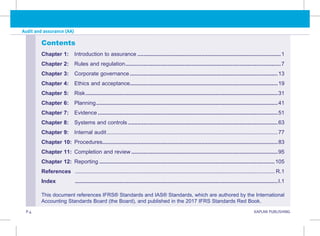
Contents
Chapter 1: Introduction to assurance...............................................................................................1
Chapter 2: Rules and regulation.......................................................................................................7
Chapter 3: Corporate governance..................................................................................................13
Chapter 4: Ethics and acceptance.................................................................................................19
Chapter 5: Risk...............................................................................................................................31
Chapter 6: Planning........................................................................................................................41
Chapter 7: Evidence.......................................................................................................................51
Chapter 8: Systems and controls...................................................................................................63
Chapter 9: Internal audit.................................................................................................................77
Chapter 10: Procedures...................................................................................................................83
Chapter 11: Completion and review.................................................................................................95
Chapter 12: Reporting....................................................................................................................105
References .................................................................................................................................... R.1
Index ......................................................................................................................................I.1
This document references IFRS® Standards and IAS® Standards, which are authored by the International
Accounting Standards Board (the Board), and published in the 2017 IFRS Standards Red Book.
KAPLAN PUBLISHING P.5
Audit and assurance (AA)
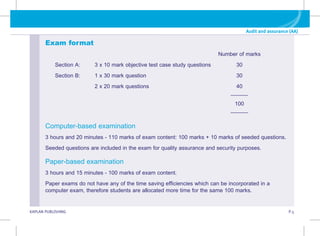
Exam format
			 Number of marks
Section A: 3 x 10 mark objective test case study questions 30
Section B: 1 x 30 mark question 30
		 2 x 20 mark questions 40
			 ––––––
			 100
			 ––––––
Computer-based examination
3 hours and 20 minutes - 110 marks of exam content: 100 marks + 10 marks of seeded questions.
Seeded questions are included in the exam for quality assurance and security purposes.
Paper-based examination
3 hours and 15 minutes - 100 marks of exam content.
Paper exams do not have any of the time saving efficiencies which can be incorporated in a
computer exam, therefore students are allocated more time for the same 100 marks.
P.6 KAPLAN PUBLISHING
Audit and assurance (AA)
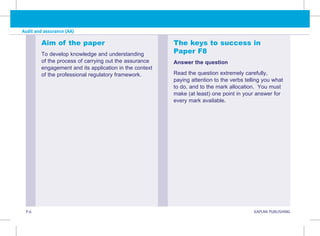
The keys to success in
Paper F8
Answer the question
Read the question extremely carefully,
paying attention to the verbs telling you what
to do, and to the mark allocation. You must
make (at least) one point in your answer for
every mark available.
Aim of the paper
To develop knowledge and understanding
of the process of carrying out the assurance
engagement and its application in the context
of the professional regulatory framework.
KAPLAN PUBLISHING P.7
Audit and assurance (AA)
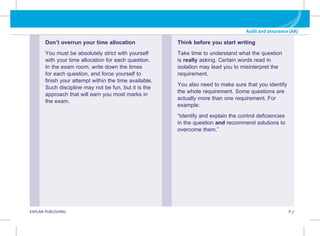
Think before you start writing
Take time to understand what the question
is really asking. Certain words read in
isolation may lead you to misinterpret the
requirement.
You also need to make sure that you identify
the whole requirement. Some questions are
actually more than one requirement. For
example:
“Identify and explain the control deficiencies
in the question and recommend solutions to
overcome them.”
Don’t overrun your time allocation
You must be absolutely strict with yourself
with your time allocation for each question.
In the exam room, write down the times
for each question, and force yourself to
finish your attempt within the time available.
Such discipline may not be fun, but it is the
approach that will earn you most marks in
the exam.
P.8 KAPLAN PUBLISHING
Audit and assurance (AA)
Quality and accuracy are of the utmost
importance to us so if you spot an error in
any of our products, please send an email
to mykaplanreporting@kaplan.com with full
details, or follow the link to the feedback
form in MyKaplan.
Our Quality Co-ordinator will work with our
technical team to verify the error and take
action to ensure it is corrected in future
editions.
1
Introduction to assurance
In this chapter
• Assurance services.
• Accountability, stewardship and agency.
chapter  
1
Introduction to assurance
2 KAPLAN PUBLISHING KA
Assurance services
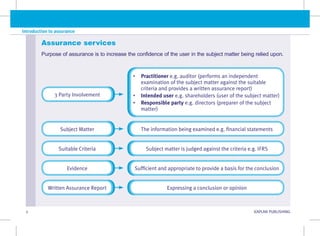
Purpose of assurance is to increase the confidence of the user in the subject matter being relied upon.
The information being examined e.g. financial statements
Sufficient and appropriate to provide a basis for the conclusion
Subject matter is judged against the criteria e.g. IFRS
Expressing a conclusion or opinion
• Practitioner e.g. auditor (performs an independent
examination of the subject matter against the suitable  
criteria and provides a written assurance report)
• Intended user e.g. shareholders (user of the subject matter)
• Responsible party e.g. directors (preparer of the subject
matter)
Subject Matter
3 Party Involvement
Evidence
Suitable Criteria
Written Assurance Report
Chapter 1
G KAPLAN PUBLISHING 3
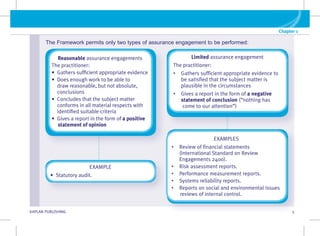
EXAMPLES
• Review of financial statements
(International Standard on Review
Engagements 2400).
• 
Risk assessment reports.
• 
Performance measurement reports.
• 
Systems reliability reports.
• 
Reports on social and environmental issues
reviews of internal control.
The Framework permits only two types of assurance engagement to be performed:
EXAMPLE
• 
Statutory audit.
Reasonable assurance engagements
The practitioner:
• Gathers sufficient appropriate evidence
• 
Does enough work to be able to
draw reasonable, but not absolute,
conclusions
• 
Concludes that the subject matter
conforms in all material respects with
identified suitable criteria
• 
Gives a report in the form of a positive
statement of opinion
Limited assurance engagement
The practitioner:
• 
Gathers sufficient appropriate evidence to
be satisfied that the subject matter is
plausible in the circumstances
• Gives a report in the form of a negative
statement of conclusion (“nothing has
come to our attention”)
Introduction to assurance
4 KAPLAN PUBLISHING KA
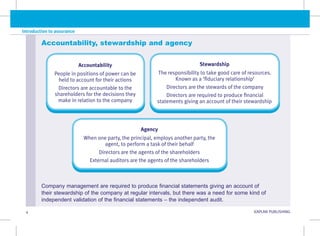
Accountability, stewardship and agency
Company management are required to produce financial statements giving an account of
their stewardship of the company at regular intervals, but there was a need for some kind of
independent validation of the financial statements – the independent audit.
Accountability
People in positions of power can be
held to account for their actions
Directors are accountable to the
shareholders for the decisions they
make in relation to the company
Stewardship
The responsibility to take good care of resources.
Known as a ‘fiduciary relationship’
Directors are the stewards of the company
Directors are required to produce financial
statements giving an account of their stewardship
Agency
When one party, the principal, employs another party, the
agent, to perform a task of their behalf
Directors are the agents of the shareholders
External auditors are the agents of the shareholders
Chapter 1
G KAPLAN PUBLISHING 5
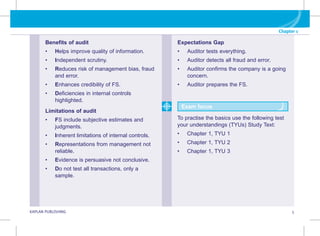
Exam focus
To practise the basics use the following test
your understandings (TYUs) Study Text:
• Chapter 1, TYU 1
• Chapter 1, TYU 2
• Chapter 1, TYU 3
Benefits of audit
• Helps improve quality of information.
• Independent scrutiny.
• Reduces risk of management bias, fraud
and error.
• Enhances credibility of FS.
• Deficiencies in internal controls
highlighted.
Limitations of audit
• FS include subjective estimates and
judgments.
• Inherent limitations of internal controls.
• Representations from management not
reliable.
• Evidence is persuasive not conclusive.
• Do not test all transactions, only a
sample.
Expectations Gap
• Auditor tests everything.
• Auditor detects all fraud and error.
• Auditor confirms the company is a going
concern.
• Auditor prepares the FS.
Introduction to assurance
6 KAPLAN PUBLISHING KA
7
Rules and regulation
In this chapter
• International and UK standard setting and regulation.
• Why have an audit.
• Who may or may not act as an auditor.
• How are auditors appointed and removed.
• Auditor’s rights and duties.
chapter  
2
Rules and regulation
8 KAPLAN PUBLISHING KA
8 KAPLAN PUBLISHING
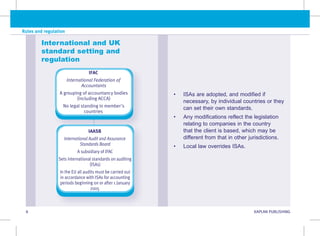
• ISAs are adopted, and modified if
necessary, by individual countries or they
can set their own standards.
• Any modifications reflect the legislation
relating to companies in the country
that the client is based, which may be
different from that in other jurisdictions.
• Local law overrides ISAs.
IFAC
International Federation of
Accountants
A grouping of accountancy bodies
(including ACCA)
No legal standing in member's
countries
IAASB
International Audit and Assurance
Standards Board
A subsidiary of IFAC
Sets international standards on auditing
(ISAs)
In the EU all audits must be carried out
in accordance with ISAs for accounting
periods beginning on or after 1 January
2005  
International and UK
standard setting and
regulation
Chapter 2
G KAPLAN PUBLISHING 9
KAPLAN PUBLISHING 9
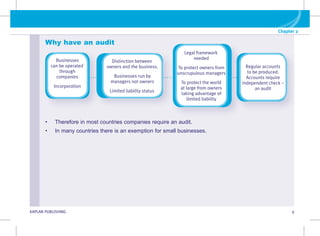
Why have an audit
• Therefore in most countries companies require an audit.
• In many countries there is an exemption for small businesses.
Businesses
can be operated
through
companies
Incorporation
Distinction between
owners and the business.
Businesses run by
managers not owners
Limited liability status
Legal framework
needed
To protect owners from
unscrupulous managers
To protect the world
at large from owners
taking advantage of
limited liability
Regular accounts
to be produced.
Accounts require
independent check –
an audit
Rules and regulation
10 KAPLAN PUBLISHING KA
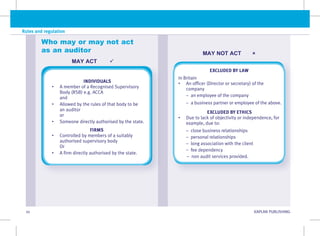
Who may or may not act
as an auditor
MAY ACT    
MAY NOT ACT   
EXCLUDED BY LAW
In Britain
• An officer (Director or secretary) of the
company
– 
an employee of the company
– 
a business partner or employee of the above.
EXCLUDED BY ETHICS
• Due to lack of objectivity or independence, for
example, due to:
– 
close business relationships
– 
personal relationships
– 
long association with the client
– 
fee dependency
– 
non audit services provided.
INDIVIDUALS
• A member of a Recognised Supervisory
Body (RSB) e.g. ACCA
and
• 
Allowed by the rules of that body to be
an auditor
or
• Someone directly authorised by the state.
FIRMS
• Controlled by members of a suitably
authorised supervisory body
Or
• 
A firm directly authorised by the state.
Chapter 2
G KAPLAN PUBLISHING 11
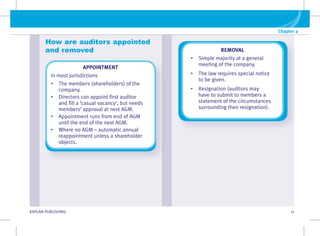
How are auditors appointed
and removed
APPOINTMENT
In most jurisdictions
• The members (shareholders) of the
company.
• 
Directors can appoint first auditor
and fill a ‘casual vacancy’, but needs
members’ approval at next AGM.
• 
Appointment runs from end of AGM
until the end of the next AGM.
• 
Where no AGM – automatic annual
reappointment unless a shareholder
objects.
REMOVAL
• 
Simple majority at a general
meeting of the company.
• The law requires special notice
to be given.
• 
Resignation (auditors may
have to submit to members a
statement of the circumstances
surrounding their resignation).
Rules and regulation
12 KAPLAN PUBLISHING KA
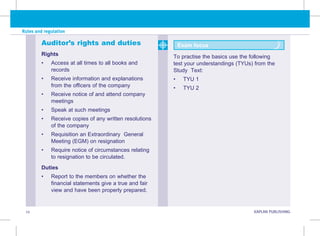
Auditor’s rights and duties
Rights
• Access at all times to all books and
records
• 
Receive information and explanations
from the officers of the company
• 
Receive notice of and attend company
meetings
• Speak at such meetings
• 
Receive copies of any written resolutions
of the company
• Requisition an Extraordinary General
Meeting (EGM) on resignation
• Require notice of circumstances relating
to resignation to be circulated.
Duties
• Report to the members on whether the
financial statements give a true and fair
view and have been properly prepared.
Exam focus
To practise the basics use the following
test your understandings (TYUs) from the
Study Text:
• TYU 1
• TYU 2
13
Corporate governance
In this chapter
• Corporate governance.
• Audit committees.
• Nomination committee.
• Remuneration committee.
• Risk management.
chapter  
3
Corporate governance
14 KAPLAN PUBLISHING KA
• Aligning key executive and board
remuneration
• Monitoring and managing potential
conflicts of interest of management,
board members and shareholders
• Ensuring the integrity of the corporation’s
accounting and financial reporting
systems, overseeing the process of
disclosure and communications.
Note the term “Board” primarily to mean
the Supervisory board in a 2 tier board
arrangement or the non-executive directors
and relevant sub committees in a unitary
board structure.
Composition of the board
• Equal numbers of executive and non-
executive directors.
• Segregation of the roles of CEO and
chairman.
• Directors subject to re-election by
shareholders at least every 3 years.
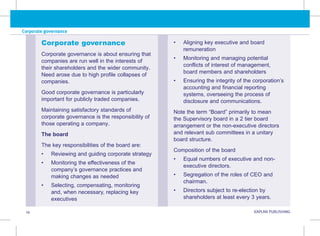
Corporate governance
Corporate governance is about ensuring that
companies are run well in the interests of
their shareholders and the wider community.
Need arose due to high profile collapses of
companies.
Good corporate governance is particularly
important for publicly traded companies.
Maintaining satisfactory standards of
corporate governance is the responsibility of
those operating a company.
The board
The key responsibilities of the board are:
• Reviewing and guiding corporate strategy
• Monitoring the effectiveness of the
company’s governance practices and
making changes as needed
• Selecting, compensating, monitoring
and, when necessary, replacing key
executives
Chapter 3
G KAPLAN PUBLISHING 15
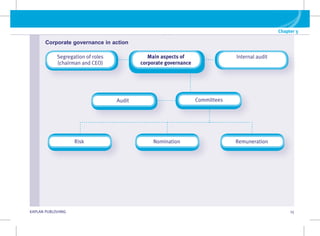
Corporate governance in action
Segregation of roles
(chairman and CEO)
Internal audit
Main aspects of
corporate governance
Committees
Audit
Nomination Remuneration
Risk
Corporate governance
16 KAPLAN PUBLISHING KA
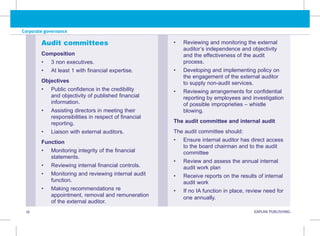
Audit committees
Composition
• 3 non executives.
• At least 1 with financial expertise.
Objectives
• Public confidence in the credibility
and objectivity of published financial
information.
• Assisting directors in meeting their
responsibilities in respect of financial
reporting.
• Liaison with external auditors.
Function
• Monitoring integrity of the financial
statements.
• Reviewing internal financial controls.
• Monitoring and reviewing internal audit
function.
• Making recommendations re
appointment, removal and remuneration
of the external auditor.
• Reviewing and monitoring the external
auditor’s independence and objectivity
and the effectiveness of the audit
process.
• Developing and implementing policy on
the engagement of the external auditor
to supply non-audit services.
• Reviewing arrangements for confidential
reporting by employees and investigation
of possible improprieties – whistle
blowing.
The audit committee and internal audit
The audit committee should:
• Ensure internal auditor has direct access
to the board chairman and to the audit
committee
• Review and assess the annual internal
audit work plan
• Receive reports on the results of internal
audit work
• If no IA function in place, review need for
one annually.
Chapter 3
G KAPLAN PUBLISHING 17
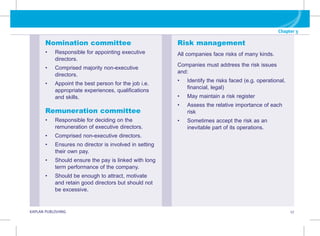
Risk management
All companies face risks of many kinds.
Companies must address the risk issues
and:
• Identify the risks faced (e.g. operational,
financial, legal)
• May maintain a risk register
• Assess the relative importance of each
risk
• Sometimes accept the risk as an
inevitable part of its operations.
Nomination committee
• Responsible for appointing executive
directors.
• Comprised majority non-executive
directors.
• Appoint the best person for the job i.e.
appropriate experiences, qualifications
and skills.
Remuneration committee
• Responsible for deciding on the
remuneration of executive directors.
• Comprised non-executive directors.
• Ensures no director is involved in setting
their own pay.
• Should ensure the pay is linked with long
term performance of the company.
• Should be enough to attract, motivate
and retain good directors but should not
be excessive.
Corporate governance
18 KAPLAN PUBLISHING KA
Exam focus
Exam kit questions in this area:
Section A – Objective case questions:
• Sistar
• Cameron
Section B – Constructed response questions:
• Saxophone Enterprises
19
Ethics and acceptance
In this chapter
• Ethical principles.
• Independence and objectivity.
• Fundamental principles, threats and safeguards.
• ACCA code of ethics and conduct.
• Threats and safeguards.
• Confidentiality.
• Acceptance of engagements.
• New work and the engagement letter.
chapter  
4
20 KAPLAN PUBLISHING KA
Ethics and acceptance
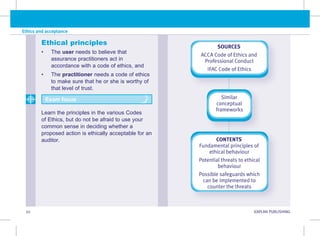
Ethical principles
• The user needs to believe that
assurance practitioners act in
accordance with a code of ethics, and
• The practitioner needs a code of ethics
to make sure that he or she is worthy of
that level of trust.
Learn the principles in the various Codes
of Ethics, but do not be afraid to use your
common sense in deciding whether a
proposed action is ethically acceptable for an
auditor.
Exam focus
SOURCES
ACCA Code of Ethics and
Professional Conduct
IFAC Code of Ethics
CONTENTS
Fundamental principles of
ethical behaviour
Potential threats to ethical
behaviour
Possible safeguards which
can be implemented to
counter the threats
Similar
conceptual
frameworks
G KAPLAN PUBLISHING 21
Chapter 4
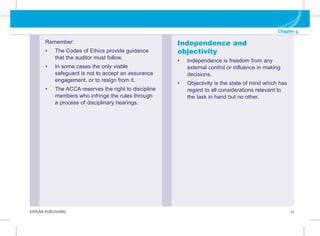
Remember:
• The Codes of Ethics provide guidance
that the auditor must follow.
• In some cases the only viable
safeguard is not to accept an assurance
engagement, or to resign from it.
• The ACCA reserves the right to discipline
members who infringe the rules through
a process of disciplinary hearings.
Independence and
objectivity
• Independence is freedom from any
external control or influence in making
decisions.
• Objectivity is the state of mind which has
regard to all considerations relevant to
the task in hand but no other.
22 KAPLAN PUBLISHING KA
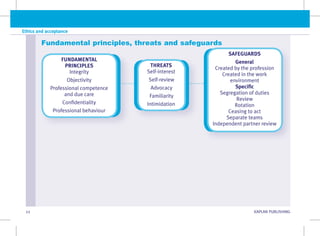
Ethics and acceptance
FUNDAMENTAL
PRINCIPLES
Integrity
Objectivity
Professional competence
and due care
Confidentiality
Professional behaviour
Fundamental principles, threats and safeguards
THREATS
Self-interest
Self-review
Advocacy
Familiarity
Intimidation
SAFEGUARDS
General
Created by the profession
Created in the work
environment
Specific
Segregation of duties
Review
Rotation
Ceasing to act
Separate teams
Independent partner review
G KAPLAN PUBLISHING 23
Chapter 4
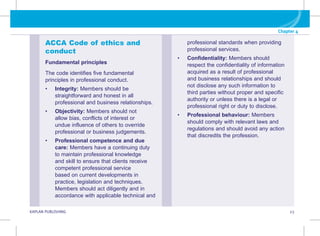
professional standards when providing
professional services.
• Confidentiality: Members should
respect the confidentiality of information
acquired as a result of professional
and business relationships and should
not disclose any such information to
third parties without proper and specific
authority or unless there is a legal or
professional right or duty to disclose.
• 
Professional behaviour: Members
should comply with relevant laws and
regulations and should avoid any action
that discredits the profession.
ACCA Code of ethics and
conduct
Fundamental principles
The code identifies five fundamental
principles in professional conduct.
• Integrity: Members should be
straightforward and honest in all
professional and business relationships.
• Objectivity: Members should not
allow bias, conflicts of interest or
undue influence of others to override
professional or business judgements.
• Professional competence and due
care: Members have a continuing duty
to maintain professional knowledge
and skill to ensure that clients receive
competent professional service
based on current developments in
practice, legislation and techniques.
Members should act diligently and in
accordance with applicable technical and
24 KAPLAN PUBLISHING KA
Ethics and acceptance
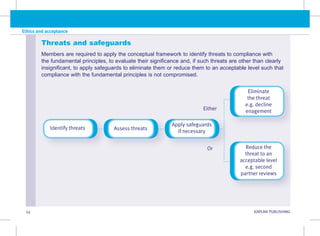
Threats and safeguards
Members are required to apply the conceptual framework to identify threats to compliance with
the fundamental principles, to evaluate their significance and, if such threats are other than clearly
insignificant, to apply safeguards to eliminate them or reduce them to an acceptable level such that
compliance with the fundamental principles is not compromised.

Identify threats Assess threats
Apply safeguards
if necessary
Reduce the
threat to an
acceptable level
e.g. second
partner reviews
Eliminate
the threat
e.g. decline
enagement
Either
Or
G KAPLAN PUBLISHING 25
Chapter 4
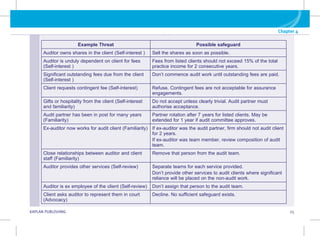
Example Threat Possible safeguard
Auditor owns shares in the client (Self-interest ) Sell the shares as soon as possible.
Auditor is unduly dependent on client for fees
(Self-interest )
Fees from listed clients should not exceed 15% of the total
practice income for 2 consecutive years.
Significant outstanding fees due from the client
(Self-interest )
Don’t commence audit work until outstanding fees are paid.
Client requests contingent fee (Self-interest) Refuse. Contingent fees are not acceptable for assurance
engagements.
Gifts or hospitality from the client (Self-interest
and familiarity)
Do not accept unless clearly trivial. Audit partner must
authorise acceptance.
Audit partner has been in post for many years
(Familiarity)
Partner rotation after 7 years for listed clients. May be
extended for 1 year if audit committee approves.
Ex-auditor now works for audit client (Familiarity) If ex-auditor was the audit partner, firm should not audit client
for 2 years.
If ex-auditor was team member, review composition of audit
team.
Close relationships between auditor and client
staff (Familiarity)
Remove that person from the audit team.
Auditor provides other services (Self-review) Separate teams for each service provided.
Don’t provide other services to audit clients where significant
reliance will be placed on the non-audit work.
Auditor is ex employee of the client (Self-review) Don’t assign that person to the audit team.
Client asks auditor to represent them in court
(Advocacy)
Decline. No sufficient safeguard exists.
26 KAPLAN PUBLISHING KA
Ethics and acceptance
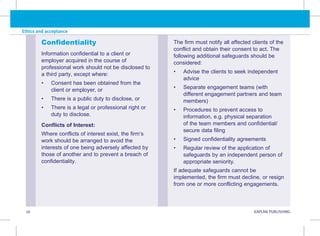
Confidentiality
Information confidential to a client or
employer acquired in the course of
professional work should not be disclosed to
a third party, except where:
• Consent has been obtained from the
client or employer, or
• There is a public duty to disclose, or
• There is a legal or professional right or
duty to disclose.
Conflicts of Interest:
Where conflicts of interest exist, the firm’s
work should be arranged to avoid the
interests of one being adversely affected by
those of another and to prevent a breach of
confidentiality.
The firm must notify all affected clients of the
conflict and obtain their consent to act. The
following additional safeguards should be
considered:
• Advise the clients to seek independent
advice
• Separate engagement teams (with
different engagement partners and team
members)
• Procedures to prevent access to
information, e.g. physical separation
of the team members and confidential/
secure data filing
• Signed confidentiality agreements
• Regular review of the application of
safeguards by an independent person of
appropriate seniority.
If adequate safeguards cannot be
implemented, the firm must decline, or resign
from one or more conflicting engagements.
G KAPLAN PUBLISHING 27
Chapter 4
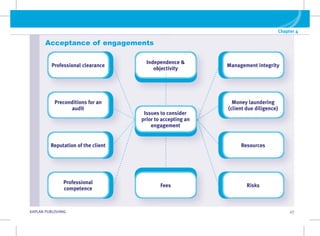
Professional clearance
Preconditions for an
audit
Reputation of the client
Professional
competence
Independence 
objectivity
Fees
Management integrity
Money laundering
(client due diligence)
Resources
Risks
Issues to consider
prior to accepting an
engagement
Acceptance of engagements
28 KAPLAN PUBLISHING KA
Ethics and acceptance
New work and the engagement letter
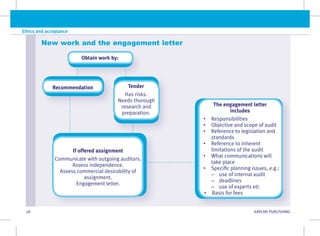
The engagement letter
includes
• Responsibilities
• Objective and scope of audit
• Reference to legislation and
standards
• Reference to inherent
limitations of the audit
• 
What communications will
take place
• 
Specific planning issues, e.g.:
–
– use of internal audit
–
– deadlines
–
– use of experts etc
• Basis for fees
Tender
Has risks.
Needs thorough
research and
preparation.
Obtain work by:
Recommendation
If offered assignment
Communicate with outgoing auditors.
Assess independence.
Assess commercial desirability of
assignment.
Engagement letter.
G KAPLAN PUBLISHING 29
Chapter 4
• A new letter may be sent every year to
emphasise its importance to clients.
• A new letter must be sent if there have
been changes, such as changes to:
–
– Statutory duties
–
– Professional duties
–
– Other services.
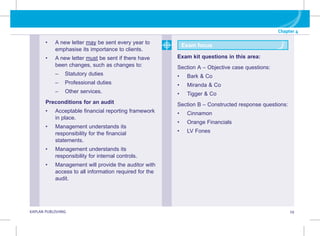
Preconditions for an audit
• Acceptable financial reporting framework
in place.
• Management understands its
responsibility for the financial
statements.
• Management understands its
responsibility for internal controls.
• Management will provide the auditor with
access to all information required for the
audit.
Exam focus
Exam kit questions in this area:
Section A – Objective case questions:
• Bark  Co
• Miranda  Co
• Tigger  Co
Section B – Constructed response questions:
• Cinnamon
• Orange Financials
• LV Fones
30 KAPLAN PUBLISHING KA
Ethics and acceptance
31
Risk
In this chapter
• Audit risk.
• Materiality.
• Significance of the risk approach.
• Understanding the entity and its environment.
• Risk assessment procedures.
• Analytical procedures.
chapter  
5
32 KAPLAN PUBLISHING
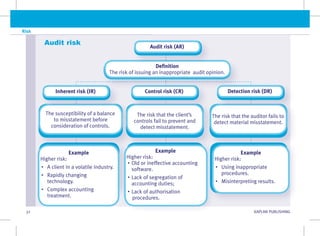
Risk
Example
Higher risk:
• A client in a volatile industry.
• Rapidly changing
technology.
• Complex accounting
treatment.
Example
Higher risk:
• Using inappropriate
procedures.
• 
Misinterpreting results.
Example
Higher risk:
• Old or ineffective accounting
software.
• Lack of segregation of
accounting duties;
• Lack of authorisation
procedures.
The susceptibility of a balance
to misstatement before
consideration of controls.
The risk that the auditor fails to
detect material misstatement.
The risk that the client’s
controls fail to prevent and
detect misstatement.
Audit risk
Control risk (CR)
Definition
The risk of issuing an inappropriate  audit opinion.
Detection risk (DR)
Inherent risk (IR)
Audit risk (AR)
KAPLAN PUBLISHING 33
Chapter 5
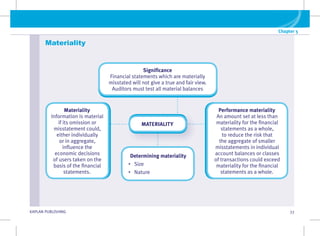
Materiality
MATERIALITY
Significance
Financial statements which are materially
misstated will not give a true and fair view.
Auditors must test all material balances
Materiality
Information is material
if its omission or
misstatement could,
either individually
or in aggregate,
influence the
economic decisions
of users taken on the
basis of the financial
statements.
Performance materiality
An amount set at less than
materiality for the financial
statements as a whole,
to reduce the risk that
the aggregate of smaller
misstatements in individual
account balances or classes
of transactions could exceed
materiality for the financial
statements as a whole.
Determining materiality
• Size
• Nature
Risk
34 KAPLAN PUBLISHING
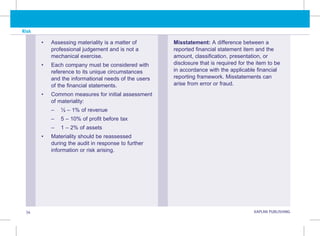
Misstatement: A difference between a
reported financial statement item and the
amount, classification, presentation, or
disclosure that is required for the item to be
in accordance with the applicable financial
reporting framework. Misstatements can
arise from error or fraud.
• Assessing materiality is a matter of
professional judgement and is not a
mechanical exercise.
• Each company must be considered with
reference to its unique circumstances
and the informational needs of the users
of the financial statements.
• Common measures for initial assessment
of materiality:
–
– ½ – 1% of revenue
–
– 5 – 10% of profit before tax
–
– 1 – 2% of assets
• Materiality should be reassessed
during the audit in response to further
information or risk arising.
KAPLAN PUBLISHING 35
Chapter 5
KAPLAN PUBLISHING 35
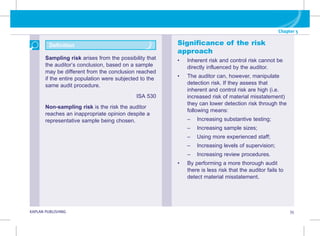
Sampling risk arises from the possibility that
the auditor’s conclusion, based on a sample
may be different from the conclusion reached
if the entire population were subjected to the
same audit procedure.
ISA 530
Non-sampling risk is the risk the auditor
reaches an inappropriate opinion despite a
representative sample being chosen.
Significance of the risk
approach
• Inherent risk and control risk cannot be
directly influenced by the auditor.
• The auditor can, however, manipulate
detection risk. If they assess that
inherent and control risk are high (i.e.
increased risk of material misstatement)
they can lower detection risk through the
following means:
–
– Increasing substantive testing;
–
– Increasing sample sizes;
–
– Using more experienced staff;
–
– Increasing levels of supervision;
–
– Increasing review procedures.
• By performing a more thorough audit
there is less risk that the auditor fails to
detect material misstatement.
Definition
36 KAPLAN PUBLISHING
Risk
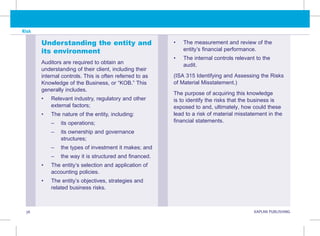
Understanding the entity and
its environment
Auditors are required to obtain an
understanding of their client, including their
internal controls. This is often referred to as
Knowledge of the Business, or “KOB.” This
generally includes.
• Relevant industry, regulatory and other
external factors;
• The nature of the entity, including:
–
– its operations;
–
– 
its ownership and governance
structures;
–
– the types of investment it makes; and
–
– the way it is structured and financed.
• The entity’s selection and application of
accounting policies.
• The entity’s objectives, strategies and
related business risks.
• The measurement and review of the
entity’s financial performance.
• The internal controls relevant to the
audit.
(ISA 315 Identifying and Assessing the Risks
of Material Misstatement.)
The purpose of acquiring this knowledge
is to identify the risks that the business is
exposed to and, ultimately, how could these
lead to a risk of material misstatement in the
financial statements.
KAPLAN PUBLISHING 37
Chapter 5
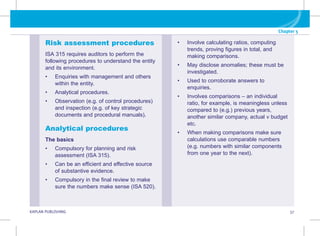
• Involve calculating ratios, computing
trends, proving figures in total, and
making comparisons.
• May disclose anomalies; these must be
investigated.
• Used to corroborate answers to
enquiries.
• Involves comparisons – an individual
ratio, for example, is meaningless unless
compared to (e.g.) previous years,
another similar company, actual v budget
etc.
• When making comparisons make sure
calculations use comparable numbers
(e.g. numbers with similar components
from one year to the next).
Risk assessment procedures
ISA 315 requires auditors to perform the
following procedures to understand the entity
and its environment.
• Enquiries with management and others
within the entity.
• Analytical procedures.
• Observation (e.g. of control procedures)
and inspection (e.g. of key strategic
documents and procedural manuals).
Analytical procedures
The basics
• Compulsory for planning and risk
assessment (ISA 315).
• Can be an efficient and effective source
of substantive evidence.
• Compulsory in the final review to make
sure the numbers make sense (ISA 520).
38 KAPLAN PUBLISHING
Risk
38 KAPLAN PUBLISHING
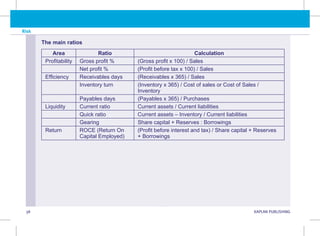
The main ratios
Area Ratio Calculation
Profitability Gross profit % (Gross profit x 100) / Sales
Net profit % (Profit before tax x 100) / Sales
Efficiency Receivables days (Receivables x 365) / Sales
Inventory turn (Inventory x 365) / Cost of sales or Cost of Sales /
Inventory
Payables days (Payables x 365) / Purchases
Liquidity Current ratio Current assets / Current liabilities
Quick ratio Current assets – Inventory / Current liabilities
Gearing Share capital + Reserves : Borrowings
Return ROCE (Return On
Capital Employed)
(Profit before interest and tax) / Share capital + Reserves
+ Borrowings
KAPLAN PUBLISHING 39
Chapter 5
KAPLAN PUBLISHING 39
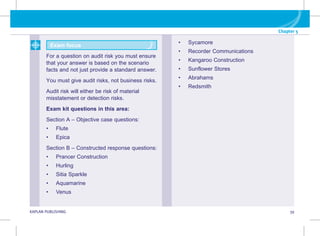
• Sycamore
• Recorder Communications
• Kangaroo Construction
• Sunflower Stores
• Abrahams
• Redsmith
For a question on audit risk you must ensure
that your answer is based on the scenario
facts and not just provide a standard answer.
You must give audit risks, not business risks.
Audit risk will either be risk of material
misstatement or detection risks.
Exam kit questions in this area:
Section A – Objective case questions:
• Flute
• Epica
Section B – Constructed response questions:
• Prancer Construction
• Hurling
• Sitia Sparkle
• Aquamarine
• Venus
Exam focus
40 KAPLAN PUBLISHING
Risk
41
Planning
In this chapter
• Planning process.
• Audit strategy and the plan.
• Impact of fraud.
• Fraud risk assessment procedures.
• Laws and regulations.
• Quality control.
• Documentation.
• Benefits of documentation.
• Working papers.
chapter  
6
Planning
42 KAPLAN PUBLISHING KA
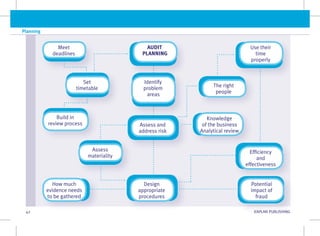
Assess and
address risk
Design
appropriate
procedures
Assess
materiality
How much
evidence needs
to be gathered
The right
people
Use their
time
properly
Efficiency
and
effectiveness
Potential
impact of
fraud
AUDIT
PLANNING
Identify
problem
areas
Set
timetable
Meet
deadlines
Build in
review process
Knowledge
of the business
Analytical review
Chapter 6
G KAPLAN PUBLISHING 43
Planning process
Adequate planning helps to ensure that:
• 
Attention is paid to the important areas
of the audit
• 
Potential problems are identified and
resolved on a timely basis
• 
The audit engagement is organised and
managed in order to be performed in an
efficient and effective manner
• 
Work is properly assigned to the
individual team members
• 
Reduces risk of giving the wrong opinion.
Planning
44 KAPLAN PUBLISHING KA
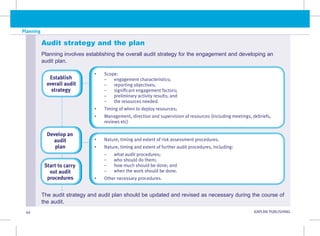
Establish
overall audit
strategy
Develop an
audit
plan
Start to carry
out audit
procedures
• Scope:
– engagement characteristics;
– reporting objectives;
– significant engagement factors;
– preliminary activity results; and
– the resources needed.
• Timing of when to deploy resources;
• Management, direction and supervision of resources (including meetings, debriefs,
reviews etc)
• Nature, timing and extent of risk assessment procedures.
• Nature, timing and extent of further audit procedures, including:
– what audit procedures;
– who should do them;
– how much should be done; and
– when the work should be done.
• Other necessary procedures.
Audit strategy and the plan
Planning involves establishing the overall audit strategy for the engagement and developing an
audit plan.
The audit strategy and audit plan should be updated and revised as necessary during the course of
the audit.
Chapter 6
G KAPLAN PUBLISHING 45
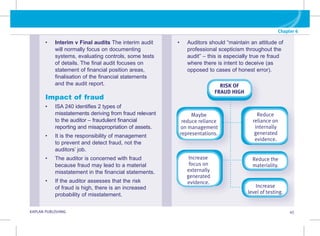
RISK OF
FRAUD HIGH
Reduce
reliance on
internally
generated
evidence.   
Reduce the
materiality.
Increase
focus on
externally
generated
evidence.
Increase
level of testing.
Maybe
reduce reliance
on management
representations.
• Interim v Final audits The interim audit
will normally focus on documenting
systems, evaluating controls, some tests
of details. The final audit focuses on
statement of financial position areas,
finalisation of the financial statements
and the audit report.
Impact of fraud
• ISA 240 identifies 2 types of
misstatements deriving from fraud relevant
to the auditor – fraudulent financial
reporting and misappropriation of assets.
• It is the responsibility of management
to prevent and detect fraud, not the
auditors’ job.
• The auditor is concerned with fraud
because fraud may lead to a material
misstatement in the financial statements.
• If the auditor assesses that the risk
of fraud is high, there is an increased
probability of misstatement.
• Auditors should “maintain an attitude of
professional scepticism throughout the
audit” – this is especially true re fraud
where there is intent to deceive (as
opposed to cases of honest error).
Planning
46 KAPLAN PUBLISHING KA
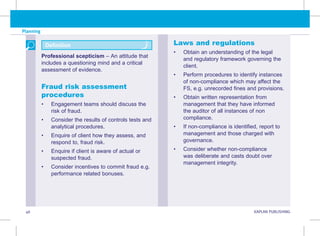
Laws and regulations
• Obtain an understanding of the legal
and regulatory framework governing the
client.
• Perform procedures to identify instances
of non-compliance which may affect the
FS, e.g. unrecorded fines and provisions.
• Obtain written representation from
management that they have informed
the auditor of all instances of non
compliance.
• If non-compliance is identified, report to
management and those charged with
governance.
• Consider whether non-compliance
was deliberate and casts doubt over
management integrity.
Fraud risk assessment
procedures
• Engagement teams should discuss the
risk of fraud.
• Consider the results of controls tests and
analytical procedures.
• Enquire of client how they assess, and
respond to, fraud risk.
• Enquire if client is aware of actual or
suspected fraud.
• Consider incentives to commit fraud e.g.
performance related bonuses.
Professional scepticism – An attitude that
includes a questioning mind and a critical
assessment of evidence.
Definition
Chapter 6
G KAPLAN PUBLISHING 47
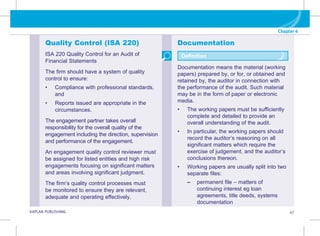
Documentation
Documentation means the material (working
papers) prepared by, or for, or obtained and
retained by, the auditor in connection with
the performance of the audit. Such material
may be in the form of paper or electronic
media.
• The working papers must be sufficiently
complete and detailed to provide an
overall understanding of the audit.
• In particular, the working papers should
record the auditor’s reasoning on all
significant matters which require the
exercise of judgement, and the auditor’s
conclusions thereon.
• Working papers are usually split into two
separate files:
–
– 
permanent file – matters of
continuing interest eg loan
agreements, title deeds, systems
documentation
Definition
Quality Control (ISA 220)
ISA 220 Quality Control for an Audit of
Financial Statements
The firm should have a system of quality
control to ensure:
• Compliance with professional standards,
and
• Reports issued are appropriate in the
circumstances.
The engagement partner takes overall
responsibility for the overall quality of the
engagement including the direction, supervision
and performance of the engagement.
An engagement quality control reviewer must
be assigned for listed entities and high risk
engagements focusing on significant matters
and areas involving significant judgment.
The firm’s quality control processes must
be monitored to ensure they are relevant,
adequate and operating effectively.
Planning
48 KAPLAN PUBLISHING
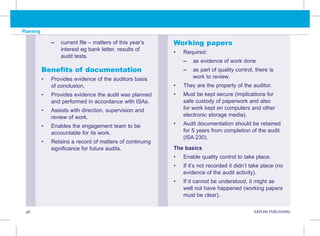
–
– 
current file – matters of this year’s
interest eg bank letter, results of
audit tests.
Benefits of documentation
• Provides evidence of the auditors basis
of conclusion.
• Provides evidence the audit was planned
and performed in accordance with ISAs.
• Assists with direction, supervision and
review of work.
• Enables the engagement team to be
accountable for its work.
• Retains a record of matters of continuing
significance for future audits.
Working papers
• Required:
–
– as evidence of work done
–
– 
as part of quality control, there is
work to review.
• They are the property of the auditor.
• Must be kept secure (implications for
safe custody of paperwork and also
for work kept on computers and other
electronic storage media).
• Audit documentation should be retained
for 5 years from completion of the audit
(ISA 230).
The basics
• Enable quality control to take place.
• If it’s not recorded it didn’t take place (no
evidence of the audit activity).
• If it cannot be understood, it might as
well not have happened (working papers
must be clear).
Chapter 6
KAPLAN PUBLISHING 49
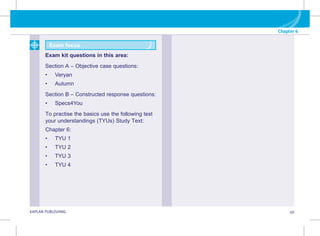
Exam focus
Exam kit questions in this area:
Section A – Objective case questions:
• Veryan
• Autumn
Section B – Constructed response questions:
• Specs4You
To practise the basics use the following test
your understandings (TYUs) Study Text:
Chapter 6:
• TYU 1
• TYU 2
• TYU 3
• TYU 4
Planning
50 KAPLAN PUBLISHING KA
51
Evidence
In this chapter
• Type of audit evidence.
• Audit procedures.
• Assertions.
• Computer assisted audit techniques.
• Sampling.
• Relying on the work of others.
chapter  
7
Evidence
52 KAPLAN PUBLISHING KA
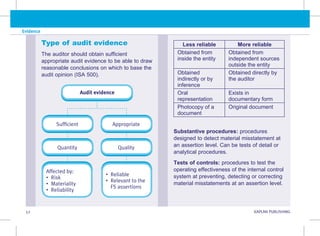
Type of audit evidence
The auditor should obtain sufficient
appropriate audit evidence to be able to draw
reasonable conclusions on which to base the
audit opinion (ISA 500).
Less reliable More reliable
Obtained from
inside the entity
Obtained from
independent sources
outside the entity
Obtained
indirectly or by
inference
Obtained directly by
the auditor
Oral
representation
Exists in
documentary form
Photocopy of a
document
Original document
Substantive procedures: procedures
designed to detect material misstatement at
an assertion level. Can be tests of detail or
analytical procedures.
Tests of controls: procedures to test the
operating effectiveness of the internal control
system at preventing, detecting or correcting
material misstatements at an assertion level.
Audit evidence
Affected by:
• 
Risk
• Materiality
• Reliability
• Reliable
• 
Relevant to the
FS assertions
Appropriate
Sufficient
Quality
Quantity
Chapter 7
G KAPLAN PUBLISHING 53
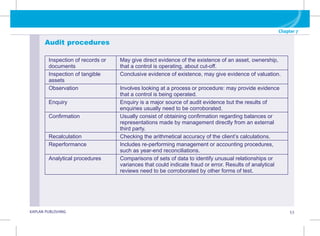
Audit procedures
Inspection of records or
documents
May give direct evidence of the existence of an asset, ownership,
that a control is operating, about cut-off.
Inspection of tangible
assets
Conclusive evidence of existence, may give evidence of valuation.
Observation Involves looking at a process or procedure: may provide evidence
that a control is being operated.
Enquiry Enquiry is a major source of audit evidence but the results of
enquiries usually need to be corroborated.
Confirmation Usually consist of obtaining confirmation regarding balances or
representations made by management directly from an external
third party.
Recalculation Checking the arithmetical accuracy of the client’s calculations.
Reperformance Includes re-performing management or accounting procedures,
such as year-end reconciliations.
Analytical procedures Comparisons of sets of data to identify unusual relationships or
variances that could indicate fraud or error. Results of analytical
reviews need to be corroborated by other forms of test.
Evidence
54 KAPLAN PUBLISHING KA
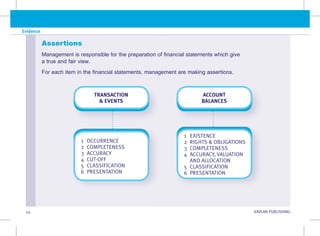
Assertions
Management is responsible for the preparation of financial statements which give
a true and fair view.
For each item in the financial statements, management are making assertions.
TRANSACTION
 EVENTS
1 OCCURRENCE
2 COMPLETENESS
3 ACCURACY
4 CUT-OFF
5 CLASSIFICATION
6 PRESENTATION
ACCOUNT
BALANCES
1 EXISTENCE
2 RIGHTS  OBLIGATIONS
3 COMPLETENESS
4 
ACCURACY, VALUATION
AND ALLOCATION
5 CLASSIFICATION
6 PRESENTATION
Chapter 7
G KAPLAN PUBLISHING 55
Analytical procedures as substantive
procedures
• The suitability of this approach depends
on:
–
– 
the assertions being tested (maybe
good for valuation, bad for existence)
–
– 
the reliability of the data (unsuitable
if controls are weak as numbers
could be wrong)
–
– 
the degree of precision possible
(more suited to regular transactions
than one off items)
–
– 
the amount of variation which is
acceptable (some numbers in
financials require greater accuracy
than others).
Evidence
56 KAPLAN PUBLISHING KA
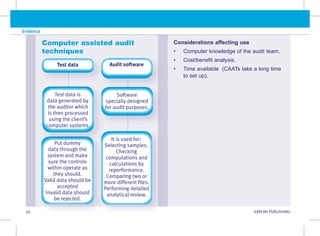
Test data
Put dummy
data through the
system and make
sure the controls
within operate as
they should.
Valid data should be
accepted
Invalid data should
be rejected.
Test data is
data generated by
the auditor which
is then processed
using the client’s
computer systems.
Audit software
It is used for:
Selecting samples.
Checking
computations and
calculations by
reperformance.
Comparing two or
more different files.
Performing detailed
analytical review.
Software
specially designed
for audit purposes.
Computer assisted audit
techniques
Considerations affecting use
• Computer knowledge of the audit team.
• Cost/benefit analysis.
• Time available (CAATs take a long time
to set up).
Chapter 7
G KAPLAN PUBLISHING 57
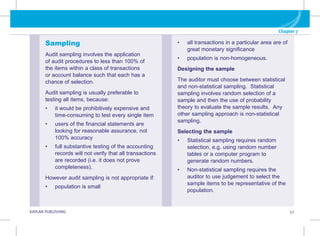
Sampling
Audit sampling involves the application
of audit procedures to less than 100% of
the items within a class of transactions
or account balance such that each has a
chance of selection.
Audit sampling is usually preferable to
testing all items, because:
• it would be prohibitively expensive and
time-consuming to test every single item
• users of the financial statements are
looking for reasonable assurance, not
100% accuracy
• full substantive testing of the accounting
records will not verify that all transactions
are recorded (i.e. it does not prove
completeness).
However audit sampling is not appropriate if:
• population is small
• all transactions in a particular area are of
great monetary significance
• population is non-homogeneous.
Designing the sample
The auditor must choose between statistical
and non-statistical sampling. Statistical
sampling involves random selection of a
sample and then the use of probability
theory to evaluate the sample results. Any
other sampling approach is non-statistical
sampling.
Selecting the sample
• Statistical sampling requires random
selection, e.g. using random number
tables or a computer program to
generate random numbers.
• Non-statistical sampling requires the
auditor to use judgement to select the
sample items to be representative of the
population.
Evidence
58 KAPLAN PUBLISHING KA
Evaluating the sample results
The auditor carries out audit procedures
on each item selected and documents the
results. Errors identified in the sample are
then projected across the population as a
whole.
Sampling Methods:
• Random
• Haphazard
• Monetary Unit Sampling
• Systematic
• Block
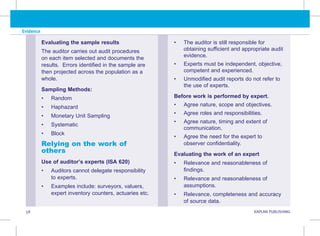
Relying on the work of
others
Use of auditor’s experts (ISA 620)
• Auditors cannot delegate responsibility
to experts.
• Examples include: surveyors, valuers,
expert inventory counters, actuaries etc.
• The auditor is still responsible for
obtaining sufficient and appropriate audit
evidence.
• Experts must be independent, objective,
competent and experienced.
• Unmodified audit reports do not refer to
the use of experts.
Before work is performed by expert.
• Agree nature, scope and objectives.
• Agree roles and responsibilities.
• Agree nature, timing and extent of
communication.
• Agree the need for the expert to
observer confidentiality.
Evaluating the work of an expert
• Relevance and reasonableness of
findings.
• Relevance and reasonableness of
assumptions.
• Relevance, completeness and accuracy
of source data.
Chapter 7
G KAPLAN PUBLISHING 59
Using internal audit to provide direct
assistance
• Internal audit function can provide direct
assistance to the external auditor under
their supervision and review.
• Cannot be provided where laws and
regulations prohibit such assistance.
• The competence and objectivity of the
internal auditor must be considered.
• Must not do work which involves
significant judgement, a high risk of
material misstatement or with which the
internal auditor has been involved.
• Planned work must be communicated
with those charged with governance.
• Cannot make excessive use of internal
auditor.
• Management must not intervene in that
work.
• Internal auditors must keep the external
auditor’s information confidential.
Using the work of internal audit (ISA 610)
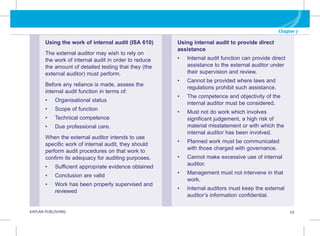
The external auditor may wish to rely on
the work of internal audit in order to reduce
the amount of detailed testing that they (the
external auditor) must perform.
Before any reliance is made, assess the
internal audit function in terms of:
• Organisational status
• Scope of function
• Technical competence
• Due professional care.
When the external auditor intends to use
specific work of internal audit, they should
perform audit procedures on that work to
confirm its adequacy for auditing purposes.
• Sufficient appropriate evidence obtained
• Conclusion are valid
• Work has been properly supervised and
reviewed
Evidence
60 KAPLAN PUBLISHING KA
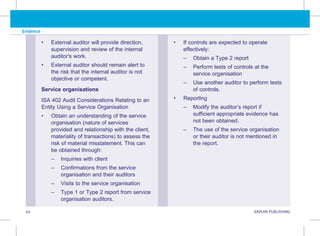
• External auditor will provide direction,
supervision and review of the internal
auditor's work.
• External auditor should remain alert to
the risk that the internal auditor is not
objective or competent.
Service organisations
ISA 402 Audit Considerations Relating to an
Entity Using a Service Organisation
• Obtain an understanding of the service
organisation (nature of services
provided and relationship with the client,
materiality of transactions) to assess the
risk of material misstatement. This can
be obtained through:
–
– Inquiries with client
–
– 
Confirmations from the service
organisation and their auditors
–
– Visits to the service organisation
–
– 
Type 1 or Type 2 report from service
organisation auditors.
• If controls are expected to operate
effectively:
–
– Obtain a Type 2 report
–
– 
Perform tests of controls at the
service organisation
–
– 
Use another auditor to perform tests
of controls.
• Reporting
–
– 
Modify the auditor’s report if
sufficient appropriate evidence has
not been obtained.
–
– 
The use of the service organisation
or their auditor is not mentioned in
the report.
Chapter 7
G KAPLAN PUBLISHING 61
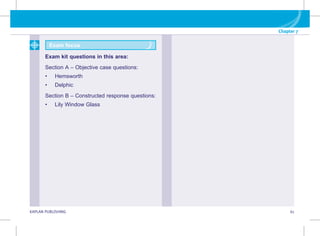
Exam focus
Exam kit questions in this area:
Section A – Objective case questions:
• Hemsworth
• Delphic
Section B – Constructed response questions:
• Lily Window Glass
Evidence
62 KAPLAN PUBLISHING KA
63
Systems and controls
In this chapter
• Internal control systems.
• The auditor and controls.
• Sales cycle.
• Purchase cycle.
• Payroll system.
• Cash system.
• Inventory.
• Communications on internal controls.
chapter  
8
64 KAPLAN PUBLISHING
Systems and controls
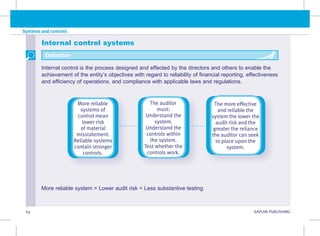
More reliable system = Lower audit risk = Less substantive testing
Internal control systems
Internal control is the process designed and effected by the directors and others to enable the
achievement of the entity’s objectives with regard to reliability of financial reporting, effectiveness
and efficiency of operations, and compliance with applicable laws and regulations.
Definition
The more effective
and reliable the
system the lower the
audit risk and the
greater the reliance
the auditor can seek
to place upon the
system.
More reliable
systems of
control mean
lower risk
of material
misstatement.
Reliable systems
contain stronger
controls.
The auditor
must:
Understand the
system.
Understand the
controls within
the system.
Test whether the
controls work.
KAPLAN PUBLISHING 65
Chapter 8
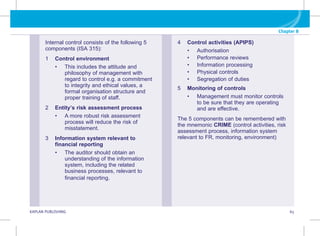
Internal control consists of the following 5
components (ISA 315):
1 Control environment
• This includes the attitude and
philosophy of management with
regard to control e.g. a commitment
to integrity and ethical values, a
formal organisation structure and
proper training of staff.
2 Entity’s risk assessment process
• A more robust risk assessment
process will reduce the risk of
misstatement.
3	
Information system relevant to
financial reporting
• The auditor should obtain an
understanding of the information
system, including the related
business processes, relevant to
financial reporting.
4 Control activities (APIPS)
• Authorisation
• Performance reviews
• Information processing
• Physical controls
• Segregation of duties
5 Monitoring of controls
• Management must monitor controls
to be sure that they are operating
and are effective.
The 5 components can be remembered with
the mnemonic CRIME (control activities, risk
assessment process, information system
relevant to FR, monitoring, environment)
66 KAPLAN PUBLISHING
Systems and controls
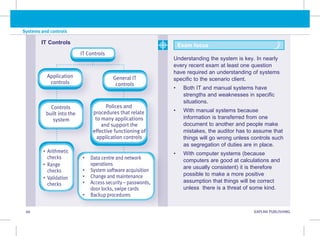
IT Controls
IT Controls
Application
controls
General IT
controls
Controls
built into the
system
Polices and
procedures that relate
to many applications
and support the
effective functioning of
application controls
Understanding the system is key. In nearly
every recent exam at least one question
have required an understanding of systems
specific to the scenario client.
• Both IT and manual systems have
strengths and weaknesses in specific
situations.
• With manual systems because
information is transferred from one
document to another and people make
mistakes, the auditor has to assume that
things will go wrong unless controls such
as segregation of duties are in place.
• With computer systems (because
computers are good at calculations and
are usually consistent) it is therefore
possible to make a more positive
assumption that things will be correct
unless there is a threat of some kind.
Exam focus
• Data centre and network
operations
• System software acquisition
• Change and maintenance
• Access security – passwords,
door locks, swipe cards
• Backup procedures
• Arithmetic
checks
• 
Range
checks
• 
Validation
checks
KAPLAN PUBLISHING 67
Chapter 8
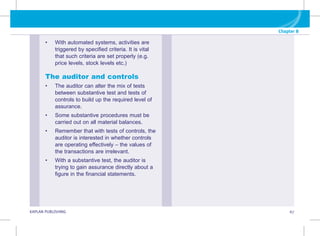
• With automated systems, activities are
triggered by specified criteria. It is vital
that such criteria are set properly (e.g.
price levels, stock levels etc.)
The auditor and controls
• The auditor can alter the mix of tests
between substantive test and tests of
controls to build up the required level of
assurance.
• Some substantive procedures must be
carried out on all material balances.
• Remember that with tests of controls, the
auditor is interested in whether controls
are operating effectively – the values of
the transactions are irrelevant.
• With a substantive test, the auditor is
trying to gain assurance directly about a
figure in the financial statements.
68 KAPLAN PUBLISHING
Systems and controls
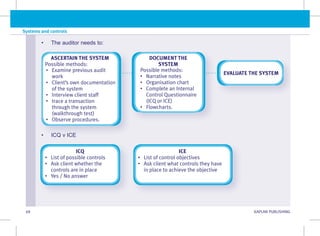
ASCERTAIN THE SYSTEM
Possible methods:
• The auditor needs to:
ICE
• List of control objectives
• 
Ask client what controls they have
in place to achieve the objective
EVALUATE THE SYSTEM
DOCUMENT THE
SYSTEM
ICQ
• List of possible controls
• 
Ask client whether the
controls are in place
• 
Yes / No answer
• ICQ v ICE
• 
Examine previous audit
work
• 
Client’s own documentation
of the system
• 
Interview client staff
• 
trace a transaction
through the system        
(walkthrough test)
• Observe procedures.
Possible methods:
• Narrative notes
• Organisation chart
• 
Complete an Internal
Control Questionnaire
(ICQ or ICE)
• Flowcharts.
KAPLAN PUBLISHING 69
Chapter 8
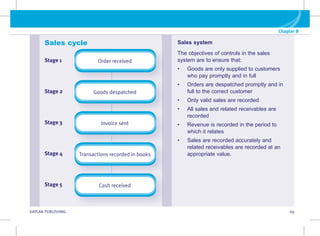
Sales system
The objectives of controls in the sales
system are to ensure that:
• Goods are only supplied to customers
who pay promptly and in full
• Orders are despatched promptly and in
full to the correct customer
• Only valid sales are recorded
• All sales and related receivables are
recorded
• Revenue is recorded in the period to
which it relates
• Sales are recorded accurately and
related receivables are recorded at an
appropriate value.
Sales cycle
Order received
Goods despatched
Invoice sent
Transactions recorded in books
Cash received
Stage 1
Stage 2
Stage 3
Stage 4
Stage 5
70 KAPLAN PUBLISHING
Systems and controls
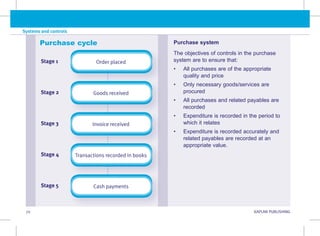
Purchase cycle
Order placed
Goods received
Invoice received
Transactions recorded in books
Cash payments
Stage 1
Stage 2
Stage 3
Stage 4
Stage 5
Purchase system
The objectives of controls in the purchase
system are to ensure that:
• All purchases are of the appropriate
quality and price
• Only necessary goods/services are
procured
• All purchases and related payables are
recorded
• Expenditure is recorded in the period to
which it relates
• Expenditure is recorded accurately and
related payables are recorded at an
appropriate value.
KAPLAN PUBLISHING 71
Chapter 8
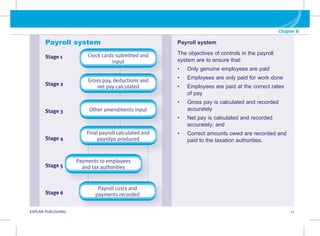
Payroll system
Stage 1
Stage 2
Stage 3
Stage 4
Stage 5
Stage 6
Clock cards submitted and
input
Gross pay, deductions and
net pay calculated
Other amendments input
Final payroll calculated and
payslips produced
Payments to employees
and tax authorities
Payroll costs and
payments recorded
Payroll system
The objectives of controls in the payroll
system are to ensure that:
• Only genuine employees are paid
• Employees are only paid for work done
• Employees are paid at the correct rates
of pay
• Gross pay is calculated and recorded
accurately
• Net pay is calculated and recorded
accurately; and
• Correct amounts owed are recorded and
paid to the taxation authorities.
72 KAPLAN PUBLISHING
Systems and controls
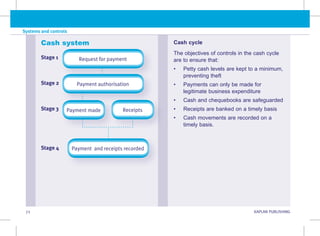
Cash system
Stage 1
Stage 2
Stage 3
Stage 4
Request for payment
Payment authorisation
Payment made
Payment  and receipts recorded
Receipts
Cash cycle
The objectives of controls in the cash cycle
are to ensure that:
• Petty cash levels are kept to a minimum,
preventing theft
• Payments can only be made for
legitimate business expenditure
• Cash and chequebooks are safeguarded
• Receipts are banked on a timely basis
• Cash movements are recorded on a
timely basis.
KAPLAN PUBLISHING 73
Chapter 8
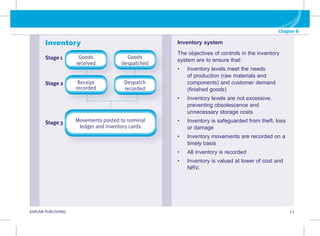
Stage 1
Stage 2
Stage 3
Goods
received
Receipt
recorded
Movements posted to nominal
ledger and inventory cards
Goods
despatched
Despatch
recorded
Inventory Inventory system
The objectives of controls in the inventory
system are to ensure that:
• Inventory levels meet the needs
of production (raw materials and
components) and customer demand
(finished goods)
• Inventory levels are not excessive,
preventing obsolescence and
unnecessary storage costs
• Inventory is safeguarded from theft, loss
or damage
• Inventory movements are recorded on a
timely basis
• All inventory is recorded
• Inventory is valued at lower of cost and
NRV.
74 KAPLAN PUBLISHING
Systems and controls
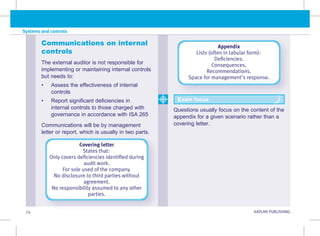
Covering letter
States that:
Only covers deficiencies identified during
audit work.
For sole used of the company.
No disclosure to third parties without
agreement.
No responsibility assumed to any other
parties.
Appendix
Lists (often in tabular form):
Deficiencies.
Consequences.
Recommendations.
Space for management's response.
Communications on internal
controls
The external auditor is not responsible for
implementing or maintaining internal controls
but needs to:
• Assess the effectiveness of internal
controls
• Report significant deficiencies in
internal controls to those charged with
governance in accordance with ISA 265
Communications will be by management
letter or report, which is usually in two parts.
Questions usually focus on the content of the
appendix for a given scenario rather than a
covering letter.
Exam focus
KAPLAN PUBLISHING 75
Chapter 8
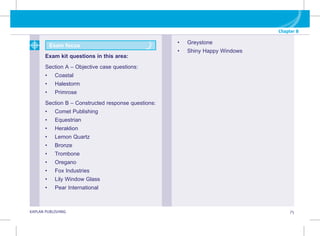
• Greystone
• Shiny Happy Windows
Exam focus
Exam kit questions in this area:
Section A – Objective case questions:
• Coastal
• Halestorm
• Primrose
Section B – Constructed response questions:
• Comet Publishing
• Equestrian
• Heraklion
• Lemon Quartz
• Bronze
• Trombone
• Oregano
• Fox Industries
• Lily Window Glass
• Pear International
76 KAPLAN PUBLISHING
Systems and controls
77
Internal audit
In this chapter
• Internal audit.
• Comparison of internal and external audit.
• Outsourcing the internal audit function.
• Producing an internal audit report.
chapter  
9
78 KAPLAN PUBLISHING KA
Internal audit
Internal audit
Definition of internal audit: an
independent, objective assurance and
consulting activity designed to add value
and improve an organisation’s operations.
The need for internal audit depends on:
• Scale, diversity and complexity of
activities
• Number of employees
• Cost/benefit considerations
• The desire of senior management to
have assurance and advice on risk
and control.
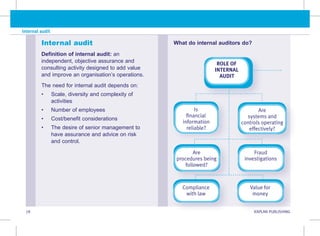
What do internal auditors do?
ROLE OF
INTERNAL
AUDIT
Is
financial
information
reliable?
Are
systems and
controls operating
effectively?
Are
procedures being
followed?
Fraud
investigations
Compliance
with law
Value for
money
G KAPLAN PUBLISHING 79
Chapter 9
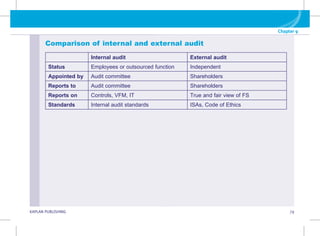
Comparison of internal and external audit
Internal audit External audit
Status Employees or outsourced function Independent
Appointed by Audit committee Shareholders
Reports to Audit committee Shareholders
Reports on Controls, VFM, IT True and fair view of FS
Standards Internal audit standards ISAs, Code of Ethics
80 KAPLAN PUBLISHING KA
Internal audit
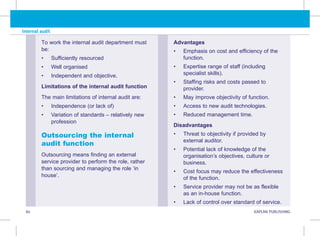
To work the internal audit department must
be:
• Sufficiently resourced
• Well organised
• Independent and objective.
Limitations of the internal audit function
The main limitations of internal audit are:
• Independence (or lack of)
• Variation of standards – relatively new
profession
Outsourcing the internal
audit function
Outsourcing means finding an external
service provider to perform the role, rather
than sourcing and managing the role ‘in
house’.
Advantages
• Emphasis on cost and efficiency of the
function.
• Expertise range of staff (including
specialist skills).
• Staffing risks and costs passed to
provider.
• May improve objectivity of function.
• Access to new audit technologies.
• Reduced management time.
Disadvantages
• Threat to objectivity if provided by
external auditor.
• Potential lack of knowledge of the
organisation’s objectives, culture or
business.
• Cost focus may reduce the effectiveness
of the function.
• Service provider may not be as flexible
as an in-house function.
• Lack of control over standard of service.
G KAPLAN PUBLISHING 81
Chapter 9
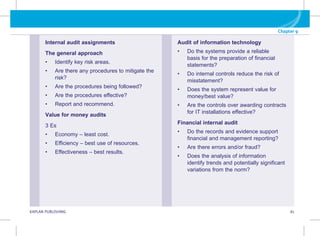
Internal audit assignments
The general approach
• Identify key risk areas.
• Are there any procedures to mitigate the
risk?
• Are the procedures being followed?
• Are the procedures effective?
• Report and recommend.
Value for money audits
3 Es
• Economy – least cost.
• Efficiency – best use of resources.
• Effectiveness – best results.
Audit of information technology
• Do the systems provide a reliable
basis for the preparation of financial
statements?
• Do internal controls reduce the risk of
misstatement?
• Does the system represent value for
money/best value?
• Are the controls over awarding contracts
for IT installations effective?
Financial internal audit
• Do the records and evidence support
financial and management reporting?
• Are there errors and/or fraud?
• Does the analysis of information
identify trends and potentially significant
variations from the norm?
82 KAPLAN PUBLISHING KA
Internal audit
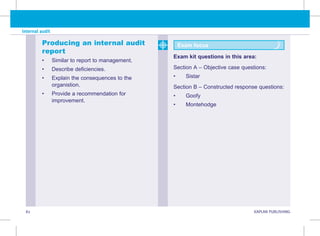
Producing an internal audit
report
• Similar to report to management.
• Describe deficiencies.
• Explain the consequences to the
organistion.
• Provide a recommendation for
improvement.
Exam focus
Exam kit questions in this area:
Section A – Objective case questions:
• Sistar
Section B – Constructed response questions:
• Goofy
• Montehodge
83
chapter  
10 Procedures
In this chapter
• Audit of receivables.
• Inventory.
• Audit of liabilities.
• Audit of bank and cash.
• Audit of tangible non-current assets.
• Accounting estimates.
• Statement of profit or loss procedures.
• Smaller entities.
• Not-for-profit organisations.
84 KAPLAN PUBLISHING KA
Procedures
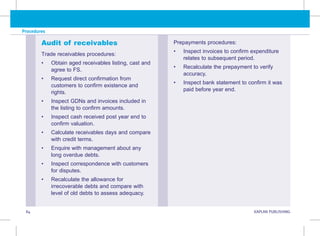
Audit of receivables
Trade receivables procedures:
• Obtain aged receivables listing, cast and
agree to FS.
• Request direct confirmation from
customers to confirm existence and
rights.
• Inspect GDNs and invoices included in
the listing to confirm amounts.
• Inspect cash received post year end to
confirm valuation.
• Calculate receivables days and compare
with credit terms.
• Enquire with management about any
long overdue debts.
• Inspect correspondence with customers
for disputes.
• Recalculate the allowance for
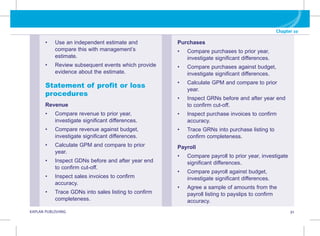
irrecoverable debts and compare with
level of old debts to assess adequacy.
Prepayments procedures:
• Inspect invoices to confirm expenditure
relates to subsequent period.
• Recalculate the prepayment to verify
accuracy.
• Inspect bank statement to confirm it was
paid before year end.
G KAPLAN PUBLISHING 85
Chapter 10
Inventory
• Can be raw materials, work in progress
and finished goods.
• Main test areas:
–
– 
existence / completeness – attend
inventory count
–
– valuation.
Attendance at the inventory count
Where inventory is material the auditor
should attend the inventory count unless
impracticable.
Before the count
• Review the previous year’s working
papers for issues.
• Review the client’s instructions issued to
the counters for adequacy.
• Identify any problem areas and discuss
them with the client.
During the count
• Observe the conduct of the count to
ensure instructions being carried out
properly.
• Make limited test counts to check the
accuracy of the count.
• Make notes of any damaged or possibly
obsolete inventory.
• Record document numbers for
subsequent test of cut-off – see below.
• Reach a conclusion as to whether the
count was carried out satisfactorily.
• Trace goods in the warehouse to the
count sheets of completeness.
• Trace goods on the count sheets to the
warehouse for existence.
86 KAPLAN PUBLISHING KA
Procedures
After the count
• Inspect the inventory listing to ensure
damaged/obsolete items have been
written down to NRV.
• Inspect the inventory listing for the items
on the last GRNs and GDNs obtained to
ensure cut-off is correctly applied.
• Trace items on the count sheets obtained
during the count into the inventory listing
to ensure the quantities have not been
changed.
• Calculate inventory days ratio and
compare with prior year to identify any
slow moving items requiring write down.
• Inspect the aged inventory listing for
old items and discuss the need for write
down with management.
• Inspect purchase invoice to verify cost.
• Inspect post year end sales invoices to
verify NRV.
• Review calculations of overheads
included in WIP and ensure only
production related overheads are
included.
G KAPLAN PUBLISHING 87
Chapter 10
Audit of liabilities
Trade payables procedures
• Obtain aged payables listing, cast and
agree to FS.
• Inspect purchase invoices and GRNs
included on the listing to confirm
accuracy of recording.
• Obtain/perform supplier statement
reconciliations to identify discrepancies.
• Obtain direct confirmation of balances
from suppliers where supplier statements
are not available.
• Inspect post year end bank statements
for payments made which may indicate
unrecorded liabilities.
• Calculate payables days ratio and
compare with credit terms given to
identify unusual differences and discuss
with management.
• Inspect GRNs for before the year end to
ensure completeness.
You must be clear about the two separate
tasks facing the auditor:
• Does the inventory exist? Attend the
inventory count to find out.
• Is the inventory correctly valued?
The two tasks are inter-related, i.e. the
auditor can identify damaged or dusty
(slow-moving) inventory at the count, and
then confirm that these inventory lines have
been written down to NRV in the valuation
exercise.
Exam focus
Procedures
88 KAPLAN PUBLISHING
Accruals procedures
• Obtain the list of accruals, cast and
agree to FS.
• Compare the accruals list with prior year
to identify any missing accruals and
discuss with management.
• Agree corporation tax accrual to tax
computation.
• Agree payroll tax accrual to payroll
records.
• Inspect post year end bank statements
for payments of accruals to confirm the
amount is reasonable.
• Inspect invoices received post year end
to confirm amount of the accrual.
Loans and overdraft procedures
• Agree balances outstanding to bank
confirmation letter and/or loan statement.
• Inspect the loan agreement for terms and
conditions such as restrictive covenants.
• Recalculate the split of current and non-
current liabilities and agree to FS.
• Review FS disclosure is adequate.
• Recalculate any interest accrual to verify
accuracy.
• Inspect bank statements for loan and
interest payments.
Chapter 10
KAPLAN PUBLISHING 89
Provisions and contingencies
Procedures
• Enquire with management the basis of
the provision to assess reasonableness.
• Recalculate the provision to confirm
arithmetical accuracy.
• Obtain written representation from
management as to the adequacy and
completeness of the provision.
• For a legal provision obtain confirmation
from lawyers regarding amount and
probability.
• Inspect board minutes to confirm an
obligation exists at year end.
• Review subsequent events for further
evidence.
Audit of bank and cash
Procedures
• Obtain listing of bank and cash balances,
cast and agree to FS.
• Obtain a bank confirmation letter for all
bank accounts held.
• Obtain bank reconciliations for all bank
accounts and cast to confirm accuracy.
• Agree the balance per the cash book to
the ledger.
• Agree the balance per the bank
statement to the bank letter.
• Agree unpresented cheques to the post
year end bank statements to confirm
they have cleared in a reasonable time.
• Agree outstanding lodgements to the
paying in book and post year end bank
statements.
• Perform a cash count for any material
cash balances or where fraud may be
suspected.
Procedures
• Inspect title deeds, registration
documents for the client’s name.
Accounting estimates
An accounting estimate is an approximation
of the amount of an item in the absence of a
precise means of measurement.
Examples of accounting estimates.
• Depreciation charges (since the
useful life and residual value of a
fixed asset are only estimates).
• Provision for a loss from a court case.
• Provision to meet warranty claims.
In accordance with ISA 540 use one or a
combination of the following approaches.
• Review and test the process used by
management to develop the estimate.
90 KAPLAN PUBLISHING
• Inspect the bank letter for any other
details requiring disclosure such as
security over assets.
Audit of tangible non-current
assets
Main procedures
• Select a sample of assets from the
asset register and physically inspect
them (existence).
• Select a sample of assets visible at the
client premises and inspect the asset
register to ensure they are included
(completeness).
• Reperform depreciation calculations or
perform a predictive analytical review
calculation on depreciation figures.
• Note the condition of assets when
inspecting them and relate to valuation.
• Review any valuers’ reports to confirm
valuation.
Chapter 10
KAPLAN PUBLISHING 91
Purchases
• Compare purchases to prior year,
investigate significant differences.
• Compare purchases against budget,
investigate significant differences.
• Calculate GPM and compare to prior
year.
• Inspect GRNs before and after year end
to confirm cut-off.
• Inspect purchase invoices to confirm
accuracy.
• Trace GRNs into purchase listing to
confirm completeness.
Payroll
• Compare payroll to prior year, investigate
significant differences.
• Compare payroll against budget,
investigate significant differences.
• Agree a sample of amounts from the
payroll listing to payslips to confirm
accuracy.
• Use an independent estimate and
compare this with management’s
estimate.
• Review subsequent events which provide
evidence about the estimate.
Statement of profit or loss
procedures
Revenue
• Compare revenue to prior year,
investigate significant differences.
• Compare revenue against budget,
investigate significant differences.
• Calculate GPM and compare to prior
year.
• Inspect GDNs before and after year end
to confirm cut-off.
• Inspect sales invoices to confirm
accuracy.
• Trace GDNs into sales listing to confirm
completeness.
Procedures
92 KAPLAN PUBLISHING
• Recalculate a sample of employee’s pay
to confirm accuracy.
• Agree a sample of names from
employee contracts into payroll listing to
confirm completeness.
This chapter includes many examples
of typical procedures. When answering
questions don’t note down everything you
can think of. Auditing requires professional
judgement so always consider when
answering a question:
• risks involved
• the nature of the items being tested
• assertions being tested.
Every exam paper contains questions
requiring audit procedures.
Smaller entities
Clients that are small businesses exhibit
several characteristics. They are usually:
• lower risk assignments
• under the direct control of owner
managers (who know what is going on)
• have simpler systems.
But there are potential problems with:
• possibility of management override
• lack of segregation of duties.
There should be no change in the application
of risk based auditing (assuming that they
require, under current legislation, an audit).
Exam focus
Chapter 10
KAPLAN PUBLISHING 93
Not-for-profit organisations
• Small not for profit organisations have
many of the attributes of other small
entities mentioned earlier.
• But such organisations tend to be staffed
by volunteers.
• Their culture is more likely to be one of
trust rather than accountability.
• Therefore documentation and controls
may be less formal.
Audit approach
In principle, the approach should be exactly
as studied so far, in accordance with
auditing standards. The same ideas of
audit planning, risk assessment, testing of
controls, etc can be applied.
Income can be a serious problem for the
auditor, since it is usually accounted for
on a cash basis, with little accompanying
documentation. Detailed analytical
procedures and written representations from
managers can assist, but the auditor may
struggle to gain sufficient audit evidence of
the completeness of income.
Expenditure. The NFP is likely to have
certain stated aims, so expenditure must be
consistent with these aims.
• Review the post year end period to
compare to actual performance.
• Recalculate balances and cast.
• Review board minutes.
94 KAPLAN PUBLISHING KA
Procedures
Exam kit questions in this area:
Section A – Objective case questions:
• Eagle Heating
• Hawk
• Swandive
• Hightown
Section B – Constructed response questions:
• Dashing
• Airsoft
• Elounda
• Andromeda
• Hawthorn
• Rose Leisure Club
• Pineapple Beach Hotel
Exam focus
95
Completion and review
In this chapter
• Final review.
• Evaluation of misstatements.
• Subsequent events.
• Going concern.
• Written representations.
chapter  
11
96 KAPLAN PUBLISHING
Completion and review
Overall review
Going concern
Evaluation of
misstatements
Subsequent events
Written representations
Completion and review
KAPLAN PUBLISHING 97
Chapter 11
Are the FS
consistent with our
knowledge of the
business?
Do the FS
comply with statute
and accounting
standards?
Is the quality of the
audit work up to
standard?
Do the
financial statements
give a true and fair
view?
Have
appropriate
accounting policies
been followed?
Have the firm’s
procedures been
followed?
Final review
98 KAPLAN PUBLISHING
Completion and review
Final review
The reviewer should ask:
• Has the work has been performed in
accordance with professional standards
and regulatory and legal requirements?
• What significant matters have been
raised for further consideration?
• Have appropriate consultations taken
place and the resulting conclusions been
documented and implemented?
• Is there a need to revise the nature,
timing and extent of the work performed?
• Does the work performed support the
conclusions reached?
• Is the work appropriately documented?
• Is the evidence obtained sufficient and
appropriate to support the auditor’s
report?
• Have the objectives of the engagement
procedures have been achieved?
Evaluation of misstatements
(ISA 450)
• All identified errors should be recorded
on a working paper set up for the
purpose.
• Individually immaterial errors may,
in aggregate, amount to a material
difference.
• Management should be requested to
adjust all identified misstatements.
• All uncorrected misstatements should
be communicated to those charged
with governance and a description of
the implications for the audit report, if
appropriate.
• If any material misstatements remain
unadjusted the auditor would modify the
audit opinion.
KAPLAN PUBLISHING 99
Chapter 11
Subsequent events (ISA 560)
Subsequent events are events occurring and facts discovered between the period end and the
date the financial statements are authorised for issue.
Adjusting events Non-adjusting events
Provide additional evidence about
conditions existing at the statement of
financial position date.
Provide evidence about conditions arising
after the statement of financial position
date.
Require adjustment Require disclosure if material
• Trade receivables become irrecoverable
debts
• Inventory held at year-end is sold for
less than cost after year-end
• Estimate for a provision is revised
• Fire destroys inventory after the year-
end
• Injury resulting in legal action occurs
after year-end
• Takeover
IAS® 10 Events After the Reporting Period
Definition
100 KAPLAN PUBLISHING
Completion and review
Going concern (ISA 570)
The going concern concept
A company is assumed to be a going
concern if it is likely to continue trading for
the foreseeable future.
• When preparing financial statements, the
directors should assess whether there
are significant doubts about an entity’s
ability to continue as a going concern.
• The auditor’s responsibility is to consider
the appropriateness of management’s
use of the going concern assumption,
and whether there are adequate
disclosures regarding uncertainties about
the entity’s ability to continue as a going
concern.
Definition
• Up to the date of the audit report, the
auditor must watch out for subsequent
events that might require adjustment or
disclosure in the financial statements.
• After the date of the audit report, the
auditor has no duty to actively search for
subsequent events. However, if he does
learn of subsequent events, he should
discuss the matter with the directors and
consider whether amended financial
statements are necessary.
• Procedures involve:
–
– 
enquiry and discussion
–
– review of minutes
–
– 
review of budgets, management
accounts, other financial data
–
– written representation
–
– 
normal procedures (looking at after
date cash receipts, payments, cutoff
etc.).
KAPLAN PUBLISHING 101
Chapter 11
Typical indicators of going concern
problems
• Net current liabilities
• Necessary borrowing facilities not agreed
• Significant liquidity or cashflow problems
• Substantial operating losses
• Inability to pay debts (eg, tax payments)
as they fall due
• Loss of key management or staff
• Loss of key suppliers or customers.
Typical audit procedures
• Review cash flow forecasts and post-
year-end management accounts to
analyse trends in performance.
• Review correspondence with major
customers for evidence of disputes.
• Inspect correspondence from the bank to
assess the likelihood of obtaining further
finance.
• Inspect correspondence from lawyers
regarding outcome of legal cases which
could impact going concern.
• Inspect board minutes for management’s
plan address GC issues.
• Obtain written representation from
management that they believe the
company is a going concern.
102 KAPLAN PUBLISHING
Completion and review
Written representations (ISA
580)
Written representations are representations
made by management to the auditor during
the course of the audit, either unsolicited or
in response to specific enquiries.
• Representations from management are a
source of audit evidence.
• ISA 580 requires that the auditor should
obtain written representations from
management on matters material to the
financial statements when other sufficient
appropriate audit evidence cannot
reasonably be expected to exist.
• As part of the completion process
the auditors will write to the client’s
management stating the issues about
which they are seeking representations.
Definition
Examples of matters included in a written
representation
Confirmation from management that they
have fulfilled their responsibilities in respect
of the following:
• preparing the financial statements in
accordance with an applicable financial
reporting framework.
• providing the auditor with all relevant
information and access to records.
• recording all transactions and reflecting
them in the financial statements.
Specific matters
• That management believe the
assumptions used for areas of
judgement are reasonable.
• That provisions and liabilities are
complete.
• That a particular product line is going to
continue.
KAPLAN PUBLISHING 103
Chapter 11
Matters required by other ISAs
• All known and suspected frauds have
been communicated to the auditor
(ISA 240)
• All instances of non-compliance with
laws and regulations have been
communicated to the auditor (ISA 250)
• Management believe the effects
of uncorrected misstatements are
immaterial (ISA 450)
• All subsequent events have been
communicated to the auditor (ISA 560)
• All going concern issues have been
communicated to the auditor (ISA 570)
• Written management representations
are documentary evidence, obtained
directly by the auditor. However, the
evidence is not independent. So the
auditor uses professional judgement to
assess the value of such representations
and consider management’s competence
to make the representations and
management’s integrity.
104 KAPLAN PUBLISHING
Completion and review
Exam kit questions in this area:
Section A – Objective case questions:
• Humphries
• Greenfields
Section B – Constructed response questions:
• Clarinet
• Panda
Exam focus
105
Reporting
In this chapter
• The audit opinion.
• Elements of an unmodified audit report.
• Example of an unmodified audit report.
• Modified opinions.
• Additional communications.
chapter  
12
106 KAPLAN PUBLISHING KA
Reporting
The audit opinion
• An unmodified report is the standard
wording (see example).
• A modified report is any change from
the standard wording. This can either be
achieved by modifying the wording of the
audit opinion or by adding an additional
paragraph to the report.
Elements of an unmodified
audit report
• Title
• Addressee
• Auditor’s opinion
• Basis for opinion
• Key audit matters (if listed)
• Other information
• Responsibilities of management
• Auditor responsibilities
• Other reporting responsibilities
• Name of the engagement partner
• Signature
• Auditor’s address
• Date
G KAPLAN PUBLISHING 107
Chapter 12
Example of an unmodified audit report
INDEPENDENT AUDITOR’S REPORT
To the Shareholders of ABC Company
Opinion
We have audited the financial statements of the ABC Company (the Company), which
comprise the statement of financial position as at 31 December, 20X4, and the statement of
comprehensive income, statement of changes in equity and statement of cash flows for the
year then ended, and notes to the financial statements, including a summary of significant
accounting policies.
In our opinion, the accompanying financial statements present fairly, in all material respects, (or
give a true and fair view of) the financial position of the Company as at December 31, 20X4,
and its performance and its cash flows for the year then ended in accordance with International
Financial Reporting Standards.
Basis for Opinion
We conducted our audit in accordance with International Standards on Auditing (ISAs). Our
responsibilities under those standards are further described in the Auditor’s Responsibilities
for the Audit of the Financial Statements section of our report. We are independent of the
Company in accordance with the ethical requirements that are relevant to our audit of the
financial statements in [jurisdiction], and we have fulfilled our other ethical responsibilities in
108 KAPLAN PUBLISHING KA
Reporting
accordance with these requirements. We believe that the audit evidence we have obtained is
sufficient and appropriate to provide a basis for our opinion.
Key Audit Matters
Key audit matters are those matters that, in our professional judgment, were of most
significance in our audit of the financial statements of the current period. These matters were
addressed in the context of our audit of the financial statements as a whole, and in forming our
opinion thereon, and we do not provide a separate opinion on these matters.
[Description of each key audit matter in accordance with ISA 701]
Other information
Management is responsible for the other information. The other information comprises the
Chairman’s statement, but does not include the financial statements and the auditor’s report
thereon.
Our opinion on the financial statements does not cover the other information and we do not
express any form of assurance conclusion thereon.
In connection with our audit of the financial statements, our responsibility is to read the other
information and, in doing so, consider whether the other information is materially inconsistent
with the financial statements or our knowledge obtained in the audit or otherwise appears to
be materially misstated. If, based on the work we have performed, we conclude that there is a
G KAPLAN PUBLISHING 109
Chapter 12
material misstatement of this information, we are required to report that fact. We have nothing
to report in this regard.
Responsibilities of Management and Those Charged With Governance for the Financial
Statements
Management is responsible for the preparation and fair presentation of these financial
statements in accordance with International Financial Reporting Standards, and for such
internal control as management determines is necessary to enable the preparation of financial
statements that are free from material misstatement, whether due to fraud or error.
In preparing the financial statements, management is responsible for assessing the Company’s
ability to continue as a going concern, disclosing as applicable, matters related to going
concern and using the going concern basis of accounting unless management either intends to
liquidate the Company or to cease operations, or has no realistic alternative but to do so.
Those charged with governance are responsible for overseeing the Company’s financial
reporting process.
Auditor’s Responsibilities for the Audit of the Financial Statements
Our objectives are to obtain reasonable assurance about whether the financial statements as
a whole are free from material misstatement, whether due to fraud or error, and to issue an
auditor’s report that includes our opinion. Reasonable assurance is a high level of assurance,
but is not a guarantee that an audit conducted in accordance with ISAs will always detect a
110 KAPLAN PUBLISHING KA
Reporting
material misstatement when it exists. Misstatements can arise from fraud or error and are
considered material if, individually or in the aggregate, they could reasonably be expected to
influence the economic decisions of users taken on the basis of these financial statements.
As part of an audit in accordance with ISAs, we exercise professional judgment and maintain
professional scepticism throughout the audit. We also:
• Identify and assess the risks of material misstatement of the financial statements, whether
due to fraud or error, design and perform audit procedures responsive to those risks, and
obtain audit evidence that is sufficient and appropriate to provide a basis for our opinion.
The risk of not detecting a material misstatement resulting from fraud is higher than for
one resulting from error, as fraud may involve collusion, forgery, intentional omissions,
misrepresentations, or the override of internal control.
• Obtain an understanding of internal control relevant to the audit in order to design audit
procedures that are appropriate in the circumstances, but not for the purpose of expressing
an opinion on the effectiveness of the Company’s internal control.
• Evaluate the appropriateness of accounting policies used and the reasonableness of
accounting estimates and related disclosures made by management.
• Conclude on the appropriateness of management’s use of the going concern basis of
accounting and, based on the audit evidence obtained, whether a material uncertainty exists
related to events or conditions that may cast significant doubt on the Company’s ability
to continue as a going concern. If we conclude that a material uncertainty exists, we are
required to draw attention in our auditor’s report to the related disclosures in the financial
G KAPLAN PUBLISHING 111
Chapter 12
statements or, if such disclosures are inadequate, to modify our opinion. Our conclusions are
based on the audit evidence obtained up to the date of our auditor’s report. However, future
events or conditions may cause the Company to cease trading as a going concern.
• Evaluate the overall presentation, structure and content of the financial statements,
including the disclosures, and whether the financial statements represent the underlying
transactions and events in a manner that achieves fair presentation.
We communicate with those charged with governance regarding, among other matters,
the planned scope and timing of the audit and significant findings, including any significant
deficiencies in internal control that we identify during our audit.
We also provide those charged with governance with a statement that we have complied with
relevant ethical requirements regarding independence, and to communicate with them all
relationships and other matters that may reasonably be thought to bear on our independence,
and where applicable, related safeguards.
From the matters communicated with those charged with governance, we determine those
matters that were of most significance in the audit of the financial statements of the current
period and are therefore the key audit matters. We describe these matters in our auditor’s
report unless law or regulation precludes public disclosure about the matter or when, in
extremely rare circumstances, we determine that a matter should not be communicated in
our report because the adverse consequences of doing so would reasonably be expected to
outweigh the public interest benefits of such communication.
112 KAPLAN PUBLISHING KA
Reporting
The opinion should be modified under the following circumstances:
• the financial statements are NOT free from material misstatement; or
• the auditor was unable to obtain sufficient appropriate evidence.
The wording of the opinion then depends upon whether the material is:
• material but not pervasive (i.e. isolated to certain elements of the financial statements); or
• material and pervasive (i.e. infiltrates so much of the financial statements that they are
unreliable as a whole).
If the opinion is being modified, a ‘basis for’ paragraph will be included to explain the reason for the
modification.
Report on Other Legal and Regulatory Requirements
[As required by local law, regulation or national auditing standards]
The engagement partner on the audit resulting in this independent auditor’s
report is ....
Signature
Address
Date
G KAPLAN PUBLISHING 113
Chapter 12
Modified Opinions
Auditor’s Judgement about the Pervasiveness of the Matter
Nature of the Matter Material but NOT Pervasive Material AND Pervasive
Financial statements are
materially misstated
Qualified opinion
(“...except for...”)
Adverse opinion
(“...do not present fairly...”)
Unable to obtain
sufficient appropriate
audit evidence
Qualified opinion
(“...except for...”)
Disclaimer of opinion
(“...we do not express an
opinion...”)
Reporting
114 KAPLAN PUBLISHING
Key audit matters
Key audit matters are those that in the
auditor’s professional judgment were of most
significance in the audit and are selected
from matters communicated to those
charged with governance.
Examples:
• Significant risks of material misstatement
• Significant areas of judgement
• Significant events or transactions
Other information
Other information is defined as financial
and non-financial information included in
a document containing audited financial
statements and the auditor’s report.
Examples include a Chairman’s Statement
and Directors’ Report.
Additional communications
Material uncertainty relating to going
concern
Included where the directors have made
adequate disclosure of material uncertainties
relating to going concern to draw the user’s
attention to the disclosure.
Emphasis of matter
Included to draw the user’s attention to a
note disclosed in the financial statements
(usually in relation to fundamental
uncertainties/contingencies).
Other matters
Included to draw the user’s attention to
other matters not related to the financial
statements. e.g. further information about the
auditor’s responsibilities.
Chapter 12
KAPLAN PUBLISHING 115
The auditor must read this information to
identify any inconsistencies between the
information and the financial statements or
their knowledge of the client.
If the other information is received before
the date of the auditor’s report, a separate
section should be included in the audit report
under the heading ‘Other Information’. In this
section the auditor should:
• Identify the other information obtained
prior to the date of the audit report.
• State that the auditor has not audited the
other information and accordingly does
not express an opinion or conclusion on
that information.
• Include a description of the auditor’s
responsibilities with respect to other
information.
• State either that the auditor has nothing
to report, or a description of the material
misstatement.
Exam focus
Exam kit questions in this area:
Section A – Objective case questions:
• Mississippi
• Pacific
• Magical Mystery Tour
• Paddington
Section B – Constructed response questions:
• Chestnut
• Paprika
• Violet
• Minnie
116 KAPLAN PUBLISHING KA
Reporting
R.1
References
R.2 KAPLAN PUBLISHING
References
IAS® 10 Events After the Reporting Period
I.1
Index
I.2 KAPLAN PUBLISHING KA
Index
A
Accepting an engagement 27
Accounting estimates 90
Accruals procedures 88
Adverse opinion 113
Analytical procedures 37
Application controls 66
Appointment of auditors 11
Ascertain the system 68
Assertions 54
Assurance services 1
Audit committees 16
Auditor’s rights and duties 12
Audit plan 44
Audit procedures 53
Audit risk 32
Audit software 56
Audit strategy 44
Audit strategy and the plan 44
B
Bank and cash procedures 89
‘Basis for’ paragraph 112
C
Cash system 72
Completion and review 95
Computer assisted audit techniques 56
Confidentiality 23, 26
Conflicts of Interest 26
Control environment 65
Control risk (CR) 32
Corporate governance 13
D
Detection risk (DR) 32
Disclaimer of opinion 113
Documentation 48
Document the system 68
E
Elements of the audit report 106
Engagement letter 28
Ethics and acceptance 19
Evaluation of misstatements 98
Evidence 51
G KAPLAN PUBLISHING I.3
Index
F
Final review 97
Fraud 46
Fundamental principles 23
G
General IT controls 66
Going concern 100
I
IAASB 8
IFAC 8
Independence 21
Inherent risk (IR) 32
Integrity 23
Internal audit 77
Internal audit assignments 81
Internal control systems 64
Inventory 85
Inventory system 73
ISA 220 48
ISA 240 46
ISA 265 74
ISA 315 36, 65
ISA 320 33
ISA 402 60
ISA 450 98
ISA 500 52
ISA 520 37
ISA 540 90
ISA 560 99
ISA 570 100
ISA 580 102
ISA 610 59
ISA 620 58
IT Controls 66
L
Laws and regulation 47
Limitations of the internal audit function 80
Limited assurance 3
Loans and overdraft procedures 88
I.4 KAPLAN PUBLISHING KA
Index
M
Management letter 74
Materiality 33
Modified Opinions 113
N
Nomination committee 17
Non-current assets procedures 90
Not-for-profit organisations 93
O
Objectivity 23
Outsourcing the internal audit function 80
P
Payroll system 71
Planning 41
Prepayments procedures 84
Procedures 83
Professional competence and due care 23
Professional scepticism 46
Provisions and contingencies 89
Purchase cycle 70
Q
Qualified opinion 113
R
Ratios 38
Reasonable assurance 3
Relying on the work of others 58
Removal of auditors 11
Remuneration committee 17
Reporting 105
Risk 31
Risk assessment procedures 37
Risk management 17
Rules and regulation 7
G KAPLAN PUBLISHING I.5
Index
S
Sales cycle 69
Sampling 57
Sampling risk 35
Smaller entities 92
Subsequent events 99
Sufficient appropriate audit evidence 52
Systems and controls 63
T
Test data 56
Threats  safeguards 24
Trade payables procedures 87
Trade receivables procedures 84
U
Understanding the entity and its environment
36
Use of auditor’s experts 58
Using the work of Internal audit 59
V
Value for money audits 81
W
Working papers 49
Written representations 102
Index
I.6 KAPLAN PUBLISHING

ACCA Kaplan(ISDC) AA-F8 Pocket Notes pdf

  • 1.
    ACCA Audit and assurance(AA) Pocket Notes
  • 2.
    P.2 KAPLAN PUBLISHING Auditand assurance (AA) British library cataloguing-in-publication data A catalogue record for this book is available from the British Library. Published by: Kaplan Publishing UK Unit 2 The Business Centre Molly Millars Lane Wokingham Berkshire RG41 2QZ ISBN: 978-1-78740-124-2 © Kaplan Financial Limited, 2018 Printed and bound in Great Britain. The text in this material and any others made available by any Kaplan Group company does not amount to advice on a particular matter and should not be taken as such. No reliance should be placed on the content as the basis for any investment or other decision or in connection with any advice given to third parties. Please consult your appropriate professional adviser as necessary. Kaplan Publishing Limited, all other Kaplan group companies, the International Accounting Standards Board, and the IFRS Foundation expressly disclaim all liability to any person in respect of any losses or other claims, whether direct, indirect, incidental, consequential or otherwise arising in relation to the use of such materials. Printed and bound in Great Britain.
  • 3.
    KAPLAN PUBLISHING P.3 Auditand assurance (AA) Trade Marks The IFRS Foundation logo, the IASB logo, the IFRS for SMEs logo, the “Hexagon Device”, “IFRS Foundation”, “eIFRS”, “IAS”, “IASB”, “IFRS for SMEs”, “NIIF” IASs” “IFRS”, “IFRSs”, “International Accounting Standards”, “International Financial Reporting Standards”, “IFRIC”, “SIC” and “IFRS Taxonomy”. Further details of the Trade Marks including details of countries where the Trade Marks are registered or applied for are available from the Foundation on request. This product contains material that is ©Financial Reporting Council Ltd (FRC). Adapted and reproduced with the kind permission of the Financial Reporting Council. All rights reserved. For further information, please visit www.frc.org.uk or call +44 (0)20 7492 2300. Acknowledgements This Product includes propriety content of the International Accounting Standards Board which is overseen by the IFRS Foundation, and is used with the express permission of the IFRS Foundation under licence. All rights reserved. No part of this publication may be reproduced, stored in a retrieval system, or transmitted in any form or by any means, electronic, mechanical, photocopying, recording, or otherwise, without prior written permission of Kaplan Publishing and the IFRS Foundation. The IFRS Foundation logo, the IASB logo, the IFRS for SMEs logo, the “Hexagon Device”, “IFRS Foundation”, “eIFRS”, “IAS”, “IASB”, “IFRS for SMEs”, “IFRS”, “IASs”, “IFRSs”, “International Accounting Standards” and “International Financial Reporting Standards”, “IFRIC” and “IFRS Taxonomy” are Trade Marks of the IFRS Foundation.
  • 4.
    P.4 KAPLAN PUBLISHING Auditand assurance (AA) Contents Chapter 1: Introduction to assurance...............................................................................................1 Chapter 2: Rules and regulation.......................................................................................................7 Chapter 3: Corporate governance..................................................................................................13 Chapter 4: Ethics and acceptance.................................................................................................19 Chapter 5: Risk...............................................................................................................................31 Chapter 6: Planning........................................................................................................................41 Chapter 7: Evidence.......................................................................................................................51 Chapter 8: Systems and controls...................................................................................................63 Chapter 9: Internal audit.................................................................................................................77 Chapter 10: Procedures...................................................................................................................83 Chapter 11: Completion and review.................................................................................................95 Chapter 12: Reporting....................................................................................................................105 References .................................................................................................................................... R.1 Index ......................................................................................................................................I.1 This document references IFRS® Standards and IAS® Standards, which are authored by the International Accounting Standards Board (the Board), and published in the 2017 IFRS Standards Red Book.
  • 5.
    KAPLAN PUBLISHING P.5 Auditand assurance (AA) Exam format Number of marks Section A: 3 x 10 mark objective test case study questions 30 Section B: 1 x 30 mark question 30 2 x 20 mark questions 40 –––––– 100 –––––– Computer-based examination 3 hours and 20 minutes - 110 marks of exam content: 100 marks + 10 marks of seeded questions. Seeded questions are included in the exam for quality assurance and security purposes. Paper-based examination 3 hours and 15 minutes - 100 marks of exam content. Paper exams do not have any of the time saving efficiencies which can be incorporated in a computer exam, therefore students are allocated more time for the same 100 marks.
  • 6.
    P.6 KAPLAN PUBLISHING Auditand assurance (AA) The keys to success in Paper F8 Answer the question Read the question extremely carefully, paying attention to the verbs telling you what to do, and to the mark allocation. You must make (at least) one point in your answer for every mark available. Aim of the paper To develop knowledge and understanding of the process of carrying out the assurance engagement and its application in the context of the professional regulatory framework.
  • 7.
    KAPLAN PUBLISHING P.7 Auditand assurance (AA) Think before you start writing Take time to understand what the question is really asking. Certain words read in isolation may lead you to misinterpret the requirement. You also need to make sure that you identify the whole requirement. Some questions are actually more than one requirement. For example: “Identify and explain the control deficiencies in the question and recommend solutions to overcome them.” Don’t overrun your time allocation You must be absolutely strict with yourself with your time allocation for each question. In the exam room, write down the times for each question, and force yourself to finish your attempt within the time available. Such discipline may not be fun, but it is the approach that will earn you most marks in the exam.
  • 8.
    P.8 KAPLAN PUBLISHING Auditand assurance (AA) Quality and accuracy are of the utmost importance to us so if you spot an error in any of our products, please send an email to mykaplanreporting@kaplan.com with full details, or follow the link to the feedback form in MyKaplan. Our Quality Co-ordinator will work with our technical team to verify the error and take action to ensure it is corrected in future editions.
  • 9.
    1 Introduction to assurance Inthis chapter • Assurance services. • Accountability, stewardship and agency. chapter 1
  • 10.
    Introduction to assurance 2KAPLAN PUBLISHING KA Assurance services Purpose of assurance is to increase the confidence of the user in the subject matter being relied upon. The information being examined e.g. financial statements Sufficient and appropriate to provide a basis for the conclusion Subject matter is judged against the criteria e.g. IFRS Expressing a conclusion or opinion • Practitioner e.g. auditor (performs an independent examination of the subject matter against the suitable criteria and provides a written assurance report) • Intended user e.g. shareholders (user of the subject matter) • Responsible party e.g. directors (preparer of the subject matter) Subject Matter 3 Party Involvement Evidence Suitable Criteria Written Assurance Report
  • 11.
    Chapter 1 G KAPLANPUBLISHING 3 EXAMPLES • Review of financial statements (International Standard on Review Engagements 2400). • Risk assessment reports. • Performance measurement reports. • Systems reliability reports. • Reports on social and environmental issues reviews of internal control. The Framework permits only two types of assurance engagement to be performed: EXAMPLE •  Statutory audit. Reasonable assurance engagements The practitioner: • Gathers sufficient appropriate evidence •  Does enough work to be able to draw reasonable, but not absolute, conclusions •  Concludes that the subject matter conforms in all material respects with identified suitable criteria •  Gives a report in the form of a positive statement of opinion Limited assurance engagement The practitioner: • Gathers sufficient appropriate evidence to be satisfied that the subject matter is plausible in the circumstances • Gives a report in the form of a negative statement of conclusion (“nothing has come to our attention”)
  • 12.
    Introduction to assurance 4KAPLAN PUBLISHING KA Accountability, stewardship and agency Company management are required to produce financial statements giving an account of their stewardship of the company at regular intervals, but there was a need for some kind of independent validation of the financial statements – the independent audit. Accountability People in positions of power can be held to account for their actions Directors are accountable to the shareholders for the decisions they make in relation to the company Stewardship The responsibility to take good care of resources. Known as a ‘fiduciary relationship’ Directors are the stewards of the company Directors are required to produce financial statements giving an account of their stewardship Agency When one party, the principal, employs another party, the agent, to perform a task of their behalf Directors are the agents of the shareholders External auditors are the agents of the shareholders
  • 13.
    Chapter 1 G KAPLANPUBLISHING 5 Exam focus To practise the basics use the following test your understandings (TYUs) Study Text: • Chapter 1, TYU 1 • Chapter 1, TYU 2 • Chapter 1, TYU 3 Benefits of audit • Helps improve quality of information. • Independent scrutiny. • Reduces risk of management bias, fraud and error. • Enhances credibility of FS. • Deficiencies in internal controls highlighted. Limitations of audit • FS include subjective estimates and judgments. • Inherent limitations of internal controls. • Representations from management not reliable. • Evidence is persuasive not conclusive. • Do not test all transactions, only a sample. Expectations Gap • Auditor tests everything. • Auditor detects all fraud and error. • Auditor confirms the company is a going concern. • Auditor prepares the FS.
  • 14.
    Introduction to assurance 6KAPLAN PUBLISHING KA
  • 15.
    7 Rules and regulation Inthis chapter • International and UK standard setting and regulation. • Why have an audit. • Who may or may not act as an auditor. • How are auditors appointed and removed. • Auditor’s rights and duties. chapter 2
  • 16.
    Rules and regulation 8KAPLAN PUBLISHING KA 8 KAPLAN PUBLISHING • ISAs are adopted, and modified if necessary, by individual countries or they can set their own standards. • Any modifications reflect the legislation relating to companies in the country that the client is based, which may be different from that in other jurisdictions. • Local law overrides ISAs. IFAC International Federation of Accountants A grouping of accountancy bodies (including ACCA) No legal standing in member's countries IAASB International Audit and Assurance Standards Board A subsidiary of IFAC Sets international standards on auditing (ISAs) In the EU all audits must be carried out in accordance with ISAs for accounting periods beginning on or after 1 January 2005 International and UK standard setting and regulation
  • 17.
    Chapter 2 G KAPLANPUBLISHING 9 KAPLAN PUBLISHING 9 Why have an audit • Therefore in most countries companies require an audit. • In many countries there is an exemption for small businesses. Businesses can be operated through companies Incorporation Distinction between owners and the business. Businesses run by managers not owners Limited liability status Legal framework needed To protect owners from unscrupulous managers To protect the world at large from owners taking advantage of limited liability Regular accounts to be produced. Accounts require independent check – an audit
  • 18.
    Rules and regulation 10KAPLAN PUBLISHING KA Who may or may not act as an auditor MAY ACT     MAY NOT ACT    EXCLUDED BY LAW In Britain • An officer (Director or secretary) of the company –  an employee of the company –  a business partner or employee of the above. EXCLUDED BY ETHICS • Due to lack of objectivity or independence, for example, due to: –  close business relationships –  personal relationships –  long association with the client –  fee dependency –  non audit services provided. INDIVIDUALS • A member of a Recognised Supervisory Body (RSB) e.g. ACCA and • Allowed by the rules of that body to be an auditor or • Someone directly authorised by the state. FIRMS • Controlled by members of a suitably authorised supervisory body Or • A firm directly authorised by the state.
  • 19.
    Chapter 2 G KAPLANPUBLISHING 11 How are auditors appointed and removed APPOINTMENT In most jurisdictions • The members (shareholders) of the company. • Directors can appoint first auditor and fill a ‘casual vacancy’, but needs members’ approval at next AGM. • Appointment runs from end of AGM until the end of the next AGM. • Where no AGM – automatic annual reappointment unless a shareholder objects. REMOVAL • Simple majority at a general meeting of the company. • The law requires special notice to be given. • Resignation (auditors may have to submit to members a statement of the circumstances surrounding their resignation).
  • 20.
    Rules and regulation 12KAPLAN PUBLISHING KA Auditor’s rights and duties Rights • Access at all times to all books and records • Receive information and explanations from the officers of the company • Receive notice of and attend company meetings • Speak at such meetings • Receive copies of any written resolutions of the company • Requisition an Extraordinary General Meeting (EGM) on resignation • Require notice of circumstances relating to resignation to be circulated. Duties • Report to the members on whether the financial statements give a true and fair view and have been properly prepared. Exam focus To practise the basics use the following test your understandings (TYUs) from the Study Text: • TYU 1 • TYU 2
  • 21.
    13 Corporate governance In thischapter • Corporate governance. • Audit committees. • Nomination committee. • Remuneration committee. • Risk management. chapter 3
  • 22.
    Corporate governance 14 KAPLANPUBLISHING KA • Aligning key executive and board remuneration • Monitoring and managing potential conflicts of interest of management, board members and shareholders • Ensuring the integrity of the corporation’s accounting and financial reporting systems, overseeing the process of disclosure and communications. Note the term “Board” primarily to mean the Supervisory board in a 2 tier board arrangement or the non-executive directors and relevant sub committees in a unitary board structure. Composition of the board • Equal numbers of executive and non- executive directors. • Segregation of the roles of CEO and chairman. • Directors subject to re-election by shareholders at least every 3 years. Corporate governance Corporate governance is about ensuring that companies are run well in the interests of their shareholders and the wider community. Need arose due to high profile collapses of companies. Good corporate governance is particularly important for publicly traded companies. Maintaining satisfactory standards of corporate governance is the responsibility of those operating a company. The board The key responsibilities of the board are: • Reviewing and guiding corporate strategy • Monitoring the effectiveness of the company’s governance practices and making changes as needed • Selecting, compensating, monitoring and, when necessary, replacing key executives
  • 23.
    Chapter 3 G KAPLANPUBLISHING 15 Corporate governance in action Segregation of roles (chairman and CEO) Internal audit Main aspects of corporate governance Committees Audit Nomination Remuneration Risk
  • 24.
    Corporate governance 16 KAPLANPUBLISHING KA Audit committees Composition • 3 non executives. • At least 1 with financial expertise. Objectives • Public confidence in the credibility and objectivity of published financial information. • Assisting directors in meeting their responsibilities in respect of financial reporting. • Liaison with external auditors. Function • Monitoring integrity of the financial statements. • Reviewing internal financial controls. • Monitoring and reviewing internal audit function. • Making recommendations re appointment, removal and remuneration of the external auditor. • Reviewing and monitoring the external auditor’s independence and objectivity and the effectiveness of the audit process. • Developing and implementing policy on the engagement of the external auditor to supply non-audit services. • Reviewing arrangements for confidential reporting by employees and investigation of possible improprieties – whistle blowing. The audit committee and internal audit The audit committee should: • Ensure internal auditor has direct access to the board chairman and to the audit committee • Review and assess the annual internal audit work plan • Receive reports on the results of internal audit work • If no IA function in place, review need for one annually.
  • 25.
    Chapter 3 G KAPLANPUBLISHING 17 Risk management All companies face risks of many kinds. Companies must address the risk issues and: • Identify the risks faced (e.g. operational, financial, legal) • May maintain a risk register • Assess the relative importance of each risk • Sometimes accept the risk as an inevitable part of its operations. Nomination committee • Responsible for appointing executive directors. • Comprised majority non-executive directors. • Appoint the best person for the job i.e. appropriate experiences, qualifications and skills. Remuneration committee • Responsible for deciding on the remuneration of executive directors. • Comprised non-executive directors. • Ensures no director is involved in setting their own pay. • Should ensure the pay is linked with long term performance of the company. • Should be enough to attract, motivate and retain good directors but should not be excessive.
  • 26.
    Corporate governance 18 KAPLANPUBLISHING KA Exam focus Exam kit questions in this area: Section A – Objective case questions: • Sistar • Cameron Section B – Constructed response questions: • Saxophone Enterprises
  • 27.
    19 Ethics and acceptance Inthis chapter • Ethical principles. • Independence and objectivity. • Fundamental principles, threats and safeguards. • ACCA code of ethics and conduct. • Threats and safeguards. • Confidentiality. • Acceptance of engagements. • New work and the engagement letter. chapter 4
  • 28.
    20 KAPLAN PUBLISHINGKA Ethics and acceptance Ethical principles • The user needs to believe that assurance practitioners act in accordance with a code of ethics, and • The practitioner needs a code of ethics to make sure that he or she is worthy of that level of trust. Learn the principles in the various Codes of Ethics, but do not be afraid to use your common sense in deciding whether a proposed action is ethically acceptable for an auditor. Exam focus SOURCES ACCA Code of Ethics and Professional Conduct IFAC Code of Ethics CONTENTS Fundamental principles of ethical behaviour Potential threats to ethical behaviour Possible safeguards which can be implemented to counter the threats Similar conceptual frameworks
  • 29.
    G KAPLAN PUBLISHING21 Chapter 4 Remember: • The Codes of Ethics provide guidance that the auditor must follow. • In some cases the only viable safeguard is not to accept an assurance engagement, or to resign from it. • The ACCA reserves the right to discipline members who infringe the rules through a process of disciplinary hearings. Independence and objectivity • Independence is freedom from any external control or influence in making decisions. • Objectivity is the state of mind which has regard to all considerations relevant to the task in hand but no other.
  • 30.
    22 KAPLAN PUBLISHINGKA Ethics and acceptance Ethics and acceptance FUNDAMENTAL PRINCIPLES Integrity Objectivity Professional competence and due care Confidentiality Professional behaviour Fundamental principles, threats and safeguards THREATS Self-interest Self-review Advocacy Familiarity Intimidation SAFEGUARDS General Created by the profession Created in the work environment Specific Segregation of duties Review Rotation Ceasing to act Separate teams Independent partner review
  • 31.
    G KAPLAN PUBLISHING23 Chapter 4 professional standards when providing professional services. • Confidentiality: Members should respect the confidentiality of information acquired as a result of professional and business relationships and should not disclose any such information to third parties without proper and specific authority or unless there is a legal or professional right or duty to disclose. • Professional behaviour: Members should comply with relevant laws and regulations and should avoid any action that discredits the profession. ACCA Code of ethics and conduct Fundamental principles The code identifies five fundamental principles in professional conduct. • Integrity: Members should be straightforward and honest in all professional and business relationships. • Objectivity: Members should not allow bias, conflicts of interest or undue influence of others to override professional or business judgements. • Professional competence and due care: Members have a continuing duty to maintain professional knowledge and skill to ensure that clients receive competent professional service based on current developments in practice, legislation and techniques. Members should act diligently and in accordance with applicable technical and
  • 32.
    24 KAPLAN PUBLISHINGKA Ethics and acceptance Ethics and acceptance Threats and safeguards Members are required to apply the conceptual framework to identify threats to compliance with the fundamental principles, to evaluate their significance and, if such threats are other than clearly insignificant, to apply safeguards to eliminate them or reduce them to an acceptable level such that compliance with the fundamental principles is not compromised. Identify threats Assess threats Apply safeguards if necessary Reduce the threat to an acceptable level e.g. second partner reviews Eliminate the threat e.g. decline enagement Either Or
  • 33.
    G KAPLAN PUBLISHING25 Chapter 4 Example Threat Possible safeguard Auditor owns shares in the client (Self-interest ) Sell the shares as soon as possible. Auditor is unduly dependent on client for fees (Self-interest ) Fees from listed clients should not exceed 15% of the total practice income for 2 consecutive years. Significant outstanding fees due from the client (Self-interest ) Don’t commence audit work until outstanding fees are paid. Client requests contingent fee (Self-interest) Refuse. Contingent fees are not acceptable for assurance engagements. Gifts or hospitality from the client (Self-interest and familiarity) Do not accept unless clearly trivial. Audit partner must authorise acceptance. Audit partner has been in post for many years (Familiarity) Partner rotation after 7 years for listed clients. May be extended for 1 year if audit committee approves. Ex-auditor now works for audit client (Familiarity) If ex-auditor was the audit partner, firm should not audit client for 2 years. If ex-auditor was team member, review composition of audit team. Close relationships between auditor and client staff (Familiarity) Remove that person from the audit team. Auditor provides other services (Self-review) Separate teams for each service provided. Don’t provide other services to audit clients where significant reliance will be placed on the non-audit work. Auditor is ex employee of the client (Self-review) Don’t assign that person to the audit team. Client asks auditor to represent them in court (Advocacy) Decline. No sufficient safeguard exists.
  • 34.
    26 KAPLAN PUBLISHINGKA Ethics and acceptance Confidentiality Information confidential to a client or employer acquired in the course of professional work should not be disclosed to a third party, except where: • Consent has been obtained from the client or employer, or • There is a public duty to disclose, or • There is a legal or professional right or duty to disclose. Conflicts of Interest: Where conflicts of interest exist, the firm’s work should be arranged to avoid the interests of one being adversely affected by those of another and to prevent a breach of confidentiality. The firm must notify all affected clients of the conflict and obtain their consent to act. The following additional safeguards should be considered: • Advise the clients to seek independent advice • Separate engagement teams (with different engagement partners and team members) • Procedures to prevent access to information, e.g. physical separation of the team members and confidential/ secure data filing • Signed confidentiality agreements • Regular review of the application of safeguards by an independent person of appropriate seniority. If adequate safeguards cannot be implemented, the firm must decline, or resign from one or more conflicting engagements.
  • 35.
    G KAPLAN PUBLISHING27 Chapter 4 Professional clearance Preconditions for an audit Reputation of the client Professional competence Independence objectivity Fees Management integrity Money laundering (client due diligence) Resources Risks Issues to consider prior to accepting an engagement Acceptance of engagements
  • 36.
    28 KAPLAN PUBLISHINGKA Ethics and acceptance New work and the engagement letter The engagement letter includes • Responsibilities • Objective and scope of audit • Reference to legislation and standards • Reference to inherent limitations of the audit • What communications will take place • Specific planning issues, e.g.: – – use of internal audit – – deadlines – – use of experts etc • Basis for fees Tender Has risks. Needs thorough research and preparation. Obtain work by: Recommendation If offered assignment Communicate with outgoing auditors. Assess independence. Assess commercial desirability of assignment. Engagement letter.
  • 37.
    G KAPLAN PUBLISHING29 Chapter 4 • A new letter may be sent every year to emphasise its importance to clients. • A new letter must be sent if there have been changes, such as changes to: – – Statutory duties – – Professional duties – – Other services. Preconditions for an audit • Acceptable financial reporting framework in place. • Management understands its responsibility for the financial statements. • Management understands its responsibility for internal controls. • Management will provide the auditor with access to all information required for the audit. Exam focus Exam kit questions in this area: Section A – Objective case questions: • Bark Co • Miranda Co • Tigger Co Section B – Constructed response questions: • Cinnamon • Orange Financials • LV Fones
  • 38.
    30 KAPLAN PUBLISHINGKA Ethics and acceptance
  • 39.
    31 Risk In this chapter •Audit risk. • Materiality. • Significance of the risk approach. • Understanding the entity and its environment. • Risk assessment procedures. • Analytical procedures. chapter 5
  • 40.
    32 KAPLAN PUBLISHING Risk Example Higherrisk: • A client in a volatile industry. • Rapidly changing technology. • Complex accounting treatment. Example Higher risk: • Using inappropriate procedures. • Misinterpreting results. Example Higher risk: • Old or ineffective accounting software. • Lack of segregation of accounting duties; • Lack of authorisation procedures. The susceptibility of a balance to misstatement before consideration of controls. The risk that the auditor fails to detect material misstatement. The risk that the client’s controls fail to prevent and detect misstatement. Audit risk Control risk (CR) Definition The risk of issuing an inappropriate audit opinion. Detection risk (DR) Inherent risk (IR) Audit risk (AR)
  • 41.
    KAPLAN PUBLISHING 33 Chapter5 Materiality MATERIALITY Significance Financial statements which are materially misstated will not give a true and fair view. Auditors must test all material balances Materiality Information is material if its omission or misstatement could, either individually or in aggregate, influence the economic decisions of users taken on the basis of the financial statements. Performance materiality An amount set at less than materiality for the financial statements as a whole, to reduce the risk that the aggregate of smaller misstatements in individual account balances or classes of transactions could exceed materiality for the financial statements as a whole. Determining materiality • Size • Nature
  • 42.
    Risk 34 KAPLAN PUBLISHING Misstatement:A difference between a reported financial statement item and the amount, classification, presentation, or disclosure that is required for the item to be in accordance with the applicable financial reporting framework. Misstatements can arise from error or fraud. • Assessing materiality is a matter of professional judgement and is not a mechanical exercise. • Each company must be considered with reference to its unique circumstances and the informational needs of the users of the financial statements. • Common measures for initial assessment of materiality: – – ½ – 1% of revenue – – 5 – 10% of profit before tax – – 1 – 2% of assets • Materiality should be reassessed during the audit in response to further information or risk arising.
  • 43.
    KAPLAN PUBLISHING 35 Chapter5 KAPLAN PUBLISHING 35 Sampling risk arises from the possibility that the auditor’s conclusion, based on a sample may be different from the conclusion reached if the entire population were subjected to the same audit procedure. ISA 530 Non-sampling risk is the risk the auditor reaches an inappropriate opinion despite a representative sample being chosen. Significance of the risk approach • Inherent risk and control risk cannot be directly influenced by the auditor. • The auditor can, however, manipulate detection risk. If they assess that inherent and control risk are high (i.e. increased risk of material misstatement) they can lower detection risk through the following means: – – Increasing substantive testing; – – Increasing sample sizes; – – Using more experienced staff; – – Increasing levels of supervision; – – Increasing review procedures. • By performing a more thorough audit there is less risk that the auditor fails to detect material misstatement. Definition
  • 44.
    36 KAPLAN PUBLISHING Risk Understandingthe entity and its environment Auditors are required to obtain an understanding of their client, including their internal controls. This is often referred to as Knowledge of the Business, or “KOB.” This generally includes. • Relevant industry, regulatory and other external factors; • The nature of the entity, including: – – its operations; – – its ownership and governance structures; – – the types of investment it makes; and – – the way it is structured and financed. • The entity’s selection and application of accounting policies. • The entity’s objectives, strategies and related business risks. • The measurement and review of the entity’s financial performance. • The internal controls relevant to the audit. (ISA 315 Identifying and Assessing the Risks of Material Misstatement.) The purpose of acquiring this knowledge is to identify the risks that the business is exposed to and, ultimately, how could these lead to a risk of material misstatement in the financial statements.
  • 45.
    KAPLAN PUBLISHING 37 Chapter5 • Involve calculating ratios, computing trends, proving figures in total, and making comparisons. • May disclose anomalies; these must be investigated. • Used to corroborate answers to enquiries. • Involves comparisons – an individual ratio, for example, is meaningless unless compared to (e.g.) previous years, another similar company, actual v budget etc. • When making comparisons make sure calculations use comparable numbers (e.g. numbers with similar components from one year to the next). Risk assessment procedures ISA 315 requires auditors to perform the following procedures to understand the entity and its environment. • Enquiries with management and others within the entity. • Analytical procedures. • Observation (e.g. of control procedures) and inspection (e.g. of key strategic documents and procedural manuals). Analytical procedures The basics • Compulsory for planning and risk assessment (ISA 315). • Can be an efficient and effective source of substantive evidence. • Compulsory in the final review to make sure the numbers make sense (ISA 520).
  • 46.
    38 KAPLAN PUBLISHING Risk 38KAPLAN PUBLISHING The main ratios Area Ratio Calculation Profitability Gross profit % (Gross profit x 100) / Sales Net profit % (Profit before tax x 100) / Sales Efficiency Receivables days (Receivables x 365) / Sales Inventory turn (Inventory x 365) / Cost of sales or Cost of Sales / Inventory Payables days (Payables x 365) / Purchases Liquidity Current ratio Current assets / Current liabilities Quick ratio Current assets – Inventory / Current liabilities Gearing Share capital + Reserves : Borrowings Return ROCE (Return On Capital Employed) (Profit before interest and tax) / Share capital + Reserves + Borrowings
  • 47.
    KAPLAN PUBLISHING 39 Chapter5 KAPLAN PUBLISHING 39 • Sycamore • Recorder Communications • Kangaroo Construction • Sunflower Stores • Abrahams • Redsmith For a question on audit risk you must ensure that your answer is based on the scenario facts and not just provide a standard answer. You must give audit risks, not business risks. Audit risk will either be risk of material misstatement or detection risks. Exam kit questions in this area: Section A – Objective case questions: • Flute • Epica Section B – Constructed response questions: • Prancer Construction • Hurling • Sitia Sparkle • Aquamarine • Venus Exam focus
  • 48.
  • 49.
    41 Planning In this chapter •Planning process. • Audit strategy and the plan. • Impact of fraud. • Fraud risk assessment procedures. • Laws and regulations. • Quality control. • Documentation. • Benefits of documentation. • Working papers. chapter 6
  • 50.
    Planning 42 KAPLAN PUBLISHINGKA Assess and address risk Design appropriate procedures Assess materiality How much evidence needs to be gathered The right people Use their time properly Efficiency and effectiveness Potential impact of fraud AUDIT PLANNING Identify problem areas Set timetable Meet deadlines Build in review process Knowledge of the business Analytical review
  • 51.
    Chapter 6 G KAPLANPUBLISHING 43 Planning process Adequate planning helps to ensure that: • Attention is paid to the important areas of the audit • Potential problems are identified and resolved on a timely basis • The audit engagement is organised and managed in order to be performed in an efficient and effective manner • Work is properly assigned to the individual team members • Reduces risk of giving the wrong opinion.
  • 52.
    Planning 44 KAPLAN PUBLISHINGKA Establish overall audit strategy Develop an audit plan Start to carry out audit procedures • Scope: – engagement characteristics; – reporting objectives; – significant engagement factors; – preliminary activity results; and – the resources needed. • Timing of when to deploy resources; • Management, direction and supervision of resources (including meetings, debriefs, reviews etc) • Nature, timing and extent of risk assessment procedures. • Nature, timing and extent of further audit procedures, including: – what audit procedures; – who should do them; – how much should be done; and – when the work should be done. • Other necessary procedures. Audit strategy and the plan Planning involves establishing the overall audit strategy for the engagement and developing an audit plan. The audit strategy and audit plan should be updated and revised as necessary during the course of the audit.
  • 53.
    Chapter 6 G KAPLANPUBLISHING 45 RISK OF FRAUD HIGH Reduce reliance on internally generated evidence. Reduce the materiality. Increase focus on externally generated evidence. Increase level of testing. Maybe reduce reliance on management representations. • Interim v Final audits The interim audit will normally focus on documenting systems, evaluating controls, some tests of details. The final audit focuses on statement of financial position areas, finalisation of the financial statements and the audit report. Impact of fraud • ISA 240 identifies 2 types of misstatements deriving from fraud relevant to the auditor – fraudulent financial reporting and misappropriation of assets. • It is the responsibility of management to prevent and detect fraud, not the auditors’ job. • The auditor is concerned with fraud because fraud may lead to a material misstatement in the financial statements. • If the auditor assesses that the risk of fraud is high, there is an increased probability of misstatement. • Auditors should “maintain an attitude of professional scepticism throughout the audit” – this is especially true re fraud where there is intent to deceive (as opposed to cases of honest error).
  • 54.
    Planning 46 KAPLAN PUBLISHINGKA Laws and regulations • Obtain an understanding of the legal and regulatory framework governing the client. • Perform procedures to identify instances of non-compliance which may affect the FS, e.g. unrecorded fines and provisions. • Obtain written representation from management that they have informed the auditor of all instances of non compliance. • If non-compliance is identified, report to management and those charged with governance. • Consider whether non-compliance was deliberate and casts doubt over management integrity. Fraud risk assessment procedures • Engagement teams should discuss the risk of fraud. • Consider the results of controls tests and analytical procedures. • Enquire of client how they assess, and respond to, fraud risk. • Enquire if client is aware of actual or suspected fraud. • Consider incentives to commit fraud e.g. performance related bonuses. Professional scepticism – An attitude that includes a questioning mind and a critical assessment of evidence. Definition
  • 55.
    Chapter 6 G KAPLANPUBLISHING 47 Documentation Documentation means the material (working papers) prepared by, or for, or obtained and retained by, the auditor in connection with the performance of the audit. Such material may be in the form of paper or electronic media. • The working papers must be sufficiently complete and detailed to provide an overall understanding of the audit. • In particular, the working papers should record the auditor’s reasoning on all significant matters which require the exercise of judgement, and the auditor’s conclusions thereon. • Working papers are usually split into two separate files: – – permanent file – matters of continuing interest eg loan agreements, title deeds, systems documentation Definition Quality Control (ISA 220) ISA 220 Quality Control for an Audit of Financial Statements The firm should have a system of quality control to ensure: • Compliance with professional standards, and • Reports issued are appropriate in the circumstances. The engagement partner takes overall responsibility for the overall quality of the engagement including the direction, supervision and performance of the engagement. An engagement quality control reviewer must be assigned for listed entities and high risk engagements focusing on significant matters and areas involving significant judgment. The firm’s quality control processes must be monitored to ensure they are relevant, adequate and operating effectively.
  • 56.
    Planning 48 KAPLAN PUBLISHING – – current file – matters of this year’s interest eg bank letter, results of audit tests. Benefits of documentation • Provides evidence of the auditors basis of conclusion. • Provides evidence the audit was planned and performed in accordance with ISAs. • Assists with direction, supervision and review of work. • Enables the engagement team to be accountable for its work. • Retains a record of matters of continuing significance for future audits. Working papers • Required: – – as evidence of work done – – as part of quality control, there is work to review. • They are the property of the auditor. • Must be kept secure (implications for safe custody of paperwork and also for work kept on computers and other electronic storage media). • Audit documentation should be retained for 5 years from completion of the audit (ISA 230). The basics • Enable quality control to take place. • If it’s not recorded it didn’t take place (no evidence of the audit activity). • If it cannot be understood, it might as well not have happened (working papers must be clear).
  • 57.
    Chapter 6 KAPLAN PUBLISHING49 Exam focus Exam kit questions in this area: Section A – Objective case questions: • Veryan • Autumn Section B – Constructed response questions: • Specs4You To practise the basics use the following test your understandings (TYUs) Study Text: Chapter 6: • TYU 1 • TYU 2 • TYU 3 • TYU 4
  • 58.
  • 59.
    51 Evidence In this chapter •Type of audit evidence. • Audit procedures. • Assertions. • Computer assisted audit techniques. • Sampling. • Relying on the work of others. chapter 7
  • 60.
    Evidence 52 KAPLAN PUBLISHINGKA Type of audit evidence The auditor should obtain sufficient appropriate audit evidence to be able to draw reasonable conclusions on which to base the audit opinion (ISA 500). Less reliable More reliable Obtained from inside the entity Obtained from independent sources outside the entity Obtained indirectly or by inference Obtained directly by the auditor Oral representation Exists in documentary form Photocopy of a document Original document Substantive procedures: procedures designed to detect material misstatement at an assertion level. Can be tests of detail or analytical procedures. Tests of controls: procedures to test the operating effectiveness of the internal control system at preventing, detecting or correcting material misstatements at an assertion level. Audit evidence Affected by: • Risk • Materiality • Reliability • Reliable • Relevant to the FS assertions Appropriate Sufficient Quality Quantity
  • 61.
    Chapter 7 G KAPLANPUBLISHING 53 Audit procedures Inspection of records or documents May give direct evidence of the existence of an asset, ownership, that a control is operating, about cut-off. Inspection of tangible assets Conclusive evidence of existence, may give evidence of valuation. Observation Involves looking at a process or procedure: may provide evidence that a control is being operated. Enquiry Enquiry is a major source of audit evidence but the results of enquiries usually need to be corroborated. Confirmation Usually consist of obtaining confirmation regarding balances or representations made by management directly from an external third party. Recalculation Checking the arithmetical accuracy of the client’s calculations. Reperformance Includes re-performing management or accounting procedures, such as year-end reconciliations. Analytical procedures Comparisons of sets of data to identify unusual relationships or variances that could indicate fraud or error. Results of analytical reviews need to be corroborated by other forms of test.
  • 62.
    Evidence 54 KAPLAN PUBLISHINGKA Assertions Management is responsible for the preparation of financial statements which give a true and fair view. For each item in the financial statements, management are making assertions. TRANSACTION EVENTS 1 OCCURRENCE 2 COMPLETENESS 3 ACCURACY 4 CUT-OFF 5 CLASSIFICATION 6 PRESENTATION ACCOUNT BALANCES 1 EXISTENCE 2 RIGHTS OBLIGATIONS 3 COMPLETENESS 4 ACCURACY, VALUATION AND ALLOCATION 5 CLASSIFICATION 6 PRESENTATION
  • 63.
    Chapter 7 G KAPLANPUBLISHING 55 Analytical procedures as substantive procedures • The suitability of this approach depends on: – – the assertions being tested (maybe good for valuation, bad for existence) – – the reliability of the data (unsuitable if controls are weak as numbers could be wrong) – – the degree of precision possible (more suited to regular transactions than one off items) – – the amount of variation which is acceptable (some numbers in financials require greater accuracy than others).
  • 64.
    Evidence 56 KAPLAN PUBLISHINGKA Test data Put dummy data through the system and make sure the controls within operate as they should. Valid data should be accepted Invalid data should be rejected. Test data is data generated by the auditor which is then processed using the client’s computer systems. Audit software It is used for: Selecting samples. Checking computations and calculations by reperformance. Comparing two or more different files. Performing detailed analytical review. Software specially designed for audit purposes. Computer assisted audit techniques Considerations affecting use • Computer knowledge of the audit team. • Cost/benefit analysis. • Time available (CAATs take a long time to set up).
  • 65.
    Chapter 7 G KAPLANPUBLISHING 57 Sampling Audit sampling involves the application of audit procedures to less than 100% of the items within a class of transactions or account balance such that each has a chance of selection. Audit sampling is usually preferable to testing all items, because: • it would be prohibitively expensive and time-consuming to test every single item • users of the financial statements are looking for reasonable assurance, not 100% accuracy • full substantive testing of the accounting records will not verify that all transactions are recorded (i.e. it does not prove completeness). However audit sampling is not appropriate if: • population is small • all transactions in a particular area are of great monetary significance • population is non-homogeneous. Designing the sample The auditor must choose between statistical and non-statistical sampling. Statistical sampling involves random selection of a sample and then the use of probability theory to evaluate the sample results. Any other sampling approach is non-statistical sampling. Selecting the sample • Statistical sampling requires random selection, e.g. using random number tables or a computer program to generate random numbers. • Non-statistical sampling requires the auditor to use judgement to select the sample items to be representative of the population.
  • 66.
    Evidence 58 KAPLAN PUBLISHINGKA Evaluating the sample results The auditor carries out audit procedures on each item selected and documents the results. Errors identified in the sample are then projected across the population as a whole. Sampling Methods: • Random • Haphazard • Monetary Unit Sampling • Systematic • Block Relying on the work of others Use of auditor’s experts (ISA 620) • Auditors cannot delegate responsibility to experts. • Examples include: surveyors, valuers, expert inventory counters, actuaries etc. • The auditor is still responsible for obtaining sufficient and appropriate audit evidence. • Experts must be independent, objective, competent and experienced. • Unmodified audit reports do not refer to the use of experts. Before work is performed by expert. • Agree nature, scope and objectives. • Agree roles and responsibilities. • Agree nature, timing and extent of communication. • Agree the need for the expert to observer confidentiality. Evaluating the work of an expert • Relevance and reasonableness of findings. • Relevance and reasonableness of assumptions. • Relevance, completeness and accuracy of source data.
  • 67.
    Chapter 7 G KAPLANPUBLISHING 59 Using internal audit to provide direct assistance • Internal audit function can provide direct assistance to the external auditor under their supervision and review. • Cannot be provided where laws and regulations prohibit such assistance. • The competence and objectivity of the internal auditor must be considered. • Must not do work which involves significant judgement, a high risk of material misstatement or with which the internal auditor has been involved. • Planned work must be communicated with those charged with governance. • Cannot make excessive use of internal auditor. • Management must not intervene in that work. • Internal auditors must keep the external auditor’s information confidential. Using the work of internal audit (ISA 610) The external auditor may wish to rely on the work of internal audit in order to reduce the amount of detailed testing that they (the external auditor) must perform. Before any reliance is made, assess the internal audit function in terms of: • Organisational status • Scope of function • Technical competence • Due professional care. When the external auditor intends to use specific work of internal audit, they should perform audit procedures on that work to confirm its adequacy for auditing purposes. • Sufficient appropriate evidence obtained • Conclusion are valid • Work has been properly supervised and reviewed
  • 68.
    Evidence 60 KAPLAN PUBLISHINGKA • External auditor will provide direction, supervision and review of the internal auditor's work. • External auditor should remain alert to the risk that the internal auditor is not objective or competent. Service organisations ISA 402 Audit Considerations Relating to an Entity Using a Service Organisation • Obtain an understanding of the service organisation (nature of services provided and relationship with the client, materiality of transactions) to assess the risk of material misstatement. This can be obtained through: – – Inquiries with client – – Confirmations from the service organisation and their auditors – – Visits to the service organisation – – Type 1 or Type 2 report from service organisation auditors. • If controls are expected to operate effectively: – – Obtain a Type 2 report – – Perform tests of controls at the service organisation – – Use another auditor to perform tests of controls. • Reporting – – Modify the auditor’s report if sufficient appropriate evidence has not been obtained. – – The use of the service organisation or their auditor is not mentioned in the report.
  • 69.
    Chapter 7 G KAPLANPUBLISHING 61 Exam focus Exam kit questions in this area: Section A – Objective case questions: • Hemsworth • Delphic Section B – Constructed response questions: • Lily Window Glass
  • 70.
  • 71.
    63 Systems and controls Inthis chapter • Internal control systems. • The auditor and controls. • Sales cycle. • Purchase cycle. • Payroll system. • Cash system. • Inventory. • Communications on internal controls. chapter 8
  • 72.
    64 KAPLAN PUBLISHING Systemsand controls More reliable system = Lower audit risk = Less substantive testing Internal control systems Internal control is the process designed and effected by the directors and others to enable the achievement of the entity’s objectives with regard to reliability of financial reporting, effectiveness and efficiency of operations, and compliance with applicable laws and regulations. Definition The more effective and reliable the system the lower the audit risk and the greater the reliance the auditor can seek to place upon the system. More reliable systems of control mean lower risk of material misstatement. Reliable systems contain stronger controls. The auditor must: Understand the system. Understand the controls within the system. Test whether the controls work.
  • 73.
    KAPLAN PUBLISHING 65 Chapter8 Internal control consists of the following 5 components (ISA 315): 1 Control environment • This includes the attitude and philosophy of management with regard to control e.g. a commitment to integrity and ethical values, a formal organisation structure and proper training of staff. 2 Entity’s risk assessment process • A more robust risk assessment process will reduce the risk of misstatement. 3 Information system relevant to financial reporting • The auditor should obtain an understanding of the information system, including the related business processes, relevant to financial reporting. 4 Control activities (APIPS) • Authorisation • Performance reviews • Information processing • Physical controls • Segregation of duties 5 Monitoring of controls • Management must monitor controls to be sure that they are operating and are effective. The 5 components can be remembered with the mnemonic CRIME (control activities, risk assessment process, information system relevant to FR, monitoring, environment)
  • 74.
    66 KAPLAN PUBLISHING Systemsand controls IT Controls IT Controls Application controls General IT controls Controls built into the system Polices and procedures that relate to many applications and support the effective functioning of application controls Understanding the system is key. In nearly every recent exam at least one question have required an understanding of systems specific to the scenario client. • Both IT and manual systems have strengths and weaknesses in specific situations. • With manual systems because information is transferred from one document to another and people make mistakes, the auditor has to assume that things will go wrong unless controls such as segregation of duties are in place. • With computer systems (because computers are good at calculations and are usually consistent) it is therefore possible to make a more positive assumption that things will be correct unless there is a threat of some kind. Exam focus • Data centre and network operations • System software acquisition • Change and maintenance • Access security – passwords, door locks, swipe cards • Backup procedures • Arithmetic checks • Range checks • Validation checks
  • 75.
    KAPLAN PUBLISHING 67 Chapter8 • With automated systems, activities are triggered by specified criteria. It is vital that such criteria are set properly (e.g. price levels, stock levels etc.) The auditor and controls • The auditor can alter the mix of tests between substantive test and tests of controls to build up the required level of assurance. • Some substantive procedures must be carried out on all material balances. • Remember that with tests of controls, the auditor is interested in whether controls are operating effectively – the values of the transactions are irrelevant. • With a substantive test, the auditor is trying to gain assurance directly about a figure in the financial statements.
  • 76.
    68 KAPLAN PUBLISHING Systemsand controls ASCERTAIN THE SYSTEM Possible methods: • The auditor needs to: ICE • List of control objectives • Ask client what controls they have in place to achieve the objective EVALUATE THE SYSTEM DOCUMENT THE SYSTEM ICQ • List of possible controls • Ask client whether the controls are in place • Yes / No answer • ICQ v ICE • Examine previous audit work • Client’s own documentation of the system • Interview client staff • trace a transaction through the system (walkthrough test) • Observe procedures. Possible methods: • Narrative notes • Organisation chart • Complete an Internal Control Questionnaire (ICQ or ICE) • Flowcharts.
  • 77.
    KAPLAN PUBLISHING 69 Chapter8 Sales system The objectives of controls in the sales system are to ensure that: • Goods are only supplied to customers who pay promptly and in full • Orders are despatched promptly and in full to the correct customer • Only valid sales are recorded • All sales and related receivables are recorded • Revenue is recorded in the period to which it relates • Sales are recorded accurately and related receivables are recorded at an appropriate value. Sales cycle Order received Goods despatched Invoice sent Transactions recorded in books Cash received Stage 1 Stage 2 Stage 3 Stage 4 Stage 5
  • 78.
    70 KAPLAN PUBLISHING Systemsand controls Purchase cycle Order placed Goods received Invoice received Transactions recorded in books Cash payments Stage 1 Stage 2 Stage 3 Stage 4 Stage 5 Purchase system The objectives of controls in the purchase system are to ensure that: • All purchases are of the appropriate quality and price • Only necessary goods/services are procured • All purchases and related payables are recorded • Expenditure is recorded in the period to which it relates • Expenditure is recorded accurately and related payables are recorded at an appropriate value.
  • 79.
    KAPLAN PUBLISHING 71 Chapter8 Payroll system Stage 1 Stage 2 Stage 3 Stage 4 Stage 5 Stage 6 Clock cards submitted and input Gross pay, deductions and net pay calculated Other amendments input Final payroll calculated and payslips produced Payments to employees and tax authorities Payroll costs and payments recorded Payroll system The objectives of controls in the payroll system are to ensure that: • Only genuine employees are paid • Employees are only paid for work done • Employees are paid at the correct rates of pay • Gross pay is calculated and recorded accurately • Net pay is calculated and recorded accurately; and • Correct amounts owed are recorded and paid to the taxation authorities.
  • 80.
    72 KAPLAN PUBLISHING Systemsand controls Cash system Stage 1 Stage 2 Stage 3 Stage 4 Request for payment Payment authorisation Payment made Payment and receipts recorded Receipts Cash cycle The objectives of controls in the cash cycle are to ensure that: • Petty cash levels are kept to a minimum, preventing theft • Payments can only be made for legitimate business expenditure • Cash and chequebooks are safeguarded • Receipts are banked on a timely basis • Cash movements are recorded on a timely basis.
  • 81.
    KAPLAN PUBLISHING 73 Chapter8 Stage 1 Stage 2 Stage 3 Goods received Receipt recorded Movements posted to nominal ledger and inventory cards Goods despatched Despatch recorded Inventory Inventory system The objectives of controls in the inventory system are to ensure that: • Inventory levels meet the needs of production (raw materials and components) and customer demand (finished goods) • Inventory levels are not excessive, preventing obsolescence and unnecessary storage costs • Inventory is safeguarded from theft, loss or damage • Inventory movements are recorded on a timely basis • All inventory is recorded • Inventory is valued at lower of cost and NRV.
  • 82.
    74 KAPLAN PUBLISHING Systemsand controls Covering letter States that: Only covers deficiencies identified during audit work. For sole used of the company. No disclosure to third parties without agreement. No responsibility assumed to any other parties. Appendix Lists (often in tabular form): Deficiencies. Consequences. Recommendations. Space for management's response. Communications on internal controls The external auditor is not responsible for implementing or maintaining internal controls but needs to: • Assess the effectiveness of internal controls • Report significant deficiencies in internal controls to those charged with governance in accordance with ISA 265 Communications will be by management letter or report, which is usually in two parts. Questions usually focus on the content of the appendix for a given scenario rather than a covering letter. Exam focus
  • 83.
    KAPLAN PUBLISHING 75 Chapter8 • Greystone • Shiny Happy Windows Exam focus Exam kit questions in this area: Section A – Objective case questions: • Coastal • Halestorm • Primrose Section B – Constructed response questions: • Comet Publishing • Equestrian • Heraklion • Lemon Quartz • Bronze • Trombone • Oregano • Fox Industries • Lily Window Glass • Pear International
  • 84.
  • 85.
    77 Internal audit In thischapter • Internal audit. • Comparison of internal and external audit. • Outsourcing the internal audit function. • Producing an internal audit report. chapter 9
  • 86.
    78 KAPLAN PUBLISHINGKA Internal audit Internal audit Definition of internal audit: an independent, objective assurance and consulting activity designed to add value and improve an organisation’s operations. The need for internal audit depends on: • Scale, diversity and complexity of activities • Number of employees • Cost/benefit considerations • The desire of senior management to have assurance and advice on risk and control. What do internal auditors do? ROLE OF INTERNAL AUDIT Is financial information reliable? Are systems and controls operating effectively? Are procedures being followed? Fraud investigations Compliance with law Value for money
  • 87.
    G KAPLAN PUBLISHING79 Chapter 9 Comparison of internal and external audit Internal audit External audit Status Employees or outsourced function Independent Appointed by Audit committee Shareholders Reports to Audit committee Shareholders Reports on Controls, VFM, IT True and fair view of FS Standards Internal audit standards ISAs, Code of Ethics
  • 88.
    80 KAPLAN PUBLISHINGKA Internal audit To work the internal audit department must be: • Sufficiently resourced • Well organised • Independent and objective. Limitations of the internal audit function The main limitations of internal audit are: • Independence (or lack of) • Variation of standards – relatively new profession Outsourcing the internal audit function Outsourcing means finding an external service provider to perform the role, rather than sourcing and managing the role ‘in house’. Advantages • Emphasis on cost and efficiency of the function. • Expertise range of staff (including specialist skills). • Staffing risks and costs passed to provider. • May improve objectivity of function. • Access to new audit technologies. • Reduced management time. Disadvantages • Threat to objectivity if provided by external auditor. • Potential lack of knowledge of the organisation’s objectives, culture or business. • Cost focus may reduce the effectiveness of the function. • Service provider may not be as flexible as an in-house function. • Lack of control over standard of service.
  • 89.
    G KAPLAN PUBLISHING81 Chapter 9 Internal audit assignments The general approach • Identify key risk areas. • Are there any procedures to mitigate the risk? • Are the procedures being followed? • Are the procedures effective? • Report and recommend. Value for money audits 3 Es • Economy – least cost. • Efficiency – best use of resources. • Effectiveness – best results. Audit of information technology • Do the systems provide a reliable basis for the preparation of financial statements? • Do internal controls reduce the risk of misstatement? • Does the system represent value for money/best value? • Are the controls over awarding contracts for IT installations effective? Financial internal audit • Do the records and evidence support financial and management reporting? • Are there errors and/or fraud? • Does the analysis of information identify trends and potentially significant variations from the norm?
  • 90.
    82 KAPLAN PUBLISHINGKA Internal audit Producing an internal audit report • Similar to report to management. • Describe deficiencies. • Explain the consequences to the organistion. • Provide a recommendation for improvement. Exam focus Exam kit questions in this area: Section A – Objective case questions: • Sistar Section B – Constructed response questions: • Goofy • Montehodge
  • 91.
    83 chapter 10Procedures In this chapter • Audit of receivables. • Inventory. • Audit of liabilities. • Audit of bank and cash. • Audit of tangible non-current assets. • Accounting estimates. • Statement of profit or loss procedures. • Smaller entities. • Not-for-profit organisations.
  • 92.
    84 KAPLAN PUBLISHINGKA Procedures Audit of receivables Trade receivables procedures: • Obtain aged receivables listing, cast and agree to FS. • Request direct confirmation from customers to confirm existence and rights. • Inspect GDNs and invoices included in the listing to confirm amounts. • Inspect cash received post year end to confirm valuation. • Calculate receivables days and compare with credit terms. • Enquire with management about any long overdue debts. • Inspect correspondence with customers for disputes. • Recalculate the allowance for irrecoverable debts and compare with level of old debts to assess adequacy. Prepayments procedures: • Inspect invoices to confirm expenditure relates to subsequent period. • Recalculate the prepayment to verify accuracy. • Inspect bank statement to confirm it was paid before year end.
  • 93.
    G KAPLAN PUBLISHING85 Chapter 10 Inventory • Can be raw materials, work in progress and finished goods. • Main test areas: – – existence / completeness – attend inventory count – – valuation. Attendance at the inventory count Where inventory is material the auditor should attend the inventory count unless impracticable. Before the count • Review the previous year’s working papers for issues. • Review the client’s instructions issued to the counters for adequacy. • Identify any problem areas and discuss them with the client. During the count • Observe the conduct of the count to ensure instructions being carried out properly. • Make limited test counts to check the accuracy of the count. • Make notes of any damaged or possibly obsolete inventory. • Record document numbers for subsequent test of cut-off – see below. • Reach a conclusion as to whether the count was carried out satisfactorily. • Trace goods in the warehouse to the count sheets of completeness. • Trace goods on the count sheets to the warehouse for existence.
  • 94.
    86 KAPLAN PUBLISHINGKA Procedures After the count • Inspect the inventory listing to ensure damaged/obsolete items have been written down to NRV. • Inspect the inventory listing for the items on the last GRNs and GDNs obtained to ensure cut-off is correctly applied. • Trace items on the count sheets obtained during the count into the inventory listing to ensure the quantities have not been changed. • Calculate inventory days ratio and compare with prior year to identify any slow moving items requiring write down. • Inspect the aged inventory listing for old items and discuss the need for write down with management. • Inspect purchase invoice to verify cost. • Inspect post year end sales invoices to verify NRV. • Review calculations of overheads included in WIP and ensure only production related overheads are included.
  • 95.
    G KAPLAN PUBLISHING87 Chapter 10 Audit of liabilities Trade payables procedures • Obtain aged payables listing, cast and agree to FS. • Inspect purchase invoices and GRNs included on the listing to confirm accuracy of recording. • Obtain/perform supplier statement reconciliations to identify discrepancies. • Obtain direct confirmation of balances from suppliers where supplier statements are not available. • Inspect post year end bank statements for payments made which may indicate unrecorded liabilities. • Calculate payables days ratio and compare with credit terms given to identify unusual differences and discuss with management. • Inspect GRNs for before the year end to ensure completeness. You must be clear about the two separate tasks facing the auditor: • Does the inventory exist? Attend the inventory count to find out. • Is the inventory correctly valued? The two tasks are inter-related, i.e. the auditor can identify damaged or dusty (slow-moving) inventory at the count, and then confirm that these inventory lines have been written down to NRV in the valuation exercise. Exam focus
  • 96.
    Procedures 88 KAPLAN PUBLISHING Accrualsprocedures • Obtain the list of accruals, cast and agree to FS. • Compare the accruals list with prior year to identify any missing accruals and discuss with management. • Agree corporation tax accrual to tax computation. • Agree payroll tax accrual to payroll records. • Inspect post year end bank statements for payments of accruals to confirm the amount is reasonable. • Inspect invoices received post year end to confirm amount of the accrual. Loans and overdraft procedures • Agree balances outstanding to bank confirmation letter and/or loan statement. • Inspect the loan agreement for terms and conditions such as restrictive covenants. • Recalculate the split of current and non- current liabilities and agree to FS. • Review FS disclosure is adequate. • Recalculate any interest accrual to verify accuracy. • Inspect bank statements for loan and interest payments.
  • 97.
    Chapter 10 KAPLAN PUBLISHING89 Provisions and contingencies Procedures • Enquire with management the basis of the provision to assess reasonableness. • Recalculate the provision to confirm arithmetical accuracy. • Obtain written representation from management as to the adequacy and completeness of the provision. • For a legal provision obtain confirmation from lawyers regarding amount and probability. • Inspect board minutes to confirm an obligation exists at year end. • Review subsequent events for further evidence. Audit of bank and cash Procedures • Obtain listing of bank and cash balances, cast and agree to FS. • Obtain a bank confirmation letter for all bank accounts held. • Obtain bank reconciliations for all bank accounts and cast to confirm accuracy. • Agree the balance per the cash book to the ledger. • Agree the balance per the bank statement to the bank letter. • Agree unpresented cheques to the post year end bank statements to confirm they have cleared in a reasonable time. • Agree outstanding lodgements to the paying in book and post year end bank statements. • Perform a cash count for any material cash balances or where fraud may be suspected.
  • 98.
    Procedures • Inspect titledeeds, registration documents for the client’s name. Accounting estimates An accounting estimate is an approximation of the amount of an item in the absence of a precise means of measurement. Examples of accounting estimates. • Depreciation charges (since the useful life and residual value of a fixed asset are only estimates). • Provision for a loss from a court case. • Provision to meet warranty claims. In accordance with ISA 540 use one or a combination of the following approaches. • Review and test the process used by management to develop the estimate. 90 KAPLAN PUBLISHING • Inspect the bank letter for any other details requiring disclosure such as security over assets. Audit of tangible non-current assets Main procedures • Select a sample of assets from the asset register and physically inspect them (existence). • Select a sample of assets visible at the client premises and inspect the asset register to ensure they are included (completeness). • Reperform depreciation calculations or perform a predictive analytical review calculation on depreciation figures. • Note the condition of assets when inspecting them and relate to valuation. • Review any valuers’ reports to confirm valuation.
  • 99.
    Chapter 10 KAPLAN PUBLISHING91 Purchases • Compare purchases to prior year, investigate significant differences. • Compare purchases against budget, investigate significant differences. • Calculate GPM and compare to prior year. • Inspect GRNs before and after year end to confirm cut-off. • Inspect purchase invoices to confirm accuracy. • Trace GRNs into purchase listing to confirm completeness. Payroll • Compare payroll to prior year, investigate significant differences. • Compare payroll against budget, investigate significant differences. • Agree a sample of amounts from the payroll listing to payslips to confirm accuracy. • Use an independent estimate and compare this with management’s estimate. • Review subsequent events which provide evidence about the estimate. Statement of profit or loss procedures Revenue • Compare revenue to prior year, investigate significant differences. • Compare revenue against budget, investigate significant differences. • Calculate GPM and compare to prior year. • Inspect GDNs before and after year end to confirm cut-off. • Inspect sales invoices to confirm accuracy. • Trace GDNs into sales listing to confirm completeness.
  • 100.
    Procedures 92 KAPLAN PUBLISHING •Recalculate a sample of employee’s pay to confirm accuracy. • Agree a sample of names from employee contracts into payroll listing to confirm completeness. This chapter includes many examples of typical procedures. When answering questions don’t note down everything you can think of. Auditing requires professional judgement so always consider when answering a question: • risks involved • the nature of the items being tested • assertions being tested. Every exam paper contains questions requiring audit procedures. Smaller entities Clients that are small businesses exhibit several characteristics. They are usually: • lower risk assignments • under the direct control of owner managers (who know what is going on) • have simpler systems. But there are potential problems with: • possibility of management override • lack of segregation of duties. There should be no change in the application of risk based auditing (assuming that they require, under current legislation, an audit). Exam focus
  • 101.
    Chapter 10 KAPLAN PUBLISHING93 Not-for-profit organisations • Small not for profit organisations have many of the attributes of other small entities mentioned earlier. • But such organisations tend to be staffed by volunteers. • Their culture is more likely to be one of trust rather than accountability. • Therefore documentation and controls may be less formal. Audit approach In principle, the approach should be exactly as studied so far, in accordance with auditing standards. The same ideas of audit planning, risk assessment, testing of controls, etc can be applied. Income can be a serious problem for the auditor, since it is usually accounted for on a cash basis, with little accompanying documentation. Detailed analytical procedures and written representations from managers can assist, but the auditor may struggle to gain sufficient audit evidence of the completeness of income. Expenditure. The NFP is likely to have certain stated aims, so expenditure must be consistent with these aims. • Review the post year end period to compare to actual performance. • Recalculate balances and cast. • Review board minutes.
  • 102.
    94 KAPLAN PUBLISHINGKA Procedures Exam kit questions in this area: Section A – Objective case questions: • Eagle Heating • Hawk • Swandive • Hightown Section B – Constructed response questions: • Dashing • Airsoft • Elounda • Andromeda • Hawthorn • Rose Leisure Club • Pineapple Beach Hotel Exam focus
  • 103.
    95 Completion and review Inthis chapter • Final review. • Evaluation of misstatements. • Subsequent events. • Going concern. • Written representations. chapter 11
  • 104.
    96 KAPLAN PUBLISHING Completionand review Overall review Going concern Evaluation of misstatements Subsequent events Written representations Completion and review
  • 105.
    KAPLAN PUBLISHING 97 Chapter11 Are the FS consistent with our knowledge of the business? Do the FS comply with statute and accounting standards? Is the quality of the audit work up to standard? Do the financial statements give a true and fair view? Have appropriate accounting policies been followed? Have the firm’s procedures been followed? Final review
  • 106.
    98 KAPLAN PUBLISHING Completionand review Final review The reviewer should ask: • Has the work has been performed in accordance with professional standards and regulatory and legal requirements? • What significant matters have been raised for further consideration? • Have appropriate consultations taken place and the resulting conclusions been documented and implemented? • Is there a need to revise the nature, timing and extent of the work performed? • Does the work performed support the conclusions reached? • Is the work appropriately documented? • Is the evidence obtained sufficient and appropriate to support the auditor’s report? • Have the objectives of the engagement procedures have been achieved? Evaluation of misstatements (ISA 450) • All identified errors should be recorded on a working paper set up for the purpose. • Individually immaterial errors may, in aggregate, amount to a material difference. • Management should be requested to adjust all identified misstatements. • All uncorrected misstatements should be communicated to those charged with governance and a description of the implications for the audit report, if appropriate. • If any material misstatements remain unadjusted the auditor would modify the audit opinion.
  • 107.
    KAPLAN PUBLISHING 99 Chapter11 Subsequent events (ISA 560) Subsequent events are events occurring and facts discovered between the period end and the date the financial statements are authorised for issue. Adjusting events Non-adjusting events Provide additional evidence about conditions existing at the statement of financial position date. Provide evidence about conditions arising after the statement of financial position date. Require adjustment Require disclosure if material • Trade receivables become irrecoverable debts • Inventory held at year-end is sold for less than cost after year-end • Estimate for a provision is revised • Fire destroys inventory after the year- end • Injury resulting in legal action occurs after year-end • Takeover IAS® 10 Events After the Reporting Period Definition
  • 108.
    100 KAPLAN PUBLISHING Completionand review Going concern (ISA 570) The going concern concept A company is assumed to be a going concern if it is likely to continue trading for the foreseeable future. • When preparing financial statements, the directors should assess whether there are significant doubts about an entity’s ability to continue as a going concern. • The auditor’s responsibility is to consider the appropriateness of management’s use of the going concern assumption, and whether there are adequate disclosures regarding uncertainties about the entity’s ability to continue as a going concern. Definition • Up to the date of the audit report, the auditor must watch out for subsequent events that might require adjustment or disclosure in the financial statements. • After the date of the audit report, the auditor has no duty to actively search for subsequent events. However, if he does learn of subsequent events, he should discuss the matter with the directors and consider whether amended financial statements are necessary. • Procedures involve: – – enquiry and discussion – – review of minutes – – review of budgets, management accounts, other financial data – – written representation – – normal procedures (looking at after date cash receipts, payments, cutoff etc.).
  • 109.
    KAPLAN PUBLISHING 101 Chapter11 Typical indicators of going concern problems • Net current liabilities • Necessary borrowing facilities not agreed • Significant liquidity or cashflow problems • Substantial operating losses • Inability to pay debts (eg, tax payments) as they fall due • Loss of key management or staff • Loss of key suppliers or customers. Typical audit procedures • Review cash flow forecasts and post- year-end management accounts to analyse trends in performance. • Review correspondence with major customers for evidence of disputes. • Inspect correspondence from the bank to assess the likelihood of obtaining further finance. • Inspect correspondence from lawyers regarding outcome of legal cases which could impact going concern. • Inspect board minutes for management’s plan address GC issues. • Obtain written representation from management that they believe the company is a going concern.
  • 110.
    102 KAPLAN PUBLISHING Completionand review Written representations (ISA 580) Written representations are representations made by management to the auditor during the course of the audit, either unsolicited or in response to specific enquiries. • Representations from management are a source of audit evidence. • ISA 580 requires that the auditor should obtain written representations from management on matters material to the financial statements when other sufficient appropriate audit evidence cannot reasonably be expected to exist. • As part of the completion process the auditors will write to the client’s management stating the issues about which they are seeking representations. Definition Examples of matters included in a written representation Confirmation from management that they have fulfilled their responsibilities in respect of the following: • preparing the financial statements in accordance with an applicable financial reporting framework. • providing the auditor with all relevant information and access to records. • recording all transactions and reflecting them in the financial statements. Specific matters • That management believe the assumptions used for areas of judgement are reasonable. • That provisions and liabilities are complete. • That a particular product line is going to continue.
  • 111.
    KAPLAN PUBLISHING 103 Chapter11 Matters required by other ISAs • All known and suspected frauds have been communicated to the auditor (ISA 240) • All instances of non-compliance with laws and regulations have been communicated to the auditor (ISA 250) • Management believe the effects of uncorrected misstatements are immaterial (ISA 450) • All subsequent events have been communicated to the auditor (ISA 560) • All going concern issues have been communicated to the auditor (ISA 570) • Written management representations are documentary evidence, obtained directly by the auditor. However, the evidence is not independent. So the auditor uses professional judgement to assess the value of such representations and consider management’s competence to make the representations and management’s integrity.
  • 112.
    104 KAPLAN PUBLISHING Completionand review Exam kit questions in this area: Section A – Objective case questions: • Humphries • Greenfields Section B – Constructed response questions: • Clarinet • Panda Exam focus
  • 113.
    105 Reporting In this chapter •The audit opinion. • Elements of an unmodified audit report. • Example of an unmodified audit report. • Modified opinions. • Additional communications. chapter 12
  • 114.
    106 KAPLAN PUBLISHINGKA Reporting The audit opinion • An unmodified report is the standard wording (see example). • A modified report is any change from the standard wording. This can either be achieved by modifying the wording of the audit opinion or by adding an additional paragraph to the report. Elements of an unmodified audit report • Title • Addressee • Auditor’s opinion • Basis for opinion • Key audit matters (if listed) • Other information • Responsibilities of management • Auditor responsibilities • Other reporting responsibilities • Name of the engagement partner • Signature • Auditor’s address • Date
  • 115.
    G KAPLAN PUBLISHING107 Chapter 12 Example of an unmodified audit report INDEPENDENT AUDITOR’S REPORT To the Shareholders of ABC Company Opinion We have audited the financial statements of the ABC Company (the Company), which comprise the statement of financial position as at 31 December, 20X4, and the statement of comprehensive income, statement of changes in equity and statement of cash flows for the year then ended, and notes to the financial statements, including a summary of significant accounting policies. In our opinion, the accompanying financial statements present fairly, in all material respects, (or give a true and fair view of) the financial position of the Company as at December 31, 20X4, and its performance and its cash flows for the year then ended in accordance with International Financial Reporting Standards. Basis for Opinion We conducted our audit in accordance with International Standards on Auditing (ISAs). Our responsibilities under those standards are further described in the Auditor’s Responsibilities for the Audit of the Financial Statements section of our report. We are independent of the Company in accordance with the ethical requirements that are relevant to our audit of the financial statements in [jurisdiction], and we have fulfilled our other ethical responsibilities in
  • 116.
    108 KAPLAN PUBLISHINGKA Reporting accordance with these requirements. We believe that the audit evidence we have obtained is sufficient and appropriate to provide a basis for our opinion. Key Audit Matters Key audit matters are those matters that, in our professional judgment, were of most significance in our audit of the financial statements of the current period. These matters were addressed in the context of our audit of the financial statements as a whole, and in forming our opinion thereon, and we do not provide a separate opinion on these matters. [Description of each key audit matter in accordance with ISA 701] Other information Management is responsible for the other information. The other information comprises the Chairman’s statement, but does not include the financial statements and the auditor’s report thereon. Our opinion on the financial statements does not cover the other information and we do not express any form of assurance conclusion thereon. In connection with our audit of the financial statements, our responsibility is to read the other information and, in doing so, consider whether the other information is materially inconsistent with the financial statements or our knowledge obtained in the audit or otherwise appears to be materially misstated. If, based on the work we have performed, we conclude that there is a
  • 117.
    G KAPLAN PUBLISHING109 Chapter 12 material misstatement of this information, we are required to report that fact. We have nothing to report in this regard. Responsibilities of Management and Those Charged With Governance for the Financial Statements Management is responsible for the preparation and fair presentation of these financial statements in accordance with International Financial Reporting Standards, and for such internal control as management determines is necessary to enable the preparation of financial statements that are free from material misstatement, whether due to fraud or error. In preparing the financial statements, management is responsible for assessing the Company’s ability to continue as a going concern, disclosing as applicable, matters related to going concern and using the going concern basis of accounting unless management either intends to liquidate the Company or to cease operations, or has no realistic alternative but to do so. Those charged with governance are responsible for overseeing the Company’s financial reporting process. Auditor’s Responsibilities for the Audit of the Financial Statements Our objectives are to obtain reasonable assurance about whether the financial statements as a whole are free from material misstatement, whether due to fraud or error, and to issue an auditor’s report that includes our opinion. Reasonable assurance is a high level of assurance, but is not a guarantee that an audit conducted in accordance with ISAs will always detect a
  • 118.
    110 KAPLAN PUBLISHINGKA Reporting material misstatement when it exists. Misstatements can arise from fraud or error and are considered material if, individually or in the aggregate, they could reasonably be expected to influence the economic decisions of users taken on the basis of these financial statements. As part of an audit in accordance with ISAs, we exercise professional judgment and maintain professional scepticism throughout the audit. We also: • Identify and assess the risks of material misstatement of the financial statements, whether due to fraud or error, design and perform audit procedures responsive to those risks, and obtain audit evidence that is sufficient and appropriate to provide a basis for our opinion. The risk of not detecting a material misstatement resulting from fraud is higher than for one resulting from error, as fraud may involve collusion, forgery, intentional omissions, misrepresentations, or the override of internal control. • Obtain an understanding of internal control relevant to the audit in order to design audit procedures that are appropriate in the circumstances, but not for the purpose of expressing an opinion on the effectiveness of the Company’s internal control. • Evaluate the appropriateness of accounting policies used and the reasonableness of accounting estimates and related disclosures made by management. • Conclude on the appropriateness of management’s use of the going concern basis of accounting and, based on the audit evidence obtained, whether a material uncertainty exists related to events or conditions that may cast significant doubt on the Company’s ability to continue as a going concern. If we conclude that a material uncertainty exists, we are required to draw attention in our auditor’s report to the related disclosures in the financial
  • 119.
    G KAPLAN PUBLISHING111 Chapter 12 statements or, if such disclosures are inadequate, to modify our opinion. Our conclusions are based on the audit evidence obtained up to the date of our auditor’s report. However, future events or conditions may cause the Company to cease trading as a going concern. • Evaluate the overall presentation, structure and content of the financial statements, including the disclosures, and whether the financial statements represent the underlying transactions and events in a manner that achieves fair presentation. We communicate with those charged with governance regarding, among other matters, the planned scope and timing of the audit and significant findings, including any significant deficiencies in internal control that we identify during our audit. We also provide those charged with governance with a statement that we have complied with relevant ethical requirements regarding independence, and to communicate with them all relationships and other matters that may reasonably be thought to bear on our independence, and where applicable, related safeguards. From the matters communicated with those charged with governance, we determine those matters that were of most significance in the audit of the financial statements of the current period and are therefore the key audit matters. We describe these matters in our auditor’s report unless law or regulation precludes public disclosure about the matter or when, in extremely rare circumstances, we determine that a matter should not be communicated in our report because the adverse consequences of doing so would reasonably be expected to outweigh the public interest benefits of such communication.
  • 120.
    112 KAPLAN PUBLISHINGKA Reporting The opinion should be modified under the following circumstances: • the financial statements are NOT free from material misstatement; or • the auditor was unable to obtain sufficient appropriate evidence. The wording of the opinion then depends upon whether the material is: • material but not pervasive (i.e. isolated to certain elements of the financial statements); or • material and pervasive (i.e. infiltrates so much of the financial statements that they are unreliable as a whole). If the opinion is being modified, a ‘basis for’ paragraph will be included to explain the reason for the modification. Report on Other Legal and Regulatory Requirements [As required by local law, regulation or national auditing standards] The engagement partner on the audit resulting in this independent auditor’s report is .... Signature Address Date
  • 121.
    G KAPLAN PUBLISHING113 Chapter 12 Modified Opinions Auditor’s Judgement about the Pervasiveness of the Matter Nature of the Matter Material but NOT Pervasive Material AND Pervasive Financial statements are materially misstated Qualified opinion (“...except for...”) Adverse opinion (“...do not present fairly...”) Unable to obtain sufficient appropriate audit evidence Qualified opinion (“...except for...”) Disclaimer of opinion (“...we do not express an opinion...”)
  • 122.
    Reporting 114 KAPLAN PUBLISHING Keyaudit matters Key audit matters are those that in the auditor’s professional judgment were of most significance in the audit and are selected from matters communicated to those charged with governance. Examples: • Significant risks of material misstatement • Significant areas of judgement • Significant events or transactions Other information Other information is defined as financial and non-financial information included in a document containing audited financial statements and the auditor’s report. Examples include a Chairman’s Statement and Directors’ Report. Additional communications Material uncertainty relating to going concern Included where the directors have made adequate disclosure of material uncertainties relating to going concern to draw the user’s attention to the disclosure. Emphasis of matter Included to draw the user’s attention to a note disclosed in the financial statements (usually in relation to fundamental uncertainties/contingencies). Other matters Included to draw the user’s attention to other matters not related to the financial statements. e.g. further information about the auditor’s responsibilities.
  • 123.
    Chapter 12 KAPLAN PUBLISHING115 The auditor must read this information to identify any inconsistencies between the information and the financial statements or their knowledge of the client. If the other information is received before the date of the auditor’s report, a separate section should be included in the audit report under the heading ‘Other Information’. In this section the auditor should: • Identify the other information obtained prior to the date of the audit report. • State that the auditor has not audited the other information and accordingly does not express an opinion or conclusion on that information. • Include a description of the auditor’s responsibilities with respect to other information. • State either that the auditor has nothing to report, or a description of the material misstatement. Exam focus Exam kit questions in this area: Section A – Objective case questions: • Mississippi • Pacific • Magical Mystery Tour • Paddington Section B – Constructed response questions: • Chestnut • Paprika • Violet • Minnie
  • 124.
  • 125.
  • 126.
    R.2 KAPLAN PUBLISHING References IAS®10 Events After the Reporting Period
  • 127.
  • 128.
    I.2 KAPLAN PUBLISHINGKA Index A Accepting an engagement 27 Accounting estimates 90 Accruals procedures 88 Adverse opinion 113 Analytical procedures 37 Application controls 66 Appointment of auditors 11 Ascertain the system 68 Assertions 54 Assurance services 1 Audit committees 16 Auditor’s rights and duties 12 Audit plan 44 Audit procedures 53 Audit risk 32 Audit software 56 Audit strategy 44 Audit strategy and the plan 44 B Bank and cash procedures 89 ‘Basis for’ paragraph 112 C Cash system 72 Completion and review 95 Computer assisted audit techniques 56 Confidentiality 23, 26 Conflicts of Interest 26 Control environment 65 Control risk (CR) 32 Corporate governance 13 D Detection risk (DR) 32 Disclaimer of opinion 113 Documentation 48 Document the system 68 E Elements of the audit report 106 Engagement letter 28 Ethics and acceptance 19 Evaluation of misstatements 98 Evidence 51
  • 129.
    G KAPLAN PUBLISHINGI.3 Index F Final review 97 Fraud 46 Fundamental principles 23 G General IT controls 66 Going concern 100 I IAASB 8 IFAC 8 Independence 21 Inherent risk (IR) 32 Integrity 23 Internal audit 77 Internal audit assignments 81 Internal control systems 64 Inventory 85 Inventory system 73 ISA 220 48 ISA 240 46 ISA 265 74 ISA 315 36, 65 ISA 320 33 ISA 402 60 ISA 450 98 ISA 500 52 ISA 520 37 ISA 540 90 ISA 560 99 ISA 570 100 ISA 580 102 ISA 610 59 ISA 620 58 IT Controls 66 L Laws and regulation 47 Limitations of the internal audit function 80 Limited assurance 3 Loans and overdraft procedures 88
  • 130.
    I.4 KAPLAN PUBLISHINGKA Index M Management letter 74 Materiality 33 Modified Opinions 113 N Nomination committee 17 Non-current assets procedures 90 Not-for-profit organisations 93 O Objectivity 23 Outsourcing the internal audit function 80 P Payroll system 71 Planning 41 Prepayments procedures 84 Procedures 83 Professional competence and due care 23 Professional scepticism 46 Provisions and contingencies 89 Purchase cycle 70 Q Qualified opinion 113 R Ratios 38 Reasonable assurance 3 Relying on the work of others 58 Removal of auditors 11 Remuneration committee 17 Reporting 105 Risk 31 Risk assessment procedures 37 Risk management 17 Rules and regulation 7
  • 131.
    G KAPLAN PUBLISHINGI.5 Index S Sales cycle 69 Sampling 57 Sampling risk 35 Smaller entities 92 Subsequent events 99 Sufficient appropriate audit evidence 52 Systems and controls 63 T Test data 56 Threats safeguards 24 Trade payables procedures 87 Trade receivables procedures 84 U Understanding the entity and its environment 36 Use of auditor’s experts 58 Using the work of Internal audit 59 V Value for money audits 81 W Working papers 49 Written representations 102
  • 132.