Academic Essay Structure
Adapted from Rao, V, Channock, K & Krishnan, L 2007, A
Visual Guide to Essay Writing, Association for Academic
Language and
Learning (ALL), Sydney.
Introduce the discipline, field, context and the topic
Why is the topic interesting to the discipline?
The “So what?” factor
Discipline or Field of enquiry
Topic
Actual task
What is the underlying question you are being
asked to resolve
Section: Context and theory
Background
Paragraph
Paragraph
Draw together your findings
Based on analysis from each section of your essay
Focus
What is the current thinking and debate surrounding your topic?
Outline the problem, define any terms, scope and time and place
(context)
Signpost the structure of your argument
Let the reader know the sequence your essay will take
introduce the sections and issues to follow
State your conclusions
Based on your findings
Outline the implications of your evaluation and conclusions for
the
discipline and the debates surrounding the essay topic
Present your thesis statement
This is where you present your argument and your
answer to the essay question
Section: First issue
Analyse and evaluate
Paragraph
Paragraph
Section: Second issue
Analyse and evaluate
Paragraph
Paragraph
Section: Context and theory
Analyse and evaluate
Paragraph
Paragraph
The body of
your essay
contains a
discussion and
exploration of
your thesis.
This is
supported
throughout by
evidence from
the literature
or from
empirical
research
Around 10-
15% of the
overall
essay
length
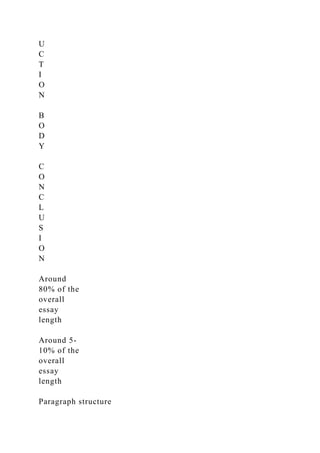
I
N
T
R
O
D
U
C
T
I
O
N
B
O
D
Y
C
O
N
C
L
U
S
I
O
N
Around
80% of the
overall
essay
length
Around 5-
10% of the
overall
essay
length
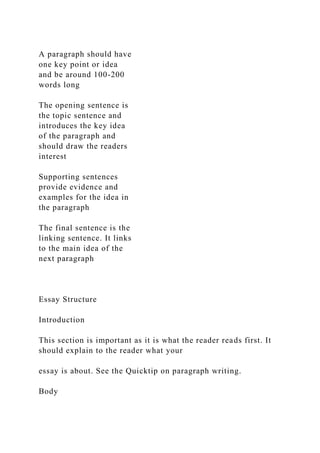
Paragraph structure
A paragraph should have
one key point or idea
and be around 100-200
words long
The opening sentence is
the topic sentence and
introduces the key idea
of the paragraph and
should draw the readers
interest
Supporting sentences
provide evidence and
examples for the idea in
the paragraph
The final sentence is the
linking sentence. It links
to the main idea of the
next paragraph
Essay Structure
Introduction
This section is important as it is what the reader reads first. It
should explain to the reader what your
essay is about. See the Quicktip on paragraph writing.
Body
The body of an essay is where your argument is developed. It
should be written in correctly formed
paragraphs. See the Quicktip on paragraph writing.
Conclusion
The conclusion draws your argument together. It is generally a
shorter paragraph than the
Introduction. It should restate the thesis statement, to leave the
reader with your argued position in
their minds.
Topic
The topic is the task or question that has been set for you by
your lecturer. It is always essential that
you address exactly what is asked of you. Marks will not be
given for a response that is not on the set
topic regardless of how well written the assignment is.
Underlying question
In an essay-style task, the lecturer usually wants more than an
appropriate response to the task. The
lecturer would usually expect you to take a position on the
topic. Based on your research, you are
expected to support your position through evidence and
discussion. The position is often called the
thesis statement and its development in the body of the essay is
called the argument.
Important Tip
The diagram above (adapted from Rao, Channock, & Krishnan,
2007) is an overview of a conventional
academic essay written without headings. Different disciplines
(e.g., engineering, psychology,
education) and courses may have varying interpretations on the
structure of the essay. Always consult
carefully with the assignment tasks and exemplars provided by
lecturers before you start to write your
essay. When in doubt about the essay requirements you should
ask your lecturer.
Need more help?
The Learning Centre can help you to develop your academic
learning language and maths
skills for success at university. Consultations are available face-
to-face, by phone or via
email.
Web: www.usq.edu.au/learningcentre
Email: [email protected]
Sources
Rao, V., Channock, K., & Krishnan, L. (2000). A Visual Guide
to Essay Writing, Association for
Academic Language and Learning (ALL): Sydney.
A copy of A Visual Guide to Essay Writing can be downloaded
for free from:
http://www.latrobe.edu.au/students/learning/allu-
documents/EssayWritingVisualGuide.pdf
http://www.usq.edu.au/learningcentre
mailto:[email protected]
http://www.latrobe.edu.au/students/learning/allu-
documents/EssayWritingVisualGuide.pdf
Assessment 2- essay
1-‹#›
Copyright © 2015 McGraw-Hill Education (Australia) Pty Ltd
Grewal, Levy, Mathews, Harrigan & Bucic Marketing 1e
1
Chapter 1 – Overview of Marketing
Essay (Individual) – 15%
1500 words (+/-10%) correctly referenced. Times New Roman
12pt, Calibri 11pt or Arial 10pt, 1.5 lines spacing, Harvard
(Anglia) references
Purpose
This assignment is served as two purposes :
to assess students’ knowledge about contemporary issue of
marketing
as a diagnostic test of the students’ writing and referencing
skills.
Due : Softcopy is to be uploaded to Moodle and Turnitin by
11.59pm Friday Week 6, Sunday 17 December 2017
1-‹#›
Copyright © 2015 McGraw-Hill Education (Australia) Pty Ltd
Grewal, Levy, Mathews, Harrigan & Bucic Marketing 1e
Essay Topic
“Marketers are not doing enough in directing their target
markets toward sustainable consumptions”
1-‹#›
Copyright © 2015 McGraw-Hill Education (Australia) Pty Ltd
Grewal, Levy, Mathews, Harrigan & Bucic Marketing 1e
The students are required to respond to the statement above and
write the responses in an essay format. The points of this
assessment are to test students’ knowledge on contemporary
marketing issues as well as to provide students with an at-risk
assessment.
The aim is to give students an early assessment with feedback to
identify students who are at risk of not achieving a pass in the
subject
This assessment will allow lecturer/tutor to work with the
students and provide early feedback which they can take on
board for later assignments. If necessary the student may be
referred to the learning support unit for further help.
1-‹#›
Copyright © 2015 McGraw-Hill Education (Australia) Pty Ltd
Grewal, Levy, Mathews, Harrigan & Bucic Marketing 1e
As the assessment asks for the opinion, the arguments need to
be supported with reliable sources of information. It is expected
that the students will cite at least 4 references. Sources that can
be used, for example, include the textbook and refereed journal
articles.
Please refrain from using internet sources like essay.com.
marketing.com, seminar slides, dictionaries, about.com.
In addition, at KOI copying from a source without proper
acknowledgement is severely penalised as leaving paragraphs
and sentences without a citation.
1-‹#›
Copyright © 2015 McGraw-Hill Education (Australia) Pty Ltd
Grewal, Levy, Mathews, Harrigan & Bucic Marketing 1e
Although the key aims of this task is for lecturers/tutors to see
the strengths and possible areas of improvement with the
students’ academic writing, the students should strive to write
in as clear a manner as possible, using well-constructed
paragraphs, and avoiding bullet points, incomplete sentences, or
overly formal or informal language.
1-‹#›
Copyright © 2015 McGraw-Hill Education (Australia) Pty Ltd
Grewal, Levy, Mathews, Harrigan & Bucic Marketing 1e

Academic Essay Structure Adapted from Rao, V, Channock.docx

  • 1.
    Academic Essay Structure Adaptedfrom Rao, V, Channock, K & Krishnan, L 2007, A Visual Guide to Essay Writing, Association for Academic Language and Learning (ALL), Sydney. Introduce the discipline, field, context and the topic Why is the topic interesting to the discipline? The “So what?” factor Discipline or Field of enquiry Topic Actual task What is the underlying question you are being asked to resolve Section: Context and theory Background Paragraph Paragraph
  • 2.
    Draw together yourfindings Based on analysis from each section of your essay Focus What is the current thinking and debate surrounding your topic? Outline the problem, define any terms, scope and time and place (context) Signpost the structure of your argument Let the reader know the sequence your essay will take introduce the sections and issues to follow State your conclusions Based on your findings Outline the implications of your evaluation and conclusions for the discipline and the debates surrounding the essay topic Present your thesis statement This is where you present your argument and your answer to the essay question Section: First issue Analyse and evaluate Paragraph Paragraph Section: Second issue Analyse and evaluate
  • 3.
    Paragraph Paragraph Section: Context andtheory Analyse and evaluate Paragraph Paragraph The body of your essay contains a discussion and exploration of your thesis. This is supported throughout by evidence from the literature or from empirical research Around 10- 15% of the overall essay length I N T R O D
  • 4.
  • 5.
    A paragraph shouldhave one key point or idea and be around 100-200 words long The opening sentence is the topic sentence and introduces the key idea of the paragraph and should draw the readers interest Supporting sentences provide evidence and examples for the idea in the paragraph The final sentence is the linking sentence. It links to the main idea of the next paragraph Essay Structure Introduction This section is important as it is what the reader reads first. It should explain to the reader what your essay is about. See the Quicktip on paragraph writing. Body
  • 6.
    The body ofan essay is where your argument is developed. It should be written in correctly formed paragraphs. See the Quicktip on paragraph writing. Conclusion The conclusion draws your argument together. It is generally a shorter paragraph than the Introduction. It should restate the thesis statement, to leave the reader with your argued position in their minds. Topic The topic is the task or question that has been set for you by your lecturer. It is always essential that you address exactly what is asked of you. Marks will not be given for a response that is not on the set topic regardless of how well written the assignment is. Underlying question In an essay-style task, the lecturer usually wants more than an appropriate response to the task. The lecturer would usually expect you to take a position on the topic. Based on your research, you are expected to support your position through evidence and discussion. The position is often called the
  • 7.
    thesis statement andits development in the body of the essay is called the argument. Important Tip The diagram above (adapted from Rao, Channock, & Krishnan, 2007) is an overview of a conventional academic essay written without headings. Different disciplines (e.g., engineering, psychology, education) and courses may have varying interpretations on the structure of the essay. Always consult carefully with the assignment tasks and exemplars provided by lecturers before you start to write your essay. When in doubt about the essay requirements you should ask your lecturer. Need more help? The Learning Centre can help you to develop your academic learning language and maths skills for success at university. Consultations are available face- to-face, by phone or via email. Web: www.usq.edu.au/learningcentre Email: [email protected] Sources
  • 8.
    Rao, V., Channock,K., & Krishnan, L. (2000). A Visual Guide to Essay Writing, Association for Academic Language and Learning (ALL): Sydney. A copy of A Visual Guide to Essay Writing can be downloaded for free from: http://www.latrobe.edu.au/students/learning/allu- documents/EssayWritingVisualGuide.pdf http://www.usq.edu.au/learningcentre mailto:[email protected] http://www.latrobe.edu.au/students/learning/allu- documents/EssayWritingVisualGuide.pdf Assessment 2- essay 1-‹#› Copyright © 2015 McGraw-Hill Education (Australia) Pty Ltd Grewal, Levy, Mathews, Harrigan & Bucic Marketing 1e 1 Chapter 1 – Overview of Marketing Essay (Individual) – 15% 1500 words (+/-10%) correctly referenced. Times New Roman 12pt, Calibri 11pt or Arial 10pt, 1.5 lines spacing, Harvard (Anglia) references Purpose This assignment is served as two purposes :
  • 9.
    to assess students’knowledge about contemporary issue of marketing as a diagnostic test of the students’ writing and referencing skills. Due : Softcopy is to be uploaded to Moodle and Turnitin by 11.59pm Friday Week 6, Sunday 17 December 2017 1-‹#› Copyright © 2015 McGraw-Hill Education (Australia) Pty Ltd Grewal, Levy, Mathews, Harrigan & Bucic Marketing 1e Essay Topic “Marketers are not doing enough in directing their target markets toward sustainable consumptions” 1-‹#› Copyright © 2015 McGraw-Hill Education (Australia) Pty Ltd Grewal, Levy, Mathews, Harrigan & Bucic Marketing 1e The students are required to respond to the statement above and write the responses in an essay format. The points of this assessment are to test students’ knowledge on contemporary marketing issues as well as to provide students with an at-risk assessment. The aim is to give students an early assessment with feedback to identify students who are at risk of not achieving a pass in the
  • 10.
    subject This assessment willallow lecturer/tutor to work with the students and provide early feedback which they can take on board for later assignments. If necessary the student may be referred to the learning support unit for further help. 1-‹#› Copyright © 2015 McGraw-Hill Education (Australia) Pty Ltd Grewal, Levy, Mathews, Harrigan & Bucic Marketing 1e As the assessment asks for the opinion, the arguments need to be supported with reliable sources of information. It is expected that the students will cite at least 4 references. Sources that can be used, for example, include the textbook and refereed journal articles. Please refrain from using internet sources like essay.com. marketing.com, seminar slides, dictionaries, about.com. In addition, at KOI copying from a source without proper acknowledgement is severely penalised as leaving paragraphs and sentences without a citation. 1-‹#› Copyright © 2015 McGraw-Hill Education (Australia) Pty Ltd Grewal, Levy, Mathews, Harrigan & Bucic Marketing 1e Although the key aims of this task is for lecturers/tutors to see the strengths and possible areas of improvement with the students’ academic writing, the students should strive to write in as clear a manner as possible, using well-constructed paragraphs, and avoiding bullet points, incomplete sentences, or
  • 11.
    overly formal orinformal language. 1-‹#› Copyright © 2015 McGraw-Hill Education (Australia) Pty Ltd Grewal, Levy, Mathews, Harrigan & Bucic Marketing 1e