Value	
  driven	
  contrac/ng	
  
Some	
  context	
  2	
  
dinsdag	
  14	
  november	
  17	
  
§  André  Nadorp
§  Director  Benchmarking  METRI
§  Andre.nadorp@metrigroup.com
§  Benchmarking
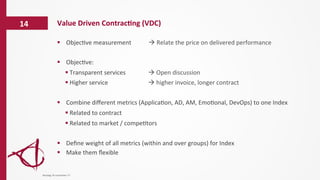
§  Research
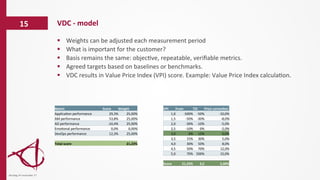
§  IT  Advisory
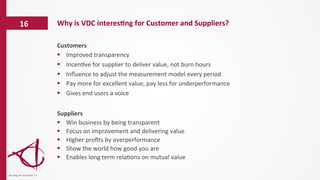
§  IT  Governance
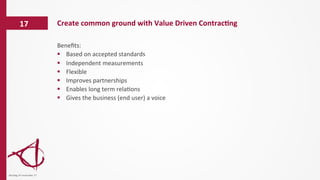
§  Source  code  analyDcs
§  Quality  metrics
§  Risk  assessments
§  Automated  FuncDon  Points
Alignment	
  of	
  supplier	
  performance	
  in	
  AD	
  3	
  
dinsdag	
  14	
  november	
  17	
  
Customers	
  want:	
  
§  Added	
  value	
  
§  Insight	
  in	
  delivered	
  services	
  
§  Value	
  for	
  money	


To	
  deliver	
  on	
  this	
  promise	
  we	
  need	
  to	
  think	
  about:	
  
§  What	
  is	
  the	
  unit	
  to	
  measure	
  work	
  delivered?	
  
§  When	
  is	
  delivered	
  work	
  valuable?	
  
§  When	
  is	
  this	
  work	
  of	
  added	
  value?	


For	
  decades,	
  people	
  all	
  over	
  the	
  world	
  are	
  working	
  on	
  different	
  standardized	
  methods	
  to	
  
measure	
  func/onality.	
  At	
  this	
  moment	
  we	
  have	
  several	
  standardized	
  and	
  accepted	
  methods.	
  
New	
  techniques	
  and	
  methods	
  make	
  it	
  harder	
  to	
  use	
  them.	
  
Clients	
  want	
  more	
  prove	
  of	
  services	
  delivered.	
  Transparency	
  is	
  needed.	


Most	
  tradi/onal	
  contracts	
  are	
  build	
  around	
  PDC’s,	
  SLA	
  and	
  KPI’s	
  like:	
  
§  Up/me	
  
§  Response	
  /me	
  
§  Performance	
  
§  Number	
  of	
  /ckets	
  
In	
  many	
  contracts	
  you	
  find:	
  
§  Penal/es	
  when	
  not	
  delivered,	
  oVen	
  converted	
  to	
  extra	
  services	
  to	
  be	
  delivered	
  
In	
  few	
  contracts	
  there	
  is	
  also	
  a:	
  
§  Bonus	
  when	
  overperforming	


Most	
  suppliers	
  want	
  to	
  raise	
  their	
  revenue	
  or	
  at	
  least	
  keep	
  it	
  stable.	
  
This	
  could	
  be	
  a	
  wrong	
  incen/ve.	


How	
  to	
  define	
  value?	
  4	
  
dinsdag	
  14	
  november	
  17	
  
Value	
  for	
  the	
  suppliers	
  is	
  mostly	
  different	
  from	
  value	
  for	
  customers	


Both	
  sides	
  want	
  to	
  make	
  profit	
  or	
  add	
  results	
  in	
  some	
  way	


Profit	
  for	
  suppliers	
  are	
  costs	
  for	
  the	
  clients.	
  Financial	
  contradic6ons	
  that	
  are	
  hard	
  to	
  merge	


Apprecia/ons	
  of	
  value	
  by	
  customers	
  and	
  suppliers	
  5	
  
dinsdag	
  14	
  november	
  17	
  
The	
  measurements	
  within	
  current	
  development	
  methods	
  are	
  less	
  standardized	
  and	
  more	
  
based	
  on	
  subjec/ve	
  and	
  non	
  repeatable	
  ways.	


The	
  biggest	
  challenge	
  has	
  to	
  do	
  with	
  con/nuously	
  measuring	
  delivered	
  func/onality	
  
(func/onal	
  and	
  technical),	
  quality	
  and	
  produc/vity.	
  The	
  Agile	
  way	
  of	
  working	
  eliminates	
  
all	
  types	
  of	
  control/waste.	


Luckily,	
  in	
  current	
  environments,	
  its	
  possible	
  to	
  measure	
  these	
  things	
  without	
  a	
  burden	
  
on	
  the	
  teams	
  by	
  deploying	
  automated	
  tools.	


So	
  on	
  the	
  technical	
  part	
  solu/ons	
  are	
  available.	


But	
  
	
  When	
  all	
  lights	
  are	
  green,	
  there	
  can	
  s/ll	
  be	
  an	
  unhappy	
  end-­‐user.	
  
How	
  to	
  measure?	
  6	
  
dinsdag	
  14	
  november	
  17	
  
Many	
  factors	
  are	
  important.	
  But	
  in	
  the	
  end	
  many	
  things	
  can	
  be	
  measured	
  
We	
  think	
  there	
  are	
  three	
  main	
  categories:	
  
§  Technical	
  	
  
§  Func/onal	
  
§  Emo/onal	
  
When	
  is	
  work	
  valuable?	
  7	
  
dinsdag	
  14	
  november	
  17	
  
In	
  an	
  open	
  discussion	
  with	
  the	
  client	
  it	
  should	
  be	
  possible	
  to	
  define	
  what	
  adds	
  value	
  to	
  
the	
  business.	


§  New	
  func/onality	
  tomorrow	
  	
  
§  Less	
  risk	
  
§  Higher	
  performance	
  
§  Less	
  complexity	
  
§  Higher	
  produc/vity	
  /	
  lower	
  quality	
  /	
  higher	
  technical	
  debt	
  
§  Happy	
  users	
  /	
  customers	


When	
  does	
  work	
  add	
  value?	
  8	
  
dinsdag	
  14	
  november	
  17	
  
Value	
  is	
  added	
  when	
  it	
  serves	
  business	
  needs.	
  This	
  could	
  be:	


§  Time	
  to	
  market	
  
§  Less	
  risk	
  	
  
§  High	
  performance	
  
§  New	
  func/onality	
  
§  Less	
  costs	
  
When	
  does	
  work	
  add	
  value?	
  9	
  
dinsdag	
  14	
  november	
  17	
  
In	
  the	
  ever	
  changing	
  world,	
  and	
  apparently	
  hard	
  to	
  measure	
  ac/vi/es,	
  clients	
  try	
  to	
  find	
  
ways	
  to	
  compare	
  services.	
  In	
  some	
  cases	
  the	
  business	
  relates	
  IT	
  to	
  costs	
  (budget),	
  
revenue,	
  services.	


Enabling	
  companies	
  in	
  measuring	
  soVware	
  services	
  enables	
  them	
  to	
  measure	
  suppliers.	


Measures	
  based	
  on	
  independent	
  and	
  repeatable	
  facts	
  removes	
  (most)	
  discussions.	


In	
  the	
  modern	
  world	
  of	
  IT	
  it’s	
  necessary	
  to	
  measure	
  things	
  without	
  impact	
  on	
  the	
  teams	
  
delivering	
  the	
  service.	


Make	
  IT	
  comparable	
  10	
  
dinsdag	
  14	
  november	
  17	
  
AutomaDon  is  Key
§  Market	
  leader	
  in	
  source	
  code	
  analy/cs	
  
§  Based	
  on	
  the	
  interna/onal	
  OMG/CISQ	
  standard	
  
§  Analyses	
  source	
  code	
  and	
  architecture	
  
§  Output:	
  technical	
  code	
  analysis	
  in	
  health	
  factors	
  
§ Total	
  Quality	
  Index	
  	
  
§ Security,	
  Robustness,	
  Efficiency,	
  Transferability,	
  Changeability	
  
§ Technical	
  Debt,	
  Cri/cal	
  Viola/ons,	
  etc.	
  
§  CAST	
  is	
  the	
  only	
  specialist	
  capable	
  of	
  automated	
  measuring	
  size	
  in	
  source	
  code:	
  
§ Automated	
  Func/on	
  Points	
  (AFP):	
  
§ Automated	
  Enhancement	
  Func/on	
  Points	
  (AEFP)	
  
§ Automated	
  Enhancement	
  Technical	
  points	
  (AETP)	


CAST	
  11	
  
dinsdag	
  14	
  november	
  17	
  
Based	
  on	
  CAST	
  analysis	
  METRI	
  can	
  do	
  objec6ve,	
  repeatable,	
  verifiable	
  and	
  therefore	
  defensible	
  way	
  of	
  measuring	
  and	
  
comparing	
  the	
  performance	
  of	
  the	
  soPware	
  supplier	
  with	
  the	
  market/contract.	
  
Performance	
  Measurement	
  12	
  
dinsdag	
  14	
  november	
  17	
  
Applica6on	
  metrics:	
  	
  
§  CAST	
  
§  TQI	
  
§  Robustness	
  
§  Security	
  
§  Efficiency	
  
§  Transferability	
  
§  Changeability	
  
§  Technical	
  Debt	
  
§  AEP	
  
§  Cri/cal	
  viola/ons	
  
§  Availability	
  
Applica6on	
  Development	
  metrics:	
  
§  Produc/vity,	
  	
  
§  Cost	
  Efficiency	
  
§  Project	
  Quality	
  	
  
§  Velocity	
  
Applica6on	
  Management	
  metrics:	
  
§  Response	
  /mes	
  
§  Resolu/on	
  /mes	
  
§  Average	
  /me	
  to	
  solve	
  issues	
  
Performance	
  Measurement	
  13	
  
dinsdag	
  14	
  november	
  17	
  
‘Emo6onal’	
  Metrics	
  
§  Customer	
  and	
  client	
  
sa/sfac/on	
  
DevOps	
  metrics:	
  	
  
§  %Effort	
  Dev/Ops	
  
§  #	
  boelenecks	
  removed	
  
§  %	
  Test	
  automa/on	
  
§  Deployment	
  frequency	
  
§  %	
  Failed	
  deployments	
  
§  Mean	
  Time	
  to	
  Recover	
  
(MTTR)	
  
§  Change	
  Lead	
  /me	
  
Value	
  Driven	
  Contrac6ng	
  (VDC)	
  14	
  
§  Objec/ve	
  measurement	
   	
   	
  à	
  Relate	
  the	
  price	
  on	
  delivered	
  performance	
  
§  Objec/ve:	
  	
  
§ Transparent	
  services 	
   	
   	
  à	
  Open	
  discussion	
  	
  
§ Higher	
  service	


  à	
  higher	
  invoice,	
  longer	
  contract	
  
§  Combine	
  different	
  metrics	
  (Applica/on,	
  AD,	
  AM,	
  Emo/onal,	
  DevOps)	
  to	
  one	
  Index	
  
§ Related	
  to	
  contract	
  
§ Related	
  to	
  market	
  /	
  compe/tors	
  
§  Define	
  weight	
  of	
  all	
  metrics	
  (within	
  and	
  over	
  groups)	
  for	
  Index	
  
§  Make	
  them	
  flexible	
  
dinsdag	
  14	
  november	
  17	
  
Metric	
   Score	
   Weight	
  
Applica/on	
  performance	
   29,3%	
   25,00%	
  
AM	
  performance	
   53,8%	
   25,00%	
  
AD	
  performance	
   -­‐10,4%	
   25,00%	
  
Emo/onal	
  performance	
   0,0%	
   0,00%	
  
DevOps	
  performance	
   12,3%	
   25,00%	
  
Total	
  score	
   	
  	
   21,23%	
  
VDC	
  -­‐	
  model	
  15	
  
dinsdag	
  14	
  november	
  17	
  
§  Weights	
  can	
  be	
  adjusted	
  each	
  measurement	
  period	
  
§  What	
  is	
  important	
  for	
  the	
  customer?	
  	
  
§  Basis	
  remains	
  the	
  same:	
  objec/ve,	
  repeatable,	
  verifiable	
  metrics.	
  
§  Agreed	
  targets	
  based	
  on	
  baselines	
  or	
  benchmarks.	
  
§  VDC	
  results	
  in	
  Value	
  Price	
  Index	
  (VPI)	
  score.	
  Example:	
  Value	
  Price	
  Index	
  calcula/on.	
  
VPI	
   From	
  	
   Till	
   Price	
  correc6on	
  
1,0	
   -­‐500%	
   -­‐50%	
   -­‐10,0%	
  
1,5	
   -­‐50%	
   -­‐30%	
   -­‐8,0%	
  
2,0	
   -­‐30%	
   -­‐10%	
   -­‐5,0%	
  
2,5	
   -­‐10%	
   0%	
   -­‐2,0%	
  
3,0	
   0%	
   15%	
   0,0%	
  
3,5	
   15%	
   30%	
   5,0%	
  
4,0	
   30%	
   50%	
   8,0%	
  
4,5	
   50%	
   70%	
   12,0%	
  
5,0	
   70%	
   500%	
   15,0%	
  
Score	
   21,23%	
   3,5	
   5,00%	
  
Customers	
  
§  Improved	
  transparency	
  
§  Incen/ve	
  for	
  supplier	
  to	
  deliver	
  value,	
  not	
  burn	
  hours	
  
§  Influence	
  to	
  adjust	
  the	
  measurement	
  model	
  every	
  period	
  
§  Pay	
  more	
  for	
  excellent	
  value,	
  pay	
  less	
  for	
  underperformance	
  
§  Gives	
  end	
  users	
  a	
  voice	


Suppliers	
  
§  Win	
  business	
  by	
  being	
  transparent	
  
§  Focus	
  on	
  improvement	
  and	
  delivering	
  value	
  
§  Higher	
  profits	
  by	
  overperformance	
  
§  Show	
  the	
  world	
  how	
  good	
  you	
  are	
  
§  Enables	
  long	
  term	
  rela/ons	
  on	
  mutual	
  value	
  
Why	
  is	
  VDC	
  interes6ng	
  for	
  Customer	
  and	
  Suppliers?	
  16	
  
dinsdag	
  14	
  november	
  17	
  
Benefits:	
  
§  Based	
  on	
  accepted	
  standards	
  
§  Independent	
  measurements	
  
§  Flexible	
  
§  Improves	
  partnerships	
  
§  Enables	
  long	
  term	
  rela/ons	
  
§  Gives	
  the	
  business	
  (end	
  user)	
  a	
  voice	
  
Create	
  common	
  ground	
  with	
  Value	
  Driven	
  Contrac6ng	
  17	
  
dinsdag	
  14	
  november	
  17	
  
About	
  METRI	
  
§  Started	
  out	
  in	
  Benchmarking	
  
§  More	
  than	
  14	
  years	
  of	
  history/track	
  record	
  
§  Market	
  leader	
  in	
  Benelux	
  
§  Interna/onal	
  focus	
  
§  USP:	
  Component	
  Based	
  Measurement	


§  Expanded	
  services	
  building	
  upon	
  proprietary	
  
benchmarking	
  database	
  
§  Service	
  -­‐,	
  	
  Cost-­‐,	
  Performance-­‐	
  	
  
and	
  	
  Value	
  management	
  
§  IT	
  sourcing:	
  strategy,	
  selec/on,	
  contrac/ng,	
  transi/on	
  &	
  
provider	
  rela/onship	
  management	


§  Fact	
  Based	
  Research	
  
§  Market	
  research	
  and	
  knowledge	
  projected	
  to	
  your	
  daily	
  
challenges	
  
§  Using	
  METRI’s	
  Eco	
  System	
  for	
  reflec/on	
  and	
  verifica/on	


Benchmarking	
  
IT	
  Advisory	
  
Research	
  
§  Quick	
  scan	
  of	
  IT	
  func/on	
  
§  Target	
  opera/ng	
  model	
  
§  Governance	
  digital	
  transforma/on	
  
§  Benchmark	
  IT	
  workforce	


IT	
  Governance	
  
©	
  2017	
  METRI.	
  Alle	
  rechten	
  voorbehouden.	


Niets	
  uit	
  deze	
  uitgave	
  mag	
  worden	
  verveelvoudigd,	
  opgeslagen	
  in	
  een	
  
geautoma/seerd	
  gegevensbestand,	
  of	
  openbaar	
  worden	
  gemaakt,	
  in	
  enige	
  
vorm	
  of	
  op	
  enige	
  wijze,	
  hetzij	
  elektronisch,	
  mechanisch,	
  door	
  fotokopieën,	
  
opnamen,	
  of	
  op	
  enige	
  manier,	
  zonder	
  voorafgaande	
  schriVelijke	
  
toestemming	
  van	
  METRI.	
  
www.metrigroup.com	
  
Disclaimer	
  

Ac2017 2. added value!

  • 1.
  • 2.
    Some  context  2   dinsdag  14  november  17   §  André  Nadorp §  Director  Benchmarking  METRI §  Andre.nadorp@metrigroup.com §  Benchmarking §  Research §  IT  Advisory §  IT  Governance §  Source  code  analyDcs §  Quality  metrics §  Risk  assessments §  Automated  FuncDon  Points
  • 3.
    Alignment  of  supplier  performance  in  AD  3   dinsdag  14  november  17   Customers  want:   §  Added  value   §  Insight  in  delivered  services   §  Value  for  money     To  deliver  on  this  promise  we  need  to  think  about:   §  What  is  the  unit  to  measure  work  delivered?   §  When  is  delivered  work  valuable?   §  When  is  this  work  of  added  value?     For  decades,  people  all  over  the  world  are  working  on  different  standardized  methods  to   measure  func/onality.  At  this  moment  we  have  several  standardized  and  accepted  methods.   New  techniques  and  methods  make  it  harder  to  use  them.   Clients  want  more  prove  of  services  delivered.  Transparency  is  needed.    
  • 4.
    Most  tradi/onal  contracts  are  build  around  PDC’s,  SLA  and  KPI’s  like:   §  Up/me   §  Response  /me   §  Performance   §  Number  of  /ckets   In  many  contracts  you  find:   §  Penal/es  when  not  delivered,  oVen  converted  to  extra  services  to  be  delivered   In  few  contracts  there  is  also  a:   §  Bonus  when  overperforming     Most  suppliers  want  to  raise  their  revenue  or  at  least  keep  it  stable.   This  could  be  a  wrong  incen/ve.     How  to  define  value?  4   dinsdag  14  november  17  
  • 5.
    Value  for  the  suppliers  is  mostly  different  from  value  for  customers       Both  sides  want  to  make  profit  or  add  results  in  some  way       Profit  for  suppliers  are  costs  for  the  clients.  Financial  contradic6ons  that  are  hard  to  merge       Apprecia/ons  of  value  by  customers  and  suppliers  5   dinsdag  14  november  17  
  • 6.
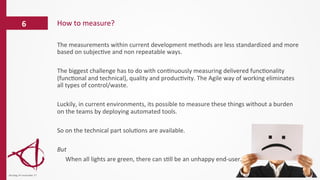
    The  measurements  within  current  development  methods  are  less  standardized  and  more   based  on  subjec/ve  and  non  repeatable  ways.       The  biggest  challenge  has  to  do  with  con/nuously  measuring  delivered  func/onality   (func/onal  and  technical),  quality  and  produc/vity.  The  Agile  way  of  working  eliminates   all  types  of  control/waste.     Luckily,  in  current  environments,  its  possible  to  measure  these  things  without  a  burden   on  the  teams  by  deploying  automated  tools.     So  on  the  technical  part  solu/ons  are  available.       But    When  all  lights  are  green,  there  can  s/ll  be  an  unhappy  end-­‐user.   How  to  measure?  6   dinsdag  14  november  17  
  • 7.
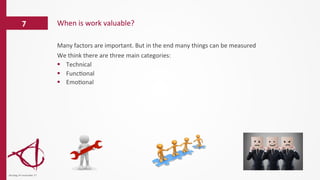
    Many  factors  are  important.  But  in  the  end  many  things  can  be  measured   We  think  there  are  three  main  categories:   §  Technical     §  Func/onal   §  Emo/onal   When  is  work  valuable?  7   dinsdag  14  november  17  
  • 8.
    In  an  open  discussion  with  the  client  it  should  be  possible  to  define  what  adds  value  to   the  business.     §  New  func/onality  tomorrow     §  Less  risk   §  Higher  performance   §  Less  complexity   §  Higher  produc/vity  /  lower  quality  /  higher  technical  debt   §  Happy  users  /  customers     When  does  work  add  value?  8   dinsdag  14  november  17  
  • 9.
    Value  is  added  when  it  serves  business  needs.  This  could  be:     §  Time  to  market   §  Less  risk     §  High  performance   §  New  func/onality   §  Less  costs   When  does  work  add  value?  9   dinsdag  14  november  17  
  • 10.
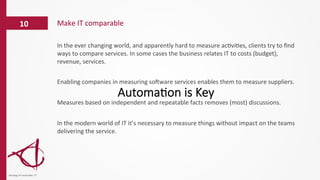
    In  the  ever  changing  world,  and  apparently  hard  to  measure  ac/vi/es,  clients  try  to  find   ways  to  compare  services.  In  some  cases  the  business  relates  IT  to  costs  (budget),   revenue,  services.     Enabling  companies  in  measuring  soVware  services  enables  them  to  measure  suppliers.     Measures  based  on  independent  and  repeatable  facts  removes  (most)  discussions.     In  the  modern  world  of  IT  it’s  necessary  to  measure  things  without  impact  on  the  teams   delivering  the  service.           Make  IT  comparable  10   dinsdag  14  november  17   AutomaDon  is  Key
  • 11.
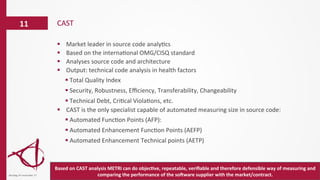
    §  Market  leader  in  source  code  analy/cs   §  Based  on  the  interna/onal  OMG/CISQ  standard   §  Analyses  source  code  and  architecture   §  Output:  technical  code  analysis  in  health  factors   § Total  Quality  Index     § Security,  Robustness,  Efficiency,  Transferability,  Changeability   § Technical  Debt,  Cri/cal  Viola/ons,  etc.   §  CAST  is  the  only  specialist  capable  of  automated  measuring  size  in  source  code:   § Automated  Func/on  Points  (AFP):   § Automated  Enhancement  Func/on  Points  (AEFP)   § Automated  Enhancement  Technical  points  (AETP)       CAST  11   dinsdag  14  november  17   Based  on  CAST  analysis  METRI  can  do  objec6ve,  repeatable,  verifiable  and  therefore  defensible  way  of  measuring  and   comparing  the  performance  of  the  soPware  supplier  with  the  market/contract.  
  • 12.
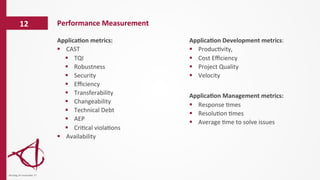
    Performance  Measurement  12   dinsdag  14  november  17   Applica6on  metrics:     §  CAST   §  TQI   §  Robustness   §  Security   §  Efficiency   §  Transferability   §  Changeability   §  Technical  Debt   §  AEP   §  Cri/cal  viola/ons   §  Availability   Applica6on  Development  metrics:   §  Produc/vity,     §  Cost  Efficiency   §  Project  Quality     §  Velocity   Applica6on  Management  metrics:   §  Response  /mes   §  Resolu/on  /mes   §  Average  /me  to  solve  issues  
  • 13.
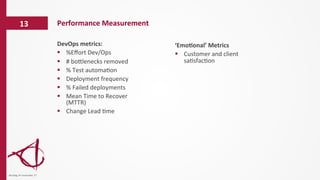
    Performance  Measurement  13   dinsdag  14  november  17   ‘Emo6onal’  Metrics   §  Customer  and  client   sa/sfac/on   DevOps  metrics:     §  %Effort  Dev/Ops   §  #  boelenecks  removed   §  %  Test  automa/on   §  Deployment  frequency   §  %  Failed  deployments   §  Mean  Time  to  Recover   (MTTR)   §  Change  Lead  /me  
  • 14.
    Value  Driven  Contrac6ng  (VDC)  14   §  Objec/ve  measurement      à  Relate  the  price  on  delivered  performance   §  Objec/ve:     § Transparent  services      à  Open  discussion     § Higher  service            à  higher  invoice,  longer  contract   §  Combine  different  metrics  (Applica/on,  AD,  AM,  Emo/onal,  DevOps)  to  one  Index   § Related  to  contract   § Related  to  market  /  compe/tors   §  Define  weight  of  all  metrics  (within  and  over  groups)  for  Index   §  Make  them  flexible   dinsdag  14  november  17  
  • 15.
    Metric   Score   Weight   Applica/on  performance   29,3%   25,00%   AM  performance   53,8%   25,00%   AD  performance   -­‐10,4%   25,00%   Emo/onal  performance   0,0%   0,00%   DevOps  performance   12,3%   25,00%   Total  score       21,23%   VDC  -­‐  model  15   dinsdag  14  november  17   §  Weights  can  be  adjusted  each  measurement  period   §  What  is  important  for  the  customer?     §  Basis  remains  the  same:  objec/ve,  repeatable,  verifiable  metrics.   §  Agreed  targets  based  on  baselines  or  benchmarks.   §  VDC  results  in  Value  Price  Index  (VPI)  score.  Example:  Value  Price  Index  calcula/on.   VPI   From     Till   Price  correc6on   1,0   -­‐500%   -­‐50%   -­‐10,0%   1,5   -­‐50%   -­‐30%   -­‐8,0%   2,0   -­‐30%   -­‐10%   -­‐5,0%   2,5   -­‐10%   0%   -­‐2,0%   3,0   0%   15%   0,0%   3,5   15%   30%   5,0%   4,0   30%   50%   8,0%   4,5   50%   70%   12,0%   5,0   70%   500%   15,0%   Score   21,23%   3,5   5,00%  
  • 16.
    Customers   §  Improved  transparency   §  Incen/ve  for  supplier  to  deliver  value,  not  burn  hours   §  Influence  to  adjust  the  measurement  model  every  period   §  Pay  more  for  excellent  value,  pay  less  for  underperformance   §  Gives  end  users  a  voice     Suppliers   §  Win  business  by  being  transparent   §  Focus  on  improvement  and  delivering  value   §  Higher  profits  by  overperformance   §  Show  the  world  how  good  you  are   §  Enables  long  term  rela/ons  on  mutual  value   Why  is  VDC  interes6ng  for  Customer  and  Suppliers?  16   dinsdag  14  november  17  
  • 17.
    Benefits:   §  Based  on  accepted  standards   §  Independent  measurements   §  Flexible   §  Improves  partnerships   §  Enables  long  term  rela/ons   §  Gives  the  business  (end  user)  a  voice   Create  common  ground  with  Value  Driven  Contrac6ng  17   dinsdag  14  november  17  
  • 18.
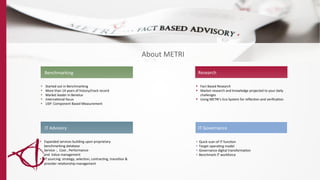
    About  METRI   § Started  out  in  Benchmarking   §  More  than  14  years  of  history/track  record   §  Market  leader  in  Benelux   §  Interna/onal  focus   §  USP:  Component  Based  Measurement     §  Expanded  services  building  upon  proprietary   benchmarking  database   §  Service  -­‐,    Cost-­‐,  Performance-­‐     and    Value  management   §  IT  sourcing:  strategy,  selec/on,  contrac/ng,  transi/on  &   provider  rela/onship  management     §  Fact  Based  Research   §  Market  research  and  knowledge  projected  to  your  daily   challenges   §  Using  METRI’s  Eco  System  for  reflec/on  and  verifica/on     Benchmarking   IT  Advisory   Research   §  Quick  scan  of  IT  func/on   §  Target  opera/ng  model   §  Governance  digital  transforma/on   §  Benchmark  IT  workforce     IT  Governance  
  • 19.
    ©  2017  METRI.  Alle  rechten  voorbehouden.     Niets  uit  deze  uitgave  mag  worden  verveelvoudigd,  opgeslagen  in  een   geautoma/seerd  gegevensbestand,  of  openbaar  worden  gemaakt,  in  enige   vorm  of  op  enige  wijze,  hetzij  elektronisch,  mechanisch,  door  fotokopieën,   opnamen,  of  op  enige  manier,  zonder  voorafgaande  schriVelijke   toestemming  van  METRI.   www.metrigroup.com   Disclaimer