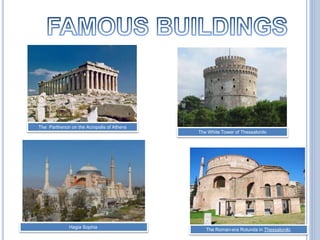
The Parthenon on the Acropolis of Athens
The White Tower of Thessaloniki
Hagia Sophia
The Roman-era Rotunda in Thessaloniki.
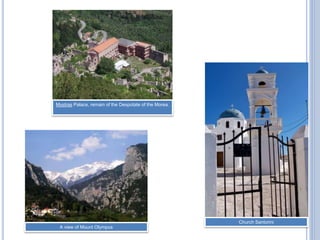
Mystras Palace, remain of the Despotate of the Morea.
A view of Mount Olympus
Church Santorini
Theatre was born in Greece.]The city-state of Classical Athens, which became a significant
cultural, political, and military power during this period, was its centre, where it was
instititionalised as part of a festival called the Dionysosa which honoured the
god Dionysus. Tragedy (late 6th century BC), comedy (486 BC), and satyr the play were
the three dramatic generes to emerge there.
During the Byzantine period, the theatrical art was heavily declined. According to Marios
Ploritis, the only form survived was the folk theatre (Mimos and Pantomimos), despite the
hostility of the official state. Later, during the Ottoman period, the main theatrical folk art
was the Karagiozis. The renaissance which led to the modern Greek theatre, took place in
the Venetian Crete. Significal dramatists include Vitsentzos Kornaros and Georgios
Chortatzis.
The modern Greek theatre was born after the Greek independence, in the early 19th
century, and initially was influenced by the Heptanesean theatre and melodrama, such as
the Italian opera. The Nobile Teatro di San Giacomo di Corfù was the first theatre
and opera house of modern Greece and the place where the first Greek opera, Spyridon
Xyndas' The Parliamentary Candidate (based on an exclusively Greek libretto) was
performed. During the late 19th and early 20th century, the Athenian theatre scene was
dominated by revues, musical comedies, operettas and nocturnes and notable playwrights
included Spyridon Samaras, Dionysios Lavrangas, Theophrastos Sakellaridis and others.
Greek vocal music extends far back into ancient times where mixed-
gender choruses performed for entertainment, celebration and spiritual
reasons. Instruments during that period included the double-
reed aulos and the plucked string instrument, the lyre, especially the
special kind called a kithara. Music played an important role in the
education system during ancient times. Boys were taught music from the
age of six. Later influences from the Roman Empire , Middle East,
and the Byzantine Empire also had effect on Greek music.
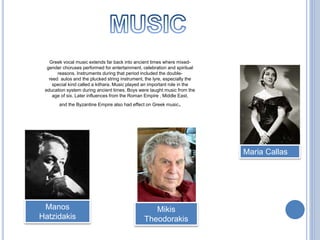
Maria Callas
Manos
Hatzidakis
Mikis
Theodorakis
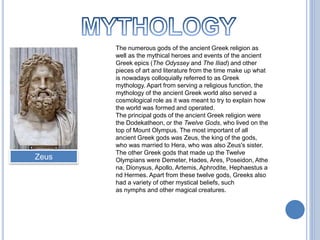
Zeus
The numerous gods of the ancient Greek religion as
well as the mythical heroes and events of the ancient
Greek epics (The Odyssey and The Iliad) and other
pieces of art and literature from the time make up what
is nowadays colloquially referred to as Greek
mythology. Apart from serving a religious function, the
mythology of the ancient Greek world also served a
cosmological role as it was meant to try to explain how
the world was formed and operated.
The principal gods of the ancient Greek religion were
the Dodekatheon, or the Twelve Gods, who lived on the
top of Mount Olympus. The most important of all
ancient Greek gods was Zeus, the king of the gods,
who was married to Hera, who was also Zeus's sister.
The other Greek gods that made up the Twelve
Olympians were Demeter, Hades, Ares, Poseidon, Athe
na, Dionysus, Apollo, Artemis, Aphrodite, Hephaestus a
nd Hermes. Apart from these twelve gods, Greeks also
had a variety of other mystical beliefs, such
as nymphs and other magical creatures.
Marta Zakrzewska
Patrycja Bończak

Ac148c71

  • 3.
    The Parthenon onthe Acropolis of Athens The White Tower of Thessaloniki Hagia Sophia The Roman-era Rotunda in Thessaloniki.
  • 4.
    Mystras Palace, remainof the Despotate of the Morea. A view of Mount Olympus Church Santorini
  • 5.
    Theatre was bornin Greece.]The city-state of Classical Athens, which became a significant cultural, political, and military power during this period, was its centre, where it was instititionalised as part of a festival called the Dionysosa which honoured the god Dionysus. Tragedy (late 6th century BC), comedy (486 BC), and satyr the play were the three dramatic generes to emerge there. During the Byzantine period, the theatrical art was heavily declined. According to Marios Ploritis, the only form survived was the folk theatre (Mimos and Pantomimos), despite the hostility of the official state. Later, during the Ottoman period, the main theatrical folk art was the Karagiozis. The renaissance which led to the modern Greek theatre, took place in the Venetian Crete. Significal dramatists include Vitsentzos Kornaros and Georgios Chortatzis. The modern Greek theatre was born after the Greek independence, in the early 19th century, and initially was influenced by the Heptanesean theatre and melodrama, such as the Italian opera. The Nobile Teatro di San Giacomo di Corfù was the first theatre and opera house of modern Greece and the place where the first Greek opera, Spyridon Xyndas' The Parliamentary Candidate (based on an exclusively Greek libretto) was performed. During the late 19th and early 20th century, the Athenian theatre scene was dominated by revues, musical comedies, operettas and nocturnes and notable playwrights included Spyridon Samaras, Dionysios Lavrangas, Theophrastos Sakellaridis and others.
  • 6.
    Greek vocal musicextends far back into ancient times where mixed- gender choruses performed for entertainment, celebration and spiritual reasons. Instruments during that period included the double- reed aulos and the plucked string instrument, the lyre, especially the special kind called a kithara. Music played an important role in the education system during ancient times. Boys were taught music from the age of six. Later influences from the Roman Empire , Middle East, and the Byzantine Empire also had effect on Greek music. Maria Callas Manos Hatzidakis Mikis Theodorakis
  • 9.
    Zeus The numerous godsof the ancient Greek religion as well as the mythical heroes and events of the ancient Greek epics (The Odyssey and The Iliad) and other pieces of art and literature from the time make up what is nowadays colloquially referred to as Greek mythology. Apart from serving a religious function, the mythology of the ancient Greek world also served a cosmological role as it was meant to try to explain how the world was formed and operated. The principal gods of the ancient Greek religion were the Dodekatheon, or the Twelve Gods, who lived on the top of Mount Olympus. The most important of all ancient Greek gods was Zeus, the king of the gods, who was married to Hera, who was also Zeus's sister. The other Greek gods that made up the Twelve Olympians were Demeter, Hades, Ares, Poseidon, Athe na, Dionysus, Apollo, Artemis, Aphrodite, Hephaestus a nd Hermes. Apart from these twelve gods, Greeks also had a variety of other mystical beliefs, such as nymphs and other magical creatures.
  • 10.