1
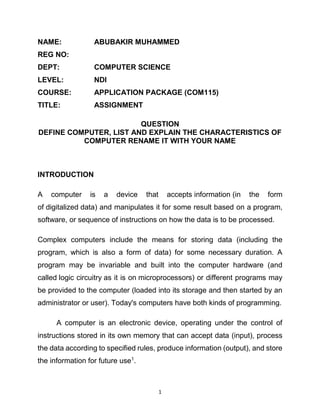
NAME: ABUBAKIR MUHAMMED
REG NO:
DEPT: COMPUTER SCIENCE
LEVEL: NDI
COURSE: APPLICATION PACKAGE (COM115)
TITLE: ASSIGNMENT
QUESTION
DEFINE COMPUTER, LIST AND EXPLAIN THE CHARACTERISTICS OF
COMPUTER RENAME IT WITH YOUR NAME
INTRODUCTION
A computer is a device that accepts information (in the form
of digitalized data) and manipulates it for some result based on a program,
software, or sequence of instructions on how the data is to be processed.
Complex computers include the means for storing data (including the
program, which is also a form of data) for some necessary duration. A
program may be invariable and built into the computer hardware (and
called logic circuitry as it is on microprocessors) or different programs may
be provided to the computer (loaded into its storage and then started by an
administrator or user). Today's computers have both kinds of programming.
A computer is an electronic device, operating under the control of
instructions stored in its own memory that can accept data (input), process
the data according to specified rules, produce information (output), and store
the information for future use1
.
2
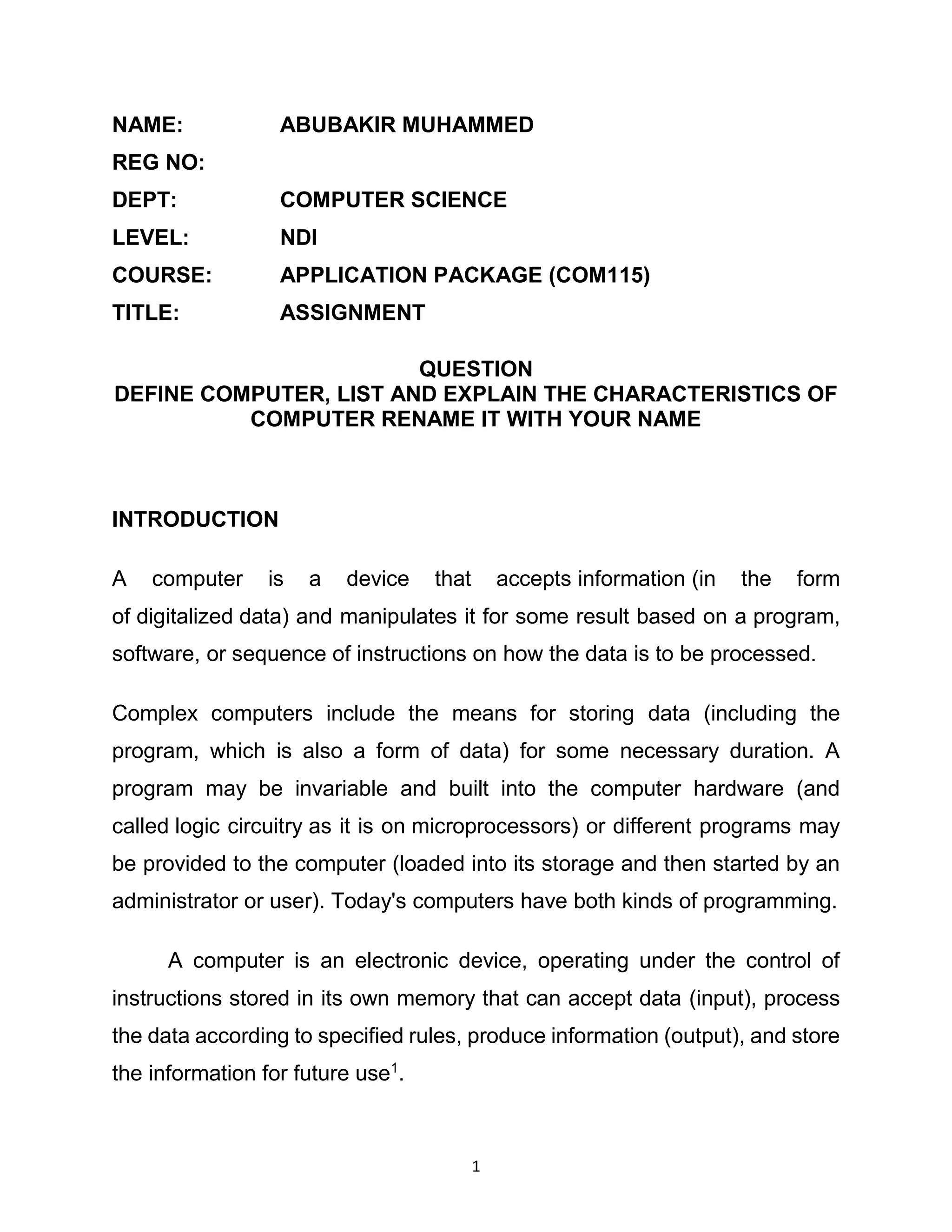
FUNCTIONALITIES OF A COMPUTER
Any digital computer carries out five functions in gross terms:
 Takes data as input.
 Stores the data/instructions in its memory and use them when
required.
 Processes the data and converts it into useful information.
 Generates the output
 Controls all the above four steps.
DEFINITION OF COMPUTER
A computer is a digital electronic machine that can be programmed to carry
out sequences of arithmetic or logical operations (computation)
automatically. Modern computers can perform generic sets of operations
known as programs. These programs enable computers to perform a wide
range of tasks. A computer system is a "complete" computer that includes
the hardware, operating system (main software), and peripheral equipment
needed and used for "full" operation. This term may also refer to a group of
computers that are linked and function together, such as a computer network
or computer cluster.
A broad range of industrial and consumer products use computers as control
systems. Simple special-purpose devices like microwave ovens and remote
controls are included, as are factory devices like industrial robots and
computer-aided design, as well as general-purpose devices like personal
computers and mobile devices like smartphones. Computers power the
Internet, which links billions of other computers and users.
3
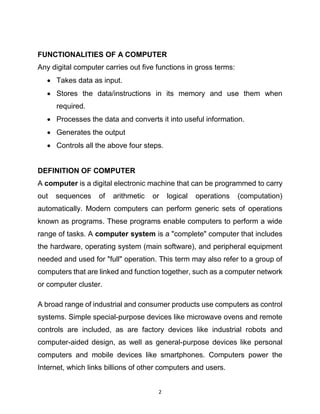
CHARACTERISTICS OF COMPUTERS
1. Speed:
Computers are fast in doing calculations. The speed of the computer is
measured in terms of million instruction per second (MIPS).
2. Storage Capacity:
Computers come with large amount of memory. They can hold lot of data.
Computers can show a particular piece of information from large amount of
data in a short time.
3. Diligence:
After doing work for sometime, humans become tired but computers do not
become tired. They work continuously. In fact, some computers which
control telephone exchanges are never stopped. This is called diligence.
4. Accuracy:
The results that the computers produce are accurate provided data and
programs are reliable.
5. Versatality:
We can use computer to perform completely different type of work at the
same time.
6. Reliability:
Computers work for many years without any problem.
4
REFERENCE
Copeland, Jack (2004), The Essential Turing, p. 22: "von Neumann ... firmly
emphasized to me, and to others I am sure, that the fundamental
conception is owing to Turing—insofar as not anticipated by Babbage,
Lovelace and others." Letter by Stanley Frankel to Brian Randell, 1972.
Enticknap, Nicholas (Summer 1998), "Computing's Golden Jubilee",
Resurrection (20), ISSN 0958-7403, archived from the original on 9
January 2012, retrieved 19 April 2008

ABUBAKIR MUHAMMED.docx

  • 1.
    1 NAME: ABUBAKIR MUHAMMED REGNO: DEPT: COMPUTER SCIENCE LEVEL: NDI COURSE: APPLICATION PACKAGE (COM115) TITLE: ASSIGNMENT QUESTION DEFINE COMPUTER, LIST AND EXPLAIN THE CHARACTERISTICS OF COMPUTER RENAME IT WITH YOUR NAME INTRODUCTION A computer is a device that accepts information (in the form of digitalized data) and manipulates it for some result based on a program, software, or sequence of instructions on how the data is to be processed. Complex computers include the means for storing data (including the program, which is also a form of data) for some necessary duration. A program may be invariable and built into the computer hardware (and called logic circuitry as it is on microprocessors) or different programs may be provided to the computer (loaded into its storage and then started by an administrator or user). Today's computers have both kinds of programming. A computer is an electronic device, operating under the control of instructions stored in its own memory that can accept data (input), process the data according to specified rules, produce information (output), and store the information for future use1 .
  • 2.
    2 FUNCTIONALITIES OF ACOMPUTER Any digital computer carries out five functions in gross terms:  Takes data as input.  Stores the data/instructions in its memory and use them when required.  Processes the data and converts it into useful information.  Generates the output  Controls all the above four steps. DEFINITION OF COMPUTER A computer is a digital electronic machine that can be programmed to carry out sequences of arithmetic or logical operations (computation) automatically. Modern computers can perform generic sets of operations known as programs. These programs enable computers to perform a wide range of tasks. A computer system is a "complete" computer that includes the hardware, operating system (main software), and peripheral equipment needed and used for "full" operation. This term may also refer to a group of computers that are linked and function together, such as a computer network or computer cluster. A broad range of industrial and consumer products use computers as control systems. Simple special-purpose devices like microwave ovens and remote controls are included, as are factory devices like industrial robots and computer-aided design, as well as general-purpose devices like personal computers and mobile devices like smartphones. Computers power the Internet, which links billions of other computers and users.
  • 3.
    3 CHARACTERISTICS OF COMPUTERS 1.Speed: Computers are fast in doing calculations. The speed of the computer is measured in terms of million instruction per second (MIPS). 2. Storage Capacity: Computers come with large amount of memory. They can hold lot of data. Computers can show a particular piece of information from large amount of data in a short time. 3. Diligence: After doing work for sometime, humans become tired but computers do not become tired. They work continuously. In fact, some computers which control telephone exchanges are never stopped. This is called diligence. 4. Accuracy: The results that the computers produce are accurate provided data and programs are reliable. 5. Versatality: We can use computer to perform completely different type of work at the same time. 6. Reliability: Computers work for many years without any problem.
  • 4.
    4 REFERENCE Copeland, Jack (2004),The Essential Turing, p. 22: "von Neumann ... firmly emphasized to me, and to others I am sure, that the fundamental conception is owing to Turing—insofar as not anticipated by Babbage, Lovelace and others." Letter by Stanley Frankel to Brian Randell, 1972. Enticknap, Nicholas (Summer 1998), "Computing's Golden Jubilee", Resurrection (20), ISSN 0958-7403, archived from the original on 9 January 2012, retrieved 19 April 2008