Abstract: Humanaction recognitionisverymuchtrendingandneedsalotof humanunderstanding
whichcomeswithexperience,one personinhischildhoodisonlyable tolearnfew of the human
actionand withexperience thathe orshe will gaingivesan ideaof differenthumanaction,thusthis
paperis all aboutyour understandingonhow humanactionlastsand how it couldbe well
differentiatedfromotheractions.Toperformthisthere are stepsthatshouldbe followed,normally
thisconceptis perceivedbyhumanusingtheirbraineye coordinationbutinthe casesof software a
similarapproachwill be followed,Requiredisacamera and a software tointerpretall of them, lets
beginwithafundamental question,whatisthe needof acamera.
Introduction
To answerthisprettygoodquestionitisrequiredtounderstandthe importance of camerainterms
of visionsystems,if agesture isdeliberatelydone thenhumanseethatandperformthataccordingly
but if the same doesnot happeninthe same waythenwrong consequencescanhappen,soitis of
utmostimportance toknowcamera isthat visionsystemtothe software.
Nowthere isa secondquestionwhatisa software.
Althoughthisquestionseemstobe ridiculousbutlet’ssee itinabroad way,a software helps
humansdo some workina speedyandaccurate manner,forexample youuse Microsoftwordto
write a reportand thenuse anothersoftware toprintit.
Thus the software isusedtoperforma similartype of actioninthiscase,to analyze the fact carefully
it isseenasa linkof makinga decision.
Ok that’sfine inthissense itisall understoodbutwhatif someone doesnothave anyknowledge on
it,so howthiscamera and software canbe helpful forthem.
It isnot that difficultasexpected,some people will sayokhow andwhat isthissoftware butrather
than eulogizedandgivingamixedanswer,letsmake itverystraight.
Whenpeople withsuchahighdemandingsoftware use that,thenalongwiththatsome manualsand
documentedformreadingwill be available whichisreadilyavailable,butwithtrendingpartissome
isnot interestedinreadingthatmaterial make sure youdohave that ideaof viewingvideos.
So let’sanswerthe questionnow howthispaperorreportanswerabouthumanmotionrecognition.
In thisregardthispaperis relatedto flow of some stepswhichare relatedtoimagesof human
motioninthe form of videos.Similarlythe same isavailable inthe desktopandthenitisavailable for
software also.The videosare standardvideosdownloadedfrominternetformaveryreliable source.
Let’sbeginwiththatlinkwhichisimportantforan intellecttoundergothatchange of humanvideos.
The linkismentionedbelowasahyperlinkwhichanyone canuse to downloadthe videoscarefully.
http://www.nada.kth.se/cvap/actions/
Throughthislinkanyone can downloadthose videosequencesof humanactionsandcan use them
for anytype of recognition.
AboutActiondatabse
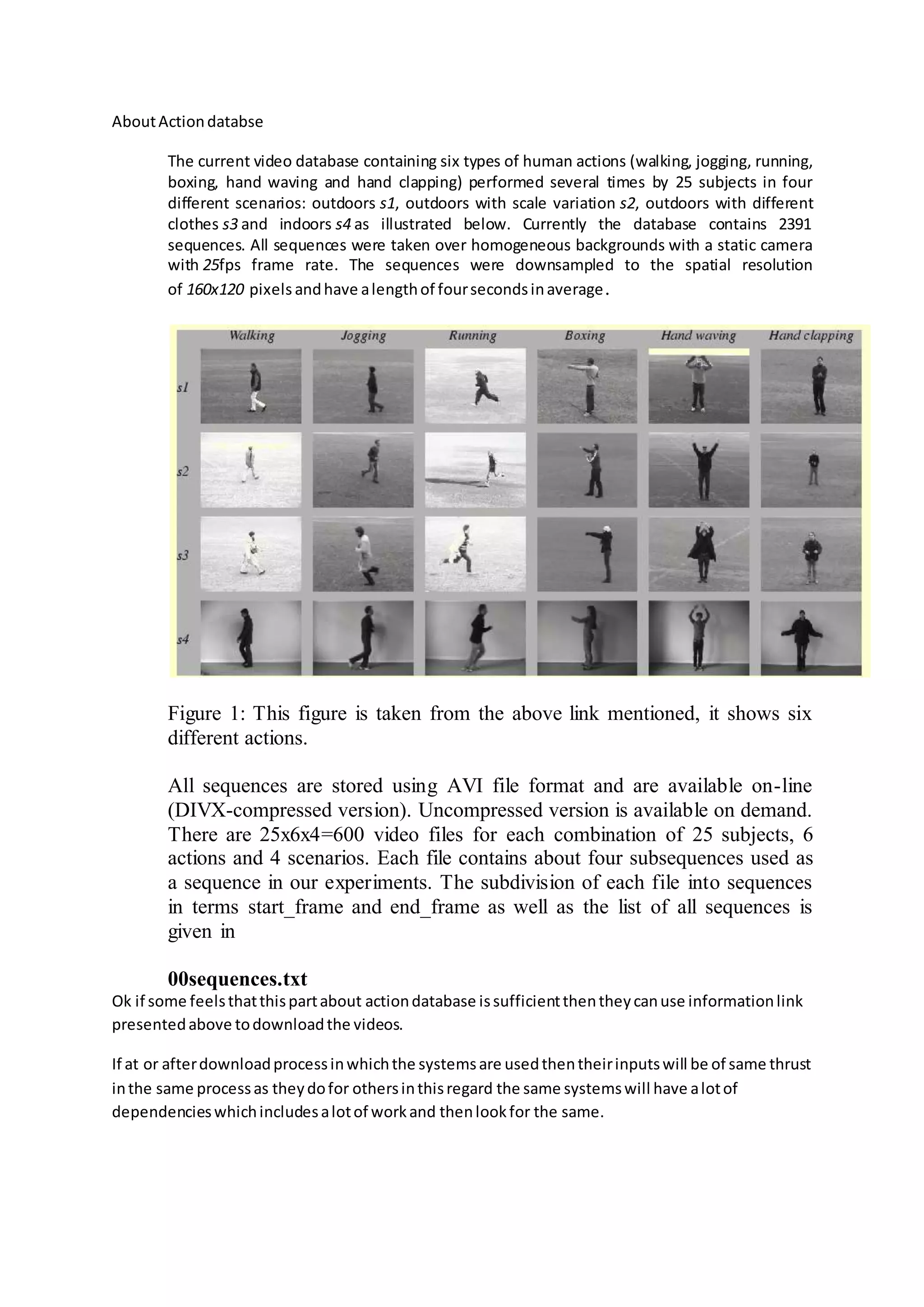
The current video database containing six types of human actions (walking, jogging, running,
boxing, hand waving and hand clapping) performed several times by 25 subjects in four
different scenarios: outdoors s1, outdoors with scale variation s2, outdoors with different
clothes s3 and indoors s4 as illustrated below. Currently the database contains 2391
sequences. All sequences were taken over homogeneous backgrounds with a static camera
with 25fps frame rate. The sequences were downsampled to the spatial resolution
of 160x120 pixels andhave alengthof foursecondsinaverage.
Figure 1: This figure is taken from the above link mentioned, it shows six
different actions.
All sequences are stored using AVI file format and are available on-line
(DIVX-compressed version). Uncompressed version is available on demand.
There are 25x6x4=600 video files for each combination of 25 subjects, 6
actions and 4 scenarios. Each file contains about four subsequences used as
a sequence in our experiments. The subdivision of each file into sequences
in terms start_frame and end_frame as well as the list of all sequences is
given in
00sequences.txt
Ok if some feelsthatthispartabout actiondatabase issufficientthentheycanuse informationlink
presentedabove todownloadthe videos.
If at or afterdownloadprocessinwhichthe systemsare usedthentheirinputswill be of same thrust
inthe same processas theydofor othersinthisregard the same systemswill have alotof
dependencieswhichincludesalotof workand thenlookfor the same.
Thus the same isexpectedfromthe usersof the same fieldtocarry some investigationonhow this
linkworkand alsohave some perseverance while thisreportgivesasystematicideaonhow this
humanrecognitionwillbe developed.
Resourcessummary.
As the ideahasbeenpropoundedthere isaneedof learningandmanagingthe software very
carefully.Whatwill be the resources veryimperative questions amongstus.
1. Some answerswill come likewhatisthe literature survey?
2. Some will askwhatisthe type of software ?
3. Some will saywhatisthe efficiencyof software?
4. Some will askhowaboutthe old work?
5. Some will askwhatwill be the new work?
6. Some will saywhataboutthe processhow are you goingto start,mediate,manage andend
the task?
Thus the topicswill followthese questionsverycarefullysothatanyone can pickthere answersfrom
here.
1. Literature survey
If any individualstartsthe workthenthe mostimportantworkwill be to start withthe
questionthatwhatisthe lastworkdone on the date the intellectstartsthe work.
Thus if thisreportisstatedon the work thenthe latestreference mustbe giventoanalyze
the situation.Tobeginwiththe processthe mostimperative workwill be usingthe required
workby introducingthe conceptof usingthe internettolookforwardforthe work.
Reference
Human Action Recognition With Video Data:
Research and Evaluation Challenges
Manoj Ramanathan
Sch. of Electr. & Electron. Eng., Nanyang Technol. Univ., Singapore,
Singapore
Wei-Yun Yau
Inst. for Infocomm Res.,Agencyfor Sci., Technol. & Res., Singapore,
Singapore
Eam Khwang Teoh
Sch. of Electr. & Electron. Eng., Nanyang Technol. Univ., Singapore,
Singapore
Abstract:
Given a video sequence,the task of action recognition is to identify the
most similar action among the action sequences learned by the system.
Such human action recognition is based on evidence gathered from
videos.It has wide application including surveillance, video indexing,
biometrics,telehealth, and human-computer interaction. Vision-based
human action recognition is affectedby several challenges due to view
changes, occlusion,variation in execution rate, anthropometry, camera
motion, and background clutter. In this survey, we provide an overview
of the existing methods based on their ability to handle these challenges
as well as how these methods can be generalized and their ability to
detectabnormal actions. Such systematic classificationwill help
researchers to identify the suitable methods available to address each of
the challenges faced and their limitations. In addition, we also identify
the publicly available datasets and the challenges posed by them. From
this survey, we draw conclusions regarding how well a challenge has
been solved,and we identify potential research areas that require further
work.
Publishedin: IEEE Transactions on Human-Machine
Systems ( Volume: 44, Issue:5, Oct. 2014 )
If anyone isinterestedcanlookforthispaperby signinginthe IEEE to allocate the same
space of interestforliterature sothata benchmarkcouldcome upin mind.
Alsowiththe helpof thispaperitmay be usedforidentifyingthe lasttechnique whichis
applicable sofar.

Abstract synopsis paper

  • 1.
    Abstract: Humanaction recognitionisverymuchtrendingandneedsalotofhumanunderstanding whichcomeswithexperience,one personinhischildhoodisonlyable tolearnfew of the human actionand withexperience thathe orshe will gaingivesan ideaof differenthumanaction,thusthis paperis all aboutyour understandingonhow humanactionlastsand how it couldbe well differentiatedfromotheractions.Toperformthisthere are stepsthatshouldbe followed,normally thisconceptis perceivedbyhumanusingtheirbraineye coordinationbutinthe casesof software a similarapproachwill be followed,Requiredisacamera and a software tointerpretall of them, lets beginwithafundamental question,whatisthe needof acamera. Introduction To answerthisprettygoodquestionitisrequiredtounderstandthe importance of camerainterms of visionsystems,if agesture isdeliberatelydone thenhumanseethatandperformthataccordingly but if the same doesnot happeninthe same waythenwrong consequencescanhappen,soitis of utmostimportance toknowcamera isthat visionsystemtothe software. Nowthere isa secondquestionwhatisa software. Althoughthisquestionseemstobe ridiculousbutlet’ssee itinabroad way,a software helps humansdo some workina speedyandaccurate manner,forexample youuse Microsoftwordto write a reportand thenuse anothersoftware toprintit. Thus the software isusedtoperforma similartype of actioninthiscase,to analyze the fact carefully it isseenasa linkof makinga decision. Ok that’sfine inthissense itisall understoodbutwhatif someone doesnothave anyknowledge on it,so howthiscamera and software canbe helpful forthem. It isnot that difficultasexpected,some people will sayokhow andwhat isthissoftware butrather than eulogizedandgivingamixedanswer,letsmake itverystraight. Whenpeople withsuchahighdemandingsoftware use that,thenalongwiththatsome manualsand documentedformreadingwill be available whichisreadilyavailable,butwithtrendingpartissome isnot interestedinreadingthatmaterial make sure youdohave that ideaof viewingvideos. So let’sanswerthe questionnow howthispaperorreportanswerabouthumanmotionrecognition. In thisregardthispaperis relatedto flow of some stepswhichare relatedtoimagesof human motioninthe form of videos.Similarlythe same isavailable inthe desktopandthenitisavailable for software also.The videosare standardvideosdownloadedfrominternetformaveryreliable source. Let’sbeginwiththatlinkwhichisimportantforan intellecttoundergothatchange of humanvideos. The linkismentionedbelowasahyperlinkwhichanyone canuse to downloadthe videoscarefully. http://www.nada.kth.se/cvap/actions/ Throughthislinkanyone can downloadthose videosequencesof humanactionsandcan use them for anytype of recognition.
  • 2.
    AboutActiondatabse The current videodatabase containing six types of human actions (walking, jogging, running, boxing, hand waving and hand clapping) performed several times by 25 subjects in four different scenarios: outdoors s1, outdoors with scale variation s2, outdoors with different clothes s3 and indoors s4 as illustrated below. Currently the database contains 2391 sequences. All sequences were taken over homogeneous backgrounds with a static camera with 25fps frame rate. The sequences were downsampled to the spatial resolution of 160x120 pixels andhave alengthof foursecondsinaverage. Figure 1: This figure is taken from the above link mentioned, it shows six different actions. All sequences are stored using AVI file format and are available on-line (DIVX-compressed version). Uncompressed version is available on demand. There are 25x6x4=600 video files for each combination of 25 subjects, 6 actions and 4 scenarios. Each file contains about four subsequences used as a sequence in our experiments. The subdivision of each file into sequences in terms start_frame and end_frame as well as the list of all sequences is given in 00sequences.txt Ok if some feelsthatthispartabout actiondatabase issufficientthentheycanuse informationlink presentedabove todownloadthe videos. If at or afterdownloadprocessinwhichthe systemsare usedthentheirinputswill be of same thrust inthe same processas theydofor othersinthisregard the same systemswill have alotof dependencieswhichincludesalotof workand thenlookfor the same.
  • 3.
    Thus the sameisexpectedfromthe usersof the same fieldtocarry some investigationonhow this linkworkand alsohave some perseverance while thisreportgivesasystematicideaonhow this humanrecognitionwillbe developed. Resourcessummary. As the ideahasbeenpropoundedthere isaneedof learningandmanagingthe software very carefully.Whatwill be the resources veryimperative questions amongstus. 1. Some answerswill come likewhatisthe literature survey? 2. Some will askwhatisthe type of software ? 3. Some will saywhatisthe efficiencyof software? 4. Some will askhowaboutthe old work? 5. Some will askwhatwill be the new work? 6. Some will saywhataboutthe processhow are you goingto start,mediate,manage andend the task? Thus the topicswill followthese questionsverycarefullysothatanyone can pickthere answersfrom here. 1. Literature survey If any individualstartsthe workthenthe mostimportantworkwill be to start withthe questionthatwhatisthe lastworkdone on the date the intellectstartsthe work. Thus if thisreportisstatedon the work thenthe latestreference mustbe giventoanalyze the situation.Tobeginwiththe processthe mostimperative workwill be usingthe required workby introducingthe conceptof usingthe internettolookforwardforthe work. Reference Human Action Recognition With Video Data: Research and Evaluation Challenges Manoj Ramanathan Sch. of Electr. & Electron. Eng., Nanyang Technol. Univ., Singapore, Singapore Wei-Yun Yau Inst. for Infocomm Res.,Agencyfor Sci., Technol. & Res., Singapore, Singapore Eam Khwang Teoh Sch. of Electr. & Electron. Eng., Nanyang Technol. Univ., Singapore, Singapore
  • 4.
    Abstract: Given a videosequence,the task of action recognition is to identify the most similar action among the action sequences learned by the system. Such human action recognition is based on evidence gathered from videos.It has wide application including surveillance, video indexing, biometrics,telehealth, and human-computer interaction. Vision-based human action recognition is affectedby several challenges due to view changes, occlusion,variation in execution rate, anthropometry, camera motion, and background clutter. In this survey, we provide an overview of the existing methods based on their ability to handle these challenges as well as how these methods can be generalized and their ability to detectabnormal actions. Such systematic classificationwill help researchers to identify the suitable methods available to address each of the challenges faced and their limitations. In addition, we also identify the publicly available datasets and the challenges posed by them. From this survey, we draw conclusions regarding how well a challenge has been solved,and we identify potential research areas that require further work. Publishedin: IEEE Transactions on Human-Machine Systems ( Volume: 44, Issue:5, Oct. 2014 ) If anyone isinterestedcanlookforthispaperby signinginthe IEEE to allocate the same space of interestforliterature sothata benchmarkcouldcome upin mind. Alsowiththe helpof thispaperitmay be usedforidentifyingthe lasttechnique whichis applicable sofar.