Module 5
Planning and Implementing Brand Marketing Programs
4.2
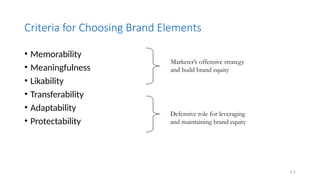
Criteria for Choosing Brand Elements
• Memorability
• Meaningfulness
• Likability
• Transferability
• Adaptability
• Protectability
Marketer’s offensive strategy
and build brand equity
Defensive role for leveraging
and maintaining brand equity
4.3
Memorability
• Brand elements should inherently be memorable and attention-
getting, and therefore facilitate recall or recognition.
4.4
Meaningfulness
• Brand elements may take on all kinds of meaning, with either
descriptive or persuasive content.
• Two particularly important criteria
• General information about the nature of the product category
• Specific information about particular attributes and benefits of the brand
• The first dimension is an important determinant of brand awareness
and salience; the second, of brand image and positioning.
4.5
Likability
• Do customers find the brand element aesthetically appealing?
• Descriptive and persuasive elements reduce the burden on marketing
communications to build awareness.
4.6
Transferability
• How useful is the brand element for line or category extensions?
• To what extent does the brand element add to brand equity across
geographic boundaries and market segments?
4.7
Adaptability
• The more adaptable and flexible the brand element, the easier it is to
update it to changes in consumer values and opinions.
• For example, logos and characters can be given a new look or a new
design to make them appear more modern and relevant.
• Ex. Advertisement of Dairymilk
4.8
Protectability
• Marketers should:
1. Choose brand elements that can be legally protected internationally.
2. Formally register chosen brand elements with the appropriate legal bodies.
3. Vigorously defend trademarks from unauthorized competitive
infringement.
4.9
Tactics for Brand Elements
• A variety of brand elements can be chosen that
inherently enhance brand awareness or facilitate the
formation of strong, favorable, and unique brand
associations.
• Brand names
• URLs
• Logos and symbols
• Characters
• Slogans
• Packaging
4.10
Brand Names
• Like any brand element, brand names must be chosen with the six
general criteria of memorability, meaningfulness, likability,
transferability, adaptability, and protectability in mind.
4.11
Brand Naming Guidelines
• Brand awareness
• Simplicity and ease of pronunciation and spelling
• Familiarity and meaningfulness
• Differentiated, distinctive, and uniqueness
• Brand associations
• The explicit and implicit meanings consumers extract from it are important. In
particular, the brand name can reinforce an important attribute or benefit
association that makes up its product positioning.
4.12
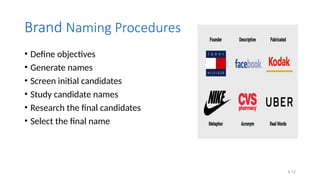
Brand Naming Procedures
• Define objectives
• Generate names
• Screen initial candidates
• Study candidate names
• Research the final candidates
• Select the final name
4.13
URLs
• URLs (uniform resource locators) specify locations of pages on the
web and are also commonly referred to as domain names.
• A company can either sue the current owner of the URL for copyright
infringement, buy the name from the current owner, or register all
conceivable variations of its brand as domain names ahead of time.
4.14
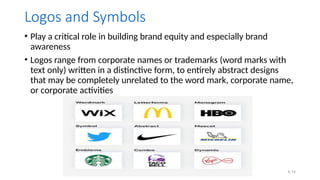
Logos and Symbols
• Play a critical role in building brand equity and especially brand
awareness
• Logos range from corporate names or trademarks (word marks with
text only) written in a distinctive form, to entirely abstract designs
that may be completely unrelated to the word mark, corporate name,
or corporate activities
4.15
Characters
• A special type of brand symbol—one that takes on human or real-life
characteristics
4.16
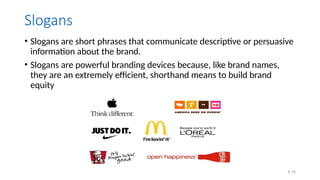
Slogans
• Slogans are short phrases that communicate descriptive or persuasive
information about the brand.
• Slogans are powerful branding devices because, like brand names,
they are an extremely efficient, shorthand means to build brand
equity
4.17
Jingles
• Jingles are musical messages written around the brand. Typically
composed by professional songwriters, they often have enough
catchy hooks and choruses to become almost permanently registered
in the minds of listeners—sometimes whether they want them to or
not!
• Jingles are perhaps most valuable in enhancing brand awareness.
• “Utterly Butterly Delicious Amul”
4.18
Packaging
• Packaging is the activities of designing and producing containers or
wrappers for a product.
• From the perspective of both the firm and consumers, packaging
must achieve a number of objectives:
• Identify the brand
• Convey descriptive and persuasive information
• Facilitate product transportation and protection
• Assist at-home storage
• Aid product consumption
4.19
Packaging Can Influence Taste
• Our sense of taste and touch is very suggestible, and what we see on
a package can lead us to taste what we think we are going to taste.
4.20
Packaging Can Influence Value
• Long after we have bought a product, a package can still lead us to
believe we bought it because it was a good value.
4.21
Packaging Can Influence Consumption
• Studies of 48 different types of foods and personal care products have
shown that people pour and consume between 18% and 32% more of
a product as the size of the container doubles.
Valerie Folkes, Ingrid Martin and Kamal Gupta,
“When to Say When: Effects of Supply on Usage,”
Journal of Consumer Research, 20 December 1993, 467-477.
4.22
Packaging Can Influence How a Person Uses a
Product
• One strategy to increase use of mature products has been to
encourage people to use the brand in new situations, like soup for
breakfast, or new uses, like baking soda as a refrigerator deodorizer.
• An analysis of 26 products and 402 consumers showed that twice as
many people learned about the new use from the package than from
television ads.
• Ex, Knor noodles
4.23
Putting It All Together
• The entire set of brand elements makes up the brand identity, the
contribution of all brand elements to awareness and image.
• The cohesiveness of the brand identity depends on the extent to
which the brand elements are consistent.
5.24
New Perspectives on Marketing
• The strategy and tactics behind marketing programs have changed
dramatically in recent years as firms have dealt with enormous shifts
in their external marketing environments:
• Digitalization and connectivity (through Internet, intranet, and mobile
devices)
• Disintermediation and reintermediation (via new middlemen of various sorts)
• Customization and customerization (through tailored products and
ingredients provided to customers to make products themselves)
• Industry convergence (through the blurring of industry boundaries)
5.25
Implications for the Practice of Brand
Management
• They have a number of implications for the practice of brand
management. Marketers are increasingly abandoning the mass-
market strategies that built brand powerhouses in the 1950s, 1960s,
and 1970s to implement new approaches.
• Even marketers in staid, traditional industries are rethinking their
practices and not doing business as usual.
5.26
Integrating Marketing Programs and Activities
• Creative and original thinking is necessary to create fresh new
marketing programs that break through the noise in the marketplace
to connect with customers.
• Marketers are increasingly trying a host of unconventional means of
building brand equity.
5.27
Personalizing Marketing
• All of these approaches are a means to create deeper, richer, and more favorable
brand associations.
• Relationship marketing has become a powerful brand-building force.
• Can slip through consumer radar
• May creatively create unique associations
• May reinforce brand imagery and feelings
• Nevertheless, there is still a need for the control and predictability of traditional
marketing activities.
• Models of brand equity can help to provide direction and focus to the marketing
programs.
5.28
Personalizing Marketing Concepts
• Experiential marketing
• One-to-one marketing
• Permission marketing
5.29
Reconciling the New Marketing Approaches
• One-to-one, permission, and experiential marketing are all potentially
effective means of getting consumers more actively involved with a
brand.
5.30
Experiential Marketing
• Focuses on customer experience
• Focuses on the consumption situation
• Views customers as rational and emotional elements
• Uses electric methods and tools
5.31
One-to-One Marketing:
Competitive Rationale
• Consumers help to add value by providing information.
• Firm adds value by generating rewarding experiences
with consumers.
• Creates switching costs for consumers
• Reduces transaction costs for consumers
• Maximizes utility for consumers
5.32
One-to-One Marketing:
Consumer Differentiation
• Treat different consumers differently
• Different needs
• Different values to firm
• Current
• Future (lifetime value)
• Devote more marketing effort on most valuable
consumers (and customers)
5.33
One-to-One Marketing: Five Key Steps
• Identify consumers, individually and addressably
• Differentiate them by value and needs
• Interact with them more cost-efficiently and effectively
• Customize some aspect of the firm’s behavior
• Brand the relationship
5.34
Permission Marketing (Seth Godin)
• “Encourages consumers to participate in a long-term
interactive marketing campaign in which they are
rewarded in some way for paying attention to
increasingly relevant messages.”
• Anticipated
• Personal
• Relevant
• Permission marketing can be contrasted to interruption
marketing.
5.35
Five Steps in Permission Marketing
1. Offer the prospect an incentive to volunteer.
2. Offer the interested prospect a curriculum over
time, teaching consumers about the product.
3. Reinforce the incentive to guarantee that prospect
maintains the permission.
4. Offer additional incentives to get more permission
from the consumer.
5. Over time, leverage the permission to change
consumer behavior toward profits.
5.36
Integrating the Brand
Into Supporting Marketing Programs
• Product strategy
• Pricing strategy
• Channel strategy
Supporting marketing mix should be designed to enhance
awareness and establish desired brand image.
5.37
Product Strategy
• Designing and delivering product and service that
that fully satisfies consumer needs and wants is a
prerequisite for successful marketing, regardless of
whether the product is a tangible good, services, or
organization.
• Perceived quality and value
• Relationship marketing
Perceived quality and value
• Perceived quality is customers’ perception of the
overall quality or superiority of product or service
compared to alternatives and with respect to its
intended purpose.
• Brand intangibles
• Total quality management and return on quality
• Value chain
5.38
Brand intangibles
• Product quality depends not only on functional product performance
but on broader product considerations as well, like speed, accuracy
and care of product delivery and installation; the promptness,
courtesy, and helpfulness of customer service and training; and
quality of repair service.
• McKinsey Consulting has put an approach to marketing called 3-D marketing
emphasize on three product and service benefit dimension:
• Functional Benefit
• Process Benefit
• Relationship Benefit
5.39
Value chain
• Value chain is a strategic tool for identifying ways to create more
customer value.
• Here, costs not restricted to actual monetary price but may reflect
opportunity costs of time, energy and any psychological involvement
in the decision that consumer might have.
5.40
Relationship marketing
• It is based on premise that current customers are the key to long term
brand success.
• Mass customization
• Aftermarketing: those marketing activities that occur after customer
purchase.
• Loyalty programs: through which marketer create strong ties with customer.
5.41
5.42
Pricing Strategy
• Price premiums are among the most important brand equity
benefits of building a strong brand.
• Consumer price perceptions
• Consumers often rank brands according to price tiers in a category.
• Setting prices to build brand equity
• Value pricing- to uncover the right blend of product quality, product
costs, and product prices that fully satisfies the needs and wants of
consumer and the profit target of the company.
• Everyday low pricing- means of determining price discounts and
promotion over time.
5.43
Channel Strategy
• The manner by which a product is sold or distributed
can have a profound impact on the resulting equity
and ultimate sales success of a brand.
• Channel strategy includes the design and
management of intermediaries such as wholesalers,
distributors, brokers, and retailers.
5.44
Channel Design
• Direct channels
• Selling through personal contacts from the company to prospective customers
by mail, phone, electronic means, in-person visits, and so forth
• Indirect channels
• Selling through third-party intermediaries such as agents or broker
representatives, wholesalers or distributors, and retailers or dealers
• Push and pull strategies
• Web strategies
5.45
Push and Pull Strategies
• By devoting marketing efforts to the end consumer, a manufacturer is
said to employ a pull strategy.
• Alternatively, marketers can devote their selling efforts to the channel
members themselves, providing direct incentives for them to stock
and sell products to the end consumer. This approach is called a push
strategy.
5.46
Channel Support
• Two such partnership strategies are retail segmentation activities and
cooperative advertising programs.
• Retail segmentation
• Retailers are “customers” too
• Cooperative advertising
• A manufacturer pays for a portion of the advertising that a retailer runs to
promote the manufacturer’s product and its availability in the retailer’s place
of business.
5.47
Web Strategies
• Advantage of having both a physical “brick and mortar” channel and a
virtual, online retail channel
• The Boston Consulting Group concluded that multichannel retailers
were able to acquire customers at half the cost of Internet-only
retailers, citing a number of advantages for the multichannel retailers.
6.48
Marketing Communications Options
• Advertising
• Promotions
• Event marketing and sponsorship
• Public relations and publicity
• Personal selling
6.49
Advertising
• A powerful means of creating strong, favorable, and unique brand
associations and eliciting positive judgments and feelings
• Controversial because its specific effects are often difficult to quantify
and predict
• Nevertheless, a number of studies using very different approaches
have shown the potential power of advertising on brand sales.
6.50
Ideal Ad Campaign
The ideal ad campaign would ensure that:
1. The right consumer is exposed to the right message at the right place and at the right time.
2. The creative strategy for the advertising causes the consumer to notice and attend to the ad
but does not distract from the intended message.
3. The ad properly reflects the consumer’s level of understanding about the product and the
brand.
4. The ad correctly positions the brand in terms of desirable and deliverable points-of-difference
and points-of-parity.
5. The ad motivates consumers to consider purchase of the brand.
6. The ad creates strong brand associations to all of these stored communication effects so that
they can have an effect when consumers are considering making a purchase.
6.51
Category of Advertising
• Television
• Radio
• Print
• Direct response
• Interactive: websites, online ads
• Mobile marketing
• Place advertising:
• Billboards; movies, airlines, and lounges; product placement; and point-of-
purchase advertising
6.52
Promotions
• Short-term incentives to encourage trial or usage of a product or
service
• Marketers can target sales promotions at either the trade or end
consumers
• Consumer promotions
• Consumer promotions are designed to change the choices, quantity, or timing
of consumers’ product purchases.
• Trade promotions
• Trade promotions are often financial incentives or discounts given to retailers,
distributors, and other members of the trade to stock, display, and in other
ways facilitate the sale of a product.
6.53
Event Marketing and Sponsorship
• Event marketing is public sponsorship of events or activities related to
sports, art, entertainment, or social causes.
• Event sponsorship provides a different kind of communication
option for marketers. By becoming part of a special and personally
relevant moment in consumers’ lives, sponsors can broaden and
deepen their relationship with their target market.
6.54
Public Relations and Publicity
• Public relations and publicity relate to a variety of programs and are
designed to promote or protect a company’s image or its individual
products.
• Buzz Marketing
• Occasionally, a product enters the market with little fanfare yet is still able to
attract a strong customer base.
6.55
Personal Selling
• Personal selling is face-to-face interaction with one or more
prospective purchasers for the purpose of making sales
• The keys to better selling
• Rethink training
• Get everyone involved
• Inspire from the top
• Change the motivation
• Forge electronic links
• Talk to your customers
6.56
Integrated Marketing Communications (IMC)
• The “voice” of the brand
• A means by which it can establish a dialogue and build
relationships with consumers
• Allow marketers to inform, persuade, provide
incentives, and remind consumers directly or indirectly
• Can contribute to brand equity by establishing the
brand in memory and linking strong, favorable, and
unique associations to it
6.57
Developing IMC Programs
• Mixing communication options
• Evaluate all possible communication options available to
create knowledge structures according to effectiveness
criteria as well as cost considerations.
• Different communication options have different strengths
and can accomplish different objectives.
• Determine the optimal mix
6.58
Evaluating IMC Programs
• Coverage: What proportion of the target audience is
reached by each communication option employed?
How much overlap exists among options?
• Cost: What is the per capita expense?
6.59
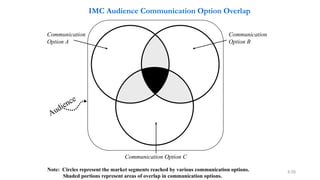
Communication
Option A
Communication Option C
Communication
Option B
Audience
IMC Audience Communication Option Overlap
Note: Circles represent the market segments reached by various communication options.
Shaded portions represent areas of overlap in communication options.
6.60
Evaluating IMC Programs (cont.)
• Contribution: The collective effect on brand equity in
terms of
• enhancing depth and breadth of awareness
• improving strength, favorability, and uniqueness of brand
associations
• Commonality: The extent to which information
conveyed by different communication options share
meaning
6.61
Evaluating IMC Programs (cont.)
• Complementarity: The extent to which different
associations and linkages are emphasized across
communication options
• Versatility: The extent to which information contained
in a communication option works with different types
of consumers
• Different communications history
• Different market segments
6.62
Marketing Communication Guidelines
• Be analytical: Use frameworks of consumer behavior
and managerial decision making to develop well-
reasoned communication programs
• Be curious: Fully understand consumers by using all
forms of research and always be thinking of how you
can create added value for consumers
• Be single-minded: Focus message on well-defined
target markets (less can be more)
• Be integrative: Reinforce your message through
consistency and cuing across all communications
6.63
Marketing Communication Guidelines (Cont.)
• Be creative: State your message in a unique fashion; use
alternative promotions and media to create favorable,
strong, and unique brand associations
• Be observant: Monitor competition, customers, channel
members, and employees through tracking studies
• Be realistic: Understand the complexities involved in
marketing communications
• Be patient: Take a long-term view of communi-cation
effectiveness to build and manage brand equity
7.64
Leveraging Secondary Associations
• Creation of new brand associations
• Effects on existing brand knowledge
• Awareness and knowledge of the entity
• Meaningfulness of the knowledge of the entity
• Transferability of the knowledge of the entity
7.65
Leveraging Secondary Associations
• Brand associations may themselves be linked to other
entities, creating secondary associations:
• Company (through branding strategies)
• Country of origin (through identification of product origin)
• Channels of distribution (through channels strategy)
• Other brands (through co-branding)
• Special case of co-branding is ingredient branding
• Characters (through licensing)
• Celebrity spokesperson (through endorsement advertising)
• Events (through sponsorship)
• Other third-party sources (through awards and reviews)
7.66
• These secondary associations may lead to a transfer of:
• Response-type associations
• Judgments (especially credibility)
• Feelings
• Meaning-type associations
• Product or service performance
• Product or service imagery
Leveraging Secondary Associations
7.67
Co-Branding
Occurs when two or more existing brands are
combined into a joint product or are marketed
together in some fashion
Examples:
 Sony Ericsson
 Yoplait Trix Yogurt
 Nestle’s Cheerios Cookie Bars
7.68
Advantages of Co-Branding
Borrow needed expertise
Leverage equity you don’t have
Reduce cost of product introduction
Expand brand meaning into related categories
 Broaden meaning
 Increase access points
Source of additional revenue
7.69
Disadvantages of Co-Branding
Loss of control
Risk of brand equity dilution
Negative feedback effects
Lack of brand focus and clarity
Organizational distractions
7.70
Ingredient Branding
A special case of co-branding that involves creating
brand equity for materials, components, or parts
that are necessarily contained within other branded
products
Examples:
 Betty Crocker baking mixes with Hershey’s chocolate
syrup
 Intel inside
7.71
Licensing
Involves contractual arrangements whereby firms
can use the names, logos, characters, and so forth of
other brands for some fixed fee
Examples:
 Entertainment (Star Wars, Jurassic Park, etc.)
 Television and cartoon characters (The Simpsons)
 Designer apparel and accessories (Calvin Klein, Pierre
Cardin, etc.)
7.72
Celebrity Endorsement
Draws attention to the brand
Shapes the perceptions of the brand
Celebrity should have a high level of visibility and a
rich set of useful associations, judgments, and
feelings
Q-Ratings to evaluate celebrities
7.73
Celebrity Endorsement: Potential Problems
Celebrity endorsers can be overused by endorsing many
products that are too varied.
There must be a reasonable match between the celebrity
and the product.
Celebrity endorsers can get in trouble or lose popularity.
Many consumers feel that celebrities are doing the
endorsement for money and do not necessarily believe in
the endorsed brand.
Celebrities may distract attention from the brand.
7.74
Sporting, Cultural, or Other Events
• Sponsored events can contribute to brand equity by becoming
associated to the brand and improving brand awareness, adding new
associations, or improving the strength, favorability, and uniqueness
of existing associations.
• The main means by which an event can transfer associations is
credibility.
7.75
Third-Party Sources
• Marketers can create secondary associations in a number of different
ways by linking the brand to various third-party sources.
• Third-party sources can be especially credible sources.
• Marketers often feature them in advertising campaigns and selling
efforts .
• Example: J.D. Power and Associates’ well-publicized Customer Satisfaction
Index

ABrand Marketing Program usually adopted

  • 1.
    Module 5 Planning andImplementing Brand Marketing Programs
  • 2.
    4.2 Criteria for ChoosingBrand Elements • Memorability • Meaningfulness • Likability • Transferability • Adaptability • Protectability Marketer’s offensive strategy and build brand equity Defensive role for leveraging and maintaining brand equity
  • 3.
    4.3 Memorability • Brand elementsshould inherently be memorable and attention- getting, and therefore facilitate recall or recognition.
  • 4.
    4.4 Meaningfulness • Brand elementsmay take on all kinds of meaning, with either descriptive or persuasive content. • Two particularly important criteria • General information about the nature of the product category • Specific information about particular attributes and benefits of the brand • The first dimension is an important determinant of brand awareness and salience; the second, of brand image and positioning.
  • 5.
    4.5 Likability • Do customersfind the brand element aesthetically appealing? • Descriptive and persuasive elements reduce the burden on marketing communications to build awareness.
  • 6.
    4.6 Transferability • How usefulis the brand element for line or category extensions? • To what extent does the brand element add to brand equity across geographic boundaries and market segments?
  • 7.
    4.7 Adaptability • The moreadaptable and flexible the brand element, the easier it is to update it to changes in consumer values and opinions. • For example, logos and characters can be given a new look or a new design to make them appear more modern and relevant. • Ex. Advertisement of Dairymilk
  • 8.
    4.8 Protectability • Marketers should: 1.Choose brand elements that can be legally protected internationally. 2. Formally register chosen brand elements with the appropriate legal bodies. 3. Vigorously defend trademarks from unauthorized competitive infringement.
  • 9.
    4.9 Tactics for BrandElements • A variety of brand elements can be chosen that inherently enhance brand awareness or facilitate the formation of strong, favorable, and unique brand associations. • Brand names • URLs • Logos and symbols • Characters • Slogans • Packaging
  • 10.
    4.10 Brand Names • Likeany brand element, brand names must be chosen with the six general criteria of memorability, meaningfulness, likability, transferability, adaptability, and protectability in mind.
  • 11.
    4.11 Brand Naming Guidelines •Brand awareness • Simplicity and ease of pronunciation and spelling • Familiarity and meaningfulness • Differentiated, distinctive, and uniqueness • Brand associations • The explicit and implicit meanings consumers extract from it are important. In particular, the brand name can reinforce an important attribute or benefit association that makes up its product positioning.
  • 12.
    4.12 Brand Naming Procedures •Define objectives • Generate names • Screen initial candidates • Study candidate names • Research the final candidates • Select the final name
  • 13.
    4.13 URLs • URLs (uniformresource locators) specify locations of pages on the web and are also commonly referred to as domain names. • A company can either sue the current owner of the URL for copyright infringement, buy the name from the current owner, or register all conceivable variations of its brand as domain names ahead of time.
  • 14.
    4.14 Logos and Symbols •Play a critical role in building brand equity and especially brand awareness • Logos range from corporate names or trademarks (word marks with text only) written in a distinctive form, to entirely abstract designs that may be completely unrelated to the word mark, corporate name, or corporate activities
  • 15.
    4.15 Characters • A specialtype of brand symbol—one that takes on human or real-life characteristics
  • 16.
    4.16 Slogans • Slogans areshort phrases that communicate descriptive or persuasive information about the brand. • Slogans are powerful branding devices because, like brand names, they are an extremely efficient, shorthand means to build brand equity
  • 17.
    4.17 Jingles • Jingles aremusical messages written around the brand. Typically composed by professional songwriters, they often have enough catchy hooks and choruses to become almost permanently registered in the minds of listeners—sometimes whether they want them to or not! • Jingles are perhaps most valuable in enhancing brand awareness. • “Utterly Butterly Delicious Amul”
  • 18.
    4.18 Packaging • Packaging isthe activities of designing and producing containers or wrappers for a product. • From the perspective of both the firm and consumers, packaging must achieve a number of objectives: • Identify the brand • Convey descriptive and persuasive information • Facilitate product transportation and protection • Assist at-home storage • Aid product consumption
  • 19.
    4.19 Packaging Can InfluenceTaste • Our sense of taste and touch is very suggestible, and what we see on a package can lead us to taste what we think we are going to taste.
  • 20.
    4.20 Packaging Can InfluenceValue • Long after we have bought a product, a package can still lead us to believe we bought it because it was a good value.
  • 21.
    4.21 Packaging Can InfluenceConsumption • Studies of 48 different types of foods and personal care products have shown that people pour and consume between 18% and 32% more of a product as the size of the container doubles. Valerie Folkes, Ingrid Martin and Kamal Gupta, “When to Say When: Effects of Supply on Usage,” Journal of Consumer Research, 20 December 1993, 467-477.
  • 22.
    4.22 Packaging Can InfluenceHow a Person Uses a Product • One strategy to increase use of mature products has been to encourage people to use the brand in new situations, like soup for breakfast, or new uses, like baking soda as a refrigerator deodorizer. • An analysis of 26 products and 402 consumers showed that twice as many people learned about the new use from the package than from television ads. • Ex, Knor noodles
  • 23.
    4.23 Putting It AllTogether • The entire set of brand elements makes up the brand identity, the contribution of all brand elements to awareness and image. • The cohesiveness of the brand identity depends on the extent to which the brand elements are consistent.
  • 24.
    5.24 New Perspectives onMarketing • The strategy and tactics behind marketing programs have changed dramatically in recent years as firms have dealt with enormous shifts in their external marketing environments: • Digitalization and connectivity (through Internet, intranet, and mobile devices) • Disintermediation and reintermediation (via new middlemen of various sorts) • Customization and customerization (through tailored products and ingredients provided to customers to make products themselves) • Industry convergence (through the blurring of industry boundaries)
  • 25.
    5.25 Implications for thePractice of Brand Management • They have a number of implications for the practice of brand management. Marketers are increasingly abandoning the mass- market strategies that built brand powerhouses in the 1950s, 1960s, and 1970s to implement new approaches. • Even marketers in staid, traditional industries are rethinking their practices and not doing business as usual.
  • 26.
    5.26 Integrating Marketing Programsand Activities • Creative and original thinking is necessary to create fresh new marketing programs that break through the noise in the marketplace to connect with customers. • Marketers are increasingly trying a host of unconventional means of building brand equity.
  • 27.
    5.27 Personalizing Marketing • Allof these approaches are a means to create deeper, richer, and more favorable brand associations. • Relationship marketing has become a powerful brand-building force. • Can slip through consumer radar • May creatively create unique associations • May reinforce brand imagery and feelings • Nevertheless, there is still a need for the control and predictability of traditional marketing activities. • Models of brand equity can help to provide direction and focus to the marketing programs.
  • 28.
    5.28 Personalizing Marketing Concepts •Experiential marketing • One-to-one marketing • Permission marketing
  • 29.
    5.29 Reconciling the NewMarketing Approaches • One-to-one, permission, and experiential marketing are all potentially effective means of getting consumers more actively involved with a brand.
  • 30.
    5.30 Experiential Marketing • Focuseson customer experience • Focuses on the consumption situation • Views customers as rational and emotional elements • Uses electric methods and tools
  • 31.
    5.31 One-to-One Marketing: Competitive Rationale •Consumers help to add value by providing information. • Firm adds value by generating rewarding experiences with consumers. • Creates switching costs for consumers • Reduces transaction costs for consumers • Maximizes utility for consumers
  • 32.
    5.32 One-to-One Marketing: Consumer Differentiation •Treat different consumers differently • Different needs • Different values to firm • Current • Future (lifetime value) • Devote more marketing effort on most valuable consumers (and customers)
  • 33.
    5.33 One-to-One Marketing: FiveKey Steps • Identify consumers, individually and addressably • Differentiate them by value and needs • Interact with them more cost-efficiently and effectively • Customize some aspect of the firm’s behavior • Brand the relationship
  • 34.
    5.34 Permission Marketing (SethGodin) • “Encourages consumers to participate in a long-term interactive marketing campaign in which they are rewarded in some way for paying attention to increasingly relevant messages.” • Anticipated • Personal • Relevant • Permission marketing can be contrasted to interruption marketing.
  • 35.
    5.35 Five Steps inPermission Marketing 1. Offer the prospect an incentive to volunteer. 2. Offer the interested prospect a curriculum over time, teaching consumers about the product. 3. Reinforce the incentive to guarantee that prospect maintains the permission. 4. Offer additional incentives to get more permission from the consumer. 5. Over time, leverage the permission to change consumer behavior toward profits.
  • 36.
    5.36 Integrating the Brand IntoSupporting Marketing Programs • Product strategy • Pricing strategy • Channel strategy Supporting marketing mix should be designed to enhance awareness and establish desired brand image.
  • 37.
    5.37 Product Strategy • Designingand delivering product and service that that fully satisfies consumer needs and wants is a prerequisite for successful marketing, regardless of whether the product is a tangible good, services, or organization. • Perceived quality and value • Relationship marketing
  • 38.
    Perceived quality andvalue • Perceived quality is customers’ perception of the overall quality or superiority of product or service compared to alternatives and with respect to its intended purpose. • Brand intangibles • Total quality management and return on quality • Value chain 5.38
  • 39.
    Brand intangibles • Productquality depends not only on functional product performance but on broader product considerations as well, like speed, accuracy and care of product delivery and installation; the promptness, courtesy, and helpfulness of customer service and training; and quality of repair service. • McKinsey Consulting has put an approach to marketing called 3-D marketing emphasize on three product and service benefit dimension: • Functional Benefit • Process Benefit • Relationship Benefit 5.39
  • 40.
    Value chain • Valuechain is a strategic tool for identifying ways to create more customer value. • Here, costs not restricted to actual monetary price but may reflect opportunity costs of time, energy and any psychological involvement in the decision that consumer might have. 5.40
  • 41.
    Relationship marketing • Itis based on premise that current customers are the key to long term brand success. • Mass customization • Aftermarketing: those marketing activities that occur after customer purchase. • Loyalty programs: through which marketer create strong ties with customer. 5.41
  • 42.
    5.42 Pricing Strategy • Pricepremiums are among the most important brand equity benefits of building a strong brand. • Consumer price perceptions • Consumers often rank brands according to price tiers in a category. • Setting prices to build brand equity • Value pricing- to uncover the right blend of product quality, product costs, and product prices that fully satisfies the needs and wants of consumer and the profit target of the company. • Everyday low pricing- means of determining price discounts and promotion over time.
  • 43.
    5.43 Channel Strategy • Themanner by which a product is sold or distributed can have a profound impact on the resulting equity and ultimate sales success of a brand. • Channel strategy includes the design and management of intermediaries such as wholesalers, distributors, brokers, and retailers.
  • 44.
    5.44 Channel Design • Directchannels • Selling through personal contacts from the company to prospective customers by mail, phone, electronic means, in-person visits, and so forth • Indirect channels • Selling through third-party intermediaries such as agents or broker representatives, wholesalers or distributors, and retailers or dealers • Push and pull strategies • Web strategies
  • 45.
    5.45 Push and PullStrategies • By devoting marketing efforts to the end consumer, a manufacturer is said to employ a pull strategy. • Alternatively, marketers can devote their selling efforts to the channel members themselves, providing direct incentives for them to stock and sell products to the end consumer. This approach is called a push strategy.
  • 46.
    5.46 Channel Support • Twosuch partnership strategies are retail segmentation activities and cooperative advertising programs. • Retail segmentation • Retailers are “customers” too • Cooperative advertising • A manufacturer pays for a portion of the advertising that a retailer runs to promote the manufacturer’s product and its availability in the retailer’s place of business.
  • 47.
    5.47 Web Strategies • Advantageof having both a physical “brick and mortar” channel and a virtual, online retail channel • The Boston Consulting Group concluded that multichannel retailers were able to acquire customers at half the cost of Internet-only retailers, citing a number of advantages for the multichannel retailers.
  • 48.
    6.48 Marketing Communications Options •Advertising • Promotions • Event marketing and sponsorship • Public relations and publicity • Personal selling
  • 49.
    6.49 Advertising • A powerfulmeans of creating strong, favorable, and unique brand associations and eliciting positive judgments and feelings • Controversial because its specific effects are often difficult to quantify and predict • Nevertheless, a number of studies using very different approaches have shown the potential power of advertising on brand sales.
  • 50.
    6.50 Ideal Ad Campaign Theideal ad campaign would ensure that: 1. The right consumer is exposed to the right message at the right place and at the right time. 2. The creative strategy for the advertising causes the consumer to notice and attend to the ad but does not distract from the intended message. 3. The ad properly reflects the consumer’s level of understanding about the product and the brand. 4. The ad correctly positions the brand in terms of desirable and deliverable points-of-difference and points-of-parity. 5. The ad motivates consumers to consider purchase of the brand. 6. The ad creates strong brand associations to all of these stored communication effects so that they can have an effect when consumers are considering making a purchase.
  • 51.
    6.51 Category of Advertising •Television • Radio • Print • Direct response • Interactive: websites, online ads • Mobile marketing • Place advertising: • Billboards; movies, airlines, and lounges; product placement; and point-of- purchase advertising
  • 52.
    6.52 Promotions • Short-term incentivesto encourage trial or usage of a product or service • Marketers can target sales promotions at either the trade or end consumers • Consumer promotions • Consumer promotions are designed to change the choices, quantity, or timing of consumers’ product purchases. • Trade promotions • Trade promotions are often financial incentives or discounts given to retailers, distributors, and other members of the trade to stock, display, and in other ways facilitate the sale of a product.
  • 53.
    6.53 Event Marketing andSponsorship • Event marketing is public sponsorship of events or activities related to sports, art, entertainment, or social causes. • Event sponsorship provides a different kind of communication option for marketers. By becoming part of a special and personally relevant moment in consumers’ lives, sponsors can broaden and deepen their relationship with their target market.
  • 54.
    6.54 Public Relations andPublicity • Public relations and publicity relate to a variety of programs and are designed to promote or protect a company’s image or its individual products. • Buzz Marketing • Occasionally, a product enters the market with little fanfare yet is still able to attract a strong customer base.
  • 55.
    6.55 Personal Selling • Personalselling is face-to-face interaction with one or more prospective purchasers for the purpose of making sales • The keys to better selling • Rethink training • Get everyone involved • Inspire from the top • Change the motivation • Forge electronic links • Talk to your customers
  • 56.
    6.56 Integrated Marketing Communications(IMC) • The “voice” of the brand • A means by which it can establish a dialogue and build relationships with consumers • Allow marketers to inform, persuade, provide incentives, and remind consumers directly or indirectly • Can contribute to brand equity by establishing the brand in memory and linking strong, favorable, and unique associations to it
  • 57.
    6.57 Developing IMC Programs •Mixing communication options • Evaluate all possible communication options available to create knowledge structures according to effectiveness criteria as well as cost considerations. • Different communication options have different strengths and can accomplish different objectives. • Determine the optimal mix
  • 58.
    6.58 Evaluating IMC Programs •Coverage: What proportion of the target audience is reached by each communication option employed? How much overlap exists among options? • Cost: What is the per capita expense?
  • 59.
    6.59 Communication Option A Communication OptionC Communication Option B Audience IMC Audience Communication Option Overlap Note: Circles represent the market segments reached by various communication options. Shaded portions represent areas of overlap in communication options.
  • 60.
    6.60 Evaluating IMC Programs(cont.) • Contribution: The collective effect on brand equity in terms of • enhancing depth and breadth of awareness • improving strength, favorability, and uniqueness of brand associations • Commonality: The extent to which information conveyed by different communication options share meaning
  • 61.
    6.61 Evaluating IMC Programs(cont.) • Complementarity: The extent to which different associations and linkages are emphasized across communication options • Versatility: The extent to which information contained in a communication option works with different types of consumers • Different communications history • Different market segments
  • 62.
    6.62 Marketing Communication Guidelines •Be analytical: Use frameworks of consumer behavior and managerial decision making to develop well- reasoned communication programs • Be curious: Fully understand consumers by using all forms of research and always be thinking of how you can create added value for consumers • Be single-minded: Focus message on well-defined target markets (less can be more) • Be integrative: Reinforce your message through consistency and cuing across all communications
  • 63.
    6.63 Marketing Communication Guidelines(Cont.) • Be creative: State your message in a unique fashion; use alternative promotions and media to create favorable, strong, and unique brand associations • Be observant: Monitor competition, customers, channel members, and employees through tracking studies • Be realistic: Understand the complexities involved in marketing communications • Be patient: Take a long-term view of communi-cation effectiveness to build and manage brand equity
  • 64.
    7.64 Leveraging Secondary Associations •Creation of new brand associations • Effects on existing brand knowledge • Awareness and knowledge of the entity • Meaningfulness of the knowledge of the entity • Transferability of the knowledge of the entity
  • 65.
    7.65 Leveraging Secondary Associations •Brand associations may themselves be linked to other entities, creating secondary associations: • Company (through branding strategies) • Country of origin (through identification of product origin) • Channels of distribution (through channels strategy) • Other brands (through co-branding) • Special case of co-branding is ingredient branding • Characters (through licensing) • Celebrity spokesperson (through endorsement advertising) • Events (through sponsorship) • Other third-party sources (through awards and reviews)
  • 66.
    7.66 • These secondaryassociations may lead to a transfer of: • Response-type associations • Judgments (especially credibility) • Feelings • Meaning-type associations • Product or service performance • Product or service imagery Leveraging Secondary Associations
  • 67.
    7.67 Co-Branding Occurs when twoor more existing brands are combined into a joint product or are marketed together in some fashion Examples:  Sony Ericsson  Yoplait Trix Yogurt  Nestle’s Cheerios Cookie Bars
  • 68.
    7.68 Advantages of Co-Branding Borrowneeded expertise Leverage equity you don’t have Reduce cost of product introduction Expand brand meaning into related categories  Broaden meaning  Increase access points Source of additional revenue
  • 69.
    7.69 Disadvantages of Co-Branding Lossof control Risk of brand equity dilution Negative feedback effects Lack of brand focus and clarity Organizational distractions
  • 70.
    7.70 Ingredient Branding A specialcase of co-branding that involves creating brand equity for materials, components, or parts that are necessarily contained within other branded products Examples:  Betty Crocker baking mixes with Hershey’s chocolate syrup  Intel inside
  • 71.
    7.71 Licensing Involves contractual arrangementswhereby firms can use the names, logos, characters, and so forth of other brands for some fixed fee Examples:  Entertainment (Star Wars, Jurassic Park, etc.)  Television and cartoon characters (The Simpsons)  Designer apparel and accessories (Calvin Klein, Pierre Cardin, etc.)
  • 72.
    7.72 Celebrity Endorsement Draws attentionto the brand Shapes the perceptions of the brand Celebrity should have a high level of visibility and a rich set of useful associations, judgments, and feelings Q-Ratings to evaluate celebrities
  • 73.
    7.73 Celebrity Endorsement: PotentialProblems Celebrity endorsers can be overused by endorsing many products that are too varied. There must be a reasonable match between the celebrity and the product. Celebrity endorsers can get in trouble or lose popularity. Many consumers feel that celebrities are doing the endorsement for money and do not necessarily believe in the endorsed brand. Celebrities may distract attention from the brand.
  • 74.
    7.74 Sporting, Cultural, orOther Events • Sponsored events can contribute to brand equity by becoming associated to the brand and improving brand awareness, adding new associations, or improving the strength, favorability, and uniqueness of existing associations. • The main means by which an event can transfer associations is credibility.
  • 75.
    7.75 Third-Party Sources • Marketerscan create secondary associations in a number of different ways by linking the brand to various third-party sources. • Third-party sources can be especially credible sources. • Marketers often feature them in advertising campaigns and selling efforts . • Example: J.D. Power and Associates’ well-publicized Customer Satisfaction Index