An expositional study taught by
Harry Morgan
For those of you online post your comments or questions
in the “comment section” on your screen. As time
affords they may be read to the class.
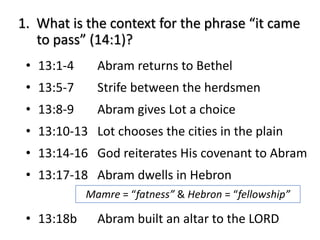
1. What is the context for the phrase “it came
to pass” (14:1)?
• 13:1-4 Abram returns to Bethel
• 13:5-7 Strife between the herdsmen
• 13:8-9 Abram gives Lot a choice
• 13:10-13 Lot chooses the cities in the plain
• 13:14-16 God reiterates His covenant to Abram
• 13:17-18 Abram dwells in Hebron
• 13:18b Abram built an altar to the LORD
Mamre = “fatness” & Hebron = “fellowship”
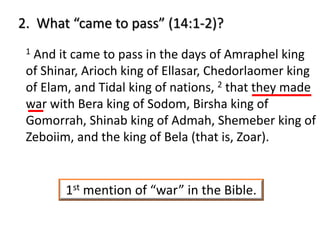
2. What “came to pass” (14:1-2)?
1 And it came to pass in the days of Amraphel king
of Shinar, Arioch king of Ellasar, Chedorlaomer king
of Elam, and Tidal king of nations, 2 that they made
war with Bera king of Sodom, Birsha king of
Gomorrah, Shinab king of Admah, Shemeber king of
Zeboiim, and the king of Bela (that is, Zoar).
1st mention of “war” in the Bible.
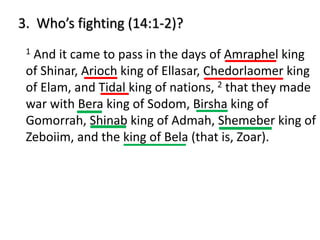
3. Who’s fighting (14:1-2)?
1 And it came to pass in the days of Amraphel king
of Shinar, Arioch king of Ellasar, Chedorlaomer king
of Elam, and Tidal king of nations, 2 that they made
war with Bera king of Sodom, Birsha king of
Gomorrah, Shinab king of Admah, Shemeber king of
Zeboiim, and the king of Bela (that is, Zoar).
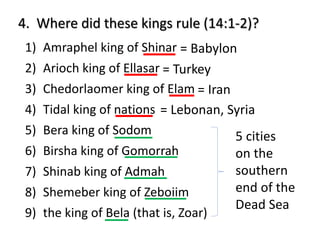
4. Where did these kings rule (14:1-2)?
1) Amraphel king of Shinar
2) Arioch king of Ellasar
3) Chedorlaomer king of Elam
4) Tidal king of nations
5) Bera king of Sodom
6) Birsha king of Gomorrah
7) Shinab king of Admah
8) Shemeber king of Zeboiim
9) the king of Bela (that is, Zoar)
= Babylon
= Turkey
= Iran
= Lebonan, Syria
5 cities
on the
southern
end of the
Dead Sea
5. What do their names mean (14:1-2)?
Amraphel
Arioch
Chedorlaomer
Tidal
Bera
Birsha
Shinab
Shemeber
= Babylon
= “conqueror,” “with evil”
= “large man,” “with wickedness”
= “Sin (the moon god) is Father”
= “His Name is Mighty”
= “servant of Lagomar”
= common name of Hittite kings
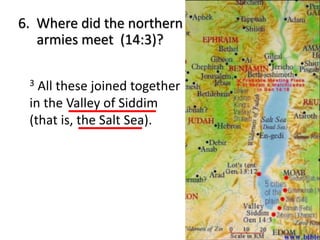
6. Where did the northern
armies meet (14:3)?
3 All these joined together
in the Valley of Siddim
(that is, the Salt Sea).
4 Twelve years they served Chedorlaomer, and
in the thirteenth year they rebelled.
7. What was the cause for the war (14:4)?
5 In the fourteenth year Chedorlaomer and the
kings that were with him came and attacked the
Rephaim in Ashteroth Karnaim, the Zuzim in
Ham, the Emim in Shaveh Kiriathaim,
8. When did the war begin (14:5)?
12 years – served
13th year – rebelled
14th year – war
5 In the fourteenth year Chedorlaomer and the
kings that were with him came and attacked the
Rephaim in Ashteroth Karnaim, the Zuzim in
Ham, the Emim in Shaveh Kiriathaim,
9. Who led the northern campaign (14:5)?
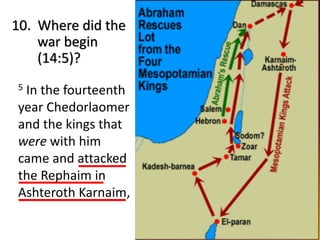
10. Where did the
war begin
(14:5)?
5 In the fourteenth
year Chedorlaomer
and the kings that
were with him
came and attacked
the Rephaim in
Ashteroth Karnaim,
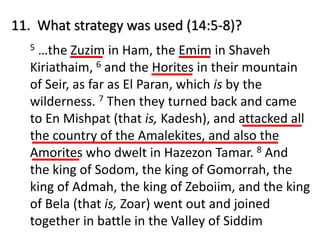
11. What strategy was used (14:5-8)?
5 …the Zuzim in Ham, the Emim in Shaveh
Kiriathaim, 6 and the Horites in their mountain
of Seir, as far as El Paran, which is by the
wilderness. 7 Then they turned back and came
to En Mishpat (that is, Kadesh), and attacked all
the country of the Amalekites, and also the
Amorites who dwelt in Hazezon Tamar. 8 And
the king of Sodom, the king of Gomorrah, the
king of Admah, the king of Zeboiim, and the king
of Bela (that is, Zoar) went out and joined
together in battle in the Valley of Siddim
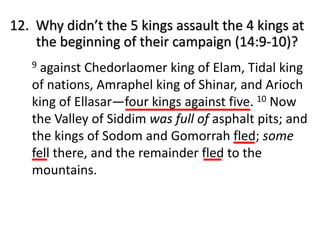
9 against Chedorlaomer king of Elam, Tidal king
of nations, Amraphel king of Shinar, and Arioch
king of Ellasar—four kings against five. 10 Now
the Valley of Siddim was full of asphalt pits; and
the kings of Sodom and Gomorrah fled; some
fell there, and the remainder fled to the
mountains.
12. Why didn’t the 5 kings assault the 4 kings at
the beginning of their campaign (14:9-10)?
10 Now the Valley of Siddim was full of asphalt
pits; and the kings of Sodom and Gomorrah
fled; some fell there, and the remainder fled to
the mountains.
13. What are asphalt pits (14:10)?
14. What were the spoils of war (14:11-12)?
11 Then they took all the goods of Sodom and
Gomorrah, and all their provisions, and went
their way. 12 They also took Lot, Abram’s
brother’s son who dwelt in Sodom, and his
goods, and departed.
15. What do you think went through Lot’s mind
as he lost all he had (14:12)?
12 They also took Lot, Abram’s brother’s son who
dwelt in Sodom, and his goods, and departed.
16. After taking Lot,
where were the
northern armies
headed (14:12)?
12 They also took
Lot, Abram’s
brother’s son who
dwelt in Sodom,
and his goods, and
departed.
17. How did Abram learn of his nephew’s
capture (14:13)?
13 Then one who had escaped came and told
Abram the Hebrew, for he dwelt by the
terebinth trees of Mamre the Amorite, brother
of Eshcol and brother of Aner; and they were
allies with Abram.
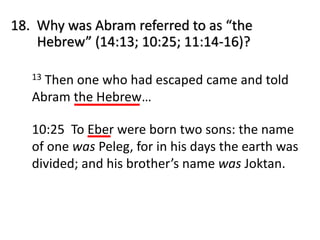
18. Why was Abram referred to as “the
Hebrew” (14:13; 10:25; 11:14-16)?
13 Then one who had escaped came and told
Abram the Hebrew…
10:25 To Eber were born two sons: the name
of one was Peleg, for in his days the earth was
divided; and his brother’s name was Joktan.
19. Upon learning the news, what were Abram’s
options (14:14)?
14 Now when Abram heard that his brother was
taken captive, he armed his three hundred and
eighteen trained servants who were born in his
own house, and went in pursuit as far as Dan.
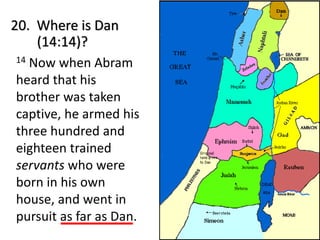
20. Where is Dan
(14:14)?
14 Now when Abram
heard that his
brother was taken
captive, he armed his
three hundred and
eighteen trained
servants who were
born in his own
house, and went in
pursuit as far as Dan.
21. What was Abram’s strategy (14:14-15)?
14 Now when Abram heard that his brother was
taken captive, he armed his three hundred and
eighteen trained servants who were born in his
own house, and went in pursuit as far as Dan. 15
He divided his forces against them by night, and
he and his servants attacked them and pursued
them as far as Hobah, which is north of
Damascus.
22. Where is Hobah (14:15)?
15b …and pursued them
as far as Hobah, which
is north of Damascus.
23. What was the outcome of Abram’s victory
(14:16, 17)?
16 So he brought back all the goods, and also
brought back his brother Lot and his goods,
as well as the women and the people. 17 And
the king of Sodom went out to meet him at
the Valley of Shaveh (that is, the King’s
Valley), after his return from the defeat of
Chedorlaomer and the kings who were with
him.
24. What two kings are mentioned (14:17-18)?
17 And the king of Sodom went out to meet
him at the Valley of Shaveh (that is, the
King’s Valley), after his return from the
defeat of Chedorlaomer and the kings who
were with him. 18 Then Melchizedek king of
Salem brought out bread and wine; he was
the priest of God Most High.
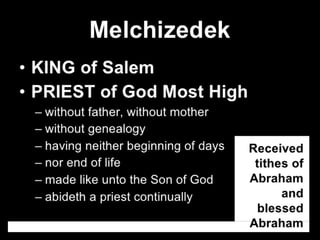
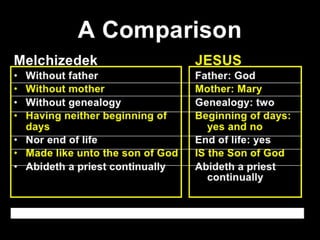
25. Who is Melchizedek (14:17)?
18 Then Melchizedek king of Salem brought
out bread and wine; he was the priest of
God Most High.
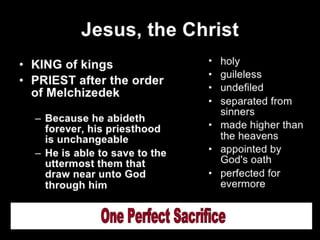
Psalm 110:4 “after the order of Melchizedek”
Hebrews 6:20 “Jesus, having become High Priest
forever according to the order of Melchizedek.”
(cf. Heb. 7:23-24)
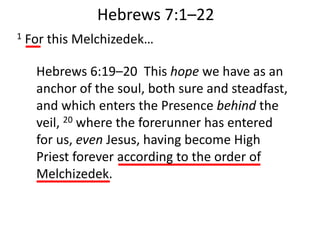
1 For this Melchizedek…
Hebrews 7:1–22
Hebrews 6:19–20 This hope we have as an
anchor of the soul, both sure and steadfast,
and which enters the Presence behind the
veil, 20 where the forerunner has entered
for us, even Jesus, having become High
Priest forever according to the order of
Melchizedek.
1 For this Melchizedek, king of Salem, priest of
the Most High God, who met Abraham returning
from the slaughter of the kings and blessed him,
2 to whom also Abraham gave a tenth part of all,
first being translated “king of righteousness,”
and then also king of Salem, meaning “king of
peace,” 3 without father, without mother,
without genealogy, having neither beginning of
days nor end of life, but made like the Son of
God, remains a priest continually. 4 Now
consider how great this man was, to whom even
the patriarch Abraham gave a tenth of the spoils.
Hebrews 7:1–22
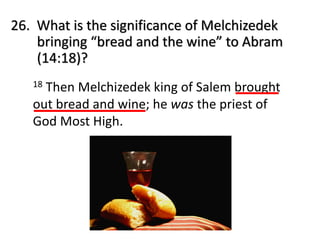
26. What is the significance of Melchizedek
bringing “bread and the wine” to Abram
(14:18)?
18 Then Melchizedek king of Salem brought
out bread and wine; he was the priest of
God Most High.
27. What else did Melchizedek do for Abram
(14:19-20)?
19 And he blessed him and said: “Blessed be
Abram of God Most High, Possessor of
heaven and earth; 20 And blessed be God
Most High, Who has delivered your enemies
into your hand.” And he gave him a tithe of
all.
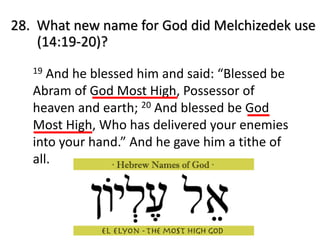
28. What new name for God did Melchizedek use
(14:19-20)?
19 And he blessed him and said: “Blessed be
Abram of God Most High, Possessor of
heaven and earth; 20 And blessed be God
Most High, Who has delivered your enemies
into your hand.” And he gave him a tithe of
all.
29. What was Abram’s response (14:19-20)?
19 And he blessed him and said: “Blessed be
Abram of God Most High, Possessor of
heaven and earth; 20 And blessed be God
Most High, Who has delivered your enemies
into your hand.” And he gave him a tithe of
all.
30. What did the king of Sodom propose to
Abram (14:21)?
21 Now the king of Sodom said to Abram,
“Give me the persons, and take the goods for
yourself.”
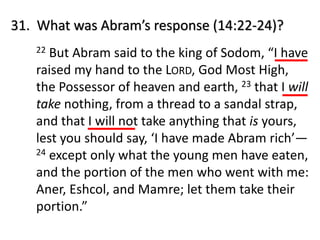
22 But Abram said to the king of Sodom, “I have
raised my hand to the LORD, God Most High,
the Possessor of heaven and earth, 23 that I will
take nothing, from a thread to a sandal strap,
and that I will not take anything that is yours,
lest you should say, ‘I have made Abram rich’—
24 except only what the young men have eaten,
and the portion of the men who went with me:
Aner, Eshcol, and Mamre; let them take their
portion.”
31. What was Abram’s response (14:22-24)?
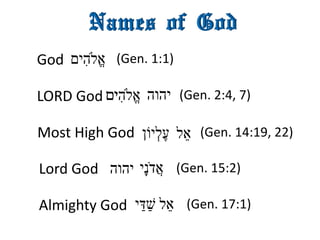
‫א‬ֱ#‫ה‬ִ‫י‬‫ם‬God
‫י‬‫ה‬‫ו‬‫ה‬‫א‬ֱ#‫ה‬ִ‫י‬‫ם‬LORD God (Gen. 2:4, 7)
(Gen. 1:1)
‫א‬ֵ‫ל‬‫ע‬ֶ‫ל‬ְ‫י‬‫וֹ‬‫ן‬Most High God (Gen. 14:19, 22)
Lord God ‫א‬ֲ‫ד‬ֹ‫נ‬ָ‫י‬‫י‬‫ה‬‫ו‬‫ה‬ (Gen. 15:2)
Almighty God ‫א‬ֵ‫ל‬‫שׁ‬ַ‫דּ‬ַ‫י‬ (Gen. 17:1)
941-729-6600
941-981-5387
http://faithbiblechurchefc.com
http://TRUTHtransforms.com
sanctitas@aol.com

Abram Goes to War

  • 1.
    An expositional studytaught by Harry Morgan
  • 2.
    For those ofyou online post your comments or questions in the “comment section” on your screen. As time affords they may be read to the class.
  • 3.
    1. What isthe context for the phrase “it came to pass” (14:1)? • 13:1-4 Abram returns to Bethel • 13:5-7 Strife between the herdsmen • 13:8-9 Abram gives Lot a choice • 13:10-13 Lot chooses the cities in the plain • 13:14-16 God reiterates His covenant to Abram • 13:17-18 Abram dwells in Hebron • 13:18b Abram built an altar to the LORD Mamre = “fatness” & Hebron = “fellowship”
  • 4.
    2. What “cameto pass” (14:1-2)? 1 And it came to pass in the days of Amraphel king of Shinar, Arioch king of Ellasar, Chedorlaomer king of Elam, and Tidal king of nations, 2 that they made war with Bera king of Sodom, Birsha king of Gomorrah, Shinab king of Admah, Shemeber king of Zeboiim, and the king of Bela (that is, Zoar). 1st mention of “war” in the Bible.
  • 5.
    3. Who’s fighting(14:1-2)? 1 And it came to pass in the days of Amraphel king of Shinar, Arioch king of Ellasar, Chedorlaomer king of Elam, and Tidal king of nations, 2 that they made war with Bera king of Sodom, Birsha king of Gomorrah, Shinab king of Admah, Shemeber king of Zeboiim, and the king of Bela (that is, Zoar).
  • 6.
    4. Where didthese kings rule (14:1-2)? 1) Amraphel king of Shinar 2) Arioch king of Ellasar 3) Chedorlaomer king of Elam 4) Tidal king of nations 5) Bera king of Sodom 6) Birsha king of Gomorrah 7) Shinab king of Admah 8) Shemeber king of Zeboiim 9) the king of Bela (that is, Zoar) = Babylon = Turkey = Iran = Lebonan, Syria 5 cities on the southern end of the Dead Sea
  • 7.
    5. What dotheir names mean (14:1-2)? Amraphel Arioch Chedorlaomer Tidal Bera Birsha Shinab Shemeber = Babylon = “conqueror,” “with evil” = “large man,” “with wickedness” = “Sin (the moon god) is Father” = “His Name is Mighty” = “servant of Lagomar” = common name of Hittite kings
  • 8.
    6. Where didthe northern armies meet (14:3)? 3 All these joined together in the Valley of Siddim (that is, the Salt Sea).
  • 9.
    4 Twelve yearsthey served Chedorlaomer, and in the thirteenth year they rebelled. 7. What was the cause for the war (14:4)?
  • 10.
    5 In thefourteenth year Chedorlaomer and the kings that were with him came and attacked the Rephaim in Ashteroth Karnaim, the Zuzim in Ham, the Emim in Shaveh Kiriathaim, 8. When did the war begin (14:5)? 12 years – served 13th year – rebelled 14th year – war
  • 11.
    5 In thefourteenth year Chedorlaomer and the kings that were with him came and attacked the Rephaim in Ashteroth Karnaim, the Zuzim in Ham, the Emim in Shaveh Kiriathaim, 9. Who led the northern campaign (14:5)?
  • 12.
    10. Where didthe war begin (14:5)? 5 In the fourteenth year Chedorlaomer and the kings that were with him came and attacked the Rephaim in Ashteroth Karnaim,
  • 13.
    11. What strategywas used (14:5-8)? 5 …the Zuzim in Ham, the Emim in Shaveh Kiriathaim, 6 and the Horites in their mountain of Seir, as far as El Paran, which is by the wilderness. 7 Then they turned back and came to En Mishpat (that is, Kadesh), and attacked all the country of the Amalekites, and also the Amorites who dwelt in Hazezon Tamar. 8 And the king of Sodom, the king of Gomorrah, the king of Admah, the king of Zeboiim, and the king of Bela (that is, Zoar) went out and joined together in battle in the Valley of Siddim
  • 14.
    9 against Chedorlaomerking of Elam, Tidal king of nations, Amraphel king of Shinar, and Arioch king of Ellasar—four kings against five. 10 Now the Valley of Siddim was full of asphalt pits; and the kings of Sodom and Gomorrah fled; some fell there, and the remainder fled to the mountains. 12. Why didn’t the 5 kings assault the 4 kings at the beginning of their campaign (14:9-10)?
  • 15.
    10 Now theValley of Siddim was full of asphalt pits; and the kings of Sodom and Gomorrah fled; some fell there, and the remainder fled to the mountains. 13. What are asphalt pits (14:10)?
  • 16.
    14. What werethe spoils of war (14:11-12)? 11 Then they took all the goods of Sodom and Gomorrah, and all their provisions, and went their way. 12 They also took Lot, Abram’s brother’s son who dwelt in Sodom, and his goods, and departed.
  • 17.
    15. What doyou think went through Lot’s mind as he lost all he had (14:12)? 12 They also took Lot, Abram’s brother’s son who dwelt in Sodom, and his goods, and departed.
  • 18.
    16. After takingLot, where were the northern armies headed (14:12)? 12 They also took Lot, Abram’s brother’s son who dwelt in Sodom, and his goods, and departed.
  • 19.
    17. How didAbram learn of his nephew’s capture (14:13)? 13 Then one who had escaped came and told Abram the Hebrew, for he dwelt by the terebinth trees of Mamre the Amorite, brother of Eshcol and brother of Aner; and they were allies with Abram.
  • 20.
    18. Why wasAbram referred to as “the Hebrew” (14:13; 10:25; 11:14-16)? 13 Then one who had escaped came and told Abram the Hebrew… 10:25 To Eber were born two sons: the name of one was Peleg, for in his days the earth was divided; and his brother’s name was Joktan.
  • 21.
    19. Upon learningthe news, what were Abram’s options (14:14)? 14 Now when Abram heard that his brother was taken captive, he armed his three hundred and eighteen trained servants who were born in his own house, and went in pursuit as far as Dan.
  • 22.
    20. Where isDan (14:14)? 14 Now when Abram heard that his brother was taken captive, he armed his three hundred and eighteen trained servants who were born in his own house, and went in pursuit as far as Dan.
  • 23.
    21. What wasAbram’s strategy (14:14-15)? 14 Now when Abram heard that his brother was taken captive, he armed his three hundred and eighteen trained servants who were born in his own house, and went in pursuit as far as Dan. 15 He divided his forces against them by night, and he and his servants attacked them and pursued them as far as Hobah, which is north of Damascus.
  • 24.
    22. Where isHobah (14:15)? 15b …and pursued them as far as Hobah, which is north of Damascus.
  • 25.
    23. What wasthe outcome of Abram’s victory (14:16, 17)? 16 So he brought back all the goods, and also brought back his brother Lot and his goods, as well as the women and the people. 17 And the king of Sodom went out to meet him at the Valley of Shaveh (that is, the King’s Valley), after his return from the defeat of Chedorlaomer and the kings who were with him.
  • 26.
    24. What twokings are mentioned (14:17-18)? 17 And the king of Sodom went out to meet him at the Valley of Shaveh (that is, the King’s Valley), after his return from the defeat of Chedorlaomer and the kings who were with him. 18 Then Melchizedek king of Salem brought out bread and wine; he was the priest of God Most High.
  • 27.
    25. Who isMelchizedek (14:17)? 18 Then Melchizedek king of Salem brought out bread and wine; he was the priest of God Most High. Psalm 110:4 “after the order of Melchizedek” Hebrews 6:20 “Jesus, having become High Priest forever according to the order of Melchizedek.” (cf. Heb. 7:23-24)
  • 28.
    1 For thisMelchizedek… Hebrews 7:1–22 Hebrews 6:19–20 This hope we have as an anchor of the soul, both sure and steadfast, and which enters the Presence behind the veil, 20 where the forerunner has entered for us, even Jesus, having become High Priest forever according to the order of Melchizedek.
  • 29.
    1 For thisMelchizedek, king of Salem, priest of the Most High God, who met Abraham returning from the slaughter of the kings and blessed him, 2 to whom also Abraham gave a tenth part of all, first being translated “king of righteousness,” and then also king of Salem, meaning “king of peace,” 3 without father, without mother, without genealogy, having neither beginning of days nor end of life, but made like the Son of God, remains a priest continually. 4 Now consider how great this man was, to whom even the patriarch Abraham gave a tenth of the spoils. Hebrews 7:1–22
  • 34.
    26. What isthe significance of Melchizedek bringing “bread and the wine” to Abram (14:18)? 18 Then Melchizedek king of Salem brought out bread and wine; he was the priest of God Most High.
  • 35.
    27. What elsedid Melchizedek do for Abram (14:19-20)? 19 And he blessed him and said: “Blessed be Abram of God Most High, Possessor of heaven and earth; 20 And blessed be God Most High, Who has delivered your enemies into your hand.” And he gave him a tithe of all.
  • 36.
    28. What newname for God did Melchizedek use (14:19-20)? 19 And he blessed him and said: “Blessed be Abram of God Most High, Possessor of heaven and earth; 20 And blessed be God Most High, Who has delivered your enemies into your hand.” And he gave him a tithe of all.
  • 37.
    29. What wasAbram’s response (14:19-20)? 19 And he blessed him and said: “Blessed be Abram of God Most High, Possessor of heaven and earth; 20 And blessed be God Most High, Who has delivered your enemies into your hand.” And he gave him a tithe of all.
  • 38.
    30. What didthe king of Sodom propose to Abram (14:21)? 21 Now the king of Sodom said to Abram, “Give me the persons, and take the goods for yourself.”
  • 39.
    22 But Abramsaid to the king of Sodom, “I have raised my hand to the LORD, God Most High, the Possessor of heaven and earth, 23 that I will take nothing, from a thread to a sandal strap, and that I will not take anything that is yours, lest you should say, ‘I have made Abram rich’— 24 except only what the young men have eaten, and the portion of the men who went with me: Aner, Eshcol, and Mamre; let them take their portion.” 31. What was Abram’s response (14:22-24)?
  • 40.
    31. What wasAbram’s response (14:22-24)?
  • 41.
    ‫א‬ֱ#‫ה‬ִ‫י‬‫ם‬God ‫י‬‫ה‬‫ו‬‫ה‬‫א‬ֱ#‫ה‬ִ‫י‬‫ם‬LORD God (Gen.2:4, 7) (Gen. 1:1) ‫א‬ֵ‫ל‬‫ע‬ֶ‫ל‬ְ‫י‬‫וֹ‬‫ן‬Most High God (Gen. 14:19, 22) Lord God ‫א‬ֲ‫ד‬ֹ‫נ‬ָ‫י‬‫י‬‫ה‬‫ו‬‫ה‬ (Gen. 15:2) Almighty God ‫א‬ֵ‫ל‬‫שׁ‬ַ‫דּ‬ַ‫י‬ (Gen. 17:1)
  • 42.