CONTENT
• BIOGRAPHY
• CONCEPT OF HIERARCHY
OF NEEDS
Theories of personality
Duane P. Schultz
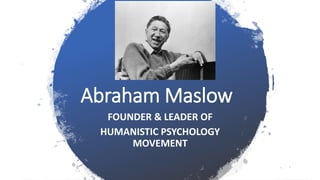
Abraham Maslow
FOUNDER & LEADER OF
HUMANISTIC PSYCHOLOGY
MOVEMENT
BIOGRAPHY
Oldest of seven
children.
1908 in Brooklyn , New
York.
Immigrants : Russia to
(Europe)New York.
Belong to poor family
but valued education.
Miserable Family &
Horrible creature.
EDUCATION
SCHOOL : Grades remained
mediocre.
College : City College Of New
York.
University: 1927 , Cornell
University.
1928 , Wisconsin to study
Psychology.
Marriage
His cousin, she joined him at
Wisconsin. (bertha)
He was 20y and she was 19y.
Birth of his first child & world
war-II. (Aan and Allen)
Teaching
1934, Ph.D. from UW, then he went to
Columbia University for a postdoctoral
fellowship under EL. Thorndike.
Later teach in Brooklyn college until
1951.
Karen horney, Alferd alder, Max
Wertheimer.
World war effects
1941, world war
changed his life.
Devoted himself to
developing a PSY based
on human ideals.
Work to improve
human personality
Displaying better
behavior than prejudice
& hate
REPUTATION
1951 – 69, taught in Brandeis Uni
Massachusetts.
Work on philosophy of politics,
economics, ethics based on.
Become popular in psycology.
President of American psy
association in 1967.
DEATH
1970, due to heart attack.
While jogging around his
swimming pool.
An exercise that had been
recommended by his cardiologist
HIERARCHY OF NEEDS (PERSONALITY
DEVELOPMENT)
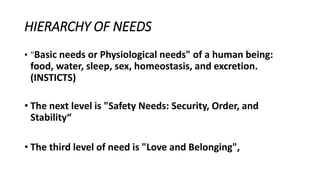
HIERARCHY OF NEEDS
• "Basic needs or Physiological needs" of a human being:
food, water, sleep, sex, homeostasis, and excretion.
(INSTICTS)
• The next level is "Safety Needs: Security, Order, and
Stability“
• The third level of need is "Love and Belonging",
SELF ESTEEM
• It refers to an individual's sense of his or her value or
worth.
• Two forms of needs for esteem.
• Feeling of self worth (respect from ourselves) & from
people in the form of status ,social success.
• It allows us to feel confident of our strength.
• Lack of confidence , discouraged.

Abraham Maslow's Theory

  • 1.
    CONTENT • BIOGRAPHY • CONCEPTOF HIERARCHY OF NEEDS Theories of personality Duane P. Schultz
  • 2.
    Abraham Maslow FOUNDER &LEADER OF HUMANISTIC PSYCHOLOGY MOVEMENT
  • 3.
    BIOGRAPHY Oldest of seven children. 1908in Brooklyn , New York. Immigrants : Russia to (Europe)New York. Belong to poor family but valued education. Miserable Family & Horrible creature.
  • 4.
    EDUCATION SCHOOL : Gradesremained mediocre. College : City College Of New York. University: 1927 , Cornell University. 1928 , Wisconsin to study Psychology.
  • 5.
    Marriage His cousin, shejoined him at Wisconsin. (bertha) He was 20y and she was 19y. Birth of his first child & world war-II. (Aan and Allen)
  • 6.
    Teaching 1934, Ph.D. fromUW, then he went to Columbia University for a postdoctoral fellowship under EL. Thorndike. Later teach in Brooklyn college until 1951. Karen horney, Alferd alder, Max Wertheimer.
  • 7.
    World war effects 1941,world war changed his life. Devoted himself to developing a PSY based on human ideals. Work to improve human personality Displaying better behavior than prejudice & hate
  • 8.
    REPUTATION 1951 – 69,taught in Brandeis Uni Massachusetts. Work on philosophy of politics, economics, ethics based on. Become popular in psycology. President of American psy association in 1967.
  • 9.
    DEATH 1970, due toheart attack. While jogging around his swimming pool. An exercise that had been recommended by his cardiologist
  • 10.
    HIERARCHY OF NEEDS(PERSONALITY DEVELOPMENT)
  • 11.
    HIERARCHY OF NEEDS •"Basic needs or Physiological needs" of a human being: food, water, sleep, sex, homeostasis, and excretion. (INSTICTS) • The next level is "Safety Needs: Security, Order, and Stability“ • The third level of need is "Love and Belonging",
  • 12.
    SELF ESTEEM • Itrefers to an individual's sense of his or her value or worth. • Two forms of needs for esteem. • Feeling of self worth (respect from ourselves) & from people in the form of status ,social success. • It allows us to feel confident of our strength. • Lack of confidence , discouraged.