DIGITAL SIGNAL PROCESSING
Presented by Group-9
Our Team
Rabiul
Limon
Mehedi
Sofikul
Pithu
Topics
Basic DSP Operation
Time Shifting
Time Reversal
Time Scaling
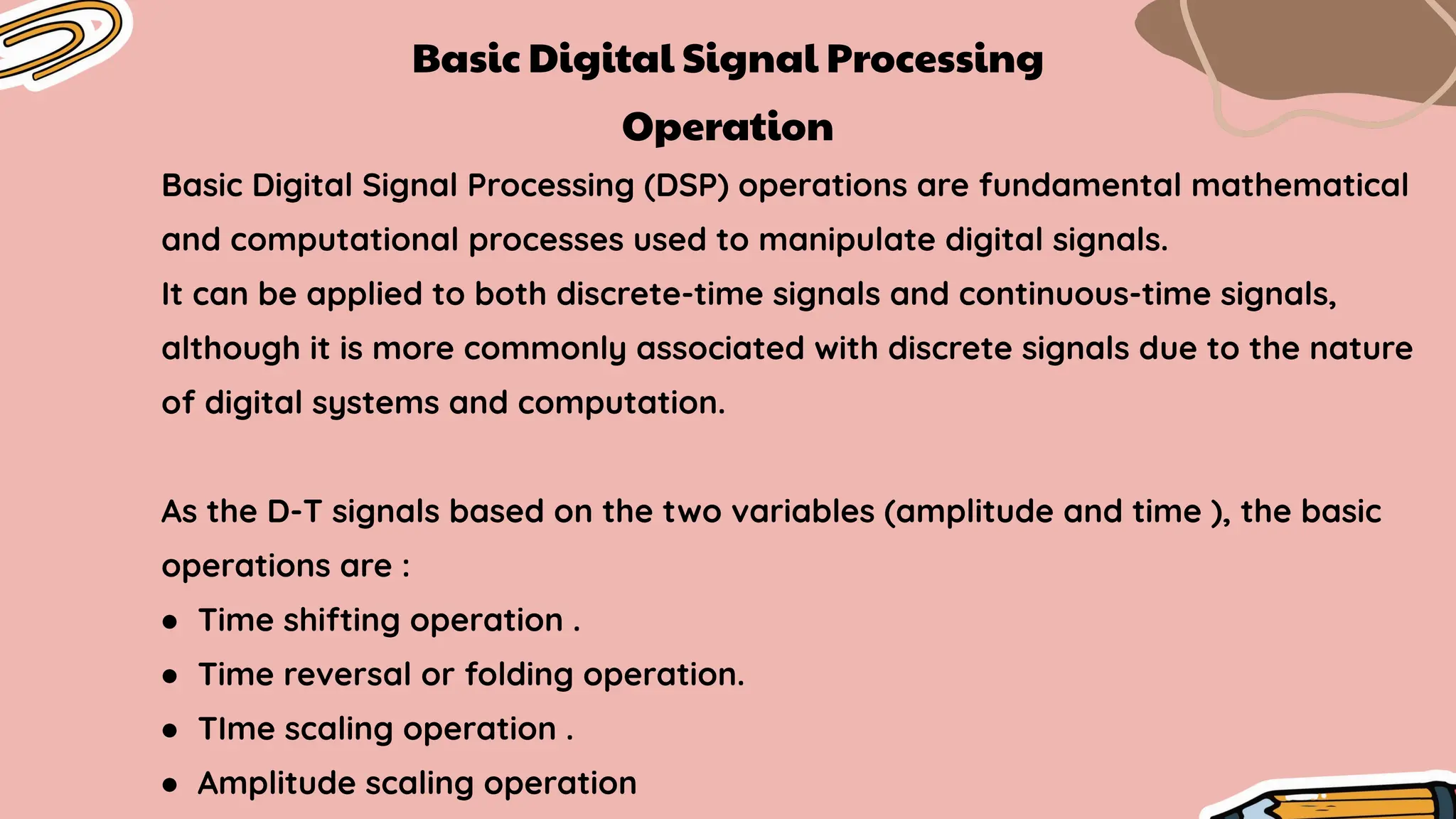
Basic Digital Signal Processing (DSP) operations are fundamental mathematical
and computational processes used to manipulate digital signals.
It can be applied to both discrete-time signals and continuous-time signals,
although it is more commonly associated with discrete signals due to the nature
of digital systems and computation.
As the D-T signals based on the two variables (amplitude and time ), the basic
operations are :
● Time shifting operation .
● Time reversal or folding operation.
● TIme scaling operation .
● Amplitude scaling operation
Basic Digital Signal Processing
Operation
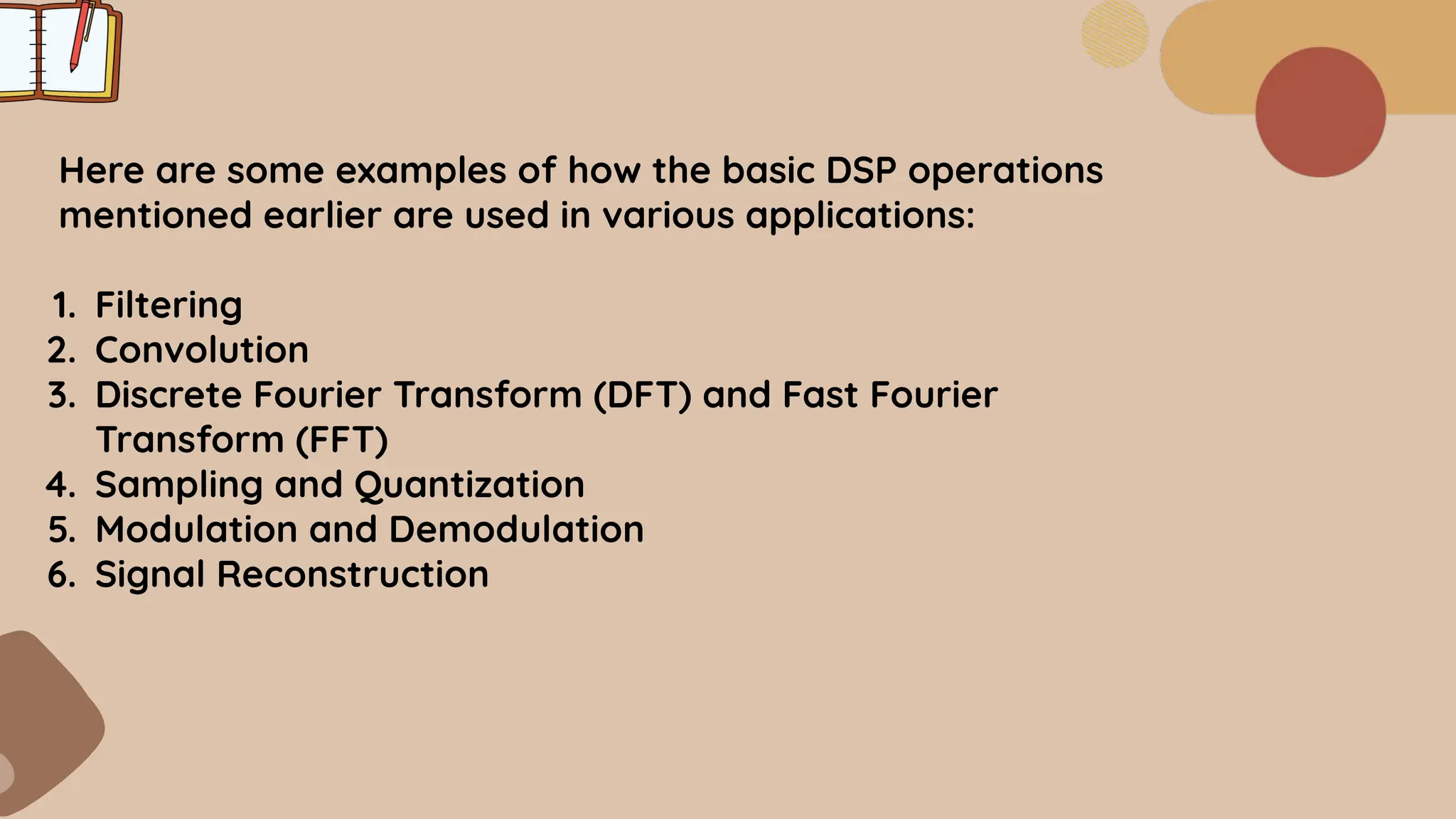
Here are some examples of how the basic DSP operations
mentioned earlier are used in various applications:
1. Filtering
2. Convolution
3. Discrete Fourier Transform (DFT) and Fast Fourier
Transform (FFT)
4. Sampling and Quantization
5. Modulation and Demodulation
6. Signal Reconstruction
TIME SHIFTING
Time shifting refers to the operation of shifting a signal along the time axis by a certain
amount. Time shifting modifies the temporal alignment of a signal without altering its
amplitude or shape.
Mathematically, time shifting can be represented as :
Input Output
x[n] y[n]= x[n-k]
Where k=Integer = +ve or -ve
Types of Time Shifting :
1. Delay (when k= +ve)
2. Advance (when k= -ve)
Time Shifting Operation
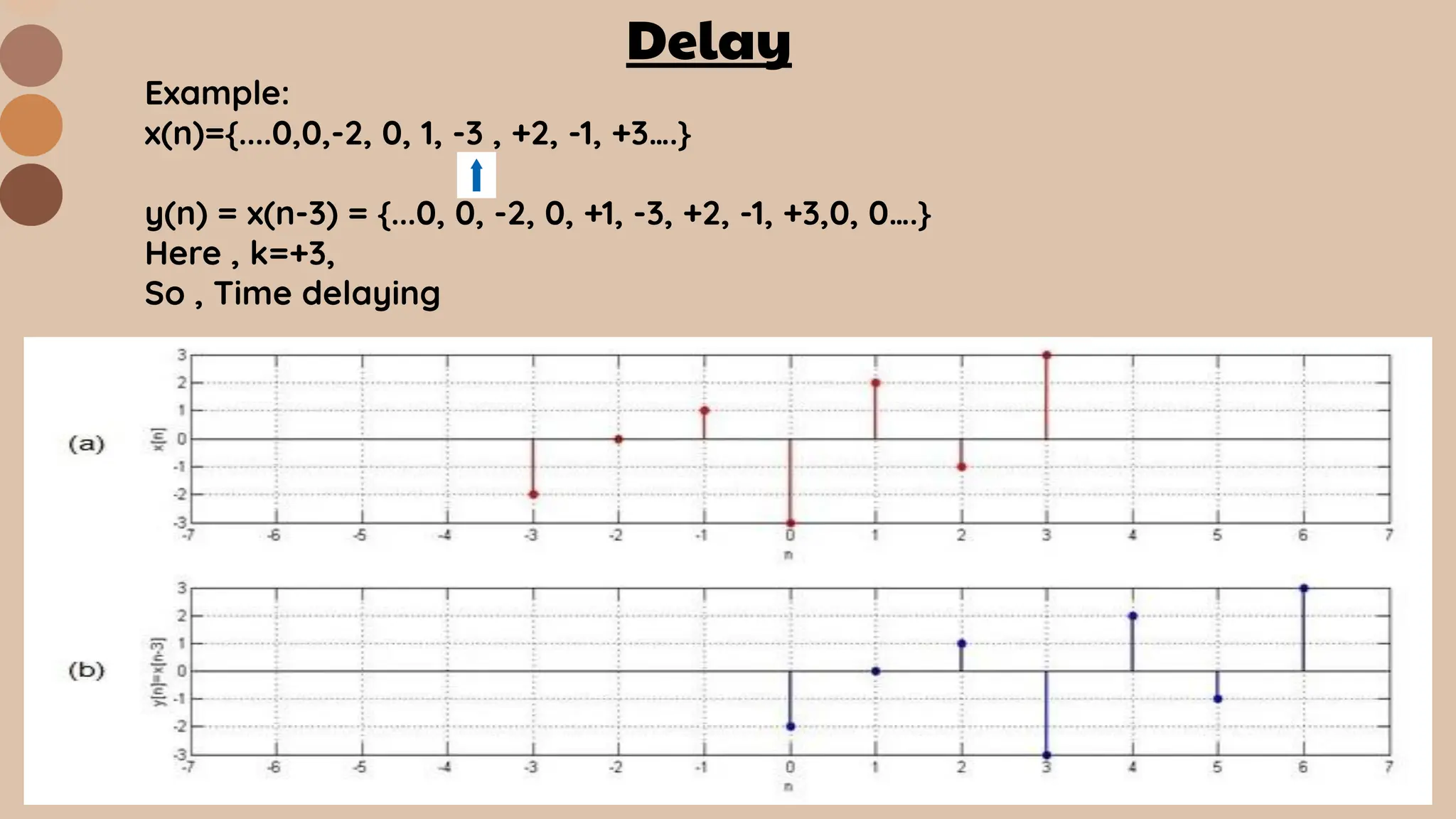
Delay
Example:
x(n)={....0,0,-2, 0, 1, -3 , +2, -1, +3….}
y(n) = x(n-3) = {...0, 0, -2, 0, +1, -3, +2, -1, +3,0, 0….}
Here , k=+3,
So , Time delaying
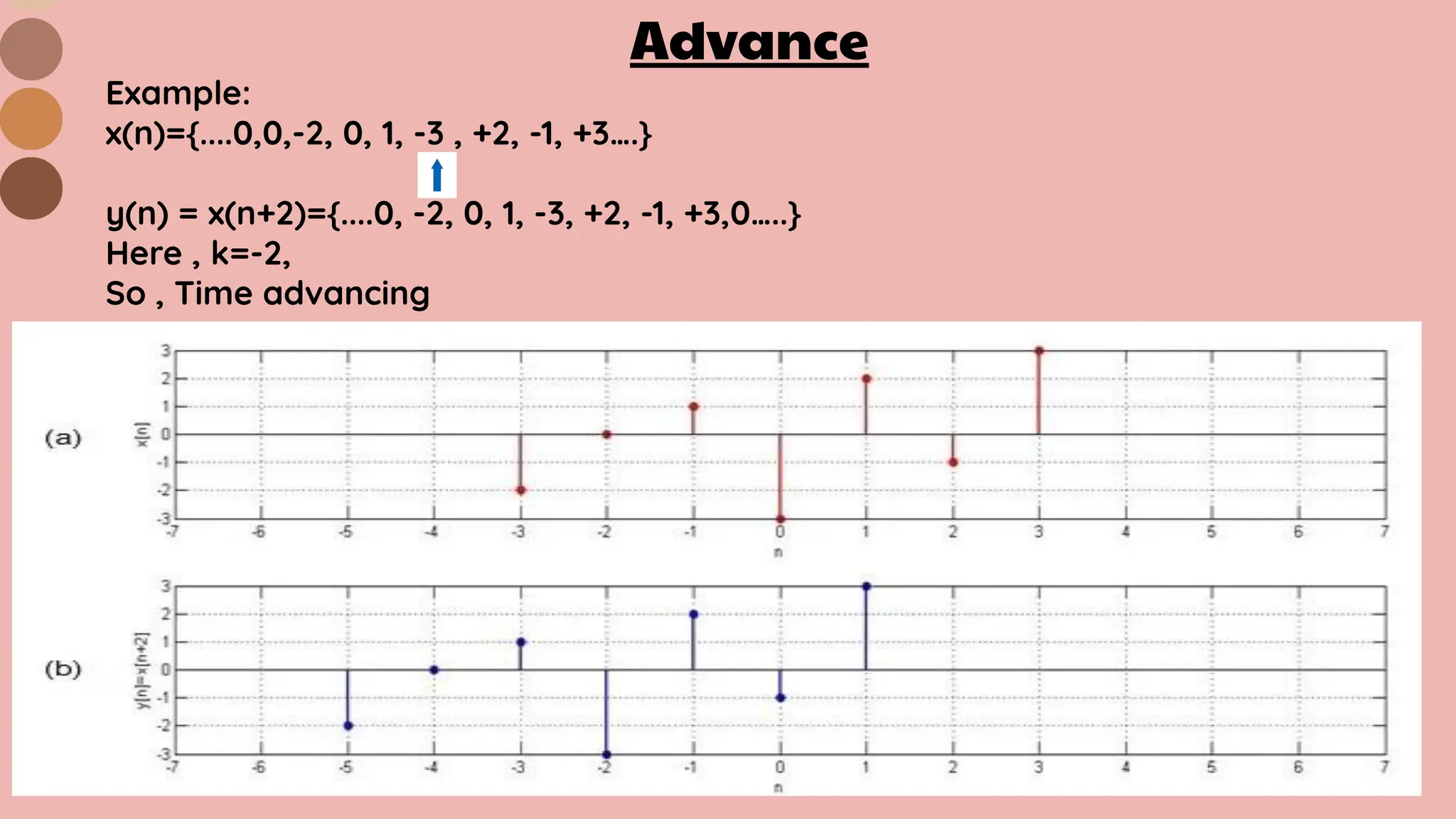
Advance
Example:
x(n)={....0,0,-2, 0, 1, -3 , +2, -1, +3….}
y(n) = x(n+2)={....0, -2, 0, 1, -3, +2, -1, +3,0…..}
Here , k=-2,
So , Time advancing
TIME REVERSING
Time-reversing is a fundamental operation that involves reversing the order of samples in a
signal with respect to time. This operation can be applied to both discrete-time signals and
continuous-time signals, although in DSP, it's primarily discussed in the context of discrete-time
signals.
Mathematically, time reversing can be represented as :
Input Output
x[n] y[n]= x[-n]
The output function resulting from time-reversal as being a mirrored version of the input
function with respect to time.It effectively flips the signal around a vertical axis located at
the midpoint of the signal's duration.
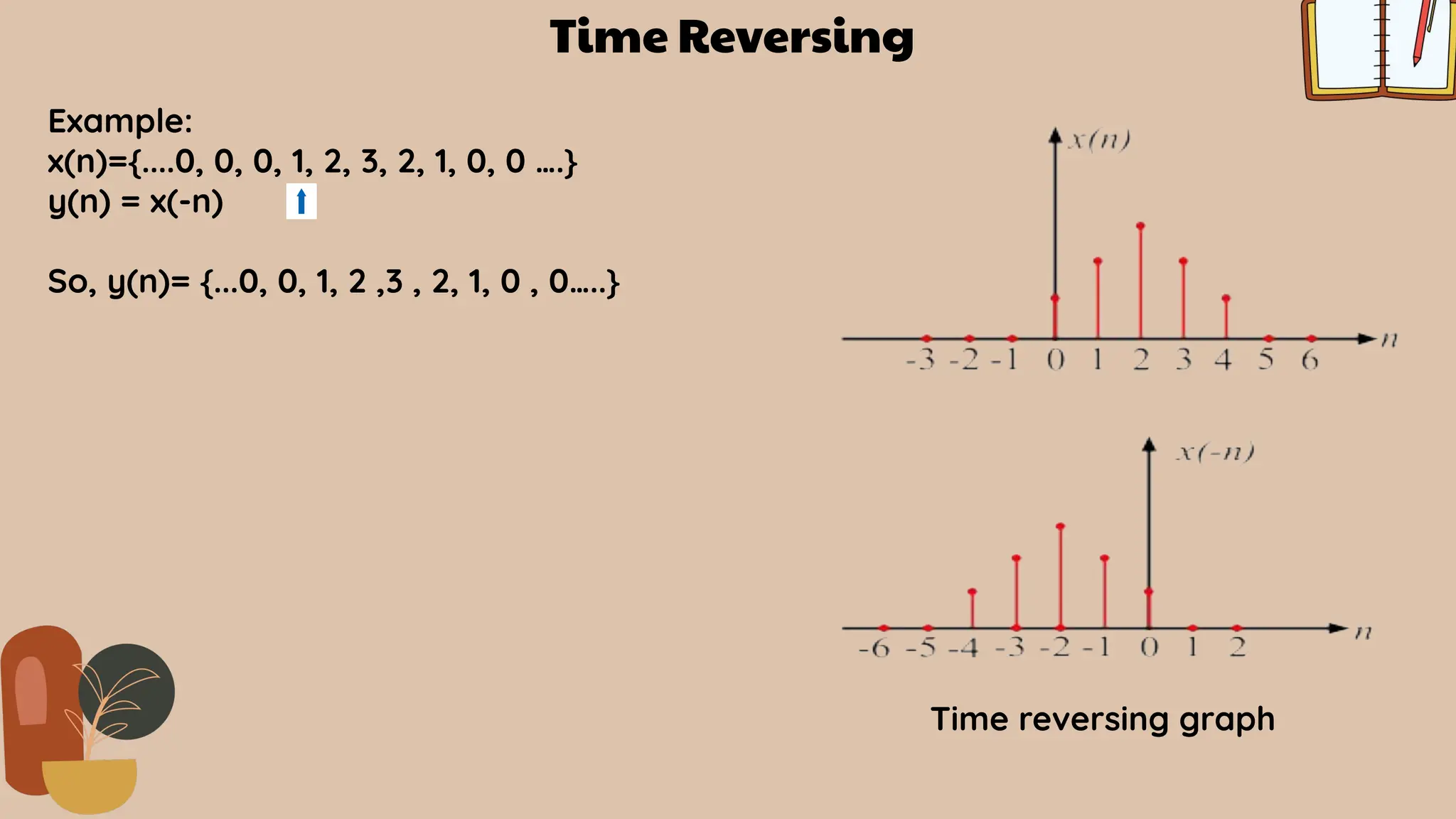
Time Reversing Operation
Time Reversing
Example:
x(n)={....0, 0, 0, 1, 2, 3, 2, 1, 0, 0 ….}
y(n) = x(-n)
So, y(n)= {...0, 0, 1, 2 ,3 , 2, 1, 0 , 0…..}
Time reversing graph
Time Scaling
Time scaling refers to the process of altering the rate at which a signal progresses
through time without changing its fundamental characteristics. It involves
compressing or expanding the time axis of a signal.
Mathematically, For a discrete-time signal x[n], time scaling by a factor α results in
a new signal y[n] given by:-
y[n] = x[αn]
Types of Time Scaling:
1. Compression (when α>1 )
2. Expansion (when α<1)
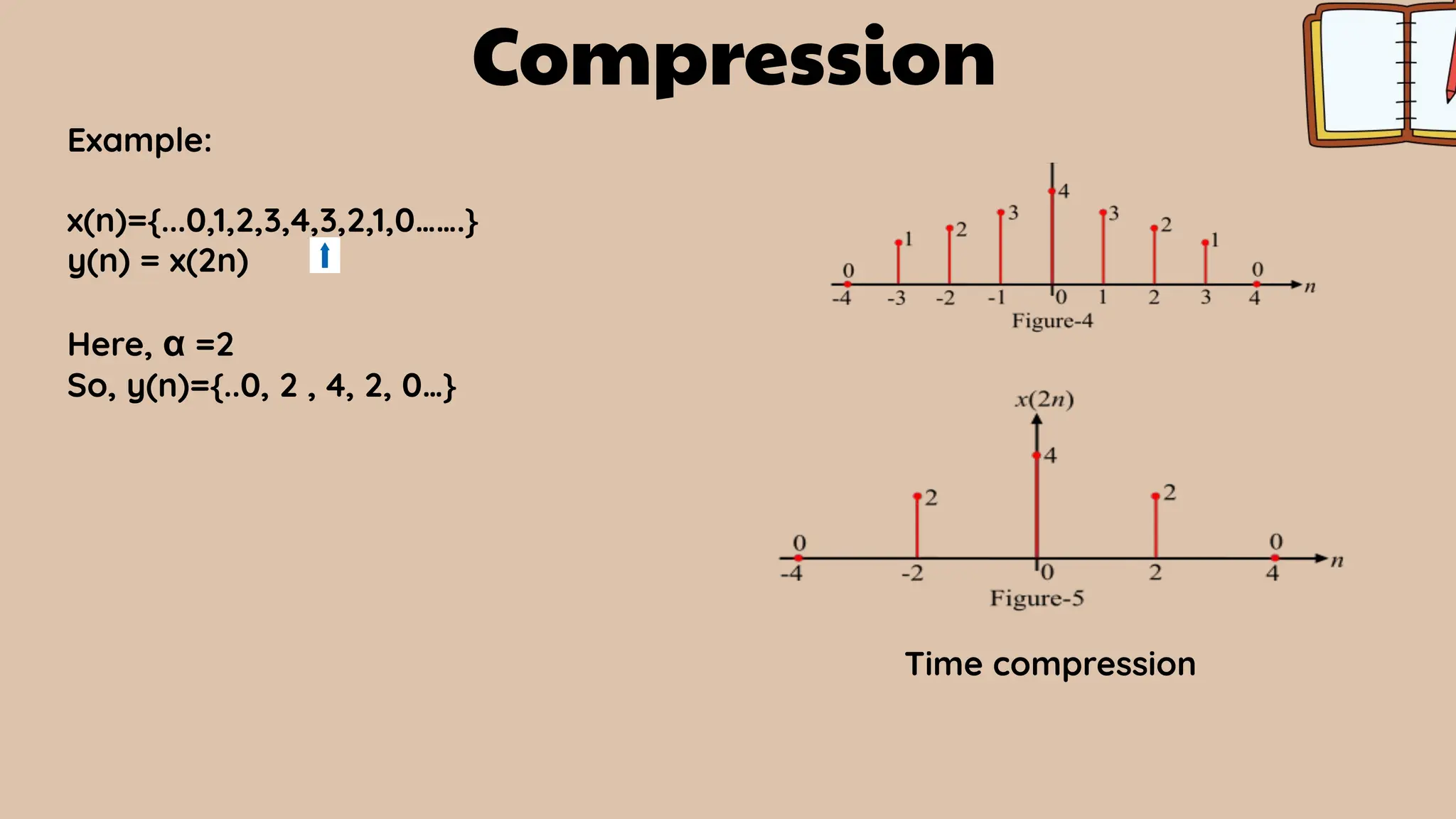
Compression
Example:
x(n)={...0,1,2,3,4,3,2,1,0…….}
y(n) = x(2n)
Here, α =2
So, y(n)={..0, 2 , 4, 2, 0…}
Time compression
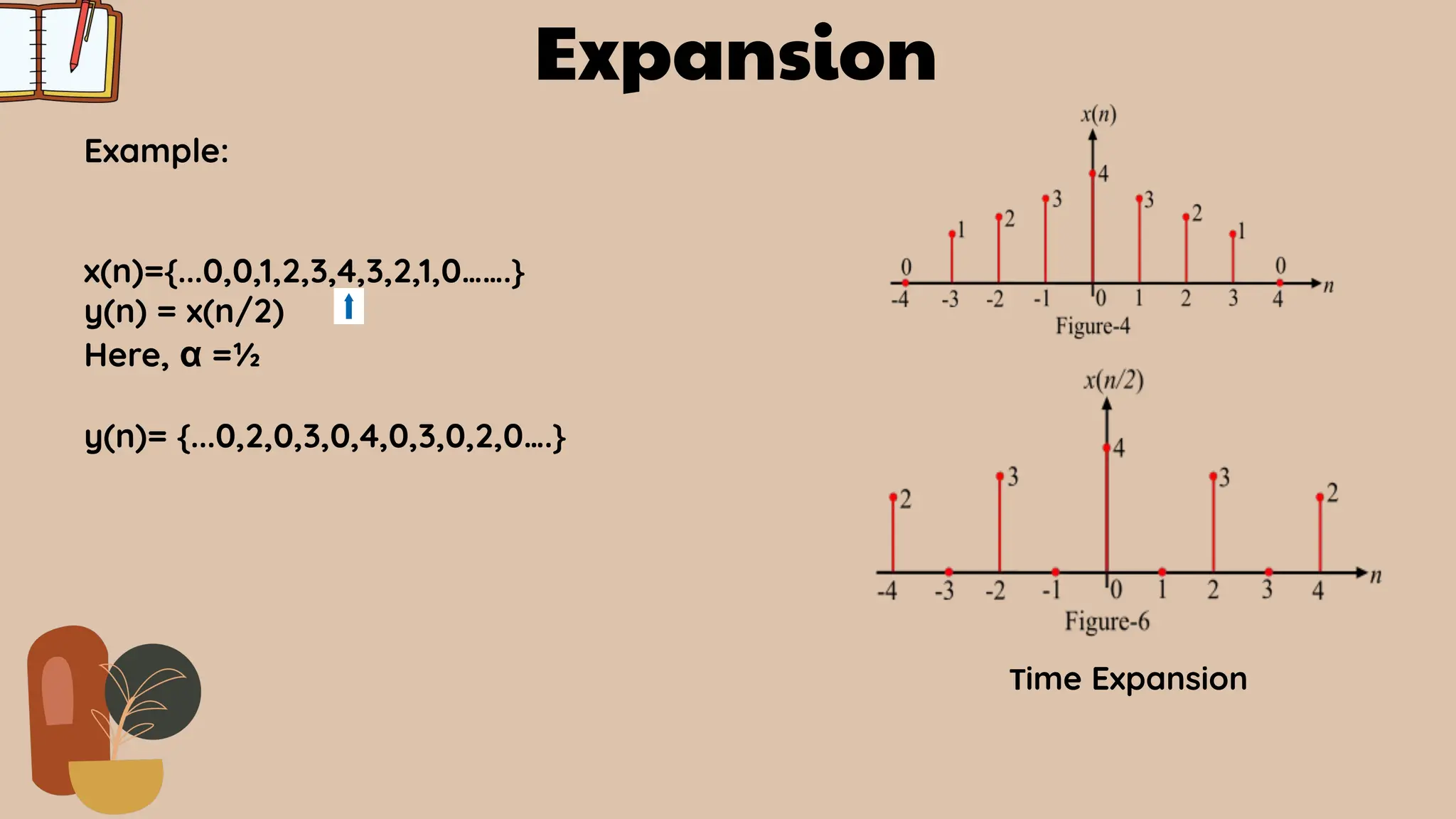
Expansion
Example:
x(n)={...0,0,1,2,3,4,3,2,1,0…….}
y(n) = x(n/2)
Here, α =½
y(n)= {...0,2,0,3,0,4,0,3,0,2,0….}
Time Expansion
Question
Time
About_dsp_convolution_correlations_andPorperties

About_dsp_convolution_correlations_andPorperties

  • 2.
  • 3.
  • 4.
    Topics Basic DSP Operation TimeShifting Time Reversal Time Scaling
  • 5.
    Basic Digital SignalProcessing (DSP) operations are fundamental mathematical and computational processes used to manipulate digital signals. It can be applied to both discrete-time signals and continuous-time signals, although it is more commonly associated with discrete signals due to the nature of digital systems and computation. As the D-T signals based on the two variables (amplitude and time ), the basic operations are : ● Time shifting operation . ● Time reversal or folding operation. ● TIme scaling operation . ● Amplitude scaling operation Basic Digital Signal Processing Operation
  • 6.
    Here are someexamples of how the basic DSP operations mentioned earlier are used in various applications: 1. Filtering 2. Convolution 3. Discrete Fourier Transform (DFT) and Fast Fourier Transform (FFT) 4. Sampling and Quantization 5. Modulation and Demodulation 6. Signal Reconstruction
  • 7.
    TIME SHIFTING Time shiftingrefers to the operation of shifting a signal along the time axis by a certain amount. Time shifting modifies the temporal alignment of a signal without altering its amplitude or shape. Mathematically, time shifting can be represented as : Input Output x[n] y[n]= x[n-k] Where k=Integer = +ve or -ve Types of Time Shifting : 1. Delay (when k= +ve) 2. Advance (when k= -ve) Time Shifting Operation
  • 8.
    Delay Example: x(n)={....0,0,-2, 0, 1,-3 , +2, -1, +3….} y(n) = x(n-3) = {...0, 0, -2, 0, +1, -3, +2, -1, +3,0, 0….} Here , k=+3, So , Time delaying
  • 9.
    Advance Example: x(n)={....0,0,-2, 0, 1,-3 , +2, -1, +3….} y(n) = x(n+2)={....0, -2, 0, 1, -3, +2, -1, +3,0…..} Here , k=-2, So , Time advancing
  • 10.
    TIME REVERSING Time-reversing isa fundamental operation that involves reversing the order of samples in a signal with respect to time. This operation can be applied to both discrete-time signals and continuous-time signals, although in DSP, it's primarily discussed in the context of discrete-time signals. Mathematically, time reversing can be represented as : Input Output x[n] y[n]= x[-n] The output function resulting from time-reversal as being a mirrored version of the input function with respect to time.It effectively flips the signal around a vertical axis located at the midpoint of the signal's duration. Time Reversing Operation
  • 11.
    Time Reversing Example: x(n)={....0, 0,0, 1, 2, 3, 2, 1, 0, 0 ….} y(n) = x(-n) So, y(n)= {...0, 0, 1, 2 ,3 , 2, 1, 0 , 0…..} Time reversing graph
  • 12.
    Time Scaling Time scalingrefers to the process of altering the rate at which a signal progresses through time without changing its fundamental characteristics. It involves compressing or expanding the time axis of a signal. Mathematically, For a discrete-time signal x[n], time scaling by a factor α results in a new signal y[n] given by:- y[n] = x[αn] Types of Time Scaling: 1. Compression (when α>1 ) 2. Expansion (when α<1)
  • 13.
    Compression Example: x(n)={...0,1,2,3,4,3,2,1,0…….} y(n) = x(2n) Here,α =2 So, y(n)={..0, 2 , 4, 2, 0…} Time compression
  • 14.
    Expansion Example: x(n)={...0,0,1,2,3,4,3,2,1,0…….} y(n) = x(n/2) Here,α =½ y(n)= {...0,2,0,3,0,4,0,3,0,2,0….} Time Expansion
  • 15.