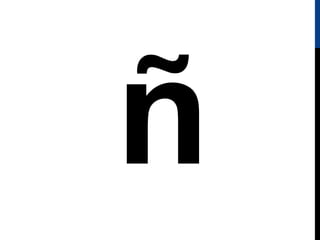
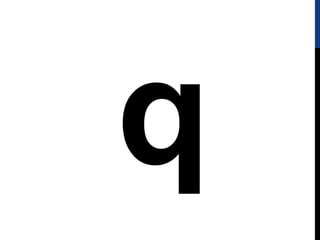
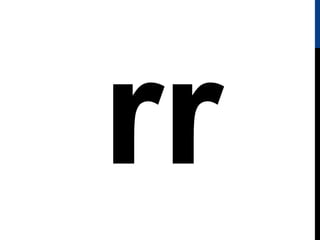
ALFABETO.INTRODUCCIONES
ALPHABET
INTRODUCTIONS
WAYS TO SAY HELLO/GOODBYE
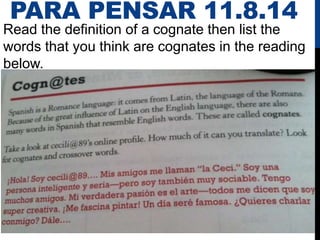
PARA PENSAR 11.8.14
Read the definition of a cognate then list the
words that you think are cognates in the reading
below.
EL ORDEN DEL DÍA
 Para Pensar
 Alfabeto
 Practica
 boleto
PRACTICA CON EL ALFABETO:
Escribe las palabras que están deletreadas abajo.
• (Write the words that have been spelled below)
• Ejemplo: ce, u, be, a – Cuba
1. eme, a, te, e, eme, a, te, i, ce, a, ese
2. hache, o, ere, ere, i, be, ele, e
3. Be, o, ele, i, ve, i, a
4. ene, o, eme, be, ere, e
5. o, ce, hache, o
6. ce, u, eme, pe, ele, e, a, eñe, o, ese
7. Ve, i, ve, i, ere
8. e, ese, pe, a, eñe, o, ele
9. a, zeta, u, ele
10. ele, a, te, i, ene, o, a, eme, e, ere, i, ce, a
BOLETO
On a ¼ sheet of paper
•Spell your full name out using
the spanish alphabet
PARA PENSAR 12.8.14
Read the following definition
of a cognate and then
identify the cognates in the
passage to the right. You do
not need to copy the
passage.
Cognate:
• Related in origin, as certain
words in genetically related
languages descended from
the same ancestral root; for
example, in English:
generation and in Spanish:
generación.
A word that looks/sounds
similar and means the same
thing in two languages
GUILLÉN, NICOLÁS
(1902-1989)
Poeta cubano al que se le
considera un genuino
representante de la poesía
negra de su país.
Trabajó como tipógrafo antes
de dedicarse al periodismo y
darse a conocer como escritor.
Desde su juventud participó
intensamente en la vida
cultural y política cubana, lo
que le costó el exilio en varias
ocasiones. Ingresó en el
Partido Comunista en 1937, y
tras el triunfo de la Revolución
cubana en 1959 desempeñó
cargos y misiones
diplomáticas de relieve.
EL ORDEN DEL DÍA
 Para Pensar
 Introducciones y despedidas
 Vocabulario: introducciones
y saludos
 Boleto
INTRODUCCIONES Y SALUDOS
¿Cómo te
llamas?—¿Cómo
se llama usted?
Me llamo_______
Mucho gusto
Encantado/a
Igualmente
¿Cómo estás?—
¿Cómo está usted?
Estoy (muy)
bien/mal/ enfermo
Así así
Mas o menos
Gracias
¿Qué tal?
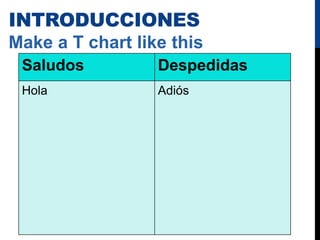
INTRODUCCIONES
Make a T chart like this
Saludos Despedidas
Hola Adiós
BOLETO
List 3 ways to say hello in
spanish
¿Cómo te llamas?
PARA PENSAR 13.8.14
Imagine you’re participating in a summer program in
Costa Rica. Read each of the following situations.
Then choose the most appropriate expression: hasta
mañana, buenos días, hola, chao, or buenas tardes
1. It’s 9:30 a.m. and you’re down in the kitchen, getting a glass of juice.
Your host grandmother, a very proper Costa Rican woman, walks in.
You say, “______, Señora.”
2. After a long day of sightseeing in San Jose, you’re ready to go to
sleep. You get up from the couch and say to your host family,
“______.”
3. You’re host brother, Andres, is on his way to his summer job at the
bank. You luckily, aren’t going with him. As he leaves, you say,
“!_________, Andres!”
4. On your way home from class, you run into a cute classmate, you call
out, “_________”
5. You’re tired of walking in the afternoon heat. You hail a cab. When
you get in, you say, “_________, señor.”
EL ORDEN DEL DÍA
 Para Pensar
 Repaso—
introducciones/saludos
 Actividad
 boleto
ACTIVIDAD:
INTRODUCCIONES/SALUDOS
You will be given 5-10 minutes to
Introduce yourself and talk to as many
classmates as possible. (you will need a
piece of paper to have them sign)
The person who introduced themselves
to the most people will win a homework
pass
P.s. if you cheat I WILL know!!!!
BOLETO
On a ¼ sheet of paper
•Cómo estás?
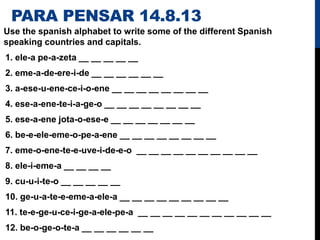
PARA PENSAR 14.8.13
Use the spanish alphabet to write some of the different Spanish
speaking countries and capitals.
1. ele-a pe-a-zeta __ __ __ __ __
2. eme-a-de-ere-i-de __ __ __ __ __ __
3. a-ese-u-ene-ce-i-o-ene __ __ __ __ __ __ __ __
4. ese-a-ene-te-i-a-ge-o __ __ __ __ __ __ __ __
5. ese-a-ene jota-o-ese-e __ __ __ __ __ __ __
6. be-e-ele-eme-o-pe-a-ene __ __ __ __ __ __ __ __
7. eme-o-ene-te-e-uve-i-de-e-o __ __ __ __ __ __ __ __ __ __
8. ele-i-eme-a __ __ __ __
9. cu-u-i-te-o __ __ __ __ __
10. ge-u-a-te-e-eme-a-ele-a __ __ __ __ __ __ __ __ __
11. te-e-ge-u-ce-i-ge-a-ele-pe-a __ __ __ __ __ __ __ __ __ __ __
12. be-o-ge-o-te-a __ __ __ __ __ __
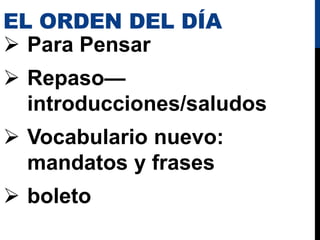
EL ORDEN DEL DÍA
 Para Pensar
 Repaso—
introducciones/saludos
 Vocabulario nuevo:
mandatos y frases
 boleto
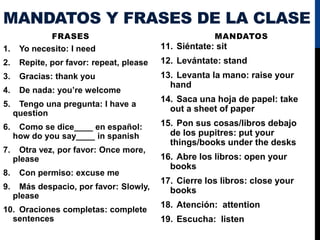
FRASES MANDATOS
MANDATOS Y FRASES DE LA CLASE
1. Yo necesito: I need
2. Repite, por favor: repeat, please
3. Gracias: thank you
4. De nada: you’re welcome
5. Tengo una pregunta: I have a
question
6. Como se dice____ en español:
how do you say____ in spanish
7. Otra vez, por favor: Once more,
please
8. Con permiso: excuse me
9. Más despacio, por favor: Slowly,
please
10. Oraciones completas: complete
sentences
11. Siéntate: sit
12. Levántate: stand
13. Levanta la mano: raise your
hand
14. Saca una hoja de papel: take
out a sheet of paper
15. Pon sus cosas/libros debajo
de los pupitres: put your
things/books under the desks
16. Abre los libros: open your
books
17. Cierre los libros: close your
books
18. Atención: attention
19. Escucha: listen
BOLETO
What is due tomorrow?
PARA PENSAR 15.8.13
Take a sheet of colored paper from the table,
you will be making a sign using the commands
and phrases…
You will be making a sign for the word with the
same number from the vocabulary that you
received yesterday that is the same as your
desk number (desk number 1- vocab word 1).
If your seat number is not listed choose one
that includes one of the numbers on your desk
(25- you can choose either 2, 12, 5, or 15)
EL ORDEN DEL DÍA
 Para pensar
 Mini lección: Porqué el español?
 Mini lección: influence of Spanish
language
 Apellidos
 Boleto
¿PORQUÉ EL ESPAÑOL?
Learning Spanish is necessary to keep pace with popular culture.
Learning Spanish is actually a medical device!
For many, learning Spanish is rapidly becoming a business
necessity.
Spanish, Spanish everywhere.
Learning Spanish will (truly) expand your universe.
Knowing Spanish will completely transform your travel
experience.
Knowing how to speak Spanish will enable you to help others.
There are reasons to learn language for language's sake.
Learning Spanish will allow you to better appreciate Hispanic
cultural contributions.
Learning Spanish is fun!
Top Ten Reasons to learn Spanish
MINI LECCIÓN: INFLUENCE OF
SPANISH LANGUAGE…
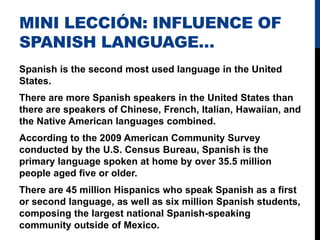
Spanish is the second most used language in the United
States.
There are more Spanish speakers in the United States than
there are speakers of Chinese, French, Italian, Hawaiian, and
the Native American languages combined.
According to the 2009 American Community Survey
conducted by the U.S. Census Bureau, Spanish is the
primary language spoken at home by over 35.5 million
people aged five or older.
There are 45 million Hispanics who speak Spanish as a first
or second language, as well as six million Spanish students,
composing the largest national Spanish-speaking
community outside of Mexico.
WHAT IS AN APELLIDO?
When you are introduced to some Spanish-speaking
people, it is imporant to understand how they use
last names. Spanish speakers uusally have more
than one apellido or last name.
Apellido paterno: the first last name comes from the
father's last name.

Apellido materno: is the mother's maiden name.
A person always identifies him or herself by the
paternal last name.
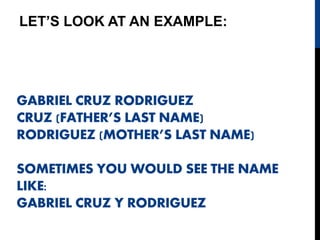
GABRIEL CRUZ RODRIGUEZ
CRUZ (FATHER’S LAST NAME)
RODRIGUEZ (MOTHER’S LAST NAME)
SOMETIMES YOU WOULD SEE THE NAME
LIKE:
GABRIEL CRUZ Y RODRIGUEZ
LET’S LOOK AT AN EXAMPLE:
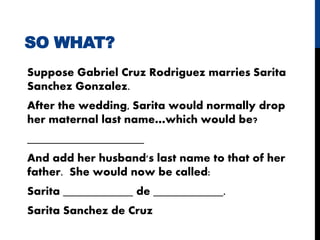
SO WHAT?
Suppose Gabriel Cruz Rodriguez marries Sarita
Sanchez Gonzalez.
After the wedding, Sarita would normally drop
her maternal last name…which would be?
____________________
And add her husband's last name to that of her
father. She would now be called:
Sarita ____________ de ____________.
Sarita Sanchez de Cruz
BOLETO
¿Cómo te llamas?
¿Cómo estás?
What is your apellido?

Abc.intros.why spanish (week 2)

  • 1.
  • 2.
    PARA PENSAR 11.8.14 Readthe definition of a cognate then list the words that you think are cognates in the reading below.
  • 3.
    EL ORDEN DELDÍA  Para Pensar  Alfabeto  Practica  boleto
  • 34.
    PRACTICA CON ELALFABETO: Escribe las palabras que están deletreadas abajo. • (Write the words that have been spelled below) • Ejemplo: ce, u, be, a – Cuba 1. eme, a, te, e, eme, a, te, i, ce, a, ese 2. hache, o, ere, ere, i, be, ele, e 3. Be, o, ele, i, ve, i, a 4. ene, o, eme, be, ere, e 5. o, ce, hache, o 6. ce, u, eme, pe, ele, e, a, eñe, o, ese 7. Ve, i, ve, i, ere 8. e, ese, pe, a, eñe, o, ele 9. a, zeta, u, ele 10. ele, a, te, i, ene, o, a, eme, e, ere, i, ce, a
  • 35.
    BOLETO On a ¼sheet of paper •Spell your full name out using the spanish alphabet
  • 36.
    PARA PENSAR 12.8.14 Readthe following definition of a cognate and then identify the cognates in the passage to the right. You do not need to copy the passage. Cognate: • Related in origin, as certain words in genetically related languages descended from the same ancestral root; for example, in English: generation and in Spanish: generación. A word that looks/sounds similar and means the same thing in two languages GUILLÉN, NICOLÁS (1902-1989) Poeta cubano al que se le considera un genuino representante de la poesía negra de su país. Trabajó como tipógrafo antes de dedicarse al periodismo y darse a conocer como escritor. Desde su juventud participó intensamente en la vida cultural y política cubana, lo que le costó el exilio en varias ocasiones. Ingresó en el Partido Comunista en 1937, y tras el triunfo de la Revolución cubana en 1959 desempeñó cargos y misiones diplomáticas de relieve.
  • 37.
    EL ORDEN DELDÍA  Para Pensar  Introducciones y despedidas  Vocabulario: introducciones y saludos  Boleto
  • 38.
    INTRODUCCIONES Y SALUDOS ¿Cómote llamas?—¿Cómo se llama usted? Me llamo_______ Mucho gusto Encantado/a Igualmente ¿Cómo estás?— ¿Cómo está usted? Estoy (muy) bien/mal/ enfermo Así así Mas o menos Gracias ¿Qué tal?
  • 39.
    INTRODUCCIONES Make a Tchart like this Saludos Despedidas Hola Adiós
  • 40.
    BOLETO List 3 waysto say hello in spanish ¿Cómo te llamas?
  • 41.
    PARA PENSAR 13.8.14 Imagineyou’re participating in a summer program in Costa Rica. Read each of the following situations. Then choose the most appropriate expression: hasta mañana, buenos días, hola, chao, or buenas tardes 1. It’s 9:30 a.m. and you’re down in the kitchen, getting a glass of juice. Your host grandmother, a very proper Costa Rican woman, walks in. You say, “______, Señora.” 2. After a long day of sightseeing in San Jose, you’re ready to go to sleep. You get up from the couch and say to your host family, “______.” 3. You’re host brother, Andres, is on his way to his summer job at the bank. You luckily, aren’t going with him. As he leaves, you say, “!_________, Andres!” 4. On your way home from class, you run into a cute classmate, you call out, “_________” 5. You’re tired of walking in the afternoon heat. You hail a cab. When you get in, you say, “_________, señor.”
  • 42.
    EL ORDEN DELDÍA  Para Pensar  Repaso— introducciones/saludos  Actividad  boleto
  • 43.
    ACTIVIDAD: INTRODUCCIONES/SALUDOS You will begiven 5-10 minutes to Introduce yourself and talk to as many classmates as possible. (you will need a piece of paper to have them sign) The person who introduced themselves to the most people will win a homework pass P.s. if you cheat I WILL know!!!!
  • 44.
    BOLETO On a ¼sheet of paper •Cómo estás?
  • 45.
    PARA PENSAR 14.8.13 Usethe spanish alphabet to write some of the different Spanish speaking countries and capitals. 1. ele-a pe-a-zeta __ __ __ __ __ 2. eme-a-de-ere-i-de __ __ __ __ __ __ 3. a-ese-u-ene-ce-i-o-ene __ __ __ __ __ __ __ __ 4. ese-a-ene-te-i-a-ge-o __ __ __ __ __ __ __ __ 5. ese-a-ene jota-o-ese-e __ __ __ __ __ __ __ 6. be-e-ele-eme-o-pe-a-ene __ __ __ __ __ __ __ __ 7. eme-o-ene-te-e-uve-i-de-e-o __ __ __ __ __ __ __ __ __ __ 8. ele-i-eme-a __ __ __ __ 9. cu-u-i-te-o __ __ __ __ __ 10. ge-u-a-te-e-eme-a-ele-a __ __ __ __ __ __ __ __ __ 11. te-e-ge-u-ce-i-ge-a-ele-pe-a __ __ __ __ __ __ __ __ __ __ __ 12. be-o-ge-o-te-a __ __ __ __ __ __
  • 46.
    EL ORDEN DELDÍA  Para Pensar  Repaso— introducciones/saludos  Vocabulario nuevo: mandatos y frases  boleto
  • 47.
    FRASES MANDATOS MANDATOS YFRASES DE LA CLASE 1. Yo necesito: I need 2. Repite, por favor: repeat, please 3. Gracias: thank you 4. De nada: you’re welcome 5. Tengo una pregunta: I have a question 6. Como se dice____ en español: how do you say____ in spanish 7. Otra vez, por favor: Once more, please 8. Con permiso: excuse me 9. Más despacio, por favor: Slowly, please 10. Oraciones completas: complete sentences 11. Siéntate: sit 12. Levántate: stand 13. Levanta la mano: raise your hand 14. Saca una hoja de papel: take out a sheet of paper 15. Pon sus cosas/libros debajo de los pupitres: put your things/books under the desks 16. Abre los libros: open your books 17. Cierre los libros: close your books 18. Atención: attention 19. Escucha: listen
  • 48.
  • 49.
    PARA PENSAR 15.8.13 Takea sheet of colored paper from the table, you will be making a sign using the commands and phrases… You will be making a sign for the word with the same number from the vocabulary that you received yesterday that is the same as your desk number (desk number 1- vocab word 1). If your seat number is not listed choose one that includes one of the numbers on your desk (25- you can choose either 2, 12, 5, or 15)
  • 50.
    EL ORDEN DELDÍA  Para pensar  Mini lección: Porqué el español?  Mini lección: influence of Spanish language  Apellidos  Boleto
  • 51.
    ¿PORQUÉ EL ESPAÑOL? LearningSpanish is necessary to keep pace with popular culture. Learning Spanish is actually a medical device! For many, learning Spanish is rapidly becoming a business necessity. Spanish, Spanish everywhere. Learning Spanish will (truly) expand your universe. Knowing Spanish will completely transform your travel experience. Knowing how to speak Spanish will enable you to help others. There are reasons to learn language for language's sake. Learning Spanish will allow you to better appreciate Hispanic cultural contributions. Learning Spanish is fun! Top Ten Reasons to learn Spanish
  • 52.
    MINI LECCIÓN: INFLUENCEOF SPANISH LANGUAGE… Spanish is the second most used language in the United States. There are more Spanish speakers in the United States than there are speakers of Chinese, French, Italian, Hawaiian, and the Native American languages combined. According to the 2009 American Community Survey conducted by the U.S. Census Bureau, Spanish is the primary language spoken at home by over 35.5 million people aged five or older. There are 45 million Hispanics who speak Spanish as a first or second language, as well as six million Spanish students, composing the largest national Spanish-speaking community outside of Mexico.
  • 53.
    WHAT IS ANAPELLIDO? When you are introduced to some Spanish-speaking people, it is imporant to understand how they use last names. Spanish speakers uusally have more than one apellido or last name. Apellido paterno: the first last name comes from the father's last name. Apellido materno: is the mother's maiden name. A person always identifies him or herself by the paternal last name.


  • 54.
    GABRIEL CRUZ RODRIGUEZ CRUZ(FATHER’S LAST NAME) RODRIGUEZ (MOTHER’S LAST NAME) SOMETIMES YOU WOULD SEE THE NAME LIKE: GABRIEL CRUZ Y RODRIGUEZ LET’S LOOK AT AN EXAMPLE:
  • 55.
    SO WHAT? Suppose GabrielCruz Rodriguez marries Sarita Sanchez Gonzalez. After the wedding, Sarita would normally drop her maternal last name…which would be? ____________________ And add her husband's last name to that of her father. She would now be called: Sarita ____________ de ____________. Sarita Sanchez de Cruz
  • 56.
    BOLETO ¿Cómo te llamas? ¿Cómoestás? What is your apellido?