

Cellular Metabolism and Division
Animals Among Us
August 29th, 2013

1
Perfect Attendance!!
• YAY!

2
Organic Molecules
• Anything with carbon in it
• The Building Blocks of Life
1. Carbohydrates
2. Lipids
3. Amino Acids and Proteins
4. Nucleic Acids

3
Organic Molecules
• Anything with carbon in it
• The Building Blocks of Life
1. Carbohydrates
2. Lipids
3. Amino Acids and Proteins
4. Nucleic Acids

4
Carbohydrates
• Carbohydrates
– Carbon, hydrogen, and oxygen
– 1 C: 2 H: 1 O
– Sugars, starches, cellulose
– Where do carbohydrates come from?

5
Carbohydrates
• Photosynthesis
• Water + Carbon Dioxide -> solar -> Carbs!
1. Monosaccharides
– Simple sugars

2. Disaccharides
– Double sugars

3. Polysaccharides
– Complex sugars
6
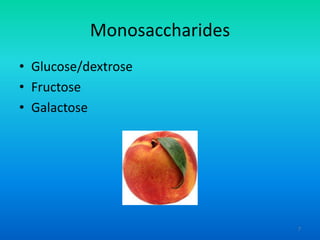
Monosaccharides
• Glucose/dextrose
• Fructose
• Galactose

7
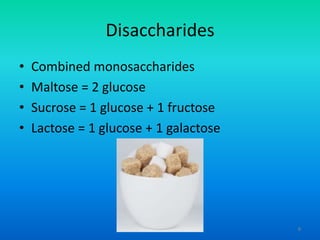
Disaccharides
•
•
•
•

Combined monosaccharides
Maltose = 2 glucose
Sucrose = 1 glucose + 1 fructose
Lactose = 1 glucose + 1 galactose

8
Polysaccharides
• Many molecules of simple sugars in long
chains
• Glycogen
– How sugars are stored in animal tissues
– When needed, converted into glucose

• Cellulose
– Principal structural carbohydrate of plants

9
Organic Molecules
• Anything with carbon in it
• The Building Blocks of Life
1. Carbohydrates
2. Lipids
3. Amino Acids and Proteins
4. Nucleic Acids

10
Lipids
• Fuel storage and building material
1. Neutral Fats
– “True” fats
– Storage from dietary fats or carbs

2. Phospholipids
– Structurally important

3. Steroids
– Complex alcohols

11
Neutral Fats
• Saturated
– Typically animal fats
– Every carbon atom is bonded with two hydrogen
atoms
– Usually solid at room temperature

• Unsaturated
– Typically plant fats (“oils”)
– 2 or more carbon atoms are joined by double
bonds, not “saturated” with hydrogen atoms

12
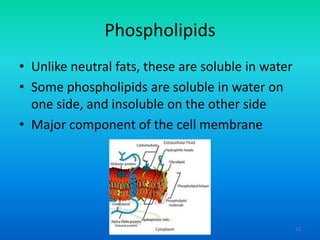
Phospholipids
• Unlike neutral fats, these are soluble in water
• Some phospholipids are soluble in water on
one side, and insoluble on the other side
• Major component of the cell membrane

13
Steroids
•
•
•
•

Structurally unlike fats
Other chemical properties are similar
Cholesterol
Hormones

14
Organic Molecules
• Anything with carbon in it
• The Building Blocks of Life
1. Carbohydrates
2. Lipids
3. Amino Acids and Proteins
4. Nucleic Acids

15
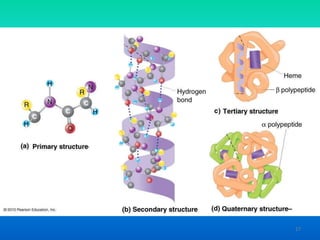
Amino Acids and Proteins
•
•
•
•

20 amino acids
Amino acid + amino acid = protein
Organized into 3 dimensional structures
Often interlinked with other proteins

16
17
Organic Molecules
• Anything with carbon in it
• The Building Blocks of Life
1. Carbohydrates
2. Lipids
3. Amino Acids and Proteins
4. Nucleic Acids

18
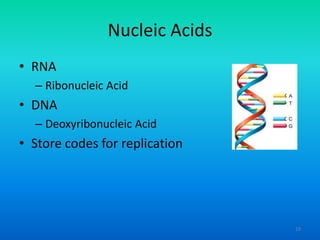
Nucleic Acids
• RNA
– Ribonucleic Acid

• DNA
– Deoxyribonucleic Acid

• Store codes for replication

19
Miller Experiment
• Methane, hydrogen, ammonia, water
• Circulate 1 week with electric spark
– Solar energy, hydrothermic vents, lightning

• 15% into complex molecules
– 4 amino acids

• Add a couple of billion years…

20
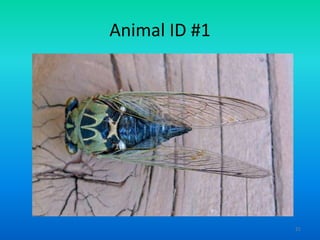
Animal ID #1

21
Scissor-Grinder Cicada
• Annual cicada
• Important food source for many bird species
• Lives underground in nymph stage for several
years, feeding on tree roots

22
Metabolism
• Photosynthesis
CO2 + H2O + Solar Energy = Sugar + O2
• First law of thermodynamics
– Energy cannot be created or destroyed
– Solar energy becomes stored energy in the plant

23
Cellular Respiration
1. Heterotroph eats food, food is broken down
and absorbed into the bloodstream
2. Molecules enter cells
3. Molecules are turned into ATP in the
cytoplasm
4. Mitochondria break bonds of ATP to provide
energy for the cell

24
Metabolism
• ATP
– Adenosine Tri-Phosphate
– High-energy bonds (“potential energy”)

• ATP + Water = ADP + Energy

25
Cellular Respiration
• Aerobic
– ATP + Water + O2 = ADP + Energy + CO2

• Anaerobic
– ATP + Water = ADP + Energy + Lactic Acid
– 1/18th as efficient as aerobic

26
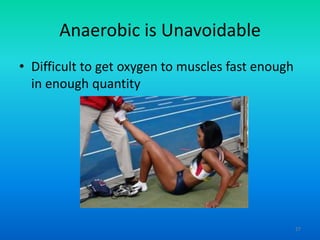
Anaerobic is Unavoidable
• Difficult to get oxygen to muscles fast enough
in enough quantity

27
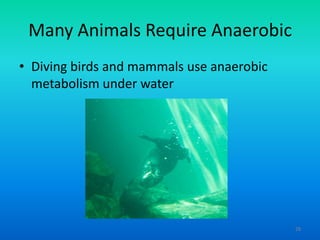
Many Animals Require Anaerobic
• Diving birds and mammals use anaerobic
metabolism under water

28
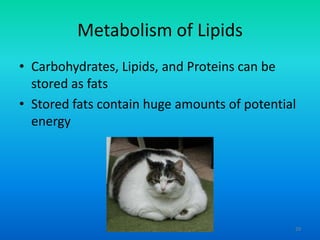
Metabolism of Lipids
• Carbohydrates, Lipids, and Proteins can be
stored as fats
• Stored fats contain huge amounts of potential
energy

29
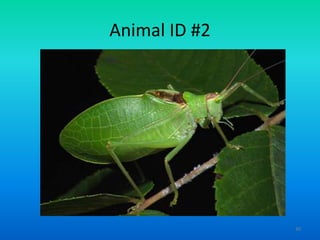
Animal ID #2

30
Northern True Katydid
• Life cycle within one year
• Prefers oak leaves
• Usually in tree canopy

31
Cellular Division
• Mitosis
– “My Toes” sis
– NOT Meiosis (forming gametes)

• Each new cell contains complete genetic code
of “parent” cell
• For animals that reproduce asexually, this is
the whole story

32
Mitosis
• 5 stages
– Interphase (MOST OF THE TIME)
– Prophase
– Metaphase
– Anaphase
– Telophase

• IPMAT – I Poop More After Tacos

33
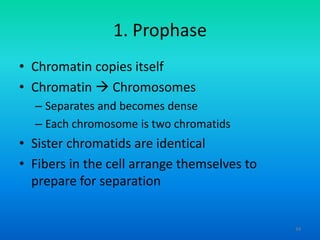
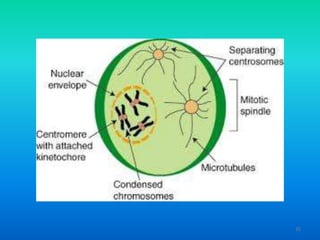
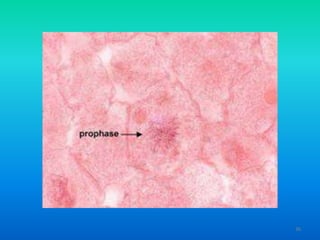
1. Prophase
• Chromatin copies itself
• Chromatin  Chromosomes
– Separates and becomes dense
– Each chromosome is two chromatids

• Sister chromatids are identical
• Fibers in the cell arrange themselves to
prepare for separation

34
35
36
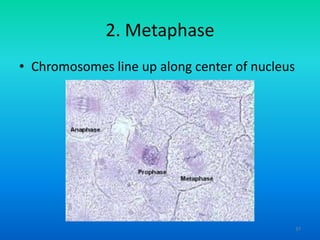
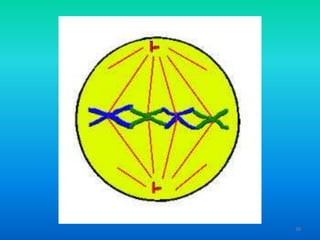
2. Metaphase
• Chromosomes line up along center of nucleus

37
38
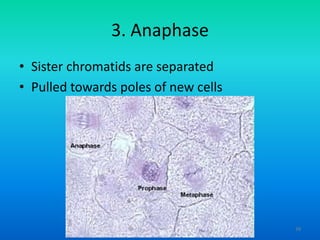
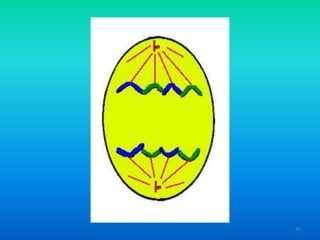
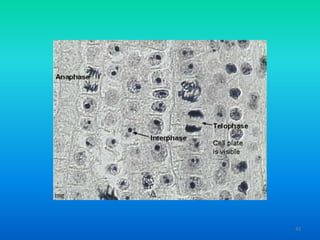
3. Anaphase
• Sister chromatids are separated
• Pulled towards poles of new cells

39
40
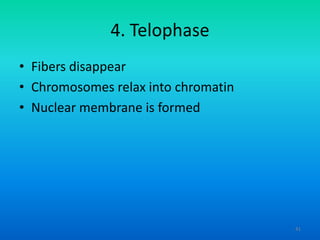
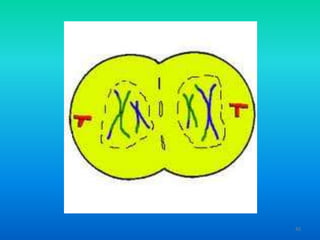
4. Telophase
• Fibers disappear
• Chromosomes relax into chromatin
• Nuclear membrane is formed

41
42
43
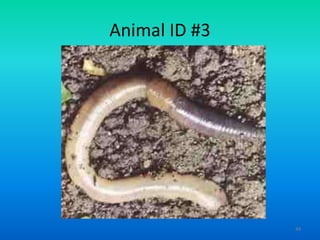
Animal ID #3

44
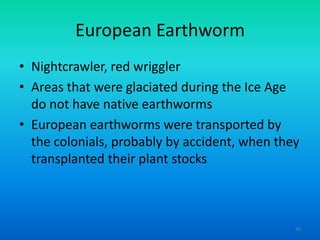
European Earthworm
• Nightcrawler, red wriggler
• Areas that were glaciated during the Ice Age
do not have native earthworms
• European earthworms were transported by
the colonials, probably by accident, when they
transplanted their plant stocks

45
Meiosis
• Same basic process as mitosis, except
– Two cycles
– Four resulting cells
– Resulting cells have half of the DNA

46
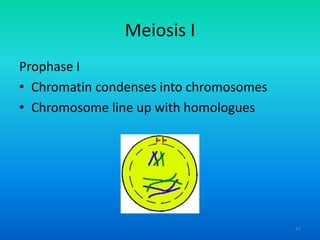
Meiosis I
Prophase I
• Chromatin condenses into chromosomes
• Chromosome line up with homologues

47
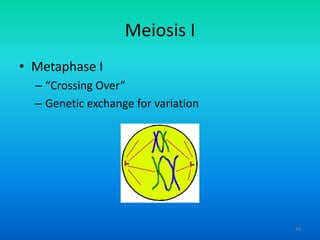
Meiosis I
• Metaphase I
– “Crossing Over”
– Genetic exchange for variation

48
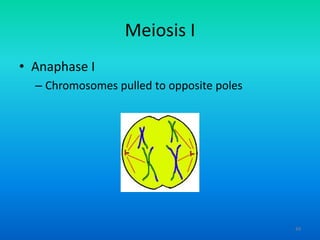
Meiosis I
• Anaphase I
– Chromosomes pulled to opposite poles

49
Meiosis I
• NO TELOPHASE I!!!

50
Meiosis II
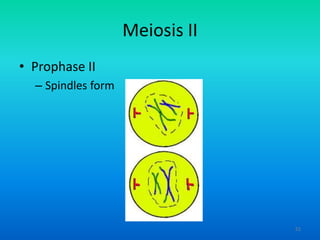
• Prophase II
– Spindles form

51
Meiosis II
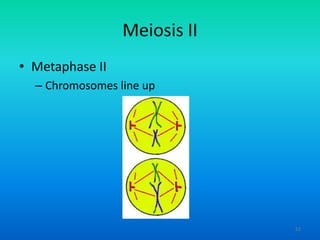
• Metaphase II
– Chromosomes line up

52
Meiosis II
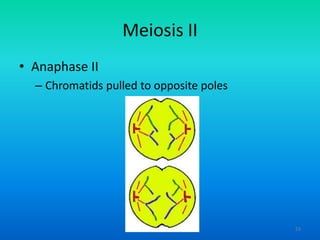
• Anaphase II
– Chromatids pulled to opposite poles

53
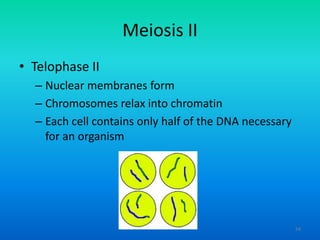
Meiosis II
• Telophase II
– Nuclear membranes form
– Chromosomes relax into chromatin
– Each cell contains only half of the DNA necessary
for an organism

54
http://www.youtube.com/watch?v=iCL6d0OwKt
8

55

Introduction to Zoology Lecture 2