

Exploratory Testing An API
Maaret Pyhäjärvi
Email: <maaret@iki.fi> | Twitter: maaretp
Maaret Pyhäjärvi
Attribution (Finland)
http://creativecommons.org/licenses/by/1.0/fi/deed.en
Testing as Performance (Exploring) vs.
Testing as Artifact Creation
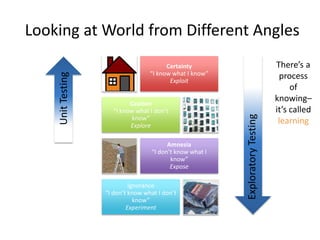
Certainty
“I know what I know”
Exploit
Caution
“I know what I don’t
know”
Explore
Amnesia
“I don’t know what I
know”
Expose
Ignorance
“I don’t know what I don’t
know”
Experiment
Looking at World from Different Angles
UnitTesting
ExploratoryTesting
There’s a
process
of
knowing–
it’s called
learning
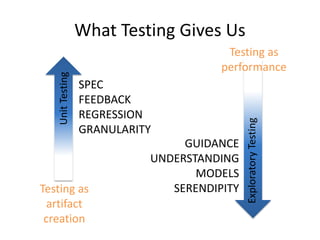
What Testing Gives Us
UnitTesting
ExploratoryTesting
SPEC
FEEDBACK
REGRESSION
GRANULARITY
GUIDANCE
UNDERSTANDING
MODELS
SERENDIPITYTesting as
artifact
creation
Testing as
performance
Product is my external
imagination
I am my developer’s external imagination
Our Test Target
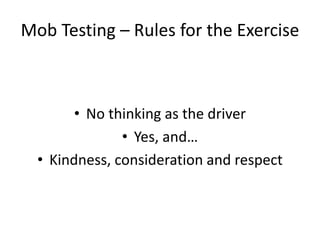
Mob Testing – Rules for the Exercise
• No thinking as the driver
• Yes, and…
• Kindness, consideration and respect
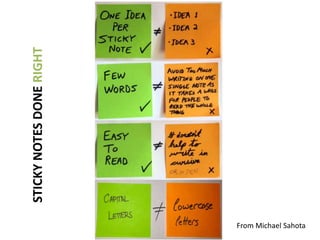
From Michael Sahota
STICKYNOTESDONERIGHT
SUMMARY
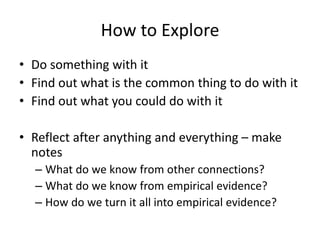
How to Explore
• Do something with it
• Find out what is the common thing to do with it
• Find out what you could do with it
• Reflect after anything and everything – make
notes
– What do we know from other connections?
– What do we know from empirical evidence?
– How do we turn it all into empirical evidence?
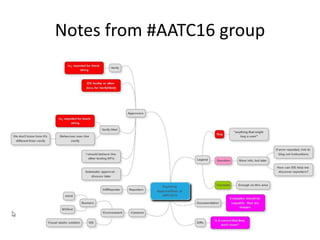
Notes from #AATC16 group
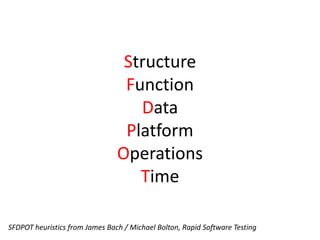
Structure
Function
Data
Platform
Operations
Time
SFDPOT heuristics from James Bach / Michael Bolton, Rapid Software Testing
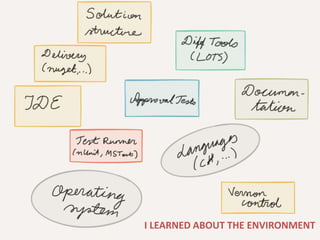
I LEARNED ABOUT THE ENVIRONMENT
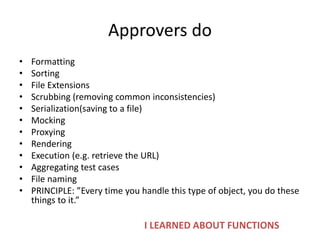
Approvers do
• Formatting
• Sorting
• File Extensions
• Scrubbing (removing common inconsistencies)
• Serialization(saving to a file)
• Mocking
• Proxying
• Rendering
• Execution (e.g. retrieve the URL)
• Aggregating test cases
• File naming
• PRINCIPLE: ”Every time you handle this type of object, you do these
things to it.”
I LEARNED ABOUT FUNCTIONS
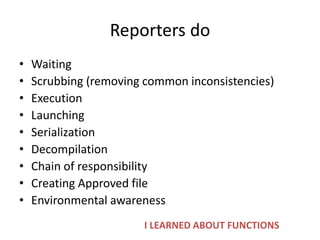
Reporters do
• Waiting
• Scrubbing (removing common inconsistencies)
• Execution
• Launching
• Serialization
• Decompilation
• Chain of responsibility
• Creating Approved file
• Environmental awareness
I LEARNED ABOUT FUNCTIONS
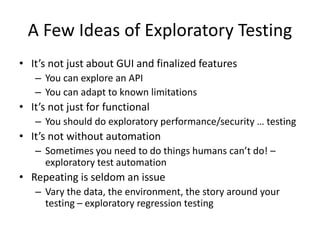
A Few Ideas of Exploratory Testing
• It’s not just about GUI and finalized features
– You can explore an API
– You can adapt to known limitations
• It’s not just for functional
– You should do exploratory performance/security … testing
• It’s not without automation
– Sometimes you need to do things humans can’t do! –
exploratory test automation
• Repeating is seldom an issue
– Vary the data, the environment, the story around your
testing – exploratory regression testing
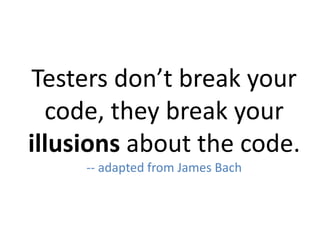
Testers don’t break your
code, they break your
illusions about the code.
-- adapted from James Bach
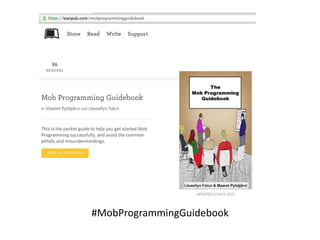
#MobProgrammingGuidebook
Maaret Pyhäjärvi
Email: maaret@iki.fi
Twitter: @maaretp
Blog: visible-quality.blogspot.fi
Get in Touch

AATC2016: Exploratory testing an API

  • 1.
    Exploratory Testing AnAPI Maaret Pyhäjärvi Email: <maaret@iki.fi> | Twitter: maaretp Maaret Pyhäjärvi Attribution (Finland) http://creativecommons.org/licenses/by/1.0/fi/deed.en
  • 2.
    Testing as Performance(Exploring) vs. Testing as Artifact Creation
  • 3.
    Certainty “I know whatI know” Exploit Caution “I know what I don’t know” Explore Amnesia “I don’t know what I know” Expose Ignorance “I don’t know what I don’t know” Experiment Looking at World from Different Angles UnitTesting ExploratoryTesting There’s a process of knowing– it’s called learning
  • 4.
    What Testing GivesUs UnitTesting ExploratoryTesting SPEC FEEDBACK REGRESSION GRANULARITY GUIDANCE UNDERSTANDING MODELS SERENDIPITYTesting as artifact creation Testing as performance
  • 5.
    Product is myexternal imagination I am my developer’s external imagination
  • 6.
  • 7.
    Mob Testing –Rules for the Exercise • No thinking as the driver • Yes, and… • Kindness, consideration and respect
  • 8.
  • 9.
  • 10.
    How to Explore •Do something with it • Find out what is the common thing to do with it • Find out what you could do with it • Reflect after anything and everything – make notes – What do we know from other connections? – What do we know from empirical evidence? – How do we turn it all into empirical evidence?
  • 11.
  • 12.
    Structure Function Data Platform Operations Time SFDPOT heuristics fromJames Bach / Michael Bolton, Rapid Software Testing
  • 13.
    I LEARNED ABOUTTHE ENVIRONMENT
  • 14.
    Approvers do • Formatting •Sorting • File Extensions • Scrubbing (removing common inconsistencies) • Serialization(saving to a file) • Mocking • Proxying • Rendering • Execution (e.g. retrieve the URL) • Aggregating test cases • File naming • PRINCIPLE: ”Every time you handle this type of object, you do these things to it.” I LEARNED ABOUT FUNCTIONS
  • 15.
    Reporters do • Waiting •Scrubbing (removing common inconsistencies) • Execution • Launching • Serialization • Decompilation • Chain of responsibility • Creating Approved file • Environmental awareness I LEARNED ABOUT FUNCTIONS
  • 16.
    A Few Ideasof Exploratory Testing • It’s not just about GUI and finalized features – You can explore an API – You can adapt to known limitations • It’s not just for functional – You should do exploratory performance/security … testing • It’s not without automation – Sometimes you need to do things humans can’t do! – exploratory test automation • Repeating is seldom an issue – Vary the data, the environment, the story around your testing – exploratory regression testing
  • 17.
    Testers don’t breakyour code, they break your illusions about the code. -- adapted from James Bach
  • 18.
  • 19.
    Maaret Pyhäjärvi Email: maaret@iki.fi Twitter:@maaretp Blog: visible-quality.blogspot.fi Get in Touch

Editor's Notes

  • #2 Four years ago, my 1st day at work. 8 things to log a day since.
  • #4 Unit testing focuses on what we know should exist.
  • #5 There’s a group of people who think of testing as creating artifacts: test cases, test automation. Tests are something that is used later for testing to happen again. The modern way of thinking leads this group of people to mostly consider test automation, recognizing that making people run mundane repeatable scripts isn’t the goal. With the automation artifacts, we get four types of benefits. The tests work as specification, giving us a detailed example of something. The tests give us feedback when we’ve implemented something, to see if what we have is what we intended. The tests stay around to guard us against regression, us forgetting details when paying attention elsewhere. And the tests give us granularity, helping us see where the problem is when the tests fail.   Another group of people thinks of testing as performance. It’s learning in layers, to prepare for the ultimate show with all the rehearsals where continuous learning enables us to put our best performance forward towards the end. Artifacts might be useful, but they are often more of an output to document all the layers of learning rather than driving the thinking. With testing as performance, we also get four types of benefits. While this style of testing does not give us a spec, it gives us guidance. It’s often not a binary Yes/No, but more of a consideration if there could be a problem here. The guidance enabling us to learn about the unknown unknowns turn into specs as we make our decisions on how to react to feedback. This testing gives us understanding, in the wider context of use and value. This testing gives us models of what the world around the application looks like, enabling us to go back to lessons we’ve learned and fast-track future learning. Finally, this testing gives us serendipity, lucky accidents to find many of the things that we should know of, but turn blind to assuming we know what we’re looking for.   While exploratory testing starts with the testing as performance in mind, it also generates artifacts whenever deemed useful. Testing of an API is a great way to get to the core of this difference in how we think about testing. All testing may be exploratory, but some of it is focused on creating artifacts. Saying “scripting is just an approach” is belittling when scripting can be the main approach to use the powers when testing.  “there’s a process of knowing” – learning Does not give as regression; serendipity (safety against things happening randomly) / unwanted serendipity events. This is what it is and what it could be. There’s a direction to it, not just statement of what it is. Coaching is not just feedback, it’s pointing them to the right way. Safety. EXPERIENCE (the verb) rather than facts ; emotions over facts. REACTIONS. HISTORY, Lessons learned, checklists. Modeling. UNDERSTANDING – where you start (knowing the thing (code & environment), knowing the user, knowing the problems, knowing the developers (how to help them and what they do so that you can efficiently test), knowing the hackers (weird use cases outside common ‘have you tried reading it upside down’) , knowing all stakeholders, knowing the business priorities) Uncovering things I cannot know, giving the application a change to reveal information for me. This allows you to know things.
  • #6 If you can’t imagine a problem, you can T write a test for it. You need to learn enough to imagine it first. I hold space and serve as my developers external imagination
  • #9 Notice how easier the left side is to read and look at than the right side
  • #17 Test till bored – 1st test is the hard one in unit testing