American Association
of School Librarians
TRANSFORMING LEARNING
N A T I O N A L
S C H O O L
L I B R A R Y
STANDARDS
Learners
AASL STANDARDS FRAMEWORK for
V.EXPLORE
I.IN
Q
UIRE
II.INCLUDE
III.COL
LABORATE IV. CURA
TE
VI. ENG
AGE
SHARED FOUNDATIONS
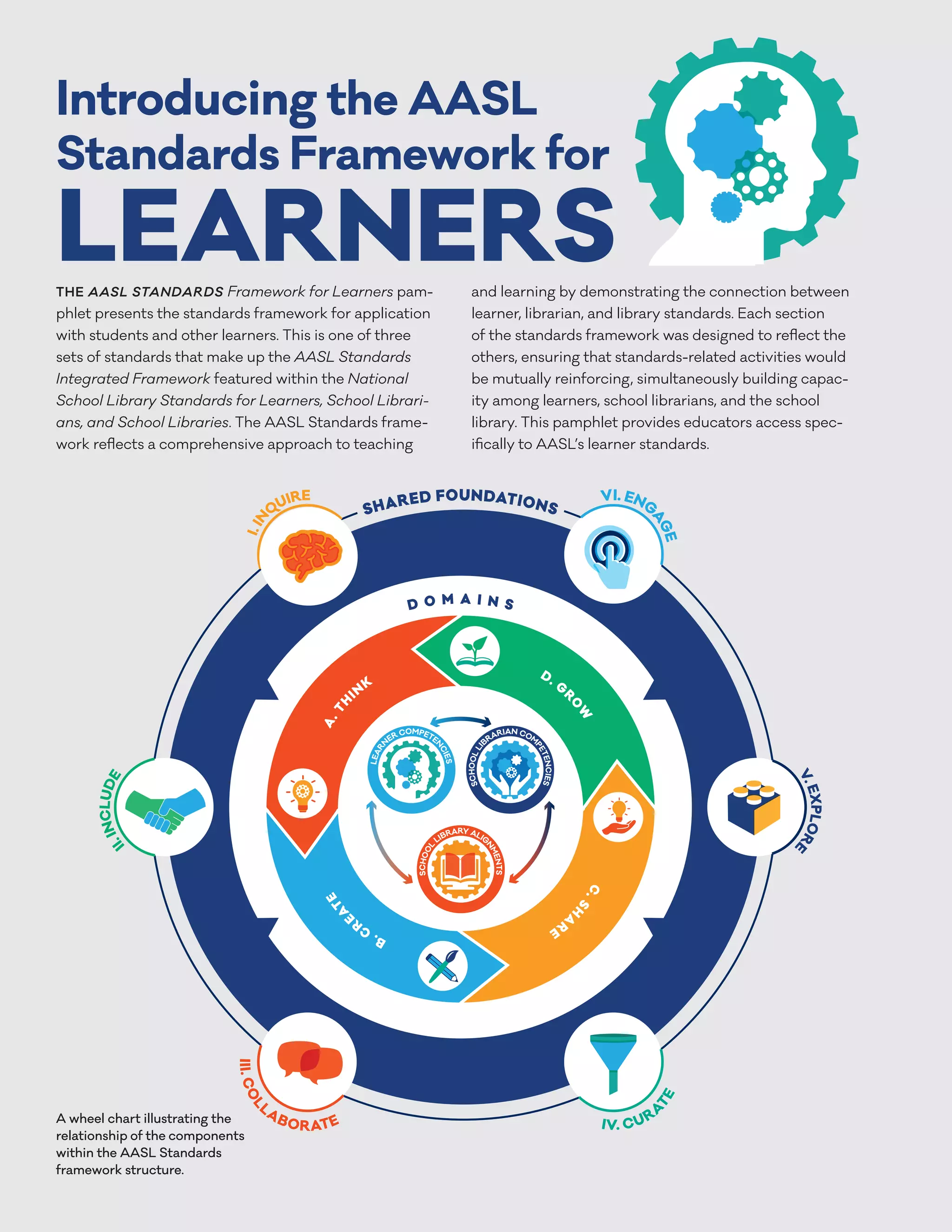
AASL Standards Integrated Framework Infographic
D O M A I N S
LEAR
N
ER COMPETE
N
CIES
SCHOOLLI
BRARIAN COM
PETENCIES
SCHOOL
LIBRARY ALIG
N
MENTS
D. G
R
O
W
C.SH
A
R
E
B.C
R
E
A
TE
A.TH
IN
K
THE AASL STANDARDS Framework for Learners pam-
phlet presents the standards framework for application
with students and other learners. This is one of three
sets of standards that make up the AASL Standards
Integrated Framework featured within the National
School Library Standards for Learners, School Librari-
ans, and School Libraries. The AASL Standards frame-
work reflects a comprehensive approach to teaching
and learning by demonstrating the connection between
learner, librarian, and library standards. Each section
of the standards framework was designed to reflect the
others, ensuring that standards-related activities would
be mutually reinforcing, simultaneously building capac-
ity among learners, school librarians, and the school
library. This pamphlet provides educators access spec­
ifically to AASL’s learner standards.
Introducing the AASL
Standards Framework for
LEARNERS
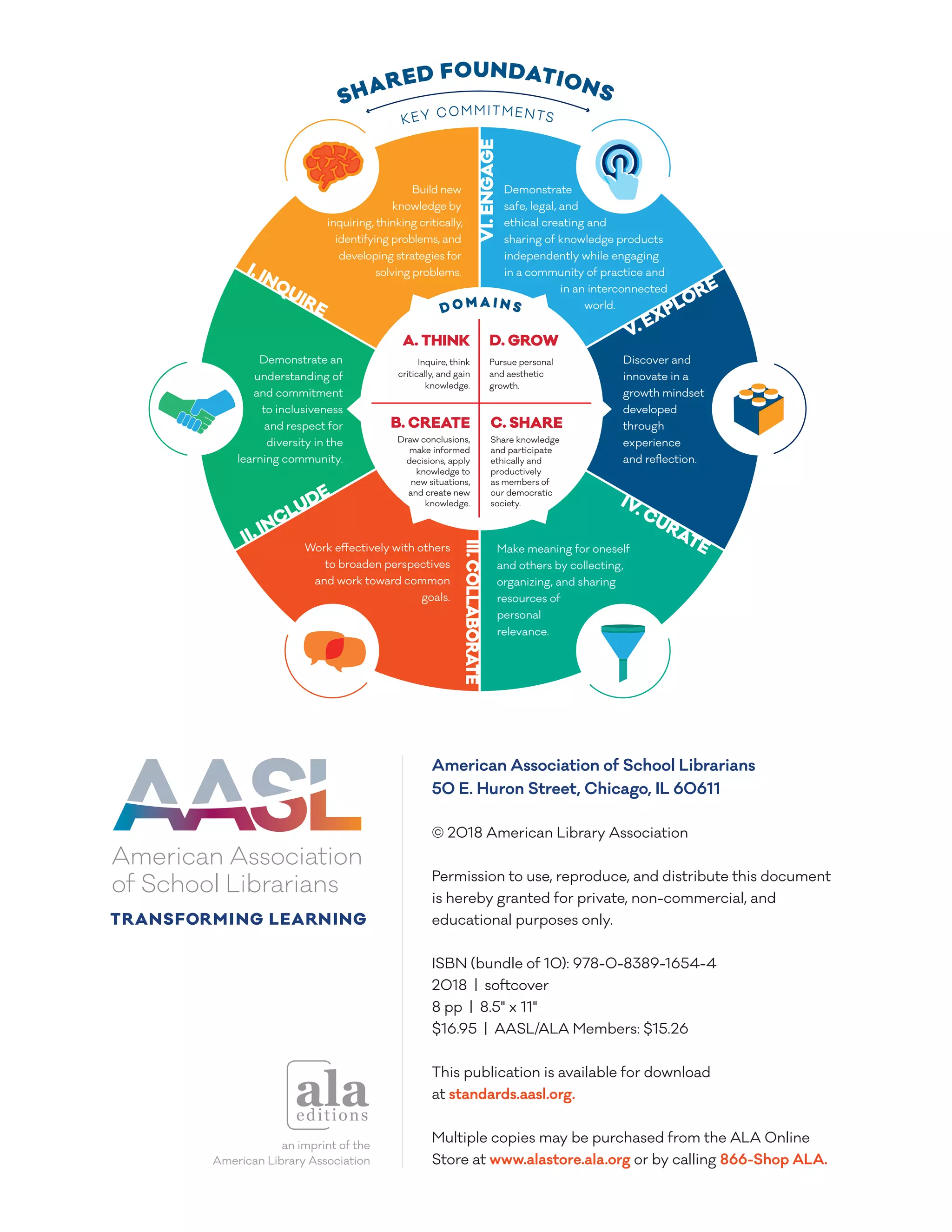
A wheel chart illustrating the
relationship of the components
within the AASL Standards
framework structure.
Common
Beliefs
1. The school library is a
unique and essential part
of a learning community.
As a destination for on-site and
virtual personalized learning, the
school library is a vital connection
between school and home. As the
leader of this space and its func-
tions, the school librarian ensures
that the school library environment
provides all members of the school
community access to information
and technology, connecting learning
to real-world events. By providing
access to an array of well-managed
resources, school librarians enable
academic knowledge to be linked to
deep understanding.
2. Qualified school
librarians lead effective
school libraries.
As they guide organizational and
personal change, effective school
librarians model, promote, and
foster inquiry learning in adequately
staffed and resourced school
libraries. Qualified school librarians
have been educated and certified
to perform interlinked, interdis-
ciplinary, and cross-cutting roles
as instructional leaders, program
administrators, educators, collab-
orative partners, and information
specialists.
3. Learners should be
pre­pared for college,
career, and life.
Committed to inclusion and equity,
effective school librarians use evi-
dence to determine what works, for
whom and under what conditions
for each learner; complemented by
community engagement and inno-
vative leadership, school librarians
improve all learners’ opportunities
for success. This success empow-
ers learners to persist in inquiry,
advanced study, enriching profes-
sional work, and community partici-
pation through continuous improve-
ment within and beyond the school
building and school day.
4. Reading is the core of
personal and academic
competency.
In the school library, learners engage
with relevant information resources
and digital learning opportunities in
a culture of reading. School librari-
ans initiate and elevate motivational
reading initiatives by using story and
personal narrative to engage learners.
School librarians curate current digital
and print materials and technology to
provide access to high-quality reading
materials that encourage learners,
educators, and families to become
lifelong learners and readers.
5. Intellectual freedom
is every learner’s right.
Learners have the freedom to
speak and hear what others have
to say, rather than allowing others
to control their access to ideas and
information; the school librarian’s
responsibility is to develop these
dispositions in learners, educators,
and all other members of the learn-
ing community.
6. Information technologies
must be appropriately
integrated and equitably
available.
Although information technology
is woven into almost every aspect
of learning and life, not every
learner and educator has equitable
access to up-to-date, appropriate
technology and connectivity. An
effective school library bridges
digital and socioeconomic divides
to affect information technology
access and skill.
How do we define the qualities of
well-prepared learners, effective school
librarians, and dynamic school libraries?
IN THE STANDARDS remodeling process, the American Association of School Librarians (AASL)
reviewed Common Beliefs from earlier AASL Standards and official AASL position state-
ments. These documents, and feedback collected from more than 1,300 school librarians
and stakeholders nationally, provided AASL with a clear expression of the qualities of well-
prepared learners, effective school librarians, and dynamic school libraries. The following
Common Beliefs and summary descriptions were identified as central to the profession.
AASL Standards Fram
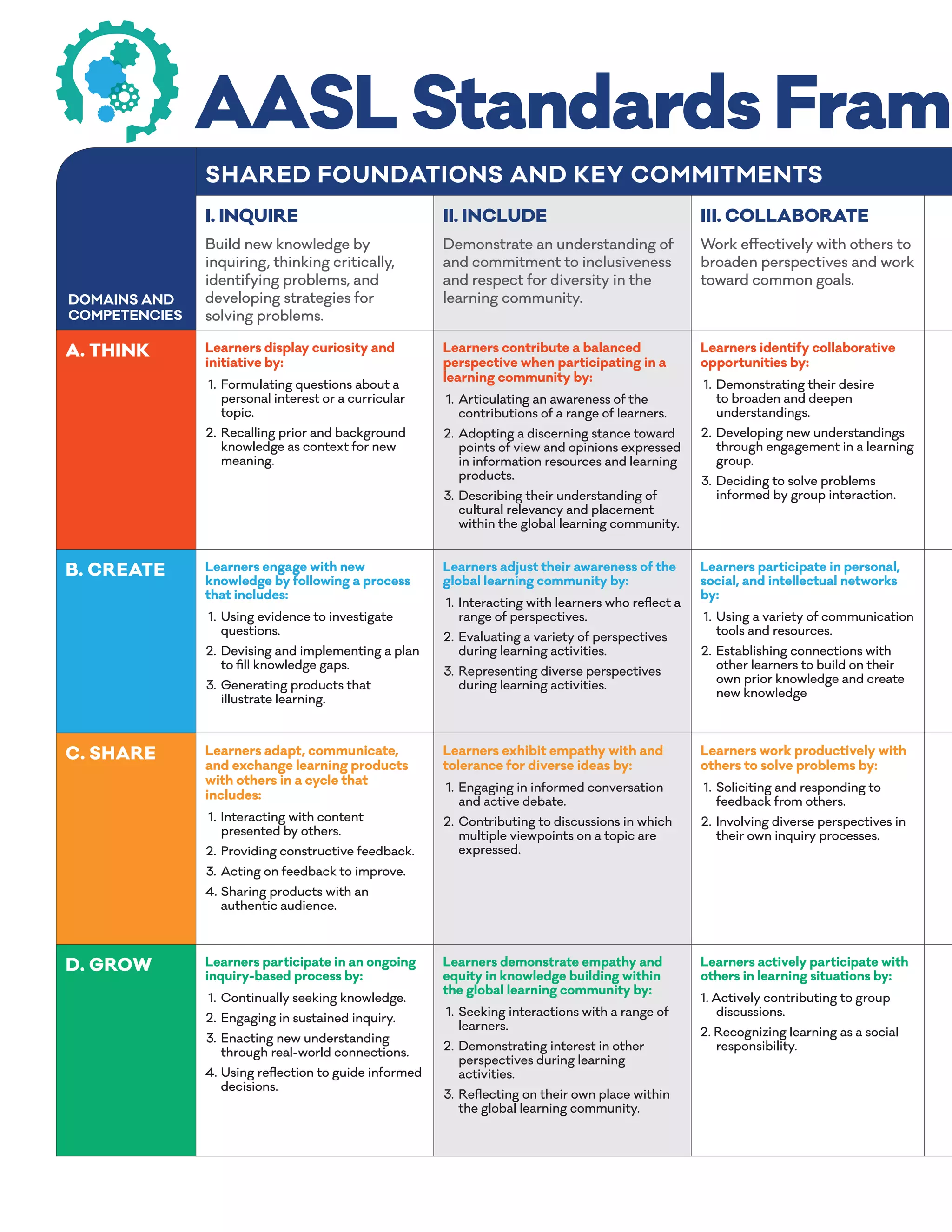
SHARED FOUNDATIONS AND KEY COMMITMENTS
I. INQUIRE
Build new knowledge by
inquiring, thinking critically,
identifying problems, and
developing strategies for
solving problems.
II. INCLUDE
Demonstrate an understanding of
and commitment to inclusiveness
and respect for diversity in the
learning community.
III. COLLABORATE
Work effectively with others to
broaden perspectives and work
toward common goals.
A. THINK Learners display curiosity and
initiative by:
	1. 	Formulating questions about a
personal interest or a curricular
topic.
	2. 	Recalling prior and background
knowledge as context for new
meaning.
Learners contribute a balanced
perspective when participating in a
learning community by:
	1. 	Articulating an awareness of the
contributions of a range of learners.
	2. 	Adopting a discerning stance toward
points of view and opinions expressed
in information resources and learning
products.
	3. 	Describing their understanding of
cultural relevancy and placement
within the global learning community.
Learners identify collaborative
opportunities by:
	1. 	Demonstrating their desire
to broaden and deepen
understandings.
	2.	Developing new understandings
through engagement in a learning
group.
	3. 	Deciding to solve problems
informed by group interaction.
B. CREATE Learners engage with new
knowledge by following a process
that includes:
	1.	Using evidence to investigate
questions.
	2.	Devising and implementing a plan
to fill knowledge gaps.
	3.	Generating products that
illustrate learning.
Learners adjust their awareness of the
global learning community by:
	1.	Interacting with learners who reflect a
range of perspectives.
	2.	Evaluating a variety of perspectives
during learning activities.
	3.	Representing diverse perspectives
during learning activities.
Learners participate in personal,
social, and intellectual networks
by:
	1.	Using a variety of communication
tools and resources.
	2.	Establishing connections with
other learners to build on their
own prior knowledge and create
new knowledge
C. SHARE Learners adapt, communicate,
and exchange learning products
with others in a cycle that
includes:
	1.	Interacting with content
presented by others.
	2.	Providing constructive feedback.
	3.	Acting on feedback to improve.
	4.	Sharing products with an
authentic audience.
Learners exhibit empathy with and
tolerance for diverse ideas by:
	1.	Engaging in informed conversation
and active debate.
	2.	Contributing to discussions in which
multiple viewpoints on a topic are
expressed.
Learners work productively with
others to solve problems by:
	1.	Soliciting and responding to
feedback from others.
	2.	Involving diverse perspectives in
their own inquiry processes.
D. GROW Learners participate in an ongoing
inquiry-based process by:
	1.	Continually seeking knowledge.
	2.	Engaging in sustained inquiry.
	3.	Enacting new understanding
through real-world connections.
4.	Using reflection to guide informed
decisions.
Learners demonstrate empathy and
equity in knowledge building within
the global learning community by:
	1.	Seeking interactions with a range of
learners.
	2.	Demonstrating interest in other
perspectives during learning
activities.
	3.	Reflecting on their own place within
the global learning community.
Learners actively participate with
others in learning situations by:
1. Actively contributing to group
discussions.
2. Recognizing learning as a social
responsibility.
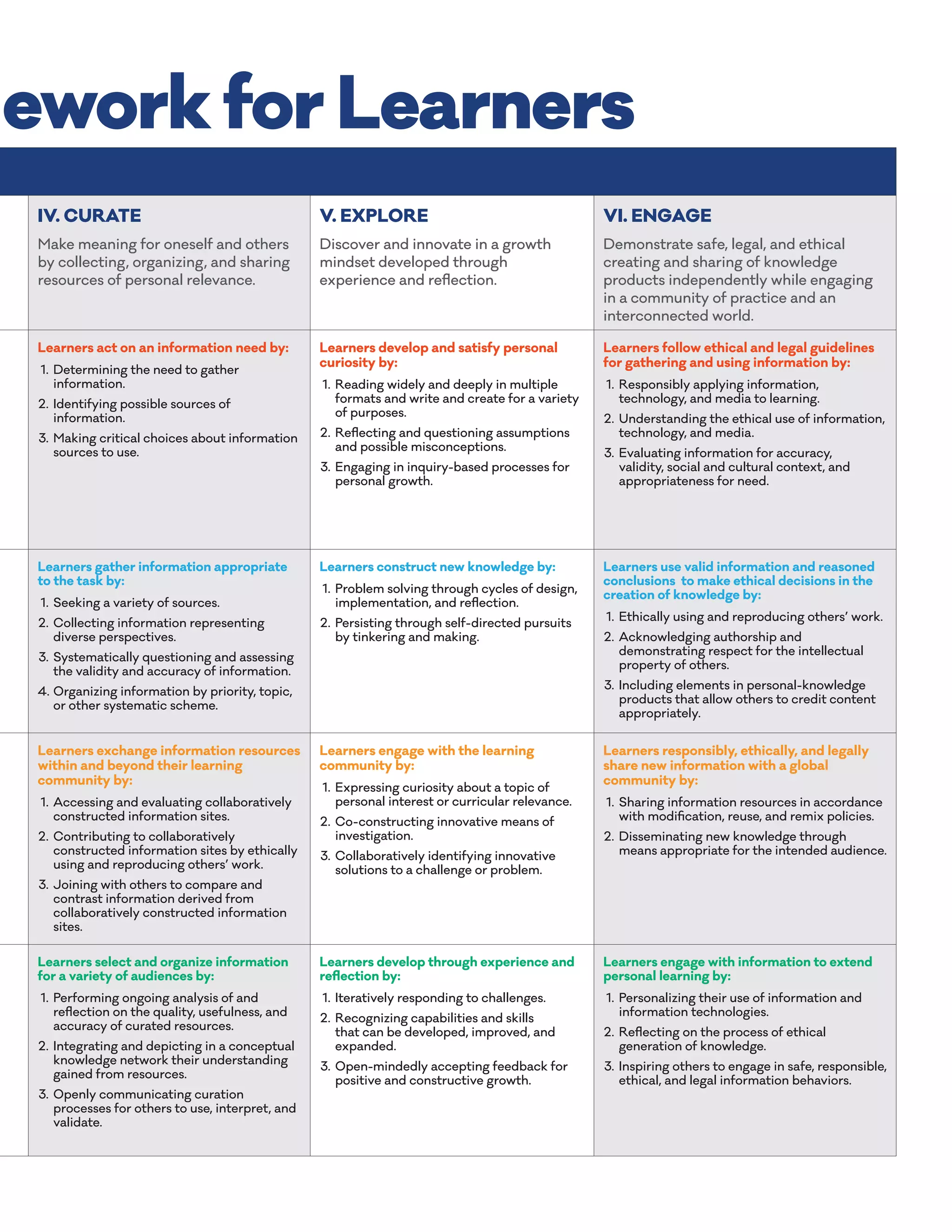
DOMAINS AND
COMPETENCIES
mework for Learners
IV. CURATE
Make meaning for oneself and others
by collecting, organizing, and sharing
resources of personal relevance.
V. EXPLORE
Discover and innovate in a growth
mindset developed through
experience and reflection.
VI. ENGAGE
Demonstrate safe, legal, and ethical
creating and sharing of knowledge
products independently while engaging
in a community of practice and an
interconnected world.
Learners act on an information need by:
	1.	Determining the need to gather
information.
	2.	Identifying possible sources of
information.
	3.	Making critical choices about information
sources to use.
Learners develop and satisfy personal
curiosity by:
	1.	Reading widely and deeply in multiple
formats and write and create for a variety
of purposes.
	2.	Reflecting and questioning assumptions
and possible misconceptions.
	3.	Engaging in inquiry-based processes for
personal growth.
Learners follow ethical and legal guidelines
for gathering and using information by:
	1.	Responsibly applying information,
technology, and media to learning.
	2.	Understanding the ethical use of information,
technology, and media.
	3.	Evaluating information for accuracy,
validity, social and cultural context, and
appropriateness for need.
Learners gather information appropriate
to the task by:
	1.	Seeking a variety of sources.
	2.	Collecting information representing
diverse perspectives.
	3.	Systematically questioning and assessing
the validity and accuracy of information.
	4.	Organizing information by priority, topic,
or other systematic scheme.
Learners construct new knowledge by:
	1.	Problem solving through cycles of design,
implementation, and reflection.
	2.	Persisting through self-directed pursuits
by tinkering and making.
Learners use valid information and reasoned
conclusions to make ethical decisions in the
creation of knowledge by:
	1.	Ethically using and reproducing others’ work.
	2.	Acknowledging authorship and
demonstrating respect for the intellectual
property of others.
	3.	Including elements in personal-knowledge
products that allow others to credit content
appropriately.
Learners exchange information resources
within and beyond their learning
community by:
	1.	Accessing and evaluating collaboratively
constructed information sites.
	2.	Contributing to collaboratively
constructed information sites by ethically
using and reproducing others’ work.
	3.	Joining with others to compare and
contrast information derived from
collaboratively constructed information
sites.
Learners engage with the learning
community by:
	1.	Expressing curiosity about a topic of
personal interest or curricular relevance.
	2.	Co-constructing innovative means of
investigation.
	3.	Collaboratively identifying innovative
solutions to a challenge or problem.
Learners responsibly, ethically, and legally
share new information with a global
community by:
	1.	Sharing information resources in accordance
with modification, reuse, and remix policies.
	2.	Disseminating new knowledge through
means appropriate for the intended audience.
Learners select and organize information
for a variety of audiences by:
	1.	Performing ongoing analysis of and
reflection on the quality, usefulness, and
accuracy of curated resources.
	2.	Integrating and depicting in a conceptual
knowledge network their understanding
gained from resources.
	3.	Openly communicating curation
processes for others to use, interpret, and
validate.
Learners develop through experience and
reflection by:
	1.	Iteratively responding to challenges.
	2.	Recognizing capabilities and skills
that can be developed, improved, and
expanded.
	3.	Open-mindedly accepting feedback for
positive and constructive growth.
Learners engage with information to extend
personal learning by:
	1.	Personalizing their use of information and
information technologies.
	2.	Reflecting on the process of ethical
generation of knowledge.
	3.	Inspiring others to engage in safe, responsible,
ethical, and legal information behaviors.
LIKE OTHER SETS of learning, professional, and program
standards, the AASL Standards are not a curriculum;
rather, they provide you with guidance and structure as
you develop a curriculum tailored to your local priorities
and needs.
The contents of the standards are designed to be
used in two ways:
1.	 As Personalized Guides. Learners and school
librarians can enter the standards at the point
most appropriate to the learning task or profes-
sional activity and use the standards to guide
decisions about actions to develop specific
competencies.
2.	 As Progressions. Learners and school librarians
first engage with the Domains at the level of Think,
and once mastery of the Competencies related
to Think are achieved, progress through Create,
Share, and Grow.
Teaching and learning are at the center of school librar-
ians’ practice. As learning leaders, school librarians
enact, model, and communicate the Competencies in
the Domains. This domain-based approach to organiz-
ing the standards ensures that school librarians are able
to personalize their professional practice and growth,
continuously tailoring their school library to local needs,
their own strengths, and learners’ benefits.
How Are the
Standards Used?
The Complete Standards
National School Library
Standards for Learners, School
Librarians, and School Libraries
ISBN: 978-0-8389-1579-0
2018 | softcover
320 pp | 7" x 10"
$199
ALA Members: $149
AASL Members: $99
AASL’S NATIONAL SCHOOL Library Standards for Learners, School
Librarians, and School Libraries offers the AASL Standards Integrated
Framework in full and expands on the application and assessment of the
standards. Sections of the book include:
•	 the six integrated frameworks (Inquire, Include, Collaborate, Curate,
Explore, and Engage) anchored with details that explain the Compe-
tencies and best practices, which include practices school librarians
can use to get started with effective implementation of the standards;
•	 detailed approaches to measuring success. The goal of competency-
based education is to support learners’ growth through personalized
learning experiences. Examples are provided for creating your own
assessment and evaluation tools that align school and district models
with AASL Standards; and
•	 a series of case studies that illustrate authentic scenarios through
which district-level supervisors and building-level school librarians
can envision putting the AASL Standards into action.
For more information about the National School Library
Standards, and to access the latest implementation
assistance resources, visit standards.aasl.org.
THE AASL STANDARDS framework is
anchored by six Shared Founda-
tions—Inquire, Include, Collaborate,
Curate, Explore, and Engage—which
highlight the standards’ core educa-
tional concepts. A one-sentence
Key Commitment describes the
essential understandings for each
of the six Shared Foundations.
Each Shared Foundation is ela­bor­
ated by three to five Competencies
for each learning category or
Domain: Think (cognitive), Create
(psychomotor), Share (affective),
and Grow (developmental). The
Competencies are measurable
statements describing the knowl-
edge, skills, and dispositions essen-
tial for learners and school librarians.
How Does It Work?
For school libraries the Competen-
cies are expressed as Alignments.
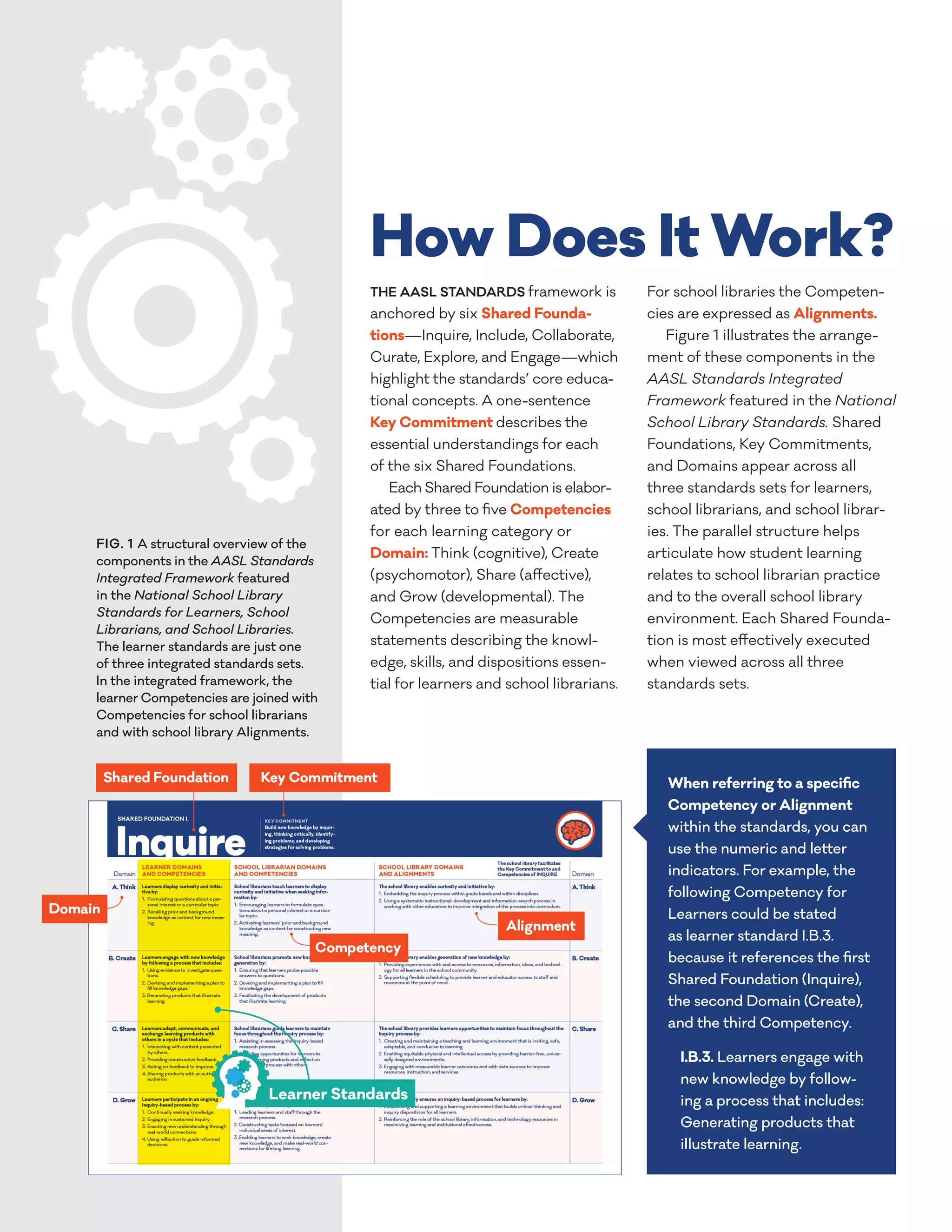
Figure 1 illustrates the arrange-
ment of these components in the
AASL Standards Integrated
Framework featured in the National
School Library Standards. Shared
Foundations, Key Commitments,
and Domains appear across all
three standards sets for learners,
school librarians, and school librar-
ies. The parallel structure helps
articulate how student learning
relates to school librarian practice
and to the overall school library
environment. Each Shared Founda-
tion is most effectively executed
when viewed across all three
standards sets.
FIG. 1 A structural overview of the
components in the AASL Standards
Integrated Framework featured
in the National School Library
Standards for Learners, School
Librarians, and School Libraries.
The learner standards are just one
of three integrated standards sets.
In the integrated framework, the
learner Competencies are joined with
Competencies for school librarians
and with school library Alignments.
When referring to a specific
Competency or Alignment
within the standards, you can
use the numeric and letter
indicators. For example, the
following Competency for
Learners could be stated
as learner standard I.B.3.
because it references the first
Shared Foundation (Inquire),
the second Domain (Create),
and the third Competency.
I.B.3. Learners engage with
new knowledge by follow-
ing a process that includes:
Generating products that
illustrate learning.
Learner Standards
American Association of School Librarians
50 E. Huron Street, Chicago, IL 60611
© 2018 American Library Association
Permission to use, reproduce, and distribute this document
is hereby granted for private, non-commercial, and
educational purposes only.
ISBN (bundle of 10): 978-0-8389-1654-4
2018 | softcover
8 pp  |  8.5" x 11"
$16.95  |  AASL/ALA Members: $15.26
This publication is available for download
at standards.aasl.org.
Multiple copies may be purchased from the ALA Online
Store at www.alastore.ala.org or by calling 866-Shop ALA.
American Association
of School Librarians
TRANSFORMING LEARNING
D O M A I N S
IV. CURATE
V. EXPLORE
VI.ENGAGE
I. INQUIRE
II. INCLUDE
III.COLLABORATE
B. CREATE C. SHARE
D. GROWA. THINK
KEY COMMITMENTS
SHARED FOUNDATIONS
Demonstrate an
understanding of
and commitment
to inclusiveness
and respect for
diversity in the
learning community.
Demonstrate
safe, legal, and
ethical creating and
sharing of knowledge products
independently while engaging
in a community of practice and
in an interconnected
world.
Discover and
innovate in a
growth mindset
developed
through
experience
and reflection.
Make meaning for oneself
and others by collecting,
organizing, and sharing
resources of
personal
relevance.
Work effectively with others
to broaden perspectives
and work toward common
goals.
Inquire, think
critically, and gain
knowledge.
Draw conclusions,
make informed
decisions, apply
knowledge to
new situations,
and create new
knowledge.
Pursue personal
and aesthetic
growth.
Share knowledge
and participate
ethically and
productively
as members of
our democratic
society.
Build new
knowledge by
inquiring, thinking critically,
identifying problems, and
developing strategies for
solving problems.
an imprint of the
American Library Association

AASL Standards Framework

  • 1.
    American Association of SchoolLibrarians TRANSFORMING LEARNING N A T I O N A L S C H O O L L I B R A R Y STANDARDS Learners AASL STANDARDS FRAMEWORK for
  • 2.
    V.EXPLORE I.IN Q UIRE II.INCLUDE III.COL LABORATE IV. CURA TE VI.ENG AGE SHARED FOUNDATIONS AASL Standards Integrated Framework Infographic D O M A I N S LEAR N ER COMPETE N CIES SCHOOLLI BRARIAN COM PETENCIES SCHOOL LIBRARY ALIG N MENTS D. G R O W C.SH A R E B.C R E A TE A.TH IN K THE AASL STANDARDS Framework for Learners pam- phlet presents the standards framework for application with students and other learners. This is one of three sets of standards that make up the AASL Standards Integrated Framework featured within the National School Library Standards for Learners, School Librari- ans, and School Libraries. The AASL Standards frame- work reflects a comprehensive approach to teaching and learning by demonstrating the connection between learner, librarian, and library standards. Each section of the standards framework was designed to reflect the others, ensuring that standards-related activities would be mutually reinforcing, simultaneously building capac- ity among learners, school librarians, and the school library. This pamphlet provides educators access spec­ ifically to AASL’s learner standards. Introducing the AASL Standards Framework for LEARNERS A wheel chart illustrating the relationship of the components within the AASL Standards framework structure.
  • 3.
    Common Beliefs 1. The schoollibrary is a unique and essential part of a learning community. As a destination for on-site and virtual personalized learning, the school library is a vital connection between school and home. As the leader of this space and its func- tions, the school librarian ensures that the school library environment provides all members of the school community access to information and technology, connecting learning to real-world events. By providing access to an array of well-managed resources, school librarians enable academic knowledge to be linked to deep understanding. 2. Qualified school librarians lead effective school libraries. As they guide organizational and personal change, effective school librarians model, promote, and foster inquiry learning in adequately staffed and resourced school libraries. Qualified school librarians have been educated and certified to perform interlinked, interdis- ciplinary, and cross-cutting roles as instructional leaders, program administrators, educators, collab- orative partners, and information specialists. 3. Learners should be pre­pared for college, career, and life. Committed to inclusion and equity, effective school librarians use evi- dence to determine what works, for whom and under what conditions for each learner; complemented by community engagement and inno- vative leadership, school librarians improve all learners’ opportunities for success. This success empow- ers learners to persist in inquiry, advanced study, enriching profes- sional work, and community partici- pation through continuous improve- ment within and beyond the school building and school day. 4. Reading is the core of personal and academic competency. In the school library, learners engage with relevant information resources and digital learning opportunities in a culture of reading. School librari- ans initiate and elevate motivational reading initiatives by using story and personal narrative to engage learners. School librarians curate current digital and print materials and technology to provide access to high-quality reading materials that encourage learners, educators, and families to become lifelong learners and readers. 5. Intellectual freedom is every learner’s right. Learners have the freedom to speak and hear what others have to say, rather than allowing others to control their access to ideas and information; the school librarian’s responsibility is to develop these dispositions in learners, educators, and all other members of the learn- ing community. 6. Information technologies must be appropriately integrated and equitably available. Although information technology is woven into almost every aspect of learning and life, not every learner and educator has equitable access to up-to-date, appropriate technology and connectivity. An effective school library bridges digital and socioeconomic divides to affect information technology access and skill. How do we define the qualities of well-prepared learners, effective school librarians, and dynamic school libraries? IN THE STANDARDS remodeling process, the American Association of School Librarians (AASL) reviewed Common Beliefs from earlier AASL Standards and official AASL position state- ments. These documents, and feedback collected from more than 1,300 school librarians and stakeholders nationally, provided AASL with a clear expression of the qualities of well- prepared learners, effective school librarians, and dynamic school libraries. The following Common Beliefs and summary descriptions were identified as central to the profession.
  • 4.
    AASL Standards Fram SHAREDFOUNDATIONS AND KEY COMMITMENTS I. INQUIRE Build new knowledge by inquiring, thinking critically, identifying problems, and developing strategies for solving problems. II. INCLUDE Demonstrate an understanding of and commitment to inclusiveness and respect for diversity in the learning community. III. COLLABORATE Work effectively with others to broaden perspectives and work toward common goals. A. THINK Learners display curiosity and initiative by: 1. Formulating questions about a personal interest or a curricular topic. 2. Recalling prior and background knowledge as context for new meaning. Learners contribute a balanced perspective when participating in a learning community by: 1. Articulating an awareness of the contributions of a range of learners. 2. Adopting a discerning stance toward points of view and opinions expressed in information resources and learning products. 3. Describing their understanding of cultural relevancy and placement within the global learning community. Learners identify collaborative opportunities by: 1. Demonstrating their desire to broaden and deepen understandings. 2. Developing new understandings through engagement in a learning group. 3. Deciding to solve problems informed by group interaction. B. CREATE Learners engage with new knowledge by following a process that includes: 1. Using evidence to investigate questions. 2. Devising and implementing a plan to fill knowledge gaps. 3. Generating products that illustrate learning. Learners adjust their awareness of the global learning community by: 1. Interacting with learners who reflect a range of perspectives. 2. Evaluating a variety of perspectives during learning activities. 3. Representing diverse perspectives during learning activities. Learners participate in personal, social, and intellectual networks by: 1. Using a variety of communication tools and resources. 2. Establishing connections with other learners to build on their own prior knowledge and create new knowledge C. SHARE Learners adapt, communicate, and exchange learning products with others in a cycle that includes: 1. Interacting with content presented by others. 2. Providing constructive feedback. 3. Acting on feedback to improve. 4. Sharing products with an authentic audience. Learners exhibit empathy with and tolerance for diverse ideas by: 1. Engaging in informed conversation and active debate. 2. Contributing to discussions in which multiple viewpoints on a topic are expressed. Learners work productively with others to solve problems by: 1. Soliciting and responding to feedback from others. 2. Involving diverse perspectives in their own inquiry processes. D. GROW Learners participate in an ongoing inquiry-based process by: 1. Continually seeking knowledge. 2. Engaging in sustained inquiry. 3. Enacting new understanding through real-world connections. 4. Using reflection to guide informed decisions. Learners demonstrate empathy and equity in knowledge building within the global learning community by: 1. Seeking interactions with a range of learners. 2. Demonstrating interest in other perspectives during learning activities. 3. Reflecting on their own place within the global learning community. Learners actively participate with others in learning situations by: 1. Actively contributing to group discussions. 2. Recognizing learning as a social responsibility. DOMAINS AND COMPETENCIES
  • 5.
    mework for Learners IV.CURATE Make meaning for oneself and others by collecting, organizing, and sharing resources of personal relevance. V. EXPLORE Discover and innovate in a growth mindset developed through experience and reflection. VI. ENGAGE Demonstrate safe, legal, and ethical creating and sharing of knowledge products independently while engaging in a community of practice and an interconnected world. Learners act on an information need by: 1. Determining the need to gather information. 2. Identifying possible sources of information. 3. Making critical choices about information sources to use. Learners develop and satisfy personal curiosity by: 1. Reading widely and deeply in multiple formats and write and create for a variety of purposes. 2. Reflecting and questioning assumptions and possible misconceptions. 3. Engaging in inquiry-based processes for personal growth. Learners follow ethical and legal guidelines for gathering and using information by: 1. Responsibly applying information, technology, and media to learning. 2. Understanding the ethical use of information, technology, and media. 3. Evaluating information for accuracy, validity, social and cultural context, and appropriateness for need. Learners gather information appropriate to the task by: 1. Seeking a variety of sources. 2. Collecting information representing diverse perspectives. 3. Systematically questioning and assessing the validity and accuracy of information. 4. Organizing information by priority, topic, or other systematic scheme. Learners construct new knowledge by: 1. Problem solving through cycles of design, implementation, and reflection. 2. Persisting through self-directed pursuits by tinkering and making. Learners use valid information and reasoned conclusions to make ethical decisions in the creation of knowledge by: 1. Ethically using and reproducing others’ work. 2. Acknowledging authorship and demonstrating respect for the intellectual property of others. 3. Including elements in personal-knowledge products that allow others to credit content appropriately. Learners exchange information resources within and beyond their learning community by: 1. Accessing and evaluating collaboratively constructed information sites. 2. Contributing to collaboratively constructed information sites by ethically using and reproducing others’ work. 3. Joining with others to compare and contrast information derived from collaboratively constructed information sites. Learners engage with the learning community by: 1. Expressing curiosity about a topic of personal interest or curricular relevance. 2. Co-constructing innovative means of investigation. 3. Collaboratively identifying innovative solutions to a challenge or problem. Learners responsibly, ethically, and legally share new information with a global community by: 1. Sharing information resources in accordance with modification, reuse, and remix policies. 2. Disseminating new knowledge through means appropriate for the intended audience. Learners select and organize information for a variety of audiences by: 1. Performing ongoing analysis of and reflection on the quality, usefulness, and accuracy of curated resources. 2. Integrating and depicting in a conceptual knowledge network their understanding gained from resources. 3. Openly communicating curation processes for others to use, interpret, and validate. Learners develop through experience and reflection by: 1. Iteratively responding to challenges. 2. Recognizing capabilities and skills that can be developed, improved, and expanded. 3. Open-mindedly accepting feedback for positive and constructive growth. Learners engage with information to extend personal learning by: 1. Personalizing their use of information and information technologies. 2. Reflecting on the process of ethical generation of knowledge. 3. Inspiring others to engage in safe, responsible, ethical, and legal information behaviors.
  • 6.
    LIKE OTHER SETSof learning, professional, and program standards, the AASL Standards are not a curriculum; rather, they provide you with guidance and structure as you develop a curriculum tailored to your local priorities and needs. The contents of the standards are designed to be used in two ways: 1. As Personalized Guides. Learners and school librarians can enter the standards at the point most appropriate to the learning task or profes- sional activity and use the standards to guide decisions about actions to develop specific competencies. 2. As Progressions. Learners and school librarians first engage with the Domains at the level of Think, and once mastery of the Competencies related to Think are achieved, progress through Create, Share, and Grow. Teaching and learning are at the center of school librar- ians’ practice. As learning leaders, school librarians enact, model, and communicate the Competencies in the Domains. This domain-based approach to organiz- ing the standards ensures that school librarians are able to personalize their professional practice and growth, continuously tailoring their school library to local needs, their own strengths, and learners’ benefits. How Are the Standards Used? The Complete Standards National School Library Standards for Learners, School Librarians, and School Libraries ISBN: 978-0-8389-1579-0 2018 | softcover 320 pp | 7" x 10" $199 ALA Members: $149 AASL Members: $99 AASL’S NATIONAL SCHOOL Library Standards for Learners, School Librarians, and School Libraries offers the AASL Standards Integrated Framework in full and expands on the application and assessment of the standards. Sections of the book include: • the six integrated frameworks (Inquire, Include, Collaborate, Curate, Explore, and Engage) anchored with details that explain the Compe- tencies and best practices, which include practices school librarians can use to get started with effective implementation of the standards; • detailed approaches to measuring success. The goal of competency- based education is to support learners’ growth through personalized learning experiences. Examples are provided for creating your own assessment and evaluation tools that align school and district models with AASL Standards; and • a series of case studies that illustrate authentic scenarios through which district-level supervisors and building-level school librarians can envision putting the AASL Standards into action. For more information about the National School Library Standards, and to access the latest implementation assistance resources, visit standards.aasl.org.
  • 7.
    THE AASL STANDARDSframework is anchored by six Shared Founda- tions—Inquire, Include, Collaborate, Curate, Explore, and Engage—which highlight the standards’ core educa- tional concepts. A one-sentence Key Commitment describes the essential understandings for each of the six Shared Foundations. Each Shared Foundation is ela­bor­ ated by three to five Competencies for each learning category or Domain: Think (cognitive), Create (psychomotor), Share (affective), and Grow (developmental). The Competencies are measurable statements describing the knowl- edge, skills, and dispositions essen- tial for learners and school librarians. How Does It Work? For school libraries the Competen- cies are expressed as Alignments. Figure 1 illustrates the arrange- ment of these components in the AASL Standards Integrated Framework featured in the National School Library Standards. Shared Foundations, Key Commitments, and Domains appear across all three standards sets for learners, school librarians, and school librar- ies. The parallel structure helps articulate how student learning relates to school librarian practice and to the overall school library environment. Each Shared Founda- tion is most effectively executed when viewed across all three standards sets. FIG. 1 A structural overview of the components in the AASL Standards Integrated Framework featured in the National School Library Standards for Learners, School Librarians, and School Libraries. The learner standards are just one of three integrated standards sets. In the integrated framework, the learner Competencies are joined with Competencies for school librarians and with school library Alignments. When referring to a specific Competency or Alignment within the standards, you can use the numeric and letter indicators. For example, the following Competency for Learners could be stated as learner standard I.B.3. because it references the first Shared Foundation (Inquire), the second Domain (Create), and the third Competency. I.B.3. Learners engage with new knowledge by follow- ing a process that includes: Generating products that illustrate learning. Learner Standards
  • 8.
    American Association ofSchool Librarians 50 E. Huron Street, Chicago, IL 60611 © 2018 American Library Association Permission to use, reproduce, and distribute this document is hereby granted for private, non-commercial, and educational purposes only. ISBN (bundle of 10): 978-0-8389-1654-4 2018 | softcover 8 pp  |  8.5" x 11" $16.95  |  AASL/ALA Members: $15.26 This publication is available for download at standards.aasl.org. Multiple copies may be purchased from the ALA Online Store at www.alastore.ala.org or by calling 866-Shop ALA. American Association of School Librarians TRANSFORMING LEARNING D O M A I N S IV. CURATE V. EXPLORE VI.ENGAGE I. INQUIRE II. INCLUDE III.COLLABORATE B. CREATE C. SHARE D. GROWA. THINK KEY COMMITMENTS SHARED FOUNDATIONS Demonstrate an understanding of and commitment to inclusiveness and respect for diversity in the learning community. Demonstrate safe, legal, and ethical creating and sharing of knowledge products independently while engaging in a community of practice and in an interconnected world. Discover and innovate in a growth mindset developed through experience and reflection. Make meaning for oneself and others by collecting, organizing, and sharing resources of personal relevance. Work effectively with others to broaden perspectives and work toward common goals. Inquire, think critically, and gain knowledge. Draw conclusions, make informed decisions, apply knowledge to new situations, and create new knowledge. Pursue personal and aesthetic growth. Share knowledge and participate ethically and productively as members of our democratic society. Build new knowledge by inquiring, thinking critically, identifying problems, and developing strategies for solving problems. an imprint of the American Library Association