ßÒ×ÓßÔóßÍÍ×ÍÌÛÜ ÝÎ×Í×Í ÎÛÍÐÑÒÍÛ
ÒßÌ×ÑÒßÔ ÍÌßÒÜßÎÜÍ
ÓßÎÝØ éô îðïð
wîðïð Ò¿¬·±²¿´ ͬ¿²¼¿®¼- ݱ³³·¬¬»» º±® ß²·³¿´óß--·-¬»¼ Ý®·-·- λ-°±²-»
¨
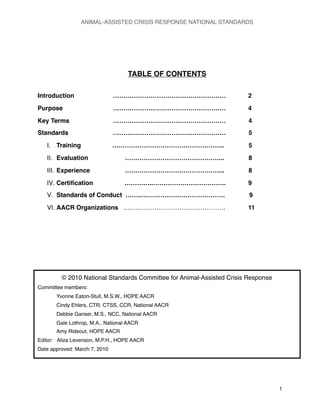
TABLE OF CONTENTS
Introduction
 
 ………………………………………………
 2
Purpose 

 
 ………………………………………………
 4
Key Terms
 
 ……………………………………………… 4
Standards
 
 ……………………………………………… 5
I. Training ……………………………………………... 5
II. Evaluation ………………………………………... 8
III. Experience ………………………………………... 8
IV. Certification …………..…………………………….. 9
V. Standards of Conduct ……..…………………………………. 9
VI. AACR Organizations …….…………………………………… 11
© 2010 National Standards Committee for Animal-Assisted Crisis Response
Committee members:
Yvonne Eaton-Stull, M.S.W., HOPE AACR
Cindy Ehlers, CTR, CTSS, CCR, National AACR
Debbie Ganser, M.S., NCC, National AACR
Gale Lothrop, M.A., National AACR
Amy Rideout, HOPE AACR
Editor: Aliza Levenson, M.P.H., HOPE AACR
Date approved: March 7, 2010
ANIMAL-ASSISTED CRISIS RESPONSE NATIONAL STANDARDS

 1
Introduction
The usefulness of canines in times of war and disaster is well-established. Law enforcement
the world over uses canines both to patrol and to protect. Customs officials use canines to
identify contraband before it enters the country. After 9/11, everyone heard of the heroism of
the search and rescue teams in their hunt for survivors. However, there were other canines at
9/11 that few people ever heard about. These canines were not called in to be heroes, but to
do what dogs do best: give the unconditional love that has been shown to provide emotional
support and stress relief for the responders and survivors.
Many people are familiar with “therapy dog” teams, also known as Animal-Assisted Activities/
Animal-Assisted Therapy (AAA/AAT) teams, that visit facilities such as hospitals, nursing
homes and schools. The healing benefits of these teams is well documented. 1
Therapy dog teams were first called in to a disaster site in 1995 by the Federal Emergency
Management Agency (FEMA) after the bombing of the Murrah Building in Oklahoma City. In
1998, after the Thurston High School shootings in Springfield, Oregon, therapy dog teams
were called in by the National Organization for Victim Assistance (NOVA). Cindy Ehlers and
her dog, Bear, were one of the teams to respond to this shooting. When the dogs were
present, counselors observed an immediate sense of relaxation and comfort in those
experiencing trauma-related stress. The dogsʼ abilitiy to connect with people experiencing
trauma-related stress was the inspiration behind Animal-Assisted Crisis Response (AACR)
teams. While working with NOVA personnel, Cindy Ehlers developed a new understanding
of the skills and training required of crisis response professionals, and of the specialized
training both handlers and dogs would need to serve as truly effective AACR teams.
The first AACR organization, Hope Pets, was founded by Cindy Ehlers in 1999 in order to
ensure safe and effective animal-assisted therapy in crisis and disaster situations. The first
AACR training workshop was held in July 2000. After the terrorist attacks of September 11,
2001, Hope Pets was called by the American Red Cross to serve in New York City. Disaster
mental health counselors and chaplains present at the Pier 94 Family Assistance Center
ANIMAL-ASSISTED CRISIS RESPONSE NATIONAL STANDARDS

 2
1 Barker, Rogers,Turner et al, “Benefits of Interacting With Companion Animals”, American Behavioral Scientist, Vol. 477,
No. 1, 94-99 (2003)
recognized the AACR teamsʼ ability to engage and relax people in a matter of minutes,
providing a sense of safety, comfort and relief from the overwhelming grief. After watching
numerous interactions, a chaplain requested AACR teams for the firefighters at the WTC site.
It was there that an extraordinary miracle occurred. “Their (firefightersʼ) defenses were high.
When the crisis response dogs would come along, they would react and their eyes would
light up or they would smile.” 2 In recognition that AACR dogs are not pets, but rather working
dogs, and that the management of AACR teams by a certifying organization is critical to the
effective delivery of AACR services, Hope Pets became HOPE Animal-Assisted Crisis
Response in November 2001.
Since 2001, the modality of AACR has received recognition and acceptance by emergency
responders and other agencies providing disaster relief. AACR services have been
requested at the local and national levels. In 2009, crisis response dogs were added to two
police and fire departments. The military has recognized the unique ability that dogs have to
help alleviate and cope with combat stress. In 2007, two Crisis Response dogs were
deployed with a unit to Iraq. As requests for AACR services increase in frequency, and as
the number of organizations offering AACR training and certification grows, it is incumbent
upon AACR organizations to create AACR National Standards to protect the reputation and
regard of AACR as a crisis service.
These AACR National Standards were initiated as a collaborative effort of the two founding
AACR organizations: HOPE AACR and National AACR. With almost 200 certified teams and
over a decade of combined experience in training and certification, these two organizations
have provided support for thousands of individuals and responders. National and state level
responses have included Hurricanes Katrina, Rita and Ike, the California wildfires, and the
Virginia Tech and Northern Illinois University shootings. Local responses have included
giving support after events such as the death of a student, teacher, firefighter, or police
officer, as well as after house fires and homicides. In addition, teams have worked with
Operation Homefront and Operation Purple to provide comfort to soldiers and their families.
ANIMAL-ASSISTED CRISIS RESPONSE NATIONAL STANDARDS

 3
2 Karen Soyka, american Red Cross, Disaster Mental health, World Trade Center, 09/11/2001
Purpose of the AACR National Standards
The purpose of these standards is to give emergency response agencies the information
needed to recognize quality AACR teams. In addition, these standards recognize that the
support of an AACR organization around certified AACR teams is vital to ensure that safe,
services are delivered with the highest possible degree of excellence and professionalism.
Agencies considering which AACR organization to call should look for AACR organizations
that embrace these ideals and have achieved the requirements of the AACR National
Standards.
By following these standards, AACR teams will have a uniformity of oversight and training
and the ability to respond professionally. These standards also address the care and health
of the canines, ensuring their safe and humane treatment.
Key Terms
Animal-assisted Crisis Response (AACR):
AACR teams provide comfort, stress relief, emotional support and crisis intervention
services for people affected by crisis and disasters in complex, unpredictable
environments surrounding traumatic events.
AACR Organization:
An organization composed of certified members which supports and manages the
delivery of AACR services. These organizations cultivate and maintain mutual aid
relationships with other crisis/disaster response agencies.
AACR Team:
An AACR team is a canine/handler team with specialized AACR training and
certification which provides animal-assisted comfort, stress relief, emotional support
and crisis intervention services for people affected by crisis and disaster.
AACR Team Leader:
A trained and certified manager who supervises and coordinates the response of up to
four canine/handler teams. Typically, the team leader works without a canine.
ANIMAL-ASSISTED CRISIS RESPONSE NATIONAL STANDARDS

 4
Incident Command System (ICS):
The ICS is a standardized, on-scene, all-hazard incident management concept
developed by the Department of Homeland Security as part of the National Incident
Management System. It is a standardized system which is applicable at all
jurisdictional levels and across all functional emergency response disciplines.
Therapy Dog Team:
A therapy dog team is a canine/handler team that provides Animal-Assisted Therapy or
Activities (AAT/AAA) in predictable environments at facilities such as hospitals, nursing
homes, schools, and libraries.
AACR Workshop:
An AACR Workshop is an intense, structured training event designed to encompass
the core training requirements as set forth in the AACR National Standards in order to
certify AACR teams.
The Standards
I. Training
AACR teams must be able to tolerate, adapt and cope with stress and changing
environments. The training workshops provided by AACR organizations builds the resilience
and skills needed by both handler and dog to respond reliably in crisis and disaster
situations. Training should be conducted by instructors actively involved in an AACR
organization with crisis/disaster experience and knowledge of ICS. Where additional
instructor qualifications are needed, they are noted under the appropriate section, outlined
below:
The following core curriculum is composed of seven (7) core units. Together, they
encompass the minimum standards of training for AACR teams and team leaders.
Core 1 Disaster/Crisis Concepts (2 hour minimum)
This section provides disaster/crisis-related information including:
1. Characteristics and types of crises.
2. Phases of disasters.
ANIMAL-ASSISTED CRISIS RESPONSE NATIONAL STANDARDS

 5
3. An introduction to the Incident Command System (ICS) and how it applies to
the AACR response group.
Core 2 Crisis Intervention (6 hour minimum)
Instructor to be a mental health professional with education and experience in the field of
disaster mental health
This section should include common reactions to crises (developmental, cognitive, physical,
emotional, behavioral, spiritual, cultural) and be consistent with the protocols in
use by other disaster and crisis response organizations. Basic crisis intervention skills
should also be covered including:
1. Establishing rapport with individuals coping with crises.
2. Active listening skills.
3. Tips for intervention strategies (doʼs and donʼt of what to say/do).
4. Elements of various intervention models (CISM, psychological first aid, etc.).
Core 3 Care of the Caregiver (2 hour minimum)
This section covers the impact of crisis work on responders providing services, individual
stress management/self-care and group stress management including:
1. Common reactions of responders to crisis work including the concepts of
compassion fatigue and secondary trauma.
2. Individual stress management and self-care before, during and following crisis
work; group stress management and the debriefing process.
3. Healthcare concerns in crises and disasters.
Core 4 Canine Handling ( 8 hour minimum )
Instructor must have education and experience in the field of animal behavior utilizing
positive reinforcement training methods including experience in behavior assessment and
behavior modification.
This section covers a basic understanding and knowledge of canine physical and emotional
health, behavior and body language. Additional knowledge of these components and how
they change in crisis/disaster situations is necessary in order to facilitate the humane care of
the AACR canine. This section should also contain prevention, management and
ANIMAL-ASSISTED CRISIS RESPONSE NATIONAL STANDARDS

 6
implementation skills to change stress-related behaviors including developing the awareness
and the ability needed to be proactive and re-direct behaviors if necessary. Training should
include the information needed to properly work with and support the AACR canine including:
1. Stress management for canines through recognition, understanding and
awareness of the signs of stress; implementation of the skills for preventing and
managing it; and the development of healthy mechanisms to cope with stress.
2. Health and nutritional support, hygiene measures and vaccinations for specific
types of deployments with increased health risks.3
3. Canine behavior encompassing an understanding of canine body language.
4. Handling skills for initial greetings of clients and facilitation of subsequent
interactions in order to establish rapport.
5. Safe use of harnesses, booties, leashes, collars, vests and other equipment.
6. Handling methods that are proven, scientific and research-based. Techniques
should include verbal directions spoken in a conversational tone of voice as
well as physical cues and signals used as gentle guidance.
Core 5 Team Leader (2 hour minimum)
This section includes the knowledge and skills team leaders need to properly supervise and
support AACR teams in the field
Core 6 Simulated Crisis Exposure (6 hour minimum)
This section includes simulated crisis exposure exercises, specifically role play, simulations
and field activities that prepare teams for emotional, unusual and changing environments.
Core 7 Developing the AACR Canine (concomitant with Core 6)
This section includes practical exercises to help develop the resilience, the acceptance and
the skills needed to adapt and cope with stress and the changing environments often
encountered when responding to crises or disasters, including:
1. Exposure to different modes of transportation.
2. Conditioning to accept unfamiliar sights, sounds and smells; emergency
vehicles and protective gear.
ANIMAL-ASSISTED CRISIS RESPONSE NATIONAL STANDARDS

 7
3 Sehulster,Chinn, “Guidelines For Environmental Infection Control in Health-Care Facilities,” CDC Morbidity
and Mortality Weekly Report, June 6, 2003/52(RR10), 49-52.
3. Conditioning to a wide range of emotional and behavioral responses.
4. Conditioning to accept diverse and high density populations.
5. Conditioning and training to accept unfamiliar canines, increasing their ability to
work and relax in their presence even when in very close proximity.
Additional Training Requirements ( to be completed within one year of initial AACR training)
This section includes a list of the minimum required additional training which must be
obtained from outside organizations. Documentation from organizations certifying that these
courses have been completed with the dates of their completion must be presented to the
certifying AACR organization to fulfill these additional requirements. These courses include,
but are not limited to:
1. Introduction to the Incident Command System
2. Pet first Aid and CPR
3. Human First Aid and CPR
II. Evaluation
To ensure that teams and team leaders have the knowledge, skills and aptitude for AACR
work, they should be evaluated under simulated crisis environments. The evaluator must be
actively involved in an AACR organization, with crisis/disaster experience and knowledge of
ICS. Minimum guidelines for evaluators include:
1. Education in the field of animal behavior.
2. Experience as an animal evaluator; ideally, they will also be trained evaluators
for their therapy dog organization.
III. Experience
In order to develop teamwork and interaction skills, teams must be active participants in
an animal therapy organization to apply for certification. After AACR certification, a teamʼs
or team leaderʼs experience in complex environments, including participation in prior
assignments, crisis response drills and training, will influence their future assignments to
crisis/disaster situations.
ANIMAL-ASSISTED CRISIS RESPONSE NATIONAL STANDARDS

 8
IV. Certification
Certification as a working AACR team by an established AACR organization indicates that a
team has the experience, education, training and aptitude for AACR work and has met the
basic requirements outlined in this document. Organizations that provide AACR certification
ensure that their teams work safely and effectively in the environments for which they are
certified according to their level of skills and experience. Additionally, these organizations will
ensure that canine health requirements are met. 4
Teams must have a minimum of twelve (12) visits over a period of twelve (12) months with an
animal therapy organization that has a formal evaluation process before consideration for
AACR certification. The following age requirements must be met before consideration for
AACR certification:
1. Handlers must be at least 18 years old.
2. Canines must be at least 1.5 years old.
Re-certification requirements include continuing education and participation in training, drills
and deployments. Teams must maintain active participation with an animal therapy
organization to develop and retain interaction skills and provide documentation to their
certifying AACR organization. Canine health records must be updated and provided to the
certifying organization annually to ensure that the canine health requirements are met.
V. Standards of Conduct
While providing services, AACR teams are expected to conduct themselves in a professional
manner. Standards for providing services should be written and available to the agency
requesting AACR support.
ANIMAL-ASSISTED CRISIS RESPONSE NATIONAL STANDARDS

 9
4 Seehulster, Chinn CDC Guidelines, see previous footnote.
AACR Members should:
1.
 Advocate for their animal at all times including:
A. Keeping their animal free from abuse, discomfort and distress.
B. Providing the animal with regular breaks and sufficient off-duty time.
C. Recognizing signs of stress and providing an acceptable outlet.Providing
proper healthcare and grooming.
2. Practice proper self-care and stress management techniques.
3. Never discriminate while providing services to any individual or population.
4. Protect the privacy of those served and maintain confidentiality.
5. Treat others with respect and courtesy.
6. Never self-deploy.
7. Never serve outside the scope of their certification/training/assignment.
8. Never serve while under the influence of alcohol or illegal drugs.
9. Display AACR identification at all times and provide documentation upon request.
10. Refer individuals to other service providers for additional assistance when
indicated.
11. Use canine handling methods as outlined in Core 4, Handler Training.
12. Clean up after their canines.
13. Conduct themselves in a cooperative manner and follow the Incident Command
System.
14. Conduct themselves in a collaborative manner when working with other AACR
organizations in order to best represent AACR and serve individuals in crisis.
AACR Canines should:
1. Respond reliably to handler commands.
2. Demonstrate an ability to perform tasks when requested.
3. Be able to turn their attention to their handler during distractions and allow the
handler to redirect them when necessary.
4. Display healthy coping behaviors during stressful situations.
5. Display friendly behavior at all times.
ANIMAL-ASSISTED CRISIS RESPONSE NATIONAL STANDARDS

 10
VI. AACR Organizations
An AACR organization must have a defined and consistent management structure with
cohesive policies and processes that assures that everyone in the organization behaves
safely, competently, legally and ethically.
AACR organizations should:
1. Have an administrative structure, such as a Board of Directors, that handles fiscal,
policy and other administrative matters. Standards in the area of administrative
structure include bylaws on file with the state of incorporation and a conflict of
interest policy.
2. Have operational policies and procedures that are written, maintained and upheld.
Standards in the area of policy include a photography policy and an ethics policy.
Standards in the area of procedures include construction of appropriate shift
schedules as well as reporting and feedback mechanisms to ensure that any
issues which may arise while providing services will be addressed. AACR
organizations will also have mechanisms to ensure that members comply with
AACR Standards and organizational policies and procedures.
3. Have a clearly defined operational structure when providing services that aligns
with the Incident Command System.
4. Maintain liability insurance coverage for the organization and its members to cover
operations and training activities at a minimum of one million dollars
($1,000,000.00 ) per incident.
__________________________________________________________________________
For more information about the AACR National Standards, please contact:
National AACR (www.animalassistedcrisisresponse.org)
HOPE AACR (www.hopeaacr.org)
ANIMAL-ASSISTED CRISIS RESPONSE NATIONAL STANDARDS

 11

AACRNationalStandards7Mar10

  • 1.
    ßÒ×ÓßÔóßÍÍ×ÍÌÛÜ ÝÎ×Í×Í ÎÛÍÐÑÒÍÛ ÒßÌ×ÑÒßÔÍÌßÒÜßÎÜÍ ÓßÎÝØ éô îðïð wîðïð Ò¿¬·±²¿´ ͬ¿²¼¿®¼- ݱ³³·¬¬»» º±® ß²·³¿´óß--·-¬»¼ Ý®·-·- λ-°±²-»
  • 2.
  • 3.
    TABLE OF CONTENTS Introduction ……………………………………………… 2 Purpose ……………………………………………… 4 Key Terms ……………………………………………… 4 Standards ……………………………………………… 5 I. Training ……………………………………………... 5 II. Evaluation ………………………………………... 8 III. Experience ………………………………………... 8 IV. Certification …………..…………………………….. 9 V. Standards of Conduct ……..…………………………………. 9 VI. AACR Organizations …….…………………………………… 11 © 2010 National Standards Committee for Animal-Assisted Crisis Response Committee members: Yvonne Eaton-Stull, M.S.W., HOPE AACR Cindy Ehlers, CTR, CTSS, CCR, National AACR Debbie Ganser, M.S., NCC, National AACR Gale Lothrop, M.A., National AACR Amy Rideout, HOPE AACR Editor: Aliza Levenson, M.P.H., HOPE AACR Date approved: March 7, 2010 ANIMAL-ASSISTED CRISIS RESPONSE NATIONAL STANDARDS 1
  • 4.
    Introduction The usefulness ofcanines in times of war and disaster is well-established. Law enforcement the world over uses canines both to patrol and to protect. Customs officials use canines to identify contraband before it enters the country. After 9/11, everyone heard of the heroism of the search and rescue teams in their hunt for survivors. However, there were other canines at 9/11 that few people ever heard about. These canines were not called in to be heroes, but to do what dogs do best: give the unconditional love that has been shown to provide emotional support and stress relief for the responders and survivors. Many people are familiar with “therapy dog” teams, also known as Animal-Assisted Activities/ Animal-Assisted Therapy (AAA/AAT) teams, that visit facilities such as hospitals, nursing homes and schools. The healing benefits of these teams is well documented. 1 Therapy dog teams were first called in to a disaster site in 1995 by the Federal Emergency Management Agency (FEMA) after the bombing of the Murrah Building in Oklahoma City. In 1998, after the Thurston High School shootings in Springfield, Oregon, therapy dog teams were called in by the National Organization for Victim Assistance (NOVA). Cindy Ehlers and her dog, Bear, were one of the teams to respond to this shooting. When the dogs were present, counselors observed an immediate sense of relaxation and comfort in those experiencing trauma-related stress. The dogsʼ abilitiy to connect with people experiencing trauma-related stress was the inspiration behind Animal-Assisted Crisis Response (AACR) teams. While working with NOVA personnel, Cindy Ehlers developed a new understanding of the skills and training required of crisis response professionals, and of the specialized training both handlers and dogs would need to serve as truly effective AACR teams. The first AACR organization, Hope Pets, was founded by Cindy Ehlers in 1999 in order to ensure safe and effective animal-assisted therapy in crisis and disaster situations. The first AACR training workshop was held in July 2000. After the terrorist attacks of September 11, 2001, Hope Pets was called by the American Red Cross to serve in New York City. Disaster mental health counselors and chaplains present at the Pier 94 Family Assistance Center ANIMAL-ASSISTED CRISIS RESPONSE NATIONAL STANDARDS 2 1 Barker, Rogers,Turner et al, “Benefits of Interacting With Companion Animals”, American Behavioral Scientist, Vol. 477, No. 1, 94-99 (2003)
  • 5.
    recognized the AACRteamsʼ ability to engage and relax people in a matter of minutes, providing a sense of safety, comfort and relief from the overwhelming grief. After watching numerous interactions, a chaplain requested AACR teams for the firefighters at the WTC site. It was there that an extraordinary miracle occurred. “Their (firefightersʼ) defenses were high. When the crisis response dogs would come along, they would react and their eyes would light up or they would smile.” 2 In recognition that AACR dogs are not pets, but rather working dogs, and that the management of AACR teams by a certifying organization is critical to the effective delivery of AACR services, Hope Pets became HOPE Animal-Assisted Crisis Response in November 2001. Since 2001, the modality of AACR has received recognition and acceptance by emergency responders and other agencies providing disaster relief. AACR services have been requested at the local and national levels. In 2009, crisis response dogs were added to two police and fire departments. The military has recognized the unique ability that dogs have to help alleviate and cope with combat stress. In 2007, two Crisis Response dogs were deployed with a unit to Iraq. As requests for AACR services increase in frequency, and as the number of organizations offering AACR training and certification grows, it is incumbent upon AACR organizations to create AACR National Standards to protect the reputation and regard of AACR as a crisis service. These AACR National Standards were initiated as a collaborative effort of the two founding AACR organizations: HOPE AACR and National AACR. With almost 200 certified teams and over a decade of combined experience in training and certification, these two organizations have provided support for thousands of individuals and responders. National and state level responses have included Hurricanes Katrina, Rita and Ike, the California wildfires, and the Virginia Tech and Northern Illinois University shootings. Local responses have included giving support after events such as the death of a student, teacher, firefighter, or police officer, as well as after house fires and homicides. In addition, teams have worked with Operation Homefront and Operation Purple to provide comfort to soldiers and their families. ANIMAL-ASSISTED CRISIS RESPONSE NATIONAL STANDARDS 3 2 Karen Soyka, american Red Cross, Disaster Mental health, World Trade Center, 09/11/2001
  • 6.
    Purpose of theAACR National Standards The purpose of these standards is to give emergency response agencies the information needed to recognize quality AACR teams. In addition, these standards recognize that the support of an AACR organization around certified AACR teams is vital to ensure that safe, services are delivered with the highest possible degree of excellence and professionalism. Agencies considering which AACR organization to call should look for AACR organizations that embrace these ideals and have achieved the requirements of the AACR National Standards. By following these standards, AACR teams will have a uniformity of oversight and training and the ability to respond professionally. These standards also address the care and health of the canines, ensuring their safe and humane treatment. Key Terms Animal-assisted Crisis Response (AACR): AACR teams provide comfort, stress relief, emotional support and crisis intervention services for people affected by crisis and disasters in complex, unpredictable environments surrounding traumatic events. AACR Organization: An organization composed of certified members which supports and manages the delivery of AACR services. These organizations cultivate and maintain mutual aid relationships with other crisis/disaster response agencies. AACR Team: An AACR team is a canine/handler team with specialized AACR training and certification which provides animal-assisted comfort, stress relief, emotional support and crisis intervention services for people affected by crisis and disaster. AACR Team Leader: A trained and certified manager who supervises and coordinates the response of up to four canine/handler teams. Typically, the team leader works without a canine. ANIMAL-ASSISTED CRISIS RESPONSE NATIONAL STANDARDS 4
  • 7.
    Incident Command System(ICS): The ICS is a standardized, on-scene, all-hazard incident management concept developed by the Department of Homeland Security as part of the National Incident Management System. It is a standardized system which is applicable at all jurisdictional levels and across all functional emergency response disciplines. Therapy Dog Team: A therapy dog team is a canine/handler team that provides Animal-Assisted Therapy or Activities (AAT/AAA) in predictable environments at facilities such as hospitals, nursing homes, schools, and libraries. AACR Workshop: An AACR Workshop is an intense, structured training event designed to encompass the core training requirements as set forth in the AACR National Standards in order to certify AACR teams. The Standards I. Training AACR teams must be able to tolerate, adapt and cope with stress and changing environments. The training workshops provided by AACR organizations builds the resilience and skills needed by both handler and dog to respond reliably in crisis and disaster situations. Training should be conducted by instructors actively involved in an AACR organization with crisis/disaster experience and knowledge of ICS. Where additional instructor qualifications are needed, they are noted under the appropriate section, outlined below: The following core curriculum is composed of seven (7) core units. Together, they encompass the minimum standards of training for AACR teams and team leaders. Core 1 Disaster/Crisis Concepts (2 hour minimum) This section provides disaster/crisis-related information including: 1. Characteristics and types of crises. 2. Phases of disasters. ANIMAL-ASSISTED CRISIS RESPONSE NATIONAL STANDARDS 5
  • 8.
    3. An introductionto the Incident Command System (ICS) and how it applies to the AACR response group. Core 2 Crisis Intervention (6 hour minimum) Instructor to be a mental health professional with education and experience in the field of disaster mental health This section should include common reactions to crises (developmental, cognitive, physical, emotional, behavioral, spiritual, cultural) and be consistent with the protocols in use by other disaster and crisis response organizations. Basic crisis intervention skills should also be covered including: 1. Establishing rapport with individuals coping with crises. 2. Active listening skills. 3. Tips for intervention strategies (doʼs and donʼt of what to say/do). 4. Elements of various intervention models (CISM, psychological first aid, etc.). Core 3 Care of the Caregiver (2 hour minimum) This section covers the impact of crisis work on responders providing services, individual stress management/self-care and group stress management including: 1. Common reactions of responders to crisis work including the concepts of compassion fatigue and secondary trauma. 2. Individual stress management and self-care before, during and following crisis work; group stress management and the debriefing process. 3. Healthcare concerns in crises and disasters. Core 4 Canine Handling ( 8 hour minimum ) Instructor must have education and experience in the field of animal behavior utilizing positive reinforcement training methods including experience in behavior assessment and behavior modification. This section covers a basic understanding and knowledge of canine physical and emotional health, behavior and body language. Additional knowledge of these components and how they change in crisis/disaster situations is necessary in order to facilitate the humane care of the AACR canine. This section should also contain prevention, management and ANIMAL-ASSISTED CRISIS RESPONSE NATIONAL STANDARDS 6
  • 9.
    implementation skills tochange stress-related behaviors including developing the awareness and the ability needed to be proactive and re-direct behaviors if necessary. Training should include the information needed to properly work with and support the AACR canine including: 1. Stress management for canines through recognition, understanding and awareness of the signs of stress; implementation of the skills for preventing and managing it; and the development of healthy mechanisms to cope with stress. 2. Health and nutritional support, hygiene measures and vaccinations for specific types of deployments with increased health risks.3 3. Canine behavior encompassing an understanding of canine body language. 4. Handling skills for initial greetings of clients and facilitation of subsequent interactions in order to establish rapport. 5. Safe use of harnesses, booties, leashes, collars, vests and other equipment. 6. Handling methods that are proven, scientific and research-based. Techniques should include verbal directions spoken in a conversational tone of voice as well as physical cues and signals used as gentle guidance. Core 5 Team Leader (2 hour minimum) This section includes the knowledge and skills team leaders need to properly supervise and support AACR teams in the field Core 6 Simulated Crisis Exposure (6 hour minimum) This section includes simulated crisis exposure exercises, specifically role play, simulations and field activities that prepare teams for emotional, unusual and changing environments. Core 7 Developing the AACR Canine (concomitant with Core 6) This section includes practical exercises to help develop the resilience, the acceptance and the skills needed to adapt and cope with stress and the changing environments often encountered when responding to crises or disasters, including: 1. Exposure to different modes of transportation. 2. Conditioning to accept unfamiliar sights, sounds and smells; emergency vehicles and protective gear. ANIMAL-ASSISTED CRISIS RESPONSE NATIONAL STANDARDS 7 3 Sehulster,Chinn, “Guidelines For Environmental Infection Control in Health-Care Facilities,” CDC Morbidity and Mortality Weekly Report, June 6, 2003/52(RR10), 49-52.
  • 10.
    3. Conditioning toa wide range of emotional and behavioral responses. 4. Conditioning to accept diverse and high density populations. 5. Conditioning and training to accept unfamiliar canines, increasing their ability to work and relax in their presence even when in very close proximity. Additional Training Requirements ( to be completed within one year of initial AACR training) This section includes a list of the minimum required additional training which must be obtained from outside organizations. Documentation from organizations certifying that these courses have been completed with the dates of their completion must be presented to the certifying AACR organization to fulfill these additional requirements. These courses include, but are not limited to: 1. Introduction to the Incident Command System 2. Pet first Aid and CPR 3. Human First Aid and CPR II. Evaluation To ensure that teams and team leaders have the knowledge, skills and aptitude for AACR work, they should be evaluated under simulated crisis environments. The evaluator must be actively involved in an AACR organization, with crisis/disaster experience and knowledge of ICS. Minimum guidelines for evaluators include: 1. Education in the field of animal behavior. 2. Experience as an animal evaluator; ideally, they will also be trained evaluators for their therapy dog organization. III. Experience In order to develop teamwork and interaction skills, teams must be active participants in an animal therapy organization to apply for certification. After AACR certification, a teamʼs or team leaderʼs experience in complex environments, including participation in prior assignments, crisis response drills and training, will influence their future assignments to crisis/disaster situations. ANIMAL-ASSISTED CRISIS RESPONSE NATIONAL STANDARDS 8
  • 11.
    IV. Certification Certification asa working AACR team by an established AACR organization indicates that a team has the experience, education, training and aptitude for AACR work and has met the basic requirements outlined in this document. Organizations that provide AACR certification ensure that their teams work safely and effectively in the environments for which they are certified according to their level of skills and experience. Additionally, these organizations will ensure that canine health requirements are met. 4 Teams must have a minimum of twelve (12) visits over a period of twelve (12) months with an animal therapy organization that has a formal evaluation process before consideration for AACR certification. The following age requirements must be met before consideration for AACR certification: 1. Handlers must be at least 18 years old. 2. Canines must be at least 1.5 years old. Re-certification requirements include continuing education and participation in training, drills and deployments. Teams must maintain active participation with an animal therapy organization to develop and retain interaction skills and provide documentation to their certifying AACR organization. Canine health records must be updated and provided to the certifying organization annually to ensure that the canine health requirements are met. V. Standards of Conduct While providing services, AACR teams are expected to conduct themselves in a professional manner. Standards for providing services should be written and available to the agency requesting AACR support. ANIMAL-ASSISTED CRISIS RESPONSE NATIONAL STANDARDS 9 4 Seehulster, Chinn CDC Guidelines, see previous footnote.
  • 12.
    AACR Members should: 1. Advocate for their animal at all times including: A. Keeping their animal free from abuse, discomfort and distress. B. Providing the animal with regular breaks and sufficient off-duty time. C. Recognizing signs of stress and providing an acceptable outlet.Providing proper healthcare and grooming. 2. Practice proper self-care and stress management techniques. 3. Never discriminate while providing services to any individual or population. 4. Protect the privacy of those served and maintain confidentiality. 5. Treat others with respect and courtesy. 6. Never self-deploy. 7. Never serve outside the scope of their certification/training/assignment. 8. Never serve while under the influence of alcohol or illegal drugs. 9. Display AACR identification at all times and provide documentation upon request. 10. Refer individuals to other service providers for additional assistance when indicated. 11. Use canine handling methods as outlined in Core 4, Handler Training. 12. Clean up after their canines. 13. Conduct themselves in a cooperative manner and follow the Incident Command System. 14. Conduct themselves in a collaborative manner when working with other AACR organizations in order to best represent AACR and serve individuals in crisis. AACR Canines should: 1. Respond reliably to handler commands. 2. Demonstrate an ability to perform tasks when requested. 3. Be able to turn their attention to their handler during distractions and allow the handler to redirect them when necessary. 4. Display healthy coping behaviors during stressful situations. 5. Display friendly behavior at all times. ANIMAL-ASSISTED CRISIS RESPONSE NATIONAL STANDARDS 10
  • 13.
    VI. AACR Organizations AnAACR organization must have a defined and consistent management structure with cohesive policies and processes that assures that everyone in the organization behaves safely, competently, legally and ethically. AACR organizations should: 1. Have an administrative structure, such as a Board of Directors, that handles fiscal, policy and other administrative matters. Standards in the area of administrative structure include bylaws on file with the state of incorporation and a conflict of interest policy. 2. Have operational policies and procedures that are written, maintained and upheld. Standards in the area of policy include a photography policy and an ethics policy. Standards in the area of procedures include construction of appropriate shift schedules as well as reporting and feedback mechanisms to ensure that any issues which may arise while providing services will be addressed. AACR organizations will also have mechanisms to ensure that members comply with AACR Standards and organizational policies and procedures. 3. Have a clearly defined operational structure when providing services that aligns with the Incident Command System. 4. Maintain liability insurance coverage for the organization and its members to cover operations and training activities at a minimum of one million dollars ($1,000,000.00 ) per incident. __________________________________________________________________________ For more information about the AACR National Standards, please contact: National AACR (www.animalassistedcrisisresponse.org) HOPE AACR (www.hopeaacr.org) ANIMAL-ASSISTED CRISIS RESPONSE NATIONAL STANDARDS 11