History and Milestones

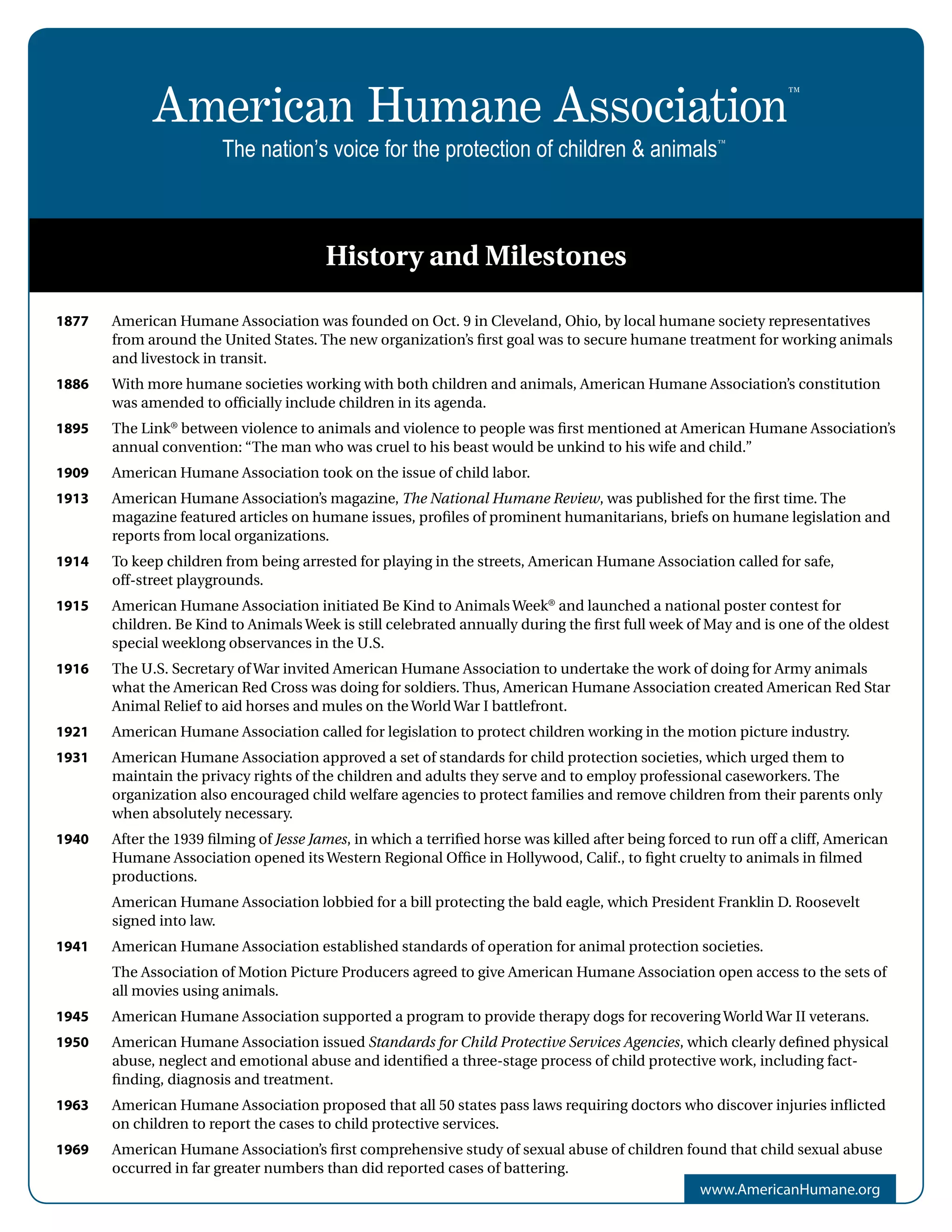
1877   American Humane Association was founded on Oct. 9 in Cleveland, Ohio, by local humane society representatives
       from around the United States. The new organization’s first goal was to secure humane treatment for working animals
       and livestock in transit.
1886   With more humane societies working with both children and animals, American Humane Association’s constitution
       was amended to officially include children in its agenda.
1895   The Link® between violence to animals and violence to people was first mentioned at American Humane Association’s
       annual convention: “The man who was cruel to his beast would be unkind to his wife and child.”
1909   American Humane Association took on the issue of child labor.
1913   American Humane Association’s magazine, The National Humane Review, was published for the first time. The
       magazine featured articles on humane issues, profiles of prominent humanitarians, briefs on humane legislation and
       reports from local organizations.
1914   To keep children from being arrested for playing in the streets, American Humane Association called for safe,
       off-street playgrounds.
1915   American Humane Association initiated Be Kind to Animals Week® and launched a national poster contest for
       children. Be Kind to Animals Week is still celebrated annually during the first full week of May and is one of the oldest
       special weeklong observances in the U.S.
1916   The U.S. Secretary of War invited American Humane Association to undertake the work of doing for Army animals
       what the American Red Cross was doing for soldiers. Thus, American Humane Association created American Red Star
       Animal Relief to aid horses and mules on the World War I battlefront.
1921   American Humane Association called for legislation to protect children working in the motion picture industry.
1931   American Humane Association approved a set of standards for child protection societies, which urged them to
       maintain the privacy rights of the children and adults they serve and to employ professional caseworkers. The
       organization also encouraged child welfare agencies to protect families and remove children from their parents only
       when absolutely necessary.
1940   After the 1939 filming of Jesse James, in which a terrified horse was killed after being forced to run off a cliff, American
       Humane Association opened its Western Regional Office in Hollywood, Calif., to fight cruelty to animals in filmed
       productions.
       American Humane Association lobbied for a bill protecting the bald eagle, which President Franklin D. Roosevelt
       signed into law.
1941   American Humane Association established standards of operation for animal protection societies.
       The Association of Motion Picture Producers agreed to give American Humane Association open access to the sets of
       all movies using animals.
1945   American Humane Association supported a program to provide therapy dogs for recovering World War II veterans.
1950   American Humane Association issued Standards for Child Protective Services Agencies, which clearly defined physical
       abuse, neglect and emotional abuse and identified a three-stage process of child protective work, including fact-
       finding, diagnosis and treatment.
1963   American Humane Association proposed that all 50 states pass laws requiring doctors who discover injuries inflicted
       on children to report the cases to child protective services.
1969   American Humane Association’s first comprehensive study of sexual abuse of children found that child sexual abuse
       occurred in far greater numbers than did reported cases of battering.
                                                                                                    www.AmericanHumane.org
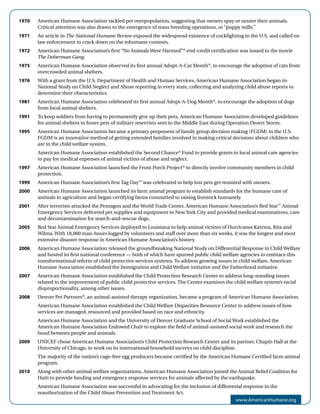
1970   American Humane Association tackled pet overpopulation, suggesting that owners spay or neuter their animals.
       Critical attention was also drawn to the emergence of mass breeding operations, or “puppy mills.”
1971   An article in The National Humane Review exposed the widespread existence of cockfighting in the U.S. and called on
       law enforcement to crack down on the inhumane contests.
1972   American Humane Association’s first “No Animals Were Harmed”® end-credit certification was issued to the movie
       The Doberman Gang.
1975   American Humane Association observed its first annual Adopt-A-Cat Month®, to encourage the adoption of cats from
       overcrowded animal shelters.
1976   With a grant from the U.S. Department of Health and Human Services, American Humane Association began its
       National Study on Child Neglect and Abuse reporting in every state, collecting and analyzing child abuse reports to
       determine their characteristics.
1981   American Humane Association celebrated its first annual Adopt-A-Dog Month®, to encourage the adoption of dogs
       from local animal shelters.
1991   To keep soldiers from having to permanently give up their pets, American Humane Association developed guidelines
       for animal shelters to foster pets of military reservists sent to the Middle East during Operation Desert Storm.
1995   American Humane Association became a primary proponent of family group decision making (FGDM) in the U.S.
       FGDM is an innovative method of getting extended families involved in making critical decisions about children who
       are in the child welfare system.
       American Humane Association established the Second Chance® Fund to provide grants to local animal care agencies
       to pay for medical expenses of animal victims of abuse and neglect.
1997   American Humane Association launched the Front Porch Project® to directly involve community members in child
       protection.
1999   American Humane Association’s first Tag Day™ was celebrated to help lost pets get reunited with owners.
2000   American Humane Association launched its farm animal program to establish standards for the humane care of
       animals in agriculture and began certifying farms committed to raising livestock humanely.
2001   After terrorists attacked the Pentagon and the World Trade Center, American Humane Association’s Red Star™ Animal
       Emergency Services delivered pet supplies and equipment to New York City and provided medical examinations, care
       and decontamination for search-and-rescue dogs.
2005   Red Star Animal Emergency Services deployed to Louisiana to help animal victims of Hurricanes Katrina, Rita and
       Wilma. With 18,000 man-hours logged by volunteers and staff over more than six weeks, it was the longest and most
       extensive disaster response in American Humane Association’s history.
2006   American Humane Association released the groundbreaking National Study on Differential Response in Child Welfare
       and hosted its first national conference — both of which have spurred public child welfare agencies to embrace this
       transformational reform of child protective services systems. To address growing issues in child welfare, American
       Humane Association established the Immigration and Child Welfare initiative and the Fatherhood initiative.
2007   American Humane Association established the Child Protection Research Center to address long-standing issues
       related to the improvement of public child protective services. The Center examines the child welfare system’s racial
       disproportionality, among other issues.
2008   Denver Pet Partners®, an animal-assisted therapy organization, became a program of American Humane Association.
       American Humane Association established the Child Welfare Disparities Resource Center to address issues of how
       services are managed, resourced and provided based on race and ethnicity.
       American Humane Association and the University of Denver Graduate School of Social Work established the
       American Humane Association Endowed Chair to explore the field of animal-assisted social work and research the
       bond between people and animals.
2009   UNICEF chose American Humane Association’s Child Protection Research Center and its partner, Chapin Hall at the
       University of Chicago, to work on its international household surveys on child discipline.
       The majority of the nation’s cage-free egg producers became certified by the American Humane Certified farm animal
       program.
2010   Along with other animal welfare organizations, American Humane Association joined the Animal Relief Coalition for
       Haiti to provide funding and emergency response services for animals affected by the earthquake.
       American Humane Association was successful in advocating for the inclusion of differential response in the
       reauthorization of the Child Abuse Prevention and Treatment Act.
                                                                                                www.AmericanHumane.org

Aha Milestones 8 15 11

  • 1.
    History and Milestones 1877 American Humane Association was founded on Oct. 9 in Cleveland, Ohio, by local humane society representatives from around the United States. The new organization’s first goal was to secure humane treatment for working animals and livestock in transit. 1886 With more humane societies working with both children and animals, American Humane Association’s constitution was amended to officially include children in its agenda. 1895 The Link® between violence to animals and violence to people was first mentioned at American Humane Association’s annual convention: “The man who was cruel to his beast would be unkind to his wife and child.” 1909 American Humane Association took on the issue of child labor. 1913 American Humane Association’s magazine, The National Humane Review, was published for the first time. The magazine featured articles on humane issues, profiles of prominent humanitarians, briefs on humane legislation and reports from local organizations. 1914 To keep children from being arrested for playing in the streets, American Humane Association called for safe, off-street playgrounds. 1915 American Humane Association initiated Be Kind to Animals Week® and launched a national poster contest for children. Be Kind to Animals Week is still celebrated annually during the first full week of May and is one of the oldest special weeklong observances in the U.S. 1916 The U.S. Secretary of War invited American Humane Association to undertake the work of doing for Army animals what the American Red Cross was doing for soldiers. Thus, American Humane Association created American Red Star Animal Relief to aid horses and mules on the World War I battlefront. 1921 American Humane Association called for legislation to protect children working in the motion picture industry. 1931 American Humane Association approved a set of standards for child protection societies, which urged them to maintain the privacy rights of the children and adults they serve and to employ professional caseworkers. The organization also encouraged child welfare agencies to protect families and remove children from their parents only when absolutely necessary. 1940 After the 1939 filming of Jesse James, in which a terrified horse was killed after being forced to run off a cliff, American Humane Association opened its Western Regional Office in Hollywood, Calif., to fight cruelty to animals in filmed productions. American Humane Association lobbied for a bill protecting the bald eagle, which President Franklin D. Roosevelt signed into law. 1941 American Humane Association established standards of operation for animal protection societies. The Association of Motion Picture Producers agreed to give American Humane Association open access to the sets of all movies using animals. 1945 American Humane Association supported a program to provide therapy dogs for recovering World War II veterans. 1950 American Humane Association issued Standards for Child Protective Services Agencies, which clearly defined physical abuse, neglect and emotional abuse and identified a three-stage process of child protective work, including fact- finding, diagnosis and treatment. 1963 American Humane Association proposed that all 50 states pass laws requiring doctors who discover injuries inflicted on children to report the cases to child protective services. 1969 American Humane Association’s first comprehensive study of sexual abuse of children found that child sexual abuse occurred in far greater numbers than did reported cases of battering. www.AmericanHumane.org
  • 2.
    1970 American Humane Association tackled pet overpopulation, suggesting that owners spay or neuter their animals. Critical attention was also drawn to the emergence of mass breeding operations, or “puppy mills.” 1971 An article in The National Humane Review exposed the widespread existence of cockfighting in the U.S. and called on law enforcement to crack down on the inhumane contests. 1972 American Humane Association’s first “No Animals Were Harmed”® end-credit certification was issued to the movie The Doberman Gang. 1975 American Humane Association observed its first annual Adopt-A-Cat Month®, to encourage the adoption of cats from overcrowded animal shelters. 1976 With a grant from the U.S. Department of Health and Human Services, American Humane Association began its National Study on Child Neglect and Abuse reporting in every state, collecting and analyzing child abuse reports to determine their characteristics. 1981 American Humane Association celebrated its first annual Adopt-A-Dog Month®, to encourage the adoption of dogs from local animal shelters. 1991 To keep soldiers from having to permanently give up their pets, American Humane Association developed guidelines for animal shelters to foster pets of military reservists sent to the Middle East during Operation Desert Storm. 1995 American Humane Association became a primary proponent of family group decision making (FGDM) in the U.S. FGDM is an innovative method of getting extended families involved in making critical decisions about children who are in the child welfare system. American Humane Association established the Second Chance® Fund to provide grants to local animal care agencies to pay for medical expenses of animal victims of abuse and neglect. 1997 American Humane Association launched the Front Porch Project® to directly involve community members in child protection. 1999 American Humane Association’s first Tag Day™ was celebrated to help lost pets get reunited with owners. 2000 American Humane Association launched its farm animal program to establish standards for the humane care of animals in agriculture and began certifying farms committed to raising livestock humanely. 2001 After terrorists attacked the Pentagon and the World Trade Center, American Humane Association’s Red Star™ Animal Emergency Services delivered pet supplies and equipment to New York City and provided medical examinations, care and decontamination for search-and-rescue dogs. 2005 Red Star Animal Emergency Services deployed to Louisiana to help animal victims of Hurricanes Katrina, Rita and Wilma. With 18,000 man-hours logged by volunteers and staff over more than six weeks, it was the longest and most extensive disaster response in American Humane Association’s history. 2006 American Humane Association released the groundbreaking National Study on Differential Response in Child Welfare and hosted its first national conference — both of which have spurred public child welfare agencies to embrace this transformational reform of child protective services systems. To address growing issues in child welfare, American Humane Association established the Immigration and Child Welfare initiative and the Fatherhood initiative. 2007 American Humane Association established the Child Protection Research Center to address long-standing issues related to the improvement of public child protective services. The Center examines the child welfare system’s racial disproportionality, among other issues. 2008 Denver Pet Partners®, an animal-assisted therapy organization, became a program of American Humane Association. American Humane Association established the Child Welfare Disparities Resource Center to address issues of how services are managed, resourced and provided based on race and ethnicity. American Humane Association and the University of Denver Graduate School of Social Work established the American Humane Association Endowed Chair to explore the field of animal-assisted social work and research the bond between people and animals. 2009 UNICEF chose American Humane Association’s Child Protection Research Center and its partner, Chapin Hall at the University of Chicago, to work on its international household surveys on child discipline. The majority of the nation’s cage-free egg producers became certified by the American Humane Certified farm animal program. 2010 Along with other animal welfare organizations, American Humane Association joined the Animal Relief Coalition for Haiti to provide funding and emergency response services for animals affected by the earthquake. American Humane Association was successful in advocating for the inclusion of differential response in the reauthorization of the Child Abuse Prevention and Treatment Act. www.AmericanHumane.org