INHERITANCE
Introduction
 Inheritance in java is a mechanism in which one
object acquires all the properties and behaviors of
parent object.
 The idea behind inheritance in java is that you can
create new classes that are built upon existing
classes.
 When you inherit from an existing class, you can
reuse methods and fields of parent class, and you can
add new methods and fields also.
 Inheritance represents the IS-A relationship, also
known as parent-child relationship.
Why use Inheritance in java
 For Method Overriding (so runtime
polymorphism can be achieved): If subclass (child
class) has the same method as declared in the
parent class, it is known as method overriding
in java.
 For Code Reusability: Use the existing class to
build the new class
Syntax of Java Inheritance
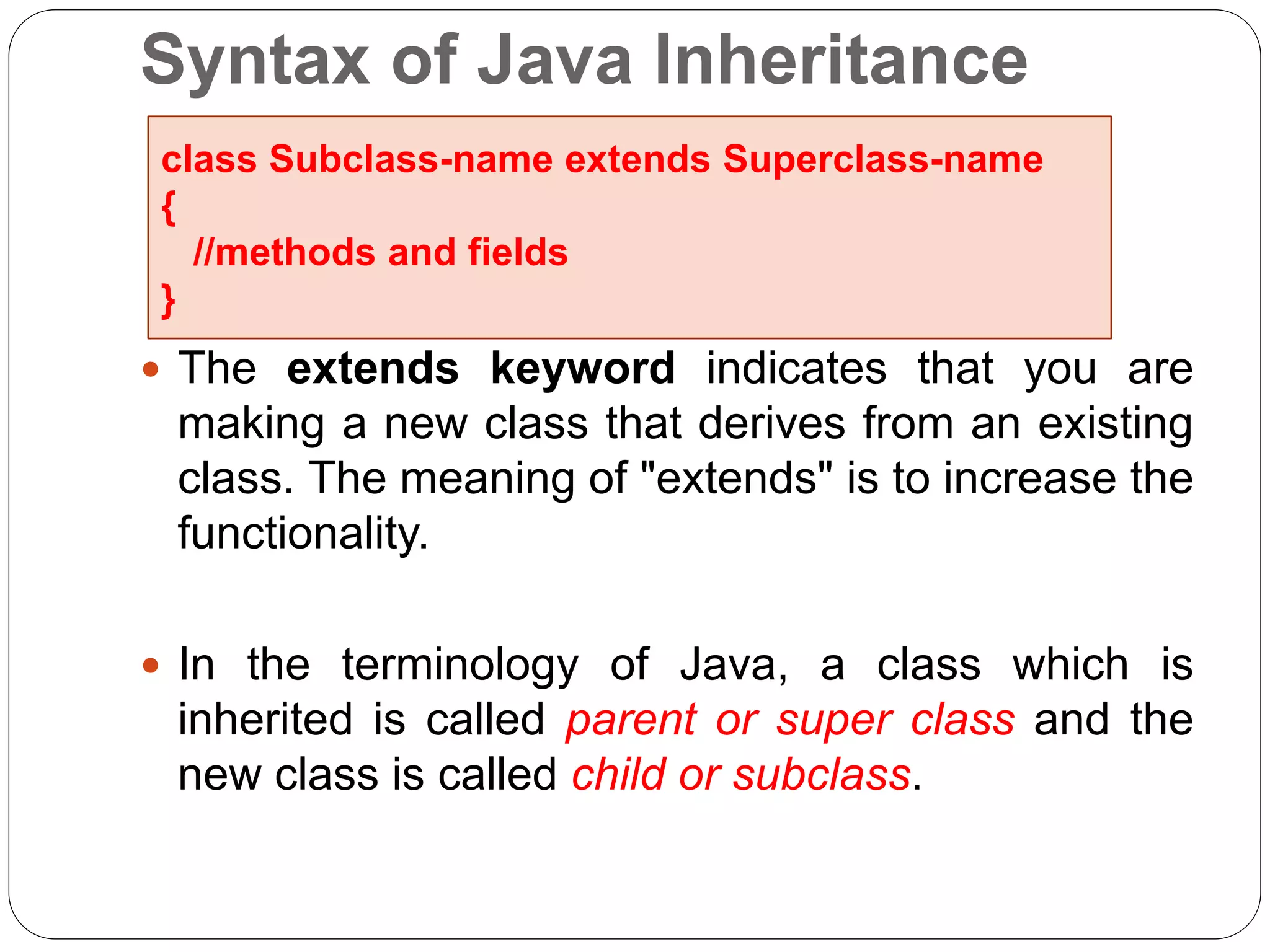
 The extends keyword indicates that you are
making a new class that derives from an existing
class. The meaning of "extends" is to increase the
functionality.
 In the terminology of Java, a class which is
inherited is called parent or super class and the
new class is called child or subclass.
class Subclass-name extends Superclass-name
{
//methods and fields
}
Java Inheritance Example
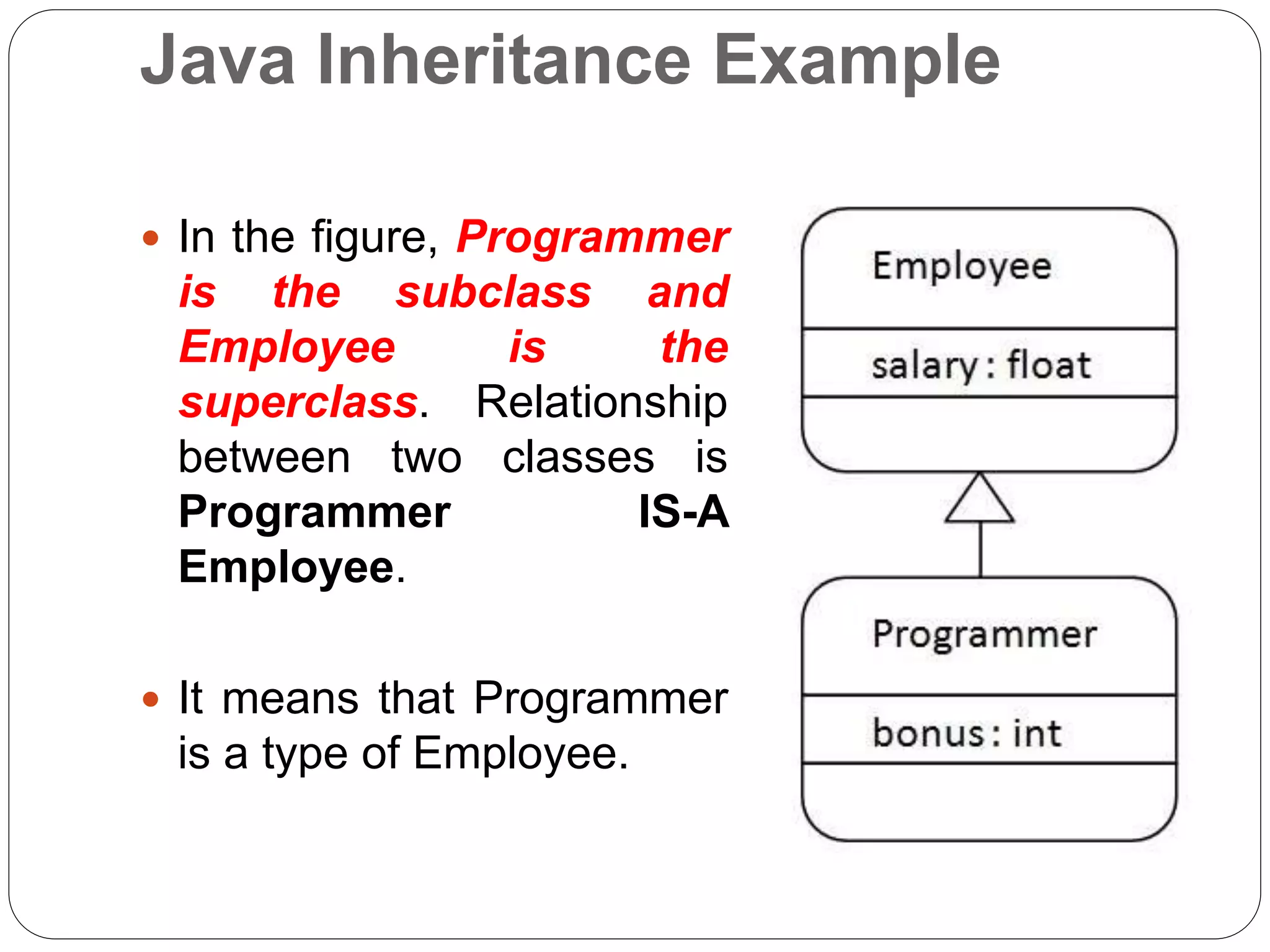
 In the figure, Programmer
is the subclass and
Employee is the
superclass. Relationship
between two classes is
Programmer IS-A
Employee.
 It means that Programmer
is a type of Employee.
class Employee
{
float salary=40000;
}
class Programmer extends Employee
{
int bonus=10000;
public static void main(String args[])
{
Programmer p=new Programmer();
System.out.println("Programmer salary is:"+p.salary);
System.out.println("Bonus of Programmer is:"+p.bonus);
}
}
Types of inheritance
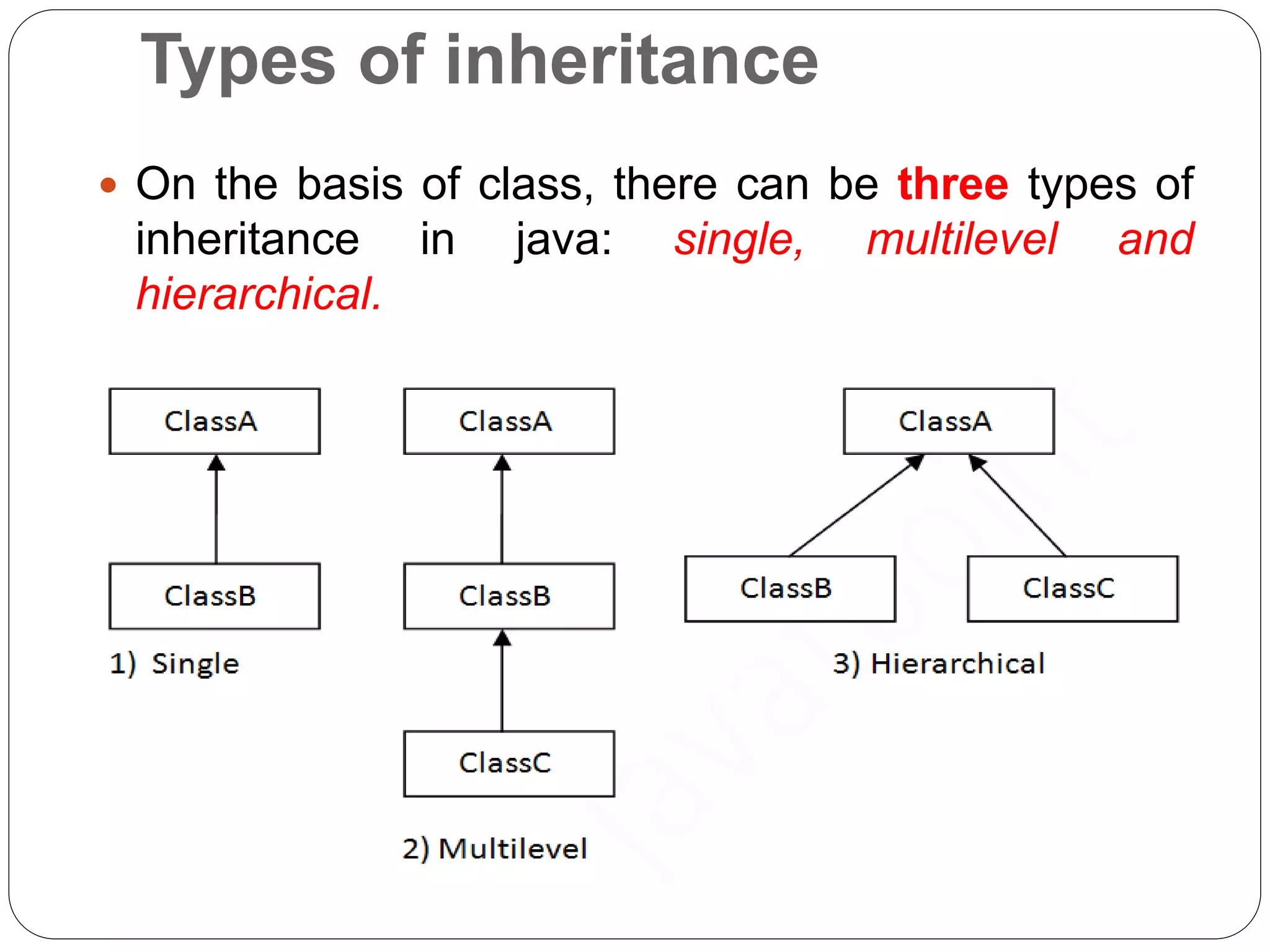
 On the basis of class, there can be three types of
inheritance in java: single, multilevel and
hierarchical.
Single Inheritance Example
class Principal
{
void Calling()
{
System.out.println(“Calling...");
}
}
Class Teacher extends Principal
{
void Teaching()
{
System.out.println(“Teaching...");
}
}
class TestInheritance
{
public static void main(String args[])
{
Teacher t=new Teacher();
t.Teaching();
t.Calling();
}
}
Multilevel Inheritance Example
class Principal
{
Void Calling()
{System.out.println(“Calling...");}
}
class Teacher extends Principal
{
void Teaching(){System.out.println(“Teaching...");}
}
class Student extends Teacher
{
void Studying(){System.out.println(“Studying..");}
}
class TestInheritance2{
public static void main(String args[]){
Student s=new Student();
s. Studying();
s. Teaching();
s. Calling();
Example
 class Principal
 {
 void Calling(){System.out.println(“calling..");}
 }
 class Teacher1 extends Principal
 {
 void Teaching(){System.out.println(“teaching….");}
 }
 class Teacher2 extends Principal
 {
 void Counselling(){System.out.println(“counselling..");}
 }
 class TestInheritance3
 {
 public static void main(String args[]){
 Teacher2 t=new Teacher2();
 t.Counselling();
 t.Calling();
 //t.Teaching();//C.T.Error
 }}
Why multiple inheritance is not supported in java?
 To reduce the complexity and simplify the
language, multiple inheritance is not supported in
java.
 Consider a scenario where A, B and C are three
classes. The C class inherits A and B classes. If A
and B classes have same method and you call it
from child class object, there will be ambiguity to
call method of A or B class.
 class A{
 void msg(){System.out.println("Hello");}
 }
 class B{
 void msg(){System.out.println("Welcome");}
 }
 class C extends A,B{//suppose if it were

 Public Static void main(String args[]){
 C obj=new C();
 obj.msg();//Now which msg() method would be invoked?
 }
 }
Lets Do Something
1. Create a class named Year that contains a data
field that holds the number of days in a year.
Include a get method that displays the number of
days and a constructor that sets the number of
days to 365. Create a subclass named LeapYear.
LeapYear’s constructor overrides Year’s
constructor and sets the number of days to 366.
Write an application named UseYear that
instantiates one object of each class and displays
their data.
2. (The Person, Student, Employee, Faculty, and
Staff classes) Design a class named Person and its
two subclasses named Student and Employee.
Make Faculty and Staff subclasses of Employee. A
person has a name, address, phone number, and
email address. A student has a class status
(freshman, sophomore, junior, or senior). Define the
status as a constant. An employee has an office,
salary, and date hired. A faculty member has office
hours and a rank. A staff member has a title. Override
the toString method in each class to display the
class name and the person’s name. Write a test
program that creates a Person, Student, Employee,
Faculty, and Staff, and invokes their toString()
methods.

A457405934_21789_26_2018_Inheritance.ppt

  • 1.
  • 2.
    Introduction  Inheritance injava is a mechanism in which one object acquires all the properties and behaviors of parent object.  The idea behind inheritance in java is that you can create new classes that are built upon existing classes.  When you inherit from an existing class, you can reuse methods and fields of parent class, and you can add new methods and fields also.  Inheritance represents the IS-A relationship, also known as parent-child relationship.
  • 3.
    Why use Inheritancein java  For Method Overriding (so runtime polymorphism can be achieved): If subclass (child class) has the same method as declared in the parent class, it is known as method overriding in java.  For Code Reusability: Use the existing class to build the new class
  • 4.
    Syntax of JavaInheritance  The extends keyword indicates that you are making a new class that derives from an existing class. The meaning of "extends" is to increase the functionality.  In the terminology of Java, a class which is inherited is called parent or super class and the new class is called child or subclass. class Subclass-name extends Superclass-name { //methods and fields }
  • 5.
    Java Inheritance Example In the figure, Programmer is the subclass and Employee is the superclass. Relationship between two classes is Programmer IS-A Employee.  It means that Programmer is a type of Employee.
  • 6.
    class Employee { float salary=40000; } classProgrammer extends Employee { int bonus=10000; public static void main(String args[]) { Programmer p=new Programmer(); System.out.println("Programmer salary is:"+p.salary); System.out.println("Bonus of Programmer is:"+p.bonus); } }
  • 7.
    Types of inheritance On the basis of class, there can be three types of inheritance in java: single, multilevel and hierarchical.
  • 8.
    Single Inheritance Example classPrincipal { void Calling() { System.out.println(“Calling..."); } } Class Teacher extends Principal { void Teaching() { System.out.println(“Teaching..."); } } class TestInheritance { public static void main(String args[]) { Teacher t=new Teacher(); t.Teaching(); t.Calling(); } }
  • 9.
    Multilevel Inheritance Example classPrincipal { Void Calling() {System.out.println(“Calling...");} } class Teacher extends Principal { void Teaching(){System.out.println(“Teaching...");} } class Student extends Teacher { void Studying(){System.out.println(“Studying..");} } class TestInheritance2{ public static void main(String args[]){ Student s=new Student(); s. Studying(); s. Teaching(); s. Calling();
  • 10.
    Example  class Principal {  void Calling(){System.out.println(“calling..");}  }  class Teacher1 extends Principal  {  void Teaching(){System.out.println(“teaching….");}  }  class Teacher2 extends Principal  {  void Counselling(){System.out.println(“counselling..");}  }  class TestInheritance3  {  public static void main(String args[]){  Teacher2 t=new Teacher2();  t.Counselling();  t.Calling();  //t.Teaching();//C.T.Error  }}
  • 11.
    Why multiple inheritanceis not supported in java?  To reduce the complexity and simplify the language, multiple inheritance is not supported in java.  Consider a scenario where A, B and C are three classes. The C class inherits A and B classes. If A and B classes have same method and you call it from child class object, there will be ambiguity to call method of A or B class.
  • 12.
     class A{ void msg(){System.out.println("Hello");}  }  class B{  void msg(){System.out.println("Welcome");}  }  class C extends A,B{//suppose if it were   Public Static void main(String args[]){  C obj=new C();  obj.msg();//Now which msg() method would be invoked?  }  }
  • 13.
    Lets Do Something 1.Create a class named Year that contains a data field that holds the number of days in a year. Include a get method that displays the number of days and a constructor that sets the number of days to 365. Create a subclass named LeapYear. LeapYear’s constructor overrides Year’s constructor and sets the number of days to 366. Write an application named UseYear that instantiates one object of each class and displays their data.
  • 14.
    2. (The Person,Student, Employee, Faculty, and Staff classes) Design a class named Person and its two subclasses named Student and Employee. Make Faculty and Staff subclasses of Employee. A person has a name, address, phone number, and email address. A student has a class status (freshman, sophomore, junior, or senior). Define the status as a constant. An employee has an office, salary, and date hired. A faculty member has office hours and a rank. A staff member has a title. Override the toString method in each class to display the class name and the person’s name. Write a test program that creates a Person, Student, Employee, Faculty, and Staff, and invokes their toString() methods.