INHERITANCE IN
JAVA
PRESENTED BY: DR. NEETU SHARMA
PROFESSOR(SCAT)
GUSCSE202232020
INHERITANCE
Inheritance is a fundamental Object-Oriented concept
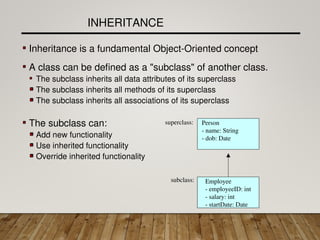
A class can be defined as a "subclass" of another class.
The subclass inherits all data attributes of its superclass
The subclass inherits all methods of its superclass
The subclass inherits all associations of its superclass
The subclass can:
Add new functionality
Use inherited functionality
Override inherited functionality
Person
- name: String
- dob: Date
Employee
- employeeID: int
- salary: int
- startDate: Date
superclass:
subclass:
How is this useful?
Economy of time – When you implement Employee, you already have all
functionality of Person. No need to reimplement
Parameter passing – If you have a function that expects a Person, you
can pass an Employee, and it is still fine.
Fewer special-purpose functions for every type of Person that exists
Container classes (linked lists, binary trees, etc.) can be defined to hold a
Person, and can hold any subclass of Person
Allows limited heterogeneity in container classes
Person
- name: String
- dob: Date
Employee
- employeeID: int
- salary: int
- startDate: Date
superclass:
subclass:
What really happens?
When an object is created using new, the system must
allocate enough memory to hold all its instance variables.
This includes any inherited instance variables
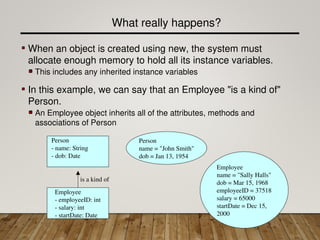
In this example, we can say that an Employee "is a kind of"
Person.
An Employee object inherits all of the attributes, methods and
associations of Person
Person
- name: String
- dob: Date
Employee
- employeeID: int
- salary: int
- startDate: Date
Person
name = "John Smith"
dob = Jan 13, 1954
Employee
name = "Sally Halls"
dob = Mar 15, 1968
employeeID = 37518
salary = 65000
startDate = Dec 15,
2000
is a kind of
Inheritance in Java
Inheritance is declared using the "extends" keyword
If inheritance is not defined, the class extends a class called Object
Person
- name: String
- dob: Date
Employee
- employeeID: int
- salary: int
- startDate: Date
public class Person
{
private String name;
private Date dob;
[...]
public class Employee extends Person
{
private int employeID;
private int salary;
private Date startDate;
[...]
Employee anEmployee = new Employee();
Inheritance Hierarchy
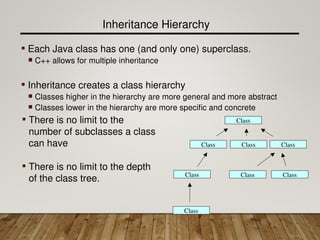
Each Java class has one (and only one) superclass.
C++ allows for multiple inheritance
Inheritance creates a class hierarchy
Classes higher in the hierarchy are more general and more abstract
Classes lower in the hierarchy are more specific and concrete
Class
There is no limit to the
number of subclasses a class
can have
There is no limit to the depth
of the class tree.
Class Class Class
Class
Class Class
Class
The class called Object
At the very top of the inheritance tree is a class called Object
All Java classes inherit from Object.
All objects have a common ancestor
This is different from C++
The Object class is defined in the java.lang package
Examine it in the Java API Specification
Object
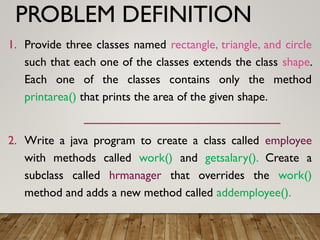
PROBLEM DEFINITION
1. Provide three classes named rectangle, triangle, and circle
such that each one of the classes extends the class shape.
Each one of the classes contains only the method
printarea() that prints the area of the given shape.
2. Write a java program to create a class called employee
with methods called work() and getsalary(). Create a
subclass called hrmanager that overrides the work()
method and adds a new method called addemployee().

Inheritance in java.ppt FOR TYPES OF INHERITANCE

  • 1.
    INHERITANCE IN JAVA PRESENTED BY:DR. NEETU SHARMA PROFESSOR(SCAT) GUSCSE202232020
  • 2.
    INHERITANCE Inheritance is afundamental Object-Oriented concept A class can be defined as a "subclass" of another class. The subclass inherits all data attributes of its superclass The subclass inherits all methods of its superclass The subclass inherits all associations of its superclass The subclass can: Add new functionality Use inherited functionality Override inherited functionality Person - name: String - dob: Date Employee - employeeID: int - salary: int - startDate: Date superclass: subclass:
  • 3.
    How is thisuseful? Economy of time – When you implement Employee, you already have all functionality of Person. No need to reimplement Parameter passing – If you have a function that expects a Person, you can pass an Employee, and it is still fine. Fewer special-purpose functions for every type of Person that exists Container classes (linked lists, binary trees, etc.) can be defined to hold a Person, and can hold any subclass of Person Allows limited heterogeneity in container classes Person - name: String - dob: Date Employee - employeeID: int - salary: int - startDate: Date superclass: subclass:
  • 4.
    What really happens? Whenan object is created using new, the system must allocate enough memory to hold all its instance variables. This includes any inherited instance variables In this example, we can say that an Employee "is a kind of" Person. An Employee object inherits all of the attributes, methods and associations of Person Person - name: String - dob: Date Employee - employeeID: int - salary: int - startDate: Date Person name = "John Smith" dob = Jan 13, 1954 Employee name = "Sally Halls" dob = Mar 15, 1968 employeeID = 37518 salary = 65000 startDate = Dec 15, 2000 is a kind of
  • 5.
    Inheritance in Java Inheritanceis declared using the "extends" keyword If inheritance is not defined, the class extends a class called Object Person - name: String - dob: Date Employee - employeeID: int - salary: int - startDate: Date public class Person { private String name; private Date dob; [...] public class Employee extends Person { private int employeID; private int salary; private Date startDate; [...] Employee anEmployee = new Employee();
  • 6.
    Inheritance Hierarchy Each Javaclass has one (and only one) superclass. C++ allows for multiple inheritance Inheritance creates a class hierarchy Classes higher in the hierarchy are more general and more abstract Classes lower in the hierarchy are more specific and concrete Class There is no limit to the number of subclasses a class can have There is no limit to the depth of the class tree. Class Class Class Class Class Class Class
  • 7.
    The class calledObject At the very top of the inheritance tree is a class called Object All Java classes inherit from Object. All objects have a common ancestor This is different from C++ The Object class is defined in the java.lang package Examine it in the Java API Specification Object
  • 8.
    PROBLEM DEFINITION 1. Providethree classes named rectangle, triangle, and circle such that each one of the classes extends the class shape. Each one of the classes contains only the method printarea() that prints the area of the given shape. 2. Write a java program to create a class called employee with methods called work() and getsalary(). Create a subclass called hrmanager that overrides the work() method and adds a new method called addemployee().