What have you learnt
from your audience
feedback?
For A2 Media Studies Coursework Evaluation
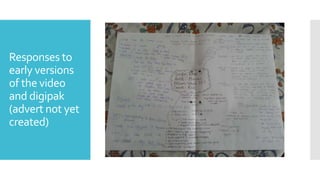
Responses to
early versions
of the video
and digipak
(advert not yet
created)
How I acted on
responses
 The mindmap on the previous slide was created when I had
finished the early version of my music video and printed out the
panels of my first digipak. I wrote the details of my products and
some other students in my class commented on what they liked
about them and what could be improved.
 Many improvements were suggested, such as getting rid of the
shadow in the stop-motion sequences, linking the digipak to the
music video and creating a clearer narrative within the visual. I
followed this advice by filming in a room with lots of natural
daylight, reconstructing the storyline and choosing different &
more interesting images that would connect to the music video
and later, the advert, providing better synergy between the video,
digipak and advert.
 The feedback I gained after making these adjustments can be
seen on the following slides…
Age and
gender
Upon creating my survey, I decided to
distribute it to a cross section of society
(young people and adults), rather than
my target audience of 11-18 year old
specifically – this was done so I would
be able to gain a variety of responses in
regards to the different views on the
finished products and evaluate what I
had done well more widely.
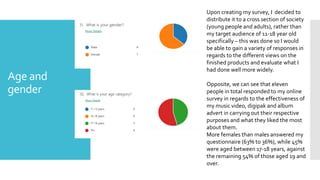
Opposite, we can see that eleven
people in total responded to my online
survey in regards to the effectiveness of
my music video, digipak and album
advert in carrying out their respective
purposes and what they liked the most
about them.
More females than males answered my
questionnaire (63% to 36%), while 45%
were aged between 17-18 years, against
the remaining 54% of those aged 19 and
over.
Favoured
features of
main product
The most popular response to the question of what the respondents liked
about the music video was the animated sequences and live action footage
being combined together, with 10 responses (90%).This was followed by the
animation alone and the live-action dance sequences, both of which were
made up 36% of answers. Only the storyline and cinematic horn option were
chosen once – it can be gathered here that the combination of animation
with live-action footage was the most successful part of the music video as
the ‘show[ed] creativity and skill’ and it was ‘different and captivating’.
Favoured
features of
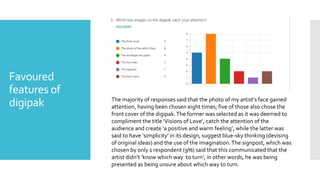
digipak The majority of responses said that the photo of my artist’s face gained
attention, having been chosen eight times; five of those also chose the
front cover of the digipak.The former was selected as it was deemed to
compliment the title ‘Visions of Love’, catch the attention of the
audience and create ‘a positive and warm feeling’, while the latter was
said to have ‘simplicity’ in its design, suggest blue-sky thinking (devising
of original ideas) and the use of the imagination.The signpost, which was
chosen by only 1 respondent (9%) said that this communicated that the
artist didn’t ‘know which way to turn’; in other words, he was being
presented as being unsure about which way to turn.
Favoured
features of
album advert
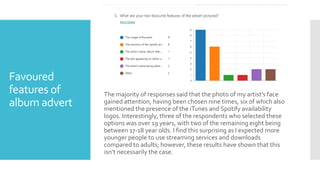
The majority of responses said that the photo of my artist’s face
gained attention, having been chosen nine times, six of which also
mentioned the presence of the iTunes and Spotify availability
logos. Interestingly, three of the respondents who selected these
options was over 19 years, with two of the remaining eight being
between 17-18 year olds. I find this surprising as I expected more
younger people to use streaming services and downloads
compared to adults; however, these results have shown that this
isn’t necessarily the case.
Storyline
interpretation
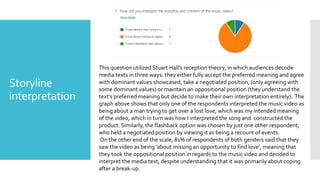
This question utilized Stuart Hall’s reception theory, in which audiences decode
media texts in three ways: they either fully accept the preferred meaning and agree
with dominant values showcased, take a negotiated position, (only agreeing with
some dominant values) or maintain an oppositional position (they understand the
text’s preferred meaning but decide to make their own interpretation entirely). The
graph above shows that only one of the respondents interpreted the music video as
being about a man trying to get over a lost love, which was my intended meaning
of the video, which in turn was how I interpreted the song and constructed the
product. Similarly, the flashback option was chosen by just one other respondent,
who held a negotiated position by viewing it as being a recount of events.
On the other end of the scale, 81% of respondents of both genders said that they
saw the video as being ‘about missing an opportunity to find love’, meaning that
they took the oppositional position in regards to the music video and decided to
interpret the media text, despite understanding that it was primarily about coping
after a break-up.
Effective
promotion of
artist through
digipak and
advert
Akin to the previous survey question, this one also uses a media
thesis, albeit one credited to Dyer – the star theory. He proposed that
the reason why companies use close-ups of a media personality is so
that they can be promoted/sold to an audience; this enables the
personality to be simultaneously present and absent. Upon posing the
question of the effectiveness of the artist’s image’s utilisation, 91% of
respondents agreed that this was the case (justifications included
‘direct eye contact’ and ability ‘to relate to the song’), compared with
10% who disagreed (the respondent said that ‘the image should be a
posed full body rather than a portrait shot’). However, this same
respondent favoured the image of the artist as she was ‘able to see [a]
visual image of the artist’; I consider this result to be unusual.

A2 evaluation question 3

  • 1.
    What have youlearnt from your audience feedback? For A2 Media Studies Coursework Evaluation
  • 2.
    Responses to early versions ofthe video and digipak (advert not yet created)
  • 3.
    How I actedon responses  The mindmap on the previous slide was created when I had finished the early version of my music video and printed out the panels of my first digipak. I wrote the details of my products and some other students in my class commented on what they liked about them and what could be improved.  Many improvements were suggested, such as getting rid of the shadow in the stop-motion sequences, linking the digipak to the music video and creating a clearer narrative within the visual. I followed this advice by filming in a room with lots of natural daylight, reconstructing the storyline and choosing different & more interesting images that would connect to the music video and later, the advert, providing better synergy between the video, digipak and advert.  The feedback I gained after making these adjustments can be seen on the following slides…
  • 4.
    Age and gender Upon creatingmy survey, I decided to distribute it to a cross section of society (young people and adults), rather than my target audience of 11-18 year old specifically – this was done so I would be able to gain a variety of responses in regards to the different views on the finished products and evaluate what I had done well more widely. Opposite, we can see that eleven people in total responded to my online survey in regards to the effectiveness of my music video, digipak and album advert in carrying out their respective purposes and what they liked the most about them. More females than males answered my questionnaire (63% to 36%), while 45% were aged between 17-18 years, against the remaining 54% of those aged 19 and over.
  • 5.
    Favoured features of main product Themost popular response to the question of what the respondents liked about the music video was the animated sequences and live action footage being combined together, with 10 responses (90%).This was followed by the animation alone and the live-action dance sequences, both of which were made up 36% of answers. Only the storyline and cinematic horn option were chosen once – it can be gathered here that the combination of animation with live-action footage was the most successful part of the music video as the ‘show[ed] creativity and skill’ and it was ‘different and captivating’.
  • 6.
    Favoured features of digipak Themajority of responses said that the photo of my artist’s face gained attention, having been chosen eight times; five of those also chose the front cover of the digipak.The former was selected as it was deemed to compliment the title ‘Visions of Love’, catch the attention of the audience and create ‘a positive and warm feeling’, while the latter was said to have ‘simplicity’ in its design, suggest blue-sky thinking (devising of original ideas) and the use of the imagination.The signpost, which was chosen by only 1 respondent (9%) said that this communicated that the artist didn’t ‘know which way to turn’; in other words, he was being presented as being unsure about which way to turn.
  • 7.
    Favoured features of album advert Themajority of responses said that the photo of my artist’s face gained attention, having been chosen nine times, six of which also mentioned the presence of the iTunes and Spotify availability logos. Interestingly, three of the respondents who selected these options was over 19 years, with two of the remaining eight being between 17-18 year olds. I find this surprising as I expected more younger people to use streaming services and downloads compared to adults; however, these results have shown that this isn’t necessarily the case.
  • 8.
    Storyline interpretation This question utilizedStuart Hall’s reception theory, in which audiences decode media texts in three ways: they either fully accept the preferred meaning and agree with dominant values showcased, take a negotiated position, (only agreeing with some dominant values) or maintain an oppositional position (they understand the text’s preferred meaning but decide to make their own interpretation entirely). The graph above shows that only one of the respondents interpreted the music video as being about a man trying to get over a lost love, which was my intended meaning of the video, which in turn was how I interpreted the song and constructed the product. Similarly, the flashback option was chosen by just one other respondent, who held a negotiated position by viewing it as being a recount of events. On the other end of the scale, 81% of respondents of both genders said that they saw the video as being ‘about missing an opportunity to find love’, meaning that they took the oppositional position in regards to the music video and decided to interpret the media text, despite understanding that it was primarily about coping after a break-up.
  • 9.
    Effective promotion of artist through digipakand advert Akin to the previous survey question, this one also uses a media thesis, albeit one credited to Dyer – the star theory. He proposed that the reason why companies use close-ups of a media personality is so that they can be promoted/sold to an audience; this enables the personality to be simultaneously present and absent. Upon posing the question of the effectiveness of the artist’s image’s utilisation, 91% of respondents agreed that this was the case (justifications included ‘direct eye contact’ and ability ‘to relate to the song’), compared with 10% who disagreed (the respondent said that ‘the image should be a posed full body rather than a portrait shot’). However, this same respondent favoured the image of the artist as she was ‘able to see [a] visual image of the artist’; I consider this result to be unusual.