International Journal of Business and Management Invention
ISSN (Online): 2319 – 8028, ISSN (Print): 2319 – 801X
www.ijbmi.org || Volume 4 Issue 5|| May. 2015 || PP-01-10
www.ijbmi.org 1 | Page
The Influence of Corporate Governance and Corporate Social
Responsibility on Financial Performancewith Efficiency as
Mediating Variable
Hisnol Jamali1
, Sutrisno T2
, Imam Subekti3
, Prihat Assih4
1(
Departmentof Accounting, School of Economics STIE AMKOP Makassar, Indonesia)
2, 3, 4(
Faculty of Economics and Business University of Brawijaya, Malang, Indonesia)
ABSTRACT :The purpose of this research was to investigate and analyze the direct effect of corporate
governance and corporate social responsibility on financial performance and their indirect effect through
efficiency. This research used quantitative approach with samples of manufacturing firms which were selected
using purposive sampling that listed in Indonesia Stock Exchange. There were 297 observations years-firms
(2009-2012). The results of this research showed that corporate governance didn’t have effect on financial
performance (ROA &Tobins Q), neither direct nor indirect effect through efficiency. In contrast, there was
empirical evidence that corporate social responsibility has positive influence on financial performance (ROA),
either direct or indirect effect through efficiency. However, corporate social responsibility has negative effect
on financial performance (Tobins Q), either direct or indirect effect through efficiency.
KEYWORDS:Corporate governance, corporate social responsibility, business efficiency, financial
performance.
I. INTRODUCTION
Financial crisis around Asia created some macros economic challenge in the development of industrial
manufacture in Indonesia. Percentage of pure profit of big Industrial manufacture and break since 2008 to 2011
run to fluctuate and tend to decline (the Capital Market, 2012). It shows that the industrial manufacture of
Indonesia is less than optimal in accomplishing industrial operation based on financial performance as the
fundamental aspect from real industrial condition (Permana, 2013). Research done by Asian Development Bank
(ADB) identified the absence of optimal accomplishment of industrial operation because of economic crisis as
the impact of “corporate governance” weak (Greenspan, 1999; Zhuanget al., 2000).
Corporate governance considered the harmonious of the importance of corporate governance with the
owners of other importances. It shows that corporate governance is based on theory of agency (Jensen &
Meckling, 1976). This theory considered that corporate governance as a very important side which have to be
watched and and reins with a certain rule. Beside, corporate governance has an authority to operate the industry
based on its capability. In this case, the implementation of corporate governance is also based on the
stewardship theory which contemplate a trusted management to act well for the importance of public in general
and especially for the shareholders (Chin & Jones, 2000; Shaw, 2003).
Consistent with the stakeholders which was explained that the corporation manager have to had a
satisfying result for all of the important people in the corporation (such as: employee, customers, supplier and
society organizations) which can affected the outcome of the corporation (Freeman, 1984). It shows that a
corporation should not only focused the purposes on the importance of shareholders or corporation owners, but
also to the importance of non-financial stakeholders who can attracted the corporation (McWilliams, Siegel &
Wright, 2006). This activity is a realization of moral dimension and industrial ethics in running a business
activity (Donaldson & Preston, 1995).
Financial performance is related with revealing corporation’s social responsibility (Beltratti, 2005)
where the customers will pay more for things and service produced by the responsible process socially. Practice
of social responsibility as a concern of a corporation to the environment including society around it, so that the
environment will not think that the corporation not only oriented in creating profit, but it is balance through the
people and planet or environment continuously based on the procedure (Susanto, 2007; Margolis & Walsh,
2003). According to Jenning&Zandbergen (1995) that a corporation has a role as institution should be able to
apply the principal of “ecologically sustainable organization”, dimension of responsibility to the environment
is one of thing that found on institutional theory in applying corporation social responsibility (Jones, 1995).
The Influence of Corporate Governance…
www.ijbmi.org 2 | Page
A corporation should able to run the function as an organization with motive business also able to run
the social role in society, implementing the responsibility ethics (such as corporation social responsibility) as a
strategy to increase social performance from corporation (Handajaniet al., 2014). It was supported by theory of
legitimacy in applying social responsibility (O’Donovan, 2002; Deegan, 2006). This theory shows the certain
aspect from transformational leadership will have positive correlations with the corporation abilities to apply the
corporation social responsibility in the strategic activity. Accomplishing profit still become the first purpose of
corporation from the applied social responsibility.
At the strategic level, a corporation which applied social responsibility can be seen from the
perspective theory resource-based-view (RBV) (Post, Preston &Sauter-Sachs, 2002; Neville et al., 2005).
McWilliams & Siegel (2001) used RBV which is connected with Theory-of-the-firm in formatting model
“maximizing profit” social responsibility. In this model, the corporation manager analyzed cost-benefit to decide
the level of resource in implementing social responsible activity. Applying Theory-of-the-firm in the social
responsibility give some strategic implications become component of integral strategy differentiation of
corporation and RBV logic on the social responsibility which probably make the corporation has model invest
of social responsibility among corporation and industry (McWilliams et al., 2006). Responsibility of social
corporation policy as the resource of intangible asset relational capital which is be the value relation of
corporation with the side of external corporation (stakeholder) (Daum, 2005).
Specific empirical experiment examined the relation/influence corporation governance and social
responsibility through the relative efficiency is limited (Greiling, 2006; Nanka-Bruce, 2011). It happens because
a different opinions is the efficiency of the corporation affected by internal factor of the corporation or there is
an external factor which also play a role in maximizing the operation level of the corporation (Berle& Means,
1932; Demsetz, 1983; and Demsetz& Lehn, 1985). Fact shows that a modern corporation operating the large
industrial environment even the border among countries, so that the internal-external corporationlimits become
very thin in differences. Also the stakeholders-agency who are more critical in behaving operation corporation
such as, product quality, service, eco-labeling, open information corporation, etc. that’s why, a corporation
should be struggle to solve and balanced this multiple-stakeholder claim.
Instrumental stakeholder theory stated that satisfied of various groups of stakeholder-agency is the
instrument to achieve financial performance organization. On the other hand, stakeholder-agency theory stated
that negotiation and contract implicit and explicit to decide conditionally the reciprocal relation between
management-stakeholder functioned as monitoring mechanism to avoid manager replaced his attention from the
purpose of corporation money (Hill & Jones, 1992; Jones 1995). Freeman & Evan (1990) stated that manager
can increase their organization efficiency adaptation through the external claim.
Consistent with what Freeman & Evan (1990) was thought, this experiment has main motivation to use
size of corporation efficiency as a variable which mediate relation between corporation governance and social
responsibility with financial performance corporation. Some research has shown that financial performance (one
of performance dimension) is the main factor of social responsibility adoption and corporation governance
(Bansal & Roth, 2000; Haigh & Jones, 2006; Juholin, 2004), but the result of the research is not able to explain
the relation between corporation governance, social responsibility, and financial performance yet as one of the
dimension measurement (McWilliams & Siegel, 2001; Kramer & Porter, 2006). It shows the research
probability by inserting efficiency variable as meditation variable.
The use of efficiency as variable meditation also to be based on Hart (1995) opinion which stated that
for certain corporation, the social responsibility can be in the form of source or capability which aimed to the
continuous competitive superiority. Because of the use of corporation source at the maximum level will be end
at the corporation ability to increase the social responsibility. Optimalization of those sources needs managerial
ability to decide the technology use ad invest which needs before deciding allocation source to the corporation
stakeholder-agency, so that the managerial ability in maximize the efficiency of corporation source use will
affect the financial performance corporation.
II. REVIEW OF THEORY AND HYPOTHESIS
2.1. The influence of corporate governance and social responsibility on workefficiency
The testing on the influence of corporate governance on efficiency is especially based on the agency
theory. It is because the management of the corporation has an important role in determining the level of the
efficiency of the corporation. The management side which act as an agent will make an operational decision
which give benefit for both principal’s importance and other stakeholders. The result of the research shows that
corporate governance significantly has an impact to the level of the corporation’s efficiency (Early, et al., 2004,
Kapopoulus&Lazeretou, 2006; Nanka-Bruce, 2001).
The Influence of Corporate Governance…
www.ijbmi.org 3 | Page
The spread of the great share ownership will have a potency to decrease the control value and the ownership
division, which cause a negative relationship between the share ownership which is spread and the corporate governance
(Berle& Means, 1932). The research result by Earle et al. (2004); Kapopulus&Lazaretou (2006) and Nanka-Bruce (2011)
reveals the positive impact of the ownership concentration to corporation’s efficiency. Afterwards, some empirical
researches shows a significant positive relation between the size of the managerial council and the corporation’s efficiency
(Zahra & Pearce, 1989; Renneborg, 2000; Golden &Zajac, 2001; Cruthley et al., 2002 ;Khiari et al., 2007; Lee et al., 2013).
The research result by Wang et al (2007) shows that thoroughly, corporation governance has an important role in insurance
industry in Taiwan. Wang, et al (2007) proves that internal ownership, cash-flow rights, and the existence of external
commissioner gives a positive impact on the insurance industry in Taiwan. Therefore, the hypothesis which are proposed:
H1: corporation governance has a positive impact on the work’s efficiency.
According to the legitimation theory perspective, a corporation adopt a social responsibility report to
legitimate its operation, when the business entity seems have done many penalties to the norms and society’s
expectation (O’Donovan, 2002). According to legitimation perspective, a decision to increase or decrease the
invest of the corporation’s social responsibility can be grounded by various strategies, self-serving and
discretionary choices which give management contractual benefit or strategy to defend its position in the
corporation Stuebs and Sun’s (2010) result proves that the activity of the corporation’s social responsibility
positively relates to the increase of the efficiency.
Vitezic research result (2011) which is about the relationship between social and efficiency show that
the corporation which has applied social responsibility has the better efficiency level. Furthermore, Sun &Stueb
(2013) find a proof that the activity of social responsibility leads the corporation to chemistry industry, and it
reaches the higher productivity. Therefore, this research proposes a hypothesis:
H2: The social responsibility of corporation positively influences to the effort efficiency.
2.2. The Influence of Corporation’s Management and Social Responsibility to Financial
Performance
One of theoretical principle underlying corporation management issue is the theory of agency which is
developed by Jansen &Meckling (1976) with the separation concept between the ownership and control. The
problem of agency emerges because the manager’s action does not always support the importance of the fund
supplier, some of their actions is not similar to the principle importance. Some empirical researches
(Windah&Andono, 2013; Dharmastuti&Wahyudi, 2013; Tornyewa&Wereko, 2012) give a n evidence that there
is positive relation between the practice of good management corporation and the corporation’s performance.
Tornyeva&Wareko (2012) shows that the size of great council, council expertise, management expertise, being
long CEO, the size of audit committee, the independency of audit committee, foreign ownership, institutional ownership,
dividend policy and general meeting in each year have a passive relation to the financial performance in an insurance
corporation at Ghana. Insurance companies are urged to adopt the management practice of corporation to improve their
financial performance and also protect the importance of the shares holder. Dharmastuti&Wahyudi (2013) shows that the
corporation’s management external which is measured by independent commissioner ratio and debt holder ha in Indonesia
has the higher effectiveness than corporation’s management internal which is measured by the independent commissioner
ratio to the corporation’s performance. The finding research has similarity to the research result Ujiyantho&Pramuka (2007)
that the corporation’s management.
On the other hand, Murwaningsri’s research result (2009) in the public corporation which is in the
Central Reference of Modal Market (PRPM) of Indonesian stock exchange which shows corporation’s
management measured by managerial and institutional ownership significantly influences to the financial
performance measured by Tobin’s-Q. This finding is consistent with the research result of Keppler& Love
(2002) which experiments the relation between the corporation’s management with investor protection and
corporation’s performance which is listed in the modal market of development country. The corporation’s
performance is measured by Tobin’s-Q and ROA. The research result shows that the corporation’s management
has significant influence to the corporation’s performance which is measured by Tobin’s-Q or ROA.
Based on the explanation above, this research proposes hypothesis such as:
H3a: Corporation management has positive influence to the financial performance (Tobin’s Q) of the
corporation.
H3b: Corporation management has positive influence to the financial performance (ROA) of the corporation.
The Influence of Corporate Governance…
www.ijbmi.org 4 | Page
Empirical research which analyses the relationship of social responsibility and corporation performance
shows the variable result. The research finding of Ahmed et al. (2000) shows that social responsibility of
corporation does not relate directly to the financial performance of corporation. Furthermore, the other research
finding gives a proof that social responsibility has positive impact to the financial performance (Ehsan&Kaleem,
2002); Oeyonoet al., 2011; Siregar&Bachtiar, (2010). Furthermore, the research result of Martin et al. (2011)
and Griffin & Mahon (1997) shows that the social performance of corporation does not correlate to the
corporation’s financial performance.
Heal (2005) proposes that social responsibility applying can be a key factor which gives the advantages
to the corporation, if the social responsibility is viewed as a strategy which can minimize a risk and maintain the
relationship among the importance managers so that it can gives a long contribution of corporation. The research
of Paul & Siegel (2006), shows that social responsibility applying has productive impact which is significant to
the efficiency, technical change, and corporation’s economy scale.
In Indonesian research, the positive and significant relation between social responsibility and
performance is shown in a research doing Lindrawati&Budianto (2008) that a corporation applying of social
responsibility well can also have well performance. The research result has a similarity to research findings of
Suratno, Darsono, &Siti (2006) that the impact of environmental expressing has positive and significant
influence to the environmental performance.
Based on those explanations, the hypotheses can be formulated as:
H4a: Social responsibility has positive influence to the financial performance (Tobin Q) of corporation
H4b: Social responsibility has positive influence to the financial performance (ROA) of corporation.
2.3. The Efficient Effort Influence of Financial Performance
Some empirical researches prove the efficient effort influence to the financial performance. This
research is based on the thought that to increase the financial performance, the corporation needs to do the
efficient effort. The higher efficient effort will be able to increase the corporation’s financial performance. The
research result of Berger &Humprhey (1997) concludes that the various efficient methods do not always result a
consistent result and suggest some ways of the method which can be improved to lead more consistent, more
accurate, and more beneficial finding. Additionally, the research result of Ducan& Eliot (2004) proves that there
is positive relationship between efficient effort and financial performance (ROA and Capital Adequacy). Then,
the research result of Greiling (2004) adds that efficient effort which is done by public sector organization is
able to increase the financial performance of public sector corporation. Based on the empirical proof, this
research proposes the hypotheses:
H5a: Efficient effort has positive influence to the financial performance (Tobin Q)
H5b: Efficient effort has positive influence to the financial performance (ROA)
2.4 The Influence of Corporation’s Management and Social Responsibility to Financial
Performance Mediated Efficient Effort
Business world challenge facing a strict environment rivalry demands the corporation to increase the
efficiency. The business corporation tries to operate efficiently to hold the fund, to maximize productivity, and
to restrain performance. Strategy management strategy expresses that the good corporation’s reputation can
create an efficient competitive superiority for the corporation (Fombrun, 1996; Roberts & Dowling, 2002;
Podolny, 1993). The research result of Vilanoveet al. (2009) shows five performance dimensions which have
power competence such as financial performance quality, efficiency, and productivity, innovation and image.
The five dimensions are appropriate for factual scope of operational working now which obligates to have
superior competitive. Hart (1995) says that corporation’s social responsibility can be a resource or capability
which leads to ongoing competitive superiority. Therefore, the resource use of the corporation at maximum level
will be ended in the corporation’s ability to increase the social responsibility. The maximum use of resource
needs managerial ability to decide the technology use and investment needed before the allocation decision of
resource to the manager of corporation’s importance. Stigler (1976) says that managerial ability is one of
particular input of some corporation resource which can be distributed as an input. Managerial ability of
maximizing the efficiency of corporation resource use will give an influence of corporation’s financial
performance (Bowlin, 1999; Diaz &Sanches, 2008; Byma&Tauer, 2010; Shahwan& Hassan, 2013).
The Influence of Corporate Governance…
www.ijbmi.org 5 | Page
Some research results which have been shown show that financial performance (one of performance
dimensions) is the principal trigger of corporation’s management adoption and social responsibility (Bansal &
Roth, 2000; Haigh & Jones, 2006; Juholin, 2004). However, the research result has not been able to explain the
relationship among corporation’s management, social management, and financial performance as one of
performance measurement dimensions (McWillians& Siegel, 2001; Kramer & Porter, 2006). Social
responsibility concept and ongoing corporation’s management implicate the balance of economic purpose,
environment, and social corporation, which show the available of corporation asset distribution to the managers
of importance, so that it can be predicted that an efficient corporation will early apply sustainability concept,
responsibility, accountability, transparency and socially responsibly (Vitezic, 2011).
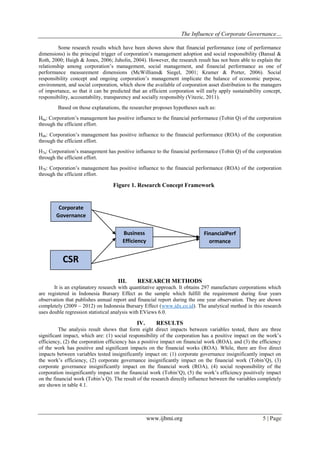
Based on those explanations, the researcher proposes hypotheses such as:
H6a: Corporation’s management has positive influence to the financial performance (Tobin Q) of the corporation
through the efficient effort.
H6b: Corporation’s management has positive influence to the financial performance (ROA) of the corporation
through the efficient effort.
H7a: Corporation’s management has positive influence to the financial performance (Tobin Q) of the corporation
through the efficient effort.
H7b: Corporation’s management has positive influence to the financial performance (ROA) of the corporation
through the efficient effort.
Figure 1. Research Concept Framework
III. RESEARCH METHODS
It is an explanatory research with quantitative approach. It obtains 297 manufacture corporations which
are registered in Indonesia Bursary Effect as the sample which fulfill the requirement during four years
observation that publishes annual report and financial report during the one year observation. They are shown
completely (2009 – 2012) on Indonesia Bursary Effect (www.idx.co.id). The analytical method in this research
uses double regression statistical analysis with EViews 6.0.
IV. RESULTS
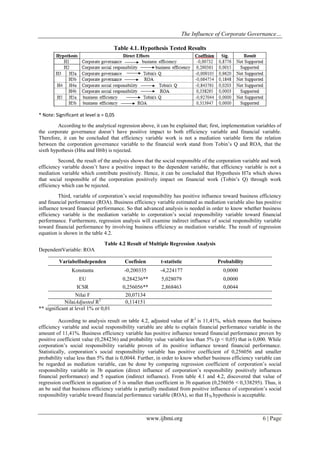
The analysis result shows that form eight direct impacts between variables tested, there are three
significant impact, which are: (1) social responsibility of the corporation has a positive impact on the work’s
efficiency, (2) the corporation efficiency has a positive impact on financial work (ROA), and (3) the efficiency
of the work has positive and significant impacts on the financial works (ROA). While, there are five direct
impacts between variables tested insignificantly impact on: (1) corporate governance insignificantly impact on
the work’s efficiency, (2) corporate governance insignificantly impact on the financial work (Tobin’Q), (3)
corporate governance insignificantly impact on the financial work (ROA), (4) social responsibility of the
corporation insignificantly impact on the financial work (Tobin’Q), (5) the work’s efficiency positively impact
on the financial work (Tobin’s Q). The result of the research directly influence between the variables completely
are shown in table 4.1.
Corporate
Governance
CSR
Business
Efficiency
FinancialPerf
ormance
The Influence of Corporate Governance…
www.ijbmi.org 6 | Page
Table 4.1. Hypothesis Tested Results
* Note: Significant at level α = 0,05
According to the analytical regression above, it can be explained that; first, implementation variables of
the corporate governance doesn’t have positive impact to both efficiency variable and financial variable.
Therefore, it can be concluded that efficiency variable work is not a mediation variable form the relation
between the corporation governance variable to the financial work stand from Tobin’s Q and ROA, that the
sixth hypothesis (H6a and H6b) is rejected.
Second, the result of the analysis shows that the social responsible of the corporation variable and work
efficiency variable doesn’t have a positive impact to the dependent variable, that efficiency variable is not a
mediation variable which contribute positively. Hence, it can be concluded that Hypothesis H7a which shows
that social responsible of the corporation positively impact on financial work (Tobin’s Q) through work
efficiency which can be rejected.
Third, variable of corporation’s social responsibility has positive influence toward business efficiency
and financial performance (ROA). Business efficiency variable estimated as mediation variable also has positive
influence toward financial performance. So that advanced analysis is needed in order to know whether business
efficiency variable is the mediation variable to corporation’s social responsibility variable toward financial
performance. Furthermore, regression analysis will examine indirect influence of social responsibility variable
toward financial performance by involving business efficiency as mediation variable. The result of regression
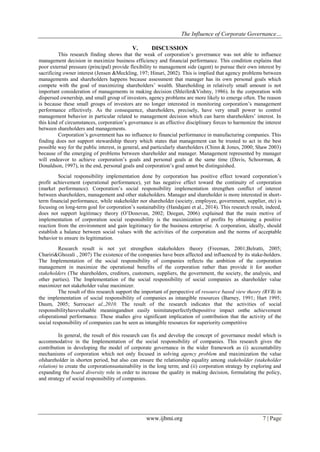
equation is shown in the table 4.2.
Table 4.2 Result of Multiple Regression Analysis
DependentVariable: ROA
VariabelIndependen Coefisien t-statistic Probability
Konstanta -0,200335 -4,224177 0,0000
EU 0,284236** 5,028079 0,0000
ICSR 0,256056** 2,868463 0,0044
Nilai F 20,07134
NilaiAdjusted R2
0,114151
** significant at level 1% or 0,01
According to analysis result on table 4.2, adjusted value of R2
is 11,41%, which means that business
efficiency variable and social responsibility variable are able to explain financial performance variable in the
amount of 11,41%. Business efficiency variable has positive influence toward financial performance proven by
positive coefficient value (0,284236) and probability value variable less than 5% (p < 0,05) that is 0,000. While
corporation’s social responsibility variable proven of its positive influence toward financial performance.
Statistically, corporation’s social responsibility variable has positive coefficient of 0,256056 and smaller
probability value less than 5% that is 0,0044. Further, in order to know whether business efficiency variable can
be regarded as mediation variable, can be done by comparing regression coefficient of corporation’s social
responsibility variable in 3b equation (direct influence of corporation’s responsibility positively influences
financial performance) and 5 equation (indirect influence). From table 4.1 and 4.2, discovered that value of
regression coefficient in equation of 5 is smaller than coefficient in 3b equation (0,256056 < 0,338295). Thus, it
an be said that business efficiency variable is partially mediated from positive influence of corporation’s social
responsibility variable toward financial performance variable (ROA), so that H7b hypothesis is acceptable.
The Influence of Corporate Governance…
www.ijbmi.org 7 | Page
V. DISCUSSION
This research finding shows that the weak of corporation’s governance was not able to influence
management decision in maximize business efficiency and financial performance. This condition explains that
poor external pressure (principal) provide flexibility to management side (agent) to pursue their own interest by
sacrificing owner interest (Jensen &Meckling, 197; Hinuri, 2002). This is implied that agency problems between
managements and shareholders happens because assessment that manager has its own personal goals which
compete with the goal of maximizing shareholders’ wealth. Shareholding in relatively small amount is not
important consideration of managements in making decision (Shleifer&Vishny, 1986). In the corporation with
dispersed ownership, and small group of investors, agency problems are more likely to emerge often. The reason
is because these small groups of investors are no longer interested in monitoring corporation’s management
performance effectively. As the consequence, shareholders, precisely, have very small power to control
management behavior in particular related to management decision which can harm shareholders’ interest. In
this kind of circumstances, corporation’s governance is an effective disciplinary forces to harmonize the interest
between shareholders and managements.
Corporation’s government has no influence to financial performance in manufacturing companies. This
finding does not support stewardship theory which states that management can be trusted to act in the best
possible way for the public interest, in general, and particularly shareholders (Chinn & Jones, 2000; Shaw 2003)
because of the emerging of problems between shareholder and manager. Management represented by manager
will endeavor to achieve corporation’s goals and personal goals at the same time (Davis, Schoorman, &
Donaldson, 1997), in the end, personal goals and corporation’s goal annot be distinguished.
Social responsibility implementation done by corporation has positive effect toward corporation’s
profit achievement (operational performance), yet has negative effect toward the continuity of corporation
(market performance). Corporation’s social responsibility implementation strengthen conflict of interest
between shareholders, management and other stakeholders. Manager and shareholder is more interested in short-
term financial performance, while stakeholder nor shareholder (society, employee, government, supplier, etc) is
focusing on long-term goal for corporation’s sustainability (Handajani et al., 2014). This research result, indeed,
does not support legitimacy theory (O’Donovan, 2002; Deegan, 2006) explained that the main motive of
implementation of corporation social responsibility is the maximization of profits by obtaining a positive
reaction from the environment and gain legitimacy for the business enterprise. A corporation, ideally, should
establish a balance between social values with the activities of the corporation and the norms of acceptable
behavior to ensure its legitimation.
Research result is not yet strengthen stakeholders theory (Freeman, 2001;Belratti, 2005;
Chariri&Ghozali , 2007) The existence of the companies have been affected and influenced by its stake-holders.
The Implementation of the social responsibility of companies reflects the ambition of the corporation
management in maximize the operational benefits of the corporation rather than provide it for another
stakeholders (The shareholders, creditors, customers, suppliers, the government, the society, the analysis, and
other parties). The Implementation of the social responsibility of social companies as shareholder value
maximizer not stakeholder value maximizer.
The result of this research support the important of perspective of resource based view theory (RVB) in
the implementation of social responsibility of companies as intangible resources (Barney, 1991; Hart 1995;
Daum, 2005; Surrocaet al.,2010. The result of the research indicates that the activities of social
responsibilityhavevaluable meaningandnot easily toimitateperfectlythepositive impact onthe achievement
ofoperational performance. These studies give significant implication of contribution that the activity of the
social responsibility of companies can be seen as intangible resources for superiority competitive
In general, the result of this research can fix and develop the concept of governance model which is
accommodative in the Implementation of the social responsibility of companies. This research gives the
contribution in developing the model of corporate governance in the wider framework as (i) accountability
mechanisms of corporation which not only focused in solving agency problem and maximization the value
ofshareholder in shorten period, but also can ensure the relationship equality among stakeholder (stakeholder
relation) to create the corporationsustainability in the long term; and (ii) corporation strategy by exploring and
expanding the board diversity role in order to increase the quality in making decision, formulating the policy,
and strategy of social responsibility of companies.
The Influence of Corporate Governance…
www.ijbmi.org 8 | Page
VI. CONCLUSION
The system of corporation which proxy by the individual shareholding whether it is direct or indirect
through the effort efficiency cannot increase the performance of corporation financial which measured with
ROA and Tobin’s Q. It portrays the weaknesses of governance corporate which the management policy not to
consider about the individual shareholding relativelysmall. The individual shareholding which concentrates in
ownership which is relatively small cannot increase the business efficiency or financial performance. The
argumentation is voting a right which is owned by the individual ownership do not enough to change/affect the
management performance whichhas establishedbusiness efficiencystrategytoimprove financial performance.
The practice of social responsibility of corporation as the corporation’s concern for the environment
and society can increase the business efficiency and operational performance of corporation (ROA), but give the
negative effect for the market performance. This finding shows that the purpose of the practice of social
responsibility of companies as the legitimate reason and to maintain reputation, however, the social
responsibility of companies cannot improve the market performance.
Financial performance of corporation can be increased by the practice of social responsibility of
companies and business efficiency. Companies which are applying the concept of social responsibility focused
on three main points, there are the economic purpose, environment and social. In other word, the industrial
assets of the corporation are used for economic purpose, environment and social. It will make the corporation to
be more efficient in allocating its resources. In the end, the efficiency which is owned by the corporation will
impact the increase of the financial performance. Efficient corporation can minimize the causes of inefficiency
and maximize the output and the performance of financial will be increase.
VII. FUTURE RESEARCH
Future research can develop the indicator which can reflect the system of companies, like Corporate
Governance Perception Index (CGPI); the institutional own and independent board composition. Then develop
the indicator which can reflect the social responsibility by using the primary data measurement or Global
Reporting Initiatives (GRI G4), considering that many companies has been reported the sustainability report and
refers to the GRI G4, and the development of financial performances indicator, like ROE as the achievement of
the corporation that can describe the corporation ability of profitability.
REFERENCES
[1]. Ahmed, S. U., Islam, Z. M., &Hasan, I. 2012. Corporate social responsibility and financial performance linkage: Evidence from
the banking sector of Bangladesh. Journal of Organizational Management, 1 (1): 14-21.
[2]. BadanPengawasPasar Modal. 2012. Annual Report 2012. Retrieved September 3, 2013, from
http://www.bapepam.go.id/pasar_modal/publikasi_pm/annual_report_pm/2012/AR-BAPEPAM-LK-2012.pdf
[3]. Bansal, P., & Roth, K. 2000. Why companies go green: A model of ecological responsiveness. Academy of Management
Journal, 43 (4): 717-736.
[4]. Barney, J. 1991. Firm resources and sustained competitive advantage. Journal ofManagement, 17 (1): 99-120.
[5]. Beltratti, A. 2005. The complementarity between corporate governance and corporate social responsibility. The Geneva Paper
30: 376-386.
[6]. Berger, A. N., & Humphrey, D. B. 1997. Efficiency of financial institutions: International survey and directions for future
research. European journal of operational research, 98(2):175-212
[7]. Berle, A., & Means, G. 1932. The modern corporation and private property. New York: MacMillan.
[8]. Bowlin, W. F. 1999. An analysis of the financial performance of defense business segments using data envelopment analysis.
Journal of Accounting and Public Policy, 18 (4): 287–310.
[9]. Byma, J. P., &Tauer, L. W. 2010. Exploring the role of managerial ability in influencing dairy farm efficiency. Agricultural and
Resource Economics Review, 39 (3): 505–516.
[10]. Chariri, A &Ghozali, I. 2007. Teoriakuntansi. Semarang: BadanPenerbitUniversitasDiponegoro.
[11]. Chinn, R., & Jones, M. E. 2000. Corporategovernance handbook. London: Gee Publising Ltd.
[12]. Crutchley, C. E., Garner, J. L., & Marshall, B. 2002. An examination of board stability and the long-term performance of initial
public offerings. Financial Management, 31(3): 63-90.
[13]. Daum, J. H. 2005. Intangible assets-based enterprise management: a practical approach. Proceedings of 2005 PMA IC
Symposium, Stern School of Business, New York University.
[14]. Davis, J. H., Schoorman, F. D., & Donaldson, L. 1997. Toward a stewardship theory of management. Academy of Management
review, 22(1): 20-47.
[15]. Deegan, C. 2006. Legitimacy theory. Methodological issues in accounting research: Theories and methods: 161-182.
[16]. Demsetz. H. 1983. The structure of ownership and the theory of the firm. Journal of Law and Economics, 26: 375-390.
[17]. Demsetz, H., & Lehn, K. 1985. The structure of corporate ownership: Causes and consequences. Journal of Political Economy,
93: 1155-1177.
[18]. Dharmastuti, C., &Wahyudi, S. 2013. The effectivity of internal and external corporate governance mechanisms towards
corporate performance. Research Journal of Finance and Accounting, 4(4): 132-139.
[19]. Diaz, M. A., & Sanchez, R. 2008. Firm size and productivity in Spain: A stochastic frontier analysis. Small Business Economics,
30 (3): 315-323.
[20]. Donaldson, T., & Preston, L. 1995. The stakeholder theory of the modern corporation: Concepts, evidence and implications.
Academy of Management Review, 20 (1):65-91.
The Influence of Corporate Governance…
www.ijbmi.org 9 | Page
[21]. Duncan, E., & Elliott, G. 2004. Efficiency, customer service and financial performance among Australian financial
institutions. International Journal of Bank Marketing, 22 (5): 319-342.
[22]. Earle, J. S., &Kucsera, C., &Telegdy, A. 2004. Ownership concentration and corporate performance on the Budapest stock
exchange: Do too many cooks spoil the goulash?.An International Review, 13: 254-264.
[23]. Ehsan, S., &Kaleem, A. 2012. An empirical investigation of the relationship between corporate social responsibility and financial
performance (evidence from manufacturing sector of Pakistan). Journal of Basic and Applied Scientific Research, 2 (3): 2909-
2922.
[24]. Fombrun, C. 1996, Reputation: Realizing value from the corporate image. Boston: Harvard Business School Press.
[25]. Freeman, R. E. 2001. Stakeholder theory of the modern corporation in Hoffman, W.M. from the chemical and business services
industries. Journal of Applied Business Research.
[26]. Freeman, R. E. 1984. Strategic management: A stakeholder approach. Boston: Pitman Publishing Inc.
[27]. Freeman, R. E., & Evan, W. M. 1990. Corporate governance: A stakeholder interpretation. Journalof Behavioral Economics, 19
(4): 337–359.
[28]. Golden, B. R., &Zajac, E. J. 2001. When will boards influence strategy? inclination x power = strategic change. Strategic
Management Journal, 22: 1087–1117.
[29]. Greenspan, A. 1999. Lessons from the global crises. World Bank Group and International Monetary Fund.
[30]. Greiling, D. 2006. Performance measurement: A remedy for increasing the efficiency of public services?.International Journal of
Productivity and Performance Management, 55 (6): 448 – 465.
[31]. Greiling, D. 2004. Quality Management. VS VerlagfürSozialwissenschaften.
[32]. Griffin, J. J., & Mahon, J. F. 1997. The corporate social performance and corporate financial performance debate twenty-five
years of incomparable research. Business & Society, 36(1): 5-31.
[33]. Haigh, M. & Jones, M. T. 2006. The drivers of corporate social responsibility: A critical review. The Business Review
Cambridge, 5 (2): 245-251.
[34]. Handajani, L., Subroto, B., Sutrisno, T., &Saraswati, E. 2014. Does board diversity matter on corporate social disclosure? an
Indonesian evidence. Journal of Economics and Sustainable Development, 5(9): 8-16.
[35]. Hart, S. 1995. A natural resource-based view of the firm. Academy of Management Review, 20: 986-1014.
[36]. Heal, G. 2005. Corporatesocial responsibility, an economic and financial framework. The Geneva Papers, 30: 387–409.
[37]. Hill, C. W., & Jones, T. M. 1992. Stakeholder‐agency theory. Journal of management studies, 29(2): 131-154.
[38]. Hinuri, H. 2002. The essence of good corporate governance. YayasanPendidikanPasar Modal Indonesia &Sinergy
Communication.
[39]. Jennings, P., &Zandbergen, P. 1995. Ecologically sustainable organizations: An institutional approach. Academy of Management
Review, 20: 1015–52.
[40]. Jensen, M. C., &Meckling, W. H. 1976. Theory of the firm: Managerial behavior, agency cost, and ownership structure. Journal
of FinancialEconomics, 3: 305–360.
[41]. Jones, T. M. 1995. Instrumental stakeholder theory: A synthesis of ethics and economic. Academy of Management Review, 20:
404-437.
[42]. Juholin, E. 2004. For business or the good of all? afinnish approach to corporate social responsibility. Corporate Governance 4
(3): 20–31.
[43]. Kapopoulos, P., &Lazaretou, S. 2006. Corporate ownership structure and performance: evidence from Greek firms. Corporate
Governance: An International Review, 15: 144-158.
[44]. Khiari, W., Karaa, A., &Omri, A. 2007. Corporate governance efficiency: An indexing approach using the
stochastic frontier analysis. Emerald Group Publishing Limited, 7 (2): 148-161.
[45]. Klapper, L. F., & Love, I. 2002. Corporate governance, investor protection, and performance in emerging markets. Policy
Research Working Paper, 1-38.
[46]. Kramer, M. R., & Porter, M. E. 2006. Strategy and society: The link between competitive advantage and corporate social
responsibility. Harvard Business Review, 85 (12): 78-92.
[47]. Lee, Y. H., Huang, Y. L., Hsu, S. S.,&Hung, C. H. 2013. Measuring the efficiency and the effect of corporate governance on the
biotechnology and medical equipment industries in Taiwan. International Journal of Economics and Financial Issues 3 (2): 662-
672.
[48]. Lindrawati, F., &Budianto. 2008. Pengaruhcorporate social responsibilityterhadapkinerjakeuanganperusahaan yang
terdaftarsebagai 100 best corporate citizens olehKLD research and analytics. MajalahEkonomi, 66-83.
[49]. Margolis, J. D., & Walsh, J. P. 2003. Misery loves companies: Rethinking social initiatives by business. Administrative Science
Quarterly, 48 (2): 268-305.
[50]. Matin, Y.A., Thagafian, H., Esapour, K., Alavi, M. A., &Farhoodi, A. 2011. A study of the relationship between corporate social
responsibility and firm financial performance. Australian Journal of Basic and Applied Sciences, 5 (12): 668-674.
[51]. McWilliams, A., & Siegel, D. 2000. Corporate social responsibility and financial performance: Correlation or
misspecification?.StrategicManagement Journal, 21 (5): 603–609.
[52]. McWilliams, A. & Siegel, D. 2001. Corporate social responsibility: A theory of the firm perspective. Academy of Management
Review, 26 (1): 117–127.
[53]. McWilliams, A., Siegel, D. S, & Wright, P. M. 2006. Corporate social responsibility: Strategic implications. Journal of
Management Studies, 43 (1): 1-18.
[54]. Murwaningsari, E. 2009. Hubungan corporate governance, corporate social responsibilities dan corporate financial performance
dalamsatu continuum. JurnalAkuntansidanKeuangan, 11(1): 30-41.
[55]. Nanka-Bruce, D. 2011. Corporate governance mechanism and firm efficiency. International Journal of Business and
Management, 6 (5): 28-40.
[56]. Neville, B. A., Bell, S. J., &Mengüç, B. 2005. Corporate reputation, stakeholders and the social performance-financial
performance relationship. European Journal of Marketing, 39(9/10):1184-1198.
[57]. O’Donovan, G. 2002. Environmental disclosures in the annual report: Extending the applicability and predictive power of
legitimacy theory. Accounting, Auditing & Accountability Journal, 15 (3): 344 – 371.
[58]. Oeyono, J., Samy, M., &Bampton, R. 2011. An examination of corporate social responsibility and financial performance: A
study of the top 50 Indonesian listed corporations. Journal of Global Responsibility, 2(1): 100-112.
[59]. Paul, C. J., & Siegel, D. S. 2006. Corporate social responsibility and economic performance. Journal of Productivity
Analysis, 26(3): 207-211.
The Influence of Corporate Governance…
www.ijbmi.org 10 | Page
[60]. Permana, D. M. R. A. 2013.
Kemampuanpengungkapantanggungjawabsosialperusahaandalammemoderasihubunganantarakinerjakeuangandengannilaiperusah
aanpadaperusahaan yang terdaftar di Kompas 100. Kumpulan Tesis Program PascasarjanaUniversitasUdayana, 1-95.
[61]. Podolny, J. M. 1993. A status-based model of market competition. American Journal of Sociology, 98: 829– 872.
[62]. Post, J. E., Preston, L. E., &Sauter-Sachs, S. 2002. Redefining the corporation: Stakeholder management and organizational
wealth. Stanford University Press.
[63]. Renneboog, L. 2000. Ownership, managerial control and the governance of companies listed on the brussels stock exchange.
Journal of Banking & Finance, 24 (12): 1959-1995.
[64]. Roberts, P. W., & Dowling, G. R. 2002. Corporate reputation and sustained superior financial performance. Strategic
Management Journal, 23 (12): 1077-1093.
[65]. Shahwan, T. M., & Hassan, Y. M. 2013. Efficiency analysis of UAE banks using data envelopment analysis. Journal of
Economic and Administrative Sciences, 29 (1): 4-20.
[66]. Shaw, J. C.2003.Corporate governance and risk : A system approach.New Jersey: John Wiley and Sons. Inc.
[67]. Shleifer, A. &Vishny, R. 1986. Large shareholders and corporation control. Journal of Political Economy, 94: 461–488.
[68]. Siregar, S. V., &Bachtiar, Y. 2010. Corporate social reporting: empirical evidence from Indonesia Stock Exchange. International
Journal of Islamic and Middle Eastern Finance and Management, 3(3): 241-252.
[69]. Stigler, G. J. 1976. The xistence of x-efficiency. The American Economic Review, 66 (1): 213-216.
[70]. Stuebs, M., & Sun, L. 2010. Business reputation and labor efficiency, productivity, and cost. Journal of Business Ethics, 96:
265–283.
[71]. Sun, L., &Stuebs, M. 2013. Corporate social responsibility and firm productivity: Evidence from the chemical industry in the
United States. Journal of business ethics, 118 (2): 251-263.
[72]. Suratno, I. B., Darsono, D., &Mutmainah, S. 2006. Pengaruh environmental performance terhadap environmental disclosure dan
economic performance (studiempirispadaperusahaanmanufaktur yang terdaftar di Bursa Efek Jakarta periode 2001-2004).
SimposiumNasionalAkuntansi9.
[73]. Surroca, J., Tribó, J. A., &Waddock, S. 2010. Corporate responsibility and financial performance: The role of intangible
resources. Strategic Management Journal, 31(5): 463-490.
[74]. Susanto, A. B. 2007. A strategic management approach: Corporate social responsibility. Cetakan I. Jakarta: The Jakarta
Consulting Group.
[75]. Tornyeva, K., &Wereko, T. 2012. Corporate governance and firm performance: Evidence from the insurance sector of
Ghana. European Journal of Business and Management, 4(13): 95-112.
[76]. Ujiyantho, M. A., &Pramuka, B. A. 2007. Mekanisme corporate governance,
manajemenlabadankinerjakeuangan. SimposiumNasionalAkuntansi X, 1-17.
[77]. Vilanova, M., Lozano, J. M., & Arenas, D. 2009. Exploring the nature of the relationship between corporate social responsibility
and competitiveness. Journal of Business Ethics, 87: 57–69.
[78]. Vitezić, N. 2011. Correlation between social responsibility and efficient performance in Croatian enterprises. Scientific
affiliation: business performance analysis and auditing, controlling, corporate social responsibility, 29 (2): 423-442.
[79]. Wang, J. L., Jeng, V., &Peng, J. L. 2007. The impact of corporate governance structure on the efficiency performance of
insurance companies in Taiwan. The International Association for the Study of Insurance Economics, 32: 264–282.
[80]. Windah, G. C., &Andono, F. A. 2013. Pengaruhpenerapan corporate governance terhadapkinerjakeuanganperusahaanhasilsurvei
The Indonesian Institute Perception Governance (IICG) periode 2008-2011. CALYPTRA: JurnalIlmiahMahasiswaUniversitas
Surabaya, 2(1).
[81]. Zahra, S. A. & Pearce, J. 1989. Boards of directors and corporate financial performance: A review and integrated model. Journal
of Management, 15: 291-334.
[82]. Zhuang, J., Edwards, D., Webb, D. C., &Capulong, M. 2000. Corporate Governance and Finance in East Asia: A study of
Indonesia, Republic of Korea, Malaysia, Philipphines, and Thailand. Asian Development Bank, 1.

The Influence of Corporate Governance and Corporate Social Responsibility on Financial Performancewith Efficiency as Mediating Variable

  • 1.
    International Journal ofBusiness and Management Invention ISSN (Online): 2319 – 8028, ISSN (Print): 2319 – 801X www.ijbmi.org || Volume 4 Issue 5|| May. 2015 || PP-01-10 www.ijbmi.org 1 | Page The Influence of Corporate Governance and Corporate Social Responsibility on Financial Performancewith Efficiency as Mediating Variable Hisnol Jamali1 , Sutrisno T2 , Imam Subekti3 , Prihat Assih4 1( Departmentof Accounting, School of Economics STIE AMKOP Makassar, Indonesia) 2, 3, 4( Faculty of Economics and Business University of Brawijaya, Malang, Indonesia) ABSTRACT :The purpose of this research was to investigate and analyze the direct effect of corporate governance and corporate social responsibility on financial performance and their indirect effect through efficiency. This research used quantitative approach with samples of manufacturing firms which were selected using purposive sampling that listed in Indonesia Stock Exchange. There were 297 observations years-firms (2009-2012). The results of this research showed that corporate governance didn’t have effect on financial performance (ROA &Tobins Q), neither direct nor indirect effect through efficiency. In contrast, there was empirical evidence that corporate social responsibility has positive influence on financial performance (ROA), either direct or indirect effect through efficiency. However, corporate social responsibility has negative effect on financial performance (Tobins Q), either direct or indirect effect through efficiency. KEYWORDS:Corporate governance, corporate social responsibility, business efficiency, financial performance. I. INTRODUCTION Financial crisis around Asia created some macros economic challenge in the development of industrial manufacture in Indonesia. Percentage of pure profit of big Industrial manufacture and break since 2008 to 2011 run to fluctuate and tend to decline (the Capital Market, 2012). It shows that the industrial manufacture of Indonesia is less than optimal in accomplishing industrial operation based on financial performance as the fundamental aspect from real industrial condition (Permana, 2013). Research done by Asian Development Bank (ADB) identified the absence of optimal accomplishment of industrial operation because of economic crisis as the impact of “corporate governance” weak (Greenspan, 1999; Zhuanget al., 2000). Corporate governance considered the harmonious of the importance of corporate governance with the owners of other importances. It shows that corporate governance is based on theory of agency (Jensen & Meckling, 1976). This theory considered that corporate governance as a very important side which have to be watched and and reins with a certain rule. Beside, corporate governance has an authority to operate the industry based on its capability. In this case, the implementation of corporate governance is also based on the stewardship theory which contemplate a trusted management to act well for the importance of public in general and especially for the shareholders (Chin & Jones, 2000; Shaw, 2003). Consistent with the stakeholders which was explained that the corporation manager have to had a satisfying result for all of the important people in the corporation (such as: employee, customers, supplier and society organizations) which can affected the outcome of the corporation (Freeman, 1984). It shows that a corporation should not only focused the purposes on the importance of shareholders or corporation owners, but also to the importance of non-financial stakeholders who can attracted the corporation (McWilliams, Siegel & Wright, 2006). This activity is a realization of moral dimension and industrial ethics in running a business activity (Donaldson & Preston, 1995). Financial performance is related with revealing corporation’s social responsibility (Beltratti, 2005) where the customers will pay more for things and service produced by the responsible process socially. Practice of social responsibility as a concern of a corporation to the environment including society around it, so that the environment will not think that the corporation not only oriented in creating profit, but it is balance through the people and planet or environment continuously based on the procedure (Susanto, 2007; Margolis & Walsh, 2003). According to Jenning&Zandbergen (1995) that a corporation has a role as institution should be able to apply the principal of “ecologically sustainable organization”, dimension of responsibility to the environment is one of thing that found on institutional theory in applying corporation social responsibility (Jones, 1995).
  • 2.
    The Influence ofCorporate Governance… www.ijbmi.org 2 | Page A corporation should able to run the function as an organization with motive business also able to run the social role in society, implementing the responsibility ethics (such as corporation social responsibility) as a strategy to increase social performance from corporation (Handajaniet al., 2014). It was supported by theory of legitimacy in applying social responsibility (O’Donovan, 2002; Deegan, 2006). This theory shows the certain aspect from transformational leadership will have positive correlations with the corporation abilities to apply the corporation social responsibility in the strategic activity. Accomplishing profit still become the first purpose of corporation from the applied social responsibility. At the strategic level, a corporation which applied social responsibility can be seen from the perspective theory resource-based-view (RBV) (Post, Preston &Sauter-Sachs, 2002; Neville et al., 2005). McWilliams & Siegel (2001) used RBV which is connected with Theory-of-the-firm in formatting model “maximizing profit” social responsibility. In this model, the corporation manager analyzed cost-benefit to decide the level of resource in implementing social responsible activity. Applying Theory-of-the-firm in the social responsibility give some strategic implications become component of integral strategy differentiation of corporation and RBV logic on the social responsibility which probably make the corporation has model invest of social responsibility among corporation and industry (McWilliams et al., 2006). Responsibility of social corporation policy as the resource of intangible asset relational capital which is be the value relation of corporation with the side of external corporation (stakeholder) (Daum, 2005). Specific empirical experiment examined the relation/influence corporation governance and social responsibility through the relative efficiency is limited (Greiling, 2006; Nanka-Bruce, 2011). It happens because a different opinions is the efficiency of the corporation affected by internal factor of the corporation or there is an external factor which also play a role in maximizing the operation level of the corporation (Berle& Means, 1932; Demsetz, 1983; and Demsetz& Lehn, 1985). Fact shows that a modern corporation operating the large industrial environment even the border among countries, so that the internal-external corporationlimits become very thin in differences. Also the stakeholders-agency who are more critical in behaving operation corporation such as, product quality, service, eco-labeling, open information corporation, etc. that’s why, a corporation should be struggle to solve and balanced this multiple-stakeholder claim. Instrumental stakeholder theory stated that satisfied of various groups of stakeholder-agency is the instrument to achieve financial performance organization. On the other hand, stakeholder-agency theory stated that negotiation and contract implicit and explicit to decide conditionally the reciprocal relation between management-stakeholder functioned as monitoring mechanism to avoid manager replaced his attention from the purpose of corporation money (Hill & Jones, 1992; Jones 1995). Freeman & Evan (1990) stated that manager can increase their organization efficiency adaptation through the external claim. Consistent with what Freeman & Evan (1990) was thought, this experiment has main motivation to use size of corporation efficiency as a variable which mediate relation between corporation governance and social responsibility with financial performance corporation. Some research has shown that financial performance (one of performance dimension) is the main factor of social responsibility adoption and corporation governance (Bansal & Roth, 2000; Haigh & Jones, 2006; Juholin, 2004), but the result of the research is not able to explain the relation between corporation governance, social responsibility, and financial performance yet as one of the dimension measurement (McWilliams & Siegel, 2001; Kramer & Porter, 2006). It shows the research probability by inserting efficiency variable as meditation variable. The use of efficiency as variable meditation also to be based on Hart (1995) opinion which stated that for certain corporation, the social responsibility can be in the form of source or capability which aimed to the continuous competitive superiority. Because of the use of corporation source at the maximum level will be end at the corporation ability to increase the social responsibility. Optimalization of those sources needs managerial ability to decide the technology use ad invest which needs before deciding allocation source to the corporation stakeholder-agency, so that the managerial ability in maximize the efficiency of corporation source use will affect the financial performance corporation. II. REVIEW OF THEORY AND HYPOTHESIS 2.1. The influence of corporate governance and social responsibility on workefficiency The testing on the influence of corporate governance on efficiency is especially based on the agency theory. It is because the management of the corporation has an important role in determining the level of the efficiency of the corporation. The management side which act as an agent will make an operational decision which give benefit for both principal’s importance and other stakeholders. The result of the research shows that corporate governance significantly has an impact to the level of the corporation’s efficiency (Early, et al., 2004, Kapopoulus&Lazeretou, 2006; Nanka-Bruce, 2001).
  • 3.
    The Influence ofCorporate Governance… www.ijbmi.org 3 | Page The spread of the great share ownership will have a potency to decrease the control value and the ownership division, which cause a negative relationship between the share ownership which is spread and the corporate governance (Berle& Means, 1932). The research result by Earle et al. (2004); Kapopulus&Lazaretou (2006) and Nanka-Bruce (2011) reveals the positive impact of the ownership concentration to corporation’s efficiency. Afterwards, some empirical researches shows a significant positive relation between the size of the managerial council and the corporation’s efficiency (Zahra & Pearce, 1989; Renneborg, 2000; Golden &Zajac, 2001; Cruthley et al., 2002 ;Khiari et al., 2007; Lee et al., 2013). The research result by Wang et al (2007) shows that thoroughly, corporation governance has an important role in insurance industry in Taiwan. Wang, et al (2007) proves that internal ownership, cash-flow rights, and the existence of external commissioner gives a positive impact on the insurance industry in Taiwan. Therefore, the hypothesis which are proposed: H1: corporation governance has a positive impact on the work’s efficiency. According to the legitimation theory perspective, a corporation adopt a social responsibility report to legitimate its operation, when the business entity seems have done many penalties to the norms and society’s expectation (O’Donovan, 2002). According to legitimation perspective, a decision to increase or decrease the invest of the corporation’s social responsibility can be grounded by various strategies, self-serving and discretionary choices which give management contractual benefit or strategy to defend its position in the corporation Stuebs and Sun’s (2010) result proves that the activity of the corporation’s social responsibility positively relates to the increase of the efficiency. Vitezic research result (2011) which is about the relationship between social and efficiency show that the corporation which has applied social responsibility has the better efficiency level. Furthermore, Sun &Stueb (2013) find a proof that the activity of social responsibility leads the corporation to chemistry industry, and it reaches the higher productivity. Therefore, this research proposes a hypothesis: H2: The social responsibility of corporation positively influences to the effort efficiency. 2.2. The Influence of Corporation’s Management and Social Responsibility to Financial Performance One of theoretical principle underlying corporation management issue is the theory of agency which is developed by Jansen &Meckling (1976) with the separation concept between the ownership and control. The problem of agency emerges because the manager’s action does not always support the importance of the fund supplier, some of their actions is not similar to the principle importance. Some empirical researches (Windah&Andono, 2013; Dharmastuti&Wahyudi, 2013; Tornyewa&Wereko, 2012) give a n evidence that there is positive relation between the practice of good management corporation and the corporation’s performance. Tornyeva&Wareko (2012) shows that the size of great council, council expertise, management expertise, being long CEO, the size of audit committee, the independency of audit committee, foreign ownership, institutional ownership, dividend policy and general meeting in each year have a passive relation to the financial performance in an insurance corporation at Ghana. Insurance companies are urged to adopt the management practice of corporation to improve their financial performance and also protect the importance of the shares holder. Dharmastuti&Wahyudi (2013) shows that the corporation’s management external which is measured by independent commissioner ratio and debt holder ha in Indonesia has the higher effectiveness than corporation’s management internal which is measured by the independent commissioner ratio to the corporation’s performance. The finding research has similarity to the research result Ujiyantho&Pramuka (2007) that the corporation’s management. On the other hand, Murwaningsri’s research result (2009) in the public corporation which is in the Central Reference of Modal Market (PRPM) of Indonesian stock exchange which shows corporation’s management measured by managerial and institutional ownership significantly influences to the financial performance measured by Tobin’s-Q. This finding is consistent with the research result of Keppler& Love (2002) which experiments the relation between the corporation’s management with investor protection and corporation’s performance which is listed in the modal market of development country. The corporation’s performance is measured by Tobin’s-Q and ROA. The research result shows that the corporation’s management has significant influence to the corporation’s performance which is measured by Tobin’s-Q or ROA. Based on the explanation above, this research proposes hypothesis such as: H3a: Corporation management has positive influence to the financial performance (Tobin’s Q) of the corporation. H3b: Corporation management has positive influence to the financial performance (ROA) of the corporation.
  • 4.
    The Influence ofCorporate Governance… www.ijbmi.org 4 | Page Empirical research which analyses the relationship of social responsibility and corporation performance shows the variable result. The research finding of Ahmed et al. (2000) shows that social responsibility of corporation does not relate directly to the financial performance of corporation. Furthermore, the other research finding gives a proof that social responsibility has positive impact to the financial performance (Ehsan&Kaleem, 2002); Oeyonoet al., 2011; Siregar&Bachtiar, (2010). Furthermore, the research result of Martin et al. (2011) and Griffin & Mahon (1997) shows that the social performance of corporation does not correlate to the corporation’s financial performance. Heal (2005) proposes that social responsibility applying can be a key factor which gives the advantages to the corporation, if the social responsibility is viewed as a strategy which can minimize a risk and maintain the relationship among the importance managers so that it can gives a long contribution of corporation. The research of Paul & Siegel (2006), shows that social responsibility applying has productive impact which is significant to the efficiency, technical change, and corporation’s economy scale. In Indonesian research, the positive and significant relation between social responsibility and performance is shown in a research doing Lindrawati&Budianto (2008) that a corporation applying of social responsibility well can also have well performance. The research result has a similarity to research findings of Suratno, Darsono, &Siti (2006) that the impact of environmental expressing has positive and significant influence to the environmental performance. Based on those explanations, the hypotheses can be formulated as: H4a: Social responsibility has positive influence to the financial performance (Tobin Q) of corporation H4b: Social responsibility has positive influence to the financial performance (ROA) of corporation. 2.3. The Efficient Effort Influence of Financial Performance Some empirical researches prove the efficient effort influence to the financial performance. This research is based on the thought that to increase the financial performance, the corporation needs to do the efficient effort. The higher efficient effort will be able to increase the corporation’s financial performance. The research result of Berger &Humprhey (1997) concludes that the various efficient methods do not always result a consistent result and suggest some ways of the method which can be improved to lead more consistent, more accurate, and more beneficial finding. Additionally, the research result of Ducan& Eliot (2004) proves that there is positive relationship between efficient effort and financial performance (ROA and Capital Adequacy). Then, the research result of Greiling (2004) adds that efficient effort which is done by public sector organization is able to increase the financial performance of public sector corporation. Based on the empirical proof, this research proposes the hypotheses: H5a: Efficient effort has positive influence to the financial performance (Tobin Q) H5b: Efficient effort has positive influence to the financial performance (ROA) 2.4 The Influence of Corporation’s Management and Social Responsibility to Financial Performance Mediated Efficient Effort Business world challenge facing a strict environment rivalry demands the corporation to increase the efficiency. The business corporation tries to operate efficiently to hold the fund, to maximize productivity, and to restrain performance. Strategy management strategy expresses that the good corporation’s reputation can create an efficient competitive superiority for the corporation (Fombrun, 1996; Roberts & Dowling, 2002; Podolny, 1993). The research result of Vilanoveet al. (2009) shows five performance dimensions which have power competence such as financial performance quality, efficiency, and productivity, innovation and image. The five dimensions are appropriate for factual scope of operational working now which obligates to have superior competitive. Hart (1995) says that corporation’s social responsibility can be a resource or capability which leads to ongoing competitive superiority. Therefore, the resource use of the corporation at maximum level will be ended in the corporation’s ability to increase the social responsibility. The maximum use of resource needs managerial ability to decide the technology use and investment needed before the allocation decision of resource to the manager of corporation’s importance. Stigler (1976) says that managerial ability is one of particular input of some corporation resource which can be distributed as an input. Managerial ability of maximizing the efficiency of corporation resource use will give an influence of corporation’s financial performance (Bowlin, 1999; Diaz &Sanches, 2008; Byma&Tauer, 2010; Shahwan& Hassan, 2013).
  • 5.
    The Influence ofCorporate Governance… www.ijbmi.org 5 | Page Some research results which have been shown show that financial performance (one of performance dimensions) is the principal trigger of corporation’s management adoption and social responsibility (Bansal & Roth, 2000; Haigh & Jones, 2006; Juholin, 2004). However, the research result has not been able to explain the relationship among corporation’s management, social management, and financial performance as one of performance measurement dimensions (McWillians& Siegel, 2001; Kramer & Porter, 2006). Social responsibility concept and ongoing corporation’s management implicate the balance of economic purpose, environment, and social corporation, which show the available of corporation asset distribution to the managers of importance, so that it can be predicted that an efficient corporation will early apply sustainability concept, responsibility, accountability, transparency and socially responsibly (Vitezic, 2011). Based on those explanations, the researcher proposes hypotheses such as: H6a: Corporation’s management has positive influence to the financial performance (Tobin Q) of the corporation through the efficient effort. H6b: Corporation’s management has positive influence to the financial performance (ROA) of the corporation through the efficient effort. H7a: Corporation’s management has positive influence to the financial performance (Tobin Q) of the corporation through the efficient effort. H7b: Corporation’s management has positive influence to the financial performance (ROA) of the corporation through the efficient effort. Figure 1. Research Concept Framework III. RESEARCH METHODS It is an explanatory research with quantitative approach. It obtains 297 manufacture corporations which are registered in Indonesia Bursary Effect as the sample which fulfill the requirement during four years observation that publishes annual report and financial report during the one year observation. They are shown completely (2009 – 2012) on Indonesia Bursary Effect (www.idx.co.id). The analytical method in this research uses double regression statistical analysis with EViews 6.0. IV. RESULTS The analysis result shows that form eight direct impacts between variables tested, there are three significant impact, which are: (1) social responsibility of the corporation has a positive impact on the work’s efficiency, (2) the corporation efficiency has a positive impact on financial work (ROA), and (3) the efficiency of the work has positive and significant impacts on the financial works (ROA). While, there are five direct impacts between variables tested insignificantly impact on: (1) corporate governance insignificantly impact on the work’s efficiency, (2) corporate governance insignificantly impact on the financial work (Tobin’Q), (3) corporate governance insignificantly impact on the financial work (ROA), (4) social responsibility of the corporation insignificantly impact on the financial work (Tobin’Q), (5) the work’s efficiency positively impact on the financial work (Tobin’s Q). The result of the research directly influence between the variables completely are shown in table 4.1. Corporate Governance CSR Business Efficiency FinancialPerf ormance
  • 6.
    The Influence ofCorporate Governance… www.ijbmi.org 6 | Page Table 4.1. Hypothesis Tested Results * Note: Significant at level α = 0,05 According to the analytical regression above, it can be explained that; first, implementation variables of the corporate governance doesn’t have positive impact to both efficiency variable and financial variable. Therefore, it can be concluded that efficiency variable work is not a mediation variable form the relation between the corporation governance variable to the financial work stand from Tobin’s Q and ROA, that the sixth hypothesis (H6a and H6b) is rejected. Second, the result of the analysis shows that the social responsible of the corporation variable and work efficiency variable doesn’t have a positive impact to the dependent variable, that efficiency variable is not a mediation variable which contribute positively. Hence, it can be concluded that Hypothesis H7a which shows that social responsible of the corporation positively impact on financial work (Tobin’s Q) through work efficiency which can be rejected. Third, variable of corporation’s social responsibility has positive influence toward business efficiency and financial performance (ROA). Business efficiency variable estimated as mediation variable also has positive influence toward financial performance. So that advanced analysis is needed in order to know whether business efficiency variable is the mediation variable to corporation’s social responsibility variable toward financial performance. Furthermore, regression analysis will examine indirect influence of social responsibility variable toward financial performance by involving business efficiency as mediation variable. The result of regression equation is shown in the table 4.2. Table 4.2 Result of Multiple Regression Analysis DependentVariable: ROA VariabelIndependen Coefisien t-statistic Probability Konstanta -0,200335 -4,224177 0,0000 EU 0,284236** 5,028079 0,0000 ICSR 0,256056** 2,868463 0,0044 Nilai F 20,07134 NilaiAdjusted R2 0,114151 ** significant at level 1% or 0,01 According to analysis result on table 4.2, adjusted value of R2 is 11,41%, which means that business efficiency variable and social responsibility variable are able to explain financial performance variable in the amount of 11,41%. Business efficiency variable has positive influence toward financial performance proven by positive coefficient value (0,284236) and probability value variable less than 5% (p < 0,05) that is 0,000. While corporation’s social responsibility variable proven of its positive influence toward financial performance. Statistically, corporation’s social responsibility variable has positive coefficient of 0,256056 and smaller probability value less than 5% that is 0,0044. Further, in order to know whether business efficiency variable can be regarded as mediation variable, can be done by comparing regression coefficient of corporation’s social responsibility variable in 3b equation (direct influence of corporation’s responsibility positively influences financial performance) and 5 equation (indirect influence). From table 4.1 and 4.2, discovered that value of regression coefficient in equation of 5 is smaller than coefficient in 3b equation (0,256056 < 0,338295). Thus, it an be said that business efficiency variable is partially mediated from positive influence of corporation’s social responsibility variable toward financial performance variable (ROA), so that H7b hypothesis is acceptable.
  • 7.
    The Influence ofCorporate Governance… www.ijbmi.org 7 | Page V. DISCUSSION This research finding shows that the weak of corporation’s governance was not able to influence management decision in maximize business efficiency and financial performance. This condition explains that poor external pressure (principal) provide flexibility to management side (agent) to pursue their own interest by sacrificing owner interest (Jensen &Meckling, 197; Hinuri, 2002). This is implied that agency problems between managements and shareholders happens because assessment that manager has its own personal goals which compete with the goal of maximizing shareholders’ wealth. Shareholding in relatively small amount is not important consideration of managements in making decision (Shleifer&Vishny, 1986). In the corporation with dispersed ownership, and small group of investors, agency problems are more likely to emerge often. The reason is because these small groups of investors are no longer interested in monitoring corporation’s management performance effectively. As the consequence, shareholders, precisely, have very small power to control management behavior in particular related to management decision which can harm shareholders’ interest. In this kind of circumstances, corporation’s governance is an effective disciplinary forces to harmonize the interest between shareholders and managements. Corporation’s government has no influence to financial performance in manufacturing companies. This finding does not support stewardship theory which states that management can be trusted to act in the best possible way for the public interest, in general, and particularly shareholders (Chinn & Jones, 2000; Shaw 2003) because of the emerging of problems between shareholder and manager. Management represented by manager will endeavor to achieve corporation’s goals and personal goals at the same time (Davis, Schoorman, & Donaldson, 1997), in the end, personal goals and corporation’s goal annot be distinguished. Social responsibility implementation done by corporation has positive effect toward corporation’s profit achievement (operational performance), yet has negative effect toward the continuity of corporation (market performance). Corporation’s social responsibility implementation strengthen conflict of interest between shareholders, management and other stakeholders. Manager and shareholder is more interested in short- term financial performance, while stakeholder nor shareholder (society, employee, government, supplier, etc) is focusing on long-term goal for corporation’s sustainability (Handajani et al., 2014). This research result, indeed, does not support legitimacy theory (O’Donovan, 2002; Deegan, 2006) explained that the main motive of implementation of corporation social responsibility is the maximization of profits by obtaining a positive reaction from the environment and gain legitimacy for the business enterprise. A corporation, ideally, should establish a balance between social values with the activities of the corporation and the norms of acceptable behavior to ensure its legitimation. Research result is not yet strengthen stakeholders theory (Freeman, 2001;Belratti, 2005; Chariri&Ghozali , 2007) The existence of the companies have been affected and influenced by its stake-holders. The Implementation of the social responsibility of companies reflects the ambition of the corporation management in maximize the operational benefits of the corporation rather than provide it for another stakeholders (The shareholders, creditors, customers, suppliers, the government, the society, the analysis, and other parties). The Implementation of the social responsibility of social companies as shareholder value maximizer not stakeholder value maximizer. The result of this research support the important of perspective of resource based view theory (RVB) in the implementation of social responsibility of companies as intangible resources (Barney, 1991; Hart 1995; Daum, 2005; Surrocaet al.,2010. The result of the research indicates that the activities of social responsibilityhavevaluable meaningandnot easily toimitateperfectlythepositive impact onthe achievement ofoperational performance. These studies give significant implication of contribution that the activity of the social responsibility of companies can be seen as intangible resources for superiority competitive In general, the result of this research can fix and develop the concept of governance model which is accommodative in the Implementation of the social responsibility of companies. This research gives the contribution in developing the model of corporate governance in the wider framework as (i) accountability mechanisms of corporation which not only focused in solving agency problem and maximization the value ofshareholder in shorten period, but also can ensure the relationship equality among stakeholder (stakeholder relation) to create the corporationsustainability in the long term; and (ii) corporation strategy by exploring and expanding the board diversity role in order to increase the quality in making decision, formulating the policy, and strategy of social responsibility of companies.
  • 8.
    The Influence ofCorporate Governance… www.ijbmi.org 8 | Page VI. CONCLUSION The system of corporation which proxy by the individual shareholding whether it is direct or indirect through the effort efficiency cannot increase the performance of corporation financial which measured with ROA and Tobin’s Q. It portrays the weaknesses of governance corporate which the management policy not to consider about the individual shareholding relativelysmall. The individual shareholding which concentrates in ownership which is relatively small cannot increase the business efficiency or financial performance. The argumentation is voting a right which is owned by the individual ownership do not enough to change/affect the management performance whichhas establishedbusiness efficiencystrategytoimprove financial performance. The practice of social responsibility of corporation as the corporation’s concern for the environment and society can increase the business efficiency and operational performance of corporation (ROA), but give the negative effect for the market performance. This finding shows that the purpose of the practice of social responsibility of companies as the legitimate reason and to maintain reputation, however, the social responsibility of companies cannot improve the market performance. Financial performance of corporation can be increased by the practice of social responsibility of companies and business efficiency. Companies which are applying the concept of social responsibility focused on three main points, there are the economic purpose, environment and social. In other word, the industrial assets of the corporation are used for economic purpose, environment and social. It will make the corporation to be more efficient in allocating its resources. In the end, the efficiency which is owned by the corporation will impact the increase of the financial performance. Efficient corporation can minimize the causes of inefficiency and maximize the output and the performance of financial will be increase. VII. FUTURE RESEARCH Future research can develop the indicator which can reflect the system of companies, like Corporate Governance Perception Index (CGPI); the institutional own and independent board composition. Then develop the indicator which can reflect the social responsibility by using the primary data measurement or Global Reporting Initiatives (GRI G4), considering that many companies has been reported the sustainability report and refers to the GRI G4, and the development of financial performances indicator, like ROE as the achievement of the corporation that can describe the corporation ability of profitability. REFERENCES [1]. Ahmed, S. U., Islam, Z. M., &Hasan, I. 2012. Corporate social responsibility and financial performance linkage: Evidence from the banking sector of Bangladesh. Journal of Organizational Management, 1 (1): 14-21. [2]. BadanPengawasPasar Modal. 2012. Annual Report 2012. Retrieved September 3, 2013, from http://www.bapepam.go.id/pasar_modal/publikasi_pm/annual_report_pm/2012/AR-BAPEPAM-LK-2012.pdf [3]. Bansal, P., & Roth, K. 2000. Why companies go green: A model of ecological responsiveness. Academy of Management Journal, 43 (4): 717-736. [4]. Barney, J. 1991. Firm resources and sustained competitive advantage. Journal ofManagement, 17 (1): 99-120. [5]. Beltratti, A. 2005. The complementarity between corporate governance and corporate social responsibility. The Geneva Paper 30: 376-386. [6]. Berger, A. N., & Humphrey, D. B. 1997. Efficiency of financial institutions: International survey and directions for future research. European journal of operational research, 98(2):175-212 [7]. Berle, A., & Means, G. 1932. The modern corporation and private property. New York: MacMillan. [8]. Bowlin, W. F. 1999. An analysis of the financial performance of defense business segments using data envelopment analysis. Journal of Accounting and Public Policy, 18 (4): 287–310. [9]. Byma, J. P., &Tauer, L. W. 2010. Exploring the role of managerial ability in influencing dairy farm efficiency. Agricultural and Resource Economics Review, 39 (3): 505–516. [10]. Chariri, A &Ghozali, I. 2007. Teoriakuntansi. Semarang: BadanPenerbitUniversitasDiponegoro. [11]. Chinn, R., & Jones, M. E. 2000. Corporategovernance handbook. London: Gee Publising Ltd. [12]. Crutchley, C. E., Garner, J. L., & Marshall, B. 2002. An examination of board stability and the long-term performance of initial public offerings. Financial Management, 31(3): 63-90. [13]. Daum, J. H. 2005. Intangible assets-based enterprise management: a practical approach. Proceedings of 2005 PMA IC Symposium, Stern School of Business, New York University. [14]. Davis, J. H., Schoorman, F. D., & Donaldson, L. 1997. Toward a stewardship theory of management. Academy of Management review, 22(1): 20-47. [15]. Deegan, C. 2006. Legitimacy theory. Methodological issues in accounting research: Theories and methods: 161-182. [16]. Demsetz. H. 1983. The structure of ownership and the theory of the firm. Journal of Law and Economics, 26: 375-390. [17]. Demsetz, H., & Lehn, K. 1985. The structure of corporate ownership: Causes and consequences. Journal of Political Economy, 93: 1155-1177. [18]. Dharmastuti, C., &Wahyudi, S. 2013. The effectivity of internal and external corporate governance mechanisms towards corporate performance. Research Journal of Finance and Accounting, 4(4): 132-139. [19]. Diaz, M. A., & Sanchez, R. 2008. Firm size and productivity in Spain: A stochastic frontier analysis. Small Business Economics, 30 (3): 315-323. [20]. Donaldson, T., & Preston, L. 1995. The stakeholder theory of the modern corporation: Concepts, evidence and implications. Academy of Management Review, 20 (1):65-91.
  • 9.
    The Influence ofCorporate Governance… www.ijbmi.org 9 | Page [21]. Duncan, E., & Elliott, G. 2004. Efficiency, customer service and financial performance among Australian financial institutions. International Journal of Bank Marketing, 22 (5): 319-342. [22]. Earle, J. S., &Kucsera, C., &Telegdy, A. 2004. Ownership concentration and corporate performance on the Budapest stock exchange: Do too many cooks spoil the goulash?.An International Review, 13: 254-264. [23]. Ehsan, S., &Kaleem, A. 2012. An empirical investigation of the relationship between corporate social responsibility and financial performance (evidence from manufacturing sector of Pakistan). Journal of Basic and Applied Scientific Research, 2 (3): 2909- 2922. [24]. Fombrun, C. 1996, Reputation: Realizing value from the corporate image. Boston: Harvard Business School Press. [25]. Freeman, R. E. 2001. Stakeholder theory of the modern corporation in Hoffman, W.M. from the chemical and business services industries. Journal of Applied Business Research. [26]. Freeman, R. E. 1984. Strategic management: A stakeholder approach. Boston: Pitman Publishing Inc. [27]. Freeman, R. E., & Evan, W. M. 1990. Corporate governance: A stakeholder interpretation. Journalof Behavioral Economics, 19 (4): 337–359. [28]. Golden, B. R., &Zajac, E. J. 2001. When will boards influence strategy? inclination x power = strategic change. Strategic Management Journal, 22: 1087–1117. [29]. Greenspan, A. 1999. Lessons from the global crises. World Bank Group and International Monetary Fund. [30]. Greiling, D. 2006. Performance measurement: A remedy for increasing the efficiency of public services?.International Journal of Productivity and Performance Management, 55 (6): 448 – 465. [31]. Greiling, D. 2004. Quality Management. VS VerlagfürSozialwissenschaften. [32]. Griffin, J. J., & Mahon, J. F. 1997. The corporate social performance and corporate financial performance debate twenty-five years of incomparable research. Business & Society, 36(1): 5-31. [33]. Haigh, M. & Jones, M. T. 2006. The drivers of corporate social responsibility: A critical review. The Business Review Cambridge, 5 (2): 245-251. [34]. Handajani, L., Subroto, B., Sutrisno, T., &Saraswati, E. 2014. Does board diversity matter on corporate social disclosure? an Indonesian evidence. Journal of Economics and Sustainable Development, 5(9): 8-16. [35]. Hart, S. 1995. A natural resource-based view of the firm. Academy of Management Review, 20: 986-1014. [36]. Heal, G. 2005. Corporatesocial responsibility, an economic and financial framework. The Geneva Papers, 30: 387–409. [37]. Hill, C. W., & Jones, T. M. 1992. Stakeholder‐agency theory. Journal of management studies, 29(2): 131-154. [38]. Hinuri, H. 2002. The essence of good corporate governance. YayasanPendidikanPasar Modal Indonesia &Sinergy Communication. [39]. Jennings, P., &Zandbergen, P. 1995. Ecologically sustainable organizations: An institutional approach. Academy of Management Review, 20: 1015–52. [40]. Jensen, M. C., &Meckling, W. H. 1976. Theory of the firm: Managerial behavior, agency cost, and ownership structure. Journal of FinancialEconomics, 3: 305–360. [41]. Jones, T. M. 1995. Instrumental stakeholder theory: A synthesis of ethics and economic. Academy of Management Review, 20: 404-437. [42]. Juholin, E. 2004. For business or the good of all? afinnish approach to corporate social responsibility. Corporate Governance 4 (3): 20–31. [43]. Kapopoulos, P., &Lazaretou, S. 2006. Corporate ownership structure and performance: evidence from Greek firms. Corporate Governance: An International Review, 15: 144-158. [44]. Khiari, W., Karaa, A., &Omri, A. 2007. Corporate governance efficiency: An indexing approach using the stochastic frontier analysis. Emerald Group Publishing Limited, 7 (2): 148-161. [45]. Klapper, L. F., & Love, I. 2002. Corporate governance, investor protection, and performance in emerging markets. Policy Research Working Paper, 1-38. [46]. Kramer, M. R., & Porter, M. E. 2006. Strategy and society: The link between competitive advantage and corporate social responsibility. Harvard Business Review, 85 (12): 78-92. [47]. Lee, Y. H., Huang, Y. L., Hsu, S. S.,&Hung, C. H. 2013. Measuring the efficiency and the effect of corporate governance on the biotechnology and medical equipment industries in Taiwan. International Journal of Economics and Financial Issues 3 (2): 662- 672. [48]. Lindrawati, F., &Budianto. 2008. Pengaruhcorporate social responsibilityterhadapkinerjakeuanganperusahaan yang terdaftarsebagai 100 best corporate citizens olehKLD research and analytics. MajalahEkonomi, 66-83. [49]. Margolis, J. D., & Walsh, J. P. 2003. Misery loves companies: Rethinking social initiatives by business. Administrative Science Quarterly, 48 (2): 268-305. [50]. Matin, Y.A., Thagafian, H., Esapour, K., Alavi, M. A., &Farhoodi, A. 2011. A study of the relationship between corporate social responsibility and firm financial performance. Australian Journal of Basic and Applied Sciences, 5 (12): 668-674. [51]. McWilliams, A., & Siegel, D. 2000. Corporate social responsibility and financial performance: Correlation or misspecification?.StrategicManagement Journal, 21 (5): 603–609. [52]. McWilliams, A. & Siegel, D. 2001. Corporate social responsibility: A theory of the firm perspective. Academy of Management Review, 26 (1): 117–127. [53]. McWilliams, A., Siegel, D. S, & Wright, P. M. 2006. Corporate social responsibility: Strategic implications. Journal of Management Studies, 43 (1): 1-18. [54]. Murwaningsari, E. 2009. Hubungan corporate governance, corporate social responsibilities dan corporate financial performance dalamsatu continuum. JurnalAkuntansidanKeuangan, 11(1): 30-41. [55]. Nanka-Bruce, D. 2011. Corporate governance mechanism and firm efficiency. International Journal of Business and Management, 6 (5): 28-40. [56]. Neville, B. A., Bell, S. J., &Mengüç, B. 2005. Corporate reputation, stakeholders and the social performance-financial performance relationship. European Journal of Marketing, 39(9/10):1184-1198. [57]. O’Donovan, G. 2002. Environmental disclosures in the annual report: Extending the applicability and predictive power of legitimacy theory. Accounting, Auditing & Accountability Journal, 15 (3): 344 – 371. [58]. Oeyono, J., Samy, M., &Bampton, R. 2011. An examination of corporate social responsibility and financial performance: A study of the top 50 Indonesian listed corporations. Journal of Global Responsibility, 2(1): 100-112. [59]. Paul, C. J., & Siegel, D. S. 2006. Corporate social responsibility and economic performance. Journal of Productivity Analysis, 26(3): 207-211.
  • 10.
    The Influence ofCorporate Governance… www.ijbmi.org 10 | Page [60]. Permana, D. M. R. A. 2013. Kemampuanpengungkapantanggungjawabsosialperusahaandalammemoderasihubunganantarakinerjakeuangandengannilaiperusah aanpadaperusahaan yang terdaftar di Kompas 100. Kumpulan Tesis Program PascasarjanaUniversitasUdayana, 1-95. [61]. Podolny, J. M. 1993. A status-based model of market competition. American Journal of Sociology, 98: 829– 872. [62]. Post, J. E., Preston, L. E., &Sauter-Sachs, S. 2002. Redefining the corporation: Stakeholder management and organizational wealth. Stanford University Press. [63]. Renneboog, L. 2000. Ownership, managerial control and the governance of companies listed on the brussels stock exchange. Journal of Banking & Finance, 24 (12): 1959-1995. [64]. Roberts, P. W., & Dowling, G. R. 2002. Corporate reputation and sustained superior financial performance. Strategic Management Journal, 23 (12): 1077-1093. [65]. Shahwan, T. M., & Hassan, Y. M. 2013. Efficiency analysis of UAE banks using data envelopment analysis. Journal of Economic and Administrative Sciences, 29 (1): 4-20. [66]. Shaw, J. C.2003.Corporate governance and risk : A system approach.New Jersey: John Wiley and Sons. Inc. [67]. Shleifer, A. &Vishny, R. 1986. Large shareholders and corporation control. Journal of Political Economy, 94: 461–488. [68]. Siregar, S. V., &Bachtiar, Y. 2010. Corporate social reporting: empirical evidence from Indonesia Stock Exchange. International Journal of Islamic and Middle Eastern Finance and Management, 3(3): 241-252. [69]. Stigler, G. J. 1976. The xistence of x-efficiency. The American Economic Review, 66 (1): 213-216. [70]. Stuebs, M., & Sun, L. 2010. Business reputation and labor efficiency, productivity, and cost. Journal of Business Ethics, 96: 265–283. [71]. Sun, L., &Stuebs, M. 2013. Corporate social responsibility and firm productivity: Evidence from the chemical industry in the United States. Journal of business ethics, 118 (2): 251-263. [72]. Suratno, I. B., Darsono, D., &Mutmainah, S. 2006. Pengaruh environmental performance terhadap environmental disclosure dan economic performance (studiempirispadaperusahaanmanufaktur yang terdaftar di Bursa Efek Jakarta periode 2001-2004). SimposiumNasionalAkuntansi9. [73]. Surroca, J., Tribó, J. A., &Waddock, S. 2010. Corporate responsibility and financial performance: The role of intangible resources. Strategic Management Journal, 31(5): 463-490. [74]. Susanto, A. B. 2007. A strategic management approach: Corporate social responsibility. Cetakan I. Jakarta: The Jakarta Consulting Group. [75]. Tornyeva, K., &Wereko, T. 2012. Corporate governance and firm performance: Evidence from the insurance sector of Ghana. European Journal of Business and Management, 4(13): 95-112. [76]. Ujiyantho, M. A., &Pramuka, B. A. 2007. Mekanisme corporate governance, manajemenlabadankinerjakeuangan. SimposiumNasionalAkuntansi X, 1-17. [77]. Vilanova, M., Lozano, J. M., & Arenas, D. 2009. Exploring the nature of the relationship between corporate social responsibility and competitiveness. Journal of Business Ethics, 87: 57–69. [78]. Vitezić, N. 2011. Correlation between social responsibility and efficient performance in Croatian enterprises. Scientific affiliation: business performance analysis and auditing, controlling, corporate social responsibility, 29 (2): 423-442. [79]. Wang, J. L., Jeng, V., &Peng, J. L. 2007. The impact of corporate governance structure on the efficiency performance of insurance companies in Taiwan. The International Association for the Study of Insurance Economics, 32: 264–282. [80]. Windah, G. C., &Andono, F. A. 2013. Pengaruhpenerapan corporate governance terhadapkinerjakeuanganperusahaanhasilsurvei The Indonesian Institute Perception Governance (IICG) periode 2008-2011. CALYPTRA: JurnalIlmiahMahasiswaUniversitas Surabaya, 2(1). [81]. Zahra, S. A. & Pearce, J. 1989. Boards of directors and corporate financial performance: A review and integrated model. Journal of Management, 15: 291-334. [82]. Zhuang, J., Edwards, D., Webb, D. C., &Capulong, M. 2000. Corporate Governance and Finance in East Asia: A study of Indonesia, Republic of Korea, Malaysia, Philipphines, and Thailand. Asian Development Bank, 1.