Five years before the release of ChatGPT, the world of Machine Translation (MT) was dominated by
unimodal AI implementations, generally bilingual or multilingual AI models with only text modality. The
era of Large Language Models (LLMs) led to various multimodal translation initiatives with text and
image modalities, based on custom data engineering techniques that introduced expectations for
improvement in the field of MT when using multimodal options. In our work, we introduced a first of its
kind AI multimodal translation with four modalities (text, image, audio and video), from English towards a
low resource language and vice-versa. Our results confirmed that multimodal translation generalizes
better, always brings improvement to unimodal text translation, and superior performance as the number
of unseen samples increases. Moreover, this initiative is a hope for worldwide low resource languages for
which the use of non-text modalities is a great solution to data scarcity in the field.
![International Journal of Artificial Intelligence and Applications (IJAIA), Vol.16, No.3, May 2025
DOI:10.5121/ijaia.2025.16304 47
A THOROUGH INTRODUCTION TO MULTIMODAL
MACHINE TRANSLATION
Kouassi Konan Jean-Claude
Faculty of Computer Science via distance learning, Bircham International University,
Madrid, Spain
ABSTRACT
Five years before the release of ChatGPT, the world of Machine Translation (MT) was dominated by
unimodal AI implementations, generally bilingual or multilingual AI models with only text modality. The
era of Large Language Models (LLMs) led to various multimodal translation initiatives with text and
image modalities, based on custom data engineering techniques that introduced expectations for
improvement in the field of MT when using multimodal options. In our work, we introduced a first of its
kind AI multimodal translation with four modalities (text, image, audio and video), from English towards a
low resource language and vice-versa. Our results confirmed that multimodal translation generalizes
better, always brings improvement to unimodal text translation, and superior performance as the number
of unseen samples increases. Moreover, this initiative is a hope for worldwide low resource languages for
which the use of non-text modalities is a great solution to data scarcity in the field.
KEYWORDS
Artificial Intelligence (AI), Machine Learning (ML), Multimodal Machine Translation, Data Engineering,
Multimodal Dataset, Baoulé language (bci)
1. INTRODUCTION
In a previous paper, we explained that Data Engineering (obtaining, cleaning, and representing
data) is at least as important as Algorithm Engineering (cf. [1], introduction of section 18.11 and
section 18.11.2), and we presented the responsibility for the Data Engineer to design the right
data for further ML tasks. By this means, we consequently provided the Secret Behind Data
Engineering for Machine Translation Tasks [2]. The present work aims to go further.
With the recent releases of Large Language Models (LLMs) such as ChatGPT 3.5 in January
2023 and Bard in May 2023, the effectiveness of Multimodal AI is still at its early stage in 2025.
Subsequently, the Multimodal models' skill share in AI job postings in the United States was of
0.15% in 2023 and 0.67% in 2024, against more than 60% for the requirement of skill in
Generative artificial intelligence (cf. [3] p. 227). Indeed, the first most significant multimodal
models (with only text and image modalities) had been released from major tech companies and
research institutions since December 2023 (Google's TinyGPT-V and Gemini Nano, MoE-
LLAVA, DeepSeek-VL, LLAVA-Gemma, etc.), cf. Figure 11.1 of [4]. In February 2025, the
field of multimodal AI is led by top leading industry and academia, with Open AI and Google as
top providers of multimodal models, globally covering audio, image, video, and text modalities,
depending on the specific model’s name, but without a specific focus on Machine Translation.
Despite these proprietary frameworks don't allow the download of fine-tuned models, they store
the weights of trained models on various nodes, so creating a global environment for research and
development activities.](https://image.slidesharecdn.com/16325ijaia04-250610111711-4ad61467/85/A-THOROUGH-INTRODUCTION-TO-MULTIMODAL-MACHINE-TRANSLATION-1-320.jpg)
![International Journal of Artificial Intelligence and Applications (IJAIA), Vol.16, No.3, May 2025
DOI:10.5121/ijaia.2025.16304 47
A THOROUGH INTRODUCTION TO MULTIMODAL
MACHINE TRANSLATION
Kouassi Konan Jean-Claude
Faculty of Computer Science via distance learning, Bircham International University,
Madrid, Spain
ABSTRACT
Five years before the release of ChatGPT, the world of Machine Translation (MT) was dominated by
unimodal AI implementations, generally bilingual or multilingual AI models with only text modality. The
era of Large Language Models (LLMs) led to various multimodal translation initiatives with text and
image modalities, based on custom data engineering techniques that introduced expectations for
improvement in the field of MT when using multimodal options. In our work, we introduced a first of its
kind AI multimodal translation with four modalities (text, image, audio and video), from English towards a
low resource language and vice-versa. Our results confirmed that multimodal translation generalizes
better, always brings improvement to unimodal text translation, and superior performance as the number
of unseen samples increases. Moreover, this initiative is a hope for worldwide low resource languages for
which the use of non-text modalities is a great solution to data scarcity in the field.
KEYWORDS
Artificial Intelligence (AI), Machine Learning (ML), Multimodal Machine Translation, Data Engineering,
Multimodal Dataset, Baoulé language (bci)
1. INTRODUCTION
In a previous paper, we explained that Data Engineering (obtaining, cleaning, and representing
data) is at least as important as Algorithm Engineering (cf. [1], introduction of section 18.11 and
section 18.11.2), and we presented the responsibility for the Data Engineer to design the right
data for further ML tasks. By this means, we consequently provided the Secret Behind Data
Engineering for Machine Translation Tasks [2]. The present work aims to go further.
With the recent releases of Large Language Models (LLMs) such as ChatGPT 3.5 in January
2023 and Bard in May 2023, the effectiveness of Multimodal AI is still at its early stage in 2025.
Subsequently, the Multimodal models' skill share in AI job postings in the United States was of
0.15% in 2023 and 0.67% in 2024, against more than 60% for the requirement of skill in
Generative artificial intelligence (cf. [3] p. 227). Indeed, the first most significant multimodal
models (with only text and image modalities) had been released from major tech companies and
research institutions since December 2023 (Google's TinyGPT-V and Gemini Nano, MoE-
LLAVA, DeepSeek-VL, LLAVA-Gemma, etc.), cf. Figure 11.1 of [4]. In February 2025, the
field of multimodal AI is led by top leading industry and academia, with Open AI and Google as
top providers of multimodal models, globally covering audio, image, video, and text modalities,
depending on the specific model’s name, but without a specific focus on Machine Translation.
Despite these proprietary frameworks don't allow the download of fine-tuned models, they store
the weights of trained models on various nodes, so creating a global environment for research and
development activities.](https://image.slidesharecdn.com/16325ijaia04-250610111711-4ad61467/75/A-THOROUGH-INTRODUCTION-TO-MULTIMODAL-MACHINE-TRANSLATION-1-2048.jpg)
![International Journal of Artificial Intelligence and Applications (IJAIA), Vol.16, No.3, May 2025
48
Especially, for the field of Multimodal Machine Translation, the traditional LLMs also known
as traditional transformers led to various multimodal translation initiatives with text and image
modalities, based on custom data engineering techniques. However, the recent breakthroughs in
LLMs implied the use of more modalities and introduced hopes for significant improvement in
the field of multimodal translation that is at its early stage, not well defined, and so still under
exploration. As good examples illustrating our analysis, two papers released in 2024 used the
path for traditional transformers for their multimodal translation systems. In a low-resource
setting, [5] used images annotated with solid red lines considering the coordinates of a part of the
image (partial image) and full image to produce a Multimodal Machine Translation model with
text and image modalities. Their experimental results demonstrated that the multimodal approach
with text and image modalities consistently outperforms the text-only baseline. In a high-resource
setting, [6] used full images and ambiguity scores to try to enhance hybrid multimodal translation
over the text-only approach. They found that despite the benefits of incorporating visual data into
Multimodal Machine Translation, its use can sometimes lead to reduced translation quality
compared to text-only approaches (the multimodal approach outperformed the text-only baseline
in 32% of cases). Both approaches in [5] and [6] used the gated fusion approach (Wu et al., 2021)
to fuse both textual and visual information. While in January 2025, an architecture based on
recent breakthroughs in LLMs allows for more modalities (text, image, video and audio) via an
implementation of a multimodal LLM-based Multi-Agent System (MAS), accessible via a chat
interface and providing positive results in terms of system's practicality and scalability (cf. Fig.
(1) and Fig. (7) of [7]). This framework showed successful implementations in the global field of
multimodal AI without a specific focus on MT. To the best of our knowledge, there are currently
(in May 2025) few or no initiatives of Multimodal Machine Translation covering at least four
(04) modalities at once, the MAS being a QA framework. Moreover, there is no standalone
model capable of overcoming this struggle, we only find frameworks accessible via nodes that
assemble the training weights.
In this paper, we built upon our previous multilingual Machine Translation work (cf. [2]) to
create a Multimodal Machine Translation Model. The adopted approach is based on our own
Data Engineering techniques, coding and currently available relevant multimodal LLMs. More
specifically, we designed our custom Multimodal Dataset and training strategy, and coded it to
match the chosen LLM provider fine-tuning processes. In the following lines, after a
comprehensive explanation of the adopted multimodal data collection process, we will provide
more details about our experiments, and we will discuss the results obtained from our strategies
via a thorough analysis.
2. THE DATA COLLECTION PROCESS
We have already presented in the introduction three (03) previous works related to Multimodal
MT and to Multimodal Dataset creation with two (02) and four (04) modalities. In an Omniscien
Technologies’ webinar about AI and Language Processing Predictions for 2025 [8], Professor
Kohen also presented the Audio-Visual Speech Translation (AV2AV) framework (cf. Figure 3 of
[9]). It is modality agnostic and assembles three (03) research areas into a standalone framework
approach (A2AVT with audio input, V2AVT with video input from lips reading videos, and
AV2AVT with audio/video input). So, existing initiatives cover one to two-modality MT,
modality agnostic MT, and global multimodal AI with four modalities. In this section, we will
show that a successful Multimodal Dataset creation process is not obtained hazardously, but
through a thorough analysis and an excellent data collection strategy.](https://image.slidesharecdn.com/16325ijaia04-250610111711-4ad61467/85/A-THOROUGH-INTRODUCTION-TO-MULTIMODAL-MACHINE-TRANSLATION-2-320.jpg)
![International Journal of Artificial Intelligence and Applications (IJAIA), Vol.16, No.3, May 2025
49
2.1. Data Extraction Technique
We know that the quality of this delicate, complex, and hard data creation stage will highly
impact the performance of related Multimodal Machine Translation models (cf. section 4.2.1.1 of
[2]). Indeed, internet pages and raw documents or files cannot directly be applied to Algorithms
(for AI tasks) without a watchful Data Engineering stage because they are just raw or dark data.
The Multimodal Machine Translation model we want to create is intended to cover audio, image,
video, and text modalities. It will translate from English (en) to Baoulé (bci) and vice-versa via a
standalone multimodal model that will handle the four (04) modalities. Therefore, we will present
below the specific approach we adopted for each modality.
Text Modality
We first created a French Latin Script Converter model for handling both the Latin-based
script and French-based script of the bci language for the Text modality. The dataset used for
training this model was carefully selected and restructured from the mtBCI-1.0-Corpus provided
in our previous paper (cf. Appendices of [2]). This model results (TER and WER) presented
better prediction quality for conversion from French towards the Latin script. This is why we
chose the French Script as the format of the text modality of our multimodal model; the converter
model will then be applied for getting the Latin version of translations. We could build a GUI to
allow users to choose independently Latin or French-based script as output. However, we will
start by providing the Text modality directly in French Script with respect to the results provided
by the Converter model that is made available in the appendices with a gradio UI layer as shown
below.
Figure 1. A Gradio UI for the French Latin Script Converter model
Next, we made another thorough text selection from the mtBCI-1.0-Corpus to create a dataset
that will be used to train the text modality of our Multimodal Machine Translation Model and
also train a Multilingual (Bilingual) Model against which compare our multimodal model.
Image Modality
For this modality, we created a dataset of 107 English annotated images labeled in Baoulé and
vice-versa. So, the total number of images for the image modality is 214. As we recommended in
section 6.2 of [2], we also used Google translate Baoulé translations to accelerate the translations
of the image labels, including some edits in order to really match high quality labels (the Baoulé
language has been added to Google translate last year in June 2024).
Audio Modality
For the audio modality, we got 347 audio files with Latin script transcriptions from the Baule
Speech Dataset For Automatic Speech Recognition Task [10], and we completed this dataset with](https://image.slidesharecdn.com/16325ijaia04-250610111711-4ad61467/85/A-THOROUGH-INTRODUCTION-TO-MULTIMODAL-MACHINE-TRANSLATION-3-320.jpg)
![International Journal of Artificial Intelligence and Applications (IJAIA), Vol.16, No.3, May 2025
50
our own English audio files leading the total number of files for training the audio modality to
696 (348 English files and 348 Baoulé files). The dataset was then created via manual selection
and coding. The French Latin Script Converter model was also used here to convert Latin
transcriptions from the ASR dataset towards the French Script.
Video Modality
For the video modality, we created small size videos from some Baoulé videos freely available
through the Internet (cf. [11-19]). Then from these videos, we created 160 short Baoulé videos.
But we didn't provide English videos for the training.
For each of these modalities (text, image, audio and video), we defined a coherent data structure
and filenames that were then used to prepare the training sets via custom hardcoding.
2.2. Corpus Analysis and Statistics
Below we propose tables of statistics about the collected data (number of files or language pairs,
depending on the data type).
Table 1. Statistics about the French Latin Script Converter Dataset.
Latin Script French Script
TOTAL
6 201 6 198
12 399
Table 2. Statistics about the English/Baoulé Multimodal Dataset.
English Baoulé
Modalities
Text
en-bci
Audio
en-bci
Image
en-bci
Video
en-bci
Text
bci-en
Audio
bci-en
Image
bci-en
Video
bci-en
TOTAL
13 582 6 256 348 107 0 6 256 348 107 160
13 582 6 711 6 871
2.3. Coverage of Our Contribution
We underline that we created our Multimodal Dataset following the scientific method aiming to
provide an easy way to improve the performance of Baoulé-related language models in a very-
low resource context. We proposed a first converter model for covering the two (02) types of
scripts in which the bci language is available. The French Latin Script Converter ensures that
everyone will be able to use his preferred script according to his own goal. This model will
follow-up new rule definitions from linguists for further improvements.
On the other side a working bci-related Multimodal Dataset will considerably reduce the
difficulties about the data collection process, focusing on modalities that are easier to provide,
perhaps audio or video, mostly for a very-low resource context. Moreover, our methods are
adaptable and reproducible to other very low-resource and low-resource languages. In Côte
d’Ivoire alone, over seventy-nine (79) very low-resource languages defined by linguists,](https://image.slidesharecdn.com/16325ijaia04-250610111711-4ad61467/85/A-THOROUGH-INTRODUCTION-TO-MULTIMODAL-MACHINE-TRANSLATION-4-320.jpg)
![International Journal of Artificial Intelligence and Applications (IJAIA), Vol.16, No.3, May 2025
51
according to Ethnologue, we already have three (03) extincted: Esuma (esm), Gbin (xgb), and
Tonjon (tjn). Additionally, fourteen (14) of them are currently endangered (cf. ethnologue.com,
Côte d’Ivoire). We think initiatives like ours will contribute to overcoming the struggle of
providing enough data to the NLP domain scientific community for language preservation.
3. BASELINE SYSTEM
In this section, after the collection of a representative multimodal dataset via a thorough Data
Engineering Process, we will provide a baseline multimodal model proving that the collected
data is enough and sufficient for a fair comparison of the multimodal model performance against
the traditional multilingual one.
3.1. Experimental Setup
In order to provide a suitable experimentation environment for training the curated Multimodal
Dataset, we should first choose a foundation or base model that can directly or indirectly handle
multimodal data. A good solution for training our Multimodal MT is to use an Agent-based
Multimodal Translation approach. And as currently there is no standalone approach available that
covers the four modalities, an architecture similar to the multimodal LLM-based Multi-Agent
System (MAS) presented in [7] is a good plausible solution. However, we could also use
proprietary models that store the weights of trained models on various nodes and make them
available for research and development activities. The latter solution will prevent us from having
to train several agents or adapters one by one.
Therefore, after a thorough analysis matching our use case, given that existing standalone
multimodal base models generally offer up to three modalities at max, we chose Gemini 2.0
Flash-Lite that is currently the cost-effective Gemini model of Google to support high
throughput. It supports many data types as an input for enabling multimodal research with audio,
image, video, text, code, and PDF input modalities and only text output. So, after some
experimentations, we formatted our multimodal dataset to match the chosen base model
requirements, and we used main hyperparameters settings for mitigating with
overfitting/underfitting and providing a fair comparison of the results. We trained our baseline
models with the following hyperparameters:
Table 3. Main training setup for the baseline models related to the multimodal MT.
Base LLM
Fine-Tuning
Task
Adapter
Size
Target Modules Epochs
Learning
Rate
Early
Stopping
gemini-2.0-
flash-lite-001
Supervised
Fine-Tuning
1
q_proj, v_proj,
gate_proj, up_proj,
down_proj
60 0.00001 N/A
For the evaluation, we chose among the ROUGE, TER, WER, BLEU and SacreBLEU metrics.
Indeed, the ROUGE metric computes the similarity between the machine-generated text and the
human reference text. The TER metric estimates the post-editing effort required on the translation
to match the reference. The WER metric indicates the percentage of words that were incorrectly
predicted and the BLEU and SacreBLEU scores are based on the Longest Common Subsequence
and Skip-Bigram Statistics.](https://image.slidesharecdn.com/16325ijaia04-250610111711-4ad61467/85/A-THOROUGH-INTRODUCTION-TO-MULTIMODAL-MACHINE-TRANSLATION-5-320.jpg)
![International Journal of Artificial Intelligence and Applications (IJAIA), Vol.16, No.3, May 2025
52
Table 4. Chosen metrics.
Chosen METRICS Low Quality range
Medium Quality
range
High Quality range
ROUGE Score [0.0 - 0.3] [0.3 - 0.6] [0.6 - 1.0]
TER Score [0.7 - 1.0] [0.4 - 0.7] [0.0 - 0.4]
WER Score [20 - 100] [10 - 20] [0 - 10]
BLEU Score [0.0 - 0.2] [0.2 - 0.4] [0.4 - 1.0]
SacreBLEU Score [0 - 20] [20 - 40] [40 - 60]
During our experiment, the Multimodal Dataset was split as shown in Table 5 below. Let’s note
that the unseen evaluation set is thoroughly chosen in order to ensure diversity assessment
through the model output, in a very low-resource context (more details in section 3.3).
Table 5. Statistics about the splits of the Multimodal Dataset.
Data Sets
English Baoulé in French-based script
Text
en-bci
Audio
en-bci
Image
en-bci
Video
en-bci
Text
bci-en
Audio
bci-en
Image
bci-en
Video
bci-en
Training Data 6 230 328 97 0 6 230 328 97 150
Unseen
Evaluation set
60 20 10 10 60 20 10 10
All 6 290 348 107 10 6 290 348 107 160
Therefore, for the matter of diversity coverage in the evaluation set we carefully selected 26 pairs
from the provided text modality and completed them to 60 for creating the text modality of the
evaluation set, adding 34 new unseen language pairs. Let’s note that in order to have a fair
comparison, for the unseen evaluation set we provided only text at the input of both baseline
models (traditional multilingual and multimodal) so that they are evaluated exactly on the same
inputs. For that we used the transcriptions of Image, Audio and Video files while keeping their
labels. We think that after the training, if there is an improvement within the multimodal model, it
will provide better performance on the same unseen evaluation set.
3.2. Results
In this section, we will present the results of our experiments. We will look first at the behavior
of our learning curves to know if our models learn well. Then, we will provide an evaluation of
each baseline model on our chosen metrics (cf. Table 4 of this paper), we retained ROUGE and
BLEU among them (checking for human-like, syntactic and semantic correctness in their
outputs). The multimodal model performance will be evaluated and compared to the traditional
multilingual model.
3.2.1. With our French Latin Script Converter Model
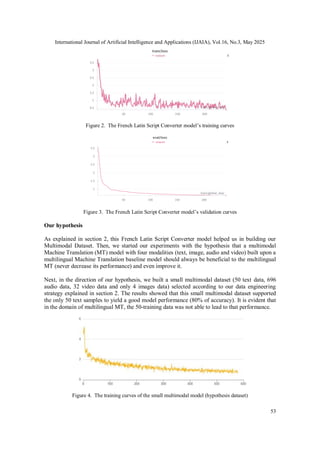
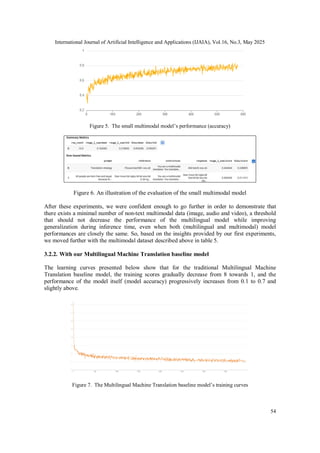
The learning curves presented below show that for our French Latin Script Converter model, the
training and evaluation scores gradually decrease from 3.5 towards 0.5 and lower values.](https://image.slidesharecdn.com/16325ijaia04-250610111711-4ad61467/85/A-THOROUGH-INTRODUCTION-TO-MULTIMODAL-MACHINE-TRANSLATION-6-320.jpg)
![International Journal of Artificial Intelligence and Applications (IJAIA), Vol.16, No.3, May 2025
57
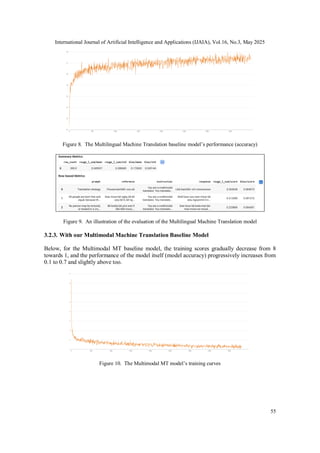
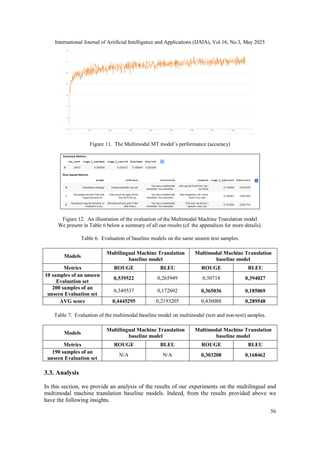
In all cases, the training curves and the model performance curves presented above (from Figure
2 to Figure 12) show that the baseline models related to our study effectively learn well, and are
not enduring an overfitting nor an underfitting case. The Multilingual Machine Translation and
the Multimodal Machine Translation baselines have seamlessly the same model performance
(Figure 8 and 11, and Table 6), the multilingual one being only very slightly above the
multimodal. However, we observe that the multimodal model produces better results. This is the
reason why both have similar ROUGE values, while the multimodal model provided the highest
BLEU scores in all evaluation schemes. As the number of unseen samples increases, the
multimodal model shows superior performance for all provided metrics.
For the context of our study, as we explained in section 4.1 of [2], Low-Resource Languages are
Languages with a digitally versatile speaker community, but very limited support in terms of
language technology. This includes but is not limited to the lack of language data, and the lack of
language technological support such as NLP tools for various data curation tasks like data
annotation tools involving the intended language. In MT, the number of language pairs covered
by low-resource languages is between 100k and 1 million. Therefore, the bci language under
study is currently in a very low-resource context (< 100k pairs), compared to the high resource
English language (>> 10 million, up to billions of language pairs). We also know that as
mentioned in section 5.2 of [2], a baseline model that turns around the bottom of the Medium
Quality would certainly work better on simpler text with about 5 tokens or words/subwords at a
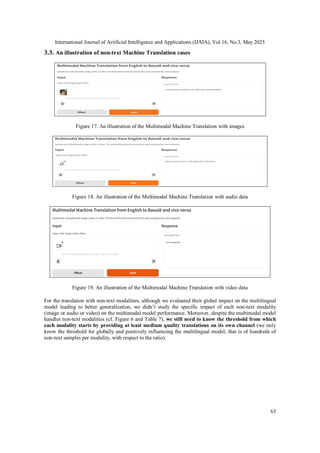
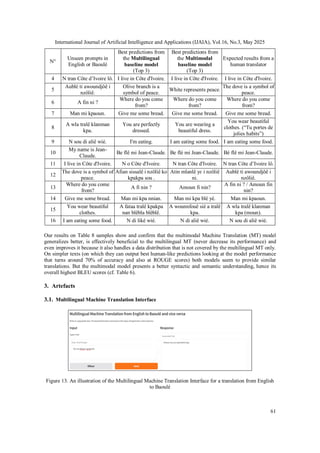
max. We provided in the appendices some clear illustrations and detailed information about
related tests.
In conclusion, our results show that the multimodal Machine Translation (MT) model generalizes
better, is effectively beneficial to the multilingual MT and even improves it because it also
handles a data distribution that is not covered by the multilingual MT alone. Moreover, the
multimodal MT model has the advantage of being able to also directly handle non-text modalities
(image, audio, and video), as shown in Table 7. However, as the results don’t clearly show the
specific impact of each individual modality, further investigations and endeavors should be
necessary to provide more insights and explanations about all these aspects.
4. LIMITATIONS AND FUTURE RESEARCH DIRECTIONS
In our work, we created a Multimodal Dataset via a thorough Data Engineering strategy, and we
provided a reliable evaluation on related baseline models, proving that the multimodal model
consistently outperforms the performance of the traditional multilingual model as the unseen
dataset increases. In this section, we show that despite the good job, some limitations still exist,
and we will focus on Future Research Directions in order to overcome these challenges.
4.1. Limitations
We have provided a multimodal dataset and related models showing the superior performance of
multimodal translation models over the traditional multilingual one. The results showed that from
a threshold of only hundreds of samples, the multimodalities start by bringing improvement to the
unimodal multilingual approach. However, the non-text modalities were just enough to detect and
evaluate their impact on the trained model’s performance during inference on unseen data. We
don’t know what modality impacted the most the multimodal model for yielding additional
performance over the traditional multilingual model. This information will be beneficial for
decision making about the Data Engineering strategy. For example, if the video modality has the
highest impact, we could encourage people to produce short and medium-sized videos with labels](https://image.slidesharecdn.com/16325ijaia04-250610111711-4ad61467/85/A-THOROUGH-INTRODUCTION-TO-MULTIMODAL-MACHINE-TRANSLATION-11-320.jpg)
![International Journal of Artificial Intelligence and Applications (IJAIA), Vol.16, No.3, May 2025
58
in order to support the multimodal model training. Finally, contributors will have the choice and
adopt the easiest way for them to contribute.
4.2. Future Research Directions
We have created a multimodal model that showed superior performance over the traditional
multilingual MT model on unseen texts. However, looking at the limitations mentioned above,
we think that another thorough study will be necessary to increase the non-text modalities and
individually evaluate the influence of each of them on the multimodal translation model.
Moreover, in the context of our Ph.D. program, we provided in a 2019 report first pictures of an
Agent-based Multimodal Translation system for audio and video modalities (cf. [20], section
IV.3- Research Objective, Fig. 4.1 Functional description of the AAVTS) for which the output
keeps the original video unchanged but only the single elements including the speech and written
texts are translated towards the output language. Further research should extend this approach to
all available modalities in a multimodal translation context (text, image, audio, and video) and
ensure that it works well. So that watching a video, the background images and texts in addition
to the speeches are all automatically translated into the chosen output language, although the
whole context of the video is maintained.
5. CONCLUSION
In this paper, based on our specific data engineering strategy, coding and relevant currently
available multimodal LLMs, we designed a custom multimodal dataset for machine translation
tasks and created a related Multimodal Machine Translation Model to evaluate it against the
traditional multilingual approach. We started our experiments with the hypothesis that a
multimodal Machine Translation (MT) model with four modalities (text, image, audio and video)
built upon a multilingual Machine Translation baseline model covering only the text modality,
should always be beneficial to the related multilingual MT (never decrease its performance) and
even improve it. Our results on relevant unseen data samples confirm that, with only hundreds of
additional non-text modalities, the multimodal Machine Translation (MT) model generalizes
better, is effectively beneficial to the multilingual MT and even improves it.
We think that these findings are especially a hope for low resource languages for which the
combination of modalities is a great solution to overcome the struggle of data scarcity in the field
of Machine Translation, given that certain modalities are easier to provide by contributors to the
scientific community for NLP tasks.
In our work that presents an approach to handle language translations implying four (04)
modalities, we found valuable insights for researchers and practitioners interested in the field of
Multimodal Machine Translation, that is still at its early stage. However, the specific impact of
each non-text modality remains an aspect to be fully covered. Indeed, our study didn’t explicitly
show the impact of each modality, separately taken, on the overall results provided by the
multimodal MT model. Further research works should focus on showing which modality among
the image, audio and video modalities provides the best additional performance over the
traditional multilingual model. Moreover, we should extend our work to a multimodal translation
context with text, image, audio, and video inputs, where all these input elements are
automatically and contextually translated towards the output language, keeping the original input
context unchanged but only translated. Finally, let’s note that, regardless of the specific case
study that supported our work (English and Baoulé), the proposed methods are adaptable and
reproducible to all other languages worldwide.](https://image.slidesharecdn.com/16325ijaia04-250610111711-4ad61467/85/A-THOROUGH-INTRODUCTION-TO-MULTIMODAL-MACHINE-TRANSLATION-12-320.jpg)
![International Journal of Artificial Intelligence and Applications (IJAIA), Vol.16, No.3, May 2025
59
ACKNOWLEDGEMENT
We would like to thank Professor William Martin our Supervisor, Professor ABDO Miled Abou
Jaoude and the BIU staff for the reviews of the reports of our Ph.D. program, and for the access
to a partial scholarship leading to this highest level of specialization in Artificial Intelligence.
Invaluable things we learned there are the supports for writing this paper.
We are also thankful to the Ivoirian Civil Service, as we got access to this Ph.D. program in 2018
as a Computer Scientist Civilian (Civil Servant or Official) from Côte d’Ivoire. Local initiatives
encourage commitment to training and to the field of research for civilians.
DECLARATIONS
Funding
No funding was received to assist with the preparation of this
manuscript.
Conflicts of interests No conflicts of interest to the best of our knowledge.
Ethical Approval and
Consent to Participate
No, the article does not require ethical approval and consent to
participate with evidence.
Availability of Data and Material/
Data Access Statement
The French Latin Script Converter model is available for
scientific experimentations (cf. APPENDICES).
Code availability Yes, for the converter only (cf. APPENDICES).
Authors Contributions One author article.
REFERENCES
[1] Russell, Stuart J. & Norvig, Peter (2018) Artificial Intelligence: A Modern Approach, Pearson India
Education Services Pvt. Ltd., India, Third Edition, twelfth Impression 2018.
[2] Konan Jean-Claude, Kouassi, (2023) “Understanding the Worldwide Paths Towards the Creation of
True Intelligence for Machines”, International Journal of Computer Science & Information
Technology (IJCSIT), Vol. 15, No. 1, pp. 43-68, Academy and Industry Research Collaboration
Center (AIRCC), doi:10.5121/ijcsit.2023.15104.
[3] Nestor Maslej, Loredana Fattorini, Raymond Perrault, Yolanda Gil, Vanessa Parli, Njenga Kariuki,
Emily Capstick, Anka Reuel, Erik Brynjolfsson, John Etchemendy, Katrina Ligett, Terah Lyons,
James Manyika, Juan Carlos Niebles, Yoav Shoham, Russell Wald, Tobi Walsh, Armin Hamrah,
Lapo Santarlasci, Julia Betts Lotufo, Alexandra Rome, Andrew Shi, Sukrut Oak. “The AI Index
2025 Annual Report,” AI Index Steering Committee, Institute for Human-Centered AI, Stanford
University, Stanford, CA, April 2025.
[4] Parthasarathy, Venkatesh et al., (2024) “The Ultimate Guide to Fine-Tuning LLMs from Basics to
Breakthroughs: An Exhaustive Review of Technologies, Research, Best Practices, Applied
Research Challenges and Opportunities (Version 1.0)”, arXiv:2408.13296v2.
[5] Hatami, Ali et al., (2024) “English-to-Low-Resource Translation: A Multimodal Approach for
Hindi, Malayalam, Bengali, and Hausa.” Conference on Machine Translation.
[6] Hatami, Ali et al., (2024) “Enhancing Translation Quality by Leveraging Semantic Diversity in
Multimodal Machine Translation”, In Proceedings of the 16th Conference of the Association for
Machine Translation in the Americas, Chicago, USA, September 30 - October 2, 2024. Volume 1:
Research Papers.
[7] Jeong, Cheonsu, (2025) “Beyond Text: Implementing Multimodal Large Language Model-Powered
Multi-Agent Systems Using a No-Code Platform”, arXiv:2501.00750v2.
[8] Omniscien Technologies. (2025, January 19). AI and Language Processing Predictions for 2025
[Video]. YouTube. https://youtu.be/tDa2jH3lboY.
[9] Choi, Jeongsoo et al., (2024) “AV2AV: Direct Audio-Visual Speech to Audio-Visual Speech
Translation with Unified Audio-Visual Speech Representation”, arXiv:2312.02512v2.
[10] Dougban Monsia. (2022, June 23) Baule Speech Dataset. 1.0, Zenodo,
doi:10.5281/zenodo.6705861.](https://image.slidesharecdn.com/16325ijaia04-250610111711-4ad61467/85/A-THOROUGH-INTRODUCTION-TO-MULTIMODAL-MACHINE-TRANSLATION-13-320.jpg)
![International Journal of Artificial Intelligence and Applications (IJAIA), Vol.16, No.3, May 2025
60
[11] RTI Officiel. (2019). Les Trésors Du Monde : Apprenons nos langues "La langue Agba (Baoulé de
Dimbokro) [Video]. YouTube. https://www.youtube.com/watch?v=DWAtiTCCH60.
[12] RTI Officiel. (2021, March 4). Les Trésors du monde | Apprenons nos langues [Video]. YouTube.
https://www.youtube.com/watch?v=iYdMacPy1qg.
[13] Djeh Pyco. (2021, March 4). Salutations chez le peuple Baoulé [Video]. YouTube.
https://www.youtube.com/watch?v=hJWThBDXX0U.
[14] BAOULE FACILE. (2017, Dec 15). BAOULE FACILE APPRENDRE A SALUER EN BAOULE
[Video]. YouTube. https://www.youtube.com/watch?v=j-XNIOq0CN0.
[15] BAOULE FACILE. (2023, Apr 17). COMMENT DEMANDER LES NOUVELLES EN BAOULÉ
FACILE [Video]. YouTube. https://www.youtube.com/watch?v=8m1mdy9H8o0.
[16] BAOULE FACILE. (2023, Apr 20). FAIRE LA PAIX EN BAOULE FACILE [Video]. YouTube.
https://www.youtube.com/watch?v=Aq8SgGp9lQc.
[17] BAOULE FACILE. (2024, Nov 18). Parlons baoulé: Sapka, dan, sran dan, adinanwlè [Video].
YouTube. https://www.youtube.com/watch?v=Q0_lbyGFFfE.
[18] BAOULE FACILE. (2024, Jun 2). LES DIFFÉRENTES PARTIE AU NIVEAU DE LA TÊTE EN
BAOULE FACILE [Video]. YouTube. https://www.youtube.com/watch?v=xYuBYtzAgbM.
[19] BAOULE FACILE. (2024, Nov 21). Expression simple en baoulé: niman [Video]. YouTube.
https://www.youtube.com/watch?v=cskYh0S_qgs.
[20] Kouassi Konan Jean-Claude, Ph.D. Student in Artificial Intelligence at Bircham International
University (BIU) – Madrid since 2018. (2019, April 1). Case Study of the 3rd
Book Report, 30 pp.,
section IV.3- Research Objective, Fig. 4.1 Functional description of the AAVTS [Figure], p.29.
APPENDICES
1. French Latin Script Converter Model and Bci-Related Data Creation
French Latin Script Converter model on Kaggle: https://www.kaggle.com/code/kjeanclaude/inference-
french-latin-script-converter-gpu.
BCI Wikimedia Incubator: https://incubator.wikimedia.org/wiki/Wp/bci.
BCI Translatewiki: https://translatewiki.net/, the bci language is mentioned here as wawle (Thank you very
much to Amir Aharoni for the translation rights.)
Open-ended Data Crowdsourcing website: https://pairing.excellence-integration.org.
Github: https://github.com/Kjeanclaude/mtBCI-1.0-Corpus.
2. Additional Information about the Models’ Evaluation
Table 8. Top 3 prediction samples from the multilingual and multimodal baseline models, on 2 longer texts
(above 5 tokens or words/subwords) and 14 simpler texts (about 5 tokens or words/subwords at a max),
taken from section 5.3 of [2], our previous paper.
N°
Unseen prompts in
English or Baoulé
Best predictions from
the Multilingual
baseline model
(Top 3)
Best predictions from
the Multimodal
baseline model
(Top 3)
Expected results from a
human translator
1
My name is Jean-
Claude, and you, what
is your name?
Be flê mi Jean-Claude,
amoun bé flê amoun sê
nan?
Be flê mi Jean-Claude,
amoun liè o?
Bé flê mi Jean-Claude,
yê ô li, bé flê wô sê ?
2
Bé flê mi Jean-Claude,
yê ô li, bé flê wô sê ?
My name is John-
Claude, and what's your
name ?
My name is Jean-
Claude, and what is
your name?
My name is Jean-
Claude, and you, what
is your name?
3 Bé flê mi Jean-Claude.
My name is Jean-
Claude.
My name is Jean-
Claude.
My name is Jean-
Claude.](https://image.slidesharecdn.com/16325ijaia04-250610111711-4ad61467/85/A-THOROUGH-INTRODUCTION-TO-MULTIMODAL-MACHINE-TRANSLATION-14-320.jpg)
![International Journal of Artificial Intelligence and Applications (IJAIA), Vol.16, No.3, May 2025
62
Figure 14. An illustration of the Multilingual Machine Translation Interface for a translation from Baoulé
to English
The Multilingual Machine Translation model behind this Interface was trained only on the text modality of
our multimodal dataset (cf. Table 2). This English/Baoulé Multimodal Dataset has been thoroughly curated
from the mtBCI-1.0-Corpus provided in our previous paper [2]. The language pairs have also been
somehow reviewed for reaching high quality translations. This text modality has been combined with non-
text modalities for training the multimodal model.
3.2. Multimodal Machine Translation Interface
Figure 15. An illustration of the Multimodal Machine Translation Interface for a translation from English
to Baoulé (better compared to the translation of Figure 13)
Figure 16. An illustration of the Multimodal Machine Translation Interface for a translation from Baoulé to
English (better compared to the translation of Figure 14)](https://image.slidesharecdn.com/16325ijaia04-250610111711-4ad61467/85/A-THOROUGH-INTRODUCTION-TO-MULTIMODAL-MACHINE-TRANSLATION-16-320.jpg)