A Supervised Machine
Learning Algorithm for
Research Articles
Leonidas Akritidis, Panayiotis Bozanis
Dept. of Computer & Communication Engineering,
University of Thessaly, Greece
28th ACM Symposium on Applied Computing
Coimbra, Portugal, 18-22 March 2013
ACM SAC 2013, Coimbra, Portugal 2University of Thessaly
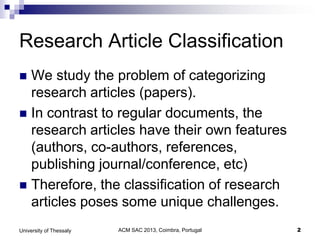
Research Article Classification
 We study the problem of categorizing
research articles (papers).
 In contrast to regular documents, the
research articles have their own features
(authors, co-authors, references,
publishing journal/conference, etc)
 Therefore, the classification of research
articles poses some unique challenges.
ACM SAC 2013, Coimbra, Portugal 3University of Thessaly
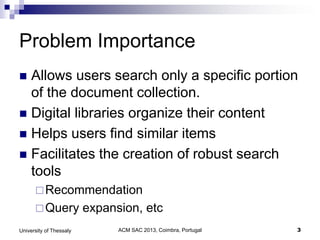
Problem Importance
 Allows users search only a specific portion
of the document collection.
 Digital libraries organize their content
 Helps users find similar items
 Facilitates the creation of robust search
tools
Recommendation
Query expansion, etc
ACM SAC 2013, Coimbra, Portugal 4University of Thessaly
Existing Approaches (1)
 Keyword extraction algorithms
The identify repeated textual patterns and
extract the most important terms
In the sequel, they employ traditional
classification approaches such as kNN.
 Machine learning (ML) approaches
Support Vector Machines (SVM)
AdaBoost.MH
ACM SAC 2013, Coimbra, Portugal 5University of Thessaly
Existing Approaches (2)
 Citation Analysis Algorithms
They exploit linkage information (e.g. multiple
articles cited together by a group of papers)
ACM SAC 2013, Coimbra, Portugal 6University of Thessaly
Our Approach
 Employs a set of labels C and a set of pre-
classified research papers - training set T.
 It trains a model based on C and T.
 The training phase takes into account the
particular features of the problem including
The authors history
Co-authorship information
Keywords selection
The previous publications
ACM SAC 2013, Coimbra, Portugal 7University of Thessaly
Preliminaries
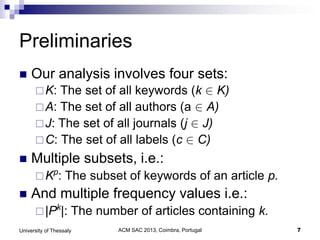
 Our analysis involves four sets:
K: The set of all keywords (k  K)
A: The set of all authors (a  A)
J: The set of all journals (j  J)
C: The set of all labels (c  C)
 Multiple subsets, i.e.:
Kp
: The subset of keywords of an article p.
 And multiple frequency values i.e.:
|Pk
|: The number of articles containing k.
ACM SAC 2013, Coimbra, Portugal 8University of Thessaly
Training Phase
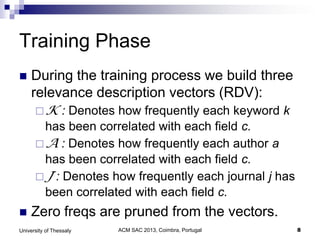
 During the training process we build three
relevance description vectors (RDV):
K : Denotes how frequently each keyword k
has been correlated with each field c.
A : Denotes how frequently each author a
has been correlated with each field c.
J : Denotes how frequently each journal j has
been correlated with each field c.
 Zero freqs are pruned from the vectors.
ACM SAC 2013, Coimbra, Portugal 9University of Thessaly
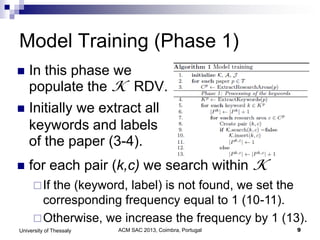
Model Training (Phase 1)
 In this phase we
populate the K RDV.
 Initially we extract all
keywords and labels
of the paper (3-4).
 for each pair (k,c) we search within K
If the (keyword, label) is not found, we set the
corresponding frequency equal to 1 (10-11).
Otherwise, we increase the frequency by 1 (13).
ACM SAC 2013, Coimbra, Portugal 10University of Thessaly
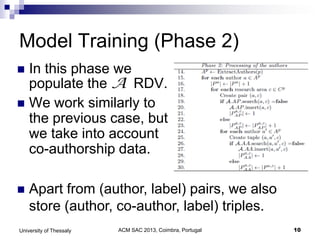
Model Training (Phase 2)
 In this phase we
populate the A RDV.
 We work similarly to
the previous case, but
we take into account
co-authorship data.
 Apart from (author, label) pairs, we also
store (author, co-author, label) triples.
ACM SAC 2013, Coimbra, Portugal 11University of Thessaly
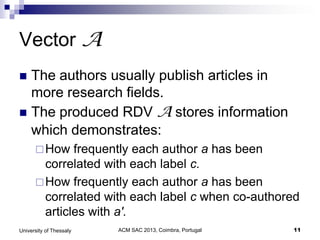
Vector A
 The authors usually publish articles in
more research fields.
 The produced RDV A stores information
which demonstrates:
How frequently each author a has been
correlated with each label c.
How frequently each author a has been
correlated with each label c when co-authored
articles with a'.
ACM SAC 2013, Coimbra, Portugal 12University of Thessaly
Co-authorship in Vector A
 For instance, when an arbitrary author A
co-operates with B, s/he publishes articles
related to IR, whereas when co-operates
with C, publishes articles related to DM.
 Consequently, when we classify an
unlabeled article authored by A and B, we
know that probably the article discusses
an IR topic.
ACM SAC 2013, Coimbra, Portugal 13University of Thessaly
Model Training (Phase 3)
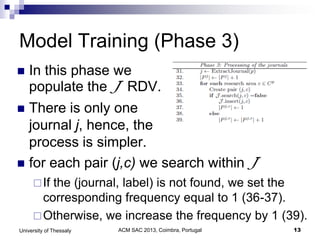
 In this phase we
populate the J RDV.
 There is only one
journal j, hence, the
process is simpler.
 for each pair (j,c) we search within J
If the (journal, label) is not found, we set the
corresponding frequency equal to 1 (36-37).
Otherwise, we increase the frequency by 1 (39).
ACM SAC 2013, Coimbra, Portugal 14University of Thessaly
Classification Process
 The three relevance description vectors
K, A, and J are now used to label to the
unclassified articles.
 For each article, each label is assigned
three partial scores according to the
article’s keywords, authors, journals, and
the contents of K, A, and J.
 The final score is a linear combination of
the three partial scores.
ACM SAC 2013, Coimbra, Portugal 15University of Thessaly
Articles Classification (Phase 1)
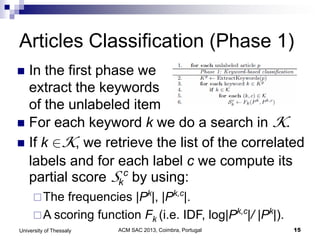
 In the first phase we
extract the keywords
of the unlabeled item
 For each keyword k we do a search in K.
 If k K, we retrieve the list of the correlated
labels and for each label c we compute its
partial score Sk
c
by using:
The frequencies |Pk
|, |Pk,c
|.
A scoring function Fk (i.e. IDF, log|Pk,c
|/ |Pk
|).
ACM SAC 2013, Coimbra, Portugal 16University of Thessaly
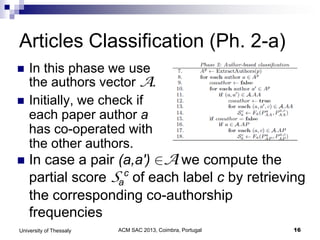
Articles Classification (Ph. 2-a)
 In this phase we use
the authors vector A.
 Initially, we check if
each paper author a
has co-operated with
the other authors.
 In case a pair (a,a') A we compute the
partial score Sa
c
of each label c by retrieving
the corresponding co-authorship
frequencies
ACM SAC 2013, Coimbra, Portugal 17University of Thessaly
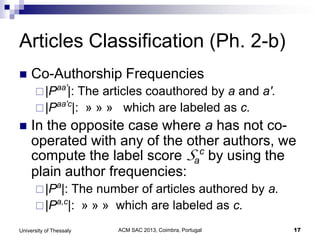
Articles Classification (Ph. 2-b)
 Co-Authorship Frequencies
|Paa'
|: The articles coauthored by a and a'.
|Paa'c
|: » » » which are labeled as c.
 In the opposite case where a has not co-
operated with any of the other authors, we
compute the label score Sa
c
by using the
plain author frequencies:
|Pa
|: The number of articles authored by a.
|Pa,c
|: » » » which are labeled as c.
ACM SAC 2013, Coimbra, Portugal 18University of Thessaly
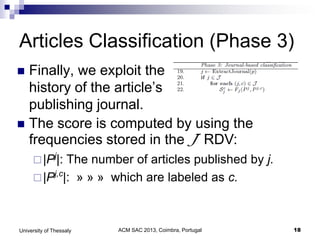
Articles Classification (Phase 3)
 Finally, we exploit the
history of the article’s
publishing journal.
 The score is computed by using the
frequencies stored in the J RDV:
|Pj
|: The number of articles published by j.
|Pj,c
|: » » » which are labeled as c.
ACM SAC 2013, Coimbra, Portugal 19University of Thessaly
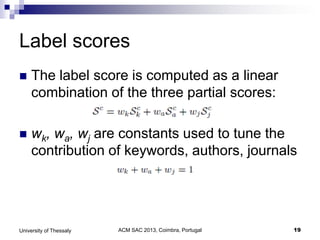
Label scores
 The label score is computed as a linear
combination of the three partial scores:
 wk, wa, wj are constants used to tune the
contribution of keywords, authors, journals
ACM SAC 2013, Coimbra, Portugal 20University of Thessaly
Experimental Setup
 We used CiteSeerX dataset, a collection
comprised of 1.8 million research papers.
 We used three sets of labels, all based on
the IEEE/ACM taxonomy:
C11: A set of the 11 top-level categories.
C81: A set of 81 mid-level categories.
C276: A set of 276 third-level categories.
 IEEE/ACM labeled articles: 1.1 million
ACM SAC 2013, Coimbra, Portugal 21University of Thessaly
Experiments
 We compared our algorithm against the
state-of-the-art ML methods: SVM and
AdaBoost.MH.
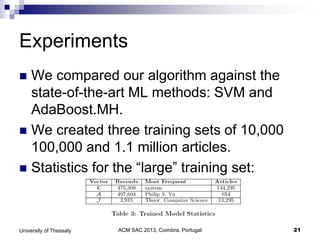
 We created three training sets of 10,000
100,000 and 1.1 million articles.
 Statistics for the “large” training set:
ACM SAC 2013, Coimbra, Portugal 22University of Thessaly
Evaluation
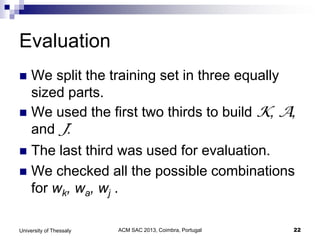
 We split the training set in three equally
sized parts.
 We used the first two thirds to build K, A,
and J.
 The last third was used for evaluation.
 We checked all the possible combinations
for wk, wa, wj .
ACM SAC 2013, Coimbra, Portugal 23University of Thessaly
Accuracy
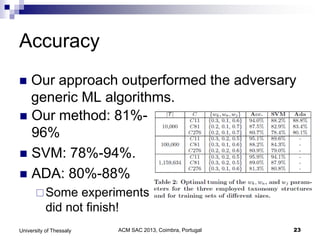
 Our approach outperformed the adversary
generic ML algorithms.
 Our method: 81%-
96%
 SVM: 78%-94%.
 ADA: 80%-88%
Some experiments
did not finish!
ACM SAC 2013, Coimbra, Portugal 24University of Thessaly
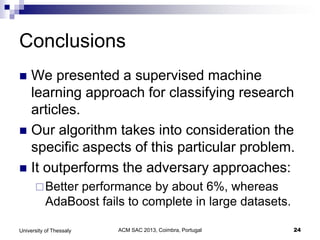
Conclusions
 We presented a supervised machine
learning approach for classifying research
articles.
 Our algorithm takes into consideration the
specific aspects of this particular problem.
 It outperforms the adversary approaches:
Better performance by about 6%, whereas
AdaBoost fails to complete in large datasets.
ACM SAC 2013, Coimbra, Portugal 25University of Thessaly
Thank you for watching
Any questions?

A Supervised Machine Learning Algorithm for Research Articles

  • 1.
    A Supervised Machine LearningAlgorithm for Research Articles Leonidas Akritidis, Panayiotis Bozanis Dept. of Computer & Communication Engineering, University of Thessaly, Greece 28th ACM Symposium on Applied Computing Coimbra, Portugal, 18-22 March 2013
  • 2.
    ACM SAC 2013,Coimbra, Portugal 2University of Thessaly Research Article Classification  We study the problem of categorizing research articles (papers).  In contrast to regular documents, the research articles have their own features (authors, co-authors, references, publishing journal/conference, etc)  Therefore, the classification of research articles poses some unique challenges.
  • 3.
    ACM SAC 2013,Coimbra, Portugal 3University of Thessaly Problem Importance  Allows users search only a specific portion of the document collection.  Digital libraries organize their content  Helps users find similar items  Facilitates the creation of robust search tools Recommendation Query expansion, etc
  • 4.
    ACM SAC 2013,Coimbra, Portugal 4University of Thessaly Existing Approaches (1)  Keyword extraction algorithms The identify repeated textual patterns and extract the most important terms In the sequel, they employ traditional classification approaches such as kNN.  Machine learning (ML) approaches Support Vector Machines (SVM) AdaBoost.MH
  • 5.
    ACM SAC 2013,Coimbra, Portugal 5University of Thessaly Existing Approaches (2)  Citation Analysis Algorithms They exploit linkage information (e.g. multiple articles cited together by a group of papers)
  • 6.
    ACM SAC 2013,Coimbra, Portugal 6University of Thessaly Our Approach  Employs a set of labels C and a set of pre- classified research papers - training set T.  It trains a model based on C and T.  The training phase takes into account the particular features of the problem including The authors history Co-authorship information Keywords selection The previous publications
  • 7.
    ACM SAC 2013,Coimbra, Portugal 7University of Thessaly Preliminaries  Our analysis involves four sets: K: The set of all keywords (k  K) A: The set of all authors (a  A) J: The set of all journals (j  J) C: The set of all labels (c  C)  Multiple subsets, i.e.: Kp : The subset of keywords of an article p.  And multiple frequency values i.e.: |Pk |: The number of articles containing k.
  • 8.
    ACM SAC 2013,Coimbra, Portugal 8University of Thessaly Training Phase  During the training process we build three relevance description vectors (RDV): K : Denotes how frequently each keyword k has been correlated with each field c. A : Denotes how frequently each author a has been correlated with each field c. J : Denotes how frequently each journal j has been correlated with each field c.  Zero freqs are pruned from the vectors.
  • 9.
    ACM SAC 2013,Coimbra, Portugal 9University of Thessaly Model Training (Phase 1)  In this phase we populate the K RDV.  Initially we extract all keywords and labels of the paper (3-4).  for each pair (k,c) we search within K If the (keyword, label) is not found, we set the corresponding frequency equal to 1 (10-11). Otherwise, we increase the frequency by 1 (13).
  • 10.
    ACM SAC 2013,Coimbra, Portugal 10University of Thessaly Model Training (Phase 2)  In this phase we populate the A RDV.  We work similarly to the previous case, but we take into account co-authorship data.  Apart from (author, label) pairs, we also store (author, co-author, label) triples.
  • 11.
    ACM SAC 2013,Coimbra, Portugal 11University of Thessaly Vector A  The authors usually publish articles in more research fields.  The produced RDV A stores information which demonstrates: How frequently each author a has been correlated with each label c. How frequently each author a has been correlated with each label c when co-authored articles with a'.
  • 12.
    ACM SAC 2013,Coimbra, Portugal 12University of Thessaly Co-authorship in Vector A  For instance, when an arbitrary author A co-operates with B, s/he publishes articles related to IR, whereas when co-operates with C, publishes articles related to DM.  Consequently, when we classify an unlabeled article authored by A and B, we know that probably the article discusses an IR topic.
  • 13.
    ACM SAC 2013,Coimbra, Portugal 13University of Thessaly Model Training (Phase 3)  In this phase we populate the J RDV.  There is only one journal j, hence, the process is simpler.  for each pair (j,c) we search within J If the (journal, label) is not found, we set the corresponding frequency equal to 1 (36-37). Otherwise, we increase the frequency by 1 (39).
  • 14.
    ACM SAC 2013,Coimbra, Portugal 14University of Thessaly Classification Process  The three relevance description vectors K, A, and J are now used to label to the unclassified articles.  For each article, each label is assigned three partial scores according to the article’s keywords, authors, journals, and the contents of K, A, and J.  The final score is a linear combination of the three partial scores.
  • 15.
    ACM SAC 2013,Coimbra, Portugal 15University of Thessaly Articles Classification (Phase 1)  In the first phase we extract the keywords of the unlabeled item  For each keyword k we do a search in K.  If k K, we retrieve the list of the correlated labels and for each label c we compute its partial score Sk c by using: The frequencies |Pk |, |Pk,c |. A scoring function Fk (i.e. IDF, log|Pk,c |/ |Pk |).
  • 16.
    ACM SAC 2013,Coimbra, Portugal 16University of Thessaly Articles Classification (Ph. 2-a)  In this phase we use the authors vector A.  Initially, we check if each paper author a has co-operated with the other authors.  In case a pair (a,a') A we compute the partial score Sa c of each label c by retrieving the corresponding co-authorship frequencies
  • 17.
    ACM SAC 2013,Coimbra, Portugal 17University of Thessaly Articles Classification (Ph. 2-b)  Co-Authorship Frequencies |Paa' |: The articles coauthored by a and a'. |Paa'c |: » » » which are labeled as c.  In the opposite case where a has not co- operated with any of the other authors, we compute the label score Sa c by using the plain author frequencies: |Pa |: The number of articles authored by a. |Pa,c |: » » » which are labeled as c.
  • 18.
    ACM SAC 2013,Coimbra, Portugal 18University of Thessaly Articles Classification (Phase 3)  Finally, we exploit the history of the article’s publishing journal.  The score is computed by using the frequencies stored in the J RDV: |Pj |: The number of articles published by j. |Pj,c |: » » » which are labeled as c.
  • 19.
    ACM SAC 2013,Coimbra, Portugal 19University of Thessaly Label scores  The label score is computed as a linear combination of the three partial scores:  wk, wa, wj are constants used to tune the contribution of keywords, authors, journals
  • 20.
    ACM SAC 2013,Coimbra, Portugal 20University of Thessaly Experimental Setup  We used CiteSeerX dataset, a collection comprised of 1.8 million research papers.  We used three sets of labels, all based on the IEEE/ACM taxonomy: C11: A set of the 11 top-level categories. C81: A set of 81 mid-level categories. C276: A set of 276 third-level categories.  IEEE/ACM labeled articles: 1.1 million
  • 21.
    ACM SAC 2013,Coimbra, Portugal 21University of Thessaly Experiments  We compared our algorithm against the state-of-the-art ML methods: SVM and AdaBoost.MH.  We created three training sets of 10,000 100,000 and 1.1 million articles.  Statistics for the “large” training set:
  • 22.
    ACM SAC 2013,Coimbra, Portugal 22University of Thessaly Evaluation  We split the training set in three equally sized parts.  We used the first two thirds to build K, A, and J.  The last third was used for evaluation.  We checked all the possible combinations for wk, wa, wj .
  • 23.
    ACM SAC 2013,Coimbra, Portugal 23University of Thessaly Accuracy  Our approach outperformed the adversary generic ML algorithms.  Our method: 81%- 96%  SVM: 78%-94%.  ADA: 80%-88% Some experiments did not finish!
  • 24.
    ACM SAC 2013,Coimbra, Portugal 24University of Thessaly Conclusions  We presented a supervised machine learning approach for classifying research articles.  Our algorithm takes into consideration the specific aspects of this particular problem.  It outperforms the adversary approaches: Better performance by about 6%, whereas AdaBoost fails to complete in large datasets.
  • 25.
    ACM SAC 2013,Coimbra, Portugal 25University of Thessaly Thank you for watching Any questions?