
A Quick and Dirty Intro to
Objective C and iPhone
Programming
…or how I stopped worrying and learned to love Steve Jobs
What we’re going to cover
• Objective C basics
• iPhone library basics
• Writing an app
• Worshipping Steve Jobs
Objective C
• Another way of doing object oriented C
• Superset of the C language
• Uses the Smalltalk idea of message
passing rather than method invocation
• May look familiar to Vision users
Objective C
• Created in the early ’80s
• Adopted by NeXT in 1988
• Apple bought NeXT in 1996 and adopted
objective C as the language behind Mac
OS X
HAIL STEVE
KING OF NeXT!
Message Passing
• Instead of calling a function we send
messages to our object;
Foo *myObject;
...
[myObject doThingsWithArg:argument];
Object Selector Argument
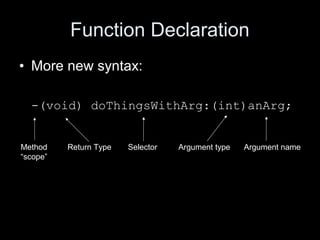
Function Declaration
• More new syntax:
-(void) doThingsWithArg:(int)anArg;
Method
“scope”
Return Type Selector Argument type Argument name
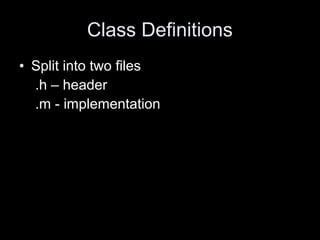
Class Definitions
• Split into two files
.h – header
.m - implementation
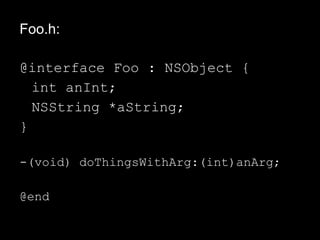
Foo.h:
@interface Foo : NSObject {
int anInt;
NSString *aString;
}
-(void) doThingsWithArg:(int)anArg;
@end
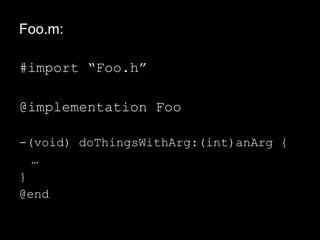
Foo.m:
#import “Foo.h”
@implementation Foo
-(void) doThingsWithArg:(int)anArg {
…
}
@end
Constructors
• 2 part construction of objects
– Allocation: Allocation selector is “alloc”
– Initialisation: Initialisation selector is custom,
but always starts with “init” by convention.
• Constructors return ‘id’ type
• Standard construction line looks like:
[[myObject alloc] init];
Foo.h:
@interface Foo : NSObject {
int anInt;
NSString *aString;
}
-(id) init;
-(id) initWithArg:(int)arg
andArg:(NSString*)arg2;
-(void) doThingsWithArg:(int)anArg;
@end
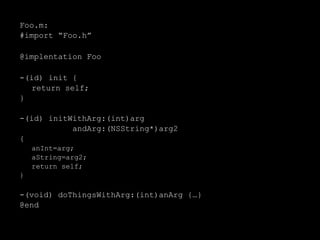
Foo.m:
#import “Foo.h”
@implentation Foo
-(id) init {
return self;
}
-(id) initWithArg:(int)arg
andArg:(NSString*)arg2
{
anInt=arg;
aString=arg2;
return self;
}
-(void) doThingsWithArg:(int)anArg {…}
@end
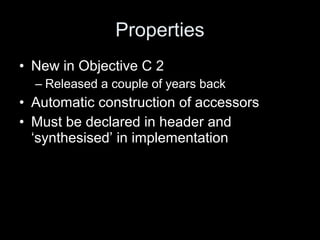
Properties
• New in Objective C 2
– Released a couple of years back
• Automatic construction of accessors
• Must be declared in header and
‘synthesised’ in implementation
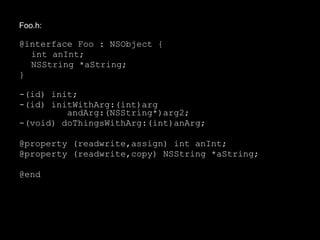
Foo.h:
@interface Foo : NSObject {
int anInt;
NSString *aString;
}
-(id) init;
-(id) initWithArg:(int)arg
andArg:(NSString*)arg2;
-(void) doThingsWithArg:(int)anArg;
@property (readwrite,assign) int anInt;
@property (readwrite,copy) NSString *aString;
@end
Foo.m:
#import “Foo.h”
@implentation Foo
@synthesize anInt;
@synthesize aString;
-(id) init {
[super init];
return self;
}
-(id) initWithArg:(int)arg
andArg:(NSString*)arg2
{
[super init];
myInstanceVar=arg;
aString=arg2;
return self;
}
-(void) doThingsWithArg:(int)anArg {…}
@end
Using our new object
Foo *myObj1=[[Foo alloc] init];
Foo *myObj2=[[Foo alloc] initWithArg:1
andArg:@”Pie”];
[myObj1 doStuffWithArg:23];
NSLog(@”%d and %@”,myObj2.anInt, myObj2.aString);
//prints out “1 and Pie”
NSLog(@”%d and %@”, [myObj2 getAnInt],
[myObj2 getAString]);
//also prints out “1 and Pie”
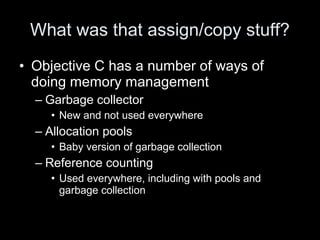
What was that assign/copy stuff?
• Objective C has a number of ways of
doing memory management
– Garbage collector
• New and not used everywhere
– Allocation pools
• Baby version of garbage collection
– Reference counting
• Used everywhere, including with pools and
garbage collection
What was that assign/copy stuff?
• When you get an object its reference
count is 1
• Use “retain” to add one to the count
• Use “release” to drop one from the count
• When count hits zero the object is
destroyed
– Destructor method is called ‘dealloc’
What was that assign/copy stuff?
• In properties you get to say how you want
the reference counts done
– Assign is a simple assignment, no reference
counting
– Retain returns the pointer to an object and
ups the reference count by 1 (for non-objects
this just works like assign)
– Copy returns a copy of the object
Reference counting
• This talk is called “quick and dirty”
because that’s all the memory
management I’m mentioning
• I’m still not sure when to retain things as
whether things are copied/retained/etc is
generally based on function naming
conventions.
– Lame
iPhone
• The iPhone uses Objective C and a bunch
of Apple libraries
• For many apps you can just bolt together
library bits with a little bit of extra logic and
data
The Steve says “LETS MAKE AN APP”
Going Further
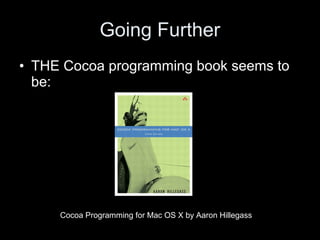
• THE Cocoa programming book seems to
be:
Cocoa Programming for Mac OS X by Aaron Hillegass
Going Further
• Series of talks by Evan Doll and Alan
Cannistraro up on iTunes U
• Talks done at Stanford University in
Summer 2009 for the 2nd
year of their
iPhone programming course
• Missing some iPhone OS 3 features, but
very good.
Going Further
• Buy a Mac
• Make The Steve pleased
• Wear rollneck sweaters
• Conform
• Conform
• Conform
• Conform
• Conform
• Conform
• Conform
A quick and dirty intro to objective c

A quick and dirty intro to objective c

  • 1.
    A Quick andDirty Intro to Objective C and iPhone Programming …or how I stopped worrying and learned to love Steve Jobs
  • 2.
    What we’re goingto cover • Objective C basics • iPhone library basics • Writing an app • Worshipping Steve Jobs
  • 3.
    Objective C • Anotherway of doing object oriented C • Superset of the C language • Uses the Smalltalk idea of message passing rather than method invocation • May look familiar to Vision users
  • 4.
    Objective C • Createdin the early ’80s • Adopted by NeXT in 1988 • Apple bought NeXT in 1996 and adopted objective C as the language behind Mac OS X
  • 5.
  • 6.
    Message Passing • Insteadof calling a function we send messages to our object; Foo *myObject; ... [myObject doThingsWithArg:argument]; Object Selector Argument
  • 7.
    Function Declaration • Morenew syntax: -(void) doThingsWithArg:(int)anArg; Method “scope” Return Type Selector Argument type Argument name
  • 8.
    Class Definitions • Splitinto two files .h – header .m - implementation
  • 9.
    Foo.h: @interface Foo :NSObject { int anInt; NSString *aString; } -(void) doThingsWithArg:(int)anArg; @end
  • 10.
    Foo.m: #import “Foo.h” @implementation Foo -(void)doThingsWithArg:(int)anArg { … } @end
  • 11.
    Constructors • 2 partconstruction of objects – Allocation: Allocation selector is “alloc” – Initialisation: Initialisation selector is custom, but always starts with “init” by convention. • Constructors return ‘id’ type • Standard construction line looks like: [[myObject alloc] init];
  • 12.
    Foo.h: @interface Foo :NSObject { int anInt; NSString *aString; } -(id) init; -(id) initWithArg:(int)arg andArg:(NSString*)arg2; -(void) doThingsWithArg:(int)anArg; @end
  • 13.
    Foo.m: #import “Foo.h” @implentation Foo -(id)init { return self; } -(id) initWithArg:(int)arg andArg:(NSString*)arg2 { anInt=arg; aString=arg2; return self; } -(void) doThingsWithArg:(int)anArg {…} @end
  • 14.
    Properties • New inObjective C 2 – Released a couple of years back • Automatic construction of accessors • Must be declared in header and ‘synthesised’ in implementation
  • 15.
    Foo.h: @interface Foo :NSObject { int anInt; NSString *aString; } -(id) init; -(id) initWithArg:(int)arg andArg:(NSString*)arg2; -(void) doThingsWithArg:(int)anArg; @property (readwrite,assign) int anInt; @property (readwrite,copy) NSString *aString; @end
  • 16.
    Foo.m: #import “Foo.h” @implentation Foo @synthesizeanInt; @synthesize aString; -(id) init { [super init]; return self; } -(id) initWithArg:(int)arg andArg:(NSString*)arg2 { [super init]; myInstanceVar=arg; aString=arg2; return self; } -(void) doThingsWithArg:(int)anArg {…} @end
  • 17.
    Using our newobject Foo *myObj1=[[Foo alloc] init]; Foo *myObj2=[[Foo alloc] initWithArg:1 andArg:@”Pie”]; [myObj1 doStuffWithArg:23]; NSLog(@”%d and %@”,myObj2.anInt, myObj2.aString); //prints out “1 and Pie” NSLog(@”%d and %@”, [myObj2 getAnInt], [myObj2 getAString]); //also prints out “1 and Pie”
  • 18.
    What was thatassign/copy stuff? • Objective C has a number of ways of doing memory management – Garbage collector • New and not used everywhere – Allocation pools • Baby version of garbage collection – Reference counting • Used everywhere, including with pools and garbage collection
  • 19.
    What was thatassign/copy stuff? • When you get an object its reference count is 1 • Use “retain” to add one to the count • Use “release” to drop one from the count • When count hits zero the object is destroyed – Destructor method is called ‘dealloc’
  • 21.
    What was thatassign/copy stuff? • In properties you get to say how you want the reference counts done – Assign is a simple assignment, no reference counting – Retain returns the pointer to an object and ups the reference count by 1 (for non-objects this just works like assign) – Copy returns a copy of the object
  • 22.
    Reference counting • Thistalk is called “quick and dirty” because that’s all the memory management I’m mentioning • I’m still not sure when to retain things as whether things are copied/retained/etc is generally based on function naming conventions. – Lame
  • 23.
    iPhone • The iPhoneuses Objective C and a bunch of Apple libraries • For many apps you can just bolt together library bits with a little bit of extra logic and data
  • 24.
    The Steve says“LETS MAKE AN APP”
  • 25.
    Going Further • THECocoa programming book seems to be: Cocoa Programming for Mac OS X by Aaron Hillegass
  • 26.
    Going Further • Seriesof talks by Evan Doll and Alan Cannistraro up on iTunes U • Talks done at Stanford University in Summer 2009 for the 2nd year of their iPhone programming course • Missing some iPhone OS 3 features, but very good.
  • 27.
    Going Further • Buya Mac • Make The Steve pleased • Wear rollneck sweaters • Conform • Conform • Conform • Conform • Conform • Conform • Conform