A PHP WEB DEVELOPMENT PROJECT REPORT ABOUT AN EMPLOYEE MANAGEMENT SYSTEM
BY
ABENAITWE STANILOUS
S23/AWU/BSIT/007
Introduction
• An Employee Management System (EMS) is a software application designed to assist
in the management and administration of employee-related data within an
organization. It enables the organization to store, organize, and manage employee
information, track performance, monitor attendance, and manage payroll.
• This report outlines the design and development of an Employee Management
System using tools with PHP (for server-side scripting), HTML (for the frontend
interface), and MySQL (for database management). The system is developed with the
goal of streamlining administrative tasks and improving the overall employee
management process.
Background
• In this modern business landscape, organizations are increasingly recognizing the importance of
effective workforce management. As businesses grow, managing employee data, tracking
performance, monitoring attendance, and ensuring payroll accuracy can delay the tasks without the
right systems in place. Traditional manual methods of employee management, such as
spreadsheets and paper records, are prone to errors, inefficiencies, and security risks. These
methods often lead to increased administrative burdens, delayed decision-making, and poor
employee experiences.
• An Employee Management System (EMS) is a software solution designed to automate and
streamline the process of managing employee-related data and activities. It allows organizations to
centralize all information related to their workforce, providing managers and HR teams with the
tools they need to perform tasks such as recruitment, employee records maintenance, performance
tracking, payroll management, and attendance monitoring in a more efficient and reliable manner.
•
Problem Statement
• In organizations, managing employee data, tracking their performance, maintaining
attendance records, calculating payroll, and generating reports can be time-
consuming and error-prone when done manually. As organizations grow, the
complexity of managing large volumes of employee information increases. A lack of
a centralized system for storing and processing this data often leads to inefficiencies,
data inconsistencies, and the potential for human error.
Objectives
Major objectives
• To improve efficiency, ensure accuracy, and automate key Human Resource functions, which are crucial for
both employees and employers.
Specific objectives
• To develop a user-friendly web-based application for managing employee data.
• To create a platform that allows Human Resource personnel to add, update, view, and delete employee
information.
• To provide an interface for generating reports related to employee details, attendance, and performance.
• To automate the calculation and management of employee salaries, allowances, bonuses, deductions, and
taxes
• To store and manage all employee data in a single, centralized database
• To build a secure and efficient system using PHP, HTML, and MySQL.
• To track employee attendance, manage leaves, and monitor working hours.
The geographical scope and Functional scope
• The geographical scope of an EMS refers to the regions or locations where the
system can be deployed and used effectively;
• Modern EMS solutions are typically cloud-based, which allows businesses to deploy
and access the system from anywhere in the world.
• Access Control for Different Locations: Depending on the organizational
structure, different geographical locations may have different access permissions
within the system
• Web-based EMS. This is particularly useful for companies with remote employees,
branch offices, or international teams.
Functional scope
• The functional scope refers to the specific features, modules, and capabilities that
an EMS provides to streamline employee management tasks that meet the needs of
an organization.
With the following functional areas;
• Employee Information Management such as database, documents
• Attendance and Leave Management such as absent reports and leave
• Payroll and Compensation such as salary mgt and payslips
• Security and Access Control such as data encryption and privacy
• Employee Self-Service such as access to personal data.
Significance
• An Employee Management System (EMS) is crucial for organizations in today's fast-
paced and dynamic business environment.
• Automates and streamlines HR processes,
• EMS enhances efficiency, accuracy, and data management while improving employee
engagement and organizational fast decision-making.
• It is easier to retrieve and update evaluation processes more seamless.
• Elimination of Manual Errors: EMS reduces the risk of human errors that are common
in manual processes, such as data entry mistakes in attendance or payroll calculations.
• Reduced Administrative Burden: By automating tasks such as documentation, reporting,
and record-keeping
• Increased data security.
The functionality of an Employee Management System
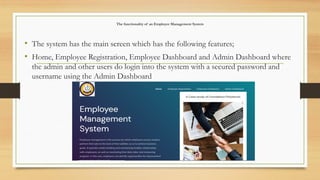
• The system has the main screen which has the following features;
• Home, Employee Registration, Employee Dashboard and Admin Dashboard where
the admin and other users do login into the system with a secured password and
username using the Admin Dashboard
continued
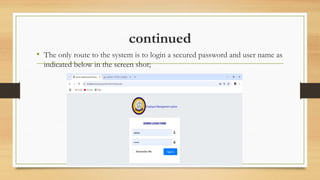
• The only route to the system is to login a secured password and user name as
indicated below in the screen shot;
Conclusion
• With the use of an employee management system software the work load for the
employers and employees is reduced to an automated, streamlined, manageable and
secured one hence making an organization to greater heights
• References
https://
www.sourcecodester.com/visual-basic-net/11553/employee-management-system.html#google_vignette
THANK YOU

A PHP WEB DEVELOPMENT REPORT ABOUT AN EMPLOYEE.pptx

  • 1.
    A PHP WEBDEVELOPMENT PROJECT REPORT ABOUT AN EMPLOYEE MANAGEMENT SYSTEM BY ABENAITWE STANILOUS S23/AWU/BSIT/007
  • 2.
    Introduction • An EmployeeManagement System (EMS) is a software application designed to assist in the management and administration of employee-related data within an organization. It enables the organization to store, organize, and manage employee information, track performance, monitor attendance, and manage payroll. • This report outlines the design and development of an Employee Management System using tools with PHP (for server-side scripting), HTML (for the frontend interface), and MySQL (for database management). The system is developed with the goal of streamlining administrative tasks and improving the overall employee management process.
  • 3.
    Background • In thismodern business landscape, organizations are increasingly recognizing the importance of effective workforce management. As businesses grow, managing employee data, tracking performance, monitoring attendance, and ensuring payroll accuracy can delay the tasks without the right systems in place. Traditional manual methods of employee management, such as spreadsheets and paper records, are prone to errors, inefficiencies, and security risks. These methods often lead to increased administrative burdens, delayed decision-making, and poor employee experiences. • An Employee Management System (EMS) is a software solution designed to automate and streamline the process of managing employee-related data and activities. It allows organizations to centralize all information related to their workforce, providing managers and HR teams with the tools they need to perform tasks such as recruitment, employee records maintenance, performance tracking, payroll management, and attendance monitoring in a more efficient and reliable manner. •
  • 4.
    Problem Statement • Inorganizations, managing employee data, tracking their performance, maintaining attendance records, calculating payroll, and generating reports can be time- consuming and error-prone when done manually. As organizations grow, the complexity of managing large volumes of employee information increases. A lack of a centralized system for storing and processing this data often leads to inefficiencies, data inconsistencies, and the potential for human error.
  • 5.
    Objectives Major objectives • Toimprove efficiency, ensure accuracy, and automate key Human Resource functions, which are crucial for both employees and employers. Specific objectives • To develop a user-friendly web-based application for managing employee data. • To create a platform that allows Human Resource personnel to add, update, view, and delete employee information. • To provide an interface for generating reports related to employee details, attendance, and performance. • To automate the calculation and management of employee salaries, allowances, bonuses, deductions, and taxes • To store and manage all employee data in a single, centralized database • To build a secure and efficient system using PHP, HTML, and MySQL. • To track employee attendance, manage leaves, and monitor working hours.
  • 6.
    The geographical scopeand Functional scope • The geographical scope of an EMS refers to the regions or locations where the system can be deployed and used effectively; • Modern EMS solutions are typically cloud-based, which allows businesses to deploy and access the system from anywhere in the world. • Access Control for Different Locations: Depending on the organizational structure, different geographical locations may have different access permissions within the system • Web-based EMS. This is particularly useful for companies with remote employees, branch offices, or international teams.
  • 7.
    Functional scope • Thefunctional scope refers to the specific features, modules, and capabilities that an EMS provides to streamline employee management tasks that meet the needs of an organization. With the following functional areas; • Employee Information Management such as database, documents • Attendance and Leave Management such as absent reports and leave • Payroll and Compensation such as salary mgt and payslips • Security and Access Control such as data encryption and privacy • Employee Self-Service such as access to personal data.
  • 8.
    Significance • An EmployeeManagement System (EMS) is crucial for organizations in today's fast- paced and dynamic business environment. • Automates and streamlines HR processes, • EMS enhances efficiency, accuracy, and data management while improving employee engagement and organizational fast decision-making. • It is easier to retrieve and update evaluation processes more seamless. • Elimination of Manual Errors: EMS reduces the risk of human errors that are common in manual processes, such as data entry mistakes in attendance or payroll calculations. • Reduced Administrative Burden: By automating tasks such as documentation, reporting, and record-keeping • Increased data security.
  • 9.
    The functionality ofan Employee Management System • The system has the main screen which has the following features; • Home, Employee Registration, Employee Dashboard and Admin Dashboard where the admin and other users do login into the system with a secured password and username using the Admin Dashboard
  • 10.
    continued • The onlyroute to the system is to login a secured password and user name as indicated below in the screen shot;
  • 11.
    Conclusion • With theuse of an employee management system software the work load for the employers and employees is reduced to an automated, streamlined, manageable and secured one hence making an organization to greater heights • References https:// www.sourcecodester.com/visual-basic-net/11553/employee-management-system.html#google_vignette
  • 12.