A MIXED-MODE PIDA CONTROLLER
EMPLOYING OTAS
Ittipong Chaisayun and Somkiat Pianprantong
Southeast Asia University
OUTLINE
 INTRODUCTION
 PRINCIPLE OF PROPOSED CIRCUIT
 SIMULATION RESULTS
 PERFORMANCE ANALYSIS
 APPLICATION
 CONCLUSION
INTRODUCTION
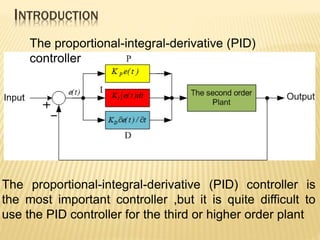
The proportional-integral-derivative (PID)
controller
The proportional-integral-derivative (PID) controller is
the most important controller ,but it is quite difficult to
use the PID controller for the third or higher order plant
The proportional-integral-derivative-acceleration(PIDA)
controller
The proportional-integral-derivative-acceleration (PIDA)
controller [2] was proposed for a third order plant.
THE SYNTHESIS OF ELECTRONIC CONTROLLER
CIRCUITS
using op-amp and passive element [3]-[4], they consume
high power and their frequency response is limited by
GBP
 PIDA circuits using OTA (Operational
Transconductance Amplifier), CFOA
(Current Feedback Operational Amplifier),
and CCII (second generation current
conveyor) were proposed [5], [6], and [7].
 This controller is more advantageous than
conventional controllers.
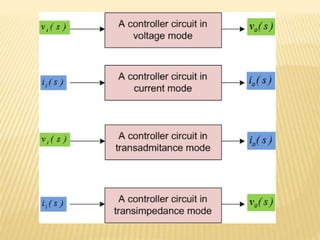
 Since the inputs and output of proposed
controller can be either current signal or
voltage signal, the application of circuitry
will be more flexible
PRINCIPLE OF THE PROPOSED CIRCUIT
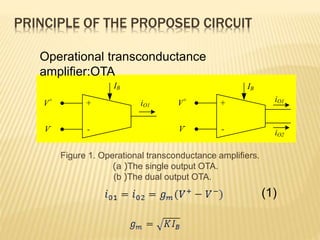
Figure 1. Operational transconductance amplifiers.
)a (The single output OTA.
(b (The dual output OTA.
IB
iO2
IB
-
+
V+
V-
iO1
iO1
-
+
V+
V-
Operational transconductance
amplifier:OTA
(1)
PIDA CONTROLLER
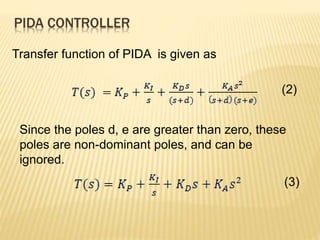
Transfer function of PIDA is given as
Since the poles d, e are greater than zero, these
poles are non-dominant poles, and can be
ignored.
(3)
(2)
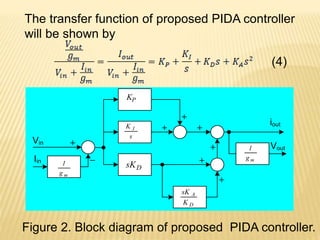
The transfer function of proposed PIDA controller
will be shown by
Vin
Iin
iout
Vout
s
K I
D
sK
D
A
K
sK
P
K
m
g
1
m
g
1
Figure 2. Block diagram of proposed PIDA controller.
(4)
-
+
OTA_3
IB3
-
+
OTA_4
IB4
-
+
OTA_5
IB5
-
+
OTA_6
IB6
-
+
OTA_7
IB7
-
+
OTA_8
IB8
-
+
OTA_9
IB9
CD CA
C1
-
+
OTA_2
IB2
+
-
OTA_10
IB10
IP
II
ID
IA
V3
V5
V2
V4
Vout
I07
I02
I06
I09
Iout
-
+
OTA_1
IB1
Vin
Iin
V1
V6
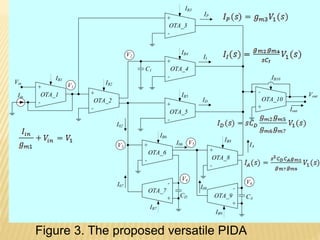
Figure 3. The proposed versatile PIDA
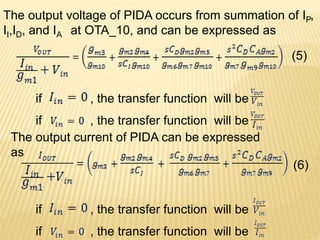
The output voltage of PIDA occurs from summation of IP,
II,ID, and IA at OTA_10, and can be expressed as
The output current of PIDA can be expressed
as
(5)
(6)
if , the transfer function will be
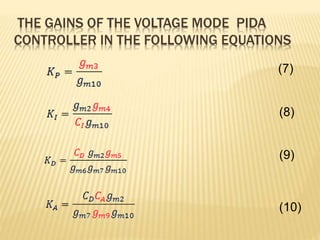
THE GAINS OF THE VOLTAGE MODE PIDA
CONTROLLER IN THE FOLLOWING EQUATIONS
(9)
(8)
(10)
(7)
SIMULATION RESULTS
IB
M3
M8
M7
M6
M5
M2
M1
M9
M4
M10
VDD
VSS
V -
V +
io1 io2
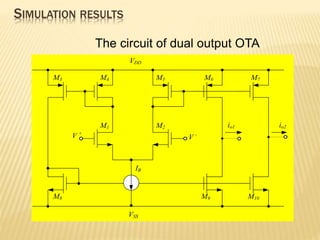
The circuit of dual output OTA
8ms
-100µA
Time
0s 4ms
-20µA
20µA
-20µA
0A
20µA
-20µA
0A
20µA
-20µA
0A
20µA
0A
100µA
Iin 0A
I
p
I
I
I
D
I
A
IB3=20µA
IB3=60µA
IB4=20µA
IB4=60µA
IB5=20µA
IB5=60µA
IB8=60µA
IB8=20µA
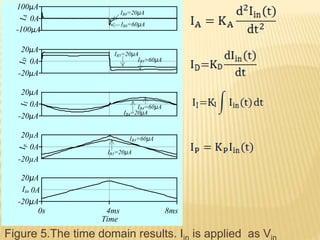
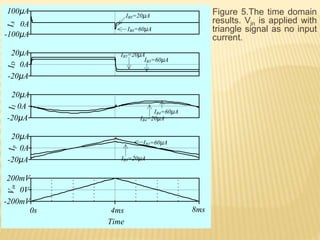
Figure 5.The time domain results. I is applied as V
Time
0s 4ms 8ms
-200mV
0V
200mV
-20µA
0A
20µA
-20µA
0A
20µA
-20µA
0A
20µA
-100µA
100µA
0A
IB8=20µA
IB8=60µA
IB5=20µA
IB5=60µA
IB4=20µA
IB4=60µA
IB3=20µA
IB3=60µA
V
in
I
D
I
A
I
I
I
p Figure 5.The time domain
results. Vin is applied with
triangle signal as no input
current.
Frequency
1Hz 10Hz 100Hz 1kHz 10kHz 100kHz
-200dB
-100dB
0dB
50dB
Simulated IP
Simulated II
Simulated ID
Simulated IA
Ideal ID
Ideal IA
Ideal IP
Ideal II
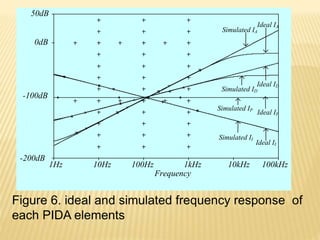
Figure 6. ideal and simulated frequency response of
each PIDA elements
PERFORMANCE ANALYSIS
(12)
(11)
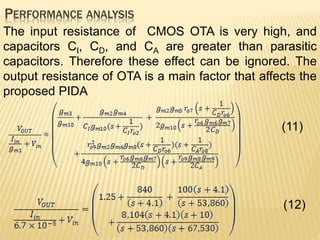
The input resistance of CMOS OTA is very high, and
capacitors CI, CD, and CA are greater than parasitic
capacitors. Therefore these effect can be ignored. The
output resistance of OTA is a main factor that affects the
proposed PIDA
APPLICATION
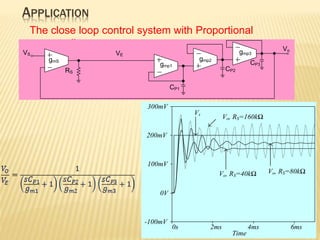
The close loop control system with Proportional
controller
RS
CP1
CP3
CP2
gmp1
gmp3
gmp2
gmS
VS
Vo
VE
Time
0s 2ms 4ms 6ms
-100mV
0V
100mV
200mV
300mV
Vs
Vo, RS=160kΩ
Vo, RS=40kΩ Vo, RS=80kΩ
RS
CP1
CP3
CP2
gmp1
gmp3
gmp2
gmS
VS
Vo
PIDA circuit
Vin
Iin
Vout
Iout
Vs
Vo
Time
0s 2ms 4ms 6ms
-200mV
0V
200mV
400mV
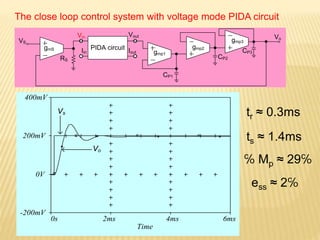
The close loop control system with voltage mode PIDA circuit
tr ≈ 0.3ms
ts ≈ 1.4ms
℅ Mp ≈ 29℅
ess ≈ 2℅
CP1
CP3
CP2
gmp1
gmp3
gmp2
gmS
VS
Vo
PIDA circuit
Vin
Iin Iout
Vout
Vo
Time
0s 2ms 4ms 6ms
-200mV
0V
200mV
400mV
Vs
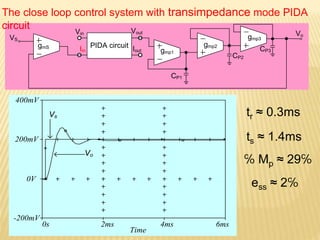
The close loop control system with transimpedance mode PIDA
circuit
tr ≈ 0.3ms
ts ≈ 1.4ms
℅ Mp ≈ 29℅
ess ≈ 2℅
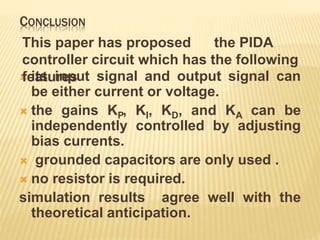
CONCLUSION
 its input signal and output signal can
be either current or voltage.
 the gains KP, KI, KD, and KA can be
independently controlled by adjusting
bias currents.
 grounded capacitors are only used .
 no resistor is required.
simulation results agree well with the
theoretical anticipation.
This paper has proposed the PIDA
controller circuit which has the following
features
THANK YOU FOR
YOUR ATTENTION

A mixed-mode PIDA controller employing OTAs.pptx