ENGLISH- 103
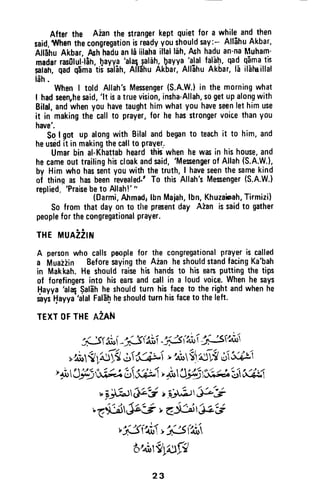
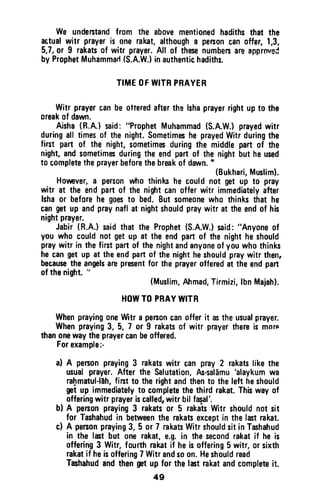
A GUIDETO
PRAYER
IN ISLAM
M. Abdul Karim Saqib
TheCo-operativeOfficeforCsll&to.eigne.sGuidanceatSullrnah
Underlhesuoeftsron0llvinistrv0l samcAlla$ andEndowmenlandCalandGudance
Te4240C//F 4251005P080x926i5Riyadh11663EnESullanah22@halmacom
ENGLISH - 103
AGUIDETO
PRAYER
IN ISLAM
M. Abdul Karim Saqib
The Co-operative Office for Call &foreigners Guidance at Sultanah
Under the supervisIOn 0I Ministry 01 IslamicAHairs and Endowment and CalI and Guidance
Tel 4240077 Fax 4251005 POBox 92675 Riyadh 11663 E-mail Sultanah22@holmail com
*i f!fi li
#1rt:i#
IN THE NAI}IE OF ALIJH
TIIE MERCIFI,'L THE COMPASSIONAIE
IN'IHE NAME OF ALLAH
11IE MERCIFUL 'IHE COMPASSIONATE
$iJl ;Ii4 LL.c
A GII]I]Dtr TO
ililPilIRAYililE
ms nsn,aMt
fi|. tbdul Karinfagib
~lo~4~..,
A GUIJD)E TO
IN ISJLAM
M. ~lJdul KfJrim SoqilJ
GUIDE TO PRAYER
ril rsLAM
RenearchedandEditedby:
MohammedAbdulKarimSaqib.
Translatedby:
ljazBegumSaqib.
A GUIDE TO PRAYER
IN ISLAM
*
*
Researched and Edited by:
Mohammed Abdul Karim Saqib.
Translated by:
Ijaz Begum Saqib.
FOREWORD
There are many books dealingwith the Subiectof Salatin
both Arabic and Urdu. Many of thesebooksarelvellwritten
and provide an informative and comprehensiveview of
how Salat should be performed accordingto the teach-
ings of Prophet Muhammad (SAW). Unfonunately(there
are very few books in Englishwhich dealwith the subjectin
the sameinformativeand comprehensiveway.The books,
which do exist,havethree main disadvantages.
Firstly, literatureconcerningSalat availablein Englishis
either so brief that it does not cover essentialpoints in
nearly enoughdetail, or it is so bulky and detailedthat it
becomes difficult to use it for quick reference,and es-
sentialpoints may get lost in the unnece$sarydetail.
Secondly,the text of the Salat lacksthe quality of direct
research from the zunnah of the Prophet Muhammad
(SAW).There are also bookswhich containmaterialwith-
out any referenceto the originalsources.
Thirdly, the majority of books have been written accord-
ing to the views held by certainschoolsof thought and for
this reasonsomepeoplehesitateto follow them.
Becauseof theseweaknessesin existingliteraturein English
we felt that the need existed to prgduce a medium sized
book on Salatwhich would approachthe subjectaccording
io the teachingsof the Prophet Muhammad(SAW).The
Prophet,himself,said,
"Pray asyou haveseenme praying."
Such a book needs.tocontain all the essentialdetailsof
Salat without being too bulky or complicatedso that the
readercan use it as a point oJ referenceon a journey or at
home.
ft was also felt that a comprehensivebook on Salat in
English would be useful for converts to lslam and for
Muslim youth brought up in this country. Keeping in
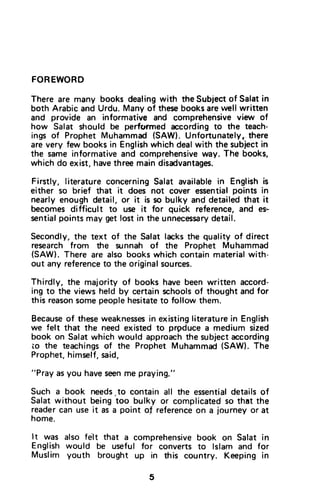
FOREWORD
There are many books dealing with the Subject of Salat in
both Arabic and Urdu. Many of these books are well written
and provide an informative and comprehensive view of
how Salat should be performed according to the teach-
ings of Prophet Muhammad (SAW). Unfortunately~. there
are very few books in English which deal with the subject in
the same informative and comprehensive way. The books,
which do exist, have three main disadvantages.
Firstly, literature concerning Salat available in English is
either so brief that it does not cover essential points in
nearly enough detail, or it is so bulky and detailed that it
becomes difficult to use it for quick reference, and es~
sential points may get lost in the unnecessary detail.
Secondly, the text of the Salat lacks the quality of direct
research from the sunnah of the Prophet Muhammad
(SAW). There are also books which contain material with-
out any reference to the original sources.
Thirdly, the majority of books have been written accord-
ing to the views held by certain schools of thought and for
this reason some people hesitate to follow them.
Because of these weaknesses in existing literature in English
we felt that the need existed to prpduce a medium sized
book on Salat which would approach the subject according
to the teachings of the Prophet Muhammad (SAW). The
Prophet, himself, said,
"Pray as you have seen me praying."
Such a book needs to contain all the essential details of
Salat without being 'too bulky or complicated so that the
reader can use it as a point 01 reference on a journey or at
home.
It was also fE~lt that a comprehensive book on Salat in
English would be useful for converts to Islam and for
Muslim youth brought up in this country. Keeping in
5
mind the needsof our brothers and sistersevery effort has
been made to produce this book in simple and easy
language.
During our researchwe sometimesfound that differences
occurred between establishedpractices in various prayer
books. In these circumstanceswe referred to authentic
hadiths of the Prophet Muhammad (SAW), so that the
points could be clarified as much as possible.This was,
because,for a true Muslim there is no greater proof for
settling arguments than authentic hadiths and practices
of ProphetMuhammad(SAW).
We hope that Allah will accept this humble attempt be-
cause without his support and help we would never have
beenabfeto do this work.
Finally we ask all our Muslim brothersand sistersto study
the text and to strive to pray according to it. lf anyone
finds anything unacceptableor to be againstthe sunnah
of the Prophet (SAW) we would be grateful if they worrld
inform us.
MuhammadAbdulKarimSaqib
6
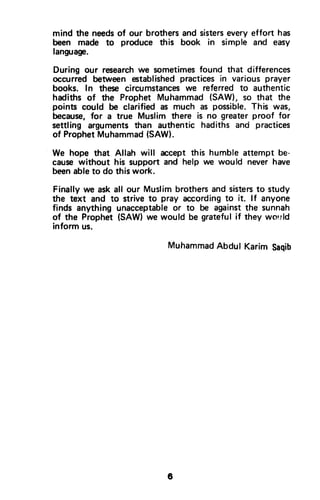
mind the needs of our brothers and sisters every effort has
been made to produce this book in simple and easy
language.
During our research we sometimes found that differences
occurred between established practices in various prayer
books. In these circumstances we referred to authentic
hadiths of the Prophet Muhammad (SAW), so that the
points could be clarified as much as possible. This was,
because, for a true Muslim there is no greater proof for
settling arguments than authentic hadiths and practices
of Prophet Muhammad (SAW).
We hope that Allah will accept this humble attempt be-
cause without his support and help we would never have
been able to do this work.
Finally we ask all our Muslim brothers and sisters to study
the text and to strive to pray according to it. If anyone
finds anything unacceptable or to be against the sunnah
of the Prophet (SAW) we would be grateful if they wo!!ld
inform us.
Muhammad Abdul Karim Saqib
6
c0ilrEilrs
Foreword
Notes
Chapter One
Before doing Wudu (Ablution)
Tooth Stick (Siwak)
Niyat for Wuflu (Ablution)
Actions of wudu (Ablution)
Specialfacilitiesin Ab.ution.
Du'i[ at the end of Ablution
Tayammum
Chapter Two
Time of $alat (Prayer)
Forbidden Times for PraYer
Placefor $alat (PraYer)
Dressfor $alat (Prayer)
Types of $alat (Prayer)
Far{ or ObligatoryPraPr
Nafl Prayer
SunnatMu'akkadah(conPulsory)
Nafl (extra) PraYer
Number of Rakats
Chapter Three
Story of Aian
The Muai2in
Text of the Aian
Aian for Fajr
Listeningto the Aian
Danidafter the A2an
Du'ii after the Aian
lqamat
Text of Iqamat
Pages
.....t2
.....t2
.....I2
J2
.....r2
,.....I3
.....I3
.....I 6
,.....t7
.....l8
........l8
.....I9
.....I9
...,.l9
,.....20
5
t0
l4
r6
20
22
22
23
23
24
24
25
25
26
26
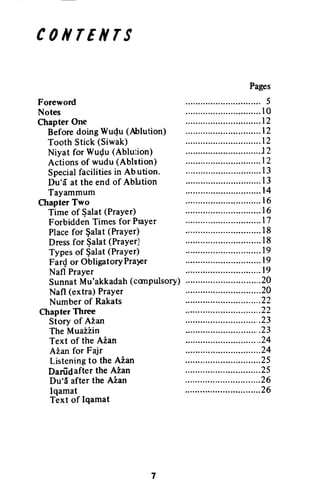
CONTENTS
Foreword
Notes
Chapter One
Before doing Wuqu (Ablution)
Tooth Stick (Siwak)
Niyat for Wuc;lu (Ablution)
Actions of wudu (Ablution)
Special facilities in Ab.ution.
Du'a at the end of Ablution
Tayammum
Chapter Two
Time of ~alat (Prayer)
Forbidden Times for Player
Place for ~alat (Prayer)
Dress for ~alat (Prayer)
Types of $alat (Prayer)
FarQ or Obligatory Pra}er
Nafl Prayer
Sunnat Mu'akkadah (canpulsory)
Nafl (extra) Prayer
Number of Rakats
Chapter Three
Story of Azan
The Muazzin
Text of the Aian
Azan for Fajr
Listening to the AZan
Dariidafter the Azan
Du"a after the Azan
lqamat
Text of Iqamat
7
Pages
......................•....... 5
.............................. 10
.............................. 12
.............................. 12
.............................. 12
..............................12
.............................. 12
.............................. 13
. 13
.............................. 14
.............................. 16
.............................. 16
.............................. 17
.............................. 18
.............................. 18
.............................. 19
.............................. 19
.......•....................... 19
..............................20
..............................20
..............................22
..............................22
..............................23
..............................23
..............................24
..............................24
..............................25
..............................25
..............................26
..............................26
ChapterFour
'Sutra
Qiblah
Intention(NiYat)
TakbirTahrimah
Foldingof hands
RecitationbeforeFatihah
Ta'awwuz
fasmiah
SurahFatihah
Ruku(&owing)
Du'asin Ruku
Du'is in Qawmah
FirstSajdah
Du'[s in Sajdah
SecondRakat
Tashahud
Fnding the Prayer
Du'6s after Salutation
Chapter Five
Witr Prayer
.....28
.....28
.....28
.....28
.....29
.....29
.....29
.....30
.....30
.....3I
:":::::::::::::
.....37
.....38
.....38
.....40
.....40
:::::::::::::::::
Recitationof SurahFatihahBdrindan Imam ..-.-.32
Ameen .....32
Recitationafter SurahFatihah .........-....-.33
Qawman(standingafterRukfr) ................36
Jalsah(sittingbetweentwo Sajddrs) .....39
SecondSajdalt .....40
Jalsah+-Istarahat(sittingfor rest) .........40
Standingup for thirdRakat ................41
$alatAlan-Nabi(Darfid) ................42
Du'5safter$alatAlan-nabi(Darfrd) ........42
Number of Rakat of Witr PraYer
Timeof Witr Prayer
How to PrayWitr
Du'i Qunfitin witr Prayer ................50
Text of Du'EQunilt
Jumah(FridayPrayer) .................51
Importanceof FridayPrayer ..---...........51
lmportanceof Cleanlinessfor lridayPrayer .....51
Goingearlyto FridayPrayer ...-............52
I
PrayerbeforeJumalt
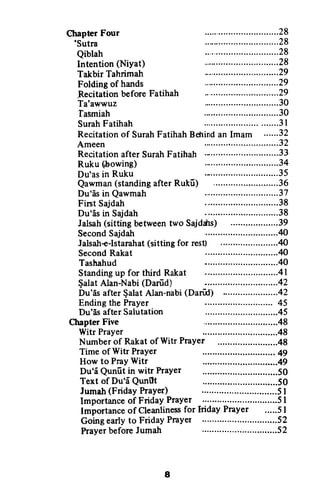
Chapter Four 28
'Sutra 28
Qiblah 28
Intention (Niyat) 28
Talcbir Tahrimah 29
Folding of hands 29
.Recitation before Fatihah 29
Ta'awwuz 30
'fasmiah 30
Surah Fatihah 31
Recitation of Surah Fatihah Behind an Imam 32
Ameen 32
Recitation after Surah Fatihah ._ 33
Ruku (J,owing) 34
Du'as in Ruku 35
Qawman (standing after Rukii) 36
Du'as in Qawmah 37
First Sajdah .38
Du'as in Sajdah 38
Jalsah (sitting between two Sajdcbs) .39
Second Sajdah 40
Jalsah-e-Istarahat (sitting for rest) 40
Second Rakat 40
Tashahud 40
Standing up for third Rakat .41
~alat Alan-Nabi (Dariid) -. .42
Du'as after ~a1at Alan-nabi (Dari"xl) .42
Ending the Prayer 45
Du'as after Salutation .45
Chapter Five 48
Witr Prayer .48
Number of Rakat ofWitr Prayer 48
Time of Witr Prayer 49
How to Pray Witr 49
Du'i Quniit in witr Prayer 50
Text of Du'i Qunilt 50
Jumah (Friday Prayer) · · 51
Importance of Friday Prayer 51
Importance of Cleanliness for Iriday Prayer 51
Going early to Friday Prayer 52
Prayer before Jumah 52
8
Listeningto Khutbah(Sermon
PrayerafterJumah
Eid Prayer
Junazuhllrayer
Conduct,'f JanazahPrayer
Fint l-akbir
Du'Esof starting
Surah Fatihah
Recitationof a Surah
SecondTakbir
Third Takbir
Du'frsof Janazah
Endingthe JanazahPrayer
Fourth Takbir
PrayerDuring a Journey
Whento shortenand combinePrayers ........62
Duration of journey
Nafl Prayeron ajourney .63
oo oa oo oo oo tt
::::::::::::::::::.54
56
s7
57
57
58
58
58
59
59
6r
6l
6l
63
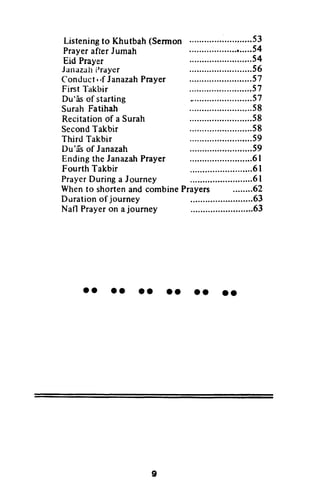
9
Listening to Khutbah (Sennon 53
Prayer after Jumah 54
Eid Prayer 54
Janazah l)rayer 56
Conduct I If Janazah Prayer 57
First Takbir 57
Du'as of starting 57
Surah Fatihah 58
Recitation of a Surah 58
Second Takbir 58
Third Takbir 59
Du'as of Janazah 59
Ending the Janazah Prayer 61
Fourth Takbir 61
Prayer During a Journey 61
When to shorten and combine Prayers 62
D-uration of journey 63
Natl Prayer on a journey 63
••••••••••••
9
thtes aboutthe Transliteration
Thefollowingsystemhasbeenadoptedt0 representr:orresponding
soundsof theArabicAlphabet.
Ar.rbicletter English
Equivalent
Example
tArabic)
Example
(English)
a
b
t
rh
J
h
kh
d
i
I
2
s
sh
I
{
I
1
,
gh
f
g
k
I
m
n
w
h

of the letterI
v
I
Y
dr
,i
c
c
c
J
j
)
)
tA
,.*
. c
f
-b
e
e15
(l,
J
I
o
t
j
Allah Apple
bismillah bat
Tirmizi loy
uthman through
Jabir iug
Raheem [ate
Khalifah noEnglish
equivalent
Dn,mi lbe
Aian reEemble
fur liver
zahid gero
sal5m seen
shuaib shop
salat sardine
wudu noequivalent
fahir noequivalent
guhr razor
Jam6'at noequivalent
Maghrib noequivalent
Fajr lan
lqamat queen
kitab f,een
Jibreel lean
Muhammad l[oon
Nisai noon
wu{u fiallet
janazah [our
noequivalentI
t in themiddle
L5
to
year
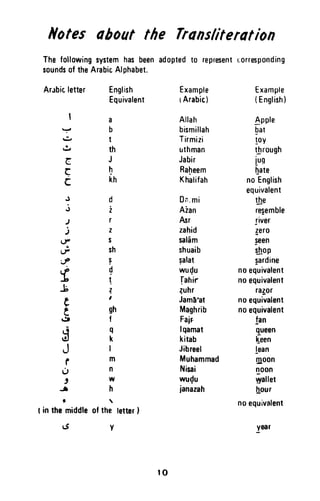
Notes about the Transliteration
The following system has been adopted to represent corresponding
sounds of the Arabic Alphabet.
ArJbic letter English Example Example
Equivalent I Arabic) (English)
a Allah ~pple
~
b bismillah bat
~ t Tirmizi !oy
• th uthman t.Drough'-oJ
C J Jabir jug
C; h Ra~eem bate
C kh Khalifah no English
equivalent
..) d Dn.mi the
oJ i Aian re~emble
J r Asr river
J z zahid !ero
IJ" s salam ~een
...
sh shuaib mopfJ'"
oj' ~ ~alat ~ardine
~
d wu~u no equivalent
, fahir no equivalent
j; ? ~uhr ra~or
e , JamIt'at no equivalent
e gh Maghrib no equivalent
~ f Fajr- fan
~
q Iqamat queen
k kitab feen
J I Jibreel lean
r m Muhammad !!loon
U n Nisai noon
j w wUQu wallet
~ h janazah ttour
• , no equivalent
( in the middle of the letter)
c.S y 'year
10
The followingsystemhas beenadoptedto representsomeof the
complexsoundsof theArabiclanguage.
A macron(-) placed0n a transcribedArabicvowel
lengtheningof thesoundof thatletter.
Arabic English
Equivalents
e
Example
(Arabic)
AilAh
Raheem
istanja
0awfid
awwal
indicates
Example
(Enslish)
Apple
seen
sit
seen
he
boot
true
sew
shovel
baY
age
ee
I
ioree
hT
u-u
aw
aww
ay
aYy
ivv
r5l
)
I
6'1
ll
ji
ii
$i
t5i
13t
Note:$ometimesan Arabicletterchangessoundaccordingt0 its
positionin theword;forexample;whetherit isat theheginning,in
ihemiddle0r at theend.InsuchcircumstancestheArabicletterhas
heenrepresentedbymorethanoneEnglishequivalent.
Abbrwirtionr
Thefollowingabbrwiationshavebeenusedinthisbook.
$,A.Uv, $tt- ul. Lllltj ALAYllllIA $Al,-LAt
I PtACrAt0 8l.tS$lll00F ALtAf{ 8t uP0tl{lt I
RA0tAil.llf|J Ailll||/ lillA
I tAy Aruil 8t PLtA$t0|1llh lllt/ l{tR
R.A.
11
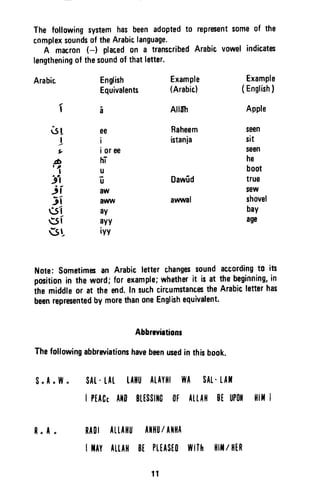
The following system has been adopted to represent some of the
complex sounds of the Arabic language.
A macron (-) placed on a transcribed Arabic vowel indicates
lengthening of the sound of that letter.
Arabic English
Equivalents
.- a
.sL ee
J i
So i or ee
.Jb hi
I'I u
)1 u
jf aw
)1 aww
(51 ay
Cf ayy
~~ iyy
Example
(Arabic)
Allih
Raheem
istanja
Dawud
awwal
Example
(English)
Apple
seen
sit
seen
he
boot
true
sew
shovel
bay
age
Note: Sometimes an Arabic letter changes sound according to its
position in the word; for example; whether it is at the beginning, in
the middle or at the end. In such circumstances the Arabic letter has
been represented by more than one English equivalent.
Abbreviations
The following abbreviations have been used in this book.
So A0 W0 SAl- lAl LANU AlAYHI WA SAL- LAM
I PEACt AND BLESSING OF AllAH BE UPON HIM I
R0 A0 RADI ALLAHU ANHU I ANHA
I MAY ALLAH BE PLEASED WITh HIMI HER
11
Chcrpter I
BEFOHEDOINGWIJOU
lf someoneneedsto goto thetoilet,heshouldusethetoiletanddo
istanjabeforedoingwudu.
ABLUTION
SIWAK(TOOTH-STICK)
It isa goodpracticeto cleantheteethwithatooth-stick,oratooth-
brushbeforeperformingwudu.In thisway you canavoidmany
diseaseswhicharecausedby uncleanteeth.
fu mentionedin thehadithAisha(R.A.)reportedAllah'smessen-
gerassaying:-'The
useof a tooth-stickisa meansof purifyingthe
mouthandispleasingto theLordaswell"
(Ahmad.0armi,andNisai.l
ProphetMuhammad(S.A.W.)alsosaid:-"lf I wouldn'thavefelt
thatit isdiffic,ultfor my peopleI woufd haveorderedthemto usea
tooth-stickwith everyprayer,that is,beforedoingeachwudu.So,
muslimsshouldalwaystry to fulfilthiswishof ourProphet(S.A.W.).
MAKTNGINTENT|0NF0RWUgU(N|YAT)
Beforestartingthe actionso wu{u it is necesaryt0 makeniyat.
MakeNiyatthat the actof performingwuf,uis for the purposeof
purityonfy.Niyatshouldbemadeintheheartbecauseit isanaction
of theheartandnotofthetongue.
Niyatby wordsisnotapprovedby ProphetMuhammad(S.A.W.l.
Thenstartthewu{u by saying:-Bismillbhhir-ra[rmanir-raheem
(lnthenameof Allah,mostgraciou$,mostmerciful)"
ACTIO]tISFORPERFORMIIIIGA8LUTIOI{.
l. Washthe handsup to thewristmakingsurethatn0 partof the
handsisleftdry.
2. Rinsethemouthtakingupwaterw;ththerighthand.
3. Cleanthenose:sniffwaterupfromtherightpalmandtheneject
waterwiththelefthand.
12
Chapter I
BEFORE DOING WUQU
If someone needs to go to the toilet, he should use the toilet and do
istanja before doing wudu.
ABLUTION
SIWAK (TOOTH--STlCK)
It is a good practice to clean the teeth with a tooth-stick, or a tooth-
brush before performing wudu. In this way you can avoid many
diseases which are caused by unclean teeth.
As mentioned in the hadith Aisha (R.A.) reported Allah's messen-
ger as saying:- ''The use of a tooth-stick is a means of purifying the
mouth and is pleasing to the Lord as well" )
(Ahmad. Oarmi, and Nisai .
Prophet Muhammad (S.A.WJ also said:- "If I wouldn't have felt
that it is difficult for my people I would have ordered them to use a
tooth-stick with every prayer, that is, before doing each wuQu. So"
muslims should always try to fulfil this wish of our Prophet (S.A.W.).
MAKING INTENTION FOR WUI}U (NIYAT)
Before starting the actions 0 wu~u it is necessary to make niyat.
Make Niyat that the act of performing wu~u is for the purpose of
purity only. Niyat should be made in the heart because it is an action
of the heart and not of the tongue.
Niyat by words is not approved by Prophet Muhammad (S.A.W.).
Then start the wu~u by saying:- Bismillah hir-ra~ma nir-raheem
(In the name of Allah, most gracious, most merciful) II
ACTIONS FOR PERFORMING ABLUTION.
1. Wash the hands up to the wrist making sure that no part of the
hands is left dry.
2. Rinse the mouth taking up water with the right hand.
3. Clean the nose: sniff water up from the right palm and then eject
water with the left hand.
12
a.
{ash theface,fromearto-eat,andforeheadto chinmakingsure
thatnopartof thefaceisleftdry.
5.Thenrvashthe forearms(rightforearmfirst) up to the elbou,s
makingsurethatnopartof themisleftdry.
6. Rubtheheadasfollows:-
Wetyourfingersandthenwipetheheadwithyourfingerqnstarting
from the forehead,takingthemto the napeof the neck,then
bringthembackto theforehead.
7. Cleantheeanby insertingthetipsof theindexfingerswettedwith
unter into the ears,twistthemaroundthefoidsof theearsthen
passthethumbbehindtheearsfromthebottom,upwards.
8. *Washthe feet (rightfoot fint) up to the anklesmakingsure
thatno parbof thefeetareleft dry,especiallybetrueenthetoes.
*SPECIALFACILITIESIil ABLUTIOT{
Eubbingthe sockswith wet handsinsteadof washingthefeet;
allowed,providedthatthesockshavebeenput 0nafterperfonr',rg
an ablution,includingwashingthefeet.Thisisaflowedfor 24hours
fromthetimeof ablution,andfor3 daysif thepersonisonajourney.
Afterthistimethefeetmustbewashed.Similarlyif thereisawound
in any parsof thebodywhichhasto bewashedin ablution,andif
washingthat particularpartislikelyt0 causeharm,it is permisible
to wipethedressingof thewoundwithawethand.
HAOITH
Mughirabinshu'bahsaid,"Prophet(S.A.W.)performedablution
andwipedoverhissocksandhissandals."
(Ahmad,Tirmizi,AbuDawild,andlbnMaiah).
Eachdetailof ablutionhasbeenperformedby ProphetMuhammad
(S.A.W.)once,twice0r threetimes(exceptrubbingof headand
cleaningof ears,i.e.actions6 and7 shouldonlybb doneonce).
Sinceall the abovemethodsmeetProphet(S.A.W.)tapprovalwe
canperformablutionby doingtheactionsonce,twice0rthreetimes.
providedthatnoparthasbeenleft drY.
AmrbinShuaib,quotinghisfatherontheauthorityof hisgrand'
fathernarratedthat ProphetMuhammad{S.A.W.)said,"lf anyone
performsactionsof ablutionmorethan3 timesrhehasdonewrong,
tramgresed,anddonewickedly.
OU'AATTHEEilDOFABLUTIOT{
"Ashhaduanl5itaha
illalldhurmhdahulf shareekalahfi
13
(Nisai,lbnMajah)
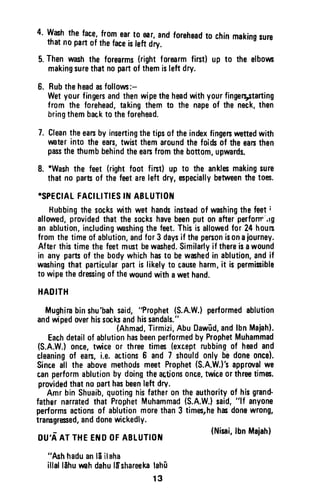
4. Wash the face, from ear to ear, and forehead to chin making sure
that no part of the face is left dry.
5. Then wash the forearms (right forearm first) up to the elbows
making sure that no part of them is left dry.
6.Rub the head as follows:-
Wet your fingers and then wipe the head with your fingers,starting
from the forehead, taking them to the nape of the neck, then
bring them back to the forehead.
7. Clean the ears by inserting the tips of the index fingers wetted with
water into the ears, twist them around the foids of the ears then
pass the thumb behind the ears from the bottom, upwards.
8. *Wash the feet (right foot first) up to the ankles making sure
that no parts of the feet are left dry, especially between the toes.
*SPECIAL FACILITIES IN ABLUTION
Rubbing the socks with wet hands instead of washing the feet;
allowed, provided that the socks have been put on after perfonr',lg
an ablution, including washing the feet. This is allowed for 24 hours
from the time of ablution, and for 3 days if the person is on ajourney.
After this time the feet must be washed. Similarly if there is awound
in any parts of the body which has to be washed in ablution, and if
washing that particular part is likely to cause harm, it is permissible
to wipe the dressing of the wound with a wet hand.
HADITH
Mughira bin shu'bah said, "Prophet (S.A.W.) performed ablution
and wiped over his socks and his sandals."
(Ahmad, Tirmizi, Abu Dawud, and Ibn Majah).
Each detail of ablution has been performed by Prophet Muhammad
(S.A.W,) once, twice or three times (except rubbing of head and
cleaning of ears, i.e. actions 6 and 7 should only be done once).
Since all the above methods meet Prophet (S.A.W,}'s approval we
can perform ablution by doing the actions once, twice or three times.
provided that no Dart has been left dry.
Amr bin Shuaib, quoting his father on the authority of his grand-
father narrated that Prophet Muhammad (S.A.W.) said, "If anyone
performs actions of ablution more than 3 times,he has done wrong,
transgressed, and done wickedly.
DU'A AT THE END OF ABLUTION
"Ash hadu an Iii iIaha
iIIallahu wah dahu Ifshareeka lahu
13
(Nisai, Ibn Majah)
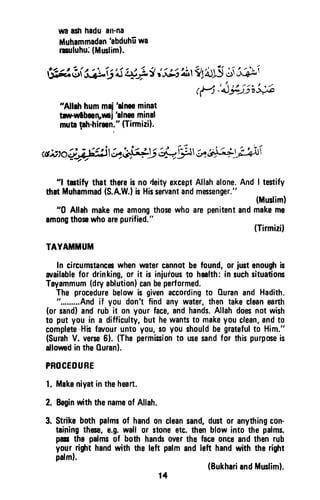
waashhaduatrna
illuhammadan
'abduhEwa
rruluhu:(Mrnliml.
fi;*l t f
"e,j'i
$jli,Et l,frglilfS*r;i;*i
rfi'i-*$s;#l
"Allahhummai'alnseminat
trpwlbmn sni hlneominal
mubph-hiren."(Tirmiril.
<tr;:toiriFi"isl..v}bQy*;5lrtirest;ay;$rf
"l tctify thatthereisnodeityexceptAllahalone.AndI testify
thatMuhammad(S.AW.IisHisservantandmessenger."
(Muslim)
"0 Allahmakemeamongthosewhoarepenitentandmakeme
amongthosswhoarepurified."
(Tirmizil
TAYATIi,IUIt|
In circumstancswhenrvatercannotbefound,orjustenoughis
arailablefor drinking,or it is iniufoust0 health:in suchsituations
Tayammum(dryablution)canbeperformed.
Theprocedurebelowis givenaccordingto OuranandHadith.
".........Andif you don'tfindanywater,thentakecleaneafth
(orsand)andrubit onyourface,andhands.Allahdoesnotwish
to putyouin a difficulty,buthewantsto makeyouclean,andto
complete-Hisfrvouruntoyou,soyoushouldbegratefulto Him."
(SurahV. verse6). (Thepermisionto usesandfor thispurposeis
allorvedintheOuran).
PROCEOU8E
l. Makeniyatinthehmrt.
2. BeginwiththenameofAllah.
3. Strikebothpalmsof handoncleansand,dustor anythingcon-
tainingthese,e.g.wallor stoneetc.fren blowintothepalms.
panthe pafmsof bothhandsoverthefaceonceandthenruh
yourrit'rt handwiththeleft palmandlett handwiththeright
palml.
(BukhariandMrslim).
14
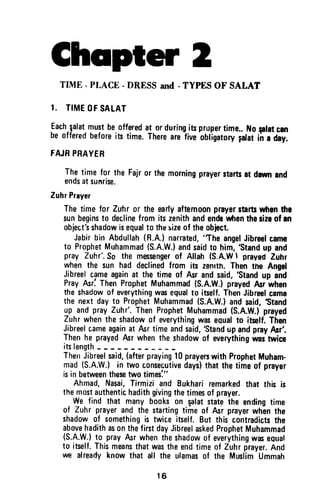
wa ash hadu an-na
Muhammadan 'abduhu wa
rasuluhu: (Muslim).
"Allah hum maj 'alnn minat
taw-wlbeen"Mj 'alnee minal
muta 18h-hireen." (TirmizH.
"1 testify that there is no rjeity except Allah alone. And I testify
that Muhammad (S.A.W.) is His servant and messenger."
(Muslim)
"0 Allah make me among those who are penitent and make me
among those who are purified."
(Tirmizi)
TAYAMMUM
In circumstances when water cannot be found, or just enough is
available for drinking, or it is injurous to health: in such situations
Tayammum (dry ablution) can be performed.
The procedure below is given according to Ouran and Hadith.
".........And if you don't find any water, then take clean earth
(or sand) and rub it on your face, and hands. Allah does not wish
to put you in a difficulty, but he wants to make you clean, and to
complete -His favour unto you, so you should be grateful to Him."
(Surah V. verse 6). (The permission to use sand for this purpose is
allowed in the Quran).
PROCEDURE
1. Make niyat in the heart.
2. Begin with the name of Allah.
3. Strike both palms of hand on clean sand, dust or anything con-
taining these, e.g. wall or stone etc. then blow into the palms.
pass the palms of both hands over the face once and then rub
your right hand with the left palm and left hand with the right
palm).
(Bukhari and Muslim).
14
4. FinishwiththesameDu'dasgivenat theendofahlution.
f{ote:0therproceduresincludethe forearmsandshouldersaswellm
armpits.Thesehavebeentransmittedby reputablescholanbut the
mostpreferableandauthenticisthatgivenabove.
oooooo
15
4. Finish with the same Du'a as given at the end of ablution.
Note: Other procedures include the forearms .and shoulders as well as
armpits. These have been transmitted by reputable scholars but the
most preferable and authentic is that given above.
o o o
15
o o o
Chspter 2
TIME - PTACE - DRESS and - TYPES OF SALAT
I. TIMEOFSALAT
Each,qalat.Tult beofferedat or during_iupropertime..Noplat crn
beofferedbeforeits time.Therearefive.obligatorydat iiiiaai.
FAJRPRAYEB
Thetime for the Fajror the morningprayerstartsat dawnand
endsatsunrise.
ZuhrPnyer
Thetime for Zuhr or the earlyaftemoonprayerrtartswhenthe
sunbeginsto declinefromitszenithandendrwtrentherizeof an
obiecttshadowisequalto thesizeof theobiect.
Jabirbin Abdulfah(R.A.lnarrated,'The
angelJibreelcams
to ProphetMuhammad(S.A.W.)andsaidto him,'Stand
up and
pray Zuhr'.So the messengerof Allah (S.A.WI prayedZuhr
whenthe sun had declinedfrom its zenlth.Thentne Anget
Jibreelcameagainat the timeof Asrandsaid,'Stand
up and
PrayAsriThenProphetMuhammad(S.A.W.)prayedAsr'when
theshadowof everythingwasequalto itself.ThenJibreelcame
the nextdayto ProphetMuhammad(S.A.W.)andsaid,Stand
!p andprayZuhr'.ThenProphetMuhammad(S.A.W.)prayed
Zuhrwhentheshadowof everythingwasequalto itself.Then
Jibreelcameagainat Asrtimeandsaid,'StandupandprayAsr'.
Thenhe prayedfur whenthe shadowof everythingrvastrvice
itslength
TherrJibreelsaid,(afterpraying10prayerswithProphetMuham-
mad(S.A.W.)in nruoconsecutivedays)thatthetimeof prayer
isin betweenth$e twotimesl"
Ahmad,Nasai,Tirmizi and Bukhariremarkedthat this is
themostauthentichadithgivingthetimesof prayer.
We find that manybookson $alatstatethe endingtime
of Zuhr prayerand the startingtime of fui prayerwhEnthe
shadowof somethingis twiceitself.But this contradictsthe
abovehadithas0nthefirstdayJibreelaskedProphetMuhammad
(S.A.W.)t0 prayfur whentheshadowof everythingwasequaf
to itself.Thismeansthatwastheendtimeof Zuhrprayer.And
we alreadyknowthat all the ulamasof the MuslimUmmah
16
Chapter 2
TIME· PLACE - DRESS and - TYPES OF SALAT
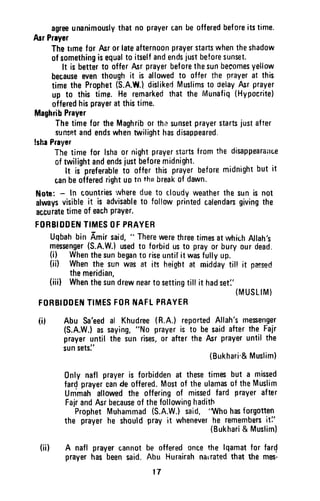
1. TIME OF SALAT
Each ~alat must be offered at or during its proper time.. No flist Cln
be offered before its time. There are five obligatory falat in a day.
FAJR PRAYER
The time for the Fajr or the morning prayer starts at dawn and
ends at sun-rise.
Zuhr Prayer
The time for Zuhr or the early afternoon prayer starts when the
sun begins to decline from its zenith and ends when the size of an
object's shadow is equal to the ~ize of the object.
Jabir bin Abdullah (R.A.) narrated, "The angel Jibreel came
to Prophet Muhammad (S.A.W.) and said to him, 'Stand up and
pray Zuhr'. So the messenger of Allah (S.A.W  prayed Zuhr
when the sun had declined from its zenith. Then the Angel
Jibreel came again at the time of Asr and said, 'Stand up and
Pray Asr~ Then Prophet Muhammad (S.A.W.) prayed Asr when
the shadow of everything was equal to itself. Then Jibreel came
the next day to Prophet Muhammad (S.A.W.) and said, 'Stand
up and pray Zuhr', Then Prophet Muhammad (S.A.W.) prayed
Zuhr when the shadow of everything was equal to itself. Then
Jibreel came again at Asr time and said, 'Stand up and pray Asr'.
Then he prayed Asr when the $hadow of everything was twice
its length _
Then Jibreel said, (after praying 10 prayers with Prophet Muham-
mad (S.A.W.) in two consecutive days) that the time of prayer
is in between these two times:"
Ahmad, Nasai, Tirmizi and Bukhari remarked that this is
the most authentic hadith giving the times of prayer.
We find that many books on ~alat stat~ the ending time
of Zuhr prayer and the starting time of Asr prayer when the
shadow of something is twice itself. But this contradicts the
above hadith as on the first day Jibreel asked Prophet Muhammad
(S.A.W.) to pray Asr when the shadow of everything was eQuat
to itself. This means that was the end time of Zuhr prayer. And
we already know that all the ulamas of the Muslim Ummah
16
agreeunanimouslythatn0 prayercanbeofferedbeforeitstime.
Arr Prryer
Thetrmefor Asrorlateafternoonprayerstartswhentheshadow
ofsomethingisequalto itselfandendsjustbeforesunset.
It isbetterto offerfur prayerbeforethesunbeeomesyellow
becauseeventhoughit is allowedto offer the orayerat this
timethe Prophet(S.A.Y{.}dislikedMuslimsto 0elayfur prayer
up to this time. He remarkedthat the Munafiq(Hypocritel
offeredhisprayeratthistime.
MaghribPraycr
Thetimefor theMaghrib0r th0sunsetprayerstartsjustafter
sunsetandendswhentwilighthasdisappeared.
!shaPrayer
Thetimefor lshaor nightprayerstartsfromthe disappearaitue
oftwilightandendsjustbeforemidnight.
It ii preferableio offerthis prayerbeforemidnightbut it
canbeofferedrightuotn thebreakof dawn'
l,lote:- In countrieswheredueto cloudyweatherthesunis not
alurnysvisibleit is advisableto followprintedcalendarsgivingthe
accuratetimeof eachPraYer.
FORBIDDENTIMESOFPHAYER
uqbahbin Amirsaid," TherewerethreetimesatwhichAllah's
messenger(S.A.W.)usedto forbidusto pray0r buryourdead.
(i) Whenthesunbeganto riseuntitit wasfullyup.
(ii) Whenthe sunwasat its heightat middaytil! it passed
themeridian,
(iii) Whenthesundrewnearto settingtill it hadsetl'
(MUSLIM)
FOBBIDDEilTIMESFORNAFLPRAYER
{i} Abu Sa'eedal Khudree(R.A.)reportedAllah'smes$enger
(S.A.W.)assaying,"No prayeris to besaidafterthe Fair
prayeruntil the sunrises,or afterthe fur prayeruntilthe
sunsetsl'
(Bukhari'&Muslim)
Onlynafl prayeris forbiddenat thesetimesbut a missed
fardprayersande offered.Mostof theulamasof theMuslim
Ummahallowedthe offeringof missedfard prayerafter
Fajrandfur becauseof thefollowinghadith
ProphetMuhammad(S.A.W.)said, '1/Vhohasforgotten
the prayerhe shouldprayit wheneverhe remembersiti'
(Bukhari& Muslim)
(ii) A nafl prayercannotbe offeredoncethe lqamatfor fard
prayerhasbeensaid.Abu Hurairahflarratedthat the mes-
17
agree unanimously that no prayer can be offered before its time.
Asr Prayer
The time for Asr or late afternoon prayer starts when the shadow
of something is equal to itself and ends just before sunset.
It is better to offer Asr prayer before the sun becomes yellow
because even though it is allowed to offer the prayer at this
time the Prophet (S.A.W.l disliked Muslims to Oelay Asr prayer
up to this time. He remarked that the Munafiq (Hypocrite)
offered his prayer at this time.
Maghrib Prayer
The time for the Maghrib or th~ sunset prayer starts just after
sunsp.t and ends when twilight has disappeared.
!sha Prayer
The time for Isha or night prayer starts from the disappearance
of twilight and ends just before midnight.
It is preferable to offer this prayer before midnight but it
can be offered right uo to thp. break of dawn.
Note: - In countries where due to cloudy weather the sun is not
always visible it is advisable to follow printed calendars giving the
accurate time of each prayer.
FORBIDDEN TIMES OF PRAYER
Uqbah bin Amir said, H, There were three times at which Allah's
messenger (S.A.W.) used to forbid us to pray or bury our dead.
(i) When the sun began to rise untir it was fully up.
(jj) When the sun was at its height at midday til! it p~sed
the meridian,
(iii) When the sun drew near to setting till it had set:'
(MUSLIM)
FORBIDDEN TIMES FOR NAFl PRAYER
(i) Abu Sa'eed al Khudree (R.A.) reported Allah's messenger
(S.A.W.) as saying, "No prayer is to be said after the Fajr
prayer until the sun rises, or after the Asr prayer until the
sun sets:'
(Bukhari-& Muslim)
Only naf1 prayer is forbidden at these times but a missed
fard prayer can de offered. Most of the ulamas of the Muslim
Um'mah allowed the offering of missed fard prayer after
Fair and Asr because of the following hadith
Prophet Muhammad (S.A.W.) said, 'Who has forgotten
the prayer he should pray it whenever he remembers it:'
(Bukhari & Muslim)
(ij) A nafl prayer cannot be offered once the Iqamat for fard
prayer has been said. Abu Hurairah nal'rated that the mes:
17
sengerof Allah(S.A.W.lsaid,
't{hen thelqanlathasbeensaid,
thenrthereis no prayervalid(Naflor sunnat)exceptthe
Fardprayerforwhichthelqamatwassaid."
(Ahmad& Muslim)
It is seenin practicethat manypeoplecontinuewith the
sunnatprayerwen thoughthe iqamathasbeensaidfor the
far{ prayerepeciallyin the Fajrprayer.Theyfeelthatthe
2 Rakatsunnatof Fajrcanonlybeofferedbeforethe Far{.
This practiceis againstcongregationPhilosophy,discipline
of Jamd'at,and a clearviolationof Hadith.Theyshould
offer 2 rakatsunnatof Fairimmediatelyafterthe Fardor
aftersunrise.
2.PLACEFORSALAT
A placeor a buildingwhichisusedfor thepurposeof woship
and prayeris calleda mciid (Mosque).A hadithtellsusthat "all
the earthhasbeenrenderedfor the Muslims,a mosque(Pureand
clmn)."
This mearsthat wherevera muslimmightbe he canoffer his
prayerbut the reuardof a prayerofferedin a mosqueisfar grmEr
thanthat offeredin an ordinaryplace.Thefollowingpointsshould
benotedwhenchoosinga placefor prayer.
(a) Theplaceshouldbeclan andpure.$alatin a dirty,filthyand
impureplacesuch if a rubbishtip, slaughterhouse,bathing
placeandacamelpenisforbidden.
(bl The placeshouldbe freefrom danger.The danpr couldbe
dueto someoneor somethingthat maydisturbthe worshipper.
(c) A prayerplacewherethe worshippermighthindermovement
of othersshouldbe avoided,e.g.busypavements,publicroad-
waysetc.
(d) lt isforbiddento prayontheroofof Baitullah(Ka'bahl.
(e) lt isforbiddento prayontop of orfacingtowardsagrave.
3. DRESSFORSATAT
MEN
(i) Thedres for the menshouldbesuchthat it coversfrom the
navelto thekneemtlect.
18
senger of Allah (S.A.W.) said, "When the Iqamat has been said"
then, there is no prayer valid (Nafl or sunnat) except the
Fard prayer for which the Iqamat was said."
(Ahmad & Muslim)
It is seen in practice that many people continue with the
sunnat prayer even though the iqamat has been said for the
far~ prayer especially in the Fajr prayer. They feel that the
2 Rakat sunnat of Fajr can only be offered before the Far~.
This practice is against congregation Philosophy, discipline
of Jama'at, and a clear violation of Hadith. They should
offer 2 rakat sunnat of Fajr immediately after the Fard or
after sunrise.
2. PLACE FOR SALAT
A place or a building which is used for the purpose of worship
and prayer is called a masjid (Mosque). A hadith tells us that "all
the earth has been rendered for the Muslims, a mosque (Pure and
clea!l)."
This means that wherever a muslim might be he can offer his
prayer but the revvard of a prayer offered in a mosque is far greater
than that offered in an ordinary place. The following points should
be noted when choosing a place for prayer.
(a) The place should be clean and pure. ~Iat in a dirty, filthy and
impure place such as a rubbish tip, slaughter house, bathing
place and a camel pen is forbidden.
(b) The place should be free from danger. The danger could be
due to someone or something that may disturb the worshipper.
(c) A prayer place where the worshipper might hinder movement
of others should be avoided, e.g. busy pavements, public road-
ways etc.
(d) It is forbidden to pray on the roof of Saitullah (Ka'bah).
(e) It is forbidden to pray on top of or facing towards a grave.
3. DRESS FOR SALAT
MEN
(j) The dress for the men should be such that it covers from the
navel to the kneesat least.
18
(iil ThEshouldersshouldnotbeleftuncovered.
(iiil $alatcanbe prayedin onegarmentif it coversthe body
fromthenavelto thekneesaswellastheshoulders.
"Noneof you mustprayin a sin$egarmentof whirh no
partcomesovertheshoulderj'
(BUKHARI& MUSLIM}
lf, however,the grment is not longenoughto uoverthe
shouldersthen partsof the body betweenthe naveland
thekneesshouldatleastbecovered.
WOMEN
The dressof the womanshouldbe suchthat it coversherwhole
body from headto foot leavingonly the faceandthe handsun'
covered.A prayerofferedin transparentclothingis not valid.Also
tight fittingcfothingwhichshowsthe shapeof the bodyshould
beavoided.
4.TYPESOFSALAT
a) Fardor obligrtorySalat.
Fardprayeris an obligatoryprayer.[very believeris ordered
by Allahto offerfive obligatoryprayersin a day.Failureto
observeanyoneof the fiveobligatoryprayersisa seriousand
punishablesin.
b) ltlaflPrayer.
Thisis a voluntaryprayerwhichtheProphet(S.A.W.)observed
beforeor afterFardat specialand isolatedoccasions.lt also
includesthosewhichheencouragedMuslimsto prav.
TheNaflPrayercanbedividedintothreecategortes.
(i) SunnatMu'akkadah(compuhory)
Thatisthosewhic,hareemphasizedbytheHolyProphet(S.A.W.)
and offeredregularlyby him beforeor afterthe Fardprayrlr.
(iil GheirMu'akkadah(optional)
Thatis thoseofferedonlyoccasionallyby ProphetMuhammad
(s.A.w.l.
r9
(in Theshoulders should not be left uncovered.
(iii) $alat tan be prayed in one garment if it covers the body
from the navel to the knees as well as the shoulders.
"None of you must pray in a single garment of whilh no
part comes over the shoulder:'
(BUKHARI &MUSLIM)
If, however, the garment is not long enough to cover the
shoulders then parts of the body between the navel and
the knees should at least be covered.
WOMEN
The dress of the woman should be such that it covers her whole
body from head to foot leaving only the face and the hands un·
covered. A prayer offered in transparent clothing is not valid. Also
tight fitting clothing which shows the shape of the body should
be avoided.
4. TYPES OF ~ALAT
a) Far~ or obligatory $alat.
Far~ prayer is an obligatory prayer. Every believer is ordered
by Allah to offer five obligatory prayers in a day. Failure to
observe anyone of the five obligatory prayers is a serious and
punishable sin.
b) NafJ Prayer.
This is a voluntary prayer which the Prophet (S.A.W.) observed
before or after Far~ at special and isolated occasions. It also
includes those which he encouraged Muslims to pray.
The Nafl Prayer can be divided into three categones.
(i) Sunnat Mu'akkadah (compulsory)
That is those which are emphasized by the Holy Prophet (S.A.W.)
and offered regularly by him before or after the Far~ praYI~r.
(ii) Ghair Mu'akkadah (optional)
That is those offered only occasionally by Prophet Muhammad
(S.A.W.).
19
(iiil thfl Prryrr(Extnl
Thbisanextraprayer.Thereisa rewardfor prayingit andno
sinforleavingit. lt canbeofferedatanyisolatedinstanceaccord-
ingto thetimeandcapacityofthebeliever.ProphetMuhammad
(S.AW,)encouragedthe believerst0 praynall to helpmake
up for anyminorombsionsor otherdefec$in theobligatory
praysr.
5.TUTIBEROFRAKATSFORTHEFIVEOETIGATORYPRAYERS
(il FrirPrryrr.
2rakarsunnatMu'akkadah,2 RakatsFard.
(ii) ZuhrPrryrr,
2 or 4 rakatssunnatMu'akkadah,4 rakabfar{,2 rakatssunnat
Mu'akkadahandanunspecifiednumberof naflrotimeandcap-
acityalloun.
lbn Umar(R.A.)said"l prayedalonewithAllah'smesengel
(S.A.W.)2 rakatsbeforeand2 rakatsaftertheZuhrprayer."
(BUKHARI& MUSLIM)
rakatssunnatbeforeZuhr
2 rakatsunnatbeforethe
It is a familiarpracticeto offer 4
prayer,but this hadithprovesthat
Zuhrprayerisalsoallowed.
(iiil ArrPrryrr.
2 0r 4 rakat sunnat$rair Mu'akkadah,4 rakatsFard.
Ali (R.A.)said,"Allah'smessenfr(S.A.W.}usedt0 pray4 rakafu
beforeAer prayerssparatangthemwithasalutation........"
(TlBftllZll
Anotherhadithnarratedby Ali (R.A.)says,"Allah'smesenger
(S.A.W.}usedtopraytw'orakasbeforeAsrprayer."
(ABUDAWUO}
(ivl MrghribPrryar.
2 rakatsnafl,3 rakan
an unspacifiednumber
fard,2 rakatssunnatMu'akkadahand
of nafl 6 timeandcapacityallows.
Abdullahbin Mughaffalreportedthe Prophet(S.A.W.)assaying,
20
(iii) Nell Preyer (Extrl)
This is an extra prayer. There is a reward for praying it and no
sin for leaving it. It can be offered at any isolated instante atcord-
ing to the time and capacity of the believer. Prophet Muhammad
(S.A.W.) encouraged the believers to pray natl to help make
up for any minor omissions or other defects in the obligatory
prayer.
5. NUMBER OF RAKATS FORTHE FIVE OBLIGATORY PRAYERS
(0 Fejr Prlyer.
2 rakats sunnat Mu'akkadah, 2 Rakats Far~.
(ii) Zuhr Prlver.
2 or 4 rakats sunnat Mu'akkadah, 4 rakats far~, 2 rakats sunnat
Mu'akkadah and an unspecified number of nafl as time and cap-
acity allows.
Ibn Umar (R.AJ said "I prayed alone with Allah's messenger
(S.A.WJ 2 rakats before and 2 rakats after the Zuhr prayer."
(BUKHARI & MUSLIM)
It is a familiar practice to offer 4 rakats sunnat before Zuhr
prayer, but this hadith proves that 2 rakat sunnat before the
Zuhr prayer is also allowed.
(iii) Asr Praver.
2 or 4 rakats sunnat ghair Mu'akkadah, 4 rakats Fard.
Ali (R.A,) said, "Allah's messenger,(S.A.W,) used to pray 4 rakats
before Per prayer separating them with asalll tation........"
(TfRMIZI)
Another hadith narrated by Ali (R.AJ says, "Allah's messenger
(S.A.WJ used to pray two rakats before Asr prayer." _
(ABU DAWUO)
(iv) Meghrib Preyer.
2 rakats nafl, 3 rakats fard, 2 rakats sunnat Mu'akkadah and
an unspecified number of' nafl as time and capacity allows.
Abdullah bin Mughaffal reported the Prophet (S.A.W.) as saying,
20
"Praybeforethe Maghribprayerj'addingwhensayingit the
thirdtime,"Thisappliesto thosewhowishto d0s0."
(EUKHARt&MUSL|MI
Thatwasbecausehe did not wishpeoplet0 treatit asa com-
pulsorysunnat.
2 rakatsnaflaftersunsetandbeforethemaghribprayer
areallowedfor tlioselvhowishto do:0. Forthistheabove
hadithis a sureproof.However,somepeopleforbidthisand
othersfind it verysrrangeif theyseea personoffer2 rakats
naflbeforeMaghrib.
(v) lshaPmyer.
An unspecifiednumber0f nafl rakatsaccordingto the time
andcapacity,4 rakatsfard,2 rakatssunnatMu'akkadah,un-
specifiednumberof nafl as timeandcapacityalloranand3
witr.
Somepeopleinsistveryemphaticallyuponthe offeringof 4
rakatsoptionalsunnatbeforethe ishaprayerbut duringour
entireresearchwe couldnot find a singleproof,any practice
or orderfromProphetMuhammad(S.A.W.)or hiscompanions
to justifythisclaim.Certainlyit is allowedta praynaflwhile
waitingforJamd'at.
Somepeopleoffer 2 rakats.naflafterthe witr prayer.How-
evet,thereis an authentichadithwhichstatesthat thewitr
prayershouldbeofferedafterallthenaflwhichapersonwishcs
to prayhavebeenoffered.
lbn Umar(H.A.)reportedthattheMesengerof Allah(S.A.W)
said,"Makewitrasthelat prayerof yournightprayerl'
(MtsHKATI
ooooo
21
"Pray before the Maghrib prayer;' adding when saying it the
third time, "This applies to those who wish to do so."
(BUKHARI &MUSLIM)
That was because he did not wish people to treat it as a com-
pulsory sunnat.
2 rakats nafl after sunset and before the maghrib prayer
are allowed for tliose who wish to do ::0. For this the above
hadith is a sure proof. However, some people forbid this and
others find it very suange if they see a person offer 2 rakats
natl before Maghrib.
(v) Isha Prayer.
An unspecified number of nafl rakats according to the time
and capacityI 4 rakats fard, 2 rakats sunnat Mu'akkadah, un-
specified number of nafl 'as time and capacity allows and 3
witr.
Some people insist very emphatically upon the offering of 4
rakats optional sunnat before the isha prayer but during our
entire research we could not find a single proof, any practice
or order from Prophet Muhammad (S.A.WJ or his companions
to justify this claim. Certainly it is allowed tQ pray nafl while
waiting for Jama'at.
Some people offer 2 rakats ~nafl after the witr prayer. How-
ever, there is an authentic hadith which states that the witr
prayer should be offered after all the nafl which a person wishes
to pray have been offered.
Ibn Umar (R.A.) reported that the Messenger of Allah (S.A.W.)
said, "Make witr as the last prayer of your night prayer:'
(MISHKAT)
o o o
21
o o
Chspter t
AZAN IQAMAT
As you know,in alf MuslimcountriesAian is calledaloud
fivetimesa dayandyoumusthaveheardit. Haveyoueverwondered
howit stafted?
sroRY0Fn2nr*r
A longtimeagowhentheMuslimsmigratedfromMakkahto Madinah
theyusedto agreeabouta fixedtimefor thecongregationalprayer.
Theyfoundit difficultt0 rememberthe timefixedfor the prayer
sometimesrespeciallywhenthey werebusydoingtheirwork.One
day ProphetMuhammad(S.A.W.)and the Muslimsdiscusedthe
matterof callingthe peoplefor the congregationalprayerat the
exacttime.Someof the believerssuggestedtheuseof somethinglike
thebellof the Christians,othessuggestedtheussof a hornlikethat
of theJews,but Umar(R.A.)suggestedsendingsomsonet0 announce
the prayer.Then Allah'sMessenger(S.AW.)appointedBilal t0
callthe peoplet0 prayer.Butit seemsthroughthestudyof ahadith
that the methodwas not satisfactory.ThenProphetMuhammad
(S.A.W.}agreedto usea Naqoose(aeonch),somethinglike thebell
of Christiansbut hewc not happyto useit becauseof itssimilarity
with the Christians.
AfterProphetMuhammad(S.A.W.)hadordereda bellto bemade
so that it couldbestruckto gatherthe peopleto prayer;on that
samedaya companion,Abdullahbin ZaidbinAbd Rabbihirsaid,"l
vrrassleepingwhenI sawa mancarryinga nagoosein hishands,and
I said,
'Servant
of Allah,will you selfthisto me?'Whenhecked
what I woufddo with it?l replied,thatwe woulduseit to callthe
peopfet0 prayer.Hesaid,ShalfI notguideyouto somsthingbetter
thanthat?'I repliedr'Certainly',sohetnldmet0 sav,
'Allehu
Akbar, AllEhu Akbar, Allahu Akbar, Altdhu
AkMr, ,Ash hadu an lE ildha illal lEh, xh hdu an li il6ha
illal lEh, Ashhadu an-ru,Mufiammadar resitut4en, Ashhadu
an-na MuQammadAr rafilullEh, bayya
'al4 galEh, bayya'alq galdh fuayya
'alal fa6h, fuayya
'alal-falEh
AllEhu
Aktur, AllEhu Aktur, G ilffia illal lilh.'l
'
22
Chapter J
AZAN ..... IQAMAT
As you know, in all Muslim countries Aian is called aloud
five times a day and you must have heard it. Have you ever wondered
how it started?
STORY OF AZAN
A long time ago when the Muslims migrated from Makkah to Madinah
they used to agree about a fixed time for the congregational prayer.
They found it difficult to remember the time fixed for the prayer
sometimes,especially when they were busy doing their work. One
day Prophet Muhammad (S.A.WJ and the Muslims discussed the
matter of calling the people for the congregational prayer at the
exact time. Some of the believers suggested the use of something like
the bell of the Christians, others suggested the use of a horn like that
of the Jews, but Umar (R.A.) suggested sending someone to announce
the prayer. Then Allah's Messenger (S.A.W.) appointfd Bital to
call the people to prayer. But it seems through the study of ahadith
that the method was not satisfactory. Then Prophet Muhammad
(S.A.WJ agreed to use a NaQoose (a oooch), something like the bell
of Christians but he was not happy to use it because of its similarity
with the Christians.
After Prophet Muhammad (S.A.WJ had ordered a bell to be made
so that it could be struck to gather the people to prayer; on that
same day a companion, Abdullah bin Zaid bin Abd Rabbihi"said, "1
was sleeDing when I saw a man carrying a naqoose in his hands, and
I said, 'Servant of Allah, will you sell this to me?' When he asked
what I would do with it?t replied,that we would use it to call the
people to prayer. He said, 'Shall I not guide you to something better
than that?' I replied/Certainly', so he told me to sav.
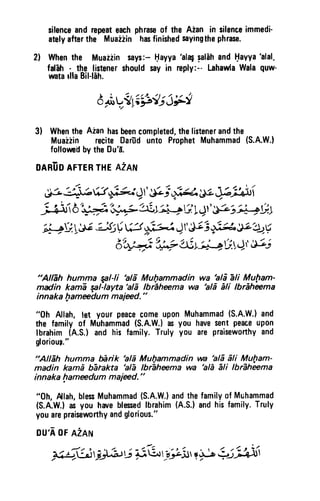
'AI/ahu Akbar, A/llJhu Akbar, Allahu Akbar, AI/shu
Akbar,. Ash hadu an Ii ilaha illal lah, ash hadu an la ilaha
iI/allah, Ash hadu an-na Mul)ammadar resulu/·/iJh, Ash hadu
an-na Mul)ammadilr rasulul-llJh, I)ayya 'a/Sf $a/ah, payya
'alSf ~aISh, payya 'alaI falal), Qayya 'alaI-fa Ilh Allahu
Akbar, AI/ahu Akbar, La ilaha iI/allah. ' ·
22
After the Aian the strangerkeptquietfor a whileandthen
said,{lhen thecongregationisreadyyoushouldsay:- AllihuAkbar,
All6huAkbar.Ashhaduanli lilahaillallah,fuh haduan'na[luham-
madarras0lul-lifr,hayya
'alaqgalih,bayya
'alalfal-ah,qadqEmatis
satah,qadq6matii iaieh,A[l6huAkbar,All6huAkbar,li ilihillal
Hh.
WhenI told Allah'sMesenger(S'A.W.)in the morningwhat
I hadseenrhesaid,
'lt isatruevision,insha'Allah,sogetupalongwith
Bilal,andwhenyouhavetaughthimwhatyou haveseenlethimuse
it in makingthe callto prayer,for he hasstrongervoicethanyou
have'.
SoI got up alongwith Bilalandbegnnto teachit to him,and
heusedit in makingthecallto grayer..
Umarbin al-Khattabheardthiswhenhewu in hishouse,and
hecameouttrailinghiscloakandsaid,
'Mesengerof Allah(S.A.W.),
by Himwhohassentyouwiththetruth,I haveseenthesamekind
oi thingashasbeenrevealed''To thisAllah'sMesenger(S.A.W.)
replied,
'Praisebeto Allah!"''
(Darmi,Ntmad,lbnMaiah,lbn,Khuzahah,Tirmizi)
So fromthatday0nt0 thepresentday Aian issaidto gather
peopleforthecongregationalprayer.
THEmun2iru
A personwho callspeoplefor the congregationalFrayeris called
a Mua2iin Beforesayingthe Aian heshouldstandfacingKa'bah
in Makkah.He shouldraisehis handsto hiseanputtingthe tips
of forefingersinto hisearsandcallin a loudvoice.Whenhesays
Havva'alC Saldhheshouldturn hisfaceto therightandwhenhe
$yi'flayya"aialFalElrheshouldturnhisfaceto theleft.
TEXTOFTHE A'NT.I
f.-5{ Jii-.;3 $et-";3 fti'i'*-::;l,'}A
,,"iifglfif {tfr::t ',ri,!r'^ll9e1;41
rt^tJFui'#&)'rjsAil, jr,IJ#fsJa, St"offi
"rji*rt
'rF"i
l -e9^1-rr
';*V
og{.dt&G va$5t'e%
,'r{Si,Aii,'i5fu"t
'o'"i'r9yUfX
23
After the Aian the stranger kept quiet for a while and then
said, When the congregation is rea~y you should say:- Allahu Akbar,
Allfihu Akbar, Ash hadu an Iii lilaha iIIallah, Ash hadu an·na Muham-
madar rasOlul-lah, ~ayya 'ala, salah, bayya 'alai fala~, qad qama tis
~Iah, qad qama tis salah, AII3hu Akbar, Allahu Akbar, la ilatll illal
lah.
When I told Allah's Messenger (S.A.W.) in the morning what
I had seen1he said, 'It is a true vision, insha·Allah, so get up along with
Bilal, and when you have taught him what you have seen let him use
it in making the call to prayer, for he has stronger voice than you
have'.
So Igot up along with Bilal and began to teach it to him, and
he used it in making the call to praver.
Umar bin al-Khattab heard this' when he was in his house, and
he came out trailing his cloak and said, 'Messenger of Allah (S.A.W.),
by Him who has sent you with the truth, I have seen the same kind
of thin~ as has been revealed", To this Allah's Messenger (S.A,WJ
replied, 'Praise be to Allah!'"
(Oarmi, Ahmad, Ibn Majah, Ibn, KhuzaicDah, Tirmizi)
So from that day on to the present day Aian is said to gather
people for the congregational prayer.
THE MUAizlN
A person who calls people for the congregational prayer is called
a Muaziin Before saying the Aian he should stand facing Ka'bah
in Makkah. He should raise his hands to his ears putting the tips
of forefingers into his ears and call in a loud voice. When he says
~ayya 'al~ ~alah he should turn his face to the right and when he
says ~ayya 'alai Fala~ he should turn his face to the left.
TEXT OF THE AlAN
b;~~~ J"i~J::s..:r
~-r~~::# lr ~~l~~
l7J~~T~; j ~(i,
23
Allihu Akbar
Allahisthegreatest
AllEhu Akbar
Allahisthegreatest
Allahu Akbar
Allahisthegreatest
Allihu Akbar
Allahisthegreatesr
Ash hadu an lE il6ha illal l1h
I bearwitnesthatthereisnodeitybutAllah.
Ash hadu an ld it1ha iilat LEh
I bearwitnesthatthereisnodeitybutAllah.
Ash hadu an-na Muhammadar rasulul Eh
I bearwitnesthatMuhammad(S.A.W.Ilsthemessengerof Allah.
Ash hadu an-na Mul"tammadarrasulul lEh
I bearwitnessthatMuhammadtS.A.tiJ.)isthemessengerof Allah.
Hayyalalaggalah
tiometo prayer
Hayya'alag sal1h
Cometo Prayer.
Hayya'alal falah
Cometo yourGood
Hayya'alal falah
Cometo yourGodA.
Alldhu Akbar
Allahisthegreatest
Allahu Akbar
Allahisthegreatest
LE ildha illal lah
ThereisnodeitybutAllah.
ainruFoRFA"IB
An additionalphraseis includedin the Aian for the Fajrprayer
afterthesecondthyya
'alal
Fal6h
!:'j,lrr'+:+'!it>iat
e+Att;Hr)-iit
4tr+1lfl! Kh-ayrumminannawm- prayerisbetterthansleep.
As.ralatuKhayrumminannarvm- prayerisbetterthansleep.
TISTEIIIilGTOTHEA2Ail
ll whenthebeliarenhearthe Aian theyshourdristento ir in
24
Allihu Akbar
Allah is the greatest
AlliJhu Akbar
Allah is the greatest
Allahu Akbar
Allah is the greatest
AlliJhu Akbar
Allah is the greatest
Ash hadu an la i!§ha iI/allah
I bear witness that thp.re is no deity but Allah.
Ash hadu an la ilaha illal Lah
I bear witness that there is no deity but Allah.
Ash hadu an~na Muhammadar rasululliJh
I bear witness that Muhammad (S.A.W.) is the messenger of Allah.
Ash hadu an-na Muhammadar rasululliJh
I bear witness that Muhammad (S.A.W.) is the messenger of Allah.
l;Iayya~/a~ ~alah
(;ome to prayer
1;Iayya 'ala1 salah
Come to Prayer.
/;/ayya 'alaI falal)
Come to your Good
I;!ayya 'alaI falalJ
Come to your Good.
Allihu Akbar
Allah is the greatest
Allihu Akbar
Allah is the greatest
LlI iliha illal Lah
There is no deity but Allah.
AZAN FOR FAJR
An additional phrase is included in the Aian for the Fajr prayer
after the second ~ayya 'alai Fal~~
A~ ~al5tu ~hayrum minan nawm .
~ ~aliJtu Khayrum minan nawm-
LISTENING TO THE A!AN
Prayer is better than sleep.
1) When the believers hear the Aian they should listen to it in
24
silenceandrepeateachphraseof the Aian in silenceimmedi'
atelyafterthe Muaiiin hasfinishedsayingthephrase.
2l Whenthe Muaiiin says:-tlayya
'al4 salEhandHavya'alal-
fal-ah:. thQ.ljstenershouldsayin reply:--LahawlaWalaquw'
watarllaBil-hh.
3) Whenthe Aian hasbeencompleted,thelistenerandthe
Muaiiin reciteOariidunto ProphetMuhammad(S.A.W.}
follomif bytheDuf;.
OARiiDAFTERTHEAZAN
J3 3t hi3 +fu,J I'gG,;;f.e- ULJljfrti
fu:irb'++P?;i,"f|*1ai,+G14r'g.a't'*ith.l
''i+V,1,# -JI:$ W
"*l
Jt F i $t!. JL1tV
dt*4'q# U'L-i;+tJ:.)t &i
"AlEh humma Eal-li hlE Mufiammadin wa
'ald
1li Muftam-
madin kamE qal-layta'alE lbr1hffima wa 'ald ili lbrEhema
innaka fiamedum maied."
"0h Allah,let your peacecomeuponMuhammad(S.A.W.)and
the family of Muhammad(S.A.W.}asyou havesentpeaceupon
lbrahimtA.S.) and his family.Truly you are praiseworthyand
glorioug:"
!!ilEh humma ffirik 'alE Mulammadin wa 'alE6li Multam-
madin kamd bitakta
'ali
lbrhheema wa 'alE Eli lbrEheema
innaka hamedum maied."
"0h, Alah,blesMuhammad(S.A.W.)andthefamilyof Muhammad
(S.A.W.)asyou hareblessedlbrahim(A.S.)andhisfamily.Truly
youarepraiseworthyandglorious."
DU'AOFA2AN
H,':.L33),:il,i-*{6r-tff:tr{+L:7iur:t
d+V,Ei-id;JF!
silence and repeat each phrase of the Aian in silence immedi·
ately after the Muaiiin has finished saying the phrase.
2) When the Muaziin says:- t:tayya 'al~ ~alah and I:tavya 'alat
fal'ah . the listener should say in reply:-- Lahawla Wala quw-
wata Ina Bil-lah.
3) When the Aian has been completed, the listener and the
Muaziin recite Dariid unto Prophet Muhammad (S.A.W.)
followed by the Du'a.
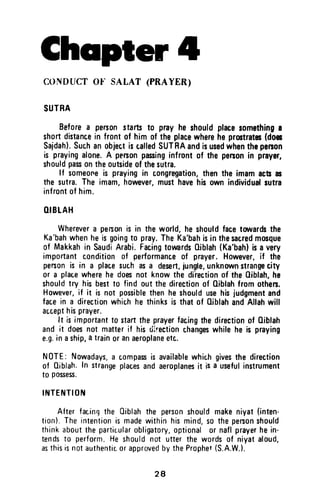
OARUO AFTER THE AiAN
"Allah humma ¥l1·li 'ala Mul)ammadin wa 'ali ali Muf1am·
madin kama ~/-Iayta 'ali Ibraheema wa 'ala ali Ibraheema
innaka lJameedum majeed. "
"Oh Allah, let your peace come upon Muhammad (S.A.W.) and
the family of Muhammad (S.A.W-l as you have sent peace upon
Ibrahim (A.S.) and his family. Truly you are praiseworthy and
gloriouJ~"
~'Allah humma barik 'ala Mul}ammadin wa 'ala ali Mu/;Jam-
madin kama blJtakta 'alll Ibraheema wa 'aliJ ali Ibraheema
innaka I}ameedum majeed. "
"Oh, Allah, bless Muhammad (S.A.W.) and the family of Mlihammad
(S.A.W.) as you have blessed Ibrahim (A.S.) and his family. Truly
you are praiseworthy and glorious."
OU'A OF AZAN
't|*.-*3,tA'"r;3'2,i#;'rlJi?,'ttv'ei3iyi
o'nJJUb$ty
"AllEh humma rabba
Hathi hid da'wa tit
tdm mati wassald
tit Oi imati hii
Mufiammada niI waseelata
wal Fa{eelata wab
'ath-hu
maqimam mahmhda nil
lazee wa adtahfi."
"0h Allah!Lordof thiscompleteprayerof oun. By theblesing
of it, giveMuhammad(S.A.W.)his eternalrightsof intercesion,
distinctionand highestclass(in paradise).And raisehim t0 the
promisedrankyouhavepromisedhim.
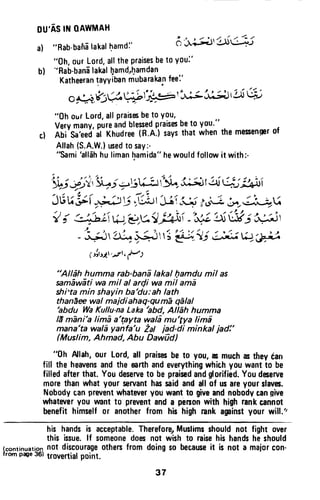
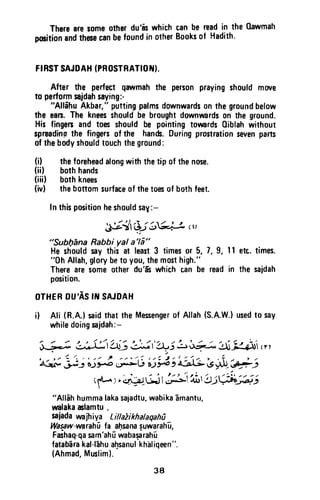
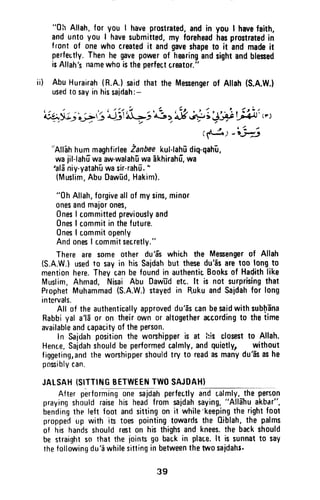
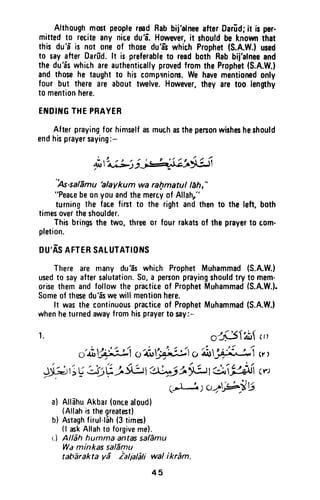
Jabir(R.A.)reportedAllah'sMesenger(S.A.W.)assayin$"lf
anyonesayswhenhe hearsthe Aian.
'0 God,Lordof thisperfect
callandof theprayerwhichisestablishedforalltime,grantMuham'
rmad(S.A.W.)theWasilaandexcellency,andraisehimupinapraise-
worthypositionwhichyou havepromised',he will h asuredof
myintercession."
(Bukhari)
IOAMAT
lqamatisthesecondcallto prayerandisutteredimmediatelybefore
the beginningof the obligatoryprayerofferedwith congregtion.
TEXTOFIOAMAT
o'@N 54';i
i,ltl ly:,iYt'J'rIal
c,,arrtCi: 'r;:Ltt Sag
cAY.aStJt,s r,;*:e,:t& e
6'-qrtI.rl*ii3 i'e!&tl5't3ii
i. :rlr*y:r{'1.,'i$fi;{'i3 %i
Allahu Akbar
Allahisthegreatest
Allahu Akhar
Allahisthegreate$t
26
"Allah humma rabba
Hazhi hid da~wa tit
tam mati was sala
til Qa imati iJii
Muhammada nil waseelata
waf Far;Jeelata wab ~ath-hu
maqamam mahmuda nil
taiee wa ad tahu."
"Gh Allah! Lord of this complete prayer of ours. By the blessing
of it, give Muhammad (S.A.W.) his eternal rights of intercession,
distinction and highest class (in paradise). And raise him to the
promised rank you have promised him.
Jabir (R.A.) reported Alla~'s Messenger (S.A.W.) as saying, "If
anyone says when he hears the Aian , '0 God, Lord of this perfect
call and of the prayer which is established for all time, grant Muham-
Imad (S.A.W.) the Wasila and excellency, and raise him up in a praise-
worthy position which you have promised', he will be assured of
my intercession."
(Bukhari)
IQAMAT
Iqamat is the second call to prayer and is uttered immediately before
the beginning of the obligatory prayer offered with congregation.
TEXT OF IOAMAT
Allahu Akbar
Allah is the greatest
Allahu Akbar
Allah is the greatest
26
Ashhadu anld il6ha illal l6h
I bearwitnesthatthereisnodeitybutAlah.
ArhhaduannaMufiammadarnsfrlul lEh
I bearwitnesthatMuhammad(S.A.W.}h them$sengprofAllah.
Hayya
'alaq ldh
Gometo prayer
Hayya hlal faldh
Cometoyourgood
QadqmatiS galEh
Jaml'atisrcady
Qadqlmatiqsal6h
Jamt'atisreaCy
Alldhu Akbar
AllahistheGnatest
All1hu Akbar
Allahisthegreatest
LEildha illal lEh
ThereisnodeitybutAllah.
Thistext of lqamatis thesamec that mentionedin thehadith
of Abdullahbin Zaidbin Abd Rabbihiwttowc thefint to haYe
avisionaboutAzan.
27
Ashhadu en Ii ilaha il/alliJh
I bear witness that there is no deity but Allah.
Ash hadu anna Muhammadar rasulullah
I bear witness that Mu'hammad (S.A.W.) is the messenger of Allah.
/:Iayya 'alaf $Blah
Come to prayer
/:Iayya 'alaI fa/a/}
Come to your good
Dad QiJmatis salah
Jaml'atis ready'
Dad qamatis salah
Jam.'at is rea~y .
Allihu Akbar
Allah is the Greatest
AI/shu Akbar
Allah is the greatest
La ilaha illallah
There is no deity but Allah.
This text of Iqamat is the same ~ that mentioned in the hadith
of Abdullah bin Zaid bin Abd Rabbihi who W~ the. first to have
a vision about Azan .
.-==========.-
27
Chopter 4
CONDUCT Ot' SALAT (PRAYER)
SUTRA
Beforea personstaru t0 pray he shouldplacesomethinga
shortdistancein frontof him of theplacewhereheprmtratc(doe
Sajdah).Suc,hanobjectiscalledSUTRAandisusedwhenthepemon
is prayingalone.A personpasinginfrontof the penonin prayer,
shouldpassontheoutsideof thesutra.
lf someoneis prayingin congregation,thenthe imamac8 as
the sutra.The imam,however,musthavehisownindividualsutra
infrontofhim.
0fEtAH
Wherevera personis in theworld,heshouldfacetowardsthe
Ka'bahwhenheis goingto pray.TheKa'bahisinthesacredmosgue
of Makkahin SaudiArabi.Facingtowards0iblah(Ka'bah)isa very
importantconditionof performanceof prayer.However,if the
personis in a placesuchasa desert,jungle,unknownstrangecity
or a placewherehe doesnot knowthe diiectionof the Oiblah,he
shouldtry hisbestto find outthedirectionof Oiblahfromothen.
However,if it is not possiblethenheshouldusehisjudgmentand
facein a directionwhichhe thinksis thatof OiblahandAllahwill
accepthisprayer.
ft isimportantto starttheprayerfacingthedirectionof 0iblah
and it doesnot matterif hisd;rectionchangeswhilehe is praying
e.g.inaship,a train0ranaeroplaneetc.
N0TE: Nowadays,a compasis availablewhichgivesthe direction
of 0iblah.In strangeplacesandaeroplanesit isa usefulinstrument
to poses.
IilTEttlT|ON
After facinqthe 0iblahthe personshouldmakeniyat(inten-
tion),Theintentionis madewithinhismind,s0 thepersonshould
thinkabouttheparticularobligatory,0ptionalor naflprayerheIn-
tertdst0 perform.Heshouldnot utterthe wordsof niyataloud,
asthisisnotauthentic0rapprovedbytheProphet(S.A.W.).
28
Chapter4
CONDUCT OF SALAT (PRAYER)
SUTRA
Before a person starts to pray he should place something 8
short distance in front of him of the place where he prostrates (does
Sajdah). Such an object is called SUTRA and is used when the person
is praying alone. A person passing infront of the person in prayer,
should pass on the outside of the sutra.
If someol'le is praying in congregation, then the imam acts as
the sutra. The imam, however, must have his own individual sutra
infront of him.
QIBlAH
Wherever a pernon is in the world, he should face towards the
Ka 'bah when he is going to pray. The Ka'bah is in the sacred mosque
of Makkah in Saudi Arabi. Facing towards Qiblah (Ka'bah) is a very
important condition of performance of prayer. However, if the
person is in a place such as a desert, jungle, unknown strange city
or a place where he does not know the direction of the Qiblah, he
should try his best to find out the direction of Qiblah from others.
However, if it is not possible then he should use his judgment and
face in a direction which he thinks is that of Qiblah and Allah will
accept his prayer.
It is important to start the prayer facing the direction of Qibtah
and it does not matter if his o;rection changes while he is praying
e.g. in a ship, a train or an aeroplane etc.
NaTE: Nowadays, a compass is available which gives the direction
of Qiblah. In strange places and aeroplanes it is a useful instrument
to possess.
INTENTION
After fac.ing the Qiblah the person should make niyat (inten-
tion). The intention is made within his mind, so the person should
think about the particular obligatory, optional or natl prayer he in-
ten ds to perform. He should not utter the words of niyat aloud,
as this is not authentic. or approved by the Prophet (S.A.W.L
28
TATBIRTAHRIMAH
Aftermakingniyatthepenonshouldstarthisprayersaying
"AllEhuakbar"(Allahisthegreatest)raisingbothof hishandsto
theshouldsrs,with fingersstretchingto theearlobes.Heshould
thenfdd hishandsoverhischestrighthandoverthelefthand.This
first"AlliihuAkbar"iscalledTakbirTahrimahbecauseaftersaying
TakbirTahrimaheverycommonandworldlyaction,talkor move-
mentisforbidden.Throughouttheprayertheeyesofthewonhipper
shouldpointtothespotwheretheforeheadrestsinSajdah.
WHERESHOUTDTHE HAI{DSBE FOTDEDAf{O PLACED
AFTERSAYITGTAKBIRTAHRIIIAH?
Somepeopleplacetheir handsunderthe navel,othersplace
themuoderthechestbuttherearehadithswhichstatethatProphet
Muhammad(S.A.W.)ued to placehishandsoverhischest.
al HalbAlaee(R.A.)repofted:"l sawtheProphet(S.A.W.)pfacing
hisrighthandoverhislefthandoverhischesti'(Ahmadrlirrrnizi).
bl Wlll b. Hair(R.A.)said:"l prayedwith ProphetMuhammad
(S.A.W.)andhe put hisrighthandoverhisleft handoverhis
cho$t."(lbnKhuzaimah,AbuDawld,Muslim).
TherearesomeothernarrationswhichstatethatsomeFuqha
usedto placetheirhan&underthechestbutabovethenavel.
Flacingthehandsin eitherof thesepositionsiscorrectbutit isbetter
to placethem overthe chestaccordingt0 the practiceof Prophet
Muhammad(S.A.W.)asmentionedin theaboveauthentichadiths.
RECITATIOT{BEFOREFATIHAH
Thereare severaldu'ts which ProphetMuhammad(S.A.W
usedto recitebeforeFatihah.Wewill mentiontwo of them.
'ij tJ;( (;- 3V& 1# i',#i+r:. iliri,,,
733Ui" L:41'L#)i o--Ft5 rt4)t
.* jr=:ag46' o#.1r-"+",iit 5rll'H
r{cs,V,o iili +L sf,? ? + 6a
"Alleh hummabe'id banee wabaynakhat|yEyaKamE
E'adta baynal mashrigiwal maghribi,Allih humma naq'
2g
TAKBIR TAHRIMAH
After making nivat the person should start his prayer saying
"AII'Ihu akbar" (Allah is the greatest) raising both of his hands to
th~ shoulders, with fingers stretching to the earlobes. He should
then fold his hands over his chest right hand over the left hand. This
tim "Anihu Akbar" is called Takbir Tahrimah because after saying
Takbir Tahrimah every common and worldly action, talk or move-
ment is forbidden. Throughout the prayer theeyesof the worshipper
should point to the spot where the forehead rests in Sajdah.
WHERE SHOULD THE HANDS BE FOLDED AND PLACED
AFTER SAYING TAKBIR TAHRIMAH?
Some people place their hands under the navel, others place
them uDder the chest but there are hadiths which state that Prophet
Muhammad (S.A.W.) used to place his hands over his chest.
a) Halb A!aee (R.A.) reported: "1 saw the Prophet (S.A.W.) placing
his right hand over his left hand over his chest:' (Ahmad"Tirtnizi).
b) Wi'il b. Hajr (R.A.) said: "I prayed with Prophet Muhammad
(S.A.W.) and he put his right hand over his left hand over his
chest." (Ibn Khuzaimah, Abu Oawtid, Muslim).
There are some other narrations which state that some Fuqha
used to place their hands under the chest but above the navel.
"Placing the hands in either of these positions is correct but it is better
to place them over the chest according to the practice of Prophet
Muhammad (S.A.W.) as mentioned in the above authentic hadiths.
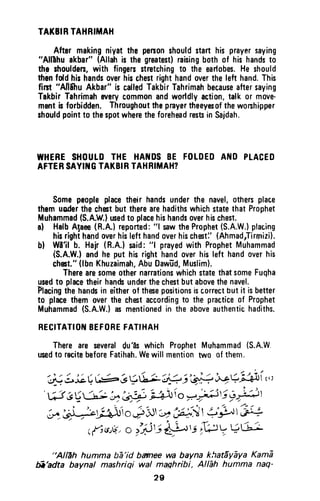
RECITATION BEFORE fATIHAH
There are several du'as which Prophet Muhammad {S.A.W,
used to recite before Fatihah. We will mention two of them.
"Allah humma ba'id barnee wa bayna khat5yaya Kama
/ii'adta baynal mashriqi wal maqhribi, Allah humma naq-
29
qinee min kha6yEya Ram'a yunag-qath thawnul a,by$!
minad dan*i, AtEh hum maghsilnie min KhatEyEya bil
mEeewath thalii wal bardi." (Bukhari and Muslim).
"0 Allahset me apartfrommy sinsm EastandWestareapart
fromeachother.
0 Allah,cleansemefrom my sinsasa whitegarmentisuleansed
fromdirtafterthoroughwCIhing.
0 Allah,unshmeoff frommy sinswithwater,snowandhail."
lf a penondoesnot know the du'diust mentionedthen he
shouldrecitethe followingone.Umar(R.A.) is reportedto hatre
usedthisdu'a-aftersayingTakbirTahrimah.
3.i+UtiS'#-.. I!,rVj'.t)iL|j;,fr)t it;rirg,,r,
eaSi;al,i;
" SubfrEna KaltEh humma wabi fiamdika watabhra
kasmukawata'aldiad-duka wali ildha ghamtk.
"Gfory be to you, 0 Allah,andall praisssarodueuflto yoor
andblessedisyournameandhighisyourmaie$yandnoneisrwnlry
ofwonhipbutyouJ'
A personcanreadboth du6s,togetheror just oneof tftemor
py of the otherdu'6swhichareapprovedby ProphetMuhammad
(S.A.W.),andrthereareabout7. Thesedu'&canbefbundin differertt
placesof sevenlBooksof Hadith,e.g.Mulim, Tirmizi,Musnad.r
!I.* Ahmad,Abu.Dawid,Dar-qulni,Nisai,lbn Majah,lbn llibban,
MuattalmamMalik).
All of the 7 du'f,scan be readtqether beforerecitfutgsurah
Fatihah.
This recitationis calledDu'#ul-lstiftahwhich meansDuE of
starting.0ui-ul lstiftahshouldonly be recitedin the first rakat.
TA,A}WYUi
Thenthepersonwhoisprayingshouldsay:-
t;,:;rrp,i*lr 4;'(;*i
" A'uiu biLEhi minah Shaygdnir-raipm."
"l seekAllahtprotectionfromsatanwhoisaccursed."
Thisshouldonlybesaidinthefirstrakat.
TASMIA}I
Thenthepenonwhoispraytngshouldsay:
30
qinee min khafiJyaya kama yunaq·qath thawIJul abyaqu
minad danasi, Allih hum maghsilnee min Khatayaya bil
maee wath thaJji wal bardi." (Bukhari and Muslim).
"0 Allah set me apart from my sins as East and West are apan
from each other.
oAllah, cleanse me from my sins as a white garment is deansed
from dirt after thorough washing.
o Allah, wash me off from my sins with water, snow and hail."
If a person does not know the duli just mentioned then he
should recite the following one. Umar (R.AJ is reported to have
used this du'i after saying Takbir Tahrimah.
~ -" ",,, / ' / " 
~~~~~~, ~J.;Z-' :!J~j~t Zi~ ,..,
.. ~tJ: ":_  --.
c~AJt'J'.. ,;4'
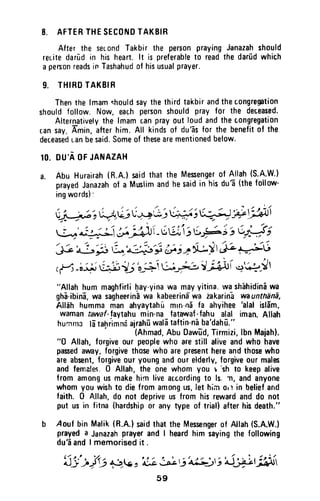
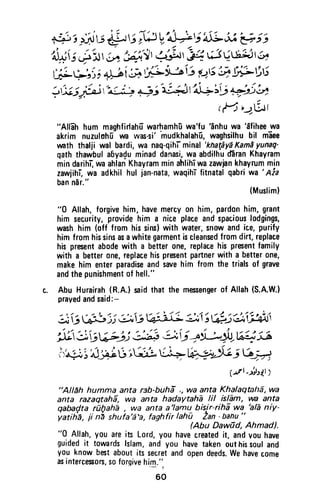
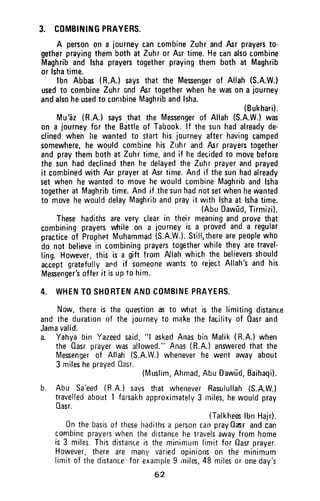
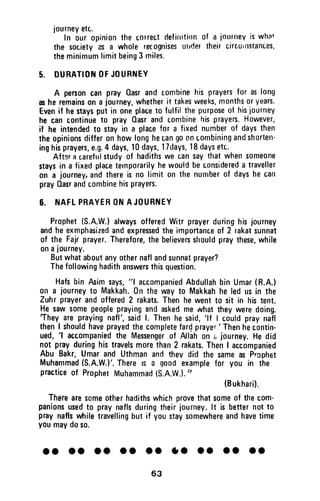
"Subpana Kallah humma wabi f)amdika wataliiJra
kasmuka wata 'ala jad-duka wallJ illJha gh;wruk.
"Glory be to you, 0 Allah, and alt praises are due unto you·,
and blessed is your name and high is your majesty and none is won'v
of worship but you:'
A persol'1 can read both du'ls, together or just one of them or
any of the other du'as which are approved by Prophet Muhammad
(S.A.W.),and,there are about 7. These du'as tan be found in different
places of several Books of Hadith, e.g. Muslim, Tirmizi, Musnad-.
Imam Ahmad, Abu Dawiid, Dar-qutni, Nisai, Ibn Majah, Ibn Hibban,
Muana Imam Malik). •
All of the 7 du'as can be read together before rettting surah
Fatihah.
This recitation is called Dua:ul-Istiftah which means Du'i of
starting. Du/a-ullstif tahshould only be retited in the first rakat.
TA'Awwui
Then the person who is praying should say;·
(~~8,~k/'~~f,,; - _" ",.. ,.,; v
" A'uiu bi/./ahi minash Shayta nir-rai-eem. "
"1 seek Allah's protection from satan who is accursed."
This should only be said in the first rakat.
TASMIAM
Then the person who is praying should say:
30
o+ij}$rj1 PF,
"BismillEhhir'nhmd nir-rahnm. "
"ln thenameof Allah,themmtkindandthemostmercifuli'
Thisshouldbesaidin weryrakatbeforerecitingrurahFatihah.
SURAHFATIHAH
ThentheperconprayingshouldreciteiurahFatihah.
;Du i:-*il Id4l 6 ;# 6 rP.i ;u
"t-it5+:^J6'.'i;{" !Vyi'*4i AVL3i;rV ;
l] e.=1ei#i( g rt,ur= e*idrig;;ott
-*t"l' S dJ,btiirydJb-';ih"F
"Alltamdu |il-Ehi rab-hil'6lameen.
Ar rafrma-nir-ralrem.
Mefiki yawmid - den.
lyydka na'budu wa
iyyaka nasta'een.
Ihdl nagsirital mustagmm.
$iragal Laieena an'amta 'alayhim.
Ghayril maghQubi -
hlaVhim walay'ddl-leen.A,mffin."
"PraiseisunlyforAllah,Lord
of theUnivene.
Themostkind,themostmerciful.
Themasterof theDayof Judgment.
Youaloneweworshipandto youalone
un prayfor help.
Showusthestraightway,
thewayof thosewhomyouhaveblessed.
Whohavenotdeservedyouranger,
Norgoneastray."
RecitingFatihahissoimportantthatProphetMuhammad(S.AW.)
said thit no prayerwG acceptablewiqhoutthe recitationof
Fatihah.
a) Ubadahbin Samit(R.A) reportedAll:th'sMessenger(S.A.W.)
assaying:
'Thereis no prayeracceptablewith_outreciting$ol,
Fatihah.;'{BukhariMuslim,Ahmad,Abu Dalfrd,Tirmizi,Nhai,
lbnMaiah).
b) AbuHurairah(n.A.)reportedthattheMessengerofAllah(S.A.W.)
wassayingthatanyonewhoprayedanykindof prayeranddid
31
, .,...:?~,. I .....::J, A~.' ':.)~ _ L.~ -...' A-~
_ ~ ~~- .... ~J.-
"Bismfllah hir-rabma nir-raheem. "
"In the name of Allah, the most kind and the most merciful:'
This should be said in FNery rakat before reciting surah Fatihah.
SURAH FATIHAH
"A/hamdu li/-/ahi rab-bil 'a/ameen.
Ar rahma nir-raheem.
Maliki yawmid : deen.
Iyyaka na'budu wa
iyyaka nasta'een.
Ihdlna~ siratal mustaqeem.
Sira(al Lazeena an 'amta 'alayhim.
Ghayril magh{1ubi _
'alayhim walap gal-Ieen. Ameen. "
"Praise is only for Allah, Lord
of the Universe.
The most kind, the most merciful.
The master of the Day of Judgment.
You alone we worship and to you alone
we pray for help.
Show us the straight way,
the way of those whom you have blessed.
Who have not deserved your anger,
Nor gone astray:'
Reciting Fatihah is so important that Prophet Muhammad (S.A.W.)
said that no prayer was acceptable wi1thout the recitation of
Fatihah.
a) Ubadah bin Samit (R.A.) reported Allah's Messenger (S.A.W.)
as saying: "There is no prayer acceptable without reciting Surah
Fatihah." (Bukhari Muslim, Ahmad, Abu Oawud, Tirmizi, Nisai,
Ibn Majah).
b) Abu Hurairah (R.A.) reported thatthe Messenger of Allah (S.A.W.)
was saying that anyone who prayed any kind of prayer and did
31
not nad in thatrUmmulOuranpnd in oneversionFatihah.tul.
Kitsbhirprayrrwillbodeficient,will bedeficienr,will bedeficient,
andnotcomplete.(Bukhrri,Mrrlim Ahmad).
cl Abu Hurrirah(R.A.l reportedAllah'sMessenger(S.AW.}as
rrying: "[Io praysrwifl benefita personwho did not readin
ftrt rurdr Fatihah."(lhn Khuzaimah,lbn Hibban.Ahmad).
In the ligrt of the abovehadithswe undentandthat surah
Fatihdrmurt berscitedor readin everyrakatof anytypeof prayer.
BECITATIOilOFSURAHFATIHAHBEHIITIDAf{ IMAM.
$ome.pgopl.ogE.ysly confusedwhethertheyshouldor should
not rsadsurah Fatiharrwhireprayingin congiegrion.Bui ih;;;
drouldnot b0any confusionin'thii niatter-i ir,Jiorro",ingtilli;
vry clmdy.ansnrersthequestion.
al Ubadahbin $amit.(R.A.)said:
'1Ale
werebehindthe Prophet
(s.A.w.)in the Fairpraver,andhe reciteda passagefrom'the
Ouran,but the recitationbecamedifficurtfor'him.'Thenwhen
he finishedhc said,'Do you recitebehindyour lmam?'we
replie.{,.'yE,^tlgfengglof Attah(S.A.W.)'.Th'enthe Messenger
of Allah (S.A.W.)said: 'Do
not reciteanything(behindt-he
lmam) exceptFatihah-tul-Kitab(surah raiitratrjbecausehe
who doesnot includeit in hisrecitationin prayerhisprayer
isnotvalid.'" (AbuDawEd,Tirmizi).
bl AbuHurairah(R.A.)reportedthsttheMesengerof Allah
(s.A.w.)said:"lf anyoneobsewesprayer(salatlinwhichhedoes
not read ummul0ur5n{FatihahLitisdeiicient,it isdeficient,
it is deficient,andnotcomplete."lt wassaidto AbuHurairahi'What
shouldwe do whenwearebehindanlmam?,,He,(Abu
Hurairahl(R.A.)replied,"Readit insirence......."(Muslim).
AMEEIU:
It is sunnahio *y Ameenwhena personfinishes-recitation
of SurahFatihah.lf he is prayingaloneheshouldsay"Ameen"in
silenceandif hg is prayingwithcongregationbehindan lmamthen
he shouldsayAmeenfairlyloudlywhenthe lmamfinishessaying
the lastverseof SurahFatihah.whensayingEmeenthe voiceoT
thewtrolecongregationshouldresoundatthesametimu.
TherearemanyhadithswhichprovethatsayingAmeenaroud
isSunnahof theHolyProphet(S.A.w.)andit wasiheiegularpractice
of the companions.we will mentiona few of thesehadithshere.
a) Naeemal Mujammarsaid:"l prayedbehindAbuHurairah(n.A.)
HerecitedBismilfdhhir-ra[manir-raheem,thenherecitedsurah
Fatihahrandwhenhe reachedwalad{alleen,he saidrAmeen
afterit andthepeoplebehindhimsaidAmeen...,.."(dukhari).
b) AbuHurairah{R.A.)reportedthattheMessengerol Allah
(s.A.w.)said:
'when
the lmamsaysGhayriiMaghd0bi'arayhim
32
not read in that,Ummul (luranl.and in one version Fatihah·tul·
Kitab his prayer will be deficient, will be deficient, will be deficient,
and not complete. (Bukhari, Muslim Ahmad).
c) Abu Hurairah (R.A.) reported Allah's Messenger (S.A.W.) as
saying: "No prayer will benefit a pe~an who did not read in
that .nlh Fatihah." (Ibn Khuzaimah. Ibn Hibban. Ahmad).
In the Ii-.t of the above hadiths we understand that Surah
Fatihah must be recited or read in every rakat of any type of prayer.
RECITATION OF SURAH fATIHAH BEHIND AN IMAM.
Some people are very confused whet~er they should or should
not l'Iad Surah Fatihah while praying in congregation. But there
should not be any confusion in this matter as the following hadith
very clearty answers the Question.
8) Ubadah bin ~amit (R.A.) said: 'We were behind the Prophet
(S.A.W.) in the Fajr prayer, and he recited a passage from the
auran, but the recitation became difficult for him. Then when
he finished he said, 'Do you recite behind your Imam?' We
replied, 'yes, Messenger of Allah (S.A.W.)'. Then the Messenger
of Allah (S.A.W.) said: 'Do not recite anything (behind the
Imam) except Fatihah-tul·Kitab (Surah Fatihah) because he
who does not include it in his recitation in prayer his prayer
is not valid.' " (Abu Dawiid. Tirmizi).
b) Abu Hurairah (R.A.) reported that the Messenger of Allah
(S.A.W.) said: "If anyone observes prayer (~alat) in which he does
not read Ummul Quran (Fatihah), it is deficient, it is deficient,
it is deficient, and not complete." It was said to Abu Hurairah:
'What should we do when we are behind an Imam?" He, (Abu
Hurairah) (R.A.) replied, "Read it in silence......." (Muslim).
AMEEN:
It is sunnah to say Ameen when a person finishes_recitation
of Surah Fatihah. If he is praying alone he should say "Ameen" in
silence and if h~ is praying with congregation behind an Imam then
he should say Ameen fairly loudly when the Imam finishes saying
the last verse of Surah Fatihah. When saying Ameen the voice of
the whole congregation should resound at the same timlt
There are many hadiths which prove that saying Ameen aloud
is Sunnah of the Holy Prophet (S.A.W.) and it was the regular practice
of the companions. We will mention a few of these hadiths here.
a) Naeem al Mujammar said: "I prayed behind Abu Hurairah (R.A.)
He recited Bismillah hir-rahma nir-raheem, then hE recited surah
Fatihah, and when he reached wala·p c)a.!.:lee-n, he said, Ameen
after it and the people behind him said Ameen......" (Bukhari).
b) Abu Hurairah (R.A.) reported that the Messenger of Allah
(S.A.W.) said: 'When the Imam says Ghayril MaghQubi 'alayhim
32
wala{dal-leenrallof youshouldsay,Ameen,becuasetheAngels
gty Ameenand the fmamsaysAmeen.And whosoeversays
Ameenandhisvoiceblendswith thatof theangelshewould
beforgivenhissins."(Ahmad,AbuDawld,Nisail.
c) Aisha(R.A.)reportedthat the Mesengerof Allah (S.A.W.)
said:"Jewsarer'noreenviousof Muslimsin two thinp la)our
greetingsomeonewith Assalamu
'alaykumand(b)sayingAmeen
(aloud)behindthelmami'(Ahmad,lbnMajah).
dl Atasaid:"l found200of thecompanionsprayingin themosque
of theProphet(S.A.W.)andwhenthelmam_saidwaladdal-!een,
I heardtheechoof theirvoicesresoundwithAmeen".
BECITATIONAFTERSURAHFATIHAH
It is sunnahfor a personwho is prayingthatheshouldread
a surahfrom 0ur5nafterFatihahin thefirsttwo rakatsof thefard
prayer.Hecanreciteoneor m0resurahs.HereareafewshortSurahs
whichyoucanrecite.
a) Surahlkhlar
#)'.FJt$g--a
itX'rt-d;!'*Fa"";Zt I'4:,i5t An63'd3
8'rratfj-rL,jiq;s3
"Oul huwal ldhu ahad.
Allah huq-qamad.
Lam yalid walam yhlad.
Walamyakul-lahl Kufuwan ahad."
"Say:HeisAllah,theonlyone.
Allahhelpsanddoesnotneedhelp.
Hedoesnotproduceachild,andHe
Wasnotbornof anyone.
Thereisnooneequalto Him."
b) SurahFalaq.
c#itt*;S;IF9'.:"',
7 A)6'5';u:+31 dFt P.k'5.iri Jrb
L*ii ih.lJ'J ;-G u3 F i5 d Astil v4v
h'-,gti:*'<ii-'
33
walaQ.. ~al-Ieen} all of you should sa~, Ameen, becuase the Angels
~y Ameen and the Imam says Ameen. And whosoever says
Ameen and his voice blends with that of the angels he would
be forgiven his sins." (Ahmad, Abu Dawud, Nisai).
c) Aisha (R.A.) reported that the Messenger of Allah (S.A.W.)
said: "Jews are more envious of Muslims in two things ~) our
greeting someone with Assalamu 'alaykum and (b) saying Ameen
(aloud) behind the Imam:' (Ahmad, Ibn Majah).
d) Ata said: "I found 200 of the companions praying in the mosque
of the Prophet (S.A.W.) and when the Imam_said wala~ ~al·leen,
I heard the echo of their voices resound with Ameen".
RECITATION AFTER SURAH FATIHAH
It is sunnah for a person who is praying that he should read
a surah from Quran after Fatihah in the first two rakats of the fard
prayer. He r.an rer.ite one or more surahs. Here are a few short Surahs
whic.h you can recite.
a) Surah Ikhlas
NQul huwal tahu ahad.
Allah hus-samad. .
Lam va/iff walam yu/ad.
Wa/am yaku/-/ahu Kufuwan a,!ad. "
"Say: He is Allah, the only one.
Allah helps and does not need help.
He does not produce a child, and He
Was not born of anyone.
There is no one equal to Him."
b) Surah FalaQ.
33
ilul AlAIubi rab-bil falaq.
Min shar-rimd Khalag.
Vrlamin shar-ri gh*iqin iia waqab.
Wamin shar-rin naf-fdthdti fil 'uqad.
Wamin shar-ri hxidin lia Hasao
"Say:I seekrefugeintheLordof thedawn,
fromthewil of allthatHehasereated,
andfromtheevilof thedarknessof nightwhenit falls,
and from the wil of those(charmers)who blow into knots.
Andfromtheevilof theenvierwhenheenvies."
cl Surrhilar.
oA-{;tfY 3}orr+'
d -rfu rd) d .4Lr*F d *t.' :?'?,'5i;
'r)3
I , t : , , 2 e t ) ' - t t , ! t . t ( t , ( t . l r y r - : t ( r ' / t t ^
or.;'uli2t.v4 uiy- Gr^llo --yt-=l Lvr"$V4
t qEJr;'93At(a
Ail A'uiuhi rab-bin n&.
Malikin n*. lld hin-n*.
Min shar-ril waswdsil khan-n-a-
Attaii Yuwaswisufx gudE rin+,fu-'niA
iii'nati wan+t*.'
'Say:I seekre{ugein thegustainerof mankind.
theOwnerof Mankind,Lordof Mankind.
Fromthewil of thesneakingwhisperer.
Whowtrispenin thehearBof mankind.
(Whetherhebe)fromamongiinnsormankind."
BUKU_ BOWITIG
Thenthe personprayingshouldsaY"Alldhu Akbar"raising
both his handsto shoulderlevelwith the palmsfacingoutward
andfingersstretchingto eadobes.Heshouldthenbendin rukuso
that his trunk (i.e.fromheadto hif) is perpendicularto the rest
of the body.Hishandsshouldreston his kneeswith the finpn
spnadapart,takingcarethat hisarmsdo not touchhisbody.The
psron slrouldh calmandcomposedin the rukupostureandnot
hurry it Thenheshouldread:'tubhanarab-biyal azeem"at lmst
$rse times.
o-p*---$li A;g[fi*-j* I rr
34
Qui Au}ubi rab-bil fs/aq.
Min shar-rima KhaJaq.
Wa min shar-ri ghisiqin iia waqab.
Wa min shar-rin nat-famati fil #uqad.
Wa min shar-ri hasidin /za Hasaa
HSay: Iseek refuge in the Lord of the dawn,
from the evil of all that He has treated,
and from the evil of the darkness of night when it falls,
and from the evil of those (charmers) who blow into knots.
And from the evil of the envier when he envies."
c) Surlh Nls.
Qui A'uzubi rab-bin nas.
Malikifl nis. IIi hin-nas.
Min shar-ril waswa sil khan-nas.
AI/ari yuwaswisu fee fudu rin-nas.
Minai jin-nati wan-nas.
''Say: Iseek refuge in the sustainer of mankind.
the Owner of Mankind, Lord of Mankind.
From the evil of the sneaking whisperer.
Who whispers in the hearts of mankind.
(Whether he be) from among jinns or mankind."
RUKU - BOWING
Then the person praying should say "Allahu Akbar" raising
both his hands to shoulder level with the palms facing outwar~
and fingers stretching to eartobes. He should then bend in ruku so
that his trunk (i.e. from head to hips) is perpendicular to the rest
of the body. His hands should rest on his knees with the fingers
spread apart, taking care that his arms do not touch his body. The
person should be calm and composed in the ruku posture and not
hurry it Then he should read :"Subhana rab-bi yal azeem" at least
three times. .
o~
34
Thismeans:
"Glorybeto myLordwho
's
theverygrmtmt:'
Hecanreadit (3,5,7,9,1l etc.)times.
Therearesgmeotherdu'& whichGanbe roadwith subfEna
rab.biyala3eemor imteadofsubfrinarabbiyalr;rm. Twoofthsm
arementionedbelow:-
0therDu'isin Ruku:
Aisha(R.A.)reportodthat the melsengprof Allah(S.AW-)
mmtlyreadthefollonringdu'i inhisrukuandnidah.
rtt i,"J?+ifrh l,f*n;r t; a vl-41tl.L.lt,r
"Sublpflna Kalld humma rab-banE wabifuamdika
AlEh hum maghfirln." (0ukhari, Musliml.
Thismeans:
"Glorybeto you,ohourLord,andallpraise
beto you.0h Allah,forgivemei'
Ali (R.A.) reportedthat the Messengerof Aflahusedto read
thefollowingDu'ain Ruku:
$Q,l i :-)j53;J, f.b?5&;3s +aLd"Nv,
V h.,za-; *Lz;',#s e',gs 6F;=--e-f
r.tirt1,,{*r
ro
-,ziJLli
r_;j hr!,xL o;,-ii{U, I
"AlEh humma laka Raka'tu,
ffiika Ennntu,
vnlaka alunru,
trta rab-bTRhahi'a sam'ee
wa mukh-kt E wa
'azme
wa 'qafu
vn mista gal - tat
bihe qada mav-ya lil-Ehi.
rabSil Elameen!'
(Ahmad, Mtslim, Abu Dawfid etc.)
"0h! my Lord,I borwdto you andI believedin you andlrub
mitud t0 you. You aremy Lord.My mr, my sight my brrin,my
bones,my tendomandwhateverhr beencarriedby my fnt b rub'
mittedfor the Lordof theworl&l'
Thereareotherdu'& whichProphetMuhammed(S.AW.}rnd in
Rukuandtheycanbefurnd in otherBooksof Hadith.
Perfectionol RukuandSaidah.
Abi Mrud al Badri(R.A) rrportedilrrt the Meseqrrr of Al*t
{S.AW.}said:
35
This means:
"Glory be to my lord who is the very greatest~'
He tan read it (3, 5, 7, 9, 11 ett.) times.
There are some other du'ls which can be read with subbina
rab·bi yal a~eem or instead of sub~ina rab-bi yalll~m. TWD of them
are mentioned below:-
Other Du'as in Ruku:
Aisha (R.A.) reported that the messenger of Allah (S.A.W.)
mostly read the follo~ng du'a in his ruku and sajdah.
(tf4tj~)oj~~4JJ'2J~;8,-'J~'~~ ").. , / . ; "" ..",
"Subl)ana Kalla humma rab-bana wabi(1amdika
AllAh hum maghfirlee. " fBukhari, Muslim);
This means:
"Glory be to you, oh our lord, and aU praise
be to you. 0h Allah, forgive me:'
Ali (R.A.) reported that the Messenger of Allah used to read
the fonowing Du'a in Rttku:
"Allah humma laka Raka'tu
wabika amantu, ,
walaka aslamtu,
~ta rab-bT khashi'a sam'ee
Wab~ wa mukh-khee wa 'azmee
wa ~abee wa masta qal - lat .
bihee qada may-va lil-Iahi.
rab-bil 'alameen."
(Ahmad, Muslim, Abu Dawiid etc.)
"Ohl my Lord, I bowed to you and I believed in you and I sub-
mitted to you. You are' my lord. My ear, my sight, my brain, my
bones, my tendons and whatever has been carried by my feet is sub-
mitted for the lord of the worlds:'
There are other du'as which Prophet Muhammad (S.A.W.) .-.d in
Ruku and they can be found in other Books of Hadith.
Perfection of Ruku and Saidah.
Abi Masud a' Badri (R.A.) reported thlt the Messenger of Allah
(S.A.W.) said:
35
"Allah doesnot conslderthe prayerof a manwho doesnot
straightenhisbackwhenbowingfor RukuandperformingSaidahj'
(lbnKhuzaimah,lbnHibban,Tabrani).
Abi 0atEdah(R.A.l reportedthat the Messengerof Allah
(S.AW.)said:
'Then0rstthiefisonewhostealsin hisprayer.,'
Thenthe companionsasked,"H0wcansomeonestearfromhis
prayer?"
Prophet(S.A.W.) ansnered.
"HedoesnncompletehisRuxuandsajdahwithperfection."al
hesaid,
"He doesnot makehis backsrraightin RukuandSajdah.,'
(Ahmad,Tabrani,lbnKhuzaimah,Hakim).
Thesehadithsprovethat Rukuand saidahshouldbe done
cafmfy,slowlyand perfectly,otherwrsesalatof the penonwill be
deficient.
OAUWI,IAH(STAilOIt{GAFTERBUKU}
After the perfectRuku the personprayingshouldraisehis
headfromRukusaying:-
6;FdiJ"ol,'*'-
"Samihllehhu limanhamidai,
"verily.Allahlistenst0onewhopraiseshim."and* raisehishan&
up to the levelof his shoulderswith palmsfacingoutwardsand
fingenstretchedto theearlobesandthenheshouldlowerhishands
to hissides.In thestandingpositionheshouldbeerectsothatthe
jointsof hisbodygohackin place.whilein thispositionheshould
reciteone 0r all of the followingdu'is iN manytimesashe likes.
*some peoptegetvery
hishandswhilegoinginro
liftinghisheadfromhuku.
annoyedwhentheyseesomeoneraising
Rukuandagainraisinghishandswhili
Thereare,however,authentichadithswhichprovethatrrrophet
Muhammad(s-A.w.)usedt0 raisehis handsai the beginningof
prayer,beforeandafterRukuandwhenstandingup foithe ihird
rakat.^FuglvllngfqBookof Hadithlike Bukhari,filuslim,Muatti
lmamMalik,Abu_Dawr.rd,Tirmizi,Nisai,rbnMajah,lbnKhuzaimah,
Hakim,Ahmad,Shafaee,Tabrani,Baitraqletc.etr. mentionsthese
hadiths.Nearlyfourhundredcompanionsalsonarratethispractice
of ProphetMuhammad{s.A.w.}.s0,thereis nottheslightesidoubt
that the raisingof handsis sunnatanda personwho fractisesthis
sunnatgetsa greaterrewardthanthe personwhodoesnot practise
it. However,eventhoughthe actionis mentionedin the hadiths,
all the ulamasagreethatthe prayerof a penonwhodoesnotraise
36
rCOnttnued
on page 37)
"Allah does not consIder the prayer of a man who does not
straighten his back when bowing for Ruku and performing Sajdah:'
(Ibn Khuzaimah, Ibn Hibban, Tabrani).
Abi Gatadah (R.A.) reported that the Messenger of Allah
(S.A.WJ said:
''The WOBt thief is one who steals in his prayer."
Then the companions asked, "How can someone steal from his
prayer?"
Prophet (S.A.W.) ansmred,
"He does nOlcomplete his RUKU and Sajdah with perfection." Or
he said,
"He does not make his balk straight in Ruku and Sajdah."
(Ahmad, Tabrani, Ibn Khuzaimah, Hakim).
These hadiths prove that RlJku and Sa;dah should be done
calmly, slowty and perfer.tly, otherwIse sa/at of the person will be
deficient.
QAWMAH (STANDING AFTER RUKU)
After the perfect Ruku the person praying should raise his
head from Ruku saying:-
"Sami 'allAh hu liman ~amida:'
"Verily Allah listens toone who praises him." and * raise ~is hands
up to the level of his shauldeB with palms facing outwards and
fingeB stretched to the earlobes and then he should lower his hands
to his sides. In the standing position he should be erect so that the
joints of his body go hack in place. While in this position he should
recite one or all of the following du'as as many times as he likes.
*Some people get very annoyed when they see someone raising
his hands while going into Ruku and again raising his hands while
lifting his head from kuku.
There are, however, authentic hadiths which prove that ?rophet
Muhammad (S.A.W.) used to raise his hands at the beginning of
prayer, before and after Ruku and when standing up for the third
rakat. Every single Book of Hadith like Bukhari, Muslim, Mual~a
Imam Malik, Abu Dawud, Tirmizi, Nisai, Ibn Majah, Ibn Khuzaimah,
Hakim, Ahmad, Shafaee, Tabrani, Baihaqi etc. etc. mentions these
hadiths. Nearly four hundred comDanions also narrate this practice
of Prophet Muhammad (S.A.W.). So, there ;s not the slightest doubt
that the raising of hands is sunnat and a person who practises this
sunnat gets a greater reward than the person who does not practise
it. However, even though the action is mentioned in the hadiths,
all the ulamas agree that the prayer of a person who does not raise
36
,continued
on page 37)
ou'AstltloAwtttAH
a) "Rab'bahalakalhamdl' 6'i;;+,'tsu*.5
"0h, 0urLord,allthepraisesbeto youl'
b) "Rab'banilakalllamd,l;ramdan
Katheerantayyibanmubarakanfeei'
o 9Q:1ts&^Wfi#r'-t^3 ii.;Jltt 6
"0h ourLord,allPraisesbeto You,
Verymany,pureandblesedpraisesbeto y9u.''
cl Ali'S.'r*o'if (rtuuitt in.n.t saysthatwhenthemesengerof
Allah(S.A.W.)ued to say:-
"Sami'all5hhulimanhamida"hewouldfollowit with:-
* S;*,"i+i =.5U-;.rr1Y^,i;.3tq ui: #ti
J6rg (,;.ZV i|*t Jii-i-ii hiJ;aJ-n4u
| ; ii,L-{t W €;9 }^i -'"rJiU urt;',.glj r
t -
t ) , . i , 2 - I a , r , 4 g l r t ! t t -
- .^--.J'& # i Li; fi JiJ W'J,a)
1ird1,.drrr)
"Alldh humma rab-bani lakal llamdu mil as
smEwEti wa mil al arQi wa mil ama
shi'ta min shayin ba'du: ah lath
than1e wal maidiahag-gu mE qdlal
'abdu WaKullu-naLaka'abd, AlEh humma
lE m1ni'a limi a'tpyta wal6 mu'Sya lima
mana'ta wala yanfa'u Zal iad-di minkal iad!'
(Muslim, Ahmad, Abu Daw0d)
"0h Allah,our Lord,all praisesbe to you,asmuchastheytan
fill the heavensandthe earthandeverythingwhichyou wantto be
filledafterthat.Youdeserveto be praisedandglorified.Youdeserve
morethanwhat your servanthassaidandall of usareyourslavc.
Nobodycanprwentwhateveryouwantto giveandnobodycangive
whateveryou umntt0 preventanda penonwith highrankcannot
benefithimselfor anotherfrom his high rankaginst your will."
his handsis acceptable.Therefore,Muslimsshouldnot fight over
this issue.lf someonedoesnot wish to raisehis handsheshould
(continuati_o4.not discourageothersfrom doingso becauseit is not a majorcon-
fromp4e36)$sysrtialpoint.
37
DU'AS IN QAWMAH
a) "Rab-bana lakal ~amd:'
"Gh, our Lord, all the praises be to you;'
b) "Rab-bana lakal hamd,hamdan
Katheeran ~ayviban niubaraka.n fee:'
,If' ,. "- .I ., ", ,~ ~
» • ~;~~,~,~~~~-,
O~~' ..
"Gh OlJ( Lord, all praises be to you,
Very many, pure and blessed praises be to you."
t) Abi Sa'eed al Khudree (R.A.) says that when the messenger of
Allah (S.A.W.) used to say:-
"Sami 'allah hu liman hamida" he would follow it with:-
"Allah humma rab-bana lakal l;1amdu mil as
samawati wa mil al ardi wa mil ama
shi'ta min shayin ba'du:ah lath
thanaee wal majdiahaq-quma qalal
'abdu Wa Kullu-na Laka /abd, Allah humma
16 mani'a lima a'tayta wala mu'tya lima
mana'ta wala yanfa'u tal jad-di minkal jad:'
(Muslim, Ahmad, Abu Dawud)
"Gh Allah, our Lord, all praises be to you, as much as they tan
fill the heavens and the earth and everything which you want to be
filled after that. You deserve to be praised and glorified. You deserve
more than what your servant has said and all of us are your slaves.
Nobody can prevent whatever you want to give and nobody can Rive
whatever you want to prevent and a person with high rank cannot
benefit himself or another from his high rank against your will."
his hands is acceptable. Therefore) Muslims should not fight over
this issue. If someone does not wish to raise his hands he should
(continuation not discourage others from doing so because it is not a major con-
from page 36) trovertia' point.
37
Therearesomeotherdu'is whichcanbe readin the 0awmah
potitionandthececanbefoundin otherBooksof Hadith.
FIRSTSAJDAH(PROSTBATIOTI.
After the perfectqawmahthe personprayingshouldmwe
to performnidahsaying:'
"AllihuAkbar,"puttingpalmsdownwardsonthegroundbelow
the ean.Thekneesshouldbebroughtdownrvardson theground.
Hisfingenandtoesshouldbe pointingtorvards0iblahwithout
spreadingthe fingersofthe han&.Duringprostrationsevenparts
ofthebodyshouldtouchtheground:
(i) theforeheadalongwiththetip 0f thenose.
(iil bothhands
(iiil bothknees
(ivl thebottomsurfaceof thetoesof bothfeet.
Inthispositionheshouldsay:-
.}t?tOi6t+p,,,
"Subl76na Rabbi yal a'16"
He shouldsay this at least3 times0r 5, 7, 9, I I
"0h Allah,glorybeto you,themosthigh."
Thereare$omeotherdu'ft whichcan be readin
position.
OTHEBDU'ASIII SAJDAH
etc.tirnes.
thesajdah
i) Ali (R.A.)saidthatthe Mesengerof Allah(S.A.W.)usedto say
whiledoingsaidah:-
3-;J irl,i:It;i :>t-ii+5 LirA-![
-g.ilt,
"t . z ) / / - - / L - . . / t z t t / r ( r 1 7 i - : , . 1 i - . r . , i , . - , /
A-rs-,F: oJFo *;+u r)y4, a-}li -9gj"_
-rfi_l
(fl-. 1,..1g.r-GjIJA'.*t!:U:X;e; ;
"Allehhummalakasajadtu,wabikaEmantu,
rmlakaclamtu .
saiadaranjhiya Littaiikhalaqahl
Waspw-vrarahfifa af.rsanaguwarah-u,
Fashaq-qasam'ahfrwabaqarah-u
fatab-arakal-l6hual.rsanulkh-aliqeen".
(Ahmad,Muslim).
38
There are some other du'as which can be read in the Qawmah
position and these can be found in other Books of Hadith.
FIRST SAJDAH (PROSTRATION).
After the perfect qawmah the person praying should move
to perform sajdah saying:-
"Allihu Akbar," putting palms downwards on the ground below
the ears. The knees should be brought downwards on the ground.
His fingers and toes should be pointing towards Qiblah without
spreadinp the fingers of the hands. During prostration seven parts
of the body should touch the ground:
(j) the forehead along with the tip of the nose.
(ii) both hands
(iii) both knees
(iv) the bottom surface of the toes of both feet.
In this position he should say:-
.~;:.-~ l,-;'i ,,/,....... , .I
~-~ '-='.-J ~~ 'J.,
"Subl)ana Rabbi yal a'la"
He should say this at least 3 times or 5, 7, 9, 11 etc. times.
"Oh Allah, glory be to you, the most high."
There are some other du'is which can be read in the sajdah
position.
OTHER DU'AS IN SAJDAH
i) Ali (R.A.) said that the Messenger of Allah (S.A.W-l used to say
while doing sajdah:-
, / -"" -' ~ /~/"''/" /1 ..... /-' ' ...... ..... ;,/ :./
~~- ~~--,~l~.-'~I~.."'~~cr,
"/ ... " ' ; . (..... ".
, ,,,- - " /" , """, , . , ". ., / ' " (." - #"" . : :- ,,,,,::,,. ' ••   ", ,,....
~ ~~ 6.J~ ~lj &.J~~~ I.S~/~~
(~)~~~~""'-'.,.:j~'2Jj~~-'
"Allah humma laka sajadtu, wabika amantu,
walaka aslamtu ,
sajada wajhiya LillaZikhalaqahii
Wasaw-warahii fa ahsana suwarahu,
FaShaq-qa sam'ahu waba~rahu
fatabara kal-Iahu a~sanul khill iqeen".
(Ahmad, Muslim).
38
"0h Allah,for you I haveprostrated,andin you I havefaith,
anduntoyou I havesubmitted,my foreheadhasprostratedin
front of onewhocreatedit andgaveshapeto it andmadeit
perfeutly.Thenhe gavepowerof hmringandsightandblesed
isAllah'5nafilswhoistheperfectcreator."
ai) AbuHurairah(R.n.)saidthatthe Mesengerof Allah(S.A.W.}
usedtosayinhissaidah:-
( t ' .
. . t / ( / t ' . / t ( i
, r . 4
l ' ' / | / t L t
4,yi;'{2.r} dj !'rL-}'d.3>'"Y+ ; J,V !.ffn "' I
(1t-a)
""h3"AllehhummaghfirleeZanbeekul-lahDdiq-qahi,
wajil-lahfwaaw-walah-uwa
-akhirahf,
wa
'aldniy-yatah-uwasir-rahfi."
{Muslim,AbuDawDd,Hakim).
"0h Allah,forgiveallof mysins,minor
onesandmajorones,
0nesI committedpreviouslyand
0nesI commitinthefuture.
OnesI commitopenly
AndonesI commitsecretly."
Thereare someother du'E'swhich the Mesengerof Allah
(S.A.W.)usedto sayin hisSaidahbut thesedu'is aret00 longto
menti0nhere.Theycanbefoundin authenticBooksof Hadithlike
Muslim,Ahmad, Nisai Abu Dawddetr,.lt is not surprislngthat
ProphetMuhammad(S.A.W.)stayedin RukuandSaidahfor long
intervals.
All of theauthenticallyapproveddu'dscanbesaidwithsub[Ena
Rabbiyal a'ld0r 0n theirownor altogetheraccordingto thetime
availableandcapacityof theperson.
In Saldahpositionthe wonhipperis at his closestto Allah.
Hence,Sajdahshouldbeperformedcalmly,andquietly, without
figgeting,andtheworshippershouldtry t0 readasmanydu'asashe
posiblycan.
JALSAH{SITTINGBETWEEI'ITWOSAJDAH)
After performingonesajdahperfectlyandcalmly,theperr,on
prayingshouldraisehis headfromsaidahsaying,"AllaJtuakbar",
bendingthe left foot andsittingon it while'keepingtherightfoot
proppedup with in toespointingtowardsthe 0iblah,the palms
of his handsshouldreston histhighsandknees.thebackshould
be straightso that the iointsgo backin place.lt is sunnatt0 say
thefollowingdu'awhilesittinginbetweenthetwosaidahr.
"0~ Allah, for you I have prostrated, and in you I have faith,
and unto you I have submitted, my forehead has prostrated in
front of one who created it and gave shape to it and made it
perfectly. Then he gave power of hearing and sight and blessed
is Allah's name who is the perfect treator."
ii) Abu Hurairah (R.A.) said that the Messenger of Allah (S.A.W.)
used to say in his saidah:-
;" ; ; " ~ " , " -' , /;.,,,
~~~:~~~&~~~'-:;~-"~~~;+;~~~'(¥')
.-' ,/.,.
(~)-,.~
'~Allah hum maghfirlee Zanbee kul-Iahjj diq-qahu,
wa jil-Iahu wa aw·walahu wa akhirahu, wa
'alii niy-yatahu wa sir-rahu. "
(Muslim, Abu Oawud, Hakim).
"Oh Allah, forgive all of my sins, minor
ones and major ones,
Ones Icommitted previously and
Ones I commit in the future.
Ones I commit openly
And ones I commit secretly."
There are some other du 'as whith the Messenger of Allah
(S.A.W.) used to say in his Sajdah but these du'as are too long to
mention here. They tan be found in authentic Books of HaeJith like
Muslim, Ahmad, Nisai Abu DawTId etc. It is not surprising that
Prophet Muhammad (S.A.WJ stayed in R.uku and Sajdah for long
intervals.
All of the authentically approved du'as tan be said with sub~ana
Rabbi yal a'ia or on their own or altogether according to the time
available and capacity of the person.
In Sajdah position the worshipper is at his closest to Allah.
HenLe, Sajdah should be performed calmly, and quietly, without
figgeting, and the worshipper should try to read as many du'as as he
possibly can.
JAlSAH {SITTING BETWEEN TWO SAJDAH)
- - - - - - -
After performing one sajdah perfectly and r.almly, the person
praying should raise his head from sajdah saying, "Allahu akbar",
bending the left foot and sitting on it while 'keeping the right foot
propped up with its toes pointing towards the Qiblah, the palms
of his hands should rest on his thighs and knees. the back should
be straight so that the joints go bac.k in place. It is sunnat to say
the following du 'a while sitting in between the two sajdahs.
39
*:liiry'vlr?.lrr-r';€tt3e,rP;N
6'c>J;:ti'ciiLtj
"AlEhhummaghfirleervarfrmneewahdinee
m 'f,fineewarzuqneswajburneewarfa'nos"
(AbuDawild).
"0h Allah,forgiveme,andhavemercy0nm0,
andkeepmeontherightpath,
andkeepmehealthy,
andprovidemewithhalalsourccofliving
andcompletemyshortcoming,
andmakemyrankhidr."
Thewonhippercansaythisdu'i'onco0r G manytimr c he
likes.
SECOTIOSAJDAH
Thenthepersonshouldperformthesecondsajdahsaying,".Allahu
Akbar"andnpeatwtrathedidinthefint sqideh.
JAI$AH- E- ISTAFAHAT(SITTIITGFONRESTI.
Thenheshouldraisehisheadupsaying'AllEhuAkbar"rndsit
forashortwhilec hedidin ialsah.HedooEfrh befonstandingup
forthesecondrakat.
SECOTDRAKAT
Afterstandingupforthesecondrakatheshouldfoldhishands
orcrhischectashedid in thefirstrakatandstarthb recitationbv
reading"Bismill6h..........andSurahFatihahfollorrmdbyanypffige
orachapteroftheHoly0uran."Thenheshouldcompletehisrscond
rakatinthemannerofthefint one.
Whilechominga passageor a chapterfor therocitationin the
scond or a subsequantrakattheworshippershoufdobservethe
orderin whichtheymcurin theHolyOurEn.Al$0,eochSurahor
wne shouldbeshorterthantheonerecitedbeforeit. Hence,longer
surahsarercitedbeforeshortersurahs.
TASHAHUD
Aftercompletingthelrotsajdahof thesecondrakat,thepenon
shouldnisehisheadsrying:"All6trAkbar".Heshouldsitashesat
betryreonthetwosajdah,puttinghisleft handonhlsleft kneeand
righthan&nhisrigrt knee.TheJistoftherighthandiscfosedsxcept
for ths indexfinpr whichis protruded.lt isprotrudedsothatthe
40
"Allah hum maghfirlee warlJamnee wahdinee
WI 'ifinee warzuqnee wajburnee war fa'nee"
(Abu DawOd).
"Oh Allah, forgive me, and have mercy on me,
and keep me on the right path,
and keep me healthy,
and provide me withhalal sources of living,
and complete my shortcomings,
and make my rank high."
The worshipper can say this du'i once or _ many times _ he
likes.
SECOND SAJDAH
Then the person should perform the second sajdah saying, ".Allahu
Akbar" and repeat what he did in the first siUdah. .
JALSAH - E-ISTARAHAT (SITTING FOR REST).
Then he should raise his head up saying .All1hu Akbar" and sit
for a short while as he did in jalsah. He does this before standing up
for the second rakat.
SECOND RAKAT
After standing up for the second rakat he should fold his hands
over his chest as he did in the first rakat and start his recitation bv
reading "Bismillih and Surah Fatihah followed by any passagl
or a chapter of the Holy Ouran." Then he should complete his second
rakat in the manner of the first one.
While choosing a passage or a chapter for the recitation in the
second or a subsequent rakat the worshipper should observe the
order in which they occur in the Holy Ourin. Also, each Surah or
verse should be shorter than the one recited before it. Hence, longer
surahs are recited before shorter surahs.
TASHAHUD
After completing the last sajdah of the second rakat, t~e person
should raise his head saying: "Allah-Akbar". He should sit as he sat
between the two sajdah, putting his left hand on his left knee and
right handon his riltlt knee. The fist of the right hand is closed except
for the index finger which is protruded. It is protruded so that the
40
{$t thu.mbb brought1otheseconddivisionof theindexfinger.In
ftbporitionthepefionrhouldrad:-
,+Jsl$*ie qii.r 6b rtat6*y Lu;iit
,W #s ilqi;c;l-Jl i gl ; it',J,-J,tt';i; rii
;ffi gfi'rff-iei,rV:'[yl j Se-,o'r#-L;"1p r
(+Jeili:., .fr;$;il+5
'At-tal|iy-yEtu lil-Ehi wq salawatu wat-lay yiffitu.
Aseafiniu-'alaykaay-yuhrt-nabiy-yu''
wt ral1ma tullEhi wa bankEruhi
As+alEmu 'alaynE
wahl6
'ibediLE his+alihen."
"Ash hdu anla'ildha illal lEhu
wa ah hdu an-na Mul7ammadan
'abduhi
wa rafiluh."
"All compliments,allphysicalprayer,
andallmonitarywonhipareforAllah.
Peacebeuponyou,0h Prophet,
andAllaht mercyandblessing.
Peacebeonu andonallrighteous
slaresof Allah."
"l bearwitnessthatnooneisworthyof
worshipexceptAllah.
AndI bearwitnesthatMuhammad
(S.A.W.}b HisslareandMessenger."
While reading"Ash hadu......'abduh-uwa rasilluh."a person
shouldrabethe indexfingerof hisrighthandslightlyandreturn
it to in prariouspmitionafterhehaofinsihedsayingit.
A personpraying2 rakatsonlyshouldcontinueto the nextstage
wfrichisSalatAlan-Nabi(Dar[d].
STAf{DII{GUPFORTHIRORAKAT
lf a penonisprayingthreeor fourrakats,thenheshouldstand
up aftertashahudsaying"All-ahuAkbar"andraisinghishandsashe
did in TakbirTahrimahstarthis recitationwith "Bismill6h.....and
then SurahFatihah."In the third or fourth rakatof fardprayer
recitationof Fatihahis sufficient.Thereis no needto sayanother
4 1
riqht t~~mb is brought to the second division of the index finger. In
thllposltlon the person should read:-
"At-tal}iy-yatu liI-lshi waf ~alawatu war-ray yibiJtu.
As-salBmu 'alayka ay-yuhan-nabiy-yu
W,J ral)ma tUJlahi wa barakiJtuhu
As-salamu 'alayna wa'ala 'iblJdil-/a hi~-~aJiheen."
"Ash hadu anli iliha il/al/ahu
wa ash hadu an-na Mul}ammadan
'ab~uhu wa rasOluh. "
"AII compliments, all physical prayer,
and all monitary worship are for Allah.
Peace be upon you, Oh Prophet,
and Allah's mercy and blessings.
Peace be on us and on all righteous
slaves of Allah."
"1 bear witness that no one is worthy of
worship except Allah.
And I bear witness that Muhammad
(S.A.W.l is His slave and Messenger."
While reading "Ash hadu......'abduhu wa rasiiluh." a person
should raise the index finger of his right hand slightly and return
it to its previous position after.he has finsihed saying it.
A person praying 2 rakats only should continue to the next stage
which is Salat Alan-Nabi (Darud).
STANDING UP FOR THIRD RAKAT
If a person is praying three or four rakats, then he should stand
up after tashahud sayIng "Allahu Akbar" and raising his hands as he
did in Takbir Tahrimah start his recitation with "Bismillah.....and
men Surah Fatihah." In the third or fourth rakat of far~ prayer
recitation of Fatihah is sufficient. There is no need to say another
41
Surah.Buta pgrsonprayingsunnator naflpraYercanreadasurah
afterFatihah.Afterrecitationheshouldcontinuet0 completehis
thirdrakat(orfourthrakatif heisprayingfour).
Atterthe cornpletionof lrot rakatheshouldsitfor tashahud
asdescribedabove(ashesatafterpraying2 rakats).
AfterTashthudhe shouldreadSalatAlan'ltlabi(0rr0d]asfollor,rrs:
aL3ih(J,fai,J r'&Gi,{J4U U'giit
#) 12+6 {Lri>L,6-r3.1)t,}-'i I-^+ytir,
;#!jt$tCLs$qk6 JJ;i,P &'54Y
;1#rol"+ltjyoa2V.y)lgi:
"AlEh humma sal-li blE Muhammadin
wa
'atE
6ti Muhimmadin,
KamE qal-layta 'ald lbrEheema
Wahld Eli lbrdheema
innaka hameedum majud."
"0h Allah,sendgraceandhonouron
Muhammad(S.A.W.)and
0n thefamilyandtruefollovrnrsof Muhammad(S.A.W.),
justasyousentGraceandHonouron
lbrahim(A.S.)
andonthefamilyandtruefollowenof lbrahim(A.S.)
Surely,youarepraiseworthy,theGrgat'"
"AlEh humma bilrik hll Muhammadin
wa htE dti MuQammadin,
'
KamEb1rakta'all lbraheema
Wa
'ald
dli lbrdheema
innaka fiameedum maied. "
"0h Allah,sendyourblessingonMuhammad(S.A.W.)
andthetruefollowersof Muhammad(S.A.W.)riust
asyousentblesings0nlbrahim(A.S.)
andhistruefollowen.
Surelvryouarepraiseworthy,theGreat."
DU,ESAFTERSALATALAI{-I{ABI(DAR[D}
Therearequitea lot of du'dswtrichProphet(S.A.W-)usedto
say after DarEdand he taughtthem to the companiom.Herewe
will mentionafewof them.
i) Abdullahbin Amr (R.A.)saidthatAbuBakr(R.A.)saidto the
42
Surah. But a person praying sunnat or nafl prayer can read a surah
after Fatihah. After recitation he should continue to complete his
third rakat (or fourth rakat if he is praying four).
After the completion of last rakat he should sit for tashahud
as described abpve (as he sat after praying 2 rakats).
After TashJhud he should read Salat Alan-Nabi (Dariid) as follows:-
"Allah humma sal-Ii 'ala Muhammadin
wa 'ala ali Muhammadin, .
Kama fal-Iayta 'ala Ibraheema
Wa'ala ali Ibriheema
innaka bameedum majeed."
"Oh Allah, send grace and honour on
Muhammad (S.A.W.) and
On the family and true folloVYers of Muhammad (S.A.W.),
just as you sent Grace and Honour on
Ibrahim (A.S')
and on the family and true followers of Ibrahim (A.S.)
Surely, you are praiseworthy, the GF1!at. IJ
"Allah humma barik 'ala Muhammadin
wa 'ala ali Muhammadin, •
Kama blIrakta·'ala Ibraheema
Wa 'ala ali Ibraheema
innaka lJameedum majeed. "
"Qh Allah, send your blessing on Muhammad (S.A.W.)
and the true followers of Muhammad (S.A.W.),just
as you sent blessings on Ibrahim (A.S.)
and his true followers.
Surel~ you are praiseworthy, the Great."
DU'AS AFTER SALAT ALAN-NABI (DARUD)
There are quite a lot of du'as which Prophet (S.A.W.) used to
say after Dariid and he taught them to the companions. Here we
will mention a few of them.
i) Abdullah bin Amr (R.A.) said that Abu Bakr (R.A.) said to the
42
ijl$;J-'t i t;*sA3 d,-' 3#3$ ;fin,',
:i i s: yl,j; rY+4'r;7'iilJ A*-C dli'J1
r{,std) '-a};$;-Jt
"All6h humma innee zalamtu nafsee
Zulman Katheran , wa| yaghfi ruz
iunr.lba
illd anta faghfirlw maghfiratam min
'indika, war fiamnee innaka antal
ghaffirur ral7eem."
(BukhariandMuslim).
"0h Allah,I havebeenverycruelto myself(byignoringmyduty
to you) andthereis no onewho canforgivethe sinsExtept
you.So forgiveme becauseygu arethe onlyforgiverandhave
mercyonme.Verily.youaretheforgiverandmerciful."
ii) ShadadbinAus(R.A.)reportedthattheProphetof Allah
(S.A.W.)usedto sayin hisPraYer:-
,*1g'-e -A i.i il|4 Lh'A'ri'LI;ilti "'
tA3:i{ttj 4;Y+ iJLiiffi1ii ei;3i;
'Li ufi,b1$39 r,+6Lv; ur.r"
r
"Alleh humma innee as'dtukatn ThubatA
fil amri, wal
'azeemata
blar rushd[,
wa as-alukashukra ni'matika ,
wa l4usna
'ib1datixa, wa ai-aluka
qalban saleeman, wa lis-ananq4diqan,
wa as'aluka min khaYri m:a
Ta'lamu,wa a,uzubika min
Shar-ri mE ta'lamu, wa as taghfiruka,
Iim-ata'lamu."( Nisai).
"0h Allah,I askyou for strengthin everymatterof deanand
a stronqwill powerto be on the rightpath.And I askyouto
Masengerof Allah,"Please'teachme a du'dso I cansayit in
myprayer."
SotheMesengnrofAllah
Sry:-
(S.A.W.lsaid,
43
Messenger of Allah, "Please'teach me a du'f so I tan say it in
my prayer."
So the Messenger of Allah (S.A.W.) said,
s.y:-
(~~.J:.J:) ~~
"Allah hllmma innee zalamtu nafsee
?uJman Katheeran , wala yaghfi ruz
zuncJba
ilia anta faghfirlee maghfiratam min
'indika, war I)amnee innaka Mtal
ghaflirur ra!)eem. "
(Bukhari and Muslim).
"Oh Allah, I have been very cruel to myself (by ignoring my duty
to you) and there is no one who can forgive the sins 'except
you. So forgive me because you are the only forgiver and have
mercy on me. Verily.you are the forgiver and merciful."
ii) Shadad bin Aus (R.A.) reported that the Prophet of Allah
(S.A.W.) used to say in his prayer:-
"Allah hUlnma innee as-diU katn ThubatJ
fil alnri, wal 'azeemata 'alar rushdi,
wa as-aluka shukra ni'matika ,
wa I]usna 'ibadatil< a, wa as-aluka
qalban saleeman, wa lisanan facJiqan,
wa as-aluka min khayri rna
Ta'lamu, wa a'uzubika min
Shar-ri rna ta'lamu, wa as taghfiruka,
lima ta'lamu."(Nisai).
"Oh Allah, I ask you for strength in every matter of dean and
a stron~ will power to be on the right path. And I ask you to
43
m0k0me thankfulfor yourbountir andgivemeabilityto
nronhipyouperfectly.AndI askyouto makemyhoartrincsrs
andmy tongustruthful.I aakyou for cvorygoodnasknown
to youandI stekrefugein youfromarerythingbadthatyou
knowisbad.
I ck yourforgivenessforallmistakmyouknow."
(iiil Aisha(R.A)reportedthattheProphet(S.A.W.)tsedtosaythis
dut inhisprayen:-
fuU+') Ft.)rfu31,-,tLL,4+'ilLi Vt*nrr",
t c_,Li))jril3 r?fu, * t;!l SJ,r.F,fur
tf' c'v);rl,rti +tbt 4+:t'A'eUii:rt
"AlEh humma inneeA'Eiubika min
Aiibil qabri, va A1iubika min
fitna tid dai-iEli,wa A'iiubika
min fitna til mabYi walmam*t.
Alfah hummainneeA'friuhika minal
Ma'thamiwalmaghrami.'t
{BukhariandMrslim}.
"0h AllahI seekrefugein you fromthe punishmentof the
grave,andI seekrefugein youfromthetroublc of dqi'ial,
andI seekrefugein youfromthedifficultiesandtroublesof
the life anddeath.0h Allah,I seekrefugein youfromnrery
kindofsinandunexpectedtroubles."
'F6}+j
rL9-+ i+i'r;:i"ltl+1,;:&*r 5 <rt
3 J.r} 33r.'4';4 ; L.ng.i'J:,Jl+tW' K!,
.r | / 1r
livl'Babbijbtneemug*mE gatatiwamin
o?'-14'l
tur-riy yateerab-banEwatagab-bal
duE,rab-banaghfirle waliwaliday-ya
walil mumineenayawmayaqfrmul
fiisEb."
"0h Lord,makemeandmychildrenkeepupprayers,
0urLord,acceptourprayer,
OurLord,forgivemeandmyparents
andalltheBelieven0ntheDayofJudgment."
44
make me thankful for your bounti. and gilR me ability to
worship you perfectly. And I ask you to make my heart sincere
and my tongue truthful. I ask you for every goodness known
to you and I seek refuge in you from everything bad that you
know is bad.
I ask your forgiveness for all mistakes you know."
(iii) Aisha (R.A.) reported that the Prophet (S.A.W.) used to say this
du'i in his prayers:-
"Allih humma innee A'iiiubika min
Alibil qabri, wa A'Uzubika min
fitna tid daj-jali, wa A'uzubika
min fitna til mal}yi wal mamat.
Allih humma innee A'uzubika minal
Ma'thami wal maghrami. '1
(Bukhari and Muslim).
1I0h Allah I seek refuge in you from the punishment of the
grave, and I seek refuge in you from the troubles of daj-jal,
and I seek refuge in you from the difficulties and troubles of
the life and death. Oh Allah, I seek refuge in you from every
kind of sin and unexpected troubles."
(iv)"Rab bij'alnee muqeemBf salati wa min
zur-riy yatee rab-bani wata qab-bal
du'a,rab-ba. naghfirlee waliwaliday-ya
wa iii mumineena yawma yaqumul
/}isab. 'I
"Oh Lord, make me and my children keep up prayers,
Our Lord, accept our prayer,
Our Lord, forgive me and my parents
and all the Believers on the Day of Judgment."
44
Althoughmmt peoplermd Rabbij'alneeafterDarEd;it is per.
mittedto reciteany niceduE Howwer,it shouldbe knownthat
this du'6'is not one of thosedu'a-swhich Prophet(S.A.W.)used
t0 sayafter Darfrd.lt is preferableto readboth Rabbij'alneeand
the du'a-swhichareauthenticallyprovedfromtheProphet(S.A.W.)
andthosehe taughtto his comprniom.We havementionedonfy
four but thereare abouttwelve.However,they aretoo lengthy
to mentionhere.
EIIIDIt{GTHEPRAYEH
Afterprayingfor himselfasmuchasthepersonwishesheshould
endhisprayersaying:-
j
oiltus:r;j*i$!ji-i
"As-salflmu'ataykum
wa rafimatul lehr"
"Peacebeonyouandthemercyof Allahr"
turningthe facefirst to the rightandthento the lett,both
timesovertheshoulder.
Thisbringsthe two, threeor fourrakatsof theprayert0 com-
pletion.
DU'ASAFTERSATUTATIOT{S
There are many du'a-swhich ProphetMuhammad(S.A.W.)
usedto sayaftersalutation.So,a personprayingshouldtry t0 mem-
orisethemandfollowthe practiceof ProphetMuhammad(S.A.W.).
Someof thesedu'aiwewillmentionhere.
It wasthe continuouspracticeof ProphetMuhammad(S.A.W.l
whenheturnedawayfromhisprayerto say:-
r. oljsirnf r,'
o'it';)3:J ct6oYr"11itc,i*t34ii-l"i wr
*;^ ; Vd)y -L6u:,ai^ii t iu r:aHr c,t
q-l*l' ScratPlts
a) AllahuAkbar(oncealoud)
(Allahisthegreatestl
b) tutaghfirul-f6h(3times)
(l rokAllahto forgivemel.
r.l Allih humma antassalEmu
Waminkas saldmu
taharaktayd ialialali wal ikrim.
45
Although most people read Rab bij'alnee after Oariid; it is per-
mitted to recite any nice du'i. However, it should be known that
this du'i is not one of those du'as which Prophet (S.A.W.) used
to say after Darud. It is preferable to read both Rab bij'alnee and
the du'as which are authentic.ally proved from the Prophet (S.A.W.)
and those he taught to his compllnions. We have mentioned only
four but there are about twelve. However, they are too lengthy
to mention here.
ENDING THE PRAYER
After praying for himself as much as the person wishes he should
end his prayer saying:-
''As-salamu ~alaykum wa ra/;lmatullfJh, "
"Peace be on you and the mercy of Allah,"
turning the face first to the right and then to the left, both
times over the shoulder.
This brings the two, three or four rakats of the prayer to tom-
pletion.
DU'AS AFTER SALUTATIONS
There are many du'as which Prophet Muhammad (S.A.W.)
used to say after salutation. So, a person praying should try to memo
arise them and follow the practice of Prophet Muhammad (S.A.W.).
Some of these du'as we will mention here.
It was the continuous practice of Prophet Muhammad (S.A.W.)
when he turned away from his prayer to say:-
1. o~~1At, ,,)
" ~ ,~..' ~ , /1 ", ~ 1" ~ ~''''l ,,: 9''>:: ''''',04>~· *' 0 4U~.. ~ 0 4U'A· ... ~.. (r,
~1;~::J';,(;j..5l:JI ~~ja~1 ~~ (r')
. (~) (;~~".~!j
a) Allahu Akbar (onte aloud)
(Allah is the greatest)
b) Astagh firul·liih (3 times)
(I ask Allah to forgive me).
I•. ) Allah humma antas salamu
Wa minkas salamu
tabarakta ya ialialali waf ikram.
45
2.'
0h Allah,youarethePeace,
Andyouarethesourceof Peace,
youareblessed,0 posessorof Glory
andHonour).(MUSLIM)
o+ 5V 1g)'4]& lJ#z&a";Afri
Altahhummaa'inneeatd iikrika
wa shukrikawa hunsni
'ibadatika'
(Ahmad,AbuDaw-ud).
(0hAllah,helpmetorememberyouallthetime,
Andtothinkyou,andtoworshipyouperfectly!.
# j J,Uj'Ajj,'oj i+? I LSgtr;'rfudlf{
,b^t;i#Li nr,eu,t ,;il{'i'p r6"q V
r,He,6,; r1:3l(t t -*J Ij'E!{ * af*g
afta ibha itlal tah| wahdah7 la shareekatahl.
Lahul Mulku wala hul Qamdu
wa huwa 'ald kul-li shay'in qadrer. ''
Al'arcn humma la mdni'a limd a'gayta
wa la mulgiva limE manata wa ld
yanfa'u Zaljad-di minkal iad. "
(Bukhari,Muslim).
a)
'There
isnoGodbutAllah,
Heistheonlyoneandhasnopartner,
Sovereigntyandpraiseareonlyfor Him.
Andhehasfull authorityovereverything."
b) "Nobodycanprwentwhateveryouwant
to giveandnobodycangivewhatweryou
wantto preventanda pers0nwithhigh
rankcannotbenefithimselforanother
fromhishighrankagainstyourwill."
-tt*j(3iit( -:!,rstb,ir.a)
(- t55 ii't 6g-*
It issunnattosaysubh6nalfEh(33timest,"Glorybet0 Allah."
Alhamdulillah(33times),"Praisebeto Allah."
andAlldhuAkbar(34times)"Allahisthegreat6t."
3.
4.
46
Oh Allah, you are the peace,
'And you are the source of peace,
you are blessed, 0 possessor of Glory
and Honour). (MUSLIM)
2,' Allah humma a'innee ali Zikrika
wa shukrika wa Qunsni 'ibadatika.
(Ahmad, Abu Dawud).
(Oh Allah, help me to remember you all the time,
And to thank you, and to worship you perfectly).
3. afLa ilaha ilIal lahu wal)dahil Ii shareeka lahu.
Lahul Mulku wala hul hamdu
wa huwa 'ala kul-li shay-in qadeer. "
bf'Allah humma la mini'a lima a'tayta
wa Iii mu:riva lima mana'ta wa la
yanfa'u Zaljad-di minkal jad. I,
(Bukhari, Muslim).
a) ''There is no God but Allah,
He is the only one and has no partner,
Sovereignty and praise are only for Him.
And he has full authority over everything."
b) "Nobody can prevent whatever you want
to give and nobody can give whatever you
want to prevent and a person with high
rank cannot benefit himself or another
from his high rank against your wilL"
...J~34.~JTAt ~..A33 ~ ~r-.JL33 ~'S~, / ; . /
4. It is sunnat to say sub~a nallah (33 times), "Glory be to Allah."
AI~amdu lillah (33 times), "Praise be to Allah."
and Allahu Akbar (34 times) "Allah is the greatest."
46
Thereareveryrnanydu'[swhichProphetMuhammad(S.AW.}
usedto sayandhetaughtthemto hiscompanions.Thesecanbe
foundinfamousBooksof Hadith.
or oo oo ol oo lo
47
There are very many du'as which Prophet Muhammad (S.A.W.)
used to say and he taught them to his companions. These can be
found in famous Books of Hadith.
•• •• ••
47
•• •• ••
Cheipter 5,OCCASIONATPRAYERS
WITBPBAYER
WitrPrryerb runnatMu'akkadah.lt isverymuchemphrized
by ProphetMuhammad(S.A.W.).He did not leavethisprayereven
dudngajoumoyorwhenmountedoncamelbac,k.
It rns ro m'achemphacizedthatsomeMuslimscholarsunder-
stoodthat it waswajib (compulsorylbut aftera c,arefulstudyof
hadithsit canbesaidthat it is not wajibbut a verymuchemphas-
izedprayer.
Witr prayeris often mistrkenlythoughtof as part of the lsha
prayer.Thisis not so.Witr prayerisa separateprayerwhichcanbe
offeredafterthe lshaprayerrightup to the breakof dawn.Forthe
convenienceof the believenPrcphet(S.A.W.)allowedWitn to be
offeredstraightafterlsha.
tn Arabictne wordwitr means,One.In hadithstheMesenger
of Allahsays:"Allahisonqsohelikesthenumber,0NE."
{Muslim}.
Allah alsolikes odd numbersbecausewten an odd number
is dividedby 2rtheremainderisalwaysone.ForthisreasonProphet
(S.A.W.}preferredoddnumbers.Helikedtodothinp in oddnumbers
in his routinelife,also,suchas:whensayingprayers,sayingdu'ds,
eatingdatesetc. Thatis why Prophet{S.A.W.}askedthe believers
to praywitr at the endof thenightprayersothatit canmakethe
nightprayerintoanoddnumber.-
Abdullahbin Umar(R.A.! saysthat the Messengerof Allah
(S.A.W.)said:"Nightprayeristo beofferedin 2 rakatsunits.When
oneof you feelsthatdawnisnearthenheshouldoffer1rakatwhich
canmakeallthenightprayerheofferedintoanoddnumber."
(Bukhari,Muslim).
]'IUMBEROFBAKATSOFWITRPHAYER
Abdullahbin Umat(R.A.)saidthat the mesengerof Allah
(S.A.W.)said:
'l,Vitrprayerisonerakatat theendof thenaflprayer
atnight."
Abu Ayub(R.A.)saysthatProphetMuhammad(S.A.W.)said:
"EvervMuslimshouldpraywitr.Anvonewholikest0 pray5 rakats
ofwitrheshoulddoso,anyofrewholikestopray3 ralkats,neshould
do so,andanyonewho likesto prayonerakat,heshorrldd0s0."
(AbuOaw[d,Nisai,tbnMaiah].
48
Chapter 5
'OCCASIONAL PRAYERS
WITR PRAYER
Witr Prayer is sunnat Mu'akkadah. It is very much emphasized
by Prophet Muhammad (S.A.W.). He did not leave this prayer even
during a journey or when mounted on camelback.
It WI so mt.ch emphasized that some Muslim scholars under-
stood that it was wajib (compulsory) but after a careful study of
hadiths it can be said that it is not wajib but a very much emphas-
ized prayer.
Witr prayer is often mistakenly thought of as part of the Isha
prayer. This is not so. Witr prayer is a separate prayer which can be
offered after the Isha prayer right up to the break of dawn. For the
convenience of the believers Prcphet (S.A.W.) allowed Witrs to be
offered straight after Isha.
In Arabic tne word witr means, One. In hadiths the Messenger
of Allah says: "Allah is one-so helikesthe number, ONE."
(Muslim).
Allah also likes odd numbers because when an odd number
is divided by 2"the remainder is always one. For this reason Prophet
(S.A.W.) preferred odd numbers. Helikedto do things in odd numbers
in his rOlltine life, also, such as: when saying prayers, saying du'as,
eating dates etc. That is why Prophet (S.A.W.) asked the believers
to pray witr at the end of the night prayer so that it can make the
night prayer into an odd number.
Abdullah bin Umar (R.A.) says that the Messenger of Allah
(S.A.W.) said: "Night prayer is to be offered in 2 rakats units. When
one of you feels that dawn is near then he should offer 1 rakat which
can make all the night prayer he offered into an odd number."
{Bukhari, Muslim}.
NUMBER OF RAKATS OF WITR PRAYER
Abdullah bin Umar (R.A.) said that the messenger of Allah
(S.A.W.) said: ''Witr prayer is one rakat at the end of the nafl prayer
at night."
Abu Ayub (R.A.) says that Prophet Muhammad (S.A.W.) said:
"Every Muslim should pray witr. Anyone who likes to pray 5 rakats
of witr he should do so, anyone who likes to pray 3 rat:kats, he should
do so, and anyone who likes to pray one rakat, he should do so."
(Abu Dawud, Nisai, Ibn Maiah).
48
We understandfrom the abovementionedhadithsthat the
actualwitr prayeris one rakat,althougha personcanoffer, 1,3,
5,7,or I rakatsof witr prayer.All of thesenumbersareapprnved
by ProphetMuhammad(S.A.W.)inauthentichadiths.
TIMEOFWITRPBAYER
Witr prayercanbe ofteredafterthe lshaprayerrightupto the
oreakof dawn.
Aisha(R.A.)said:"ProphetMuhammad(S.A.W.)prayedwitr
duringall timesof the night.Sometimeshe prayedWitrduringthe
first part of the night,sometimesduringthe middlepart of the
night,andsometimuduringthe endpartof the nightbut heused
to completetheprayerbeforethebreakof dawn.o
(Bukhari,Muslim).
However,a personwho thinkshe couldnot get up to pray
witr at the end part of the nightcanoffer witr immediatelyatter
lshaor beforehe goesto bed.But someonewho thinksthat he
cangetup andpraynaflat nightshouldpraywitr at theendof his
nightprayer.
Jabir(R.A.)saidthat the Prophet{S.A.W.)said:"Anyoneof
you who couldnot getup at the endpartof the nightheshould
praywitr in thefirstpartof thenightandanyoneof youwhothinks
hecangetup at theendpartof thenightheshouldpraywitr then,
becausetheangelsarepresentfor theprayerofferedat theendpart
of thenight."
(Muslim,Ahmad,Tirmizi,lbnMajah).
HOWTOPRAYWITR
WhenprayingoneWitra personcanofferit asthe usualprayer.
Whenpraying3, 5, 7 or I rakatsof witr prayerthereis morn
thanonewaytheprayercanbeoffered.
Forexample:-
a) A personpraying3 rakatswitr can pray 2 rakatslike the
usualprayer.After the Salutation,As-salSmu'alaykumwa
nhmatul-16h,firstto the rightandthento theleft heshould
gei up immediatelyto com-pletethethird rakat.Thiswayof
. offeringwitr prayeriscalled,witr bil fasal'.
b) A personpraying3 rakatsor 5 rakaisWitr shouldnot sit
for Tashahudin betweenthe rakaBexceptin the lastrakat.
c) A penonpraying3, 5 or 7 rakatsWitrshouldsitin Tashahud
in the last but one rakat,€.9.in the secondrakatif he is
offering3 Witr,fourth rakatif heis offering5 witr, or sixth
rakatif heisoffering7 Witrandsoon.Heshouldread
Tashahudandthengetup for thelat rakatandcompleteit.
49
We understand from the above mentioned hadiths that the
actual witr prayer is one rakat, although a person can offer, 1,3,
5,7, or 9 rakats of witr prayer. All of these numbers are approue~
by Prophet Muhammari (S.A.W-l in authentic hadiths.
TIME OF WITR PRAYER
Witr prayer can be oftered after the Isha prayer right up to the
oreak of dawn.
Aisha (R.A.) said: "Prophet Muhammad (S.A.W.) prayed witr
during all times of the night. Sometimes he prayed Witr during the
first part of the night, sometimes during the middle part of the
night, and someHmes during the end part of the night but he used
to complete the prayer before the break of dawn. "
(Bukhari, Muslim).
However, a person who thinks he could not get up to pray
witr at the end part of the night can offer witr immediately after
Isha or before he goes to bed. But someone who thinks that he
can get up and pray nafl at night should pray witr at the end of his
night prayer.
Jabir (R.A.) said that the Prophet (S.A.W.) said: "Anyone of
you who could not get up at the end part of the night he should
pray witr in the first part of the night and anyone of you who thinks
he can get up at the end part of the night he should pray witr then,
because the angels are present for the prayer offered at the end part
of the night. II
(Muslim, Ahmad, Tirmizi, Ibn Majah).
HOW TO PRAY WITR
When praying one Witr a person can offer it as the usual prayer.
When praying 3, 5, 7 or 9 rakats of witr prayer there is mon~
than one way the prayer can be offered.
For example:-
a) A person praying 3 rakats witr can pray 2 rakats like the
usual prayer. After the Salutation, As-salamu 'alaykum wa
rahmatul-Iah, first to the right and then to the left he should
get up immediately to complete the third rakat. This way of
offering witr prayer is called, witr bil f~al'.
b) A person praying 3 rakats or 5 rakats Witr should not sit
for Tashahud in between the rakats except in the last rakat.
c) A person praying 3, 5 or 7 rakats Witr should sit in Tashahud
in the last but one rakat, e.g. in the second rakat if he is
offering 3 Witr, fourth rakat if he is offering 5 witr, or sixth
rakat if he is offering 7 Witr and so on. He should read
Tashahud and then get up for the last rakat and complete it.
49
All 3 methodsareauthentir.andarepractisedbythegreatulamas
andsuholars.SoMuslimsr;anuhooseanyoneof these3 methodsto
offerthe witr prayer.Whenpraying3 rakats,witr,however,it is
preferableto r.hosemeth0d
'a'
or
'b'asProphetMuhammad(S.A.W.)
said:"Do notmakeyourwitrprayersimilart0 y0urmaghribprayer."
(Oiamul-lail).
Du,AOUNUTINWITRPBAYER
Readingdu'a Ounutin the lastrakatof the Witr Prayeris a
provedpractir:eof ProphetMuhammad(S.A.W.)andit canberead
beforerukuorafterruku.
a) someonewho wantsto readOunutbeforerukuheshould
readit afterhehasfinishedrecitingsurahFatihahanacr,apiei
of the Holy0uran.whirerecitingdu'a0un0t. proon?rn
.. lup hishandsin fronrof him oihe canleavethemfofded.
b) someonewho wantsto readdu'a-0unu:titter ttrerukuhe
canreadit withhishandscuppedin frontof himor hecin
let his handsre6tat hissides.sayingdu'E'aftertne ruku
andruppinghandsin frontispreferalleasthiswasthe
practiceofProphetMuhammad(S.A.t/.).
someFuqhasinsisrthat readingdu'i 0un[t is compul-
sory in the lastrakatof the witr andsomeotherssayit is
rompulsoryin the lastrakatof the Fajrprayer,but if you
studyhadithscarefullyyouwill finclthat'it'is not ,orirt-
soryeitherin thewitr or in the Fajrprayer.Therefore,it a
personleavesdu'aounilt in hiswitr prayerhisprayei'wilr
not bedeficient.Also,ifsomeonedoesnot'knowdu,i 0unfit
he neednot sayanotheruhrpterof theOuran0r anyother
wordsin its replacement.Du'aounDtcanbe reaoin iny
prayer.
TEXTOFDU'AOUruUT
a) HasanbinAli (R.A.)saidthattheMessengerof Allah(S.A.W.)
taughtmethewoidswhichI shouldsayin thedu,d'oi witr:-
+ ; i iilbL ;;+'&;L,.Viq'^h ;*'j i j4;i t
j#, ;)t',1:?; €!j--ii tfo |).'!:.Uj :i#',#l
-nC -, G !+*'/ l.t.ta-e j;$f; b?hi j:,j;r,
'J_H,;
a;r2; ; ej gj1 U,,tG;;1+. j t
.ai-rt6e'oirt'AC; it$,S.fr i
50
All 3 methods are authentic and are prac.tised by the great ulam~
and scholars. So Muslims r~an lhoose anyone of these 3 methods to
offer the witr prayer. When praying 3 rakats, witr, however, it is
preferable to Lhose method 'a' or 'b' ~ ~rophet Muhamma.d (S.A.W.~,
said: "00 not make yourwitr prayer similar to your maghnb praye~.
(Qiamul·lall).
DU'A DUNUT IN WITR PRAYER
Reading du 'ei Dunut in the last rakat of the Wi~r Prayer is a
proved practire of Prophet Muhammad (S.A.W.) and It c.an be read
before ruku or after rui<.u.
a) Someone who wants to read Qunut before ruku he should
read it after he has finished reciting surah Fatihah and chapter
of the Holy Duran. While reciting du'a Qunut a person tan
rup his hands in front of him or he can leave them folded.
b) Someone who wants to read du'a Dunut after the ruku he
can read it with his hands cupped in front of him or he can
let his hands rest at his sides. Saying du'a after the ruku
and Lupping hands in front is preferaQle as this was the
practice of Prophet Muhammad (S.A.JV.).
Some Fuqhas insist that reading du'a Qunut is compul·
sory in the last rakat of the Witr and some others say it is
compulsory in the last rakat of the Fajr prayer, but if you
study hadiths carefully you will find that it is not compul-
sory either in the Witr or in the Fajr prayer. Therefore, if a
person leaves du 'ei Dunut in his witr prayer his prayer will
not be defic.ient. Also, if someone does not know du'a Qunut
he need not say another chapter of the 'Ouran or any other
words in its replacement. Ou'(j QunIit can be read in any
prayer.
TEXT OF OU'A QUNUT
a) Hasan bin Ali (R.A.) said that the Messenger of Allah (S.A.W.)
taught me the words which I should say in the du'a of witr:-
50
"AlEh hum mahdinu feemanhadaYta,
Wa'ifinu feman Efayta,
watatanl-lanrefeemantawal-layta,
wabarik lee f*mE a'taita,
waqine shar-ramEqaQayta,
fa-innakaaqde waldyug(Etalayk,
innahDlE Yaiillu manw wllayt,
walEya'iz-zuman Edaita,
tabeJaktarabbanEwata Elaia,
n alaghfiiil *a wanatubu ilav ka,
Waqal-lallahu alan-nabffi."
Abu Dawfid, Nisai,tbn Maiah).
"0h Allah.makemeamongthosewhomyouhaveguided,
andmakemeamongthosewhomyouhavesaved,andmake
meamongthosewtromyouhavechocen,andblcswhatever
youhwegivenme,andprotectmefromtheevilwhichyou
hrvedecreed;verilyryoudecidethethingsandnobodycan
decideagainstyou;surelythepensonyoubefriendedcan't
bedlsgraced,andthepenonyouopposedcantbehonoured.
Youareblecsed,our Lord,andexalted,rtr aslrtor yourforgivenes
andturnt0 you.Peaceandmercyof AllahbeupontheProphet."
b)'s g ; + b' * j'rJaiL*,, -!i;;;E:)vfiut
'{1;!5K'4; s H ;Fi i* b::"i b6;
d;k5 UfiLrr'! V;ilri -'!j!,rt- i- t'#t
r , ! ? '
Iii; .tk: F.j i 3+{ i Hj ?$ts 3&5,
A:'J;);)u3' V,4r':eLy4,'i;
"AlEh humma innd nista'eenuka w nntaghfiruka wa
nu'minu bika vn natawak-kalu 'atayka yw nuthne 'alayk-al
khayr. Wa nashkuruka wa 16 nakfuruka wa nakhla'u wa
natruku man-y yafjurka. Allih humma iyyhka ne'budu
wa laka nugal-le wa nxjudu vn ilayka n*'d tn naltfidu
wa narj0 rahmataka wa nakhshE hzibake inna 'azfraka
bil kuf-fdri mulhig.
"0h Allah,we askyou for helpandseekyour forgivenes,
andwe believein you andhavetrtst in you, andwe praiso
you in the bestway andwe thankyou andvveaIEnot un-
gratefulto you, andumforsakeandturn awayfromthe one
wtrodisobeysyou. 0 Allah,we worshipyou onlyandpray
51
"Allah hum mahdinee feeman hadayta,
Wa '5finee feeman 'afayta,
wata wal-Ianee feeman tawal-Iayta,
wa barik lee feemi a'taita,
waqinee shar-ra ma qa~ayta,
fa-innaka taqdee wala yuCl'/a'alayk,
innahu II Yazil-lu manw wllayt,
wala ya'iz-zu man 'Idaita,
tablJrakta rabbana wata '!Iaita,
nastaghfiiuka wanatubu ilavka.
Wa sal-Ial lahu alan- nabee."
(Abu Dawud, Nisai, Ibn Majah).
"Oh Allah, make me among those whom you have guided,
and make me among those whom you have saved, and make
me among those whom you have chosen, and bless whatever
you have given me, and protect me from the evil which you
have decreed; verily., you decide the things and nobody can
decide against you; surely the person you befriended can't
be disgraced, and the person you opposed can't be honoured.
You are blessed, our lord, and exalted, we ask tor your forgiveness
and turn to you. Peace and mercy of Allah be upon the Prophet."
"Allah humma inna nasta'eenuka .w nastaghfiruka wa
nu'minu bika wa natawak-ka/u 'a/ayka .w nuthnee 'atayk-al
khayr. Wa nashkuruka wa /5 nakfuruka wa nakhla'u wa
natroku man-y yafjurka. Allah humma iyyaka na'budu
wa /aka nu~al-lee wa nasjudu wa ilayka nas'i wa nahfidu
wa narjO rahmataka wa nakhsha 'azabake inna 'azabaka
bil kuf-fari mulhiq.
"0h Allah, we ask you for help and seek your forgiveness,
and we believe in you and h~Ye trust in you, and we praise
you in the best way and we thank you and we are not un-
grateful to you, and we forsake and turn iNlay from the one
who disobeys you. 0 Allah, we worship you only and pray
51
to youandprostrate0urselvesbeforeyou,andweruntowards
ycu andserveyou,andwe hopeto rec,eiveyourmercy,and
we fearyourpunishment.Surely,thedisbelieverswill receive
yourpunishment."
someulamasrecommendthis-du'a-in thewitr prayer.0f courue,
it uanbereadasit isanicedu'i butit isnotoneof thosedu'6'swhich
ProphetMuhammad(S.A.W.)readin his0unfrt,
Therearesomeotherdu'fswhichProphetMuhammad(S.A.W.}
usedto readin his0un[t in theWitrprayer0r in hisotherpraves.
A penonuanreadall thesedu'frstogetheror jusioneof them
orcombinethemwithotherdu'a-s.
JUMAH(FRf0AYPRAYERI
IMPORTANCEOFATTENDINGFHIDAYPBAYER
FridayPrayerisveryamp0rtantin lslam.lt hasgotitsownmoral,
socialand politicalbenefits.lt isobligatoryfor every,Muslimexcept
w0men,children,slaves,seriouslyill peopleandtravellen.Theycin
prayJumahbutit isnotobligatoryonthem.
ProphetMuhammad(s.A.w.)hasgivena strongwarningto a
personwholeaveshisJumahprayerwithoutagoodreason.
In one hadithAbdullahbin Masu-d(R.A.)narrateswhatthe
Messengerof Allah(S.A.W.)oncesaidabourthe peoplewho did
notcomet0 theFridayPrayerwithoutagoodreason.'.'l
wishto appointsomeoneto leadtheprayerandmyselfgoto
the housesof thosewho missedthe FridayPrayerandiet fiie to
theirhouseswiththeoccupantsintl-em."
{Muslim,Ahmad}.
Anotherhadithstates,"A pen;onwho leaves3 Fridayprayers
uonsecutively,Allahputsasealonhisheaft."
(Ahmad,Tirmizi,abuDawfd).
IMPORTANCEOFCLEANLINESSFORFBIOAYPBAYER
Becausein FridayPrayera c0mparativelylargenumberor Mus-
limsgatherin a bigplacersorlslamemphasizes0nthephysicalclean-
linesaswell.
Prophet(S.A.W.)said,"A personwho hasa bathon Friday,
cleanseshimselffully,usescil andperfume;thengoesto themosgue
earlyin the afternoonandtakeshisplacequiefl1,withoutpushing
or disturbingpeople;thenhe prays(optionalprayerasmuchas
he wasableto pray);thensitsquietlylisteningto theKhutbarh;he
will be forgivenhissinsbetweenthisJumahandthenextJumah."
(Bukhari).
52
to you and prostrate ourselves before you, and we run towards
you and serve you, and we hope to re~eive. your m~rcy, a.nd
we fear your punishment. Surely, the disbelievers will receive
your punishment."
Some ulamas recommend this·du'a in the witr prayer. Of course,
it Lan be read as it is a nice du'a but it is not one of those du'as which
Prophet Muhammad (S.A.W.) read in his Qunut.
There are some other du 'as which Prophet Muhammad (S.A.W-l
used to read in his Qunut in the Witr prayer or in his other prave~.
A person Lan read all these du'as together or jUSl one of them
or combine them with other du'as.
JUMAH (FRIDAY PRAYER)
IMPORTANCE OF ATTENDING FRIDAY PRAYER
Friday Prayer is very important in Islam. It has got its own moral,
social and political benefits. It is obligatory for every' Muslim except
women, children, slaves, seriously ill people and travellers. They can
pray Jumah but it is not obligatory on them.
Prophet Muhammad (S.A.W.) has given a strong warning to a
person who leaves his Jumah prayer without a good reason.
In one hadith Abdullah bin Masud (A.A.) narrates what the
Messenger of Allah (S.A.W.) once said about the people who did
not tome to the Friday Prayer without a good reason.
"I wish to appoint someone to leadthe prayer and myself go to
the houses of those who missed the Friday Prayer and set fire to
their houses with the occupants in t~em."
(Muslim, Ahmad).
Another hadith states, "A pen;on who leaves 3 Friday prayers
Lonsecutively, Allah puts a seal on hi:) heart."
(Ahmad, Tirmizi, abu Oawud).
IMPORTANCE OF CLEANLINESS FOR FRIDAY PRAYER
Because in Friday Prayer a comparatively large number 01 Mus-
lims gather in a big place,so,lslam emphasizes on the physical clean-
liness as well.
Prophet (S.A.W.) said, "A person who has a bath on Friday,
cleanses himself fully, uses oil and perfume; then goes to the mosque
early in the afternoon and takes his place quieti',' without pushing
or disturbing people; then he prays (optional prayer as much as
he was able to pray); then sits quietly listening to the Khutbah;he
will be forgiven his sins between this Jumah and the next Jumah."
(Bukhari).
52
ITIPORTATTGEOFGOIIIGEARTYTO FRIDAYPBAYER
0n Fridayit is morerewardingto gntreadyquirklyto goto the
mosque.
Abu Hurairah(R.A.) narratedthat the Mesengnrof Atlah
(S.A.W.}said,"0n FridaytheAngelsstandot thedoorol thenrosque
andwrite downthe namesof thepeoplein theorderin whichthey
enterthe mosquefor Fridayprayer.Thefirstgroupof peoplewho
enterthe mosquegetthe rewardequivafentto that of sacrificinga
camel,the peoplewho enterthe mosqueafterthemgetthe rermrd
equivalentto that of sac,rificinga cow.Thepeoplewho enterthe
mosqueafter themgetthe rewardequivalentt0 that of sacrificing
a ramandthe peoplewho follow0n likewisegetthe rarardof a
chic,ken,eggands00n thereisa gradationof raruardsforthepeople
astheyenter.Theangelskeepwritingthenamesof thepeopleasthey
enterthe mosqueuntil the lrnamsitsdownto giveKhutbah.Then
the angelscollecttheirregistersandsit andlistento the Khutbah."
(Bukhari,Muslim).
PRAYERBEFOREJUMAH
A parsonwho goesto attendFridayprayercanprayasmany
naflsashewishesafterthesunhasdeclinedfromits zenithto wherr
thelmamcomesto giveKhutbah.Anyhowheisexpectedto prayat
least2 rakatssunnat.
LISTEiIIt{GTO KHUTBAH(SEBMON}
0nuethe Khutbahstarts,the wholecodgregationshouldlisten
to it in silence.lf a personarriveswhilethelmamisgivingKhutbah
then this personshouldpray2 rakatsnaflbeforesittingdorrunto
listento Khutbah.
Jabir(R.A.)saidthat the Messengerof Allah(S.A.W.)said
whilehewasgivingKhutbah:
"lf anyoneof you goesto attendthe FridayPrayerwhilethe
lmamis deliveringKhutbahhe shouldpray2 rakatsandshould
notmakethemlong."
(Musliml.
Thereisanotherhadith.Jabir(R.A.)saysthatoncea mancame
to FridayPrayerwhiletheMessengerof Allah(S.A.W.)wasdelivering
Khutbah.soAllah'smessdnger(S.A.W.)askedhim,"Didyoupray?"
"N0",hganswgrgd.
ThenProphet(S.A.W.lsaidto him,'Standupandpray."
(Bukhari,muslim,AbuDawfd,Tirmizi].
It is a .continuouspracticein soinemosquesthat thosewho
arrivewhile'thelmamis givingspeechsit downandlistento the
speech.Whenthe lmamhasfinishedthespeechhegivestimeto the
latearrivalsto pray2 or 4 rakatrsunnat.Afterthatthelmamgivesa
53
IMPORTANCE OF GOING EARLYTO FRIDAY PRAYER
On Friday it is more rewarding to get ready quickly to go to the
mosque.
Abu Hurairah (R.A.) narrated that the Messenger I)f Allah
(S.A.W.) said, "On Friday the Angels stand Q.t the door of the mosque
and write down the names of the people in the order in which they
enter the mosque for Friday prayer. The first group of people who
enter the mosque get the reward equivalent to that of sacrificing a
camel, the people who enter the mosque after them get the reward
equivalent to that of sacrificing a cow. The people who enter the
mosque after them get the reward equivalent to that of sacrificing
a ram and the people who follow on likewise get the reward of a
chicken, egg and so on there is a gradation of rewards for the people
as they enter. The angels keep writing the names of the people as they
enter the mosque until the Imam sits down to give Khutbah. Then
the angels collect their registers and sit and listen to the Khutbah."
(Bukhari, Muslim).
PRAYER BEfORE JUMAH
A pdrson who goes to attend Friday prayer can pray as many
nafls as he wishes after the sun has declined from its zenith to whtm
the Imam comes to give Khutbah. Anyhow he is expected to pray at
least 2 rakats sunnat.
LISTENING TO KHUTBAH (SERMON)
Once the Khutbah starts, the whole congregation should listen
to it in silence. If a person arrives while the Imam is giving Khutbah
then this person should pray 2 rakats nafl before sitting down to
listen to Khutbah.
Jabir (R.A.) said that the Messenger of Allah (S.A.W.) said
while he was giving Khutbah:
"If anyone of you goes to attend the Friday Prayer while the
Imam is delivering Khutbah he should pray 2 rakats and should
not make them long."
(Muslim).
There is another hadith. Jabir (R.A.) says that once a man came
to Friday Prayer while the Messenger of Allah (S.A.W.) was delivering
Khutbah, so Allah's messenger (S.A.W.) asked him, "Did you pray?"
"No", he answered.
Then Prophet (S.A.W.) said to him, ''Stand up and pray:'
(Bukhari, muslim, Abu Dawud,Tirmizi).
It is a continuous practice in Saine mosques that those who
arrive while'the Imam is giving speech sit down and listen to the
speech. When the Imam has finished the speech he ~ives time to the
late arrivals to pray 2 or 4 rakats sunnat. After that the Imam gives a
53
shortKhutbahin ArabicbeforeprayingtheJumahPrayer.
Thete peoplegetveryannoyedif theyseea personoffer
2raxassunnatwhilethe lmamis givingspeech.They-feelthatthe
psnon is beingdisrespectfulio the lmam.Thisis incorrectand
unprovedfromthe practiceof ProphetMuhammad(S.A.W.).
ft is alsoagninstthosehadithswhichwe mentionedaboveand
ilteonewearementioningbelow.
Abi 0atadah(R.A.lsaysthat the Mesengerof Attah(S.A.W.)
$id, "Whaneyerongof you entersthe mosquehe shouldnot sit
downwithoutoffering2 rakats."
(Bukhari,Musfim).
Thesehadithsclarifythe pointswhicharemispractisedabove.
The lmamsand ulamaswho haveevena slightfearof Allahand
respectfor nadithandthesunnahof ProphetMuhammad(S.A.W.)
shouldstop this practiceand shouldnot becomeannoyedwhen
othenpray2 rakats.
ACTUATJUMAHPRAYER
JumahPrayeris 2 rakatsfard.lf a personislateandfindsonty
I rakatwith thecongregationheshouldcompletethesecondrakat
alone.lf a penonarrivesso latethat he misesthe Jumahprayer
completelythen he hasto offer4 rakatfar{ of Zuhrprayer.The
Jumahprayeris replacementof Zuhrprayerbut the lmamhasto
reciteOir6taloudin JumahPrayer.
PRAYERAFTERJUtt,IAH
AftertheJumahPrayer2 rakatsof sunnatprayerisanauthen-
ticallyprovedpracticeof ProphetMuhammad(S.A.W.)but some
companionsusedto pray4 or 6 rakatssunnataftertheJumahPrayer-
lbn Umar(R.A.lsaysthat the Messengerof Allah(S.A.W.)
didnotprayafterthe Fridayprayeruntilhewenthomeandthen
heprayed2 rakats'
(Bukhari,Musrim).
Abu Hurairah(R.A.)narratedthat the Mesengerof Allah
(S.A.W.}said:"Anyoneof youwhoisgoingt0 prayaftertheFriday
prayer,heshouldpray4 rakats."
(Muslim).
Atdsays:
'lVheneverAbdullanibn Umar(8.n.)prayedJumah
in Makkahrhewouldmovea littleforwardaftertheJumahprayer
andoffer2 rakats;thenhe wouldmovea littleforwardagainand
offer4 rakats.Andwheneverhe prayedJumahin Madinah,he did
not prayin the mosqueaftertheJumahprayerunti!hewentback
home;thenhe prayed2 rakats.Whenhewasaskedwhyhedidnot
pray in the mosqueafterthe Jumahprayer,Heanswered,
'This
uasthepracticeof ProphetMuhammad(S.A.W.):"
Thesehadithsclarifythat2,4 or S rakatstan beofferedafter
54
short Khutbah in Arabic before praying the Jumah Prayer.
These people get very annoyed if they see a person offer
2rakats sunnatwhile the Imam is giving speech. They Jeel that the
person is being disrespectful to the Imam. This is incorrect and
unproved from the practice of Prophet Muhammad (S.A.W.).
It is also against those hadiths which we mentioned above and
theone we are mentioning below.
Abi Oatadah (R.A.) says that the Messenger of Allah (S.A.W.)
said, "Whenever one of you enters the mosque he should not sit
down without offering 2 rakats."
(Bukhari, Muslim),
These hadiths clarify the points which are mispraetised above.
The Imams "nd ulamas who have even a slight fear of Allah and
respect for nadith and the sunnah of Prophet Muhammad (S.A.W.)
should stop this practice and should not become annoyed when
others pray 2 raleats.
ACTUAL JUMAH PRAYER
Jumah Prayer is 2 rakats far~. If a person is late and finds only
1 rakat with the congregation he should complete the second rakat
alone. If a person arrives so late that he mis:;es the Jumah prayer
completely then he has to offer 4 rakat far~ of Zuhr prayer. The
Jumah prayer is replacement of Zuhr prayer but the Imam has to
recite Qirat aloud in Jumah Prayer.
PRAYER AFTER JUMAH
After the Jumah Prayer 2 rakats of sunnat prayer is an authen-
tically proved practice of Prophet Muhammad (S.A.W.) but some
companions used to pray 4 or 6 rakats sunnat after the Jumah Prayer.
Ibn Umar (R.A.) says that the Messenger of Allah (S.A.W.)
did not pray after the Friday prayer until he went home and then
he prayed 2 rakats.
(Bukhari, Muslim).
Abu Hurairah (R.A.) narrated that the Messenger of Allah
(S.A.WJ said: "Anyone of you who is going to pray after the Friday
prayer, he should pray 4 rakats."
(Muslim).
Ata says: ''Whenever Abdullah ibn Umar (R.A.) prayed Jumah
in Makkah,he would move a little forward after the Jumah prayer
and offer 2 rakats; then he would move a little forward again and
offer 4 rakats. And whenever he prayed Jumah in MadinahJ he did
not pray in the mosque after the Jumah prayer until he went back
home; then he prayed 2 rakats. When he was asked why he did not
pray in the mosque after the Jumah prayer. He answered, 'This
was the practice of Prophet Muhammad (S.A.W.): "
These hadiths clarify that 2, 4 or 6 rakats can be offered after
54
theJumahprayeraccordingto thetimeandcapacityof theperson.
It is not goodpracticeto accusepeoplewho read2 raka$only
becausethis,toorwastheauthenticpracticeof ProphetMuhammad
(s.A.w.l.
EIDPRAYER
PTACEFOREIDPRAYER
Eidprayershouldbeoffdred0utd00rin theopen,e.g.in apark
field,or a desertetc.ff it iswetor notposibleto findasuitable
outdoorplaceit canbeprayedinamosque0ralargehall.
(AbuDawfid]
TIMEOFEIDPRAYER
Eidprayershouldbe offeredwhenthesunn obviousabove
thehorizon.
I{UMBEROFBAKATSOFEIDPBAYER
Eidprayeris2 rakats.Thereis no nafl.prayerbeforeor after
theEidPrayer.Thereisnolqamator azinforEidPrayer.
lbn Abbas(R.A.)reported:"N0 doubt,ProphetMuhammad
(S.A,W.}usedto pray2 rakatsonlyfor EidPrayer.Hedidnotpray
anythingbeforeorafterthat.
(Bukhari,Mrslim).
COI{DUGTOFEIOPRAYER
2 rakatsof Eidprayershouldbeofferedin thesamemanner6
the 2 rakatsof theusualprayerexceptthatthereare7 takbinin
thefirstrakatandfivetakbirsin thesecondrakat.WithEchextra
takbirthe handsshouldbe raisedup to theshoulderlevel(asin
TakbirTahrima).
All extratakbinshouldbe pronouncedbeforestartingOir6t
(recitation).
Kathirbin Abdullahreportedfrom hisfatherandhisfather
fromgrandfatherthat Prophet(S.A.W.Isaid7 takbinin thefint
rakatof Eidprayerand5 takbinin thesecondrakatof EidPrayer
beforebeginningrecitation.
(Tirmizi,lbnMajah,Darmi).
EIOPRAYERISOFFEBEDBEFOREKHUTBAH
JafarUinf,rtutrammad19.a1lgporteo-
Muhammad(S.A.W.I,Abu Bakr(R.A.land
exrratakbinin the firsrrakatof theirEid
"No doubt,Prophet
Umar(R.A.)said7
andRainPrayerand
55
the Jumah prayer according to the time and capacity of the person.
It is not good practice to accuse people who read 2 rakats only
because this, too, was the authentic practice of Prophet Muhammad
(S.A.W.).
EIO PRAYER
PLACE FOR EIO PRAYER
Eid prayer should be offered outdoor in the open, e.g. in a park
field, or a desert etc. If it is wet or not possible to find a suitable
outdoor place it can be prayed in a mosque or a large hall.
(Abu Dawlid)
TIME OF EID PRAYER
Eid prayer should be offered when the sun IS obvious above
the horizon.
NUMBER OF RAKATS OF EID PRAYER
Eid prayer is 2 rakats. There i5 no nafl. prayer before or after
the Eid Prayer. There is no Iqamat or azim for Eid Prayer.
Ibn Abbas (R.A.) reported: "No doubt, Prophet Muhammad
(S.A.W.) used to pray 2 rakats only for Eid Prayer. He did not pray
anything before or after that.
(Bukhari, Muslim).
CONDUCT OF EID PRAYER
2 rakats of Eid prayer should be offered in the same manner as
the 2 rakats of the usual prayer except that there are 7 takbirs in
the first rakat and five takbirs in the second rakat. With each extra
takbir the hands should be -raised up to the shoulder level (as in
Takbir Tahrima).
All extra takbirs should be pronounced before starting Girst
(recitation).
Kathir bin Abdullah reported from his father' and his father
from grandfather that Prophet (S.A.W.) said 7 takbirs in the first
rakat of Eid prayer and 5 takbirs in the second rakat of Eid Prayer
before beginning recitation.
(Tirmizi, Ibn Majah, Darmi).
EID PRAYER IS OFFERED BEFORE KHUTBAH
Jafar bTrl--MlJhammad (R.A.-)-re-p-o-rte-d-:--'-'N-o-do-u-bt-,-P~ro-p-h-et-
Muhammad (S.A.Wol, Abu Bakr (R.A.) and Umar (R.A.) said 7
extra takbirs in the first rakat of their Eid and Rain Prayer and
55
fiveextratakbin in the secondrakatof theirEidandRainPrayer.
Prophet(S.A.W.)offeredEid PrayerbeforeKhutbahand recited
aloud."
(Shafaee).
JANAZAHPRAYEH(FUNERALPRAYER}
JATIAZAHPRAYER
It isa rightof a MuslimthatwhenhepassesawayotherMuslims
shouldprayJanazahprayerforhim.Janazahprayerissupererogatory
prayer.lf noonefromthewholeof theMuslimCommunityprayed
theJanazahprayer;thenthewholecommunitywouldbeconsidered
sinfulin thesightof Allah.lf someofthepeopleprayedtheJanazah
prayerthenthewholecommunityis savedfrorntheangerof Allah
eventhoughthe rewardwill onlybegivento theparticipantsonly.
In hadithsProphetMuhammad(S.A.W.)emphasizedanderr--
couragedtheMuslimsto attendfuneralceremonies.SoreveryMuslim
maleshouldtry hisbestto futftl hisdut',,fortnedeceased.
l. Janazahprayershouldbeprayedin congregationasthisismore
rewardful.lt c,anbeprayedin morethanonecongregationbut
bydifferentpeople.
2. Janazahprayershouldbe offeredin an openplacebut in case
of rainor badweather0r any otherreasonit canbeprayed
ina mosqueorahalletc.
3. WHILEPRAYINGJANAZAHPRAYER
The lmamshouldstandlevelwith the headandshouldersof
the deadbodyif the bodyis male.lmamshouldstandlevelwith
themiddlepartof thebodyif it isafemale.
4. WHEREJANAZAHPRAYERDIFFERS
Janazahprayeris onlyslightlydifferentfromotherprayersin
thatthereis no ruku,nosajdah,andnoTashahudin it. Thereisno
fixedtimefor offeringthisprayer.lt hasto beprayedin a standing
positiononly. 0ther conditionslike purification,facing0iblah,
sutra,dressetc.haveto besatisfiedasin theusualprayers.
5. CONDUCTOFJANAZAHPRAYER
a. Like otherprayersfacingOiblahis a necessarycondition.The
lmamshouldaskthe peopleto straightentheirrows.There
shouldbeanoddnumberof rowsasit ism0rerewardful.
b. Makingintentionisnecessaryin Janazahprayerasit isnecessary
in otherprayers.Beforebeginningprayerthe intentionshould
56
five extra takbirs in the second rakat of their Eid and Rain Prayer.
Prophet (S.A.WJ offered Eid Prayer before Khutbah and recited
aloud."
(Shafaee).
JANAZAH PRAYER (FUNERAL PRAYER)
JANAZAH PRAYER
It is a right of a Muslim that when he passes away other Muslims
should pray Janazah prayer for him. Janazah prayer is supererogatory
prayer. If no one from the whole of the Muslim Community prayed
the Janazah prayer; then the whole community would be considered
sinful in the sight of Allah. If some of the people prayed the Janazah
prayer then the whole community is saved from the anger of Allah
even though the reward will only be given to the participants only.
In hadiths Prophet Muhammad (S.A.W.) emphasized and eu--
couraged the Muslims to attend funeral ceremonies. So,every Muslim
male should try his best to tUlfll his dut'/ for me deceased.
1. Janazah prayer should be prayed in congregation as this is more
rewardful. !t can be prayed in more than one congregation but
by different people.
2. Janazah prayer should be offered in an open place but in case
of rain or bad weather or any other reason it can be prayed
in a mosque or a hall etc.
3. WHILE PRAYING JANAZAH PRAYER
The Imam should stand level with the head and shoulders of
the dead body if the body is male. Imam should stand level with
the middle part of the body if it is a female.
4. WHERE JANAZAH PRAYER DIFFERS
Janazah prayer is only slightly different from other prayers in
that there is no ruku, no sajdah, and no Tashahud in it. There is no
fixed time for ,offering this prayer. It has to be prayed in a standing
position only. Other conditions like purification, facing Qiblah,
sutra, dress etc. have to be satisfied as in the usual prayers.
5. CONDUCT OF JANAZAH PRAYER
a. Like other prayers facing Qiblah is a necessary condition. The
Imam should ask the people to straighten their rows. There
should be an odd number of rows as it is more rewardful.
b. Making intention is necessary in Janazah prayer as it is nec.essary
in other prayers. Before beginning prayer the intention should
56
d.
bemadein theheartasutteringanywordsof niyataloudwasnot
the practicenf ProphetMuhammad(S.A.W.)or of hiscomp'
anions.
FIBSTTAKBIRORTAKBIFTAHBIMA.
Janazahprayercontains4
Takbim.FirstTakbiris TakbirTahrima.ThelmamsaysAlldhu
akbarandraiseshishandsup t0 theshoulderlevelwith fingers
stretchingto the earlobesandthe congregationdoa thesame'
Thenthe lmamfoldshis handson hischestrighthandover
thelgft.
DU',A0F STARTltrlG.
0u'6'of Starting.Thenthe personcanreadoneof thosedu'as
whichare recommendedin the first rakatof the usualprayer
beforerecitationof Fatihah.Forexamplo'
'4 1+ tti: srr^t'il;V; I )el$)t lit;.'i
"izft.L,^I,U
"SubfiEnaKaltdh humma wabi hamdikawa tabarakasmuka
iata"dli jad'oukawali ildhagh'ayruk."
"Glory be to you, 0 Altah,andall praisesaredueuntoyou,
and blessedis your nameandhighis yourmajestyandnone
isworthyofworshipbutyou."
0r he cansayotherdu?s.Somescholando not recommend
du'5of startingin Janazahprayerbut readingit ispreferable.
However,if someonedoesnot readit, it doesnot affecthis
prayer.Bothwaysarepractisedby Muslimscholas..
Thenthepersonshouldsay:-
6tl;..1r.+L:J6r+! ;fr
oj, yj;',
".,i-3;l l" l+!"
"A'fiu biHehi minashshayg1nir rajeem!'
"Eismilldhhir-rahnEnir-rafieem."
andthenheshouldrecitesurahFatihah.
t i*v{^:tb;#r.r;i;rd ;i41it '>;S3*6}i
i """" ryri-qtur;;6'# !tiui#5'56-I
t - 1 a - ' - t / - . , /
8Jd)tt1;, N J#-i W L;1;l,63x,^i'J')rti W-
- cat'f
57
be made in the heart as uttering any words of niyat aloud was not
the practice nf Prophet Muhammad (S.A.W.) or of hi~ comp-
anions.
c. FIRST TAKBIR OR TAKBIR TAHRIMA.
Janazah prayer contains 4
Takbirs. First Takbir is Takbir Tahrima. The Imam says Allahu
akbar and raises his hands up to the shoulder level with fingers
stretching to the earlobes and the c.ongregation does the same.
Then the Imam folds his hands on his chest right hand over
the lett.
d. DU'A OF STARTING.
Du'a of Starting. Then the person can read one of those du'as
which are recommended in the first rakat of the usual prayer
before recitation of Fatihah. For examplo'
~" " ..., ~ ".
~ ~~~j~8j~';,;j~;;~/j~~~~
"",g~"" ".",:-J/
~~~"""";'1.J
#Sub!}ana Ka//ah humma wabi f}amdika wa tabara kasmuka
wata 'ala jad-duka wafS il5ha ghayruk."
"Glory be to you. 0 Allah, and all praises are due unto you,
and blessed is your name and high is your majesty and none
;s worthy of worship but you."
Or he can say other du'as. Some scholars do not recommend
du 'a of starting in Janazah prayer but reading it is preferable.
However, if someone does not read it, it does not affect his
prayer. Both ways are practised by Muslim scholars..
e. Then the person should say:-
jI , . . . "'""", '  ' ~~ -
o~ ~JL~Uz;~ ~~~;~
o "~11.  ~,~~
J)'-'. ,;:T ~ '" ,/ "
uA 'uiu bil-Iahi minash shaY!8 nir rajeem:'
"Bismill5h hir-rahma nir-ral;eem"
and then he should recite surah Fatihah.
57
"Alfamdu lillehi rab-hil '6lameen.
Ar raltma'nir-rafieerfi.
Mefiki yawmid - deen.
lyydka na'budu wa
iyyika nasta'een.
IhdinaggirEgalmustaqeem.
$irEgalladheenaan'amta'alayhim.
Ghayril maghdubi -'alayhim walaf,/dl-leen. Ameen."
"PraiseisonlyforAllah,Lord
of theUniverse.
Themostkind,themostmerciful.
Themasterof theDayofJudgment.
Yo'.aloneweworshipandtoyoualone
weprayforhelp.
Showusthestraightway,
thewayof thosewhonryouhaveblessed.
Whohavenotdeservedyouranger,
Norgoneastray".
Somepeopledo not readsurahFatihahin Janazahprayerbut
surahFatihahis necesaryfor thevalidityof anytypeof prayeras
ProphetMuhammad(S.A.W.)hassaidthatno prayerisvalidwithout
surahFatihah.
Talhahbin Abdullahbin Aouf(R.A.)saysthathe prayedthe
JanazahprayerbehindAbdullahbin Abbas(R.A.)andAbdullah
bin Abbas(R.A.)readsurahFatihahaloud.Afterwardshe said:
"l did readit out loudso thatyou mayknowthatit is the
sunnahof ProphetMuhammad(S.A.W.)."
(Bukhari).
Ihis hadithprovesthat recitingsurahFatihahis necesaryin
Janazahprayeraswell.
6. RECITATIONOFA SUHAH
A chapteror partof a r"napterran be readaftertherecitation
ofsurahFatihahbutit isnotessentialto readit.
I. SECONDTAKBIR
Thenthe lmamshouldsaythesecondtakbirandther.)ongreg-
ationshoulrifollowbut it is not neressaryto raisethehandsupt0
theshoulderlevelbut if someonedoes,it is alright.Bothwaysare
practisedbygreatulamasandscholars.
s8
"AIJ:1amdu lil-Iahi rab-bil 'alameen.
Ar rahmanir·raheem.
Maliki yawn1id: deen.
Iyyaka na'budu wa
iyyaka nasta 'een.
Ihdina~ ~ira!al mustaqeem.
Sirafalladheena an 'amta 'alayhim.
Ghayril maghdUbi _
'alayhim wala{1 cjal-Ieen. Ameen."
"Praise is only for Allah, Lord
of the Universe.
The most kind, the most merciful.
The master of the Day of Judgment.
YOI; alone we worship and to you alone
we pray for help.
Show us the straight way,
the way of those whom you have blessed.
Who have not deserved your anger,
Nor gone astray".
Some people do not read surah Fatihah in Janazah prayer but
~urah Fatihah is necessary for the validity of any type of prayer as
Prophet Muhammad (S.A.W.) has said that no prayer is valid without
surah Fatihah.
Talhah bin Abdullah bin Aouf (R.A.) says that he prayed the
Janazah prayer behind Abdullah bin Abbas (A.A.) and Abdullah
bin Abbas (R.A.) read surah Fatihah aloud. Afterwards he said:
"1 did read it out loud so that you may know that it is the
sunnah of Prophet Muhammad (S.A.W.)."
(Bukhari).
fhis hadith proves that reciting surah Fatihah is necessary in
Janazah prayer as well.
6. RECITATION OF A SURAH
A chapter or part of a chapter can be read after the recitation
of surah ratihah but it is not essential to read it.
7. SECOND TAKOIR
Then the Imam should say the second takbir and the congreg-
ation shoulrl follow but it is not necessary to raise the hands up to
the shoulder level but if someone does, it is alright. Both ways are
practised by great ulamas and scholars.
58
8. AFTERTHESECONDTAKBIR
After the sec.ondTakbirthe per$onprayingJanazahshould
reuitedarid in hisheart.lt is preferableto readthedar0dwhich
apers0nreadsinTashahudof hisusualprayer.
9. THIHDTAKBIR
Thenthelmamshouldsaythethirdtakbirandthecongregation
shouldfollow.Now,eachpersonshouldpray for the deceased.
Alternativelythe lmamcanprayout loudandthecongregation
r.ansay,Amin,afterhim.All kindsof du'Bsfor the benefitof the
deceasedt.anbesaid.Someof thesearementionedbelow.
10. DU'AOFJANAZAH
a. Abu Hurairah(R.A.)saidthatthe Mesengerof Allah(S.A.W')
prayedJanazahof a Muslimandhesaidin hisdu? (thefollow'
ingwords):
(j -+;'r$vs(++ *r u++;(+-1 *,jfri
La'"t+=15 f-[Li,i rt$";;u;3;
'l:-'"-t
ri ,a','-JJr:r'9",.n;+)tj"yl ,* t-dJ
,{, -;i-J"u+ii7;'o-$ g}-;..:',.lH)i q ;r-! I
"Allahhummaghfirlihay-yinawa mayyitina.washihidiniwa
gh6-ibinE,wa sagheerinEwa kabeerinS'waiakarin-awaunthiinl,
Alleh hummamanahyaytahImrn-ndla ahyihee
'alal
isld'm.
wamantawaf-faytahumin-nafatawaf-fahualal iman.Allah
humnralatahrimnaairah[wal6taftin-niba'dahil."
(nhmad,AbuDawld,Tirmizi,lbnMaiah).
"0 Allah,forgiveour peoplewho arestillaliveandwho have
pasedav,Ey,forgivethosewhoarepresenthereandthosewho
areabsent,forgiveouryoungandourelderly,forgiveourmales
andfemales.0 Allah,the onewhomyou r 'sh to keepalive
from amongusmakehirnliveaccordingto ls. n, andanyone
whomyouwishto diefromamongus,lethim0r'rin beliefand
faith. 0 Allah,do not depriveusfrom hisrewardanddo not
put usin fitna{hardshipor anytype of trial}afterhisdeath."
b 4ouf bin Malik(R.A.)saidthattheft4essengerof Allah(S.A.W.)
prayeda JanazahprayerandI heardhim sayingthe following
du'dandI memorisedit .
t l t . ' , ' / .
r) jJf +is ,'rjj-Jn 6'aAti'i'r'liit'r;liffr
59
8. AFTER THE SECOND TAKBIR
After the second Takbir the person praying Janazah should
reLite darud in his heart. It is preferable to read the darud which
a person reads if! Tashahud of his usual prayer.
9. THIRD TAKBIR
Then the Imam ~hould say the third takbir and the c.ongregation
should follow. Now, eac.h person should pray for the deceased.
Alternatively the Imam tan pray out loud and the congregation
can say; Amin, after him. All kinds of du'as for the benefit of the
deceased Lan be said. Some of these are mentioned below.
10. DU'A OF JANAZAH
a. Abu Hurairah (R.A.) said that the Messenger of Allah (S.A.W.)
prayed Janazah of a Musim and he said in his du'a (the follow-
ing words):
,.. ;' / ; ' / " . / ., ;'.~/
I'" . .;.; . -!..,/ ,;  ....Li:w ~,/ ~_~ ::. j>~' "J~'l
~,~....~ ~ ~ ,/ .., ' ...... ,/.r;;- y-vv
- ( , " / , ;  / "" /.'..1,;" ./ / ..".) " , /
:- - -,.;' 1~ . ;.. --.P. 1,  . ;.'  . ~..; .:".' -('
~A.,o. •• _~ ~~ _U'-=AI ~'-.J~~-' ~!)
./' ..... ,.". , /' " , , , / " ""...-
/.,. GZ ':"~';.:i~j~~~~~G~ ~./ - ~ ,., ... ,-/
(M_~~~~~~8~~~1r~I~~~'
"Allah hum maghfirli ~ay-yina wa may-yitina. wa shahidina wa
gha-ibina, wa sagheerina wa kabeerina wa zakarina wa unthana,
Allah humma man ahyaytahu mlO-oa fa ahyihee 'alai islam.
waman tawaf-!aytahu min-na fatawaf-fahu alai iman. Allah
hummJ Iii tahrimmi ajrahu wah~ taftin-na ba'dahii"
. (Ahmad, Abu Dawlid, Tirmizi, Ibn Majah).
"0 Allah, forgive our people who are still alive and who have
passed away, forgive those who are present here and those who
are absent, forgive our young and our elderlv, forgive our males
and females. 0 Allah, the one whom you " :sh to keep alive
from among us make him live ac.cording to Is, 11, and anyone
whom you wish to die from among us, let hi;n Ql1 in belief and
faith. 0 Allah, do not deprive us from his reward and do not
put us in fitna (hardship or any type of trial) after his death."
b Aouf bin Malik (R.A.) said that the Messenger of Allah (S.A.W.)
prayed a Janazah prayer and I heard him saying the following
du'a and I memorised it .
59
++ i H):id-!t;i# V:4*V'aiL*'v ; t
U$iS+h At',#.1,.S.-r'eg;13UtSHtt5^
t'i;Yri; +J fi; ,[L.u3ij Pri';ilirLrit3
3,x ;j&i "t+ # 3'l'4 lrja;5 #j b
rfrrqrtt
"All6h hum maghfidahfrwarhamh[wa'fu'inhu wa
'dfihee
wa
akrim nuzulohIun was-sifhudkhalah-u,waghsilhubil m-aee
wath thalji wal bardi,wa naq-qihl-minal'khatdy1Kamayunaq'
qaththawbulabya{uminaddanasi,wa abdilhud6ranKhayram
mindarihr-,waahlanKhayramminahlihTwazawiankhayrummin
zawiihiwa adkhilhul jan-nata,waqihTfitnatalqabriwa'Aia
banndr"'
,Musrim)
"0 Allah,forgivehim,havemercyon him,pardonhim,grant
him security,providehim a niceplaceandspaciouslodgings,
washhim (off from hissins)with water,snowandice,purify
himfromhissinsasawhitegarmentiscleansedfromdirt,replace
hispresentabodewith a betterone,replacehispresentfamily
with a betterone,replacehispresentpartnerwitha betterone,
makehim enterparadiseandsarehim fromthe trialsof grave
andthepunishmentof hell."
c. Abu Hurairah(R.A.lsaidthat the mssengerof Allah(S.A.W.)
prayedandsaid:-
ii & )j a,v #I- gr1i #.jei$$
"#J;jvtj,i 3:i i l;i: +Y-;gt lL$55
l,^+.i'lui4irii'ii [+ l|#Jciw?
prt -lrVtr I
"Alleh humma anta reb-buh| ,, wa anta KhalaqtaltS,wa
anta razagtahS, wa anta hadaytahE lil islEm, vw anta
gaba{ta rilfiahl , wo anta a'lamu bislr-rihi wa hlE niy-
yatiie, ii ni shuia'a'a,faghfirlah} Lan'banu"
Abu Daw0d, Ahmad).
"0 Allah,you areits Lord,you havecreatedit, andvouhave
guidedit toramrdslslam,andyou havetakenouthissoufand
you knowbestaboutits secretandopendeeds.we havecome
asintercesors.soforqivehi0.':
60
"Allah hum maghfirtahu warhamhti wa'fu 'anhu wa 'afihee wa
akrim nuzulohu wa was-si' 'mudkhalahu, waghsilhu bil maee
wath thalji wal bardi, wa naq-qihT minal 'khataya Kama yunaq-
qath thawbul al)ya~u minad danasi, wa abdilhu d3ran Khayram
min darihT, wa ahlan Khayram min ahlihi wa zawjan khayrum min
zawjihi, wa adkhil hul jan-nata, waqihT fitnatal qabri wa ' Aia
ban nar."
(Muslim)
"0 Allah, forgive him, have mercy on him, pardon him, grant
him security, provide him a nice place and spacious lodgings,
wash him (off from his sins) with water, snow and ice, purify
him from his sins as a white garment is cleansed from dirt, replace
his present abode with a better one, replace his present family
with a better one, replace his present partner with a better one,
make him enter paradise and save him from the trials of grave
and the punishment of hell."
t. Abu Hurairah (R.A.) said that the messenger of Allah (S.A.W.)
prayed and said:-
... '....., .... ~~ '" .... ,. "' .... t" ~ :. /1--: .... '.~,'/ ''''~~.''''/~' ~J.4~/,
~~ .J)~'..:J~O~~ ~~->~,
"', , " ~,/ / ' " / .>
~~G~.JJ ~ ~-,~~...}U/~~~~
r ".; :J if' ,""'" --:A.I~ ,/' / ,/ ""
c~· :.0'" j~~~~ '1-;: "'U:"'_-'
. ~ ~ ' / " .. ~-' ~
(.JI_>~'.>J.I )
"Allah humma anta r3b-buha " wa anta Khalaqtaha, wa
anta razaqtaha, wa anta hadaytaha IiI islam, VIla anta
qabacjta rD!)aha , wa anta a 'Iam~ bisir-riha wa ~/a niy-
yatiha, ji n~ shufa'a'a, faghfir lahu Zan -banu "
(Abu DawiJd, Ahmad).
"0 Allah, you are its Lord, you have created it, and vou have
guided it towards Islam, and you have taken out his soul and
you know best about its secret and open deeds. We have come
as intercessors, so forgive him."
- r
60
Onethingwecanseeclearlyfromtheobovomentionedhadiths
that everycompanionwtro narratedilo duT of Janazahprayer
raysthathe heardthe Prophet(S.AW.I$yingfio wordsof dut
in Janazahprayer.ThirproresthatthsMosssngorof Allsh(S.A,W.!
usedto saytheJanazahprayeror atleasttheduB inJanazahprayor
aloud.Therefore,thereshouldnotbsanyobjectionorconfusionif
thelmamrecitesaloudinJanazahPrayer.
Thereare$omeotherdu'iswhicharenarratedfromProphet
Muhammad(S.A.W.)andtheycanbefoundin HadithBooks.All
of thesedu?scanbesaidtogetheror individually.0therduft can
besaidwiththesadutr butit is betterto stickto duE approved
byProphet(S.A.W.}.
Er{ot]{cTHEJAilAZAHPRAYER(F0URTHTAKBtRI.
Thenthe lrnamshoufdsaythefourthtrkbir andfie congngl
ationshouldfollorruandafterthattre lmamshouldray"Ar*ali'mu
'alaykumyvarafmatul-16h"turninghisfacetotheri$t firt rndthsn
totheleft;andthecongregationshoulddotho$mB.
Ilote:- Somepeoplestressa lot onsayingdu& aftsrthscompletion
of Janazahprayerbut we did not find a ringlehadithruppgrting
$is idea.Janazahprayeris designedsothatall dtodub a poron
uyantst0 sayfor the dececedcanbenid afbr fie ftird bkbir.
Thiswasthe authenticpncticeof ProphetMuhrmmrd(S.AW.}
andhn compantons.
PRAYEBDURIilGA JOURTEY
lslamis a practicalwayof lite andcorsidentre rituatior in
whichit follorwn mayfacedifficulties.So Allahhc madethe
thinp emyfor the believenin such.situatiom.Includedin ths$
facilitiesisthepermisionforshorteningandcombiningdailyprayoll
duringajoumey.
I. OASRPRAYER(SHORTPRAYERI.
Whena Muslim
's
on a iournoyheshouldprry2 raks6far{ for
Zuhr,lcr andlsha.Fairandm4hribPrayg6remoinc theyrre.
2. IT IS ]TOREREWARDFULTO PBAYA OASRPBAYER
($HORTPRAYERI
It is morerervardfulto praya 0asrPrayerwtrileonaiournoy.
TheMs$sngerof Allah(S.AW.)said:"lt h agiftfromAllrhh'hhh
hshc bectornduponyou;t0yourhouldacceptit."
(tttrsliml.
61
(Muslim).
One thing we can see clearly from the above mentioned haditM
that every companion who narrated the du'i of Janazah prayer
says that he heard the Prophet (S.A.W.) saying the words of du'i
in Janazah prayer. This proves that the M..nger of Allah (S.A.W.)
used to say the Janazah prayer or at least the du'is in Janazah prayer
aloud. Therefore, there should not be any objection or confusion if
the Imam recites aloud in Janazah Prayer.
There are some other du'is which are narrated from Prophet
Muhammad (S.A.W.)and they can be found in Hadith Books. All
of these du'is can be said together or individually. Other du'is can
be said with these du'is but it is better to stick to du'is approved
by Prophet (S.A.W.).
ENDING THE JANAZAH PRAYER (FO URTH TAKBIR)·
Then the Imam should say the fourth takbir and the congreg-
ation should follow and after that the Imam should say "As-alimu
'alaykum wa ra~matul·lih" turning his face to the right tim and then
to the left; and the congregation should do the same.
Note:- Some people stress a lot on saying du'. after the completion
of Janazah prayer but we did not find a single hadith lupp~rting
this idea. Janazah prayer is designed so that all the du. a person
wants to say for the deceased can be said after the third mkbir.
This was the authentic practice of Prophet Muhammad (S.A.W.)
and hiS companions.
PRAYER DURING A JOURNEY
Islam is a practical way of life and considers the situations in
which its followers may face difficulties. So Allah h. made the
things easy for the believers in suclLsituations. Included in th_
facilities is the permission for shortening and combining daily prayers
during a journey.
1. QASR PRAYER (SHORT PRAYER).
When a Muslim is on a journey he should pray 2 rakats far~ for
Zuhr, Per and Isha. Fajr and maghrib prayers remain. they are.
2. IT IS MORE REWARDFUl TO PRAY A QASR PRAYER
(SHORT PRAYER)
It is more rewardful to pray a Qasr Prayer while on a journey.
The Messenger of Allah (S.A.W.) said: "It is a gift from Allah which
he has bestowed u~on you;so you should accept it."
61
3. COMBININGPRAYERS.
A personon a journeycancombineZuhrandAsrprayerst0-
getherprayingthembothat Zuhror Asrtime.Hecanalsocombine
Maghriband lshaprayerstogetherprayingthembothat Maghrib
or lshatime.
lbn Abbas(R.A.)saysthat the Mesengerof Allah(S.A.W.)
usedto combineZuhrandAsrtogetherwhenhewasona journey
andalsoheusedto combineMaghribandlsha.
(Bukharii.
Mu'62(R.A.)saysthat the Messengerof Allah(S.A.W.)was
on a journeyfor the Battleof Tabook.lf thesunhadalreadyde-
clinedwhenlre wantedt0 starthisjourneyafterhavingcamped
somewhere,he wouldcombinehis Zuhrandfur prayerstogether
andpraythembothat Zuhrtime,andif hedecidedto movebefore
the sunhaddeclinedthenhe delayedtheZuhrprayerandprayed
it cornbinedwithfur prayerat Asrtime.Andif thesunhadalready
setwhenhewantedt0 movehewouldcombineMaghribandlsha
togetherat Maghribtime.Andif thesunhadnotsetwhenhewanted
to movehewoulddelayMaghribandprayit withlshaat lshatime.
(AbuDawild,Tirmizi).
Thesehadithsareveryclearin theirmeaningandprovethat
combiningprayerswhile0n a journeyis a provedanda regular
practiceof ProphetMuhammad(S.A.W.).Still,therearepeoplewho
do not believein combiningprayerstogetherwhiletheyaretravel-
ling,However,this is a gift from Allahwhichthebelieversshould
acceptgratefullyand if someonewantsto rejectAllah'sandhis
Mesenger'sofferit isupto him.
4. WHENTOSHORTENANDCOMBINEPBAYERS.
Now,thereis the questionm to whatis the limitingdistance
andthe durationof the journeyto makethefacilityof Oasrand
Jamavalid.
a. Yahyabin Yazeedsaid,"l askedAnasbin Malik(H.A.)when
the Oasrprayerwasallowed."Anas(R.A.)answeredthatthe
Mesengerof Allah(S.A.W.)wheneverhe went awayabout
3 milesheprayedOasr.
(Muslim,Ahmad,AbuDawfd,Baihaqi).
b. Abu Sa'eed(R.A.)saysthat wheneverRasulullah(S.A.W.l
travelledabout1 farsakhapproximately3 miles,hewouldpray
0asr.
(TalkheeslbnHair).
0n thebasisof thesehadithsa personcanpray0asrandcan
cornbineprayerswhenthedistancehetravelsawayfromhome
is3 miles.Thisdistanceis theminimumfimitfor Oasrprayer.
However,thereare manyvariedopinions0n the minimum
limitof thedistance'forexampleI miles.48miles0r oneday's
62
3. COMBINING PRAYERS.
A person on a journey can combine Zuhr and Asr prayers to-
gether praying them both at Zuhr or Asr time. He can also combine
Maghrib and Isha prayers together praying them both at Maghrib
or Isha time.
Ibn Abbas (R.A.) sa'ys that the Messenger of Allah (S.A.W.)
used to combine Zuhr and Asr together when he was on a journey
and also he used to combine Maghrib and Isha.
(Bukhari).
Mu/az (R.A.) says that the Messenger of Allah (S.A.W.) was
on a journey for the Battle of Tabook. If the sun had already de-
clined when he wanted to start his journey after having camped
somewhere, he would combine his Zuhr an"d Asr prayers together
and pray them both at Zuhr timet and if he decided to move before
the sun had declined then he delayed the Zuh r prayer and prayed
it combined with Asr prayer at Asr time. And if the sun had already
set when he wanted to move he would combine Maghrib and Isha
together at Maghrib time. And if the sun had not set when he wanted
to move he would delay Maghrib and pray it with Isha at Isha time.
(Abu Dawud, Tirmizi).
These hadiths are very clear in thei r meaning and prove that
combining prayers while on a journey is a proved and a regular
practice of Prophpt Muhammad (S.A.W.). Still, there are people who
do not believe in combining prayers together while they are travel-
ling. However, this is a gift from Allah which the believers should
accept gratefully ard if someone wants to reject Allah's and his
Messenger's offer it is up to him.
4. WHEN TO SHORTEN AND COMBINE PRAYERS.
Now, there is the question ~ to what is the limiting distance
and the duration of the journey to make the facility of Qasr and
Jama valid.
a. Yahya bin Yazeed said, "I asked Anas bin Malik (R.A.) when
the Qasr prayer was allowed." A.nas (R.A.) answered that the
Messenger of Allah (S.A.W.) whenever he went away about
3 miles he prayed Gasr.
(Muslim, Ahmad, Abu Dawud, Baihaqi).
b. Abu Sa/eed (R.A.) says that whenever Rasulullah (S.A.W.)
travelled about 1 farsakh approximately 3 miles, he would pray
Qasr.
(Talkhees Ibn Hajr).
On the basis of these hadiths a person can pray Qasr and can
combine prayers when the distance he travels away from home
is 3 miles. This distance is the minimum limit for Qasr prayer.
However, there are many varied opinions on the minimum
limit of the distance' for example 9 ,lliles, 48 miles or one day's
62
journeyetc.
In our opinionthe oorrectdefinitinnof a iourneyiswhat
the societyas a wholereCognisesutrdettheircircurttstances,
theminimumlimitbeing3 miles.
5. DUBATIOilOFJOURNEY
A personcan prayOasrand combinehis prayersfor aslong
asheremainson a journey,whetherit takesweeks,monthsoryearu.
Evenif hestaysput in oneplaceto fulfil thepurposeof hisiourney
he cancontinueto prayOasrandcombinehisprayers.However,
if he intendedt0 stayin a placefor a fixednumberof daysthen
theopinionsdifferonhowlonghecang0oncombiningandshorten"
inghisprayers,e.g.4days,10days,lTdays,18daysetc.
Aftsra carefulstudyof hadithswe cansaythatwhens0meone
staysin a fixedplacetelnporarilyhewouldbeconsidereda traveller
on a journey,andthereis no limit on the nunrberof dayshecart
prayOasrandcombinehisprayers.
6. NAFLPRAYERONAJOURNEY
Prophet(S.A.W.)alwaysofferedWitrprayerduringhisjourney
andheexmphasizedandexpressedtheimportanceof 2 rakatsunnat
of the Fajrprayer.Therefore,thebelieversshouldpraythese,while
onajourney.
Butwhataboutanyothernaflandsunnatprayer?
Thefollowinghadithanswersthisquestion.
Hafsbin fuim says,"l accompaniedAbdullahbinUmar(R.A.)
on a journeyto Makkah.0nthewayt0 Makkahheledusin the
Zuhrprayerandoffered2 rakats.Thenhewentto sit in histent.
Hesawsomepeopleprayingandaskedmewhattheyweredoing.
They areprayingnafl',saidl. Thenhesaid,'lflcould praynafl
thenI shouldhaveprayedthecompletefardprayer.'Thenhecontin-
ued,
'l accompaniedthe Messengerof Allahon i, journey.Hedid
not prayduringhistravelsmorethan2 rakats.ThenI accompanied
Abu Bakr,Umarand Uthmanandthev did the sameas Pr.ophet
Muhammad(S.A.W.}'.ThereF a goodexamplefor you in the
practiceof PropherMuhammad{S.A.W.).',
(Bukharil.
Therearesomeotherhadithswhichprovethatsomeof thecom-
panionsusedto praynaflsduringthelrjourney.lt is betternott0
praynaflswhiletravellingbut if youstaysomewhereandhavetime
youmaydoso.
ot ol oo lt ao 10 lc oo ol
63
journey etc.
In our opinion the correct definition of a journey is what
the society as a whole recognises urlder their c.ircUlllstances,
the minimum limit being 3 miles.
5. DURATION OF JOURNEY
A person can pray Qasr and combine his prayers' for as long
as he remains on a journey, whether it takp.s weeks, months or years.
Even if he stays put in one place to fulfil the purpose of his journey
he can continue to pray Qasr and combine his prayers. However,
if he intended to stay in a place for a fixed number of days then
the opinions differ on how long he can go on combining and shorten-
ing his prayers, e.g. 4 days, 10 days, 17days, 18 days etc..
Aft~r rt careflll study of hadiths we can say that when someone
stays in a fixed place temporarily he would be considered a traveller
on a journey, and there is no limit on the number of days he can
pray HaST and combine his prayers.
6. NAFL PRAYER ON AJOURNEY
Prophet (S.A.W.) always offered Witr prayer during his journey
and he exmphasized and expressed the importance of 2 rakat sunnat
of the Fajr prayer. Therefore, the believers should pray these, while
on a journey.
But what about any other nafl and sunnat prayer?
The following hadith answers this question.
Hafs bin Asim says, "1 accompanied Abdullah bin Umar (R.A.)
on a journey to Makkah. On the way to Makkah he led us in the
Zuh r prayer and offered 2 rakats. Then he went to sit in his tent.
He saw some people praying and asked me what they were doing.
'They are praying nafl', said I. Then he said, 'If I could pray nafl
then I should have prayed the complete farq prayer.' Then he contin-
ued, 'I accompanied the Messenger of Allah on (. journey. He did
not pray during his travels more than 2 rakats. Then I accompanied
Abu Bakr, Umar and Uthman and they did the same as Prophet
Muhammad (S.A.W.)'. There IS a good example for you in the
practice of Prophet Muhammad (S.A.W.). J)
(Bukhari).
There are some other hadiths which prove that some of the com-
panions used to pray nafls during their journey. It is better not to
pray nafls while travelling but if you stay somewhere and have time
you may do so.
•• •• •• •• •• •• •• •• ••
63
e#Jf i)tualhra
rL:.-1" $ J*
~t~~~.,..
rLj~..1~
+tfE),t-€fu
# pfu9a1J.cAltl 6'J';'e
I
IT
~t~~~t
~~~4Ut~

A guide to prayer

  • 1.
    ENGLISH- 103 A GUIDETO PRAYER INISLAM M. Abdul Karim Saqib TheCo-operativeOfficeforCsll&to.eigne.sGuidanceatSullrnah Underlhesuoeftsron0llvinistrv0l samcAlla$ andEndowmenlandCalandGudance Te4240C//F 4251005P080x926i5Riyadh11663EnESullanah22@halmacom ENGLISH - 103 AGUIDETO PRAYER IN ISLAM M. Abdul Karim Saqib The Co-operative Office for Call &foreigners Guidance at Sultanah Under the supervisIOn 0I Ministry 01 IslamicAHairs and Endowment and CalI and Guidance Tel 4240077 Fax 4251005 POBox 92675 Riyadh 11663 E-mail Sultanah22@holmail com
  • 2.
    *i f!fi li #1rt:i# INTHE NAI}IE OF ALIJH TIIE MERCIFI,'L THE COMPASSIONAIE IN'IHE NAME OF ALLAH 11IE MERCIFUL 'IHE COMPASSIONATE
  • 3.
    $iJl ;Ii4 LL.c AGII]I]Dtr TO ililPilIRAYililE ms nsn,aMt fi|. tbdul Karinfagib ~lo~4~.., A GUIJD)E TO IN ISJLAM M. ~lJdul KfJrim SoqilJ
  • 4.
    GUIDE TO PRAYER rilrsLAM RenearchedandEditedby: MohammedAbdulKarimSaqib. Translatedby: ljazBegumSaqib. A GUIDE TO PRAYER IN ISLAM * * Researched and Edited by: Mohammed Abdul Karim Saqib. Translated by: Ijaz Begum Saqib.
  • 5.
    FOREWORD There are manybooks dealingwith the Subiectof Salatin both Arabic and Urdu. Many of thesebooksarelvellwritten and provide an informative and comprehensiveview of how Salat should be performed accordingto the teach- ings of Prophet Muhammad (SAW). Unfonunately(there are very few books in Englishwhich dealwith the subjectin the sameinformativeand comprehensiveway.The books, which do exist,havethree main disadvantages. Firstly, literatureconcerningSalat availablein Englishis either so brief that it does not cover essentialpoints in nearly enoughdetail, or it is so bulky and detailedthat it becomes difficult to use it for quick reference,and es- sentialpoints may get lost in the unnece$sarydetail. Secondly,the text of the Salat lacksthe quality of direct research from the zunnah of the Prophet Muhammad (SAW).There are also bookswhich containmaterialwith- out any referenceto the originalsources. Thirdly, the majority of books have been written accord- ing to the views held by certainschoolsof thought and for this reasonsomepeoplehesitateto follow them. Becauseof theseweaknessesin existingliteraturein English we felt that the need existed to prgduce a medium sized book on Salatwhich would approachthe subjectaccording io the teachingsof the Prophet Muhammad(SAW).The Prophet,himself,said, "Pray asyou haveseenme praying." Such a book needs.tocontain all the essentialdetailsof Salat without being too bulky or complicatedso that the readercan use it as a point oJ referenceon a journey or at home. ft was also felt that a comprehensivebook on Salat in English would be useful for converts to lslam and for Muslim youth brought up in this country. Keeping in FOREWORD There are many books dealing with the Subject of Salat in both Arabic and Urdu. Many of these books are well written and provide an informative and comprehensive view of how Salat should be performed according to the teach- ings of Prophet Muhammad (SAW). Unfortunately~. there are very few books in English which deal with the subject in the same informative and comprehensive way. The books, which do exist, have three main disadvantages. Firstly, literature concerning Salat available in English is either so brief that it does not cover essential points in nearly enough detail, or it is so bulky and detailed that it becomes difficult to use it for quick reference, and es~ sential points may get lost in the unnecessary detail. Secondly, the text of the Salat lacks the quality of direct research from the sunnah of the Prophet Muhammad (SAW). There are also books which contain material with- out any reference to the original sources. Thirdly, the majority of books have been written accord- ing to the views held by certain schools of thought and for this reason some people hesitate to follow them. Because of these weaknesses in existing literature in English we felt that the need existed to prpduce a medium sized book on Salat which would approach the subject according to the teachings of the Prophet Muhammad (SAW). The Prophet, himself, said, "Pray as you have seen me praying." Such a book needs to contain all the essential details of Salat without being 'too bulky or complicated so that the reader can use it as a point 01 reference on a journey or at home. It was also fE~lt that a comprehensive book on Salat in English would be useful for converts to Islam and for Muslim youth brought up in this country. Keeping in 5
  • 6.
    mind the needsofour brothers and sistersevery effort has been made to produce this book in simple and easy language. During our researchwe sometimesfound that differences occurred between establishedpractices in various prayer books. In these circumstanceswe referred to authentic hadiths of the Prophet Muhammad (SAW), so that the points could be clarified as much as possible.This was, because,for a true Muslim there is no greater proof for settling arguments than authentic hadiths and practices of ProphetMuhammad(SAW). We hope that Allah will accept this humble attempt be- cause without his support and help we would never have beenabfeto do this work. Finally we ask all our Muslim brothersand sistersto study the text and to strive to pray according to it. lf anyone finds anything unacceptableor to be againstthe sunnah of the Prophet (SAW) we would be grateful if they worrld inform us. MuhammadAbdulKarimSaqib 6 mind the needs of our brothers and sisters every effort has been made to produce this book in simple and easy language. During our research we sometimes found that differences occurred between established practices in various prayer books. In these circumstances we referred to authentic hadiths of the Prophet Muhammad (SAW), so that the points could be clarified as much as possible. This was, because, for a true Muslim there is no greater proof for settling arguments than authentic hadiths and practices of Prophet Muhammad (SAW). We hope that Allah will accept this humble attempt be- cause without his support and help we would never have been able to do this work. Finally we ask all our Muslim brothers and sisters to study the text and to strive to pray according to it. If anyone finds anything unacceptable or to be against the sunnah of the Prophet (SAW) we would be grateful if they wo!!ld inform us. Muhammad Abdul Karim Saqib 6
  • 7.
    c0ilrEilrs Foreword Notes Chapter One Before doingWudu (Ablution) Tooth Stick (Siwak) Niyat for Wuflu (Ablution) Actions of wudu (Ablution) Specialfacilitiesin Ab.ution. Du'i[ at the end of Ablution Tayammum Chapter Two Time of $alat (Prayer) Forbidden Times for PraYer Placefor $alat (PraYer) Dressfor $alat (Prayer) Types of $alat (Prayer) Far{ or ObligatoryPraPr Nafl Prayer SunnatMu'akkadah(conPulsory) Nafl (extra) PraYer Number of Rakats Chapter Three Story of Aian The Muai2in Text of the Aian Aian for Fajr Listeningto the Aian Danidafter the A2an Du'ii after the Aian lqamat Text of Iqamat Pages .....t2 .....t2 .....I2 J2 .....r2 ,.....I3 .....I3 .....I 6 ,.....t7 .....l8 ........l8 .....I9 .....I9 ...,.l9 ,.....20 5 t0 l4 r6 20 22 22 23 23 24 24 25 25 26 26 CONTENTS Foreword Notes Chapter One Before doing Wuqu (Ablution) Tooth Stick (Siwak) Niyat for Wuc;lu (Ablution) Actions of wudu (Ablution) Special facilities in Ab.ution. Du'a at the end of Ablution Tayammum Chapter Two Time of ~alat (Prayer) Forbidden Times for Player Place for ~alat (Prayer) Dress for ~alat (Prayer) Types of $alat (Prayer) FarQ or Obligatory Pra}er Nafl Prayer Sunnat Mu'akkadah (canpulsory) Nafl (extra) Prayer Number of Rakats Chapter Three Story of Azan The Muazzin Text of the Aian Azan for Fajr Listening to the AZan Dariidafter the Azan Du"a after the Azan lqamat Text of Iqamat 7 Pages ......................•....... 5 .............................. 10 .............................. 12 .............................. 12 .............................. 12 ..............................12 .............................. 12 .............................. 13 . 13 .............................. 14 .............................. 16 .............................. 16 .............................. 17 .............................. 18 .............................. 18 .............................. 19 .............................. 19 .......•....................... 19 ..............................20 ..............................20 ..............................22 ..............................22 ..............................23 ..............................23 ..............................24 ..............................24 ..............................25 ..............................25 ..............................26 ..............................26
  • 8.
    ChapterFour 'Sutra Qiblah Intention(NiYat) TakbirTahrimah Foldingof hands RecitationbeforeFatihah Ta'awwuz fasmiah SurahFatihah Ruku(&owing) Du'asin Ruku Du'isin Qawmah FirstSajdah Du'[s in Sajdah SecondRakat Tashahud Fnding the Prayer Du'6s after Salutation Chapter Five Witr Prayer .....28 .....28 .....28 .....28 .....29 .....29 .....29 .....30 .....30 .....3I :"::::::::::::: .....37 .....38 .....38 .....40 .....40 ::::::::::::::::: Recitationof SurahFatihahBdrindan Imam ..-.-.32 Ameen .....32 Recitationafter SurahFatihah .........-....-.33 Qawman(standingafterRukfr) ................36 Jalsah(sittingbetweentwo Sajddrs) .....39 SecondSajdalt .....40 Jalsah+-Istarahat(sittingfor rest) .........40 Standingup for thirdRakat ................41 $alatAlan-Nabi(Darfid) ................42 Du'5safter$alatAlan-nabi(Darfrd) ........42 Number of Rakat of Witr PraYer Timeof Witr Prayer How to PrayWitr Du'i Qunfitin witr Prayer ................50 Text of Du'EQunilt Jumah(FridayPrayer) .................51 Importanceof FridayPrayer ..---...........51 lmportanceof Cleanlinessfor lridayPrayer .....51 Goingearlyto FridayPrayer ...-............52 I PrayerbeforeJumalt Chapter Four 28 'Sutra 28 Qiblah 28 Intention (Niyat) 28 Talcbir Tahrimah 29 Folding of hands 29 .Recitation before Fatihah 29 Ta'awwuz 30 'fasmiah 30 Surah Fatihah 31 Recitation of Surah Fatihah Behind an Imam 32 Ameen 32 Recitation after Surah Fatihah ._ 33 Ruku (J,owing) 34 Du'as in Ruku 35 Qawman (standing after Rukii) 36 Du'as in Qawmah 37 First Sajdah .38 Du'as in Sajdah 38 Jalsah (sitting between two Sajdcbs) .39 Second Sajdah 40 Jalsah-e-Istarahat (sitting for rest) 40 Second Rakat 40 Tashahud 40 Standing up for third Rakat .41 ~alat Alan-Nabi (Dariid) -. .42 Du'as after ~a1at Alan-nabi (Dari"xl) .42 Ending the Prayer 45 Du'as after Salutation .45 Chapter Five 48 Witr Prayer .48 Number of Rakat ofWitr Prayer 48 Time of Witr Prayer 49 How to Pray Witr 49 Du'i Quniit in witr Prayer 50 Text of Du'i Qunilt 50 Jumah (Friday Prayer) · · 51 Importance of Friday Prayer 51 Importance of Cleanliness for Iriday Prayer 51 Going early to Friday Prayer 52 Prayer before Jumah 52 8
  • 9.
    Listeningto Khutbah(Sermon PrayerafterJumah Eid Prayer Junazuhllrayer Conduct,'fJanazahPrayer Fint l-akbir Du'Esof starting Surah Fatihah Recitationof a Surah SecondTakbir Third Takbir Du'frsof Janazah Endingthe JanazahPrayer Fourth Takbir PrayerDuring a Journey Whento shortenand combinePrayers ........62 Duration of journey Nafl Prayeron ajourney .63 oo oa oo oo oo tt ::::::::::::::::::.54 56 s7 57 57 58 58 58 59 59 6r 6l 6l 63 9 Listening to Khutbah (Sennon 53 Prayer after Jumah 54 Eid Prayer 54 Janazah l)rayer 56 Conduct I If Janazah Prayer 57 First Takbir 57 Du'as of starting 57 Surah Fatihah 58 Recitation of a Surah 58 Second Takbir 58 Third Takbir 59 Du'as of Janazah 59 Ending the Janazah Prayer 61 Fourth Takbir 61 Prayer During a Journey 61 When to shorten and combine Prayers 62 D-uration of journey 63 Natl Prayer on a journey 63 •••••••••••• 9
  • 10.
    thtes aboutthe Transliteration Thefollowingsystemhasbeenadoptedt0representr:orresponding soundsof theArabicAlphabet. Ar.rbicletter English Equivalent Example tArabic) Example (English) a b t rh J h kh d i I 2 s sh I { I 1 , gh f g k I m n w h of the letterI v I Y dr ,i c c c J j ) ) tA ,.* . c f -b e e15 (l, J I o t j Allah Apple bismillah bat Tirmizi loy uthman through Jabir iug Raheem [ate Khalifah noEnglish equivalent Dn,mi lbe Aian reEemble fur liver zahid gero sal5m seen shuaib shop salat sardine wudu noequivalent fahir noequivalent guhr razor Jam6'at noequivalent Maghrib noequivalent Fajr lan lqamat queen kitab f,een Jibreel lean Muhammad l[oon Nisai noon wu{u fiallet janazah [our noequivalentI t in themiddle L5 to year Notes about the Transliteration The following system has been adopted to represent corresponding sounds of the Arabic Alphabet. ArJbic letter English Example Example Equivalent I Arabic) (English) a Allah ~pple ~ b bismillah bat ~ t Tirmizi !oy • th uthman t.Drough'-oJ C J Jabir jug C; h Ra~eem bate C kh Khalifah no English equivalent ..) d Dn.mi the oJ i Aian re~emble J r Asr river J z zahid !ero IJ" s salam ~een ... sh shuaib mopfJ'" oj' ~ ~alat ~ardine ~ d wu~u no equivalent , fahir no equivalent j; ? ~uhr ra~or e , JamIt'at no equivalent e gh Maghrib no equivalent ~ f Fajr- fan ~ q Iqamat queen k kitab feen J I Jibreel lean r m Muhammad !!loon U n Nisai noon j w wUQu wallet ~ h janazah ttour • , no equivalent ( in the middle of the letter) c.S y 'year 10
  • 11.
    The followingsystemhas beenadoptedtorepresentsomeof the complexsoundsof theArabiclanguage. A macron(-) placed0n a transcribedArabicvowel lengtheningof thesoundof thatletter. Arabic English Equivalents e Example (Arabic) AilAh Raheem istanja 0awfid awwal indicates Example (Enslish) Apple seen sit seen he boot true sew shovel baY age ee I ioree hT u-u aw aww ay aYy ivv r5l ) I 6'1 ll ji ii $i t5i 13t Note:$ometimesan Arabicletterchangessoundaccordingt0 its positionin theword;forexample;whetherit isat theheginning,in ihemiddle0r at theend.InsuchcircumstancestheArabicletterhas heenrepresentedbymorethanoneEnglishequivalent. Abbrwirtionr Thefollowingabbrwiationshavebeenusedinthisbook. $,A.Uv, $tt- ul. Lllltj ALAYllllIA $Al,-LAt I PtACrAt0 8l.tS$lll00F ALtAf{ 8t uP0tl{lt I RA0tAil.llf|J Ailll||/ lillA I tAy Aruil 8t PLtA$t0|1llh lllt/ l{tR R.A. 11 The following system has been adopted to represent some of the complex sounds of the Arabic language. A macron (-) placed on a transcribed Arabic vowel indicates lengthening of the sound of that letter. Arabic English Equivalents .- a .sL ee J i So i or ee .Jb hi I'I u )1 u jf aw )1 aww (51 ay Cf ayy ~~ iyy Example (Arabic) Allih Raheem istanja Dawud awwal Example (English) Apple seen sit seen he boot true sew shovel bay age Note: Sometimes an Arabic letter changes sound according to its position in the word; for example; whether it is at the beginning, in the middle or at the end. In such circumstances the Arabic letter has been represented by more than one English equivalent. Abbreviations The following abbreviations have been used in this book. So A0 W0 SAl- lAl LANU AlAYHI WA SAL- LAM I PEACt AND BLESSING OF AllAH BE UPON HIM I R0 A0 RADI ALLAHU ANHU I ANHA I MAY ALLAH BE PLEASED WITh HIMI HER 11
  • 12.
    Chcrpter I BEFOHEDOINGWIJOU lf someoneneedstogoto thetoilet,heshouldusethetoiletanddo istanjabeforedoingwudu. ABLUTION SIWAK(TOOTH-STICK) It isa goodpracticeto cleantheteethwithatooth-stick,oratooth- brushbeforeperformingwudu.In thisway you canavoidmany diseaseswhicharecausedby uncleanteeth. fu mentionedin thehadithAisha(R.A.)reportedAllah'smessen- gerassaying:-'The useof a tooth-stickisa meansof purifyingthe mouthandispleasingto theLordaswell" (Ahmad.0armi,andNisai.l ProphetMuhammad(S.A.W.)alsosaid:-"lf I wouldn'thavefelt thatit isdiffic,ultfor my peopleI woufd haveorderedthemto usea tooth-stickwith everyprayer,that is,beforedoingeachwudu.So, muslimsshouldalwaystry to fulfilthiswishof ourProphet(S.A.W.). MAKTNGINTENT|0NF0RWUgU(N|YAT) Beforestartingthe actionso wu{u it is necesaryt0 makeniyat. MakeNiyatthat the actof performingwuf,uis for the purposeof purityonfy.Niyatshouldbemadeintheheartbecauseit isanaction of theheartandnotofthetongue. Niyatby wordsisnotapprovedby ProphetMuhammad(S.A.W.l. Thenstartthewu{u by saying:-Bismillbhhir-ra[rmanir-raheem (lnthenameof Allah,mostgraciou$,mostmerciful)" ACTIO]tISFORPERFORMIIIIGA8LUTIOI{. l. Washthe handsup to thewristmakingsurethatn0 partof the handsisleftdry. 2. Rinsethemouthtakingupwaterw;ththerighthand. 3. Cleanthenose:sniffwaterupfromtherightpalmandtheneject waterwiththelefthand. 12 Chapter I BEFORE DOING WUQU If someone needs to go to the toilet, he should use the toilet and do istanja before doing wudu. ABLUTION SIWAK (TOOTH--STlCK) It is a good practice to clean the teeth with a tooth-stick, or a tooth- brush before performing wudu. In this way you can avoid many diseases which are caused by unclean teeth. As mentioned in the hadith Aisha (R.A.) reported Allah's messen- ger as saying:- ''The use of a tooth-stick is a means of purifying the mouth and is pleasing to the Lord as well" ) (Ahmad. Oarmi, and Nisai . Prophet Muhammad (S.A.WJ also said:- "If I wouldn't have felt that it is difficult for my people I would have ordered them to use a tooth-stick with every prayer, that is, before doing each wuQu. So" muslims should always try to fulfil this wish of our Prophet (S.A.W.). MAKING INTENTION FOR WUI}U (NIYAT) Before starting the actions 0 wu~u it is necessary to make niyat. Make Niyat that the act of performing wu~u is for the purpose of purity only. Niyat should be made in the heart because it is an action of the heart and not of the tongue. Niyat by words is not approved by Prophet Muhammad (S.A.W.). Then start the wu~u by saying:- Bismillah hir-ra~ma nir-raheem (In the name of Allah, most gracious, most merciful) II ACTIONS FOR PERFORMING ABLUTION. 1. Wash the hands up to the wrist making sure that no part of the hands is left dry. 2. Rinse the mouth taking up water with the right hand. 3. Clean the nose: sniff water up from the right palm and then eject water with the left hand. 12
  • 13.
    a. {ash theface,fromearto-eat,andforeheadto chinmakingsure thatnopartofthefaceisleftdry. 5.Thenrvashthe forearms(rightforearmfirst) up to the elbou,s makingsurethatnopartof themisleftdry. 6. Rubtheheadasfollows:- Wetyourfingersandthenwipetheheadwithyourfingerqnstarting from the forehead,takingthemto the napeof the neck,then bringthembackto theforehead. 7. Cleantheeanby insertingthetipsof theindexfingerswettedwith unter into the ears,twistthemaroundthefoidsof theearsthen passthethumbbehindtheearsfromthebottom,upwards. 8. *Washthe feet (rightfoot fint) up to the anklesmakingsure thatno parbof thefeetareleft dry,especiallybetrueenthetoes. *SPECIALFACILITIESIil ABLUTIOT{ Eubbingthe sockswith wet handsinsteadof washingthefeet; allowed,providedthatthesockshavebeenput 0nafterperfonr',rg an ablution,includingwashingthefeet.Thisisaflowedfor 24hours fromthetimeof ablution,andfor3 daysif thepersonisonajourney. Afterthistimethefeetmustbewashed.Similarlyif thereisawound in any parsof thebodywhichhasto bewashedin ablution,andif washingthat particularpartislikelyt0 causeharm,it is permisible to wipethedressingof thewoundwithawethand. HAOITH Mughirabinshu'bahsaid,"Prophet(S.A.W.)performedablution andwipedoverhissocksandhissandals." (Ahmad,Tirmizi,AbuDawild,andlbnMaiah). Eachdetailof ablutionhasbeenperformedby ProphetMuhammad (S.A.W.)once,twice0r threetimes(exceptrubbingof headand cleaningof ears,i.e.actions6 and7 shouldonlybb doneonce). Sinceall the abovemethodsmeetProphet(S.A.W.)tapprovalwe canperformablutionby doingtheactionsonce,twice0rthreetimes. providedthatnoparthasbeenleft drY. AmrbinShuaib,quotinghisfatherontheauthorityof hisgrand' fathernarratedthat ProphetMuhammad{S.A.W.)said,"lf anyone performsactionsof ablutionmorethan3 timesrhehasdonewrong, tramgresed,anddonewickedly. OU'AATTHEEilDOFABLUTIOT{ "Ashhaduanl5itaha illalldhurmhdahulf shareekalahfi 13 (Nisai,lbnMajah) 4. Wash the face, from ear to ear, and forehead to chin making sure that no part of the face is left dry. 5. Then wash the forearms (right forearm first) up to the elbows making sure that no part of them is left dry. 6.Rub the head as follows:- Wet your fingers and then wipe the head with your fingers,starting from the forehead, taking them to the nape of the neck, then bring them back to the forehead. 7. Clean the ears by inserting the tips of the index fingers wetted with water into the ears, twist them around the foids of the ears then pass the thumb behind the ears from the bottom, upwards. 8. *Wash the feet (right foot first) up to the ankles making sure that no parts of the feet are left dry, especially between the toes. *SPECIAL FACILITIES IN ABLUTION Rubbing the socks with wet hands instead of washing the feet; allowed, provided that the socks have been put on after perfonr',lg an ablution, including washing the feet. This is allowed for 24 hours from the time of ablution, and for 3 days if the person is on ajourney. After this time the feet must be washed. Similarly if there is awound in any parts of the body which has to be washed in ablution, and if washing that particular part is likely to cause harm, it is permissible to wipe the dressing of the wound with a wet hand. HADITH Mughira bin shu'bah said, "Prophet (S.A.W.) performed ablution and wiped over his socks and his sandals." (Ahmad, Tirmizi, Abu Dawud, and Ibn Majah). Each detail of ablution has been performed by Prophet Muhammad (S.A.W,) once, twice or three times (except rubbing of head and cleaning of ears, i.e. actions 6 and 7 should only be done once). Since all the above methods meet Prophet (S.A.W,}'s approval we can perform ablution by doing the actions once, twice or three times. provided that no Dart has been left dry. Amr bin Shuaib, quoting his father on the authority of his grand- father narrated that Prophet Muhammad (S.A.W.) said, "If anyone performs actions of ablution more than 3 times,he has done wrong, transgressed, and done wickedly. DU'A AT THE END OF ABLUTION "Ash hadu an Iii iIaha iIIallahu wah dahu Ifshareeka lahu 13 (Nisai, Ibn Majah)
  • 14.
    waashhaduatrna illuhammadan 'abduhEwa rruluhu:(Mrnliml. fi;*l t f "e,j'i $jli,Etl,frglilfS*r;i;*i rfi'i-*$s;#l "Allahhummai'alnseminat trpwlbmn sni hlneominal mubph-hiren."(Tirmiril. <tr;:toiriFi"isl..v}bQy*;5lrtirest;ay;$rf "l tctify thatthereisnodeityexceptAllahalone.AndI testify thatMuhammad(S.AW.IisHisservantandmessenger." (Muslim) "0 Allahmakemeamongthosewhoarepenitentandmakeme amongthosswhoarepurified." (Tirmizil TAYATIi,IUIt| In circumstancswhenrvatercannotbefound,orjustenoughis arailablefor drinking,or it is iniufoust0 health:in suchsituations Tayammum(dryablution)canbeperformed. Theprocedurebelowis givenaccordingto OuranandHadith. ".........Andif you don'tfindanywater,thentakecleaneafth (orsand)andrubit onyourface,andhands.Allahdoesnotwish to putyouin a difficulty,buthewantsto makeyouclean,andto complete-Hisfrvouruntoyou,soyoushouldbegratefulto Him." (SurahV. verse6). (Thepermisionto usesandfor thispurposeis allorvedintheOuran). PROCEOU8E l. Makeniyatinthehmrt. 2. BeginwiththenameofAllah. 3. Strikebothpalmsof handoncleansand,dustor anythingcon- tainingthese,e.g.wallor stoneetc.fren blowintothepalms. panthe pafmsof bothhandsoverthefaceonceandthenruh yourrit'rt handwiththeleft palmandlett handwiththeright palml. (BukhariandMrslim). 14 wa ash hadu an-na Muhammadan 'abduhu wa rasuluhu: (Muslim). "Allah hum maj 'alnn minat taw-wlbeen"Mj 'alnee minal muta 18h-hireen." (TirmizH. "1 testify that there is no rjeity except Allah alone. And I testify that Muhammad (S.A.W.) is His servant and messenger." (Muslim) "0 Allah make me among those who are penitent and make me among those who are purified." (Tirmizi) TAYAMMUM In circumstances when water cannot be found, or just enough is available for drinking, or it is injurous to health: in such situations Tayammum (dry ablution) can be performed. The procedure below is given according to Ouran and Hadith. ".........And if you don't find any water, then take clean earth (or sand) and rub it on your face, and hands. Allah does not wish to put you in a difficulty, but he wants to make you clean, and to complete -His favour unto you, so you should be grateful to Him." (Surah V. verse 6). (The permission to use sand for this purpose is allowed in the Quran). PROCEDURE 1. Make niyat in the heart. 2. Begin with the name of Allah. 3. Strike both palms of hand on clean sand, dust or anything con- taining these, e.g. wall or stone etc. then blow into the palms. pass the palms of both hands over the face once and then rub your right hand with the left palm and left hand with the right palm). (Bukhari and Muslim). 14
  • 15.
    4. FinishwiththesameDu'dasgivenat theendofahlution. f{ote:0therproceduresincludetheforearmsandshouldersaswellm armpits.Thesehavebeentransmittedby reputablescholanbut the mostpreferableandauthenticisthatgivenabove. oooooo 15 4. Finish with the same Du'a as given at the end of ablution. Note: Other procedures include the forearms .and shoulders as well as armpits. These have been transmitted by reputable scholars but the most preferable and authentic is that given above. o o o 15 o o o
  • 16.
    Chspter 2 TIME -PTACE - DRESS and - TYPES OF SALAT I. TIMEOFSALAT Each,qalat.Tult beofferedat or during_iupropertime..Noplat crn beofferedbeforeits time.Therearefive.obligatorydat iiiiaai. FAJRPRAYEB Thetime for the Fajror the morningprayerstartsat dawnand endsatsunrise. ZuhrPnyer Thetime for Zuhr or the earlyaftemoonprayerrtartswhenthe sunbeginsto declinefromitszenithandendrwtrentherizeof an obiecttshadowisequalto thesizeof theobiect. Jabirbin Abdulfah(R.A.lnarrated,'The angelJibreelcams to ProphetMuhammad(S.A.W.)andsaidto him,'Stand up and pray Zuhr'.So the messengerof Allah (S.A.WI prayedZuhr whenthe sun had declinedfrom its zenlth.Thentne Anget Jibreelcameagainat the timeof Asrandsaid,'Stand up and PrayAsriThenProphetMuhammad(S.A.W.)prayedAsr'when theshadowof everythingwasequalto itself.ThenJibreelcame the nextdayto ProphetMuhammad(S.A.W.)andsaid,Stand !p andprayZuhr'.ThenProphetMuhammad(S.A.W.)prayed Zuhrwhentheshadowof everythingwasequalto itself.Then Jibreelcameagainat Asrtimeandsaid,'StandupandprayAsr'. Thenhe prayedfur whenthe shadowof everythingrvastrvice itslength TherrJibreelsaid,(afterpraying10prayerswithProphetMuham- mad(S.A.W.)in nruoconsecutivedays)thatthetimeof prayer isin betweenth$e twotimesl" Ahmad,Nasai,Tirmizi and Bukhariremarkedthat this is themostauthentichadithgivingthetimesof prayer. We find that manybookson $alatstatethe endingtime of Zuhr prayerand the startingtime of fui prayerwhEnthe shadowof somethingis twiceitself.But this contradictsthe abovehadithas0nthefirstdayJibreelaskedProphetMuhammad (S.A.W.)t0 prayfur whentheshadowof everythingwasequaf to itself.Thismeansthatwastheendtimeof Zuhrprayer.And we alreadyknowthat all the ulamasof the MuslimUmmah 16 Chapter 2 TIME· PLACE - DRESS and - TYPES OF SALAT 1. TIME OF SALAT Each ~alat must be offered at or during its proper time.. No flist Cln be offered before its time. There are five obligatory falat in a day. FAJR PRAYER The time for the Fajr or the morning prayer starts at dawn and ends at sun-rise. Zuhr Prayer The time for Zuhr or the early afternoon prayer starts when the sun begins to decline from its zenith and ends when the size of an object's shadow is equal to the ~ize of the object. Jabir bin Abdullah (R.A.) narrated, "The angel Jibreel came to Prophet Muhammad (S.A.W.) and said to him, 'Stand up and pray Zuhr'. So the messenger of Allah (S.A.W prayed Zuhr when the sun had declined from its zenith. Then the Angel Jibreel came again at the time of Asr and said, 'Stand up and Pray Asr~ Then Prophet Muhammad (S.A.W.) prayed Asr when the shadow of everything was equal to itself. Then Jibreel came the next day to Prophet Muhammad (S.A.W.) and said, 'Stand up and pray Zuhr', Then Prophet Muhammad (S.A.W.) prayed Zuhr when the shadow of everything was equal to itself. Then Jibreel came again at Asr time and said, 'Stand up and pray Asr'. Then he prayed Asr when the $hadow of everything was twice its length _ Then Jibreel said, (after praying 10 prayers with Prophet Muham- mad (S.A.W.) in two consecutive days) that the time of prayer is in between these two times:" Ahmad, Nasai, Tirmizi and Bukhari remarked that this is the most authentic hadith giving the times of prayer. We find that many books on ~alat stat~ the ending time of Zuhr prayer and the starting time of Asr prayer when the shadow of something is twice itself. But this contradicts the above hadith as on the first day Jibreel asked Prophet Muhammad (S.A.W.) to pray Asr when the shadow of everything was eQuat to itself. This means that was the end time of Zuhr prayer. And we already know that all the ulamas of the Muslim Ummah 16
  • 17.
    agreeunanimouslythatn0 prayercanbeofferedbeforeitstime. Arr Prryer ThetrmeforAsrorlateafternoonprayerstartswhentheshadow ofsomethingisequalto itselfandendsjustbeforesunset. It isbetterto offerfur prayerbeforethesunbeeomesyellow becauseeventhoughit is allowedto offer the orayerat this timethe Prophet(S.A.Y{.}dislikedMuslimsto 0elayfur prayer up to this time. He remarkedthat the Munafiq(Hypocritel offeredhisprayeratthistime. MaghribPraycr Thetimefor theMaghrib0r th0sunsetprayerstartsjustafter sunsetandendswhentwilighthasdisappeared. !shaPrayer Thetimefor lshaor nightprayerstartsfromthe disappearaitue oftwilightandendsjustbeforemidnight. It ii preferableio offerthis prayerbeforemidnightbut it canbeofferedrightuotn thebreakof dawn' l,lote:- In countrieswheredueto cloudyweatherthesunis not alurnysvisibleit is advisableto followprintedcalendarsgivingthe accuratetimeof eachPraYer. FORBIDDENTIMESOFPHAYER uqbahbin Amirsaid," TherewerethreetimesatwhichAllah's messenger(S.A.W.)usedto forbidusto pray0r buryourdead. (i) Whenthesunbeganto riseuntitit wasfullyup. (ii) Whenthe sunwasat its heightat middaytil! it passed themeridian, (iii) Whenthesundrewnearto settingtill it hadsetl' (MUSLIM) FOBBIDDEilTIMESFORNAFLPRAYER {i} Abu Sa'eedal Khudree(R.A.)reportedAllah'smes$enger (S.A.W.)assaying,"No prayeris to besaidafterthe Fair prayeruntil the sunrises,or afterthe fur prayeruntilthe sunsetsl' (Bukhari'&Muslim) Onlynafl prayeris forbiddenat thesetimesbut a missed fardprayersande offered.Mostof theulamasof theMuslim Ummahallowedthe offeringof missedfard prayerafter Fajrandfur becauseof thefollowinghadith ProphetMuhammad(S.A.W.)said, '1/Vhohasforgotten the prayerhe shouldprayit wheneverhe remembersiti' (Bukhari& Muslim) (ii) A nafl prayercannotbe offeredoncethe lqamatfor fard prayerhasbeensaid.Abu Hurairahflarratedthat the mes- 17 agree unanimously that no prayer can be offered before its time. Asr Prayer The time for Asr or late afternoon prayer starts when the shadow of something is equal to itself and ends just before sunset. It is better to offer Asr prayer before the sun becomes yellow because even though it is allowed to offer the prayer at this time the Prophet (S.A.W.l disliked Muslims to Oelay Asr prayer up to this time. He remarked that the Munafiq (Hypocrite) offered his prayer at this time. Maghrib Prayer The time for the Maghrib or th~ sunset prayer starts just after sunsp.t and ends when twilight has disappeared. !sha Prayer The time for Isha or night prayer starts from the disappearance of twilight and ends just before midnight. It is preferable to offer this prayer before midnight but it can be offered right uo to thp. break of dawn. Note: - In countries where due to cloudy weather the sun is not always visible it is advisable to follow printed calendars giving the accurate time of each prayer. FORBIDDEN TIMES OF PRAYER Uqbah bin Amir said, H, There were three times at which Allah's messenger (S.A.W.) used to forbid us to pray or bury our dead. (i) When the sun began to rise untir it was fully up. (jj) When the sun was at its height at midday til! it p~sed the meridian, (iii) When the sun drew near to setting till it had set:' (MUSLIM) FORBIDDEN TIMES FOR NAFl PRAYER (i) Abu Sa'eed al Khudree (R.A.) reported Allah's messenger (S.A.W.) as saying, "No prayer is to be said after the Fajr prayer until the sun rises, or after the Asr prayer until the sun sets:' (Bukhari-& Muslim) Only naf1 prayer is forbidden at these times but a missed fard prayer can de offered. Most of the ulamas of the Muslim Um'mah allowed the offering of missed fard prayer after Fair and Asr because of the following hadith Prophet Muhammad (S.A.W.) said, 'Who has forgotten the prayer he should pray it whenever he remembers it:' (Bukhari & Muslim) (ij) A nafl prayer cannot be offered once the Iqamat for fard prayer has been said. Abu Hurairah nal'rated that the mes: 17
  • 18.
    sengerof Allah(S.A.W.lsaid, 't{hen thelqanlathasbeensaid, thenrthereisno prayervalid(Naflor sunnat)exceptthe Fardprayerforwhichthelqamatwassaid." (Ahmad& Muslim) It is seenin practicethat manypeoplecontinuewith the sunnatprayerwen thoughthe iqamathasbeensaidfor the far{ prayerepeciallyin the Fajrprayer.Theyfeelthatthe 2 Rakatsunnatof Fajrcanonlybeofferedbeforethe Far{. This practiceis againstcongregationPhilosophy,discipline of Jamd'at,and a clearviolationof Hadith.Theyshould offer 2 rakatsunnatof Fairimmediatelyafterthe Fardor aftersunrise. 2.PLACEFORSALAT A placeor a buildingwhichisusedfor thepurposeof woship and prayeris calleda mciid (Mosque).A hadithtellsusthat "all the earthhasbeenrenderedfor the Muslims,a mosque(Pureand clmn)." This mearsthat wherevera muslimmightbe he canoffer his prayerbut the reuardof a prayerofferedin a mosqueisfar grmEr thanthat offeredin an ordinaryplace.Thefollowingpointsshould benotedwhenchoosinga placefor prayer. (a) Theplaceshouldbeclan andpure.$alatin a dirty,filthyand impureplacesuch if a rubbishtip, slaughterhouse,bathing placeandacamelpenisforbidden. (bl The placeshouldbe freefrom danger.The danpr couldbe dueto someoneor somethingthat maydisturbthe worshipper. (c) A prayerplacewherethe worshippermighthindermovement of othersshouldbe avoided,e.g.busypavements,publicroad- waysetc. (d) lt isforbiddento prayontheroofof Baitullah(Ka'bahl. (e) lt isforbiddento prayontop of orfacingtowardsagrave. 3. DRESSFORSATAT MEN (i) Thedres for the menshouldbesuchthat it coversfrom the navelto thekneemtlect. 18 senger of Allah (S.A.W.) said, "When the Iqamat has been said" then, there is no prayer valid (Nafl or sunnat) except the Fard prayer for which the Iqamat was said." (Ahmad & Muslim) It is seen in practice that many people continue with the sunnat prayer even though the iqamat has been said for the far~ prayer especially in the Fajr prayer. They feel that the 2 Rakat sunnat of Fajr can only be offered before the Far~. This practice is against congregation Philosophy, discipline of Jama'at, and a clear violation of Hadith. They should offer 2 rakat sunnat of Fajr immediately after the Fard or after sunrise. 2. PLACE FOR SALAT A place or a building which is used for the purpose of worship and prayer is called a masjid (Mosque). A hadith tells us that "all the earth has been rendered for the Muslims, a mosque (Pure and clea!l)." This means that wherever a muslim might be he can offer his prayer but the revvard of a prayer offered in a mosque is far greater than that offered in an ordinary place. The following points should be noted when choosing a place for prayer. (a) The place should be clean and pure. ~Iat in a dirty, filthy and impure place such as a rubbish tip, slaughter house, bathing place and a camel pen is forbidden. (b) The place should be free from danger. The danger could be due to someone or something that may disturb the worshipper. (c) A prayer place where the worshipper might hinder movement of others should be avoided, e.g. busy pavements, public road- ways etc. (d) It is forbidden to pray on the roof of Saitullah (Ka'bah). (e) It is forbidden to pray on top of or facing towards a grave. 3. DRESS FOR SALAT MEN (j) The dress for the men should be such that it covers from the navel to the kneesat least. 18
  • 19.
    (iil ThEshouldersshouldnotbeleftuncovered. (iiil $alatcanbeprayedin onegarmentif it coversthe body fromthenavelto thekneesaswellastheshoulders. "Noneof you mustprayin a sin$egarmentof whirh no partcomesovertheshoulderj' (BUKHARI& MUSLIM} lf, however,the grment is not longenoughto uoverthe shouldersthen partsof the body betweenthe naveland thekneesshouldatleastbecovered. WOMEN The dressof the womanshouldbe suchthat it coversherwhole body from headto foot leavingonly the faceandthe handsun' covered.A prayerofferedin transparentclothingis not valid.Also tight fittingcfothingwhichshowsthe shapeof the bodyshould beavoided. 4.TYPESOFSALAT a) Fardor obligrtorySalat. Fardprayeris an obligatoryprayer.[very believeris ordered by Allahto offerfive obligatoryprayersin a day.Failureto observeanyoneof the fiveobligatoryprayersisa seriousand punishablesin. b) ltlaflPrayer. Thisis a voluntaryprayerwhichtheProphet(S.A.W.)observed beforeor afterFardat specialand isolatedoccasions.lt also includesthosewhichheencouragedMuslimsto prav. TheNaflPrayercanbedividedintothreecategortes. (i) SunnatMu'akkadah(compuhory) Thatisthosewhic,hareemphasizedbytheHolyProphet(S.A.W.) and offeredregularlyby him beforeor afterthe Fardprayrlr. (iil GheirMu'akkadah(optional) Thatis thoseofferedonlyoccasionallyby ProphetMuhammad (s.A.w.l. r9 (in Theshoulders should not be left uncovered. (iii) $alat tan be prayed in one garment if it covers the body from the navel to the knees as well as the shoulders. "None of you must pray in a single garment of whilh no part comes over the shoulder:' (BUKHARI &MUSLIM) If, however, the garment is not long enough to cover the shoulders then parts of the body between the navel and the knees should at least be covered. WOMEN The dress of the woman should be such that it covers her whole body from head to foot leaving only the face and the hands un· covered. A prayer offered in transparent clothing is not valid. Also tight fitting clothing which shows the shape of the body should be avoided. 4. TYPES OF ~ALAT a) Far~ or obligatory $alat. Far~ prayer is an obligatory prayer. Every believer is ordered by Allah to offer five obligatory prayers in a day. Failure to observe anyone of the five obligatory prayers is a serious and punishable sin. b) NafJ Prayer. This is a voluntary prayer which the Prophet (S.A.W.) observed before or after Far~ at special and isolated occasions. It also includes those which he encouraged Muslims to pray. The Nafl Prayer can be divided into three categones. (i) Sunnat Mu'akkadah (compulsory) That is those which are emphasized by the Holy Prophet (S.A.W.) and offered regularly by him before or after the Far~ praYI~r. (ii) Ghair Mu'akkadah (optional) That is those offered only occasionally by Prophet Muhammad (S.A.W.). 19
  • 20.
    (iiil thfl Prryrr(Extnl Thbisanextraprayer.Thereisarewardfor prayingit andno sinforleavingit. lt canbeofferedatanyisolatedinstanceaccord- ingto thetimeandcapacityofthebeliever.ProphetMuhammad (S.AW,)encouragedthe believerst0 praynall to helpmake up for anyminorombsionsor otherdefec$in theobligatory praysr. 5.TUTIBEROFRAKATSFORTHEFIVEOETIGATORYPRAYERS (il FrirPrryrr. 2rakarsunnatMu'akkadah,2 RakatsFard. (ii) ZuhrPrryrr, 2 or 4 rakatssunnatMu'akkadah,4 rakabfar{,2 rakatssunnat Mu'akkadahandanunspecifiednumberof naflrotimeandcap- acityalloun. lbn Umar(R.A.)said"l prayedalonewithAllah'smesengel (S.A.W.)2 rakatsbeforeand2 rakatsaftertheZuhrprayer." (BUKHARI& MUSLIM) rakatssunnatbeforeZuhr 2 rakatsunnatbeforethe It is a familiarpracticeto offer 4 prayer,but this hadithprovesthat Zuhrprayerisalsoallowed. (iiil ArrPrryrr. 2 0r 4 rakat sunnat$rair Mu'akkadah,4 rakatsFard. Ali (R.A.)said,"Allah'smessenfr(S.A.W.}usedt0 pray4 rakafu beforeAer prayerssparatangthemwithasalutation........" (TlBftllZll Anotherhadithnarratedby Ali (R.A.)says,"Allah'smesenger (S.A.W.}usedtopraytw'orakasbeforeAsrprayer." (ABUDAWUO} (ivl MrghribPrryar. 2 rakatsnafl,3 rakan an unspacifiednumber fard,2 rakatssunnatMu'akkadahand of nafl 6 timeandcapacityallows. Abdullahbin Mughaffalreportedthe Prophet(S.A.W.)assaying, 20 (iii) Nell Preyer (Extrl) This is an extra prayer. There is a reward for praying it and no sin for leaving it. It can be offered at any isolated instante atcord- ing to the time and capacity of the believer. Prophet Muhammad (S.A.W.) encouraged the believers to pray natl to help make up for any minor omissions or other defects in the obligatory prayer. 5. NUMBER OF RAKATS FORTHE FIVE OBLIGATORY PRAYERS (0 Fejr Prlyer. 2 rakats sunnat Mu'akkadah, 2 Rakats Far~. (ii) Zuhr Prlver. 2 or 4 rakats sunnat Mu'akkadah, 4 rakats far~, 2 rakats sunnat Mu'akkadah and an unspecified number of nafl as time and cap- acity allows. Ibn Umar (R.AJ said "I prayed alone with Allah's messenger (S.A.WJ 2 rakats before and 2 rakats after the Zuhr prayer." (BUKHARI & MUSLIM) It is a familiar practice to offer 4 rakats sunnat before Zuhr prayer, but this hadith proves that 2 rakat sunnat before the Zuhr prayer is also allowed. (iii) Asr Praver. 2 or 4 rakats sunnat ghair Mu'akkadah, 4 rakats Fard. Ali (R.A,) said, "Allah's messenger,(S.A.W,) used to pray 4 rakats before Per prayer separating them with asalll tation........" (TfRMIZI) Another hadith narrated by Ali (R.AJ says, "Allah's messenger (S.A.WJ used to pray two rakats before Asr prayer." _ (ABU DAWUO) (iv) Meghrib Preyer. 2 rakats nafl, 3 rakats fard, 2 rakats sunnat Mu'akkadah and an unspecified number of' nafl as time and capacity allows. Abdullah bin Mughaffal reported the Prophet (S.A.W.) as saying, 20
  • 21.
    "Praybeforethe Maghribprayerj'addingwhensayingit the thirdtime,"Thisappliestothosewhowishto d0s0." (EUKHARt&MUSL|MI Thatwasbecausehe did not wishpeoplet0 treatit asa com- pulsorysunnat. 2 rakatsnaflaftersunsetandbeforethemaghribprayer areallowedfor tlioselvhowishto do:0. Forthistheabove hadithis a sureproof.However,somepeopleforbidthisand othersfind it verysrrangeif theyseea personoffer2 rakats naflbeforeMaghrib. (v) lshaPmyer. An unspecifiednumber0f nafl rakatsaccordingto the time andcapacity,4 rakatsfard,2 rakatssunnatMu'akkadah,un- specifiednumberof nafl as timeandcapacityalloranand3 witr. Somepeopleinsistveryemphaticallyuponthe offeringof 4 rakatsoptionalsunnatbeforethe ishaprayerbut duringour entireresearchwe couldnot find a singleproof,any practice or orderfromProphetMuhammad(S.A.W.)or hiscompanions to justifythisclaim.Certainlyit is allowedta praynaflwhile waitingforJamd'at. Somepeopleoffer 2 rakats.naflafterthe witr prayer.How- evet,thereis an authentichadithwhichstatesthat thewitr prayershouldbeofferedafterallthenaflwhichapersonwishcs to prayhavebeenoffered. lbn Umar(H.A.)reportedthattheMesengerof Allah(S.A.W) said,"Makewitrasthelat prayerof yournightprayerl' (MtsHKATI ooooo 21 "Pray before the Maghrib prayer;' adding when saying it the third time, "This applies to those who wish to do so." (BUKHARI &MUSLIM) That was because he did not wish people to treat it as a com- pulsory sunnat. 2 rakats nafl after sunset and before the maghrib prayer are allowed for tliose who wish to do ::0. For this the above hadith is a sure proof. However, some people forbid this and others find it very suange if they see a person offer 2 rakats natl before Maghrib. (v) Isha Prayer. An unspecified number of nafl rakats according to the time and capacityI 4 rakats fard, 2 rakats sunnat Mu'akkadah, un- specified number of nafl 'as time and capacity allows and 3 witr. Some people insist very emphatically upon the offering of 4 rakats optional sunnat before the isha prayer but during our entire research we could not find a single proof, any practice or order from Prophet Muhammad (S.A.WJ or his companions to justify this claim. Certainly it is allowed tQ pray nafl while waiting for Jama'at. Some people offer 2 rakats ~nafl after the witr prayer. How- ever, there is an authentic hadith which states that the witr prayer should be offered after all the nafl which a person wishes to pray have been offered. Ibn Umar (R.A.) reported that the Messenger of Allah (S.A.W.) said, "Make witr as the last prayer of your night prayer:' (MISHKAT) o o o 21 o o
  • 22.
    Chspter t AZAN IQAMAT Asyou know,in alf MuslimcountriesAian is calledaloud fivetimesa dayandyoumusthaveheardit. Haveyoueverwondered howit stafted? sroRY0Fn2nr*r A longtimeagowhentheMuslimsmigratedfromMakkahto Madinah theyusedto agreeabouta fixedtimefor thecongregationalprayer. Theyfoundit difficultt0 rememberthe timefixedfor the prayer sometimesrespeciallywhenthey werebusydoingtheirwork.One day ProphetMuhammad(S.A.W.)and the Muslimsdiscusedthe matterof callingthe peoplefor the congregationalprayerat the exacttime.Someof the believerssuggestedtheuseof somethinglike thebellof the Christians,othessuggestedtheussof a hornlikethat of theJews,but Umar(R.A.)suggestedsendingsomsonet0 announce the prayer.Then Allah'sMessenger(S.AW.)appointedBilal t0 callthe peoplet0 prayer.Butit seemsthroughthestudyof ahadith that the methodwas not satisfactory.ThenProphetMuhammad (S.A.W.}agreedto usea Naqoose(aeonch),somethinglike thebell of Christiansbut hewc not happyto useit becauseof itssimilarity with the Christians. AfterProphetMuhammad(S.A.W.)hadordereda bellto bemade so that it couldbestruckto gatherthe peopleto prayer;on that samedaya companion,Abdullahbin ZaidbinAbd Rabbihirsaid,"l vrrassleepingwhenI sawa mancarryinga nagoosein hishands,and I said, 'Servant of Allah,will you selfthisto me?'Whenhecked what I woufddo with it?l replied,thatwe woulduseit to callthe peopfet0 prayer.Hesaid,ShalfI notguideyouto somsthingbetter thanthat?'I repliedr'Certainly',sohetnldmet0 sav, 'Allehu Akbar, AllEhu Akbar, Allahu Akbar, Altdhu AkMr, ,Ash hadu an lE ildha illal lEh, xh hdu an li il6ha illal lEh, Ashhadu an-ru,Mufiammadar resitut4en, Ashhadu an-na MuQammadAr rafilullEh, bayya 'al4 galEh, bayya'alq galdh fuayya 'alal fa6h, fuayya 'alal-falEh AllEhu Aktur, AllEhu Aktur, G ilffia illal lilh.'l ' 22 Chapter J AZAN ..... IQAMAT As you know, in all Muslim countries Aian is called aloud five times a day and you must have heard it. Have you ever wondered how it started? STORY OF AZAN A long time ago when the Muslims migrated from Makkah to Madinah they used to agree about a fixed time for the congregational prayer. They found it difficult to remember the time fixed for the prayer sometimes,especially when they were busy doing their work. One day Prophet Muhammad (S.A.WJ and the Muslims discussed the matter of calling the people for the congregational prayer at the exact time. Some of the believers suggested the use of something like the bell of the Christians, others suggested the use of a horn like that of the Jews, but Umar (R.A.) suggested sending someone to announce the prayer. Then Allah's Messenger (S.A.W.) appointfd Bital to call the people to prayer. But it seems through the study of ahadith that the method was not satisfactory. Then Prophet Muhammad (S.A.WJ agreed to use a NaQoose (a oooch), something like the bell of Christians but he was not happy to use it because of its similarity with the Christians. After Prophet Muhammad (S.A.WJ had ordered a bell to be made so that it could be struck to gather the people to prayer; on that same day a companion, Abdullah bin Zaid bin Abd Rabbihi"said, "1 was sleeDing when I saw a man carrying a naqoose in his hands, and I said, 'Servant of Allah, will you sell this to me?' When he asked what I would do with it?t replied,that we would use it to call the people to prayer. He said, 'Shall I not guide you to something better than that?' I replied/Certainly', so he told me to sav. 'AI/ahu Akbar, A/llJhu Akbar, Allahu Akbar, AI/shu Akbar,. Ash hadu an Ii ilaha illal lah, ash hadu an la ilaha iI/allah, Ash hadu an-na Mul)ammadar resulu/·/iJh, Ash hadu an-na Mul)ammadilr rasulul-llJh, I)ayya 'a/Sf $a/ah, payya 'alSf ~aISh, payya 'alaI falal), Qayya 'alaI-fa Ilh Allahu Akbar, AI/ahu Akbar, La ilaha iI/allah. ' · 22
  • 23.
    After the Aianthe strangerkeptquietfor a whileandthen said,{lhen thecongregationisreadyyoushouldsay:- AllihuAkbar, All6huAkbar.Ashhaduanli lilahaillallah,fuh haduan'na[luham- madarras0lul-lifr,hayya 'alaqgalih,bayya 'alalfal-ah,qadqEmatis satah,qadq6matii iaieh,A[l6huAkbar,All6huAkbar,li ilihillal Hh. WhenI told Allah'sMesenger(S'A.W.)in the morningwhat I hadseenrhesaid, 'lt isatruevision,insha'Allah,sogetupalongwith Bilal,andwhenyouhavetaughthimwhatyou haveseenlethimuse it in makingthe callto prayer,for he hasstrongervoicethanyou have'. SoI got up alongwith Bilalandbegnnto teachit to him,and heusedit in makingthecallto grayer.. Umarbin al-Khattabheardthiswhenhewu in hishouse,and hecameouttrailinghiscloakandsaid, 'Mesengerof Allah(S.A.W.), by Himwhohassentyouwiththetruth,I haveseenthesamekind oi thingashasbeenrevealed''To thisAllah'sMesenger(S.A.W.) replied, 'Praisebeto Allah!"'' (Darmi,Ntmad,lbnMaiah,lbn,Khuzahah,Tirmizi) So fromthatday0nt0 thepresentday Aian issaidto gather peopleforthecongregationalprayer. THEmun2iru A personwho callspeoplefor the congregationalFrayeris called a Mua2iin Beforesayingthe Aian heshouldstandfacingKa'bah in Makkah.He shouldraisehis handsto hiseanputtingthe tips of forefingersinto hisearsandcallin a loudvoice.Whenhesays Havva'alC Saldhheshouldturn hisfaceto therightandwhenhe $yi'flayya"aialFalElrheshouldturnhisfaceto theleft. TEXTOFTHE A'NT.I f.-5{ Jii-.;3 $et-";3 fti'i'*-::;l,'}A ,,"iifglfif {tfr::t ',ri,!r'^ll9e1;41 rt^tJFui'#&)'rjsAil, jr,IJ#fsJa, St"offi "rji*rt 'rF"i l -e9^1-rr ';*V og{.dt&G va$5t'e% ,'r{Si,Aii,'i5fu"t 'o'"i'r9yUfX 23 After the Aian the stranger kept quiet for a while and then said, When the congregation is rea~y you should say:- Allahu Akbar, Allfihu Akbar, Ash hadu an Iii lilaha iIIallah, Ash hadu an·na Muham- madar rasOlul-lah, ~ayya 'ala, salah, bayya 'alai fala~, qad qama tis ~Iah, qad qama tis salah, AII3hu Akbar, Allahu Akbar, la ilatll illal lah. When I told Allah's Messenger (S.A.W.) in the morning what I had seen1he said, 'It is a true vision, insha·Allah, so get up along with Bilal, and when you have taught him what you have seen let him use it in making the call to prayer, for he has stronger voice than you have'. So Igot up along with Bilal and began to teach it to him, and he used it in making the call to praver. Umar bin al-Khattab heard this' when he was in his house, and he came out trailing his cloak and said, 'Messenger of Allah (S.A.W.), by Him who has sent you with the truth, I have seen the same kind of thin~ as has been revealed", To this Allah's Messenger (S.A,WJ replied, 'Praise be to Allah!'" (Oarmi, Ahmad, Ibn Majah, Ibn, KhuzaicDah, Tirmizi) So from that day on to the present day Aian is said to gather people for the congregational prayer. THE MUAizlN A person who calls people for the congregational prayer is called a Muaziin Before saying the Aian he should stand facing Ka'bah in Makkah. He should raise his hands to his ears putting the tips of forefingers into his ears and call in a loud voice. When he says ~ayya 'al~ ~alah he should turn his face to the right and when he says ~ayya 'alai Fala~ he should turn his face to the left. TEXT OF THE AlAN b;~~~ J"i~J::s..:r ~-r~~::# lr ~~l~~ l7J~~T~; j ~(i, 23
  • 24.
    Allihu Akbar Allahisthegreatest AllEhu Akbar Allahisthegreatest AllahuAkbar Allahisthegreatest Allihu Akbar Allahisthegreatesr Ash hadu an lE il6ha illal l1h I bearwitnesthatthereisnodeitybutAllah. Ash hadu an ld it1ha iilat LEh I bearwitnesthatthereisnodeitybutAllah. Ash hadu an-na Muhammadar rasulul Eh I bearwitnesthatMuhammad(S.A.W.Ilsthemessengerof Allah. Ash hadu an-na Mul"tammadarrasulul lEh I bearwitnessthatMuhammadtS.A.tiJ.)isthemessengerof Allah. Hayyalalaggalah tiometo prayer Hayya'alag sal1h Cometo Prayer. Hayya'alal falah Cometo yourGood Hayya'alal falah Cometo yourGodA. Alldhu Akbar Allahisthegreatest Allahu Akbar Allahisthegreatest LE ildha illal lah ThereisnodeitybutAllah. ainruFoRFA"IB An additionalphraseis includedin the Aian for the Fajrprayer afterthesecondthyya 'alal Fal6h !:'j,lrr'+:+'!it>iat e+Att;Hr)-iit 4tr+1lfl! Kh-ayrumminannawm- prayerisbetterthansleep. As.ralatuKhayrumminannarvm- prayerisbetterthansleep. TISTEIIIilGTOTHEA2Ail ll whenthebeliarenhearthe Aian theyshourdristento ir in 24 Allihu Akbar Allah is the greatest AlliJhu Akbar Allah is the greatest Allahu Akbar Allah is the greatest AlliJhu Akbar Allah is the greatest Ash hadu an la i!§ha iI/allah I bear witness that thp.re is no deity but Allah. Ash hadu an la ilaha illal Lah I bear witness that there is no deity but Allah. Ash hadu an~na Muhammadar rasululliJh I bear witness that Muhammad (S.A.W.) is the messenger of Allah. Ash hadu an-na Muhammadar rasululliJh I bear witness that Muhammad (S.A.W.) is the messenger of Allah. l;Iayya~/a~ ~alah (;ome to prayer 1;Iayya 'ala1 salah Come to Prayer. /;/ayya 'alaI falal) Come to your Good I;!ayya 'alaI falalJ Come to your Good. Allihu Akbar Allah is the greatest Allihu Akbar Allah is the greatest LlI iliha illal Lah There is no deity but Allah. AZAN FOR FAJR An additional phrase is included in the Aian for the Fajr prayer after the second ~ayya 'alai Fal~~ A~ ~al5tu ~hayrum minan nawm . ~ ~aliJtu Khayrum minan nawm- LISTENING TO THE A!AN Prayer is better than sleep. Prayer is better than sleep. 1) When the believers hear the Aian they should listen to it in 24
  • 25.
    silenceandrepeateachphraseof the Aianin silenceimmedi' atelyafterthe Muaiiin hasfinishedsayingthephrase. 2l Whenthe Muaiiin says:-tlayya 'al4 salEhandHavya'alal- fal-ah:. thQ.ljstenershouldsayin reply:--LahawlaWalaquw' watarllaBil-hh. 3) Whenthe Aian hasbeencompleted,thelistenerandthe Muaiiin reciteOariidunto ProphetMuhammad(S.A.W.} follomif bytheDuf;. OARiiDAFTERTHEAZAN J3 3t hi3 +fu,J I'gG,;;f.e- ULJljfrti fu:irb'++P?;i,"f|*1ai,+G14r'g.a't'*ith.l ''i+V,1,# -JI:$ W "*l Jt F i $t!. JL1tV dt*4'q# U'L-i;+tJ:.)t &i "AlEh humma Eal-li hlE Mufiammadin wa 'ald 1li Muftam- madin kamE qal-layta'alE lbr1hffima wa 'ald ili lbrEhema innaka fiamedum maied." "0h Allah,let your peacecomeuponMuhammad(S.A.W.)and the family of Muhammad(S.A.W.}asyou havesentpeaceupon lbrahimtA.S.) and his family.Truly you are praiseworthyand glorioug:" !!ilEh humma ffirik 'alE Mulammadin wa 'alE6li Multam- madin kamd bitakta 'ali lbrhheema wa 'alE Eli lbrEheema innaka hamedum maied." "0h, Alah,blesMuhammad(S.A.W.)andthefamilyof Muhammad (S.A.W.)asyou hareblessedlbrahim(A.S.)andhisfamily.Truly youarepraiseworthyandglorious." DU'AOFA2AN H,':.L33),:il,i-*{6r-tff:tr{+L:7iur:t d+V,Ei-id;JF! silence and repeat each phrase of the Aian in silence immedi· ately after the Muaiiin has finished saying the phrase. 2) When the Muaziin says:- t:tayya 'al~ ~alah and I:tavya 'alat fal'ah . the listener should say in reply:-- Lahawla Wala quw- wata Ina Bil-lah. 3) When the Aian has been completed, the listener and the Muaziin recite Dariid unto Prophet Muhammad (S.A.W.) followed by the Du'a. OARUO AFTER THE AiAN "Allah humma ¥l1·li 'ala Mul)ammadin wa 'ali ali Muf1am· madin kama ~/-Iayta 'ali Ibraheema wa 'ala ali Ibraheema innaka lJameedum majeed. " "Oh Allah, let your peace come upon Muhammad (S.A.W.) and the family of Muhammad (S.A.W-l as you have sent peace upon Ibrahim (A.S.) and his family. Truly you are praiseworthy and gloriouJ~" ~'Allah humma barik 'ala Mul}ammadin wa 'ala ali Mu/;Jam- madin kama blJtakta 'alll Ibraheema wa 'aliJ ali Ibraheema innaka I}ameedum majeed. " "Oh, Allah, bless Muhammad (S.A.W.) and the family of Mlihammad (S.A.W.) as you have blessed Ibrahim (A.S.) and his family. Truly you are praiseworthy and glorious." OU'A OF AZAN
  • 26.
    't|*.-*3,tA'"r;3'2,i#;'rlJi?,'ttv'ei3iyi o'nJJUb$ty "AllEh humma rabba Hathihid da'wa tit tdm mati wassald tit Oi imati hii Mufiammada niI waseelata wal Fa{eelata wab 'ath-hu maqimam mahmhda nil lazee wa adtahfi." "0h Allah!Lordof thiscompleteprayerof oun. By theblesing of it, giveMuhammad(S.A.W.)his eternalrightsof intercesion, distinctionand highestclass(in paradise).And raisehim t0 the promisedrankyouhavepromisedhim. Jabir(R.A.)reportedAllah'sMesenger(S.A.W.)assayin$"lf anyonesayswhenhe hearsthe Aian. '0 God,Lordof thisperfect callandof theprayerwhichisestablishedforalltime,grantMuham' rmad(S.A.W.)theWasilaandexcellency,andraisehimupinapraise- worthypositionwhichyou havepromised',he will h asuredof myintercession." (Bukhari) IOAMAT lqamatisthesecondcallto prayerandisutteredimmediatelybefore the beginningof the obligatoryprayerofferedwith congregtion. TEXTOFIOAMAT o'@N 54';i i,ltl ly:,iYt'J'rIal c,,arrtCi: 'r;:Ltt Sag cAY.aStJt,s r,;*:e,:t& e 6'-qrtI.rl*ii3 i'e!&tl5't3ii i. :rlr*y:r{'1.,'i$fi;{'i3 %i Allahu Akbar Allahisthegreatest Allahu Akhar Allahisthegreate$t 26 "Allah humma rabba Hazhi hid da~wa tit tam mati was sala til Qa imati iJii Muhammada nil waseelata waf Far;Jeelata wab ~ath-hu maqamam mahmuda nil taiee wa ad tahu." "Gh Allah! Lord of this complete prayer of ours. By the blessing of it, give Muhammad (S.A.W.) his eternal rights of intercession, distinction and highest class (in paradise). And raise him to the promised rank you have promised him. Jabir (R.A.) reported Alla~'s Messenger (S.A.W.) as saying, "If anyone says when he hears the Aian , '0 God, Lord of this perfect call and of the prayer which is established for all time, grant Muham- Imad (S.A.W.) the Wasila and excellency, and raise him up in a praise- worthy position which you have promised', he will be assured of my intercession." (Bukhari) IQAMAT Iqamat is the second call to prayer and is uttered immediately before the beginning of the obligatory prayer offered with congregation. TEXT OF IOAMAT Allahu Akbar Allah is the greatest Allahu Akbar Allah is the greatest 26
  • 27.
    Ashhadu anld il6haillal l6h I bearwitnesthatthereisnodeitybutAlah. ArhhaduannaMufiammadarnsfrlul lEh I bearwitnesthatMuhammad(S.A.W.}h them$sengprofAllah. Hayya 'alaq ldh Gometo prayer Hayya hlal faldh Cometoyourgood QadqmatiS galEh Jaml'atisrcady Qadqlmatiqsal6h Jamt'atisreaCy Alldhu Akbar AllahistheGnatest All1hu Akbar Allahisthegreatest LEildha illal lEh ThereisnodeitybutAllah. Thistext of lqamatis thesamec that mentionedin thehadith of Abdullahbin Zaidbin Abd Rabbihiwttowc thefint to haYe avisionaboutAzan. 27 Ashhadu en Ii ilaha il/alliJh I bear witness that there is no deity but Allah. Ash hadu anna Muhammadar rasulullah I bear witness that Mu'hammad (S.A.W.) is the messenger of Allah. /:Iayya 'alaf $Blah Come to prayer /:Iayya 'alaI fa/a/} Come to your good Dad QiJmatis salah Jaml'atis ready' Dad qamatis salah Jam.'at is rea~y . Allihu Akbar Allah is the Greatest AI/shu Akbar Allah is the greatest La ilaha illallah There is no deity but Allah. This text of Iqamat is the same ~ that mentioned in the hadith of Abdullah bin Zaid bin Abd Rabbihi who W~ the. first to have a vision about Azan . .-==========.- 27
  • 28.
    Chopter 4 CONDUCT Ot'SALAT (PRAYER) SUTRA Beforea personstaru t0 pray he shouldplacesomethinga shortdistancein frontof him of theplacewhereheprmtratc(doe Sajdah).Suc,hanobjectiscalledSUTRAandisusedwhenthepemon is prayingalone.A personpasinginfrontof the penonin prayer, shouldpassontheoutsideof thesutra. lf someoneis prayingin congregation,thenthe imamac8 as the sutra.The imam,however,musthavehisownindividualsutra infrontofhim. 0fEtAH Wherevera personis in theworld,heshouldfacetowardsthe Ka'bahwhenheis goingto pray.TheKa'bahisinthesacredmosgue of Makkahin SaudiArabi.Facingtowards0iblah(Ka'bah)isa very importantconditionof performanceof prayer.However,if the personis in a placesuchasa desert,jungle,unknownstrangecity or a placewherehe doesnot knowthe diiectionof the Oiblah,he shouldtry hisbestto find outthedirectionof Oiblahfromothen. However,if it is not possiblethenheshouldusehisjudgmentand facein a directionwhichhe thinksis thatof OiblahandAllahwill accepthisprayer. ft isimportantto starttheprayerfacingthedirectionof 0iblah and it doesnot matterif hisd;rectionchangeswhilehe is praying e.g.inaship,a train0ranaeroplaneetc. N0TE: Nowadays,a compasis availablewhichgivesthe direction of 0iblah.In strangeplacesandaeroplanesit isa usefulinstrument to poses. IilTEttlT|ON After facinqthe 0iblahthe personshouldmakeniyat(inten- tion),Theintentionis madewithinhismind,s0 thepersonshould thinkabouttheparticularobligatory,0ptionalor naflprayerheIn- tertdst0 perform.Heshouldnot utterthe wordsof niyataloud, asthisisnotauthentic0rapprovedbytheProphet(S.A.W.). 28 Chapter4 CONDUCT OF SALAT (PRAYER) SUTRA Before a person starts to pray he should place something 8 short distance in front of him of the place where he prostrates (does Sajdah). Such an object is called SUTRA and is used when the person is praying alone. A person passing infront of the person in prayer, should pass on the outside of the sutra. If someol'le is praying in congregation, then the imam acts as the sutra. The imam, however, must have his own individual sutra infront of him. QIBlAH Wherever a pernon is in the world, he should face towards the Ka 'bah when he is going to pray. The Ka'bah is in the sacred mosque of Makkah in Saudi Arabi. Facing towards Qiblah (Ka'bah) is a very important condition of performance of prayer. However, if the person is in a place such as a desert, jungle, unknown strange city or a place where he does not know the direction of the Qiblah, he should try his best to find out the direction of Qiblah from others. However, if it is not possible then he should use his judgment and face in a direction which he thinks is that of Qiblah and Allah will accept his prayer. It is important to start the prayer facing the direction of Qibtah and it does not matter if his o;rection changes while he is praying e.g. in a ship, a train or an aeroplane etc. NaTE: Nowadays, a compass is available which gives the direction of Qiblah. In strange places and aeroplanes it is a useful instrument to possess. INTENTION After fac.ing the Qiblah the person should make niyat (inten- tion). The intention is made within his mind, so the person should think about the particular obligatory, optional or natl prayer he in- ten ds to perform. He should not utter the words of niyat aloud, as this is not authentic. or approved by the Prophet (S.A.W.L 28
  • 29.
    TATBIRTAHRIMAH Aftermakingniyatthepenonshouldstarthisprayersaying "AllEhuakbar"(Allahisthegreatest)raisingbothof hishandsto theshouldsrs,with fingersstretchingtotheearlobes.Heshould thenfdd hishandsoverhischestrighthandoverthelefthand.This first"AlliihuAkbar"iscalledTakbirTahrimahbecauseaftersaying TakbirTahrimaheverycommonandworldlyaction,talkor move- mentisforbidden.Throughouttheprayertheeyesofthewonhipper shouldpointtothespotwheretheforeheadrestsinSajdah. WHERESHOUTDTHE HAI{DSBE FOTDEDAf{O PLACED AFTERSAYITGTAKBIRTAHRIIIAH? Somepeopleplacetheir handsunderthe navel,othersplace themuoderthechestbuttherearehadithswhichstatethatProphet Muhammad(S.A.W.)ued to placehishandsoverhischest. al HalbAlaee(R.A.)repofted:"l sawtheProphet(S.A.W.)pfacing hisrighthandoverhislefthandoverhischesti'(Ahmadrlirrrnizi). bl Wlll b. Hair(R.A.)said:"l prayedwith ProphetMuhammad (S.A.W.)andhe put hisrighthandoverhisleft handoverhis cho$t."(lbnKhuzaimah,AbuDawld,Muslim). TherearesomeothernarrationswhichstatethatsomeFuqha usedto placetheirhan&underthechestbutabovethenavel. Flacingthehandsin eitherof thesepositionsiscorrectbutit isbetter to placethem overthe chestaccordingt0 the practiceof Prophet Muhammad(S.A.W.)asmentionedin theaboveauthentichadiths. RECITATIOT{BEFOREFATIHAH Thereare severaldu'ts which ProphetMuhammad(S.A.W usedto recitebeforeFatihah.Wewill mentiontwo of them. 'ij tJ;( (;- 3V& 1# i',#i+r:. iliri,,, 733Ui" L:41'L#)i o--Ft5 rt4)t .* jr=:ag46' o#.1r-"+",iit 5rll'H r{cs,V,o iili +L sf,? ? + 6a "Alleh hummabe'id banee wabaynakhat|yEyaKamE E'adta baynal mashrigiwal maghribi,Allih humma naq' 2g TAKBIR TAHRIMAH After making nivat the person should start his prayer saying "AII'Ihu akbar" (Allah is the greatest) raising both of his hands to th~ shoulders, with fingers stretching to the earlobes. He should then fold his hands over his chest right hand over the left hand. This tim "Anihu Akbar" is called Takbir Tahrimah because after saying Takbir Tahrimah every common and worldly action, talk or move- ment is forbidden. Throughout the prayer theeyesof the worshipper should point to the spot where the forehead rests in Sajdah. WHERE SHOULD THE HANDS BE FOLDED AND PLACED AFTER SAYING TAKBIR TAHRIMAH? Some people place their hands under the navel, others place them uDder the chest but there are hadiths which state that Prophet Muhammad (S.A.W.) used to place his hands over his chest. a) Halb A!aee (R.A.) reported: "1 saw the Prophet (S.A.W.) placing his right hand over his left hand over his chest:' (Ahmad"Tirtnizi). b) Wi'il b. Hajr (R.A.) said: "I prayed with Prophet Muhammad (S.A.W.) and he put his right hand over his left hand over his chest." (Ibn Khuzaimah, Abu Oawtid, Muslim). There are some other narrations which state that some Fuqha used to place their hands under the chest but above the navel. "Placing the hands in either of these positions is correct but it is better to place them over the chest according to the practice of Prophet Muhammad (S.A.W.) as mentioned in the above authentic hadiths. RECITATION BEFORE fATIHAH There are several du'as which Prophet Muhammad {S.A.W, used to recite before Fatihah. We will mention two of them. "Allah humma ba'id barnee wa bayna khat5yaya Kama /ii'adta baynal mashriqi wal maqhribi, Allah humma naq- 29
  • 30.
    qinee min kha6yEyaRam'a yunag-qath thawnul a,by$! minad dan*i, AtEh hum maghsilnie min KhatEyEya bil mEeewath thalii wal bardi." (Bukhari and Muslim). "0 Allahset me apartfrommy sinsm EastandWestareapart fromeachother. 0 Allah,cleansemefrom my sinsasa whitegarmentisuleansed fromdirtafterthoroughwCIhing. 0 Allah,unshmeoff frommy sinswithwater,snowandhail." lf a penondoesnot know the du'diust mentionedthen he shouldrecitethe followingone.Umar(R.A.) is reportedto hatre usedthisdu'a-aftersayingTakbirTahrimah. 3.i+UtiS'#-.. I!,rVj'.t)iL|j;,fr)t it;rirg,,r, eaSi;al,i; " SubfrEna KaltEh humma wabi fiamdika watabhra kasmukawata'aldiad-duka wali ildha ghamtk. "Gfory be to you, 0 Allah,andall praisssarodueuflto yoor andblessedisyournameandhighisyourmaie$yandnoneisrwnlry ofwonhipbutyouJ' A personcanreadboth du6s,togetheror just oneof tftemor py of the otherdu'6swhichareapprovedby ProphetMuhammad (S.A.W.),andrthereareabout7. Thesedu'&canbefbundin differertt placesof sevenlBooksof Hadith,e.g.Mulim, Tirmizi,Musnad.r !I.* Ahmad,Abu.Dawid,Dar-qulni,Nisai,lbn Majah,lbn llibban, MuattalmamMalik). All of the 7 du'f,scan be readtqether beforerecitfutgsurah Fatihah. This recitationis calledDu'#ul-lstiftahwhich meansDuE of starting.0ui-ul lstiftahshouldonly be recitedin the first rakat. TA,A}WYUi Thenthepersonwhoisprayingshouldsay:- t;,:;rrp,i*lr 4;'(;*i " A'uiu biLEhi minah Shaygdnir-raipm." "l seekAllahtprotectionfromsatanwhoisaccursed." Thisshouldonlybesaidinthefirstrakat. TASMIA}I Thenthepenonwhoispraytngshouldsay: 30 qinee min khafiJyaya kama yunaq·qath thawIJul abyaqu minad danasi, Allih hum maghsilnee min Khatayaya bil maee wath thaJji wal bardi." (Bukhari and Muslim). "0 Allah set me apart from my sins as East and West are apan from each other. oAllah, cleanse me from my sins as a white garment is deansed from dirt after thorough washing. o Allah, wash me off from my sins with water, snow and hail." If a person does not know the duli just mentioned then he should recite the following one. Umar (R.AJ is reported to have used this du'i after saying Takbir Tahrimah. ~ -" ",,, / ' / " ~~~~~~, ~J.;Z-' :!J~j~t Zi~ ,.., .. ~tJ: ":_ --. c~AJt'J'.. ,;4' "Subpana Kallah humma wabi f)amdika wataliiJra kasmuka wata 'ala jad-duka wallJ illJha gh;wruk. "Glory be to you, 0 Allah, and alt praises are due unto you·, and blessed is your name and high is your majesty and none is won'v of worship but you:' A persol'1 can read both du'ls, together or just one of them or any of the other du'as which are approved by Prophet Muhammad (S.A.W.),and,there are about 7. These du'as tan be found in different places of several Books of Hadith, e.g. Muslim, Tirmizi, Musnad-. Imam Ahmad, Abu Dawiid, Dar-qutni, Nisai, Ibn Majah, Ibn Hibban, Muana Imam Malik). • All of the 7 du'as can be read together before rettting surah Fatihah. This recitation is called Dua:ul-Istiftah which means Du'i of starting. Du/a-ullstif tahshould only be retited in the first rakat. TA'Awwui Then the person who is praying should say;· (~~8,~k/'~~f,,; - _" ",.. ,.,; v " A'uiu bi/./ahi minash Shayta nir-rai-eem. " "1 seek Allah's protection from satan who is accursed." This should only be said in the first rakat. TASMIAM Then the person who is praying should say: 30
  • 31.
    o+ij}$rj1 PF, "BismillEhhir'nhmd nir-rahnm." "ln thenameof Allah,themmtkindandthemostmercifuli' Thisshouldbesaidin weryrakatbeforerecitingrurahFatihah. SURAHFATIHAH ThentheperconprayingshouldreciteiurahFatihah. ;Du i:-*il Id4l 6 ;# 6 rP.i ;u "t-it5+:^J6'.'i;{" !Vyi'*4i AVL3i;rV ; l] e.=1ei#i( g rt,ur= e*idrig;;ott -*t"l' S dJ,btiirydJb-';ih"F "Alltamdu |il-Ehi rab-hil'6lameen. Ar rafrma-nir-ralrem. Mefiki yawmid - den. lyydka na'budu wa iyyaka nasta'een. Ihdl nagsirital mustagmm. $iragal Laieena an'amta 'alayhim. Ghayril maghQubi - hlaVhim walay'ddl-leen.A,mffin." "PraiseisunlyforAllah,Lord of theUnivene. Themostkind,themostmerciful. Themasterof theDayof Judgment. Youaloneweworshipandto youalone un prayfor help. Showusthestraightway, thewayof thosewhomyouhaveblessed. Whohavenotdeservedyouranger, Norgoneastray." RecitingFatihahissoimportantthatProphetMuhammad(S.AW.) said thit no prayerwG acceptablewiqhoutthe recitationof Fatihah. a) Ubadahbin Samit(R.A) reportedAll:th'sMessenger(S.A.W.) assaying: 'Thereis no prayeracceptablewith_outreciting$ol, Fatihah.;'{BukhariMuslim,Ahmad,Abu Dalfrd,Tirmizi,Nhai, lbnMaiah). b) AbuHurairah(n.A.)reportedthattheMessengerofAllah(S.A.W.) wassayingthatanyonewhoprayedanykindof prayeranddid 31 , .,...:?~,. I .....::J, A~.' ':.)~ _ L.~ -...' A-~ _ ~ ~~- .... ~J.- "Bismfllah hir-rabma nir-raheem. " "In the name of Allah, the most kind and the most merciful:' This should be said in FNery rakat before reciting surah Fatihah. SURAH FATIHAH "A/hamdu li/-/ahi rab-bil 'a/ameen. Ar rahma nir-raheem. Maliki yawmid : deen. Iyyaka na'budu wa iyyaka nasta'een. Ihdlna~ siratal mustaqeem. Sira(al Lazeena an 'amta 'alayhim. Ghayril magh{1ubi _ 'alayhim walap gal-Ieen. Ameen. " "Praise is only for Allah, Lord of the Universe. The most kind, the most merciful. The master of the Day of Judgment. You alone we worship and to you alone we pray for help. Show us the straight way, the way of those whom you have blessed. Who have not deserved your anger, Nor gone astray:' Reciting Fatihah is so important that Prophet Muhammad (S.A.W.) said that no prayer was acceptable wi1thout the recitation of Fatihah. a) Ubadah bin Samit (R.A.) reported Allah's Messenger (S.A.W.) as saying: "There is no prayer acceptable without reciting Surah Fatihah." (Bukhari Muslim, Ahmad, Abu Oawud, Tirmizi, Nisai, Ibn Majah). b) Abu Hurairah (R.A.) reported thatthe Messenger of Allah (S.A.W.) was saying that anyone who prayed any kind of prayer and did 31
  • 32.
    not nad inthatrUmmulOuranpnd in oneversionFatihah.tul. Kitsbhirprayrrwillbodeficient,will bedeficienr,will bedeficient, andnotcomplete.(Bukhrri,Mrrlim Ahmad). cl Abu Hurrirah(R.A.l reportedAllah'sMessenger(S.AW.}as rrying: "[Io praysrwifl benefita personwho did not readin ftrt rurdr Fatihah."(lhn Khuzaimah,lbn Hibban.Ahmad). In the ligrt of the abovehadithswe undentandthat surah Fatihdrmurt berscitedor readin everyrakatof anytypeof prayer. BECITATIOilOFSURAHFATIHAHBEHIITIDAf{ IMAM. $ome.pgopl.ogE.ysly confusedwhethertheyshouldor should not rsadsurah Fatiharrwhireprayingin congiegrion.Bui ih;;; drouldnot b0any confusionin'thii niatter-i ir,Jiorro",ingtilli; vry clmdy.ansnrersthequestion. al Ubadahbin $amit.(R.A.)said: '1Ale werebehindthe Prophet (s.A.w.)in the Fairpraver,andhe reciteda passagefrom'the Ouran,but the recitationbecamedifficurtfor'him.'Thenwhen he finishedhc said,'Do you recitebehindyour lmam?'we replie.{,.'yE,^tlgfengglof Attah(S.A.W.)'.Th'enthe Messenger of Allah (S.A.W.)said: 'Do not reciteanything(behindt-he lmam) exceptFatihah-tul-Kitab(surah raiitratrjbecausehe who doesnot includeit in hisrecitationin prayerhisprayer isnotvalid.'" (AbuDawEd,Tirmizi). bl AbuHurairah(R.A.)reportedthsttheMesengerof Allah (s.A.w.)said:"lf anyoneobsewesprayer(salatlinwhichhedoes not read ummul0ur5n{FatihahLitisdeiicient,it isdeficient, it is deficient,andnotcomplete."lt wassaidto AbuHurairahi'What shouldwe do whenwearebehindanlmam?,,He,(Abu Hurairahl(R.A.)replied,"Readit insirence......."(Muslim). AMEEIU: It is sunnahio *y Ameenwhena personfinishes-recitation of SurahFatihah.lf he is prayingaloneheshouldsay"Ameen"in silenceandif hg is prayingwithcongregationbehindan lmamthen he shouldsayAmeenfairlyloudlywhenthe lmamfinishessaying the lastverseof SurahFatihah.whensayingEmeenthe voiceoT thewtrolecongregationshouldresoundatthesametimu. TherearemanyhadithswhichprovethatsayingAmeenaroud isSunnahof theHolyProphet(S.A.w.)andit wasiheiegularpractice of the companions.we will mentiona few of thesehadithshere. a) Naeemal Mujammarsaid:"l prayedbehindAbuHurairah(n.A.) HerecitedBismilfdhhir-ra[manir-raheem,thenherecitedsurah Fatihahrandwhenhe reachedwalad{alleen,he saidrAmeen afterit andthepeoplebehindhimsaidAmeen...,.."(dukhari). b) AbuHurairah{R.A.)reportedthattheMessengerol Allah (s.A.w.)said: 'when the lmamsaysGhayriiMaghd0bi'arayhim 32 not read in that,Ummul (luranl.and in one version Fatihah·tul· Kitab his prayer will be deficient, will be deficient, will be deficient, and not complete. (Bukhari, Muslim Ahmad). c) Abu Hurairah (R.A.) reported Allah's Messenger (S.A.W.) as saying: "No prayer will benefit a pe~an who did not read in that .nlh Fatihah." (Ibn Khuzaimah. Ibn Hibban. Ahmad). In the Ii-.t of the above hadiths we understand that Surah Fatihah must be recited or read in every rakat of any type of prayer. RECITATION OF SURAH fATIHAH BEHIND AN IMAM. Some people are very confused whet~er they should or should not l'Iad Surah Fatihah while praying in congregation. But there should not be any confusion in this matter as the following hadith very clearty answers the Question. 8) Ubadah bin ~amit (R.A.) said: 'We were behind the Prophet (S.A.W.) in the Fajr prayer, and he recited a passage from the auran, but the recitation became difficult for him. Then when he finished he said, 'Do you recite behind your Imam?' We replied, 'yes, Messenger of Allah (S.A.W.)'. Then the Messenger of Allah (S.A.W.) said: 'Do not recite anything (behind the Imam) except Fatihah-tul·Kitab (Surah Fatihah) because he who does not include it in his recitation in prayer his prayer is not valid.' " (Abu Dawiid. Tirmizi). b) Abu Hurairah (R.A.) reported that the Messenger of Allah (S.A.W.) said: "If anyone observes prayer (~alat) in which he does not read Ummul Quran (Fatihah), it is deficient, it is deficient, it is deficient, and not complete." It was said to Abu Hurairah: 'What should we do when we are behind an Imam?" He, (Abu Hurairah) (R.A.) replied, "Read it in silence......." (Muslim). AMEEN: It is sunnah to say Ameen when a person finishes_recitation of Surah Fatihah. If he is praying alone he should say "Ameen" in silence and if h~ is praying with congregation behind an Imam then he should say Ameen fairly loudly when the Imam finishes saying the last verse of Surah Fatihah. When saying Ameen the voice of the whole congregation should resound at the same timlt There are many hadiths which prove that saying Ameen aloud is Sunnah of the Holy Prophet (S.A.W.) and it was the regular practice of the companions. We will mention a few of these hadiths here. a) Naeem al Mujammar said: "I prayed behind Abu Hurairah (R.A.) He recited Bismillah hir-rahma nir-raheem, then hE recited surah Fatihah, and when he reached wala·p c)a.!.:lee-n, he said, Ameen after it and the people behind him said Ameen......" (Bukhari). b) Abu Hurairah (R.A.) reported that the Messenger of Allah (S.A.W.) said: 'When the Imam says Ghayril MaghQubi 'alayhim 32
  • 33.
    wala{dal-leenrallof youshouldsay,Ameen,becuasetheAngels gty Ameenandthe fmamsaysAmeen.And whosoeversays Ameenandhisvoiceblendswith thatof theangelshewould beforgivenhissins."(Ahmad,AbuDawld,Nisail. c) Aisha(R.A.)reportedthat the Mesengerof Allah (S.A.W.) said:"Jewsarer'noreenviousof Muslimsin two thinp la)our greetingsomeonewith Assalamu 'alaykumand(b)sayingAmeen (aloud)behindthelmami'(Ahmad,lbnMajah). dl Atasaid:"l found200of thecompanionsprayingin themosque of theProphet(S.A.W.)andwhenthelmam_saidwaladdal-!een, I heardtheechoof theirvoicesresoundwithAmeen". BECITATIONAFTERSURAHFATIHAH It is sunnahfor a personwho is prayingthatheshouldread a surahfrom 0ur5nafterFatihahin thefirsttwo rakatsof thefard prayer.Hecanreciteoneor m0resurahs.HereareafewshortSurahs whichyoucanrecite. a) Surahlkhlar #)'.FJt$g--a itX'rt-d;!'*Fa"";Zt I'4:,i5t An63'd3 8'rratfj-rL,jiq;s3 "Oul huwal ldhu ahad. Allah huq-qamad. Lam yalid walam yhlad. Walamyakul-lahl Kufuwan ahad." "Say:HeisAllah,theonlyone. Allahhelpsanddoesnotneedhelp. Hedoesnotproduceachild,andHe Wasnotbornof anyone. Thereisnooneequalto Him." b) SurahFalaq. c#itt*;S;IF9'.:"', 7 A)6'5';u:+31 dFt P.k'5.iri Jrb L*ii ih.lJ'J ;-G u3 F i5 d Astil v4v h'-,gti:*'<ii-' 33 walaQ.. ~al-Ieen} all of you should sa~, Ameen, becuase the Angels ~y Ameen and the Imam says Ameen. And whosoever says Ameen and his voice blends with that of the angels he would be forgiven his sins." (Ahmad, Abu Dawud, Nisai). c) Aisha (R.A.) reported that the Messenger of Allah (S.A.W.) said: "Jews are more envious of Muslims in two things ~) our greeting someone with Assalamu 'alaykum and (b) saying Ameen (aloud) behind the Imam:' (Ahmad, Ibn Majah). d) Ata said: "I found 200 of the companions praying in the mosque of the Prophet (S.A.W.) and when the Imam_said wala~ ~al·leen, I heard the echo of their voices resound with Ameen". RECITATION AFTER SURAH FATIHAH It is sunnah for a person who is praying that he should read a surah from Quran after Fatihah in the first two rakats of the fard prayer. He r.an rer.ite one or more surahs. Here are a few short Surahs whic.h you can recite. a) Surah Ikhlas NQul huwal tahu ahad. Allah hus-samad. . Lam va/iff walam yu/ad. Wa/am yaku/-/ahu Kufuwan a,!ad. " "Say: He is Allah, the only one. Allah helps and does not need help. He does not produce a child, and He Was not born of anyone. There is no one equal to Him." b) Surah FalaQ. 33
  • 34.
    ilul AlAIubi rab-bilfalaq. Min shar-rimd Khalag. Vrlamin shar-ri gh*iqin iia waqab. Wamin shar-rin naf-fdthdti fil 'uqad. Wamin shar-ri hxidin lia Hasao "Say:I seekrefugeintheLordof thedawn, fromthewil of allthatHehasereated, andfromtheevilof thedarknessof nightwhenit falls, and from the wil of those(charmers)who blow into knots. Andfromtheevilof theenvierwhenheenvies." cl Surrhilar. oA-{;tfY 3}orr+' d -rfu rd) d .4Lr*F d *t.' :?'?,'5i; 'r)3 I , t : , , 2 e t ) ' - t t , ! t . t ( t , ( t . l r y r - : t ( r ' / t t ^ or.;'uli2t.v4 uiy- Gr^llo --yt-=l Lvr"$V4 t qEJr;'93At(a Ail A'uiuhi rab-bin n&. Malikin n*. lld hin-n*. Min shar-ril waswdsil khan-n-a- Attaii Yuwaswisufx gudE rin+,fu-'niA iii'nati wan+t*.' 'Say:I seekre{ugein thegustainerof mankind. theOwnerof Mankind,Lordof Mankind. Fromthewil of thesneakingwhisperer. Whowtrispenin thehearBof mankind. (Whetherhebe)fromamongiinnsormankind." BUKU_ BOWITIG Thenthe personprayingshouldsaY"Alldhu Akbar"raising both his handsto shoulderlevelwith the palmsfacingoutward andfingersstretchingto eadobes.Heshouldthenbendin rukuso that his trunk (i.e.fromheadto hif) is perpendicularto the rest of the body.Hishandsshouldreston his kneeswith the finpn spnadapart,takingcarethat hisarmsdo not touchhisbody.The psron slrouldh calmandcomposedin the rukupostureandnot hurry it Thenheshouldread:'tubhanarab-biyal azeem"at lmst $rse times. o-p*---$li A;g[fi*-j* I rr 34 Qui Au}ubi rab-bil fs/aq. Min shar-rima KhaJaq. Wa min shar-ri ghisiqin iia waqab. Wa min shar-rin nat-famati fil #uqad. Wa min shar-ri hasidin /za Hasaa HSay: Iseek refuge in the Lord of the dawn, from the evil of all that He has treated, and from the evil of the darkness of night when it falls, and from the evil of those (charmers) who blow into knots. And from the evil of the envier when he envies." c) Surlh Nls. Qui A'uzubi rab-bin nas. Malikifl nis. IIi hin-nas. Min shar-ril waswa sil khan-nas. AI/ari yuwaswisu fee fudu rin-nas. Minai jin-nati wan-nas. ''Say: Iseek refuge in the sustainer of mankind. the Owner of Mankind, Lord of Mankind. From the evil of the sneaking whisperer. Who whispers in the hearts of mankind. (Whether he be) from among jinns or mankind." RUKU - BOWING Then the person praying should say "Allahu Akbar" raising both his hands to shoulder level with the palms facing outwar~ and fingers stretching to eartobes. He should then bend in ruku so that his trunk (i.e. from head to hips) is perpendicular to the rest of the body. His hands should rest on his knees with the fingers spread apart, taking care that his arms do not touch his body. The person should be calm and composed in the ruku posture and not hurry it Then he should read :"Subhana rab-bi yal azeem" at least three times. . o~ 34
  • 35.
    Thismeans: "Glorybeto myLordwho 's theverygrmtmt:' Hecanreadit (3,5,7,9,1letc.)times. Therearesgmeotherdu'& whichGanbe roadwith subfEna rab.biyala3eemor imteadofsubfrinarabbiyalr;rm. Twoofthsm arementionedbelow:- 0therDu'isin Ruku: Aisha(R.A.)reportodthat the melsengprof Allah(S.AW-) mmtlyreadthefollonringdu'i inhisrukuandnidah. rtt i,"J?+ifrh l,f*n;r t; a vl-41tl.L.lt,r "Sublpflna Kalld humma rab-banE wabifuamdika AlEh hum maghfirln." (0ukhari, Musliml. Thismeans: "Glorybeto you,ohourLord,andallpraise beto you.0h Allah,forgivemei' Ali (R.A.) reportedthat the Messengerof Aflahusedto read thefollowingDu'ain Ruku: $Q,l i :-)j53;J, f.b?5&;3s +aLd"Nv, V h.,za-; *Lz;',#s e',gs 6F;=--e-f r.tirt1,,{*r ro -,ziJLli r_;j hr!,xL o;,-ii{U, I "AlEh humma laka Raka'tu, ffiika Ennntu, vnlaka alunru, trta rab-bTRhahi'a sam'ee wa mukh-kt E wa 'azme wa 'qafu vn mista gal - tat bihe qada mav-ya lil-Ehi. rabSil Elameen!' (Ahmad, Mtslim, Abu Dawfid etc.) "0h! my Lord,I borwdto you andI believedin you andlrub mitud t0 you. You aremy Lord.My mr, my sight my brrin,my bones,my tendomandwhateverhr beencarriedby my fnt b rub' mittedfor the Lordof theworl&l' Thereareotherdu'& whichProphetMuhammed(S.AW.}rnd in Rukuandtheycanbefurnd in otherBooksof Hadith. Perfectionol RukuandSaidah. Abi Mrud al Badri(R.A) rrportedilrrt the Meseqrrr of Al*t {S.AW.}said: 35 This means: "Glory be to my lord who is the very greatest~' He tan read it (3, 5, 7, 9, 11 ett.) times. There are some other du'ls which can be read with subbina rab·bi yal a~eem or instead of sub~ina rab-bi yalll~m. TWD of them are mentioned below:- Other Du'as in Ruku: Aisha (R.A.) reported that the messenger of Allah (S.A.W.) mostly read the follo~ng du'a in his ruku and sajdah. (tf4tj~)oj~~4JJ'2J~;8,-'J~'~~ ").. , / . ; "" ..", "Subl)ana Kalla humma rab-bana wabi(1amdika AllAh hum maghfirlee. " fBukhari, Muslim); This means: "Glory be to you, oh our lord, and aU praise be to you. 0h Allah, forgive me:' Ali (R.A.) reported that the Messenger of Allah used to read the fonowing Du'a in Rttku: "Allah humma laka Raka'tu wabika amantu, , walaka aslamtu, ~ta rab-bT khashi'a sam'ee Wab~ wa mukh-khee wa 'azmee wa ~abee wa masta qal - lat . bihee qada may-va lil-Iahi. rab-bil 'alameen." (Ahmad, Muslim, Abu Dawiid etc.) "Ohl my Lord, I bowed to you and I believed in you and I sub- mitted to you. You are' my lord. My ear, my sight, my brain, my bones, my tendons and whatever has been carried by my feet is sub- mitted for the lord of the worlds:' There are other du'as which Prophet Muhammad (S.A.W.) .-.d in Ruku and they can be found in other Books of Hadith. Perfection of Ruku and Saidah. Abi Masud a' Badri (R.A.) reported thlt the Messenger of Allah (S.A.W.) said: 35
  • 36.
    "Allah doesnot consldertheprayerof a manwho doesnot straightenhisbackwhenbowingfor RukuandperformingSaidahj' (lbnKhuzaimah,lbnHibban,Tabrani). Abi 0atEdah(R.A.l reportedthat the Messengerof Allah (S.AW.)said: 'Then0rstthiefisonewhostealsin hisprayer.,' Thenthe companionsasked,"H0wcansomeonestearfromhis prayer?" Prophet(S.A.W.) ansnered. "HedoesnncompletehisRuxuandsajdahwithperfection."al hesaid, "He doesnot makehis backsrraightin RukuandSajdah.,' (Ahmad,Tabrani,lbnKhuzaimah,Hakim). Thesehadithsprovethat Rukuand saidahshouldbe done cafmfy,slowlyand perfectly,otherwrsesalatof the penonwill be deficient. OAUWI,IAH(STAilOIt{GAFTERBUKU} After the perfectRuku the personprayingshouldraisehis headfromRukusaying:- 6;FdiJ"ol,'*'- "Samihllehhu limanhamidai, "verily.Allahlistenst0onewhopraiseshim."and* raisehishan& up to the levelof his shoulderswith palmsfacingoutwardsand fingenstretchedto theearlobesandthenheshouldlowerhishands to hissides.In thestandingpositionheshouldbeerectsothatthe jointsof hisbodygohackin place.whilein thispositionheshould reciteone 0r all of the followingdu'is iN manytimesashe likes. *some peoptegetvery hishandswhilegoinginro liftinghisheadfromhuku. annoyedwhentheyseesomeoneraising Rukuandagainraisinghishandswhili Thereare,however,authentichadithswhichprovethatrrrophet Muhammad(s-A.w.)usedt0 raisehis handsai the beginningof prayer,beforeandafterRukuandwhenstandingup foithe ihird rakat.^FuglvllngfqBookof Hadithlike Bukhari,filuslim,Muatti lmamMalik,Abu_Dawr.rd,Tirmizi,Nisai,rbnMajah,lbnKhuzaimah, Hakim,Ahmad,Shafaee,Tabrani,Baitraqletc.etr. mentionsthese hadiths.Nearlyfourhundredcompanionsalsonarratethispractice of ProphetMuhammad{s.A.w.}.s0,thereis nottheslightesidoubt that the raisingof handsis sunnatanda personwho fractisesthis sunnatgetsa greaterrewardthanthe personwhodoesnot practise it. However,eventhoughthe actionis mentionedin the hadiths, all the ulamasagreethatthe prayerof a penonwhodoesnotraise 36 rCOnttnued on page 37) "Allah does not consIder the prayer of a man who does not straighten his back when bowing for Ruku and performing Sajdah:' (Ibn Khuzaimah, Ibn Hibban, Tabrani). Abi Gatadah (R.A.) reported that the Messenger of Allah (S.A.WJ said: ''The WOBt thief is one who steals in his prayer." Then the companions asked, "How can someone steal from his prayer?" Prophet (S.A.W.) ansmred, "He does nOlcomplete his RUKU and Sajdah with perfection." Or he said, "He does not make his balk straight in Ruku and Sajdah." (Ahmad, Tabrani, Ibn Khuzaimah, Hakim). These hadiths prove that RlJku and Sa;dah should be done calmly, slowty and perfer.tly, otherwIse sa/at of the person will be deficient. QAWMAH (STANDING AFTER RUKU) After the perfect Ruku the person praying should raise his head from Ruku saying:- "Sami 'allAh hu liman ~amida:' "Verily Allah listens toone who praises him." and * raise ~is hands up to the level of his shauldeB with palms facing outwards and fingeB stretched to the earlobes and then he should lower his hands to his sides. In the standing position he should be erect so that the joints of his body go hack in place. While in this position he should recite one or all of the following du'as as many times as he likes. *Some people get very annoyed when they see someone raising his hands while going into Ruku and again raising his hands while lifting his head from kuku. There are, however, authentic hadiths which prove that ?rophet Muhammad (S.A.W.) used to raise his hands at the beginning of prayer, before and after Ruku and when standing up for the third rakat. Every single Book of Hadith like Bukhari, Muslim, Mual~a Imam Malik, Abu Dawud, Tirmizi, Nisai, Ibn Majah, Ibn Khuzaimah, Hakim, Ahmad, Shafaee, Tabrani, Baihaqi etc. etc. mentions these hadiths. Nearly four hundred comDanions also narrate this practice of Prophet Muhammad (S.A.W.). So, there ;s not the slightest doubt that the raising of hands is sunnat and a person who practises this sunnat gets a greater reward than the person who does not practise it. However, even though the action is mentioned in the hadiths, all the ulamas agree that the prayer of a person who does not raise 36 ,continued on page 37)
  • 37.
    ou'AstltloAwtttAH a) "Rab'bahalakalhamdl' 6'i;;+,'tsu*.5 "0h,0urLord,allthepraisesbeto youl' b) "Rab'banilakalllamd,l;ramdan Katheerantayyibanmubarakanfeei' o 9Q:1ts&^Wfi#r'-t^3 ii.;Jltt 6 "0h ourLord,allPraisesbeto You, Verymany,pureandblesedpraisesbeto y9u.'' cl Ali'S.'r*o'if (rtuuitt in.n.t saysthatwhenthemesengerof Allah(S.A.W.)ued to say:- "Sami'all5hhulimanhamida"hewouldfollowit with:- * S;*,"i+i =.5U-;.rr1Y^,i;.3tq ui: #ti J6rg (,;.ZV i|*t Jii-i-ii hiJ;aJ-n4u | ; ii,L-{t W €;9 }^i -'"rJiU urt;',.glj r t - t ) , . i , 2 - I a , r , 4 g l r t ! t t - - .^--.J'& # i Li; fi JiJ W'J,a) 1ird1,.drrr) "Alldh humma rab-bani lakal llamdu mil as smEwEti wa mil al arQi wa mil ama shi'ta min shayin ba'du: ah lath than1e wal maidiahag-gu mE qdlal 'abdu WaKullu-naLaka'abd, AlEh humma lE m1ni'a limi a'tpyta wal6 mu'Sya lima mana'ta wala yanfa'u Zal iad-di minkal iad!' (Muslim, Ahmad, Abu Daw0d) "0h Allah,our Lord,all praisesbe to you,asmuchastheytan fill the heavensandthe earthandeverythingwhichyou wantto be filledafterthat.Youdeserveto be praisedandglorified.Youdeserve morethanwhat your servanthassaidandall of usareyourslavc. Nobodycanprwentwhateveryouwantto giveandnobodycangive whateveryou umntt0 preventanda penonwith highrankcannot benefithimselfor anotherfrom his high rankaginst your will." his handsis acceptable.Therefore,Muslimsshouldnot fight over this issue.lf someonedoesnot wish to raisehis handsheshould (continuati_o4.not discourageothersfrom doingso becauseit is not a majorcon- fromp4e36)$sysrtialpoint. 37 DU'AS IN QAWMAH a) "Rab-bana lakal ~amd:' "Gh, our Lord, all the praises be to you;' b) "Rab-bana lakal hamd,hamdan Katheeran ~ayviban niubaraka.n fee:' ,If' ,. "- .I ., ", ,~ ~ » • ~;~~,~,~~~~-, O~~' .. "Gh OlJ( Lord, all praises be to you, Very many, pure and blessed praises be to you." t) Abi Sa'eed al Khudree (R.A.) says that when the messenger of Allah (S.A.W.) used to say:- "Sami 'allah hu liman hamida" he would follow it with:- "Allah humma rab-bana lakal l;1amdu mil as samawati wa mil al ardi wa mil ama shi'ta min shayin ba'du:ah lath thanaee wal majdiahaq-quma qalal 'abdu Wa Kullu-na Laka /abd, Allah humma 16 mani'a lima a'tayta wala mu'tya lima mana'ta wala yanfa'u tal jad-di minkal jad:' (Muslim, Ahmad, Abu Dawud) "Gh Allah, our Lord, all praises be to you, as much as they tan fill the heavens and the earth and everything which you want to be filled after that. You deserve to be praised and glorified. You deserve more than what your servant has said and all of us are your slaves. Nobody can prevent whatever you want to give and nobody can Rive whatever you want to prevent and a person with high rank cannot benefit himself or another from his high rank against your will." his hands is acceptable. Therefore) Muslims should not fight over this issue. If someone does not wish to raise his hands he should (continuation not discourage others from doing so because it is not a major con- from page 36) trovertia' point. 37
  • 38.
    Therearesomeotherdu'is whichcanbe readinthe 0awmah potitionandthececanbefoundin otherBooksof Hadith. FIRSTSAJDAH(PROSTBATIOTI. After the perfectqawmahthe personprayingshouldmwe to performnidahsaying:' "AllihuAkbar,"puttingpalmsdownwardsonthegroundbelow the ean.Thekneesshouldbebroughtdownrvardson theground. Hisfingenandtoesshouldbe pointingtorvards0iblahwithout spreadingthe fingersofthe han&.Duringprostrationsevenparts ofthebodyshouldtouchtheground: (i) theforeheadalongwiththetip 0f thenose. (iil bothhands (iiil bothknees (ivl thebottomsurfaceof thetoesof bothfeet. Inthispositionheshouldsay:- .}t?tOi6t+p,,, "Subl76na Rabbi yal a'16" He shouldsay this at least3 times0r 5, 7, 9, I I "0h Allah,glorybeto you,themosthigh." Thereare$omeotherdu'ft whichcan be readin position. OTHEBDU'ASIII SAJDAH etc.tirnes. thesajdah i) Ali (R.A.)saidthatthe Mesengerof Allah(S.A.W.)usedto say whiledoingsaidah:- 3-;J irl,i:It;i :>t-ii+5 LirA-![ -g.ilt, "t . z ) / / - - / L - . . / t z t t / r ( r 1 7 i - : , . 1 i - . r . , i , . - , / A-rs-,F: oJFo *;+u r)y4, a-}li -9gj"_ -rfi_l (fl-. 1,..1g.r-GjIJA'.*t!:U:X;e; ; "Allehhummalakasajadtu,wabikaEmantu, rmlakaclamtu . saiadaranjhiya Littaiikhalaqahl Waspw-vrarahfifa af.rsanaguwarah-u, Fashaq-qasam'ahfrwabaqarah-u fatab-arakal-l6hual.rsanulkh-aliqeen". (Ahmad,Muslim). 38 There are some other du'as which can be read in the Qawmah position and these can be found in other Books of Hadith. FIRST SAJDAH (PROSTRATION). After the perfect qawmah the person praying should move to perform sajdah saying:- "Allihu Akbar," putting palms downwards on the ground below the ears. The knees should be brought downwards on the ground. His fingers and toes should be pointing towards Qiblah without spreadinp the fingers of the hands. During prostration seven parts of the body should touch the ground: (j) the forehead along with the tip of the nose. (ii) both hands (iii) both knees (iv) the bottom surface of the toes of both feet. In this position he should say:- .~;:.-~ l,-;'i ,,/,....... , .I ~-~ '-='.-J ~~ 'J., "Subl)ana Rabbi yal a'la" He should say this at least 3 times or 5, 7, 9, 11 etc. times. "Oh Allah, glory be to you, the most high." There are some other du'is which can be read in the sajdah position. OTHER DU'AS IN SAJDAH i) Ali (R.A.) said that the Messenger of Allah (S.A.W-l used to say while doing sajdah:- , / -"" -' ~ /~/"''/" /1 ..... /-' ' ...... ..... ;,/ :./ ~~- ~~--,~l~.-'~I~.."'~~cr, "/ ... " ' ; . (..... ". , ,,,- - " /" , """, , . , ". ., / ' " (." - #"" . : :- ,,,,,::,,. ' •• ", ,,.... ~ ~~ 6.J~ ~lj &.J~~~ I.S~/~~ (~)~~~~""'-'.,.:j~'2Jj~~-' "Allah humma laka sajadtu, wabika amantu, walaka aslamtu , sajada wajhiya LillaZikhalaqahii Wasaw-warahii fa ahsana suwarahu, FaShaq-qa sam'ahu waba~rahu fatabara kal-Iahu a~sanul khill iqeen". (Ahmad, Muslim). 38
  • 39.
    "0h Allah,for youI haveprostrated,andin you I havefaith, anduntoyou I havesubmitted,my foreheadhasprostratedin front of onewhocreatedit andgaveshapeto it andmadeit perfeutly.Thenhe gavepowerof hmringandsightandblesed isAllah'5nafilswhoistheperfectcreator." ai) AbuHurairah(R.n.)saidthatthe Mesengerof Allah(S.A.W.} usedtosayinhissaidah:- ( t ' . . . t / ( / t ' . / t ( i , r . 4 l ' ' / | / t L t 4,yi;'{2.r} dj !'rL-}'d.3>'"Y+ ; J,V !.ffn "' I (1t-a) ""h3"AllehhummaghfirleeZanbeekul-lahDdiq-qahi, wajil-lahfwaaw-walah-uwa -akhirahf, wa 'aldniy-yatah-uwasir-rahfi." {Muslim,AbuDawDd,Hakim). "0h Allah,forgiveallof mysins,minor onesandmajorones, 0nesI committedpreviouslyand 0nesI commitinthefuture. OnesI commitopenly AndonesI commitsecretly." Thereare someother du'E'swhich the Mesengerof Allah (S.A.W.)usedto sayin hisSaidahbut thesedu'is aret00 longto menti0nhere.Theycanbefoundin authenticBooksof Hadithlike Muslim,Ahmad, Nisai Abu Dawddetr,.lt is not surprislngthat ProphetMuhammad(S.A.W.)stayedin RukuandSaidahfor long intervals. All of theauthenticallyapproveddu'dscanbesaidwithsub[Ena Rabbiyal a'ld0r 0n theirownor altogetheraccordingto thetime availableandcapacityof theperson. In Saldahpositionthe wonhipperis at his closestto Allah. Hence,Sajdahshouldbeperformedcalmly,andquietly, without figgeting,andtheworshippershouldtry t0 readasmanydu'asashe posiblycan. JALSAH{SITTINGBETWEEI'ITWOSAJDAH) After performingonesajdahperfectlyandcalmly,theperr,on prayingshouldraisehis headfromsaidahsaying,"AllaJtuakbar", bendingthe left foot andsittingon it while'keepingtherightfoot proppedup with in toespointingtowardsthe 0iblah,the palms of his handsshouldreston histhighsandknees.thebackshould be straightso that the iointsgo backin place.lt is sunnatt0 say thefollowingdu'awhilesittinginbetweenthetwosaidahr. "0~ Allah, for you I have prostrated, and in you I have faith, and unto you I have submitted, my forehead has prostrated in front of one who created it and gave shape to it and made it perfectly. Then he gave power of hearing and sight and blessed is Allah's name who is the perfect treator." ii) Abu Hurairah (R.A.) said that the Messenger of Allah (S.A.W.) used to say in his saidah:- ;" ; ; " ~ " , " -' , /;.,,, ~~~:~~~&~~~'-:;~-"~~~;+;~~~'(¥') .-' ,/.,. (~)-,.~ '~Allah hum maghfirlee Zanbee kul-Iahjj diq-qahu, wa jil-Iahu wa aw·walahu wa akhirahu, wa 'alii niy-yatahu wa sir-rahu. " (Muslim, Abu Oawud, Hakim). "Oh Allah, forgive all of my sins, minor ones and major ones, Ones Icommitted previously and Ones I commit in the future. Ones I commit openly And ones I commit secretly." There are some other du 'as whith the Messenger of Allah (S.A.W.) used to say in his Sajdah but these du'as are too long to mention here. They tan be found in authentic Books of HaeJith like Muslim, Ahmad, Nisai Abu DawTId etc. It is not surprising that Prophet Muhammad (S.A.WJ stayed in R.uku and Sajdah for long intervals. All of the authentically approved du'as tan be said with sub~ana Rabbi yal a'ia or on their own or altogether according to the time available and capacity of the person. In Sajdah position the worshipper is at his closest to Allah. HenLe, Sajdah should be performed calmly, and quietly, without figgeting, and the worshipper should try to read as many du'as as he possibly can. JAlSAH {SITTING BETWEEN TWO SAJDAH) - - - - - - - After performing one sajdah perfectly and r.almly, the person praying should raise his head from sajdah saying, "Allahu akbar", bending the left foot and sitting on it while 'keeping the right foot propped up with its toes pointing towards the Qiblah, the palms of his hands should rest on his thighs and knees. the back should be straight so that the joints go bac.k in place. It is sunnat to say the following du 'a while sitting in between the two sajdahs. 39
  • 40.
    *:liiry'vlr?.lrr-r';€tt3e,rP;N 6'c>J;:ti'ciiLtj "AlEhhummaghfirleervarfrmneewahdinee m 'f,fineewarzuqneswajburneewarfa'nos" (AbuDawild). "0h Allah,forgiveme,andhavemercy0nm0, andkeepmeontherightpath, andkeepmehealthy, andprovidemewithhalalsourccofliving andcompletemyshortcoming, andmakemyrankhidr." Thewonhippercansaythisdu'i'onco0rG manytimr c he likes. SECOTIOSAJDAH Thenthepersonshouldperformthesecondsajdahsaying,".Allahu Akbar"andnpeatwtrathedidinthefint sqideh. JAI$AH- E- ISTAFAHAT(SITTIITGFONRESTI. Thenheshouldraisehisheadupsaying'AllEhuAkbar"rndsit forashortwhilec hedidin ialsah.HedooEfrh befonstandingup forthesecondrakat. SECOTDRAKAT Afterstandingupforthesecondrakatheshouldfoldhishands orcrhischectashedid in thefirstrakatandstarthb recitationbv reading"Bismill6h..........andSurahFatihahfollorrmdbyanypffige orachapteroftheHoly0uran."Thenheshouldcompletehisrscond rakatinthemannerofthefint one. Whilechominga passageor a chapterfor therocitationin the scond or a subsequantrakattheworshippershoufdobservethe orderin whichtheymcurin theHolyOurEn.Al$0,eochSurahor wne shouldbeshorterthantheonerecitedbeforeit. Hence,longer surahsarercitedbeforeshortersurahs. TASHAHUD Aftercompletingthelrotsajdahof thesecondrakat,thepenon shouldnisehisheadsrying:"All6trAkbar".Heshouldsitashesat betryreonthetwosajdah,puttinghisleft handonhlsleft kneeand righthan&nhisrigrt knee.TheJistoftherighthandiscfosedsxcept for ths indexfinpr whichis protruded.lt isprotrudedsothatthe 40 "Allah hum maghfirlee warlJamnee wahdinee WI 'ifinee warzuqnee wajburnee war fa'nee" (Abu DawOd). "Oh Allah, forgive me, and have mercy on me, and keep me on the right path, and keep me healthy, and provide me withhalal sources of living, and complete my shortcomings, and make my rank high." The worshipper can say this du'i once or _ many times _ he likes. SECOND SAJDAH Then the person should perform the second sajdah saying, ".Allahu Akbar" and repeat what he did in the first siUdah. . JALSAH - E-ISTARAHAT (SITTING FOR REST). Then he should raise his head up saying .All1hu Akbar" and sit for a short while as he did in jalsah. He does this before standing up for the second rakat. SECOND RAKAT After standing up for the second rakat he should fold his hands over his chest as he did in the first rakat and start his recitation bv reading "Bismillih and Surah Fatihah followed by any passagl or a chapter of the Holy Ouran." Then he should complete his second rakat in the manner of the first one. While choosing a passage or a chapter for the recitation in the second or a subsequent rakat the worshipper should observe the order in which they occur in the Holy Ourin. Also, each Surah or verse should be shorter than the one recited before it. Hence, longer surahs are recited before shorter surahs. TASHAHUD After completing the last sajdah of the second rakat, t~e person should raise his head saying: "Allah-Akbar". He should sit as he sat between the two sajdah, putting his left hand on his left knee and right handon his riltlt knee. The fist of the right hand is closed except for the index finger which is protruded. It is protruded so that the 40
  • 41.
    {$t thu.mbb brought1otheseconddivisionoftheindexfinger.In ftbporitionthepefionrhouldrad:- ,+Jsl$*ie qii.r 6b rtat6*y Lu;iit ,W #s ilqi;c;l-Jl i gl ; it',J,-J,tt';i; rii ;ffi gfi'rff-iei,rV:'[yl j Se-,o'r#-L;"1p r (+Jeili:., .fr;$;il+5 'At-tal|iy-yEtu lil-Ehi wq salawatu wat-lay yiffitu. Aseafiniu-'alaykaay-yuhrt-nabiy-yu'' wt ral1ma tullEhi wa bankEruhi As+alEmu 'alaynE wahl6 'ibediLE his+alihen." "Ash hdu anla'ildha illal lEhu wa ah hdu an-na Mul7ammadan 'abduhi wa rafiluh." "All compliments,allphysicalprayer, andallmonitarywonhipareforAllah. Peacebeuponyou,0h Prophet, andAllaht mercyandblessing. Peacebeonu andonallrighteous slaresof Allah." "l bearwitnessthatnooneisworthyof worshipexceptAllah. AndI bearwitnesthatMuhammad (S.A.W.}b HisslareandMessenger." While reading"Ash hadu......'abduh-uwa rasilluh."a person shouldrabethe indexfingerof hisrighthandslightlyandreturn it to in prariouspmitionafterhehaofinsihedsayingit. A personpraying2 rakatsonlyshouldcontinueto the nextstage wfrichisSalatAlan-Nabi(Dar[d]. STAf{DII{GUPFORTHIRORAKAT lf a penonisprayingthreeor fourrakats,thenheshouldstand up aftertashahudsaying"All-ahuAkbar"andraisinghishandsashe did in TakbirTahrimahstarthis recitationwith "Bismill6h.....and then SurahFatihah."In the third or fourth rakatof fardprayer recitationof Fatihahis sufficient.Thereis no needto sayanother 4 1 riqht t~~mb is brought to the second division of the index finger. In thllposltlon the person should read:- "At-tal}iy-yatu liI-lshi waf ~alawatu war-ray yibiJtu. As-salBmu 'alayka ay-yuhan-nabiy-yu W,J ral)ma tUJlahi wa barakiJtuhu As-salamu 'alayna wa'ala 'iblJdil-/a hi~-~aJiheen." "Ash hadu anli iliha il/al/ahu wa ash hadu an-na Mul}ammadan 'ab~uhu wa rasOluh. " "AII compliments, all physical prayer, and all monitary worship are for Allah. Peace be upon you, Oh Prophet, and Allah's mercy and blessings. Peace be on us and on all righteous slaves of Allah." "1 bear witness that no one is worthy of worship except Allah. And I bear witness that Muhammad (S.A.W.l is His slave and Messenger." While reading "Ash hadu......'abduhu wa rasiiluh." a person should raise the index finger of his right hand slightly and return it to its previous position after.he has finsihed saying it. A person praying 2 rakats only should continue to the next stage which is Salat Alan-Nabi (Darud). STANDING UP FOR THIRD RAKAT If a person is praying three or four rakats, then he should stand up after tashahud sayIng "Allahu Akbar" and raising his hands as he did in Takbir Tahrimah start his recitation with "Bismillah.....and men Surah Fatihah." In the third or fourth rakat of far~ prayer recitation of Fatihah is sufficient. There is no need to say another 41
  • 42.
    Surah.Buta pgrsonprayingsunnator naflpraYercanreadasurah afterFatihah.Afterrecitationheshouldcontinuet0completehis thirdrakat(orfourthrakatif heisprayingfour). Atterthe cornpletionof lrot rakatheshouldsitfor tashahud asdescribedabove(ashesatafterpraying2 rakats). AfterTashthudhe shouldreadSalatAlan'ltlabi(0rr0d]asfollor,rrs: aL3ih(J,fai,J r'&Gi,{J4U U'giit #) 12+6 {Lri>L,6-r3.1)t,}-'i I-^+ytir, ;#!jt$tCLs$qk6 JJ;i,P &'54Y ;1#rol"+ltjyoa2V.y)lgi: "AlEh humma sal-li blE Muhammadin wa 'atE 6ti Muhimmadin, KamE qal-layta 'ald lbrEheema Wahld Eli lbrdheema innaka hameedum majud." "0h Allah,sendgraceandhonouron Muhammad(S.A.W.)and 0n thefamilyandtruefollovrnrsof Muhammad(S.A.W.), justasyousentGraceandHonouron lbrahim(A.S.) andonthefamilyandtruefollowenof lbrahim(A.S.) Surely,youarepraiseworthy,theGrgat'" "AlEh humma bilrik hll Muhammadin wa htE dti MuQammadin, ' KamEb1rakta'all lbraheema Wa 'ald dli lbrdheema innaka fiameedum maied. " "0h Allah,sendyourblessingonMuhammad(S.A.W.) andthetruefollowersof Muhammad(S.A.W.)riust asyousentblesings0nlbrahim(A.S.) andhistruefollowen. Surelvryouarepraiseworthy,theGreat." DU,ESAFTERSALATALAI{-I{ABI(DAR[D} Therearequitea lot of du'dswtrichProphet(S.A.W-)usedto say after DarEdand he taughtthem to the companiom.Herewe will mentionafewof them. i) Abdullahbin Amr (R.A.)saidthatAbuBakr(R.A.)saidto the 42 Surah. But a person praying sunnat or nafl prayer can read a surah after Fatihah. After recitation he should continue to complete his third rakat (or fourth rakat if he is praying four). After the completion of last rakat he should sit for tashahud as described abpve (as he sat after praying 2 rakats). After TashJhud he should read Salat Alan-Nabi (Dariid) as follows:- "Allah humma sal-Ii 'ala Muhammadin wa 'ala ali Muhammadin, . Kama fal-Iayta 'ala Ibraheema Wa'ala ali Ibriheema innaka bameedum majeed." "Oh Allah, send grace and honour on Muhammad (S.A.W.) and On the family and true folloVYers of Muhammad (S.A.W.), just as you sent Grace and Honour on Ibrahim (A.S') and on the family and true followers of Ibrahim (A.S.) Surely, you are praiseworthy, the GF1!at. IJ "Allah humma barik 'ala Muhammadin wa 'ala ali Muhammadin, • Kama blIrakta·'ala Ibraheema Wa 'ala ali Ibraheema innaka lJameedum majeed. " "Qh Allah, send your blessing on Muhammad (S.A.W.) and the true followers of Muhammad (S.A.W.),just as you sent blessings on Ibrahim (A.S.) and his true followers. Surel~ you are praiseworthy, the Great." DU'AS AFTER SALAT ALAN-NABI (DARUD) There are quite a lot of du'as which Prophet (S.A.W.) used to say after Dariid and he taught them to the companions. Here we will mention a few of them. i) Abdullah bin Amr (R.A.) said that Abu Bakr (R.A.) said to the 42
  • 43.
    ijl$;J-'t i t;*sA3d,-' 3#3$ ;fin,', :i i s: yl,j; rY+4'r;7'iilJ A*-C dli'J1 r{,std) '-a};$;-Jt "All6h humma innee zalamtu nafsee Zulman Katheran , wa| yaghfi ruz iunr.lba illd anta faghfirlw maghfiratam min 'indika, war fiamnee innaka antal ghaffirur ral7eem." (BukhariandMuslim). "0h Allah,I havebeenverycruelto myself(byignoringmyduty to you) andthereis no onewho canforgivethe sinsExtept you.So forgiveme becauseygu arethe onlyforgiverandhave mercyonme.Verily.youaretheforgiverandmerciful." ii) ShadadbinAus(R.A.)reportedthattheProphetof Allah (S.A.W.)usedto sayin hisPraYer:- ,*1g'-e -A i.i il|4 Lh'A'ri'LI;ilti "' tA3:i{ttj 4;Y+ iJLiiffi1ii ei;3i; 'Li ufi,b1$39 r,+6Lv; ur.r" r "Alleh humma innee as'dtukatn ThubatA fil amri, wal 'azeemata blar rushd[, wa as-alukashukra ni'matika , wa l4usna 'ib1datixa, wa ai-aluka qalban saleeman, wa lis-ananq4diqan, wa as'aluka min khaYri m:a Ta'lamu,wa a,uzubika min Shar-ri mE ta'lamu, wa as taghfiruka, Iim-ata'lamu."( Nisai). "0h Allah,I askyou for strengthin everymatterof deanand a stronqwill powerto be on the rightpath.And I askyouto Masengerof Allah,"Please'teachme a du'dso I cansayit in myprayer." SotheMesengnrofAllah Sry:- (S.A.W.lsaid, 43 Messenger of Allah, "Please'teach me a du'f so I tan say it in my prayer." So the Messenger of Allah (S.A.W.) said, s.y:- (~~.J:.J:) ~~ "Allah hllmma innee zalamtu nafsee ?uJman Katheeran , wala yaghfi ruz zuncJba ilia anta faghfirlee maghfiratam min 'indika, war I)amnee innaka Mtal ghaflirur ra!)eem. " (Bukhari and Muslim). "Oh Allah, I have been very cruel to myself (by ignoring my duty to you) and there is no one who can forgive the sins 'except you. So forgive me because you are the only forgiver and have mercy on me. Verily.you are the forgiver and merciful." ii) Shadad bin Aus (R.A.) reported that the Prophet of Allah (S.A.W.) used to say in his prayer:- "Allah hUlnma innee as-diU katn ThubatJ fil alnri, wal 'azeemata 'alar rushdi, wa as-aluka shukra ni'matika , wa I]usna 'ibadatil< a, wa as-aluka qalban saleeman, wa lisanan facJiqan, wa as-aluka min khayri rna Ta'lamu, wa a'uzubika min Shar-ri rna ta'lamu, wa as taghfiruka, lima ta'lamu."(Nisai). "Oh Allah, I ask you for strength in every matter of dean and a stron~ will power to be on the right path. And I ask you to 43
  • 44.
    m0k0me thankfulfor yourbountirandgivemeabilityto nronhipyouperfectly.AndI askyouto makemyhoartrincsrs andmy tongustruthful.I aakyou for cvorygoodnasknown to youandI stekrefugein youfromarerythingbadthatyou knowisbad. I ck yourforgivenessforallmistakmyouknow." (iiil Aisha(R.A)reportedthattheProphet(S.A.W.)tsedtosaythis dut inhisprayen:- fuU+') Ft.)rfu31,-,tLL,4+'ilLi Vt*nrr", t c_,Li))jril3 r?fu, * t;!l SJ,r.F,fur tf' c'v);rl,rti +tbt 4+:t'A'eUii:rt "AlEh humma inneeA'Eiubika min Aiibil qabri, va A1iubika min fitna tid dai-iEli,wa A'iiubika min fitna til mabYi walmam*t. Alfah hummainneeA'friuhika minal Ma'thamiwalmaghrami.'t {BukhariandMrslim}. "0h AllahI seekrefugein you fromthe punishmentof the grave,andI seekrefugein youfromthetroublc of dqi'ial, andI seekrefugein youfromthedifficultiesandtroublesof the life anddeath.0h Allah,I seekrefugein youfromnrery kindofsinandunexpectedtroubles." 'F6}+j rL9-+ i+i'r;:i"ltl+1,;:&*r 5 <rt 3 J.r} 33r.'4';4 ; L.ng.i'J:,Jl+tW' K!, .r | / 1r livl'Babbijbtneemug*mE gatatiwamin o?'-14'l tur-riy yateerab-banEwatagab-bal duE,rab-banaghfirle waliwaliday-ya walil mumineenayawmayaqfrmul fiisEb." "0h Lord,makemeandmychildrenkeepupprayers, 0urLord,acceptourprayer, OurLord,forgivemeandmyparents andalltheBelieven0ntheDayofJudgment." 44 make me thankful for your bounti. and gilR me ability to worship you perfectly. And I ask you to make my heart sincere and my tongue truthful. I ask you for every goodness known to you and I seek refuge in you from everything bad that you know is bad. I ask your forgiveness for all mistakes you know." (iii) Aisha (R.A.) reported that the Prophet (S.A.W.) used to say this du'i in his prayers:- "Allih humma innee A'iiiubika min Alibil qabri, wa A'Uzubika min fitna tid daj-jali, wa A'uzubika min fitna til mal}yi wal mamat. Allih humma innee A'uzubika minal Ma'thami wal maghrami. '1 (Bukhari and Muslim). 1I0h Allah I seek refuge in you from the punishment of the grave, and I seek refuge in you from the troubles of daj-jal, and I seek refuge in you from the difficulties and troubles of the life and death. Oh Allah, I seek refuge in you from every kind of sin and unexpected troubles." (iv)"Rab bij'alnee muqeemBf salati wa min zur-riy yatee rab-bani wata qab-bal du'a,rab-ba. naghfirlee waliwaliday-ya wa iii mumineena yawma yaqumul /}isab. 'I "Oh Lord, make me and my children keep up prayers, Our Lord, accept our prayer, Our Lord, forgive me and my parents and all the Believers on the Day of Judgment." 44
  • 45.
    Althoughmmt peoplermd Rabbij'alneeafterDarEd;itis per. mittedto reciteany niceduE Howwer,it shouldbe knownthat this du'6'is not one of thosedu'a-swhich Prophet(S.A.W.)used t0 sayafter Darfrd.lt is preferableto readboth Rabbij'alneeand the du'a-swhichareauthenticallyprovedfromtheProphet(S.A.W.) andthosehe taughtto his comprniom.We havementionedonfy four but thereare abouttwelve.However,they aretoo lengthy to mentionhere. EIIIDIt{GTHEPRAYEH Afterprayingfor himselfasmuchasthepersonwishesheshould endhisprayersaying:- j oiltus:r;j*i$!ji-i "As-salflmu'ataykum wa rafimatul lehr" "Peacebeonyouandthemercyof Allahr" turningthe facefirst to the rightandthento the lett,both timesovertheshoulder. Thisbringsthe two, threeor fourrakatsof theprayert0 com- pletion. DU'ASAFTERSATUTATIOT{S There are many du'a-swhich ProphetMuhammad(S.A.W.) usedto sayaftersalutation.So,a personprayingshouldtry t0 mem- orisethemandfollowthe practiceof ProphetMuhammad(S.A.W.). Someof thesedu'aiwewillmentionhere. It wasthe continuouspracticeof ProphetMuhammad(S.A.W.l whenheturnedawayfromhisprayerto say:- r. oljsirnf r,' o'it';)3:J ct6oYr"11itc,i*t34ii-l"i wr *;^ ; Vd)y -L6u:,ai^ii t iu r:aHr c,t q-l*l' ScratPlts a) AllahuAkbar(oncealoud) (Allahisthegreatestl b) tutaghfirul-f6h(3times) (l rokAllahto forgivemel. r.l Allih humma antassalEmu Waminkas saldmu taharaktayd ialialali wal ikrim. 45 Although most people read Rab bij'alnee after Oariid; it is per- mitted to recite any nice du'i. However, it should be known that this du'i is not one of those du'as which Prophet (S.A.W.) used to say after Darud. It is preferable to read both Rab bij'alnee and the du'as which are authentic.ally proved from the Prophet (S.A.W.) and those he taught to his compllnions. We have mentioned only four but there are about twelve. However, they are too lengthy to mention here. ENDING THE PRAYER After praying for himself as much as the person wishes he should end his prayer saying:- ''As-salamu ~alaykum wa ra/;lmatullfJh, " "Peace be on you and the mercy of Allah," turning the face first to the right and then to the left, both times over the shoulder. This brings the two, three or four rakats of the prayer to tom- pletion. DU'AS AFTER SALUTATIONS There are many du'as which Prophet Muhammad (S.A.W.) used to say after salutation. So, a person praying should try to memo arise them and follow the practice of Prophet Muhammad (S.A.W.). Some of these du'as we will mention here. It was the continuous practice of Prophet Muhammad (S.A.W.) when he turned away from his prayer to say:- 1. o~~1At, ,,) " ~ ,~..' ~ , /1 ", ~ 1" ~ ~''''l ,,: 9''>:: ''''',04>~· *' 0 4U~.. ~ 0 4U'A· ... ~.. (r, ~1;~::J';,(;j..5l:JI ~~ja~1 ~~ (r') . (~) (;~~".~!j a) Allahu Akbar (onte aloud) (Allah is the greatest) b) Astagh firul·liih (3 times) (I ask Allah to forgive me). I•. ) Allah humma antas salamu Wa minkas salamu tabarakta ya ialialali waf ikram. 45
  • 46.
    2.' 0h Allah,youarethePeace, Andyouarethesourceof Peace, youareblessed,0posessorof Glory andHonour).(MUSLIM) o+ 5V 1g)'4]& lJ#z&a";Afri Altahhummaa'inneeatd iikrika wa shukrikawa hunsni 'ibadatika' (Ahmad,AbuDaw-ud). (0hAllah,helpmetorememberyouallthetime, Andtothinkyou,andtoworshipyouperfectly!. # j J,Uj'Ajj,'oj i+? I LSgtr;'rfudlf{ ,b^t;i#Li nr,eu,t ,;il{'i'p r6"q V r,He,6,; r1:3l(t t -*J Ij'E!{ * af*g afta ibha itlal tah| wahdah7 la shareekatahl. Lahul Mulku wala hul Qamdu wa huwa 'ald kul-li shay'in qadrer. '' Al'arcn humma la mdni'a limd a'gayta wa la mulgiva limE manata wa ld yanfa'u Zaljad-di minkal iad. " (Bukhari,Muslim). a) 'There isnoGodbutAllah, Heistheonlyoneandhasnopartner, Sovereigntyandpraiseareonlyfor Him. Andhehasfull authorityovereverything." b) "Nobodycanprwentwhateveryouwant to giveandnobodycangivewhatweryou wantto preventanda pers0nwithhigh rankcannotbenefithimselforanother fromhishighrankagainstyourwill." -tt*j(3iit( -:!,rstb,ir.a) (- t55 ii't 6g-* It issunnattosaysubh6nalfEh(33timest,"Glorybet0 Allah." Alhamdulillah(33times),"Praisebeto Allah." andAlldhuAkbar(34times)"Allahisthegreat6t." 3. 4. 46 Oh Allah, you are the peace, 'And you are the source of peace, you are blessed, 0 possessor of Glory and Honour). (MUSLIM) 2,' Allah humma a'innee ali Zikrika wa shukrika wa Qunsni 'ibadatika. (Ahmad, Abu Dawud). (Oh Allah, help me to remember you all the time, And to thank you, and to worship you perfectly). 3. afLa ilaha ilIal lahu wal)dahil Ii shareeka lahu. Lahul Mulku wala hul hamdu wa huwa 'ala kul-li shay-in qadeer. " bf'Allah humma la mini'a lima a'tayta wa Iii mu:riva lima mana'ta wa la yanfa'u Zaljad-di minkal jad. I, (Bukhari, Muslim). a) ''There is no God but Allah, He is the only one and has no partner, Sovereignty and praise are only for Him. And he has full authority over everything." b) "Nobody can prevent whatever you want to give and nobody can give whatever you want to prevent and a person with high rank cannot benefit himself or another from his high rank against your wilL" ...J~34.~JTAt ~..A33 ~ ~r-.JL33 ~'S~, / ; . / 4. It is sunnat to say sub~a nallah (33 times), "Glory be to Allah." AI~amdu lillah (33 times), "Praise be to Allah." and Allahu Akbar (34 times) "Allah is the greatest." 46
  • 47.
    Thereareveryrnanydu'[swhichProphetMuhammad(S.AW.} usedto sayandhetaughtthemto hiscompanions.Thesecanbe foundinfamousBooksofHadith. or oo oo ol oo lo 47 There are very many du'as which Prophet Muhammad (S.A.W.) used to say and he taught them to his companions. These can be found in famous Books of Hadith. •• •• •• 47 •• •• ••
  • 48.
    Cheipter 5,OCCASIONATPRAYERS WITBPBAYER WitrPrryerb runnatMu'akkadah.ltisverymuchemphrized by ProphetMuhammad(S.A.W.).He did not leavethisprayereven dudngajoumoyorwhenmountedoncamelbac,k. It rns ro m'achemphacizedthatsomeMuslimscholarsunder- stoodthat it waswajib (compulsorylbut aftera c,arefulstudyof hadithsit canbesaidthat it is not wajibbut a verymuchemphas- izedprayer. Witr prayeris often mistrkenlythoughtof as part of the lsha prayer.Thisis not so.Witr prayerisa separateprayerwhichcanbe offeredafterthe lshaprayerrightup to the breakof dawn.Forthe convenienceof the believenPrcphet(S.A.W.)allowedWitn to be offeredstraightafterlsha. tn Arabictne wordwitr means,One.In hadithstheMesenger of Allahsays:"Allahisonqsohelikesthenumber,0NE." {Muslim}. Allah alsolikes odd numbersbecausewten an odd number is dividedby 2rtheremainderisalwaysone.ForthisreasonProphet (S.A.W.}preferredoddnumbers.Helikedtodothinp in oddnumbers in his routinelife,also,suchas:whensayingprayers,sayingdu'ds, eatingdatesetc. Thatis why Prophet{S.A.W.}askedthe believers to praywitr at the endof thenightprayersothatit canmakethe nightprayerintoanoddnumber.- Abdullahbin Umar(R.A.! saysthat the Messengerof Allah (S.A.W.)said:"Nightprayeristo beofferedin 2 rakatsunits.When oneof you feelsthatdawnisnearthenheshouldoffer1rakatwhich canmakeallthenightprayerheofferedintoanoddnumber." (Bukhari,Muslim). ]'IUMBEROFBAKATSOFWITRPHAYER Abdullahbin Umat(R.A.)saidthat the mesengerof Allah (S.A.W.)said: 'l,Vitrprayerisonerakatat theendof thenaflprayer atnight." Abu Ayub(R.A.)saysthatProphetMuhammad(S.A.W.)said: "EvervMuslimshouldpraywitr.Anvonewholikest0 pray5 rakats ofwitrheshoulddoso,anyofrewholikestopray3 ralkats,neshould do so,andanyonewho likesto prayonerakat,heshorrldd0s0." (AbuOaw[d,Nisai,tbnMaiah]. 48 Chapter 5 'OCCASIONAL PRAYERS WITR PRAYER Witr Prayer is sunnat Mu'akkadah. It is very much emphasized by Prophet Muhammad (S.A.W.). He did not leave this prayer even during a journey or when mounted on camelback. It WI so mt.ch emphasized that some Muslim scholars under- stood that it was wajib (compulsory) but after a careful study of hadiths it can be said that it is not wajib but a very much emphas- ized prayer. Witr prayer is often mistakenly thought of as part of the Isha prayer. This is not so. Witr prayer is a separate prayer which can be offered after the Isha prayer right up to the break of dawn. For the convenience of the believers Prcphet (S.A.W.) allowed Witrs to be offered straight after Isha. In Arabic tne word witr means, One. In hadiths the Messenger of Allah says: "Allah is one-so helikesthe number, ONE." (Muslim). Allah also likes odd numbers because when an odd number is divided by 2"the remainder is always one. For this reason Prophet (S.A.W.) preferred odd numbers. Helikedto do things in odd numbers in his rOlltine life, also, such as: when saying prayers, saying du'as, eating dates etc. That is why Prophet (S.A.W.) asked the believers to pray witr at the end of the night prayer so that it can make the night prayer into an odd number. Abdullah bin Umar (R.A.) says that the Messenger of Allah (S.A.W.) said: "Night prayer is to be offered in 2 rakats units. When one of you feels that dawn is near then he should offer 1 rakat which can make all the night prayer he offered into an odd number." {Bukhari, Muslim}. NUMBER OF RAKATS OF WITR PRAYER Abdullah bin Umar (R.A.) said that the messenger of Allah (S.A.W.) said: ''Witr prayer is one rakat at the end of the nafl prayer at night." Abu Ayub (R.A.) says that Prophet Muhammad (S.A.W.) said: "Every Muslim should pray witr. Anyone who likes to pray 5 rakats of witr he should do so, anyone who likes to pray 3 rat:kats, he should do so, and anyone who likes to pray one rakat, he should do so." (Abu Dawud, Nisai, Ibn Maiah). 48
  • 49.
    We understandfrom theabovementionedhadithsthat the actualwitr prayeris one rakat,althougha personcanoffer, 1,3, 5,7,or I rakatsof witr prayer.All of thesenumbersareapprnved by ProphetMuhammad(S.A.W.)inauthentichadiths. TIMEOFWITRPBAYER Witr prayercanbe ofteredafterthe lshaprayerrightupto the oreakof dawn. Aisha(R.A.)said:"ProphetMuhammad(S.A.W.)prayedwitr duringall timesof the night.Sometimeshe prayedWitrduringthe first part of the night,sometimesduringthe middlepart of the night,andsometimuduringthe endpartof the nightbut heused to completetheprayerbeforethebreakof dawn.o (Bukhari,Muslim). However,a personwho thinkshe couldnot get up to pray witr at the end part of the nightcanoffer witr immediatelyatter lshaor beforehe goesto bed.But someonewho thinksthat he cangetup andpraynaflat nightshouldpraywitr at theendof his nightprayer. Jabir(R.A.)saidthat the Prophet{S.A.W.)said:"Anyoneof you who couldnot getup at the endpartof the nightheshould praywitr in thefirstpartof thenightandanyoneof youwhothinks hecangetup at theendpartof thenightheshouldpraywitr then, becausetheangelsarepresentfor theprayerofferedat theendpart of thenight." (Muslim,Ahmad,Tirmizi,lbnMajah). HOWTOPRAYWITR WhenprayingoneWitra personcanofferit asthe usualprayer. Whenpraying3, 5, 7 or I rakatsof witr prayerthereis morn thanonewaytheprayercanbeoffered. Forexample:- a) A personpraying3 rakatswitr can pray 2 rakatslike the usualprayer.After the Salutation,As-salSmu'alaykumwa nhmatul-16h,firstto the rightandthento theleft heshould gei up immediatelyto com-pletethethird rakat.Thiswayof . offeringwitr prayeriscalled,witr bil fasal'. b) A personpraying3 rakatsor 5 rakaisWitr shouldnot sit for Tashahudin betweenthe rakaBexceptin the lastrakat. c) A penonpraying3, 5 or 7 rakatsWitrshouldsitin Tashahud in the last but one rakat,€.9.in the secondrakatif he is offering3 Witr,fourth rakatif heis offering5 witr, or sixth rakatif heisoffering7 Witrandsoon.Heshouldread Tashahudandthengetup for thelat rakatandcompleteit. 49 We understand from the above mentioned hadiths that the actual witr prayer is one rakat, although a person can offer, 1,3, 5,7, or 9 rakats of witr prayer. All of these numbers are approue~ by Prophet Muhammari (S.A.W-l in authentic hadiths. TIME OF WITR PRAYER Witr prayer can be oftered after the Isha prayer right up to the oreak of dawn. Aisha (R.A.) said: "Prophet Muhammad (S.A.W.) prayed witr during all times of the night. Sometimes he prayed Witr during the first part of the night, sometimes during the middle part of the night, and someHmes during the end part of the night but he used to complete the prayer before the break of dawn. " (Bukhari, Muslim). However, a person who thinks he could not get up to pray witr at the end part of the night can offer witr immediately after Isha or before he goes to bed. But someone who thinks that he can get up and pray nafl at night should pray witr at the end of his night prayer. Jabir (R.A.) said that the Prophet (S.A.W.) said: "Anyone of you who could not get up at the end part of the night he should pray witr in the first part of the night and anyone of you who thinks he can get up at the end part of the night he should pray witr then, because the angels are present for the prayer offered at the end part of the night. II (Muslim, Ahmad, Tirmizi, Ibn Majah). HOW TO PRAY WITR When praying one Witr a person can offer it as the usual prayer. When praying 3, 5, 7 or 9 rakats of witr prayer there is mon~ than one way the prayer can be offered. For example:- a) A person praying 3 rakats witr can pray 2 rakats like the usual prayer. After the Salutation, As-salamu 'alaykum wa rahmatul-Iah, first to the right and then to the left he should get up immediately to complete the third rakat. This way of offering witr prayer is called, witr bil f~al'. b) A person praying 3 rakats or 5 rakats Witr should not sit for Tashahud in between the rakats except in the last rakat. c) A person praying 3, 5 or 7 rakats Witr should sit in Tashahud in the last but one rakat, e.g. in the second rakat if he is offering 3 Witr, fourth rakat if he is offering 5 witr, or sixth rakat if he is offering 7 Witr and so on. He should read Tashahud and then get up for the last rakat and complete it. 49
  • 50.
    All 3 methodsareauthentir.andarepractisedbythegreatulamas andsuholars.SoMuslimsr;anuhooseanyoneofthese3 methodsto offerthe witr prayer.Whenpraying3 rakats,witr,however,it is preferableto r.hosemeth0d 'a' or 'b'asProphetMuhammad(S.A.W.) said:"Do notmakeyourwitrprayersimilart0 y0urmaghribprayer." (Oiamul-lail). Du,AOUNUTINWITRPBAYER Readingdu'a Ounutin the lastrakatof the Witr Prayeris a provedpractir:eof ProphetMuhammad(S.A.W.)andit canberead beforerukuorafterruku. a) someonewho wantsto readOunutbeforerukuheshould readit afterhehasfinishedrecitingsurahFatihahanacr,apiei of the Holy0uran.whirerecitingdu'a0un0t. proon?rn .. lup hishandsin fronrof him oihe canleavethemfofded. b) someonewho wantsto readdu'a-0unu:titter ttrerukuhe canreadit withhishandscuppedin frontof himor hecin let his handsre6tat hissides.sayingdu'E'aftertne ruku andruppinghandsin frontispreferalleasthiswasthe practiceofProphetMuhammad(S.A.t/.). someFuqhasinsisrthat readingdu'i 0un[t is compul- sory in the lastrakatof the witr andsomeotherssayit is rompulsoryin the lastrakatof the Fajrprayer,but if you studyhadithscarefullyyouwill finclthat'it'is not ,orirt- soryeitherin thewitr or in the Fajrprayer.Therefore,it a personleavesdu'aounilt in hiswitr prayerhisprayei'wilr not bedeficient.Also,ifsomeonedoesnot'knowdu,i 0unfit he neednot sayanotheruhrpterof theOuran0r anyother wordsin its replacement.Du'aounDtcanbe reaoin iny prayer. TEXTOFDU'AOUruUT a) HasanbinAli (R.A.)saidthattheMessengerof Allah(S.A.W.) taughtmethewoidswhichI shouldsayin thedu,d'oi witr:- + ; i iilbL ;;+'&;L,.Viq'^h ;*'j i j4;i t j#, ;)t',1:?; €!j--ii tfo |).'!:.Uj :i#',#l -nC -, G !+*'/ l.t.ta-e j;$f; b?hi j:,j;r, 'J_H,; a;r2; ; ej gj1 U,,tG;;1+. j t .ai-rt6e'oirt'AC; it$,S.fr i 50 All 3 methods are authentic and are prac.tised by the great ulam~ and scholars. So Muslims r~an lhoose anyone of these 3 methods to offer the witr prayer. When praying 3 rakats, witr, however, it is preferable to Lhose method 'a' or 'b' ~ ~rophet Muhamma.d (S.A.W.~, said: "00 not make yourwitr prayer similar to your maghnb praye~. (Qiamul·lall). DU'A DUNUT IN WITR PRAYER Reading du 'ei Dunut in the last rakat of the Wi~r Prayer is a proved practire of Prophet Muhammad (S.A.W.) and It c.an be read before ruku or after rui<.u. a) Someone who wants to read Qunut before ruku he should read it after he has finished reciting surah Fatihah and chapter of the Holy Duran. While reciting du'a Qunut a person tan rup his hands in front of him or he can leave them folded. b) Someone who wants to read du'a Dunut after the ruku he can read it with his hands cupped in front of him or he can let his hands rest at his sides. Saying du'a after the ruku and Lupping hands in front is preferaQle as this was the practice of Prophet Muhammad (S.A.JV.). Some Fuqhas insist that reading du'a Qunut is compul· sory in the last rakat of the Witr and some others say it is compulsory in the last rakat of the Fajr prayer, but if you study hadiths carefully you will find that it is not compul- sory either in the Witr or in the Fajr prayer. Therefore, if a person leaves du 'ei Dunut in his witr prayer his prayer will not be defic.ient. Also, if someone does not know du'a Qunut he need not say another chapter of the 'Ouran or any other words in its replacement. Ou'(j QunIit can be read in any prayer. TEXT OF OU'A QUNUT a) Hasan bin Ali (R.A.) said that the Messenger of Allah (S.A.W.) taught me the words which I should say in the du'a of witr:- 50
  • 51.
    "AlEh hum mahdinufeemanhadaYta, Wa'ifinu feman Efayta, watatanl-lanrefeemantawal-layta, wabarik lee f*mE a'taita, waqine shar-ramEqaQayta, fa-innakaaqde waldyug(Etalayk, innahDlE Yaiillu manw wllayt, walEya'iz-zuman Edaita, tabeJaktarabbanEwata Elaia, n alaghfiiil *a wanatubu ilav ka, Waqal-lallahu alan-nabffi." Abu Dawfid, Nisai,tbn Maiah). "0h Allah.makemeamongthosewhomyouhaveguided, andmakemeamongthosewhomyouhavesaved,andmake meamongthosewtromyouhavechocen,andblcswhatever youhwegivenme,andprotectmefromtheevilwhichyou hrvedecreed;verilyryoudecidethethingsandnobodycan decideagainstyou;surelythepensonyoubefriendedcan't bedlsgraced,andthepenonyouopposedcantbehonoured. Youareblecsed,our Lord,andexalted,rtr aslrtor yourforgivenes andturnt0 you.Peaceandmercyof AllahbeupontheProphet." b)'s g ; + b' * j'rJaiL*,, -!i;;;E:)vfiut '{1;!5K'4; s H ;Fi i* b::"i b6; d;k5 UfiLrr'! V;ilri -'!j!,rt- i- t'#t r , ! ? ' Iii; .tk: F.j i 3+{ i Hj ?$ts 3&5, A:'J;);)u3' V,4r':eLy4,'i; "AlEh humma innd nista'eenuka w nntaghfiruka wa nu'minu bika vn natawak-kalu 'atayka yw nuthne 'alayk-al khayr. Wa nashkuruka wa 16 nakfuruka wa nakhla'u wa natruku man-y yafjurka. Allih humma iyyhka ne'budu wa laka nugal-le wa nxjudu vn ilayka n*'d tn naltfidu wa narj0 rahmataka wa nakhshE hzibake inna 'azfraka bil kuf-fdri mulhig. "0h Allah,we askyou for helpandseekyour forgivenes, andwe believein you andhavetrtst in you, andwe praiso you in the bestway andwe thankyou andvveaIEnot un- gratefulto you, andumforsakeandturn awayfromthe one wtrodisobeysyou. 0 Allah,we worshipyou onlyandpray 51 "Allah hum mahdinee feeman hadayta, Wa '5finee feeman 'afayta, wata wal-Ianee feeman tawal-Iayta, wa barik lee feemi a'taita, waqinee shar-ra ma qa~ayta, fa-innaka taqdee wala yuCl'/a'alayk, innahu II Yazil-lu manw wllayt, wala ya'iz-zu man 'Idaita, tablJrakta rabbana wata '!Iaita, nastaghfiiuka wanatubu ilavka. Wa sal-Ial lahu alan- nabee." (Abu Dawud, Nisai, Ibn Majah). "Oh Allah, make me among those whom you have guided, and make me among those whom you have saved, and make me among those whom you have chosen, and bless whatever you have given me, and protect me from the evil which you have decreed; verily., you decide the things and nobody can decide against you; surely the person you befriended can't be disgraced, and the person you opposed can't be honoured. You are blessed, our lord, and exalted, we ask tor your forgiveness and turn to you. Peace and mercy of Allah be upon the Prophet." "Allah humma inna nasta'eenuka .w nastaghfiruka wa nu'minu bika wa natawak-ka/u 'a/ayka .w nuthnee 'atayk-al khayr. Wa nashkuruka wa /5 nakfuruka wa nakhla'u wa natroku man-y yafjurka. Allah humma iyyaka na'budu wa /aka nu~al-lee wa nasjudu wa ilayka nas'i wa nahfidu wa narjO rahmataka wa nakhsha 'azabake inna 'azabaka bil kuf-fari mulhiq. "0h Allah, we ask you for help and seek your forgiveness, and we believe in you and h~Ye trust in you, and we praise you in the best way and we thank you and we are not un- grateful to you, and we forsake and turn iNlay from the one who disobeys you. 0 Allah, we worship you only and pray 51
  • 52.
    to youandprostrate0urselvesbeforeyou,andweruntowards ycu andserveyou,andwehopeto rec,eiveyourmercy,and we fearyourpunishment.Surely,thedisbelieverswill receive yourpunishment." someulamasrecommendthis-du'a-in thewitr prayer.0f courue, it uanbereadasit isanicedu'i butit isnotoneof thosedu'6'swhich ProphetMuhammad(S.A.W.)readin his0unfrt, Therearesomeotherdu'fswhichProphetMuhammad(S.A.W.} usedto readin his0un[t in theWitrprayer0r in hisotherpraves. A penonuanreadall thesedu'frstogetheror jusioneof them orcombinethemwithotherdu'a-s. JUMAH(FRf0AYPRAYERI IMPORTANCEOFATTENDINGFHIDAYPBAYER FridayPrayerisveryamp0rtantin lslam.lt hasgotitsownmoral, socialand politicalbenefits.lt isobligatoryfor every,Muslimexcept w0men,children,slaves,seriouslyill peopleandtravellen.Theycin prayJumahbutit isnotobligatoryonthem. ProphetMuhammad(s.A.w.)hasgivena strongwarningto a personwholeaveshisJumahprayerwithoutagoodreason. In one hadithAbdullahbin Masu-d(R.A.)narrateswhatthe Messengerof Allah(S.A.W.)oncesaidabourthe peoplewho did notcomet0 theFridayPrayerwithoutagoodreason.'.'l wishto appointsomeoneto leadtheprayerandmyselfgoto the housesof thosewho missedthe FridayPrayerandiet fiie to theirhouseswiththeoccupantsintl-em." {Muslim,Ahmad}. Anotherhadithstates,"A pen;onwho leaves3 Fridayprayers uonsecutively,Allahputsasealonhisheaft." (Ahmad,Tirmizi,abuDawfd). IMPORTANCEOFCLEANLINESSFORFBIOAYPBAYER Becausein FridayPrayera c0mparativelylargenumberor Mus- limsgatherin a bigplacersorlslamemphasizes0nthephysicalclean- linesaswell. Prophet(S.A.W.)said,"A personwho hasa bathon Friday, cleanseshimselffully,usescil andperfume;thengoesto themosgue earlyin the afternoonandtakeshisplacequiefl1,withoutpushing or disturbingpeople;thenhe prays(optionalprayerasmuchas he wasableto pray);thensitsquietlylisteningto theKhutbarh;he will be forgivenhissinsbetweenthisJumahandthenextJumah." (Bukhari). 52 to you and prostrate ourselves before you, and we run towards you and serve you, and we hope to re~eive. your m~rcy, a.nd we fear your punishment. Surely, the disbelievers will receive your punishment." Some ulamas recommend this·du'a in the witr prayer. Of course, it Lan be read as it is a nice du'a but it is not one of those du'as which Prophet Muhammad (S.A.W.) read in his Qunut. There are some other du 'as which Prophet Muhammad (S.A.W-l used to read in his Qunut in the Witr prayer or in his other prave~. A person Lan read all these du'as together or jUSl one of them or combine them with other du'as. JUMAH (FRIDAY PRAYER) IMPORTANCE OF ATTENDING FRIDAY PRAYER Friday Prayer is very important in Islam. It has got its own moral, social and political benefits. It is obligatory for every' Muslim except women, children, slaves, seriously ill people and travellers. They can pray Jumah but it is not obligatory on them. Prophet Muhammad (S.A.W.) has given a strong warning to a person who leaves his Jumah prayer without a good reason. In one hadith Abdullah bin Masud (A.A.) narrates what the Messenger of Allah (S.A.W.) once said about the people who did not tome to the Friday Prayer without a good reason. "I wish to appoint someone to leadthe prayer and myself go to the houses of those who missed the Friday Prayer and set fire to their houses with the occupants in t~em." (Muslim, Ahmad). Another hadith states, "A pen;on who leaves 3 Friday prayers Lonsecutively, Allah puts a seal on hi:) heart." (Ahmad, Tirmizi, abu Oawud). IMPORTANCE OF CLEANLINESS FOR FRIDAY PRAYER Because in Friday Prayer a comparatively large number 01 Mus- lims gather in a big place,so,lslam emphasizes on the physical clean- liness as well. Prophet (S.A.W.) said, "A person who has a bath on Friday, cleanses himself fully, uses oil and perfume; then goes to the mosque early in the afternoon and takes his place quieti',' without pushing or disturbing people; then he prays (optional prayer as much as he was able to pray); then sits quietly listening to the Khutbah;he will be forgiven his sins between this Jumah and the next Jumah." (Bukhari). 52
  • 53.
    ITIPORTATTGEOFGOIIIGEARTYTO FRIDAYPBAYER 0n Fridayitis morerewardingto gntreadyquirklyto goto the mosque. Abu Hurairah(R.A.) narratedthat the Mesengnrof Atlah (S.A.W.}said,"0n FridaytheAngelsstandot thedoorol thenrosque andwrite downthe namesof thepeoplein theorderin whichthey enterthe mosquefor Fridayprayer.Thefirstgroupof peoplewho enterthe mosquegetthe rewardequivafentto that of sacrificinga camel,the peoplewho enterthe mosqueafterthemgetthe rermrd equivalentto that of sac,rificinga cow.Thepeoplewho enterthe mosqueafter themgetthe rewardequivalentt0 that of sacrificing a ramandthe peoplewho follow0n likewisegetthe rarardof a chic,ken,eggands00n thereisa gradationof raruardsforthepeople astheyenter.Theangelskeepwritingthenamesof thepeopleasthey enterthe mosqueuntil the lrnamsitsdownto giveKhutbah.Then the angelscollecttheirregistersandsit andlistento the Khutbah." (Bukhari,Muslim). PRAYERBEFOREJUMAH A parsonwho goesto attendFridayprayercanprayasmany naflsashewishesafterthesunhasdeclinedfromits zenithto wherr thelmamcomesto giveKhutbah.Anyhowheisexpectedto prayat least2 rakatssunnat. LISTEiIIt{GTO KHUTBAH(SEBMON} 0nuethe Khutbahstarts,the wholecodgregationshouldlisten to it in silence.lf a personarriveswhilethelmamisgivingKhutbah then this personshouldpray2 rakatsnaflbeforesittingdorrunto listento Khutbah. Jabir(R.A.)saidthat the Messengerof Allah(S.A.W.)said whilehewasgivingKhutbah: "lf anyoneof you goesto attendthe FridayPrayerwhilethe lmamis deliveringKhutbahhe shouldpray2 rakatsandshould notmakethemlong." (Musliml. Thereisanotherhadith.Jabir(R.A.)saysthatoncea mancame to FridayPrayerwhiletheMessengerof Allah(S.A.W.)wasdelivering Khutbah.soAllah'smessdnger(S.A.W.)askedhim,"Didyoupray?" "N0",hganswgrgd. ThenProphet(S.A.W.lsaidto him,'Standupandpray." (Bukhari,muslim,AbuDawfd,Tirmizi]. It is a .continuouspracticein soinemosquesthat thosewho arrivewhile'thelmamis givingspeechsit downandlistento the speech.Whenthe lmamhasfinishedthespeechhegivestimeto the latearrivalsto pray2 or 4 rakatrsunnat.Afterthatthelmamgivesa 53 IMPORTANCE OF GOING EARLYTO FRIDAY PRAYER On Friday it is more rewarding to get ready quickly to go to the mosque. Abu Hurairah (R.A.) narrated that the Messenger I)f Allah (S.A.W.) said, "On Friday the Angels stand Q.t the door of the mosque and write down the names of the people in the order in which they enter the mosque for Friday prayer. The first group of people who enter the mosque get the reward equivalent to that of sacrificing a camel, the people who enter the mosque after them get the reward equivalent to that of sacrificing a cow. The people who enter the mosque after them get the reward equivalent to that of sacrificing a ram and the people who follow on likewise get the reward of a chicken, egg and so on there is a gradation of rewards for the people as they enter. The angels keep writing the names of the people as they enter the mosque until the Imam sits down to give Khutbah. Then the angels collect their registers and sit and listen to the Khutbah." (Bukhari, Muslim). PRAYER BEfORE JUMAH A pdrson who goes to attend Friday prayer can pray as many nafls as he wishes after the sun has declined from its zenith to whtm the Imam comes to give Khutbah. Anyhow he is expected to pray at least 2 rakats sunnat. LISTENING TO KHUTBAH (SERMON) Once the Khutbah starts, the whole congregation should listen to it in silence. If a person arrives while the Imam is giving Khutbah then this person should pray 2 rakats nafl before sitting down to listen to Khutbah. Jabir (R.A.) said that the Messenger of Allah (S.A.W.) said while he was giving Khutbah: "If anyone of you goes to attend the Friday Prayer while the Imam is delivering Khutbah he should pray 2 rakats and should not make them long." (Muslim). There is another hadith. Jabir (R.A.) says that once a man came to Friday Prayer while the Messenger of Allah (S.A.W.) was delivering Khutbah, so Allah's messenger (S.A.W.) asked him, "Did you pray?" "No", he answered. Then Prophet (S.A.W.) said to him, ''Stand up and pray:' (Bukhari, muslim, Abu Dawud,Tirmizi). It is a continuous practice in Saine mosques that those who arrive while'the Imam is giving speech sit down and listen to the speech. When the Imam has finished the speech he ~ives time to the late arrivals to pray 2 or 4 rakats sunnat. After that the Imam gives a 53
  • 54.
    shortKhutbahin ArabicbeforeprayingtheJumahPrayer. Thete peoplegetveryannoyediftheyseea personoffer 2raxassunnatwhilethe lmamis givingspeech.They-feelthatthe psnon is beingdisrespectfulio the lmam.Thisis incorrectand unprovedfromthe practiceof ProphetMuhammad(S.A.W.). ft is alsoagninstthosehadithswhichwe mentionedaboveand ilteonewearementioningbelow. Abi 0atadah(R.A.lsaysthat the Mesengerof Attah(S.A.W.) $id, "Whaneyerongof you entersthe mosquehe shouldnot sit downwithoutoffering2 rakats." (Bukhari,Musfim). Thesehadithsclarifythe pointswhicharemispractisedabove. The lmamsand ulamaswho haveevena slightfearof Allahand respectfor nadithandthesunnahof ProphetMuhammad(S.A.W.) shouldstop this practiceand shouldnot becomeannoyedwhen othenpray2 rakats. ACTUATJUMAHPRAYER JumahPrayeris 2 rakatsfard.lf a personislateandfindsonty I rakatwith thecongregationheshouldcompletethesecondrakat alone.lf a penonarrivesso latethat he misesthe Jumahprayer completelythen he hasto offer4 rakatfar{ of Zuhrprayer.The Jumahprayeris replacementof Zuhrprayerbut the lmamhasto reciteOir6taloudin JumahPrayer. PRAYERAFTERJUtt,IAH AftertheJumahPrayer2 rakatsof sunnatprayerisanauthen- ticallyprovedpracticeof ProphetMuhammad(S.A.W.)but some companionsusedto pray4 or 6 rakatssunnataftertheJumahPrayer- lbn Umar(R.A.lsaysthat the Messengerof Allah(S.A.W.) didnotprayafterthe Fridayprayeruntilhewenthomeandthen heprayed2 rakats' (Bukhari,Musrim). Abu Hurairah(R.A.)narratedthat the Mesengerof Allah (S.A.W.}said:"Anyoneof youwhoisgoingt0 prayaftertheFriday prayer,heshouldpray4 rakats." (Muslim). Atdsays: 'lVheneverAbdullanibn Umar(8.n.)prayedJumah in Makkahrhewouldmovea littleforwardaftertheJumahprayer andoffer2 rakats;thenhe wouldmovea littleforwardagainand offer4 rakats.Andwheneverhe prayedJumahin Madinah,he did not prayin the mosqueaftertheJumahprayerunti!hewentback home;thenhe prayed2 rakats.Whenhewasaskedwhyhedidnot pray in the mosqueafterthe Jumahprayer,Heanswered, 'This uasthepracticeof ProphetMuhammad(S.A.W.):" Thesehadithsclarifythat2,4 or S rakatstan beofferedafter 54 short Khutbah in Arabic before praying the Jumah Prayer. These people get very annoyed if they see a person offer 2rakats sunnatwhile the Imam is giving speech. They Jeel that the person is being disrespectful to the Imam. This is incorrect and unproved from the practice of Prophet Muhammad (S.A.W.). It is also against those hadiths which we mentioned above and theone we are mentioning below. Abi Oatadah (R.A.) says that the Messenger of Allah (S.A.W.) said, "Whenever one of you enters the mosque he should not sit down without offering 2 rakats." (Bukhari, Muslim), These hadiths clarify the points which are mispraetised above. The Imams "nd ulamas who have even a slight fear of Allah and respect for nadith and the sunnah of Prophet Muhammad (S.A.W.) should stop this practice and should not become annoyed when others pray 2 raleats. ACTUAL JUMAH PRAYER Jumah Prayer is 2 rakats far~. If a person is late and finds only 1 rakat with the congregation he should complete the second rakat alone. If a person arrives so late that he mis:;es the Jumah prayer completely then he has to offer 4 rakat far~ of Zuhr prayer. The Jumah prayer is replacement of Zuhr prayer but the Imam has to recite Qirat aloud in Jumah Prayer. PRAYER AFTER JUMAH After the Jumah Prayer 2 rakats of sunnat prayer is an authen- tically proved practice of Prophet Muhammad (S.A.W.) but some companions used to pray 4 or 6 rakats sunnat after the Jumah Prayer. Ibn Umar (R.A.) says that the Messenger of Allah (S.A.W.) did not pray after the Friday prayer until he went home and then he prayed 2 rakats. (Bukhari, Muslim). Abu Hurairah (R.A.) narrated that the Messenger of Allah (S.A.WJ said: "Anyone of you who is going to pray after the Friday prayer, he should pray 4 rakats." (Muslim). Ata says: ''Whenever Abdullah ibn Umar (R.A.) prayed Jumah in Makkah,he would move a little forward after the Jumah prayer and offer 2 rakats; then he would move a little forward again and offer 4 rakats. And whenever he prayed Jumah in MadinahJ he did not pray in the mosque after the Jumah prayer until he went back home; then he prayed 2 rakats. When he was asked why he did not pray in the mosque after the Jumah prayer. He answered, 'This was the practice of Prophet Muhammad (S.A.W.): " These hadiths clarify that 2, 4 or 6 rakats can be offered after 54
  • 55.
    theJumahprayeraccordingto thetimeandcapacityof theperson. Itis not goodpracticeto accusepeoplewho read2 raka$only becausethis,toorwastheauthenticpracticeof ProphetMuhammad (s.A.w.l. EIDPRAYER PTACEFOREIDPRAYER Eidprayershouldbeoffdred0utd00rin theopen,e.g.in apark field,or a desertetc.ff it iswetor notposibleto findasuitable outdoorplaceit canbeprayedinamosque0ralargehall. (AbuDawfid] TIMEOFEIDPRAYER Eidprayershouldbe offeredwhenthesunn obviousabove thehorizon. I{UMBEROFBAKATSOFEIDPBAYER Eidprayeris2 rakats.Thereis no nafl.prayerbeforeor after theEidPrayer.Thereisnolqamator azinforEidPrayer. lbn Abbas(R.A.)reported:"N0 doubt,ProphetMuhammad (S.A,W.}usedto pray2 rakatsonlyfor EidPrayer.Hedidnotpray anythingbeforeorafterthat. (Bukhari,Mrslim). COI{DUGTOFEIOPRAYER 2 rakatsof Eidprayershouldbeofferedin thesamemanner6 the 2 rakatsof theusualprayerexceptthatthereare7 takbinin thefirstrakatandfivetakbirsin thesecondrakat.WithEchextra takbirthe handsshouldbe raisedup to theshoulderlevel(asin TakbirTahrima). All extratakbinshouldbe pronouncedbeforestartingOir6t (recitation). Kathirbin Abdullahreportedfrom hisfatherandhisfather fromgrandfatherthat Prophet(S.A.W.Isaid7 takbinin thefint rakatof Eidprayerand5 takbinin thesecondrakatof EidPrayer beforebeginningrecitation. (Tirmizi,lbnMajah,Darmi). EIOPRAYERISOFFEBEDBEFOREKHUTBAH JafarUinf,rtutrammad19.a1lgporteo- Muhammad(S.A.W.I,Abu Bakr(R.A.land exrratakbinin the firsrrakatof theirEid "No doubt,Prophet Umar(R.A.)said7 andRainPrayerand 55 the Jumah prayer according to the time and capacity of the person. It is not good practice to accuse people who read 2 rakats only because this, too, was the authentic practice of Prophet Muhammad (S.A.W.). EIO PRAYER PLACE FOR EIO PRAYER Eid prayer should be offered outdoor in the open, e.g. in a park field, or a desert etc. If it is wet or not possible to find a suitable outdoor place it can be prayed in a mosque or a large hall. (Abu Dawlid) TIME OF EID PRAYER Eid prayer should be offered when the sun IS obvious above the horizon. NUMBER OF RAKATS OF EID PRAYER Eid prayer is 2 rakats. There i5 no nafl. prayer before or after the Eid Prayer. There is no Iqamat or azim for Eid Prayer. Ibn Abbas (R.A.) reported: "No doubt, Prophet Muhammad (S.A.W.) used to pray 2 rakats only for Eid Prayer. He did not pray anything before or after that. (Bukhari, Muslim). CONDUCT OF EID PRAYER 2 rakats of Eid prayer should be offered in the same manner as the 2 rakats of the usual prayer except that there are 7 takbirs in the first rakat and five takbirs in the second rakat. With each extra takbir the hands should be -raised up to the shoulder level (as in Takbir Tahrima). All extra takbirs should be pronounced before starting Girst (recitation). Kathir bin Abdullah reported from his father' and his father from grandfather that Prophet (S.A.W.) said 7 takbirs in the first rakat of Eid prayer and 5 takbirs in the second rakat of Eid Prayer before beginning recitation. (Tirmizi, Ibn Majah, Darmi). EID PRAYER IS OFFERED BEFORE KHUTBAH Jafar bTrl--MlJhammad (R.A.-)-re-p-o-rte-d-:--'-'N-o-do-u-bt-,-P~ro-p-h-et- Muhammad (S.A.Wol, Abu Bakr (R.A.) and Umar (R.A.) said 7 extra takbirs in the first rakat of their Eid and Rain Prayer and 55
  • 56.
    fiveextratakbin in thesecondrakatof theirEidandRainPrayer. Prophet(S.A.W.)offeredEid PrayerbeforeKhutbahand recited aloud." (Shafaee). JANAZAHPRAYEH(FUNERALPRAYER} JATIAZAHPRAYER It isa rightof a MuslimthatwhenhepassesawayotherMuslims shouldprayJanazahprayerforhim.Janazahprayerissupererogatory prayer.lf noonefromthewholeof theMuslimCommunityprayed theJanazahprayer;thenthewholecommunitywouldbeconsidered sinfulin thesightof Allah.lf someofthepeopleprayedtheJanazah prayerthenthewholecommunityis savedfrorntheangerof Allah eventhoughthe rewardwill onlybegivento theparticipantsonly. In hadithsProphetMuhammad(S.A.W.)emphasizedanderr-- couragedtheMuslimsto attendfuneralceremonies.SoreveryMuslim maleshouldtry hisbestto futftl hisdut',,fortnedeceased. l. Janazahprayershouldbeprayedin congregationasthisismore rewardful.lt c,anbeprayedin morethanonecongregationbut bydifferentpeople. 2. Janazahprayershouldbe offeredin an openplacebut in case of rainor badweather0r any otherreasonit canbeprayed ina mosqueorahalletc. 3. WHILEPRAYINGJANAZAHPRAYER The lmamshouldstandlevelwith the headandshouldersof the deadbodyif the bodyis male.lmamshouldstandlevelwith themiddlepartof thebodyif it isafemale. 4. WHEREJANAZAHPRAYERDIFFERS Janazahprayeris onlyslightlydifferentfromotherprayersin thatthereis no ruku,nosajdah,andnoTashahudin it. Thereisno fixedtimefor offeringthisprayer.lt hasto beprayedin a standing positiononly. 0ther conditionslike purification,facing0iblah, sutra,dressetc.haveto besatisfiedasin theusualprayers. 5. CONDUCTOFJANAZAHPRAYER a. Like otherprayersfacingOiblahis a necessarycondition.The lmamshouldaskthe peopleto straightentheirrows.There shouldbeanoddnumberof rowsasit ism0rerewardful. b. Makingintentionisnecessaryin Janazahprayerasit isnecessary in otherprayers.Beforebeginningprayerthe intentionshould 56 five extra takbirs in the second rakat of their Eid and Rain Prayer. Prophet (S.A.WJ offered Eid Prayer before Khutbah and recited aloud." (Shafaee). JANAZAH PRAYER (FUNERAL PRAYER) JANAZAH PRAYER It is a right of a Muslim that when he passes away other Muslims should pray Janazah prayer for him. Janazah prayer is supererogatory prayer. If no one from the whole of the Muslim Community prayed the Janazah prayer; then the whole community would be considered sinful in the sight of Allah. If some of the people prayed the Janazah prayer then the whole community is saved from the anger of Allah even though the reward will only be given to the participants only. In hadiths Prophet Muhammad (S.A.W.) emphasized and eu-- couraged the Muslims to attend funeral ceremonies. So,every Muslim male should try his best to tUlfll his dut'/ for me deceased. 1. Janazah prayer should be prayed in congregation as this is more rewardful. !t can be prayed in more than one congregation but by different people. 2. Janazah prayer should be offered in an open place but in case of rain or bad weather or any other reason it can be prayed in a mosque or a hall etc. 3. WHILE PRAYING JANAZAH PRAYER The Imam should stand level with the head and shoulders of the dead body if the body is male. Imam should stand level with the middle part of the body if it is a female. 4. WHERE JANAZAH PRAYER DIFFERS Janazah prayer is only slightly different from other prayers in that there is no ruku, no sajdah, and no Tashahud in it. There is no fixed time for ,offering this prayer. It has to be prayed in a standing position only. Other conditions like purification, facing Qiblah, sutra, dress etc. have to be satisfied as in the usual prayers. 5. CONDUCT OF JANAZAH PRAYER a. Like other prayers facing Qiblah is a necessary condition. The Imam should ask the people to straighten their rows. There should be an odd number of rows as it is more rewardful. b. Making intention is necessary in Janazah prayer as it is nec.essary in other prayers. Before beginning prayer the intention should 56
  • 57.
    d. bemadein theheartasutteringanywordsof niyataloudwasnot thepracticenf ProphetMuhammad(S.A.W.)or of hiscomp' anions. FIBSTTAKBIRORTAKBIFTAHBIMA. Janazahprayercontains4 Takbim.FirstTakbiris TakbirTahrima.ThelmamsaysAlldhu akbarandraiseshishandsup t0 theshoulderlevelwith fingers stretchingto the earlobesandthe congregationdoa thesame' Thenthe lmamfoldshis handson hischestrighthandover thelgft. DU',A0F STARTltrlG. 0u'6'of Starting.Thenthe personcanreadoneof thosedu'as whichare recommendedin the first rakatof the usualprayer beforerecitationof Fatihah.Forexamplo' '4 1+ tti: srr^t'il;V; I )el$)t lit;.'i "izft.L,^I,U "SubfiEnaKaltdh humma wabi hamdikawa tabarakasmuka iata"dli jad'oukawali ildhagh'ayruk." "Glory be to you, 0 Altah,andall praisesaredueuntoyou, and blessedis your nameandhighis yourmajestyandnone isworthyofworshipbutyou." 0r he cansayotherdu?s.Somescholando not recommend du'5of startingin Janazahprayerbut readingit ispreferable. However,if someonedoesnot readit, it doesnot affecthis prayer.Bothwaysarepractisedby Muslimscholas.. Thenthepersonshouldsay:- 6tl;..1r.+L:J6r+! ;fr oj, yj;', ".,i-3;l l" l+!" "A'fiu biHehi minashshayg1nir rajeem!' "Eismilldhhir-rahnEnir-rafieem." andthenheshouldrecitesurahFatihah. t i*v{^:tb;#r.r;i;rd ;i41it '>;S3*6}i i """" ryri-qtur;;6'# !tiui#5'56-I t - 1 a - ' - t / - . , / 8Jd)tt1;, N J#-i W L;1;l,63x,^i'J')rti W- - cat'f 57 be made in the heart as uttering any words of niyat aloud was not the practice nf Prophet Muhammad (S.A.W.) or of hi~ comp- anions. c. FIRST TAKBIR OR TAKBIR TAHRIMA. Janazah prayer contains 4 Takbirs. First Takbir is Takbir Tahrima. The Imam says Allahu akbar and raises his hands up to the shoulder level with fingers stretching to the earlobes and the c.ongregation does the same. Then the Imam folds his hands on his chest right hand over the lett. d. DU'A OF STARTING. Du'a of Starting. Then the person can read one of those du'as which are recommended in the first rakat of the usual prayer before recitation of Fatihah. For examplo' ~" " ..., ~ ". ~ ~~~j~8j~';,;j~;;~/j~~~~ "",g~"" ".",:-J/ ~~~"""";'1.J #Sub!}ana Ka//ah humma wabi f}amdika wa tabara kasmuka wata 'ala jad-duka wafS il5ha ghayruk." "Glory be to you. 0 Allah, and all praises are due unto you, and blessed is your name and high is your majesty and none ;s worthy of worship but you." Or he can say other du'as. Some scholars do not recommend du 'a of starting in Janazah prayer but reading it is preferable. However, if someone does not read it, it does not affect his prayer. Both ways are practised by Muslim scholars.. e. Then the person should say:- jI , . . . "'""", ' ' ~~ - o~ ~JL~Uz;~ ~~~;~ o "~11. ~,~~ J)'-'. ,;:T ~ '" ,/ " uA 'uiu bil-Iahi minash shaY!8 nir rajeem:' "Bismill5h hir-rahma nir-ral;eem" and then he should recite surah Fatihah. 57
  • 58.
    "Alfamdu lillehi rab-hil'6lameen. Ar raltma'nir-rafieerfi. Mefiki yawmid - deen. lyydka na'budu wa iyyika nasta'een. IhdinaggirEgalmustaqeem. $irEgalladheenaan'amta'alayhim. Ghayril maghdubi -'alayhim walaf,/dl-leen. Ameen." "PraiseisonlyforAllah,Lord of theUniverse. Themostkind,themostmerciful. Themasterof theDayofJudgment. Yo'.aloneweworshipandtoyoualone weprayforhelp. Showusthestraightway, thewayof thosewhonryouhaveblessed. Whohavenotdeservedyouranger, Norgoneastray". Somepeopledo not readsurahFatihahin Janazahprayerbut surahFatihahis necesaryfor thevalidityof anytypeof prayeras ProphetMuhammad(S.A.W.)hassaidthatno prayerisvalidwithout surahFatihah. Talhahbin Abdullahbin Aouf(R.A.)saysthathe prayedthe JanazahprayerbehindAbdullahbin Abbas(R.A.)andAbdullah bin Abbas(R.A.)readsurahFatihahaloud.Afterwardshe said: "l did readit out loudso thatyou mayknowthatit is the sunnahof ProphetMuhammad(S.A.W.)." (Bukhari). Ihis hadithprovesthat recitingsurahFatihahis necesaryin Janazahprayeraswell. 6. RECITATIONOFA SUHAH A chapteror partof a r"napterran be readaftertherecitation ofsurahFatihahbutit isnotessentialto readit. I. SECONDTAKBIR Thenthe lmamshouldsaythesecondtakbirandther.)ongreg- ationshoulrifollowbut it is not neressaryto raisethehandsupt0 theshoulderlevelbut if someonedoes,it is alright.Bothwaysare practisedbygreatulamasandscholars. s8 "AIJ:1amdu lil-Iahi rab-bil 'alameen. Ar rahmanir·raheem. Maliki yawn1id: deen. Iyyaka na'budu wa iyyaka nasta 'een. Ihdina~ ~ira!al mustaqeem. Sirafalladheena an 'amta 'alayhim. Ghayril maghdUbi _ 'alayhim wala{1 cjal-Ieen. Ameen." "Praise is only for Allah, Lord of the Universe. The most kind, the most merciful. The master of the Day of Judgment. YOI; alone we worship and to you alone we pray for help. Show us the straight way, the way of those whom you have blessed. Who have not deserved your anger, Nor gone astray". Some people do not read surah Fatihah in Janazah prayer but ~urah Fatihah is necessary for the validity of any type of prayer as Prophet Muhammad (S.A.W.) has said that no prayer is valid without surah Fatihah. Talhah bin Abdullah bin Aouf (R.A.) says that he prayed the Janazah prayer behind Abdullah bin Abbas (A.A.) and Abdullah bin Abbas (R.A.) read surah Fatihah aloud. Afterwards he said: "1 did read it out loud so that you may know that it is the sunnah of Prophet Muhammad (S.A.W.)." (Bukhari). fhis hadith proves that reciting surah Fatihah is necessary in Janazah prayer as well. 6. RECITATION OF A SURAH A chapter or part of a chapter can be read after the recitation of surah ratihah but it is not essential to read it. 7. SECOND TAKOIR Then the Imam should say the second takbir and the congreg- ation shoulrl follow but it is not necessary to raise the hands up to the shoulder level but if someone does, it is alright. Both ways are practised by great ulamas and scholars. 58
  • 59.
    8. AFTERTHESECONDTAKBIR After thesec.ondTakbirthe per$onprayingJanazahshould reuitedarid in hisheart.lt is preferableto readthedar0dwhich apers0nreadsinTashahudof hisusualprayer. 9. THIHDTAKBIR Thenthelmamshouldsaythethirdtakbirandthecongregation shouldfollow.Now,eachpersonshouldpray for the deceased. Alternativelythe lmamcanprayout loudandthecongregation r.ansay,Amin,afterhim.All kindsof du'Bsfor the benefitof the deceasedt.anbesaid.Someof thesearementionedbelow. 10. DU'AOFJANAZAH a. Abu Hurairah(R.A.)saidthatthe Mesengerof Allah(S.A.W') prayedJanazahof a Muslimandhesaidin hisdu? (thefollow' ingwords): (j -+;'r$vs(++ *r u++;(+-1 *,jfri La'"t+=15 f-[Li,i rt$";;u;3; 'l:-'"-t ri ,a','-JJr:r'9",.n;+)tj"yl ,* t-dJ ,{, -;i-J"u+ii7;'o-$ g}-;..:',.lH)i q ;r-! I "Allahhummaghfirlihay-yinawa mayyitina.washihidiniwa gh6-ibinE,wa sagheerinEwa kabeerinS'waiakarin-awaunthiinl, Alleh hummamanahyaytahImrn-ndla ahyihee 'alal isld'm. wamantawaf-faytahumin-nafatawaf-fahualal iman.Allah humnralatahrimnaairah[wal6taftin-niba'dahil." (nhmad,AbuDawld,Tirmizi,lbnMaiah). "0 Allah,forgiveour peoplewho arestillaliveandwho have pasedav,Ey,forgivethosewhoarepresenthereandthosewho areabsent,forgiveouryoungandourelderly,forgiveourmales andfemales.0 Allah,the onewhomyou r 'sh to keepalive from amongusmakehirnliveaccordingto ls. n, andanyone whomyouwishto diefromamongus,lethim0r'rin beliefand faith. 0 Allah,do not depriveusfrom hisrewardanddo not put usin fitna{hardshipor anytype of trial}afterhisdeath." b 4ouf bin Malik(R.A.)saidthattheft4essengerof Allah(S.A.W.) prayeda JanazahprayerandI heardhim sayingthe following du'dandI memorisedit . t l t . ' , ' / . r) jJf +is ,'rjj-Jn 6'aAti'i'r'liit'r;liffr 59 8. AFTER THE SECOND TAKBIR After the second Takbir the person praying Janazah should reLite darud in his heart. It is preferable to read the darud which a person reads if! Tashahud of his usual prayer. 9. THIRD TAKBIR Then the Imam ~hould say the third takbir and the c.ongregation should follow. Now, eac.h person should pray for the deceased. Alternatively the Imam tan pray out loud and the congregation can say; Amin, after him. All kinds of du'as for the benefit of the deceased Lan be said. Some of these are mentioned below. 10. DU'A OF JANAZAH a. Abu Hurairah (R.A.) said that the Messenger of Allah (S.A.W.) prayed Janazah of a Musim and he said in his du'a (the follow- ing words): ,.. ;' / ; ' / " . / ., ;'.~/ I'" . .;.; . -!..,/ ,; ....Li:w ~,/ ~_~ ::. j>~' "J~'l ~,~....~ ~ ~ ,/ .., ' ...... ,/.r;;- y-vv - ( , " / , ; / "" /.'..1,;" ./ / ..".) " , / :- - -,.;' 1~ . ;.. --.P. 1, . ;.' . ~..; .:".' -(' ~A.,o. •• _~ ~~ _U'-=AI ~'-.J~~-' ~!) ./' ..... ,.". , /' " , , , / " ""...- /.,. GZ ':"~';.:i~j~~~~~G~ ~./ - ~ ,., ... ,-/ (M_~~~~~~8~~~1r~I~~~' "Allah hum maghfirli ~ay-yina wa may-yitina. wa shahidina wa gha-ibina, wa sagheerina wa kabeerina wa zakarina wa unthana, Allah humma man ahyaytahu mlO-oa fa ahyihee 'alai islam. waman tawaf-!aytahu min-na fatawaf-fahu alai iman. Allah hummJ Iii tahrimmi ajrahu wah~ taftin-na ba'dahii" . (Ahmad, Abu Dawlid, Tirmizi, Ibn Majah). "0 Allah, forgive our people who are still alive and who have passed away, forgive those who are present here and those who are absent, forgive our young and our elderlv, forgive our males and females. 0 Allah, the one whom you " :sh to keep alive from among us make him live ac.cording to Is, 11, and anyone whom you wish to die from among us, let hi;n Ql1 in belief and faith. 0 Allah, do not deprive us from his reward and do not put us in fitna (hardship or any type of trial) after his death." b Aouf bin Malik (R.A.) said that the Messenger of Allah (S.A.W.) prayed a Janazah prayer and I heard him saying the following du'a and I memorised it . 59
  • 60.
    ++ i H):id-!t;i#V:4*V'aiL*'v ; t U$iS+h At',#.1,.S.-r'eg;13UtSHtt5^ t'i;Yri; +J fi; ,[L.u3ij Pri';ilirLrit3 3,x ;j&i "t+ # 3'l'4 lrja;5 #j b rfrrqrtt "All6h hum maghfidahfrwarhamh[wa'fu'inhu wa 'dfihee wa akrim nuzulohIun was-sifhudkhalah-u,waghsilhubil m-aee wath thalji wal bardi,wa naq-qihl-minal'khatdy1Kamayunaq' qaththawbulabya{uminaddanasi,wa abdilhud6ranKhayram mindarihr-,waahlanKhayramminahlihTwazawiankhayrummin zawiihiwa adkhilhul jan-nata,waqihTfitnatalqabriwa'Aia banndr"' ,Musrim) "0 Allah,forgivehim,havemercyon him,pardonhim,grant him security,providehim a niceplaceandspaciouslodgings, washhim (off from hissins)with water,snowandice,purify himfromhissinsasawhitegarmentiscleansedfromdirt,replace hispresentabodewith a betterone,replacehispresentfamily with a betterone,replacehispresentpartnerwitha betterone, makehim enterparadiseandsarehim fromthe trialsof grave andthepunishmentof hell." c. Abu Hurairah(R.A.lsaidthat the mssengerof Allah(S.A.W.) prayedandsaid:- ii & )j a,v #I- gr1i #.jei$$ "#J;jvtj,i 3:i i l;i: +Y-;gt lL$55 l,^+.i'lui4irii'ii [+ l|#Jciw? prt -lrVtr I "Alleh humma anta reb-buh| ,, wa anta KhalaqtaltS,wa anta razagtahS, wa anta hadaytahE lil islEm, vw anta gaba{ta rilfiahl , wo anta a'lamu bislr-rihi wa hlE niy- yatiie, ii ni shuia'a'a,faghfirlah} Lan'banu" Abu Daw0d, Ahmad). "0 Allah,you areits Lord,you havecreatedit, andvouhave guidedit toramrdslslam,andyou havetakenouthissoufand you knowbestaboutits secretandopendeeds.we havecome asintercesors.soforqivehi0.': 60 "Allah hum maghfirtahu warhamhti wa'fu 'anhu wa 'afihee wa akrim nuzulohu wa was-si' 'mudkhalahu, waghsilhu bil maee wath thalji wal bardi, wa naq-qihT minal 'khataya Kama yunaq- qath thawbul al)ya~u minad danasi, wa abdilhu d3ran Khayram min darihT, wa ahlan Khayram min ahlihi wa zawjan khayrum min zawjihi, wa adkhil hul jan-nata, waqihT fitnatal qabri wa ' Aia ban nar." (Muslim) "0 Allah, forgive him, have mercy on him, pardon him, grant him security, provide him a nice place and spacious lodgings, wash him (off from his sins) with water, snow and ice, purify him from his sins as a white garment is cleansed from dirt, replace his present abode with a better one, replace his present family with a better one, replace his present partner with a better one, make him enter paradise and save him from the trials of grave and the punishment of hell." t. Abu Hurairah (R.A.) said that the messenger of Allah (S.A.W.) prayed and said:- ... '....., .... ~~ '" .... ,. "' .... t" ~ :. /1--: .... '.~,'/ ''''~~.''''/~' ~J.4~/, ~~ .J)~'..:J~O~~ ~~->~, "', , " ~,/ / ' " / .> ~~G~.JJ ~ ~-,~~...}U/~~~~ r ".; :J if' ,""'" --:A.I~ ,/' / ,/ "" c~· :.0'" j~~~~ '1-;: "'U:"'_-' . ~ ~ ' / " .. ~-' ~ (.JI_>~'.>J.I ) "Allah humma anta r3b-buha " wa anta Khalaqtaha, wa anta razaqtaha, wa anta hadaytaha IiI islam, VIla anta qabacjta rD!)aha , wa anta a 'Iam~ bisir-riha wa ~/a niy- yatiha, ji n~ shufa'a'a, faghfir lahu Zan -banu " (Abu DawiJd, Ahmad). "0 Allah, you are its Lord, you have created it, and vou have guided it towards Islam, and you have taken out his soul and you know best about its secret and open deeds. We have come as intercessors, so forgive him." - r 60
  • 61.
    Onethingwecanseeclearlyfromtheobovomentionedhadiths that everycompanionwtro narratediloduT of Janazahprayer raysthathe heardthe Prophet(S.AW.I$yingfio wordsof dut in Janazahprayer.ThirproresthatthsMosssngorof Allsh(S.A,W.! usedto saytheJanazahprayeror atleasttheduB inJanazahprayor aloud.Therefore,thereshouldnotbsanyobjectionorconfusionif thelmamrecitesaloudinJanazahPrayer. Thereare$omeotherdu'iswhicharenarratedfromProphet Muhammad(S.A.W.)andtheycanbefoundin HadithBooks.All of thesedu?scanbesaidtogetheror individually.0therduft can besaidwiththesadutr butit is betterto stickto duE approved byProphet(S.A.W.}. Er{ot]{cTHEJAilAZAHPRAYER(F0URTHTAKBtRI. Thenthe lrnamshoufdsaythefourthtrkbir andfie congngl ationshouldfollorruandafterthattre lmamshouldray"Ar*ali'mu 'alaykumyvarafmatul-16h"turninghisfacetotheri$t firt rndthsn totheleft;andthecongregationshoulddotho$mB. Ilote:- Somepeoplestressa lot onsayingdu& aftsrthscompletion of Janazahprayerbut we did not find a ringlehadithruppgrting $is idea.Janazahprayeris designedsothatall dtodub a poron uyantst0 sayfor the dececedcanbenid afbr fie ftird bkbir. Thiswasthe authenticpncticeof ProphetMuhrmmrd(S.AW.} andhn compantons. PRAYEBDURIilGA JOURTEY lslamis a practicalwayof lite andcorsidentre rituatior in whichit follorwn mayfacedifficulties.So Allahhc madethe thinp emyfor the believenin such.situatiom.Includedin ths$ facilitiesisthepermisionforshorteningandcombiningdailyprayoll duringajoumey. I. OASRPRAYER(SHORTPRAYERI. Whena Muslim 's on a iournoyheshouldprry2 raks6far{ for Zuhr,lcr andlsha.Fairandm4hribPrayg6remoinc theyrre. 2. IT IS ]TOREREWARDFULTO PBAYA OASRPBAYER ($HORTPRAYERI It is morerervardfulto praya 0asrPrayerwtrileonaiournoy. TheMs$sngerof Allah(S.AW.)said:"lt h agiftfromAllrhh'hhh hshc bectornduponyou;t0yourhouldacceptit." (tttrsliml. 61 (Muslim). One thing we can see clearly from the above mentioned haditM that every companion who narrated the du'i of Janazah prayer says that he heard the Prophet (S.A.W.) saying the words of du'i in Janazah prayer. This proves that the M..nger of Allah (S.A.W.) used to say the Janazah prayer or at least the du'is in Janazah prayer aloud. Therefore, there should not be any objection or confusion if the Imam recites aloud in Janazah Prayer. There are some other du'is which are narrated from Prophet Muhammad (S.A.W.)and they can be found in Hadith Books. All of these du'is can be said together or individually. Other du'is can be said with these du'is but it is better to stick to du'is approved by Prophet (S.A.W.). ENDING THE JANAZAH PRAYER (FO URTH TAKBIR)· Then the Imam should say the fourth takbir and the congreg- ation should follow and after that the Imam should say "As-alimu 'alaykum wa ra~matul·lih" turning his face to the right tim and then to the left; and the congregation should do the same. Note:- Some people stress a lot on saying du'. after the completion of Janazah prayer but we did not find a single hadith lupp~rting this idea. Janazah prayer is designed so that all the du. a person wants to say for the deceased can be said after the third mkbir. This was the authentic practice of Prophet Muhammad (S.A.W.) and hiS companions. PRAYER DURING A JOURNEY Islam is a practical way of life and considers the situations in which its followers may face difficulties. So Allah h. made the things easy for the believers in suclLsituations. Included in th_ facilities is the permission for shortening and combining daily prayers during a journey. 1. QASR PRAYER (SHORT PRAYER). When a Muslim is on a journey he should pray 2 rakats far~ for Zuhr, Per and Isha. Fajr and maghrib prayers remain. they are. 2. IT IS MORE REWARDFUl TO PRAY A QASR PRAYER (SHORT PRAYER) It is more rewardful to pray a Qasr Prayer while on a journey. The Messenger of Allah (S.A.W.) said: "It is a gift from Allah which he has bestowed u~on you;so you should accept it." 61
  • 62.
    3. COMBININGPRAYERS. A personona journeycancombineZuhrandAsrprayerst0- getherprayingthembothat Zuhror Asrtime.Hecanalsocombine Maghriband lshaprayerstogetherprayingthembothat Maghrib or lshatime. lbn Abbas(R.A.)saysthat the Mesengerof Allah(S.A.W.) usedto combineZuhrandAsrtogetherwhenhewasona journey andalsoheusedto combineMaghribandlsha. (Bukharii. Mu'62(R.A.)saysthat the Messengerof Allah(S.A.W.)was on a journeyfor the Battleof Tabook.lf thesunhadalreadyde- clinedwhenlre wantedt0 starthisjourneyafterhavingcamped somewhere,he wouldcombinehis Zuhrandfur prayerstogether andpraythembothat Zuhrtime,andif hedecidedto movebefore the sunhaddeclinedthenhe delayedtheZuhrprayerandprayed it cornbinedwithfur prayerat Asrtime.Andif thesunhadalready setwhenhewantedt0 movehewouldcombineMaghribandlsha togetherat Maghribtime.Andif thesunhadnotsetwhenhewanted to movehewoulddelayMaghribandprayit withlshaat lshatime. (AbuDawild,Tirmizi). Thesehadithsareveryclearin theirmeaningandprovethat combiningprayerswhile0n a journeyis a provedanda regular practiceof ProphetMuhammad(S.A.W.).Still,therearepeoplewho do not believein combiningprayerstogetherwhiletheyaretravel- ling,However,this is a gift from Allahwhichthebelieversshould acceptgratefullyand if someonewantsto rejectAllah'sandhis Mesenger'sofferit isupto him. 4. WHENTOSHORTENANDCOMBINEPBAYERS. Now,thereis the questionm to whatis the limitingdistance andthe durationof the journeyto makethefacilityof Oasrand Jamavalid. a. Yahyabin Yazeedsaid,"l askedAnasbin Malik(H.A.)when the Oasrprayerwasallowed."Anas(R.A.)answeredthatthe Mesengerof Allah(S.A.W.)wheneverhe went awayabout 3 milesheprayedOasr. (Muslim,Ahmad,AbuDawfd,Baihaqi). b. Abu Sa'eed(R.A.)saysthat wheneverRasulullah(S.A.W.l travelledabout1 farsakhapproximately3 miles,hewouldpray 0asr. (TalkheeslbnHair). 0n thebasisof thesehadithsa personcanpray0asrandcan cornbineprayerswhenthedistancehetravelsawayfromhome is3 miles.Thisdistanceis theminimumfimitfor Oasrprayer. However,thereare manyvariedopinions0n the minimum limitof thedistance'forexampleI miles.48miles0r oneday's 62 3. COMBINING PRAYERS. A person on a journey can combine Zuhr and Asr prayers to- gether praying them both at Zuhr or Asr time. He can also combine Maghrib and Isha prayers together praying them both at Maghrib or Isha time. Ibn Abbas (R.A.) sa'ys that the Messenger of Allah (S.A.W.) used to combine Zuhr and Asr together when he was on a journey and also he used to combine Maghrib and Isha. (Bukhari). Mu/az (R.A.) says that the Messenger of Allah (S.A.W.) was on a journey for the Battle of Tabook. If the sun had already de- clined when he wanted to start his journey after having camped somewhere, he would combine his Zuhr an"d Asr prayers together and pray them both at Zuhr timet and if he decided to move before the sun had declined then he delayed the Zuh r prayer and prayed it combined with Asr prayer at Asr time. And if the sun had already set when he wanted to move he would combine Maghrib and Isha together at Maghrib time. And if the sun had not set when he wanted to move he would delay Maghrib and pray it with Isha at Isha time. (Abu Dawud, Tirmizi). These hadiths are very clear in thei r meaning and prove that combining prayers while on a journey is a proved and a regular practice of Prophpt Muhammad (S.A.W.). Still, there are people who do not believe in combining prayers together while they are travel- ling. However, this is a gift from Allah which the believers should accept gratefully ard if someone wants to reject Allah's and his Messenger's offer it is up to him. 4. WHEN TO SHORTEN AND COMBINE PRAYERS. Now, there is the question ~ to what is the limiting distance and the duration of the journey to make the facility of Qasr and Jama valid. a. Yahya bin Yazeed said, "I asked Anas bin Malik (R.A.) when the Qasr prayer was allowed." A.nas (R.A.) answered that the Messenger of Allah (S.A.W.) whenever he went away about 3 miles he prayed Gasr. (Muslim, Ahmad, Abu Dawud, Baihaqi). b. Abu Sa/eed (R.A.) says that whenever Rasulullah (S.A.W.) travelled about 1 farsakh approximately 3 miles, he would pray Qasr. (Talkhees Ibn Hajr). On the basis of these hadiths a person can pray Qasr and can combine prayers when the distance he travels away from home is 3 miles. This distance is the minimum limit for Qasr prayer. However, there are many varied opinions on the minimum limit of the distance' for example 9 ,lliles, 48 miles or one day's 62
  • 63.
    journeyetc. In our opiniontheoorrectdefinitinnof a iourneyiswhat the societyas a wholereCognisesutrdettheircircurttstances, theminimumlimitbeing3 miles. 5. DUBATIOilOFJOURNEY A personcan prayOasrand combinehis prayersfor aslong asheremainson a journey,whetherit takesweeks,monthsoryearu. Evenif hestaysput in oneplaceto fulfil thepurposeof hisiourney he cancontinueto prayOasrandcombinehisprayers.However, if he intendedt0 stayin a placefor a fixednumberof daysthen theopinionsdifferonhowlonghecang0oncombiningandshorten" inghisprayers,e.g.4days,10days,lTdays,18daysetc. Aftsra carefulstudyof hadithswe cansaythatwhens0meone staysin a fixedplacetelnporarilyhewouldbeconsidereda traveller on a journey,andthereis no limit on the nunrberof dayshecart prayOasrandcombinehisprayers. 6. NAFLPRAYERONAJOURNEY Prophet(S.A.W.)alwaysofferedWitrprayerduringhisjourney andheexmphasizedandexpressedtheimportanceof 2 rakatsunnat of the Fajrprayer.Therefore,thebelieversshouldpraythese,while onajourney. Butwhataboutanyothernaflandsunnatprayer? Thefollowinghadithanswersthisquestion. Hafsbin fuim says,"l accompaniedAbdullahbinUmar(R.A.) on a journeyto Makkah.0nthewayt0 Makkahheledusin the Zuhrprayerandoffered2 rakats.Thenhewentto sit in histent. Hesawsomepeopleprayingandaskedmewhattheyweredoing. They areprayingnafl',saidl. Thenhesaid,'lflcould praynafl thenI shouldhaveprayedthecompletefardprayer.'Thenhecontin- ued, 'l accompaniedthe Messengerof Allahon i, journey.Hedid not prayduringhistravelsmorethan2 rakats.ThenI accompanied Abu Bakr,Umarand Uthmanandthev did the sameas Pr.ophet Muhammad(S.A.W.}'.ThereF a goodexamplefor you in the practiceof PropherMuhammad{S.A.W.).', (Bukharil. Therearesomeotherhadithswhichprovethatsomeof thecom- panionsusedto praynaflsduringthelrjourney.lt is betternott0 praynaflswhiletravellingbut if youstaysomewhereandhavetime youmaydoso. ot ol oo lt ao 10 lc oo ol 63 journey etc. In our opinion the correct definition of a journey is what the society as a whole recognises urlder their c.ircUlllstances, the minimum limit being 3 miles. 5. DURATION OF JOURNEY A person can pray Qasr and combine his prayers' for as long as he remains on a journey, whether it takp.s weeks, months or years. Even if he stays put in one place to fulfil the purpose of his journey he can continue to pray Qasr and combine his prayers. However, if he intended to stay in a place for a fixed number of days then the opinions differ on how long he can go on combining and shorten- ing his prayers, e.g. 4 days, 10 days, 17days, 18 days etc.. Aft~r rt careflll study of hadiths we can say that when someone stays in a fixed place temporarily he would be considered a traveller on a journey, and there is no limit on the number of days he can pray HaST and combine his prayers. 6. NAFL PRAYER ON AJOURNEY Prophet (S.A.W.) always offered Witr prayer during his journey and he exmphasized and expressed the importance of 2 rakat sunnat of the Fajr prayer. Therefore, the believers should pray these, while on a journey. But what about any other nafl and sunnat prayer? The following hadith answers this question. Hafs bin Asim says, "1 accompanied Abdullah bin Umar (R.A.) on a journey to Makkah. On the way to Makkah he led us in the Zuh r prayer and offered 2 rakats. Then he went to sit in his tent. He saw some people praying and asked me what they were doing. 'They are praying nafl', said I. Then he said, 'If I could pray nafl then I should have prayed the complete farq prayer.' Then he contin- ued, 'I accompanied the Messenger of Allah on (. journey. He did not pray during his travels more than 2 rakats. Then I accompanied Abu Bakr, Umar and Uthman and they did the same as Prophet Muhammad (S.A.W.)'. There IS a good example for you in the practice of Prophet Muhammad (S.A.W.). J) (Bukhari). There are some other hadiths which prove that some of the com- panions used to pray nafls during their journey. It is better not to pray nafls while travelling but if you stay somewhere and have time you may do so. •• •• •• •• •• •• •• •• •• 63
  • 64.
    e#Jf i)tualhra rL:.-1" $J* ~t~~~.,.. rLj~..1~
  • 65.