K. Webb ECE 322
Diode Models
28
K. Webb ECE 322
29
Diode Models
 Need a diode model to enable circuit analysis
 Shockley equation is one model
 Simplified, but still complex for hand analysis
 Can trade off complexity and accuracy
 Choose the simplest possible model that provides
acceptable accuracy
 We’ll look at three much simpler models
 Appropriate for first-order type of analyses
 Ideal diode model
 Nearly-ideal diode model
 Nearly-ideal model with resistance
K. Webb ECE 322
30
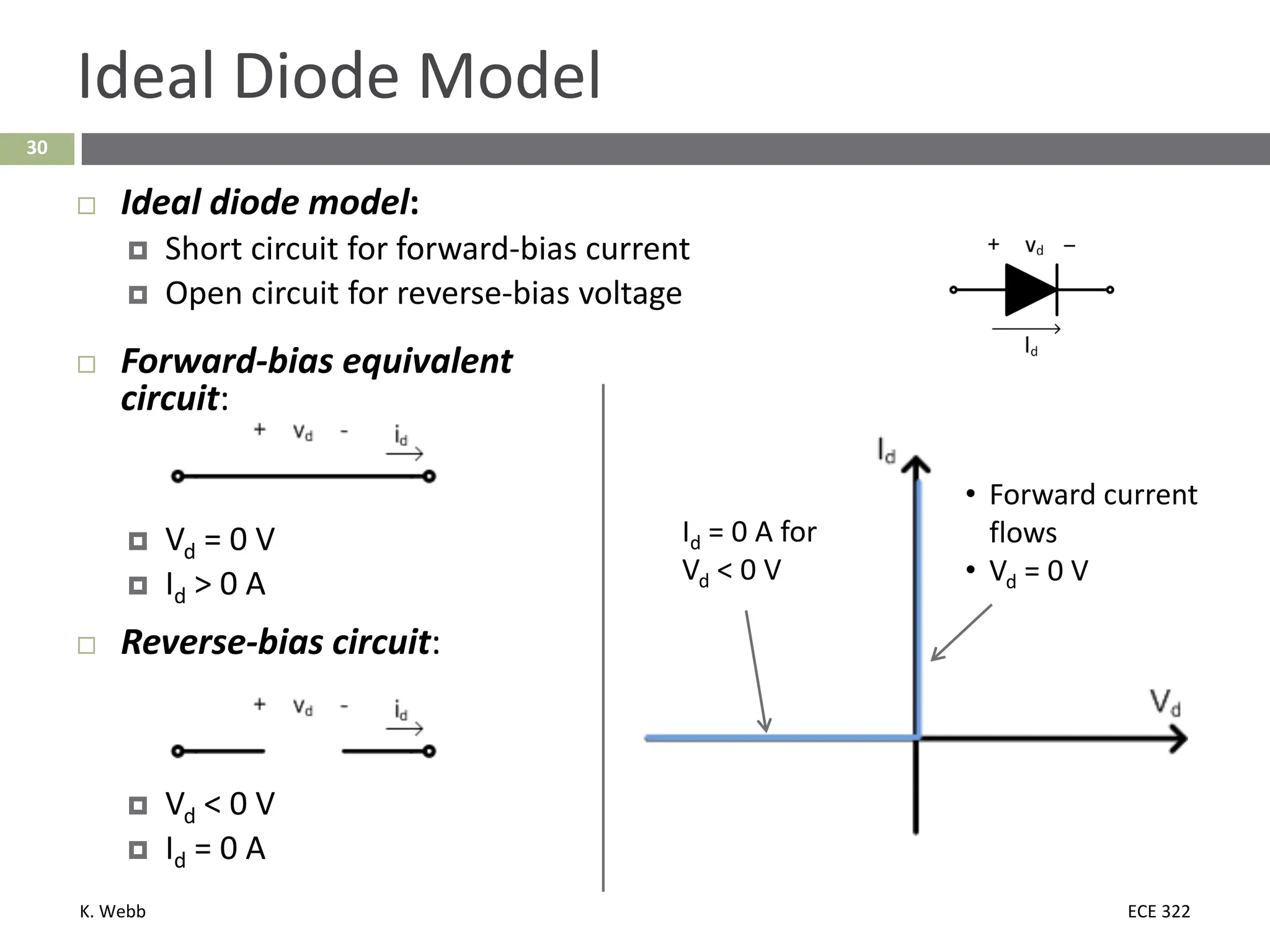
Ideal Diode Model
 Ideal diode model:
 Short circuit for forward-bias current
 Open circuit for reverse-bias voltage
Id = 0 A for
Vd < 0 V
• Forward current
flows
• Vd = 0 V
 Forward-bias equivalent
circuit:
 Vd = 0 V
 Id > 0 A
 Reverse-bias circuit:
 Vd < 0 V
 Id = 0 A
K. Webb ECE 322
31
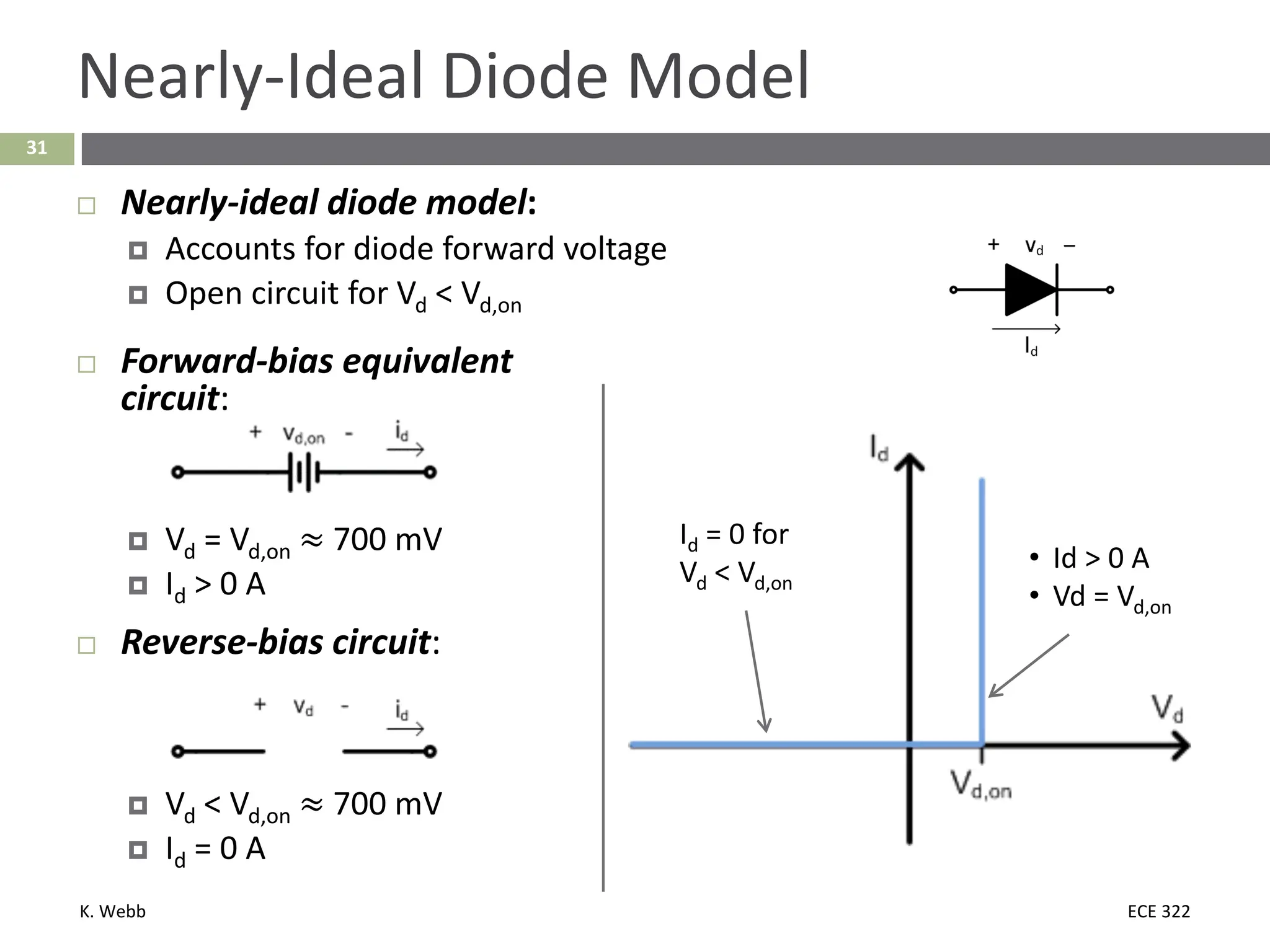
Nearly-Ideal Diode Model
 Nearly-ideal diode model:
 Accounts for diode forward voltage
 Open circuit for Vd < Vd,on
 Forward-bias equivalent
circuit:
 Vd = Vd,on ≈ 700 mV
 Id > 0 A
 Reverse-bias circuit:
 Vd < Vd,on ≈ 700 mV
 Id = 0 A
Id = 0 for
Vd < Vd,on
• Id > 0 A
• Vd = Vd,on
K. Webb ECE 322
32
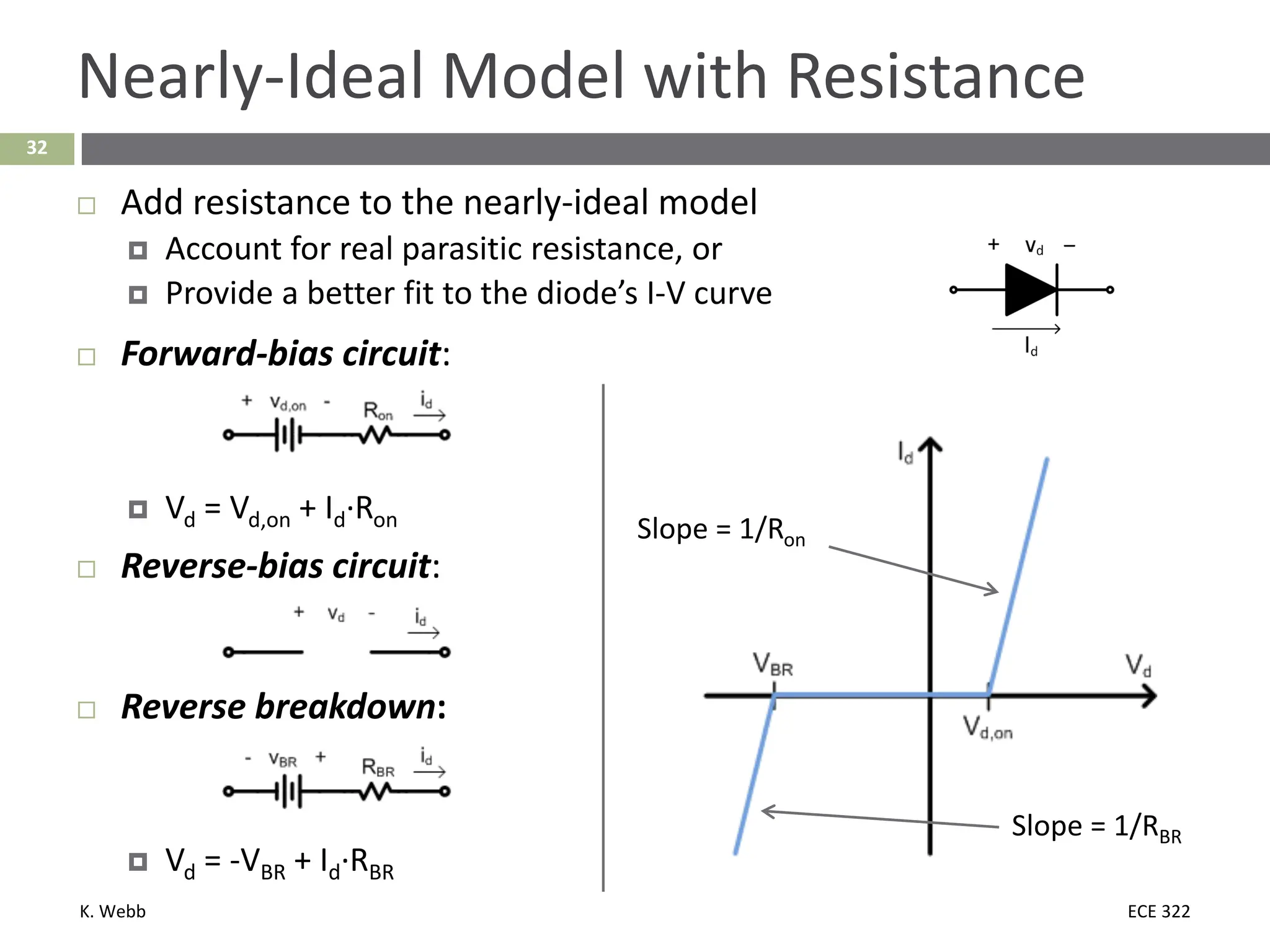
Nearly-Ideal Model with Resistance
 Add resistance to the nearly-ideal model
 Account for real parasitic resistance, or
 Provide a better fit to the diode’s I-V curve
 Forward-bias circuit:
 Vd = Vd,on + Id∙Ron
 Reverse-bias circuit:
 Reverse breakdown:
 Vd = -VBR + Id∙RBR
Slope = 1/Ron
Slope = 1/RBR
K. Webb ECE 322
Load-Line Analysis
33
K. Webb ECE 322
34
Diode Circuit Analysis
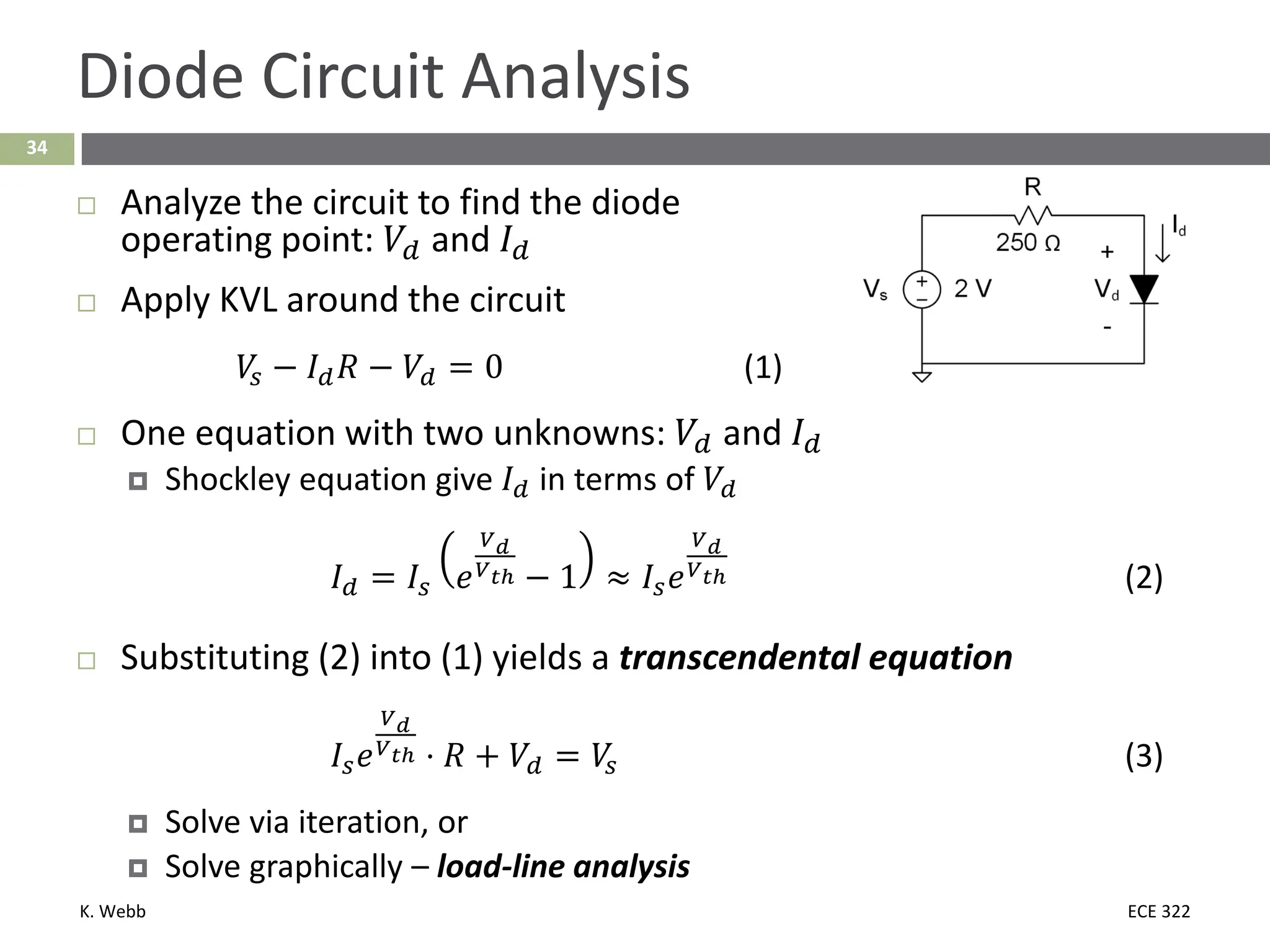
 Analyze the circuit to find the diode
operating point: 𝑉𝑉𝑑𝑑 and 𝐼𝐼𝑑𝑑
 Apply KVL around the circuit
𝑉𝑉
𝑠𝑠 − 𝐼𝐼𝑑𝑑𝑅𝑅 − 𝑉𝑉𝑑𝑑 = 0 (1)
 One equation with two unknowns: 𝑉𝑉𝑑𝑑 and 𝐼𝐼𝑑𝑑
 Shockley equation give 𝐼𝐼𝑑𝑑 in terms of 𝑉𝑉𝑑𝑑
𝐼𝐼𝑑𝑑 = 𝐼𝐼𝑠𝑠 𝑒𝑒
𝑉𝑉𝑑𝑑
𝑉𝑉𝑡𝑡𝑡 − 1 ≈ 𝐼𝐼𝑠𝑠𝑒𝑒
𝑉𝑉𝑑𝑑
𝑉𝑉𝑡𝑡𝑡 (2)
 Substituting (2) into (1) yields a transcendental equation
𝐼𝐼𝑠𝑠𝑒𝑒
𝑉𝑉𝑑𝑑
𝑉𝑉𝑡𝑡𝑡 ⋅ 𝑅𝑅 + 𝑉𝑉𝑑𝑑 = 𝑉𝑉
𝑠𝑠 (3)
 Solve via iteration, or
 Solve graphically – load-line analysis
K. Webb ECE 322
35
Diode Circuit Analysis
𝐼𝐼𝑠𝑠𝑒𝑒
𝑉𝑉𝑑𝑑
𝑉𝑉𝑡𝑡𝑡 ⋅ 𝑅𝑅 + 𝑉𝑉𝑑𝑑 = 𝑉𝑉
𝑠𝑠 (3)
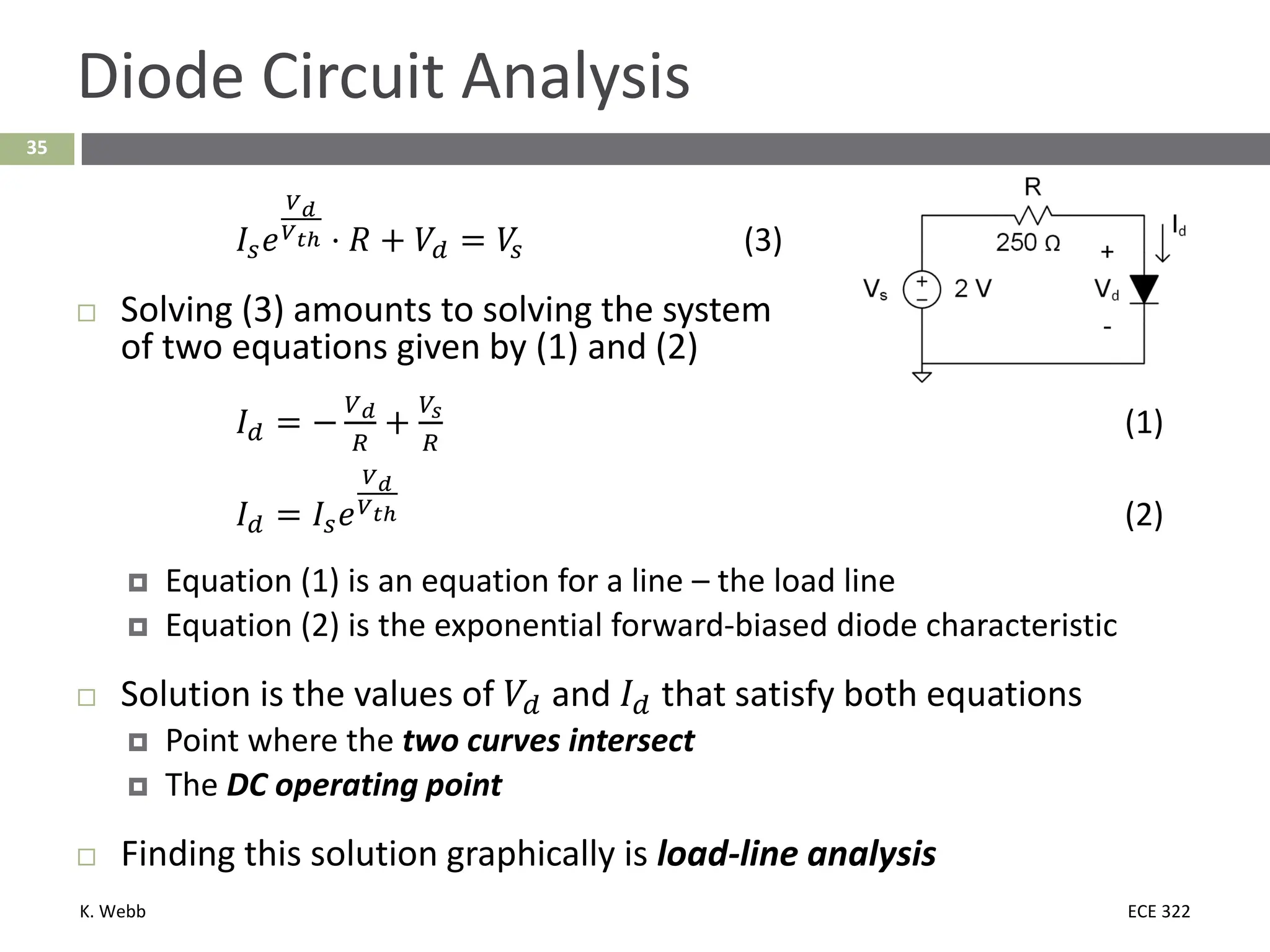
 Solving (3) amounts to solving the system
of two equations given by (1) and (2)
𝐼𝐼𝑑𝑑 = −
𝑉𝑉𝑑𝑑
𝑅𝑅
+
𝑉𝑉𝑠𝑠
𝑅𝑅
(1)
𝐼𝐼𝑑𝑑 = 𝐼𝐼𝑠𝑠𝑒𝑒
𝑉𝑉𝑑𝑑
𝑉𝑉𝑡𝑡𝑡 (2)
 Equation (1) is an equation for a line – the load line
 Equation (2) is the exponential forward-biased diode characteristic
 Solution is the values of 𝑉𝑉𝑑𝑑 and 𝐼𝐼𝑑𝑑 that satisfy both equations
 Point where the two curves intersect
 The DC operating point
 Finding this solution graphically is load-line analysis
K. Webb ECE 322
36
Load-Line Analysis
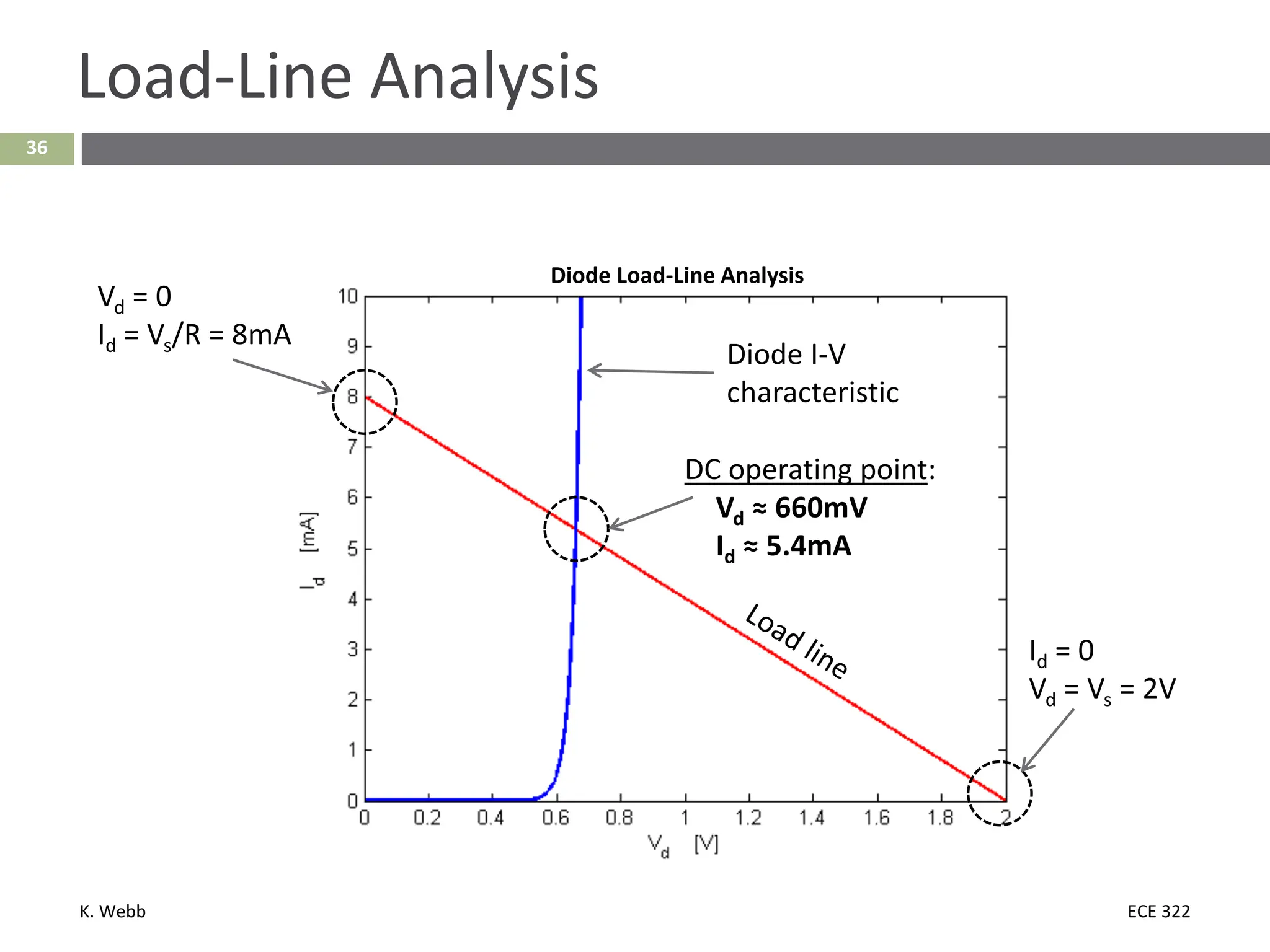
Diode I-V
characteristic
DC operating point:
Vd ≈ 660mV
Id ≈ 5.4mA
Id = 0
Vd = Vs = 2V
Vd = 0
Id = Vs/R = 8mA
Diode Load-Line Analysis
K. Webb ECE 322
Analysis with Simple Diode Models
37
K. Webb ECE 322
38
Simplified Analysis – Ideal Model
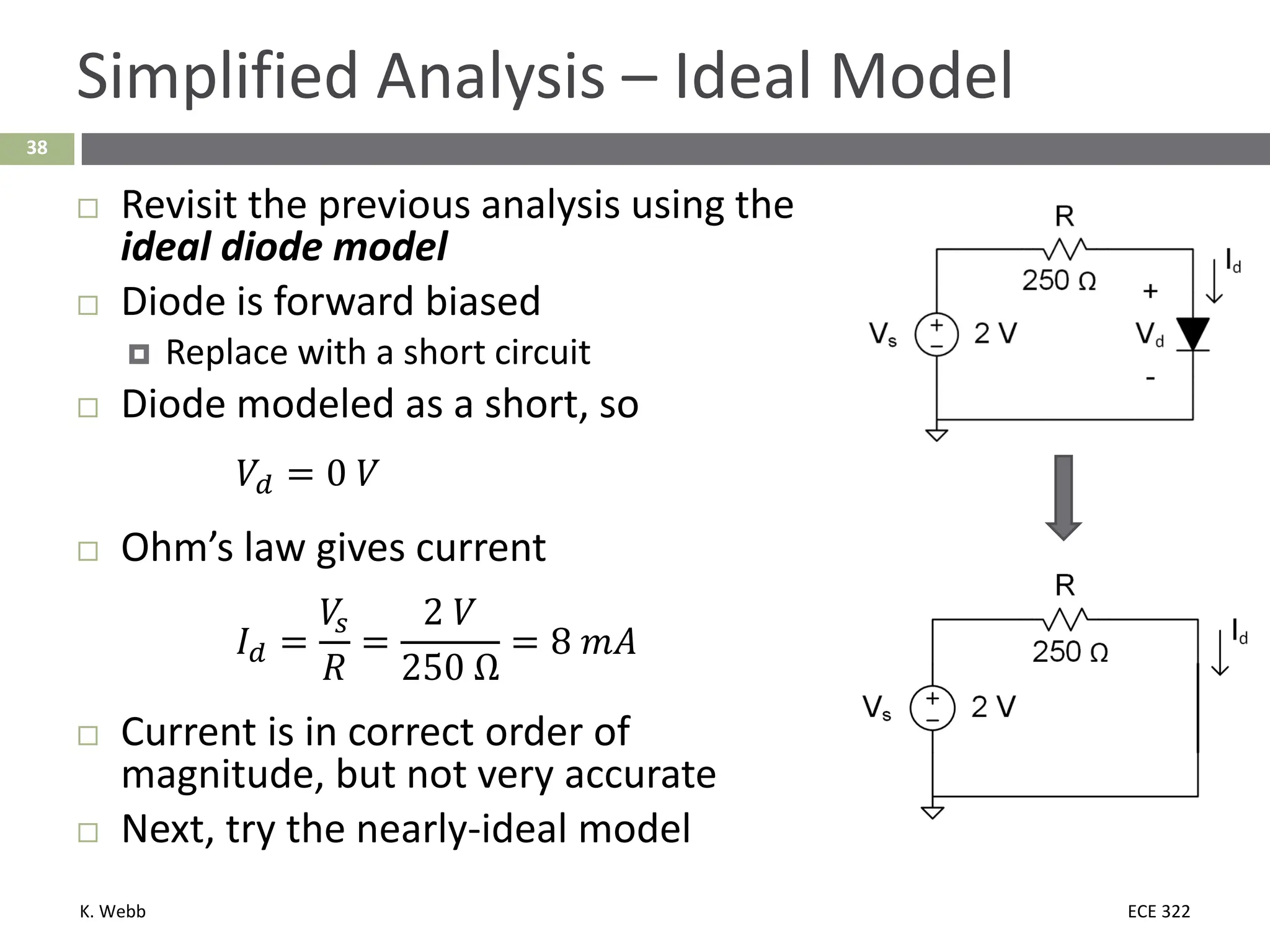
 Revisit the previous analysis using the
ideal diode model
 Diode is forward biased
 Replace with a short circuit
 Diode modeled as a short, so
𝑉𝑉𝑑𝑑 = 0 𝑉𝑉
 Ohm’s law gives current
𝐼𝐼𝑑𝑑 =
𝑉𝑉
𝑠𝑠
𝑅𝑅
=
2 𝑉𝑉
250 Ω
= 8 𝑚𝑚𝑝𝑝
 Current is in correct order of
magnitude, but not very accurate
 Next, try the nearly-ideal model
K. Webb ECE 322
39
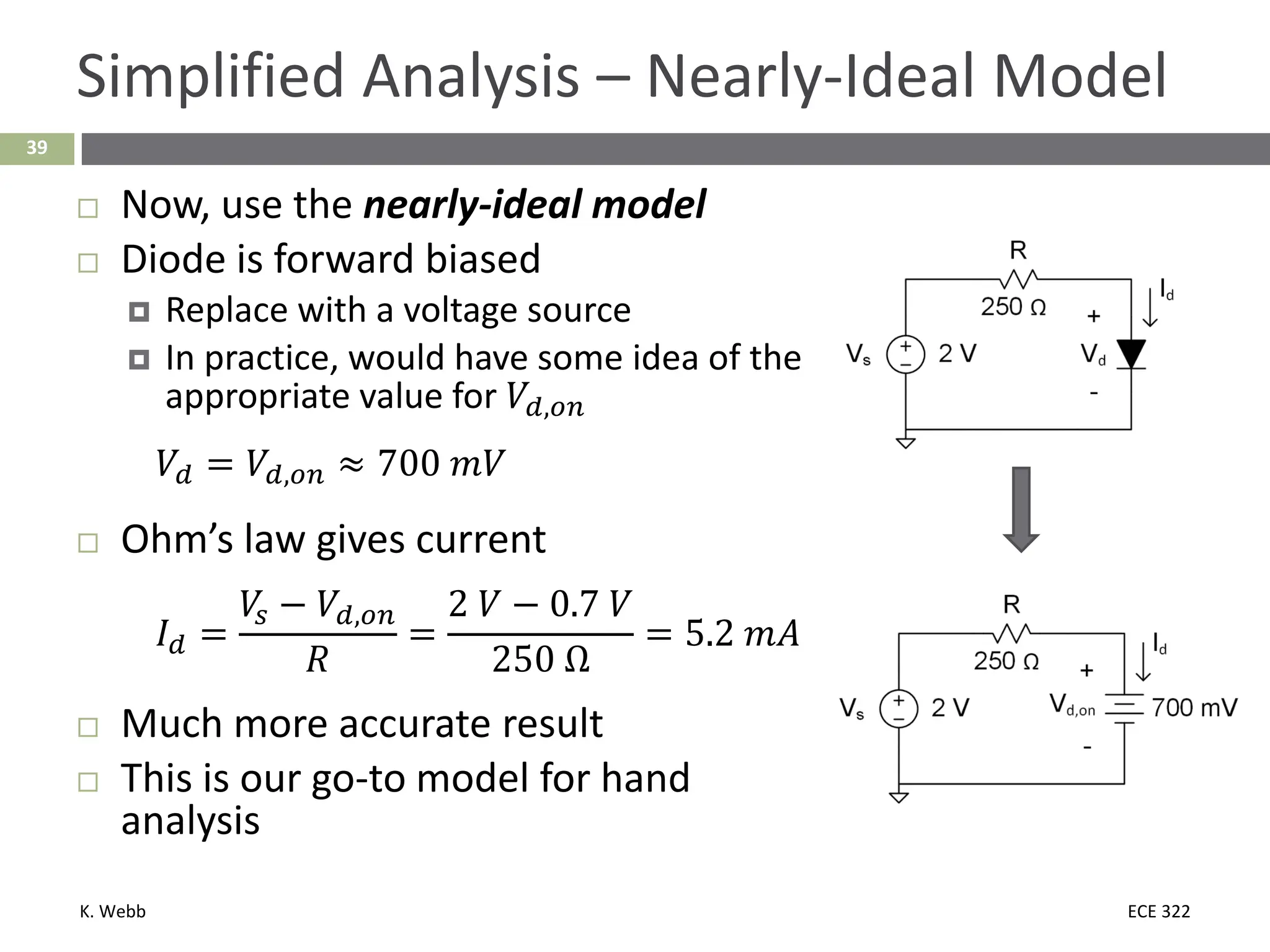
Simplified Analysis – Nearly-Ideal Model
 Now, use the nearly-ideal model
 Diode is forward biased
 Replace with a voltage source
 In practice, would have some idea of the
appropriate value for 𝑉𝑉𝑑𝑑,𝑜𝑜𝑜𝑜
𝑉𝑉𝑑𝑑 = 𝑉𝑉𝑑𝑑,𝑜𝑜𝑜𝑜 ≈ 700 𝑚𝑚𝑉𝑉
 Ohm’s law gives current
𝐼𝐼𝑑𝑑 =
𝑉𝑉
𝑠𝑠 − 𝑉𝑉𝑑𝑑,𝑜𝑜𝑜𝑜
𝑅𝑅
=
2 𝑉𝑉 − 0.7 𝑉𝑉
250 Ω
= 5.2 𝑚𝑚𝑝𝑝
 Much more accurate result
 This is our go-to model for hand
analysis
K. Webb ECE 322
Rectifier Circuits
40
K. Webb ECE 322
41
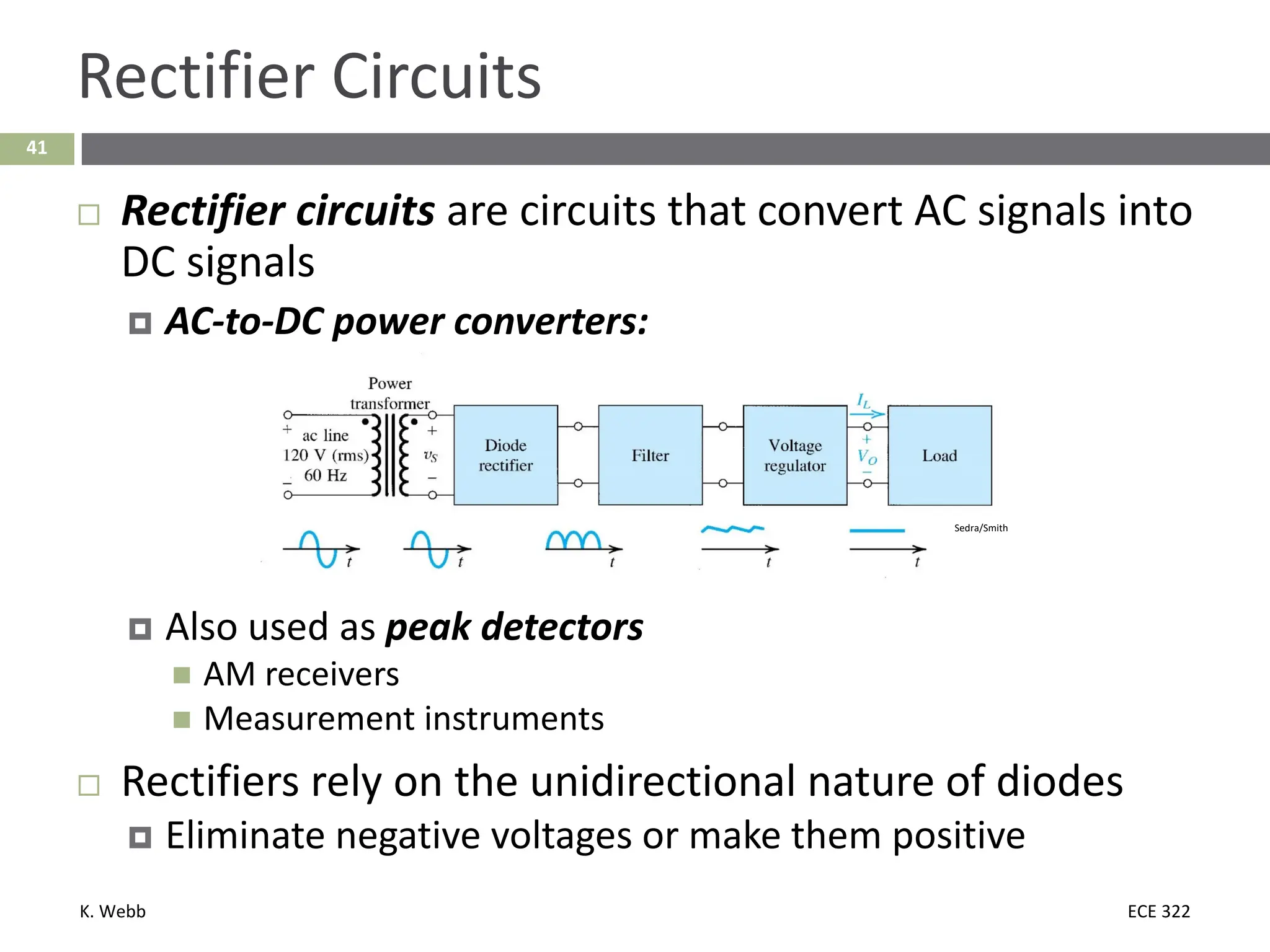
Rectifier Circuits
 Rectifier circuits are circuits that convert AC signals into
DC signals
 AC-to-DC power converters:
 Also used as peak detectors
 AM receivers
 Measurement instruments
 Rectifiers rely on the unidirectional nature of diodes
 Eliminate negative voltages or make them positive
Sedra/Smith
K. Webb ECE 322
42
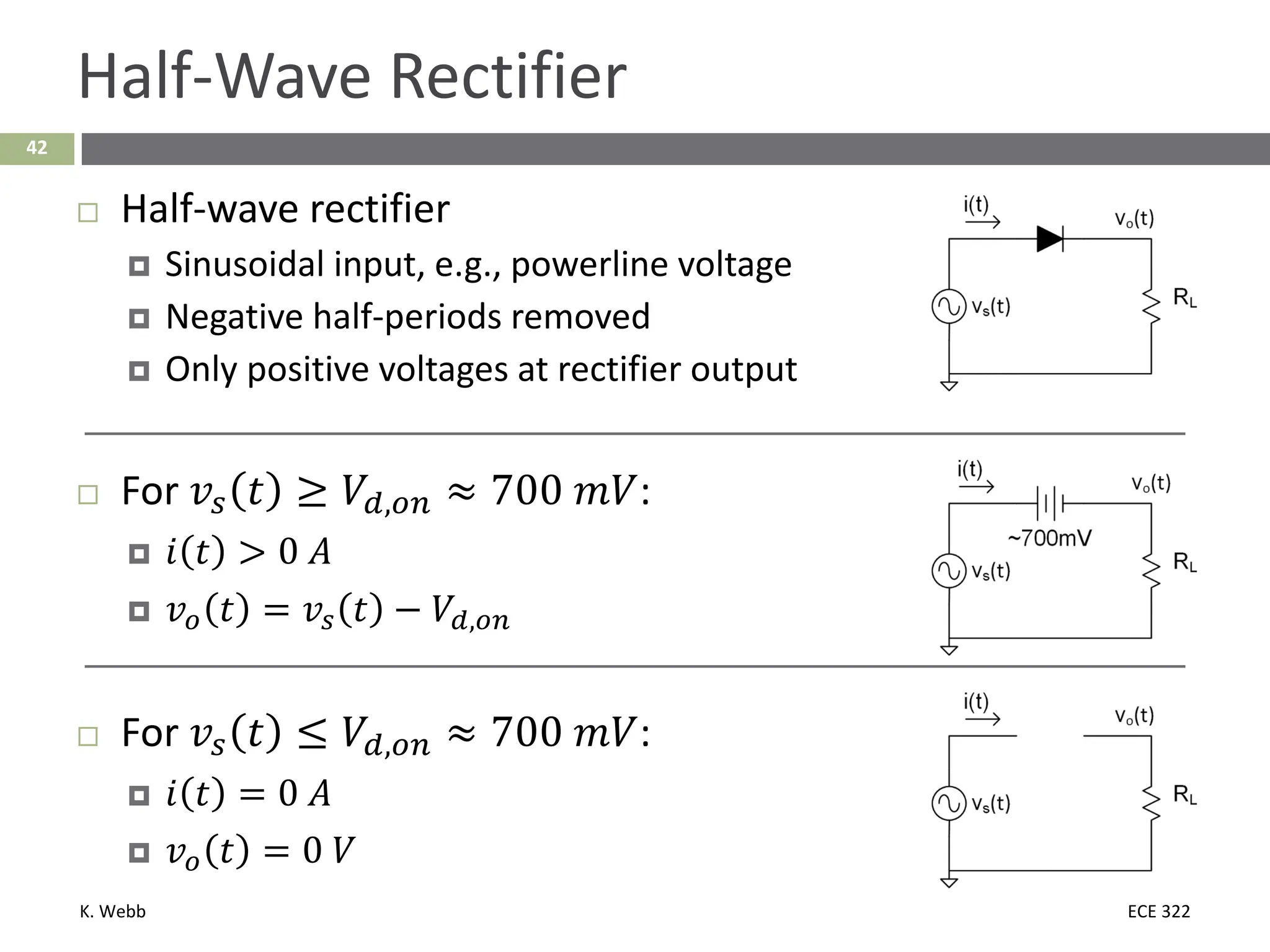
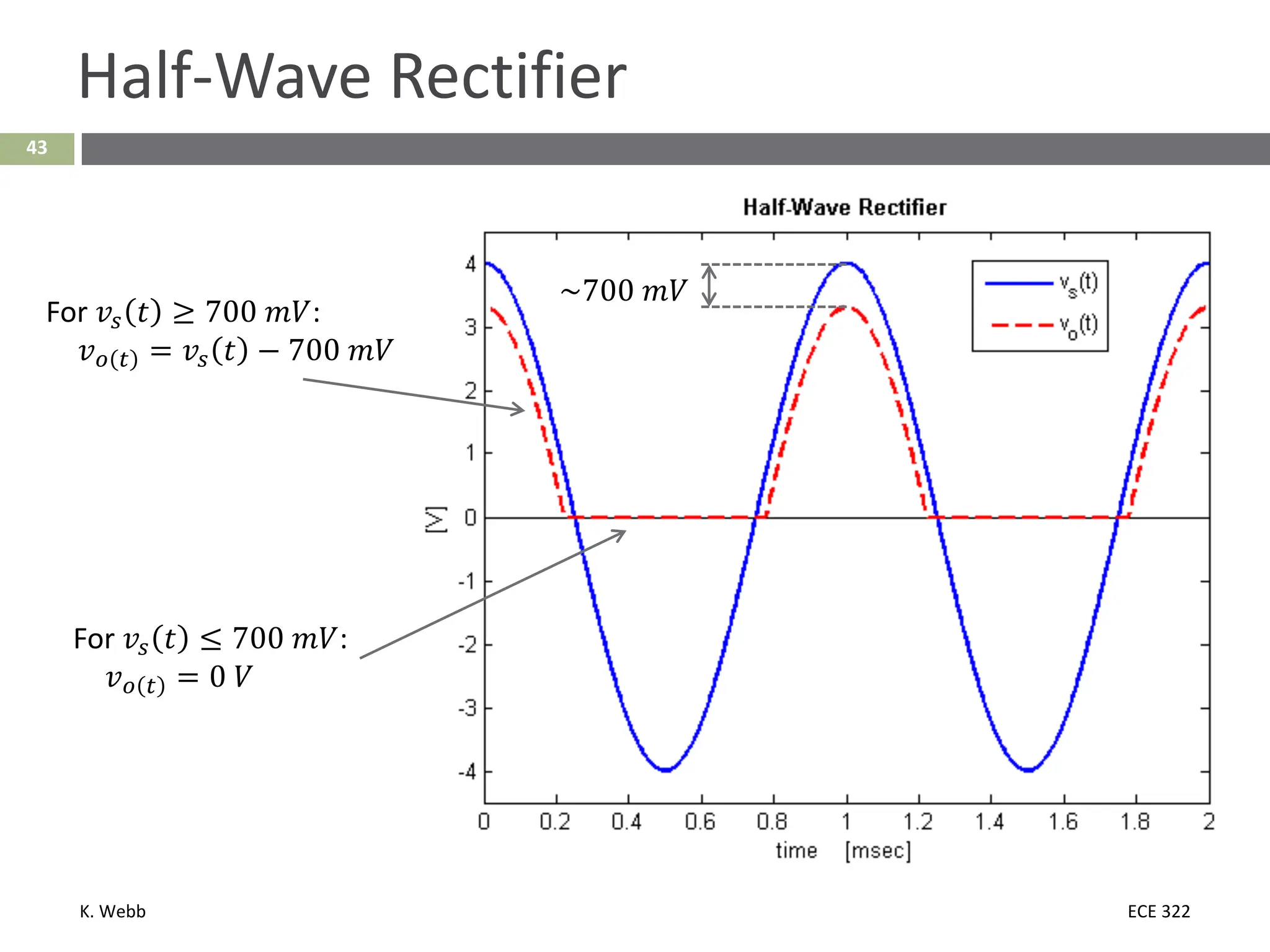
Half-Wave Rectifier
 Half-wave rectifier
 Sinusoidal input, e.g., powerline voltage
 Negative half-periods removed
 Only positive voltages at rectifier output
 For 𝑣𝑣𝑠𝑠 𝑡𝑡 ≥ 𝑉𝑉𝑑𝑑,𝑜𝑜𝑜𝑜 ≈ 700 𝑚𝑚𝑉𝑉:
 𝑖𝑖 𝑡𝑡 > 0 𝑝𝑝
 𝑣𝑣𝑜𝑜 𝑡𝑡 = 𝑣𝑣𝑠𝑠 𝑡𝑡 − 𝑉𝑉𝑑𝑑,𝑜𝑜𝑜𝑜
 For 𝑣𝑣𝑠𝑠 𝑡𝑡 ≤ 𝑉𝑉𝑑𝑑,𝑜𝑜𝑜𝑜 ≈ 700 𝑚𝑚𝑉𝑉:
 𝑖𝑖 𝑡𝑡 = 0 𝑝𝑝
 𝑣𝑣𝑜𝑜 𝑡𝑡 = 0 𝑉𝑉
K. Webb ECE 322
43
Half-Wave Rectifier
~700 𝑚𝑚𝑉𝑉
For 𝑣𝑣𝑠𝑠 𝑡𝑡 ≥ 700 𝑚𝑚𝑉𝑉:
𝑣𝑣𝑜𝑜 𝑡𝑡 = 𝑣𝑣𝑠𝑠 𝑡𝑡 − 700 𝑚𝑚𝑉𝑉
For 𝑣𝑣𝑠𝑠 𝑡𝑡 ≤ 700 𝑚𝑚𝑉𝑉:
𝑣𝑣𝑜𝑜 𝑡𝑡 = 0 𝑉𝑉
K. Webb ECE 322
44
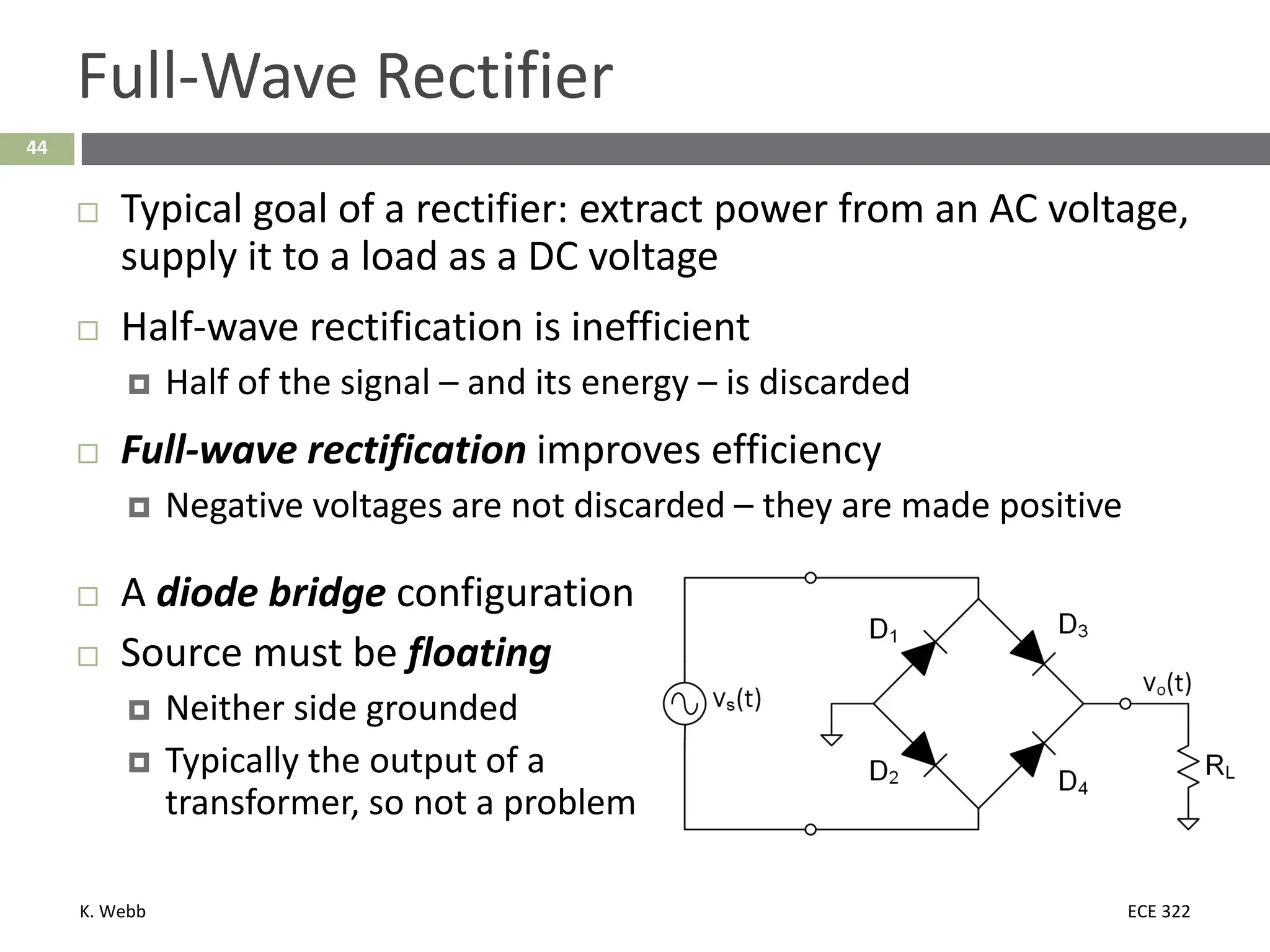
Full-Wave Rectifier
 Typical goal of a rectifier: extract power from an AC voltage,
supply it to a load as a DC voltage
 Half-wave rectification is inefficient
 Half of the signal – and its energy – is discarded
 Full-wave rectification improves efficiency
 Negative voltages are not discarded – they are made positive
 A diode bridge configuration
 Source must be floating
 Neither side grounded
 Typically the output of a
transformer, so not a problem
K. Webb ECE 322
45
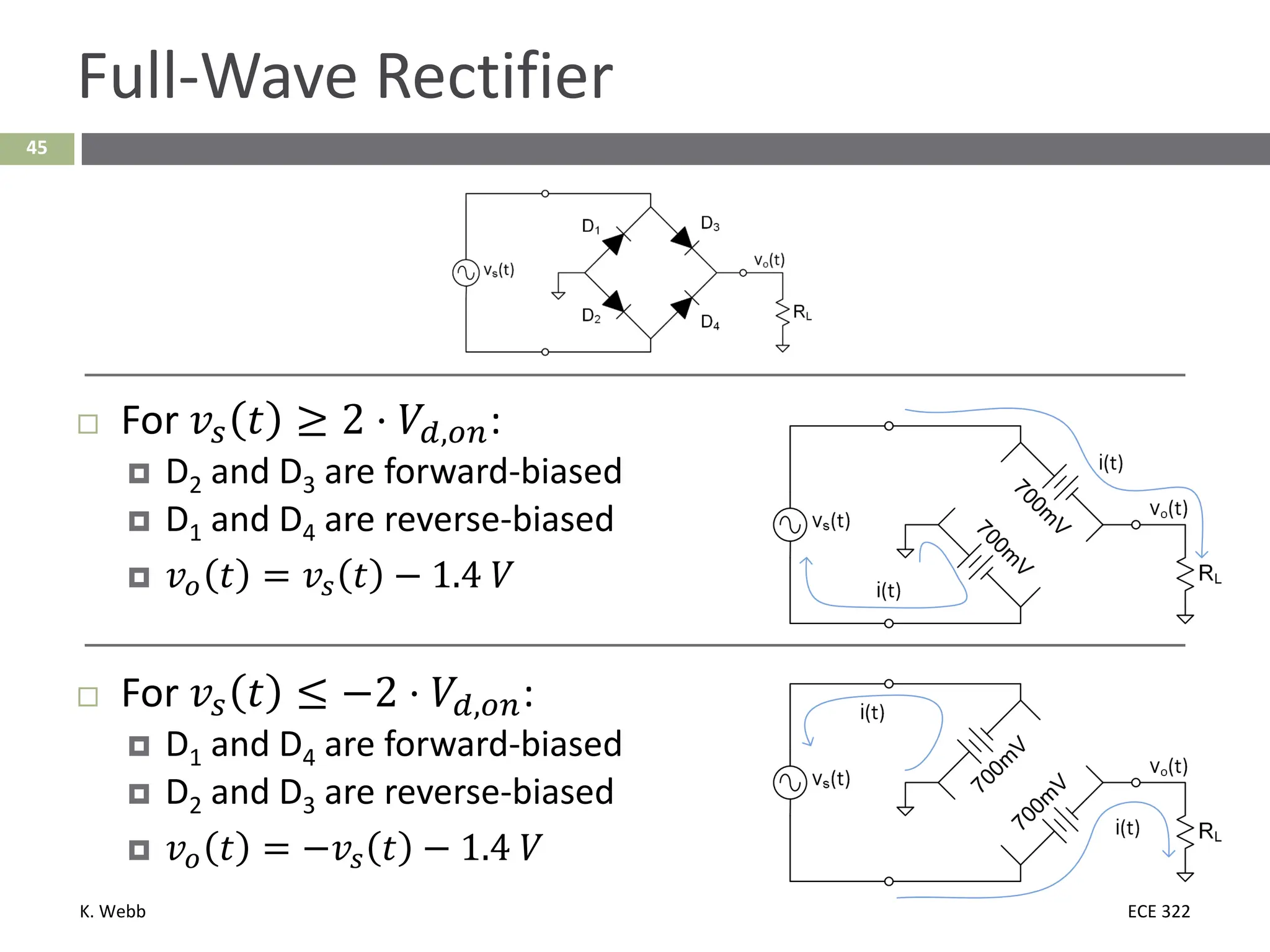
Full-Wave Rectifier
 For 𝑣𝑣𝑠𝑠 𝑡𝑡 ≥ 2 ⋅ 𝑉𝑉𝑑𝑑,𝑜𝑜𝑜𝑜:
 D2 and D3 are forward-biased
 D1 and D4 are reverse-biased
 𝑣𝑣𝑜𝑜 𝑡𝑡 = 𝑣𝑣𝑠𝑠 𝑡𝑡 − 1.4 𝑉𝑉
 For 𝑣𝑣𝑠𝑠 𝑡𝑡 ≤ −2 ⋅ 𝑉𝑉𝑑𝑑,𝑜𝑜𝑜𝑜:
 D1 and D4 are forward-biased
 D2 and D3 are reverse-biased
 𝑣𝑣𝑜𝑜 𝑡𝑡 = −𝑣𝑣𝑠𝑠 𝑡𝑡 − 1.4 𝑉𝑉
K. Webb ECE 322
46
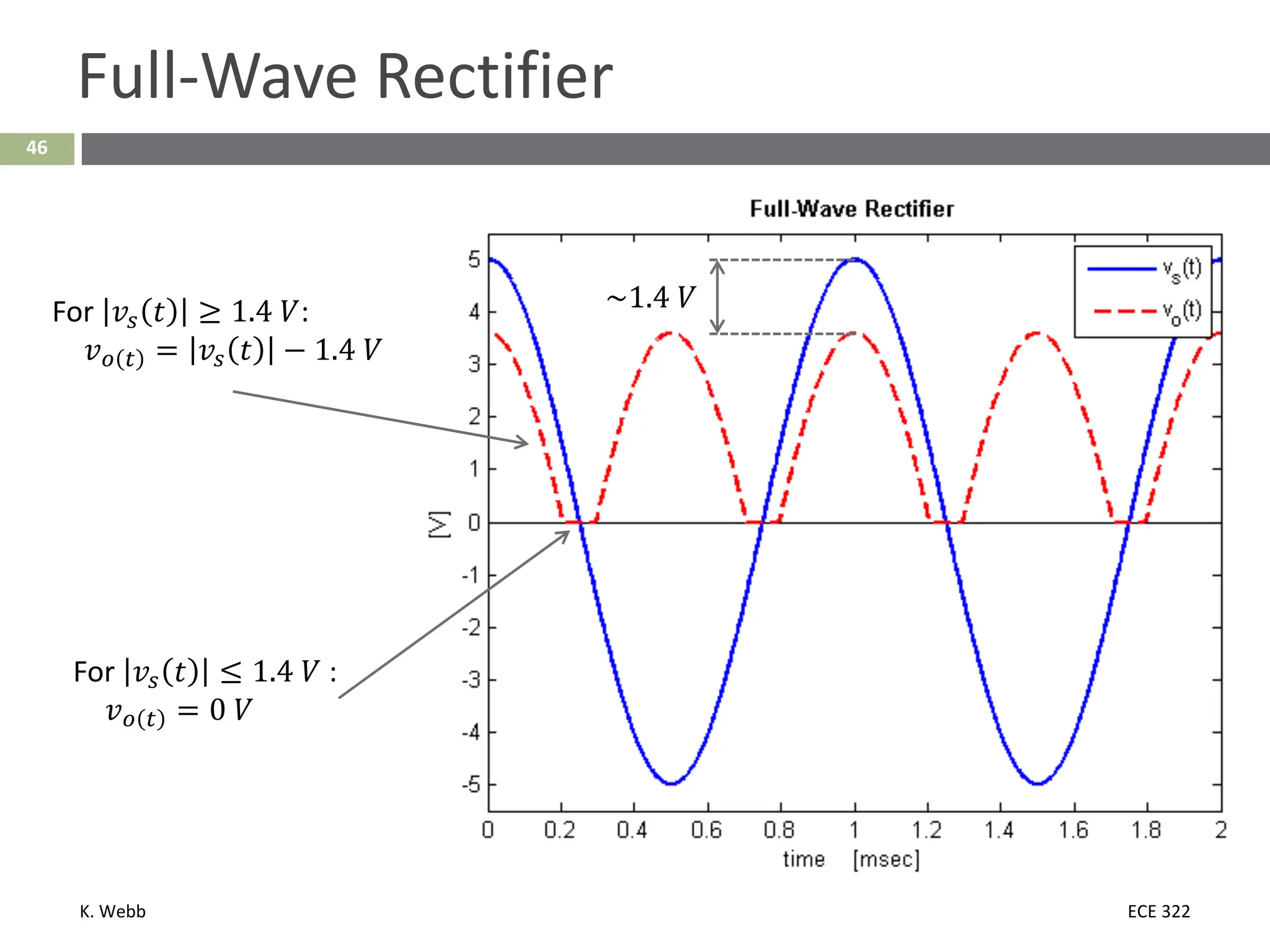
Full-Wave Rectifier
~1.4 𝑉𝑉
For 𝑣𝑣𝑠𝑠 𝑡𝑡 ≥ 1.4 𝑉𝑉:
𝑣𝑣𝑜𝑜 𝑡𝑡 = 𝑣𝑣𝑠𝑠 𝑡𝑡 − 1.4 𝑉𝑉
For 𝑣𝑣𝑠𝑠 𝑡𝑡 ≤ 1.4 𝑉𝑉 :
𝑣𝑣𝑜𝑜 𝑡𝑡 = 0 𝑉𝑉
K. Webb ECE 322
47
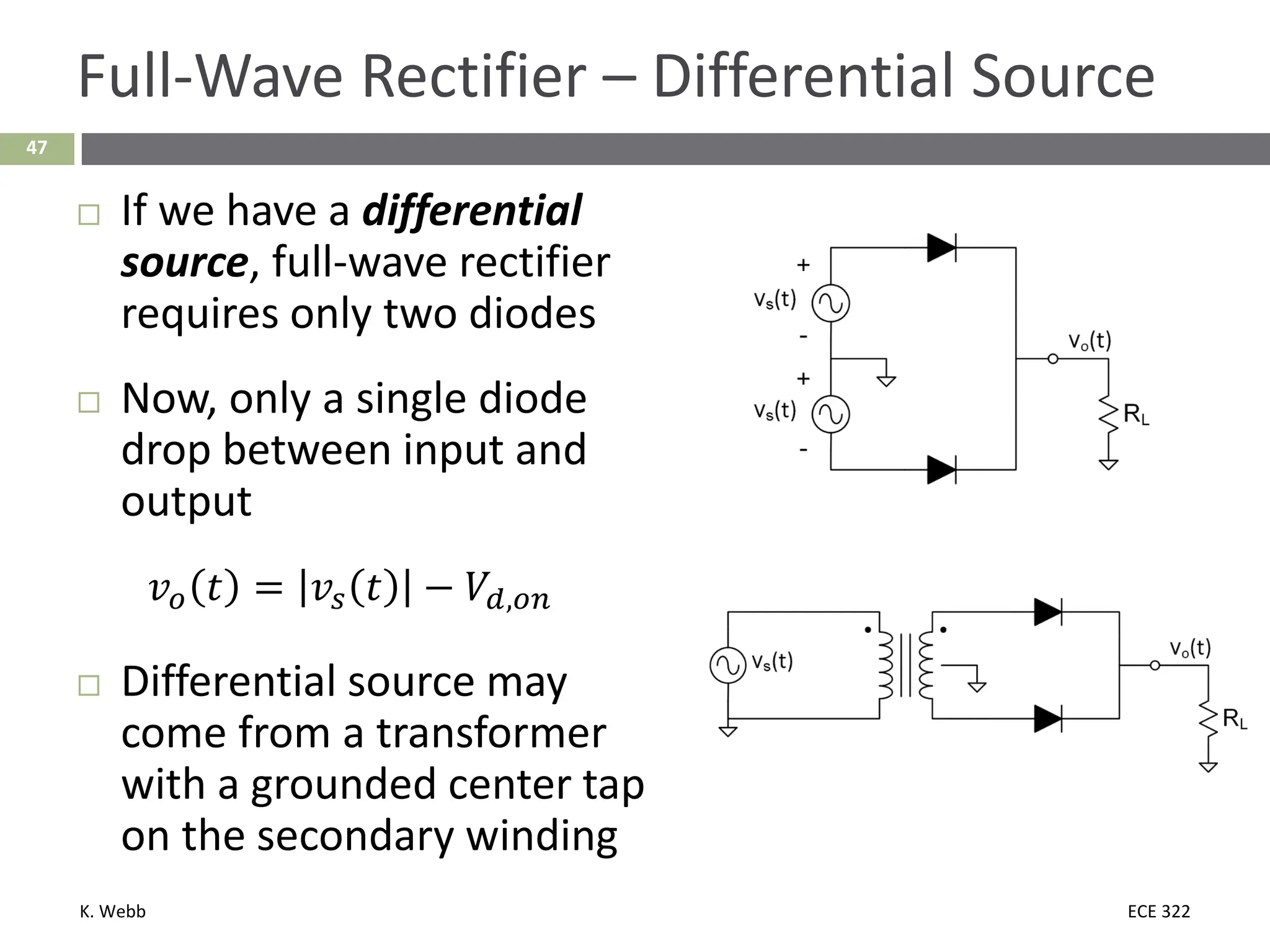
Full-Wave Rectifier – Differential Source
 If we have a differential
source, full-wave rectifier
requires only two diodes
 Now, only a single diode
drop between input and
output
𝑣𝑣𝑜𝑜 𝑡𝑡 = 𝑣𝑣𝑠𝑠 𝑡𝑡 − 𝑉𝑉𝑑𝑑,𝑜𝑜𝑜𝑜
 Differential source may
come from a transformer
with a grounded center tap
on the secondary winding
K. Webb ECE 322
48
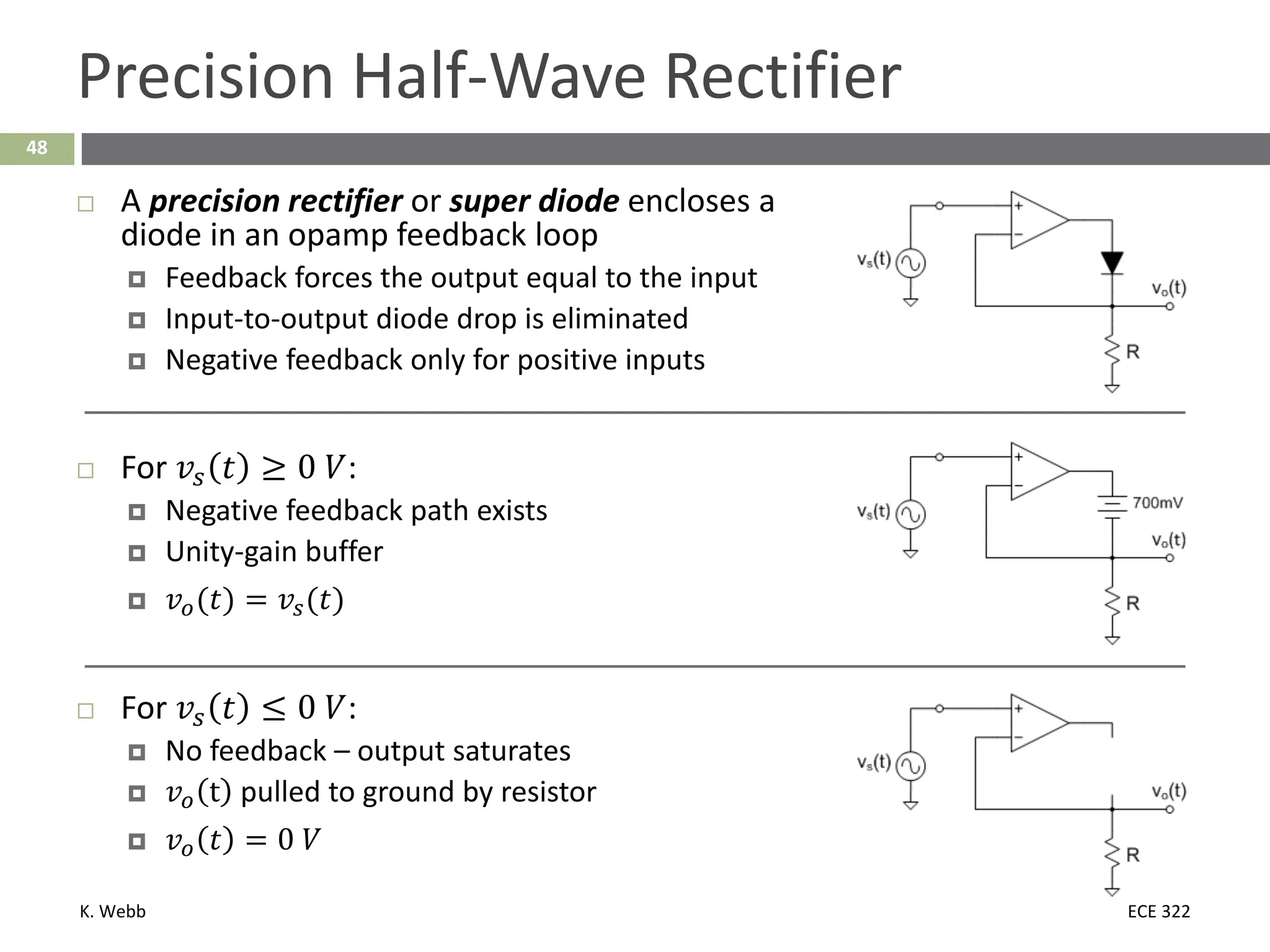
Precision Half-Wave Rectifier
 A precision rectifier or super diode encloses a
diode in an opamp feedback loop
 Feedback forces the output equal to the input
 Input-to-output diode drop is eliminated
 Negative feedback only for positive inputs
 For 𝑣𝑣𝑠𝑠 𝑡𝑡 ≥ 0 𝑉𝑉:
 Negative feedback path exists
 Unity-gain buffer
 𝑣𝑣𝑜𝑜(𝑡𝑡) = 𝑣𝑣𝑠𝑠(𝑡𝑡)
 For 𝑣𝑣𝑠𝑠 𝑡𝑡 ≤ 0 𝑉𝑉:
 No feedback – output saturates
 𝑣𝑣𝑜𝑜 t pulled to ground by resistor
 𝑣𝑣𝑜𝑜 𝑡𝑡 = 0 𝑉𝑉
K. Webb ECE 322
Smoothing Capacitors & Peak Detectors
49
K. Webb ECE 322
50
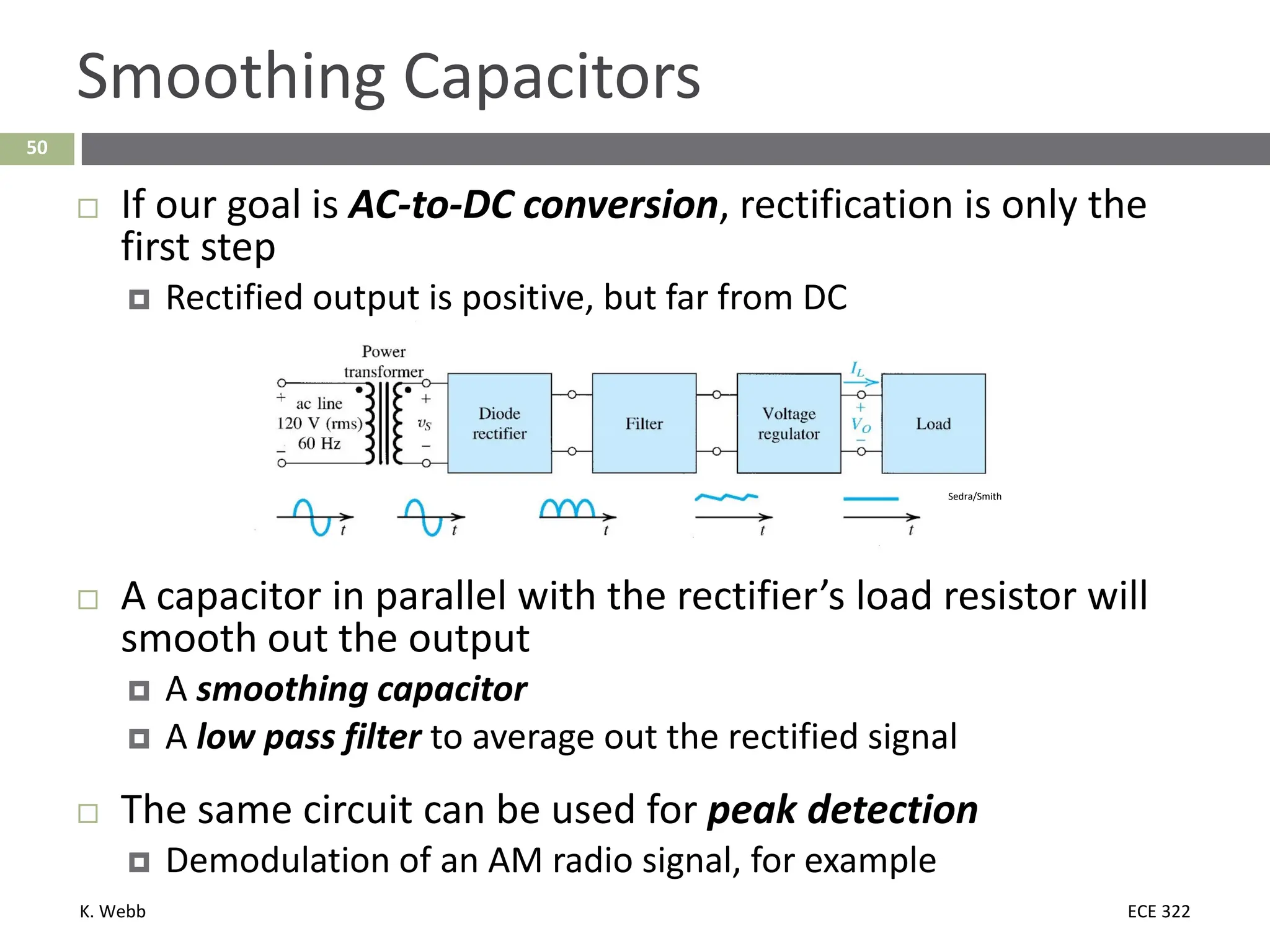
Smoothing Capacitors
 If our goal is AC-to-DC conversion, rectification is only the
first step
 Rectified output is positive, but far from DC
Sedra/Smith
 A capacitor in parallel with the rectifier’s load resistor will
smooth out the output
 A smoothing capacitor
 A low pass filter to average out the rectified signal
 The same circuit can be used for peak detection
 Demodulation of an AM radio signal, for example
K. Webb ECE 322
51
Smoothing Capacitors
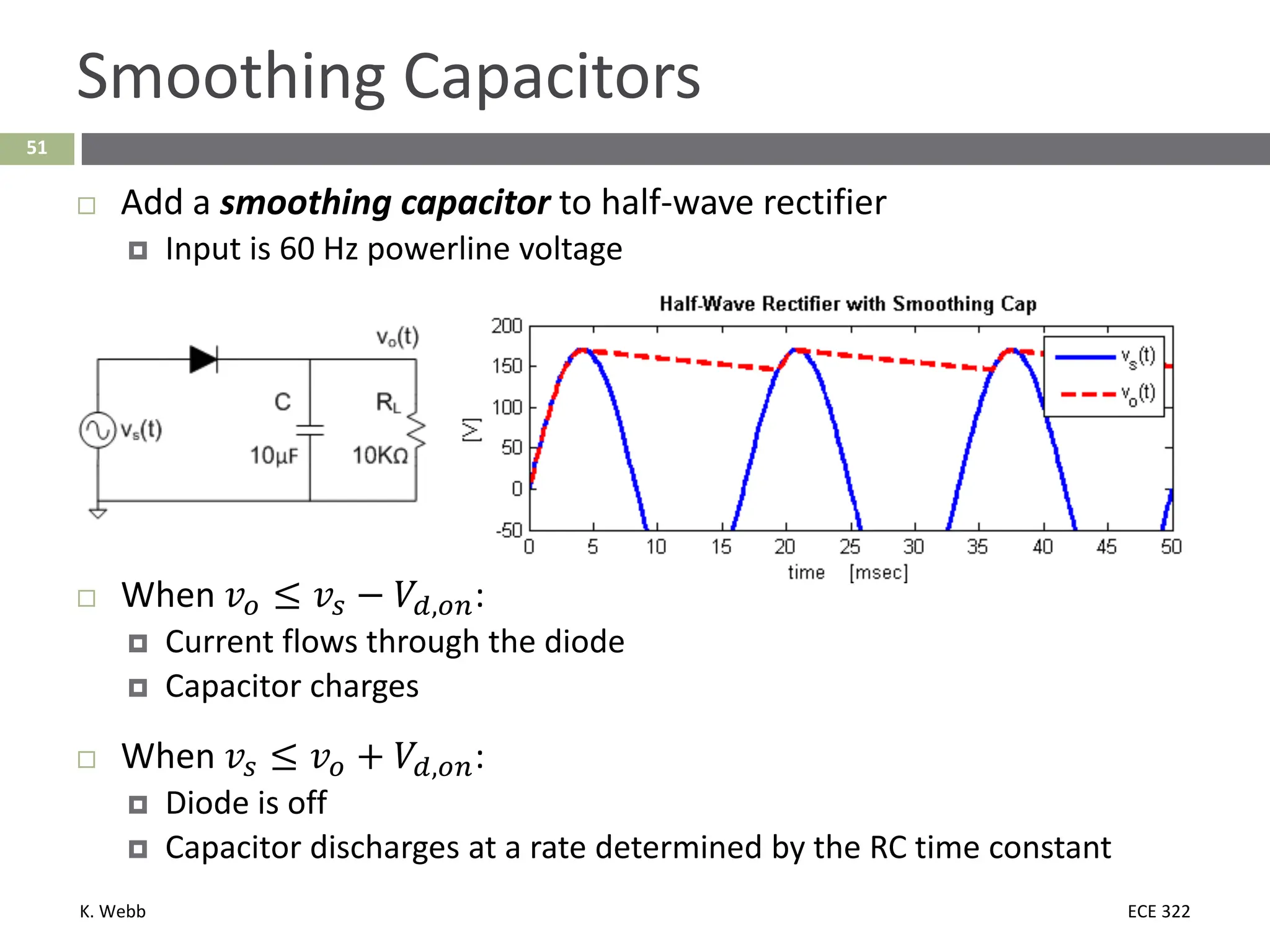
 Add a smoothing capacitor to half-wave rectifier
 Input is 60 Hz powerline voltage
 When 𝑣𝑣𝑜𝑜 ≤ 𝑣𝑣𝑠𝑠 − 𝑉𝑉𝑑𝑑,𝑜𝑜𝑜𝑜:
 Current flows through the diode
 Capacitor charges
 When 𝑣𝑣𝑠𝑠 ≤ 𝑣𝑣𝑜𝑜 + 𝑉𝑉𝑑𝑑,𝑜𝑜𝑜𝑜:
 Diode is off
 Capacitor discharges at a rate determined by the RC time constant
K. Webb ECE 322
52
Smoothing Capacitors
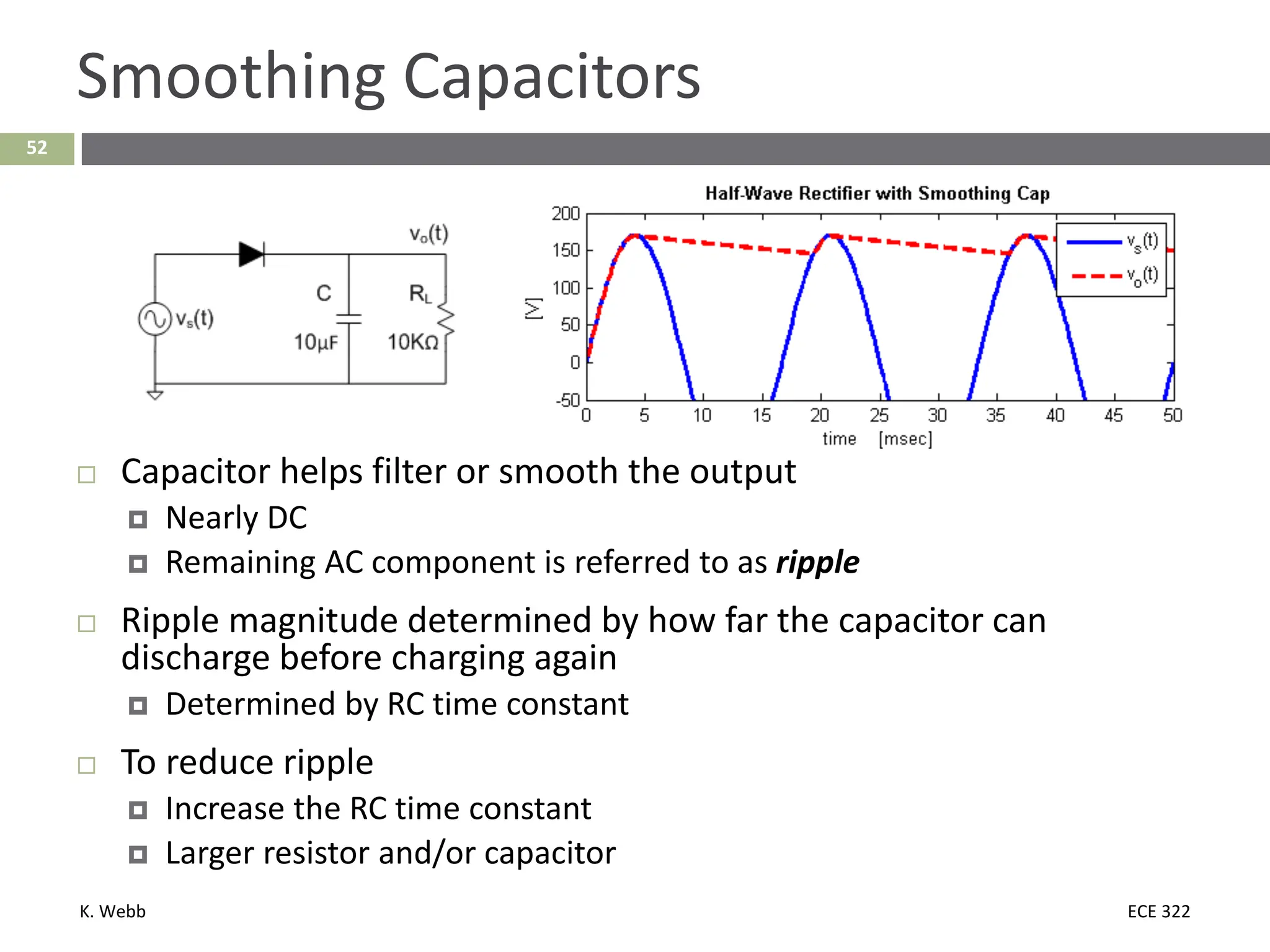
 Capacitor helps filter or smooth the output
 Nearly DC
 Remaining AC component is referred to as ripple
 Ripple magnitude determined by how far the capacitor can
discharge before charging again
 Determined by RC time constant
 To reduce ripple
 Increase the RC time constant
 Larger resistor and/or capacitor
K. Webb ECE 322
53
Calculating Ripple – Half Wave Rectifier
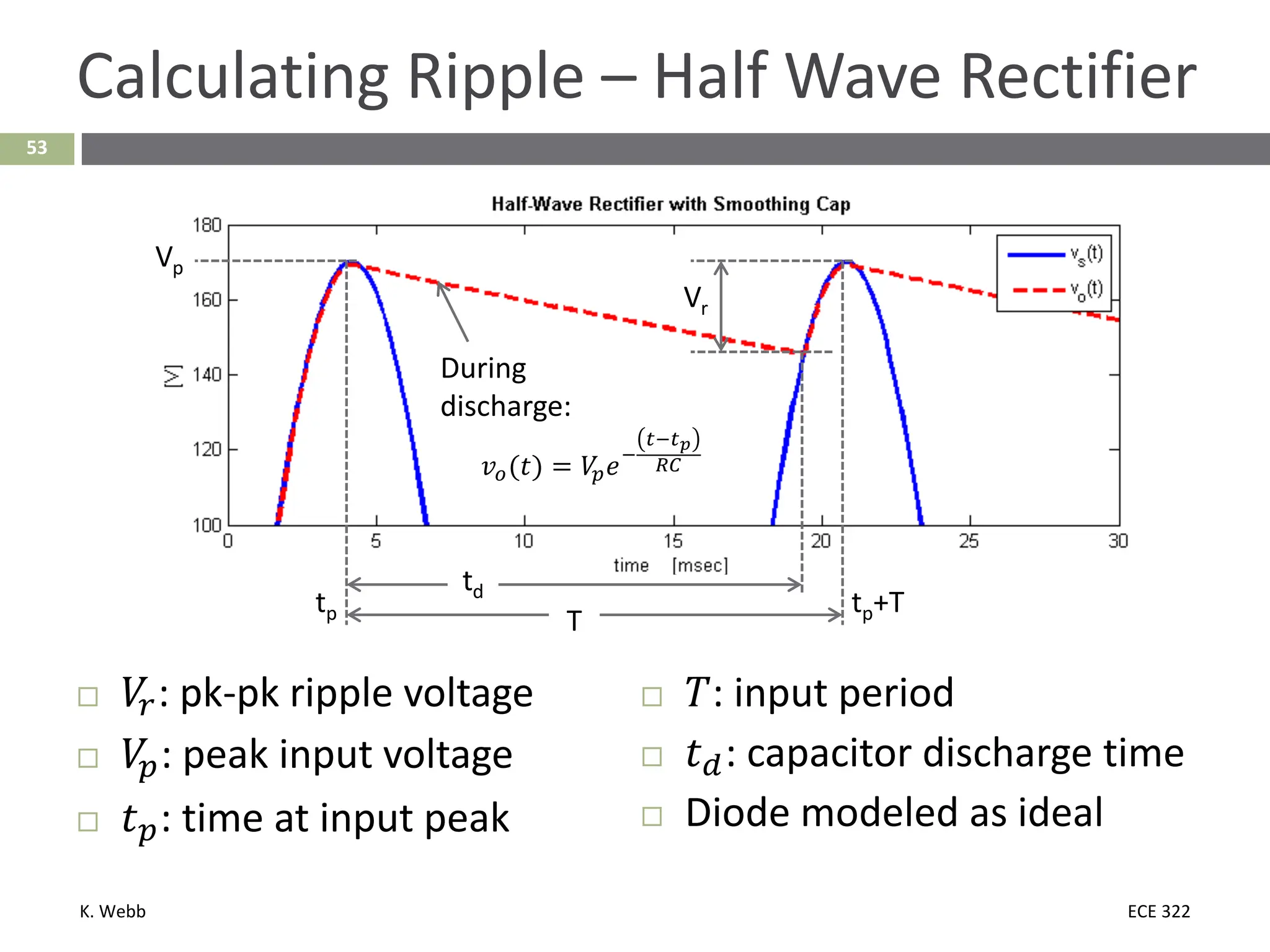
 𝑉𝑉
𝑟𝑟: pk-pk ripple voltage
 𝑉𝑉
𝑝𝑝: peak input voltage
 𝑡𝑡𝑝𝑝: time at input peak
 𝑘𝑘: input period
 𝑡𝑡𝑑𝑑: capacitor discharge time
 Diode modeled as ideal
Vr
During
discharge:
𝑣𝑣𝑜𝑜(𝑡𝑡) = 𝑉𝑉
𝑝𝑝𝑒𝑒−
𝑡𝑡−𝑡𝑡𝑝𝑝
𝑅𝑅𝑅𝑅
tp
Vp
tp+T
td
T
K. Webb ECE 322
54
Calculating Ripple – Half Wave Rectifier
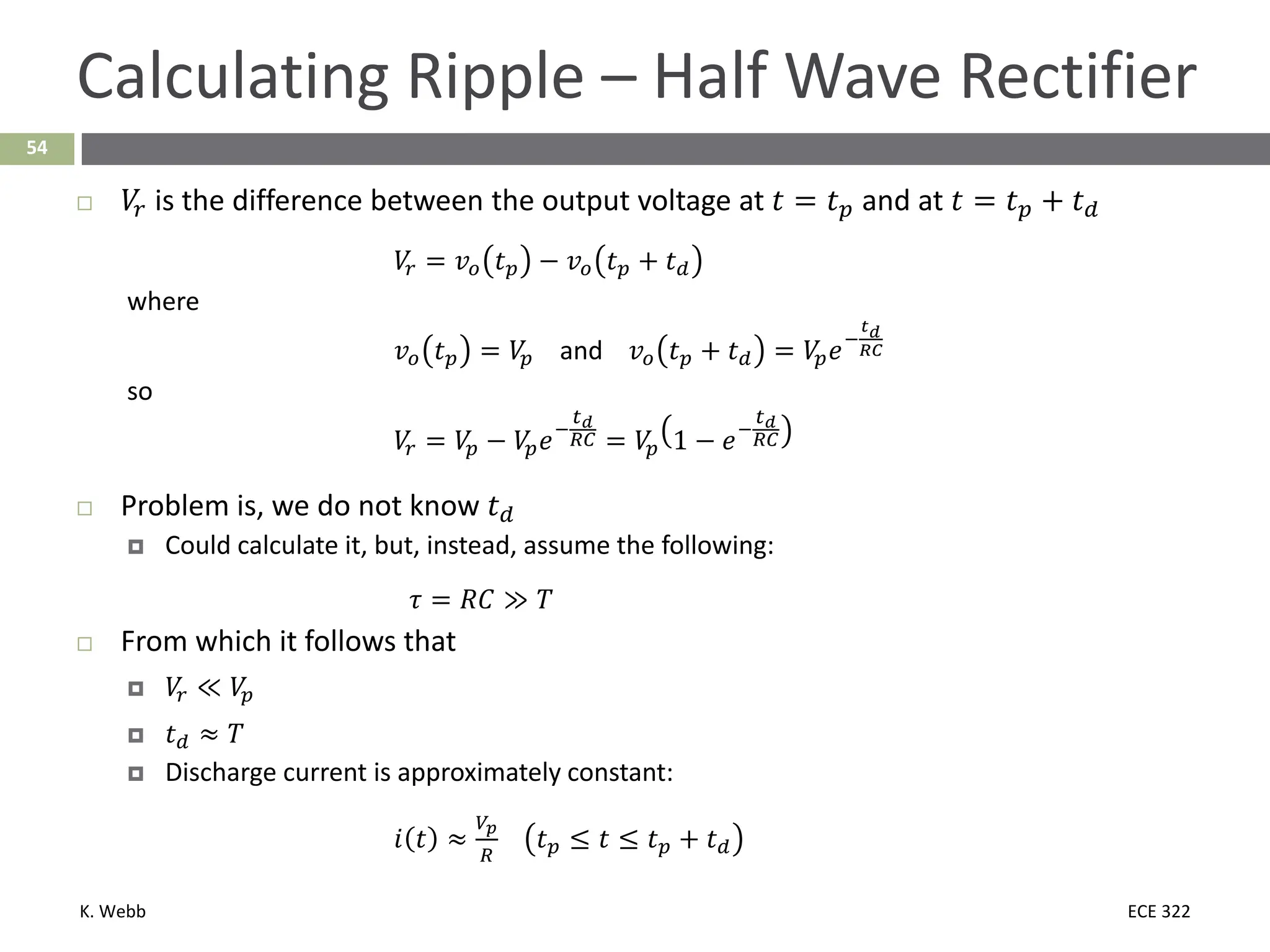
 𝑉𝑉
𝑟𝑟 is the difference between the output voltage at 𝑡𝑡 = 𝑡𝑡𝑝𝑝 and at 𝑡𝑡 = 𝑡𝑡𝑝𝑝 + 𝑡𝑡𝑑𝑑
𝑉𝑉
𝑟𝑟 = 𝑣𝑣𝑜𝑜 𝑡𝑡𝑝𝑝 − 𝑣𝑣𝑜𝑜 𝑡𝑡𝑝𝑝 + 𝑡𝑡𝑑𝑑
where
𝑣𝑣𝑜𝑜 𝑡𝑡𝑝𝑝 = 𝑉𝑉
𝑝𝑝 and 𝑣𝑣𝑜𝑜 𝑡𝑡𝑝𝑝 + 𝑡𝑡𝑑𝑑 = 𝑉𝑉
𝑝𝑝𝑒𝑒−
𝑡𝑡𝑑𝑑
𝑅𝑅𝑅𝑅
so
𝑉𝑉
𝑟𝑟 = 𝑉𝑉
𝑝𝑝 − 𝑉𝑉
𝑝𝑝𝑒𝑒−
𝑡𝑡𝑑𝑑
𝑅𝑅𝑅𝑅 = 𝑉𝑉
𝑝𝑝 1 − 𝑒𝑒−
𝑡𝑡𝑑𝑑
𝑅𝑅𝑅𝑅
 Problem is, we do not know 𝑡𝑡𝑑𝑑
 Could calculate it, but, instead, assume the following:
𝜏𝜏 = 𝑅𝑅𝐶𝐶 ≫ 𝑘𝑘
 From which it follows that
 𝑉𝑉
𝑟𝑟 ≪ 𝑉𝑉
𝑝𝑝
 𝑡𝑡𝑑𝑑 ≈ 𝑘𝑘
 Discharge current is approximately constant:
𝑖𝑖 𝑡𝑡 ≈
𝑉𝑉𝑝𝑝
𝑅𝑅
𝑡𝑡𝑝𝑝 ≤ 𝑡𝑡 ≤ 𝑡𝑡𝑝𝑝 + 𝑡𝑡𝑑𝑑
K. Webb ECE 322
55
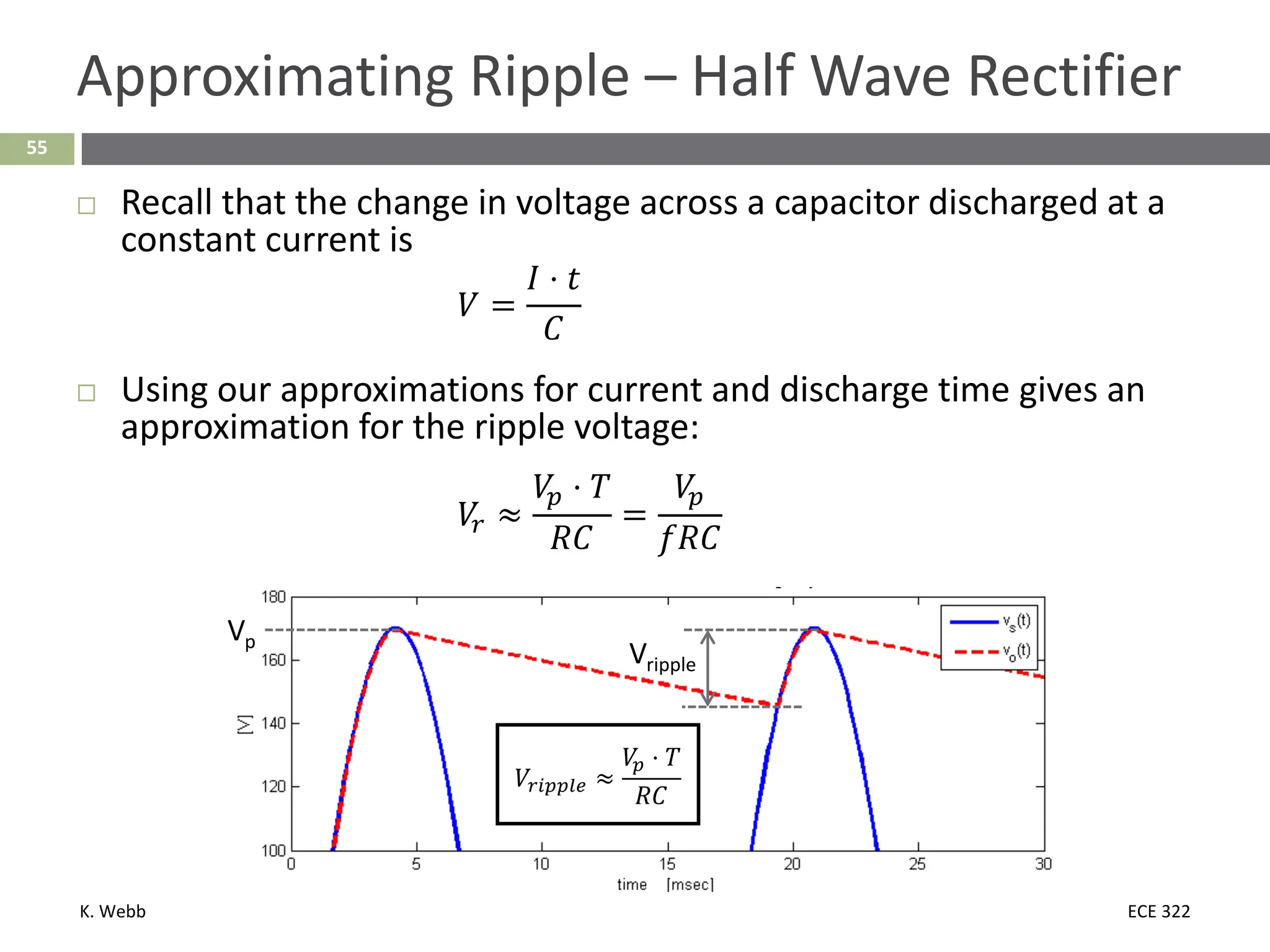
Approximating Ripple – Half Wave Rectifier
 Recall that the change in voltage across a capacitor discharged at a
constant current is
𝑉𝑉 =
𝐼𝐼 ⋅ 𝑡𝑡
𝐶𝐶
 Using our approximations for current and discharge time gives an
approximation for the ripple voltage:
𝑉𝑉
𝑟𝑟 ≈
𝑉𝑉
𝑝𝑝 ⋅ 𝑘𝑘
𝑅𝑅𝐶𝐶
=
𝑉𝑉
𝑝𝑝
𝑓𝑓𝑅𝑅𝐶𝐶
Vripple
Vp
𝑉𝑉𝑟𝑟𝑟𝑟𝑝𝑝𝑝𝑝𝑟𝑟𝑟𝑟 ≈
𝑉𝑉
𝑝𝑝 ⋅ 𝑘𝑘
𝑅𝑅𝐶𝐶
a good description about diodes and more

  • 1.
    K. Webb ECE322 Diode Models 28
  • 2.
    K. Webb ECE322 29 Diode Models  Need a diode model to enable circuit analysis  Shockley equation is one model  Simplified, but still complex for hand analysis  Can trade off complexity and accuracy  Choose the simplest possible model that provides acceptable accuracy  We’ll look at three much simpler models  Appropriate for first-order type of analyses  Ideal diode model  Nearly-ideal diode model  Nearly-ideal model with resistance
  • 3.
    K. Webb ECE322 30 Ideal Diode Model  Ideal diode model:  Short circuit for forward-bias current  Open circuit for reverse-bias voltage Id = 0 A for Vd < 0 V • Forward current flows • Vd = 0 V  Forward-bias equivalent circuit:  Vd = 0 V  Id > 0 A  Reverse-bias circuit:  Vd < 0 V  Id = 0 A
  • 4.
    K. Webb ECE322 31 Nearly-Ideal Diode Model  Nearly-ideal diode model:  Accounts for diode forward voltage  Open circuit for Vd < Vd,on  Forward-bias equivalent circuit:  Vd = Vd,on ≈ 700 mV  Id > 0 A  Reverse-bias circuit:  Vd < Vd,on ≈ 700 mV  Id = 0 A Id = 0 for Vd < Vd,on • Id > 0 A • Vd = Vd,on
  • 5.
    K. Webb ECE322 32 Nearly-Ideal Model with Resistance  Add resistance to the nearly-ideal model  Account for real parasitic resistance, or  Provide a better fit to the diode’s I-V curve  Forward-bias circuit:  Vd = Vd,on + Id∙Ron  Reverse-bias circuit:  Reverse breakdown:  Vd = -VBR + Id∙RBR Slope = 1/Ron Slope = 1/RBR
  • 6.
    K. Webb ECE322 Load-Line Analysis 33
  • 7.
    K. Webb ECE322 34 Diode Circuit Analysis  Analyze the circuit to find the diode operating point: 𝑉𝑉𝑑𝑑 and 𝐼𝐼𝑑𝑑  Apply KVL around the circuit 𝑉𝑉 𝑠𝑠 − 𝐼𝐼𝑑𝑑𝑅𝑅 − 𝑉𝑉𝑑𝑑 = 0 (1)  One equation with two unknowns: 𝑉𝑉𝑑𝑑 and 𝐼𝐼𝑑𝑑  Shockley equation give 𝐼𝐼𝑑𝑑 in terms of 𝑉𝑉𝑑𝑑 𝐼𝐼𝑑𝑑 = 𝐼𝐼𝑠𝑠 𝑒𝑒 𝑉𝑉𝑑𝑑 𝑉𝑉𝑡𝑡𝑡 − 1 ≈ 𝐼𝐼𝑠𝑠𝑒𝑒 𝑉𝑉𝑑𝑑 𝑉𝑉𝑡𝑡𝑡 (2)  Substituting (2) into (1) yields a transcendental equation 𝐼𝐼𝑠𝑠𝑒𝑒 𝑉𝑉𝑑𝑑 𝑉𝑉𝑡𝑡𝑡 ⋅ 𝑅𝑅 + 𝑉𝑉𝑑𝑑 = 𝑉𝑉 𝑠𝑠 (3)  Solve via iteration, or  Solve graphically – load-line analysis
  • 8.
    K. Webb ECE322 35 Diode Circuit Analysis 𝐼𝐼𝑠𝑠𝑒𝑒 𝑉𝑉𝑑𝑑 𝑉𝑉𝑡𝑡𝑡 ⋅ 𝑅𝑅 + 𝑉𝑉𝑑𝑑 = 𝑉𝑉 𝑠𝑠 (3)  Solving (3) amounts to solving the system of two equations given by (1) and (2) 𝐼𝐼𝑑𝑑 = − 𝑉𝑉𝑑𝑑 𝑅𝑅 + 𝑉𝑉𝑠𝑠 𝑅𝑅 (1) 𝐼𝐼𝑑𝑑 = 𝐼𝐼𝑠𝑠𝑒𝑒 𝑉𝑉𝑑𝑑 𝑉𝑉𝑡𝑡𝑡 (2)  Equation (1) is an equation for a line – the load line  Equation (2) is the exponential forward-biased diode characteristic  Solution is the values of 𝑉𝑉𝑑𝑑 and 𝐼𝐼𝑑𝑑 that satisfy both equations  Point where the two curves intersect  The DC operating point  Finding this solution graphically is load-line analysis
  • 9.
    K. Webb ECE322 36 Load-Line Analysis Diode I-V characteristic DC operating point: Vd ≈ 660mV Id ≈ 5.4mA Id = 0 Vd = Vs = 2V Vd = 0 Id = Vs/R = 8mA Diode Load-Line Analysis
  • 10.
    K. Webb ECE322 Analysis with Simple Diode Models 37
  • 11.
    K. Webb ECE322 38 Simplified Analysis – Ideal Model  Revisit the previous analysis using the ideal diode model  Diode is forward biased  Replace with a short circuit  Diode modeled as a short, so 𝑉𝑉𝑑𝑑 = 0 𝑉𝑉  Ohm’s law gives current 𝐼𝐼𝑑𝑑 = 𝑉𝑉 𝑠𝑠 𝑅𝑅 = 2 𝑉𝑉 250 Ω = 8 𝑚𝑚𝑝𝑝  Current is in correct order of magnitude, but not very accurate  Next, try the nearly-ideal model
  • 12.
    K. Webb ECE322 39 Simplified Analysis – Nearly-Ideal Model  Now, use the nearly-ideal model  Diode is forward biased  Replace with a voltage source  In practice, would have some idea of the appropriate value for 𝑉𝑉𝑑𝑑,𝑜𝑜𝑜𝑜 𝑉𝑉𝑑𝑑 = 𝑉𝑉𝑑𝑑,𝑜𝑜𝑜𝑜 ≈ 700 𝑚𝑚𝑉𝑉  Ohm’s law gives current 𝐼𝐼𝑑𝑑 = 𝑉𝑉 𝑠𝑠 − 𝑉𝑉𝑑𝑑,𝑜𝑜𝑜𝑜 𝑅𝑅 = 2 𝑉𝑉 − 0.7 𝑉𝑉 250 Ω = 5.2 𝑚𝑚𝑝𝑝  Much more accurate result  This is our go-to model for hand analysis
  • 13.
    K. Webb ECE322 Rectifier Circuits 40
  • 14.
    K. Webb ECE322 41 Rectifier Circuits  Rectifier circuits are circuits that convert AC signals into DC signals  AC-to-DC power converters:  Also used as peak detectors  AM receivers  Measurement instruments  Rectifiers rely on the unidirectional nature of diodes  Eliminate negative voltages or make them positive Sedra/Smith
  • 15.
    K. Webb ECE322 42 Half-Wave Rectifier  Half-wave rectifier  Sinusoidal input, e.g., powerline voltage  Negative half-periods removed  Only positive voltages at rectifier output  For 𝑣𝑣𝑠𝑠 𝑡𝑡 ≥ 𝑉𝑉𝑑𝑑,𝑜𝑜𝑜𝑜 ≈ 700 𝑚𝑚𝑉𝑉:  𝑖𝑖 𝑡𝑡 > 0 𝑝𝑝  𝑣𝑣𝑜𝑜 𝑡𝑡 = 𝑣𝑣𝑠𝑠 𝑡𝑡 − 𝑉𝑉𝑑𝑑,𝑜𝑜𝑜𝑜  For 𝑣𝑣𝑠𝑠 𝑡𝑡 ≤ 𝑉𝑉𝑑𝑑,𝑜𝑜𝑜𝑜 ≈ 700 𝑚𝑚𝑉𝑉:  𝑖𝑖 𝑡𝑡 = 0 𝑝𝑝  𝑣𝑣𝑜𝑜 𝑡𝑡 = 0 𝑉𝑉
  • 16.
    K. Webb ECE322 43 Half-Wave Rectifier ~700 𝑚𝑚𝑉𝑉 For 𝑣𝑣𝑠𝑠 𝑡𝑡 ≥ 700 𝑚𝑚𝑉𝑉: 𝑣𝑣𝑜𝑜 𝑡𝑡 = 𝑣𝑣𝑠𝑠 𝑡𝑡 − 700 𝑚𝑚𝑉𝑉 For 𝑣𝑣𝑠𝑠 𝑡𝑡 ≤ 700 𝑚𝑚𝑉𝑉: 𝑣𝑣𝑜𝑜 𝑡𝑡 = 0 𝑉𝑉
  • 17.
    K. Webb ECE322 44 Full-Wave Rectifier  Typical goal of a rectifier: extract power from an AC voltage, supply it to a load as a DC voltage  Half-wave rectification is inefficient  Half of the signal – and its energy – is discarded  Full-wave rectification improves efficiency  Negative voltages are not discarded – they are made positive  A diode bridge configuration  Source must be floating  Neither side grounded  Typically the output of a transformer, so not a problem
  • 18.
    K. Webb ECE322 45 Full-Wave Rectifier  For 𝑣𝑣𝑠𝑠 𝑡𝑡 ≥ 2 ⋅ 𝑉𝑉𝑑𝑑,𝑜𝑜𝑜𝑜:  D2 and D3 are forward-biased  D1 and D4 are reverse-biased  𝑣𝑣𝑜𝑜 𝑡𝑡 = 𝑣𝑣𝑠𝑠 𝑡𝑡 − 1.4 𝑉𝑉  For 𝑣𝑣𝑠𝑠 𝑡𝑡 ≤ −2 ⋅ 𝑉𝑉𝑑𝑑,𝑜𝑜𝑜𝑜:  D1 and D4 are forward-biased  D2 and D3 are reverse-biased  𝑣𝑣𝑜𝑜 𝑡𝑡 = −𝑣𝑣𝑠𝑠 𝑡𝑡 − 1.4 𝑉𝑉
  • 19.
    K. Webb ECE322 46 Full-Wave Rectifier ~1.4 𝑉𝑉 For 𝑣𝑣𝑠𝑠 𝑡𝑡 ≥ 1.4 𝑉𝑉: 𝑣𝑣𝑜𝑜 𝑡𝑡 = 𝑣𝑣𝑠𝑠 𝑡𝑡 − 1.4 𝑉𝑉 For 𝑣𝑣𝑠𝑠 𝑡𝑡 ≤ 1.4 𝑉𝑉 : 𝑣𝑣𝑜𝑜 𝑡𝑡 = 0 𝑉𝑉
  • 20.
    K. Webb ECE322 47 Full-Wave Rectifier – Differential Source  If we have a differential source, full-wave rectifier requires only two diodes  Now, only a single diode drop between input and output 𝑣𝑣𝑜𝑜 𝑡𝑡 = 𝑣𝑣𝑠𝑠 𝑡𝑡 − 𝑉𝑉𝑑𝑑,𝑜𝑜𝑜𝑜  Differential source may come from a transformer with a grounded center tap on the secondary winding
  • 21.
    K. Webb ECE322 48 Precision Half-Wave Rectifier  A precision rectifier or super diode encloses a diode in an opamp feedback loop  Feedback forces the output equal to the input  Input-to-output diode drop is eliminated  Negative feedback only for positive inputs  For 𝑣𝑣𝑠𝑠 𝑡𝑡 ≥ 0 𝑉𝑉:  Negative feedback path exists  Unity-gain buffer  𝑣𝑣𝑜𝑜(𝑡𝑡) = 𝑣𝑣𝑠𝑠(𝑡𝑡)  For 𝑣𝑣𝑠𝑠 𝑡𝑡 ≤ 0 𝑉𝑉:  No feedback – output saturates  𝑣𝑣𝑜𝑜 t pulled to ground by resistor  𝑣𝑣𝑜𝑜 𝑡𝑡 = 0 𝑉𝑉
  • 22.
    K. Webb ECE322 Smoothing Capacitors & Peak Detectors 49
  • 23.
    K. Webb ECE322 50 Smoothing Capacitors  If our goal is AC-to-DC conversion, rectification is only the first step  Rectified output is positive, but far from DC Sedra/Smith  A capacitor in parallel with the rectifier’s load resistor will smooth out the output  A smoothing capacitor  A low pass filter to average out the rectified signal  The same circuit can be used for peak detection  Demodulation of an AM radio signal, for example
  • 24.
    K. Webb ECE322 51 Smoothing Capacitors  Add a smoothing capacitor to half-wave rectifier  Input is 60 Hz powerline voltage  When 𝑣𝑣𝑜𝑜 ≤ 𝑣𝑣𝑠𝑠 − 𝑉𝑉𝑑𝑑,𝑜𝑜𝑜𝑜:  Current flows through the diode  Capacitor charges  When 𝑣𝑣𝑠𝑠 ≤ 𝑣𝑣𝑜𝑜 + 𝑉𝑉𝑑𝑑,𝑜𝑜𝑜𝑜:  Diode is off  Capacitor discharges at a rate determined by the RC time constant
  • 25.
    K. Webb ECE322 52 Smoothing Capacitors  Capacitor helps filter or smooth the output  Nearly DC  Remaining AC component is referred to as ripple  Ripple magnitude determined by how far the capacitor can discharge before charging again  Determined by RC time constant  To reduce ripple  Increase the RC time constant  Larger resistor and/or capacitor
  • 26.
    K. Webb ECE322 53 Calculating Ripple – Half Wave Rectifier  𝑉𝑉 𝑟𝑟: pk-pk ripple voltage  𝑉𝑉 𝑝𝑝: peak input voltage  𝑡𝑡𝑝𝑝: time at input peak  𝑘𝑘: input period  𝑡𝑡𝑑𝑑: capacitor discharge time  Diode modeled as ideal Vr During discharge: 𝑣𝑣𝑜𝑜(𝑡𝑡) = 𝑉𝑉 𝑝𝑝𝑒𝑒− 𝑡𝑡−𝑡𝑡𝑝𝑝 𝑅𝑅𝑅𝑅 tp Vp tp+T td T
  • 27.
    K. Webb ECE322 54 Calculating Ripple – Half Wave Rectifier  𝑉𝑉 𝑟𝑟 is the difference between the output voltage at 𝑡𝑡 = 𝑡𝑡𝑝𝑝 and at 𝑡𝑡 = 𝑡𝑡𝑝𝑝 + 𝑡𝑡𝑑𝑑 𝑉𝑉 𝑟𝑟 = 𝑣𝑣𝑜𝑜 𝑡𝑡𝑝𝑝 − 𝑣𝑣𝑜𝑜 𝑡𝑡𝑝𝑝 + 𝑡𝑡𝑑𝑑 where 𝑣𝑣𝑜𝑜 𝑡𝑡𝑝𝑝 = 𝑉𝑉 𝑝𝑝 and 𝑣𝑣𝑜𝑜 𝑡𝑡𝑝𝑝 + 𝑡𝑡𝑑𝑑 = 𝑉𝑉 𝑝𝑝𝑒𝑒− 𝑡𝑡𝑑𝑑 𝑅𝑅𝑅𝑅 so 𝑉𝑉 𝑟𝑟 = 𝑉𝑉 𝑝𝑝 − 𝑉𝑉 𝑝𝑝𝑒𝑒− 𝑡𝑡𝑑𝑑 𝑅𝑅𝑅𝑅 = 𝑉𝑉 𝑝𝑝 1 − 𝑒𝑒− 𝑡𝑡𝑑𝑑 𝑅𝑅𝑅𝑅  Problem is, we do not know 𝑡𝑡𝑑𝑑  Could calculate it, but, instead, assume the following: 𝜏𝜏 = 𝑅𝑅𝐶𝐶 ≫ 𝑘𝑘  From which it follows that  𝑉𝑉 𝑟𝑟 ≪ 𝑉𝑉 𝑝𝑝  𝑡𝑡𝑑𝑑 ≈ 𝑘𝑘  Discharge current is approximately constant: 𝑖𝑖 𝑡𝑡 ≈ 𝑉𝑉𝑝𝑝 𝑅𝑅 𝑡𝑡𝑝𝑝 ≤ 𝑡𝑡 ≤ 𝑡𝑡𝑝𝑝 + 𝑡𝑡𝑑𝑑
  • 28.
    K. Webb ECE322 55 Approximating Ripple – Half Wave Rectifier  Recall that the change in voltage across a capacitor discharged at a constant current is 𝑉𝑉 = 𝐼𝐼 ⋅ 𝑡𝑡 𝐶𝐶  Using our approximations for current and discharge time gives an approximation for the ripple voltage: 𝑉𝑉 𝑟𝑟 ≈ 𝑉𝑉 𝑝𝑝 ⋅ 𝑘𝑘 𝑅𝑅𝐶𝐶 = 𝑉𝑉 𝑝𝑝 𝑓𝑓𝑅𝑅𝐶𝐶 Vripple Vp 𝑉𝑉𝑟𝑟𝑟𝑟𝑝𝑝𝑝𝑝𝑟𝑟𝑟𝑟 ≈ 𝑉𝑉 𝑝𝑝 ⋅ 𝑘𝑘 𝑅𝑅𝐶𝐶