Manuale PHP
Stig Sæther Bakken
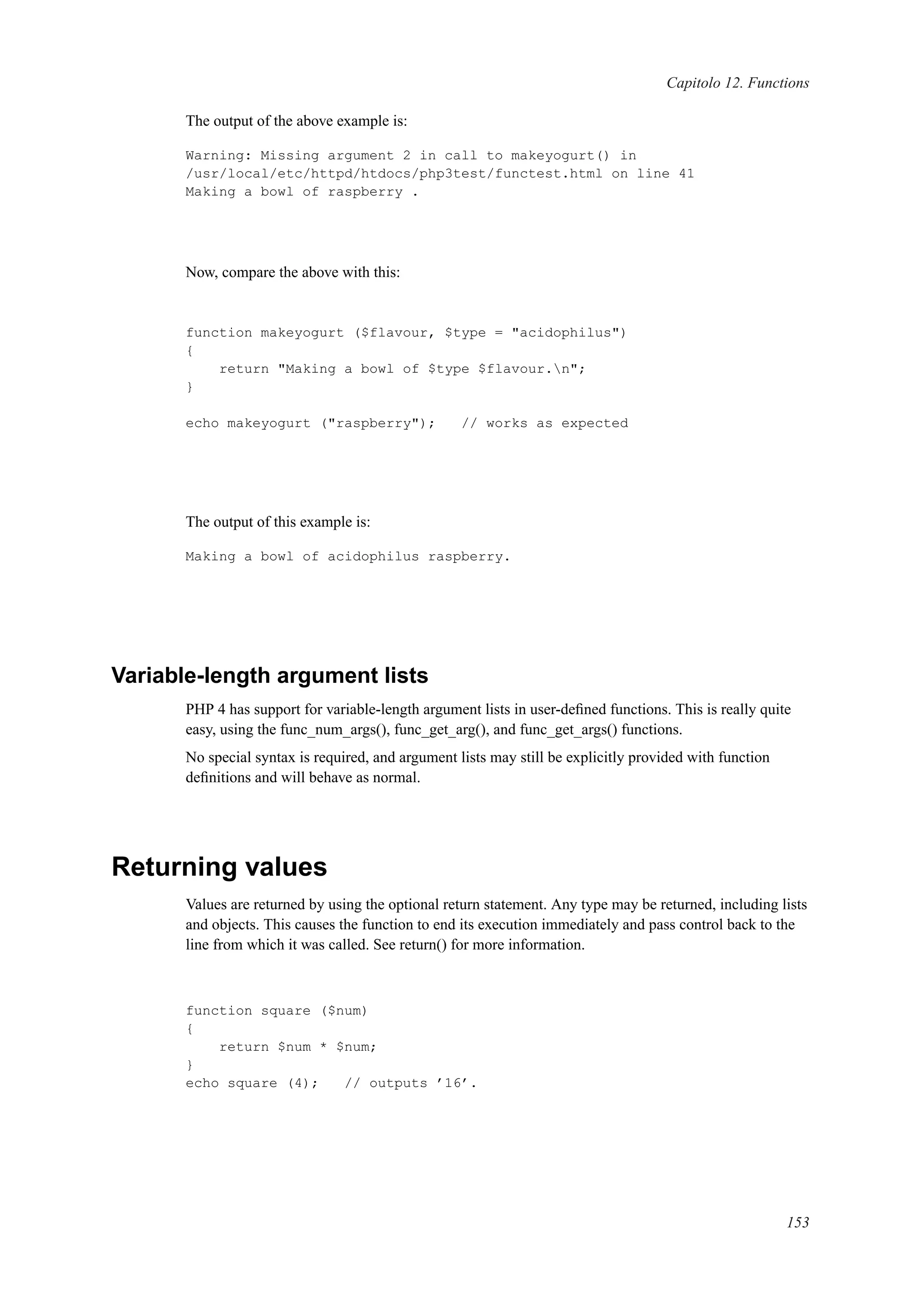
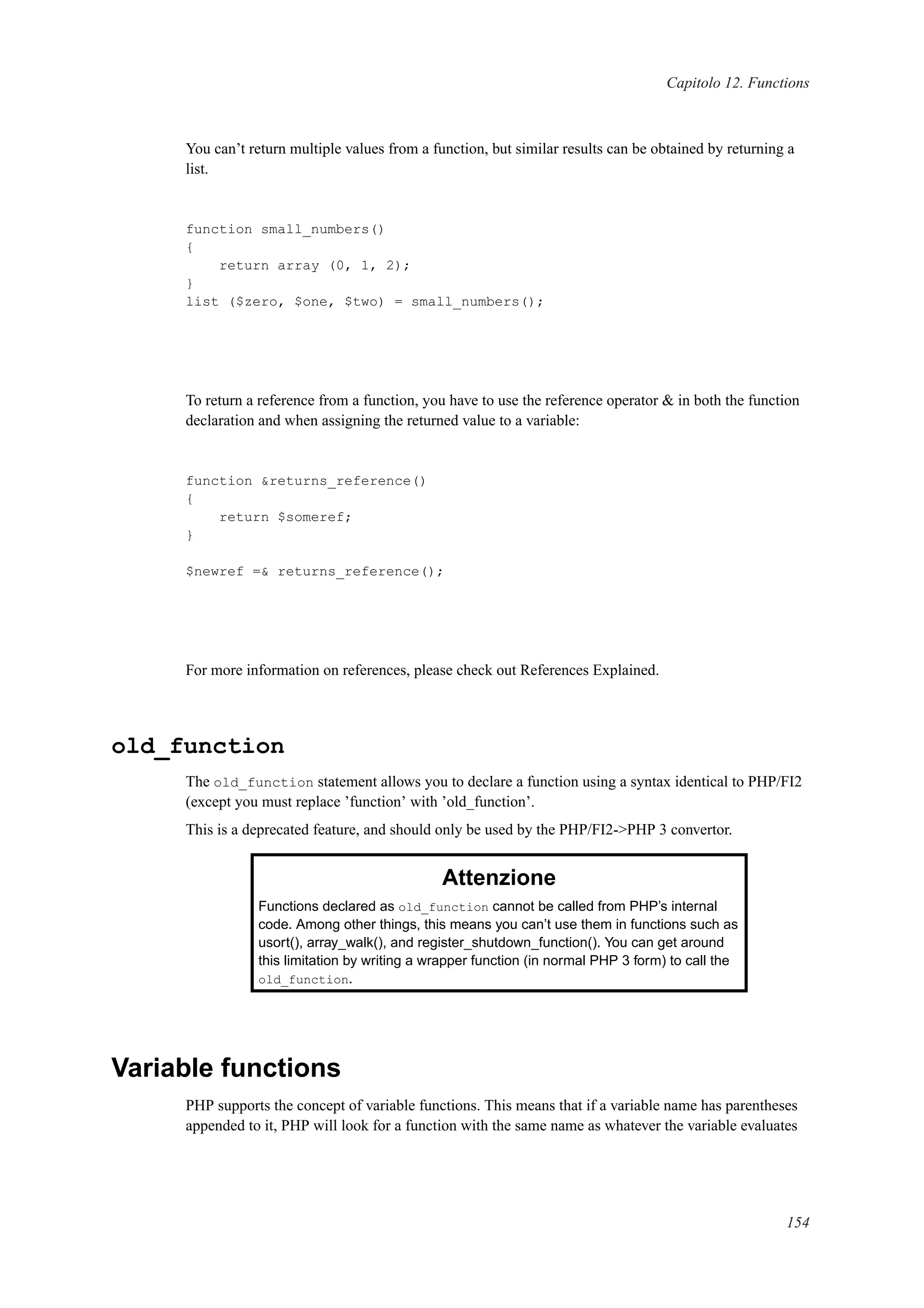
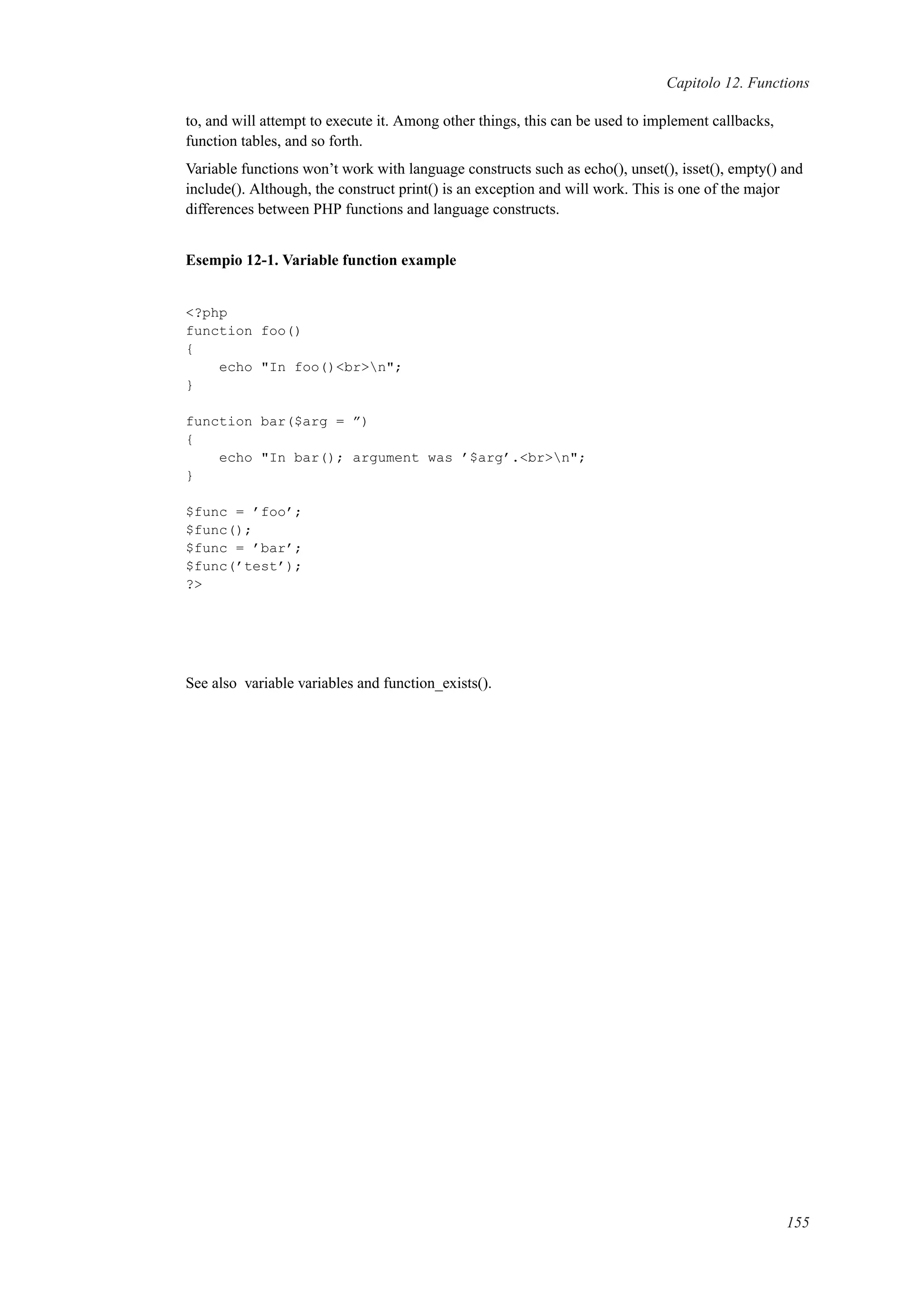
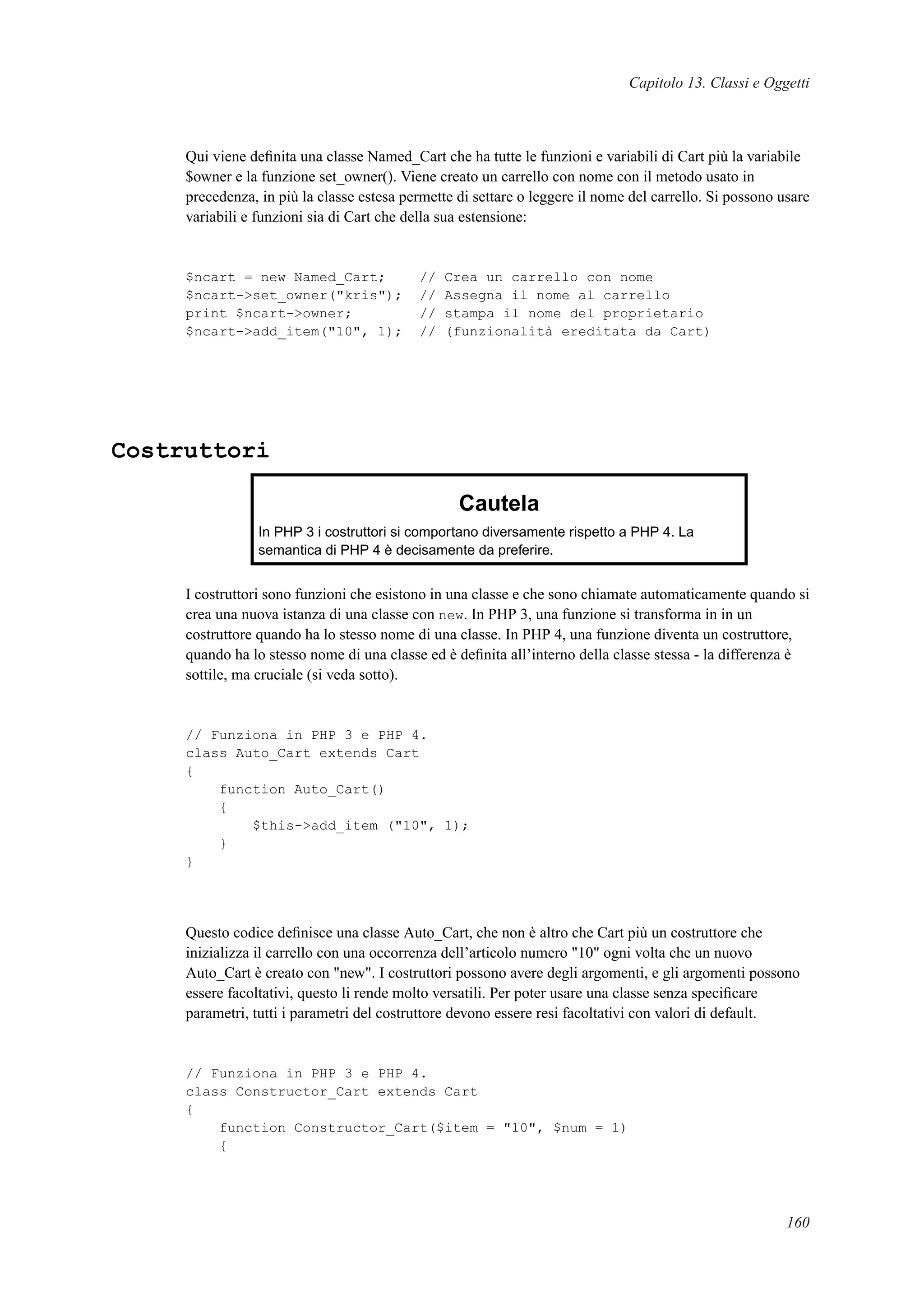
Alexander Aulbach
Egon Schmid
Jim Winstead
Lars Torben Wilson
Rasmus Lerdorf
Andrei Zmievski
Jouni Ahto
A cura di
Luca Perugini
Simone Cortesi
Tradotto con la collaborazione di:
Marco Cucinato
Massimo Colombo
Marco De Nittis
Darvin Andrioli
Fabio Gandola
Sergio Marchesini
Alan D’Angelo
Giacomo Tesio
Marco Spisto
Gabriele Scaroni
Mariano Calandra
Rocco Curcio
Luca Costantino
21-05-2002
Copyright © 1997, 1998, 1999, 2000, 2001, 2002 Gruppo di Documentazione PHP
Copyright
Questo manuale è © Copyright 1997, 1998, 1999, 2000, 2001, 2002 del Gruppo
di Documentazione PHP. I membri di questo gruppo sono elencati nella
copertina di questo manuale.
Questo manuale può essere redistribuito secondo i termini della GNU General
Public License come pubblicata dalla Free Software Foundation; sia la
versione 2 della licenza, oppure (a scelta) qualsiasi versione successiva.
La sezione ’Estendere PHP 4.0’ di questo manuale è copyright © 2000 della
Zend Technologies, Ltd. Questo materiale può essere distribuito solo secondo
i termini e le condizioni della Open Publication License, v1.0 o successiva (la
versione più recente è al momento disponibile qui
http://www.opencontent.org/openpub/).
Manuale PHP
Stig Sæther Bakken, Alexander Aulbach, Egon Schmid, Jim Winstead, Lars Torben Wilson, Rasmus Lerdorf,
Andrei Zmievski, e Jouni Ahto
A cura di Luca Perugini
A cura di Simone Cortesi
Tradotto con la collaborazione di:
Marco Cucinato
Massimo Colombo
Marco De Nittis
Darvin Andrioli
Fabio Gandola
Sergio Marchesini
Alan D’Angelo
Giacomo Tesio
Marco Spisto
Gabriele Scaroni
Mariano Calandra
Rocco Curcio
Luca Costantino
Pubblicato 21-05-2002
Copyright © 1997, 1998, 1999, 2000, 2001, 2002 Gruppo di Documentazione PHP
Copyright
Questo manuale è © Copyright 1997, 1998, 1999, 2000, 2001, 2002 del Gruppo di Documentazione PHP. I
membri di questo gruppo sono elencati nella copertina di questo manuale.
Questo manuale può essere redistribuito secondo i termini della GNU General Public License come pubblicata
dalla Free Software Foundation; sia la versione 2 della licenza, oppure (a scelta) qualsiasi versione successiva.
La sezione ’Estendere PHP 4.0’ di questo manuale è copyright © 2000 della Zend Technologies, Ltd. Questo
materiale può essere distribuito solo secondo i termini e le condizioni della Open Publication License, v1.0 o
successiva (la versione più recente è al momento disponibile qui http://www.opencontent.org/openpub/).
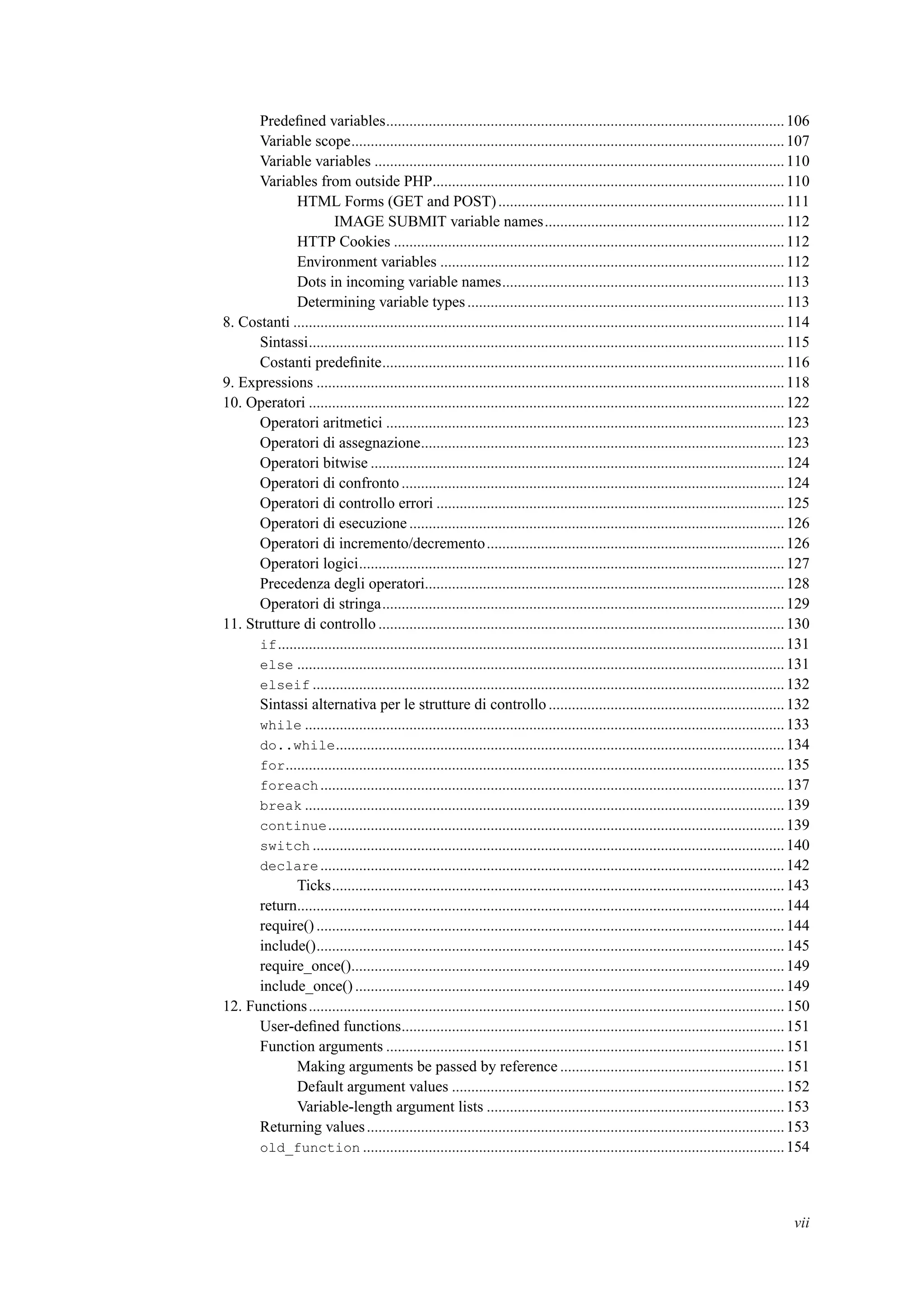
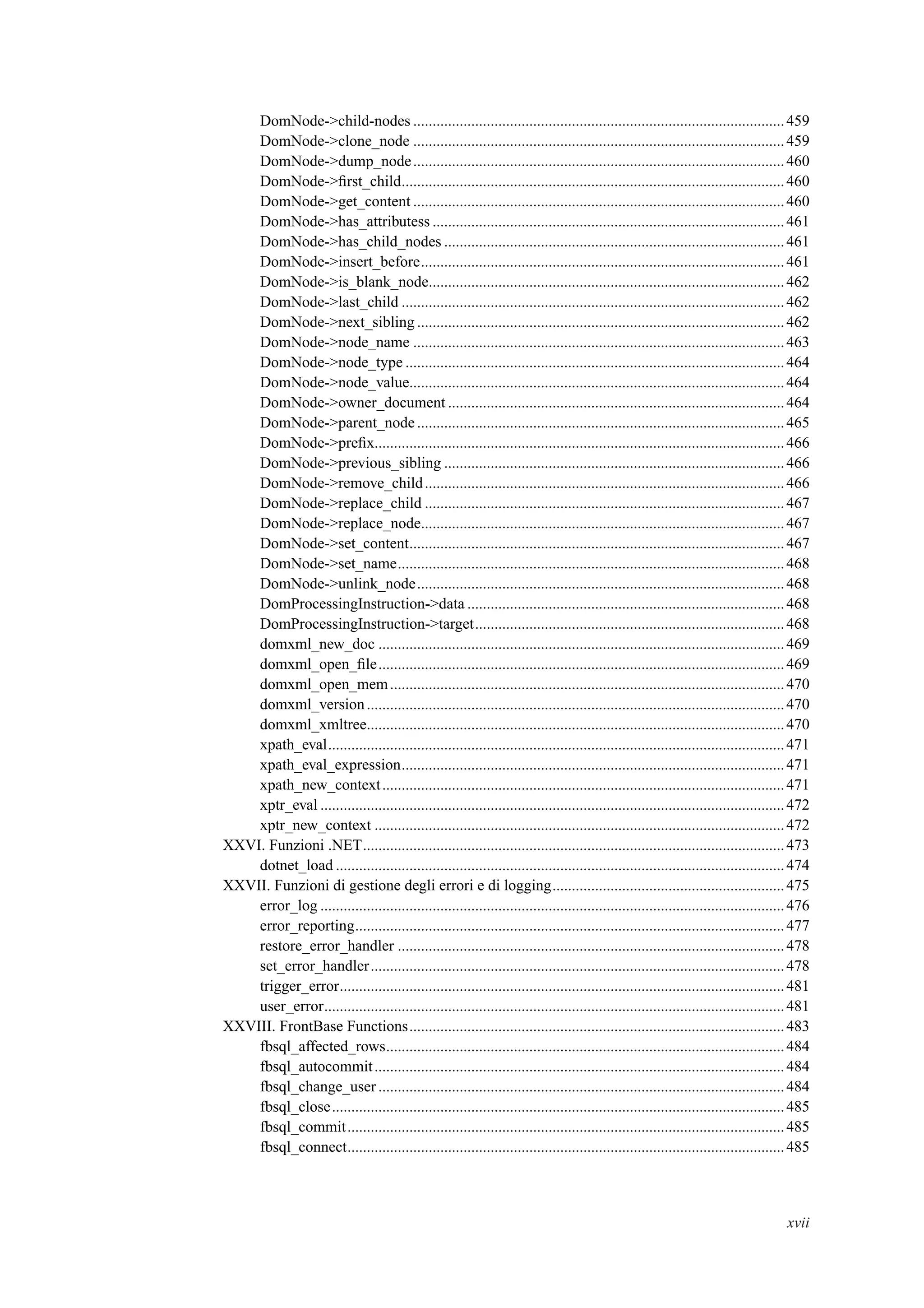
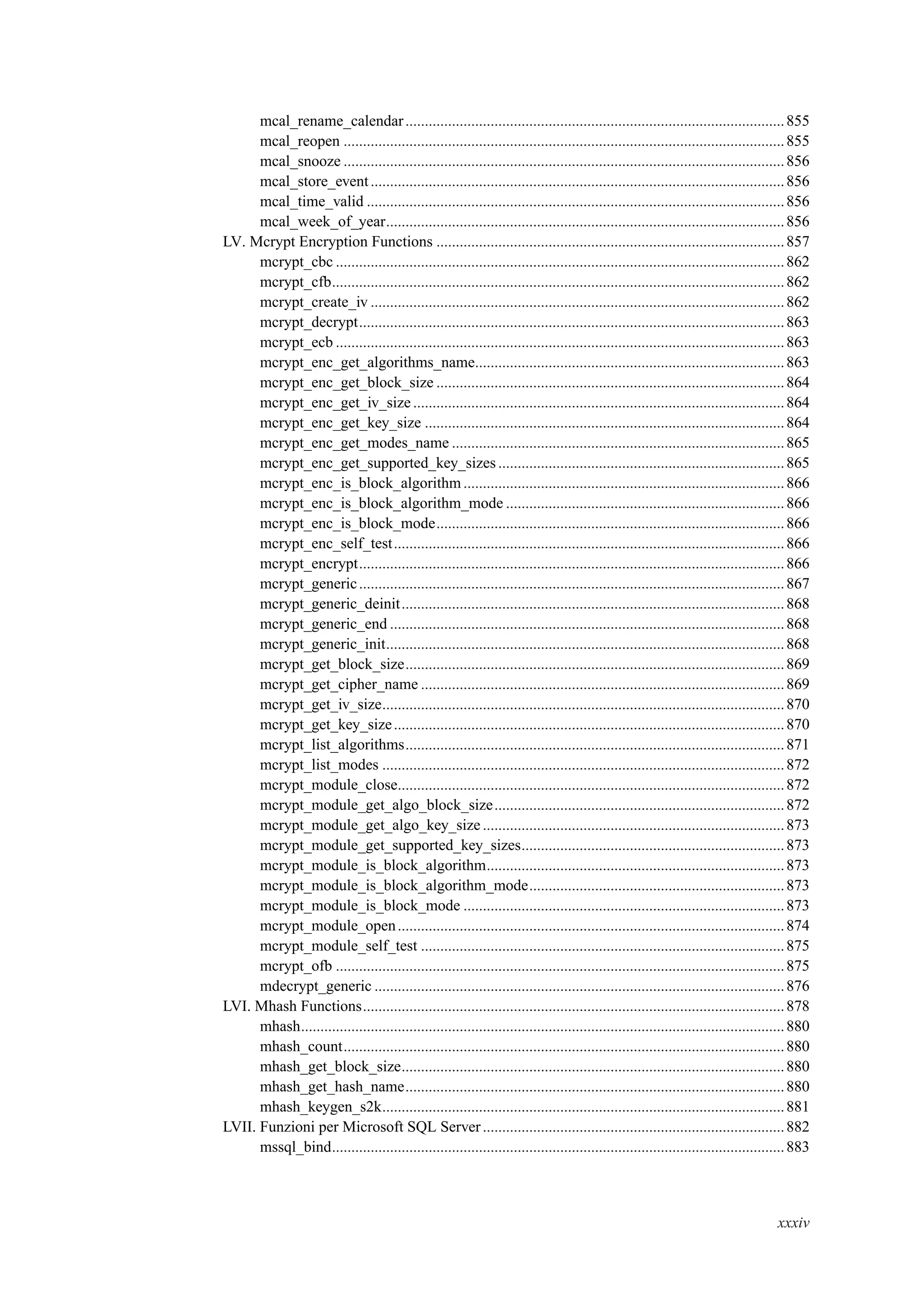
Sommario
Prefazione .............................................................................................................................................i
I. Guida Rapida...................................................................................................................................1
1. Introduzione ............................................................................................................................1
Che cos’è il PHP?..............................................................................................................2
What can PHP do?.............................................................................................................2
A brief history of PHP.......................................................................................................4
2. Installazione ............................................................................................................................5
General Installation Considerations ..................................................................................6
Unix/HP-UX installs .........................................................................................................6
Unix/Linux installs............................................................................................................8
Using Packages ........................................................................................................8
Unix/Mac OS X installs.....................................................................................................8
Using Packages ........................................................................................................8
Compiling for OS X server......................................................................................8
Compiling for MacOS X client..............................................................................10
Unix/OpenBSD installs ...................................................................................................10
Using Ports.............................................................................................................11
Using Packages ......................................................................................................11
Unix/Solaris installs.........................................................................................................11
Required software ..................................................................................................11
Using Packages ......................................................................................................12
Installation on UNIX systems .........................................................................................12
Apache Module Quick Reference..........................................................................12
Building .................................................................................................................13
Installation on Windows systems ....................................................................................13
Windows InstallShield ...........................................................................................13
Manual Installation Steps.......................................................................................14
Building from source .............................................................................................16
Preparations..................................................................................................16
Putting it all together....................................................................................17
Compiling.....................................................................................................18
Installation of Windows extensions .......................................................................18
Servers-CGI/Commandline .............................................................................................20
Testing....................................................................................................................21
Benchmarking........................................................................................................21
Servers-Apache................................................................................................................21
Details of installing PHP with Apache on Unix ....................................................21
Installing PHP on Windows with Apache 1.3.x.....................................................24
Servers-Caudium .............................................................................................................25
Servers-fhttpd ..................................................................................................................25
Servers-IIS/PWS..............................................................................................................26
Windows and PWS/IIS 3 .......................................................................................26
Windows and PWS 4 or newer ..............................................................................27
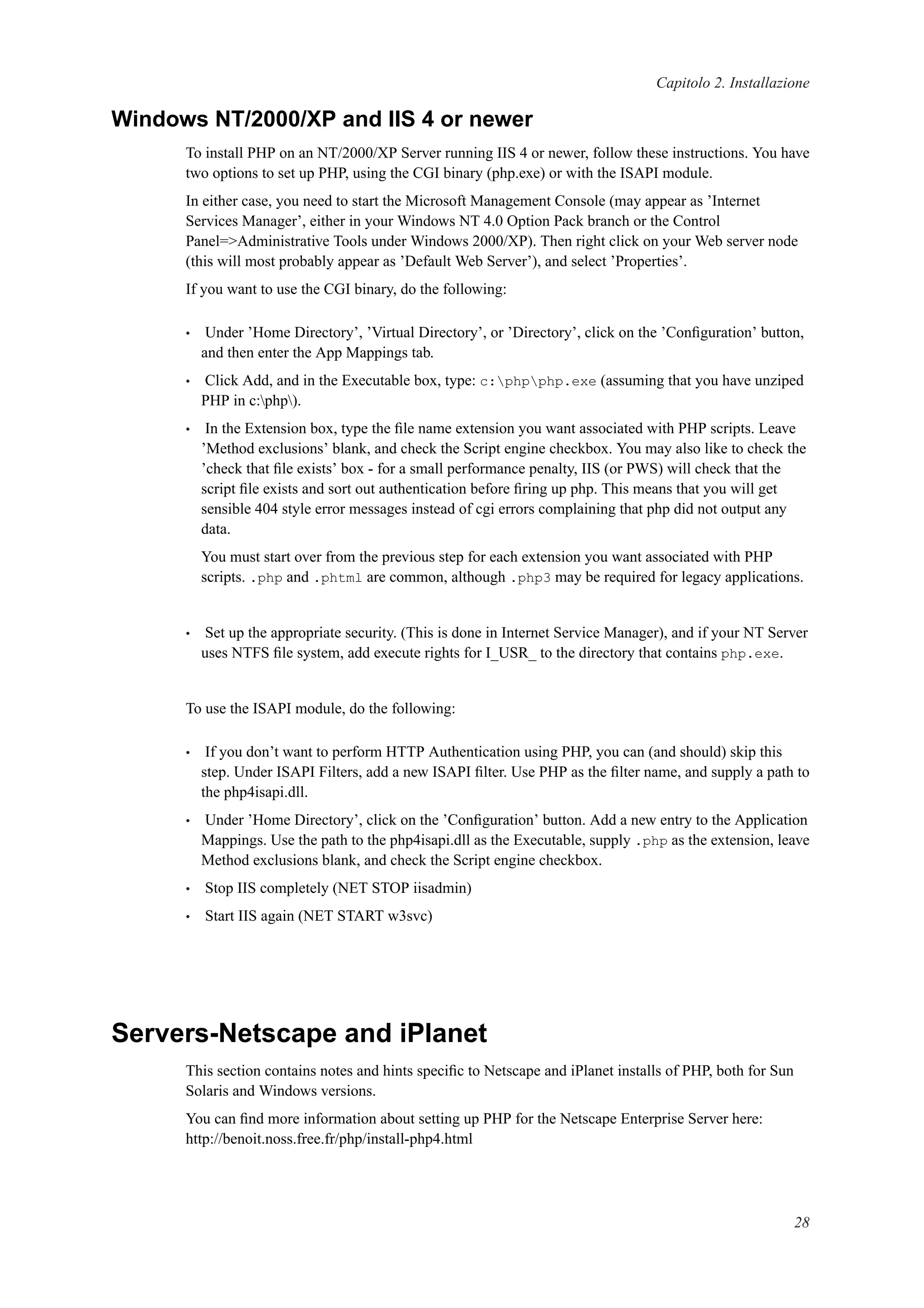
Windows NT/2000/XP and IIS 4 or newer............................................................27
Servers-Netscape and iPlanet ..........................................................................................28
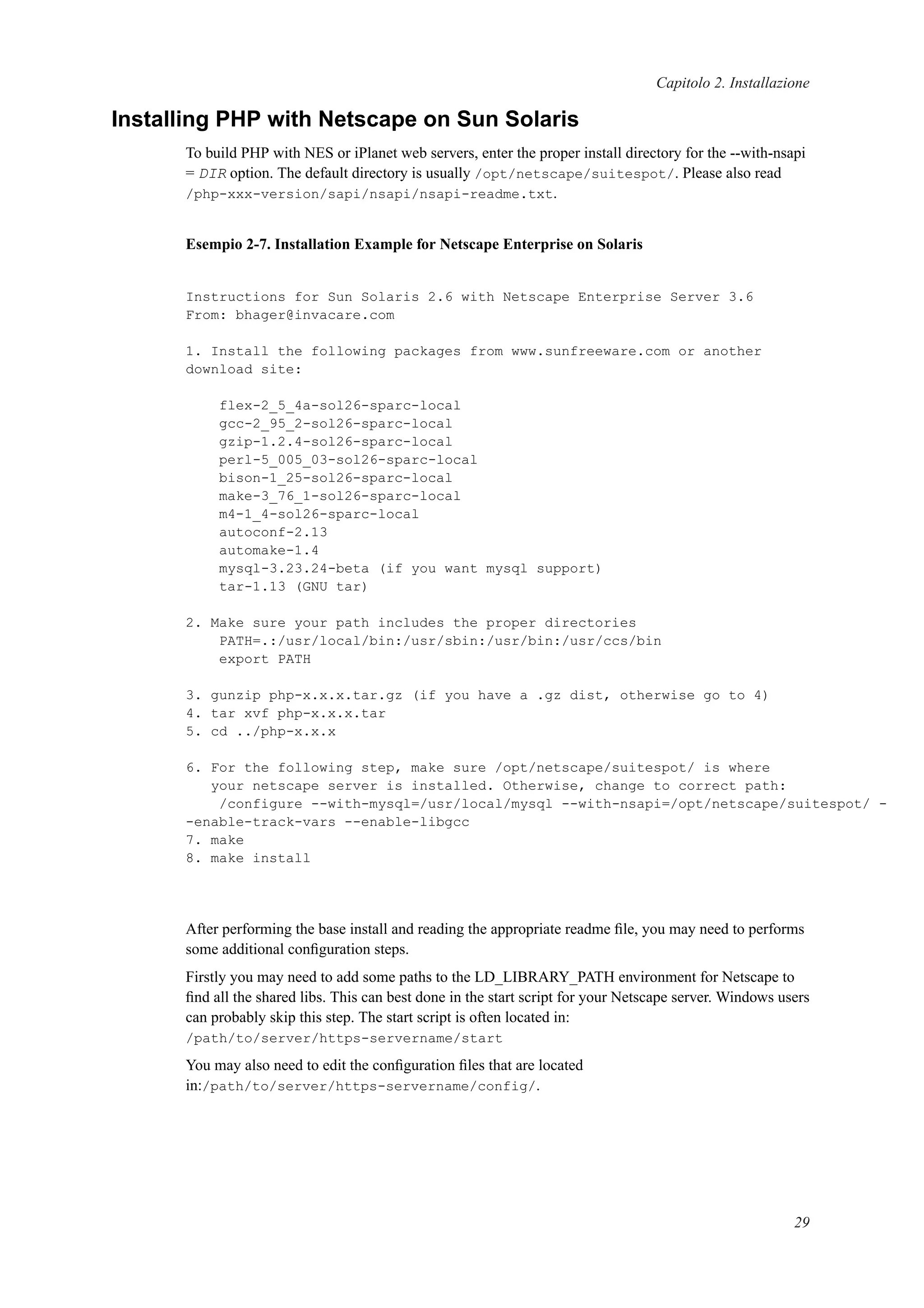
Installing PHP with Netscape on Sun Solaris........................................................28
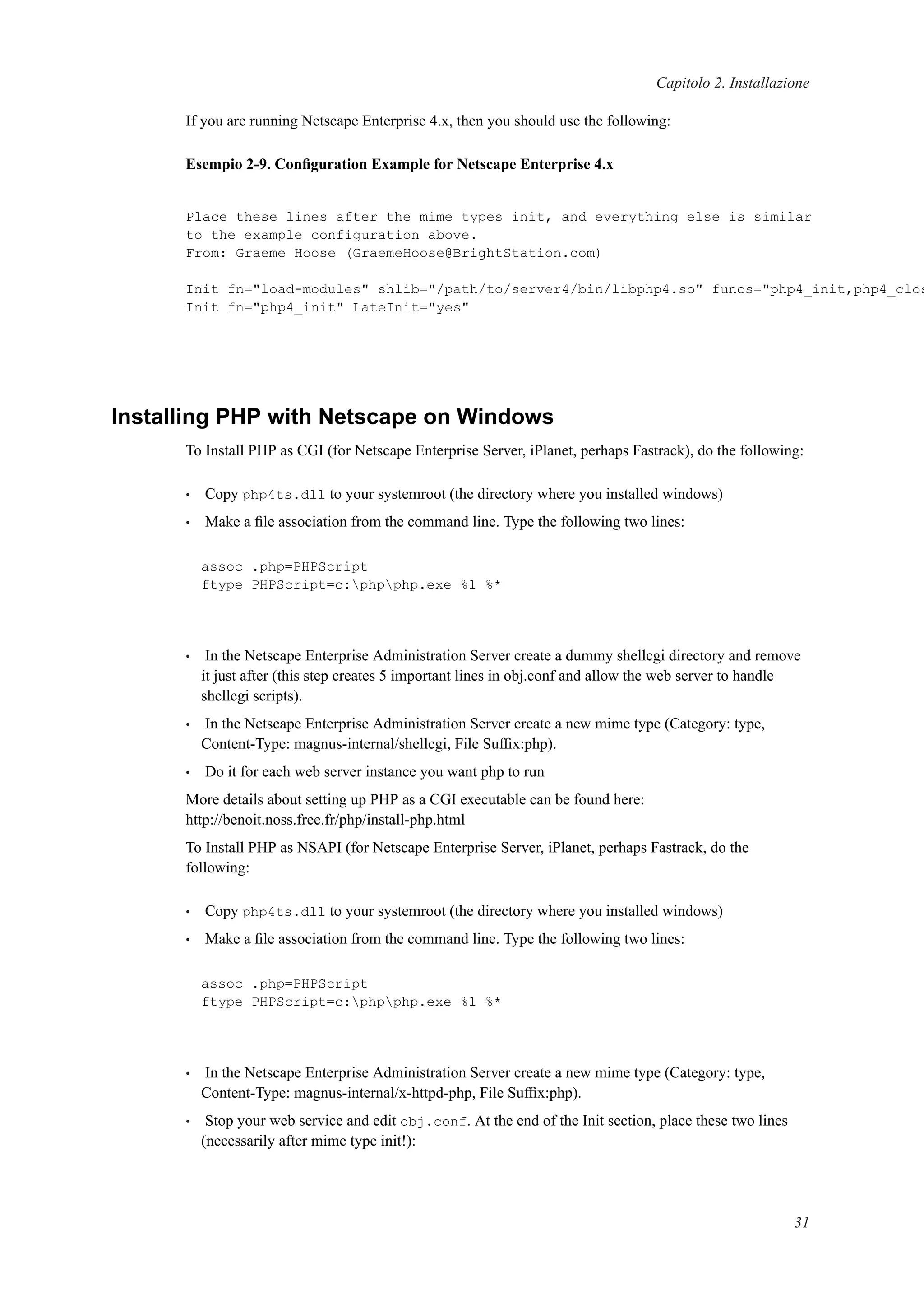
Installing PHP with Netscape on Windows ...........................................................31
Servers-OmniHTTPd Server ...........................................................................................32
OmniHTTPd 2.0b1 and up for Windows...............................................................32
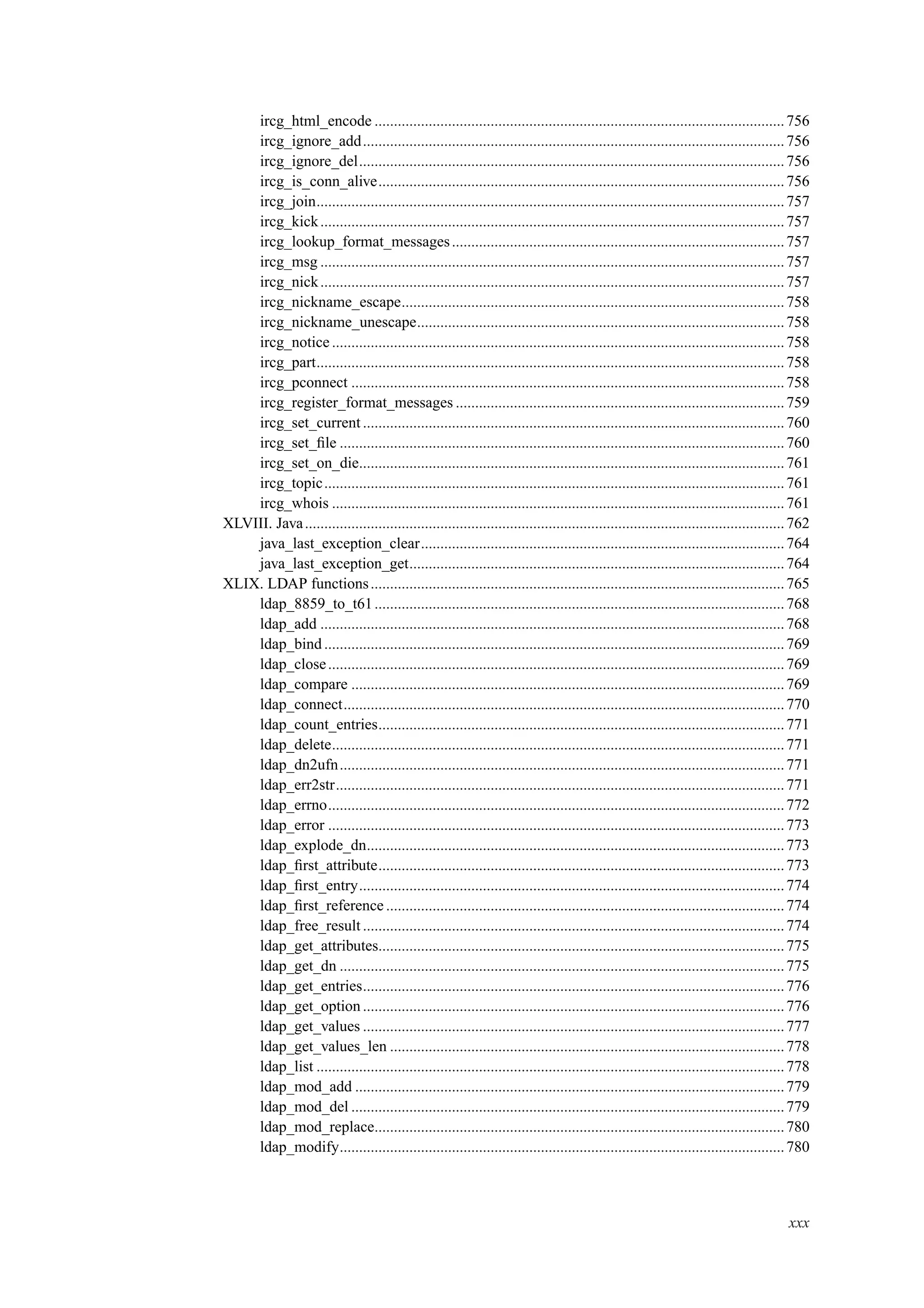
iv
Servers-Oreilly Website Pro ............................................................................................33
Oreilly Website Pro 2.5 and up for Windows ........................................................33
Servers-Xitami.................................................................................................................33
Xitami for Windows...............................................................................................33
Servers-Other web servers...............................................................................................34
Problems? ........................................................................................................................34
Read the FAQ.........................................................................................................34
Other problems.......................................................................................................34
Bug reports.............................................................................................................34
Complete list of configure options ..................................................................................34
Configure Options in PHP 4 ..................................................................................35
Database options ..........................................................................................35
Graphics options...........................................................................................38
Misc options .................................................................................................39
PHP options..................................................................................................45
Server options...............................................................................................46
XML options ................................................................................................47
3. Configuration ........................................................................................................................48
The configuration file ......................................................................................................49
General Configuration Directives ..........................................................................50
Safe Mode Configuration Directives......................................................................55
Debugger Configuration Directives .......................................................................55
Extension Loading Directives................................................................................56
mSQL Configuration Directives ............................................................................56
Postgres Configuration Directives .........................................................................56
SESAM Configuration Directives..........................................................................57
Sybase Configuration Directives............................................................................57
Sybase-CT Configuration Directives .....................................................................57
Informix Configuration Directives.........................................................................58
BC Math Configuration Directives ........................................................................59
Browser Capability Configuration Directives........................................................59
Multi-Byte String Configuration Directives ..........................................................59
Exif Configuration Directives ................................................................................60
4. Security .................................................................................................................................62
General considerations ....................................................................................................63
Installed as CGI binary....................................................................................................63
Possible attacks......................................................................................................64
Case 1: only public files served .............................................................................64
Case 2: using --enable-force-cgi-redirect...............................................................64
Case 3: setting doc_root or user_dir ......................................................................65
Case 4: PHP parser outside of web tree.................................................................65
Installed as an Apache module........................................................................................66
Filesystem Security .........................................................................................................66
Database Security ............................................................................................................68
Designing Databases..............................................................................................69
Connecting to Database .........................................................................................69
Encrypted Storage Model ......................................................................................69
SQL Injection.........................................................................................................70
Avoiding techniques.....................................................................................73
Error Reporting................................................................................................................74
Using Register Globals....................................................................................................75
User Submitted Data........................................................................................................77
v
Hiding PHP......................................................................................................................77
Keeping Current ..............................................................................................................78
II. Struttura del Linguaggio.............................................................................................................79
5. Sintassi Fondamentale...........................................................................................................79
Modi per uscire dalla modalità HTML............................................................................80
Separazione delle istruzioni.............................................................................................81
Commenti ........................................................................................................................81
6. Types .....................................................................................................................................82
Introduction .....................................................................................................................83
Booleans ..........................................................................................................................83
Syntax ....................................................................................................................83
Converting to boolean............................................................................................84
Integers ............................................................................................................................85
Syntax ....................................................................................................................85
Integer overflow .....................................................................................................85
Converting to integer..............................................................................................86
From booleans..............................................................................................86
From floating point numbers........................................................................86
From strings..................................................................................................87
From other types...........................................................................................87
Floating point numbers....................................................................................................87
Strings..............................................................................................................................88
Syntax ....................................................................................................................88
Single quoted................................................................................................88
Double quoted ..............................................................................................89
Heredoc ........................................................................................................89
Variable parsing............................................................................................91
Simple syntax......................................................................................91
Complex (curly) syntax ......................................................................91
String access by character ............................................................................92
Useful functions.....................................................................................................93
String conversion ...................................................................................................93
Arrays ..............................................................................................................................94
Syntax ....................................................................................................................94
Specifying with array().................................................................................94
Creating/modifying with square-bracket syntax ..........................................94
Useful functions.....................................................................................................95
Array do’s and don’ts.............................................................................................95
Why is $foo[bar] wrong?.........................................................................95
So why is it bad then?.........................................................................96
Examples................................................................................................................96
Objects...........................................................................................................................100
Object Initialization .............................................................................................100
Resource ........................................................................................................................100
Freeing resources .................................................................................................100
NULL ............................................................................................................................101
Syntax ..................................................................................................................101
Type Juggling ................................................................................................................101
Type Casting ........................................................................................................102
7. Variables..............................................................................................................................104
Basics.............................................................................................................................105
vi
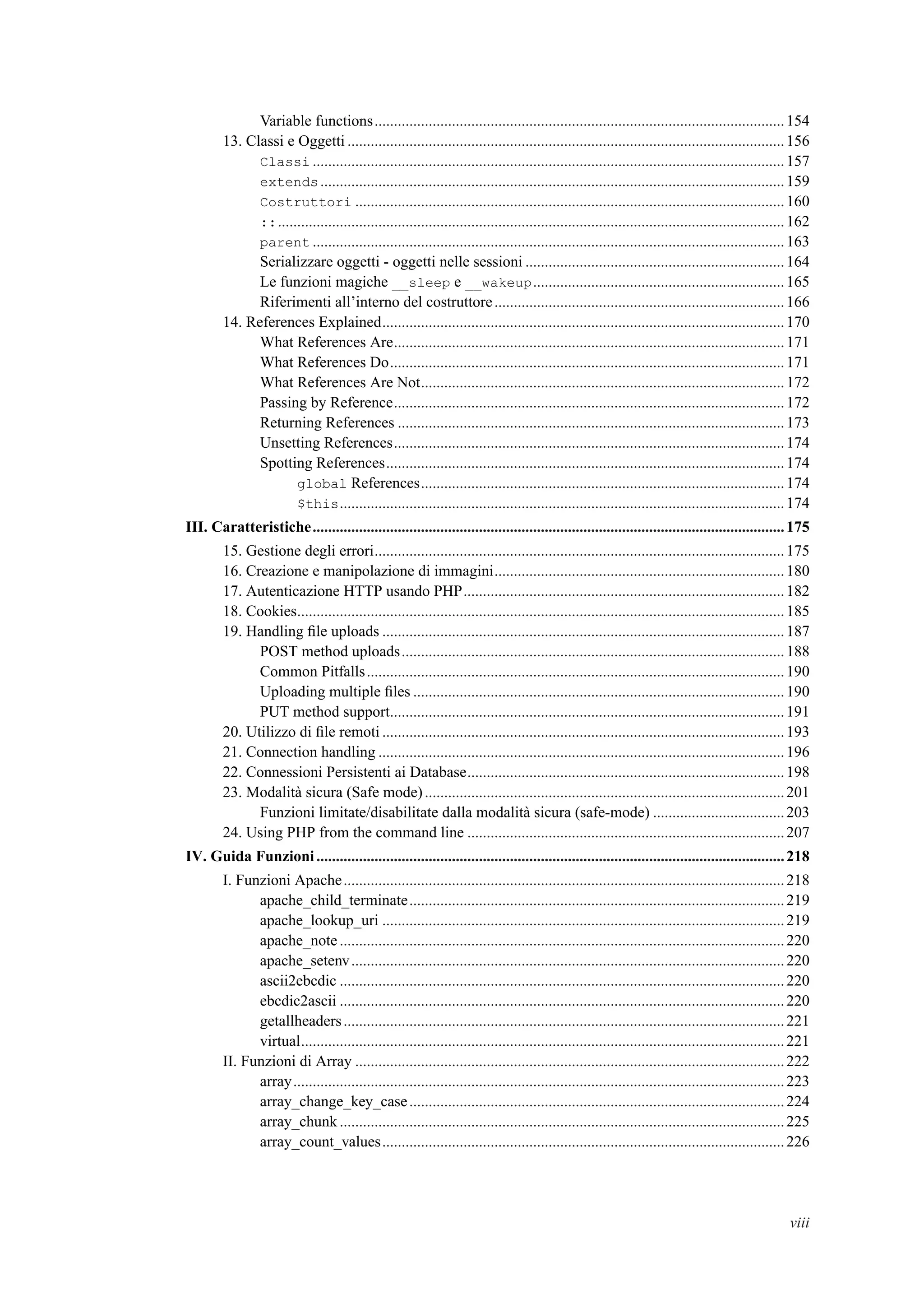
Predefined variables.......................................................................................................106
Variable scope................................................................................................................107
Variable variables ..........................................................................................................110
Variables from outside PHP...........................................................................................110
HTML Forms (GET and POST)..........................................................................111
IMAGE SUBMIT variable names..............................................................112
HTTP Cookies .....................................................................................................112
Environment variables .........................................................................................112
Dots in incoming variable names.........................................................................113
Determining variable types..................................................................................113
8. Costanti ...............................................................................................................................114
Sintassi...........................................................................................................................115
Costanti predefinite........................................................................................................116
9. Expressions .........................................................................................................................118
10. Operatori ...........................................................................................................................122
Operatori aritmetici .......................................................................................................123
Operatori di assegnazione..............................................................................................123
Operatori bitwise ...........................................................................................................124
Operatori di confronto ...................................................................................................124
Operatori di controllo errori ..........................................................................................125
Operatori di esecuzione .................................................................................................126
Operatori di incremento/decremento.............................................................................126
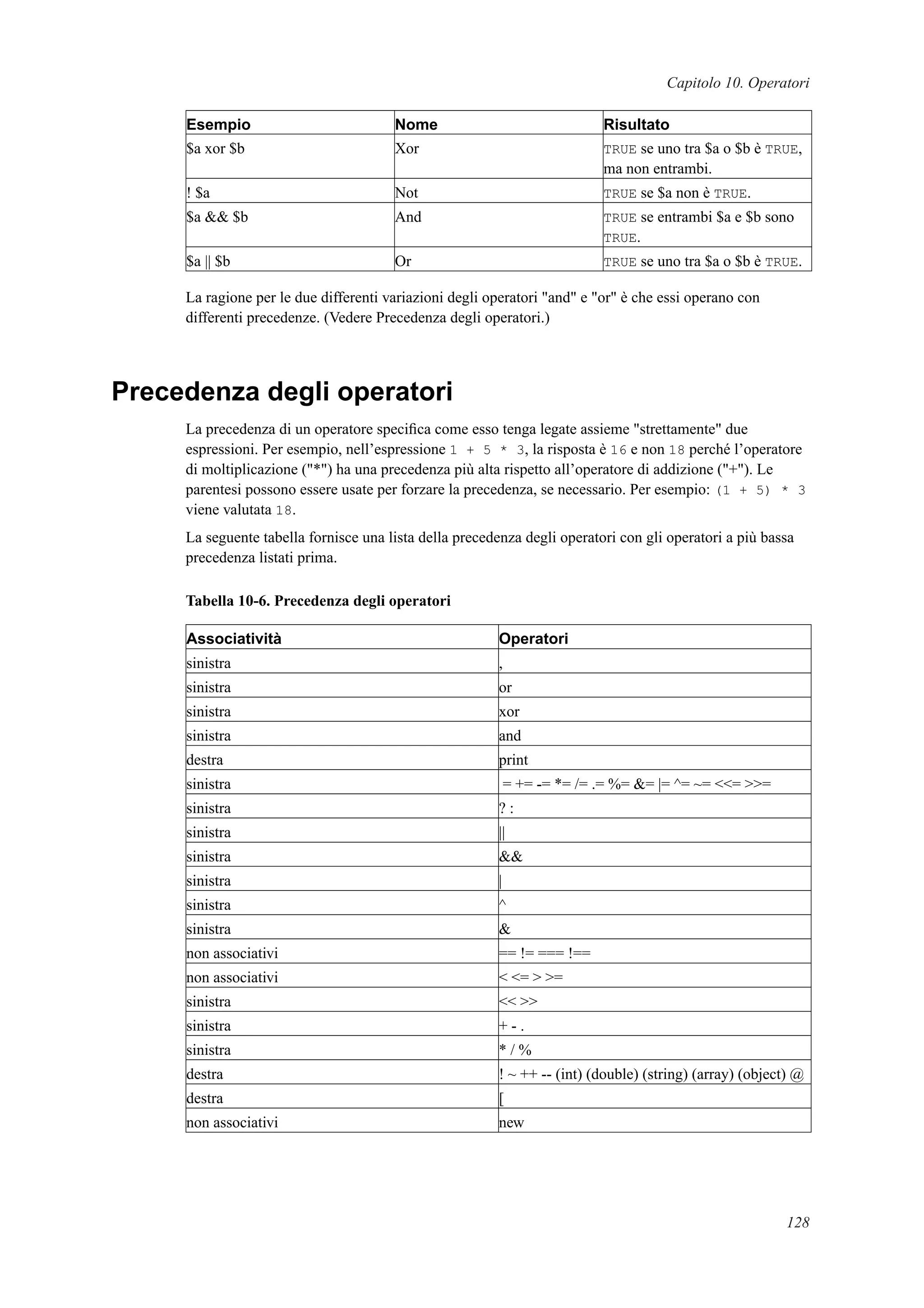
Operatori logici..............................................................................................................127
Precedenza degli operatori.............................................................................................128
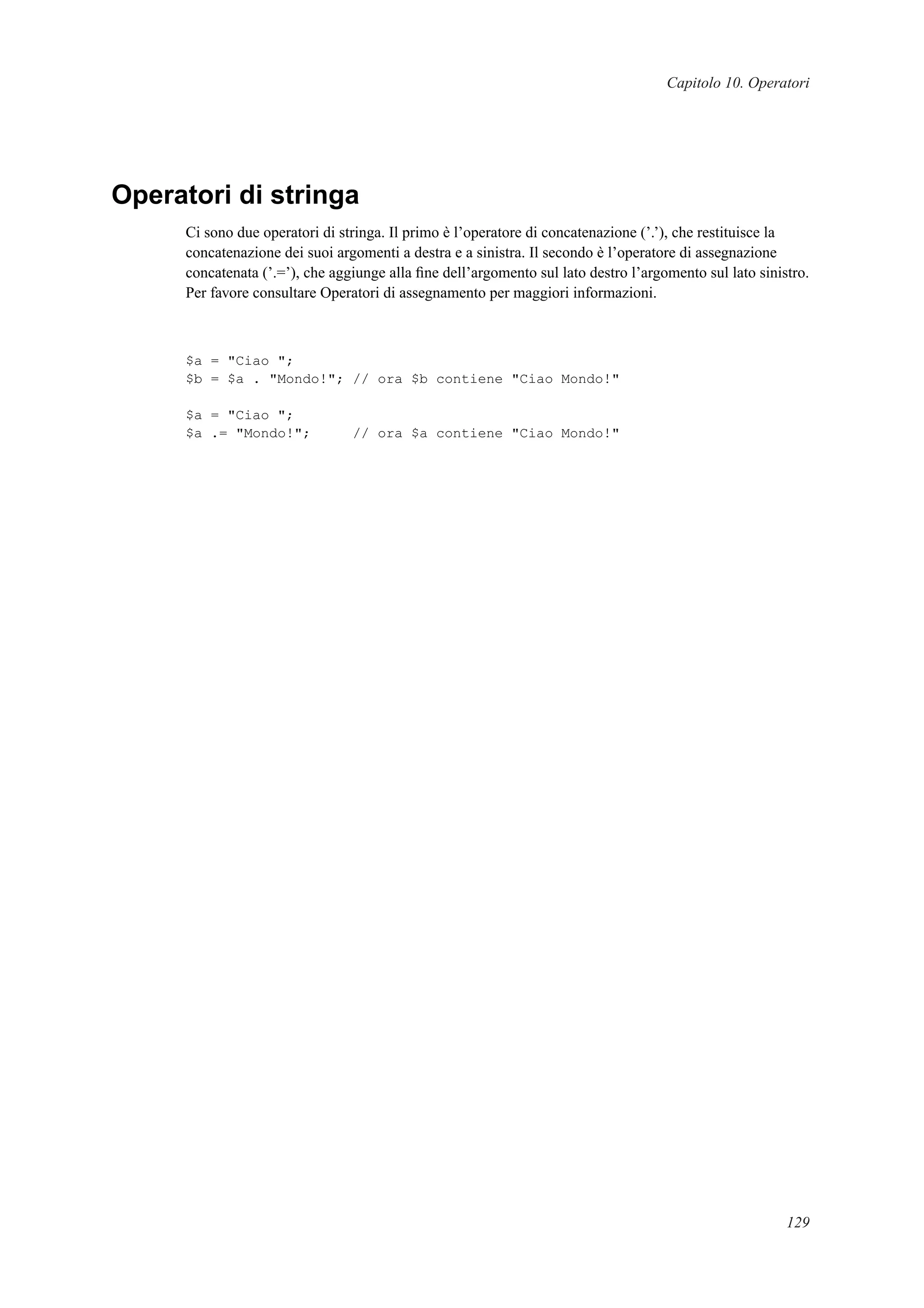
Operatori di stringa........................................................................................................129
11. Strutture di controllo .........................................................................................................130
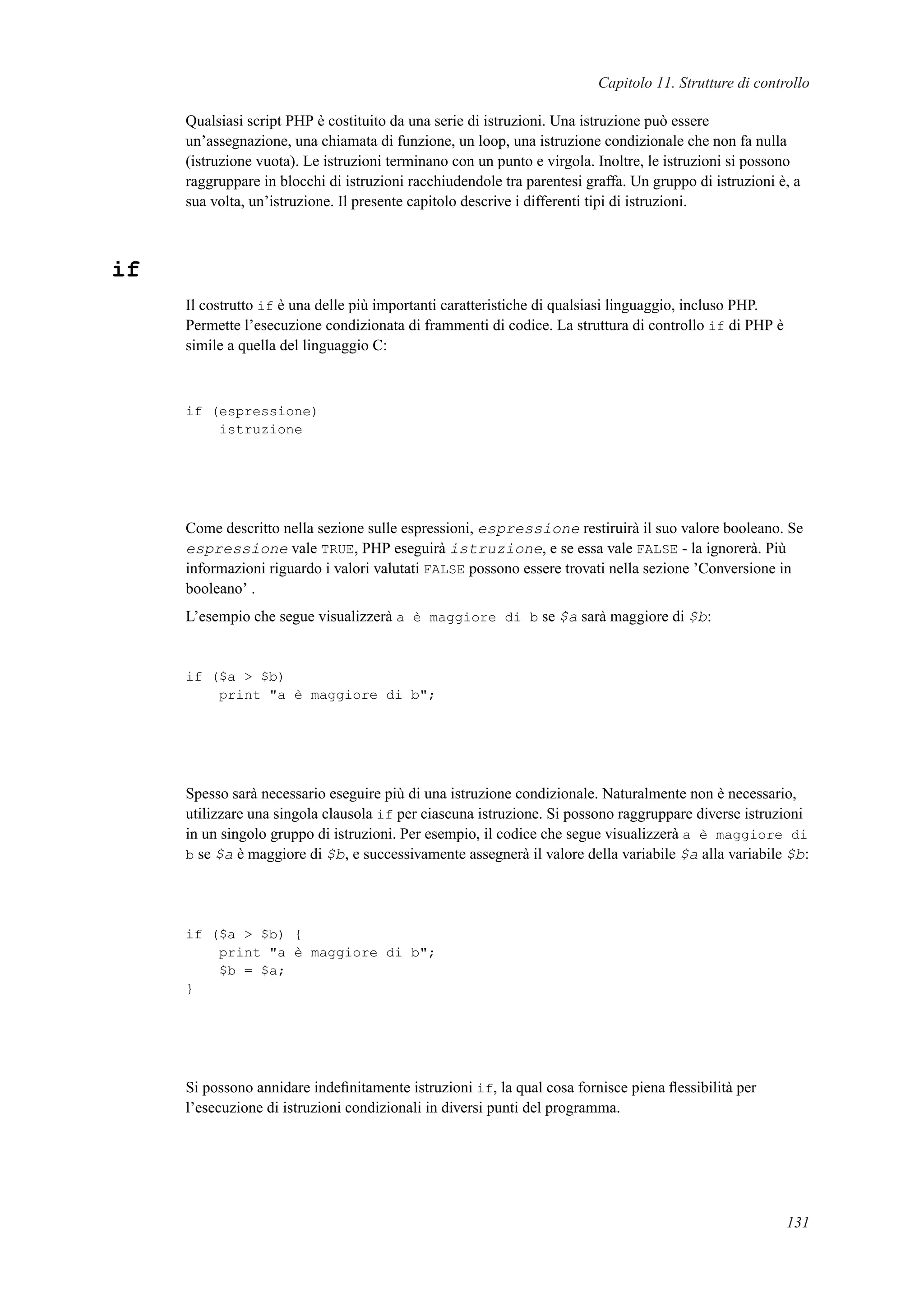
if...................................................................................................................................131
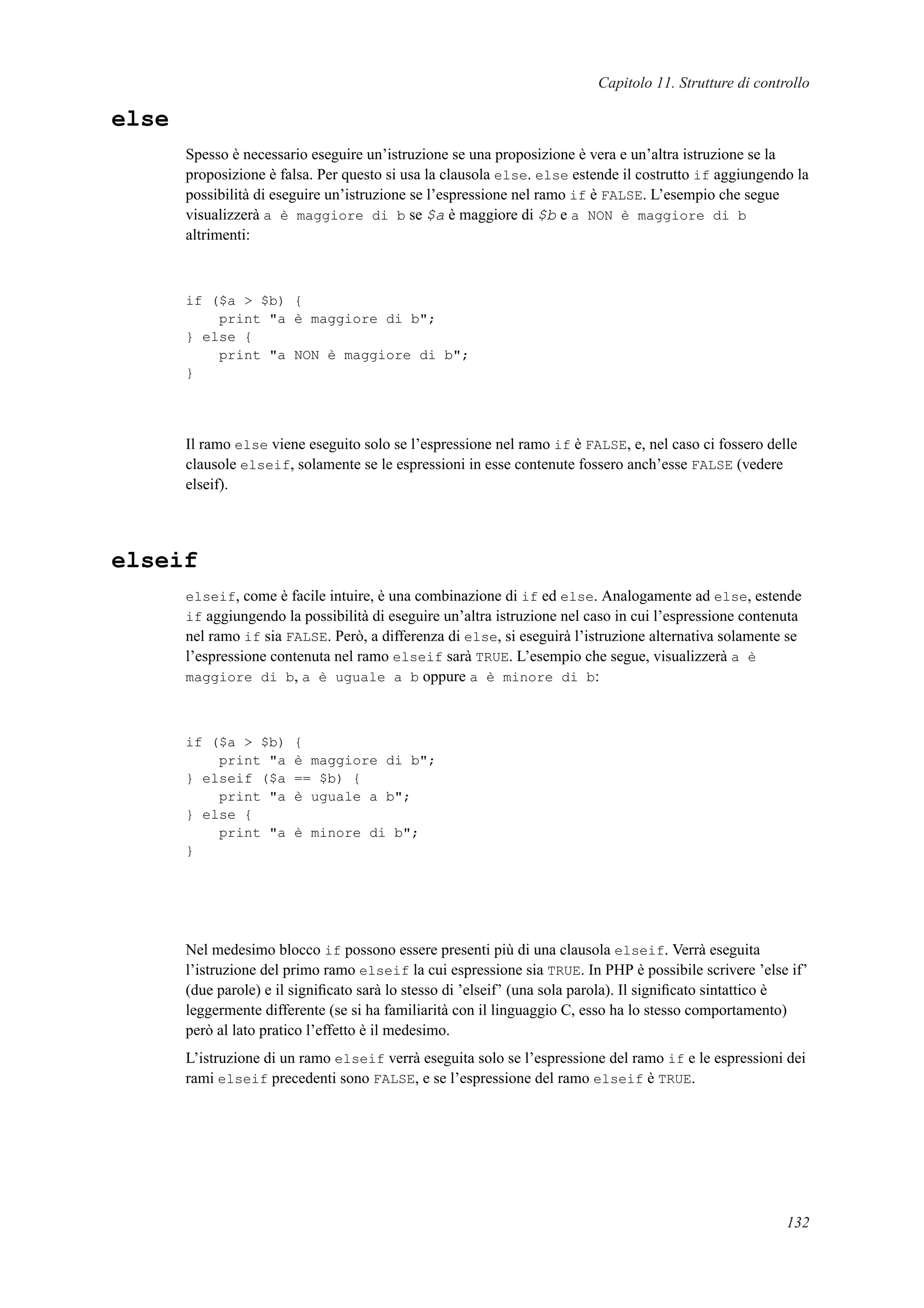
else ..............................................................................................................................131
elseif ..........................................................................................................................132
Sintassi alternativa per le strutture di controllo.............................................................132
while ............................................................................................................................133
do..while....................................................................................................................134
for.................................................................................................................................135
foreach........................................................................................................................137
break ............................................................................................................................139
continue......................................................................................................................139
switch ..........................................................................................................................140
declare........................................................................................................................142
Ticks.....................................................................................................................143
return..............................................................................................................................144
require() .........................................................................................................................144
include().........................................................................................................................145
require_once()................................................................................................................149
include_once() ...............................................................................................................149
12. Functions...........................................................................................................................150
User-defined functions...................................................................................................151
Function arguments .......................................................................................................151
Making arguments be passed by reference ..........................................................151
Default argument values ......................................................................................152
Variable-length argument lists .............................................................................153
Returning values............................................................................................................153
old_function .............................................................................................................154
vii
Variable functions..........................................................................................................154
13. Classi e Oggetti .................................................................................................................156
Classi ..........................................................................................................................157
extends........................................................................................................................159
Costruttori ...............................................................................................................160
::...................................................................................................................................162
parent ..........................................................................................................................163
Serializzare oggetti - oggetti nelle sessioni ...................................................................164
Le funzioni magiche __sleep e __wakeup.................................................................165
Riferimenti all’interno del costruttore...........................................................................166
14. References Explained........................................................................................................170
What References Are.....................................................................................................171
What References Do......................................................................................................171
What References Are Not..............................................................................................172
Passing by Reference.....................................................................................................172
Returning References ....................................................................................................173
Unsetting References.....................................................................................................174
Spotting References.......................................................................................................174
global References..............................................................................................174
$this...................................................................................................................174
III. Caratteristiche..........................................................................................................................175
15. Gestione degli errori..........................................................................................................175
16. Creazione e manipolazione di immagini...........................................................................180
17. Autenticazione HTTP usando PHP...................................................................................182
18. Cookies..............................................................................................................................185
19. Handling file uploads ........................................................................................................187
POST method uploads...................................................................................................188
Common Pitfalls............................................................................................................190
Uploading multiple files ................................................................................................190
PUT method support......................................................................................................191
20. Utilizzo di file remoti ........................................................................................................193
21. Connection handling .........................................................................................................196
22. Connessioni Persistenti ai Database..................................................................................198
23. Modalità sicura (Safe mode).............................................................................................201
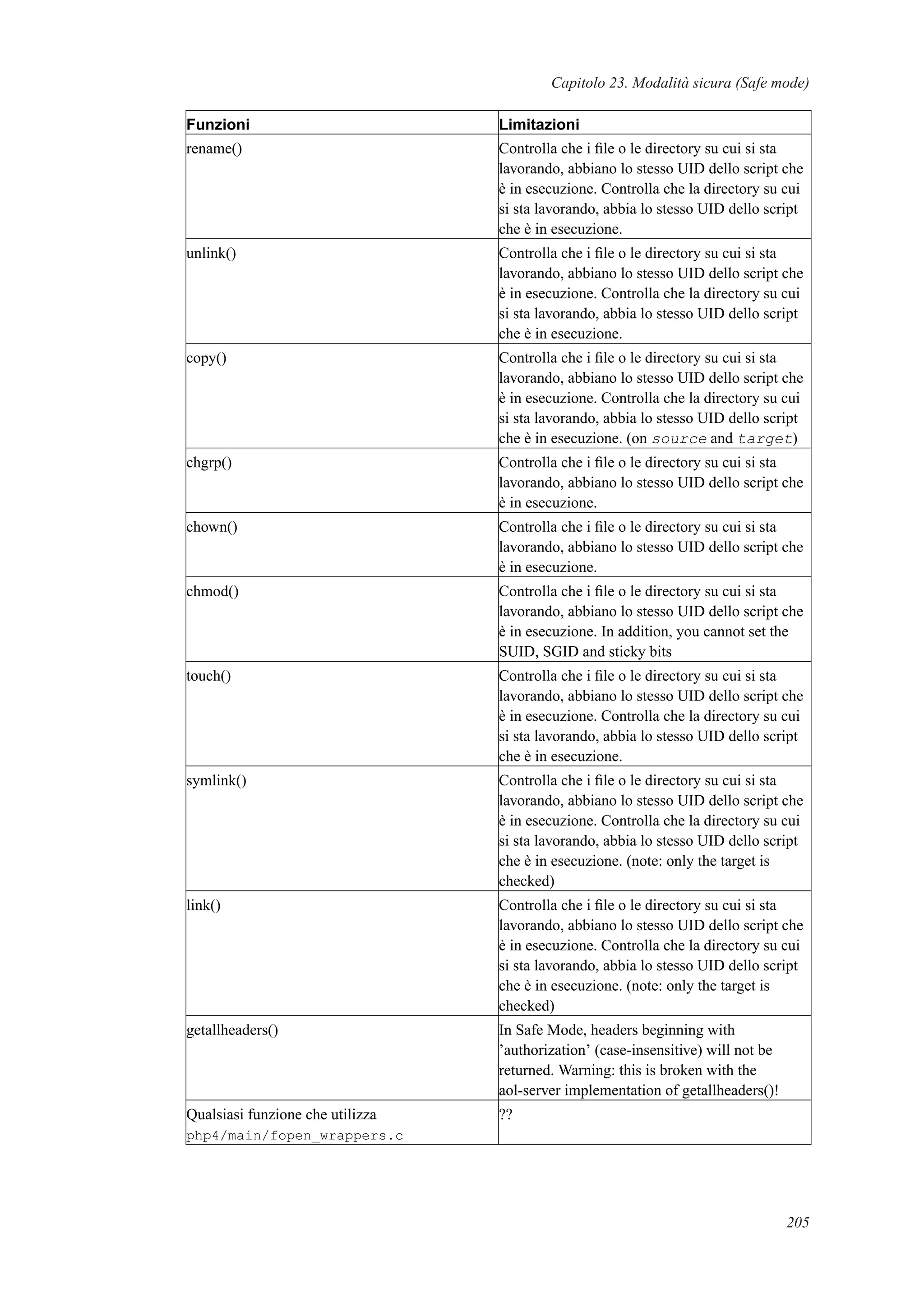
Funzioni limitate/disabilitate dalla modalità sicura (safe-mode) ..................................203
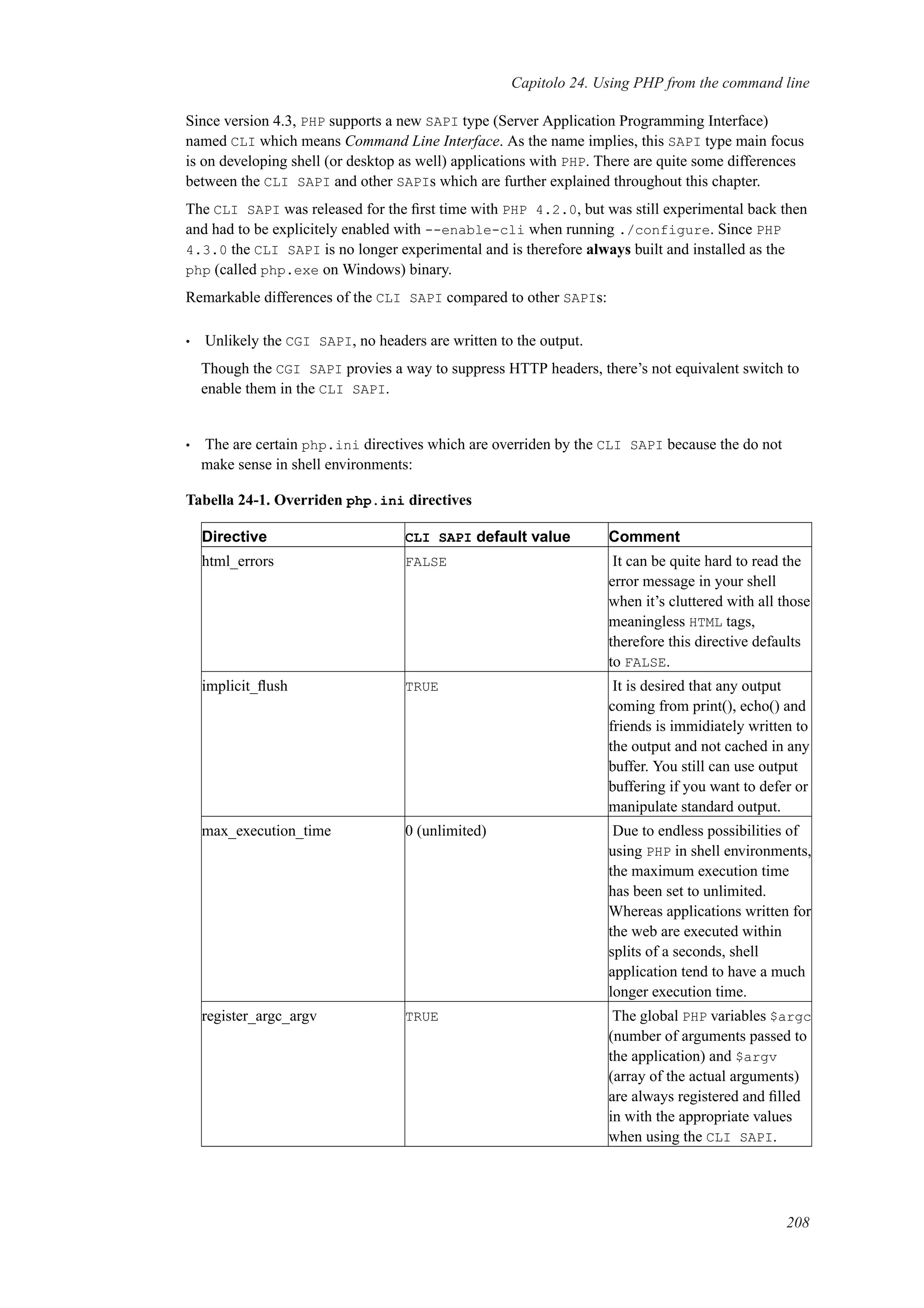
24. Using PHP from the command line ..................................................................................207
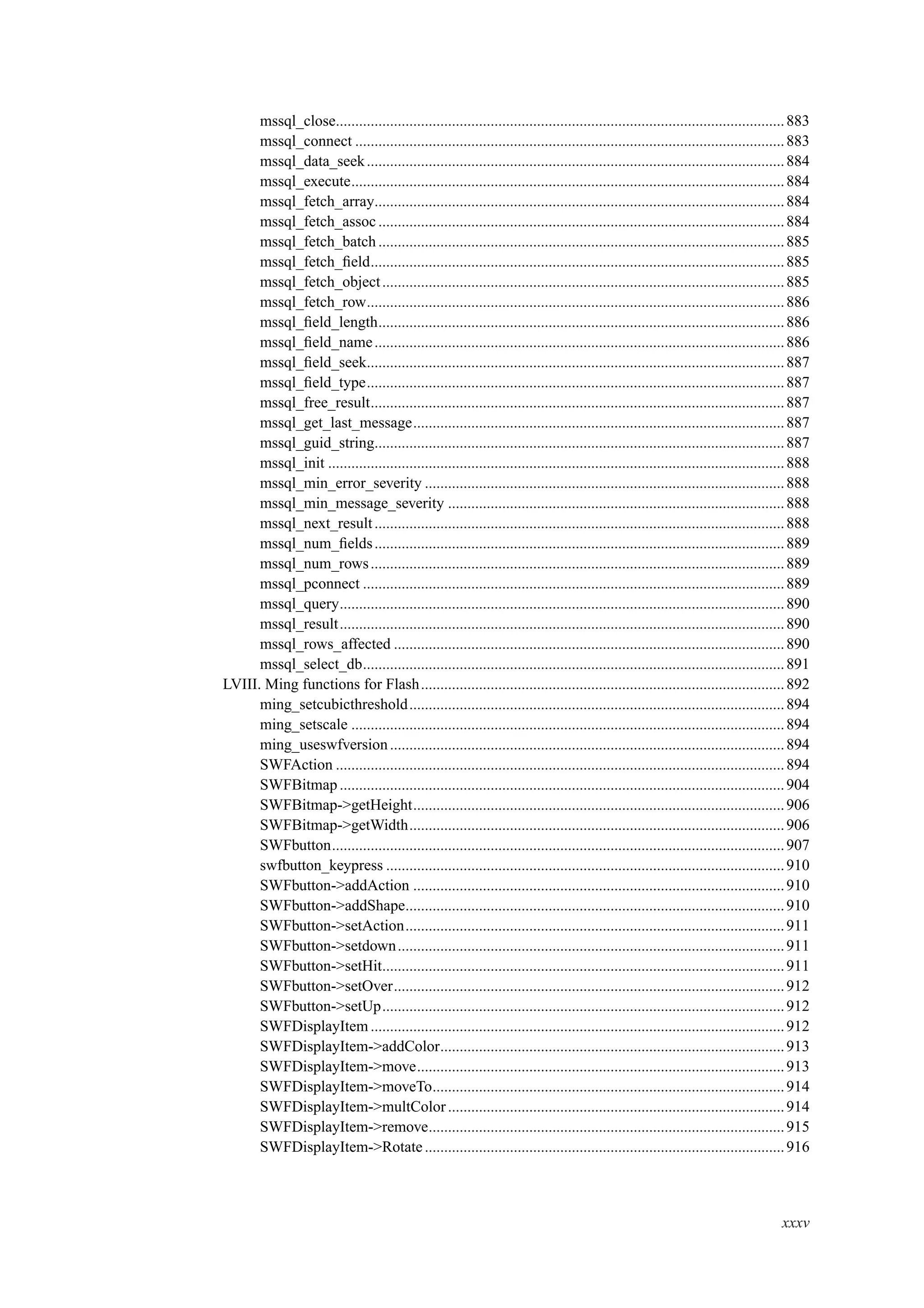
IV. Guida Funzioni.........................................................................................................................218
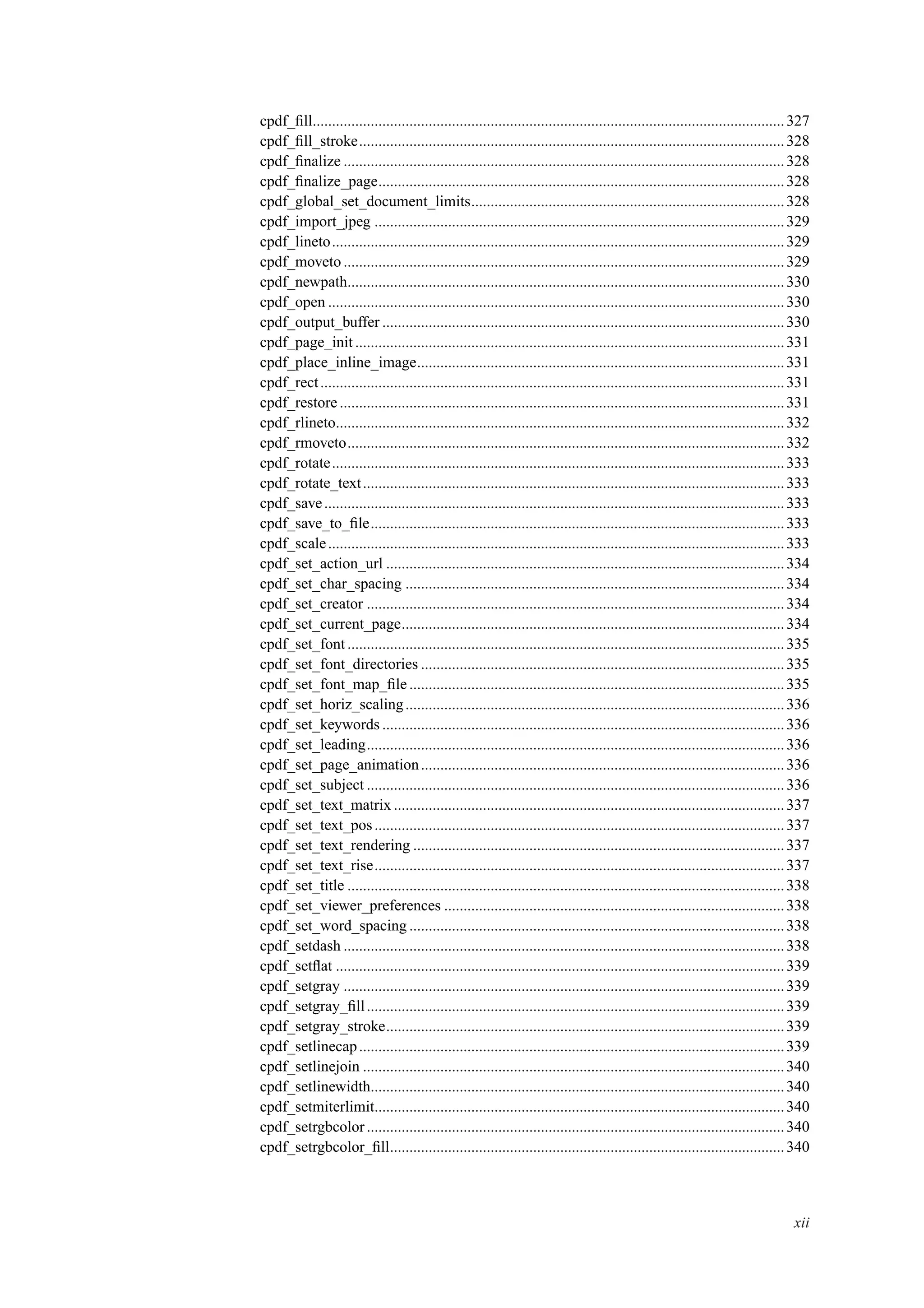
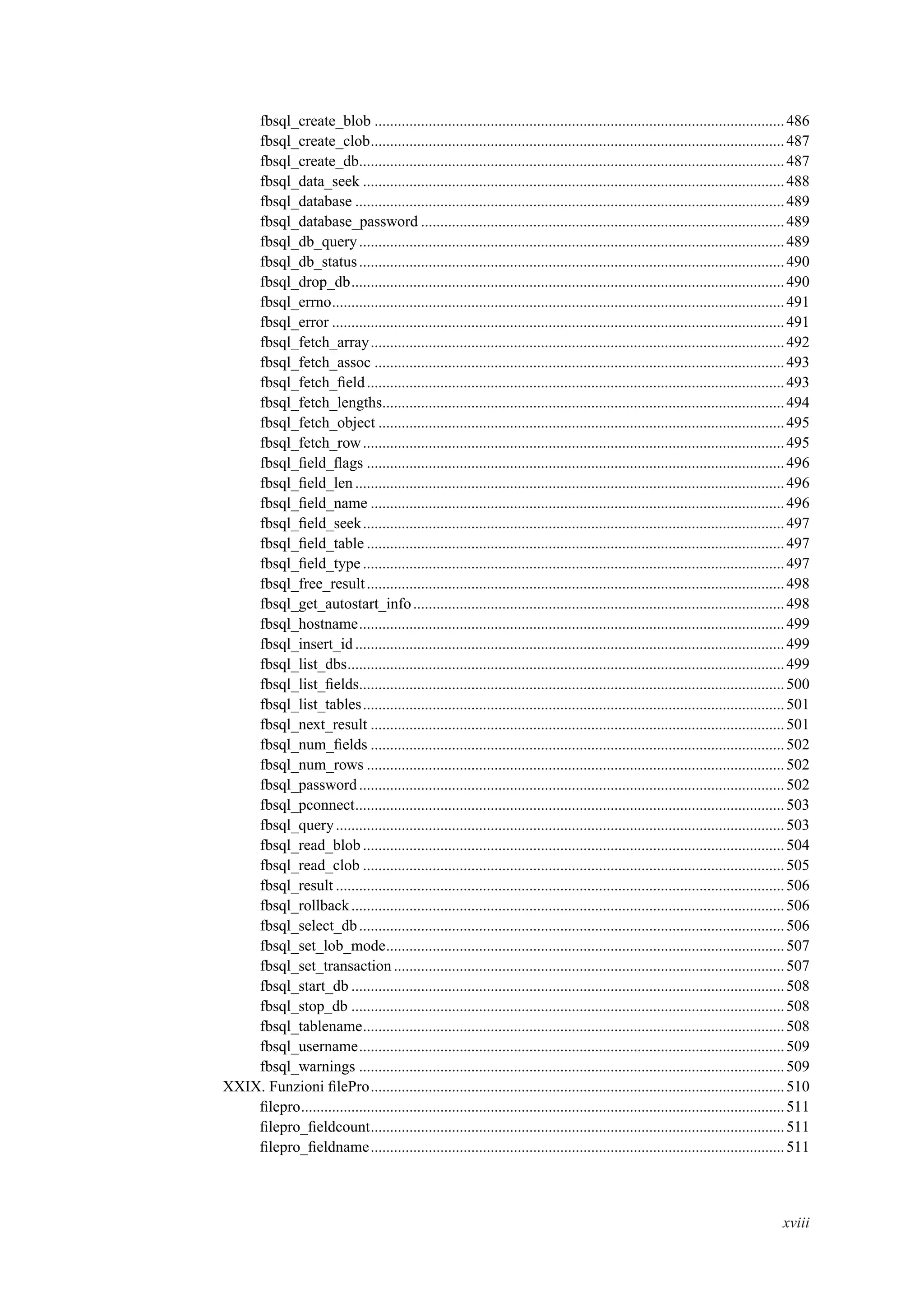
I. Funzioni Apache..................................................................................................................218
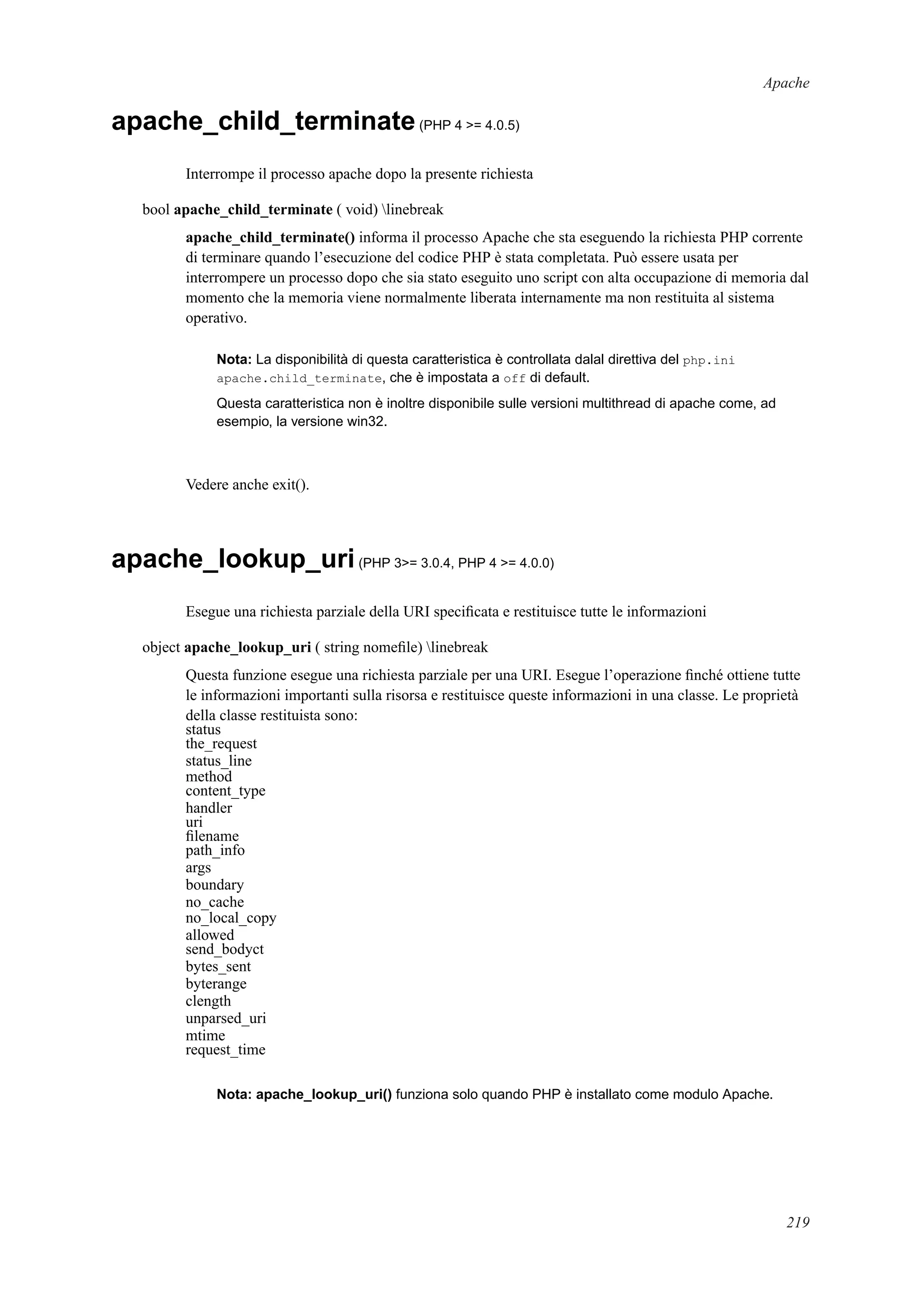
apache_child_terminate.................................................................................................219
apache_lookup_uri ........................................................................................................219
apache_note ...................................................................................................................220
apache_setenv................................................................................................................220
ascii2ebcdic ...................................................................................................................220
ebcdic2ascii ...................................................................................................................220
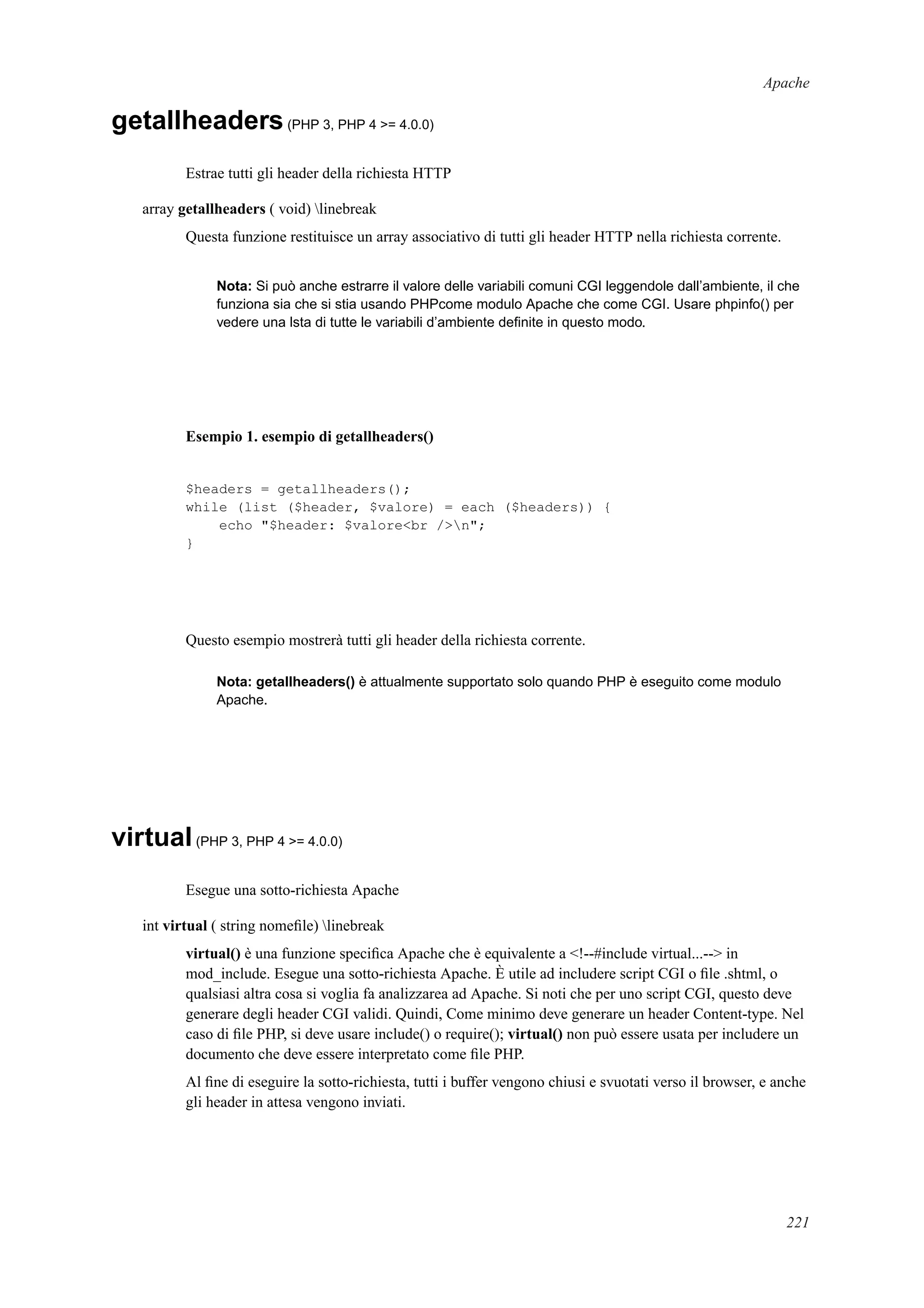
getallheaders..................................................................................................................221
virtual.............................................................................................................................221
II. Funzioni di Array ...............................................................................................................222
array...............................................................................................................................223
array_change_key_case.................................................................................................224
array_chunk ...................................................................................................................225
array_count_values........................................................................................................226
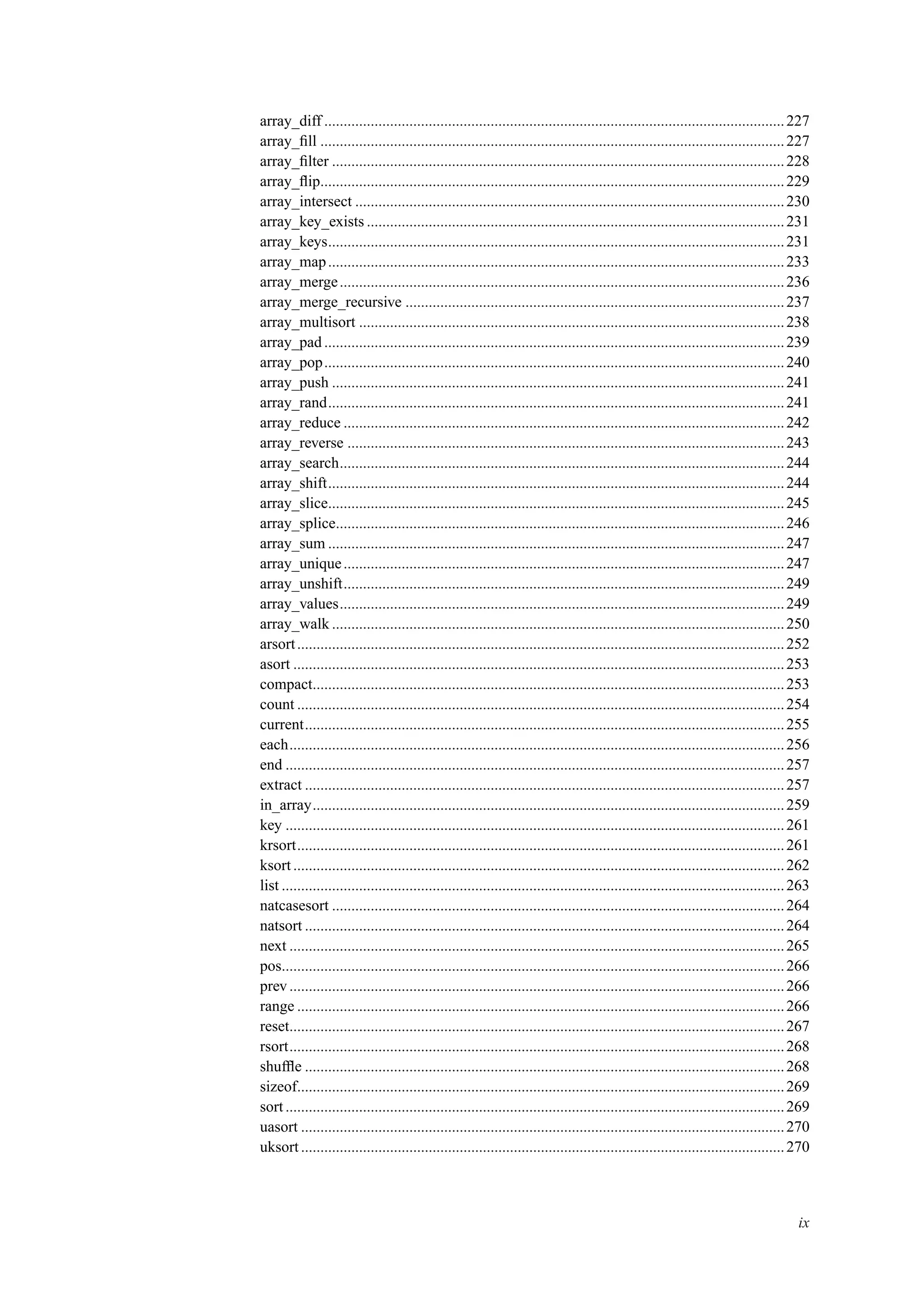
viii
array_diff .......................................................................................................................227
array_fill ........................................................................................................................227
array_filter .....................................................................................................................228
array_flip........................................................................................................................229
array_intersect ...............................................................................................................230
array_key_exists ............................................................................................................231
array_keys......................................................................................................................231
array_map......................................................................................................................233
array_merge...................................................................................................................236
array_merge_recursive ..................................................................................................237
array_multisort ..............................................................................................................238
array_pad .......................................................................................................................239
array_pop.......................................................................................................................240
array_push .....................................................................................................................241
array_rand......................................................................................................................241
array_reduce ..................................................................................................................242
array_reverse .................................................................................................................243
array_search...................................................................................................................244
array_shift......................................................................................................................244
array_slice......................................................................................................................245
array_splice....................................................................................................................246
array_sum ......................................................................................................................247
array_unique..................................................................................................................247
array_unshift..................................................................................................................249
array_values...................................................................................................................249
array_walk .....................................................................................................................250
arsort..............................................................................................................................252
asort ...............................................................................................................................253
compact..........................................................................................................................253
count ..............................................................................................................................254
current............................................................................................................................255
each................................................................................................................................256
end .................................................................................................................................257
extract ............................................................................................................................257
in_array..........................................................................................................................259
key .................................................................................................................................261
krsort..............................................................................................................................261
ksort...............................................................................................................................262
list ..................................................................................................................................263
natcasesort .....................................................................................................................264
natsort ............................................................................................................................264
next ................................................................................................................................265
pos..................................................................................................................................266
prev................................................................................................................................266
range ..............................................................................................................................266
reset................................................................................................................................267
rsort................................................................................................................................268
shuffle ............................................................................................................................268
sizeof..............................................................................................................................269
sort.................................................................................................................................269
uasort .............................................................................................................................270
uksort.............................................................................................................................270
ix
usort...............................................................................................................................271
III. Funzioni Aspell [deprecated]............................................................................................275
aspell_check ..................................................................................................................276
aspell_check_raw...........................................................................................................276
aspell_new .....................................................................................................................276
aspell_suggest................................................................................................................277
IV. Funzioni Matematiche BCMath a precisione arbitraria....................................................278
bcadd..............................................................................................................................279
bccomp ..........................................................................................................................279
bcdiv ..............................................................................................................................279
bcmod ............................................................................................................................279
bcmul.............................................................................................................................279
bcpow.............................................................................................................................280
bcscale ...........................................................................................................................280
bcsqrt .............................................................................................................................280
bcsub..............................................................................................................................280
V. Funzioni di compressione Bzip2........................................................................................282
bzclose ...........................................................................................................................284
bzcompress ....................................................................................................................284
bzdecompress ................................................................................................................284
bzerrno...........................................................................................................................285
bzerror............................................................................................................................285
bzerrstr...........................................................................................................................286
bzflush............................................................................................................................286
bzopen............................................................................................................................286
bzread ............................................................................................................................287
bzwrite ...........................................................................................................................287
VI. Funzioni Calendar.............................................................................................................289
cal_days_in_month........................................................................................................291
cal_from_jd....................................................................................................................291
cal_info..........................................................................................................................291
cal_to_jd ........................................................................................................................291
easter_date .....................................................................................................................291
easter_days ....................................................................................................................292
FrenchToJD ...................................................................................................................293
GregorianToJD ..............................................................................................................293
JDDayOfWeek...............................................................................................................293
JDMonthName ..............................................................................................................294
JDToFrench ...................................................................................................................295
JDToGregorian ..............................................................................................................295
JDToJewish....................................................................................................................295
JDToJulian.....................................................................................................................295
jdtounix..........................................................................................................................295
JewishToJD....................................................................................................................295
JulianToJD.....................................................................................................................296
unixtojd..........................................................................................................................296
VII. Funzioni API CCVS........................................................................................................297
ccvs_add ........................................................................................................................298
ccvs_auth .......................................................................................................................298
ccvs_command ..............................................................................................................298
ccvs_count .....................................................................................................................298
ccvs_delete ....................................................................................................................299
x
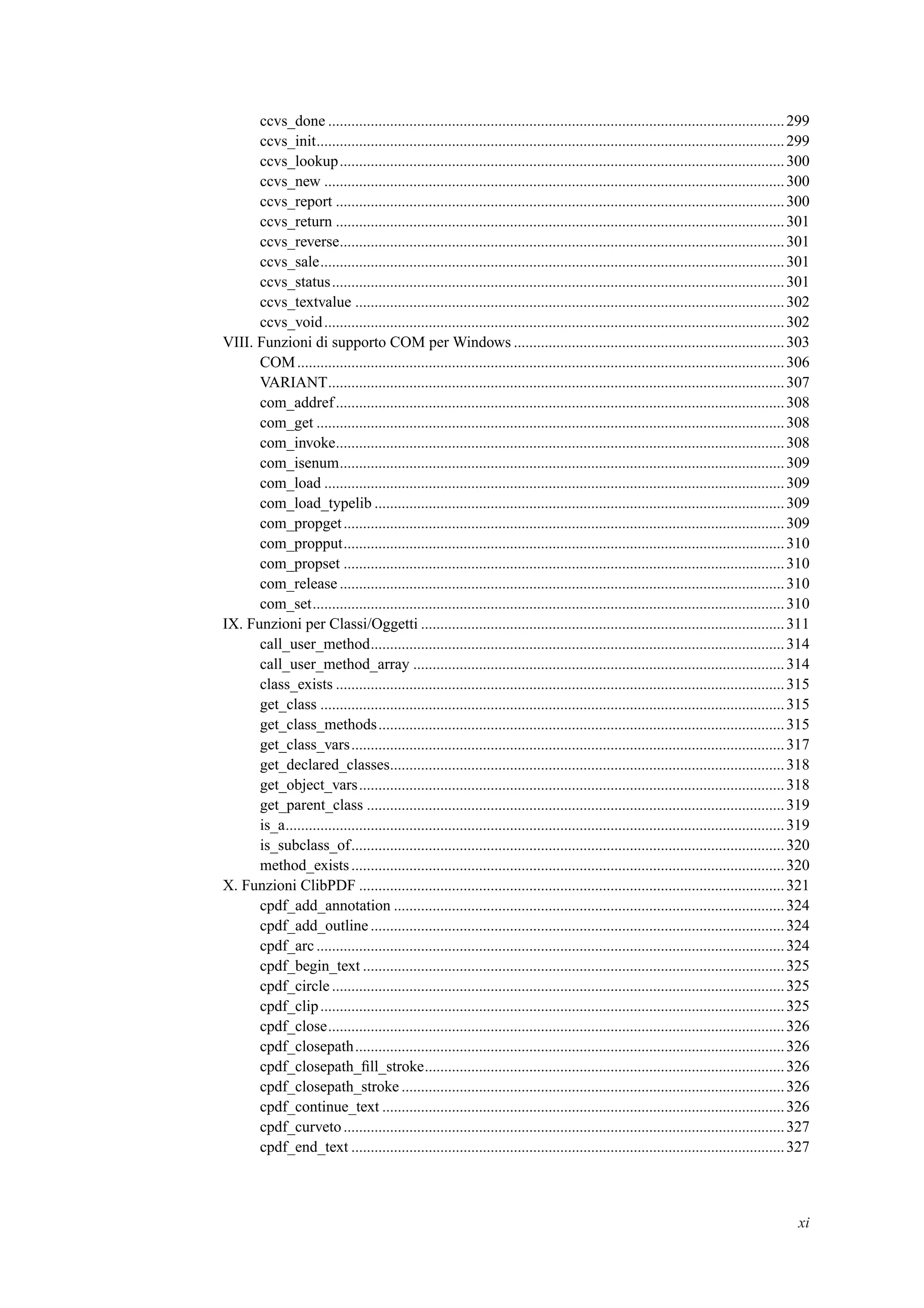
ccvs_done ......................................................................................................................299
ccvs_init.........................................................................................................................299
ccvs_lookup...................................................................................................................300
ccvs_new .......................................................................................................................300
ccvs_report ....................................................................................................................300
ccvs_return ....................................................................................................................301
ccvs_reverse...................................................................................................................301
ccvs_sale........................................................................................................................301
ccvs_status.....................................................................................................................301
ccvs_textvalue ...............................................................................................................302
ccvs_void.......................................................................................................................302
VIII. Funzioni di supporto COM per Windows ......................................................................303
COM..............................................................................................................................306
VARIANT......................................................................................................................307
com_addref....................................................................................................................308
com_get .........................................................................................................................308
com_invoke....................................................................................................................308
com_isenum...................................................................................................................309
com_load .......................................................................................................................309
com_load_typelib ..........................................................................................................309
com_propget..................................................................................................................309
com_propput..................................................................................................................310
com_propset ..................................................................................................................310
com_release ...................................................................................................................310
com_set..........................................................................................................................310
IX. Funzioni per Classi/Oggetti ..............................................................................................311
call_user_method...........................................................................................................314
call_user_method_array ................................................................................................314
class_exists ....................................................................................................................315
get_class ........................................................................................................................315
get_class_methods.........................................................................................................315
get_class_vars................................................................................................................317
get_declared_classes......................................................................................................318
get_object_vars..............................................................................................................318
get_parent_class ............................................................................................................319
is_a.................................................................................................................................319
is_subclass_of................................................................................................................320
method_exists................................................................................................................320
X. Funzioni ClibPDF ..............................................................................................................321
cpdf_add_annotation .....................................................................................................324
cpdf_add_outline ...........................................................................................................324
cpdf_arc .........................................................................................................................324
cpdf_begin_text .............................................................................................................325
cpdf_circle .....................................................................................................................325
cpdf_clip........................................................................................................................325
cpdf_close......................................................................................................................326
cpdf_closepath...............................................................................................................326
cpdf_closepath_fill_stroke.............................................................................................326
cpdf_closepath_stroke ...................................................................................................326
cpdf_continue_text ........................................................................................................326
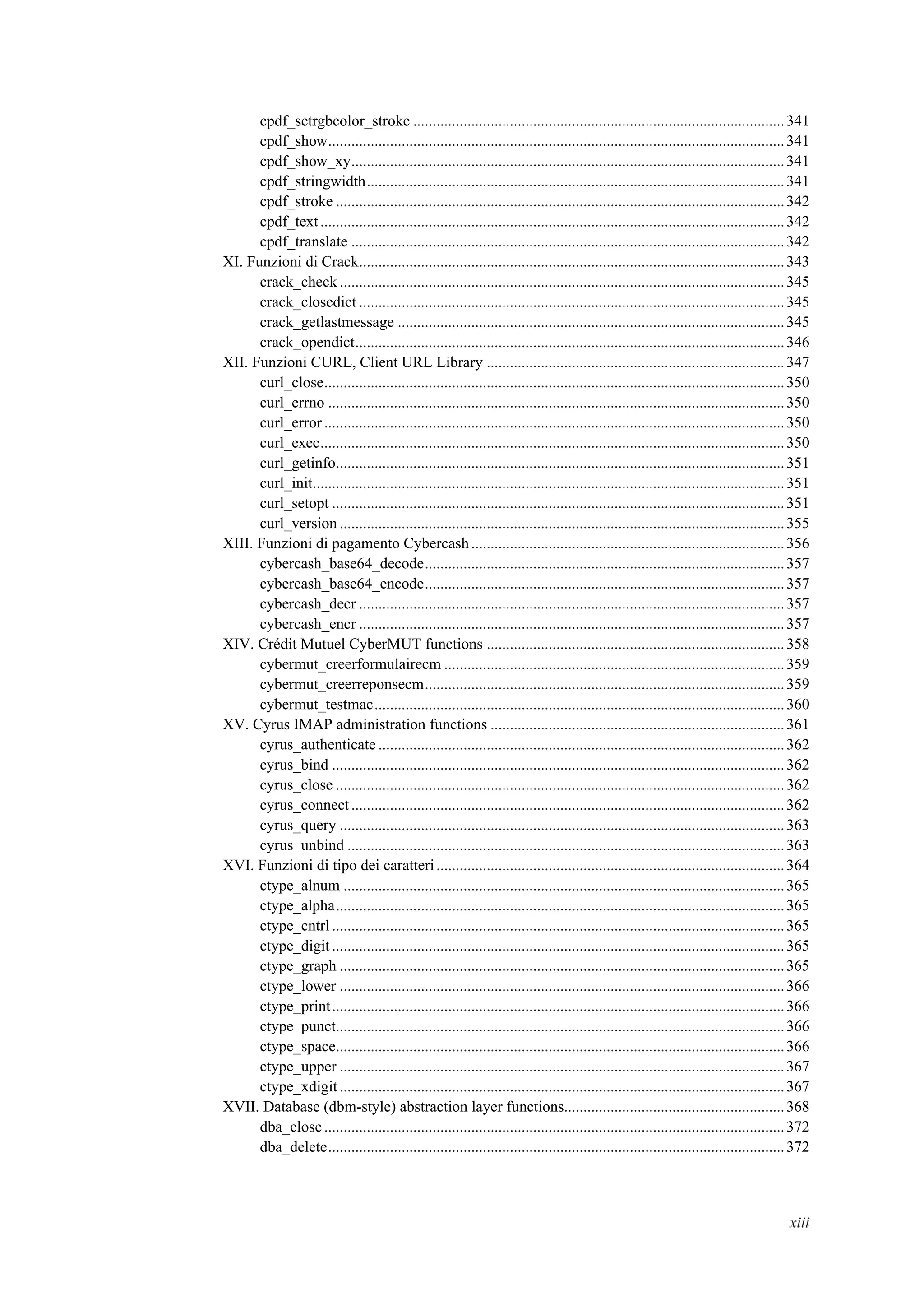
cpdf_curveto..................................................................................................................327
cpdf_end_text ................................................................................................................327
xi
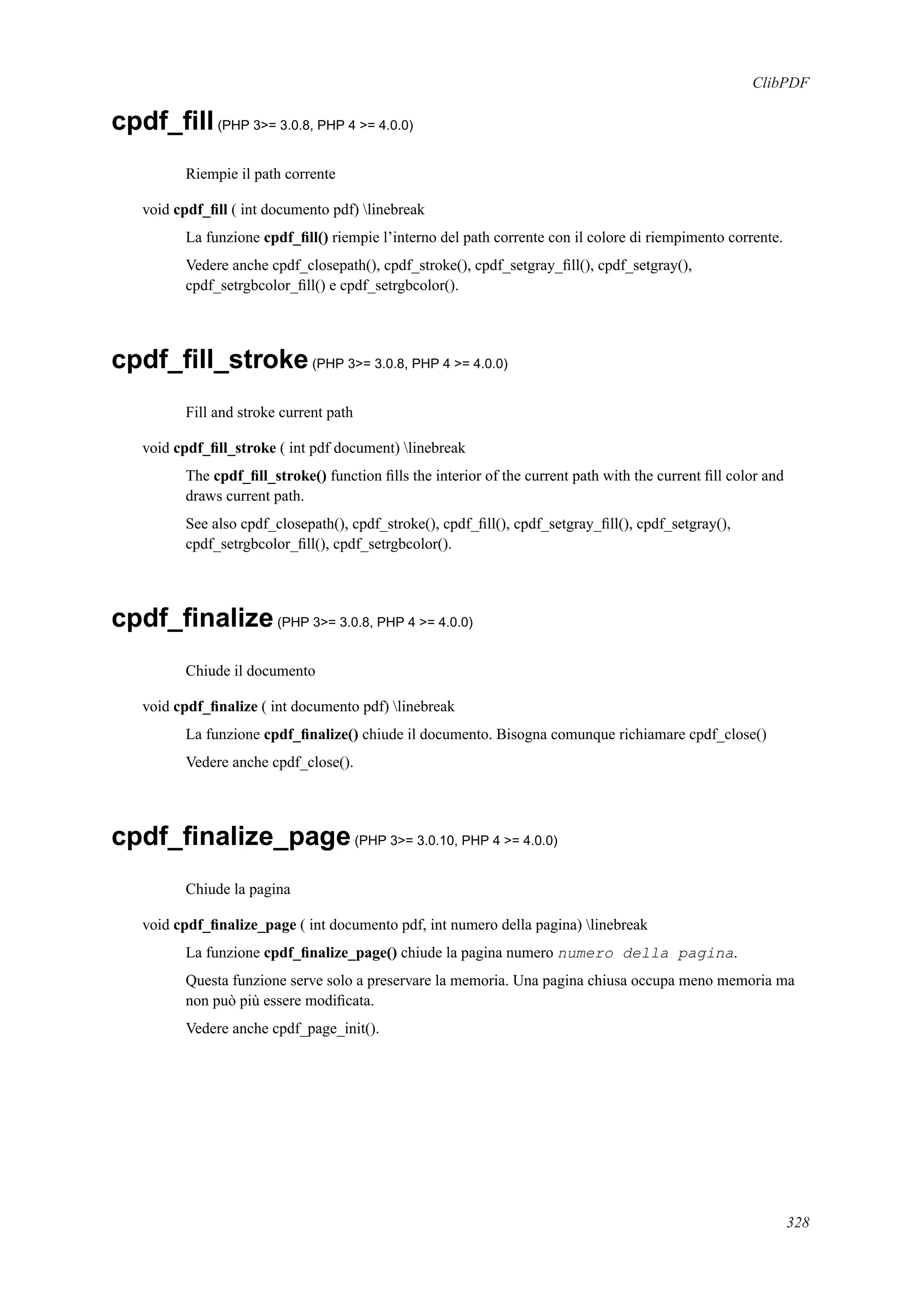
cpdf_fill..........................................................................................................................327
cpdf_fill_stroke..............................................................................................................328
cpdf_finalize ..................................................................................................................328
cpdf_finalize_page.........................................................................................................328
cpdf_global_set_document_limits.................................................................................328
cpdf_import_jpeg ..........................................................................................................329
cpdf_lineto.....................................................................................................................329
cpdf_moveto ..................................................................................................................329
cpdf_newpath.................................................................................................................330
cpdf_open ......................................................................................................................330
cpdf_output_buffer ........................................................................................................330
cpdf_page_init ...............................................................................................................331
cpdf_place_inline_image...............................................................................................331
cpdf_rect........................................................................................................................331
cpdf_restore ...................................................................................................................331
cpdf_rlineto....................................................................................................................332
cpdf_rmoveto.................................................................................................................332
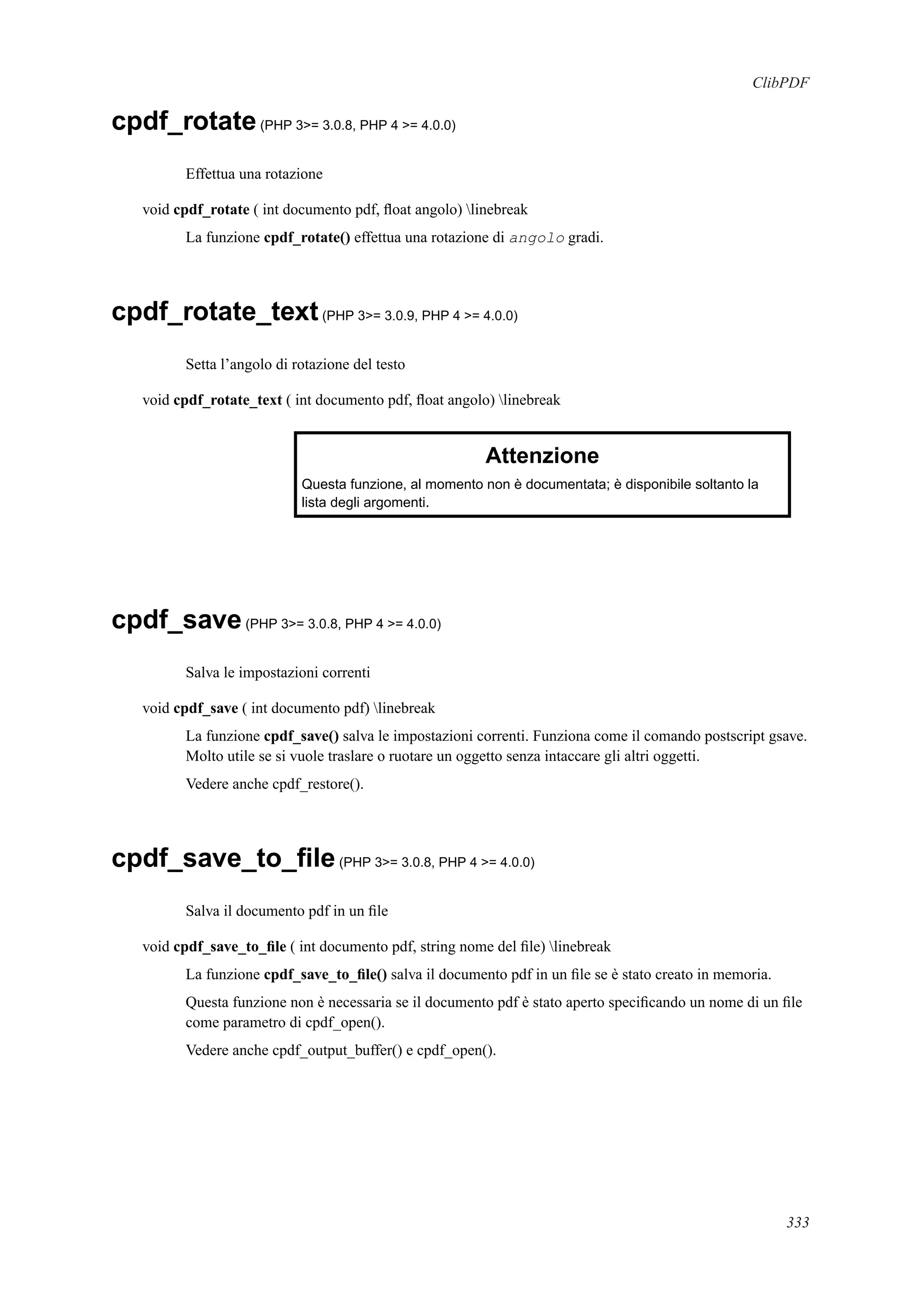
cpdf_rotate.....................................................................................................................333
cpdf_rotate_text.............................................................................................................333
cpdf_save.......................................................................................................................333
cpdf_save_to_file...........................................................................................................333
cpdf_scale......................................................................................................................333
cpdf_set_action_url .......................................................................................................334
cpdf_set_char_spacing ..................................................................................................334
cpdf_set_creator ............................................................................................................334
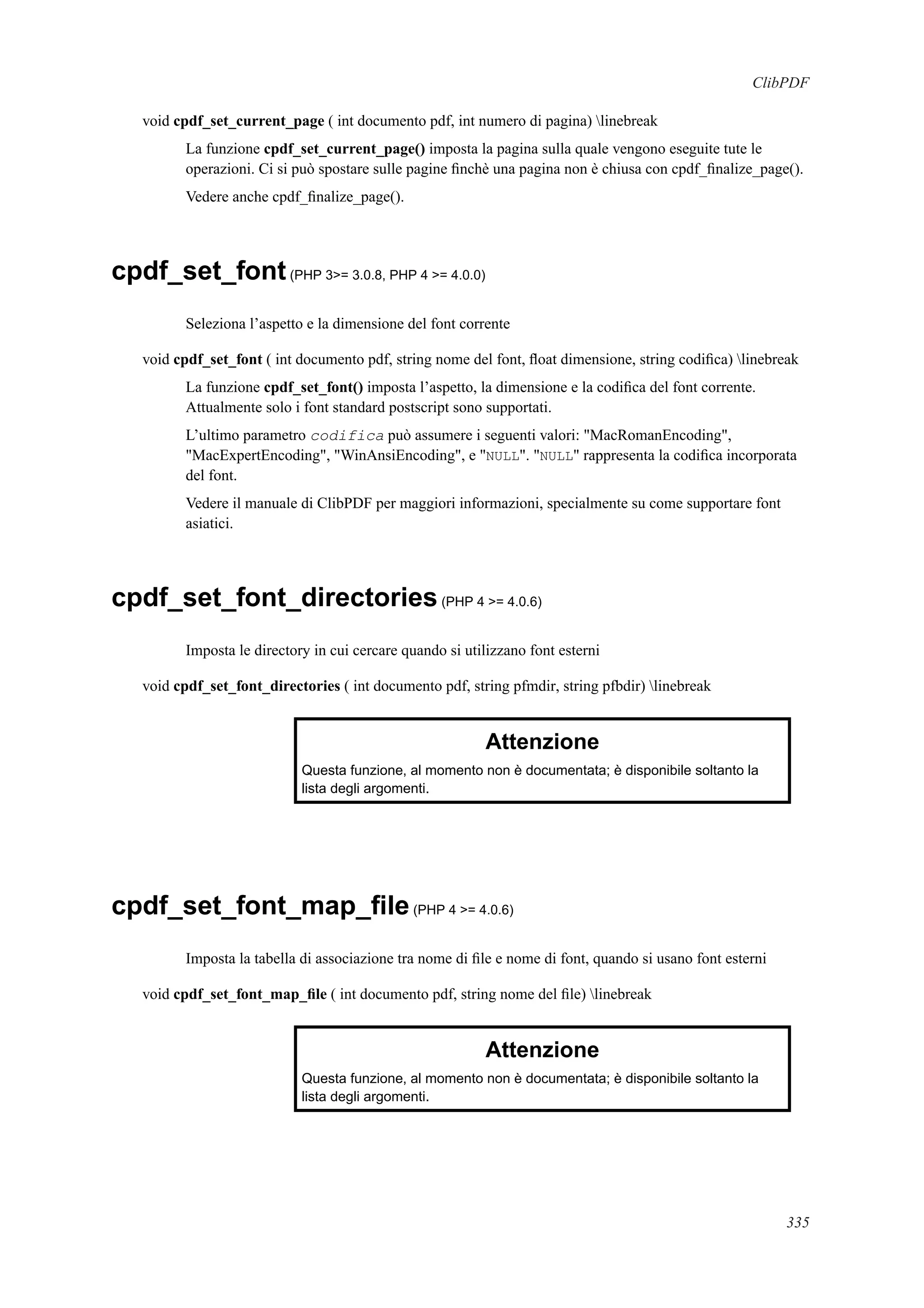
cpdf_set_current_page...................................................................................................334
cpdf_set_font .................................................................................................................335
cpdf_set_font_directories ..............................................................................................335
cpdf_set_font_map_file .................................................................................................335
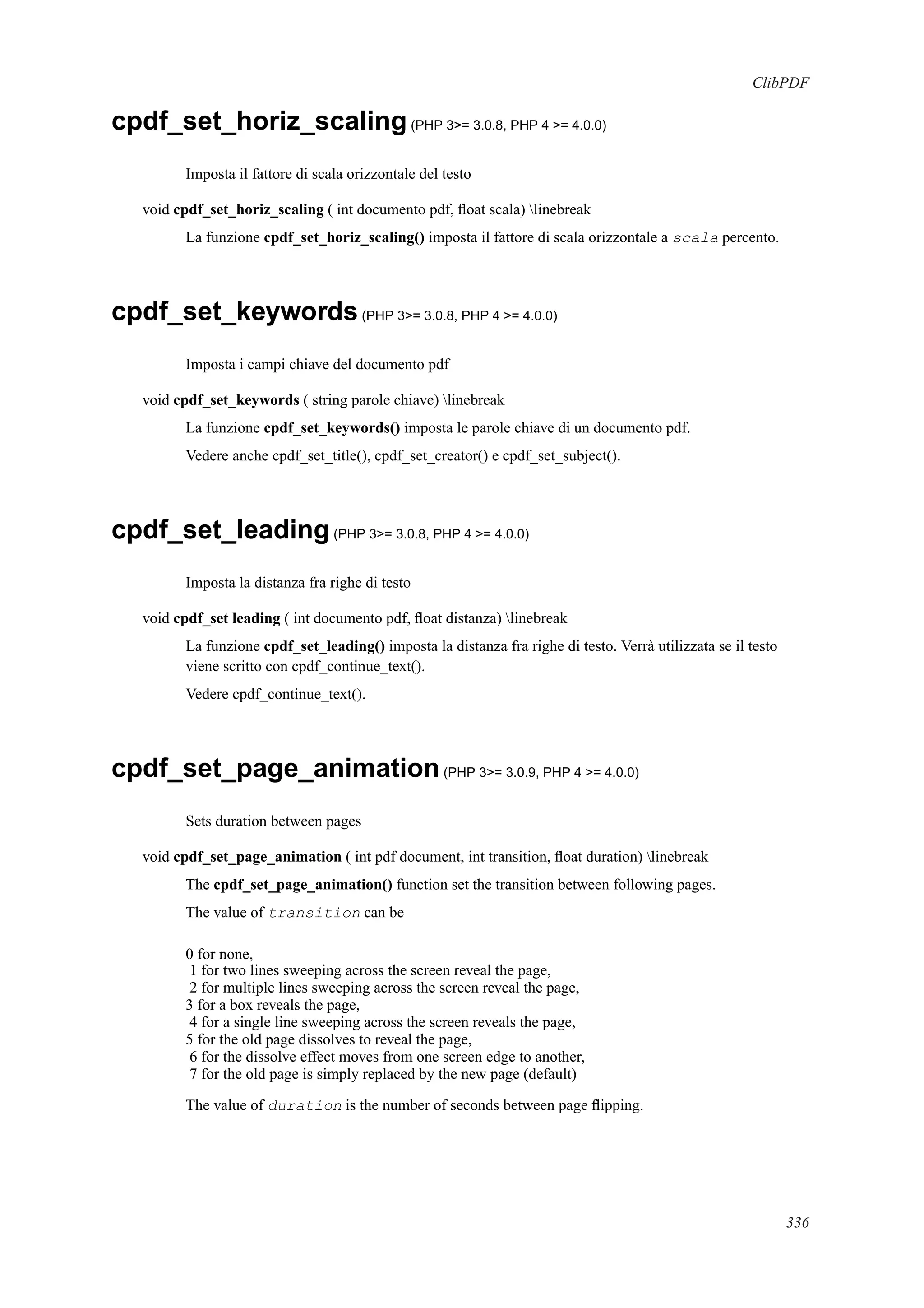
cpdf_set_horiz_scaling..................................................................................................336
cpdf_set_keywords ........................................................................................................336
cpdf_set_leading............................................................................................................336
cpdf_set_page_animation..............................................................................................336
cpdf_set_subject ............................................................................................................336
cpdf_set_text_matrix .....................................................................................................337
cpdf_set_text_pos..........................................................................................................337
cpdf_set_text_rendering ................................................................................................337
cpdf_set_text_rise..........................................................................................................337
cpdf_set_title .................................................................................................................338
cpdf_set_viewer_preferences ........................................................................................338
cpdf_set_word_spacing .................................................................................................338
cpdf_setdash ..................................................................................................................338
cpdf_setflat ....................................................................................................................339
cpdf_setgray ..................................................................................................................339
cpdf_setgray_fill............................................................................................................339
cpdf_setgray_stroke.......................................................................................................339
cpdf_setlinecap..............................................................................................................339
cpdf_setlinejoin .............................................................................................................340
cpdf_setlinewidth...........................................................................................................340
cpdf_setmiterlimit..........................................................................................................340
cpdf_setrgbcolor............................................................................................................340
cpdf_setrgbcolor_fill......................................................................................................340
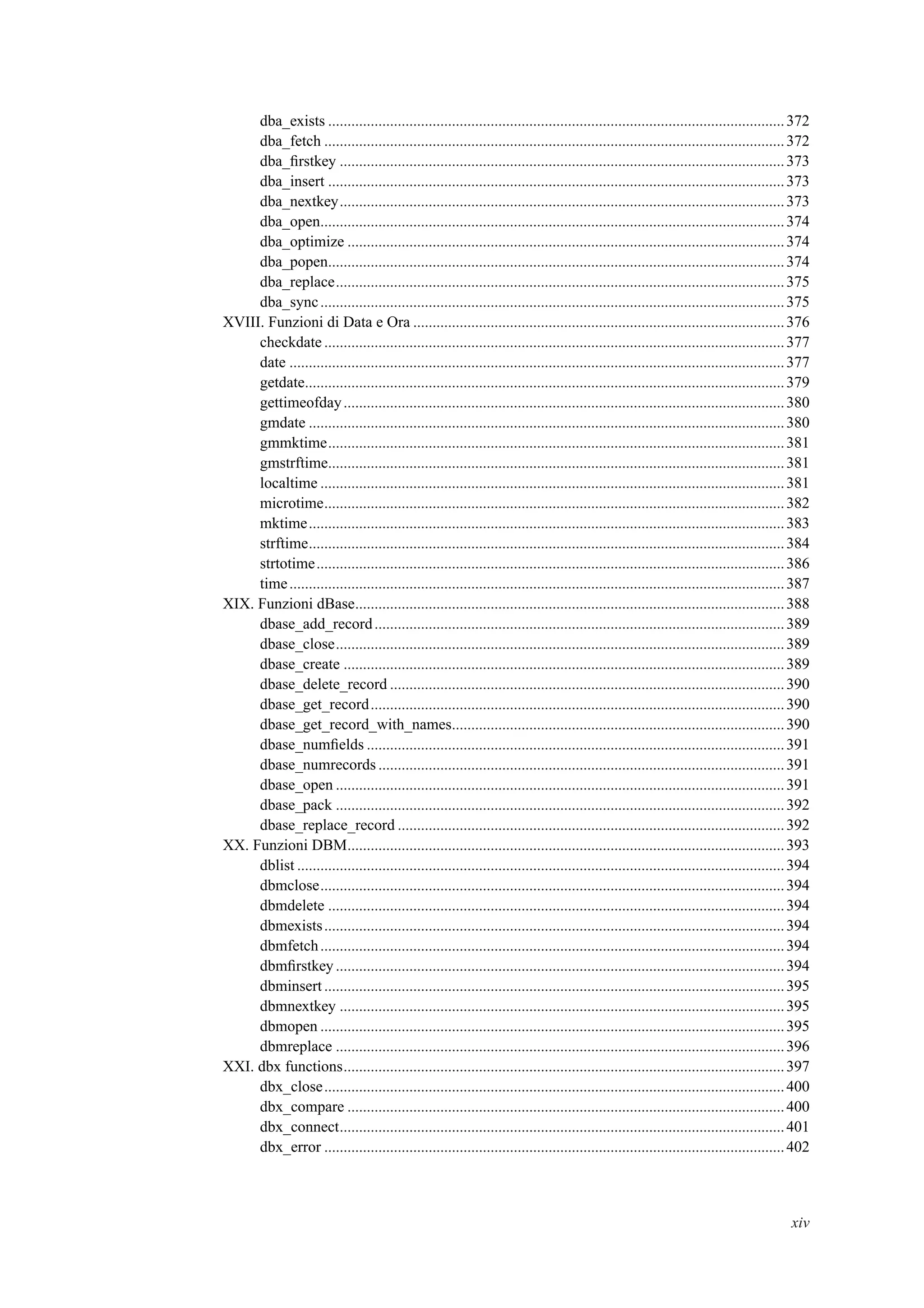
xii
cpdf_setrgbcolor_stroke ................................................................................................341
cpdf_show......................................................................................................................341
cpdf_show_xy................................................................................................................341
cpdf_stringwidth............................................................................................................341
cpdf_stroke ....................................................................................................................342
cpdf_text........................................................................................................................342
cpdf_translate ................................................................................................................342
XI. Funzioni di Crack..............................................................................................................343
crack_check ...................................................................................................................345
crack_closedict ..............................................................................................................345
crack_getlastmessage ....................................................................................................345
crack_opendict...............................................................................................................346
XII. Funzioni CURL, Client URL Library .............................................................................347
curl_close.......................................................................................................................350
curl_errno ......................................................................................................................350
curl_error .......................................................................................................................350
curl_exec........................................................................................................................350
curl_getinfo....................................................................................................................351
curl_init..........................................................................................................................351
curl_setopt .....................................................................................................................351
curl_version ...................................................................................................................355
XIII. Funzioni di pagamento Cybercash.................................................................................356
cybercash_base64_decode.............................................................................................357
cybercash_base64_encode.............................................................................................357
cybercash_decr ..............................................................................................................357
cybercash_encr ..............................................................................................................357
XIV. Crédit Mutuel CyberMUT functions .............................................................................358
cybermut_creerformulairecm ........................................................................................359
cybermut_creerreponsecm.............................................................................................359
cybermut_testmac..........................................................................................................360
XV. Cyrus IMAP administration functions ............................................................................361
cyrus_authenticate .........................................................................................................362
cyrus_bind .....................................................................................................................362
cyrus_close ....................................................................................................................362
cyrus_connect................................................................................................................362
cyrus_query ...................................................................................................................363
cyrus_unbind .................................................................................................................363
XVI. Funzioni di tipo dei caratteri..........................................................................................364
ctype_alnum ..................................................................................................................365
ctype_alpha....................................................................................................................365
ctype_cntrl .....................................................................................................................365
ctype_digit.....................................................................................................................365
ctype_graph ...................................................................................................................365
ctype_lower ...................................................................................................................366
ctype_print.....................................................................................................................366
ctype_punct....................................................................................................................366
ctype_space....................................................................................................................366
ctype_upper ...................................................................................................................367
ctype_xdigit...................................................................................................................367
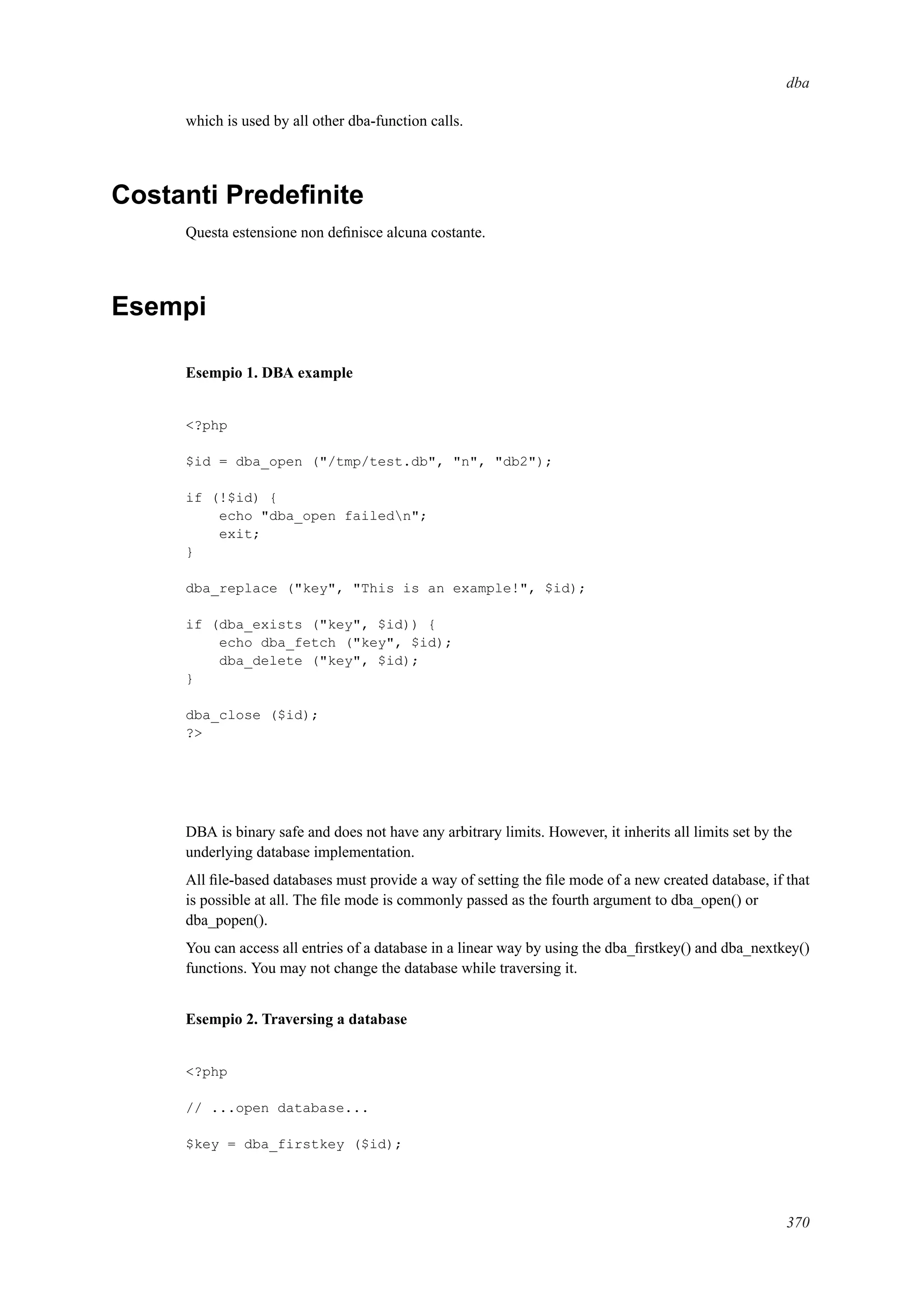
XVII. Database (dbm-style) abstraction layer functions.........................................................368
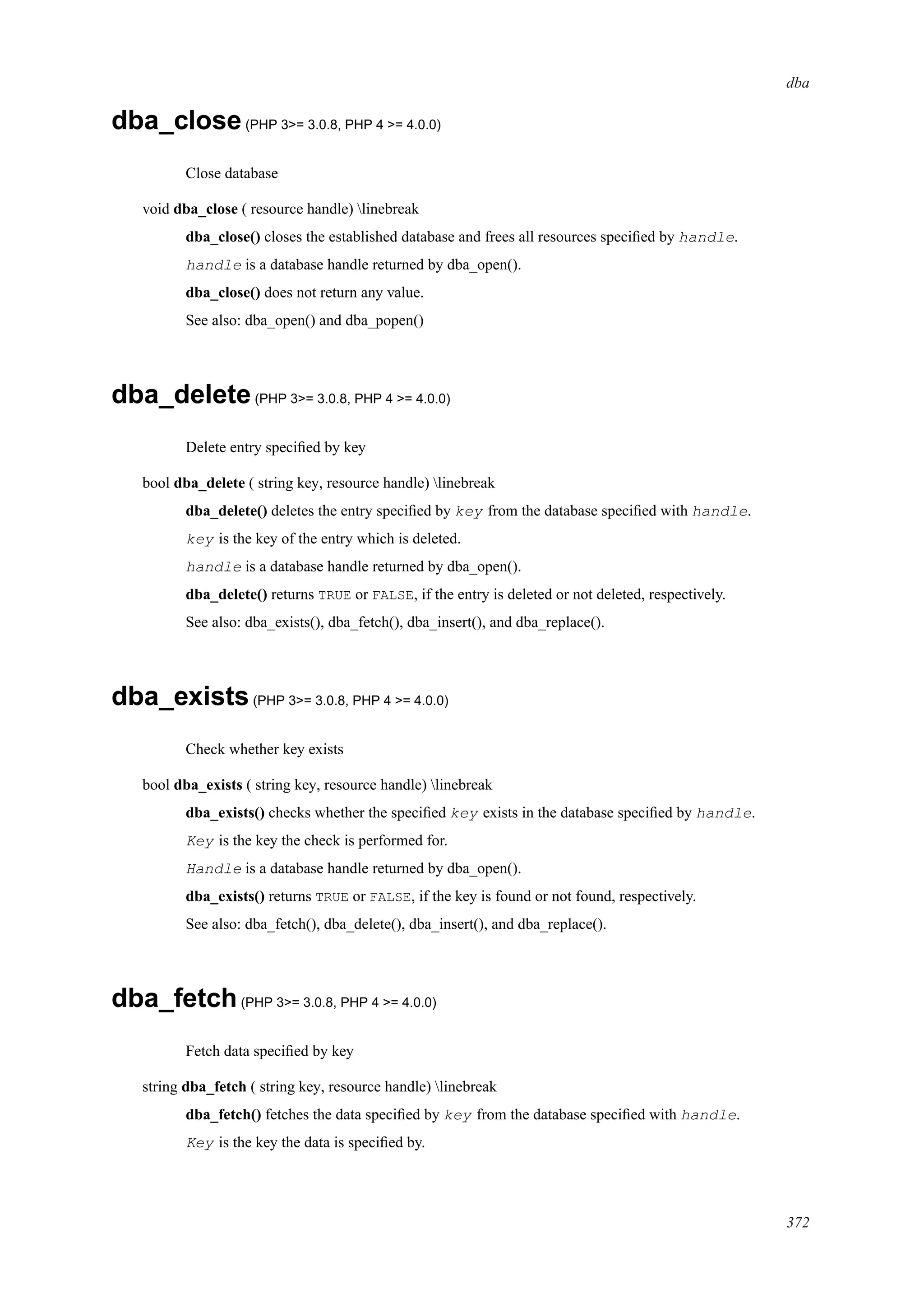
dba_close .......................................................................................................................372
dba_delete......................................................................................................................372
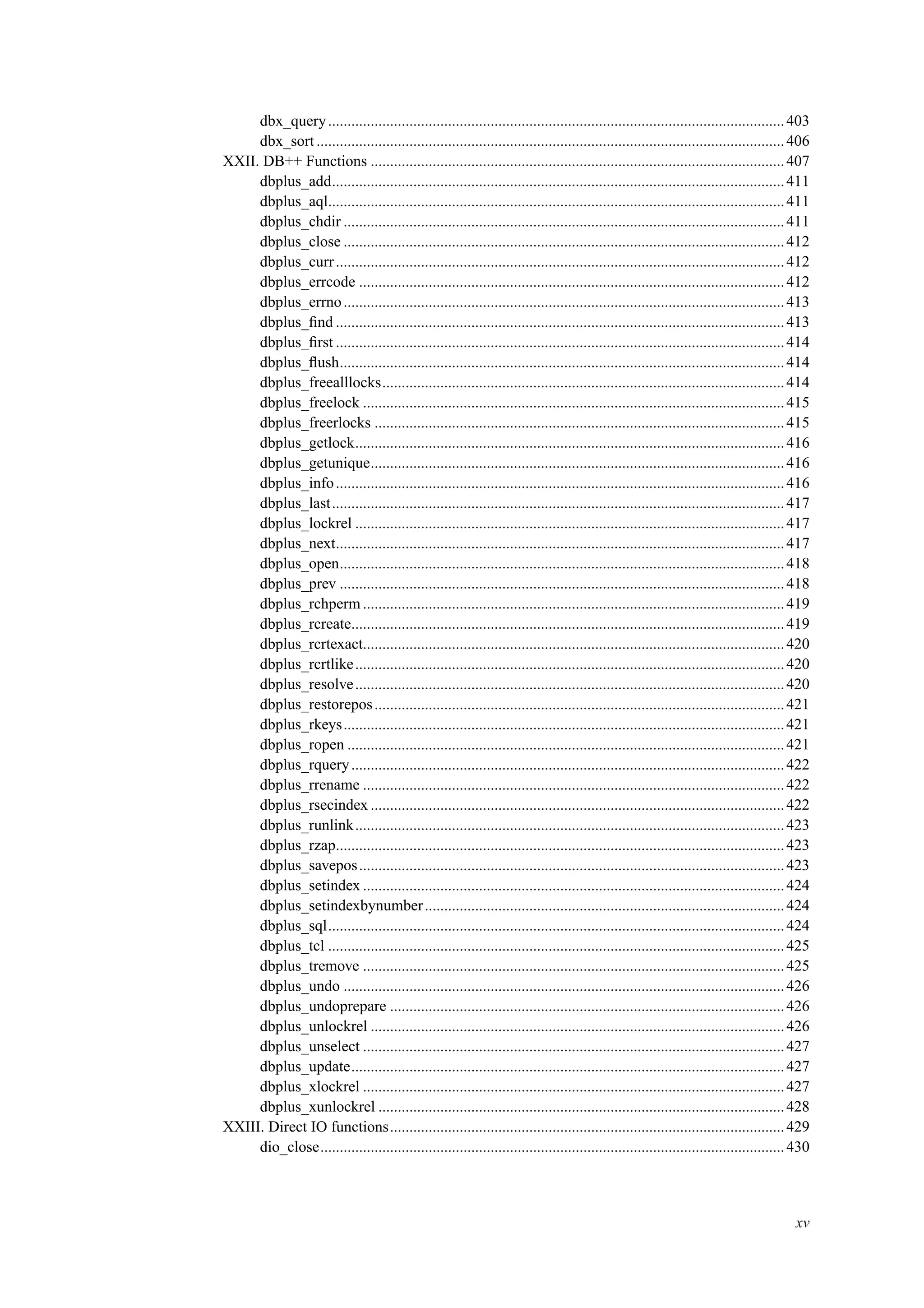
xiii
dba_exists ......................................................................................................................372
dba_fetch .......................................................................................................................372
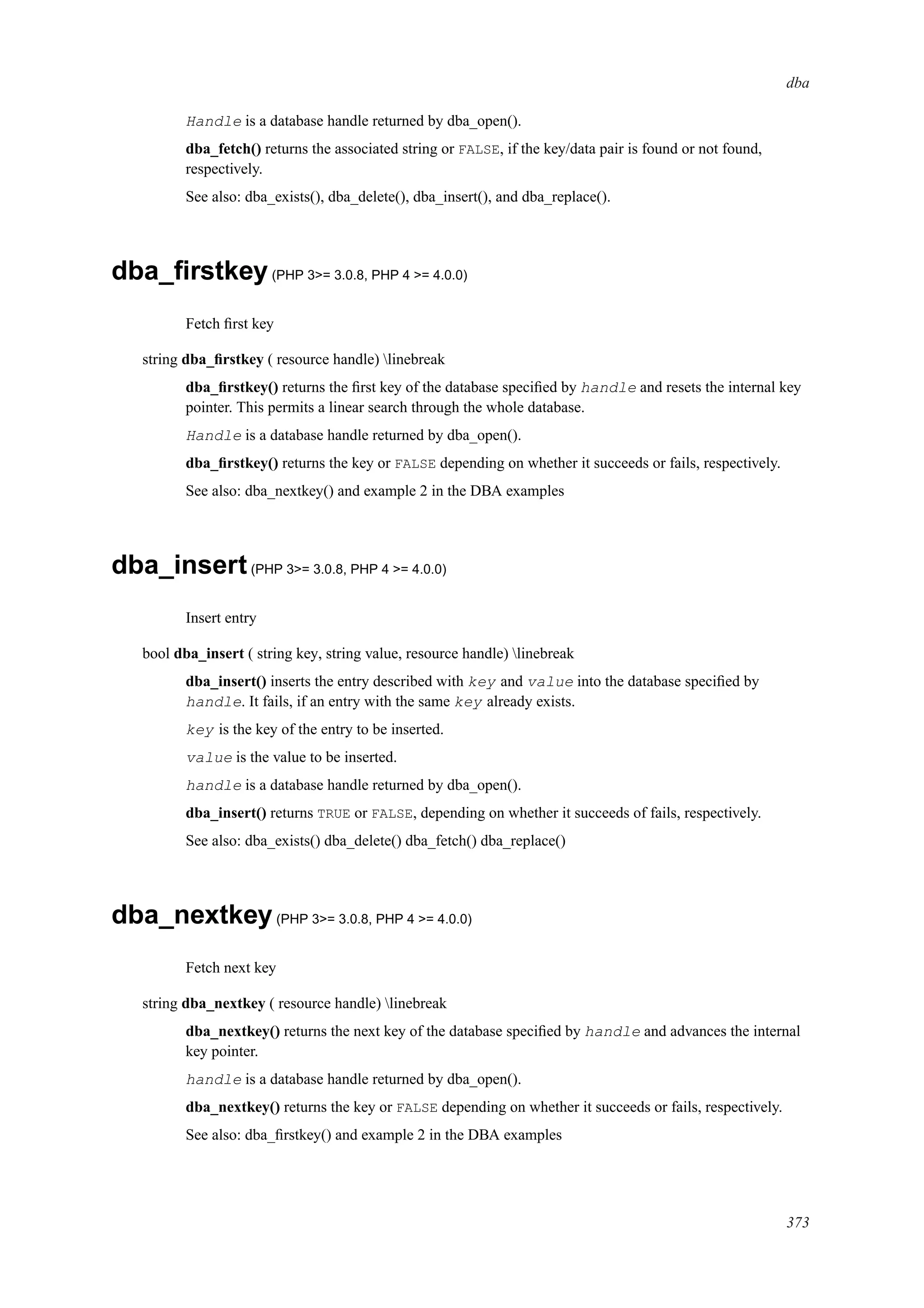
dba_firstkey ...................................................................................................................373
dba_insert ......................................................................................................................373
dba_nextkey...................................................................................................................373
dba_open........................................................................................................................374
dba_optimize .................................................................................................................374
dba_popen......................................................................................................................374
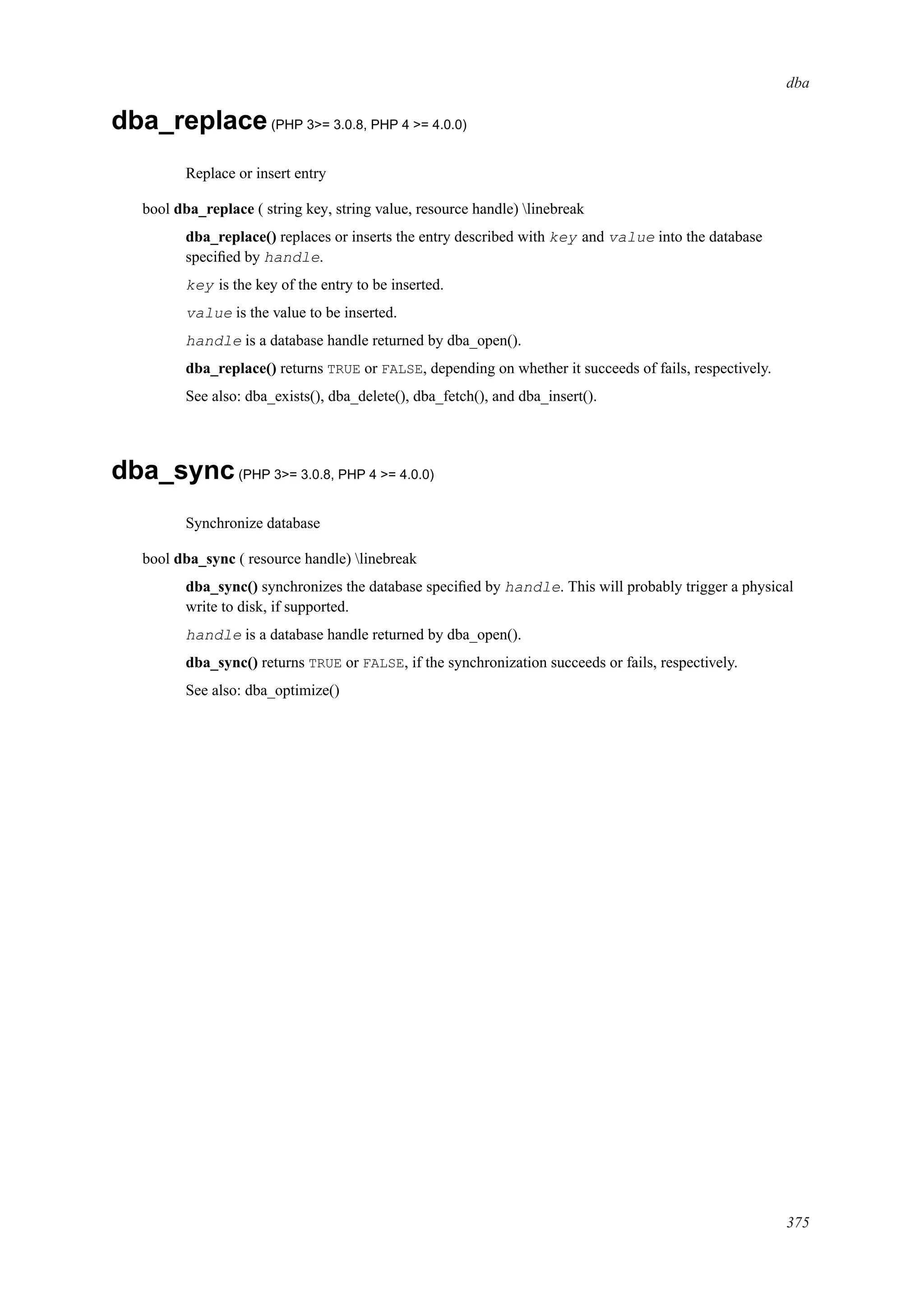
dba_replace....................................................................................................................375
dba_sync........................................................................................................................375
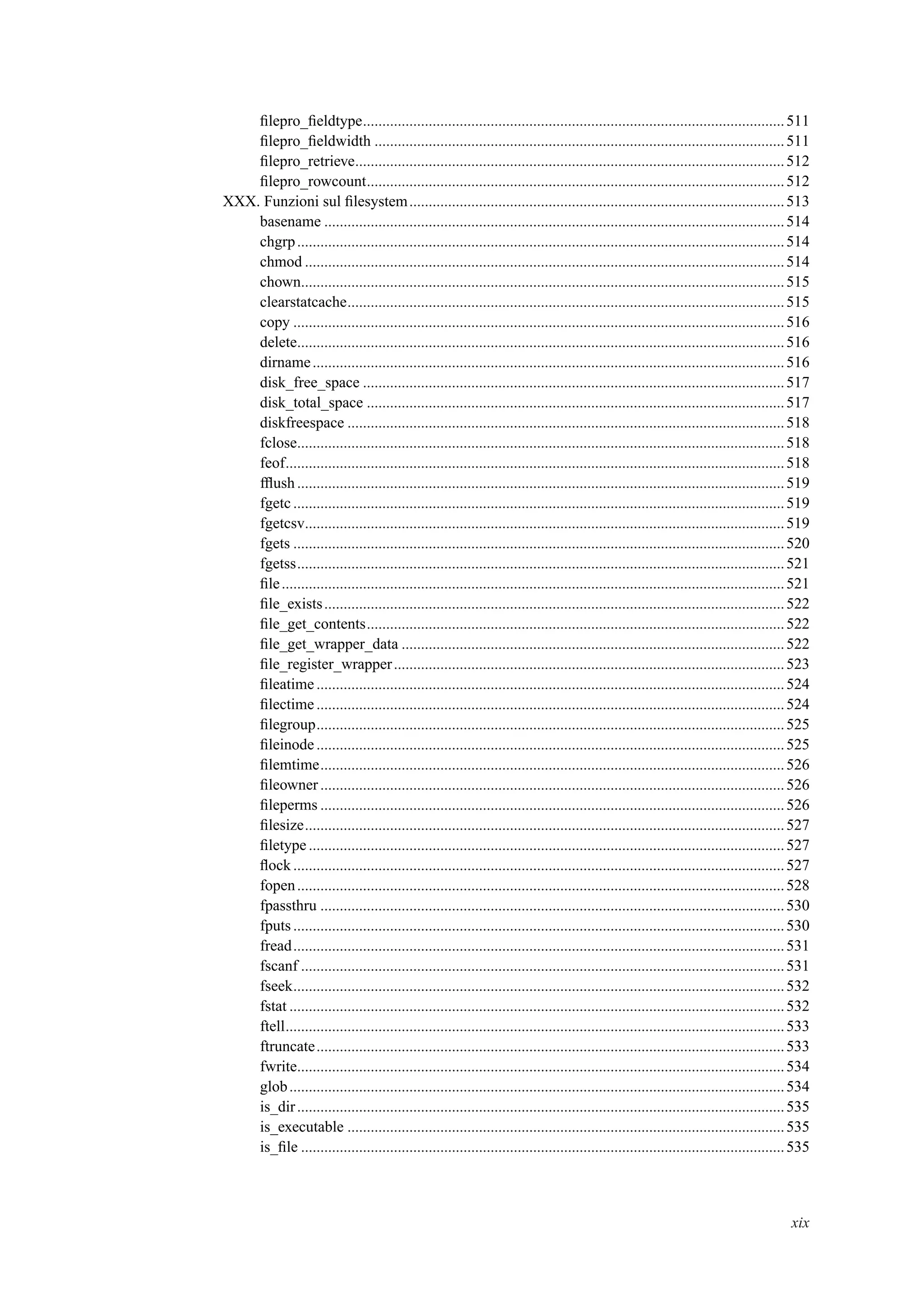
XVIII. Funzioni di Data e Ora ................................................................................................376
checkdate .......................................................................................................................377
date ................................................................................................................................377
getdate............................................................................................................................379
gettimeofday..................................................................................................................380
gmdate ...........................................................................................................................380
gmmktime......................................................................................................................381
gmstrftime......................................................................................................................381
localtime ........................................................................................................................381
microtime.......................................................................................................................382
mktime...........................................................................................................................383
strftime...........................................................................................................................384
strtotime.........................................................................................................................386
time................................................................................................................................387
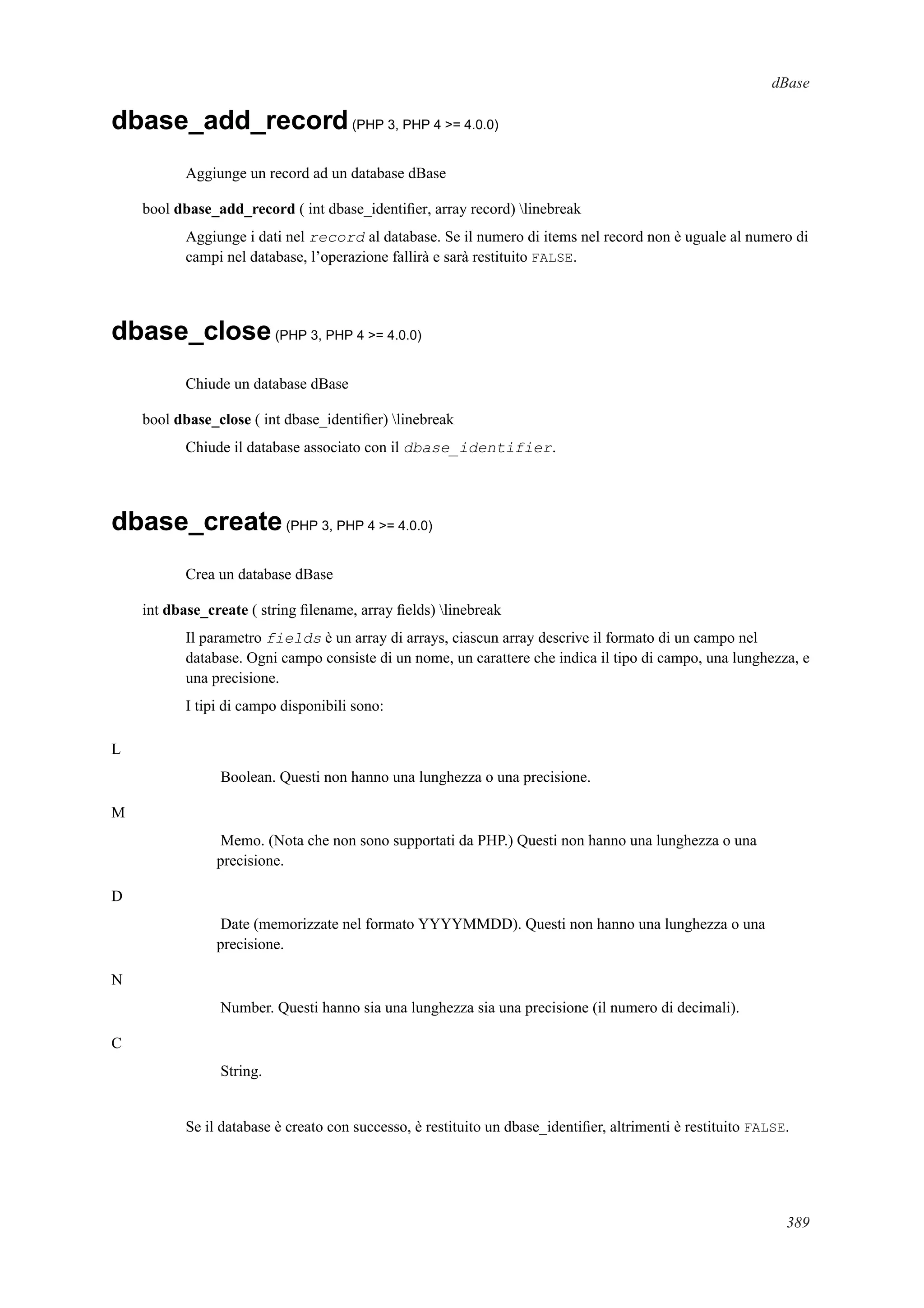
XIX. Funzioni dBase...............................................................................................................388
dbase_add_record..........................................................................................................389
dbase_close....................................................................................................................389
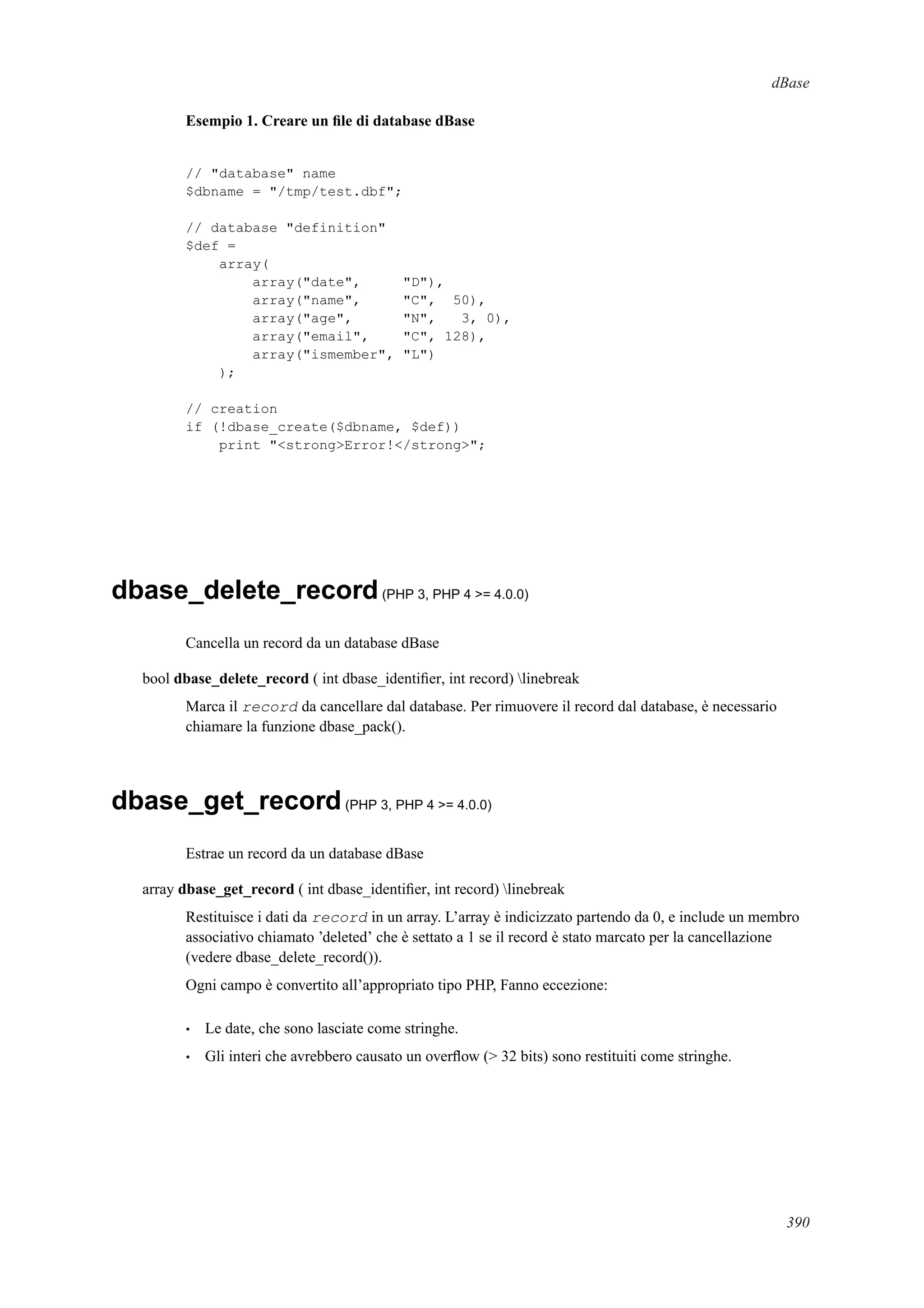
dbase_create ..................................................................................................................389
dbase_delete_record ......................................................................................................390
dbase_get_record...........................................................................................................390
dbase_get_record_with_names......................................................................................390
dbase_numfields ............................................................................................................391
dbase_numrecords .........................................................................................................391
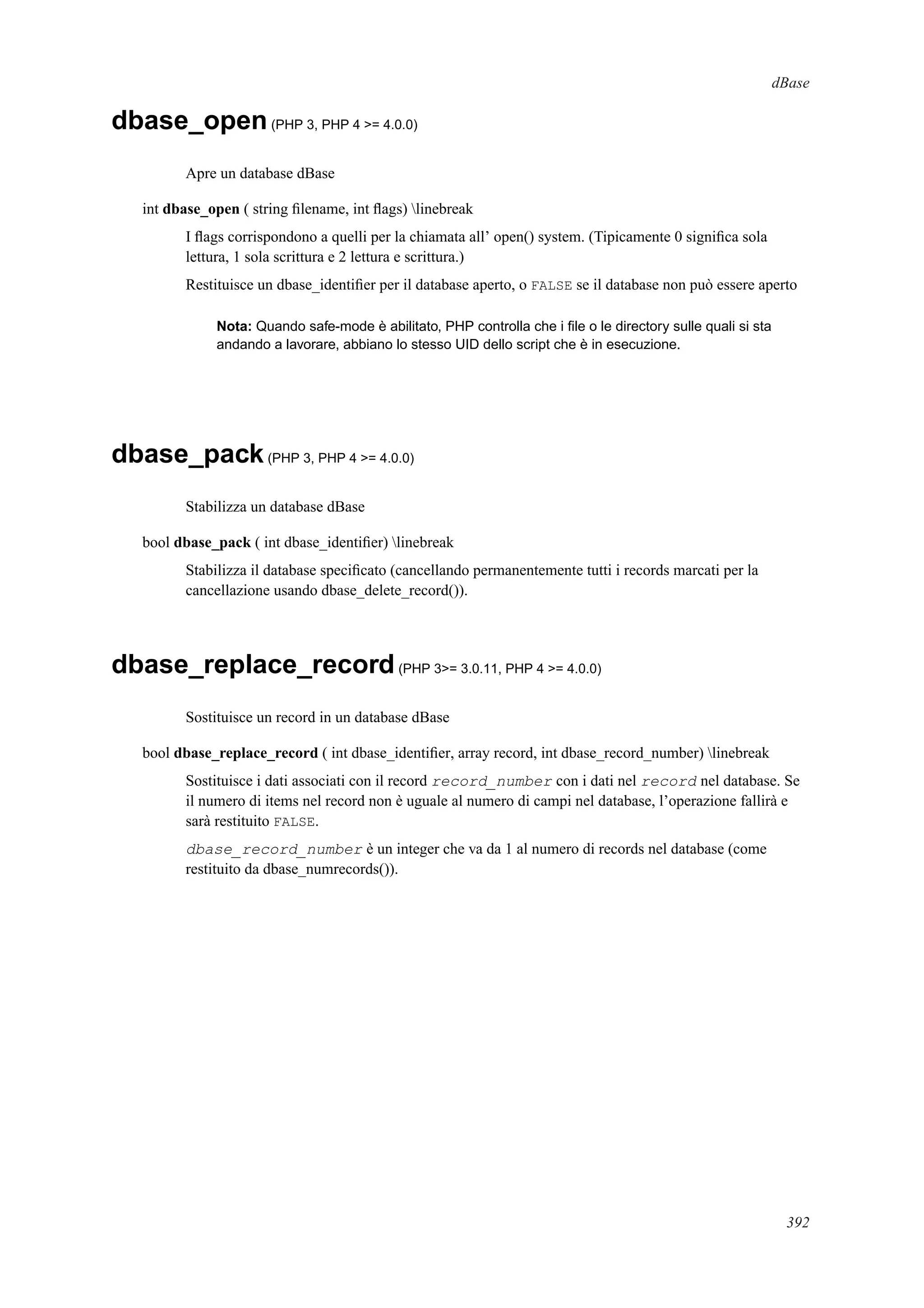
dbase_open ....................................................................................................................391
dbase_pack ....................................................................................................................392
dbase_replace_record ....................................................................................................392
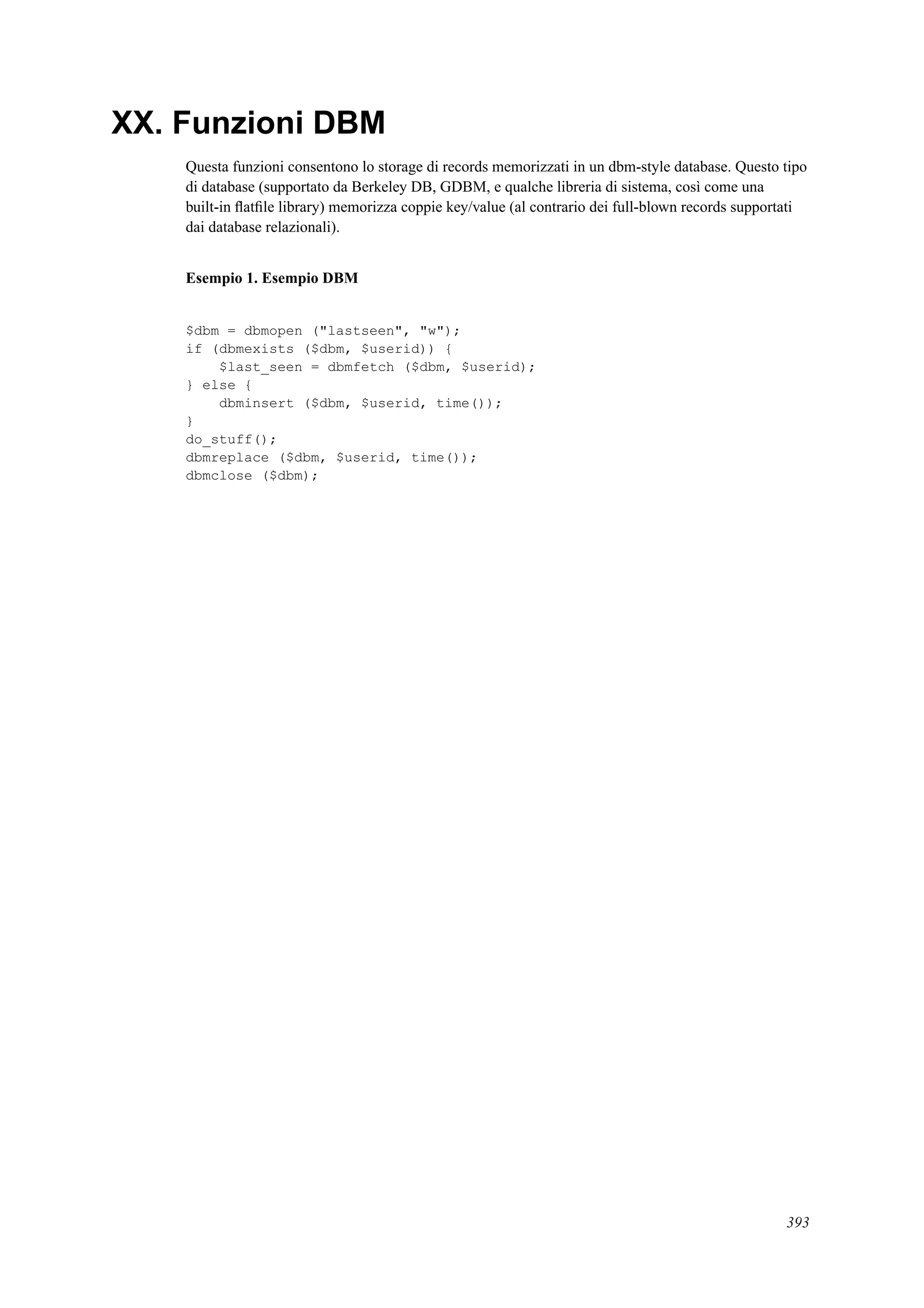
XX. Funzioni DBM.................................................................................................................393
dblist ..............................................................................................................................394
dbmclose........................................................................................................................394
dbmdelete ......................................................................................................................394
dbmexists.......................................................................................................................394
dbmfetch........................................................................................................................394
dbmfirstkey....................................................................................................................394
dbminsert.......................................................................................................................395
dbmnextkey ...................................................................................................................395
dbmopen ........................................................................................................................395
dbmreplace ....................................................................................................................396
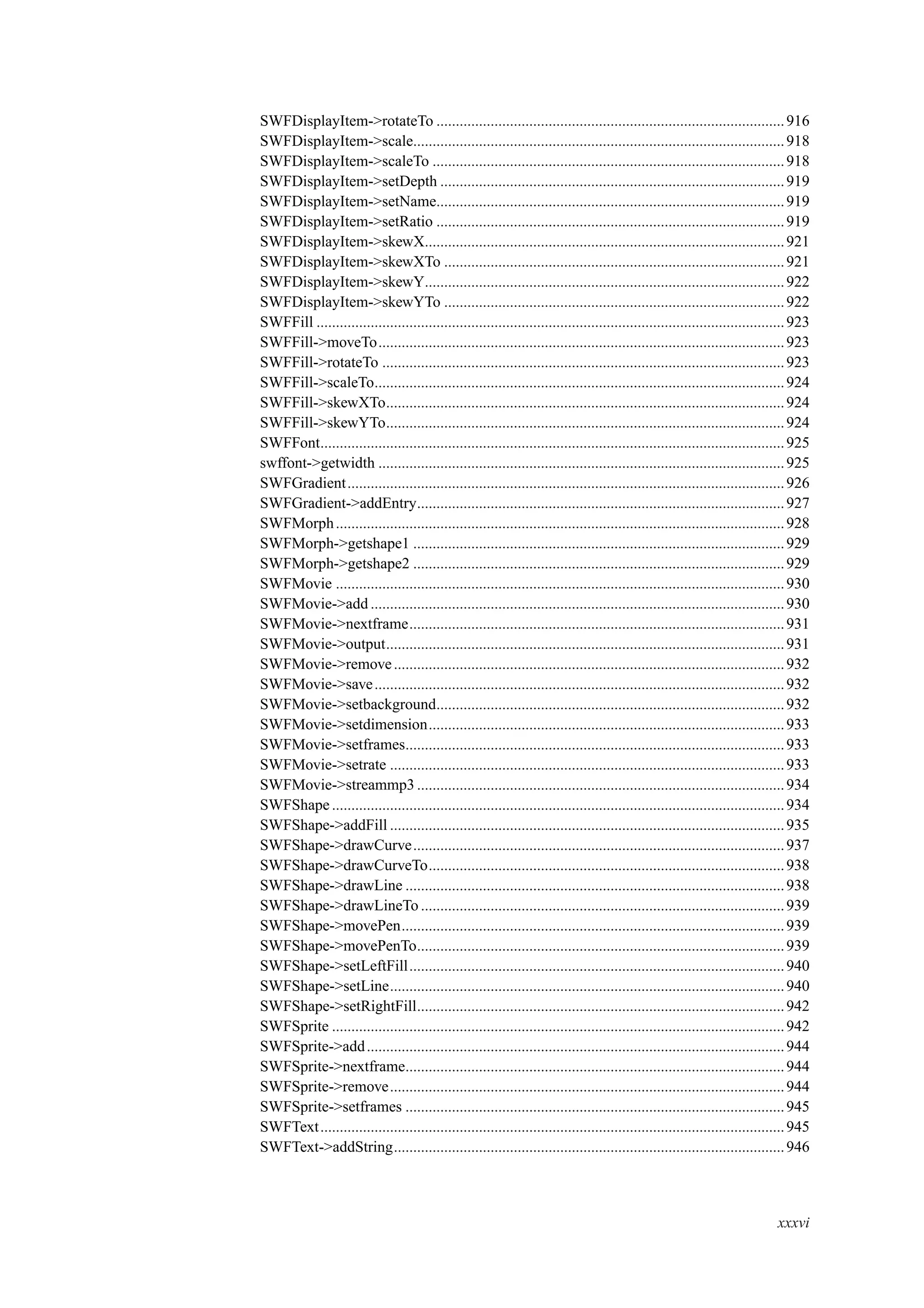
XXI. dbx functions..................................................................................................................397
dbx_close.......................................................................................................................400
dbx_compare .................................................................................................................400
dbx_connect...................................................................................................................401
dbx_error .......................................................................................................................402
xiv
dbx_query......................................................................................................................403
dbx_sort.........................................................................................................................406
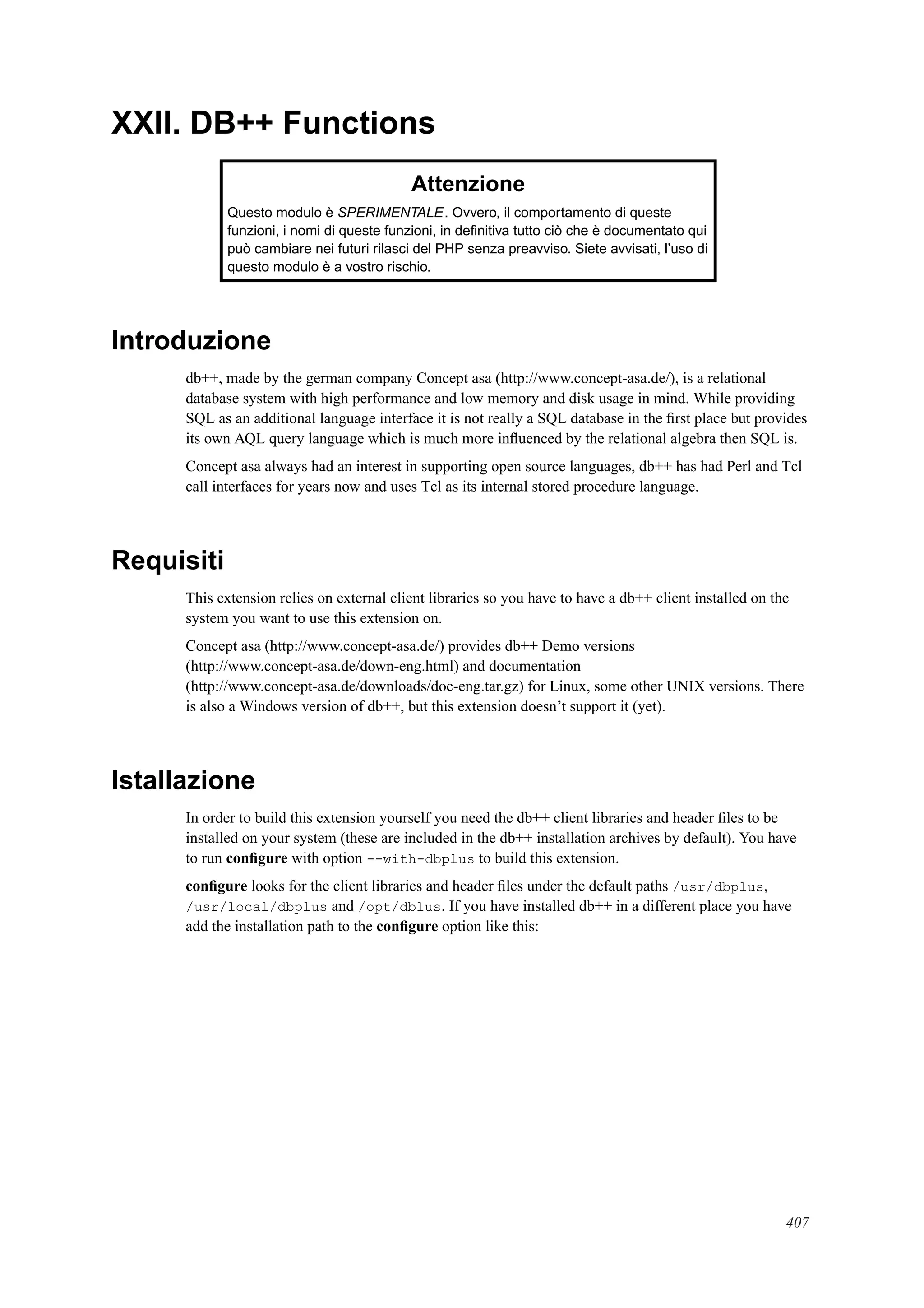
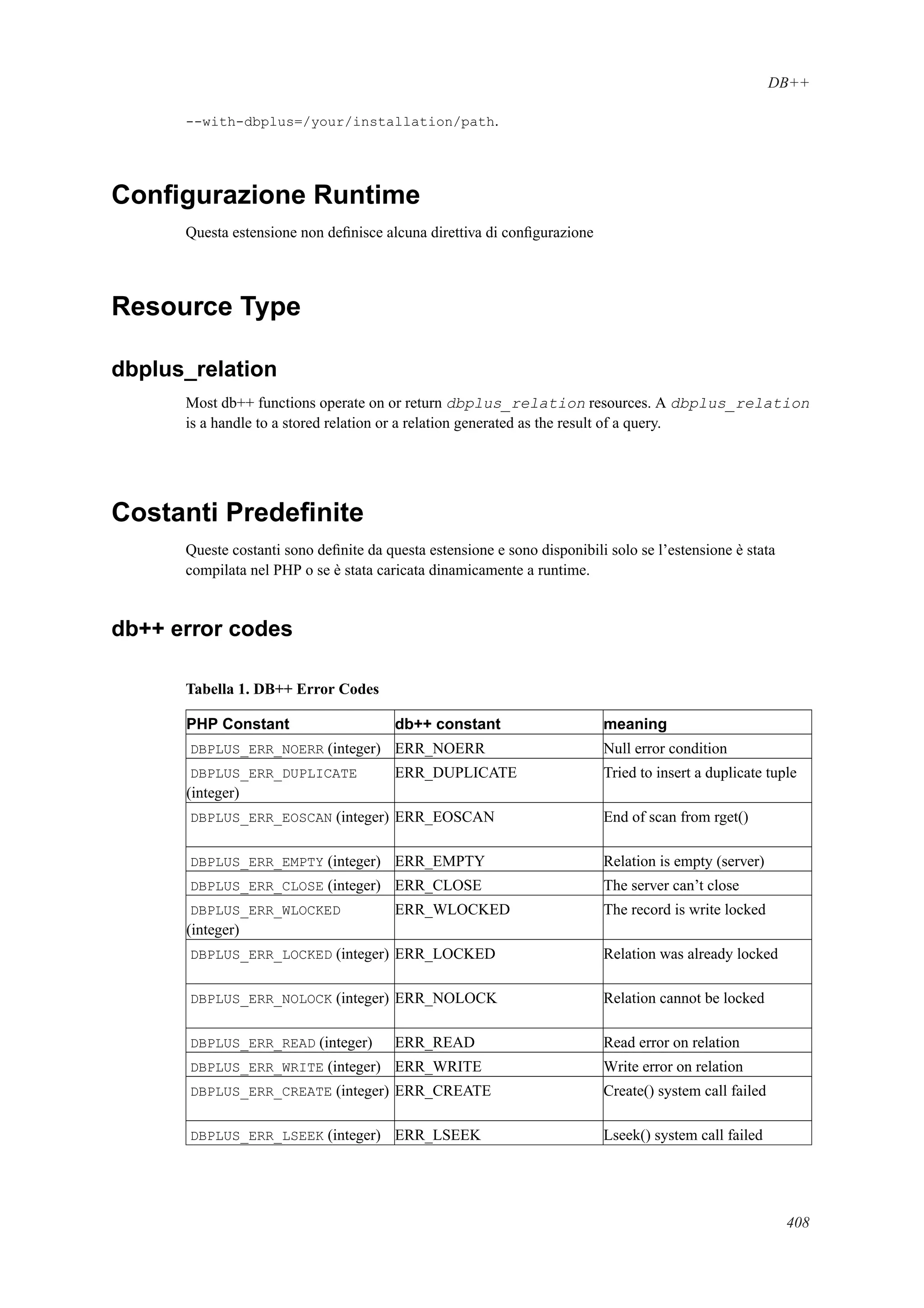
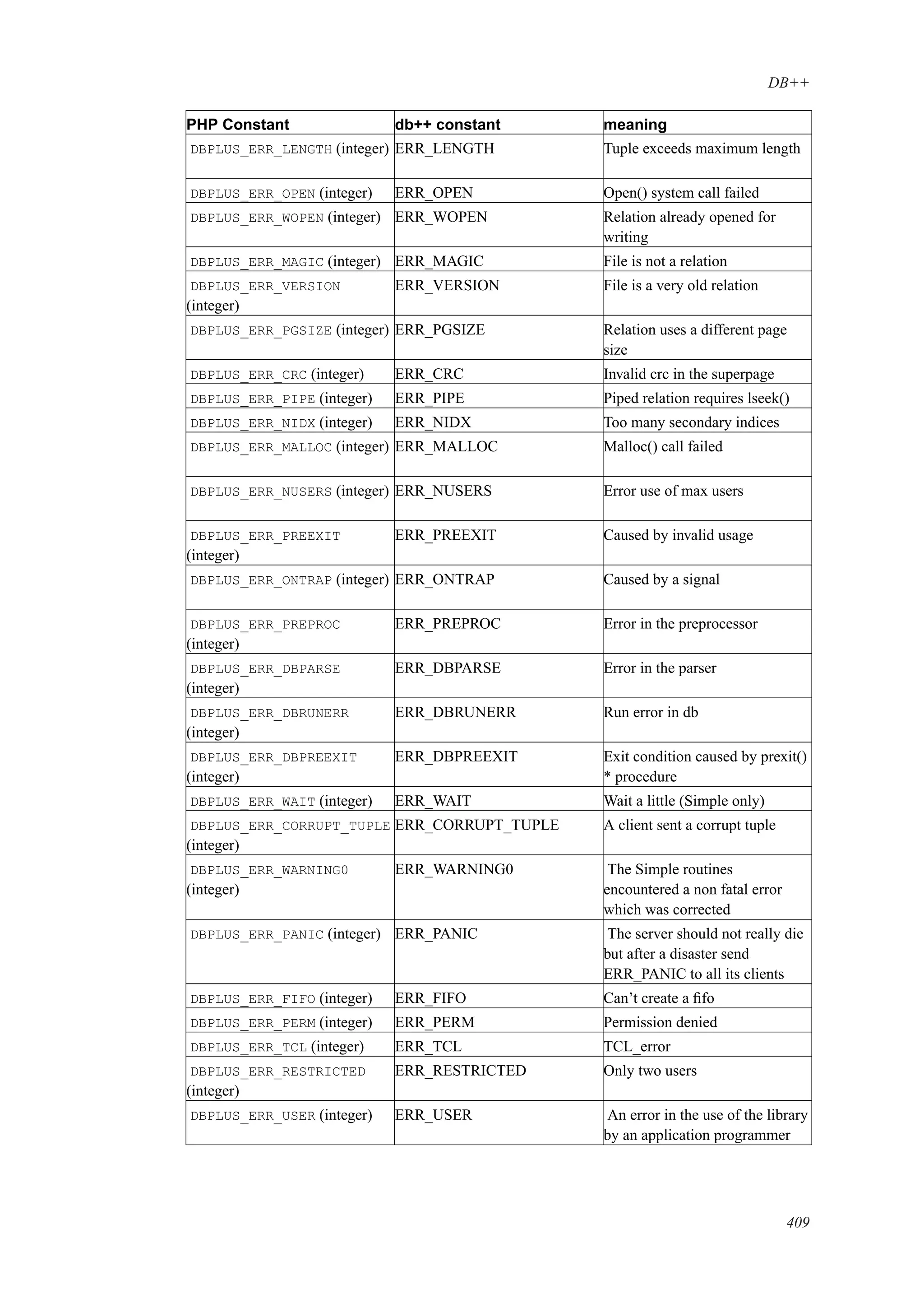
XXII. DB++ Functions ...........................................................................................................407
dbplus_add.....................................................................................................................411
dbplus_aql......................................................................................................................411
dbplus_chdir ..................................................................................................................411
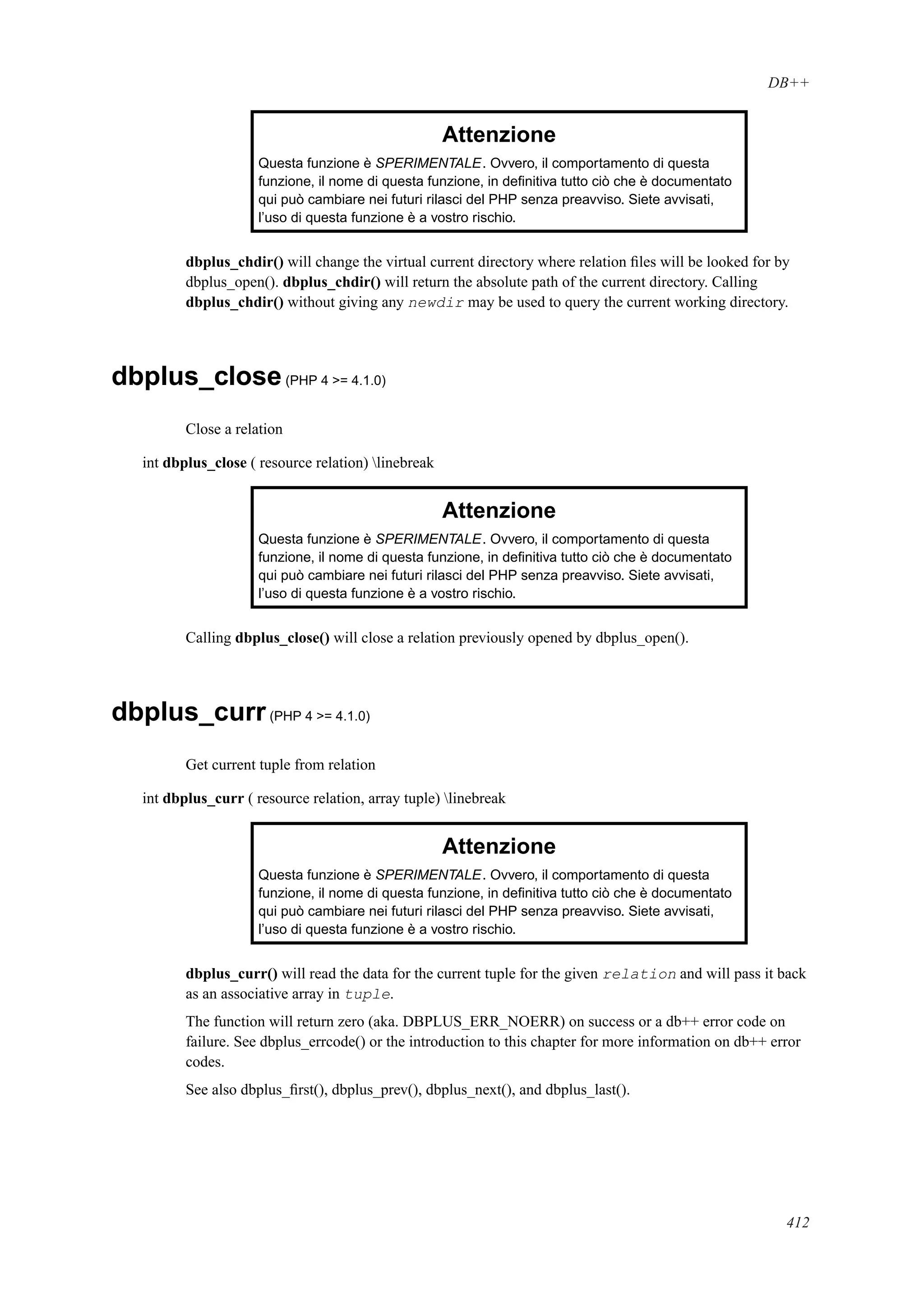
dbplus_close ..................................................................................................................412
dbplus_curr....................................................................................................................412
dbplus_errcode ..............................................................................................................412
dbplus_errno..................................................................................................................413
dbplus_find ....................................................................................................................413
dbplus_first ....................................................................................................................414
dbplus_flush...................................................................................................................414
dbplus_freealllocks........................................................................................................414
dbplus_freelock .............................................................................................................415
dbplus_freerlocks ..........................................................................................................415
dbplus_getlock...............................................................................................................416
dbplus_getunique...........................................................................................................416
dbplus_info....................................................................................................................416
dbplus_last.....................................................................................................................417
dbplus_lockrel ...............................................................................................................417
dbplus_next....................................................................................................................417
dbplus_open...................................................................................................................418
dbplus_prev ...................................................................................................................418
dbplus_rchperm .............................................................................................................419
dbplus_rcreate................................................................................................................419
dbplus_rcrtexact.............................................................................................................420
dbplus_rcrtlike...............................................................................................................420
dbplus_resolve...............................................................................................................420
dbplus_restorepos..........................................................................................................421
dbplus_rkeys..................................................................................................................421
dbplus_ropen .................................................................................................................421
dbplus_rquery................................................................................................................422
dbplus_rrename .............................................................................................................422
dbplus_rsecindex ...........................................................................................................422
dbplus_runlink...............................................................................................................423
dbplus_rzap....................................................................................................................423
dbplus_savepos..............................................................................................................423
dbplus_setindex .............................................................................................................424
dbplus_setindexbynumber.............................................................................................424
dbplus_sql......................................................................................................................424
dbplus_tcl ......................................................................................................................425
dbplus_tremove .............................................................................................................425
dbplus_undo ..................................................................................................................426
dbplus_undoprepare ......................................................................................................426
dbplus_unlockrel ...........................................................................................................426
dbplus_unselect .............................................................................................................427
dbplus_update................................................................................................................427
dbplus_xlockrel .............................................................................................................427
dbplus_xunlockrel .........................................................................................................428
XXIII. Direct IO functions......................................................................................................429
dio_close........................................................................................................................430
xv
dio_fcntl.........................................................................................................................430
dio_open ........................................................................................................................430
dio_read .........................................................................................................................431
dio_seek.........................................................................................................................431
dio_stat ..........................................................................................................................431
dio_truncate ...................................................................................................................432
dio_write........................................................................................................................432
XXIV. Funzioni per le directory.............................................................................................433
chdir...............................................................................................................................434
chroot.............................................................................................................................434
dir...................................................................................................................................434
closedir ..........................................................................................................................435
getcwd............................................................................................................................435
opendir...........................................................................................................................435
readdir............................................................................................................................436
rewinddir........................................................................................................................437
XXV. DOM XML functions...................................................................................................438
DomAttribute->name ....................................................................................................446
DomAttribute->specified...............................................................................................446
DomAttribute->value.....................................................................................................446
DomDocument->add_root [deprecated]........................................................................446
DomDocument->create_attribute..................................................................................447
DomDocument->create_cdata_section..........................................................................447
DomDocument->create_comment ................................................................................447
DomDocument->create_element...................................................................................448
DomDocument->create_entity_reference .....................................................................448
DomDocument->create_processing_instruction...........................................................448
DomDocument->create_text_node................................................................................449
DomDocument->doctype ..............................................................................................449
DomDocument->document_element ............................................................................449
DomDocument->dump_file...........................................................................................450
DomDocument->dump_mem........................................................................................451
DomDocument->get_element_by_id ............................................................................451
DomDocument->get_elements_by_tagname ................................................................452
DomDocument->html_dump_mem ..............................................................................452
DomDocumentType->entities .......................................................................................452
DomDocumentType->internal_subset...........................................................................453
DomDocumentType->name ..........................................................................................453
DomDocumentType->notations ....................................................................................453
DomDocumentType->public_id....................................................................................454
DomDocumentType->system_id...................................................................................454
DomElement->get_attribute..........................................................................................455
DomElement->get_attribute_node ................................................................................455
DomElement->get_elements_by_tagname....................................................................455
DomElement->has_attribute..........................................................................................455
DomElement->remove_attribute...................................................................................456
DomElement->set_attribute ..........................................................................................456
DomElement->set_attribute_node.................................................................................457
DomElement->tagname.................................................................................................457
DomNode->append_child .............................................................................................457
DomNode->append_sibling ..........................................................................................459
DomNode->attributes....................................................................................................459
xvi
DomNode->child-nodes ................................................................................................459
DomNode->clone_node ................................................................................................459
DomNode->dump_node................................................................................................460
DomNode->first_child...................................................................................................460
DomNode->get_content ................................................................................................460
DomNode->has_attributess ...........................................................................................461
DomNode->has_child_nodes ........................................................................................461
DomNode->insert_before..............................................................................................461
DomNode->is_blank_node............................................................................................462
DomNode->last_child ...................................................................................................462
DomNode->next_sibling ...............................................................................................462
DomNode->node_name ................................................................................................463
DomNode->node_type ..................................................................................................464
DomNode->node_value.................................................................................................464
DomNode->owner_document .......................................................................................464
DomNode->parent_node...............................................................................................465
DomNode->prefix..........................................................................................................466
DomNode->previous_sibling ........................................................................................466
DomNode->remove_child.............................................................................................466
DomNode->replace_child .............................................................................................467
DomNode->replace_node..............................................................................................467
DomNode->set_content.................................................................................................467
DomNode->set_name....................................................................................................468
DomNode->unlink_node...............................................................................................468
DomProcessingInstruction->data ..................................................................................468
DomProcessingInstruction->target................................................................................468
domxml_new_doc .........................................................................................................469
domxml_open_file.........................................................................................................469
domxml_open_mem......................................................................................................470
domxml_version............................................................................................................470
domxml_xmltree............................................................................................................470
xpath_eval......................................................................................................................471
xpath_eval_expression...................................................................................................471
xpath_new_context........................................................................................................471
xptr_eval ........................................................................................................................472
xptr_new_context ..........................................................................................................472
XXVI. Funzioni .NET.............................................................................................................473
dotnet_load ....................................................................................................................474
XXVII. Funzioni di gestione degli errori e di logging............................................................475
error_log ........................................................................................................................476
error_reporting...............................................................................................................477
restore_error_handler ....................................................................................................478
set_error_handler...........................................................................................................478
trigger_error...................................................................................................................481
user_error.......................................................................................................................481
XXVIII. FrontBase Functions.................................................................................................483
fbsql_affected_rows.......................................................................................................484
fbsql_autocommit..........................................................................................................484
fbsql_change_user .........................................................................................................484
fbsql_close.....................................................................................................................485
fbsql_commit.................................................................................................................485
fbsql_connect.................................................................................................................485
xvii
fbsql_create_blob ..........................................................................................................486
fbsql_create_clob...........................................................................................................487
fbsql_create_db..............................................................................................................487
fbsql_data_seek .............................................................................................................488
fbsql_database ...............................................................................................................489
fbsql_database_password ..............................................................................................489
fbsql_db_query..............................................................................................................489
fbsql_db_status..............................................................................................................490
fbsql_drop_db................................................................................................................490
fbsql_errno.....................................................................................................................491
fbsql_error .....................................................................................................................491
fbsql_fetch_array...........................................................................................................492
fbsql_fetch_assoc ..........................................................................................................493
fbsql_fetch_field............................................................................................................493
fbsql_fetch_lengths........................................................................................................494
fbsql_fetch_object .........................................................................................................495
fbsql_fetch_row.............................................................................................................495
fbsql_field_flags ............................................................................................................496
fbsql_field_len...............................................................................................................496
fbsql_field_name ...........................................................................................................496
fbsql_field_seek.............................................................................................................497
fbsql_field_table ............................................................................................................497
fbsql_field_type.............................................................................................................497
fbsql_free_result............................................................................................................498
fbsql_get_autostart_info................................................................................................498
fbsql_hostname..............................................................................................................499
fbsql_insert_id...............................................................................................................499
fbsql_list_dbs.................................................................................................................499
fbsql_list_fields..............................................................................................................500
fbsql_list_tables.............................................................................................................501
fbsql_next_result ...........................................................................................................501
fbsql_num_fields ...........................................................................................................502
fbsql_num_rows ............................................................................................................502
fbsql_password..............................................................................................................502
fbsql_pconnect...............................................................................................................503
fbsql_query....................................................................................................................503
fbsql_read_blob .............................................................................................................504
fbsql_read_clob .............................................................................................................505
fbsql_result ....................................................................................................................506
fbsql_rollback................................................................................................................506
fbsql_select_db..............................................................................................................506
fbsql_set_lob_mode.......................................................................................................507
fbsql_set_transaction .....................................................................................................507
fbsql_start_db ................................................................................................................508
fbsql_stop_db ................................................................................................................508
fbsql_tablename.............................................................................................................508
fbsql_username..............................................................................................................509
fbsql_warnings ..............................................................................................................509
XXIX. Funzioni filePro...........................................................................................................510
filepro.............................................................................................................................511
filepro_fieldcount...........................................................................................................511
filepro_fieldname...........................................................................................................511
xviii
filepro_fieldtype.............................................................................................................511
filepro_fieldwidth ..........................................................................................................511
filepro_retrieve...............................................................................................................512
filepro_rowcount............................................................................................................512
XXX. Funzioni sul filesystem.................................................................................................513
basename .......................................................................................................................514
chgrp..............................................................................................................................514
chmod ............................................................................................................................514
chown.............................................................................................................................515
clearstatcache.................................................................................................................515
copy ...............................................................................................................................516
delete..............................................................................................................................516
dirname..........................................................................................................................516
disk_free_space .............................................................................................................517
disk_total_space ............................................................................................................517
diskfreespace .................................................................................................................518
fclose..............................................................................................................................518
feof.................................................................................................................................518
fflush..............................................................................................................................519
fgetc ...............................................................................................................................519
fgetcsv............................................................................................................................519
fgets ...............................................................................................................................520
fgetss..............................................................................................................................521
file..................................................................................................................................521
file_exists.......................................................................................................................522
file_get_contents............................................................................................................522
file_get_wrapper_data ...................................................................................................522
file_register_wrapper.....................................................................................................523
fileatime.........................................................................................................................524
filectime.........................................................................................................................524
filegroup.........................................................................................................................525
fileinode.........................................................................................................................525
filemtime........................................................................................................................526
fileowner........................................................................................................................526
fileperms ........................................................................................................................526
filesize............................................................................................................................527
filetype...........................................................................................................................527
flock...............................................................................................................................527
fopen..............................................................................................................................528
fpassthru ........................................................................................................................530
fputs...............................................................................................................................530
fread...............................................................................................................................531
fscanf .............................................................................................................................531
fseek...............................................................................................................................532
fstat ................................................................................................................................532
ftell.................................................................................................................................533
ftruncate.........................................................................................................................533
fwrite..............................................................................................................................534
glob................................................................................................................................534
is_dir..............................................................................................................................535
is_executable .................................................................................................................535
is_file .............................................................................................................................535
xix
is_link ............................................................................................................................536
is_readable.....................................................................................................................536
is_uploaded_file.............................................................................................................536
is_writable .....................................................................................................................537
is_writeable....................................................................................................................538
link.................................................................................................................................538
linkinfo ..........................................................................................................................538
lstat ................................................................................................................................538
mkdir..............................................................................................................................539
move_uploaded_file.......................................................................................................540
parse_ini_file .................................................................................................................540
pathinfo..........................................................................................................................542
pclose.............................................................................................................................542
popen .............................................................................................................................543
readfile ...........................................................................................................................543
readlink..........................................................................................................................544
realpath ..........................................................................................................................544
rename ...........................................................................................................................545
rewind............................................................................................................................545
rmdir ..............................................................................................................................545
set_file_buffer................................................................................................................545
stat..................................................................................................................................546
symlink ..........................................................................................................................547
tempnam ........................................................................................................................547
tmpfile............................................................................................................................548
touch ..............................................................................................................................548
umask.............................................................................................................................549
unlink.............................................................................................................................549
XXXI. Forms Data Format functions......................................................................................550
fdf_add_template...........................................................................................................554
fdf_close ........................................................................................................................554
fdf_create.......................................................................................................................554
fdf_get_file ....................................................................................................................555
fdf_get_status ................................................................................................................555
fdf_get_value.................................................................................................................555
fdf_next_field_name......................................................................................................555
fdf_open.........................................................................................................................555
fdf_save .........................................................................................................................556
fdf_set_ap ......................................................................................................................556
fdf_set_encoding ...........................................................................................................557
fdf_set_file.....................................................................................................................557
fdf_set_flags ..................................................................................................................557
fdf_set_javascript_action...............................................................................................557
fdf_set_opt.....................................................................................................................557
fdf_set_status.................................................................................................................558
fdf_set_submit_form_action..........................................................................................558
fdf_set_value .................................................................................................................558
XXXII. Funzioni FriBiDi........................................................................................................559
fribidi_log2vis ...............................................................................................................560
XXXIII. Funzioni FTP............................................................................................................561
ftp_cdup.........................................................................................................................562
ftp_chdir ........................................................................................................................562
xx
ftp_close ........................................................................................................................562
ftp_connect ....................................................................................................................562
ftp_delete .......................................................................................................................563
ftp_exec .........................................................................................................................563
ftp_fget ..........................................................................................................................563
ftp_fput ..........................................................................................................................563
ftp_get............................................................................................................................563
ftp_get_option................................................................................................................564
ftp_login ........................................................................................................................564
ftp_mdtm .......................................................................................................................565
ftp_mkdir.......................................................................................................................565
ftp_nlist..........................................................................................................................565
ftp_pasv .........................................................................................................................565
ftp_put............................................................................................................................566
ftp_pwd..........................................................................................................................566
ftp_quit ..........................................................................................................................566
ftp_rawlist......................................................................................................................566
ftp_rename.....................................................................................................................567
ftp_rmdir........................................................................................................................567
ftp_set_option................................................................................................................567
ftp_site...........................................................................................................................568
ftp_size ..........................................................................................................................568
ftp_systype.....................................................................................................................568
XXXIV. Function Handling functions....................................................................................569
call_user_func................................................................................................................570
call_user_func_array .....................................................................................................570
create_function ..............................................................................................................571
func_get_arg..................................................................................................................573
func_get_args.................................................................................................................574
func_num_args ..............................................................................................................574
function_exists...............................................................................................................575
get_defined_functions....................................................................................................575
register_shutdown_function ..........................................................................................576
register_tick_function....................................................................................................577
unregister_tick_function................................................................................................577
XXXV. Gettext .......................................................................................................................578
bind_textdomain_codeset..............................................................................................579
bindtextdomain..............................................................................................................579
dcgettext ........................................................................................................................579
dcngettext ......................................................................................................................579
dgettext ..........................................................................................................................579
dngettext ........................................................................................................................580
gettext ............................................................................................................................580
ngettext ..........................................................................................................................581
textdomain .....................................................................................................................581
XXXVI. Funzioni GMP..........................................................................................................582
gmp_abs.........................................................................................................................583
gmp_add ........................................................................................................................583
gmp_and ........................................................................................................................583
gmp_clrbit......................................................................................................................583
gmp_cmp.......................................................................................................................583
gmp_com.......................................................................................................................583
xxi
gmp_div.........................................................................................................................584
gmp_div_q.....................................................................................................................584
gmp_div_qr....................................................................................................................584
gmp_div_r......................................................................................................................585
gmp_divexact.................................................................................................................585
gmp_fact........................................................................................................................585
gmp_gcd ........................................................................................................................585
gmp_gcdext ...................................................................................................................586
gmp_hamdist .................................................................................................................586
gmp_init.........................................................................................................................586
gmp_intval.....................................................................................................................587
gmp_invert.....................................................................................................................587
gmp_jacobi ....................................................................................................................587
gmp_legendre ................................................................................................................587
gmp_mod.......................................................................................................................588
gmp_mul........................................................................................................................588
gmp_neg ........................................................................................................................588
gmp_or...........................................................................................................................588
gmp_perfect_square ......................................................................................................588
gmp_popcount...............................................................................................................588
gmp_pow .......................................................................................................................589
gmp_powm....................................................................................................................589
gmp_prob_prime ...........................................................................................................589
gmp_random..................................................................................................................589
gmp_scan0.....................................................................................................................590
gmp_scan1.....................................................................................................................590
gmp_setbit .....................................................................................................................590
gmp_sign .......................................................................................................................590
gmp_sqrt........................................................................................................................590
gmp_sqrtrm....................................................................................................................590
gmp_strval .....................................................................................................................591
gmp_sub ........................................................................................................................591
gmp_xor.........................................................................................................................591
XXXVII. Funzioni HTTP .......................................................................................................592
header ............................................................................................................................593
headers_sent ..................................................................................................................595
setcookie........................................................................................................................595
XXXVIII. Hyperwave functions.............................................................................................598
hw_Array2Objrec..........................................................................................................602
hw_changeobject ...........................................................................................................602
hw_Children ..................................................................................................................602
hw_ChildrenObj ............................................................................................................602
hw_Close.......................................................................................................................602
hw_Connect...................................................................................................................603
hw_connection_info ......................................................................................................603
hw_Cp............................................................................................................................603
hw_Deleteobject............................................................................................................603
hw_DocByAnchor.........................................................................................................604
hw_DocByAnchorObj...................................................................................................604
hw_Document_Attributes..............................................................................................604
hw_Document_BodyTag...............................................................................................604
hw_Document_Content.................................................................................................605
xxii
hw_Document_SetContent............................................................................................605
hw_Document_Size.......................................................................................................605
hw_dummy....................................................................................................................605
hw_EditText...................................................................................................................606
hw_Error........................................................................................................................606
hw_ErrorMsg.................................................................................................................606
hw_Free_Document ......................................................................................................606
hw_GetAnchors.............................................................................................................607
hw_GetAnchorsObj.......................................................................................................607
hw_GetAndLock ...........................................................................................................607
hw_GetChildColl...........................................................................................................607
hw_GetChildCollObj.....................................................................................................607
hw_GetChildDocColl....................................................................................................608
hw_GetChildDocCollObj..............................................................................................608
hw_GetObject................................................................................................................608
hw_GetObjectByQuery .................................................................................................609
hw_GetObjectByQueryColl ..........................................................................................609
hw_GetObjectByQueryCollObj ....................................................................................609
hw_GetObjectByQueryObj ...........................................................................................609
hw_GetParents...............................................................................................................610
hw_GetParentsObj.........................................................................................................610
hw_getrellink.................................................................................................................610
hw_GetRemote..............................................................................................................610
hw_GetRemoteChildren................................................................................................611
hw_GetSrcByDestObj ...................................................................................................611
hw_GetText ...................................................................................................................611
hw_getusername............................................................................................................612
hw_Identify....................................................................................................................612
hw_InCollections...........................................................................................................613
hw_Info..........................................................................................................................613
hw_InsColl ....................................................................................................................613
hw_InsDoc.....................................................................................................................613
hw_insertanchors...........................................................................................................613
hw_InsertDocument ......................................................................................................614
hw_InsertObject ............................................................................................................614
hw_mapid ......................................................................................................................614
hw_Modifyobject ..........................................................................................................615
hw_Mv...........................................................................................................................617
hw_New_Document......................................................................................................617
hw_Objrec2Array..........................................................................................................617
hw_Output_Document ..................................................................................................618
hw_pConnect.................................................................................................................618
hw_PipeDocument ........................................................................................................618
hw_Root ........................................................................................................................619
hw_setlinkroot...............................................................................................................619
hw_stat...........................................................................................................................619
hw_Unlock ....................................................................................................................619
hw_Who ........................................................................................................................620
XXXIX. Hyperwave API functions ........................................................................................621
hw_api_attribute............................................................................................................623
hw_api_attribute->key...................................................................................................623
hw_api_attribute->langdepvalue ...................................................................................623
xxiii
hw_api_attribute->value................................................................................................623
hw_api_attribute->values ..............................................................................................623
hw_api->checkin ...........................................................................................................623
hw_api->checkout .........................................................................................................624
hw_api->children...........................................................................................................625
hw_api->content............................................................................................................625
hw_api_content->mimetype..........................................................................................625
hw_api_content->read...................................................................................................625
hw_api->copy................................................................................................................626
hw_api->dbstat ..............................................................................................................626
hw_api->dcstat ..............................................................................................................626
hw_api->dstanchors.......................................................................................................626
hw_api->dstofsrcanchors...............................................................................................626
hw_api_error->count .....................................................................................................627
hw_api_error->reason....................................................................................................627
hw_api->find..................................................................................................................627
hw_api->ftstat................................................................................................................627
hwapi_hgcsp..................................................................................................................628
hw_api->hwstat .............................................................................................................628
hw_api->identify ...........................................................................................................628
hw_api->info .................................................................................................................628
hw_api->insert...............................................................................................................629
hw_api->insertanchor....................................................................................................629
hw_api->insertcollection...............................................................................................629
hw_api->insertdocument...............................................................................................630
hw_api->link..................................................................................................................630
hw_api->lock.................................................................................................................630
hw_api->move...............................................................................................................631
hw_api_content..............................................................................................................631
hw_api->object..............................................................................................................631
hw_api_object->assign..................................................................................................632
hw_api_object->attreditable..........................................................................................632
hw_api_object->count...................................................................................................632
hw_api_object->insert...................................................................................................633
hw_api_object................................................................................................................633
hw_api_object->remove................................................................................................633
hw_api_object->title......................................................................................................633
hw_api_object->value ...................................................................................................633
hw_api->objectbyanchor...............................................................................................634
hw_api->parents ............................................................................................................634
hw_api_reason->description..........................................................................................634
hw_api_reason->type ....................................................................................................634
hw_api->remove............................................................................................................635
hw_api->replace ............................................................................................................635
hw_api->setcommitedversion........................................................................................636
hw_api->srcanchors.......................................................................................................636
hw_api->srcsofdst..........................................................................................................636
hw_api->unlock.............................................................................................................636
hw_api->user.................................................................................................................637
hw_api->userlist ............................................................................................................637
XL. ICAP Functions [deprecated] ..........................................................................................638
icap_close ......................................................................................................................639
xxiv
icap_create_calendar .....................................................................................................639
icap_delete_calendar .....................................................................................................639
icap_delete_event ..........................................................................................................639
icap_fetch_event............................................................................................................639
icap_list_alarms.............................................................................................................640
icap_list_events .............................................................................................................641
icap_open.......................................................................................................................641
icap_rename_calendar ...................................................................................................641
icap_reopen....................................................................................................................642
icap_snooze ...................................................................................................................642
icap_store_event ............................................................................................................642
XLI. funzioni iconv.................................................................................................................644
iconv ..............................................................................................................................645
iconv_get_encoding.......................................................................................................645
iconv_set_encoding .......................................................................................................645
ob_iconv_handler ..........................................................................................................645
XLII. Image functions.............................................................................................................647
exif_imagetype ..............................................................................................................648
exif_read_data ...............................................................................................................648
exif_thumbnail...............................................................................................................651
getimagesize ..................................................................................................................651
image2wbmp .................................................................................................................652
imagealphablending.......................................................................................................653
imagearc ........................................................................................................................653
imagechar ......................................................................................................................653
imagecharup ..................................................................................................................654
imagecolorallocate.........................................................................................................654
imagecolorat ..................................................................................................................654
imagecolorclosest ..........................................................................................................655
imagecolorclosestalpha..................................................................................................655
imagecolorclosesthwb ...................................................................................................655
imagecolordeallocate.....................................................................................................655
imagecolorexact.............................................................................................................656
imagecolorexactalpha....................................................................................................656
imagecolorresolve..........................................................................................................656
imagecolorresolvealpha.................................................................................................657
imagecolorset.................................................................................................................657
imagecolorsforindex......................................................................................................657
imagecolorstotal ............................................................................................................657
imagecolortransparent ...................................................................................................658
imagecopy......................................................................................................................658
imagecopymerge............................................................................................................658
imagecopymergegray.....................................................................................................658
imagecopyresampled .....................................................................................................659
imagecopyresized ..........................................................................................................659
imagecreate....................................................................................................................660
imagecreatefromgd........................................................................................................660
imagecreatefromgd2......................................................................................................660
imagecreatefromgd2part................................................................................................661
imagecreatefromgif........................................................................................................661
imagecreatefromjpeg .....................................................................................................662
imagecreatefrompng......................................................................................................662
xxv
imagecreatefromstring...................................................................................................663
imagecreatefromwbmp..................................................................................................663
imagecreatefromxbm.....................................................................................................664
imagecreatefromxpm.....................................................................................................664
imagecreatetruecolor .....................................................................................................664
imagedashedline ............................................................................................................664
imagedestroy..................................................................................................................665
imageellipse...................................................................................................................665
imagefill.........................................................................................................................665
imagefilledarc ................................................................................................................665
imagefilledellipse...........................................................................................................666
imagefilledpolygon........................................................................................................666
imagefilledrectangle ......................................................................................................666
imagefilltoborder ...........................................................................................................667
imagefontheight.............................................................................................................667
imagefontwidth..............................................................................................................667
imageftbbox...................................................................................................................667
imagefttext.....................................................................................................................668
imagegammacorrect.......................................................................................................668
imagegd .........................................................................................................................668
imagegd2 .......................................................................................................................668
imagegif.........................................................................................................................669
imageinterlace................................................................................................................670
imagejpeg ......................................................................................................................670
imageline .......................................................................................................................671
imageloadfont................................................................................................................671
imagepalettecopy...........................................................................................................672
imagepng .......................................................................................................................672
imagepolygon ................................................................................................................672
imagepsbbox..................................................................................................................672
imagepscopyfont............................................................................................................673
imagepsencodefont........................................................................................................673
imagepsextendfont.........................................................................................................674
imagepsfreefont .............................................................................................................674
imagepsloadfont ............................................................................................................674
imagepsslantfont............................................................................................................675
imagepstext....................................................................................................................675
imagerectangle...............................................................................................................676
imagesetbrush................................................................................................................676
imagesetpixel.................................................................................................................676
imagesetstyle .................................................................................................................677
imagesetthickness..........................................................................................................677
imagesettile....................................................................................................................678
imagestring ....................................................................................................................678
imagestringup ................................................................................................................678
imagesx..........................................................................................................................679
imagesy..........................................................................................................................679
imagetruecolortopalette .................................................................................................679
imagettfbbox..................................................................................................................679
imagettftext....................................................................................................................680
imagetypes.....................................................................................................................681
imagewbmp ...................................................................................................................682
xxvi
iptcembed ......................................................................................................................682
jpeg2wbmp ....................................................................................................................682
png2wbmp.....................................................................................................................683
read_exif_data ...............................................................................................................683
XLIII. IMAP, POP3 and NNTP functions ..............................................................................684
imap_8bit.......................................................................................................................685
imap_alerts ....................................................................................................................685
imap_append..................................................................................................................685
imap_base64..................................................................................................................686
imap_binary...................................................................................................................686
imap_body.....................................................................................................................686
imap_bodystruct ............................................................................................................687
imap_check....................................................................................................................687
imap_clearflag_full........................................................................................................687
imap_close.....................................................................................................................688
imap_createmailbox ......................................................................................................688
imap_delete....................................................................................................................689
imap_deletemailbox ......................................................................................................690
imap_errors....................................................................................................................690
imap_expunge................................................................................................................690
imap_fetch_overview ....................................................................................................691
imap_fetchbody .............................................................................................................692
imap_fetchheader ..........................................................................................................692
imap_fetchstructure .......................................................................................................693
imap_get_quota .............................................................................................................694
imap_getmailboxes........................................................................................................695
imap_getsubscribed .......................................................................................................696
imap_header ..................................................................................................................696
imap_headerinfo............................................................................................................696
imap_headers.................................................................................................................698
imap_last_error..............................................................................................................698
imap_listmailbox...........................................................................................................698
imap_listsubscribed.......................................................................................................699
imap_mail......................................................................................................................699
imap_mail_compose......................................................................................................699
imap_mail_copy ............................................................................................................700
imap_mail_move ...........................................................................................................701
imap_mailboxmsginfo...................................................................................................701
imap_mime_header_decode..........................................................................................702
imap_msgno ..................................................................................................................703
imap_num_msg .............................................................................................................703
imap_num_recent ..........................................................................................................703
imap_open .....................................................................................................................703
imap_ping......................................................................................................................705
imap_popen ...................................................................................................................705
imap_qprint....................................................................................................................706
imap_renamemailbox ....................................................................................................706
imap_reopen ..................................................................................................................706
imap_rfc822_parse_adrlist ............................................................................................707
imap_rfc822_parse_headers..........................................................................................707
imap_rfc822_write_address ..........................................................................................708
imap_scanmailbox.........................................................................................................708
xxvii
imap_search...................................................................................................................708
imap_set_quota..............................................................................................................709
imap_setacl....................................................................................................................710
imap_setflag_full...........................................................................................................710
imap_sort.......................................................................................................................711
imap_status....................................................................................................................712
imap_subscribe..............................................................................................................712
imap_thread ...................................................................................................................713
imap_uid........................................................................................................................713
imap_undelete................................................................................................................713
imap_unsubscribe..........................................................................................................713
imap_utf7_decode .........................................................................................................714
imap_utf7_encode .........................................................................................................714
imap_utf8.......................................................................................................................714
XLIV. Informix functions.......................................................................................................715
ifx_affected_rows ..........................................................................................................717
ifx_blobinfile_mode ......................................................................................................717
ifx_byteasvarchar...........................................................................................................717
ifx_close ........................................................................................................................718
ifx_connect ....................................................................................................................718
ifx_copy_blob................................................................................................................719
ifx_create_blob..............................................................................................................719
ifx_create_char ..............................................................................................................719
ifx_do.............................................................................................................................719
ifx_error.........................................................................................................................720
ifx_errormsg ..................................................................................................................720
ifx_fetch_row.................................................................................................................720
ifx_fieldproperties..........................................................................................................721
ifx_fieldtypes.................................................................................................................722
ifx_free_blob .................................................................................................................722
ifx_free_char..................................................................................................................723
ifx_free_result................................................................................................................723
ifx_get_blob...................................................................................................................723
ifx_get_char...................................................................................................................723
ifx_getsqlca....................................................................................................................723
ifx_htmltbl_result ..........................................................................................................724
ifx_nullformat................................................................................................................725
ifx_num_fields...............................................................................................................725
ifx_num_rows................................................................................................................725
ifx_pconnect ..................................................................................................................725
ifx_prepare.....................................................................................................................726
ifx_query........................................................................................................................726
ifx_textasvarchar ...........................................................................................................728
ifx_update_blob.............................................................................................................728
ifx_update_char .............................................................................................................728
ifxus_close_slob ............................................................................................................728
ifxus_create_slob...........................................................................................................728
ifxus_free_slob ..............................................................................................................729
ifxus_open_slob.............................................................................................................729
ifxus_read_slob..............................................................................................................729
ifxus_seek_slob .............................................................................................................729
ifxus_tell_slob ...............................................................................................................730
xxviii
ifxus_write_slob ............................................................................................................730
XLV. Funzioni InterBase ........................................................................................................731
ibase_blob_add..............................................................................................................732
ibase_blob_cancel..........................................................................................................732
ibase_blob_close............................................................................................................732
ibase_blob_create ..........................................................................................................732
ibase_blob_echo ............................................................................................................733
ibase_blob_get...............................................................................................................733
ibase_blob_import.........................................................................................................733
ibase_blob_info .............................................................................................................734
ibase_blob_open............................................................................................................734
ibase_close.....................................................................................................................734
ibase_commit.................................................................................................................734
ibase_connect ................................................................................................................735
ibase_errmsg..................................................................................................................736
ibase_execute.................................................................................................................736
ibase_fetch_object .........................................................................................................736
ibase_fetch_row.............................................................................................................737
ibase_field_info .............................................................................................................737
ibase_free_query............................................................................................................738
ibase_free_result............................................................................................................738
ibase_num_fields...........................................................................................................738
ibase_pconnect ..............................................................................................................739
ibase_prepare.................................................................................................................739
ibase_query....................................................................................................................739
ibase_rollback................................................................................................................740
ibase_timefmt ................................................................................................................740
ibase_trans .....................................................................................................................741
XLVI. Ingres II functions........................................................................................................742
ingres_autocommit ........................................................................................................743
ingres_close ...................................................................................................................743
ingres_commit...............................................................................................................743
ingres_connect...............................................................................................................744
ingres_fetch_array .........................................................................................................745
ingres_fetch_object........................................................................................................746
ingres_fetch_row ...........................................................................................................747
ingres_field_length ........................................................................................................747
ingres_field_name..........................................................................................................748
ingres_field_nullable .....................................................................................................748
ingres_field_precision....................................................................................................749
ingres_field_scale ..........................................................................................................749
ingres_field_type ...........................................................................................................749
ingres_num_fields..........................................................................................................750
ingres_num_rows...........................................................................................................750
ingres_pconnect.............................................................................................................751
ingres_query ..................................................................................................................751
ingres_rollback ..............................................................................................................753
XLVII. IRC Gateway Functions..............................................................................................754
ircg_channel_mode........................................................................................................755
ircg_disconnect..............................................................................................................755
ircg_fetch_error_msg ....................................................................................................755
ircg_get_username.........................................................................................................755
xxix
ircg_html_encode ..........................................................................................................756
ircg_ignore_add.............................................................................................................756
ircg_ignore_del..............................................................................................................756
ircg_is_conn_alive.........................................................................................................756
ircg_join.........................................................................................................................757
ircg_kick........................................................................................................................757
ircg_lookup_format_messages......................................................................................757
ircg_msg ........................................................................................................................757
ircg_nick........................................................................................................................757
ircg_nickname_escape...................................................................................................758
ircg_nickname_unescape...............................................................................................758
ircg_notice .....................................................................................................................758
ircg_part.........................................................................................................................758
ircg_pconnect ................................................................................................................758
ircg_register_format_messages .....................................................................................759
ircg_set_current .............................................................................................................760
ircg_set_file ...................................................................................................................760
ircg_set_on_die..............................................................................................................761
ircg_topic.......................................................................................................................761
ircg_whois .....................................................................................................................761
XLVIII. Java............................................................................................................................762
java_last_exception_clear..............................................................................................764
java_last_exception_get.................................................................................................764
XLIX. LDAP functions...........................................................................................................765
ldap_8859_to_t61..........................................................................................................768
ldap_add ........................................................................................................................768
ldap_bind.......................................................................................................................769
ldap_close......................................................................................................................769
ldap_compare ................................................................................................................769
ldap_connect..................................................................................................................770
ldap_count_entries.........................................................................................................771
ldap_delete.....................................................................................................................771
ldap_dn2ufn...................................................................................................................771
ldap_err2str....................................................................................................................771
ldap_errno......................................................................................................................772
ldap_error ......................................................................................................................773
ldap_explode_dn............................................................................................................773
ldap_first_attribute.........................................................................................................773
ldap_first_entry..............................................................................................................774
ldap_first_reference .......................................................................................................774
ldap_free_result .............................................................................................................774
ldap_get_attributes.........................................................................................................775
ldap_get_dn ...................................................................................................................775
ldap_get_entries.............................................................................................................776
ldap_get_option.............................................................................................................776
ldap_get_values .............................................................................................................777
ldap_get_values_len ......................................................................................................778
ldap_list .........................................................................................................................778
ldap_mod_add ...............................................................................................................779
ldap_mod_del ................................................................................................................779
ldap_mod_replace..........................................................................................................780
ldap_modify...................................................................................................................780
xxx
ldap_next_attribute ........................................................................................................780
ldap_next_entry .............................................................................................................780
ldap_next_reference.......................................................................................................781
ldap_parse_reference.....................................................................................................781
ldap_parse_result...........................................................................................................781
ldap_read .......................................................................................................................782
ldap_rename ..................................................................................................................782
ldap_search....................................................................................................................782
ldap_set_option..............................................................................................................784
ldap_set_rebind_proc ....................................................................................................785
ldap_sort ........................................................................................................................786
ldap_start_tls..................................................................................................................786
ldap_t61_to_8859..........................................................................................................786
ldap_unbind...................................................................................................................787
L. Funzioni di Mail .................................................................................................................788
ezmlm_hash...................................................................................................................789
mail................................................................................................................................789
LI. mailparse functions ...........................................................................................................792
mailparse_determine_best_xfer_encoding....................................................................793
mailparse_msg_create ...................................................................................................793
mailparse_msg_extract_part..........................................................................................793
mailparse_msg_extract_part_file...................................................................................794
mailparse_msg_free.......................................................................................................794
mailparse_msg_get_part................................................................................................795
mailparse_msg_get_part_data .......................................................................................795
mailparse_msg_get_structure........................................................................................796
mailparse_msg_parse ....................................................................................................796
mailparse_msg_parse_file .............................................................................................797
mailparse_rfc822_parse_addresses ...............................................................................797
mailparse_stream_encode..............................................................................................798
mailparse_uudecode_all ................................................................................................798
LII. Funzioni Matematiche .....................................................................................................800
abs..................................................................................................................................801
acos................................................................................................................................801
acosh..............................................................................................................................801
asin.................................................................................................................................801
asinh...............................................................................................................................802
atan ................................................................................................................................802
atan2 ..............................................................................................................................802
atanh ..............................................................................................................................802
base_convert ..................................................................................................................803
bindec ............................................................................................................................803
ceil .................................................................................................................................803
cos..................................................................................................................................804
cosh................................................................................................................................804
decbin ............................................................................................................................804
dechex............................................................................................................................804
decoct.............................................................................................................................805
deg2rad ..........................................................................................................................805
exp .................................................................................................................................805
expm1 ............................................................................................................................805
floor................................................................................................................................806
xxxi
getrandmax ....................................................................................................................806
hexdec............................................................................................................................806
hypot..............................................................................................................................807
is_finite ..........................................................................................................................807
is_infinite.......................................................................................................................808
is_nan.............................................................................................................................808
lcg_value........................................................................................................................808
log..................................................................................................................................808
log10..............................................................................................................................808
log1p..............................................................................................................................809
max ................................................................................................................................809
min.................................................................................................................................809
mt_getrandmax..............................................................................................................810
mt_rand..........................................................................................................................810
mt_srand ........................................................................................................................810
number_format ..............................................................................................................811
octdec.............................................................................................................................812
pi....................................................................................................................................812
pow ................................................................................................................................813
rad2deg ..........................................................................................................................813
rand................................................................................................................................813
round..............................................................................................................................814
sin ..................................................................................................................................815
sinh ................................................................................................................................815
sqrt.................................................................................................................................815
srand ..............................................................................................................................815
tan ..................................................................................................................................816
tanh ................................................................................................................................816
LIII. Multi-Byte String Functions...........................................................................................817
mb_convert_encoding....................................................................................................824
mb_convert_kana...........................................................................................................824
mb_convert_variables....................................................................................................825
mb_decode_mimeheader...............................................................................................826
mb_decode_numericentity ............................................................................................826
mb_detect_encoding......................................................................................................827
mb_detect_order............................................................................................................827
mb_encode_mimeheader...............................................................................................828
mb_encode_numericentity ............................................................................................829
mb_ereg .........................................................................................................................830
mb_ereg_match .............................................................................................................830
mb_ereg_replace............................................................................................................831
mb_ereg_search.............................................................................................................832
mb_ereg_search_getpos.................................................................................................832
mb_ereg_search_getregs ...............................................................................................833
mb_ereg_search_init......................................................................................................833
mb_ereg_search_pos .....................................................................................................834
mb_ereg_search_regs ....................................................................................................834
mb_ereg_search_setpos.................................................................................................835
mb_eregi........................................................................................................................835
mb_eregi_replace...........................................................................................................836
mb_get_info...................................................................................................................836
mb_http_input................................................................................................................837
xxxii
mb_http_output..............................................................................................................837
mb_internal_encoding ...................................................................................................837
mb_language..................................................................................................................838
mb_output_handler........................................................................................................838
mb_parse_str..................................................................................................................839
mb_preferred_mime_name............................................................................................839
mb_regex_encoding.......................................................................................................840
mb_send_mail................................................................................................................840
mb_split.........................................................................................................................841
mb_strcut.......................................................................................................................841
mb_strimwidth...............................................................................................................842
mb_strlen.......................................................................................................................842
mb_strpos ......................................................................................................................842
mb_strrpos.....................................................................................................................843
mb_strwidth...................................................................................................................843
mb_substitute_character................................................................................................844
mb_substr ......................................................................................................................844
LIV. MCAL functions.............................................................................................................845
mcal_append_event .......................................................................................................847
mcal_close .....................................................................................................................847
mcal_create_calendar ....................................................................................................847
mcal_date_compare.......................................................................................................847
mcal_date_valid.............................................................................................................847
mcal_day_of_week........................................................................................................847
mcal_day_of_year .........................................................................................................848
mcal_days_in_month.....................................................................................................848
mcal_delete_calendar ....................................................................................................848
mcal_delete_event .........................................................................................................848
mcal_event_add_attribute..............................................................................................848
mcal_event_init .............................................................................................................849
mcal_event_set_alarm ...................................................................................................849
mcal_event_set_category...............................................................................................849
mcal_event_set_class.....................................................................................................849
mcal_event_set_description...........................................................................................850
mcal_event_set_end.......................................................................................................850
mcal_event_set_recur_daily ..........................................................................................850
mcal_event_set_recur_monthly_mday..........................................................................850
mcal_event_set_recur_monthly_wday ..........................................................................850
mcal_event_set_recur_none ..........................................................................................851
mcal_event_set_recur_weekly.......................................................................................851
mcal_event_set_recur_yearly ........................................................................................851
mcal_event_set_start .....................................................................................................851
mcal_event_set_title ......................................................................................................852
mcal_expunge................................................................................................................852
mcal_fetch_current_stream_event.................................................................................852
mcal_fetch_event...........................................................................................................853
mcal_is_leap_year .........................................................................................................854
mcal_list_alarms............................................................................................................854
mcal_list_events ............................................................................................................854
mcal_next_recurrence....................................................................................................854
mcal_open......................................................................................................................855
mcal_popen....................................................................................................................855
xxxiii
mcal_rename_calendar..................................................................................................855
mcal_reopen ..................................................................................................................855
mcal_snooze ..................................................................................................................856
mcal_store_event...........................................................................................................856
mcal_time_valid ............................................................................................................856
mcal_week_of_year.......................................................................................................856
LV. Mcrypt Encryption Functions ..........................................................................................857
mcrypt_cbc ....................................................................................................................862
mcrypt_cfb.....................................................................................................................862
mcrypt_create_iv ...........................................................................................................862
mcrypt_decrypt..............................................................................................................863
mcrypt_ecb ....................................................................................................................863
mcrypt_enc_get_algorithms_name................................................................................863
mcrypt_enc_get_block_size ..........................................................................................864
mcrypt_enc_get_iv_size................................................................................................864
mcrypt_enc_get_key_size .............................................................................................864
mcrypt_enc_get_modes_name ......................................................................................865
mcrypt_enc_get_supported_key_sizes..........................................................................865
mcrypt_enc_is_block_algorithm ...................................................................................866
mcrypt_enc_is_block_algorithm_mode ........................................................................866
mcrypt_enc_is_block_mode..........................................................................................866
mcrypt_enc_self_test.....................................................................................................866
mcrypt_encrypt..............................................................................................................866
mcrypt_generic..............................................................................................................867
mcrypt_generic_deinit...................................................................................................868
mcrypt_generic_end ......................................................................................................868
mcrypt_generic_init.......................................................................................................868
mcrypt_get_block_size..................................................................................................869
mcrypt_get_cipher_name ..............................................................................................869
mcrypt_get_iv_size........................................................................................................870
mcrypt_get_key_size.....................................................................................................870
mcrypt_list_algorithms..................................................................................................871
mcrypt_list_modes ........................................................................................................872
mcrypt_module_close....................................................................................................872
mcrypt_module_get_algo_block_size...........................................................................872
mcrypt_module_get_algo_key_size..............................................................................873
mcrypt_module_get_supported_key_sizes....................................................................873
mcrypt_module_is_block_algorithm.............................................................................873
mcrypt_module_is_block_algorithm_mode..................................................................873
mcrypt_module_is_block_mode ...................................................................................873
mcrypt_module_open....................................................................................................874
mcrypt_module_self_test ..............................................................................................875
mcrypt_ofb ....................................................................................................................875
mdecrypt_generic ..........................................................................................................876
LVI. Mhash Functions.............................................................................................................878
mhash.............................................................................................................................880
mhash_count..................................................................................................................880
mhash_get_block_size...................................................................................................880
mhash_get_hash_name..................................................................................................880
mhash_keygen_s2k........................................................................................................881
LVII. Funzioni per Microsoft SQL Server..............................................................................882
mssql_bind.....................................................................................................................883
xxxiv
mssql_close....................................................................................................................883
mssql_connect ...............................................................................................................883
mssql_data_seek............................................................................................................884
mssql_execute................................................................................................................884
mssql_fetch_array..........................................................................................................884
mssql_fetch_assoc .........................................................................................................884
mssql_fetch_batch .........................................................................................................885
mssql_fetch_field...........................................................................................................885
mssql_fetch_object........................................................................................................885
mssql_fetch_row............................................................................................................886
mssql_field_length.........................................................................................................886
mssql_field_name..........................................................................................................886
mssql_field_seek............................................................................................................887
mssql_field_type............................................................................................................887
mssql_free_result...........................................................................................................887
mssql_get_last_message................................................................................................887
mssql_guid_string..........................................................................................................887
mssql_init ......................................................................................................................888
mssql_min_error_severity .............................................................................................888
mssql_min_message_severity .......................................................................................888
mssql_next_result..........................................................................................................888
mssql_num_fields..........................................................................................................889
mssql_num_rows...........................................................................................................889
mssql_pconnect .............................................................................................................889
mssql_query...................................................................................................................890
mssql_result...................................................................................................................890
mssql_rows_affected .....................................................................................................890
mssql_select_db.............................................................................................................891
LVIII. Ming functions for Flash..............................................................................................892
ming_setcubicthreshold.................................................................................................894
ming_setscale ................................................................................................................894
ming_useswfversion......................................................................................................894
SWFAction ....................................................................................................................894
SWFBitmap...................................................................................................................904
SWFBitmap->getHeight................................................................................................906
SWFBitmap->getWidth.................................................................................................906
SWFbutton.....................................................................................................................907
swfbutton_keypress .......................................................................................................910
SWFbutton->addAction ................................................................................................910
SWFbutton->addShape..................................................................................................910
SWFbutton->setAction..................................................................................................911
SWFbutton->setdown....................................................................................................911
SWFbutton->setHit........................................................................................................911
SWFbutton->setOver.....................................................................................................912
SWFbutton->setUp........................................................................................................912
SWFDisplayItem...........................................................................................................912
SWFDisplayItem->addColor.........................................................................................913
SWFDisplayItem->move...............................................................................................913
SWFDisplayItem->moveTo...........................................................................................914
SWFDisplayItem->multColor.......................................................................................914
SWFDisplayItem->remove............................................................................................915
SWFDisplayItem->Rotate.............................................................................................916
xxxv
SWFDisplayItem->rotateTo ..........................................................................................916
SWFDisplayItem->scale................................................................................................918
SWFDisplayItem->scaleTo ...........................................................................................918
SWFDisplayItem->setDepth .........................................................................................919
SWFDisplayItem->setName..........................................................................................919
SWFDisplayItem->setRatio ..........................................................................................919
SWFDisplayItem->skewX.............................................................................................921
SWFDisplayItem->skewXTo ........................................................................................921
SWFDisplayItem->skewY.............................................................................................922
SWFDisplayItem->skewYTo ........................................................................................922
SWFFill .........................................................................................................................923
SWFFill->moveTo.........................................................................................................923
SWFFill->rotateTo ........................................................................................................923
SWFFill->scaleTo..........................................................................................................924
SWFFill->skewXTo.......................................................................................................924
SWFFill->skewYTo.......................................................................................................924
SWFFont........................................................................................................................925
swffont->getwidth .........................................................................................................925
SWFGradient.................................................................................................................926
SWFGradient->addEntry...............................................................................................927
SWFMorph....................................................................................................................928
SWFMorph->getshape1 ................................................................................................929
SWFMorph->getshape2 ................................................................................................929
SWFMovie ....................................................................................................................930
SWFMovie->add ...........................................................................................................930
SWFMovie->nextframe.................................................................................................931
SWFMovie->output.......................................................................................................931
SWFMovie->remove.....................................................................................................932
SWFMovie->save..........................................................................................................932
SWFMovie->setbackground..........................................................................................932
SWFMovie->setdimension............................................................................................933
SWFMovie->setframes..................................................................................................933
SWFMovie->setrate ......................................................................................................933
SWFMovie->streammp3 ...............................................................................................934
SWFShape.....................................................................................................................934
SWFShape->addFill ......................................................................................................935
SWFShape->drawCurve................................................................................................937
SWFShape->drawCurveTo............................................................................................938
SWFShape->drawLine ..................................................................................................938
SWFShape->drawLineTo ..............................................................................................939
SWFShape->movePen...................................................................................................939
SWFShape->movePenTo...............................................................................................939
SWFShape->setLeftFill.................................................................................................940
SWFShape->setLine......................................................................................................940
SWFShape->setRightFill...............................................................................................942
SWFSprite .....................................................................................................................942
SWFSprite->add............................................................................................................944
SWFSprite->nextframe..................................................................................................944
SWFSprite->remove......................................................................................................944
SWFSprite->setframes ..................................................................................................945
SWFText........................................................................................................................945
SWFText->addString.....................................................................................................946
xxxvi
SWFText->getWidth......................................................................................................946
SWFText->moveTo .......................................................................................................947
SWFText->setColor.......................................................................................................947
SWFText->setFont.........................................................................................................947
SWFText->setHeight.....................................................................................................948
SWFText->setSpacing...................................................................................................948
SWFTextField................................................................................................................948
SWFTextField->addstring .............................................................................................949
SWFTextField->align....................................................................................................950
SWFTextField->setbounds............................................................................................950
SWFTextField->setcolor ...............................................................................................950
SWFTextField->setFont ................................................................................................951
SWFTextField->setHeight.............................................................................................951
SWFTextField->setindentation......................................................................................951
SWFTextField->setLeftMargin .....................................................................................952
SWFTextField->setLineSpacing ...................................................................................952
SWFTextField->setMargins ..........................................................................................952
SWFTextField->setname...............................................................................................953
SWFTextField->setrightMargin ....................................................................................953
LIX. Miscellaneous functions.................................................................................................954
connection_aborted........................................................................................................955
connection_status ..........................................................................................................955
connection_timeout .......................................................................................................955
constant..........................................................................................................................955
define .............................................................................................................................956
defined ...........................................................................................................................956
die ..................................................................................................................................957
eval.................................................................................................................................957
exit .................................................................................................................................958
get_browser ...................................................................................................................959
highlight_file..................................................................................................................960
highlight_string..............................................................................................................962
ignore_user_abort..........................................................................................................962
iptcparse.........................................................................................................................962
leak ................................................................................................................................962
pack................................................................................................................................963
show_source ..................................................................................................................964
sleep...............................................................................................................................964
uniqid.............................................................................................................................964
unpack............................................................................................................................965
usleep.............................................................................................................................965
LX. mnoGoSearch Functions..................................................................................................967
udm_add_search_limit ..................................................................................................968
udm_alloc_agent............................................................................................................968
udm_api_version ...........................................................................................................969
udm_cat_list ..................................................................................................................969
udm_cat_path ................................................................................................................970
udm_check_charset .......................................................................................................971
udm_check_stored.........................................................................................................972
udm_clear_search_limits...............................................................................................972
udm_close_stored..........................................................................................................972
udm_crc32 .....................................................................................................................972
xxxvii
udm_errno......................................................................................................................973
udm_error ......................................................................................................................973
udm_find........................................................................................................................973
udm_free_agent .............................................................................................................974
udm_free_ispell_data ....................................................................................................974
udm_free_res .................................................................................................................974
udm_get_doc_count ......................................................................................................975
udm_get_res_field .........................................................................................................975
udm_get_res_param ......................................................................................................976
udm_load_ispell_data....................................................................................................976
udm_open_stored ..........................................................................................................978
udm_set_agent_param...................................................................................................979
LXI. mSQL functions .............................................................................................................982
msql ...............................................................................................................................983
msql_affected_rows.......................................................................................................983
msql_close.....................................................................................................................983
msql_connect.................................................................................................................983
msql_create_db..............................................................................................................984
msql_createdb................................................................................................................984
msql_data_seek..............................................................................................................984
msql_dbname.................................................................................................................984
msql_drop_db................................................................................................................985
msql_dropdb..................................................................................................................985
msql_error......................................................................................................................985
msql_fetch_array ...........................................................................................................985
msql_fetch_field ............................................................................................................986
msql_fetch_object..........................................................................................................986
msql_fetch_row .............................................................................................................987
msql_field_seek.............................................................................................................987
msql_fieldflags...............................................................................................................987
msql_fieldlen .................................................................................................................987
msql_fieldname..............................................................................................................987
msql_fieldtable ..............................................................................................................988
msql_fieldtype ...............................................................................................................988
msql_free_result ............................................................................................................988
msql_freeresult ..............................................................................................................988
msql_list_dbs.................................................................................................................988
msql_list_fields..............................................................................................................989
msql_list_tables.............................................................................................................989
msql_listdbs...................................................................................................................989
msql_listfields................................................................................................................989
msql_listtables...............................................................................................................989
msql_num_fields............................................................................................................990
msql_num_rows.............................................................................................................990
msql_numfields..............................................................................................................990
msql_numrows...............................................................................................................990
msql_pconnect...............................................................................................................990
msql_query ....................................................................................................................991
msql_regcase .................................................................................................................991
msql_result ....................................................................................................................992
msql_select_db ..............................................................................................................992
msql_selectdb ................................................................................................................992
xxxviii
msql_tablename.............................................................................................................992
LXII. MySQL Functions.........................................................................................................994
mysql_affected_rows.....................................................................................................998
mysql_change_user .......................................................................................................999
mysql_character_set_name............................................................................................999
mysql_close.................................................................................................................1000
mysql_connect.............................................................................................................1000
mysql_create_db..........................................................................................................1001
mysql_data_seek..........................................................................................................1002
mysql_db_name...........................................................................................................1003
mysql_db_query ..........................................................................................................1004
mysql_drop_db............................................................................................................1004
mysql_errno.................................................................................................................1004
mysql_error..................................................................................................................1005
mysql_escape_string....................................................................................................1006
mysql_fetch_array .......................................................................................................1007
mysql_fetch_assoc.......................................................................................................1008
mysql_fetch_field ........................................................................................................1009
mysql_fetch_lengths....................................................................................................1010
mysql_fetch_object......................................................................................................1011
mysql_fetch_row .........................................................................................................1012
mysql_field_flags.........................................................................................................1012
mysql_field_len ...........................................................................................................1012
mysql_field_name........................................................................................................1012
mysql_field_seek.........................................................................................................1013
mysql_field_table ........................................................................................................1014
mysql_field_type .........................................................................................................1014
mysql_free_result ........................................................................................................1015
mysql_get_client_info.................................................................................................1015
mysql_get_host_info ...................................................................................................1015
mysql_get_proto_info..................................................................................................1016
mysql_get_server_info ................................................................................................1017
mysql_info...................................................................................................................1017
mysql_insert_id ...........................................................................................................1018
mysql_list_dbs.............................................................................................................1019
mysql_list_fields..........................................................................................................1019
mysql_list_processes...................................................................................................1020
mysql_list_tables.........................................................................................................1021
mysql_num_fields........................................................................................................1022
mysql_num_rows.........................................................................................................1022
mysql_pconnect...........................................................................................................1023
mysql_ping ..................................................................................................................1023
mysql_query ................................................................................................................1024
mysql_real_escape_string............................................................................................1025
mysql_result ................................................................................................................1026
mysql_select_db ..........................................................................................................1026
mysql_stat....................................................................................................................1026
mysql_tablename.........................................................................................................1027
mysql_thread_id ..........................................................................................................1028
mysql_unbuffered_query.............................................................................................1028
LXIII. Mohawk Software session handler functions ............................................................1030
msession_connect........................................................................................................1031
xxxix
msession_count............................................................................................................1031
msession_create...........................................................................................................1031
msession_destroy.........................................................................................................1031
msession_disconnect ...................................................................................................1032
msession_find ..............................................................................................................1032
msession_get................................................................................................................1032
msession_get_array .....................................................................................................1032
msession_getdata.........................................................................................................1033
msession_inc................................................................................................................1033
msession_list................................................................................................................1033
msession_listvar...........................................................................................................1033
msession_lock..............................................................................................................1033
msession_plugin ..........................................................................................................1034
msession_randstr .........................................................................................................1034
msession_set................................................................................................................1034
msession_set_array......................................................................................................1035
msession_setdata .........................................................................................................1035
msession_timeout ........................................................................................................1035
msession_uniq .............................................................................................................1035
msession_unlock..........................................................................................................1036
LXIV. muscat functions........................................................................................................1037
muscat_close................................................................................................................1038
muscat_get...................................................................................................................1038
muscat_give.................................................................................................................1038
muscat_setup ...............................................................................................................1039
muscat_setup_net ........................................................................................................1039
LXV. Funzioni di rete ...........................................................................................................1041
checkdnsrr....................................................................................................................1042
closelog........................................................................................................................1042
debugger_off................................................................................................................1042
debugger_on ................................................................................................................1042
define_syslog_variables...............................................................................................1042
fsockopen.....................................................................................................................1043
gethostbyaddr ..............................................................................................................1044
gethostbyname.............................................................................................................1044
gethostbynamel............................................................................................................1045
getmxrr ........................................................................................................................1045
getprotobyname ...........................................................................................................1045
getprotobynumber........................................................................................................1045
getservbyname.............................................................................................................1046
getservbyport ...............................................................................................................1046
ip2long.........................................................................................................................1046
long2ip.........................................................................................................................1047
openlog ........................................................................................................................1047
pfsockopen...................................................................................................................1048
socket_get_status.........................................................................................................1049
socket_set_blocking ....................................................................................................1049
socket_set_timeout ......................................................................................................1049
syslog...........................................................................................................................1050
LXVI. Ncurses terminal screen control functions ................................................................1052
ncurses_addch..............................................................................................................1057
ncurses_addchnstr........................................................................................................1057
xl
ncurses_addchstr..........................................................................................................1057
ncurses_addnstr ...........................................................................................................1057
ncurses_addstr .............................................................................................................1058
ncurses_assume_default_colors ..................................................................................1058
ncurses_attroff .............................................................................................................1058
ncurses_attron..............................................................................................................1059
ncurses_attrset .............................................................................................................1059
ncurses_baudrate .........................................................................................................1059
ncurses_beep................................................................................................................1060
ncurses_bkgd ...............................................................................................................1060
ncurses_bkgdset...........................................................................................................1060
ncurses_border.............................................................................................................1061
ncurses_can_change_color..........................................................................................1061
ncurses_cbreak ............................................................................................................1061
ncurses_clear ...............................................................................................................1062
ncurses_clrtobot...........................................................................................................1062
ncurses_clrtoeol...........................................................................................................1063
ncurses_color_set ........................................................................................................1063
ncurses_curs_set..........................................................................................................1063
ncurses_def_prog_mode..............................................................................................1064
ncurses_def_shell_mode..............................................................................................1064
ncurses_define_key......................................................................................................1065
ncurses_delay_output ..................................................................................................1065
ncurses_delch ..............................................................................................................1065
ncurses_deleteln ..........................................................................................................1065
ncurses_delwin ............................................................................................................1066
ncurses_doupdate ........................................................................................................1066
ncurses_echo................................................................................................................1067
ncurses_echochar.........................................................................................................1067
ncurses_end .................................................................................................................1067
ncurses_erase...............................................................................................................1068
ncurses_erasechar........................................................................................................1068
ncurses_filter................................................................................................................1068
ncurses_flash................................................................................................................1069
ncurses_flushinp ..........................................................................................................1069
ncurses_getch ..............................................................................................................1069
ncurses_getmouse........................................................................................................1070
ncurses_halfdelay ........................................................................................................1071
ncurses_has_colors......................................................................................................1071
ncurses_has_ic.............................................................................................................1071
ncurses_has_il..............................................................................................................1072
ncurses_has_key..........................................................................................................1072
ncurses_hline ...............................................................................................................1073
ncurses_inch ................................................................................................................1073
ncurses_init..................................................................................................................1073
ncurses_init_color........................................................................................................1074
ncurses_init_pair..........................................................................................................1074
ncurses_insch...............................................................................................................1074
ncurses_insdelln ..........................................................................................................1074
ncurses_insertln ...........................................................................................................1075
ncurses_insstr ..............................................................................................................1075
ncurses_instr................................................................................................................1075
xli
ncurses_isendwin.........................................................................................................1076
ncurses_keyok .............................................................................................................1076
ncurses_killchar...........................................................................................................1076
ncurses_longname .......................................................................................................1077
ncurses_mouseinterval.................................................................................................1077
ncurses_mousemask ....................................................................................................1078
ncurses_move ..............................................................................................................1079
ncurses_mvaddch.........................................................................................................1079
ncurses_mvaddchnstr...................................................................................................1080
ncurses_mvaddchstr.....................................................................................................1080
ncurses_mvaddnstr ......................................................................................................1080
ncurses_mvaddstr ........................................................................................................1081
ncurses_mvcur.............................................................................................................1081
ncurses_mvdelch .........................................................................................................1081
ncurses_mvgetch .........................................................................................................1082
ncurses_mvhline..........................................................................................................1082
ncurses_mvinch ...........................................................................................................1082
ncurses_mvvline..........................................................................................................1083
ncurses_mvwaddstr .....................................................................................................1083
ncurses_napms.............................................................................................................1083
ncurses_newwin...........................................................................................................1084
ncurses_nl....................................................................................................................1084
ncurses_nocbreak ........................................................................................................1084
ncurses_noecho............................................................................................................1085
ncurses_nonl................................................................................................................1085
ncurses_noqiflush ........................................................................................................1085
ncurses_noraw .............................................................................................................1086
ncurses_putp................................................................................................................1086
ncurses_qiflush ............................................................................................................1086
ncurses_raw .................................................................................................................1087
ncurses_refresh............................................................................................................1087
ncurses_resetty ............................................................................................................1088
ncurses_savetty............................................................................................................1088
ncurses_scr_dump .......................................................................................................1088
ncurses_scr_init ...........................................................................................................1089
ncurses_scr_restore......................................................................................................1089
ncurses_scr_set............................................................................................................1089
ncurses_scrl .................................................................................................................1090
ncurses_slk_attr ...........................................................................................................1090
ncurses_slk_attroff.......................................................................................................1090
ncurses_slk_attron .......................................................................................................1090
ncurses_slk_attrset.......................................................................................................1091
ncurses_slk_clear.........................................................................................................1091
ncurses_slk_color ........................................................................................................1091
ncurses_slk_init...........................................................................................................1092
ncurses_slk_noutrefresh ..............................................................................................1092
ncurses_slk_refresh .....................................................................................................1093
ncurses_slk_restore......................................................................................................1093
ncurses_slk_touch........................................................................................................1093
ncurses_standend.........................................................................................................1093
ncurses_standout..........................................................................................................1094
ncurses_start_color......................................................................................................1094
xlii
ncurses_termattrs.........................................................................................................1094
ncurses_termname .......................................................................................................1095
ncurses_timeout...........................................................................................................1095
ncurses_typeahead.......................................................................................................1095
ncurses_ungetch ..........................................................................................................1096
ncurses_ungetmouse....................................................................................................1096
ncurses_use_default_colors.........................................................................................1097
ncurses_use_env ..........................................................................................................1097
ncurses_use_extended_names .....................................................................................1097
ncurses_vidattr.............................................................................................................1098
ncurses_vline ...............................................................................................................1098
ncurses_wrefresh .........................................................................................................1098
LXVII. Lotus Notes functions ..............................................................................................1100
notes_body...................................................................................................................1101
notes_copy_db.............................................................................................................1101
notes_create_db ...........................................................................................................1101
notes_create_note ........................................................................................................1102
notes_drop_db .............................................................................................................1102
notes_find_note............................................................................................................1103
notes_header_info........................................................................................................1103
notes_list_msgs............................................................................................................1104
notes_mark_read..........................................................................................................1104
notes_mark_unread......................................................................................................1105
notes_nav_create .........................................................................................................1105
notes_search ................................................................................................................1106
notes_unread................................................................................................................1106
notes_version...............................................................................................................1107
LXVIII. Funzioni ODBC Unificate ......................................................................................1108
odbc_autocommit ........................................................................................................1111
odbc_binmode .............................................................................................................1111
odbc_close ...................................................................................................................1112
odbc_close_all .............................................................................................................1112
odbc_columnprivileges................................................................................................1112
odbc_columns..............................................................................................................1113
odbc_commit...............................................................................................................1114
odbc_connect...............................................................................................................1114
odbc_cursor .................................................................................................................1115
odbc_do .......................................................................................................................1115
odbc_error....................................................................................................................1115
odbc_errormsg.............................................................................................................1115
odbc_exec ....................................................................................................................1115
odbc_execute ...............................................................................................................1116
odbc_fetch_array .........................................................................................................1116
odbc_fetch_into ...........................................................................................................1117
odbc_fetch_object........................................................................................................1118
odbc_fetch_row ...........................................................................................................1118
odbc_field_len .............................................................................................................1119
odbc_field_name..........................................................................................................1119
odbc_field_num...........................................................................................................1119
odbc_field_precision....................................................................................................1119
odbc_field_scale ..........................................................................................................1119
odbc_field_type ...........................................................................................................1120
xliii
odbc_foreignkeys.........................................................................................................1120
odbc_free_result ..........................................................................................................1121
odbc_gettypeinfo .........................................................................................................1121
odbc_longreadlen ........................................................................................................1122
odbc_next_result..........................................................................................................1122
odbc_num_fields..........................................................................................................1122
odbc_num_rows...........................................................................................................1123
odbc_pconnect.............................................................................................................1123
odbc_prepare ...............................................................................................................1123
odbc_primarykeys .......................................................................................................1124
odbc_procedurecolumns..............................................................................................1124
odbc_procedures..........................................................................................................1125
odbc_result ..................................................................................................................1125
odbc_result_all ............................................................................................................1126
odbc_rollback ..............................................................................................................1126
odbc_setoption.............................................................................................................1126
odbc_specialcolumns...................................................................................................1127
odbc_statistics..............................................................................................................1128
odbc_tableprivileges....................................................................................................1129
odbc_tables..................................................................................................................1129
LXIX. Funzioni Oracle 8 ......................................................................................................1131
OCIBindByName ........................................................................................................1134
OCICancel ...................................................................................................................1135
OCICollAppend...........................................................................................................1135
OCICollAssign ............................................................................................................1135
OCICollAssignElem....................................................................................................1136
OCICollGetElem.........................................................................................................1136
OCICollMax................................................................................................................1136
OCICollSize ................................................................................................................1137
OCICollTrim ...............................................................................................................1137
OCIColumnIsNULL....................................................................................................1137
OCIColumnName........................................................................................................1137
OCIColumnPrecision ..................................................................................................1138
OCIColumnScale.........................................................................................................1139
OCIColumnSize ..........................................................................................................1139
OCIColumnType .........................................................................................................1140
OCIColumnTypeRaw ..................................................................................................1141
OCICommit.................................................................................................................1141
OCIDefineByName .....................................................................................................1141
OCIError......................................................................................................................1142
OCIExecute .................................................................................................................1142
OCIFetch .....................................................................................................................1143
OCIFetchInto...............................................................................................................1143
OCIFetchStatement .....................................................................................................1143
OCIFreeCollection ......................................................................................................1144
OCIFreeCursor ............................................................................................................1144
OCIFreeDesc ...............................................................................................................1144
OCIFreeStatement .......................................................................................................1145
OCIInternalDebug .......................................................................................................1145
OCILoadLob................................................................................................................1145
OCILogOff ..................................................................................................................1145
OCILogon....................................................................................................................1146
xliv
OCINewCollection......................................................................................................1147
OCINewCursor............................................................................................................1148
OCINewDescriptor......................................................................................................1149
OCINLogon.................................................................................................................1151
OCINumCols...............................................................................................................1153
OCIParse......................................................................................................................1154
OCIPLogon..................................................................................................................1154
OCIResult....................................................................................................................1154
OCIRollback................................................................................................................1154
OCIRowCount.............................................................................................................1155
OCISaveLob ................................................................................................................1155
OCISaveLobFile..........................................................................................................1156
OCIServerVersion........................................................................................................1156
OCISetPrefetch............................................................................................................1156
OCIStatementType ......................................................................................................1157
OCIWriteLobToFile ....................................................................................................1157
LXX. OpenSSL functions.....................................................................................................1159
openssl_csr_export ......................................................................................................1162
openssl_csr_export_to_file..........................................................................................1162
openssl_csr_new..........................................................................................................1162
openssl_csr_sign..........................................................................................................1163
openssl_error_string ....................................................................................................1163
openssl_free_key .........................................................................................................1164
openssl_get_privatekey................................................................................................1164
openssl_get_publickey.................................................................................................1165
openssl_open ...............................................................................................................1165
openssl_pkcs7_decrypt................................................................................................1166
openssl_pkcs7_encrypt................................................................................................1167
openssl_pkcs7_sign.....................................................................................................1168
openssl_pkcs7_verify ..................................................................................................1169
openssl_pkey_export ...................................................................................................1170
openssl_pkey_export_to_file.......................................................................................1170
openssl_pkey_new.......................................................................................................1171
openssl_private_decrypt ..............................................................................................1171
openssl_private_encrypt ..............................................................................................1172
openssl_public_decrypt ...............................................................................................1172
openssl_public_encrypt ...............................................................................................1172
openssl_seal.................................................................................................................1173
openssl_sign ................................................................................................................1174
openssl_verify..............................................................................................................1175
openssl_x509_check_private_key ...............................................................................1176
openssl_x509_checkpurpose .......................................................................................1176
openssl_x509_export...................................................................................................1177
openssl_x509_export_to_file.......................................................................................1177
openssl_x509_free.......................................................................................................1178
openssl_x509_parse.....................................................................................................1178
openssl_x509_read ......................................................................................................1179
LXXI. Funzioni Oracle .........................................................................................................1180
Ora_Bind .....................................................................................................................1181
Ora_Close....................................................................................................................1181
Ora_ColumnName.......................................................................................................1181
Ora_ColumnSize .........................................................................................................1182
xlv
Ora_ColumnType ........................................................................................................1182
Ora_Commit................................................................................................................1182
Ora_CommitOff...........................................................................................................1182
Ora_CommitOn...........................................................................................................1183
Ora_Do ........................................................................................................................1183
Ora_Error.....................................................................................................................1183
Ora_ErrorCode ............................................................................................................1184
Ora_Exec .....................................................................................................................1184
Ora_Fetch ....................................................................................................................1184
Ora_Fetch_Into............................................................................................................1184
Ora_GetColumn ..........................................................................................................1185
Ora_Logoff..................................................................................................................1185
Ora_Logon...................................................................................................................1185
Ora_Numcols...............................................................................................................1186
Ora_Numrows .............................................................................................................1186
Ora_Open ....................................................................................................................1186
Ora_Parse.....................................................................................................................1186
Ora_pLogon.................................................................................................................1187
Ora_Rollback...............................................................................................................1187
LXXII. Ovrimos SQL functions ...........................................................................................1188
ovrimos_close..............................................................................................................1189
ovrimos_commit..........................................................................................................1189
ovrimos_connect..........................................................................................................1189
ovrimos_cursor............................................................................................................1190
ovrimos_exec...............................................................................................................1190
ovrimos_execute..........................................................................................................1190
ovrimos_fetch_into......................................................................................................1190
ovrimos_fetch_row......................................................................................................1191
ovrimos_field_len........................................................................................................1192
ovrimos_field_name ....................................................................................................1192
ovrimos_field_num......................................................................................................1192
ovrimos_field_type......................................................................................................1193
ovrimos_free_result.....................................................................................................1193
ovrimos_longreadlen ...................................................................................................1193
ovrimos_num_fields ....................................................................................................1193
ovrimos_num_rows .....................................................................................................1194
ovrimos_prepare..........................................................................................................1194
ovrimos_result .............................................................................................................1195
ovrimos_result_all .......................................................................................................1195
ovrimos_rollback.........................................................................................................1196
LXXIII. Output Control Functions .......................................................................................1198
flush .............................................................................................................................1199
ob_clean.......................................................................................................................1199
ob_end_clean...............................................................................................................1199
ob_end_flush................................................................................................................1199
ob_flush .......................................................................................................................1200
ob_get_contents...........................................................................................................1200
ob_get_length ..............................................................................................................1200
ob_get_level.................................................................................................................1200
ob_gzhandler ...............................................................................................................1201
ob_implicit_flush.........................................................................................................1201
ob_start ........................................................................................................................1202
xlvi
LXXIV. Proprietà object e method call overloading ............................................................1204
overload .......................................................................................................................1206
LXXV. PDF functions ..........................................................................................................1207
pdf_add_annotation .....................................................................................................1213
pdf_add_bookmark......................................................................................................1213
pdf_add_launchlink .....................................................................................................1213
pdf_add_locallink........................................................................................................1213
pdf_add_note ...............................................................................................................1213
pdf_add_outline...........................................................................................................1213
pdf_add_pdflink...........................................................................................................1214
pdf_add_thumbnail......................................................................................................1214
pdf_add_weblink .........................................................................................................1214
pdf_arc.........................................................................................................................1214
pdf_arcn.......................................................................................................................1214
pdf_attach_file .............................................................................................................1215
pdf_begin_page ...........................................................................................................1215
pdf_begin_pattern........................................................................................................1215
pdf_begin_template .....................................................................................................1216
pdf_circle.....................................................................................................................1216
pdf_clip........................................................................................................................1216
pdf_close......................................................................................................................1216
pdf_close_image..........................................................................................................1216
pdf_close_pdi ..............................................................................................................1217
pdf_close_pdi_page.....................................................................................................1217
pdf_closepath...............................................................................................................1217
pdf_closepath_fill_stroke ............................................................................................1217
pdf_closepath_stroke...................................................................................................1217
pdf_concat ...................................................................................................................1218
pdf_continue_text........................................................................................................1218
pdf_curveto..................................................................................................................1218
pdf_delete ....................................................................................................................1218
pdf_end_page ..............................................................................................................1218
pdf_end_pattern...........................................................................................................1218
pdf_end_template ........................................................................................................1219
pdf_endpath .................................................................................................................1219
pdf_fill .........................................................................................................................1219
pdf_fill_stroke..............................................................................................................1219
pdf_findfont.................................................................................................................1219
pdf_get_buffer .............................................................................................................1220
pdf_get_font ................................................................................................................1220
pdf_get_fontname........................................................................................................1220
pdf_get_fontsize ..........................................................................................................1220
pdf_get_image_height .................................................................................................1221
pdf_get_image_width..................................................................................................1221
pdf_get_majorversion..................................................................................................1221
pdf_get_minorversion..................................................................................................1221
pdf_get_parameter.......................................................................................................1221
pdf_get_pdi_parameter................................................................................................1222
pdf_get_pdi_value .......................................................................................................1222
pdf_get_value ..............................................................................................................1222
pdf_initgraphics...........................................................................................................1222
pdf_lineto.....................................................................................................................1222
xlvii
pdf_makespotcolor ......................................................................................................1222
pdf_moveto..................................................................................................................1223
pdf_new .......................................................................................................................1223
pdf_open......................................................................................................................1223
pdf_open_CCITT ........................................................................................................1223
pdf_open_file...............................................................................................................1224
pdf_open_gif................................................................................................................1224
pdf_open_image ..........................................................................................................1224
pdf_open_image_file ...................................................................................................1225
pdf_open_jpeg .............................................................................................................1225
pdf_open_memory_image...........................................................................................1225
pdf_open_pdi...............................................................................................................1226
pdf_open_pdi_page .....................................................................................................1226
pdf_open_png..............................................................................................................1226
pdf_open_tiff ...............................................................................................................1226
pdf_place_image..........................................................................................................1226
pdf_place_pdi_page.....................................................................................................1227
pdf_rect........................................................................................................................1227
pdf_restore...................................................................................................................1227
pdf_rotate.....................................................................................................................1227
pdf_save.......................................................................................................................1227
pdf_scale......................................................................................................................1228
pdf_set_border_color...................................................................................................1228
pdf_set_border_dash....................................................................................................1228
pdf_set_border_style ...................................................................................................1228
pdf_set_char_spacing ..................................................................................................1228
pdf_set_duration..........................................................................................................1228
pdf_set_font.................................................................................................................1229
pdf_set_horiz_scaling..................................................................................................1229
pdf_set_info.................................................................................................................1229
pdf_set_info_author.....................................................................................................1229
pdf_set_info_creator....................................................................................................1229
pdf_set_info_keywords ...............................................................................................1230
pdf_set_info_subject....................................................................................................1230
pdf_set_info_title.........................................................................................................1230
pdf_set_leading............................................................................................................1230
pdf_set_parameter .......................................................................................................1230
pdf_set_text_pos..........................................................................................................1231
pdf_set_text_rendering................................................................................................1231
pdf_set_text_rise..........................................................................................................1231
pdf_set_text_matrix.....................................................................................................1231
pdf_set_value...............................................................................................................1231
pdf_set_word_spacing.................................................................................................1231
pdf_setcolor .................................................................................................................1232
pdf_setdash..................................................................................................................1232
pdf_setflat ....................................................................................................................1233
pdf_setfont...................................................................................................................1233
pdf_setgray ..................................................................................................................1233
pdf_setgray_fill............................................................................................................1233
pdf_setgray_stroke ......................................................................................................1233
pdf_setlinecap..............................................................................................................1234
pdf_setlinejoin.............................................................................................................1234
xlviii
pdf_setlinewidth ..........................................................................................................1234
pdf_setmatrix...............................................................................................................1234
pdf_setmiterlimit .........................................................................................................1234
pdf_setpolydash...........................................................................................................1235
pdf_setrgbcolor............................................................................................................1235
pdf_setrgbcolor_fill .....................................................................................................1235
pdf_setrgbcolor_stroke ................................................................................................1235
pdf_show .....................................................................................................................1236
pdf_show_boxed..........................................................................................................1236
pdf_show_xy ...............................................................................................................1236
pdf_skew......................................................................................................................1236
pdf_stringwidth............................................................................................................1236
pdf_stroke....................................................................................................................1237
pdf_translate ................................................................................................................1237
LXXVI. Verisign Payflow Pro functions...............................................................................1238
pfpro_cleanup..............................................................................................................1239
pfpro_init.....................................................................................................................1239
pfpro_process ..............................................................................................................1239
pfpro_process_raw.......................................................................................................1240
pfpro_version...............................................................................................................1241
LXXVII. PHP Options&Information....................................................................................1242
assert............................................................................................................................1243
assert_options ..............................................................................................................1244
dl..................................................................................................................................1244
extension_loaded .........................................................................................................1245
get_cfg_var..................................................................................................................1246
get_current_user ..........................................................................................................1246
get_defined_constants..................................................................................................1247
get_extension_funcs ....................................................................................................1247
get_included_files........................................................................................................1248
get_loaded_extensions.................................................................................................1249
get_magic_quotes_gpc ................................................................................................1250
get_magic_quotes_runtime..........................................................................................1250
get_required_files ........................................................................................................1250
getenv...........................................................................................................................1250
getlastmod....................................................................................................................1251
getmygid......................................................................................................................1251
getmyinode ..................................................................................................................1251
getmypid......................................................................................................................1252
getmyuid......................................................................................................................1252
getrusage......................................................................................................................1252
ini_alter........................................................................................................................1253
ini_get..........................................................................................................................1253
ini_get_all....................................................................................................................1253
ini_restore....................................................................................................................1253
ini_set ..........................................................................................................................1254
php_logo_guid.............................................................................................................1260
php_sapi_name............................................................................................................1260
php_uname ..................................................................................................................1261
phpcredits ....................................................................................................................1261
phpinfo.........................................................................................................................1263
phpversion ...................................................................................................................1264
xlix
putenv ..........................................................................................................................1265
set_magic_quotes_runtime..........................................................................................1265
set_time_limit..............................................................................................................1266
version_compare..........................................................................................................1266
zend_logo_guid ...........................................................................................................1267
zend_version................................................................................................................1267
LXXVIII. POSIX functions ..................................................................................................1268
posix_ctermid ..............................................................................................................1269
posix_getcwd...............................................................................................................1269
posix_getegid...............................................................................................................1269
posix_geteuid...............................................................................................................1269
posix_getgid ................................................................................................................1269
posix_getgrgid .............................................................................................................1269
posix_getgrnam ...........................................................................................................1270
posix_getgroups...........................................................................................................1270
posix_getlogin .............................................................................................................1270
posix_getpgid ..............................................................................................................1270
posix_getpgrp ..............................................................................................................1270
posix_getpid ................................................................................................................1271
posix_getppid ..............................................................................................................1271
posix_getpwnam..........................................................................................................1271
posix_getpwuid............................................................................................................1272
posix_getrlimit.............................................................................................................1273
posix_getsid.................................................................................................................1273
posix_getuid ................................................................................................................1273
posix_isatty..................................................................................................................1273
posix_kill.....................................................................................................................1274
posix_mkfifo................................................................................................................1274
posix_setegid ...............................................................................................................1274
posix_seteuid...............................................................................................................1274
posix_setgid.................................................................................................................1275
posix_setpgid...............................................................................................................1275
posix_setsid .................................................................................................................1275
posix_setuid.................................................................................................................1275
posix_times..................................................................................................................1276
posix_ttyname..............................................................................................................1276
posix_uname................................................................................................................1276
LXXIX. Funzioni PostgreSQL .............................................................................................1278
pg_affected_rows.........................................................................................................1282
pg_cancel_query..........................................................................................................1282
pg_client_encoding......................................................................................................1282
pg_close.......................................................................................................................1283
pg_connect...................................................................................................................1283
pg_connection_busy....................................................................................................1284
pg_connection_reset....................................................................................................1284
pg_connection_status ..................................................................................................1284
pg_convert ...................................................................................................................1284
pg_copy_from..............................................................................................................1285
pg_copy_to ..................................................................................................................1285
pg_dbname ..................................................................................................................1285
pg_delete......................................................................................................................1285
pg_end_copy................................................................................................................1286
l
pg_escape_bytea..........................................................................................................1286
pg_escape_string .........................................................................................................1287
pg_fetch_array.............................................................................................................1287
pg_fetch_object ...........................................................................................................1288
pg_fetch_result ............................................................................................................1289
pg_fetch_row...............................................................................................................1290
pg_field_is_null...........................................................................................................1291
pg_field_name .............................................................................................................1291
pg_field_num...............................................................................................................1291
pg_field_prtlen.............................................................................................................1292
pg_field_size................................................................................................................1292
pg_field_type...............................................................................................................1292
pg_free_result..............................................................................................................1293
pg_get_result ...............................................................................................................1293
pg_host ........................................................................................................................1293
pg_insert ......................................................................................................................1293
pg_last_error................................................................................................................1294
pg_last_notice..............................................................................................................1294
pg_last_oid ..................................................................................................................1295
pg_lo_close..................................................................................................................1295
pg_lo_create ................................................................................................................1295
pg_lo_export................................................................................................................1296
pg_lo_import ...............................................................................................................1296
pg_lo_open ..................................................................................................................1297
pg_lo_read ...................................................................................................................1297
pg_lo_read_all .............................................................................................................1297
pg_lo_seek...................................................................................................................1298
pg_lo_tell.....................................................................................................................1298
pg_lo_unlink................................................................................................................1298
pg_lo_write..................................................................................................................1298
pg_metadata.................................................................................................................1299
pg_num_fields .............................................................................................................1299
pg_num_rows ..............................................................................................................1299
pg_options ...................................................................................................................1300
pg_pconnect.................................................................................................................1300
pg_port.........................................................................................................................1301
pg_put_line..................................................................................................................1301
pg_query......................................................................................................................1302
pg_result_error ............................................................................................................1302
pg_result_status...........................................................................................................1303
pg_select......................................................................................................................1303
pg_send_query.............................................................................................................1304
pg_set_client_encoding ...............................................................................................1304
pg_trace .......................................................................................................................1304
pg_tty...........................................................................................................................1305
pg_untrace ...................................................................................................................1305
pg_update ....................................................................................................................1305
LXXX. Process Control Functions .......................................................................................1307
pcntl_exec....................................................................................................................1309
pcntl_fork ....................................................................................................................1309
pcntl_signal..................................................................................................................1309
pcntl_waitpid ...............................................................................................................1311
li
pcntl_wexitstatus .........................................................................................................1311
pcntl_wifexited............................................................................................................1312
pcntl_wifsignaled ........................................................................................................1312
pcntl_wifstopped .........................................................................................................1312
pcntl_wstopsig.............................................................................................................1312
pcntl_wtermsig ............................................................................................................1313
LXXXI. Funzioni per l’esecuzione di programmi................................................................1314
escapeshellarg..............................................................................................................1315
escapeshellcmd............................................................................................................1315
exec..............................................................................................................................1315
passthru........................................................................................................................1316
proc_close....................................................................................................................1317
proc_open ....................................................................................................................1317
shell_exec ....................................................................................................................1318
system..........................................................................................................................1318
LXXXII. Funzioni per le stampanti ......................................................................................1320
printer_abort ................................................................................................................1321
printer_close ................................................................................................................1321
printer_create_brush....................................................................................................1321
printer_create_dc .........................................................................................................1322
printer_create_font ......................................................................................................1322
printer_create_pen .......................................................................................................1323
printer_delete_brush....................................................................................................1324
printer_delete_dc .........................................................................................................1324
printer_delete_font ......................................................................................................1324
printer_delete_pen .......................................................................................................1324
printer_draw_bmp .......................................................................................................1324
printer_draw_chord .....................................................................................................1325
printer_draw_elipse .....................................................................................................1326
printer_draw_line.........................................................................................................1327
printer_draw_pie..........................................................................................................1327
printer_draw_rectangle................................................................................................1328
printer_draw_roundrect ...............................................................................................1329
printer_draw_text.........................................................................................................1330
printer_end_doc...........................................................................................................1330
printer_end_page .........................................................................................................1330
printer_get_option .......................................................................................................1331
printer_list....................................................................................................................1331
printer_logical_fontheight ...........................................................................................1332
printer_open.................................................................................................................1332
printer_select_brush ....................................................................................................1332
printer_select_font.......................................................................................................1333
printer_select_pen........................................................................................................1334
printer_set_option........................................................................................................1334
printer_start_doc..........................................................................................................1336
printer_start_page........................................................................................................1336
printer_write ................................................................................................................1337
LXXXIII. Pspell Functions...................................................................................................1338
pspell_add_to_personal ...............................................................................................1339
pspell_add_to_session.................................................................................................1339
pspell_check ................................................................................................................1339
pspell_clear_session ....................................................................................................1340
lii
pspell_config_create....................................................................................................1340
pspell_config_ignore ...................................................................................................1341
pspell_config_mode.....................................................................................................1341
pspell_config_personal................................................................................................1342
pspell_config_repl .......................................................................................................1343
pspell_config_runtogether ...........................................................................................1343
pspell_config_save_repl ..............................................................................................1344
pspell_new...................................................................................................................1344
pspell_new_config.......................................................................................................1345
pspell_new_personal ...................................................................................................1345
pspell_save_wordlist....................................................................................................1346
pspell_store_replacement ............................................................................................1347
pspell_suggest..............................................................................................................1347
LXXXIV. GNU Readline .....................................................................................................1349
readline ........................................................................................................................1350
readline_add_history ...................................................................................................1350
readline_clear_history .................................................................................................1350
readline_completion_function.....................................................................................1350
readline_info................................................................................................................1351
readline_list_history ....................................................................................................1351
readline_read_history ..................................................................................................1351
readline_write_history.................................................................................................1351
LXXXV. GNU Recode functions .........................................................................................1352
recode ..........................................................................................................................1353
recode_file ...................................................................................................................1353
recode_string ...............................................................................................................1353
LXXXVI. Funzioni per le espressioni regolari (Perl compatibili)........................................1355
Modificatori di criterio (Pattern Modifiers).................................................................1357
Sintassi delle espressioni regolari................................................................................1358
preg_grep.....................................................................................................................1384
preg_match ..................................................................................................................1385
preg_match_all ............................................................................................................1386
preg_quote ...................................................................................................................1388
preg_replace.................................................................................................................1389
preg_replace_callback .................................................................................................1391
preg_split .....................................................................................................................1392
LXXXVII. Funzioni qtdom...................................................................................................1394
qdom_error ..................................................................................................................1395
qdom_tree....................................................................................................................1395
LXXXVIII. Funzioni per le espressioni regolari (POSIX estesa).........................................1396
ereg ..............................................................................................................................1398
ereg_replace.................................................................................................................1398
eregi .............................................................................................................................1400
eregi_replace................................................................................................................1400
split ..............................................................................................................................1400
spliti.............................................................................................................................1402
sql_regcase...................................................................................................................1402
LXXXIX. Funzioni per i semafori, la memoria condivisa ed IPC........................................1403
ftok...............................................................................................................................1404
msg_get_queue............................................................................................................1404
msg_receive.................................................................................................................1404
msg_remove_queue.....................................................................................................1405
liii
msg_send.....................................................................................................................1405
msg_set_queue ............................................................................................................1406
msg_stat_queue ...........................................................................................................1406
sem_acquire.................................................................................................................1407
sem_get........................................................................................................................1407
sem_release..................................................................................................................1408
sem_remove.................................................................................................................1408
shm_attach...................................................................................................................1409
shm_detach..................................................................................................................1409
shm_get_var.................................................................................................................1409
shm_put_var ................................................................................................................1410
shm_remove.................................................................................................................1410
shm_remove_var..........................................................................................................1410
XC. SESAM database functions ...........................................................................................1411
sesam_affected_rows...................................................................................................1416
sesam_commit.............................................................................................................1416
sesam_connect.............................................................................................................1417
sesam_diagnostic.........................................................................................................1417
sesam_disconnect ........................................................................................................1419
sesam_errormsg...........................................................................................................1420
sesam_execimm...........................................................................................................1420
sesam_fetch_array .......................................................................................................1421
sesam_fetch_result ......................................................................................................1422
sesam_fetch_row .........................................................................................................1423
sesam_field_array........................................................................................................1425
sesam_field_name........................................................................................................1427
sesam_free_result ........................................................................................................1427
sesam_num_fields........................................................................................................1427
sesam_query ................................................................................................................1428
sesam_rollback ............................................................................................................1429
sesam_seek_row..........................................................................................................1430
sesam_settransaction ...................................................................................................1431
XCI. Funzioni di gestione della sessione..............................................................................1433
session_cache_expire...................................................................................................1438
session_cache_limiter..................................................................................................1438
session_decode ............................................................................................................1438
session_destroy............................................................................................................1439
session_encode ............................................................................................................1440
session_get_cookie_params ........................................................................................1440
session_id ....................................................................................................................1440
session_is_registered ...................................................................................................1440
session_module_name.................................................................................................1441
session_name...............................................................................................................1441
session_readonly..........................................................................................................1442
session_register............................................................................................................1442
session_save_path........................................................................................................1443
session_set_cookie_params.........................................................................................1443
session_set_save_handler ............................................................................................1443
session_start.................................................................................................................1445
session_unregister........................................................................................................1446
session_unset...............................................................................................................1446
session_write_close .....................................................................................................1446
liv
XCII. Funzioni relative alla memoria condivisa ...................................................................1448
shmop_close ................................................................................................................1449
shmop_delete...............................................................................................................1449
shmop_open.................................................................................................................1449
shmop_read..................................................................................................................1450
shmop_size ..................................................................................................................1451
shmop_write ................................................................................................................1451
XCIII. Shockwave Flash functions .......................................................................................1453
swf_actiongeturl ..........................................................................................................1455
swf_actiongotoframe ...................................................................................................1455
swf_actiongotolabel.....................................................................................................1455
swf_actionnextframe ...................................................................................................1455
swf_actionplay.............................................................................................................1455
swf_actionprevframe ...................................................................................................1455
swf_actionsettarget......................................................................................................1456
swf_actionstop.............................................................................................................1456
swf_actiontogglequality ..............................................................................................1456
swf_actionwaitforframe...............................................................................................1456
swf_addbuttonrecord ...................................................................................................1456
swf_addcolor ...............................................................................................................1457
swf_closefile................................................................................................................1457
swf_definebitmap ........................................................................................................1459
swf_definefont .............................................................................................................1459
swf_defineline..............................................................................................................1459
swf_definepoly ............................................................................................................1459
swf_definerect..............................................................................................................1460
swf_definetext..............................................................................................................1460
swf_endbutton .............................................................................................................1460
swf_enddoaction..........................................................................................................1460
swf_endshape ..............................................................................................................1461
swf_endsymbol............................................................................................................1461
swf_fontsize.................................................................................................................1461
swf_fontslant ...............................................................................................................1461
swf_fonttracking..........................................................................................................1461
swf_getbitmapinfo.......................................................................................................1461
swf_getfontinfo............................................................................................................1462
swf_getframe ...............................................................................................................1462
swf_labelframe ............................................................................................................1462
swf_lookat ...................................................................................................................1462
swf_modifyobject........................................................................................................1463
swf_mulcolor...............................................................................................................1463
swf_nextid ...................................................................................................................1463
swf_oncondition ..........................................................................................................1464
swf_openfile ................................................................................................................1464
swf_ortho.....................................................................................................................1464
swf_ortho2...................................................................................................................1465
swf_perspective ...........................................................................................................1465
swf_placeobject ...........................................................................................................1465
swf_polarview .............................................................................................................1466
swf_popmatrix.............................................................................................................1466
swf_posround ..............................................................................................................1466
swf_pushmatrix ...........................................................................................................1466
lv
swf_removeobject........................................................................................................1466
swf_rotate ....................................................................................................................1467
swf_scale .....................................................................................................................1467
swf_setfont ..................................................................................................................1467
swf_setframe................................................................................................................1467
swf_shapearc ...............................................................................................................1467
swf_shapecurveto ........................................................................................................1468
swf_shapecurveto3 ......................................................................................................1468
swf_shapefillbitmapclip...............................................................................................1468
swf_shapefillbitmaptile................................................................................................1468
swf_shapefilloff ...........................................................................................................1469
swf_shapefillsolid........................................................................................................1469
swf_shapelinesolid ......................................................................................................1469
swf_shapelineto ...........................................................................................................1469
swf_shapemoveto ........................................................................................................1469
swf_showframe............................................................................................................1470
swf_startbutton ............................................................................................................1470
swf_startdoaction.........................................................................................................1470
swf_startshape .............................................................................................................1470
swf_startsymbol...........................................................................................................1470
swf_textwidth ..............................................................................................................1471
swf_translate................................................................................................................1471
swf_viewport ...............................................................................................................1471
XCIV. Funzioni per SNMP...................................................................................................1472
snmp_get_quick_print.................................................................................................1473
snmp_set_quick_print..................................................................................................1473
snmpget........................................................................................................................1474
snmprealwalk...............................................................................................................1474
snmpset........................................................................................................................1474
snmpwalk.....................................................................................................................1475
snmpwalkoid................................................................................................................1475
XCV. Funzioni relative ai Socket .........................................................................................1477
socket_accept...............................................................................................................1480
socket_bind..................................................................................................................1480
socket_clear_error .......................................................................................................1481
socket_close.................................................................................................................1481
socket_connect ............................................................................................................1482
socket_create ...............................................................................................................1482
socket_create_listen.....................................................................................................1483
socket_create_pair .......................................................................................................1483
socket_get_option........................................................................................................1483
socket_getpeername ....................................................................................................1484
socket_getsockname....................................................................................................1484
socket_iovec_add.........................................................................................................1485
socket_iovec_alloc.......................................................................................................1485
socket_iovec_delete.....................................................................................................1486
socket_iovec_fetch ......................................................................................................1486
socket_iovec_free ........................................................................................................1487
socket_iovec_set..........................................................................................................1487
socket_last_error..........................................................................................................1488
socket_listen ................................................................................................................1488
socket_read..................................................................................................................1489
lvi
socket_readv................................................................................................................1489
socket_recv..................................................................................................................1490
socket_recvfrom ..........................................................................................................1490
socket_recvmsg ...........................................................................................................1491
socket_select................................................................................................................1491
socket_send..................................................................................................................1492
socket_sendmsg...........................................................................................................1492
socket_sendto ..............................................................................................................1493
socket_set_nonblock....................................................................................................1493
socket_set_option ........................................................................................................1494
socket_shutdown .........................................................................................................1494
socket_strerror .............................................................................................................1495
socket_write.................................................................................................................1496
socket_writev...............................................................................................................1496
XCVI. String functions .........................................................................................................1497
addcslashes ..................................................................................................................1498
addslashes....................................................................................................................1498
bin2hex ........................................................................................................................1499
chop .............................................................................................................................1499
chr................................................................................................................................1499
chunk_split ..................................................................................................................1500
convert_cyr_string .......................................................................................................1500
count_chars..................................................................................................................1501
crc32 ............................................................................................................................1501
crypt.............................................................................................................................1501
echo..............................................................................................................................1502
explode ........................................................................................................................1504
get_html_translation_table ..........................................................................................1504
get_meta_tags..............................................................................................................1505
hebrev ..........................................................................................................................1506
hebrevc.........................................................................................................................1506
htmlentities ..................................................................................................................1506
htmlspecialchars ..........................................................................................................1507
implode........................................................................................................................1508
join...............................................................................................................................1508
levenshtein...................................................................................................................1508
localeconv....................................................................................................................1509
ltrim .............................................................................................................................1512
md5..............................................................................................................................1512
md5_file.......................................................................................................................1513
metaphone....................................................................................................................1513
nl_langinfo...................................................................................................................1513
nl2br.............................................................................................................................1514
ord................................................................................................................................1514
parse_str.......................................................................................................................1514
print..............................................................................................................................1515
printf ............................................................................................................................1516
quoted_printable_decode.............................................................................................1516
quotemeta ....................................................................................................................1516
rtrim.............................................................................................................................1516
setlocale .......................................................................................................................1517
similar_text..................................................................................................................1518
lvii
soundex........................................................................................................................1519
sprintf...........................................................................................................................1519
sscanf ...........................................................................................................................1521
str_pad .........................................................................................................................1522
str_repeat .....................................................................................................................1523
str_replace....................................................................................................................1523
str_rot13.......................................................................................................................1524
strcasecmp ...................................................................................................................1524
strchr............................................................................................................................1524
strcmp ..........................................................................................................................1524
strcoll...........................................................................................................................1525
strcspn..........................................................................................................................1525
strip_tags......................................................................................................................1525
stripcslashes.................................................................................................................1526
stripslashes...................................................................................................................1526
stristr............................................................................................................................1526
strlen ............................................................................................................................1527
strnatcasecmp ..............................................................................................................1527
strnatcmp .....................................................................................................................1527
strncasecmp .................................................................................................................1528
strncmp ........................................................................................................................1528
strpos............................................................................................................................1529
strrchr...........................................................................................................................1530
strrev............................................................................................................................1530
strrpos ..........................................................................................................................1530
strspn............................................................................................................................1531
strstr.............................................................................................................................1532
strtok............................................................................................................................1532
strtolower.....................................................................................................................1533
strtoupper.....................................................................................................................1534
strtr...............................................................................................................................1534
substr............................................................................................................................1535
substr_count.................................................................................................................1536
substr_replace..............................................................................................................1536
trim ..............................................................................................................................1537
ucfirst...........................................................................................................................1538
ucwords........................................................................................................................1539
vprintf ..........................................................................................................................1539
vsprintf.........................................................................................................................1539
wordwrap.....................................................................................................................1540
XCVII. Sybase functions ......................................................................................................1542
sybase_affected_rows..................................................................................................1543
sybase_close ................................................................................................................1543
sybase_connect............................................................................................................1543
sybase_data_seek.........................................................................................................1544
sybase_fetch_array ......................................................................................................1544
sybase_fetch_field .......................................................................................................1544
sybase_fetch_object.....................................................................................................1545
sybase_fetch_row ........................................................................................................1545
sybase_field_seek ........................................................................................................1545
sybase_free_result .......................................................................................................1546
sybase_get_last_message ............................................................................................1546
lviii
sybase_min_client_severity.........................................................................................1546
sybase_min_error_severity..........................................................................................1546
sybase_min_message_severity ....................................................................................1547
sybase_min_server_severity........................................................................................1547
sybase_num_fields.......................................................................................................1547
sybase_num_rows........................................................................................................1547
sybase_pconnect..........................................................................................................1547
sybase_query ...............................................................................................................1548
sybase_result................................................................................................................1548
sybase_select_db .........................................................................................................1548
XCVIII. URL Functions .......................................................................................................1550
base64_decode.............................................................................................................1551
base64_encode.............................................................................................................1551
parse_url ......................................................................................................................1551
rawurldecode ...............................................................................................................1551
rawurlencode ...............................................................................................................1552
urldecode .....................................................................................................................1553
urlencode .....................................................................................................................1553
XCIX. Funzioni di Variabili..................................................................................................1555
doubleval......................................................................................................................1556
empty...........................................................................................................................1556
floatval .........................................................................................................................1556
get_defined_vars..........................................................................................................1557
get_resource_type........................................................................................................1557
gettype .........................................................................................................................1558
import_request_variables.............................................................................................1559
intval............................................................................................................................1559
is_array ........................................................................................................................1560
is_bool .........................................................................................................................1560
is_callable....................................................................................................................1560
is_double......................................................................................................................1560
is_float .........................................................................................................................1560
is_int ............................................................................................................................1561
is_integer .....................................................................................................................1561
is_long .........................................................................................................................1561
is_null ..........................................................................................................................1561
is_numeric ...................................................................................................................1562
is_object.......................................................................................................................1562
is_real ..........................................................................................................................1562
is_resource...................................................................................................................1562
is_scalar .......................................................................................................................1562
is_string .......................................................................................................................1563
isset..............................................................................................................................1564
print_r ..........................................................................................................................1564
serialize........................................................................................................................1566
settype..........................................................................................................................1566
strval ............................................................................................................................1567
unserialize....................................................................................................................1567
unset.............................................................................................................................1569
var_dump.....................................................................................................................1571
var_export....................................................................................................................1572
C. Funzioni vpopmail............................................................................................................1574
lix
vpopmail_add_alias_domain.......................................................................................1575
vpopmail_add_alias_domain_ex .................................................................................1575
vpopmail_add_domain ................................................................................................1575
vpopmail_add_domain_ex ..........................................................................................1576
vpopmail_add_user......................................................................................................1576
vpopmail_alias_add.....................................................................................................1577
vpopmail_alias_del......................................................................................................1577
vpopmail_alias_del_domain........................................................................................1578
vpopmail_alias_get......................................................................................................1578
vpopmail_alias_get_all................................................................................................1579
vpopmail_auth_user ....................................................................................................1579
vpopmail_del_domain.................................................................................................1580
vpopmail_del_domain_ex ...........................................................................................1580
vpopmail_del_user ......................................................................................................1581
vpopmail_error ............................................................................................................1581
vpopmail_passwd ........................................................................................................1582
vpopmail_set_user_quota............................................................................................1582
CI. Funzioni W32api.............................................................................................................1584
w32api_deftype ...........................................................................................................1585
w32api_init_dtype.......................................................................................................1585
w32api_invoke_function .............................................................................................1585
w32api_register_function............................................................................................1586
w32api_set_call_method .............................................................................................1586
CII. WDDX Functions ..........................................................................................................1588
wddx_add_vars............................................................................................................1590
wddx_deserialize .........................................................................................................1590
wddx_packet_end........................................................................................................1590
wddx_packet_start.......................................................................................................1590
wddx_serialize_value ..................................................................................................1590
wddx_serialize_vars ....................................................................................................1591
CIII. Funzioni relative al parser XML ..................................................................................1592
utf8_decode .................................................................................................................1601
utf8_encode .................................................................................................................1601
xml_error_string..........................................................................................................1601
xml_get_current_byte_index.......................................................................................1602
xml_get_current_column_number ..............................................................................1602
xml_get_current_line_number ....................................................................................1602
xml_get_error_code.....................................................................................................1602
xml_parse ....................................................................................................................1603
xml_parse_into_struct .................................................................................................1603
xml_parser_create........................................................................................................1607
xml_parser_create_ns..................................................................................................1607
xml_parser_free...........................................................................................................1607
xml_parser_get_option................................................................................................1608
xml_parser_set_option ................................................................................................1608
xml_set_character_data_handler .................................................................................1609
xml_set_default_handler .............................................................................................1610
xml_set_element_handler............................................................................................1610
xml_set_end_namespace_decl_handler ......................................................................1611
xml_set_external_entity_ref_handler..........................................................................1612
xml_set_notation_decl_handler...................................................................................1613
xml_set_object.............................................................................................................1614
lx
xml_set_processing_instruction_handler ....................................................................1615
xml_set_start_namespace_decl_handler .....................................................................1616
xml_set_unparsed_entity_decl_handler ......................................................................1616
CIV. Funzioni XMLRPC ......................................................................................................1618
xmlrpc_decode ............................................................................................................1619
xmlrpc_decode_request...............................................................................................1619
xmlrpc_encode ............................................................................................................1619
xmlrpc_encode_request...............................................................................................1620
xmlrpc_get_type..........................................................................................................1620
xmlrpc_parse_method_descriptions............................................................................1621
xmlrpc_server_add_introspection_data.......................................................................1621
xmlrpc_server_call_method ........................................................................................1622
xmlrpc_server_create...................................................................................................1622
xmlrpc_server_destroy ................................................................................................1623
xmlrpc_server_register_introspection_callback..........................................................1623
xmlrpc_server_register_method ..................................................................................1624
xmlrpc_set_type ..........................................................................................................1624
CV. Funzioni XSLT ..............................................................................................................1626
xslt_create....................................................................................................................1627
xslt_errno.....................................................................................................................1627
xslt_error......................................................................................................................1627
xslt_free .......................................................................................................................1627
xslt_process .................................................................................................................1628
xslt_set_base................................................................................................................1630
xslt_set_encoding ........................................................................................................1630
xslt_set_error_handler .................................................................................................1630
xslt_set_log..................................................................................................................1631
xslt_set_sax_handler....................................................................................................1632
xslt_set_sax_handlers..................................................................................................1632
xslt_set_scheme_handler.............................................................................................1632
xslt_set_scheme_handlers ...........................................................................................1633
CVI. YAZ functions ..............................................................................................................1634
yaz_addinfo .................................................................................................................1636
yaz_ccl_conf................................................................................................................1636
yaz_ccl_parse ..............................................................................................................1636
yaz_close .....................................................................................................................1637
yaz_connect .................................................................................................................1637
yaz_database................................................................................................................1638
yaz_element.................................................................................................................1638
yaz_errno .....................................................................................................................1638
yaz_error......................................................................................................................1638
yaz_hits........................................................................................................................1639
yaz_itemorder..............................................................................................................1639
yaz_present..................................................................................................................1641
yaz_range.....................................................................................................................1641
yaz_record ...................................................................................................................1641
yaz_scan ......................................................................................................................1642
yaz_scan_result............................................................................................................1643
yaz_search ...................................................................................................................1643
yaz_sort........................................................................................................................1644
yaz_syntax ...................................................................................................................1645
yaz_wait.......................................................................................................................1645
lxi
CVII. YP/NIS Functions.......................................................................................................1647
yp_all...........................................................................................................................1648
yp_cat ..........................................................................................................................1648
yp_err_string................................................................................................................1648
yp_errno.......................................................................................................................1648
yp_first.........................................................................................................................1649
yp_get_default_domain ...............................................................................................1649
yp_master ....................................................................................................................1650
yp_match .....................................................................................................................1650
yp_next ........................................................................................................................1651
yp_order.......................................................................................................................1651
CVIII. Funzioni per File Zip (Accesso di Sola Lettura) .......................................................1653
zip_close......................................................................................................................1655
zip_entry_close............................................................................................................1655
zip_entry_compressedsize...........................................................................................1655
zip_entry_compressionmethod....................................................................................1655
zip_entry_filesize.........................................................................................................1655
zip_entry_name ...........................................................................................................1656
zip_entry_open ............................................................................................................1656
zip_entry_read .............................................................................................................1656
zip_open ......................................................................................................................1657
zip_read .......................................................................................................................1657
CIX. Zlib Compression Functions ........................................................................................1658
gzclose .........................................................................................................................1660
gzcompress ..................................................................................................................1660
gzdeflate.......................................................................................................................1660
gzencode......................................................................................................................1660
gzeof ............................................................................................................................1661
gzfile ............................................................................................................................1661
gzgetc...........................................................................................................................1662
gzgets...........................................................................................................................1662
gzgetss .........................................................................................................................1662
gzinflate .......................................................................................................................1663
gzopen..........................................................................................................................1663
gzpassthru....................................................................................................................1663
gzputs...........................................................................................................................1664
gzread ..........................................................................................................................1664
gzrewind ......................................................................................................................1664
gzseek ..........................................................................................................................1665
gztell ............................................................................................................................1665
gzuncompress ..............................................................................................................1665
gzwrite .........................................................................................................................1665
readgzfile .....................................................................................................................1666
V. Extending PHP 4.0...................................................................................................................1667
25. Overview.........................................................................................................................1667
What Is Zend? and What Is PHP? ...............................................................................1668
26. Extension Possibilities ....................................................................................................1669
External Modules.........................................................................................................1670
Built-in Modules..........................................................................................................1670
The Zend Engine .........................................................................................................1671
27. Source Layout .................................................................................................................1672
lxii
Extension Conventions................................................................................................1674
Macros .........................................................................................................................1674
Memory Management .................................................................................................1674
Directory and File Functions.......................................................................................1675
String Handling ...........................................................................................................1675
Complex Types............................................................................................................1675
28. PHP’s Automatic Build System ......................................................................................1676
29. Creating Extensions ........................................................................................................1679
Compiling Modules.....................................................................................................1681
30. Using Extensions.............................................................................................................1683
31. Troubleshooting ..............................................................................................................1685
32. Source Discussion...........................................................................................................1687
Module Structure.........................................................................................................1688
Header File Inclusions.................................................................................................1688
Declaring Exported Functions.....................................................................................1688
Declaration of the Zend Function Block .....................................................................1689
Declaration of the Zend Module Block.......................................................................1690
Creation of get_module()............................................................................................1692
Implementation of All Exported Functions.................................................................1692
Summary......................................................................................................................1693
33. Accepting Arguments......................................................................................................1694
Determining the Number of Arguments......................................................................1695
Retrieving Arguments..................................................................................................1696
Old way of retrieving arguments (deprecated) ............................................................1698
Dealing with a Variable Number of Arguments/Optional Parameters ........................1699
Accessing Arguments..................................................................................................1701
Dealing with Arguments Passed by Reference............................................................1704
Assuring Write Safety for Other Parameters...............................................................1705
34. Creating Variables...........................................................................................................1707
Overview .....................................................................................................................1708
Longs (Integers)...........................................................................................................1710
Doubles (Floats) ..........................................................................................................1711
Strings..........................................................................................................................1711
Booleans ......................................................................................................................1712
Arrays ..........................................................................................................................1712
Objects.........................................................................................................................1715
Resources.....................................................................................................................1716
Macros for Automatic Global Variable Creation.........................................................1720
Creating Constants.......................................................................................................1720
35. Duplicating Variable Contents: The Copy Constructor ..................................................1722
36. Returning Values.............................................................................................................1724
37. Printing Information........................................................................................................1727
zend_printf() ..............................................................................................................1728
zend_error() ...............................................................................................................1728
Including Output in phpinfo() .....................................................................................1728
Execution Information.................................................................................................1729
38. Startup and Shutdown Functions ....................................................................................1731
39. Calling User Functions....................................................................................................1733
40. Initialization File Support ...............................................................................................1736
41. Where to Go from Here ..................................................................................................1739
42. Reference: Some Configuration Macros.........................................................................1741
config.m4..................................................................................................................1742
lxiii
43. API Macros .....................................................................................................................1743
VI. FAQ: Frequently Asked Questions (domande e risposte ricorrenti) .................................1745
44. Informazioni Generali.....................................................................................................1745
45. Mailing list ......................................................................................................................1748
46. Ottenere PHP.......................................................................................................................??
47. Database issues ...................................................................................................................??
48. Installazione ........................................................................................................................??
49. Problemi di installazione.....................................................................................................??
50. Using PHP...........................................................................................................................??
51. PHP and HTML ..................................................................................................................??
52. PHP e COM ........................................................................................................................??
53. PHP e gli altri linguaggi di programmazione......................................................................??
54. Migrazione da PHP 2 a PHP 3............................................................................................??
55. Migrazione da PHP 3 a PHP 4............................................................................................??
56. Domande varie ....................................................................................................................??
VII. Appendici...................................................................................................................................??
A. History of PHP and related projects.....................................................................................??
History of PHP ................................................................................................................??
PHP/FI ...................................................................................................................??
PHP 3 .....................................................................................................................??
PHP 4 .....................................................................................................................??
History of PHP related projects.......................................................................................??
PEAR .....................................................................................................................??
PHP Quality Assurance Initiative ..........................................................................??
PHP-GTK...............................................................................................................??
Books about PHP.............................................................................................................??
Publications about PHP...................................................................................................??
B. Migrating from PHP 3 to PHP 4 ..........................................................................................??
What has changed in PHP 4 ............................................................................................??
Running PHP 3 and PHP 4 concurrently.........................................................................??
Migrating Configuration Files.........................................................................................??
Parser behavior ................................................................................................................??
Error reporting.................................................................................................................??
Configuration changes ...........................................................................................??
Additional warning messages ................................................................................??
Initializers........................................................................................................................??
empty("0")....................................................................................................................??
Missing functions ............................................................................................................??
Functions missing due to conceptual changes .......................................................??
Deprecate functions and extensions.......................................................................??
Changed status for unset() .....................................................................................??
PHP 3 extension ..............................................................................................................??
Variable substitution in strings ........................................................................................??
Cookies............................................................................................................................??
Handling of global variables............................................................................................??
C. Migrazione da PHP/FI 2 a PHP 3.........................................................................................??
Incompatibilià in 3.0........................................................................................................??
Inizio/fine tags di PHP.....................................................................................................??
Sintassi di if..endif...........................................................................................................??
Sintassi di while...............................................................................................................??
Tipi di espressione...........................................................................................................??
lxiv
I messaggi di errore sono cambiati..................................................................................??
Valutazione cortocircuita booleana..................................................................................??
TRUE/FALSE valori ritornati dalle funzioni .....................................................................??
Altre incompatibilità........................................................................................................??
D. Debugging PHP....................................................................................................................??
About the debugger .........................................................................................................??
Using the Debugger.........................................................................................................??
Debugger Protocol...........................................................................................................??
E. Extending PHP 3 ..................................................................................................................??
Adding functions to PHP 3..............................................................................................??
Function Prototype.................................................................................................??
Function Arguments...............................................................................................??
Variable Function Arguments ................................................................................??
Using the Function Arguments ..............................................................................??
Memory Management in Functions.......................................................................??
Setting Variables in the Symbol Table...................................................................??
Returning simple values.........................................................................................??
Returning complex values......................................................................................??
Using the resource list............................................................................................??
Using the persistent resource table ........................................................................??
Adding runtime configuration directives ...............................................................??
Calling User Functions....................................................................................................??
HashTable *function_table ....................................................................................??
pval *object............................................................................................................??
pval *function_name..............................................................................................??
pval *retval.............................................................................................................??
int param_count .....................................................................................................??
pval *params[] .......................................................................................................??
Reporting Errors ..............................................................................................................??
E_NOTICE.............................................................................................................??
E_WARNING ........................................................................................................??
E_ERROR..............................................................................................................??
E_PARSE...............................................................................................................??
E_CORE_ERROR .................................................................................................??
E_CORE_WARNING............................................................................................??
E_COMPILE_ERROR ..........................................................................................??
E_COMPILE_WARNING.....................................................................................??
E_USER_ERROR..................................................................................................??
E_USER_WARNING............................................................................................??
E_USER_NOTICE ................................................................................................??
E_ALL ...................................................................................................................??
F. Lista dei sinonimi delle funzioni PHP ..................................................................................??
G. Parole riservate nel PHP.......................................................................................................??
H. List of Resource Types.........................................................................................................??
I. List of Parser Tokens .............................................................................................................??
J. Informazioni sul manuale......................................................................................................??
Formati ............................................................................................................................??
Contributi degli utenti......................................................................................................??
Come trovare più informazioni sul PHP..........................................................................??
Come aiutare a migliorare la documentazione ................................................................??
Come generiamo i diversi formati...................................................................................??
K. missing stuff .........................................................................................................................??
lxv
Prefazione
PHP, che significa "PHP: Hypertext Preprocessor", è un linguaggio di scripting general-purpose
Open Source molto utilizzato, è specialmente indicato per lo sviluppo Web e può essere integrato
nell’HTML. La sua sintassi è basata su quella di C, Java e Perl, ed è molto semplice da imparare.
L’obiettivo principale del linguaggio è quello di permettere agli sviluppatori web di scrivere
velocemente pagine web dinamiche, ma con PHP si possono fare molte altre cose.
Questo manuale consiste principalmente in un elenco commentato di funzioni ma contiene anche
una guida al linguaggio, spiegazione delle maggiori caratteristiche del PHP e altre informazioni
aggiuntive.
Il manuale è fornito in diversi formati qui: http://www.php.net/docs.php. I file sono aggiornati ogni
volta che i contenuti cambiano. Maggiori informazioni su come questo manuale viene sviluppato
possono essere trovate nell’appendice ’Informazioni sul Manuale’.
i
Parte I. Guida Rapida
Capitolo 1. Introduzione
1
Capitolo 1. Introduzione
Che cos’è il PHP?
PHP (acronimo ricorsivo per "PHP: Hypertext Preprocessor") è un linguaggio di scripting
general-purpose Open Source molto utilizzato, è specialmente indicato per lo sviluppo Web e può
essere integrato nell’HTML.
Risposta banale, ma che cosa significa? Un esempio:
Esempio 1-1. Un esempio introduttivo
<html>
<head>
<title>Esempio</title>
</head>
<body>
<?php
echo "Ciao, sono uno script PHP!";
?>
</body>
</html>
Notate come questo esempio è differente da uno script scritto in altri linguaggi tipo Perl o C -- invece
di scrivere un programma con parecchi comandi per produrre HTML, si scrive in HTML con
qualche comando immerso per ottenere dei risultati (in questo semplice esempio, la visualizzazione
di una frase). Il codice PHP è delimitato da speciali start ed end tag che ne indicano l’inizio e la fine
e che consentono di passare dal modo HTML al modo PHP.
What distinguishes PHP from something like client-side JavaScript is that the code is executed on
the server. If you were to have a script similar to the above on your server, the client would receive
the results of running that script, with no way of determining what the underlying code may be. You
can even configure your web server to process all your HTML files with PHP, and then there’s really
no way that users can tell what you have up your sleeve.
The best things in using PHP are that it is extremely simple for a newcomer, but offers many
advanced features for a professional programmer. Don’t be afraid reading the long list of PHP’s
features. You can jump in, in a short time, and start writing simple scripts in a few hours.
Although PHP’s development is focused on server-side scripting, you can do much more with it.
Read on, and see more in the What can PHP do? section.
What can PHP do?
Anything. PHP is mainly focused on server-side scripting, so you can do anything any other CGI
program can do, such as collect form data, generate dynamic page content, or send and receive
cookies. But PHP can do much more.
There are three main fields where PHP scripts are used.
2
Capitolo 1. Introduzione
• Server-side scripting. This is the most traditional and main target field for PHP. You need three
things to make this work. The PHP parser (CGI or server module), a webserver and a web
browser. You need to run the webserver, with a connected PHP installation. You can access the
PHP program output with a web browser, viewing the PHP page through the server. See the
installation instructions section for more information.
• Command line scripting. You can make a PHP script to run it without any server and any browser.
You only need the PHP parser to use it this way. This type of usage is ideal for scripts regularly
executed using cron (task sheduler on Windows), or simple text processing tasks. See the section
about Command line usage of PHP for more information.
• Writing client-side GUI applications. PHP is probably not the very best language to write
windowing applications, but if you know PHP very well, and would like to use some advanced
PHP features in your client-side applications you can also use PHP-GTK to write such programs.
You also have the ability to write cross-platform applications this way. PHP-GTK is an extension
to PHP, not available in the main distribution. If you are interested in PHP-GTK, visit it’s own
website (http://gtk.php.net/).
PHP can be used on all major operating systems, including Linux, many Unix variants (including
HP-UX, Solaris and OpenBSD), Microsoft Windows, Mac OS X, RISC OS, and probably others.
PHP has also support for most of the web servers today. This includes Apache, Microsoft Internet
Information Server, Personal Web Server, Netscape and iPlanet servers, Oreilly Website Pro server,
Caudium, Xitami, OmniHTTPd, and many others. For the majority of the servers PHP has a module,
for the others supporting the CGI standard, PHP can work as a CGI processor.
So with PHP, you have the freedom of choosing an operating system and a web server. Furthermore,
you also have the choice of using procedural programming or object oriented programming, or a
mixture of them. Although not every standard OOP feature is realized in the current version of PHP,
many code libraries and large applications (including the PEAR library) are written only using OOP
code.
With PHP you are not limited to output HTML. PHP’s abilities includes outputing images, PDF files
and even Flash movies (using libswf and Ming) generated on the fly. You can also output easily any
text, such as XHTML and any other XML file. PHP can autogenerate these files, and save them in
the file system, instead of printing it out, forming a server-side cache for your dynamic content.
One of the strongest and most significant feature in PHP is its support for a wide range of databases.
Writing a database-enabled web page is incredibly simple. The following databases are currently
supported:
Adabas D Ingres Oracle (OCI7 and OCI8)
dBase InterBase Ovrimos
Empress FrontBase PostgreSQL
FilePro (read-only) mSQL Solid
Hyperwave Direct MS-SQL Sybase
IBM DB2 MySQL Velocis
Informix ODBC Unix dbm
We also have a DBX database abstraction extension allowing you to transparently use any database
supported by that extension. Additionally PHP supports ODBC, the Open Database Connection
standard, so you can connect to any other database supporting this world standard.
PHP also has support for talking to other services using protocols such as LDAP, IMAP, SNMP,
NNTP, POP3, HTTP, COM (on Windows) and countless others. You can also open raw network
sockets and interact using any other protocol. PHP has support for the WDDX complex data
exchange between virtually all Web programming languages. Talking about interconnection, PHP
has support for instantiation of Java objects and using them transparently as PHP objects. You can
also use our CORBA extension to access remote objects.
3
Capitolo 1. Introduzione
PHP has extremely useful text processing features, from the POSIX Extended or Perl regular
expressions to parsing XML documents. For parsing and accessing XML documents, we support the
SAX and DOM standards. You can use our XSLT extension to transform XML documents.
While using PHP in the ecommerce field, you’ll find the Cybercash payment, CyberMUT, Verysign
Payflow Pro and CCVS functions useful for your online payment programs.
At last but not least, we have many other interesting extensions, the mnoGoSearch search engine
functions, the IRC Gateway functions, many compression utilities (gzip, bz2), calendar conversion,
translation...
As you can see this page is not enough to list all the features and benefits PHP can offer. Read on in
the sections about installing PHP, and see the function reference part for explanation of the
extensions mentioned here.
A brief history of PHP
PHP was conceived sometime in the fall of 1994 by Rasmus Lerdorf (mailto:rasmus@php.net).
Early non-released versions were used on his home page to keep track of who was looking at his
online resume. The first version used by others was available sometime in early 1995 and was known
as the Personal Home Page Tools. It consisted of a very simplistic parser engine that only understood
a few special macros and a number of utilities that were in common use on home pages back then. A
guestbook, a counter and some other stuff. The parser was rewritten in mid-1995 and named PHP/FI
Version 2. The FI came from another package Rasmus had written which interpreted html form data.
He combined the Personal Home Page tools scripts with the Form Interpreter and added mSQL
support and PHP/FI was born. PHP/FI grew at an amazing pace and people started contributing code
to it.
It is difficult to give any hard statistics, but it is estimated that by late 1996 PHP/FI was in use on at
least 15,000 web sites around the world. By mid-1997 this number had grown to over 50,000.
Mid-1997 also saw a change in the development of PHP. It changed from being Rasmus’ own pet
project that a handful of people had contributed to, to being a much more organized team effort. The
parser was rewritten from scratch by Zeev Suraski and Andi Gutmans and this new parser formed the
basis for PHP Version 3. A lot of the utility code from PHP/FI was ported over to PHP 3 and a lot of
it was completely rewritten.
The latest version (PHP 4) uses the Zend (http://www.zend.com/) scripting engine to deliver higher
performance, supports an even wider array of third-party libraries and extensions, and runs as a
native server module with all of the popular web servers.
Today (1/2001) PHP 3 or PHP 4 now ships with a number of commercial products such as Red Hat’s
Stronghold web server. A conservative estimate based on an extrapolation from numbers provided by
Netcraft (http://www.netcraft.com/) (see also Netcraft Web Server Survey
(http://www.netcraft.com/survey/)) would be that PHP is in use on over 5,100,000 sites around the
world. To put that in perspective, that is slightly more sites than run Microsoft’s IIS server on the
Internet (5.03 million).
4
Capitolo 2. Installazione
5
Capitolo 2. Installazione
General Installation Considerations
Before installing first, you need to know what do you want to use PHP for. There are three main
fields you can use PHP, as described in the What can PHP do? section:
• Server-side scripting
• Command line scripting
• Client-side GUI applications
For the first and most common form, you need three things: PHP itself, a web server and a web
browser. You probably already have a web browser, and depending on your operating system setup,
you may also have a web server (eg. Apache on Linux or IIS on Windows). You may also rent
webspace at a company. This way, you don’t need to set up anything on your own, only write your
PHP scripts, upload it to the server you rent, and see the results in your browser. You can find a list
of hosting companies at http://hosts.php.net/.
While setting up the server and PHP on your own, you have two choices for the method of
connecting PHP to the server. For many servers PHP has a direct module interface (also called
SAPI). These servers include Apache, Microsoft Internet Information Server, Netscape and iPlanet
servers. Many other servers have support for ISAPI, the Microsoft module interface (OmniHTTPd
for example). If PHP has no module support for your web server, you can always use it as a CGI
processor. This means you set up your server to use the command line executable of PHP (php.exe
on Windows) to process all PHP file requests on the server.
If you are also interested to use PHP for command line scripting (eg. write scripts autogenerating
some images for you offline, or processing text files depending on some arguments you pass to
them), you always need the command line executable. For more information, read the section about
writing command line PHP applications. In this case, you need no server and no browser.
With PHP you can also write client side GUI applications using the PHP-GTK extension. This is a
completely different approach than writing web pages, as you do not output any HTML, but manage
windows and objects within them. For more information about PHP-GTK, please visit the site
dedicated to this extension (http://gtk.php.net/). PHP-GTK is not included in the official PHP
distribution.
From now on, this section deals with setting up PHP for web servers on Unix and Windows with
server module interfaces and CGI executables.
Downloading PHP, the source code, and binary distributions for Windows can be found at
http://www.php.net/. We recommend you to choose a mirror (http://www.php.net/mirrors.php)
nearest to you for downloading the distributions.
Unix/HP-UX installs
This section contains notes and hints specific to installing PHP on HP-UX systems.
Esempio 2-1. Installation Instructions for HP-UX 10
From: paul_mckay@clearwater-it.co.uk
04-Jan-2001 09:49
6
Capitolo 2. Installazione
(These tips are for PHP 4.0.4 and Apache v1.3.9)
So you want to install PHP and Apache on a HP-UX 10.20 box?
1. You need gzip, download a binary distribution from
http://hpux.connect.org.uk/ftp/hpux/Gnu/gzip-1.2.4a/gzip-1.2.4a-sd-10.20.depot.Z
uncompress the file and install using swinstall
2. You need gcc, download a binary distribution from
http://gatekeep.cs.utah.edu/ftp/hpux/Gnu/gcc-2.95.2/gcc-2.95.2-sd-10.20.depot.gz
gunzip this file and install gcc using swinstall.
3. You need the GNU binutils, you can download a binary distribution from
http://hpux.connect.org.uk/ftp/hpux/Gnu/binutils-2.9.1/binutils-2.9.1-sd-10.20.depot.gz
gunzip and install using swinstall.
4. You now need bison, you can download a binary distribution from
http://hpux.connect.org.uk/ftp/hpux/Gnu/bison-1.28/bison-1.28-sd-10.20.depot.gz
install as above.
5. You now need flex, you need to download the source from one of the
http://www.gnu.org mirrors. It is in the <filename>non-gnu</filename> direc-
tory of the ftp site.
Download the file, gunzip, then tar -xvf it. Go into the newly created flex
directory and do a ./configure, then a make, and then a make install
If you have errors here, it’s probably because gcc etc. are not in your
PATH so add them to your PATH.
Right, now into the hard stuff.
6. Download the PHP and apache sources.
7. gunzip and tar -xvf them.
We need to hack a couple of files so that they can compile ok.
8. Firstly the configure file needs to be hacked because it seems to lose
track of the fact that you are a hpux machine, there will be a
better way of doing this but a cheap and cheerful hack is to put
lt_target=hpux10.20
on line 47286 of the configure script.
9. Next, the Apache GuessOS file needs to be hacked. Under
apache_1.3.9/src/helpers change line 89 from
"echo "hp${HPUXMACH}-hpux${HPUXVER}"; exit 0"
to:
"echo "hp${HPUXMACH}-hp-hpux${HPUXVER}"; exit 0"
10. You cannot install PHP as a shared object under HP-UX so you must compile
it as a static, just follow the instructions at the Apache page.
11. PHP and apache should have compiled OK, but Apache won’t start. you need
to create a new user for Apache, eg www, or apache. You then change lines 252
and 253 of the conf/httpd.conf in Apache so that instead of
User nobody
Group nogroup
7
Capitolo 2. Installazione
you have something like
User www
Group sys
This is because you can’t run Apache as nobody under hp-ux.
Apache and PHP should then work.
Hope this helps somebody,
Paul Mckay.
Unix/Linux installs
This section contains notes and hints specific to installing PHP on Linux distributions.
Using Packages
Many Linux distributions have some sort of package installation system, such as RPM. This can
assist in setting up a standard configuration, but if you need to have a different set of features (such
as a secure server, or a different database driver), you may need to build PHP and/or your webserver.
If you are unfamiliar with building and compiling your own software, it is worth checking to see
whether somebody has already built a packaged version of PHP with the features you need.
Unix/Mac OS X installs
This section contains notes and hints specific to installing PHP on Mac OS X Server.
Using Packages
There are a few pre-packaged and pre-compiled versions of PHP for Mac OS X. This can help in
setting up a standard configuration, but if you need to have a different set of features (such as a
secure server, or a different database driver), you may need to build PHP and/or your web server
yourself. If you are unfamiliar with building and compiling your own software, it’s worth checking
whether somebody has already built a packaged version of PHP with the features you need.
Compiling for OS X server
There are two slightly different versions of Mac OS X, client and server. The following is for OS X
Server.
Esempio 2-2. Mac OS X server install
1. Get the latest distributions of Apache and PHP
2. Untar them, and run the configure program on Apache like so.
./configure --exec-prefix=/usr 
8
Capitolo 2. Installazione
--localstatedir=/var 
--mandir=/usr/share/man 
--libexecdir=/System/Library/Apache/Modules 
--iconsdir=/System/Library/Apache/Icons 
--includedir=/System/Library/Frameworks/Apache.framework/Versions/1.3/Headers 
--enable-shared=max 
--enable-module=most 
--target=apache
4. You may also want to add this line:
setenv OPTIM=-O2
If you want the compiler to do some optimization.
5. Next, go to the PHP 4 source directory and configure it.
./configure --prefix=/usr 
--sysconfdir=/etc 
--localstatedir=/var 
--mandir=/usr/share/man 
--with-xml 
--with-apache=/src/apache_1.3.12
If you have any other additions (MySQL, GD, etc.), be sure to add
them here. For the --with-apache string, put in the path to your
apache source directory, for example "/src/apache_1.3.12".
6. make
7. make install
This will add a directory to your Apache source directory under
src/modules/php4.
8. Now, reconfigure Apache to build in PHP 4.
./configure --exec-prefix=/usr 
--localstatedir=/var 
--mandir=/usr/share/man 
--libexecdir=/System/Library/Apache/Modules 
--iconsdir=/System/Library/Apache/Icons 
--includedir=/System/Library/Frameworks/Apache.framework/Versions/1.3/Headers 
--enable-shared=max 
--enable-module=most 
--target=apache 
--activate-module=src/modules/php4/libphp4.a
You may get a message telling you that libmodphp4.a is out of date.
If so, go to the src/modules/php4 directory inside your apache
source directory and run this command:
ranlib libmodphp4.a
Then go back to the root of the apache source directory and run the
above configure command again. That’ll bring the link table up to
date.
9. make
10. make install
11. copy and rename the php.ini-dist file to your "bin" directory from your
PHP 4 source directory:
9
Capitolo 2. Installazione
cp php.ini-dist /usr/local/bin/php.ini
or (if your don’t have a local directory)
cp php.ini-dist /usr/bin/php.ini
Other examples for Mac OS X client
(http://www.stepwise.com/Articles/Workbench/Apache-1.3.14-MacOSX.html) and Mac OS X
server (http://www.stepwise.com/Articles/Workbench/Apache-1.3.14-MacOSX.html) are available
at Stepwise (http://www.stepwise.com/).
Compiling for MacOS X client
Those tips are graciously provided by Marc Liyanage (http://www.entropy.ch/software/macosx).
The PHP module for the Apache web server included in Mac OS X. This version includes support
for the MySQL and PostgreSQL databases.
NOTE: Be careful when you do this, you could screw up your Apache web server!
Do this to install:
• 1. Open a terminal window
• 2. Type "wget http://www.diax.ch/users/liyanage/software/macosx/libphp4.so.gz", wait for
download to finish
• 3. Type "gunzip libphp4.so.gz"
• 4. Type "sudo apxs -i -a -n php4 libphp4.so"
Now type "sudo open -a TextEdit /etc/httpd/httpd.conf" TextEdit will open with the
web server configuration file. Locate these two lines towards the end of the file: (Use the Find
command)
#AddType application/x-httpd-php .php
#AddType application/x-httpd-php-source .phps
Remove the two hash marks (#), then save the file and quit TextEdit.
Finally, type "sudo apachectl graceful" to restart the web server.
PHP should now be up and running. You can test it by dropping a file into your "Sites" folder which
is called "test.php". Into that file, write this line: "<?php phpinfo() ?>".
Now open up 127.0.0.1/~your_username/test.php in your web browser. You should see a
status table with information about the PHP module.
10
Capitolo 2. Installazione
Unix/OpenBSD installs
This section contains notes and hints specific to installing PHP on OpenBSD
(http://www.openbsd.org/).
Using Ports
This is the recommended method of installing PHP on OpenBSD, as it will have the latest patches
and security fixes applied to it by the maintainers. To use this method, ensure that you have a recent
ports tree (http://www.openbsd.org/ports.html). Then simply find out which flavors you wish to
install, and issue the make install command. Below is an example of how to do this.
Esempio 2-3. OpenBSD Ports Install Example
$ cd /usr/ports/www/php4
$ make show VARNAME=FLAVORS
(choose which flavors you want from the list)
$ env FLAVOR="imap gettext ldap mysql gd" make install
$ /usr/local/sbin/php4-enable
Using Packages
There are pre-compiled packages available for your release of OpenBSD (http://www.openbsd.org/).
These integrate automatically with the version of Apache installed with the OS. However, since there
are a large number of options (called flavors) available for this port, you may find it easier to compile
it from source using the ports tree. Read the packages(7)
(http://www.openbsd.org/cgi-bin/man.cgi?query=packages) manual page for more information in
what packages are available.
Unix/Solaris installs
This section contains notes and hints specific to installing PHP on Solaris systems.
Required software
Solaris installs often lack C compilers and their related tools. The required software is as follows:
• gcc (recommended, other C compilers may work)
• make
• flex
• bison
• m4
11
Capitolo 2. Installazione
• autoconf
• automake
• perl
• gzip
• tar
In addition, you will need to install (and possibly compile) any additional software specific to your
configuration, such as Oracle or MySQL.
Using Packages
You can simplify the Solaris install process by using pkgadd to install most of your needed
components.
Installation on UNIX systems
This section will guide you through the general configuration and installation of PHP on Unix
systems. Be sure to investigate any sections specific to your platform or web server before you begin
the process.
Prerequisite knowledge and software:
• Basic UNIX skills (being able to operate "make" and a C compiler, if compiling)
• An ANSI C compiler (if compiling)
• flex (for compiling)
• bison (for compiling)
• A web server
• Any module specific components (such as gd, pdf libs, etc.)
There are several ways to install PHP for the Unix platform, either with a compile and configure
process, or through various pre-packaged methods. This documentation is mainly focused around the
process of compiling and configuring PHP.
The initial PHP setup and configuration process is controlled by the use of the commandline options
of the configure script. This page outlines the usage of the most common options, but there are
many others to play with. Check out the Complete list of configure options for an exhaustive
rundown. There are several ways to install PHP:
• As an Apache module
• As an fhttpd module
• For use with AOLServer, NSAPI, phttpd, Pi3Web, Roxen, thttpd, or Zeus.
• As a CGI executable
12
Capitolo 2. Installazione
Apache Module Quick Reference
PHP can be compiled in a number of different ways, but one of the most popular is as an Apache
module. The following is a quick installation overview.
Esempio 2-4. Quick Installation Instructions for PHP 4 (Apache Module Version)
1. gunzip apache_1.3.x.tar.gz
2. tar xvf apache_1.3.x.tar
3. gunzip php-x.x.x.tar.gz
4. tar xvf php-x.x.x.tar
5. cd apache_1.3.x
6. ./configure --prefix=/www
7. cd ../php-x.x.x
8. ./configure --with-mysql --with-apache=../apache_1.3.x --enable-track-vars
9. make
10. make install
11. cd ../apache_1.3.x
12. ./configure --activate-module=src/modules/php4/libphp4.a
13. make
14. make install
15. cd ../php-x.x.x
16. cp php.ini-dist /usr/local/lib/php.ini
17. Edit your httpd.conf or srm.conf file and add:
AddType application/x-httpd-php .php
18. Use your normal procedure for restarting the Apache server. (You must
stop and restart the server, not just cause the server to reload by
use a HUP or USR1 signal.)
Building
When PHP is configured, you are ready to build the CGI executable. The command make should
take care of this. If it fails and you can’t figure out why, see the Problems section.
Installation on Windows systems
This section applies to Windows 95/98/Me and Windows NT/2000/XP. Do not expect PHP to work
on 16 bit platforms such as Windows 3.1. Sometimes we refer to the supported Windows platforms
as Win32.
There are two main ways to install PHP for Windows: either manually or by using the InstallShield
installer.
If you have Microsoft Visual Studio, you can also build PHP from the original source code.
Once you have PHP installed on your Windows system, you may also want to load various
extensions for added functionality.
13
Capitolo 2. Installazione
Windows InstallShield
The Windows PHP installer available from the downloads page at http://www.php.net/, this installs
the CGI version of PHP and, for IIS, PWS, and Xitami, configures the web server as well. Also note,
that while the InstallShield installer is an easy way to make PHP work, it is restricted in many
aspects, as automatic setup of extensions for example is not supported.
Install your selected HTTP server on your system and make sure that it works.
Run the executable installer and follow the instructions provided by the installation wizard. Two
types of installation are supported - standard, which provides sensible defaults for all the settings it
can, and advanced, which asks questions as it goes along.
The installation wizard gathers enough information to set up the php.ini file and configure the web
server to use PHP. For IIS and also PWS on NT Workstation, a list of all the nodes on the server with
script map settings is displayed, and you can choose those nodes to which you wish to add the PHP
script mappings.
Once the installation has completed the installer will inform you if you need to restart your system,
restart the server, or just start using PHP.
Attenzione
Be aware, that this setup of PHP is not secure. If you would like to have a
secure PHP setup, you’d better go on the manual way, and set every option
carefully. This automatically working setup gives you an instantly working PHP
installation, but it is not meant to be used on online servers.
Manual Installation Steps
This install guide will help you manually install and configure PHP on your Windows webserver.
You need to download the zip binary distribution from the downloads page at http://www.php.net/.
The original version of this guide was compiled by Bob Silva
(mailto:bob_silva@mail.umesd.k12.or.us), and can be found at
http://www.umesd.k12.or.us/php/win32install.html.
This guide provides manual installation support for:
• Personal Web Server 3 and 4 or newer
• Internet Information Server 3 and 4 or newer
• Apache 1.3.x
• OmniHTTPd 2.0b1 and up
• Oreilly Website Pro
• Xitami
• Netscape Enterprise Server, iPlanet
PHP 4 for Windows comes in two flavours - a CGI executable (php.exe), and several SAPI modules
(for example: php4isapi.dll). The latter form is new to PHP 4, and provides significantly improved
performance and some new functionality.
14
Capitolo 2. Installazione
Attenzione
The SAPI modules have been significantly improved in the 4.1 release,
however, you may find that you encounter possible server errors or other
server modules such as ASP failing, in older systems.
If you choose one of the SAPI modules and use Windows 95, be sure to download the DCOM update
from the Microsoft DCOM pages
(http://download.microsoft.com/msdownload/dcom/95/x86/en/dcom95.exe). For the ISAPI module,
an ISAPI 4.0 compliant Web server is required (tested on IIS 4.0, PWS 4.0 and IIS 5.0). IIS 3.0 is
NOT supported. You should download and install the Windows NT 4.0 Option Pack with IIS 4.0 if
you want native PHP support.
The following steps should be performed on all installations before the server specific instructions.
• Extract the distribution file to a directory of your choice. c:php is a good start. You probably
do not want to use a path in which spaces are included (for example: c:program filesphp is not a
good idea). Some web servers will crash if you do.
• You need to ensure that the DLLs which PHP uses can be found. The precise DLLs involved
depend on which web server you use and whether you want to run PHP as a CGI or as a server
module. php4ts.dll is always used. If you are using a server module (e.g. ISAPI or Apache)
then you will need the relevant DLL from the sapi folder. If you are using any PHP extension
DLLs then you will need those as well. To make sure that the DLLs can be found, you can either
copy them to the system directory (e.g. winnt/system32 or windows/system) or you can
make sure that they live in the same directory as the main PHP executable or DLL your web server
will use (e.g. php.exe, php4apache.dll).
The PHP binary, the SAPI modules, and some extensions rely on external DLLs for execution.
Make sure that these DLLs in the distribution exist in a directory that is in the Windows PATH.
The best bet to do it is to copy the files below into your system directory, which is typically:
c:windowssystem for Windows 9x/ME
c:winntsystem32 for Windows NT/2000
c:windowssystem32 for Windows XP
The files to copy are:
php4ts.dll, if it already exists there, overwrite it
The files in your distribution’s ’dlls’ directory. If you have them already installed on your system, overwrite them onl
Download the latest version of the Microsoft Data Access Components (MDAC) for your
platform, especially if you use Microsoft Windows 9x/NT4. MDAC is available at
http://www.microsoft.com/data/.
• Copy your chosen ini file (see below) to your ’%WINDOWS%’ directory on Windows 9x/Me or
to your ’%SYSTEMROOT%’ directory under Windows NT/2000/XP and rename it to php.ini.
Your ’%WINDOWS%’ or ’%SYSTEMROOT%’ directory is typically:
c:windows for Windows 9x/ME/XP
c:winnt or c:winnt40 for NT/2000 servers
There are two ini files distributed in the zip file, php.ini-dist and php.ini-optimized. We
advise you to use php.ini-optimized, because we optimized the default settings in this file for
performance, and security. The best is to study all the ini settings and set every element manually
yourself. If you would like to achieve the best security, then this is the way for you, although PHP
works fine with these default ini files.
15
Capitolo 2. Installazione
• Edit your new php.ini file:
• You will need to change the ’extension_dir’ setting to point to your php-install-dir, or where
you have placed your php_*.dll files. ex: c:phpextensions
• If you are using OmniHTTPd, do not follow the next step. Set the ’doc_root’ to point to your
webservers document_root. For example: c:apachehtdocs or c:webroot
• Choose which extensions you would like to load when PHP starts. See the section about
Windows extensions, about how to set up one, and what is already built in. Note that on a new
installation it is advisable to first get PHP working and tested without any extensions before
enabling them in php.ini.
• On PWS and IIS, you can set the browscap.ini to point to:
c:windowssysteminetsrvbrowscap.ini on Windows 9x/Me,
c:winntsystem32inetsrvbrowscap.ini on NT/2000, and
c:windowssystem32inetsrvbrowscap.ini on XP.
• Note that the mibs directory supplied with the Windows distribution contains support files for
SNMP. This directory should be moved to DRIVE:usrmibs (DRIVE being the drive where
PHP is installed.)
• If you’re using NTFS on Windows NT, 2000 or XP, make sure that the user running the
webserver has read permissions to your php.ini (e.g. make it readable by Everyone).
• For PWS give execution permission to the webroot:
• Start PWS Web Manager
• Edit Properties of the "Home"-Directory
• Select the "execute"-Checkbox
Building from source
Before getting started, it is worthwhile answering the question: "Why is building on Windows so
hard?" Two reasons come to mind:
1. Windows does not (yet) enjoy a large community of developers who are willing to freely share
their source. As a direct result, the necessary investment in infrastructure required to support
such development hasn’t been made. By and large, what is available has been made possible by
the porting of necessary utilities from Unix. Don’t be surprised if some of this heritage shows
through from time to time.
2. Pretty much all of the instructions that follow are of the "set and forget" variety. So sit back and
try follow the instructions below as faithfully as you can.
Preparations
Before you get started, you have a lot to download...
• For starters, get the Cygwin toolkit from the closest cygwin
(http://sources.redhat.com/cygwin/download.html) mirror site. This will provide you most of the
popular GNU utilities used by the build process.
16
Capitolo 2. Installazione
• Download the rest of the build tools you will need from the PHP site at
http://www.php.net/extra/win32build.zip.
• Get the source code for the DNS name resolver used by PHP at
http://www.php.net/extra/bindlib_w32.zip. This is a replacement for the resolv.lib library
included in win32build.zip.
• If you don’t already have an unzip utility, you will need one. A free version is available from
InfoZip (http://www.cdrom.com/pub/infozip/UnZip.html).
Finally, you are going to need the source to PHP 4 itself. You can get the latest development version
using anonymous CVS (http://www.php.net/anoncvs.php). If you get a snapshot
(http://snaps.php.net/) or a source (http://www.php.net/downloads.php) tarball, you not only will
have to untar and ungzip it, but you will have to convert the bare linefeeds to crlf’s in the *.dsp and
*.dsw files before Microsoft Visual C++ will have anything to do with them.
Nota: Place the Zend and TSRM directories inside the php4 directory in order for the projects to
be found during the build process.
Putting it all together
• Follow the instructions for installing the unzip utility of your choosing.
• Execute setup.exe and follow the installation instructions. If you choose to install to a path
other than c:cygnus, let the build process know by setting the Cygwin environment variable.
On Windows 95/98 setting an environment variable can be done by placing a line in your
autoexec.bat. On Windows NT, go to My Computer => Control Panel => System and select
the environment tab.
Attenzione
Make a temporary directory for Cygwin to use, otherwise many commands
(particularly bison) will fail. On Windows 95/98, mkdir C:TMP. For Windows
NT, mkdir %SystemDrive%tmp.
• Make a directory and unzip win32build.zip into it.
• Launch Microsoft Visual C++, and from the menu select Tools => Options. In the dialog, select
the directories tab. Sequentially change the dropdown to Executables, Includes, and Library files,
and ensure that cygwinbin, win32buildinclude, and win32buildlib are in each list,
respectively. (To add an entry, select a blank line at the end of the list and begin typing). Typical
entries will look like this:
• c:cygnusbin
• c:php-win32buildinclude
• c:php-win32buildlib
Press OK, and exit out of Visual C++.
17
Capitolo 2. Installazione
• Make another directory and unzip bindlib_w32.zip into it. Decide whether you want to have
debug symbols available (bindlib - Win32 Debug) or not (bindlib - Win32 Release). Build the
appropriate configuration:
• For GUI users, launch VC++, and then select File => Open Workspace and select bindlib. Then
select Build=>Set Active Configuration and select the desired configuration. Finally select
Build=>Rebuild All.
• For command line users, make sure that you either have the C++ environment variables
registered, or have run vcvars.bat, and then execute one of the following:
• msdev bindlib.dsp /MAKE "bindlib - Win32 Debug"
• msdev bindlib.dsp /MAKE "bindlib - Win32 Release"
• At this point, you should have a usable resolv.lib in either your Debug or Release
subdirectories. Copy this file into your win32buildlib directory over the file by the same
name found in there.
Compiling
The best way to get started is to build the standalone/CGI version.
• For GUI users, launch VC++, and then select File => Open Workspace and select php4ts. Then
select Build=>Set Active Configuration and select the desired configuration. Finally select
Build=>Rebuild All.
• For command line users, make sure that you either have the C++ environment variables
registered, or have run vcvars.bat, and then execute one of the following:
• msdev php4ts.dsp /MAKE "php4ts - Win32 Debug_TS"
• msdev php4ts.dsp /MAKE "php4ts - Win32 Release_TS"
• At this point, you should have a usable php.exe in either your Debug_TS or Release_TS
subdirectories.
Repeat the above steps with php4isapi.dsp (which can be found in sapiisapi) in order to
build the code necessary for integrating PHP with Microsoft IIS.
Installation of Windows extensions
After installing PHP and a webserver on Windows, you will probably want to install some
extensions for added functionality. The following table describes some of the extensions available.
You can choose which extensions you would like to load when PHP starts by uncommenting the:
’extension=php_*.dll’ lines in php.ini. You can also load a module dynamically in your script
using dl().
The DLLs for PHP extensions are prefixed with ’php_’ in PHP 4 (and ’php3_’ in PHP 3). This
prevents confusion between PHP extensions and their supporting libraries.
18
Capitolo 2. Installazione
Nota: In PHP 4.0.6 BCMath, Calendar, COM, FTP, MySQL, ODBC, PCRE, Session, WDDX and
XML support is built in. You don’t need to load any additional extensions in order to use these
functions. See your distributions README.txt or install.txt for a list of built in modules.
Nota: Some of these extensions need extra DLLs to work. Couple of them can be found in the
distribution package, in the ’dlls’ folder but some, for example Oracle (php_oci8.dll) require DLLs
which are not bundled with the distribution package.
Copy the bundled DLLs from ’DLLs’ folder to your Windows PATH, safe places are:
c:windowssystem for Windows 9x/Me
c:winntsystem32 for Windows NT/2000
c:windowssystem32 for Windows XP
If you have them already installed on your system, overwrite them only if something doesn’t work
correctly (Before overwriting them, it is a good idea to make a backup of them, or move them to
another folder - just in case something goes wrong).
Tabella 2-1. PHP Extensions
Extension Description Notes
php_bz2.dll bzip2 compression functions None
php_calendar.dll Calendar conversion functions Built in since PHP 4.0.3
php_cpdf.dll ClibPDF functions None
php_crack.dll Crack functions None
php3_crypt.dll Crypt functions unknown
php_ctype.dll ctype family functions None
php_curl.dll CURL, Client URL library
functions
Requires: libeay32.dll,
ssleay32.dll (bundled)
php_cybercash.dll Cybercash payment functions None
php_db.dll DBM functions Deprecated. Use DBA instead
(php_dba.dll)
php_dba.dll DBA: DataBase (dbm-style)
Abstraction layer functions
None
php_dbase.dll dBase functions None
php3_dbm.dll Berkeley DB2 library unknown
php_domxml.dll DOM XML functions Requires: libxml2.dll (bundled)
php_dotnet.dll .NET functions None
php_exif.dll Read EXIF headers from JPEG None
php_fbsql.dll FrontBase functions None
php_fdf.dll FDF: Forms Data Format
functions.
Requires: fdftk.dll (bundled)
php_filepro.dll filePro functions Read-only access
php_ftp.dll FTP functions Built-in since PHP 4.0.3
php_gd.dll GD library image functions None
19
Capitolo 2. Installazione
Extension Description Notes
php_gettext.dll Gettext functions Requires: gnu_gettext.dll
(bundled)
php_hyperwave.dll HyperWave functions None
php_iconv.dll ICONV characterset conversion Requires: iconv-1.3.dll (bundled)
php_ifx.dll Informix functions Requires: Informix libraries
php_iisfunc.dll IIS management functions None
php_imap.dll IMAP POP3 and NNTP
functions
PHP 3: php3_imap4r1.dll
php_ingres.dll Ingres II functions Requires: Ingres II libraries
php_interbase.dll InterBase functions Requires: gds32.dll (bundled)
php_java.dll Java extension Requires: jvm.dll (bundled)
php_ldap.dll LDAP functions Requires: libsasl.dll (bundled)
php_mhash.dll Mhash Functions None
php_ming.dll Ming functions for Flash None
php_msql.dll mSQL functions Requires: msql.dll (bundled)
php3_msql1.dll mSQL 1 client unknown
php3_msql2.dll mSQL 2 client unknown
php_mssql.dll MSSQL functions Requires: ntwdblib.dll (bundled)
php3_mysql.dll MySQL functions Built-in in PHP 4
php3_nsmail.dll Netscape mail functions unknown
php3_oci73.dll Oracle functions unknown
php_oci8.dll Oracle 8 functions Requires: Oracle 8 client
libraries
php_openssl.dll OpenSSL functions Requires: libeay32.dll (bundled)
php_oracle.dll Oracle functions Requires: Oracle 7 client
libraries
php_pdf.dll PDF functions None
php_pgsql.dll PostgreSQL functions None
php_printer.dll Printer functions None
php_xslt.dll XSLT functions Requires: sablot.dll (bundled)
php_snmp.dll SNMP get and walk functions NT only!
php_sybase_ct.dll Sybase functions Requires: Sybase client libraries
php_yaz.dll YAZ functions None
php_zlib.dll ZLib compression functions None
Servers-CGI/Commandline
The default is to build PHP as a CGI program. This creates a commandline interpreter, which can be
used for CGI processing, or for non-web-related PHP scripting. If you are running a web server PHP
20
Capitolo 2. Installazione
has module support for, you should generally go for that solution for performance reasons. However,
the CGI version enables Apache users to run different PHP-enabled pages under different user-ids.
Please make sure you read through the Security chapter if you are going to run PHP as a CGI.
Testing
If you have built PHP as a CGI program, you may test your build by typing make test. It is always a
good idea to test your build. This way you may catch a problem with PHP on your platform early
instead of having to struggle with it later.
Benchmarking
If you have built PHP 3 as a CGI program, you may benchmark your build by typing make bench.
Note that if Safe Mode is on by default, the benchmark may not be able to finish if it takes longer
then the 30 seconds allowed. This is because the set_time_limit() can not be used in safe mode. Use
the max_execution_time configuration setting to control this time for your own scripts. make bench
ignores the configuration file.
Nota: make bench is only available for PHP 3.
Servers-Apache
This section contains notes and hints specific to Apache installs of PHP, both for Unix and Windows
versions.
Details of installing PHP with Apache on Unix
You can select arguments to add to the configure on line 8 below from the Complete list of configure
options. The version numbers have been omitted here, to ensure the instructions are not incorrect.
You will need to replace the ’xxx’ here with the correct values from your files.
Esempio 2-5. Installation Instructions (Apache Shared Module Version) for PHP 4
1. gunzip apache_xxx.tar.gz
2. tar -xvf apache_xxx.tar
3. gunzip php-xxx.tar.gz
4. tar -xvf php-xxx.tar
5. cd apache_xxx
6. ./configure --prefix=/www --enable-module=so
7. make
8. make install
9. cd ../php-xxx
10. ./configure --with-mysql --with-apxs=/www/bin/apxs
11. make
12. make install
21
Capitolo 2. Installazione
If you decide to change your configure options after installation
you only need to repeat the last three steps. You only need to
restart apache for the new module to take effect. A recompile of
Apache is not needed.
11. cp php.ini-dist /usr/local/lib/php.ini
You can edit your .ini file to set PHP options. If
you prefer this file in another location, use
--with-config-file-path=/path in step 8.
12. Edit your httpd.conf or srm.conf file and check that these lines are
present and not commented out:
AddType application/x-httpd-php .php
LoadModule php4_module libexec/libphp4.so
You can choose any extension you wish here. .php is simply the one
we suggest. You can even include .html, and .php3 can be added for
backwards compatibility.
The path on the right hand side of the LoadModule statement must point
to the path of the PHP module on your system. The above statement is
correct for the steps shown above.
13. Use your normal procedure for starting the Apache server. (You must
stop and restart the server, not just cause the server to reload by
use a HUP or USR1 signal.)
Depending on your Apache install and Unix variant, there are many possible ways to stop and restart
the server. Below are some typical lines used in restarting the server, for different apache/unix
installations. You should replace /path/to/ with the path to these applications on your systems.
1. Several Linux and SysV variants:
/etc/rc.d/init.d/httpd restart
2. Using apachectl scripts:
/path/to/apachectl stop
/path/to/apachectl start
3. httpdctl and httpsdctl (Using OpenSSL), similar to apachectl:
/path/to/httpsdctl stop
/path/to/httpsdctl start
4. Using mod_ssl, or another SSL server, you may want to manually
stop and start:
/path/to/apachectl stop
/path/to/apachectl startssl
22
Capitolo 2. Installazione
The locations of the apachectl and http(s)dctl binaries often vary. If your system has locate or
whereis or which commands, these can assist you in finding your server control programs.
Different examples of compiling PHP for apache are as follows:
./configure --with-apxs --with-pgsql
This will create a libphp4.so shared library that is loaded into Apache using a LoadModule line in
Apache’s httpd.conf file. The PostgreSQL support is embedded into this libphp4.so library.
./configure --with-apxs --with-pgsql=shared
This will create a libphp4.so shared library for Apache, but it will also create a pgsql.so shared
library that is loaded into PHP either by using the extension directive in php.ini file or by loading
it explicitly in a script using the dl() function.
./configure --with-apache=/path/to/apache_source --with-pgsql
This will create a libmodphp4.a library, a mod_php4.c and some accompanying files and copy
this into the src/modules/php4 directory in the Apache source tree. Then you compile Apache
using --activate-module=src/modules/php4/libphp4.a and the Apache build system will
create libphp4.a and link it statically into the httpd binary. The PostgreSQL support is included
directly into this httpd binary, so the final result here is a single httpd binary that includes all of
Apache and all of PHP.
./configure --with-apache=/path/to/apache_source --with-pgsql=shared
Same as before, except instead of including PostgreSQL support directly into the final httpd you
will get a pgsql.so shared library that you can load into PHP from either the php.ini file or
directly using dl().
When choosing to build PHP in different ways, you should consider the advantages and drawbacks
of each method. Building as a shared object will mean that you can compile apache separately, and
don’t have to recompile everything as you add to, or change, PHP. Building PHP into apache (static
method) means that PHP will load and run faster. For more information, see the Apache webpage on
DSO support (http://www.apache.org/docs/dso.html).
23
Capitolo 2. Installazione
Nota: Apache’s default http.conf currently ships with a section that looks like this: User nobody
Group "#-1" Unless you change that to "Group nogroup" or something like that ("Group daemon"
is also very common) PHP will not be able to open files.
Installing PHP on Windows with Apache 1.3.x
There are two ways to set up PHP to work with Apache 1.3.x on Windows. One is to use the CGI
binary (php.exe), the other is to use the Apache module DLL. In either case you need to stop the
Apache server, and edit your srm.conf or httpd.conf to configure Apache to work with PHP.
It is worth noting here that now the SAPI module has been made more stable under windows, we
recommend it’s use above the CGI binary, since it is more transparent and secure.
Although there can be a few variations of configuring PHP under Apache, these are simple enough to
be used by the newcomer. Please consult the Apache Docs for further configuration directives.
If you unziped the PHP package to c:php as described in the Manual Installation Steps section, you
need to insert these lines to your Apache configuration file to set up the CGI binary:
• ScriptAlias /php/ "c:/php/"
• AddType application/x-httpd-php .php .phtml
• Action application/x-httpd-php "/php/php.exe"
Note that the second line in the list above can be found in the actual versions of httpd.conf, but it
is commented out. Remember also to substitute the c:/php/ for your actual path to PHP.
Attenzione
By using the CGI setup, your server is open to several possible attacks. Please
read our CGI security section to learn how to defend yourself from attacks.
If you would like to use PHP as a module in Apache, be sure to move php4ts.dll to the
windows/system (for Windows 9x/Me) or winnt/system32 (for Windows NT/2000/XP) directory,
overwriting any older file. Then you should add the following two lines to you Apache conf file:
• LoadModule php4_module c:/php/sapi/php4apache.dll
• AddType application/x-httpd-php .php .phtml
After changing the configuration file, remember to restart the server, for example, NET STOP
APACHE followed by NET START APACHE, if you run Apache as a Windows Service, or use your
regular shortcuts.
Nota: You may find after using the windows installer for Apache that you need to define the
AddModule directive for mod_php4.c in the configuration file (httpd.conf). This is done by
adding AddModule mod_php4.c to the AddModule list, near the beginning of the configuration
file. This is especially important if the ClearModuleList directive is defined. Failure to do this
may mean PHP will not be registered as an Apache module.
24
Capitolo 2. Installazione
There are 2 ways you can use the source code highlighting feature, however their ability to work
depends on your installation. If you have configured Apache to use PHP as an ISAPI module, then
by adding the following line to your configuration file you can use this feature: AddType
application/x-httpd-php-source .phps
If you chose to configure Apache to use PHP as a CGI binary, you will need to use the
show_source() function. To do this simply create a PHP script file and add this code: <?php
show_source ("original_php_script.php"); ?>. Substitute
original_php_script.php with the name of the file you wish to show the source of.
Nota: On Win-Apache all backslashes in a path statement such as "c:directoryfile.ext", must be
converted to forward slashes, as "c:/directory/file.ext".
Servers-Caudium
PHP 4 can be built as a Pike module for the Caudium webserver. Note that this is not supported with
PHP 3. Follow the simple instructions below to install PHP 4 for Caudium.
Esempio 2-6. Caudium Installation Instructions
1. Make sure you have Caudium installed prior to attempting to
install PHP 4. For PHP 4 to work correctly, you will need Pike
7.0.268 or newer. For the sake of this example we assume that
Caudium is installed in /opt/caudium/server/.
2. Change directory to php-x.y.z (where x.y.z is the version number).
3. ./configure --with-caudium=/opt/caudium/server
4. make
5. make install
6. Restart Caudium if it’s currently running.
7. Log into the graphical configuration interface and go to the
virtual server where you want to add PHP 4 support.
8. Click Add Module and locate and then add the PHP 4 Script Support module.
9. If the documentation says that the ’PHP 4 interpreter isn’t
available’, make sure that you restarted the server. If you did
check /opt/caudium/logs/debug/default.1 for any errors related to
<filename>PHP4.so</filename>. Also make sure that
<filename>caudium/server/lib/[pike-version]/PHP4.so</filename>
is present.
10. Configure the PHP Script Support module if needed.
You can of course compile your Caudium module with support for the various extensions available
in PHP 4. See the complete list of configure options for an exhaustive rundown.
Nota: When compiling PHP 4 with MySQL support you must make sure that the normal MySQL
client code is used. Otherwise there might be conflicts if your Pike already has MySQL support.
You do this by specifying a MySQL install directory the --with-mysql option.
25
Capitolo 2. Installazione
Servers-fhttpd
To build PHP as an fhttpd module, answer "yes" to "Build as an fhttpd module?" (the
--with-fhttpd=DIR option to configure) and specify the fhttpd source base directory. The default
directory is /usr/local/src/fhttpd. If you are running fhttpd, building PHP as a module will
give better performance, more control and remote execution capability.
Servers-IIS/PWS
This section contains notes and hints specific to IIS (Microsoft Internet Information Server).
Installing PHP for PWS/IIS 3, PWS 4 or newer and IIS 4 or newer versions.
Windows and PWS/IIS 3
The recommended method for configuring these servers is to use the REG file included with the
distribution (pws-php4cgi.reg). You may want to edit this file and make sure the extensions and PHP
install directories match your configuration. Or you can follow the steps below to do it manually.
Attenzione
These steps involve working directly with the Windows registry. One error here
can leave your system in an unstable state. We highly recommend that you
back up your registry first. The PHP Development team will not be held
responsible if you damage your registry.
• Run Regedit.
• Navigate to: HKEY_LOCAL_MACHINE /System /CurrentControlSet /Services /W3Svc
/Parameters /ScriptMap.
• On the edit menu select: New->String Value.
• Type in the extension you wish to use for your php scripts. For example .php
• Double click on the new string value and enter the path to php.exe in the value data field. ex:
c:phpphp.exe.
• Repeat these steps for each extension you wish to associate with PHP scripts.
The following steps do not affect the web server installation and only apply if you want your php
scripts to be executed when they are run from the command line (ex. run
c:myscriptstest.php) or by double clicking on them in a directory viewer window. You may
wish to skip these steps as you might prefer the PHP files to load into a text editor when you double
click on them.
• Navigate to: HKEY_CLASSES_ROOT
• On the edit menu select: New->Key.
• Name the key to the extension you setup in the previous section. ex: .php
26
Capitolo 2. Installazione
• Highlight the new key and in the right side pane, double click the "default value" and enter
phpfile.
• Repeat the last step for each extension you set up in the previous section.
• Now create another New->Key under HKEY_CLASSES_ROOT and name it phpfile.
• Highlight the new key phpfile and in the right side pane, double click the "default value" and
enter PHP Script.
• Right click on the phpfile key and select New->Key, name it Shell.
• Right click on the Shell key and select New->Key, name it open.
• Right click on the open key and select New->Key, name it command.
• Highlight the new key command and in the right side pane, double click the "default value" and
enter the path to php.exe. ex: c:phpphp.exe -q %1. (don’t forget the %1).
• Exit Regedit.
• If using PWS on Windows, reboot to reload the registry.
PWS and IIS 3 users now have a fully operational system. IIS 3 users can use a nifty tool
(http://www.genusa.com/iis/iiscfg.html) from Steven Genusa to configure their script maps.
Windows and PWS 4 or newer
When installing PHP on Windows with PWS 4 or newer version, you have two options. One to set
up the PHP CGI binary, the other is to use the ISAPI module DLL.
If you choose the CGI binary, do the following:
• Edit the enclosed pws-php4cgi.reg file (look into the SAPI dir) to reflect the location of your
php.exe. Forward slashes should be escaped, for example:
[HKEY_LOCAL_MACHINESYSTEMCurrentControlSetServicesw3svcparametersScript
Map] ".php"="c:phpphp.exe"
• In the PWS Manager, right click on a given directory you want to add PHP support to, and select
Properties. Check the ’Execute’ checkbox, and confirm.
If you choose the ISAPI module, do the following:
• Edit the enclosed pws-php4isapi.reg file (look into the SAPI dir) to reflect the location of
your php4isapi.dll. Forward slashes should be escaped, for example:
[HKEY_LOCAL_MACHINESYSTEMCurrentControlSetServicesw3svcparametersScript
Map] ".php"="c:phpsapiphp4isapi.dll"
• In the PWS Manager, right click on a given directory you want to add PHP support to, and select
Properties. Check the ’Execute’ checkbox, and confirm.
27
Capitolo 2. Installazione
Windows NT/2000/XP and IIS 4 or newer
To install PHP on an NT/2000/XP Server running IIS 4 or newer, follow these instructions. You have
two options to set up PHP, using the CGI binary (php.exe) or with the ISAPI module.
In either case, you need to start the Microsoft Management Console (may appear as ’Internet
Services Manager’, either in your Windows NT 4.0 Option Pack branch or the Control
Panel=>Administrative Tools under Windows 2000/XP). Then right click on your Web server node
(this will most probably appear as ’Default Web Server’), and select ’Properties’.
If you want to use the CGI binary, do the following:
• Under ’Home Directory’, ’Virtual Directory’, or ’Directory’, click on the ’Configuration’ button,
and then enter the App Mappings tab.
• Click Add, and in the Executable box, type: c:phpphp.exe (assuming that you have unziped
PHP in c:php).
• In the Extension box, type the file name extension you want associated with PHP scripts. Leave
’Method exclusions’ blank, and check the Script engine checkbox. You may also like to check the
’check that file exists’ box - for a small performance penalty, IIS (or PWS) will check that the
script file exists and sort out authentication before firing up php. This means that you will get
sensible 404 style error messages instead of cgi errors complaining that php did not output any
data.
You must start over from the previous step for each extension you want associated with PHP
scripts. .php and .phtml are common, although .php3 may be required for legacy applications.
• Set up the appropriate security. (This is done in Internet Service Manager), and if your NT Server
uses NTFS file system, add execute rights for I_USR_ to the directory that contains php.exe.
To use the ISAPI module, do the following:
• If you don’t want to perform HTTP Authentication using PHP, you can (and should) skip this
step. Under ISAPI Filters, add a new ISAPI filter. Use PHP as the filter name, and supply a path to
the php4isapi.dll.
• Under ’Home Directory’, click on the ’Configuration’ button. Add a new entry to the Application
Mappings. Use the path to the php4isapi.dll as the Executable, supply .php as the extension, leave
Method exclusions blank, and check the Script engine checkbox.
• Stop IIS completely (NET STOP iisadmin)
• Start IIS again (NET START w3svc)
Servers-Netscape and iPlanet
This section contains notes and hints specific to Netscape and iPlanet installs of PHP, both for Sun
Solaris and Windows versions.
You can find more information about setting up PHP for the Netscape Enterprise Server here:
http://benoit.noss.free.fr/php/install-php4.html
28
Capitolo 2. Installazione
Installing PHP with Netscape on Sun Solaris
To build PHP with NES or iPlanet web servers, enter the proper install directory for the --with-nsapi
= DIR option. The default directory is usually /opt/netscape/suitespot/. Please also read
/php-xxx-version/sapi/nsapi/nsapi-readme.txt.
Esempio 2-7. Installation Example for Netscape Enterprise on Solaris
Instructions for Sun Solaris 2.6 with Netscape Enterprise Server 3.6
From: bhager@invacare.com
1. Install the following packages from www.sunfreeware.com or another
download site:
flex-2_5_4a-sol26-sparc-local
gcc-2_95_2-sol26-sparc-local
gzip-1.2.4-sol26-sparc-local
perl-5_005_03-sol26-sparc-local
bison-1_25-sol26-sparc-local
make-3_76_1-sol26-sparc-local
m4-1_4-sol26-sparc-local
autoconf-2.13
automake-1.4
mysql-3.23.24-beta (if you want mysql support)
tar-1.13 (GNU tar)
2. Make sure your path includes the proper directories
PATH=.:/usr/local/bin:/usr/sbin:/usr/bin:/usr/ccs/bin
export PATH
3. gunzip php-x.x.x.tar.gz (if you have a .gz dist, otherwise go to 4)
4. tar xvf php-x.x.x.tar
5. cd ../php-x.x.x
6. For the following step, make sure /opt/netscape/suitespot/ is where
your netscape server is installed. Otherwise, change to correct path:
/configure --with-mysql=/usr/local/mysql --with-nsapi=/opt/netscape/suitespot/ -
-enable-track-vars --enable-libgcc
7. make
8. make install
After performing the base install and reading the appropriate readme file, you may need to performs
some additional configuration steps.
Firstly you may need to add some paths to the LD_LIBRARY_PATH environment for Netscape to
find all the shared libs. This can best done in the start script for your Netscape server. Windows users
can probably skip this step. The start script is often located in:
/path/to/server/https-servername/start
You may also need to edit the configuration files that are located
in:/path/to/server/https-servername/config/.
29
Capitolo 2. Installazione
Esempio 2-8. Configuration Example for Netscape Enterprise
Configuration Instructions for Netscape Enterprise Server
From: bhager@invacare.com
1. Add the following line to mime.types:
type=magnus-internal/x-httpd-php exts=php
2. Add the following to obj.conf, shlib will vary depending on
your OS, for unix it will be something like
/opt/netscape/suitespot/bin/libphp4.so.
You should place the following lines after mime types init.
Init fn="load-modules" funcs="php4_init,php4_close,php4_execute,php4_auth_trans" shli
Init fn=php4_init errorString="Failed to initialize PHP!"
<object name="default">
.
.
.
.#NOTE this next line should happen after all ’ObjectType’ and before all ’AddLog’ li
Service fn="php4_execute" type="magnus-internal/x-httpd-php"
.
.
</Object>
<Object name="x-httpd-php">
ObjectType fn="force-type" type="magnus-internal/x-httpd-php"
Service fn=php4_execute
</Object>
Authentication configuration
PHP authentication cannot be used with any other authentication. ALL AU-
THENTICATION IS
PASSED TO YOUR PHP SCRIPT. To configure PHP Authentication for the entire server, add
the following line:
<Object name="default">
AuthTrans fn=php4_auth_trans
.
.
.
.
</Object>
To use PHP Authentication on a single directory, add the following:
<Object ppath="d:pathtoauthenticateddir*">
AuthTrans fn=php4_auth_trans
</Object>
30
Capitolo 2. Installazione
If you are running Netscape Enterprise 4.x, then you should use the following:
Esempio 2-9. Configuration Example for Netscape Enterprise 4.x
Place these lines after the mime types init, and everything else is similar
to the example configuration above.
From: Graeme Hoose (GraemeHoose@BrightStation.com)
Init fn="load-modules" shlib="/path/to/server4/bin/libphp4.so" funcs="php4_init,php4_clos
Init fn="php4_init" LateInit="yes"
Installing PHP with Netscape on Windows
To Install PHP as CGI (for Netscape Enterprise Server, iPlanet, perhaps Fastrack), do the following:
• Copy php4ts.dll to your systemroot (the directory where you installed windows)
• Make a file association from the command line. Type the following two lines:
assoc .php=PHPScript
ftype PHPScript=c:phpphp.exe %1 %*
• In the Netscape Enterprise Administration Server create a dummy shellcgi directory and remove
it just after (this step creates 5 important lines in obj.conf and allow the web server to handle
shellcgi scripts).
• In the Netscape Enterprise Administration Server create a new mime type (Category: type,
Content-Type: magnus-internal/shellcgi, File Suffix:php).
• Do it for each web server instance you want php to run
More details about setting up PHP as a CGI executable can be found here:
http://benoit.noss.free.fr/php/install-php.html
To Install PHP as NSAPI (for Netscape Enterprise Server, iPlanet, perhaps Fastrack, do the
following:
• Copy php4ts.dll to your systemroot (the directory where you installed windows)
• Make a file association from the command line. Type the following two lines:
assoc .php=PHPScript
ftype PHPScript=c:phpphp.exe %1 %*
• In the Netscape Enterprise Administration Server create a new mime type (Category: type,
Content-Type: magnus-internal/x-httpd-php, File Suffix:php).
• Stop your web service and edit obj.conf. At the end of the Init section, place these two lines
(necessarily after mime type init!):
31
Capitolo 2. Installazione
Init fn="load-modules" funcs="php4_init,php4_close,php4_execute,php4_auth_trans" shlib=
Init fn="php4_init" errorString="Failed to initialise PHP!"
• In The < Object name="default" > section, place this line necessarily after all ’ObjectType’
and before all ’AddLog’ lines:
Service fn="php4_execute" type="magnus-internal/x-httpd-php"
• At the end of the file, create a new object called x-httpd-php, by inserting these lines:
<Object name="x-httpd-php">
ObjectType fn="force-type" type="magnus-internal/x-httpd-php"
Service fn=php4_execute
</Object>
• Restart your web service and apply changes
• Do it for each web server instance you want PHP to run
More details about setting up PHP as an NSAPI filter can be found here:
http://benoit.noss.free.fr/php/install-php4.html
Servers-OmniHTTPd Server
This section contains notes and hints specific to OmniHTTPd.
OmniHTTPd 2.0b1 and up for Windows
You need to complete the following steps to make PHP work with OmniHTTPd. This is a CGI
executable setup. SAPI is supported by OmniHTTPd, but some tests have shown that it is not so
stable to use PHP as an ISAPI module.
• Step 1: Install OmniHTTPd server.
• Step 2: Right click on the blue OmniHTTPd icon in the system tray and select Properties
• Step 3: Click on Web Server Global Settings
• Step 4: On the ’External’ tab, enter: virtual = .php | actual =
c:path-to-php-dirphp.exe, and use the Add button.
• Step 5: On the Mime tab, enter: virtual = wwwserver/stdcgi | actual = .php, and use
the Add button.
• Step 6: Click OK
32
Capitolo 2. Installazione
Repeat steps 2 - 6 for each extension you want to associate with PHP.
Nota: Some OmniHTTPd packages come with built in PHP support. You can choose at setup
time to do a custom setup, and uncheck the PHP component. We recommend you to use the
latest PHP binaries. Some OmniHTTPd servers come with PHP 4 beta distributions, so you
should choose not to set up the built in support, but install your own. If the server is already on
your machine, use the Replace button in Step 4 and 5 to set the new, correct information.
Servers-Oreilly Website Pro
This section contains notes and hints specific to Oreilly Website Pro.
Oreilly Website Pro 2.5 and up for Windows
This list describes how to set up the PHP CGI binary or the ISAPI module to work with Oreilly
Website Pro on Windows.
• Edit the Server Properties and select the tab "Mapping".
• From the List select "Associations" and enter the desired extension (.php) and the path to the
CGI exe (ex. c:phpphp.exe) or the ISAPI DLL file (ex. c:phpsapiphp4isapi.dll).
• Select "Content Types" add the same extension (.php) and enter the content type. If you choose
the CGI executable file, enter ’wwwserver/shellcgi’, if you choose the ISAPI module, enter
’wwwserver/isapi’ (both without quotes).
Servers-Xitami
This section contains notes and hints specific to Xitami.
Xitami for Windows
This list describes how to set up the PHP CGI binary to work with Xitami on Windows.
• Make sure the webserver is running, and point your browser to xitamis admin console (usually
http://127.0.0.1/admin), and click on Configuration.
• Navigate to the Filters, and put the extension which PHP should parse (i.e. .php) into the field File
extensions (.xxx).
• In Filter command or script put the path and name of your php executable i.e. c:phpphp.exe.
• Press the ’Save’ icon.
• Restart the server to reflect changes.
33
Capitolo 2. Installazione
Servers-Other web servers
PHP can be built to support a large number of web servers. Please see Server-related options for a
full list of server-related configure options. The PHP CGI binaries are compatible with almost all
webservers supporting the CGI standard.
Problems?
Read the FAQ
Some problems are more common than others. The most common ones are listed in the PHP FAQ,
part of this manual.
Other problems
If you are still stuck, someone on the PHP installation mailing list may be able to help you. You
should check out the archive first, in case someone already answered someone else who had the
same problem as you. The archives are available from the support page on http://www.php.net/. To
subscribe to the PHP installation mailing list, send an empty mail to
php-install-subscribe@lists.php.net (mailto:php-install-subscribe@lists.php.net). The mailing list
address is php-install@lists.php.net.
If you want to get help on the mailing list, please try to be precise and give the necessary details
about your environment (which operating system, what PHP version, what web server, if you are
running PHP as CGI or a server module, etc.), and preferably enough code to make others able to
reproduce and test your problem.
Bug reports
If you think you have found a bug in PHP, please report it. The PHP developers probably don’t know
about it, and unless you report it, chances are it won’t be fixed. You can report bugs using the
bug-tracking system at http://bugs.php.net/. Please do not send bug reports in mailing list or personal
letters. The bug system is also suitable to submit feature requests.
Read the How to report a bug (http://bugs.php.net/how-to-report.php) document before submitting
any bug reports!
Complete list of configure options
Nota: These are only used at compile time. If you want to alter PHP’s runtime configuration,
please see the chapter on Configuration.
34
Capitolo 2. Installazione
The following is a complete list of options supported by PHP 4 configure scripts (as of 4.1.0),
used when compiling in Unix-like environments. Some are available in PHP 3, some in PHP 4, and
some in both. This is not noted yet.
• Database
• Graphics
• Miscellaneous
• PHP Behaviour
• Server
• XML
Configure Options in PHP 4
Nota: These options are only used in PHP 4 as of PHP 4.1.0. Some are available in older
versions of PHP 4, some even in PHP 3, some only in PHP 4.1.0. If you want to compile an older
version, some options will probably not be available.
Database options
--with-db
Include old xDBM support (deprecated).
--enable-dba=shared
Build DBA as a shared module.
--with-gdbm[=DIR]
Include GDBM support.
--with-ndbm[=DIR]
Include NDBM support.
--with-db2[=DIR]
Include Berkeley DB2 support.
--with-db3[=DIR]
Include Berkeley DB3 support.
--with-dbm[=DIR]
Include DBM support.
--with-cdb[=DIR]
Include CDB support.
35
Capitolo 2. Installazione
--enable-dbase
Enable the bundled dbase library.
--with-dbplus
Include dbplus support.
--enable-dbx
Enable dbx.
--with-fbsql[=DIR]
Include FrontBase support. DIR is the FrontBase base directory.
--enable-filepro
Enable the bundled read-only filePro support.
--with-fribidi[=DIR]
Include fribidi support (requires FriBidi >=0.1.12). DIR is the fribidi installation directory -
default /usr/local/.
--with-informix[=DIR]
Include Informix support. DIR is the Informix base install directory, defaults to nothing.
--with-ingres[=DIR]
Include Ingres II support. DIR is the Ingres base directory (default /II/ingres).
--with-interbase[=DIR]
Include InterBase support. DIR is the InterBase base install directory, defaults to /usr/interbase.
--with-msql[=DIR]
Include mSQL support. DIR is the mSQL base install directory, defaults to /usr/local/Hughes.
--with-mysql[=DIR]
Include MySQL support. DIR is the MySQL base directory. If unspecified, the bundled
MySQL library will be used.
--with-oci8[=DIR]
Include Oracle-oci8 support. Default DIR is ORACLE_HOME.
--with-adabas[=DIR]
Include Adabas D support. DIR is the Adabas base install directory, defaults to /usr/local.
--with-sapdb[=DIR]
Include SAP DB support. DIR is SAP DB base install directory, defaults to /usr/local.
--with-solid[=DIR]
Include Solid support. DIR is the Solid base install directory, defaults to /usr/local/solid.
36
Capitolo 2. Installazione
--with-ibm-db2[=DIR]
Include IBM DB2 support. DIR is the DB2 base install directory, defaults to
/home/db2inst1/sqllib.
--with-empress[=DIR]
Include Empress support. DIR is the Empress base install directory, defaults to
$EMPRESSPATH. From PHP4, this option only supports Empress Version 8.60 and above.
--with-empress-bcs[=DIR]
Include Empress Local Access support. DIR is the Empress base install directory, defaults to
$EMPRESSPATH. From PHP4, this option only supports Empress Version 8.60 and above.
--with-birdstep[=DIR]
Include Birdstep support. DIR is the Birdstep base install directory, defaults to
/usr/local/birdstep.
--with-custom-odbc[=DIR]
Include a user defined ODBC support. The DIR is ODBC install base directory, which defaults
to /usr/local. Make sure to define CUSTOM_ODBC_LIBS and have some odbc.h in your
include dirs. E.g., you should define following for Sybase SQL Anywhere 5.5.00 on QNX, prior
to run configure script: CPPFLAGS="-DODBC_QNX -DSQLANY_BUG" LDFLAGS=-lunix
CUSTOM_ODBC_LIBS="-ldblib -lodbc".
--with-iodbc[=DIR]
Include iODBC support. DIR is the iODBC base install directory, defaults to /usr/local.
--with-esoob[=DIR]
Include Easysoft OOB support. DIR is the OOB base install directory, defaults to
/usr/local/easysoft/oob/client.
--with-unixODBC[=DIR]
Include unixODBC support. DIR is the unixODBC base install directory, defaults to /usr/local.
--with-openlink[=DIR]
Include OpenLink ODBC support. DIR is the OpenLink base install directory, defaults to
/usr/local. This is the same as iODBC.
--with-dbmaker[=DIR]
Include DBMaker support. DIR is the DBMaker base install directory, defaults to where the
latest version of DBMaker is installed (such as /home/dbmaker/3.6).
--with-oracle[=DIR]
Include Oracle-oci7 support. Default DIR is ORACLE_HOME.
--with-ovrimos[=DIR]
Include Ovrimos SQL Server support. DIR is the Ovrimos’ libsqlcli install directory.
37
Capitolo 2. Installazione
--with-pgsql[=DIR]
Include PostgreSQL support. DIR is the PostgreSQL base install directory, defaults to
/usr/local/pgsql. Set DIR to shared to build as a dl, or shared,DIR to build as a dl and still
specify DIR.
--with-sybase[=DIR]
Include Sybase-DB support. DIR is the Sybase home directory, defaults to /home/sybase.
--with-sybase-ct[=DIR]
Include Sybase-CT support. DIR is the Sybase home directory. Defaults to /home/sybase.
--disable-unified-odbc
Disable unified ODBC support. Only applicable if iODBC, Adabas, Solid, Velocis or a custom
ODBC interface is enabled. PHP 3 only!
Graphics options
--with-gd[=DIR]
Include GD support (DIR is GD’s install dir). Set DIR to shared to build as a dl, or shared,DIR
to build as a dl and still specify DIR.
--enable-gd-native-ttf
GD: Enable TrueType string function in gd.
--with-jpeg-dir=DIR
GD: Set the path to libjpeg install prefix.
--with-png-dir=DIR
GD: Set the path to libpng install prefix.
--with-xpm-dir=DIR
GD: Set the path to libXpm install prefix.
--with-freetype-dir=DIR
GD: Set the path to freetype2 install prefix.
--with-ttf[=DIR]
GD: Include FreeType 1.x support.
--with-t1lib[=DIR]
GD: Include T1lib support.
--with-cpdflib[=DIR]
Include cpdflib support (requires cpdflib >= 2). DIR is the cpdfllib install directory, defaults to
/usr.
--with-jpeg-dir[=DIR]
jpeg dir for cpdflib 2.x.
38
Capitolo 2. Installazione
--with-tiff-dir[=DIR]
tiff dir for cpdflib 2.x.
--with-pdflib[=DIR]
Include PDFlib support. DIR is the pdflib base install directory, defaults to /usr/local. Set DIR
to shared to build as dl, or shared,DIR to build as dl and still specify DIR.
--with-jpeg-dir[=DIR]
PDFLIB: define libjpeg install directory.
--with-png-dir[=DIR]
PDFLIB: define libpng install directory.
--with-tiff-dir[=DIR]
PDFLIB: define libtiff install directory.
--with-swf[=DIR]
Include swf support.
--without-gd
Disable GD support. PHP 3 only!
--with-imagick
Include ImageMagick support. DIR is the install directory, and if left out, PHP will try to find it
on its own. [experimental]. PHP 3 only!
--with-ming[=DIR]
Include ming support.
Misc options
--enable-force-cgi-redirect
Enable the security check for internal server redirects. You should use this if you are running
the CGI version with Apache.
--enable-discard-path
If this is enabled, the PHP CGI binary can safely be placed outside of the web tree and people
will not be able to circumvent .htaccess security.
--with-fastcgi=SRCDIR
Build PHP as FastCGI application.
--enable-debug
Compile with debugging symbols.
--with-layout=TYPE
Sets how installed files will be laid out. Type is one of PHP (default) or GNU.
39
Capitolo 2. Installazione
--with-pear=DIR
Install PEAR in DIR (default PREFIX/lib/php).
--without-pear
Do not install PEAR.
--with-openssl[=DIR]
Include OpenSSL support (requires OpenSSL >= 0.9.5).
--enable-sigchild
Enable PHP’s own SIGCHLD handler.
--disable-rpath
Disable passing additional runtime library search paths.
--enable-libgcc
Enable explicitly linking against libgcc.
--enable-dmalloc
Enable dmalloc.
--enable-php-streams
Include experimental php streams. Do not use unless you are testing the code!
--with-zlib-dir=<DIR>
Define the location of zlib install directory.
--with-zlib[=DIR]
Include zlib support (requires zlib >= 1.0.9). DIR is the zlib install directory.
--with-aspell[=DIR]
Include ASPELL support.
--enable-bcmath
Enable bc style precision math functions.
--with-bz2[=DIR]
Include BZip2 support.
--enable-calendar
Enable support for calendar conversion.
--with-ccvs[=DIR]
Include CCVS support.
--with-crack[=DIR]
Include crack support.
40
Capitolo 2. Installazione
--enable-ctype
Enable ctype support.
--with-curl[=DIR]
Include CURL support.
--with-cybercash[=DIR]
Include CyberCash support. DIR is the CyberCash MCK install directory.
--with-cybermut[=DIR]
Include CyberMut (French Credit Mutuel telepaiement).
--with-cyrus
Include cyrus IMAP support.
--enable-exif
Enable exif support.
--with-fdftk[=DIR]
Include fdftk support.
--enable-ftp
Enable FTP support.
--with-gettext[=DIR]
Include GNU gettext support. DIR is the gettext install directory, defaults to /usr/local.
--with-gmp
Include gmp support.
--with-hyperwave
Include Hyperwave support.
--with-icap[=DIR]
Include ICAP support.
--with-iconv[=DIR]
Include iconv support.
--with-imap[=DIR]
Include IMAP support. DIR is the c-client install prefix.
--with-kerberos[=DIR]
IMAP: Include Kerberos support. DIR is the Kerberos install dir.
--with-imap-ssl[=DIR]
IMAP: Include SSL support. DIR is the OpenSSL install dir.
41
Capitolo 2. Installazione
--with-ircg-config
Path to the ircg-config script.
--with-ircg
Include ircg support.
--with-java[=DIR]
Include Java support. DIR is the base install directory for the JDK. This extension can only be
built as a shared dl.
--with-ldap[=DIR]
Include LDAP support. DIR is the LDAP base install directory.
--enable-mailparse
Enable mailparse support.
--enable-mbstring
Enable multibyte string support.
--enable-mbstr-enc-trans
Enable japanese encoding translation.
--with-mcal[=DIR]
Include MCAL support.
--with-mcrypt[=DIR]
Include mcrypt support. DIR is the mcrypt install directory.
--with-mhash[=DIR]
Include mhash support. DIR is the mhash install directory.
--with-mnogosearch[=DIR]
Include mnoGoSearch support. DIR is the mnoGoSearch base install directory, defaults to
/usr/local/mnogosearch.
--with-muscat[=DIR]
Include muscat support.
--with-ncurses
Include ncurses support.
--enable-pcntl
Enable experimental pcntl support (CGI ONLY!)
--without-pcre-regex
Do not include Perl Compatible Regular Expressions support. Use --with-pcre-regex=DIR to
specify DIR where PCRE’s include and library files are located, if not using bundled library.
42
Capitolo 2. Installazione
--with-pfpro[=DIR]
Include Verisign Payflow Pro support.
--disable-posix
Disable POSIX-like functions.
--with-pspell[=DIR]
Include PSPELL support.
--with-qtdom
Include QtDOM support (requires Qt >= 2.2.0).
--with-libedit[=DIR]
Include libedit readline replacement.
--with-readline[=DIR]
Include readline support. DIR is the readline install directory.
--with-recode[=DIR]
Include recode support. DIR is the recode install directory.
--with-satellite[=DIR]
Enable CORBA support via Satellite (EXPERIMENTAL) DIR is the base directory for ORBit.
--with-mm[=DIR]
Include mm support for session storage.
--enable-trans-sid
Enable transparent session id propagation.
--disable-session
Disable session support.
--enable-shmop
Enable shmop support.
--with-snmp[=DIR]
Include SNMP support. DIR is the SNMP base install directory, defaults to searching through a
number of common locations for the snmp install. Set DIR to shared to build as a dl, or
shared,DIR to build as a dl and still specify DIR.
--enable-ucd-snmp-hack
Enable UCD SNMP hack.
--enable-sockets
Enable sockets support.
--with-regex=TYPE
regex library type: system, apache, php.
43
Capitolo 2. Installazione
--with-system-regex
Use system regex library (deprecated).
--enable-sysvsem
Enable System V semaphore support.
--enable-sysvshm
Enable the System V shared memory support.
--with-vpopmail[=DIR]
Include vpopmail support.
--with-tsrm-pthreads
Use POSIX threads (default).
--enable-shared[=PKGS]
Build shared libraries [default=yes].
--enable-static[=PKGS]
Build static libraries [default=yes].
--enable-fast-install[=PKGS]
Optimize for fast installation [default=yes].
--with-gnu-ld
Assume the C compiler uses GNU ld [default=no].
--disable-libtool-lock
Avoid locking (might break parallel builds).
--with-pic
Try to use only PIC/non-PIC objects [default=use both].
--with-yaz[=DIR]
Include YAZ support (ANSI/NISO Z39.50). DIR is the YAZ bin install directory.
--enable-memory-limit
Compile with memory limit support.
--disable-url-fopen-wrapper
Disable the URL-aware fopen wrapper that allows accessing files via HTTP or FTP.
--enable-versioning
Export only required symbols. See INSTALL for more information.
--disable-bcmath
Compile without bc style precision math functions. PHP 3 only!
44
Capitolo 2. Installazione
--with-imsp[=DIR]
Include IMSp support (DIR is IMSP’s include dir and libimsp.a dir). PHP 3 only!
--with-ftp
Include FTP support. PHP 3 only!
--with-mck[=DIR]
Include Cybercash MCK support. DIR is the cybercash mck build directory, defaults to
/usr/src/mck-3.2.0.3-linux for help look in extra/cyberlib. PHP 3 only!
--disable-overload
Disable user-space object overloading support. PHP 3 only!
--enable-yp
Include YP support. PHP 3 only!
--with-zip
Include ZIP support (requires zziplib >= 0.10.6). PHP 3 only!
--with-mod-dav=DIR
Include DAV support through Apache’s mod_dav, DIR is mod_dav’s installation directory
(Apache module version only!) PHP 3 only!
--enable-debugger
Compile with remote debugging functions. PHP 3 only!
--enable-versioning
Take advantage of versioning and scoping provided by Solaris 2.x and Linux. PHP 3 only!
PHP options
--enable-maintainer-mode
Enable make rules and dependencies not useful (and sometimes confusing) to the casual
installer.
--with-config-file-path=PATH
Sets the path in which to look for php.ini, defaults to PREFIX/lib.
--enable-safe-mode
Enable safe mode by default.
--with-exec-dir[=DIR]
Only allow executables in DIR when in safe mode defaults to /usr/local/php/bin.
--enable-magic-quotes
Enable magic quotes by default.
45
Capitolo 2. Installazione
--disable-short-tags
Disable the short-form <? start tag by default.
Server options
--with-aolserver=DIR
Specify path to the installed AOLserver.
--with-apxs[=FILE]
Build shared Apache module. FILE is the optional pathname to the Apache apxs tool; defaults
to apxs.
--with-apache[=DIR]
Build Apache module. DIR is the top-level Apache build directory, defaults to
/usr/local/apache.
--with-mod_charset
Enable transfer tables for mod_charset (Rus Apache).
--with-apxs2[=FILE]
Build shared Apache 2.0 module. FILE is the optional pathname to the Apache apxs tool;
defaults to apxs.
--with-fhttpd[=DIR]
Build fhttpd module. DIR is the fhttpd sources directory, defaults to /usr/local/src/fhttpd.
--with-isapi=DIR
Build PHP as an ISAPI module for use with Zeus.
--with-nsapi=DIR
Specify path to the installed Netscape Server.
--with-phttpd=DIR
No information yet.
--with-pi3web=DIR
Build PHP as a module for use with Pi3Web.
--with-roxen=DIR
Build PHP as a Pike module. DIR is the base Roxen directory, normally /usr/local/roxen/server.
--enable-roxen-zts
Build the Roxen module using Zend Thread Safety.
--with-servlet[=DIR]
Include servlet support. DIR is the base install directory for the JSDK. This SAPI prereqs the
java extension must be built as a shared dl.
46
Capitolo 2. Installazione
--with-thttpd=SRCDIR
Build PHP as thttpd module.
--with-tux=MODULEDIR
Build PHP as a TUX module (Linux only).
XML options
--with-dom[=DIR]
Include DOM support (requires libxml >= 2.4.2). DIR is the libxml install directory, defaults to
/usr.
--disable-xml
Disable XML support using bundled expat lib.
--with-expat-dir=DIR
XML: external libexpat install dir.
--with-xmlrpc[=DIR]
Include XMLRPC-EPI support.
--enable-wddx
Enable WDDX support.
47
Capitolo 3. Configuration
48
Capitolo 3. Configuration
The configuration file
The configuration file (called php3.ini in PHP 3.0, and simply php.ini as of PHP 4.0) is read
when PHP starts up. For the server module versions of PHP, this happens only once when the web
server is started. For the CGI version, it happens on every invocation.
Esempio 3-1. php.ini example
; any text on a line after an unquoted semicolon (;) is ignored
[php] ; section markers (text within square brackets) are also ignored
; Boolean values can be set to either:
; true, on, yes
; or false, off, no, none
register_globals = off
magic_quotes_gpc = yes
; you can enclose strings in double-quotes
include_path = ".:/usr/local/lib/php"
; backslashes are treated the same as any other character
include_path = ".;c:phplib"
When using PHP as an Apache module, you can also change the configuration settings using
directives in Apache configuration files and .htaccess files (You will need "AllowOverride Options"
or "AllowOverride All" privileges)
With PHP 3.0, there are Apache directives that correspond to each configuration setting in the
php3.ini name, except the name is prefixed by "php3_".
With PHP 4.0, there are several Apache directives that allow you to change the PHP configuration
from within the Apache configuration file itself.
php_value name value
This sets the value of the specified variable.
php_flag name on|off
This is used to set a Boolean configuration option.
php_admin_value name value
This sets the value of the specified variable. "Admin" configuration settings can only be set
from within the main Apache configuration files, and not from .htaccess files.
php_admin_flag name on|off
This is used to set a Boolean configuration option.
49
Capitolo 3. Configuration
Esempio 3-2. Apache configuration example
<IfModule mod_php4.c>
php_value include_path ".:/usr/local/lib/php"
php_flag safe_mode on
</IfModule>
<IfModule mod_php3.c>
php3_include_path ".:/usr/local/lib/php"
php3_safe_mode on
</IfModule>
You can view the settings of the configuration values in the output of phpinfo(). You can also access
the values of individual configuration settings using get_cfg_var().
General Configuration Directives
allow_url_fopen boolean
This option enables the URL-aware fopen wrappers that enable accessing URL object like
files. Default wrappers are provided for the access of remote files using the ftp or http protocol,
some extensions like zlib may register additional wrappers.
Nota: This option was introduced immediately after the release of version 4.0.3. For
versions up to and including 4.0.3 you can only disable this feature at compile time by using
the configuration switch --d isable-url-fopen-wrapper.
asp_tags boolean
Enables the use of ASP-like <% %> tags in addition to the usual <?php ?> tags. This includes
the variable-value printing shorthand of <%= $value %>. For more information, see Escaping
from HTML.
Nota: Support for ASP-style tags was added in 3.0.4.
auto_append_file string
Specifies the name of a file that is automatically parsed after the main file. The file is included
as if it was called with the include() function, so include_path is used.
The special value none disables auto-appending.
Nota: If the script is terminated with exit(), auto-append will not occur.
50
Capitolo 3. Configuration
auto_prepend_file string
Specifies the name of a file that is automatically parsed before the main file. The file is
included as if it was called with the include() function, so include_path is used.
The special value none disables auto-prepending.
cgi_ext string
display_errors boolean
This determines whether errors should be printed to the screen as part of the HTML output or
not.
doc_root string
PHP’s "root directory" on the server. Only used if non-empty. If PHP is configured with safe
mode, no files outside this directory are served.
engine boolean
This directive is really only useful in the Apache module version of PHP. It is used by sites that
would like to turn PHP parsing on and off on a per-directory or per-virtual server basis. By
putting engine off in the appropriate places in the httpd.conf file, PHP can be enabled or
disabled.
error_log string
Name of file where script errors should be logged. If the special value syslog is used, the
errors are sent to the system logger instead. On UNIX, this means syslog(3) and on Windows
NT it means the event log. The system logger is not supported on Windows 95.
error_reporting integer
Set the error reporting level. The parameter is an integer representing a bit field. Add the values
of the error reporting levels you want.
Tabella 3-1. Error Reporting Levels
bit value enabled reporting
1 normal errors
2 normal warnings
4 parser errors
8 non-critical style-related warnings
The default value for this directive is 7 (normal errors, normal warnings and parser errors are
shown).
html_errors boolean
Turn off HTML tags in error messages.
51
Capitolo 3. Configuration
open_basedir string
Limit the files that can be opened by PHP to the specified directory-tree.
When a script tries to open a file with, for example, fopen or gzopen, the location of the file is
checked. When the file is outside the specified directory-tree, PHP will refuse to open it. All
symbolic links are resolved, so it’s not possible to avoid this restriction with a symlink.
The special value . indicates that the directory in which the script is stored will be used as
base-directory.
Under Windows, separate the directories with a semicolon. On all other systems, separate the
directories with a colon. As an Apache module, open_basedir paths from parent directories are
now automatically inherited.
The restriction specified with open_basedir is actually a prefix, not a directory name. This
means that "open_basedir = /dir/incl" also allows access to "/dir/include" and "/dir/incls" if they
exist. When you want to restrict access to only the specified directory, end with a slash. For
example: "open_basedir = /dir/incl/"
Nota: Support for multiple directories was added in 3.0.7.
The default is to allow all files to be opened.
gpc_order string
Set the order of GET/POST/COOKIE variable parsing. The default setting of this directive is
"GPC". Setting this to "GP", for example, will cause PHP to completely ignore cookies and to
overwrite any GET method variables with POST-method variables of the same name.
Note, that this option is not available in PHP 4. Use variables_order instead.
variables_order string
Set the order of the EGPCS (Environment, GET, POST, Cookie, Server) variable parsing. The
default setting of this directive is "EGPCS". Setting this to "GP", for example, will cause PHP
to completely ignore environment variables, cookies and server variables, and to overwrite any
GET method variables with POST-method variables of the same name.
See also register_globals.
ignore_user_abort string
On by default. If changed to Off scripts will be terminated as soon as they try to output
something after a client has aborted their connection. ignore_user_abort().
implicit_flush boolean
FALSE by default. Changing this to TRUE tells PHP to tell the output layer to flush itself
automatically after every output block. This is equivalent to calling the PHP function flush()
after each and every call to print() or echo() and each and every HTML block.
When using PHP within an web environment, turning this option on has serious performance
implications and is generally recommended for debugging purposes only. This value defaults to
TRUE when operating under the CLI SAPI.
52
Capitolo 3. Configuration
include_path string
Specifies a list of directories where the require(), include() and fopen_with_path() functions
look for files. The format is like the system’s PATH environment variable: a list of directories
separated with a colon in UNIX or semicolon in Windows.
Esempio 3-3. UNIX include_path
include_path=.:/home/httpd/php-lib
Esempio 3-4. Windows include_path
include_path=".;c:wwwphplib"
The default value for this directive is . (only the current directory).
isapi_ext string
log_errors boolean
Tells whether script error messages should be logged to the server’s error log. This option is
thus server-specific.
magic_quotes_gpc boolean
Sets the magic_quotes state for GPC (Get/Post/Cookie) operations. When magic_quotes are
on, all ’ (single-quote), " (double quote),  (backslash) and NUL’s are escaped with a backslash
automatically. If magic_quotes_sybase is also on, a single-quote is escaped with a single-quote
instead of a backslash.
magic_quotes_runtime boolean
If magic_quotes_runtime is enabled, most functions that return data from any sort of
external source including databases and text files will have quotes escaped with a backslash. If
magic_quotes_sybase is also on, a single-quote is escaped with a single-quote instead of
a backslash.
magic_quotes_sybase boolean
If magic_quotes_sybase is also on, a single-quote is escaped with a single-quote instead
of a backslash if magic_quotes_gpc or magic_quotes_runtime is enabled.
max_execution_time integer
This sets the maximum time in seconds a script is allowed to run before it is terminated by the
parser. This helps prevent poorly written scripts from tying up the server. The default setting is
30.
The maximum execution time is not affected by system calls, the sleep() function, etc. Please
see the set_time_limit() function for more details.
53
Capitolo 3. Configuration
memory_limit integer
This sets the maximum amount of memory in bytes that a script is allowed to allocate. This
helps prevent poorly written scripts for eating up all available memory on a server.
nsapi_ext string
precision integer
The number of significant digits displayed in floating point numbers.
register_argc_argv boolean
Tells PHP whether to declare the argv & argc variables (that would contain the GET
information).
See also command line. Also, this directive became available in PHP 4.0.0 and was always "on"
before that.
post_max_size integer
Sets max size of post data allowed. This setting also affects file upload. To upload large files,
this value must be larger than upload_max_filesize.
If memory limit is enabled by configure script, memory_limit also affects file uploading.
Generally speaking, memory_limit should be larger than post_max_size.
register_globals boolean
Tells whether or not to register the EGPCS (Environment, GET, POST, Cookie, Server)
variables as global variables. You may want to turn this off if you don’t want to clutter your
scripts’ global scope with user data. This makes the most sense when coupled with track_vars -
in which case you can access all of the EGPCS variables through the $_ENV, $_GET, $_POST,
$_COOKIE, and $_SERVER arrays in the global scope.
Please note that you need to set AllowOveride All in your Directory block in the apache config
file for this to work.
short_open_tag boolean
Tells whether the short form (<? ?>) of PHP’s open tag should be allowed. If you want to use
PHP in combination with XML, you have to disable this option. If disabled, you must use the
long form of the open tag (<?php ?>).
sql.safe_mode boolean
track_errors boolean
If enabled, the last error message will always be present in the global variable
$php_errormsg.
54
Capitolo 3. Configuration
track_vars boolean
If enabled, then Environment, GET, POST, Cookie, and Server variables can be found in the
global associative arrays $_ENV, $_GET, $_POST, $_COOKIE, and $_SERVER.
Note that as of PHP 4.0.3, track_vars is always turned on.
upload_tmp_dir string
The temporary directory used for storing files when doing file upload. Must be writable by
whatever user PHP is running as.
upload_max_filesize integer
The maximum size of an uploaded file. The value is in bytes.
user_dir string
The base name of the directory used on a user’s home directory for PHP files, for example
public_html.
warn_plus_overloading boolean
If enabled, this option makes PHP output a warning when the plus (+) operator is used on
strings. This is to make it easier to find scripts that need to be rewritten to using the string
concatenator instead (.).
Safe Mode Configuration Directives
safe_mode boolean
Whether to enable PHP’s safe mode. Read the Security and Safe Mode chapters for more
information.
safe_mode_gid boolean
Whether to use UID (Off) or GID (On) checking upon file access. See Safe Mode for more
information.
safe_mode_exec_dir string
If PHP is used in safe mode, system() and the other functions executing system programs
refuse to start programs that are not in this directory.
safe_mode_include_dir string
UID/GID checks are bypassed when including files from this directory and its subdirectories
(directory must also be in include_path or full path must including).
Debugger Configuration Directives
debugger.host string
DNS name or IP address of host used by the debugger.
55
Capitolo 3. Configuration
debugger.port string
Port number used by the debugger.
debugger.enabled boolean
Whether the debugger is enabled.
Extension Loading Directives
enable_dl boolean
This directive is really only useful in the Apache module version of PHP. You can turn dynamic
loading of PHP extensions with dl() on and off per virtual server or per directory.
The main reason for turning dynamic loading off is security. With dynamic loading, it’s
possible to ignore all the safe_mode and open_basedir restrictions.
The default is to allow dynamic loading, except when using safe-mode. In safe-mode, it’s
always imposible to use dl().
extension_dir string
In what directory PHP should look for dynamically loadable extensions.
extension string
Which dynamically loadable extensions to load when PHP starts up.
mSQL Configuration Directives
msql.allow_persistent boolean
Whether to allow persistent mSQL connections.
msql.max_persistent integer
The maximum number of persistent mSQL connections per process.
msql.max_links integer
The maximum number of mSQL connections per process, including persistent connections.
Postgres Configuration Directives
pgsql.allow_persistent boolean
Whether to allow persistent Postgres connections.
pgsql.max_persistent integer
The maximum number of persistent Postgres connections per process.
56
Capitolo 3. Configuration
pgsql.max_links integer
The maximum number of Postgres connections per process, including persistent connections.
SESAM Configuration Directives
sesam_oml string
Name of BS2000 PLAM library containing the loadable SESAM driver modules. Required for
using SESAM functions. The BS2000 PLAM library must be set
ACCESS=READ,SHARE=YES because it must be readable by the apache server’s user id.
sesam_configfile string
Name of SESAM application configuration file. Required for using SESAM functions. The
BS2000 file must be readable by the apache server’s user id.
The application configuration file will usually contain a configuration like (see SESAM
reference manual):
CNF=B
NAM=K
NOTYPE
sesam_messagecatalog string
Name of SESAM message catalog file. In most cases, this directive is not neccessary. Only if
the SESAM message file is not installed in the system’s BS2000 message file table, it can be set
with this directive.
The message catalog must be set ACCESS=READ,SHARE=YES because it must be readable
by the apache server’s user id.
Sybase Configuration Directives
sybase.allow_persistent boolean
Whether to allow persistent Sybase connections.
sybase.max_persistent integer
The maximum number of persistent Sybase connections per process.
sybase.max_links integer
The maximum number of Sybase connections per process, including persistent connections.
57
Capitolo 3. Configuration
Sybase-CT Configuration Directives
sybct.allow_persistent boolean
Whether to allow persistent Sybase-CT connections. The default is on.
sybct.max_persistent integer
The maximum number of persistent Sybase-CT connections per process. The default is -1
meaning unlimited.
sybct.max_links integer
The maximum number of Sybase-CT connections per process, including persistent
connections. The default is -1 meaning unlimited.
sybct.min_server_severity integer
Server messages with severity greater than or equal to sybct.min_server_severity will be
reported as warnings. This value can also be set from a script by calling
sybase_min_server_severity(). The default is 10 which reports errors of information severity or
greater.
sybct.min_client_severity integer
Client library messages with severity greater than or equal to sybct.min_client_severity will be
reported as warnings. This value can also be set from a script by calling
sybase_min_client_severity(). The default is 10 which effectively disables reporting.
sybct.login_timeout integer
The maximum time in seconds to wait for a connection attempt to succeed before returning
failure. Note that if max_execution_time has been exceeded when a connection attempt times
out, your script will be terminated before it can take action on failure. The default is one minute.
sybct.timeout integer
The maximum time in seconds to wait for a select_db or query operation to succeed before
returning failure. Note that if max_execution_time has been exceeded when am operation times
out, your script will be terminated before it can take action on failure. The default is no limit.
sybct.hostname string
The name of the host you claim to be connecting from, for display by sp_who. The default is
none.
Informix Configuration Directives
ifx.allow_persistent boolean
Whether to allow persistent Informix connections.
ifx.max_persistent integer
The maximum number of persistent Informix connections per process.
58
Capitolo 3. Configuration
ifx.max_links integer
The maximum number of Informix connections per process, including persistent connections.
ifx.default_host string
The default host to connect to when no host is specified in ifx_connect() or ifx_pconnect().
ifx.default_user string
The default user id to use when none is specified in ifx_connect() or ifx_pconnect().
ifx.default_password string
The default password to use when none is specified in ifx_connect() or ifx_pconnect().
ifx.blobinfile boolean
Set to TRUE if you want to return blob columns in a file, FALSE if you want them in memory.
You can override the setting at runtime with ifx_blobinfile_mode().
ifx.textasvarchar boolean
Set to TRUE if you want to return TEXT columns as normal strings in select statements, FALSE
if you want to use blob id parameters. You can override the setting at runtime with
ifx_textasvarchar().
ifx.byteasvarchar boolean
Set to TRUE if you want to return BYTE columns as normal strings in select queries, FALSE if
you want to use blob id parameters. You can override the setting at runtime with
ifx_textasvarchar().
ifx.charasvarchar boolean
Set to TRUE if you want to trim trailing spaces from CHAR columns when fetching them.
ifx.nullformat boolean
Set to TRUE if you want to return NULL columns as the literal string "NULL", FALSE if you want
them returned as the empty string "". You can override this setting at runtime with
ifx_nullformat().
BC Math Configuration Directives
bcmath.scale integer
Number of decimal digits for all bcmath functions.
Browser Capability Configuration Directives
browscap string
Name of browser capabilities file. See also get_browser().
59
Capitolo 3. Configuration
Multi-Byte String Configuration Directives
mbstring.internal_encoding string
mbstring.internal_encoding defines default internal character encoding.
mbstring.http_input string
mbstring.http_input defines default HTTP input character encoding.
mbstring.http_output string
mbstring.http_output defines default HTTP output character encoding.
mbstring.detect_order string
mbstring.detect_order defines default character encoding detection order.
mbstring.substitute_character string
mbstring.substitute_character defines character to substitute for invalid character
codes.
Exif Configuration Directives
Exif supports automatically conversion for Unicode and JIS character encodings of user comments
when module mbstring is available. This is done by first decoding the comment using the specified
characterset. The result is then encoded with another characterset which should match your http
output.
exif.encode_unicode string
exif.encode_unicode defines the characterset UNICODE user comments are handled. This
defaults to ISO-8859-15 which should work for most non asian counties. The setting can be
empty or must be an encoding supported by mbstring. If it is empty the current internal
encoding of mbstring is used.
exif.decode_unicode_motorola string
exif.decode_unicode_motorola defines the image internal characterset for Unicode
encoded user comments if image is in motorola byte order (big-endian). This setting cannot be
empty but you can specify a list of encodings supported by mbstring. The default is UCS-2BE.
exif.decode_unicode_intel string
exif.decode_unicode_intel defines the image internal characterset for Unicode encoded
user comments if image is in intel byte order (little-endian). This setting cannot be empty but
you can specify a list of encodings supported by mbstring. The default is UCS-2LE.
exif.encode_jis string
exif.encode_jis defines the characterset JIS user comments are handled. This defaults to
an empty value which forces the functions to use the current internal encoding of mbstring.
60
Capitolo 3. Configuration
exif.decode_jis_motorola string
exif.decode_jis_motorola defines the image internal characterset for JIS encoded user
comments if image is in motorola byte order (big-endian). This setting cannot be empty but you
can specify a list of encodings supported by mbstring. The default is JIS.
exif.decode_jis_intel string
exif.decode_jis_intel defines the image internal characterset for JIS encoded user
comments if image is in intel byte order (little-endian). This setting cannot be empty but you
can specify a list of encodings supported by mbstring. The default is JIS.
61
Capitolo 4. Security
62
Capitolo 4. Security
PHP is a powerful language and the interpreter, whether included in a web server as a module or
executed as a separate CGI binary, is able to access files, execute commands and open network
connections on the server. These properties make anything run on a web server insecure by default.
PHP is designed specifically to be a more secure language for writing CGI programs than Perl or C,
and with correct selection of compile-time and runtime configuration options, and proper coding
practices, it can give you exactly the combination of freedom and security you need.
As there are many different ways of utilizing PHP, there are many configuration options controlling
its behaviour. A large selection of options guarantees you can use PHP for a lot of purposes, but it
also means there are combinations of these options and server configurations that result in an
insecure setup.
The configuration flexibility of PHP is equally rivalled by the code flexibility. PHP can be used to
build complete server applications, with all the power of a shell user, or it can be used for simple
server-side includes with little risk in a tightly controlled environment. How you build that
environment, and how secure it is, is largely up to the PHP developer.
This chapter starts with some general security advice, explains the different configuration option
combinations and the situations they can be safely used, and describes different considerations in
coding for different levels of security.
General considerations
A completely secure system is a virtual impossibility, so an approach often used in the security
profession is one of balancing risk and usability. If every variable submitted by a user required two
forms of biometric validation (such as a retinal scan and a fingerprint), you would have an extremely
high level of accountability. It would also take half an hour to fill out a fairly complex form, which
would tend to encourage users to find ways of bypassing the security.
The best security is often inobtrusive enough to suit the requirements without the user being
prevented from accomplishing their work, or over-burdening the code author with excessive
complexity. Indeed, some security attacks are merely exploits of this kind of overly built security,
which tends to erode over time.
A phrase worth remembering: A system is only as good as the weakest link in a chain. If all
transactions are heavily logged based on time, location, transaction type, etc. but the user is only
verified based on a single cookie, the validity of tying the users to the transaction log is severely
weakened.
When testing, keep in mind that you will not be able to test all possibilities for even the simplest of
pages. The input you may expect will be completely unrelated to the input given by a disgruntled
employee, a cracker with months of time on their hands, or a housecat walking across the keyboard.
This is why it’s best to look at the code from a logical perspective, to discern where unexpected data
can be introduced, and then follow how it is modified, reduced, or amplified.
The Internet is filled with people trying to make a name for themselves by breaking your code,
crashing your site, posting inappropriate content, and otherwise making your day interesting. It
doesn’t matter if you have a small or large site, you are a target by simply being online, by having a
server that can be connected to. Many cracking programs do not discern by size, they simply trawl
massive IP blocks looking for victims. Try not to become one.
63
Capitolo 4. Security
Installed as CGI binary
Possible attacks
Using PHP as a CGI binary is an option for setups that for some reason do not wish to integrate PHP
as a module into server software (like Apache), or will use PHP with different kinds of CGI
wrappers to create safe chroot and setuid environments for scripts. This setup usually involves
installing executable PHP binary to the web server cgi-bin directory. CERT advisory CA-96.11
(http://www.cert.org/advisories/CA-96.11.interpreters_in_cgi_bin_dir.html) recommends against
placing any interpreters into cgi-bin. Even if the PHP binary can be used as a standalone interpreter,
PHP is designed to prevent the attacks this setup makes possible:
• Accessing system files: http://my.host/cgi-bin/php?/etc/passwd
The query information in a url after the question mark (?) is passed as command line arguments to
the interpreter by the CGI interface. Usually interpreters open and execute the file specified as the
first argument on the command line.
When invoked as a CGI binary, PHP refuses to interpret the command line arguments.
• Accessing any web document on server: http://my.host/cgi-bin/php/secret/doc.html
The path information part of the url after the PHP binary name, /secret/doc.html is
conventionally used to specify the name of the file to be opened and interpreted by the CGI
program. Usually some web server configuration directives (Apache: Action) are used to redirect
requests to documents like http://my.host/secret/script.php to the PHP interpreter.
With this setup, the web server first checks the access permissions to the directory /secret, and
after that creates the redirected request
http://my.host/cgi-bin/php/secret/script.php. Unfortunately, if the request is
originally given in this form, no access checks are made by web server for file
/secret/script.php, but only for the /cgi-bin/php file. This way any user able to access
/cgi-bin/php is able to access any protected document on the web server.
In PHP, compile-time configuration option --enable-force-cgi-redirect and runtime configuration
directives doc_root and user_dir can be used to prevent this attack, if the server document tree has
any directories with access restrictions. See below for full the explanation of the different
combinations.
Case 1: only public files served
If your server does not have any content that is not restricted by password or ip based access control,
there is no need for these configuration options. If your web server does not allow you to do
redirects, or the server does not have a way to communicate to the PHP binary that the request is a
safely redirected request, you can specify the option --enable-force-cgi-redirect to the configure
script. You still have to make sure your PHP scripts do not rely on one or another way of calling the
script, neither by directly http://my.host/cgi-bin/php/dir/script.php nor by redirection
http://my.host/dir/script.php.
Redirection can be configured in Apache by using AddHandler and Action directives (see below).
64
Capitolo 4. Security
Case 2: using --enable-force-cgi-redirect
This compile-time option prevents anyone from calling PHP directly with a url like
http://my.host/cgi-bin/php/secretdir/script.php. Instead, PHP will only parse in this
mode if it has gone through a web server redirect rule.
Usually the redirection in the Apache configuration is done with the following directives:
Action php-script /cgi-bin/php
AddHandler php-script .php
This option has only been tested with the Apache web server, and relies on Apache to set the
non-standard CGI environment variable REDIRECT_STATUS on redirected requests. If your web
server does not support any way of telling if the request is direct or redirected, you cannot use this
option and you must use one of the other ways of running the CGI version documented here.
Case 3: setting doc_root or user_dir
To include active content, like scripts and executables, in the web server document directories is
sometimes consider an insecure practice. If, because of some configuration mistake, the scripts are
not executed but displayed as regular HTML documents, this may result in leakage of intellectual
property or security information like passwords. Therefore many sysadmins will prefer setting up
another directory structure for scripts that are accessible only through the PHP CGI, and therefore
always interpreted and not displayed as such.
Also if the method for making sure the requests are not redirected, as described in the previous
section, is not available, it is necessary to set up a script doc_root that is different from web
document root.
You can set the PHP script document root by the configuration directive doc_root in the
configuration file, or you can set the environment variable PHP_DOCUMENT_ROOT. If it is set,
the CGI version of PHP will always construct the file name to open with this doc_root and the
path information in the request, so you can be sure no script is executed outside this directory
(except for user_dir below).
Another option usable here is user_dir. When user_dir is unset, only thing controlling the opened file
name is doc_root. Opening an url like http://my.host/~user/doc.php does not result in
opening a file under users home directory, but a file called ~user/doc.php under doc_root (yes, a
directory name starting with a tilde [~]).
If user_dir is set to for example public_php, a request like http://my.host/~user/doc.php
will open a file called doc.php under the directory named public_php under the home directory of
the user. If the home of the user is /home/user, the file executed is
/home/user/public_php/doc.php.
user_dir expansion happens regardless of the doc_root setting, so you can control the
document root and user directory access separately.
Case 4: PHP parser outside of web tree
A very secure option is to put the PHP parser binary somewhere outside of the web tree of files. In
/usr/local/bin, for example. The only real downside to this option is that you will now have to
65
Capitolo 4. Security
put a line similar to:
#!/usr/local/bin/php
as the first line of any file containing PHP tags. You will also need to make the file executable. That
is, treat it exactly as you would treat any other CGI script written in Perl or sh or any other common
scripting language which uses the #! shell-escape mechanism for launching itself.
To get PHP to handle PATH_INFO and PATH_TRANSLATED information correctly with this setup,
the php parser should be compiled with the --enable-discard-path configure option.
Installed as an Apache module
When PHP is used as an Apache module it inherits Apache’s user permissions (typically those of the
"nobody" user). This has several impacts on security and authorization. For example, if you are using
PHP to access a database, unless that database has built-in access control, you will have to make the
database accessable to the "nobody" user. This means a malicious script could access and modify the
database, even without a username and password. It’s entirely possible that a web spider could
stumble across a database administrator’s web page, and drop all of your databases. You can protect
against this with Apache authorization, or you can design your own access model using LDAP,
.htaccess files, etc. and include that code as part of your PHP scripts.
Often, once security is established to the point where the PHP user (in this case, the apache user) has
very little risk attached to it, it is discovered that PHP is now prevented from writing any files to user
directories. Or perhaps it has been prevented from accessing or changing databases. It has equally
been secured from writing good and bad files, or entering good and bad database transactions.
A frequent security mistake made at this point is to allow apache root permissions, or to escalate
apache’s abilitites in some other way.
Escalating the Apache user’s permissions to root is extremely dangerous and may compromise the
entire system, so sudo’ing, chroot’ing, or otherwise running as root should not be considered by
those who are not security professionals.
There are some simpler solutions. By using open_basedir you can control and restrict what
directories are allowed to be used for PHP. You can also set up apache-only areas, to restrict all web
based activity to non-user, or non-system, files.
Filesystem Security
PHP is subject to the security built into most server systems with respect to permissions on a file and
directory basis. This allows you to control which files in the filesystem may be read. Care should be
taken with any files which are world readable to ensure that they are safe for reading by all users who
have access to that filesystem.
Since PHP was designed to allow user level access to the filesystem, it’s entirely possible to write a
PHP script that will allow you to read system files such as /etc/passwd, modify your ethernet
connections, send massive printer jobs out, etc. This has some obvious implications, in that you need
to ensure that the files that you read from and write to are the appropriate ones.
66
Capitolo 4. Security
Consider the following script, where a user indicates that they’d like to delete a file in their home
directory. This assumes a situation where a PHP web interface is regularly used for file management,
so the Apache user is allowed to delete files in the user home directories.
Esempio 4-1. Poor variable checking leads to....
<?php
// remove a file from the user’s home directory
$username = $HTTP_POST_VARS[’user_submitted_name’];
$homedir = "/home/$username";
$file_to_delete = "$userfile";
unlink ($homedir/$userfile);
echo "$file_to_delete has been deleted!";
?>
Since the username is postable from a user form, they can submit a username and file belonging to
someone else, and delete files. In this case, you’d want to use some other form of authentication.
Consider what could happen if the variables submitted were "../etc/" and "passwd". The code would
then effectively read:
Esempio 4-2. ... A filesystem attack
<?php
// removes a file from anywhere on the hard drive that
// the PHP user has access to. If PHP has root access:
$username = "../etc/";
$homedir = "/home/../etc/";
$file_to_delete = "passwd";
unlink ("/home/../etc/passwd");
echo "/home/../etc/passwd has been deleted!";
?>
There are two important measures you should take to prevent these issues.
• Only allow limited permissions to the PHP web user binary.
• Check all variables which are submitted.
Here is an improved script:
Esempio 4-3. More secure file name checking
<?php
// removes a file from the hard drive that
// the PHP user has access to.
$username = $HTTP_SERVER_VARS[’REMOTE_USER’]; // using an authentication mechanisim
67
Capitolo 4. Security
$homedir = "/home/$username";
$file_to_delete = basename("$userfile"); // strip paths
unlink ($homedir/$file_to_delete);
$fp = fopen("/home/logging/filedelete.log","+a"); //log the deletion
$logstring = "$username $homedir $file_to_delete";
fputs ($fp, $logstring);
fclose($fp);
echo "$file_to_delete has been deleted!";
?>
However, even this is not without it’s flaws. If your authentication system allowed users to create
their own user logins, and a user chose the login "../etc/", the system is once again exposed. For this
reason, you may prefer to write a more customized check:
Esempio 4-4. More secure file name checking
<?php
$username = $HTTP_SERVER_VARS[’REMOTE_USER’]; // using an authentication mechanisim
$homedir = "/home/$username";
if (!ereg(’^[^./][^/]*$’, $userfile))
die(’bad filename’); //die, do not process
if (!ereg(’^[^./][^/]*$’, $username))
die(’bad username’); //die, do not process
//etc...
?>
Depending on your operating system, there are a wide variety of files which you should be
concerned about, including device entries (/dev/ or COM1), configuration files (/etc/ files and the .ini
files), well known file storage areas (/home/, My Documents), etc. For this reason, it’s usually easier
to create a policy where you forbid everything except for what you explicitly allow.
Database Security
Nowadays, databases are cardinal components of any web based application by enabling websites to
provide varying dynamic content. Since very sensitive or secret informations can be stored in such
database, you should strongly consider to protect them somehow.
To retrieve or to store any information you need to connect to the database, send a legitimate query,
fetch the result, and close the connecion. Nowadays, the commonly used query language in this
interaction is the Structured Query Language (SQL). See how an attacker can tamper with an SQL
query.
68
Capitolo 4. Security
As you can realize, PHP cannot protect your database by itself. The following sections aim to be an
introduction into the very basics of how to access and manipulate databases within PHP scripts.
Keep in mind this simple rule: defence in depth. In the more place you take the more action to
increase the protection of your database, the less probability of that an attacker succeeds, and
exposes or abuse any stored secret information. Good design of the database schema and the
application deals with your greatest fears.
Designing Databases
The first step is always to create the database, unless you want to use an existing third party’s one.
When a database is created, it is assigned to an owner, who executed the creation statement. Usually,
only the owner (or a superuser) can do anything with the objects in that database, and in order to
allow other users to use it, privileges must be granted.
Applications should never connect to the database as its owner or a superuser, because these users
can execute any query at will, for example, modifying the schema (e.g. dropping tables) or deleting
its entire content.
You may create different database users for every aspect of your application with very limited rights
to database objects. The most required privileges should be granted only, and avoid that the same
user can interact with the database in different use cases. This means that if intruders gain access to
your database using one of these credentials, they can only effect as many changes as your
application can.
You are encouraged not to implement all the business logic in the web application (i.e. your script),
instead to do it in the database schema using views, triggers or rules. If the system evolves, new ports
will be intended to open to the database, and you have to reimplement the logic in each separate
database client. Over and above, triggers can be used to transparently and automatically handle
fields, which often provides insight when debugging problems with your application or tracing back
transactions.
Connecting to Database
You may want to estabilish the connections over SSL to encrypt client/server communications for
increased security, or you can use ssh to encrypt the network connection between clients and the
database server. If either of them is done, then monitoring your traffic and gaining informations in
this way will be a hard work.
Encrypted Storage Model
SSL/SSH protects data travelling from the client to the server, SSL/SSH does not protect the
persistent data stored in a database. SSL is an on-the-wire protocol.
Once an attacker gains access to your database directly (bypassing the webserver), the stored
sensitive data may be exposed or misused, unless the information is protected by the database itself.
Encrypting the data is a good way to mitigate this threat, but very few databases offer this type of
data encryption.
The easiest way to work around this problem is to first create your own encryption package, and then
use it from within your PHP scripts. PHP can assist you in this case with its several extensions, such
as Mcrypt and Mhash, covering a wide variety of encryption algorithms. The script encrypts the data
69
Capitolo 4. Security
be stored first, and decrypts it when retrieving. See the references for further examples how
encryption works.
In case of truly hidden data, if its raw representation is not needed (i.e. not be displayed), hashing
may be also taken into consideration. The well-known example for the hashing is storing the MD5
hash of a password in a database, instead of the password itself. See also crypt() and md5().
Esempio 4-5. Using hashed password field
// storing password hash
$query = sprintf("INSERT INTO users(name,pwd) VALUES(’%s’,’%s’);",
addslashes($username), md5($password));
$result = pg_exec($connection, $query);
// querying if user submitted the right password
$query = sprintf("SELECT 1 FROM users WHERE name=’%s’ AND pwd=’%s’;",
addslashes($username), md5($password));
$result = pg_exec($connection, $query);
if (pg_numrows($result) > 0) {
echo "Welcome, $username!";
}
else {
echo "Authentication failed for $username.";
}
SQL Injection
Many web developers are unaware of how SQL queries can be tampered with, and assume that an
SQL query is a trusted command. It means that SQL queries are able to circumvent access controls,
thereby bypassing standard authentication and authorization checks, and sometimes SQL queries
even may allow access to host operating system level commands.
Direct SQL Command Injection is a technique where an attacker creates or alters existing SQL
commands to expose hidden data, or to override valuable ones, or even to execute dangerous system
level commands on the database host. This is accomplished by the application taking user input and
combining it with static parameters to build a SQL query. The following examples are based on true
stories, unfortunately.
Owing to the lack of input validation and connecting to the database on behalf of a superuser or the
one who can create users, the attacker may create a superuser in your database.
Esempio 4-6. Splitting the result set into pages ... and making superusers (PostgreSQL and
MySQL)
$offset = argv[0]; // beware, no input validation!
$query = "SELECT id, name FROM products ORDER BY name LIMIT 20 OFFSET $offset;";
// with PostgreSQL
$result = pg_exec($conn, $query);
// with MySQL
$result = mysql_query($query);
70
Capitolo 4. Security
Normal users click on the ’next’, ’prev’ links where the $offset is encoded into the URL. The
script expects that the incoming $offset is decimal number. However, someone tries to break in
with appending urlencode()’d form of the following to the URL
// in case of PostgreSQL
0;
insert into pg_shadow(usename,usesysid,usesuper,usecatupd,passwd)
select ’crack’, usesysid, ’t’,’t’,’crack’
from pg_shadow where usename=’postgres’;
--
// in case of MySQL
0;
UPDATE user SET Password=PASSWORD(’crack’) WHERE user=’root’;
FLUSH PRIVILEGES;
If it happened, then the script would present a superuser access to him. Note that 0; is to supply a
valid offset to the original query and to terminate it.
Nota: It is common technique to force the SQL parser to ignore the rest of the query written by
the developer with -- which is the comment sign in SQL.
A feasible way to gain passwords is to circumvent your search result pages. What the attacker needs
only is to try if there is any submitted variable used in SQL statement which is not handled properly.
These filters can be set commonly in a preceding form to customize WHERE, ORDER BY, LIMIT
and OFFSET clauses in SELECT statements. If your database supports the UNION construct, the
attacker may try to append an entire query to the original one to list passwords from an arbitrary
table. Using encrypted password fields is strongly encouraged.
Esempio 4-7. Listing out articles ... and some passwords (any database server)
$query = "SELECT id, name, inserted, size FROM products
WHERE size = ’$size’
ORDER BY $order LIMIT $limit, $offset;";
$result = odbc_exec($conn, $query);
The static part of the query can be combined with another SELECT statement which reveals all
passwords:
’
union select ’1’, concat(uname||’-’||passwd) as name, ’1971-01-01’, ’0’ from usertable;
--
71
Capitolo 4. Security
If this query (playing with the ’ and --) were assigned to one of the variables used in $query, the
query beast awakened.
SQL UPDATEs are also subject to attacking your database. These queries are also threatened by
chopping and appending an entirely new query to it. But the attacker might fiddle with the SET
clause. In this case some schema information must be possessed to manipulate the query
successfully. This can be acquired by examing the form variable names, or just simply brute forcing.
There are not so many naming convention for fields storing passwords or usernames.
Esempio 4-8. From resetting a password ... to gaining more privileges (any database server)
$query = "UPDATE usertable SET pwd=’$pwd’ WHERE uid=’$uid’;";
But a malicious user sumbits the value ’ or uid like’%admin%’; -- to $uid to change the
admin’s password, or simply sets $pwd to "hehehe’, admin=’yes’, trusted=100 " (with a
trailing space) to gain more privileges. Then, the query will be twisted:
// $uid == ’ or uid like’%admin%’; --
$query = "UPDATE usertable SET pwd=’...’ WHERE uid=” or uid like ’%admin%’; -
-";
// $pwd == "hehehe’, admin=’yes’, trusted=100 "
$query = "UPDATE usertable SET pwd=’hehehe’, admin=’yes’, trusted=100 WHERE ...;"
A frightening example how operating system level commands can be accessed on some database
hosts.
Esempio 4-9. Attacking the database host’s operating system (MSSQL Server)
$query = "SELECT * FROM products WHERE id LIKE ’%$prod%’";
$result = mssql_query($query);
If attacker submits the value a%’ exec master..xp_cmdshell ’net user test testpass
/ADD’ -- to $prod, then the $query will be:
$query = "SELECT * FROM products
WHERE id LIKE ’%a%’
exec master..xp_cmdshell ’net user test testpass /ADD’-
-";
$result = mssql_query($query);
72
Capitolo 4. Security
MSSQL Server executes the SQL statements in the batch including a command to add a new user to
the local accounts database. If this application were running as sa and the MSSQLSERVER service
is running with sufficient privileges, the attacker would now have an account with which to access
this machine.
Nota: Some of the examples above is tied to a specific database server. This does not mean
that a similar attack is impossible against other products. Your database server may be so
vulnerable in other manner.
Avoiding techniques
You may plead that the attacker must possess a piece of information about the database schema in
most examples. You are right, but you never know when and how it can be taken out, and if it
happens, your database may be exposed. If you are using an open source, or publicly available
database handling package, which may belong to a content management system or forum, the
intruders easily produce a copy of a piece of your code. It may be also a security risk if it is a poorly
designed one.
These attacks are mainly based on exploiting the code not being written with security in mind. Never
trust on any kind of input, especially which comes from the client side, even though it comes from a
select box, a hidden input field or a cookie. The first example shows that such a blameless query can
cause disasters.
• Never connect to the database as a superuser or as the database owner. Use always customized
users with very limited privileges.
• Check if the given input has the expected data type. PHP has a wide range of input validating
functions, from the simplest ones found in Variable Functions and in Character Type Functions
(e.g. is_numeric(), ctype_digit() respectively) onwards the Perl compatible Regular Expressions
support.
• If the application waits for numerical input, consider to verify data with is_numeric(), or silently
change its type using settype(), or use its numeric representation by sprintf().
Esempio 4-10. A more secure way to compose a query for paging
settype($offset, ’integer’);
$query = "SELECT id, name FROM products ORDER BY name LIMIT 20 OFFSET $offset;";
// please note %d in the format string, using %s would be meaningless
$query = sprintf("SELECT id, name FROM products ORDER BY name LIMIT 20 OFF-
SET %d;",
$offset);
• Quote each non numeric user input which is passed to the database with addslashes() or
addcslashes(). See the first example. As the examples shows, quotes burnt into the static part of
the query is not enough, and can be easily hacked.
73
Capitolo 4. Security
• Do not print out any database specific information, especially about the schema, by fair means or
foul. See also Error Reporting and Error Handling and Logging Functions.
• You may use stored procedures and previously defined cursors to abstract data access so that
users do not directly access tables or views, but this solution has another impacts.
Besides these, you benefit from logging queries either within your script or by the database itself, if
it supports. Obviously, the logging is unable to prevent any harmful attempt, but it can be helpful to
trace back which application has been circumvented. The log is not useful by itself, but through the
information it contains. The more detail is generally better.
Error Reporting
With PHP security, there are two sides to error reporting. One is beneficial to increasing security, the
other is detrimental.
A standard attack tactic involves profiling a system by feeding it improper data, and checking for the
kinds, and contexts, of the errors which are returned. This allows the system cracker to probe for
information about the server, to determine possible weaknesses. For example, if an attacker had
gleaned information about a page based on a prior form submission, they may attempt to override
variables, or modify them:
Esempio 4-11. Attacking Variables with a custom HTML page
<form method="post" action="attacktarget?username=badfoo&password=badfoo">
<input type="hidden" name="username" value="badfoo">
<input type="hidden" name="password" value="badfoo">
</form>
The PHP errors which are normally returned can be quite helpful to a developer who is trying to
debug a script, indicating such things as the function or file that failed, the PHP file it failed in, and
the line number which the failure occured in. This is all information that can be exploited. It is not
uncommon for a php developer to use show_source(), highlight_string(), or highlight_file() as a
debugging measure, but in a live site, this can expose hidden variables, unchecked syntax, and other
dangerous information. Especially dangerous is running code from known sources with built-in
debugging handlers, or using common debugging techniques. If the attacker can determine what
general technique you are using, they may try to brute-force a page, by sending various common
debugging strings:
Esempio 4-12. Exploiting common debugging variables
<form method="post" action="attacktarget?errors=Y&amp;showerrors=1"&debug=1">
<input type="hidden" name="errors" value="Y">
<input type="hidden" name="showerrors" value="1">
<input type="hidden" name="debug" value="1">
</form>
74
Capitolo 4. Security
Regardless of the method of error handling, the ability to probe a system for errors leads to providing
an attacker with more information.
For example, the very style of a generic PHP error indicates a system is running PHP. If the attacker
was looking at an .html page, and wanted to probe for the back-end (to look for known weaknesses
in the system), by feeding it the wrong data they may be able to determine that a system was built
with PHP.
A function error can indicate whether a system may be running a specific database engine, or give
clues as to how a web page or programmed or designed. This allows for deeper investigation into
open database ports, or to look for specific bugs or weaknesses in a web page. By feeding different
pieces of bad data, for example, an attacker can determine the order of authentication in a script,
(from the line number errors) as well as probe for exploits that may be exploited in different
locations in the script.
A filesystem or general PHP error can indicate what permissions the webserver has, as well as the
structure and organization of files on the web server. Developer written error code can aggravate this
problem, leading to easy exploitation of formerly "hidden" information.
There are three major solutions to this issue. The first is to scrutinize all functions, and attempt to
compensate for the bulk of the errors. The second is to disable error reporting entirely on the running
code. The third is to use PHP’s custom error handling functions to create your own error handler.
Depending on your security policy, you may find all three to be applicable to your situation.
One way of catching this issue ahead of time is to make use of PHP’s own error_reporting(), to help
you secure your code and find variable usage that may be dangerous. By testing your code, prior to
deployment, with E_ALL, you can quickly find areas where your variables may be open to
poisoning or modification in other ways. Once you are ready for deployment, by using E_NONE,
you insulate your code from probing.
Esempio 4-13. Finding dangerous variables with E_ALL
<?php
if ($username) { // Not initialized or checked before usage
$good_login = 1;
}
if ($good_login == 1) { // If above test fails, not initialized or checked be-
fore usage
fpassthru ("/highly/sensitive/data/index.html");
}
?>
Using Register Globals
One feature of PHP that can be used to enhance security is configuring PHP with register_globals =
off. By turning off the ability for any user-submitted variable to be injected into PHP code, you can
75
Capitolo 4. Security
reduce the amount of variable poisoning a potential attacker may inflict. They will have to take the
additional time to forge submissions, and your internal variables are effectively isolated from user
submitted data.
While it does slightly increase the amount of effort required to work with PHP, it has been argued
that the benefits far outweigh the effort.
Esempio 4-14. Working without register_globals=off
<?php
if ($username) { // can be forged by a user in get/post/cookies
$good_login = 1;
}
if ($good_login == 1) { // can be forged by a user in get/post/cookies,
fpassthru ("/highly/sensitive/data/index.html");
}
?>
Esempio 4-15. Working with register_globals = off
<?php
if($HTTP_COOKIE_VARS[’username’]){
// can only come from a cookie, forged or otherwise
$good_login = 1;
fpassthru ("/highly/sensitive/data/index.html");
}
?>
By using this wisely, it’s even possible to take preventative measures to warn when forging is being
attempted. If you know ahead of time exactly where a variable should be coming from, you can
check to see if submitted data is coming from an inappropriate kind of submission. While it doesn’t
guarantee that data has not been forged, it does require an attacker to guess the right kind of forging.
Esempio 4-16. Detecting simple variable poisoning
<?php
if ($HTTP_COOKIE_VARS[’username’] &&
!$HTTP_POST_VARS[’username’] &&
!$HTTP_GET_VARS[’username’] ) {
// Perform other checks to validate the user name...
$good_login = 1;
fpassthru ("/highly/sensitive/data/index.html");
} else {
mail("admin@example.com", "Possible breakin attempt", $HTTP_SERVER_VARS[’REMOTE_ADDR’]
echo "Security violation, admin has been alerted.";
exit;
}
76
Capitolo 4. Security
?>
Of course, simply turning off register_globals does not mean code is secure. For every piece of data
that is submitted, it should also be checked in other ways.
User Submitted Data
The greatest weakness in many PHP programs is not inherent in the language itself, but merely an
issue of code not being written with security in mind. For this reason, you should always take the
time to consider the implications of a given piece of code, to ascertain the possible damage if an
unexpected variable is submitted to it.
Esempio 4-17. Dangerous Variable Usage
<?php
// remove a file from the user’s home directory... or maybe
// somebody else’s?
unlink ($evil_var);
// Write logging of their access... or maybe an /etc/passwd entry?
fputs ($fp, $evil_var);
// Execute something trivial.. or rm -rf *?
system ($evil_var);
exec ($evil_var);
?>
You should always carefully examine your code to make sure that any variables being submitted
from a web browser are being properly checked, and ask yourself the following questions:
• Will this script only affect the intended files?
• Can unusual or undesirable data be acted upon?
• Can this script be used in unintended ways?
• Can this be used in conjunction with other scripts in a negative manner?
• Will any transactions be adequately logged?
By adequately asking these questions while writing the script, rather than later, you prevent an
unfortunate re-write when you need to increase your security. By starting out with this mindset, you
won’t guarantee the security of your system, but you can help improve it.
You may also want to consider turning off register_globals, magic_quotes, or other convenience
settings which may confuse you as to the validity, source, or value of a given variable. Working with
PHP in error_reporting(E_ALL) mode can also help warn you about variables being used before
they are checked or initialized (so you can prevent unusual data from being operated upon).
77
Capitolo 4. Security
Hiding PHP
In general, security by obscurity is one of the weakest forms of security. But in some cases, every
little bit of extra security is desirable.
A few simple techniques can help to hide PHP, possibly slowing down an attacker who is attempting
to discover weaknesses in your system. By setting expose_php = off in your php.ini file, you
reduce the amount of information available to them.
Another tactic is to configure web servers such as apache to parse different filetypes through PHP,
either with an .htaccess directive, or in the apache configuration file itself. You can then use
misleading file extensions:
Esempio 4-18. Hiding PHP as another language
# Make PHP code look like other code types
AddType application/x-httpd-php .asp .py .pl
Or obscure it completely:
Esempio 4-19. Using unknown types for PHP extensions
# Make PHP code look like unknown types
AddType application/x-httpd-php .bop .foo .133t
Or hide it as html code, which has a slight performance hit because all html will be parsed through
the PHP engine:
Esempio 4-20. Using html types for PHP extensions
# Make all PHP code look like html
AddType application/x-httpd-php .htm .html
For this to work effectively, you must rename your PHP files with the above extensions. While it is a
form of security through obscurity, it’s a minor preventative measure with few drawbacks.
Keeping Current
PHP, like any other large system, is under constant scrutiny and improvement. Each new version will
often include both major and minor changes to enhance and repair security flaws, configuration
mishaps, and other issues that will affect the overall security and stability of your system.
Like other system-level scripting languages and programs, the best approach is to update often, and
maintain awareness of the latest versions and their changes.
78
Parte II. Struttura del Linguaggio
Capitolo 5. Sintassi Fondamentale
79
Capitolo 5. Sintassi Fondamentale
Modi per uscire dalla modalità HTML
Quando il PHP inizia a manipolare un file, produrrà in uscita solamente il testo che trova. Così se si
ha un file HTML, e si modifica l’estensione in .php, il file continuerà ad essere visibile.
Se si vogliono inserire delle istruzioni PHP in un certo punto del file, occorre indicarlo al php,
entrando nella "modalità PHP" in uno dei seguenti modi:
Esempio 5-1. Metodi per uscire dalla modalità HTML
1. <? echo ("questo è il più semplice, ovvero come istruzione SGMLn"); ?>
<?= espressione ?> Questa è un’abbreviazione per "<? echo espressione ?>"
2. <?php echo("se si vogliono produrre documenti XHTML o XML, si utilizzi questo modon"
3. <script language="php">
echo ("alcuni editor (tipo FrontPage) non
amano le istruzioni di elaborazione");
</script>
4. <% echo ("Opzionalmente puoi utilizzare tag nello stile ASP"); %>
<%= $variable; # Questo è una abbreviazione per "<%echo .." %>
Il primo è disponibile solo se sono stati abilitati i tags abbreviati. Ciò può essere impostato abilitando
nel file di configurazione del PHP l’opzione short_open_tag, oppure compilando il PHP utilizzando
l’opzione --enable-short-tags nel comando configure.
Il secondo modo è il metodo generalmente preferito, in quanto consente alla prossima generazione di
XHTML di essere facilmente implementato con il PHP.
Il quarto modo è disponibile solo se sono stati attivati nel file di configurazione i tag in stile ASP
tramite l’opzione asp_tags.
Nota: Il supporto per i tag nello stile ASP è stato aggiunto nella versione 3.0.4.
I tag di chiusura del blocco includono, se presente, il carattere di newline immediatamente sucessivo.
PHP allows you to use structures like this:
Esempio 5-2. Advanced escaping
<?php
if (boolean-expression) {
?>
<strong>This is true.</strong>
<?php
} else {
?>
<strong>This is false.</strong>
<?php
}
80
Capitolo 5. Sintassi Fondamentale
?>
This works as expected, because PHP handles text within ?> and <?php as an echo() statement.
Separazione delle istruzioni
Le istruzioni sono separate come nel C o in perl - ogni istruzione termina con un punto e virgola.
Il tag di chiusura (?>) implica anche la fine di un’istruzione, perciò le seguenti sono equivalenti:
<?php
echo "Questo ‘ un test";
?>
<?php echo "Questo ‘ un test" ?>
Commenti
PHP supporta i commenti dei linguaggi ’C’, ’C++’ e della shell Unix. Per esempio:
<?php
echo "Questo ‘ un test"; // Questo è un commento su una linea nella stile c++
/* Questo è un commento su più linee
ancora un’altra linea di commento */
echo "Questo è un altro test";
echo "Un ultimo test"; # Questo è un commento stile shell Unix
?>
Lo stile di commento su "una linea", attualmente commenta solo fino alla fine della linea o del
blocco corrente di codice PHP.
<h1>Questo è un <?# echo "semplice";?> esempio.</h1>
<p>L’intestazione qui sopra dirà ’Questo è un esempio’.
Occorre fare attenzione nel non annidare i commenti di stile C, situazione che si presenta quando si
commentano larghi blocchi di codice.
<?php
/*
echo "Questo è un test"; /* Questo commento causerà dei problemi */
*/
?>
81
Capitolo 6. Types
82
Capitolo 6. Types
Introduction
PHP supports eight primitive types.
Four scalar types:
• boolean
• integer
• floating-point number (float)
• string
Two compound types:
• array
• object
And finally two special types:
• resource
• NULL
Nota: In this manual you’ll often find mixed parameters. This pseudo-type indicates multiple
possibilities for that parameter.
The type of a variable is usually not set by the programmer; rather, it is decided at runtime by PHP
depending on the context in which that variable is used.
Nota: If you want to check out the type and value of a certain expression, use var_dump().
If you simply want a human-readable representation of the type for debugging, use gettype(). To
check for a certain type, do not use gettype(), but use the is_type functions.
If you would like to force a variable to be converted to a certain type, you may either cast the
variable or use the settype() function on it.
Note that a variable may behave in different manners in certain situations, depending on what type it
is at the time. For more information, see the section on Type Juggling.
Booleans
This is the easiest type. A boolean expresses a truth value. It can be either TRUE or FALSE.
Nota: The boolean type was introduced in PHP 4.
83
Capitolo 6. Types
Syntax
To specify a boolean literal, use either the keyword TRUE or FALSE. Both are case-insensitive.
$foo = True; // assign the value TRUE to $foo
Usually you use some kind of operator which returns a boolean value, and then pass it on to a control
structure.
// == is an operator which returns a boolean
if ($action == "show_version") {
echo "The version is 1.23";
}
// this is not necessary:
if ($show_separators == TRUE) {
echo "<hr>n";
}
// because you can simply type this:
if ($show_separators) {
echo "<hr>n";
}
Converting to boolean
To explicitly convert a value to boolean, use either the (bool) or the (boolean) cast. However, in
most cases you do not need to use the cast, since a value will be automatically converted if an
operator, function or control structure requires a boolean argument.
See also Type Juggling.
When converting to boolean, the following values are considered FALSE:
• the boolean FALSE
• the integer 0 (zero)
• the float 0.0 (zero)
• the empty string, and the string "0"
• an array with zero elements
• an object with zero elements
• the special type NULL (including unset variables)
Every other value is considered TRUE (including any resource).
84
Capitolo 6. Types
Attenzione
-1 is considered TRUE, like any other non-zero (whether negative or positive)
number!
Integers
An integer is a number of the set Z = {..., -2, -1, 0, 1, 2, ...}.
See also: Arbitrary length integers and Floating point numbers
Syntax
Integers can be specified in decimal (10-based), hexadecimal (16-based) or octal (8-based) notation,
optionally preceded by a sign (- or +).
If you use the octal notation, you must precede the number with a 0 (zero), to use hexadecimal
notation precede the number with 0x.
Esempio 6-1. Integer literals
$a = 1234; # decimal number
$a = -123; # a negative number
$a = 0123; # octal number (equivalent to 83 decimal)
$a = 0x1A; # hexadecimal number (equivalent to 26 decimal)
The size of an integer is platform-dependent, although a maximum value of about two billion is the
usual value (that’s 32 bits signed). PHP does not support unsigned integers.
Integer overflow
If you specify a number beyond the bounds of the integer type, it will be interpreted as a float
instead. Also, if you perform an operation that results in a number beyond the bounds of the integer
type, a float will be returned instead.
$large_number = 2147483647;
var_dump($large_number);
// output: int(2147483647)
$large_number = 2147483648;
var_dump($large_number);
// output: float(2147483648)
// this goes also for hexadecimal specified integers:
var_dump( 0x80000000 );
85
Capitolo 6. Types
// output: float(2147483648)
$million = 1000000;
$large_number = 50000 * $million;
var_dump($large_number);
// output: float(50000000000)
Attenzione
Unfortunately, there was a bug in PHP so that this does not always work
correctly when there are negative numbers involved. For example: when you
do -50000 * $million, the result will be -429496728. However, when both
operands are positive there is no problem.
This is solved in PHP 4.1.0.
There is no integer division operator in PHP. 1/2 yields the float 0.5.
var_dump( 25/7 );
// output: float(3.5714285714286)
Converting to integer
To explicitly convert a value to integer, use either the (int) or the (integer) cast. However, in
most cases you do not need to use the cast, since a value will be automatically converted if an
operator, function or control structure requires a integer argument.
See also type-juggling.
From booleans
FALSE will yield 0 (zero), and TRUE will yield 1 (one).
From floating point numbers
When converting from float to integer, the number will be rounded towards zero.
If the float is beyond the boundaries of integer (usually +/- 2.15e+9 = 2^31), the result is
undefined, since the float hasn’t got enough precision to give an exact integer result. No warning, not
even a notice will be issued in this case!
86
Capitolo 6. Types
Attenzione
Never cast an unknown fraction to integer, as this can sometimes lead to
unexpected results.
echo (int) ( (0.1+0.7) * 10 ); // echoes 7!
See for more information the warning about float-precision.
From strings
See String conversion
From other types
Cautela
Behaviour of converting to integer is undefined for other types. Currently, the
behaviour is the same as if the value was first converted to boolean. However,
do not rely on this behaviour, as it can change without notice.
Floating point numbers
Floating point numbers (AKA "floats", "doubles" or "real numbers") can be specified using any of
the following syntaxes:
$a = 1.234; $a = 1.2e3; $a = 7E-10;
The size of a float is platform-dependent, although a maximum of ~1.8e308 with a precision of
roughly 14 decimal digits is a common value (that’s 64 bit IEEE format).
87
Capitolo 6. Types
Floating point precision
It is quite usual that simple decimal fractions like 0.1 or 0.7 cannot be
converted into their internal binary counterparts without a little loss of
precision. This can lead to confusing results: for example,
floor((0.1+0.7)*10) will usually return 7 instead of the expected 8 as the
result of the internal representation really being something like
7.9999999999....
This is related to the fact that it is impossible to exactly express some fractions
in decimal notation with a finite number of digits. For instance, 1/3 in decimal
form becomes 0.3333333. . ..
So never trust floating number results to the last digit and never compare
floating point numbers for equality. If you really need higher precision, you
should use the arbitrary precision math functions or gmp functions instead.
Strings
A string is series of characters. In PHP, a character is the same as a byte, that is, there are exactly 256
different characters possible. This also implies that PHP has no native support of Unicode.
Nota: It is no problem for a string to become very large. There is no practical bound to the size of
strings imposed by PHP, so there is no reason at all to worry about long strings.
Syntax
A string literal can be specified in three different ways.
• single quoted
• double quoted
• heredoc syntax
Single quoted
The easiest way to specify a simple string is to enclose it in single quotes (the character ’).
To specify a literal single quote, you will need to escape it with a backslash (), like in many other
languages. If a backslash needs to occur before a single quote or at the end of the string, you need to
double it. Note that if you try to escape any other character, the backslash too will be printed! So
usually there is no need to escape the backslash itself.
Nota: In PHP 3, a warning will be issued at the E_NOTICE level when this happens.
Nota: Unlike the two other syntaxes, variables will not be expanded when they occur in single
quoted strings.
88
Capitolo 6. Types
echo ’this is a simple string’;
echo ’You can also have embedded newlines in strings,
like this way.’;
echo ’Arnold once said: "I’ll be back"’;
// output: ... "I’ll be back"
echo ’Are you sure you want to delete C:*.*?’;
// output: ... delete C:*.*?
echo ’Are you sure you want to delete C:*.*?’;
// output: ... delete C:*.*?
echo ’I am trying to include at this point: n a newline’;
// output: ... this point: n a newline
Double quoted
If the string is enclosed in double-quotes ("), PHP understands more escape sequences for special
characters:
Tabella 6-1. Escaped characters
sequence meaning
n linefeed (LF or 0x0A (10) in ASCII)
r carriage return (CR or 0x0D (13) in ASCII)
t horizontal tab (HT or 0x09 (9) in ASCII)
 backslash
$ dollar sign
" double-quote
[0-7]{1,3} the sequence of characters matching the regular
expression is a character in octal notation
x[0-9A-Fa-f]{1,2} the sequence of characters matching the regular
expression is a character in hexadecimal notation
Again, if you try to escape any other character, the backslash will be printed too!
But the most important pre of double-quoted strings is the fact that variable names will be expanded.
See string parsing for details.
Heredoc
Another way to delimit strings is by using here doc syntax ("<<<"). One should provide an identifier
after <<<, then the string, and then the same identifier to close the quotation.
The closing identifier must begin in the first column of the line. Also, the identifier used must follow
the same naming rules as any other label in PHP: it must contain only alphanumeric characters and
underscores, and must start with a non-digit character or underscore.
89
Capitolo 6. Types
Attenzione
It is very important to note that the line with the closing identifier contains no
other characters, except possibly a semicolon (;). That means especially that
the identifier may not be indented, and there may not be any spaces or tabs
after or before the semicolon.
Probably the nastiest gotcha is that there may also not be a carriage return
(r) at the end of the line, only a form feed, AKA newline (n). Since Microsoft
Windows uses the sequence rn as a line terminator, your heredoc may not
work if you write your script in a Windows editor. However, most programming
editors provide a way to save your files with a UNIX line terminator.
Here doc text behaves just like a double-quoted string, without the double-quotes. This means that
you do not need to escape quotes in your here docs, but you can still use the escape codes listed
above. Variables are expanded, but the same care must be taken when expressing complex variables
inside a here doc as with strings.
Esempio 6-2. Here doc string quoting example
<?php
$str = <<<EOD
Example of string
spanning multiple lines
using heredoc syntax.
EOD;
/* More complex example, with variables. */
class foo
{
var $foo;
var $bar;
function foo()
{
$this->foo = ’Foo’;
$this->bar = array(’Bar1’, ’Bar2’, ’Bar3’);
}
}
$foo = new foo();
$name = ’MyName’;
echo <<<EOT
My name is "$name". I am printing some $foo->foo.
Now, I am printing some {$foo->bar[1]}.
This should print a capital ’A’: x41
EOT;
?>
Nota: Here doc support was added in PHP 4.
90
Capitolo 6. Types
Variable parsing
When a string is specified in double quotes or with heredoc, variables are parsed within it.
There are two types of syntax, a simple one and a complex one. The simple syntax is the most
common and convenient, it provides a way to parse a variable, an array value, or an object property.
The complex syntax was introduced in PHP 4, and can by recognised by the curly braces
surrounding the expression.
Simple syntax
If a dollar sign ($) is encountered, the parser will greedily take as much tokens as possible to form a
valid variable name. Enclose the variable name in curly braces if you want to explicitly specify the
end of the name.
$beer = ’Heineken’;
echo "$beer’s taste is great"; // works, "’" is an invalid character for varnames
echo "He drunk some $beers"; // won’t work, ’s’ is a valid character for varnames
echo "He drunk some ${beer}s"; // works
Similarly, you can also have an array index or an object property parsed. With array indices, the
closing square bracket (]) marks the end of the index. For object properties the same rules apply as to
simple variables, though with object properties there doesn’t exist a trick like the one with variables.
$fruits = array( ’strawberry’ => ’red’ , ’banana’ => ’yellow’ );
// note that this works differently outside string-quotes.
echo "A banana is $fruits[banana].";
echo "This square is $square->width meters broad.";
// Won’t work. For a solution, see the complex syntax.
echo "This square is $square->width00 centimeters broad.";
For anything more complex, you should use the complex syntax.
Complex (curly) syntax
This isn’t called complex because the syntax is complex, but because you can include complex
expressions this way.
In fact, you can include any value that is in the namespace in strings with this syntax. You simply
write the expression the same way as you would outside the string, and then include it in { and }.
91
Capitolo 6. Types
Since you can’t escape ’{’, this syntax will only be recognised when the $ is immediately following
the {. (Use "{$" or "{$" to get a literal "{$"). Some examples to make it clear:
$great = ’fantastic’;
echo "This is { $great}"; // won’t work, outputs: This is { fantastic}
echo "This is {$great}"; // works, outputs: This is fantastic
echo "This square is {$square->width}00 centimeters broad.";
echo "This works: {$arr[4][3]}";
// This is wrong for the same reason
// as $foo[bar] is wrong outside a string.
echo "This is wrong: {$arr[foo][3]}";
echo "You should do it this way: {$arr[’foo’][3]}";
echo "You can even write {$obj->values[3]->name}";
echo "This is the value of the var named $name: {${$name}}";
String access by character
Characters within strings may be accessed by specifying the zero-based offset of the desired
character after the string in curly braces.
Nota: For backwards compatibility, you can still use the array-braces. However, this syntax is
deprecated as of PHP 4.
Esempio 6-3. Some string examples
<?php
/* Assigning a string. */
$str = "This is a string";
/* Appending to it. */
$str = $str . " with some more text";
/* Another way to append, includes an escaped newline. */
$str .= " and a newline at the end.n";
/* This string will end up being ’<p>Number: 9</p>’ */
$num = 9;
$str = "<p>Number: $num</p>";
/* This one will be ’<p>Number: $num</p>’ */
$num = 9;
$str = ’<p>Number: $num</p>’;
92
Capitolo 6. Types
/* Get the first character of a string */
$str = ’This is a test.’;
$first = $str{0};
/* Get the last character of a string. */
$str = ’This is still a test.’;
$last = $str{strlen($str)-1};
?>
Useful functions
Strings may be concatenated using the ’.’ (dot) operator. Note that the ’+’ (addition) operator will not
work for this. Please see String operators for more information.
There are a lot of useful functions for string modification.
See the string functions section for general functions, the regular expression functions for advanced
find&replacing (in two tastes: Perl and POSIX extended).
There are also functions for URL-strings, and functions to encrypt/decrypt strings (mcrypt and
mhash).
Finally, if you still didn’t find what you’re looking for, see also the character type functions.
String conversion
When a string is evaluated as a numeric value, the resulting value and type are determined as follows.
The string will evaluate as a float if it contains any of the characters ’.’, ’e’, or ’E’. Otherwise, it will
evaluate as an integer.
The value is given by the initial portion of the string. If the string starts with valid numeric data, this
will be the value used. Otherwise, the value will be 0 (zero). Valid numeric data is an optional sign,
followed by one or more digits (optionally containing a decimal point), followed by an optional
exponent. The exponent is an ’e’ or ’E’ followed by one or more digits.
When the first expression is a string, the type of the variable will depend on the second expression.
$foo = 1 + "10.5"; // $foo is float (11.5)
$foo = 1 + "-1.3e3"; // $foo is float (-1299)
$foo = 1 + "bob-1.3e3"; // $foo is integer (1)
$foo = 1 + "bob3"; // $foo is integer (1)
$foo = 1 + "10 Small Pigs"; // $foo is integer (11)
$foo = 1 + "10 Little Piggies"; // $foo is integer (11)
$foo = "10.0 pigs " + 1; // $foo is integer (11)
$foo = "10.0 pigs " + 1.0; // $foo is float (11)
For more information on this conversion, see the Unix manual page for strtod(3).
93
Capitolo 6. Types
If you would like to test any of the examples in this section, you can cut and paste the examples and
insert the following line to see for yourself what’s going on:
echo "$foo==$foo; type is " . gettype ($foo) . "<br>n";
Arrays
An array in PHP is actually an ordered map. A map is a type that maps values to keys. This type is
optimized in several ways, so you can use it as a real array, or a list (vector), hashtable (which is an
implementation of a map), dictionary, collection, stack, queue and probably more. Because you can
have another PHP-array as a value, you can also quite easily simulate trees.
Explanation of those structures is beyond the scope of this manual, but you’ll find at least one
example for each of those structures. For more information about those structures, we refer you to
external literature about this broad topic.
Syntax
Specifying with array()
An array can be created by the array() language-construct. It takes a certain number of
comma-separated key => value pairs.
A key is either a nonnegative integer or a string. If a key is the standard representation of a
non-negative integer, it will be interpreted as such (i.e. ’8’ will be interpreted as 8, while ’08’ will
be interpreted as ’08’).
A value can be anything.
If you omit a key, the maximum of the integer-indices is taken, and the new key will be that
maximum + 1. If no integer-indices exist yet, the key will be 0 (zero). If you specify a key that
already has a value assigned to it, that value will be overwritten.
array( [key =>] value
, ...
)
// key is either string or nonnegative integer
// value can be anything
Creating/modifying with square-bracket syntax
You can also modify an existing array, by explicitly setting values.
94
Capitolo 6. Types
This is done by assigning values to the array while specifying the key in brackets. You can also omit
the key, add an empty pair of brackets ("[]") to the variable-name in that case.
$arr[key] = value;
$arr[] = value;
// key is either string or nonnegative integer
// value can be anything
If $arr doesn’t exist yet, it will be created. So this is also an alternative way to specify an array. To
change a certain value, just assign a new value to it. If you want to remove a key/value pair, you need
to unset() it.
Useful functions
There are quite some useful function for working with arrays, see the array-functions section.
Nota: The unset() function allows unsetting keys of an array. Be aware that the array will NOT be
reindexed.
$a = array( 1 => ’one’, 2 => ’two’, 3 => ’three’ );
unset( $a[2] );
/* will produce an array that would have been defined as
$a = array( 1=>’one’, 3=>’three’);
and NOT
$a = array( 1 => ’one’, 2 => ’three’);
*/
The foreach control structure exists specificly for arrays. It provides an easy way to traverse an array.
Array do’s and don’ts
Why is $foo[bar] wrong?
You should always use quotes around an associative array index. For example, use $foo[’bar’] and
not $foo[bar]. But why is $foo[bar] wrong? You might have seen the following syntax in old scripts:
$foo[bar] = ’enemy’;
echo $foo[bar];
// etc
This is wrong, but it works. Then, why is it wrong? The reason is that this code has an undefined
constant (bar) rather than a string (’bar’ - notice the quotes), and PHP may in future define constants
95
Capitolo 6. Types
which, unfortunately for your code, have the same name. It works, because the undefined constant
gets converted to a string of the same name.
As stated in the syntax section, there must be an expression between the square brackets (’[’ and
’]’). That means that you can write things like this:
echo $arr[ foo(true) ];
This is an example of using a function return value as the array index. PHP knows also about
constants, and you may have seen the E_* before.
$error_descriptions[E_ERROR] = "A fatal error has occured";
$error_descriptions[E_WARNING] = "PHP issued a warning";
$error_descriptions[E_NOTICE] = "This is just an informal notice";
Note that E_ERROR is also a valid identifier, just like bar in the first example. But the last example is
in fact the same as writing:
$error_descriptions[1] = "A fatal error has occured";
$error_descriptions[2] = "PHP issued a warning";
$error_descriptions[8] = "This is just an informal notice";
because E_ERROR equals 1, etc.
Then, how is it possible that $foo[bar] works? It works, because bar is due to its syntax expected
to be a constant expression. However, in this case no constant with the name bar exists. PHP now
assumes that you meant bar literally, as the string "bar", but that you forgot to write the quotes.
So why is it bad then?
At some point in the future, the PHP team might want to add another constant or keyword, and then
you get in trouble. For example, you already cannot use the words empty and default this way,
since they are special reserved keywords.
Nota: When you turn error_reporting to E_ALL, you will see that PHP generates notices
whenever an index is used which is not defined (put the line error_reporting(E_ALL); in your
script).
Nota: Inside a double-quoted string, an other syntax is valid. See variable parsing in strings for
more details.
96
Capitolo 6. Types
Examples
The array type in PHP is very versatile, so here will be some examples to show you the full power of
arrays.
// this
$a = array( ’color’ => ’red’
, ’taste’ => ’sweet’
, ’shape’ => ’round’
, ’name’ => ’apple’
, 4 // key will be 0
);
// is completely equivalent with
$a[’color’] = ’red’;
$a[’taste’] = ’sweet’;
$a[’shape’] = ’round’;
$a[’name’] = ’apple’;
$a[] = 4; // key will be 0
$b[] = ’a’;
$b[] = ’b’;
$b[] = ’c’;
// will result in the array array( 0 => ’a’ , 1 => ’b’ , 2 => ’c’ ),
// or simply array(’a’, ’b’, ’c’)
Esempio 6-4. Using array()
// Array as (property-)map
$map = array( ’version’ => 4
, ’OS’ => ’Linux’
, ’lang’ => ’english’
, ’short_tags’ => true
);
// strictly numerical keys
$array = array( 7
, 8
, 0
, 156
, -10
);
// this is the same as array( 0 => 7, 1 => 8, ...)
$switching = array( 10 // key = 0
, 5 => 6
, 3 => 7
, ’a’ => 4
, 11 // key = 6 (maximum of integer-indices was 5)
, ’8’ => 2 // key = 8 (integer!)
97
Capitolo 6. Types
, ’02’ => 77 // key = ’02’
, 0 => 12 // the value 10 will be overwritten by 12
);
// empty array
$empty = array();
Esempio 6-5. Collection
$colors = array(’red’,’blue’,’green’,’yellow’);
foreach ( $colors as $color ) {
echo "Do you like $color?n";
}
/* output:
Do you like red?
Do you like blue?
Do you like green?
Do you like yellow?
*/
Note that it is currently not possible to change the values of the array directly in such a loop. A
workaround is the following:
Esempio 6-6. Collection
foreach ($colors as $key => $color) {
// won’t work:
//$color = strtoupper($color);
//works:
$colors[$key] = strtoupper($color);
}
print_r($colors);
/* output:
Array
(
[0] => RED
[1] => BLUE
[2] => GREEN
[3] => YELLOW
)
*/
98
Capitolo 6. Types
This example creates a one-based array.
Esempio 6-7. One-based index
$firstquarter = array(1 => ’January’, ’February’, ’March’);
print_r($firstquarter);
/* output:
Array
(
[1] => ’January’
[2] => ’February’
[3] => ’March’
)
*/
Esempio 6-8. Filling real array
// fill an array with all items from a directory
$handle = opendir(’.’);
while ($file = readdir($handle))
{
$files[] = $file;
}
closedir($handle);
Arrays are ordered. You can also change the order using various sorting-functions. See
array-functions for more information.
Esempio 6-9. Sorting array
sort($files);
print_r($files);
Because the value of an array can be everything, it can also be another array. This way you can make
recursive and multi-dimensional arrays.
Esempio 6-10. Recursive and multi-dimensional arrays
$fruits = array ( "fruits" => array ( "a" => "orange"
, "b" => "banana"
, "c" => "apple"
)
, "numbers" => array ( 1
99
Capitolo 6. Types
, 2
, 3
, 4
, 5
, 6
)
, "holes" => array ( "first"
, 5 => "second"
, "third"
)
);
Objects
Object Initialization
To initialize an object, you use the new statement to instantiate the object to a variable.
<?php
class foo
{
function do_foo()
{
echo "Doing foo.";
}
}
$bar = new foo;
$bar->do_foo();
?>
For a full discussion, please read the section Classes and Objects.
Resource
A resource is a special variable, holding a reference to an external resource. Resources are created
and used by special functions. See the appendix for a listing of all these functions and the
corresponding resource types.
Nota: The resource type was introduced in PHP 4
100
Capitolo 6. Types
Freeing resources
Due to the reference-counting system introduced with PHP4’s Zend-engine, it is automatically
detected when a resource is no longer referred to (just like Java). When this is the case, all resources
that were in use for this resource are made free by the garbage collector. For this reason, it is rarely
ever necessary to free the memory manually by using some free_result function.
Nota: Persistent database-links are special, they are not destroyed by the gc. See also
persistent links
NULL
The special NULL value represents that a variable has no value. NULL is the only possible value of
type NULL.
Nota: The null type was introduced in PHP 4
Syntax
There is only one value of type NULL, and that is the case-insensitive keyword NULL.
$var = NULL;
Type Juggling
PHP does not require (or support) explicit type definition in variable declaration; a variable’s type is
determined by the context in which that variable is used. That is to say, if you assign a string value to
variable var, var becomes a string. If you then assign an integer value to var, it becomes an
integer.
An example of PHP’s automatic type conversion is the addition operator ’+’. If any of the operands is
a float, then all operands are evaluated as floats, and the result will be a float. Otherwise, the operands
will be interpreted as integers, and the result will also be an integer. Note that this does NOT change
the types of the operands themselves; the only change is in how the operands are evaluated.
$foo = "0"; // $foo is string (ASCII 48)
$foo += 2; // $foo is now an integer (2)
$foo = $foo + 1.3; // $foo is now a float (3.3)
$foo = 5 + "10 Little Piggies"; // $foo is integer (15)
$foo = 5 + "10 Small Pigs"; // $foo is integer (15)
101
Capitolo 6. Types
If the last two examples above seem odd, see String conversion.
If you wish to force a variable to be evaluated as a certain type, see the section on Type casting. If
you wish to change the type of a variable, see settype().
If you would like to test any of the examples in this section, you can use the var_dump() function.
Nota: The behaviour of an automatic conversion to array is currently undefined.
$a = 1; // $a is an integer
$a[0] = "f"; // $a becomes an array, with $a[0] holding "f"
While the above example may seem like it should clearly result in $a becoming an array, the first
element of which is ’f’, consider this:
$a = "1"; // $a is a string
$a[0] = "f"; // What about string offsets? What happens?
Since PHP supports indexing into strings via offsets using the same syntax as array indexing,
the example above leads to a problem: should $a become an array with its first element being
"f", or should "f" become the first character of the string $a?
For this reason, as of PHP 3.0.12 and PHP 4.0b3-RC4, the result of this automatic conversion is
considered to be undefined. Fixes are, however, being discussed.
Type Casting
Type casting in PHP works much as it does in C: the name of the desired type is written in
parentheses before the variable which is to be cast.
$foo = 10; // $foo is an integer
$bar = (float) $foo; // $bar is a float
The casts allowed are:
• (int), (integer) - cast to integer
• (bool), (boolean) - cast to boolean
• (float), (double), (real) - cast to float
• (string) - cast to string
• (array) - cast to array
102
Capitolo 6. Types
• (object) - cast to object
Nota: Instead of casting a variable to string, you can also enclose the variable in double quotes.
Note that tabs and spaces are allowed inside the parentheses, so the following are functionally
equivalent:
$foo = (int) $bar;
$foo = ( int ) $bar;
It may not be obvious exactly what will happen when casting between certain types. For more info,
see these sections:
• Converting to boolean
• Converting to integer
When casting or forcing a conversion from array to string, the result will be the word Array. When
casting or forcing a conversion from object to string, the result will be the word Object.
When casting from a scalar or a string variable to an array, the variable will become the first element
of the array:
$var = ’ciao’;
$arr = (array) $var;
echo $arr[0]; // outputs ’ciao’
When casting from a scalar or a string variable to an object, the variable will become an attribute of
the object; the attribute name will be ’scalar’:
$var = ’ciao’;
$obj = (object) $var;
echo $obj->scalar; // outputs ’ciao’
103
Capitolo 7. Variables
104
Capitolo 7. Variables
Basics
Variables in PHP are represented by a dollar sign followed by the name of the variable. The variable
name is case-sensitive.
Variable names follow the same rules as other labels in PHP. A valid variable name starts with a
letter or underscore, followed by any number of letters, numbers, or underscores. As a regular
expression, it would be expressed thus: ’[a-zA-Z_x7f-xff][a-zA-Z0-9_x7f-xff]*’
Nota: For our purposes here, a letter is a-z, A-Z, and the ASCII characters from 127 through 255
(0x7f-0xff).
$var = "Bob";
$Var = "Joe";
echo "$var, $Var"; // outputs "Bob, Joe"
$4site = ’not yet’; // invalid; starts with a number
$_4site = ’not yet’; // valid; starts with an underscore
$täyte = ’mansikka’; // valid; ’ä’ is ASCII 228.
In PHP 3, variables are always assigned by value. That is to say, when you assign an expression to a
variable, the entire value of the original expression is copied into the destination variable. This
means, for instance, that after assigning one variable’s value to another, changing one of those
variables will have no effect on the other. For more information on this kind of assignment, see
Expressions.
PHP 4 offers another way to assign values to variables: assign by reference. This means that the new
variable simply references (in other words, "becomes an alias for" or "points to") the original
variable. Changes to the new variable affect the original, and vice versa. This also means that no
copying is performed; thus, the assignment happens more quickly. However, any speedup will likely
be noticed only in tight loops or when assigning large arrays or objects.
To assign by reference, simply prepend an ampersand (&) to the beginning of the variable which is
being assigned (the source variable). For instance, the following code snippet outputs ’My name is
Bob’ twice:
<?php
$foo = ’Bob’; // Assign the value ’Bob’ to $foo
$bar = &$foo; // Reference $foo via $bar.
$bar = "My name is $bar"; // Alter $bar...
echo $bar;
echo $foo; // $foo is altered too.
?>
105
Capitolo 7. Variables
One important thing to note is that only named variables may be assigned by reference.
<?php
$foo = 25;
$bar = &$foo; // This is a valid assignment.
$bar = &(24 * 7); // Invalid; references an unnamed expression.
function test()
{
return 25;
}
$bar = &test(); // Invalid.
?>
Predefined variables
PHP provides a large number of predefined variables to any script which it runs. Many of these
variables, however, cannot be fully documented as they are dependent upon which server is running,
the version and setup of the server, and other factors. Some of these variables will not be available
when PHP is run on the command line. For a listing of these variables, please see the section
Predefined variables.
Attenzione
In PHP 4.2.0 and later, the default set of predefined variables which are
available in the global scope has changed. Individual input and server
variables are by default no longer placed directly into the global scope; rather,
they are placed into the following superglobal arrays.
You can still force the old behaviour by setting register_globals to ’On’ in your
php.ini file.
For more information and background on this change, please see the PHP
4.1.0 Release Announcement (http://www.php.net/release_4_1_0.php).
From version 4.1.0 onward, PHP provides a set of predefined arrays containing variables from the
web server (if applicable), the environment, and user input. These new arrays are rather special in
that they are automatically global--i.e., automatically available in every scope. For this reason, they
are often known as ’autoglobals’ or ’superglobals’. (There is no mechanism in PHP for user-defined
superglobals.) The superglobals are listed below; however, for a listing of their contents and further
discussion on PHP predefined variables and their natures, please see the section Predefined variables.
PHP Superglobals
$GLOBALS
Contains a reference to every variable which is currently available within the global scope of
the script. The keys of this array are the names of the global variables.
106
Capitolo 7. Variables
$_SERVER
Variables set by the web server or otherwise directly related to the execution environment of
the current script. Analogous to the old $HTTP_SERVER_VARS array (which is still available,
but deprecated).
$_GET
Variables provided to the script via HTTP GET. Analogous to the old $HTTP_GET_VARS array
(which is still available, but deprecated).
$_POST
Variables provided to the script via HTTP POST. Analogous to the old $HTTP_POST_VARS
array (which is still available, but deprecated).
$_COOKIE
Variables provided to the script via HTTP cookies. Analogous to the old
$HTTP_COOKIE_VARS array (which is still available, but deprecated).
$_FILES
Variables provided to the script via HTTP post file uploads. Analogous to the old
$HTTP_POST_FILES array (which is still available, but deprecated). See POST method uploads
for more information.
$_ENV
Variables provided to the script via the environment. Analogous to the old $HTTP_ENV_VARS
array (which is still available, but deprecated).
$_REQUEST
Variables provided to the script via any user input mechanism, and which therefore cannot be
trusted. Note: when running on the command line, this will not include the argv and argc
entries; these are present in the $_SERVER array. The presence and order of variable inclusion
in this array is defined according to the variables_order configuration directive. This array has
no direct analogue in versions of PHP prior to 4.1.0.
$_SESSION
Variables which are currently registered to a script’s session. Analogous to the old
$HTTP_SESSION_VARS array (which is still available, but deprecated). See the Session
handling functions section for more information.
Variable scope
The scope of a variable is the context within which it is defined. For the most part all PHP variables
only have a single scope. This single scope spans included and required files as well. For example:
$a = 1;
include "b.inc";
107
Capitolo 7. Variables
Here the $a variable will be available within the included b.inc script. However, within
user-defined functions a local function scope is introduced. Any variable used inside a function is by
default limited to the local function scope. For example:
$a = 1; /* global scope */
function Test()
{
echo $a; /* reference to local scope variable */
}
Test();
This script will not produce any output because the echo statement refers to a local version of the $a
variable, and it has not been assigned a value within this scope. You may notice that this is a little bit
different from the C language in that global variables in C are automatically available to functions
unless specifically overridden by a local definition. This can cause some problems in that people may
inadvertently change a global variable. In PHP global variables must be declared global inside a
function if they are going to be used in that function. An example:
$a = 1;
$b = 2;
function Sum()
{
global $a, $b;
$b = $a + $b;
}
Sum();
echo $b;
The above script will output "3". By declaring $a and $b global within the function, all references to
either variable will refer to the global version. There is no limit to the number of global variables that
can be manipulated by a function.
A second way to access variables from the global scope is to use the special PHP-defined $GLOBALS
array. The previous example can be rewritten as:
$a = 1;
$b = 2;
function Sum()
{
$GLOBALS["b"] = $GLOBALS["a"] + $GLOBALS["b"];
}
Sum();
108
Capitolo 7. Variables
echo $b;
The $GLOBALS array is an associative array with the name of the global variable being the key and
the contents of that variable being the value of the array element.
Another important feature of variable scoping is the static variable. A static variable exists only in a
local function scope, but it does not lose its value when program execution leaves this scope.
Consider the following example:
function Test ()
{
$a = 0;
echo $a;
$a++;
}
This function is quite useless since every time it is called it sets $a to 0 and prints "0". The $a++
which increments the variable serves no purpose since as soon as the function exits the $a variable
disappears. To make a useful counting function which will not lose track of the current count, the $a
variable is declared static:
function Test()
{
static $a = 0;
echo $a;
$a++;
}
Now, every time the Test() function is called it will print the value of $a and increment it.
Static variables also provide one way to deal with recursive functions. A recursive function is one
which calls itself. Care must be taken when writing a recursive function because it is possible to
make it recurse indefinitely. You must make sure you have an adequate way of terminating the
recursion. The following simple function recursively counts to 10, using the static variable $count
to know when to stop:
function Test()
{
static $count = 0;
$count++;
echo $count;
if ($count < 10) {
Test ();
}
$count--;
}
109
Capitolo 7. Variables
Variable variables
Sometimes it is convenient to be able to have variable variable names. That is, a variable name which
can be set and used dynamically. A normal variable is set with a statement such as:
$a = "hello";
A variable variable takes the value of a variable and treats that as the name of a variable. In the above
example, hello, can be used as the name of a variable by using two dollar signs. i.e.
$$a = "world";
At this point two variables have been defined and stored in the PHP symbol tree: $a with contents
"hello" and $hello with contents "world". Therefore, this statement:
echo "$a ${$a}";
produces the exact same output as:
echo "$a $hello";
i.e. they both produce: hello world.
In order to use variable variables with arrays, you have to resolve an ambiguity problem. That is, if
you write $$a[1] then the parser needs to know if you meant to use $a[1] as a variable, or if you
wanted $$a as the variable and then the [1] index from that variable. The syntax for resolving this
ambiguity is: ${$a[1]} for the first case and ${$a}[1] for the second.
Please note that variable variables cannot be used with PHP’s new superglobals. This means you
cannot do things like ${$_GET}. If you are looking for a way to handle availability of superglobals
and the old HTTP_*_VARS, you might want to try referencing them.
110
Capitolo 7. Variables
Variables from outside PHP
HTML Forms (GET and POST)
When a form is submitted to a PHP script, any variables from that form will be automatically made
available to the script by PHP. If the track_vars configuration option is turned on, then these
variables will be located in the associative arrays $HTTP_POST_VARS, $HTTP_GET_VARS, and/or
$HTTP_POST_FILES, according to the source of the variable in question.
For more information on these variables, please read Predefined variables.
Esempio 7-1. Simple form variable
<form action="foo.php" method="post">
Name: <input type="text" name="username"><br>
<input type="submit">
</form>
When the above form is submitted, the value from the text input will be available in
$HTTP_POST_VARS[’username’]. If the register_globals configuration directive is turned on, then
the variable will also be available as $username in the global scope.
Nota: The magic_quotes_gpc configuration directive affects Get, Post and Cookie values. If
turned on, value (It’s "PHP!") will automagically become (It’s "PHP!"). Escaping is needed for
DB insertion. Also see addslashes(), stripslashes() and magic_quotes_sybase.
PHP also understands arrays in the context of form variables (see the related faq). You may, for
example, group related variables together, or use this feature to retrieve values from a multiple select
input:
Esempio 7-2. More complex form variables
<form action="array.php" method="post">
Name: <input type="text" name="personal[name]"><br>
Email: <input type="text" name="personal[email]"><br>
Beer: <br>
<select multiple name="beer[]">
<option value="warthog">Warthog
<option value="guinness">Guinness
<option value="stuttgarter">Stuttgarter Schwabenbräu
</select>
<input type="submit">
</form>
111
Capitolo 7. Variables
In PHP 3, the array form variable usage is limited to single-dimensional arrays. In PHP 4, no such
restriction applies.
IMAGE SUBMIT variable names
When submitting a form, it is possible to use an image instead of the standard submit button with a
tag like:
<input type="image" src="image.gif" name="sub">
When the user clicks somewhere on the image, the accompanying form will be transmitted to the
server with two additional variables, sub_x and sub_y. These contain the coordinates of the user
click within the image. The experienced may note that the actual variable names sent by the browser
contains a period rather than an underscore, but PHP converts the period to an underscore
automatically.
HTTP Cookies
PHP transparently supports HTTP cookies as defined by Netscape’s Spec
(http://www.netscape.com/newsref/std/cookie_spec.html). Cookies are a mechanism for storing data
in the remote browser and thus tracking or identifying return users. You can set cookies using the
setcookie() function. Cookies are part of the HTTP header, so the SetCookie function must be called
before any output is sent to the browser. This is the same restriction as for the header() function. Any
cookies sent to you from the client will automatically be turned into a PHP variable just like GET
and POST method data.
If you wish to assign multiple values to a single cookie, just add [] to the cookie name. For example:
setcookie("MyCookie[]", "Testing", time()+3600);
Note that a cookie will replace a previous cookie by the same name in your browser unless the path
or domain is different. So, for a shopping cart application you may want to keep a counter and pass
this along. i.e.
Esempio 7-3. SetCookie Example
$Count++;
setcookie("Count", $Count, time()+3600);
setcookie("Cart[$Count]", $item, time()+3600);
112
Capitolo 7. Variables
Environment variables
PHP automatically makes environment variables available as normal PHP variables.
echo $HOME; /* Shows the HOME environment variable, if set. */
Since information coming in via GET, POST and Cookie mechanisms also automatically create PHP
variables, it is sometimes best to explicitly read a variable from the environment in order to make
sure that you are getting the right version. The getenv() function can be used for this. You can also
set an environment variable with the putenv() function.
Dots in incoming variable names
Typically, PHP does not alter the names of variables when they are passed into a script. However, it
should be noted that the dot (period, full stop) is not a valid character in a PHP variable name. For
the reason, look at it:
$varname.ext; /* invalid variable name */
Now, what the parser sees is a variable named $varname, followed by the string concatenation
operator, followed by the barestring (i.e. unquoted string which doesn’t match any known key or
reserved words) ’ext’. Obviously, this doesn’t have the intended result.
For this reason, it is important to note that PHP will automatically replace any dots in incoming
variable names with underscores.
Determining variable types
Because PHP determines the types of variables and converts them (generally) as needed, it is not
always obvious what type a given variable is at any one time. PHP includes several functions which
find out what type a variable is. They are gettype(), is_array(), is_float(), is_int(), is_object(), and
is_string().
113
Capitolo 8. Costanti
114
Capitolo 8. Costanti
Una costante è un identificatore (nome) per un valore. Come si può intuire, tale valore non può
cambiare durante l’esecuzione dello script (le costanti __FILE__ e __LINE__ sono l’unica
eccezione). Una costante è "case-sensitive" per default. È convenzione comune che i nomi di
costante siano sempre maiuscoli.
In PHP il nome di una costante segue le regole di qualsiasi "etichetta". Un nome di costante valido
inizia con una lettera o underscore, seguita da un numero qualsiasi di caratteri alfanumerici o
underscore. L’espressione regolare che esprime questa convenzione è:
[a-zA-Z_x7f-xff][a-zA-Z0-9_x7f-xff]*
Nota: In questo contesto una lettera è a-z, A-Z e i caratteri ASCII dal 127 al 255 (0x7f-0xff).
Una costante è sempre globale.
Sintassi
È possibile definire una variabile utilizzando la funzione define(). Una volta definita una variabile,
non è possibile cambiarne il valore o eliminarla.
Le costanti possono contenere solo dati di tipo scalare (boolean, integer, double and string).
Per ottenere il valore di una costante è sufficiente specificarne il nome. A differenza delle variabili,
non è necessario anteporre il simbolo $ al nome di una variabile. Si può anche utilizzare la funzione
constant(), per leggere il valore di una costante, nel caso in cui se ne ottenga dinamicamente il nome.
Si utilizzi get_defined_constants() per ottenere una lista delle variabili definite.
Nota: Costanti e variabili (globali) si trovano in un "namespace" differente. Questo implica che
generalmente TRUE e $TRUE sono differenti.
Se si utilizza il nome di una costante che non è definita, PHP assume che detto valore sia il nome
della costante stessa. Quando ciò accade PHP lo seganala il problema con con un notice. Per sapere
se una costante è definita, si può utilizzare la funzione defined().
Di seguito sono riportate le principali differenze dalle variabili:
• Le costanti non richiedono il simbolo di dollaro ($) anteposto al nome;
• Le costanti si possono definire e utilizzare in qualsiasi contesto indipendentemente dalle regole
dello spazio dei nomi;
• Le costanti non si possono ridefinire o eliminare una volta che siano state definite; e
• Le costanti possono contenere solo valori scalari.
Esempio 8-1. Definizione di costanti
<?php
define("COSTANTE", "Ciao mondo.");
echo COSTANTE; // stampa "Ciao mondo."
echo Costante; // stampa "Costante" e genera una notice.
115
Capitolo 8. Costanti
?>
Costanti predefinite
Le costanti predefinite (sempre disponibili) sono:
__FILE__ (case-insensitive)
Il nome del file dello script processato. Se usato in un file che è stato incluso tramite le funzioni
include e require, allora corrisponde al nome del file incluso e non al nome del file genitore.
__LINE__ (case-insensitive)
Il numero di linea all’interno del file processato. Se usato in un file che è stato incluso tramite
le funzioni include e require, allora corrisponde alla posizione nel file incluso.
PHP_VERSION
La rappresentazione in formato stringa della versione del motore PHP attualmente in uso: per
esempio ’4.1.0’.
PHP_OS
Il nome del sistema operativo sul quale il motore PHP è in esecuzione. Valori possibili possono
essere: "AIX", "Darwin" (MacOS), "Linux", "SunOS", "WIN32", "WINNT". Nota: potrebbero
essere presenti anche altri valori.
TRUE (case-insensitive)
Un valore TRUE (vedere tipo boolean).
FALSE (case-insensitive)
Un valore FALSE (vedere tipo boolean).
NULL (case-insensitive)
Un valore NULL (vedere tipo boolean).
E_ERROR
Denota un errore differente da un errore di parsing. Non è recuperabile.
E_WARNING
Denota una condizione dove il PHP sa che c’è qualcosa di sbagliato, ma continua comunque
l’esecuzione; Queste possono essere gestite dallo script stesso. Un esempio può essere una
regexp non valida in ereg().
E_PARSE
Il parser ha incontrato in uno script una sintassi non valida. L’errore non è recuperabile.
116
Capitolo 8. Costanti
E_NOTICE
È accaduto qualcosa che può o può non essere un errore. L’esecuzione continua. Esempi
includono: usare una stringa non racchiusa da virgolette come indice di un array o accedere ad
una variabile che non è stata definita.
E_ALL
Tutte le costanti E_* racchiuse in una sola. Se usata assieme a error_reporting(), farà si che
tutti gli errori rilevati dal PHP siano comunicati.
Le costanti E_* sono tipicamente usate in congiunzione alla funzione error_reporting() per
impostare il livello di errori da comunicare. Vedere tutte queste costanti in Gestione errori.
Esempio 8-2. Uso di __FILE__ e __LINE__
<?php
function comunica_errore($file, $linea, $messaggio)
{
echo "È avvenuto un errore in $file alla linea $linea: $messaggio.";
}
report_error(__FILE__, __LINE__, "Qualcosa è andato storto!");
?>
117
Capitolo 9. Expressions
118
Capitolo 9. Expressions
Expressions are the most important building stones of PHP. In PHP, almost anything you write is an
expression. The simplest yet most accurate way to define an expression is "anything that has a value".
The most basic forms of expressions are constants and variables. When you type "$a = 5", you’re
assigning ’5’ into $a. ’5’, obviously, has the value 5, or in other words ’5’ is an expression with the
value of 5 (in this case, ’5’ is an integer constant).
After this assignment, you’d expect $a’s value to be 5 as well, so if you wrote $b = $a, you’d expect
it to behave just as if you wrote $b = 5. In other words, $a is an expression with the value of 5 as
well. If everything works right, this is exactly what will happen.
Slightly more complex examples for expressions are functions. For instance, consider the following
function:
function foo ()
{
return 5;
}
Assuming you’re familiar with the concept of functions (if you’re not, take a look at the chapter
about functions), you’d assume that typing $c = foo() is essentially just like writing $c = 5, and
you’re right. Functions are expressions with the value of their return value. Since foo() returns 5, the
value of the expression ’foo()’ is 5. Usually functions don’t just return a static value but compute
something.
Of course, values in PHP don’t have to be integers, and very often they aren’t. PHP supports three
scalar value types: integer values, floating point values and string values (scalar values are values
that you can’t ’break’ into smaller pieces, unlike arrays, for instance). PHP also supports two
composite (non-scalar) types: arrays and objects. Each of these value types can be assigned into
variables or returned from functions.
So far, users of PHP/FI 2 shouldn’t feel any change. However, PHP takes expressions much further,
in the same way many other languages do. PHP is an expression-oriented language, in the sense that
almost everything is an expression. Consider the example we’ve already dealt with, ’$a = 5’. It’s
easy to see that there are two values involved here, the value of the integer constant ’5’, and the value
of $a which is being updated to 5 as well. But the truth is that there’s one additional value involved
here, and that’s the value of the assignment itself. The assignment itself evaluates to the assigned
value, in this case 5. In practice, it means that ’$a = 5’, regardless of what it does, is an expression
with the value 5. Thus, writing something like ’$b = ($a = 5)’ is like writing ’$a = 5; $b = 5;’ (a
semicolon marks the end of a statement). Since assignments are parsed in a right to left order, you
can also write ’$b = $a = 5’.
Another good example of expression orientation is pre- and post-increment and decrement. Users of
PHP/FI 2 and many other languages may be familiar with the notation of variable++ and variable--.
These are increment and decrement operators. In PHP/FI 2, the statement ’$a++’ has no value (is not
an expression), and thus you can’t assign it or use it in any way. PHP enhances the
increment/decrement capabilities by making these expressions as well, like in C. In PHP, like in C,
there are two types of increment - pre-increment and post-increment. Both pre-increment and
post-increment essentially increment the variable, and the effect on the variable is idential. The
difference is with the value of the increment expression. Pre-increment, which is written
’++$variable’, evaluates to the incremented value (PHP increments the variable before reading its
value, thus the name ’pre-increment’). Post-increment, which is written ’$variable++’ evaluates to
119
Capitolo 9. Expressions
the original value of $variable, before it was incremented (PHP increments the variable after reading
its value, thus the name ’post-increment’).
A very common type of expressions are comparison expressions. These expressions evaluate to
either 0 or 1, meaning FALSE or TRUE (respectively). PHP supports > (bigger than), >= (bigger than
or equal to), == (equal), != (not equal), < (smaller than) and <= (smaller than or equal to). These
expressions are most commonly used inside conditional execution, such as if statements.
The last example of expressions we’ll deal with here is combined operator-assignment expressions.
You already know that if you want to increment $a by 1, you can simply write ’$a++’ or ’++$a’. But
what if you want to add more than one to it, for instance 3? You could write ’$a++’ multiple times,
but this is obviously not a very efficient or comfortable way. A much more common practice is to
write ’$a = $a + 3’. ’$a + 3’ evaluates to the value of $a plus 3, and is assigned back into $a, which
results in incrementing $a by 3. In PHP, as in several other languages like C, you can write this in a
shorter way, which with time would become clearer and quicker to understand as well. Adding 3 to
the current value of $a can be written ’$a += 3’. This means exactly "take the value of $a, add 3 to it,
and assign it back into $a". In addition to being shorter and clearer, this also results in faster
execution. The value of ’$a += 3’, like the value of a regular assignment, is the assigned value.
Notice that it is NOT 3, but the combined value of $a plus 3 (this is the value that’s assigned into $a).
Any two-place operator can be used in this operator-assignment mode, for example ’$a -= 5’
(subtract 5 from the value of $a), ’$b *= 7’ (multiply the value of $b by 7), etc.
There is one more expression that may seem odd if you haven’t seen it in other languages, the
ternary conditional operator:
$first ? $second : $third
If the value of the first subexpression is TRUE (non-zero), then the second subexpression is evaluated,
and that is the result of the conditional expression. Otherwise, the third subexpression is evaluated,
and that is the value.
The following example should help you understand pre- and post-increment and expressions in
general a bit better:
function double($i)
{
return $i*2;
}
$b = $a = 5; /* assign the value five into the variable $a and $b */
$c = $a++; /* post-increment, assign original value of $a
(5) to $c */
$e = $d = ++$b; /* pre-increment, assign the incremented value of
$b (6) to $d and $e */
/* at this point, both $d and $e are equal to 6 */
$f = double($d++); /* assign twice the value of $d <emphasis>before</emphasis>
the increment, 2*6 = 12 to $f */
$g = double(++$e); /* assign twice the value of $e <emphasis>after</emphasis>
the increment, 2*7 = 14 to $g */
$h = $g += 10; /* first, $g is incremented by 10 and ends with the
value of 24. the value of the assignment (24) is
120
Capitolo 9. Expressions
then assigned into $h, and $h ends with the value
of 24 as well. */
In the beginning of the chapter we said that we’ll be describing the various statement types, and as
promised, expressions can be statements. However, not every expression is a statement. In this case,
a statement has the form of ’expr’ ’;’ that is, an expression followed by a semicolon. In ’$b=$a=5;’,
$a=5 is a valid expression, but it’s not a statement by itself. ’$b=$a=5;’ however is a valid statement.
One last thing worth mentioning is the truth value of expressions. In many events, mainly in
conditional execution and loops, you’re not interested in the specific value of the expression, but
only care about whether it means TRUE or FALSE. The constants TRUE and FALSE (case-insensitive)
are the two possible boolean values. When necessary, an expression is automatically converted to
boolean. See the section about type-casting for details about how.
PHP provides a full and powerful implementation of expressions, and documenting it entirely goes
beyond the scope of this manual. The above examples should give you a good idea about what
expressions are and how you can construct useful expressions. Throughout the rest of this manual
we’ll write expr to indicate any valid PHP expression.
121
Capitolo 10. Operatori
122
Capitolo 10. Operatori
Operatori aritmetici
Ricordate l’aritmetica di base dalla scuola? Questi funzionano proprio come quelli.
Tabella 10-1. Operatori aritmetici
Esempio Nome Risultato
$a + $b Addizione La somma di $a e $b.
$a - $b Sottrazione La differenza di $a e $b.
$a * $b Moltiplicazione il prodotto di $a e $b.
$a / $b Divisione Quoziente di $a e $b.
$a % $b Modulo Il resto di $a diviso da $b.
L’operatore di divisione ("/") restituisce un valore intero (il risultato di una divisione intera) se i due
operandi sono interi (o stringhe che vengono convertite a interi) e il quoziente è un intero. Se uno
degli operandi (o entrambi) è un valore in virgola mobile, oppure il risultato dell’operazione è un
valore non intero, viene restituito un valore in virgola mobile.
Operatori di assegnazione
L’operatore di base dell’assegnazione è "=". La vostra prima inclinazione potrebbe essere di pensare
che ciò sia come "uguale a". No. Esso significa realmente che l’operando a sinistra assume il valore
dell’espressione a destra (ciò significa, "assegna il valore a").
Il valore di un’espressione di assegnazione è il valore assegnato. Cioè il valore di "$a = 3" è 3.
Questo vi permette di fare qualche trucchetto:
$a = ($b = 4) + 5; // $a è uguale a 9 ora, e $b è stato impostato a 4.
In aggiunta all’operatore di base dell’assegnazione, ci sono gli "operatori combinati" per tutta
l’aritmetica binaria e gli operatori di stringa che vi consentono di usare un valore in un’espressione e
poi impostare il suo valore al risultato di quell’espressione. Per esempio:
$a = 3;
$a += 5; // imposta $a a 8, come se avessimo detto: $a = $a + 5;
$b = "Ciao ";
$b .= "Lì!"; // imposta $b a "Ciao Lì!", proprio come $b = $b . "Lì!";
Notare che l’assegnazione copia la variabile originale alla nuova (assegnazione per valore), così i
cambiamenti ad una non si verificheranno nell’ altra. Ciò può anche avere rilevanza se avete bisogno
di copiare qualcosa come un grande array in un ciclo molto stretto. PHP 4 supporta l’assegnazione
per riferimento, usando la sintassi $var = &$othervar;, ma ciò non è possibile in PHP 3.
123
Capitolo 10. Operatori
’L’assegnazione per riferimento’ vuol dire che entrambe le variabili finiscono con il puntare agli
stessi dati, e nulla è copiato in nessun posto. Per ulteriori approfondimenti sui riferimenti, consultare
References explained.
Operatori bitwise
Gli operatori bitwise vi permettono di alterare bit specifici in posizione on oppure off. Se entrambi i
parametri di sinistra e destra sono stringhe, l’operatore bitwise opererà sui caratteri di questa stringa.
<?php
echo 12 ^ 9; // L’output è ’5’
echo "12" ^ "9"; // L’output è il carattere Backspace (ascii 8)
// (’1’ (ascii 49)) ^ (’9’ (ascii 57)) = #8
echo "hallo" ^ "hello"; // L’output è il valore ascii #0 #4 #0 #0 #0
// ’a’ ^ ’e’ = #4
?>
Tabella 10-2. Operatori bitwise
Esempio Nome Risultato
$a & $b And Sono impostati ad ON i bit che
sono ON sia in $a che in $b.
$a | $b Or Sono impostati ad ON i bit che
sono ON in $a oppure in $b.
$a ^ $b Xor Sono impostati ad ON i bit che
sono ON in $a oppure in $b na
non quelli che sono entrambi
ON.
~ $a Not Sono impostati ad ON i bit che
sono OFF in $a, e viceversa.
$a << $b Shift left Sposta i bit di $a a sinistra di $b
passi (ogni passo significa
"moltiplica per due")
$a >> $b Shift right Sposta i bit di $a a destra di $b
passi (ogni passo significa "dividi
per due")
Operatori di confronto
Gli operatori di confronto, come suggerisce il loro nome, permettono di confrontare due valori.
124
Capitolo 10. Operatori
Tabella 10-3. Operatori di confronto
Esempio Nome Risultato
$a == $b Uguale TRUE se $a è uguale a $b.
$a === $b Identico TRUE se $a è uguale a $b, ed essi
sono dello stesso tipo. (Solo PHP
4)
$a != $b Diversi TRUE se $a è diverso da $b.
$a <> $b Diversi TRUE se $a è diverso da $b.
$a !== $b Non identici TRUE se $a è diverso da $b, o se
essi non sono dello stesso tipo.
(Solo PHP 4)
$a < $b Minore TRUE se $a è strettamente minore
di $b.
$a > $b Maggiore TRUE se $a è strettamente
maggiore di $b.
$a <= $b Minore o uguale TRUE se $a è minore o uguale a
$b.
$a >= $b Maggiore o uguale TRUE se $a è maggiore o uguale
a $b.
Un altro operatore condizionale è l’operatore "?:" (o trinario), che opera come in C e molti altri
linguaggi.
(espressione1) ? (espressione2) : (espressione3);
Questa espressione vale espressione2 se espressione1 è TRUE, e espressione3 se
espressione1 è FALSE.
Operatori di controllo errori
PHP supporta un operatore di controllo dell’errore: il carattere at (@). Quando prefisso ad una
espressione in PHP, qualunque messaggio di errore che potesse essere generato da quella espressione
sarà ignorato.
Se la caratteristica track_errors è abilitata, qualsiasi messaggio di errore generato dall’espressione
sarà salvato nella variabile globale $php_errormsg. Questa variabile sarà sovrascritta ad ogni errore,
così controllatela subito se volete usarla.
<?php
/* Errore di file intenzionale */
$my_file = @file (’file_inesistente’) or
die ("Apertura del file fallita: l’errore è ’$php_errormsg’");
// questo funziona per qualsiasi espressione, non solo funzioni:
125
Capitolo 10. Operatori
$value = @$cache[$key];
// non verrà generata una notifica se l’indice $key non esiste.
?>
Nota: L’operatore @ funziona solo sulle espressioni. Una semplice regola di thumb è: se potete
prendere il valore di qualcosa, potete anteporre ad esso l’operatore @. Per esempio, potete
anteporre esso a variabili, funzioni e chiamate ad include(), costanti, e così via. non potete
anteporre esso a definizioni di funzioni o classi, o strutture condizionali come if e foreach, e
così via.
Vedere anche error_reporting().
Attenzione
Attualmente il prefisso operatore di controllo dell’errore "@" disabiliterà la
restituzione di errori per errori critici che interromperanno l’esecuzione dello
script. Tra le altre cose, questo significa che se state usando "@" per
sopprimere errori da una certa funzione ed essa non è disponibile oppure è
stata scritta male, lo script terminerà senza dare indicazioni sul perché.
Operatori di esecuzione
PHP supporta un operatore di esecuzione: backticks (“). Notare che quelli non sono apostrofi! PHP
cercherà di eseguire il contenuto dei backticks come comando di shell; sarà restituito l’output (i.e.,
non sarà semplicemente esportato come output; può essere assegnato ad una variabile).
$output = ‘ls -al‘;
echo "<pre>$output</pre>";
Nota: L’operatore backtick è disabilitato quando è abilitata safe mode oppure quando è
disabilitata shell_exec().
Vedere anche escapeshellcmd(), exec(), passthru(), popen(), shell_exec() e system().
Operatori di incremento/decremento
PHP supporta lo stile C degli operatori di pre- e post-incremento e decremento.
126
Capitolo 10. Operatori
Tabella 10-4. Operatori di incremento/decremento
Esempio Nome Effetto
++$a Pre-incremento Incrementa $a di una unità,
inoltre restituisce $a.
$a++ Post-incremento Restituisce $a, inoltre incrementa
$a di una unità.
--$a Pre-decremento Decrementa $a di una unità,
inoltre restituisce $a.
$a-- Post-decremento Restituisce $a, inoltre
decrementa $a di una unità.
Qui c’è un semplice script di esempio:
<?php
echo "<h3&gt;Post-incremento</h3&gt;";
$a = 5;
echo "Dovrebbe essere 5: " . $a++ . "<br>n";
echo "Dovrebbe essere 6: " . $a . "<br>n";
echo "<h3>Pre-incremento</h3>";
$a = 5;
echo "Dovrebbe essere 6: " . ++$a . "<br>n";
echo "Dovrebbe essere 6: " . $a . "<br>n";
echo "<h3>Post-decremento</h3>";
$a = 5;
echo "Dovrebbe essere 5: " . $a-- . "<br>n";
echo "Dovrebbe essere 4: " . $a . "<br>n";
echo "<h3>Pre-decremento</h3>";
$a = 5;
echo "Dovrebbe essere 4: " . --$a . "<br>n";
echo "Dovrebbe essere 4: " . $a . "<br>n";
?>
Operatori logici
Tabella 10-5. Operatori logici
Esempio Nome Risultato
$a and $b And TRUE se entrambi $a e $b sono
TRUE.
$a or $b Or TRUE se uno tra $a o $b è TRUE.
127
Capitolo 10. Operatori
Esempio Nome Risultato
$a xor $b Xor TRUE se uno tra $a o $b è TRUE,
ma non entrambi.
! $a Not TRUE se $a non è TRUE.
$a && $b And TRUE se entrambi $a e $b sono
TRUE.
$a || $b Or TRUE se uno tra $a o $b è TRUE.
La ragione per le due differenti variazioni degli operatori "and" e "or" è che essi operano con
differenti precedenze. (Vedere Precedenza degli operatori.)
Precedenza degli operatori
La precedenza di un operatore specifica come esso tenga legate assieme "strettamente" due
espressioni. Per esempio, nell’espressione 1 + 5 * 3, la risposta è 16 e non 18 perché l’operatore
di moltiplicazione ("*") ha una precedenza più alta rispetto all’operatore di addizione ("+"). Le
parentesi possono essere usate per forzare la precedenza, se necessario. Per esempio: (1 + 5) * 3
viene valutata 18.
La seguente tabella fornisce una lista della precedenza degli operatori con gli operatori a più bassa
precedenza listati prima.
Tabella 10-6. Precedenza degli operatori
Associatività Operatori
sinistra ,
sinistra or
sinistra xor
sinistra and
destra print
sinistra = += -= *= /= .= %= &= |= ^= ~= <<= >>=
sinistra ? :
sinistra ||
sinistra &&
sinistra |
sinistra ^
sinistra &
non associativi == != === !==
non associativi < <= > >=
sinistra << >>
sinistra + - .
sinistra * / %
destra ! ~ ++ -- (int) (double) (string) (array) (object) @
destra [
non associativi new
128
Capitolo 10. Operatori
Operatori di stringa
Ci sono due operatori di stringa. Il primo è l’operatore di concatenazione (’.’), che restituisce la
concatenazione dei suoi argomenti a destra e a sinistra. Il secondo è l’operatore di assegnazione
concatenata (’.=’), che aggiunge alla fine dell’argomento sul lato destro l’argomento sul lato sinistro.
Per favore consultare Operatori di assegnamento per maggiori informazioni.
$a = "Ciao ";
$b = $a . "Mondo!"; // ora $b contiene "Ciao Mondo!"
$a = "Ciao ";
$a .= "Mondo!"; // ora $a contiene "Ciao Mondo!"
129
Capitolo 11. Strutture di controllo
130
Capitolo 11. Strutture di controllo
Qualsiasi script PHP è costituito da una serie di istruzioni. Una istruzione può essere
un’assegnazione, una chiamata di funzione, un loop, una istruzione condizionale che non fa nulla
(istruzione vuota). Le istruzioni terminano con un punto e virgola. Inoltre, le istruzioni si possono
raggruppare in blocchi di istruzioni racchiudendole tra parentesi graffa. Un gruppo di istruzioni è, a
sua volta, un’istruzione. Il presente capitolo descrive i differenti tipi di istruzioni.
if
Il costrutto if è una delle più importanti caratteristiche di qualsiasi linguaggio, incluso PHP.
Permette l’esecuzione condizionata di frammenti di codice. La struttura di controllo if di PHP è
simile a quella del linguaggio C:
if (espressione)
istruzione
Come descritto nella sezione sulle espressioni, espressione restiruirà il suo valore booleano. Se
espressione vale TRUE, PHP eseguirà istruzione, e se essa vale FALSE - la ignorerà. Più
informazioni riguardo i valori valutati FALSE possono essere trovati nella sezione ’Conversione in
booleano’ .
L’esempio che segue visualizzerà a è maggiore di b se $a sarà maggiore di $b:
if ($a > $b)
print "a è maggiore di b";
Spesso sarà necessario eseguire più di una istruzione condizionale. Naturalmente non è necessario,
utilizzare una singola clausola if per ciascuna istruzione. Si possono raggruppare diverse istruzioni
in un singolo gruppo di istruzioni. Per esempio, il codice che segue visualizzerà a è maggiore di
b se $a è maggiore di $b, e successivamente assegnerà il valore della variabile $a alla variabile $b:
if ($a > $b) {
print "a è maggiore di b";
$b = $a;
}
Si possono annidare indefinitamente istruzioni if, la qual cosa fornisce piena flessibilità per
l’esecuzione di istruzioni condizionali in diversi punti del programma.
131
Capitolo 11. Strutture di controllo
else
Spesso è necessario eseguire un’istruzione se una proposizione è vera e un’altra istruzione se la
proposizione è falsa. Per questo si usa la clausola else. else estende il costrutto if aggiungendo la
possibilità di eseguire un’istruzione se l’espressione nel ramo if è FALSE. L’esempio che segue
visualizzerà a è maggiore di b se $a è maggiore di $b e a NON è maggiore di b
altrimenti:
if ($a > $b) {
print "a è maggiore di b";
} else {
print "a NON è maggiore di b";
}
Il ramo else viene eseguito solo se l’espressione nel ramo if è FALSE, e, nel caso ci fossero delle
clausole elseif, solamente se le espressioni in esse contenute fossero anch’esse FALSE (vedere
elseif).
elseif
elseif, come è facile intuire, è una combinazione di if ed else. Analogamente ad else, estende
if aggiungendo la possibilità di eseguire un’altra istruzione nel caso in cui l’espressione contenuta
nel ramo if sia FALSE. Però, a differenza di else, si eseguirà l’istruzione alternativa solamente se
l’espressione contenuta nel ramo elseif sarà TRUE. L’esempio che segue, visualizzerà a è
maggiore di b, a è uguale a b oppure a è minore di b:
if ($a > $b) {
print "a è maggiore di b";
} elseif ($a == $b) {
print "a è uguale a b";
} else {
print "a è minore di b";
}
Nel medesimo blocco if possono essere presenti più di una clausola elseif. Verrà eseguita
l’istruzione del primo ramo elseif la cui espressione sia TRUE. In PHP è possibile scrivere ’else if’
(due parole) e il significato sarà lo stesso di ’elseif’ (una sola parola). Il significato sintattico è
leggermente differente (se si ha familiarità con il linguaggio C, esso ha lo stesso comportamento)
però al lato pratico l’effetto è il medesimo.
L’istruzione di un ramo elseif verrà eseguita solo se l’espressione del ramo if e le espressioni dei
rami elseif precedenti sono FALSE, e se l’espressione del ramo elseif è TRUE.
132
Capitolo 11. Strutture di controllo
Sintassi alternativa per le strutture di controllo
PHP offre una sintassi alternativa per alcune delle sue strutture di controllo; vale a dire, if, while,
for, foreach e switch. Fondamentalmente la sintassi alternativa consiste nel sostituire la prima
parentesi graffa con il carattere "duepunti" (:) e la seconda parentesi graffa con endif;,
endwhile;, endfor;, endforeach;, oppure endswitch;, rispettivamente.
<?php if ($a == 5): ?>
a è uguale a 5
<?php endif; ?>
Nell’esempio precedente, il blocco HTML "a è uguale a 5" è incluso nel ramo if scritto utilizzando
la sintassi alternativa. Il blocco HTML verrà visualizzato solamente se $a è uguale a 5.
La sintassi alternativa si applica anche ad else ed elseif. Nell’esempio che segue si mostra come
utilizzare la sintassi alternativa nel caso di un if con elseif ed else:
if ($a == 5):
print "a è uguale a 5";
print "...";
elseif ($a == 6):
print "a è uguale a 6";
print "!!!";
else:
print "a non è nè 5 nè 6";
endif;
Vedere anche while, for, e if per ulteriori esempi.
while
Il ciclo while è la forma di ciclo più semplice tra quelle possibili in PHP. Si comporta come la sua
controparte nel linguaggio C. La forma di base di un ciclo while è la seguente:
while (espressione) istruzione
Il significato di un ciclo while è semplice. Istruisce l’interprete PHP perchè esegua l’istruzione (o le
istruzioni) in esso racchiuse, ripetutamente, fintanto che l’espressione contenuta nella clausola
while ha valore TRUE. Il valore dell’espressione viene verificato ogni volta che il ciclo si ripete
133
Capitolo 11. Strutture di controllo
(iterazione), così che anche se il valore dell’espressione cambia durante l’esecuzione dell’istruzione,
il ciclo non termina fino all’iterazione successiva. Ovviamente, se l’espressione nella clausola while
ha valore FALSE dall’inizio, l’istruzione racchiusa nel blocco non verrà eseguita nemmeno una volta.
Come nel caso della struttura di controllo if, si possono raggruppare più istruzioni nello medesimo
ciclo while racchiudendo le istruzioni in parentesi graffa, oppure utilizzando la sintassi alternativa:
while (espressione): istruzione ... endwhile;
Gli esempi seguenti sono identici e entrambi visualizzano i numeri da 1 a 10:
/* esempio 1 */
$i = 1;
while ($i <= 10) {
print $i++; /* Il valore visualizzato è il valore della
variabile $i prima dell’incremento
(post-incremento) */
}
/* esempio 2 */
$i = 1;
while ($i <= 10):
print $i;
$i++;
endwhile;
do..while
Il ciclo do..while è simile al ciclo while, con l’unica differenza che il valore dell’espressione
viene controllato alla fine di ogni iterazione anzichè all’inizio. La differenza più importante rispetto
a while è che la prima iterazione di un blocco do..while verrà sempre eseguita (il valore
dell’espressione viene controllato alla fine del ciclo), mentre non sarà necessariamente eseguito in un
ciclo while (il valore dell’espressione viene controllato all’inizio del ciclo, e se tale valore è FALSE
dall’inizio, l’esecuzione del ciclo termina immediatamente).
È ammessa una sola sintassi per il ciclo do..while:
$i = 0;
do {
print $i;
} while ($i>0);
134
Capitolo 11. Strutture di controllo
Il ciclo precedente verrà eseguito un’unica volta, dal momento che alla prima iterazione, quando si
controlla l’espressione, il suo valore sarà FALSE ($i non è maggiore di 0) e il ciclo di esecuzioni,
termina.
Chi ha utilizzato il linguaggio C conosce probabilmente un’altro modo di utilizzare il ciclo
do..while, che permette di terminare l’esecuzione delle istruzioni durante l’esecuzione stessa,
utilizzando do..while(0), e usando l’istruzione break. Il codice che segue esemplifica questa
possibilità:
do {
if ($i < 5) {
print "i non è abbastanza grande";
break;
}
$i *= $factor;
if ($i < $minimum_limit) {
break;
}
print "i è ok";
...processa i...
} while(0);
Non vi preoccupate se l’esempio non è sufficientemente chiaro. Si possono scrivere ottimi
programmi PHP anche senza far ricorso a questa ’possibilità’.
for
Il ciclo for è il ciclo più complesso tra quelli disponibili in PHP. Si comporta come la sua
controparte nel linguaggio C. La sintassi di un clico for è:
for (espressione1; espressione2; espressione3) istruzione
Il valore della prima espressione (espressione1) viene verificato (eseguito) una sola volta
incondizionatamente all’inizio del ciclo.
Ad ogni iterazione, si controlla il valore di espressione2. Se è TRUE, il ciclo prosegue e viene
eseguita l’istruzione (o le istruzioni) contenuta nel blocco; se è FALSE, l’esecuzione del ciclo
termina.
Al termine di ogni iterazione, si verifica (si esegue) il valore di espressione3.
135
Capitolo 11. Strutture di controllo
Le due espressioni possono anche non essere presenti. Se non esiste espressione2 significa che
il ciclo deve essere eseguito indefinitamente (PHP considera implicitamente che il suo valore è TRUE,
come in C). Questa possibilità in fondo non è utile come può sembrare perchè obbliga a terminare il
ciclo utilizzando l’istruzione break invece di utilizzare le espressioni booleane del ciclo for .
Si considerino gli esempi seguenti. In ciascun caso si visualizzeranno i numeri da 1 a 10:
/* esempio 1 */
for ($i = 1; $i <= 10; $i++) {
print $i;
}
/* esempio 2 */
for ($i = 1;;$i++) {
if ($i > 10) {
break;
}
print $i;
}
/* esempio 3 */
$i = 1;
for (;;) {
if ($i > 10) {
break;
}
print $i;
$i++;
}
/* esempio 4 */
for ($i = 1; $i <= 10; print $i, $i++) ;
Naturalmente il primo esempio sembra il migliore (o forse il quarto), ma l’uso del ciclo for senza
espressioni può essere utile in molti casi.
PHP offre una sintassi alternativa (con i "punto e virgola") per i cicli for.
for (espressione1; espressione2; espressione3): istruzione; ...; endfor;
Alcuni linguaggi permettono l’uso della struttura di controllo foreach per attraversare un array o
una tabella hash. PHP 3 non premette l’uso di tale ciclo mentre PHP 4 si (vedere foreach). In PHP 3
è possibile combinare while con la funzione list() e each() per ottenere la stessa funzionalià. Si veda
la documentazione di queste funzioni per ulteriori esempi.
136
Capitolo 11. Strutture di controllo
foreach
PHP 4 (non PHP 3) permette l’uso della struttura di controllo foreach, alla stessa maniera del
linguaggio Perl e altri. Ciò semplicemente fornisce una facile metodo per attraversare un array.
Esistono due possibili notazioni sintattiche; la seconda è un’utile estensione della prima:
foreach(array_expression as $value) istruzione
foreach(array_expression as $key => $value) istruzione
La prima attraversa l’array dato da array_expression. Ad ogni ciclo, si assegna il valore
dell’elemento corrente a $value e il puntatore interno avanza di una posizione (in modo tale che al
ciclo successivo l’elemento corrente sarà il successivo elemento dell’array).
La seconda esegue lo stesso ciclo con la differenza che il valore dell’indice corrente viene assegnato
ad ogni ciclo, alla variabile $key.
Nota: All’inizio dell’esecuzione di un ciclo foreach il puntatore interno viene automaticamente
posizionato nella prima posizione. Questo significa che non è necessario utilizzare la funzione
reset() prima di un ciclo foreach .
Nota: È importante notare che foreach opera su una copia dell’array, non sull’array stesso,
pertanto il puntatore dell’array originale non viene modificato come accade utilizzando la
funzione each() e le modifiche agli elementi dell’array non appaiono nell’array originale.
Nota: foreach non offre la possibilità di annullare la generazione di messaggi d’errore
utilizzando il carattere ’@’.
Avete probabilmente notato che i due cicli seguenti sono identici da un punto di vista funzionale:
reset ($arr);
while (list(, $value) = each ($arr)) {
echo "Valore: $value<br>n";
}
foreach ($arr as $value) {
echo "Valore: $value<br>n";
}
137
Capitolo 11. Strutture di controllo
Allo stesso modo i due cicli seguenti sono identici:
reset ($arr);
while (list($key, $value) = each ($arr)) {
echo "Chiave: $key; Valore: $value<br>n";
}
foreach ($arr as $key => $value) {
echo "Chiave: $key; Valore: $value<br>n";
}
Di seguito, altri esempi per mostrare possibili utilizzi:
/* esempio 1 foreach: solo il valore */
$a = array (1, 2, 3, 17);
foreach ($a as $v) {
print "Valore corrente di $a: $v.n";
}
/* esempio 2 foreach: valore (con la chiave stampata) */
$a = array (1, 2, 3, 17);
$i = 0; /* solo per un proposito illustrativo */
foreach($a as $v) {
print "$a[$i] => $v.n";
$i++;
}
/* esempio 3 foreach: chiave e valore */
$a = array (
"uno" => 1,
"due" => 2,
"tre" => 3,
"diciassette" => 17
);
foreach($a as $k => $v) {
print "$a[$k] => $v.n";
}
/* esempio 4 foreach: array multidimensionali */
$a[0][0] = "a";
$a[0][1] = "b";
$a[1][0] = "y";
$a[1][1] = "z";
138
Capitolo 11. Strutture di controllo
foreach($a as $v1) {
foreach ($v1 as $v2) {
print "$v2n";
}
}
/* esempio 5 foreach: array dinamici */
foreach(array(1, 2, 3, 4, 5) as $v) {
print "$vn";
}
break
break termina l’esecuzione di una struttura for, foreach while, do..while o switch.
break accetta un argomento opzionale che definisce, nel caso di cicli annidati, il livello del ciclo che
è da interrompere.
$arr = array (’uno’, ’due’, ’tre’, ’quattro’, ’stop’, ’cinque’);
while (list (, $val) = each ($arr)) {
if ($val == ’stop’) {
break; /* Qui si può anche usare ’break 1;’. */
}
echo "$val<br>n";
}
/* Uso dell’argomento opzionale. */
$i = 0;
while (++$i) {
switch ($i) {
case 5:
echo "At 5<br>n";
break 1; /* Interrompe solo awitch. */
case 10:
echo "At 10; quitting<br>n";
break 2; /* Interrompe switch e while. */
default:
break;
}
}
139
Capitolo 11. Strutture di controllo
continue
continue si utilizza per interrompere l’esecuzione del ciclo corrente e continuare con l’esecuzione
all’inizio del ciclo successivo.
continue accetta un argomento numerico opzionale che definisce, nel caso di cicli annidati, il
numero di cicli da interrompere e da cui iniziare l’esecuzione dell’iterazione successiva.
while (list ($key, $value) = each ($arr)) {
if (!($key % 2)) { // salta odd members
continue;
}
do_something_odd ($value);
}
$i = 0;
while ($i++ &lt; 5) {
echo "Esterno<br>n";
while (1) {
echo "&nbsp;&nbsp;Centrale<br>n";
while (1) {
echo "&nbsp;&nbsp;Interno<br>n";
continue 3;
}
echo "Questo non sarà mai stampato.<br>n";
}
echo "Nemmeno questo.<br>n";
}
switch
switch è simile a una serie di if sulla stessa espressione. In molti casi può essere necessario
confrontare una variabile (o espressione) con differenti valori ed eseguire un differente blocco di
istruzioni a seconda del valore di detta variabile. Questo è esattamente quello che fa la struttura di
controllo switch.
Gli esempi seguenti mostrano due maniere differenti di scrivere la stessa cosa, uno utilizzando una
serie di if, l’altro utilizzando switch :
if ($i == 0) {
print "i è uguale a 0";
}
if ($i == 1) {
print "i è uguale a 1";
}
if ($i == 2) {
print "i è uguale a 2";
}
140
Capitolo 11. Strutture di controllo
switch ($i) {
case 0:
print "i è uguale a 0";
break;
case 1:
print "i è uguale a 1";
break;
case 2:
print "i è uguale a 2";
break;
}
È importante comprendere esattamente come viene eseguita la clausola switch per evitare errori.
Un’istruzione switch esegue linea dopo linea le istruzioni in essa contenuta. All’inizio non viene
eseguito alcun codice. Solamente quando incontra una clausola case il cui valore è uguale al valore
della viariabile, PHP inizia ad eseguire le istruzioni contenute nel blocco case. PHP continua
l’esecuzione delle istruzioni fino alla termine del blocco switch, o quando incontra un’istruzione
break. Se non esiste alcuna istruzione break al termine di un blocco case PHP continuerà
l’esecuzione delle istruzioni del blocco case successivo. Per esempio:
switch ($i) {
case 0:
print "i è uguale a 0";
case 1:
print "i è uguale a 1";
case 2:
print "i è uguale a 2";
}
In questo caso se $i è uguale a 0, PHP eseguirà tutte le istruzioni contenute nei blocchi case. Se $i è
uguale a 1, PHP eseguirà le istruzioni degli ultimi due blocchi case e solamente se $i è uguale a 2
otterremo il risultato voluto e si visualizzerà solo ’$i è uguale a 2’. Pertanto è importante non
dimenticare l’istruzione break (anche se in alcuni casi potrà essere necessario non utilizzarla).
In un’istruzione switch, la condizione in parentesi viene valutata una sola volta e il risultato viene
confrontato con ciascun ramo case. Utilizzando elseif, la condizione viene valutata una seconda
volta. Se tale condizione è più complessa di un semplice confronto e/o è in un ciclo piuttosto
pesante, l’uso di switch dovrebbe garantire un minor tempo di esecuzione.
Un blocco case può anche non contenere istruzioni, nel qual caso il controllo passa semplicemente al
successivo blocco case.
switch ($i) {
case 0:
case 1:
case 2:
print "i è minore di 3 ma non negativo";
141
Capitolo 11. Strutture di controllo
break;
case 3:
print "i è 3";
}
Un blocco case speciale è il il blocco case di default. Uguaglia tutte le condizioni non uguagliate nei
blocchi case precedenti e dev’essere l’ultimo blocco case. Per esempio:
switch ($i) {
case 0:
print "i è uguale a 0";
break;
case 1:
print "i è uguale a 1";
break;
case 2:
print "i è uguale a 2";
break;
default:
print "i è diverso da 0, 1 o 2";
}
L’espressione in un ramo case può essere qualsiasi espressione il cui valore sarà di tipo intero,
decimale, numerico e stringa. Array e oggetti (objects) non sono ammessi a meno che non siano
dereferenziati a un tipo di dato semplice tra quelli precedentemente elencati.
Come per altre strutture di controllo è possibile utilizzare una sintassi alternativa. Si veda Sintassi
alternativa per le strutture di controllo per ulteriori esempi.
switch ($i):
case 0:
print "i è uguale a 0";
break;
case 1:
print "i è uguale a 1";
break;
case 2:
print "i è uguale a 2";
break;
default:
print "i è diverso da 0, 1 o 2";
endswitch;
142
Capitolo 11. Strutture di controllo
declare
Il costrutto declare si usa per definire direttive di esecuzione per blocchi di istruzioni. La sintassi è
simile alla sintassi di altre strutture di controllo:
declare (direttiva) istruzione
La sezione direttiva permette di impostare il comportamento del blocco declare . Attualmente
è riconosciuta una sola direttiva: la direttiva ticks. (Fare riferimento più in basso per ulteriori
informazioni relative alla direttiva ticks)
Verrà eseguita la parte istruzione del blocco declare - come verrà eseguita e quali effetti
collaterali emergeranno durante l’esecuzione potrà dipendere dalla direttiva impostata nel blocco
direttiva.
Ticks
Un tick è un evento che si verifica per ogni N istruzioni di basso livello eseguite dal parser all’interno
del blocco declare. Il valore per N viene specificato usando ticks=N all’interno della sezione
direttiva del blocco declare.
L’evento (o gli eventi) che si verifica su ogni tick è specificato usando register_tick_function().
Vedere l’esempio più in basso per ulteriori dettagli. Notare che può verificarsi più di un evento per
ogni tick.
Esempio 11-1. Segue una sezione di codice PHP
<pre>
<?php
// Una funzione che registra il tempo quando viene chiamata
function profile ($dump = FALSE)
{
static $profile;
// Restituisce il tempo immagazinato in $profile, successivamente lo cancella
if ($dump) {
$temp = $profile;
unset ($profile);
return ($temp);
}
$profile[] = microtime ();
}
// Imposta un tick handler
register_tick_function("profile");
// Inizializza la funzione prima del blocco declare
profile ();
143
Capitolo 11. Strutture di controllo
// Esegue un blocco di codice, attraverso un tick ogni seconda istruzione
declare (ticks = 2) {
for ($x = 1; $x < 50; ++$x) {
echo similar_text (md5($x), md5($x*$x)), "&lt;br&gt;";
}
}
// Mostra i dati immagazionati nel profilo
print_r (profile (TRUE));
?>
</pre>
L’esempio descrive il codice PHP all’interno del blocco ’declare’, registrando il tempo in cui è stata
eseguita ogni seconda istruzione di basso livello. Questa informazione può poi essere usata per
trovare le aree lente all’interno di particolari segmenti di codice. Questo processo può essere
ottimizzato usando altri metodi: usando i tick è più conveniente e facile da implementare.
I tick sono ben adeguati per il debugging, l’implementazione di semplici multitasking, backgrounded
I/O e molti altri compiti.
Vedere anche register_tick_function() e unregister_tick_function().
return
Se viene chiamato all’interno di una funzione, l’istruzione return() termina immediatamente
l’esecuzione della funzione corrente, e restituisce il suo argomento come valore della funzione
chiamata. return() terminerà anche l’esecuzione di un’istruzione eval() o di un file di script.
Se viene chiamato in uno scope globale, allora verrà terrminata l’esecuzione del file di script
corrente. Nel caso in cui il file di script corrente sia un file chiamato da include() o require(), il
controllo viene passato al file chiamante. Ciononostante, se il file di script corrente è un file chiamato
da include(), allora il valore dato da return() verrà restituito come valore della chiamata include(). Se
viene chiamato return() all’interno del file di script principale, allora l’esecuzione dello script
terminerà. Se il file di script corrente è stato nominato da auto_prepend_file o auto_append_file con
le opzioni di configurazione nel file di configurazione, allora l’esecuzione di quello script termina.
Per maggiori informazioni, consultare Valori restituiti.
Nota: Notate che poichè return() è un costrutto di linguaggio e non una funzione, le parentesi
che circondano i suoi argomenti non sono richieste --infatti, è più comune evitarle che usarle,
nonostante ciò non c’è motivo di preferire un modo o l’altro.
require()
L’istruzione require() include e valuta il file specifico.
require() include e valuta uno specifico file. Informazioni dettagliate su come funziona
quest’inclusione sono descritte nella documentazione di include().
144
Capitolo 11. Strutture di controllo
require() e include() sono identiche in ogni senso eccetto per come esse trattano gli errori. include()
produce un Warning mentre require() restituisce un Fatal Error. In altre parole, non esitate ad usare
require() se volete che un file mancante fermi l’esecuzione della pagina. include() non si comporta in
questo modo, lo script continuerà nonostante tutto. Assicuratevi di avere un appropriato include_path
impostato a dovere.
Esempio 11-2. Esempio di base con require()
<?php
require ’prepend.php’;
require $qualche_file;
require (’qualche_file.txt’);
?>
Vedere la documentazione di include() per più esempi.
Nota: Prima di PHP 4.0.2, si applica la seguente logica: require() tenterà sempre di leggere il file
chiamato, anche se la riga su cui si trova non verrà mai eseguita. L’istruzione condizionale non
avrà effetto su require(). Comunque, se la riga su cui si verifica require() non viene eseguita, non
sarà eseguito nemmeno il codice del file incluso. Similmente, le strutture cicliche non avranno
effetto sul comportamento di require(). Sebbene il codice contenuto nel file incluso è ancora
soggetto a ciclo, require() stesso si verifica solo una volta.
Vedere anche include(), require_once(), include_once(), eval(), file(), readfile(), virtual() e
include_path.
include()
L’istruzione include() include e valuta il file specificato.
La documentazione seguente si applica anche a require(). I due costrutti sono identici in ogni aspetto
eccetto per come essi trattano gli errori. include() produce un Warning mentre require() restituisce un
Fatal Error. In altre parole, usate require() se volete che un file mancante fermi l’esecuzione della
pagina. include() non si comporta in questo modo, lo script continuerà nonostante tutto. Assicuratevi
di avere un appropriato include_path impostato a dovere.
Quando un file viene incluso, il codice che esso contiene eredita lo scope delle variabili della riga in
cui si verifica l’inclusione. Qualsiasi variabile disponibile in quella riga nella chiamata al file sarà
disponibile all’interno del file chiamato, da quel punto in avanti.
145
Capitolo 11. Strutture di controllo
Esempio 11-3. Esempio di base con include()
vars.php
<?php
$colore = ’verde’;
$frutto = ’mela’;
?>
test.php
<?php
echo "Una $frutto $colore"; // Una
include ’vars.php’;
echo "Una $frutto $colore"; // Una mela verde
?>
Se l’inclusione si verifica dentro una funzione all’interno del file chiamato, allora tutto il codice
contenuto nel file chiamato si comporterà come se esso sia stato definito all’interno di una funzione.
Così, esso seguirà lo scope delle variabili di quella funzione.
Esempio 11-4. Inclusione all’interno di funzioni
<?php
function foo()
{
global $frutto;
include ’vars.php’;
echo "Una $frutto $colore";
}
/* vars.php è nello scope di foo() così *
* $colore NON è disponibile fuori di *
* questo scope. $frutto si perchè è stato *
* dichiarato globale. */
foo(); // Una mela verde
echo "Una $frutto $colore"; // Una mela
?>
146
Capitolo 11. Strutture di controllo
Quando un file viene incluso, il parsing esce dalla modalità PHP e entra in modalità HTML all’inizio
del file incluso, e riprende alla fine. Per questa ragione, qualunque codice all’interno del file incluso
che dovrebbe essere eseguito come codice PHP deve essere incluso all’interno dei tag PHP validi di
apertura e chiusura.
Se "URL fopen wrappers" nel PHP sono abilitati (come nella configurazione di default), potete
specificare il file da includere usando un URL (via HTTP) invece che un percorso locale. Se il server
chiamato interpreta il file incluso come codice PHP, le variabili possono essere passate al file incluso
usando una stringa di richiesta URL come con l’utilizzo di HTTP GET. Non è proprio parlare della
stessa cosa includere il file e averlo ereditato dallo scope di variabili del file chiamante; lo script è
stato attualmente eseguito su un server remoto e il risultato è poi stato incluso nello script locale.
Esempio 11-5. include() attraverso HTTP
<?php
/* Questo esempio assume che www.example.com è configurato per eseguire file *
* .php e non file .txt. Anche, ’Funziona’ qui significa che le variabili *
* $foo e $bar sono disponibili all’interno del file incluso. */
// Non funzionerà; file.txt non è stato trattato da www.example.com come PHP
include ’http://www.example.com/file.txt?foo=1&bar=2’;
// Non funzionerà; cercare un file chiamato’file.php?foo=1&bar=2’ nel
// filesystem locale.
include ’file.php?foo=1&bar=2’;
// Funziona.
include ’http://www.example.com/file.php?foo=1&bar=2’;
$foo = 1;
$bar = 2;
include ’file.txt’; // Funziona.
include ’file.php’; // Funziona.
?>
Vedere anche Remote files, fopen() e file() per informazioni correlate.
Poichè include() e require() sono speciali costrutti di linguaggio, dovete includerli all’interno di
blocchi di istruzioni se si trovano in un blocco condizionale.
Esempio 11-6. include() e i blocchi condizionali
<?php
// Questo NON VA BENE e non funzionerà come desiderato.
if ($condizione)
include $file;
else
include $un_altro;
147
Capitolo 11. Strutture di controllo
// Questo è CORRETTO.
if ($condizione) {
include $file;
} else {
include $un_altro;
}
?>
Trattamento dei valori restituiti: È possibile eseguire un’istruzione return() in un file incluso per
terminare l’esecuzione di quel file e restituirlo allo script che l’ha chiamato. È anche possibile
restituire valori dai file inclusi. Potete prendere il valore di una chiamata di inclusione come fareste
con una normale funzione.
Nota: In PHP 3, return potrebbe non apparire in un blocco a meno che esso sia un blocco di
funzione, nel qual caso return() si applica a quella funzione e non all’intero file.
Esempio 11-7. include() and the return() statement
return.php
<?php
$var = ’PHP’;
return $var;
?>
noreturn.php
<?php
$var = ’PHP’;
?>
testreturns.php
<?php
$foo = include ’return.php’;
echo $foo; // stampa ’PHP’
$bar = include ’noreturn.php’;
echo $bar; // stampa 1
?>
148
Capitolo 11. Strutture di controllo
$bar ha valore 1 perchè l’inclusione è stata eseguita con successo. Notare la differenza tra gli
esempi sopra. Il primo usa return() all’interno di un file incluso mentre l’altro no. Pochi altri modi di
"includere" file in variabili sono con fopen(), file() o usando include() insieme con Output Control
Functions.
Vedere anche require(), require_once(), include_once(), readfile(), virtual(), e include_path.
require_once()
L’istruzione require_once() include e valuta il file specificato durante l’esecuzione dello script. È un
comportamento simile all’istruzione require(), con la sola differenza che se il codice di un file è stato
già incluso, esso non sarà incluso nuovamente. Vedere la documentazione di require() per maggiori
informazioni su come funziona quest’istruzione.
require_once() dovrebbe essere usato nei casi dove lo stesso file potrebbe essere incluso e valutato
più di una volta durante una particolare esecuzione di uno script, e volete essere sicuri che esso sia
incluso esattamente una volta per evitare problemi con la ridefinizione di funzioni, riassegnazione di
valori a variabili, etc.
Per esempi sull’utilizzo di require_once() e include_once(), consultare il codice PEAR
(http://pear.php.net/) incluso nell’ultima distribuzione del codice sorgente di PHP.
Nota: require_once() è stato aggiunto in PHP 4.0.1pl2
Vedere anche: require(), include(), include_once(), get_required_files(), get_included_files(),
readfile(), e virtual().
include_once()
L’istruzione include_once() include e valuta il file specificato durante l’esecuzione dello script. È un
comportamento simile all’istruzione include(), con la sola differenza che se il codice di un file è stato
già incluso, esso non sarà incluso nuovamente. Come suggerisce il nome, esso sarà incluso solo una
volta.
include_once() dovrebbe essere usato nei casi dove lo stesso file potrebbe essere incluso e valutato
più di una volta durante una particolare esecuzione di uno script, e volete essere sicuri che esso sia
incluso esattamente una volta per evitare problemi con la ridefinizione di funzioni, riassegnazione di
valori a variabili, etc.
Per maggiori esempi sull’utilizzo di require_once() e include_once(), consultare il codice PEAR
(http://pear.php.net/) incluso nell’ultima distribuzione del codice sorgente di PHP.
Nota: include_once() è stato aggiunto in PHP 4.0.1pl2
Vedere anche include(), require(), require_once(), get_required_files(), get_included_files(),
readfile(), e virtual().
149
Capitolo 12. Functions
150
Capitolo 12. Functions
User-defined functions
A function may be defined using syntax such as the following:
function foo ($arg_1, $arg_2, ..., $arg_n)
{
echo "Example function.n";
return $retval;
}
Any valid PHP code may appear inside a function, even other functions and class definitions.
In PHP 3, functions must be defined before they are referenced. No such requirement exists in PHP 4.
PHP does not support function overloading, nor is it possible to undefine or redefine
previously-declared functions.
PHP 3 does not support variable numbers of arguments to functions, although default arguments are
supported (see Default argument values for more information). PHP 4 supports both: see
Variable-length argument lists and the function references for func_num_args(), func_get_arg(), and
func_get_args() for more information.
Function arguments
Information may be passed to functions via the argument list, which is a comma-delimited list of
variables and/or constants.
PHP supports passing arguments by value (the default), passing by reference, and default argument
values. Variable-length argument lists are supported only in PHP 4 and later; see Variable-length
argument lists and the function references for func_num_args(), func_get_arg(), and func_get_args()
for more information. A similar effect can be achieved in PHP 3 by passing an array of arguments to
a function:
function takes_array($input)
{
echo "$input[0] + $input[1] = ", $input[0]+$input[1];
}
Making arguments be passed by reference
By default, function arguments are passed by value (so that if you change the value of the argument
within the function, it does not get changed outside of the function). If you wish to allow a function
to modify its arguments, you must pass them by reference.
151
Capitolo 12. Functions
If you want an argument to a function to always be passed by reference, you can prepend an
ampersand (&) to the argument name in the function definition:
function add_some_extra(&$string)
{
$string .= ’and something extra.’;
}
$str = ’This is a string, ’;
add_some_extra($str);
echo $str; // outputs ’This is a string, and something extra.’
Default argument values
A function may define C++-style default values for scalar arguments as follows:
function makecoffee ($type = "cappucino")
{
return "Making a cup of $type.n";
}
echo makecoffee ();
echo makecoffee ("espresso");
The output from the above snippet is:
Making a cup of cappucino.
Making a cup of espresso.
The default value must be a constant expression, not (for example) a variable or class member.
Note that when using default arguments, any defaults should be on the right side of any non-default
arguments; otherwise, things will not work as expected. Consider the following code snippet:
function makeyogurt ($type = "acidophilus", $flavour)
{
return "Making a bowl of $type $flavour.n";
}
echo makeyogurt ("raspberry"); // won’t work as expected
152
Capitolo 12. Functions
The output of the above example is:
Warning: Missing argument 2 in call to makeyogurt() in
/usr/local/etc/httpd/htdocs/php3test/functest.html on line 41
Making a bowl of raspberry .
Now, compare the above with this:
function makeyogurt ($flavour, $type = "acidophilus")
{
return "Making a bowl of $type $flavour.n";
}
echo makeyogurt ("raspberry"); // works as expected
The output of this example is:
Making a bowl of acidophilus raspberry.
Variable-length argument lists
PHP 4 has support for variable-length argument lists in user-defined functions. This is really quite
easy, using the func_num_args(), func_get_arg(), and func_get_args() functions.
No special syntax is required, and argument lists may still be explicitly provided with function
definitions and will behave as normal.
Returning values
Values are returned by using the optional return statement. Any type may be returned, including lists
and objects. This causes the function to end its execution immediately and pass control back to the
line from which it was called. See return() for more information.
function square ($num)
{
return $num * $num;
}
echo square (4); // outputs ’16’.
153
Capitolo 12. Functions
You can’t return multiple values from a function, but similar results can be obtained by returning a
list.
function small_numbers()
{
return array (0, 1, 2);
}
list ($zero, $one, $two) = small_numbers();
To return a reference from a function, you have to use the reference operator & in both the function
declaration and when assigning the returned value to a variable:
function &returns_reference()
{
return $someref;
}
$newref =& returns_reference();
For more information on references, please check out References Explained.
old_function
The old_function statement allows you to declare a function using a syntax identical to PHP/FI2
(except you must replace ’function’ with ’old_function’.
This is a deprecated feature, and should only be used by the PHP/FI2->PHP 3 convertor.
Attenzione
Functions declared as old_function cannot be called from PHP’s internal
code. Among other things, this means you can’t use them in functions such as
usort(), array_walk(), and register_shutdown_function(). You can get around
this limitation by writing a wrapper function (in normal PHP 3 form) to call the
old_function.
Variable functions
PHP supports the concept of variable functions. This means that if a variable name has parentheses
appended to it, PHP will look for a function with the same name as whatever the variable evaluates
154
Capitolo 12. Functions
to, and will attempt to execute it. Among other things, this can be used to implement callbacks,
function tables, and so forth.
Variable functions won’t work with language constructs such as echo(), unset(), isset(), empty() and
include(). Although, the construct print() is an exception and will work. This is one of the major
differences between PHP functions and language constructs.
Esempio 12-1. Variable function example
<?php
function foo()
{
echo "In foo()<br>n";
}
function bar($arg = ”)
{
echo "In bar(); argument was ’$arg’.<br>n";
}
$func = ’foo’;
$func();
$func = ’bar’;
$func(’test’);
?>
See also variable variables and function_exists().
155
Capitolo 13. Classi e Oggetti
156
Capitolo 13. Classi e Oggetti
Classi
Una classe è una collezione di variabili e funzioni che utilizzano queste variabili. Una classe si
definisce usando la seguente sintassi:
<?php
class Cart
{
var $items; // Articoli nel carrello
// Aggiunge $num articoli di $artnr nel carrello
function add_item ($artnr, $num)
{
$this->items[$artnr] += $num;
}
// Prende $num articoli di $artnr e li rimuove dal carrello
function remove_item ($artnr, $num)
{
if ($this->items[$artnr] > $num) {
$this->items[$artnr] -= $num;
return true;
} else {
return false;
}
}
}
?>
Il codice definisce una classe chiamata Cart composta da un array associativo che archivia gli articoli
nel carrello e due funzioni per aggiungere e rimuovere gli articoli dal carrello stesso.
Cautela
Le seguenti note cautelari sono valide per PHP 4.
Il nome stdClass è usato esclusivamente da Zend ed è riservato. Non è
quindi possibile creare una classe chiamata stdClass in PHP.
I nomi di funzione __sleep e __wakeup sono riservati e magici nelle classi
PHP. Non è possibile creare funzioni con questi nomi nelle classi definite
dall’utente, a meno che non sia desiderata la funzionalità magica connessa a
questi nomi. Si veda sotto per avere più informazioni.
PHP riserva tutti i nomi di funzione che iniziano con __ a funzioni magiche. Si
suggerisce di non usare nomi di funzioni che utilizzano con i caratteri __ in
PHP a meno che non si desideri implementare una funzionalità magica.
Nota: In PHP 4, sono permesse inizializzazioni di variabili con valori costanti solamente grazie
all’uso di var. Per inizializzare variabili con valori non-costanti, bisogna creare una funzione
157
Capitolo 13. Classi e Oggetti
d’inizializzazione che è chiamata automaticamente all’istanziazione di un oggetto da una classe.
Questo tipo di funzione si chiama costruttore (vedi sotto).
<?php
/* questo non funziona in PHP 4. */
class Cart
{
var $todays_date = date("Y-m-d");
var $name = $firstname;
var $owner = ’Fred ’ . ’Jones’;
var $items = array("VCR", "TV");
}
/* Questo è corretto. */
class Cart
{
var $todays_date;
var $name;
var $owner;
var $items;
function Cart()
{
$this->todays_date = date("Y-m-d");
$this->name = $GLOBALS[’firstname’];
/* etc ... */
}
}
Le classi sono tipi del linguaggio, e sono modelli per variabili reali. Per creare una variabile oggetto
si usa l’operatore new.
<?php
$cart = new Cart;
$cart->add_item("10", 1);
$another_cart = new Cart;
$another_cart->add_item("0815", 3);
Il codice sopra, genera gli oggetti $cart e $another_cart, dalla classe Cart. La funzione add_item()
dell’oggetto $cart è chiamata per aggiungere una ricorrenza dell’articolo numero 10 a $cart. Ad
$another_cart sono aggiunte 3 ricorrenze dell’articolo numero 0815.
Sia $cart che $another_cart dispongono delle funzioni add_item(), remove_item() e della variabile
$items, ma per ogni oggetto queste sono funzioni e variabili sono distinte. Potete pensare agli oggetti
come a qualcosa di simile alle directories di un filesystem. In un filesystem si possono avere due
diversi files README.TXT, purchè siano in directories differenti. Così come in un filesystem dovete
digitare il nome (percorso) completo per raggiungere un determinato file partendo da una directory
toplevel, così dovete specificare il nome completo di una funzione o variabile che desiderate
richiamare da un oggetto. Per PHP, la directory toplevel è il namespace globale dell’oggetto ed il
separatore del pathname (/) è ->. Così $cart->items e $another_cart->items sono due diverse variabili
158
Capitolo 13. Classi e Oggetti
che differiscono per il nome. Si noti che la variabile si chiama $cart->items, e non $cart->$items,
questo perchè le variabili il PHP si scrivono con un unico simbolo di dollaro.
// corretto, con un simbolo $
$cart->items = array("10" => 1);
// non valido, perchè $cart->$items diventa $cart->""
$cart->$items = array("10" => 1);
// corretto, ma non sempre può funzionare:
// $cart->$myvar diventa $cart->items
$myvar = ’items’;
$cart->$myvar = array("10" => 1);
Quando si definisce una classe, non è possibile prevedere quale nome avrà l’oggetto istanziato nel
programma. Quando la classe Cart è stata scritta, non si poteva prevedere che l’oggetto istanziato da
essa si sarebbe potuto chiamare $cart o $another_cart. Quindi non è possibile scrivere $cart->items
all’interno della classe Cart in fase di progettazione. Per poter accedere alle funzioni e alle variabili
interne di una classe perciò si usa la pseudo-variabile $this che può essere letta come ’la miail mio’
o ’di questo oggetto’. Quindi, ’$this->items[$artnr] += $num’ può essere letto come ’aggiungi $num
al contatore $artnr al del mio array degli articoli’ o ’aggiungi $num al contatore $artnr dell’array
degli articoli di questo oggetto’.
Nota: Ci sono molte utili funzioni per manipolare classi ed oggetti. Se desiderate conoscerle
potete dare un’occhiata alle Class/Object Functions
extends
Spesso si ha bisogno di avere classi con variabili e funzioni simili ad altre classi. É buona norma
definire una classe in modo generico, sia per poterla riutilizzare spesso, sia per poterla adattare a
scopi specifici.Per facilitare questa operazione, è possibile generare classi per estensione di altre
classi. Una classe estesa o derivata ha tutte le variabili e le funzioni della classe di base (questo
fenomeno è chiamato ’eredità’, anche se non muore nessuno) più tutto ciò che viene aggiunto
dall’estensione. Non è possibile che una sottoclasse, ridefinisca variabili e funzioni di una classe
madre. Una classe estesa dipende sempre da una singola classe di base: l’eredità multipla non è
supportata. Le classi si estendono usando la parola chiave ’extends’.
class Named_Cart extends Cart
{
var $owner;
function set_owner ($name)
{
$this->owner = $name;
}
}
159
Capitolo 13. Classi e Oggetti
Qui viene definita una classe Named_Cart che ha tutte le funzioni e variabili di Cart più la variabile
$owner e la funzione set_owner(). Viene creato un carrello con nome con il metodo usato in
precedenza, in più la classe estesa permette di settare o leggere il nome del carrello. Si possono usare
variabili e funzioni sia di Cart che della sua estensione:
$ncart = new Named_Cart; // Crea un carrello con nome
$ncart->set_owner("kris"); // Assegna il nome al carrello
print $ncart->owner; // stampa il nome del proprietario
$ncart->add_item("10", 1); // (funzionalità ereditata da Cart)
Costruttori
Cautela
In PHP 3 i costruttori si comportano diversamente rispetto a PHP 4. La
semantica di PHP 4 è decisamente da preferire.
I costruttori sono funzioni che esistono in una classe e che sono chiamate automaticamente quando si
crea una nuova istanza di una classe con new. In PHP 3, una funzione si transforma in in un
costruttore quando ha lo stesso nome di una classe. In PHP 4, una funzione diventa un costruttore,
quando ha lo stesso nome di una classe ed è definita all’interno della classe stessa - la differenza è
sottile, ma cruciale (si veda sotto).
// Funziona in PHP 3 e PHP 4.
class Auto_Cart extends Cart
{
function Auto_Cart()
{
$this->add_item ("10", 1);
}
}
Questo codice definisce una classe Auto_Cart, che non è altro che Cart più un costruttore che
inizializza il carrello con una occorrenza dell’articolo numero "10" ogni volta che un nuovo
Auto_Cart è creato con "new". I costruttori possono avere degli argomenti, e gli argomenti possono
essere facoltativi, questo li rende molto versatili. Per poter usare una classe senza specificare
parametri, tutti i parametri del costruttore devono essere resi facoltativi con valori di default.
// Funziona in PHP 3 e PHP 4.
class Constructor_Cart extends Cart
{
function Constructor_Cart($item = "10", $num = 1)
{
160
Capitolo 13. Classi e Oggetti
$this->add_item ($item, $num);
}
}
// Istanzia il vecchio e noioso carrello.
$default_cart = new Constructor_Cart;
// Un carrello nuovo ...
$different_cart = new Constructor_Cart("20", 17);
Cautela
In PHP 3, le classi e i costruttori derivati presentano un certo numero di
limitazioni. I seguenti esempi dovrebbero essere letti con attenzione per
capire queste limitazioni.
class A
{
function A()
{
echo "Sono il costtruttore di A.<br>n";
}
}
class B extends A
{
function C()
{
echo "Sono una normale funzione.<br>n";
}
}
// nessun costruttore è chiamato in PHP 3.
$b = new B;
In PHP 3, nessun costruttore è stato chiamanto nel suddetto esempio. La regola in PHP 3 è: ’un
costruttore è una funzione che ha lo stesso nome di una classe’. Il nome della classe è B e non c’è
nessuna funzione B() nella classe B.
Questa regola è stata cambiata in PHP 4, la nuova regola dice: ’Se una classe non ha un costruttore
proprio, verrà chiamato il costruttore della classe base, se esiste’. Il suddetto esempio avrebbe
stampato ’Sono il costruttore di A.’ in PHP 4.
class A
{
function A()
{
161
Capitolo 13. Classi e Oggetti
echo "Sono il costruttore di A.<br>n";
}
function B()
{
echo "Sono una normale funzione di nome B della classe A.<br>n";
echo "Non sono il costruttore di A.<br>n";
}
}
class B extends A
{
function C()
{
echo "Sono una normale funzione.<br>n";
}
}
// This will call B() as a constructor.
$b = new B;
In PHP 3, la funzione B() della classe A si transformerà improvvisamente in un costruttore per la
classe B, anche se questo non era previsto. La regola in PHP 3 è: ’un costruttore è una funzione che
ha lo stesso nome di una classe’. PHP 3 non si preoccupa se la funzione è stata definita nella classe B
o se è stata ereditata.
La regola è stata corretta in PHP 4 ed è diventata: ’un costruttore è una funzione con lo stesso nome
della classe in cui è definita’. Così in PHP 4, la classe B non avendo una funzione costruttore avrebbe
richiamato il costruttore della sua classe base, e sarebbe stato stampato ’io sono il costruttore di A.’.
Cautela
Nè PHP 3 nè PHP 4 chiamano costruttori di una classe base
automaticamente da un costruttore di una classe derivata. È responsabilità del
programmatore propagare la chiamata ai costruttori dove è necessario.
Nota: Non ci sono distruttori in PHP 3 o in PHP 4. Potete usare register_shutdown_function()
per simulare la maggior parte degli effetti dei distruttori.
I distruttori sono funzioni che sono chiamate automaticamente quando una variabile è distrutta con
unset() o semplicemente uscendo dal suo ambito. Non ci sono distruttori in PHP.
::
Cautela
Ciò che segue è valido soltanto per PHP 4.
162
Capitolo 13. Classi e Oggetti
A volte è utile riferirsi alle funzioni ed alle variabili di classi base o riferirsi alle funzioni di classi
senza istanziarle. L’operatore :: è usato per questi scopi.
class A
{
function example()
{
echo "Sono la funzione originale A::example().<br>n";
}
}
class B extends A
{
function example()
{
echo "Sono la funzione ridefinita B::example().<br>n";
A::example();
}
}
// non viene istanziato nessun oggetto dalla classe A.
// ma il codice stampa
// Sono la funzione originale A::example().<br>
A::example();
// crea un oggetto dalla classe B.
$b = new B;
// questo codice stampa
// Sono la funzione ridefinita B::example().<br>
// Sono la funzione originale A::example().<br>
$b->example();
L’esempio chiama la funzione example() della classe A, ma senza creare un’istanza di A, di modo
che la funzione non si possa richiamare con $a->example(). example() è chiamata come ’funzione
della classe’, e non come funzione di un oggetto della classe.
Si possono usare funzioni della classe, ma non le variabili della classe. Infatti, non esiste nessun
oggetto nel momento della chiamata della funzione. Quindi, la funzione della classe non può usare le
variabili dell’oggetto (ma può usare le variabili locali e globali) e $this non può essere usato.
Nel suddetto esempio, la classe B ridefinisce la funzione example(). La funzione originale definita
nella classe A è adombrata e non più disponibile, a meno che voi non chiamiate esplicitamente con
l’operatore :: scrivendo A::example() per richiamare la funzione (è possibile anche scrivere
parent::example(), come mostra la sezione seguente).
In questo contesto, c’è un oggetto corrente che può avere determinate variabili. Una volta usate da
parte di una funzione dell’oggetto, potete usare $this per le variabili dell’oggetto.
163
Capitolo 13. Classi e Oggetti
parent
E possibile ritrovarsi a scrivere classi con codice che si riferisce a variabili e funzioni di classi base.
Ciò è particolarmente VERO se una classe derivata è un perfezionamento o una specializzazione di
una classe base.
Invece di usare il nome letterale della classe, bisognerebbe usare il nome speciale parent, che si
riferisce al nome della classe base definita nella dichiarazione di extends. Usando questo metodo,
si evita di usare il nome della classe base nel codice scritto. Se l’albero di eredità cambiasse durante
lo sviluppo della classe, il cambiamento si ridurrebbe semplicemente alla modifica della
dichiarazione extends della classe.
class A
{
function example()
{
echo "Sono A::example() e fornisco una funzionalità di base.<br>n";
}
}
class B extends A
{
function example()
{
echo "Sono B::example() e fornisco una funzionalità aggiuntiva.<br>n";
parent::example();
}
}
$b = new B;
// Il codice chiama B::example(), che a sua volta chiama A::example().
$b->example();
Serializzare oggetti - oggetti nelle sessioni
Nota: In PHP 3, gli oggetti perdono la loro associazione di classe durante il processo di
serializzazione e di deserializzazione. La variabile risultante è di tipo oggetto, ma non ha classe
e metodi, e diventa inutile (come un buffo array).
Cautela
Le seguenti informazioni sono valide soltanto per PHP 4.
serialize() restituisce una stringa che contiene una rappresentazione byte-stream di tutti i valori che
possono essere memorizzati in PHP. unserialize() può usare questa stringa per ricreare i valori
variabili utilizzabili. Usando serialize() per salvare un oggetto si salveranno tutte le variabili
dell’oggetto. Le funzioni dell’oggetto non sono salvate, viene salvato solo il nome della classe.
164
Capitolo 13. Classi e Oggetti
Per potere usare unserialize() su un oggetto, la classe dell’oggetto deve essere definita. Cioè se avete
un oggetto $a della classe A su una pagina di nome page1.php e usate serialize(), otterrete una
stringa che si riferisce alla classe A e contiene tutti i valori delle variabili contenute in $a. Se
desiderate potere deserializzare l’oggetto in un’altra pagina chiamata page2.php, dovete ricreare $a
dalla classe A, la definizione della classe A perciò deve essere presente nella pagina page2.php.
Questo può essere fatto per esempio memorizzando la definizione della classe A in un file che viene
incluso sia in page1.php che in page2.php.
classa.inc:
class A
{
var $one = 1;
function show_one()
{
echo $this->one;
}
}
page1.php:
include("classa.inc");
$a = new A;
$s = serialize($a);
// memorizzare $s in qualche luogo della page2.
$fp = fopen("store", "w");
fputs($fp, $s);
fclose($fp);
page2.php:
// questo è necessario perchè unserialize() funzioni correttamente.
include("classa.inc");
$s = implode("", @file("store"));
$a = unserialize($s);
// ora usiamo la function show_one() dell’oggetto $a.
$a->show_one();
Se state usando le sessioni ed usate session_register() per registrare oggetti, questi oggetti vengono
serializzati automaticamente alla fine di ogni pagina PHP e sono deserializzate automaticamente su
ogni pagina della sessione. Ciò significa che gli oggetti possono mostrarsi in ogni pagina e che sono
parte integrante della sessione.
Si suggerisce vivamente di includere le definizioni delle classi degli oggetti registrati su tutte le
pagine, anche se le classi non sono usate su tutte le pagine. Se un oggetto viene deserializzato senza
la relativa definizione della classe, perderà l’associazione ad essa e si transformerà in in un oggetto
della classe stdClass senza nessuna funzione disponibile, diventando inutile.
Così se nell’esempio qui sopra $a diventasse parte di una sessione e fosse registrato con
session_register("a"), dovreste includere un file classa.inc su tutte le pagine in cui è
valida la sessione, non soltanto nella page1.php e nella page2.php.
165
Capitolo 13. Classi e Oggetti
Le funzioni magiche __sleep e __wakeup
serialize() controlla se la vostra classe ha una funzione dal nome magico __sleep. In caso
affermativo, quella funzione viene eseguita prima di qualsiasi serializzazione. La funzione può pulire
l’oggetto e restituire un array con i nomi di tutte le variabili di quell’ oggetto che dovrebbero essere
serializzate.
Si intende usare __sleep quando chiudendo un collegamento ad un database l’oggetto può avere
dati pendenti e l’oggetto ha bisogno di essere ripulito. Inoltre, la funzione è utile se avete oggetti
molto grandi che non devono essere salvati completamente.
Per contro, unserialize() controlla per vedere se c’è nella classe una funzione dal nome magico
__wakeup. Se è presente questa funzione può ricostruire qualunque risorsa che l’oggetto aveva.
L’intento di __wakeup è quello di ristabilire le connessioni ai database che possono esser state persi
durante la serializzazione ed effettuare altre mansioni reinizializzazione.
Riferimenti all’interno del costruttore
La creazione di riferimenti con costruttori può condurre a risultati confusi. Questa sezione in stile
Tutorial vi aiuterà ad evitare problemi.
class Foo
{
function Foo($name)
{
// crea un riferimento all’interno della variabile $globalref
global $globalref;
$globalref[] = &$this;
// setta Name con il valore passato
$this->setName($name);
// e lo manda all’output
$this->echoName();
}
function echoName()
{
echo "<br>",$this->name;
}
function setName($name)
{
$this->name = $name;
}
}
Verifichiamo se c’è una differenza fra $bar1 che è stato creato usando l’operatore = e $bar2 che è
stato creato usando l’operatore di riferimento =& ...
166
Capitolo 13. Classi e Oggetti
$bar1 = new Foo(’set in constructor’);
$bar1->echoName();
$globalref[0]->echoName();
/* output:
imposta nel costruttore
imposta nel costruttore */
$bar2 =& new Foo(’set in constructor’);
$bar2->echoName();
$globalref[1]->echoName();
/* output:
imposta nel costruttore
imposta nel costruttore */
Apparentemente non c’è differenza, ed in effetti questo è molto significativo: $bar1 e
$globalref[0] _ NON _ sono riferimenti, ma sono due variabili diverse. Questo succede perché
"new" non restituisce per default un riferimento, ma restituisce una copia.
Nota: Non c’è perdita di prestazioni (da php 4 in su si usa il riferimento) ad istanziare copie per
riferimento. Al contrario spesso è meglio lavorare con copie istanziate per riferimento, perché
creare copie reali richiede un certo tempo, mentre creare riferimenti virtuali è immediato, (a
meno che non si parli di un grande array o un oggetto che viene modificato in modo successivo,
allora sarebbe saggio usare i riferimenti per cambiargli tutti i valori simultaneamente).
Per dimostrare quello che è scritto sopra guardate il codice qui sotto.
// ora cambieremo il nome che cosa vi aspettate?
// potreste prevedere che $bar e $globalref[0] cambino i loro nomi ...
$bar1->setName(’set from outside’);
// come accennato prima ecco il risultato.
$bar1->echoName();
$globalref[0]->echoName();
/* output:
set from outside
set in constructor */
// vediamo le differenze tra $bar2 e $globalref[1]
$bar2->setName(’set from outside’);
// fortunatamen sono solo uguali, ma sono la stessa variabile
// $bar2->name e $globalref[1]->name sono la stessa cosa
$bar2->echoName();
$globalref[1]->echoName();
/* output:
set from outside
167
Capitolo 13. Classi e Oggetti
set from outside */
Un esempio finale, prova a farvi capire.
class A
{
function A($i)
{
$this->value = $i;
// provare a capire perchè qui non abbiamo bisogno d’un riferimento
$this->b = new B($this);
}
function createRef()
{
$this->c = new B($this);
}
function echoValue()
{
echo "<br>","class ",get_class($this),’: ’,$this->value;
}
}
class B
{
function B(&$a)
{
$this->a = &$a;
}
function echoValue()
{
echo "<br>","class ",get_class($this),’: ’,$this->a->value;
}
}
// prova a capire perchè usando una semplice copia si avrebbe
// in un risultato indesiderato nella riga segnata con *
$a =& new A(10);
$a->createRef();
$a->echoValue();
$a->b->echoValue();
$a->c->echoValue();
$a->value = 11;
$a->echoValue();
$a->b->echoValue(); // *
$a->c->echoValue();
168
Capitolo 13. Classi e Oggetti
/*
output:
class A: 10
class B: 10
class B: 10
class A: 11
class B: 11
class B: 11
*/
169
Capitolo 14. References Explained
170
Capitolo 14. References Explained
What References Are
References are a means in PHP to access the same variable content by different names. They are not
like C pointers, they are symbol table aliases. Note that in PHP, variable name and variable content
are different, so the same content can have different names. The most close analogy is with Unix
filenames and files - variable names are directory entries, while variable contents is the file itself.
References can be thought of as hardlinking in Unix filesystem.
What References Do
PHP references allow you to make two variables to refer to the same content. Meaning, when you
do:
$a =& $b
it means that $a and $b point to the same variable.
Nota: $a and $b are completely equal here, that’s not $a is pointing to $b or vice versa, that’s $a
and $b pointing to the same place.
The same syntax can be used with functions, that return references, and with new operator (in PHP
4.0.4 and later):
$bar =& new fooclass();
$foo =& find_var ($bar);
Nota: Not using the & operator causes a copy of the object to be made. If you use $this in the
class it will operate on the current instance of the class. The assignment without & will copy the
instance (i.e. the object) and $this will operate on the copy, which is not always what is desired.
Usually you want to have a single instance to work with, due to performance and memory
consumption issues.
The second thing references do is to pass variables by-reference. This is done by making a local
variable in a function and a variable in the calling scope reference to the same content. Example:
function foo (&$var)
{
$var++;
171
Capitolo 14. References Explained
}
$a=5;
foo ($a);
will make $a to be 6. This happens because in the function foo the variable $var refers to the same
content as $a. See also more detailed explanations about passing by reference.
The third thing reference can do is return by reference.
What References Are Not
As said before, references aren’t pointers. That means, the following construct won’t do what you
expect:
function foo (&$var)
{
$var =& $GLOBALS["baz"];
}
foo($bar);
What happens is that $var in foo will be bound with $bar in caller, but then it will be re-bound
with $GLOBALS["baz"]. There’s no way to bind $bar in the calling scope to something else using
the reference mechanism, since $bar is not available in the function foo (it is represented by $var,
but $var has only variable contents and not name-to-value binding in the calling symbol table).
Passing by Reference
You can pass variable to function by reference, so that function could modify its arguments. The
syntax is as follows:
function foo (&$var)
{
$var++;
}
$a=5;
foo ($a);
// $a is 6 here
Note that there’s no reference sign on function call - only on function definition. Function definition
alone is enough to correctly pass the argument by reference.
172
Capitolo 14. References Explained
Following things can be passed by reference:
• Variable, i.e. foo($a)
• New statement, i.e. foo(new foobar())
• Reference, returned from a function, i.e.:
function &bar()
{
$a = 5;
return $a;
}
foo(bar());
See also explanations about returning by reference.
Any other expression should not be passed by reference, as the result is undefined. For example, the
following examples of passing by reference are invalid:
function bar() // Note the missing &
{
$a = 5;
return $a;
}
foo(bar());
foo($a = 5) // Expression, not variable
foo(5) // Constant, not variable
These requirements are for PHP 4.0.4 and later.
Returning References
Returning by-reference is useful when you want to use a function to find which variable a reference
should be bound to. When returning references, use this syntax:
function &find_var ($param)
{
...code...
return $found_var;
}
$foo =& find_var ($bar);
$foo->x = 2;
173
Capitolo 14. References Explained
In this example, the property of the object returned by the find_var function would be set, not the
copy, as it would be without using reference syntax.
Nota: Unlike parameter passing, here you have to use & in both places - to indicate that you
return by-reference, not a copy as usual, and to indicate that reference binding, rather than usual
assignment, should be done for $foo.
Unsetting References
When you unset the reference, you just break the binding between variable name and variable
content. This does not mean that variable content will be destroyed. For example:
$a = 1;
$b =& $a;
unset ($a);
won’t unset $b, just $a.
Again, it might be useful to think about this as analogous to Unix unlink call.
Spotting References
Many syntax constructs in PHP are implemented via referencing mechanisms, so everything told
above about reference binding also apply to these constructs. Some constructs, like passing and
returning by-reference, are mentioned above. Other constructs that use references are:
global References
When you declare variable as global $var you are in fact creating reference to a global variable.
That means, this is the same as:
$var =& $GLOBALS["var"];
That means, for example, that unsetting $var won’t unset global variable.
$this
In an object method, $this is always reference to the caller object.
174
Parte III. Caratteristiche
Capitolo 15. Gestione degli errori
175
Capitolo 15. Gestione degli errori
In PHP sono presenti diversi tipi di errori e avvertimenti (warning):
Tabella 15-1. PHP - Tipi di errore
valore simbolo descrizione note
1 E_ERROR Errore run-time fatale
2 E_WARNING Warning run-time(errore
non fatale)
4 E_PARSE Errore nel parsing in
compilazione
8 E_NOTICE Notifiche run-time
(meno serie dei warning)
16 E_CORE_ERROR Errore fatale nella fase di
startup inizale di PHP
Solo PHP 4
32 E_CORE_WARNING Warning (errore non
fatale) nella fase di
startup inizale di PHP
Solo PHP 4
64 E_COMPILE_ERROR Errore fatale in fase di
compilazione
Solo PHP 4
128 E_COMPILE_WARNINGWarning (errore non
fatale) in fase di
compilazione
Solo PHP 4
256 E_USER_ERROR Messagio di errore
generato dall’utente
Solo PHP 4
512 E_USER_WARNING Messaggio di
avvertimento (warning)
generato dall’utente
Solo PHP 4
1024 E_USER_NOTICE Messagio di notifica
generato dall’utente
Solo PHP 4
E_ALL Tutti i precedenti Solo PHP 4
I valori presenti nella tabella (sia numerici che simbolici) sono utilizzati per creare delle bitmask per
specificare quali errori segnalare. Si possono usare gli operatori sui bit ’|’,’&’ e ’~’ per combinare
questi valori e mascherare certi tipi di errori. Nota che solo ’|’, ’~’, ’!’, e ’&’ verranno interpretati
correttamente all’interno del file php.ini e che gli operatori sui bit non saranno interpretati nel file
php3.ini.
Nel PHP 4 la configurazione predefinita di error_reporting è E_ALL & ~E_NOTICE che fa si che
vengano visualizzati tutti gli errori e avvertimenti che non siano di livello E_NOTICE. Nel PHP 3 la
configurazione predefinita è (E_ERROR | E_WARNING | E_PARSE), che ha lo stesso effetto. Si
noti che, dato che le costanti non sono supportate nel file php3.ini presente nel PHP 3, la
configurazione di error_reporting va effettuata usando un valore numerico, ad esempio 7.
Le configurazioni predefinite possono essere cambiate nel file ini con la direttiva error_reporting. Si
può anche utilizzare il file di configurazione di Apache httpd.conf con la direttiva
php_error_reporting (php3_error_reporting per PHP 3) oppure ancora in fase di esecuzione di uno
script con la funzione error_reporting().
176
Capitolo 15. Gestione degli errori
Attenzione
Quando si esegue un upgrade del codice o dei server da PHP3 a PHP4 è
necessario controllare questi settaggi e le chiamate a error_reporting() oppure
potrebbe disabilitarsi il report dei nuovi tipi di errore, specialmente
E_COMPILE_ERROR. Questo potrebbe portare a documenti vuoti senza
alcun feedback sulle cause o dove guardare per trovare il problema.
Tutte le espressioni PHP possono anche venir chiamate con il prefisso "@", che disabilita il report
degli errori per quella particolare espressione. Se capita un errore in una di queste espressioni e
l’opzione track_errors è attivata, si può trovare il messaggio d’errore nella variabile globale
$php_errormsg.
Nota: Il prefisso @ non disabilita i messaggi che sono il risultato di errori di parsing.
Attenzione
Attualmente il prefisso @ disabilita anche il report per gli errori critici che
terminano l’esecuzione dello script. Fra le altre cose, questo significa che se si
usa @ per sopprimere gli errori di una determinata funzione e questa è ad
esempio non disponibile oppure è stata chiamata in maniera non corretta, lo
script terminerà e non ci sarà nessuna indicazione del perché.
Di seguito si può vedere un esempio di come si possono usare le possibilità di gestione degli errori
del PHP. Definiamo una funzione per la gestione degli errori che registra le informazioni in un file
(utilizzando un formato XML) e invia una email allo sviluppatore quando si verifica un errore critico
nella logica.
Esempio 15-1. Usare la gestione degli errori in uno script
<?php
// sviluppiamo la nostra gestione degli errori
error_reporting(0);
// funzione per la gestione degli errori definita dall’utente
function userErrorHandler ($errno, $errmsg, $filename, $linenum, $vars) {
// data e ora della annotazione dell’errore
$dt = date("Y-m-d H:i:s (T)");
// define an assoc array of error string
// in reality the only entries we should
// consider are 2,8,256,512 and 1024
$errortype = array (
1 => "Error",
2 => "Warning",
4 => "Parsing Error",
8 => "Notice",
16 => "Core Error",
32 => "Core Warning",
64 => "Compile Error",
128 => "Compile Warning",
177
Capitolo 15. Gestione degli errori
256 => "User Error",
512 => "User Warning",
1024=> "User Notice"
);
// set of errors for which a var trace will be saved
$user_errors = array(E_USER_ERROR, E_USER_WARNING, E_USER_NOTICE);
$err = "<errorentry>n";
$err .= "t<datetime>".$dt."</datetime>n";
$err .= "t<errornum>".$errno."</errornum>n";
$err .= "t<errortype>".$errortype[$errno]."</errortype>n";
$err .= "t<errormsg>".$errmsg."</errormsg>n";
$err .= "t<scriptname>".$filename."</scriptname>n";
$err .= "t<scriptlinenum>".$linenum."</scriptlinenum>n";
if (in_array($errno, $user_errors))
$err .= "t<vartrace>".wddx_serialize_value($vars,"Variables")."</vartrace>n";
$err .= "</errorentry>nn";
// for testing
// echo $err;
// save to the error log, and e-mail me if there is a critical user error
error_log($err, 3, "/usr/local/php4/error.log");
if ($errno == E_USER_ERROR)
mail("phpdev@example.com","Critical User Error",$err);
}
function distance ($vect1, $vect2) {
if (!is_array($vect1) || !is_array($vect2)) {
trigger_error("Incorrect parameters, arrays expected", E_USER_ERROR);
return NULL;
}
if (count($vect1) != count($vect2)) {
trigger_error("Vectors need to be of the same size", E_USER_ERROR);
return NULL;
}
for ($i=0; $i<count($vect1); $i++) {
$c1 = $vect1[$i]; $c2 = $vect2[$i];
$d = 0.0;
if (!is_numeric($c1)) {
trigger_error("Coordinate $i in vector 1 is not a number, using zero",
E_USER_WARNING);
$c1 = 0.0;
}
if (!is_numeric($c2)) {
trigger_error("Coordinate $i in vector 2 is not a number, using zero",
E_USER_WARNING);
$c2 = 0.0;
}
$d += $c2*$c2 - $c1*$c1;
}
return sqrt($d);
}
178
Capitolo 15. Gestione degli errori
$old_error_handler = set_error_handler("userErrorHandler");
// undefined constant, generates a warning
$t = I_AM_NOT_DEFINED;
// define some "vectors"
$a = array(2,3,"foo");
$b = array(5.5, 4.3, -1.6);
$c = array (1,-3);
// generate a user error
$t1 = distance($c,$b)."n";
// generate another user error
$t2 = distance($b,"i am not an array")."n";
// generate a warning
$t3 = distance($a,$b)."n";
?>
Questo è un semplice esempio che mostra come usare le funzioni per la gestione degli errori e per
loggare.
Vedere anche error_reporting(), error_log(), set_error_handler(), restore_error_handler(),
trigger_error(), user_error()
179
Capitolo 16. Creazione e manipolazione di
immagini
180
Capitolo 16. Creazione e manipolazione di immagini
PHP non è limitato alla creazione di output HTML. Può anche essere usato per creare e manipolare
file di immagini in una varietà di differenti formati, inclusi gif, png, jpg, wbmp e xpm. Ancora più
convenientemente, php può visualizzare un’immagine da esso creata, direttamente in un browser. E‘
necessario compilare PHP con le librerie GD per poter usare queste funzioni. GD e PHP potrebbero
necessitare di altre librerie, a seconda di quali formati immagine si desidera usare. GD ha smesso di
supportare le immagini Gif dalla versione 1.6.
Esempio 16-1. Creazione di PNG usando PHP
<?php
Header("Content-type: image/png");
$stringa=implode($argv," ");
$im = ImageCreateFromPng("immagini/bottone1.png");
$arancio = ImageColorAllocate($im, 220, 210, 60);
$px = (imagesx($im)-7.5*strlen($string))/2;
ImageString($im,3,$px,9,$stringa,$arancio);
ImagePng($im);
ImageDestroy($im);
?>
Questo esempio può essere richiamato da una pagina con un tag tipo: <img src="bottone.php?testo">
Lo script bottone.php presentato sopra prende la stringa "testo" e la sovrappone ad una immagine
base che, in questo caso, è "immagini/bottone1.png" e visualizza l’immagine risultante. Questo è un
modo molto conveniente per evitare di disegnare nuove immagini di bottoni ogni volta che si
desidera modificare il testo di un bottone. Con questo metodo esse vengono generate dinamicamente.
181
Capitolo 17. Autenticazione HTTP usando
PHP
182
Capitolo 17. Autenticazione HTTP usando PHP
I meccanismi di Autenticazione HTTP sono disponibili in PHP solo quando questo viene usato come
un modulo di Apache ed esso non è quindi disponibile nella versione CGI. In uno script PHP modulo
di Apache, è possibile usare la funzione header() per inviare un messaggio di "Authentication
Required" al browser dell’utente, provocando quindi l’apertura di una finestra contenente una
richiesta di Nome utente/Password. Una volta che l’utente ha compilato i campi nome utente e
password, l’URL contenente lo script PHP verrà richiamato nuovamente usando le variabili,
$PHP_AUTH_USER, $PHP_AUTH_PW e $PHP_AUTH_TYPE impostate con, rispettivamente:
nome, password e tipo di autenticazione. Solamente il tipo di autenticazione "Basic" è al momento
supportato. Fare riferimento alla funzione header() per ulteriori informazioni.
Un frammento di script di esempio che richiede l’autenticazione da parte del browser su una pagina,
potrebbe essere il seguente:
Esempio 17-1. Esempio di Autenticazione HTTP
<?php
if (!isset($PHP_AUTH_USER)) {
Header("WWW-Authenticate: Basic realm="Il mio Regno"");
Header("HTTP/1.0 401 Unauthorized");
echo "Messaggio da inviare se si preme il tasto Canceln";
exit;
} else {
echo "<p>Ciao $PHP_AUTH_USER.</p>";
echo "<p>Hai inserito $PHP_AUTH_PW come tua password.</p>";
}
?>
Note: Fare molta attenzione quando si scrive codice per le intestazioni HTTP. Per ottenere la
massima compatibilità con tutti i client, la paorla-chiave "Basic" deve essere scritta con una "B"
maiuscola, la stringa realm deve essere racchiusa in virgolette doppie (non singole), ed
esattamente uno spazio deve precedere il codice "401" nella linea di intestazione "HTTP/1.0
401".
Invece di stampare semplicemente $PHP_AUTH_USER e $PHP_AUTH_PW, probabilmente si
vorrà controllare la validità dello username e della password. Probabilemnte inviando una chiamata
al database, o cercando un utente in un file dbm.
Si faccia attenzione ad alcune versioni di Internet Explorer. Sembra che siano molto schizzinosi
riguardo all’ordine delle intestazioni. Inviare l’intestazione WWW-Authenticate prima
dell’intestazione HTTP/1.0 401 sembra sistemare le cose per il momento.
Al fine di prevenire che qualcuno scriva uno script che rivela la password di una pagina che era stata
autenticata tramite un tradizionale meccanismo esterno, le variabili PHP_AUTH non verranno
impostate se è abilitata l’autenticazione esterna per quella determinata pagina. In questo caso, la
variabile $REMOTE_USER può essere usata per identificare un utente autenticato esternamente.
Nota sulla Configurazione: PHP usa la presenza di una direttiva AuthType per determinare se
viene utilizzata l’autenticazione esterna. Evitare questa direttiva nel contesto dove si intende
usare l’autenticazione con PHP (altrimenti ogni tentativo di autenticazione fallirà).
183
Capitolo 17. Autenticazione HTTP usando PHP
Si fa notare, però, che quanto scritto sopra non impedisce a qualcuno che controlla un URL non
autenticato di sottrarre password da URL autenticati presenti sullo stesso server.
Sia Netscape Navigator che Internet Explorer cancellano la cache locale della finestra del browser,
per quanto riguarda il realm, al ricevimento di una risposta 401 da parte del server. Questo è
effettivamente un meccanismo di "log out" per l’utente, che lo forza a reinserire lo username e la
password. Alcune persone usano questo per fare il "time out" dei login, o per rendere disponibili
bottoni di "log-out".
Esempio 17-2. Esempio di Autenticazione HTTP che impone l’inserimento di nuovo
username/password
<?php
function authenticate() {
Header( "WWW-Authenticate: Basic realm="Prova del Sistema di Autenticazione"");
Header( "HTTP/1.0 401 Unauthorized");
echo "Per poter accedere a questa risorsa occorre inserire una coppia lo-
gin e password validen";
exit;
}
if (!isset($PHP_AUTH_USER) || ($SeenBefore == 1 && !strcmp($OldAuth, $PHP_AUTH_USER)))
authenticate();
}
else {
echo "<p>Benvenuto: $PHP_AUTH_USER<br>";
echo "Vecchio: $OldAuth";
echo "<form action=’$PHP_SELF’ method=’POST’>n";
echo "<input type=’HIDDEN’ name=’SeenBefore’ value=’1’>n";
echo "<input type=’HIDDEN’ name=’OldAuth’ value=’$PHP_AUTH_USER’>n";
echo "<input type=’submit’ value=’Re Authenticate’>n";
echo "</form></p>n";
}
?>
Questo comportamento non è richiesto dallo standard di autenticazione HTTP Basic, quindi non si
dovrebbe mai fare affidamento su di esso. Test effettuati con Lynx mostrano che Lynx non cancella
le credenziali di autenticazione al ricevimento del codice di risposta 401 da parte del server, quindi,
premendo indietro e avanti nuovamente, darà nuovamente accesso alla risorsa, ammesso che le
rispettive richieste di credenziali non siano cambiate. L’utente può però premere il tasto ’_’ al fine di
cancellare le sue informazioni di autenticazione.
Si noti anche che questo non funziona con il server IIS di Microsoft e con la versione CGI di PHP a
causa di una limitazione di IIS.
184
Capitolo 18. Cookies
185
Capitolo 18. Cookies
PHP supporta in modo trasparente i cookies HTTP. I cookies sono un meccanismo per memorizzare
dati nel browser remoto e tenere traccia degli utenti o identificarli al loro ritorno. I cookies possono
essere impostati tramite la funzione setcookie(). I cookies sono parte dell’intestazione HTTP, quindi
setcookie() deve essere chiamata prima che qualsiasi output sia inviato al browser. Si tratta della
stessa limitazione della funzione header(). Si può utilizzare la funzione di buffer dell’output per
posticipare l’output dello script finchè non avete stabilito se impostare o meno qualsiasi cookies o
l”invio di header.
Ogni cookie inviato dal client sarà automaticamente trasformato in una variabile PHP, come avviene
nel caso di dati GET o POST, in base alle variabili di configurazione register_globals e
variables_order. Se si vogliono assegnare più valori ad un singolo cookie, basta aggiungere [] al
nome del cookie.
Nel PHP 4.1.0 e successivi, il vettore auto-globale $_COOKIE sarà sempre impostato con qualsiasi
cookies inviati dal client. $HTTP_COOKIE_VARS è anch’essa impostata nelle versioni precedenti del
PHP se è impostata la variabile di configurazione track_vars.
Per maggiori dettagli si veda la funzione setcookie().
186
Capitolo 19. Handling file uploads
187
Capitolo 19. Handling file uploads
POST method uploads
PHP is capable of receiving file uploads from any RFC-1867 compliant browser (which includes
Netscape Navigator 3 or later, Microsoft Internet Explorer 3 with a patch from Microsoft, or later
without a patch). This feature lets people upload both text and binary files. With PHP’s
authentication and file manipulation functions, you have full control over who is allowed to upload
and what is to be done with the file once it has been uploaded.
Note that PHP also supports PUT-method file uploads as used by Netscape Composer and W3C’s
Amaya clients. See the PUT Method Support for more details.
A file upload screen can be built by creating a special form which looks something like this:
Esempio 19-1. File Upload Form
<form enctype="multipart/form-data" action="_URL_" method="post">
<input type="hidden" name="MAX_FILE_SIZE" value="1000">
Send this file: <input name="userfile" type="file">
<input type="submit" value="Send File">
</form>
The _URL_ should point to a PHP file. The MAX_FILE_SIZE hidden field must precede the file
input field and its value is the maximum filesize accepted. The value is in bytes.
Attenzione
The MAX_FILE_SIZE is advisory to the browser. It is easy to circumvent this
maximum. So don’t count on it that the browser obeys you wish! The
PHP-settings for maximum-size, however, cannot be fooled.
Variables defined for uploaded files differs depends on PHP version and configuration. Following
variables will be defined within the destination script upon a successful upload. When track_vars is
enabled, $HTTP_POST_FILES/$_FILES array is initialized. Finally, related variables may be
initialized as globals when register_globals is turned on. However, use of globals is not
recommended anymore.
Nota: track_vars is always on from PHP 4.0.3. From PHP 4.1.0 or later, $_FILES may be used
instead of $HTTP_POST_FILES. $_FILES is always global, so global should not be used for
$_FILES in function scope.
$HTTP_POST_FILES/$_FILES is provided to contain the uploaded file information.
The contents of $HTTP_POST_FILES are as follows. Note that this assumes the use of the file upload
name ’userfile’, as used in the example script above:
$HTTP_POST_FILES[’userfile’][’name’]
The original name of the file on the client machine.
188
Capitolo 19. Handling file uploads
$HTTP_POST_FILES[’userfile’][’type’]
The mime type of the file, if the browser provided this information. An example would be
"image/gif".
$HTTP_POST_FILES[’userfile’][’size’]
The size, in bytes, of the uploaded file.
$HTTP_POST_FILES[’userfile’][’tmp_name’]
The temporary filename of the file in which the uploaded file was stored on the server.
Nota: PHP 4.1.0 or later supports a short track variable $_FILES. PHP 3 does not support
$HTTP_POST_FILES.
When register_globals is turned on in php.ini the available variables are as follows. Note that the
following variable names assume the use of the file upload name ’userfile’, as used in the example
script above:
• $userfile - The temporary filename in which the uploaded file was stored on the server
machine.
• $userfile_name - The original name or path of the file on the sender’s system.
• $userfile_size - The size of the uploaded file in bytes.
• $userfile_type - The mime type of the file if the browser provided this information. An
example would be "image/gif".
Note that the "$userfile" part of the above variables is whatever the name of the <input> field of
type="file" is in the upload form. In the above upload form example, we chose to call it "userfile".
Nota: register_globals = On is not recommended for security and performance reason.
Files will by default be stored in the server’s default temporary directory, unless another location has
been given with the upload_tmp_dir directive in php.ini. The server’s default directory can be
changed by setting the environment variable TMPDIR in the environment in which PHP runs.
Setting it using putenv() from within a PHP script will not work. This environment variable can also
be used to make sure that other operations are working on uploaded files, as well.
Esempio 19-2. Validating file uploads
The following examples are for versions of PHP 4 greater than 4.0.2. See the function entries for
is_uploaded_file() and move_uploaded_file().
<?php
// In PHP 4.1.0 or later, $_FILES should be used instead of $HTTP_POST_FILES.
if (is_uploaded_file($HTTP_POST_FILES[’userfile’][’tmp_name’])) {
copy($HTTP_POST_FILES[’userfile’][’tmp_name’], "/place/to/put/uploaded/file");
} else {
189
Capitolo 19. Handling file uploads
echo "Possible file upload attack. Filename: " . $HTTP_POST_FILES[’userfile’][’name’]
}
/* ...or... */
move_uploaded_file($HTTP_POST_FILES[’userfile’][’tmp_name’], "/place/to/put/uploaded/file
?>
The PHP script which receives the uploaded file should implement whatever logic is necessary for
determining what should be done with the uploaded file. You can for example use the
$HTTP_POST_FILES[’userfile’][’size’] variable to throw away any files that are either too
small or too big. You could use the $HTTP_POST_FILES[’userfile’][’type’] variable to
throw away any files that didn’t match a certain type criteria. Whatever the logic, you should either
delete the file from the temporary directory or move it elsewhere.
The file will be deleted from the temporary directory at the end of the request if it has not been
moved away or renamed.
Common Pitfalls
The MAX_FILE_SIZE item cannot specify a file size greater than the file size that has been set in the
upload_max_filesize ini-setting. The default is 2 Megabytes.
If memory limit is enabled, larger memory_limit may be needed. Make sure to set memory_limit
large enough.
If max_execution_time is set too small, script execution may be exceeded the value. Make sure to set
max_execution_time large enough.
If post_max_size set too small, large files cannot be uploaded. Make sure to set post_max_size
large enough.
Not validating which file you operate on may mean that users can access sensitive information in
other directories.
Please note that the CERN httpd seems to strip off everything starting at the first whitespace in the
content-type mime header it gets from the client. As long as this is the case, CERN httpd will not
support the file upload feature.
Uploading multiple files
Multiple files can be uploaded using different name for input.
It is also possible to upload multiple files simultaneously and have the information organized
automatically in arrays for you. To do so, you need to use the same array submission syntax in the
HTML form as you do with multiple selects and checkboxes:
Nota: Support for multiple file uploads was added in version 3.0.10.
190
Capitolo 19. Handling file uploads
Esempio 19-3. Uploading multiple files
<form action="file-upload.php" method="post" enctype="multipart/form-data">
Send these files:<br>
<input name="userfile[]" type="file"><br>
<input type="submit" value="Send files">
</form>
When the above form is submitted, the arrays $HTTP_POST_FILES[’userfile’],
$HTTP_POST_FILES[’userfile’][’name’], and
$HTTP_POST_FILES[’userfile’][’size’] will be initialized. (As well as in $_FILES for PHP
4.1.0 or later. $HTTP_POST_VARS in PHP 3. When register_globals is on, globals for
uploaded files are also initialized). Each of these will be a numerically indexed array of the
appropriate values for the submitted files.
For instance, assume that the filenames /home/test/review.html and /home/test/xwp.out
are submitted. In this case, $HTTP_POST_FILES[’userfile’][’name’][0] would contain the
value review.html, and $HTTP_POST_FILES[’userfile’][’name’][1] would contain the
value xwp.out. Similarly, $HTTP_POST_FILES[’userfile’][’size’][0] would contain
review.html’s filesize, and so forth.
$HTTP_POST_FILES[’userfile’][’name’][0],
$HTTP_POST_FILES[’userfile’][’tmp_name’][0],
$HTTP_POST_FILES[’userfile’][’size’][0], and
$HTTP_POST_FILES[’userfile’][’type’][0] are also set.
PUT method support
PHP provides support for the HTTP PUT method used by clients such as Netscape Composer and
W3C Amaya. PUT requests are much simpler than a file upload and they look something like this:
PUT /path/filename.html HTTP/1.1
This would normally mean that the remote client would like to save the content that follows as:
/path/filename.html in your web tree. It is obviously not a good idea for Apache or PHP to
automatically let everybody overwrite any files in your web tree. So, to handle such a request you
have to first tell your web server that you want a certain PHP script to handle the request. In Apache
you do this with the Script directive. It can be placed almost anywhere in your Apache configuration
file. A common place is inside a <Directory> block or perhaps inside a <Virtualhost> block. A line
like this would do the trick:
Script PUT /put.php
191
Capitolo 19. Handling file uploads
This tells Apache to send all PUT requests for URIs that match the context in which you put this line
to the put.php script. This assumes, of course, that you have PHP enabled for the .php extension and
PHP is active.
Inside your put.php file you would then do something like this:
<?php copy($PHP_UPLOADED_FILE_NAME,$DOCUMENT_ROOT.$REQUEST_URI); ?>
This would copy the file to the location requested by the remote client. You would probably want to
perform some checks and/or authenticate the user before performing this file copy. The only trick
here is that when PHP sees a PUT-method request it stores the uploaded file in a temporary file just
like those handled but the POST-method. When the request ends, this temporary file is deleted. So,
your PUT handling PHP script has to copy that file somewhere. The filename of this temporary file is
in the $PHP_PUT_FILENAME variable, and you can see the suggested destination filename in the
$REQUEST_URI (may vary on non-Apache web servers). This destination filename is the one that
the remote client specified. You do not have to listen to this client. You could, for example, copy all
uploaded files to a special uploads directory.
192
Capitolo 20. Utilizzo di file remoti
193
Capitolo 20. Utilizzo di file remoti
Quando viene abilitato il supporto per l "URL fopen wrapper" durante la configurazione di PHP
(avviene automaticamente a meno che si specifichi espressamente il flag
--disable-url-fopen-wrapper (per le versioni sino alla 4.0.3) oppure impostare
allow_url_fopen a off in php.ini (per le nuove versioni)), si possono usare URL FTP e
HTTP con la maggior parte delle funzioni che richiedono nomi di file come parametri, incluse le
funzioni require() e include().
Nota: Non si possono usare i file remoti con include() e require() sotto Windows.
Per esempio, si può usare per aprire un file da un web server remoto, elaborare i dati presi da remoto,
e usarli per effetuare delle query, o semplicemente visualizzarli con lo stile del proprio sito web.
Esempio 20-1. Legere il titolo di una pagina web remota
<?php
$file = fopen ("http://www.example.com/", "r");
if (!$file) {
echo "<p>Impossibile aprire il file remoto.n";
exit;
}
while (!feof ($file)) {
$linea = fgets ($file, 1024);
/* Funziona solo se title e i relativi tag sono sulla medesima riga */
if (eregi ("<title>(.*)</title>", $linea, $out)) {
$title = $out[1];
break;
}
}
fclose($file);
?>
Si può anche scrivere in un file remoto via FTP se l’utente con cui ci si connette ha le autorizzazioni
necessarie, e il file non è già presente. Per connettersi con un utenti specifico si ha bisogno di
specificare lo username (e la relativa password) dentro l’URL in questo modo:
’ftp://user:password@ftp.example.com/directory/del/file’. (Si può usare lo stesso tipo di sintassi per
accedere a file via HTTP quando richiedono autenticazione).
Esempio 20-2. Salvataggio di dati su server remoto
<?php
$file = fopen ("ftp://ftp.example.com/incoming/outputfile", "w");
if (!$file) {
echo "<p>Impossibile aprire il file remoto in scrittura.n";
exit;
}
/* Scrive i dati qui. */
194
Capitolo 20. Utilizzo di file remoti
fputs ($file, $HTTP_SERVER_VARS[’HTTP_USER_AGENT’] . "n");
fclose ($file);
?>
Nota: Dall’esempio precedente ci si può fare un’idea di come usare questa tecnica per effettuare
dei log in remoto, ma come già accennato non è possibile scrivere su file già esistenti con
questo sitema. Per fare una procedura di log distribuito è più indicata la funzione syslog().
195
Capitolo 21. Connection handling
196
Capitolo 21. Connection handling
Nota: The following applies to 3.0.7 and later.
Internally in PHP a connection status is maintained. There are 3 possible states:
• 0 - NORMAL
• 1 - ABORTED
• 2 - TIMEOUT
When a PHP script is running normally the NORMAL state, is active. If the remote client
disconnects the ABORTED state flag is turned on. A remote client disconnect is usually caused by
the user hitting his STOP button. If the PHP-imposed time limit (see set_time_limit()) is hit, the
TIMEOUT state flag is turned on.
You can decide whether or not you want a client disconnect to cause your script to be aborted.
Sometimes it is handy to always have your scripts run to completion even if there is no remote
browser receiving the output. The default behaviour is however for your script to be aborted when
the remote client disconnects. This behaviour can be set via the ignore_user_abort php.ini
directive as well as through the corresponding "php_value ignore_user_abort" Apache .conf directive
or with the ignore_user_abort() function. If you do not tell PHP to ignore a user abort and the user
aborts, your script will terminate. The one exception is if you have registered a shutdown function
using register_shutdown_function(). With a shutdown function, when the remote user hits his STOP
button, the next time your script tries to output something PHP will detect that the connection has
been aborted and the shutdown function is called. This shutdown function will also get called at the
end of your script terminating normally, so to do something different in case of a client disconnect
you can use the connection_aborted() function. This function will return TRUE if the connection was
aborted.
Your script can also be terminated by the built-in script timer. The default timeout is 30 seconds. It
can be changed using the max_execution_time php.ini directive or the corresponding "php_value
max_execution_time" Apache .conf directive as well as with the set_time_limit() function. When the
timer expires the script will be aborted and as with the above client disconnect case, if a shutdown
function has been registered it will be called. Within this shutdown function you can check to see if a
timeout caused the shutdown function to be called by calling the connection_timeout() function.
This function will return TRUE if a timeout caused the shutdown function to be called.
One thing to note is that both the ABORTED and the TIMEOUT states can be active at the same
time. This is possible if you tell PHP to ignore user aborts. PHP will still note the fact that a user
may have broken the connection, but the script will keep running. If it then hits the time limit it will
be aborted and your shutdown function, if any, will be called. At this point you will find that
connection_timeout() and connection_aborted() return TRUE. You can also check both states in a
single call by using the connection_status(). This function returns a bitfield of the active states. So, if
both states are active it would return 3, for example.
197
Capitolo 22. Connessioni Persistenti ai
Database
198
Capitolo 22. Connessioni Persistenti ai Database
Connessioni persistenti sono collegamenti SQL che non vengono chiusi quando l’esecusione di uno
script viene terminata. Quando è richiesta una connessione persistente, PHP controlla se esiste già
una identica connessione persistente (che è rimasta aperta da prima) - e se esiste, la usa. Se non
esiste, crea il collegamento. Una connessione ’identica’ è una connessione aperta verso lo stesso
host, con lo stesso username e la stessa password (dove applicabile).
Nota: Ci sono altre estensioni che permettono di usare connessioni persistenti, ad esempio
l’estensione IMAP.
Chi non ha molta familiarità con il modo in cui lavorano i server web e di come essi distribuiscano il
carico potrebbero confondere le connessioni permanenti per ciò che esse non sono. In particolare,
non danno la possibilità di aprire ’sessioni utente’ sullo stesso collegamento SQL, non danno la
possibilità di gestire una transazione in maniera efficiente e sopratutto non fanno molte altre cose.
Infatti, per essere molto chiari su questo punto, le connessioni persistenti non hanno nessuna
funzionalià che non era disponibile con le loro omonime non-persistenti.
Perché?
Questo ha a che fare con il modo in cui i server web operano. Ci sono tre modi in cui un server web
può utilizzare PHP per generare le pagine web.
Il primo metodo ‘ quello di usare il PHP come un "wrapper" (involucro) CGI. Quando viene eseguito
in questa modalità, per ogni pagina che viene richiesta al server web che contenga del codice PHP,
viene creata e, alla fine dell’esecuzione, distrutta, una istanza dell’interprete PHP. Poiché viene
distrutta alla fine di ogni richiesta, qualunque risorsa abbia acquisito (come ad esempio un
collegamento ad un server di database SQL) verrà anch’essa distrutta. In questo caso, non vi è
nessun guadagno nell’usare le connessioni persistenti -- semplicemente esse non persistono.
Il secondo, e più popolare, metodo è quello di eseguire il programma PHP come modulo in un server
web multiprocesso, cosa che attualmente include solo Apache. Un server multiprocesso ha
tipicamente un processo (il padre) che coordina un insieme di processi (i suoi figli) che sono quelli
che generano le pagine web. Quando arriva una richiesta da parte di un client, questa è passata ad
uno dei figli che in quel momento non è già occupato a servire un altro client. Questo significa che
quando lo stesso client effettua una seconda richiesta al server, esso potrà essere servito da un
diverso processo figlio rispetto a quello della prima volta. In questa situazione, usare una
connessione persistente, permette di stabilire una e una sola connessione al database SQL per ogni
processo figlio, poiché ciascun processo figlio necessita di collegarsi al database SQL solo la prima
volta che richiama una pagina che ne fa uso. Quando viene richamata un’altra pagina che necessita
di una connessione al server SQL, essa può riutilizzare la connessione che lo stesso processo figlio
aveva stabilito in precedenza.
L’ultimo metodo è quello di usare il PHP come una plug-in per un server web multithread.
Attualmente PHP 4 supporta ISAPI, WSAPI e NSAPI (su piattaforma Windows), i quali permettono
di usare PHP come una plug-in sui server web multithread come FastTrack (iPlanet) di Netscape,
Internet Information Server (IIS) di Microsoft e WebSite Pro di O’Reilly. Il comportamento è
essenzialmente lo stesso che si ha nel modello multiprocesso descritto prima. Si noti che il supporto
SAPI non è disponibile in PHP 3.
Se le connessioni persistenti non hanno nessuna funzionalità aggiuntiva, perch´ usarle?
La risposta, in questo caso è estremamente semplice: efficienza. Le connessioni persistenti sono utili
se il carico di lavoro necessario per aprire una connessione al server SQL è alto. Che il carico sia
molto alto o meno dipende da molti fattori. Quali, il tipo di database che si utilizza, il fatto che esso
si trovi sulla stessa macchina sulla quale si trova il server web, quanto carico di lavoro ha la
macchina sulla quale si trova il server SQL, e molte altre ragioni. Il fatto importante è che se il carico
199
Capitolo 22. Connessioni Persistenti ai Database
di lavoro necessario per aprire le connessioni è alto, le connessioni persistenti possono aiutare in
maniera considerevole. Fanno in modo che il processo figlio si colleghi semplicemente una volta
durante la sua intera vita, invece di collegarsi ogni volta che processa una pagina che richiede una
connessione al server SQL. Questo significa che per ogni figlio che ha aperto una connessione
persistente, si avrà una nuova connessione persistente aperta verso il server. Per esempio, se si hanno
20 diversi processi figlio che eseguono uno script che crea una connessione persistente al server SQL
server, si avranno 20 diverse connessioni al server SQL, una per ogni figlio.
Si fa notare, tuttavia, che questo può avere degli svantaggi se si fa uso di un database che ha un
limite al numero di connessioni, minore rispetto al numero delle connessioni persistenti dei procesi
figlio. Se per esempio di usa un database con 16 connessioni simultanee, e durante un periodo di
intensa attività del web server, 17 processi figlio cercano di collegarsi, uno non sarà in grado di farlo.
Se nei vostri script ci sono bug che non permettono alle connessioni di chiudersi in maniera regolare
(come ad esempio un loop infinito), un database con sole 32 connessioni diventerà rapidamente
saturo. Fare riferimento alla documentazione del database per informazioni su come gestire
connessioni abbandonate o inattive.
Attenzione
Ci sono un paio di altri caveat da tenere in considerazione quando si usano le
connessioni persistenti. Uno è che quando si usa il table locking su una
connessione persistente, se lo script, per una qualunque ragione non è in
grado di rimuovere il blocco, allora i successivi script che useranno la stessa
connessione rimarranno bloccati in maniera indefinita e potrebbe essre
necessario riavviare il server httpd o il server database. Un altro è che quando
si usano le transazioni, un transaction block verrà trasferito anche allo script
successivo che usa la medesima connessione, se lo script in esecuzione
termina prima che sia terminato il transaction block. In entrambi i casi, si può
usare register_shutdown_function() per registrare una semplice funzione di
pulizia per sbloccare le tabelle o effettuare il roll back delle transaczioni.
Sarebbe meglio non dover affrontare il problema, semplicemente non usando
le connessioni persistenti negli script che usano i lock delle tabelle o le
transaczioni (si possono comunque usare in altre situazioni).
Sommario importante. Le connessioni persistenti sono state pensate per avere una mappatura
uno-a-uno con le connessioni di tipo normale. Ciò significa che si dovrebbe sempre essere in grado
di cambiare una connessione persistente con una connessione non-persistente, e che questo non
dovrebbe cambiare il modo in cui lo script si comporta. Può (e probabilmente succederà) cambiare
l’efficienza dello script, ma non il suo comportamento!
Vedere anche fbsql_pconnect(), ibase_pconnect(), ifx_pconnect(), imap_popen(), ingres_pconnect(),
msql_pconnect(), mssql_pconnect(), mysql_pconnect(), OCIPLogon(), odbc_pconnect(),
Ora_pLogon(), pfsockopen(), pg_pconnect() e sybase_pconnect().
200
Capitolo 23. Modalità sicura (Safe mode)
201
Capitolo 23. Modalità sicura (Safe mode)
La modalità Safe Mode è un tentativo di risolvere il problema di sicurezza derivante dalla
condivisione del server. Dal punto di vista architetturale non è corretto cercare di risolvere questo
problema al livello del PHP, ma poiché le alternative al livello del web server e del SO (Sistema
Operativo) non sono realistiche, in molti, specialmente ISP (Internet Service Provider), utilizzano la
modalità sicura.
Le direttive di configurazione che controllano la modalità sicura sono:
safe_mode = Off
open_basedir =
safe_mode_exec_dir =
safe_mode_allowed_env_vars = PHP_
safe_mode_protected_env_vars = LD_LIBRARY_PATH
disable_functions =
Quando safe_mode è attiva (on), il PHP verifica se il proprietario dello script in esecuzione e il
proprietario del file su cui si sta operando con una funzione sui file, coincidono. Per esempio:
-rw-rw-r-- 1 rasmus rasmus 33 Jul 1 19:20 script.php
-rw-r--r-- 1 root root 1116 May 26 18:01 /etc/passwd
Eseguendo questo script.php
<?php
readfile(’/etc/passwd’);
?>
results in this error when Safe Mode is enabled:
Warning: SAFE MODE Restriction in effect. The script whose uid is 500 is not
allowed to access /etc/passwd owned by uid 0 in /docroot/script.php on line 2
Se, invece di safe_mode, viene definita una directory open_basedir allora tutte le operazioni sui file
saranno limitate ai file sottostanti la directory specificata. Per esempio (nel file httpd.conf di Apache):
<Directory /docroot>
php_admin_value open_basedir /docroot
</Directory>
If you run the same script.php with this open_basedir setting then this is the result:
202
Capitolo 23. Modalità sicura (Safe mode)
Warning: open_basedir restriction in effect. File is in wrong directory in
/docroot/script.php on line 2
È possibile inoltre disabilitare le singole funzioni. Se si aggiunge la seguente riga al file php.ini:
disable_functions readfile,system
Then we get this output:
Warning: readfile() has been disabled for security reasons in
/docroot/script.php on line 2
Funzioni limitate/disabilitate dalla modalità sicura
(safe-mode)
Questo è un elenco probabilmente ancora incompleto e forse non esatto delle funzioni limitate da
Safe Mode.
Tabella 23-1. Funzioni limitate dalla modalità sicura
Funzioni Limitazioni
dbmopen() Controlla che i file o le directory su cui si sta
lavorando, abbiano lo stesso UID dello script che
è in esecuzione.
dbase_open() Controlla che i file o le directory su cui si sta
lavorando, abbiano lo stesso UID dello script che
è in esecuzione.
filepro() Controlla che i file o le directory su cui si sta
lavorando, abbiano lo stesso UID dello script che
è in esecuzione.
filepro_rowcount() Controlla che i file o le directory su cui si sta
lavorando, abbiano lo stesso UID dello script che
è in esecuzione.
filepro_retrieve() Controlla che i file o le directory su cui si sta
lavorando, abbiano lo stesso UID dello script che
è in esecuzione.
ifx_*() sql_safe_mode restrictions, (!= Safe Mode)
ingres_*() sql_safe_mode restrictions, (!= Safe Mode)
203
Capitolo 23. Modalità sicura (Safe mode)
Funzioni Limitazioni
mysql_*() sql_safe_mode restrictions, (!= Safe Mode)
pg_loimport() Controlla che i file o le directory su cui si sta
lavorando, abbiano lo stesso UID dello script che
è in esecuzione.
posix_mkfifo() Controlla che la directory su cui si sta lavorando,
abbia lo stesso UID dello script che è in
esecuzione.
putenv() Obbedisce le direttive del file ini
safe_mode_protected_env_vars e
safe_mode_allowed_env_vars. Vedere la
documentazione relativa on putenv()
move_uploaded_file() Controlla che i file o le directory su cui si sta
lavorando, abbiano lo stesso UID dello script che
è in esecuzione.
chdir() Controlla che la directory su cui si sta lavorando,
abbia lo stesso UID dello script che è in
esecuzione.
dl() Questa funzione è disabilitata nella
modalitàsafe-mode
backtick operator Questa funzione è disabilitata nella
modalitàsafe-mode
shell_exec() (functional equivalent of backticks) Questa funzione è disabilitata nella
modalitàsafe-mode
exec() You can only execute executables within the
safe_mode_exec_dir. For practical reasons it’s
currently not allowed to have .. components in
the path to the executable.
system() You can only execute executables within the
safe_mode_exec_dir. For practical reasons it’s
currently not allowed to have .. components in
the path to the executable.
passthru() You can only execute executables within the
safe_mode_exec_dir. For practical reasons it’s
currently not allowed to have .. components in
the path to the executable.
popen() You can only execute executables within the
safe_mode_exec_dir. For practical reasons it’s
currently not allowed to have .. components in
the path to the executable.
mkdir() Controlla che la directory su cui si sta lavorando,
abbia lo stesso UID dello script che è in
esecuzione.
rmdir() Controlla che i file o le directory su cui si sta
lavorando, abbiano lo stesso UID dello script che
è in esecuzione.
204
Capitolo 23. Modalità sicura (Safe mode)
Funzioni Limitazioni
rename() Controlla che i file o le directory su cui si sta
lavorando, abbiano lo stesso UID dello script che
è in esecuzione. Controlla che la directory su cui
si sta lavorando, abbia lo stesso UID dello script
che è in esecuzione.
unlink() Controlla che i file o le directory su cui si sta
lavorando, abbiano lo stesso UID dello script che
è in esecuzione. Controlla che la directory su cui
si sta lavorando, abbia lo stesso UID dello script
che è in esecuzione.
copy() Controlla che i file o le directory su cui si sta
lavorando, abbiano lo stesso UID dello script che
è in esecuzione. Controlla che la directory su cui
si sta lavorando, abbia lo stesso UID dello script
che è in esecuzione. (on source and target)
chgrp() Controlla che i file o le directory su cui si sta
lavorando, abbiano lo stesso UID dello script che
è in esecuzione.
chown() Controlla che i file o le directory su cui si sta
lavorando, abbiano lo stesso UID dello script che
è in esecuzione.
chmod() Controlla che i file o le directory su cui si sta
lavorando, abbiano lo stesso UID dello script che
è in esecuzione. In addition, you cannot set the
SUID, SGID and sticky bits
touch() Controlla che i file o le directory su cui si sta
lavorando, abbiano lo stesso UID dello script che
è in esecuzione. Controlla che la directory su cui
si sta lavorando, abbia lo stesso UID dello script
che è in esecuzione.
symlink() Controlla che i file o le directory su cui si sta
lavorando, abbiano lo stesso UID dello script che
è in esecuzione. Controlla che la directory su cui
si sta lavorando, abbia lo stesso UID dello script
che è in esecuzione. (note: only the target is
checked)
link() Controlla che i file o le directory su cui si sta
lavorando, abbiano lo stesso UID dello script che
è in esecuzione. Controlla che la directory su cui
si sta lavorando, abbia lo stesso UID dello script
che è in esecuzione. (note: only the target is
checked)
getallheaders() In Safe Mode, headers beginning with
’authorization’ (case-insensitive) will not be
returned. Warning: this is broken with the
aol-server implementation of getallheaders()!
Qualsiasi funzione che utilizza
php4/main/fopen_wrappers.c
??
205
Capitolo 23. Modalità sicura (Safe mode)
206
Capitolo 24. Using PHP from the command
line
207
Capitolo 24. Using PHP from the command line
Since version 4.3, PHP supports a new SAPI type (Server Application Programming Interface)
named CLI which means Command Line Interface. As the name implies, this SAPI type main focus
is on developing shell (or desktop as well) applications with PHP. There are quite some differences
between the CLI SAPI and other SAPIs which are further explained throughout this chapter.
The CLI SAPI was released for the first time with PHP 4.2.0, but was still experimental back then
and had to be explicitely enabled with --enable-cli when running ./configure. Since PHP
4.3.0 the CLI SAPI is no longer experimental and is therefore always built and installed as the
php (called php.exe on Windows) binary.
Remarkable differences of the CLI SAPI compared to other SAPIs:
• Unlikely the CGI SAPI, no headers are written to the output.
Though the CGI SAPI provies a way to suppress HTTP headers, there’s not equivalent switch to
enable them in the CLI SAPI.
• The are certain php.ini directives which are overriden by the CLI SAPI because the do not
make sense in shell environments:
Tabella 24-1. Overriden php.ini directives
Directive CLI SAPI default value Comment
html_errors FALSE It can be quite hard to read the
error message in your shell
when it’s cluttered with all those
meaningless HTML tags,
therefore this directive defaults
to FALSE.
implicit_flush TRUE It is desired that any output
coming from print(), echo() and
friends is immidiately written to
the output and not cached in any
buffer. You still can use output
buffering if you want to defer or
manipulate standard output.
max_execution_time 0 (unlimited) Due to endless possibilities of
using PHP in shell environments,
the maximum execution time
has been set to unlimited.
Whereas applications written for
the web are executed within
splits of a seconds, shell
application tend to have a much
longer execution time.
register_argc_argv TRUE The global PHP variables $argc
(number of arguments passed to
the application) and $argv
(array of the actual arguments)
are always registered and filled
in with the appropriate values
when using the CLI SAPI.
208
Capitolo 24. Using PHP from the command line
Nota: This directives cannot be initialzied with another value from the configuration file
php.ini or a custom one (if specified). This is a limitation because those default values are
applied after all configuration files have been parsed. However, their value can be changed
during runtime (which does not make sense for all of those directives, e.g. register_argc_argv).
• The CLI SAPI does not change the current directory to the directory of the executed script !
Example showing the difference to the CGI SAPI:
<?
/* Our simple test application */
echo getcwd(), "n";
?>
When using the CGI version, the output is
$ pwd
/tmp
$ php-cgi -f another_directory/test.php
/tmp/another_directory
This clearly shows that PHP changes its current directory to the one of the executed script.
Using the CLI SAPI yields:
$ pwd
/tmp
$ php -f another_directory/test.php
/tmp
This allows greater flexibility when writing shell tools in PHP.
Nota: The CGI SAPI supports the CLI SAPI behaviour by means of the -C switch when ran
from the command line.
The list of command line options provided by the PHP binary can be queryied anytime by running
PHP with the -h switch:
Usage: php [options] [-f] <file> [args...]
php [options] -r <code> [args...]
209
Capitolo 24. Using PHP from the command line
php [options] [-- args...]
-s Display colour syntax highlighted source.
-w Display source with stripped comments and whitespace.
-f <file> Parse <file>.
-v Version number
-c <path>|<file> Look for php.ini file in this directory
-a Run interactively
-d foo[=bar] Define INI entry foo with value ’bar’
-e Generate extended information for debugger/profiler
-z <file> Load Zend extension <file>.
-l Syntax check only (lint)
-m Show compiled in modules
-i PHP information
-r <code> Run PHP <code> without using script tags <?..?>
-h This help
args... Arguments passed to script. Use -- args when first argument
starts with - or script is read from stdin
The CLI SAPI has three different ways of getting the PHP code you want to execute:
1. Telling PHP to execute a certain file.
php my_script.php
php -f my_script.php
Both ways (using the -f switch or not) execute the given file my_script.php. You can choose
any file to execute, your PHP scripts do not have to end with the .php extension but can give
them any name or extension you want them to have.
2. Pass the PHP code to execute directly on the command line.
php -r ’print_r(get_defined_constants());’
Special care has to be taken in regards of shell variable substitution and quoting usage.
Nota: Read the example carefully, thera are no beginning or ending tags! The -r switch
simply does not need them. Using them will lead to a parser error.
3. Provide the PHP code to execute via standard input (stdin).
This gives the powerful ability to dynamically create PHP code and feed it to the binary, as
shown in this (fictional) example:
210
Capitolo 24. Using PHP from the command line
$ some_application | some_filter | php | sort -u >final_output.txt
You cannot combine any of the three ways to execute code.
Like every shell application not only the PHP binary accepts a number of arguments but also your
PHP script can receive them. The number of arguments which can be passed to your script is not
limited by PHP (the shell has a certain size limit in numbers of characters which can be passed;
usually you won’t hit this limit). The arguments passed to your script are available in the global array
$argv. The zero index always contains the script name (which is - in case the PHP code is coming
from either standard input or from the command line switch -r). The second registered global
variable is $argc which contains the number of elements in the $argv array (not the number of
arguments passed to the script).
As long as the arguments you want to pass to your script do not start with the - character, there’s
nothing special to watch out for. Passing an argument to your script which starts with a - will cause
trouble because PHP itself thinks it has to handle it. To prevent this use the argument list separator
--. After the argument has been parsed by PHP, every argument following it is passed
untoched/unparsed to your script.
# This will not execute the given code but will show the PHP usage
$ php -r ’var_dump($argv);’ -h
Usage: php [options] [-f] <file> [args...]
[...]
# This will pass the ’-h’ argument to your script and prevent PHP from show-
ing it’s usage
$ php -r ’var_dump($argv);’ -- -h
array(2) {
[0]=>
string(1) "-"
[1]=>
string(2) "-h"
}
However, there’s another way of using PHP for shell scripting. You can write a script which’s first
line starts with #!/usr/bin/php and then following the normal PHP code included within the PHP
starting and end tags and set the execution attributes of the file appropriately. This way it can be
executed like a normal shell or perl script:
#!/usr/bin/php
<?
var_dump($argv);
?>
Assuming this file is named test in the current directory, we can now do the following:
211
Capitolo 24. Using PHP from the command line
$ chmod 755 test
$ ./test -h -- foo
array(4) {
[0]=>
string(6) "./test"
[1]=>
string(2) "-h"
[2]=>
string(2) "--"
[3]=>
string(3) "foo"
}
As you see no care has to be taken when passing parameters to your script which start with -.
Tabella 24-2. Command line options
Option Description
-s Display colour syntax highlighted source.
This option uses the internal mechanism to parse
the file and produces a HTML highlighted version
of it and writes it to standard output. Note that all
it does it to generate a block of <code> [...]
</code> HTML tags, no HTML headers.
Nota: This option does not work together
with the -r option.
-w Display source with stripped comments and
whitespace.
Nota: This option does not work together
with the -r option.
-f Parses and executed the given filename to the -f
option. This switch is optional and can be left out.
Only providing the filename to execute is
sufficient.
-v Writes the PHP, PHP SAPI, and Zend version to stan-
dard output, e.g.
$ php -v
PHP 4.3.0-dev (cli), Copyright (c) 1997-
2002 The PHP Group
Zend Engine v1.2.1, Copyright (c) 1998-
2002 Zend Technologies
212
Capitolo 24. Using PHP from the command line
Option Description
-c With this option one can either specify a directory
where to look for php.ini or you can specify a cus-
tom INI file directly (which does not need to be named
php.ini), e.g.:
$ php -c /custom/directory/ my_script.php
$ php -c /custom/directory/custom-file.ini my_scrip
-a Runs PHP interactively.
-d This option allows to set a custom value for any of
the configuration directives allowed in php.ini. The
syntax is:
-d configuration_directive[=value]
Examples:
# Ommiting the value part will set the given con-
figuration directive to "1"
$ php -d max_execution_time -r ’$foo = ini_get("max
string(1) "1"
# Passing an empty value part will set the con-
figuration directive to ""
php -d max_execution_time= -r ’$foo = ini_get("max_
string(0) ""
# The configuration directive will be set to any-
thing passed after the ’=’ character
$ php -d max_execution_time=20 -r ’$foo = ini_get(
string(2) "20"
$ php -d max_execution_time=doesntmakesense -
r ’$foo = ini_get("max_execution_time"); var_dump($
string(15) "doesntmakesense"
-e Generate extended information for
debugger/profiler.
213
Capitolo 24. Using PHP from the command line
Option Description
-z Load Zend extension. If only a filename is given,
PHP tries to load this extension from the current
default library path on your system (usually
specified /etc/ld.so.conf on Linux systems).
Passing a filename with an absolute path
information will not use the systems library
search path. A relative filename with a directory
information will tell PHP only to try to load the
extension relative to the current directory.
-l This option provides a convenient way to only
perform a syntax check on the given PHP code.
On succes, the text No syntax errors
detected in <filename> is written to
standard output and the shell return code is 0. On
failure, the text Errors parsing
<filename> in addition to the internal parser
error message is written to standard output and
the shell return code is set to 255.
This option won’t find fatal errors (like undefined
functions). Use -f if you would like to test for
fatal errors too.
Nota: This option does not work together
with the -r option.
-m Using this option, PHP prints out the built in (and loaded)
PHP and Zend modules:
$ php -m
[PHP Modules]
xml
tokenizer
standard
session
posix
pcre
overload
mysql
mbstring
ctype
[Zend Modules]
-i This command line option calls phpinfo(), and
prints out the results. If PHP is not working well, it
is advisable to make a php -i and see if any error
messages are printed out before or in place of the
information tables. Beware that the output is in
HTML and therefore quite huge.
214
Capitolo 24. Using PHP from the command line
Option Description
-r This option allows execution of PHP right from
within the command line. The PHP start and end
tags (<?php and ?>) are not needed and will
cause a parser errors.
Nota: Care has to be taken when using this
form of PHP to not collide with command line
variable substitution done by the shell.
Example showing a parser error
$ php -r "$foo = get_defined_constants();"
Command line code(1) : Parse error - parse er-
ror, unexpected ’=’
The problem here is that the sh/bash
performs variable substritution even when
using double quotes ". Since the variable
$foo is unlikely to be defined, it expands to
nothing which results in being the code
passed to PHP for executin in fact reads:
$ php -r " = get_defined_constants();"
The correct way would be to use single
quotes ’. variables in strings quoted with
single quotes are not expanded by sh/bash.
$ php -r ’$foo = get_defined_constants(); var_dump($
array(370) {
["E_ERROR"]=>
int(1)
["E_WARNING"]=>
int(2)
["E_PARSE"]=>
int(4)
["E_NOTICE"]=>
int(8)
["E_CORE_ERROR"]=>
[...]
If you are using a shell different from
sh/bash, you might experience further
issues. Feel free to open a bug report or
send a mail to phpdoc@lists.php.net. One
still can easily run intro troubles when trying
to get shell variables into the code or using
backslashes for escaping. You’ve been
warned.
-h With this option, you can get information about
the actual list of command line options and some
one line descriptions about what they do.
215
Capitolo 24. Using PHP from the command line
The PHP executable can be used to run PHP scripts absolutely independent from the web server. If
you are on a Unix system, you should add a special first line to your PHP script, and make it
executable, so the system will know, what program should run the script. On a Windows platform
you can associate php.exe with the double click option of the .php files, or you can make a batch
file to run the script through PHP. The first line added to the script to work on Unix won’t hurt on
Windows, so you can write cross platform programs this way. A simple example of writing a
command line PHP program can be found below.
Esempio 24-1. Script intended to be run from command line (script.php)
#!/usr/bin/php
<?php
if ($argc != 2 || in_array($argv[1], array(’--help’, ’-help’, ’-h’, ’-?’))) {
?>
This is a command line PHP script with one option.
Usage:
<?php echo $argv[0]; ?> <option>
<option> can be some word you would like
to print out. With the --help, -help, -h,
or -? options, you can get this help.
<?php
} else {
echo $argv[1];
}
?>
In the script above, we used the special first line to indicate, that this file should be run by PHP. We
work with a CLI version here, so there will be no HTTP header printouts. There are two variables
you can use while writing command line applications with PHP: $argc and $argv. The first is the
number of arguments plus one (the name of the script running). The second is an array containing
the arguments, starting with the script name as number zero ($argv[0]).
In the program above we checked if there are less or more than one arguments. Also if the argument
was --help, -help, -h or -?, we printed out the help message, printing the script name
dynamically. If we received some other argument we echoed that out.
If you would like to run the above script on Unix, you need to make it executable, and simply call it
as script.php echothis or script.php -h. On Windows, you can make a batch file for this
task:
Esempio 24-2. Batch file to run a command line PHP script (script.bat)
@c:phpphp.exe script.php %1 %2 %3 %4
Assuming, you named the above program as script.php, and you have your php.exe in
c:phpphp.exe this batch file will run it for you with your added options: script.bat
echothis or script.bat -h.
216
Capitolo 24. Using PHP from the command line
See also the Readline extension documentation for more functions you can use to enhance your
command line applications in PHP.
217
Parte IV. Guida Funzioni
I. Funzioni Apache
Queste funzioni sono disponibili unicamente quando PHP è eseguito come modulo di Apache.
218
Apache
apache_child_terminate(PHP 4 >= 4.0.5)
Interrompe il processo apache dopo la presente richiesta
bool apache_child_terminate ( void) linebreak
apache_child_terminate() informa il processo Apache che sta eseguendo la richiesta PHP corrente
di terminare quando l’esecuzione del codice PHP è stata completata. Può essere usata per
interrompere un processo dopo che sia stato eseguito uno script con alta occupazione di memoria dal
momento che la memoria viene normalmente liberata internamente ma non restituita al sistema
operativo.
Nota: La disponibilità di questa caratteristica è controllata dalal direttiva del php.ini
apache.child_terminate, che è impostata a off di default.
Questa caratteristica non è inoltre disponibile sulle versioni multithread di apache come, ad
esempio, la versione win32.
Vedere anche exit().
apache_lookup_uri(PHP 3>= 3.0.4, PHP 4 >= 4.0.0)
Esegue una richiesta parziale della URI specificata e restituisce tutte le informazioni
object apache_lookup_uri ( string nomefile) linebreak
Questa funzione esegue una richiesta parziale per una URI. Esegue l’operazione finché ottiene tutte
le informazioni importanti sulla risorsa e restituisce queste informazioni in una classe. Le proprietà
della classe restituista sono:
status
the_request
status_line
method
content_type
handler
uri
filename
path_info
args
boundary
no_cache
no_local_copy
allowed
send_bodyct
bytes_sent
byterange
clength
unparsed_uri
mtime
request_time
Nota: apache_lookup_uri() funziona solo quando PHP è installato come modulo Apache.
219
Apache
apache_note(PHP 3>= 3.0.2, PHP 4 >= 4.0.0)
Ricava o imposta una variabile nella tabella notes di Apache
string apache_note ( string nome_nota [, string valore]) linebreak
apache_note() è una funzione specifica di Apache che ricava o imposta un valore nella tabella
notes di una richiesta HTTP. Se viene invocata con un solo argomento restituisce il valore della
nota nome_nota. Se viene chiamata con due argomenti, imposta il valore della nota nome_nota a
valore e restituisce il valore precedente della nota nome_nota.
apache_setenv(PHP 4 >= 4.2.0)
Imposta una variabile Apache subprocess_env
int apache_setenv ( string varibile, string valore [, bool vai_in_cima]) linebreak
Attenzione
Questa funzione, al momento non è documentata; è disponibile soltanto la
lista degli argomenti.
ascii2ebcdic(PHP 3>= 3.0.17)
Traduce una stringa da ASCII a EBCDIC
int ascii2ebcdic ( string ascii_str) linebreak
ascii2ebcdic() è una funzione Apache che è disponibile solo su sistemi operativi basati sull’EBCDIC
(OS/390, BS2000). Traduce la stringa codificata in ASCII ascii_str nella sua rappresentazione
equivalente EBCDIC (proteggendo i dati binari), e restituisce il risultato.
Vedere anche la funzione duale ebcdic2ascii()
ebcdic2ascii(PHP 3>= 3.0.17)
Traduce una stringa da string EBCDIC ad ASCII
int ebcdic2ascii ( string ebcdic_str) linebreak
ebcdic2ascii() è una funzione Apache che è disponibile solo su sistemi operativi basati su EBCDIC
(OS/390, BS2000). Traduce la stringa codificata in EBCDIC ebcdic_str nella sua
rappresentazione equivalente ASCII (proteggendo i dati binari), e restituisce il risultato.
Vedere anche la funzione duale ascii2ebcdic()
220
Apache
getallheaders(PHP 3, PHP 4 >= 4.0.0)
Estrae tutti gli header della richiesta HTTP
array getallheaders ( void) linebreak
Questa funzione restituisce un array associativo di tutti gli header HTTP nella richiesta corrente.
Nota: Si può anche estrarre il valore delle variabili comuni CGI leggendole dall’ambiente, il che
funziona sia che si stia usando PHPcome modulo Apache che come CGI. Usare phpinfo() per
vedere una lsta di tutte le variabili d’ambiente definite in questo modo.
Esempio 1. esempio di getallheaders()
$headers = getallheaders();
while (list ($header, $valore) = each ($headers)) {
echo "$header: $valore<br />n";
}
Questo esempio mostrerà tutti gli header della richiesta corrente.
Nota: getallheaders() è attualmente supportato solo quando PHP è eseguito come modulo
Apache.
virtual(PHP 3, PHP 4 >= 4.0.0)
Esegue una sotto-richiesta Apache
int virtual ( string nomefile) linebreak
virtual() è una funzione specifica Apache che è equivalente a <!--#include virtual...--> in
mod_include. Esegue una sotto-richiesta Apache. È utile ad includere script CGI o file .shtml, o
qualsiasi altra cosa si voglia fa analizzarea ad Apache. Si noti che per uno script CGI, questo deve
generare degli header CGI validi. Quindi, Come minimo deve generare un header Content-type. Nel
caso di file PHP, si deve usare include() o require(); virtual() non può essere usata per includere un
documento che deve essere interpretato come file PHP.
Al fine di eseguire la sotto-richiesta, tutti i buffer vengono chiusi e svuotati verso il browser, e anche
gli header in attesa vengono inviati.
221
II. Funzioni di Array
Introduzione
Queste funzioni permettono di manipolare e interagire con gli array in vari modi. Gli array sono
indispensabili per immagazzinare, mantenere e operare su gruppi di variabili.
Sono supportati sia array semplici che multi-dimensionali, che possono essere sia creati dall’utente
che da funzioni. Ci sono specifiche funzioni di database per riempire gli array a partire da
interrogazioni sui dati, e parecchie funzioni restituiscono array.
Vedere la sezione Array del manuale per una spiegazione dettagliata di come gli array siano
implementati ed usati in PHP.
Requisiti
Queste funzioni sono disponibili nei moduli standard, che sono sempre disponibili.
Istallazione
Non ‘ necessaria nessuna installazione per usare queste funzioni, esse fanno parte del core di PHP.
Configurazione Runtime
Questa estensione non definisce alcuna direttiva di configurazione
Resource Type
Questa estensione non definisce alcun tipo di risorsa.
Costanti Predefinite
CASE_UPPER e CASE_LOWER sono usate con la funzione array_change_key_case(). Sono usate
rispettivamente per cambiare una stringa in caratteri maiuscoli o minuscoli.
Vedere anche
Vedere anche is_array(), explode(), implode(), split() e join().
222
Array
array(unknown)
Crea un array
array array ( [mixed ...]) linebreak
Restituisce un array contenente i parametri. Ai parametri si può dare un indice con l’operatore =>.
Nota: array() è un costrutto del linguaggio usato per rappresentare array letterali, e non una
normale funzione.
La sintassi "indice => valori", separati da virgole, definisce indici e valori. indice può essere di tipo
string o numerico. Quando l’indice è omesso, viene generato automaticamente un indice intero, a
partire da 0. Se l’indice è un intero, il successivo indice generato sarà l’indice intero più grande + 1.
Si noti che quando due indici identici vengono definiti, l’ultimo sovrascrive il primo.
L’esempio seguente dimostra come creare un array bidimensionale, come specificare le chiavi per gli
array associativi, e come modificare la serie degli indici numerici negli array normali.
Esempio 1. Esempio di array()
$frutta = array (
"frutta" => array ("a"=>"arancia", "b"=>"banana", "c"=>"mela"),
"numeri" => array (1, 2, 3, 4, 5, 6),
"buche" => array ("prima", 5 => "seconda", "terza")
);
Esempio 2. Indice automatico con array()
$array = array( 1, 1, 1, 1, 1, 8=>1, 4=>1, 19, 3=>13);
print_r($array);
che stamperà:
Array
(
[0] => 1
[1] => 1
[2] => 1
[3] => 13
[4] => 1
[8] => 1
[9] => 19
)
223
Array
Si noti che l’indice ’3’ è definito due volte, e che mantiene il valore finale 13. L’indice 4 è definito
dopo l’indice 8, e il successivo indice generato (valore 19) è 9, dal momento che l’indice più grande
era 8.
Questo esempio crea un array che parte da 1 (1-based).
Esempio 3. Indice 1-based con array()
$primotrimestre = array(1 => ’Gennaio’, ’Febbraio’, ’Marzo’);
print_r($primotrimestre);
che stamperà:
Array
(
[1] => ’Gennaio’
[2] => ’Febbraio’
[3] => ’Marzo’
)
Vedere anche array_pad(), list() e range()
array_change_key_case(PHP 4 >= 4.2.0)
Restituisce un array con tutte le chiavi cambiate in maiuscolo o in minuscolo
array array_change_key_case ( array input [, int case]) linebreak
array_change_key_case() cambia le chiavi nell’array input in modo che siano tutte minuscole o
maiuscole. Il tipo di cambiamento dipende dal parametro opzionale case. Si possono usare due
costanti, CASE_UPPER per le maiuscole e CASE_LOWER per le minuscole. Il default è CASE_LOWER.
La funzione non modifica le chiavi numeriche.
Esempio 1. esempio di array_change_key_case()
$input_array = array("PriMo" => 1, "SecOndO" => 4);
print_r(array_change_key_case($input_array, CASE_UPPER));
Il risultato di questo programma sarà:
Array
224
Array
(
[PRIMO] => 1
[SECONDO] => 2
)
array_chunk(PHP 4 >= 4.2.0)
Spezza un array in tronconi
array array_chunk ( array input, int dimensione [, bool mantieni_chiavi]) linebreak
array_chunk() spezza l’array in più array di dimensione dimensione. L’ultimo array potrebbe
ovviamente avere una dimensione inferiore. Gli array sono restituiti in un array multidimensionale
indicizzato con chiavi che partono da zero.
Impostando il parametro opzionale preserve_keys a TRUE, si forza PHP a mantenere le chiavi
originarie dell’array di input. Se si imposta a FALSE come chiavi verranno usati in ogni array dei
numeri crescenti a partire da zero. Il default è FALSE.
Esempio 1. esempio di array_chunk()
$input_array = array(’a’, ’b’, ’c’, ’d’, ’e’);
print_r(array_chunk($input_array, 2));
print_r(array_chunk($input_array, 2, TRUE));
Il risultato di questo programma sarà:
Array
(
[0] => Array
(
[0] => a
[1] => b
)
[1] => Array
(
[0] => c
[1] => d
)
[2] => Array
(
[0] => e
)
)
Array
225
Array
(
[0] => Array
(
[0] => a
[1] => b
)
[1] => Array
(
[2] => c
[3] => d
)
[2] => Array
(
[4] => e
)
)
array_count_values(PHP 4 >= 4.0.0)
Conta tutti i valori di un array
array array_count_values ( array input) linebreak
array_count_values() restituisce un array che ha i valori dell’array input per chiavi e la loro
frequenza in input come valori.
Esempio 1. Esempio di array_count_values()
$array = array (1, "ciao", 1, "mondo", "ciao");
print_r(array_count_values ($array));
Il risultato di questo programma sarà:
Array
(
[1] => 2
[ciao] => 2
[mondo[ => 1
)
226
Array
array_diff(PHP 4 )
Calcola la differenza di due o più array
array array_diff ( array array1, array array2 [, array ...]) linebreak
array_diff() restituisce un array contenente tutti i valori di array1 che non sono presenti in alcuno
degli altri array. Si noti che le associazioni con le chiavi vengono mantenute.
Esempio 1. Esempio di array_diff()
$array1 = array ("a" => "verde", "rosso", "blu", "rosso");
$array2 = array ("b" => "verde", "giallo", "rosso");
$risultato = array_diff ($array1, $array2);
In questo modo $risultato sarà array ("blue");. Occorrenze multiple in $array1 sono tutte
trattate nello stesso modo.
Nota: Due elementi sono considerati uguali se e solo se (string) $elem1 === (string)
$elem2. Ovvero: quando la rappresentazione sotto forma di stringa è la stessa.
Attenzione
Questa funzione era errata nel PHP 4.0.4!
Vedere anche array_intersect().
array_fill(PHP 4 >= 4.2.0)
Riempie un array con i valori specificati
array array_fill ( int inizio, int num, mixed valore) linebreak
array_fill() riempie un array con num elementi inizializzati con il valore del parametro valore, e
con le chiavi che partono dal valore del parametro start_index.
Esempio 1. esempio di array_fill()
$a = array_fill(5, 6, ’banana’);
$a ora ha i seguenti elementi (usando la funzione print_r()):
Array
227
Array
(
[5] => banana
[6] => banana
[7] => banana
[8] => banana
[9] => banana
[10] => banana
)
array_filter(PHP 4 >= 4.0.6)
Filtra gli elementi di un array usando una funzione callback
array array_filter ( array input [, mixed callback]) linebreak
array_filter() restituisce un array contenente tutti gli elementi di input filtrati attraverso una
funzione callback. Se input è un array associativo le chiavi sono mantenute.
Esempio 1. Esempio di array_filter()
function dispari($var) {
return ($var % 2 == 1);
}
function pari($var) {
return ($var % 2 == 0);
}
$array1 = array ("a"=>1, "b"=>2, "c"=>3, "d"=>4, "e"=>5);
$array2 = array (6, 7, 8, 9, 10, 11, 12);
echo "Dispari :n";
print_r(array_filter($array1, "dispari");
echo "Pari :n";
print_r(array_filter($array2, "pari");
Il risultato di questo sarà:
Dispari :
Array
(
[a] => 1
[c] => 3
[e] => 5
)
Pari:
228
Array
Array
(
[0] => 6
[2] => 8
[4] => 10
[6] => 12
)
Nota: Invece di un nome di funzione è possibile passare un vettore contenente un riferimento ad
un oggetto e un nome di metodo.
Gli utenti non possono modificare l’array attraverso la funzione di callback, ad esempio
aggiungere/togliere un elemento, o cancellare l’array su cui array_filter() è applicata. Se l’array
viene cambiato, il comportamento di questa funzione non è definito.
Vedere anche array_map() e array_reduce().
array_flip(PHP 4 >= 4.0.0)
Scambia tutti i valori di un array
array array_flip ( array trans) linebreak
array_flip() restituisce un array scambiato, ovvero le chiavi di trans diventano valori e i valori di
trans diventano chiavi.
Si noti che i valori di trans devono poter diventare chiavi valide, ovvero devo essere di tipo integer
o string. Un errore verrà segnalato se un valore ha il tipo errato, e la coppia chiave/valore in
questione non verrà scambiata.
Se un valore ha più di una occorrenza, L’ultima chiave verrà usata come valore, e tutte le altre
verranno perse.
array_flip() restituisce FALSE se fallisce.
Esempio 1. Esempio di array_flip()
$trans = array_flip ($trans);
$original = strtr ($str, $trans);
229
Array
Esempio 2. Esempio di array_flip(): collisione
$trans = array ("a" => 1, "b" => 1, "c" => 2);
$trans = array_flip ($trans);
print_r($trans);
ora $trans è:
Array
(
[1] => b
[2] => c
)
array_intersect(PHP 4 )
Calcola l’intersezione degli arrays
array array_intersect ( array array1, array array2 [, array ...]) linebreak
array_intersect() restituisce un array contenente tutti i valori di array1 che siano presenti in tutti
gli array passati come argomento. Si noti che le associazioni con le chiavi sono mantenute.
Esempio 1. Esempio di array_intersect()
$array1 = array ("a" => "verde", "rosso", "blu");
$array2 = array ("b" => "verde", "giallo", "rosso");
$risultato = array_intersect ($array1, $array2);
In questo modo $result sarà:
Array
(
[a] => verde
[0] => rosso
)
230
Array
Nota: Due elementi sono considerati uguali solo e solo se (string) $elem1 === (string)
$elem2. Ovvero: quando la rappresentazione sotto forma di stringa è la stessa.
Attenzione
Questa funzione era errata nel PHP 4.0.4!
Vedere anche array_diff().
array_key_exists(PHP 4 >= 4.1.0)
Controlla se l’indice (o chiave) specificato esiste nell’array
bool array_key_exists ( mixed chiave, array cerca) linebreak
array_key_exists() restituisce TRUE se il parametro chiave esiste nell’array. chiave può essere
qualsiasi valore accettabile per un indice di array.
Esempio 1. esempio di array_key_exists()
$un_array = array("primo" => 1, "secondo" => 4);
if (array_key_exists("primo", $un_array)) {
echo "L’elemento ’primo’ è nell’array";
}
Nota: Il nome di questa funzione è key_exists() nel PHP versione 4.0.6.
Vedere anche isset().
array_keys(PHP 4 >= 4.0.0)
Restituisce tutte le chiavi di un array
array array_keys ( array input [, mixed search_value]) linebreak
array_keys() rstituisce le chiavi, numeriche e stringa, dell’array input.
Se il parametro opzionale search_value è specificato, solo le chiavi con che corrispondono a
quel valore vengono restituite. Altrimenti, vengono restituite tutte le chiavi dell’array input.
231
Array
Esempio 1. Esempio di array_keys()
$array = array (0 => 100, "colore" => "rosso");
print_r(array_keys ($array))
$array = array ("blu", "rosso", "verde", "blu", "blu");
print_r(array_keys ($array, "blu"));
$array = array ("colore" => array("blu", "rosso", "verde"), "misura" =&gt; ar-
ray("piccola", "media", "grande"));
print_r(array_keys ($array));
Il risultato di questo programma sarà:
Array
(
[0] => 0
[1] => colore
)
Array
(
[0] => 0
[1] => 3
[2] => 4
)
Array
(
[0] => colore
[1] => misura
)
Nota: Questa funzione è stata aggiunta in PHP 4, qui sotto c’è una implementazione per coloro
che usano ancora PHP 3.
Esempio 2. Implementazione di array_keys() per utenti PHP 3
function array_keys ($arr, $term="") {
$t = array();
while (list($k,$v) = each($arr)) {
if ($term && $v != $term) {
continue;
}
$t[] = $k;
}
return $t;
}
232
Array
Vedere anche array_values().
array_map(PHP 4 >= 4.0.6)
Applica la funzione callback a tutti gli elementi dell’array dato
array array_map ( mixed callback, array arr1 [, array arr2...]) linebreak
array_map() restituisce un array contenente tutti gli elementi di arr1 dopo che è stata loro
applicata la funzione callback. Il numero di parametri che la funzione callback accetta deve
corrispondere al numero di array passati alla funzione array_map()
Esempio 1. Esempio di array_map()
function cubo($n) {
return $n*$n*$n;
}
$a = array(1, 2, 3, 4, 5);
$b = array_map("cubo", $a);
print_r($b);
In questo modo $b sarà:
Array
(
[0] => 1
[1] => 8
[2] => 27
[3] => 64
[4] => 125
)
Esempio 2. array_map() - usare più array
function mostra_Spagnolo($n, $m) {
return "Il numero $n si dice $m in Spagnolo";
}
function mappa_Spagnolo($n, $m) {
return array ($n => $m);
233
Array
}
$a = array(1, 2, 3, 4, 5);
$b = array("uno", "dos", "tres", "cuatro", "cinco");
$c = array_map("mostra_Spagnolo", $a, $b);
print_r($c);
$d = array_map("mappa_Spagnolo", $a, $b);
print_r($d);
Questo restituisce:
//stampa di $c
Array
(
[0] => Il numero 1 si dice uno in Spagnolo
[1] => Il numero 2 si dice dos in Spagnolo
[2] => Il numero 3 si dice tres in Spagnolo
[3] => Il numero 4 si dice cuatro in Spagnolo
[4] => Il numero 5 si dice cinco in Spagnolo
)
// stampa di $d
Array
(
[0] => Array
(
[1] => uno
)
[1] => Array
(
[2] => dos
)
[2] => Array
(
[3] => tres
)
[3] => Array
(
[4] => cuatro
)
[4] => Array
(
[5] => cinco
)
)
234
Array
Generalmente, quando si usano due o più array, questi devono avere eguale lunghezza in quanto la
funzione callback viene applicata in parallelo agli elementi corrispondenti. Se gli array sono di
lunghezza diversa, il più corto verrà esteso con elementi vuoti.
Un uso interessante di questa funzione è quello di costruire un array di array, cosa che pouò essere
facilmente ottenuta usando null come nome della funzione callback
Esempio 3. Array_map() - creare un array di array
$a = array(1, 2, 3, 4, 5);
$b = array("uno", "due", "tre", "quattro", "cinque");
$c = array("uno", "dos", "tres", "cuatro", "cinco");
$d = array_map(null, $a, $b, $c);
print_r($d);
Il risultato di questo programma sarà;
Array
(
[0] => Array
(
[0] => 1
[1] => uno
[2] => uno
)
[1] => Array
(
[0] => 2
[1] => due
[2] => dos
)
[2] => Array
(
[0] => 3
[1] => tre
[2] => tres
)
[3] => Array
(
[0] => 4
[1] => quattro
[2] => cuatro
)
[4] => Array
(
235
Array
[0] => 5
[1] => cinque
[2] => cinco
)
)
Vedere anche array_filter() e array_reduce().
array_merge(PHP 4 >= 4.0.0)
Fonde due o più array
array array_merge ( array array1, array array2 [, array ...]) linebreak
array_merge() fonde gli elementi di due o più array in modo che i valori di un array siano accodati
a quelli dell’array precedente. Restituisce l’array risultante.
Se gli array in input hanno le stesse chiavi stringa, l’ultimo valore di quella chiave sovrascriverà i
precedenti. Comunque, se gli array hanno le stesse chiavi numeriche, l’ultimo valore non
sovrascriverà quello originale, bensì sarà accodato.
Esempio 1. Esempio di array_merge()
$array1 = array ("colore" => "rosso", 2, 4);
$array2 = array ("a", "b", "colore" => "verde", "forma" => "trapezio", 4);
$risultato = array_merge ($array1, $array2);
La variabile $risultato sarà:
Array
(
[colore] => verde
[0] => 2
[1] => 4
[2] => a
[3] => b
[forma] => trapezio
[4] => 4
)
236
Array
Esempio 2. Esempio di array_merge()
$array1 = array();
$array2 = array(1 => "dati");
$result = array_merge($array1, $array2);
Non dimenticarsi che le chiavi numeriche saranno rinumerate!
Array
(
[0] => data
)
Se si vogliono preservare gli array e li si vuole solo concatenare, usare l’operatore +:
$array1 = array();
$array2 = array(1 => "dati");
$result = $array1 + $array2;
La chiave numerica sarà preservata e così pure l’associazione.
Array
(
[1] => data
)
Vedere anche array_merge_recursive().
array_merge_recursive(PHP 4 )
Fonde due o più array in modo ricorsivo
array array_merge_recursive ( array array1, array array2 [, array ...]) linebreak
Array_merge_recursive() fonde gli elementi di due o più array in modo tale che i valori di un array
siano accodati all’array precedente. Restituisce l’array risultante.
Se gli array in input hanno le stesse chiavi stringa, i valori di queste chiavi vengono fusi in un array,
e questo è fatto in modo ricorsivo, cio‘ se uno dei valori è un array, la funzione lo fonder%agrave;
con una voce corrispondente in un altro array Comunque, se gli array hanno la stessa chiave
numerica, l’ultimo valore non sovrascriver‘ il valore originale, bensì verrà accodato.
237
Array
Esempio 1. Esempio di array_merge_recursive()
$ar1 = array ("colore" => array ("preferito" => "rosso"), 5);
$ar2 = array (10, "colore" => array ("preferito" => "verde", "blu"));
$risultato = array_merge_recursive ($ar1, $ar2);
La variabile $risultato sarà:
Array
(
[colore] => Array
(
[preferito] => Array
(
[0] => rosso
[1] => verde
)
[0] => blu
)
[0] => 5
[1] => 10
)
Vedere anche array_merge().
array_multisort(PHP 4 >= 4.0.0)
Ordina array multipli o multidimensionali
bool array_multisort ( array ar1 [, mixed arg [, mixed ... [, array ...]]]) linebreak
Array_multisort() Può essere usata per ordinare parecchi array allo stesso tempo, oppure un array
multidimensionale, rispetto a una o più dimensioni. Mantiene le associazioni delle chiavi durante
l’ordinamento.
Gli array in input sono trattati come campi di una tabella che vengano ordinati per righe - questo
assomiglia alla funzionalità della clausola SQL ORDER BY Il primo array è quello primario,
rispetto a cui aordinare. Le righe (valori) in questo array that siano uguali vengono ordinate secondo
l’array successivo, e così via.
La struttura degli argomenti di questa funzione è un po’ inusuale, ma flessibile. Il primo argomento
deve essere un array. In seguito, ogni argomento può essere sia un aray che un flag di ordinamento,
selezionabile dalla seguente lista.
Flag di ordinamento:
238
Array
• SORT_ASC - ordinamento crescente
• SORT_DESC - ordinamento decrescente
Sorting type flags:
• SORT_REGULAR - confronta gli elementi in modo normale
• SORT_NUMERIC - confronta gli elementi numericamente
• SORT_STRING - confronta gli elementi come stringhe
Dopo ogni array, non si possono specificare due flag dello stesso tipo. I flag specificati dopo un array
si applicano solo a quell’array - sono reimpostati ai default SORT_ASC e SORT_REGULAR dopo
ogni nuovo array passato come argomento.
Restituisce TRUE in caso di successo, FALSE in caso di fallimento.
Esempio 1. Ordinamre più array
$ar1 = array ("10", 100, 100, "a");
$ar2 = array (1, 3, "2", 1);
array_multisort ($ar1, $ar2);
In questo esempio, dopo l’ordinamento, il primo array conterrà "10", "a", 100, 100. Il secondo array
conterrà 1, 1, "2", 3. Gli elementi nel secondo array che corrispondono agli elementi identici nel
primo array (100 e 100) vengono pure ordinati.
Esempio 2. Ordinare un array multi-dimensionale
$ar = array (array ("10", 100, 100, "a"), array (1, 3, "2", 1));
array_multisort ($ar[0], SORT_ASC, SORT_STRING,
$ar[1], SORT_NUMERIC, SORT_DESC);
In questo esempio, dopo l’ordinamento, il primo array conterrà 10, 100, 100, "a" (ordinato come
stringhe ordine crescente), e il secondo conterrà 1, 3, "2", 1 (ordinati come numeri, in ordine
decrescente).
array_pad(PHP 4 >= 4.0.0)
Riempie con un valore un array fino alla lunghezza specificata
array array_pad ( array input, int pad_size, mixed pad_value) linebreak
239
Array
array_pad() restituisce una copia di input allungato alla dimensione sepcificata da pad_size
con il valore pad_value. Se pad_size è positivo l’array è riempito sulla destra, se è negativo
sulla sinistra. Se il valore assoluto di pad_size è minore o uguale alla lunghezza di input non
viene effettuata alcuna modifica.
Esempio 1. esempio di array_pad()
$input = array (12, 10, 9);
$risultato = array_pad ($input, 5, 0);
// risultato diventa array (12, 10, 9, 0, 0)
$risultato = array_pad ($input, -7, -1);
// risultato diventa array (-1, -1, -1, -1, 12, 10, 9)
$risultato = array_pad ($input, 2, "noop");
// ridimensionamento non efettuato
array_pop(PHP 4 >= 4.0.0)
Estrae l’elemento alla fine dell’array
mixed array_pop ( array array) linebreak
array_pop() estrae e restituisce l’ultimo valore di array, accorciando array di un elemento. Se
array è vuoto (o non è un array), viene restituito NULL.
Esempio 1. esempio di array_pop()
$pila = array ("arancia", "banana", "mela", "lampone");
$frutto = array_pop ($pila);
Dopo questa istruzione, $pila avrà solo 3 elementi:
Array
(
[0] => arancia
[1] => banana
[2] => mela
)
e lampone verràa assegnato alla variabile $frutto.
240
Array
Attenzione
Questa funzione può restituire il Booleano FALSE, ma può anche restituire un
valore non-Booleano valutato come FALSE, come ad esempio 0 o "". Per
favore fare riferimento alla sezione Booleans per maggiorni informazioni.
Usare l’operatore === per controllare il valore restituito da questa funzione.
Vedere anche array_push(), array_shift() e array_unshift().
array_push(PHP 4 >= 4.0.0)
Accoda uno o più elementi ad un array
int array_push ( array array, mixed var [, mixed ...]) linebreak
array_push() tratta array come una pila, e accoda le variabili date alla fine di array. La
lunghezza di array aumenta del numero di variabili accodate. Ha lo stesso effetto di:
$array[] = $var;
ripetuto per ogni var.
Restituisce il nuovo numero di elementi nell’array.
Esempio 1. esempio di array_push()
$pila = array ("arancia", "banana");
array_push ($pila, "mela", "lampone");
In questo esempio $pila avrà i seguenti elementi:
Array
(
[0] => arancia
[1] => banana
[2] => mela
[3] => lampone
)
Vedere anche array_pop(), array_shift() e array_unshift().
241
Array
array_rand(PHP 4 >= 4.0.0)
Estrae a caso uno o più elementi da un array
mixed array_rand ( array input [, int num_req]) linebreak
array_rand() è piuttosto utile quando si vuole estrarre a caso uno o più elementi da un array. Prende
un array (input) e un argomento ozpionale (num_req) che specifica quanti elementi estrarre - se
non è specificato, è 1 per default.
Se si sta estraendo solo un elemento, array_rand() restituisce la chiave di un elemento. Altrimenti,
restituisce un array di chiavi. Questo viene fatto in modo da permettere di estrarre dall’array sia le
chiavi che i valori.
Non dimenticare di chiamare srand() per perturbare il generatore di numri casuali.
Esempio 1. esempio di array_rand()
srand ((float) microtime() * 10000000);
$input = array ("Neo", "Morpheus", "Trinity", "Cypher", "Tank");
$chiavi = array_rand ($input, 2);
print $input[$chiavi[0]]."n";
print $input[$chiavi[1]]."n";
array_reduce(PHP 4 >= 4.0.5)
Riduce iterativamente l’array a un singolo valore utilizzando una funzione callback
mixed array_reduce ( array input, mixed callback [, int initial]) linebreak
array_reduce() applica iterativamente la funzione callback agli elementi dell’array input,
riducendo l’array a un singolo valore. Seil parametro opzionale intial è specificato, viene usato
come valore iniziale all’inizio del processo, o come risultato finale nel caso l’array sia vuoto.
Esempio 1. esempio di array_reduce()
function rsum($v, $w) {
$v += $w;
return $v;
}
function rmul($v, $w) {
$v *= $w;
return $v;
}
$a = array(1, 2, 3, 4, 5);
242
Array
$x = array();
$b = array_reduce($a, "rsum");
$c = array_reduce($a, "rmul", 10);
$d = array_reduce($x, "rsum", 1);
In questo modo $b conterrà 15, $c conterrà 1200 (= 1*2*3*4*5*10) e $d conterrà 1.
Vedere anche array_filter() e array_map().
array_reverse(PHP 4 >= 4.0.0)
Restituisce un array con gli elementi in ordine invertito
array array_reverse ( array array [, bool mantieni_chiavi]) linebreak
array_reverse() prende array e restituisce un nuovo array con l’ordine degli elementi invertito,
mantenendo le chiavi sie mantieni_chiavi è TRUE.
Esempio 1. esempio di array_reverse()
$input = array ("php", 4.0, array ("verde", "rosso"));
$risultato = array_reverse ($input);
$resultato_chiavi = array_reverse ($input, TRUE);
Questo fa sì che sia $risultato che $risultato_chiavi abbiano gli stessi elementi, ma si noti
la differenza tra le chiavi. La stampa di $risultato e $risultato_chiavi sarà:
Array
(
[0] => Array
(
[0] => verde
[1] => rosso
)
[1] => 4
[2] => php
)
Array
(
[2] => Array
(
[0] => verde
[1] => rosso
)
[1] => 4
[0] => php
243
Array
)
Nota: Il secondo parametro è stato aggiunto in PHP 4.0.3.
array_search(PHP 4 >= 4.0.5)
Ricerca un dato valore in un array e ne restituisce la chiave corrispondente, se la ricerca ha successo.
mixed array_search ( mixed ago, array pagliaio [, bool strict]) linebreak
Cerca in pagliaio per trovare ago e restituisce la chiave se viene trovato nell’array, FALSE
altrimenti.
Nota: Nelle versioni di PHP antecedenti la 4.2.0, array_search() restituisce NULL invece di
FALSE in caso di fallimento.
Se il terzo parametro opzionale strict è impostato a TRUE la funzione array_search() controllerè
anche il tipo di ago nell’array pagliaio.
Attenzione
Questa funzione può restituire il Booleano FALSE, ma può anche restituire un
valore non-Booleano valutato come FALSE, come ad esempio 0 o "". Per
favore fare riferimento alla sezione Booleans per maggiorni informazioni.
Usare l’operatore === per controllare il valore restituito da questa funzione.
Vedere anche in_array().
array_shift(PHP 4 >= 4.0.0)
Estrae l’elemento alla testa dell’array
mixed array_shift ( array array) linebreak
array_shift() estrae il primo elemento di array e lo restituisce, accorciando array di un
elemento e spostando tutti gli altri all’indietro. Se array è vuoto (o non è un array), viene restituito
NULL.
244
Array
Esempio 1. esempio di array_shift()
$pila = array ("arancia", "banana", "mela", lampone");
$frutto = array_shift ($pila);
In questo modo $pila rimarrà con 3 elementi:
Array
(
[0] => banana
[1] => mela
[2] => lampone
)
e arancia sarà assegnata a $frutto.
Vedere anche array_unshift(), array_push() e array_pop().
array_slice(PHP 4 >= 4.0.0)
Estrae un sottoinsieme da un array
array array_slice ( array array, int offset [, int length]) linebreak
array_slice() restituisce la sequenza di elementi dell’array array come specificato dai parametri
offset e length .
Se offset è positivo, la sequenza comincerà da quell’offset in array. Se offset è negativo, la
sequenza comincerà alla distanza offset dalla fine di array.
Se length è specificata ed è positiva, la sequenza conterrà quel numero di elementi. Se length è
specificata ed è negativa la sequenza si fermerà a quel numero di elementi dalla fine dell’array. Se
viene omessa, la sequenza conterrà tutto da offset fino alla fine di array.
Si noti che array_slice() ignorerà le chiavi dell’array, e calcolerè gli spiazzamenti e le lunghezze
basandosi sulle posizioni correnti degli elementi nell’array.
Esempio 1. esempi di array_slice()
$input = array ("a", "b", "c", "d", "e");
$output = array_slice ($input, 2); // restituisce "c", "d" e "e"
$output = array_slice ($input, 2, -1); // restituisce "c", "d"
$output = array_slice ($input, -2, 1); // restituisce "d"
$output = array_slice ($input, 0, 3); // restituisce "a", "b" e "c"
245
Array
Vedere anche array_splice().
array_splice(PHP 4 >= 4.0.0)
Rimuove una porzione dell’array e la sostituisce con altro
array array_splice ( array input, int offset [, int length [, array replacement]]) linebreak
array_splice() rimuove gli elementi specificati da offset e length dall’array input, e li
sostituisce con gli elementi dell’array replacement, se fornito. Restituisce un array contenente
gli elementi estratti.
Se offset è positivo l’inizio della porzione rimossa è a quella distanza dall’inizio dell’array
input. Se offset è negativo inizia a quella distanza dalla fine dell’array input.
Se length è omessa, rimuove tutti gli elementi da offset alla fine dell’array. Se length è
specificata a positiva, quel numero di elementi vengono rimossi. Se length è specificata e negativa
la porzione da rimuovere terminerà a length elementi dalla fine dell’array. Suggerimento: per
rimuovere tutti gli elementi tra offset e la fine dell’array quando è specificato pure
replacement, usare count($input) nel parametro length.
Se l’array replacement è specificato, gli elementi rimossi sono sostituiti dagli elementi di questo
array. Se offset e length sono tali per cui niente viene rimosso, gli elementi dell’array
replacement sono inseriti nella posizione specificata da offset. Suggerimento: se
replacement è composto solo da un elemento non è necessario porlo nel costrutto array(), a
meno che l’elemento stesso non sia un array.
Valgono le seguenti equivalenze:
array_push ($input, $x, $y) array_splice ($input, count ($input), 0,
array ($x, $y))
array_pop ($input) array_splice ($input, -1)
array_shift ($input) array_splice ($input, 0, 1)
array_unshift ($input, $x, $y) array_splice ($input, 0, 0, array ($x, $y))
$a[$x] = $y array_splice ($input, $x, 1, $y)
Restituisce un array contenente gli elementi rimossi.
Esempio 1. esempi di array_splice()
$input = array ("rosso", "verde", "blu", "giallo");
array_splice ($input, 2);
// $input è ora array ("rosso", "verde")
$input = array ("rosso", "verde", "blu", "giallo");
array_splice ($input, 1, -1);
// $input è ora array ("rosso", "giallo")
246
Array
$input = array ("rosso", "verde", "blu", "giallo");
array_splice ($input, 1, count($input), "arancio");
// $input è ora array ("rosso", "arancio")
$input = array ("rosso", "verde", "blu", "giallo");
array_splice ($input, -1, 1, array("nero", "marrone"));
// $input è ora array ("rosso", "verde",
// "blu", "nero", "marrone")
Vedere anche array_slice().
array_sum(PHP 4 >= 4.0.4)
Calcola la somma dei valori di un array.
mixed array_sum ( array array) linebreak
array_sum() restituisce la somma dei valori dell’array sotto forma di integer o float.
Esempio 1. esempi di array_sum()
$a = array(2, 4, 6, 8);
echo "sum(a) = ".array_sum($a)."n";
$b = array("a"=>1.2,"b"=>2.3,"c"=>3.4);
echo "sum(b) = ".array_sum($b)."n";
Il risultato di questo programma sarà:
sum(a) = 20
sum(b) = 6.9
Nota: Le versioni di PHP antecedenti alla 4.0.6 modificavano l’array stesso e convertivano le
stringhe in numeri (le quali erano convertite in zeri la maggior parte delle volte, a seconda dal
valore).
247
Array
array_unique(PHP 4 )
Rimuove i valori duplicati di un array
array array_unique ( array array) linebreak
array_unique() prende array e restituisce un nuovo array senza i valori duplicati.
Si noti che le chiavi sono mantenute. array_unique() ordina i valori trattandoli come stringhe,
quindi mantiene la prima chiave trovata per ogni valore, e ignorerà tutte le altre chiavi. Questo non
significa che la chiave del primo valore dell’array non ancora ordinato verrà mantenuta.
Nota: Due elementi sono considerati uguali se e solo se (string) $elem1 === (string)
$elem2. Ovvero: quando la rappresentazione sotto forma di stringa è la stessa.
Verrà usato il primo elemento.
Attenzione
Questa funzione era errata nel PHP 4.0.4!
Esempio 1. esempio di array_unique()
$input = array ("a" => "verde", "rosso", "b" => "verde", "blu", "rosso");
$risultato = array_unique ($input);
print_r($result);
Questo mostrerà:
Array
(
[b] => verde
[1] => blu
[2] => rosso
)
Esempio 2. array_unique() e i tipi
$input = array (4,"4","3",4,3,"3");
$risultato = array_unique ($input);
var_dump($risultato);
248
Array
Il risultato di questo programma sarà (PHP 4.0.6):
array(2) {
[0]=>
int(4)
[2]=>
string(1) "3"
}
array_unshift(PHP 4 >= 4.0.0)
Inserisce uno o più elementi all’inizio dell’array
int array_unshift ( array array, mixed var [, mixed ...]) linebreak
array_unshift() aggiunge gli elementi specificati in testa ad array. Si noti che la lista di elementi
è aggiunta in blocco, in modo tale che gli elementi rimangano nello stesso ordine.
Restituisce il nuovo numero di elementi in array.
Esempio 1. esempio di array_unshift()
$lista = array ("arancia", "banana");
array_unshift ($lista, "mela", "lampone");
In questo modo $lista conterrà i seguenti elementi:
Array
(
[0] => mela
[1] => lampone
[2] => arancia
[3] => banana
)
Vedere anche array_shift(), array_push() e array_pop().
249
Array
array_values(PHP 4 >= 4.0.0)
Restituisce tutti i valori di un array
array array_values ( array input) linebreak
array_values() restituisce tutti i valori dell’array input.
Esempio 1. esempio di array_values()
$array = array ("taglia" => "XL", "colore" => "oro");
print_r(array_values ($array));
Questo mostrerà:
Array
(
[0] => XL
[1] => oro
)
Nota: Questa funzione è stata aggiunta in PHP 4, qui sotto si trova una implementazione per chi
usa ancora PHP 3.
Esempio 2. Implementazone di array_values() per gli utenti PHP 3
function array_values ($arr) {
$t = array();
while (list($k, $v) = each ($arr)) {
$t[] = $v;
}
return $t;
}
Vedere anche array_keys().
250
Array
array_walk(PHP 3>= 3.0.3, PHP 4 >= 4.0.0)
Esegue una funzione su ogni elemento dell’array
int array_walk ( array array, string funzione [, mixed datiutente]) linebreak
Esegue la funzione definita dall’utente identificata da funzione su ogni elemento di array. A
funzione verrà passato il valore dell’elemento come primo parametro e la chiave come secondo
parametro. Se datiutente è specificato, verrà passato come terzo parametro alla funzione.
funzione deve essere una funzione definita dall’utente, e non può essere una funzione nativa PHP.
Quindi, non si può usare array_walk() direttamente con str2lower(), bensì occorre costruire una
funzione utente con tale istruzione, e passarla come argomento.
Nota: Invece di un nome di funzione è possibile passare un vettore contenente un riferimento ad
un oggetto e un nome di metodo.
Se funzione richiede più di due o tre argomenti, a seconda di datiutente, un warning verrà
generato ogni qualvolta array_walk() chiami funzione. Questi warning possono essere soppressi
apponendo il simbolo ’@’ alla chiamata di array_walk(), oppure usando error_reporting().
Nota: Se funzione deve lavorare con i reali valori dell’array, specificare che il primo parametro
di funzione deve essere passato come riferimento. A qesto punto ogni modifica a questi
elementi verrà effettuata sull’array stesso.
Modificare l’array all’interno di func può causare comportamenti imprevedibili.
Nota: Il passaggio della chiave e di datiutente a func è stato aggiunto nella versione 4.0.
In PHP 4 la funzione reset() deve essere chiamata obbligatoriamente, in quanto array_walk()
non reinizializza automaticamente l’array.
Gli utenti non possono modificare l’array attraverso la funzione di callback, ad esempio
aggiungere/togliere un elemento, o cancellare l’array su cui array_walk() è applicata. Se l’array
viene cambiato, il comportamento di questa funzione non è definito.
Esempio 1. esempio di array_walk()
$frutta = array ("d"=>"limone", "a"=>"arancia", "b"=>"banana", "c"=>"mela");
function modifica (&$elemento1, $chiave, $prefisso) {
$elemento1 = "$prefisso: $elemento1";
}
function stampa ($elemento2, $chiave) {
echo "$chiave. $elemento2<br>n";
}
echo "Prima ...:n";
array_walk ($frutta, ’stampa’);
reset ($frutta);
array_walk ($frutta, ’modifica’, ’frutto’);
251
Array
echo "... e dopo:n";
reset ($frutta);
array_walk ($frutta, ’stampa’);
Il risultato del programma sarà:
Prima ...:
d. limone
a. arancia
b. banana
c. mela
... and after:
d. frutto: limone
a. frutto: arancia
b. frutto: banana
c. frutto: mela
Vedere anche each() e list().
arsort(PHP 3, PHP 4 >= 4.0.0)
Ordina un array in ordine decrescente e mantiene le associazioni degli indici
void arsort ( array array [, int sort_flags]) linebreak
Questa funzione ordina un array in modo tale che i suoi indici mantengano la loro correlazione con
gli elementi ai quali sono associati. Viene usata principalmente nell’ordinamento degli array
associativi, quando la disposizione originaria degli elementi è importante.
Esempio 1. esempio di arsort()
$frutta = array ("d"=>"limone", "a"=>;"arancia", "b"=>"banana", "c"=>"mela");
arsort ($frutta);
reset ($frutta);
while (list ($chiave, $valore) = each ($frutta)) {
echo "$chiave = $valoren";
}
Questo esempio mostrerà
c = mela
d = limone
b = banana
a = arancia
252
Array
I frutti sono ordinati in ordine alfabetico decrescente, e l’indice associato a ogni elemento è stato
mantenuto.
È possibile modificare il comportamento dell’ordinamento usando il parametro opzionale
sort_flags, per maggiori dettagli vedere sort().
vedere anche asort(), rsort(), ksort() e sort().
asort(PHP 3, PHP 4 >= 4.0.0)
Ordina un array e mantiene le associazioni degli indici
void asort ( array array [, int sort_flags]) linebreak
Questa funzione ordina un array in modo tale che i suoi indici mantengano la loro correlazione con
gli elementi ai quali sono associati. Viene usata principalmente nell’ordinamento degli array
associativi, quando la disposizione originaria degli elementi è importante .
Esempio 1. esempio di asort()
$frutta = array ("d"=>"limone", "a"=>"arancia", "b"=>"banana", "c"=>"mela");
asort ($frutta);
reset ($frutta);
while (list ($chiave, $valore) = each ($frutta)) {
echo "$chiave = $valoren";
}
Questo esempio mostrerà:
a = arancia
b = banana
d = limone
c = mela
I frutti sono ordinati in ordine alfabetico, e l’indice associato ad ogni elemento è stato mantenuto.
È possibile modificare il comportamento dell’ordinamento usando il parametro opzionale
sort_flags, per maggiori dettagli vedere sort().
Vedere anche arsort(), rsort(), ksort() e sort().
253
Array
compact(PHP 4 >= 4.0.0)
Crea un array contenente variabili e il loro valore
array compact ( mixed varname [, mixed ...]) linebreak
compact() accetta un numero variabile di parametri. Ogni parametro può essere una stringa
contenente il nome della variabile, o un array di nomi di variabile. L’array può contenere altri array
di nomi di variabile; compact() se ne occupa in modo ricorsivo.
Per ognuno di questi, compact() cerca la variabile con quel nome nella tabella dei simboli corrente,
e la aggiunge all’array di output in modo tale che il nome della variabile diventi la chiave e i
contenuti della variabile diventino il valore associato a quella chiave. In breve, compact() è
l’opposto di extract(). Restituisce l’array di output con tutte le variabili aggiunte a quest’ultimo.
Qualsiasi stringa non valorizzata verrà semplicemente ignorata.
Esempio 1. esempio di compact()
$citta = "Milano";
$provincia = "MI";
$evento = "SMAU";
$var_luoghi = array ("citta", "provincia");
$risultato = compact ("evento", "niente", $var_luoghi);
In questo modo, $risultato sarà:
Array
(
[event] => SMAU
[citta] => Milano
[provincia] => MI
)
Vedere anche extract().
count(PHP 3, PHP 4 >= 4.0.0)
Conta gli elementi in una variabile
int count ( mixed var) linebreak
Restituisce il numero di elementi in var, la quale è di norma un array (dal momento che qualsiasi
altro oggetto avrà un elemento).
254
Array
Se var non è un array, verrà restituito 1 (eccezione: count(NULL) restituisce 0).
Attenzione
count() può restituire 0 per una variabile che non è impostata, ma può anche
restituire 0 per una variabile che è stata inizializzata con un array vuoto. Usare
isset() per verificare se una variabile è impostata.
Vedere la sezione Arrays nel manuale per una spiegazione dettagliata di come gli array siano
implementati ed usati in PHP.
Esempio 1. esempio di count()
$a[0] = 1;
$a[1] = 3;
$a[2] = 5;
$risultato = count ($a);
//$risultato == 3
$b[0] = 7;
$b[5] = 9;
$b[10] = 11;
$risultato = count ($b);
// $risultato == 3;
Nota: La funzione sizeof() è un alias per count().
Vedere anche is_array(), isset() e strlen().
current(PHP 3, PHP 4 >= 4.0.0)
Restituisce l’elemento corrente di un array
mixed current ( array array) linebreak
Ogni array ha un puntatore interno all’elemento "corrente", che è inizializzato al primo elemento
inserito nell’array.
La funzione current() restituisce l’elemento che è attualmente puntato dal puntatore interno. In ogni
caso non muove il puntatore. Se il puntatore interno punta oltre la fine della lista di elementi,
current() restituisce FALSE.
255
Array
Attenzione
Se l’array contiene elementi vuoti (0 o "", la stringa vuota) la funzione restituirà
FALSE pure per questi elementi. Questo rende impossibile stabilire se si è
veramente alla fine della lista in un array di questo tipo usando current(). Per
attraversare in modo corretto un array che può contenere elementi vuoti,
usare la funzione each().
Vedere anche end(), next(), prev() e reset().
each(PHP 3, PHP 4 >= 4.0.0)
Restituisce la successiva coppia chiave/valore di un array e incrementa il puntatore dell’array
array each ( array array) linebreak
Restituisce la corrente coppia chiave/valore corrente di array e incrementa il puntatore interno
dell’array. Questa coppia è restituita in un array di quattro elementi, con le chiavi 0, 1, key, and
value. Gli elementi 0 e key contengono il nome della chiave dell’elemento dell’array, mentre 1 e
value contengono i dati.
Se il puntatore interno dell’array punta oltre la fine dei contenuti dell’array, each() restituisce FALSE.
Esempio 1. esempi dieach()
$foo = array ("bob", "fred", "jussi", "jouni", "egon", "marliese");
$bar = each ($foo);
$bar ora contiene la seguente coppia chiave/valore:
• 0 => 0
• 1 => ’bob’
• key => 0
• value => ’bob’
$foo = array ("Robert" => "Bob", "Seppo" => "Sepi");
$bar = each ($foo);
$bar ora contiene la seguente coppia chiave/valore:
• 0 => ’Robert’
• 1 => ’Bob’
• key => ’Robert’
• value => ’Bob’
256
Array
each() viene normalmente usata in congiunzione con list() nell’attraversamento di un array; per
esempio, $HTTP_POST_VARS:
Esempio 2. Attraversamento di $HTTP_POST_VARS con each()
echo "Valori inviati con il metodo POST:<br>";
reset ($HTTP_POST_VARS);
while (list ($chiave, $valore) = each ($HTTP_POST_VARS)) {
echo "$chiave => $valore<br>";
}
Dopo l’esecuzione di each(), il puntatore dell’array viene lasciato sull’elemento successivo, o
sull’ultimo elemento se si è alla fine dell’array. Si deve utilizzare reset() se si vuole riattraversare
l’array usando each().
Vedere anche key(), list(), current(), reset(), next(), prev() e foreach().
end(PHP 3, PHP 4 >= 4.0.0)
Sposta il puntatore interno dell’array all’ultimo elemento
mixed end ( array array) linebreak
end() fa avanzare il puntatore di array all’ultimo elemento, e restituisce l’elemento.
Esempio 1. Un semplce esempio di end()
<?php
$frutti = array(’mela’,’banana’,’mirtillo’);
print end($frutti); // mirtillo
?>
Vedere anche current(), each(), next() e reset().
extract(PHP 3>= 3.0.7, PHP 4 >= 4.0.0)
Importa le variabili nella tabella dei simboli
257
Array
int extract ( array var_array [, int extract_type [, string prefix]]) linebreak
Questa funzione viene usata per importare delle variabili da un array nella tabella dei simbloi
corrente. Riceve un array associativo var_array e interpreta le chiavi come nomi di variabile e i
valori come valori di variabile. Per ogni coppia chiave/valore verrà creata una variabile nella tabella
dei simboli corrente, coerentemente con i parametri extract_type e prefix.
Nota: Since version 4.0.5 this function returns the number of variables extracted.
Nota: EXTR_IF_EXISTS e EXTR_PREFIX_IF_EXISTS sono stati introdotti nella versione 4.2.0.
extract() controlla ogni chiave per stabilire se costituisce un nome valido di variabile e se ci sono
collisioni con variabili già esistenti nella tabella dei simboli. Il modo in cui vengono trattate le chiavi
invalide/numeriche e le collisioni è determinato da extract_type. Può essere uno dei seguenti
valori:
EXTR_OVERWRITE
Se avviene una collisione, sovrascrive la variabile esistente.
EXTR_SKIP
Se avviene una collisione, non sovrascrive la variabile esistente.
EXTR_PREFIX_SAME
Se avviene una collisione, mette come prefisso al nome della variabile il parametro prefix.
EXTR_PREFIX_ALL
Mette come prefisso di tutte le variabili il parametro prefix. Dal PHP 4.0.5 questo avviene
anche per i valori numerici.
EXTR_PREFIX_INVALID
Mette come prefisso, solo per i nomi di variabili invalidi/numerici, il parametro prefix.
Questa opzione è stata aggiunta in PHP 4.0.5.
EXTR_IF_EXISTS
Sovrascrive la variabile solo se già esiste nella tabella dei simboli, altrimenti non fa nulla.
Questo è utile per definire una lista di variabili valide e quindi estrarre solo quelle variabili
definite in $_REQUEST, per esempio. Questa opzione è stata aggiunta in PHP 4.2.0.
EXTR_PREFIX_IF_EXISTS
Crea nomi di variabili con il prefisso solo se la versione senza prefisso della stessa variable
esiste nella tabella dei simboli. Questa opzione è stata aggiunta in PHP 4.2.0.
Se extract_type non è specificato, si assume che sia EXTR_OVERWRITE.
Si noti che prefix è richiesto solo se extract_type è EXTR_PREFIX_SAME,
EXTR_PREFIX_ALL, EXTR_PREFIX_INVALID o EXTR_PREFIX_IF_EXISTS. Se il risultato
non è un nome di variabile valido, non viene importato nella tabella dei simboli.
258
Array
extract() restituisce il numero di variabili importate con successo nella tabella dei simboli.
Un possibile uso di extract() è quello di importare nella tabella dei simboli variabili contenute in un
array associativo restituito da wddx_deserialize().
Esempio 1. esempio diextract()
<?php
/* Si supponga che $array_variabili sia un array restituito da
wddx_deserialize */
$dimensione = "grande";
$array_variabili = array ("colore" => "blu",
"dimensione" => "media",
"forma" => "sfera");
extract ($array_variabili, EXTR_PREFIX_SAME, "wddx");
print "$colore, $dimensione, $forma, $wddx_dimensionen";
?>
Questo esempio mostrerà:
blu, grande, sfera, media
La variabile $dimensione non è stata sovrascritta, in quanto è specificato EXTR_PREFIX_SAME,
che ha portato alla creazione di $wddx_dimensione. Se fosse stato specificato EXTR_SKIP,
$wddx_dimensione non sarebbe stata creata. EXTR_OVERWRITE avrebbe portato $dimensione
ad assumere il valore "medio" , e EXTR_PREFIX_ALL avrebbe fatto creare nuove variabili
chiamate $wddx_colore, $wddx_dimensione e $wddx_forma.
Si deve usare un array associativo, un array indicizzato numericamente non produce risultati a meno
di non usare EXTR_PREFIX_ALL o EXTR_PREFIX_INVALID.
Vedere anche compact().
in_array(PHP 4 >= 4.0.0)
Restituisce TRUE se un valore è presente in un array
bool in_array ( mixed ago, array pagliaio [, bool strict]) linebreak
Cerca in pagliaio per trovare ago e restituisce TRUE se viene trovato nell’array, FALSE
altrimenti.
259
Array
Se il terzo parametro strict è TRUE la funzione in_array() controllerà anche il tipo di ago
nell’array haystack.
Nota: Se ago è una stringa, il confronto è effettuato tenendo conto delle maiuscole/minuscole.
Nota: Nelle versioni di PHP precedenti la 4.2.0. ago non poteva essere un array.
Esempio 1. esempio di in_array()
$os = array ("Mac", "NT", "Irix", "Linux");
if (in_array ("Irix", $os)) {
print "Trovato Irix";
}
if (in_array ("mac", $os)) {
print "Trovato mac";
}
La seconda condizione fallisce perché in_array() tiene conto di maiuscole e minuscole, quindi il
programma mostrerà:
Trovato Irix
Esempio 2. esempio di in_array() con strict
<?php
$a = array(’1.10’, 12.4, 1.13);
if (in_array(’12.4’, $a, TRUE))
echo "’12.4’ trovato con controllo strictn"
if (in_array(1.13, $a, TRUE))
echo "1.13 trovato con controllo strictn"
?>
Questo mostrerà:
1.13 trovato con controllo strict
260
Array
Esempio 3. in_array() con un array come ago
<?php
$a = array(array(’p’, ’h’), array(’p’, ’r’), ’o’);
if (in_array(array (’p’, ’h’), $a))
echo "’ph’ trovaton";
if (in_array(array (’f’, ’i’), $a))
echo "’fi’ non trovaton";
if (in_array(’o’, $a))
echo "’o’ trovaton";
?>
// Questo ritornerà:
’ph’ trovato
’o’ trovato
Vedere anche array_search().
key(PHP 3, PHP 4 >= 4.0.0)
Estrae la chiave corrente da un array associativo
mixed key ( array array) linebreak
key() restituisce la chiave corrispondente all’attuale posizione del puntatore interno all’array.
Vedere anche current() e next().
krsort(PHP 3>= 3.0.13, PHP 4 >= 4.0.0)
Ordina rispetto alle chiavi di un array in ordine inverso
int krsort ( array array [, int sort_flags]) linebreak
Ordina un array rispetto alle sue chiavi, in ordine inverso, mantenendo le associazioni. Questa
funzione è utile con gli array associativi.
Esempio 1. Esempio di krsort()
$frutti = array ("d"=>"limone", "a"=>"arancio", "b"=>"banana", "c"=>"mela");
krsort ($frutti);
reset ($frutti);
while (list ($chiave, $valore) = each ($frutti)) {
261
Array
echo "$chiave = $valoren";
}
Questo esempio mostrerà:
d = limone
c = mela
b = banana
a = arancio
Si può modificare il comportamento dell’ordinamento usando il parametro opzionale sort_flags,
per ulteriori dettagli vedere sort().
Vedere anche asort(), arsort(), ksort(), sort(), natsort() e rsort().
ksort(PHP 3, PHP 4 >= 4.0.0)
Ordina rispetto alle chiavi di un array
int ksort ( array array [, int sort_flags]) linebreak
Ordina un array rispetto alle sue chiavi, mantenendo le associazioni. Questa funzione è utile con gli
array associativi.
Esempio 1. esempio di ksort()
$frutti = array ("d"=>"limone", "a"=>"arancia", "b"=>"banana", "c"=>"mela");
ksort ($frutti);
reset ($frutti);
while (list ($chiave, $valore) = each ($frutti)) {
echo "$chiave = $valoren";
}
Questo esempio mostrerà:
a = arancia
b = banana
c = mela
d = limone
262
Array
Si può modificare il comportamento dell’ordinamento usando il parametro opzionale sort_flags,
per ulteriori dettagli vedere sort().
Vedere anche asort(), arsort(), krsort(), uksort(), sort(), natsort() e rsort().
Nota: Il secondo parametro è stato aggiunto in PHP 4.
list(unknown)
Assegna valori a delle variabili come se fossero un array
void list ( mixed ...) linebreak
Come array(), questa non è in realtà una funzione, bensì un costrutto del linguaggio. list() è usata per
assegnare valori ad una lista di variabili in una sola operazione.
Nota: list() funziona solo su array numerici e si aspetta che gli indici numerici partano da 0.
Esempio 1. esempio di list()
<?php
$info = array(’caffè’, ’scuro’, ’caffeina’);
// assegna a tutte le variabili
list($bevanda, $colore, $componente) = $info;
print "Il $bevanda è $colore e la $componente lo rende speciale.n";
// assegna solo in parte
list($bevanda, , $componente) = $info;
print "Il $bevanda ha la $componente.n";
// oppure assegnamo solo l’ultima variabile
list( , , $componente) = $info;
print "Ho voglia di $bevanda!n";
?>
263
Array
Esempio 2. Esempio di uso di list()
<table>
<tr>
<th>Nome dell’impiegato</th>
<th>Stipendio</th>
</tr>
<?php
$risultato = mysql_query ($conn, "SELECT id, nome, stipendio FROM impiegati",$conn);
while (list ($id, $nome, $stipendio) = mysql_fetch_row ($risultato)) {
print (" <tr>n".
" <td><a href="info.php?id=$id">$nome</a></td>n".
" <td>$stipendio</td>n".
" </tr>n");
}
?>
</table>
Vedere anche each() e array() e extract().
natcasesort(PHP 4 >= 4.0.0)
Ordina un array usando un algoritmo di "ordine naturale" non sensibile alle maiuscole/minuscole
void natcasesort ( array array) linebreak
Questa funziona implementa un algoritmo di ordinamento che ordina le stringhe alfanumeriche
come lo farebbe un essere umano. Questo è chiamato "ordine naturale".
natcasesort() è una versione, non sensibile alle maiuscole/minuscole, di natsort(). Vedere natsort()
per un esempio della differenza tra questo algoritmo e quello normalmente usato dai computer.
Per maggiori informazioni vedere la pagina di Martin Pool Natural Order String Comparison
(http://naturalordersort.org/) .
Vedere anche sort(), natsort(), strnatcmp() e strnatcasecmp().
natsort(PHP 4 >= 4.0.0)
Ordina un array usando un algoritmo di "ordine naturale"
void natsort ( array array) linebreak
264
Array
Questa funzione implementa un algoritmo di ordinamento che ordina le stringhe alfanumeriche
come lo farebbe un essere umano. Questo è chiamato "ordine naturale". un esempio della differenza
tra questo algoritmo e quello normalmente usato dai computer (usato in sort()) è dato qui sotto:
Esempio 1. esempio di natsort()
$array1 = $array2 = array ("img12.png", "img10.png", "img2.png", "img1.png");
sort($array1);
echo "Ordinamento standardn";
print_r($array1);
natsort($array2);
echo "nOrdinamento naturalen";
print_r($array2);
Questo codice genererà il seguente risultato:
Ordinamento standard
Array
(
[0] => img1.png
[1] => img10.png
[2] => img12.png
[3] => img2.png
)
Ordinamento naturale
Array
(
[3] => img1.png
[2] => img2.png
[1] => img10.png
[0] => img12.png
)
Per ulteriori informazioni vedere la pagina di Martin Pool Natural Order String Comparison
(http://naturalordersort.org/) .
Vedere anche natcasesort(), strnatcmp() e strnatcasecmp().
next(PHP 3, PHP 4 >= 4.0.0)
Incrementa il puntatore interno dell’array
mixed next ( array array) linebreak
265
Array
Restituisce l’elemento dell’array che sta nella posizione successiva a quella attuale indicata dal
puntatore interno, oppure FALSE se non ci sono altri elementi.
next() si comporta come current(), con una differenza. Incrementa il puntatore interno dell’array di
una posizione, prima di restituire l’elemento. Ciò significa che restituisce l’elemento successivo e
incrementa il puntatore di una posizione. Se l’incremento fa sì che il puntatore vada oltre la fine della
lista di elementi, next() restituisce FALSE.
Attenzione
Se l’array contiene elementi vuoti, o elementi che hanno il valore chiave
uguale a 0 allora questa funzione restituisce FALSE anche per questi elementi.
Per esplorare correttamente un array che può contenere elementi vuoti o con
chiave uguale a 0 vedere la funzione each().
Vedere anche current(), end(), prev() e reset().
pos(PHP 3, PHP 4 >= 4.0.0)
Restituisce l’elemento corrente di un array
mixed pos ( array array) linebreak
Questo è un alias di current().
Vedere anche end(), next(), prev() e reset().
prev(PHP 3, PHP 4 >= 4.0.0)
Decrementa il puntatore interno dell’array
mixed prev ( array array) linebreak
Restituisce l’elemento dell’array che sta nella posizione precedente a quella attuale indicata dal
puntatore interno, oppure FALSE se non ci sono altri elementi.
Attenzione
Se l’array contiene degli elementi vuoti la funzione restituirà FALSE per questi
valori. Per esplorare correttamente un array che può contenere elementi vuoti
vedere la funzione each().
prev() si comporta come next(), tranne per il fatto di decrementare il puntatore interno di una
posizione, invece che incrementarlo.
Vedere anche current(), end(), next() e reset().
266
Array
range(PHP 3>= 3.0.8, PHP 4 >= 4.0.0)
Crea un array contenente una serie di elementi
array range ( mixed min, mixed max) linebreak
range() restituisce una serie di elementi da min a max, inclusiva. Se min > max, la sequenza sarà
decrescente.
Esempio 1. esempi di range()
foreach(range(0, 9) as $numero) {
echo $numero;
}
foreach(range(’a’, ’z’) as $lettera) {
echo $lettera;
}
foreach(range(’z’, ’a’) as $lettera) {
echo $lettera;
}
Nota: Prima della versione 4.1.0 la funzione range() generava solo array crescenti di interi. Il
supporto per le sequenze di caratteri e array decresenti è stata aggiunta nella 4.1.0.
Esempio 2. Simulazione di range decrescenti e sequenze di caratteri
# array_reverse può essere udata per invertire l’ordine di un range
foreach(range(0,9) as $numero) {
echo $numero;
}
#array_map() puà essere udata per convertire gli interi in caratteri usando chr()
foreach(array_map(’chr’, range(ord(’a’),ord(’z’))) as $carattere) {
echo $carattere;
}
Vedere shuffle() per un altro esempio d’uso.
reset(PHP 3, PHP 4 >= 4.0.0)
Reimposta il puntatore interno di un array sulla posizione iniziale
mixed reset ( array array) linebreak
reset() riporta il puntatore di array sul primo elemento.
reset() restituisce il volore del primo elemento dell’array.
267
Array
Vedere anche current(), each(), next(), e prev().
rsort(PHP 3, PHP 4 >= 4.0.0)
Ordina un array in ordine decrescente
void rsort ( array array [, int sort_flags]) linebreak
Questa funzione ordina un array in ordine decrescente.
Esempio 1. esempio di rsort()
$frutti = array ("limone", "arancia", "banana", "mela");
rsort ($frutti);
reset ($frutti);
while (list ($chiave, $valore) = each ($frutti)) {
echo "$chiave = $valoren";
}
Questo esempio mostrerà:
0 = mela
1 = limone
2 = banana
3 = arancia
I frutti sono stati ordinati in ordine alfabetico decrescente.
Si può modificare il comportamento dell’ordinamento usando il parametro opzionale sort_flags,
per maggiori dettagli vedere sort().
Vedere anche arsort(), asort(), ksort(), sort() e usort().
shuffle(PHP 3>= 3.0.8, PHP 4 >= 4.0.0)
Mescola un array
void shuffle ( array array) linebreak
Questa funzione mescola un array (rende casuale l’ordine degli elementi). Si deve usare srand() per
inizializzare il generatore di numeri casuali.
268
Array
Esempio 1. esempio di shuffle()
$numeri = range (1,20);
srand ((float)microtime()*1000000);
shuffle ($numeri);
while (list (, $numeero) = each ($numeri)) {
echo "$numero ";
}
Vedere anche arsort(), asort(), ksort(), rsort(), sort() e usort().
sizeof(PHP 3, PHP 4 >= 4.0.0)
Conta gli elementi in una variabile
int sizeof ( mixed var) linebreak
La funzione sizeof() è un alias di count().
Vedere anche count().
sort(PHP 3, PHP 4 >= 4.0.0)
Ordina un array
void sort ( array array [, int sort_flags]) linebreak
Questa funzione ordina un array. Gli elementi vengono disposti dal più piccolo al più grande.
Esempio 1. esempio di sort()
<?php
$frutti = array ("limone", "arancia", "banana", "mela");
sort ($frutti);
reset ($frutti);
while (list ($chiave, $valore) = each ($frutti)) {
echo "frutti[".$chiave."] = ".$valore."n";
}
?>
Questo esempio mostrerà:
269
Array
frutti[0] = arancia
frutti[1] = banana
frutti[2] = limone
frutti[3] = mela
I frutti sono stati ordinati in ordine alfabetico.
Il secondo parametro opzionale sort_flags può essere usato per modificare il comportamento
dell’ordinamento, usando i seguenti valori:
flag d’ordinamento:
• SORT_REGULAR - compara gli elementi in modo normale
• SORT_NUMERIC - compara gli elementi numericamente
• SORT_STRING - compara gli elementi convertiti in stringa
Vedere anche arsort(), asort(), ksort(), natsort(), natcasesort(), rsort(), usort(), array_multisort() e
uksort().
Nota: Il secondo parametro è stato aggiunto nel PHP 4.
uasort(PHP 3>= 3.0.4, PHP 4 >= 4.0.0)
Ordina un array mediante una funzione definita dall’utente e mantiene le associazioni
void uasort ( array array, function cmp_function) linebreak
Questa funzione ordina un array in modo tale che le chiavi mantengano la loro correlazione con gli
elementi dell’array a cui sono associate. Questo è utile quando si ordinano array associativi in cui
l’ordine degli elementi è importante. La funzione di comparazione deve essere fornita dall’utente.
Nota: Vedere usort() e uksort() per esempio di funzioni di comparazione.
Nota: Invece di un nome di funzione è possibile passare un vettore contenente un riferimento ad
un oggetto e un nome di metodo.
Vedere anche usort(), uksort(), sort(), asort(), arsort(), ksort() e rsort().
270
Array
uksort(PHP 3>= 3.0.4, PHP 4 >= 4.0.0)
Ordina rispetto alle chiavi di un array mediante una funzione definita dall’utente
void uksort ( array array, function cmp_function) linebreak
Ordina rispetto alle chiavi di un array mediante una funzione di comparazione definita dall’utente.
Se si vuole ordinare un array con dei criteri non usuali, si deve usare questa funzione.
Esempio 1. esempio di uksort()
function cmp ($a, $b) {
if ($a == $b) return 0;
return ($a > $b) ? -1 : 1;
}
$a = array (4 => "quattro", 3 => "tre", 20 => "venti", 10 => "dieci");
uksort ($a, "cmp");
while (list ($chiave, $valore) = each ($a)) {
echo "$chiave: $valoren";
}
Questo esempio mostrerà:
20: venti
10: dieci
4: quattro
3: tre
Nota: Invece di un nome di funzione è possibile passare un vettore contenente un riferimento ad
un oggetto e un nome di metodo.
Vedere anche usort(), uasort(), sort(), asort(), arsort(), ksort(), natsort() e rsort().
usort(PHP 3>= 3.0.3, PHP 4 >= 4.0.0)
Ordina un array mediante una funzione definita dall’utente
void usort ( array array, string cmp_function) linebreak
Ordina i valori di un array mediante una funzione di comparazione definita dall’utente. Se si vuole
ordinare un array con dei criteri non usuali, si deve usare questa funzione.
271
Array
La funzione di comparazione deve restituire un intero minore, uguale o superiore a zero se il primo
elemento è da considerarsi rispettivamente monire, uguale o maggiore del secondo. Se due parametri
vengono valutati uguale, il loro ordinamento nell’array ordinato è indefinito..
Esempio 1. esempio di usort()
function cmp ($a, $b) {
if ($a == $b) return 0;
return ($a > $b) ? -1 : 1;
}
$a = array (3, 2, 5, 6, 1);
usort ($a, "cmp");
while (list ($chiave, $valore) = each ($a)) {
echo "$chiave: $valoren";
}
Questo esempio mostrerà:
0: 6
1: 5
2: 3
3: 2
4: 1
Nota: Ovviamente, in questo caso banale di ordinamento decrescente la funzione rsort()
sarebbe stata più appropriata.
Esempio 2. esempio di usort() con un array multidimensionale
function cmp ($a, $b) {
return strcmp($a["frutto"], $b["frutto"]);
}
$frutti[0]["frutto"] = "limoni";
$frutti[1]["frutto"] = "arance";
$frutti[2]["frutto"] = "uva";
usort($frutti, "cmp");
272
Array
while (list ($chiave, $valore) = each ($frutti)) {
echo "$frutti[$chiave]: " . $valore["frutto"] . "n";
}
Quando si ordina un array multidimensionale, $a e $b contengono riferimenti al primo indice
dell’array.
Questo esempio mostrerà:
$frutti[0]: arance
$frutti[1]: limoni
$frutti[2]: uva
Nota: Invece di un nome di funzione è possibile passare un vettore contenente un riferimento ad
un oggetto e un nome di metodo.
Esempio 3. esempio di usort() usando una funzione membro di un oggetto
class OggettoTest {
var $nome;
function OggettoTest($nome)
{
$this->nome = $nome;
}
/* Questa &egrave; la funzione statica di comparazione: */
function comp_ogg($a, $b)
{
$al = strtolower($a->nome);
$bl = strtolower($b->nome);
if ($al == $bl) return 0;
return ($al > $bl) ? +1 : -1;
}
}
$a[] = new OggettoTest("c");
$a[] = new OggettoTest("b");
$a[] = new OggettoTest("d");
uasort($a, array ("OggettoTest", "comp_ogg"));
foreach ($a as $voce) {
print $voce->nome."n";
}
273
Array
Questo esempio mostrerà:
b
c
d
Attenzione
La sottostante funzione di quicksort può causare, in alcune librerie C (per
esempio, sui sistemi Solaris) un crash del PHP se la funzione di
comparazione non restituisce valori coerenti.
Vedere anche uasort(), uksort(), sort(), asort(), arsort(),ksort(), natsort() e rsort().
274
III. Funzioni Aspell [deprecated]
Introduzione
Le funzioni aspell() permettono di controllare la correttezza di una parola e di offrire suggerimenti.
Requisiti
aspell funziona solo con versioni molto vecchie (più o meno fino alla .27.*) della libreria aspell. Né
il presente modulo, né quelle versioni della libreria sono più supportate. Se si vuole usare le
funzionalità di controllo grammaticale in php, usare piuttosto pspell. Usa la libreria pspell e funziona
con le nuove versioni di aspell.
Istallazione
È necessaria la libreria aspell, disponibile su: http://aspell.sourceforge.net/.
Vedere Anche
Vedere anche pspell.
275
Aspell
aspell_check(PHP 3>= 3.0.7, PHP 4 >= 4.0.0)
Controlla una parola [deprecated]
bool aspell_check ( int link_dizionario, string parola) linebreak
aspell_check() controlla la compitazione di una parola e restituisce TRUE se è corretta, FALSE
altrimenti.
Esempio 1. aspell_check()
$aspell_link = aspell_new("italiano");
if (aspell_check($aspell_link, "provva")) {
echo "La parola &egrave; corretta";
} else {
echo "Spiacente, parola non corretta";
}
aspell_check_raw(PHP 3>= 3.0.7, PHP 4 >= 4.0.0)
Controlla una parola senza togliere le maiuscole o cercare di eliminare gli spazi inutili [deprecated]
bool aspell_check_raw ( int link_dizionario, string parola) linebreak
aspell_check_raw() controlla la correttezza di una parola, senza modificare le maiuscole/minusciole
o cercare di eliminare gli spazi inutili e restituisce TRUE se è corretta, FALSE altrimenti.
Esempio 1. aspell_check_raw()
$aspell_link = aspell_new("italiano");
if (aspell_check_raw($aspell_link, "prova")) {
echo "La parola &grave; corretta";
} else {
echo "Spiacente, parola non corretta";
}
276
Aspell
aspell_new(PHP 3>= 3.0.7, PHP 4 >= 4.0.0)
Carca un nuovo dizionario [deprecated]
int aspell_new ( string master [, string personal]) linebreak
aspell_new() apre un nuovo dizionario e restituisce un puntatore (link) identificatore del dizionario,
da utilizzare in altre funzioni aspell. Restituisce FALSE in caso di errore.
Esempio 1. aspell_new()
$aspell_link = aspell_new("italiano");
aspell_suggest(PHP 3>= 3.0.7, PHP 4 >= 4.0.0)
Suggerisce correzioni di una parola [deprecated]
array aspell_suggest ( int link_dizionario, string parola) linebreak
aspell_suggest() restituisce un array di possibili correzioni per la parola data.
Esempio 1. aspell_suggest()
$aspell_link = aspell_new("italiano");
if (!aspell_check($aspell_link, "prova")) {
$suggerimenti = aspell_suggest($aspell_link, "prova");
foreach ($suggerimenti as $suggerimento) {
echo "Possibile parola corretta: $suggerimento<br>n";
}
}
277
IV. Funzioni Matematiche BCMath a
precisione arbitraria
Introduzione
Per la matematica a precisione arbitraria PHP offre il Binary Calculator che supporta numeri di
qualsiasi dimensione e precisione, rappresentati da stringhe;
Requisiti
Dalla versione 4.0.4 del PHP, libbcmath è inclusa nella distribuzione. Non c’è bisogno di altre
librerie esterne per questa estensione.
Istallazione
In PHP 4, queste funzioni sono disponibili solo se il PHP è stato configurato con
--enable-bcmath. In PHP 3, queste funzioni sono disponibili solo se il PHP non è stato
configurato con --disable-bcmath.
Configurazione Runtime
Questa estensione non definisce alcuna direttiva di configurazione
Resource Type
Questa estensione non definisce alcun tipo di risorsa.
Costanti Predefinite
Questa estensione non definisce alcuna costante.
278
BC math
bcadd(PHP 3, PHP 4 >= 4.0.0)
Somma due numeri a precisione arbitraria
string bcadd ( string primo operando, string secondo operando [, int precisione]) linebreak
Somma il primo operando con il secondo operando e restituisce la somma sotto forma di
stringa. Il parametro opzionale precisione è utilizzato per impostare il numero di cifre dopo il
punto decimale nel risultato.
Vedere anche bcsub().
bccomp(PHP 3, PHP 4 >= 4.0.0)
Confronta due numeri a precisione arbitraria
int bccomp ( string primo operand, string secondo operand [, int precisione]) linebreak
Confronta il primo operando e il secondo operando e restituisce il risultato sotto forma di
intero. Il parametro opzionale precisione è utilizzato per impostare il numero di cifre dopo il
punto decimale che verranno usate nel confronto. Il valore restituito ‘ 0 se i due operandi sono
uguali. Se il primo operando è più grande del secondo operando il valore restituito è +1 e
se il primo operando è minore del secondo operando il valore restituito è -1.
bcdiv(PHP 3, PHP 4 >= 4.0.0)
Divide due numeri a precisione arbitraria
string bcdiv ( string primo operando, string secondo operando [, int precisione]) linebreak
Divide il primo operando per il secondo operando e restituisce il risultato. Il parametro
opzionale precisione imposta il numero di cifre dopo il punto decimale nel risultato.
Vedere anche bcmul().
bcmod(PHP 3, PHP 4 >= 4.0.0)
Ricava il modulo di un numero a precisione arbitraria
string bcmod ( string operando, string modulo) linebreak
Ricava il modulo di operando usando modulo.
Vedere anche bcdiv().
279
BC math
bcmul(PHP 3, PHP 4 >= 4.0.0)
Moltiplica due numeri a precisione arbitraria
string bcmul ( string primo operando, string secondo operando [, int precisione]) linebreak
Moltiplica il primo operando per il secondo operando e restituisce il risultato. Il
parametro opzionale precisione imposta il numero di cifre dopo il punto decimale nel risultato.
Vedere anche bcdiv().
bcpow(PHP 3, PHP 4 >= 4.0.0)
Effettual l’elevamento a potenza
string bcpow ( string x, string y [, int precisione]) linebreak
Eleva x alla potenza y. Il parametro opzionale precisione può essere usato per imposta il
numero di cifre dopo il punto decimale nel risultato.
Vedere anche bcsqrt().
bcscale(PHP 3, PHP 4 >= 4.0.0)
Imposta il valore di precisione di default per tutte le funzioni matematich BCMath
string bcscale ( int precisione) linebreak
Questa funzione imposta il valore di default del parametro precisione per tutte le funzioni
BCMath susseguenti, che non specifichino esplicitamente un parametro di precisione numerica.
bcsqrt(PHP 3, PHP 4 >= 4.0.0)
Ottiene la radice quadrata di un numero a precisione arbitraria
string bcsqrt ( string operando [, int precisione]) linebreak
Restituisce la radice quadrata di operando. Il parametro opzionale precisione imposta il
numero di cifre dopo il punto decimale nel risultato.
Vedere anche bcpow().
bcsub(PHP 3, PHP 4 >= 4.0.0)
Sottrae un numero a precisione arbitraria da un altro
string bcsub ( string primo operando, string secondo operando [, int precisione]) linebreak
280
BC math
Sottrae il primo operando dal secondo operando e retituisce il risultato in una stringa. Il
parametro opzionale scale è usato per impostare il numero di cifre dopo il punto decimale nel
risultato.
Vedere anche bcadd().
281
V. Funzioni di compressione Bzip2
Introduzione
Le funzioni bzip2 sono utilizzate per leggere e scrivere in modo trasparente i file compressi con
bzip2 (.bz2).
Requisiti
Questo modulo tuilizza le funzioni della libreria bzip2 (http://sources.redhat.com/bzip2/) di Julian
Seward
Istallazione
Il supporto di Bzip2 in PHP non è attivo per default. Si deve usare l’opzione di configurazione
--with-bz2 quando si compila PHP per sbilitare il supporto bzip2. Questo modulo richiede
bzip2/libbzip2 con versione >= 1.0.x.
Configurazione Runtime
Questa estensione non definisce alcuna direttiva di configurazione
Resource Type
Questa estensione definisce un tipi di risorsa: un puntatore a file che identifica il file bz2 su cui
lavorare.
Costanti Predefinite
Questa estensione non definisce alcuna costante.
Esempi
Questo esempio apre un file temporaneo e scrive una stringa di prova su di esso, quindi stampa il
contenuto del file.
Esempio 1. breve esempio di bzip2
<?php
282
Bzip2
$nomefile = "/tmp/filediprova.bz2";
$str = "Questa è una stringa di prova.n";
// apre il file in lettura
$bz = bzopen($nomefile, "w");
// scrive la stringa sul file
bzwrite($bz, $str);
// chiude il file
bzclose($bz);
// apre il file in lettura
$bz = bzopen($nomefile, "r");
// legge 10 caratteri
print bzread($bz, 10);
// stampa fino alla fine del file (o fino ai prossimi 1024 caratteri) e chi-
ude il file.
print bzread($bz);
bzclose($bz);
?>
283
Bzip2
bzclose(PHP 4 >= 4.0.4)
Chiude un puntatore a un file bzip2
int bzclose ( resource bz) linebreak
Chiude il file bzip2 referenziato dal puntatore bz.
Restituisce TRUE in caso di successo, FALSE in caso di fallimento.
Il puntatore al file deve essere valido, e deve puntare a un file gi$agrave; aperto con bzopen().
Vedere anche bzopen().
bzcompress(PHP 4 >= 4.0.4)
Comprime una stringa nel formato bzip2
string bzcompress ( string sorgente [, int dimblocco [, int workfactor]]) linebreak
bzcompress() comprime la stringa sorgente e la restituisce come dati codificati in bzip2.
Il parametro opzionale dimblocco specifica la dimensione del blocco usato durante la
compressione e dovrebbe essere un numero tra 1 e 9 dove 9 dà la compressione migliore, ma usando
più risorse. dimblocco ha come valore predefinito 4.
Il parametro opzionale workfactor controlla il comportamento della fase di compressione
quando deve trattare col caso peggiore, ovvero dati in ingresso molto ripetitivi. Il valore può variare
tra 0 e 250, dove 0 è un caso speciale e 30 egrave; il valore di default. Indipendentemente dal
parametro workfactor, i dat generati sono gli stessi.
Esempio 1. Esempio di bzcompress()
<?php
$str = "dati di prova";
$bzstr = bzcompress($str, 9);
print( $bzstr );
?>
See also bzdecompress().
bzdecompress(PHP 4 >= 4.0.4)
Decomprime dati codificati con bzip2
string bzdecompress ( string sorgente [, int small]) linebreak
284
Bzip2
bzdecompress() decomprime la strina sorgente contenente dati codificati in bzip2 e li restituisce.
Se il parametro opzionale small è TRUE, verrà usato un algoritmo di decompressione alternativo
che richiede meno memoria (la maximum quantità massima di meoria richiesta scende a 2300K) ma
funziona a circa la metà della velocità. Vedere la documentazione di bzip2
(http://sources.redhat.com/bzip2/) per maggiori informazioni su questa funzionalità.
Esempio 1. bzdecompress()
<?php
$stringa_iniziale = "Sto facendo il mio lavoro?";
$bzstr = bzcompress($start_str);
print( "Stirnga Compressa: " );
print( $bzstr );
print( "n<br>n" );
$stringa = bzdecompress($bzstr);
print( "Stringa Decompressa: " );
print( $str );
print( "n<br>n" );
?>
See also bzcompress().
bzerrno(PHP 4 >= 4.0.4)
Restituisce il codice d’errore bzip2
int bzerrno ( resource bz) linebreak
Restituisce il codice di un qualsiasi errore bzip2 restituito dal puntatore al file bz.
Vedere anche bzerror() e bzerrstr().
bzerror(PHP 4 >= 4.0.4)
Restituisce il codice d’errore bzip2 e la stringa corrispondente in un array
array bzerror ( resource bz) linebreak
Restituisce il codice e la stringa di errore, sotto forma di array associativo, di un errore bzip2
restituito dal puntatore bz.
285
Bzip2
Esempio 1. Esempio di bzerror()
<?php
$errore = bzerror($bz);
echo $errore["errno"];
echo $errore["errstr"];
?>
Vedere anche bzerrno() e bzerrstr().
bzerrstr(PHP 4 >= 4.0.4)
restituisce la stringa di errore bzip2
string bzerrstr ( resource bz) linebreak
Resituisce la stringa di errore bzip2 restituito dal puntatore bz.
Vedere anche bzerrno() e bzerror().
bzflush(PHP 4 >= 4.0.4)
Forza la scrittura di tutti i dati nel buffer
int bzflush ( resource bz) linebreak
Forza la scrittura di tutti i dati che sono nel buffer del puntatore bz.
Restituisce TRUE in caso di successo, FALSE in caso di fallimento.
Vedere anche bzread() e bzwrite().
bzopen(PHP 4 >= 4.0.4)
Apre un file compresso bzip2
resource bzopen ( string nomefile, string modo) linebreak
Apre un file bzip2 (.bz2) in lettura o scrittura. nomefile è il nome del file da aprire. Il parametro
modo egrave; simile a quello della funzione fopen() (‘r’ per lettura, ‘w’ per scrittura, ecc.).
Se l’operazione fallisce, la funzione restituisce FALSE, altrimenti restituisce un puntatore al file
appena aperto.
286
Bzip2
Esempio 1. Esempio dibzopen()
<?php
$bz = bzopen("/tmp/foo.bz2", "r");
$file_decompresso = bzread($bz, filesize("/tmp/foo.bz2"));
bzclose($bz);
print( "Il contenuto di /tmp/foo.bz2 è: " );
print( "n<br>n" );
print( $file_decompresso );
?>
Vedere anche bzclose().
bzread(PHP 4 >= 4.0.4)
Esegue la lettura binaria di un file bzip2
string bzread ( resource bz [, int lunghezza]) linebreak
bzread() legge fino a lunghezza byte dal puntatore bzip2 specificato da bz. La pettura termina
quando lunghezza byte (decompressi) sono stati letti o quando viene raggiunto l’EOF. Se il
parametro opzionale lunghezza è omesso, bzread() leggerà 1024 byte (decompressi) ogni volta.
Esempio 1. Esempio di bzread()
<?php
$bz = bzopen("/tmp/foo.bz2", "r");
$str = bzread($bz, 2048);
print( $str );
?>
Vedere anche bzwrite() e bzopen().
bzwrite(PHP 4 >= 4.0.4)
Esegue la scrittura binaria di un file bzip2
int bzwrite ( resource bz, string dati [, int lunghezza]) linebreak
287
Bzip2
bzwrite() scrie il contenuto della stringa dati nel file bzip2 puntato da bz. Se il parametro
opzionale lunghezza è specificato, la scrittura si fermerà dopo che siano stati scritti lunghezza
byte (decompressi) o al raggiungimento della fine della stringa.
Esempio 1. Esempio di bzwrite()
<?php
$str = "dati non compressi";
$bz = bzopen("/tmp/foo.bz2", "w");
bzwrite($bz, $str, strlen($str));
bzclose($bz);
?>
Vedere anche bzread() e bzopen().
288
VI. Funzioni Calendar
Introduzione
L’estensione calendar presenta una serie di funzioni che semplificano la conversione tra differenti
formati di calendario. Il formato intermedio o standard è basato sul Conteggio del Giorno Giuliano.
Il Conteggio Giuliano è un conteggio di giorni che parte molto prima di qualsiasi data la maggior
parte della gente potrebbe usare (circa il 4000 a.C.). Per convertire tra i sistemi di calendario, si deve
prima convertire nel sistema del Giorno Giuliano, poi nel sistema di calendario scelto. Il Conteggio
del Giorno Giuliano è molto diverso dal Calendario Giulano! Per maggiori informazioni sui sistemi
di calendario vedere http://genealogy.org/~scottlee/cal-overview.html. Parti di questa pagina sono
inclusi in queste istruzioni, citate tra virgolette.
Istallazione
Per rendere disponibili queste funzioni, occorre compilare PHP con --enable-calendar.
Configurazione Runtime
Questa estensione non definisce alcuna direttiva di configurazione
Resource Type
Questa estensione non definisce alcun tipo di risorsa.
Costanti Predefinite
Queste costanti sono definite da questa estensione e sono disponibili solo se l’estensione è stata
289
Calendar
compilata nel PHP o se è stata caricata dinamicamente a runtime.
CAL_GREGORIAN (integer)
CAL_JULIAN (integer)
CAL_JEWISH (integer)
CAL_FRENCH (integer)
CAL_NUM_CALS (integer)
CAL_DOW_DAYNO (integer)
CAL_DOW_SHORT (integer)
CAL_DOW_LONG (integer)
CAL_MONTH_GREGORIAN_SHORT (integer)
CAL_MONTH_GREGORIAN_LONG (integer)
CAL_MONTH_JULIAN_SHORT (integer)
CAL_MONTH_JULIAN_LONG (integer)
CAL_MONTH_JEWISH (integer)
CAL_MONTH_FRENCH (integer)
290
Calendar
cal_days_in_month(PHP 4 >= 4.1.0)
Restituisce il numero di giorni di un mese per un dato anno e calendario
int cal_days_in_month ( int calendario, int mese, int anno) linebreak
Questa funzione restituisce il numero di giorni coe compongono il mese dell’anno nel calendar
specificato.
Vedere anche jdtounix().
cal_from_jd(PHP 4 >= 4.1.0)
Converte dal Giorno Giuliano ad un calendario e restituisce informazioni estese
array cal_from_jd ( int giornogiuliano, int calendario) linebreak
cal_info(PHP 4 >= 4.1.0)
Restituisce informazioni su un particolare calendario
array cal_info ( int calendario) linebreak
cal_to_jd(PHP 4 >= 4.1.0)
Converte da un calendario a un Giorno Giuliano
int cal_to_jd ( int calendario, int mese, int giorno, int anno) linebreak
easter_date(PHP 3>= 3.0.9, PHP 4 >= 4.0.0)
Restituisce un timestamp UNIX della mezzanotte del giorno di Pasqua di un dato anno
int easter_date ( int anno) linebreak
Restituisce il timestamp UNIX corrispondente alla mezzanotte del giorno di Pasqua dell’anno
specificato. Se non è specificato l’anno, si assume l’anno corrente.
Attenzione: Questa funzione gerererà un allarme (warning) se l’anno è fuori dall’escursione di
validità dei timestamp UNIX (cioè prima del 1970 o dopo il 2037).
291
Calendar
Esempio 1. esempio di easter_date()
echo date ("M-d-Y", easter_date(1999)); /* "Apr-04-1999" */
echo date ("M-d-Y", easter_date(2000)); /* "Apr-23-2000" */
echo date ("M-d-Y", easter_date(2001)); /* "Apr-15-2001" */
La data della Pasqua fu definita dal Concilio di Nicea nel 325 d.C. come la Domenica successiva alla
prima luna piena dopo l’Equinozio di Primavera. Si assume che l’Equinozio cada sempre il 21
Marzo, quindi il calcolo si riduce alla determinazione della data della luna piena e la data della
Domenica seguente. L’algoritmo qui usato fu proposto attorno all’anno 532 d.C. da Dionysius
Exiguus (Dionigi il Piccolo). Nel Calendario Giuliano (for years before 1753) un semplice ciclo di
19 anni è usato per traciare le fasi della Luna. Nel Calendario Gregoriano (per gli anni dopo il 1753 -
ideato da Clavius e Lilius, e introdotto da Papa Gregorio XIII nell’Ottobre 1582, e in Gran Bretagna
e nelle sue colonie nel Settembre 1752) due fattori correttivi sono aggiunti per rendere più accurato il
ciclo.
(Il codice è basato su un programma in C di Simon Kershaw, <webmaster@ely.anglican.org>)
Vedere easter_days() per il calcolo della Pasqua prima del 1970 o dopo il 2037.
easter_days(PHP 3>= 3.0.9, PHP 4 >= 4.0.0)
Restituisce il numero di giorni tra il 21 Marzo e Pasqua, dato un anno
int easter_days ( int anno) linebreak
Restituisce il numero di giorni tra il 21 Marzo e Pasqua per un dato anno. Se l’ano non è specificato,
si assume l’anno corrente.
Questa funzione può essere usata al posto di easter_date() per calcolare la Pasqua per gli anni che
cadono fuori dalla gamma di validità dei timestamp UNIX (cioè prima del 1970 o dopo il 2037).
Esempio 1. esempio di easter_days()
echo easter_days (1999); /* 14, i.e. April 4 */
echo easter_days (1492); /* 32, i.e. April 22 */
echo easter_days (1913); /* 2, i.e. March 23 */
La data della Pasqua fu definita dal Concilio di Nicea nel 325 d.C. come la Domenica successiva alla
prima luna piena dopo l’Equinozio di Primavera. Si assume che l’Equinozio cada sempre il 21
Marzo, quindi il calcolo si riduce alla determinazione della data della luna piena e la data della
Domenica seguente. L’algoritmo qui usato fu proposto attorno all’anno 532 d.C. da Dionysius
Exiguus (Dionigi il Piccolo). Nel Calendario Giuliano (for years before 1753) un semplice ciclo di
19 anni è usato per traciare le fasi della Luna. Nel Calendario Gregoriano (per gli anni dopo il 1753 -
ideato da Clavius e Lilius, e introdotto da Papa Gregorio XIII nell’Ottobre 1582, e in Gran Bretagna
292
Calendar
e nelle sue colonie nel Settembre 1752) due fattori correttivi sono aggiunti per rendere più accurato il
ciclo.
(Il codice è basato su un programma in C di Simon Kershaw, <webmaster@ely.anglican.org>)
Vedere anche easter_date().
FrenchToJD(PHP 3, PHP 4 >= 4.0.0)
Converte una data del Calendario Repubblicano Francese in un Giorno Giuliano
int frenchtojd ( int mese, int giorno, int anno) linebreak
Converte una data del Calendario Repubblicano Francese in un Giorno Giuliano.
Queste funzioni convertono solo le date con gli anni dal 1 al 14 (date Gregoriane dal 22 Settmbre
1792 al 22 Settembre 1806). Questo copre più del periodo in cui fu in uso il calendario.
GregorianToJD(PHP 3, PHP 4 >= 4.0.0)
Converte una data Gregoriana in un Giorno Giuliano
int gregoriantojd ( int mese, int giorno, int anno) linebreak
L’intervallo valido per il Calendario Gregoriano è dal 4714 a.C. al 9999 d.C.
Anche se questa funzione può gestire date fino al 4714 a.C., qusto utilizzo potrebbe non avere senso.
Il calendario Gregorian fu istituito il 15 Ottobre 1582 (o 5 Ottobre 1582 nel calendario Giuliano).
Alcune nazioni non lo accettarono per un lungo periodo. Per esempio, il Regno Unito si convertì nel
1752, L’Unione Sovietica nel in 1918 e la Grecia nel 1923. La maggior parte delle nazioni Europee
usavano il calendario Giuliano pdima del Gregoriano.
Esempio 1. Calendar functions
<?php
$jd = GregorianToJD (10,11,1970);
echo "$jdn";
$gregorian = JDToGregorian ($jd);
echo "$gregoriann";
?>
JDDayOfWeek(PHP 3, PHP 4 >= 4.0.0)
Restituisce il giorno della settimana
293
Calendar
mixed jddayofweek ( int giornogiuliano, int modo) linebreak
Restituisce il giorno della settimana. Può restituire una stringa o un intero a seconda del modo.
Tabella 1. Modi
Modo Significato
0 Restiutuisce il numero del giorno come intero
(0=domenica, 1=lunediì, etc)
1 Restituisce una stringa contenente il giorno della
settimana (in inglese-gregoriano)
2 Restituisce una stringa contenente il giorno della
settimana abbreviato (in inglese-gregoriano)
JDMonthName(PHP 3, PHP 4 >= 4.0.0)
Restituisce il nome di un mese
string jdmonthname ( int giornogiuliano, int modo) linebreak
Restituisce una stringa contenente il nome di un mese. modo dice alla funzione verso quale
calendario convertire il giorno Giuliano, e che tipo di nome di mese restituire.
Tabella 1. Modi del Calendario
Modo Significato Valori
0 Gregoriano abbreviato Jan, Feb, Mar, Apr, May, Jun,
Jul, Aug, Sep, Oct, Nov, Dec
1 Gregoriano January, February, March, April,
May, June, July, August,
September, October, November,
December
2 Guliano abbreviato Jan, Feb, Mar, Apr, May, Jun,
Jul, Aug, Sep, Oct, Nov, Dec
3 Guliano January, February, March, April,
May, June, July, August,
September, October, November,
December
4 Giudeo Tishri, Heshvan, Kislev, Tevet,
Shevat, AdarI, AdarII, Nisan,
Iyyar, Sivan, Tammuz, Av, Elul
5 Repubblicano Francese Vendemiaire, Brumaire,
Frimaire, Nivose, Pluviose,
Ventose, Germinal, Floreal,
Prairial, Messidor, Thermidor,
Fructidor, Extra
294
Calendar
JDToFrench(PHP 3, PHP 4 >= 4.0.0)
Converte un Giorno Giuliano in una data del Calendario Repubblicano Francese
string jdtofrench ( int giornogiuliano) linebreak
Converte un Giorno Giuliano in una data del calendario Repubblicano Francese.
JDToGregorian(PHP 3, PHP 4 >= 4.0.0)
Converte il Giorno Giuliano in data Gregoriana
string jdtogregorian ( int giornogiuliano) linebreak
Converte il Giorno Giuliano in una stringa contenente la data Gregoriana nel formato
"mese/giorno/anno".
JDToJewish(PHP 3, PHP 4 >= 4.0.0)
Converte un Giorno Giuliano nel Calendario Giudeo
string jdtojewish ( int giornogiuliano) linebreak
Converte un Giorno Giuliano nel Calendario Giudeo.
JDToJulian(PHP 3, PHP 4 >= 4.0.0)
Converte un Giorno Giuliano in una data Giuliana
string jdtojulian ( int giornogiuliano) linebreak
Converte un Giorno Giuliano in una stringa contenente la data del calendario Giuliano nel formato
"mese/giorno/anno".
jdtounix(PHP 4 >= 4.0.0)
Converte un Giorno Giuliano in un timestamp UNIX
int jdtounix ( int giornogiuliano) linebreak
Questa funzione restituisce un timestamp UNIX corrispondente al Giorno Giuliano
giornogiuliano o FALSE se giornogiuliano non è all’interno della gamma UNIX (anni
Gregoriani tra il 1970 e il 2037 o 2440588 <= giornogiuliano <= 2465342 )
See also unixtojd().
295
Calendar
JewishToJD(PHP 3, PHP 4 >= 4.0.0)
Converte una data del Calendario Giudeo in Giorno Giuliano
int jewishtojd ( int mese, int giorno, int anno) linebreak
Anche se questa funzione può gestire date fino all’anno 1 (3761 B.C.), questo utilizzo potrebbe non
avere senso. Il calendario Giudeo è usato da parecchie migliaia di anni, ma nei primi tempi non c’era
una formula per stabilire l’inizio del mese. Il nuovo mese iniziava quando si vedeva la prima volta la
luna.
JulianToJD(PHP 3, PHP 4 >= 4.0.0)
Converte una data Giuliana in un Giorno Giuliano
int juliantojd ( int mese, int giorno, int anno) linebreak
L’intervallo valido per il Calendario Giuliano è dal 4713 a.C. al 9999 d.C.
Anche se questa funzione può gestire date fino al 4713 a.C., questo utilizzo potrebbe non avere
senso. Il calendario fu creato nel 46 a.C., ma i dettagli non furono perfezionati fino almeno al 8 d.D.,
e forse anche fino al quarto secolo. Inoltre, l’inizio dell’anno variava da una cultura all’altrar - non
tutti accettavano Gennaio come primo mese.
Cautela
Il calendario attuale, utilizzato in tutto il mondo, è il calendario Gregoriano.
gregoriantojd() può essere utilizzata per convertire queste date nel
corrispondente Giorno Giuliano.
unixtojd(PHP 4 >= 4.0.0)
Converte un timestamp UNIX in un Giorno Giuliano
int unixtojd ( [int timestamp]) linebreak
Restituisce il Giorno Giuliano di un timestamp UNIX (secondi dal 1/1/1970), o del giorno
corrente se timestamp non è specificato.
Vedere anche jdtounix().
296
VII. Funzioni API CCVS
Introduzione
Queste funzioni si interfacciano con le API CCVS, permettendo di lavorare direttamente con CCVS
dagli script PHP. CCVS è la soluzione di RedHat (http://www.redhat.com/) per il "mediatore" nella
gestione dei pagamenti con carta di credito. Permette di comunicare direttamente con le società di
autorizzazione di transazione attraverso una *nix box e un modem. Usando il modulo CCVS per
PHP, è possibile procesare direttamente le carte di credito attraverso gli script PHP. Le seguenti
informazioni esemplificheranno il processo.
Nota: CCVS è stato abbandonato da Red Hat e non c’è l’intenzione di fornire altre chiavi o
contratti di assistenza. Chi cerca un sostituto può considerare MCVE della Main Street
Softworks (http://www.mcve.com/) come una possibile alternativa. Il prodotto è simile nella
struttura ed ha un supporto documentato per PHP!
Istallazione
Per abilitare il supporto CCVS in PHP, occorre innanzitutto verificare la directory dell’installazione
CCVS. Occorrerà poi configurare PHP con l’opzione --with-ccvs. Se si usa questa opzione senza
specificare il percorso all’installazaione CCVS, il PHP cercherà nel percorso di installazione di
CCVS di default (/usr/local/ccvs). Se il CCVS è in un percorso non standard, eseguire configure con:
--with-ccvs=$ccvs_path, dove $ccvs_path è il percorso dell’installazione di CCVS. Si noti che
il supporto CCVS richiede che $ccvs_path/lib e $ccvs_path/include esistano, e include cv_api.h
nella directory include e libccvs.a nella directory lib.
Inoltre, un processo ccvsd deve essere attivato con le configurazioni che si vogliono utilizzare negli
script PHP. Si dovrà anche assicurarsi che i processi PHP siano eseguiti con lo stesso utente del
CCVS (es. se CCVS è installato come utente ’ccvs’, i processi PHP devono pure essere eseguiti
come utente ’ccvs’.)
Vedere Anche
Informazioni aggiuntive riguardanti CCVS possono essere trovate qui
http://www.redhat.com/products/ccvs. RedHat mantiene una documentazione leggermente datata ma
utile presso http://www.redhat.com/products/ccvs/support/CCVS3.3docs/ProgPHP.html.
297
CCVS
ccvs_add(PHP 4 >= 4.0.2)
Aggiunge dati ad una transazione
string ccvs_add ( string sessione, string fattura, string tipo_arg, string valore_arg) linebreak
Attenzione
Questa funzione, al momento non è documentata; è disponibile soltanto la
lista degli argomenti.
ccvs_auth(PHP 4 >= 4.0.2)
Esegue un test di autorizzazione al credito su una transazione
string ccvs_auth ( string sessione, string fattura) linebreak
Attenzione
Questa funzione, al momento non è documentata; è disponibile soltanto la
lista degli argomenti.
ccvs_command(PHP 4 >= 4.0.2)
Esegue un comando caratteristico di un particolare protocollo, quindi non disponibile nelle API di
CCVS
string ccvs_command ( string sessione, string tipo, string val_arg) linebreak
Attenzione
Questa funzione, al momento non è documentata; è disponibile soltanto la
lista degli argomenti.
ccvs_count(PHP 4 >= 4.0.2)
Conta quante transazioni di un dato tipo sono archiviate nel sistema
298
CCVS
int ccvs_count ( string sessione, string tipo) linebreak
Attenzione
Questa funzione, al momento non è documentata; è disponibile soltanto la
lista degli argomenti.
ccvs_delete(PHP 4 >= 4.0.2)
Cancella una transazione
string ccvs_delete ( string sessione, string fattura) linebreak
Attenzione
Questa funzione, al momento non è documentata; è disponibile soltanto la
lista degli argomenti.
ccvs_done(PHP 4 >= 4.0.2)
Ferma il processo CCVS e ripulisce gli oggetti creati
string ccvs_done ( string sessione) linebreak
Attenzione
Questa funzione, al momento non è documentata; è disponibile soltanto la
lista degli argomenti.
ccvs_init(PHP 4 >= 4.0.2)
Inizializza CCVS per il successivo utilizzo
string ccvs_init ( string nome) linebreak
299
CCVS
Attenzione
Questa funzione, al momento non è documentata; è disponibile soltanto la
lista degli argomenti.
ccvs_lookup(PHP 4 >= 4.0.2)
Cerca una voce di un determinato tipo nel database #
string ccvs_lookup ( string sessione, string fattura, int num) linebreak
Attenzione
Questa funzione, al momento non è documentata; è disponibile soltanto la
lista degli argomenti.
ccvs_new(PHP 4 >= 4.0.2)
Crea una nuova transazione, vuota
string ccvs_new ( string sessione, string fattura) linebreak
Attenzione
Questa funzione, al momento non è documentata; è disponibile soltanto la
lista degli argomenti.
ccvs_report(PHP 4 >= 4.0.2)
Restituisce lo stato del processo di comunicazione
string ccvs_report ( string sessione, string tipo) linebreak
Attenzione
Questa funzione, al momento non è documentata; è disponibile soltanto la
lista degli argomenti.
300
CCVS
ccvs_return(PHP 4 >= 4.0.2)
Trasferisce fondi dal merchant al titolare della carta di credito
string ccvs_return ( string sessione, string fattura) linebreak
Attenzione
Questa funzione, al momento non è documentata; è disponibile soltanto la
lista degli argomenti.
ccvs_reverse(PHP 4 >= 4.0.2)
Esegue uno storno su un’autorizzazione già processata
string ccvs_reverse ( string sessione, string fattura) linebreak
Attenzione
Questa funzione, al momento non è documentata; è disponibile soltanto la
lista degli argomenti.
ccvs_sale(PHP 4 >= 4.0.2)
Trasferisce fondi dal titolare della carta di credito al merchant
string ccvs_sale ( string sessione, string fattura) linebreak
Attenzione
Questa funzione, al momento non è documentata; è disponibile soltanto la
lista degli argomenti.
301
CCVS
ccvs_status(PHP 4 >= 4.0.2)
Controlla lo stato di una fattura
string ccvs_status ( string sessione, string fattura) linebreak
Attenzione
Questa funzione, al momento non è documentata; è disponibile soltanto la
lista degli argomenti.
ccvs_textvalue(PHP 4 >= 4.0.2)
Restuisce il valore testuale reso dalla precedente chiamata di funzione
string ccvs_textvalue ( string sessione) linebreak
Attenzione
Questa funzione, al momento non è documentata; è disponibile soltanto la
lista degli argomenti.
ccvs_void(PHP 4 >= 4.0.2)
Esegue uno storno su una transazione già completata
string ccvs_void ( string sessione, string fattura) linebreak
Attenzione
Questa funzione, al momento non è documentata; è disponibile soltanto la
lista degli argomenti.
302
VIII. Funzioni di supporto COM per Windows
Introduzione
COM è una tecnologia che permette il riutilizzo del codice scritto in un qualsiasi linguaggio
utilizzando una convenzione standard di chiamate e nascondendo dietro a delle API i dettagli di
implementazione quali la macchina su cui il Componente è conservato e il file eseguibile che lo
ospita. Si può pernsare a COM com a un meccanismo avanzato di Remote Procedure Call (RPC) con
alcune basi di programmazione ad oggetti. COM separa l’implementazione dall’interfaccia.
COM incoraggia il versioning, la separazione tra interfaccia e implementazione e l’occultamento dei
dettagli dell’implementazione, come la posizione dell’eseguibile e il linguaggio di programmazione.
Le funzioni COM sono disponibili solo sulle versioni Windows di PHP.
Costanti Predefinite
Queste costanti sono definite da questa estensione e sono disponibili solo se l’estensione è stata
303
COM
compilata nel PHP o se è stata caricata dinamicamente a runtime.
CLSCTX_INPROC_SERVER (integer)
CLSCTX_INPROC_HANDLER (integer)
CLSCTX_LOCAL_SERVER (integer)
CLSCTX_REMOTE_SERVER (integer)
CLSCTX_SERVER (integer)
CLSCTX_ALL (integer)
VT_NULL (integer)
VT_EMPTY (integer)
VT_UI1 (integer)
VT_I2 (integer)
VT_I4 (integer)
VT_R4 (integer)
VT_R8 (integer)
VT_BOOL (integer)
VT_ERROR (integer)
VT_CY (integer)
VT_DATE (integer)
VT_BSTR (integer)
304
COM
(http://www.microsoft.com/Com/resources/comdocs.asp) o si guardi anche la documentazione di
Don Box su Yet Another COM Library (YACL) (http://www.developmentor.com/dbox/yacl.htm)
305
COM
COM(unknown)
classe COM
Sinossi
$obj = new COM("server.object")
La classe COM fornisce un ambiente per integrare (D)COM components negli script php.
string COM::COM ( string nome_modulo [, string nome_server [, int codepage]]) linebreak
costruttore della classe COM. Parametri:
nome_modulo
nome o class-id del componente desiderato.
nome_server
nome del server DCOM dal quale deve essere richiamato il componente. Se NULL, si assume
localhost. Per permettere l’uso di DCOM il parametro com.allow_dcom deve essere
impostato a TRUE in php.ini.
codepage
specifica la codepage che verrà usata per convertire le stringhe di PHP in stringhe Unicode e
viceversa. I valori possibili sono CP_ACP, CP_MACCP, CP_OEMCP, CP_SYMBOL,
CP_THREAD_ACP, CP_UTF7 e CP_UTF8.
Esempio 1. esempio di COM (1)
// esecuzione di Word
$word = new COM("word.application") or die("Non sono riuscito ad eseguire Word");
print "Word caricato, versione {$word->Version}n";
//lo porta in primo piano
$word->Visible = 1;
//apre un documento vuoto
$word->Documents->Add();
//esegue un po’ di operazioni inutili
$word->Selection->TypeText("Questa è una prova...");
$word->Documents[1]->SaveAs("Prova inutile.doc");
//chiude Word
$word->Quit();
//libera l’oggetto
$word->Release();
306
COM
$word = null;
Esempio 2. esempio di COM (2)
$conn = new COM("ADODB.Connection") or die("non riesco ad attivare ADO");
$conn->Open("Provider=SQLOLEDB; Data Source=localhost;
Initial Catalog=database; User ID=user; Password=password");
$rs = $conn->Execute("SELECT * FROM unatabella"); // Recordset
$num_colonne = $rs->Fields->Count();
echo $num_columns . "n";
for ($i=0; $i < $num_colonne; $i++)
{
$campi[$i] = $rs->Fields($i);
}
$contorighe = 0;
while (!$rs->EOF)
{
for ($i=0; $i < $num_colonne; $i++)
{
echo $campi[$i]->value . "t";
}
echo "n";
$contorighe++; // incrementa contorighe
$rs->MoveNext();
}
$rs->Close();
$conn->Close();
$rs->Release();
$conn->Release();
$rs = null;
$conn = null;
VARIANT(unknown)
classe VARIANT
307
COM
Sinossi
$vVar = new VARIANT($var)
Un semplice contenitore per includere le variabili in strutture VARIANT.
string VARIANT::VARIANT ( [mixed valore [, int tipo [, int codepage]]]) linebreak
costruttore della classe VARIANT. Parametri:
valore
valore iniziale. se omesso viene creato un oggetto VT_EMPTY.
tipo
specifica il tipo di contenuto dell’oggetto VARIANT. I valori possibili sono VT_UI1, VT_UI2,
VT_UI4, VT_I1, VT_I2, VT_I4, VT_R4, VT_R8, VT_INT, VT_UINT, VT_BOOL, VT_ERROR,
VT_CY, VT_DATE, VT_BSTR, VT_DECIMAL, VT_UNKNOWN, VT_DISPATCH and VT_VARIANT.
Questi valori sono mutuallmente esclusivi, ma possono essere combinati con VT_BYREF to
specify being a value. If omitted, the type of value is used. Consult the msdn library for
additional information.
codepage
specifica la codepage che è usata per convertire le stringhe PHP in stringhe unicode e
viceversa. I valori possibili sono CP_ACP, CP_MACCP, CP_OEMCP, CP_SYMBOL,
CP_THREAD_ACP, CP_UTF7 e CP_UTF8.
com_addref(PHP 4 >= 4.1.0)
Incrementa il contatore di referenze.
void com_addref ( void) linebreak
Incrementa il contatore di referenze.
com_get(PHP 3>= 3.0.3, PHP 4 >= 4.0.5)
Ricava il valore di una proprietà di un componente COM
mixed com_get ( resource oggetto_com, string nome_prop) linebreak
Restituisce il valore della proprietà nome_prop del componente COM referenziato da
oggetto_com. Restituisce FALSE in caso di errore.
308
COM
com_invoke(PHP 3>= 3.0.3)
Chiama un metodo di un componente COM.
mixed com_invoke ( resource oggetto_com, string nome_funzione [, mixed parametri, ...]) linebreak
com_invoke() chiama un metodo del componente COM referenziato da oggetto_com.
Restituisce FALSE in caso di errore, altrimenti restituisce il valore di ritorno di nome_funzione.
com_isenum(PHP 4 >= 4.1.0)
Recupera un IEnumVariant
void com_isenum ( object modulo_com) linebreak
Attenzione
Questa funzione, al momento non è documentata; è disponibile soltanto la
lista degli argomenti.
com_load(PHP 3>= 3.0.3)
Crea un nuovo riferimento a un componente COM
string com_load ( string nome_modulo [, string nome_server [, int codepage]]) linebreak
com_load() crea un nuovocomponente COM e ne restituisce un riferimento. Restituisce FALSE in
caso di errore. I possibili valori per codepage sono CP_ACP, CP_MACCP, CP_OEMCP, CP_SYMBOL,
CP_THREAD_ACP, CP_UTF7 e CP_UTF8.
com_load_typelib(PHP 4 >= 4.1.0)
Carica una Typelib
void com_load_typelib ( string nome_typelib [, int ignora_maiuscole]) linebreak
Attenzione
Questa funzione, al momento non è documentata; è disponibile soltanto la
lista degli argomenti.
309
COM
com_propget(PHP 3>= 3.0.3, PHP 4 >= 4.0.5)
Ricava il valore di una proprietà di un componente COM
mixed com_propget ( resource oggetto_com, string nome_prop) linebreak
Questa funzione è un alias di com_get().
com_propput(PHP 3>= 3.0.3, PHP 4 >= 4.0.5)
Assegna un valore a una proprietà di un oggetto COM
void com_propput ( resource oggetto_com, string nome_prop, mixed valore) linebreak
Questa funzione è un alias di com_set().
com_propset(PHP 3>= 3.0.3, PHP 4 >= 4.0.5)
Assegna un valore a una proprietà di un oggetto COM
void com_propset ( resource oggetto_com, string nome_prop, mixed valore) linebreak
Questa funzione è un alias di com_set().
com_release(PHP 4 >= 4.1.0)
Decrementa il contaotre di referenze.
void com_release ( void) linebreak
Decrementa il contatore di referenze.
com_set(PHP 3>= 3.0.3, PHP 4 >= 4.0.5)
Assegna un valore a una proprietà di un oggetto COM
void com_set ( resource oggetto_com, string nome_prop, mixed valore) linebreak
Imposta il valore della proprietà nome_prop del componente COM referenziato da
oggetto_com. Restituisce il valore appena impostato in caso di successo„ FALSE altrimenti.
310
IX. Funzioni per Classi/Oggetti
Introduzione
Queste funzioni permettono di ottenere informazioni sulle classi e sulle istanze degli oggetti. Si può
ricavare il nome della classe da cui deriva un dato oggetto, come le sue proprietà e i suoi metodi.
Utilizzando queste funzioni si ottiene, non solo a quale classe appartiene un dato oggetto, ma anche i
suoi "padri" (ad esempio da quale classe è derivata la classe dell’oggetto).
Esempi
In questo esempio, prima si definisce una classe base, quindi una seconda che deriva dalla prima. La
classe base descrive gli aspetti generali degli ortaggi, se è commestibile e quale sia il colore. La
classe derivata Spinaci aggiunge i metodi di cottura e di verifica della completa cottura.
Esempio 1. classi.inc
<?php
// classe base con proprietà e metodi
class Ortaggio {
var $commestibile;
var $colore;
function Ortaggio( $commestibile, $colore="verde" ) {
$this->commestibile = $commestibile;
$this->colore = $colore;
}
function e_commestibile() {
return $this->commestibile;
}
function che_colore_ha() {
return $this->colore;
}
} // Fine della classe ortaggio
// Estensione della classe base
class Spinaci extends Ortaggio {
var $cotto = false;
function Spinaci() {
$this->Ortaggio( true, "verde" );
}
function cuocilo() {
311
Classi/Oggetti
$this->cotto = true;
}
function e_cotto() {
return $this->cotto;
}
} // Fine della classe spinaci
?>
A questo punto si istanziano 2 oggetti a partire da queste classi e si visualizzeranno le informazioni
relative a questi oggetti, compresi i loro padri. Verranno anche inserite funzioni di utilità
principalmente con lo scopo di rendere chiara la visualizzazione delle variabili.
Esempio 2. test_script.php
<pre>
<?php
include "classi.inc";
// Funzioni di utilità
function visualizza_var($oggetto) {
$matrice = get_object_vars($oggetto);
while (list($prop, $val) = each($matrice))
echo "t$prop = $valn";
}
function visualizza_metodi($oggetto) {
$matrice = get_class_methods(get_class($oggetto));
foreach ($matrice as $metodo)
echo "tfunzione $metodo()n";
}
function padri_classe($oggetto, $classe) {
global $$oggetto;
if (is_subclass_of($$oggetto, $classe)) {
echo "Oggetto $oggetto appartiene alla classe ".get_class($$oggetto);
echo " derivata da $classen";
} else {
echo "Oggetto $oggetto non deriva da una sottoclasse di $classen";
}
}
// Istanzia 2 oggetti
$pomodoro = new Ortaggio(true,"rosso");
$frondoso = new Spinaci();
// Visualizza le informazioni sugli oggetti
312
Classi/Oggetti
echo "pomodoro: CLASSE ".get_class($pomodoro)."n";
echo "frondoso: CLASSE ".get_class($frondoso);
echo ", PADRE ".get_parent_class($frondoso)."n";
// visualizza le proprietà di pomodoro
echo "npomodoro: Proprietàn";
visualizza_var($pomodoro);
// e i metodi di frondoso
echo "nfrondoso: Metodin";
visualizza_metodi($frondoso);
echo "nPadri:n";
padri_classe("frondoso", "Spinaci");
padri_classe("frondoso", "Ortaggio");
?>
</pre>
Un aspetto da notare nell’esempio precedente è che l’oggetto $frondoso è un’istanza della classe
Spinaci che a sua volta è una sottoclasse di Ortaggio, quindi l’ultima parte dell’esempio
visualizzerà:
[...]
Padri:
Oggetto frondoso non deriva da una sottoclasse di Spinaci
Oggetto frondoso appartiene alla classe spinaci derivata da Ortaggio
313
Classi/Oggetti
call_user_method(PHP 3>= 3.0.3, PHP 4 >= 4.0.0)
Chiama un metodo dell’oggetto indicato [deprecated]
mixed call_user_method ( string nome_metodo, object oggetto [, mixed parametro [, mixed ...]]) linebreak
Attenzione
A partire dalla versione 4.1.0 l’uso della funzione call_user_method() è
sconsigliato; in sostituzione utilizzare la serie call_user_func() con la sintassi
array(&$obj, "method_name").
Richiama il metodo indicato da nome_metodo dell’oggetto oggetto. Di seguito si fornisce un
esempio di utilizzo. Qui si definisce una classe, si istanzia un oggetto, e si utilizza
call_user_method() per richiamare il metodo stampa_info
<?php
class Stato {
var $NOME;
var $TLD;
function Stato($nome, $tld) {
$this->NOME = $nome;
$this->TLD = $tld;
}
function stampa_info($prestr="") {
echo $prestr."Stato: ".$this->NOME."n";
echo $prestr."Dominio di primo livello: ".$this->TLD."n";
}
}
$paese = new Stato("Peru","pe");
echo "* Richiamo il metodo direttamenten";
$paese->stampa_info();
echo "n* utilizzo dello stesso metodo in modo indiretton";
call_user_method("stampa_info", $paese, "t");
?>
Vedere anche call_user_func_array(), call_user_func(), call_user_method_array().
call_user_method_array(PHP 4 >= 4.0.5)
Richiama il metodo dato con un array di parametri [deprecated]
314
Classi/Oggetti
mixed call_user_method_array ( string nome_metodo, object oggetto [, array array_parametri]) linebreak
Attenzione
A partire dalla versione 4.1.0 è sconsigliato l’uso di
call_user_method_array(); in sostituzione utilizzare la serie di funzioni
call_user_func_array() con sintassi array(&$obj, "method_name").
Richiama il metodo indicato da nome_metodo dell’oggetto oggetto, utilizzando i parametri
forniti in array_parametri.
Vedere anche: call_user_func_array(), call_user_func(), call_user_method().
Nota: Questa funzione è stata aggiunta al codice CVS dopo la release 4.0.4pl1 di PHP
class_exists(PHP 4 >= 4.0.0)
Verifica se una classe è stata definita
bool class_exists ( string nome_classe) linebreak
Questa classe restituisce TRUE se la classe indicata dal parametro nome_classe è stata definita,
altrimenti restituisce FALSE .
get_class(PHP 4 >= 4.0.0)
Restituisce il nome della classe di un oggetto
string get_class ( object oggetto) linebreak
Questa funzione restituisce il nome della classe di cui l’oggetto oggetto è un’istanza. Restituisce
FALSE se oggetto non è un oggetto.
Nota: get_class() restituisce il nome delle classi definite dagli utenti in minuscolo. Viceversa le
classi definite nelle estensioni di PHP sono restituite nella notazione originale.
Vedere anche get_parent_class(), gettype() e is_subclass_of()
get_class_methods(PHP 4 >= 4.0.0)
Restituisce un array con i nomi dei metodi della classe
array get_class_methods ( string nome_classe) linebreak
315
Classi/Oggetti
Questa funzione restituisce un array contenente i nomi dei metodi definiti per la classe specificata da
nome_classe.
Nota: Dalla versione 4.0.6 di PHP, si può specificare direttamente l’oggetto anziché la classe nel
parametro nome_classe. Ad esempio:
$metodi_della_classe = get_class_methods($mia_classe); // vedere di seguito l’esempio completo
Esempio 1. Esempio di get_class_methods()
<?php
class miaclasse {
// costruttore
function miaclasse() {
return(true);
}
// metodo 1
function funzione1() {
return(true);
}
// metodo 2
function funzione2() {
return(true);
}
}
$mio_oggetto = new miaclasse();
$metodi = get_class_methods(get_class($mio_oggetto));
foreach ($metodi as $nome_metodo) {
echo "$nome_metodon";
}
?>
Produrrà:
miaclasse
funzione1
316
Classi/Oggetti
funzione2
Vedere anche get_class_vars() e get_object_vars()
get_class_vars(PHP 4 >= 4.0.0)
Restituisce un array con le proprietà di default della classe
array get_class_vars ( string nome_classe) linebreak
Questa funzione restituisce un array associativo contenente le proprietà di default della classe. Gli
elementi dell’array prodotto sono nel formato nomevariabile => valore.
Nota: Le variabili della classe non inizializzate non sono elencate da get_class_vars().
Esempio 1. get_class_vars() esempio
<?php
class miaclasse {
var $var1; // questa variabile non ha un valore di default...
var $var2 = "xyz";
var $var3 = 100;
// costruttore
function miaclasse() {
return(true);
}
}
$mia_classe = new miaclasse();
$variabili = get_class_vars(get_class($mia_classe));
foreach ($variabili as $nome => $valore) {
echo "$nome : $valoren";
}
?>
Produrrà:
317
Classi/Oggetti
var2 : xyz
var3 : 100
Vedere anche get_class_methods() e get_object_vars()
get_declared_classes(PHP 4 >= 4.0.0)
Restituisce un array con il nome delle classi definite
array get_declared_classes ( void) linebreak
Questa funzione restituisce un array con i nomi delle classi definite all’interno dello script corrente.
Nota: Nella versione 4.0.1pl2 di PHP, in testa all’array erano indicate tre ulteriori classi:
stdClass (definita in Zend/zend.c), OverloadedTestClass (definita in
ext/standard/basic_functions.c) e Directory (definita in ext/standard/dir.c).
Occorre notare che, in base a quali librerie sono state compilate in PHP, possono essere rilevate
ulteriori classi. Questo significa, anche, che non si potranno definire delle classi con questi nomi.
Un’elenco delle classi predefinite è nella sezione Predefined Classes dell’appendice.
get_object_vars(PHP 4 >= 4.0.0)
Restituisce un array associativo con le proprietà dell’oggetto
array get_object_vars ( object oggetto) linebreak
Questa funzione restituisce un array associativo con le proprietà definite nell’oggetto passato nel
parametro oggetto . Le variabili, dichiarate nella classe di cui oggetto è un’istanza, a cui non
sia stato ancora assegnato un valore, non saranno restituite nell’array.
Esempio 1. Utilizzo di get_object_vars()
<?php
class Point2D {
var $x, $y;
var $etichetta;
function Point2D($x, $y) {
$this->x = $x;
$this->y = $y;
}
function setetichetta($etichetta) {
$this->etichetta = $etichetta;
318
Classi/Oggetti
}
function getPoint() {
return array("x" => $this->x,
"y" => $this->y,
"etichetta" => $this->etichetta);
}
}
// "$etichetta" è dichiarata ma non definita
$p1 = new Point2D(1.233, 3.445);
print_r(get_object_vars($p1));
$p1->setetichetta("point #1");
print_r(get_object_vars($p1));
?>
L’output del programma precedente sarà:
Array
(
[x] => 1.233
[y] => 3.445
)
Array
(
[x] => 1.233
[y] => 3.445
[label] => point #1
)
Vedere anche get_class_methods() e get_class_vars()
get_parent_class(PHP 4 >= 4.0.0)
Restituisce il nome della classe genitrice di un oggetto o di una classe
string get_parent_class ( mixed oggetto) linebreak
Se oggetto è un oggetto, la funzione restituisce il nome del genitore della classe di cui oggetto
è un’istanza.
Se oggetto è una stringa, la funzione restituisce il nome della classe genitrice della classe di cui
oggetto indica il nome. Questa funzionalità è stata aggiunta nella versione 4.0.5 di PHP.
Vedere anche get_class(), is_subclass_of()
319
Classi/Oggetti
is_a(PHP 4 >= 4.2.0)
Restituisce vero se l’oggetto appartiene a questa classe o se ha questa classe tra i suoi genitori
bool is_a ( object object, string class_name) linebreak
Questa funzione restituisce TRUE appartiene a questa classe oppure ha questa classe tra i suoi
genitori, FALSE in caso diverso.
Vedere anche get_class(), get_parent_class() e is_subclass_of().
is_subclass_of(PHP 4 >= 4.0.0)
Restituisce vero se l’oggetto ha questa classe come uno dei suoi genitori
bool is_subclass_of ( object oggetto, string nome_classe) linebreak
Questa funzione restituisce TRUE se obj, appartiene ad una sottoclasse di nome_classe,
altrimenti FALSE.
Vedere anche get_class(), get_parent_class() e is_a().
method_exists(PHP 4 >= 4.0.0)
Verifica se il metodo esiste nella classe
bool method_exists ( object object, string nome_metodo) linebreak
Questa funzione restituisce TRUE se il metodo indicato dal parametro nome_metodo è stato
nell’oggetto indicato da oggetto, altrimenti FALSE.
320
X. Funzioni ClibPDF
ClibPDF permette di creare documenti PDF utilizzando PHP. E’ disponibile per il download a
FastIO (http://www.fastio.com/), ma richiede che si acquisti una licenza per l’utilizzo commerciale.
La funzionalità e l’ API di ClibPDF sono simili a quelle di PDFlib.
Questa documentazione dovrebbe essere letta accanto al manuale di ClibPDF dato che quest’ultimo
spiega la libreria più nel dettaglio.
Molte funzioni nella ClibPDF nativa e nel modulo PHP , così come nella PDFlib hanno lo stesso
nome. Tutte le funzioni ad eccezione di cpdf_open() hanno l’identificatore del documento come loro
primo parametro.
Attualmente questo identificatore non è usato internamente dato che ClibPDF non supporta la
creazione di svariati documenti PDF contemporaneamente. Attualmente non bisognerebbe provare a
farlo, dato che i risultati sono imprevedibili. Non è possibile controllare quali siano le conseguenze
in un ambiente multi processo. Secondo l’autore di ClibPDF questo cambierà in una delle prossime
release (la versione corrente quando questo è stato scritto è la 1.10). Se si ha bisogno di questa
funzionalità utilizzare il modulo pdflib.
Nota: La funzione cpdf_set_font() è cambiata dal PHP 3 per supportare i font asiatici. Il
parametro per l’encoding non è più un numero intero, ma una stringa.
Un’interessante caratteristica di ClibPDF (e PDFlib) è l’abilità di creare il documento PDF
completamente in memoria senza utilizzare file temporanei. Inoltre fornisce l’abilità di passare le
coordinare in un’unità di lunghezza predefinita. (Questa caratteristica puo’essere simulata da
pdf_translate() quando si utilizzano le funzioni PDFlib.)
Un’altra interessante caratteristica di ClibPDF è il fatto che ogni pagina può essere modificata in
qualsiasi momento anche se è già stata aperta una nuova pagina. La funzione
cpdf_set_current_page() permette di lasciare la pagina corrente e modificare un’altra pagina.
La maggioranza delle funzioni sono abbastanza facili da usare. La parte più difficile è probabilmente
creare un simplice documento PDF. L’esempio seguente dovrebbe essere utile per cominciare. Crea
un documento con una pagina. La pagina contiene il testo "Times-Roman" con un font di 30pt. Il
testo è sottolineato.
Esempio 1. Semplice esempio ClibPDF
<?php
$cpdf = cpdf_open(0);
cpdf_page_init($cpdf, 1, 0, 595, 842, 1.0);
cpdf_add_outline($cpdf, 0, 0, 0, 1, "Page 1");
cpdf_begin_text($cpdf);
cpdf_set_font($cpdf, "Times-Roman", 30, "WinAnsiEncoding");
cpdf_set_text_rendering($cpdf, 1);
cpdf_text($cpdf, "Times Roman outlined", 50, 750);
cpdf_end_text($cpdf);
cpdf_moveto($cpdf, 50, 740);
cpdf_lineto($cpdf, 330, 740);
cpdf_stroke($cpdf);
cpdf_finalize($cpdf);
Header("Content-type: application/pdf");
cpdf_output_buffer($cpdf);
321
ClibPDF
cpdf_close($cpdf);
?>
La distribuzione pdflib contiene un esempio più complicato che crea una serie di pagine con un
orologio analogico. Di seguito si trova questo esempio convertito in PHP utilizzando l’estensione
ClibPDF:
Esempio 2. esempio pdfclock dalla distribuzione pdflib 2.0
<?php
$radius = 200;
$margin = 20;
$pagecount = 40;
$pdf = cpdf_open(0);
cpdf_set_creator($pdf, "pdf_clock.php3");
cpdf_set_title($pdf, "Analog Clock");
while($pagecount-- > 0) {
cpdf_page_init($pdf, $pagecount+1, 0, 2 * ($radius + $margin), 2 * ($radius + $mar-
gin), 1.0);
cpdf_set_page_animation($pdf, 4, 0.5, 0, 0, 0); /* wipe */
cpdf_translate($pdf, $radius + $margin, $radius + $margin);
cpdf_save($pdf);
cpdf_setrgbcolor($pdf, 0.0, 0.0, 1.0);
/* linee dei minuti */
cpdf_setlinewidth($pdf, 2.0);
for ($alpha = 0; $alpha &lt; 360; $alpha += 6)
{
cpdf_rotate($pdf, 6.0);
cpdf_moveto($pdf, $radius, 0.0);
cpdf_lineto($pdf, $radius-$margin/3, 0.0);
cpdf_stroke($pdf);
}
cpdf_restore($pdf);
cpdf_save($pdf);
/* linee dei 5 minuti */
cpdf_setlinewidth($pdf, 3.0);
for ($alpha = 0; $alpha &lt; 360; $alpha += 30)
{
cpdf_rotate($pdf, 30.0);
cpdf_moveto($pdf, $radius, 0.0);
cpdf_lineto($pdf, $radius-$margin, 0.0);
cpdf_stroke($pdf);
}
$ltime = getdate();
/* disegna la lancetta delle ore */
322
ClibPDF
cpdf_save($pdf);
cpdf_rotate($pdf, -(($ltime[’minutes’]/60.0) + $ltime[’hours’] - 3.0) * 30.0);
cpdf_moveto($pdf, -$radius/10, -$radius/20);
cpdf_lineto($pdf, $radius/2, 0.0);
cpdf_lineto($pdf, -$radius/10, $radius/20);
cpdf_closepath($pdf);
cpdf_fill($pdf);
cpdf_restore($pdf);
/* disegna la lancetta dei minuti */
cpdf_save($pdf);
cpdf_rotate($pdf, -(($ltime[’seconds’]/60.0) + $ltime[’minutes’] - 15.0) * 6.0);
cpdf_moveto($pdf, -$radius/10, -$radius/20);
cpdf_lineto($pdf, $radius * 0.8, 0.0);
cpdf_lineto($pdf, -$radius/10, $radius/20);
cpdf_closepath($pdf);
cpdf_fill($pdf);
cpdf_restore($pdf);
/* disegna la lancetta dei secondi */
cpdf_setrgbcolor($pdf, 1.0, 0.0, 0.0);
cpdf_setlinewidth($pdf, 2);
cpdf_save($pdf);
cpdf_rotate($pdf, -(($ltime[’seconds’] - 15.0) * 6.0));
cpdf_moveto($pdf, -$radius/5, 0.0);
cpdf_lineto($pdf, $radius, 0.0);
cpdf_stroke($pdf);
cpdf_restore($pdf);
/* disegna un piccolo cerchio al centro */
cpdf_circle($pdf, 0, 0, $radius/30);
cpdf_fill($pdf);
cpdf_restore($pdf);
cpdf_finalize_page($pdf, $pagecount+1);
}
cpdf_finalize($pdf);
Header("Content-type: application/pdf");
cpdf_output_buffer($pdf);
cpdf_close($pdf);
?>
323
ClibPDF
cpdf_add_annotation(PHP 3>= 3.0.12, PHP 4 >= 4.0.0)
Aggiunge un’annotazione
void cpdf_add_annotation ( int documento pdf, float llx, float lly, float urx, float ury, string titolo, string
contenuto [, int modo]) linebreak
La cpdf_add_annotation() aggiunge una nota con l’angolo in basso a sinistra in (llx, lly) e
l’angolo in alto a destra in (urx, ury).
Il parametro facoltativo modo determina l’unità di lunghezza. Se è 0 o è omesso viene utilizzata
l’unità di default specificata per la pagina. Altrimenti le coordinate sono misurate in punti postscript
trascurando l’unità corrente.
cpdf_add_outline(PHP 3>= 3.0.9, PHP 4 >= 4.0.0)
Aggiunge un segnalibro per la pagina corrente
void cpdf_add_outline ( int documento pdf, string testo) linebreak
La funzione cpdf_add_outline() aggiunge un segnalibro con il testo testo che punta alla pagina
corrente.
Esempio 1. Aggiungere il contorno alla pagina
<?php
$cpdf = cpdf_open(0);
cpdf_page_init($cpdf, 1, 0, 595, 842);
cpdf_add_outline($cpdf, 0, 0, 0, 1, "Page 1");
// ...
// alcuni disegni
// ...
cpdf_finalize($cpdf);
Header("Content-type: application/pdf");
cpdf_output_buffer($cpdf);
cpdf_close($cpdf);
?>
cpdf_arc(PHP 3>= 3.0.8, PHP 4 >= 4.0.0)
Disegna un arco
void cpdf_arc ( int documento pdf, float x-coor, float y-coor, float raggio, float inizio, float fine [, int modo])
linebreak
La funzione cpdf_arc() disegna un arco con centro nel punto (x-coor, y-coor) e raggio
radius, che comincia all’angolo inizio e che termina all’angolo fine.
324
ClibPDF
Il parametro facoltativo modo determina l’unità di lunghezza. Se è 0 o è omesso viene utilizzata
l’unità di default specificata per la pagina. Altrimenti le coordinate sono misurate in punti postscript
trascurando l’unità corrente.
Vedere anche cpdf_circle().
cpdf_begin_text(PHP 3>= 3.0.8, PHP 4 >= 4.0.0)
Avvia una sezione di testo
void cpdf_begin_text ( int documento pdf) linebreak
La funzione cpdf_begin_text() avvia una sezione di testo. Deve essere terminata con
cpdf_end_text().
Esempio 1. Output di testo
<?php
cpdf_begin_text($pdf);
cpdf_set_font($pdf, 16, "Helvetica", "WinAnsiEncoding");
cpdf_text($pdf, 100, 100, "Un p&ograve; di testo");
cpdf_end_text($pdf)
?>
Vedere anche cpdf_end_text().
cpdf_circle(PHP 3>= 3.0.8, PHP 4 >= 4.0.0)
Disegna un cerchio
void cpdf_circle ( int documento pdf, float x-coor, float y-coor, float raggio [, int modo]) linebreak
La funzione cpdf_circle() disegna un cerchio con centro nel punto (x-coor, y-coor) e raggio
raggio.
Il parametro facoltativo modo determina l’unità di lunghezza. Se è 0 o è omesso viene utilizzata
l’unità di default specificata per la pagina. Altrimenti le coordinate sono misurate in punti postscript
trascurando l’unità corrente.
Vedere anche cpdf_arc().
cpdf_clip(PHP 3>= 3.0.8, PHP 4 >= 4.0.0)
Taglia dal path corrente
void cpdf_clip ( int documento pdf) linebreak
325
ClibPDF
La funzione cpdf_clip() taglia tutti i disegni dal path corrente.
cpdf_close(PHP 3>= 3.0.8, PHP 4 >= 4.0.0)
Chiude il documento PDF
void cpdf_close ( int documento pdf) linebreak
La funzione cpdf_close() chiude il documento pdf. Questa dovrebbe essere l’ultima funzione dopo
persino cpdf_finalize(), cpdf_output_buffer() e cpdf_save_to_file().
Vedere anche cpdf_open().
cpdf_closepath(PHP 3>= 3.0.8, PHP 4 >= 4.0.0)
Chiude la path corrente
void cpdf_closepath ( int documento pdf) linebreak
La funzione cpdf_closepath() chiude la path corrente.
cpdf_closepath_fill_stroke(PHP 3>= 3.0.8, PHP 4 >= 4.0.0)
Close, fill and stroke current path
void cpdf_closepath_fill_stroke ( int pdf document) linebreak
The cpdf_closepath_fill_stroke() function closes, fills the interior of the current path with the
current fill color and draws current path.
See also cpdf_closepath(), cpdf_stroke(), cpdf_fill(), cpdf_setgray_fill(), cpdf_setgray(),
cpdf_setrgbcolor_fill(), cpdf_setrgbcolor().
cpdf_closepath_stroke(PHP 3>= 3.0.8, PHP 4 >= 4.0.0)
Chiude il path e disegna una linea lungo il path
void cpdf_closepath_stroke ( int documento pdf) linebreak
La funzione cpdf_closepath_stroke() è una combinazione di cpdf_closepath() e cpdf_stroke().
Dopo libera il path.
Vedere anche cpdf_closepath() e cpdf_stroke().
326
ClibPDF
cpdf_continue_text(PHP 3>= 3.0.8, PHP 4 >= 4.0.0)
Scrive del testo nella riga seguente
void cpdf_continue_text ( int documento pdf, string testo) linebreak
La funzione cpdf_continue_text() scrive la stringa testo nella riga seguente.
Vedere anche cpdf_show_xy(), cpdf_text(), cpdf_set_leading() e cpdf_set_text_pos().
cpdf_curveto(PHP 3>= 3.0.8, PHP 4 >= 4.0.0)
Disegna una curva
void cpdf_curveto ( int documento pdf, float x1, float y1, float x2, float y2, float x3, float y3 [, int modo])
linebreak
La funzione cpdf_curveto() disegna una curva di Bezier dal punto corrente al punto (x3, y3)
utilizzando (x1, y1) e (x2, y2) come punti di controllo.
Il parametro facoltativo modo determina l’unità di lunghezza. Se è 0 o è omesso viene utilizzata
l’unità di default specificata per la pagina. Altrimenti le coordinate sono misurate in punti postscript
trascurando l’unità corrente.
Vedere anche cpdf_moveto(), cpdf_rmoveto(), cpdf_rlineto() e cpdf_lineto().
cpdf_end_text(PHP 3>= 3.0.8, PHP 4 >= 4.0.0)
Termina la sezione di testo
void cpdf_end_text ( int documento pdf) linebreak
La funzione cpdf_end_text() termina una sezione di testo cominciata con cpdf_begin_text().
Esempio 1. Output di testo
<?php
cpdf_begin_text($pdf);
cpdf_set_font($pdf, 16, "Helvetica", "WinAnsiEncoding");
cpdf_text($pdf, 100, 100, "Un p&ograve; di testo");
cpdf_end_text($pdf)
?>
Vedere anche cpdf_begin_text().
327
ClibPDF
cpdf_fill(PHP 3>= 3.0.8, PHP 4 >= 4.0.0)
Riempie il path corrente
void cpdf_fill ( int documento pdf) linebreak
La funzione cpdf_fill() riempie l’interno del path corrente con il colore di riempimento corrente.
Vedere anche cpdf_closepath(), cpdf_stroke(), cpdf_setgray_fill(), cpdf_setgray(),
cpdf_setrgbcolor_fill() e cpdf_setrgbcolor().
cpdf_fill_stroke(PHP 3>= 3.0.8, PHP 4 >= 4.0.0)
Fill and stroke current path
void cpdf_fill_stroke ( int pdf document) linebreak
The cpdf_fill_stroke() function fills the interior of the current path with the current fill color and
draws current path.
See also cpdf_closepath(), cpdf_stroke(), cpdf_fill(), cpdf_setgray_fill(), cpdf_setgray(),
cpdf_setrgbcolor_fill(), cpdf_setrgbcolor().
cpdf_finalize(PHP 3>= 3.0.8, PHP 4 >= 4.0.0)
Chiude il documento
void cpdf_finalize ( int documento pdf) linebreak
La funzione cpdf_finalize() chiude il documento. Bisogna comunque richiamare cpdf_close()
Vedere anche cpdf_close().
cpdf_finalize_page(PHP 3>= 3.0.10, PHP 4 >= 4.0.0)
Chiude la pagina
void cpdf_finalize_page ( int documento pdf, int numero della pagina) linebreak
La funzione cpdf_finalize_page() chiude la pagina numero numero della pagina.
Questa funzione serve solo a preservare la memoria. Una pagina chiusa occupa meno memoria ma
non può più essere modificata.
Vedere anche cpdf_page_init().
328
ClibPDF
cpdf_global_set_document_limits(PHP 4 >= 4.0.0)
Sets document limits for any pdf document
void cpdf_global_set_document_limits ( int maxpages, int maxfonts, int maximages, int maxannotations,
int maxobjects) linebreak
The cpdf_global_set_document_limits() function sets several document limits. This function has to
be called before cpdf_open() to take effect. It sets the limits for any document open afterwards.
See also cpdf_open().
cpdf_import_jpeg(PHP 3>= 3.0.9, PHP 4 >= 4.0.0)
Apre un’immagine JPEG
int cpdf_import_jpeg ( int documento pdf, string nome del file, float x-coor, float y-coor, float angolo, float
larghezza, float altezza, float scala-x, float scala-y [, int modo]) linebreak
La funzione cpdf_import_jpeg() apre un’immagine contenuta nel file con nome nome del
file. Il formato dell’immagine deve essere jpeg. L’ immagine viene inserita nella pagina corrente
alla posizione (x-coor, y-coor). L’immagine è ruotata di angolo gradi.
Il parametro facoltativo modo determina l’unità di lunghezza. Se è 0 o è omesso viene utilizzata
l’unità di default specificata per la pagina. Altrimenti le coordinate sono misurate in punti postscript
trascurando l’unità corrente.
Vedere anche cpdf_place_inline_image().
cpdf_lineto(PHP 3>= 3.0.8, PHP 4 >= 4.0.0)
Disegna una linea
void cpdf_lineto ( int documento pdf, float x-coor, float y-coor [, int modo]) linebreak
La funzione cpdf_lineto() disegna una linea dal punto corrente al punto con coordinate (x-coor,
y-coor).
Il parametro facoltativo modo determina l’unità di lunghezza. Se è 0 o è omesso viene utilizzata
l’unità di default specificata per la pagina. Altrimenti le coordinate sono misurate in punti postscript
trascurando l’unità corrente.
Vedere anche cpdf_moveto(), cpdf_rmoveto() e cpdf_curveto().
cpdf_moveto(PHP 3>= 3.0.8, PHP 4 >= 4.0.0)
Setta il punto corrente
void cpdf_moveto ( int documento pdf, float x-coor, float y-coor [, int modo]) linebreak
329
ClibPDF
La funzione cpdf_moveto() setta il punto corrente alle coordinate x-coor e y-coor.
Il parametro facoltativo modo determina l’unità di lunghezza. Se è 0 o è omesso viene utilizzata
l’unità di default specificata per la pagina. Altrimenti le coordinate sono misurate in punti postscript
trascurando l’unità corrente.
cpdf_newpath(PHP 3>= 3.0.9, PHP 4 >= 4.0.0)
Inizia un nuovo path
void cpdf_newpath ( int documento pdf) linebreak
La funzione cpdf_newpath() inizia un nuovo path sul documento indicato dal parametro
documento pdf.
cpdf_open(PHP 3>= 3.0.8, PHP 4 >= 4.0.0)
Apre un nuovo documento pdf
int cpdf_open ( int compressione [, string nome file]) linebreak
La funzione cpdf_open() apre un nuovo documento pdf. Il primo parametro setta il fattore di
compressione del documento se è diverso da 0. Il secondo parametro, opzionale, setta il file in cui il
documento viene scritto. Se è omesso il documento è creato in memoria e può essere scritto su un
file con cpdf_save_to_file() oppure scritto sullo standard output con cpdf_output_buffer().
Nota: Il valore di ritorno sarà necessario nelle future versione di ClibPDF come primo parametro
di tutte le altre funzioni che scrivono sul documento PDF.
La libreria ClibPDF considera il nome del file "-" come sinonimo di stdout. Se il PHP è compilato
come modulo di apache questo però non funziona perchè il modo in cui ClibPDF scrive sullo
stdout non funziona con apache. Si può risolvere questo problema saltando il nome del file e
utilizzando cpdf_output_buffer() per scrivere il documento pdf.
Vedere anche cpdf_close() e cpdf_output_buffer().
cpdf_output_buffer(PHP 3>= 3.0.9, PHP 4 >= 4.0.0)
Scrive il documento pdf nel buffer di memoria
void cpdf_output_buffer ( int documento pdf) linebreak
La funzione cpdf_output_buffer() scrive il documento pdf nello stdout. Il documento deve essere
creato in memoria, cosa che si verifica se cpdf_open() è richiamata senza il nome di un file come
parametro.
Vedere anche cpdf_open().
330
ClibPDF
cpdf_page_init(PHP 3>= 3.0.8, PHP 4 >= 4.0.0)
Inizia una nuova pagina
void cpdf_page_init ( int documento pdf, int numero di pagina, int orientamento, float altezza, float larghezza
[, float unità]) linebreak
La funzione cpdf_page_init() inizia una nuova pagina con altezza height e larghezza width. La
pagina ha numero numero di pagina e orientamento orientamento. orientamento può
essere 0 per l’orientamento verticale e 1 per l’orizzontale. L’ultimo parametro facoltativo unità
setta le unità per il sistema di coordinate. Il valore deve essere il numero di punti postscript per unità.
Dato che un pollice corrisponde a 72 punti, un valore di 72 setterà l’unità ad un pollice. Il valore di
default è sempre 72.
Vedere cpdf_set_current_page().
cpdf_place_inline_image(PHP 3>= 3.0.9, PHP 4 >= 4.0.0)
Inserisce un’immagine nella pagina
void cpdf_place_inline_image ( int documento pdf, int immagine, float x-coor, float y-coor, float angolo,
float larghezza, float altezza [, int modo]) linebreak
La funzione cpdf_place_inline_image() inserisce un’immagine creata con le funzioni per le
immagini di PHP nella pagina alla posizione (x-coor, y-coor). L’immagine può essere
ridimensionata nello stesso tempo.
Il parametro facoltativo modo determina l’unità di lunghezza. Se è 0 o è omesso viene utilizzata
l’unità di default specificata per la pagina. Altrimenti le coordinate sono misurate in punti postscript
trascurando l’unità corrente.
Vedere anche cpdf_import_jpeg().
cpdf_rect(PHP 3>= 3.0.8, PHP 4 >= 4.0.0)
Disegna un rettangolo
void cpdf_rect ( int documento pdf, float x-coor, float y-coor, float larghezza, float altezza [, int modo])
linebreak
La funzione cpdf_rect() disegna un rettangolo con l’angolo in basso a sinistra nel punto (x-coor,
y-coor). La larghezza è settata a larghezza. L’altezza è settata a altezza.
Il parametro facoltativo modo determina l’unità di lunghezza. Se è 0 o è omesso viene utilizzata
l’unità di default specificata per la pagina. Altrimenti le coordinate sono misurate in punti postscript
trascurando l’unità corrente.
331
ClibPDF
cpdf_restore(PHP 3>= 3.0.8, PHP 4 >= 4.0.0)
Ristabilisce le impostazioni salvate in precedenza
void cpdf_restore ( int documento pdf) linebreak
La funzione cpdf_restore() ristabilisce le impostazioni salvate con cpdf_save(). Funziona come il
comando postscript grestore. Molto utile se si vuole traslare o ruotare un oggetto senza intaccare gli
altri oggetti.
Esempio 1. Salvare/Richiamare
<?php
cpdf_save($pdf);
// effettuare qualsiasi tipo di rotazione, trasformazione, ...
cpdf_restore($pdf)
?>
Vedere anche cpdf_save().
cpdf_rlineto(PHP 3>= 3.0.9, PHP 4 >= 4.0.0)
Disegna una linea
void cpdf_rlineto ( int documento pdf, float x-coor, float y-coor [, int modo]) linebreak
La funzione cpdf_rlineto() disegna una linea dal punto corrente al punto con coordinate relative
(x-coor, y-coor).
Il parametro facoltativo modo determina l’unità di lunghezza. Se è 0 o è omesso viene utilizzata
l’unità di default specificata per la pagina. Altrimenti le coordinate sono misurate in punti postscript
trascurando l’unità corrente.
Vedere anche cpdf_moveto(), cpdf_rmoveto() e cpdf_curveto().
cpdf_rmoveto(PHP 3>= 3.0.9, PHP 4 >= 4.0.0)
Setta il punto corrente
void cpdf_rmoveto ( int documento pdf, float x-coor, float y-coor [, int modo]) linebreak
La funzione cpdf_rmoveto() setta il punto corrente alle coordinate relative x-coor e y-coor.
Il parametro facoltativo modo determina l’unità di lunghezza. Se è 0 o è omesso viene utilizzata
l’unità di default specificata per la pagina. Altrimenti le coordinate sono misurate in punti postscript
trascurando l’unità corrente.
Vedere anche cpdf_moveto().
332
ClibPDF
cpdf_rotate(PHP 3>= 3.0.8, PHP 4 >= 4.0.0)
Effettua una rotazione
void cpdf_rotate ( int documento pdf, float angolo) linebreak
La funzione cpdf_rotate() effettua una rotazione di angolo gradi.
cpdf_rotate_text(PHP 3>= 3.0.9, PHP 4 >= 4.0.0)
Setta l’angolo di rotazione del testo
void cpdf_rotate_text ( int documento pdf, float angolo) linebreak
Attenzione
Questa funzione, al momento non è documentata; è disponibile soltanto la
lista degli argomenti.
cpdf_save(PHP 3>= 3.0.8, PHP 4 >= 4.0.0)
Salva le impostazioni correnti
void cpdf_save ( int documento pdf) linebreak
La funzione cpdf_save() salva le impostazioni correnti. Funziona come il comando postscript gsave.
Molto utile se si vuole traslare o ruotare un oggetto senza intaccare gli altri oggetti.
Vedere anche cpdf_restore().
cpdf_save_to_file(PHP 3>= 3.0.8, PHP 4 >= 4.0.0)
Salva il documento pdf in un file
void cpdf_save_to_file ( int documento pdf, string nome del file) linebreak
La funzione cpdf_save_to_file() salva il documento pdf in un file se è stato creato in memoria.
Questa funzione non è necessaria se il documento pdf è stato aperto specificando un nome di un file
come parametro di cpdf_open().
Vedere anche cpdf_output_buffer() e cpdf_open().
333
ClibPDF
cpdf_scale(PHP 3>= 3.0.8, PHP 4 >= 4.0.0)
Applica il coefficiente di scala
void cpdf_scale ( int documento pdf, float scala-x, float scala-y) linebreak
La funzione cpdf_scale() applica il coefficiente di scala in entrambe le direzioni.
cpdf_set_action_url(PHP 3>= 3.0.9, PHP 4 >= 4.0.0)
Imposta un link
void cpdf_set_action_url ( int documento pdf, float xll, float yll, float xur, float xur, string url [, int modo])
linebreak
Attenzione
Questa funzione, al momento non è documentata; è disponibile soltanto la
lista degli argomenti.
cpdf_set_char_spacing(PHP 3>= 3.0.8, PHP 4 >= 4.0.0)
Imposta la spaziatura fra caratteri
void cpdf_set_char_spacing ( int documento pdf, float spaziatura) linebreak
La funzione cpdf_set_char_spacing() imposta la spaziatura fra caratteri.
Vedere anche cpdf_set_word_spacing() e cpdf_set_leading().
cpdf_set_creator(PHP 3>= 3.0.8, PHP 4 >= 4.0.0)
Imposta il campo creatore nel documento pdf
void cpdf_set_creator ( string creatore) linebreak
La funzione cpdf_set_creator() imposta il creatore del documento pdf.
Vedere anche cpdf_set_subject(), cpdf_set_title() e cpdf_set_keywords().
cpdf_set_current_page(PHP 3>= 3.0.9, PHP 4 >= 4.0.0)
Imposta la pagina corrente
334
ClibPDF
void cpdf_set_current_page ( int documento pdf, int numero di pagina) linebreak
La funzione cpdf_set_current_page() imposta la pagina sulla quale vengono eseguite tute le
operazioni. Ci si può spostare sulle pagine finchè una pagina non è chiusa con cpdf_finalize_page().
Vedere anche cpdf_finalize_page().
cpdf_set_font(PHP 3>= 3.0.8, PHP 4 >= 4.0.0)
Seleziona l’aspetto e la dimensione del font corrente
void cpdf_set_font ( int documento pdf, string nome del font, float dimensione, string codifica) linebreak
La funzione cpdf_set_font() imposta l’aspetto, la dimensione e la codifica del font corrente.
Attualmente solo i font standard postscript sono supportati.
L’ultimo parametro codifica può assumere i seguenti valori: "MacRomanEncoding",
"MacExpertEncoding", "WinAnsiEncoding", e "NULL". "NULL" rappresenta la codifica incorporata
del font.
Vedere il manuale di ClibPDF per maggiori informazioni, specialmente su come supportare font
asiatici.
cpdf_set_font_directories(PHP 4 >= 4.0.6)
Imposta le directory in cui cercare quando si utilizzano font esterni
void cpdf_set_font_directories ( int documento pdf, string pfmdir, string pfbdir) linebreak
Attenzione
Questa funzione, al momento non è documentata; è disponibile soltanto la
lista degli argomenti.
cpdf_set_font_map_file(PHP 4 >= 4.0.6)
Imposta la tabella di associazione tra nome di file e nome di font, quando si usano font esterni
void cpdf_set_font_map_file ( int documento pdf, string nome del file) linebreak
Attenzione
Questa funzione, al momento non è documentata; è disponibile soltanto la
lista degli argomenti.
335
ClibPDF
cpdf_set_horiz_scaling(PHP 3>= 3.0.8, PHP 4 >= 4.0.0)
Imposta il fattore di scala orizzontale del testo
void cpdf_set_horiz_scaling ( int documento pdf, float scala) linebreak
La funzione cpdf_set_horiz_scaling() imposta il fattore di scala orizzontale a scala percento.
cpdf_set_keywords(PHP 3>= 3.0.8, PHP 4 >= 4.0.0)
Imposta i campi chiave del documento pdf
void cpdf_set_keywords ( string parole chiave) linebreak
La funzione cpdf_set_keywords() imposta le parole chiave di un documento pdf.
Vedere anche cpdf_set_title(), cpdf_set_creator() e cpdf_set_subject().
cpdf_set_leading(PHP 3>= 3.0.8, PHP 4 >= 4.0.0)
Imposta la distanza fra righe di testo
void cpdf_set leading ( int documento pdf, float distanza) linebreak
La funzione cpdf_set_leading() imposta la distanza fra righe di testo. Verrà utilizzata se il testo
viene scritto con cpdf_continue_text().
Vedere cpdf_continue_text().
cpdf_set_page_animation(PHP 3>= 3.0.9, PHP 4 >= 4.0.0)
Sets duration between pages
void cpdf_set_page_animation ( int pdf document, int transition, float duration) linebreak
The cpdf_set_page_animation() function set the transition between following pages.
The value of transition can be
0 for none,
1 for two lines sweeping across the screen reveal the page,
2 for multiple lines sweeping across the screen reveal the page,
3 for a box reveals the page,
4 for a single line sweeping across the screen reveals the page,
5 for the old page dissolves to reveal the page,
6 for the dissolve effect moves from one screen edge to another,
7 for the old page is simply replaced by the new page (default)
The value of duration is the number of seconds between page flipping.
336
ClibPDF
cpdf_set_subject(PHP 3>= 3.0.8, PHP 4 >= 4.0.0)
Imposta il campo soggetto del documento pdf
void cpdf_set_subject ( string soggetto) linebreak
La funzione cpdf_set_subject() imposta il soggetto del documento pdf.
Vedere anche cpdf_set_title(), cpdf_set_creator() e cpdf_set_keywords().
cpdf_set_text_matrix(PHP 3>= 3.0.8, PHP 4 >= 4.0.0)
Imposta la matrice di testo
void cpdf_set_text_matrix ( int documento pdf, array matrice) linebreak
La funzione cpdf_set_text_matrix() imposta una matrice che descrive una trasformazione applicata
sul font corrente.
cpdf_set_text_pos(PHP 3>= 3.0.8, PHP 4 >= 4.0.0)
Imposta la posizione del testo
void cpdf_set_text_pos ( int documento pdf, float x-coor, float y-coor [, int modo]) linebreak
La funzione cpdf_set_text_pos() imposta la posizione del testo per la prossima chiamata della
funzione cpdf_show().
Il parametro facoltativo modo determina l’unità di lunghezza. Se è 0 o è omesso viene utilizzata
l’unità di default specificata per la pagina. Altrimenti le coordinate sono misurate in punti postscript
trascurando l’unità corrente.
Vedere anche cpdf_show() e cpdf_text().
cpdf_set_text_rendering(PHP 3>= 3.0.8, PHP 4 >= 4.0.0)
Determines how text is rendered
void cpdf_set_text_rendering ( int pdf document, int mode) linebreak
The cpdf_set_text_rendering() function determines how text is rendered.
The possible values for mode are 0=fill text, 1=stroke text, 2=fill and stroke text, 3=invisible, 4=fill
text and add it to clipping path, 5=stroke text and add it to clipping path, 6=fill and stroke text and
add it to clipping path, 7=add it to clipping path.
337
ClibPDF
cpdf_set_text_rise(PHP 3>= 3.0.8, PHP 4 >= 4.0.0)
Sets the text rise
void cpdf_set_text_rise ( int pdf document, float value) linebreak
The cpdf_set_text_rise() function sets the text rising to value units.
cpdf_set_title(PHP 3>= 3.0.8, PHP 4 >= 4.0.0)
Imposta il campo titolo del documento pdf
void cpdf_set_title ( string titolo) linebreak
La funzione cpdf_set_title() imposta il titolo di un documento pdf.
Vedere anche cpdf_set_subject(), cpdf_set_creator() e cpdf_set_keywords().
cpdf_set_viewer_preferences(PHP 3>= 3.0.9, PHP 4 >= 4.0.0)
How to show the document in the viewer
void cpdf_set_viewer_preferences ( int pdfdoc, array preferences) linebreak
Attenzione
Questa funzione, al momento non è documentata; è disponibile soltanto la
lista degli argomenti.
cpdf_set_word_spacing(PHP 3>= 3.0.8, PHP 4 >= 4.0.0)
Imposta la spaziatura fra parole
void cpdf_set_word_spacing ( int documento pdf, float spaziatura) linebreak
La funzione cpdf_set_word_spacing() imposta la spaziatura fra parole.
Vedere cpdf_set_char_spacing() e cpdf_set_leading().
cpdf_setdash(PHP 3>= 3.0.8, PHP 4 >= 4.0.0)
Sets dash pattern
void cpdf_setdash ( int pdf document, float white, float black) linebreak
338
ClibPDF
The cpdf_setdash() function set the dash pattern white white units and black black units. If both
are 0 a solid line is set.
cpdf_setflat(PHP 3>= 3.0.8, PHP 4 >= 4.0.0)
Sets flatness
void cpdf_setflat ( int pdf document, float value) linebreak
The cpdf_setflat() function set the flatness to a value between 0 and 100.
cpdf_setgray(PHP 3>= 3.0.8, PHP 4 >= 4.0.0)
Sets drawing and filling color to gray value
void cpdf_setgray ( int pdf document, float gray value) linebreak
The cpdf_setgray() function sets the current drawing and filling color to the given gray value.
See also cpdf_setrgbcolor_stroke(), cpdf_setrgbcolor_fill().
cpdf_setgray_fill(PHP 3>= 3.0.8, PHP 4 >= 4.0.0)
Sets filling color to gray value
void cpdf_setgray_fill ( int pdf document, float value) linebreak
The cpdf_setgray_fill() function sets the current gray value to fill a path.
See also cpdf_setrgbcolor_fill().
cpdf_setgray_stroke(PHP 3>= 3.0.8, PHP 4 >= 4.0.0)
Sets drawing color to gray value
void cpdf_setgray_stroke ( int pdf document, float gray value) linebreak
The cpdf_setgray_stroke() function sets the current drawing color to the given gray value.
See also cpdf_setrgbcolor_stroke().
cpdf_setlinecap(PHP 3>= 3.0.8, PHP 4 >= 4.0.0)
Sets linecap parameter
339
ClibPDF
void cpdf_setlinecap ( int pdf document, int value) linebreak
The cpdf_setlinecap() function set the linecap parameter between a value of 0 and 2. 0 = butt end, 1
= round, 2 = projecting square.
cpdf_setlinejoin(PHP 3>= 3.0.8, PHP 4 >= 4.0.0)
Sets linejoin parameter
void cpdf_setlinejoin ( int pdf document, long value) linebreak
The cpdf_setlinejoin() function set the linejoin parameter between a value of 0 and 2. 0 = miter, 1 =
round, 2 = bevel.
cpdf_setlinewidth(PHP 3>= 3.0.8, PHP 4 >= 4.0.0)
Sets line width
void cpdf_setlinewidth ( int pdf document, float width) linebreak
The cpdf_setlinewidth() function set the line width to width.
cpdf_setmiterlimit(PHP 3>= 3.0.8, PHP 4 >= 4.0.0)
Sets miter limit
void cpdf_setmiterlimit ( int pdf document, float value) linebreak
The cpdf_setmiterlimit() function set the miter limit to a value greater or equal than 1.
cpdf_setrgbcolor(PHP 3>= 3.0.8, PHP 4 >= 4.0.0)
Sets drawing and filling color to rgb color value
void cpdf_setrgbcolor ( int pdf document, float red value, float green value, float blue value) linebreak
The cpdf_setrgbcolor() function sets the current drawing and filling color to the given rgb color
value.
See also cpdf_setrgbcolor_stroke(), cpdf_setrgbcolor_fill().
cpdf_setrgbcolor_fill(PHP 3>= 3.0.8, PHP 4 >= 4.0.0)
Sets filling color to rgb color value
340
ClibPDF
void cpdf_setrgbcolor_fill ( int pdf document, float red value, float green value, float blue value) linebreak
The cpdf_setrgbcolor_fill() function sets the current rgb color value to fill a path.
See also cpdf_setrgbcolor_stroke(), cpdf_setrgbcolor().
cpdf_setrgbcolor_stroke(PHP 3>= 3.0.8, PHP 4 >= 4.0.0)
Sets drawing color to rgb color value
void cpdf_setrgbcolor_stroke ( int pdf document, float red value, float green value, float blue value) line-
break
The cpdf_setrgbcolor_stroke() function sets the current drawing color to the given rgb color value.
See also cpdf_setrgbcolor_fill(), cpdf_setrgbcolor().
cpdf_show(PHP 3>= 3.0.8, PHP 4 >= 4.0.0)
Output text at current position
void cpdf_show ( int pdf document, string text) linebreak
The cpdf_show() function outputs the string in text at the current position.
See also cpdf_text(), cpdf_begin_text(), cpdf_end_text().
cpdf_show_xy(PHP 3>= 3.0.8, PHP 4 >= 4.0.0)
Output text at position
void cpdf_show_xy ( int pdf document, string text, float x-coor, float y-coor [, int mode]) linebreak
The cpdf_show_xy() function outputs the string text at position with coordinates (x-coor,
y-coor).
The optional parameter mode determines the unit length. If it’s 0 or omitted the default unit as
specified for the page is used. Otherwise the coordinates are measured in postscript points
disregarding the current unit.
Nota: The function cpdf_show_xy() is identical to cpdf_text() without the optional parameters.
See also cpdf_text().
341
ClibPDF
cpdf_stringwidth(PHP 3>= 3.0.8, PHP 4 >= 4.0.0)
Returns width of text in current font
float cpdf_stringwidth ( int pdf document, string text) linebreak
The cpdf_stringwidth() function returns the width of the string in text. It requires a font to be set
before.
See also cpdf_set_font().
cpdf_stroke(PHP 3>= 3.0.8, PHP 4 >= 4.0.0)
Draw line along path
void cpdf_stroke ( int pdf document) linebreak
The cpdf_stroke() function draws a line along current path.
See also cpdf_closepath(), cpdf_closepath_stroke().
cpdf_text(PHP 3>= 3.0.8, PHP 4 >= 4.0.0)
Scrive il testo con i parametri
void cpdf_text ( int documento pdf, string testo, float x-coor, float y-coor [, int modo [, float orientamento [,
int allineamento]]]) linebreak
La funzione cpdf_text() scrive la stringa testo alla posizione con coordinate (x-coor, y-coor).
Il parametro facoltativo modo determina l’unità di lunghezza. Se è 0 o è omesso viene utilizzata
l’unità di default specificata per la pagina. Altrimenti le coordinate sono misurate in punti postscript
trascurando l’unità corrente. Il parametro facoltativo orientamento è la rotazione del testo in
gradi. Il parametro facoltativo allineamento determina come viene allineato il testo.
Vedere la documentazione ClibPDF per i possibili valori.
Vedere anche cpdf_show_xy().
cpdf_translate(PHP 3>= 3.0.8, PHP 4 >= 4.0.0)
Sets origin of coordinate system
void cpdf_translate ( int pdf document, float x-coor, float y-coor [, int mode]) linebreak
The cpdf_translate() function set the origin of coordinate system to the point (x-coor, y-coor).
The optional parameter mode determines the unit length. If it’s 0 or omitted the default unit as
specified for the page is used. Otherwise the coordinates are measured in postscript points
disregarding the current unit.
342
XI. Funzioni di Crack
Queste funzioni permettono di usare la libreria CrackLib per testare la ’forza’ di una password. La
’forza’ di una password è testata attraverso un controllo sulla lunghezza, sull’uso di maiuscole e
minuscole ed un controllo attraverso lo specifico dizionario di CrackLib. CrackLib darà anche utili
messaggi diagnostici che aiuteranno nel ’rafforzare’ la password.
Requisiti
Maggiori informazioni riguardo CrackLib possono essere trovate, insieme alla libreria, a
http://www.users.dircon.co.uk/~crypto/.
Installazione
Per utilizzare queste funzioni, bisogna compilare il PHP con il supporto Crack usando l’opzione
--with-crack[=DIR].
Configurazione a Runtime
Questa estensione non definisce alcuna direttiva di configurazione
Tipi di risorsa
Questa estensione non definisce alcuna direttiva di configurazione
Costanti predefinite
Questa estensione non definisce alcuna direttiva di configurazione
Esempio
Questo esempio mostra come aprire un dizionario di CrackLib, testare una determinata password,
recuperare ogni messaggio diagnostico e chiudere il dizionario.
Esempio 1. Esempio di CrackLib
<?php
// Apre il dizionario di CrackLib
$dizionario = crack_opendict(’/usr/local/lib/pw_dict’)
or die(’Incapace di aprire il dizionario di CrackLib’);
// Esegue il controllo della password
343
Funzioni di Crack
$controllo = controllo_crack($dizionario, ’gx9A2s0x’);
// Recupera i messaggi
$messaggio = crack_getlastmessage();
echo $messaggio; // ’password forte’
// Chiude il dizionario
crack_closedict($dizionario);
?>
Nota: Se crack_check() restituisce TRUE, crack_getlastmessage() restituirà ’password forte’.
344
Funzioni di Crack
crack_check(PHP 4 >= 4.0.5)
Effettua un controllo nascosto con la password data
bool crack_check ( [resource dizionario, string password]) linebreak
Restituisce TRUE se password è forte, altrimenti FALSE.
Attenzione
Questa funzione è SPERIMENTALE. Ovvero, il comportamento di questa
funzione, il nome di questa funzione, in definitiva tutto ciò che è documentato
qui può cambiare nei futuri rilasci del PHP senza preavviso. Siete avvisati,
l’uso di questa funzione è a vostro rischio.
crack_check() effettua un controllo nascosto della password data nel dizionario specificato.
Se dizionario non è specificato viene utilizzato l’ultimo dizionario aperto.
crack_closedict(PHP 4 >= 4.0.5)
Chiude un dizionario di CrackLib aperto
bool crack_closedict ( [resource dizionario]) linebreak
Restituisce TRUE in caso di successo, FALSE in caso di fallimento.
Attenzione
Questa funzione è SPERIMENTALE. Ovvero, il comportamento di questa
funzione, il nome di questa funzione, in definitiva tutto ciò che è documentato
qui può cambiare nei futuri rilasci del PHP senza preavviso. Siete avvisati,
l’uso di questa funzione è a vostro rischio.
crack_closedict() chiude l’identificatore del dizionario specificato. Se dizionario non è
specificato, verrà chiuso il dizionario corrente.
crack_getlastmessage(PHP 4 >= 4.0.5)
Restituisce il messaggio dell’ultimo controllo nascosto
string crack_getlastmessage ( void) linebreak
Attenzione
Questa funzione è SPERIMENTALE. Ovvero, il comportamento di questa
funzione, il nome di questa funzione, in definitiva tutto ciò che è documentato
qui può cambiare nei futuri rilasci del PHP senza preavviso. Siete avvisati,
l’uso di questa funzione è a vostro rischio.
345
Funzioni di Crack
crack_getlastmessage() restituisce il messaggio dell’ultimo controllo nascosto.
crack_opendict(PHP 4 >= 4.0.5)
Apre un nuovo dizionario di CrackLib
resource crack_opendict ( string dizionario) linebreak
Restituisce un identificatore di risorsa dizionario in caso di successo, o FALSE in caso di fallimento.
Attenzione
Questa funzione è SPERIMENTALE. Ovvero, il comportamento di questa
funzione, il nome di questa funzione, in definitiva tutto ciò che è documentato
qui può cambiare nei futuri rilasci del PHP senza preavviso. Siete avvisati,
l’uso di questa funzione è a vostro rischio.
crack_opendict() apre il dizionario specificato di CrackLib per usarlo con crack_check().
Nota: Può essere aperto solo un dizionario alla volta.
Vedere anche: crack_check() e crack_closedict().
346
XII. Funzioni CURL, Client URL Library
Introduzione
PHP supporta libcurl, una libreria creata da Daniel Stenberg, che permette di collegarsi e comunicare
con parecchi tipi di server e con parecchi tipi di protocolli. Libcurl al momento supporta i protocolli
http, https, ftp, gopher, telnet, dict, file, e ldap. libcurl supporta anche i certificati HTTPS, HTTP
POST, HTTP PUT, l’upload via FTP (questo può essere ottenuto anche con l’estensione ftp di PHP),
upload attraverso una form HTTP, proxy, cookie e autenticazione con utente e password.
Queste funzioni sono state aggiunte nel PHP 4.0.2.
Requisiti
Per utilizzare le funzioni CURL occorre installare il pacchetto CURL (http://curl.haxx.se/). PHP
richiede che si usi CURL 7.0.2-beta o successivi. PHP non funzionerà con alcuna versione di CURL
antecedente alla 7.0.2-beta.
Istallazione
Al fine di utilizzare il supporto CURL occorre anche compilare PHP con --with-curl[=DIR]
dove DIR è il percorso della directory che contiene le directory lib e include. Nella directory
"include" ci dovrebbe essere una cartella chiamata "curl" che dovrebbe contenere i file easy.h e
curl.h. Ci dovrebbe essere un file chiamato "libcurl.a" nella directory "lib".
Costanti Predefinite
Queste costanti sono definite da questa estensione e sono disponibili solo se l’estensione è stata
347
CURL
compilata nel PHP o se è stata caricata dinamicamente a runtime.
CURLOPT_PORT (integer)
CURLOPT_FILE (integer)
CURLOPT_INFILE (integer)
CURLOPT_INFILESIZE (integer)
CURLOPT_URL (integer)
CURLOPT_PROXY (integer)
CURLOPT_VERBOSE (integer)
CURLOPT_HEADER (integer)
CURLOPT_HTTPHEADER (integer)
CURLOPT_NOPROGRESS (integer)
CURLOPT_NOBODY (integer)
CURLOPT_FAILONERROR (integer)
CURLOPT_UPLOAD (integer)
CURLOPT_POST (integer)
CURLOPT_FTPLISTONLY (integer)
CURLOPT_FTPAPPEND (integer)
CURLOPT_NETRC (integer)
CURLOPT_FOLLOWLOCATION (integer)
348
CURL
fondo che sta dietro le funzioni CURL è: si inizializza una sessione CURL usando curl_init(), si
impostano le opzioni per il trasferimento tramite curl_exec() e quindi si termina la sessione usando
curl_close(). Qui di seguito si trova un esempio che fa uso delle funzioni CURL per scaricare la
homepage del sito example.com e metterla in un file:
Esempio 1. Usare il modulo CURL di PHP per scaricare la homepage di example.com
<?php
$ch = curl_init ("http://www.example.com/");
$fp = fopen ("homepage_example.txt", "w");
curl_setopt ($ch, CURLOPT_FILE, $fp);
curl_setopt ($ch, CURLOPT_HEADER, 0);
curl_exec ($ch);
curl_close ($ch);
fclose ($fp);
?>
349
CURL
curl_close(PHP 4 >= 4.0.2)
Chiude una sessione CURL
void curl_close ( int ch) linebreak
Questa funzione chiude una sessione CURL e libera tutte le risorse. L’handle CURL ch viene
anch’esso eliminato.
curl_errno(PHP 4 >= 4.0.3)
Restituisce un intero contenente il numero dell’ultimo errore
int curl_errno ( int ch) linebreak
Attenzione
Questa funzione, al momento non è documentata; è disponibile soltanto la
lista degli argomenti.
curl_error(PHP 4 >= 4.0.3)
Restituisce una stringa contenente l’ultimo errore relativo alla sessione corrente
string curl_error ( int ch) linebreak
Attenzione
Questa funzione, al momento non è documentata; è disponibile soltanto la
lista degli argomenti.
curl_exec(PHP 4 >= 4.0.2)
Esegue una sessione CURL
bool curl_exec ( int ch) linebreak
Questa funzione deve essere chiamata dopo aver inizializzato una sessione CURL e dopo che tutte le
opzioni per la sessione sono state impostate. La sua funzione è semplicemente quella di eseguire la
sessione CURL predefinita (identificata dal parametro ch).
350
CURL
Suggerimento: Come con qualsiasi cosa che invia il risultato direttamente al browser, è
possibile utilizzare la funzione output-control per catturare l’uscita di questa funzione e salvarla -
per esempio - in una stringa.
curl_getinfo(PHP 4 >= 4.0.4)
Ottiene informazioni relative a un determinato trasferimento
string curl_getinfo ( int ch, int opt) linebreak
Attenzione
Questa funzione, al momento non è documentata; è disponibile soltanto la
lista degli argomenti.
curl_init(PHP 4 >= 4.0.2)
Inizializza una sessione CURL
int curl_init ( [string url]) linebreak
curl_init() inizializza una nuova sessione e restituisce un handle CURL da usarsi con le funzioni
curl_setopt(), curl_exec() e curl_close(). Se viene dato il parametro opzionale url, allora l’opzione
CURLOPT_URL verrà impostata al valore di quel parametro. Questo si può impostare manualmente
usando la funzione curl_setopt().
Esempio 1. Inizializzare una nuova sessione CURL e scaricare una pagina web
<?php
$ch = curl_init();
curl_setopt ($ch, CURLOPT_URL, "http://www.example.com/");
curl_setopt ($ch, CURLOPT_HEADER, 0);
curl_exec ($ch);
curl_close ($ch);
?>
Vedere anche: curl_close() e curl_setopt().
351
CURL
curl_setopt(PHP 4 >= 4.0.2)
Imposta una opzione per un trasferimento CURL
bool curl_setopt ( int ch, string opzione, mixed valore) linebreak
La funzione curl_setopt() imposterà le opzioni per una sessione CURL identificata dal parametro
ch. il parametro opzione è l’opzione che si vuole impostare e valore è il valore dell’opzione
data da opzione.
Il valore dovrebbe essere di tipo long per le seguenti opzioni (specificato nel parametro
opzione):
• CURLOPT_INFILESIZE: Quando si carica un file su un server remoto, questa opzione
dovrebbe essere usata per dire a PHP quale dimensione attendersi dal file in arrivo.
• CURLOPT_VERBOSE: Impostare questa opzione a un valore diverso da zero se si vuole che
CURL to segnali tutto quello che sta avvenendo.
• CURLOPT_HEADER: Impostare questa opzione a un valore diverso da zero se si vuole che gli
header vengano inclusi nell’output.
• CURLOPT_NOPROGRESS: Impostare questa opzione a un valore diverso da zero se non si vuole
che PHP mostri l’indicazione di avanzamento nei trasferimenti CURL.
Nota: PHP imposta automaticamente questa opzione a un valore non-zero, esso dovrebbe
essere cambiato solo per eseguire il debug.
• CURLOPT_NOBODY: Impostare questa opzione a un valore diverso da zero se non si desidera
l’inclusione del body nell’output.
• CURLOPT_FAILONERROR: Impostare questa opzione a un valore diverso da zero se si vuole
che PHP termini senza generare messaggi se il codice HTTP restituito è maggiore di 300. Il
comportamento di default è di restituire la pagina comunque, ignorando la presenza del codice.
• CURLOPT_UPLOAD: Impostare questa opzione a un valore diverso da zero se si vuole che PHP
si prepari per un upload.
• CURLOPT_POST: Impostare questa opzione a un valore diverso da zero se si vuole che PHP
esegua un comune HTTP POST. Questo POST è di tipo
application/x-www-form-urlencoded, molto spesso usato nei form HTML.
• CURLOPT_FTPLISTONLY: Impostare questa opzione a un valore diverso da zero e PHP
semplicemente elencherà i nomi in una directory FTP.
• CURLOPT_FTPAPPEND: Impostare questa opzione a un valore diverso da zero e PHP accoderà
l’output al file remoto invece di sovrascrivere.
• CURLOPT_NETRC: Impostare questa opzione a un valore diverso da zero e PHP leggerà il vostro
file ~./netrc al fine di trovare username e password per il server remoto verso il quale si sta
eseguendo la connessione.
• CURLOPT_FOLLOWLOCATION: Impostare questa opzione a un valore diverso da zero per
seguire ogni header "Location: " che il server dovesse inviare come parte degli header HTTP (si
noti che questo è ricorsivo, PHP seguirà tutti gli header "Location: " che dovessero essere inviati.)
352
CURL
• CURLOPT_PUT: Impostare questa opzione a un valore diverso da zero per eseguire un HTTP
PUT su un file. Il file su cui eseguire PUT deve essere impostato con CURLOPT_INFILE e
CURLOPT_INFILESIZE.
• CURLOPT_MUTE: Impostare questa opzione a un valore diverso da zero e PHP resterà silenzioso
riguardo alle funzioni CURL.
• CURLOPT_TIMEOUT: Passa un tipo di dato long come parametro che contiene il tempo
massimo, in secondi, che si è disposti a concedere alle funzioni CURL.
• CURLOPT_LOW_SPEED_LIMIT: Passa un tipo di dato long come parametro contenente la
velocità di trasferimento espressa in byte al secondo, velocità al di sotto della quale il
trasferimento dovrà rimanere per CURLOPT_LOW_SPEED_TIME secondi affinché PHP lo
consideri troppo lento e lo termini.
• CURLOPT_LOW_SPEED_TIME: Passa un tipo di dato long come parametro che contiene il
tempo in secondi che il trasferimento dovrà rimanere al di sotto del valore
CURLOPT_LOW_SPEED_LIMIT affinché PHP lo consideri troppo lento e lo termini.
• CURLOPT_RESUME_FROM: Passa un tipo di dato long come parametro che contiene l’offset, in
byte, dal quale partire per effettuare il trasferimento.
• CURLOPT_SSLVERSION: Passa un tipo di dato long come parametro che contiene la versione
SSL (2 o 3) da usare. Di default PHP cercherà di determinare questo dato sè, ciononostante, in
alcuni casi andrà impostato manualmente.
• CURLOPT_SSL_VERIFYHOST: Passa un tipo di dato long se CURL deve verificare il common
name del peer certificate durante l’handshake SSL. Un valore di 1 denota che si deve cercare
l’esistenza del common name, un valore di 2 denota che dovremo assicurarci che corrisponda
all’hostname fornito.
• CURLOPT_TIMECONDITION: Passa un tipo di dato long come parametro che che definisce
come trattare CURLOPT_TIMEVALUE. Si può impostare questo parametro a
TIMECOND_IFMODSINCE o TIMECOND_ISUNMODSINCE. Questa è una caratteristica del
solo HTTP.
• CURLOPT_TIMEVALUE: Passa un tipo di dato long come parametro che rappresenta il tempo
espresso in secondi trascorsi dal 1 Gennaio 1970. Il tempo verrà usato come specificato
dall’opzione CURLOPT_TIMEVALUE o di default verrà usato TIMECOND_IFMODSINCE.
• CURLOPT_RETURNTRANSFER: Passa un valore diverso da zero se si desidera che CURL
restituisca direttamente il trasferimento invece di stamparlo.
il parametro valole deve essere una stringa per i seguenti valori del parametro opzione:
• CURLOPT_URL: Questo è l’URL che si desidera far salvare da PHP. Si può anche impostare
questa opzione quando si inizializza una sessione con la funzione curl_init().
• CURLOPT_USERPWD: Passa una stringa formattata come [username]:[password], che sarà usata
da PHP per la connessione.
• CURLOPT_PROXYUSERPWD: Passa una stringa formattata come [username]:[password], per la
connessione al proxy HTTP.
• CURLOPT_RANGE: Passa il range richiesto. Deve essere nel formato "X-Y", dove X o Y possono
essere omessi. I trasferimenti HTTP supportano anche intervalli multipli, separati da virgole come
in X-Y,N-M.
353
CURL
• CURLOPT_POSTFIELDS: Passa una stringa contenente tutti i dati da inviare durante una
richiesta HTTP "POST".
• CURLOPT_REFERER: Passa una stringa contenente l’header "referer" che verrà usato in una
richiesta HTTP.
• CURLOPT_USERAGENT: Passa una stringa contenente l’header "user-agent" che sarà usato nella
richiesta HTTP.
• CURLOPT_FTPPORT: Passa una stringa contenente il valore che verrà usato per ottenere
l’indirizzo IP da usarsi per l’istruzione "POST" dell’ftp. L’istruzione POST dice al server remoto
di collegarsi al nostro indirizzo IP specificato. La stringa può essere un semplice indirizzo IP, un
hostname, il nome di una interfaccia di rete (sotto UNIX) o semplicemente un ’-’ per indicare di
usare l’indirizzo IP di default del sistema.
• CURLOPT_COOKIE: Passa una stringa contenente il contenuto del cookie da impostare
nell’header HTTP.
• CURLOPT_SSLCERT: Passa una stringa contenente il filename del certificato formattato
secondo PEM.
• CURLOPT_SSLCERTPASSWD: Passa una stringa contenente la password richiesta per usare il
certificato CURLOPT_SSLCERT.
• CURLOPT_COOKIEFILE: Passa una stringa contenente il nome del file contenente i dati relativi
al cookie. Il file del cookie può essere in formato Netscape o semplicemente un dump degli header
in stile HTTP.
• CURLOPT_CUSTOMREQUEST: Passa una stringa da usare al posto di GET o HEAD nell’effettuare
una richiesta HTTP. Questo è utile per effettuare un DELETE o altre, più oscure richieste HTTP.
Valori validi sono cose del tipo GET, POST e così via; per esempio non inserire qui una richiesta
HTTP intera. Per esempio, inserire ’GET /index.html HTTP/1.0rnrn’ sarebbe sbagliato.
Nota: Non eseguire se non si è sicuri che il proprio server supporti il comando.
• CURLOPT_PROXY: Indica il nome del server proxy HTTP attraverso il quale inviare le richieste.
• CURLOPT_INTERFACE: Passa il nome dell’interfaccia di rete da usare in uscita. Questo può
essere il nome di un’interfaccia, un indirizzo IP o un nome di host.
• CURLOPT_KRB4LEVEL: Passa il security level KRB4 (Kerberos 4). Ognuna delle seguenti
stringhe (in ordine dalla meno alla più potente): ’clear’, ’safe’, ’confidential’, ’private’. Se la
stringa inviata non corrisponde a nessuna di queste, verrà usata ’private’. Se si imposta a NULL, la
security KRB4 verrà disabilitata. La security KRB4, al momento, funziona solamente con le
transazioni FTP.
• CURLOPT_HTTPHEADER: Passa un array di campi header HTTP da impostare.
• CURLOPT_QUOTE: Passa un array di comandi FTP da eseguire sul server, prima della richiesta
FTP.
• CURLOPT_POSTQUOTE: Passa un array di comandi FTP da eseguire sul server, dopo che la
richiesta FTP è stata eseguita.
Le opzioni seguenti richiedono un descrittore a file che è ottenuto usando la funzione fopen():
• CURLOPT_FILE: Il file dove mettere l’output del trasferimento, di default è STDOUT.
354
CURL
• CURLOPT_INFILE: Il file da cui proviene l’input del trasferimento.
• CURLOPT_WRITEHEADER: Il file sul quale scrivere la parte di output contenente gli header.
• CURLOPT_STDERR: Il file sul quale scrivere gli errori invece di stderr.
curl_version(PHP 4 >= 4.0.2)
Restituisce la versione di CURL in uso
string curl_version ( void) linebreak
La funzione curl_version() restituisce una stringa contenente la versione di CURL attualmente in
uso.
355
XIII. Funzioni di pagamento Cybercash
Istallazione
Queste funzione sono disponibili solo se l’interprete è stato compilato con l’opzione
--with-cybercash=[DIR].
356
Cybercash
cybercash_base64_decode(PHP 4 >= 4.0.0)
Decodifica dei dati in base64 per Cybercash
string cybercash_base64_decode ( string inbuff) linebreak
cybercash_base64_encode(PHP 4 >= 4.0.0)
Codifica dei dati in base64 per Cybercash
string cybercash_base64_encode ( string inbuff) linebreak
cybercash_decr(PHP 4 >= 4.0.0)
Decrifrazione Cybercash
array cybercash_decr ( string wmk, string sk, string inbuff) linebreak
La funzione restituisce un array associativo con gli elementi "errcode" e, se "errcode" è FALSE,
"outbuff" (stringa), "outLth" (long) and "macbuff" (stringa).
cybercash_encr(PHP 4 >= 4.0.0)
Criptazione Cybercash
array cybercash_encr ( string wmk, string sk, string inbuff) linebreak
La funzione restituisce un array associativo con gli elementi "errcode" e, se "errcode" è FALSE,
"outbuff" (stringa), "outLth" (long) and "macbuff" (stringa).
357
XIV. Crédit Mutuel CyberMUT functions
Questa estensione vi permette di processare le transazioni delle carte di credito usando il sistema
Crédit Mutuel CyberMUT
(http://www.creditmutuel.fr/centre_commercial/vendez_sur_internet.html).
CynerMUT, in Francia, è un popolare servizio di pagamento tramite web, fornito dalla banca Crédit
Mutuel. Se siete stranieri in Francia, queste funzioni non saranno utili.
Queste funzioni sono disponibili se PHP è stato compilato con l’opzione
--with-cybermut[=DIR], dove DIR è la locazione di libcm-mac.a e cm-mac.h. Verrà richiesto
l’appropriato SDK per la piattaforma, che sarà spedito dopo la sottoscrizione al servizio CyberMUT
(contattateli via Web, o recatevi presso il più vicino Crédit Mutuel).
L’uso di queste funzioni è abbastanza simile alle funzioni originali, ad eccezione dei parametri
restituiti da cybermut_creerformulairecm() e cybermut_creerreponsecm(), che sono restituiti
direttamente dalle funzioni PHP, mentre loro sono passati in riferimento nelle funzioni originali.
Queste funzioni sono state aggiunte in PHP 4.0.6.
Nota: Queste funzioni forniscono solo un link all’SDK di CyberMUT. Assicuratevi di leggere la
Guida per gli Sviluppatori del CyberMUT per i dettagli completi dei parametri richiesti.
358
CyberMUT
cybermut_creerformulairecm(PHP 4 >= 4.0.5)
Genera un form HTML per la richiesta di pagamento
string cybermut_creerformulairecm ( string url_CM, string version, string TPE, string montant, string
ref_commande, string texte_libre, string url_retour, string url_retour_ok, string url_retour_err, string langue,
string code_societe, string texte_bouton) linebreak
cybermut_creerformulairecm() è usato per generare il form HTML per la richiesta di pagamento.
Esempio 1. Primo passo di pagamento (equiv cgi1.c)
<?php
// Directory dove si trovano le chiavi
putenv("CMKEYDIR=/var/creditmut/cles");
// Numero Versione
$VERSION="1.2";
$retour = cybermut_creerformulairecm(
"https://www.creditmutuel.fr/test/telepaiement/paiement.cgi",
$VERSION,
"1234567890",
"300FRF",
$REFERENCE,
$TEXTE_LIBRE,
$URL_RETOUR,
$URL_RETOUR_OK,
$URL_RETOUR_ERR,
"francais",
"company",
"Paiement par carte bancaire");
echo $retour;
?>
Vedere anche cybermut_testmac() e cybermut_creerreponsecm().
cybermut_creerreponsecm(PHP 4 >= 4.0.5)
Genera la conferma della consegna della conferma di pagamento
string cybermut_creerreponsecm ( string phrase) linebreak
cybermut_creerreponsecm() restituisce una stringa contenente un messaggio di conferma di
consegna.
Il parametro è "OK" se il messaggio di conferma del pagamento è stato correttamente autenticato da
cybermut_testmac(). Ogni altra catena è considerata come un messaggio di errore.
Vedere anche cybermut_creerformulairecm() e cybermut_testmac().
359
CyberMUT
cybermut_testmac(PHP 4 >= 4.0.5)
Assicura che non siano contenuti dati manipolati nel messaggio di conferma ricevuto
bool cybermut_testmac ( string code_MAC, string version, string TPE, string cdate, string montant, string
ref_commande, string texte_libre, string code-retour) linebreak
cybermut_testmac() è usato per assicurare che non siano contenuti dati manipolati nel messaggio di
conferma ricevuto. Prestate attenzione ai parametri code-retour e texte-libre, che non
possono essere valutati tal quali, a causa del trattino. Dovete recuperarli usando:
<?php
$code_retour=$HTTP_GET_VARS["code-retour"];
$texte_libre=$HTTP_GET_VARS["texte-libre"];
?>
Esempio 1. Ultimo passaggio del pagamento (equiv cgi2.c)
<?php
// Make sure that Enable Track Vars is ON.
// Directory where are located the keys
putenv("CMKEYDIR=/var/creditmut/cles");
// Version number
$VERSION="1.2";
$texte_libre = $HTTP_GET_VARS["texte-libre"];
$code_retour = $HTTP_GET_VARS["code-retour"];
$mac_ok = cybermut_testmac($MAC,$VERSION,$TPE,$date,$montant,$reference,$texte_libre,$cod
if ($mac_ok) {
//
// insert data processing here
//
//
$result=cybermut_creerreponsecm("OK");
} else {
$result=cybermut_creerreponsecm("Document Falsifie");
}
?>
Vedere anche cybermut_creerformulairecm() e cybermut_creerreponsecm().
360
XV. Cyrus IMAP administration functions
Introduzione
Attenzione
Questa funzione, al momento non è documentata; è disponibile soltanto la
lista degli argomenti.
Costanti Predefinite
Queste costanti sono definite da questa estensione e sono disponibili solo se l’estensione è stata
compilata nel PHP o se è stata caricata dinamicamente a runtime.
CYRUS_CONN_NONSYNCLITERAL (integer)
CYRUS_CONN_INITIALRESPONSE (integer)
CYRUS_CALLBACK_NUMBERED (integer)
CYRUS_CALLBACK_NOLITERAL (integer)
361
Cyradm functions
cyrus_authenticate(PHP 4 >= 4.1.0)
Authenticate agaings a Cyrus IMAP server
bool cyrus_authenticate ( resource connection [, string mechlist [, string service [, string user [, int minssf
[, int maxssf]]]]]) linebreak
Attenzione
Questa funzione, al momento non è documentata; è disponibile soltanto la
lista degli argomenti.
cyrus_bind(PHP 4 >= 4.1.0)
Bind callbacks to a Cyrus IMAP connection
bool cyrus_bind ( resource connection, array callbacks) linebreak
Attenzione
Questa funzione, al momento non è documentata; è disponibile soltanto la
lista degli argomenti.
cyrus_close(PHP 4 >= 4.1.0)
Close connection to a cyrus server
bool cyrus_close ( resource connection) linebreak
Attenzione
Questa funzione, al momento non è documentata; è disponibile soltanto la
lista degli argomenti.
cyrus_connect(PHP 4 >= 4.1.0)
Connect to a Cyrus IMAP server
362
Cyradm functions
resource cyrus_connect ( [string host [, string port [, int flags]]]) linebreak
Attenzione
Questa funzione, al momento non è documentata; è disponibile soltanto la
lista degli argomenti.
cyrus_query(PHP 4 >= 4.1.0)
Send a query to a Cyrus IMAP server
bool cyrus_query ( resource connection, string query) linebreak
Attenzione
Questa funzione, al momento non è documentata; è disponibile soltanto la
lista degli argomenti.
cyrus_unbind(PHP 4 >= 4.1.0)
Unbind ...
bool cyrus_unbind ( resource connection, string trigger_name) linebreak
Attenzione
Questa funzione, al momento non è documentata; è disponibile soltanto la
lista degli argomenti.
363
XVI. Funzioni di tipo dei caratteri
Le funzioni fornite da questa estensione controllano se un carattere o una stringa rientrano in una
classe di caratteri in accordo con l’ambiente corrente (vedere anche setlocale()).
Quando vengono chiamate con un numero intero come argomento queste funzioni si comportano
esattamente come il loro equivalente in C presente in "ctype.h".
Quando vengono chiamate con una stringa come argomento controlleranno ogni carattere della
stringa e ritorneranno TRUE se ogni carattere della stringa soddisfa il criterio richiesto.
Passare qualsiasi cosa eccetto una stringa o un numero intero restituirà immediatamenente FALSE.
Requisiti
Nessuno oltre alle funzioni della libreria standard del C che sono sempre disponibili.
Installazione
A partire da PHP 4.2.0 queste funzioni sono abilitate di default. Per le versioni più vecchie bisogna
configurare e compilare PHP con --enable-ctype.
Configurazione a Runtime
Questa estensione non definisce alcuna direttiva di configurazione
Tipi di risorsa
Questa estensione non definisce alcuna direttiva di configurazione
Costanti predefinite
Questa estensione non definisce alcuna direttiva di configurazione
364
ctype
ctype_alnum(PHP 4 >= 4.0.4)
Controlla i caratteri alfanumerici
bool ctype_alnum ( string testo) linebreak
Restituisce TRUE se ogni carattere di testo è una lettera o una cifra, FALSE in caso contrario.
Nell’ambiente standard del C le lettere sono solamente [A-Za-z]. La funzione è equivalente a
(ctype_alpha($text) || ctype_digit($text)).
Vedere anche ctype_alpha(), ctype_digit() e setlocale().
ctype_alpha(PHP 4 >= 4.0.4)
Controlla i caratteri alfabetici
bool ctype_alpha ( string testo) linebreak
Restituisce TRUE se ogni carattere di testo è una lettera dell’ambiente corrente, FALSE in caso
contrario. Nell’ambiente standard del C le lettere sono solo [A-Za-z] e ctype_alpha() è equivalente
a (ctype_upper($text) || ctype_lower($text)), ma altri linguaggi hanno lettere che non
sono considerate nè maiuscole nè minuscole.
Vedere anche ctype_upper(), ctype_lower() e setlocale().
ctype_cntrl(PHP 4 >= 4.0.4)
Controlla i caratteri di controllo
bool ctype_cntrl ( string testo) linebreak
Restituisce TRUE se ogni carattere di testo ha una speciale funzione di controllo, FALSE in caso
contrario. I caratteri di controllo sono per esempio line feed (avanza di una riga), tab, esc.
ctype_digit(PHP 4 >= 4.0.4)
Controlla i caratteri numerici
bool ctype_digit ( string testo) linebreak
Restituisce TRUE se ogni carattere di testo è una cifra decimale, FALSE in caso contrario.
Vedere anche ctype_alnum() e ctype_xdigit().
ctype_graph(PHP 4 >= 4.0.4)
Controlla ogni carattere stampabile tranne lo spazio
365
ctype
bool ctype_graph ( string testo) linebreak
Restituisce TRUE se ogni carattere di testo è stampabile e crea un output realmente visibile (senza
spazi bianchi), FALSE in caso contrario.
Vedere anche ctype_alnum(), ctype_print() e ctype_punct().
ctype_lower(PHP 4 >= 4.0.4)
Controlla i caratteri minuscoli
bool ctype_lower ( string testo) linebreak
Restituisce TRUE se ogni carattere di testo è una lettera minuscola nell’ambiente corrente.
Vedere anche ctype_alpha() e ctype_upper().
ctype_print(PHP 4 >= 4.0.4)
Controlla i caratteri stampabili
bool ctype_print ( string testo) linebreak
Restituisce TRUE se ogni carattere di testo creerà veramente un output (compresi gli spazi).
Restituisce FALSE se testo contiene dei caratteri di controllo o caratteri che non hanno nessun
output o che non hanno per niente una funzione di controllo.
Vedere anche ctype_cntrl(), ctype_graph() e ctype_punct().
ctype_punct(PHP 4 >= 4.0.4)
Controlla ogni carattere stampabile che non è uno spazio o un carattere alfanumerico
bool ctype_punct ( string testo) linebreak
Restituisce TRUE se ogni carattere di testo è stampabile, ma non è nè una lettera nè; una cifra nè
uno spazio, FALSE in caso contrario.
Vedere anche ctype_cntrl(), ctype_graph() e ctype_punct().
ctype_space(PHP 4 >= 4.0.4)
Controlla gli spazi
bool ctype_space ( string testo) linebreak
Restituisce TRUE se ogni carattere di testo crea qualche tipo di spazio, FALSE in caso contrario.
Oltre allo spazio questo include anche tab, tab verticale, line feed (avanza di una riga), carriage
return (a capo) e form feed (avanza di un modulo).
366
ctype
ctype_upper(PHP 4 >= 4.0.4)
Controlla i caratteri maiuscoli
bool ctype_upper ( string testo) linebreak
Restituisce TRUE se ogni carattere di testo è una lettera maiuscola nell’ambiente corrente.
Vedere anche ctype_alpha() e ctype_lower().
ctype_xdigit(PHP 4 >= 4.0.4)
Controlla i caratteri che rappresentano una cifra esadecimale
bool ctype_xdigit ( string testo) linebreak
Restituisce TRUE se ogni carattere di testo è una ’cifra’ esadecimale, cioè una cifra decimale o un
carattere fra [A-Fa-f] , FALSE in caso contrario.
Vedere anche ctype_digit().
367
XVII. Database (dbm-style) abstraction layer
functions
Introduzione
These functions build the foundation for accessing Berkeley DB style databases.
This is a general abstraction layer for several file-based databases. As such, functionality is limited to
a common subset of features supported by modern databases such as Sleepycat Software’s DB2
(http://www.sleepycat.com/). (This is not to be confused with IBM’s DB2 software, which is
supported through the ODBC functions.)
Requisiti
The behaviour of various aspects depends on the implementation of the underlying database.
Functions such as dba_optimize() and dba_sync() will do what they promise for one database and
will do nothing for others. You have to download and install supported dba-Handlers.
Tabella 1. List of DBA handlers
Handler Notes
dbm Dbm is the oldest (original) type of Berkeley DB
style databases. You should avoid it, if possible.
We do not support the compatibility functions
built into DB2 and gdbm, because they are only
compatible on the source code level, but cannot
handle the original dbm format.
ndbm Ndbm is a newer type and more flexible than
dbm. It still has most of the arbitrary limits of
dbm (therefore it is deprecated).
gdbm Gdbm is the GNU database manager
(ftp://ftp.gnu.org/pub/gnu/gdbm/).
db2 DB2 is Sleepycat Software’s DB2
(http://www.sleepycat.com/). It is described as "a
programmatic toolkit that provides
high-performance built-in database support for
both standalone and client/server applications.
db3 DB3 is Sleepycat Software’s DB3
(http://www.sleepycat.com/).
cdb Cdb is "a fast, reliable, lightweight package for
creating and reading constant databases." It is
from the author of qmail and can be found here
(http://cr.yp.to/cdb.html). Since it is constant, we
support only reading operations.
368
dba
When invoking the dba_open() or dba_popen() functions, one of the handler names must be supplied
as an argument. The actually available list of handlers is displayed by invoking phpinfo().
Istallazione
By using the --enable-dba=shared configuration option you can build a dynamic loadable
modul to enable PHP for basic support of dbm-style databases. You also have to add support for at
least one of the following handlers by specifying the --with-XXXX configure switch to your PHP
configure line.
Tabella 2. Supported DBA handlers
Handler Configure Switch
dbm To enable support for dbm add
--with-dbm[=DIR].
ndbm To enable support for ndbm add
--with-ndbm[=DIR].
gdbm To enable support for gdbm add
--with-gdbm[=DIR].
db2 To enable support for db2 add
--with-db2[=DIR].
db3 To enable support for db3 add
--with-db3[=DIR].
cdb To enable support for cdb add
--with-cdb[=DIR].
Configurazione Runtime
Questa estensione non definisce alcuna direttiva di configurazione
Resource Type
The functions dba_open() and dba_popen() return a handle to the specified database file to access
369
dba
which is used by all other dba-function calls.
Costanti Predefinite
Questa estensione non definisce alcuna costante.
Esempi
Esempio 1. DBA example
<?php
$id = dba_open ("/tmp/test.db", "n", "db2");
if (!$id) {
echo "dba_open failedn";
exit;
}
dba_replace ("key", "This is an example!", $id);
if (dba_exists ("key", $id)) {
echo dba_fetch ("key", $id);
dba_delete ("key", $id);
}
dba_close ($id);
?>
DBA is binary safe and does not have any arbitrary limits. However, it inherits all limits set by the
underlying database implementation.
All file-based databases must provide a way of setting the file mode of a new created database, if that
is possible at all. The file mode is commonly passed as the fourth argument to dba_open() or
dba_popen().
You can access all entries of a database in a linear way by using the dba_firstkey() and dba_nextkey()
functions. You may not change the database while traversing it.
Esempio 2. Traversing a database
<?php
// ...open database...
$key = dba_firstkey ($id);
370
dba
while ($key != false) {
if (...) { // remember the key to perform some action later
$handle_later[] = $key;
}
$key = dba_nextkey ($id);
}
for ($i = 0; $i < count($handle_later); $i++)
dba_delete ($handle_later[$i], $id);
?>
371
dba
dba_close(PHP 3>= 3.0.8, PHP 4 >= 4.0.0)
Close database
void dba_close ( resource handle) linebreak
dba_close() closes the established database and frees all resources specified by handle.
handle is a database handle returned by dba_open().
dba_close() does not return any value.
See also: dba_open() and dba_popen()
dba_delete(PHP 3>= 3.0.8, PHP 4 >= 4.0.0)
Delete entry specified by key
bool dba_delete ( string key, resource handle) linebreak
dba_delete() deletes the entry specified by key from the database specified with handle.
key is the key of the entry which is deleted.
handle is a database handle returned by dba_open().
dba_delete() returns TRUE or FALSE, if the entry is deleted or not deleted, respectively.
See also: dba_exists(), dba_fetch(), dba_insert(), and dba_replace().
dba_exists(PHP 3>= 3.0.8, PHP 4 >= 4.0.0)
Check whether key exists
bool dba_exists ( string key, resource handle) linebreak
dba_exists() checks whether the specified key exists in the database specified by handle.
Key is the key the check is performed for.
Handle is a database handle returned by dba_open().
dba_exists() returns TRUE or FALSE, if the key is found or not found, respectively.
See also: dba_fetch(), dba_delete(), dba_insert(), and dba_replace().
dba_fetch(PHP 3>= 3.0.8, PHP 4 >= 4.0.0)
Fetch data specified by key
string dba_fetch ( string key, resource handle) linebreak
dba_fetch() fetches the data specified by key from the database specified with handle.
Key is the key the data is specified by.
372
dba
Handle is a database handle returned by dba_open().
dba_fetch() returns the associated string or FALSE, if the key/data pair is found or not found,
respectively.
See also: dba_exists(), dba_delete(), dba_insert(), and dba_replace().
dba_firstkey(PHP 3>= 3.0.8, PHP 4 >= 4.0.0)
Fetch first key
string dba_firstkey ( resource handle) linebreak
dba_firstkey() returns the first key of the database specified by handle and resets the internal key
pointer. This permits a linear search through the whole database.
Handle is a database handle returned by dba_open().
dba_firstkey() returns the key or FALSE depending on whether it succeeds or fails, respectively.
See also: dba_nextkey() and example 2 in the DBA examples
dba_insert(PHP 3>= 3.0.8, PHP 4 >= 4.0.0)
Insert entry
bool dba_insert ( string key, string value, resource handle) linebreak
dba_insert() inserts the entry described with key and value into the database specified by
handle. It fails, if an entry with the same key already exists.
key is the key of the entry to be inserted.
value is the value to be inserted.
handle is a database handle returned by dba_open().
dba_insert() returns TRUE or FALSE, depending on whether it succeeds of fails, respectively.
See also: dba_exists() dba_delete() dba_fetch() dba_replace()
dba_nextkey(PHP 3>= 3.0.8, PHP 4 >= 4.0.0)
Fetch next key
string dba_nextkey ( resource handle) linebreak
dba_nextkey() returns the next key of the database specified by handle and advances the internal
key pointer.
handle is a database handle returned by dba_open().
dba_nextkey() returns the key or FALSE depending on whether it succeeds or fails, respectively.
See also: dba_firstkey() and example 2 in the DBA examples
373
dba
dba_open(PHP 3>= 3.0.8, PHP 4 >= 4.0.0)
Open database
resource dba_open ( string path, string mode, string handler [, ...]) linebreak
dba_open() establishes a database instance for path with mode using handler.
path is commonly a regular path in your filesystem.
mode is "r" for read access, "w" for read/write access to an already existing database, "c" for
read/write access and database creation if it doesn’t currently exist, and "n" for create, truncate and
read/write access.
handler is the name of the handler which shall be used for accessing path. It is passed all
optional parameters given to dba_open() and can act on behalf of them.
dba_open() returns a positive handle or FALSE, in the case the open is successful or fails,
respectively.
See also: dba_popen() dba_close()
dba_optimize(PHP 3>= 3.0.8, PHP 4 >= 4.0.0)
Optimize database
bool dba_optimize ( resource handle) linebreak
dba_optimize() optimizes the underlying database specified by handle.
handle is a database handle returned by dba_open().
dba_optimize() returns TRUE or FALSE, if the optimization succeeds or fails, respectively.
See also: dba_sync()
dba_popen(PHP 3>= 3.0.8, PHP 4 >= 4.0.0)
Open database persistently
resource dba_popen ( string path, string mode, string handler [, ...]) linebreak
dba_popen() establishes a persistent database instance for path with mode using handler.
path is commonly a regular path in your filesystem.
mode is "r" for read access, "w" for read/write access to an already existing database, "c" for
read/write access and database creation if it doesn’t currently exist, and "n" for create, truncate and
read/write access.
handler is the name of the handler which shall be used for accessing path. It is passed all
optional parameters given to dba_popen() and can act on behalf of them.
dba_popen() returns a positive handle or FALSE, in the case the open is successful or fails,
respectively.
See also: dba_open() dba_close()
374
dba
dba_replace(PHP 3>= 3.0.8, PHP 4 >= 4.0.0)
Replace or insert entry
bool dba_replace ( string key, string value, resource handle) linebreak
dba_replace() replaces or inserts the entry described with key and value into the database
specified by handle.
key is the key of the entry to be inserted.
value is the value to be inserted.
handle is a database handle returned by dba_open().
dba_replace() returns TRUE or FALSE, depending on whether it succeeds of fails, respectively.
See also: dba_exists(), dba_delete(), dba_fetch(), and dba_insert().
dba_sync(PHP 3>= 3.0.8, PHP 4 >= 4.0.0)
Synchronize database
bool dba_sync ( resource handle) linebreak
dba_sync() synchronizes the database specified by handle. This will probably trigger a physical
write to disk, if supported.
handle is a database handle returned by dba_open().
dba_sync() returns TRUE or FALSE, if the synchronization succeeds or fails, respectively.
See also: dba_optimize()
375
XVIII. Funzioni di Data e Ora
Introduzione
Puoi usare queste funzione per la data e l’ora. Queste funzioni ti permettono di scaricare la data e
l’orario dal server dove gira il PHP. Puoi usare queste funzioni per formattare l’output delle date e
degli orari in diversi modi.
Nota: Ricordati che queste funzioni dipendono dai settaggi locali del tuo server. Considera
specialmente l’ora legale e gli anni bisestili.
Requisiti
Queste funzioni sono disponibili nei moduli standard, che sono sempre disponibili.
Istallazione
Non ‘ necessaria nessuna installazione per usare queste funzioni, esse fanno parte del core di PHP.
Configurazione Runtime
Questa estensione non definisce alcuna direttiva di configurazione
Resource Type
Questa estensione non definisce alcun tipo di risorsa.
Costanti Predefinite
Questa estensione non definisce alcuna costante.
376
Data/ora
checkdate(PHP 3, PHP 4 >= 4.0.0)
Verifica una data/orario gragoriana/o
bool checkdate ( int mese, int giorno, int anno) linebreak
Restituisce TRUE se la data inserita è valida; altrimenti restituisce FALSE. Controlla la validità di una
data formata dagli argomenti. Una data è considerata valida se:
• anno è compreso tra 1 e 32767
• mese è compreso tra 1 e 12
• Giorno è compreso tra il numero dei giorni possibile per il mese dato. Gli anno(i) bisestili
sono presi in considerazione.
Guarda anche mktime() e strtotime().
date(PHP 3, PHP 4 >= 4.0.0)
Formatta una data o orario locale
string data ( string formato [, int timestamp]) linebreak
Restituisce una stringa formattata in accordo con il formato della stringa usato nell’ intero
timestamp o nell’attuale orario locale se timestamp non è assegnato.
Nota: Il valido intervallo del timestamp è abitualmente da Fri, 13 Dec 1901 20:45:54 GMT a Tue,
19 Jan 2038 03:14:07 GMT. (Queste date corrispondono al valore minimo e al massimo per un
intero segnato a 32-bit.)
Per generare un timestamp da una stringa rappresentante la data, devi sapere usare strtotime().
In aggiunta, dei databases hanno funzioni che convertono i loro formati di data in timestamps
(come la funzione di MySQL, UNIX_TIMESTAMP).
I seguenti caratteri sono utilizzati nella stringa formato:
• a - "am" o "pm"
• A - "AM" o "PM"
• B - Swatch Internet time
• d - giorno del mese, 2 cifre senza tralasciare gli zero; i.e. "01" a "31"
• D - giorno della settimana, testuale, 3 lettere; i.e. "Fri"
• F - mese, testuale, long; i.e. "January"
• g - ora, formato a 12-ore senza eventuali zero; i.e. "1" a "12"
• G - ora, formato a 24-ore senza eventuali zero; i.e. "0" a "23"
• h - ora, formato a 12-ore; i.e. "01" a "12"
• H - ora, formato a 24-ore; i.e. "00" a "23"
377
Data/ora
• i - minuti; i.e. "00" a "59"
• I (i grande) - "1" se c’è l’ora legale, "0" altrimenti.
• j - giorno del mese senza eventuali zero; i.e. "1" a "31"
• l (’L’ piccola) - giorno della settimana, testuale, long; i.e. "Friday"
• L - valore booleano per stabilire se è un anno bisestile; i.e. "0" o "1"
• m - mese; i.e. "01" a "12"
• M - mese, testuale, 3 lettere; i.e. "Jan"
• n - mese senza eventuali zero; i.e. "1" a "12"
• O - Differenza in ore dal fuso orario Greenwich; i.e. "+0200"
• r - Data formattata RFC 822; i.e. "Thu, 21 Dec 2000 16:01:07 +0200" (aggiunto nel PHP 4.0.4)
• s - secondi; i.e. "00" a "59"
• S - Suffisso ordinale Inglese per i giorni del mese, 2 caratteri; i.e. "th", "nd"
• t - numero di giorni del mese dato; i.e. "28" a "31"
• T - Fuso orario di questo computer; i.e. "MDT"
• U - secondi dall’epoca since the epoch
• w - giorno del mese, numerico, i.e. "0" (Domenica) a "6" (Sabato)
• W - ISO-8601 Numero della settimana dell’anno, le settimane iniziano il lunedì (aggiunto nel
PHP 4.1.0) (Sabato)
• Y - anno, 4 cifre; i.e. "1999"
• y - anno, 2 cifre; i.e. "99"
• z - giorno dell’anno; i.e. "0" a "365"
• Z - Fuso orario in secondi (i.e. "-43200" a "43200"). Il fuso orario ad ovest dell’UTC è sempre
negativo, e per quelli ad est è sempre positivo.
Caratteri non utilizzati nella stringa del formato saranno scritti come sono. Il formato "Z" restituirà
sempre "0" quando si usa gmdate().
Esempio 1. Esempio di data()
echo date ("l dS of F Y h:i:s A");
echo "July 1, 2000 is on a " . date ("l", mktime(0,0,0,7,1,2000));
Puoi utilizzare un carattere utilizzabile nella stringa del formato come carattere normale facendolo
semplicemente precedere dal carattere di escape, il backslash. Se il carattere con un backslash è
ancora una sequenza speciale, devi inserire di nuovo il carattere di escape per il backslash.
Esempio 2. Caratteri di escape in date()
echo date("l the jS"); // scrive qualcosa tipo ’Saturday the 8th’
378
Data/ora
È possibile usare date() e mktime() assieme per cercare delle date nel futuro o nel passato.
Esempio 3. Esempio di date() e mktime()
$tomorrow = mktime (0,0,0,date("m") ,date("d")+1,date("Y"));
$lastmonth = mktime (0,0,0,date("m")-1,date("d"), date("Y"));
$nextyear = mktime (0,0,0,date("m"), date("d"), date("Y")+1);
Nota: Questo può essere più affidabile della semplice addizione e sottrazione del numero di
secondi in un giorno o mese a un timestamp a causa del daylight savings time.
Alcuni esempi della formattazione di date(). Nota che puoi scrivere qualsiasi altro carattere senza
escape, il quale attualmente non dovrebbe produrre risultati indesiderati, ma altri caratteri potrebbero
essere assegnati come caratteri della stringa di formattazione nelle prossime versioni del PHP.
Quando si utilizza il carattere di escape, assicurati di usare un singolo apice per prevenire che
caratteri come n facciano iniziare una nuova linea.
Esempio 4. date() Formatting
/* Today is March 10th, 2001, 5:16:18 pm */
$today = date("F j, Y, g:i a"); // March 10, 2001, 5:16 pm
$today = date("m.d.y"); // 03.10.01
$today = date("j, n, Y"); // 10, 3, 2001
$today = date("Ymd"); // 20010310
$today = date(’h-i-s, j-m-y, it is w Day z ’); // 05-16-17, 10-03-01, 1631 1618 6 Fripm0
$today = date(’it is the jS day.’); // It is the 10th day.
$today = date("D M j G:i:s T Y"); // Sat Mar 10 15:16:08 MST 2001
$today = date(’H:m:s m is month’); // 17:03:17 m is month
$today = date("H:i:s"); // 17:16:17
Per formattare le date in lingue diverse dall’inglese, dovresti usare le funzioni setlocale() e strftime().
Guarda anche getlastmod(), gmdate(), mktime(), strftime() e time().
getdate(PHP 3, PHP 4 >= 4.0.0)
Riceve informazioni su data/orario
array getdate ( [int timestamp]) linebreak
379
Data/ora
Restituisce un array associativo contenente le informazioni sulla data del timestamp, o
dell’attuale orario locale se non è stato assegnato timestamp, con i seguenti elementi di array:
• "seconds" - secondi
• "minutes" - minuti
• "hours" - ore
• "mday" - giorno del mese
• "wday" - giorno della settimana, numerico : da 0 come Domenica a 6 come Sabato
• "mon" - mese, numerico
• "year" - anno, numerico
• "yday" - giorno dell’anno, numerico; i.e. "299"
• "weekday" - giorno della settimana, testuale, per intero; i.e. "Friday"
• "month" - mese, testuale, per intero; i.e. "January"
Esempio 1. Esempio di getdate()
$today = getdate();
$month = $today[’month’];
$mday = $today[’mday’];
$year = $today[’year’];
echo "$month $mday, $year";
gettimeofday(PHP 3>= 3.0.7, PHP 4 >= 4.0.0)
Riceve l’orario attuale
array gettimeofday ( void) linebreak
Questa è un’interfaccia di gettimeofday(2). Restituisce un array associativo contenente i dati
restituiti dalla chiamata al sistema.
• "sec" - secondi
• "usec" - microsecondi
• "minuteswest" - minuti ovest di Greenwich
• "dsttime" - tipo di correzione dell’ora legale
gmdate(PHP 3, PHP 4 >= 4.0.0)
Formatta una data/orario GMT/CUT
380
Data/ora
string gmdate ( string formato [, int timestamp]) linebreak
Identica alla funzione date() eccetto per il fatto che l’orario restituito è del Greenwich Mean Time
(GMT). Per esempio, quando si è in Finlandia (GMT +0200), la prima linea sotto scrive "Jan 01
1998 00:00:00", mentre la seconda scrive "Dec 31 1997 22:00:00".
Esempio 1. Esempio di gmdate()
echo date ("M d Y H:i:s", mktime (0,0,0,1,1,1998));
echo gmdate ("M d Y H:i:s", mktime (0,0,0,1,1,1998));
Guarda anche date(), mktime(), gmmktime() e strftime().
gmmktime(PHP 3, PHP 4 >= 4.0.0)
Riceve l’UNIX timestamp per una data GMT
int gmmktime ( int ora, int minuto, int secondo, int mese, int giorno, int anno [, int is_dst]) linebreak
Identica alla funzione mktime() eccetto per il paramentro passato, che rappresenta una data GMT.
gmstrftime(PHP 3>= 3.0.12, PHP 4 >= 4.0.0)
Formatta una data/orario GMT/CUT associandola/o ai parametri locali
string gmstrftime ( string formato [, int timestamp]) linebreak
Si comporta allo stesso modo della funzione strftime() eccetto che l’orario restituito è del Greenwich
Mean Time (GMT). Ad esempio, quando si è nell’ Eastern Standard Time (GMT -0500), la prima
linea sotto scrive "Dec 31 1998 20:00:00", mentre la seconda scrive "Jan 01 1999 01:00:00".
Esempio 1. Esempio di gmstrftime()
setlocale (’LC_TIME’, ’en_US’);
echo strftime ("%b %d %Y %H:%M:%S", mktime (20,0,0,12,31,98))."n";
echo gmstrftime ("%b %d %Y %H:%M:%S", mktime (20,0,0,12,31,98))."n";
Guarda anche strftime().
381
Data/ora
localtime(PHP 4 >= 4.0.0)
Riceve l’orario locale
array localtime ( [int timestamp [, bool is_associative]]) linebreak
La funzione localtime() restituisce un array identico a quello della struttura della chimata della
funzione di C. Il primo argomento per localtime() è il timestamp, se non esiste viene assegnato di
default l’orario attuale. Il secondo argomento di localtime() è is_associative, se questo è
settato a 0 o non sostituito l’array restituirà un regolare array numerico indicizzato. Se l’argomento è
settato a 1, localtime() è un array associativo contenente tutti gli elementi differenti della struttura
restituita dalla funzione chiamata localtime di C. Il nome delle differenti chiavi dell’array associativo
sono le seguenti:
• "tm_sec" - secondi
• "tm_min" - minuti
• "tm_hour" - ora
• "tm_mday" - giorno del mese
• "tm_mon" - mese dell’anno, iniziando con 0 per Gennaio
• "tm_year" - Anni dal 1900
• "tm_wday" - Giorno della settimana
• "tm_yday" - Giorno dell’anno
• "tm_isdst" - Se l’ora legale è effettiva
microtime(PHP 3, PHP 4 >= 4.0.0)
Restituisce l’attuale UNIX timestamp con i microsecondi
string microtime ( void) linebreak
Restituisce la stringa "msec sec" dove sec è l’attuale orario misurato nel numero di secondi dalla
Unix Epoch (0:00:00 January 1, 1970 GMT), e msec è la parte in microsecondi. Questa funzione è
disponibile solo su sistemi operativi che supportano la chiamata di sistema gettimeofday().
Entrambi le parti della stringa sono restituite in unità di secondi.
Esempio 1. Esempio di microtime()
function getmicrotime(){
list($usec, $sec) = explode(" ",microtime());
return ((float)$usec + (float)$sec);
}
$time_start = getmicrotime();
for ($i=0; $i < 1000; $i++){
//do nothing, 1000 times
382
Data/ora
}
$time_end = getmicrotime();
$time = $time_end - $time_start;
echo "Did nothing in $time seconds";
Vedere anche time().
mktime(PHP 3, PHP 4 >= 4.0.0)
Restituisce la UNIX timestamp per una data
int mktime ( int hour, int minute, int second, int month, int day, int year [, int is_dst]) linebreak
Attenzione: Nota lo strano ordine degli argomenti, che differiscono dal normale ordine degli
argomenti in una normale chiamata UNIX mktime() e che non si presta bene a far comparire i
parametri da destra a sinistra (guarda sotto). E’ un comune errore la confusione di questi argomenti
in uno script.
Restituisce la Unix timestamp corrispondente all’argomento dato. Questa timestamp è un intero
lungo contenente il numero di secondi tra la Unix Epoch (January 1 1970) e la data e orario
specificati.
Gli argomenti possono essere omessi nell’ordine da destra a sinistra; degli argomenti omessi saranno
impostati con l’attuale valore accordandolo alla data e orario locale.
is_dst può essere impostato su 1 se l’orario è nell’ora legale, 0 altrimenti, o -1 (di default) se è
sconosciuta la presenza dell’ora legale o meno. Se è sconosciuto, il PHP proverà ad impostarlo da se.
Questo può causare un risultato non aspettato (ma non sbagliato).
Nota: is_dst è stato aggiunto nella verisone 3.0.10.
mktime() è usata per fare calcoli tra date e validazioni, come può calcolare automaticamente il
corretto valore per un valore fuori dall’intervallo valido. Per esempio, ognuna delle seguenti linee
produce la stringa "Jan-01-1998".
Esempio 1. Esempio di mktime()
echo date ("M-d-Y", mktime (0,0,0,12,32,1997));
echo date ("M-d-Y", mktime (0,0,0,13,1,1997));
echo date ("M-d-Y", mktime (0,0,0,1,1,1998));
echo date ("M-d-Y", mktime (0,0,0,1,1,98));
383
Data/ora
Year può avere sia 2 che 4 cifre, con valori compresi tra 0-69 e 2000-2069 oppure tra 70-99 e
1970-1999 (sui sistemi dove time_t è un intero segnato a 32bit, come sulla maggior parte dei PC di
oggi, l’intervallo valido per year è tra 1902 e 2037).
L’ultimo giorno del mese dato può essere espresso come il giorno "0" del mese successivo, non come
il giorno -1. Entrami i seguenti esempi produrranno la stringa "L’ultimo giorno di Feb 2000 è: 29".
Esempio 2. L’ultimo giorno del mese successivo
$lastday = mktime (0,0,0,3,0,2000);
echo strftime ("L’ultimo giorno di Feb 2000 è: %d", $lastday);
$lastday = mktime (0,0,0,4,-31,2000);
echo strftime ("L’ultimo giorno di Feb 2000 è: %d", $lastday);
Date con anno, mese e giorno uguali a 0 non sono considerate valide (altrimenti saranno considerate
come 30.11.1999, quando hanno uno strano behavior).
Guarda anche date() e time().
strftime(PHP 3, PHP 4 >= 4.0.0)
Formatta una data/orario locale accordandola/o alle impostazioni locali according to locale settings
string strftime ( string format [, int timestamp]) linebreak
Restituisce una stringa formattata in accordo con la stringa del formato data usando il parametro dato
timestamp o l’attuale orario locale se non è stato dato il timestamp. I nomi di mesi e giorni della
settimana e le altre stringhe dipendenti dalla lingua rispettano le attuali impostazioni locali con
setlocale().
Le seguenti sequenze di caratteri sono utilizzate nella stringa del formato:
• %a - Nome del giorno della settimana abbreviato in accordo con i parametri locali
• %A - Nome completo del giorno della settimana in accordo con i parametri locali
• %b - Nome del mese abbreviato in accordo con i parametri locali
• %B - Nome completo del mese in accordo con i parametri locali
• %c - Rappresentazione preferita di data e orario per le attuali impostazioni locali
• %C - numero del secolo (l’anno diviso 100 e troncato in un intero, intervallo tra 00 e 99)
• %d - giorno del mese come numero decimale (intervallo tra 01 e 31)
• %D - come %m/%d/%y
• %e - giorno del mese come numero decimale, un singolo carattere è preceduto da uno spapzio
(intervallo tra ’ 1’ e ’31’)
384
Data/ora
• %g - come %G, ma senza il secolo.
• %G - L’anno a 4 cifre corrispondente al numero di setitmana ISO (vedi %V). Questa ha lo stesso
formato e valore di %Y, eccetto che se il numero di settimana ISO appartiene al precedente o
prossimo anno, è invece utilizzato l’anno attuale.
• %h - come %b
• %H - ora come numero decimale usando il sistema a 24 ore (intervallo tra 00 e 23)
• %I - ora come numero decimale usando il sistema a 12 ore (intervallo tra 01 e 12)
• %j - giorno dell’anno come numero decimale (intervallo tra 001 e 366)
• %m - mese come numero decimale (intervallo tra 01 e 12)
• %M - minuto come numero decimale
• %n - carattere di nuova linea
• %p - entrambi ‘am’ o ‘pm’ accordati a un valore di tempo dato, o alle stringhe corrispondenti per
le impostazioni locali
• %r - orario in notazione a.m. e p.m
• %R - orario nella notazione a 24 ore
• %S - secondi come numero decimale
• %t - Carattere di tabella
• %T - orario attuale, identico a %H:%M:%S
• %u - giorno della settimana come numero decimale [1,7], dove 1 rappresenta il Lunedì
Attenzione
Sun Solaris sembra far iniziare con la Domenica a come 1 sebbe la ISO
9889:1999 (l’attuale standard di C) specifica chiaramente che dovrebbe
iniziare dal Lunedì.
• %U - numero della settimana dell’anno in corso come numero decimale, iniziando dalla prima
Domenica come primo giorno della prima settimana
• %V - Il numero di settimana ISO 8601:1988 dell’anno attuale come numero decimale, intervallo
tra 01 e 53, dove la settimana 1 è la prima settimana che ha almeno 4 giorni dell’attuale anno, e
con il Lunedì come primo giorno della settimana. (Utilizza %G o %g per l’anno componente che
corrisponde al numero di settimana per il timestamp specificato.)
• %W - numero della settimana dell’attuale anno come numero decimale, partendo con il primo
Lunedì come primo giorno della prima settimana
• %w - giorno della settimana come decimale, dove la Domenica è 0
• %x - visualizzazione della data preferita dalle impostazioni del sistema locale senza orario
• %X - visualizzazione dell’orario preferito dalle impostazioni del sistema locale senza data
• %y - anno come numero decimale senza secolo (intervallo tra 00 e 99)
• %Y - anno come numero decimale incluso il secolo
• %Z - fuso orario o abbreviazione
• %% - il carattere ‘%’
385
Data/ora
Nota: Non tutte le sequenze di caratteri potrebbero essere supportate dalla tua libreria locale di
C, in tal caso la funzione strftime() non sarà supportata dal PHP. Questo significa che %T e %D
non funzioneranno sotto Windows.
Esempio 1. Esempio di strftime()
setlocale (LC_TIME, "C");
print (strftime ("%A in Finlandese è "));
setlocale (LC_TIME, "fi_FI");
print (strftime ("%A, in Francese "));
setlocale (LC_TIME, "fr_FR");
print (strftime ("%A e in Italiano "));
setlocale (LC_TIME, "it_IT");
print (strftime ("%A.n"));
Questo esempio funziona se hai le ripettive impostazioni di lingua installate nel tuo sistema.
Guarda anche setlocale() e mktime() e le specifiche dell’ Open Group per strftime()
(http://www.opengroup.org/onlinepubs/7908799/xsh/strftime.html).
strtotime(PHP 3>= 3.0.12, PHP 4 >= 4.0.0)
Analizza le descrizioni testuali di datetime in Inglese nell’UNIX timestamp
int strtotime ( string time [, int now]) linebreak
La funzione aspetta di avere una stringa contenente un formato di data in Inglese e proverà a passare
questo formato all’UNIX timestamp relativo al timestamp dato in now, o l’attuale orario se non è
stato passato il parametro. Sul fallimento, è restituito -1.
Perché strtotime() si comporti in accordo con la sintassi della data GNU, dai uno sguardo alla
pagina del manuale GNU intitolata Date Input Formats
(http://www.gnu.org/manual/tar-1.12/html_chapter/tar_7.html). Descrive se c’è una sinstassi valida
per il parametro time.
Esempio 1. strtotime() - esempi
echo strtotime ("now"), "n";
echo strtotime ("10 September 2000"), "n";
echo strtotime ("+1 day"), "n";
echo strtotime ("+1 week"), "n";
echo strtotime ("+1 week 2 days 4 hours 2 seconds"), "n";
echo strtotime ("next Thursday"), "n";
echo strtotime ("last Monday"), "n";
386
Data/ora
Esempio 2. Controllo per il fallimento
$str = ’Not Good’;
if (($timestamp = strtotime($str)) === -1) {
echo "The string ($str) is bogus";
} else {
echo "$str == ". date(’l dS of F Y h:i:s A’,$timestamp);
}
Nota: L’intervallo valido di un timestamp è normalmente da Fri, 13 Dec 1901 20:45:54 GMT a
Tue, 19 Jan 2038 03:14:07 GMT. (Queste sono le date ce corrispondono al minimo e al massimo
valore per un intero segnato a 32 bit.)
time(PHP 3, PHP 4 >= 4.0.0)
Restituisce l’attuale UNIX timestamp
int time ( void) linebreak
Restituisce l’attuale data e orario misurata in numero di secondi dalla Unix Epoch (January 1 1970
00:00:00 GMT).
Guarda anche date().
387
XIX. Funzioni dBase
Queste funzioni consentono di accedere ai records memorizzati in dBase-format (dbf) database. Per
poter usare queste funzioni, si deve prima compilare il PHP con l’opzione --enable-dbase option.
Non è previsto il supporto per indici o campi memo. Manca anche il supporto per il locking. E’
probabile che due processi concorrenti da parte del webserver sugli stessi file dBase, finiscano con il
rovinare il Database.
I files dBase sono semplici files sequenziali o records a lunghezza fissa. I record sono appesi alla fine
del file e quelli cancellati sono conservati fino alla chiamata della funzione dbase_pack().
Vi raccomandiamo di non usare i files dBase come database di lavoro. Scegliete piuttosto qualsiasi
reale SQL server; MySQL o Postgres sono scelte comuni con PHP. Il supporto dBase è presente per
permettervi di importare ed esportare dati da e verso il vostro web database, perchè il formato del file
è comunemente ben interpretato dai fogli elettronici e dagli organizers di Windows.
388
dBase
dbase_add_record(PHP 3, PHP 4 >= 4.0.0)
Aggiunge un record ad un database dBase
bool dbase_add_record ( int dbase_identifier, array record) linebreak
Aggiunge i dati nel record al database. Se il numero di items nel record non è uguale al numero di
campi nel database, l’operazione fallirà e sarà restituito FALSE.
dbase_close(PHP 3, PHP 4 >= 4.0.0)
Chiude un database dBase
bool dbase_close ( int dbase_identifier) linebreak
Chiude il database associato con il dbase_identifier.
dbase_create(PHP 3, PHP 4 >= 4.0.0)
Crea un database dBase
int dbase_create ( string filename, array fields) linebreak
Il parametro fields è un array di arrays, ciascun array descrive il formato di un campo nel
database. Ogni campo consiste di un nome, un carattere che indica il tipo di campo, una lunghezza, e
una precisione.
I tipi di campo disponibili sono:
L
Boolean. Questi non hanno una lunghezza o una precisione.
M
Memo. (Nota che non sono supportati da PHP.) Questi non hanno una lunghezza o una
precisione.
D
Date (memorizzate nel formato YYYYMMDD). Questi non hanno una lunghezza o una
precisione.
N
Number. Questi hanno sia una lunghezza sia una precisione (il numero di decimali).
C
String.
Se il database è creato con successo, è restituito un dbase_identifier, altrimenti è restituito FALSE.
389
dBase
Esempio 1. Creare un file di database dBase
// "database" name
$dbname = "/tmp/test.dbf";
// database "definition"
$def =
array(
array("date", "D"),
array("name", "C", 50),
array("age", "N", 3, 0),
array("email", "C", 128),
array("ismember", "L")
);
// creation
if (!dbase_create($dbname, $def))
print "<strong>Error!</strong>";
dbase_delete_record(PHP 3, PHP 4 >= 4.0.0)
Cancella un record da un database dBase
bool dbase_delete_record ( int dbase_identifier, int record) linebreak
Marca il record da cancellare dal database. Per rimuovere il record dal database, è necessario
chiamare la funzione dbase_pack().
dbase_get_record(PHP 3, PHP 4 >= 4.0.0)
Estrae un record da un database dBase
array dbase_get_record ( int dbase_identifier, int record) linebreak
Restituisce i dati da record in un array. L’array è indicizzato partendo da 0, e include un membro
associativo chiamato ’deleted’ che è settato a 1 se il record è stato marcato per la cancellazione
(vedere dbase_delete_record()).
Ogni campo è convertito all’appropriato tipo PHP, Fanno eccezione:
• Le date, che sono lasciate come stringhe.
• Gli interi che avrebbero causato un overflow (> 32 bits) sono restituiti come stringhe.
390
dBase
dbase_get_record_with_names(PHP 3>= 3.0.4, PHP 4 >= 4.0.0)
Estrae un record da un database dBase come un array associativo
array dbase_get_record_with_names ( int dbase_identifier, int record) linebreak
Restituisce i dati da record in un array associativo. L’array include anche un membro associativo
chiamato ’deleted’ che è settato a 1 se il record è stato marcato per la cancellazione (vedere
dbase_delete_record()).
Ogni campo è convertito all’appropriato tipo PHP, Fanno eccezione:
• Le date, che sono lasciate come stringhe.
• Gli interi che avrebbero causato un overflow (> 32 bits) sono restituiti come stringhe.
dbase_numfields(PHP 3, PHP 4 >= 4.0.0)
Restituisce il numero di campi in un database dBase.
int dbase_numfields ( int dbase_identifier) linebreak
Restituisce il numero di campi (colonne) nel databaase specificato. I numeri dei campi sono
compresi tra 0 e dbase_numfields($db)-1, mentre i numeri dei records sono compresi tra 1 e
dbase_numrecords($db).
Esempio 1. Usare dbase_numfields()
$rec = dbase_get_record($db, $recno);
$nf = dbase_numfields($db);
for ($i=0; $i < $nf; $i++) {
print $rec[$i]."<br>n";
}
dbase_numrecords(PHP 3, PHP 4 >= 4.0.0)
Restituisce il numero di records in un database dBase.
int dbase_numrecords ( int dbase_identifier) linebreak
Restituisce il numero di records (righe) nel database specificato. I numeri dei records sono compresi
tra 1 e dbase_numrecords($db), mentre i numeri dei campi sono compresi tra 0 e
dbase_numfields($db)-1.
391
dBase
dbase_open(PHP 3, PHP 4 >= 4.0.0)
Apre un database dBase
int dbase_open ( string filename, int flags) linebreak
I flags corrispondono a quelli per la chiamata all’ open() system. (Tipicamente 0 significa sola
lettura, 1 sola scrittura e 2 lettura e scrittura.)
Restituisce un dbase_identifier per il database aperto, o FALSE se il database non può essere aperto
Nota: Quando safe-mode è abilitato, PHP controlla che i file o le directory sulle quali si sta
andando a lavorare, abbiano lo stesso UID dello script che è in esecuzione.
dbase_pack(PHP 3, PHP 4 >= 4.0.0)
Stabilizza un database dBase
bool dbase_pack ( int dbase_identifier) linebreak
Stabilizza il database specificato (cancellando permanentemente tutti i records marcati per la
cancellazione usando dbase_delete_record()).
dbase_replace_record(PHP 3>= 3.0.11, PHP 4 >= 4.0.0)
Sostituisce un record in un database dBase
bool dbase_replace_record ( int dbase_identifier, array record, int dbase_record_number) linebreak
Sostituisce i dati associati con il record record_number con i dati nel record nel database. Se
il numero di items nel record non è uguale al numero di campi nel database, l’operazione fallirà e
sarà restituito FALSE.
dbase_record_number è un integer che va da 1 al numero di records nel database (come
restituito da dbase_numrecords()).
392
XX. Funzioni DBM
Questa funzioni consentono lo storage di records memorizzati in un dbm-style database. Questo tipo
di database (supportato da Berkeley DB, GDBM, e qualche libreria di sistema, così come una
built-in flatfile library) memorizza coppie key/value (al contrario dei full-blown records supportati
dai database relazionali).
Esempio 1. Esempio DBM
$dbm = dbmopen ("lastseen", "w");
if (dbmexists ($dbm, $userid)) {
$last_seen = dbmfetch ($dbm, $userid);
} else {
dbminsert ($dbm, $userid, time());
}
do_stuff();
dbmreplace ($dbm, $userid, time());
dbmclose ($dbm);
393
DBM
dblist(PHP 3, PHP 4 >= 4.0.0)
Descrive la libreria DBM-compatibile in uso.
string dblist ( void) linebreak
dbmclose(PHP 3, PHP 4 >= 4.0.0)
Chiude un database dbm
bool dbmclose ( int dbm_identifier) linebreak
Sblocca e chiude il database specificato.
dbmdelete(PHP 3, PHP 4 >= 4.0.0)
Cancella il valore per una chiave da un database DBM
bool dbmdelete ( int dbm_identifier, string key) linebreak
Cancella il valore per key nel database.
Restituisce FALSE se la chiave non esisteva nel database.
dbmexists(PHP 3, PHP 4 >= 4.0.0)
Dice se esiste un valore per una chiave in un database DBM
bool dbmexists ( int dbm_identifier, string key) linebreak
Restituisce TRUE se c’è un valore associato con la key.
dbmfetch(PHP 3, PHP 4 >= 4.0.0)
Estrae un valore per una chiave da un database DBM
string dbmfetch ( int dbm_identifier, string key) linebreak
Restituisce il valore associato con key.
dbmfirstkey(PHP 3, PHP 4 >= 4.0.0)
Recupera la prima chiave da un database DBM
394
DBM
string dbmfirstkey ( int dbm_identifier) linebreak
Restituisce la prima chiave nel database. Da notare che nessun ordine particolare è garantito dal
momento che il database potrebbe essere stato costruito usando una hash-table, che non garantisce
nessun ordine.
dbminsert(PHP 3, PHP 4 >= 4.0.0)
Inserisce un valore per una chiave in un database DBM
int dbminsert ( int dbm_identifier, string key, string value) linebreak
Aggiunge il valore al database con la chiave specificata.
Restituisce -1 se il database è stato aperto in modalità read-only (sola lettura), 0 se l’inserimento è
andato a buon fine, e 1 se la chiave specificata già esiste. (Per sostituire il valore, usa dbmreplace().)
dbmnextkey(PHP 3, PHP 4 >= 4.0.0)
Recupera la chiave successiva da un database DBM
string dbmnextkey ( int dbm_identifier, string key) linebreak
Restituisce la chiave successiva dopo key. Chiamando la funzione dbmfirstkey() seguita da
successive chiamate alla funzione dbmnextkey() è possibile visionare ciascuna coppia key/value nel
database DBM. Per esempio:
Esempio 1. Esaminare ogni coppia key/value in un database DBM
$key = dbmfirstkey ($dbm_id);
while ($key) {
echo "$key = " . dbmfetch ($dbm_id, $key) . "n";
$key = dbmnextkey ($dbm_id, $key);
}
dbmopen(PHP 3, PHP 4 >= 4.0.0)
Apre un database DBM
int dbmopen ( string filename, string flags) linebreak
Il primo argomento è il nome (con il percorso completo) del file DBM da aprire e il secondo è l’
open mode del file che può essere "r", "n", "c" or "w" per sola lettura, nuovo (implica
lettura-scrittura, e molto probabilmente troncherà un database esistente con lo stesso nome), crea
395
DBM
(implica lettura-scrittura, e non troncherà un database esistente con lo stesso nome) e lettura-scrittura
rispettivamente.
Restituisce un identifier da passare alle altre funzioni DBM in caso di successo, o FALSE se fallisce.
Se è usato il supporto NDBM, NDBM creerà filename.dir e filename.pag files. GDBM usa solo un
file, in quanto fa l’ internal flat-file support, e il Berkeley DB crea un filename.db file. Da notare
che PHP fa il suo file locking in aggiunta a quello che eventualmente potrebbe fare la stessa libreria
DBM. PHP non cancella i files .lck che crea. Semplicemente usa questi files come fixed inodes su
cui fare il file locking. Per maggiori informazioni sui files DBM, guarda le pagine del tuo manuale
UNIX, o scarica GNU’s GDBM (ftp://ftp.gnu.org/pub/gnu/gdbm/).
Nota: Quando safe-mode è abilitato, PHP controlla che i file o le directory sulle quali si sta
andando a lavorare, abbiano lo stesso UID dello script che è in esecuzione.
dbmreplace(PHP 3, PHP 4 >= 4.0.0)
Sostituisce il valore per una chiave in un database DBM
int dbmreplace ( int dbm_identifier, string key, string value) linebreak
Sostituisce il valore per la chiave specificata nel database.
Aggiungerà inoltre la chiave al database se la stessa non esisteva già.
396
XXI. dbx functions
Introduzione
The dbx module is a database abstraction layer (db ’X’, where ’X’ is a supported database). The dbx
functions allow you to access all supported databases using a single calling convention. The
dbx-functions themselves do not interface directly to the databases, but interface to the modules that
are used to support these databases.
Requisiti
To be able to use a database with the dbx-module, the module must be either linked or loaded into
PHP, and the database module must be supported by the dbx-module. Currently, following databases
are supported, but others will follow (soon, I hope :-):
• FrontBase (available from PHP 4.1.0).
• Microsoft SQL Server
• MySQL
• ODBC
• PostgreSQL
• Sybase-CT (available from PHP 4.2.0).
Documentation for adding additional database support to dbx can be found at
http://www.guidance.nl/php/dbx/doc/.
Istallazione
In order to have these functions available, you must compile PHP with dbx support by using the
--enable-dbx option and all options for the databases that will be used, e.g. for MySQL you must
also specify --with-mysql=[DIR]. To get other supported databases to work with the dbx-module
refer to their specific documentation.
Configurazione Runtime
Questa estensione non definisce alcuna direttiva di configurazione
Resource Type
There are two resource types used in the dbx module. The first one is the link-object for a database
397
dbx
connection, the second a result-object which helds the result of a query.
Costanti Predefinite
Queste costanti sono definite da questa estensione e sono disponibili solo se l’estensione è stata
398
dbx
compilata nel PHP o se è stata caricata dinamicamente a runtime.
DBX_MYSQL (integer)
DBX_ODBC (integer)
DBX_PGSQL (integer)
DBX_MSSQL (integer)
DBX_FBSQL (integer)
DBX_OCI8 (integer)
DBX_SYBASECT (integer)
DBX_PERSISTENT (integer)
DBX_RESULT_INFO (integer)
DBX_RESULT_INDEX (integer)
DBX_RESULT_ASSOC (integer)
DBX_CMP_NATIVE (integer)
DBX_CMP_TEXT (integer)
DBX_CMP_NUMBER (integer)
DBX_CMP_ASC (integer)
DBX_CMP_DESC (integer)
399
dbx
dbx_close(PHP 4 >= 4.0.6)
Close an open connection/database
bool dbx_close ( object link_identifier) linebreak
Restituisce TRUE in caso di successo, FALSE in caso di fallimento.
Esempio 1. dbx_close() example
<?php
$link = dbx_connect(DBX_MYSQL, "localhost", "db", "username", "password")
or die ("Could not connect");
print("Connected successfully");
dbx_close($link);
?>
Nota: Always refer to the module-specific documentation as well.
See also: dbx_connect().
dbx_compare(PHP 4 >= 4.1.0)
Compare two rows for sorting purposes
int dbx_compare ( array row_a, array row_b, string column_key [, int flags]) linebreak
dbx_compare() returns 0 if the row_a[$column_key] is equal to row_b[$column_key], and 1
or -1 if the former is greater or is smaller than the latter one, respectively, or vice versa if the flag
is set to DBX_CMP_DESC. dbx_compare() is a helper function for dbx_sort() to ease the make and
use of the custom sorting function.
The flags can be set to specify comparison direction:
• DBX_CMP_ASC - ascending order
• DBX_CMP_DESC - descending order
and the preferred comparison type:
• DBX_CMP_NATIVE - no type conversion
• DBX_CMP_TEXT - compare items as strings
• DBX_CMP_NUMBER - compare items numerically
One of the direction and one of the type constant can be combined with bitwise OR operator (|). The
default value for the flags parameter is DBX_CMP_ASC | DBX_CMP_NATIVE.
400
dbx
Esempio 1. dbx_compare() example
<?php
function user_re_order ($a, $b) {
$rv = dbx_compare ($a, $b, "parentid", DBX_CMP_DESC);
if ( !$rv ) {
$rv = dbx_compare ($a, $b, "id", DBX_CMP_NUMBER);
}
return $rv;
}
$link = dbx_connect (DBX_ODBC, "", "db", "username", "password")
or die ("Could not connect");
$result = dbx_query ($link, "SELECT id, parentid, description FROM table OR-
DER BY id");
// data in $result is now ordered by id
dbx_sort ($result, "user_re_order");
// date in $result is now ordered by parentid (descending), then by id
dbx_close ($link);
?>
See also dbx_sort().
dbx_connect(PHP 4 >= 4.0.6)
Open a connection/database
object dbx_connect ( mixed module, string host, string database, string username, string password [, int
persistent]) linebreak
dbx_connect() returns an object on success, FALSE on error. If a connection has been made but the
database could not be selected, the connection is closed and FALSE is returned. The persistent
parameter can be set to DBX_PERSISTENT, if so, a persistent connection will be created.
The module parameter can be either a string or a constant, though the latter form is preferred. The
possible values are given below, but keep in mind that they only work if the module is actually
loaded.
• DBX_MYSQL or "mysql"
• DBX_ODBC or "odbc"
• DBX_PGSQL or "pgsql"
• DBX_MSSQL or "mssql"
• DBX_FBSQL or "fbsql" (available from PHP 4.1.0)
• DBX_SYBASECT or "sybase_ct" (available from PHP 4.2.0)
401
dbx
The host, database, username and password parameters are expected, but not always used
depending on the connect functions for the abstracted module.
The returned object has three properties:
database
It is the name of the currently selected database.
handle
It is a valid handle for the connected database, and as such it can be used in module-specific
functions (if required).
$link = dbx_connect (DBX_MYSQL, "localhost", "db", "username", "password");
mysql_close ($link->handle); // dbx_close($link) would be better here
module
It is used internally by dbx only, and is actually the module number mentioned above.
Esempio 1. dbx_connect() example
<?php
$link = dbx_connect (DBX_ODBC, "", "db", "username", "password", DBX_PERSISTENT)
or die ("Could not connect");
print ("Connected successfully");
dbx_close ($link);
?>
Nota: Always refer to the module-specific documentation as well.
See also: dbx_close().
dbx_error(PHP 4 >= 4.0.6)
Report the error message of the latest function call in the module (not just in the connection)
string dbx_error ( object link_identifier) linebreak
dbx_error() returns a string containing the error message from the last function call of the
abstracted module (e.g. mysql module). If there are multiple connections in the same module, just
402
dbx
the last error is given. If there are connections on different modules, the latest error is returned for
the module specified by the link_identifier parameter.
Esempio 1. dbx_error() example
<?php
$link = dbx_connect(DBX_MYSQL, "localhost", "db", "username", "password")
or die ("Could not connect");
$result = dbx_query($link, "select id from non_existing_table");
if ( $result == 0 ) {
echo dbx_error ($link);
}
dbx_close ($link);
?>
Nota: Always refer to the module-specific documentation as well.
The error message for Microsoft SQL Server is actually the result of the
mssql_get_last_message() function.
dbx_query(PHP 4 >= 4.0.6)
Send a query and fetch all results (if any)
object dbx_query ( object link_identifier, string sql_statement [, long flags]) linebreak
dbx_query() returns an object or 1 on success, and 0 on failure. The result object is returned only if
the query given in sql_statement produces a result set.
Esempio 1. How to handle the returned value
<?php
$link = dbx_connect(DBX_ODBC, "", "db", "username", "password")
or die("Could not connect");
$result = dbx_query($link, ’SELECT id, parentid, description FROM table’);
if ( is_object($result) ) {
// ... do some stuff here, see detailed examples below ...
// first, print out field names and types
// then, draw a table filled with the returned field values
}
else if ( $result == 1 ) {
echo("Query executed successfully, but no result set returned");
}
else {
exit("Query failed");
403
dbx
}
dbx_close($link);
?>
The flags parameter is used to control the amount of information that is returned. It may be any
combination of the following constants with the bitwise OR operator (|):
DBX_RESULT_INDEX
It is always set, that is, the returned object has a data property which is a 2 dimensional array
indexed numerically. For example, in the expression data[2][3] 2 stands for the row (or
record) number and 3 stands for the column (or field) number. The first row and column are
indexed at 0.
If DBX_RESULT_ASSOC is also specified, the returning object contains the information related
to DBX_RESULT_INFO too, even if it was not specified.
DBX_RESULT_INFO
It provides info about columns, such as field names and field types.
DBX_RESULT_ASSOC
It effects that the field values can be accessed with the respective column names used as keys to
the returned object’s data property.
Associated results are actually references to the numerically indexed data, so modifying
data[0][0] causes that data[0][’field_name_for_first_column’] is modified as
well.
Note that DBX_RESULT_INDEX is always used, regardless of the actual value of flags parameter.
This means that the following combinations is effective only:
• DBX_RESULT_INDEX
• DBX_RESULT_INDEX | DBX_RESULT_INFO
• DBX_RESULT_INDEX | DBX_RESULT_INFO | DBX_RESULT_ASSOC - this is the default, if flags
is not specified.
The returing object has four or five properties depending on flags:
handle
It is a valid handle for the connected database, and as such it can be used in module specific
functions (if required).
$result = dbx_query ($link, "SELECT id FROM table");
mysql_field_len ($result->handle, 0);
404
dbx
cols and rows
These contain the number of columns (or fields) and rows (or records) respectively.
$result = dbx_query ($link, ’SELECT id FROM table’);
echo $result->rows; // number of records
echo $result->cols; // number of fields
info (optional)
It is returned only if either DBX_RESULT_INFO or DBX_RESULT_ASSOC is specified in the
flags parameter. It is a 2 dimensional array, that has two named rows (name and type) to
retrieve column information.
Esempio 2. lists each field’s name and type
$result = dbx_query ($link, ’SELECT id FROM table’,
DBX_RESULT_INDEX | DBX_RESULT_INFO);
for ($i = 0; $i < $result->cols; $i++ ) {
echo $result->info[’name’][$i] . "n";
echo $result->info[’type’][$i] . "n";
}
data
This property contains the actual resulting data, possibly associated with column names as well
depending on flags. If DBX_RESULT_ASSOC is set, it is possible to use
$result->data[2]["field_name"].
Esempio 3. outputs the content of data property into HTML table
$result = dbx_query ($link, ’SELECT id, parentid, description FROM table’);
echo "<table>n";
foreach ( $result->data as $row ) {
echo "<tr>n";
foreach ( $row as $field ) {
echo "<td>$field</td>";
}
echo "</tr>n";
}
echo "</table>n";
405
dbx
Nota: Always refer to the module-specific documentation as well.
See also: dbx_connect().
dbx_sort(PHP 4 >= 4.0.6)
Sort a result from a dbx_query by a custom sort function
bool dbx_sort ( object result, string user_compare_function) linebreak
Restituisce TRUE in caso di successo, FALSE in caso di fallimento.
Nota: It is always better to use ORDER BY SQL clause instead of dbx_sort(), if possible.
Esempio 1. dbx_sort() example
<?php
function user_re_order ($a, $b) {
$rv = dbx_compare ($a, $b, "parentid", DBX_CMP_DESC);
if ( !$rv ) {
$rv = dbx_compare ($a, $b, "id", DBX_CMP_NUMBER);
}
return $rv;
}
$link = dbx_connect (DBX_ODBC, "", "db", "username", "password")
or die ("Could not connect");
$result = dbx_query ($link, "SELECT id, parentid, description FROM tbl ORDER BY id");
// data in $result is now ordered by id
dbx_sort ($result, "user_re_order");
// data in $result is now ordered by parentid (descending), then by id
dbx_close ($link);
?>
See also dbx_compare().
406
XXII. DB++ Functions
Attenzione
Questo modulo è SPERIMENTALE. Ovvero, il comportamento di queste
funzioni, i nomi di queste funzioni, in definitiva tutto ciò che è documentato qui
può cambiare nei futuri rilasci del PHP senza preavviso. Siete avvisati, l’uso di
questo modulo è a vostro rischio.
Introduzione
db++, made by the german company Concept asa (http://www.concept-asa.de/), is a relational
database system with high performance and low memory and disk usage in mind. While providing
SQL as an additional language interface it is not really a SQL database in the first place but provides
its own AQL query language which is much more influenced by the relational algebra then SQL is.
Concept asa always had an interest in supporting open source languages, db++ has had Perl and Tcl
call interfaces for years now and uses Tcl as its internal stored procedure language.
Requisiti
This extension relies on external client libraries so you have to have a db++ client installed on the
system you want to use this extension on.
Concept asa (http://www.concept-asa.de/) provides db++ Demo versions
(http://www.concept-asa.de/down-eng.html) and documentation
(http://www.concept-asa.de/downloads/doc-eng.tar.gz) for Linux, some other UNIX versions. There
is also a Windows version of db++, but this extension doesn’t support it (yet).
Istallazione
In order to build this extension yourself you need the db++ client libraries and header files to be
installed on your system (these are included in the db++ installation archives by default). You have
to run configure with option --with-dbplus to build this extension.
configure looks for the client libraries and header files under the default paths /usr/dbplus,
/usr/local/dbplus and /opt/dblus. If you have installed db++ in a different place you have
add the installation path to the configure option like this:
407
DB++
--with-dbplus=/your/installation/path.
Configurazione Runtime
Questa estensione non definisce alcuna direttiva di configurazione
Resource Type
dbplus_relation
Most db++ functions operate on or return dbplus_relation resources. A dbplus_relation
is a handle to a stored relation or a relation generated as the result of a query.
Costanti Predefinite
Queste costanti sono definite da questa estensione e sono disponibili solo se l’estensione è stata
compilata nel PHP o se è stata caricata dinamicamente a runtime.
db++ error codes
Tabella 1. DB++ Error Codes
PHP Constant db++ constant meaning
DBPLUS_ERR_NOERR (integer) ERR_NOERR Null error condition
DBPLUS_ERR_DUPLICATE
(integer)
ERR_DUPLICATE Tried to insert a duplicate tuple
DBPLUS_ERR_EOSCAN (integer) ERR_EOSCAN End of scan from rget()
DBPLUS_ERR_EMPTY (integer) ERR_EMPTY Relation is empty (server)
DBPLUS_ERR_CLOSE (integer) ERR_CLOSE The server can’t close
DBPLUS_ERR_WLOCKED
(integer)
ERR_WLOCKED The record is write locked
DBPLUS_ERR_LOCKED (integer) ERR_LOCKED Relation was already locked
DBPLUS_ERR_NOLOCK (integer) ERR_NOLOCK Relation cannot be locked
DBPLUS_ERR_READ (integer) ERR_READ Read error on relation
DBPLUS_ERR_WRITE (integer) ERR_WRITE Write error on relation
DBPLUS_ERR_CREATE (integer) ERR_CREATE Create() system call failed
DBPLUS_ERR_LSEEK (integer) ERR_LSEEK Lseek() system call failed
408
DB++
PHP Constant db++ constant meaning
DBPLUS_ERR_LENGTH (integer) ERR_LENGTH Tuple exceeds maximum length
DBPLUS_ERR_OPEN (integer) ERR_OPEN Open() system call failed
DBPLUS_ERR_WOPEN (integer) ERR_WOPEN Relation already opened for
writing
DBPLUS_ERR_MAGIC (integer) ERR_MAGIC File is not a relation
DBPLUS_ERR_VERSION
(integer)
ERR_VERSION File is a very old relation
DBPLUS_ERR_PGSIZE (integer) ERR_PGSIZE Relation uses a different page
size
DBPLUS_ERR_CRC (integer) ERR_CRC Invalid crc in the superpage
DBPLUS_ERR_PIPE (integer) ERR_PIPE Piped relation requires lseek()
DBPLUS_ERR_NIDX (integer) ERR_NIDX Too many secondary indices
DBPLUS_ERR_MALLOC (integer) ERR_MALLOC Malloc() call failed
DBPLUS_ERR_NUSERS (integer) ERR_NUSERS Error use of max users
DBPLUS_ERR_PREEXIT
(integer)
ERR_PREEXIT Caused by invalid usage
DBPLUS_ERR_ONTRAP (integer) ERR_ONTRAP Caused by a signal
DBPLUS_ERR_PREPROC
(integer)
ERR_PREPROC Error in the preprocessor
DBPLUS_ERR_DBPARSE
(integer)
ERR_DBPARSE Error in the parser
DBPLUS_ERR_DBRUNERR
(integer)
ERR_DBRUNERR Run error in db
DBPLUS_ERR_DBPREEXIT
(integer)
ERR_DBPREEXIT Exit condition caused by prexit()
* procedure
DBPLUS_ERR_WAIT (integer) ERR_WAIT Wait a little (Simple only)
DBPLUS_ERR_CORRUPT_TUPLE
(integer)
ERR_CORRUPT_TUPLE A client sent a corrupt tuple
DBPLUS_ERR_WARNING0
(integer)
ERR_WARNING0 The Simple routines
encountered a non fatal error
which was corrected
DBPLUS_ERR_PANIC (integer) ERR_PANIC The server should not really die
but after a disaster send
ERR_PANIC to all its clients
DBPLUS_ERR_FIFO (integer) ERR_FIFO Can’t create a fifo
DBPLUS_ERR_PERM (integer) ERR_PERM Permission denied
DBPLUS_ERR_TCL (integer) ERR_TCL TCL_error
DBPLUS_ERR_RESTRICTED
(integer)
ERR_RESTRICTED Only two users
DBPLUS_ERR_USER (integer) ERR_USER An error in the use of the library
by an application programmer
409
DB++
PHP Constant db++ constant meaning
DBPLUS_ERR_UNKNOWN
(integer)
ERR_UNKNOWN
410
DB++
dbplus_add(PHP 4 >= 4.1.0)
Add a tuple to a relation
int dbplus_add ( resource relation, array tuple) linebreak
Attenzione
Questa funzione è SPERIMENTALE. Ovvero, il comportamento di questa
funzione, il nome di questa funzione, in definitiva tutto ciò che è documentato
qui può cambiare nei futuri rilasci del PHP senza preavviso. Siete avvisati,
l’uso di questa funzione è a vostro rischio.
This function will add a tuple to a relation. The tuple data is an array of attribute/value pairs to be
inserted into the given relation. After successful execution the tuple array will contain the
complete data of the newly created tuple, including all implicitly set domain fields like sequences.
The function will return zero (aka. DBPLUS_ERR_NOERR) on success or a db++ error code on
failure. See dbplus_errcode() or the introduction to this chapter for more information on db++ error
codes.
dbplus_aql(PHP 4 >= 4.1.0)
Perform AQL query
resource dbplus_aql ( string query [, string server [, string dbpath]]) linebreak
Attenzione
Questa funzione è SPERIMENTALE. Ovvero, il comportamento di questa
funzione, il nome di questa funzione, in definitiva tutto ciò che è documentato
qui può cambiare nei futuri rilasci del PHP senza preavviso. Siete avvisati,
l’uso di questa funzione è a vostro rischio.
dbplus_aql() will execute an AQL query on the given server and dbpath.
On success it will return a relation handle. The result data may be fetched from this relation by
calling dbplus_next() and dbplus_current(). Other relation access functions will not work on a
result relation.
Further information on the AQL A... Query Language is provided in the original db++ manual.
dbplus_chdir(PHP 4 >= 4.1.0)
Get/Set database virtual current directory
string dbplus_chdir ( [string newdir]) linebreak
411
DB++
Attenzione
Questa funzione è SPERIMENTALE. Ovvero, il comportamento di questa
funzione, il nome di questa funzione, in definitiva tutto ciò che è documentato
qui può cambiare nei futuri rilasci del PHP senza preavviso. Siete avvisati,
l’uso di questa funzione è a vostro rischio.
dbplus_chdir() will change the virtual current directory where relation files will be looked for by
dbplus_open(). dbplus_chdir() will return the absolute path of the current directory. Calling
dbplus_chdir() without giving any newdir may be used to query the current working directory.
dbplus_close(PHP 4 >= 4.1.0)
Close a relation
int dbplus_close ( resource relation) linebreak
Attenzione
Questa funzione è SPERIMENTALE. Ovvero, il comportamento di questa
funzione, il nome di questa funzione, in definitiva tutto ciò che è documentato
qui può cambiare nei futuri rilasci del PHP senza preavviso. Siete avvisati,
l’uso di questa funzione è a vostro rischio.
Calling dbplus_close() will close a relation previously opened by dbplus_open().
dbplus_curr(PHP 4 >= 4.1.0)
Get current tuple from relation
int dbplus_curr ( resource relation, array tuple) linebreak
Attenzione
Questa funzione è SPERIMENTALE. Ovvero, il comportamento di questa
funzione, il nome di questa funzione, in definitiva tutto ciò che è documentato
qui può cambiare nei futuri rilasci del PHP senza preavviso. Siete avvisati,
l’uso di questa funzione è a vostro rischio.
dbplus_curr() will read the data for the current tuple for the given relation and will pass it back
as an associative array in tuple.
The function will return zero (aka. DBPLUS_ERR_NOERR) on success or a db++ error code on
failure. See dbplus_errcode() or the introduction to this chapter for more information on db++ error
codes.
See also dbplus_first(), dbplus_prev(), dbplus_next(), and dbplus_last().
412
DB++
dbplus_errcode(PHP 4 >= 4.1.0)
Get error string for given errorcode or last error
string dbplus_errcode ( int errno) linebreak
Attenzione
Questa funzione è SPERIMENTALE. Ovvero, il comportamento di questa
funzione, il nome di questa funzione, in definitiva tutto ciò che è documentato
qui può cambiare nei futuri rilasci del PHP senza preavviso. Siete avvisati,
l’uso di questa funzione è a vostro rischio.
dbplus_errcode() returns a cleartext error string for the error code passed as errno of for the result
code of the last db++ operation if no parameter is given.
dbplus_errno(PHP 4 >= 4.1.0)
Get error code for last operation
int dbplus_errno ( void) linebreak
Attenzione
Questa funzione è SPERIMENTALE. Ovvero, il comportamento di questa
funzione, il nome di questa funzione, in definitiva tutto ciò che è documentato
qui può cambiare nei futuri rilasci del PHP senza preavviso. Siete avvisati,
l’uso di questa funzione è a vostro rischio.
dbplus_errno() will return the error code returned by the last db++ operation.
See also dbplus_errcode().
dbplus_find(PHP 4 >= 4.1.0)
Set a constraint on a relation
int dbplus_find ( resource relation, array constraints, mixed tuple) linebreak
Attenzione
Questa funzione è SPERIMENTALE. Ovvero, il comportamento di questa
funzione, il nome di questa funzione, in definitiva tutto ciò che è documentato
qui può cambiare nei futuri rilasci del PHP senza preavviso. Siete avvisati,
l’uso di questa funzione è a vostro rischio.
dbplus_find() will place a constraint on the given relation. Further calls to functions like
dbplus_curr() or dbplus_next() will only return tuples matching the given constraints.
413
DB++
Constraints are triplets of strings containing of a domain name, a comparison operator and a
comparison value. The constraints parameter array may consist of a collection of string arrays,
each of which contains a domain, an operator and a value, or of a single string array containing a
multiple of three elements.
The comparison operator may be one of the following strings: ’==’, ’>’, ’>=’, ’<’, ’<=’, ’!=’, ’~’ for
a regular expression match and ’BAND’ or ’BOR’ for bitwise operations.
See also dbplus_unselect().
dbplus_first(PHP 4 >= 4.1.0)
Get first tuple from relation
int dbplus_first ( resource relation, array tuple) linebreak
Attenzione
Questa funzione è SPERIMENTALE. Ovvero, il comportamento di questa
funzione, il nome di questa funzione, in definitiva tutto ciò che è documentato
qui può cambiare nei futuri rilasci del PHP senza preavviso. Siete avvisati,
l’uso di questa funzione è a vostro rischio.
dbplus_curr() will read the data for the first tuple for the given relation, make it the current tuple
and pass it back as an associative array in tuple.
The function will return zero (aka. DBPLUS_ERR_NOERR) on success or a db++ error code on
failure. See dbplus_errcode() or the introduction to this chapter for more information on db++ error
codes.
See also dbplus_curr(), dbplus_prev(), dbplus_next(), and dbplus_last().
dbplus_flush(PHP 4 >= 4.1.0)
Flush all changes made on a relation
int dbplus_flush ( resource relation) linebreak
Attenzione
Questa funzione è SPERIMENTALE. Ovvero, il comportamento di questa
funzione, il nome di questa funzione, in definitiva tutto ciò che è documentato
qui può cambiare nei futuri rilasci del PHP senza preavviso. Siete avvisati,
l’uso di questa funzione è a vostro rischio.
dbplus_flush() will write all changes applied to relation since the last flush to disk.
The function will return zero (aka. DBPLUS_ERR_NOERR) on success or a db++ error code on
failure. See dbplus_errcode() or the introduction to this chapter for more information on db++ error
codes.
414
DB++
dbplus_freealllocks(PHP 4 >= 4.1.0)
Free all locks held by this client
int dbplus_freealllocks ( void) linebreak
Attenzione
Questa funzione è SPERIMENTALE. Ovvero, il comportamento di questa
funzione, il nome di questa funzione, in definitiva tutto ciò che è documentato
qui può cambiare nei futuri rilasci del PHP senza preavviso. Siete avvisati,
l’uso di questa funzione è a vostro rischio.
dbplus_freeaalllocks() will free all tuple locks held by this client.
See also dbplus_getlock(), dbplus_freelock(), and dbplus_freerlocks().
dbplus_freelock(PHP 4 >= 4.1.0)
Release write lock on tuple
int dbplus_freelock ( resource relation, string tname) linebreak
Attenzione
Questa funzione è SPERIMENTALE. Ovvero, il comportamento di questa
funzione, il nome di questa funzione, in definitiva tutto ciò che è documentato
qui può cambiare nei futuri rilasci del PHP senza preavviso. Siete avvisati,
l’uso di questa funzione è a vostro rischio.
dbplus_freelock() will release a write lock on the given tuple previously obtained by
dbplus_getlock().
See also dbplus_getlock(), dbplus_freerlocks(), and dbplus_freealllocks().
dbplus_freerlocks(PHP 4 >= 4.1.0)
Free all tuple locks on given relation
int dbplus_freerlocks ( resource relation) linebreak
Attenzione
Questa funzione è SPERIMENTALE. Ovvero, il comportamento di questa
funzione, il nome di questa funzione, in definitiva tutto ciò che è documentato
qui può cambiare nei futuri rilasci del PHP senza preavviso. Siete avvisati,
l’uso di questa funzione è a vostro rischio.
dbplus_freerlocks() will free all tuple locks held on the given relation.
415
DB++
See also dbplus_getlock(), dbplus_freelock(), and dbplus_freealllocks().
dbplus_getlock(PHP 4 >= 4.1.0)
Get a write lock on a tuple
int dbplus_getlock ( resource relation, string tname) linebreak
Attenzione
Questa funzione è SPERIMENTALE. Ovvero, il comportamento di questa
funzione, il nome di questa funzione, in definitiva tutto ciò che è documentato
qui può cambiare nei futuri rilasci del PHP senza preavviso. Siete avvisati,
l’uso di questa funzione è a vostro rischio.
dbplus_getlock() will request a write lock on the specified tuple. It will return zero on success or
a non-zero error code, especially DBPLUS_ERR_WLOCKED, on failure.
See also dbplus_freelock(), dbplus_freerlocks(), and dbplus_freealllocks().
dbplus_getunique(PHP 4 >= 4.1.0)
Get a id number unique to a relation
int dbplus_getunique ( resource relation, int uniqueid) linebreak
Attenzione
Questa funzione è SPERIMENTALE. Ovvero, il comportamento di questa
funzione, il nome di questa funzione, in definitiva tutto ciò che è documentato
qui può cambiare nei futuri rilasci del PHP senza preavviso. Siete avvisati,
l’uso di questa funzione è a vostro rischio.
dbplus_getunique() will obtain a number guaranteed to be unique for the given relation and
will pass it back in the variable given as uniqueid.
The function will return zero (aka. DBPLUS_ERR_NOERR) on success or a db++ error code on
failure. See dbplus_errcode() or the introduction to this chapter for more information on db++ error
codes.
dbplus_info(PHP 4 >= 4.1.0)
???
int dbplus_info ( resource relation, string key, array ) linebreak
416
DB++
Attenzione
Questa funzione è SPERIMENTALE. Ovvero, il comportamento di questa
funzione, il nome di questa funzione, in definitiva tutto ciò che è documentato
qui può cambiare nei futuri rilasci del PHP senza preavviso. Siete avvisati,
l’uso di questa funzione è a vostro rischio.
Not implemented yet.
dbplus_last(PHP 4 >= 4.1.0)
Get last tuple from relation
int dbplus_last ( resource relation, array tuple) linebreak
Attenzione
Questa funzione è SPERIMENTALE. Ovvero, il comportamento di questa
funzione, il nome di questa funzione, in definitiva tutto ciò che è documentato
qui può cambiare nei futuri rilasci del PHP senza preavviso. Siete avvisati,
l’uso di questa funzione è a vostro rischio.
dbplus_curr() will read the data for the last tuple for the given relation, make it the current tuple
and pass it back as an associative array in tuple.
The function will return zero (aka. DBPLUS_ERR_NOERR) on success or a db++ error code on
failure. See dbplus_errcode() or the introduction to this chapter for more information on db++ error
codes.
See also dbplus_first(), dbplus_curr(), dbplus_prev(), and dbplus_next().
dbplus_lockrel(unknown)
Request write lock on relation
int dbplus_lockrel ( resource relation) linebreak
Attenzione
Questa funzione è SPERIMENTALE. Ovvero, il comportamento di questa
funzione, il nome di questa funzione, in definitiva tutto ciò che è documentato
qui può cambiare nei futuri rilasci del PHP senza preavviso. Siete avvisati,
l’uso di questa funzione è a vostro rischio.
dbplus_lockrel() will request a write lock on the given relation. Other clients may still query the
relation, but can’t alter it while it is locked.
417
DB++
dbplus_next(PHP 4 >= 4.1.0)
Get next tuple from relation
int dbplus_next ( resource relation, array ) linebreak
Attenzione
Questa funzione è SPERIMENTALE. Ovvero, il comportamento di questa
funzione, il nome di questa funzione, in definitiva tutto ciò che è documentato
qui può cambiare nei futuri rilasci del PHP senza preavviso. Siete avvisati,
l’uso di questa funzione è a vostro rischio.
dbplus_curr() will read the data for the next tuple for the given relation, will make it the current
tuple and will pass it back as an associative array in tuple.
The function will return zero (aka. DBPLUS_ERR_NOERR) on success or a db++ error code on
failure. See dbplus_errcode() or the introduction to this chapter for more information on db++ error
codes.
See also dbplus_first(), dbplus_curr(), dbplus_prev(), and dbplus_last().
dbplus_open(PHP 4 >= 4.1.0)
Open relation file
resource dbplus_open ( string name) linebreak
Attenzione
Questa funzione è SPERIMENTALE. Ovvero, il comportamento di questa
funzione, il nome di questa funzione, in definitiva tutto ciò che è documentato
qui può cambiare nei futuri rilasci del PHP senza preavviso. Siete avvisati,
l’uso di questa funzione è a vostro rischio.
The relation file name will be opened. name can be either a file name or a relative or absolute path
name. This will be mapped in any case to an absolute relation file path on a specific host machine
and server.
On success a relation file resource (cursor) is returned which must be used in any subsequent
commands referencing the relation. Failure leads to a zero return value, the actual error code may be
asked for by calling dbplus_errno().
dbplus_prev(PHP 4 >= 4.1.0)
Get previous tuple from relation
int dbplus_prev ( resource relation, array tuple) linebreak
418
DB++
Attenzione
Questa funzione è SPERIMENTALE. Ovvero, il comportamento di questa
funzione, il nome di questa funzione, in definitiva tutto ciò che è documentato
qui può cambiare nei futuri rilasci del PHP senza preavviso. Siete avvisati,
l’uso di questa funzione è a vostro rischio.
dbplus_curr() will read the data for the next tuple for the given relation, will make it the current
tuple and will pass it back as an associative array in tuple.
The function will return zero (aka. DBPLUS_ERR_NOERR) on success or a db++ error code on
failure. See dbplus_errcode() or the introduction to this chapter for more information on db++ error
codes.
See also dbplus_first(), dbplus_curr(), dbplus_next(), and dbplus_last().
dbplus_rchperm(PHP 4 >= 4.1.0)
Change relation permissions
int dbplus_rchperm ( resource relation, int mask, string user, string group) linebreak
Attenzione
Questa funzione è SPERIMENTALE. Ovvero, il comportamento di questa
funzione, il nome di questa funzione, in definitiva tutto ciò che è documentato
qui può cambiare nei futuri rilasci del PHP senza preavviso. Siete avvisati,
l’uso di questa funzione è a vostro rischio.
dbplus_rchperm() will change access permissions as specified by mask, user and group. The
values for these are operating system specific.
dbplus_rcreate(PHP 4 >= 4.1.0)
Creates a new DB++ relation
resource dbplus_rcreate ( string name, mixed domlist [, boolean overwrite]) linebreak
Attenzione
Questa funzione è SPERIMENTALE. Ovvero, il comportamento di questa
funzione, il nome di questa funzione, in definitiva tutto ciò che è documentato
qui può cambiare nei futuri rilasci del PHP senza preavviso. Siete avvisati,
l’uso di questa funzione è a vostro rischio.
dbplus_rcreate() will create a new relation named name. An existing relation by the same name
will only be overwritten if the relation is currently not in use and overwrite is set to TRUE.
domlist should contain the domain specification for the new relation within an array of domain
description strings. ( dbplus_rcreate() will also accept a string with space delimited domain
419
DB++
description strings, but it is recommended to use an array). A domain description string consists of a
domain name unique to this relation, a slash and a type specification character. See the db++
documentation, especially the dbcreate(1) manpage, for a description of available type specifiers and
their meanings.
dbplus_rcrtexact(PHP 4 >= 4.1.0)
Creates an exact but empty copy of a relation including indices
resource dbplus_rcrtexact ( string name, resource relation, boolean overwrite) linebreak
Attenzione
Questa funzione è SPERIMENTALE. Ovvero, il comportamento di questa
funzione, il nome di questa funzione, in definitiva tutto ciò che è documentato
qui può cambiare nei futuri rilasci del PHP senza preavviso. Siete avvisati,
l’uso di questa funzione è a vostro rischio.
dbplus_rcrtexact() will create an exact but empty copy of the given relation under a new name.
An existing relation by the same name will only be overwritten if overwrite is TRUE and no
other process is currently using the relation.
dbplus_rcrtlike(PHP 4 >= 4.1.0)
Creates an empty copy of a relation with default indices
resource dbplus_rcrtlike ( string name, resource relation, int flag) linebreak
Attenzione
Questa funzione è SPERIMENTALE. Ovvero, il comportamento di questa
funzione, il nome di questa funzione, in definitiva tutto ciò che è documentato
qui può cambiare nei futuri rilasci del PHP senza preavviso. Siete avvisati,
l’uso di questa funzione è a vostro rischio.
dbplus_rcrtexact() will create an empty copy of the given relation under a new name, but with
default indices. An existing relation by the same name will only be overwritten if overwrite is
TRUE and no other process is currently using the relation.
dbplus_resolve(PHP 4 >= 4.1.0)
Resolve host information for relation
int dbplus_resolve ( string relation_name) linebreak
420
DB++
Attenzione
Questa funzione è SPERIMENTALE. Ovvero, il comportamento di questa
funzione, il nome di questa funzione, in definitiva tutto ciò che è documentato
qui può cambiare nei futuri rilasci del PHP senza preavviso. Siete avvisati,
l’uso di questa funzione è a vostro rischio.
dbplus_resolve() will try to resolve the given relation_name and find out internal server id, real
hostname and the database path on this host. The function will return an array containing these
values under the keys ’sid’, ’host’ and ’host_path’ or FALSE on error.
See also dbplus_tcl().
dbplus_restorepos(PHP 4 >= 4.1.0)
???
int dbplus_restorepos ( resource relation, array tuple) linebreak
Attenzione
Questa funzione è SPERIMENTALE. Ovvero, il comportamento di questa
funzione, il nome di questa funzione, in definitiva tutto ciò che è documentato
qui può cambiare nei futuri rilasci del PHP senza preavviso. Siete avvisati,
l’uso di questa funzione è a vostro rischio.
Not implemented yet.
dbplus_rkeys(PHP 4 >= 4.1.0)
Specify new primary key for a relation
resource dbplus_rkeys ( resource relation, mixed domlist) linebreak
Attenzione
Questa funzione è SPERIMENTALE. Ovvero, il comportamento di questa
funzione, il nome di questa funzione, in definitiva tutto ciò che è documentato
qui può cambiare nei futuri rilasci del PHP senza preavviso. Siete avvisati,
l’uso di questa funzione è a vostro rischio.
dbplus_rkeys() will replace the current primary key for relation with the combination of
domains specified by domlist.
domlist may be passed as a single domain name string or as an array of domain names.
421
DB++
dbplus_ropen(PHP 4 >= 4.1.0)
Open relation file local
resource dbplus_ropen ( string name) linebreak
Attenzione
Questa funzione è SPERIMENTALE. Ovvero, il comportamento di questa
funzione, il nome di questa funzione, in definitiva tutto ciò che è documentato
qui può cambiare nei futuri rilasci del PHP senza preavviso. Siete avvisati,
l’uso di questa funzione è a vostro rischio.
dbplus_ropen() will open the relation file locally for quick access without any client/server
overhead. Access is read only and only dbplus_current() and dbplus_next() may be applied to the
returned relation.
dbplus_rquery(PHP 4 >= 4.1.0)
Perform local (raw) AQL query
int dbplus_rquery ( string query, string dbpath) linebreak
Attenzione
Questa funzione è SPERIMENTALE. Ovvero, il comportamento di questa
funzione, il nome di questa funzione, in definitiva tutto ciò che è documentato
qui può cambiare nei futuri rilasci del PHP senza preavviso. Siete avvisati,
l’uso di questa funzione è a vostro rischio.
dbplus_rquery() performs a local (raw) AQL query using an AQL interpreter embedded into the
db++ client library. dbplus_rquery() is faster than dbplus_aql() but will work on local data only.
dbplus_rrename(PHP 4 >= 4.1.0)
Rename a relation
int dbplus_rrename ( resource relation, string name) linebreak
Attenzione
Questa funzione è SPERIMENTALE. Ovvero, il comportamento di questa
funzione, il nome di questa funzione, in definitiva tutto ciò che è documentato
qui può cambiare nei futuri rilasci del PHP senza preavviso. Siete avvisati,
l’uso di questa funzione è a vostro rischio.
dbplus_rrename() will change the name of relation to name.
422
DB++
dbplus_rsecindex(PHP 4 >= 4.1.0)
Create a new secondary index for a relation
resource dbplus_rsecindex ( resource relation, mixed domlist, int type) linebreak
Attenzione
Questa funzione è SPERIMENTALE. Ovvero, il comportamento di questa
funzione, il nome di questa funzione, in definitiva tutto ciò che è documentato
qui può cambiare nei futuri rilasci del PHP senza preavviso. Siete avvisati,
l’uso di questa funzione è a vostro rischio.
dbplus_rsecindex() will create a new secondary index for relation with consists of the domains
specified by domlist and is of type type
domlist may be passed as a single domain name string or as an array of domain names.
dbplus_runlink(PHP 4 >= 4.1.0)
Remove relation from filesystem
int dbplus_runlink ( resource relation) linebreak
Attenzione
Questa funzione è SPERIMENTALE. Ovvero, il comportamento di questa
funzione, il nome di questa funzione, in definitiva tutto ciò che è documentato
qui può cambiare nei futuri rilasci del PHP senza preavviso. Siete avvisati,
l’uso di questa funzione è a vostro rischio.
dbplus_unlink() will close and remove the relation.
dbplus_rzap(PHP 4 >= 4.1.0)
Remove all tuples from relation
int dbplus_rzap ( resource relation) linebreak
Attenzione
Questa funzione è SPERIMENTALE. Ovvero, il comportamento di questa
funzione, il nome di questa funzione, in definitiva tutto ciò che è documentato
qui può cambiare nei futuri rilasci del PHP senza preavviso. Siete avvisati,
l’uso di questa funzione è a vostro rischio.
dbplus_rzap() will remove all tuples from relation.
423
DB++
dbplus_savepos(PHP 4 >= 4.1.0)
???
int dbplus_savepos ( resource relation) linebreak
Attenzione
Questa funzione è SPERIMENTALE. Ovvero, il comportamento di questa
funzione, il nome di questa funzione, in definitiva tutto ciò che è documentato
qui può cambiare nei futuri rilasci del PHP senza preavviso. Siete avvisati,
l’uso di questa funzione è a vostro rischio.
Not implemented yet.
dbplus_setindex(PHP 4 >= 4.1.0)
???
int dbplus_setindex ( resource relation, string idx_name) linebreak
Attenzione
Questa funzione è SPERIMENTALE. Ovvero, il comportamento di questa
funzione, il nome di questa funzione, in definitiva tutto ciò che è documentato
qui può cambiare nei futuri rilasci del PHP senza preavviso. Siete avvisati,
l’uso di questa funzione è a vostro rischio.
Not implemented yet.
dbplus_setindexbynumber(PHP 4 >= 4.1.0)
???
int dbplus_setindexbynumber ( resource relation, int idx_number) linebreak
Attenzione
Questa funzione è SPERIMENTALE. Ovvero, il comportamento di questa
funzione, il nome di questa funzione, in definitiva tutto ciò che è documentato
qui può cambiare nei futuri rilasci del PHP senza preavviso. Siete avvisati,
l’uso di questa funzione è a vostro rischio.
Not implemented yet.
424
DB++
dbplus_sql(PHP 4 >= 4.1.0)
Perform SQL query
resource dbplus_sql ( string query, string server, string dbpath) linebreak
Attenzione
Questa funzione è SPERIMENTALE. Ovvero, il comportamento di questa
funzione, il nome di questa funzione, in definitiva tutto ciò che è documentato
qui può cambiare nei futuri rilasci del PHP senza preavviso. Siete avvisati,
l’uso di questa funzione è a vostro rischio.
Not implemented yet.
dbplus_tcl(PHP 4 >= 4.1.0)
Execute TCL code on server side
int dbplus_tcl ( int sid, string script) linebreak
Attenzione
Questa funzione è SPERIMENTALE. Ovvero, il comportamento di questa
funzione, il nome di questa funzione, in definitiva tutto ciò che è documentato
qui può cambiare nei futuri rilasci del PHP senza preavviso. Siete avvisati,
l’uso di questa funzione è a vostro rischio.
A db++ server will prepare a TCL interpreter for each client connection. This interpreter will enable
the server to execute TCL code provided by the client as a sort of stored procedures to improve the
performance of database operations by avoiding client/server data transfers and context switches.
dbplus_tcl() needs to pass the client connection id the TCL script code should be executed by.
dbplus_resolve() will provide this connection id. The function will return whatever the TCL code
returns or a TCL error message if the TCL code fails.
See also dbplus_resolve().
dbplus_tremove(PHP 4 >= 4.1.0)
Remove tuple and return new current tuple
int dbplus_tremove ( resource relation, array tuple [, array current]) linebreak
425
DB++
Attenzione
Questa funzione è SPERIMENTALE. Ovvero, il comportamento di questa
funzione, il nome di questa funzione, in definitiva tutto ciò che è documentato
qui può cambiare nei futuri rilasci del PHP senza preavviso. Siete avvisati,
l’uso di questa funzione è a vostro rischio.
dbplus_tremove() removes tuple from relation if it perfectly matches a tuple within the
relation. current, if given, will contain the data of the new current tuple after calling
dbplus_tremove().
dbplus_undo(PHP 4 >= 4.1.0)
???
int dbplus_undo ( resource relation) linebreak
Attenzione
Questa funzione è SPERIMENTALE. Ovvero, il comportamento di questa
funzione, il nome di questa funzione, in definitiva tutto ciò che è documentato
qui può cambiare nei futuri rilasci del PHP senza preavviso. Siete avvisati,
l’uso di questa funzione è a vostro rischio.
Not implemented yet.
dbplus_undoprepare(PHP 4 >= 4.1.0)
???
int dbplus_undoprepare ( resource relation) linebreak
Attenzione
Questa funzione è SPERIMENTALE. Ovvero, il comportamento di questa
funzione, il nome di questa funzione, in definitiva tutto ciò che è documentato
qui può cambiare nei futuri rilasci del PHP senza preavviso. Siete avvisati,
l’uso di questa funzione è a vostro rischio.
Not implemented yet.
dbplus_unlockrel(PHP 4 >= 4.1.0)
Give up write lock on relation
int dbplus_unlockrel ( resource relation) linebreak
426
DB++
Attenzione
Questa funzione è SPERIMENTALE. Ovvero, il comportamento di questa
funzione, il nome di questa funzione, in definitiva tutto ciò che è documentato
qui può cambiare nei futuri rilasci del PHP senza preavviso. Siete avvisati,
l’uso di questa funzione è a vostro rischio.
dbplus_unlockrel() will release a write lock previously obtained by dbplus_lockrel().
dbplus_unselect(PHP 4 >= 4.1.0)
Remove a constraint from relation
int dbplus_unselect ( resource relation) linebreak
Attenzione
Questa funzione è SPERIMENTALE. Ovvero, il comportamento di questa
funzione, il nome di questa funzione, in definitiva tutto ciò che è documentato
qui può cambiare nei futuri rilasci del PHP senza preavviso. Siete avvisati,
l’uso di questa funzione è a vostro rischio.
Calling dbplus_unselect() will remove a constraint previously set by dbplus_find() on relation.
dbplus_update(PHP 4 >= 4.1.0)
Update specified tuple in relation
int dbplus_update ( resource relation, array old, array new) linebreak
Attenzione
Questa funzione è SPERIMENTALE. Ovvero, il comportamento di questa
funzione, il nome di questa funzione, in definitiva tutto ciò che è documentato
qui può cambiare nei futuri rilasci del PHP senza preavviso. Siete avvisati,
l’uso di questa funzione è a vostro rischio.
dbplus_update() replaces the tuple given by old with the data from new if and only if old
completely matches a tuple within relation.
dbplus_xlockrel(PHP 4 >= 4.1.0)
Request exclusive lock on relation
int dbplus_xlockrel ( resource relation) linebreak
427
DB++
Attenzione
Questa funzione è SPERIMENTALE. Ovvero, il comportamento di questa
funzione, il nome di questa funzione, in definitiva tutto ciò che è documentato
qui può cambiare nei futuri rilasci del PHP senza preavviso. Siete avvisati,
l’uso di questa funzione è a vostro rischio.
dbplus_xlockrel() will request an exclusive lock on relation preventing even read access from
other clients.
See also dbplus_xunlockrel().
dbplus_xunlockrel(PHP 4 >= 4.1.0)
Free exclusive lock on relation
int dbplus_xunlockrel ( resource relation) linebreak
Attenzione
Questa funzione è SPERIMENTALE. Ovvero, il comportamento di questa
funzione, il nome di questa funzione, in definitiva tutto ciò che è documentato
qui può cambiare nei futuri rilasci del PHP senza preavviso. Siete avvisati,
l’uso di questa funzione è a vostro rischio.
dbplus_xunlockrel() will release an exclusive lock on relation previously obtained by
dbplus_xlockrel().
428
XXIII. Direct IO functions
Introduzione
PHP supports the direct io functions as described in the Posix Standard (Section 6) for performing
I/O functions at a lower level than the C-Language stream I/O functions (fopen, fread,..).
Requisiti
Queste funzioni sono disponibili nei moduli standard, che sono sempre disponibili.
Installation
To get these functions to work, you have to configure PHP with --enable-dio.
Configurazione Runtime
Questa estensione non definisce alcuna direttiva di configurazione
Resource Type
One resource type is defined by this extension: a file descriptor returnded by dio_open().
Costanti Predefinite
Questa estensione non definisce alcuna costante.
429
DIO functions
dio_close(PHP 4 >= 4.2.0)
Closes the file descriptor given by fd
void dio_close ( resource fd) linebreak
The function dio_close() closes the file descriptor resource.
dio_fcntl(PHP 4 >= 4.2.0)
Performs a c library fcntl on fd
mixed dio_fcntl ( resource fd, int cmd [, mixed arg]) linebreak
The dio_fcntl() function performs the operation specified by cmd on the file descriptor fd. Some
commands require additional arguments args to be supplied.
arg is an associative array, when cmd is F_SETLK or F_SETLLW, with the following keys:
• "start" - offset where lock begins
• "length" - size of locked area. zero means to end of file
• "wenth" - Where l_start is relative to: can be SEEK_SET, SEEK_END and SEEK_CUR
• "type" - type of lock: can be F_RDLCK (read lock), F_WRLCK (write lock) or F_UNLCK
(unlock)
cmd can be one of the following operations:
• F_SETLK - Lock is set or cleared. If the lock is held by someone else dio_fcntl() returns -1.
• F_SETLKW - like F_SETLK, but in case the lock is held by someone else, dio_fcntl() waits until
the lock is released.
• F_GETLK - dio_fcntl() returns an associative array (as described above) if someone else
prevents lock. If there is no obstruction key "type" will set to F_UNLCK.
• F_DUPFD - finds the lowest numbered available file descriptor greater or equal than arg and
returns them.
dio_open(PHP 4 >= 4.2.0)
Opens a new filename with specified permissions of flags and creation permissions of mode
resource dio_open ( string filename, int flags [, int mode]) linebreak
dio_open() opens a file and returns a new file descriptor for it, or -1 if any error occurred. If flags
is O_CREAT, optional third parameter mode will set the mode of the file (creation permissions). The
flags parameter can be one of the following options:
430
DIO functions
• O_RDONLY - opens the file for read access
• O_WRONLY - opens the file for write access
• O_RDWR - opens the file for both reading and writing
The flags parameter can also include any combination of the following flags:
• O_CREAT - creates the file, if it doesn’t already exist
• O_EXCL - if both, O_CREAT and O_EXCL are set, dio_open() fails, if file already exists
• O_TRUNC - if file exists, and its opened for write access, file will be truncated to zero length.
• O_APPEND - write operations write data at the end of file
• O_NONBLOCK - sets non blocking mode
dio_read(PHP 4 >= 4.2.0)
Reads n bytes from fd and returns them, if n is not specified, reads 1k block
string dio_read ( resource fd [, int n]) linebreak
The function dio_read() reads and returns n bytes from file with descriptor resource. If n is not
specified, dio_read() reads 1K sized block and returns them.
dio_seek(PHP 4 >= 4.2.0)
Seeks to pos on fd from whence
int dio_seek ( resource fd, int pos, int whence) linebreak
The function dio_seek() is used to change the file position of the file with descriptor resource.
The parameter whence specifies how the position pos should be interpreted:
• SEEK_SET - specifies that pos is specified from the beginning of the file
• SEEK_CUR - Specifies that pos is a count of characters from the current file position. This
count may be positive or negative
• SEEK_END - Specifies that pos is a count of characters from the end of the file. A negative
count specifies a position within the current extent of the file; a positive count specifies a position
past the current end. If you set the position past the current end, and actually write data, you will
extend the file with zeros up to that position
dio_stat(PHP 4 >= 4.2.0)
Gets stat information about the file descriptor fd
431
DIO functions
array dio_stat ( resource fd) linebreak
Function dio_stat() returns information about the file with file descriptor fd. dio_stat() returns an
associative array with the following keys:
• "device" - device
• "inode" - inode
• "mode" - mode
• "nlink" - number of hard links
• "uid" - user id
• "gid" - group id
• "device_type" - device type (if inode device)
• "size" - total size in bytes
• "blocksize" - blocksize
• "blocks" - number of blocks allocated
• "atime" - time of last access
• "mtime" - time of last modification
• "ctime" - time of last change
On error dio_stat() returns NULL.
dio_truncate(PHP 4 >= 4.2.0)
Truncates file descriptor fd to offset bytes
bool dio_truncate ( resource fd, int offset) linebreak
Function dio_truncate() causes the file referenced by fd to be truncated to at most offset bytes
in size. If the file previously was larger than this size, the extra data is lost. If the file previously was
shorter, it is unspecified whether the file is left unchanged or is extended. In the latter case the
extended part reads as zero bytes. Returns 0 on success, otherwise -1.
dio_write(PHP 4 >= 4.2.0)
Writes data to fd with optional truncation at length
int dio_write ( resource fd, string data [, int len]) linebreak
The function dio_write() writes up to len bytes from data to file fd. If len is not specified,
dio_write() writes all data to the specified file. dio_write() returns the number of bytes written to
fd.
432
XXIV. Funzioni per le directory
Per funzioni correlate, quali dirname(), is_dir(), mkdir() e rmdir(), vedere la sezione Filesystem.
433
Directory
chdir(PHP 3, PHP 4 >= 4.0.0)
cambia directory
bool chdir ( string directory) linebreak
Cambia la directory in uso da parte del PHP in directory. Restituisce FALSE se non in grado di
cambiare directory, TRUE altrimenti.
chroot(PHP 4 >= 4.0.5)
cambia la direcory di root
bool chroot ( string directory) linebreak
Cambia la directory di root del processo in esecuzione in directory. Restituisce FALSE se non in
grado di cambiare la directory root, altrimenti TRUE.
Nota: Non è intelligente usare questa funzione quando ci si trova nell’ambiente di lavoro di un
webserver, poiché non è possibile resettare la directory root nuovamente a / alla fine della
richiesta. Questa funzione si comporta correttamente solo quando eseguita come CGI.
dir(PHP 3, PHP 4 >= 4.0.0)
classe directory
class dir {
dir(string directory);
string path;
string read();
void rewind();
void close();
}
Un meccanismo pseudo orientato agli oggetti per leggere una directory. La directory data è
aperta. Due proprietà sono disponibili nonappena la directory è stata aperta. La proprietà handle può
essere usata in congiunzione ad altre funzioni relative alle directory, quali readdir(), rewinddir() e
closedir(). La proprietà path è impostata alla directory che è stata aperta. Sono disponibili tre metodi:
read (leggi), rewind (riavvolgi) e close (chiudi).
Fare attenzione al modo in cui il valore restituito dalla funzione dir() è controllato nell’esempio
sotto riportato. Controlliamo esplicitamente che il valore restituito sia identico a (uguale a e dello
stesso tipo di (fare riferimento a Comparison Operators per maggiori informazioni) FALSE
altrimenti, ogni risultato il cui nome non venga valutato FALSE farà interrompere il ciclo.
434
Directory
Esempio 1. esempio dir()
$d = dir("/etc");
echo "Handle: ".$d->handle."<br>n";
echo "Path: ".$d->path."<br>n";
while ($entry = $d->read()) {
echo $entry."<br>n";
}
$d->close();
Nota: L’ordine nel quale vengono restituiti i dati dal metodo read è dipendente dal sistema usato.
Nota: Questo definisce la classe interna Directory, ciò significa che non sarà possibile definire
una nuova classe con lo stesso nome. Per una lista completa delle classi predefinite presenti in
PHP, fare riferimento a Predefined Classes.
closedir(PHP 3, PHP 4 >= 4.0.0)
chiude l’handle della directory
void closedir ( resource dir_handle) linebreak
Chiude il flusso directory indicato da dir_handle. Il flusso deve essere stato aperto in precedenza
da opendir().
getcwd(PHP 4 >= 4.0.0)
restituisce la directory di lavoro in uso
string getcwd ( void) linebreak
Restituisce la directory di lavoro in uso al momento.
opendir(PHP 3, PHP 4 >= 4.0.0)
apre l’handle della directory
resource opendir ( string percorso) linebreak
435
Directory
Restituisce un handle della directory da usare nelle chiamate alle funzioni closedir(), readdir() e
rewinddir().
Se percorso non è una directory valida o la directory non può essere aperta a causa di restrizioni
sui permessi di accesso o a causa di errori del filesystem, opendir() restituisce FALSE e genera un
errore PHP. Si può sopprimere l’output dell’errore di opendir() anteponendo ‘@’ davanti al nome
della funzione.
Esempio 1. esempio opendir()
<?php
if ($dir = @opendir("/tmp")) {
while (($file = readdir($dir)) !== false) {
echo "$filen";
}
closedir($dir);
}
?>
Vedere anche is_dir().
readdir(PHP 3, PHP 4 >= 4.0.0)
legge una voce dall’handle della directory
string readdir ( resource dir_handle) linebreak
Restituisce il nomefile del file successivo della directory. I nomi dei file vengono restituiti secondo
l’ordine in cui sono memorizzati nel filesystem.
Si faccia caso al modo in cui il valore restituito da readdir() viene controllato negli esempi
successivi. Viene controllato esplicitamente che il valore restituito sia identico a (uguale a e dello
stesso tipo di (vedere Comparison Operators per maggiori informazioni) FALSE altrimenti
avverrebbe che ogni nome di directory il cui nome fosse valutato FALSE interromperebbe il loop.
Esempio 1. Elenca tutti i file presenti in una directory
// Nota che l’operatore !== non è esistito fino alla versione 4.0.0-RC2
<?php
if ($handle = opendir(’/percorso/ai/file’)) {
echo "Handle della directory: $handlen";
echo "File:n";
/* Questa è la maniera corretta di eseguire un loop all’interno di una di-
rectory. */
while (false !== ($file = readdir($handle))) {
436
Directory
echo "$filen";
}
/* Questa è la maniera SCORRETTA di eseguire un loop all’interno di una di-
rectory. */
while ($file = readdir($handle)) {
echo "$filen";
}
closedir($handle);
}
?>
Nota che readdir() restituirà le voci . e ... Se non si vogliono ottenere queste, si possono
semplicemente eliminare:
Esempio 2. Elenca tutti i file della directory in uso ed elimina . e ..
<?php
if ($handle = opendir(’.’)) {
while (false !== ($file = readdir($handle))) {
if ($file != "." && $file != "..") {
echo "$filen";
}
}
closedir($handle);
}
?>
Vedere anche is_dir().
rewinddir(PHP 3, PHP 4 >= 4.0.0)
riavvolge l’handle della directory
void rewinddir ( resource dir_handle) linebreak
Reimposta il flusso della directory indicato da dir_handle all’inizio della directory.
437
XXV. DOM XML functions
Introduzione
Attenzione
Questo modulo è SPERIMENTALE. Ovvero, il comportamento di queste
funzioni, i nomi di queste funzioni, in definitiva tutto ciò che è documentato qui
può cambiare nei futuri rilasci del PHP senza preavviso. Siete avvisati, l’uso di
questo modulo è a vostro rischio.
The domxml extension has been overhauled in PHP Version 4.3.0 in favour of a better compliance of
the DOM standard. The extension still contains many old functions, but they should not be used
anymore. Especially those non object oriented functions should be avoided.
The extension allows you to operate on an XML document with the DOM API. It also provides a
function domxml_xmltree() to turn the complete XML document into a tree of PHP objects.
Currently this tree should be considered read-only - you can modify it but this would not make any
sense since DomDocument_dump_mem() cannot be applied to it. Therefore, if you want to read an
XML file and write a modified version use the DomDocument_create_element(),
DomDocument_create_text_node(), set_attribute(), etc. and finally DomDocument_dump_mem()
functions.
Requisiti
This extension make use of the GNOME xml library (http://www.xmlsoft.org). Download and install
this library. You will need at least libxml-2.2.7.
Istallazione
This extension is only available if PHP was configured with --with-dom=[DIR].
Deprecated functions
There a quite some functions which do not fit into the DOM standard and should not be used
anymore as listed in the following table. The function DomNode_append_child() has changed its
behaviour. It now actually adds a child and not a sibling. If this breaks your application use the non
DOM function DomNode_append_sibling().
Tabella 1. Deprecated functions and its replacements
Old function New function
xmldoc domxml_open_mem()
xmldocfiel domxml_open_file()
438
DOM XML
Old function New function
domxml_new_xmldoc domxml_new_doc()
domxml_dump_mem DomDocument_dump_mem()
domxml_dump_mem_file DomDocument_dump_file()
DomDocument_dump_mem_file DomDocument_dump_file()
DomDocument_add_root DomDocument_create_element() followed by
DomNode_append_child()
DomDocument_dtd DomDocument_doctype()
DomDocument_root DomDocument_document_element()
DomDocument_children DomNode_child_nodes()
DomDocument_imported_node No replacement.
DomNode_add_child Create a new node with e.g.
DomDocument_create_element() und add it with
DomNode_append_child().
DomNode_children DomNode_child_nodes()
DomNode_parent DomNode_parent_node()
DomNode_new_child Create a new node with e.g.
DomDocument_create_element() und add it with
DomNode_append_child().
DomNode_set_content Create a new node with e.g.
DomDocument_create_text_node() und add it
with DomNode_append_child().
DomNode_get_content Content is just a text node and can be accessed
with DomNode_child_nodes().
DomNode_set_content Content is just a text node and can be added with
DomNode_append_child().
Costanti Predefinite
Queste costanti sono definite da questa estensione e sono disponibili solo se l’estensione è stata
compilata nel PHP o se è stata caricata dinamicamente a runtime.
Tabella 2. XML constants
Constant Value Description
XML_ELEMENT_NODE (integer) 1 Node is an element
XML_ATTRIBUTE_NODE
(integer)
2 Node is an attribute
XML_TEXT_NODE (integer) 3 Node is a piece of text
XML_CDATA_SECTION_NODE
(integer)
4
XML_ENTITY_REF_NODE
(integer)
5
439
DOM XML
Constant Value Description
XML_ENTITY_NODE (integer) 6 Node is an entity like &nbsp;
XML_PI_NODE (integer) 7 Node is a processing instruction
XML_COMMENT_NODE (integer) 8 Node is a comment
XML_DOCUMENT_NODE (integer) 9 Node is a document
XML_DOCUMENT_TYPE_NODE
(integer)
10
XML_DOCUMENT_FRAG_NODE
(integer)
11
XML_NOTATION_NODE (integer) 12
XML_GLOBAL_NAMESPACE
(integer)
1
XML_LOCAL_NAMESPACE
(integer)
2
XML_HTML_DOCUMENT_NODE
(integer)
XML_DTD_NODE (integer)
XML_ELEMENT_DECL_NODE
(integer)
XML_ATTRIBUTE_DECL_NODE
(integer)
XML_ENTITY_DECL_NODE
(integer)
XML_NAMESPACE_DECL_NODE
(integer)
XML_ATTRIBUTE_CDATA
(integer)
XML_ATTRIBUTE_ID (integer)
XML_ATTRIBUTE_IDREF
(integer)
XML_ATTRIBUTE_IDREFS
(integer)
XML_ATTRIBUTE_ENTITY
(integer)
XML_ATTRIBUTE_NMTOKEN
(integer)
XML_ATTRIBUTE_NMTOKENS
(integer)
XML_ATTRIBUTE_ENUMERATION
(integer)
XML_ATTRIBUTE_NOTATION
(integer)
XPATH_UNDEFINED (integer)
440
DOM XML
Constant Value Description
XPATH_NODESET (integer)
XPATH_BOOLEAN (integer)
XPATH_NUMBER (integer)
XPATH_STRING (integer)
XPATH_POINT (integer)
XPATH_RANGE (integer)
XPATH_LOCATIONSET (integer)
XPATH_USERS (integer)
XPATH_NUMBER (integer)
Classes
The API of the module follows the DOM Level 2 standard as close as possible. Consequently the
API is fully object oriented. It is a good idea to have the DOM standard available when using this
module. Though the API is object oriented there are many functions which can be called in a
non-object oriented way by passing the object to operate on as the first argument. These function are
mainly to retain compatibilty to older versions of the extension but are not encouraged to use
anymore in new developments.
This API differs from the official DOM API in two points. First, all class attributes are implemented
as functions with the same name and secondly the function names follow the PHP naming
convention. This means that a DOM function lastChild() will be written as last_child().
This module defines a number of classes, which are listed — including their method — in the
following tables. Classes with an equivalent in the DOM Standard are named DOMxxx.
Tabella 3. List of classes
Class name Parent classes
DomAttribute DomNode
DomCData DomNode
DomComment DomCData : DomNode
DomDocument DomNode
DomDocumentType DomNode
DomElement DomNode
DomEntity DomNode
DomEntityReference DomNode
DomProcessingInstruction DomNode
DomText DomCData : DomNode
Parser Currently still called DomParser
XPathContext
441
DOM XML
Tabella 4. DomDocument class (DomDocument : DomNode)
Method name Function name Remark
doctype DomDocument_doctype()
document_elemnent DomDocument_document_element()
create_element DomDocument_create_element()
create_text_node DomDocument_create_text_node()
create_comment DomDocument_create_comment()
create_cdata_section DomDocument_create_cdata_section()
create_processing_instruction DomDocument_create_processing_instruction()
create_attribute DomDocument_create_attribute()
create_entity_reference DomDocument_create_entity_reference()
get_elements_by_tagname DomDocument_get_elements_by_tagname()
get_element_by_id DomDocument_get_element_by_id()
dump_mem DomDocument_dump_mem() not DOM standard
dump_file DomDocument_dump_file() not DOM standard
html_dump_mem DomDocument_html_dump_mem()not DOM standard
xpath_init xpath_init not DOM standard
xpath_new_context xpath_new_context not DOM standard
xptr_new_context xptr_new_context not DOM standard
Tabella 5. DomElement class (DomElement : DomNode)
Method name Function name Remark
tagname DomElement_tagname()
get_attribute DomElement_get_attribute()
set_attribute DomElement_set_attribute()
remove_attribute DomElement_remove_attribute()
get_attribute_node DomElement_get_attribute_node()
442
DOM XML
Method name Function name Remark
set_attribute_node DomElement_set_attribute_node()
get_elements_by_tagname DomElement_get_elements_by_tagname()
has_attribute DomElement_has_attribute()
Tabella 6. DomNode class
Method name Remark
DomNode_node_name()
DomNode_node_value()
DomNode_node_type()
DomNode_last_child()
DomNode_first_child()
DomNode_child_nodes()
DomNode_previous_sibling()
DomNode_next_sibling()
DomNode_parent_node()
DomNode_owner_document()
DomNode_insert_before()
DomNode_append_child()
DomNode_append_sibling() Not in DOM standard. This function emulates the
former behaviour of DomNode_append_child().
DomNode_remove_child()
DomNode_has_child_nodes()
DomNode_has_attributes()
DomNode_clone_node()
DomNode_attributes()
DomNode_unlink_node() Not in DOM standard
DomNode_replace_node() Not in DOM standard
DomNode_set_content() Not in DOM standard, deprecated
DomNode_get_content() Not in DOM standard, deprecated
DomNode_dump_node() Not in DOM standard
DomNode_is_blank_node() Not in DOM standard
Tabella 7. DomAttribute class (DomAttribute : DomNode)
Method name Remark
name DomAttribute_name()
value DomAttribute_value()
443
DOM XML
Method name Remark
specified DomAttribute_specified()
Tabella 8. DomProcessingInstruction class (DomProcessingInstruction : DomNode)
Method name Function name Remark
target DomProcessingInstruction_target()
data DomProcessingInstruction_data()
Tabella 9. Parser class
Method name Function name Remark
add_chunk Parser_add_chunk()
end Parser_end()
Tabella 10. XPathContext class
Method name Function name Remark
eval XPathContext_eval()
eval_expression XPathContext_eval_expression()
register_ns XPathContext_register_ns()
Tabella 11. DomDocumentType class (DomDocumentType : DomNode)
Method name Function name Remark
name DomDocumentType_name()
entities DomDocumentType_entities()
notations DomDocumentType_notations()
public_id DomDocumentType_public_id()
system_id DomDocumentType_system_id()
internal_subset DomDocumentType_internal_subset()
444
DOM XML
The classes DomDtd is derived from DomNode. DomComment is derived from DomCData
Esempi
Many examples in this reference require a xml string. Instead of repeating this string in any example
it will be put into a file and be included by each example. This include file is shown in the following
example section. You could also create an xml document read it with DomDocument_open_file().
Esempio 1. Include file example.inc with xml string
<?php
$xmlstr = "<?xml version=’1.0’ standalone=’yes’?>
<!DOCTYPE c
[E book   ita] php manual
[E book   ita] php manual
[E book   ita] php manual
[E book   ita] php manual
[E book   ita] php manual
[E book   ita] php manual
[E book   ita] php manual
[E book   ita] php manual
[E book   ita] php manual
[E book   ita] php manual
[E book   ita] php manual
[E book   ita] php manual
[E book   ita] php manual
[E book   ita] php manual
[E book   ita] php manual
[E book   ita] php manual
[E book   ita] php manual
[E book   ita] php manual
[E book   ita] php manual
[E book   ita] php manual
[E book   ita] php manual
[E book   ita] php manual
[E book   ita] php manual
[E book   ita] php manual
[E book   ita] php manual
[E book   ita] php manual
[E book   ita] php manual
[E book   ita] php manual
[E book   ita] php manual
[E book   ita] php manual
[E book   ita] php manual
[E book   ita] php manual
[E book   ita] php manual
[E book   ita] php manual
[E book   ita] php manual
[E book   ita] php manual
[E book   ita] php manual
[E book   ita] php manual
[E book   ita] php manual
[E book   ita] php manual
[E book   ita] php manual
[E book   ita] php manual
[E book   ita] php manual
[E book   ita] php manual
[E book   ita] php manual
[E book   ita] php manual
[E book   ita] php manual
[E book   ita] php manual
[E book   ita] php manual
[E book   ita] php manual
[E book   ita] php manual
[E book   ita] php manual
[E book   ita] php manual
[E book   ita] php manual
[E book   ita] php manual
[E book   ita] php manual
[E book   ita] php manual
[E book   ita] php manual
[E book   ita] php manual
[E book   ita] php manual
[E book   ita] php manual
[E book   ita] php manual
[E book   ita] php manual
[E book   ita] php manual
[E book   ita] php manual
[E book   ita] php manual
[E book   ita] php manual
[E book   ita] php manual
[E book   ita] php manual
[E book   ita] php manual
[E book   ita] php manual
[E book   ita] php manual
[E book   ita] php manual
[E book   ita] php manual
[E book   ita] php manual
[E book   ita] php manual
[E book   ita] php manual
[E book   ita] php manual
[E book   ita] php manual
[E book   ita] php manual
[E book   ita] php manual
[E book   ita] php manual
[E book   ita] php manual
[E book   ita] php manual
[E book   ita] php manual
[E book   ita] php manual
[E book   ita] php manual
[E book   ita] php manual
[E book   ita] php manual
[E book   ita] php manual
[E book   ita] php manual
[E book   ita] php manual
[E book   ita] php manual
[E book   ita] php manual
[E book   ita] php manual
[E book   ita] php manual
[E book   ita] php manual
[E book   ita] php manual
[E book   ita] php manual
[E book   ita] php manual
[E book   ita] php manual
[E book   ita] php manual
[E book   ita] php manual
[E book   ita] php manual
[E book   ita] php manual
[E book   ita] php manual
[E book   ita] php manual
[E book   ita] php manual
[E book   ita] php manual
[E book   ita] php manual
[E book   ita] php manual
[E book   ita] php manual
[E book   ita] php manual
[E book   ita] php manual
[E book   ita] php manual
[E book   ita] php manual
[E book   ita] php manual
[E book   ita] php manual
[E book   ita] php manual
[E book   ita] php manual
[E book   ita] php manual
[E book   ita] php manual
[E book   ita] php manual
[E book   ita] php manual
[E book   ita] php manual
[E book   ita] php manual
[E book   ita] php manual
[E book   ita] php manual
[E book   ita] php manual
[E book   ita] php manual
[E book   ita] php manual
[E book   ita] php manual
[E book   ita] php manual
[E book   ita] php manual
[E book   ita] php manual
[E book   ita] php manual
[E book   ita] php manual
[E book   ita] php manual
[E book   ita] php manual
[E book   ita] php manual
[E book   ita] php manual
[E book   ita] php manual
[E book   ita] php manual
[E book   ita] php manual
[E book   ita] php manual
[E book   ita] php manual
[E book   ita] php manual
[E book   ita] php manual
[E book   ita] php manual
[E book   ita] php manual
[E book   ita] php manual
[E book   ita] php manual
[E book   ita] php manual
[E book   ita] php manual
[E book   ita] php manual
[E book   ita] php manual
[E book   ita] php manual
[E book   ita] php manual
[E book   ita] php manual
[E book   ita] php manual
[E book   ita] php manual
[E book   ita] php manual
[E book   ita] php manual
[E book   ita] php manual
[E book   ita] php manual
[E book   ita] php manual
[E book   ita] php manual
[E book   ita] php manual
[E book   ita] php manual
[E book   ita] php manual
[E book   ita] php manual
[E book   ita] php manual
[E book   ita] php manual
[E book   ita] php manual
[E book   ita] php manual
[E book   ita] php manual
[E book   ita] php manual
[E book   ita] php manual
[E book   ita] php manual
[E book   ita] php manual
[E book   ita] php manual
[E book   ita] php manual
[E book   ita] php manual
[E book   ita] php manual
[E book   ita] php manual
[E book   ita] php manual
[E book   ita] php manual
[E book   ita] php manual
[E book   ita] php manual
[E book   ita] php manual
[E book   ita] php manual
[E book   ita] php manual
[E book   ita] php manual
[E book   ita] php manual
[E book   ita] php manual
[E book   ita] php manual
[E book   ita] php manual
[E book   ita] php manual
[E book   ita] php manual
[E book   ita] php manual
[E book   ita] php manual
[E book   ita] php manual
[E book   ita] php manual
[E book   ita] php manual
[E book   ita] php manual
[E book   ita] php manual
[E book   ita] php manual
[E book   ita] php manual
[E book   ita] php manual
[E book   ita] php manual
[E book   ita] php manual
[E book   ita] php manual
[E book   ita] php manual
[E book   ita] php manual
[E book   ita] php manual
[E book   ita] php manual
[E book   ita] php manual
[E book   ita] php manual
[E book   ita] php manual
[E book   ita] php manual
[E book   ita] php manual
[E book   ita] php manual
[E book   ita] php manual
[E book   ita] php manual
[E book   ita] php manual
[E book   ita] php manual
[E book   ita] php manual
[E book   ita] php manual
[E book   ita] php manual
[E book   ita] php manual
[E book   ita] php manual
[E book   ita] php manual
[E book   ita] php manual
[E book   ita] php manual
[E book   ita] php manual
[E book   ita] php manual
[E book   ita] php manual
[E book   ita] php manual
[E book   ita] php manual
[E book   ita] php manual
[E book   ita] php manual
[E book   ita] php manual
[E book   ita] php manual
[E book   ita] php manual
[E book   ita] php manual
[E book   ita] php manual
[E book   ita] php manual
[E book   ita] php manual
[E book   ita] php manual
[E book   ita] php manual
[E book   ita] php manual
[E book   ita] php manual
[E book   ita] php manual
[E book   ita] php manual
[E book   ita] php manual
[E book   ita] php manual
[E book   ita] php manual
[E book   ita] php manual
[E book   ita] php manual
[E book   ita] php manual
[E book   ita] php manual
[E book   ita] php manual
[E book   ita] php manual
[E book   ita] php manual
[E book   ita] php manual
[E book   ita] php manual
[E book   ita] php manual
[E book   ita] php manual
[E book   ita] php manual
[E book   ita] php manual
[E book   ita] php manual
[E book   ita] php manual
[E book   ita] php manual
[E book   ita] php manual
[E book   ita] php manual
[E book   ita] php manual
[E book   ita] php manual
[E book   ita] php manual
[E book   ita] php manual
[E book   ita] php manual
[E book   ita] php manual
[E book   ita] php manual
[E book   ita] php manual
[E book   ita] php manual
[E book   ita] php manual
[E book   ita] php manual
[E book   ita] php manual
[E book   ita] php manual
[E book   ita] php manual
[E book   ita] php manual
[E book   ita] php manual
[E book   ita] php manual
[E book   ita] php manual
[E book   ita] php manual
[E book   ita] php manual
[E book   ita] php manual
[E book   ita] php manual
[E book   ita] php manual
[E book   ita] php manual
[E book   ita] php manual
[E book   ita] php manual
[E book   ita] php manual
[E book   ita] php manual
[E book   ita] php manual
[E book   ita] php manual
[E book   ita] php manual
[E book   ita] php manual
[E book   ita] php manual
[E book   ita] php manual
[E book   ita] php manual
[E book   ita] php manual
[E book   ita] php manual
[E book   ita] php manual
[E book   ita] php manual
[E book   ita] php manual
[E book   ita] php manual
[E book   ita] php manual
[E book   ita] php manual
[E book   ita] php manual
[E book   ita] php manual
[E book   ita] php manual
[E book   ita] php manual
[E book   ita] php manual
[E book   ita] php manual
[E book   ita] php manual
[E book   ita] php manual
[E book   ita] php manual
[E book   ita] php manual
[E book   ita] php manual
[E book   ita] php manual
[E book   ita] php manual
[E book   ita] php manual
[E book   ita] php manual
[E book   ita] php manual
[E book   ita] php manual
[E book   ita] php manual
[E book   ita] php manual
[E book   ita] php manual
[E book   ita] php manual
[E book   ita] php manual
[E book   ita] php manual
[E book   ita] php manual
[E book   ita] php manual
[E book   ita] php manual
[E book   ita] php manual
[E book   ita] php manual
[E book   ita] php manual
[E book   ita] php manual
[E book   ita] php manual
[E book   ita] php manual
[E book   ita] php manual
[E book   ita] php manual
[E book   ita] php manual
[E book   ita] php manual
[E book   ita] php manual
[E book   ita] php manual
[E book   ita] php manual
[E book   ita] php manual
[E book   ita] php manual
[E book   ita] php manual
[E book   ita] php manual
[E book   ita] php manual
[E book   ita] php manual
[E book   ita] php manual
[E book   ita] php manual
[E book   ita] php manual
[E book   ita] php manual
[E book   ita] php manual
[E book   ita] php manual
[E book   ita] php manual
[E book   ita] php manual
[E book   ita] php manual
[E book   ita] php manual
[E book   ita] php manual
[E book   ita] php manual
[E book   ita] php manual
[E book   ita] php manual
[E book   ita] php manual
[E book   ita] php manual
[E book   ita] php manual
[E book   ita] php manual
[E book   ita] php manual
[E book   ita] php manual
[E book   ita] php manual
[E book   ita] php manual
[E book   ita] php manual
[E book   ita] php manual
[E book   ita] php manual
[E book   ita] php manual
[E book   ita] php manual
[E book   ita] php manual
[E book   ita] php manual
[E book   ita] php manual
[E book   ita] php manual
[E book   ita] php manual
[E book   ita] php manual
[E book   ita] php manual
[E book   ita] php manual
[E book   ita] php manual
[E book   ita] php manual
[E book   ita] php manual
[E book   ita] php manual
[E book   ita] php manual
[E book   ita] php manual
[E book   ita] php manual
[E book   ita] php manual
[E book   ita] php manual
[E book   ita] php manual
[E book   ita] php manual
[E book   ita] php manual
[E book   ita] php manual
[E book   ita] php manual
[E book   ita] php manual
[E book   ita] php manual
[E book   ita] php manual
[E book   ita] php manual
[E book   ita] php manual
[E book   ita] php manual
[E book   ita] php manual
[E book   ita] php manual
[E book   ita] php manual
[E book   ita] php manual
[E book   ita] php manual
[E book   ita] php manual
[E book   ita] php manual
[E book   ita] php manual
[E book   ita] php manual
[E book   ita] php manual
[E book   ita] php manual
[E book   ita] php manual
[E book   ita] php manual
[E book   ita] php manual
[E book   ita] php manual
[E book   ita] php manual
[E book   ita] php manual
[E book   ita] php manual
[E book   ita] php manual
[E book   ita] php manual
[E book   ita] php manual
[E book   ita] php manual
[E book   ita] php manual
[E book   ita] php manual
[E book   ita] php manual
[E book   ita] php manual
[E book   ita] php manual
[E book   ita] php manual
[E book   ita] php manual
[E book   ita] php manual
[E book   ita] php manual
[E book   ita] php manual
[E book   ita] php manual
[E book   ita] php manual
[E book   ita] php manual
[E book   ita] php manual
[E book   ita] php manual
[E book   ita] php manual
[E book   ita] php manual
[E book   ita] php manual
[E book   ita] php manual
[E book   ita] php manual
[E book   ita] php manual
[E book   ita] php manual
[E book   ita] php manual
[E book   ita] php manual
[E book   ita] php manual
[E book   ita] php manual
[E book   ita] php manual
[E book   ita] php manual
[E book   ita] php manual
[E book   ita] php manual
[E book   ita] php manual
[E book   ita] php manual
[E book   ita] php manual
[E book   ita] php manual
[E book   ita] php manual
[E book   ita] php manual
[E book   ita] php manual
[E book   ita] php manual
[E book   ita] php manual
[E book   ita] php manual
[E book   ita] php manual
[E book   ita] php manual
[E book   ita] php manual
[E book   ita] php manual
[E book   ita] php manual
[E book   ita] php manual
[E book   ita] php manual
[E book   ita] php manual
[E book   ita] php manual
[E book   ita] php manual
[E book   ita] php manual
[E book   ita] php manual
[E book   ita] php manual
[E book   ita] php manual
[E book   ita] php manual
[E book   ita] php manual
[E book   ita] php manual
[E book   ita] php manual
[E book   ita] php manual
[E book   ita] php manual
[E book   ita] php manual
[E book   ita] php manual
[E book   ita] php manual
[E book   ita] php manual
[E book   ita] php manual
[E book   ita] php manual
[E book   ita] php manual
[E book   ita] php manual
[E book   ita] php manual
[E book   ita] php manual
[E book   ita] php manual
[E book   ita] php manual
[E book   ita] php manual
[E book   ita] php manual
[E book   ita] php manual
[E book   ita] php manual
[E book   ita] php manual
[E book   ita] php manual
[E book   ita] php manual
[E book   ita] php manual
[E book   ita] php manual
[E book   ita] php manual
[E book   ita] php manual
[E book   ita] php manual
[E book   ita] php manual
[E book   ita] php manual
[E book   ita] php manual
[E book   ita] php manual
[E book   ita] php manual
[E book   ita] php manual
[E book   ita] php manual
[E book   ita] php manual
[E book   ita] php manual
[E book   ita] php manual
[E book   ita] php manual
[E book   ita] php manual
[E book   ita] php manual
[E book   ita] php manual
[E book   ita] php manual
[E book   ita] php manual
[E book   ita] php manual
[E book   ita] php manual
[E book   ita] php manual
[E book   ita] php manual
[E book   ita] php manual
[E book   ita] php manual
[E book   ita] php manual
[E book   ita] php manual
[E book   ita] php manual
[E book   ita] php manual
[E book   ita] php manual
[E book   ita] php manual
[E book   ita] php manual
[E book   ita] php manual
[E book   ita] php manual
[E book   ita] php manual
[E book   ita] php manual
[E book   ita] php manual
[E book   ita] php manual
[E book   ita] php manual
[E book   ita] php manual
[E book   ita] php manual
[E book   ita] php manual
[E book   ita] php manual
[E book   ita] php manual
[E book   ita] php manual
[E book   ita] php manual
[E book   ita] php manual
[E book   ita] php manual
[E book   ita] php manual
[E book   ita] php manual
[E book   ita] php manual
[E book   ita] php manual
[E book   ita] php manual
[E book   ita] php manual
[E book   ita] php manual
[E book   ita] php manual
[E book   ita] php manual
[E book   ita] php manual
[E book   ita] php manual
[E book   ita] php manual
[E book   ita] php manual
[E book   ita] php manual
[E book   ita] php manual
[E book   ita] php manual
[E book   ita] php manual
[E book   ita] php manual
[E book   ita] php manual
[E book   ita] php manual
[E book   ita] php manual
[E book   ita] php manual
[E book   ita] php manual
[E book   ita] php manual
[E book   ita] php manual
[E book   ita] php manual
[E book   ita] php manual
[E book   ita] php manual
[E book   ita] php manual
[E book   ita] php manual
[E book   ita] php manual
[E book   ita] php manual
[E book   ita] php manual
[E book   ita] php manual
[E book   ita] php manual
[E book   ita] php manual
[E book   ita] php manual
[E book   ita] php manual
[E book   ita] php manual
[E book   ita] php manual
[E book   ita] php manual
[E book   ita] php manual
[E book   ita] php manual
[E book   ita] php manual
[E book   ita] php manual
[E book   ita] php manual
[E book   ita] php manual
[E book   ita] php manual
[E book   ita] php manual
[E book   ita] php manual
[E book   ita] php manual
[E book   ita] php manual
[E book   ita] php manual
[E book   ita] php manual
[E book   ita] php manual
[E book   ita] php manual
[E book   ita] php manual
[E book   ita] php manual
[E book   ita] php manual
[E book   ita] php manual
[E book   ita] php manual
[E book   ita] php manual
[E book   ita] php manual
[E book   ita] php manual
[E book   ita] php manual
[E book   ita] php manual
[E book   ita] php manual
[E book   ita] php manual
[E book   ita] php manual
[E book   ita] php manual
[E book   ita] php manual
[E book   ita] php manual
[E book   ita] php manual
[E book   ita] php manual
[E book   ita] php manual
[E book   ita] php manual
[E book   ita] php manual
[E book   ita] php manual
[E book   ita] php manual
[E book   ita] php manual
[E book   ita] php manual
[E book   ita] php manual
[E book   ita] php manual
[E book   ita] php manual
[E book   ita] php manual
[E book   ita] php manual
[E book   ita] php manual
[E book   ita] php manual
[E book   ita] php manual
[E book   ita] php manual
[E book   ita] php manual
[E book   ita] php manual
[E book   ita] php manual
[E book   ita] php manual
[E book   ita] php manual
[E book   ita] php manual
[E book   ita] php manual
[E book   ita] php manual
[E book   ita] php manual
[E book   ita] php manual
[E book   ita] php manual
[E book   ita] php manual
[E book   ita] php manual
[E book   ita] php manual
[E book   ita] php manual
[E book   ita] php manual
[E book   ita] php manual
[E book   ita] php manual
[E book   ita] php manual
[E book   ita] php manual
[E book   ita] php manual
[E book   ita] php manual
[E book   ita] php manual
[E book   ita] php manual
[E book   ita] php manual
[E book   ita] php manual
[E book   ita] php manual
[E book   ita] php manual
[E book   ita] php manual
[E book   ita] php manual
[E book   ita] php manual
[E book   ita] php manual
[E book   ita] php manual
[E book   ita] php manual
[E book   ita] php manual
[E book   ita] php manual
[E book   ita] php manual
[E book   ita] php manual
[E book   ita] php manual
[E book   ita] php manual
[E book   ita] php manual
[E book   ita] php manual
[E book   ita] php manual
[E book   ita] php manual
[E book   ita] php manual
[E book   ita] php manual
[E book   ita] php manual
[E book   ita] php manual
[E book   ita] php manual
[E book   ita] php manual
[E book   ita] php manual
[E book   ita] php manual
[E book   ita] php manual
[E book   ita] php manual
[E book   ita] php manual
[E book   ita] php manual
[E book   ita] php manual
[E book   ita] php manual
[E book   ita] php manual
[E book   ita] php manual
[E book   ita] php manual
[E book   ita] php manual
[E book   ita] php manual
[E book   ita] php manual
[E book   ita] php manual
[E book   ita] php manual
[E book   ita] php manual
[E book   ita] php manual
[E book   ita] php manual
[E book   ita] php manual
[E book   ita] php manual
[E book   ita] php manual
[E book   ita] php manual
[E book   ita] php manual
[E book   ita] php manual
[E book   ita] php manual
[E book   ita] php manual
[E book   ita] php manual
[E book   ita] php manual
[E book   ita] php manual
[E book   ita] php manual
[E book   ita] php manual
[E book   ita] php manual
[E book   ita] php manual
[E book   ita] php manual
[E book   ita] php manual
[E book   ita] php manual
[E book   ita] php manual
[E book   ita] php manual
[E book   ita] php manual
[E book   ita] php manual
[E book   ita] php manual
[E book   ita] php manual
[E book   ita] php manual
[E book   ita] php manual
[E book   ita] php manual
[E book   ita] php manual
[E book   ita] php manual
[E book   ita] php manual
[E book   ita] php manual
[E book   ita] php manual
[E book   ita] php manual
[E book   ita] php manual
[E book   ita] php manual
[E book   ita] php manual
[E book   ita] php manual
[E book   ita] php manual
[E book   ita] php manual
[E book   ita] php manual
[E book   ita] php manual
[E book   ita] php manual
[E book   ita] php manual
[E book   ita] php manual
[E book   ita] php manual
[E book   ita] php manual
[E book   ita] php manual
[E book   ita] php manual
[E book   ita] php manual
[E book   ita] php manual
[E book   ita] php manual
[E book   ita] php manual
[E book   ita] php manual
[E book   ita] php manual
[E book   ita] php manual
[E book   ita] php manual
[E book   ita] php manual
[E book   ita] php manual
[E book   ita] php manual
[E book   ita] php manual
[E book   ita] php manual
[E book   ita] php manual
[E book   ita] php manual
[E book   ita] php manual
[E book   ita] php manual
[E book   ita] php manual
[E book   ita] php manual
[E book   ita] php manual
[E book   ita] php manual
[E book   ita] php manual
[E book   ita] php manual
[E book   ita] php manual
[E book   ita] php manual
[E book   ita] php manual
[E book   ita] php manual
[E book   ita] php manual
[E book   ita] php manual
[E book   ita] php manual
[E book   ita] php manual
[E book   ita] php manual
[E book   ita] php manual
[E book   ita] php manual
[E book   ita] php manual
[E book   ita] php manual
[E book   ita] php manual
[E book   ita] php manual
[E book   ita] php manual
[E book   ita] php manual
[E book   ita] php manual
[E book   ita] php manual
[E book   ita] php manual
[E book   ita] php manual
[E book   ita] php manual
[E book   ita] php manual
[E book   ita] php manual
[E book   ita] php manual
[E book   ita] php manual
[E book   ita] php manual
[E book   ita] php manual
[E book   ita] php manual
[E book   ita] php manual
[E book   ita] php manual
[E book   ita] php manual
[E book   ita] php manual
[E book   ita] php manual
[E book   ita] php manual
[E book   ita] php manual
[E book   ita] php manual
[E book   ita] php manual
[E book   ita] php manual
[E book   ita] php manual
[E book   ita] php manual
[E book   ita] php manual
[E book   ita] php manual
[E book   ita] php manual
[E book   ita] php manual
[E book   ita] php manual
[E book   ita] php manual
[E book   ita] php manual
[E book   ita] php manual
[E book   ita] php manual
[E book   ita] php manual
[E book   ita] php manual
[E book   ita] php manual
[E book   ita] php manual
[E book   ita] php manual
[E book   ita] php manual
[E book   ita] php manual
[E book   ita] php manual
[E book   ita] php manual
[E book   ita] php manual
[E book   ita] php manual
[E book   ita] php manual
[E book   ita] php manual
[E book   ita] php manual
[E book   ita] php manual
[E book   ita] php manual
[E book   ita] php manual
[E book   ita] php manual
[E book   ita] php manual
[E book   ita] php manual
[E book   ita] php manual
[E book   ita] php manual
[E book   ita] php manual
[E book   ita] php manual
[E book   ita] php manual
[E book   ita] php manual
[E book   ita] php manual
[E book   ita] php manual
[E book   ita] php manual
[E book   ita] php manual
[E book   ita] php manual
[E book   ita] php manual
[E book   ita] php manual
[E book   ita] php manual
[E book   ita] php manual
[E book   ita] php manual
[E book   ita] php manual
[E book   ita] php manual
[E book   ita] php manual
[E book   ita] php manual
[E book   ita] php manual
[E book   ita] php manual
[E book   ita] php manual
[E book   ita] php manual
[E book   ita] php manual
[E book   ita] php manual
[E book   ita] php manual
[E book   ita] php manual
[E book   ita] php manual
[E book   ita] php manual
[E book   ita] php manual
[E book   ita] php manual
[E book   ita] php manual
[E book   ita] php manual
[E book   ita] php manual
[E book   ita] php manual
[E book   ita] php manual
[E book   ita] php manual
[E book   ita] php manual
[E book   ita] php manual
[E book   ita] php manual
[E book   ita] php manual
[E book   ita] php manual
[E book   ita] php manual
[E book   ita] php manual
[E book   ita] php manual
[E book   ita] php manual
[E book   ita] php manual
[E book   ita] php manual
[E book   ita] php manual
[E book   ita] php manual
[E book   ita] php manual
[E book   ita] php manual
[E book   ita] php manual
[E book   ita] php manual
[E book   ita] php manual
[E book   ita] php manual
[E book   ita] php manual
[E book   ita] php manual
[E book   ita] php manual
[E book   ita] php manual
[E book   ita] php manual
[E book   ita] php manual
[E book   ita] php manual
[E book   ita] php manual
[E book   ita] php manual
[E book   ita] php manual
[E book   ita] php manual
[E book   ita] php manual
[E book   ita] php manual
[E book   ita] php manual
[E book   ita] php manual
[E book   ita] php manual
[E book   ita] php manual
[E book   ita] php manual
[E book   ita] php manual
[E book   ita] php manual
[E book   ita] php manual
[E book   ita] php manual
[E book   ita] php manual
[E book   ita] php manual
[E book   ita] php manual
[E book   ita] php manual
[E book   ita] php manual
[E book   ita] php manual
[E book   ita] php manual
[E book   ita] php manual
[E book   ita] php manual
[E book   ita] php manual
[E book   ita] php manual
[E book   ita] php manual
[E book   ita] php manual
[E book   ita] php manual
[E book   ita] php manual
[E book   ita] php manual
[E book   ita] php manual
[E book   ita] php manual
[E book   ita] php manual
[E book   ita] php manual
[E book   ita] php manual
[E book   ita] php manual
[E book   ita] php manual
[E book   ita] php manual
[E book   ita] php manual
[E book   ita] php manual
[E book   ita] php manual
[E book   ita] php manual
[E book   ita] php manual
[E book   ita] php manual
[E book   ita] php manual
[E book   ita] php manual
[E book   ita] php manual
[E book   ita] php manual
[E book   ita] php manual
[E book   ita] php manual
[E book   ita] php manual
[E book   ita] php manual
[E book   ita] php manual
[E book   ita] php manual
[E book   ita] php manual
[E book   ita] php manual
[E book   ita] php manual
[E book   ita] php manual
[E book   ita] php manual
[E book   ita] php manual
[E book   ita] php manual
[E book   ita] php manual
[E book   ita] php manual
[E book   ita] php manual
[E book   ita] php manual
[E book   ita] php manual
[E book   ita] php manual
[E book   ita] php manual
[E book   ita] php manual
[E book   ita] php manual
[E book   ita] php manual
[E book   ita] php manual
[E book   ita] php manual
[E book   ita] php manual
[E book   ita] php manual
[E book   ita] php manual
[E book   ita] php manual
[E book   ita] php manual
[E book   ita] php manual
[E book   ita] php manual
[E book   ita] php manual
[E book   ita] php manual
[E book   ita] php manual
[E book   ita] php manual
[E book   ita] php manual
[E book   ita] php manual
[E book   ita] php manual
[E book   ita] php manual
[E book   ita] php manual
[E book   ita] php manual
[E book   ita] php manual
[E book   ita] php manual
[E book   ita] php manual
[E book   ita] php manual
[E book   ita] php manual
[E book   ita] php manual
[E book   ita] php manual
[E book   ita] php manual
[E book   ita] php manual
[E book   ita] php manual
[E book   ita] php manual
[E book   ita] php manual
[E book   ita] php manual
[E book   ita] php manual
[E book   ita] php manual
[E book   ita] php manual
[E book   ita] php manual
[E book   ita] php manual
[E book   ita] php manual
[E book   ita] php manual
[E book   ita] php manual
[E book   ita] php manual
[E book   ita] php manual
[E book   ita] php manual
[E book   ita] php manual
[E book   ita] php manual
[E book   ita] php manual
[E book   ita] php manual
[E book   ita] php manual
[E book   ita] php manual
[E book   ita] php manual
[E book   ita] php manual
[E book   ita] php manual
[E book   ita] php manual
[E book   ita] php manual
[E book   ita] php manual
[E book   ita] php manual
[E book   ita] php manual
[E book   ita] php manual
[E book   ita] php manual
[E book   ita] php manual
[E book   ita] php manual
[E book   ita] php manual
[E book   ita] php manual
[E book   ita] php manual
[E book   ita] php manual
[E book   ita] php manual
[E book   ita] php manual
[E book   ita] php manual
[E book   ita] php manual
[E book   ita] php manual
[E book   ita] php manual
[E book   ita] php manual
[E book   ita] php manual
[E book   ita] php manual
[E book   ita] php manual
[E book   ita] php manual
[E book   ita] php manual
[E book   ita] php manual
[E book   ita] php manual
[E book   ita] php manual
[E book   ita] php manual
[E book   ita] php manual
[E book   ita] php manual
[E book   ita] php manual
[E book   ita] php manual
[E book   ita] php manual
[E book   ita] php manual
[E book   ita] php manual
[E book   ita] php manual
[E book   ita] php manual
[E book   ita] php manual
[E book   ita] php manual
[E book   ita] php manual
[E book   ita] php manual
[E book   ita] php manual
[E book   ita] php manual
[E book   ita] php manual
[E book   ita] php manual
[E book   ita] php manual
[E book   ita] php manual
[E book   ita] php manual
[E book   ita] php manual
[E book   ita] php manual
[E book   ita] php manual
[E book   ita] php manual
[E book   ita] php manual
[E book   ita] php manual
[E book   ita] php manual
[E book   ita] php manual
[E book   ita] php manual
[E book   ita] php manual
[E book   ita] php manual
[E book   ita] php manual
[E book   ita] php manual
[E book   ita] php manual
[E book   ita] php manual
[E book   ita] php manual
[E book   ita] php manual
[E book   ita] php manual
[E book   ita] php manual
[E book   ita] php manual
[E book   ita] php manual
[E book   ita] php manual
[E book   ita] php manual
[E book   ita] php manual
[E book   ita] php manual
[E book   ita] php manual
[E book   ita] php manual
[E book   ita] php manual
[E book   ita] php manual
[E book   ita] php manual
[E book   ita] php manual
[E book   ita] php manual
[E book   ita] php manual
[E book   ita] php manual
[E book   ita] php manual
[E book   ita] php manual
[E book   ita] php manual
[E book   ita] php manual
[E book   ita] php manual
[E book   ita] php manual
[E book   ita] php manual
[E book   ita] php manual
[E book   ita] php manual
[E book   ita] php manual
[E book   ita] php manual
[E book   ita] php manual
[E book   ita] php manual
[E book   ita] php manual
[E book   ita] php manual
[E book   ita] php manual
[E book   ita] php manual
[E book   ita] php manual
[E book   ita] php manual
[E book   ita] php manual
[E book   ita] php manual
[E book   ita] php manual
[E book   ita] php manual
[E book   ita] php manual
[E book   ita] php manual
[E book   ita] php manual
[E book   ita] php manual
[E book   ita] php manual
[E book   ita] php manual
[E book   ita] php manual
[E book   ita] php manual
[E book   ita] php manual
[E book   ita] php manual
[E book   ita] php manual
[E book   ita] php manual
[E book   ita] php manual
[E book   ita] php manual
[E book   ita] php manual
[E book   ita] php manual
[E book   ita] php manual
[E book   ita] php manual
[E book   ita] php manual
[E book   ita] php manual
[E book   ita] php manual
[E book   ita] php manual
[E book   ita] php manual
[E book   ita] php manual
[E book   ita] php manual
[E book   ita] php manual
[E book   ita] php manual
[E book   ita] php manual
[E book   ita] php manual
[E book   ita] php manual
[E book   ita] php manual
[E book   ita] php manual
[E book   ita] php manual
[E book   ita] php manual
[E book   ita] php manual
[E book   ita] php manual
[E book   ita] php manual
[E book   ita] php manual
[E book   ita] php manual
[E book   ita] php manual
[E book   ita] php manual
[E book   ita] php manual
[E book   ita] php manual
[E book   ita] php manual
[E book   ita] php manual
[E book   ita] php manual
[E book   ita] php manual
[E book   ita] php manual
[E book   ita] php manual
[E book   ita] php manual
[E book   ita] php manual
[E book   ita] php manual
[E book   ita] php manual
[E book   ita] php manual
[E book   ita] php manual
[E book   ita] php manual
[E book   ita] php manual
[E book   ita] php manual
[E book   ita] php manual
[E book   ita] php manual
[E book   ita] php manual
[E book   ita] php manual
[E book   ita] php manual
[E book   ita] php manual
[E book   ita] php manual
[E book   ita] php manual
[E book   ita] php manual
[E book   ita] php manual
[E book   ita] php manual
[E book   ita] php manual
[E book   ita] php manual
[E book   ita] php manual
[E book   ita] php manual
[E book   ita] php manual
[E book   ita] php manual
[E book   ita] php manual
[E book   ita] php manual
[E book   ita] php manual
[E book   ita] php manual
[E book   ita] php manual
[E book   ita] php manual
[E book   ita] php manual
[E book   ita] php manual
[E book   ita] php manual
[E book   ita] php manual
[E book   ita] php manual
[E book   ita] php manual
[E book   ita] php manual
[E book   ita] php manual
[E book   ita] php manual
[E book   ita] php manual
[E book   ita] php manual
[E book   ita] php manual
[E book   ita] php manual
[E book   ita] php manual
[E book   ita] php manual
[E book   ita] php manual
[E book   ita] php manual
[E book   ita] php manual
[E book   ita] php manual
[E book   ita] php manual
[E book   ita] php manual
[E book   ita] php manual
[E book   ita] php manual
[E book   ita] php manual
[E book   ita] php manual
[E book   ita] php manual
[E book   ita] php manual
[E book   ita] php manual
[E book   ita] php manual
[E book   ita] php manual
[E book   ita] php manual
[E book   ita] php manual
[E book   ita] php manual
[E book   ita] php manual
[E book   ita] php manual
[E book   ita] php manual
[E book   ita] php manual
[E book   ita] php manual
[E book   ita] php manual
[E book   ita] php manual
[E book   ita] php manual
[E book   ita] php manual
[E book   ita] php manual
[E book   ita] php manual
[E book   ita] php manual
[E book   ita] php manual
[E book   ita] php manual
[E book   ita] php manual
[E book   ita] php manual
[E book   ita] php manual
[E book   ita] php manual
[E book   ita] php manual
[E book   ita] php manual
[E book   ita] php manual
[E book   ita] php manual
[E book   ita] php manual
[E book   ita] php manual
[E book   ita] php manual
[E book   ita] php manual
[E book   ita] php manual
[E book   ita] php manual

[E book ita] php manual

  • 1.
    Manuale PHP Stig SætherBakken Alexander Aulbach Egon Schmid Jim Winstead Lars Torben Wilson Rasmus Lerdorf Andrei Zmievski Jouni Ahto A cura di Luca Perugini Simone Cortesi
  • 2.
    Tradotto con lacollaborazione di: Marco Cucinato Massimo Colombo Marco De Nittis Darvin Andrioli Fabio Gandola Sergio Marchesini Alan D’Angelo Giacomo Tesio Marco Spisto Gabriele Scaroni Mariano Calandra Rocco Curcio Luca Costantino 21-05-2002 Copyright © 1997, 1998, 1999, 2000, 2001, 2002 Gruppo di Documentazione PHP Copyright Questo manuale è © Copyright 1997, 1998, 1999, 2000, 2001, 2002 del Gruppo di Documentazione PHP. I membri di questo gruppo sono elencati nella copertina di questo manuale. Questo manuale può essere redistribuito secondo i termini della GNU General Public License come pubblicata dalla Free Software Foundation; sia la versione 2 della licenza, oppure (a scelta) qualsiasi versione successiva. La sezione ’Estendere PHP 4.0’ di questo manuale è copyright © 2000 della Zend Technologies, Ltd. Questo materiale può essere distribuito solo secondo i termini e le condizioni della Open Publication License, v1.0 o successiva (la versione più recente è al momento disponibile qui http://www.opencontent.org/openpub/).
  • 3.
    Manuale PHP Stig SætherBakken, Alexander Aulbach, Egon Schmid, Jim Winstead, Lars Torben Wilson, Rasmus Lerdorf, Andrei Zmievski, e Jouni Ahto A cura di Luca Perugini A cura di Simone Cortesi Tradotto con la collaborazione di: Marco Cucinato Massimo Colombo Marco De Nittis Darvin Andrioli Fabio Gandola Sergio Marchesini Alan D’Angelo Giacomo Tesio Marco Spisto Gabriele Scaroni Mariano Calandra Rocco Curcio Luca Costantino Pubblicato 21-05-2002 Copyright © 1997, 1998, 1999, 2000, 2001, 2002 Gruppo di Documentazione PHP Copyright Questo manuale è © Copyright 1997, 1998, 1999, 2000, 2001, 2002 del Gruppo di Documentazione PHP. I membri di questo gruppo sono elencati nella copertina di questo manuale. Questo manuale può essere redistribuito secondo i termini della GNU General Public License come pubblicata dalla Free Software Foundation; sia la versione 2 della licenza, oppure (a scelta) qualsiasi versione successiva. La sezione ’Estendere PHP 4.0’ di questo manuale è copyright © 2000 della Zend Technologies, Ltd. Questo materiale può essere distribuito solo secondo i termini e le condizioni della Open Publication License, v1.0 o successiva (la versione più recente è al momento disponibile qui http://www.opencontent.org/openpub/).
  • 4.
    Sommario Prefazione .............................................................................................................................................i I. GuidaRapida...................................................................................................................................1 1. Introduzione ............................................................................................................................1 Che cos’è il PHP?..............................................................................................................2 What can PHP do?.............................................................................................................2 A brief history of PHP.......................................................................................................4 2. Installazione ............................................................................................................................5 General Installation Considerations ..................................................................................6 Unix/HP-UX installs .........................................................................................................6 Unix/Linux installs............................................................................................................8 Using Packages ........................................................................................................8 Unix/Mac OS X installs.....................................................................................................8 Using Packages ........................................................................................................8 Compiling for OS X server......................................................................................8 Compiling for MacOS X client..............................................................................10 Unix/OpenBSD installs ...................................................................................................10 Using Ports.............................................................................................................11 Using Packages ......................................................................................................11 Unix/Solaris installs.........................................................................................................11 Required software ..................................................................................................11 Using Packages ......................................................................................................12 Installation on UNIX systems .........................................................................................12 Apache Module Quick Reference..........................................................................12 Building .................................................................................................................13 Installation on Windows systems ....................................................................................13 Windows InstallShield ...........................................................................................13 Manual Installation Steps.......................................................................................14 Building from source .............................................................................................16 Preparations..................................................................................................16 Putting it all together....................................................................................17 Compiling.....................................................................................................18 Installation of Windows extensions .......................................................................18 Servers-CGI/Commandline .............................................................................................20 Testing....................................................................................................................21 Benchmarking........................................................................................................21 Servers-Apache................................................................................................................21 Details of installing PHP with Apache on Unix ....................................................21 Installing PHP on Windows with Apache 1.3.x.....................................................24 Servers-Caudium .............................................................................................................25 Servers-fhttpd ..................................................................................................................25 Servers-IIS/PWS..............................................................................................................26 Windows and PWS/IIS 3 .......................................................................................26 Windows and PWS 4 or newer ..............................................................................27 Windows NT/2000/XP and IIS 4 or newer............................................................27 Servers-Netscape and iPlanet ..........................................................................................28 Installing PHP with Netscape on Sun Solaris........................................................28 Installing PHP with Netscape on Windows ...........................................................31 Servers-OmniHTTPd Server ...........................................................................................32 OmniHTTPd 2.0b1 and up for Windows...............................................................32 iv
  • 5.
    Servers-Oreilly Website Pro............................................................................................33 Oreilly Website Pro 2.5 and up for Windows ........................................................33 Servers-Xitami.................................................................................................................33 Xitami for Windows...............................................................................................33 Servers-Other web servers...............................................................................................34 Problems? ........................................................................................................................34 Read the FAQ.........................................................................................................34 Other problems.......................................................................................................34 Bug reports.............................................................................................................34 Complete list of configure options ..................................................................................34 Configure Options in PHP 4 ..................................................................................35 Database options ..........................................................................................35 Graphics options...........................................................................................38 Misc options .................................................................................................39 PHP options..................................................................................................45 Server options...............................................................................................46 XML options ................................................................................................47 3. Configuration ........................................................................................................................48 The configuration file ......................................................................................................49 General Configuration Directives ..........................................................................50 Safe Mode Configuration Directives......................................................................55 Debugger Configuration Directives .......................................................................55 Extension Loading Directives................................................................................56 mSQL Configuration Directives ............................................................................56 Postgres Configuration Directives .........................................................................56 SESAM Configuration Directives..........................................................................57 Sybase Configuration Directives............................................................................57 Sybase-CT Configuration Directives .....................................................................57 Informix Configuration Directives.........................................................................58 BC Math Configuration Directives ........................................................................59 Browser Capability Configuration Directives........................................................59 Multi-Byte String Configuration Directives ..........................................................59 Exif Configuration Directives ................................................................................60 4. Security .................................................................................................................................62 General considerations ....................................................................................................63 Installed as CGI binary....................................................................................................63 Possible attacks......................................................................................................64 Case 1: only public files served .............................................................................64 Case 2: using --enable-force-cgi-redirect...............................................................64 Case 3: setting doc_root or user_dir ......................................................................65 Case 4: PHP parser outside of web tree.................................................................65 Installed as an Apache module........................................................................................66 Filesystem Security .........................................................................................................66 Database Security ............................................................................................................68 Designing Databases..............................................................................................69 Connecting to Database .........................................................................................69 Encrypted Storage Model ......................................................................................69 SQL Injection.........................................................................................................70 Avoiding techniques.....................................................................................73 Error Reporting................................................................................................................74 Using Register Globals....................................................................................................75 User Submitted Data........................................................................................................77 v
  • 6.
    Hiding PHP......................................................................................................................77 Keeping Current..............................................................................................................78 II. Struttura del Linguaggio.............................................................................................................79 5. Sintassi Fondamentale...........................................................................................................79 Modi per uscire dalla modalità HTML............................................................................80 Separazione delle istruzioni.............................................................................................81 Commenti ........................................................................................................................81 6. Types .....................................................................................................................................82 Introduction .....................................................................................................................83 Booleans ..........................................................................................................................83 Syntax ....................................................................................................................83 Converting to boolean............................................................................................84 Integers ............................................................................................................................85 Syntax ....................................................................................................................85 Integer overflow .....................................................................................................85 Converting to integer..............................................................................................86 From booleans..............................................................................................86 From floating point numbers........................................................................86 From strings..................................................................................................87 From other types...........................................................................................87 Floating point numbers....................................................................................................87 Strings..............................................................................................................................88 Syntax ....................................................................................................................88 Single quoted................................................................................................88 Double quoted ..............................................................................................89 Heredoc ........................................................................................................89 Variable parsing............................................................................................91 Simple syntax......................................................................................91 Complex (curly) syntax ......................................................................91 String access by character ............................................................................92 Useful functions.....................................................................................................93 String conversion ...................................................................................................93 Arrays ..............................................................................................................................94 Syntax ....................................................................................................................94 Specifying with array().................................................................................94 Creating/modifying with square-bracket syntax ..........................................94 Useful functions.....................................................................................................95 Array do’s and don’ts.............................................................................................95 Why is $foo[bar] wrong?.........................................................................95 So why is it bad then?.........................................................................96 Examples................................................................................................................96 Objects...........................................................................................................................100 Object Initialization .............................................................................................100 Resource ........................................................................................................................100 Freeing resources .................................................................................................100 NULL ............................................................................................................................101 Syntax ..................................................................................................................101 Type Juggling ................................................................................................................101 Type Casting ........................................................................................................102 7. Variables..............................................................................................................................104 Basics.............................................................................................................................105 vi
  • 7.
    Predefined variables.......................................................................................................106 Variable scope................................................................................................................107 Variablevariables ..........................................................................................................110 Variables from outside PHP...........................................................................................110 HTML Forms (GET and POST)..........................................................................111 IMAGE SUBMIT variable names..............................................................112 HTTP Cookies .....................................................................................................112 Environment variables .........................................................................................112 Dots in incoming variable names.........................................................................113 Determining variable types..................................................................................113 8. Costanti ...............................................................................................................................114 Sintassi...........................................................................................................................115 Costanti predefinite........................................................................................................116 9. Expressions .........................................................................................................................118 10. Operatori ...........................................................................................................................122 Operatori aritmetici .......................................................................................................123 Operatori di assegnazione..............................................................................................123 Operatori bitwise ...........................................................................................................124 Operatori di confronto ...................................................................................................124 Operatori di controllo errori ..........................................................................................125 Operatori di esecuzione .................................................................................................126 Operatori di incremento/decremento.............................................................................126 Operatori logici..............................................................................................................127 Precedenza degli operatori.............................................................................................128 Operatori di stringa........................................................................................................129 11. Strutture di controllo .........................................................................................................130 if...................................................................................................................................131 else ..............................................................................................................................131 elseif ..........................................................................................................................132 Sintassi alternativa per le strutture di controllo.............................................................132 while ............................................................................................................................133 do..while....................................................................................................................134 for.................................................................................................................................135 foreach........................................................................................................................137 break ............................................................................................................................139 continue......................................................................................................................139 switch ..........................................................................................................................140 declare........................................................................................................................142 Ticks.....................................................................................................................143 return..............................................................................................................................144 require() .........................................................................................................................144 include().........................................................................................................................145 require_once()................................................................................................................149 include_once() ...............................................................................................................149 12. Functions...........................................................................................................................150 User-defined functions...................................................................................................151 Function arguments .......................................................................................................151 Making arguments be passed by reference ..........................................................151 Default argument values ......................................................................................152 Variable-length argument lists .............................................................................153 Returning values............................................................................................................153 old_function .............................................................................................................154 vii
  • 8.
    Variable functions..........................................................................................................154 13. Classie Oggetti .................................................................................................................156 Classi ..........................................................................................................................157 extends........................................................................................................................159 Costruttori ...............................................................................................................160 ::...................................................................................................................................162 parent ..........................................................................................................................163 Serializzare oggetti - oggetti nelle sessioni ...................................................................164 Le funzioni magiche __sleep e __wakeup.................................................................165 Riferimenti all’interno del costruttore...........................................................................166 14. References Explained........................................................................................................170 What References Are.....................................................................................................171 What References Do......................................................................................................171 What References Are Not..............................................................................................172 Passing by Reference.....................................................................................................172 Returning References ....................................................................................................173 Unsetting References.....................................................................................................174 Spotting References.......................................................................................................174 global References..............................................................................................174 $this...................................................................................................................174 III. Caratteristiche..........................................................................................................................175 15. Gestione degli errori..........................................................................................................175 16. Creazione e manipolazione di immagini...........................................................................180 17. Autenticazione HTTP usando PHP...................................................................................182 18. Cookies..............................................................................................................................185 19. Handling file uploads ........................................................................................................187 POST method uploads...................................................................................................188 Common Pitfalls............................................................................................................190 Uploading multiple files ................................................................................................190 PUT method support......................................................................................................191 20. Utilizzo di file remoti ........................................................................................................193 21. Connection handling .........................................................................................................196 22. Connessioni Persistenti ai Database..................................................................................198 23. Modalità sicura (Safe mode).............................................................................................201 Funzioni limitate/disabilitate dalla modalità sicura (safe-mode) ..................................203 24. Using PHP from the command line ..................................................................................207 IV. Guida Funzioni.........................................................................................................................218 I. Funzioni Apache..................................................................................................................218 apache_child_terminate.................................................................................................219 apache_lookup_uri ........................................................................................................219 apache_note ...................................................................................................................220 apache_setenv................................................................................................................220 ascii2ebcdic ...................................................................................................................220 ebcdic2ascii ...................................................................................................................220 getallheaders..................................................................................................................221 virtual.............................................................................................................................221 II. Funzioni di Array ...............................................................................................................222 array...............................................................................................................................223 array_change_key_case.................................................................................................224 array_chunk ...................................................................................................................225 array_count_values........................................................................................................226 viii
  • 9.
    array_diff .......................................................................................................................227 array_fill ........................................................................................................................227 array_filter.....................................................................................................................228 array_flip........................................................................................................................229 array_intersect ...............................................................................................................230 array_key_exists ............................................................................................................231 array_keys......................................................................................................................231 array_map......................................................................................................................233 array_merge...................................................................................................................236 array_merge_recursive ..................................................................................................237 array_multisort ..............................................................................................................238 array_pad .......................................................................................................................239 array_pop.......................................................................................................................240 array_push .....................................................................................................................241 array_rand......................................................................................................................241 array_reduce ..................................................................................................................242 array_reverse .................................................................................................................243 array_search...................................................................................................................244 array_shift......................................................................................................................244 array_slice......................................................................................................................245 array_splice....................................................................................................................246 array_sum ......................................................................................................................247 array_unique..................................................................................................................247 array_unshift..................................................................................................................249 array_values...................................................................................................................249 array_walk .....................................................................................................................250 arsort..............................................................................................................................252 asort ...............................................................................................................................253 compact..........................................................................................................................253 count ..............................................................................................................................254 current............................................................................................................................255 each................................................................................................................................256 end .................................................................................................................................257 extract ............................................................................................................................257 in_array..........................................................................................................................259 key .................................................................................................................................261 krsort..............................................................................................................................261 ksort...............................................................................................................................262 list ..................................................................................................................................263 natcasesort .....................................................................................................................264 natsort ............................................................................................................................264 next ................................................................................................................................265 pos..................................................................................................................................266 prev................................................................................................................................266 range ..............................................................................................................................266 reset................................................................................................................................267 rsort................................................................................................................................268 shuffle ............................................................................................................................268 sizeof..............................................................................................................................269 sort.................................................................................................................................269 uasort .............................................................................................................................270 uksort.............................................................................................................................270 ix
  • 10.
    usort...............................................................................................................................271 III. Funzioni Aspell[deprecated]............................................................................................275 aspell_check ..................................................................................................................276 aspell_check_raw...........................................................................................................276 aspell_new .....................................................................................................................276 aspell_suggest................................................................................................................277 IV. Funzioni Matematiche BCMath a precisione arbitraria....................................................278 bcadd..............................................................................................................................279 bccomp ..........................................................................................................................279 bcdiv ..............................................................................................................................279 bcmod ............................................................................................................................279 bcmul.............................................................................................................................279 bcpow.............................................................................................................................280 bcscale ...........................................................................................................................280 bcsqrt .............................................................................................................................280 bcsub..............................................................................................................................280 V. Funzioni di compressione Bzip2........................................................................................282 bzclose ...........................................................................................................................284 bzcompress ....................................................................................................................284 bzdecompress ................................................................................................................284 bzerrno...........................................................................................................................285 bzerror............................................................................................................................285 bzerrstr...........................................................................................................................286 bzflush............................................................................................................................286 bzopen............................................................................................................................286 bzread ............................................................................................................................287 bzwrite ...........................................................................................................................287 VI. Funzioni Calendar.............................................................................................................289 cal_days_in_month........................................................................................................291 cal_from_jd....................................................................................................................291 cal_info..........................................................................................................................291 cal_to_jd ........................................................................................................................291 easter_date .....................................................................................................................291 easter_days ....................................................................................................................292 FrenchToJD ...................................................................................................................293 GregorianToJD ..............................................................................................................293 JDDayOfWeek...............................................................................................................293 JDMonthName ..............................................................................................................294 JDToFrench ...................................................................................................................295 JDToGregorian ..............................................................................................................295 JDToJewish....................................................................................................................295 JDToJulian.....................................................................................................................295 jdtounix..........................................................................................................................295 JewishToJD....................................................................................................................295 JulianToJD.....................................................................................................................296 unixtojd..........................................................................................................................296 VII. Funzioni API CCVS........................................................................................................297 ccvs_add ........................................................................................................................298 ccvs_auth .......................................................................................................................298 ccvs_command ..............................................................................................................298 ccvs_count .....................................................................................................................298 ccvs_delete ....................................................................................................................299 x
  • 11.
    ccvs_done ......................................................................................................................299 ccvs_init.........................................................................................................................299 ccvs_lookup...................................................................................................................300 ccvs_new .......................................................................................................................300 ccvs_report....................................................................................................................300 ccvs_return ....................................................................................................................301 ccvs_reverse...................................................................................................................301 ccvs_sale........................................................................................................................301 ccvs_status.....................................................................................................................301 ccvs_textvalue ...............................................................................................................302 ccvs_void.......................................................................................................................302 VIII. Funzioni di supporto COM per Windows ......................................................................303 COM..............................................................................................................................306 VARIANT......................................................................................................................307 com_addref....................................................................................................................308 com_get .........................................................................................................................308 com_invoke....................................................................................................................308 com_isenum...................................................................................................................309 com_load .......................................................................................................................309 com_load_typelib ..........................................................................................................309 com_propget..................................................................................................................309 com_propput..................................................................................................................310 com_propset ..................................................................................................................310 com_release ...................................................................................................................310 com_set..........................................................................................................................310 IX. Funzioni per Classi/Oggetti ..............................................................................................311 call_user_method...........................................................................................................314 call_user_method_array ................................................................................................314 class_exists ....................................................................................................................315 get_class ........................................................................................................................315 get_class_methods.........................................................................................................315 get_class_vars................................................................................................................317 get_declared_classes......................................................................................................318 get_object_vars..............................................................................................................318 get_parent_class ............................................................................................................319 is_a.................................................................................................................................319 is_subclass_of................................................................................................................320 method_exists................................................................................................................320 X. Funzioni ClibPDF ..............................................................................................................321 cpdf_add_annotation .....................................................................................................324 cpdf_add_outline ...........................................................................................................324 cpdf_arc .........................................................................................................................324 cpdf_begin_text .............................................................................................................325 cpdf_circle .....................................................................................................................325 cpdf_clip........................................................................................................................325 cpdf_close......................................................................................................................326 cpdf_closepath...............................................................................................................326 cpdf_closepath_fill_stroke.............................................................................................326 cpdf_closepath_stroke ...................................................................................................326 cpdf_continue_text ........................................................................................................326 cpdf_curveto..................................................................................................................327 cpdf_end_text ................................................................................................................327 xi
  • 12.
    cpdf_fill..........................................................................................................................327 cpdf_fill_stroke..............................................................................................................328 cpdf_finalize ..................................................................................................................328 cpdf_finalize_page.........................................................................................................328 cpdf_global_set_document_limits.................................................................................328 cpdf_import_jpeg ..........................................................................................................329 cpdf_lineto.....................................................................................................................329 cpdf_moveto..................................................................................................................329 cpdf_newpath.................................................................................................................330 cpdf_open ......................................................................................................................330 cpdf_output_buffer ........................................................................................................330 cpdf_page_init ...............................................................................................................331 cpdf_place_inline_image...............................................................................................331 cpdf_rect........................................................................................................................331 cpdf_restore ...................................................................................................................331 cpdf_rlineto....................................................................................................................332 cpdf_rmoveto.................................................................................................................332 cpdf_rotate.....................................................................................................................333 cpdf_rotate_text.............................................................................................................333 cpdf_save.......................................................................................................................333 cpdf_save_to_file...........................................................................................................333 cpdf_scale......................................................................................................................333 cpdf_set_action_url .......................................................................................................334 cpdf_set_char_spacing ..................................................................................................334 cpdf_set_creator ............................................................................................................334 cpdf_set_current_page...................................................................................................334 cpdf_set_font .................................................................................................................335 cpdf_set_font_directories ..............................................................................................335 cpdf_set_font_map_file .................................................................................................335 cpdf_set_horiz_scaling..................................................................................................336 cpdf_set_keywords ........................................................................................................336 cpdf_set_leading............................................................................................................336 cpdf_set_page_animation..............................................................................................336 cpdf_set_subject ............................................................................................................336 cpdf_set_text_matrix .....................................................................................................337 cpdf_set_text_pos..........................................................................................................337 cpdf_set_text_rendering ................................................................................................337 cpdf_set_text_rise..........................................................................................................337 cpdf_set_title .................................................................................................................338 cpdf_set_viewer_preferences ........................................................................................338 cpdf_set_word_spacing .................................................................................................338 cpdf_setdash ..................................................................................................................338 cpdf_setflat ....................................................................................................................339 cpdf_setgray ..................................................................................................................339 cpdf_setgray_fill............................................................................................................339 cpdf_setgray_stroke.......................................................................................................339 cpdf_setlinecap..............................................................................................................339 cpdf_setlinejoin .............................................................................................................340 cpdf_setlinewidth...........................................................................................................340 cpdf_setmiterlimit..........................................................................................................340 cpdf_setrgbcolor............................................................................................................340 cpdf_setrgbcolor_fill......................................................................................................340 xii
  • 13.
    cpdf_setrgbcolor_stroke ................................................................................................341 cpdf_show......................................................................................................................341 cpdf_show_xy................................................................................................................341 cpdf_stringwidth............................................................................................................341 cpdf_stroke ....................................................................................................................342 cpdf_text........................................................................................................................342 cpdf_translate................................................................................................................342 XI. Funzioni di Crack..............................................................................................................343 crack_check ...................................................................................................................345 crack_closedict ..............................................................................................................345 crack_getlastmessage ....................................................................................................345 crack_opendict...............................................................................................................346 XII. Funzioni CURL, Client URL Library .............................................................................347 curl_close.......................................................................................................................350 curl_errno ......................................................................................................................350 curl_error .......................................................................................................................350 curl_exec........................................................................................................................350 curl_getinfo....................................................................................................................351 curl_init..........................................................................................................................351 curl_setopt .....................................................................................................................351 curl_version ...................................................................................................................355 XIII. Funzioni di pagamento Cybercash.................................................................................356 cybercash_base64_decode.............................................................................................357 cybercash_base64_encode.............................................................................................357 cybercash_decr ..............................................................................................................357 cybercash_encr ..............................................................................................................357 XIV. Crédit Mutuel CyberMUT functions .............................................................................358 cybermut_creerformulairecm ........................................................................................359 cybermut_creerreponsecm.............................................................................................359 cybermut_testmac..........................................................................................................360 XV. Cyrus IMAP administration functions ............................................................................361 cyrus_authenticate .........................................................................................................362 cyrus_bind .....................................................................................................................362 cyrus_close ....................................................................................................................362 cyrus_connect................................................................................................................362 cyrus_query ...................................................................................................................363 cyrus_unbind .................................................................................................................363 XVI. Funzioni di tipo dei caratteri..........................................................................................364 ctype_alnum ..................................................................................................................365 ctype_alpha....................................................................................................................365 ctype_cntrl .....................................................................................................................365 ctype_digit.....................................................................................................................365 ctype_graph ...................................................................................................................365 ctype_lower ...................................................................................................................366 ctype_print.....................................................................................................................366 ctype_punct....................................................................................................................366 ctype_space....................................................................................................................366 ctype_upper ...................................................................................................................367 ctype_xdigit...................................................................................................................367 XVII. Database (dbm-style) abstraction layer functions.........................................................368 dba_close .......................................................................................................................372 dba_delete......................................................................................................................372 xiii
  • 14.
    dba_exists ......................................................................................................................372 dba_fetch .......................................................................................................................372 dba_firstkey...................................................................................................................373 dba_insert ......................................................................................................................373 dba_nextkey...................................................................................................................373 dba_open........................................................................................................................374 dba_optimize .................................................................................................................374 dba_popen......................................................................................................................374 dba_replace....................................................................................................................375 dba_sync........................................................................................................................375 XVIII. Funzioni di Data e Ora ................................................................................................376 checkdate .......................................................................................................................377 date ................................................................................................................................377 getdate............................................................................................................................379 gettimeofday..................................................................................................................380 gmdate ...........................................................................................................................380 gmmktime......................................................................................................................381 gmstrftime......................................................................................................................381 localtime ........................................................................................................................381 microtime.......................................................................................................................382 mktime...........................................................................................................................383 strftime...........................................................................................................................384 strtotime.........................................................................................................................386 time................................................................................................................................387 XIX. Funzioni dBase...............................................................................................................388 dbase_add_record..........................................................................................................389 dbase_close....................................................................................................................389 dbase_create ..................................................................................................................389 dbase_delete_record ......................................................................................................390 dbase_get_record...........................................................................................................390 dbase_get_record_with_names......................................................................................390 dbase_numfields ............................................................................................................391 dbase_numrecords .........................................................................................................391 dbase_open ....................................................................................................................391 dbase_pack ....................................................................................................................392 dbase_replace_record ....................................................................................................392 XX. Funzioni DBM.................................................................................................................393 dblist ..............................................................................................................................394 dbmclose........................................................................................................................394 dbmdelete ......................................................................................................................394 dbmexists.......................................................................................................................394 dbmfetch........................................................................................................................394 dbmfirstkey....................................................................................................................394 dbminsert.......................................................................................................................395 dbmnextkey ...................................................................................................................395 dbmopen ........................................................................................................................395 dbmreplace ....................................................................................................................396 XXI. dbx functions..................................................................................................................397 dbx_close.......................................................................................................................400 dbx_compare .................................................................................................................400 dbx_connect...................................................................................................................401 dbx_error .......................................................................................................................402 xiv
  • 15.
    dbx_query......................................................................................................................403 dbx_sort.........................................................................................................................406 XXII. DB++ Functions...........................................................................................................407 dbplus_add.....................................................................................................................411 dbplus_aql......................................................................................................................411 dbplus_chdir ..................................................................................................................411 dbplus_close ..................................................................................................................412 dbplus_curr....................................................................................................................412 dbplus_errcode ..............................................................................................................412 dbplus_errno..................................................................................................................413 dbplus_find ....................................................................................................................413 dbplus_first ....................................................................................................................414 dbplus_flush...................................................................................................................414 dbplus_freealllocks........................................................................................................414 dbplus_freelock .............................................................................................................415 dbplus_freerlocks ..........................................................................................................415 dbplus_getlock...............................................................................................................416 dbplus_getunique...........................................................................................................416 dbplus_info....................................................................................................................416 dbplus_last.....................................................................................................................417 dbplus_lockrel ...............................................................................................................417 dbplus_next....................................................................................................................417 dbplus_open...................................................................................................................418 dbplus_prev ...................................................................................................................418 dbplus_rchperm .............................................................................................................419 dbplus_rcreate................................................................................................................419 dbplus_rcrtexact.............................................................................................................420 dbplus_rcrtlike...............................................................................................................420 dbplus_resolve...............................................................................................................420 dbplus_restorepos..........................................................................................................421 dbplus_rkeys..................................................................................................................421 dbplus_ropen .................................................................................................................421 dbplus_rquery................................................................................................................422 dbplus_rrename .............................................................................................................422 dbplus_rsecindex ...........................................................................................................422 dbplus_runlink...............................................................................................................423 dbplus_rzap....................................................................................................................423 dbplus_savepos..............................................................................................................423 dbplus_setindex .............................................................................................................424 dbplus_setindexbynumber.............................................................................................424 dbplus_sql......................................................................................................................424 dbplus_tcl ......................................................................................................................425 dbplus_tremove .............................................................................................................425 dbplus_undo ..................................................................................................................426 dbplus_undoprepare ......................................................................................................426 dbplus_unlockrel ...........................................................................................................426 dbplus_unselect .............................................................................................................427 dbplus_update................................................................................................................427 dbplus_xlockrel .............................................................................................................427 dbplus_xunlockrel .........................................................................................................428 XXIII. Direct IO functions......................................................................................................429 dio_close........................................................................................................................430 xv
  • 16.
    dio_fcntl.........................................................................................................................430 dio_open ........................................................................................................................430 dio_read .........................................................................................................................431 dio_seek.........................................................................................................................431 dio_stat..........................................................................................................................431 dio_truncate ...................................................................................................................432 dio_write........................................................................................................................432 XXIV. Funzioni per le directory.............................................................................................433 chdir...............................................................................................................................434 chroot.............................................................................................................................434 dir...................................................................................................................................434 closedir ..........................................................................................................................435 getcwd............................................................................................................................435 opendir...........................................................................................................................435 readdir............................................................................................................................436 rewinddir........................................................................................................................437 XXV. DOM XML functions...................................................................................................438 DomAttribute->name ....................................................................................................446 DomAttribute->specified...............................................................................................446 DomAttribute->value.....................................................................................................446 DomDocument->add_root [deprecated]........................................................................446 DomDocument->create_attribute..................................................................................447 DomDocument->create_cdata_section..........................................................................447 DomDocument->create_comment ................................................................................447 DomDocument->create_element...................................................................................448 DomDocument->create_entity_reference .....................................................................448 DomDocument->create_processing_instruction...........................................................448 DomDocument->create_text_node................................................................................449 DomDocument->doctype ..............................................................................................449 DomDocument->document_element ............................................................................449 DomDocument->dump_file...........................................................................................450 DomDocument->dump_mem........................................................................................451 DomDocument->get_element_by_id ............................................................................451 DomDocument->get_elements_by_tagname ................................................................452 DomDocument->html_dump_mem ..............................................................................452 DomDocumentType->entities .......................................................................................452 DomDocumentType->internal_subset...........................................................................453 DomDocumentType->name ..........................................................................................453 DomDocumentType->notations ....................................................................................453 DomDocumentType->public_id....................................................................................454 DomDocumentType->system_id...................................................................................454 DomElement->get_attribute..........................................................................................455 DomElement->get_attribute_node ................................................................................455 DomElement->get_elements_by_tagname....................................................................455 DomElement->has_attribute..........................................................................................455 DomElement->remove_attribute...................................................................................456 DomElement->set_attribute ..........................................................................................456 DomElement->set_attribute_node.................................................................................457 DomElement->tagname.................................................................................................457 DomNode->append_child .............................................................................................457 DomNode->append_sibling ..........................................................................................459 DomNode->attributes....................................................................................................459 xvi
  • 17.
    DomNode->child-nodes ................................................................................................459 DomNode->clone_node ................................................................................................459 DomNode->dump_node................................................................................................460 DomNode->first_child...................................................................................................460 DomNode->get_content................................................................................................460 DomNode->has_attributess ...........................................................................................461 DomNode->has_child_nodes ........................................................................................461 DomNode->insert_before..............................................................................................461 DomNode->is_blank_node............................................................................................462 DomNode->last_child ...................................................................................................462 DomNode->next_sibling ...............................................................................................462 DomNode->node_name ................................................................................................463 DomNode->node_type ..................................................................................................464 DomNode->node_value.................................................................................................464 DomNode->owner_document .......................................................................................464 DomNode->parent_node...............................................................................................465 DomNode->prefix..........................................................................................................466 DomNode->previous_sibling ........................................................................................466 DomNode->remove_child.............................................................................................466 DomNode->replace_child .............................................................................................467 DomNode->replace_node..............................................................................................467 DomNode->set_content.................................................................................................467 DomNode->set_name....................................................................................................468 DomNode->unlink_node...............................................................................................468 DomProcessingInstruction->data ..................................................................................468 DomProcessingInstruction->target................................................................................468 domxml_new_doc .........................................................................................................469 domxml_open_file.........................................................................................................469 domxml_open_mem......................................................................................................470 domxml_version............................................................................................................470 domxml_xmltree............................................................................................................470 xpath_eval......................................................................................................................471 xpath_eval_expression...................................................................................................471 xpath_new_context........................................................................................................471 xptr_eval ........................................................................................................................472 xptr_new_context ..........................................................................................................472 XXVI. Funzioni .NET.............................................................................................................473 dotnet_load ....................................................................................................................474 XXVII. Funzioni di gestione degli errori e di logging............................................................475 error_log ........................................................................................................................476 error_reporting...............................................................................................................477 restore_error_handler ....................................................................................................478 set_error_handler...........................................................................................................478 trigger_error...................................................................................................................481 user_error.......................................................................................................................481 XXVIII. FrontBase Functions.................................................................................................483 fbsql_affected_rows.......................................................................................................484 fbsql_autocommit..........................................................................................................484 fbsql_change_user .........................................................................................................484 fbsql_close.....................................................................................................................485 fbsql_commit.................................................................................................................485 fbsql_connect.................................................................................................................485 xvii
  • 18.
    fbsql_create_blob ..........................................................................................................486 fbsql_create_clob...........................................................................................................487 fbsql_create_db..............................................................................................................487 fbsql_data_seek .............................................................................................................488 fbsql_database...............................................................................................................489 fbsql_database_password ..............................................................................................489 fbsql_db_query..............................................................................................................489 fbsql_db_status..............................................................................................................490 fbsql_drop_db................................................................................................................490 fbsql_errno.....................................................................................................................491 fbsql_error .....................................................................................................................491 fbsql_fetch_array...........................................................................................................492 fbsql_fetch_assoc ..........................................................................................................493 fbsql_fetch_field............................................................................................................493 fbsql_fetch_lengths........................................................................................................494 fbsql_fetch_object .........................................................................................................495 fbsql_fetch_row.............................................................................................................495 fbsql_field_flags ............................................................................................................496 fbsql_field_len...............................................................................................................496 fbsql_field_name ...........................................................................................................496 fbsql_field_seek.............................................................................................................497 fbsql_field_table ............................................................................................................497 fbsql_field_type.............................................................................................................497 fbsql_free_result............................................................................................................498 fbsql_get_autostart_info................................................................................................498 fbsql_hostname..............................................................................................................499 fbsql_insert_id...............................................................................................................499 fbsql_list_dbs.................................................................................................................499 fbsql_list_fields..............................................................................................................500 fbsql_list_tables.............................................................................................................501 fbsql_next_result ...........................................................................................................501 fbsql_num_fields ...........................................................................................................502 fbsql_num_rows ............................................................................................................502 fbsql_password..............................................................................................................502 fbsql_pconnect...............................................................................................................503 fbsql_query....................................................................................................................503 fbsql_read_blob .............................................................................................................504 fbsql_read_clob .............................................................................................................505 fbsql_result ....................................................................................................................506 fbsql_rollback................................................................................................................506 fbsql_select_db..............................................................................................................506 fbsql_set_lob_mode.......................................................................................................507 fbsql_set_transaction .....................................................................................................507 fbsql_start_db ................................................................................................................508 fbsql_stop_db ................................................................................................................508 fbsql_tablename.............................................................................................................508 fbsql_username..............................................................................................................509 fbsql_warnings ..............................................................................................................509 XXIX. Funzioni filePro...........................................................................................................510 filepro.............................................................................................................................511 filepro_fieldcount...........................................................................................................511 filepro_fieldname...........................................................................................................511 xviii
  • 19.
    filepro_fieldtype.............................................................................................................511 filepro_fieldwidth ..........................................................................................................511 filepro_retrieve...............................................................................................................512 filepro_rowcount............................................................................................................512 XXX. Funzionisul filesystem.................................................................................................513 basename .......................................................................................................................514 chgrp..............................................................................................................................514 chmod ............................................................................................................................514 chown.............................................................................................................................515 clearstatcache.................................................................................................................515 copy ...............................................................................................................................516 delete..............................................................................................................................516 dirname..........................................................................................................................516 disk_free_space .............................................................................................................517 disk_total_space ............................................................................................................517 diskfreespace .................................................................................................................518 fclose..............................................................................................................................518 feof.................................................................................................................................518 fflush..............................................................................................................................519 fgetc ...............................................................................................................................519 fgetcsv............................................................................................................................519 fgets ...............................................................................................................................520 fgetss..............................................................................................................................521 file..................................................................................................................................521 file_exists.......................................................................................................................522 file_get_contents............................................................................................................522 file_get_wrapper_data ...................................................................................................522 file_register_wrapper.....................................................................................................523 fileatime.........................................................................................................................524 filectime.........................................................................................................................524 filegroup.........................................................................................................................525 fileinode.........................................................................................................................525 filemtime........................................................................................................................526 fileowner........................................................................................................................526 fileperms ........................................................................................................................526 filesize............................................................................................................................527 filetype...........................................................................................................................527 flock...............................................................................................................................527 fopen..............................................................................................................................528 fpassthru ........................................................................................................................530 fputs...............................................................................................................................530 fread...............................................................................................................................531 fscanf .............................................................................................................................531 fseek...............................................................................................................................532 fstat ................................................................................................................................532 ftell.................................................................................................................................533 ftruncate.........................................................................................................................533 fwrite..............................................................................................................................534 glob................................................................................................................................534 is_dir..............................................................................................................................535 is_executable .................................................................................................................535 is_file .............................................................................................................................535 xix
  • 20.
    is_link ............................................................................................................................536 is_readable.....................................................................................................................536 is_uploaded_file.............................................................................................................536 is_writable .....................................................................................................................537 is_writeable....................................................................................................................538 link.................................................................................................................................538 linkinfo..........................................................................................................................538 lstat ................................................................................................................................538 mkdir..............................................................................................................................539 move_uploaded_file.......................................................................................................540 parse_ini_file .................................................................................................................540 pathinfo..........................................................................................................................542 pclose.............................................................................................................................542 popen .............................................................................................................................543 readfile ...........................................................................................................................543 readlink..........................................................................................................................544 realpath ..........................................................................................................................544 rename ...........................................................................................................................545 rewind............................................................................................................................545 rmdir ..............................................................................................................................545 set_file_buffer................................................................................................................545 stat..................................................................................................................................546 symlink ..........................................................................................................................547 tempnam ........................................................................................................................547 tmpfile............................................................................................................................548 touch ..............................................................................................................................548 umask.............................................................................................................................549 unlink.............................................................................................................................549 XXXI. Forms Data Format functions......................................................................................550 fdf_add_template...........................................................................................................554 fdf_close ........................................................................................................................554 fdf_create.......................................................................................................................554 fdf_get_file ....................................................................................................................555 fdf_get_status ................................................................................................................555 fdf_get_value.................................................................................................................555 fdf_next_field_name......................................................................................................555 fdf_open.........................................................................................................................555 fdf_save .........................................................................................................................556 fdf_set_ap ......................................................................................................................556 fdf_set_encoding ...........................................................................................................557 fdf_set_file.....................................................................................................................557 fdf_set_flags ..................................................................................................................557 fdf_set_javascript_action...............................................................................................557 fdf_set_opt.....................................................................................................................557 fdf_set_status.................................................................................................................558 fdf_set_submit_form_action..........................................................................................558 fdf_set_value .................................................................................................................558 XXXII. Funzioni FriBiDi........................................................................................................559 fribidi_log2vis ...............................................................................................................560 XXXIII. Funzioni FTP............................................................................................................561 ftp_cdup.........................................................................................................................562 ftp_chdir ........................................................................................................................562 xx
  • 21.
    ftp_close ........................................................................................................................562 ftp_connect ....................................................................................................................562 ftp_delete.......................................................................................................................563 ftp_exec .........................................................................................................................563 ftp_fget ..........................................................................................................................563 ftp_fput ..........................................................................................................................563 ftp_get............................................................................................................................563 ftp_get_option................................................................................................................564 ftp_login ........................................................................................................................564 ftp_mdtm .......................................................................................................................565 ftp_mkdir.......................................................................................................................565 ftp_nlist..........................................................................................................................565 ftp_pasv .........................................................................................................................565 ftp_put............................................................................................................................566 ftp_pwd..........................................................................................................................566 ftp_quit ..........................................................................................................................566 ftp_rawlist......................................................................................................................566 ftp_rename.....................................................................................................................567 ftp_rmdir........................................................................................................................567 ftp_set_option................................................................................................................567 ftp_site...........................................................................................................................568 ftp_size ..........................................................................................................................568 ftp_systype.....................................................................................................................568 XXXIV. Function Handling functions....................................................................................569 call_user_func................................................................................................................570 call_user_func_array .....................................................................................................570 create_function ..............................................................................................................571 func_get_arg..................................................................................................................573 func_get_args.................................................................................................................574 func_num_args ..............................................................................................................574 function_exists...............................................................................................................575 get_defined_functions....................................................................................................575 register_shutdown_function ..........................................................................................576 register_tick_function....................................................................................................577 unregister_tick_function................................................................................................577 XXXV. Gettext .......................................................................................................................578 bind_textdomain_codeset..............................................................................................579 bindtextdomain..............................................................................................................579 dcgettext ........................................................................................................................579 dcngettext ......................................................................................................................579 dgettext ..........................................................................................................................579 dngettext ........................................................................................................................580 gettext ............................................................................................................................580 ngettext ..........................................................................................................................581 textdomain .....................................................................................................................581 XXXVI. Funzioni GMP..........................................................................................................582 gmp_abs.........................................................................................................................583 gmp_add ........................................................................................................................583 gmp_and ........................................................................................................................583 gmp_clrbit......................................................................................................................583 gmp_cmp.......................................................................................................................583 gmp_com.......................................................................................................................583 xxi
  • 22.
    gmp_div.........................................................................................................................584 gmp_div_q.....................................................................................................................584 gmp_div_qr....................................................................................................................584 gmp_div_r......................................................................................................................585 gmp_divexact.................................................................................................................585 gmp_fact........................................................................................................................585 gmp_gcd ........................................................................................................................585 gmp_gcdext ...................................................................................................................586 gmp_hamdist.................................................................................................................586 gmp_init.........................................................................................................................586 gmp_intval.....................................................................................................................587 gmp_invert.....................................................................................................................587 gmp_jacobi ....................................................................................................................587 gmp_legendre ................................................................................................................587 gmp_mod.......................................................................................................................588 gmp_mul........................................................................................................................588 gmp_neg ........................................................................................................................588 gmp_or...........................................................................................................................588 gmp_perfect_square ......................................................................................................588 gmp_popcount...............................................................................................................588 gmp_pow .......................................................................................................................589 gmp_powm....................................................................................................................589 gmp_prob_prime ...........................................................................................................589 gmp_random..................................................................................................................589 gmp_scan0.....................................................................................................................590 gmp_scan1.....................................................................................................................590 gmp_setbit .....................................................................................................................590 gmp_sign .......................................................................................................................590 gmp_sqrt........................................................................................................................590 gmp_sqrtrm....................................................................................................................590 gmp_strval .....................................................................................................................591 gmp_sub ........................................................................................................................591 gmp_xor.........................................................................................................................591 XXXVII. Funzioni HTTP .......................................................................................................592 header ............................................................................................................................593 headers_sent ..................................................................................................................595 setcookie........................................................................................................................595 XXXVIII. Hyperwave functions.............................................................................................598 hw_Array2Objrec..........................................................................................................602 hw_changeobject ...........................................................................................................602 hw_Children ..................................................................................................................602 hw_ChildrenObj ............................................................................................................602 hw_Close.......................................................................................................................602 hw_Connect...................................................................................................................603 hw_connection_info ......................................................................................................603 hw_Cp............................................................................................................................603 hw_Deleteobject............................................................................................................603 hw_DocByAnchor.........................................................................................................604 hw_DocByAnchorObj...................................................................................................604 hw_Document_Attributes..............................................................................................604 hw_Document_BodyTag...............................................................................................604 hw_Document_Content.................................................................................................605 xxii
  • 23.
    hw_Document_SetContent............................................................................................605 hw_Document_Size.......................................................................................................605 hw_dummy....................................................................................................................605 hw_EditText...................................................................................................................606 hw_Error........................................................................................................................606 hw_ErrorMsg.................................................................................................................606 hw_Free_Document ......................................................................................................606 hw_GetAnchors.............................................................................................................607 hw_GetAnchorsObj.......................................................................................................607 hw_GetAndLock ...........................................................................................................607 hw_GetChildColl...........................................................................................................607 hw_GetChildCollObj.....................................................................................................607 hw_GetChildDocColl....................................................................................................608 hw_GetChildDocCollObj..............................................................................................608 hw_GetObject................................................................................................................608 hw_GetObjectByQuery.................................................................................................609 hw_GetObjectByQueryColl ..........................................................................................609 hw_GetObjectByQueryCollObj ....................................................................................609 hw_GetObjectByQueryObj ...........................................................................................609 hw_GetParents...............................................................................................................610 hw_GetParentsObj.........................................................................................................610 hw_getrellink.................................................................................................................610 hw_GetRemote..............................................................................................................610 hw_GetRemoteChildren................................................................................................611 hw_GetSrcByDestObj ...................................................................................................611 hw_GetText ...................................................................................................................611 hw_getusername............................................................................................................612 hw_Identify....................................................................................................................612 hw_InCollections...........................................................................................................613 hw_Info..........................................................................................................................613 hw_InsColl ....................................................................................................................613 hw_InsDoc.....................................................................................................................613 hw_insertanchors...........................................................................................................613 hw_InsertDocument ......................................................................................................614 hw_InsertObject ............................................................................................................614 hw_mapid ......................................................................................................................614 hw_Modifyobject ..........................................................................................................615 hw_Mv...........................................................................................................................617 hw_New_Document......................................................................................................617 hw_Objrec2Array..........................................................................................................617 hw_Output_Document ..................................................................................................618 hw_pConnect.................................................................................................................618 hw_PipeDocument ........................................................................................................618 hw_Root ........................................................................................................................619 hw_setlinkroot...............................................................................................................619 hw_stat...........................................................................................................................619 hw_Unlock ....................................................................................................................619 hw_Who ........................................................................................................................620 XXXIX. Hyperwave API functions ........................................................................................621 hw_api_attribute............................................................................................................623 hw_api_attribute->key...................................................................................................623 hw_api_attribute->langdepvalue ...................................................................................623 xxiii
  • 24.
    hw_api_attribute->value................................................................................................623 hw_api_attribute->values ..............................................................................................623 hw_api->checkin ...........................................................................................................623 hw_api->checkout.........................................................................................................624 hw_api->children...........................................................................................................625 hw_api->content............................................................................................................625 hw_api_content->mimetype..........................................................................................625 hw_api_content->read...................................................................................................625 hw_api->copy................................................................................................................626 hw_api->dbstat ..............................................................................................................626 hw_api->dcstat ..............................................................................................................626 hw_api->dstanchors.......................................................................................................626 hw_api->dstofsrcanchors...............................................................................................626 hw_api_error->count .....................................................................................................627 hw_api_error->reason....................................................................................................627 hw_api->find..................................................................................................................627 hw_api->ftstat................................................................................................................627 hwapi_hgcsp..................................................................................................................628 hw_api->hwstat .............................................................................................................628 hw_api->identify ...........................................................................................................628 hw_api->info .................................................................................................................628 hw_api->insert...............................................................................................................629 hw_api->insertanchor....................................................................................................629 hw_api->insertcollection...............................................................................................629 hw_api->insertdocument...............................................................................................630 hw_api->link..................................................................................................................630 hw_api->lock.................................................................................................................630 hw_api->move...............................................................................................................631 hw_api_content..............................................................................................................631 hw_api->object..............................................................................................................631 hw_api_object->assign..................................................................................................632 hw_api_object->attreditable..........................................................................................632 hw_api_object->count...................................................................................................632 hw_api_object->insert...................................................................................................633 hw_api_object................................................................................................................633 hw_api_object->remove................................................................................................633 hw_api_object->title......................................................................................................633 hw_api_object->value ...................................................................................................633 hw_api->objectbyanchor...............................................................................................634 hw_api->parents ............................................................................................................634 hw_api_reason->description..........................................................................................634 hw_api_reason->type ....................................................................................................634 hw_api->remove............................................................................................................635 hw_api->replace ............................................................................................................635 hw_api->setcommitedversion........................................................................................636 hw_api->srcanchors.......................................................................................................636 hw_api->srcsofdst..........................................................................................................636 hw_api->unlock.............................................................................................................636 hw_api->user.................................................................................................................637 hw_api->userlist ............................................................................................................637 XL. ICAP Functions [deprecated] ..........................................................................................638 icap_close ......................................................................................................................639 xxiv
  • 25.
    icap_create_calendar .....................................................................................................639 icap_delete_calendar .....................................................................................................639 icap_delete_event..........................................................................................................639 icap_fetch_event............................................................................................................639 icap_list_alarms.............................................................................................................640 icap_list_events .............................................................................................................641 icap_open.......................................................................................................................641 icap_rename_calendar ...................................................................................................641 icap_reopen....................................................................................................................642 icap_snooze ...................................................................................................................642 icap_store_event ............................................................................................................642 XLI. funzioni iconv.................................................................................................................644 iconv ..............................................................................................................................645 iconv_get_encoding.......................................................................................................645 iconv_set_encoding .......................................................................................................645 ob_iconv_handler ..........................................................................................................645 XLII. Image functions.............................................................................................................647 exif_imagetype ..............................................................................................................648 exif_read_data ...............................................................................................................648 exif_thumbnail...............................................................................................................651 getimagesize ..................................................................................................................651 image2wbmp .................................................................................................................652 imagealphablending.......................................................................................................653 imagearc ........................................................................................................................653 imagechar ......................................................................................................................653 imagecharup ..................................................................................................................654 imagecolorallocate.........................................................................................................654 imagecolorat ..................................................................................................................654 imagecolorclosest ..........................................................................................................655 imagecolorclosestalpha..................................................................................................655 imagecolorclosesthwb ...................................................................................................655 imagecolordeallocate.....................................................................................................655 imagecolorexact.............................................................................................................656 imagecolorexactalpha....................................................................................................656 imagecolorresolve..........................................................................................................656 imagecolorresolvealpha.................................................................................................657 imagecolorset.................................................................................................................657 imagecolorsforindex......................................................................................................657 imagecolorstotal ............................................................................................................657 imagecolortransparent ...................................................................................................658 imagecopy......................................................................................................................658 imagecopymerge............................................................................................................658 imagecopymergegray.....................................................................................................658 imagecopyresampled .....................................................................................................659 imagecopyresized ..........................................................................................................659 imagecreate....................................................................................................................660 imagecreatefromgd........................................................................................................660 imagecreatefromgd2......................................................................................................660 imagecreatefromgd2part................................................................................................661 imagecreatefromgif........................................................................................................661 imagecreatefromjpeg .....................................................................................................662 imagecreatefrompng......................................................................................................662 xxv
  • 26.
    imagecreatefromstring...................................................................................................663 imagecreatefromwbmp..................................................................................................663 imagecreatefromxbm.....................................................................................................664 imagecreatefromxpm.....................................................................................................664 imagecreatetruecolor .....................................................................................................664 imagedashedline ............................................................................................................664 imagedestroy..................................................................................................................665 imageellipse...................................................................................................................665 imagefill.........................................................................................................................665 imagefilledarc................................................................................................................665 imagefilledellipse...........................................................................................................666 imagefilledpolygon........................................................................................................666 imagefilledrectangle ......................................................................................................666 imagefilltoborder ...........................................................................................................667 imagefontheight.............................................................................................................667 imagefontwidth..............................................................................................................667 imageftbbox...................................................................................................................667 imagefttext.....................................................................................................................668 imagegammacorrect.......................................................................................................668 imagegd .........................................................................................................................668 imagegd2 .......................................................................................................................668 imagegif.........................................................................................................................669 imageinterlace................................................................................................................670 imagejpeg ......................................................................................................................670 imageline .......................................................................................................................671 imageloadfont................................................................................................................671 imagepalettecopy...........................................................................................................672 imagepng .......................................................................................................................672 imagepolygon ................................................................................................................672 imagepsbbox..................................................................................................................672 imagepscopyfont............................................................................................................673 imagepsencodefont........................................................................................................673 imagepsextendfont.........................................................................................................674 imagepsfreefont .............................................................................................................674 imagepsloadfont ............................................................................................................674 imagepsslantfont............................................................................................................675 imagepstext....................................................................................................................675 imagerectangle...............................................................................................................676 imagesetbrush................................................................................................................676 imagesetpixel.................................................................................................................676 imagesetstyle .................................................................................................................677 imagesetthickness..........................................................................................................677 imagesettile....................................................................................................................678 imagestring ....................................................................................................................678 imagestringup ................................................................................................................678 imagesx..........................................................................................................................679 imagesy..........................................................................................................................679 imagetruecolortopalette .................................................................................................679 imagettfbbox..................................................................................................................679 imagettftext....................................................................................................................680 imagetypes.....................................................................................................................681 imagewbmp ...................................................................................................................682 xxvi
  • 27.
    iptcembed ......................................................................................................................682 jpeg2wbmp ....................................................................................................................682 png2wbmp.....................................................................................................................683 read_exif_data...............................................................................................................683 XLIII. IMAP, POP3 and NNTP functions ..............................................................................684 imap_8bit.......................................................................................................................685 imap_alerts ....................................................................................................................685 imap_append..................................................................................................................685 imap_base64..................................................................................................................686 imap_binary...................................................................................................................686 imap_body.....................................................................................................................686 imap_bodystruct ............................................................................................................687 imap_check....................................................................................................................687 imap_clearflag_full........................................................................................................687 imap_close.....................................................................................................................688 imap_createmailbox ......................................................................................................688 imap_delete....................................................................................................................689 imap_deletemailbox ......................................................................................................690 imap_errors....................................................................................................................690 imap_expunge................................................................................................................690 imap_fetch_overview ....................................................................................................691 imap_fetchbody .............................................................................................................692 imap_fetchheader ..........................................................................................................692 imap_fetchstructure .......................................................................................................693 imap_get_quota .............................................................................................................694 imap_getmailboxes........................................................................................................695 imap_getsubscribed .......................................................................................................696 imap_header ..................................................................................................................696 imap_headerinfo............................................................................................................696 imap_headers.................................................................................................................698 imap_last_error..............................................................................................................698 imap_listmailbox...........................................................................................................698 imap_listsubscribed.......................................................................................................699 imap_mail......................................................................................................................699 imap_mail_compose......................................................................................................699 imap_mail_copy ............................................................................................................700 imap_mail_move ...........................................................................................................701 imap_mailboxmsginfo...................................................................................................701 imap_mime_header_decode..........................................................................................702 imap_msgno ..................................................................................................................703 imap_num_msg .............................................................................................................703 imap_num_recent ..........................................................................................................703 imap_open .....................................................................................................................703 imap_ping......................................................................................................................705 imap_popen ...................................................................................................................705 imap_qprint....................................................................................................................706 imap_renamemailbox ....................................................................................................706 imap_reopen ..................................................................................................................706 imap_rfc822_parse_adrlist ............................................................................................707 imap_rfc822_parse_headers..........................................................................................707 imap_rfc822_write_address ..........................................................................................708 imap_scanmailbox.........................................................................................................708 xxvii
  • 28.
    imap_search...................................................................................................................708 imap_set_quota..............................................................................................................709 imap_setacl....................................................................................................................710 imap_setflag_full...........................................................................................................710 imap_sort.......................................................................................................................711 imap_status....................................................................................................................712 imap_subscribe..............................................................................................................712 imap_thread ...................................................................................................................713 imap_uid........................................................................................................................713 imap_undelete................................................................................................................713 imap_unsubscribe..........................................................................................................713 imap_utf7_decode .........................................................................................................714 imap_utf7_encode.........................................................................................................714 imap_utf8.......................................................................................................................714 XLIV. Informix functions.......................................................................................................715 ifx_affected_rows ..........................................................................................................717 ifx_blobinfile_mode ......................................................................................................717 ifx_byteasvarchar...........................................................................................................717 ifx_close ........................................................................................................................718 ifx_connect ....................................................................................................................718 ifx_copy_blob................................................................................................................719 ifx_create_blob..............................................................................................................719 ifx_create_char ..............................................................................................................719 ifx_do.............................................................................................................................719 ifx_error.........................................................................................................................720 ifx_errormsg ..................................................................................................................720 ifx_fetch_row.................................................................................................................720 ifx_fieldproperties..........................................................................................................721 ifx_fieldtypes.................................................................................................................722 ifx_free_blob .................................................................................................................722 ifx_free_char..................................................................................................................723 ifx_free_result................................................................................................................723 ifx_get_blob...................................................................................................................723 ifx_get_char...................................................................................................................723 ifx_getsqlca....................................................................................................................723 ifx_htmltbl_result ..........................................................................................................724 ifx_nullformat................................................................................................................725 ifx_num_fields...............................................................................................................725 ifx_num_rows................................................................................................................725 ifx_pconnect ..................................................................................................................725 ifx_prepare.....................................................................................................................726 ifx_query........................................................................................................................726 ifx_textasvarchar ...........................................................................................................728 ifx_update_blob.............................................................................................................728 ifx_update_char .............................................................................................................728 ifxus_close_slob ............................................................................................................728 ifxus_create_slob...........................................................................................................728 ifxus_free_slob ..............................................................................................................729 ifxus_open_slob.............................................................................................................729 ifxus_read_slob..............................................................................................................729 ifxus_seek_slob .............................................................................................................729 ifxus_tell_slob ...............................................................................................................730 xxviii
  • 29.
    ifxus_write_slob ............................................................................................................730 XLV. FunzioniInterBase ........................................................................................................731 ibase_blob_add..............................................................................................................732 ibase_blob_cancel..........................................................................................................732 ibase_blob_close............................................................................................................732 ibase_blob_create ..........................................................................................................732 ibase_blob_echo ............................................................................................................733 ibase_blob_get...............................................................................................................733 ibase_blob_import.........................................................................................................733 ibase_blob_info .............................................................................................................734 ibase_blob_open............................................................................................................734 ibase_close.....................................................................................................................734 ibase_commit.................................................................................................................734 ibase_connect ................................................................................................................735 ibase_errmsg..................................................................................................................736 ibase_execute.................................................................................................................736 ibase_fetch_object .........................................................................................................736 ibase_fetch_row.............................................................................................................737 ibase_field_info .............................................................................................................737 ibase_free_query............................................................................................................738 ibase_free_result............................................................................................................738 ibase_num_fields...........................................................................................................738 ibase_pconnect ..............................................................................................................739 ibase_prepare.................................................................................................................739 ibase_query....................................................................................................................739 ibase_rollback................................................................................................................740 ibase_timefmt ................................................................................................................740 ibase_trans .....................................................................................................................741 XLVI. Ingres II functions........................................................................................................742 ingres_autocommit ........................................................................................................743 ingres_close ...................................................................................................................743 ingres_commit...............................................................................................................743 ingres_connect...............................................................................................................744 ingres_fetch_array .........................................................................................................745 ingres_fetch_object........................................................................................................746 ingres_fetch_row ...........................................................................................................747 ingres_field_length ........................................................................................................747 ingres_field_name..........................................................................................................748 ingres_field_nullable .....................................................................................................748 ingres_field_precision....................................................................................................749 ingres_field_scale ..........................................................................................................749 ingres_field_type ...........................................................................................................749 ingres_num_fields..........................................................................................................750 ingres_num_rows...........................................................................................................750 ingres_pconnect.............................................................................................................751 ingres_query ..................................................................................................................751 ingres_rollback ..............................................................................................................753 XLVII. IRC Gateway Functions..............................................................................................754 ircg_channel_mode........................................................................................................755 ircg_disconnect..............................................................................................................755 ircg_fetch_error_msg ....................................................................................................755 ircg_get_username.........................................................................................................755 xxix
  • 30.
    ircg_html_encode ..........................................................................................................756 ircg_ignore_add.............................................................................................................756 ircg_ignore_del..............................................................................................................756 ircg_is_conn_alive.........................................................................................................756 ircg_join.........................................................................................................................757 ircg_kick........................................................................................................................757 ircg_lookup_format_messages......................................................................................757 ircg_msg ........................................................................................................................757 ircg_nick........................................................................................................................757 ircg_nickname_escape...................................................................................................758 ircg_nickname_unescape...............................................................................................758 ircg_notice.....................................................................................................................758 ircg_part.........................................................................................................................758 ircg_pconnect ................................................................................................................758 ircg_register_format_messages .....................................................................................759 ircg_set_current .............................................................................................................760 ircg_set_file ...................................................................................................................760 ircg_set_on_die..............................................................................................................761 ircg_topic.......................................................................................................................761 ircg_whois .....................................................................................................................761 XLVIII. Java............................................................................................................................762 java_last_exception_clear..............................................................................................764 java_last_exception_get.................................................................................................764 XLIX. LDAP functions...........................................................................................................765 ldap_8859_to_t61..........................................................................................................768 ldap_add ........................................................................................................................768 ldap_bind.......................................................................................................................769 ldap_close......................................................................................................................769 ldap_compare ................................................................................................................769 ldap_connect..................................................................................................................770 ldap_count_entries.........................................................................................................771 ldap_delete.....................................................................................................................771 ldap_dn2ufn...................................................................................................................771 ldap_err2str....................................................................................................................771 ldap_errno......................................................................................................................772 ldap_error ......................................................................................................................773 ldap_explode_dn............................................................................................................773 ldap_first_attribute.........................................................................................................773 ldap_first_entry..............................................................................................................774 ldap_first_reference .......................................................................................................774 ldap_free_result .............................................................................................................774 ldap_get_attributes.........................................................................................................775 ldap_get_dn ...................................................................................................................775 ldap_get_entries.............................................................................................................776 ldap_get_option.............................................................................................................776 ldap_get_values .............................................................................................................777 ldap_get_values_len ......................................................................................................778 ldap_list .........................................................................................................................778 ldap_mod_add ...............................................................................................................779 ldap_mod_del ................................................................................................................779 ldap_mod_replace..........................................................................................................780 ldap_modify...................................................................................................................780 xxx
  • 31.
    ldap_next_attribute ........................................................................................................780 ldap_next_entry .............................................................................................................780 ldap_next_reference.......................................................................................................781 ldap_parse_reference.....................................................................................................781 ldap_parse_result...........................................................................................................781 ldap_read.......................................................................................................................782 ldap_rename ..................................................................................................................782 ldap_search....................................................................................................................782 ldap_set_option..............................................................................................................784 ldap_set_rebind_proc ....................................................................................................785 ldap_sort ........................................................................................................................786 ldap_start_tls..................................................................................................................786 ldap_t61_to_8859..........................................................................................................786 ldap_unbind...................................................................................................................787 L. Funzioni di Mail .................................................................................................................788 ezmlm_hash...................................................................................................................789 mail................................................................................................................................789 LI. mailparse functions ...........................................................................................................792 mailparse_determine_best_xfer_encoding....................................................................793 mailparse_msg_create ...................................................................................................793 mailparse_msg_extract_part..........................................................................................793 mailparse_msg_extract_part_file...................................................................................794 mailparse_msg_free.......................................................................................................794 mailparse_msg_get_part................................................................................................795 mailparse_msg_get_part_data .......................................................................................795 mailparse_msg_get_structure........................................................................................796 mailparse_msg_parse ....................................................................................................796 mailparse_msg_parse_file .............................................................................................797 mailparse_rfc822_parse_addresses ...............................................................................797 mailparse_stream_encode..............................................................................................798 mailparse_uudecode_all ................................................................................................798 LII. Funzioni Matematiche .....................................................................................................800 abs..................................................................................................................................801 acos................................................................................................................................801 acosh..............................................................................................................................801 asin.................................................................................................................................801 asinh...............................................................................................................................802 atan ................................................................................................................................802 atan2 ..............................................................................................................................802 atanh ..............................................................................................................................802 base_convert ..................................................................................................................803 bindec ............................................................................................................................803 ceil .................................................................................................................................803 cos..................................................................................................................................804 cosh................................................................................................................................804 decbin ............................................................................................................................804 dechex............................................................................................................................804 decoct.............................................................................................................................805 deg2rad ..........................................................................................................................805 exp .................................................................................................................................805 expm1 ............................................................................................................................805 floor................................................................................................................................806 xxxi
  • 32.
    getrandmax ....................................................................................................................806 hexdec............................................................................................................................806 hypot..............................................................................................................................807 is_finite ..........................................................................................................................807 is_infinite.......................................................................................................................808 is_nan.............................................................................................................................808 lcg_value........................................................................................................................808 log..................................................................................................................................808 log10..............................................................................................................................808 log1p..............................................................................................................................809 max................................................................................................................................809 min.................................................................................................................................809 mt_getrandmax..............................................................................................................810 mt_rand..........................................................................................................................810 mt_srand ........................................................................................................................810 number_format ..............................................................................................................811 octdec.............................................................................................................................812 pi....................................................................................................................................812 pow ................................................................................................................................813 rad2deg ..........................................................................................................................813 rand................................................................................................................................813 round..............................................................................................................................814 sin ..................................................................................................................................815 sinh ................................................................................................................................815 sqrt.................................................................................................................................815 srand ..............................................................................................................................815 tan ..................................................................................................................................816 tanh ................................................................................................................................816 LIII. Multi-Byte String Functions...........................................................................................817 mb_convert_encoding....................................................................................................824 mb_convert_kana...........................................................................................................824 mb_convert_variables....................................................................................................825 mb_decode_mimeheader...............................................................................................826 mb_decode_numericentity ............................................................................................826 mb_detect_encoding......................................................................................................827 mb_detect_order............................................................................................................827 mb_encode_mimeheader...............................................................................................828 mb_encode_numericentity ............................................................................................829 mb_ereg .........................................................................................................................830 mb_ereg_match .............................................................................................................830 mb_ereg_replace............................................................................................................831 mb_ereg_search.............................................................................................................832 mb_ereg_search_getpos.................................................................................................832 mb_ereg_search_getregs ...............................................................................................833 mb_ereg_search_init......................................................................................................833 mb_ereg_search_pos .....................................................................................................834 mb_ereg_search_regs ....................................................................................................834 mb_ereg_search_setpos.................................................................................................835 mb_eregi........................................................................................................................835 mb_eregi_replace...........................................................................................................836 mb_get_info...................................................................................................................836 mb_http_input................................................................................................................837 xxxii
  • 33.
    mb_http_output..............................................................................................................837 mb_internal_encoding ...................................................................................................837 mb_language..................................................................................................................838 mb_output_handler........................................................................................................838 mb_parse_str..................................................................................................................839 mb_preferred_mime_name............................................................................................839 mb_regex_encoding.......................................................................................................840 mb_send_mail................................................................................................................840 mb_split.........................................................................................................................841 mb_strcut.......................................................................................................................841 mb_strimwidth...............................................................................................................842 mb_strlen.......................................................................................................................842 mb_strpos ......................................................................................................................842 mb_strrpos.....................................................................................................................843 mb_strwidth...................................................................................................................843 mb_substitute_character................................................................................................844 mb_substr......................................................................................................................844 LIV. MCAL functions.............................................................................................................845 mcal_append_event .......................................................................................................847 mcal_close .....................................................................................................................847 mcal_create_calendar ....................................................................................................847 mcal_date_compare.......................................................................................................847 mcal_date_valid.............................................................................................................847 mcal_day_of_week........................................................................................................847 mcal_day_of_year .........................................................................................................848 mcal_days_in_month.....................................................................................................848 mcal_delete_calendar ....................................................................................................848 mcal_delete_event .........................................................................................................848 mcal_event_add_attribute..............................................................................................848 mcal_event_init .............................................................................................................849 mcal_event_set_alarm ...................................................................................................849 mcal_event_set_category...............................................................................................849 mcal_event_set_class.....................................................................................................849 mcal_event_set_description...........................................................................................850 mcal_event_set_end.......................................................................................................850 mcal_event_set_recur_daily ..........................................................................................850 mcal_event_set_recur_monthly_mday..........................................................................850 mcal_event_set_recur_monthly_wday ..........................................................................850 mcal_event_set_recur_none ..........................................................................................851 mcal_event_set_recur_weekly.......................................................................................851 mcal_event_set_recur_yearly ........................................................................................851 mcal_event_set_start .....................................................................................................851 mcal_event_set_title ......................................................................................................852 mcal_expunge................................................................................................................852 mcal_fetch_current_stream_event.................................................................................852 mcal_fetch_event...........................................................................................................853 mcal_is_leap_year .........................................................................................................854 mcal_list_alarms............................................................................................................854 mcal_list_events ............................................................................................................854 mcal_next_recurrence....................................................................................................854 mcal_open......................................................................................................................855 mcal_popen....................................................................................................................855 xxxiii
  • 34.
    mcal_rename_calendar..................................................................................................855 mcal_reopen ..................................................................................................................855 mcal_snooze ..................................................................................................................856 mcal_store_event...........................................................................................................856 mcal_time_valid............................................................................................................856 mcal_week_of_year.......................................................................................................856 LV. Mcrypt Encryption Functions ..........................................................................................857 mcrypt_cbc ....................................................................................................................862 mcrypt_cfb.....................................................................................................................862 mcrypt_create_iv ...........................................................................................................862 mcrypt_decrypt..............................................................................................................863 mcrypt_ecb ....................................................................................................................863 mcrypt_enc_get_algorithms_name................................................................................863 mcrypt_enc_get_block_size ..........................................................................................864 mcrypt_enc_get_iv_size................................................................................................864 mcrypt_enc_get_key_size .............................................................................................864 mcrypt_enc_get_modes_name ......................................................................................865 mcrypt_enc_get_supported_key_sizes..........................................................................865 mcrypt_enc_is_block_algorithm ...................................................................................866 mcrypt_enc_is_block_algorithm_mode ........................................................................866 mcrypt_enc_is_block_mode..........................................................................................866 mcrypt_enc_self_test.....................................................................................................866 mcrypt_encrypt..............................................................................................................866 mcrypt_generic..............................................................................................................867 mcrypt_generic_deinit...................................................................................................868 mcrypt_generic_end ......................................................................................................868 mcrypt_generic_init.......................................................................................................868 mcrypt_get_block_size..................................................................................................869 mcrypt_get_cipher_name ..............................................................................................869 mcrypt_get_iv_size........................................................................................................870 mcrypt_get_key_size.....................................................................................................870 mcrypt_list_algorithms..................................................................................................871 mcrypt_list_modes ........................................................................................................872 mcrypt_module_close....................................................................................................872 mcrypt_module_get_algo_block_size...........................................................................872 mcrypt_module_get_algo_key_size..............................................................................873 mcrypt_module_get_supported_key_sizes....................................................................873 mcrypt_module_is_block_algorithm.............................................................................873 mcrypt_module_is_block_algorithm_mode..................................................................873 mcrypt_module_is_block_mode ...................................................................................873 mcrypt_module_open....................................................................................................874 mcrypt_module_self_test ..............................................................................................875 mcrypt_ofb ....................................................................................................................875 mdecrypt_generic ..........................................................................................................876 LVI. Mhash Functions.............................................................................................................878 mhash.............................................................................................................................880 mhash_count..................................................................................................................880 mhash_get_block_size...................................................................................................880 mhash_get_hash_name..................................................................................................880 mhash_keygen_s2k........................................................................................................881 LVII. Funzioni per Microsoft SQL Server..............................................................................882 mssql_bind.....................................................................................................................883 xxxiv
  • 35.
    mssql_close....................................................................................................................883 mssql_connect ...............................................................................................................883 mssql_data_seek............................................................................................................884 mssql_execute................................................................................................................884 mssql_fetch_array..........................................................................................................884 mssql_fetch_assoc .........................................................................................................884 mssql_fetch_batch.........................................................................................................885 mssql_fetch_field...........................................................................................................885 mssql_fetch_object........................................................................................................885 mssql_fetch_row............................................................................................................886 mssql_field_length.........................................................................................................886 mssql_field_name..........................................................................................................886 mssql_field_seek............................................................................................................887 mssql_field_type............................................................................................................887 mssql_free_result...........................................................................................................887 mssql_get_last_message................................................................................................887 mssql_guid_string..........................................................................................................887 mssql_init ......................................................................................................................888 mssql_min_error_severity .............................................................................................888 mssql_min_message_severity .......................................................................................888 mssql_next_result..........................................................................................................888 mssql_num_fields..........................................................................................................889 mssql_num_rows...........................................................................................................889 mssql_pconnect .............................................................................................................889 mssql_query...................................................................................................................890 mssql_result...................................................................................................................890 mssql_rows_affected .....................................................................................................890 mssql_select_db.............................................................................................................891 LVIII. Ming functions for Flash..............................................................................................892 ming_setcubicthreshold.................................................................................................894 ming_setscale ................................................................................................................894 ming_useswfversion......................................................................................................894 SWFAction ....................................................................................................................894 SWFBitmap...................................................................................................................904 SWFBitmap->getHeight................................................................................................906 SWFBitmap->getWidth.................................................................................................906 SWFbutton.....................................................................................................................907 swfbutton_keypress .......................................................................................................910 SWFbutton->addAction ................................................................................................910 SWFbutton->addShape..................................................................................................910 SWFbutton->setAction..................................................................................................911 SWFbutton->setdown....................................................................................................911 SWFbutton->setHit........................................................................................................911 SWFbutton->setOver.....................................................................................................912 SWFbutton->setUp........................................................................................................912 SWFDisplayItem...........................................................................................................912 SWFDisplayItem->addColor.........................................................................................913 SWFDisplayItem->move...............................................................................................913 SWFDisplayItem->moveTo...........................................................................................914 SWFDisplayItem->multColor.......................................................................................914 SWFDisplayItem->remove............................................................................................915 SWFDisplayItem->Rotate.............................................................................................916 xxxv
  • 36.
    SWFDisplayItem->rotateTo ..........................................................................................916 SWFDisplayItem->scale................................................................................................918 SWFDisplayItem->scaleTo ...........................................................................................918 SWFDisplayItem->setDepth.........................................................................................919 SWFDisplayItem->setName..........................................................................................919 SWFDisplayItem->setRatio ..........................................................................................919 SWFDisplayItem->skewX.............................................................................................921 SWFDisplayItem->skewXTo ........................................................................................921 SWFDisplayItem->skewY.............................................................................................922 SWFDisplayItem->skewYTo ........................................................................................922 SWFFill .........................................................................................................................923 SWFFill->moveTo.........................................................................................................923 SWFFill->rotateTo ........................................................................................................923 SWFFill->scaleTo..........................................................................................................924 SWFFill->skewXTo.......................................................................................................924 SWFFill->skewYTo.......................................................................................................924 SWFFont........................................................................................................................925 swffont->getwidth .........................................................................................................925 SWFGradient.................................................................................................................926 SWFGradient->addEntry...............................................................................................927 SWFMorph....................................................................................................................928 SWFMorph->getshape1 ................................................................................................929 SWFMorph->getshape2 ................................................................................................929 SWFMovie ....................................................................................................................930 SWFMovie->add ...........................................................................................................930 SWFMovie->nextframe.................................................................................................931 SWFMovie->output.......................................................................................................931 SWFMovie->remove.....................................................................................................932 SWFMovie->save..........................................................................................................932 SWFMovie->setbackground..........................................................................................932 SWFMovie->setdimension............................................................................................933 SWFMovie->setframes..................................................................................................933 SWFMovie->setrate ......................................................................................................933 SWFMovie->streammp3 ...............................................................................................934 SWFShape.....................................................................................................................934 SWFShape->addFill ......................................................................................................935 SWFShape->drawCurve................................................................................................937 SWFShape->drawCurveTo............................................................................................938 SWFShape->drawLine ..................................................................................................938 SWFShape->drawLineTo ..............................................................................................939 SWFShape->movePen...................................................................................................939 SWFShape->movePenTo...............................................................................................939 SWFShape->setLeftFill.................................................................................................940 SWFShape->setLine......................................................................................................940 SWFShape->setRightFill...............................................................................................942 SWFSprite .....................................................................................................................942 SWFSprite->add............................................................................................................944 SWFSprite->nextframe..................................................................................................944 SWFSprite->remove......................................................................................................944 SWFSprite->setframes ..................................................................................................945 SWFText........................................................................................................................945 SWFText->addString.....................................................................................................946 xxxvi
  • 37.
    SWFText->getWidth......................................................................................................946 SWFText->moveTo .......................................................................................................947 SWFText->setColor.......................................................................................................947 SWFText->setFont.........................................................................................................947 SWFText->setHeight.....................................................................................................948 SWFText->setSpacing...................................................................................................948 SWFTextField................................................................................................................948 SWFTextField->addstring .............................................................................................949 SWFTextField->align....................................................................................................950 SWFTextField->setbounds............................................................................................950 SWFTextField->setcolor...............................................................................................950 SWFTextField->setFont ................................................................................................951 SWFTextField->setHeight.............................................................................................951 SWFTextField->setindentation......................................................................................951 SWFTextField->setLeftMargin .....................................................................................952 SWFTextField->setLineSpacing ...................................................................................952 SWFTextField->setMargins ..........................................................................................952 SWFTextField->setname...............................................................................................953 SWFTextField->setrightMargin ....................................................................................953 LIX. Miscellaneous functions.................................................................................................954 connection_aborted........................................................................................................955 connection_status ..........................................................................................................955 connection_timeout .......................................................................................................955 constant..........................................................................................................................955 define .............................................................................................................................956 defined ...........................................................................................................................956 die ..................................................................................................................................957 eval.................................................................................................................................957 exit .................................................................................................................................958 get_browser ...................................................................................................................959 highlight_file..................................................................................................................960 highlight_string..............................................................................................................962 ignore_user_abort..........................................................................................................962 iptcparse.........................................................................................................................962 leak ................................................................................................................................962 pack................................................................................................................................963 show_source ..................................................................................................................964 sleep...............................................................................................................................964 uniqid.............................................................................................................................964 unpack............................................................................................................................965 usleep.............................................................................................................................965 LX. mnoGoSearch Functions..................................................................................................967 udm_add_search_limit ..................................................................................................968 udm_alloc_agent............................................................................................................968 udm_api_version ...........................................................................................................969 udm_cat_list ..................................................................................................................969 udm_cat_path ................................................................................................................970 udm_check_charset .......................................................................................................971 udm_check_stored.........................................................................................................972 udm_clear_search_limits...............................................................................................972 udm_close_stored..........................................................................................................972 udm_crc32 .....................................................................................................................972 xxxvii
  • 38.
    udm_errno......................................................................................................................973 udm_error ......................................................................................................................973 udm_find........................................................................................................................973 udm_free_agent .............................................................................................................974 udm_free_ispell_data....................................................................................................974 udm_free_res .................................................................................................................974 udm_get_doc_count ......................................................................................................975 udm_get_res_field .........................................................................................................975 udm_get_res_param ......................................................................................................976 udm_load_ispell_data....................................................................................................976 udm_open_stored ..........................................................................................................978 udm_set_agent_param...................................................................................................979 LXI. mSQL functions .............................................................................................................982 msql ...............................................................................................................................983 msql_affected_rows.......................................................................................................983 msql_close.....................................................................................................................983 msql_connect.................................................................................................................983 msql_create_db..............................................................................................................984 msql_createdb................................................................................................................984 msql_data_seek..............................................................................................................984 msql_dbname.................................................................................................................984 msql_drop_db................................................................................................................985 msql_dropdb..................................................................................................................985 msql_error......................................................................................................................985 msql_fetch_array ...........................................................................................................985 msql_fetch_field ............................................................................................................986 msql_fetch_object..........................................................................................................986 msql_fetch_row .............................................................................................................987 msql_field_seek.............................................................................................................987 msql_fieldflags...............................................................................................................987 msql_fieldlen .................................................................................................................987 msql_fieldname..............................................................................................................987 msql_fieldtable ..............................................................................................................988 msql_fieldtype ...............................................................................................................988 msql_free_result ............................................................................................................988 msql_freeresult ..............................................................................................................988 msql_list_dbs.................................................................................................................988 msql_list_fields..............................................................................................................989 msql_list_tables.............................................................................................................989 msql_listdbs...................................................................................................................989 msql_listfields................................................................................................................989 msql_listtables...............................................................................................................989 msql_num_fields............................................................................................................990 msql_num_rows.............................................................................................................990 msql_numfields..............................................................................................................990 msql_numrows...............................................................................................................990 msql_pconnect...............................................................................................................990 msql_query ....................................................................................................................991 msql_regcase .................................................................................................................991 msql_result ....................................................................................................................992 msql_select_db ..............................................................................................................992 msql_selectdb ................................................................................................................992 xxxviii
  • 39.
    msql_tablename.............................................................................................................992 LXII. MySQL Functions.........................................................................................................994 mysql_affected_rows.....................................................................................................998 mysql_change_user.......................................................................................................999 mysql_character_set_name............................................................................................999 mysql_close.................................................................................................................1000 mysql_connect.............................................................................................................1000 mysql_create_db..........................................................................................................1001 mysql_data_seek..........................................................................................................1002 mysql_db_name...........................................................................................................1003 mysql_db_query ..........................................................................................................1004 mysql_drop_db............................................................................................................1004 mysql_errno.................................................................................................................1004 mysql_error..................................................................................................................1005 mysql_escape_string....................................................................................................1006 mysql_fetch_array .......................................................................................................1007 mysql_fetch_assoc.......................................................................................................1008 mysql_fetch_field ........................................................................................................1009 mysql_fetch_lengths....................................................................................................1010 mysql_fetch_object......................................................................................................1011 mysql_fetch_row .........................................................................................................1012 mysql_field_flags.........................................................................................................1012 mysql_field_len ...........................................................................................................1012 mysql_field_name........................................................................................................1012 mysql_field_seek.........................................................................................................1013 mysql_field_table ........................................................................................................1014 mysql_field_type .........................................................................................................1014 mysql_free_result ........................................................................................................1015 mysql_get_client_info.................................................................................................1015 mysql_get_host_info ...................................................................................................1015 mysql_get_proto_info..................................................................................................1016 mysql_get_server_info ................................................................................................1017 mysql_info...................................................................................................................1017 mysql_insert_id ...........................................................................................................1018 mysql_list_dbs.............................................................................................................1019 mysql_list_fields..........................................................................................................1019 mysql_list_processes...................................................................................................1020 mysql_list_tables.........................................................................................................1021 mysql_num_fields........................................................................................................1022 mysql_num_rows.........................................................................................................1022 mysql_pconnect...........................................................................................................1023 mysql_ping ..................................................................................................................1023 mysql_query ................................................................................................................1024 mysql_real_escape_string............................................................................................1025 mysql_result ................................................................................................................1026 mysql_select_db ..........................................................................................................1026 mysql_stat....................................................................................................................1026 mysql_tablename.........................................................................................................1027 mysql_thread_id ..........................................................................................................1028 mysql_unbuffered_query.............................................................................................1028 LXIII. Mohawk Software session handler functions ............................................................1030 msession_connect........................................................................................................1031 xxxix
  • 40.
    msession_count............................................................................................................1031 msession_create...........................................................................................................1031 msession_destroy.........................................................................................................1031 msession_disconnect ...................................................................................................1032 msession_find ..............................................................................................................1032 msession_get................................................................................................................1032 msession_get_array.....................................................................................................1032 msession_getdata.........................................................................................................1033 msession_inc................................................................................................................1033 msession_list................................................................................................................1033 msession_listvar...........................................................................................................1033 msession_lock..............................................................................................................1033 msession_plugin ..........................................................................................................1034 msession_randstr .........................................................................................................1034 msession_set................................................................................................................1034 msession_set_array......................................................................................................1035 msession_setdata .........................................................................................................1035 msession_timeout ........................................................................................................1035 msession_uniq .............................................................................................................1035 msession_unlock..........................................................................................................1036 LXIV. muscat functions........................................................................................................1037 muscat_close................................................................................................................1038 muscat_get...................................................................................................................1038 muscat_give.................................................................................................................1038 muscat_setup ...............................................................................................................1039 muscat_setup_net ........................................................................................................1039 LXV. Funzioni di rete ...........................................................................................................1041 checkdnsrr....................................................................................................................1042 closelog........................................................................................................................1042 debugger_off................................................................................................................1042 debugger_on ................................................................................................................1042 define_syslog_variables...............................................................................................1042 fsockopen.....................................................................................................................1043 gethostbyaddr ..............................................................................................................1044 gethostbyname.............................................................................................................1044 gethostbynamel............................................................................................................1045 getmxrr ........................................................................................................................1045 getprotobyname ...........................................................................................................1045 getprotobynumber........................................................................................................1045 getservbyname.............................................................................................................1046 getservbyport ...............................................................................................................1046 ip2long.........................................................................................................................1046 long2ip.........................................................................................................................1047 openlog ........................................................................................................................1047 pfsockopen...................................................................................................................1048 socket_get_status.........................................................................................................1049 socket_set_blocking ....................................................................................................1049 socket_set_timeout ......................................................................................................1049 syslog...........................................................................................................................1050 LXVI. Ncurses terminal screen control functions ................................................................1052 ncurses_addch..............................................................................................................1057 ncurses_addchnstr........................................................................................................1057 xl
  • 41.
    ncurses_addchstr..........................................................................................................1057 ncurses_addnstr ...........................................................................................................1057 ncurses_addstr .............................................................................................................1058 ncurses_assume_default_colors..................................................................................1058 ncurses_attroff .............................................................................................................1058 ncurses_attron..............................................................................................................1059 ncurses_attrset .............................................................................................................1059 ncurses_baudrate .........................................................................................................1059 ncurses_beep................................................................................................................1060 ncurses_bkgd ...............................................................................................................1060 ncurses_bkgdset...........................................................................................................1060 ncurses_border.............................................................................................................1061 ncurses_can_change_color..........................................................................................1061 ncurses_cbreak ............................................................................................................1061 ncurses_clear ...............................................................................................................1062 ncurses_clrtobot...........................................................................................................1062 ncurses_clrtoeol...........................................................................................................1063 ncurses_color_set ........................................................................................................1063 ncurses_curs_set..........................................................................................................1063 ncurses_def_prog_mode..............................................................................................1064 ncurses_def_shell_mode..............................................................................................1064 ncurses_define_key......................................................................................................1065 ncurses_delay_output ..................................................................................................1065 ncurses_delch ..............................................................................................................1065 ncurses_deleteln ..........................................................................................................1065 ncurses_delwin ............................................................................................................1066 ncurses_doupdate ........................................................................................................1066 ncurses_echo................................................................................................................1067 ncurses_echochar.........................................................................................................1067 ncurses_end .................................................................................................................1067 ncurses_erase...............................................................................................................1068 ncurses_erasechar........................................................................................................1068 ncurses_filter................................................................................................................1068 ncurses_flash................................................................................................................1069 ncurses_flushinp ..........................................................................................................1069 ncurses_getch ..............................................................................................................1069 ncurses_getmouse........................................................................................................1070 ncurses_halfdelay ........................................................................................................1071 ncurses_has_colors......................................................................................................1071 ncurses_has_ic.............................................................................................................1071 ncurses_has_il..............................................................................................................1072 ncurses_has_key..........................................................................................................1072 ncurses_hline ...............................................................................................................1073 ncurses_inch ................................................................................................................1073 ncurses_init..................................................................................................................1073 ncurses_init_color........................................................................................................1074 ncurses_init_pair..........................................................................................................1074 ncurses_insch...............................................................................................................1074 ncurses_insdelln ..........................................................................................................1074 ncurses_insertln ...........................................................................................................1075 ncurses_insstr ..............................................................................................................1075 ncurses_instr................................................................................................................1075 xli
  • 42.
    ncurses_isendwin.........................................................................................................1076 ncurses_keyok .............................................................................................................1076 ncurses_killchar...........................................................................................................1076 ncurses_longname .......................................................................................................1077 ncurses_mouseinterval.................................................................................................1077 ncurses_mousemask....................................................................................................1078 ncurses_move ..............................................................................................................1079 ncurses_mvaddch.........................................................................................................1079 ncurses_mvaddchnstr...................................................................................................1080 ncurses_mvaddchstr.....................................................................................................1080 ncurses_mvaddnstr ......................................................................................................1080 ncurses_mvaddstr ........................................................................................................1081 ncurses_mvcur.............................................................................................................1081 ncurses_mvdelch .........................................................................................................1081 ncurses_mvgetch .........................................................................................................1082 ncurses_mvhline..........................................................................................................1082 ncurses_mvinch ...........................................................................................................1082 ncurses_mvvline..........................................................................................................1083 ncurses_mvwaddstr .....................................................................................................1083 ncurses_napms.............................................................................................................1083 ncurses_newwin...........................................................................................................1084 ncurses_nl....................................................................................................................1084 ncurses_nocbreak ........................................................................................................1084 ncurses_noecho............................................................................................................1085 ncurses_nonl................................................................................................................1085 ncurses_noqiflush ........................................................................................................1085 ncurses_noraw .............................................................................................................1086 ncurses_putp................................................................................................................1086 ncurses_qiflush ............................................................................................................1086 ncurses_raw .................................................................................................................1087 ncurses_refresh............................................................................................................1087 ncurses_resetty ............................................................................................................1088 ncurses_savetty............................................................................................................1088 ncurses_scr_dump .......................................................................................................1088 ncurses_scr_init ...........................................................................................................1089 ncurses_scr_restore......................................................................................................1089 ncurses_scr_set............................................................................................................1089 ncurses_scrl .................................................................................................................1090 ncurses_slk_attr ...........................................................................................................1090 ncurses_slk_attroff.......................................................................................................1090 ncurses_slk_attron .......................................................................................................1090 ncurses_slk_attrset.......................................................................................................1091 ncurses_slk_clear.........................................................................................................1091 ncurses_slk_color ........................................................................................................1091 ncurses_slk_init...........................................................................................................1092 ncurses_slk_noutrefresh ..............................................................................................1092 ncurses_slk_refresh .....................................................................................................1093 ncurses_slk_restore......................................................................................................1093 ncurses_slk_touch........................................................................................................1093 ncurses_standend.........................................................................................................1093 ncurses_standout..........................................................................................................1094 ncurses_start_color......................................................................................................1094 xlii
  • 43.
    ncurses_termattrs.........................................................................................................1094 ncurses_termname .......................................................................................................1095 ncurses_timeout...........................................................................................................1095 ncurses_typeahead.......................................................................................................1095 ncurses_ungetch ..........................................................................................................1096 ncurses_ungetmouse....................................................................................................1096 ncurses_use_default_colors.........................................................................................1097 ncurses_use_env..........................................................................................................1097 ncurses_use_extended_names .....................................................................................1097 ncurses_vidattr.............................................................................................................1098 ncurses_vline ...............................................................................................................1098 ncurses_wrefresh .........................................................................................................1098 LXVII. Lotus Notes functions ..............................................................................................1100 notes_body...................................................................................................................1101 notes_copy_db.............................................................................................................1101 notes_create_db ...........................................................................................................1101 notes_create_note ........................................................................................................1102 notes_drop_db .............................................................................................................1102 notes_find_note............................................................................................................1103 notes_header_info........................................................................................................1103 notes_list_msgs............................................................................................................1104 notes_mark_read..........................................................................................................1104 notes_mark_unread......................................................................................................1105 notes_nav_create .........................................................................................................1105 notes_search ................................................................................................................1106 notes_unread................................................................................................................1106 notes_version...............................................................................................................1107 LXVIII. Funzioni ODBC Unificate ......................................................................................1108 odbc_autocommit ........................................................................................................1111 odbc_binmode .............................................................................................................1111 odbc_close ...................................................................................................................1112 odbc_close_all .............................................................................................................1112 odbc_columnprivileges................................................................................................1112 odbc_columns..............................................................................................................1113 odbc_commit...............................................................................................................1114 odbc_connect...............................................................................................................1114 odbc_cursor .................................................................................................................1115 odbc_do .......................................................................................................................1115 odbc_error....................................................................................................................1115 odbc_errormsg.............................................................................................................1115 odbc_exec ....................................................................................................................1115 odbc_execute ...............................................................................................................1116 odbc_fetch_array .........................................................................................................1116 odbc_fetch_into ...........................................................................................................1117 odbc_fetch_object........................................................................................................1118 odbc_fetch_row ...........................................................................................................1118 odbc_field_len .............................................................................................................1119 odbc_field_name..........................................................................................................1119 odbc_field_num...........................................................................................................1119 odbc_field_precision....................................................................................................1119 odbc_field_scale ..........................................................................................................1119 odbc_field_type ...........................................................................................................1120 xliii
  • 44.
    odbc_foreignkeys.........................................................................................................1120 odbc_free_result ..........................................................................................................1121 odbc_gettypeinfo .........................................................................................................1121 odbc_longreadlen........................................................................................................1122 odbc_next_result..........................................................................................................1122 odbc_num_fields..........................................................................................................1122 odbc_num_rows...........................................................................................................1123 odbc_pconnect.............................................................................................................1123 odbc_prepare ...............................................................................................................1123 odbc_primarykeys .......................................................................................................1124 odbc_procedurecolumns..............................................................................................1124 odbc_procedures..........................................................................................................1125 odbc_result ..................................................................................................................1125 odbc_result_all ............................................................................................................1126 odbc_rollback ..............................................................................................................1126 odbc_setoption.............................................................................................................1126 odbc_specialcolumns...................................................................................................1127 odbc_statistics..............................................................................................................1128 odbc_tableprivileges....................................................................................................1129 odbc_tables..................................................................................................................1129 LXIX. Funzioni Oracle 8 ......................................................................................................1131 OCIBindByName ........................................................................................................1134 OCICancel ...................................................................................................................1135 OCICollAppend...........................................................................................................1135 OCICollAssign ............................................................................................................1135 OCICollAssignElem....................................................................................................1136 OCICollGetElem.........................................................................................................1136 OCICollMax................................................................................................................1136 OCICollSize ................................................................................................................1137 OCICollTrim ...............................................................................................................1137 OCIColumnIsNULL....................................................................................................1137 OCIColumnName........................................................................................................1137 OCIColumnPrecision ..................................................................................................1138 OCIColumnScale.........................................................................................................1139 OCIColumnSize ..........................................................................................................1139 OCIColumnType .........................................................................................................1140 OCIColumnTypeRaw ..................................................................................................1141 OCICommit.................................................................................................................1141 OCIDefineByName .....................................................................................................1141 OCIError......................................................................................................................1142 OCIExecute .................................................................................................................1142 OCIFetch .....................................................................................................................1143 OCIFetchInto...............................................................................................................1143 OCIFetchStatement .....................................................................................................1143 OCIFreeCollection ......................................................................................................1144 OCIFreeCursor ............................................................................................................1144 OCIFreeDesc ...............................................................................................................1144 OCIFreeStatement .......................................................................................................1145 OCIInternalDebug .......................................................................................................1145 OCILoadLob................................................................................................................1145 OCILogOff ..................................................................................................................1145 OCILogon....................................................................................................................1146 xliv
  • 45.
    OCINewCollection......................................................................................................1147 OCINewCursor............................................................................................................1148 OCINewDescriptor......................................................................................................1149 OCINLogon.................................................................................................................1151 OCINumCols...............................................................................................................1153 OCIParse......................................................................................................................1154 OCIPLogon..................................................................................................................1154 OCIResult....................................................................................................................1154 OCIRollback................................................................................................................1154 OCIRowCount.............................................................................................................1155 OCISaveLob ................................................................................................................1155 OCISaveLobFile..........................................................................................................1156 OCIServerVersion........................................................................................................1156 OCISetPrefetch............................................................................................................1156 OCIStatementType ......................................................................................................1157 OCIWriteLobToFile....................................................................................................1157 LXX. OpenSSL functions.....................................................................................................1159 openssl_csr_export ......................................................................................................1162 openssl_csr_export_to_file..........................................................................................1162 openssl_csr_new..........................................................................................................1162 openssl_csr_sign..........................................................................................................1163 openssl_error_string ....................................................................................................1163 openssl_free_key .........................................................................................................1164 openssl_get_privatekey................................................................................................1164 openssl_get_publickey.................................................................................................1165 openssl_open ...............................................................................................................1165 openssl_pkcs7_decrypt................................................................................................1166 openssl_pkcs7_encrypt................................................................................................1167 openssl_pkcs7_sign.....................................................................................................1168 openssl_pkcs7_verify ..................................................................................................1169 openssl_pkey_export ...................................................................................................1170 openssl_pkey_export_to_file.......................................................................................1170 openssl_pkey_new.......................................................................................................1171 openssl_private_decrypt ..............................................................................................1171 openssl_private_encrypt ..............................................................................................1172 openssl_public_decrypt ...............................................................................................1172 openssl_public_encrypt ...............................................................................................1172 openssl_seal.................................................................................................................1173 openssl_sign ................................................................................................................1174 openssl_verify..............................................................................................................1175 openssl_x509_check_private_key ...............................................................................1176 openssl_x509_checkpurpose .......................................................................................1176 openssl_x509_export...................................................................................................1177 openssl_x509_export_to_file.......................................................................................1177 openssl_x509_free.......................................................................................................1178 openssl_x509_parse.....................................................................................................1178 openssl_x509_read ......................................................................................................1179 LXXI. Funzioni Oracle .........................................................................................................1180 Ora_Bind .....................................................................................................................1181 Ora_Close....................................................................................................................1181 Ora_ColumnName.......................................................................................................1181 Ora_ColumnSize .........................................................................................................1182 xlv
  • 46.
    Ora_ColumnType ........................................................................................................1182 Ora_Commit................................................................................................................1182 Ora_CommitOff...........................................................................................................1182 Ora_CommitOn...........................................................................................................1183 Ora_Do ........................................................................................................................1183 Ora_Error.....................................................................................................................1183 Ora_ErrorCode............................................................................................................1184 Ora_Exec .....................................................................................................................1184 Ora_Fetch ....................................................................................................................1184 Ora_Fetch_Into............................................................................................................1184 Ora_GetColumn ..........................................................................................................1185 Ora_Logoff..................................................................................................................1185 Ora_Logon...................................................................................................................1185 Ora_Numcols...............................................................................................................1186 Ora_Numrows .............................................................................................................1186 Ora_Open ....................................................................................................................1186 Ora_Parse.....................................................................................................................1186 Ora_pLogon.................................................................................................................1187 Ora_Rollback...............................................................................................................1187 LXXII. Ovrimos SQL functions ...........................................................................................1188 ovrimos_close..............................................................................................................1189 ovrimos_commit..........................................................................................................1189 ovrimos_connect..........................................................................................................1189 ovrimos_cursor............................................................................................................1190 ovrimos_exec...............................................................................................................1190 ovrimos_execute..........................................................................................................1190 ovrimos_fetch_into......................................................................................................1190 ovrimos_fetch_row......................................................................................................1191 ovrimos_field_len........................................................................................................1192 ovrimos_field_name ....................................................................................................1192 ovrimos_field_num......................................................................................................1192 ovrimos_field_type......................................................................................................1193 ovrimos_free_result.....................................................................................................1193 ovrimos_longreadlen ...................................................................................................1193 ovrimos_num_fields ....................................................................................................1193 ovrimos_num_rows .....................................................................................................1194 ovrimos_prepare..........................................................................................................1194 ovrimos_result .............................................................................................................1195 ovrimos_result_all .......................................................................................................1195 ovrimos_rollback.........................................................................................................1196 LXXIII. Output Control Functions .......................................................................................1198 flush .............................................................................................................................1199 ob_clean.......................................................................................................................1199 ob_end_clean...............................................................................................................1199 ob_end_flush................................................................................................................1199 ob_flush .......................................................................................................................1200 ob_get_contents...........................................................................................................1200 ob_get_length ..............................................................................................................1200 ob_get_level.................................................................................................................1200 ob_gzhandler ...............................................................................................................1201 ob_implicit_flush.........................................................................................................1201 ob_start ........................................................................................................................1202 xlvi
  • 47.
    LXXIV. Proprietà objecte method call overloading ............................................................1204 overload .......................................................................................................................1206 LXXV. PDF functions ..........................................................................................................1207 pdf_add_annotation .....................................................................................................1213 pdf_add_bookmark......................................................................................................1213 pdf_add_launchlink .....................................................................................................1213 pdf_add_locallink........................................................................................................1213 pdf_add_note ...............................................................................................................1213 pdf_add_outline...........................................................................................................1213 pdf_add_pdflink...........................................................................................................1214 pdf_add_thumbnail......................................................................................................1214 pdf_add_weblink .........................................................................................................1214 pdf_arc.........................................................................................................................1214 pdf_arcn.......................................................................................................................1214 pdf_attach_file .............................................................................................................1215 pdf_begin_page ...........................................................................................................1215 pdf_begin_pattern........................................................................................................1215 pdf_begin_template .....................................................................................................1216 pdf_circle.....................................................................................................................1216 pdf_clip........................................................................................................................1216 pdf_close......................................................................................................................1216 pdf_close_image..........................................................................................................1216 pdf_close_pdi ..............................................................................................................1217 pdf_close_pdi_page.....................................................................................................1217 pdf_closepath...............................................................................................................1217 pdf_closepath_fill_stroke ............................................................................................1217 pdf_closepath_stroke...................................................................................................1217 pdf_concat ...................................................................................................................1218 pdf_continue_text........................................................................................................1218 pdf_curveto..................................................................................................................1218 pdf_delete ....................................................................................................................1218 pdf_end_page ..............................................................................................................1218 pdf_end_pattern...........................................................................................................1218 pdf_end_template ........................................................................................................1219 pdf_endpath .................................................................................................................1219 pdf_fill .........................................................................................................................1219 pdf_fill_stroke..............................................................................................................1219 pdf_findfont.................................................................................................................1219 pdf_get_buffer .............................................................................................................1220 pdf_get_font ................................................................................................................1220 pdf_get_fontname........................................................................................................1220 pdf_get_fontsize ..........................................................................................................1220 pdf_get_image_height .................................................................................................1221 pdf_get_image_width..................................................................................................1221 pdf_get_majorversion..................................................................................................1221 pdf_get_minorversion..................................................................................................1221 pdf_get_parameter.......................................................................................................1221 pdf_get_pdi_parameter................................................................................................1222 pdf_get_pdi_value .......................................................................................................1222 pdf_get_value ..............................................................................................................1222 pdf_initgraphics...........................................................................................................1222 pdf_lineto.....................................................................................................................1222 xlvii
  • 48.
    pdf_makespotcolor ......................................................................................................1222 pdf_moveto..................................................................................................................1223 pdf_new .......................................................................................................................1223 pdf_open......................................................................................................................1223 pdf_open_CCITT........................................................................................................1223 pdf_open_file...............................................................................................................1224 pdf_open_gif................................................................................................................1224 pdf_open_image ..........................................................................................................1224 pdf_open_image_file ...................................................................................................1225 pdf_open_jpeg .............................................................................................................1225 pdf_open_memory_image...........................................................................................1225 pdf_open_pdi...............................................................................................................1226 pdf_open_pdi_page .....................................................................................................1226 pdf_open_png..............................................................................................................1226 pdf_open_tiff ...............................................................................................................1226 pdf_place_image..........................................................................................................1226 pdf_place_pdi_page.....................................................................................................1227 pdf_rect........................................................................................................................1227 pdf_restore...................................................................................................................1227 pdf_rotate.....................................................................................................................1227 pdf_save.......................................................................................................................1227 pdf_scale......................................................................................................................1228 pdf_set_border_color...................................................................................................1228 pdf_set_border_dash....................................................................................................1228 pdf_set_border_style ...................................................................................................1228 pdf_set_char_spacing ..................................................................................................1228 pdf_set_duration..........................................................................................................1228 pdf_set_font.................................................................................................................1229 pdf_set_horiz_scaling..................................................................................................1229 pdf_set_info.................................................................................................................1229 pdf_set_info_author.....................................................................................................1229 pdf_set_info_creator....................................................................................................1229 pdf_set_info_keywords ...............................................................................................1230 pdf_set_info_subject....................................................................................................1230 pdf_set_info_title.........................................................................................................1230 pdf_set_leading............................................................................................................1230 pdf_set_parameter .......................................................................................................1230 pdf_set_text_pos..........................................................................................................1231 pdf_set_text_rendering................................................................................................1231 pdf_set_text_rise..........................................................................................................1231 pdf_set_text_matrix.....................................................................................................1231 pdf_set_value...............................................................................................................1231 pdf_set_word_spacing.................................................................................................1231 pdf_setcolor .................................................................................................................1232 pdf_setdash..................................................................................................................1232 pdf_setflat ....................................................................................................................1233 pdf_setfont...................................................................................................................1233 pdf_setgray ..................................................................................................................1233 pdf_setgray_fill............................................................................................................1233 pdf_setgray_stroke ......................................................................................................1233 pdf_setlinecap..............................................................................................................1234 pdf_setlinejoin.............................................................................................................1234 xlviii
  • 49.
    pdf_setlinewidth ..........................................................................................................1234 pdf_setmatrix...............................................................................................................1234 pdf_setmiterlimit .........................................................................................................1234 pdf_setpolydash...........................................................................................................1235 pdf_setrgbcolor............................................................................................................1235 pdf_setrgbcolor_fill.....................................................................................................1235 pdf_setrgbcolor_stroke ................................................................................................1235 pdf_show .....................................................................................................................1236 pdf_show_boxed..........................................................................................................1236 pdf_show_xy ...............................................................................................................1236 pdf_skew......................................................................................................................1236 pdf_stringwidth............................................................................................................1236 pdf_stroke....................................................................................................................1237 pdf_translate ................................................................................................................1237 LXXVI. Verisign Payflow Pro functions...............................................................................1238 pfpro_cleanup..............................................................................................................1239 pfpro_init.....................................................................................................................1239 pfpro_process ..............................................................................................................1239 pfpro_process_raw.......................................................................................................1240 pfpro_version...............................................................................................................1241 LXXVII. PHP Options&Information....................................................................................1242 assert............................................................................................................................1243 assert_options ..............................................................................................................1244 dl..................................................................................................................................1244 extension_loaded .........................................................................................................1245 get_cfg_var..................................................................................................................1246 get_current_user ..........................................................................................................1246 get_defined_constants..................................................................................................1247 get_extension_funcs ....................................................................................................1247 get_included_files........................................................................................................1248 get_loaded_extensions.................................................................................................1249 get_magic_quotes_gpc ................................................................................................1250 get_magic_quotes_runtime..........................................................................................1250 get_required_files ........................................................................................................1250 getenv...........................................................................................................................1250 getlastmod....................................................................................................................1251 getmygid......................................................................................................................1251 getmyinode ..................................................................................................................1251 getmypid......................................................................................................................1252 getmyuid......................................................................................................................1252 getrusage......................................................................................................................1252 ini_alter........................................................................................................................1253 ini_get..........................................................................................................................1253 ini_get_all....................................................................................................................1253 ini_restore....................................................................................................................1253 ini_set ..........................................................................................................................1254 php_logo_guid.............................................................................................................1260 php_sapi_name............................................................................................................1260 php_uname ..................................................................................................................1261 phpcredits ....................................................................................................................1261 phpinfo.........................................................................................................................1263 phpversion ...................................................................................................................1264 xlix
  • 50.
    putenv ..........................................................................................................................1265 set_magic_quotes_runtime..........................................................................................1265 set_time_limit..............................................................................................................1266 version_compare..........................................................................................................1266 zend_logo_guid ...........................................................................................................1267 zend_version................................................................................................................1267 LXXVIII.POSIX functions ..................................................................................................1268 posix_ctermid ..............................................................................................................1269 posix_getcwd...............................................................................................................1269 posix_getegid...............................................................................................................1269 posix_geteuid...............................................................................................................1269 posix_getgid ................................................................................................................1269 posix_getgrgid .............................................................................................................1269 posix_getgrnam ...........................................................................................................1270 posix_getgroups...........................................................................................................1270 posix_getlogin .............................................................................................................1270 posix_getpgid ..............................................................................................................1270 posix_getpgrp ..............................................................................................................1270 posix_getpid ................................................................................................................1271 posix_getppid ..............................................................................................................1271 posix_getpwnam..........................................................................................................1271 posix_getpwuid............................................................................................................1272 posix_getrlimit.............................................................................................................1273 posix_getsid.................................................................................................................1273 posix_getuid ................................................................................................................1273 posix_isatty..................................................................................................................1273 posix_kill.....................................................................................................................1274 posix_mkfifo................................................................................................................1274 posix_setegid ...............................................................................................................1274 posix_seteuid...............................................................................................................1274 posix_setgid.................................................................................................................1275 posix_setpgid...............................................................................................................1275 posix_setsid .................................................................................................................1275 posix_setuid.................................................................................................................1275 posix_times..................................................................................................................1276 posix_ttyname..............................................................................................................1276 posix_uname................................................................................................................1276 LXXIX. Funzioni PostgreSQL .............................................................................................1278 pg_affected_rows.........................................................................................................1282 pg_cancel_query..........................................................................................................1282 pg_client_encoding......................................................................................................1282 pg_close.......................................................................................................................1283 pg_connect...................................................................................................................1283 pg_connection_busy....................................................................................................1284 pg_connection_reset....................................................................................................1284 pg_connection_status ..................................................................................................1284 pg_convert ...................................................................................................................1284 pg_copy_from..............................................................................................................1285 pg_copy_to ..................................................................................................................1285 pg_dbname ..................................................................................................................1285 pg_delete......................................................................................................................1285 pg_end_copy................................................................................................................1286 l
  • 51.
    pg_escape_bytea..........................................................................................................1286 pg_escape_string .........................................................................................................1287 pg_fetch_array.............................................................................................................1287 pg_fetch_object ...........................................................................................................1288 pg_fetch_result............................................................................................................1289 pg_fetch_row...............................................................................................................1290 pg_field_is_null...........................................................................................................1291 pg_field_name .............................................................................................................1291 pg_field_num...............................................................................................................1291 pg_field_prtlen.............................................................................................................1292 pg_field_size................................................................................................................1292 pg_field_type...............................................................................................................1292 pg_free_result..............................................................................................................1293 pg_get_result ...............................................................................................................1293 pg_host ........................................................................................................................1293 pg_insert ......................................................................................................................1293 pg_last_error................................................................................................................1294 pg_last_notice..............................................................................................................1294 pg_last_oid ..................................................................................................................1295 pg_lo_close..................................................................................................................1295 pg_lo_create ................................................................................................................1295 pg_lo_export................................................................................................................1296 pg_lo_import ...............................................................................................................1296 pg_lo_open ..................................................................................................................1297 pg_lo_read ...................................................................................................................1297 pg_lo_read_all .............................................................................................................1297 pg_lo_seek...................................................................................................................1298 pg_lo_tell.....................................................................................................................1298 pg_lo_unlink................................................................................................................1298 pg_lo_write..................................................................................................................1298 pg_metadata.................................................................................................................1299 pg_num_fields .............................................................................................................1299 pg_num_rows ..............................................................................................................1299 pg_options ...................................................................................................................1300 pg_pconnect.................................................................................................................1300 pg_port.........................................................................................................................1301 pg_put_line..................................................................................................................1301 pg_query......................................................................................................................1302 pg_result_error ............................................................................................................1302 pg_result_status...........................................................................................................1303 pg_select......................................................................................................................1303 pg_send_query.............................................................................................................1304 pg_set_client_encoding ...............................................................................................1304 pg_trace .......................................................................................................................1304 pg_tty...........................................................................................................................1305 pg_untrace ...................................................................................................................1305 pg_update ....................................................................................................................1305 LXXX. Process Control Functions .......................................................................................1307 pcntl_exec....................................................................................................................1309 pcntl_fork ....................................................................................................................1309 pcntl_signal..................................................................................................................1309 pcntl_waitpid ...............................................................................................................1311 li
  • 52.
    pcntl_wexitstatus .........................................................................................................1311 pcntl_wifexited............................................................................................................1312 pcntl_wifsignaled ........................................................................................................1312 pcntl_wifstopped.........................................................................................................1312 pcntl_wstopsig.............................................................................................................1312 pcntl_wtermsig ............................................................................................................1313 LXXXI. Funzioni per l’esecuzione di programmi................................................................1314 escapeshellarg..............................................................................................................1315 escapeshellcmd............................................................................................................1315 exec..............................................................................................................................1315 passthru........................................................................................................................1316 proc_close....................................................................................................................1317 proc_open ....................................................................................................................1317 shell_exec ....................................................................................................................1318 system..........................................................................................................................1318 LXXXII. Funzioni per le stampanti ......................................................................................1320 printer_abort ................................................................................................................1321 printer_close ................................................................................................................1321 printer_create_brush....................................................................................................1321 printer_create_dc .........................................................................................................1322 printer_create_font ......................................................................................................1322 printer_create_pen .......................................................................................................1323 printer_delete_brush....................................................................................................1324 printer_delete_dc .........................................................................................................1324 printer_delete_font ......................................................................................................1324 printer_delete_pen .......................................................................................................1324 printer_draw_bmp .......................................................................................................1324 printer_draw_chord .....................................................................................................1325 printer_draw_elipse .....................................................................................................1326 printer_draw_line.........................................................................................................1327 printer_draw_pie..........................................................................................................1327 printer_draw_rectangle................................................................................................1328 printer_draw_roundrect ...............................................................................................1329 printer_draw_text.........................................................................................................1330 printer_end_doc...........................................................................................................1330 printer_end_page .........................................................................................................1330 printer_get_option .......................................................................................................1331 printer_list....................................................................................................................1331 printer_logical_fontheight ...........................................................................................1332 printer_open.................................................................................................................1332 printer_select_brush ....................................................................................................1332 printer_select_font.......................................................................................................1333 printer_select_pen........................................................................................................1334 printer_set_option........................................................................................................1334 printer_start_doc..........................................................................................................1336 printer_start_page........................................................................................................1336 printer_write ................................................................................................................1337 LXXXIII. Pspell Functions...................................................................................................1338 pspell_add_to_personal ...............................................................................................1339 pspell_add_to_session.................................................................................................1339 pspell_check ................................................................................................................1339 pspell_clear_session ....................................................................................................1340 lii
  • 53.
    pspell_config_create....................................................................................................1340 pspell_config_ignore ...................................................................................................1341 pspell_config_mode.....................................................................................................1341 pspell_config_personal................................................................................................1342 pspell_config_repl .......................................................................................................1343 pspell_config_runtogether...........................................................................................1343 pspell_config_save_repl ..............................................................................................1344 pspell_new...................................................................................................................1344 pspell_new_config.......................................................................................................1345 pspell_new_personal ...................................................................................................1345 pspell_save_wordlist....................................................................................................1346 pspell_store_replacement ............................................................................................1347 pspell_suggest..............................................................................................................1347 LXXXIV. GNU Readline .....................................................................................................1349 readline ........................................................................................................................1350 readline_add_history ...................................................................................................1350 readline_clear_history .................................................................................................1350 readline_completion_function.....................................................................................1350 readline_info................................................................................................................1351 readline_list_history ....................................................................................................1351 readline_read_history ..................................................................................................1351 readline_write_history.................................................................................................1351 LXXXV. GNU Recode functions .........................................................................................1352 recode ..........................................................................................................................1353 recode_file ...................................................................................................................1353 recode_string ...............................................................................................................1353 LXXXVI. Funzioni per le espressioni regolari (Perl compatibili)........................................1355 Modificatori di criterio (Pattern Modifiers).................................................................1357 Sintassi delle espressioni regolari................................................................................1358 preg_grep.....................................................................................................................1384 preg_match ..................................................................................................................1385 preg_match_all ............................................................................................................1386 preg_quote ...................................................................................................................1388 preg_replace.................................................................................................................1389 preg_replace_callback .................................................................................................1391 preg_split .....................................................................................................................1392 LXXXVII. Funzioni qtdom...................................................................................................1394 qdom_error ..................................................................................................................1395 qdom_tree....................................................................................................................1395 LXXXVIII. Funzioni per le espressioni regolari (POSIX estesa).........................................1396 ereg ..............................................................................................................................1398 ereg_replace.................................................................................................................1398 eregi .............................................................................................................................1400 eregi_replace................................................................................................................1400 split ..............................................................................................................................1400 spliti.............................................................................................................................1402 sql_regcase...................................................................................................................1402 LXXXIX. Funzioni per i semafori, la memoria condivisa ed IPC........................................1403 ftok...............................................................................................................................1404 msg_get_queue............................................................................................................1404 msg_receive.................................................................................................................1404 msg_remove_queue.....................................................................................................1405 liii
  • 54.
    msg_send.....................................................................................................................1405 msg_set_queue ............................................................................................................1406 msg_stat_queue ...........................................................................................................1406 sem_acquire.................................................................................................................1407 sem_get........................................................................................................................1407 sem_release..................................................................................................................1408 sem_remove.................................................................................................................1408 shm_attach...................................................................................................................1409 shm_detach..................................................................................................................1409 shm_get_var.................................................................................................................1409 shm_put_var................................................................................................................1410 shm_remove.................................................................................................................1410 shm_remove_var..........................................................................................................1410 XC. SESAM database functions ...........................................................................................1411 sesam_affected_rows...................................................................................................1416 sesam_commit.............................................................................................................1416 sesam_connect.............................................................................................................1417 sesam_diagnostic.........................................................................................................1417 sesam_disconnect ........................................................................................................1419 sesam_errormsg...........................................................................................................1420 sesam_execimm...........................................................................................................1420 sesam_fetch_array .......................................................................................................1421 sesam_fetch_result ......................................................................................................1422 sesam_fetch_row .........................................................................................................1423 sesam_field_array........................................................................................................1425 sesam_field_name........................................................................................................1427 sesam_free_result ........................................................................................................1427 sesam_num_fields........................................................................................................1427 sesam_query ................................................................................................................1428 sesam_rollback ............................................................................................................1429 sesam_seek_row..........................................................................................................1430 sesam_settransaction ...................................................................................................1431 XCI. Funzioni di gestione della sessione..............................................................................1433 session_cache_expire...................................................................................................1438 session_cache_limiter..................................................................................................1438 session_decode ............................................................................................................1438 session_destroy............................................................................................................1439 session_encode ............................................................................................................1440 session_get_cookie_params ........................................................................................1440 session_id ....................................................................................................................1440 session_is_registered ...................................................................................................1440 session_module_name.................................................................................................1441 session_name...............................................................................................................1441 session_readonly..........................................................................................................1442 session_register............................................................................................................1442 session_save_path........................................................................................................1443 session_set_cookie_params.........................................................................................1443 session_set_save_handler ............................................................................................1443 session_start.................................................................................................................1445 session_unregister........................................................................................................1446 session_unset...............................................................................................................1446 session_write_close .....................................................................................................1446 liv
  • 55.
    XCII. Funzioni relativealla memoria condivisa ...................................................................1448 shmop_close ................................................................................................................1449 shmop_delete...............................................................................................................1449 shmop_open.................................................................................................................1449 shmop_read..................................................................................................................1450 shmop_size ..................................................................................................................1451 shmop_write ................................................................................................................1451 XCIII. Shockwave Flash functions .......................................................................................1453 swf_actiongeturl ..........................................................................................................1455 swf_actiongotoframe ...................................................................................................1455 swf_actiongotolabel.....................................................................................................1455 swf_actionnextframe ...................................................................................................1455 swf_actionplay.............................................................................................................1455 swf_actionprevframe ...................................................................................................1455 swf_actionsettarget......................................................................................................1456 swf_actionstop.............................................................................................................1456 swf_actiontogglequality ..............................................................................................1456 swf_actionwaitforframe...............................................................................................1456 swf_addbuttonrecord ...................................................................................................1456 swf_addcolor ...............................................................................................................1457 swf_closefile................................................................................................................1457 swf_definebitmap ........................................................................................................1459 swf_definefont .............................................................................................................1459 swf_defineline..............................................................................................................1459 swf_definepoly ............................................................................................................1459 swf_definerect..............................................................................................................1460 swf_definetext..............................................................................................................1460 swf_endbutton .............................................................................................................1460 swf_enddoaction..........................................................................................................1460 swf_endshape ..............................................................................................................1461 swf_endsymbol............................................................................................................1461 swf_fontsize.................................................................................................................1461 swf_fontslant ...............................................................................................................1461 swf_fonttracking..........................................................................................................1461 swf_getbitmapinfo.......................................................................................................1461 swf_getfontinfo............................................................................................................1462 swf_getframe ...............................................................................................................1462 swf_labelframe ............................................................................................................1462 swf_lookat ...................................................................................................................1462 swf_modifyobject........................................................................................................1463 swf_mulcolor...............................................................................................................1463 swf_nextid ...................................................................................................................1463 swf_oncondition ..........................................................................................................1464 swf_openfile ................................................................................................................1464 swf_ortho.....................................................................................................................1464 swf_ortho2...................................................................................................................1465 swf_perspective ...........................................................................................................1465 swf_placeobject ...........................................................................................................1465 swf_polarview .............................................................................................................1466 swf_popmatrix.............................................................................................................1466 swf_posround ..............................................................................................................1466 swf_pushmatrix ...........................................................................................................1466 lv
  • 56.
    swf_removeobject........................................................................................................1466 swf_rotate ....................................................................................................................1467 swf_scale .....................................................................................................................1467 swf_setfont..................................................................................................................1467 swf_setframe................................................................................................................1467 swf_shapearc ...............................................................................................................1467 swf_shapecurveto ........................................................................................................1468 swf_shapecurveto3 ......................................................................................................1468 swf_shapefillbitmapclip...............................................................................................1468 swf_shapefillbitmaptile................................................................................................1468 swf_shapefilloff ...........................................................................................................1469 swf_shapefillsolid........................................................................................................1469 swf_shapelinesolid ......................................................................................................1469 swf_shapelineto ...........................................................................................................1469 swf_shapemoveto ........................................................................................................1469 swf_showframe............................................................................................................1470 swf_startbutton ............................................................................................................1470 swf_startdoaction.........................................................................................................1470 swf_startshape .............................................................................................................1470 swf_startsymbol...........................................................................................................1470 swf_textwidth ..............................................................................................................1471 swf_translate................................................................................................................1471 swf_viewport ...............................................................................................................1471 XCIV. Funzioni per SNMP...................................................................................................1472 snmp_get_quick_print.................................................................................................1473 snmp_set_quick_print..................................................................................................1473 snmpget........................................................................................................................1474 snmprealwalk...............................................................................................................1474 snmpset........................................................................................................................1474 snmpwalk.....................................................................................................................1475 snmpwalkoid................................................................................................................1475 XCV. Funzioni relative ai Socket .........................................................................................1477 socket_accept...............................................................................................................1480 socket_bind..................................................................................................................1480 socket_clear_error .......................................................................................................1481 socket_close.................................................................................................................1481 socket_connect ............................................................................................................1482 socket_create ...............................................................................................................1482 socket_create_listen.....................................................................................................1483 socket_create_pair .......................................................................................................1483 socket_get_option........................................................................................................1483 socket_getpeername ....................................................................................................1484 socket_getsockname....................................................................................................1484 socket_iovec_add.........................................................................................................1485 socket_iovec_alloc.......................................................................................................1485 socket_iovec_delete.....................................................................................................1486 socket_iovec_fetch ......................................................................................................1486 socket_iovec_free ........................................................................................................1487 socket_iovec_set..........................................................................................................1487 socket_last_error..........................................................................................................1488 socket_listen ................................................................................................................1488 socket_read..................................................................................................................1489 lvi
  • 57.
    socket_readv................................................................................................................1489 socket_recv..................................................................................................................1490 socket_recvfrom ..........................................................................................................1490 socket_recvmsg ...........................................................................................................1491 socket_select................................................................................................................1491 socket_send..................................................................................................................1492 socket_sendmsg...........................................................................................................1492 socket_sendto..............................................................................................................1493 socket_set_nonblock....................................................................................................1493 socket_set_option ........................................................................................................1494 socket_shutdown .........................................................................................................1494 socket_strerror .............................................................................................................1495 socket_write.................................................................................................................1496 socket_writev...............................................................................................................1496 XCVI. String functions .........................................................................................................1497 addcslashes ..................................................................................................................1498 addslashes....................................................................................................................1498 bin2hex ........................................................................................................................1499 chop .............................................................................................................................1499 chr................................................................................................................................1499 chunk_split ..................................................................................................................1500 convert_cyr_string .......................................................................................................1500 count_chars..................................................................................................................1501 crc32 ............................................................................................................................1501 crypt.............................................................................................................................1501 echo..............................................................................................................................1502 explode ........................................................................................................................1504 get_html_translation_table ..........................................................................................1504 get_meta_tags..............................................................................................................1505 hebrev ..........................................................................................................................1506 hebrevc.........................................................................................................................1506 htmlentities ..................................................................................................................1506 htmlspecialchars ..........................................................................................................1507 implode........................................................................................................................1508 join...............................................................................................................................1508 levenshtein...................................................................................................................1508 localeconv....................................................................................................................1509 ltrim .............................................................................................................................1512 md5..............................................................................................................................1512 md5_file.......................................................................................................................1513 metaphone....................................................................................................................1513 nl_langinfo...................................................................................................................1513 nl2br.............................................................................................................................1514 ord................................................................................................................................1514 parse_str.......................................................................................................................1514 print..............................................................................................................................1515 printf ............................................................................................................................1516 quoted_printable_decode.............................................................................................1516 quotemeta ....................................................................................................................1516 rtrim.............................................................................................................................1516 setlocale .......................................................................................................................1517 similar_text..................................................................................................................1518 lvii
  • 58.
    soundex........................................................................................................................1519 sprintf...........................................................................................................................1519 sscanf ...........................................................................................................................1521 str_pad .........................................................................................................................1522 str_repeat.....................................................................................................................1523 str_replace....................................................................................................................1523 str_rot13.......................................................................................................................1524 strcasecmp ...................................................................................................................1524 strchr............................................................................................................................1524 strcmp ..........................................................................................................................1524 strcoll...........................................................................................................................1525 strcspn..........................................................................................................................1525 strip_tags......................................................................................................................1525 stripcslashes.................................................................................................................1526 stripslashes...................................................................................................................1526 stristr............................................................................................................................1526 strlen ............................................................................................................................1527 strnatcasecmp ..............................................................................................................1527 strnatcmp .....................................................................................................................1527 strncasecmp .................................................................................................................1528 strncmp ........................................................................................................................1528 strpos............................................................................................................................1529 strrchr...........................................................................................................................1530 strrev............................................................................................................................1530 strrpos ..........................................................................................................................1530 strspn............................................................................................................................1531 strstr.............................................................................................................................1532 strtok............................................................................................................................1532 strtolower.....................................................................................................................1533 strtoupper.....................................................................................................................1534 strtr...............................................................................................................................1534 substr............................................................................................................................1535 substr_count.................................................................................................................1536 substr_replace..............................................................................................................1536 trim ..............................................................................................................................1537 ucfirst...........................................................................................................................1538 ucwords........................................................................................................................1539 vprintf ..........................................................................................................................1539 vsprintf.........................................................................................................................1539 wordwrap.....................................................................................................................1540 XCVII. Sybase functions ......................................................................................................1542 sybase_affected_rows..................................................................................................1543 sybase_close ................................................................................................................1543 sybase_connect............................................................................................................1543 sybase_data_seek.........................................................................................................1544 sybase_fetch_array ......................................................................................................1544 sybase_fetch_field .......................................................................................................1544 sybase_fetch_object.....................................................................................................1545 sybase_fetch_row ........................................................................................................1545 sybase_field_seek ........................................................................................................1545 sybase_free_result .......................................................................................................1546 sybase_get_last_message ............................................................................................1546 lviii
  • 59.
    sybase_min_client_severity.........................................................................................1546 sybase_min_error_severity..........................................................................................1546 sybase_min_message_severity ....................................................................................1547 sybase_min_server_severity........................................................................................1547 sybase_num_fields.......................................................................................................1547 sybase_num_rows........................................................................................................1547 sybase_pconnect..........................................................................................................1547 sybase_query ...............................................................................................................1548 sybase_result................................................................................................................1548 sybase_select_db.........................................................................................................1548 XCVIII. URL Functions .......................................................................................................1550 base64_decode.............................................................................................................1551 base64_encode.............................................................................................................1551 parse_url ......................................................................................................................1551 rawurldecode ...............................................................................................................1551 rawurlencode ...............................................................................................................1552 urldecode .....................................................................................................................1553 urlencode .....................................................................................................................1553 XCIX. Funzioni di Variabili..................................................................................................1555 doubleval......................................................................................................................1556 empty...........................................................................................................................1556 floatval .........................................................................................................................1556 get_defined_vars..........................................................................................................1557 get_resource_type........................................................................................................1557 gettype .........................................................................................................................1558 import_request_variables.............................................................................................1559 intval............................................................................................................................1559 is_array ........................................................................................................................1560 is_bool .........................................................................................................................1560 is_callable....................................................................................................................1560 is_double......................................................................................................................1560 is_float .........................................................................................................................1560 is_int ............................................................................................................................1561 is_integer .....................................................................................................................1561 is_long .........................................................................................................................1561 is_null ..........................................................................................................................1561 is_numeric ...................................................................................................................1562 is_object.......................................................................................................................1562 is_real ..........................................................................................................................1562 is_resource...................................................................................................................1562 is_scalar .......................................................................................................................1562 is_string .......................................................................................................................1563 isset..............................................................................................................................1564 print_r ..........................................................................................................................1564 serialize........................................................................................................................1566 settype..........................................................................................................................1566 strval ............................................................................................................................1567 unserialize....................................................................................................................1567 unset.............................................................................................................................1569 var_dump.....................................................................................................................1571 var_export....................................................................................................................1572 C. Funzioni vpopmail............................................................................................................1574 lix
  • 60.
    vpopmail_add_alias_domain.......................................................................................1575 vpopmail_add_alias_domain_ex .................................................................................1575 vpopmail_add_domain ................................................................................................1575 vpopmail_add_domain_ex..........................................................................................1576 vpopmail_add_user......................................................................................................1576 vpopmail_alias_add.....................................................................................................1577 vpopmail_alias_del......................................................................................................1577 vpopmail_alias_del_domain........................................................................................1578 vpopmail_alias_get......................................................................................................1578 vpopmail_alias_get_all................................................................................................1579 vpopmail_auth_user ....................................................................................................1579 vpopmail_del_domain.................................................................................................1580 vpopmail_del_domain_ex ...........................................................................................1580 vpopmail_del_user ......................................................................................................1581 vpopmail_error ............................................................................................................1581 vpopmail_passwd ........................................................................................................1582 vpopmail_set_user_quota............................................................................................1582 CI. Funzioni W32api.............................................................................................................1584 w32api_deftype ...........................................................................................................1585 w32api_init_dtype.......................................................................................................1585 w32api_invoke_function .............................................................................................1585 w32api_register_function............................................................................................1586 w32api_set_call_method .............................................................................................1586 CII. WDDX Functions ..........................................................................................................1588 wddx_add_vars............................................................................................................1590 wddx_deserialize .........................................................................................................1590 wddx_packet_end........................................................................................................1590 wddx_packet_start.......................................................................................................1590 wddx_serialize_value ..................................................................................................1590 wddx_serialize_vars ....................................................................................................1591 CIII. Funzioni relative al parser XML ..................................................................................1592 utf8_decode .................................................................................................................1601 utf8_encode .................................................................................................................1601 xml_error_string..........................................................................................................1601 xml_get_current_byte_index.......................................................................................1602 xml_get_current_column_number ..............................................................................1602 xml_get_current_line_number ....................................................................................1602 xml_get_error_code.....................................................................................................1602 xml_parse ....................................................................................................................1603 xml_parse_into_struct .................................................................................................1603 xml_parser_create........................................................................................................1607 xml_parser_create_ns..................................................................................................1607 xml_parser_free...........................................................................................................1607 xml_parser_get_option................................................................................................1608 xml_parser_set_option ................................................................................................1608 xml_set_character_data_handler .................................................................................1609 xml_set_default_handler .............................................................................................1610 xml_set_element_handler............................................................................................1610 xml_set_end_namespace_decl_handler ......................................................................1611 xml_set_external_entity_ref_handler..........................................................................1612 xml_set_notation_decl_handler...................................................................................1613 xml_set_object.............................................................................................................1614 lx
  • 61.
    xml_set_processing_instruction_handler ....................................................................1615 xml_set_start_namespace_decl_handler .....................................................................1616 xml_set_unparsed_entity_decl_handler......................................................................1616 CIV. Funzioni XMLRPC ......................................................................................................1618 xmlrpc_decode ............................................................................................................1619 xmlrpc_decode_request...............................................................................................1619 xmlrpc_encode ............................................................................................................1619 xmlrpc_encode_request...............................................................................................1620 xmlrpc_get_type..........................................................................................................1620 xmlrpc_parse_method_descriptions............................................................................1621 xmlrpc_server_add_introspection_data.......................................................................1621 xmlrpc_server_call_method ........................................................................................1622 xmlrpc_server_create...................................................................................................1622 xmlrpc_server_destroy ................................................................................................1623 xmlrpc_server_register_introspection_callback..........................................................1623 xmlrpc_server_register_method ..................................................................................1624 xmlrpc_set_type ..........................................................................................................1624 CV. Funzioni XSLT ..............................................................................................................1626 xslt_create....................................................................................................................1627 xslt_errno.....................................................................................................................1627 xslt_error......................................................................................................................1627 xslt_free .......................................................................................................................1627 xslt_process .................................................................................................................1628 xslt_set_base................................................................................................................1630 xslt_set_encoding ........................................................................................................1630 xslt_set_error_handler .................................................................................................1630 xslt_set_log..................................................................................................................1631 xslt_set_sax_handler....................................................................................................1632 xslt_set_sax_handlers..................................................................................................1632 xslt_set_scheme_handler.............................................................................................1632 xslt_set_scheme_handlers ...........................................................................................1633 CVI. YAZ functions ..............................................................................................................1634 yaz_addinfo .................................................................................................................1636 yaz_ccl_conf................................................................................................................1636 yaz_ccl_parse ..............................................................................................................1636 yaz_close .....................................................................................................................1637 yaz_connect .................................................................................................................1637 yaz_database................................................................................................................1638 yaz_element.................................................................................................................1638 yaz_errno .....................................................................................................................1638 yaz_error......................................................................................................................1638 yaz_hits........................................................................................................................1639 yaz_itemorder..............................................................................................................1639 yaz_present..................................................................................................................1641 yaz_range.....................................................................................................................1641 yaz_record ...................................................................................................................1641 yaz_scan ......................................................................................................................1642 yaz_scan_result............................................................................................................1643 yaz_search ...................................................................................................................1643 yaz_sort........................................................................................................................1644 yaz_syntax ...................................................................................................................1645 yaz_wait.......................................................................................................................1645 lxi
  • 62.
    CVII. YP/NIS Functions.......................................................................................................1647 yp_all...........................................................................................................................1648 yp_cat..........................................................................................................................1648 yp_err_string................................................................................................................1648 yp_errno.......................................................................................................................1648 yp_first.........................................................................................................................1649 yp_get_default_domain ...............................................................................................1649 yp_master ....................................................................................................................1650 yp_match .....................................................................................................................1650 yp_next ........................................................................................................................1651 yp_order.......................................................................................................................1651 CVIII. Funzioni per File Zip (Accesso di Sola Lettura) .......................................................1653 zip_close......................................................................................................................1655 zip_entry_close............................................................................................................1655 zip_entry_compressedsize...........................................................................................1655 zip_entry_compressionmethod....................................................................................1655 zip_entry_filesize.........................................................................................................1655 zip_entry_name ...........................................................................................................1656 zip_entry_open ............................................................................................................1656 zip_entry_read .............................................................................................................1656 zip_open ......................................................................................................................1657 zip_read .......................................................................................................................1657 CIX. Zlib Compression Functions ........................................................................................1658 gzclose .........................................................................................................................1660 gzcompress ..................................................................................................................1660 gzdeflate.......................................................................................................................1660 gzencode......................................................................................................................1660 gzeof ............................................................................................................................1661 gzfile ............................................................................................................................1661 gzgetc...........................................................................................................................1662 gzgets...........................................................................................................................1662 gzgetss .........................................................................................................................1662 gzinflate .......................................................................................................................1663 gzopen..........................................................................................................................1663 gzpassthru....................................................................................................................1663 gzputs...........................................................................................................................1664 gzread ..........................................................................................................................1664 gzrewind ......................................................................................................................1664 gzseek ..........................................................................................................................1665 gztell ............................................................................................................................1665 gzuncompress ..............................................................................................................1665 gzwrite .........................................................................................................................1665 readgzfile .....................................................................................................................1666 V. Extending PHP 4.0...................................................................................................................1667 25. Overview.........................................................................................................................1667 What Is Zend? and What Is PHP? ...............................................................................1668 26. Extension Possibilities ....................................................................................................1669 External Modules.........................................................................................................1670 Built-in Modules..........................................................................................................1670 The Zend Engine .........................................................................................................1671 27. Source Layout .................................................................................................................1672 lxii
  • 63.
    Extension Conventions................................................................................................1674 Macros .........................................................................................................................1674 MemoryManagement .................................................................................................1674 Directory and File Functions.......................................................................................1675 String Handling ...........................................................................................................1675 Complex Types............................................................................................................1675 28. PHP’s Automatic Build System ......................................................................................1676 29. Creating Extensions ........................................................................................................1679 Compiling Modules.....................................................................................................1681 30. Using Extensions.............................................................................................................1683 31. Troubleshooting ..............................................................................................................1685 32. Source Discussion...........................................................................................................1687 Module Structure.........................................................................................................1688 Header File Inclusions.................................................................................................1688 Declaring Exported Functions.....................................................................................1688 Declaration of the Zend Function Block .....................................................................1689 Declaration of the Zend Module Block.......................................................................1690 Creation of get_module()............................................................................................1692 Implementation of All Exported Functions.................................................................1692 Summary......................................................................................................................1693 33. Accepting Arguments......................................................................................................1694 Determining the Number of Arguments......................................................................1695 Retrieving Arguments..................................................................................................1696 Old way of retrieving arguments (deprecated) ............................................................1698 Dealing with a Variable Number of Arguments/Optional Parameters ........................1699 Accessing Arguments..................................................................................................1701 Dealing with Arguments Passed by Reference............................................................1704 Assuring Write Safety for Other Parameters...............................................................1705 34. Creating Variables...........................................................................................................1707 Overview .....................................................................................................................1708 Longs (Integers)...........................................................................................................1710 Doubles (Floats) ..........................................................................................................1711 Strings..........................................................................................................................1711 Booleans ......................................................................................................................1712 Arrays ..........................................................................................................................1712 Objects.........................................................................................................................1715 Resources.....................................................................................................................1716 Macros for Automatic Global Variable Creation.........................................................1720 Creating Constants.......................................................................................................1720 35. Duplicating Variable Contents: The Copy Constructor ..................................................1722 36. Returning Values.............................................................................................................1724 37. Printing Information........................................................................................................1727 zend_printf() ..............................................................................................................1728 zend_error() ...............................................................................................................1728 Including Output in phpinfo() .....................................................................................1728 Execution Information.................................................................................................1729 38. Startup and Shutdown Functions ....................................................................................1731 39. Calling User Functions....................................................................................................1733 40. Initialization File Support ...............................................................................................1736 41. Where to Go from Here ..................................................................................................1739 42. Reference: Some Configuration Macros.........................................................................1741 config.m4..................................................................................................................1742 lxiii
  • 64.
    43. API Macros.....................................................................................................................1743 VI. FAQ: Frequently Asked Questions (domande e risposte ricorrenti) .................................1745 44. Informazioni Generali.....................................................................................................1745 45. Mailing list ......................................................................................................................1748 46. Ottenere PHP.......................................................................................................................?? 47. Database issues ...................................................................................................................?? 48. Installazione ........................................................................................................................?? 49. Problemi di installazione.....................................................................................................?? 50. Using PHP...........................................................................................................................?? 51. PHP and HTML ..................................................................................................................?? 52. PHP e COM ........................................................................................................................?? 53. PHP e gli altri linguaggi di programmazione......................................................................?? 54. Migrazione da PHP 2 a PHP 3............................................................................................?? 55. Migrazione da PHP 3 a PHP 4............................................................................................?? 56. Domande varie ....................................................................................................................?? VII. Appendici...................................................................................................................................?? A. History of PHP and related projects.....................................................................................?? History of PHP ................................................................................................................?? PHP/FI ...................................................................................................................?? PHP 3 .....................................................................................................................?? PHP 4 .....................................................................................................................?? History of PHP related projects.......................................................................................?? PEAR .....................................................................................................................?? PHP Quality Assurance Initiative ..........................................................................?? PHP-GTK...............................................................................................................?? Books about PHP.............................................................................................................?? Publications about PHP...................................................................................................?? B. Migrating from PHP 3 to PHP 4 ..........................................................................................?? What has changed in PHP 4 ............................................................................................?? Running PHP 3 and PHP 4 concurrently.........................................................................?? Migrating Configuration Files.........................................................................................?? Parser behavior ................................................................................................................?? Error reporting.................................................................................................................?? Configuration changes ...........................................................................................?? Additional warning messages ................................................................................?? Initializers........................................................................................................................?? empty("0")....................................................................................................................?? Missing functions ............................................................................................................?? Functions missing due to conceptual changes .......................................................?? Deprecate functions and extensions.......................................................................?? Changed status for unset() .....................................................................................?? PHP 3 extension ..............................................................................................................?? Variable substitution in strings ........................................................................................?? Cookies............................................................................................................................?? Handling of global variables............................................................................................?? C. Migrazione da PHP/FI 2 a PHP 3.........................................................................................?? Incompatibilià in 3.0........................................................................................................?? Inizio/fine tags di PHP.....................................................................................................?? Sintassi di if..endif...........................................................................................................?? Sintassi di while...............................................................................................................?? Tipi di espressione...........................................................................................................?? lxiv
  • 65.
    I messaggi dierrore sono cambiati..................................................................................?? Valutazione cortocircuita booleana..................................................................................?? TRUE/FALSE valori ritornati dalle funzioni .....................................................................?? Altre incompatibilità........................................................................................................?? D. Debugging PHP....................................................................................................................?? About the debugger .........................................................................................................?? Using the Debugger.........................................................................................................?? Debugger Protocol...........................................................................................................?? E. Extending PHP 3 ..................................................................................................................?? Adding functions to PHP 3..............................................................................................?? Function Prototype.................................................................................................?? Function Arguments...............................................................................................?? Variable Function Arguments ................................................................................?? Using the Function Arguments ..............................................................................?? Memory Management in Functions.......................................................................?? Setting Variables in the Symbol Table...................................................................?? Returning simple values.........................................................................................?? Returning complex values......................................................................................?? Using the resource list............................................................................................?? Using the persistent resource table ........................................................................?? Adding runtime configuration directives ...............................................................?? Calling User Functions....................................................................................................?? HashTable *function_table ....................................................................................?? pval *object............................................................................................................?? pval *function_name..............................................................................................?? pval *retval.............................................................................................................?? int param_count .....................................................................................................?? pval *params[] .......................................................................................................?? Reporting Errors ..............................................................................................................?? E_NOTICE.............................................................................................................?? E_WARNING ........................................................................................................?? E_ERROR..............................................................................................................?? E_PARSE...............................................................................................................?? E_CORE_ERROR .................................................................................................?? E_CORE_WARNING............................................................................................?? E_COMPILE_ERROR ..........................................................................................?? E_COMPILE_WARNING.....................................................................................?? E_USER_ERROR..................................................................................................?? E_USER_WARNING............................................................................................?? E_USER_NOTICE ................................................................................................?? E_ALL ...................................................................................................................?? F. Lista dei sinonimi delle funzioni PHP ..................................................................................?? G. Parole riservate nel PHP.......................................................................................................?? H. List of Resource Types.........................................................................................................?? I. List of Parser Tokens .............................................................................................................?? J. Informazioni sul manuale......................................................................................................?? Formati ............................................................................................................................?? Contributi degli utenti......................................................................................................?? Come trovare più informazioni sul PHP..........................................................................?? Come aiutare a migliorare la documentazione ................................................................?? Come generiamo i diversi formati...................................................................................?? K. missing stuff .........................................................................................................................?? lxv
  • 66.
    Prefazione PHP, che significa"PHP: Hypertext Preprocessor", è un linguaggio di scripting general-purpose Open Source molto utilizzato, è specialmente indicato per lo sviluppo Web e può essere integrato nell’HTML. La sua sintassi è basata su quella di C, Java e Perl, ed è molto semplice da imparare. L’obiettivo principale del linguaggio è quello di permettere agli sviluppatori web di scrivere velocemente pagine web dinamiche, ma con PHP si possono fare molte altre cose. Questo manuale consiste principalmente in un elenco commentato di funzioni ma contiene anche una guida al linguaggio, spiegazione delle maggiori caratteristiche del PHP e altre informazioni aggiuntive. Il manuale è fornito in diversi formati qui: http://www.php.net/docs.php. I file sono aggiornati ogni volta che i contenuti cambiano. Maggiori informazioni su come questo manuale viene sviluppato possono essere trovate nell’appendice ’Informazioni sul Manuale’. i
  • 67.
    Parte I. GuidaRapida Capitolo 1. Introduzione 1
  • 68.
    Capitolo 1. Introduzione Checos’è il PHP? PHP (acronimo ricorsivo per "PHP: Hypertext Preprocessor") è un linguaggio di scripting general-purpose Open Source molto utilizzato, è specialmente indicato per lo sviluppo Web e può essere integrato nell’HTML. Risposta banale, ma che cosa significa? Un esempio: Esempio 1-1. Un esempio introduttivo <html> <head> <title>Esempio</title> </head> <body> <?php echo "Ciao, sono uno script PHP!"; ?> </body> </html> Notate come questo esempio è differente da uno script scritto in altri linguaggi tipo Perl o C -- invece di scrivere un programma con parecchi comandi per produrre HTML, si scrive in HTML con qualche comando immerso per ottenere dei risultati (in questo semplice esempio, la visualizzazione di una frase). Il codice PHP è delimitato da speciali start ed end tag che ne indicano l’inizio e la fine e che consentono di passare dal modo HTML al modo PHP. What distinguishes PHP from something like client-side JavaScript is that the code is executed on the server. If you were to have a script similar to the above on your server, the client would receive the results of running that script, with no way of determining what the underlying code may be. You can even configure your web server to process all your HTML files with PHP, and then there’s really no way that users can tell what you have up your sleeve. The best things in using PHP are that it is extremely simple for a newcomer, but offers many advanced features for a professional programmer. Don’t be afraid reading the long list of PHP’s features. You can jump in, in a short time, and start writing simple scripts in a few hours. Although PHP’s development is focused on server-side scripting, you can do much more with it. Read on, and see more in the What can PHP do? section. What can PHP do? Anything. PHP is mainly focused on server-side scripting, so you can do anything any other CGI program can do, such as collect form data, generate dynamic page content, or send and receive cookies. But PHP can do much more. There are three main fields where PHP scripts are used. 2
  • 69.
    Capitolo 1. Introduzione •Server-side scripting. This is the most traditional and main target field for PHP. You need three things to make this work. The PHP parser (CGI or server module), a webserver and a web browser. You need to run the webserver, with a connected PHP installation. You can access the PHP program output with a web browser, viewing the PHP page through the server. See the installation instructions section for more information. • Command line scripting. You can make a PHP script to run it without any server and any browser. You only need the PHP parser to use it this way. This type of usage is ideal for scripts regularly executed using cron (task sheduler on Windows), or simple text processing tasks. See the section about Command line usage of PHP for more information. • Writing client-side GUI applications. PHP is probably not the very best language to write windowing applications, but if you know PHP very well, and would like to use some advanced PHP features in your client-side applications you can also use PHP-GTK to write such programs. You also have the ability to write cross-platform applications this way. PHP-GTK is an extension to PHP, not available in the main distribution. If you are interested in PHP-GTK, visit it’s own website (http://gtk.php.net/). PHP can be used on all major operating systems, including Linux, many Unix variants (including HP-UX, Solaris and OpenBSD), Microsoft Windows, Mac OS X, RISC OS, and probably others. PHP has also support for most of the web servers today. This includes Apache, Microsoft Internet Information Server, Personal Web Server, Netscape and iPlanet servers, Oreilly Website Pro server, Caudium, Xitami, OmniHTTPd, and many others. For the majority of the servers PHP has a module, for the others supporting the CGI standard, PHP can work as a CGI processor. So with PHP, you have the freedom of choosing an operating system and a web server. Furthermore, you also have the choice of using procedural programming or object oriented programming, or a mixture of them. Although not every standard OOP feature is realized in the current version of PHP, many code libraries and large applications (including the PEAR library) are written only using OOP code. With PHP you are not limited to output HTML. PHP’s abilities includes outputing images, PDF files and even Flash movies (using libswf and Ming) generated on the fly. You can also output easily any text, such as XHTML and any other XML file. PHP can autogenerate these files, and save them in the file system, instead of printing it out, forming a server-side cache for your dynamic content. One of the strongest and most significant feature in PHP is its support for a wide range of databases. Writing a database-enabled web page is incredibly simple. The following databases are currently supported: Adabas D Ingres Oracle (OCI7 and OCI8) dBase InterBase Ovrimos Empress FrontBase PostgreSQL FilePro (read-only) mSQL Solid Hyperwave Direct MS-SQL Sybase IBM DB2 MySQL Velocis Informix ODBC Unix dbm We also have a DBX database abstraction extension allowing you to transparently use any database supported by that extension. Additionally PHP supports ODBC, the Open Database Connection standard, so you can connect to any other database supporting this world standard. PHP also has support for talking to other services using protocols such as LDAP, IMAP, SNMP, NNTP, POP3, HTTP, COM (on Windows) and countless others. You can also open raw network sockets and interact using any other protocol. PHP has support for the WDDX complex data exchange between virtually all Web programming languages. Talking about interconnection, PHP has support for instantiation of Java objects and using them transparently as PHP objects. You can also use our CORBA extension to access remote objects. 3
  • 70.
    Capitolo 1. Introduzione PHPhas extremely useful text processing features, from the POSIX Extended or Perl regular expressions to parsing XML documents. For parsing and accessing XML documents, we support the SAX and DOM standards. You can use our XSLT extension to transform XML documents. While using PHP in the ecommerce field, you’ll find the Cybercash payment, CyberMUT, Verysign Payflow Pro and CCVS functions useful for your online payment programs. At last but not least, we have many other interesting extensions, the mnoGoSearch search engine functions, the IRC Gateway functions, many compression utilities (gzip, bz2), calendar conversion, translation... As you can see this page is not enough to list all the features and benefits PHP can offer. Read on in the sections about installing PHP, and see the function reference part for explanation of the extensions mentioned here. A brief history of PHP PHP was conceived sometime in the fall of 1994 by Rasmus Lerdorf (mailto:rasmus@php.net). Early non-released versions were used on his home page to keep track of who was looking at his online resume. The first version used by others was available sometime in early 1995 and was known as the Personal Home Page Tools. It consisted of a very simplistic parser engine that only understood a few special macros and a number of utilities that were in common use on home pages back then. A guestbook, a counter and some other stuff. The parser was rewritten in mid-1995 and named PHP/FI Version 2. The FI came from another package Rasmus had written which interpreted html form data. He combined the Personal Home Page tools scripts with the Form Interpreter and added mSQL support and PHP/FI was born. PHP/FI grew at an amazing pace and people started contributing code to it. It is difficult to give any hard statistics, but it is estimated that by late 1996 PHP/FI was in use on at least 15,000 web sites around the world. By mid-1997 this number had grown to over 50,000. Mid-1997 also saw a change in the development of PHP. It changed from being Rasmus’ own pet project that a handful of people had contributed to, to being a much more organized team effort. The parser was rewritten from scratch by Zeev Suraski and Andi Gutmans and this new parser formed the basis for PHP Version 3. A lot of the utility code from PHP/FI was ported over to PHP 3 and a lot of it was completely rewritten. The latest version (PHP 4) uses the Zend (http://www.zend.com/) scripting engine to deliver higher performance, supports an even wider array of third-party libraries and extensions, and runs as a native server module with all of the popular web servers. Today (1/2001) PHP 3 or PHP 4 now ships with a number of commercial products such as Red Hat’s Stronghold web server. A conservative estimate based on an extrapolation from numbers provided by Netcraft (http://www.netcraft.com/) (see also Netcraft Web Server Survey (http://www.netcraft.com/survey/)) would be that PHP is in use on over 5,100,000 sites around the world. To put that in perspective, that is slightly more sites than run Microsoft’s IIS server on the Internet (5.03 million). 4
  • 71.
  • 72.
    Capitolo 2. Installazione GeneralInstallation Considerations Before installing first, you need to know what do you want to use PHP for. There are three main fields you can use PHP, as described in the What can PHP do? section: • Server-side scripting • Command line scripting • Client-side GUI applications For the first and most common form, you need three things: PHP itself, a web server and a web browser. You probably already have a web browser, and depending on your operating system setup, you may also have a web server (eg. Apache on Linux or IIS on Windows). You may also rent webspace at a company. This way, you don’t need to set up anything on your own, only write your PHP scripts, upload it to the server you rent, and see the results in your browser. You can find a list of hosting companies at http://hosts.php.net/. While setting up the server and PHP on your own, you have two choices for the method of connecting PHP to the server. For many servers PHP has a direct module interface (also called SAPI). These servers include Apache, Microsoft Internet Information Server, Netscape and iPlanet servers. Many other servers have support for ISAPI, the Microsoft module interface (OmniHTTPd for example). If PHP has no module support for your web server, you can always use it as a CGI processor. This means you set up your server to use the command line executable of PHP (php.exe on Windows) to process all PHP file requests on the server. If you are also interested to use PHP for command line scripting (eg. write scripts autogenerating some images for you offline, or processing text files depending on some arguments you pass to them), you always need the command line executable. For more information, read the section about writing command line PHP applications. In this case, you need no server and no browser. With PHP you can also write client side GUI applications using the PHP-GTK extension. This is a completely different approach than writing web pages, as you do not output any HTML, but manage windows and objects within them. For more information about PHP-GTK, please visit the site dedicated to this extension (http://gtk.php.net/). PHP-GTK is not included in the official PHP distribution. From now on, this section deals with setting up PHP for web servers on Unix and Windows with server module interfaces and CGI executables. Downloading PHP, the source code, and binary distributions for Windows can be found at http://www.php.net/. We recommend you to choose a mirror (http://www.php.net/mirrors.php) nearest to you for downloading the distributions. Unix/HP-UX installs This section contains notes and hints specific to installing PHP on HP-UX systems. Esempio 2-1. Installation Instructions for HP-UX 10 From: paul_mckay@clearwater-it.co.uk 04-Jan-2001 09:49 6
  • 73.
    Capitolo 2. Installazione (Thesetips are for PHP 4.0.4 and Apache v1.3.9) So you want to install PHP and Apache on a HP-UX 10.20 box? 1. You need gzip, download a binary distribution from http://hpux.connect.org.uk/ftp/hpux/Gnu/gzip-1.2.4a/gzip-1.2.4a-sd-10.20.depot.Z uncompress the file and install using swinstall 2. You need gcc, download a binary distribution from http://gatekeep.cs.utah.edu/ftp/hpux/Gnu/gcc-2.95.2/gcc-2.95.2-sd-10.20.depot.gz gunzip this file and install gcc using swinstall. 3. You need the GNU binutils, you can download a binary distribution from http://hpux.connect.org.uk/ftp/hpux/Gnu/binutils-2.9.1/binutils-2.9.1-sd-10.20.depot.gz gunzip and install using swinstall. 4. You now need bison, you can download a binary distribution from http://hpux.connect.org.uk/ftp/hpux/Gnu/bison-1.28/bison-1.28-sd-10.20.depot.gz install as above. 5. You now need flex, you need to download the source from one of the http://www.gnu.org mirrors. It is in the <filename>non-gnu</filename> direc- tory of the ftp site. Download the file, gunzip, then tar -xvf it. Go into the newly created flex directory and do a ./configure, then a make, and then a make install If you have errors here, it’s probably because gcc etc. are not in your PATH so add them to your PATH. Right, now into the hard stuff. 6. Download the PHP and apache sources. 7. gunzip and tar -xvf them. We need to hack a couple of files so that they can compile ok. 8. Firstly the configure file needs to be hacked because it seems to lose track of the fact that you are a hpux machine, there will be a better way of doing this but a cheap and cheerful hack is to put lt_target=hpux10.20 on line 47286 of the configure script. 9. Next, the Apache GuessOS file needs to be hacked. Under apache_1.3.9/src/helpers change line 89 from "echo "hp${HPUXMACH}-hpux${HPUXVER}"; exit 0" to: "echo "hp${HPUXMACH}-hp-hpux${HPUXVER}"; exit 0" 10. You cannot install PHP as a shared object under HP-UX so you must compile it as a static, just follow the instructions at the Apache page. 11. PHP and apache should have compiled OK, but Apache won’t start. you need to create a new user for Apache, eg www, or apache. You then change lines 252 and 253 of the conf/httpd.conf in Apache so that instead of User nobody Group nogroup 7
  • 74.
    Capitolo 2. Installazione youhave something like User www Group sys This is because you can’t run Apache as nobody under hp-ux. Apache and PHP should then work. Hope this helps somebody, Paul Mckay. Unix/Linux installs This section contains notes and hints specific to installing PHP on Linux distributions. Using Packages Many Linux distributions have some sort of package installation system, such as RPM. This can assist in setting up a standard configuration, but if you need to have a different set of features (such as a secure server, or a different database driver), you may need to build PHP and/or your webserver. If you are unfamiliar with building and compiling your own software, it is worth checking to see whether somebody has already built a packaged version of PHP with the features you need. Unix/Mac OS X installs This section contains notes and hints specific to installing PHP on Mac OS X Server. Using Packages There are a few pre-packaged and pre-compiled versions of PHP for Mac OS X. This can help in setting up a standard configuration, but if you need to have a different set of features (such as a secure server, or a different database driver), you may need to build PHP and/or your web server yourself. If you are unfamiliar with building and compiling your own software, it’s worth checking whether somebody has already built a packaged version of PHP with the features you need. Compiling for OS X server There are two slightly different versions of Mac OS X, client and server. The following is for OS X Server. Esempio 2-2. Mac OS X server install 1. Get the latest distributions of Apache and PHP 2. Untar them, and run the configure program on Apache like so. ./configure --exec-prefix=/usr 8
  • 75.
    Capitolo 2. Installazione --localstatedir=/var --mandir=/usr/share/man --libexecdir=/System/Library/Apache/Modules --iconsdir=/System/Library/Apache/Icons --includedir=/System/Library/Frameworks/Apache.framework/Versions/1.3/Headers --enable-shared=max --enable-module=most --target=apache 4. You may also want to add this line: setenv OPTIM=-O2 If you want the compiler to do some optimization. 5. Next, go to the PHP 4 source directory and configure it. ./configure --prefix=/usr --sysconfdir=/etc --localstatedir=/var --mandir=/usr/share/man --with-xml --with-apache=/src/apache_1.3.12 If you have any other additions (MySQL, GD, etc.), be sure to add them here. For the --with-apache string, put in the path to your apache source directory, for example "/src/apache_1.3.12". 6. make 7. make install This will add a directory to your Apache source directory under src/modules/php4. 8. Now, reconfigure Apache to build in PHP 4. ./configure --exec-prefix=/usr --localstatedir=/var --mandir=/usr/share/man --libexecdir=/System/Library/Apache/Modules --iconsdir=/System/Library/Apache/Icons --includedir=/System/Library/Frameworks/Apache.framework/Versions/1.3/Headers --enable-shared=max --enable-module=most --target=apache --activate-module=src/modules/php4/libphp4.a You may get a message telling you that libmodphp4.a is out of date. If so, go to the src/modules/php4 directory inside your apache source directory and run this command: ranlib libmodphp4.a Then go back to the root of the apache source directory and run the above configure command again. That’ll bring the link table up to date. 9. make 10. make install 11. copy and rename the php.ini-dist file to your "bin" directory from your PHP 4 source directory: 9
  • 76.
    Capitolo 2. Installazione cpphp.ini-dist /usr/local/bin/php.ini or (if your don’t have a local directory) cp php.ini-dist /usr/bin/php.ini Other examples for Mac OS X client (http://www.stepwise.com/Articles/Workbench/Apache-1.3.14-MacOSX.html) and Mac OS X server (http://www.stepwise.com/Articles/Workbench/Apache-1.3.14-MacOSX.html) are available at Stepwise (http://www.stepwise.com/). Compiling for MacOS X client Those tips are graciously provided by Marc Liyanage (http://www.entropy.ch/software/macosx). The PHP module for the Apache web server included in Mac OS X. This version includes support for the MySQL and PostgreSQL databases. NOTE: Be careful when you do this, you could screw up your Apache web server! Do this to install: • 1. Open a terminal window • 2. Type "wget http://www.diax.ch/users/liyanage/software/macosx/libphp4.so.gz", wait for download to finish • 3. Type "gunzip libphp4.so.gz" • 4. Type "sudo apxs -i -a -n php4 libphp4.so" Now type "sudo open -a TextEdit /etc/httpd/httpd.conf" TextEdit will open with the web server configuration file. Locate these two lines towards the end of the file: (Use the Find command) #AddType application/x-httpd-php .php #AddType application/x-httpd-php-source .phps Remove the two hash marks (#), then save the file and quit TextEdit. Finally, type "sudo apachectl graceful" to restart the web server. PHP should now be up and running. You can test it by dropping a file into your "Sites" folder which is called "test.php". Into that file, write this line: "<?php phpinfo() ?>". Now open up 127.0.0.1/~your_username/test.php in your web browser. You should see a status table with information about the PHP module. 10
  • 77.
    Capitolo 2. Installazione Unix/OpenBSDinstalls This section contains notes and hints specific to installing PHP on OpenBSD (http://www.openbsd.org/). Using Ports This is the recommended method of installing PHP on OpenBSD, as it will have the latest patches and security fixes applied to it by the maintainers. To use this method, ensure that you have a recent ports tree (http://www.openbsd.org/ports.html). Then simply find out which flavors you wish to install, and issue the make install command. Below is an example of how to do this. Esempio 2-3. OpenBSD Ports Install Example $ cd /usr/ports/www/php4 $ make show VARNAME=FLAVORS (choose which flavors you want from the list) $ env FLAVOR="imap gettext ldap mysql gd" make install $ /usr/local/sbin/php4-enable Using Packages There are pre-compiled packages available for your release of OpenBSD (http://www.openbsd.org/). These integrate automatically with the version of Apache installed with the OS. However, since there are a large number of options (called flavors) available for this port, you may find it easier to compile it from source using the ports tree. Read the packages(7) (http://www.openbsd.org/cgi-bin/man.cgi?query=packages) manual page for more information in what packages are available. Unix/Solaris installs This section contains notes and hints specific to installing PHP on Solaris systems. Required software Solaris installs often lack C compilers and their related tools. The required software is as follows: • gcc (recommended, other C compilers may work) • make • flex • bison • m4 11
  • 78.
    Capitolo 2. Installazione •autoconf • automake • perl • gzip • tar In addition, you will need to install (and possibly compile) any additional software specific to your configuration, such as Oracle or MySQL. Using Packages You can simplify the Solaris install process by using pkgadd to install most of your needed components. Installation on UNIX systems This section will guide you through the general configuration and installation of PHP on Unix systems. Be sure to investigate any sections specific to your platform or web server before you begin the process. Prerequisite knowledge and software: • Basic UNIX skills (being able to operate "make" and a C compiler, if compiling) • An ANSI C compiler (if compiling) • flex (for compiling) • bison (for compiling) • A web server • Any module specific components (such as gd, pdf libs, etc.) There are several ways to install PHP for the Unix platform, either with a compile and configure process, or through various pre-packaged methods. This documentation is mainly focused around the process of compiling and configuring PHP. The initial PHP setup and configuration process is controlled by the use of the commandline options of the configure script. This page outlines the usage of the most common options, but there are many others to play with. Check out the Complete list of configure options for an exhaustive rundown. There are several ways to install PHP: • As an Apache module • As an fhttpd module • For use with AOLServer, NSAPI, phttpd, Pi3Web, Roxen, thttpd, or Zeus. • As a CGI executable 12
  • 79.
    Capitolo 2. Installazione ApacheModule Quick Reference PHP can be compiled in a number of different ways, but one of the most popular is as an Apache module. The following is a quick installation overview. Esempio 2-4. Quick Installation Instructions for PHP 4 (Apache Module Version) 1. gunzip apache_1.3.x.tar.gz 2. tar xvf apache_1.3.x.tar 3. gunzip php-x.x.x.tar.gz 4. tar xvf php-x.x.x.tar 5. cd apache_1.3.x 6. ./configure --prefix=/www 7. cd ../php-x.x.x 8. ./configure --with-mysql --with-apache=../apache_1.3.x --enable-track-vars 9. make 10. make install 11. cd ../apache_1.3.x 12. ./configure --activate-module=src/modules/php4/libphp4.a 13. make 14. make install 15. cd ../php-x.x.x 16. cp php.ini-dist /usr/local/lib/php.ini 17. Edit your httpd.conf or srm.conf file and add: AddType application/x-httpd-php .php 18. Use your normal procedure for restarting the Apache server. (You must stop and restart the server, not just cause the server to reload by use a HUP or USR1 signal.) Building When PHP is configured, you are ready to build the CGI executable. The command make should take care of this. If it fails and you can’t figure out why, see the Problems section. Installation on Windows systems This section applies to Windows 95/98/Me and Windows NT/2000/XP. Do not expect PHP to work on 16 bit platforms such as Windows 3.1. Sometimes we refer to the supported Windows platforms as Win32. There are two main ways to install PHP for Windows: either manually or by using the InstallShield installer. If you have Microsoft Visual Studio, you can also build PHP from the original source code. Once you have PHP installed on your Windows system, you may also want to load various extensions for added functionality. 13
  • 80.
    Capitolo 2. Installazione WindowsInstallShield The Windows PHP installer available from the downloads page at http://www.php.net/, this installs the CGI version of PHP and, for IIS, PWS, and Xitami, configures the web server as well. Also note, that while the InstallShield installer is an easy way to make PHP work, it is restricted in many aspects, as automatic setup of extensions for example is not supported. Install your selected HTTP server on your system and make sure that it works. Run the executable installer and follow the instructions provided by the installation wizard. Two types of installation are supported - standard, which provides sensible defaults for all the settings it can, and advanced, which asks questions as it goes along. The installation wizard gathers enough information to set up the php.ini file and configure the web server to use PHP. For IIS and also PWS on NT Workstation, a list of all the nodes on the server with script map settings is displayed, and you can choose those nodes to which you wish to add the PHP script mappings. Once the installation has completed the installer will inform you if you need to restart your system, restart the server, or just start using PHP. Attenzione Be aware, that this setup of PHP is not secure. If you would like to have a secure PHP setup, you’d better go on the manual way, and set every option carefully. This automatically working setup gives you an instantly working PHP installation, but it is not meant to be used on online servers. Manual Installation Steps This install guide will help you manually install and configure PHP on your Windows webserver. You need to download the zip binary distribution from the downloads page at http://www.php.net/. The original version of this guide was compiled by Bob Silva (mailto:bob_silva@mail.umesd.k12.or.us), and can be found at http://www.umesd.k12.or.us/php/win32install.html. This guide provides manual installation support for: • Personal Web Server 3 and 4 or newer • Internet Information Server 3 and 4 or newer • Apache 1.3.x • OmniHTTPd 2.0b1 and up • Oreilly Website Pro • Xitami • Netscape Enterprise Server, iPlanet PHP 4 for Windows comes in two flavours - a CGI executable (php.exe), and several SAPI modules (for example: php4isapi.dll). The latter form is new to PHP 4, and provides significantly improved performance and some new functionality. 14
  • 81.
    Capitolo 2. Installazione Attenzione TheSAPI modules have been significantly improved in the 4.1 release, however, you may find that you encounter possible server errors or other server modules such as ASP failing, in older systems. If you choose one of the SAPI modules and use Windows 95, be sure to download the DCOM update from the Microsoft DCOM pages (http://download.microsoft.com/msdownload/dcom/95/x86/en/dcom95.exe). For the ISAPI module, an ISAPI 4.0 compliant Web server is required (tested on IIS 4.0, PWS 4.0 and IIS 5.0). IIS 3.0 is NOT supported. You should download and install the Windows NT 4.0 Option Pack with IIS 4.0 if you want native PHP support. The following steps should be performed on all installations before the server specific instructions. • Extract the distribution file to a directory of your choice. c:php is a good start. You probably do not want to use a path in which spaces are included (for example: c:program filesphp is not a good idea). Some web servers will crash if you do. • You need to ensure that the DLLs which PHP uses can be found. The precise DLLs involved depend on which web server you use and whether you want to run PHP as a CGI or as a server module. php4ts.dll is always used. If you are using a server module (e.g. ISAPI or Apache) then you will need the relevant DLL from the sapi folder. If you are using any PHP extension DLLs then you will need those as well. To make sure that the DLLs can be found, you can either copy them to the system directory (e.g. winnt/system32 or windows/system) or you can make sure that they live in the same directory as the main PHP executable or DLL your web server will use (e.g. php.exe, php4apache.dll). The PHP binary, the SAPI modules, and some extensions rely on external DLLs for execution. Make sure that these DLLs in the distribution exist in a directory that is in the Windows PATH. The best bet to do it is to copy the files below into your system directory, which is typically: c:windowssystem for Windows 9x/ME c:winntsystem32 for Windows NT/2000 c:windowssystem32 for Windows XP The files to copy are: php4ts.dll, if it already exists there, overwrite it The files in your distribution’s ’dlls’ directory. If you have them already installed on your system, overwrite them onl Download the latest version of the Microsoft Data Access Components (MDAC) for your platform, especially if you use Microsoft Windows 9x/NT4. MDAC is available at http://www.microsoft.com/data/. • Copy your chosen ini file (see below) to your ’%WINDOWS%’ directory on Windows 9x/Me or to your ’%SYSTEMROOT%’ directory under Windows NT/2000/XP and rename it to php.ini. Your ’%WINDOWS%’ or ’%SYSTEMROOT%’ directory is typically: c:windows for Windows 9x/ME/XP c:winnt or c:winnt40 for NT/2000 servers There are two ini files distributed in the zip file, php.ini-dist and php.ini-optimized. We advise you to use php.ini-optimized, because we optimized the default settings in this file for performance, and security. The best is to study all the ini settings and set every element manually yourself. If you would like to achieve the best security, then this is the way for you, although PHP works fine with these default ini files. 15
  • 82.
    Capitolo 2. Installazione •Edit your new php.ini file: • You will need to change the ’extension_dir’ setting to point to your php-install-dir, or where you have placed your php_*.dll files. ex: c:phpextensions • If you are using OmniHTTPd, do not follow the next step. Set the ’doc_root’ to point to your webservers document_root. For example: c:apachehtdocs or c:webroot • Choose which extensions you would like to load when PHP starts. See the section about Windows extensions, about how to set up one, and what is already built in. Note that on a new installation it is advisable to first get PHP working and tested without any extensions before enabling them in php.ini. • On PWS and IIS, you can set the browscap.ini to point to: c:windowssysteminetsrvbrowscap.ini on Windows 9x/Me, c:winntsystem32inetsrvbrowscap.ini on NT/2000, and c:windowssystem32inetsrvbrowscap.ini on XP. • Note that the mibs directory supplied with the Windows distribution contains support files for SNMP. This directory should be moved to DRIVE:usrmibs (DRIVE being the drive where PHP is installed.) • If you’re using NTFS on Windows NT, 2000 or XP, make sure that the user running the webserver has read permissions to your php.ini (e.g. make it readable by Everyone). • For PWS give execution permission to the webroot: • Start PWS Web Manager • Edit Properties of the "Home"-Directory • Select the "execute"-Checkbox Building from source Before getting started, it is worthwhile answering the question: "Why is building on Windows so hard?" Two reasons come to mind: 1. Windows does not (yet) enjoy a large community of developers who are willing to freely share their source. As a direct result, the necessary investment in infrastructure required to support such development hasn’t been made. By and large, what is available has been made possible by the porting of necessary utilities from Unix. Don’t be surprised if some of this heritage shows through from time to time. 2. Pretty much all of the instructions that follow are of the "set and forget" variety. So sit back and try follow the instructions below as faithfully as you can. Preparations Before you get started, you have a lot to download... • For starters, get the Cygwin toolkit from the closest cygwin (http://sources.redhat.com/cygwin/download.html) mirror site. This will provide you most of the popular GNU utilities used by the build process. 16
  • 83.
    Capitolo 2. Installazione •Download the rest of the build tools you will need from the PHP site at http://www.php.net/extra/win32build.zip. • Get the source code for the DNS name resolver used by PHP at http://www.php.net/extra/bindlib_w32.zip. This is a replacement for the resolv.lib library included in win32build.zip. • If you don’t already have an unzip utility, you will need one. A free version is available from InfoZip (http://www.cdrom.com/pub/infozip/UnZip.html). Finally, you are going to need the source to PHP 4 itself. You can get the latest development version using anonymous CVS (http://www.php.net/anoncvs.php). If you get a snapshot (http://snaps.php.net/) or a source (http://www.php.net/downloads.php) tarball, you not only will have to untar and ungzip it, but you will have to convert the bare linefeeds to crlf’s in the *.dsp and *.dsw files before Microsoft Visual C++ will have anything to do with them. Nota: Place the Zend and TSRM directories inside the php4 directory in order for the projects to be found during the build process. Putting it all together • Follow the instructions for installing the unzip utility of your choosing. • Execute setup.exe and follow the installation instructions. If you choose to install to a path other than c:cygnus, let the build process know by setting the Cygwin environment variable. On Windows 95/98 setting an environment variable can be done by placing a line in your autoexec.bat. On Windows NT, go to My Computer => Control Panel => System and select the environment tab. Attenzione Make a temporary directory for Cygwin to use, otherwise many commands (particularly bison) will fail. On Windows 95/98, mkdir C:TMP. For Windows NT, mkdir %SystemDrive%tmp. • Make a directory and unzip win32build.zip into it. • Launch Microsoft Visual C++, and from the menu select Tools => Options. In the dialog, select the directories tab. Sequentially change the dropdown to Executables, Includes, and Library files, and ensure that cygwinbin, win32buildinclude, and win32buildlib are in each list, respectively. (To add an entry, select a blank line at the end of the list and begin typing). Typical entries will look like this: • c:cygnusbin • c:php-win32buildinclude • c:php-win32buildlib Press OK, and exit out of Visual C++. 17
  • 84.
    Capitolo 2. Installazione •Make another directory and unzip bindlib_w32.zip into it. Decide whether you want to have debug symbols available (bindlib - Win32 Debug) or not (bindlib - Win32 Release). Build the appropriate configuration: • For GUI users, launch VC++, and then select File => Open Workspace and select bindlib. Then select Build=>Set Active Configuration and select the desired configuration. Finally select Build=>Rebuild All. • For command line users, make sure that you either have the C++ environment variables registered, or have run vcvars.bat, and then execute one of the following: • msdev bindlib.dsp /MAKE "bindlib - Win32 Debug" • msdev bindlib.dsp /MAKE "bindlib - Win32 Release" • At this point, you should have a usable resolv.lib in either your Debug or Release subdirectories. Copy this file into your win32buildlib directory over the file by the same name found in there. Compiling The best way to get started is to build the standalone/CGI version. • For GUI users, launch VC++, and then select File => Open Workspace and select php4ts. Then select Build=>Set Active Configuration and select the desired configuration. Finally select Build=>Rebuild All. • For command line users, make sure that you either have the C++ environment variables registered, or have run vcvars.bat, and then execute one of the following: • msdev php4ts.dsp /MAKE "php4ts - Win32 Debug_TS" • msdev php4ts.dsp /MAKE "php4ts - Win32 Release_TS" • At this point, you should have a usable php.exe in either your Debug_TS or Release_TS subdirectories. Repeat the above steps with php4isapi.dsp (which can be found in sapiisapi) in order to build the code necessary for integrating PHP with Microsoft IIS. Installation of Windows extensions After installing PHP and a webserver on Windows, you will probably want to install some extensions for added functionality. The following table describes some of the extensions available. You can choose which extensions you would like to load when PHP starts by uncommenting the: ’extension=php_*.dll’ lines in php.ini. You can also load a module dynamically in your script using dl(). The DLLs for PHP extensions are prefixed with ’php_’ in PHP 4 (and ’php3_’ in PHP 3). This prevents confusion between PHP extensions and their supporting libraries. 18
  • 85.
    Capitolo 2. Installazione Nota:In PHP 4.0.6 BCMath, Calendar, COM, FTP, MySQL, ODBC, PCRE, Session, WDDX and XML support is built in. You don’t need to load any additional extensions in order to use these functions. See your distributions README.txt or install.txt for a list of built in modules. Nota: Some of these extensions need extra DLLs to work. Couple of them can be found in the distribution package, in the ’dlls’ folder but some, for example Oracle (php_oci8.dll) require DLLs which are not bundled with the distribution package. Copy the bundled DLLs from ’DLLs’ folder to your Windows PATH, safe places are: c:windowssystem for Windows 9x/Me c:winntsystem32 for Windows NT/2000 c:windowssystem32 for Windows XP If you have them already installed on your system, overwrite them only if something doesn’t work correctly (Before overwriting them, it is a good idea to make a backup of them, or move them to another folder - just in case something goes wrong). Tabella 2-1. PHP Extensions Extension Description Notes php_bz2.dll bzip2 compression functions None php_calendar.dll Calendar conversion functions Built in since PHP 4.0.3 php_cpdf.dll ClibPDF functions None php_crack.dll Crack functions None php3_crypt.dll Crypt functions unknown php_ctype.dll ctype family functions None php_curl.dll CURL, Client URL library functions Requires: libeay32.dll, ssleay32.dll (bundled) php_cybercash.dll Cybercash payment functions None php_db.dll DBM functions Deprecated. Use DBA instead (php_dba.dll) php_dba.dll DBA: DataBase (dbm-style) Abstraction layer functions None php_dbase.dll dBase functions None php3_dbm.dll Berkeley DB2 library unknown php_domxml.dll DOM XML functions Requires: libxml2.dll (bundled) php_dotnet.dll .NET functions None php_exif.dll Read EXIF headers from JPEG None php_fbsql.dll FrontBase functions None php_fdf.dll FDF: Forms Data Format functions. Requires: fdftk.dll (bundled) php_filepro.dll filePro functions Read-only access php_ftp.dll FTP functions Built-in since PHP 4.0.3 php_gd.dll GD library image functions None 19
  • 86.
    Capitolo 2. Installazione ExtensionDescription Notes php_gettext.dll Gettext functions Requires: gnu_gettext.dll (bundled) php_hyperwave.dll HyperWave functions None php_iconv.dll ICONV characterset conversion Requires: iconv-1.3.dll (bundled) php_ifx.dll Informix functions Requires: Informix libraries php_iisfunc.dll IIS management functions None php_imap.dll IMAP POP3 and NNTP functions PHP 3: php3_imap4r1.dll php_ingres.dll Ingres II functions Requires: Ingres II libraries php_interbase.dll InterBase functions Requires: gds32.dll (bundled) php_java.dll Java extension Requires: jvm.dll (bundled) php_ldap.dll LDAP functions Requires: libsasl.dll (bundled) php_mhash.dll Mhash Functions None php_ming.dll Ming functions for Flash None php_msql.dll mSQL functions Requires: msql.dll (bundled) php3_msql1.dll mSQL 1 client unknown php3_msql2.dll mSQL 2 client unknown php_mssql.dll MSSQL functions Requires: ntwdblib.dll (bundled) php3_mysql.dll MySQL functions Built-in in PHP 4 php3_nsmail.dll Netscape mail functions unknown php3_oci73.dll Oracle functions unknown php_oci8.dll Oracle 8 functions Requires: Oracle 8 client libraries php_openssl.dll OpenSSL functions Requires: libeay32.dll (bundled) php_oracle.dll Oracle functions Requires: Oracle 7 client libraries php_pdf.dll PDF functions None php_pgsql.dll PostgreSQL functions None php_printer.dll Printer functions None php_xslt.dll XSLT functions Requires: sablot.dll (bundled) php_snmp.dll SNMP get and walk functions NT only! php_sybase_ct.dll Sybase functions Requires: Sybase client libraries php_yaz.dll YAZ functions None php_zlib.dll ZLib compression functions None Servers-CGI/Commandline The default is to build PHP as a CGI program. This creates a commandline interpreter, which can be used for CGI processing, or for non-web-related PHP scripting. If you are running a web server PHP 20
  • 87.
    Capitolo 2. Installazione hasmodule support for, you should generally go for that solution for performance reasons. However, the CGI version enables Apache users to run different PHP-enabled pages under different user-ids. Please make sure you read through the Security chapter if you are going to run PHP as a CGI. Testing If you have built PHP as a CGI program, you may test your build by typing make test. It is always a good idea to test your build. This way you may catch a problem with PHP on your platform early instead of having to struggle with it later. Benchmarking If you have built PHP 3 as a CGI program, you may benchmark your build by typing make bench. Note that if Safe Mode is on by default, the benchmark may not be able to finish if it takes longer then the 30 seconds allowed. This is because the set_time_limit() can not be used in safe mode. Use the max_execution_time configuration setting to control this time for your own scripts. make bench ignores the configuration file. Nota: make bench is only available for PHP 3. Servers-Apache This section contains notes and hints specific to Apache installs of PHP, both for Unix and Windows versions. Details of installing PHP with Apache on Unix You can select arguments to add to the configure on line 8 below from the Complete list of configure options. The version numbers have been omitted here, to ensure the instructions are not incorrect. You will need to replace the ’xxx’ here with the correct values from your files. Esempio 2-5. Installation Instructions (Apache Shared Module Version) for PHP 4 1. gunzip apache_xxx.tar.gz 2. tar -xvf apache_xxx.tar 3. gunzip php-xxx.tar.gz 4. tar -xvf php-xxx.tar 5. cd apache_xxx 6. ./configure --prefix=/www --enable-module=so 7. make 8. make install 9. cd ../php-xxx 10. ./configure --with-mysql --with-apxs=/www/bin/apxs 11. make 12. make install 21
  • 88.
    Capitolo 2. Installazione Ifyou decide to change your configure options after installation you only need to repeat the last three steps. You only need to restart apache for the new module to take effect. A recompile of Apache is not needed. 11. cp php.ini-dist /usr/local/lib/php.ini You can edit your .ini file to set PHP options. If you prefer this file in another location, use --with-config-file-path=/path in step 8. 12. Edit your httpd.conf or srm.conf file and check that these lines are present and not commented out: AddType application/x-httpd-php .php LoadModule php4_module libexec/libphp4.so You can choose any extension you wish here. .php is simply the one we suggest. You can even include .html, and .php3 can be added for backwards compatibility. The path on the right hand side of the LoadModule statement must point to the path of the PHP module on your system. The above statement is correct for the steps shown above. 13. Use your normal procedure for starting the Apache server. (You must stop and restart the server, not just cause the server to reload by use a HUP or USR1 signal.) Depending on your Apache install and Unix variant, there are many possible ways to stop and restart the server. Below are some typical lines used in restarting the server, for different apache/unix installations. You should replace /path/to/ with the path to these applications on your systems. 1. Several Linux and SysV variants: /etc/rc.d/init.d/httpd restart 2. Using apachectl scripts: /path/to/apachectl stop /path/to/apachectl start 3. httpdctl and httpsdctl (Using OpenSSL), similar to apachectl: /path/to/httpsdctl stop /path/to/httpsdctl start 4. Using mod_ssl, or another SSL server, you may want to manually stop and start: /path/to/apachectl stop /path/to/apachectl startssl 22
  • 89.
    Capitolo 2. Installazione Thelocations of the apachectl and http(s)dctl binaries often vary. If your system has locate or whereis or which commands, these can assist you in finding your server control programs. Different examples of compiling PHP for apache are as follows: ./configure --with-apxs --with-pgsql This will create a libphp4.so shared library that is loaded into Apache using a LoadModule line in Apache’s httpd.conf file. The PostgreSQL support is embedded into this libphp4.so library. ./configure --with-apxs --with-pgsql=shared This will create a libphp4.so shared library for Apache, but it will also create a pgsql.so shared library that is loaded into PHP either by using the extension directive in php.ini file or by loading it explicitly in a script using the dl() function. ./configure --with-apache=/path/to/apache_source --with-pgsql This will create a libmodphp4.a library, a mod_php4.c and some accompanying files and copy this into the src/modules/php4 directory in the Apache source tree. Then you compile Apache using --activate-module=src/modules/php4/libphp4.a and the Apache build system will create libphp4.a and link it statically into the httpd binary. The PostgreSQL support is included directly into this httpd binary, so the final result here is a single httpd binary that includes all of Apache and all of PHP. ./configure --with-apache=/path/to/apache_source --with-pgsql=shared Same as before, except instead of including PostgreSQL support directly into the final httpd you will get a pgsql.so shared library that you can load into PHP from either the php.ini file or directly using dl(). When choosing to build PHP in different ways, you should consider the advantages and drawbacks of each method. Building as a shared object will mean that you can compile apache separately, and don’t have to recompile everything as you add to, or change, PHP. Building PHP into apache (static method) means that PHP will load and run faster. For more information, see the Apache webpage on DSO support (http://www.apache.org/docs/dso.html). 23
  • 90.
    Capitolo 2. Installazione Nota:Apache’s default http.conf currently ships with a section that looks like this: User nobody Group "#-1" Unless you change that to "Group nogroup" or something like that ("Group daemon" is also very common) PHP will not be able to open files. Installing PHP on Windows with Apache 1.3.x There are two ways to set up PHP to work with Apache 1.3.x on Windows. One is to use the CGI binary (php.exe), the other is to use the Apache module DLL. In either case you need to stop the Apache server, and edit your srm.conf or httpd.conf to configure Apache to work with PHP. It is worth noting here that now the SAPI module has been made more stable under windows, we recommend it’s use above the CGI binary, since it is more transparent and secure. Although there can be a few variations of configuring PHP under Apache, these are simple enough to be used by the newcomer. Please consult the Apache Docs for further configuration directives. If you unziped the PHP package to c:php as described in the Manual Installation Steps section, you need to insert these lines to your Apache configuration file to set up the CGI binary: • ScriptAlias /php/ "c:/php/" • AddType application/x-httpd-php .php .phtml • Action application/x-httpd-php "/php/php.exe" Note that the second line in the list above can be found in the actual versions of httpd.conf, but it is commented out. Remember also to substitute the c:/php/ for your actual path to PHP. Attenzione By using the CGI setup, your server is open to several possible attacks. Please read our CGI security section to learn how to defend yourself from attacks. If you would like to use PHP as a module in Apache, be sure to move php4ts.dll to the windows/system (for Windows 9x/Me) or winnt/system32 (for Windows NT/2000/XP) directory, overwriting any older file. Then you should add the following two lines to you Apache conf file: • LoadModule php4_module c:/php/sapi/php4apache.dll • AddType application/x-httpd-php .php .phtml After changing the configuration file, remember to restart the server, for example, NET STOP APACHE followed by NET START APACHE, if you run Apache as a Windows Service, or use your regular shortcuts. Nota: You may find after using the windows installer for Apache that you need to define the AddModule directive for mod_php4.c in the configuration file (httpd.conf). This is done by adding AddModule mod_php4.c to the AddModule list, near the beginning of the configuration file. This is especially important if the ClearModuleList directive is defined. Failure to do this may mean PHP will not be registered as an Apache module. 24
  • 91.
    Capitolo 2. Installazione Thereare 2 ways you can use the source code highlighting feature, however their ability to work depends on your installation. If you have configured Apache to use PHP as an ISAPI module, then by adding the following line to your configuration file you can use this feature: AddType application/x-httpd-php-source .phps If you chose to configure Apache to use PHP as a CGI binary, you will need to use the show_source() function. To do this simply create a PHP script file and add this code: <?php show_source ("original_php_script.php"); ?>. Substitute original_php_script.php with the name of the file you wish to show the source of. Nota: On Win-Apache all backslashes in a path statement such as "c:directoryfile.ext", must be converted to forward slashes, as "c:/directory/file.ext". Servers-Caudium PHP 4 can be built as a Pike module for the Caudium webserver. Note that this is not supported with PHP 3. Follow the simple instructions below to install PHP 4 for Caudium. Esempio 2-6. Caudium Installation Instructions 1. Make sure you have Caudium installed prior to attempting to install PHP 4. For PHP 4 to work correctly, you will need Pike 7.0.268 or newer. For the sake of this example we assume that Caudium is installed in /opt/caudium/server/. 2. Change directory to php-x.y.z (where x.y.z is the version number). 3. ./configure --with-caudium=/opt/caudium/server 4. make 5. make install 6. Restart Caudium if it’s currently running. 7. Log into the graphical configuration interface and go to the virtual server where you want to add PHP 4 support. 8. Click Add Module and locate and then add the PHP 4 Script Support module. 9. If the documentation says that the ’PHP 4 interpreter isn’t available’, make sure that you restarted the server. If you did check /opt/caudium/logs/debug/default.1 for any errors related to <filename>PHP4.so</filename>. Also make sure that <filename>caudium/server/lib/[pike-version]/PHP4.so</filename> is present. 10. Configure the PHP Script Support module if needed. You can of course compile your Caudium module with support for the various extensions available in PHP 4. See the complete list of configure options for an exhaustive rundown. Nota: When compiling PHP 4 with MySQL support you must make sure that the normal MySQL client code is used. Otherwise there might be conflicts if your Pike already has MySQL support. You do this by specifying a MySQL install directory the --with-mysql option. 25
  • 92.
    Capitolo 2. Installazione Servers-fhttpd Tobuild PHP as an fhttpd module, answer "yes" to "Build as an fhttpd module?" (the --with-fhttpd=DIR option to configure) and specify the fhttpd source base directory. The default directory is /usr/local/src/fhttpd. If you are running fhttpd, building PHP as a module will give better performance, more control and remote execution capability. Servers-IIS/PWS This section contains notes and hints specific to IIS (Microsoft Internet Information Server). Installing PHP for PWS/IIS 3, PWS 4 or newer and IIS 4 or newer versions. Windows and PWS/IIS 3 The recommended method for configuring these servers is to use the REG file included with the distribution (pws-php4cgi.reg). You may want to edit this file and make sure the extensions and PHP install directories match your configuration. Or you can follow the steps below to do it manually. Attenzione These steps involve working directly with the Windows registry. One error here can leave your system in an unstable state. We highly recommend that you back up your registry first. The PHP Development team will not be held responsible if you damage your registry. • Run Regedit. • Navigate to: HKEY_LOCAL_MACHINE /System /CurrentControlSet /Services /W3Svc /Parameters /ScriptMap. • On the edit menu select: New->String Value. • Type in the extension you wish to use for your php scripts. For example .php • Double click on the new string value and enter the path to php.exe in the value data field. ex: c:phpphp.exe. • Repeat these steps for each extension you wish to associate with PHP scripts. The following steps do not affect the web server installation and only apply if you want your php scripts to be executed when they are run from the command line (ex. run c:myscriptstest.php) or by double clicking on them in a directory viewer window. You may wish to skip these steps as you might prefer the PHP files to load into a text editor when you double click on them. • Navigate to: HKEY_CLASSES_ROOT • On the edit menu select: New->Key. • Name the key to the extension you setup in the previous section. ex: .php 26
  • 93.
    Capitolo 2. Installazione •Highlight the new key and in the right side pane, double click the "default value" and enter phpfile. • Repeat the last step for each extension you set up in the previous section. • Now create another New->Key under HKEY_CLASSES_ROOT and name it phpfile. • Highlight the new key phpfile and in the right side pane, double click the "default value" and enter PHP Script. • Right click on the phpfile key and select New->Key, name it Shell. • Right click on the Shell key and select New->Key, name it open. • Right click on the open key and select New->Key, name it command. • Highlight the new key command and in the right side pane, double click the "default value" and enter the path to php.exe. ex: c:phpphp.exe -q %1. (don’t forget the %1). • Exit Regedit. • If using PWS on Windows, reboot to reload the registry. PWS and IIS 3 users now have a fully operational system. IIS 3 users can use a nifty tool (http://www.genusa.com/iis/iiscfg.html) from Steven Genusa to configure their script maps. Windows and PWS 4 or newer When installing PHP on Windows with PWS 4 or newer version, you have two options. One to set up the PHP CGI binary, the other is to use the ISAPI module DLL. If you choose the CGI binary, do the following: • Edit the enclosed pws-php4cgi.reg file (look into the SAPI dir) to reflect the location of your php.exe. Forward slashes should be escaped, for example: [HKEY_LOCAL_MACHINESYSTEMCurrentControlSetServicesw3svcparametersScript Map] ".php"="c:phpphp.exe" • In the PWS Manager, right click on a given directory you want to add PHP support to, and select Properties. Check the ’Execute’ checkbox, and confirm. If you choose the ISAPI module, do the following: • Edit the enclosed pws-php4isapi.reg file (look into the SAPI dir) to reflect the location of your php4isapi.dll. Forward slashes should be escaped, for example: [HKEY_LOCAL_MACHINESYSTEMCurrentControlSetServicesw3svcparametersScript Map] ".php"="c:phpsapiphp4isapi.dll" • In the PWS Manager, right click on a given directory you want to add PHP support to, and select Properties. Check the ’Execute’ checkbox, and confirm. 27
  • 94.
    Capitolo 2. Installazione WindowsNT/2000/XP and IIS 4 or newer To install PHP on an NT/2000/XP Server running IIS 4 or newer, follow these instructions. You have two options to set up PHP, using the CGI binary (php.exe) or with the ISAPI module. In either case, you need to start the Microsoft Management Console (may appear as ’Internet Services Manager’, either in your Windows NT 4.0 Option Pack branch or the Control Panel=>Administrative Tools under Windows 2000/XP). Then right click on your Web server node (this will most probably appear as ’Default Web Server’), and select ’Properties’. If you want to use the CGI binary, do the following: • Under ’Home Directory’, ’Virtual Directory’, or ’Directory’, click on the ’Configuration’ button, and then enter the App Mappings tab. • Click Add, and in the Executable box, type: c:phpphp.exe (assuming that you have unziped PHP in c:php). • In the Extension box, type the file name extension you want associated with PHP scripts. Leave ’Method exclusions’ blank, and check the Script engine checkbox. You may also like to check the ’check that file exists’ box - for a small performance penalty, IIS (or PWS) will check that the script file exists and sort out authentication before firing up php. This means that you will get sensible 404 style error messages instead of cgi errors complaining that php did not output any data. You must start over from the previous step for each extension you want associated with PHP scripts. .php and .phtml are common, although .php3 may be required for legacy applications. • Set up the appropriate security. (This is done in Internet Service Manager), and if your NT Server uses NTFS file system, add execute rights for I_USR_ to the directory that contains php.exe. To use the ISAPI module, do the following: • If you don’t want to perform HTTP Authentication using PHP, you can (and should) skip this step. Under ISAPI Filters, add a new ISAPI filter. Use PHP as the filter name, and supply a path to the php4isapi.dll. • Under ’Home Directory’, click on the ’Configuration’ button. Add a new entry to the Application Mappings. Use the path to the php4isapi.dll as the Executable, supply .php as the extension, leave Method exclusions blank, and check the Script engine checkbox. • Stop IIS completely (NET STOP iisadmin) • Start IIS again (NET START w3svc) Servers-Netscape and iPlanet This section contains notes and hints specific to Netscape and iPlanet installs of PHP, both for Sun Solaris and Windows versions. You can find more information about setting up PHP for the Netscape Enterprise Server here: http://benoit.noss.free.fr/php/install-php4.html 28
  • 95.
    Capitolo 2. Installazione InstallingPHP with Netscape on Sun Solaris To build PHP with NES or iPlanet web servers, enter the proper install directory for the --with-nsapi = DIR option. The default directory is usually /opt/netscape/suitespot/. Please also read /php-xxx-version/sapi/nsapi/nsapi-readme.txt. Esempio 2-7. Installation Example for Netscape Enterprise on Solaris Instructions for Sun Solaris 2.6 with Netscape Enterprise Server 3.6 From: bhager@invacare.com 1. Install the following packages from www.sunfreeware.com or another download site: flex-2_5_4a-sol26-sparc-local gcc-2_95_2-sol26-sparc-local gzip-1.2.4-sol26-sparc-local perl-5_005_03-sol26-sparc-local bison-1_25-sol26-sparc-local make-3_76_1-sol26-sparc-local m4-1_4-sol26-sparc-local autoconf-2.13 automake-1.4 mysql-3.23.24-beta (if you want mysql support) tar-1.13 (GNU tar) 2. Make sure your path includes the proper directories PATH=.:/usr/local/bin:/usr/sbin:/usr/bin:/usr/ccs/bin export PATH 3. gunzip php-x.x.x.tar.gz (if you have a .gz dist, otherwise go to 4) 4. tar xvf php-x.x.x.tar 5. cd ../php-x.x.x 6. For the following step, make sure /opt/netscape/suitespot/ is where your netscape server is installed. Otherwise, change to correct path: /configure --with-mysql=/usr/local/mysql --with-nsapi=/opt/netscape/suitespot/ - -enable-track-vars --enable-libgcc 7. make 8. make install After performing the base install and reading the appropriate readme file, you may need to performs some additional configuration steps. Firstly you may need to add some paths to the LD_LIBRARY_PATH environment for Netscape to find all the shared libs. This can best done in the start script for your Netscape server. Windows users can probably skip this step. The start script is often located in: /path/to/server/https-servername/start You may also need to edit the configuration files that are located in:/path/to/server/https-servername/config/. 29
  • 96.
    Capitolo 2. Installazione Esempio2-8. Configuration Example for Netscape Enterprise Configuration Instructions for Netscape Enterprise Server From: bhager@invacare.com 1. Add the following line to mime.types: type=magnus-internal/x-httpd-php exts=php 2. Add the following to obj.conf, shlib will vary depending on your OS, for unix it will be something like /opt/netscape/suitespot/bin/libphp4.so. You should place the following lines after mime types init. Init fn="load-modules" funcs="php4_init,php4_close,php4_execute,php4_auth_trans" shli Init fn=php4_init errorString="Failed to initialize PHP!" <object name="default"> . . . .#NOTE this next line should happen after all ’ObjectType’ and before all ’AddLog’ li Service fn="php4_execute" type="magnus-internal/x-httpd-php" . . </Object> <Object name="x-httpd-php"> ObjectType fn="force-type" type="magnus-internal/x-httpd-php" Service fn=php4_execute </Object> Authentication configuration PHP authentication cannot be used with any other authentication. ALL AU- THENTICATION IS PASSED TO YOUR PHP SCRIPT. To configure PHP Authentication for the entire server, add the following line: <Object name="default"> AuthTrans fn=php4_auth_trans . . . . </Object> To use PHP Authentication on a single directory, add the following: <Object ppath="d:pathtoauthenticateddir*"> AuthTrans fn=php4_auth_trans </Object> 30
  • 97.
    Capitolo 2. Installazione Ifyou are running Netscape Enterprise 4.x, then you should use the following: Esempio 2-9. Configuration Example for Netscape Enterprise 4.x Place these lines after the mime types init, and everything else is similar to the example configuration above. From: Graeme Hoose (GraemeHoose@BrightStation.com) Init fn="load-modules" shlib="/path/to/server4/bin/libphp4.so" funcs="php4_init,php4_clos Init fn="php4_init" LateInit="yes" Installing PHP with Netscape on Windows To Install PHP as CGI (for Netscape Enterprise Server, iPlanet, perhaps Fastrack), do the following: • Copy php4ts.dll to your systemroot (the directory where you installed windows) • Make a file association from the command line. Type the following two lines: assoc .php=PHPScript ftype PHPScript=c:phpphp.exe %1 %* • In the Netscape Enterprise Administration Server create a dummy shellcgi directory and remove it just after (this step creates 5 important lines in obj.conf and allow the web server to handle shellcgi scripts). • In the Netscape Enterprise Administration Server create a new mime type (Category: type, Content-Type: magnus-internal/shellcgi, File Suffix:php). • Do it for each web server instance you want php to run More details about setting up PHP as a CGI executable can be found here: http://benoit.noss.free.fr/php/install-php.html To Install PHP as NSAPI (for Netscape Enterprise Server, iPlanet, perhaps Fastrack, do the following: • Copy php4ts.dll to your systemroot (the directory where you installed windows) • Make a file association from the command line. Type the following two lines: assoc .php=PHPScript ftype PHPScript=c:phpphp.exe %1 %* • In the Netscape Enterprise Administration Server create a new mime type (Category: type, Content-Type: magnus-internal/x-httpd-php, File Suffix:php). • Stop your web service and edit obj.conf. At the end of the Init section, place these two lines (necessarily after mime type init!): 31
  • 98.
    Capitolo 2. Installazione Initfn="load-modules" funcs="php4_init,php4_close,php4_execute,php4_auth_trans" shlib= Init fn="php4_init" errorString="Failed to initialise PHP!" • In The < Object name="default" > section, place this line necessarily after all ’ObjectType’ and before all ’AddLog’ lines: Service fn="php4_execute" type="magnus-internal/x-httpd-php" • At the end of the file, create a new object called x-httpd-php, by inserting these lines: <Object name="x-httpd-php"> ObjectType fn="force-type" type="magnus-internal/x-httpd-php" Service fn=php4_execute </Object> • Restart your web service and apply changes • Do it for each web server instance you want PHP to run More details about setting up PHP as an NSAPI filter can be found here: http://benoit.noss.free.fr/php/install-php4.html Servers-OmniHTTPd Server This section contains notes and hints specific to OmniHTTPd. OmniHTTPd 2.0b1 and up for Windows You need to complete the following steps to make PHP work with OmniHTTPd. This is a CGI executable setup. SAPI is supported by OmniHTTPd, but some tests have shown that it is not so stable to use PHP as an ISAPI module. • Step 1: Install OmniHTTPd server. • Step 2: Right click on the blue OmniHTTPd icon in the system tray and select Properties • Step 3: Click on Web Server Global Settings • Step 4: On the ’External’ tab, enter: virtual = .php | actual = c:path-to-php-dirphp.exe, and use the Add button. • Step 5: On the Mime tab, enter: virtual = wwwserver/stdcgi | actual = .php, and use the Add button. • Step 6: Click OK 32
  • 99.
    Capitolo 2. Installazione Repeatsteps 2 - 6 for each extension you want to associate with PHP. Nota: Some OmniHTTPd packages come with built in PHP support. You can choose at setup time to do a custom setup, and uncheck the PHP component. We recommend you to use the latest PHP binaries. Some OmniHTTPd servers come with PHP 4 beta distributions, so you should choose not to set up the built in support, but install your own. If the server is already on your machine, use the Replace button in Step 4 and 5 to set the new, correct information. Servers-Oreilly Website Pro This section contains notes and hints specific to Oreilly Website Pro. Oreilly Website Pro 2.5 and up for Windows This list describes how to set up the PHP CGI binary or the ISAPI module to work with Oreilly Website Pro on Windows. • Edit the Server Properties and select the tab "Mapping". • From the List select "Associations" and enter the desired extension (.php) and the path to the CGI exe (ex. c:phpphp.exe) or the ISAPI DLL file (ex. c:phpsapiphp4isapi.dll). • Select "Content Types" add the same extension (.php) and enter the content type. If you choose the CGI executable file, enter ’wwwserver/shellcgi’, if you choose the ISAPI module, enter ’wwwserver/isapi’ (both without quotes). Servers-Xitami This section contains notes and hints specific to Xitami. Xitami for Windows This list describes how to set up the PHP CGI binary to work with Xitami on Windows. • Make sure the webserver is running, and point your browser to xitamis admin console (usually http://127.0.0.1/admin), and click on Configuration. • Navigate to the Filters, and put the extension which PHP should parse (i.e. .php) into the field File extensions (.xxx). • In Filter command or script put the path and name of your php executable i.e. c:phpphp.exe. • Press the ’Save’ icon. • Restart the server to reflect changes. 33
  • 100.
    Capitolo 2. Installazione Servers-Otherweb servers PHP can be built to support a large number of web servers. Please see Server-related options for a full list of server-related configure options. The PHP CGI binaries are compatible with almost all webservers supporting the CGI standard. Problems? Read the FAQ Some problems are more common than others. The most common ones are listed in the PHP FAQ, part of this manual. Other problems If you are still stuck, someone on the PHP installation mailing list may be able to help you. You should check out the archive first, in case someone already answered someone else who had the same problem as you. The archives are available from the support page on http://www.php.net/. To subscribe to the PHP installation mailing list, send an empty mail to php-install-subscribe@lists.php.net (mailto:php-install-subscribe@lists.php.net). The mailing list address is php-install@lists.php.net. If you want to get help on the mailing list, please try to be precise and give the necessary details about your environment (which operating system, what PHP version, what web server, if you are running PHP as CGI or a server module, etc.), and preferably enough code to make others able to reproduce and test your problem. Bug reports If you think you have found a bug in PHP, please report it. The PHP developers probably don’t know about it, and unless you report it, chances are it won’t be fixed. You can report bugs using the bug-tracking system at http://bugs.php.net/. Please do not send bug reports in mailing list or personal letters. The bug system is also suitable to submit feature requests. Read the How to report a bug (http://bugs.php.net/how-to-report.php) document before submitting any bug reports! Complete list of configure options Nota: These are only used at compile time. If you want to alter PHP’s runtime configuration, please see the chapter on Configuration. 34
  • 101.
    Capitolo 2. Installazione Thefollowing is a complete list of options supported by PHP 4 configure scripts (as of 4.1.0), used when compiling in Unix-like environments. Some are available in PHP 3, some in PHP 4, and some in both. This is not noted yet. • Database • Graphics • Miscellaneous • PHP Behaviour • Server • XML Configure Options in PHP 4 Nota: These options are only used in PHP 4 as of PHP 4.1.0. Some are available in older versions of PHP 4, some even in PHP 3, some only in PHP 4.1.0. If you want to compile an older version, some options will probably not be available. Database options --with-db Include old xDBM support (deprecated). --enable-dba=shared Build DBA as a shared module. --with-gdbm[=DIR] Include GDBM support. --with-ndbm[=DIR] Include NDBM support. --with-db2[=DIR] Include Berkeley DB2 support. --with-db3[=DIR] Include Berkeley DB3 support. --with-dbm[=DIR] Include DBM support. --with-cdb[=DIR] Include CDB support. 35
  • 102.
    Capitolo 2. Installazione --enable-dbase Enablethe bundled dbase library. --with-dbplus Include dbplus support. --enable-dbx Enable dbx. --with-fbsql[=DIR] Include FrontBase support. DIR is the FrontBase base directory. --enable-filepro Enable the bundled read-only filePro support. --with-fribidi[=DIR] Include fribidi support (requires FriBidi >=0.1.12). DIR is the fribidi installation directory - default /usr/local/. --with-informix[=DIR] Include Informix support. DIR is the Informix base install directory, defaults to nothing. --with-ingres[=DIR] Include Ingres II support. DIR is the Ingres base directory (default /II/ingres). --with-interbase[=DIR] Include InterBase support. DIR is the InterBase base install directory, defaults to /usr/interbase. --with-msql[=DIR] Include mSQL support. DIR is the mSQL base install directory, defaults to /usr/local/Hughes. --with-mysql[=DIR] Include MySQL support. DIR is the MySQL base directory. If unspecified, the bundled MySQL library will be used. --with-oci8[=DIR] Include Oracle-oci8 support. Default DIR is ORACLE_HOME. --with-adabas[=DIR] Include Adabas D support. DIR is the Adabas base install directory, defaults to /usr/local. --with-sapdb[=DIR] Include SAP DB support. DIR is SAP DB base install directory, defaults to /usr/local. --with-solid[=DIR] Include Solid support. DIR is the Solid base install directory, defaults to /usr/local/solid. 36
  • 103.
    Capitolo 2. Installazione --with-ibm-db2[=DIR] IncludeIBM DB2 support. DIR is the DB2 base install directory, defaults to /home/db2inst1/sqllib. --with-empress[=DIR] Include Empress support. DIR is the Empress base install directory, defaults to $EMPRESSPATH. From PHP4, this option only supports Empress Version 8.60 and above. --with-empress-bcs[=DIR] Include Empress Local Access support. DIR is the Empress base install directory, defaults to $EMPRESSPATH. From PHP4, this option only supports Empress Version 8.60 and above. --with-birdstep[=DIR] Include Birdstep support. DIR is the Birdstep base install directory, defaults to /usr/local/birdstep. --with-custom-odbc[=DIR] Include a user defined ODBC support. The DIR is ODBC install base directory, which defaults to /usr/local. Make sure to define CUSTOM_ODBC_LIBS and have some odbc.h in your include dirs. E.g., you should define following for Sybase SQL Anywhere 5.5.00 on QNX, prior to run configure script: CPPFLAGS="-DODBC_QNX -DSQLANY_BUG" LDFLAGS=-lunix CUSTOM_ODBC_LIBS="-ldblib -lodbc". --with-iodbc[=DIR] Include iODBC support. DIR is the iODBC base install directory, defaults to /usr/local. --with-esoob[=DIR] Include Easysoft OOB support. DIR is the OOB base install directory, defaults to /usr/local/easysoft/oob/client. --with-unixODBC[=DIR] Include unixODBC support. DIR is the unixODBC base install directory, defaults to /usr/local. --with-openlink[=DIR] Include OpenLink ODBC support. DIR is the OpenLink base install directory, defaults to /usr/local. This is the same as iODBC. --with-dbmaker[=DIR] Include DBMaker support. DIR is the DBMaker base install directory, defaults to where the latest version of DBMaker is installed (such as /home/dbmaker/3.6). --with-oracle[=DIR] Include Oracle-oci7 support. Default DIR is ORACLE_HOME. --with-ovrimos[=DIR] Include Ovrimos SQL Server support. DIR is the Ovrimos’ libsqlcli install directory. 37
  • 104.
    Capitolo 2. Installazione --with-pgsql[=DIR] IncludePostgreSQL support. DIR is the PostgreSQL base install directory, defaults to /usr/local/pgsql. Set DIR to shared to build as a dl, or shared,DIR to build as a dl and still specify DIR. --with-sybase[=DIR] Include Sybase-DB support. DIR is the Sybase home directory, defaults to /home/sybase. --with-sybase-ct[=DIR] Include Sybase-CT support. DIR is the Sybase home directory. Defaults to /home/sybase. --disable-unified-odbc Disable unified ODBC support. Only applicable if iODBC, Adabas, Solid, Velocis or a custom ODBC interface is enabled. PHP 3 only! Graphics options --with-gd[=DIR] Include GD support (DIR is GD’s install dir). Set DIR to shared to build as a dl, or shared,DIR to build as a dl and still specify DIR. --enable-gd-native-ttf GD: Enable TrueType string function in gd. --with-jpeg-dir=DIR GD: Set the path to libjpeg install prefix. --with-png-dir=DIR GD: Set the path to libpng install prefix. --with-xpm-dir=DIR GD: Set the path to libXpm install prefix. --with-freetype-dir=DIR GD: Set the path to freetype2 install prefix. --with-ttf[=DIR] GD: Include FreeType 1.x support. --with-t1lib[=DIR] GD: Include T1lib support. --with-cpdflib[=DIR] Include cpdflib support (requires cpdflib >= 2). DIR is the cpdfllib install directory, defaults to /usr. --with-jpeg-dir[=DIR] jpeg dir for cpdflib 2.x. 38
  • 105.
    Capitolo 2. Installazione --with-tiff-dir[=DIR] tiffdir for cpdflib 2.x. --with-pdflib[=DIR] Include PDFlib support. DIR is the pdflib base install directory, defaults to /usr/local. Set DIR to shared to build as dl, or shared,DIR to build as dl and still specify DIR. --with-jpeg-dir[=DIR] PDFLIB: define libjpeg install directory. --with-png-dir[=DIR] PDFLIB: define libpng install directory. --with-tiff-dir[=DIR] PDFLIB: define libtiff install directory. --with-swf[=DIR] Include swf support. --without-gd Disable GD support. PHP 3 only! --with-imagick Include ImageMagick support. DIR is the install directory, and if left out, PHP will try to find it on its own. [experimental]. PHP 3 only! --with-ming[=DIR] Include ming support. Misc options --enable-force-cgi-redirect Enable the security check for internal server redirects. You should use this if you are running the CGI version with Apache. --enable-discard-path If this is enabled, the PHP CGI binary can safely be placed outside of the web tree and people will not be able to circumvent .htaccess security. --with-fastcgi=SRCDIR Build PHP as FastCGI application. --enable-debug Compile with debugging symbols. --with-layout=TYPE Sets how installed files will be laid out. Type is one of PHP (default) or GNU. 39
  • 106.
    Capitolo 2. Installazione --with-pear=DIR InstallPEAR in DIR (default PREFIX/lib/php). --without-pear Do not install PEAR. --with-openssl[=DIR] Include OpenSSL support (requires OpenSSL >= 0.9.5). --enable-sigchild Enable PHP’s own SIGCHLD handler. --disable-rpath Disable passing additional runtime library search paths. --enable-libgcc Enable explicitly linking against libgcc. --enable-dmalloc Enable dmalloc. --enable-php-streams Include experimental php streams. Do not use unless you are testing the code! --with-zlib-dir=<DIR> Define the location of zlib install directory. --with-zlib[=DIR] Include zlib support (requires zlib >= 1.0.9). DIR is the zlib install directory. --with-aspell[=DIR] Include ASPELL support. --enable-bcmath Enable bc style precision math functions. --with-bz2[=DIR] Include BZip2 support. --enable-calendar Enable support for calendar conversion. --with-ccvs[=DIR] Include CCVS support. --with-crack[=DIR] Include crack support. 40
  • 107.
    Capitolo 2. Installazione --enable-ctype Enablectype support. --with-curl[=DIR] Include CURL support. --with-cybercash[=DIR] Include CyberCash support. DIR is the CyberCash MCK install directory. --with-cybermut[=DIR] Include CyberMut (French Credit Mutuel telepaiement). --with-cyrus Include cyrus IMAP support. --enable-exif Enable exif support. --with-fdftk[=DIR] Include fdftk support. --enable-ftp Enable FTP support. --with-gettext[=DIR] Include GNU gettext support. DIR is the gettext install directory, defaults to /usr/local. --with-gmp Include gmp support. --with-hyperwave Include Hyperwave support. --with-icap[=DIR] Include ICAP support. --with-iconv[=DIR] Include iconv support. --with-imap[=DIR] Include IMAP support. DIR is the c-client install prefix. --with-kerberos[=DIR] IMAP: Include Kerberos support. DIR is the Kerberos install dir. --with-imap-ssl[=DIR] IMAP: Include SSL support. DIR is the OpenSSL install dir. 41
  • 108.
    Capitolo 2. Installazione --with-ircg-config Pathto the ircg-config script. --with-ircg Include ircg support. --with-java[=DIR] Include Java support. DIR is the base install directory for the JDK. This extension can only be built as a shared dl. --with-ldap[=DIR] Include LDAP support. DIR is the LDAP base install directory. --enable-mailparse Enable mailparse support. --enable-mbstring Enable multibyte string support. --enable-mbstr-enc-trans Enable japanese encoding translation. --with-mcal[=DIR] Include MCAL support. --with-mcrypt[=DIR] Include mcrypt support. DIR is the mcrypt install directory. --with-mhash[=DIR] Include mhash support. DIR is the mhash install directory. --with-mnogosearch[=DIR] Include mnoGoSearch support. DIR is the mnoGoSearch base install directory, defaults to /usr/local/mnogosearch. --with-muscat[=DIR] Include muscat support. --with-ncurses Include ncurses support. --enable-pcntl Enable experimental pcntl support (CGI ONLY!) --without-pcre-regex Do not include Perl Compatible Regular Expressions support. Use --with-pcre-regex=DIR to specify DIR where PCRE’s include and library files are located, if not using bundled library. 42
  • 109.
    Capitolo 2. Installazione --with-pfpro[=DIR] IncludeVerisign Payflow Pro support. --disable-posix Disable POSIX-like functions. --with-pspell[=DIR] Include PSPELL support. --with-qtdom Include QtDOM support (requires Qt >= 2.2.0). --with-libedit[=DIR] Include libedit readline replacement. --with-readline[=DIR] Include readline support. DIR is the readline install directory. --with-recode[=DIR] Include recode support. DIR is the recode install directory. --with-satellite[=DIR] Enable CORBA support via Satellite (EXPERIMENTAL) DIR is the base directory for ORBit. --with-mm[=DIR] Include mm support for session storage. --enable-trans-sid Enable transparent session id propagation. --disable-session Disable session support. --enable-shmop Enable shmop support. --with-snmp[=DIR] Include SNMP support. DIR is the SNMP base install directory, defaults to searching through a number of common locations for the snmp install. Set DIR to shared to build as a dl, or shared,DIR to build as a dl and still specify DIR. --enable-ucd-snmp-hack Enable UCD SNMP hack. --enable-sockets Enable sockets support. --with-regex=TYPE regex library type: system, apache, php. 43
  • 110.
    Capitolo 2. Installazione --with-system-regex Usesystem regex library (deprecated). --enable-sysvsem Enable System V semaphore support. --enable-sysvshm Enable the System V shared memory support. --with-vpopmail[=DIR] Include vpopmail support. --with-tsrm-pthreads Use POSIX threads (default). --enable-shared[=PKGS] Build shared libraries [default=yes]. --enable-static[=PKGS] Build static libraries [default=yes]. --enable-fast-install[=PKGS] Optimize for fast installation [default=yes]. --with-gnu-ld Assume the C compiler uses GNU ld [default=no]. --disable-libtool-lock Avoid locking (might break parallel builds). --with-pic Try to use only PIC/non-PIC objects [default=use both]. --with-yaz[=DIR] Include YAZ support (ANSI/NISO Z39.50). DIR is the YAZ bin install directory. --enable-memory-limit Compile with memory limit support. --disable-url-fopen-wrapper Disable the URL-aware fopen wrapper that allows accessing files via HTTP or FTP. --enable-versioning Export only required symbols. See INSTALL for more information. --disable-bcmath Compile without bc style precision math functions. PHP 3 only! 44
  • 111.
    Capitolo 2. Installazione --with-imsp[=DIR] IncludeIMSp support (DIR is IMSP’s include dir and libimsp.a dir). PHP 3 only! --with-ftp Include FTP support. PHP 3 only! --with-mck[=DIR] Include Cybercash MCK support. DIR is the cybercash mck build directory, defaults to /usr/src/mck-3.2.0.3-linux for help look in extra/cyberlib. PHP 3 only! --disable-overload Disable user-space object overloading support. PHP 3 only! --enable-yp Include YP support. PHP 3 only! --with-zip Include ZIP support (requires zziplib >= 0.10.6). PHP 3 only! --with-mod-dav=DIR Include DAV support through Apache’s mod_dav, DIR is mod_dav’s installation directory (Apache module version only!) PHP 3 only! --enable-debugger Compile with remote debugging functions. PHP 3 only! --enable-versioning Take advantage of versioning and scoping provided by Solaris 2.x and Linux. PHP 3 only! PHP options --enable-maintainer-mode Enable make rules and dependencies not useful (and sometimes confusing) to the casual installer. --with-config-file-path=PATH Sets the path in which to look for php.ini, defaults to PREFIX/lib. --enable-safe-mode Enable safe mode by default. --with-exec-dir[=DIR] Only allow executables in DIR when in safe mode defaults to /usr/local/php/bin. --enable-magic-quotes Enable magic quotes by default. 45
  • 112.
    Capitolo 2. Installazione --disable-short-tags Disablethe short-form <? start tag by default. Server options --with-aolserver=DIR Specify path to the installed AOLserver. --with-apxs[=FILE] Build shared Apache module. FILE is the optional pathname to the Apache apxs tool; defaults to apxs. --with-apache[=DIR] Build Apache module. DIR is the top-level Apache build directory, defaults to /usr/local/apache. --with-mod_charset Enable transfer tables for mod_charset (Rus Apache). --with-apxs2[=FILE] Build shared Apache 2.0 module. FILE is the optional pathname to the Apache apxs tool; defaults to apxs. --with-fhttpd[=DIR] Build fhttpd module. DIR is the fhttpd sources directory, defaults to /usr/local/src/fhttpd. --with-isapi=DIR Build PHP as an ISAPI module for use with Zeus. --with-nsapi=DIR Specify path to the installed Netscape Server. --with-phttpd=DIR No information yet. --with-pi3web=DIR Build PHP as a module for use with Pi3Web. --with-roxen=DIR Build PHP as a Pike module. DIR is the base Roxen directory, normally /usr/local/roxen/server. --enable-roxen-zts Build the Roxen module using Zend Thread Safety. --with-servlet[=DIR] Include servlet support. DIR is the base install directory for the JSDK. This SAPI prereqs the java extension must be built as a shared dl. 46
  • 113.
    Capitolo 2. Installazione --with-thttpd=SRCDIR BuildPHP as thttpd module. --with-tux=MODULEDIR Build PHP as a TUX module (Linux only). XML options --with-dom[=DIR] Include DOM support (requires libxml >= 2.4.2). DIR is the libxml install directory, defaults to /usr. --disable-xml Disable XML support using bundled expat lib. --with-expat-dir=DIR XML: external libexpat install dir. --with-xmlrpc[=DIR] Include XMLRPC-EPI support. --enable-wddx Enable WDDX support. 47
  • 114.
  • 115.
    Capitolo 3. Configuration Theconfiguration file The configuration file (called php3.ini in PHP 3.0, and simply php.ini as of PHP 4.0) is read when PHP starts up. For the server module versions of PHP, this happens only once when the web server is started. For the CGI version, it happens on every invocation. Esempio 3-1. php.ini example ; any text on a line after an unquoted semicolon (;) is ignored [php] ; section markers (text within square brackets) are also ignored ; Boolean values can be set to either: ; true, on, yes ; or false, off, no, none register_globals = off magic_quotes_gpc = yes ; you can enclose strings in double-quotes include_path = ".:/usr/local/lib/php" ; backslashes are treated the same as any other character include_path = ".;c:phplib" When using PHP as an Apache module, you can also change the configuration settings using directives in Apache configuration files and .htaccess files (You will need "AllowOverride Options" or "AllowOverride All" privileges) With PHP 3.0, there are Apache directives that correspond to each configuration setting in the php3.ini name, except the name is prefixed by "php3_". With PHP 4.0, there are several Apache directives that allow you to change the PHP configuration from within the Apache configuration file itself. php_value name value This sets the value of the specified variable. php_flag name on|off This is used to set a Boolean configuration option. php_admin_value name value This sets the value of the specified variable. "Admin" configuration settings can only be set from within the main Apache configuration files, and not from .htaccess files. php_admin_flag name on|off This is used to set a Boolean configuration option. 49
  • 116.
    Capitolo 3. Configuration Esempio3-2. Apache configuration example <IfModule mod_php4.c> php_value include_path ".:/usr/local/lib/php" php_flag safe_mode on </IfModule> <IfModule mod_php3.c> php3_include_path ".:/usr/local/lib/php" php3_safe_mode on </IfModule> You can view the settings of the configuration values in the output of phpinfo(). You can also access the values of individual configuration settings using get_cfg_var(). General Configuration Directives allow_url_fopen boolean This option enables the URL-aware fopen wrappers that enable accessing URL object like files. Default wrappers are provided for the access of remote files using the ftp or http protocol, some extensions like zlib may register additional wrappers. Nota: This option was introduced immediately after the release of version 4.0.3. For versions up to and including 4.0.3 you can only disable this feature at compile time by using the configuration switch --d isable-url-fopen-wrapper. asp_tags boolean Enables the use of ASP-like <% %> tags in addition to the usual <?php ?> tags. This includes the variable-value printing shorthand of <%= $value %>. For more information, see Escaping from HTML. Nota: Support for ASP-style tags was added in 3.0.4. auto_append_file string Specifies the name of a file that is automatically parsed after the main file. The file is included as if it was called with the include() function, so include_path is used. The special value none disables auto-appending. Nota: If the script is terminated with exit(), auto-append will not occur. 50
  • 117.
    Capitolo 3. Configuration auto_prepend_filestring Specifies the name of a file that is automatically parsed before the main file. The file is included as if it was called with the include() function, so include_path is used. The special value none disables auto-prepending. cgi_ext string display_errors boolean This determines whether errors should be printed to the screen as part of the HTML output or not. doc_root string PHP’s "root directory" on the server. Only used if non-empty. If PHP is configured with safe mode, no files outside this directory are served. engine boolean This directive is really only useful in the Apache module version of PHP. It is used by sites that would like to turn PHP parsing on and off on a per-directory or per-virtual server basis. By putting engine off in the appropriate places in the httpd.conf file, PHP can be enabled or disabled. error_log string Name of file where script errors should be logged. If the special value syslog is used, the errors are sent to the system logger instead. On UNIX, this means syslog(3) and on Windows NT it means the event log. The system logger is not supported on Windows 95. error_reporting integer Set the error reporting level. The parameter is an integer representing a bit field. Add the values of the error reporting levels you want. Tabella 3-1. Error Reporting Levels bit value enabled reporting 1 normal errors 2 normal warnings 4 parser errors 8 non-critical style-related warnings The default value for this directive is 7 (normal errors, normal warnings and parser errors are shown). html_errors boolean Turn off HTML tags in error messages. 51
  • 118.
    Capitolo 3. Configuration open_basedirstring Limit the files that can be opened by PHP to the specified directory-tree. When a script tries to open a file with, for example, fopen or gzopen, the location of the file is checked. When the file is outside the specified directory-tree, PHP will refuse to open it. All symbolic links are resolved, so it’s not possible to avoid this restriction with a symlink. The special value . indicates that the directory in which the script is stored will be used as base-directory. Under Windows, separate the directories with a semicolon. On all other systems, separate the directories with a colon. As an Apache module, open_basedir paths from parent directories are now automatically inherited. The restriction specified with open_basedir is actually a prefix, not a directory name. This means that "open_basedir = /dir/incl" also allows access to "/dir/include" and "/dir/incls" if they exist. When you want to restrict access to only the specified directory, end with a slash. For example: "open_basedir = /dir/incl/" Nota: Support for multiple directories was added in 3.0.7. The default is to allow all files to be opened. gpc_order string Set the order of GET/POST/COOKIE variable parsing. The default setting of this directive is "GPC". Setting this to "GP", for example, will cause PHP to completely ignore cookies and to overwrite any GET method variables with POST-method variables of the same name. Note, that this option is not available in PHP 4. Use variables_order instead. variables_order string Set the order of the EGPCS (Environment, GET, POST, Cookie, Server) variable parsing. The default setting of this directive is "EGPCS". Setting this to "GP", for example, will cause PHP to completely ignore environment variables, cookies and server variables, and to overwrite any GET method variables with POST-method variables of the same name. See also register_globals. ignore_user_abort string On by default. If changed to Off scripts will be terminated as soon as they try to output something after a client has aborted their connection. ignore_user_abort(). implicit_flush boolean FALSE by default. Changing this to TRUE tells PHP to tell the output layer to flush itself automatically after every output block. This is equivalent to calling the PHP function flush() after each and every call to print() or echo() and each and every HTML block. When using PHP within an web environment, turning this option on has serious performance implications and is generally recommended for debugging purposes only. This value defaults to TRUE when operating under the CLI SAPI. 52
  • 119.
    Capitolo 3. Configuration include_pathstring Specifies a list of directories where the require(), include() and fopen_with_path() functions look for files. The format is like the system’s PATH environment variable: a list of directories separated with a colon in UNIX or semicolon in Windows. Esempio 3-3. UNIX include_path include_path=.:/home/httpd/php-lib Esempio 3-4. Windows include_path include_path=".;c:wwwphplib" The default value for this directive is . (only the current directory). isapi_ext string log_errors boolean Tells whether script error messages should be logged to the server’s error log. This option is thus server-specific. magic_quotes_gpc boolean Sets the magic_quotes state for GPC (Get/Post/Cookie) operations. When magic_quotes are on, all ’ (single-quote), " (double quote), (backslash) and NUL’s are escaped with a backslash automatically. If magic_quotes_sybase is also on, a single-quote is escaped with a single-quote instead of a backslash. magic_quotes_runtime boolean If magic_quotes_runtime is enabled, most functions that return data from any sort of external source including databases and text files will have quotes escaped with a backslash. If magic_quotes_sybase is also on, a single-quote is escaped with a single-quote instead of a backslash. magic_quotes_sybase boolean If magic_quotes_sybase is also on, a single-quote is escaped with a single-quote instead of a backslash if magic_quotes_gpc or magic_quotes_runtime is enabled. max_execution_time integer This sets the maximum time in seconds a script is allowed to run before it is terminated by the parser. This helps prevent poorly written scripts from tying up the server. The default setting is 30. The maximum execution time is not affected by system calls, the sleep() function, etc. Please see the set_time_limit() function for more details. 53
  • 120.
    Capitolo 3. Configuration memory_limitinteger This sets the maximum amount of memory in bytes that a script is allowed to allocate. This helps prevent poorly written scripts for eating up all available memory on a server. nsapi_ext string precision integer The number of significant digits displayed in floating point numbers. register_argc_argv boolean Tells PHP whether to declare the argv & argc variables (that would contain the GET information). See also command line. Also, this directive became available in PHP 4.0.0 and was always "on" before that. post_max_size integer Sets max size of post data allowed. This setting also affects file upload. To upload large files, this value must be larger than upload_max_filesize. If memory limit is enabled by configure script, memory_limit also affects file uploading. Generally speaking, memory_limit should be larger than post_max_size. register_globals boolean Tells whether or not to register the EGPCS (Environment, GET, POST, Cookie, Server) variables as global variables. You may want to turn this off if you don’t want to clutter your scripts’ global scope with user data. This makes the most sense when coupled with track_vars - in which case you can access all of the EGPCS variables through the $_ENV, $_GET, $_POST, $_COOKIE, and $_SERVER arrays in the global scope. Please note that you need to set AllowOveride All in your Directory block in the apache config file for this to work. short_open_tag boolean Tells whether the short form (<? ?>) of PHP’s open tag should be allowed. If you want to use PHP in combination with XML, you have to disable this option. If disabled, you must use the long form of the open tag (<?php ?>). sql.safe_mode boolean track_errors boolean If enabled, the last error message will always be present in the global variable $php_errormsg. 54
  • 121.
    Capitolo 3. Configuration track_varsboolean If enabled, then Environment, GET, POST, Cookie, and Server variables can be found in the global associative arrays $_ENV, $_GET, $_POST, $_COOKIE, and $_SERVER. Note that as of PHP 4.0.3, track_vars is always turned on. upload_tmp_dir string The temporary directory used for storing files when doing file upload. Must be writable by whatever user PHP is running as. upload_max_filesize integer The maximum size of an uploaded file. The value is in bytes. user_dir string The base name of the directory used on a user’s home directory for PHP files, for example public_html. warn_plus_overloading boolean If enabled, this option makes PHP output a warning when the plus (+) operator is used on strings. This is to make it easier to find scripts that need to be rewritten to using the string concatenator instead (.). Safe Mode Configuration Directives safe_mode boolean Whether to enable PHP’s safe mode. Read the Security and Safe Mode chapters for more information. safe_mode_gid boolean Whether to use UID (Off) or GID (On) checking upon file access. See Safe Mode for more information. safe_mode_exec_dir string If PHP is used in safe mode, system() and the other functions executing system programs refuse to start programs that are not in this directory. safe_mode_include_dir string UID/GID checks are bypassed when including files from this directory and its subdirectories (directory must also be in include_path or full path must including). Debugger Configuration Directives debugger.host string DNS name or IP address of host used by the debugger. 55
  • 122.
    Capitolo 3. Configuration debugger.portstring Port number used by the debugger. debugger.enabled boolean Whether the debugger is enabled. Extension Loading Directives enable_dl boolean This directive is really only useful in the Apache module version of PHP. You can turn dynamic loading of PHP extensions with dl() on and off per virtual server or per directory. The main reason for turning dynamic loading off is security. With dynamic loading, it’s possible to ignore all the safe_mode and open_basedir restrictions. The default is to allow dynamic loading, except when using safe-mode. In safe-mode, it’s always imposible to use dl(). extension_dir string In what directory PHP should look for dynamically loadable extensions. extension string Which dynamically loadable extensions to load when PHP starts up. mSQL Configuration Directives msql.allow_persistent boolean Whether to allow persistent mSQL connections. msql.max_persistent integer The maximum number of persistent mSQL connections per process. msql.max_links integer The maximum number of mSQL connections per process, including persistent connections. Postgres Configuration Directives pgsql.allow_persistent boolean Whether to allow persistent Postgres connections. pgsql.max_persistent integer The maximum number of persistent Postgres connections per process. 56
  • 123.
    Capitolo 3. Configuration pgsql.max_linksinteger The maximum number of Postgres connections per process, including persistent connections. SESAM Configuration Directives sesam_oml string Name of BS2000 PLAM library containing the loadable SESAM driver modules. Required for using SESAM functions. The BS2000 PLAM library must be set ACCESS=READ,SHARE=YES because it must be readable by the apache server’s user id. sesam_configfile string Name of SESAM application configuration file. Required for using SESAM functions. The BS2000 file must be readable by the apache server’s user id. The application configuration file will usually contain a configuration like (see SESAM reference manual): CNF=B NAM=K NOTYPE sesam_messagecatalog string Name of SESAM message catalog file. In most cases, this directive is not neccessary. Only if the SESAM message file is not installed in the system’s BS2000 message file table, it can be set with this directive. The message catalog must be set ACCESS=READ,SHARE=YES because it must be readable by the apache server’s user id. Sybase Configuration Directives sybase.allow_persistent boolean Whether to allow persistent Sybase connections. sybase.max_persistent integer The maximum number of persistent Sybase connections per process. sybase.max_links integer The maximum number of Sybase connections per process, including persistent connections. 57
  • 124.
    Capitolo 3. Configuration Sybase-CTConfiguration Directives sybct.allow_persistent boolean Whether to allow persistent Sybase-CT connections. The default is on. sybct.max_persistent integer The maximum number of persistent Sybase-CT connections per process. The default is -1 meaning unlimited. sybct.max_links integer The maximum number of Sybase-CT connections per process, including persistent connections. The default is -1 meaning unlimited. sybct.min_server_severity integer Server messages with severity greater than or equal to sybct.min_server_severity will be reported as warnings. This value can also be set from a script by calling sybase_min_server_severity(). The default is 10 which reports errors of information severity or greater. sybct.min_client_severity integer Client library messages with severity greater than or equal to sybct.min_client_severity will be reported as warnings. This value can also be set from a script by calling sybase_min_client_severity(). The default is 10 which effectively disables reporting. sybct.login_timeout integer The maximum time in seconds to wait for a connection attempt to succeed before returning failure. Note that if max_execution_time has been exceeded when a connection attempt times out, your script will be terminated before it can take action on failure. The default is one minute. sybct.timeout integer The maximum time in seconds to wait for a select_db or query operation to succeed before returning failure. Note that if max_execution_time has been exceeded when am operation times out, your script will be terminated before it can take action on failure. The default is no limit. sybct.hostname string The name of the host you claim to be connecting from, for display by sp_who. The default is none. Informix Configuration Directives ifx.allow_persistent boolean Whether to allow persistent Informix connections. ifx.max_persistent integer The maximum number of persistent Informix connections per process. 58
  • 125.
    Capitolo 3. Configuration ifx.max_linksinteger The maximum number of Informix connections per process, including persistent connections. ifx.default_host string The default host to connect to when no host is specified in ifx_connect() or ifx_pconnect(). ifx.default_user string The default user id to use when none is specified in ifx_connect() or ifx_pconnect(). ifx.default_password string The default password to use when none is specified in ifx_connect() or ifx_pconnect(). ifx.blobinfile boolean Set to TRUE if you want to return blob columns in a file, FALSE if you want them in memory. You can override the setting at runtime with ifx_blobinfile_mode(). ifx.textasvarchar boolean Set to TRUE if you want to return TEXT columns as normal strings in select statements, FALSE if you want to use blob id parameters. You can override the setting at runtime with ifx_textasvarchar(). ifx.byteasvarchar boolean Set to TRUE if you want to return BYTE columns as normal strings in select queries, FALSE if you want to use blob id parameters. You can override the setting at runtime with ifx_textasvarchar(). ifx.charasvarchar boolean Set to TRUE if you want to trim trailing spaces from CHAR columns when fetching them. ifx.nullformat boolean Set to TRUE if you want to return NULL columns as the literal string "NULL", FALSE if you want them returned as the empty string "". You can override this setting at runtime with ifx_nullformat(). BC Math Configuration Directives bcmath.scale integer Number of decimal digits for all bcmath functions. Browser Capability Configuration Directives browscap string Name of browser capabilities file. See also get_browser(). 59
  • 126.
    Capitolo 3. Configuration Multi-ByteString Configuration Directives mbstring.internal_encoding string mbstring.internal_encoding defines default internal character encoding. mbstring.http_input string mbstring.http_input defines default HTTP input character encoding. mbstring.http_output string mbstring.http_output defines default HTTP output character encoding. mbstring.detect_order string mbstring.detect_order defines default character encoding detection order. mbstring.substitute_character string mbstring.substitute_character defines character to substitute for invalid character codes. Exif Configuration Directives Exif supports automatically conversion for Unicode and JIS character encodings of user comments when module mbstring is available. This is done by first decoding the comment using the specified characterset. The result is then encoded with another characterset which should match your http output. exif.encode_unicode string exif.encode_unicode defines the characterset UNICODE user comments are handled. This defaults to ISO-8859-15 which should work for most non asian counties. The setting can be empty or must be an encoding supported by mbstring. If it is empty the current internal encoding of mbstring is used. exif.decode_unicode_motorola string exif.decode_unicode_motorola defines the image internal characterset for Unicode encoded user comments if image is in motorola byte order (big-endian). This setting cannot be empty but you can specify a list of encodings supported by mbstring. The default is UCS-2BE. exif.decode_unicode_intel string exif.decode_unicode_intel defines the image internal characterset for Unicode encoded user comments if image is in intel byte order (little-endian). This setting cannot be empty but you can specify a list of encodings supported by mbstring. The default is UCS-2LE. exif.encode_jis string exif.encode_jis defines the characterset JIS user comments are handled. This defaults to an empty value which forces the functions to use the current internal encoding of mbstring. 60
  • 127.
    Capitolo 3. Configuration exif.decode_jis_motorolastring exif.decode_jis_motorola defines the image internal characterset for JIS encoded user comments if image is in motorola byte order (big-endian). This setting cannot be empty but you can specify a list of encodings supported by mbstring. The default is JIS. exif.decode_jis_intel string exif.decode_jis_intel defines the image internal characterset for JIS encoded user comments if image is in intel byte order (little-endian). This setting cannot be empty but you can specify a list of encodings supported by mbstring. The default is JIS. 61
  • 128.
  • 129.
    Capitolo 4. Security PHPis a powerful language and the interpreter, whether included in a web server as a module or executed as a separate CGI binary, is able to access files, execute commands and open network connections on the server. These properties make anything run on a web server insecure by default. PHP is designed specifically to be a more secure language for writing CGI programs than Perl or C, and with correct selection of compile-time and runtime configuration options, and proper coding practices, it can give you exactly the combination of freedom and security you need. As there are many different ways of utilizing PHP, there are many configuration options controlling its behaviour. A large selection of options guarantees you can use PHP for a lot of purposes, but it also means there are combinations of these options and server configurations that result in an insecure setup. The configuration flexibility of PHP is equally rivalled by the code flexibility. PHP can be used to build complete server applications, with all the power of a shell user, or it can be used for simple server-side includes with little risk in a tightly controlled environment. How you build that environment, and how secure it is, is largely up to the PHP developer. This chapter starts with some general security advice, explains the different configuration option combinations and the situations they can be safely used, and describes different considerations in coding for different levels of security. General considerations A completely secure system is a virtual impossibility, so an approach often used in the security profession is one of balancing risk and usability. If every variable submitted by a user required two forms of biometric validation (such as a retinal scan and a fingerprint), you would have an extremely high level of accountability. It would also take half an hour to fill out a fairly complex form, which would tend to encourage users to find ways of bypassing the security. The best security is often inobtrusive enough to suit the requirements without the user being prevented from accomplishing their work, or over-burdening the code author with excessive complexity. Indeed, some security attacks are merely exploits of this kind of overly built security, which tends to erode over time. A phrase worth remembering: A system is only as good as the weakest link in a chain. If all transactions are heavily logged based on time, location, transaction type, etc. but the user is only verified based on a single cookie, the validity of tying the users to the transaction log is severely weakened. When testing, keep in mind that you will not be able to test all possibilities for even the simplest of pages. The input you may expect will be completely unrelated to the input given by a disgruntled employee, a cracker with months of time on their hands, or a housecat walking across the keyboard. This is why it’s best to look at the code from a logical perspective, to discern where unexpected data can be introduced, and then follow how it is modified, reduced, or amplified. The Internet is filled with people trying to make a name for themselves by breaking your code, crashing your site, posting inappropriate content, and otherwise making your day interesting. It doesn’t matter if you have a small or large site, you are a target by simply being online, by having a server that can be connected to. Many cracking programs do not discern by size, they simply trawl massive IP blocks looking for victims. Try not to become one. 63
  • 130.
    Capitolo 4. Security Installedas CGI binary Possible attacks Using PHP as a CGI binary is an option for setups that for some reason do not wish to integrate PHP as a module into server software (like Apache), or will use PHP with different kinds of CGI wrappers to create safe chroot and setuid environments for scripts. This setup usually involves installing executable PHP binary to the web server cgi-bin directory. CERT advisory CA-96.11 (http://www.cert.org/advisories/CA-96.11.interpreters_in_cgi_bin_dir.html) recommends against placing any interpreters into cgi-bin. Even if the PHP binary can be used as a standalone interpreter, PHP is designed to prevent the attacks this setup makes possible: • Accessing system files: http://my.host/cgi-bin/php?/etc/passwd The query information in a url after the question mark (?) is passed as command line arguments to the interpreter by the CGI interface. Usually interpreters open and execute the file specified as the first argument on the command line. When invoked as a CGI binary, PHP refuses to interpret the command line arguments. • Accessing any web document on server: http://my.host/cgi-bin/php/secret/doc.html The path information part of the url after the PHP binary name, /secret/doc.html is conventionally used to specify the name of the file to be opened and interpreted by the CGI program. Usually some web server configuration directives (Apache: Action) are used to redirect requests to documents like http://my.host/secret/script.php to the PHP interpreter. With this setup, the web server first checks the access permissions to the directory /secret, and after that creates the redirected request http://my.host/cgi-bin/php/secret/script.php. Unfortunately, if the request is originally given in this form, no access checks are made by web server for file /secret/script.php, but only for the /cgi-bin/php file. This way any user able to access /cgi-bin/php is able to access any protected document on the web server. In PHP, compile-time configuration option --enable-force-cgi-redirect and runtime configuration directives doc_root and user_dir can be used to prevent this attack, if the server document tree has any directories with access restrictions. See below for full the explanation of the different combinations. Case 1: only public files served If your server does not have any content that is not restricted by password or ip based access control, there is no need for these configuration options. If your web server does not allow you to do redirects, or the server does not have a way to communicate to the PHP binary that the request is a safely redirected request, you can specify the option --enable-force-cgi-redirect to the configure script. You still have to make sure your PHP scripts do not rely on one or another way of calling the script, neither by directly http://my.host/cgi-bin/php/dir/script.php nor by redirection http://my.host/dir/script.php. Redirection can be configured in Apache by using AddHandler and Action directives (see below). 64
  • 131.
    Capitolo 4. Security Case2: using --enable-force-cgi-redirect This compile-time option prevents anyone from calling PHP directly with a url like http://my.host/cgi-bin/php/secretdir/script.php. Instead, PHP will only parse in this mode if it has gone through a web server redirect rule. Usually the redirection in the Apache configuration is done with the following directives: Action php-script /cgi-bin/php AddHandler php-script .php This option has only been tested with the Apache web server, and relies on Apache to set the non-standard CGI environment variable REDIRECT_STATUS on redirected requests. If your web server does not support any way of telling if the request is direct or redirected, you cannot use this option and you must use one of the other ways of running the CGI version documented here. Case 3: setting doc_root or user_dir To include active content, like scripts and executables, in the web server document directories is sometimes consider an insecure practice. If, because of some configuration mistake, the scripts are not executed but displayed as regular HTML documents, this may result in leakage of intellectual property or security information like passwords. Therefore many sysadmins will prefer setting up another directory structure for scripts that are accessible only through the PHP CGI, and therefore always interpreted and not displayed as such. Also if the method for making sure the requests are not redirected, as described in the previous section, is not available, it is necessary to set up a script doc_root that is different from web document root. You can set the PHP script document root by the configuration directive doc_root in the configuration file, or you can set the environment variable PHP_DOCUMENT_ROOT. If it is set, the CGI version of PHP will always construct the file name to open with this doc_root and the path information in the request, so you can be sure no script is executed outside this directory (except for user_dir below). Another option usable here is user_dir. When user_dir is unset, only thing controlling the opened file name is doc_root. Opening an url like http://my.host/~user/doc.php does not result in opening a file under users home directory, but a file called ~user/doc.php under doc_root (yes, a directory name starting with a tilde [~]). If user_dir is set to for example public_php, a request like http://my.host/~user/doc.php will open a file called doc.php under the directory named public_php under the home directory of the user. If the home of the user is /home/user, the file executed is /home/user/public_php/doc.php. user_dir expansion happens regardless of the doc_root setting, so you can control the document root and user directory access separately. Case 4: PHP parser outside of web tree A very secure option is to put the PHP parser binary somewhere outside of the web tree of files. In /usr/local/bin, for example. The only real downside to this option is that you will now have to 65
  • 132.
    Capitolo 4. Security puta line similar to: #!/usr/local/bin/php as the first line of any file containing PHP tags. You will also need to make the file executable. That is, treat it exactly as you would treat any other CGI script written in Perl or sh or any other common scripting language which uses the #! shell-escape mechanism for launching itself. To get PHP to handle PATH_INFO and PATH_TRANSLATED information correctly with this setup, the php parser should be compiled with the --enable-discard-path configure option. Installed as an Apache module When PHP is used as an Apache module it inherits Apache’s user permissions (typically those of the "nobody" user). This has several impacts on security and authorization. For example, if you are using PHP to access a database, unless that database has built-in access control, you will have to make the database accessable to the "nobody" user. This means a malicious script could access and modify the database, even without a username and password. It’s entirely possible that a web spider could stumble across a database administrator’s web page, and drop all of your databases. You can protect against this with Apache authorization, or you can design your own access model using LDAP, .htaccess files, etc. and include that code as part of your PHP scripts. Often, once security is established to the point where the PHP user (in this case, the apache user) has very little risk attached to it, it is discovered that PHP is now prevented from writing any files to user directories. Or perhaps it has been prevented from accessing or changing databases. It has equally been secured from writing good and bad files, or entering good and bad database transactions. A frequent security mistake made at this point is to allow apache root permissions, or to escalate apache’s abilitites in some other way. Escalating the Apache user’s permissions to root is extremely dangerous and may compromise the entire system, so sudo’ing, chroot’ing, or otherwise running as root should not be considered by those who are not security professionals. There are some simpler solutions. By using open_basedir you can control and restrict what directories are allowed to be used for PHP. You can also set up apache-only areas, to restrict all web based activity to non-user, or non-system, files. Filesystem Security PHP is subject to the security built into most server systems with respect to permissions on a file and directory basis. This allows you to control which files in the filesystem may be read. Care should be taken with any files which are world readable to ensure that they are safe for reading by all users who have access to that filesystem. Since PHP was designed to allow user level access to the filesystem, it’s entirely possible to write a PHP script that will allow you to read system files such as /etc/passwd, modify your ethernet connections, send massive printer jobs out, etc. This has some obvious implications, in that you need to ensure that the files that you read from and write to are the appropriate ones. 66
  • 133.
    Capitolo 4. Security Considerthe following script, where a user indicates that they’d like to delete a file in their home directory. This assumes a situation where a PHP web interface is regularly used for file management, so the Apache user is allowed to delete files in the user home directories. Esempio 4-1. Poor variable checking leads to.... <?php // remove a file from the user’s home directory $username = $HTTP_POST_VARS[’user_submitted_name’]; $homedir = "/home/$username"; $file_to_delete = "$userfile"; unlink ($homedir/$userfile); echo "$file_to_delete has been deleted!"; ?> Since the username is postable from a user form, they can submit a username and file belonging to someone else, and delete files. In this case, you’d want to use some other form of authentication. Consider what could happen if the variables submitted were "../etc/" and "passwd". The code would then effectively read: Esempio 4-2. ... A filesystem attack <?php // removes a file from anywhere on the hard drive that // the PHP user has access to. If PHP has root access: $username = "../etc/"; $homedir = "/home/../etc/"; $file_to_delete = "passwd"; unlink ("/home/../etc/passwd"); echo "/home/../etc/passwd has been deleted!"; ?> There are two important measures you should take to prevent these issues. • Only allow limited permissions to the PHP web user binary. • Check all variables which are submitted. Here is an improved script: Esempio 4-3. More secure file name checking <?php // removes a file from the hard drive that // the PHP user has access to. $username = $HTTP_SERVER_VARS[’REMOTE_USER’]; // using an authentication mechanisim 67
  • 134.
    Capitolo 4. Security $homedir= "/home/$username"; $file_to_delete = basename("$userfile"); // strip paths unlink ($homedir/$file_to_delete); $fp = fopen("/home/logging/filedelete.log","+a"); //log the deletion $logstring = "$username $homedir $file_to_delete"; fputs ($fp, $logstring); fclose($fp); echo "$file_to_delete has been deleted!"; ?> However, even this is not without it’s flaws. If your authentication system allowed users to create their own user logins, and a user chose the login "../etc/", the system is once again exposed. For this reason, you may prefer to write a more customized check: Esempio 4-4. More secure file name checking <?php $username = $HTTP_SERVER_VARS[’REMOTE_USER’]; // using an authentication mechanisim $homedir = "/home/$username"; if (!ereg(’^[^./][^/]*$’, $userfile)) die(’bad filename’); //die, do not process if (!ereg(’^[^./][^/]*$’, $username)) die(’bad username’); //die, do not process //etc... ?> Depending on your operating system, there are a wide variety of files which you should be concerned about, including device entries (/dev/ or COM1), configuration files (/etc/ files and the .ini files), well known file storage areas (/home/, My Documents), etc. For this reason, it’s usually easier to create a policy where you forbid everything except for what you explicitly allow. Database Security Nowadays, databases are cardinal components of any web based application by enabling websites to provide varying dynamic content. Since very sensitive or secret informations can be stored in such database, you should strongly consider to protect them somehow. To retrieve or to store any information you need to connect to the database, send a legitimate query, fetch the result, and close the connecion. Nowadays, the commonly used query language in this interaction is the Structured Query Language (SQL). See how an attacker can tamper with an SQL query. 68
  • 135.
    Capitolo 4. Security Asyou can realize, PHP cannot protect your database by itself. The following sections aim to be an introduction into the very basics of how to access and manipulate databases within PHP scripts. Keep in mind this simple rule: defence in depth. In the more place you take the more action to increase the protection of your database, the less probability of that an attacker succeeds, and exposes or abuse any stored secret information. Good design of the database schema and the application deals with your greatest fears. Designing Databases The first step is always to create the database, unless you want to use an existing third party’s one. When a database is created, it is assigned to an owner, who executed the creation statement. Usually, only the owner (or a superuser) can do anything with the objects in that database, and in order to allow other users to use it, privileges must be granted. Applications should never connect to the database as its owner or a superuser, because these users can execute any query at will, for example, modifying the schema (e.g. dropping tables) or deleting its entire content. You may create different database users for every aspect of your application with very limited rights to database objects. The most required privileges should be granted only, and avoid that the same user can interact with the database in different use cases. This means that if intruders gain access to your database using one of these credentials, they can only effect as many changes as your application can. You are encouraged not to implement all the business logic in the web application (i.e. your script), instead to do it in the database schema using views, triggers or rules. If the system evolves, new ports will be intended to open to the database, and you have to reimplement the logic in each separate database client. Over and above, triggers can be used to transparently and automatically handle fields, which often provides insight when debugging problems with your application or tracing back transactions. Connecting to Database You may want to estabilish the connections over SSL to encrypt client/server communications for increased security, or you can use ssh to encrypt the network connection between clients and the database server. If either of them is done, then monitoring your traffic and gaining informations in this way will be a hard work. Encrypted Storage Model SSL/SSH protects data travelling from the client to the server, SSL/SSH does not protect the persistent data stored in a database. SSL is an on-the-wire protocol. Once an attacker gains access to your database directly (bypassing the webserver), the stored sensitive data may be exposed or misused, unless the information is protected by the database itself. Encrypting the data is a good way to mitigate this threat, but very few databases offer this type of data encryption. The easiest way to work around this problem is to first create your own encryption package, and then use it from within your PHP scripts. PHP can assist you in this case with its several extensions, such as Mcrypt and Mhash, covering a wide variety of encryption algorithms. The script encrypts the data 69
  • 136.
    Capitolo 4. Security bestored first, and decrypts it when retrieving. See the references for further examples how encryption works. In case of truly hidden data, if its raw representation is not needed (i.e. not be displayed), hashing may be also taken into consideration. The well-known example for the hashing is storing the MD5 hash of a password in a database, instead of the password itself. See also crypt() and md5(). Esempio 4-5. Using hashed password field // storing password hash $query = sprintf("INSERT INTO users(name,pwd) VALUES(’%s’,’%s’);", addslashes($username), md5($password)); $result = pg_exec($connection, $query); // querying if user submitted the right password $query = sprintf("SELECT 1 FROM users WHERE name=’%s’ AND pwd=’%s’;", addslashes($username), md5($password)); $result = pg_exec($connection, $query); if (pg_numrows($result) > 0) { echo "Welcome, $username!"; } else { echo "Authentication failed for $username."; } SQL Injection Many web developers are unaware of how SQL queries can be tampered with, and assume that an SQL query is a trusted command. It means that SQL queries are able to circumvent access controls, thereby bypassing standard authentication and authorization checks, and sometimes SQL queries even may allow access to host operating system level commands. Direct SQL Command Injection is a technique where an attacker creates or alters existing SQL commands to expose hidden data, or to override valuable ones, or even to execute dangerous system level commands on the database host. This is accomplished by the application taking user input and combining it with static parameters to build a SQL query. The following examples are based on true stories, unfortunately. Owing to the lack of input validation and connecting to the database on behalf of a superuser or the one who can create users, the attacker may create a superuser in your database. Esempio 4-6. Splitting the result set into pages ... and making superusers (PostgreSQL and MySQL) $offset = argv[0]; // beware, no input validation! $query = "SELECT id, name FROM products ORDER BY name LIMIT 20 OFFSET $offset;"; // with PostgreSQL $result = pg_exec($conn, $query); // with MySQL $result = mysql_query($query); 70
  • 137.
    Capitolo 4. Security Normalusers click on the ’next’, ’prev’ links where the $offset is encoded into the URL. The script expects that the incoming $offset is decimal number. However, someone tries to break in with appending urlencode()’d form of the following to the URL // in case of PostgreSQL 0; insert into pg_shadow(usename,usesysid,usesuper,usecatupd,passwd) select ’crack’, usesysid, ’t’,’t’,’crack’ from pg_shadow where usename=’postgres’; -- // in case of MySQL 0; UPDATE user SET Password=PASSWORD(’crack’) WHERE user=’root’; FLUSH PRIVILEGES; If it happened, then the script would present a superuser access to him. Note that 0; is to supply a valid offset to the original query and to terminate it. Nota: It is common technique to force the SQL parser to ignore the rest of the query written by the developer with -- which is the comment sign in SQL. A feasible way to gain passwords is to circumvent your search result pages. What the attacker needs only is to try if there is any submitted variable used in SQL statement which is not handled properly. These filters can be set commonly in a preceding form to customize WHERE, ORDER BY, LIMIT and OFFSET clauses in SELECT statements. If your database supports the UNION construct, the attacker may try to append an entire query to the original one to list passwords from an arbitrary table. Using encrypted password fields is strongly encouraged. Esempio 4-7. Listing out articles ... and some passwords (any database server) $query = "SELECT id, name, inserted, size FROM products WHERE size = ’$size’ ORDER BY $order LIMIT $limit, $offset;"; $result = odbc_exec($conn, $query); The static part of the query can be combined with another SELECT statement which reveals all passwords: ’ union select ’1’, concat(uname||’-’||passwd) as name, ’1971-01-01’, ’0’ from usertable; -- 71
  • 138.
    Capitolo 4. Security Ifthis query (playing with the ’ and --) were assigned to one of the variables used in $query, the query beast awakened. SQL UPDATEs are also subject to attacking your database. These queries are also threatened by chopping and appending an entirely new query to it. But the attacker might fiddle with the SET clause. In this case some schema information must be possessed to manipulate the query successfully. This can be acquired by examing the form variable names, or just simply brute forcing. There are not so many naming convention for fields storing passwords or usernames. Esempio 4-8. From resetting a password ... to gaining more privileges (any database server) $query = "UPDATE usertable SET pwd=’$pwd’ WHERE uid=’$uid’;"; But a malicious user sumbits the value ’ or uid like’%admin%’; -- to $uid to change the admin’s password, or simply sets $pwd to "hehehe’, admin=’yes’, trusted=100 " (with a trailing space) to gain more privileges. Then, the query will be twisted: // $uid == ’ or uid like’%admin%’; -- $query = "UPDATE usertable SET pwd=’...’ WHERE uid=” or uid like ’%admin%’; - -"; // $pwd == "hehehe’, admin=’yes’, trusted=100 " $query = "UPDATE usertable SET pwd=’hehehe’, admin=’yes’, trusted=100 WHERE ...;" A frightening example how operating system level commands can be accessed on some database hosts. Esempio 4-9. Attacking the database host’s operating system (MSSQL Server) $query = "SELECT * FROM products WHERE id LIKE ’%$prod%’"; $result = mssql_query($query); If attacker submits the value a%’ exec master..xp_cmdshell ’net user test testpass /ADD’ -- to $prod, then the $query will be: $query = "SELECT * FROM products WHERE id LIKE ’%a%’ exec master..xp_cmdshell ’net user test testpass /ADD’- -"; $result = mssql_query($query); 72
  • 139.
    Capitolo 4. Security MSSQLServer executes the SQL statements in the batch including a command to add a new user to the local accounts database. If this application were running as sa and the MSSQLSERVER service is running with sufficient privileges, the attacker would now have an account with which to access this machine. Nota: Some of the examples above is tied to a specific database server. This does not mean that a similar attack is impossible against other products. Your database server may be so vulnerable in other manner. Avoiding techniques You may plead that the attacker must possess a piece of information about the database schema in most examples. You are right, but you never know when and how it can be taken out, and if it happens, your database may be exposed. If you are using an open source, or publicly available database handling package, which may belong to a content management system or forum, the intruders easily produce a copy of a piece of your code. It may be also a security risk if it is a poorly designed one. These attacks are mainly based on exploiting the code not being written with security in mind. Never trust on any kind of input, especially which comes from the client side, even though it comes from a select box, a hidden input field or a cookie. The first example shows that such a blameless query can cause disasters. • Never connect to the database as a superuser or as the database owner. Use always customized users with very limited privileges. • Check if the given input has the expected data type. PHP has a wide range of input validating functions, from the simplest ones found in Variable Functions and in Character Type Functions (e.g. is_numeric(), ctype_digit() respectively) onwards the Perl compatible Regular Expressions support. • If the application waits for numerical input, consider to verify data with is_numeric(), or silently change its type using settype(), or use its numeric representation by sprintf(). Esempio 4-10. A more secure way to compose a query for paging settype($offset, ’integer’); $query = "SELECT id, name FROM products ORDER BY name LIMIT 20 OFFSET $offset;"; // please note %d in the format string, using %s would be meaningless $query = sprintf("SELECT id, name FROM products ORDER BY name LIMIT 20 OFF- SET %d;", $offset); • Quote each non numeric user input which is passed to the database with addslashes() or addcslashes(). See the first example. As the examples shows, quotes burnt into the static part of the query is not enough, and can be easily hacked. 73
  • 140.
    Capitolo 4. Security •Do not print out any database specific information, especially about the schema, by fair means or foul. See also Error Reporting and Error Handling and Logging Functions. • You may use stored procedures and previously defined cursors to abstract data access so that users do not directly access tables or views, but this solution has another impacts. Besides these, you benefit from logging queries either within your script or by the database itself, if it supports. Obviously, the logging is unable to prevent any harmful attempt, but it can be helpful to trace back which application has been circumvented. The log is not useful by itself, but through the information it contains. The more detail is generally better. Error Reporting With PHP security, there are two sides to error reporting. One is beneficial to increasing security, the other is detrimental. A standard attack tactic involves profiling a system by feeding it improper data, and checking for the kinds, and contexts, of the errors which are returned. This allows the system cracker to probe for information about the server, to determine possible weaknesses. For example, if an attacker had gleaned information about a page based on a prior form submission, they may attempt to override variables, or modify them: Esempio 4-11. Attacking Variables with a custom HTML page <form method="post" action="attacktarget?username=badfoo&password=badfoo"> <input type="hidden" name="username" value="badfoo"> <input type="hidden" name="password" value="badfoo"> </form> The PHP errors which are normally returned can be quite helpful to a developer who is trying to debug a script, indicating such things as the function or file that failed, the PHP file it failed in, and the line number which the failure occured in. This is all information that can be exploited. It is not uncommon for a php developer to use show_source(), highlight_string(), or highlight_file() as a debugging measure, but in a live site, this can expose hidden variables, unchecked syntax, and other dangerous information. Especially dangerous is running code from known sources with built-in debugging handlers, or using common debugging techniques. If the attacker can determine what general technique you are using, they may try to brute-force a page, by sending various common debugging strings: Esempio 4-12. Exploiting common debugging variables <form method="post" action="attacktarget?errors=Y&amp;showerrors=1"&debug=1"> <input type="hidden" name="errors" value="Y"> <input type="hidden" name="showerrors" value="1"> <input type="hidden" name="debug" value="1"> </form> 74
  • 141.
    Capitolo 4. Security Regardlessof the method of error handling, the ability to probe a system for errors leads to providing an attacker with more information. For example, the very style of a generic PHP error indicates a system is running PHP. If the attacker was looking at an .html page, and wanted to probe for the back-end (to look for known weaknesses in the system), by feeding it the wrong data they may be able to determine that a system was built with PHP. A function error can indicate whether a system may be running a specific database engine, or give clues as to how a web page or programmed or designed. This allows for deeper investigation into open database ports, or to look for specific bugs or weaknesses in a web page. By feeding different pieces of bad data, for example, an attacker can determine the order of authentication in a script, (from the line number errors) as well as probe for exploits that may be exploited in different locations in the script. A filesystem or general PHP error can indicate what permissions the webserver has, as well as the structure and organization of files on the web server. Developer written error code can aggravate this problem, leading to easy exploitation of formerly "hidden" information. There are three major solutions to this issue. The first is to scrutinize all functions, and attempt to compensate for the bulk of the errors. The second is to disable error reporting entirely on the running code. The third is to use PHP’s custom error handling functions to create your own error handler. Depending on your security policy, you may find all three to be applicable to your situation. One way of catching this issue ahead of time is to make use of PHP’s own error_reporting(), to help you secure your code and find variable usage that may be dangerous. By testing your code, prior to deployment, with E_ALL, you can quickly find areas where your variables may be open to poisoning or modification in other ways. Once you are ready for deployment, by using E_NONE, you insulate your code from probing. Esempio 4-13. Finding dangerous variables with E_ALL <?php if ($username) { // Not initialized or checked before usage $good_login = 1; } if ($good_login == 1) { // If above test fails, not initialized or checked be- fore usage fpassthru ("/highly/sensitive/data/index.html"); } ?> Using Register Globals One feature of PHP that can be used to enhance security is configuring PHP with register_globals = off. By turning off the ability for any user-submitted variable to be injected into PHP code, you can 75
  • 142.
    Capitolo 4. Security reducethe amount of variable poisoning a potential attacker may inflict. They will have to take the additional time to forge submissions, and your internal variables are effectively isolated from user submitted data. While it does slightly increase the amount of effort required to work with PHP, it has been argued that the benefits far outweigh the effort. Esempio 4-14. Working without register_globals=off <?php if ($username) { // can be forged by a user in get/post/cookies $good_login = 1; } if ($good_login == 1) { // can be forged by a user in get/post/cookies, fpassthru ("/highly/sensitive/data/index.html"); } ?> Esempio 4-15. Working with register_globals = off <?php if($HTTP_COOKIE_VARS[’username’]){ // can only come from a cookie, forged or otherwise $good_login = 1; fpassthru ("/highly/sensitive/data/index.html"); } ?> By using this wisely, it’s even possible to take preventative measures to warn when forging is being attempted. If you know ahead of time exactly where a variable should be coming from, you can check to see if submitted data is coming from an inappropriate kind of submission. While it doesn’t guarantee that data has not been forged, it does require an attacker to guess the right kind of forging. Esempio 4-16. Detecting simple variable poisoning <?php if ($HTTP_COOKIE_VARS[’username’] && !$HTTP_POST_VARS[’username’] && !$HTTP_GET_VARS[’username’] ) { // Perform other checks to validate the user name... $good_login = 1; fpassthru ("/highly/sensitive/data/index.html"); } else { mail("admin@example.com", "Possible breakin attempt", $HTTP_SERVER_VARS[’REMOTE_ADDR’] echo "Security violation, admin has been alerted."; exit; } 76
  • 143.
    Capitolo 4. Security ?> Ofcourse, simply turning off register_globals does not mean code is secure. For every piece of data that is submitted, it should also be checked in other ways. User Submitted Data The greatest weakness in many PHP programs is not inherent in the language itself, but merely an issue of code not being written with security in mind. For this reason, you should always take the time to consider the implications of a given piece of code, to ascertain the possible damage if an unexpected variable is submitted to it. Esempio 4-17. Dangerous Variable Usage <?php // remove a file from the user’s home directory... or maybe // somebody else’s? unlink ($evil_var); // Write logging of their access... or maybe an /etc/passwd entry? fputs ($fp, $evil_var); // Execute something trivial.. or rm -rf *? system ($evil_var); exec ($evil_var); ?> You should always carefully examine your code to make sure that any variables being submitted from a web browser are being properly checked, and ask yourself the following questions: • Will this script only affect the intended files? • Can unusual or undesirable data be acted upon? • Can this script be used in unintended ways? • Can this be used in conjunction with other scripts in a negative manner? • Will any transactions be adequately logged? By adequately asking these questions while writing the script, rather than later, you prevent an unfortunate re-write when you need to increase your security. By starting out with this mindset, you won’t guarantee the security of your system, but you can help improve it. You may also want to consider turning off register_globals, magic_quotes, or other convenience settings which may confuse you as to the validity, source, or value of a given variable. Working with PHP in error_reporting(E_ALL) mode can also help warn you about variables being used before they are checked or initialized (so you can prevent unusual data from being operated upon). 77
  • 144.
    Capitolo 4. Security HidingPHP In general, security by obscurity is one of the weakest forms of security. But in some cases, every little bit of extra security is desirable. A few simple techniques can help to hide PHP, possibly slowing down an attacker who is attempting to discover weaknesses in your system. By setting expose_php = off in your php.ini file, you reduce the amount of information available to them. Another tactic is to configure web servers such as apache to parse different filetypes through PHP, either with an .htaccess directive, or in the apache configuration file itself. You can then use misleading file extensions: Esempio 4-18. Hiding PHP as another language # Make PHP code look like other code types AddType application/x-httpd-php .asp .py .pl Or obscure it completely: Esempio 4-19. Using unknown types for PHP extensions # Make PHP code look like unknown types AddType application/x-httpd-php .bop .foo .133t Or hide it as html code, which has a slight performance hit because all html will be parsed through the PHP engine: Esempio 4-20. Using html types for PHP extensions # Make all PHP code look like html AddType application/x-httpd-php .htm .html For this to work effectively, you must rename your PHP files with the above extensions. While it is a form of security through obscurity, it’s a minor preventative measure with few drawbacks. Keeping Current PHP, like any other large system, is under constant scrutiny and improvement. Each new version will often include both major and minor changes to enhance and repair security flaws, configuration mishaps, and other issues that will affect the overall security and stability of your system. Like other system-level scripting languages and programs, the best approach is to update often, and maintain awareness of the latest versions and their changes. 78
  • 145.
    Parte II. Strutturadel Linguaggio Capitolo 5. Sintassi Fondamentale 79
  • 146.
    Capitolo 5. SintassiFondamentale Modi per uscire dalla modalità HTML Quando il PHP inizia a manipolare un file, produrrà in uscita solamente il testo che trova. Così se si ha un file HTML, e si modifica l’estensione in .php, il file continuerà ad essere visibile. Se si vogliono inserire delle istruzioni PHP in un certo punto del file, occorre indicarlo al php, entrando nella "modalità PHP" in uno dei seguenti modi: Esempio 5-1. Metodi per uscire dalla modalità HTML 1. <? echo ("questo è il più semplice, ovvero come istruzione SGMLn"); ?> <?= espressione ?> Questa è un’abbreviazione per "<? echo espressione ?>" 2. <?php echo("se si vogliono produrre documenti XHTML o XML, si utilizzi questo modon" 3. <script language="php"> echo ("alcuni editor (tipo FrontPage) non amano le istruzioni di elaborazione"); </script> 4. <% echo ("Opzionalmente puoi utilizzare tag nello stile ASP"); %> <%= $variable; # Questo è una abbreviazione per "<%echo .." %> Il primo è disponibile solo se sono stati abilitati i tags abbreviati. Ciò può essere impostato abilitando nel file di configurazione del PHP l’opzione short_open_tag, oppure compilando il PHP utilizzando l’opzione --enable-short-tags nel comando configure. Il secondo modo è il metodo generalmente preferito, in quanto consente alla prossima generazione di XHTML di essere facilmente implementato con il PHP. Il quarto modo è disponibile solo se sono stati attivati nel file di configurazione i tag in stile ASP tramite l’opzione asp_tags. Nota: Il supporto per i tag nello stile ASP è stato aggiunto nella versione 3.0.4. I tag di chiusura del blocco includono, se presente, il carattere di newline immediatamente sucessivo. PHP allows you to use structures like this: Esempio 5-2. Advanced escaping <?php if (boolean-expression) { ?> <strong>This is true.</strong> <?php } else { ?> <strong>This is false.</strong> <?php } 80
  • 147.
    Capitolo 5. SintassiFondamentale ?> This works as expected, because PHP handles text within ?> and <?php as an echo() statement. Separazione delle istruzioni Le istruzioni sono separate come nel C o in perl - ogni istruzione termina con un punto e virgola. Il tag di chiusura (?>) implica anche la fine di un’istruzione, perciò le seguenti sono equivalenti: <?php echo "Questo ‘ un test"; ?> <?php echo "Questo ‘ un test" ?> Commenti PHP supporta i commenti dei linguaggi ’C’, ’C++’ e della shell Unix. Per esempio: <?php echo "Questo ‘ un test"; // Questo è un commento su una linea nella stile c++ /* Questo è un commento su più linee ancora un’altra linea di commento */ echo "Questo è un altro test"; echo "Un ultimo test"; # Questo è un commento stile shell Unix ?> Lo stile di commento su "una linea", attualmente commenta solo fino alla fine della linea o del blocco corrente di codice PHP. <h1>Questo è un <?# echo "semplice";?> esempio.</h1> <p>L’intestazione qui sopra dirà ’Questo è un esempio’. Occorre fare attenzione nel non annidare i commenti di stile C, situazione che si presenta quando si commentano larghi blocchi di codice. <?php /* echo "Questo è un test"; /* Questo commento causerà dei problemi */ */ ?> 81
  • 148.
  • 149.
    Capitolo 6. Types Introduction PHPsupports eight primitive types. Four scalar types: • boolean • integer • floating-point number (float) • string Two compound types: • array • object And finally two special types: • resource • NULL Nota: In this manual you’ll often find mixed parameters. This pseudo-type indicates multiple possibilities for that parameter. The type of a variable is usually not set by the programmer; rather, it is decided at runtime by PHP depending on the context in which that variable is used. Nota: If you want to check out the type and value of a certain expression, use var_dump(). If you simply want a human-readable representation of the type for debugging, use gettype(). To check for a certain type, do not use gettype(), but use the is_type functions. If you would like to force a variable to be converted to a certain type, you may either cast the variable or use the settype() function on it. Note that a variable may behave in different manners in certain situations, depending on what type it is at the time. For more information, see the section on Type Juggling. Booleans This is the easiest type. A boolean expresses a truth value. It can be either TRUE or FALSE. Nota: The boolean type was introduced in PHP 4. 83
  • 150.
    Capitolo 6. Types Syntax Tospecify a boolean literal, use either the keyword TRUE or FALSE. Both are case-insensitive. $foo = True; // assign the value TRUE to $foo Usually you use some kind of operator which returns a boolean value, and then pass it on to a control structure. // == is an operator which returns a boolean if ($action == "show_version") { echo "The version is 1.23"; } // this is not necessary: if ($show_separators == TRUE) { echo "<hr>n"; } // because you can simply type this: if ($show_separators) { echo "<hr>n"; } Converting to boolean To explicitly convert a value to boolean, use either the (bool) or the (boolean) cast. However, in most cases you do not need to use the cast, since a value will be automatically converted if an operator, function or control structure requires a boolean argument. See also Type Juggling. When converting to boolean, the following values are considered FALSE: • the boolean FALSE • the integer 0 (zero) • the float 0.0 (zero) • the empty string, and the string "0" • an array with zero elements • an object with zero elements • the special type NULL (including unset variables) Every other value is considered TRUE (including any resource). 84
  • 151.
    Capitolo 6. Types Attenzione -1is considered TRUE, like any other non-zero (whether negative or positive) number! Integers An integer is a number of the set Z = {..., -2, -1, 0, 1, 2, ...}. See also: Arbitrary length integers and Floating point numbers Syntax Integers can be specified in decimal (10-based), hexadecimal (16-based) or octal (8-based) notation, optionally preceded by a sign (- or +). If you use the octal notation, you must precede the number with a 0 (zero), to use hexadecimal notation precede the number with 0x. Esempio 6-1. Integer literals $a = 1234; # decimal number $a = -123; # a negative number $a = 0123; # octal number (equivalent to 83 decimal) $a = 0x1A; # hexadecimal number (equivalent to 26 decimal) The size of an integer is platform-dependent, although a maximum value of about two billion is the usual value (that’s 32 bits signed). PHP does not support unsigned integers. Integer overflow If you specify a number beyond the bounds of the integer type, it will be interpreted as a float instead. Also, if you perform an operation that results in a number beyond the bounds of the integer type, a float will be returned instead. $large_number = 2147483647; var_dump($large_number); // output: int(2147483647) $large_number = 2147483648; var_dump($large_number); // output: float(2147483648) // this goes also for hexadecimal specified integers: var_dump( 0x80000000 ); 85
  • 152.
    Capitolo 6. Types //output: float(2147483648) $million = 1000000; $large_number = 50000 * $million; var_dump($large_number); // output: float(50000000000) Attenzione Unfortunately, there was a bug in PHP so that this does not always work correctly when there are negative numbers involved. For example: when you do -50000 * $million, the result will be -429496728. However, when both operands are positive there is no problem. This is solved in PHP 4.1.0. There is no integer division operator in PHP. 1/2 yields the float 0.5. var_dump( 25/7 ); // output: float(3.5714285714286) Converting to integer To explicitly convert a value to integer, use either the (int) or the (integer) cast. However, in most cases you do not need to use the cast, since a value will be automatically converted if an operator, function or control structure requires a integer argument. See also type-juggling. From booleans FALSE will yield 0 (zero), and TRUE will yield 1 (one). From floating point numbers When converting from float to integer, the number will be rounded towards zero. If the float is beyond the boundaries of integer (usually +/- 2.15e+9 = 2^31), the result is undefined, since the float hasn’t got enough precision to give an exact integer result. No warning, not even a notice will be issued in this case! 86
  • 153.
    Capitolo 6. Types Attenzione Nevercast an unknown fraction to integer, as this can sometimes lead to unexpected results. echo (int) ( (0.1+0.7) * 10 ); // echoes 7! See for more information the warning about float-precision. From strings See String conversion From other types Cautela Behaviour of converting to integer is undefined for other types. Currently, the behaviour is the same as if the value was first converted to boolean. However, do not rely on this behaviour, as it can change without notice. Floating point numbers Floating point numbers (AKA "floats", "doubles" or "real numbers") can be specified using any of the following syntaxes: $a = 1.234; $a = 1.2e3; $a = 7E-10; The size of a float is platform-dependent, although a maximum of ~1.8e308 with a precision of roughly 14 decimal digits is a common value (that’s 64 bit IEEE format). 87
  • 154.
    Capitolo 6. Types Floatingpoint precision It is quite usual that simple decimal fractions like 0.1 or 0.7 cannot be converted into their internal binary counterparts without a little loss of precision. This can lead to confusing results: for example, floor((0.1+0.7)*10) will usually return 7 instead of the expected 8 as the result of the internal representation really being something like 7.9999999999.... This is related to the fact that it is impossible to exactly express some fractions in decimal notation with a finite number of digits. For instance, 1/3 in decimal form becomes 0.3333333. . .. So never trust floating number results to the last digit and never compare floating point numbers for equality. If you really need higher precision, you should use the arbitrary precision math functions or gmp functions instead. Strings A string is series of characters. In PHP, a character is the same as a byte, that is, there are exactly 256 different characters possible. This also implies that PHP has no native support of Unicode. Nota: It is no problem for a string to become very large. There is no practical bound to the size of strings imposed by PHP, so there is no reason at all to worry about long strings. Syntax A string literal can be specified in three different ways. • single quoted • double quoted • heredoc syntax Single quoted The easiest way to specify a simple string is to enclose it in single quotes (the character ’). To specify a literal single quote, you will need to escape it with a backslash (), like in many other languages. If a backslash needs to occur before a single quote or at the end of the string, you need to double it. Note that if you try to escape any other character, the backslash too will be printed! So usually there is no need to escape the backslash itself. Nota: In PHP 3, a warning will be issued at the E_NOTICE level when this happens. Nota: Unlike the two other syntaxes, variables will not be expanded when they occur in single quoted strings. 88
  • 155.
    Capitolo 6. Types echo’this is a simple string’; echo ’You can also have embedded newlines in strings, like this way.’; echo ’Arnold once said: "I’ll be back"’; // output: ... "I’ll be back" echo ’Are you sure you want to delete C:*.*?’; // output: ... delete C:*.*? echo ’Are you sure you want to delete C:*.*?’; // output: ... delete C:*.*? echo ’I am trying to include at this point: n a newline’; // output: ... this point: n a newline Double quoted If the string is enclosed in double-quotes ("), PHP understands more escape sequences for special characters: Tabella 6-1. Escaped characters sequence meaning n linefeed (LF or 0x0A (10) in ASCII) r carriage return (CR or 0x0D (13) in ASCII) t horizontal tab (HT or 0x09 (9) in ASCII) backslash $ dollar sign " double-quote [0-7]{1,3} the sequence of characters matching the regular expression is a character in octal notation x[0-9A-Fa-f]{1,2} the sequence of characters matching the regular expression is a character in hexadecimal notation Again, if you try to escape any other character, the backslash will be printed too! But the most important pre of double-quoted strings is the fact that variable names will be expanded. See string parsing for details. Heredoc Another way to delimit strings is by using here doc syntax ("<<<"). One should provide an identifier after <<<, then the string, and then the same identifier to close the quotation. The closing identifier must begin in the first column of the line. Also, the identifier used must follow the same naming rules as any other label in PHP: it must contain only alphanumeric characters and underscores, and must start with a non-digit character or underscore. 89
  • 156.
    Capitolo 6. Types Attenzione Itis very important to note that the line with the closing identifier contains no other characters, except possibly a semicolon (;). That means especially that the identifier may not be indented, and there may not be any spaces or tabs after or before the semicolon. Probably the nastiest gotcha is that there may also not be a carriage return (r) at the end of the line, only a form feed, AKA newline (n). Since Microsoft Windows uses the sequence rn as a line terminator, your heredoc may not work if you write your script in a Windows editor. However, most programming editors provide a way to save your files with a UNIX line terminator. Here doc text behaves just like a double-quoted string, without the double-quotes. This means that you do not need to escape quotes in your here docs, but you can still use the escape codes listed above. Variables are expanded, but the same care must be taken when expressing complex variables inside a here doc as with strings. Esempio 6-2. Here doc string quoting example <?php $str = <<<EOD Example of string spanning multiple lines using heredoc syntax. EOD; /* More complex example, with variables. */ class foo { var $foo; var $bar; function foo() { $this->foo = ’Foo’; $this->bar = array(’Bar1’, ’Bar2’, ’Bar3’); } } $foo = new foo(); $name = ’MyName’; echo <<<EOT My name is "$name". I am printing some $foo->foo. Now, I am printing some {$foo->bar[1]}. This should print a capital ’A’: x41 EOT; ?> Nota: Here doc support was added in PHP 4. 90
  • 157.
    Capitolo 6. Types Variableparsing When a string is specified in double quotes or with heredoc, variables are parsed within it. There are two types of syntax, a simple one and a complex one. The simple syntax is the most common and convenient, it provides a way to parse a variable, an array value, or an object property. The complex syntax was introduced in PHP 4, and can by recognised by the curly braces surrounding the expression. Simple syntax If a dollar sign ($) is encountered, the parser will greedily take as much tokens as possible to form a valid variable name. Enclose the variable name in curly braces if you want to explicitly specify the end of the name. $beer = ’Heineken’; echo "$beer’s taste is great"; // works, "’" is an invalid character for varnames echo "He drunk some $beers"; // won’t work, ’s’ is a valid character for varnames echo "He drunk some ${beer}s"; // works Similarly, you can also have an array index or an object property parsed. With array indices, the closing square bracket (]) marks the end of the index. For object properties the same rules apply as to simple variables, though with object properties there doesn’t exist a trick like the one with variables. $fruits = array( ’strawberry’ => ’red’ , ’banana’ => ’yellow’ ); // note that this works differently outside string-quotes. echo "A banana is $fruits[banana]."; echo "This square is $square->width meters broad."; // Won’t work. For a solution, see the complex syntax. echo "This square is $square->width00 centimeters broad."; For anything more complex, you should use the complex syntax. Complex (curly) syntax This isn’t called complex because the syntax is complex, but because you can include complex expressions this way. In fact, you can include any value that is in the namespace in strings with this syntax. You simply write the expression the same way as you would outside the string, and then include it in { and }. 91
  • 158.
    Capitolo 6. Types Sinceyou can’t escape ’{’, this syntax will only be recognised when the $ is immediately following the {. (Use "{$" or "{$" to get a literal "{$"). Some examples to make it clear: $great = ’fantastic’; echo "This is { $great}"; // won’t work, outputs: This is { fantastic} echo "This is {$great}"; // works, outputs: This is fantastic echo "This square is {$square->width}00 centimeters broad."; echo "This works: {$arr[4][3]}"; // This is wrong for the same reason // as $foo[bar] is wrong outside a string. echo "This is wrong: {$arr[foo][3]}"; echo "You should do it this way: {$arr[’foo’][3]}"; echo "You can even write {$obj->values[3]->name}"; echo "This is the value of the var named $name: {${$name}}"; String access by character Characters within strings may be accessed by specifying the zero-based offset of the desired character after the string in curly braces. Nota: For backwards compatibility, you can still use the array-braces. However, this syntax is deprecated as of PHP 4. Esempio 6-3. Some string examples <?php /* Assigning a string. */ $str = "This is a string"; /* Appending to it. */ $str = $str . " with some more text"; /* Another way to append, includes an escaped newline. */ $str .= " and a newline at the end.n"; /* This string will end up being ’<p>Number: 9</p>’ */ $num = 9; $str = "<p>Number: $num</p>"; /* This one will be ’<p>Number: $num</p>’ */ $num = 9; $str = ’<p>Number: $num</p>’; 92
  • 159.
    Capitolo 6. Types /*Get the first character of a string */ $str = ’This is a test.’; $first = $str{0}; /* Get the last character of a string. */ $str = ’This is still a test.’; $last = $str{strlen($str)-1}; ?> Useful functions Strings may be concatenated using the ’.’ (dot) operator. Note that the ’+’ (addition) operator will not work for this. Please see String operators for more information. There are a lot of useful functions for string modification. See the string functions section for general functions, the regular expression functions for advanced find&replacing (in two tastes: Perl and POSIX extended). There are also functions for URL-strings, and functions to encrypt/decrypt strings (mcrypt and mhash). Finally, if you still didn’t find what you’re looking for, see also the character type functions. String conversion When a string is evaluated as a numeric value, the resulting value and type are determined as follows. The string will evaluate as a float if it contains any of the characters ’.’, ’e’, or ’E’. Otherwise, it will evaluate as an integer. The value is given by the initial portion of the string. If the string starts with valid numeric data, this will be the value used. Otherwise, the value will be 0 (zero). Valid numeric data is an optional sign, followed by one or more digits (optionally containing a decimal point), followed by an optional exponent. The exponent is an ’e’ or ’E’ followed by one or more digits. When the first expression is a string, the type of the variable will depend on the second expression. $foo = 1 + "10.5"; // $foo is float (11.5) $foo = 1 + "-1.3e3"; // $foo is float (-1299) $foo = 1 + "bob-1.3e3"; // $foo is integer (1) $foo = 1 + "bob3"; // $foo is integer (1) $foo = 1 + "10 Small Pigs"; // $foo is integer (11) $foo = 1 + "10 Little Piggies"; // $foo is integer (11) $foo = "10.0 pigs " + 1; // $foo is integer (11) $foo = "10.0 pigs " + 1.0; // $foo is float (11) For more information on this conversion, see the Unix manual page for strtod(3). 93
  • 160.
    Capitolo 6. Types Ifyou would like to test any of the examples in this section, you can cut and paste the examples and insert the following line to see for yourself what’s going on: echo "$foo==$foo; type is " . gettype ($foo) . "<br>n"; Arrays An array in PHP is actually an ordered map. A map is a type that maps values to keys. This type is optimized in several ways, so you can use it as a real array, or a list (vector), hashtable (which is an implementation of a map), dictionary, collection, stack, queue and probably more. Because you can have another PHP-array as a value, you can also quite easily simulate trees. Explanation of those structures is beyond the scope of this manual, but you’ll find at least one example for each of those structures. For more information about those structures, we refer you to external literature about this broad topic. Syntax Specifying with array() An array can be created by the array() language-construct. It takes a certain number of comma-separated key => value pairs. A key is either a nonnegative integer or a string. If a key is the standard representation of a non-negative integer, it will be interpreted as such (i.e. ’8’ will be interpreted as 8, while ’08’ will be interpreted as ’08’). A value can be anything. If you omit a key, the maximum of the integer-indices is taken, and the new key will be that maximum + 1. If no integer-indices exist yet, the key will be 0 (zero). If you specify a key that already has a value assigned to it, that value will be overwritten. array( [key =>] value , ... ) // key is either string or nonnegative integer // value can be anything Creating/modifying with square-bracket syntax You can also modify an existing array, by explicitly setting values. 94
  • 161.
    Capitolo 6. Types Thisis done by assigning values to the array while specifying the key in brackets. You can also omit the key, add an empty pair of brackets ("[]") to the variable-name in that case. $arr[key] = value; $arr[] = value; // key is either string or nonnegative integer // value can be anything If $arr doesn’t exist yet, it will be created. So this is also an alternative way to specify an array. To change a certain value, just assign a new value to it. If you want to remove a key/value pair, you need to unset() it. Useful functions There are quite some useful function for working with arrays, see the array-functions section. Nota: The unset() function allows unsetting keys of an array. Be aware that the array will NOT be reindexed. $a = array( 1 => ’one’, 2 => ’two’, 3 => ’three’ ); unset( $a[2] ); /* will produce an array that would have been defined as $a = array( 1=>’one’, 3=>’three’); and NOT $a = array( 1 => ’one’, 2 => ’three’); */ The foreach control structure exists specificly for arrays. It provides an easy way to traverse an array. Array do’s and don’ts Why is $foo[bar] wrong? You should always use quotes around an associative array index. For example, use $foo[’bar’] and not $foo[bar]. But why is $foo[bar] wrong? You might have seen the following syntax in old scripts: $foo[bar] = ’enemy’; echo $foo[bar]; // etc This is wrong, but it works. Then, why is it wrong? The reason is that this code has an undefined constant (bar) rather than a string (’bar’ - notice the quotes), and PHP may in future define constants 95
  • 162.
    Capitolo 6. Types which,unfortunately for your code, have the same name. It works, because the undefined constant gets converted to a string of the same name. As stated in the syntax section, there must be an expression between the square brackets (’[’ and ’]’). That means that you can write things like this: echo $arr[ foo(true) ]; This is an example of using a function return value as the array index. PHP knows also about constants, and you may have seen the E_* before. $error_descriptions[E_ERROR] = "A fatal error has occured"; $error_descriptions[E_WARNING] = "PHP issued a warning"; $error_descriptions[E_NOTICE] = "This is just an informal notice"; Note that E_ERROR is also a valid identifier, just like bar in the first example. But the last example is in fact the same as writing: $error_descriptions[1] = "A fatal error has occured"; $error_descriptions[2] = "PHP issued a warning"; $error_descriptions[8] = "This is just an informal notice"; because E_ERROR equals 1, etc. Then, how is it possible that $foo[bar] works? It works, because bar is due to its syntax expected to be a constant expression. However, in this case no constant with the name bar exists. PHP now assumes that you meant bar literally, as the string "bar", but that you forgot to write the quotes. So why is it bad then? At some point in the future, the PHP team might want to add another constant or keyword, and then you get in trouble. For example, you already cannot use the words empty and default this way, since they are special reserved keywords. Nota: When you turn error_reporting to E_ALL, you will see that PHP generates notices whenever an index is used which is not defined (put the line error_reporting(E_ALL); in your script). Nota: Inside a double-quoted string, an other syntax is valid. See variable parsing in strings for more details. 96
  • 163.
    Capitolo 6. Types Examples Thearray type in PHP is very versatile, so here will be some examples to show you the full power of arrays. // this $a = array( ’color’ => ’red’ , ’taste’ => ’sweet’ , ’shape’ => ’round’ , ’name’ => ’apple’ , 4 // key will be 0 ); // is completely equivalent with $a[’color’] = ’red’; $a[’taste’] = ’sweet’; $a[’shape’] = ’round’; $a[’name’] = ’apple’; $a[] = 4; // key will be 0 $b[] = ’a’; $b[] = ’b’; $b[] = ’c’; // will result in the array array( 0 => ’a’ , 1 => ’b’ , 2 => ’c’ ), // or simply array(’a’, ’b’, ’c’) Esempio 6-4. Using array() // Array as (property-)map $map = array( ’version’ => 4 , ’OS’ => ’Linux’ , ’lang’ => ’english’ , ’short_tags’ => true ); // strictly numerical keys $array = array( 7 , 8 , 0 , 156 , -10 ); // this is the same as array( 0 => 7, 1 => 8, ...) $switching = array( 10 // key = 0 , 5 => 6 , 3 => 7 , ’a’ => 4 , 11 // key = 6 (maximum of integer-indices was 5) , ’8’ => 2 // key = 8 (integer!) 97
  • 164.
    Capitolo 6. Types ,’02’ => 77 // key = ’02’ , 0 => 12 // the value 10 will be overwritten by 12 ); // empty array $empty = array(); Esempio 6-5. Collection $colors = array(’red’,’blue’,’green’,’yellow’); foreach ( $colors as $color ) { echo "Do you like $color?n"; } /* output: Do you like red? Do you like blue? Do you like green? Do you like yellow? */ Note that it is currently not possible to change the values of the array directly in such a loop. A workaround is the following: Esempio 6-6. Collection foreach ($colors as $key => $color) { // won’t work: //$color = strtoupper($color); //works: $colors[$key] = strtoupper($color); } print_r($colors); /* output: Array ( [0] => RED [1] => BLUE [2] => GREEN [3] => YELLOW ) */ 98
  • 165.
    Capitolo 6. Types Thisexample creates a one-based array. Esempio 6-7. One-based index $firstquarter = array(1 => ’January’, ’February’, ’March’); print_r($firstquarter); /* output: Array ( [1] => ’January’ [2] => ’February’ [3] => ’March’ ) */ Esempio 6-8. Filling real array // fill an array with all items from a directory $handle = opendir(’.’); while ($file = readdir($handle)) { $files[] = $file; } closedir($handle); Arrays are ordered. You can also change the order using various sorting-functions. See array-functions for more information. Esempio 6-9. Sorting array sort($files); print_r($files); Because the value of an array can be everything, it can also be another array. This way you can make recursive and multi-dimensional arrays. Esempio 6-10. Recursive and multi-dimensional arrays $fruits = array ( "fruits" => array ( "a" => "orange" , "b" => "banana" , "c" => "apple" ) , "numbers" => array ( 1 99
  • 166.
    Capitolo 6. Types ,2 , 3 , 4 , 5 , 6 ) , "holes" => array ( "first" , 5 => "second" , "third" ) ); Objects Object Initialization To initialize an object, you use the new statement to instantiate the object to a variable. <?php class foo { function do_foo() { echo "Doing foo."; } } $bar = new foo; $bar->do_foo(); ?> For a full discussion, please read the section Classes and Objects. Resource A resource is a special variable, holding a reference to an external resource. Resources are created and used by special functions. See the appendix for a listing of all these functions and the corresponding resource types. Nota: The resource type was introduced in PHP 4 100
  • 167.
    Capitolo 6. Types Freeingresources Due to the reference-counting system introduced with PHP4’s Zend-engine, it is automatically detected when a resource is no longer referred to (just like Java). When this is the case, all resources that were in use for this resource are made free by the garbage collector. For this reason, it is rarely ever necessary to free the memory manually by using some free_result function. Nota: Persistent database-links are special, they are not destroyed by the gc. See also persistent links NULL The special NULL value represents that a variable has no value. NULL is the only possible value of type NULL. Nota: The null type was introduced in PHP 4 Syntax There is only one value of type NULL, and that is the case-insensitive keyword NULL. $var = NULL; Type Juggling PHP does not require (or support) explicit type definition in variable declaration; a variable’s type is determined by the context in which that variable is used. That is to say, if you assign a string value to variable var, var becomes a string. If you then assign an integer value to var, it becomes an integer. An example of PHP’s automatic type conversion is the addition operator ’+’. If any of the operands is a float, then all operands are evaluated as floats, and the result will be a float. Otherwise, the operands will be interpreted as integers, and the result will also be an integer. Note that this does NOT change the types of the operands themselves; the only change is in how the operands are evaluated. $foo = "0"; // $foo is string (ASCII 48) $foo += 2; // $foo is now an integer (2) $foo = $foo + 1.3; // $foo is now a float (3.3) $foo = 5 + "10 Little Piggies"; // $foo is integer (15) $foo = 5 + "10 Small Pigs"; // $foo is integer (15) 101
  • 168.
    Capitolo 6. Types Ifthe last two examples above seem odd, see String conversion. If you wish to force a variable to be evaluated as a certain type, see the section on Type casting. If you wish to change the type of a variable, see settype(). If you would like to test any of the examples in this section, you can use the var_dump() function. Nota: The behaviour of an automatic conversion to array is currently undefined. $a = 1; // $a is an integer $a[0] = "f"; // $a becomes an array, with $a[0] holding "f" While the above example may seem like it should clearly result in $a becoming an array, the first element of which is ’f’, consider this: $a = "1"; // $a is a string $a[0] = "f"; // What about string offsets? What happens? Since PHP supports indexing into strings via offsets using the same syntax as array indexing, the example above leads to a problem: should $a become an array with its first element being "f", or should "f" become the first character of the string $a? For this reason, as of PHP 3.0.12 and PHP 4.0b3-RC4, the result of this automatic conversion is considered to be undefined. Fixes are, however, being discussed. Type Casting Type casting in PHP works much as it does in C: the name of the desired type is written in parentheses before the variable which is to be cast. $foo = 10; // $foo is an integer $bar = (float) $foo; // $bar is a float The casts allowed are: • (int), (integer) - cast to integer • (bool), (boolean) - cast to boolean • (float), (double), (real) - cast to float • (string) - cast to string • (array) - cast to array 102
  • 169.
    Capitolo 6. Types •(object) - cast to object Nota: Instead of casting a variable to string, you can also enclose the variable in double quotes. Note that tabs and spaces are allowed inside the parentheses, so the following are functionally equivalent: $foo = (int) $bar; $foo = ( int ) $bar; It may not be obvious exactly what will happen when casting between certain types. For more info, see these sections: • Converting to boolean • Converting to integer When casting or forcing a conversion from array to string, the result will be the word Array. When casting or forcing a conversion from object to string, the result will be the word Object. When casting from a scalar or a string variable to an array, the variable will become the first element of the array: $var = ’ciao’; $arr = (array) $var; echo $arr[0]; // outputs ’ciao’ When casting from a scalar or a string variable to an object, the variable will become an attribute of the object; the attribute name will be ’scalar’: $var = ’ciao’; $obj = (object) $var; echo $obj->scalar; // outputs ’ciao’ 103
  • 170.
  • 171.
    Capitolo 7. Variables Basics Variablesin PHP are represented by a dollar sign followed by the name of the variable. The variable name is case-sensitive. Variable names follow the same rules as other labels in PHP. A valid variable name starts with a letter or underscore, followed by any number of letters, numbers, or underscores. As a regular expression, it would be expressed thus: ’[a-zA-Z_x7f-xff][a-zA-Z0-9_x7f-xff]*’ Nota: For our purposes here, a letter is a-z, A-Z, and the ASCII characters from 127 through 255 (0x7f-0xff). $var = "Bob"; $Var = "Joe"; echo "$var, $Var"; // outputs "Bob, Joe" $4site = ’not yet’; // invalid; starts with a number $_4site = ’not yet’; // valid; starts with an underscore $täyte = ’mansikka’; // valid; ’ä’ is ASCII 228. In PHP 3, variables are always assigned by value. That is to say, when you assign an expression to a variable, the entire value of the original expression is copied into the destination variable. This means, for instance, that after assigning one variable’s value to another, changing one of those variables will have no effect on the other. For more information on this kind of assignment, see Expressions. PHP 4 offers another way to assign values to variables: assign by reference. This means that the new variable simply references (in other words, "becomes an alias for" or "points to") the original variable. Changes to the new variable affect the original, and vice versa. This also means that no copying is performed; thus, the assignment happens more quickly. However, any speedup will likely be noticed only in tight loops or when assigning large arrays or objects. To assign by reference, simply prepend an ampersand (&) to the beginning of the variable which is being assigned (the source variable). For instance, the following code snippet outputs ’My name is Bob’ twice: <?php $foo = ’Bob’; // Assign the value ’Bob’ to $foo $bar = &$foo; // Reference $foo via $bar. $bar = "My name is $bar"; // Alter $bar... echo $bar; echo $foo; // $foo is altered too. ?> 105
  • 172.
    Capitolo 7. Variables Oneimportant thing to note is that only named variables may be assigned by reference. <?php $foo = 25; $bar = &$foo; // This is a valid assignment. $bar = &(24 * 7); // Invalid; references an unnamed expression. function test() { return 25; } $bar = &test(); // Invalid. ?> Predefined variables PHP provides a large number of predefined variables to any script which it runs. Many of these variables, however, cannot be fully documented as they are dependent upon which server is running, the version and setup of the server, and other factors. Some of these variables will not be available when PHP is run on the command line. For a listing of these variables, please see the section Predefined variables. Attenzione In PHP 4.2.0 and later, the default set of predefined variables which are available in the global scope has changed. Individual input and server variables are by default no longer placed directly into the global scope; rather, they are placed into the following superglobal arrays. You can still force the old behaviour by setting register_globals to ’On’ in your php.ini file. For more information and background on this change, please see the PHP 4.1.0 Release Announcement (http://www.php.net/release_4_1_0.php). From version 4.1.0 onward, PHP provides a set of predefined arrays containing variables from the web server (if applicable), the environment, and user input. These new arrays are rather special in that they are automatically global--i.e., automatically available in every scope. For this reason, they are often known as ’autoglobals’ or ’superglobals’. (There is no mechanism in PHP for user-defined superglobals.) The superglobals are listed below; however, for a listing of their contents and further discussion on PHP predefined variables and their natures, please see the section Predefined variables. PHP Superglobals $GLOBALS Contains a reference to every variable which is currently available within the global scope of the script. The keys of this array are the names of the global variables. 106
  • 173.
    Capitolo 7. Variables $_SERVER Variablesset by the web server or otherwise directly related to the execution environment of the current script. Analogous to the old $HTTP_SERVER_VARS array (which is still available, but deprecated). $_GET Variables provided to the script via HTTP GET. Analogous to the old $HTTP_GET_VARS array (which is still available, but deprecated). $_POST Variables provided to the script via HTTP POST. Analogous to the old $HTTP_POST_VARS array (which is still available, but deprecated). $_COOKIE Variables provided to the script via HTTP cookies. Analogous to the old $HTTP_COOKIE_VARS array (which is still available, but deprecated). $_FILES Variables provided to the script via HTTP post file uploads. Analogous to the old $HTTP_POST_FILES array (which is still available, but deprecated). See POST method uploads for more information. $_ENV Variables provided to the script via the environment. Analogous to the old $HTTP_ENV_VARS array (which is still available, but deprecated). $_REQUEST Variables provided to the script via any user input mechanism, and which therefore cannot be trusted. Note: when running on the command line, this will not include the argv and argc entries; these are present in the $_SERVER array. The presence and order of variable inclusion in this array is defined according to the variables_order configuration directive. This array has no direct analogue in versions of PHP prior to 4.1.0. $_SESSION Variables which are currently registered to a script’s session. Analogous to the old $HTTP_SESSION_VARS array (which is still available, but deprecated). See the Session handling functions section for more information. Variable scope The scope of a variable is the context within which it is defined. For the most part all PHP variables only have a single scope. This single scope spans included and required files as well. For example: $a = 1; include "b.inc"; 107
  • 174.
    Capitolo 7. Variables Herethe $a variable will be available within the included b.inc script. However, within user-defined functions a local function scope is introduced. Any variable used inside a function is by default limited to the local function scope. For example: $a = 1; /* global scope */ function Test() { echo $a; /* reference to local scope variable */ } Test(); This script will not produce any output because the echo statement refers to a local version of the $a variable, and it has not been assigned a value within this scope. You may notice that this is a little bit different from the C language in that global variables in C are automatically available to functions unless specifically overridden by a local definition. This can cause some problems in that people may inadvertently change a global variable. In PHP global variables must be declared global inside a function if they are going to be used in that function. An example: $a = 1; $b = 2; function Sum() { global $a, $b; $b = $a + $b; } Sum(); echo $b; The above script will output "3". By declaring $a and $b global within the function, all references to either variable will refer to the global version. There is no limit to the number of global variables that can be manipulated by a function. A second way to access variables from the global scope is to use the special PHP-defined $GLOBALS array. The previous example can be rewritten as: $a = 1; $b = 2; function Sum() { $GLOBALS["b"] = $GLOBALS["a"] + $GLOBALS["b"]; } Sum(); 108
  • 175.
    Capitolo 7. Variables echo$b; The $GLOBALS array is an associative array with the name of the global variable being the key and the contents of that variable being the value of the array element. Another important feature of variable scoping is the static variable. A static variable exists only in a local function scope, but it does not lose its value when program execution leaves this scope. Consider the following example: function Test () { $a = 0; echo $a; $a++; } This function is quite useless since every time it is called it sets $a to 0 and prints "0". The $a++ which increments the variable serves no purpose since as soon as the function exits the $a variable disappears. To make a useful counting function which will not lose track of the current count, the $a variable is declared static: function Test() { static $a = 0; echo $a; $a++; } Now, every time the Test() function is called it will print the value of $a and increment it. Static variables also provide one way to deal with recursive functions. A recursive function is one which calls itself. Care must be taken when writing a recursive function because it is possible to make it recurse indefinitely. You must make sure you have an adequate way of terminating the recursion. The following simple function recursively counts to 10, using the static variable $count to know when to stop: function Test() { static $count = 0; $count++; echo $count; if ($count < 10) { Test (); } $count--; } 109
  • 176.
    Capitolo 7. Variables Variablevariables Sometimes it is convenient to be able to have variable variable names. That is, a variable name which can be set and used dynamically. A normal variable is set with a statement such as: $a = "hello"; A variable variable takes the value of a variable and treats that as the name of a variable. In the above example, hello, can be used as the name of a variable by using two dollar signs. i.e. $$a = "world"; At this point two variables have been defined and stored in the PHP symbol tree: $a with contents "hello" and $hello with contents "world". Therefore, this statement: echo "$a ${$a}"; produces the exact same output as: echo "$a $hello"; i.e. they both produce: hello world. In order to use variable variables with arrays, you have to resolve an ambiguity problem. That is, if you write $$a[1] then the parser needs to know if you meant to use $a[1] as a variable, or if you wanted $$a as the variable and then the [1] index from that variable. The syntax for resolving this ambiguity is: ${$a[1]} for the first case and ${$a}[1] for the second. Please note that variable variables cannot be used with PHP’s new superglobals. This means you cannot do things like ${$_GET}. If you are looking for a way to handle availability of superglobals and the old HTTP_*_VARS, you might want to try referencing them. 110
  • 177.
    Capitolo 7. Variables Variablesfrom outside PHP HTML Forms (GET and POST) When a form is submitted to a PHP script, any variables from that form will be automatically made available to the script by PHP. If the track_vars configuration option is turned on, then these variables will be located in the associative arrays $HTTP_POST_VARS, $HTTP_GET_VARS, and/or $HTTP_POST_FILES, according to the source of the variable in question. For more information on these variables, please read Predefined variables. Esempio 7-1. Simple form variable <form action="foo.php" method="post"> Name: <input type="text" name="username"><br> <input type="submit"> </form> When the above form is submitted, the value from the text input will be available in $HTTP_POST_VARS[’username’]. If the register_globals configuration directive is turned on, then the variable will also be available as $username in the global scope. Nota: The magic_quotes_gpc configuration directive affects Get, Post and Cookie values. If turned on, value (It’s "PHP!") will automagically become (It’s "PHP!"). Escaping is needed for DB insertion. Also see addslashes(), stripslashes() and magic_quotes_sybase. PHP also understands arrays in the context of form variables (see the related faq). You may, for example, group related variables together, or use this feature to retrieve values from a multiple select input: Esempio 7-2. More complex form variables <form action="array.php" method="post"> Name: <input type="text" name="personal[name]"><br> Email: <input type="text" name="personal[email]"><br> Beer: <br> <select multiple name="beer[]"> <option value="warthog">Warthog <option value="guinness">Guinness <option value="stuttgarter">Stuttgarter Schwabenbräu </select> <input type="submit"> </form> 111
  • 178.
    Capitolo 7. Variables InPHP 3, the array form variable usage is limited to single-dimensional arrays. In PHP 4, no such restriction applies. IMAGE SUBMIT variable names When submitting a form, it is possible to use an image instead of the standard submit button with a tag like: <input type="image" src="image.gif" name="sub"> When the user clicks somewhere on the image, the accompanying form will be transmitted to the server with two additional variables, sub_x and sub_y. These contain the coordinates of the user click within the image. The experienced may note that the actual variable names sent by the browser contains a period rather than an underscore, but PHP converts the period to an underscore automatically. HTTP Cookies PHP transparently supports HTTP cookies as defined by Netscape’s Spec (http://www.netscape.com/newsref/std/cookie_spec.html). Cookies are a mechanism for storing data in the remote browser and thus tracking or identifying return users. You can set cookies using the setcookie() function. Cookies are part of the HTTP header, so the SetCookie function must be called before any output is sent to the browser. This is the same restriction as for the header() function. Any cookies sent to you from the client will automatically be turned into a PHP variable just like GET and POST method data. If you wish to assign multiple values to a single cookie, just add [] to the cookie name. For example: setcookie("MyCookie[]", "Testing", time()+3600); Note that a cookie will replace a previous cookie by the same name in your browser unless the path or domain is different. So, for a shopping cart application you may want to keep a counter and pass this along. i.e. Esempio 7-3. SetCookie Example $Count++; setcookie("Count", $Count, time()+3600); setcookie("Cart[$Count]", $item, time()+3600); 112
  • 179.
    Capitolo 7. Variables Environmentvariables PHP automatically makes environment variables available as normal PHP variables. echo $HOME; /* Shows the HOME environment variable, if set. */ Since information coming in via GET, POST and Cookie mechanisms also automatically create PHP variables, it is sometimes best to explicitly read a variable from the environment in order to make sure that you are getting the right version. The getenv() function can be used for this. You can also set an environment variable with the putenv() function. Dots in incoming variable names Typically, PHP does not alter the names of variables when they are passed into a script. However, it should be noted that the dot (period, full stop) is not a valid character in a PHP variable name. For the reason, look at it: $varname.ext; /* invalid variable name */ Now, what the parser sees is a variable named $varname, followed by the string concatenation operator, followed by the barestring (i.e. unquoted string which doesn’t match any known key or reserved words) ’ext’. Obviously, this doesn’t have the intended result. For this reason, it is important to note that PHP will automatically replace any dots in incoming variable names with underscores. Determining variable types Because PHP determines the types of variables and converts them (generally) as needed, it is not always obvious what type a given variable is at any one time. PHP includes several functions which find out what type a variable is. They are gettype(), is_array(), is_float(), is_int(), is_object(), and is_string(). 113
  • 180.
  • 181.
    Capitolo 8. Costanti Unacostante è un identificatore (nome) per un valore. Come si può intuire, tale valore non può cambiare durante l’esecuzione dello script (le costanti __FILE__ e __LINE__ sono l’unica eccezione). Una costante è "case-sensitive" per default. È convenzione comune che i nomi di costante siano sempre maiuscoli. In PHP il nome di una costante segue le regole di qualsiasi "etichetta". Un nome di costante valido inizia con una lettera o underscore, seguita da un numero qualsiasi di caratteri alfanumerici o underscore. L’espressione regolare che esprime questa convenzione è: [a-zA-Z_x7f-xff][a-zA-Z0-9_x7f-xff]* Nota: In questo contesto una lettera è a-z, A-Z e i caratteri ASCII dal 127 al 255 (0x7f-0xff). Una costante è sempre globale. Sintassi È possibile definire una variabile utilizzando la funzione define(). Una volta definita una variabile, non è possibile cambiarne il valore o eliminarla. Le costanti possono contenere solo dati di tipo scalare (boolean, integer, double and string). Per ottenere il valore di una costante è sufficiente specificarne il nome. A differenza delle variabili, non è necessario anteporre il simbolo $ al nome di una variabile. Si può anche utilizzare la funzione constant(), per leggere il valore di una costante, nel caso in cui se ne ottenga dinamicamente il nome. Si utilizzi get_defined_constants() per ottenere una lista delle variabili definite. Nota: Costanti e variabili (globali) si trovano in un "namespace" differente. Questo implica che generalmente TRUE e $TRUE sono differenti. Se si utilizza il nome di una costante che non è definita, PHP assume che detto valore sia il nome della costante stessa. Quando ciò accade PHP lo seganala il problema con con un notice. Per sapere se una costante è definita, si può utilizzare la funzione defined(). Di seguito sono riportate le principali differenze dalle variabili: • Le costanti non richiedono il simbolo di dollaro ($) anteposto al nome; • Le costanti si possono definire e utilizzare in qualsiasi contesto indipendentemente dalle regole dello spazio dei nomi; • Le costanti non si possono ridefinire o eliminare una volta che siano state definite; e • Le costanti possono contenere solo valori scalari. Esempio 8-1. Definizione di costanti <?php define("COSTANTE", "Ciao mondo."); echo COSTANTE; // stampa "Ciao mondo." echo Costante; // stampa "Costante" e genera una notice. 115
  • 182.
    Capitolo 8. Costanti ?> Costantipredefinite Le costanti predefinite (sempre disponibili) sono: __FILE__ (case-insensitive) Il nome del file dello script processato. Se usato in un file che è stato incluso tramite le funzioni include e require, allora corrisponde al nome del file incluso e non al nome del file genitore. __LINE__ (case-insensitive) Il numero di linea all’interno del file processato. Se usato in un file che è stato incluso tramite le funzioni include e require, allora corrisponde alla posizione nel file incluso. PHP_VERSION La rappresentazione in formato stringa della versione del motore PHP attualmente in uso: per esempio ’4.1.0’. PHP_OS Il nome del sistema operativo sul quale il motore PHP è in esecuzione. Valori possibili possono essere: "AIX", "Darwin" (MacOS), "Linux", "SunOS", "WIN32", "WINNT". Nota: potrebbero essere presenti anche altri valori. TRUE (case-insensitive) Un valore TRUE (vedere tipo boolean). FALSE (case-insensitive) Un valore FALSE (vedere tipo boolean). NULL (case-insensitive) Un valore NULL (vedere tipo boolean). E_ERROR Denota un errore differente da un errore di parsing. Non è recuperabile. E_WARNING Denota una condizione dove il PHP sa che c’è qualcosa di sbagliato, ma continua comunque l’esecuzione; Queste possono essere gestite dallo script stesso. Un esempio può essere una regexp non valida in ereg(). E_PARSE Il parser ha incontrato in uno script una sintassi non valida. L’errore non è recuperabile. 116
  • 183.
    Capitolo 8. Costanti E_NOTICE Èaccaduto qualcosa che può o può non essere un errore. L’esecuzione continua. Esempi includono: usare una stringa non racchiusa da virgolette come indice di un array o accedere ad una variabile che non è stata definita. E_ALL Tutte le costanti E_* racchiuse in una sola. Se usata assieme a error_reporting(), farà si che tutti gli errori rilevati dal PHP siano comunicati. Le costanti E_* sono tipicamente usate in congiunzione alla funzione error_reporting() per impostare il livello di errori da comunicare. Vedere tutte queste costanti in Gestione errori. Esempio 8-2. Uso di __FILE__ e __LINE__ <?php function comunica_errore($file, $linea, $messaggio) { echo "È avvenuto un errore in $file alla linea $linea: $messaggio."; } report_error(__FILE__, __LINE__, "Qualcosa è andato storto!"); ?> 117
  • 184.
  • 185.
    Capitolo 9. Expressions Expressionsare the most important building stones of PHP. In PHP, almost anything you write is an expression. The simplest yet most accurate way to define an expression is "anything that has a value". The most basic forms of expressions are constants and variables. When you type "$a = 5", you’re assigning ’5’ into $a. ’5’, obviously, has the value 5, or in other words ’5’ is an expression with the value of 5 (in this case, ’5’ is an integer constant). After this assignment, you’d expect $a’s value to be 5 as well, so if you wrote $b = $a, you’d expect it to behave just as if you wrote $b = 5. In other words, $a is an expression with the value of 5 as well. If everything works right, this is exactly what will happen. Slightly more complex examples for expressions are functions. For instance, consider the following function: function foo () { return 5; } Assuming you’re familiar with the concept of functions (if you’re not, take a look at the chapter about functions), you’d assume that typing $c = foo() is essentially just like writing $c = 5, and you’re right. Functions are expressions with the value of their return value. Since foo() returns 5, the value of the expression ’foo()’ is 5. Usually functions don’t just return a static value but compute something. Of course, values in PHP don’t have to be integers, and very often they aren’t. PHP supports three scalar value types: integer values, floating point values and string values (scalar values are values that you can’t ’break’ into smaller pieces, unlike arrays, for instance). PHP also supports two composite (non-scalar) types: arrays and objects. Each of these value types can be assigned into variables or returned from functions. So far, users of PHP/FI 2 shouldn’t feel any change. However, PHP takes expressions much further, in the same way many other languages do. PHP is an expression-oriented language, in the sense that almost everything is an expression. Consider the example we’ve already dealt with, ’$a = 5’. It’s easy to see that there are two values involved here, the value of the integer constant ’5’, and the value of $a which is being updated to 5 as well. But the truth is that there’s one additional value involved here, and that’s the value of the assignment itself. The assignment itself evaluates to the assigned value, in this case 5. In practice, it means that ’$a = 5’, regardless of what it does, is an expression with the value 5. Thus, writing something like ’$b = ($a = 5)’ is like writing ’$a = 5; $b = 5;’ (a semicolon marks the end of a statement). Since assignments are parsed in a right to left order, you can also write ’$b = $a = 5’. Another good example of expression orientation is pre- and post-increment and decrement. Users of PHP/FI 2 and many other languages may be familiar with the notation of variable++ and variable--. These are increment and decrement operators. In PHP/FI 2, the statement ’$a++’ has no value (is not an expression), and thus you can’t assign it or use it in any way. PHP enhances the increment/decrement capabilities by making these expressions as well, like in C. In PHP, like in C, there are two types of increment - pre-increment and post-increment. Both pre-increment and post-increment essentially increment the variable, and the effect on the variable is idential. The difference is with the value of the increment expression. Pre-increment, which is written ’++$variable’, evaluates to the incremented value (PHP increments the variable before reading its value, thus the name ’pre-increment’). Post-increment, which is written ’$variable++’ evaluates to 119
  • 186.
    Capitolo 9. Expressions theoriginal value of $variable, before it was incremented (PHP increments the variable after reading its value, thus the name ’post-increment’). A very common type of expressions are comparison expressions. These expressions evaluate to either 0 or 1, meaning FALSE or TRUE (respectively). PHP supports > (bigger than), >= (bigger than or equal to), == (equal), != (not equal), < (smaller than) and <= (smaller than or equal to). These expressions are most commonly used inside conditional execution, such as if statements. The last example of expressions we’ll deal with here is combined operator-assignment expressions. You already know that if you want to increment $a by 1, you can simply write ’$a++’ or ’++$a’. But what if you want to add more than one to it, for instance 3? You could write ’$a++’ multiple times, but this is obviously not a very efficient or comfortable way. A much more common practice is to write ’$a = $a + 3’. ’$a + 3’ evaluates to the value of $a plus 3, and is assigned back into $a, which results in incrementing $a by 3. In PHP, as in several other languages like C, you can write this in a shorter way, which with time would become clearer and quicker to understand as well. Adding 3 to the current value of $a can be written ’$a += 3’. This means exactly "take the value of $a, add 3 to it, and assign it back into $a". In addition to being shorter and clearer, this also results in faster execution. The value of ’$a += 3’, like the value of a regular assignment, is the assigned value. Notice that it is NOT 3, but the combined value of $a plus 3 (this is the value that’s assigned into $a). Any two-place operator can be used in this operator-assignment mode, for example ’$a -= 5’ (subtract 5 from the value of $a), ’$b *= 7’ (multiply the value of $b by 7), etc. There is one more expression that may seem odd if you haven’t seen it in other languages, the ternary conditional operator: $first ? $second : $third If the value of the first subexpression is TRUE (non-zero), then the second subexpression is evaluated, and that is the result of the conditional expression. Otherwise, the third subexpression is evaluated, and that is the value. The following example should help you understand pre- and post-increment and expressions in general a bit better: function double($i) { return $i*2; } $b = $a = 5; /* assign the value five into the variable $a and $b */ $c = $a++; /* post-increment, assign original value of $a (5) to $c */ $e = $d = ++$b; /* pre-increment, assign the incremented value of $b (6) to $d and $e */ /* at this point, both $d and $e are equal to 6 */ $f = double($d++); /* assign twice the value of $d <emphasis>before</emphasis> the increment, 2*6 = 12 to $f */ $g = double(++$e); /* assign twice the value of $e <emphasis>after</emphasis> the increment, 2*7 = 14 to $g */ $h = $g += 10; /* first, $g is incremented by 10 and ends with the value of 24. the value of the assignment (24) is 120
  • 187.
    Capitolo 9. Expressions thenassigned into $h, and $h ends with the value of 24 as well. */ In the beginning of the chapter we said that we’ll be describing the various statement types, and as promised, expressions can be statements. However, not every expression is a statement. In this case, a statement has the form of ’expr’ ’;’ that is, an expression followed by a semicolon. In ’$b=$a=5;’, $a=5 is a valid expression, but it’s not a statement by itself. ’$b=$a=5;’ however is a valid statement. One last thing worth mentioning is the truth value of expressions. In many events, mainly in conditional execution and loops, you’re not interested in the specific value of the expression, but only care about whether it means TRUE or FALSE. The constants TRUE and FALSE (case-insensitive) are the two possible boolean values. When necessary, an expression is automatically converted to boolean. See the section about type-casting for details about how. PHP provides a full and powerful implementation of expressions, and documenting it entirely goes beyond the scope of this manual. The above examples should give you a good idea about what expressions are and how you can construct useful expressions. Throughout the rest of this manual we’ll write expr to indicate any valid PHP expression. 121
  • 188.
  • 189.
    Capitolo 10. Operatori Operatoriaritmetici Ricordate l’aritmetica di base dalla scuola? Questi funzionano proprio come quelli. Tabella 10-1. Operatori aritmetici Esempio Nome Risultato $a + $b Addizione La somma di $a e $b. $a - $b Sottrazione La differenza di $a e $b. $a * $b Moltiplicazione il prodotto di $a e $b. $a / $b Divisione Quoziente di $a e $b. $a % $b Modulo Il resto di $a diviso da $b. L’operatore di divisione ("/") restituisce un valore intero (il risultato di una divisione intera) se i due operandi sono interi (o stringhe che vengono convertite a interi) e il quoziente è un intero. Se uno degli operandi (o entrambi) è un valore in virgola mobile, oppure il risultato dell’operazione è un valore non intero, viene restituito un valore in virgola mobile. Operatori di assegnazione L’operatore di base dell’assegnazione è "=". La vostra prima inclinazione potrebbe essere di pensare che ciò sia come "uguale a". No. Esso significa realmente che l’operando a sinistra assume il valore dell’espressione a destra (ciò significa, "assegna il valore a"). Il valore di un’espressione di assegnazione è il valore assegnato. Cioè il valore di "$a = 3" è 3. Questo vi permette di fare qualche trucchetto: $a = ($b = 4) + 5; // $a è uguale a 9 ora, e $b è stato impostato a 4. In aggiunta all’operatore di base dell’assegnazione, ci sono gli "operatori combinati" per tutta l’aritmetica binaria e gli operatori di stringa che vi consentono di usare un valore in un’espressione e poi impostare il suo valore al risultato di quell’espressione. Per esempio: $a = 3; $a += 5; // imposta $a a 8, come se avessimo detto: $a = $a + 5; $b = "Ciao "; $b .= "Lì!"; // imposta $b a "Ciao Lì!", proprio come $b = $b . "Lì!"; Notare che l’assegnazione copia la variabile originale alla nuova (assegnazione per valore), così i cambiamenti ad una non si verificheranno nell’ altra. Ciò può anche avere rilevanza se avete bisogno di copiare qualcosa come un grande array in un ciclo molto stretto. PHP 4 supporta l’assegnazione per riferimento, usando la sintassi $var = &$othervar;, ma ciò non è possibile in PHP 3. 123
  • 190.
    Capitolo 10. Operatori ’L’assegnazioneper riferimento’ vuol dire che entrambe le variabili finiscono con il puntare agli stessi dati, e nulla è copiato in nessun posto. Per ulteriori approfondimenti sui riferimenti, consultare References explained. Operatori bitwise Gli operatori bitwise vi permettono di alterare bit specifici in posizione on oppure off. Se entrambi i parametri di sinistra e destra sono stringhe, l’operatore bitwise opererà sui caratteri di questa stringa. <?php echo 12 ^ 9; // L’output è ’5’ echo "12" ^ "9"; // L’output è il carattere Backspace (ascii 8) // (’1’ (ascii 49)) ^ (’9’ (ascii 57)) = #8 echo "hallo" ^ "hello"; // L’output è il valore ascii #0 #4 #0 #0 #0 // ’a’ ^ ’e’ = #4 ?> Tabella 10-2. Operatori bitwise Esempio Nome Risultato $a & $b And Sono impostati ad ON i bit che sono ON sia in $a che in $b. $a | $b Or Sono impostati ad ON i bit che sono ON in $a oppure in $b. $a ^ $b Xor Sono impostati ad ON i bit che sono ON in $a oppure in $b na non quelli che sono entrambi ON. ~ $a Not Sono impostati ad ON i bit che sono OFF in $a, e viceversa. $a << $b Shift left Sposta i bit di $a a sinistra di $b passi (ogni passo significa "moltiplica per due") $a >> $b Shift right Sposta i bit di $a a destra di $b passi (ogni passo significa "dividi per due") Operatori di confronto Gli operatori di confronto, come suggerisce il loro nome, permettono di confrontare due valori. 124
  • 191.
    Capitolo 10. Operatori Tabella10-3. Operatori di confronto Esempio Nome Risultato $a == $b Uguale TRUE se $a è uguale a $b. $a === $b Identico TRUE se $a è uguale a $b, ed essi sono dello stesso tipo. (Solo PHP 4) $a != $b Diversi TRUE se $a è diverso da $b. $a <> $b Diversi TRUE se $a è diverso da $b. $a !== $b Non identici TRUE se $a è diverso da $b, o se essi non sono dello stesso tipo. (Solo PHP 4) $a < $b Minore TRUE se $a è strettamente minore di $b. $a > $b Maggiore TRUE se $a è strettamente maggiore di $b. $a <= $b Minore o uguale TRUE se $a è minore o uguale a $b. $a >= $b Maggiore o uguale TRUE se $a è maggiore o uguale a $b. Un altro operatore condizionale è l’operatore "?:" (o trinario), che opera come in C e molti altri linguaggi. (espressione1) ? (espressione2) : (espressione3); Questa espressione vale espressione2 se espressione1 è TRUE, e espressione3 se espressione1 è FALSE. Operatori di controllo errori PHP supporta un operatore di controllo dell’errore: il carattere at (@). Quando prefisso ad una espressione in PHP, qualunque messaggio di errore che potesse essere generato da quella espressione sarà ignorato. Se la caratteristica track_errors è abilitata, qualsiasi messaggio di errore generato dall’espressione sarà salvato nella variabile globale $php_errormsg. Questa variabile sarà sovrascritta ad ogni errore, così controllatela subito se volete usarla. <?php /* Errore di file intenzionale */ $my_file = @file (’file_inesistente’) or die ("Apertura del file fallita: l’errore è ’$php_errormsg’"); // questo funziona per qualsiasi espressione, non solo funzioni: 125
  • 192.
    Capitolo 10. Operatori $value= @$cache[$key]; // non verrà generata una notifica se l’indice $key non esiste. ?> Nota: L’operatore @ funziona solo sulle espressioni. Una semplice regola di thumb è: se potete prendere il valore di qualcosa, potete anteporre ad esso l’operatore @. Per esempio, potete anteporre esso a variabili, funzioni e chiamate ad include(), costanti, e così via. non potete anteporre esso a definizioni di funzioni o classi, o strutture condizionali come if e foreach, e così via. Vedere anche error_reporting(). Attenzione Attualmente il prefisso operatore di controllo dell’errore "@" disabiliterà la restituzione di errori per errori critici che interromperanno l’esecuzione dello script. Tra le altre cose, questo significa che se state usando "@" per sopprimere errori da una certa funzione ed essa non è disponibile oppure è stata scritta male, lo script terminerà senza dare indicazioni sul perché. Operatori di esecuzione PHP supporta un operatore di esecuzione: backticks (“). Notare che quelli non sono apostrofi! PHP cercherà di eseguire il contenuto dei backticks come comando di shell; sarà restituito l’output (i.e., non sarà semplicemente esportato come output; può essere assegnato ad una variabile). $output = ‘ls -al‘; echo "<pre>$output</pre>"; Nota: L’operatore backtick è disabilitato quando è abilitata safe mode oppure quando è disabilitata shell_exec(). Vedere anche escapeshellcmd(), exec(), passthru(), popen(), shell_exec() e system(). Operatori di incremento/decremento PHP supporta lo stile C degli operatori di pre- e post-incremento e decremento. 126
  • 193.
    Capitolo 10. Operatori Tabella10-4. Operatori di incremento/decremento Esempio Nome Effetto ++$a Pre-incremento Incrementa $a di una unità, inoltre restituisce $a. $a++ Post-incremento Restituisce $a, inoltre incrementa $a di una unità. --$a Pre-decremento Decrementa $a di una unità, inoltre restituisce $a. $a-- Post-decremento Restituisce $a, inoltre decrementa $a di una unità. Qui c’è un semplice script di esempio: <?php echo "<h3&gt;Post-incremento</h3&gt;"; $a = 5; echo "Dovrebbe essere 5: " . $a++ . "<br>n"; echo "Dovrebbe essere 6: " . $a . "<br>n"; echo "<h3>Pre-incremento</h3>"; $a = 5; echo "Dovrebbe essere 6: " . ++$a . "<br>n"; echo "Dovrebbe essere 6: " . $a . "<br>n"; echo "<h3>Post-decremento</h3>"; $a = 5; echo "Dovrebbe essere 5: " . $a-- . "<br>n"; echo "Dovrebbe essere 4: " . $a . "<br>n"; echo "<h3>Pre-decremento</h3>"; $a = 5; echo "Dovrebbe essere 4: " . --$a . "<br>n"; echo "Dovrebbe essere 4: " . $a . "<br>n"; ?> Operatori logici Tabella 10-5. Operatori logici Esempio Nome Risultato $a and $b And TRUE se entrambi $a e $b sono TRUE. $a or $b Or TRUE se uno tra $a o $b è TRUE. 127
  • 194.
    Capitolo 10. Operatori EsempioNome Risultato $a xor $b Xor TRUE se uno tra $a o $b è TRUE, ma non entrambi. ! $a Not TRUE se $a non è TRUE. $a && $b And TRUE se entrambi $a e $b sono TRUE. $a || $b Or TRUE se uno tra $a o $b è TRUE. La ragione per le due differenti variazioni degli operatori "and" e "or" è che essi operano con differenti precedenze. (Vedere Precedenza degli operatori.) Precedenza degli operatori La precedenza di un operatore specifica come esso tenga legate assieme "strettamente" due espressioni. Per esempio, nell’espressione 1 + 5 * 3, la risposta è 16 e non 18 perché l’operatore di moltiplicazione ("*") ha una precedenza più alta rispetto all’operatore di addizione ("+"). Le parentesi possono essere usate per forzare la precedenza, se necessario. Per esempio: (1 + 5) * 3 viene valutata 18. La seguente tabella fornisce una lista della precedenza degli operatori con gli operatori a più bassa precedenza listati prima. Tabella 10-6. Precedenza degli operatori Associatività Operatori sinistra , sinistra or sinistra xor sinistra and destra print sinistra = += -= *= /= .= %= &= |= ^= ~= <<= >>= sinistra ? : sinistra || sinistra && sinistra | sinistra ^ sinistra & non associativi == != === !== non associativi < <= > >= sinistra << >> sinistra + - . sinistra * / % destra ! ~ ++ -- (int) (double) (string) (array) (object) @ destra [ non associativi new 128
  • 195.
    Capitolo 10. Operatori Operatoridi stringa Ci sono due operatori di stringa. Il primo è l’operatore di concatenazione (’.’), che restituisce la concatenazione dei suoi argomenti a destra e a sinistra. Il secondo è l’operatore di assegnazione concatenata (’.=’), che aggiunge alla fine dell’argomento sul lato destro l’argomento sul lato sinistro. Per favore consultare Operatori di assegnamento per maggiori informazioni. $a = "Ciao "; $b = $a . "Mondo!"; // ora $b contiene "Ciao Mondo!" $a = "Ciao "; $a .= "Mondo!"; // ora $a contiene "Ciao Mondo!" 129
  • 196.
    Capitolo 11. Strutturedi controllo 130
  • 197.
    Capitolo 11. Strutturedi controllo Qualsiasi script PHP è costituito da una serie di istruzioni. Una istruzione può essere un’assegnazione, una chiamata di funzione, un loop, una istruzione condizionale che non fa nulla (istruzione vuota). Le istruzioni terminano con un punto e virgola. Inoltre, le istruzioni si possono raggruppare in blocchi di istruzioni racchiudendole tra parentesi graffa. Un gruppo di istruzioni è, a sua volta, un’istruzione. Il presente capitolo descrive i differenti tipi di istruzioni. if Il costrutto if è una delle più importanti caratteristiche di qualsiasi linguaggio, incluso PHP. Permette l’esecuzione condizionata di frammenti di codice. La struttura di controllo if di PHP è simile a quella del linguaggio C: if (espressione) istruzione Come descritto nella sezione sulle espressioni, espressione restiruirà il suo valore booleano. Se espressione vale TRUE, PHP eseguirà istruzione, e se essa vale FALSE - la ignorerà. Più informazioni riguardo i valori valutati FALSE possono essere trovati nella sezione ’Conversione in booleano’ . L’esempio che segue visualizzerà a è maggiore di b se $a sarà maggiore di $b: if ($a > $b) print "a è maggiore di b"; Spesso sarà necessario eseguire più di una istruzione condizionale. Naturalmente non è necessario, utilizzare una singola clausola if per ciascuna istruzione. Si possono raggruppare diverse istruzioni in un singolo gruppo di istruzioni. Per esempio, il codice che segue visualizzerà a è maggiore di b se $a è maggiore di $b, e successivamente assegnerà il valore della variabile $a alla variabile $b: if ($a > $b) { print "a è maggiore di b"; $b = $a; } Si possono annidare indefinitamente istruzioni if, la qual cosa fornisce piena flessibilità per l’esecuzione di istruzioni condizionali in diversi punti del programma. 131
  • 198.
    Capitolo 11. Strutturedi controllo else Spesso è necessario eseguire un’istruzione se una proposizione è vera e un’altra istruzione se la proposizione è falsa. Per questo si usa la clausola else. else estende il costrutto if aggiungendo la possibilità di eseguire un’istruzione se l’espressione nel ramo if è FALSE. L’esempio che segue visualizzerà a è maggiore di b se $a è maggiore di $b e a NON è maggiore di b altrimenti: if ($a > $b) { print "a è maggiore di b"; } else { print "a NON è maggiore di b"; } Il ramo else viene eseguito solo se l’espressione nel ramo if è FALSE, e, nel caso ci fossero delle clausole elseif, solamente se le espressioni in esse contenute fossero anch’esse FALSE (vedere elseif). elseif elseif, come è facile intuire, è una combinazione di if ed else. Analogamente ad else, estende if aggiungendo la possibilità di eseguire un’altra istruzione nel caso in cui l’espressione contenuta nel ramo if sia FALSE. Però, a differenza di else, si eseguirà l’istruzione alternativa solamente se l’espressione contenuta nel ramo elseif sarà TRUE. L’esempio che segue, visualizzerà a è maggiore di b, a è uguale a b oppure a è minore di b: if ($a > $b) { print "a è maggiore di b"; } elseif ($a == $b) { print "a è uguale a b"; } else { print "a è minore di b"; } Nel medesimo blocco if possono essere presenti più di una clausola elseif. Verrà eseguita l’istruzione del primo ramo elseif la cui espressione sia TRUE. In PHP è possibile scrivere ’else if’ (due parole) e il significato sarà lo stesso di ’elseif’ (una sola parola). Il significato sintattico è leggermente differente (se si ha familiarità con il linguaggio C, esso ha lo stesso comportamento) però al lato pratico l’effetto è il medesimo. L’istruzione di un ramo elseif verrà eseguita solo se l’espressione del ramo if e le espressioni dei rami elseif precedenti sono FALSE, e se l’espressione del ramo elseif è TRUE. 132
  • 199.
    Capitolo 11. Strutturedi controllo Sintassi alternativa per le strutture di controllo PHP offre una sintassi alternativa per alcune delle sue strutture di controllo; vale a dire, if, while, for, foreach e switch. Fondamentalmente la sintassi alternativa consiste nel sostituire la prima parentesi graffa con il carattere "duepunti" (:) e la seconda parentesi graffa con endif;, endwhile;, endfor;, endforeach;, oppure endswitch;, rispettivamente. <?php if ($a == 5): ?> a è uguale a 5 <?php endif; ?> Nell’esempio precedente, il blocco HTML "a è uguale a 5" è incluso nel ramo if scritto utilizzando la sintassi alternativa. Il blocco HTML verrà visualizzato solamente se $a è uguale a 5. La sintassi alternativa si applica anche ad else ed elseif. Nell’esempio che segue si mostra come utilizzare la sintassi alternativa nel caso di un if con elseif ed else: if ($a == 5): print "a è uguale a 5"; print "..."; elseif ($a == 6): print "a è uguale a 6"; print "!!!"; else: print "a non è nè 5 nè 6"; endif; Vedere anche while, for, e if per ulteriori esempi. while Il ciclo while è la forma di ciclo più semplice tra quelle possibili in PHP. Si comporta come la sua controparte nel linguaggio C. La forma di base di un ciclo while è la seguente: while (espressione) istruzione Il significato di un ciclo while è semplice. Istruisce l’interprete PHP perchè esegua l’istruzione (o le istruzioni) in esso racchiuse, ripetutamente, fintanto che l’espressione contenuta nella clausola while ha valore TRUE. Il valore dell’espressione viene verificato ogni volta che il ciclo si ripete 133
  • 200.
    Capitolo 11. Strutturedi controllo (iterazione), così che anche se il valore dell’espressione cambia durante l’esecuzione dell’istruzione, il ciclo non termina fino all’iterazione successiva. Ovviamente, se l’espressione nella clausola while ha valore FALSE dall’inizio, l’istruzione racchiusa nel blocco non verrà eseguita nemmeno una volta. Come nel caso della struttura di controllo if, si possono raggruppare più istruzioni nello medesimo ciclo while racchiudendo le istruzioni in parentesi graffa, oppure utilizzando la sintassi alternativa: while (espressione): istruzione ... endwhile; Gli esempi seguenti sono identici e entrambi visualizzano i numeri da 1 a 10: /* esempio 1 */ $i = 1; while ($i <= 10) { print $i++; /* Il valore visualizzato è il valore della variabile $i prima dell’incremento (post-incremento) */ } /* esempio 2 */ $i = 1; while ($i <= 10): print $i; $i++; endwhile; do..while Il ciclo do..while è simile al ciclo while, con l’unica differenza che il valore dell’espressione viene controllato alla fine di ogni iterazione anzichè all’inizio. La differenza più importante rispetto a while è che la prima iterazione di un blocco do..while verrà sempre eseguita (il valore dell’espressione viene controllato alla fine del ciclo), mentre non sarà necessariamente eseguito in un ciclo while (il valore dell’espressione viene controllato all’inizio del ciclo, e se tale valore è FALSE dall’inizio, l’esecuzione del ciclo termina immediatamente). È ammessa una sola sintassi per il ciclo do..while: $i = 0; do { print $i; } while ($i>0); 134
  • 201.
    Capitolo 11. Strutturedi controllo Il ciclo precedente verrà eseguito un’unica volta, dal momento che alla prima iterazione, quando si controlla l’espressione, il suo valore sarà FALSE ($i non è maggiore di 0) e il ciclo di esecuzioni, termina. Chi ha utilizzato il linguaggio C conosce probabilmente un’altro modo di utilizzare il ciclo do..while, che permette di terminare l’esecuzione delle istruzioni durante l’esecuzione stessa, utilizzando do..while(0), e usando l’istruzione break. Il codice che segue esemplifica questa possibilità: do { if ($i < 5) { print "i non è abbastanza grande"; break; } $i *= $factor; if ($i < $minimum_limit) { break; } print "i è ok"; ...processa i... } while(0); Non vi preoccupate se l’esempio non è sufficientemente chiaro. Si possono scrivere ottimi programmi PHP anche senza far ricorso a questa ’possibilità’. for Il ciclo for è il ciclo più complesso tra quelli disponibili in PHP. Si comporta come la sua controparte nel linguaggio C. La sintassi di un clico for è: for (espressione1; espressione2; espressione3) istruzione Il valore della prima espressione (espressione1) viene verificato (eseguito) una sola volta incondizionatamente all’inizio del ciclo. Ad ogni iterazione, si controlla il valore di espressione2. Se è TRUE, il ciclo prosegue e viene eseguita l’istruzione (o le istruzioni) contenuta nel blocco; se è FALSE, l’esecuzione del ciclo termina. Al termine di ogni iterazione, si verifica (si esegue) il valore di espressione3. 135
  • 202.
    Capitolo 11. Strutturedi controllo Le due espressioni possono anche non essere presenti. Se non esiste espressione2 significa che il ciclo deve essere eseguito indefinitamente (PHP considera implicitamente che il suo valore è TRUE, come in C). Questa possibilità in fondo non è utile come può sembrare perchè obbliga a terminare il ciclo utilizzando l’istruzione break invece di utilizzare le espressioni booleane del ciclo for . Si considerino gli esempi seguenti. In ciascun caso si visualizzeranno i numeri da 1 a 10: /* esempio 1 */ for ($i = 1; $i <= 10; $i++) { print $i; } /* esempio 2 */ for ($i = 1;;$i++) { if ($i > 10) { break; } print $i; } /* esempio 3 */ $i = 1; for (;;) { if ($i > 10) { break; } print $i; $i++; } /* esempio 4 */ for ($i = 1; $i <= 10; print $i, $i++) ; Naturalmente il primo esempio sembra il migliore (o forse il quarto), ma l’uso del ciclo for senza espressioni può essere utile in molti casi. PHP offre una sintassi alternativa (con i "punto e virgola") per i cicli for. for (espressione1; espressione2; espressione3): istruzione; ...; endfor; Alcuni linguaggi permettono l’uso della struttura di controllo foreach per attraversare un array o una tabella hash. PHP 3 non premette l’uso di tale ciclo mentre PHP 4 si (vedere foreach). In PHP 3 è possibile combinare while con la funzione list() e each() per ottenere la stessa funzionalià. Si veda la documentazione di queste funzioni per ulteriori esempi. 136
  • 203.
    Capitolo 11. Strutturedi controllo foreach PHP 4 (non PHP 3) permette l’uso della struttura di controllo foreach, alla stessa maniera del linguaggio Perl e altri. Ciò semplicemente fornisce una facile metodo per attraversare un array. Esistono due possibili notazioni sintattiche; la seconda è un’utile estensione della prima: foreach(array_expression as $value) istruzione foreach(array_expression as $key => $value) istruzione La prima attraversa l’array dato da array_expression. Ad ogni ciclo, si assegna il valore dell’elemento corrente a $value e il puntatore interno avanza di una posizione (in modo tale che al ciclo successivo l’elemento corrente sarà il successivo elemento dell’array). La seconda esegue lo stesso ciclo con la differenza che il valore dell’indice corrente viene assegnato ad ogni ciclo, alla variabile $key. Nota: All’inizio dell’esecuzione di un ciclo foreach il puntatore interno viene automaticamente posizionato nella prima posizione. Questo significa che non è necessario utilizzare la funzione reset() prima di un ciclo foreach . Nota: È importante notare che foreach opera su una copia dell’array, non sull’array stesso, pertanto il puntatore dell’array originale non viene modificato come accade utilizzando la funzione each() e le modifiche agli elementi dell’array non appaiono nell’array originale. Nota: foreach non offre la possibilità di annullare la generazione di messaggi d’errore utilizzando il carattere ’@’. Avete probabilmente notato che i due cicli seguenti sono identici da un punto di vista funzionale: reset ($arr); while (list(, $value) = each ($arr)) { echo "Valore: $value<br>n"; } foreach ($arr as $value) { echo "Valore: $value<br>n"; } 137
  • 204.
    Capitolo 11. Strutturedi controllo Allo stesso modo i due cicli seguenti sono identici: reset ($arr); while (list($key, $value) = each ($arr)) { echo "Chiave: $key; Valore: $value<br>n"; } foreach ($arr as $key => $value) { echo "Chiave: $key; Valore: $value<br>n"; } Di seguito, altri esempi per mostrare possibili utilizzi: /* esempio 1 foreach: solo il valore */ $a = array (1, 2, 3, 17); foreach ($a as $v) { print "Valore corrente di $a: $v.n"; } /* esempio 2 foreach: valore (con la chiave stampata) */ $a = array (1, 2, 3, 17); $i = 0; /* solo per un proposito illustrativo */ foreach($a as $v) { print "$a[$i] => $v.n"; $i++; } /* esempio 3 foreach: chiave e valore */ $a = array ( "uno" => 1, "due" => 2, "tre" => 3, "diciassette" => 17 ); foreach($a as $k => $v) { print "$a[$k] => $v.n"; } /* esempio 4 foreach: array multidimensionali */ $a[0][0] = "a"; $a[0][1] = "b"; $a[1][0] = "y"; $a[1][1] = "z"; 138
  • 205.
    Capitolo 11. Strutturedi controllo foreach($a as $v1) { foreach ($v1 as $v2) { print "$v2n"; } } /* esempio 5 foreach: array dinamici */ foreach(array(1, 2, 3, 4, 5) as $v) { print "$vn"; } break break termina l’esecuzione di una struttura for, foreach while, do..while o switch. break accetta un argomento opzionale che definisce, nel caso di cicli annidati, il livello del ciclo che è da interrompere. $arr = array (’uno’, ’due’, ’tre’, ’quattro’, ’stop’, ’cinque’); while (list (, $val) = each ($arr)) { if ($val == ’stop’) { break; /* Qui si può anche usare ’break 1;’. */ } echo "$val<br>n"; } /* Uso dell’argomento opzionale. */ $i = 0; while (++$i) { switch ($i) { case 5: echo "At 5<br>n"; break 1; /* Interrompe solo awitch. */ case 10: echo "At 10; quitting<br>n"; break 2; /* Interrompe switch e while. */ default: break; } } 139
  • 206.
    Capitolo 11. Strutturedi controllo continue continue si utilizza per interrompere l’esecuzione del ciclo corrente e continuare con l’esecuzione all’inizio del ciclo successivo. continue accetta un argomento numerico opzionale che definisce, nel caso di cicli annidati, il numero di cicli da interrompere e da cui iniziare l’esecuzione dell’iterazione successiva. while (list ($key, $value) = each ($arr)) { if (!($key % 2)) { // salta odd members continue; } do_something_odd ($value); } $i = 0; while ($i++ &lt; 5) { echo "Esterno<br>n"; while (1) { echo "&nbsp;&nbsp;Centrale<br>n"; while (1) { echo "&nbsp;&nbsp;Interno<br>n"; continue 3; } echo "Questo non sarà mai stampato.<br>n"; } echo "Nemmeno questo.<br>n"; } switch switch è simile a una serie di if sulla stessa espressione. In molti casi può essere necessario confrontare una variabile (o espressione) con differenti valori ed eseguire un differente blocco di istruzioni a seconda del valore di detta variabile. Questo è esattamente quello che fa la struttura di controllo switch. Gli esempi seguenti mostrano due maniere differenti di scrivere la stessa cosa, uno utilizzando una serie di if, l’altro utilizzando switch : if ($i == 0) { print "i è uguale a 0"; } if ($i == 1) { print "i è uguale a 1"; } if ($i == 2) { print "i è uguale a 2"; } 140
  • 207.
    Capitolo 11. Strutturedi controllo switch ($i) { case 0: print "i è uguale a 0"; break; case 1: print "i è uguale a 1"; break; case 2: print "i è uguale a 2"; break; } È importante comprendere esattamente come viene eseguita la clausola switch per evitare errori. Un’istruzione switch esegue linea dopo linea le istruzioni in essa contenuta. All’inizio non viene eseguito alcun codice. Solamente quando incontra una clausola case il cui valore è uguale al valore della viariabile, PHP inizia ad eseguire le istruzioni contenute nel blocco case. PHP continua l’esecuzione delle istruzioni fino alla termine del blocco switch, o quando incontra un’istruzione break. Se non esiste alcuna istruzione break al termine di un blocco case PHP continuerà l’esecuzione delle istruzioni del blocco case successivo. Per esempio: switch ($i) { case 0: print "i è uguale a 0"; case 1: print "i è uguale a 1"; case 2: print "i è uguale a 2"; } In questo caso se $i è uguale a 0, PHP eseguirà tutte le istruzioni contenute nei blocchi case. Se $i è uguale a 1, PHP eseguirà le istruzioni degli ultimi due blocchi case e solamente se $i è uguale a 2 otterremo il risultato voluto e si visualizzerà solo ’$i è uguale a 2’. Pertanto è importante non dimenticare l’istruzione break (anche se in alcuni casi potrà essere necessario non utilizzarla). In un’istruzione switch, la condizione in parentesi viene valutata una sola volta e il risultato viene confrontato con ciascun ramo case. Utilizzando elseif, la condizione viene valutata una seconda volta. Se tale condizione è più complessa di un semplice confronto e/o è in un ciclo piuttosto pesante, l’uso di switch dovrebbe garantire un minor tempo di esecuzione. Un blocco case può anche non contenere istruzioni, nel qual caso il controllo passa semplicemente al successivo blocco case. switch ($i) { case 0: case 1: case 2: print "i è minore di 3 ma non negativo"; 141
  • 208.
    Capitolo 11. Strutturedi controllo break; case 3: print "i è 3"; } Un blocco case speciale è il il blocco case di default. Uguaglia tutte le condizioni non uguagliate nei blocchi case precedenti e dev’essere l’ultimo blocco case. Per esempio: switch ($i) { case 0: print "i è uguale a 0"; break; case 1: print "i è uguale a 1"; break; case 2: print "i è uguale a 2"; break; default: print "i è diverso da 0, 1 o 2"; } L’espressione in un ramo case può essere qualsiasi espressione il cui valore sarà di tipo intero, decimale, numerico e stringa. Array e oggetti (objects) non sono ammessi a meno che non siano dereferenziati a un tipo di dato semplice tra quelli precedentemente elencati. Come per altre strutture di controllo è possibile utilizzare una sintassi alternativa. Si veda Sintassi alternativa per le strutture di controllo per ulteriori esempi. switch ($i): case 0: print "i è uguale a 0"; break; case 1: print "i è uguale a 1"; break; case 2: print "i è uguale a 2"; break; default: print "i è diverso da 0, 1 o 2"; endswitch; 142
  • 209.
    Capitolo 11. Strutturedi controllo declare Il costrutto declare si usa per definire direttive di esecuzione per blocchi di istruzioni. La sintassi è simile alla sintassi di altre strutture di controllo: declare (direttiva) istruzione La sezione direttiva permette di impostare il comportamento del blocco declare . Attualmente è riconosciuta una sola direttiva: la direttiva ticks. (Fare riferimento più in basso per ulteriori informazioni relative alla direttiva ticks) Verrà eseguita la parte istruzione del blocco declare - come verrà eseguita e quali effetti collaterali emergeranno durante l’esecuzione potrà dipendere dalla direttiva impostata nel blocco direttiva. Ticks Un tick è un evento che si verifica per ogni N istruzioni di basso livello eseguite dal parser all’interno del blocco declare. Il valore per N viene specificato usando ticks=N all’interno della sezione direttiva del blocco declare. L’evento (o gli eventi) che si verifica su ogni tick è specificato usando register_tick_function(). Vedere l’esempio più in basso per ulteriori dettagli. Notare che può verificarsi più di un evento per ogni tick. Esempio 11-1. Segue una sezione di codice PHP <pre> <?php // Una funzione che registra il tempo quando viene chiamata function profile ($dump = FALSE) { static $profile; // Restituisce il tempo immagazinato in $profile, successivamente lo cancella if ($dump) { $temp = $profile; unset ($profile); return ($temp); } $profile[] = microtime (); } // Imposta un tick handler register_tick_function("profile"); // Inizializza la funzione prima del blocco declare profile (); 143
  • 210.
    Capitolo 11. Strutturedi controllo // Esegue un blocco di codice, attraverso un tick ogni seconda istruzione declare (ticks = 2) { for ($x = 1; $x < 50; ++$x) { echo similar_text (md5($x), md5($x*$x)), "&lt;br&gt;"; } } // Mostra i dati immagazionati nel profilo print_r (profile (TRUE)); ?> </pre> L’esempio descrive il codice PHP all’interno del blocco ’declare’, registrando il tempo in cui è stata eseguita ogni seconda istruzione di basso livello. Questa informazione può poi essere usata per trovare le aree lente all’interno di particolari segmenti di codice. Questo processo può essere ottimizzato usando altri metodi: usando i tick è più conveniente e facile da implementare. I tick sono ben adeguati per il debugging, l’implementazione di semplici multitasking, backgrounded I/O e molti altri compiti. Vedere anche register_tick_function() e unregister_tick_function(). return Se viene chiamato all’interno di una funzione, l’istruzione return() termina immediatamente l’esecuzione della funzione corrente, e restituisce il suo argomento come valore della funzione chiamata. return() terminerà anche l’esecuzione di un’istruzione eval() o di un file di script. Se viene chiamato in uno scope globale, allora verrà terrminata l’esecuzione del file di script corrente. Nel caso in cui il file di script corrente sia un file chiamato da include() o require(), il controllo viene passato al file chiamante. Ciononostante, se il file di script corrente è un file chiamato da include(), allora il valore dato da return() verrà restituito come valore della chiamata include(). Se viene chiamato return() all’interno del file di script principale, allora l’esecuzione dello script terminerà. Se il file di script corrente è stato nominato da auto_prepend_file o auto_append_file con le opzioni di configurazione nel file di configurazione, allora l’esecuzione di quello script termina. Per maggiori informazioni, consultare Valori restituiti. Nota: Notate che poichè return() è un costrutto di linguaggio e non una funzione, le parentesi che circondano i suoi argomenti non sono richieste --infatti, è più comune evitarle che usarle, nonostante ciò non c’è motivo di preferire un modo o l’altro. require() L’istruzione require() include e valuta il file specifico. require() include e valuta uno specifico file. Informazioni dettagliate su come funziona quest’inclusione sono descritte nella documentazione di include(). 144
  • 211.
    Capitolo 11. Strutturedi controllo require() e include() sono identiche in ogni senso eccetto per come esse trattano gli errori. include() produce un Warning mentre require() restituisce un Fatal Error. In altre parole, non esitate ad usare require() se volete che un file mancante fermi l’esecuzione della pagina. include() non si comporta in questo modo, lo script continuerà nonostante tutto. Assicuratevi di avere un appropriato include_path impostato a dovere. Esempio 11-2. Esempio di base con require() <?php require ’prepend.php’; require $qualche_file; require (’qualche_file.txt’); ?> Vedere la documentazione di include() per più esempi. Nota: Prima di PHP 4.0.2, si applica la seguente logica: require() tenterà sempre di leggere il file chiamato, anche se la riga su cui si trova non verrà mai eseguita. L’istruzione condizionale non avrà effetto su require(). Comunque, se la riga su cui si verifica require() non viene eseguita, non sarà eseguito nemmeno il codice del file incluso. Similmente, le strutture cicliche non avranno effetto sul comportamento di require(). Sebbene il codice contenuto nel file incluso è ancora soggetto a ciclo, require() stesso si verifica solo una volta. Vedere anche include(), require_once(), include_once(), eval(), file(), readfile(), virtual() e include_path. include() L’istruzione include() include e valuta il file specificato. La documentazione seguente si applica anche a require(). I due costrutti sono identici in ogni aspetto eccetto per come essi trattano gli errori. include() produce un Warning mentre require() restituisce un Fatal Error. In altre parole, usate require() se volete che un file mancante fermi l’esecuzione della pagina. include() non si comporta in questo modo, lo script continuerà nonostante tutto. Assicuratevi di avere un appropriato include_path impostato a dovere. Quando un file viene incluso, il codice che esso contiene eredita lo scope delle variabili della riga in cui si verifica l’inclusione. Qualsiasi variabile disponibile in quella riga nella chiamata al file sarà disponibile all’interno del file chiamato, da quel punto in avanti. 145
  • 212.
    Capitolo 11. Strutturedi controllo Esempio 11-3. Esempio di base con include() vars.php <?php $colore = ’verde’; $frutto = ’mela’; ?> test.php <?php echo "Una $frutto $colore"; // Una include ’vars.php’; echo "Una $frutto $colore"; // Una mela verde ?> Se l’inclusione si verifica dentro una funzione all’interno del file chiamato, allora tutto il codice contenuto nel file chiamato si comporterà come se esso sia stato definito all’interno di una funzione. Così, esso seguirà lo scope delle variabili di quella funzione. Esempio 11-4. Inclusione all’interno di funzioni <?php function foo() { global $frutto; include ’vars.php’; echo "Una $frutto $colore"; } /* vars.php è nello scope di foo() così * * $colore NON è disponibile fuori di * * questo scope. $frutto si perchè è stato * * dichiarato globale. */ foo(); // Una mela verde echo "Una $frutto $colore"; // Una mela ?> 146
  • 213.
    Capitolo 11. Strutturedi controllo Quando un file viene incluso, il parsing esce dalla modalità PHP e entra in modalità HTML all’inizio del file incluso, e riprende alla fine. Per questa ragione, qualunque codice all’interno del file incluso che dovrebbe essere eseguito come codice PHP deve essere incluso all’interno dei tag PHP validi di apertura e chiusura. Se "URL fopen wrappers" nel PHP sono abilitati (come nella configurazione di default), potete specificare il file da includere usando un URL (via HTTP) invece che un percorso locale. Se il server chiamato interpreta il file incluso come codice PHP, le variabili possono essere passate al file incluso usando una stringa di richiesta URL come con l’utilizzo di HTTP GET. Non è proprio parlare della stessa cosa includere il file e averlo ereditato dallo scope di variabili del file chiamante; lo script è stato attualmente eseguito su un server remoto e il risultato è poi stato incluso nello script locale. Esempio 11-5. include() attraverso HTTP <?php /* Questo esempio assume che www.example.com è configurato per eseguire file * * .php e non file .txt. Anche, ’Funziona’ qui significa che le variabili * * $foo e $bar sono disponibili all’interno del file incluso. */ // Non funzionerà; file.txt non è stato trattato da www.example.com come PHP include ’http://www.example.com/file.txt?foo=1&bar=2’; // Non funzionerà; cercare un file chiamato’file.php?foo=1&bar=2’ nel // filesystem locale. include ’file.php?foo=1&bar=2’; // Funziona. include ’http://www.example.com/file.php?foo=1&bar=2’; $foo = 1; $bar = 2; include ’file.txt’; // Funziona. include ’file.php’; // Funziona. ?> Vedere anche Remote files, fopen() e file() per informazioni correlate. Poichè include() e require() sono speciali costrutti di linguaggio, dovete includerli all’interno di blocchi di istruzioni se si trovano in un blocco condizionale. Esempio 11-6. include() e i blocchi condizionali <?php // Questo NON VA BENE e non funzionerà come desiderato. if ($condizione) include $file; else include $un_altro; 147
  • 214.
    Capitolo 11. Strutturedi controllo // Questo è CORRETTO. if ($condizione) { include $file; } else { include $un_altro; } ?> Trattamento dei valori restituiti: È possibile eseguire un’istruzione return() in un file incluso per terminare l’esecuzione di quel file e restituirlo allo script che l’ha chiamato. È anche possibile restituire valori dai file inclusi. Potete prendere il valore di una chiamata di inclusione come fareste con una normale funzione. Nota: In PHP 3, return potrebbe non apparire in un blocco a meno che esso sia un blocco di funzione, nel qual caso return() si applica a quella funzione e non all’intero file. Esempio 11-7. include() and the return() statement return.php <?php $var = ’PHP’; return $var; ?> noreturn.php <?php $var = ’PHP’; ?> testreturns.php <?php $foo = include ’return.php’; echo $foo; // stampa ’PHP’ $bar = include ’noreturn.php’; echo $bar; // stampa 1 ?> 148
  • 215.
    Capitolo 11. Strutturedi controllo $bar ha valore 1 perchè l’inclusione è stata eseguita con successo. Notare la differenza tra gli esempi sopra. Il primo usa return() all’interno di un file incluso mentre l’altro no. Pochi altri modi di "includere" file in variabili sono con fopen(), file() o usando include() insieme con Output Control Functions. Vedere anche require(), require_once(), include_once(), readfile(), virtual(), e include_path. require_once() L’istruzione require_once() include e valuta il file specificato durante l’esecuzione dello script. È un comportamento simile all’istruzione require(), con la sola differenza che se il codice di un file è stato già incluso, esso non sarà incluso nuovamente. Vedere la documentazione di require() per maggiori informazioni su come funziona quest’istruzione. require_once() dovrebbe essere usato nei casi dove lo stesso file potrebbe essere incluso e valutato più di una volta durante una particolare esecuzione di uno script, e volete essere sicuri che esso sia incluso esattamente una volta per evitare problemi con la ridefinizione di funzioni, riassegnazione di valori a variabili, etc. Per esempi sull’utilizzo di require_once() e include_once(), consultare il codice PEAR (http://pear.php.net/) incluso nell’ultima distribuzione del codice sorgente di PHP. Nota: require_once() è stato aggiunto in PHP 4.0.1pl2 Vedere anche: require(), include(), include_once(), get_required_files(), get_included_files(), readfile(), e virtual(). include_once() L’istruzione include_once() include e valuta il file specificato durante l’esecuzione dello script. È un comportamento simile all’istruzione include(), con la sola differenza che se il codice di un file è stato già incluso, esso non sarà incluso nuovamente. Come suggerisce il nome, esso sarà incluso solo una volta. include_once() dovrebbe essere usato nei casi dove lo stesso file potrebbe essere incluso e valutato più di una volta durante una particolare esecuzione di uno script, e volete essere sicuri che esso sia incluso esattamente una volta per evitare problemi con la ridefinizione di funzioni, riassegnazione di valori a variabili, etc. Per maggiori esempi sull’utilizzo di require_once() e include_once(), consultare il codice PEAR (http://pear.php.net/) incluso nell’ultima distribuzione del codice sorgente di PHP. Nota: include_once() è stato aggiunto in PHP 4.0.1pl2 Vedere anche include(), require(), require_once(), get_required_files(), get_included_files(), readfile(), e virtual(). 149
  • 216.
  • 217.
    Capitolo 12. Functions User-definedfunctions A function may be defined using syntax such as the following: function foo ($arg_1, $arg_2, ..., $arg_n) { echo "Example function.n"; return $retval; } Any valid PHP code may appear inside a function, even other functions and class definitions. In PHP 3, functions must be defined before they are referenced. No such requirement exists in PHP 4. PHP does not support function overloading, nor is it possible to undefine or redefine previously-declared functions. PHP 3 does not support variable numbers of arguments to functions, although default arguments are supported (see Default argument values for more information). PHP 4 supports both: see Variable-length argument lists and the function references for func_num_args(), func_get_arg(), and func_get_args() for more information. Function arguments Information may be passed to functions via the argument list, which is a comma-delimited list of variables and/or constants. PHP supports passing arguments by value (the default), passing by reference, and default argument values. Variable-length argument lists are supported only in PHP 4 and later; see Variable-length argument lists and the function references for func_num_args(), func_get_arg(), and func_get_args() for more information. A similar effect can be achieved in PHP 3 by passing an array of arguments to a function: function takes_array($input) { echo "$input[0] + $input[1] = ", $input[0]+$input[1]; } Making arguments be passed by reference By default, function arguments are passed by value (so that if you change the value of the argument within the function, it does not get changed outside of the function). If you wish to allow a function to modify its arguments, you must pass them by reference. 151
  • 218.
    Capitolo 12. Functions Ifyou want an argument to a function to always be passed by reference, you can prepend an ampersand (&) to the argument name in the function definition: function add_some_extra(&$string) { $string .= ’and something extra.’; } $str = ’This is a string, ’; add_some_extra($str); echo $str; // outputs ’This is a string, and something extra.’ Default argument values A function may define C++-style default values for scalar arguments as follows: function makecoffee ($type = "cappucino") { return "Making a cup of $type.n"; } echo makecoffee (); echo makecoffee ("espresso"); The output from the above snippet is: Making a cup of cappucino. Making a cup of espresso. The default value must be a constant expression, not (for example) a variable or class member. Note that when using default arguments, any defaults should be on the right side of any non-default arguments; otherwise, things will not work as expected. Consider the following code snippet: function makeyogurt ($type = "acidophilus", $flavour) { return "Making a bowl of $type $flavour.n"; } echo makeyogurt ("raspberry"); // won’t work as expected 152
  • 219.
    Capitolo 12. Functions Theoutput of the above example is: Warning: Missing argument 2 in call to makeyogurt() in /usr/local/etc/httpd/htdocs/php3test/functest.html on line 41 Making a bowl of raspberry . Now, compare the above with this: function makeyogurt ($flavour, $type = "acidophilus") { return "Making a bowl of $type $flavour.n"; } echo makeyogurt ("raspberry"); // works as expected The output of this example is: Making a bowl of acidophilus raspberry. Variable-length argument lists PHP 4 has support for variable-length argument lists in user-defined functions. This is really quite easy, using the func_num_args(), func_get_arg(), and func_get_args() functions. No special syntax is required, and argument lists may still be explicitly provided with function definitions and will behave as normal. Returning values Values are returned by using the optional return statement. Any type may be returned, including lists and objects. This causes the function to end its execution immediately and pass control back to the line from which it was called. See return() for more information. function square ($num) { return $num * $num; } echo square (4); // outputs ’16’. 153
  • 220.
    Capitolo 12. Functions Youcan’t return multiple values from a function, but similar results can be obtained by returning a list. function small_numbers() { return array (0, 1, 2); } list ($zero, $one, $two) = small_numbers(); To return a reference from a function, you have to use the reference operator & in both the function declaration and when assigning the returned value to a variable: function &returns_reference() { return $someref; } $newref =& returns_reference(); For more information on references, please check out References Explained. old_function The old_function statement allows you to declare a function using a syntax identical to PHP/FI2 (except you must replace ’function’ with ’old_function’. This is a deprecated feature, and should only be used by the PHP/FI2->PHP 3 convertor. Attenzione Functions declared as old_function cannot be called from PHP’s internal code. Among other things, this means you can’t use them in functions such as usort(), array_walk(), and register_shutdown_function(). You can get around this limitation by writing a wrapper function (in normal PHP 3 form) to call the old_function. Variable functions PHP supports the concept of variable functions. This means that if a variable name has parentheses appended to it, PHP will look for a function with the same name as whatever the variable evaluates 154
  • 221.
    Capitolo 12. Functions to,and will attempt to execute it. Among other things, this can be used to implement callbacks, function tables, and so forth. Variable functions won’t work with language constructs such as echo(), unset(), isset(), empty() and include(). Although, the construct print() is an exception and will work. This is one of the major differences between PHP functions and language constructs. Esempio 12-1. Variable function example <?php function foo() { echo "In foo()<br>n"; } function bar($arg = ”) { echo "In bar(); argument was ’$arg’.<br>n"; } $func = ’foo’; $func(); $func = ’bar’; $func(’test’); ?> See also variable variables and function_exists(). 155
  • 222.
    Capitolo 13. Classie Oggetti 156
  • 223.
    Capitolo 13. Classie Oggetti Classi Una classe è una collezione di variabili e funzioni che utilizzano queste variabili. Una classe si definisce usando la seguente sintassi: <?php class Cart { var $items; // Articoli nel carrello // Aggiunge $num articoli di $artnr nel carrello function add_item ($artnr, $num) { $this->items[$artnr] += $num; } // Prende $num articoli di $artnr e li rimuove dal carrello function remove_item ($artnr, $num) { if ($this->items[$artnr] > $num) { $this->items[$artnr] -= $num; return true; } else { return false; } } } ?> Il codice definisce una classe chiamata Cart composta da un array associativo che archivia gli articoli nel carrello e due funzioni per aggiungere e rimuovere gli articoli dal carrello stesso. Cautela Le seguenti note cautelari sono valide per PHP 4. Il nome stdClass è usato esclusivamente da Zend ed è riservato. Non è quindi possibile creare una classe chiamata stdClass in PHP. I nomi di funzione __sleep e __wakeup sono riservati e magici nelle classi PHP. Non è possibile creare funzioni con questi nomi nelle classi definite dall’utente, a meno che non sia desiderata la funzionalità magica connessa a questi nomi. Si veda sotto per avere più informazioni. PHP riserva tutti i nomi di funzione che iniziano con __ a funzioni magiche. Si suggerisce di non usare nomi di funzioni che utilizzano con i caratteri __ in PHP a meno che non si desideri implementare una funzionalità magica. Nota: In PHP 4, sono permesse inizializzazioni di variabili con valori costanti solamente grazie all’uso di var. Per inizializzare variabili con valori non-costanti, bisogna creare una funzione 157
  • 224.
    Capitolo 13. Classie Oggetti d’inizializzazione che è chiamata automaticamente all’istanziazione di un oggetto da una classe. Questo tipo di funzione si chiama costruttore (vedi sotto). <?php /* questo non funziona in PHP 4. */ class Cart { var $todays_date = date("Y-m-d"); var $name = $firstname; var $owner = ’Fred ’ . ’Jones’; var $items = array("VCR", "TV"); } /* Questo è corretto. */ class Cart { var $todays_date; var $name; var $owner; var $items; function Cart() { $this->todays_date = date("Y-m-d"); $this->name = $GLOBALS[’firstname’]; /* etc ... */ } } Le classi sono tipi del linguaggio, e sono modelli per variabili reali. Per creare una variabile oggetto si usa l’operatore new. <?php $cart = new Cart; $cart->add_item("10", 1); $another_cart = new Cart; $another_cart->add_item("0815", 3); Il codice sopra, genera gli oggetti $cart e $another_cart, dalla classe Cart. La funzione add_item() dell’oggetto $cart è chiamata per aggiungere una ricorrenza dell’articolo numero 10 a $cart. Ad $another_cart sono aggiunte 3 ricorrenze dell’articolo numero 0815. Sia $cart che $another_cart dispongono delle funzioni add_item(), remove_item() e della variabile $items, ma per ogni oggetto queste sono funzioni e variabili sono distinte. Potete pensare agli oggetti come a qualcosa di simile alle directories di un filesystem. In un filesystem si possono avere due diversi files README.TXT, purchè siano in directories differenti. Così come in un filesystem dovete digitare il nome (percorso) completo per raggiungere un determinato file partendo da una directory toplevel, così dovete specificare il nome completo di una funzione o variabile che desiderate richiamare da un oggetto. Per PHP, la directory toplevel è il namespace globale dell’oggetto ed il separatore del pathname (/) è ->. Così $cart->items e $another_cart->items sono due diverse variabili 158
  • 225.
    Capitolo 13. Classie Oggetti che differiscono per il nome. Si noti che la variabile si chiama $cart->items, e non $cart->$items, questo perchè le variabili il PHP si scrivono con un unico simbolo di dollaro. // corretto, con un simbolo $ $cart->items = array("10" => 1); // non valido, perchè $cart->$items diventa $cart->"" $cart->$items = array("10" => 1); // corretto, ma non sempre può funzionare: // $cart->$myvar diventa $cart->items $myvar = ’items’; $cart->$myvar = array("10" => 1); Quando si definisce una classe, non è possibile prevedere quale nome avrà l’oggetto istanziato nel programma. Quando la classe Cart è stata scritta, non si poteva prevedere che l’oggetto istanziato da essa si sarebbe potuto chiamare $cart o $another_cart. Quindi non è possibile scrivere $cart->items all’interno della classe Cart in fase di progettazione. Per poter accedere alle funzioni e alle variabili interne di una classe perciò si usa la pseudo-variabile $this che può essere letta come ’la miail mio’ o ’di questo oggetto’. Quindi, ’$this->items[$artnr] += $num’ può essere letto come ’aggiungi $num al contatore $artnr al del mio array degli articoli’ o ’aggiungi $num al contatore $artnr dell’array degli articoli di questo oggetto’. Nota: Ci sono molte utili funzioni per manipolare classi ed oggetti. Se desiderate conoscerle potete dare un’occhiata alle Class/Object Functions extends Spesso si ha bisogno di avere classi con variabili e funzioni simili ad altre classi. É buona norma definire una classe in modo generico, sia per poterla riutilizzare spesso, sia per poterla adattare a scopi specifici.Per facilitare questa operazione, è possibile generare classi per estensione di altre classi. Una classe estesa o derivata ha tutte le variabili e le funzioni della classe di base (questo fenomeno è chiamato ’eredità’, anche se non muore nessuno) più tutto ciò che viene aggiunto dall’estensione. Non è possibile che una sottoclasse, ridefinisca variabili e funzioni di una classe madre. Una classe estesa dipende sempre da una singola classe di base: l’eredità multipla non è supportata. Le classi si estendono usando la parola chiave ’extends’. class Named_Cart extends Cart { var $owner; function set_owner ($name) { $this->owner = $name; } } 159
  • 226.
    Capitolo 13. Classie Oggetti Qui viene definita una classe Named_Cart che ha tutte le funzioni e variabili di Cart più la variabile $owner e la funzione set_owner(). Viene creato un carrello con nome con il metodo usato in precedenza, in più la classe estesa permette di settare o leggere il nome del carrello. Si possono usare variabili e funzioni sia di Cart che della sua estensione: $ncart = new Named_Cart; // Crea un carrello con nome $ncart->set_owner("kris"); // Assegna il nome al carrello print $ncart->owner; // stampa il nome del proprietario $ncart->add_item("10", 1); // (funzionalità ereditata da Cart) Costruttori Cautela In PHP 3 i costruttori si comportano diversamente rispetto a PHP 4. La semantica di PHP 4 è decisamente da preferire. I costruttori sono funzioni che esistono in una classe e che sono chiamate automaticamente quando si crea una nuova istanza di una classe con new. In PHP 3, una funzione si transforma in in un costruttore quando ha lo stesso nome di una classe. In PHP 4, una funzione diventa un costruttore, quando ha lo stesso nome di una classe ed è definita all’interno della classe stessa - la differenza è sottile, ma cruciale (si veda sotto). // Funziona in PHP 3 e PHP 4. class Auto_Cart extends Cart { function Auto_Cart() { $this->add_item ("10", 1); } } Questo codice definisce una classe Auto_Cart, che non è altro che Cart più un costruttore che inizializza il carrello con una occorrenza dell’articolo numero "10" ogni volta che un nuovo Auto_Cart è creato con "new". I costruttori possono avere degli argomenti, e gli argomenti possono essere facoltativi, questo li rende molto versatili. Per poter usare una classe senza specificare parametri, tutti i parametri del costruttore devono essere resi facoltativi con valori di default. // Funziona in PHP 3 e PHP 4. class Constructor_Cart extends Cart { function Constructor_Cart($item = "10", $num = 1) { 160
  • 227.
    Capitolo 13. Classie Oggetti $this->add_item ($item, $num); } } // Istanzia il vecchio e noioso carrello. $default_cart = new Constructor_Cart; // Un carrello nuovo ... $different_cart = new Constructor_Cart("20", 17); Cautela In PHP 3, le classi e i costruttori derivati presentano un certo numero di limitazioni. I seguenti esempi dovrebbero essere letti con attenzione per capire queste limitazioni. class A { function A() { echo "Sono il costtruttore di A.<br>n"; } } class B extends A { function C() { echo "Sono una normale funzione.<br>n"; } } // nessun costruttore è chiamato in PHP 3. $b = new B; In PHP 3, nessun costruttore è stato chiamanto nel suddetto esempio. La regola in PHP 3 è: ’un costruttore è una funzione che ha lo stesso nome di una classe’. Il nome della classe è B e non c’è nessuna funzione B() nella classe B. Questa regola è stata cambiata in PHP 4, la nuova regola dice: ’Se una classe non ha un costruttore proprio, verrà chiamato il costruttore della classe base, se esiste’. Il suddetto esempio avrebbe stampato ’Sono il costruttore di A.’ in PHP 4. class A { function A() { 161
  • 228.
    Capitolo 13. Classie Oggetti echo "Sono il costruttore di A.<br>n"; } function B() { echo "Sono una normale funzione di nome B della classe A.<br>n"; echo "Non sono il costruttore di A.<br>n"; } } class B extends A { function C() { echo "Sono una normale funzione.<br>n"; } } // This will call B() as a constructor. $b = new B; In PHP 3, la funzione B() della classe A si transformerà improvvisamente in un costruttore per la classe B, anche se questo non era previsto. La regola in PHP 3 è: ’un costruttore è una funzione che ha lo stesso nome di una classe’. PHP 3 non si preoccupa se la funzione è stata definita nella classe B o se è stata ereditata. La regola è stata corretta in PHP 4 ed è diventata: ’un costruttore è una funzione con lo stesso nome della classe in cui è definita’. Così in PHP 4, la classe B non avendo una funzione costruttore avrebbe richiamato il costruttore della sua classe base, e sarebbe stato stampato ’io sono il costruttore di A.’. Cautela Nè PHP 3 nè PHP 4 chiamano costruttori di una classe base automaticamente da un costruttore di una classe derivata. È responsabilità del programmatore propagare la chiamata ai costruttori dove è necessario. Nota: Non ci sono distruttori in PHP 3 o in PHP 4. Potete usare register_shutdown_function() per simulare la maggior parte degli effetti dei distruttori. I distruttori sono funzioni che sono chiamate automaticamente quando una variabile è distrutta con unset() o semplicemente uscendo dal suo ambito. Non ci sono distruttori in PHP. :: Cautela Ciò che segue è valido soltanto per PHP 4. 162
  • 229.
    Capitolo 13. Classie Oggetti A volte è utile riferirsi alle funzioni ed alle variabili di classi base o riferirsi alle funzioni di classi senza istanziarle. L’operatore :: è usato per questi scopi. class A { function example() { echo "Sono la funzione originale A::example().<br>n"; } } class B extends A { function example() { echo "Sono la funzione ridefinita B::example().<br>n"; A::example(); } } // non viene istanziato nessun oggetto dalla classe A. // ma il codice stampa // Sono la funzione originale A::example().<br> A::example(); // crea un oggetto dalla classe B. $b = new B; // questo codice stampa // Sono la funzione ridefinita B::example().<br> // Sono la funzione originale A::example().<br> $b->example(); L’esempio chiama la funzione example() della classe A, ma senza creare un’istanza di A, di modo che la funzione non si possa richiamare con $a->example(). example() è chiamata come ’funzione della classe’, e non come funzione di un oggetto della classe. Si possono usare funzioni della classe, ma non le variabili della classe. Infatti, non esiste nessun oggetto nel momento della chiamata della funzione. Quindi, la funzione della classe non può usare le variabili dell’oggetto (ma può usare le variabili locali e globali) e $this non può essere usato. Nel suddetto esempio, la classe B ridefinisce la funzione example(). La funzione originale definita nella classe A è adombrata e non più disponibile, a meno che voi non chiamiate esplicitamente con l’operatore :: scrivendo A::example() per richiamare la funzione (è possibile anche scrivere parent::example(), come mostra la sezione seguente). In questo contesto, c’è un oggetto corrente che può avere determinate variabili. Una volta usate da parte di una funzione dell’oggetto, potete usare $this per le variabili dell’oggetto. 163
  • 230.
    Capitolo 13. Classie Oggetti parent E possibile ritrovarsi a scrivere classi con codice che si riferisce a variabili e funzioni di classi base. Ciò è particolarmente VERO se una classe derivata è un perfezionamento o una specializzazione di una classe base. Invece di usare il nome letterale della classe, bisognerebbe usare il nome speciale parent, che si riferisce al nome della classe base definita nella dichiarazione di extends. Usando questo metodo, si evita di usare il nome della classe base nel codice scritto. Se l’albero di eredità cambiasse durante lo sviluppo della classe, il cambiamento si ridurrebbe semplicemente alla modifica della dichiarazione extends della classe. class A { function example() { echo "Sono A::example() e fornisco una funzionalità di base.<br>n"; } } class B extends A { function example() { echo "Sono B::example() e fornisco una funzionalità aggiuntiva.<br>n"; parent::example(); } } $b = new B; // Il codice chiama B::example(), che a sua volta chiama A::example(). $b->example(); Serializzare oggetti - oggetti nelle sessioni Nota: In PHP 3, gli oggetti perdono la loro associazione di classe durante il processo di serializzazione e di deserializzazione. La variabile risultante è di tipo oggetto, ma non ha classe e metodi, e diventa inutile (come un buffo array). Cautela Le seguenti informazioni sono valide soltanto per PHP 4. serialize() restituisce una stringa che contiene una rappresentazione byte-stream di tutti i valori che possono essere memorizzati in PHP. unserialize() può usare questa stringa per ricreare i valori variabili utilizzabili. Usando serialize() per salvare un oggetto si salveranno tutte le variabili dell’oggetto. Le funzioni dell’oggetto non sono salvate, viene salvato solo il nome della classe. 164
  • 231.
    Capitolo 13. Classie Oggetti Per potere usare unserialize() su un oggetto, la classe dell’oggetto deve essere definita. Cioè se avete un oggetto $a della classe A su una pagina di nome page1.php e usate serialize(), otterrete una stringa che si riferisce alla classe A e contiene tutti i valori delle variabili contenute in $a. Se desiderate potere deserializzare l’oggetto in un’altra pagina chiamata page2.php, dovete ricreare $a dalla classe A, la definizione della classe A perciò deve essere presente nella pagina page2.php. Questo può essere fatto per esempio memorizzando la definizione della classe A in un file che viene incluso sia in page1.php che in page2.php. classa.inc: class A { var $one = 1; function show_one() { echo $this->one; } } page1.php: include("classa.inc"); $a = new A; $s = serialize($a); // memorizzare $s in qualche luogo della page2. $fp = fopen("store", "w"); fputs($fp, $s); fclose($fp); page2.php: // questo è necessario perchè unserialize() funzioni correttamente. include("classa.inc"); $s = implode("", @file("store")); $a = unserialize($s); // ora usiamo la function show_one() dell’oggetto $a. $a->show_one(); Se state usando le sessioni ed usate session_register() per registrare oggetti, questi oggetti vengono serializzati automaticamente alla fine di ogni pagina PHP e sono deserializzate automaticamente su ogni pagina della sessione. Ciò significa che gli oggetti possono mostrarsi in ogni pagina e che sono parte integrante della sessione. Si suggerisce vivamente di includere le definizioni delle classi degli oggetti registrati su tutte le pagine, anche se le classi non sono usate su tutte le pagine. Se un oggetto viene deserializzato senza la relativa definizione della classe, perderà l’associazione ad essa e si transformerà in in un oggetto della classe stdClass senza nessuna funzione disponibile, diventando inutile. Così se nell’esempio qui sopra $a diventasse parte di una sessione e fosse registrato con session_register("a"), dovreste includere un file classa.inc su tutte le pagine in cui è valida la sessione, non soltanto nella page1.php e nella page2.php. 165
  • 232.
    Capitolo 13. Classie Oggetti Le funzioni magiche __sleep e __wakeup serialize() controlla se la vostra classe ha una funzione dal nome magico __sleep. In caso affermativo, quella funzione viene eseguita prima di qualsiasi serializzazione. La funzione può pulire l’oggetto e restituire un array con i nomi di tutte le variabili di quell’ oggetto che dovrebbero essere serializzate. Si intende usare __sleep quando chiudendo un collegamento ad un database l’oggetto può avere dati pendenti e l’oggetto ha bisogno di essere ripulito. Inoltre, la funzione è utile se avete oggetti molto grandi che non devono essere salvati completamente. Per contro, unserialize() controlla per vedere se c’è nella classe una funzione dal nome magico __wakeup. Se è presente questa funzione può ricostruire qualunque risorsa che l’oggetto aveva. L’intento di __wakeup è quello di ristabilire le connessioni ai database che possono esser state persi durante la serializzazione ed effettuare altre mansioni reinizializzazione. Riferimenti all’interno del costruttore La creazione di riferimenti con costruttori può condurre a risultati confusi. Questa sezione in stile Tutorial vi aiuterà ad evitare problemi. class Foo { function Foo($name) { // crea un riferimento all’interno della variabile $globalref global $globalref; $globalref[] = &$this; // setta Name con il valore passato $this->setName($name); // e lo manda all’output $this->echoName(); } function echoName() { echo "<br>",$this->name; } function setName($name) { $this->name = $name; } } Verifichiamo se c’è una differenza fra $bar1 che è stato creato usando l’operatore = e $bar2 che è stato creato usando l’operatore di riferimento =& ... 166
  • 233.
    Capitolo 13. Classie Oggetti $bar1 = new Foo(’set in constructor’); $bar1->echoName(); $globalref[0]->echoName(); /* output: imposta nel costruttore imposta nel costruttore imposta nel costruttore */ $bar2 =& new Foo(’set in constructor’); $bar2->echoName(); $globalref[1]->echoName(); /* output: imposta nel costruttore imposta nel costruttore imposta nel costruttore */ Apparentemente non c’è differenza, ed in effetti questo è molto significativo: $bar1 e $globalref[0] _ NON _ sono riferimenti, ma sono due variabili diverse. Questo succede perché "new" non restituisce per default un riferimento, ma restituisce una copia. Nota: Non c’è perdita di prestazioni (da php 4 in su si usa il riferimento) ad istanziare copie per riferimento. Al contrario spesso è meglio lavorare con copie istanziate per riferimento, perché creare copie reali richiede un certo tempo, mentre creare riferimenti virtuali è immediato, (a meno che non si parli di un grande array o un oggetto che viene modificato in modo successivo, allora sarebbe saggio usare i riferimenti per cambiargli tutti i valori simultaneamente). Per dimostrare quello che è scritto sopra guardate il codice qui sotto. // ora cambieremo il nome che cosa vi aspettate? // potreste prevedere che $bar e $globalref[0] cambino i loro nomi ... $bar1->setName(’set from outside’); // come accennato prima ecco il risultato. $bar1->echoName(); $globalref[0]->echoName(); /* output: set from outside set in constructor */ // vediamo le differenze tra $bar2 e $globalref[1] $bar2->setName(’set from outside’); // fortunatamen sono solo uguali, ma sono la stessa variabile // $bar2->name e $globalref[1]->name sono la stessa cosa $bar2->echoName(); $globalref[1]->echoName(); /* output: set from outside 167
  • 234.
    Capitolo 13. Classie Oggetti set from outside */ Un esempio finale, prova a farvi capire. class A { function A($i) { $this->value = $i; // provare a capire perchè qui non abbiamo bisogno d’un riferimento $this->b = new B($this); } function createRef() { $this->c = new B($this); } function echoValue() { echo "<br>","class ",get_class($this),’: ’,$this->value; } } class B { function B(&$a) { $this->a = &$a; } function echoValue() { echo "<br>","class ",get_class($this),’: ’,$this->a->value; } } // prova a capire perchè usando una semplice copia si avrebbe // in un risultato indesiderato nella riga segnata con * $a =& new A(10); $a->createRef(); $a->echoValue(); $a->b->echoValue(); $a->c->echoValue(); $a->value = 11; $a->echoValue(); $a->b->echoValue(); // * $a->c->echoValue(); 168
  • 235.
    Capitolo 13. Classie Oggetti /* output: class A: 10 class B: 10 class B: 10 class A: 11 class B: 11 class B: 11 */ 169
  • 236.
  • 237.
    Capitolo 14. ReferencesExplained What References Are References are a means in PHP to access the same variable content by different names. They are not like C pointers, they are symbol table aliases. Note that in PHP, variable name and variable content are different, so the same content can have different names. The most close analogy is with Unix filenames and files - variable names are directory entries, while variable contents is the file itself. References can be thought of as hardlinking in Unix filesystem. What References Do PHP references allow you to make two variables to refer to the same content. Meaning, when you do: $a =& $b it means that $a and $b point to the same variable. Nota: $a and $b are completely equal here, that’s not $a is pointing to $b or vice versa, that’s $a and $b pointing to the same place. The same syntax can be used with functions, that return references, and with new operator (in PHP 4.0.4 and later): $bar =& new fooclass(); $foo =& find_var ($bar); Nota: Not using the & operator causes a copy of the object to be made. If you use $this in the class it will operate on the current instance of the class. The assignment without & will copy the instance (i.e. the object) and $this will operate on the copy, which is not always what is desired. Usually you want to have a single instance to work with, due to performance and memory consumption issues. The second thing references do is to pass variables by-reference. This is done by making a local variable in a function and a variable in the calling scope reference to the same content. Example: function foo (&$var) { $var++; 171
  • 238.
    Capitolo 14. ReferencesExplained } $a=5; foo ($a); will make $a to be 6. This happens because in the function foo the variable $var refers to the same content as $a. See also more detailed explanations about passing by reference. The third thing reference can do is return by reference. What References Are Not As said before, references aren’t pointers. That means, the following construct won’t do what you expect: function foo (&$var) { $var =& $GLOBALS["baz"]; } foo($bar); What happens is that $var in foo will be bound with $bar in caller, but then it will be re-bound with $GLOBALS["baz"]. There’s no way to bind $bar in the calling scope to something else using the reference mechanism, since $bar is not available in the function foo (it is represented by $var, but $var has only variable contents and not name-to-value binding in the calling symbol table). Passing by Reference You can pass variable to function by reference, so that function could modify its arguments. The syntax is as follows: function foo (&$var) { $var++; } $a=5; foo ($a); // $a is 6 here Note that there’s no reference sign on function call - only on function definition. Function definition alone is enough to correctly pass the argument by reference. 172
  • 239.
    Capitolo 14. ReferencesExplained Following things can be passed by reference: • Variable, i.e. foo($a) • New statement, i.e. foo(new foobar()) • Reference, returned from a function, i.e.: function &bar() { $a = 5; return $a; } foo(bar()); See also explanations about returning by reference. Any other expression should not be passed by reference, as the result is undefined. For example, the following examples of passing by reference are invalid: function bar() // Note the missing & { $a = 5; return $a; } foo(bar()); foo($a = 5) // Expression, not variable foo(5) // Constant, not variable These requirements are for PHP 4.0.4 and later. Returning References Returning by-reference is useful when you want to use a function to find which variable a reference should be bound to. When returning references, use this syntax: function &find_var ($param) { ...code... return $found_var; } $foo =& find_var ($bar); $foo->x = 2; 173
  • 240.
    Capitolo 14. ReferencesExplained In this example, the property of the object returned by the find_var function would be set, not the copy, as it would be without using reference syntax. Nota: Unlike parameter passing, here you have to use & in both places - to indicate that you return by-reference, not a copy as usual, and to indicate that reference binding, rather than usual assignment, should be done for $foo. Unsetting References When you unset the reference, you just break the binding between variable name and variable content. This does not mean that variable content will be destroyed. For example: $a = 1; $b =& $a; unset ($a); won’t unset $b, just $a. Again, it might be useful to think about this as analogous to Unix unlink call. Spotting References Many syntax constructs in PHP are implemented via referencing mechanisms, so everything told above about reference binding also apply to these constructs. Some constructs, like passing and returning by-reference, are mentioned above. Other constructs that use references are: global References When you declare variable as global $var you are in fact creating reference to a global variable. That means, this is the same as: $var =& $GLOBALS["var"]; That means, for example, that unsetting $var won’t unset global variable. $this In an object method, $this is always reference to the caller object. 174
  • 241.
    Parte III. Caratteristiche Capitolo15. Gestione degli errori 175
  • 242.
    Capitolo 15. Gestionedegli errori In PHP sono presenti diversi tipi di errori e avvertimenti (warning): Tabella 15-1. PHP - Tipi di errore valore simbolo descrizione note 1 E_ERROR Errore run-time fatale 2 E_WARNING Warning run-time(errore non fatale) 4 E_PARSE Errore nel parsing in compilazione 8 E_NOTICE Notifiche run-time (meno serie dei warning) 16 E_CORE_ERROR Errore fatale nella fase di startup inizale di PHP Solo PHP 4 32 E_CORE_WARNING Warning (errore non fatale) nella fase di startup inizale di PHP Solo PHP 4 64 E_COMPILE_ERROR Errore fatale in fase di compilazione Solo PHP 4 128 E_COMPILE_WARNINGWarning (errore non fatale) in fase di compilazione Solo PHP 4 256 E_USER_ERROR Messagio di errore generato dall’utente Solo PHP 4 512 E_USER_WARNING Messaggio di avvertimento (warning) generato dall’utente Solo PHP 4 1024 E_USER_NOTICE Messagio di notifica generato dall’utente Solo PHP 4 E_ALL Tutti i precedenti Solo PHP 4 I valori presenti nella tabella (sia numerici che simbolici) sono utilizzati per creare delle bitmask per specificare quali errori segnalare. Si possono usare gli operatori sui bit ’|’,’&’ e ’~’ per combinare questi valori e mascherare certi tipi di errori. Nota che solo ’|’, ’~’, ’!’, e ’&’ verranno interpretati correttamente all’interno del file php.ini e che gli operatori sui bit non saranno interpretati nel file php3.ini. Nel PHP 4 la configurazione predefinita di error_reporting è E_ALL & ~E_NOTICE che fa si che vengano visualizzati tutti gli errori e avvertimenti che non siano di livello E_NOTICE. Nel PHP 3 la configurazione predefinita è (E_ERROR | E_WARNING | E_PARSE), che ha lo stesso effetto. Si noti che, dato che le costanti non sono supportate nel file php3.ini presente nel PHP 3, la configurazione di error_reporting va effettuata usando un valore numerico, ad esempio 7. Le configurazioni predefinite possono essere cambiate nel file ini con la direttiva error_reporting. Si può anche utilizzare il file di configurazione di Apache httpd.conf con la direttiva php_error_reporting (php3_error_reporting per PHP 3) oppure ancora in fase di esecuzione di uno script con la funzione error_reporting(). 176
  • 243.
    Capitolo 15. Gestionedegli errori Attenzione Quando si esegue un upgrade del codice o dei server da PHP3 a PHP4 è necessario controllare questi settaggi e le chiamate a error_reporting() oppure potrebbe disabilitarsi il report dei nuovi tipi di errore, specialmente E_COMPILE_ERROR. Questo potrebbe portare a documenti vuoti senza alcun feedback sulle cause o dove guardare per trovare il problema. Tutte le espressioni PHP possono anche venir chiamate con il prefisso "@", che disabilita il report degli errori per quella particolare espressione. Se capita un errore in una di queste espressioni e l’opzione track_errors è attivata, si può trovare il messaggio d’errore nella variabile globale $php_errormsg. Nota: Il prefisso @ non disabilita i messaggi che sono il risultato di errori di parsing. Attenzione Attualmente il prefisso @ disabilita anche il report per gli errori critici che terminano l’esecuzione dello script. Fra le altre cose, questo significa che se si usa @ per sopprimere gli errori di una determinata funzione e questa è ad esempio non disponibile oppure è stata chiamata in maniera non corretta, lo script terminerà e non ci sarà nessuna indicazione del perché. Di seguito si può vedere un esempio di come si possono usare le possibilità di gestione degli errori del PHP. Definiamo una funzione per la gestione degli errori che registra le informazioni in un file (utilizzando un formato XML) e invia una email allo sviluppatore quando si verifica un errore critico nella logica. Esempio 15-1. Usare la gestione degli errori in uno script <?php // sviluppiamo la nostra gestione degli errori error_reporting(0); // funzione per la gestione degli errori definita dall’utente function userErrorHandler ($errno, $errmsg, $filename, $linenum, $vars) { // data e ora della annotazione dell’errore $dt = date("Y-m-d H:i:s (T)"); // define an assoc array of error string // in reality the only entries we should // consider are 2,8,256,512 and 1024 $errortype = array ( 1 => "Error", 2 => "Warning", 4 => "Parsing Error", 8 => "Notice", 16 => "Core Error", 32 => "Core Warning", 64 => "Compile Error", 128 => "Compile Warning", 177
  • 244.
    Capitolo 15. Gestionedegli errori 256 => "User Error", 512 => "User Warning", 1024=> "User Notice" ); // set of errors for which a var trace will be saved $user_errors = array(E_USER_ERROR, E_USER_WARNING, E_USER_NOTICE); $err = "<errorentry>n"; $err .= "t<datetime>".$dt."</datetime>n"; $err .= "t<errornum>".$errno."</errornum>n"; $err .= "t<errortype>".$errortype[$errno]."</errortype>n"; $err .= "t<errormsg>".$errmsg."</errormsg>n"; $err .= "t<scriptname>".$filename."</scriptname>n"; $err .= "t<scriptlinenum>".$linenum."</scriptlinenum>n"; if (in_array($errno, $user_errors)) $err .= "t<vartrace>".wddx_serialize_value($vars,"Variables")."</vartrace>n"; $err .= "</errorentry>nn"; // for testing // echo $err; // save to the error log, and e-mail me if there is a critical user error error_log($err, 3, "/usr/local/php4/error.log"); if ($errno == E_USER_ERROR) mail("phpdev@example.com","Critical User Error",$err); } function distance ($vect1, $vect2) { if (!is_array($vect1) || !is_array($vect2)) { trigger_error("Incorrect parameters, arrays expected", E_USER_ERROR); return NULL; } if (count($vect1) != count($vect2)) { trigger_error("Vectors need to be of the same size", E_USER_ERROR); return NULL; } for ($i=0; $i<count($vect1); $i++) { $c1 = $vect1[$i]; $c2 = $vect2[$i]; $d = 0.0; if (!is_numeric($c1)) { trigger_error("Coordinate $i in vector 1 is not a number, using zero", E_USER_WARNING); $c1 = 0.0; } if (!is_numeric($c2)) { trigger_error("Coordinate $i in vector 2 is not a number, using zero", E_USER_WARNING); $c2 = 0.0; } $d += $c2*$c2 - $c1*$c1; } return sqrt($d); } 178
  • 245.
    Capitolo 15. Gestionedegli errori $old_error_handler = set_error_handler("userErrorHandler"); // undefined constant, generates a warning $t = I_AM_NOT_DEFINED; // define some "vectors" $a = array(2,3,"foo"); $b = array(5.5, 4.3, -1.6); $c = array (1,-3); // generate a user error $t1 = distance($c,$b)."n"; // generate another user error $t2 = distance($b,"i am not an array")."n"; // generate a warning $t3 = distance($a,$b)."n"; ?> Questo è un semplice esempio che mostra come usare le funzioni per la gestione degli errori e per loggare. Vedere anche error_reporting(), error_log(), set_error_handler(), restore_error_handler(), trigger_error(), user_error() 179
  • 246.
    Capitolo 16. Creazionee manipolazione di immagini 180
  • 247.
    Capitolo 16. Creazionee manipolazione di immagini PHP non è limitato alla creazione di output HTML. Può anche essere usato per creare e manipolare file di immagini in una varietà di differenti formati, inclusi gif, png, jpg, wbmp e xpm. Ancora più convenientemente, php può visualizzare un’immagine da esso creata, direttamente in un browser. E‘ necessario compilare PHP con le librerie GD per poter usare queste funzioni. GD e PHP potrebbero necessitare di altre librerie, a seconda di quali formati immagine si desidera usare. GD ha smesso di supportare le immagini Gif dalla versione 1.6. Esempio 16-1. Creazione di PNG usando PHP <?php Header("Content-type: image/png"); $stringa=implode($argv," "); $im = ImageCreateFromPng("immagini/bottone1.png"); $arancio = ImageColorAllocate($im, 220, 210, 60); $px = (imagesx($im)-7.5*strlen($string))/2; ImageString($im,3,$px,9,$stringa,$arancio); ImagePng($im); ImageDestroy($im); ?> Questo esempio può essere richiamato da una pagina con un tag tipo: <img src="bottone.php?testo"> Lo script bottone.php presentato sopra prende la stringa "testo" e la sovrappone ad una immagine base che, in questo caso, è "immagini/bottone1.png" e visualizza l’immagine risultante. Questo è un modo molto conveniente per evitare di disegnare nuove immagini di bottoni ogni volta che si desidera modificare il testo di un bottone. Con questo metodo esse vengono generate dinamicamente. 181
  • 248.
    Capitolo 17. AutenticazioneHTTP usando PHP 182
  • 249.
    Capitolo 17. AutenticazioneHTTP usando PHP I meccanismi di Autenticazione HTTP sono disponibili in PHP solo quando questo viene usato come un modulo di Apache ed esso non è quindi disponibile nella versione CGI. In uno script PHP modulo di Apache, è possibile usare la funzione header() per inviare un messaggio di "Authentication Required" al browser dell’utente, provocando quindi l’apertura di una finestra contenente una richiesta di Nome utente/Password. Una volta che l’utente ha compilato i campi nome utente e password, l’URL contenente lo script PHP verrà richiamato nuovamente usando le variabili, $PHP_AUTH_USER, $PHP_AUTH_PW e $PHP_AUTH_TYPE impostate con, rispettivamente: nome, password e tipo di autenticazione. Solamente il tipo di autenticazione "Basic" è al momento supportato. Fare riferimento alla funzione header() per ulteriori informazioni. Un frammento di script di esempio che richiede l’autenticazione da parte del browser su una pagina, potrebbe essere il seguente: Esempio 17-1. Esempio di Autenticazione HTTP <?php if (!isset($PHP_AUTH_USER)) { Header("WWW-Authenticate: Basic realm="Il mio Regno""); Header("HTTP/1.0 401 Unauthorized"); echo "Messaggio da inviare se si preme il tasto Canceln"; exit; } else { echo "<p>Ciao $PHP_AUTH_USER.</p>"; echo "<p>Hai inserito $PHP_AUTH_PW come tua password.</p>"; } ?> Note: Fare molta attenzione quando si scrive codice per le intestazioni HTTP. Per ottenere la massima compatibilità con tutti i client, la paorla-chiave "Basic" deve essere scritta con una "B" maiuscola, la stringa realm deve essere racchiusa in virgolette doppie (non singole), ed esattamente uno spazio deve precedere il codice "401" nella linea di intestazione "HTTP/1.0 401". Invece di stampare semplicemente $PHP_AUTH_USER e $PHP_AUTH_PW, probabilmente si vorrà controllare la validità dello username e della password. Probabilemnte inviando una chiamata al database, o cercando un utente in un file dbm. Si faccia attenzione ad alcune versioni di Internet Explorer. Sembra che siano molto schizzinosi riguardo all’ordine delle intestazioni. Inviare l’intestazione WWW-Authenticate prima dell’intestazione HTTP/1.0 401 sembra sistemare le cose per il momento. Al fine di prevenire che qualcuno scriva uno script che rivela la password di una pagina che era stata autenticata tramite un tradizionale meccanismo esterno, le variabili PHP_AUTH non verranno impostate se è abilitata l’autenticazione esterna per quella determinata pagina. In questo caso, la variabile $REMOTE_USER può essere usata per identificare un utente autenticato esternamente. Nota sulla Configurazione: PHP usa la presenza di una direttiva AuthType per determinare se viene utilizzata l’autenticazione esterna. Evitare questa direttiva nel contesto dove si intende usare l’autenticazione con PHP (altrimenti ogni tentativo di autenticazione fallirà). 183
  • 250.
    Capitolo 17. AutenticazioneHTTP usando PHP Si fa notare, però, che quanto scritto sopra non impedisce a qualcuno che controlla un URL non autenticato di sottrarre password da URL autenticati presenti sullo stesso server. Sia Netscape Navigator che Internet Explorer cancellano la cache locale della finestra del browser, per quanto riguarda il realm, al ricevimento di una risposta 401 da parte del server. Questo è effettivamente un meccanismo di "log out" per l’utente, che lo forza a reinserire lo username e la password. Alcune persone usano questo per fare il "time out" dei login, o per rendere disponibili bottoni di "log-out". Esempio 17-2. Esempio di Autenticazione HTTP che impone l’inserimento di nuovo username/password <?php function authenticate() { Header( "WWW-Authenticate: Basic realm="Prova del Sistema di Autenticazione""); Header( "HTTP/1.0 401 Unauthorized"); echo "Per poter accedere a questa risorsa occorre inserire una coppia lo- gin e password validen"; exit; } if (!isset($PHP_AUTH_USER) || ($SeenBefore == 1 && !strcmp($OldAuth, $PHP_AUTH_USER))) authenticate(); } else { echo "<p>Benvenuto: $PHP_AUTH_USER<br>"; echo "Vecchio: $OldAuth"; echo "<form action=’$PHP_SELF’ method=’POST’>n"; echo "<input type=’HIDDEN’ name=’SeenBefore’ value=’1’>n"; echo "<input type=’HIDDEN’ name=’OldAuth’ value=’$PHP_AUTH_USER’>n"; echo "<input type=’submit’ value=’Re Authenticate’>n"; echo "</form></p>n"; } ?> Questo comportamento non è richiesto dallo standard di autenticazione HTTP Basic, quindi non si dovrebbe mai fare affidamento su di esso. Test effettuati con Lynx mostrano che Lynx non cancella le credenziali di autenticazione al ricevimento del codice di risposta 401 da parte del server, quindi, premendo indietro e avanti nuovamente, darà nuovamente accesso alla risorsa, ammesso che le rispettive richieste di credenziali non siano cambiate. L’utente può però premere il tasto ’_’ al fine di cancellare le sue informazioni di autenticazione. Si noti anche che questo non funziona con il server IIS di Microsoft e con la versione CGI di PHP a causa di una limitazione di IIS. 184
  • 251.
  • 252.
    Capitolo 18. Cookies PHPsupporta in modo trasparente i cookies HTTP. I cookies sono un meccanismo per memorizzare dati nel browser remoto e tenere traccia degli utenti o identificarli al loro ritorno. I cookies possono essere impostati tramite la funzione setcookie(). I cookies sono parte dell’intestazione HTTP, quindi setcookie() deve essere chiamata prima che qualsiasi output sia inviato al browser. Si tratta della stessa limitazione della funzione header(). Si può utilizzare la funzione di buffer dell’output per posticipare l’output dello script finchè non avete stabilito se impostare o meno qualsiasi cookies o l”invio di header. Ogni cookie inviato dal client sarà automaticamente trasformato in una variabile PHP, come avviene nel caso di dati GET o POST, in base alle variabili di configurazione register_globals e variables_order. Se si vogliono assegnare più valori ad un singolo cookie, basta aggiungere [] al nome del cookie. Nel PHP 4.1.0 e successivi, il vettore auto-globale $_COOKIE sarà sempre impostato con qualsiasi cookies inviati dal client. $HTTP_COOKIE_VARS è anch’essa impostata nelle versioni precedenti del PHP se è impostata la variabile di configurazione track_vars. Per maggiori dettagli si veda la funzione setcookie(). 186
  • 253.
    Capitolo 19. Handlingfile uploads 187
  • 254.
    Capitolo 19. Handlingfile uploads POST method uploads PHP is capable of receiving file uploads from any RFC-1867 compliant browser (which includes Netscape Navigator 3 or later, Microsoft Internet Explorer 3 with a patch from Microsoft, or later without a patch). This feature lets people upload both text and binary files. With PHP’s authentication and file manipulation functions, you have full control over who is allowed to upload and what is to be done with the file once it has been uploaded. Note that PHP also supports PUT-method file uploads as used by Netscape Composer and W3C’s Amaya clients. See the PUT Method Support for more details. A file upload screen can be built by creating a special form which looks something like this: Esempio 19-1. File Upload Form <form enctype="multipart/form-data" action="_URL_" method="post"> <input type="hidden" name="MAX_FILE_SIZE" value="1000"> Send this file: <input name="userfile" type="file"> <input type="submit" value="Send File"> </form> The _URL_ should point to a PHP file. The MAX_FILE_SIZE hidden field must precede the file input field and its value is the maximum filesize accepted. The value is in bytes. Attenzione The MAX_FILE_SIZE is advisory to the browser. It is easy to circumvent this maximum. So don’t count on it that the browser obeys you wish! The PHP-settings for maximum-size, however, cannot be fooled. Variables defined for uploaded files differs depends on PHP version and configuration. Following variables will be defined within the destination script upon a successful upload. When track_vars is enabled, $HTTP_POST_FILES/$_FILES array is initialized. Finally, related variables may be initialized as globals when register_globals is turned on. However, use of globals is not recommended anymore. Nota: track_vars is always on from PHP 4.0.3. From PHP 4.1.0 or later, $_FILES may be used instead of $HTTP_POST_FILES. $_FILES is always global, so global should not be used for $_FILES in function scope. $HTTP_POST_FILES/$_FILES is provided to contain the uploaded file information. The contents of $HTTP_POST_FILES are as follows. Note that this assumes the use of the file upload name ’userfile’, as used in the example script above: $HTTP_POST_FILES[’userfile’][’name’] The original name of the file on the client machine. 188
  • 255.
    Capitolo 19. Handlingfile uploads $HTTP_POST_FILES[’userfile’][’type’] The mime type of the file, if the browser provided this information. An example would be "image/gif". $HTTP_POST_FILES[’userfile’][’size’] The size, in bytes, of the uploaded file. $HTTP_POST_FILES[’userfile’][’tmp_name’] The temporary filename of the file in which the uploaded file was stored on the server. Nota: PHP 4.1.0 or later supports a short track variable $_FILES. PHP 3 does not support $HTTP_POST_FILES. When register_globals is turned on in php.ini the available variables are as follows. Note that the following variable names assume the use of the file upload name ’userfile’, as used in the example script above: • $userfile - The temporary filename in which the uploaded file was stored on the server machine. • $userfile_name - The original name or path of the file on the sender’s system. • $userfile_size - The size of the uploaded file in bytes. • $userfile_type - The mime type of the file if the browser provided this information. An example would be "image/gif". Note that the "$userfile" part of the above variables is whatever the name of the <input> field of type="file" is in the upload form. In the above upload form example, we chose to call it "userfile". Nota: register_globals = On is not recommended for security and performance reason. Files will by default be stored in the server’s default temporary directory, unless another location has been given with the upload_tmp_dir directive in php.ini. The server’s default directory can be changed by setting the environment variable TMPDIR in the environment in which PHP runs. Setting it using putenv() from within a PHP script will not work. This environment variable can also be used to make sure that other operations are working on uploaded files, as well. Esempio 19-2. Validating file uploads The following examples are for versions of PHP 4 greater than 4.0.2. See the function entries for is_uploaded_file() and move_uploaded_file(). <?php // In PHP 4.1.0 or later, $_FILES should be used instead of $HTTP_POST_FILES. if (is_uploaded_file($HTTP_POST_FILES[’userfile’][’tmp_name’])) { copy($HTTP_POST_FILES[’userfile’][’tmp_name’], "/place/to/put/uploaded/file"); } else { 189
  • 256.
    Capitolo 19. Handlingfile uploads echo "Possible file upload attack. Filename: " . $HTTP_POST_FILES[’userfile’][’name’] } /* ...or... */ move_uploaded_file($HTTP_POST_FILES[’userfile’][’tmp_name’], "/place/to/put/uploaded/file ?> The PHP script which receives the uploaded file should implement whatever logic is necessary for determining what should be done with the uploaded file. You can for example use the $HTTP_POST_FILES[’userfile’][’size’] variable to throw away any files that are either too small or too big. You could use the $HTTP_POST_FILES[’userfile’][’type’] variable to throw away any files that didn’t match a certain type criteria. Whatever the logic, you should either delete the file from the temporary directory or move it elsewhere. The file will be deleted from the temporary directory at the end of the request if it has not been moved away or renamed. Common Pitfalls The MAX_FILE_SIZE item cannot specify a file size greater than the file size that has been set in the upload_max_filesize ini-setting. The default is 2 Megabytes. If memory limit is enabled, larger memory_limit may be needed. Make sure to set memory_limit large enough. If max_execution_time is set too small, script execution may be exceeded the value. Make sure to set max_execution_time large enough. If post_max_size set too small, large files cannot be uploaded. Make sure to set post_max_size large enough. Not validating which file you operate on may mean that users can access sensitive information in other directories. Please note that the CERN httpd seems to strip off everything starting at the first whitespace in the content-type mime header it gets from the client. As long as this is the case, CERN httpd will not support the file upload feature. Uploading multiple files Multiple files can be uploaded using different name for input. It is also possible to upload multiple files simultaneously and have the information organized automatically in arrays for you. To do so, you need to use the same array submission syntax in the HTML form as you do with multiple selects and checkboxes: Nota: Support for multiple file uploads was added in version 3.0.10. 190
  • 257.
    Capitolo 19. Handlingfile uploads Esempio 19-3. Uploading multiple files <form action="file-upload.php" method="post" enctype="multipart/form-data"> Send these files:<br> <input name="userfile[]" type="file"><br> <input name="userfile[]" type="file"><br> <input type="submit" value="Send files"> </form> When the above form is submitted, the arrays $HTTP_POST_FILES[’userfile’], $HTTP_POST_FILES[’userfile’][’name’], and $HTTP_POST_FILES[’userfile’][’size’] will be initialized. (As well as in $_FILES for PHP 4.1.0 or later. $HTTP_POST_VARS in PHP 3. When register_globals is on, globals for uploaded files are also initialized). Each of these will be a numerically indexed array of the appropriate values for the submitted files. For instance, assume that the filenames /home/test/review.html and /home/test/xwp.out are submitted. In this case, $HTTP_POST_FILES[’userfile’][’name’][0] would contain the value review.html, and $HTTP_POST_FILES[’userfile’][’name’][1] would contain the value xwp.out. Similarly, $HTTP_POST_FILES[’userfile’][’size’][0] would contain review.html’s filesize, and so forth. $HTTP_POST_FILES[’userfile’][’name’][0], $HTTP_POST_FILES[’userfile’][’tmp_name’][0], $HTTP_POST_FILES[’userfile’][’size’][0], and $HTTP_POST_FILES[’userfile’][’type’][0] are also set. PUT method support PHP provides support for the HTTP PUT method used by clients such as Netscape Composer and W3C Amaya. PUT requests are much simpler than a file upload and they look something like this: PUT /path/filename.html HTTP/1.1 This would normally mean that the remote client would like to save the content that follows as: /path/filename.html in your web tree. It is obviously not a good idea for Apache or PHP to automatically let everybody overwrite any files in your web tree. So, to handle such a request you have to first tell your web server that you want a certain PHP script to handle the request. In Apache you do this with the Script directive. It can be placed almost anywhere in your Apache configuration file. A common place is inside a <Directory> block or perhaps inside a <Virtualhost> block. A line like this would do the trick: Script PUT /put.php 191
  • 258.
    Capitolo 19. Handlingfile uploads This tells Apache to send all PUT requests for URIs that match the context in which you put this line to the put.php script. This assumes, of course, that you have PHP enabled for the .php extension and PHP is active. Inside your put.php file you would then do something like this: <?php copy($PHP_UPLOADED_FILE_NAME,$DOCUMENT_ROOT.$REQUEST_URI); ?> This would copy the file to the location requested by the remote client. You would probably want to perform some checks and/or authenticate the user before performing this file copy. The only trick here is that when PHP sees a PUT-method request it stores the uploaded file in a temporary file just like those handled but the POST-method. When the request ends, this temporary file is deleted. So, your PUT handling PHP script has to copy that file somewhere. The filename of this temporary file is in the $PHP_PUT_FILENAME variable, and you can see the suggested destination filename in the $REQUEST_URI (may vary on non-Apache web servers). This destination filename is the one that the remote client specified. You do not have to listen to this client. You could, for example, copy all uploaded files to a special uploads directory. 192
  • 259.
    Capitolo 20. Utilizzodi file remoti 193
  • 260.
    Capitolo 20. Utilizzodi file remoti Quando viene abilitato il supporto per l "URL fopen wrapper" durante la configurazione di PHP (avviene automaticamente a meno che si specifichi espressamente il flag --disable-url-fopen-wrapper (per le versioni sino alla 4.0.3) oppure impostare allow_url_fopen a off in php.ini (per le nuove versioni)), si possono usare URL FTP e HTTP con la maggior parte delle funzioni che richiedono nomi di file come parametri, incluse le funzioni require() e include(). Nota: Non si possono usare i file remoti con include() e require() sotto Windows. Per esempio, si può usare per aprire un file da un web server remoto, elaborare i dati presi da remoto, e usarli per effetuare delle query, o semplicemente visualizzarli con lo stile del proprio sito web. Esempio 20-1. Legere il titolo di una pagina web remota <?php $file = fopen ("http://www.example.com/", "r"); if (!$file) { echo "<p>Impossibile aprire il file remoto.n"; exit; } while (!feof ($file)) { $linea = fgets ($file, 1024); /* Funziona solo se title e i relativi tag sono sulla medesima riga */ if (eregi ("<title>(.*)</title>", $linea, $out)) { $title = $out[1]; break; } } fclose($file); ?> Si può anche scrivere in un file remoto via FTP se l’utente con cui ci si connette ha le autorizzazioni necessarie, e il file non è già presente. Per connettersi con un utenti specifico si ha bisogno di specificare lo username (e la relativa password) dentro l’URL in questo modo: ’ftp://user:password@ftp.example.com/directory/del/file’. (Si può usare lo stesso tipo di sintassi per accedere a file via HTTP quando richiedono autenticazione). Esempio 20-2. Salvataggio di dati su server remoto <?php $file = fopen ("ftp://ftp.example.com/incoming/outputfile", "w"); if (!$file) { echo "<p>Impossibile aprire il file remoto in scrittura.n"; exit; } /* Scrive i dati qui. */ 194
  • 261.
    Capitolo 20. Utilizzodi file remoti fputs ($file, $HTTP_SERVER_VARS[’HTTP_USER_AGENT’] . "n"); fclose ($file); ?> Nota: Dall’esempio precedente ci si può fare un’idea di come usare questa tecnica per effettuare dei log in remoto, ma come già accennato non è possibile scrivere su file già esistenti con questo sitema. Per fare una procedura di log distribuito è più indicata la funzione syslog(). 195
  • 262.
  • 263.
    Capitolo 21. Connectionhandling Nota: The following applies to 3.0.7 and later. Internally in PHP a connection status is maintained. There are 3 possible states: • 0 - NORMAL • 1 - ABORTED • 2 - TIMEOUT When a PHP script is running normally the NORMAL state, is active. If the remote client disconnects the ABORTED state flag is turned on. A remote client disconnect is usually caused by the user hitting his STOP button. If the PHP-imposed time limit (see set_time_limit()) is hit, the TIMEOUT state flag is turned on. You can decide whether or not you want a client disconnect to cause your script to be aborted. Sometimes it is handy to always have your scripts run to completion even if there is no remote browser receiving the output. The default behaviour is however for your script to be aborted when the remote client disconnects. This behaviour can be set via the ignore_user_abort php.ini directive as well as through the corresponding "php_value ignore_user_abort" Apache .conf directive or with the ignore_user_abort() function. If you do not tell PHP to ignore a user abort and the user aborts, your script will terminate. The one exception is if you have registered a shutdown function using register_shutdown_function(). With a shutdown function, when the remote user hits his STOP button, the next time your script tries to output something PHP will detect that the connection has been aborted and the shutdown function is called. This shutdown function will also get called at the end of your script terminating normally, so to do something different in case of a client disconnect you can use the connection_aborted() function. This function will return TRUE if the connection was aborted. Your script can also be terminated by the built-in script timer. The default timeout is 30 seconds. It can be changed using the max_execution_time php.ini directive or the corresponding "php_value max_execution_time" Apache .conf directive as well as with the set_time_limit() function. When the timer expires the script will be aborted and as with the above client disconnect case, if a shutdown function has been registered it will be called. Within this shutdown function you can check to see if a timeout caused the shutdown function to be called by calling the connection_timeout() function. This function will return TRUE if a timeout caused the shutdown function to be called. One thing to note is that both the ABORTED and the TIMEOUT states can be active at the same time. This is possible if you tell PHP to ignore user aborts. PHP will still note the fact that a user may have broken the connection, but the script will keep running. If it then hits the time limit it will be aborted and your shutdown function, if any, will be called. At this point you will find that connection_timeout() and connection_aborted() return TRUE. You can also check both states in a single call by using the connection_status(). This function returns a bitfield of the active states. So, if both states are active it would return 3, for example. 197
  • 264.
    Capitolo 22. ConnessioniPersistenti ai Database 198
  • 265.
    Capitolo 22. ConnessioniPersistenti ai Database Connessioni persistenti sono collegamenti SQL che non vengono chiusi quando l’esecusione di uno script viene terminata. Quando è richiesta una connessione persistente, PHP controlla se esiste già una identica connessione persistente (che è rimasta aperta da prima) - e se esiste, la usa. Se non esiste, crea il collegamento. Una connessione ’identica’ è una connessione aperta verso lo stesso host, con lo stesso username e la stessa password (dove applicabile). Nota: Ci sono altre estensioni che permettono di usare connessioni persistenti, ad esempio l’estensione IMAP. Chi non ha molta familiarità con il modo in cui lavorano i server web e di come essi distribuiscano il carico potrebbero confondere le connessioni permanenti per ciò che esse non sono. In particolare, non danno la possibilità di aprire ’sessioni utente’ sullo stesso collegamento SQL, non danno la possibilità di gestire una transazione in maniera efficiente e sopratutto non fanno molte altre cose. Infatti, per essere molto chiari su questo punto, le connessioni persistenti non hanno nessuna funzionalià che non era disponibile con le loro omonime non-persistenti. Perché? Questo ha a che fare con il modo in cui i server web operano. Ci sono tre modi in cui un server web può utilizzare PHP per generare le pagine web. Il primo metodo ‘ quello di usare il PHP come un "wrapper" (involucro) CGI. Quando viene eseguito in questa modalità, per ogni pagina che viene richiesta al server web che contenga del codice PHP, viene creata e, alla fine dell’esecuzione, distrutta, una istanza dell’interprete PHP. Poiché viene distrutta alla fine di ogni richiesta, qualunque risorsa abbia acquisito (come ad esempio un collegamento ad un server di database SQL) verrà anch’essa distrutta. In questo caso, non vi è nessun guadagno nell’usare le connessioni persistenti -- semplicemente esse non persistono. Il secondo, e più popolare, metodo è quello di eseguire il programma PHP come modulo in un server web multiprocesso, cosa che attualmente include solo Apache. Un server multiprocesso ha tipicamente un processo (il padre) che coordina un insieme di processi (i suoi figli) che sono quelli che generano le pagine web. Quando arriva una richiesta da parte di un client, questa è passata ad uno dei figli che in quel momento non è già occupato a servire un altro client. Questo significa che quando lo stesso client effettua una seconda richiesta al server, esso potrà essere servito da un diverso processo figlio rispetto a quello della prima volta. In questa situazione, usare una connessione persistente, permette di stabilire una e una sola connessione al database SQL per ogni processo figlio, poiché ciascun processo figlio necessita di collegarsi al database SQL solo la prima volta che richiama una pagina che ne fa uso. Quando viene richamata un’altra pagina che necessita di una connessione al server SQL, essa può riutilizzare la connessione che lo stesso processo figlio aveva stabilito in precedenza. L’ultimo metodo è quello di usare il PHP come una plug-in per un server web multithread. Attualmente PHP 4 supporta ISAPI, WSAPI e NSAPI (su piattaforma Windows), i quali permettono di usare PHP come una plug-in sui server web multithread come FastTrack (iPlanet) di Netscape, Internet Information Server (IIS) di Microsoft e WebSite Pro di O’Reilly. Il comportamento è essenzialmente lo stesso che si ha nel modello multiprocesso descritto prima. Si noti che il supporto SAPI non è disponibile in PHP 3. Se le connessioni persistenti non hanno nessuna funzionalità aggiuntiva, perch´ usarle? La risposta, in questo caso è estremamente semplice: efficienza. Le connessioni persistenti sono utili se il carico di lavoro necessario per aprire una connessione al server SQL è alto. Che il carico sia molto alto o meno dipende da molti fattori. Quali, il tipo di database che si utilizza, il fatto che esso si trovi sulla stessa macchina sulla quale si trova il server web, quanto carico di lavoro ha la macchina sulla quale si trova il server SQL, e molte altre ragioni. Il fatto importante è che se il carico 199
  • 266.
    Capitolo 22. ConnessioniPersistenti ai Database di lavoro necessario per aprire le connessioni è alto, le connessioni persistenti possono aiutare in maniera considerevole. Fanno in modo che il processo figlio si colleghi semplicemente una volta durante la sua intera vita, invece di collegarsi ogni volta che processa una pagina che richiede una connessione al server SQL. Questo significa che per ogni figlio che ha aperto una connessione persistente, si avrà una nuova connessione persistente aperta verso il server. Per esempio, se si hanno 20 diversi processi figlio che eseguono uno script che crea una connessione persistente al server SQL server, si avranno 20 diverse connessioni al server SQL, una per ogni figlio. Si fa notare, tuttavia, che questo può avere degli svantaggi se si fa uso di un database che ha un limite al numero di connessioni, minore rispetto al numero delle connessioni persistenti dei procesi figlio. Se per esempio di usa un database con 16 connessioni simultanee, e durante un periodo di intensa attività del web server, 17 processi figlio cercano di collegarsi, uno non sarà in grado di farlo. Se nei vostri script ci sono bug che non permettono alle connessioni di chiudersi in maniera regolare (come ad esempio un loop infinito), un database con sole 32 connessioni diventerà rapidamente saturo. Fare riferimento alla documentazione del database per informazioni su come gestire connessioni abbandonate o inattive. Attenzione Ci sono un paio di altri caveat da tenere in considerazione quando si usano le connessioni persistenti. Uno è che quando si usa il table locking su una connessione persistente, se lo script, per una qualunque ragione non è in grado di rimuovere il blocco, allora i successivi script che useranno la stessa connessione rimarranno bloccati in maniera indefinita e potrebbe essre necessario riavviare il server httpd o il server database. Un altro è che quando si usano le transazioni, un transaction block verrà trasferito anche allo script successivo che usa la medesima connessione, se lo script in esecuzione termina prima che sia terminato il transaction block. In entrambi i casi, si può usare register_shutdown_function() per registrare una semplice funzione di pulizia per sbloccare le tabelle o effettuare il roll back delle transaczioni. Sarebbe meglio non dover affrontare il problema, semplicemente non usando le connessioni persistenti negli script che usano i lock delle tabelle o le transaczioni (si possono comunque usare in altre situazioni). Sommario importante. Le connessioni persistenti sono state pensate per avere una mappatura uno-a-uno con le connessioni di tipo normale. Ciò significa che si dovrebbe sempre essere in grado di cambiare una connessione persistente con una connessione non-persistente, e che questo non dovrebbe cambiare il modo in cui lo script si comporta. Può (e probabilmente succederà) cambiare l’efficienza dello script, ma non il suo comportamento! Vedere anche fbsql_pconnect(), ibase_pconnect(), ifx_pconnect(), imap_popen(), ingres_pconnect(), msql_pconnect(), mssql_pconnect(), mysql_pconnect(), OCIPLogon(), odbc_pconnect(), Ora_pLogon(), pfsockopen(), pg_pconnect() e sybase_pconnect(). 200
  • 267.
    Capitolo 23. Modalitàsicura (Safe mode) 201
  • 268.
    Capitolo 23. Modalitàsicura (Safe mode) La modalità Safe Mode è un tentativo di risolvere il problema di sicurezza derivante dalla condivisione del server. Dal punto di vista architetturale non è corretto cercare di risolvere questo problema al livello del PHP, ma poiché le alternative al livello del web server e del SO (Sistema Operativo) non sono realistiche, in molti, specialmente ISP (Internet Service Provider), utilizzano la modalità sicura. Le direttive di configurazione che controllano la modalità sicura sono: safe_mode = Off open_basedir = safe_mode_exec_dir = safe_mode_allowed_env_vars = PHP_ safe_mode_protected_env_vars = LD_LIBRARY_PATH disable_functions = Quando safe_mode è attiva (on), il PHP verifica se il proprietario dello script in esecuzione e il proprietario del file su cui si sta operando con una funzione sui file, coincidono. Per esempio: -rw-rw-r-- 1 rasmus rasmus 33 Jul 1 19:20 script.php -rw-r--r-- 1 root root 1116 May 26 18:01 /etc/passwd Eseguendo questo script.php <?php readfile(’/etc/passwd’); ?> results in this error when Safe Mode is enabled: Warning: SAFE MODE Restriction in effect. The script whose uid is 500 is not allowed to access /etc/passwd owned by uid 0 in /docroot/script.php on line 2 Se, invece di safe_mode, viene definita una directory open_basedir allora tutte le operazioni sui file saranno limitate ai file sottostanti la directory specificata. Per esempio (nel file httpd.conf di Apache): <Directory /docroot> php_admin_value open_basedir /docroot </Directory> If you run the same script.php with this open_basedir setting then this is the result: 202
  • 269.
    Capitolo 23. Modalitàsicura (Safe mode) Warning: open_basedir restriction in effect. File is in wrong directory in /docroot/script.php on line 2 È possibile inoltre disabilitare le singole funzioni. Se si aggiunge la seguente riga al file php.ini: disable_functions readfile,system Then we get this output: Warning: readfile() has been disabled for security reasons in /docroot/script.php on line 2 Funzioni limitate/disabilitate dalla modalità sicura (safe-mode) Questo è un elenco probabilmente ancora incompleto e forse non esatto delle funzioni limitate da Safe Mode. Tabella 23-1. Funzioni limitate dalla modalità sicura Funzioni Limitazioni dbmopen() Controlla che i file o le directory su cui si sta lavorando, abbiano lo stesso UID dello script che è in esecuzione. dbase_open() Controlla che i file o le directory su cui si sta lavorando, abbiano lo stesso UID dello script che è in esecuzione. filepro() Controlla che i file o le directory su cui si sta lavorando, abbiano lo stesso UID dello script che è in esecuzione. filepro_rowcount() Controlla che i file o le directory su cui si sta lavorando, abbiano lo stesso UID dello script che è in esecuzione. filepro_retrieve() Controlla che i file o le directory su cui si sta lavorando, abbiano lo stesso UID dello script che è in esecuzione. ifx_*() sql_safe_mode restrictions, (!= Safe Mode) ingres_*() sql_safe_mode restrictions, (!= Safe Mode) 203
  • 270.
    Capitolo 23. Modalitàsicura (Safe mode) Funzioni Limitazioni mysql_*() sql_safe_mode restrictions, (!= Safe Mode) pg_loimport() Controlla che i file o le directory su cui si sta lavorando, abbiano lo stesso UID dello script che è in esecuzione. posix_mkfifo() Controlla che la directory su cui si sta lavorando, abbia lo stesso UID dello script che è in esecuzione. putenv() Obbedisce le direttive del file ini safe_mode_protected_env_vars e safe_mode_allowed_env_vars. Vedere la documentazione relativa on putenv() move_uploaded_file() Controlla che i file o le directory su cui si sta lavorando, abbiano lo stesso UID dello script che è in esecuzione. chdir() Controlla che la directory su cui si sta lavorando, abbia lo stesso UID dello script che è in esecuzione. dl() Questa funzione è disabilitata nella modalitàsafe-mode backtick operator Questa funzione è disabilitata nella modalitàsafe-mode shell_exec() (functional equivalent of backticks) Questa funzione è disabilitata nella modalitàsafe-mode exec() You can only execute executables within the safe_mode_exec_dir. For practical reasons it’s currently not allowed to have .. components in the path to the executable. system() You can only execute executables within the safe_mode_exec_dir. For practical reasons it’s currently not allowed to have .. components in the path to the executable. passthru() You can only execute executables within the safe_mode_exec_dir. For practical reasons it’s currently not allowed to have .. components in the path to the executable. popen() You can only execute executables within the safe_mode_exec_dir. For practical reasons it’s currently not allowed to have .. components in the path to the executable. mkdir() Controlla che la directory su cui si sta lavorando, abbia lo stesso UID dello script che è in esecuzione. rmdir() Controlla che i file o le directory su cui si sta lavorando, abbiano lo stesso UID dello script che è in esecuzione. 204
  • 271.
    Capitolo 23. Modalitàsicura (Safe mode) Funzioni Limitazioni rename() Controlla che i file o le directory su cui si sta lavorando, abbiano lo stesso UID dello script che è in esecuzione. Controlla che la directory su cui si sta lavorando, abbia lo stesso UID dello script che è in esecuzione. unlink() Controlla che i file o le directory su cui si sta lavorando, abbiano lo stesso UID dello script che è in esecuzione. Controlla che la directory su cui si sta lavorando, abbia lo stesso UID dello script che è in esecuzione. copy() Controlla che i file o le directory su cui si sta lavorando, abbiano lo stesso UID dello script che è in esecuzione. Controlla che la directory su cui si sta lavorando, abbia lo stesso UID dello script che è in esecuzione. (on source and target) chgrp() Controlla che i file o le directory su cui si sta lavorando, abbiano lo stesso UID dello script che è in esecuzione. chown() Controlla che i file o le directory su cui si sta lavorando, abbiano lo stesso UID dello script che è in esecuzione. chmod() Controlla che i file o le directory su cui si sta lavorando, abbiano lo stesso UID dello script che è in esecuzione. In addition, you cannot set the SUID, SGID and sticky bits touch() Controlla che i file o le directory su cui si sta lavorando, abbiano lo stesso UID dello script che è in esecuzione. Controlla che la directory su cui si sta lavorando, abbia lo stesso UID dello script che è in esecuzione. symlink() Controlla che i file o le directory su cui si sta lavorando, abbiano lo stesso UID dello script che è in esecuzione. Controlla che la directory su cui si sta lavorando, abbia lo stesso UID dello script che è in esecuzione. (note: only the target is checked) link() Controlla che i file o le directory su cui si sta lavorando, abbiano lo stesso UID dello script che è in esecuzione. Controlla che la directory su cui si sta lavorando, abbia lo stesso UID dello script che è in esecuzione. (note: only the target is checked) getallheaders() In Safe Mode, headers beginning with ’authorization’ (case-insensitive) will not be returned. Warning: this is broken with the aol-server implementation of getallheaders()! Qualsiasi funzione che utilizza php4/main/fopen_wrappers.c ?? 205
  • 272.
    Capitolo 23. Modalitàsicura (Safe mode) 206
  • 273.
    Capitolo 24. UsingPHP from the command line 207
  • 274.
    Capitolo 24. UsingPHP from the command line Since version 4.3, PHP supports a new SAPI type (Server Application Programming Interface) named CLI which means Command Line Interface. As the name implies, this SAPI type main focus is on developing shell (or desktop as well) applications with PHP. There are quite some differences between the CLI SAPI and other SAPIs which are further explained throughout this chapter. The CLI SAPI was released for the first time with PHP 4.2.0, but was still experimental back then and had to be explicitely enabled with --enable-cli when running ./configure. Since PHP 4.3.0 the CLI SAPI is no longer experimental and is therefore always built and installed as the php (called php.exe on Windows) binary. Remarkable differences of the CLI SAPI compared to other SAPIs: • Unlikely the CGI SAPI, no headers are written to the output. Though the CGI SAPI provies a way to suppress HTTP headers, there’s not equivalent switch to enable them in the CLI SAPI. • The are certain php.ini directives which are overriden by the CLI SAPI because the do not make sense in shell environments: Tabella 24-1. Overriden php.ini directives Directive CLI SAPI default value Comment html_errors FALSE It can be quite hard to read the error message in your shell when it’s cluttered with all those meaningless HTML tags, therefore this directive defaults to FALSE. implicit_flush TRUE It is desired that any output coming from print(), echo() and friends is immidiately written to the output and not cached in any buffer. You still can use output buffering if you want to defer or manipulate standard output. max_execution_time 0 (unlimited) Due to endless possibilities of using PHP in shell environments, the maximum execution time has been set to unlimited. Whereas applications written for the web are executed within splits of a seconds, shell application tend to have a much longer execution time. register_argc_argv TRUE The global PHP variables $argc (number of arguments passed to the application) and $argv (array of the actual arguments) are always registered and filled in with the appropriate values when using the CLI SAPI. 208
  • 275.
    Capitolo 24. UsingPHP from the command line Nota: This directives cannot be initialzied with another value from the configuration file php.ini or a custom one (if specified). This is a limitation because those default values are applied after all configuration files have been parsed. However, their value can be changed during runtime (which does not make sense for all of those directives, e.g. register_argc_argv). • The CLI SAPI does not change the current directory to the directory of the executed script ! Example showing the difference to the CGI SAPI: <? /* Our simple test application */ echo getcwd(), "n"; ?> When using the CGI version, the output is $ pwd /tmp $ php-cgi -f another_directory/test.php /tmp/another_directory This clearly shows that PHP changes its current directory to the one of the executed script. Using the CLI SAPI yields: $ pwd /tmp $ php -f another_directory/test.php /tmp This allows greater flexibility when writing shell tools in PHP. Nota: The CGI SAPI supports the CLI SAPI behaviour by means of the -C switch when ran from the command line. The list of command line options provided by the PHP binary can be queryied anytime by running PHP with the -h switch: Usage: php [options] [-f] <file> [args...] php [options] -r <code> [args...] 209
  • 276.
    Capitolo 24. UsingPHP from the command line php [options] [-- args...] -s Display colour syntax highlighted source. -w Display source with stripped comments and whitespace. -f <file> Parse <file>. -v Version number -c <path>|<file> Look for php.ini file in this directory -a Run interactively -d foo[=bar] Define INI entry foo with value ’bar’ -e Generate extended information for debugger/profiler -z <file> Load Zend extension <file>. -l Syntax check only (lint) -m Show compiled in modules -i PHP information -r <code> Run PHP <code> without using script tags <?..?> -h This help args... Arguments passed to script. Use -- args when first argument starts with - or script is read from stdin The CLI SAPI has three different ways of getting the PHP code you want to execute: 1. Telling PHP to execute a certain file. php my_script.php php -f my_script.php Both ways (using the -f switch or not) execute the given file my_script.php. You can choose any file to execute, your PHP scripts do not have to end with the .php extension but can give them any name or extension you want them to have. 2. Pass the PHP code to execute directly on the command line. php -r ’print_r(get_defined_constants());’ Special care has to be taken in regards of shell variable substitution and quoting usage. Nota: Read the example carefully, thera are no beginning or ending tags! The -r switch simply does not need them. Using them will lead to a parser error. 3. Provide the PHP code to execute via standard input (stdin). This gives the powerful ability to dynamically create PHP code and feed it to the binary, as shown in this (fictional) example: 210
  • 277.
    Capitolo 24. UsingPHP from the command line $ some_application | some_filter | php | sort -u >final_output.txt You cannot combine any of the three ways to execute code. Like every shell application not only the PHP binary accepts a number of arguments but also your PHP script can receive them. The number of arguments which can be passed to your script is not limited by PHP (the shell has a certain size limit in numbers of characters which can be passed; usually you won’t hit this limit). The arguments passed to your script are available in the global array $argv. The zero index always contains the script name (which is - in case the PHP code is coming from either standard input or from the command line switch -r). The second registered global variable is $argc which contains the number of elements in the $argv array (not the number of arguments passed to the script). As long as the arguments you want to pass to your script do not start with the - character, there’s nothing special to watch out for. Passing an argument to your script which starts with a - will cause trouble because PHP itself thinks it has to handle it. To prevent this use the argument list separator --. After the argument has been parsed by PHP, every argument following it is passed untoched/unparsed to your script. # This will not execute the given code but will show the PHP usage $ php -r ’var_dump($argv);’ -h Usage: php [options] [-f] <file> [args...] [...] # This will pass the ’-h’ argument to your script and prevent PHP from show- ing it’s usage $ php -r ’var_dump($argv);’ -- -h array(2) { [0]=> string(1) "-" [1]=> string(2) "-h" } However, there’s another way of using PHP for shell scripting. You can write a script which’s first line starts with #!/usr/bin/php and then following the normal PHP code included within the PHP starting and end tags and set the execution attributes of the file appropriately. This way it can be executed like a normal shell or perl script: #!/usr/bin/php <? var_dump($argv); ?> Assuming this file is named test in the current directory, we can now do the following: 211
  • 278.
    Capitolo 24. UsingPHP from the command line $ chmod 755 test $ ./test -h -- foo array(4) { [0]=> string(6) "./test" [1]=> string(2) "-h" [2]=> string(2) "--" [3]=> string(3) "foo" } As you see no care has to be taken when passing parameters to your script which start with -. Tabella 24-2. Command line options Option Description -s Display colour syntax highlighted source. This option uses the internal mechanism to parse the file and produces a HTML highlighted version of it and writes it to standard output. Note that all it does it to generate a block of <code> [...] </code> HTML tags, no HTML headers. Nota: This option does not work together with the -r option. -w Display source with stripped comments and whitespace. Nota: This option does not work together with the -r option. -f Parses and executed the given filename to the -f option. This switch is optional and can be left out. Only providing the filename to execute is sufficient. -v Writes the PHP, PHP SAPI, and Zend version to stan- dard output, e.g. $ php -v PHP 4.3.0-dev (cli), Copyright (c) 1997- 2002 The PHP Group Zend Engine v1.2.1, Copyright (c) 1998- 2002 Zend Technologies 212
  • 279.
    Capitolo 24. UsingPHP from the command line Option Description -c With this option one can either specify a directory where to look for php.ini or you can specify a cus- tom INI file directly (which does not need to be named php.ini), e.g.: $ php -c /custom/directory/ my_script.php $ php -c /custom/directory/custom-file.ini my_scrip -a Runs PHP interactively. -d This option allows to set a custom value for any of the configuration directives allowed in php.ini. The syntax is: -d configuration_directive[=value] Examples: # Ommiting the value part will set the given con- figuration directive to "1" $ php -d max_execution_time -r ’$foo = ini_get("max string(1) "1" # Passing an empty value part will set the con- figuration directive to "" php -d max_execution_time= -r ’$foo = ini_get("max_ string(0) "" # The configuration directive will be set to any- thing passed after the ’=’ character $ php -d max_execution_time=20 -r ’$foo = ini_get( string(2) "20" $ php -d max_execution_time=doesntmakesense - r ’$foo = ini_get("max_execution_time"); var_dump($ string(15) "doesntmakesense" -e Generate extended information for debugger/profiler. 213
  • 280.
    Capitolo 24. UsingPHP from the command line Option Description -z Load Zend extension. If only a filename is given, PHP tries to load this extension from the current default library path on your system (usually specified /etc/ld.so.conf on Linux systems). Passing a filename with an absolute path information will not use the systems library search path. A relative filename with a directory information will tell PHP only to try to load the extension relative to the current directory. -l This option provides a convenient way to only perform a syntax check on the given PHP code. On succes, the text No syntax errors detected in <filename> is written to standard output and the shell return code is 0. On failure, the text Errors parsing <filename> in addition to the internal parser error message is written to standard output and the shell return code is set to 255. This option won’t find fatal errors (like undefined functions). Use -f if you would like to test for fatal errors too. Nota: This option does not work together with the -r option. -m Using this option, PHP prints out the built in (and loaded) PHP and Zend modules: $ php -m [PHP Modules] xml tokenizer standard session posix pcre overload mysql mbstring ctype [Zend Modules] -i This command line option calls phpinfo(), and prints out the results. If PHP is not working well, it is advisable to make a php -i and see if any error messages are printed out before or in place of the information tables. Beware that the output is in HTML and therefore quite huge. 214
  • 281.
    Capitolo 24. UsingPHP from the command line Option Description -r This option allows execution of PHP right from within the command line. The PHP start and end tags (<?php and ?>) are not needed and will cause a parser errors. Nota: Care has to be taken when using this form of PHP to not collide with command line variable substitution done by the shell. Example showing a parser error $ php -r "$foo = get_defined_constants();" Command line code(1) : Parse error - parse er- ror, unexpected ’=’ The problem here is that the sh/bash performs variable substritution even when using double quotes ". Since the variable $foo is unlikely to be defined, it expands to nothing which results in being the code passed to PHP for executin in fact reads: $ php -r " = get_defined_constants();" The correct way would be to use single quotes ’. variables in strings quoted with single quotes are not expanded by sh/bash. $ php -r ’$foo = get_defined_constants(); var_dump($ array(370) { ["E_ERROR"]=> int(1) ["E_WARNING"]=> int(2) ["E_PARSE"]=> int(4) ["E_NOTICE"]=> int(8) ["E_CORE_ERROR"]=> [...] If you are using a shell different from sh/bash, you might experience further issues. Feel free to open a bug report or send a mail to phpdoc@lists.php.net. One still can easily run intro troubles when trying to get shell variables into the code or using backslashes for escaping. You’ve been warned. -h With this option, you can get information about the actual list of command line options and some one line descriptions about what they do. 215
  • 282.
    Capitolo 24. UsingPHP from the command line The PHP executable can be used to run PHP scripts absolutely independent from the web server. If you are on a Unix system, you should add a special first line to your PHP script, and make it executable, so the system will know, what program should run the script. On a Windows platform you can associate php.exe with the double click option of the .php files, or you can make a batch file to run the script through PHP. The first line added to the script to work on Unix won’t hurt on Windows, so you can write cross platform programs this way. A simple example of writing a command line PHP program can be found below. Esempio 24-1. Script intended to be run from command line (script.php) #!/usr/bin/php <?php if ($argc != 2 || in_array($argv[1], array(’--help’, ’-help’, ’-h’, ’-?’))) { ?> This is a command line PHP script with one option. Usage: <?php echo $argv[0]; ?> <option> <option> can be some word you would like to print out. With the --help, -help, -h, or -? options, you can get this help. <?php } else { echo $argv[1]; } ?> In the script above, we used the special first line to indicate, that this file should be run by PHP. We work with a CLI version here, so there will be no HTTP header printouts. There are two variables you can use while writing command line applications with PHP: $argc and $argv. The first is the number of arguments plus one (the name of the script running). The second is an array containing the arguments, starting with the script name as number zero ($argv[0]). In the program above we checked if there are less or more than one arguments. Also if the argument was --help, -help, -h or -?, we printed out the help message, printing the script name dynamically. If we received some other argument we echoed that out. If you would like to run the above script on Unix, you need to make it executable, and simply call it as script.php echothis or script.php -h. On Windows, you can make a batch file for this task: Esempio 24-2. Batch file to run a command line PHP script (script.bat) @c:phpphp.exe script.php %1 %2 %3 %4 Assuming, you named the above program as script.php, and you have your php.exe in c:phpphp.exe this batch file will run it for you with your added options: script.bat echothis or script.bat -h. 216
  • 283.
    Capitolo 24. UsingPHP from the command line See also the Readline extension documentation for more functions you can use to enhance your command line applications in PHP. 217
  • 284.
    Parte IV. GuidaFunzioni I. Funzioni Apache Queste funzioni sono disponibili unicamente quando PHP è eseguito come modulo di Apache. 218
  • 285.
    Apache apache_child_terminate(PHP 4 >=4.0.5) Interrompe il processo apache dopo la presente richiesta bool apache_child_terminate ( void) linebreak apache_child_terminate() informa il processo Apache che sta eseguendo la richiesta PHP corrente di terminare quando l’esecuzione del codice PHP è stata completata. Può essere usata per interrompere un processo dopo che sia stato eseguito uno script con alta occupazione di memoria dal momento che la memoria viene normalmente liberata internamente ma non restituita al sistema operativo. Nota: La disponibilità di questa caratteristica è controllata dalal direttiva del php.ini apache.child_terminate, che è impostata a off di default. Questa caratteristica non è inoltre disponibile sulle versioni multithread di apache come, ad esempio, la versione win32. Vedere anche exit(). apache_lookup_uri(PHP 3>= 3.0.4, PHP 4 >= 4.0.0) Esegue una richiesta parziale della URI specificata e restituisce tutte le informazioni object apache_lookup_uri ( string nomefile) linebreak Questa funzione esegue una richiesta parziale per una URI. Esegue l’operazione finché ottiene tutte le informazioni importanti sulla risorsa e restituisce queste informazioni in una classe. Le proprietà della classe restituista sono: status the_request status_line method content_type handler uri filename path_info args boundary no_cache no_local_copy allowed send_bodyct bytes_sent byterange clength unparsed_uri mtime request_time Nota: apache_lookup_uri() funziona solo quando PHP è installato come modulo Apache. 219
  • 286.
    Apache apache_note(PHP 3>= 3.0.2,PHP 4 >= 4.0.0) Ricava o imposta una variabile nella tabella notes di Apache string apache_note ( string nome_nota [, string valore]) linebreak apache_note() è una funzione specifica di Apache che ricava o imposta un valore nella tabella notes di una richiesta HTTP. Se viene invocata con un solo argomento restituisce il valore della nota nome_nota. Se viene chiamata con due argomenti, imposta il valore della nota nome_nota a valore e restituisce il valore precedente della nota nome_nota. apache_setenv(PHP 4 >= 4.2.0) Imposta una variabile Apache subprocess_env int apache_setenv ( string varibile, string valore [, bool vai_in_cima]) linebreak Attenzione Questa funzione, al momento non è documentata; è disponibile soltanto la lista degli argomenti. ascii2ebcdic(PHP 3>= 3.0.17) Traduce una stringa da ASCII a EBCDIC int ascii2ebcdic ( string ascii_str) linebreak ascii2ebcdic() è una funzione Apache che è disponibile solo su sistemi operativi basati sull’EBCDIC (OS/390, BS2000). Traduce la stringa codificata in ASCII ascii_str nella sua rappresentazione equivalente EBCDIC (proteggendo i dati binari), e restituisce il risultato. Vedere anche la funzione duale ebcdic2ascii() ebcdic2ascii(PHP 3>= 3.0.17) Traduce una stringa da string EBCDIC ad ASCII int ebcdic2ascii ( string ebcdic_str) linebreak ebcdic2ascii() è una funzione Apache che è disponibile solo su sistemi operativi basati su EBCDIC (OS/390, BS2000). Traduce la stringa codificata in EBCDIC ebcdic_str nella sua rappresentazione equivalente ASCII (proteggendo i dati binari), e restituisce il risultato. Vedere anche la funzione duale ascii2ebcdic() 220
  • 287.
    Apache getallheaders(PHP 3, PHP4 >= 4.0.0) Estrae tutti gli header della richiesta HTTP array getallheaders ( void) linebreak Questa funzione restituisce un array associativo di tutti gli header HTTP nella richiesta corrente. Nota: Si può anche estrarre il valore delle variabili comuni CGI leggendole dall’ambiente, il che funziona sia che si stia usando PHPcome modulo Apache che come CGI. Usare phpinfo() per vedere una lsta di tutte le variabili d’ambiente definite in questo modo. Esempio 1. esempio di getallheaders() $headers = getallheaders(); while (list ($header, $valore) = each ($headers)) { echo "$header: $valore<br />n"; } Questo esempio mostrerà tutti gli header della richiesta corrente. Nota: getallheaders() è attualmente supportato solo quando PHP è eseguito come modulo Apache. virtual(PHP 3, PHP 4 >= 4.0.0) Esegue una sotto-richiesta Apache int virtual ( string nomefile) linebreak virtual() è una funzione specifica Apache che è equivalente a <!--#include virtual...--> in mod_include. Esegue una sotto-richiesta Apache. È utile ad includere script CGI o file .shtml, o qualsiasi altra cosa si voglia fa analizzarea ad Apache. Si noti che per uno script CGI, questo deve generare degli header CGI validi. Quindi, Come minimo deve generare un header Content-type. Nel caso di file PHP, si deve usare include() o require(); virtual() non può essere usata per includere un documento che deve essere interpretato come file PHP. Al fine di eseguire la sotto-richiesta, tutti i buffer vengono chiusi e svuotati verso il browser, e anche gli header in attesa vengono inviati. 221
  • 288.
    II. Funzioni diArray Introduzione Queste funzioni permettono di manipolare e interagire con gli array in vari modi. Gli array sono indispensabili per immagazzinare, mantenere e operare su gruppi di variabili. Sono supportati sia array semplici che multi-dimensionali, che possono essere sia creati dall’utente che da funzioni. Ci sono specifiche funzioni di database per riempire gli array a partire da interrogazioni sui dati, e parecchie funzioni restituiscono array. Vedere la sezione Array del manuale per una spiegazione dettagliata di come gli array siano implementati ed usati in PHP. Requisiti Queste funzioni sono disponibili nei moduli standard, che sono sempre disponibili. Istallazione Non ‘ necessaria nessuna installazione per usare queste funzioni, esse fanno parte del core di PHP. Configurazione Runtime Questa estensione non definisce alcuna direttiva di configurazione Resource Type Questa estensione non definisce alcun tipo di risorsa. Costanti Predefinite CASE_UPPER e CASE_LOWER sono usate con la funzione array_change_key_case(). Sono usate rispettivamente per cambiare una stringa in caratteri maiuscoli o minuscoli. Vedere anche Vedere anche is_array(), explode(), implode(), split() e join(). 222
  • 289.
    Array array(unknown) Crea un array arrayarray ( [mixed ...]) linebreak Restituisce un array contenente i parametri. Ai parametri si può dare un indice con l’operatore =>. Nota: array() è un costrutto del linguaggio usato per rappresentare array letterali, e non una normale funzione. La sintassi "indice => valori", separati da virgole, definisce indici e valori. indice può essere di tipo string o numerico. Quando l’indice è omesso, viene generato automaticamente un indice intero, a partire da 0. Se l’indice è un intero, il successivo indice generato sarà l’indice intero più grande + 1. Si noti che quando due indici identici vengono definiti, l’ultimo sovrascrive il primo. L’esempio seguente dimostra come creare un array bidimensionale, come specificare le chiavi per gli array associativi, e come modificare la serie degli indici numerici negli array normali. Esempio 1. Esempio di array() $frutta = array ( "frutta" => array ("a"=>"arancia", "b"=>"banana", "c"=>"mela"), "numeri" => array (1, 2, 3, 4, 5, 6), "buche" => array ("prima", 5 => "seconda", "terza") ); Esempio 2. Indice automatico con array() $array = array( 1, 1, 1, 1, 1, 8=>1, 4=>1, 19, 3=>13); print_r($array); che stamperà: Array ( [0] => 1 [1] => 1 [2] => 1 [3] => 13 [4] => 1 [8] => 1 [9] => 19 ) 223
  • 290.
    Array Si noti chel’indice ’3’ è definito due volte, e che mantiene il valore finale 13. L’indice 4 è definito dopo l’indice 8, e il successivo indice generato (valore 19) è 9, dal momento che l’indice più grande era 8. Questo esempio crea un array che parte da 1 (1-based). Esempio 3. Indice 1-based con array() $primotrimestre = array(1 => ’Gennaio’, ’Febbraio’, ’Marzo’); print_r($primotrimestre); che stamperà: Array ( [1] => ’Gennaio’ [2] => ’Febbraio’ [3] => ’Marzo’ ) Vedere anche array_pad(), list() e range() array_change_key_case(PHP 4 >= 4.2.0) Restituisce un array con tutte le chiavi cambiate in maiuscolo o in minuscolo array array_change_key_case ( array input [, int case]) linebreak array_change_key_case() cambia le chiavi nell’array input in modo che siano tutte minuscole o maiuscole. Il tipo di cambiamento dipende dal parametro opzionale case. Si possono usare due costanti, CASE_UPPER per le maiuscole e CASE_LOWER per le minuscole. Il default è CASE_LOWER. La funzione non modifica le chiavi numeriche. Esempio 1. esempio di array_change_key_case() $input_array = array("PriMo" => 1, "SecOndO" => 4); print_r(array_change_key_case($input_array, CASE_UPPER)); Il risultato di questo programma sarà: Array 224
  • 291.
    Array ( [PRIMO] => 1 [SECONDO]=> 2 ) array_chunk(PHP 4 >= 4.2.0) Spezza un array in tronconi array array_chunk ( array input, int dimensione [, bool mantieni_chiavi]) linebreak array_chunk() spezza l’array in più array di dimensione dimensione. L’ultimo array potrebbe ovviamente avere una dimensione inferiore. Gli array sono restituiti in un array multidimensionale indicizzato con chiavi che partono da zero. Impostando il parametro opzionale preserve_keys a TRUE, si forza PHP a mantenere le chiavi originarie dell’array di input. Se si imposta a FALSE come chiavi verranno usati in ogni array dei numeri crescenti a partire da zero. Il default è FALSE. Esempio 1. esempio di array_chunk() $input_array = array(’a’, ’b’, ’c’, ’d’, ’e’); print_r(array_chunk($input_array, 2)); print_r(array_chunk($input_array, 2, TRUE)); Il risultato di questo programma sarà: Array ( [0] => Array ( [0] => a [1] => b ) [1] => Array ( [0] => c [1] => d ) [2] => Array ( [0] => e ) ) Array 225
  • 292.
    Array ( [0] => Array ( [0]=> a [1] => b ) [1] => Array ( [2] => c [3] => d ) [2] => Array ( [4] => e ) ) array_count_values(PHP 4 >= 4.0.0) Conta tutti i valori di un array array array_count_values ( array input) linebreak array_count_values() restituisce un array che ha i valori dell’array input per chiavi e la loro frequenza in input come valori. Esempio 1. Esempio di array_count_values() $array = array (1, "ciao", 1, "mondo", "ciao"); print_r(array_count_values ($array)); Il risultato di questo programma sarà: Array ( [1] => 2 [ciao] => 2 [mondo[ => 1 ) 226
  • 293.
    Array array_diff(PHP 4 ) Calcolala differenza di due o più array array array_diff ( array array1, array array2 [, array ...]) linebreak array_diff() restituisce un array contenente tutti i valori di array1 che non sono presenti in alcuno degli altri array. Si noti che le associazioni con le chiavi vengono mantenute. Esempio 1. Esempio di array_diff() $array1 = array ("a" => "verde", "rosso", "blu", "rosso"); $array2 = array ("b" => "verde", "giallo", "rosso"); $risultato = array_diff ($array1, $array2); In questo modo $risultato sarà array ("blue");. Occorrenze multiple in $array1 sono tutte trattate nello stesso modo. Nota: Due elementi sono considerati uguali se e solo se (string) $elem1 === (string) $elem2. Ovvero: quando la rappresentazione sotto forma di stringa è la stessa. Attenzione Questa funzione era errata nel PHP 4.0.4! Vedere anche array_intersect(). array_fill(PHP 4 >= 4.2.0) Riempie un array con i valori specificati array array_fill ( int inizio, int num, mixed valore) linebreak array_fill() riempie un array con num elementi inizializzati con il valore del parametro valore, e con le chiavi che partono dal valore del parametro start_index. Esempio 1. esempio di array_fill() $a = array_fill(5, 6, ’banana’); $a ora ha i seguenti elementi (usando la funzione print_r()): Array 227
  • 294.
    Array ( [5] => banana [6]=> banana [7] => banana [8] => banana [9] => banana [10] => banana ) array_filter(PHP 4 >= 4.0.6) Filtra gli elementi di un array usando una funzione callback array array_filter ( array input [, mixed callback]) linebreak array_filter() restituisce un array contenente tutti gli elementi di input filtrati attraverso una funzione callback. Se input è un array associativo le chiavi sono mantenute. Esempio 1. Esempio di array_filter() function dispari($var) { return ($var % 2 == 1); } function pari($var) { return ($var % 2 == 0); } $array1 = array ("a"=>1, "b"=>2, "c"=>3, "d"=>4, "e"=>5); $array2 = array (6, 7, 8, 9, 10, 11, 12); echo "Dispari :n"; print_r(array_filter($array1, "dispari"); echo "Pari :n"; print_r(array_filter($array2, "pari"); Il risultato di questo sarà: Dispari : Array ( [a] => 1 [c] => 3 [e] => 5 ) Pari: 228
  • 295.
    Array Array ( [0] => 6 [2]=> 8 [4] => 10 [6] => 12 ) Nota: Invece di un nome di funzione è possibile passare un vettore contenente un riferimento ad un oggetto e un nome di metodo. Gli utenti non possono modificare l’array attraverso la funzione di callback, ad esempio aggiungere/togliere un elemento, o cancellare l’array su cui array_filter() è applicata. Se l’array viene cambiato, il comportamento di questa funzione non è definito. Vedere anche array_map() e array_reduce(). array_flip(PHP 4 >= 4.0.0) Scambia tutti i valori di un array array array_flip ( array trans) linebreak array_flip() restituisce un array scambiato, ovvero le chiavi di trans diventano valori e i valori di trans diventano chiavi. Si noti che i valori di trans devono poter diventare chiavi valide, ovvero devo essere di tipo integer o string. Un errore verrà segnalato se un valore ha il tipo errato, e la coppia chiave/valore in questione non verrà scambiata. Se un valore ha più di una occorrenza, L’ultima chiave verrà usata come valore, e tutte le altre verranno perse. array_flip() restituisce FALSE se fallisce. Esempio 1. Esempio di array_flip() $trans = array_flip ($trans); $original = strtr ($str, $trans); 229
  • 296.
    Array Esempio 2. Esempiodi array_flip(): collisione $trans = array ("a" => 1, "b" => 1, "c" => 2); $trans = array_flip ($trans); print_r($trans); ora $trans è: Array ( [1] => b [2] => c ) array_intersect(PHP 4 ) Calcola l’intersezione degli arrays array array_intersect ( array array1, array array2 [, array ...]) linebreak array_intersect() restituisce un array contenente tutti i valori di array1 che siano presenti in tutti gli array passati come argomento. Si noti che le associazioni con le chiavi sono mantenute. Esempio 1. Esempio di array_intersect() $array1 = array ("a" => "verde", "rosso", "blu"); $array2 = array ("b" => "verde", "giallo", "rosso"); $risultato = array_intersect ($array1, $array2); In questo modo $result sarà: Array ( [a] => verde [0] => rosso ) 230
  • 297.
    Array Nota: Due elementisono considerati uguali solo e solo se (string) $elem1 === (string) $elem2. Ovvero: quando la rappresentazione sotto forma di stringa è la stessa. Attenzione Questa funzione era errata nel PHP 4.0.4! Vedere anche array_diff(). array_key_exists(PHP 4 >= 4.1.0) Controlla se l’indice (o chiave) specificato esiste nell’array bool array_key_exists ( mixed chiave, array cerca) linebreak array_key_exists() restituisce TRUE se il parametro chiave esiste nell’array. chiave può essere qualsiasi valore accettabile per un indice di array. Esempio 1. esempio di array_key_exists() $un_array = array("primo" => 1, "secondo" => 4); if (array_key_exists("primo", $un_array)) { echo "L’elemento ’primo’ è nell’array"; } Nota: Il nome di questa funzione è key_exists() nel PHP versione 4.0.6. Vedere anche isset(). array_keys(PHP 4 >= 4.0.0) Restituisce tutte le chiavi di un array array array_keys ( array input [, mixed search_value]) linebreak array_keys() rstituisce le chiavi, numeriche e stringa, dell’array input. Se il parametro opzionale search_value è specificato, solo le chiavi con che corrispondono a quel valore vengono restituite. Altrimenti, vengono restituite tutte le chiavi dell’array input. 231
  • 298.
    Array Esempio 1. Esempiodi array_keys() $array = array (0 => 100, "colore" => "rosso"); print_r(array_keys ($array)) $array = array ("blu", "rosso", "verde", "blu", "blu"); print_r(array_keys ($array, "blu")); $array = array ("colore" => array("blu", "rosso", "verde"), "misura" =&gt; ar- ray("piccola", "media", "grande")); print_r(array_keys ($array)); Il risultato di questo programma sarà: Array ( [0] => 0 [1] => colore ) Array ( [0] => 0 [1] => 3 [2] => 4 ) Array ( [0] => colore [1] => misura ) Nota: Questa funzione è stata aggiunta in PHP 4, qui sotto c’è una implementazione per coloro che usano ancora PHP 3. Esempio 2. Implementazione di array_keys() per utenti PHP 3 function array_keys ($arr, $term="") { $t = array(); while (list($k,$v) = each($arr)) { if ($term && $v != $term) { continue; } $t[] = $k; } return $t; } 232
  • 299.
    Array Vedere anche array_values(). array_map(PHP4 >= 4.0.6) Applica la funzione callback a tutti gli elementi dell’array dato array array_map ( mixed callback, array arr1 [, array arr2...]) linebreak array_map() restituisce un array contenente tutti gli elementi di arr1 dopo che è stata loro applicata la funzione callback. Il numero di parametri che la funzione callback accetta deve corrispondere al numero di array passati alla funzione array_map() Esempio 1. Esempio di array_map() function cubo($n) { return $n*$n*$n; } $a = array(1, 2, 3, 4, 5); $b = array_map("cubo", $a); print_r($b); In questo modo $b sarà: Array ( [0] => 1 [1] => 8 [2] => 27 [3] => 64 [4] => 125 ) Esempio 2. array_map() - usare più array function mostra_Spagnolo($n, $m) { return "Il numero $n si dice $m in Spagnolo"; } function mappa_Spagnolo($n, $m) { return array ($n => $m); 233
  • 300.
    Array } $a = array(1,2, 3, 4, 5); $b = array("uno", "dos", "tres", "cuatro", "cinco"); $c = array_map("mostra_Spagnolo", $a, $b); print_r($c); $d = array_map("mappa_Spagnolo", $a, $b); print_r($d); Questo restituisce: //stampa di $c Array ( [0] => Il numero 1 si dice uno in Spagnolo [1] => Il numero 2 si dice dos in Spagnolo [2] => Il numero 3 si dice tres in Spagnolo [3] => Il numero 4 si dice cuatro in Spagnolo [4] => Il numero 5 si dice cinco in Spagnolo ) // stampa di $d Array ( [0] => Array ( [1] => uno ) [1] => Array ( [2] => dos ) [2] => Array ( [3] => tres ) [3] => Array ( [4] => cuatro ) [4] => Array ( [5] => cinco ) ) 234
  • 301.
    Array Generalmente, quando siusano due o più array, questi devono avere eguale lunghezza in quanto la funzione callback viene applicata in parallelo agli elementi corrispondenti. Se gli array sono di lunghezza diversa, il più corto verrà esteso con elementi vuoti. Un uso interessante di questa funzione è quello di costruire un array di array, cosa che pouò essere facilmente ottenuta usando null come nome della funzione callback Esempio 3. Array_map() - creare un array di array $a = array(1, 2, 3, 4, 5); $b = array("uno", "due", "tre", "quattro", "cinque"); $c = array("uno", "dos", "tres", "cuatro", "cinco"); $d = array_map(null, $a, $b, $c); print_r($d); Il risultato di questo programma sarà; Array ( [0] => Array ( [0] => 1 [1] => uno [2] => uno ) [1] => Array ( [0] => 2 [1] => due [2] => dos ) [2] => Array ( [0] => 3 [1] => tre [2] => tres ) [3] => Array ( [0] => 4 [1] => quattro [2] => cuatro ) [4] => Array ( 235
  • 302.
    Array [0] => 5 [1]=> cinque [2] => cinco ) ) Vedere anche array_filter() e array_reduce(). array_merge(PHP 4 >= 4.0.0) Fonde due o più array array array_merge ( array array1, array array2 [, array ...]) linebreak array_merge() fonde gli elementi di due o più array in modo che i valori di un array siano accodati a quelli dell’array precedente. Restituisce l’array risultante. Se gli array in input hanno le stesse chiavi stringa, l’ultimo valore di quella chiave sovrascriverà i precedenti. Comunque, se gli array hanno le stesse chiavi numeriche, l’ultimo valore non sovrascriverà quello originale, bensì sarà accodato. Esempio 1. Esempio di array_merge() $array1 = array ("colore" => "rosso", 2, 4); $array2 = array ("a", "b", "colore" => "verde", "forma" => "trapezio", 4); $risultato = array_merge ($array1, $array2); La variabile $risultato sarà: Array ( [colore] => verde [0] => 2 [1] => 4 [2] => a [3] => b [forma] => trapezio [4] => 4 ) 236
  • 303.
    Array Esempio 2. Esempiodi array_merge() $array1 = array(); $array2 = array(1 => "dati"); $result = array_merge($array1, $array2); Non dimenticarsi che le chiavi numeriche saranno rinumerate! Array ( [0] => data ) Se si vogliono preservare gli array e li si vuole solo concatenare, usare l’operatore +: $array1 = array(); $array2 = array(1 => "dati"); $result = $array1 + $array2; La chiave numerica sarà preservata e così pure l’associazione. Array ( [1] => data ) Vedere anche array_merge_recursive(). array_merge_recursive(PHP 4 ) Fonde due o più array in modo ricorsivo array array_merge_recursive ( array array1, array array2 [, array ...]) linebreak Array_merge_recursive() fonde gli elementi di due o più array in modo tale che i valori di un array siano accodati all’array precedente. Restituisce l’array risultante. Se gli array in input hanno le stesse chiavi stringa, i valori di queste chiavi vengono fusi in un array, e questo è fatto in modo ricorsivo, cio‘ se uno dei valori è un array, la funzione lo fonder%agrave; con una voce corrispondente in un altro array Comunque, se gli array hanno la stessa chiave numerica, l’ultimo valore non sovrascriver‘ il valore originale, bensì verrà accodato. 237
  • 304.
    Array Esempio 1. Esempiodi array_merge_recursive() $ar1 = array ("colore" => array ("preferito" => "rosso"), 5); $ar2 = array (10, "colore" => array ("preferito" => "verde", "blu")); $risultato = array_merge_recursive ($ar1, $ar2); La variabile $risultato sarà: Array ( [colore] => Array ( [preferito] => Array ( [0] => rosso [1] => verde ) [0] => blu ) [0] => 5 [1] => 10 ) Vedere anche array_merge(). array_multisort(PHP 4 >= 4.0.0) Ordina array multipli o multidimensionali bool array_multisort ( array ar1 [, mixed arg [, mixed ... [, array ...]]]) linebreak Array_multisort() Può essere usata per ordinare parecchi array allo stesso tempo, oppure un array multidimensionale, rispetto a una o più dimensioni. Mantiene le associazioni delle chiavi durante l’ordinamento. Gli array in input sono trattati come campi di una tabella che vengano ordinati per righe - questo assomiglia alla funzionalità della clausola SQL ORDER BY Il primo array è quello primario, rispetto a cui aordinare. Le righe (valori) in questo array that siano uguali vengono ordinate secondo l’array successivo, e così via. La struttura degli argomenti di questa funzione è un po’ inusuale, ma flessibile. Il primo argomento deve essere un array. In seguito, ogni argomento può essere sia un aray che un flag di ordinamento, selezionabile dalla seguente lista. Flag di ordinamento: 238
  • 305.
    Array • SORT_ASC -ordinamento crescente • SORT_DESC - ordinamento decrescente Sorting type flags: • SORT_REGULAR - confronta gli elementi in modo normale • SORT_NUMERIC - confronta gli elementi numericamente • SORT_STRING - confronta gli elementi come stringhe Dopo ogni array, non si possono specificare due flag dello stesso tipo. I flag specificati dopo un array si applicano solo a quell’array - sono reimpostati ai default SORT_ASC e SORT_REGULAR dopo ogni nuovo array passato come argomento. Restituisce TRUE in caso di successo, FALSE in caso di fallimento. Esempio 1. Ordinamre più array $ar1 = array ("10", 100, 100, "a"); $ar2 = array (1, 3, "2", 1); array_multisort ($ar1, $ar2); In questo esempio, dopo l’ordinamento, il primo array conterrà "10", "a", 100, 100. Il secondo array conterrà 1, 1, "2", 3. Gli elementi nel secondo array che corrispondono agli elementi identici nel primo array (100 e 100) vengono pure ordinati. Esempio 2. Ordinare un array multi-dimensionale $ar = array (array ("10", 100, 100, "a"), array (1, 3, "2", 1)); array_multisort ($ar[0], SORT_ASC, SORT_STRING, $ar[1], SORT_NUMERIC, SORT_DESC); In questo esempio, dopo l’ordinamento, il primo array conterrà 10, 100, 100, "a" (ordinato come stringhe ordine crescente), e il secondo conterrà 1, 3, "2", 1 (ordinati come numeri, in ordine decrescente). array_pad(PHP 4 >= 4.0.0) Riempie con un valore un array fino alla lunghezza specificata array array_pad ( array input, int pad_size, mixed pad_value) linebreak 239
  • 306.
    Array array_pad() restituisce unacopia di input allungato alla dimensione sepcificata da pad_size con il valore pad_value. Se pad_size è positivo l’array è riempito sulla destra, se è negativo sulla sinistra. Se il valore assoluto di pad_size è minore o uguale alla lunghezza di input non viene effettuata alcuna modifica. Esempio 1. esempio di array_pad() $input = array (12, 10, 9); $risultato = array_pad ($input, 5, 0); // risultato diventa array (12, 10, 9, 0, 0) $risultato = array_pad ($input, -7, -1); // risultato diventa array (-1, -1, -1, -1, 12, 10, 9) $risultato = array_pad ($input, 2, "noop"); // ridimensionamento non efettuato array_pop(PHP 4 >= 4.0.0) Estrae l’elemento alla fine dell’array mixed array_pop ( array array) linebreak array_pop() estrae e restituisce l’ultimo valore di array, accorciando array di un elemento. Se array è vuoto (o non è un array), viene restituito NULL. Esempio 1. esempio di array_pop() $pila = array ("arancia", "banana", "mela", "lampone"); $frutto = array_pop ($pila); Dopo questa istruzione, $pila avrà solo 3 elementi: Array ( [0] => arancia [1] => banana [2] => mela ) e lampone verràa assegnato alla variabile $frutto. 240
  • 307.
    Array Attenzione Questa funzione puòrestituire il Booleano FALSE, ma può anche restituire un valore non-Booleano valutato come FALSE, come ad esempio 0 o "". Per favore fare riferimento alla sezione Booleans per maggiorni informazioni. Usare l’operatore === per controllare il valore restituito da questa funzione. Vedere anche array_push(), array_shift() e array_unshift(). array_push(PHP 4 >= 4.0.0) Accoda uno o più elementi ad un array int array_push ( array array, mixed var [, mixed ...]) linebreak array_push() tratta array come una pila, e accoda le variabili date alla fine di array. La lunghezza di array aumenta del numero di variabili accodate. Ha lo stesso effetto di: $array[] = $var; ripetuto per ogni var. Restituisce il nuovo numero di elementi nell’array. Esempio 1. esempio di array_push() $pila = array ("arancia", "banana"); array_push ($pila, "mela", "lampone"); In questo esempio $pila avrà i seguenti elementi: Array ( [0] => arancia [1] => banana [2] => mela [3] => lampone ) Vedere anche array_pop(), array_shift() e array_unshift(). 241
  • 308.
    Array array_rand(PHP 4 >=4.0.0) Estrae a caso uno o più elementi da un array mixed array_rand ( array input [, int num_req]) linebreak array_rand() è piuttosto utile quando si vuole estrarre a caso uno o più elementi da un array. Prende un array (input) e un argomento ozpionale (num_req) che specifica quanti elementi estrarre - se non è specificato, è 1 per default. Se si sta estraendo solo un elemento, array_rand() restituisce la chiave di un elemento. Altrimenti, restituisce un array di chiavi. Questo viene fatto in modo da permettere di estrarre dall’array sia le chiavi che i valori. Non dimenticare di chiamare srand() per perturbare il generatore di numri casuali. Esempio 1. esempio di array_rand() srand ((float) microtime() * 10000000); $input = array ("Neo", "Morpheus", "Trinity", "Cypher", "Tank"); $chiavi = array_rand ($input, 2); print $input[$chiavi[0]]."n"; print $input[$chiavi[1]]."n"; array_reduce(PHP 4 >= 4.0.5) Riduce iterativamente l’array a un singolo valore utilizzando una funzione callback mixed array_reduce ( array input, mixed callback [, int initial]) linebreak array_reduce() applica iterativamente la funzione callback agli elementi dell’array input, riducendo l’array a un singolo valore. Seil parametro opzionale intial è specificato, viene usato come valore iniziale all’inizio del processo, o come risultato finale nel caso l’array sia vuoto. Esempio 1. esempio di array_reduce() function rsum($v, $w) { $v += $w; return $v; } function rmul($v, $w) { $v *= $w; return $v; } $a = array(1, 2, 3, 4, 5); 242
  • 309.
    Array $x = array(); $b= array_reduce($a, "rsum"); $c = array_reduce($a, "rmul", 10); $d = array_reduce($x, "rsum", 1); In questo modo $b conterrà 15, $c conterrà 1200 (= 1*2*3*4*5*10) e $d conterrà 1. Vedere anche array_filter() e array_map(). array_reverse(PHP 4 >= 4.0.0) Restituisce un array con gli elementi in ordine invertito array array_reverse ( array array [, bool mantieni_chiavi]) linebreak array_reverse() prende array e restituisce un nuovo array con l’ordine degli elementi invertito, mantenendo le chiavi sie mantieni_chiavi è TRUE. Esempio 1. esempio di array_reverse() $input = array ("php", 4.0, array ("verde", "rosso")); $risultato = array_reverse ($input); $resultato_chiavi = array_reverse ($input, TRUE); Questo fa sì che sia $risultato che $risultato_chiavi abbiano gli stessi elementi, ma si noti la differenza tra le chiavi. La stampa di $risultato e $risultato_chiavi sarà: Array ( [0] => Array ( [0] => verde [1] => rosso ) [1] => 4 [2] => php ) Array ( [2] => Array ( [0] => verde [1] => rosso ) [1] => 4 [0] => php 243
  • 310.
    Array ) Nota: Il secondoparametro è stato aggiunto in PHP 4.0.3. array_search(PHP 4 >= 4.0.5) Ricerca un dato valore in un array e ne restituisce la chiave corrispondente, se la ricerca ha successo. mixed array_search ( mixed ago, array pagliaio [, bool strict]) linebreak Cerca in pagliaio per trovare ago e restituisce la chiave se viene trovato nell’array, FALSE altrimenti. Nota: Nelle versioni di PHP antecedenti la 4.2.0, array_search() restituisce NULL invece di FALSE in caso di fallimento. Se il terzo parametro opzionale strict è impostato a TRUE la funzione array_search() controllerè anche il tipo di ago nell’array pagliaio. Attenzione Questa funzione può restituire il Booleano FALSE, ma può anche restituire un valore non-Booleano valutato come FALSE, come ad esempio 0 o "". Per favore fare riferimento alla sezione Booleans per maggiorni informazioni. Usare l’operatore === per controllare il valore restituito da questa funzione. Vedere anche in_array(). array_shift(PHP 4 >= 4.0.0) Estrae l’elemento alla testa dell’array mixed array_shift ( array array) linebreak array_shift() estrae il primo elemento di array e lo restituisce, accorciando array di un elemento e spostando tutti gli altri all’indietro. Se array è vuoto (o non è un array), viene restituito NULL. 244
  • 311.
    Array Esempio 1. esempiodi array_shift() $pila = array ("arancia", "banana", "mela", lampone"); $frutto = array_shift ($pila); In questo modo $pila rimarrà con 3 elementi: Array ( [0] => banana [1] => mela [2] => lampone ) e arancia sarà assegnata a $frutto. Vedere anche array_unshift(), array_push() e array_pop(). array_slice(PHP 4 >= 4.0.0) Estrae un sottoinsieme da un array array array_slice ( array array, int offset [, int length]) linebreak array_slice() restituisce la sequenza di elementi dell’array array come specificato dai parametri offset e length . Se offset è positivo, la sequenza comincerà da quell’offset in array. Se offset è negativo, la sequenza comincerà alla distanza offset dalla fine di array. Se length è specificata ed è positiva, la sequenza conterrà quel numero di elementi. Se length è specificata ed è negativa la sequenza si fermerà a quel numero di elementi dalla fine dell’array. Se viene omessa, la sequenza conterrà tutto da offset fino alla fine di array. Si noti che array_slice() ignorerà le chiavi dell’array, e calcolerè gli spiazzamenti e le lunghezze basandosi sulle posizioni correnti degli elementi nell’array. Esempio 1. esempi di array_slice() $input = array ("a", "b", "c", "d", "e"); $output = array_slice ($input, 2); // restituisce "c", "d" e "e" $output = array_slice ($input, 2, -1); // restituisce "c", "d" $output = array_slice ($input, -2, 1); // restituisce "d" $output = array_slice ($input, 0, 3); // restituisce "a", "b" e "c" 245
  • 312.
    Array Vedere anche array_splice(). array_splice(PHP4 >= 4.0.0) Rimuove una porzione dell’array e la sostituisce con altro array array_splice ( array input, int offset [, int length [, array replacement]]) linebreak array_splice() rimuove gli elementi specificati da offset e length dall’array input, e li sostituisce con gli elementi dell’array replacement, se fornito. Restituisce un array contenente gli elementi estratti. Se offset è positivo l’inizio della porzione rimossa è a quella distanza dall’inizio dell’array input. Se offset è negativo inizia a quella distanza dalla fine dell’array input. Se length è omessa, rimuove tutti gli elementi da offset alla fine dell’array. Se length è specificata a positiva, quel numero di elementi vengono rimossi. Se length è specificata e negativa la porzione da rimuovere terminerà a length elementi dalla fine dell’array. Suggerimento: per rimuovere tutti gli elementi tra offset e la fine dell’array quando è specificato pure replacement, usare count($input) nel parametro length. Se l’array replacement è specificato, gli elementi rimossi sono sostituiti dagli elementi di questo array. Se offset e length sono tali per cui niente viene rimosso, gli elementi dell’array replacement sono inseriti nella posizione specificata da offset. Suggerimento: se replacement è composto solo da un elemento non è necessario porlo nel costrutto array(), a meno che l’elemento stesso non sia un array. Valgono le seguenti equivalenze: array_push ($input, $x, $y) array_splice ($input, count ($input), 0, array ($x, $y)) array_pop ($input) array_splice ($input, -1) array_shift ($input) array_splice ($input, 0, 1) array_unshift ($input, $x, $y) array_splice ($input, 0, 0, array ($x, $y)) $a[$x] = $y array_splice ($input, $x, 1, $y) Restituisce un array contenente gli elementi rimossi. Esempio 1. esempi di array_splice() $input = array ("rosso", "verde", "blu", "giallo"); array_splice ($input, 2); // $input è ora array ("rosso", "verde") $input = array ("rosso", "verde", "blu", "giallo"); array_splice ($input, 1, -1); // $input è ora array ("rosso", "giallo") 246
  • 313.
    Array $input = array("rosso", "verde", "blu", "giallo"); array_splice ($input, 1, count($input), "arancio"); // $input è ora array ("rosso", "arancio") $input = array ("rosso", "verde", "blu", "giallo"); array_splice ($input, -1, 1, array("nero", "marrone")); // $input è ora array ("rosso", "verde", // "blu", "nero", "marrone") Vedere anche array_slice(). array_sum(PHP 4 >= 4.0.4) Calcola la somma dei valori di un array. mixed array_sum ( array array) linebreak array_sum() restituisce la somma dei valori dell’array sotto forma di integer o float. Esempio 1. esempi di array_sum() $a = array(2, 4, 6, 8); echo "sum(a) = ".array_sum($a)."n"; $b = array("a"=>1.2,"b"=>2.3,"c"=>3.4); echo "sum(b) = ".array_sum($b)."n"; Il risultato di questo programma sarà: sum(a) = 20 sum(b) = 6.9 Nota: Le versioni di PHP antecedenti alla 4.0.6 modificavano l’array stesso e convertivano le stringhe in numeri (le quali erano convertite in zeri la maggior parte delle volte, a seconda dal valore). 247
  • 314.
    Array array_unique(PHP 4 ) Rimuovei valori duplicati di un array array array_unique ( array array) linebreak array_unique() prende array e restituisce un nuovo array senza i valori duplicati. Si noti che le chiavi sono mantenute. array_unique() ordina i valori trattandoli come stringhe, quindi mantiene la prima chiave trovata per ogni valore, e ignorerà tutte le altre chiavi. Questo non significa che la chiave del primo valore dell’array non ancora ordinato verrà mantenuta. Nota: Due elementi sono considerati uguali se e solo se (string) $elem1 === (string) $elem2. Ovvero: quando la rappresentazione sotto forma di stringa è la stessa. Verrà usato il primo elemento. Attenzione Questa funzione era errata nel PHP 4.0.4! Esempio 1. esempio di array_unique() $input = array ("a" => "verde", "rosso", "b" => "verde", "blu", "rosso"); $risultato = array_unique ($input); print_r($result); Questo mostrerà: Array ( [b] => verde [1] => blu [2] => rosso ) Esempio 2. array_unique() e i tipi $input = array (4,"4","3",4,3,"3"); $risultato = array_unique ($input); var_dump($risultato); 248
  • 315.
    Array Il risultato diquesto programma sarà (PHP 4.0.6): array(2) { [0]=> int(4) [2]=> string(1) "3" } array_unshift(PHP 4 >= 4.0.0) Inserisce uno o più elementi all’inizio dell’array int array_unshift ( array array, mixed var [, mixed ...]) linebreak array_unshift() aggiunge gli elementi specificati in testa ad array. Si noti che la lista di elementi è aggiunta in blocco, in modo tale che gli elementi rimangano nello stesso ordine. Restituisce il nuovo numero di elementi in array. Esempio 1. esempio di array_unshift() $lista = array ("arancia", "banana"); array_unshift ($lista, "mela", "lampone"); In questo modo $lista conterrà i seguenti elementi: Array ( [0] => mela [1] => lampone [2] => arancia [3] => banana ) Vedere anche array_shift(), array_push() e array_pop(). 249
  • 316.
    Array array_values(PHP 4 >=4.0.0) Restituisce tutti i valori di un array array array_values ( array input) linebreak array_values() restituisce tutti i valori dell’array input. Esempio 1. esempio di array_values() $array = array ("taglia" => "XL", "colore" => "oro"); print_r(array_values ($array)); Questo mostrerà: Array ( [0] => XL [1] => oro ) Nota: Questa funzione è stata aggiunta in PHP 4, qui sotto si trova una implementazione per chi usa ancora PHP 3. Esempio 2. Implementazone di array_values() per gli utenti PHP 3 function array_values ($arr) { $t = array(); while (list($k, $v) = each ($arr)) { $t[] = $v; } return $t; } Vedere anche array_keys(). 250
  • 317.
    Array array_walk(PHP 3>= 3.0.3,PHP 4 >= 4.0.0) Esegue una funzione su ogni elemento dell’array int array_walk ( array array, string funzione [, mixed datiutente]) linebreak Esegue la funzione definita dall’utente identificata da funzione su ogni elemento di array. A funzione verrà passato il valore dell’elemento come primo parametro e la chiave come secondo parametro. Se datiutente è specificato, verrà passato come terzo parametro alla funzione. funzione deve essere una funzione definita dall’utente, e non può essere una funzione nativa PHP. Quindi, non si può usare array_walk() direttamente con str2lower(), bensì occorre costruire una funzione utente con tale istruzione, e passarla come argomento. Nota: Invece di un nome di funzione è possibile passare un vettore contenente un riferimento ad un oggetto e un nome di metodo. Se funzione richiede più di due o tre argomenti, a seconda di datiutente, un warning verrà generato ogni qualvolta array_walk() chiami funzione. Questi warning possono essere soppressi apponendo il simbolo ’@’ alla chiamata di array_walk(), oppure usando error_reporting(). Nota: Se funzione deve lavorare con i reali valori dell’array, specificare che il primo parametro di funzione deve essere passato come riferimento. A qesto punto ogni modifica a questi elementi verrà effettuata sull’array stesso. Modificare l’array all’interno di func può causare comportamenti imprevedibili. Nota: Il passaggio della chiave e di datiutente a func è stato aggiunto nella versione 4.0. In PHP 4 la funzione reset() deve essere chiamata obbligatoriamente, in quanto array_walk() non reinizializza automaticamente l’array. Gli utenti non possono modificare l’array attraverso la funzione di callback, ad esempio aggiungere/togliere un elemento, o cancellare l’array su cui array_walk() è applicata. Se l’array viene cambiato, il comportamento di questa funzione non è definito. Esempio 1. esempio di array_walk() $frutta = array ("d"=>"limone", "a"=>"arancia", "b"=>"banana", "c"=>"mela"); function modifica (&$elemento1, $chiave, $prefisso) { $elemento1 = "$prefisso: $elemento1"; } function stampa ($elemento2, $chiave) { echo "$chiave. $elemento2<br>n"; } echo "Prima ...:n"; array_walk ($frutta, ’stampa’); reset ($frutta); array_walk ($frutta, ’modifica’, ’frutto’); 251
  • 318.
    Array echo "... edopo:n"; reset ($frutta); array_walk ($frutta, ’stampa’); Il risultato del programma sarà: Prima ...: d. limone a. arancia b. banana c. mela ... and after: d. frutto: limone a. frutto: arancia b. frutto: banana c. frutto: mela Vedere anche each() e list(). arsort(PHP 3, PHP 4 >= 4.0.0) Ordina un array in ordine decrescente e mantiene le associazioni degli indici void arsort ( array array [, int sort_flags]) linebreak Questa funzione ordina un array in modo tale che i suoi indici mantengano la loro correlazione con gli elementi ai quali sono associati. Viene usata principalmente nell’ordinamento degli array associativi, quando la disposizione originaria degli elementi è importante. Esempio 1. esempio di arsort() $frutta = array ("d"=>"limone", "a"=>;"arancia", "b"=>"banana", "c"=>"mela"); arsort ($frutta); reset ($frutta); while (list ($chiave, $valore) = each ($frutta)) { echo "$chiave = $valoren"; } Questo esempio mostrerà c = mela d = limone b = banana a = arancia 252
  • 319.
    Array I frutti sonoordinati in ordine alfabetico decrescente, e l’indice associato a ogni elemento è stato mantenuto. È possibile modificare il comportamento dell’ordinamento usando il parametro opzionale sort_flags, per maggiori dettagli vedere sort(). vedere anche asort(), rsort(), ksort() e sort(). asort(PHP 3, PHP 4 >= 4.0.0) Ordina un array e mantiene le associazioni degli indici void asort ( array array [, int sort_flags]) linebreak Questa funzione ordina un array in modo tale che i suoi indici mantengano la loro correlazione con gli elementi ai quali sono associati. Viene usata principalmente nell’ordinamento degli array associativi, quando la disposizione originaria degli elementi è importante . Esempio 1. esempio di asort() $frutta = array ("d"=>"limone", "a"=>"arancia", "b"=>"banana", "c"=>"mela"); asort ($frutta); reset ($frutta); while (list ($chiave, $valore) = each ($frutta)) { echo "$chiave = $valoren"; } Questo esempio mostrerà: a = arancia b = banana d = limone c = mela I frutti sono ordinati in ordine alfabetico, e l’indice associato ad ogni elemento è stato mantenuto. È possibile modificare il comportamento dell’ordinamento usando il parametro opzionale sort_flags, per maggiori dettagli vedere sort(). Vedere anche arsort(), rsort(), ksort() e sort(). 253
  • 320.
    Array compact(PHP 4 >=4.0.0) Crea un array contenente variabili e il loro valore array compact ( mixed varname [, mixed ...]) linebreak compact() accetta un numero variabile di parametri. Ogni parametro può essere una stringa contenente il nome della variabile, o un array di nomi di variabile. L’array può contenere altri array di nomi di variabile; compact() se ne occupa in modo ricorsivo. Per ognuno di questi, compact() cerca la variabile con quel nome nella tabella dei simboli corrente, e la aggiunge all’array di output in modo tale che il nome della variabile diventi la chiave e i contenuti della variabile diventino il valore associato a quella chiave. In breve, compact() è l’opposto di extract(). Restituisce l’array di output con tutte le variabili aggiunte a quest’ultimo. Qualsiasi stringa non valorizzata verrà semplicemente ignorata. Esempio 1. esempio di compact() $citta = "Milano"; $provincia = "MI"; $evento = "SMAU"; $var_luoghi = array ("citta", "provincia"); $risultato = compact ("evento", "niente", $var_luoghi); In questo modo, $risultato sarà: Array ( [event] => SMAU [citta] => Milano [provincia] => MI ) Vedere anche extract(). count(PHP 3, PHP 4 >= 4.0.0) Conta gli elementi in una variabile int count ( mixed var) linebreak Restituisce il numero di elementi in var, la quale è di norma un array (dal momento che qualsiasi altro oggetto avrà un elemento). 254
  • 321.
    Array Se var nonè un array, verrà restituito 1 (eccezione: count(NULL) restituisce 0). Attenzione count() può restituire 0 per una variabile che non è impostata, ma può anche restituire 0 per una variabile che è stata inizializzata con un array vuoto. Usare isset() per verificare se una variabile è impostata. Vedere la sezione Arrays nel manuale per una spiegazione dettagliata di come gli array siano implementati ed usati in PHP. Esempio 1. esempio di count() $a[0] = 1; $a[1] = 3; $a[2] = 5; $risultato = count ($a); //$risultato == 3 $b[0] = 7; $b[5] = 9; $b[10] = 11; $risultato = count ($b); // $risultato == 3; Nota: La funzione sizeof() è un alias per count(). Vedere anche is_array(), isset() e strlen(). current(PHP 3, PHP 4 >= 4.0.0) Restituisce l’elemento corrente di un array mixed current ( array array) linebreak Ogni array ha un puntatore interno all’elemento "corrente", che è inizializzato al primo elemento inserito nell’array. La funzione current() restituisce l’elemento che è attualmente puntato dal puntatore interno. In ogni caso non muove il puntatore. Se il puntatore interno punta oltre la fine della lista di elementi, current() restituisce FALSE. 255
  • 322.
    Array Attenzione Se l’array contieneelementi vuoti (0 o "", la stringa vuota) la funzione restituirà FALSE pure per questi elementi. Questo rende impossibile stabilire se si è veramente alla fine della lista in un array di questo tipo usando current(). Per attraversare in modo corretto un array che può contenere elementi vuoti, usare la funzione each(). Vedere anche end(), next(), prev() e reset(). each(PHP 3, PHP 4 >= 4.0.0) Restituisce la successiva coppia chiave/valore di un array e incrementa il puntatore dell’array array each ( array array) linebreak Restituisce la corrente coppia chiave/valore corrente di array e incrementa il puntatore interno dell’array. Questa coppia è restituita in un array di quattro elementi, con le chiavi 0, 1, key, and value. Gli elementi 0 e key contengono il nome della chiave dell’elemento dell’array, mentre 1 e value contengono i dati. Se il puntatore interno dell’array punta oltre la fine dei contenuti dell’array, each() restituisce FALSE. Esempio 1. esempi dieach() $foo = array ("bob", "fred", "jussi", "jouni", "egon", "marliese"); $bar = each ($foo); $bar ora contiene la seguente coppia chiave/valore: • 0 => 0 • 1 => ’bob’ • key => 0 • value => ’bob’ $foo = array ("Robert" => "Bob", "Seppo" => "Sepi"); $bar = each ($foo); $bar ora contiene la seguente coppia chiave/valore: • 0 => ’Robert’ • 1 => ’Bob’ • key => ’Robert’ • value => ’Bob’ 256
  • 323.
    Array each() viene normalmenteusata in congiunzione con list() nell’attraversamento di un array; per esempio, $HTTP_POST_VARS: Esempio 2. Attraversamento di $HTTP_POST_VARS con each() echo "Valori inviati con il metodo POST:<br>"; reset ($HTTP_POST_VARS); while (list ($chiave, $valore) = each ($HTTP_POST_VARS)) { echo "$chiave => $valore<br>"; } Dopo l’esecuzione di each(), il puntatore dell’array viene lasciato sull’elemento successivo, o sull’ultimo elemento se si è alla fine dell’array. Si deve utilizzare reset() se si vuole riattraversare l’array usando each(). Vedere anche key(), list(), current(), reset(), next(), prev() e foreach(). end(PHP 3, PHP 4 >= 4.0.0) Sposta il puntatore interno dell’array all’ultimo elemento mixed end ( array array) linebreak end() fa avanzare il puntatore di array all’ultimo elemento, e restituisce l’elemento. Esempio 1. Un semplce esempio di end() <?php $frutti = array(’mela’,’banana’,’mirtillo’); print end($frutti); // mirtillo ?> Vedere anche current(), each(), next() e reset(). extract(PHP 3>= 3.0.7, PHP 4 >= 4.0.0) Importa le variabili nella tabella dei simboli 257
  • 324.
    Array int extract (array var_array [, int extract_type [, string prefix]]) linebreak Questa funzione viene usata per importare delle variabili da un array nella tabella dei simbloi corrente. Riceve un array associativo var_array e interpreta le chiavi come nomi di variabile e i valori come valori di variabile. Per ogni coppia chiave/valore verrà creata una variabile nella tabella dei simboli corrente, coerentemente con i parametri extract_type e prefix. Nota: Since version 4.0.5 this function returns the number of variables extracted. Nota: EXTR_IF_EXISTS e EXTR_PREFIX_IF_EXISTS sono stati introdotti nella versione 4.2.0. extract() controlla ogni chiave per stabilire se costituisce un nome valido di variabile e se ci sono collisioni con variabili già esistenti nella tabella dei simboli. Il modo in cui vengono trattate le chiavi invalide/numeriche e le collisioni è determinato da extract_type. Può essere uno dei seguenti valori: EXTR_OVERWRITE Se avviene una collisione, sovrascrive la variabile esistente. EXTR_SKIP Se avviene una collisione, non sovrascrive la variabile esistente. EXTR_PREFIX_SAME Se avviene una collisione, mette come prefisso al nome della variabile il parametro prefix. EXTR_PREFIX_ALL Mette come prefisso di tutte le variabili il parametro prefix. Dal PHP 4.0.5 questo avviene anche per i valori numerici. EXTR_PREFIX_INVALID Mette come prefisso, solo per i nomi di variabili invalidi/numerici, il parametro prefix. Questa opzione è stata aggiunta in PHP 4.0.5. EXTR_IF_EXISTS Sovrascrive la variabile solo se già esiste nella tabella dei simboli, altrimenti non fa nulla. Questo è utile per definire una lista di variabili valide e quindi estrarre solo quelle variabili definite in $_REQUEST, per esempio. Questa opzione è stata aggiunta in PHP 4.2.0. EXTR_PREFIX_IF_EXISTS Crea nomi di variabili con il prefisso solo se la versione senza prefisso della stessa variable esiste nella tabella dei simboli. Questa opzione è stata aggiunta in PHP 4.2.0. Se extract_type non è specificato, si assume che sia EXTR_OVERWRITE. Si noti che prefix è richiesto solo se extract_type è EXTR_PREFIX_SAME, EXTR_PREFIX_ALL, EXTR_PREFIX_INVALID o EXTR_PREFIX_IF_EXISTS. Se il risultato non è un nome di variabile valido, non viene importato nella tabella dei simboli. 258
  • 325.
    Array extract() restituisce ilnumero di variabili importate con successo nella tabella dei simboli. Un possibile uso di extract() è quello di importare nella tabella dei simboli variabili contenute in un array associativo restituito da wddx_deserialize(). Esempio 1. esempio diextract() <?php /* Si supponga che $array_variabili sia un array restituito da wddx_deserialize */ $dimensione = "grande"; $array_variabili = array ("colore" => "blu", "dimensione" => "media", "forma" => "sfera"); extract ($array_variabili, EXTR_PREFIX_SAME, "wddx"); print "$colore, $dimensione, $forma, $wddx_dimensionen"; ?> Questo esempio mostrerà: blu, grande, sfera, media La variabile $dimensione non è stata sovrascritta, in quanto è specificato EXTR_PREFIX_SAME, che ha portato alla creazione di $wddx_dimensione. Se fosse stato specificato EXTR_SKIP, $wddx_dimensione non sarebbe stata creata. EXTR_OVERWRITE avrebbe portato $dimensione ad assumere il valore "medio" , e EXTR_PREFIX_ALL avrebbe fatto creare nuove variabili chiamate $wddx_colore, $wddx_dimensione e $wddx_forma. Si deve usare un array associativo, un array indicizzato numericamente non produce risultati a meno di non usare EXTR_PREFIX_ALL o EXTR_PREFIX_INVALID. Vedere anche compact(). in_array(PHP 4 >= 4.0.0) Restituisce TRUE se un valore è presente in un array bool in_array ( mixed ago, array pagliaio [, bool strict]) linebreak Cerca in pagliaio per trovare ago e restituisce TRUE se viene trovato nell’array, FALSE altrimenti. 259
  • 326.
    Array Se il terzoparametro strict è TRUE la funzione in_array() controllerà anche il tipo di ago nell’array haystack. Nota: Se ago è una stringa, il confronto è effettuato tenendo conto delle maiuscole/minuscole. Nota: Nelle versioni di PHP precedenti la 4.2.0. ago non poteva essere un array. Esempio 1. esempio di in_array() $os = array ("Mac", "NT", "Irix", "Linux"); if (in_array ("Irix", $os)) { print "Trovato Irix"; } if (in_array ("mac", $os)) { print "Trovato mac"; } La seconda condizione fallisce perché in_array() tiene conto di maiuscole e minuscole, quindi il programma mostrerà: Trovato Irix Esempio 2. esempio di in_array() con strict <?php $a = array(’1.10’, 12.4, 1.13); if (in_array(’12.4’, $a, TRUE)) echo "’12.4’ trovato con controllo strictn" if (in_array(1.13, $a, TRUE)) echo "1.13 trovato con controllo strictn" ?> Questo mostrerà: 1.13 trovato con controllo strict 260
  • 327.
    Array Esempio 3. in_array()con un array come ago <?php $a = array(array(’p’, ’h’), array(’p’, ’r’), ’o’); if (in_array(array (’p’, ’h’), $a)) echo "’ph’ trovaton"; if (in_array(array (’f’, ’i’), $a)) echo "’fi’ non trovaton"; if (in_array(’o’, $a)) echo "’o’ trovaton"; ?> // Questo ritornerà: ’ph’ trovato ’o’ trovato Vedere anche array_search(). key(PHP 3, PHP 4 >= 4.0.0) Estrae la chiave corrente da un array associativo mixed key ( array array) linebreak key() restituisce la chiave corrispondente all’attuale posizione del puntatore interno all’array. Vedere anche current() e next(). krsort(PHP 3>= 3.0.13, PHP 4 >= 4.0.0) Ordina rispetto alle chiavi di un array in ordine inverso int krsort ( array array [, int sort_flags]) linebreak Ordina un array rispetto alle sue chiavi, in ordine inverso, mantenendo le associazioni. Questa funzione è utile con gli array associativi. Esempio 1. Esempio di krsort() $frutti = array ("d"=>"limone", "a"=>"arancio", "b"=>"banana", "c"=>"mela"); krsort ($frutti); reset ($frutti); while (list ($chiave, $valore) = each ($frutti)) { 261
  • 328.
    Array echo "$chiave =$valoren"; } Questo esempio mostrerà: d = limone c = mela b = banana a = arancio Si può modificare il comportamento dell’ordinamento usando il parametro opzionale sort_flags, per ulteriori dettagli vedere sort(). Vedere anche asort(), arsort(), ksort(), sort(), natsort() e rsort(). ksort(PHP 3, PHP 4 >= 4.0.0) Ordina rispetto alle chiavi di un array int ksort ( array array [, int sort_flags]) linebreak Ordina un array rispetto alle sue chiavi, mantenendo le associazioni. Questa funzione è utile con gli array associativi. Esempio 1. esempio di ksort() $frutti = array ("d"=>"limone", "a"=>"arancia", "b"=>"banana", "c"=>"mela"); ksort ($frutti); reset ($frutti); while (list ($chiave, $valore) = each ($frutti)) { echo "$chiave = $valoren"; } Questo esempio mostrerà: a = arancia b = banana c = mela d = limone 262
  • 329.
    Array Si può modificareil comportamento dell’ordinamento usando il parametro opzionale sort_flags, per ulteriori dettagli vedere sort(). Vedere anche asort(), arsort(), krsort(), uksort(), sort(), natsort() e rsort(). Nota: Il secondo parametro è stato aggiunto in PHP 4. list(unknown) Assegna valori a delle variabili come se fossero un array void list ( mixed ...) linebreak Come array(), questa non è in realtà una funzione, bensì un costrutto del linguaggio. list() è usata per assegnare valori ad una lista di variabili in una sola operazione. Nota: list() funziona solo su array numerici e si aspetta che gli indici numerici partano da 0. Esempio 1. esempio di list() <?php $info = array(’caffè’, ’scuro’, ’caffeina’); // assegna a tutte le variabili list($bevanda, $colore, $componente) = $info; print "Il $bevanda è $colore e la $componente lo rende speciale.n"; // assegna solo in parte list($bevanda, , $componente) = $info; print "Il $bevanda ha la $componente.n"; // oppure assegnamo solo l’ultima variabile list( , , $componente) = $info; print "Ho voglia di $bevanda!n"; ?> 263
  • 330.
    Array Esempio 2. Esempiodi uso di list() <table> <tr> <th>Nome dell’impiegato</th> <th>Stipendio</th> </tr> <?php $risultato = mysql_query ($conn, "SELECT id, nome, stipendio FROM impiegati",$conn); while (list ($id, $nome, $stipendio) = mysql_fetch_row ($risultato)) { print (" <tr>n". " <td><a href="info.php?id=$id">$nome</a></td>n". " <td>$stipendio</td>n". " </tr>n"); } ?> </table> Vedere anche each() e array() e extract(). natcasesort(PHP 4 >= 4.0.0) Ordina un array usando un algoritmo di "ordine naturale" non sensibile alle maiuscole/minuscole void natcasesort ( array array) linebreak Questa funziona implementa un algoritmo di ordinamento che ordina le stringhe alfanumeriche come lo farebbe un essere umano. Questo è chiamato "ordine naturale". natcasesort() è una versione, non sensibile alle maiuscole/minuscole, di natsort(). Vedere natsort() per un esempio della differenza tra questo algoritmo e quello normalmente usato dai computer. Per maggiori informazioni vedere la pagina di Martin Pool Natural Order String Comparison (http://naturalordersort.org/) . Vedere anche sort(), natsort(), strnatcmp() e strnatcasecmp(). natsort(PHP 4 >= 4.0.0) Ordina un array usando un algoritmo di "ordine naturale" void natsort ( array array) linebreak 264
  • 331.
    Array Questa funzione implementaun algoritmo di ordinamento che ordina le stringhe alfanumeriche come lo farebbe un essere umano. Questo è chiamato "ordine naturale". un esempio della differenza tra questo algoritmo e quello normalmente usato dai computer (usato in sort()) è dato qui sotto: Esempio 1. esempio di natsort() $array1 = $array2 = array ("img12.png", "img10.png", "img2.png", "img1.png"); sort($array1); echo "Ordinamento standardn"; print_r($array1); natsort($array2); echo "nOrdinamento naturalen"; print_r($array2); Questo codice genererà il seguente risultato: Ordinamento standard Array ( [0] => img1.png [1] => img10.png [2] => img12.png [3] => img2.png ) Ordinamento naturale Array ( [3] => img1.png [2] => img2.png [1] => img10.png [0] => img12.png ) Per ulteriori informazioni vedere la pagina di Martin Pool Natural Order String Comparison (http://naturalordersort.org/) . Vedere anche natcasesort(), strnatcmp() e strnatcasecmp(). next(PHP 3, PHP 4 >= 4.0.0) Incrementa il puntatore interno dell’array mixed next ( array array) linebreak 265
  • 332.
    Array Restituisce l’elemento dell’arrayche sta nella posizione successiva a quella attuale indicata dal puntatore interno, oppure FALSE se non ci sono altri elementi. next() si comporta come current(), con una differenza. Incrementa il puntatore interno dell’array di una posizione, prima di restituire l’elemento. Ciò significa che restituisce l’elemento successivo e incrementa il puntatore di una posizione. Se l’incremento fa sì che il puntatore vada oltre la fine della lista di elementi, next() restituisce FALSE. Attenzione Se l’array contiene elementi vuoti, o elementi che hanno il valore chiave uguale a 0 allora questa funzione restituisce FALSE anche per questi elementi. Per esplorare correttamente un array che può contenere elementi vuoti o con chiave uguale a 0 vedere la funzione each(). Vedere anche current(), end(), prev() e reset(). pos(PHP 3, PHP 4 >= 4.0.0) Restituisce l’elemento corrente di un array mixed pos ( array array) linebreak Questo è un alias di current(). Vedere anche end(), next(), prev() e reset(). prev(PHP 3, PHP 4 >= 4.0.0) Decrementa il puntatore interno dell’array mixed prev ( array array) linebreak Restituisce l’elemento dell’array che sta nella posizione precedente a quella attuale indicata dal puntatore interno, oppure FALSE se non ci sono altri elementi. Attenzione Se l’array contiene degli elementi vuoti la funzione restituirà FALSE per questi valori. Per esplorare correttamente un array che può contenere elementi vuoti vedere la funzione each(). prev() si comporta come next(), tranne per il fatto di decrementare il puntatore interno di una posizione, invece che incrementarlo. Vedere anche current(), end(), next() e reset(). 266
  • 333.
    Array range(PHP 3>= 3.0.8,PHP 4 >= 4.0.0) Crea un array contenente una serie di elementi array range ( mixed min, mixed max) linebreak range() restituisce una serie di elementi da min a max, inclusiva. Se min > max, la sequenza sarà decrescente. Esempio 1. esempi di range() foreach(range(0, 9) as $numero) { echo $numero; } foreach(range(’a’, ’z’) as $lettera) { echo $lettera; } foreach(range(’z’, ’a’) as $lettera) { echo $lettera; } Nota: Prima della versione 4.1.0 la funzione range() generava solo array crescenti di interi. Il supporto per le sequenze di caratteri e array decresenti è stata aggiunta nella 4.1.0. Esempio 2. Simulazione di range decrescenti e sequenze di caratteri # array_reverse può essere udata per invertire l’ordine di un range foreach(range(0,9) as $numero) { echo $numero; } #array_map() puà essere udata per convertire gli interi in caratteri usando chr() foreach(array_map(’chr’, range(ord(’a’),ord(’z’))) as $carattere) { echo $carattere; } Vedere shuffle() per un altro esempio d’uso. reset(PHP 3, PHP 4 >= 4.0.0) Reimposta il puntatore interno di un array sulla posizione iniziale mixed reset ( array array) linebreak reset() riporta il puntatore di array sul primo elemento. reset() restituisce il volore del primo elemento dell’array. 267
  • 334.
    Array Vedere anche current(),each(), next(), e prev(). rsort(PHP 3, PHP 4 >= 4.0.0) Ordina un array in ordine decrescente void rsort ( array array [, int sort_flags]) linebreak Questa funzione ordina un array in ordine decrescente. Esempio 1. esempio di rsort() $frutti = array ("limone", "arancia", "banana", "mela"); rsort ($frutti); reset ($frutti); while (list ($chiave, $valore) = each ($frutti)) { echo "$chiave = $valoren"; } Questo esempio mostrerà: 0 = mela 1 = limone 2 = banana 3 = arancia I frutti sono stati ordinati in ordine alfabetico decrescente. Si può modificare il comportamento dell’ordinamento usando il parametro opzionale sort_flags, per maggiori dettagli vedere sort(). Vedere anche arsort(), asort(), ksort(), sort() e usort(). shuffle(PHP 3>= 3.0.8, PHP 4 >= 4.0.0) Mescola un array void shuffle ( array array) linebreak Questa funzione mescola un array (rende casuale l’ordine degli elementi). Si deve usare srand() per inizializzare il generatore di numeri casuali. 268
  • 335.
    Array Esempio 1. esempiodi shuffle() $numeri = range (1,20); srand ((float)microtime()*1000000); shuffle ($numeri); while (list (, $numeero) = each ($numeri)) { echo "$numero "; } Vedere anche arsort(), asort(), ksort(), rsort(), sort() e usort(). sizeof(PHP 3, PHP 4 >= 4.0.0) Conta gli elementi in una variabile int sizeof ( mixed var) linebreak La funzione sizeof() è un alias di count(). Vedere anche count(). sort(PHP 3, PHP 4 >= 4.0.0) Ordina un array void sort ( array array [, int sort_flags]) linebreak Questa funzione ordina un array. Gli elementi vengono disposti dal più piccolo al più grande. Esempio 1. esempio di sort() <?php $frutti = array ("limone", "arancia", "banana", "mela"); sort ($frutti); reset ($frutti); while (list ($chiave, $valore) = each ($frutti)) { echo "frutti[".$chiave."] = ".$valore."n"; } ?> Questo esempio mostrerà: 269
  • 336.
    Array frutti[0] = arancia frutti[1]= banana frutti[2] = limone frutti[3] = mela I frutti sono stati ordinati in ordine alfabetico. Il secondo parametro opzionale sort_flags può essere usato per modificare il comportamento dell’ordinamento, usando i seguenti valori: flag d’ordinamento: • SORT_REGULAR - compara gli elementi in modo normale • SORT_NUMERIC - compara gli elementi numericamente • SORT_STRING - compara gli elementi convertiti in stringa Vedere anche arsort(), asort(), ksort(), natsort(), natcasesort(), rsort(), usort(), array_multisort() e uksort(). Nota: Il secondo parametro è stato aggiunto nel PHP 4. uasort(PHP 3>= 3.0.4, PHP 4 >= 4.0.0) Ordina un array mediante una funzione definita dall’utente e mantiene le associazioni void uasort ( array array, function cmp_function) linebreak Questa funzione ordina un array in modo tale che le chiavi mantengano la loro correlazione con gli elementi dell’array a cui sono associate. Questo è utile quando si ordinano array associativi in cui l’ordine degli elementi è importante. La funzione di comparazione deve essere fornita dall’utente. Nota: Vedere usort() e uksort() per esempio di funzioni di comparazione. Nota: Invece di un nome di funzione è possibile passare un vettore contenente un riferimento ad un oggetto e un nome di metodo. Vedere anche usort(), uksort(), sort(), asort(), arsort(), ksort() e rsort(). 270
  • 337.
    Array uksort(PHP 3>= 3.0.4,PHP 4 >= 4.0.0) Ordina rispetto alle chiavi di un array mediante una funzione definita dall’utente void uksort ( array array, function cmp_function) linebreak Ordina rispetto alle chiavi di un array mediante una funzione di comparazione definita dall’utente. Se si vuole ordinare un array con dei criteri non usuali, si deve usare questa funzione. Esempio 1. esempio di uksort() function cmp ($a, $b) { if ($a == $b) return 0; return ($a > $b) ? -1 : 1; } $a = array (4 => "quattro", 3 => "tre", 20 => "venti", 10 => "dieci"); uksort ($a, "cmp"); while (list ($chiave, $valore) = each ($a)) { echo "$chiave: $valoren"; } Questo esempio mostrerà: 20: venti 10: dieci 4: quattro 3: tre Nota: Invece di un nome di funzione è possibile passare un vettore contenente un riferimento ad un oggetto e un nome di metodo. Vedere anche usort(), uasort(), sort(), asort(), arsort(), ksort(), natsort() e rsort(). usort(PHP 3>= 3.0.3, PHP 4 >= 4.0.0) Ordina un array mediante una funzione definita dall’utente void usort ( array array, string cmp_function) linebreak Ordina i valori di un array mediante una funzione di comparazione definita dall’utente. Se si vuole ordinare un array con dei criteri non usuali, si deve usare questa funzione. 271
  • 338.
    Array La funzione dicomparazione deve restituire un intero minore, uguale o superiore a zero se il primo elemento è da considerarsi rispettivamente monire, uguale o maggiore del secondo. Se due parametri vengono valutati uguale, il loro ordinamento nell’array ordinato è indefinito.. Esempio 1. esempio di usort() function cmp ($a, $b) { if ($a == $b) return 0; return ($a > $b) ? -1 : 1; } $a = array (3, 2, 5, 6, 1); usort ($a, "cmp"); while (list ($chiave, $valore) = each ($a)) { echo "$chiave: $valoren"; } Questo esempio mostrerà: 0: 6 1: 5 2: 3 3: 2 4: 1 Nota: Ovviamente, in questo caso banale di ordinamento decrescente la funzione rsort() sarebbe stata più appropriata. Esempio 2. esempio di usort() con un array multidimensionale function cmp ($a, $b) { return strcmp($a["frutto"], $b["frutto"]); } $frutti[0]["frutto"] = "limoni"; $frutti[1]["frutto"] = "arance"; $frutti[2]["frutto"] = "uva"; usort($frutti, "cmp"); 272
  • 339.
    Array while (list ($chiave,$valore) = each ($frutti)) { echo "$frutti[$chiave]: " . $valore["frutto"] . "n"; } Quando si ordina un array multidimensionale, $a e $b contengono riferimenti al primo indice dell’array. Questo esempio mostrerà: $frutti[0]: arance $frutti[1]: limoni $frutti[2]: uva Nota: Invece di un nome di funzione è possibile passare un vettore contenente un riferimento ad un oggetto e un nome di metodo. Esempio 3. esempio di usort() usando una funzione membro di un oggetto class OggettoTest { var $nome; function OggettoTest($nome) { $this->nome = $nome; } /* Questa &egrave; la funzione statica di comparazione: */ function comp_ogg($a, $b) { $al = strtolower($a->nome); $bl = strtolower($b->nome); if ($al == $bl) return 0; return ($al > $bl) ? +1 : -1; } } $a[] = new OggettoTest("c"); $a[] = new OggettoTest("b"); $a[] = new OggettoTest("d"); uasort($a, array ("OggettoTest", "comp_ogg")); foreach ($a as $voce) { print $voce->nome."n"; } 273
  • 340.
    Array Questo esempio mostrerà: b c d Attenzione Lasottostante funzione di quicksort può causare, in alcune librerie C (per esempio, sui sistemi Solaris) un crash del PHP se la funzione di comparazione non restituisce valori coerenti. Vedere anche uasort(), uksort(), sort(), asort(), arsort(),ksort(), natsort() e rsort(). 274
  • 341.
    III. Funzioni Aspell[deprecated] Introduzione Le funzioni aspell() permettono di controllare la correttezza di una parola e di offrire suggerimenti. Requisiti aspell funziona solo con versioni molto vecchie (più o meno fino alla .27.*) della libreria aspell. Né il presente modulo, né quelle versioni della libreria sono più supportate. Se si vuole usare le funzionalità di controllo grammaticale in php, usare piuttosto pspell. Usa la libreria pspell e funziona con le nuove versioni di aspell. Istallazione È necessaria la libreria aspell, disponibile su: http://aspell.sourceforge.net/. Vedere Anche Vedere anche pspell. 275
  • 342.
    Aspell aspell_check(PHP 3>= 3.0.7,PHP 4 >= 4.0.0) Controlla una parola [deprecated] bool aspell_check ( int link_dizionario, string parola) linebreak aspell_check() controlla la compitazione di una parola e restituisce TRUE se è corretta, FALSE altrimenti. Esempio 1. aspell_check() $aspell_link = aspell_new("italiano"); if (aspell_check($aspell_link, "provva")) { echo "La parola &egrave; corretta"; } else { echo "Spiacente, parola non corretta"; } aspell_check_raw(PHP 3>= 3.0.7, PHP 4 >= 4.0.0) Controlla una parola senza togliere le maiuscole o cercare di eliminare gli spazi inutili [deprecated] bool aspell_check_raw ( int link_dizionario, string parola) linebreak aspell_check_raw() controlla la correttezza di una parola, senza modificare le maiuscole/minusciole o cercare di eliminare gli spazi inutili e restituisce TRUE se è corretta, FALSE altrimenti. Esempio 1. aspell_check_raw() $aspell_link = aspell_new("italiano"); if (aspell_check_raw($aspell_link, "prova")) { echo "La parola &grave; corretta"; } else { echo "Spiacente, parola non corretta"; } 276
  • 343.
    Aspell aspell_new(PHP 3>= 3.0.7,PHP 4 >= 4.0.0) Carca un nuovo dizionario [deprecated] int aspell_new ( string master [, string personal]) linebreak aspell_new() apre un nuovo dizionario e restituisce un puntatore (link) identificatore del dizionario, da utilizzare in altre funzioni aspell. Restituisce FALSE in caso di errore. Esempio 1. aspell_new() $aspell_link = aspell_new("italiano"); aspell_suggest(PHP 3>= 3.0.7, PHP 4 >= 4.0.0) Suggerisce correzioni di una parola [deprecated] array aspell_suggest ( int link_dizionario, string parola) linebreak aspell_suggest() restituisce un array di possibili correzioni per la parola data. Esempio 1. aspell_suggest() $aspell_link = aspell_new("italiano"); if (!aspell_check($aspell_link, "prova")) { $suggerimenti = aspell_suggest($aspell_link, "prova"); foreach ($suggerimenti as $suggerimento) { echo "Possibile parola corretta: $suggerimento<br>n"; } } 277
  • 344.
    IV. Funzioni MatematicheBCMath a precisione arbitraria Introduzione Per la matematica a precisione arbitraria PHP offre il Binary Calculator che supporta numeri di qualsiasi dimensione e precisione, rappresentati da stringhe; Requisiti Dalla versione 4.0.4 del PHP, libbcmath è inclusa nella distribuzione. Non c’è bisogno di altre librerie esterne per questa estensione. Istallazione In PHP 4, queste funzioni sono disponibili solo se il PHP è stato configurato con --enable-bcmath. In PHP 3, queste funzioni sono disponibili solo se il PHP non è stato configurato con --disable-bcmath. Configurazione Runtime Questa estensione non definisce alcuna direttiva di configurazione Resource Type Questa estensione non definisce alcun tipo di risorsa. Costanti Predefinite Questa estensione non definisce alcuna costante. 278
  • 345.
    BC math bcadd(PHP 3,PHP 4 >= 4.0.0) Somma due numeri a precisione arbitraria string bcadd ( string primo operando, string secondo operando [, int precisione]) linebreak Somma il primo operando con il secondo operando e restituisce la somma sotto forma di stringa. Il parametro opzionale precisione è utilizzato per impostare il numero di cifre dopo il punto decimale nel risultato. Vedere anche bcsub(). bccomp(PHP 3, PHP 4 >= 4.0.0) Confronta due numeri a precisione arbitraria int bccomp ( string primo operand, string secondo operand [, int precisione]) linebreak Confronta il primo operando e il secondo operando e restituisce il risultato sotto forma di intero. Il parametro opzionale precisione è utilizzato per impostare il numero di cifre dopo il punto decimale che verranno usate nel confronto. Il valore restituito ‘ 0 se i due operandi sono uguali. Se il primo operando è più grande del secondo operando il valore restituito è +1 e se il primo operando è minore del secondo operando il valore restituito è -1. bcdiv(PHP 3, PHP 4 >= 4.0.0) Divide due numeri a precisione arbitraria string bcdiv ( string primo operando, string secondo operando [, int precisione]) linebreak Divide il primo operando per il secondo operando e restituisce il risultato. Il parametro opzionale precisione imposta il numero di cifre dopo il punto decimale nel risultato. Vedere anche bcmul(). bcmod(PHP 3, PHP 4 >= 4.0.0) Ricava il modulo di un numero a precisione arbitraria string bcmod ( string operando, string modulo) linebreak Ricava il modulo di operando usando modulo. Vedere anche bcdiv(). 279
  • 346.
    BC math bcmul(PHP 3,PHP 4 >= 4.0.0) Moltiplica due numeri a precisione arbitraria string bcmul ( string primo operando, string secondo operando [, int precisione]) linebreak Moltiplica il primo operando per il secondo operando e restituisce il risultato. Il parametro opzionale precisione imposta il numero di cifre dopo il punto decimale nel risultato. Vedere anche bcdiv(). bcpow(PHP 3, PHP 4 >= 4.0.0) Effettual l’elevamento a potenza string bcpow ( string x, string y [, int precisione]) linebreak Eleva x alla potenza y. Il parametro opzionale precisione può essere usato per imposta il numero di cifre dopo il punto decimale nel risultato. Vedere anche bcsqrt(). bcscale(PHP 3, PHP 4 >= 4.0.0) Imposta il valore di precisione di default per tutte le funzioni matematich BCMath string bcscale ( int precisione) linebreak Questa funzione imposta il valore di default del parametro precisione per tutte le funzioni BCMath susseguenti, che non specifichino esplicitamente un parametro di precisione numerica. bcsqrt(PHP 3, PHP 4 >= 4.0.0) Ottiene la radice quadrata di un numero a precisione arbitraria string bcsqrt ( string operando [, int precisione]) linebreak Restituisce la radice quadrata di operando. Il parametro opzionale precisione imposta il numero di cifre dopo il punto decimale nel risultato. Vedere anche bcpow(). bcsub(PHP 3, PHP 4 >= 4.0.0) Sottrae un numero a precisione arbitraria da un altro string bcsub ( string primo operando, string secondo operando [, int precisione]) linebreak 280
  • 347.
    BC math Sottrae ilprimo operando dal secondo operando e retituisce il risultato in una stringa. Il parametro opzionale scale è usato per impostare il numero di cifre dopo il punto decimale nel risultato. Vedere anche bcadd(). 281
  • 348.
    V. Funzioni dicompressione Bzip2 Introduzione Le funzioni bzip2 sono utilizzate per leggere e scrivere in modo trasparente i file compressi con bzip2 (.bz2). Requisiti Questo modulo tuilizza le funzioni della libreria bzip2 (http://sources.redhat.com/bzip2/) di Julian Seward Istallazione Il supporto di Bzip2 in PHP non è attivo per default. Si deve usare l’opzione di configurazione --with-bz2 quando si compila PHP per sbilitare il supporto bzip2. Questo modulo richiede bzip2/libbzip2 con versione >= 1.0.x. Configurazione Runtime Questa estensione non definisce alcuna direttiva di configurazione Resource Type Questa estensione definisce un tipi di risorsa: un puntatore a file che identifica il file bz2 su cui lavorare. Costanti Predefinite Questa estensione non definisce alcuna costante. Esempi Questo esempio apre un file temporaneo e scrive una stringa di prova su di esso, quindi stampa il contenuto del file. Esempio 1. breve esempio di bzip2 <?php 282
  • 349.
    Bzip2 $nomefile = "/tmp/filediprova.bz2"; $str= "Questa è una stringa di prova.n"; // apre il file in lettura $bz = bzopen($nomefile, "w"); // scrive la stringa sul file bzwrite($bz, $str); // chiude il file bzclose($bz); // apre il file in lettura $bz = bzopen($nomefile, "r"); // legge 10 caratteri print bzread($bz, 10); // stampa fino alla fine del file (o fino ai prossimi 1024 caratteri) e chi- ude il file. print bzread($bz); bzclose($bz); ?> 283
  • 350.
    Bzip2 bzclose(PHP 4 >=4.0.4) Chiude un puntatore a un file bzip2 int bzclose ( resource bz) linebreak Chiude il file bzip2 referenziato dal puntatore bz. Restituisce TRUE in caso di successo, FALSE in caso di fallimento. Il puntatore al file deve essere valido, e deve puntare a un file gi$agrave; aperto con bzopen(). Vedere anche bzopen(). bzcompress(PHP 4 >= 4.0.4) Comprime una stringa nel formato bzip2 string bzcompress ( string sorgente [, int dimblocco [, int workfactor]]) linebreak bzcompress() comprime la stringa sorgente e la restituisce come dati codificati in bzip2. Il parametro opzionale dimblocco specifica la dimensione del blocco usato durante la compressione e dovrebbe essere un numero tra 1 e 9 dove 9 dà la compressione migliore, ma usando più risorse. dimblocco ha come valore predefinito 4. Il parametro opzionale workfactor controlla il comportamento della fase di compressione quando deve trattare col caso peggiore, ovvero dati in ingresso molto ripetitivi. Il valore può variare tra 0 e 250, dove 0 è un caso speciale e 30 egrave; il valore di default. Indipendentemente dal parametro workfactor, i dat generati sono gli stessi. Esempio 1. Esempio di bzcompress() <?php $str = "dati di prova"; $bzstr = bzcompress($str, 9); print( $bzstr ); ?> See also bzdecompress(). bzdecompress(PHP 4 >= 4.0.4) Decomprime dati codificati con bzip2 string bzdecompress ( string sorgente [, int small]) linebreak 284
  • 351.
    Bzip2 bzdecompress() decomprime lastrina sorgente contenente dati codificati in bzip2 e li restituisce. Se il parametro opzionale small è TRUE, verrà usato un algoritmo di decompressione alternativo che richiede meno memoria (la maximum quantità massima di meoria richiesta scende a 2300K) ma funziona a circa la metà della velocità. Vedere la documentazione di bzip2 (http://sources.redhat.com/bzip2/) per maggiori informazioni su questa funzionalità. Esempio 1. bzdecompress() <?php $stringa_iniziale = "Sto facendo il mio lavoro?"; $bzstr = bzcompress($start_str); print( "Stirnga Compressa: " ); print( $bzstr ); print( "n<br>n" ); $stringa = bzdecompress($bzstr); print( "Stringa Decompressa: " ); print( $str ); print( "n<br>n" ); ?> See also bzcompress(). bzerrno(PHP 4 >= 4.0.4) Restituisce il codice d’errore bzip2 int bzerrno ( resource bz) linebreak Restituisce il codice di un qualsiasi errore bzip2 restituito dal puntatore al file bz. Vedere anche bzerror() e bzerrstr(). bzerror(PHP 4 >= 4.0.4) Restituisce il codice d’errore bzip2 e la stringa corrispondente in un array array bzerror ( resource bz) linebreak Restituisce il codice e la stringa di errore, sotto forma di array associativo, di un errore bzip2 restituito dal puntatore bz. 285
  • 352.
    Bzip2 Esempio 1. Esempiodi bzerror() <?php $errore = bzerror($bz); echo $errore["errno"]; echo $errore["errstr"]; ?> Vedere anche bzerrno() e bzerrstr(). bzerrstr(PHP 4 >= 4.0.4) restituisce la stringa di errore bzip2 string bzerrstr ( resource bz) linebreak Resituisce la stringa di errore bzip2 restituito dal puntatore bz. Vedere anche bzerrno() e bzerror(). bzflush(PHP 4 >= 4.0.4) Forza la scrittura di tutti i dati nel buffer int bzflush ( resource bz) linebreak Forza la scrittura di tutti i dati che sono nel buffer del puntatore bz. Restituisce TRUE in caso di successo, FALSE in caso di fallimento. Vedere anche bzread() e bzwrite(). bzopen(PHP 4 >= 4.0.4) Apre un file compresso bzip2 resource bzopen ( string nomefile, string modo) linebreak Apre un file bzip2 (.bz2) in lettura o scrittura. nomefile è il nome del file da aprire. Il parametro modo egrave; simile a quello della funzione fopen() (‘r’ per lettura, ‘w’ per scrittura, ecc.). Se l’operazione fallisce, la funzione restituisce FALSE, altrimenti restituisce un puntatore al file appena aperto. 286
  • 353.
    Bzip2 Esempio 1. Esempiodibzopen() <?php $bz = bzopen("/tmp/foo.bz2", "r"); $file_decompresso = bzread($bz, filesize("/tmp/foo.bz2")); bzclose($bz); print( "Il contenuto di /tmp/foo.bz2 è: " ); print( "n<br>n" ); print( $file_decompresso ); ?> Vedere anche bzclose(). bzread(PHP 4 >= 4.0.4) Esegue la lettura binaria di un file bzip2 string bzread ( resource bz [, int lunghezza]) linebreak bzread() legge fino a lunghezza byte dal puntatore bzip2 specificato da bz. La pettura termina quando lunghezza byte (decompressi) sono stati letti o quando viene raggiunto l’EOF. Se il parametro opzionale lunghezza è omesso, bzread() leggerà 1024 byte (decompressi) ogni volta. Esempio 1. Esempio di bzread() <?php $bz = bzopen("/tmp/foo.bz2", "r"); $str = bzread($bz, 2048); print( $str ); ?> Vedere anche bzwrite() e bzopen(). bzwrite(PHP 4 >= 4.0.4) Esegue la scrittura binaria di un file bzip2 int bzwrite ( resource bz, string dati [, int lunghezza]) linebreak 287
  • 354.
    Bzip2 bzwrite() scrie ilcontenuto della stringa dati nel file bzip2 puntato da bz. Se il parametro opzionale lunghezza è specificato, la scrittura si fermerà dopo che siano stati scritti lunghezza byte (decompressi) o al raggiungimento della fine della stringa. Esempio 1. Esempio di bzwrite() <?php $str = "dati non compressi"; $bz = bzopen("/tmp/foo.bz2", "w"); bzwrite($bz, $str, strlen($str)); bzclose($bz); ?> Vedere anche bzread() e bzopen(). 288
  • 355.
    VI. Funzioni Calendar Introduzione L’estensionecalendar presenta una serie di funzioni che semplificano la conversione tra differenti formati di calendario. Il formato intermedio o standard è basato sul Conteggio del Giorno Giuliano. Il Conteggio Giuliano è un conteggio di giorni che parte molto prima di qualsiasi data la maggior parte della gente potrebbe usare (circa il 4000 a.C.). Per convertire tra i sistemi di calendario, si deve prima convertire nel sistema del Giorno Giuliano, poi nel sistema di calendario scelto. Il Conteggio del Giorno Giuliano è molto diverso dal Calendario Giulano! Per maggiori informazioni sui sistemi di calendario vedere http://genealogy.org/~scottlee/cal-overview.html. Parti di questa pagina sono inclusi in queste istruzioni, citate tra virgolette. Istallazione Per rendere disponibili queste funzioni, occorre compilare PHP con --enable-calendar. Configurazione Runtime Questa estensione non definisce alcuna direttiva di configurazione Resource Type Questa estensione non definisce alcun tipo di risorsa. Costanti Predefinite Queste costanti sono definite da questa estensione e sono disponibili solo se l’estensione è stata 289
  • 356.
    Calendar compilata nel PHPo se è stata caricata dinamicamente a runtime. CAL_GREGORIAN (integer) CAL_JULIAN (integer) CAL_JEWISH (integer) CAL_FRENCH (integer) CAL_NUM_CALS (integer) CAL_DOW_DAYNO (integer) CAL_DOW_SHORT (integer) CAL_DOW_LONG (integer) CAL_MONTH_GREGORIAN_SHORT (integer) CAL_MONTH_GREGORIAN_LONG (integer) CAL_MONTH_JULIAN_SHORT (integer) CAL_MONTH_JULIAN_LONG (integer) CAL_MONTH_JEWISH (integer) CAL_MONTH_FRENCH (integer) 290
  • 357.
    Calendar cal_days_in_month(PHP 4 >=4.1.0) Restituisce il numero di giorni di un mese per un dato anno e calendario int cal_days_in_month ( int calendario, int mese, int anno) linebreak Questa funzione restituisce il numero di giorni coe compongono il mese dell’anno nel calendar specificato. Vedere anche jdtounix(). cal_from_jd(PHP 4 >= 4.1.0) Converte dal Giorno Giuliano ad un calendario e restituisce informazioni estese array cal_from_jd ( int giornogiuliano, int calendario) linebreak cal_info(PHP 4 >= 4.1.0) Restituisce informazioni su un particolare calendario array cal_info ( int calendario) linebreak cal_to_jd(PHP 4 >= 4.1.0) Converte da un calendario a un Giorno Giuliano int cal_to_jd ( int calendario, int mese, int giorno, int anno) linebreak easter_date(PHP 3>= 3.0.9, PHP 4 >= 4.0.0) Restituisce un timestamp UNIX della mezzanotte del giorno di Pasqua di un dato anno int easter_date ( int anno) linebreak Restituisce il timestamp UNIX corrispondente alla mezzanotte del giorno di Pasqua dell’anno specificato. Se non è specificato l’anno, si assume l’anno corrente. Attenzione: Questa funzione gerererà un allarme (warning) se l’anno è fuori dall’escursione di validità dei timestamp UNIX (cioè prima del 1970 o dopo il 2037). 291
  • 358.
    Calendar Esempio 1. esempiodi easter_date() echo date ("M-d-Y", easter_date(1999)); /* "Apr-04-1999" */ echo date ("M-d-Y", easter_date(2000)); /* "Apr-23-2000" */ echo date ("M-d-Y", easter_date(2001)); /* "Apr-15-2001" */ La data della Pasqua fu definita dal Concilio di Nicea nel 325 d.C. come la Domenica successiva alla prima luna piena dopo l’Equinozio di Primavera. Si assume che l’Equinozio cada sempre il 21 Marzo, quindi il calcolo si riduce alla determinazione della data della luna piena e la data della Domenica seguente. L’algoritmo qui usato fu proposto attorno all’anno 532 d.C. da Dionysius Exiguus (Dionigi il Piccolo). Nel Calendario Giuliano (for years before 1753) un semplice ciclo di 19 anni è usato per traciare le fasi della Luna. Nel Calendario Gregoriano (per gli anni dopo il 1753 - ideato da Clavius e Lilius, e introdotto da Papa Gregorio XIII nell’Ottobre 1582, e in Gran Bretagna e nelle sue colonie nel Settembre 1752) due fattori correttivi sono aggiunti per rendere più accurato il ciclo. (Il codice è basato su un programma in C di Simon Kershaw, <webmaster@ely.anglican.org>) Vedere easter_days() per il calcolo della Pasqua prima del 1970 o dopo il 2037. easter_days(PHP 3>= 3.0.9, PHP 4 >= 4.0.0) Restituisce il numero di giorni tra il 21 Marzo e Pasqua, dato un anno int easter_days ( int anno) linebreak Restituisce il numero di giorni tra il 21 Marzo e Pasqua per un dato anno. Se l’ano non è specificato, si assume l’anno corrente. Questa funzione può essere usata al posto di easter_date() per calcolare la Pasqua per gli anni che cadono fuori dalla gamma di validità dei timestamp UNIX (cioè prima del 1970 o dopo il 2037). Esempio 1. esempio di easter_days() echo easter_days (1999); /* 14, i.e. April 4 */ echo easter_days (1492); /* 32, i.e. April 22 */ echo easter_days (1913); /* 2, i.e. March 23 */ La data della Pasqua fu definita dal Concilio di Nicea nel 325 d.C. come la Domenica successiva alla prima luna piena dopo l’Equinozio di Primavera. Si assume che l’Equinozio cada sempre il 21 Marzo, quindi il calcolo si riduce alla determinazione della data della luna piena e la data della Domenica seguente. L’algoritmo qui usato fu proposto attorno all’anno 532 d.C. da Dionysius Exiguus (Dionigi il Piccolo). Nel Calendario Giuliano (for years before 1753) un semplice ciclo di 19 anni è usato per traciare le fasi della Luna. Nel Calendario Gregoriano (per gli anni dopo il 1753 - ideato da Clavius e Lilius, e introdotto da Papa Gregorio XIII nell’Ottobre 1582, e in Gran Bretagna 292
  • 359.
    Calendar e nelle suecolonie nel Settembre 1752) due fattori correttivi sono aggiunti per rendere più accurato il ciclo. (Il codice è basato su un programma in C di Simon Kershaw, <webmaster@ely.anglican.org>) Vedere anche easter_date(). FrenchToJD(PHP 3, PHP 4 >= 4.0.0) Converte una data del Calendario Repubblicano Francese in un Giorno Giuliano int frenchtojd ( int mese, int giorno, int anno) linebreak Converte una data del Calendario Repubblicano Francese in un Giorno Giuliano. Queste funzioni convertono solo le date con gli anni dal 1 al 14 (date Gregoriane dal 22 Settmbre 1792 al 22 Settembre 1806). Questo copre più del periodo in cui fu in uso il calendario. GregorianToJD(PHP 3, PHP 4 >= 4.0.0) Converte una data Gregoriana in un Giorno Giuliano int gregoriantojd ( int mese, int giorno, int anno) linebreak L’intervallo valido per il Calendario Gregoriano è dal 4714 a.C. al 9999 d.C. Anche se questa funzione può gestire date fino al 4714 a.C., qusto utilizzo potrebbe non avere senso. Il calendario Gregorian fu istituito il 15 Ottobre 1582 (o 5 Ottobre 1582 nel calendario Giuliano). Alcune nazioni non lo accettarono per un lungo periodo. Per esempio, il Regno Unito si convertì nel 1752, L’Unione Sovietica nel in 1918 e la Grecia nel 1923. La maggior parte delle nazioni Europee usavano il calendario Giuliano pdima del Gregoriano. Esempio 1. Calendar functions <?php $jd = GregorianToJD (10,11,1970); echo "$jdn"; $gregorian = JDToGregorian ($jd); echo "$gregoriann"; ?> JDDayOfWeek(PHP 3, PHP 4 >= 4.0.0) Restituisce il giorno della settimana 293
  • 360.
    Calendar mixed jddayofweek (int giornogiuliano, int modo) linebreak Restituisce il giorno della settimana. Può restituire una stringa o un intero a seconda del modo. Tabella 1. Modi Modo Significato 0 Restiutuisce il numero del giorno come intero (0=domenica, 1=lunediì, etc) 1 Restituisce una stringa contenente il giorno della settimana (in inglese-gregoriano) 2 Restituisce una stringa contenente il giorno della settimana abbreviato (in inglese-gregoriano) JDMonthName(PHP 3, PHP 4 >= 4.0.0) Restituisce il nome di un mese string jdmonthname ( int giornogiuliano, int modo) linebreak Restituisce una stringa contenente il nome di un mese. modo dice alla funzione verso quale calendario convertire il giorno Giuliano, e che tipo di nome di mese restituire. Tabella 1. Modi del Calendario Modo Significato Valori 0 Gregoriano abbreviato Jan, Feb, Mar, Apr, May, Jun, Jul, Aug, Sep, Oct, Nov, Dec 1 Gregoriano January, February, March, April, May, June, July, August, September, October, November, December 2 Guliano abbreviato Jan, Feb, Mar, Apr, May, Jun, Jul, Aug, Sep, Oct, Nov, Dec 3 Guliano January, February, March, April, May, June, July, August, September, October, November, December 4 Giudeo Tishri, Heshvan, Kislev, Tevet, Shevat, AdarI, AdarII, Nisan, Iyyar, Sivan, Tammuz, Av, Elul 5 Repubblicano Francese Vendemiaire, Brumaire, Frimaire, Nivose, Pluviose, Ventose, Germinal, Floreal, Prairial, Messidor, Thermidor, Fructidor, Extra 294
  • 361.
    Calendar JDToFrench(PHP 3, PHP4 >= 4.0.0) Converte un Giorno Giuliano in una data del Calendario Repubblicano Francese string jdtofrench ( int giornogiuliano) linebreak Converte un Giorno Giuliano in una data del calendario Repubblicano Francese. JDToGregorian(PHP 3, PHP 4 >= 4.0.0) Converte il Giorno Giuliano in data Gregoriana string jdtogregorian ( int giornogiuliano) linebreak Converte il Giorno Giuliano in una stringa contenente la data Gregoriana nel formato "mese/giorno/anno". JDToJewish(PHP 3, PHP 4 >= 4.0.0) Converte un Giorno Giuliano nel Calendario Giudeo string jdtojewish ( int giornogiuliano) linebreak Converte un Giorno Giuliano nel Calendario Giudeo. JDToJulian(PHP 3, PHP 4 >= 4.0.0) Converte un Giorno Giuliano in una data Giuliana string jdtojulian ( int giornogiuliano) linebreak Converte un Giorno Giuliano in una stringa contenente la data del calendario Giuliano nel formato "mese/giorno/anno". jdtounix(PHP 4 >= 4.0.0) Converte un Giorno Giuliano in un timestamp UNIX int jdtounix ( int giornogiuliano) linebreak Questa funzione restituisce un timestamp UNIX corrispondente al Giorno Giuliano giornogiuliano o FALSE se giornogiuliano non è all’interno della gamma UNIX (anni Gregoriani tra il 1970 e il 2037 o 2440588 <= giornogiuliano <= 2465342 ) See also unixtojd(). 295
  • 362.
    Calendar JewishToJD(PHP 3, PHP4 >= 4.0.0) Converte una data del Calendario Giudeo in Giorno Giuliano int jewishtojd ( int mese, int giorno, int anno) linebreak Anche se questa funzione può gestire date fino all’anno 1 (3761 B.C.), questo utilizzo potrebbe non avere senso. Il calendario Giudeo è usato da parecchie migliaia di anni, ma nei primi tempi non c’era una formula per stabilire l’inizio del mese. Il nuovo mese iniziava quando si vedeva la prima volta la luna. JulianToJD(PHP 3, PHP 4 >= 4.0.0) Converte una data Giuliana in un Giorno Giuliano int juliantojd ( int mese, int giorno, int anno) linebreak L’intervallo valido per il Calendario Giuliano è dal 4713 a.C. al 9999 d.C. Anche se questa funzione può gestire date fino al 4713 a.C., questo utilizzo potrebbe non avere senso. Il calendario fu creato nel 46 a.C., ma i dettagli non furono perfezionati fino almeno al 8 d.D., e forse anche fino al quarto secolo. Inoltre, l’inizio dell’anno variava da una cultura all’altrar - non tutti accettavano Gennaio come primo mese. Cautela Il calendario attuale, utilizzato in tutto il mondo, è il calendario Gregoriano. gregoriantojd() può essere utilizzata per convertire queste date nel corrispondente Giorno Giuliano. unixtojd(PHP 4 >= 4.0.0) Converte un timestamp UNIX in un Giorno Giuliano int unixtojd ( [int timestamp]) linebreak Restituisce il Giorno Giuliano di un timestamp UNIX (secondi dal 1/1/1970), o del giorno corrente se timestamp non è specificato. Vedere anche jdtounix(). 296
  • 363.
    VII. Funzioni APICCVS Introduzione Queste funzioni si interfacciano con le API CCVS, permettendo di lavorare direttamente con CCVS dagli script PHP. CCVS è la soluzione di RedHat (http://www.redhat.com/) per il "mediatore" nella gestione dei pagamenti con carta di credito. Permette di comunicare direttamente con le società di autorizzazione di transazione attraverso una *nix box e un modem. Usando il modulo CCVS per PHP, è possibile procesare direttamente le carte di credito attraverso gli script PHP. Le seguenti informazioni esemplificheranno il processo. Nota: CCVS è stato abbandonato da Red Hat e non c’è l’intenzione di fornire altre chiavi o contratti di assistenza. Chi cerca un sostituto può considerare MCVE della Main Street Softworks (http://www.mcve.com/) come una possibile alternativa. Il prodotto è simile nella struttura ed ha un supporto documentato per PHP! Istallazione Per abilitare il supporto CCVS in PHP, occorre innanzitutto verificare la directory dell’installazione CCVS. Occorrerà poi configurare PHP con l’opzione --with-ccvs. Se si usa questa opzione senza specificare il percorso all’installazaione CCVS, il PHP cercherà nel percorso di installazione di CCVS di default (/usr/local/ccvs). Se il CCVS è in un percorso non standard, eseguire configure con: --with-ccvs=$ccvs_path, dove $ccvs_path è il percorso dell’installazione di CCVS. Si noti che il supporto CCVS richiede che $ccvs_path/lib e $ccvs_path/include esistano, e include cv_api.h nella directory include e libccvs.a nella directory lib. Inoltre, un processo ccvsd deve essere attivato con le configurazioni che si vogliono utilizzare negli script PHP. Si dovrà anche assicurarsi che i processi PHP siano eseguiti con lo stesso utente del CCVS (es. se CCVS è installato come utente ’ccvs’, i processi PHP devono pure essere eseguiti come utente ’ccvs’.) Vedere Anche Informazioni aggiuntive riguardanti CCVS possono essere trovate qui http://www.redhat.com/products/ccvs. RedHat mantiene una documentazione leggermente datata ma utile presso http://www.redhat.com/products/ccvs/support/CCVS3.3docs/ProgPHP.html. 297
  • 364.
    CCVS ccvs_add(PHP 4 >=4.0.2) Aggiunge dati ad una transazione string ccvs_add ( string sessione, string fattura, string tipo_arg, string valore_arg) linebreak Attenzione Questa funzione, al momento non è documentata; è disponibile soltanto la lista degli argomenti. ccvs_auth(PHP 4 >= 4.0.2) Esegue un test di autorizzazione al credito su una transazione string ccvs_auth ( string sessione, string fattura) linebreak Attenzione Questa funzione, al momento non è documentata; è disponibile soltanto la lista degli argomenti. ccvs_command(PHP 4 >= 4.0.2) Esegue un comando caratteristico di un particolare protocollo, quindi non disponibile nelle API di CCVS string ccvs_command ( string sessione, string tipo, string val_arg) linebreak Attenzione Questa funzione, al momento non è documentata; è disponibile soltanto la lista degli argomenti. ccvs_count(PHP 4 >= 4.0.2) Conta quante transazioni di un dato tipo sono archiviate nel sistema 298
  • 365.
    CCVS int ccvs_count (string sessione, string tipo) linebreak Attenzione Questa funzione, al momento non è documentata; è disponibile soltanto la lista degli argomenti. ccvs_delete(PHP 4 >= 4.0.2) Cancella una transazione string ccvs_delete ( string sessione, string fattura) linebreak Attenzione Questa funzione, al momento non è documentata; è disponibile soltanto la lista degli argomenti. ccvs_done(PHP 4 >= 4.0.2) Ferma il processo CCVS e ripulisce gli oggetti creati string ccvs_done ( string sessione) linebreak Attenzione Questa funzione, al momento non è documentata; è disponibile soltanto la lista degli argomenti. ccvs_init(PHP 4 >= 4.0.2) Inizializza CCVS per il successivo utilizzo string ccvs_init ( string nome) linebreak 299
  • 366.
    CCVS Attenzione Questa funzione, almomento non è documentata; è disponibile soltanto la lista degli argomenti. ccvs_lookup(PHP 4 >= 4.0.2) Cerca una voce di un determinato tipo nel database # string ccvs_lookup ( string sessione, string fattura, int num) linebreak Attenzione Questa funzione, al momento non è documentata; è disponibile soltanto la lista degli argomenti. ccvs_new(PHP 4 >= 4.0.2) Crea una nuova transazione, vuota string ccvs_new ( string sessione, string fattura) linebreak Attenzione Questa funzione, al momento non è documentata; è disponibile soltanto la lista degli argomenti. ccvs_report(PHP 4 >= 4.0.2) Restituisce lo stato del processo di comunicazione string ccvs_report ( string sessione, string tipo) linebreak Attenzione Questa funzione, al momento non è documentata; è disponibile soltanto la lista degli argomenti. 300
  • 367.
    CCVS ccvs_return(PHP 4 >=4.0.2) Trasferisce fondi dal merchant al titolare della carta di credito string ccvs_return ( string sessione, string fattura) linebreak Attenzione Questa funzione, al momento non è documentata; è disponibile soltanto la lista degli argomenti. ccvs_reverse(PHP 4 >= 4.0.2) Esegue uno storno su un’autorizzazione già processata string ccvs_reverse ( string sessione, string fattura) linebreak Attenzione Questa funzione, al momento non è documentata; è disponibile soltanto la lista degli argomenti. ccvs_sale(PHP 4 >= 4.0.2) Trasferisce fondi dal titolare della carta di credito al merchant string ccvs_sale ( string sessione, string fattura) linebreak Attenzione Questa funzione, al momento non è documentata; è disponibile soltanto la lista degli argomenti. 301
  • 368.
    CCVS ccvs_status(PHP 4 >=4.0.2) Controlla lo stato di una fattura string ccvs_status ( string sessione, string fattura) linebreak Attenzione Questa funzione, al momento non è documentata; è disponibile soltanto la lista degli argomenti. ccvs_textvalue(PHP 4 >= 4.0.2) Restuisce il valore testuale reso dalla precedente chiamata di funzione string ccvs_textvalue ( string sessione) linebreak Attenzione Questa funzione, al momento non è documentata; è disponibile soltanto la lista degli argomenti. ccvs_void(PHP 4 >= 4.0.2) Esegue uno storno su una transazione già completata string ccvs_void ( string sessione, string fattura) linebreak Attenzione Questa funzione, al momento non è documentata; è disponibile soltanto la lista degli argomenti. 302
  • 369.
    VIII. Funzioni disupporto COM per Windows Introduzione COM è una tecnologia che permette il riutilizzo del codice scritto in un qualsiasi linguaggio utilizzando una convenzione standard di chiamate e nascondendo dietro a delle API i dettagli di implementazione quali la macchina su cui il Componente è conservato e il file eseguibile che lo ospita. Si può pernsare a COM com a un meccanismo avanzato di Remote Procedure Call (RPC) con alcune basi di programmazione ad oggetti. COM separa l’implementazione dall’interfaccia. COM incoraggia il versioning, la separazione tra interfaccia e implementazione e l’occultamento dei dettagli dell’implementazione, come la posizione dell’eseguibile e il linguaggio di programmazione. Le funzioni COM sono disponibili solo sulle versioni Windows di PHP. Costanti Predefinite Queste costanti sono definite da questa estensione e sono disponibili solo se l’estensione è stata 303
  • 370.
    COM compilata nel PHPo se è stata caricata dinamicamente a runtime. CLSCTX_INPROC_SERVER (integer) CLSCTX_INPROC_HANDLER (integer) CLSCTX_LOCAL_SERVER (integer) CLSCTX_REMOTE_SERVER (integer) CLSCTX_SERVER (integer) CLSCTX_ALL (integer) VT_NULL (integer) VT_EMPTY (integer) VT_UI1 (integer) VT_I2 (integer) VT_I4 (integer) VT_R4 (integer) VT_R8 (integer) VT_BOOL (integer) VT_ERROR (integer) VT_CY (integer) VT_DATE (integer) VT_BSTR (integer) 304
  • 371.
    COM (http://www.microsoft.com/Com/resources/comdocs.asp) o siguardi anche la documentazione di Don Box su Yet Another COM Library (YACL) (http://www.developmentor.com/dbox/yacl.htm) 305
  • 372.
    COM COM(unknown) classe COM Sinossi $obj =new COM("server.object") La classe COM fornisce un ambiente per integrare (D)COM components negli script php. string COM::COM ( string nome_modulo [, string nome_server [, int codepage]]) linebreak costruttore della classe COM. Parametri: nome_modulo nome o class-id del componente desiderato. nome_server nome del server DCOM dal quale deve essere richiamato il componente. Se NULL, si assume localhost. Per permettere l’uso di DCOM il parametro com.allow_dcom deve essere impostato a TRUE in php.ini. codepage specifica la codepage che verrà usata per convertire le stringhe di PHP in stringhe Unicode e viceversa. I valori possibili sono CP_ACP, CP_MACCP, CP_OEMCP, CP_SYMBOL, CP_THREAD_ACP, CP_UTF7 e CP_UTF8. Esempio 1. esempio di COM (1) // esecuzione di Word $word = new COM("word.application") or die("Non sono riuscito ad eseguire Word"); print "Word caricato, versione {$word->Version}n"; //lo porta in primo piano $word->Visible = 1; //apre un documento vuoto $word->Documents->Add(); //esegue un po’ di operazioni inutili $word->Selection->TypeText("Questa è una prova..."); $word->Documents[1]->SaveAs("Prova inutile.doc"); //chiude Word $word->Quit(); //libera l’oggetto $word->Release(); 306
  • 373.
    COM $word = null; Esempio2. esempio di COM (2) $conn = new COM("ADODB.Connection") or die("non riesco ad attivare ADO"); $conn->Open("Provider=SQLOLEDB; Data Source=localhost; Initial Catalog=database; User ID=user; Password=password"); $rs = $conn->Execute("SELECT * FROM unatabella"); // Recordset $num_colonne = $rs->Fields->Count(); echo $num_columns . "n"; for ($i=0; $i < $num_colonne; $i++) { $campi[$i] = $rs->Fields($i); } $contorighe = 0; while (!$rs->EOF) { for ($i=0; $i < $num_colonne; $i++) { echo $campi[$i]->value . "t"; } echo "n"; $contorighe++; // incrementa contorighe $rs->MoveNext(); } $rs->Close(); $conn->Close(); $rs->Release(); $conn->Release(); $rs = null; $conn = null; VARIANT(unknown) classe VARIANT 307
  • 374.
    COM Sinossi $vVar = newVARIANT($var) Un semplice contenitore per includere le variabili in strutture VARIANT. string VARIANT::VARIANT ( [mixed valore [, int tipo [, int codepage]]]) linebreak costruttore della classe VARIANT. Parametri: valore valore iniziale. se omesso viene creato un oggetto VT_EMPTY. tipo specifica il tipo di contenuto dell’oggetto VARIANT. I valori possibili sono VT_UI1, VT_UI2, VT_UI4, VT_I1, VT_I2, VT_I4, VT_R4, VT_R8, VT_INT, VT_UINT, VT_BOOL, VT_ERROR, VT_CY, VT_DATE, VT_BSTR, VT_DECIMAL, VT_UNKNOWN, VT_DISPATCH and VT_VARIANT. Questi valori sono mutuallmente esclusivi, ma possono essere combinati con VT_BYREF to specify being a value. If omitted, the type of value is used. Consult the msdn library for additional information. codepage specifica la codepage che è usata per convertire le stringhe PHP in stringhe unicode e viceversa. I valori possibili sono CP_ACP, CP_MACCP, CP_OEMCP, CP_SYMBOL, CP_THREAD_ACP, CP_UTF7 e CP_UTF8. com_addref(PHP 4 >= 4.1.0) Incrementa il contatore di referenze. void com_addref ( void) linebreak Incrementa il contatore di referenze. com_get(PHP 3>= 3.0.3, PHP 4 >= 4.0.5) Ricava il valore di una proprietà di un componente COM mixed com_get ( resource oggetto_com, string nome_prop) linebreak Restituisce il valore della proprietà nome_prop del componente COM referenziato da oggetto_com. Restituisce FALSE in caso di errore. 308
  • 375.
    COM com_invoke(PHP 3>= 3.0.3) Chiamaun metodo di un componente COM. mixed com_invoke ( resource oggetto_com, string nome_funzione [, mixed parametri, ...]) linebreak com_invoke() chiama un metodo del componente COM referenziato da oggetto_com. Restituisce FALSE in caso di errore, altrimenti restituisce il valore di ritorno di nome_funzione. com_isenum(PHP 4 >= 4.1.0) Recupera un IEnumVariant void com_isenum ( object modulo_com) linebreak Attenzione Questa funzione, al momento non è documentata; è disponibile soltanto la lista degli argomenti. com_load(PHP 3>= 3.0.3) Crea un nuovo riferimento a un componente COM string com_load ( string nome_modulo [, string nome_server [, int codepage]]) linebreak com_load() crea un nuovocomponente COM e ne restituisce un riferimento. Restituisce FALSE in caso di errore. I possibili valori per codepage sono CP_ACP, CP_MACCP, CP_OEMCP, CP_SYMBOL, CP_THREAD_ACP, CP_UTF7 e CP_UTF8. com_load_typelib(PHP 4 >= 4.1.0) Carica una Typelib void com_load_typelib ( string nome_typelib [, int ignora_maiuscole]) linebreak Attenzione Questa funzione, al momento non è documentata; è disponibile soltanto la lista degli argomenti. 309
  • 376.
    COM com_propget(PHP 3>= 3.0.3,PHP 4 >= 4.0.5) Ricava il valore di una proprietà di un componente COM mixed com_propget ( resource oggetto_com, string nome_prop) linebreak Questa funzione è un alias di com_get(). com_propput(PHP 3>= 3.0.3, PHP 4 >= 4.0.5) Assegna un valore a una proprietà di un oggetto COM void com_propput ( resource oggetto_com, string nome_prop, mixed valore) linebreak Questa funzione è un alias di com_set(). com_propset(PHP 3>= 3.0.3, PHP 4 >= 4.0.5) Assegna un valore a una proprietà di un oggetto COM void com_propset ( resource oggetto_com, string nome_prop, mixed valore) linebreak Questa funzione è un alias di com_set(). com_release(PHP 4 >= 4.1.0) Decrementa il contaotre di referenze. void com_release ( void) linebreak Decrementa il contatore di referenze. com_set(PHP 3>= 3.0.3, PHP 4 >= 4.0.5) Assegna un valore a una proprietà di un oggetto COM void com_set ( resource oggetto_com, string nome_prop, mixed valore) linebreak Imposta il valore della proprietà nome_prop del componente COM referenziato da oggetto_com. Restituisce il valore appena impostato in caso di successo„ FALSE altrimenti. 310
  • 377.
    IX. Funzioni perClassi/Oggetti Introduzione Queste funzioni permettono di ottenere informazioni sulle classi e sulle istanze degli oggetti. Si può ricavare il nome della classe da cui deriva un dato oggetto, come le sue proprietà e i suoi metodi. Utilizzando queste funzioni si ottiene, non solo a quale classe appartiene un dato oggetto, ma anche i suoi "padri" (ad esempio da quale classe è derivata la classe dell’oggetto). Esempi In questo esempio, prima si definisce una classe base, quindi una seconda che deriva dalla prima. La classe base descrive gli aspetti generali degli ortaggi, se è commestibile e quale sia il colore. La classe derivata Spinaci aggiunge i metodi di cottura e di verifica della completa cottura. Esempio 1. classi.inc <?php // classe base con proprietà e metodi class Ortaggio { var $commestibile; var $colore; function Ortaggio( $commestibile, $colore="verde" ) { $this->commestibile = $commestibile; $this->colore = $colore; } function e_commestibile() { return $this->commestibile; } function che_colore_ha() { return $this->colore; } } // Fine della classe ortaggio // Estensione della classe base class Spinaci extends Ortaggio { var $cotto = false; function Spinaci() { $this->Ortaggio( true, "verde" ); } function cuocilo() { 311
  • 378.
    Classi/Oggetti $this->cotto = true; } functione_cotto() { return $this->cotto; } } // Fine della classe spinaci ?> A questo punto si istanziano 2 oggetti a partire da queste classi e si visualizzeranno le informazioni relative a questi oggetti, compresi i loro padri. Verranno anche inserite funzioni di utilità principalmente con lo scopo di rendere chiara la visualizzazione delle variabili. Esempio 2. test_script.php <pre> <?php include "classi.inc"; // Funzioni di utilità function visualizza_var($oggetto) { $matrice = get_object_vars($oggetto); while (list($prop, $val) = each($matrice)) echo "t$prop = $valn"; } function visualizza_metodi($oggetto) { $matrice = get_class_methods(get_class($oggetto)); foreach ($matrice as $metodo) echo "tfunzione $metodo()n"; } function padri_classe($oggetto, $classe) { global $$oggetto; if (is_subclass_of($$oggetto, $classe)) { echo "Oggetto $oggetto appartiene alla classe ".get_class($$oggetto); echo " derivata da $classen"; } else { echo "Oggetto $oggetto non deriva da una sottoclasse di $classen"; } } // Istanzia 2 oggetti $pomodoro = new Ortaggio(true,"rosso"); $frondoso = new Spinaci(); // Visualizza le informazioni sugli oggetti 312
  • 379.
    Classi/Oggetti echo "pomodoro: CLASSE".get_class($pomodoro)."n"; echo "frondoso: CLASSE ".get_class($frondoso); echo ", PADRE ".get_parent_class($frondoso)."n"; // visualizza le proprietà di pomodoro echo "npomodoro: Proprietàn"; visualizza_var($pomodoro); // e i metodi di frondoso echo "nfrondoso: Metodin"; visualizza_metodi($frondoso); echo "nPadri:n"; padri_classe("frondoso", "Spinaci"); padri_classe("frondoso", "Ortaggio"); ?> </pre> Un aspetto da notare nell’esempio precedente è che l’oggetto $frondoso è un’istanza della classe Spinaci che a sua volta è una sottoclasse di Ortaggio, quindi l’ultima parte dell’esempio visualizzerà: [...] Padri: Oggetto frondoso non deriva da una sottoclasse di Spinaci Oggetto frondoso appartiene alla classe spinaci derivata da Ortaggio 313
  • 380.
    Classi/Oggetti call_user_method(PHP 3>= 3.0.3,PHP 4 >= 4.0.0) Chiama un metodo dell’oggetto indicato [deprecated] mixed call_user_method ( string nome_metodo, object oggetto [, mixed parametro [, mixed ...]]) linebreak Attenzione A partire dalla versione 4.1.0 l’uso della funzione call_user_method() è sconsigliato; in sostituzione utilizzare la serie call_user_func() con la sintassi array(&$obj, "method_name"). Richiama il metodo indicato da nome_metodo dell’oggetto oggetto. Di seguito si fornisce un esempio di utilizzo. Qui si definisce una classe, si istanzia un oggetto, e si utilizza call_user_method() per richiamare il metodo stampa_info <?php class Stato { var $NOME; var $TLD; function Stato($nome, $tld) { $this->NOME = $nome; $this->TLD = $tld; } function stampa_info($prestr="") { echo $prestr."Stato: ".$this->NOME."n"; echo $prestr."Dominio di primo livello: ".$this->TLD."n"; } } $paese = new Stato("Peru","pe"); echo "* Richiamo il metodo direttamenten"; $paese->stampa_info(); echo "n* utilizzo dello stesso metodo in modo indiretton"; call_user_method("stampa_info", $paese, "t"); ?> Vedere anche call_user_func_array(), call_user_func(), call_user_method_array(). call_user_method_array(PHP 4 >= 4.0.5) Richiama il metodo dato con un array di parametri [deprecated] 314
  • 381.
    Classi/Oggetti mixed call_user_method_array (string nome_metodo, object oggetto [, array array_parametri]) linebreak Attenzione A partire dalla versione 4.1.0 è sconsigliato l’uso di call_user_method_array(); in sostituzione utilizzare la serie di funzioni call_user_func_array() con sintassi array(&$obj, "method_name"). Richiama il metodo indicato da nome_metodo dell’oggetto oggetto, utilizzando i parametri forniti in array_parametri. Vedere anche: call_user_func_array(), call_user_func(), call_user_method(). Nota: Questa funzione è stata aggiunta al codice CVS dopo la release 4.0.4pl1 di PHP class_exists(PHP 4 >= 4.0.0) Verifica se una classe è stata definita bool class_exists ( string nome_classe) linebreak Questa classe restituisce TRUE se la classe indicata dal parametro nome_classe è stata definita, altrimenti restituisce FALSE . get_class(PHP 4 >= 4.0.0) Restituisce il nome della classe di un oggetto string get_class ( object oggetto) linebreak Questa funzione restituisce il nome della classe di cui l’oggetto oggetto è un’istanza. Restituisce FALSE se oggetto non è un oggetto. Nota: get_class() restituisce il nome delle classi definite dagli utenti in minuscolo. Viceversa le classi definite nelle estensioni di PHP sono restituite nella notazione originale. Vedere anche get_parent_class(), gettype() e is_subclass_of() get_class_methods(PHP 4 >= 4.0.0) Restituisce un array con i nomi dei metodi della classe array get_class_methods ( string nome_classe) linebreak 315
  • 382.
    Classi/Oggetti Questa funzione restituisceun array contenente i nomi dei metodi definiti per la classe specificata da nome_classe. Nota: Dalla versione 4.0.6 di PHP, si può specificare direttamente l’oggetto anziché la classe nel parametro nome_classe. Ad esempio: $metodi_della_classe = get_class_methods($mia_classe); // vedere di seguito l’esempio completo Esempio 1. Esempio di get_class_methods() <?php class miaclasse { // costruttore function miaclasse() { return(true); } // metodo 1 function funzione1() { return(true); } // metodo 2 function funzione2() { return(true); } } $mio_oggetto = new miaclasse(); $metodi = get_class_methods(get_class($mio_oggetto)); foreach ($metodi as $nome_metodo) { echo "$nome_metodon"; } ?> Produrrà: miaclasse funzione1 316
  • 383.
    Classi/Oggetti funzione2 Vedere anche get_class_vars()e get_object_vars() get_class_vars(PHP 4 >= 4.0.0) Restituisce un array con le proprietà di default della classe array get_class_vars ( string nome_classe) linebreak Questa funzione restituisce un array associativo contenente le proprietà di default della classe. Gli elementi dell’array prodotto sono nel formato nomevariabile => valore. Nota: Le variabili della classe non inizializzate non sono elencate da get_class_vars(). Esempio 1. get_class_vars() esempio <?php class miaclasse { var $var1; // questa variabile non ha un valore di default... var $var2 = "xyz"; var $var3 = 100; // costruttore function miaclasse() { return(true); } } $mia_classe = new miaclasse(); $variabili = get_class_vars(get_class($mia_classe)); foreach ($variabili as $nome => $valore) { echo "$nome : $valoren"; } ?> Produrrà: 317
  • 384.
    Classi/Oggetti var2 : xyz var3: 100 Vedere anche get_class_methods() e get_object_vars() get_declared_classes(PHP 4 >= 4.0.0) Restituisce un array con il nome delle classi definite array get_declared_classes ( void) linebreak Questa funzione restituisce un array con i nomi delle classi definite all’interno dello script corrente. Nota: Nella versione 4.0.1pl2 di PHP, in testa all’array erano indicate tre ulteriori classi: stdClass (definita in Zend/zend.c), OverloadedTestClass (definita in ext/standard/basic_functions.c) e Directory (definita in ext/standard/dir.c). Occorre notare che, in base a quali librerie sono state compilate in PHP, possono essere rilevate ulteriori classi. Questo significa, anche, che non si potranno definire delle classi con questi nomi. Un’elenco delle classi predefinite è nella sezione Predefined Classes dell’appendice. get_object_vars(PHP 4 >= 4.0.0) Restituisce un array associativo con le proprietà dell’oggetto array get_object_vars ( object oggetto) linebreak Questa funzione restituisce un array associativo con le proprietà definite nell’oggetto passato nel parametro oggetto . Le variabili, dichiarate nella classe di cui oggetto è un’istanza, a cui non sia stato ancora assegnato un valore, non saranno restituite nell’array. Esempio 1. Utilizzo di get_object_vars() <?php class Point2D { var $x, $y; var $etichetta; function Point2D($x, $y) { $this->x = $x; $this->y = $y; } function setetichetta($etichetta) { $this->etichetta = $etichetta; 318
  • 385.
    Classi/Oggetti } function getPoint() { returnarray("x" => $this->x, "y" => $this->y, "etichetta" => $this->etichetta); } } // "$etichetta" è dichiarata ma non definita $p1 = new Point2D(1.233, 3.445); print_r(get_object_vars($p1)); $p1->setetichetta("point #1"); print_r(get_object_vars($p1)); ?> L’output del programma precedente sarà: Array ( [x] => 1.233 [y] => 3.445 ) Array ( [x] => 1.233 [y] => 3.445 [label] => point #1 ) Vedere anche get_class_methods() e get_class_vars() get_parent_class(PHP 4 >= 4.0.0) Restituisce il nome della classe genitrice di un oggetto o di una classe string get_parent_class ( mixed oggetto) linebreak Se oggetto è un oggetto, la funzione restituisce il nome del genitore della classe di cui oggetto è un’istanza. Se oggetto è una stringa, la funzione restituisce il nome della classe genitrice della classe di cui oggetto indica il nome. Questa funzionalità è stata aggiunta nella versione 4.0.5 di PHP. Vedere anche get_class(), is_subclass_of() 319
  • 386.
    Classi/Oggetti is_a(PHP 4 >=4.2.0) Restituisce vero se l’oggetto appartiene a questa classe o se ha questa classe tra i suoi genitori bool is_a ( object object, string class_name) linebreak Questa funzione restituisce TRUE appartiene a questa classe oppure ha questa classe tra i suoi genitori, FALSE in caso diverso. Vedere anche get_class(), get_parent_class() e is_subclass_of(). is_subclass_of(PHP 4 >= 4.0.0) Restituisce vero se l’oggetto ha questa classe come uno dei suoi genitori bool is_subclass_of ( object oggetto, string nome_classe) linebreak Questa funzione restituisce TRUE se obj, appartiene ad una sottoclasse di nome_classe, altrimenti FALSE. Vedere anche get_class(), get_parent_class() e is_a(). method_exists(PHP 4 >= 4.0.0) Verifica se il metodo esiste nella classe bool method_exists ( object object, string nome_metodo) linebreak Questa funzione restituisce TRUE se il metodo indicato dal parametro nome_metodo è stato nell’oggetto indicato da oggetto, altrimenti FALSE. 320
  • 387.
    X. Funzioni ClibPDF ClibPDFpermette di creare documenti PDF utilizzando PHP. E’ disponibile per il download a FastIO (http://www.fastio.com/), ma richiede che si acquisti una licenza per l’utilizzo commerciale. La funzionalità e l’ API di ClibPDF sono simili a quelle di PDFlib. Questa documentazione dovrebbe essere letta accanto al manuale di ClibPDF dato che quest’ultimo spiega la libreria più nel dettaglio. Molte funzioni nella ClibPDF nativa e nel modulo PHP , così come nella PDFlib hanno lo stesso nome. Tutte le funzioni ad eccezione di cpdf_open() hanno l’identificatore del documento come loro primo parametro. Attualmente questo identificatore non è usato internamente dato che ClibPDF non supporta la creazione di svariati documenti PDF contemporaneamente. Attualmente non bisognerebbe provare a farlo, dato che i risultati sono imprevedibili. Non è possibile controllare quali siano le conseguenze in un ambiente multi processo. Secondo l’autore di ClibPDF questo cambierà in una delle prossime release (la versione corrente quando questo è stato scritto è la 1.10). Se si ha bisogno di questa funzionalità utilizzare il modulo pdflib. Nota: La funzione cpdf_set_font() è cambiata dal PHP 3 per supportare i font asiatici. Il parametro per l’encoding non è più un numero intero, ma una stringa. Un’interessante caratteristica di ClibPDF (e PDFlib) è l’abilità di creare il documento PDF completamente in memoria senza utilizzare file temporanei. Inoltre fornisce l’abilità di passare le coordinare in un’unità di lunghezza predefinita. (Questa caratteristica puo’essere simulata da pdf_translate() quando si utilizzano le funzioni PDFlib.) Un’altra interessante caratteristica di ClibPDF è il fatto che ogni pagina può essere modificata in qualsiasi momento anche se è già stata aperta una nuova pagina. La funzione cpdf_set_current_page() permette di lasciare la pagina corrente e modificare un’altra pagina. La maggioranza delle funzioni sono abbastanza facili da usare. La parte più difficile è probabilmente creare un simplice documento PDF. L’esempio seguente dovrebbe essere utile per cominciare. Crea un documento con una pagina. La pagina contiene il testo "Times-Roman" con un font di 30pt. Il testo è sottolineato. Esempio 1. Semplice esempio ClibPDF <?php $cpdf = cpdf_open(0); cpdf_page_init($cpdf, 1, 0, 595, 842, 1.0); cpdf_add_outline($cpdf, 0, 0, 0, 1, "Page 1"); cpdf_begin_text($cpdf); cpdf_set_font($cpdf, "Times-Roman", 30, "WinAnsiEncoding"); cpdf_set_text_rendering($cpdf, 1); cpdf_text($cpdf, "Times Roman outlined", 50, 750); cpdf_end_text($cpdf); cpdf_moveto($cpdf, 50, 740); cpdf_lineto($cpdf, 330, 740); cpdf_stroke($cpdf); cpdf_finalize($cpdf); Header("Content-type: application/pdf"); cpdf_output_buffer($cpdf); 321
  • 388.
    ClibPDF cpdf_close($cpdf); ?> La distribuzione pdflibcontiene un esempio più complicato che crea una serie di pagine con un orologio analogico. Di seguito si trova questo esempio convertito in PHP utilizzando l’estensione ClibPDF: Esempio 2. esempio pdfclock dalla distribuzione pdflib 2.0 <?php $radius = 200; $margin = 20; $pagecount = 40; $pdf = cpdf_open(0); cpdf_set_creator($pdf, "pdf_clock.php3"); cpdf_set_title($pdf, "Analog Clock"); while($pagecount-- > 0) { cpdf_page_init($pdf, $pagecount+1, 0, 2 * ($radius + $margin), 2 * ($radius + $mar- gin), 1.0); cpdf_set_page_animation($pdf, 4, 0.5, 0, 0, 0); /* wipe */ cpdf_translate($pdf, $radius + $margin, $radius + $margin); cpdf_save($pdf); cpdf_setrgbcolor($pdf, 0.0, 0.0, 1.0); /* linee dei minuti */ cpdf_setlinewidth($pdf, 2.0); for ($alpha = 0; $alpha &lt; 360; $alpha += 6) { cpdf_rotate($pdf, 6.0); cpdf_moveto($pdf, $radius, 0.0); cpdf_lineto($pdf, $radius-$margin/3, 0.0); cpdf_stroke($pdf); } cpdf_restore($pdf); cpdf_save($pdf); /* linee dei 5 minuti */ cpdf_setlinewidth($pdf, 3.0); for ($alpha = 0; $alpha &lt; 360; $alpha += 30) { cpdf_rotate($pdf, 30.0); cpdf_moveto($pdf, $radius, 0.0); cpdf_lineto($pdf, $radius-$margin, 0.0); cpdf_stroke($pdf); } $ltime = getdate(); /* disegna la lancetta delle ore */ 322
  • 389.
    ClibPDF cpdf_save($pdf); cpdf_rotate($pdf, -(($ltime[’minutes’]/60.0) +$ltime[’hours’] - 3.0) * 30.0); cpdf_moveto($pdf, -$radius/10, -$radius/20); cpdf_lineto($pdf, $radius/2, 0.0); cpdf_lineto($pdf, -$radius/10, $radius/20); cpdf_closepath($pdf); cpdf_fill($pdf); cpdf_restore($pdf); /* disegna la lancetta dei minuti */ cpdf_save($pdf); cpdf_rotate($pdf, -(($ltime[’seconds’]/60.0) + $ltime[’minutes’] - 15.0) * 6.0); cpdf_moveto($pdf, -$radius/10, -$radius/20); cpdf_lineto($pdf, $radius * 0.8, 0.0); cpdf_lineto($pdf, -$radius/10, $radius/20); cpdf_closepath($pdf); cpdf_fill($pdf); cpdf_restore($pdf); /* disegna la lancetta dei secondi */ cpdf_setrgbcolor($pdf, 1.0, 0.0, 0.0); cpdf_setlinewidth($pdf, 2); cpdf_save($pdf); cpdf_rotate($pdf, -(($ltime[’seconds’] - 15.0) * 6.0)); cpdf_moveto($pdf, -$radius/5, 0.0); cpdf_lineto($pdf, $radius, 0.0); cpdf_stroke($pdf); cpdf_restore($pdf); /* disegna un piccolo cerchio al centro */ cpdf_circle($pdf, 0, 0, $radius/30); cpdf_fill($pdf); cpdf_restore($pdf); cpdf_finalize_page($pdf, $pagecount+1); } cpdf_finalize($pdf); Header("Content-type: application/pdf"); cpdf_output_buffer($pdf); cpdf_close($pdf); ?> 323
  • 390.
    ClibPDF cpdf_add_annotation(PHP 3>= 3.0.12,PHP 4 >= 4.0.0) Aggiunge un’annotazione void cpdf_add_annotation ( int documento pdf, float llx, float lly, float urx, float ury, string titolo, string contenuto [, int modo]) linebreak La cpdf_add_annotation() aggiunge una nota con l’angolo in basso a sinistra in (llx, lly) e l’angolo in alto a destra in (urx, ury). Il parametro facoltativo modo determina l’unità di lunghezza. Se è 0 o è omesso viene utilizzata l’unità di default specificata per la pagina. Altrimenti le coordinate sono misurate in punti postscript trascurando l’unità corrente. cpdf_add_outline(PHP 3>= 3.0.9, PHP 4 >= 4.0.0) Aggiunge un segnalibro per la pagina corrente void cpdf_add_outline ( int documento pdf, string testo) linebreak La funzione cpdf_add_outline() aggiunge un segnalibro con il testo testo che punta alla pagina corrente. Esempio 1. Aggiungere il contorno alla pagina <?php $cpdf = cpdf_open(0); cpdf_page_init($cpdf, 1, 0, 595, 842); cpdf_add_outline($cpdf, 0, 0, 0, 1, "Page 1"); // ... // alcuni disegni // ... cpdf_finalize($cpdf); Header("Content-type: application/pdf"); cpdf_output_buffer($cpdf); cpdf_close($cpdf); ?> cpdf_arc(PHP 3>= 3.0.8, PHP 4 >= 4.0.0) Disegna un arco void cpdf_arc ( int documento pdf, float x-coor, float y-coor, float raggio, float inizio, float fine [, int modo]) linebreak La funzione cpdf_arc() disegna un arco con centro nel punto (x-coor, y-coor) e raggio radius, che comincia all’angolo inizio e che termina all’angolo fine. 324
  • 391.
    ClibPDF Il parametro facoltativomodo determina l’unità di lunghezza. Se è 0 o è omesso viene utilizzata l’unità di default specificata per la pagina. Altrimenti le coordinate sono misurate in punti postscript trascurando l’unità corrente. Vedere anche cpdf_circle(). cpdf_begin_text(PHP 3>= 3.0.8, PHP 4 >= 4.0.0) Avvia una sezione di testo void cpdf_begin_text ( int documento pdf) linebreak La funzione cpdf_begin_text() avvia una sezione di testo. Deve essere terminata con cpdf_end_text(). Esempio 1. Output di testo <?php cpdf_begin_text($pdf); cpdf_set_font($pdf, 16, "Helvetica", "WinAnsiEncoding"); cpdf_text($pdf, 100, 100, "Un p&ograve; di testo"); cpdf_end_text($pdf) ?> Vedere anche cpdf_end_text(). cpdf_circle(PHP 3>= 3.0.8, PHP 4 >= 4.0.0) Disegna un cerchio void cpdf_circle ( int documento pdf, float x-coor, float y-coor, float raggio [, int modo]) linebreak La funzione cpdf_circle() disegna un cerchio con centro nel punto (x-coor, y-coor) e raggio raggio. Il parametro facoltativo modo determina l’unità di lunghezza. Se è 0 o è omesso viene utilizzata l’unità di default specificata per la pagina. Altrimenti le coordinate sono misurate in punti postscript trascurando l’unità corrente. Vedere anche cpdf_arc(). cpdf_clip(PHP 3>= 3.0.8, PHP 4 >= 4.0.0) Taglia dal path corrente void cpdf_clip ( int documento pdf) linebreak 325
  • 392.
    ClibPDF La funzione cpdf_clip()taglia tutti i disegni dal path corrente. cpdf_close(PHP 3>= 3.0.8, PHP 4 >= 4.0.0) Chiude il documento PDF void cpdf_close ( int documento pdf) linebreak La funzione cpdf_close() chiude il documento pdf. Questa dovrebbe essere l’ultima funzione dopo persino cpdf_finalize(), cpdf_output_buffer() e cpdf_save_to_file(). Vedere anche cpdf_open(). cpdf_closepath(PHP 3>= 3.0.8, PHP 4 >= 4.0.0) Chiude la path corrente void cpdf_closepath ( int documento pdf) linebreak La funzione cpdf_closepath() chiude la path corrente. cpdf_closepath_fill_stroke(PHP 3>= 3.0.8, PHP 4 >= 4.0.0) Close, fill and stroke current path void cpdf_closepath_fill_stroke ( int pdf document) linebreak The cpdf_closepath_fill_stroke() function closes, fills the interior of the current path with the current fill color and draws current path. See also cpdf_closepath(), cpdf_stroke(), cpdf_fill(), cpdf_setgray_fill(), cpdf_setgray(), cpdf_setrgbcolor_fill(), cpdf_setrgbcolor(). cpdf_closepath_stroke(PHP 3>= 3.0.8, PHP 4 >= 4.0.0) Chiude il path e disegna una linea lungo il path void cpdf_closepath_stroke ( int documento pdf) linebreak La funzione cpdf_closepath_stroke() è una combinazione di cpdf_closepath() e cpdf_stroke(). Dopo libera il path. Vedere anche cpdf_closepath() e cpdf_stroke(). 326
  • 393.
    ClibPDF cpdf_continue_text(PHP 3>= 3.0.8,PHP 4 >= 4.0.0) Scrive del testo nella riga seguente void cpdf_continue_text ( int documento pdf, string testo) linebreak La funzione cpdf_continue_text() scrive la stringa testo nella riga seguente. Vedere anche cpdf_show_xy(), cpdf_text(), cpdf_set_leading() e cpdf_set_text_pos(). cpdf_curveto(PHP 3>= 3.0.8, PHP 4 >= 4.0.0) Disegna una curva void cpdf_curveto ( int documento pdf, float x1, float y1, float x2, float y2, float x3, float y3 [, int modo]) linebreak La funzione cpdf_curveto() disegna una curva di Bezier dal punto corrente al punto (x3, y3) utilizzando (x1, y1) e (x2, y2) come punti di controllo. Il parametro facoltativo modo determina l’unità di lunghezza. Se è 0 o è omesso viene utilizzata l’unità di default specificata per la pagina. Altrimenti le coordinate sono misurate in punti postscript trascurando l’unità corrente. Vedere anche cpdf_moveto(), cpdf_rmoveto(), cpdf_rlineto() e cpdf_lineto(). cpdf_end_text(PHP 3>= 3.0.8, PHP 4 >= 4.0.0) Termina la sezione di testo void cpdf_end_text ( int documento pdf) linebreak La funzione cpdf_end_text() termina una sezione di testo cominciata con cpdf_begin_text(). Esempio 1. Output di testo <?php cpdf_begin_text($pdf); cpdf_set_font($pdf, 16, "Helvetica", "WinAnsiEncoding"); cpdf_text($pdf, 100, 100, "Un p&ograve; di testo"); cpdf_end_text($pdf) ?> Vedere anche cpdf_begin_text(). 327
  • 394.
    ClibPDF cpdf_fill(PHP 3>= 3.0.8,PHP 4 >= 4.0.0) Riempie il path corrente void cpdf_fill ( int documento pdf) linebreak La funzione cpdf_fill() riempie l’interno del path corrente con il colore di riempimento corrente. Vedere anche cpdf_closepath(), cpdf_stroke(), cpdf_setgray_fill(), cpdf_setgray(), cpdf_setrgbcolor_fill() e cpdf_setrgbcolor(). cpdf_fill_stroke(PHP 3>= 3.0.8, PHP 4 >= 4.0.0) Fill and stroke current path void cpdf_fill_stroke ( int pdf document) linebreak The cpdf_fill_stroke() function fills the interior of the current path with the current fill color and draws current path. See also cpdf_closepath(), cpdf_stroke(), cpdf_fill(), cpdf_setgray_fill(), cpdf_setgray(), cpdf_setrgbcolor_fill(), cpdf_setrgbcolor(). cpdf_finalize(PHP 3>= 3.0.8, PHP 4 >= 4.0.0) Chiude il documento void cpdf_finalize ( int documento pdf) linebreak La funzione cpdf_finalize() chiude il documento. Bisogna comunque richiamare cpdf_close() Vedere anche cpdf_close(). cpdf_finalize_page(PHP 3>= 3.0.10, PHP 4 >= 4.0.0) Chiude la pagina void cpdf_finalize_page ( int documento pdf, int numero della pagina) linebreak La funzione cpdf_finalize_page() chiude la pagina numero numero della pagina. Questa funzione serve solo a preservare la memoria. Una pagina chiusa occupa meno memoria ma non può più essere modificata. Vedere anche cpdf_page_init(). 328
  • 395.
    ClibPDF cpdf_global_set_document_limits(PHP 4 >=4.0.0) Sets document limits for any pdf document void cpdf_global_set_document_limits ( int maxpages, int maxfonts, int maximages, int maxannotations, int maxobjects) linebreak The cpdf_global_set_document_limits() function sets several document limits. This function has to be called before cpdf_open() to take effect. It sets the limits for any document open afterwards. See also cpdf_open(). cpdf_import_jpeg(PHP 3>= 3.0.9, PHP 4 >= 4.0.0) Apre un’immagine JPEG int cpdf_import_jpeg ( int documento pdf, string nome del file, float x-coor, float y-coor, float angolo, float larghezza, float altezza, float scala-x, float scala-y [, int modo]) linebreak La funzione cpdf_import_jpeg() apre un’immagine contenuta nel file con nome nome del file. Il formato dell’immagine deve essere jpeg. L’ immagine viene inserita nella pagina corrente alla posizione (x-coor, y-coor). L’immagine è ruotata di angolo gradi. Il parametro facoltativo modo determina l’unità di lunghezza. Se è 0 o è omesso viene utilizzata l’unità di default specificata per la pagina. Altrimenti le coordinate sono misurate in punti postscript trascurando l’unità corrente. Vedere anche cpdf_place_inline_image(). cpdf_lineto(PHP 3>= 3.0.8, PHP 4 >= 4.0.0) Disegna una linea void cpdf_lineto ( int documento pdf, float x-coor, float y-coor [, int modo]) linebreak La funzione cpdf_lineto() disegna una linea dal punto corrente al punto con coordinate (x-coor, y-coor). Il parametro facoltativo modo determina l’unità di lunghezza. Se è 0 o è omesso viene utilizzata l’unità di default specificata per la pagina. Altrimenti le coordinate sono misurate in punti postscript trascurando l’unità corrente. Vedere anche cpdf_moveto(), cpdf_rmoveto() e cpdf_curveto(). cpdf_moveto(PHP 3>= 3.0.8, PHP 4 >= 4.0.0) Setta il punto corrente void cpdf_moveto ( int documento pdf, float x-coor, float y-coor [, int modo]) linebreak 329
  • 396.
    ClibPDF La funzione cpdf_moveto()setta il punto corrente alle coordinate x-coor e y-coor. Il parametro facoltativo modo determina l’unità di lunghezza. Se è 0 o è omesso viene utilizzata l’unità di default specificata per la pagina. Altrimenti le coordinate sono misurate in punti postscript trascurando l’unità corrente. cpdf_newpath(PHP 3>= 3.0.9, PHP 4 >= 4.0.0) Inizia un nuovo path void cpdf_newpath ( int documento pdf) linebreak La funzione cpdf_newpath() inizia un nuovo path sul documento indicato dal parametro documento pdf. cpdf_open(PHP 3>= 3.0.8, PHP 4 >= 4.0.0) Apre un nuovo documento pdf int cpdf_open ( int compressione [, string nome file]) linebreak La funzione cpdf_open() apre un nuovo documento pdf. Il primo parametro setta il fattore di compressione del documento se è diverso da 0. Il secondo parametro, opzionale, setta il file in cui il documento viene scritto. Se è omesso il documento è creato in memoria e può essere scritto su un file con cpdf_save_to_file() oppure scritto sullo standard output con cpdf_output_buffer(). Nota: Il valore di ritorno sarà necessario nelle future versione di ClibPDF come primo parametro di tutte le altre funzioni che scrivono sul documento PDF. La libreria ClibPDF considera il nome del file "-" come sinonimo di stdout. Se il PHP è compilato come modulo di apache questo però non funziona perchè il modo in cui ClibPDF scrive sullo stdout non funziona con apache. Si può risolvere questo problema saltando il nome del file e utilizzando cpdf_output_buffer() per scrivere il documento pdf. Vedere anche cpdf_close() e cpdf_output_buffer(). cpdf_output_buffer(PHP 3>= 3.0.9, PHP 4 >= 4.0.0) Scrive il documento pdf nel buffer di memoria void cpdf_output_buffer ( int documento pdf) linebreak La funzione cpdf_output_buffer() scrive il documento pdf nello stdout. Il documento deve essere creato in memoria, cosa che si verifica se cpdf_open() è richiamata senza il nome di un file come parametro. Vedere anche cpdf_open(). 330
  • 397.
    ClibPDF cpdf_page_init(PHP 3>= 3.0.8,PHP 4 >= 4.0.0) Inizia una nuova pagina void cpdf_page_init ( int documento pdf, int numero di pagina, int orientamento, float altezza, float larghezza [, float unità]) linebreak La funzione cpdf_page_init() inizia una nuova pagina con altezza height e larghezza width. La pagina ha numero numero di pagina e orientamento orientamento. orientamento può essere 0 per l’orientamento verticale e 1 per l’orizzontale. L’ultimo parametro facoltativo unità setta le unità per il sistema di coordinate. Il valore deve essere il numero di punti postscript per unità. Dato che un pollice corrisponde a 72 punti, un valore di 72 setterà l’unità ad un pollice. Il valore di default è sempre 72. Vedere cpdf_set_current_page(). cpdf_place_inline_image(PHP 3>= 3.0.9, PHP 4 >= 4.0.0) Inserisce un’immagine nella pagina void cpdf_place_inline_image ( int documento pdf, int immagine, float x-coor, float y-coor, float angolo, float larghezza, float altezza [, int modo]) linebreak La funzione cpdf_place_inline_image() inserisce un’immagine creata con le funzioni per le immagini di PHP nella pagina alla posizione (x-coor, y-coor). L’immagine può essere ridimensionata nello stesso tempo. Il parametro facoltativo modo determina l’unità di lunghezza. Se è 0 o è omesso viene utilizzata l’unità di default specificata per la pagina. Altrimenti le coordinate sono misurate in punti postscript trascurando l’unità corrente. Vedere anche cpdf_import_jpeg(). cpdf_rect(PHP 3>= 3.0.8, PHP 4 >= 4.0.0) Disegna un rettangolo void cpdf_rect ( int documento pdf, float x-coor, float y-coor, float larghezza, float altezza [, int modo]) linebreak La funzione cpdf_rect() disegna un rettangolo con l’angolo in basso a sinistra nel punto (x-coor, y-coor). La larghezza è settata a larghezza. L’altezza è settata a altezza. Il parametro facoltativo modo determina l’unità di lunghezza. Se è 0 o è omesso viene utilizzata l’unità di default specificata per la pagina. Altrimenti le coordinate sono misurate in punti postscript trascurando l’unità corrente. 331
  • 398.
    ClibPDF cpdf_restore(PHP 3>= 3.0.8,PHP 4 >= 4.0.0) Ristabilisce le impostazioni salvate in precedenza void cpdf_restore ( int documento pdf) linebreak La funzione cpdf_restore() ristabilisce le impostazioni salvate con cpdf_save(). Funziona come il comando postscript grestore. Molto utile se si vuole traslare o ruotare un oggetto senza intaccare gli altri oggetti. Esempio 1. Salvare/Richiamare <?php cpdf_save($pdf); // effettuare qualsiasi tipo di rotazione, trasformazione, ... cpdf_restore($pdf) ?> Vedere anche cpdf_save(). cpdf_rlineto(PHP 3>= 3.0.9, PHP 4 >= 4.0.0) Disegna una linea void cpdf_rlineto ( int documento pdf, float x-coor, float y-coor [, int modo]) linebreak La funzione cpdf_rlineto() disegna una linea dal punto corrente al punto con coordinate relative (x-coor, y-coor). Il parametro facoltativo modo determina l’unità di lunghezza. Se è 0 o è omesso viene utilizzata l’unità di default specificata per la pagina. Altrimenti le coordinate sono misurate in punti postscript trascurando l’unità corrente. Vedere anche cpdf_moveto(), cpdf_rmoveto() e cpdf_curveto(). cpdf_rmoveto(PHP 3>= 3.0.9, PHP 4 >= 4.0.0) Setta il punto corrente void cpdf_rmoveto ( int documento pdf, float x-coor, float y-coor [, int modo]) linebreak La funzione cpdf_rmoveto() setta il punto corrente alle coordinate relative x-coor e y-coor. Il parametro facoltativo modo determina l’unità di lunghezza. Se è 0 o è omesso viene utilizzata l’unità di default specificata per la pagina. Altrimenti le coordinate sono misurate in punti postscript trascurando l’unità corrente. Vedere anche cpdf_moveto(). 332
  • 399.
    ClibPDF cpdf_rotate(PHP 3>= 3.0.8,PHP 4 >= 4.0.0) Effettua una rotazione void cpdf_rotate ( int documento pdf, float angolo) linebreak La funzione cpdf_rotate() effettua una rotazione di angolo gradi. cpdf_rotate_text(PHP 3>= 3.0.9, PHP 4 >= 4.0.0) Setta l’angolo di rotazione del testo void cpdf_rotate_text ( int documento pdf, float angolo) linebreak Attenzione Questa funzione, al momento non è documentata; è disponibile soltanto la lista degli argomenti. cpdf_save(PHP 3>= 3.0.8, PHP 4 >= 4.0.0) Salva le impostazioni correnti void cpdf_save ( int documento pdf) linebreak La funzione cpdf_save() salva le impostazioni correnti. Funziona come il comando postscript gsave. Molto utile se si vuole traslare o ruotare un oggetto senza intaccare gli altri oggetti. Vedere anche cpdf_restore(). cpdf_save_to_file(PHP 3>= 3.0.8, PHP 4 >= 4.0.0) Salva il documento pdf in un file void cpdf_save_to_file ( int documento pdf, string nome del file) linebreak La funzione cpdf_save_to_file() salva il documento pdf in un file se è stato creato in memoria. Questa funzione non è necessaria se il documento pdf è stato aperto specificando un nome di un file come parametro di cpdf_open(). Vedere anche cpdf_output_buffer() e cpdf_open(). 333
  • 400.
    ClibPDF cpdf_scale(PHP 3>= 3.0.8,PHP 4 >= 4.0.0) Applica il coefficiente di scala void cpdf_scale ( int documento pdf, float scala-x, float scala-y) linebreak La funzione cpdf_scale() applica il coefficiente di scala in entrambe le direzioni. cpdf_set_action_url(PHP 3>= 3.0.9, PHP 4 >= 4.0.0) Imposta un link void cpdf_set_action_url ( int documento pdf, float xll, float yll, float xur, float xur, string url [, int modo]) linebreak Attenzione Questa funzione, al momento non è documentata; è disponibile soltanto la lista degli argomenti. cpdf_set_char_spacing(PHP 3>= 3.0.8, PHP 4 >= 4.0.0) Imposta la spaziatura fra caratteri void cpdf_set_char_spacing ( int documento pdf, float spaziatura) linebreak La funzione cpdf_set_char_spacing() imposta la spaziatura fra caratteri. Vedere anche cpdf_set_word_spacing() e cpdf_set_leading(). cpdf_set_creator(PHP 3>= 3.0.8, PHP 4 >= 4.0.0) Imposta il campo creatore nel documento pdf void cpdf_set_creator ( string creatore) linebreak La funzione cpdf_set_creator() imposta il creatore del documento pdf. Vedere anche cpdf_set_subject(), cpdf_set_title() e cpdf_set_keywords(). cpdf_set_current_page(PHP 3>= 3.0.9, PHP 4 >= 4.0.0) Imposta la pagina corrente 334
  • 401.
    ClibPDF void cpdf_set_current_page (int documento pdf, int numero di pagina) linebreak La funzione cpdf_set_current_page() imposta la pagina sulla quale vengono eseguite tute le operazioni. Ci si può spostare sulle pagine finchè una pagina non è chiusa con cpdf_finalize_page(). Vedere anche cpdf_finalize_page(). cpdf_set_font(PHP 3>= 3.0.8, PHP 4 >= 4.0.0) Seleziona l’aspetto e la dimensione del font corrente void cpdf_set_font ( int documento pdf, string nome del font, float dimensione, string codifica) linebreak La funzione cpdf_set_font() imposta l’aspetto, la dimensione e la codifica del font corrente. Attualmente solo i font standard postscript sono supportati. L’ultimo parametro codifica può assumere i seguenti valori: "MacRomanEncoding", "MacExpertEncoding", "WinAnsiEncoding", e "NULL". "NULL" rappresenta la codifica incorporata del font. Vedere il manuale di ClibPDF per maggiori informazioni, specialmente su come supportare font asiatici. cpdf_set_font_directories(PHP 4 >= 4.0.6) Imposta le directory in cui cercare quando si utilizzano font esterni void cpdf_set_font_directories ( int documento pdf, string pfmdir, string pfbdir) linebreak Attenzione Questa funzione, al momento non è documentata; è disponibile soltanto la lista degli argomenti. cpdf_set_font_map_file(PHP 4 >= 4.0.6) Imposta la tabella di associazione tra nome di file e nome di font, quando si usano font esterni void cpdf_set_font_map_file ( int documento pdf, string nome del file) linebreak Attenzione Questa funzione, al momento non è documentata; è disponibile soltanto la lista degli argomenti. 335
  • 402.
    ClibPDF cpdf_set_horiz_scaling(PHP 3>= 3.0.8,PHP 4 >= 4.0.0) Imposta il fattore di scala orizzontale del testo void cpdf_set_horiz_scaling ( int documento pdf, float scala) linebreak La funzione cpdf_set_horiz_scaling() imposta il fattore di scala orizzontale a scala percento. cpdf_set_keywords(PHP 3>= 3.0.8, PHP 4 >= 4.0.0) Imposta i campi chiave del documento pdf void cpdf_set_keywords ( string parole chiave) linebreak La funzione cpdf_set_keywords() imposta le parole chiave di un documento pdf. Vedere anche cpdf_set_title(), cpdf_set_creator() e cpdf_set_subject(). cpdf_set_leading(PHP 3>= 3.0.8, PHP 4 >= 4.0.0) Imposta la distanza fra righe di testo void cpdf_set leading ( int documento pdf, float distanza) linebreak La funzione cpdf_set_leading() imposta la distanza fra righe di testo. Verrà utilizzata se il testo viene scritto con cpdf_continue_text(). Vedere cpdf_continue_text(). cpdf_set_page_animation(PHP 3>= 3.0.9, PHP 4 >= 4.0.0) Sets duration between pages void cpdf_set_page_animation ( int pdf document, int transition, float duration) linebreak The cpdf_set_page_animation() function set the transition between following pages. The value of transition can be 0 for none, 1 for two lines sweeping across the screen reveal the page, 2 for multiple lines sweeping across the screen reveal the page, 3 for a box reveals the page, 4 for a single line sweeping across the screen reveals the page, 5 for the old page dissolves to reveal the page, 6 for the dissolve effect moves from one screen edge to another, 7 for the old page is simply replaced by the new page (default) The value of duration is the number of seconds between page flipping. 336
  • 403.
    ClibPDF cpdf_set_subject(PHP 3>= 3.0.8,PHP 4 >= 4.0.0) Imposta il campo soggetto del documento pdf void cpdf_set_subject ( string soggetto) linebreak La funzione cpdf_set_subject() imposta il soggetto del documento pdf. Vedere anche cpdf_set_title(), cpdf_set_creator() e cpdf_set_keywords(). cpdf_set_text_matrix(PHP 3>= 3.0.8, PHP 4 >= 4.0.0) Imposta la matrice di testo void cpdf_set_text_matrix ( int documento pdf, array matrice) linebreak La funzione cpdf_set_text_matrix() imposta una matrice che descrive una trasformazione applicata sul font corrente. cpdf_set_text_pos(PHP 3>= 3.0.8, PHP 4 >= 4.0.0) Imposta la posizione del testo void cpdf_set_text_pos ( int documento pdf, float x-coor, float y-coor [, int modo]) linebreak La funzione cpdf_set_text_pos() imposta la posizione del testo per la prossima chiamata della funzione cpdf_show(). Il parametro facoltativo modo determina l’unità di lunghezza. Se è 0 o è omesso viene utilizzata l’unità di default specificata per la pagina. Altrimenti le coordinate sono misurate in punti postscript trascurando l’unità corrente. Vedere anche cpdf_show() e cpdf_text(). cpdf_set_text_rendering(PHP 3>= 3.0.8, PHP 4 >= 4.0.0) Determines how text is rendered void cpdf_set_text_rendering ( int pdf document, int mode) linebreak The cpdf_set_text_rendering() function determines how text is rendered. The possible values for mode are 0=fill text, 1=stroke text, 2=fill and stroke text, 3=invisible, 4=fill text and add it to clipping path, 5=stroke text and add it to clipping path, 6=fill and stroke text and add it to clipping path, 7=add it to clipping path. 337
  • 404.
    ClibPDF cpdf_set_text_rise(PHP 3>= 3.0.8,PHP 4 >= 4.0.0) Sets the text rise void cpdf_set_text_rise ( int pdf document, float value) linebreak The cpdf_set_text_rise() function sets the text rising to value units. cpdf_set_title(PHP 3>= 3.0.8, PHP 4 >= 4.0.0) Imposta il campo titolo del documento pdf void cpdf_set_title ( string titolo) linebreak La funzione cpdf_set_title() imposta il titolo di un documento pdf. Vedere anche cpdf_set_subject(), cpdf_set_creator() e cpdf_set_keywords(). cpdf_set_viewer_preferences(PHP 3>= 3.0.9, PHP 4 >= 4.0.0) How to show the document in the viewer void cpdf_set_viewer_preferences ( int pdfdoc, array preferences) linebreak Attenzione Questa funzione, al momento non è documentata; è disponibile soltanto la lista degli argomenti. cpdf_set_word_spacing(PHP 3>= 3.0.8, PHP 4 >= 4.0.0) Imposta la spaziatura fra parole void cpdf_set_word_spacing ( int documento pdf, float spaziatura) linebreak La funzione cpdf_set_word_spacing() imposta la spaziatura fra parole. Vedere cpdf_set_char_spacing() e cpdf_set_leading(). cpdf_setdash(PHP 3>= 3.0.8, PHP 4 >= 4.0.0) Sets dash pattern void cpdf_setdash ( int pdf document, float white, float black) linebreak 338
  • 405.
    ClibPDF The cpdf_setdash() functionset the dash pattern white white units and black black units. If both are 0 a solid line is set. cpdf_setflat(PHP 3>= 3.0.8, PHP 4 >= 4.0.0) Sets flatness void cpdf_setflat ( int pdf document, float value) linebreak The cpdf_setflat() function set the flatness to a value between 0 and 100. cpdf_setgray(PHP 3>= 3.0.8, PHP 4 >= 4.0.0) Sets drawing and filling color to gray value void cpdf_setgray ( int pdf document, float gray value) linebreak The cpdf_setgray() function sets the current drawing and filling color to the given gray value. See also cpdf_setrgbcolor_stroke(), cpdf_setrgbcolor_fill(). cpdf_setgray_fill(PHP 3>= 3.0.8, PHP 4 >= 4.0.0) Sets filling color to gray value void cpdf_setgray_fill ( int pdf document, float value) linebreak The cpdf_setgray_fill() function sets the current gray value to fill a path. See also cpdf_setrgbcolor_fill(). cpdf_setgray_stroke(PHP 3>= 3.0.8, PHP 4 >= 4.0.0) Sets drawing color to gray value void cpdf_setgray_stroke ( int pdf document, float gray value) linebreak The cpdf_setgray_stroke() function sets the current drawing color to the given gray value. See also cpdf_setrgbcolor_stroke(). cpdf_setlinecap(PHP 3>= 3.0.8, PHP 4 >= 4.0.0) Sets linecap parameter 339
  • 406.
    ClibPDF void cpdf_setlinecap (int pdf document, int value) linebreak The cpdf_setlinecap() function set the linecap parameter between a value of 0 and 2. 0 = butt end, 1 = round, 2 = projecting square. cpdf_setlinejoin(PHP 3>= 3.0.8, PHP 4 >= 4.0.0) Sets linejoin parameter void cpdf_setlinejoin ( int pdf document, long value) linebreak The cpdf_setlinejoin() function set the linejoin parameter between a value of 0 and 2. 0 = miter, 1 = round, 2 = bevel. cpdf_setlinewidth(PHP 3>= 3.0.8, PHP 4 >= 4.0.0) Sets line width void cpdf_setlinewidth ( int pdf document, float width) linebreak The cpdf_setlinewidth() function set the line width to width. cpdf_setmiterlimit(PHP 3>= 3.0.8, PHP 4 >= 4.0.0) Sets miter limit void cpdf_setmiterlimit ( int pdf document, float value) linebreak The cpdf_setmiterlimit() function set the miter limit to a value greater or equal than 1. cpdf_setrgbcolor(PHP 3>= 3.0.8, PHP 4 >= 4.0.0) Sets drawing and filling color to rgb color value void cpdf_setrgbcolor ( int pdf document, float red value, float green value, float blue value) linebreak The cpdf_setrgbcolor() function sets the current drawing and filling color to the given rgb color value. See also cpdf_setrgbcolor_stroke(), cpdf_setrgbcolor_fill(). cpdf_setrgbcolor_fill(PHP 3>= 3.0.8, PHP 4 >= 4.0.0) Sets filling color to rgb color value 340
  • 407.
    ClibPDF void cpdf_setrgbcolor_fill (int pdf document, float red value, float green value, float blue value) linebreak The cpdf_setrgbcolor_fill() function sets the current rgb color value to fill a path. See also cpdf_setrgbcolor_stroke(), cpdf_setrgbcolor(). cpdf_setrgbcolor_stroke(PHP 3>= 3.0.8, PHP 4 >= 4.0.0) Sets drawing color to rgb color value void cpdf_setrgbcolor_stroke ( int pdf document, float red value, float green value, float blue value) line- break The cpdf_setrgbcolor_stroke() function sets the current drawing color to the given rgb color value. See also cpdf_setrgbcolor_fill(), cpdf_setrgbcolor(). cpdf_show(PHP 3>= 3.0.8, PHP 4 >= 4.0.0) Output text at current position void cpdf_show ( int pdf document, string text) linebreak The cpdf_show() function outputs the string in text at the current position. See also cpdf_text(), cpdf_begin_text(), cpdf_end_text(). cpdf_show_xy(PHP 3>= 3.0.8, PHP 4 >= 4.0.0) Output text at position void cpdf_show_xy ( int pdf document, string text, float x-coor, float y-coor [, int mode]) linebreak The cpdf_show_xy() function outputs the string text at position with coordinates (x-coor, y-coor). The optional parameter mode determines the unit length. If it’s 0 or omitted the default unit as specified for the page is used. Otherwise the coordinates are measured in postscript points disregarding the current unit. Nota: The function cpdf_show_xy() is identical to cpdf_text() without the optional parameters. See also cpdf_text(). 341
  • 408.
    ClibPDF cpdf_stringwidth(PHP 3>= 3.0.8,PHP 4 >= 4.0.0) Returns width of text in current font float cpdf_stringwidth ( int pdf document, string text) linebreak The cpdf_stringwidth() function returns the width of the string in text. It requires a font to be set before. See also cpdf_set_font(). cpdf_stroke(PHP 3>= 3.0.8, PHP 4 >= 4.0.0) Draw line along path void cpdf_stroke ( int pdf document) linebreak The cpdf_stroke() function draws a line along current path. See also cpdf_closepath(), cpdf_closepath_stroke(). cpdf_text(PHP 3>= 3.0.8, PHP 4 >= 4.0.0) Scrive il testo con i parametri void cpdf_text ( int documento pdf, string testo, float x-coor, float y-coor [, int modo [, float orientamento [, int allineamento]]]) linebreak La funzione cpdf_text() scrive la stringa testo alla posizione con coordinate (x-coor, y-coor). Il parametro facoltativo modo determina l’unità di lunghezza. Se è 0 o è omesso viene utilizzata l’unità di default specificata per la pagina. Altrimenti le coordinate sono misurate in punti postscript trascurando l’unità corrente. Il parametro facoltativo orientamento è la rotazione del testo in gradi. Il parametro facoltativo allineamento determina come viene allineato il testo. Vedere la documentazione ClibPDF per i possibili valori. Vedere anche cpdf_show_xy(). cpdf_translate(PHP 3>= 3.0.8, PHP 4 >= 4.0.0) Sets origin of coordinate system void cpdf_translate ( int pdf document, float x-coor, float y-coor [, int mode]) linebreak The cpdf_translate() function set the origin of coordinate system to the point (x-coor, y-coor). The optional parameter mode determines the unit length. If it’s 0 or omitted the default unit as specified for the page is used. Otherwise the coordinates are measured in postscript points disregarding the current unit. 342
  • 409.
    XI. Funzioni diCrack Queste funzioni permettono di usare la libreria CrackLib per testare la ’forza’ di una password. La ’forza’ di una password è testata attraverso un controllo sulla lunghezza, sull’uso di maiuscole e minuscole ed un controllo attraverso lo specifico dizionario di CrackLib. CrackLib darà anche utili messaggi diagnostici che aiuteranno nel ’rafforzare’ la password. Requisiti Maggiori informazioni riguardo CrackLib possono essere trovate, insieme alla libreria, a http://www.users.dircon.co.uk/~crypto/. Installazione Per utilizzare queste funzioni, bisogna compilare il PHP con il supporto Crack usando l’opzione --with-crack[=DIR]. Configurazione a Runtime Questa estensione non definisce alcuna direttiva di configurazione Tipi di risorsa Questa estensione non definisce alcuna direttiva di configurazione Costanti predefinite Questa estensione non definisce alcuna direttiva di configurazione Esempio Questo esempio mostra come aprire un dizionario di CrackLib, testare una determinata password, recuperare ogni messaggio diagnostico e chiudere il dizionario. Esempio 1. Esempio di CrackLib <?php // Apre il dizionario di CrackLib $dizionario = crack_opendict(’/usr/local/lib/pw_dict’) or die(’Incapace di aprire il dizionario di CrackLib’); // Esegue il controllo della password 343
  • 410.
    Funzioni di Crack $controllo= controllo_crack($dizionario, ’gx9A2s0x’); // Recupera i messaggi $messaggio = crack_getlastmessage(); echo $messaggio; // ’password forte’ // Chiude il dizionario crack_closedict($dizionario); ?> Nota: Se crack_check() restituisce TRUE, crack_getlastmessage() restituirà ’password forte’. 344
  • 411.
    Funzioni di Crack crack_check(PHP4 >= 4.0.5) Effettua un controllo nascosto con la password data bool crack_check ( [resource dizionario, string password]) linebreak Restituisce TRUE se password è forte, altrimenti FALSE. Attenzione Questa funzione è SPERIMENTALE. Ovvero, il comportamento di questa funzione, il nome di questa funzione, in definitiva tutto ciò che è documentato qui può cambiare nei futuri rilasci del PHP senza preavviso. Siete avvisati, l’uso di questa funzione è a vostro rischio. crack_check() effettua un controllo nascosto della password data nel dizionario specificato. Se dizionario non è specificato viene utilizzato l’ultimo dizionario aperto. crack_closedict(PHP 4 >= 4.0.5) Chiude un dizionario di CrackLib aperto bool crack_closedict ( [resource dizionario]) linebreak Restituisce TRUE in caso di successo, FALSE in caso di fallimento. Attenzione Questa funzione è SPERIMENTALE. Ovvero, il comportamento di questa funzione, il nome di questa funzione, in definitiva tutto ciò che è documentato qui può cambiare nei futuri rilasci del PHP senza preavviso. Siete avvisati, l’uso di questa funzione è a vostro rischio. crack_closedict() chiude l’identificatore del dizionario specificato. Se dizionario non è specificato, verrà chiuso il dizionario corrente. crack_getlastmessage(PHP 4 >= 4.0.5) Restituisce il messaggio dell’ultimo controllo nascosto string crack_getlastmessage ( void) linebreak Attenzione Questa funzione è SPERIMENTALE. Ovvero, il comportamento di questa funzione, il nome di questa funzione, in definitiva tutto ciò che è documentato qui può cambiare nei futuri rilasci del PHP senza preavviso. Siete avvisati, l’uso di questa funzione è a vostro rischio. 345
  • 412.
    Funzioni di Crack crack_getlastmessage()restituisce il messaggio dell’ultimo controllo nascosto. crack_opendict(PHP 4 >= 4.0.5) Apre un nuovo dizionario di CrackLib resource crack_opendict ( string dizionario) linebreak Restituisce un identificatore di risorsa dizionario in caso di successo, o FALSE in caso di fallimento. Attenzione Questa funzione è SPERIMENTALE. Ovvero, il comportamento di questa funzione, il nome di questa funzione, in definitiva tutto ciò che è documentato qui può cambiare nei futuri rilasci del PHP senza preavviso. Siete avvisati, l’uso di questa funzione è a vostro rischio. crack_opendict() apre il dizionario specificato di CrackLib per usarlo con crack_check(). Nota: Può essere aperto solo un dizionario alla volta. Vedere anche: crack_check() e crack_closedict(). 346
  • 413.
    XII. Funzioni CURL,Client URL Library Introduzione PHP supporta libcurl, una libreria creata da Daniel Stenberg, che permette di collegarsi e comunicare con parecchi tipi di server e con parecchi tipi di protocolli. Libcurl al momento supporta i protocolli http, https, ftp, gopher, telnet, dict, file, e ldap. libcurl supporta anche i certificati HTTPS, HTTP POST, HTTP PUT, l’upload via FTP (questo può essere ottenuto anche con l’estensione ftp di PHP), upload attraverso una form HTTP, proxy, cookie e autenticazione con utente e password. Queste funzioni sono state aggiunte nel PHP 4.0.2. Requisiti Per utilizzare le funzioni CURL occorre installare il pacchetto CURL (http://curl.haxx.se/). PHP richiede che si usi CURL 7.0.2-beta o successivi. PHP non funzionerà con alcuna versione di CURL antecedente alla 7.0.2-beta. Istallazione Al fine di utilizzare il supporto CURL occorre anche compilare PHP con --with-curl[=DIR] dove DIR è il percorso della directory che contiene le directory lib e include. Nella directory "include" ci dovrebbe essere una cartella chiamata "curl" che dovrebbe contenere i file easy.h e curl.h. Ci dovrebbe essere un file chiamato "libcurl.a" nella directory "lib". Costanti Predefinite Queste costanti sono definite da questa estensione e sono disponibili solo se l’estensione è stata 347
  • 414.
    CURL compilata nel PHPo se è stata caricata dinamicamente a runtime. CURLOPT_PORT (integer) CURLOPT_FILE (integer) CURLOPT_INFILE (integer) CURLOPT_INFILESIZE (integer) CURLOPT_URL (integer) CURLOPT_PROXY (integer) CURLOPT_VERBOSE (integer) CURLOPT_HEADER (integer) CURLOPT_HTTPHEADER (integer) CURLOPT_NOPROGRESS (integer) CURLOPT_NOBODY (integer) CURLOPT_FAILONERROR (integer) CURLOPT_UPLOAD (integer) CURLOPT_POST (integer) CURLOPT_FTPLISTONLY (integer) CURLOPT_FTPAPPEND (integer) CURLOPT_NETRC (integer) CURLOPT_FOLLOWLOCATION (integer) 348
  • 415.
    CURL fondo che stadietro le funzioni CURL è: si inizializza una sessione CURL usando curl_init(), si impostano le opzioni per il trasferimento tramite curl_exec() e quindi si termina la sessione usando curl_close(). Qui di seguito si trova un esempio che fa uso delle funzioni CURL per scaricare la homepage del sito example.com e metterla in un file: Esempio 1. Usare il modulo CURL di PHP per scaricare la homepage di example.com <?php $ch = curl_init ("http://www.example.com/"); $fp = fopen ("homepage_example.txt", "w"); curl_setopt ($ch, CURLOPT_FILE, $fp); curl_setopt ($ch, CURLOPT_HEADER, 0); curl_exec ($ch); curl_close ($ch); fclose ($fp); ?> 349
  • 416.
    CURL curl_close(PHP 4 >=4.0.2) Chiude una sessione CURL void curl_close ( int ch) linebreak Questa funzione chiude una sessione CURL e libera tutte le risorse. L’handle CURL ch viene anch’esso eliminato. curl_errno(PHP 4 >= 4.0.3) Restituisce un intero contenente il numero dell’ultimo errore int curl_errno ( int ch) linebreak Attenzione Questa funzione, al momento non è documentata; è disponibile soltanto la lista degli argomenti. curl_error(PHP 4 >= 4.0.3) Restituisce una stringa contenente l’ultimo errore relativo alla sessione corrente string curl_error ( int ch) linebreak Attenzione Questa funzione, al momento non è documentata; è disponibile soltanto la lista degli argomenti. curl_exec(PHP 4 >= 4.0.2) Esegue una sessione CURL bool curl_exec ( int ch) linebreak Questa funzione deve essere chiamata dopo aver inizializzato una sessione CURL e dopo che tutte le opzioni per la sessione sono state impostate. La sua funzione è semplicemente quella di eseguire la sessione CURL predefinita (identificata dal parametro ch). 350
  • 417.
    CURL Suggerimento: Come conqualsiasi cosa che invia il risultato direttamente al browser, è possibile utilizzare la funzione output-control per catturare l’uscita di questa funzione e salvarla - per esempio - in una stringa. curl_getinfo(PHP 4 >= 4.0.4) Ottiene informazioni relative a un determinato trasferimento string curl_getinfo ( int ch, int opt) linebreak Attenzione Questa funzione, al momento non è documentata; è disponibile soltanto la lista degli argomenti. curl_init(PHP 4 >= 4.0.2) Inizializza una sessione CURL int curl_init ( [string url]) linebreak curl_init() inizializza una nuova sessione e restituisce un handle CURL da usarsi con le funzioni curl_setopt(), curl_exec() e curl_close(). Se viene dato il parametro opzionale url, allora l’opzione CURLOPT_URL verrà impostata al valore di quel parametro. Questo si può impostare manualmente usando la funzione curl_setopt(). Esempio 1. Inizializzare una nuova sessione CURL e scaricare una pagina web <?php $ch = curl_init(); curl_setopt ($ch, CURLOPT_URL, "http://www.example.com/"); curl_setopt ($ch, CURLOPT_HEADER, 0); curl_exec ($ch); curl_close ($ch); ?> Vedere anche: curl_close() e curl_setopt(). 351
  • 418.
    CURL curl_setopt(PHP 4 >=4.0.2) Imposta una opzione per un trasferimento CURL bool curl_setopt ( int ch, string opzione, mixed valore) linebreak La funzione curl_setopt() imposterà le opzioni per una sessione CURL identificata dal parametro ch. il parametro opzione è l’opzione che si vuole impostare e valore è il valore dell’opzione data da opzione. Il valore dovrebbe essere di tipo long per le seguenti opzioni (specificato nel parametro opzione): • CURLOPT_INFILESIZE: Quando si carica un file su un server remoto, questa opzione dovrebbe essere usata per dire a PHP quale dimensione attendersi dal file in arrivo. • CURLOPT_VERBOSE: Impostare questa opzione a un valore diverso da zero se si vuole che CURL to segnali tutto quello che sta avvenendo. • CURLOPT_HEADER: Impostare questa opzione a un valore diverso da zero se si vuole che gli header vengano inclusi nell’output. • CURLOPT_NOPROGRESS: Impostare questa opzione a un valore diverso da zero se non si vuole che PHP mostri l’indicazione di avanzamento nei trasferimenti CURL. Nota: PHP imposta automaticamente questa opzione a un valore non-zero, esso dovrebbe essere cambiato solo per eseguire il debug. • CURLOPT_NOBODY: Impostare questa opzione a un valore diverso da zero se non si desidera l’inclusione del body nell’output. • CURLOPT_FAILONERROR: Impostare questa opzione a un valore diverso da zero se si vuole che PHP termini senza generare messaggi se il codice HTTP restituito è maggiore di 300. Il comportamento di default è di restituire la pagina comunque, ignorando la presenza del codice. • CURLOPT_UPLOAD: Impostare questa opzione a un valore diverso da zero se si vuole che PHP si prepari per un upload. • CURLOPT_POST: Impostare questa opzione a un valore diverso da zero se si vuole che PHP esegua un comune HTTP POST. Questo POST è di tipo application/x-www-form-urlencoded, molto spesso usato nei form HTML. • CURLOPT_FTPLISTONLY: Impostare questa opzione a un valore diverso da zero e PHP semplicemente elencherà i nomi in una directory FTP. • CURLOPT_FTPAPPEND: Impostare questa opzione a un valore diverso da zero e PHP accoderà l’output al file remoto invece di sovrascrivere. • CURLOPT_NETRC: Impostare questa opzione a un valore diverso da zero e PHP leggerà il vostro file ~./netrc al fine di trovare username e password per il server remoto verso il quale si sta eseguendo la connessione. • CURLOPT_FOLLOWLOCATION: Impostare questa opzione a un valore diverso da zero per seguire ogni header "Location: " che il server dovesse inviare come parte degli header HTTP (si noti che questo è ricorsivo, PHP seguirà tutti gli header "Location: " che dovessero essere inviati.) 352
  • 419.
    CURL • CURLOPT_PUT: Impostarequesta opzione a un valore diverso da zero per eseguire un HTTP PUT su un file. Il file su cui eseguire PUT deve essere impostato con CURLOPT_INFILE e CURLOPT_INFILESIZE. • CURLOPT_MUTE: Impostare questa opzione a un valore diverso da zero e PHP resterà silenzioso riguardo alle funzioni CURL. • CURLOPT_TIMEOUT: Passa un tipo di dato long come parametro che contiene il tempo massimo, in secondi, che si è disposti a concedere alle funzioni CURL. • CURLOPT_LOW_SPEED_LIMIT: Passa un tipo di dato long come parametro contenente la velocità di trasferimento espressa in byte al secondo, velocità al di sotto della quale il trasferimento dovrà rimanere per CURLOPT_LOW_SPEED_TIME secondi affinché PHP lo consideri troppo lento e lo termini. • CURLOPT_LOW_SPEED_TIME: Passa un tipo di dato long come parametro che contiene il tempo in secondi che il trasferimento dovrà rimanere al di sotto del valore CURLOPT_LOW_SPEED_LIMIT affinché PHP lo consideri troppo lento e lo termini. • CURLOPT_RESUME_FROM: Passa un tipo di dato long come parametro che contiene l’offset, in byte, dal quale partire per effettuare il trasferimento. • CURLOPT_SSLVERSION: Passa un tipo di dato long come parametro che contiene la versione SSL (2 o 3) da usare. Di default PHP cercherà di determinare questo dato sè, ciononostante, in alcuni casi andrà impostato manualmente. • CURLOPT_SSL_VERIFYHOST: Passa un tipo di dato long se CURL deve verificare il common name del peer certificate durante l’handshake SSL. Un valore di 1 denota che si deve cercare l’esistenza del common name, un valore di 2 denota che dovremo assicurarci che corrisponda all’hostname fornito. • CURLOPT_TIMECONDITION: Passa un tipo di dato long come parametro che che definisce come trattare CURLOPT_TIMEVALUE. Si può impostare questo parametro a TIMECOND_IFMODSINCE o TIMECOND_ISUNMODSINCE. Questa è una caratteristica del solo HTTP. • CURLOPT_TIMEVALUE: Passa un tipo di dato long come parametro che rappresenta il tempo espresso in secondi trascorsi dal 1 Gennaio 1970. Il tempo verrà usato come specificato dall’opzione CURLOPT_TIMEVALUE o di default verrà usato TIMECOND_IFMODSINCE. • CURLOPT_RETURNTRANSFER: Passa un valore diverso da zero se si desidera che CURL restituisca direttamente il trasferimento invece di stamparlo. il parametro valole deve essere una stringa per i seguenti valori del parametro opzione: • CURLOPT_URL: Questo è l’URL che si desidera far salvare da PHP. Si può anche impostare questa opzione quando si inizializza una sessione con la funzione curl_init(). • CURLOPT_USERPWD: Passa una stringa formattata come [username]:[password], che sarà usata da PHP per la connessione. • CURLOPT_PROXYUSERPWD: Passa una stringa formattata come [username]:[password], per la connessione al proxy HTTP. • CURLOPT_RANGE: Passa il range richiesto. Deve essere nel formato "X-Y", dove X o Y possono essere omessi. I trasferimenti HTTP supportano anche intervalli multipli, separati da virgole come in X-Y,N-M. 353
  • 420.
    CURL • CURLOPT_POSTFIELDS: Passauna stringa contenente tutti i dati da inviare durante una richiesta HTTP "POST". • CURLOPT_REFERER: Passa una stringa contenente l’header "referer" che verrà usato in una richiesta HTTP. • CURLOPT_USERAGENT: Passa una stringa contenente l’header "user-agent" che sarà usato nella richiesta HTTP. • CURLOPT_FTPPORT: Passa una stringa contenente il valore che verrà usato per ottenere l’indirizzo IP da usarsi per l’istruzione "POST" dell’ftp. L’istruzione POST dice al server remoto di collegarsi al nostro indirizzo IP specificato. La stringa può essere un semplice indirizzo IP, un hostname, il nome di una interfaccia di rete (sotto UNIX) o semplicemente un ’-’ per indicare di usare l’indirizzo IP di default del sistema. • CURLOPT_COOKIE: Passa una stringa contenente il contenuto del cookie da impostare nell’header HTTP. • CURLOPT_SSLCERT: Passa una stringa contenente il filename del certificato formattato secondo PEM. • CURLOPT_SSLCERTPASSWD: Passa una stringa contenente la password richiesta per usare il certificato CURLOPT_SSLCERT. • CURLOPT_COOKIEFILE: Passa una stringa contenente il nome del file contenente i dati relativi al cookie. Il file del cookie può essere in formato Netscape o semplicemente un dump degli header in stile HTTP. • CURLOPT_CUSTOMREQUEST: Passa una stringa da usare al posto di GET o HEAD nell’effettuare una richiesta HTTP. Questo è utile per effettuare un DELETE o altre, più oscure richieste HTTP. Valori validi sono cose del tipo GET, POST e così via; per esempio non inserire qui una richiesta HTTP intera. Per esempio, inserire ’GET /index.html HTTP/1.0rnrn’ sarebbe sbagliato. Nota: Non eseguire se non si è sicuri che il proprio server supporti il comando. • CURLOPT_PROXY: Indica il nome del server proxy HTTP attraverso il quale inviare le richieste. • CURLOPT_INTERFACE: Passa il nome dell’interfaccia di rete da usare in uscita. Questo può essere il nome di un’interfaccia, un indirizzo IP o un nome di host. • CURLOPT_KRB4LEVEL: Passa il security level KRB4 (Kerberos 4). Ognuna delle seguenti stringhe (in ordine dalla meno alla più potente): ’clear’, ’safe’, ’confidential’, ’private’. Se la stringa inviata non corrisponde a nessuna di queste, verrà usata ’private’. Se si imposta a NULL, la security KRB4 verrà disabilitata. La security KRB4, al momento, funziona solamente con le transazioni FTP. • CURLOPT_HTTPHEADER: Passa un array di campi header HTTP da impostare. • CURLOPT_QUOTE: Passa un array di comandi FTP da eseguire sul server, prima della richiesta FTP. • CURLOPT_POSTQUOTE: Passa un array di comandi FTP da eseguire sul server, dopo che la richiesta FTP è stata eseguita. Le opzioni seguenti richiedono un descrittore a file che è ottenuto usando la funzione fopen(): • CURLOPT_FILE: Il file dove mettere l’output del trasferimento, di default è STDOUT. 354
  • 421.
    CURL • CURLOPT_INFILE: Ilfile da cui proviene l’input del trasferimento. • CURLOPT_WRITEHEADER: Il file sul quale scrivere la parte di output contenente gli header. • CURLOPT_STDERR: Il file sul quale scrivere gli errori invece di stderr. curl_version(PHP 4 >= 4.0.2) Restituisce la versione di CURL in uso string curl_version ( void) linebreak La funzione curl_version() restituisce una stringa contenente la versione di CURL attualmente in uso. 355
  • 422.
    XIII. Funzioni dipagamento Cybercash Istallazione Queste funzione sono disponibili solo se l’interprete è stato compilato con l’opzione --with-cybercash=[DIR]. 356
  • 423.
    Cybercash cybercash_base64_decode(PHP 4 >=4.0.0) Decodifica dei dati in base64 per Cybercash string cybercash_base64_decode ( string inbuff) linebreak cybercash_base64_encode(PHP 4 >= 4.0.0) Codifica dei dati in base64 per Cybercash string cybercash_base64_encode ( string inbuff) linebreak cybercash_decr(PHP 4 >= 4.0.0) Decrifrazione Cybercash array cybercash_decr ( string wmk, string sk, string inbuff) linebreak La funzione restituisce un array associativo con gli elementi "errcode" e, se "errcode" è FALSE, "outbuff" (stringa), "outLth" (long) and "macbuff" (stringa). cybercash_encr(PHP 4 >= 4.0.0) Criptazione Cybercash array cybercash_encr ( string wmk, string sk, string inbuff) linebreak La funzione restituisce un array associativo con gli elementi "errcode" e, se "errcode" è FALSE, "outbuff" (stringa), "outLth" (long) and "macbuff" (stringa). 357
  • 424.
    XIV. Crédit MutuelCyberMUT functions Questa estensione vi permette di processare le transazioni delle carte di credito usando il sistema Crédit Mutuel CyberMUT (http://www.creditmutuel.fr/centre_commercial/vendez_sur_internet.html). CynerMUT, in Francia, è un popolare servizio di pagamento tramite web, fornito dalla banca Crédit Mutuel. Se siete stranieri in Francia, queste funzioni non saranno utili. Queste funzioni sono disponibili se PHP è stato compilato con l’opzione --with-cybermut[=DIR], dove DIR è la locazione di libcm-mac.a e cm-mac.h. Verrà richiesto l’appropriato SDK per la piattaforma, che sarà spedito dopo la sottoscrizione al servizio CyberMUT (contattateli via Web, o recatevi presso il più vicino Crédit Mutuel). L’uso di queste funzioni è abbastanza simile alle funzioni originali, ad eccezione dei parametri restituiti da cybermut_creerformulairecm() e cybermut_creerreponsecm(), che sono restituiti direttamente dalle funzioni PHP, mentre loro sono passati in riferimento nelle funzioni originali. Queste funzioni sono state aggiunte in PHP 4.0.6. Nota: Queste funzioni forniscono solo un link all’SDK di CyberMUT. Assicuratevi di leggere la Guida per gli Sviluppatori del CyberMUT per i dettagli completi dei parametri richiesti. 358
  • 425.
    CyberMUT cybermut_creerformulairecm(PHP 4 >=4.0.5) Genera un form HTML per la richiesta di pagamento string cybermut_creerformulairecm ( string url_CM, string version, string TPE, string montant, string ref_commande, string texte_libre, string url_retour, string url_retour_ok, string url_retour_err, string langue, string code_societe, string texte_bouton) linebreak cybermut_creerformulairecm() è usato per generare il form HTML per la richiesta di pagamento. Esempio 1. Primo passo di pagamento (equiv cgi1.c) <?php // Directory dove si trovano le chiavi putenv("CMKEYDIR=/var/creditmut/cles"); // Numero Versione $VERSION="1.2"; $retour = cybermut_creerformulairecm( "https://www.creditmutuel.fr/test/telepaiement/paiement.cgi", $VERSION, "1234567890", "300FRF", $REFERENCE, $TEXTE_LIBRE, $URL_RETOUR, $URL_RETOUR_OK, $URL_RETOUR_ERR, "francais", "company", "Paiement par carte bancaire"); echo $retour; ?> Vedere anche cybermut_testmac() e cybermut_creerreponsecm(). cybermut_creerreponsecm(PHP 4 >= 4.0.5) Genera la conferma della consegna della conferma di pagamento string cybermut_creerreponsecm ( string phrase) linebreak cybermut_creerreponsecm() restituisce una stringa contenente un messaggio di conferma di consegna. Il parametro è "OK" se il messaggio di conferma del pagamento è stato correttamente autenticato da cybermut_testmac(). Ogni altra catena è considerata come un messaggio di errore. Vedere anche cybermut_creerformulairecm() e cybermut_testmac(). 359
  • 426.
    CyberMUT cybermut_testmac(PHP 4 >=4.0.5) Assicura che non siano contenuti dati manipolati nel messaggio di conferma ricevuto bool cybermut_testmac ( string code_MAC, string version, string TPE, string cdate, string montant, string ref_commande, string texte_libre, string code-retour) linebreak cybermut_testmac() è usato per assicurare che non siano contenuti dati manipolati nel messaggio di conferma ricevuto. Prestate attenzione ai parametri code-retour e texte-libre, che non possono essere valutati tal quali, a causa del trattino. Dovete recuperarli usando: <?php $code_retour=$HTTP_GET_VARS["code-retour"]; $texte_libre=$HTTP_GET_VARS["texte-libre"]; ?> Esempio 1. Ultimo passaggio del pagamento (equiv cgi2.c) <?php // Make sure that Enable Track Vars is ON. // Directory where are located the keys putenv("CMKEYDIR=/var/creditmut/cles"); // Version number $VERSION="1.2"; $texte_libre = $HTTP_GET_VARS["texte-libre"]; $code_retour = $HTTP_GET_VARS["code-retour"]; $mac_ok = cybermut_testmac($MAC,$VERSION,$TPE,$date,$montant,$reference,$texte_libre,$cod if ($mac_ok) { // // insert data processing here // // $result=cybermut_creerreponsecm("OK"); } else { $result=cybermut_creerreponsecm("Document Falsifie"); } ?> Vedere anche cybermut_creerformulairecm() e cybermut_creerreponsecm(). 360
  • 427.
    XV. Cyrus IMAPadministration functions Introduzione Attenzione Questa funzione, al momento non è documentata; è disponibile soltanto la lista degli argomenti. Costanti Predefinite Queste costanti sono definite da questa estensione e sono disponibili solo se l’estensione è stata compilata nel PHP o se è stata caricata dinamicamente a runtime. CYRUS_CONN_NONSYNCLITERAL (integer) CYRUS_CONN_INITIALRESPONSE (integer) CYRUS_CALLBACK_NUMBERED (integer) CYRUS_CALLBACK_NOLITERAL (integer) 361
  • 428.
    Cyradm functions cyrus_authenticate(PHP 4>= 4.1.0) Authenticate agaings a Cyrus IMAP server bool cyrus_authenticate ( resource connection [, string mechlist [, string service [, string user [, int minssf [, int maxssf]]]]]) linebreak Attenzione Questa funzione, al momento non è documentata; è disponibile soltanto la lista degli argomenti. cyrus_bind(PHP 4 >= 4.1.0) Bind callbacks to a Cyrus IMAP connection bool cyrus_bind ( resource connection, array callbacks) linebreak Attenzione Questa funzione, al momento non è documentata; è disponibile soltanto la lista degli argomenti. cyrus_close(PHP 4 >= 4.1.0) Close connection to a cyrus server bool cyrus_close ( resource connection) linebreak Attenzione Questa funzione, al momento non è documentata; è disponibile soltanto la lista degli argomenti. cyrus_connect(PHP 4 >= 4.1.0) Connect to a Cyrus IMAP server 362
  • 429.
    Cyradm functions resource cyrus_connect( [string host [, string port [, int flags]]]) linebreak Attenzione Questa funzione, al momento non è documentata; è disponibile soltanto la lista degli argomenti. cyrus_query(PHP 4 >= 4.1.0) Send a query to a Cyrus IMAP server bool cyrus_query ( resource connection, string query) linebreak Attenzione Questa funzione, al momento non è documentata; è disponibile soltanto la lista degli argomenti. cyrus_unbind(PHP 4 >= 4.1.0) Unbind ... bool cyrus_unbind ( resource connection, string trigger_name) linebreak Attenzione Questa funzione, al momento non è documentata; è disponibile soltanto la lista degli argomenti. 363
  • 430.
    XVI. Funzioni ditipo dei caratteri Le funzioni fornite da questa estensione controllano se un carattere o una stringa rientrano in una classe di caratteri in accordo con l’ambiente corrente (vedere anche setlocale()). Quando vengono chiamate con un numero intero come argomento queste funzioni si comportano esattamente come il loro equivalente in C presente in "ctype.h". Quando vengono chiamate con una stringa come argomento controlleranno ogni carattere della stringa e ritorneranno TRUE se ogni carattere della stringa soddisfa il criterio richiesto. Passare qualsiasi cosa eccetto una stringa o un numero intero restituirà immediatamenente FALSE. Requisiti Nessuno oltre alle funzioni della libreria standard del C che sono sempre disponibili. Installazione A partire da PHP 4.2.0 queste funzioni sono abilitate di default. Per le versioni più vecchie bisogna configurare e compilare PHP con --enable-ctype. Configurazione a Runtime Questa estensione non definisce alcuna direttiva di configurazione Tipi di risorsa Questa estensione non definisce alcuna direttiva di configurazione Costanti predefinite Questa estensione non definisce alcuna direttiva di configurazione 364
  • 431.
    ctype ctype_alnum(PHP 4 >=4.0.4) Controlla i caratteri alfanumerici bool ctype_alnum ( string testo) linebreak Restituisce TRUE se ogni carattere di testo è una lettera o una cifra, FALSE in caso contrario. Nell’ambiente standard del C le lettere sono solamente [A-Za-z]. La funzione è equivalente a (ctype_alpha($text) || ctype_digit($text)). Vedere anche ctype_alpha(), ctype_digit() e setlocale(). ctype_alpha(PHP 4 >= 4.0.4) Controlla i caratteri alfabetici bool ctype_alpha ( string testo) linebreak Restituisce TRUE se ogni carattere di testo è una lettera dell’ambiente corrente, FALSE in caso contrario. Nell’ambiente standard del C le lettere sono solo [A-Za-z] e ctype_alpha() è equivalente a (ctype_upper($text) || ctype_lower($text)), ma altri linguaggi hanno lettere che non sono considerate nè maiuscole nè minuscole. Vedere anche ctype_upper(), ctype_lower() e setlocale(). ctype_cntrl(PHP 4 >= 4.0.4) Controlla i caratteri di controllo bool ctype_cntrl ( string testo) linebreak Restituisce TRUE se ogni carattere di testo ha una speciale funzione di controllo, FALSE in caso contrario. I caratteri di controllo sono per esempio line feed (avanza di una riga), tab, esc. ctype_digit(PHP 4 >= 4.0.4) Controlla i caratteri numerici bool ctype_digit ( string testo) linebreak Restituisce TRUE se ogni carattere di testo è una cifra decimale, FALSE in caso contrario. Vedere anche ctype_alnum() e ctype_xdigit(). ctype_graph(PHP 4 >= 4.0.4) Controlla ogni carattere stampabile tranne lo spazio 365
  • 432.
    ctype bool ctype_graph (string testo) linebreak Restituisce TRUE se ogni carattere di testo è stampabile e crea un output realmente visibile (senza spazi bianchi), FALSE in caso contrario. Vedere anche ctype_alnum(), ctype_print() e ctype_punct(). ctype_lower(PHP 4 >= 4.0.4) Controlla i caratteri minuscoli bool ctype_lower ( string testo) linebreak Restituisce TRUE se ogni carattere di testo è una lettera minuscola nell’ambiente corrente. Vedere anche ctype_alpha() e ctype_upper(). ctype_print(PHP 4 >= 4.0.4) Controlla i caratteri stampabili bool ctype_print ( string testo) linebreak Restituisce TRUE se ogni carattere di testo creerà veramente un output (compresi gli spazi). Restituisce FALSE se testo contiene dei caratteri di controllo o caratteri che non hanno nessun output o che non hanno per niente una funzione di controllo. Vedere anche ctype_cntrl(), ctype_graph() e ctype_punct(). ctype_punct(PHP 4 >= 4.0.4) Controlla ogni carattere stampabile che non è uno spazio o un carattere alfanumerico bool ctype_punct ( string testo) linebreak Restituisce TRUE se ogni carattere di testo è stampabile, ma non è nè una lettera nè; una cifra nè uno spazio, FALSE in caso contrario. Vedere anche ctype_cntrl(), ctype_graph() e ctype_punct(). ctype_space(PHP 4 >= 4.0.4) Controlla gli spazi bool ctype_space ( string testo) linebreak Restituisce TRUE se ogni carattere di testo crea qualche tipo di spazio, FALSE in caso contrario. Oltre allo spazio questo include anche tab, tab verticale, line feed (avanza di una riga), carriage return (a capo) e form feed (avanza di un modulo). 366
  • 433.
    ctype ctype_upper(PHP 4 >=4.0.4) Controlla i caratteri maiuscoli bool ctype_upper ( string testo) linebreak Restituisce TRUE se ogni carattere di testo è una lettera maiuscola nell’ambiente corrente. Vedere anche ctype_alpha() e ctype_lower(). ctype_xdigit(PHP 4 >= 4.0.4) Controlla i caratteri che rappresentano una cifra esadecimale bool ctype_xdigit ( string testo) linebreak Restituisce TRUE se ogni carattere di testo è una ’cifra’ esadecimale, cioè una cifra decimale o un carattere fra [A-Fa-f] , FALSE in caso contrario. Vedere anche ctype_digit(). 367
  • 434.
    XVII. Database (dbm-style)abstraction layer functions Introduzione These functions build the foundation for accessing Berkeley DB style databases. This is a general abstraction layer for several file-based databases. As such, functionality is limited to a common subset of features supported by modern databases such as Sleepycat Software’s DB2 (http://www.sleepycat.com/). (This is not to be confused with IBM’s DB2 software, which is supported through the ODBC functions.) Requisiti The behaviour of various aspects depends on the implementation of the underlying database. Functions such as dba_optimize() and dba_sync() will do what they promise for one database and will do nothing for others. You have to download and install supported dba-Handlers. Tabella 1. List of DBA handlers Handler Notes dbm Dbm is the oldest (original) type of Berkeley DB style databases. You should avoid it, if possible. We do not support the compatibility functions built into DB2 and gdbm, because they are only compatible on the source code level, but cannot handle the original dbm format. ndbm Ndbm is a newer type and more flexible than dbm. It still has most of the arbitrary limits of dbm (therefore it is deprecated). gdbm Gdbm is the GNU database manager (ftp://ftp.gnu.org/pub/gnu/gdbm/). db2 DB2 is Sleepycat Software’s DB2 (http://www.sleepycat.com/). It is described as "a programmatic toolkit that provides high-performance built-in database support for both standalone and client/server applications. db3 DB3 is Sleepycat Software’s DB3 (http://www.sleepycat.com/). cdb Cdb is "a fast, reliable, lightweight package for creating and reading constant databases." It is from the author of qmail and can be found here (http://cr.yp.to/cdb.html). Since it is constant, we support only reading operations. 368
  • 435.
    dba When invoking thedba_open() or dba_popen() functions, one of the handler names must be supplied as an argument. The actually available list of handlers is displayed by invoking phpinfo(). Istallazione By using the --enable-dba=shared configuration option you can build a dynamic loadable modul to enable PHP for basic support of dbm-style databases. You also have to add support for at least one of the following handlers by specifying the --with-XXXX configure switch to your PHP configure line. Tabella 2. Supported DBA handlers Handler Configure Switch dbm To enable support for dbm add --with-dbm[=DIR]. ndbm To enable support for ndbm add --with-ndbm[=DIR]. gdbm To enable support for gdbm add --with-gdbm[=DIR]. db2 To enable support for db2 add --with-db2[=DIR]. db3 To enable support for db3 add --with-db3[=DIR]. cdb To enable support for cdb add --with-cdb[=DIR]. Configurazione Runtime Questa estensione non definisce alcuna direttiva di configurazione Resource Type The functions dba_open() and dba_popen() return a handle to the specified database file to access 369
  • 436.
    dba which is usedby all other dba-function calls. Costanti Predefinite Questa estensione non definisce alcuna costante. Esempi Esempio 1. DBA example <?php $id = dba_open ("/tmp/test.db", "n", "db2"); if (!$id) { echo "dba_open failedn"; exit; } dba_replace ("key", "This is an example!", $id); if (dba_exists ("key", $id)) { echo dba_fetch ("key", $id); dba_delete ("key", $id); } dba_close ($id); ?> DBA is binary safe and does not have any arbitrary limits. However, it inherits all limits set by the underlying database implementation. All file-based databases must provide a way of setting the file mode of a new created database, if that is possible at all. The file mode is commonly passed as the fourth argument to dba_open() or dba_popen(). You can access all entries of a database in a linear way by using the dba_firstkey() and dba_nextkey() functions. You may not change the database while traversing it. Esempio 2. Traversing a database <?php // ...open database... $key = dba_firstkey ($id); 370
  • 437.
    dba while ($key !=false) { if (...) { // remember the key to perform some action later $handle_later[] = $key; } $key = dba_nextkey ($id); } for ($i = 0; $i < count($handle_later); $i++) dba_delete ($handle_later[$i], $id); ?> 371
  • 438.
    dba dba_close(PHP 3>= 3.0.8,PHP 4 >= 4.0.0) Close database void dba_close ( resource handle) linebreak dba_close() closes the established database and frees all resources specified by handle. handle is a database handle returned by dba_open(). dba_close() does not return any value. See also: dba_open() and dba_popen() dba_delete(PHP 3>= 3.0.8, PHP 4 >= 4.0.0) Delete entry specified by key bool dba_delete ( string key, resource handle) linebreak dba_delete() deletes the entry specified by key from the database specified with handle. key is the key of the entry which is deleted. handle is a database handle returned by dba_open(). dba_delete() returns TRUE or FALSE, if the entry is deleted or not deleted, respectively. See also: dba_exists(), dba_fetch(), dba_insert(), and dba_replace(). dba_exists(PHP 3>= 3.0.8, PHP 4 >= 4.0.0) Check whether key exists bool dba_exists ( string key, resource handle) linebreak dba_exists() checks whether the specified key exists in the database specified by handle. Key is the key the check is performed for. Handle is a database handle returned by dba_open(). dba_exists() returns TRUE or FALSE, if the key is found or not found, respectively. See also: dba_fetch(), dba_delete(), dba_insert(), and dba_replace(). dba_fetch(PHP 3>= 3.0.8, PHP 4 >= 4.0.0) Fetch data specified by key string dba_fetch ( string key, resource handle) linebreak dba_fetch() fetches the data specified by key from the database specified with handle. Key is the key the data is specified by. 372
  • 439.
    dba Handle is adatabase handle returned by dba_open(). dba_fetch() returns the associated string or FALSE, if the key/data pair is found or not found, respectively. See also: dba_exists(), dba_delete(), dba_insert(), and dba_replace(). dba_firstkey(PHP 3>= 3.0.8, PHP 4 >= 4.0.0) Fetch first key string dba_firstkey ( resource handle) linebreak dba_firstkey() returns the first key of the database specified by handle and resets the internal key pointer. This permits a linear search through the whole database. Handle is a database handle returned by dba_open(). dba_firstkey() returns the key or FALSE depending on whether it succeeds or fails, respectively. See also: dba_nextkey() and example 2 in the DBA examples dba_insert(PHP 3>= 3.0.8, PHP 4 >= 4.0.0) Insert entry bool dba_insert ( string key, string value, resource handle) linebreak dba_insert() inserts the entry described with key and value into the database specified by handle. It fails, if an entry with the same key already exists. key is the key of the entry to be inserted. value is the value to be inserted. handle is a database handle returned by dba_open(). dba_insert() returns TRUE or FALSE, depending on whether it succeeds of fails, respectively. See also: dba_exists() dba_delete() dba_fetch() dba_replace() dba_nextkey(PHP 3>= 3.0.8, PHP 4 >= 4.0.0) Fetch next key string dba_nextkey ( resource handle) linebreak dba_nextkey() returns the next key of the database specified by handle and advances the internal key pointer. handle is a database handle returned by dba_open(). dba_nextkey() returns the key or FALSE depending on whether it succeeds or fails, respectively. See also: dba_firstkey() and example 2 in the DBA examples 373
  • 440.
    dba dba_open(PHP 3>= 3.0.8,PHP 4 >= 4.0.0) Open database resource dba_open ( string path, string mode, string handler [, ...]) linebreak dba_open() establishes a database instance for path with mode using handler. path is commonly a regular path in your filesystem. mode is "r" for read access, "w" for read/write access to an already existing database, "c" for read/write access and database creation if it doesn’t currently exist, and "n" for create, truncate and read/write access. handler is the name of the handler which shall be used for accessing path. It is passed all optional parameters given to dba_open() and can act on behalf of them. dba_open() returns a positive handle or FALSE, in the case the open is successful or fails, respectively. See also: dba_popen() dba_close() dba_optimize(PHP 3>= 3.0.8, PHP 4 >= 4.0.0) Optimize database bool dba_optimize ( resource handle) linebreak dba_optimize() optimizes the underlying database specified by handle. handle is a database handle returned by dba_open(). dba_optimize() returns TRUE or FALSE, if the optimization succeeds or fails, respectively. See also: dba_sync() dba_popen(PHP 3>= 3.0.8, PHP 4 >= 4.0.0) Open database persistently resource dba_popen ( string path, string mode, string handler [, ...]) linebreak dba_popen() establishes a persistent database instance for path with mode using handler. path is commonly a regular path in your filesystem. mode is "r" for read access, "w" for read/write access to an already existing database, "c" for read/write access and database creation if it doesn’t currently exist, and "n" for create, truncate and read/write access. handler is the name of the handler which shall be used for accessing path. It is passed all optional parameters given to dba_popen() and can act on behalf of them. dba_popen() returns a positive handle or FALSE, in the case the open is successful or fails, respectively. See also: dba_open() dba_close() 374
  • 441.
    dba dba_replace(PHP 3>= 3.0.8,PHP 4 >= 4.0.0) Replace or insert entry bool dba_replace ( string key, string value, resource handle) linebreak dba_replace() replaces or inserts the entry described with key and value into the database specified by handle. key is the key of the entry to be inserted. value is the value to be inserted. handle is a database handle returned by dba_open(). dba_replace() returns TRUE or FALSE, depending on whether it succeeds of fails, respectively. See also: dba_exists(), dba_delete(), dba_fetch(), and dba_insert(). dba_sync(PHP 3>= 3.0.8, PHP 4 >= 4.0.0) Synchronize database bool dba_sync ( resource handle) linebreak dba_sync() synchronizes the database specified by handle. This will probably trigger a physical write to disk, if supported. handle is a database handle returned by dba_open(). dba_sync() returns TRUE or FALSE, if the synchronization succeeds or fails, respectively. See also: dba_optimize() 375
  • 442.
    XVIII. Funzioni diData e Ora Introduzione Puoi usare queste funzione per la data e l’ora. Queste funzioni ti permettono di scaricare la data e l’orario dal server dove gira il PHP. Puoi usare queste funzioni per formattare l’output delle date e degli orari in diversi modi. Nota: Ricordati che queste funzioni dipendono dai settaggi locali del tuo server. Considera specialmente l’ora legale e gli anni bisestili. Requisiti Queste funzioni sono disponibili nei moduli standard, che sono sempre disponibili. Istallazione Non ‘ necessaria nessuna installazione per usare queste funzioni, esse fanno parte del core di PHP. Configurazione Runtime Questa estensione non definisce alcuna direttiva di configurazione Resource Type Questa estensione non definisce alcun tipo di risorsa. Costanti Predefinite Questa estensione non definisce alcuna costante. 376
  • 443.
    Data/ora checkdate(PHP 3, PHP4 >= 4.0.0) Verifica una data/orario gragoriana/o bool checkdate ( int mese, int giorno, int anno) linebreak Restituisce TRUE se la data inserita è valida; altrimenti restituisce FALSE. Controlla la validità di una data formata dagli argomenti. Una data è considerata valida se: • anno è compreso tra 1 e 32767 • mese è compreso tra 1 e 12 • Giorno è compreso tra il numero dei giorni possibile per il mese dato. Gli anno(i) bisestili sono presi in considerazione. Guarda anche mktime() e strtotime(). date(PHP 3, PHP 4 >= 4.0.0) Formatta una data o orario locale string data ( string formato [, int timestamp]) linebreak Restituisce una stringa formattata in accordo con il formato della stringa usato nell’ intero timestamp o nell’attuale orario locale se timestamp non è assegnato. Nota: Il valido intervallo del timestamp è abitualmente da Fri, 13 Dec 1901 20:45:54 GMT a Tue, 19 Jan 2038 03:14:07 GMT. (Queste date corrispondono al valore minimo e al massimo per un intero segnato a 32-bit.) Per generare un timestamp da una stringa rappresentante la data, devi sapere usare strtotime(). In aggiunta, dei databases hanno funzioni che convertono i loro formati di data in timestamps (come la funzione di MySQL, UNIX_TIMESTAMP). I seguenti caratteri sono utilizzati nella stringa formato: • a - "am" o "pm" • A - "AM" o "PM" • B - Swatch Internet time • d - giorno del mese, 2 cifre senza tralasciare gli zero; i.e. "01" a "31" • D - giorno della settimana, testuale, 3 lettere; i.e. "Fri" • F - mese, testuale, long; i.e. "January" • g - ora, formato a 12-ore senza eventuali zero; i.e. "1" a "12" • G - ora, formato a 24-ore senza eventuali zero; i.e. "0" a "23" • h - ora, formato a 12-ore; i.e. "01" a "12" • H - ora, formato a 24-ore; i.e. "00" a "23" 377
  • 444.
    Data/ora • i -minuti; i.e. "00" a "59" • I (i grande) - "1" se c’è l’ora legale, "0" altrimenti. • j - giorno del mese senza eventuali zero; i.e. "1" a "31" • l (’L’ piccola) - giorno della settimana, testuale, long; i.e. "Friday" • L - valore booleano per stabilire se è un anno bisestile; i.e. "0" o "1" • m - mese; i.e. "01" a "12" • M - mese, testuale, 3 lettere; i.e. "Jan" • n - mese senza eventuali zero; i.e. "1" a "12" • O - Differenza in ore dal fuso orario Greenwich; i.e. "+0200" • r - Data formattata RFC 822; i.e. "Thu, 21 Dec 2000 16:01:07 +0200" (aggiunto nel PHP 4.0.4) • s - secondi; i.e. "00" a "59" • S - Suffisso ordinale Inglese per i giorni del mese, 2 caratteri; i.e. "th", "nd" • t - numero di giorni del mese dato; i.e. "28" a "31" • T - Fuso orario di questo computer; i.e. "MDT" • U - secondi dall’epoca since the epoch • w - giorno del mese, numerico, i.e. "0" (Domenica) a "6" (Sabato) • W - ISO-8601 Numero della settimana dell’anno, le settimane iniziano il lunedì (aggiunto nel PHP 4.1.0) (Sabato) • Y - anno, 4 cifre; i.e. "1999" • y - anno, 2 cifre; i.e. "99" • z - giorno dell’anno; i.e. "0" a "365" • Z - Fuso orario in secondi (i.e. "-43200" a "43200"). Il fuso orario ad ovest dell’UTC è sempre negativo, e per quelli ad est è sempre positivo. Caratteri non utilizzati nella stringa del formato saranno scritti come sono. Il formato "Z" restituirà sempre "0" quando si usa gmdate(). Esempio 1. Esempio di data() echo date ("l dS of F Y h:i:s A"); echo "July 1, 2000 is on a " . date ("l", mktime(0,0,0,7,1,2000)); Puoi utilizzare un carattere utilizzabile nella stringa del formato come carattere normale facendolo semplicemente precedere dal carattere di escape, il backslash. Se il carattere con un backslash è ancora una sequenza speciale, devi inserire di nuovo il carattere di escape per il backslash. Esempio 2. Caratteri di escape in date() echo date("l the jS"); // scrive qualcosa tipo ’Saturday the 8th’ 378
  • 445.
    Data/ora È possibile usaredate() e mktime() assieme per cercare delle date nel futuro o nel passato. Esempio 3. Esempio di date() e mktime() $tomorrow = mktime (0,0,0,date("m") ,date("d")+1,date("Y")); $lastmonth = mktime (0,0,0,date("m")-1,date("d"), date("Y")); $nextyear = mktime (0,0,0,date("m"), date("d"), date("Y")+1); Nota: Questo può essere più affidabile della semplice addizione e sottrazione del numero di secondi in un giorno o mese a un timestamp a causa del daylight savings time. Alcuni esempi della formattazione di date(). Nota che puoi scrivere qualsiasi altro carattere senza escape, il quale attualmente non dovrebbe produrre risultati indesiderati, ma altri caratteri potrebbero essere assegnati come caratteri della stringa di formattazione nelle prossime versioni del PHP. Quando si utilizza il carattere di escape, assicurati di usare un singolo apice per prevenire che caratteri come n facciano iniziare una nuova linea. Esempio 4. date() Formatting /* Today is March 10th, 2001, 5:16:18 pm */ $today = date("F j, Y, g:i a"); // March 10, 2001, 5:16 pm $today = date("m.d.y"); // 03.10.01 $today = date("j, n, Y"); // 10, 3, 2001 $today = date("Ymd"); // 20010310 $today = date(’h-i-s, j-m-y, it is w Day z ’); // 05-16-17, 10-03-01, 1631 1618 6 Fripm0 $today = date(’it is the jS day.’); // It is the 10th day. $today = date("D M j G:i:s T Y"); // Sat Mar 10 15:16:08 MST 2001 $today = date(’H:m:s m is month’); // 17:03:17 m is month $today = date("H:i:s"); // 17:16:17 Per formattare le date in lingue diverse dall’inglese, dovresti usare le funzioni setlocale() e strftime(). Guarda anche getlastmod(), gmdate(), mktime(), strftime() e time(). getdate(PHP 3, PHP 4 >= 4.0.0) Riceve informazioni su data/orario array getdate ( [int timestamp]) linebreak 379
  • 446.
    Data/ora Restituisce un arrayassociativo contenente le informazioni sulla data del timestamp, o dell’attuale orario locale se non è stato assegnato timestamp, con i seguenti elementi di array: • "seconds" - secondi • "minutes" - minuti • "hours" - ore • "mday" - giorno del mese • "wday" - giorno della settimana, numerico : da 0 come Domenica a 6 come Sabato • "mon" - mese, numerico • "year" - anno, numerico • "yday" - giorno dell’anno, numerico; i.e. "299" • "weekday" - giorno della settimana, testuale, per intero; i.e. "Friday" • "month" - mese, testuale, per intero; i.e. "January" Esempio 1. Esempio di getdate() $today = getdate(); $month = $today[’month’]; $mday = $today[’mday’]; $year = $today[’year’]; echo "$month $mday, $year"; gettimeofday(PHP 3>= 3.0.7, PHP 4 >= 4.0.0) Riceve l’orario attuale array gettimeofday ( void) linebreak Questa è un’interfaccia di gettimeofday(2). Restituisce un array associativo contenente i dati restituiti dalla chiamata al sistema. • "sec" - secondi • "usec" - microsecondi • "minuteswest" - minuti ovest di Greenwich • "dsttime" - tipo di correzione dell’ora legale gmdate(PHP 3, PHP 4 >= 4.0.0) Formatta una data/orario GMT/CUT 380
  • 447.
    Data/ora string gmdate (string formato [, int timestamp]) linebreak Identica alla funzione date() eccetto per il fatto che l’orario restituito è del Greenwich Mean Time (GMT). Per esempio, quando si è in Finlandia (GMT +0200), la prima linea sotto scrive "Jan 01 1998 00:00:00", mentre la seconda scrive "Dec 31 1997 22:00:00". Esempio 1. Esempio di gmdate() echo date ("M d Y H:i:s", mktime (0,0,0,1,1,1998)); echo gmdate ("M d Y H:i:s", mktime (0,0,0,1,1,1998)); Guarda anche date(), mktime(), gmmktime() e strftime(). gmmktime(PHP 3, PHP 4 >= 4.0.0) Riceve l’UNIX timestamp per una data GMT int gmmktime ( int ora, int minuto, int secondo, int mese, int giorno, int anno [, int is_dst]) linebreak Identica alla funzione mktime() eccetto per il paramentro passato, che rappresenta una data GMT. gmstrftime(PHP 3>= 3.0.12, PHP 4 >= 4.0.0) Formatta una data/orario GMT/CUT associandola/o ai parametri locali string gmstrftime ( string formato [, int timestamp]) linebreak Si comporta allo stesso modo della funzione strftime() eccetto che l’orario restituito è del Greenwich Mean Time (GMT). Ad esempio, quando si è nell’ Eastern Standard Time (GMT -0500), la prima linea sotto scrive "Dec 31 1998 20:00:00", mentre la seconda scrive "Jan 01 1999 01:00:00". Esempio 1. Esempio di gmstrftime() setlocale (’LC_TIME’, ’en_US’); echo strftime ("%b %d %Y %H:%M:%S", mktime (20,0,0,12,31,98))."n"; echo gmstrftime ("%b %d %Y %H:%M:%S", mktime (20,0,0,12,31,98))."n"; Guarda anche strftime(). 381
  • 448.
    Data/ora localtime(PHP 4 >=4.0.0) Riceve l’orario locale array localtime ( [int timestamp [, bool is_associative]]) linebreak La funzione localtime() restituisce un array identico a quello della struttura della chimata della funzione di C. Il primo argomento per localtime() è il timestamp, se non esiste viene assegnato di default l’orario attuale. Il secondo argomento di localtime() è is_associative, se questo è settato a 0 o non sostituito l’array restituirà un regolare array numerico indicizzato. Se l’argomento è settato a 1, localtime() è un array associativo contenente tutti gli elementi differenti della struttura restituita dalla funzione chiamata localtime di C. Il nome delle differenti chiavi dell’array associativo sono le seguenti: • "tm_sec" - secondi • "tm_min" - minuti • "tm_hour" - ora • "tm_mday" - giorno del mese • "tm_mon" - mese dell’anno, iniziando con 0 per Gennaio • "tm_year" - Anni dal 1900 • "tm_wday" - Giorno della settimana • "tm_yday" - Giorno dell’anno • "tm_isdst" - Se l’ora legale è effettiva microtime(PHP 3, PHP 4 >= 4.0.0) Restituisce l’attuale UNIX timestamp con i microsecondi string microtime ( void) linebreak Restituisce la stringa "msec sec" dove sec è l’attuale orario misurato nel numero di secondi dalla Unix Epoch (0:00:00 January 1, 1970 GMT), e msec è la parte in microsecondi. Questa funzione è disponibile solo su sistemi operativi che supportano la chiamata di sistema gettimeofday(). Entrambi le parti della stringa sono restituite in unità di secondi. Esempio 1. Esempio di microtime() function getmicrotime(){ list($usec, $sec) = explode(" ",microtime()); return ((float)$usec + (float)$sec); } $time_start = getmicrotime(); for ($i=0; $i < 1000; $i++){ //do nothing, 1000 times 382
  • 449.
    Data/ora } $time_end = getmicrotime(); $time= $time_end - $time_start; echo "Did nothing in $time seconds"; Vedere anche time(). mktime(PHP 3, PHP 4 >= 4.0.0) Restituisce la UNIX timestamp per una data int mktime ( int hour, int minute, int second, int month, int day, int year [, int is_dst]) linebreak Attenzione: Nota lo strano ordine degli argomenti, che differiscono dal normale ordine degli argomenti in una normale chiamata UNIX mktime() e che non si presta bene a far comparire i parametri da destra a sinistra (guarda sotto). E’ un comune errore la confusione di questi argomenti in uno script. Restituisce la Unix timestamp corrispondente all’argomento dato. Questa timestamp è un intero lungo contenente il numero di secondi tra la Unix Epoch (January 1 1970) e la data e orario specificati. Gli argomenti possono essere omessi nell’ordine da destra a sinistra; degli argomenti omessi saranno impostati con l’attuale valore accordandolo alla data e orario locale. is_dst può essere impostato su 1 se l’orario è nell’ora legale, 0 altrimenti, o -1 (di default) se è sconosciuta la presenza dell’ora legale o meno. Se è sconosciuto, il PHP proverà ad impostarlo da se. Questo può causare un risultato non aspettato (ma non sbagliato). Nota: is_dst è stato aggiunto nella verisone 3.0.10. mktime() è usata per fare calcoli tra date e validazioni, come può calcolare automaticamente il corretto valore per un valore fuori dall’intervallo valido. Per esempio, ognuna delle seguenti linee produce la stringa "Jan-01-1998". Esempio 1. Esempio di mktime() echo date ("M-d-Y", mktime (0,0,0,12,32,1997)); echo date ("M-d-Y", mktime (0,0,0,13,1,1997)); echo date ("M-d-Y", mktime (0,0,0,1,1,1998)); echo date ("M-d-Y", mktime (0,0,0,1,1,98)); 383
  • 450.
    Data/ora Year può averesia 2 che 4 cifre, con valori compresi tra 0-69 e 2000-2069 oppure tra 70-99 e 1970-1999 (sui sistemi dove time_t è un intero segnato a 32bit, come sulla maggior parte dei PC di oggi, l’intervallo valido per year è tra 1902 e 2037). L’ultimo giorno del mese dato può essere espresso come il giorno "0" del mese successivo, non come il giorno -1. Entrami i seguenti esempi produrranno la stringa "L’ultimo giorno di Feb 2000 è: 29". Esempio 2. L’ultimo giorno del mese successivo $lastday = mktime (0,0,0,3,0,2000); echo strftime ("L’ultimo giorno di Feb 2000 è: %d", $lastday); $lastday = mktime (0,0,0,4,-31,2000); echo strftime ("L’ultimo giorno di Feb 2000 è: %d", $lastday); Date con anno, mese e giorno uguali a 0 non sono considerate valide (altrimenti saranno considerate come 30.11.1999, quando hanno uno strano behavior). Guarda anche date() e time(). strftime(PHP 3, PHP 4 >= 4.0.0) Formatta una data/orario locale accordandola/o alle impostazioni locali according to locale settings string strftime ( string format [, int timestamp]) linebreak Restituisce una stringa formattata in accordo con la stringa del formato data usando il parametro dato timestamp o l’attuale orario locale se non è stato dato il timestamp. I nomi di mesi e giorni della settimana e le altre stringhe dipendenti dalla lingua rispettano le attuali impostazioni locali con setlocale(). Le seguenti sequenze di caratteri sono utilizzate nella stringa del formato: • %a - Nome del giorno della settimana abbreviato in accordo con i parametri locali • %A - Nome completo del giorno della settimana in accordo con i parametri locali • %b - Nome del mese abbreviato in accordo con i parametri locali • %B - Nome completo del mese in accordo con i parametri locali • %c - Rappresentazione preferita di data e orario per le attuali impostazioni locali • %C - numero del secolo (l’anno diviso 100 e troncato in un intero, intervallo tra 00 e 99) • %d - giorno del mese come numero decimale (intervallo tra 01 e 31) • %D - come %m/%d/%y • %e - giorno del mese come numero decimale, un singolo carattere è preceduto da uno spapzio (intervallo tra ’ 1’ e ’31’) 384
  • 451.
    Data/ora • %g -come %G, ma senza il secolo. • %G - L’anno a 4 cifre corrispondente al numero di setitmana ISO (vedi %V). Questa ha lo stesso formato e valore di %Y, eccetto che se il numero di settimana ISO appartiene al precedente o prossimo anno, è invece utilizzato l’anno attuale. • %h - come %b • %H - ora come numero decimale usando il sistema a 24 ore (intervallo tra 00 e 23) • %I - ora come numero decimale usando il sistema a 12 ore (intervallo tra 01 e 12) • %j - giorno dell’anno come numero decimale (intervallo tra 001 e 366) • %m - mese come numero decimale (intervallo tra 01 e 12) • %M - minuto come numero decimale • %n - carattere di nuova linea • %p - entrambi ‘am’ o ‘pm’ accordati a un valore di tempo dato, o alle stringhe corrispondenti per le impostazioni locali • %r - orario in notazione a.m. e p.m • %R - orario nella notazione a 24 ore • %S - secondi come numero decimale • %t - Carattere di tabella • %T - orario attuale, identico a %H:%M:%S • %u - giorno della settimana come numero decimale [1,7], dove 1 rappresenta il Lunedì Attenzione Sun Solaris sembra far iniziare con la Domenica a come 1 sebbe la ISO 9889:1999 (l’attuale standard di C) specifica chiaramente che dovrebbe iniziare dal Lunedì. • %U - numero della settimana dell’anno in corso come numero decimale, iniziando dalla prima Domenica come primo giorno della prima settimana • %V - Il numero di settimana ISO 8601:1988 dell’anno attuale come numero decimale, intervallo tra 01 e 53, dove la settimana 1 è la prima settimana che ha almeno 4 giorni dell’attuale anno, e con il Lunedì come primo giorno della settimana. (Utilizza %G o %g per l’anno componente che corrisponde al numero di settimana per il timestamp specificato.) • %W - numero della settimana dell’attuale anno come numero decimale, partendo con il primo Lunedì come primo giorno della prima settimana • %w - giorno della settimana come decimale, dove la Domenica è 0 • %x - visualizzazione della data preferita dalle impostazioni del sistema locale senza orario • %X - visualizzazione dell’orario preferito dalle impostazioni del sistema locale senza data • %y - anno come numero decimale senza secolo (intervallo tra 00 e 99) • %Y - anno come numero decimale incluso il secolo • %Z - fuso orario o abbreviazione • %% - il carattere ‘%’ 385
  • 452.
    Data/ora Nota: Non tuttele sequenze di caratteri potrebbero essere supportate dalla tua libreria locale di C, in tal caso la funzione strftime() non sarà supportata dal PHP. Questo significa che %T e %D non funzioneranno sotto Windows. Esempio 1. Esempio di strftime() setlocale (LC_TIME, "C"); print (strftime ("%A in Finlandese è ")); setlocale (LC_TIME, "fi_FI"); print (strftime ("%A, in Francese ")); setlocale (LC_TIME, "fr_FR"); print (strftime ("%A e in Italiano ")); setlocale (LC_TIME, "it_IT"); print (strftime ("%A.n")); Questo esempio funziona se hai le ripettive impostazioni di lingua installate nel tuo sistema. Guarda anche setlocale() e mktime() e le specifiche dell’ Open Group per strftime() (http://www.opengroup.org/onlinepubs/7908799/xsh/strftime.html). strtotime(PHP 3>= 3.0.12, PHP 4 >= 4.0.0) Analizza le descrizioni testuali di datetime in Inglese nell’UNIX timestamp int strtotime ( string time [, int now]) linebreak La funzione aspetta di avere una stringa contenente un formato di data in Inglese e proverà a passare questo formato all’UNIX timestamp relativo al timestamp dato in now, o l’attuale orario se non è stato passato il parametro. Sul fallimento, è restituito -1. Perché strtotime() si comporti in accordo con la sintassi della data GNU, dai uno sguardo alla pagina del manuale GNU intitolata Date Input Formats (http://www.gnu.org/manual/tar-1.12/html_chapter/tar_7.html). Descrive se c’è una sinstassi valida per il parametro time. Esempio 1. strtotime() - esempi echo strtotime ("now"), "n"; echo strtotime ("10 September 2000"), "n"; echo strtotime ("+1 day"), "n"; echo strtotime ("+1 week"), "n"; echo strtotime ("+1 week 2 days 4 hours 2 seconds"), "n"; echo strtotime ("next Thursday"), "n"; echo strtotime ("last Monday"), "n"; 386
  • 453.
    Data/ora Esempio 2. Controlloper il fallimento $str = ’Not Good’; if (($timestamp = strtotime($str)) === -1) { echo "The string ($str) is bogus"; } else { echo "$str == ". date(’l dS of F Y h:i:s A’,$timestamp); } Nota: L’intervallo valido di un timestamp è normalmente da Fri, 13 Dec 1901 20:45:54 GMT a Tue, 19 Jan 2038 03:14:07 GMT. (Queste sono le date ce corrispondono al minimo e al massimo valore per un intero segnato a 32 bit.) time(PHP 3, PHP 4 >= 4.0.0) Restituisce l’attuale UNIX timestamp int time ( void) linebreak Restituisce l’attuale data e orario misurata in numero di secondi dalla Unix Epoch (January 1 1970 00:00:00 GMT). Guarda anche date(). 387
  • 454.
    XIX. Funzioni dBase Questefunzioni consentono di accedere ai records memorizzati in dBase-format (dbf) database. Per poter usare queste funzioni, si deve prima compilare il PHP con l’opzione --enable-dbase option. Non è previsto il supporto per indici o campi memo. Manca anche il supporto per il locking. E’ probabile che due processi concorrenti da parte del webserver sugli stessi file dBase, finiscano con il rovinare il Database. I files dBase sono semplici files sequenziali o records a lunghezza fissa. I record sono appesi alla fine del file e quelli cancellati sono conservati fino alla chiamata della funzione dbase_pack(). Vi raccomandiamo di non usare i files dBase come database di lavoro. Scegliete piuttosto qualsiasi reale SQL server; MySQL o Postgres sono scelte comuni con PHP. Il supporto dBase è presente per permettervi di importare ed esportare dati da e verso il vostro web database, perchè il formato del file è comunemente ben interpretato dai fogli elettronici e dagli organizers di Windows. 388
  • 455.
    dBase dbase_add_record(PHP 3, PHP4 >= 4.0.0) Aggiunge un record ad un database dBase bool dbase_add_record ( int dbase_identifier, array record) linebreak Aggiunge i dati nel record al database. Se il numero di items nel record non è uguale al numero di campi nel database, l’operazione fallirà e sarà restituito FALSE. dbase_close(PHP 3, PHP 4 >= 4.0.0) Chiude un database dBase bool dbase_close ( int dbase_identifier) linebreak Chiude il database associato con il dbase_identifier. dbase_create(PHP 3, PHP 4 >= 4.0.0) Crea un database dBase int dbase_create ( string filename, array fields) linebreak Il parametro fields è un array di arrays, ciascun array descrive il formato di un campo nel database. Ogni campo consiste di un nome, un carattere che indica il tipo di campo, una lunghezza, e una precisione. I tipi di campo disponibili sono: L Boolean. Questi non hanno una lunghezza o una precisione. M Memo. (Nota che non sono supportati da PHP.) Questi non hanno una lunghezza o una precisione. D Date (memorizzate nel formato YYYYMMDD). Questi non hanno una lunghezza o una precisione. N Number. Questi hanno sia una lunghezza sia una precisione (il numero di decimali). C String. Se il database è creato con successo, è restituito un dbase_identifier, altrimenti è restituito FALSE. 389
  • 456.
    dBase Esempio 1. Creareun file di database dBase // "database" name $dbname = "/tmp/test.dbf"; // database "definition" $def = array( array("date", "D"), array("name", "C", 50), array("age", "N", 3, 0), array("email", "C", 128), array("ismember", "L") ); // creation if (!dbase_create($dbname, $def)) print "<strong>Error!</strong>"; dbase_delete_record(PHP 3, PHP 4 >= 4.0.0) Cancella un record da un database dBase bool dbase_delete_record ( int dbase_identifier, int record) linebreak Marca il record da cancellare dal database. Per rimuovere il record dal database, è necessario chiamare la funzione dbase_pack(). dbase_get_record(PHP 3, PHP 4 >= 4.0.0) Estrae un record da un database dBase array dbase_get_record ( int dbase_identifier, int record) linebreak Restituisce i dati da record in un array. L’array è indicizzato partendo da 0, e include un membro associativo chiamato ’deleted’ che è settato a 1 se il record è stato marcato per la cancellazione (vedere dbase_delete_record()). Ogni campo è convertito all’appropriato tipo PHP, Fanno eccezione: • Le date, che sono lasciate come stringhe. • Gli interi che avrebbero causato un overflow (> 32 bits) sono restituiti come stringhe. 390
  • 457.
    dBase dbase_get_record_with_names(PHP 3>= 3.0.4,PHP 4 >= 4.0.0) Estrae un record da un database dBase come un array associativo array dbase_get_record_with_names ( int dbase_identifier, int record) linebreak Restituisce i dati da record in un array associativo. L’array include anche un membro associativo chiamato ’deleted’ che è settato a 1 se il record è stato marcato per la cancellazione (vedere dbase_delete_record()). Ogni campo è convertito all’appropriato tipo PHP, Fanno eccezione: • Le date, che sono lasciate come stringhe. • Gli interi che avrebbero causato un overflow (> 32 bits) sono restituiti come stringhe. dbase_numfields(PHP 3, PHP 4 >= 4.0.0) Restituisce il numero di campi in un database dBase. int dbase_numfields ( int dbase_identifier) linebreak Restituisce il numero di campi (colonne) nel databaase specificato. I numeri dei campi sono compresi tra 0 e dbase_numfields($db)-1, mentre i numeri dei records sono compresi tra 1 e dbase_numrecords($db). Esempio 1. Usare dbase_numfields() $rec = dbase_get_record($db, $recno); $nf = dbase_numfields($db); for ($i=0; $i < $nf; $i++) { print $rec[$i]."<br>n"; } dbase_numrecords(PHP 3, PHP 4 >= 4.0.0) Restituisce il numero di records in un database dBase. int dbase_numrecords ( int dbase_identifier) linebreak Restituisce il numero di records (righe) nel database specificato. I numeri dei records sono compresi tra 1 e dbase_numrecords($db), mentre i numeri dei campi sono compresi tra 0 e dbase_numfields($db)-1. 391
  • 458.
    dBase dbase_open(PHP 3, PHP4 >= 4.0.0) Apre un database dBase int dbase_open ( string filename, int flags) linebreak I flags corrispondono a quelli per la chiamata all’ open() system. (Tipicamente 0 significa sola lettura, 1 sola scrittura e 2 lettura e scrittura.) Restituisce un dbase_identifier per il database aperto, o FALSE se il database non può essere aperto Nota: Quando safe-mode è abilitato, PHP controlla che i file o le directory sulle quali si sta andando a lavorare, abbiano lo stesso UID dello script che è in esecuzione. dbase_pack(PHP 3, PHP 4 >= 4.0.0) Stabilizza un database dBase bool dbase_pack ( int dbase_identifier) linebreak Stabilizza il database specificato (cancellando permanentemente tutti i records marcati per la cancellazione usando dbase_delete_record()). dbase_replace_record(PHP 3>= 3.0.11, PHP 4 >= 4.0.0) Sostituisce un record in un database dBase bool dbase_replace_record ( int dbase_identifier, array record, int dbase_record_number) linebreak Sostituisce i dati associati con il record record_number con i dati nel record nel database. Se il numero di items nel record non è uguale al numero di campi nel database, l’operazione fallirà e sarà restituito FALSE. dbase_record_number è un integer che va da 1 al numero di records nel database (come restituito da dbase_numrecords()). 392
  • 459.
    XX. Funzioni DBM Questafunzioni consentono lo storage di records memorizzati in un dbm-style database. Questo tipo di database (supportato da Berkeley DB, GDBM, e qualche libreria di sistema, così come una built-in flatfile library) memorizza coppie key/value (al contrario dei full-blown records supportati dai database relazionali). Esempio 1. Esempio DBM $dbm = dbmopen ("lastseen", "w"); if (dbmexists ($dbm, $userid)) { $last_seen = dbmfetch ($dbm, $userid); } else { dbminsert ($dbm, $userid, time()); } do_stuff(); dbmreplace ($dbm, $userid, time()); dbmclose ($dbm); 393
  • 460.
    DBM dblist(PHP 3, PHP4 >= 4.0.0) Descrive la libreria DBM-compatibile in uso. string dblist ( void) linebreak dbmclose(PHP 3, PHP 4 >= 4.0.0) Chiude un database dbm bool dbmclose ( int dbm_identifier) linebreak Sblocca e chiude il database specificato. dbmdelete(PHP 3, PHP 4 >= 4.0.0) Cancella il valore per una chiave da un database DBM bool dbmdelete ( int dbm_identifier, string key) linebreak Cancella il valore per key nel database. Restituisce FALSE se la chiave non esisteva nel database. dbmexists(PHP 3, PHP 4 >= 4.0.0) Dice se esiste un valore per una chiave in un database DBM bool dbmexists ( int dbm_identifier, string key) linebreak Restituisce TRUE se c’è un valore associato con la key. dbmfetch(PHP 3, PHP 4 >= 4.0.0) Estrae un valore per una chiave da un database DBM string dbmfetch ( int dbm_identifier, string key) linebreak Restituisce il valore associato con key. dbmfirstkey(PHP 3, PHP 4 >= 4.0.0) Recupera la prima chiave da un database DBM 394
  • 461.
    DBM string dbmfirstkey (int dbm_identifier) linebreak Restituisce la prima chiave nel database. Da notare che nessun ordine particolare è garantito dal momento che il database potrebbe essere stato costruito usando una hash-table, che non garantisce nessun ordine. dbminsert(PHP 3, PHP 4 >= 4.0.0) Inserisce un valore per una chiave in un database DBM int dbminsert ( int dbm_identifier, string key, string value) linebreak Aggiunge il valore al database con la chiave specificata. Restituisce -1 se il database è stato aperto in modalità read-only (sola lettura), 0 se l’inserimento è andato a buon fine, e 1 se la chiave specificata già esiste. (Per sostituire il valore, usa dbmreplace().) dbmnextkey(PHP 3, PHP 4 >= 4.0.0) Recupera la chiave successiva da un database DBM string dbmnextkey ( int dbm_identifier, string key) linebreak Restituisce la chiave successiva dopo key. Chiamando la funzione dbmfirstkey() seguita da successive chiamate alla funzione dbmnextkey() è possibile visionare ciascuna coppia key/value nel database DBM. Per esempio: Esempio 1. Esaminare ogni coppia key/value in un database DBM $key = dbmfirstkey ($dbm_id); while ($key) { echo "$key = " . dbmfetch ($dbm_id, $key) . "n"; $key = dbmnextkey ($dbm_id, $key); } dbmopen(PHP 3, PHP 4 >= 4.0.0) Apre un database DBM int dbmopen ( string filename, string flags) linebreak Il primo argomento è il nome (con il percorso completo) del file DBM da aprire e il secondo è l’ open mode del file che può essere "r", "n", "c" or "w" per sola lettura, nuovo (implica lettura-scrittura, e molto probabilmente troncherà un database esistente con lo stesso nome), crea 395
  • 462.
    DBM (implica lettura-scrittura, enon troncherà un database esistente con lo stesso nome) e lettura-scrittura rispettivamente. Restituisce un identifier da passare alle altre funzioni DBM in caso di successo, o FALSE se fallisce. Se è usato il supporto NDBM, NDBM creerà filename.dir e filename.pag files. GDBM usa solo un file, in quanto fa l’ internal flat-file support, e il Berkeley DB crea un filename.db file. Da notare che PHP fa il suo file locking in aggiunta a quello che eventualmente potrebbe fare la stessa libreria DBM. PHP non cancella i files .lck che crea. Semplicemente usa questi files come fixed inodes su cui fare il file locking. Per maggiori informazioni sui files DBM, guarda le pagine del tuo manuale UNIX, o scarica GNU’s GDBM (ftp://ftp.gnu.org/pub/gnu/gdbm/). Nota: Quando safe-mode è abilitato, PHP controlla che i file o le directory sulle quali si sta andando a lavorare, abbiano lo stesso UID dello script che è in esecuzione. dbmreplace(PHP 3, PHP 4 >= 4.0.0) Sostituisce il valore per una chiave in un database DBM int dbmreplace ( int dbm_identifier, string key, string value) linebreak Sostituisce il valore per la chiave specificata nel database. Aggiungerà inoltre la chiave al database se la stessa non esisteva già. 396
  • 463.
    XXI. dbx functions Introduzione Thedbx module is a database abstraction layer (db ’X’, where ’X’ is a supported database). The dbx functions allow you to access all supported databases using a single calling convention. The dbx-functions themselves do not interface directly to the databases, but interface to the modules that are used to support these databases. Requisiti To be able to use a database with the dbx-module, the module must be either linked or loaded into PHP, and the database module must be supported by the dbx-module. Currently, following databases are supported, but others will follow (soon, I hope :-): • FrontBase (available from PHP 4.1.0). • Microsoft SQL Server • MySQL • ODBC • PostgreSQL • Sybase-CT (available from PHP 4.2.0). Documentation for adding additional database support to dbx can be found at http://www.guidance.nl/php/dbx/doc/. Istallazione In order to have these functions available, you must compile PHP with dbx support by using the --enable-dbx option and all options for the databases that will be used, e.g. for MySQL you must also specify --with-mysql=[DIR]. To get other supported databases to work with the dbx-module refer to their specific documentation. Configurazione Runtime Questa estensione non definisce alcuna direttiva di configurazione Resource Type There are two resource types used in the dbx module. The first one is the link-object for a database 397
  • 464.
    dbx connection, the seconda result-object which helds the result of a query. Costanti Predefinite Queste costanti sono definite da questa estensione e sono disponibili solo se l’estensione è stata 398
  • 465.
    dbx compilata nel PHPo se è stata caricata dinamicamente a runtime. DBX_MYSQL (integer) DBX_ODBC (integer) DBX_PGSQL (integer) DBX_MSSQL (integer) DBX_FBSQL (integer) DBX_OCI8 (integer) DBX_SYBASECT (integer) DBX_PERSISTENT (integer) DBX_RESULT_INFO (integer) DBX_RESULT_INDEX (integer) DBX_RESULT_ASSOC (integer) DBX_CMP_NATIVE (integer) DBX_CMP_TEXT (integer) DBX_CMP_NUMBER (integer) DBX_CMP_ASC (integer) DBX_CMP_DESC (integer) 399
  • 466.
    dbx dbx_close(PHP 4 >=4.0.6) Close an open connection/database bool dbx_close ( object link_identifier) linebreak Restituisce TRUE in caso di successo, FALSE in caso di fallimento. Esempio 1. dbx_close() example <?php $link = dbx_connect(DBX_MYSQL, "localhost", "db", "username", "password") or die ("Could not connect"); print("Connected successfully"); dbx_close($link); ?> Nota: Always refer to the module-specific documentation as well. See also: dbx_connect(). dbx_compare(PHP 4 >= 4.1.0) Compare two rows for sorting purposes int dbx_compare ( array row_a, array row_b, string column_key [, int flags]) linebreak dbx_compare() returns 0 if the row_a[$column_key] is equal to row_b[$column_key], and 1 or -1 if the former is greater or is smaller than the latter one, respectively, or vice versa if the flag is set to DBX_CMP_DESC. dbx_compare() is a helper function for dbx_sort() to ease the make and use of the custom sorting function. The flags can be set to specify comparison direction: • DBX_CMP_ASC - ascending order • DBX_CMP_DESC - descending order and the preferred comparison type: • DBX_CMP_NATIVE - no type conversion • DBX_CMP_TEXT - compare items as strings • DBX_CMP_NUMBER - compare items numerically One of the direction and one of the type constant can be combined with bitwise OR operator (|). The default value for the flags parameter is DBX_CMP_ASC | DBX_CMP_NATIVE. 400
  • 467.
    dbx Esempio 1. dbx_compare()example <?php function user_re_order ($a, $b) { $rv = dbx_compare ($a, $b, "parentid", DBX_CMP_DESC); if ( !$rv ) { $rv = dbx_compare ($a, $b, "id", DBX_CMP_NUMBER); } return $rv; } $link = dbx_connect (DBX_ODBC, "", "db", "username", "password") or die ("Could not connect"); $result = dbx_query ($link, "SELECT id, parentid, description FROM table OR- DER BY id"); // data in $result is now ordered by id dbx_sort ($result, "user_re_order"); // date in $result is now ordered by parentid (descending), then by id dbx_close ($link); ?> See also dbx_sort(). dbx_connect(PHP 4 >= 4.0.6) Open a connection/database object dbx_connect ( mixed module, string host, string database, string username, string password [, int persistent]) linebreak dbx_connect() returns an object on success, FALSE on error. If a connection has been made but the database could not be selected, the connection is closed and FALSE is returned. The persistent parameter can be set to DBX_PERSISTENT, if so, a persistent connection will be created. The module parameter can be either a string or a constant, though the latter form is preferred. The possible values are given below, but keep in mind that they only work if the module is actually loaded. • DBX_MYSQL or "mysql" • DBX_ODBC or "odbc" • DBX_PGSQL or "pgsql" • DBX_MSSQL or "mssql" • DBX_FBSQL or "fbsql" (available from PHP 4.1.0) • DBX_SYBASECT or "sybase_ct" (available from PHP 4.2.0) 401
  • 468.
    dbx The host, database,username and password parameters are expected, but not always used depending on the connect functions for the abstracted module. The returned object has three properties: database It is the name of the currently selected database. handle It is a valid handle for the connected database, and as such it can be used in module-specific functions (if required). $link = dbx_connect (DBX_MYSQL, "localhost", "db", "username", "password"); mysql_close ($link->handle); // dbx_close($link) would be better here module It is used internally by dbx only, and is actually the module number mentioned above. Esempio 1. dbx_connect() example <?php $link = dbx_connect (DBX_ODBC, "", "db", "username", "password", DBX_PERSISTENT) or die ("Could not connect"); print ("Connected successfully"); dbx_close ($link); ?> Nota: Always refer to the module-specific documentation as well. See also: dbx_close(). dbx_error(PHP 4 >= 4.0.6) Report the error message of the latest function call in the module (not just in the connection) string dbx_error ( object link_identifier) linebreak dbx_error() returns a string containing the error message from the last function call of the abstracted module (e.g. mysql module). If there are multiple connections in the same module, just 402
  • 469.
    dbx the last erroris given. If there are connections on different modules, the latest error is returned for the module specified by the link_identifier parameter. Esempio 1. dbx_error() example <?php $link = dbx_connect(DBX_MYSQL, "localhost", "db", "username", "password") or die ("Could not connect"); $result = dbx_query($link, "select id from non_existing_table"); if ( $result == 0 ) { echo dbx_error ($link); } dbx_close ($link); ?> Nota: Always refer to the module-specific documentation as well. The error message for Microsoft SQL Server is actually the result of the mssql_get_last_message() function. dbx_query(PHP 4 >= 4.0.6) Send a query and fetch all results (if any) object dbx_query ( object link_identifier, string sql_statement [, long flags]) linebreak dbx_query() returns an object or 1 on success, and 0 on failure. The result object is returned only if the query given in sql_statement produces a result set. Esempio 1. How to handle the returned value <?php $link = dbx_connect(DBX_ODBC, "", "db", "username", "password") or die("Could not connect"); $result = dbx_query($link, ’SELECT id, parentid, description FROM table’); if ( is_object($result) ) { // ... do some stuff here, see detailed examples below ... // first, print out field names and types // then, draw a table filled with the returned field values } else if ( $result == 1 ) { echo("Query executed successfully, but no result set returned"); } else { exit("Query failed"); 403
  • 470.
    dbx } dbx_close($link); ?> The flags parameteris used to control the amount of information that is returned. It may be any combination of the following constants with the bitwise OR operator (|): DBX_RESULT_INDEX It is always set, that is, the returned object has a data property which is a 2 dimensional array indexed numerically. For example, in the expression data[2][3] 2 stands for the row (or record) number and 3 stands for the column (or field) number. The first row and column are indexed at 0. If DBX_RESULT_ASSOC is also specified, the returning object contains the information related to DBX_RESULT_INFO too, even if it was not specified. DBX_RESULT_INFO It provides info about columns, such as field names and field types. DBX_RESULT_ASSOC It effects that the field values can be accessed with the respective column names used as keys to the returned object’s data property. Associated results are actually references to the numerically indexed data, so modifying data[0][0] causes that data[0][’field_name_for_first_column’] is modified as well. Note that DBX_RESULT_INDEX is always used, regardless of the actual value of flags parameter. This means that the following combinations is effective only: • DBX_RESULT_INDEX • DBX_RESULT_INDEX | DBX_RESULT_INFO • DBX_RESULT_INDEX | DBX_RESULT_INFO | DBX_RESULT_ASSOC - this is the default, if flags is not specified. The returing object has four or five properties depending on flags: handle It is a valid handle for the connected database, and as such it can be used in module specific functions (if required). $result = dbx_query ($link, "SELECT id FROM table"); mysql_field_len ($result->handle, 0); 404
  • 471.
    dbx cols and rows Thesecontain the number of columns (or fields) and rows (or records) respectively. $result = dbx_query ($link, ’SELECT id FROM table’); echo $result->rows; // number of records echo $result->cols; // number of fields info (optional) It is returned only if either DBX_RESULT_INFO or DBX_RESULT_ASSOC is specified in the flags parameter. It is a 2 dimensional array, that has two named rows (name and type) to retrieve column information. Esempio 2. lists each field’s name and type $result = dbx_query ($link, ’SELECT id FROM table’, DBX_RESULT_INDEX | DBX_RESULT_INFO); for ($i = 0; $i < $result->cols; $i++ ) { echo $result->info[’name’][$i] . "n"; echo $result->info[’type’][$i] . "n"; } data This property contains the actual resulting data, possibly associated with column names as well depending on flags. If DBX_RESULT_ASSOC is set, it is possible to use $result->data[2]["field_name"]. Esempio 3. outputs the content of data property into HTML table $result = dbx_query ($link, ’SELECT id, parentid, description FROM table’); echo "<table>n"; foreach ( $result->data as $row ) { echo "<tr>n"; foreach ( $row as $field ) { echo "<td>$field</td>"; } echo "</tr>n"; } echo "</table>n"; 405
  • 472.
    dbx Nota: Always referto the module-specific documentation as well. See also: dbx_connect(). dbx_sort(PHP 4 >= 4.0.6) Sort a result from a dbx_query by a custom sort function bool dbx_sort ( object result, string user_compare_function) linebreak Restituisce TRUE in caso di successo, FALSE in caso di fallimento. Nota: It is always better to use ORDER BY SQL clause instead of dbx_sort(), if possible. Esempio 1. dbx_sort() example <?php function user_re_order ($a, $b) { $rv = dbx_compare ($a, $b, "parentid", DBX_CMP_DESC); if ( !$rv ) { $rv = dbx_compare ($a, $b, "id", DBX_CMP_NUMBER); } return $rv; } $link = dbx_connect (DBX_ODBC, "", "db", "username", "password") or die ("Could not connect"); $result = dbx_query ($link, "SELECT id, parentid, description FROM tbl ORDER BY id"); // data in $result is now ordered by id dbx_sort ($result, "user_re_order"); // data in $result is now ordered by parentid (descending), then by id dbx_close ($link); ?> See also dbx_compare(). 406
  • 473.
    XXII. DB++ Functions Attenzione Questomodulo è SPERIMENTALE. Ovvero, il comportamento di queste funzioni, i nomi di queste funzioni, in definitiva tutto ciò che è documentato qui può cambiare nei futuri rilasci del PHP senza preavviso. Siete avvisati, l’uso di questo modulo è a vostro rischio. Introduzione db++, made by the german company Concept asa (http://www.concept-asa.de/), is a relational database system with high performance and low memory and disk usage in mind. While providing SQL as an additional language interface it is not really a SQL database in the first place but provides its own AQL query language which is much more influenced by the relational algebra then SQL is. Concept asa always had an interest in supporting open source languages, db++ has had Perl and Tcl call interfaces for years now and uses Tcl as its internal stored procedure language. Requisiti This extension relies on external client libraries so you have to have a db++ client installed on the system you want to use this extension on. Concept asa (http://www.concept-asa.de/) provides db++ Demo versions (http://www.concept-asa.de/down-eng.html) and documentation (http://www.concept-asa.de/downloads/doc-eng.tar.gz) for Linux, some other UNIX versions. There is also a Windows version of db++, but this extension doesn’t support it (yet). Istallazione In order to build this extension yourself you need the db++ client libraries and header files to be installed on your system (these are included in the db++ installation archives by default). You have to run configure with option --with-dbplus to build this extension. configure looks for the client libraries and header files under the default paths /usr/dbplus, /usr/local/dbplus and /opt/dblus. If you have installed db++ in a different place you have add the installation path to the configure option like this: 407
  • 474.
    DB++ --with-dbplus=/your/installation/path. Configurazione Runtime Questa estensionenon definisce alcuna direttiva di configurazione Resource Type dbplus_relation Most db++ functions operate on or return dbplus_relation resources. A dbplus_relation is a handle to a stored relation or a relation generated as the result of a query. Costanti Predefinite Queste costanti sono definite da questa estensione e sono disponibili solo se l’estensione è stata compilata nel PHP o se è stata caricata dinamicamente a runtime. db++ error codes Tabella 1. DB++ Error Codes PHP Constant db++ constant meaning DBPLUS_ERR_NOERR (integer) ERR_NOERR Null error condition DBPLUS_ERR_DUPLICATE (integer) ERR_DUPLICATE Tried to insert a duplicate tuple DBPLUS_ERR_EOSCAN (integer) ERR_EOSCAN End of scan from rget() DBPLUS_ERR_EMPTY (integer) ERR_EMPTY Relation is empty (server) DBPLUS_ERR_CLOSE (integer) ERR_CLOSE The server can’t close DBPLUS_ERR_WLOCKED (integer) ERR_WLOCKED The record is write locked DBPLUS_ERR_LOCKED (integer) ERR_LOCKED Relation was already locked DBPLUS_ERR_NOLOCK (integer) ERR_NOLOCK Relation cannot be locked DBPLUS_ERR_READ (integer) ERR_READ Read error on relation DBPLUS_ERR_WRITE (integer) ERR_WRITE Write error on relation DBPLUS_ERR_CREATE (integer) ERR_CREATE Create() system call failed DBPLUS_ERR_LSEEK (integer) ERR_LSEEK Lseek() system call failed 408
  • 475.
    DB++ PHP Constant db++constant meaning DBPLUS_ERR_LENGTH (integer) ERR_LENGTH Tuple exceeds maximum length DBPLUS_ERR_OPEN (integer) ERR_OPEN Open() system call failed DBPLUS_ERR_WOPEN (integer) ERR_WOPEN Relation already opened for writing DBPLUS_ERR_MAGIC (integer) ERR_MAGIC File is not a relation DBPLUS_ERR_VERSION (integer) ERR_VERSION File is a very old relation DBPLUS_ERR_PGSIZE (integer) ERR_PGSIZE Relation uses a different page size DBPLUS_ERR_CRC (integer) ERR_CRC Invalid crc in the superpage DBPLUS_ERR_PIPE (integer) ERR_PIPE Piped relation requires lseek() DBPLUS_ERR_NIDX (integer) ERR_NIDX Too many secondary indices DBPLUS_ERR_MALLOC (integer) ERR_MALLOC Malloc() call failed DBPLUS_ERR_NUSERS (integer) ERR_NUSERS Error use of max users DBPLUS_ERR_PREEXIT (integer) ERR_PREEXIT Caused by invalid usage DBPLUS_ERR_ONTRAP (integer) ERR_ONTRAP Caused by a signal DBPLUS_ERR_PREPROC (integer) ERR_PREPROC Error in the preprocessor DBPLUS_ERR_DBPARSE (integer) ERR_DBPARSE Error in the parser DBPLUS_ERR_DBRUNERR (integer) ERR_DBRUNERR Run error in db DBPLUS_ERR_DBPREEXIT (integer) ERR_DBPREEXIT Exit condition caused by prexit() * procedure DBPLUS_ERR_WAIT (integer) ERR_WAIT Wait a little (Simple only) DBPLUS_ERR_CORRUPT_TUPLE (integer) ERR_CORRUPT_TUPLE A client sent a corrupt tuple DBPLUS_ERR_WARNING0 (integer) ERR_WARNING0 The Simple routines encountered a non fatal error which was corrected DBPLUS_ERR_PANIC (integer) ERR_PANIC The server should not really die but after a disaster send ERR_PANIC to all its clients DBPLUS_ERR_FIFO (integer) ERR_FIFO Can’t create a fifo DBPLUS_ERR_PERM (integer) ERR_PERM Permission denied DBPLUS_ERR_TCL (integer) ERR_TCL TCL_error DBPLUS_ERR_RESTRICTED (integer) ERR_RESTRICTED Only two users DBPLUS_ERR_USER (integer) ERR_USER An error in the use of the library by an application programmer 409
  • 476.
    DB++ PHP Constant db++constant meaning DBPLUS_ERR_UNKNOWN (integer) ERR_UNKNOWN 410
  • 477.
    DB++ dbplus_add(PHP 4 >=4.1.0) Add a tuple to a relation int dbplus_add ( resource relation, array tuple) linebreak Attenzione Questa funzione è SPERIMENTALE. Ovvero, il comportamento di questa funzione, il nome di questa funzione, in definitiva tutto ciò che è documentato qui può cambiare nei futuri rilasci del PHP senza preavviso. Siete avvisati, l’uso di questa funzione è a vostro rischio. This function will add a tuple to a relation. The tuple data is an array of attribute/value pairs to be inserted into the given relation. After successful execution the tuple array will contain the complete data of the newly created tuple, including all implicitly set domain fields like sequences. The function will return zero (aka. DBPLUS_ERR_NOERR) on success or a db++ error code on failure. See dbplus_errcode() or the introduction to this chapter for more information on db++ error codes. dbplus_aql(PHP 4 >= 4.1.0) Perform AQL query resource dbplus_aql ( string query [, string server [, string dbpath]]) linebreak Attenzione Questa funzione è SPERIMENTALE. Ovvero, il comportamento di questa funzione, il nome di questa funzione, in definitiva tutto ciò che è documentato qui può cambiare nei futuri rilasci del PHP senza preavviso. Siete avvisati, l’uso di questa funzione è a vostro rischio. dbplus_aql() will execute an AQL query on the given server and dbpath. On success it will return a relation handle. The result data may be fetched from this relation by calling dbplus_next() and dbplus_current(). Other relation access functions will not work on a result relation. Further information on the AQL A... Query Language is provided in the original db++ manual. dbplus_chdir(PHP 4 >= 4.1.0) Get/Set database virtual current directory string dbplus_chdir ( [string newdir]) linebreak 411
  • 478.
    DB++ Attenzione Questa funzione èSPERIMENTALE. Ovvero, il comportamento di questa funzione, il nome di questa funzione, in definitiva tutto ciò che è documentato qui può cambiare nei futuri rilasci del PHP senza preavviso. Siete avvisati, l’uso di questa funzione è a vostro rischio. dbplus_chdir() will change the virtual current directory where relation files will be looked for by dbplus_open(). dbplus_chdir() will return the absolute path of the current directory. Calling dbplus_chdir() without giving any newdir may be used to query the current working directory. dbplus_close(PHP 4 >= 4.1.0) Close a relation int dbplus_close ( resource relation) linebreak Attenzione Questa funzione è SPERIMENTALE. Ovvero, il comportamento di questa funzione, il nome di questa funzione, in definitiva tutto ciò che è documentato qui può cambiare nei futuri rilasci del PHP senza preavviso. Siete avvisati, l’uso di questa funzione è a vostro rischio. Calling dbplus_close() will close a relation previously opened by dbplus_open(). dbplus_curr(PHP 4 >= 4.1.0) Get current tuple from relation int dbplus_curr ( resource relation, array tuple) linebreak Attenzione Questa funzione è SPERIMENTALE. Ovvero, il comportamento di questa funzione, il nome di questa funzione, in definitiva tutto ciò che è documentato qui può cambiare nei futuri rilasci del PHP senza preavviso. Siete avvisati, l’uso di questa funzione è a vostro rischio. dbplus_curr() will read the data for the current tuple for the given relation and will pass it back as an associative array in tuple. The function will return zero (aka. DBPLUS_ERR_NOERR) on success or a db++ error code on failure. See dbplus_errcode() or the introduction to this chapter for more information on db++ error codes. See also dbplus_first(), dbplus_prev(), dbplus_next(), and dbplus_last(). 412
  • 479.
    DB++ dbplus_errcode(PHP 4 >=4.1.0) Get error string for given errorcode or last error string dbplus_errcode ( int errno) linebreak Attenzione Questa funzione è SPERIMENTALE. Ovvero, il comportamento di questa funzione, il nome di questa funzione, in definitiva tutto ciò che è documentato qui può cambiare nei futuri rilasci del PHP senza preavviso. Siete avvisati, l’uso di questa funzione è a vostro rischio. dbplus_errcode() returns a cleartext error string for the error code passed as errno of for the result code of the last db++ operation if no parameter is given. dbplus_errno(PHP 4 >= 4.1.0) Get error code for last operation int dbplus_errno ( void) linebreak Attenzione Questa funzione è SPERIMENTALE. Ovvero, il comportamento di questa funzione, il nome di questa funzione, in definitiva tutto ciò che è documentato qui può cambiare nei futuri rilasci del PHP senza preavviso. Siete avvisati, l’uso di questa funzione è a vostro rischio. dbplus_errno() will return the error code returned by the last db++ operation. See also dbplus_errcode(). dbplus_find(PHP 4 >= 4.1.0) Set a constraint on a relation int dbplus_find ( resource relation, array constraints, mixed tuple) linebreak Attenzione Questa funzione è SPERIMENTALE. Ovvero, il comportamento di questa funzione, il nome di questa funzione, in definitiva tutto ciò che è documentato qui può cambiare nei futuri rilasci del PHP senza preavviso. Siete avvisati, l’uso di questa funzione è a vostro rischio. dbplus_find() will place a constraint on the given relation. Further calls to functions like dbplus_curr() or dbplus_next() will only return tuples matching the given constraints. 413
  • 480.
    DB++ Constraints are tripletsof strings containing of a domain name, a comparison operator and a comparison value. The constraints parameter array may consist of a collection of string arrays, each of which contains a domain, an operator and a value, or of a single string array containing a multiple of three elements. The comparison operator may be one of the following strings: ’==’, ’>’, ’>=’, ’<’, ’<=’, ’!=’, ’~’ for a regular expression match and ’BAND’ or ’BOR’ for bitwise operations. See also dbplus_unselect(). dbplus_first(PHP 4 >= 4.1.0) Get first tuple from relation int dbplus_first ( resource relation, array tuple) linebreak Attenzione Questa funzione è SPERIMENTALE. Ovvero, il comportamento di questa funzione, il nome di questa funzione, in definitiva tutto ciò che è documentato qui può cambiare nei futuri rilasci del PHP senza preavviso. Siete avvisati, l’uso di questa funzione è a vostro rischio. dbplus_curr() will read the data for the first tuple for the given relation, make it the current tuple and pass it back as an associative array in tuple. The function will return zero (aka. DBPLUS_ERR_NOERR) on success or a db++ error code on failure. See dbplus_errcode() or the introduction to this chapter for more information on db++ error codes. See also dbplus_curr(), dbplus_prev(), dbplus_next(), and dbplus_last(). dbplus_flush(PHP 4 >= 4.1.0) Flush all changes made on a relation int dbplus_flush ( resource relation) linebreak Attenzione Questa funzione è SPERIMENTALE. Ovvero, il comportamento di questa funzione, il nome di questa funzione, in definitiva tutto ciò che è documentato qui può cambiare nei futuri rilasci del PHP senza preavviso. Siete avvisati, l’uso di questa funzione è a vostro rischio. dbplus_flush() will write all changes applied to relation since the last flush to disk. The function will return zero (aka. DBPLUS_ERR_NOERR) on success or a db++ error code on failure. See dbplus_errcode() or the introduction to this chapter for more information on db++ error codes. 414
  • 481.
    DB++ dbplus_freealllocks(PHP 4 >=4.1.0) Free all locks held by this client int dbplus_freealllocks ( void) linebreak Attenzione Questa funzione è SPERIMENTALE. Ovvero, il comportamento di questa funzione, il nome di questa funzione, in definitiva tutto ciò che è documentato qui può cambiare nei futuri rilasci del PHP senza preavviso. Siete avvisati, l’uso di questa funzione è a vostro rischio. dbplus_freeaalllocks() will free all tuple locks held by this client. See also dbplus_getlock(), dbplus_freelock(), and dbplus_freerlocks(). dbplus_freelock(PHP 4 >= 4.1.0) Release write lock on tuple int dbplus_freelock ( resource relation, string tname) linebreak Attenzione Questa funzione è SPERIMENTALE. Ovvero, il comportamento di questa funzione, il nome di questa funzione, in definitiva tutto ciò che è documentato qui può cambiare nei futuri rilasci del PHP senza preavviso. Siete avvisati, l’uso di questa funzione è a vostro rischio. dbplus_freelock() will release a write lock on the given tuple previously obtained by dbplus_getlock(). See also dbplus_getlock(), dbplus_freerlocks(), and dbplus_freealllocks(). dbplus_freerlocks(PHP 4 >= 4.1.0) Free all tuple locks on given relation int dbplus_freerlocks ( resource relation) linebreak Attenzione Questa funzione è SPERIMENTALE. Ovvero, il comportamento di questa funzione, il nome di questa funzione, in definitiva tutto ciò che è documentato qui può cambiare nei futuri rilasci del PHP senza preavviso. Siete avvisati, l’uso di questa funzione è a vostro rischio. dbplus_freerlocks() will free all tuple locks held on the given relation. 415
  • 482.
    DB++ See also dbplus_getlock(),dbplus_freelock(), and dbplus_freealllocks(). dbplus_getlock(PHP 4 >= 4.1.0) Get a write lock on a tuple int dbplus_getlock ( resource relation, string tname) linebreak Attenzione Questa funzione è SPERIMENTALE. Ovvero, il comportamento di questa funzione, il nome di questa funzione, in definitiva tutto ciò che è documentato qui può cambiare nei futuri rilasci del PHP senza preavviso. Siete avvisati, l’uso di questa funzione è a vostro rischio. dbplus_getlock() will request a write lock on the specified tuple. It will return zero on success or a non-zero error code, especially DBPLUS_ERR_WLOCKED, on failure. See also dbplus_freelock(), dbplus_freerlocks(), and dbplus_freealllocks(). dbplus_getunique(PHP 4 >= 4.1.0) Get a id number unique to a relation int dbplus_getunique ( resource relation, int uniqueid) linebreak Attenzione Questa funzione è SPERIMENTALE. Ovvero, il comportamento di questa funzione, il nome di questa funzione, in definitiva tutto ciò che è documentato qui può cambiare nei futuri rilasci del PHP senza preavviso. Siete avvisati, l’uso di questa funzione è a vostro rischio. dbplus_getunique() will obtain a number guaranteed to be unique for the given relation and will pass it back in the variable given as uniqueid. The function will return zero (aka. DBPLUS_ERR_NOERR) on success or a db++ error code on failure. See dbplus_errcode() or the introduction to this chapter for more information on db++ error codes. dbplus_info(PHP 4 >= 4.1.0) ??? int dbplus_info ( resource relation, string key, array ) linebreak 416
  • 483.
    DB++ Attenzione Questa funzione èSPERIMENTALE. Ovvero, il comportamento di questa funzione, il nome di questa funzione, in definitiva tutto ciò che è documentato qui può cambiare nei futuri rilasci del PHP senza preavviso. Siete avvisati, l’uso di questa funzione è a vostro rischio. Not implemented yet. dbplus_last(PHP 4 >= 4.1.0) Get last tuple from relation int dbplus_last ( resource relation, array tuple) linebreak Attenzione Questa funzione è SPERIMENTALE. Ovvero, il comportamento di questa funzione, il nome di questa funzione, in definitiva tutto ciò che è documentato qui può cambiare nei futuri rilasci del PHP senza preavviso. Siete avvisati, l’uso di questa funzione è a vostro rischio. dbplus_curr() will read the data for the last tuple for the given relation, make it the current tuple and pass it back as an associative array in tuple. The function will return zero (aka. DBPLUS_ERR_NOERR) on success or a db++ error code on failure. See dbplus_errcode() or the introduction to this chapter for more information on db++ error codes. See also dbplus_first(), dbplus_curr(), dbplus_prev(), and dbplus_next(). dbplus_lockrel(unknown) Request write lock on relation int dbplus_lockrel ( resource relation) linebreak Attenzione Questa funzione è SPERIMENTALE. Ovvero, il comportamento di questa funzione, il nome di questa funzione, in definitiva tutto ciò che è documentato qui può cambiare nei futuri rilasci del PHP senza preavviso. Siete avvisati, l’uso di questa funzione è a vostro rischio. dbplus_lockrel() will request a write lock on the given relation. Other clients may still query the relation, but can’t alter it while it is locked. 417
  • 484.
    DB++ dbplus_next(PHP 4 >=4.1.0) Get next tuple from relation int dbplus_next ( resource relation, array ) linebreak Attenzione Questa funzione è SPERIMENTALE. Ovvero, il comportamento di questa funzione, il nome di questa funzione, in definitiva tutto ciò che è documentato qui può cambiare nei futuri rilasci del PHP senza preavviso. Siete avvisati, l’uso di questa funzione è a vostro rischio. dbplus_curr() will read the data for the next tuple for the given relation, will make it the current tuple and will pass it back as an associative array in tuple. The function will return zero (aka. DBPLUS_ERR_NOERR) on success or a db++ error code on failure. See dbplus_errcode() or the introduction to this chapter for more information on db++ error codes. See also dbplus_first(), dbplus_curr(), dbplus_prev(), and dbplus_last(). dbplus_open(PHP 4 >= 4.1.0) Open relation file resource dbplus_open ( string name) linebreak Attenzione Questa funzione è SPERIMENTALE. Ovvero, il comportamento di questa funzione, il nome di questa funzione, in definitiva tutto ciò che è documentato qui può cambiare nei futuri rilasci del PHP senza preavviso. Siete avvisati, l’uso di questa funzione è a vostro rischio. The relation file name will be opened. name can be either a file name or a relative or absolute path name. This will be mapped in any case to an absolute relation file path on a specific host machine and server. On success a relation file resource (cursor) is returned which must be used in any subsequent commands referencing the relation. Failure leads to a zero return value, the actual error code may be asked for by calling dbplus_errno(). dbplus_prev(PHP 4 >= 4.1.0) Get previous tuple from relation int dbplus_prev ( resource relation, array tuple) linebreak 418
  • 485.
    DB++ Attenzione Questa funzione èSPERIMENTALE. Ovvero, il comportamento di questa funzione, il nome di questa funzione, in definitiva tutto ciò che è documentato qui può cambiare nei futuri rilasci del PHP senza preavviso. Siete avvisati, l’uso di questa funzione è a vostro rischio. dbplus_curr() will read the data for the next tuple for the given relation, will make it the current tuple and will pass it back as an associative array in tuple. The function will return zero (aka. DBPLUS_ERR_NOERR) on success or a db++ error code on failure. See dbplus_errcode() or the introduction to this chapter for more information on db++ error codes. See also dbplus_first(), dbplus_curr(), dbplus_next(), and dbplus_last(). dbplus_rchperm(PHP 4 >= 4.1.0) Change relation permissions int dbplus_rchperm ( resource relation, int mask, string user, string group) linebreak Attenzione Questa funzione è SPERIMENTALE. Ovvero, il comportamento di questa funzione, il nome di questa funzione, in definitiva tutto ciò che è documentato qui può cambiare nei futuri rilasci del PHP senza preavviso. Siete avvisati, l’uso di questa funzione è a vostro rischio. dbplus_rchperm() will change access permissions as specified by mask, user and group. The values for these are operating system specific. dbplus_rcreate(PHP 4 >= 4.1.0) Creates a new DB++ relation resource dbplus_rcreate ( string name, mixed domlist [, boolean overwrite]) linebreak Attenzione Questa funzione è SPERIMENTALE. Ovvero, il comportamento di questa funzione, il nome di questa funzione, in definitiva tutto ciò che è documentato qui può cambiare nei futuri rilasci del PHP senza preavviso. Siete avvisati, l’uso di questa funzione è a vostro rischio. dbplus_rcreate() will create a new relation named name. An existing relation by the same name will only be overwritten if the relation is currently not in use and overwrite is set to TRUE. domlist should contain the domain specification for the new relation within an array of domain description strings. ( dbplus_rcreate() will also accept a string with space delimited domain 419
  • 486.
    DB++ description strings, butit is recommended to use an array). A domain description string consists of a domain name unique to this relation, a slash and a type specification character. See the db++ documentation, especially the dbcreate(1) manpage, for a description of available type specifiers and their meanings. dbplus_rcrtexact(PHP 4 >= 4.1.0) Creates an exact but empty copy of a relation including indices resource dbplus_rcrtexact ( string name, resource relation, boolean overwrite) linebreak Attenzione Questa funzione è SPERIMENTALE. Ovvero, il comportamento di questa funzione, il nome di questa funzione, in definitiva tutto ciò che è documentato qui può cambiare nei futuri rilasci del PHP senza preavviso. Siete avvisati, l’uso di questa funzione è a vostro rischio. dbplus_rcrtexact() will create an exact but empty copy of the given relation under a new name. An existing relation by the same name will only be overwritten if overwrite is TRUE and no other process is currently using the relation. dbplus_rcrtlike(PHP 4 >= 4.1.0) Creates an empty copy of a relation with default indices resource dbplus_rcrtlike ( string name, resource relation, int flag) linebreak Attenzione Questa funzione è SPERIMENTALE. Ovvero, il comportamento di questa funzione, il nome di questa funzione, in definitiva tutto ciò che è documentato qui può cambiare nei futuri rilasci del PHP senza preavviso. Siete avvisati, l’uso di questa funzione è a vostro rischio. dbplus_rcrtexact() will create an empty copy of the given relation under a new name, but with default indices. An existing relation by the same name will only be overwritten if overwrite is TRUE and no other process is currently using the relation. dbplus_resolve(PHP 4 >= 4.1.0) Resolve host information for relation int dbplus_resolve ( string relation_name) linebreak 420
  • 487.
    DB++ Attenzione Questa funzione èSPERIMENTALE. Ovvero, il comportamento di questa funzione, il nome di questa funzione, in definitiva tutto ciò che è documentato qui può cambiare nei futuri rilasci del PHP senza preavviso. Siete avvisati, l’uso di questa funzione è a vostro rischio. dbplus_resolve() will try to resolve the given relation_name and find out internal server id, real hostname and the database path on this host. The function will return an array containing these values under the keys ’sid’, ’host’ and ’host_path’ or FALSE on error. See also dbplus_tcl(). dbplus_restorepos(PHP 4 >= 4.1.0) ??? int dbplus_restorepos ( resource relation, array tuple) linebreak Attenzione Questa funzione è SPERIMENTALE. Ovvero, il comportamento di questa funzione, il nome di questa funzione, in definitiva tutto ciò che è documentato qui può cambiare nei futuri rilasci del PHP senza preavviso. Siete avvisati, l’uso di questa funzione è a vostro rischio. Not implemented yet. dbplus_rkeys(PHP 4 >= 4.1.0) Specify new primary key for a relation resource dbplus_rkeys ( resource relation, mixed domlist) linebreak Attenzione Questa funzione è SPERIMENTALE. Ovvero, il comportamento di questa funzione, il nome di questa funzione, in definitiva tutto ciò che è documentato qui può cambiare nei futuri rilasci del PHP senza preavviso. Siete avvisati, l’uso di questa funzione è a vostro rischio. dbplus_rkeys() will replace the current primary key for relation with the combination of domains specified by domlist. domlist may be passed as a single domain name string or as an array of domain names. 421
  • 488.
    DB++ dbplus_ropen(PHP 4 >=4.1.0) Open relation file local resource dbplus_ropen ( string name) linebreak Attenzione Questa funzione è SPERIMENTALE. Ovvero, il comportamento di questa funzione, il nome di questa funzione, in definitiva tutto ciò che è documentato qui può cambiare nei futuri rilasci del PHP senza preavviso. Siete avvisati, l’uso di questa funzione è a vostro rischio. dbplus_ropen() will open the relation file locally for quick access without any client/server overhead. Access is read only and only dbplus_current() and dbplus_next() may be applied to the returned relation. dbplus_rquery(PHP 4 >= 4.1.0) Perform local (raw) AQL query int dbplus_rquery ( string query, string dbpath) linebreak Attenzione Questa funzione è SPERIMENTALE. Ovvero, il comportamento di questa funzione, il nome di questa funzione, in definitiva tutto ciò che è documentato qui può cambiare nei futuri rilasci del PHP senza preavviso. Siete avvisati, l’uso di questa funzione è a vostro rischio. dbplus_rquery() performs a local (raw) AQL query using an AQL interpreter embedded into the db++ client library. dbplus_rquery() is faster than dbplus_aql() but will work on local data only. dbplus_rrename(PHP 4 >= 4.1.0) Rename a relation int dbplus_rrename ( resource relation, string name) linebreak Attenzione Questa funzione è SPERIMENTALE. Ovvero, il comportamento di questa funzione, il nome di questa funzione, in definitiva tutto ciò che è documentato qui può cambiare nei futuri rilasci del PHP senza preavviso. Siete avvisati, l’uso di questa funzione è a vostro rischio. dbplus_rrename() will change the name of relation to name. 422
  • 489.
    DB++ dbplus_rsecindex(PHP 4 >=4.1.0) Create a new secondary index for a relation resource dbplus_rsecindex ( resource relation, mixed domlist, int type) linebreak Attenzione Questa funzione è SPERIMENTALE. Ovvero, il comportamento di questa funzione, il nome di questa funzione, in definitiva tutto ciò che è documentato qui può cambiare nei futuri rilasci del PHP senza preavviso. Siete avvisati, l’uso di questa funzione è a vostro rischio. dbplus_rsecindex() will create a new secondary index for relation with consists of the domains specified by domlist and is of type type domlist may be passed as a single domain name string or as an array of domain names. dbplus_runlink(PHP 4 >= 4.1.0) Remove relation from filesystem int dbplus_runlink ( resource relation) linebreak Attenzione Questa funzione è SPERIMENTALE. Ovvero, il comportamento di questa funzione, il nome di questa funzione, in definitiva tutto ciò che è documentato qui può cambiare nei futuri rilasci del PHP senza preavviso. Siete avvisati, l’uso di questa funzione è a vostro rischio. dbplus_unlink() will close and remove the relation. dbplus_rzap(PHP 4 >= 4.1.0) Remove all tuples from relation int dbplus_rzap ( resource relation) linebreak Attenzione Questa funzione è SPERIMENTALE. Ovvero, il comportamento di questa funzione, il nome di questa funzione, in definitiva tutto ciò che è documentato qui può cambiare nei futuri rilasci del PHP senza preavviso. Siete avvisati, l’uso di questa funzione è a vostro rischio. dbplus_rzap() will remove all tuples from relation. 423
  • 490.
    DB++ dbplus_savepos(PHP 4 >=4.1.0) ??? int dbplus_savepos ( resource relation) linebreak Attenzione Questa funzione è SPERIMENTALE. Ovvero, il comportamento di questa funzione, il nome di questa funzione, in definitiva tutto ciò che è documentato qui può cambiare nei futuri rilasci del PHP senza preavviso. Siete avvisati, l’uso di questa funzione è a vostro rischio. Not implemented yet. dbplus_setindex(PHP 4 >= 4.1.0) ??? int dbplus_setindex ( resource relation, string idx_name) linebreak Attenzione Questa funzione è SPERIMENTALE. Ovvero, il comportamento di questa funzione, il nome di questa funzione, in definitiva tutto ciò che è documentato qui può cambiare nei futuri rilasci del PHP senza preavviso. Siete avvisati, l’uso di questa funzione è a vostro rischio. Not implemented yet. dbplus_setindexbynumber(PHP 4 >= 4.1.0) ??? int dbplus_setindexbynumber ( resource relation, int idx_number) linebreak Attenzione Questa funzione è SPERIMENTALE. Ovvero, il comportamento di questa funzione, il nome di questa funzione, in definitiva tutto ciò che è documentato qui può cambiare nei futuri rilasci del PHP senza preavviso. Siete avvisati, l’uso di questa funzione è a vostro rischio. Not implemented yet. 424
  • 491.
    DB++ dbplus_sql(PHP 4 >=4.1.0) Perform SQL query resource dbplus_sql ( string query, string server, string dbpath) linebreak Attenzione Questa funzione è SPERIMENTALE. Ovvero, il comportamento di questa funzione, il nome di questa funzione, in definitiva tutto ciò che è documentato qui può cambiare nei futuri rilasci del PHP senza preavviso. Siete avvisati, l’uso di questa funzione è a vostro rischio. Not implemented yet. dbplus_tcl(PHP 4 >= 4.1.0) Execute TCL code on server side int dbplus_tcl ( int sid, string script) linebreak Attenzione Questa funzione è SPERIMENTALE. Ovvero, il comportamento di questa funzione, il nome di questa funzione, in definitiva tutto ciò che è documentato qui può cambiare nei futuri rilasci del PHP senza preavviso. Siete avvisati, l’uso di questa funzione è a vostro rischio. A db++ server will prepare a TCL interpreter for each client connection. This interpreter will enable the server to execute TCL code provided by the client as a sort of stored procedures to improve the performance of database operations by avoiding client/server data transfers and context switches. dbplus_tcl() needs to pass the client connection id the TCL script code should be executed by. dbplus_resolve() will provide this connection id. The function will return whatever the TCL code returns or a TCL error message if the TCL code fails. See also dbplus_resolve(). dbplus_tremove(PHP 4 >= 4.1.0) Remove tuple and return new current tuple int dbplus_tremove ( resource relation, array tuple [, array current]) linebreak 425
  • 492.
    DB++ Attenzione Questa funzione èSPERIMENTALE. Ovvero, il comportamento di questa funzione, il nome di questa funzione, in definitiva tutto ciò che è documentato qui può cambiare nei futuri rilasci del PHP senza preavviso. Siete avvisati, l’uso di questa funzione è a vostro rischio. dbplus_tremove() removes tuple from relation if it perfectly matches a tuple within the relation. current, if given, will contain the data of the new current tuple after calling dbplus_tremove(). dbplus_undo(PHP 4 >= 4.1.0) ??? int dbplus_undo ( resource relation) linebreak Attenzione Questa funzione è SPERIMENTALE. Ovvero, il comportamento di questa funzione, il nome di questa funzione, in definitiva tutto ciò che è documentato qui può cambiare nei futuri rilasci del PHP senza preavviso. Siete avvisati, l’uso di questa funzione è a vostro rischio. Not implemented yet. dbplus_undoprepare(PHP 4 >= 4.1.0) ??? int dbplus_undoprepare ( resource relation) linebreak Attenzione Questa funzione è SPERIMENTALE. Ovvero, il comportamento di questa funzione, il nome di questa funzione, in definitiva tutto ciò che è documentato qui può cambiare nei futuri rilasci del PHP senza preavviso. Siete avvisati, l’uso di questa funzione è a vostro rischio. Not implemented yet. dbplus_unlockrel(PHP 4 >= 4.1.0) Give up write lock on relation int dbplus_unlockrel ( resource relation) linebreak 426
  • 493.
    DB++ Attenzione Questa funzione èSPERIMENTALE. Ovvero, il comportamento di questa funzione, il nome di questa funzione, in definitiva tutto ciò che è documentato qui può cambiare nei futuri rilasci del PHP senza preavviso. Siete avvisati, l’uso di questa funzione è a vostro rischio. dbplus_unlockrel() will release a write lock previously obtained by dbplus_lockrel(). dbplus_unselect(PHP 4 >= 4.1.0) Remove a constraint from relation int dbplus_unselect ( resource relation) linebreak Attenzione Questa funzione è SPERIMENTALE. Ovvero, il comportamento di questa funzione, il nome di questa funzione, in definitiva tutto ciò che è documentato qui può cambiare nei futuri rilasci del PHP senza preavviso. Siete avvisati, l’uso di questa funzione è a vostro rischio. Calling dbplus_unselect() will remove a constraint previously set by dbplus_find() on relation. dbplus_update(PHP 4 >= 4.1.0) Update specified tuple in relation int dbplus_update ( resource relation, array old, array new) linebreak Attenzione Questa funzione è SPERIMENTALE. Ovvero, il comportamento di questa funzione, il nome di questa funzione, in definitiva tutto ciò che è documentato qui può cambiare nei futuri rilasci del PHP senza preavviso. Siete avvisati, l’uso di questa funzione è a vostro rischio. dbplus_update() replaces the tuple given by old with the data from new if and only if old completely matches a tuple within relation. dbplus_xlockrel(PHP 4 >= 4.1.0) Request exclusive lock on relation int dbplus_xlockrel ( resource relation) linebreak 427
  • 494.
    DB++ Attenzione Questa funzione èSPERIMENTALE. Ovvero, il comportamento di questa funzione, il nome di questa funzione, in definitiva tutto ciò che è documentato qui può cambiare nei futuri rilasci del PHP senza preavviso. Siete avvisati, l’uso di questa funzione è a vostro rischio. dbplus_xlockrel() will request an exclusive lock on relation preventing even read access from other clients. See also dbplus_xunlockrel(). dbplus_xunlockrel(PHP 4 >= 4.1.0) Free exclusive lock on relation int dbplus_xunlockrel ( resource relation) linebreak Attenzione Questa funzione è SPERIMENTALE. Ovvero, il comportamento di questa funzione, il nome di questa funzione, in definitiva tutto ciò che è documentato qui può cambiare nei futuri rilasci del PHP senza preavviso. Siete avvisati, l’uso di questa funzione è a vostro rischio. dbplus_xunlockrel() will release an exclusive lock on relation previously obtained by dbplus_xlockrel(). 428
  • 495.
    XXIII. Direct IOfunctions Introduzione PHP supports the direct io functions as described in the Posix Standard (Section 6) for performing I/O functions at a lower level than the C-Language stream I/O functions (fopen, fread,..). Requisiti Queste funzioni sono disponibili nei moduli standard, che sono sempre disponibili. Installation To get these functions to work, you have to configure PHP with --enable-dio. Configurazione Runtime Questa estensione non definisce alcuna direttiva di configurazione Resource Type One resource type is defined by this extension: a file descriptor returnded by dio_open(). Costanti Predefinite Questa estensione non definisce alcuna costante. 429
  • 496.
    DIO functions dio_close(PHP 4>= 4.2.0) Closes the file descriptor given by fd void dio_close ( resource fd) linebreak The function dio_close() closes the file descriptor resource. dio_fcntl(PHP 4 >= 4.2.0) Performs a c library fcntl on fd mixed dio_fcntl ( resource fd, int cmd [, mixed arg]) linebreak The dio_fcntl() function performs the operation specified by cmd on the file descriptor fd. Some commands require additional arguments args to be supplied. arg is an associative array, when cmd is F_SETLK or F_SETLLW, with the following keys: • "start" - offset where lock begins • "length" - size of locked area. zero means to end of file • "wenth" - Where l_start is relative to: can be SEEK_SET, SEEK_END and SEEK_CUR • "type" - type of lock: can be F_RDLCK (read lock), F_WRLCK (write lock) or F_UNLCK (unlock) cmd can be one of the following operations: • F_SETLK - Lock is set or cleared. If the lock is held by someone else dio_fcntl() returns -1. • F_SETLKW - like F_SETLK, but in case the lock is held by someone else, dio_fcntl() waits until the lock is released. • F_GETLK - dio_fcntl() returns an associative array (as described above) if someone else prevents lock. If there is no obstruction key "type" will set to F_UNLCK. • F_DUPFD - finds the lowest numbered available file descriptor greater or equal than arg and returns them. dio_open(PHP 4 >= 4.2.0) Opens a new filename with specified permissions of flags and creation permissions of mode resource dio_open ( string filename, int flags [, int mode]) linebreak dio_open() opens a file and returns a new file descriptor for it, or -1 if any error occurred. If flags is O_CREAT, optional third parameter mode will set the mode of the file (creation permissions). The flags parameter can be one of the following options: 430
  • 497.
    DIO functions • O_RDONLY- opens the file for read access • O_WRONLY - opens the file for write access • O_RDWR - opens the file for both reading and writing The flags parameter can also include any combination of the following flags: • O_CREAT - creates the file, if it doesn’t already exist • O_EXCL - if both, O_CREAT and O_EXCL are set, dio_open() fails, if file already exists • O_TRUNC - if file exists, and its opened for write access, file will be truncated to zero length. • O_APPEND - write operations write data at the end of file • O_NONBLOCK - sets non blocking mode dio_read(PHP 4 >= 4.2.0) Reads n bytes from fd and returns them, if n is not specified, reads 1k block string dio_read ( resource fd [, int n]) linebreak The function dio_read() reads and returns n bytes from file with descriptor resource. If n is not specified, dio_read() reads 1K sized block and returns them. dio_seek(PHP 4 >= 4.2.0) Seeks to pos on fd from whence int dio_seek ( resource fd, int pos, int whence) linebreak The function dio_seek() is used to change the file position of the file with descriptor resource. The parameter whence specifies how the position pos should be interpreted: • SEEK_SET - specifies that pos is specified from the beginning of the file • SEEK_CUR - Specifies that pos is a count of characters from the current file position. This count may be positive or negative • SEEK_END - Specifies that pos is a count of characters from the end of the file. A negative count specifies a position within the current extent of the file; a positive count specifies a position past the current end. If you set the position past the current end, and actually write data, you will extend the file with zeros up to that position dio_stat(PHP 4 >= 4.2.0) Gets stat information about the file descriptor fd 431
  • 498.
    DIO functions array dio_stat( resource fd) linebreak Function dio_stat() returns information about the file with file descriptor fd. dio_stat() returns an associative array with the following keys: • "device" - device • "inode" - inode • "mode" - mode • "nlink" - number of hard links • "uid" - user id • "gid" - group id • "device_type" - device type (if inode device) • "size" - total size in bytes • "blocksize" - blocksize • "blocks" - number of blocks allocated • "atime" - time of last access • "mtime" - time of last modification • "ctime" - time of last change On error dio_stat() returns NULL. dio_truncate(PHP 4 >= 4.2.0) Truncates file descriptor fd to offset bytes bool dio_truncate ( resource fd, int offset) linebreak Function dio_truncate() causes the file referenced by fd to be truncated to at most offset bytes in size. If the file previously was larger than this size, the extra data is lost. If the file previously was shorter, it is unspecified whether the file is left unchanged or is extended. In the latter case the extended part reads as zero bytes. Returns 0 on success, otherwise -1. dio_write(PHP 4 >= 4.2.0) Writes data to fd with optional truncation at length int dio_write ( resource fd, string data [, int len]) linebreak The function dio_write() writes up to len bytes from data to file fd. If len is not specified, dio_write() writes all data to the specified file. dio_write() returns the number of bytes written to fd. 432
  • 499.
    XXIV. Funzioni perle directory Per funzioni correlate, quali dirname(), is_dir(), mkdir() e rmdir(), vedere la sezione Filesystem. 433
  • 500.
    Directory chdir(PHP 3, PHP4 >= 4.0.0) cambia directory bool chdir ( string directory) linebreak Cambia la directory in uso da parte del PHP in directory. Restituisce FALSE se non in grado di cambiare directory, TRUE altrimenti. chroot(PHP 4 >= 4.0.5) cambia la direcory di root bool chroot ( string directory) linebreak Cambia la directory di root del processo in esecuzione in directory. Restituisce FALSE se non in grado di cambiare la directory root, altrimenti TRUE. Nota: Non è intelligente usare questa funzione quando ci si trova nell’ambiente di lavoro di un webserver, poiché non è possibile resettare la directory root nuovamente a / alla fine della richiesta. Questa funzione si comporta correttamente solo quando eseguita come CGI. dir(PHP 3, PHP 4 >= 4.0.0) classe directory class dir { dir(string directory); string path; string read(); void rewind(); void close(); } Un meccanismo pseudo orientato agli oggetti per leggere una directory. La directory data è aperta. Due proprietà sono disponibili nonappena la directory è stata aperta. La proprietà handle può essere usata in congiunzione ad altre funzioni relative alle directory, quali readdir(), rewinddir() e closedir(). La proprietà path è impostata alla directory che è stata aperta. Sono disponibili tre metodi: read (leggi), rewind (riavvolgi) e close (chiudi). Fare attenzione al modo in cui il valore restituito dalla funzione dir() è controllato nell’esempio sotto riportato. Controlliamo esplicitamente che il valore restituito sia identico a (uguale a e dello stesso tipo di (fare riferimento a Comparison Operators per maggiori informazioni) FALSE altrimenti, ogni risultato il cui nome non venga valutato FALSE farà interrompere il ciclo. 434
  • 501.
    Directory Esempio 1. esempiodir() $d = dir("/etc"); echo "Handle: ".$d->handle."<br>n"; echo "Path: ".$d->path."<br>n"; while ($entry = $d->read()) { echo $entry."<br>n"; } $d->close(); Nota: L’ordine nel quale vengono restituiti i dati dal metodo read è dipendente dal sistema usato. Nota: Questo definisce la classe interna Directory, ciò significa che non sarà possibile definire una nuova classe con lo stesso nome. Per una lista completa delle classi predefinite presenti in PHP, fare riferimento a Predefined Classes. closedir(PHP 3, PHP 4 >= 4.0.0) chiude l’handle della directory void closedir ( resource dir_handle) linebreak Chiude il flusso directory indicato da dir_handle. Il flusso deve essere stato aperto in precedenza da opendir(). getcwd(PHP 4 >= 4.0.0) restituisce la directory di lavoro in uso string getcwd ( void) linebreak Restituisce la directory di lavoro in uso al momento. opendir(PHP 3, PHP 4 >= 4.0.0) apre l’handle della directory resource opendir ( string percorso) linebreak 435
  • 502.
    Directory Restituisce un handledella directory da usare nelle chiamate alle funzioni closedir(), readdir() e rewinddir(). Se percorso non è una directory valida o la directory non può essere aperta a causa di restrizioni sui permessi di accesso o a causa di errori del filesystem, opendir() restituisce FALSE e genera un errore PHP. Si può sopprimere l’output dell’errore di opendir() anteponendo ‘@’ davanti al nome della funzione. Esempio 1. esempio opendir() <?php if ($dir = @opendir("/tmp")) { while (($file = readdir($dir)) !== false) { echo "$filen"; } closedir($dir); } ?> Vedere anche is_dir(). readdir(PHP 3, PHP 4 >= 4.0.0) legge una voce dall’handle della directory string readdir ( resource dir_handle) linebreak Restituisce il nomefile del file successivo della directory. I nomi dei file vengono restituiti secondo l’ordine in cui sono memorizzati nel filesystem. Si faccia caso al modo in cui il valore restituito da readdir() viene controllato negli esempi successivi. Viene controllato esplicitamente che il valore restituito sia identico a (uguale a e dello stesso tipo di (vedere Comparison Operators per maggiori informazioni) FALSE altrimenti avverrebbe che ogni nome di directory il cui nome fosse valutato FALSE interromperebbe il loop. Esempio 1. Elenca tutti i file presenti in una directory // Nota che l’operatore !== non è esistito fino alla versione 4.0.0-RC2 <?php if ($handle = opendir(’/percorso/ai/file’)) { echo "Handle della directory: $handlen"; echo "File:n"; /* Questa è la maniera corretta di eseguire un loop all’interno di una di- rectory. */ while (false !== ($file = readdir($handle))) { 436
  • 503.
    Directory echo "$filen"; } /* Questaè la maniera SCORRETTA di eseguire un loop all’interno di una di- rectory. */ while ($file = readdir($handle)) { echo "$filen"; } closedir($handle); } ?> Nota che readdir() restituirà le voci . e ... Se non si vogliono ottenere queste, si possono semplicemente eliminare: Esempio 2. Elenca tutti i file della directory in uso ed elimina . e .. <?php if ($handle = opendir(’.’)) { while (false !== ($file = readdir($handle))) { if ($file != "." && $file != "..") { echo "$filen"; } } closedir($handle); } ?> Vedere anche is_dir(). rewinddir(PHP 3, PHP 4 >= 4.0.0) riavvolge l’handle della directory void rewinddir ( resource dir_handle) linebreak Reimposta il flusso della directory indicato da dir_handle all’inizio della directory. 437
  • 504.
    XXV. DOM XMLfunctions Introduzione Attenzione Questo modulo è SPERIMENTALE. Ovvero, il comportamento di queste funzioni, i nomi di queste funzioni, in definitiva tutto ciò che è documentato qui può cambiare nei futuri rilasci del PHP senza preavviso. Siete avvisati, l’uso di questo modulo è a vostro rischio. The domxml extension has been overhauled in PHP Version 4.3.0 in favour of a better compliance of the DOM standard. The extension still contains many old functions, but they should not be used anymore. Especially those non object oriented functions should be avoided. The extension allows you to operate on an XML document with the DOM API. It also provides a function domxml_xmltree() to turn the complete XML document into a tree of PHP objects. Currently this tree should be considered read-only - you can modify it but this would not make any sense since DomDocument_dump_mem() cannot be applied to it. Therefore, if you want to read an XML file and write a modified version use the DomDocument_create_element(), DomDocument_create_text_node(), set_attribute(), etc. and finally DomDocument_dump_mem() functions. Requisiti This extension make use of the GNOME xml library (http://www.xmlsoft.org). Download and install this library. You will need at least libxml-2.2.7. Istallazione This extension is only available if PHP was configured with --with-dom=[DIR]. Deprecated functions There a quite some functions which do not fit into the DOM standard and should not be used anymore as listed in the following table. The function DomNode_append_child() has changed its behaviour. It now actually adds a child and not a sibling. If this breaks your application use the non DOM function DomNode_append_sibling(). Tabella 1. Deprecated functions and its replacements Old function New function xmldoc domxml_open_mem() xmldocfiel domxml_open_file() 438
  • 505.
    DOM XML Old functionNew function domxml_new_xmldoc domxml_new_doc() domxml_dump_mem DomDocument_dump_mem() domxml_dump_mem_file DomDocument_dump_file() DomDocument_dump_mem_file DomDocument_dump_file() DomDocument_add_root DomDocument_create_element() followed by DomNode_append_child() DomDocument_dtd DomDocument_doctype() DomDocument_root DomDocument_document_element() DomDocument_children DomNode_child_nodes() DomDocument_imported_node No replacement. DomNode_add_child Create a new node with e.g. DomDocument_create_element() und add it with DomNode_append_child(). DomNode_children DomNode_child_nodes() DomNode_parent DomNode_parent_node() DomNode_new_child Create a new node with e.g. DomDocument_create_element() und add it with DomNode_append_child(). DomNode_set_content Create a new node with e.g. DomDocument_create_text_node() und add it with DomNode_append_child(). DomNode_get_content Content is just a text node and can be accessed with DomNode_child_nodes(). DomNode_set_content Content is just a text node and can be added with DomNode_append_child(). Costanti Predefinite Queste costanti sono definite da questa estensione e sono disponibili solo se l’estensione è stata compilata nel PHP o se è stata caricata dinamicamente a runtime. Tabella 2. XML constants Constant Value Description XML_ELEMENT_NODE (integer) 1 Node is an element XML_ATTRIBUTE_NODE (integer) 2 Node is an attribute XML_TEXT_NODE (integer) 3 Node is a piece of text XML_CDATA_SECTION_NODE (integer) 4 XML_ENTITY_REF_NODE (integer) 5 439
  • 506.
    DOM XML Constant ValueDescription XML_ENTITY_NODE (integer) 6 Node is an entity like &nbsp; XML_PI_NODE (integer) 7 Node is a processing instruction XML_COMMENT_NODE (integer) 8 Node is a comment XML_DOCUMENT_NODE (integer) 9 Node is a document XML_DOCUMENT_TYPE_NODE (integer) 10 XML_DOCUMENT_FRAG_NODE (integer) 11 XML_NOTATION_NODE (integer) 12 XML_GLOBAL_NAMESPACE (integer) 1 XML_LOCAL_NAMESPACE (integer) 2 XML_HTML_DOCUMENT_NODE (integer) XML_DTD_NODE (integer) XML_ELEMENT_DECL_NODE (integer) XML_ATTRIBUTE_DECL_NODE (integer) XML_ENTITY_DECL_NODE (integer) XML_NAMESPACE_DECL_NODE (integer) XML_ATTRIBUTE_CDATA (integer) XML_ATTRIBUTE_ID (integer) XML_ATTRIBUTE_IDREF (integer) XML_ATTRIBUTE_IDREFS (integer) XML_ATTRIBUTE_ENTITY (integer) XML_ATTRIBUTE_NMTOKEN (integer) XML_ATTRIBUTE_NMTOKENS (integer) XML_ATTRIBUTE_ENUMERATION (integer) XML_ATTRIBUTE_NOTATION (integer) XPATH_UNDEFINED (integer) 440
  • 507.
    DOM XML Constant ValueDescription XPATH_NODESET (integer) XPATH_BOOLEAN (integer) XPATH_NUMBER (integer) XPATH_STRING (integer) XPATH_POINT (integer) XPATH_RANGE (integer) XPATH_LOCATIONSET (integer) XPATH_USERS (integer) XPATH_NUMBER (integer) Classes The API of the module follows the DOM Level 2 standard as close as possible. Consequently the API is fully object oriented. It is a good idea to have the DOM standard available when using this module. Though the API is object oriented there are many functions which can be called in a non-object oriented way by passing the object to operate on as the first argument. These function are mainly to retain compatibilty to older versions of the extension but are not encouraged to use anymore in new developments. This API differs from the official DOM API in two points. First, all class attributes are implemented as functions with the same name and secondly the function names follow the PHP naming convention. This means that a DOM function lastChild() will be written as last_child(). This module defines a number of classes, which are listed — including their method — in the following tables. Classes with an equivalent in the DOM Standard are named DOMxxx. Tabella 3. List of classes Class name Parent classes DomAttribute DomNode DomCData DomNode DomComment DomCData : DomNode DomDocument DomNode DomDocumentType DomNode DomElement DomNode DomEntity DomNode DomEntityReference DomNode DomProcessingInstruction DomNode DomText DomCData : DomNode Parser Currently still called DomParser XPathContext 441
  • 508.
    DOM XML Tabella 4.DomDocument class (DomDocument : DomNode) Method name Function name Remark doctype DomDocument_doctype() document_elemnent DomDocument_document_element() create_element DomDocument_create_element() create_text_node DomDocument_create_text_node() create_comment DomDocument_create_comment() create_cdata_section DomDocument_create_cdata_section() create_processing_instruction DomDocument_create_processing_instruction() create_attribute DomDocument_create_attribute() create_entity_reference DomDocument_create_entity_reference() get_elements_by_tagname DomDocument_get_elements_by_tagname() get_element_by_id DomDocument_get_element_by_id() dump_mem DomDocument_dump_mem() not DOM standard dump_file DomDocument_dump_file() not DOM standard html_dump_mem DomDocument_html_dump_mem()not DOM standard xpath_init xpath_init not DOM standard xpath_new_context xpath_new_context not DOM standard xptr_new_context xptr_new_context not DOM standard Tabella 5. DomElement class (DomElement : DomNode) Method name Function name Remark tagname DomElement_tagname() get_attribute DomElement_get_attribute() set_attribute DomElement_set_attribute() remove_attribute DomElement_remove_attribute() get_attribute_node DomElement_get_attribute_node() 442
  • 509.
    DOM XML Method nameFunction name Remark set_attribute_node DomElement_set_attribute_node() get_elements_by_tagname DomElement_get_elements_by_tagname() has_attribute DomElement_has_attribute() Tabella 6. DomNode class Method name Remark DomNode_node_name() DomNode_node_value() DomNode_node_type() DomNode_last_child() DomNode_first_child() DomNode_child_nodes() DomNode_previous_sibling() DomNode_next_sibling() DomNode_parent_node() DomNode_owner_document() DomNode_insert_before() DomNode_append_child() DomNode_append_sibling() Not in DOM standard. This function emulates the former behaviour of DomNode_append_child(). DomNode_remove_child() DomNode_has_child_nodes() DomNode_has_attributes() DomNode_clone_node() DomNode_attributes() DomNode_unlink_node() Not in DOM standard DomNode_replace_node() Not in DOM standard DomNode_set_content() Not in DOM standard, deprecated DomNode_get_content() Not in DOM standard, deprecated DomNode_dump_node() Not in DOM standard DomNode_is_blank_node() Not in DOM standard Tabella 7. DomAttribute class (DomAttribute : DomNode) Method name Remark name DomAttribute_name() value DomAttribute_value() 443
  • 510.
    DOM XML Method nameRemark specified DomAttribute_specified() Tabella 8. DomProcessingInstruction class (DomProcessingInstruction : DomNode) Method name Function name Remark target DomProcessingInstruction_target() data DomProcessingInstruction_data() Tabella 9. Parser class Method name Function name Remark add_chunk Parser_add_chunk() end Parser_end() Tabella 10. XPathContext class Method name Function name Remark eval XPathContext_eval() eval_expression XPathContext_eval_expression() register_ns XPathContext_register_ns() Tabella 11. DomDocumentType class (DomDocumentType : DomNode) Method name Function name Remark name DomDocumentType_name() entities DomDocumentType_entities() notations DomDocumentType_notations() public_id DomDocumentType_public_id() system_id DomDocumentType_system_id() internal_subset DomDocumentType_internal_subset() 444
  • 511.
    DOM XML The classesDomDtd is derived from DomNode. DomComment is derived from DomCData Esempi Many examples in this reference require a xml string. Instead of repeating this string in any example it will be put into a file and be included by each example. This include file is shown in the following example section. You could also create an xml document read it with DomDocument_open_file(). Esempio 1. Include file example.inc with xml string <?php $xmlstr = "<?xml version=’1.0’ standalone=’yes’?> <!DOCTYPE c