A Data-Driven
Game Object System
GDC 2002
Scott Bilas
Gas Powered Games
Introduction
 Me
– Scott Bilas
– Background
 You
– System architect types
– Tired of fighting with statically typed systems for game code
 The Test Subject
– Dungeon Siege
– >7300 unique object types (i.e. can be placed in the editor)
– >100000 objects placed in our two maps
– Continuous world means anything can load at any time
Cell Phones?
Definitions
 Data-Driven
– Meaning: “No engineer required”
– Engineers are slow
– Causes designers to hack around missing
functionality
– Goal: remove C/C++ from game
– Line between engine and content is always moving
Definitions (Cont.)
 Game Object (Go)
– Piece of logical interactive content
– Perform tasks like rendering, path finding, path
following, speaking, animating, persisting
– Examples are trees, bushes, monsters, levers,
waypoint markers, doors, heroes, inventory items
– Many are “pure logic”, never see them (triggers,
elevator movers, camera sequences)
– Every game has these in some form
Definitions (Cont.)
 Game Object System
– Constructs and manages Go‟s
– Maps ID‟s to object pointers
– Routes messages
– Build from many things, but for this talk
 GoDb: Go database
 ContentDb: Static content database
– Every game has this in some form
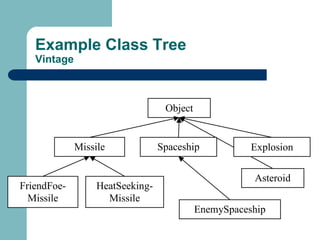
Example Class Tree
Vintage
Object
Missile Spaceship Explosion
FriendFoe-
Missile
HeatSeeking-
Missile
EnemySpaceship
Asteroid
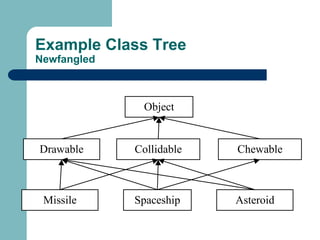
Example Class Tree
Newfangled
Object
Drawable Collidable Chewable
Missile Spaceship Asteroid
It Won’t Work
 There are hundreds of ways to decompose the
Go system problem into classes
– They are all wrong
– They don‟t start out wrong, of course…
 Games constantly change
– Designer makes decisions independently of
engineering type structures
– They will ask for things that cut right across
engineering concerns
Just Give In To Change
 Requirements get fuzzier the closer your code
gets to the content
 Will end up regularly refactoring
 Do not resist, will cause worse problems!
 However: C++ does not support this very well!!
C++: Not Flexible Enough
 Code has a tendency to “harden”
– Resists change over time
– Rearranging class tree requires lots of work
 Needing to change it causes engineering
frustration, which leads to…
– Class merging/hoisting (fights clean OOP)
– Virtual override madness
– Increased complexity  increasing resistance
– Doc rot, editor out of sync
Reexamine The Problem
 This is a database
– (a very well understood problem)
– “The data is important, nothing else matters”
 …and we‟re hard coding it every time
 To meet changing design needs, can‟t just
data-drive the object properties, must data-
drive structure (schema) of the objects
Solution: Component System
 Each component is a self-contained piece of
game logic
 Assemble components into Go‟s to build
complete objects
 Specification for assembly driven by data
 Lay out data in a C++-style specialization tree
to promote reuse and reduce memory usage
 Include and enforce an external schema
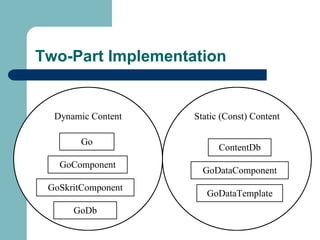
Two-Part Implementation
Static (Const) Content
Dynamic Content
Go
GoComponent
GoSkritComponent
GoDb
ContentDb
GoDataComponent
GoDataTemplate
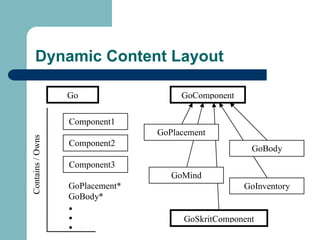
Dynamic Content Layout
GoComponent
GoPlacement
GoMind
GoInventory
GoBody
GoSkritComponent
Go
Component1
Component2
Component3
.
.
.
Contains
/
Owns
GoPlacement*
GoBody*
Extension: Skrit
(DS Scripting Language)
 Obvious requirement:
build components out of skrit
 Leave high performance components in C++
 Permits extremely fast prototyping
– No rebuilds required
– Don‟t even have to restart game (reload on the fly)
 Schema is internal
Extension: Skrit (Cont.)
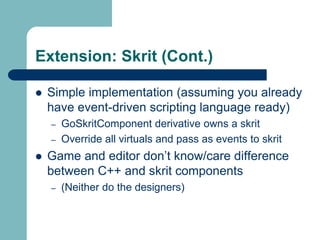
 Simple implementation (assuming you already
have event-driven scripting language ready)
– GoSkritComponent derivative owns a skrit
– Override all virtuals and pass as events to skrit
 Game and editor don‟t know/care difference
between C++ and skrit components
– (Neither do the designers)
21 C++ Components
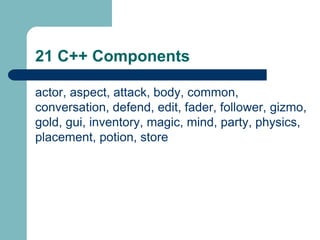
actor, aspect, attack, body, common,
conversation, defend, edit, fader, follower, gizmo,
gold, gui, inventory, magic, mind, party, physics,
placement, potion, store
148 Skrit components
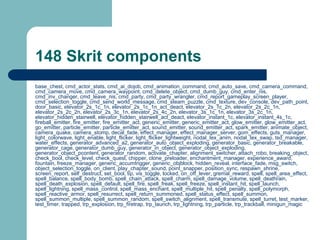
base_chest, cmd_actor_stats, cmd_ai_dojob, cmd_animation_command, cmd_auto_save, cmd_camera_command,
cmd_camera_move, cmd_camera_waypoint, cmd_delete_object, cmd_dumb_guy, cmd_enter_nis,
cmd_inv_changer, cmd_leave_nis, cmd_party, cmd_party_wrangler, cmd_report_gameplay_screen_player,
cmd_selection_toggle, cmd_send_world_message, cmd_steam_puzzle, cmd_texture, dev_console, dev_path_point,
door_basic, elevator_2s_1c_1n, elevator_2s_1c_1n_act_deact, elevator_2s_1c_2n, elevator_2s_2c_1n,
elevator_2s_2c_2n, elevator_2s_3c_1n, elevator_2s_4c_2n, elevator_3s_1c_1n, elevator_3s_2c_1n,
elevator_hidden_stairwell, elevator_hidden_stairwell_act_deact, elevator_instant_1c, elevator_instant_4s_1c,
fireball_emitter, fire_emitter, fire_emitter_act, generic_emitter, generic_emitter_act, glow_emitter, glow_emitter_act,
go_emitter, particle_emitter, particle_emitter_act, sound_emitter, sound_emitter_act, spark_emitter, animate_object,
camera_quake, camera_stomp, decal_fade, effect_manager, effect_manager_server, gom_effects, guts_manager,
light_colorwave, light_enable, light_flicker, light_flicker_lightweight, nodal_tex_anim, nodal_tex_swap, tsd_manager,
water_effects, generator_advanced_a2, generator_auto_object_exploding, generator_basic, generator_breakable,
generator_cage, generator_dumb_guy, generator_in_object, generator_object_exploding,
generator_object_pcontent, generator_random, activate_chapter, alignment_switcher, attach_robo, breaking_object,
check_bool, check_level, check_quest, chipper, clone_preloader, enchantment_manager, experience_award,
fountain, freeze_manager, generic_accumtrigger, generic_objblock, hidden_reveal, interface_fade, msg_switch,
object_selection_toggle, on_client, play_chapter_sound, point_snapper, position_sync, respawn_shrine,
screen_report, self_destruct, set_bool, tip, vis_toggle, locked, on_off_lever, gremal_reward, spell, spell_area_effect,
spell_balance, spell_body_bomb, spell_chain_attack, spell_charm, spell_damage_volume, spell_deathrain,
spell_death_explosion, spell_default, spell_fire, spell_freak, spell_freeze, spell_instant_hit, spell_launch,
spell_lightning, spell_mass_control, spell_mass_enchant, spell_multiple_hit, spell_penalty, spell_polymorph,
spell_reactive_armor, spell_resurrect, spell_return_summoned, spell_status_effect, spell_summon,
spell_summon_multiple, spell_summon_random, spell_switch_alignment, spell_transmute, spell_turret, test_marker,
test_timer, trapped, trp_explosion, trp_firetrap, trp_launch, trp_lightning, trp_particle, trp_trackball, minigun_magic
Alert! Before Moving On
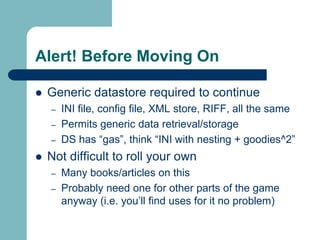
 Generic datastore required to continue
– INI file, config file, XML store, RIFF, all the same
– Permits generic data retrieval/storage
– DS has “gas”, think “INI with nesting + goodies^2”
 Not difficult to roll your own
– Many books/articles on this
– Probably need one for other parts of the game
anyway (i.e. you‟ll find uses for it no problem)
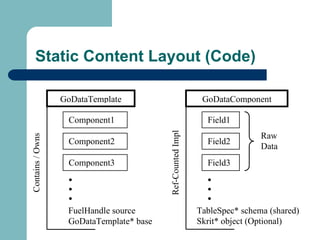
Static Content Layout (Code)
GoDataComponent
GoDataTemplate
Component1
Component2
Component3
.
.
.
Contains
/
Owns
FuelHandle source
GoDataTemplate* base
TableSpec* schema (shared)
Skrit* object (Optional)
Ref-Counted
Impl
Field1
Field2
Field3
.
.
.
Raw
Data
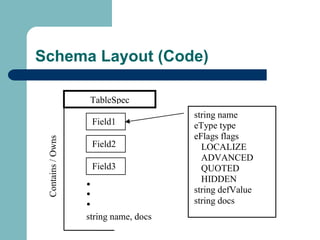
Schema Layout (Code)
TableSpec
.
.
.
Contains
/
Owns
string name, docs
Field1
Field2
Field3
string name
eType type
eFlags flags
LOCALIZE
ADVANCED
QUOTED
HIDDEN
string defValue
string docs
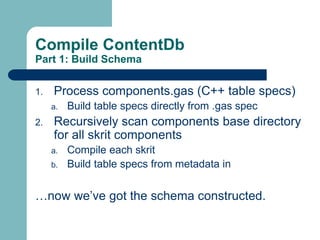
Compile ContentDb
Part 1: Build Schema
1. Process components.gas (C++ table specs)
a. Build table specs directly from .gas spec
2. Recursively scan components base directory
for all skrit components
a. Compile each skrit
b. Build table specs from metadata in
…now we‟ve got the schema constructed.
C++ Component Schema (Data)
[t:component,n:gui]
{
doc = "Objects with GUI may be placed in inventory";
required_component* = aspect;
[inventory_icon]
{
type = string; default = b_gui_ig_i_it_def;
doc = "Bitmap displayed when dragging or in inventory";
}
[active_icon]
{
type = string; default = b_gui_ig_i_ic_def;
doc = "Bitmap displayed in quick-select window";
}
...
}
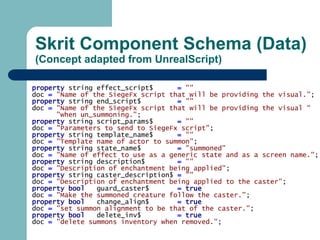
Skrit Component Schema (Data)
(Concept adapted from UnrealScript)
property string effect_script$ = ""
doc = "Name of the SiegeFx script that will be providing the visual.";
property string end_script$ = ""
doc = "Name of the SiegeFx script that will be providing the visual “
"when un_summoning.";
property string script_params$ = ""
doc = "Parameters to send to SiegeFx script";
property string template_name$ = ""
doc = "Template name of actor to summon";
property string state_name$ = "summoned"
doc = "Name of effect to use as a generic state and as a screen name.";
property string description$ = ""
doc = "Description of enchantment being applied";
property string caster_description$ = ""
doc = "Description of enchantment being applied to the caster";
property bool guard_caster$ = true
doc = "Make the summoned creature follow the caster.";
property bool change_align$ = true
doc = "set summon alignment to be that of the caster.";
property bool delete_inv$ = true
doc = "delete summons inventory when removed.";
Compile ContentDb
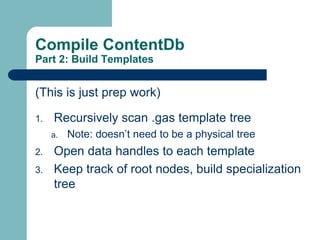
Part 2: Build Templates
(This is just prep work)
1. Recursively scan .gas template tree
a. Note: doesn‟t need to be a physical tree
2. Open data handles to each template
3. Keep track of root nodes, build specialization
tree
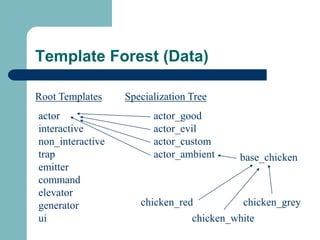
Template Forest (Data)
actor
interactive
non_interactive
trap
emitter
command
elevator
generator
ui
Root Templates
actor_good
actor_evil
actor_custom
actor_ambient base_chicken
chicken_red
chicken_white
chicken_grey
Specialization Tree
Template
Specification
(Data)
[t:template,n:chicken_white]
{
category_name = "1W_ambients";
doc = "chicken_white";
specializes = base_chicken;
[aspect]
{
[textures] { 0=b_c_na_ckn_white; }
}
[common]
{
[template_triggers]
{
[*]
{
action* = call_sfx_script("feathers_flap_white");
condition* = receive_world_message("we_anim_sfx",1);
}
}
}
[physics]
{
break_effect = feathers_white;
explode_when_killed = true;
}
}
Compile ContentDb
Part 3: Compile Templates
1. Recursively compile templates root-down
2. Add data components on demand
3. Read in values, override base template fields
This is all similar to C++ base-first member
initialization in ctors.
Compile ContentDb
Special notes
• We want a flat tree for performance reasons
• Depends on how frequently you construct objects and how fast
your data override system is
• Also permits special const-read optimization that can eliminate
memory usage and CPU for variables that are never changed
• Copy data components on write to avoid unnecessary
memory usage
• If have many templates, will need to JIT compile leaf
templates to save memory
Editor Integration
 This is almost trivial
 Editor should have a property sheet type thing
– This is a one-entry view into the db
– Map types and names onto fields using schema
– Can un-override easily by querying template
– Be sure to add a column or tooltip for docs!
Editor Integration (Cont.)
 For DS all editing support done through a
special “GoEdit” component
– Transforms data between game object and editor
– Supports cheap rollback (undo) by double buffering
– Does not exist in game, only needed in editor
– Automates saving all game object instances – just
compare vs. the const data and write out if different
 Not recommended: permitting forced overrides
of duplicate data
Instance Specification (Data)
[t:chicken_red,n:0x837FD928]
{
[placement]
{
p position = 1.3,0,1.8,0x1738FFDB;
q orientation = 0.3828,0.2384,-0.7772,0.98;
}
[common]
{
screen_name = "Super Chicken";
}
[body]
{
avg_move_velocity = 18.000000;
}
}
Loading Objects
 In DS, objects are referenced by content ID
 Look up instance block to get template to use
 Instantiate Go by that template
– For each block in instance, create a new data
component
– Specialize that data component from base in
template
– Finally iterate through GoComponents and xfer in
data to set initial values
New C++ Components
 Can be done with little regard for other components
(just add it)
 Derive from GoComponent only
– Specializing an existing class just asking for trouble
 Add new block to C++ components schema (DOC IT)
 Use a factory method
– Simple LUT mapping name  „new GoJooky‟
 Wait a second, wouldn‟t it be better to write using the
scripting language? (Probably…)
New Skrit Components
 Same as C++, just stick it in there
 Everything should be autodetect here
 Extend the scripting language with metadata
– Pass it straight through to schema query
– Can implement flags, docs, and custom game
features like “server only” components etc.
Managing the Template Tree
 Can be maintained by nearly anyone once it‟s set up
 Should have multiple roots for broad types
 Try to avoid data duplication
 Reserve one branch for test templates
– Mark it dev-only (so is excluded for retail build)
– Prefix with test_ or dev_ to avoid namespace pollution
– DS ended up with 150 or so
Advantages I Forgot To Mention
 Direct and automatic editor support
 Designers can construct their own types to place in the
editor (careful, monitor this!)
 By only saving out modified data in instances, can
make global changes easily by modifying templates
 Reorganizing the template tree is easy
 If embed a sub-tree for designers to build custom views
into the database
Some Pitfalls
 C++ components prone to becoming intertwined
– Operations can end up being order-dependent, though this is
more easily controlled
– Nothing here is unique to components
 It‟s a little too easy to add templates, perhaps
– DS has >7300 of them, many auto-generated
– System was designed for <100
– Need to keep close eye on template complexity to avoid
memory/CPU hog (i.e. unnecessary components or wacky
specialization)
 “With power comes responsibility”
Future
 Schema extensible
 Add flags and constraints that editor can use
– Auto-detect when can use color chooser or slider or
listbox or whatever
 Add defaults computed from script
Contact Info
Scott Bilas
http://scottbilas.com

a data driven game object system

  • 1.
    A Data-Driven Game ObjectSystem GDC 2002 Scott Bilas Gas Powered Games
  • 2.
    Introduction  Me – ScottBilas – Background  You – System architect types – Tired of fighting with statically typed systems for game code  The Test Subject – Dungeon Siege – >7300 unique object types (i.e. can be placed in the editor) – >100000 objects placed in our two maps – Continuous world means anything can load at any time
  • 3.
  • 4.
    Definitions  Data-Driven – Meaning:“No engineer required” – Engineers are slow – Causes designers to hack around missing functionality – Goal: remove C/C++ from game – Line between engine and content is always moving
  • 5.
    Definitions (Cont.)  GameObject (Go) – Piece of logical interactive content – Perform tasks like rendering, path finding, path following, speaking, animating, persisting – Examples are trees, bushes, monsters, levers, waypoint markers, doors, heroes, inventory items – Many are “pure logic”, never see them (triggers, elevator movers, camera sequences) – Every game has these in some form
  • 6.
    Definitions (Cont.)  GameObject System – Constructs and manages Go‟s – Maps ID‟s to object pointers – Routes messages – Build from many things, but for this talk  GoDb: Go database  ContentDb: Static content database – Every game has this in some form
  • 7.
    Example Class Tree Vintage Object MissileSpaceship Explosion FriendFoe- Missile HeatSeeking- Missile EnemySpaceship Asteroid
  • 8.
    Example Class Tree Newfangled Object DrawableCollidable Chewable Missile Spaceship Asteroid
  • 9.
    It Won’t Work There are hundreds of ways to decompose the Go system problem into classes – They are all wrong – They don‟t start out wrong, of course…  Games constantly change – Designer makes decisions independently of engineering type structures – They will ask for things that cut right across engineering concerns
  • 10.
    Just Give InTo Change  Requirements get fuzzier the closer your code gets to the content  Will end up regularly refactoring  Do not resist, will cause worse problems!  However: C++ does not support this very well!!
  • 11.
    C++: Not FlexibleEnough  Code has a tendency to “harden” – Resists change over time – Rearranging class tree requires lots of work  Needing to change it causes engineering frustration, which leads to… – Class merging/hoisting (fights clean OOP) – Virtual override madness – Increased complexity  increasing resistance – Doc rot, editor out of sync
  • 12.
    Reexamine The Problem This is a database – (a very well understood problem) – “The data is important, nothing else matters”  …and we‟re hard coding it every time  To meet changing design needs, can‟t just data-drive the object properties, must data- drive structure (schema) of the objects
  • 13.
    Solution: Component System Each component is a self-contained piece of game logic  Assemble components into Go‟s to build complete objects  Specification for assembly driven by data  Lay out data in a C++-style specialization tree to promote reuse and reduce memory usage  Include and enforce an external schema
  • 14.
    Two-Part Implementation Static (Const)Content Dynamic Content Go GoComponent GoSkritComponent GoDb ContentDb GoDataComponent GoDataTemplate
  • 15.
  • 16.
    Extension: Skrit (DS ScriptingLanguage)  Obvious requirement: build components out of skrit  Leave high performance components in C++  Permits extremely fast prototyping – No rebuilds required – Don‟t even have to restart game (reload on the fly)  Schema is internal
  • 17.
    Extension: Skrit (Cont.) Simple implementation (assuming you already have event-driven scripting language ready) – GoSkritComponent derivative owns a skrit – Override all virtuals and pass as events to skrit  Game and editor don‟t know/care difference between C++ and skrit components – (Neither do the designers)
  • 18.
    21 C++ Components actor,aspect, attack, body, common, conversation, defend, edit, fader, follower, gizmo, gold, gui, inventory, magic, mind, party, physics, placement, potion, store
  • 19.
    148 Skrit components base_chest,cmd_actor_stats, cmd_ai_dojob, cmd_animation_command, cmd_auto_save, cmd_camera_command, cmd_camera_move, cmd_camera_waypoint, cmd_delete_object, cmd_dumb_guy, cmd_enter_nis, cmd_inv_changer, cmd_leave_nis, cmd_party, cmd_party_wrangler, cmd_report_gameplay_screen_player, cmd_selection_toggle, cmd_send_world_message, cmd_steam_puzzle, cmd_texture, dev_console, dev_path_point, door_basic, elevator_2s_1c_1n, elevator_2s_1c_1n_act_deact, elevator_2s_1c_2n, elevator_2s_2c_1n, elevator_2s_2c_2n, elevator_2s_3c_1n, elevator_2s_4c_2n, elevator_3s_1c_1n, elevator_3s_2c_1n, elevator_hidden_stairwell, elevator_hidden_stairwell_act_deact, elevator_instant_1c, elevator_instant_4s_1c, fireball_emitter, fire_emitter, fire_emitter_act, generic_emitter, generic_emitter_act, glow_emitter, glow_emitter_act, go_emitter, particle_emitter, particle_emitter_act, sound_emitter, sound_emitter_act, spark_emitter, animate_object, camera_quake, camera_stomp, decal_fade, effect_manager, effect_manager_server, gom_effects, guts_manager, light_colorwave, light_enable, light_flicker, light_flicker_lightweight, nodal_tex_anim, nodal_tex_swap, tsd_manager, water_effects, generator_advanced_a2, generator_auto_object_exploding, generator_basic, generator_breakable, generator_cage, generator_dumb_guy, generator_in_object, generator_object_exploding, generator_object_pcontent, generator_random, activate_chapter, alignment_switcher, attach_robo, breaking_object, check_bool, check_level, check_quest, chipper, clone_preloader, enchantment_manager, experience_award, fountain, freeze_manager, generic_accumtrigger, generic_objblock, hidden_reveal, interface_fade, msg_switch, object_selection_toggle, on_client, play_chapter_sound, point_snapper, position_sync, respawn_shrine, screen_report, self_destruct, set_bool, tip, vis_toggle, locked, on_off_lever, gremal_reward, spell, spell_area_effect, spell_balance, spell_body_bomb, spell_chain_attack, spell_charm, spell_damage_volume, spell_deathrain, spell_death_explosion, spell_default, spell_fire, spell_freak, spell_freeze, spell_instant_hit, spell_launch, spell_lightning, spell_mass_control, spell_mass_enchant, spell_multiple_hit, spell_penalty, spell_polymorph, spell_reactive_armor, spell_resurrect, spell_return_summoned, spell_status_effect, spell_summon, spell_summon_multiple, spell_summon_random, spell_switch_alignment, spell_transmute, spell_turret, test_marker, test_timer, trapped, trp_explosion, trp_firetrap, trp_launch, trp_lightning, trp_particle, trp_trackball, minigun_magic
  • 20.
    Alert! Before MovingOn  Generic datastore required to continue – INI file, config file, XML store, RIFF, all the same – Permits generic data retrieval/storage – DS has “gas”, think “INI with nesting + goodies^2”  Not difficult to roll your own – Many books/articles on this – Probably need one for other parts of the game anyway (i.e. you‟ll find uses for it no problem)
  • 21.
    Static Content Layout(Code) GoDataComponent GoDataTemplate Component1 Component2 Component3 . . . Contains / Owns FuelHandle source GoDataTemplate* base TableSpec* schema (shared) Skrit* object (Optional) Ref-Counted Impl Field1 Field2 Field3 . . . Raw Data
  • 22.
    Schema Layout (Code) TableSpec . . . Contains / Owns stringname, docs Field1 Field2 Field3 string name eType type eFlags flags LOCALIZE ADVANCED QUOTED HIDDEN string defValue string docs
  • 23.
    Compile ContentDb Part 1:Build Schema 1. Process components.gas (C++ table specs) a. Build table specs directly from .gas spec 2. Recursively scan components base directory for all skrit components a. Compile each skrit b. Build table specs from metadata in …now we‟ve got the schema constructed.
  • 24.
    C++ Component Schema(Data) [t:component,n:gui] { doc = "Objects with GUI may be placed in inventory"; required_component* = aspect; [inventory_icon] { type = string; default = b_gui_ig_i_it_def; doc = "Bitmap displayed when dragging or in inventory"; } [active_icon] { type = string; default = b_gui_ig_i_ic_def; doc = "Bitmap displayed in quick-select window"; } ... }
  • 25.
    Skrit Component Schema(Data) (Concept adapted from UnrealScript) property string effect_script$ = "" doc = "Name of the SiegeFx script that will be providing the visual."; property string end_script$ = "" doc = "Name of the SiegeFx script that will be providing the visual “ "when un_summoning."; property string script_params$ = "" doc = "Parameters to send to SiegeFx script"; property string template_name$ = "" doc = "Template name of actor to summon"; property string state_name$ = "summoned" doc = "Name of effect to use as a generic state and as a screen name."; property string description$ = "" doc = "Description of enchantment being applied"; property string caster_description$ = "" doc = "Description of enchantment being applied to the caster"; property bool guard_caster$ = true doc = "Make the summoned creature follow the caster."; property bool change_align$ = true doc = "set summon alignment to be that of the caster."; property bool delete_inv$ = true doc = "delete summons inventory when removed.";
  • 26.
    Compile ContentDb Part 2:Build Templates (This is just prep work) 1. Recursively scan .gas template tree a. Note: doesn‟t need to be a physical tree 2. Open data handles to each template 3. Keep track of root nodes, build specialization tree
  • 27.
    Template Forest (Data) actor interactive non_interactive trap emitter command elevator generator ui RootTemplates actor_good actor_evil actor_custom actor_ambient base_chicken chicken_red chicken_white chicken_grey Specialization Tree
  • 28.
    Template Specification (Data) [t:template,n:chicken_white] { category_name = "1W_ambients"; doc= "chicken_white"; specializes = base_chicken; [aspect] { [textures] { 0=b_c_na_ckn_white; } } [common] { [template_triggers] { [*] { action* = call_sfx_script("feathers_flap_white"); condition* = receive_world_message("we_anim_sfx",1); } } } [physics] { break_effect = feathers_white; explode_when_killed = true; } }
  • 29.
    Compile ContentDb Part 3:Compile Templates 1. Recursively compile templates root-down 2. Add data components on demand 3. Read in values, override base template fields This is all similar to C++ base-first member initialization in ctors.
  • 30.
    Compile ContentDb Special notes •We want a flat tree for performance reasons • Depends on how frequently you construct objects and how fast your data override system is • Also permits special const-read optimization that can eliminate memory usage and CPU for variables that are never changed • Copy data components on write to avoid unnecessary memory usage • If have many templates, will need to JIT compile leaf templates to save memory
  • 31.
    Editor Integration  Thisis almost trivial  Editor should have a property sheet type thing – This is a one-entry view into the db – Map types and names onto fields using schema – Can un-override easily by querying template – Be sure to add a column or tooltip for docs!
  • 32.
    Editor Integration (Cont.) For DS all editing support done through a special “GoEdit” component – Transforms data between game object and editor – Supports cheap rollback (undo) by double buffering – Does not exist in game, only needed in editor – Automates saving all game object instances – just compare vs. the const data and write out if different  Not recommended: permitting forced overrides of duplicate data
  • 33.
    Instance Specification (Data) [t:chicken_red,n:0x837FD928] { [placement] { pposition = 1.3,0,1.8,0x1738FFDB; q orientation = 0.3828,0.2384,-0.7772,0.98; } [common] { screen_name = "Super Chicken"; } [body] { avg_move_velocity = 18.000000; } }
  • 34.
    Loading Objects  InDS, objects are referenced by content ID  Look up instance block to get template to use  Instantiate Go by that template – For each block in instance, create a new data component – Specialize that data component from base in template – Finally iterate through GoComponents and xfer in data to set initial values
  • 35.
    New C++ Components Can be done with little regard for other components (just add it)  Derive from GoComponent only – Specializing an existing class just asking for trouble  Add new block to C++ components schema (DOC IT)  Use a factory method – Simple LUT mapping name  „new GoJooky‟  Wait a second, wouldn‟t it be better to write using the scripting language? (Probably…)
  • 36.
    New Skrit Components Same as C++, just stick it in there  Everything should be autodetect here  Extend the scripting language with metadata – Pass it straight through to schema query – Can implement flags, docs, and custom game features like “server only” components etc.
  • 37.
    Managing the TemplateTree  Can be maintained by nearly anyone once it‟s set up  Should have multiple roots for broad types  Try to avoid data duplication  Reserve one branch for test templates – Mark it dev-only (so is excluded for retail build) – Prefix with test_ or dev_ to avoid namespace pollution – DS ended up with 150 or so
  • 38.
    Advantages I ForgotTo Mention  Direct and automatic editor support  Designers can construct their own types to place in the editor (careful, monitor this!)  By only saving out modified data in instances, can make global changes easily by modifying templates  Reorganizing the template tree is easy  If embed a sub-tree for designers to build custom views into the database
  • 39.
    Some Pitfalls  C++components prone to becoming intertwined – Operations can end up being order-dependent, though this is more easily controlled – Nothing here is unique to components  It‟s a little too easy to add templates, perhaps – DS has >7300 of them, many auto-generated – System was designed for <100 – Need to keep close eye on template complexity to avoid memory/CPU hog (i.e. unnecessary components or wacky specialization)  “With power comes responsibility”
  • 40.
    Future  Schema extensible Add flags and constraints that editor can use – Auto-detect when can use color chooser or slider or listbox or whatever  Add defaults computed from script
  • 41.