A Critical Theory of Library Technology:  Libraries & Electronic Publishing  Ajit K. Pyati, Ph.D. Assistant Professor Faculty of Information and Media Studies University of Western Ontario July 13, 2007 PKP Scholarly Publishing Conference 2007 Vancouver, BC
Today’s Presentation Background: Electronic Publishing in the “Information Society” What is “critical theory?” A Critical Theory of Library Technology  A Case Study: Libraries & Electronic Publishing  Q & A
Research Background Information society linked to connectivity, access to ICTs; World Summit on the Information Society (WSIS) Technological determinism; information commodification Packaging of certain political/economic structures with ICTs
Scholarly Publication “Crisis”  Needs to be viewed in the context of the dominant information society vision Electronic licensing of journals prohibitively expensive for many libraries Concentration of academic publishers - monopoly over scholarly knowledge production Increasing commodification of knowledge/information
Libraries’ Responses to the “Crisis” Cutting subscriptions Advocacy - ALA, CLA, ACRL, IFLA Open access movements
Open Access Initiatives (OA) Response to scholarly publication crisis - Harnad, Suber, Willinsky, etc. Varying forms of open access - repositories, OA journals, self-archiving, delayed OA, etc.
Libraries in the Face of a Crisis: Need for Critical Theories for Action/Reflection What are different social theories we can draw upon to derive theoretical frameworks to understand library-based OA advocacy? Need for critical theory in the field
Library Ethics and Values  Libraries and values of democratic access to information How can we extend these values to the realm of technology in libraries?  What does democratization mean in the context of library technology?
What is “critical theory?” Social theory with origins in Germany - Institute for Social Research (founded 1923) - “Frankfurt School” of critical theory Multidisciplinary perspective - combining macro and micro perspectives, making connections Transformative  social theory for action/reflection Deals with emancipatory concerns within the context of oppressive socio-economic, political, and ideological conditions
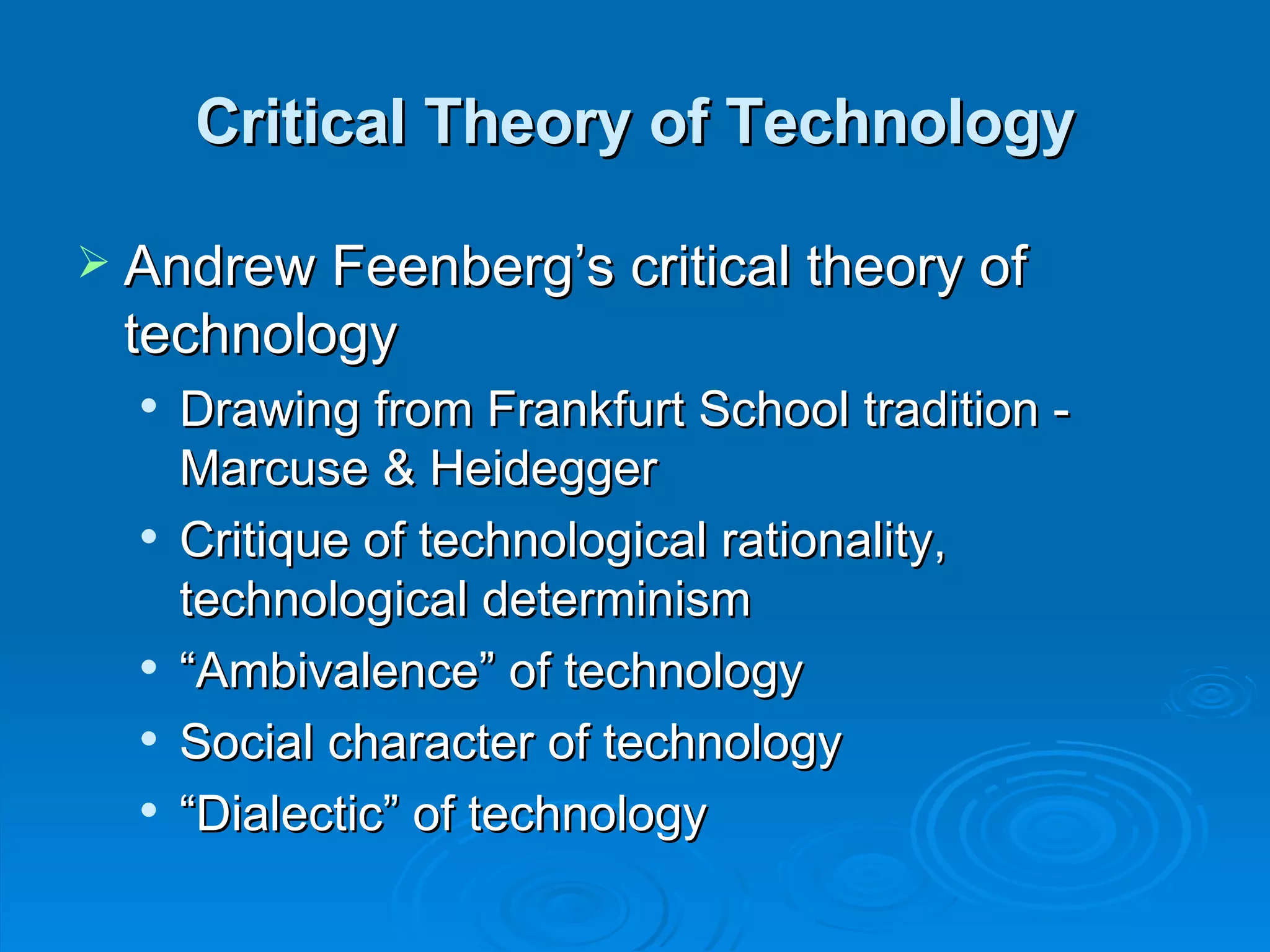
Critical Theory of Technology Andrew Feenberg’s critical theory of technology  Drawing from Frankfurt School tradition - Marcuse & Heidegger Critique of technological rationality, technological determinism “ Ambivalence” of technology Social character of technology  “ Dialectic” of technology
Critical Theory of Technology (2) Democratization of technology “ Opening technical development to the influence of a wider range of values is a technical project requiring broad democratic participation” (Feenberg, 2002, p.35) Feenberg, A. (2002).  Transforming Technology: A Critical Theory Revisited.  Oxford University Press: New York .
Questions for Consideration What are the dimensions of a   critical theory of technology that can enhance library public service goals? Is the open access movement a route for libraries to reclaim and shape ICTs for enhancing public service missions and to democratize library technology development?
Critical Theory and Library Technology? How can critical theory of technology be applied to the library context? Building upon critical theory of technology and library technology studies, a “critical theory of library technology” framework is formulated
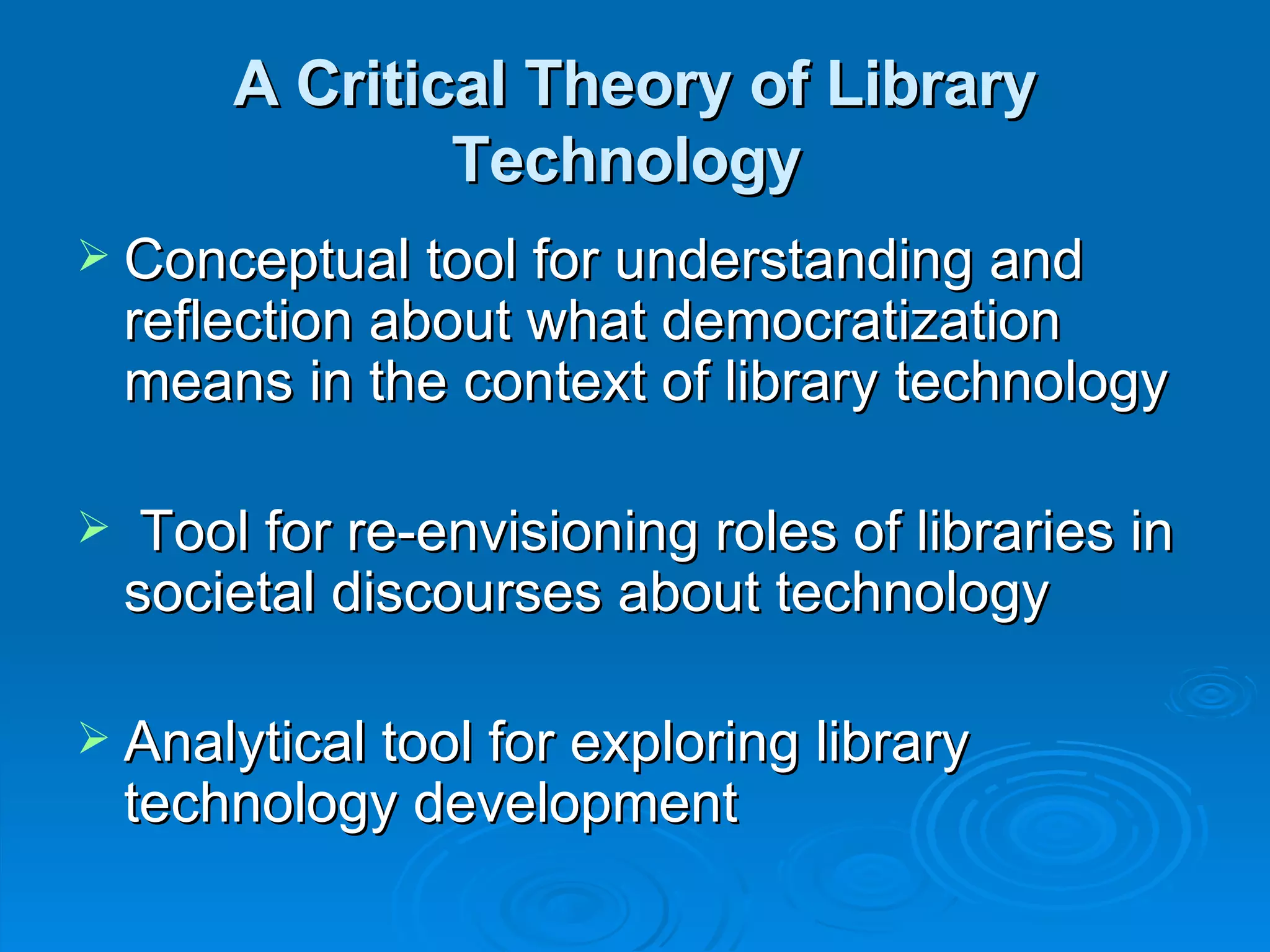
A Critical Theory of Library Technology  Conceptual tool for understanding and reflection about what democratization means in the context of library technology Tool for re-envisioning roles of libraries in societal discourses about technology Analytical tool for exploring library technology development
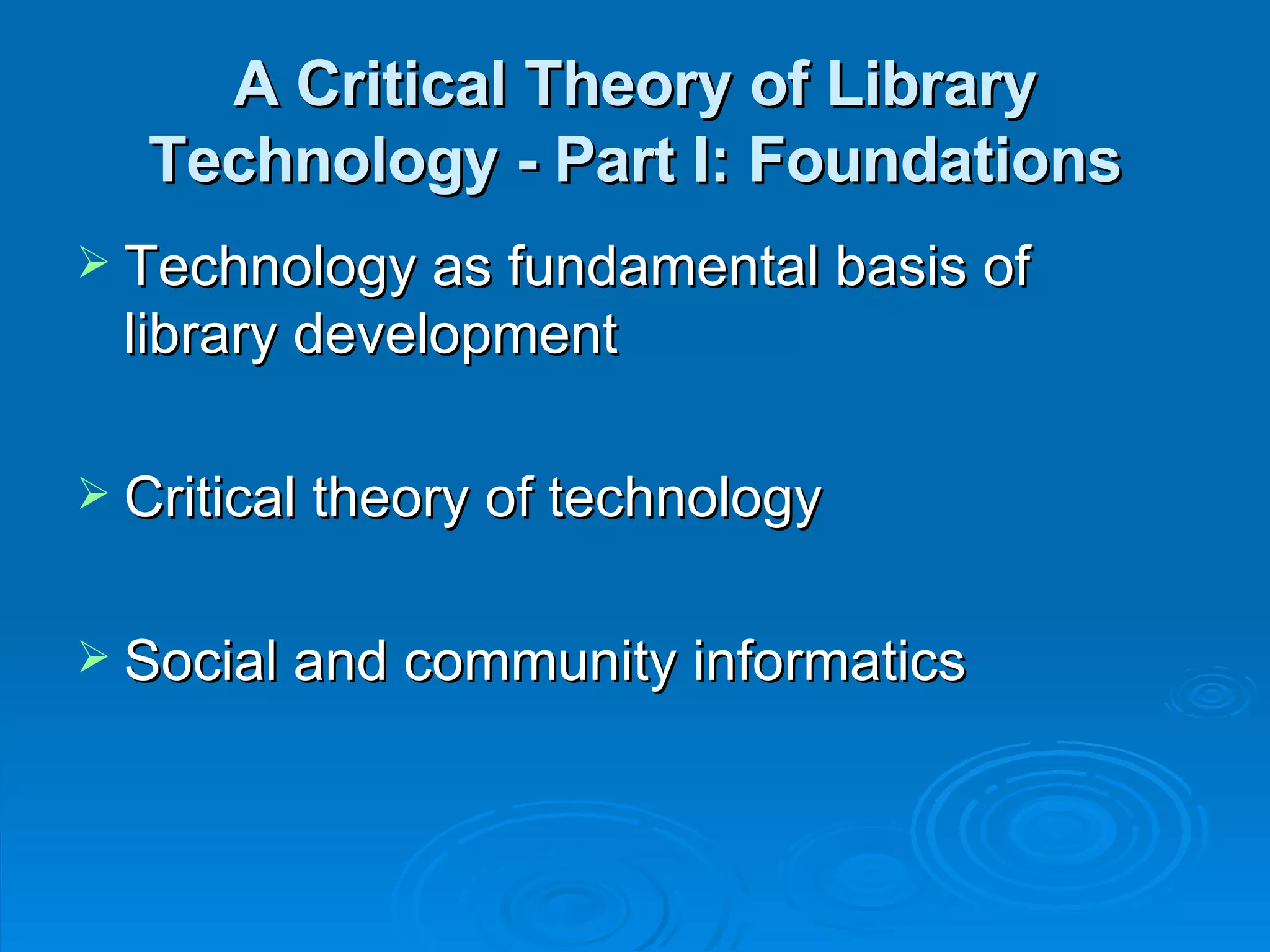
A Critical Theory of Library Technology - Part I: Foundations Technology as fundamental basis of library development  Critical theory of technology Social and community informatics
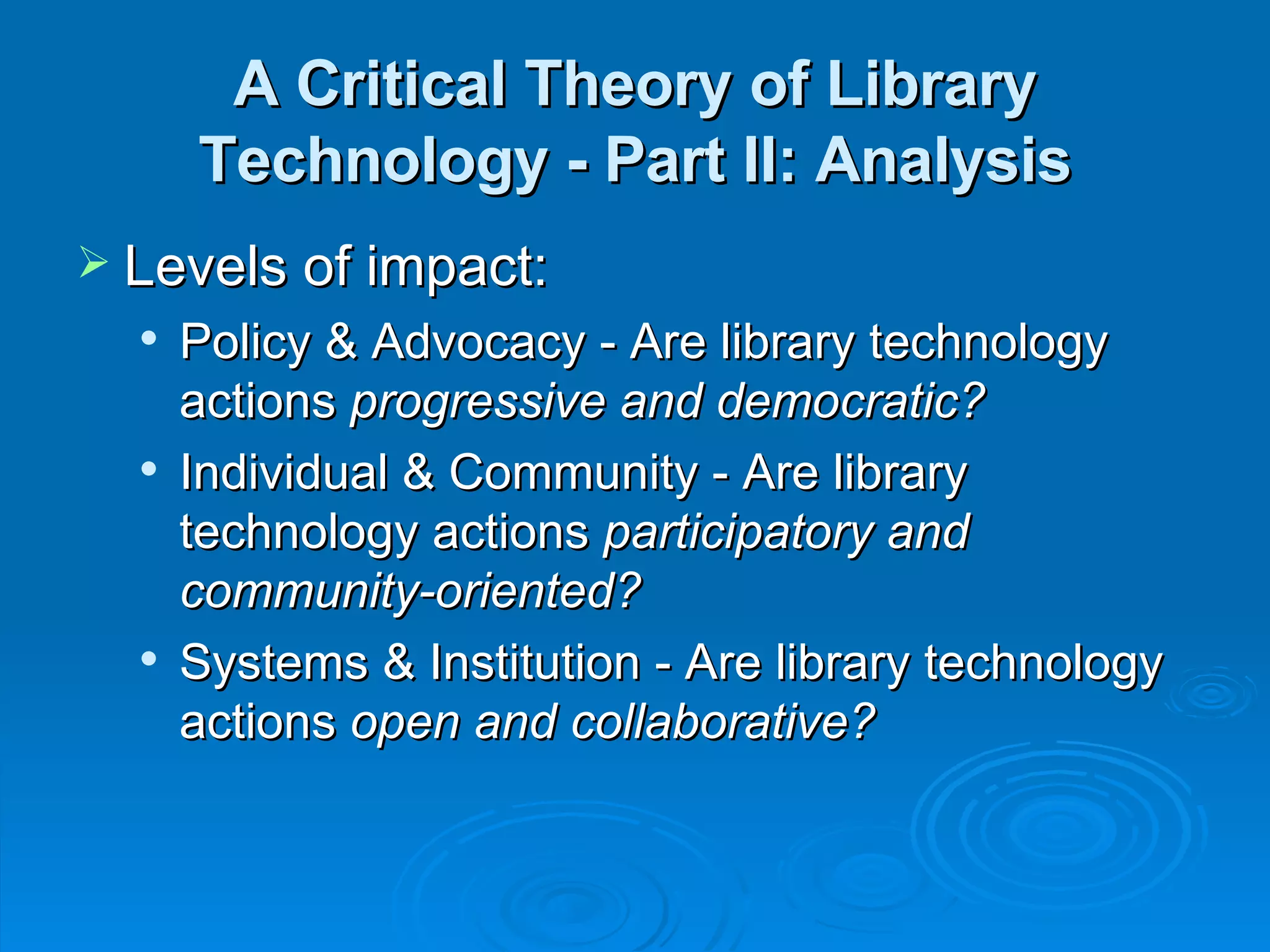
A Critical Theory of Library Technology - Part II: Analysis Levels of impact: Policy & Advocacy - Are library technology actions  progressive and democratic? Individual & Community - Are library technology actions  participatory and community-oriented? Systems & Institution - Are library technology actions  open and collaborative?
Critical Theory, OA and Libraries Libraries as “battlegrounds” for contesting increasing commodification of information Contesting “stranglehold” of commercial publishers Creating openings for more democratic production and access of scholarly knowledge Exposing tensions and contradictions of techno-capitalism
Critical Theory and Library Promotion of OA In-depth, “test” cases needed of library-based OA advocacy  Need for exemplars of library open access advocacy to begin applying the framework as a mode of analysis Does OA embody the principles and ethics of critical theory?
Future Research  How can we use the critical theory of library technology framework to study other library technology practices?  Open access publishing  Digital libraries Community archiving Community networks Digital reference Content development  Etc, etc. How can this framework adapt and incorporate other relevant social theories and approaches?
Thank You! Ajit Pyati [email_address]
Research Agenda  International library development Libraries and information access in the developing world  Information society & policy Culturally relevant and social justice-oriented ICT4D projects Globalization, migration, & ICTs Immigrant and diasporic communities and information behavior; new media technologies; politics and power of cultural representation

A Critical Theory of Library Technology: Libraries & Electronic Publishing

  • 1.
    A Critical Theoryof Library Technology: Libraries & Electronic Publishing Ajit K. Pyati, Ph.D. Assistant Professor Faculty of Information and Media Studies University of Western Ontario July 13, 2007 PKP Scholarly Publishing Conference 2007 Vancouver, BC
  • 2.
    Today’s Presentation Background:Electronic Publishing in the “Information Society” What is “critical theory?” A Critical Theory of Library Technology A Case Study: Libraries & Electronic Publishing Q & A
  • 3.
    Research Background Informationsociety linked to connectivity, access to ICTs; World Summit on the Information Society (WSIS) Technological determinism; information commodification Packaging of certain political/economic structures with ICTs
  • 4.
    Scholarly Publication “Crisis” Needs to be viewed in the context of the dominant information society vision Electronic licensing of journals prohibitively expensive for many libraries Concentration of academic publishers - monopoly over scholarly knowledge production Increasing commodification of knowledge/information
  • 5.
    Libraries’ Responses tothe “Crisis” Cutting subscriptions Advocacy - ALA, CLA, ACRL, IFLA Open access movements
  • 6.
    Open Access Initiatives(OA) Response to scholarly publication crisis - Harnad, Suber, Willinsky, etc. Varying forms of open access - repositories, OA journals, self-archiving, delayed OA, etc.
  • 7.
    Libraries in theFace of a Crisis: Need for Critical Theories for Action/Reflection What are different social theories we can draw upon to derive theoretical frameworks to understand library-based OA advocacy? Need for critical theory in the field
  • 8.
    Library Ethics andValues Libraries and values of democratic access to information How can we extend these values to the realm of technology in libraries? What does democratization mean in the context of library technology?
  • 9.
    What is “criticaltheory?” Social theory with origins in Germany - Institute for Social Research (founded 1923) - “Frankfurt School” of critical theory Multidisciplinary perspective - combining macro and micro perspectives, making connections Transformative social theory for action/reflection Deals with emancipatory concerns within the context of oppressive socio-economic, political, and ideological conditions
  • 10.
    Critical Theory ofTechnology Andrew Feenberg’s critical theory of technology Drawing from Frankfurt School tradition - Marcuse & Heidegger Critique of technological rationality, technological determinism “ Ambivalence” of technology Social character of technology “ Dialectic” of technology
  • 11.
    Critical Theory ofTechnology (2) Democratization of technology “ Opening technical development to the influence of a wider range of values is a technical project requiring broad democratic participation” (Feenberg, 2002, p.35) Feenberg, A. (2002). Transforming Technology: A Critical Theory Revisited. Oxford University Press: New York .
  • 12.
    Questions for ConsiderationWhat are the dimensions of a critical theory of technology that can enhance library public service goals? Is the open access movement a route for libraries to reclaim and shape ICTs for enhancing public service missions and to democratize library technology development?
  • 13.
    Critical Theory andLibrary Technology? How can critical theory of technology be applied to the library context? Building upon critical theory of technology and library technology studies, a “critical theory of library technology” framework is formulated
  • 14.
    A Critical Theoryof Library Technology Conceptual tool for understanding and reflection about what democratization means in the context of library technology Tool for re-envisioning roles of libraries in societal discourses about technology Analytical tool for exploring library technology development
  • 15.
    A Critical Theoryof Library Technology - Part I: Foundations Technology as fundamental basis of library development Critical theory of technology Social and community informatics
  • 16.
    A Critical Theoryof Library Technology - Part II: Analysis Levels of impact: Policy & Advocacy - Are library technology actions progressive and democratic? Individual & Community - Are library technology actions participatory and community-oriented? Systems & Institution - Are library technology actions open and collaborative?
  • 17.
    Critical Theory, OAand Libraries Libraries as “battlegrounds” for contesting increasing commodification of information Contesting “stranglehold” of commercial publishers Creating openings for more democratic production and access of scholarly knowledge Exposing tensions and contradictions of techno-capitalism
  • 18.
    Critical Theory andLibrary Promotion of OA In-depth, “test” cases needed of library-based OA advocacy Need for exemplars of library open access advocacy to begin applying the framework as a mode of analysis Does OA embody the principles and ethics of critical theory?
  • 19.
    Future Research How can we use the critical theory of library technology framework to study other library technology practices? Open access publishing Digital libraries Community archiving Community networks Digital reference Content development Etc, etc. How can this framework adapt and incorporate other relevant social theories and approaches?
  • 20.
    Thank You! AjitPyati [email_address]
  • 21.
    Research Agenda International library development Libraries and information access in the developing world Information society & policy Culturally relevant and social justice-oriented ICT4D projects Globalization, migration, & ICTs Immigrant and diasporic communities and information behavior; new media technologies; politics and power of cultural representation