A CHECKLIST
PRESENTATIONS
PERSUASIVE
FOR MORE
BY DORIE CLARK
If you outline your presentation to ensure you cover these bases, you’re far more
likely to get the audience on your side quickly and achieve the result you desire.
Designed by
WHAT’S THE PROBLEM YOU’RE
SOLVING?
Explain the context and what matters up front. If not, you risk the audience tuning
out early on because they’re not sure if your idea is relevant.
WHY NOW?
Until you prove that the problem is urgent, and will continue to get worse unless
you address it, the inclination will be to “wait and see” or prioritize other things first.
Make sure you’ve clearly explained the cost of not taking action.
HOW HAS THE IDEA
BEEN VETTED?
You want to highlight evidence of your competence and the seriousness with which
you pursued this solution. For instance, it’s worth mentioning that your team
interviewed 100 leading researchers to identify the best practices you’re
recommending, or that you ran three pilots to test the concept.
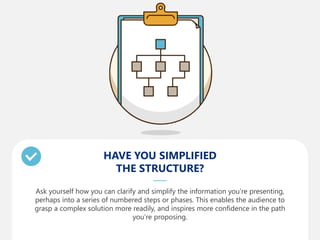
HAVE YOU SIMPLIFIED
THE STRUCTURE?
Ask yourself how you can clarify and simplify the information you’re presenting,
perhaps into a series of numbered steps or phases. This enables the audience to
grasp a complex solution more readily, and inspires more confidence in the path
you’re proposing.
HAVE YOU INCLUDED
A STORY?
That doesn’t mean concocting treacly leadership fables. But it does mean
recognizing that a piece of data can become more powerful if you pair it with a
concrete example to help others visualize what you’re talking about. Make sure your
outline includes at least one story to enliven your presentation.
HAVE YOU INCLUDED A CALL
TO ACTION?
If you’ve done your job up to this point, they’ll be on your side. Now you can clarify
for them exactly what action they can take to show their support.
DORIE CLARK
is a marketing strategist and professional speaker who teaches at
Duke University’s Fuqua School of Business. She is the author of
Reinventing You and Stand Out.

A Checklist for More Persuasive Presentations

  • 1.
    A CHECKLIST PRESENTATIONS PERSUASIVE FOR MORE BYDORIE CLARK If you outline your presentation to ensure you cover these bases, you’re far more likely to get the audience on your side quickly and achieve the result you desire. Designed by
  • 2.
    WHAT’S THE PROBLEMYOU’RE SOLVING? Explain the context and what matters up front. If not, you risk the audience tuning out early on because they’re not sure if your idea is relevant.
  • 3.
    WHY NOW? Until youprove that the problem is urgent, and will continue to get worse unless you address it, the inclination will be to “wait and see” or prioritize other things first. Make sure you’ve clearly explained the cost of not taking action.
  • 4.
    HOW HAS THEIDEA BEEN VETTED? You want to highlight evidence of your competence and the seriousness with which you pursued this solution. For instance, it’s worth mentioning that your team interviewed 100 leading researchers to identify the best practices you’re recommending, or that you ran three pilots to test the concept.
  • 5.
    HAVE YOU SIMPLIFIED THESTRUCTURE? Ask yourself how you can clarify and simplify the information you’re presenting, perhaps into a series of numbered steps or phases. This enables the audience to grasp a complex solution more readily, and inspires more confidence in the path you’re proposing.
  • 6.
    HAVE YOU INCLUDED ASTORY? That doesn’t mean concocting treacly leadership fables. But it does mean recognizing that a piece of data can become more powerful if you pair it with a concrete example to help others visualize what you’re talking about. Make sure your outline includes at least one story to enliven your presentation.
  • 7.
    HAVE YOU INCLUDEDA CALL TO ACTION? If you’ve done your job up to this point, they’ll be on your side. Now you can clarify for them exactly what action they can take to show their support.
  • 8.
    DORIE CLARK is amarketing strategist and professional speaker who teaches at Duke University’s Fuqua School of Business. She is the author of Reinventing You and Stand Out.