15BOARDROOM
PRESENTATION TIPS
Real world advice from seasoned presenters to help you survive and shine
through your boardroom experiences.
Review the latest set of director profiles early on in
the process. Don’t worry about memorizing details;
knowing who you’re addressing is common courtesy.
1 KNOW YOUR AUDIENCE
Directors see presentations from 30,000 feet.
Bring the project up to their horizon.
2 KEEP YOUR CONTENT
HIGH-LEVEL
3 PRACTICE YOUR PRESENTATION
It’s shocking how something so simple is rarely done. Practice
ensures your timing is on, transitions work, and your content
doesn’t fall flat. It also allows you to plan where to enunciate, pause
for effect and direct your audience's visual attention.
4 CHECK YOUR
ATTITUDE AT
THE DOOR
This advice applies to everyone,
even those in the C-suite.
5 DON’T WASTE YOUR ENERGY
TRYING TO READ THE ROOM
By and large, directors are experts at sublimating body language
and other tells. Focus on your message.
6 THANK THE AUDIENCE
A simple “thank you for inviting me today” is enough.
Don’t embellish.
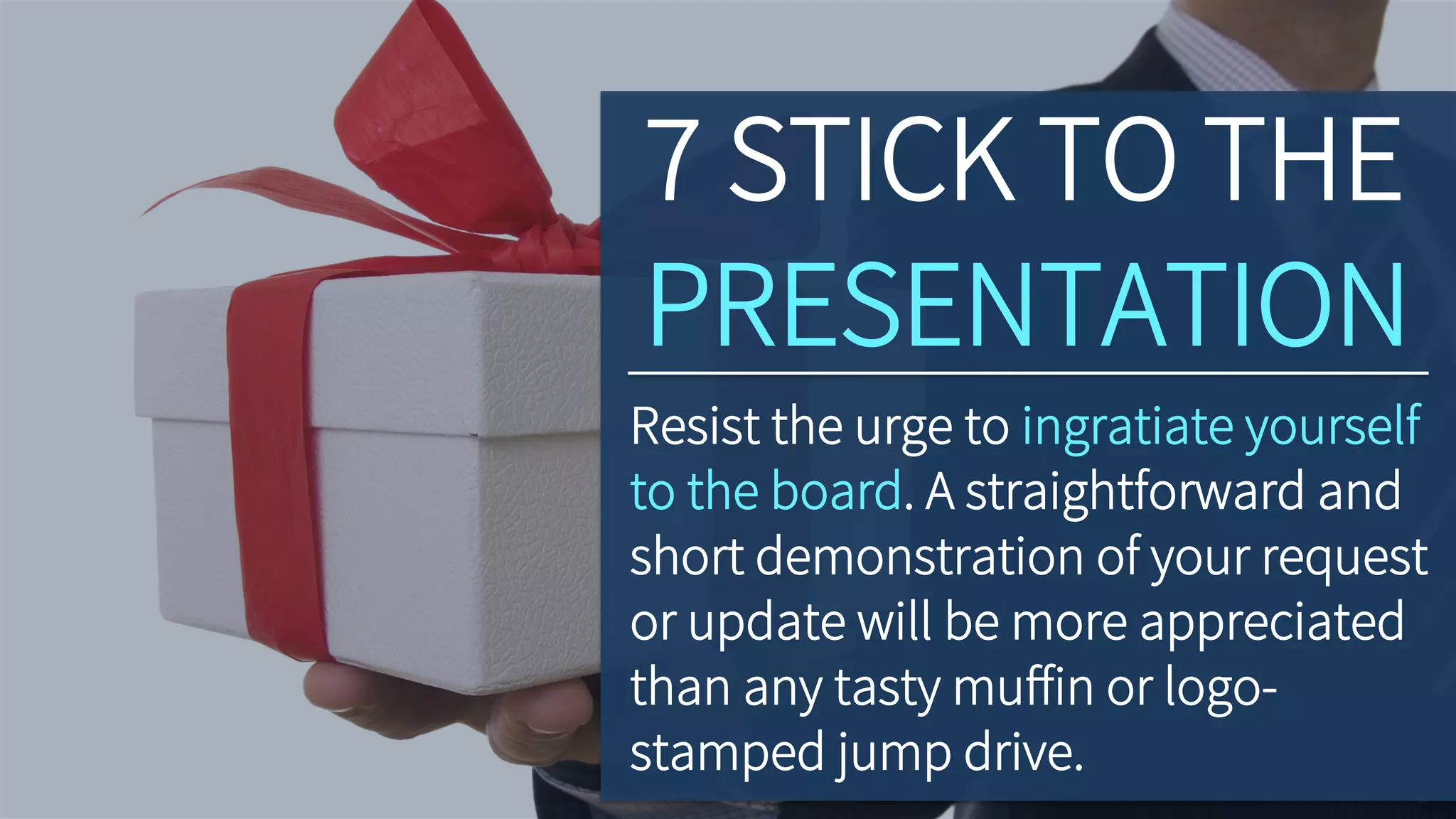
7 STICK TO THE
PRESENTATION
Resist the urge to ingratiate yourself
to the board. A straightforward and
short demonstration of your request
or update will be more appreciated
than any tasty muffin or logo-
stamped jump drive.
8 Steer Clear of
Jargon
Even if you feel everyone in the
room understands it. A slide
with a few bullet points can
clarify necessary shorthand.
9 TELL THE FACTS PLAINLY
As a general rule of thumb, don’t share anecdotes
unless they relate directly to the point of your
presentation. Customer stories can work in the right
scenario, but you can save that for Q&A or other
venues. Simple and straightforward is preferred.
10 EXPECT TO BE
INTERRUPTED
Just go with the flow. Know your
main points and be able to pick
back up in your presentation.
11 BE FLEXIBLE
Show up early and plan to stay a
little later. And, if at any time while
doing your presentation you are
asked to leave the room or wrap
things up, nod and comply without
question. Don’t take it personally.
Brevity equals impact. So be concise in
the time allotted and make sure to
leave room for questions.
12 DON’T GO LONG
13 IT’S OKAY TO
SAY I DON’T KNOW
Accept that you won’t have all the
answers. If you don’t know, say so and
promise to follow up with them after.
14 BE PREPARED
TO BE SURPRISED
Someone always asks the one
question you are least prepared to
answer. Don’t be thrown by that, and
refer to #13 when answering.
15 ASK FOR
SUPPORT
Your request is not
implied. You’ve come
this far; a simple closing
statement with your ask
brings the story full
circle.
15 Boardroom Presentation Tips

15 Boardroom Presentation Tips

  • 1.
    15BOARDROOM PRESENTATION TIPS Real worldadvice from seasoned presenters to help you survive and shine through your boardroom experiences.
  • 2.
    Review the latestset of director profiles early on in the process. Don’t worry about memorizing details; knowing who you’re addressing is common courtesy. 1 KNOW YOUR AUDIENCE
  • 3.
    Directors see presentationsfrom 30,000 feet. Bring the project up to their horizon. 2 KEEP YOUR CONTENT HIGH-LEVEL
  • 4.
    3 PRACTICE YOURPRESENTATION It’s shocking how something so simple is rarely done. Practice ensures your timing is on, transitions work, and your content doesn’t fall flat. It also allows you to plan where to enunciate, pause for effect and direct your audience's visual attention.
  • 5.
    4 CHECK YOUR ATTITUDEAT THE DOOR This advice applies to everyone, even those in the C-suite.
  • 6.
    5 DON’T WASTEYOUR ENERGY TRYING TO READ THE ROOM By and large, directors are experts at sublimating body language and other tells. Focus on your message.
  • 7.
    6 THANK THEAUDIENCE A simple “thank you for inviting me today” is enough. Don’t embellish.
  • 8.
    7 STICK TOTHE PRESENTATION Resist the urge to ingratiate yourself to the board. A straightforward and short demonstration of your request or update will be more appreciated than any tasty muffin or logo- stamped jump drive.
  • 9.
    8 Steer Clearof Jargon Even if you feel everyone in the room understands it. A slide with a few bullet points can clarify necessary shorthand.
  • 10.
    9 TELL THEFACTS PLAINLY As a general rule of thumb, don’t share anecdotes unless they relate directly to the point of your presentation. Customer stories can work in the right scenario, but you can save that for Q&A or other venues. Simple and straightforward is preferred.
  • 11.
    10 EXPECT TOBE INTERRUPTED Just go with the flow. Know your main points and be able to pick back up in your presentation.
  • 12.
    11 BE FLEXIBLE Showup early and plan to stay a little later. And, if at any time while doing your presentation you are asked to leave the room or wrap things up, nod and comply without question. Don’t take it personally.
  • 13.
    Brevity equals impact.So be concise in the time allotted and make sure to leave room for questions. 12 DON’T GO LONG
  • 14.
    13 IT’S OKAYTO SAY I DON’T KNOW Accept that you won’t have all the answers. If you don’t know, say so and promise to follow up with them after.
  • 15.
    14 BE PREPARED TOBE SURPRISED Someone always asks the one question you are least prepared to answer. Don’t be thrown by that, and refer to #13 when answering.
  • 16.
    15 ASK FOR SUPPORT Yourrequest is not implied. You’ve come this far; a simple closing statement with your ask brings the story full circle.