users are people, too
using user research to remember
your users are actually people.
rachel price
who am I?
user researcher
information architect
partner at factor
UW iSchool alum
bandleader
user research is
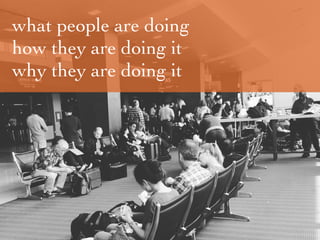
observation
what people are doing
how they are doing it
why they are doing it
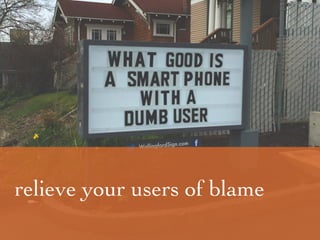
relieve your users of blame
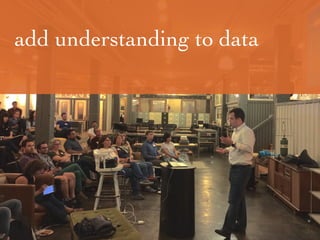
add understanding to data
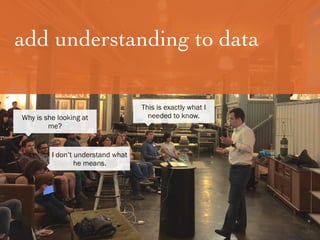
This is exactly what I
needed to know.Why is she looking at
me?
I don’t understand what
he means.
add understanding to data
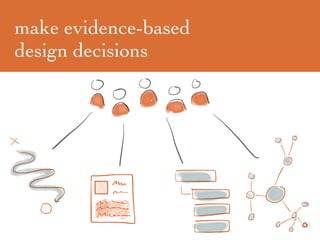
make evidence-based
design decisions
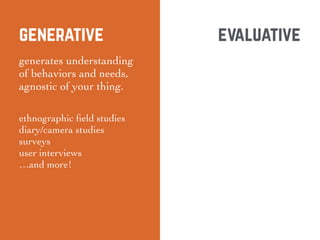
generative evaluative
generative
generates understanding
of behaviors and needs,
agnostic of your thing.
ethnographic field studies
diary/camera studies
surveys
user interviews
…and more!
evaluative
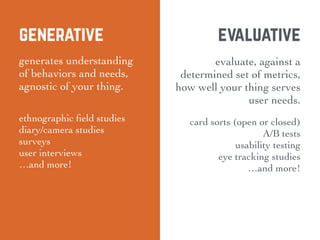
generative
generates understanding
of behaviors and needs,
agnostic of your thing.
ethnographic field studies
diary/camera studies
surveys
user interviews
…and more!
evaluative
evaluate, against a
determined set of metrics,
how well your thing serves
user needs.
card sorts (open or closed)
A/B tests
usability testing
eye tracking studies
…and more!
deep dive:
user interviews!
1.why interview?
2.design a user research program
3.conduct the interviews
4.analyze your findings
5.translate your findings to design decisions
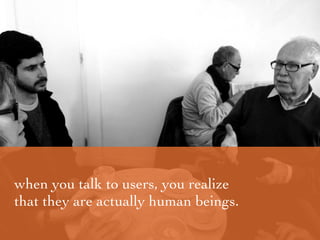
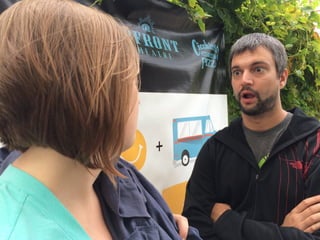
when you talk to users, you realize
that they are actually human beings.
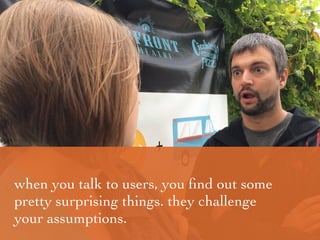
when you talk to users, you find out some
pretty surprising things. they challenge
your assumptions.
1.why interview?
2.design a user research program
3.conduct the interviews
4.analyze your findings
5.translate your findings to design decisions
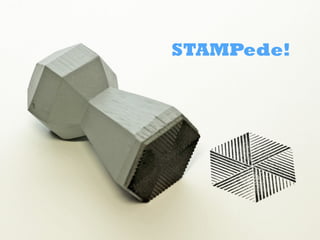
STAMPede!
“hobbyist customers are dumb and
don’t know how to order. this costs
us a lot of money.” -the client
“hobbyist customers are dumb and
don’t know how to order. this costs
us a lot of money.” -the client
“hobbyist customers are unfamiliar with the
custom stamp ordering world, and don’t
know what questions to ask, or what is
expected of them in order to purchase.”
-the user researcher
“we want hobbyists to buy things
from us. how can we make them
buy things from us?” -the client
“we want hobbyists to buy things
from us. how can we make them
buy things from us?” -the client
“let’s do some research and turn it into a
journey map so you can see where
things are going awry…and hopefully,
fix them.” - the user researcher
identify
research goals
what do we know?
what do we want to
know?
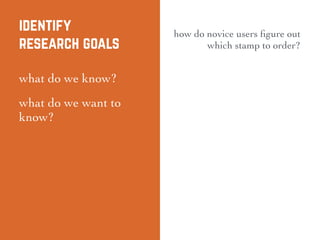
identify
research goals
what do we know?
what do we want to
know?
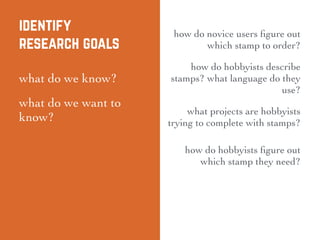
how do novice users figure out
which stamp to order?
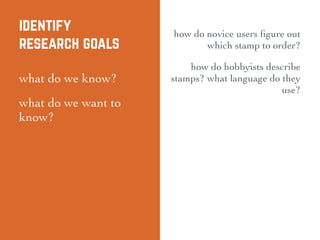
identify
research goals
what do we know?
what do we want to
know?
how do novice users figure out
which stamp to order?
how do hobbyists describe
stamps? what language do they
use?
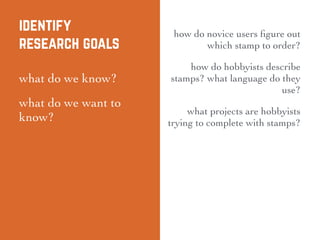
identify
research goals
what do we know?
what do we want to
know?
how do novice users figure out
which stamp to order?
how do hobbyists describe
stamps? what language do they
use?
what projects are hobbyists
trying to complete with stamps?
identify
research goals
what do we know?
what do we want to
know?
how do novice users figure out
which stamp to order?
how do hobbyists describe
stamps? what language do they
use?
what projects are hobbyists
trying to complete with stamps?
how do hobbyists figure out
which stamp they need?
how do novice users figure out
which stamp to order?
how do hobbyists describe
stamps? what language do they
use?
what projects are hobbyists
trying to complete with stamps?
how do hobbyists figure out
which stamp they need?
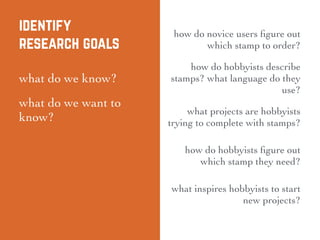
what inspires hobbyists to start
new projects?
identify
research goals
what do we know?
what do we want to
know?
who should we talk to?
1.why interview?
2.design a user research program
3.conduct the interviews
4.analyze your findings
5.translate your findings to design decisions
go where your
participants take you.
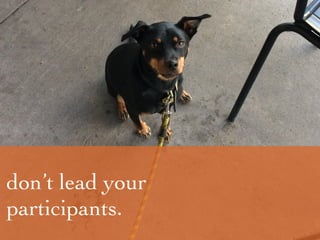
don’t lead your
participants.
commit to
awkward silences.
notetaking
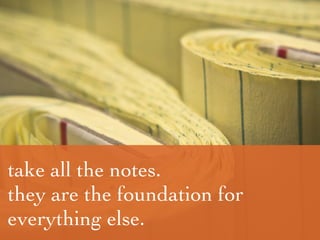
take all the notes.
they are the foundation for
everything else.
1.why interview?
2.design a user research program
3.conduct the interviews
4.analyze your findings
5.translate your findings to design decisions
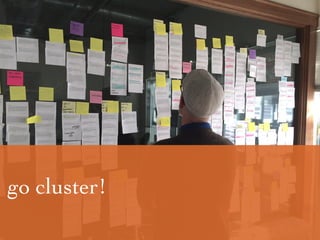
affinity diagramming
go cluster!
1.why interview?
2.design a user research program
3.conduct the interviews
4.analyze your findings
5.translate your findings to design decisions
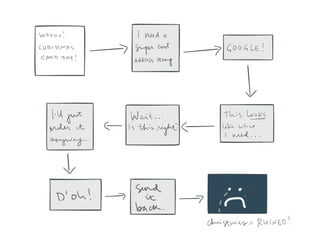
let’s make a journey map!
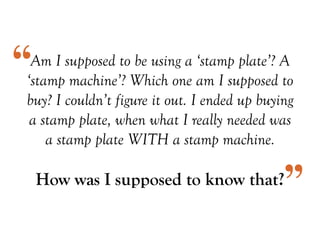
Am I supposed to be using a ‘stamp plate’? A
‘stamp machine’? Which one am I supposed to
buy? I couldn’t figure it out. I ended up buying
a stamp plate, when what I really needed was
a stamp plate WITH a stamp machine.
How was I supposed to know that?
“
”
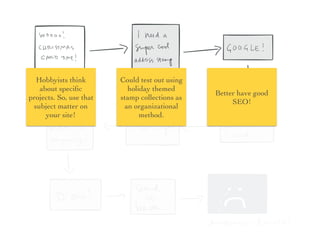
Hobbyists think
about specific
projects. So, use that
subject matter on
your site!
Better have good
SEO!
Could test out using
holiday themed
stamp collections as
an organizational
method.
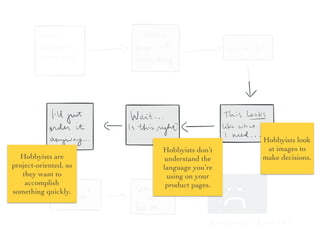
Hobbyists are
project-oriented, so
they want to
accomplish
something quickly.
Hobbyists look
at images to
make decisions.
Hobbyists don’t
understand the
language you’re
using on your
product pages.
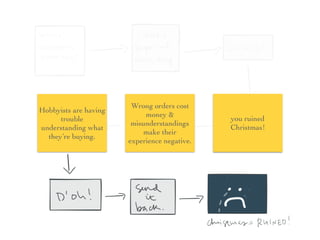
Hobbyists are having
trouble
understanding what
they’re buying.
you ruined
Christmas!
Wrong orders cost
money &
misunderstandings
make their
experience negative.
user research is challenging.
user research is rewarding.
user research is challenging.
…when you do it right.
user research is rewarding.
user research is challenging.
thank you!
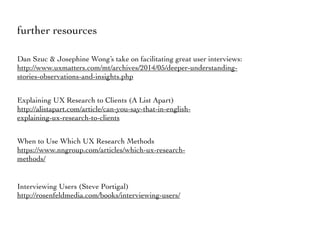
further resources
Dan Szuc & Josephine Wong’s take on facilitating great user interviews:
http://www.uxmatters.com/mt/archives/2014/05/deeper-understanding-
stories-observations-and-insights.php
Explaining UX Research to Clients (A List Apart)
http://alistapart.com/article/can-you-say-that-in-english-
explaining-ux-research-to-clients
When to Use Which UX Research Methods
https://www.nngroup.com/articles/which-ux-research-
methods/
Interviewing Users (Steve Portigal)
http://rosenfeldmedia.com/books/interviewing-users/

A Brief Introduction to User Research

  • 1.
    users are people,too using user research to remember your users are actually people. rachel price
  • 2.
    who am I? userresearcher information architect partner at factor UW iSchool alum bandleader
  • 3.
  • 4.
    what people aredoing how they are doing it why they are doing it
  • 5.
  • 6.
  • 7.
    This is exactlywhat I needed to know.Why is she looking at me? I don’t understand what he means. add understanding to data
  • 8.
  • 9.
  • 10.
    generative generates understanding of behaviorsand needs, agnostic of your thing. ethnographic field studies diary/camera studies surveys user interviews …and more! evaluative
  • 11.
    generative generates understanding of behaviorsand needs, agnostic of your thing. ethnographic field studies diary/camera studies surveys user interviews …and more! evaluative evaluate, against a determined set of metrics, how well your thing serves user needs. card sorts (open or closed) A/B tests usability testing eye tracking studies …and more!
  • 12.
  • 13.
    1.why interview? 2.design auser research program 3.conduct the interviews 4.analyze your findings 5.translate your findings to design decisions
  • 14.
    when you talkto users, you realize that they are actually human beings.
  • 16.
    when you talkto users, you find out some pretty surprising things. they challenge your assumptions.
  • 17.
    1.why interview? 2.design auser research program 3.conduct the interviews 4.analyze your findings 5.translate your findings to design decisions
  • 18.
  • 19.
    “hobbyist customers aredumb and don’t know how to order. this costs us a lot of money.” -the client
  • 20.
    “hobbyist customers aredumb and don’t know how to order. this costs us a lot of money.” -the client “hobbyist customers are unfamiliar with the custom stamp ordering world, and don’t know what questions to ask, or what is expected of them in order to purchase.” -the user researcher
  • 21.
    “we want hobbyiststo buy things from us. how can we make them buy things from us?” -the client
  • 22.
    “we want hobbyiststo buy things from us. how can we make them buy things from us?” -the client “let’s do some research and turn it into a journey map so you can see where things are going awry…and hopefully, fix them.” - the user researcher
  • 23.
    identify research goals what dowe know? what do we want to know?
  • 24.
    identify research goals what dowe know? what do we want to know? how do novice users figure out which stamp to order?
  • 25.
    identify research goals what dowe know? what do we want to know? how do novice users figure out which stamp to order? how do hobbyists describe stamps? what language do they use?
  • 26.
    identify research goals what dowe know? what do we want to know? how do novice users figure out which stamp to order? how do hobbyists describe stamps? what language do they use? what projects are hobbyists trying to complete with stamps?
  • 27.
    identify research goals what dowe know? what do we want to know? how do novice users figure out which stamp to order? how do hobbyists describe stamps? what language do they use? what projects are hobbyists trying to complete with stamps? how do hobbyists figure out which stamp they need?
  • 28.
    how do noviceusers figure out which stamp to order? how do hobbyists describe stamps? what language do they use? what projects are hobbyists trying to complete with stamps? how do hobbyists figure out which stamp they need? what inspires hobbyists to start new projects? identify research goals what do we know? what do we want to know?
  • 29.
    who should wetalk to?
  • 30.
    1.why interview? 2.design auser research program 3.conduct the interviews 4.analyze your findings 5.translate your findings to design decisions
  • 31.
  • 32.
  • 33.
  • 34.
    notetaking take all thenotes. they are the foundation for everything else.
  • 35.
    1.why interview? 2.design auser research program 3.conduct the interviews 4.analyze your findings 5.translate your findings to design decisions
  • 36.
  • 37.
    1.why interview? 2.design auser research program 3.conduct the interviews 4.analyze your findings 5.translate your findings to design decisions
  • 38.
    let’s make ajourney map!
  • 39.
    Am I supposedto be using a ‘stamp plate’? A ‘stamp machine’? Which one am I supposed to buy? I couldn’t figure it out. I ended up buying a stamp plate, when what I really needed was a stamp plate WITH a stamp machine. How was I supposed to know that? “ ”
  • 41.
    Hobbyists think about specific projects.So, use that subject matter on your site! Better have good SEO! Could test out using holiday themed stamp collections as an organizational method.
  • 42.
    Hobbyists are project-oriented, so theywant to accomplish something quickly. Hobbyists look at images to make decisions. Hobbyists don’t understand the language you’re using on your product pages.
  • 43.
    Hobbyists are having trouble understandingwhat they’re buying. you ruined Christmas! Wrong orders cost money & misunderstandings make their experience negative.
  • 44.
    user research ischallenging.
  • 45.
    user research isrewarding. user research is challenging.
  • 46.
    …when you doit right. user research is rewarding. user research is challenging.
  • 47.
  • 48.
    further resources Dan Szuc& Josephine Wong’s take on facilitating great user interviews: http://www.uxmatters.com/mt/archives/2014/05/deeper-understanding- stories-observations-and-insights.php Explaining UX Research to Clients (A List Apart) http://alistapart.com/article/can-you-say-that-in-english- explaining-ux-research-to-clients When to Use Which UX Research Methods https://www.nngroup.com/articles/which-ux-research- methods/ Interviewing Users (Steve Portigal) http://rosenfeldmedia.com/books/interviewing-users/