Content
• Introduction
• History
•Types of Blockchain
• Architecture
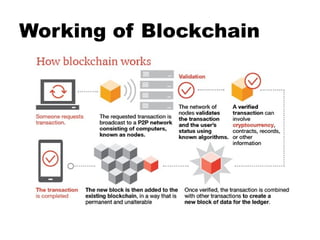
• Working of Blockchain
• Types of Concensus Algorithms
• What is PoW Algorithm and How it works
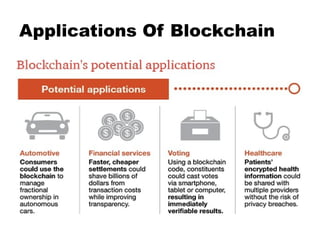
• Applications of Blockchain
• Advantages and Disadvantages
• Conclusion
3.
Introduction
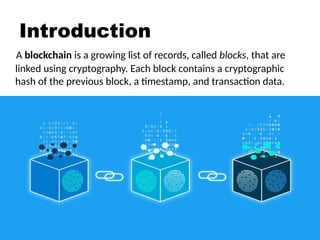
A blockchain isa growing list of records, called blocks, that are
linked using cryptography. Each block contains a cryptographic
hash of the previous block, a timestamp, and transaction data.
4.
History Of Blockchain
•The first work on a cryptographically secured chain of blocks was
described in 1991 by Stuart Haber and W. Scott Stornetta
• In 1992, Bayer, Haber and Stornetta incorporated Merkle trees to the
design, which improved its efficiency by allowing several document
certificates to be collected into one block.
• The first blockchain was conceptualized by a person (or group of
people) known as Satoshi Nakamoto in 2008.
• In August 2014, the bitcoin blockchain file size, containing records of
all transactions that have occurred on the network, reached 20 GB
(gigabytes).
• In January 2015, the size had grown to almost 30 GB, and from
January 2016 to January 2017, the bitcoin blockchain grew from 50 GB
to 100 GB in size.
Architecture of Blockchain
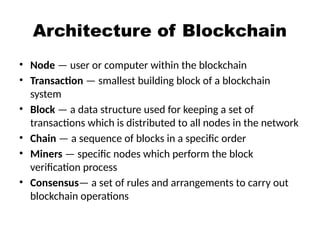
•Node — user or computer within the blockchain
• Transaction — smallest building block of a blockchain
system
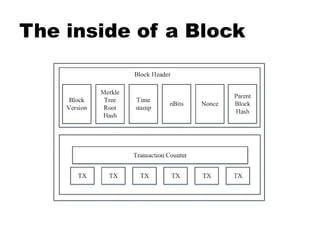
• Block — a data structure used for keeping a set of
transactions which is distributed to all nodes in the network
• Chain — a sequence of blocks in a specific order
• Miners — specific nodes which perform the block
verification process
• Consensus— a set of rules and arrangements to carry out
blockchain operations
Types of ConsensusAlgorithms
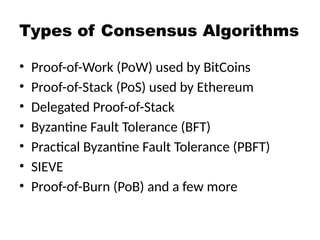
• Proof-of-Work (PoW) used by BitCoins
• Proof-of-Stack (PoS) used by Ethereum
• Delegated Proof-of-Stack
• Byzantine Fault Tolerance (BFT)
• Practical Byzantine Fault Tolerance (PBFT)
• SIEVE
• Proof-of-Burn (PoB) and a few more
10.
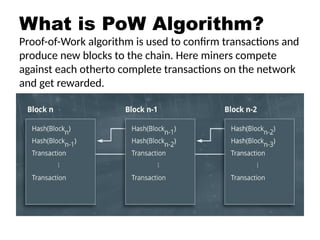
What is PoWAlgorithm?
Proof-of-Work algorithm is used to confirm transactions and
produce new blocks to the chain. Here miners compete
against each otherto complete transactions on the network
and get rewarded.
11.
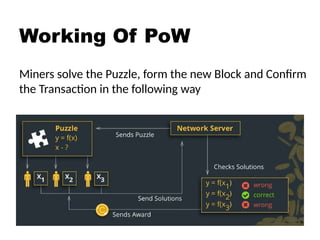
Working Of PoW
Minerssolve the Puzzle, form the new Block and Confirm
the Transaction in the following way
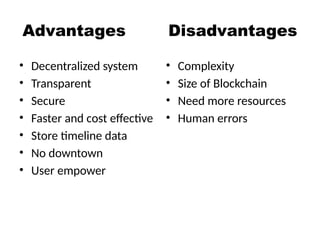
Advantages Disadvantages
• Decentralizedsystem
• Transparent
• Secure
• Faster and cost effective
• Store timeline data
• No downtown
• User empower
• Complexity
• Size of Blockchain
• Need more resources
• Human errors
14.
Conclusion
Blockchain is anew name in the world of technologies but it is
definitely the one to last. Even in the early stages, the
technology has gained huge popularity starting with their very
first application of cryptocurrencies. More areas of
applications are being discovered and tested with each
passing day. Once the technology is adopted and accepted on
a global level, it’ll transform the way we live today.





![Blockchain, working [blockchain vs bitcoin] pros and cons](https://cdn.slidesharecdn.com/ss_thumbnails/blockchainfinal-180420144408-thumbnail.jpg?width=640&height=640&fit=bounds)

![What is Blockchain? [Applications of Blockchain in Cryptocurrency and Banking]](https://cdn.slidesharecdn.com/ss_thumbnails/blockchaindecentralizedstoragepowposmechanisms-250609045147-b01d52eb-thumbnail.jpg?width=640&height=640&fit=bounds)


