Connecting with Computer Science 2
Objectives
• Learn why today almost everyone is a computer
operator
• Learn about the predecessors of modern computer
hardware and software
• Trace the development of computer hardware and
software through several generations
Connecting with Computer Science 3
Objectives (continued)
• Learn that sometimes good ideas flop and bad ones
survive
• Meet some interesting figures—some famous, some
infamous, some wealthy, and some obscure
• See some issues facing modern computing
Connecting with Computer Science 4
Why You Need to Know About
the History of Computing
• Computers are everywhere
– Communication device
– Tool for artists, architects, and designers
– Information archive
– Entertainment device
– Trains, planes, automobiles
• What caused the revolution?
• What lies ahead?
Connecting with Computer Science 5
Ancient History
• Origins of computer in ancient Assyria
– Tablets with arithmetic/trigonometric solutions
– Math solves societal and personal problems
• Drivers of mathematical development
– Property ownership and the need to measure
– Vertical construction and the pyramids
– Navigation and the need to control time
• Computers do math
Connecting with Computer Science 6
Pascal and Leibniz
Start the Wheel Rolling
• Paper, wood, stone, papyrus tables, abacuses as
“computers”
• 1622: invention of slide rule
• 1642: invention of mechanical calculator by Blaise
Pascal
• 1694: Leibniz Wheel expands arithmetic operations
Connecting with Computer Science 7
Joseph Jacquard
• Invents programmable loom in 1801
– Jacquard loom weaves patterns in fabric
– Allows input and storage of parameters
– Selection pins oriented with punch cards
– Similarities with player piano
• Concept of the stored program
Connecting with Computer Science 8
Connecting with Computer Science 9
Charles Babbage
• Invents Difference Engine in 1823
– Device adds, subtracts, multiplies, divides
• Designs Analytical Engine
– Components of modern computer
• Input and output devices, memory and CPU
– Not built due to lack of funds
• Collaborates with Ada Lovelace Byron
– Attribution of program loop concept
– Ada programming language namesake
Connecting with Computer Science 10
Herman Hollerith
• Invents electromechanical counter in 1880s
– Serves tabulation role in 1890 US census
– Machine uses punch cards as input
– Single-purpose machine
• Company created around technology becomes
IBM
– IBM rolls out multi-purpose Mark I in 1944
– Mark I rapidly made obsolete by vacuum tubes
Connecting with Computer Science 11
Connecting with Computer Science 12
Progression of
Computer Electronics
• Charles Sanders Peirce extends work of Boole
– Electric switches emulate the true/false conditions of
Boolean algebra
– Benjamin Burack implements concepts in 1936 logic
machine
• John Atanasoff and Clifford Berry build computer
using vacuum tubes
• World War II as developmental turning point
Connecting with Computer Science 13
Wartime Research Drives
Technological Innovation
• Military need: trajectory tables for weapons testing
– U.S. Navy Board of Ordinance helps fund Mark I
– U.S. Army funds ENIAC (Electronic Numerical
Integrator and Computer)
• ENIAC runs 1000 times faster than Mark I
• ENIAC and Mark I too late to assist in war effort
Connecting with Computer Science 14
ENIAC and EDVAC
• ENIAC’s overhead
– Loud and large at 30 tons: fills a huge basement
– 18,000 vacuum tubes need constant attention
– 6,000 switches need for arithmetic operations
• ENIAC’s strengths
– Performs arithmetic and logic operations
– Made multi-purpose with symbolic variables
• ENIAC’S other weaknesses
– Could not modify program contents
– Had to be programmed externally
Connecting with Computer Science 15
Connecting with Computer Science 16
ENIAC AND EDVAC (continued)
• EDVAC (Electronic Discrete Variable Automatic
Computer) created in 1944
– Recognized as the Von Neumann machine
– Superior model for descendant computers
– Operation governed by program in memory
– Programs could be modified
– Stored program concept: programs reusable
• The British response: Colossus
– Colossus helps crack German U-boat Enigma code
– All machines destroyed by 1960s
Connecting with Computer Science 17
Connecting with Computer Science 18
The Computer Era Begins:
The First Generation
• 1950s: First Generation for hardware and software
– Vacuum tubes worked as memory for the machine
– Data written to magnetic drums and magnetic tapes
– Paper tape and data cards handled input
– The line printer made its appearance
• Software separates from hardware and evolves
– Instructions written in binary or machine code
– Assembly language: first layer of abstraction
– Programmers split into system and application
engineers
Connecting with Computer Science 19
Connecting with Computer Science 20
UNIVAC
• UNIVAC: first commercially viable computer
– US Census Bureau is first customer
– Faces skepticism from Howard Aiken, Mark I
builder
• UNIVAC and the 1952 Presidential election
– Successfully predicts outcome during CBS
broadcast
– Quickly adopted by all major news network
Connecting with Computer Science 21
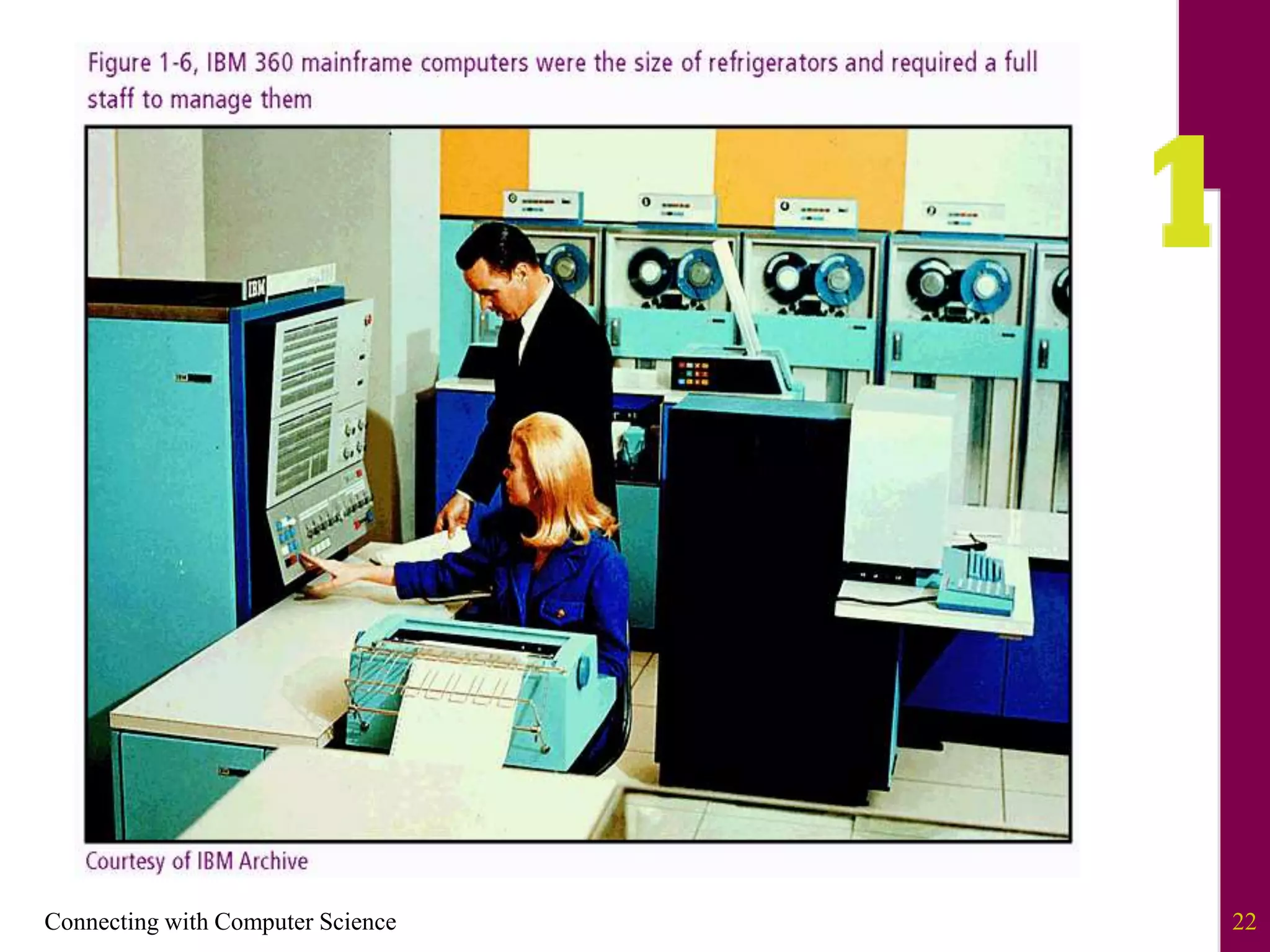
IBM (Big Blue)
• IBM dominates mainframe market by the 1960s
– Strong sales culture
– Controlled 70 percent of the market
• IBM vision
– Sharp focus on a few products
– Leverage existing business relationships
– Introduce scalable (and hence flexible) systems
– Lease systems with 10 to 15 year life spans
Connecting with Computer Science 22
Connecting with Computer Science 23
Transistors in the
Second Generation
• Software Innovations
– Assembly language limitations
– Appearance of high-level languages: FORTRAN,
COBOL, LISP
• Hardware Development
– Transistor replaces vacuum tube
– RAM becomes available with magnetic cores
– Magnetic disks support secondary storage
Connecting with Computer Science 24
Circuit Boards in
the Third Generation
• Integrated Circuits(IC) or Chips
– Miniaturized circuit components on board
– Semiconductor properties
– Reduce cost and size
– Improve reliability and speed
• Operating Systems (OS)
– Program to manage jobs
– Utilize system resources
– Allow multiple users
Connecting with Computer Science 25
Connecting with Computer Science 26
Time-Sharing
• Allocates system resources to multiple users
– Input with long paper rolls instead of punch cards
– Productivity gains offset by increased response time
• General purpose machines broaden appeal
• Programmers gear software toward end user
– Distinctions between application level and OS level
– Statistical and accounting programs hide
implementation details
Connecting with Computer Science 27
Living in the ‘70s
with the Fourth Generation
• The era of miniaturization
– LSI chips contain up to 15,000 circuits
– VLSI contain 100,000 to 1 million circuits
• Moore’s Law
– Circuit density doubles every 1.5 years
– Memory capacity and speed rise while costs drop
• Minicomputer industry grows
• Microcomputer makes appearance
Connecting with Computer Science 28
The Personal
Computer Revolution
• Causes
– Hardware vision of engineers
– Iconoclastic software developers seeking challenges
– Electronic hobbyists realizing a dream
• The role of will
– Components previously developed
– Social and economic support
Connecting with Computer Science 29
Intel
• The Intel 4004 chip
– 4004 transistors aboard
– Accrues greater functionality
– Precursor to central processing unit (CPU)
• Gary Kildall writes OS for Intel microprocessor
• Software and hardware become separate
commodities
Connecting with Computer Science 30
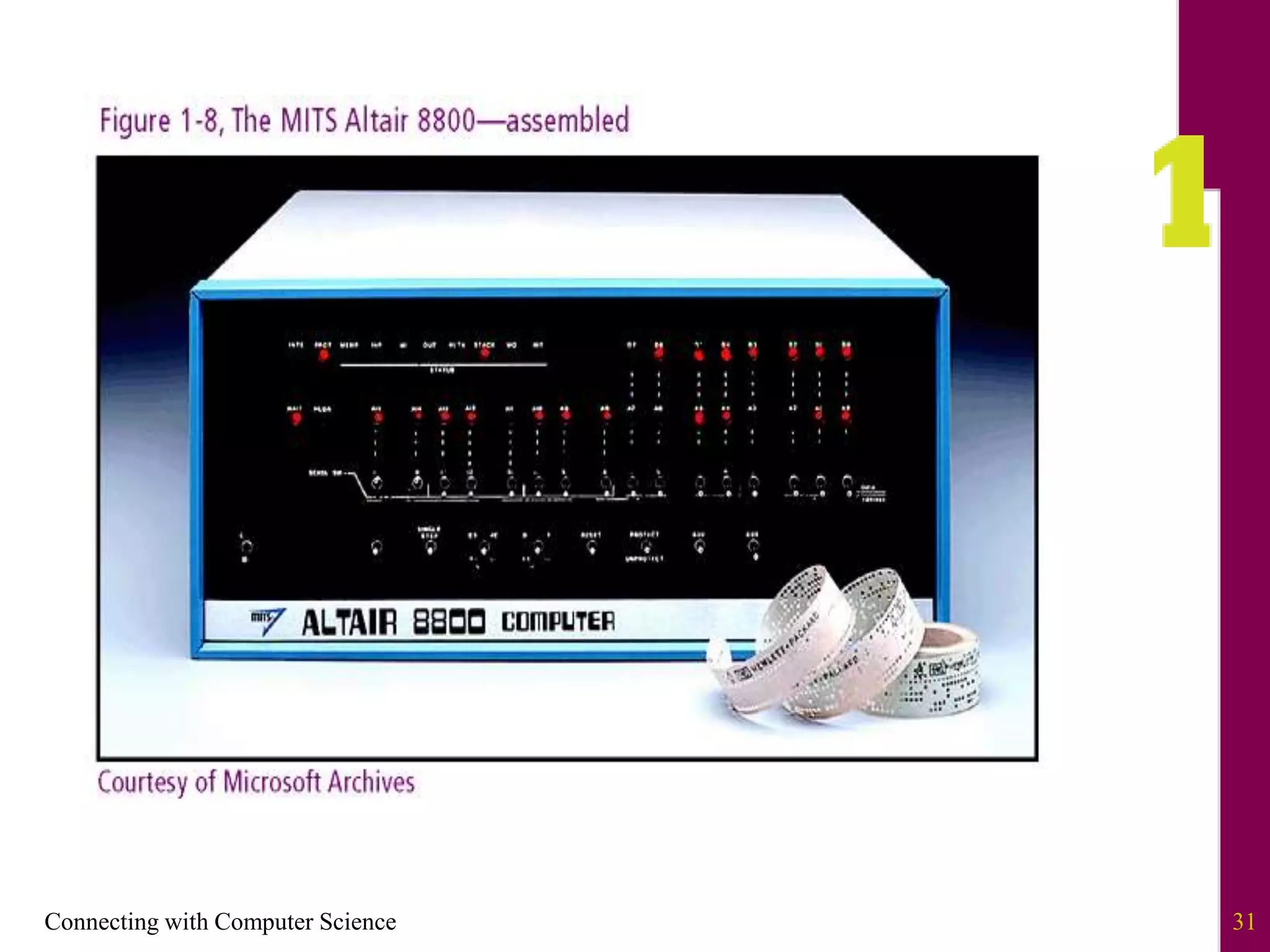
The Altair 8800
• Development spurred by Popular Electronics
• Ed Roberts reports on the Altair 8800
– Kit based on Intel 8080
– Generates 4000 orders within three months
• Altair 8800 features
– I/O similar to ENIAC’s
– Open architecture provides adaptability
– Portable
Connecting with Computer Science 31
Connecting with Computer Science 32
Enter Bill Gates,
Paul Allen, and Microsoft
• Gates and Allen develop a BASIC interpreter
– High level language for microcomputer programmers
• Briefly associate with MITS
• Form Micro-Soft company in 1975
Connecting with Computer Science 33
Connecting with Computer Science 34
The Microcomputer
Begins to Evolve
• Microcomputer’s profitability lures more players
– Enter Radio Shack, IMSAI, Sphere and others
• Altair’s bus becomes S100 industry standard
• MITS stumbles
– Links prices of faulty hardware to BASIC
– Develops new model incompatible with 8080
• 1977
– MITS sold off
– Hardware companies introduce competing models
Connecting with Computer Science 35
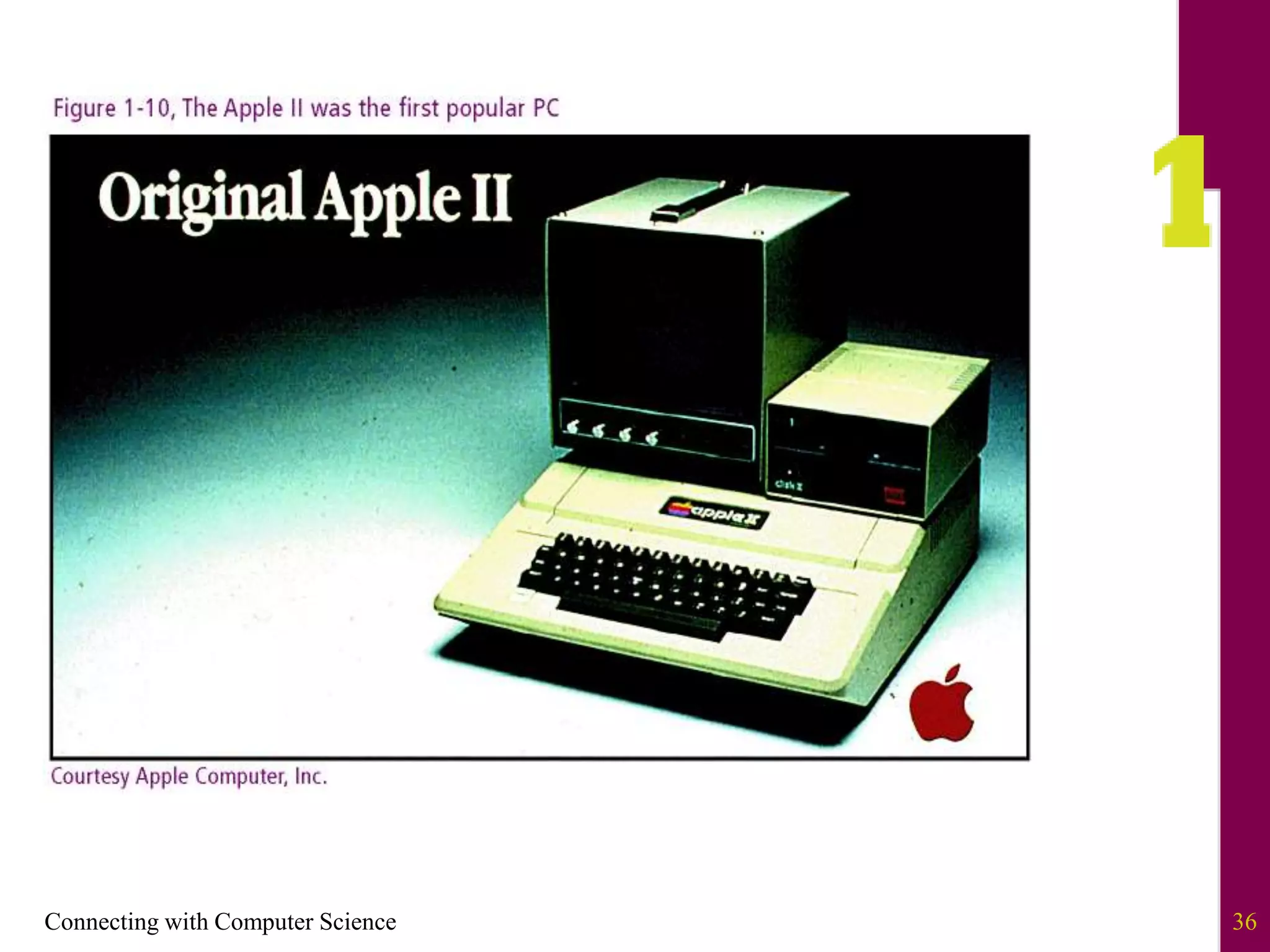
An Apple a day…
• 1976: Steve Jobs and Steve Wozniak offer Apple I
• 1977: Apple II developed and released
– Based on Motorola 6502 processor
– Gains respect in industry as well as among hobbyists
– Promotes application development
• VisiCalc spreadsheet program
– Drives Apple II sales
– Earns new title: killer app
– Draws attention of wider business community
Connecting with Computer Science 36
Connecting with Computer Science 37
IBM Offers the PC
• IBMS builds a microcomputer with new ways
– Adopts the Intel 8088 off the shelf
– Uses a non-proprietary CPU
– Create approachable documentation
– Offer open architecture
• New product name: personal computer (PC)
• PC sold through retail outlets
Connecting with Computer Science 38
MS-DOS
• IBM chooses Microsoft to develop OS
• Microsoft introduces MS-DOS
– Based on Kildall’s 8 bit CP/M
– Runs on 16 bit CPU (Intel 8088)
– Prevails over competition
• IBM calls operating system PC-DOS
Connecting with Computer Science 39
The Apple Macintosh
Raises the Bar
• Steve Jobs visits Xerox PARC
– Alto: graphics, menus, icons, windows, mouse
– Observes functioning Ethernet network
– Learns about hypertext
• Jobs succeeds with Xerox ideas
– Picks up where Xerox, focused on copiers, leaves off
– Incorporates many Palo Alto components in
Macintosh
• 1984: Macintosh unveiled
– Graphical user interface (GUI)
– Mouse: point-and-click and ease-of-use
Connecting with Computer Science 40
Connecting with Computer Science 41
Other PCs (and One Serious OS
Competitor) Begin to Emerge
• Microsoft two-fold argument to IBM
– Adapt open architecture concept to OS
– Allow Microsoft freedom to license its OS
• Microsoft answers Apple
– Windows 3.1 incorporates Mac’s GUI features
– Competing PC clones appear with Microsoft’s OS
• Microsoft leverages position
– OS presence drive application software sales
– Sales synergies and licensing give 90 % of PC pie
Connecting with Computer Science 42
The Latest Generation (Fifth)
• Parallel computing
– Aka parallel architecture
– CPUs joined for simultaneous task execution
• Three approaches
– SIMD (single instruction, multiple data) stream
– MIMD (multiple instruction, multiple data) stream
– Internetworking
• Uses
– Control web pages, databases, networks
– Mathematical modeling and scientific research (Cray)
Connecting with Computer Science 43
The Internet
• ARPA origins of new communication system
– Resource sharing
– Common protocols
– Fault tolerance
• 1969: ARPANET born
– Consisted of (4) computers at (4) locations
– Different systems linked with Interface Message
Processor (IMP)
• ARPANET grows rapidly
– Protocols allow easy entry into network
– Electronic mail comprises 2/3 of network traffic
Connecting with Computer Science 44
LANs and WANs and other ANs
• The Internet as network of networks
– Wide Area Network (WAN)
– Local Area Network (LAN)
– Wireless Local Area Network (WLAN)
– Metropolitan Area Network (MAN)
– Urban Area Network (UAN)
• Network technologies
– Ethernet
– Fiberoptics
– Wireless technologies
Connecting with Computer Science 45
Super Software and the Web
• Object-oriented programming (OOP)
• Computer Aided Software Engineering (CASE)
• Origin of the World Wide Web (WWW)
– 1990: Tim Berners-Lee develops hypertext
– Prototype browser created on NeXT computer
– Marc Andreesen and Mosaic
– Microsoft and Internet Explorer
• Web components
– Web pages
– Browser
– Network technology
Connecting with Computer Science 46
Connecting with Computer Science 47
The Microsoft Era and More
• The “browser wars”
– Microsoft integrates IE browser into Windows
– Netscape opposes Microsoft: goes open source
• The wars continue in court
– US government file antitrust suit against Microsoft
– By 2001 most of antitrust suit dropped or lessened
• Linux OS threatens Windows
– Low cost, open source, reliability
• Microsoft in perspective
– Accounts for 10 percent of world’s software
– Microsoft a small software player outside of PC
Connecting with Computer Science 48
What About the Future?
• Parallel Computing
– Massive amplification of computing power
– Can be hosted by local networks as well as Internet
• Wireless networking
– Bluetooth
– Embedded or ubiquitous computing
• Digitization of Economy
• Privacy and security
• Open source movement
Connecting with Computer Science 49
One Last Thought
• Development as a product of needs and wants
• The mixture of forces driving innovation
– Commercial and physical requirements (IC)
– The need to solve a problem (Analytical Engine)
– The desire to create something new (Apple I)
– The goal of winning a war (World War II)
– The need to succeed (Bill Gates)
• The evolutionary view
• The purpose of historical study
– Avoid mistakes and emulate triumphs
Connecting with Computer Science 50
Summary
• The evolution of computers is tied to the evolution
of mathematics and driven by the need to master
time and space
• From stone tablets to electronic machines, the
computer’s chief purpose has been to manipulate
mathematical and linguistic symbols
• Many civilizations from the times of the ancients
to the present have contributed to the development
of computers and their science
Connecting with Computer Science 51
Summary (continued)
• Mechanical calculators were invented in the 17th
century by Pascal and Leibniz
• The Jacquard Loom of 1801 introduced the punch
card and the concept of a stored program
• Charles Babbage designed a prototype of the modern
computer: The Analytical Engine
• Herman Hollerith incorporated punch cards in his
mechanical tabulating machines
Connecting with Computer Science 52
Summary (continued)
• World War II drove computer innovation in the
mid-twentieth century: ENIAC, Mark I, Colossus
• The EDVAC’s Von Neumann architecture has
become a basic model for all later development
• Progress from vacuum tubes to integrated circuits
has exponentially increased the computer speed
and simultaneously reduced the size and cost
• The microcomputer and Internet, latter 20th
century developments, have made computers
ubiquitous

A brief history of computing

  • 2.
    Connecting with ComputerScience 2 Objectives • Learn why today almost everyone is a computer operator • Learn about the predecessors of modern computer hardware and software • Trace the development of computer hardware and software through several generations
  • 3.
    Connecting with ComputerScience 3 Objectives (continued) • Learn that sometimes good ideas flop and bad ones survive • Meet some interesting figures—some famous, some infamous, some wealthy, and some obscure • See some issues facing modern computing
  • 4.
    Connecting with ComputerScience 4 Why You Need to Know About the History of Computing • Computers are everywhere – Communication device – Tool for artists, architects, and designers – Information archive – Entertainment device – Trains, planes, automobiles • What caused the revolution? • What lies ahead?
  • 5.
    Connecting with ComputerScience 5 Ancient History • Origins of computer in ancient Assyria – Tablets with arithmetic/trigonometric solutions – Math solves societal and personal problems • Drivers of mathematical development – Property ownership and the need to measure – Vertical construction and the pyramids – Navigation and the need to control time • Computers do math
  • 6.
    Connecting with ComputerScience 6 Pascal and Leibniz Start the Wheel Rolling • Paper, wood, stone, papyrus tables, abacuses as “computers” • 1622: invention of slide rule • 1642: invention of mechanical calculator by Blaise Pascal • 1694: Leibniz Wheel expands arithmetic operations
  • 7.
    Connecting with ComputerScience 7 Joseph Jacquard • Invents programmable loom in 1801 – Jacquard loom weaves patterns in fabric – Allows input and storage of parameters – Selection pins oriented with punch cards – Similarities with player piano • Concept of the stored program
  • 8.
  • 9.
    Connecting with ComputerScience 9 Charles Babbage • Invents Difference Engine in 1823 – Device adds, subtracts, multiplies, divides • Designs Analytical Engine – Components of modern computer • Input and output devices, memory and CPU – Not built due to lack of funds • Collaborates with Ada Lovelace Byron – Attribution of program loop concept – Ada programming language namesake
  • 10.
    Connecting with ComputerScience 10 Herman Hollerith • Invents electromechanical counter in 1880s – Serves tabulation role in 1890 US census – Machine uses punch cards as input – Single-purpose machine • Company created around technology becomes IBM – IBM rolls out multi-purpose Mark I in 1944 – Mark I rapidly made obsolete by vacuum tubes
  • 11.
  • 12.
    Connecting with ComputerScience 12 Progression of Computer Electronics • Charles Sanders Peirce extends work of Boole – Electric switches emulate the true/false conditions of Boolean algebra – Benjamin Burack implements concepts in 1936 logic machine • John Atanasoff and Clifford Berry build computer using vacuum tubes • World War II as developmental turning point
  • 13.
    Connecting with ComputerScience 13 Wartime Research Drives Technological Innovation • Military need: trajectory tables for weapons testing – U.S. Navy Board of Ordinance helps fund Mark I – U.S. Army funds ENIAC (Electronic Numerical Integrator and Computer) • ENIAC runs 1000 times faster than Mark I • ENIAC and Mark I too late to assist in war effort
  • 14.
    Connecting with ComputerScience 14 ENIAC and EDVAC • ENIAC’s overhead – Loud and large at 30 tons: fills a huge basement – 18,000 vacuum tubes need constant attention – 6,000 switches need for arithmetic operations • ENIAC’s strengths – Performs arithmetic and logic operations – Made multi-purpose with symbolic variables • ENIAC’S other weaknesses – Could not modify program contents – Had to be programmed externally
  • 15.
  • 16.
    Connecting with ComputerScience 16 ENIAC AND EDVAC (continued) • EDVAC (Electronic Discrete Variable Automatic Computer) created in 1944 – Recognized as the Von Neumann machine – Superior model for descendant computers – Operation governed by program in memory – Programs could be modified – Stored program concept: programs reusable • The British response: Colossus – Colossus helps crack German U-boat Enigma code – All machines destroyed by 1960s
  • 17.
  • 18.
    Connecting with ComputerScience 18 The Computer Era Begins: The First Generation • 1950s: First Generation for hardware and software – Vacuum tubes worked as memory for the machine – Data written to magnetic drums and magnetic tapes – Paper tape and data cards handled input – The line printer made its appearance • Software separates from hardware and evolves – Instructions written in binary or machine code – Assembly language: first layer of abstraction – Programmers split into system and application engineers
  • 19.
  • 20.
    Connecting with ComputerScience 20 UNIVAC • UNIVAC: first commercially viable computer – US Census Bureau is first customer – Faces skepticism from Howard Aiken, Mark I builder • UNIVAC and the 1952 Presidential election – Successfully predicts outcome during CBS broadcast – Quickly adopted by all major news network
  • 21.
    Connecting with ComputerScience 21 IBM (Big Blue) • IBM dominates mainframe market by the 1960s – Strong sales culture – Controlled 70 percent of the market • IBM vision – Sharp focus on a few products – Leverage existing business relationships – Introduce scalable (and hence flexible) systems – Lease systems with 10 to 15 year life spans
  • 22.
  • 23.
    Connecting with ComputerScience 23 Transistors in the Second Generation • Software Innovations – Assembly language limitations – Appearance of high-level languages: FORTRAN, COBOL, LISP • Hardware Development – Transistor replaces vacuum tube – RAM becomes available with magnetic cores – Magnetic disks support secondary storage
  • 24.
    Connecting with ComputerScience 24 Circuit Boards in the Third Generation • Integrated Circuits(IC) or Chips – Miniaturized circuit components on board – Semiconductor properties – Reduce cost and size – Improve reliability and speed • Operating Systems (OS) – Program to manage jobs – Utilize system resources – Allow multiple users
  • 25.
  • 26.
    Connecting with ComputerScience 26 Time-Sharing • Allocates system resources to multiple users – Input with long paper rolls instead of punch cards – Productivity gains offset by increased response time • General purpose machines broaden appeal • Programmers gear software toward end user – Distinctions between application level and OS level – Statistical and accounting programs hide implementation details
  • 27.
    Connecting with ComputerScience 27 Living in the ‘70s with the Fourth Generation • The era of miniaturization – LSI chips contain up to 15,000 circuits – VLSI contain 100,000 to 1 million circuits • Moore’s Law – Circuit density doubles every 1.5 years – Memory capacity and speed rise while costs drop • Minicomputer industry grows • Microcomputer makes appearance
  • 28.
    Connecting with ComputerScience 28 The Personal Computer Revolution • Causes – Hardware vision of engineers – Iconoclastic software developers seeking challenges – Electronic hobbyists realizing a dream • The role of will – Components previously developed – Social and economic support
  • 29.
    Connecting with ComputerScience 29 Intel • The Intel 4004 chip – 4004 transistors aboard – Accrues greater functionality – Precursor to central processing unit (CPU) • Gary Kildall writes OS for Intel microprocessor • Software and hardware become separate commodities
  • 30.
    Connecting with ComputerScience 30 The Altair 8800 • Development spurred by Popular Electronics • Ed Roberts reports on the Altair 8800 – Kit based on Intel 8080 – Generates 4000 orders within three months • Altair 8800 features – I/O similar to ENIAC’s – Open architecture provides adaptability – Portable
  • 31.
  • 32.
    Connecting with ComputerScience 32 Enter Bill Gates, Paul Allen, and Microsoft • Gates and Allen develop a BASIC interpreter – High level language for microcomputer programmers • Briefly associate with MITS • Form Micro-Soft company in 1975
  • 33.
  • 34.
    Connecting with ComputerScience 34 The Microcomputer Begins to Evolve • Microcomputer’s profitability lures more players – Enter Radio Shack, IMSAI, Sphere and others • Altair’s bus becomes S100 industry standard • MITS stumbles – Links prices of faulty hardware to BASIC – Develops new model incompatible with 8080 • 1977 – MITS sold off – Hardware companies introduce competing models
  • 35.
    Connecting with ComputerScience 35 An Apple a day… • 1976: Steve Jobs and Steve Wozniak offer Apple I • 1977: Apple II developed and released – Based on Motorola 6502 processor – Gains respect in industry as well as among hobbyists – Promotes application development • VisiCalc spreadsheet program – Drives Apple II sales – Earns new title: killer app – Draws attention of wider business community
  • 36.
  • 37.
    Connecting with ComputerScience 37 IBM Offers the PC • IBMS builds a microcomputer with new ways – Adopts the Intel 8088 off the shelf – Uses a non-proprietary CPU – Create approachable documentation – Offer open architecture • New product name: personal computer (PC) • PC sold through retail outlets
  • 38.
    Connecting with ComputerScience 38 MS-DOS • IBM chooses Microsoft to develop OS • Microsoft introduces MS-DOS – Based on Kildall’s 8 bit CP/M – Runs on 16 bit CPU (Intel 8088) – Prevails over competition • IBM calls operating system PC-DOS
  • 39.
    Connecting with ComputerScience 39 The Apple Macintosh Raises the Bar • Steve Jobs visits Xerox PARC – Alto: graphics, menus, icons, windows, mouse – Observes functioning Ethernet network – Learns about hypertext • Jobs succeeds with Xerox ideas – Picks up where Xerox, focused on copiers, leaves off – Incorporates many Palo Alto components in Macintosh • 1984: Macintosh unveiled – Graphical user interface (GUI) – Mouse: point-and-click and ease-of-use
  • 40.
  • 41.
    Connecting with ComputerScience 41 Other PCs (and One Serious OS Competitor) Begin to Emerge • Microsoft two-fold argument to IBM – Adapt open architecture concept to OS – Allow Microsoft freedom to license its OS • Microsoft answers Apple – Windows 3.1 incorporates Mac’s GUI features – Competing PC clones appear with Microsoft’s OS • Microsoft leverages position – OS presence drive application software sales – Sales synergies and licensing give 90 % of PC pie
  • 42.
    Connecting with ComputerScience 42 The Latest Generation (Fifth) • Parallel computing – Aka parallel architecture – CPUs joined for simultaneous task execution • Three approaches – SIMD (single instruction, multiple data) stream – MIMD (multiple instruction, multiple data) stream – Internetworking • Uses – Control web pages, databases, networks – Mathematical modeling and scientific research (Cray)
  • 43.
    Connecting with ComputerScience 43 The Internet • ARPA origins of new communication system – Resource sharing – Common protocols – Fault tolerance • 1969: ARPANET born – Consisted of (4) computers at (4) locations – Different systems linked with Interface Message Processor (IMP) • ARPANET grows rapidly – Protocols allow easy entry into network – Electronic mail comprises 2/3 of network traffic
  • 44.
    Connecting with ComputerScience 44 LANs and WANs and other ANs • The Internet as network of networks – Wide Area Network (WAN) – Local Area Network (LAN) – Wireless Local Area Network (WLAN) – Metropolitan Area Network (MAN) – Urban Area Network (UAN) • Network technologies – Ethernet – Fiberoptics – Wireless technologies
  • 45.
    Connecting with ComputerScience 45 Super Software and the Web • Object-oriented programming (OOP) • Computer Aided Software Engineering (CASE) • Origin of the World Wide Web (WWW) – 1990: Tim Berners-Lee develops hypertext – Prototype browser created on NeXT computer – Marc Andreesen and Mosaic – Microsoft and Internet Explorer • Web components – Web pages – Browser – Network technology
  • 46.
  • 47.
    Connecting with ComputerScience 47 The Microsoft Era and More • The “browser wars” – Microsoft integrates IE browser into Windows – Netscape opposes Microsoft: goes open source • The wars continue in court – US government file antitrust suit against Microsoft – By 2001 most of antitrust suit dropped or lessened • Linux OS threatens Windows – Low cost, open source, reliability • Microsoft in perspective – Accounts for 10 percent of world’s software – Microsoft a small software player outside of PC
  • 48.
    Connecting with ComputerScience 48 What About the Future? • Parallel Computing – Massive amplification of computing power – Can be hosted by local networks as well as Internet • Wireless networking – Bluetooth – Embedded or ubiquitous computing • Digitization of Economy • Privacy and security • Open source movement
  • 49.
    Connecting with ComputerScience 49 One Last Thought • Development as a product of needs and wants • The mixture of forces driving innovation – Commercial and physical requirements (IC) – The need to solve a problem (Analytical Engine) – The desire to create something new (Apple I) – The goal of winning a war (World War II) – The need to succeed (Bill Gates) • The evolutionary view • The purpose of historical study – Avoid mistakes and emulate triumphs
  • 50.
    Connecting with ComputerScience 50 Summary • The evolution of computers is tied to the evolution of mathematics and driven by the need to master time and space • From stone tablets to electronic machines, the computer’s chief purpose has been to manipulate mathematical and linguistic symbols • Many civilizations from the times of the ancients to the present have contributed to the development of computers and their science
  • 51.
    Connecting with ComputerScience 51 Summary (continued) • Mechanical calculators were invented in the 17th century by Pascal and Leibniz • The Jacquard Loom of 1801 introduced the punch card and the concept of a stored program • Charles Babbage designed a prototype of the modern computer: The Analytical Engine • Herman Hollerith incorporated punch cards in his mechanical tabulating machines
  • 52.
    Connecting with ComputerScience 52 Summary (continued) • World War II drove computer innovation in the mid-twentieth century: ENIAC, Mark I, Colossus • The EDVAC’s Von Neumann architecture has become a basic model for all later development • Progress from vacuum tubes to integrated circuits has exponentially increased the computer speed and simultaneously reduced the size and cost • The microcomputer and Internet, latter 20th century developments, have made computers ubiquitous