T. K. Yin, NUK-CSIE
Introduction to Computer Science
(I)
Introduction
T. K. Yin, NUK-CSIE
Information Technology in Our
Lives
• Digital Convergence
– Converting whatever we can in the physical and
communications world to binary on/off signals,
called bits
• Text
• Voice
• Picture
• Movie
T. K. Yin, NUK-CSIE
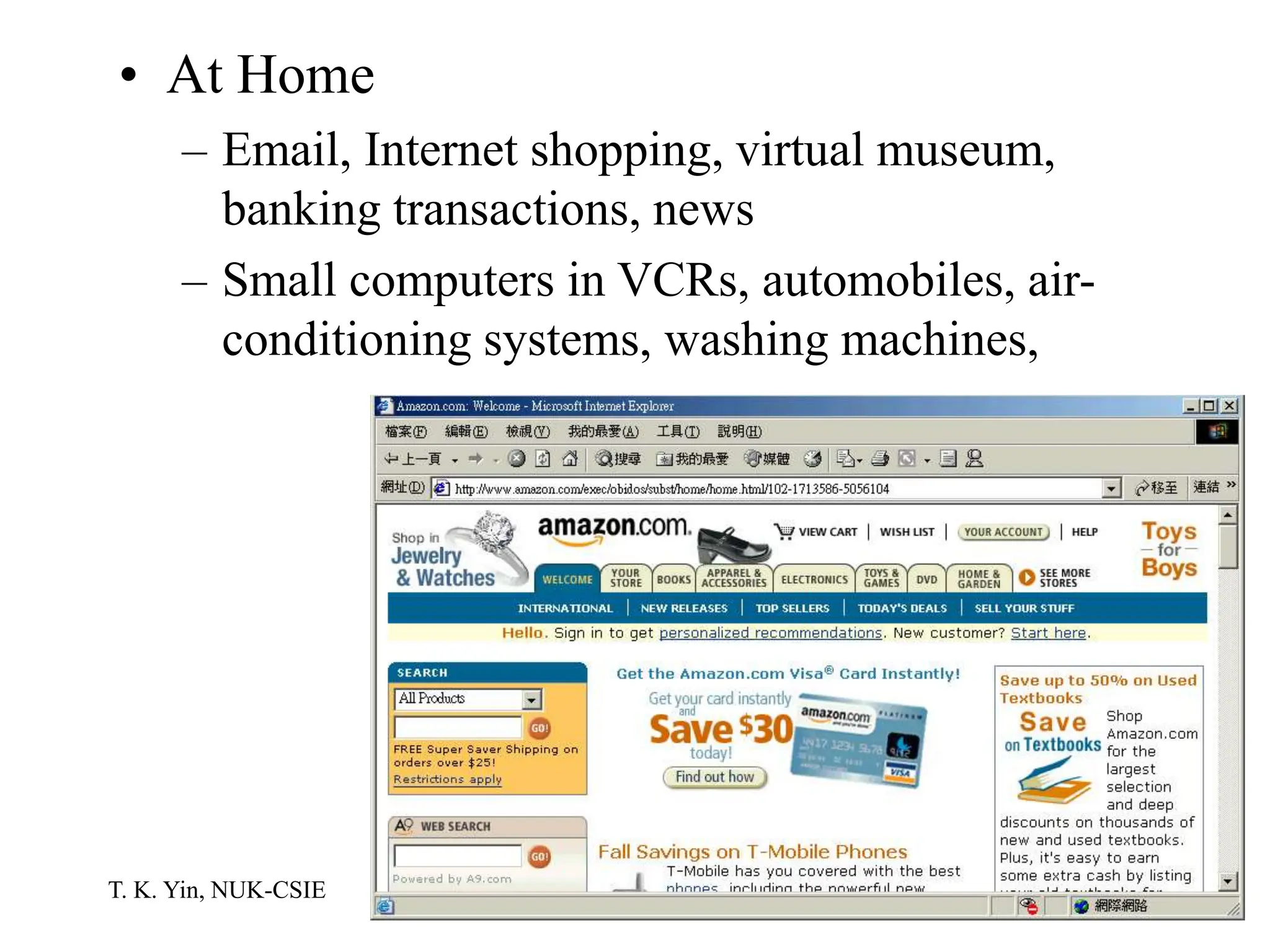
• At Home
– Email, Internet shopping, virtual museum,
banking transactions, news
– Small computers in VCRs, automobiles, air-
conditioning systems, washing machines,
T. K. Yin, NUK-CSIE
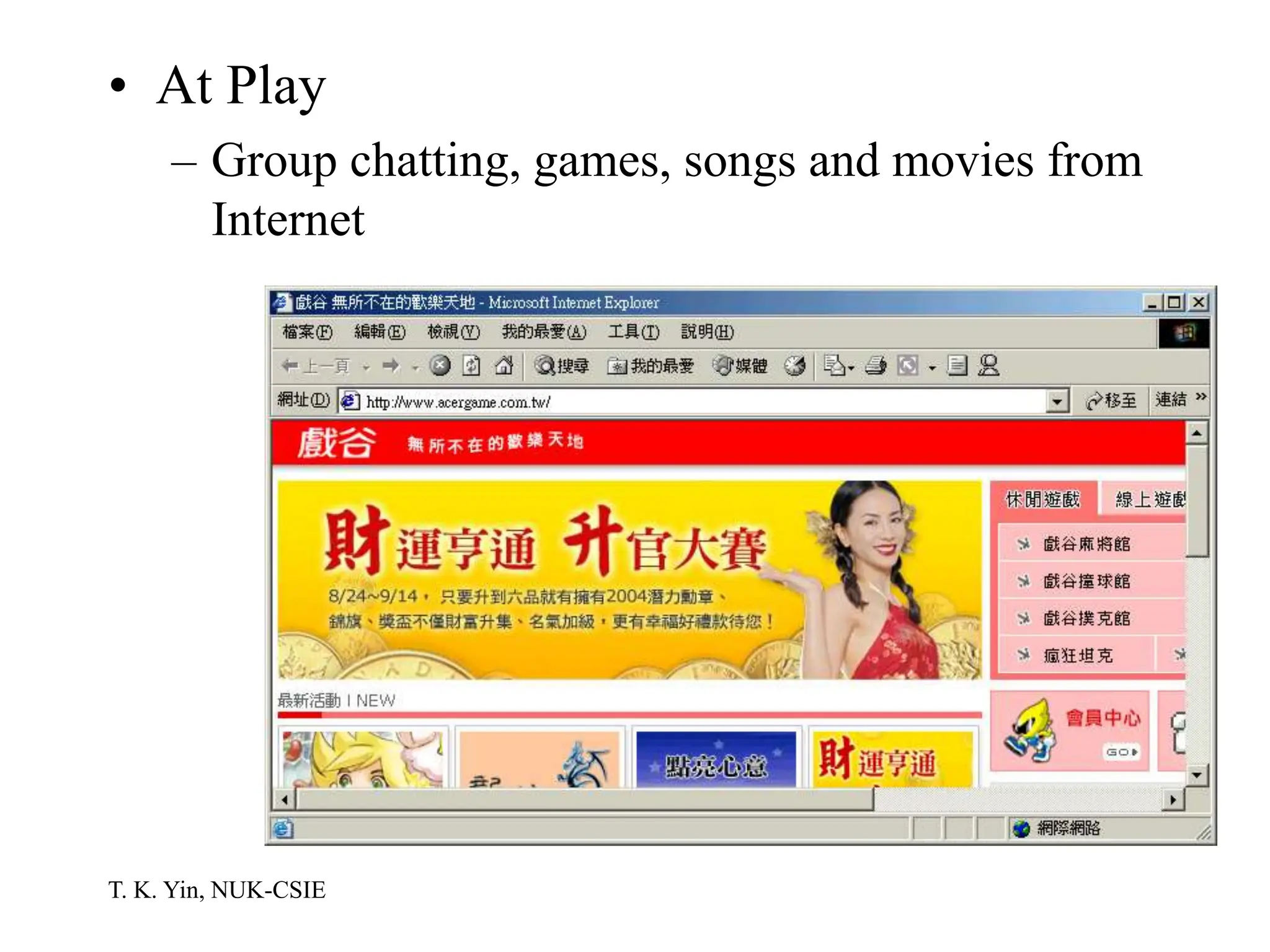
• At Play
– Group chatting, games, songs and movies from
Internet
T. K. Yin, NUK-CSIE
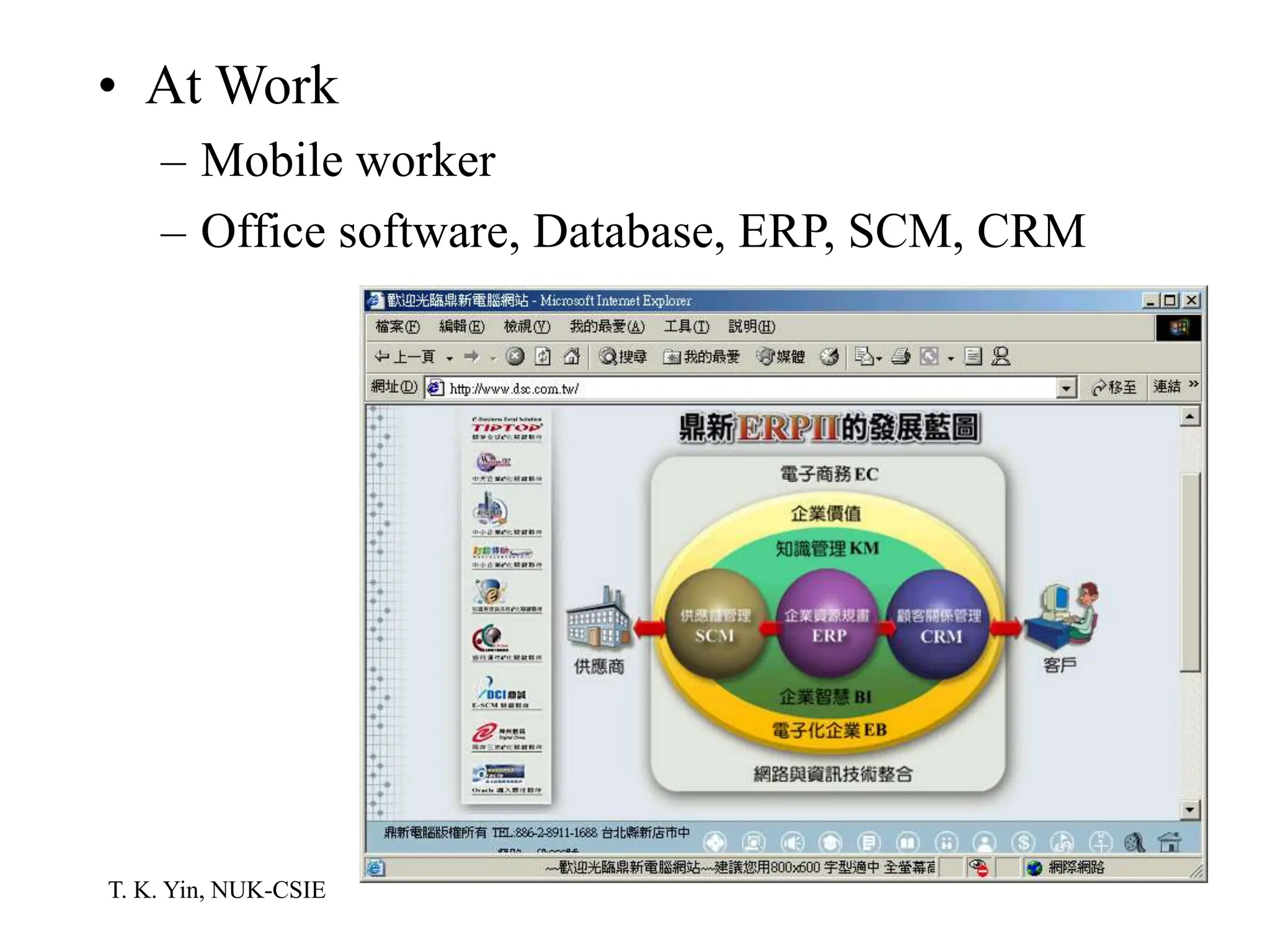
• At Work
– Mobile worker
– Office software, Database, ERP, SCM, CRM
T. K. Yin, NUK-CSIE
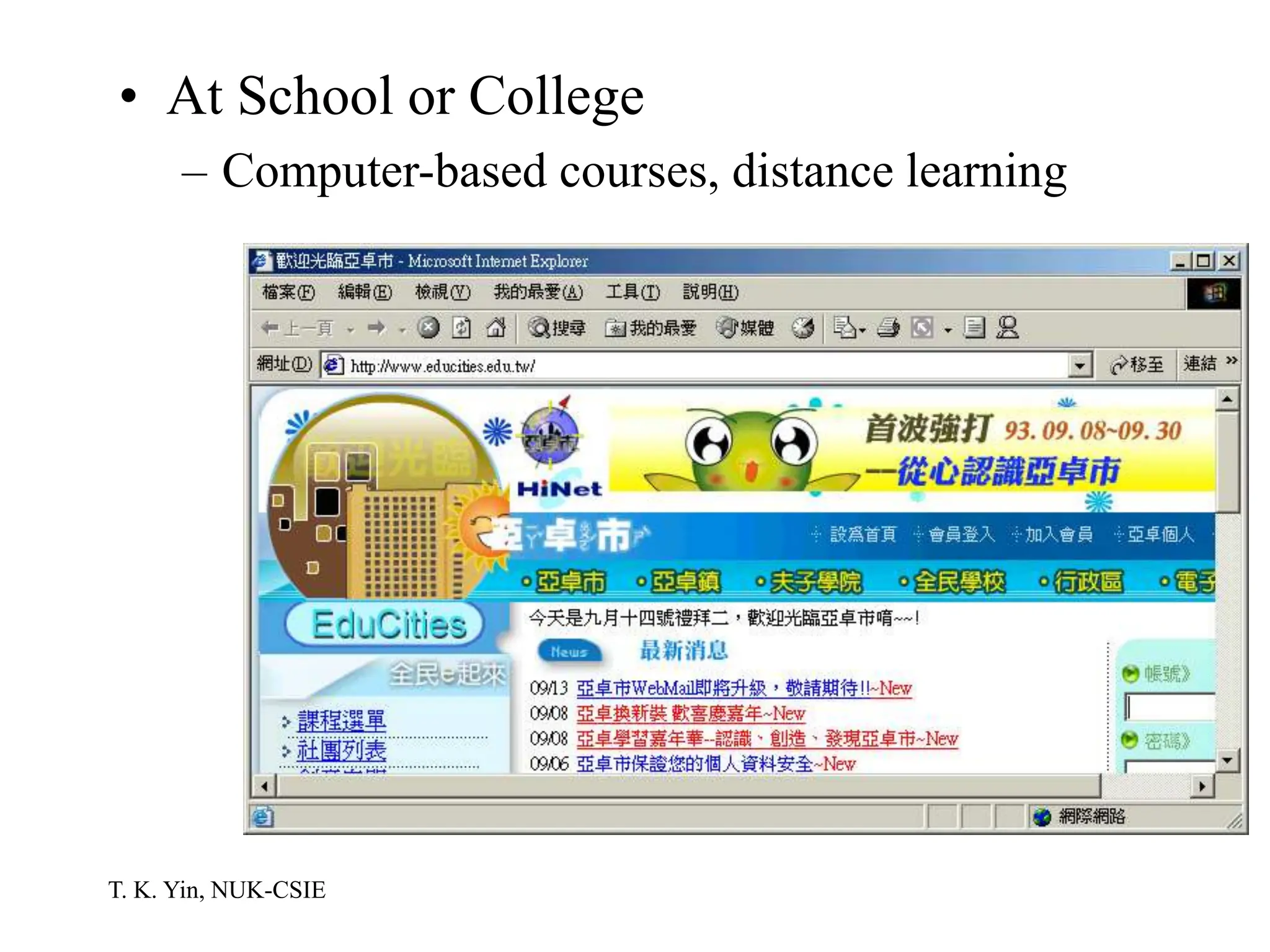
• At School or College
– Computer-based courses, distance learning
T. K. Yin, NUK-CSIE
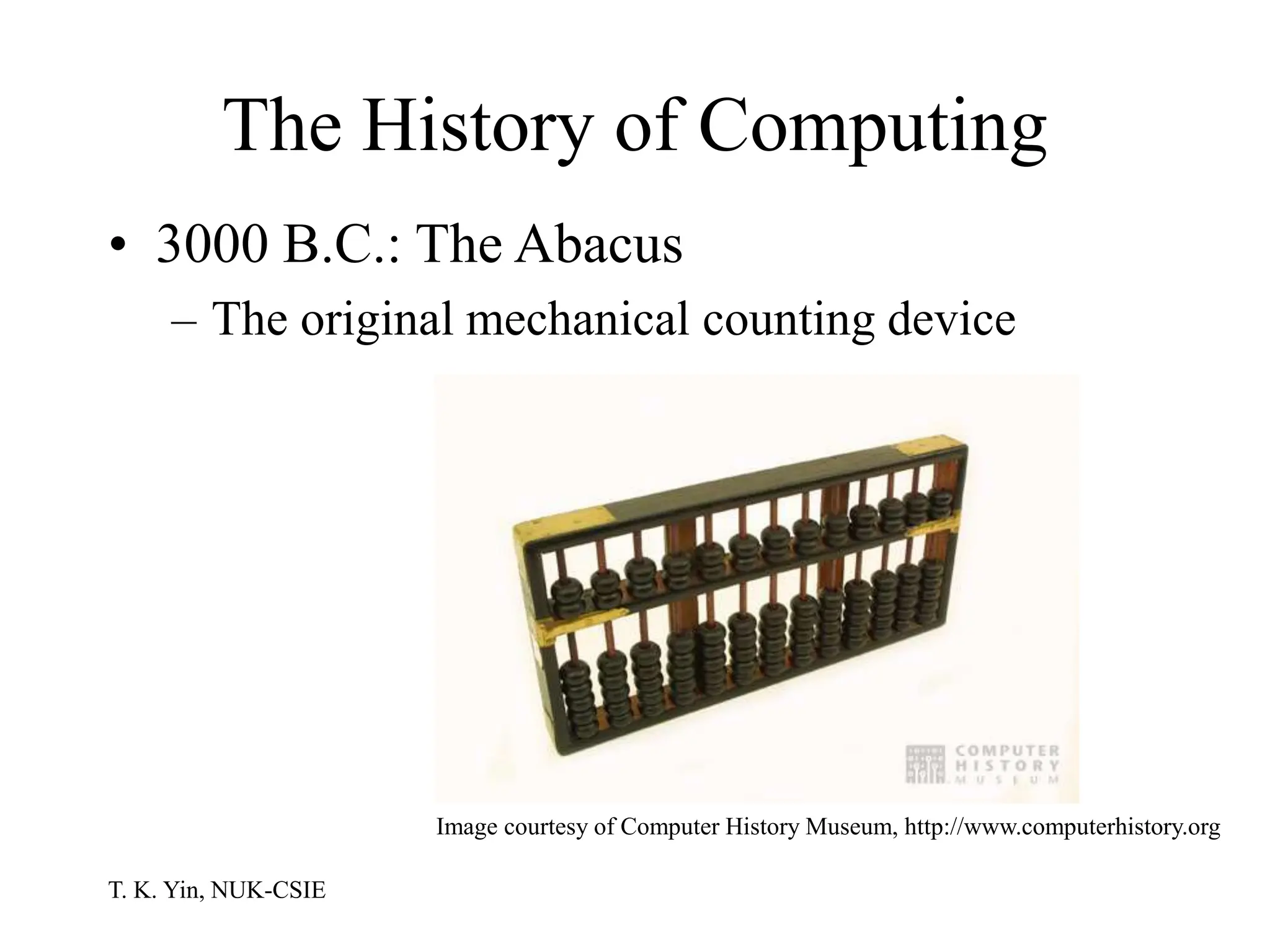
The History of Computing
• 3000 B.C.: The Abacus
– The original mechanical counting device
Image courtesy of Computer History Museum, http://www.computerhistory.org
T. K. Yin, NUK-CSIE
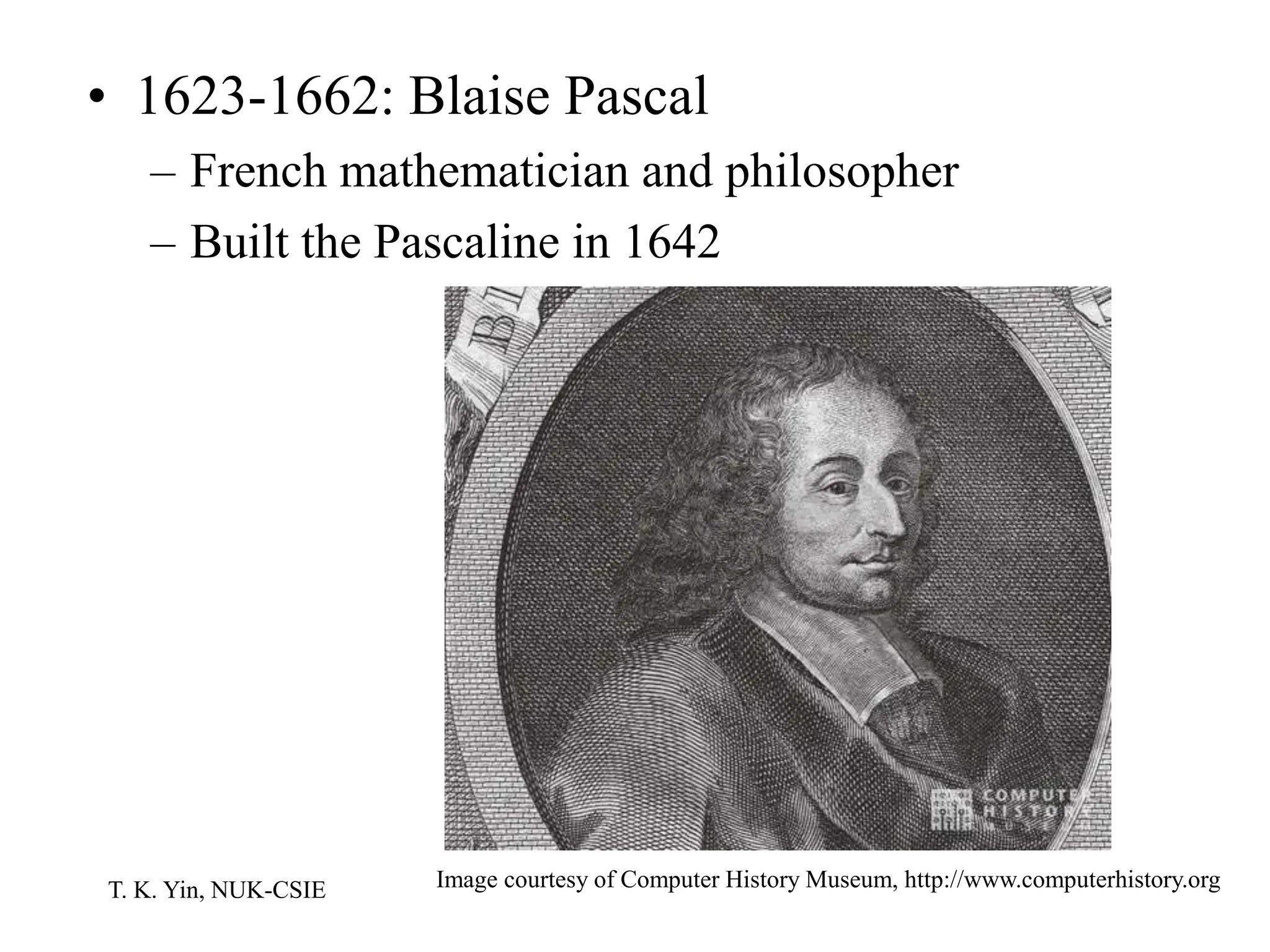
• 1623-1662: Blaise Pascal
– French mathematician and philosopher
– Built the Pascaline in 1642
Image courtesy of Computer History Museum, http://www.computerhistory.org
T. K. Yin, NUK-CSIE
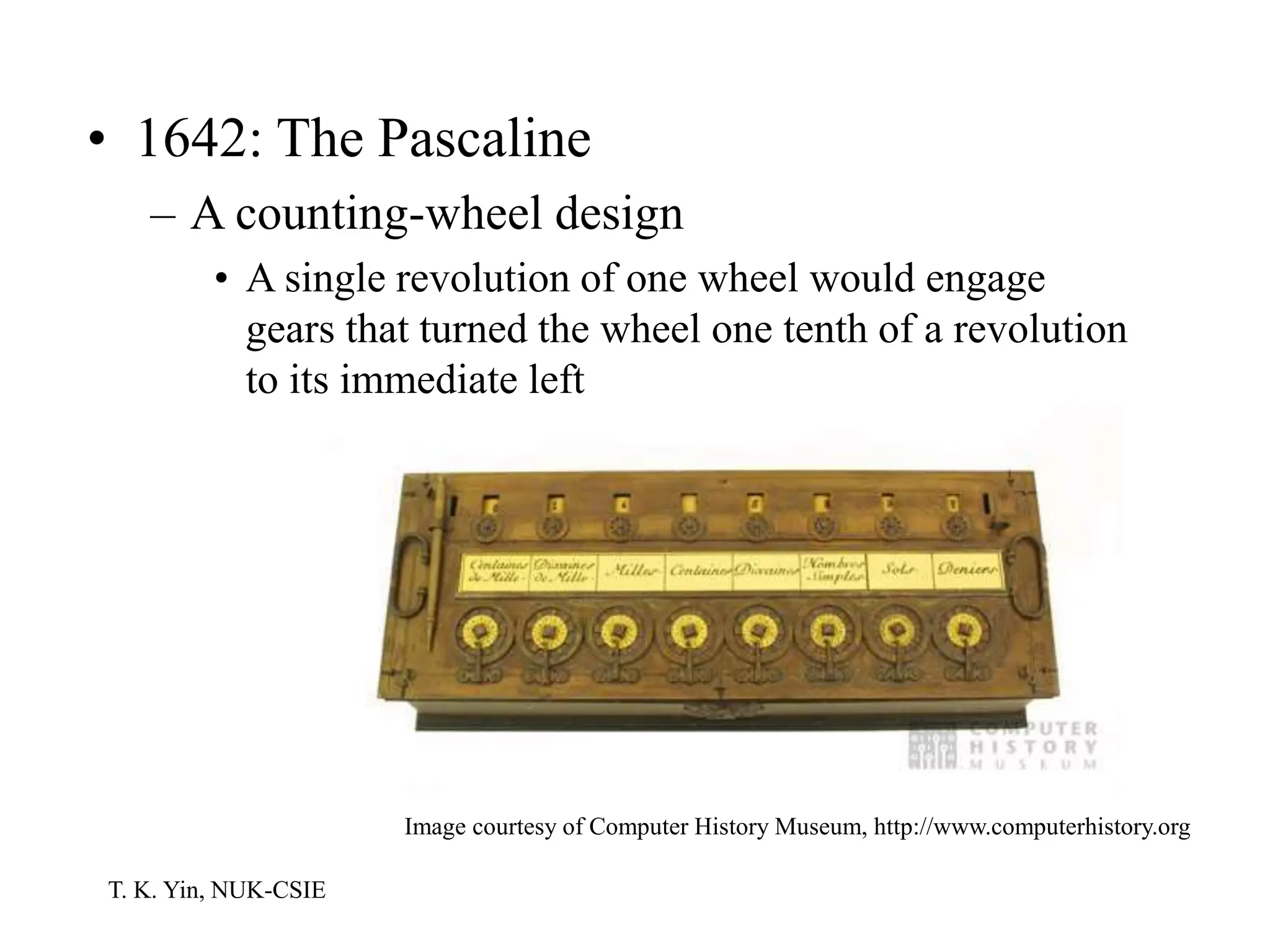
• 1642: The Pascaline
– A counting-wheel design
• A single revolution of one wheel would engage
gears that turned the wheel one tenth of a revolution
to its immediate left
Image courtesy of Computer History Museum, http://www.computerhistory.org
T. K. Yin, NUK-CSIE
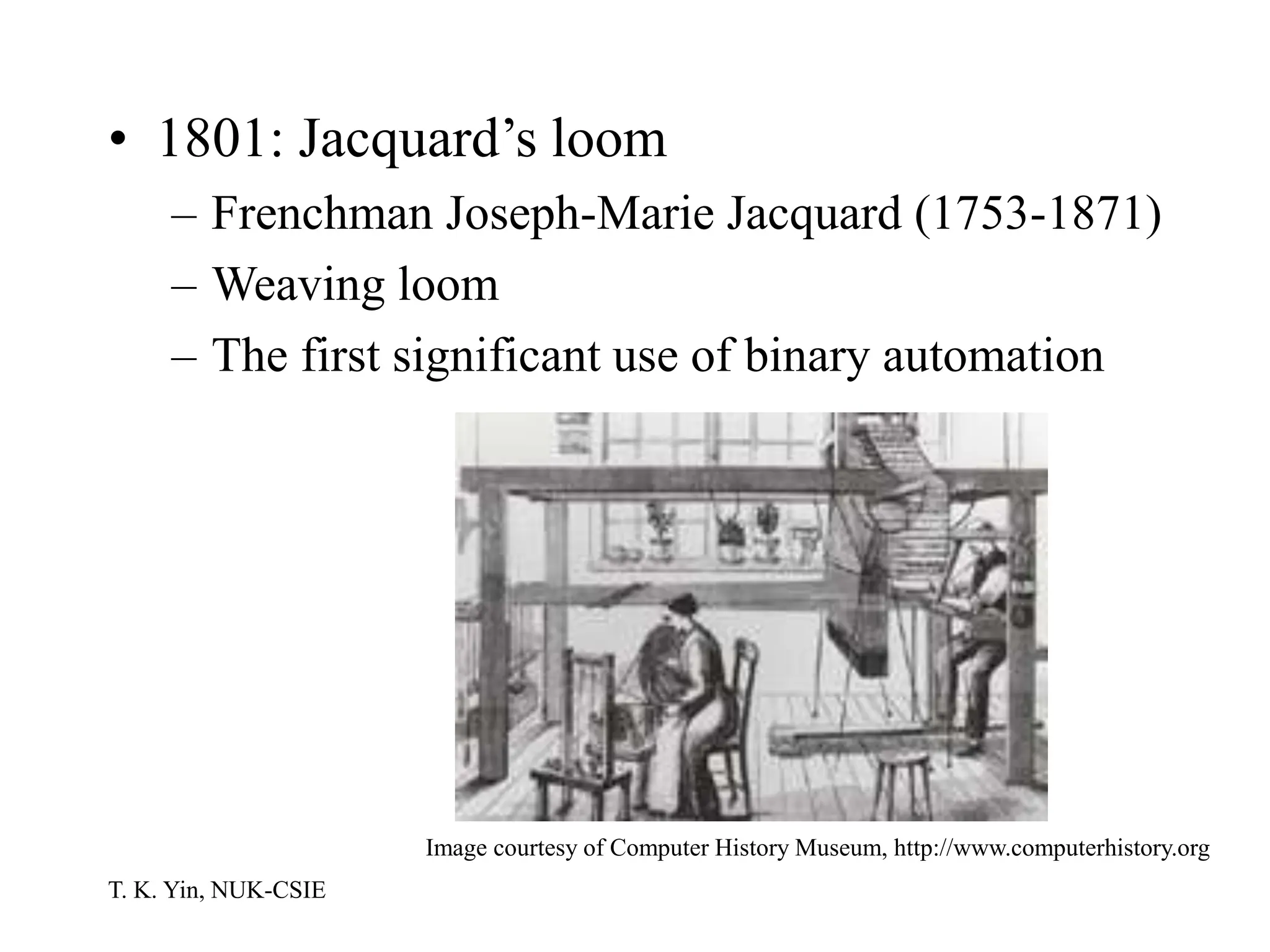
• 1801: Jacquard’s loom
– Frenchman Joseph-Marie Jacquard (1753-1871)
– Weaving loom
– The first significant use of binary automation
Image courtesy of Computer History Museum, http://www.computerhistory.org
T. K. Yin, NUK-CSIE
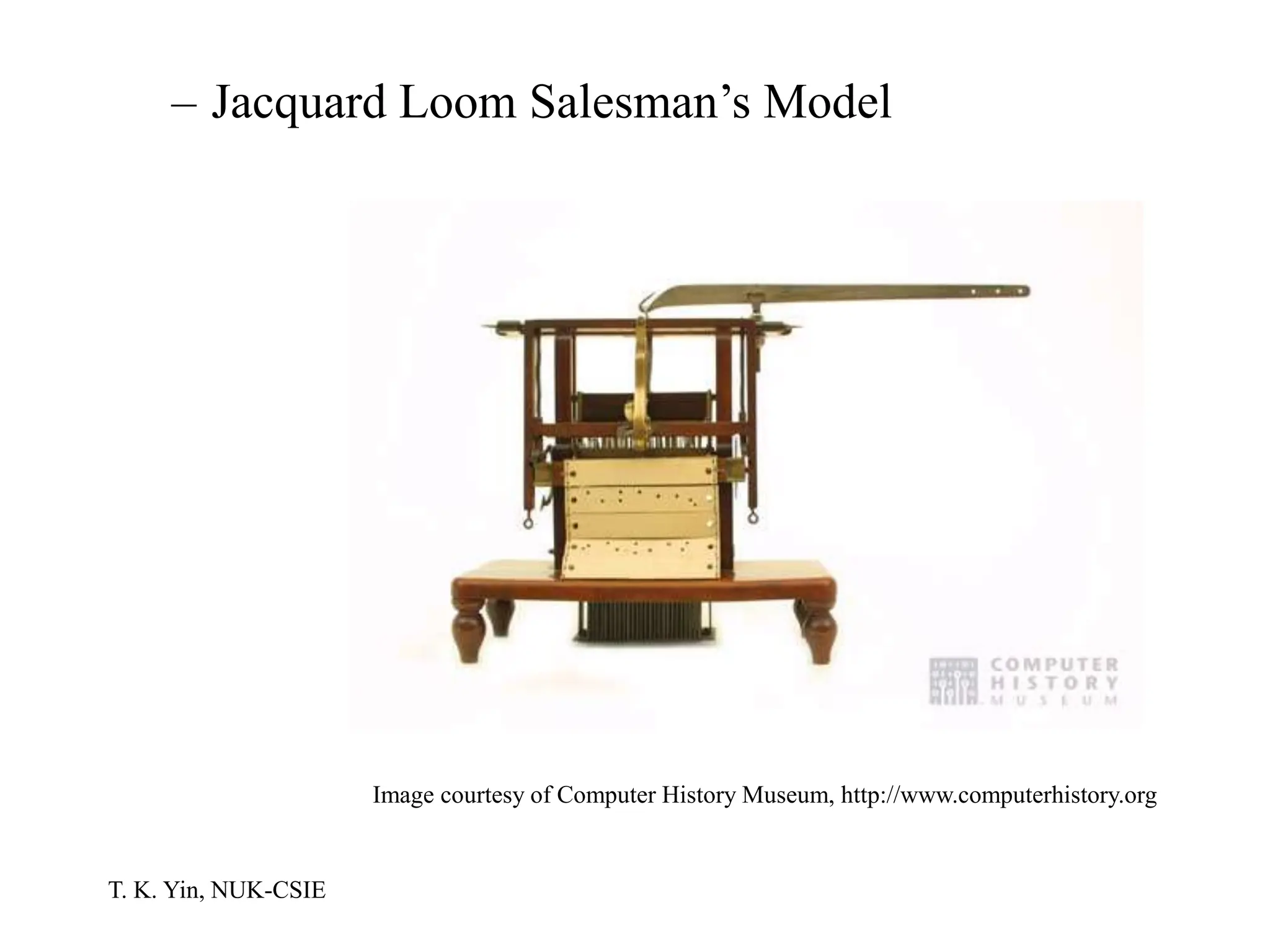
– Jacquard Loom Salesman’s Model
Image courtesy of Computer History Museum, http://www.computerhistory.org
T. K. Yin, NUK-CSIE
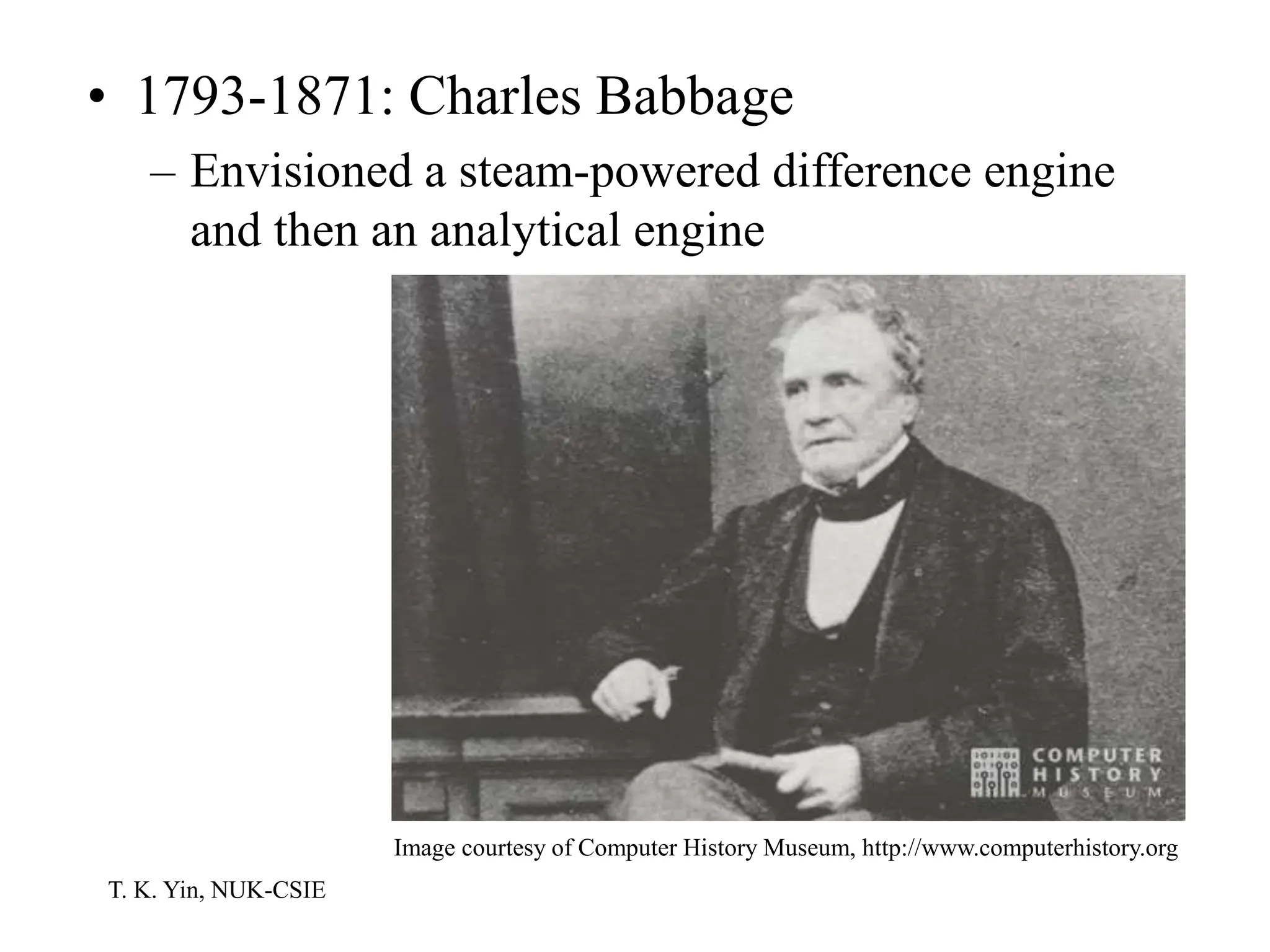
• 1793-1871: Charles Babbage
– Envisioned a steam-powered difference engine
and then an analytical engine
Image courtesy of Computer History Museum, http://www.computerhistory.org
T. K. Yin, NUK-CSIE
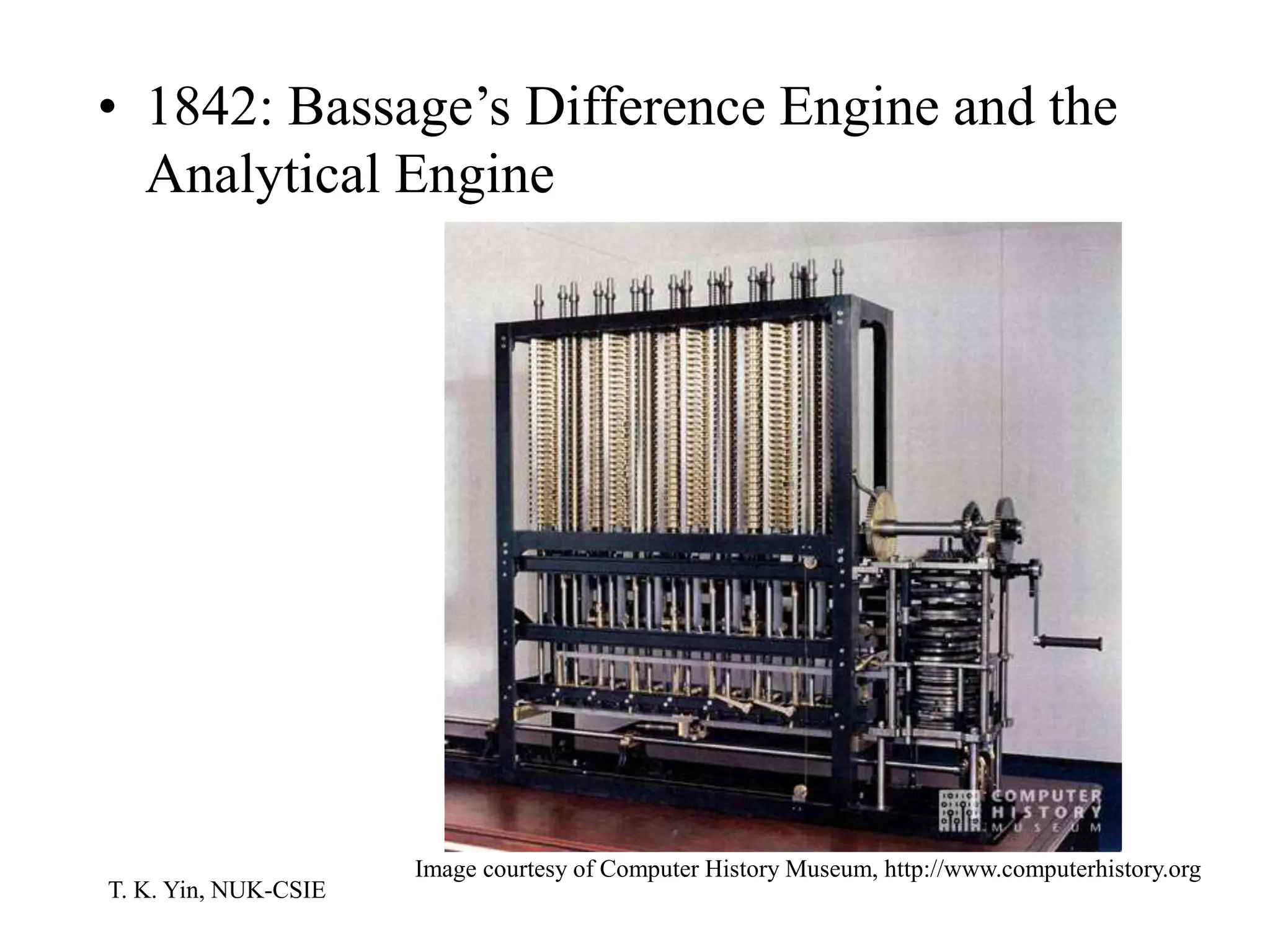
• 1842: Bassage’s Difference Engine and the
Analytical Engine
Image courtesy of Computer History Museum, http://www.computerhistory.org
T. K. Yin, NUK-CSIE
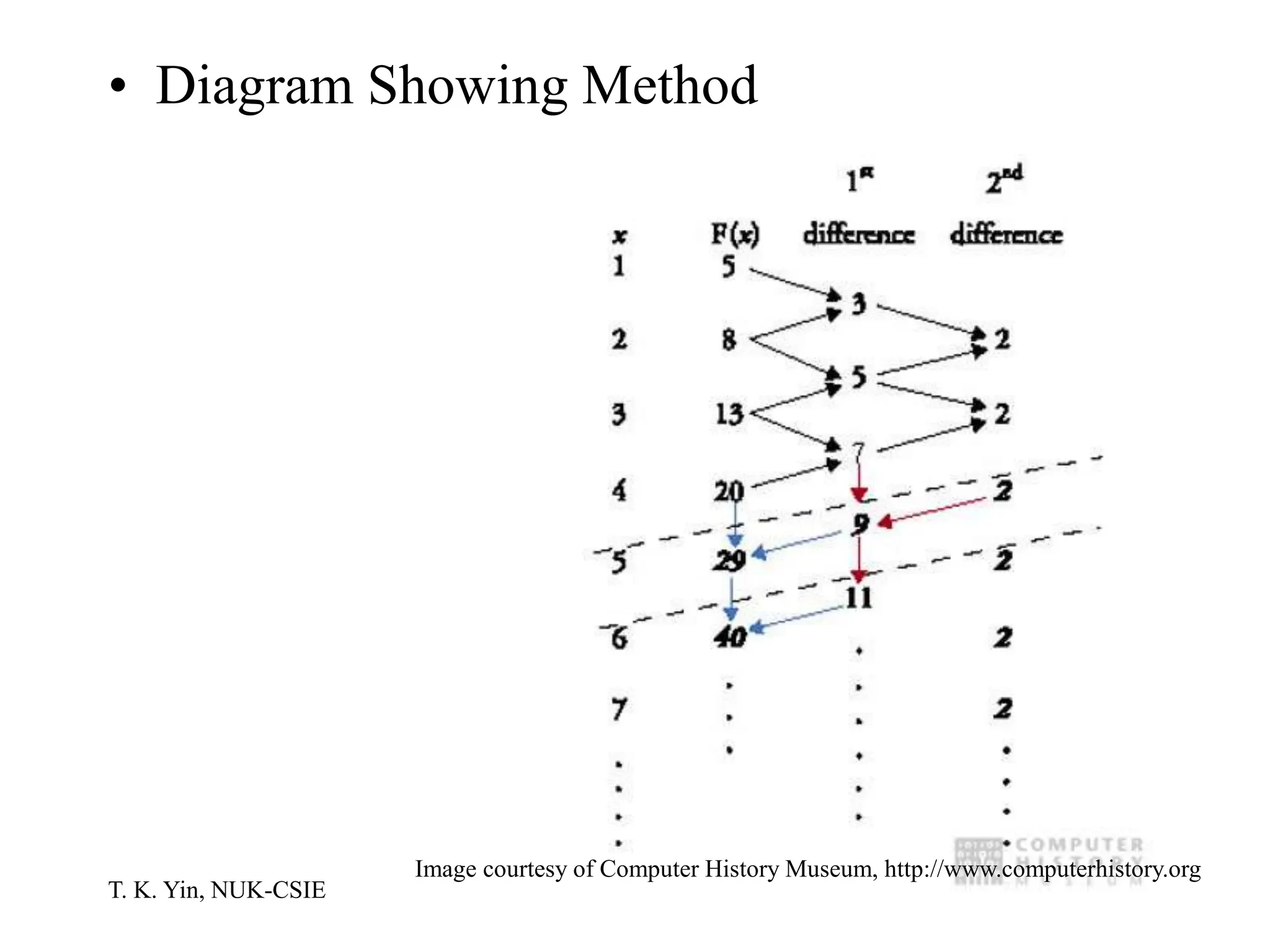
• Diagram Showing Method
Image courtesy of Computer History Museum, http://www.computerhistory.org
T. K. Yin, NUK-CSIE
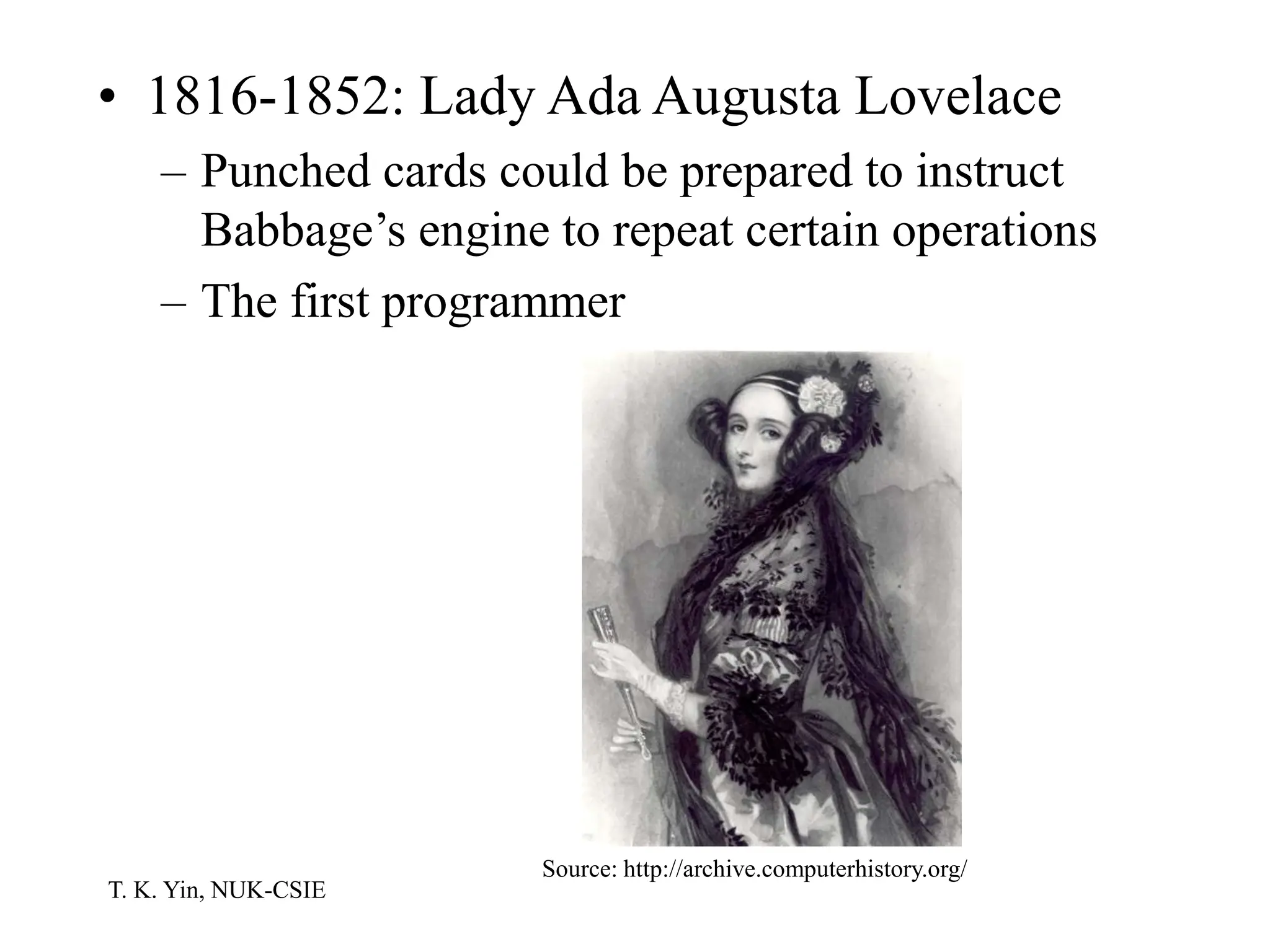
• 1816-1852: Lady Ada Augusta Lovelace
– Punched cards could be prepared to instruct
Babbage’s engine to repeat certain operations
– The first programmer
Source: http://archive.computerhistory.org/
T. K. Yin, NUK-CSIE
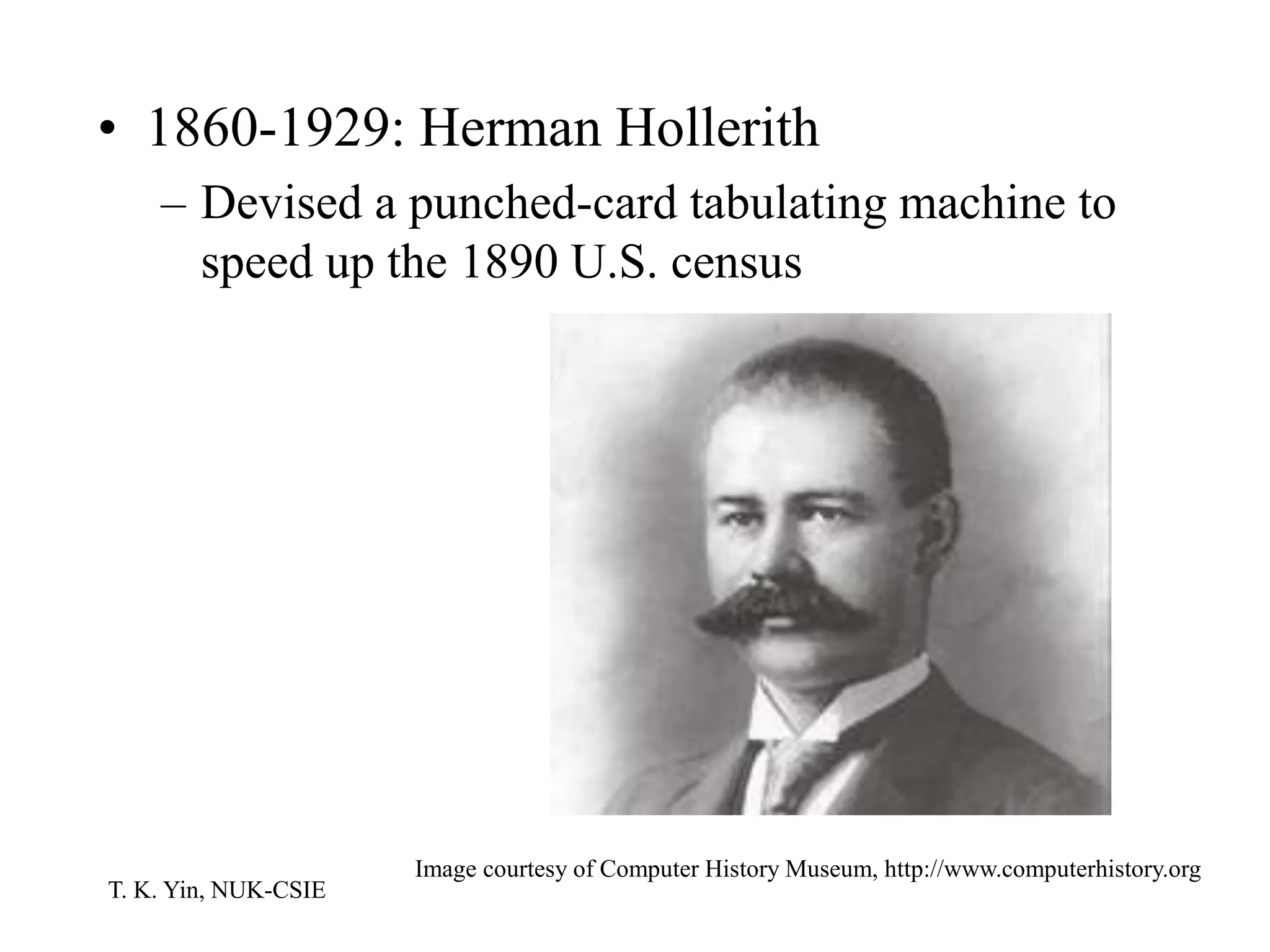
• 1860-1929: Herman Hollerith
– Devised a punched-card tabulating machine to
speed up the 1890 U.S. census
Image courtesy of Computer History Museum, http://www.computerhistory.org
T. K. Yin, NUK-CSIE
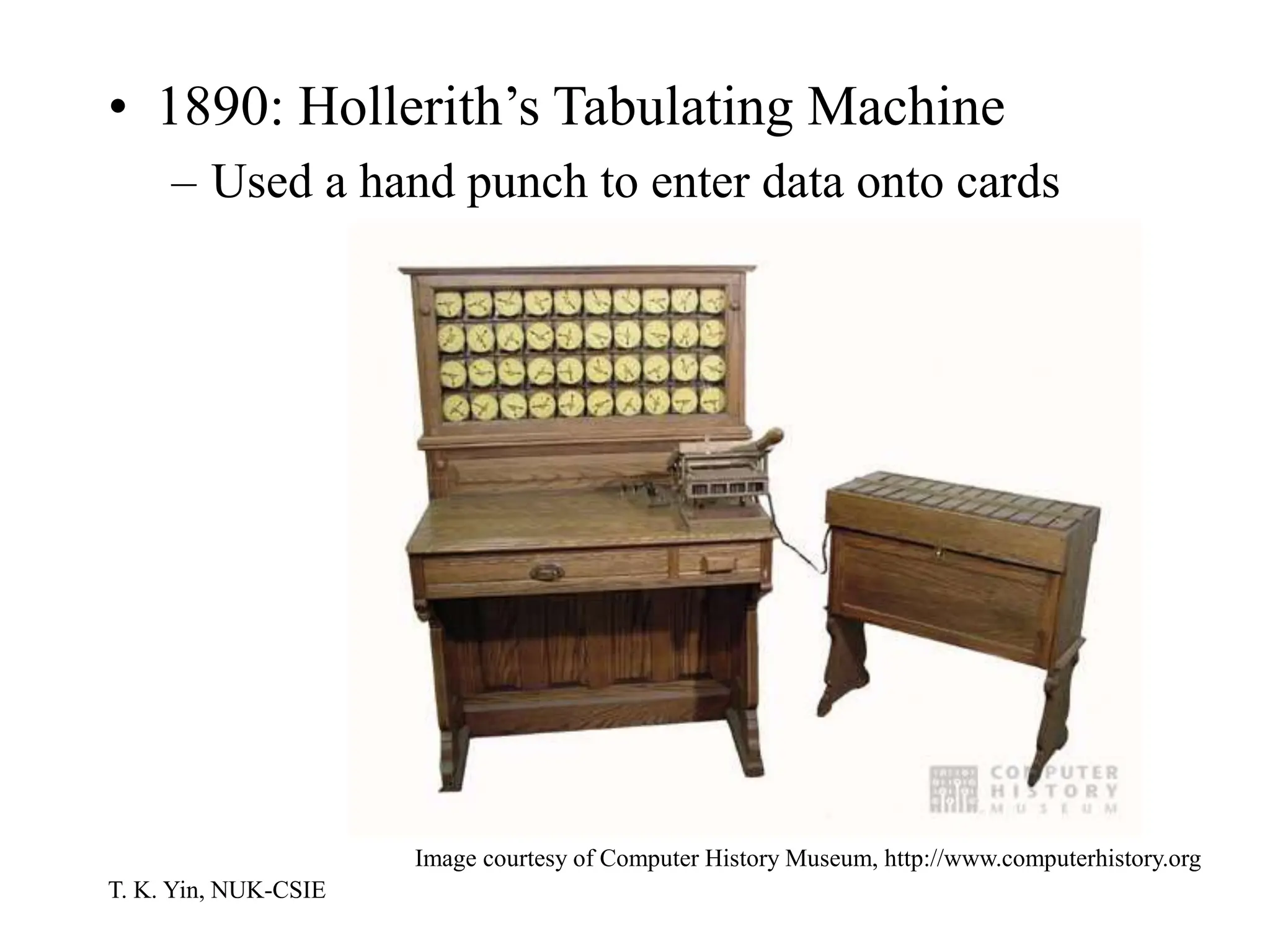
• 1890: Hollerith’s Tabulating Machine
– Used a hand punch to enter data onto cards
Image courtesy of Computer History Museum, http://www.computerhistory.org
T. K. Yin, NUK-CSIE
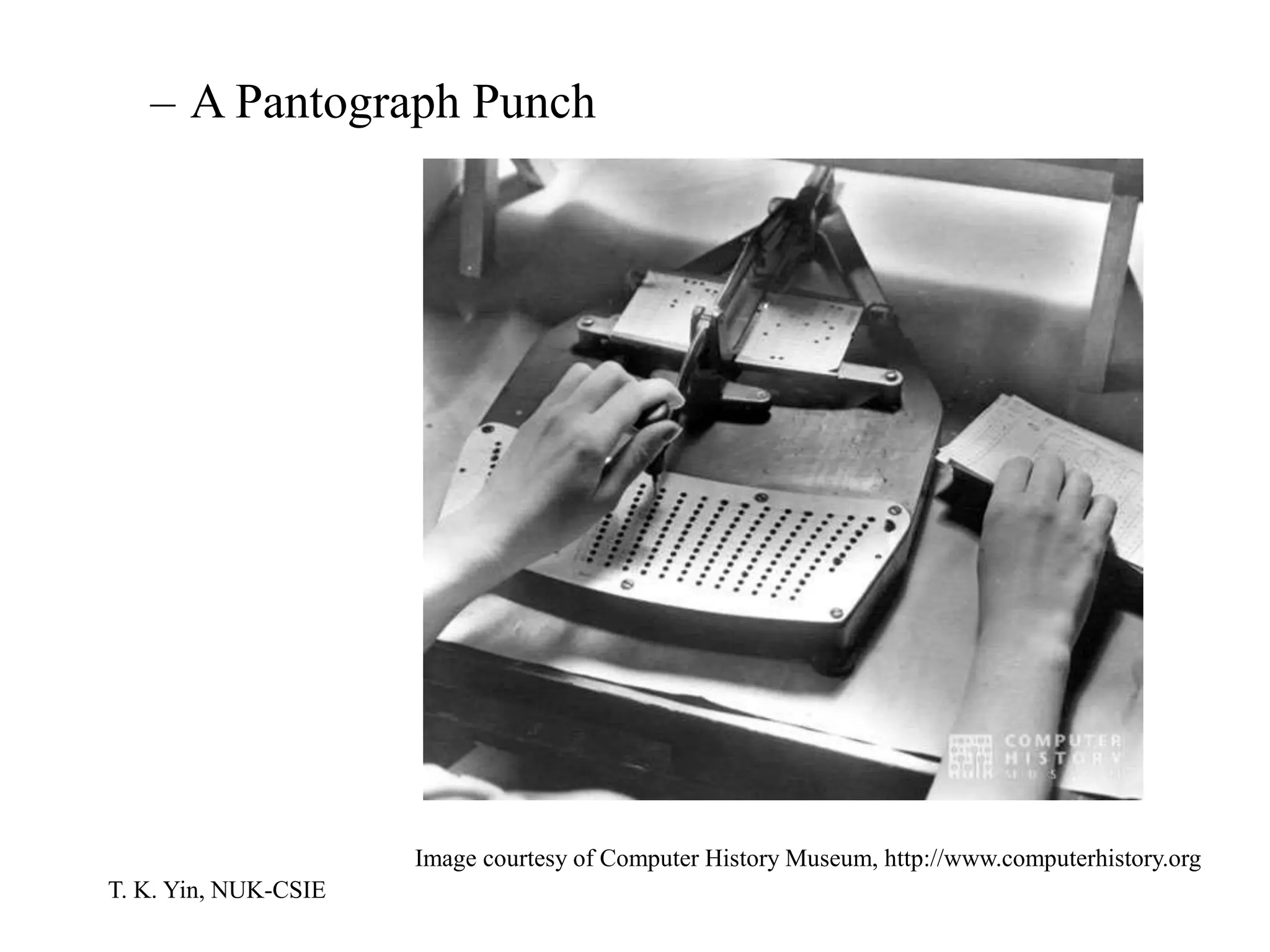
– A Pantograph Punch
Image courtesy of Computer History Museum, http://www.computerhistory.org
T. K. Yin, NUK-CSIE
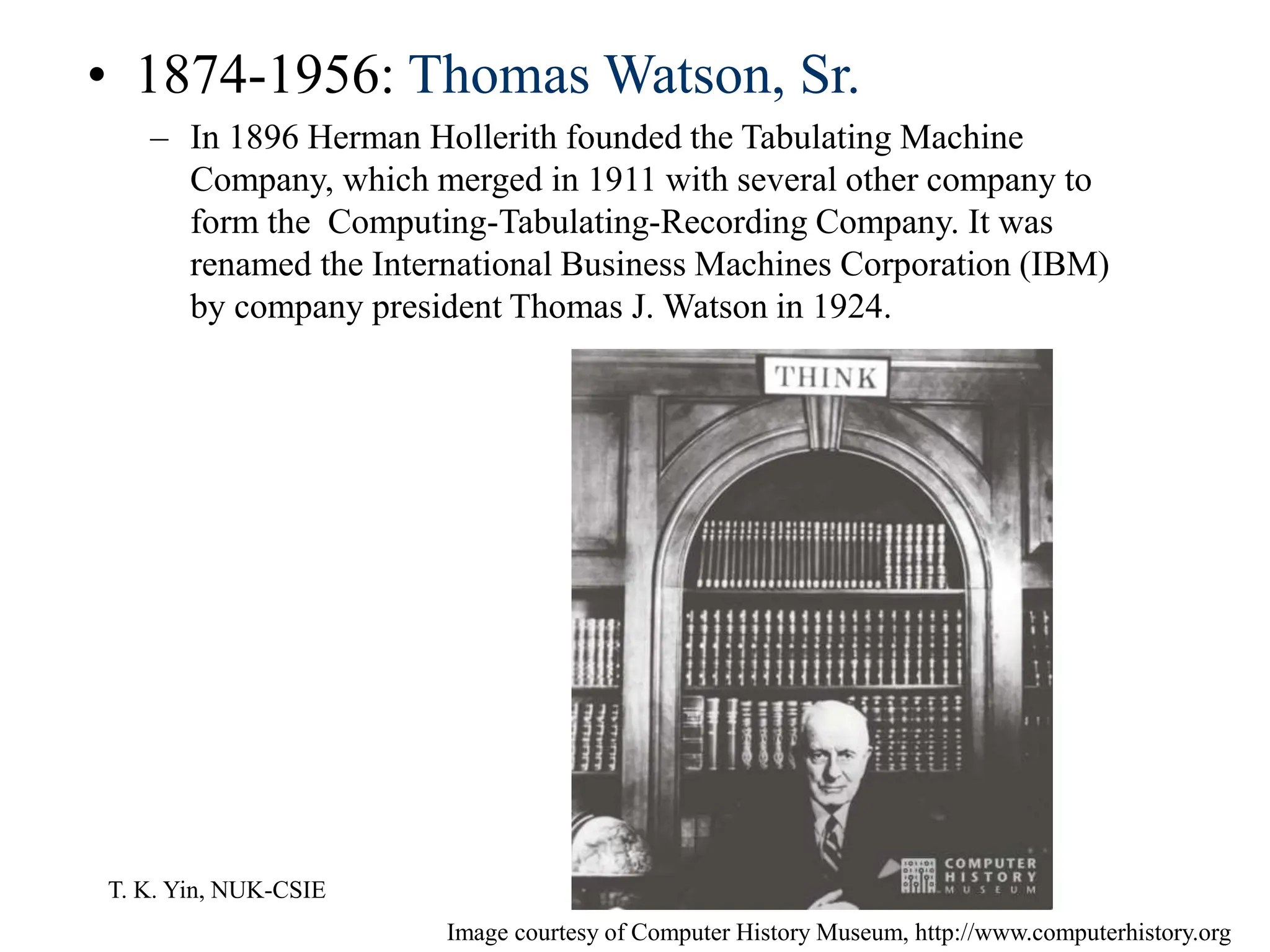
• 1874-1956: Thomas Watson, Sr.
– In 1896 Herman Hollerith founded the Tabulating Machine
Company, which merged in 1911 with several other company to
form the Computing-Tabulating-Recording Company. It was
renamed the International Business Machines Corporation (IBM)
by company president Thomas J. Watson in 1924.
Image courtesy of Computer History Museum, http://www.computerhistory.org
T. K. Yin, NUK-CSIE
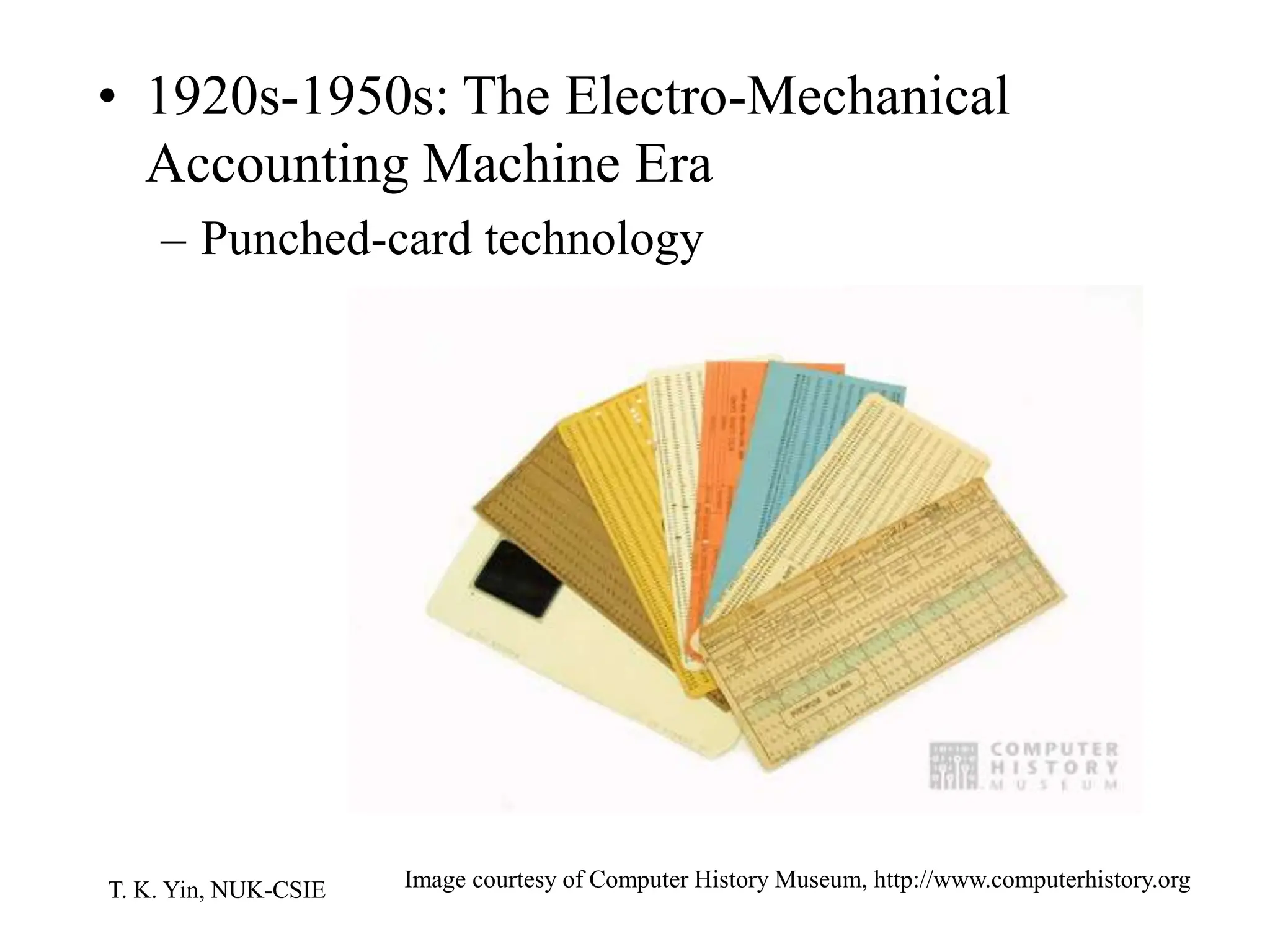
• 1920s-1950s: The Electro-Mechanical
Accounting Machine Era
– Punched-card technology
Image courtesy of Computer History Museum, http://www.computerhistory.org
T. K. Yin, NUK-CSIE
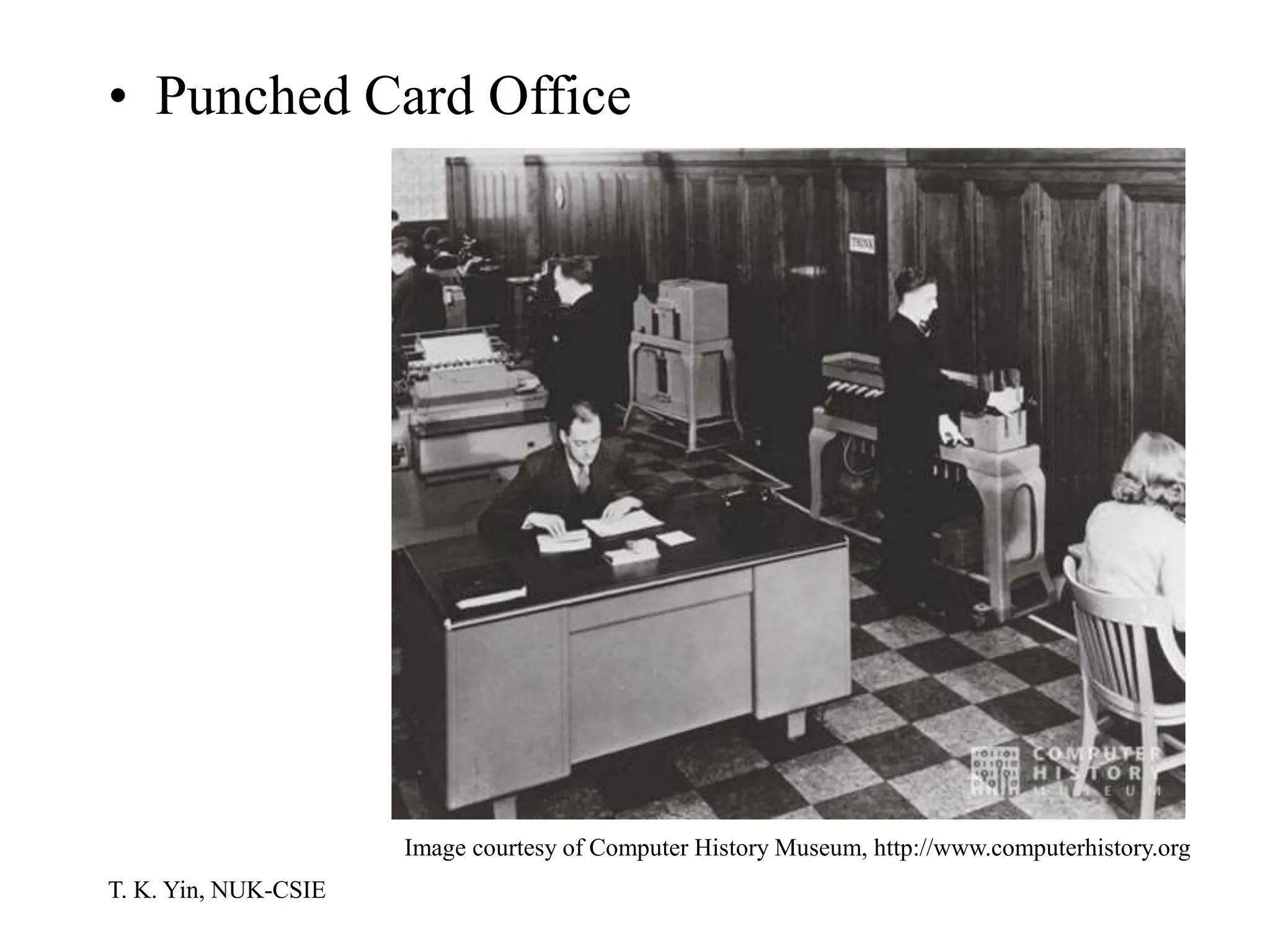
• Punched Card Office
Image courtesy of Computer History Museum, http://www.computerhistory.org
T. K. Yin, NUK-CSIE
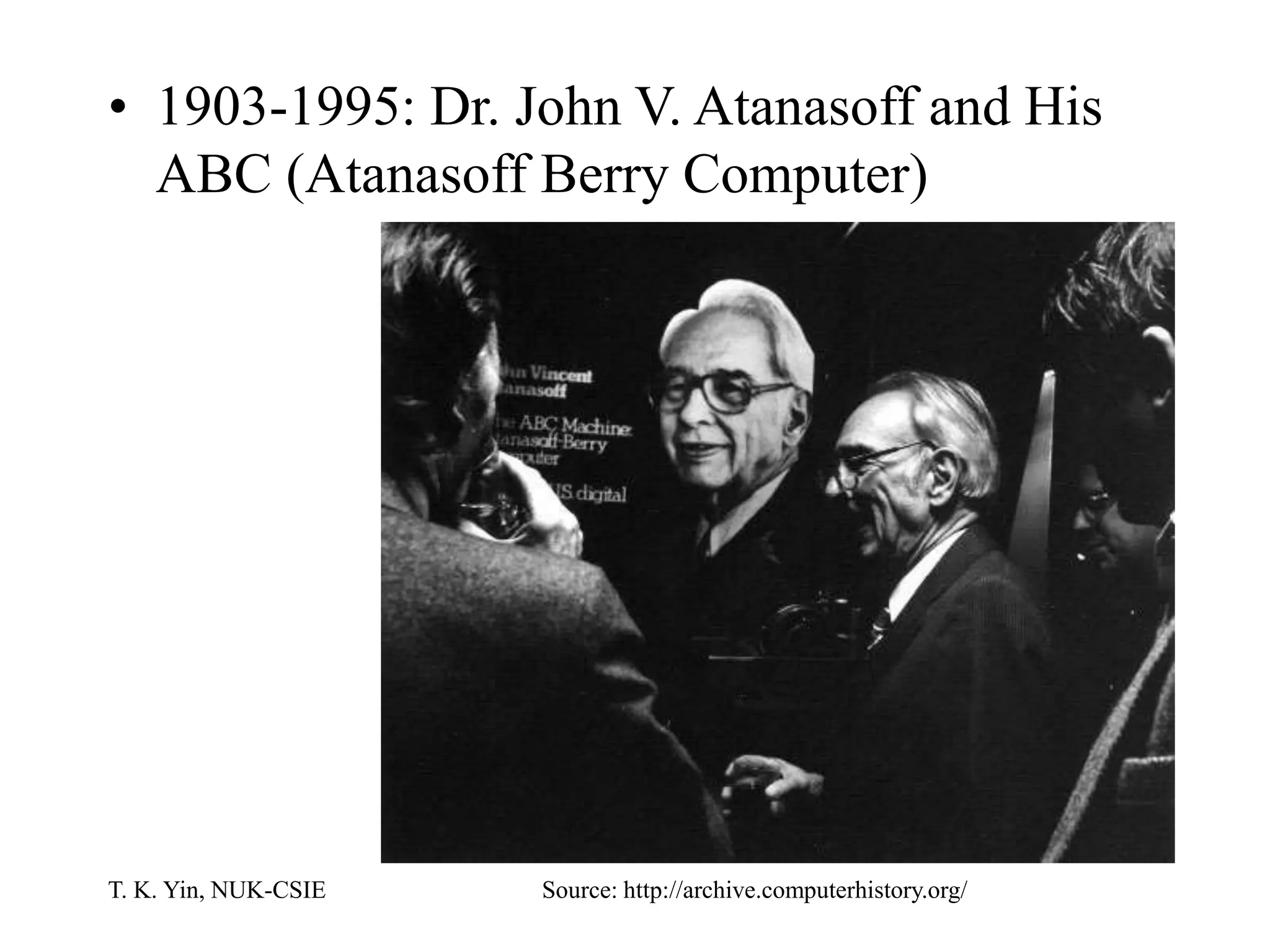
• 1903-1995: Dr. John V. Atanasoff and His
ABC (Atanasoff Berry Computer)
Source: http://archive.computerhistory.org/
T. K. Yin, NUK-CSIE
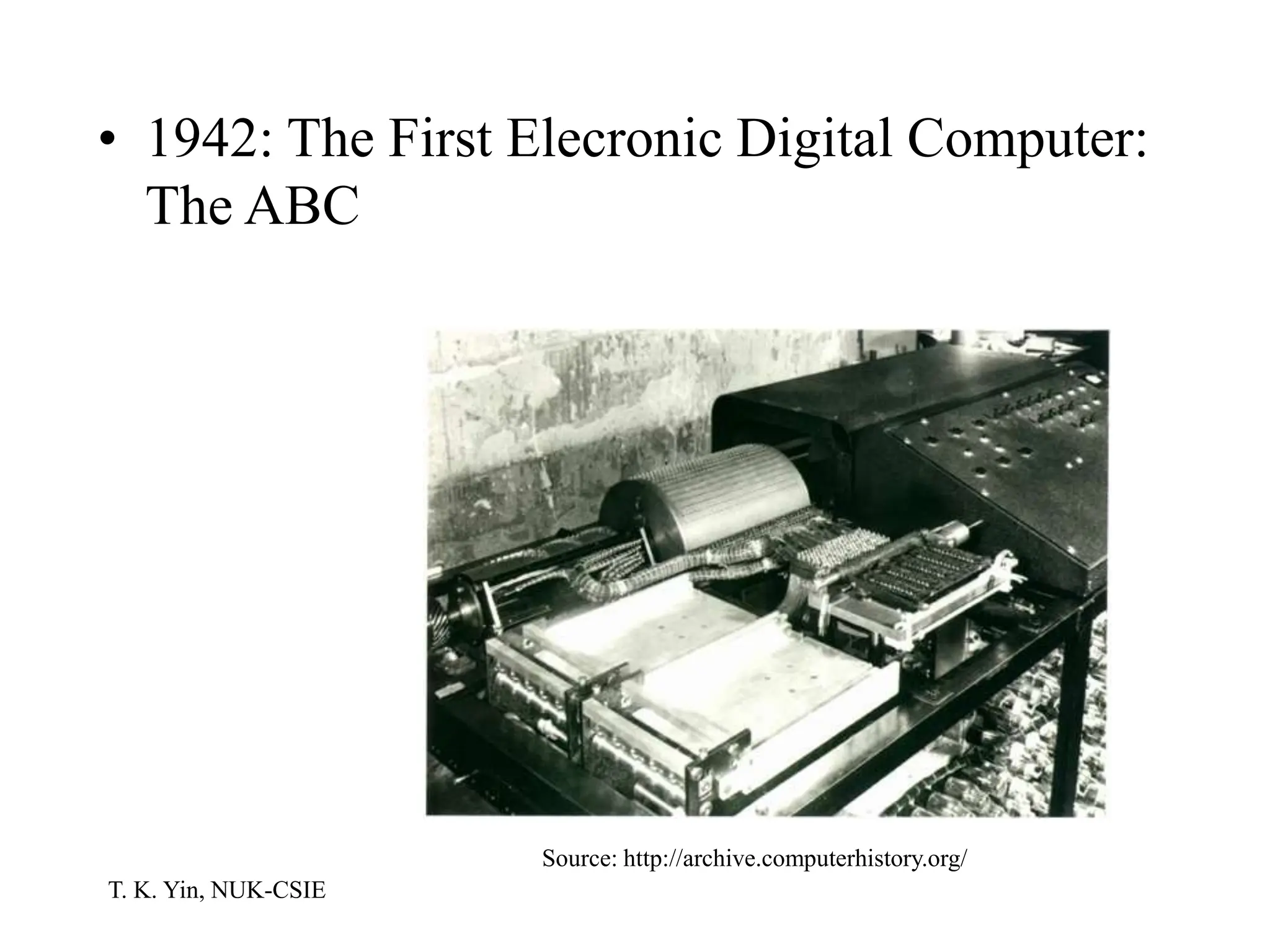
• 1942: The First Elecronic Digital Computer:
The ABC
Source: http://archive.computerhistory.org/
T. K. Yin, NUK-CSIE
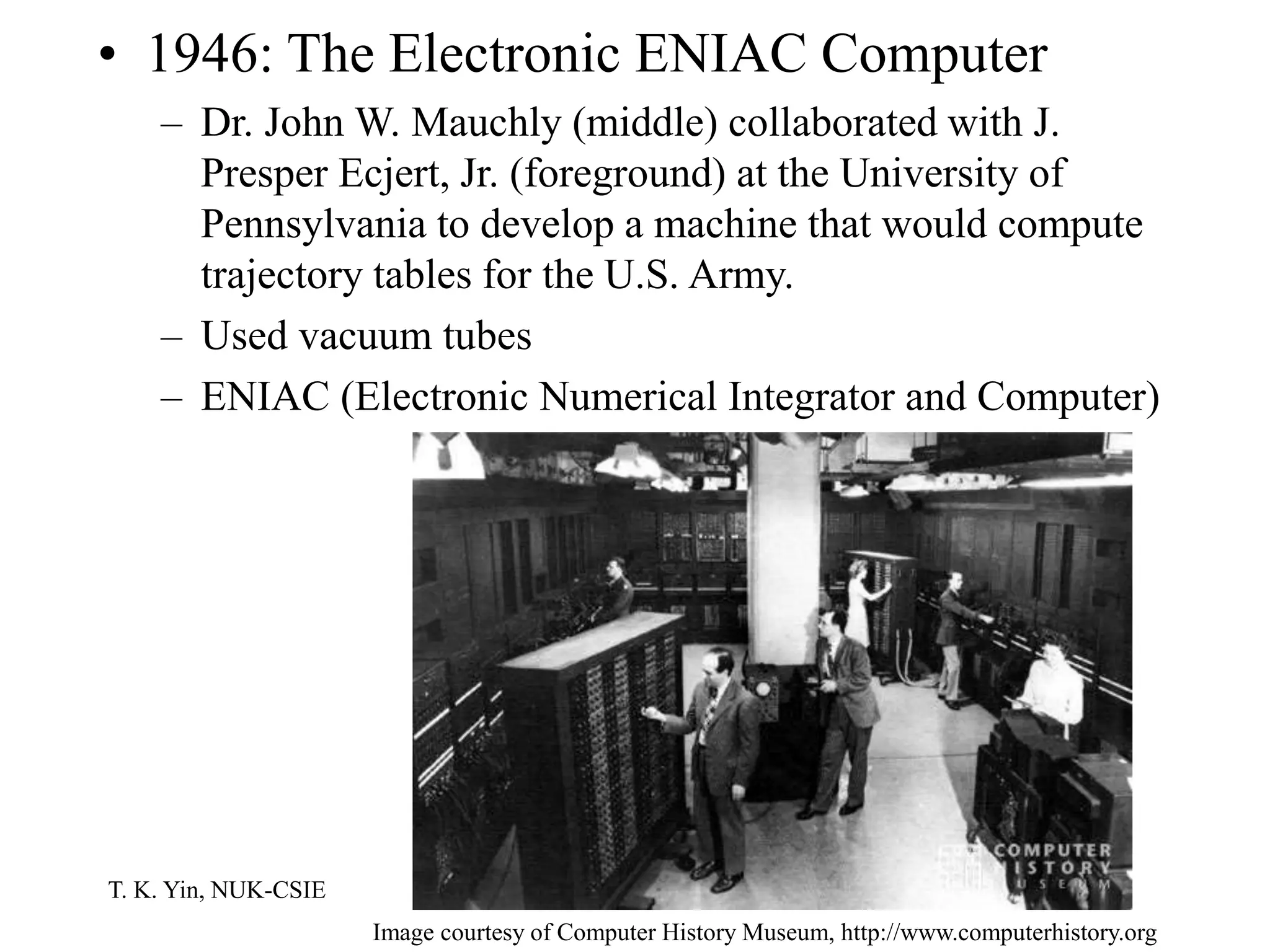
• 1946: The Electronic ENIAC Computer
– Dr. John W. Mauchly (middle) collaborated with J.
Presper Ecjert, Jr. (foreground) at the University of
Pennsylvania to develop a machine that would compute
trajectory tables for the U.S. Army.
– Used vacuum tubes
– ENIAC (Electronic Numerical Integrator and Computer)
Image courtesy of Computer History Museum, http://www.computerhistory.org
T. K. Yin, NUK-CSIE
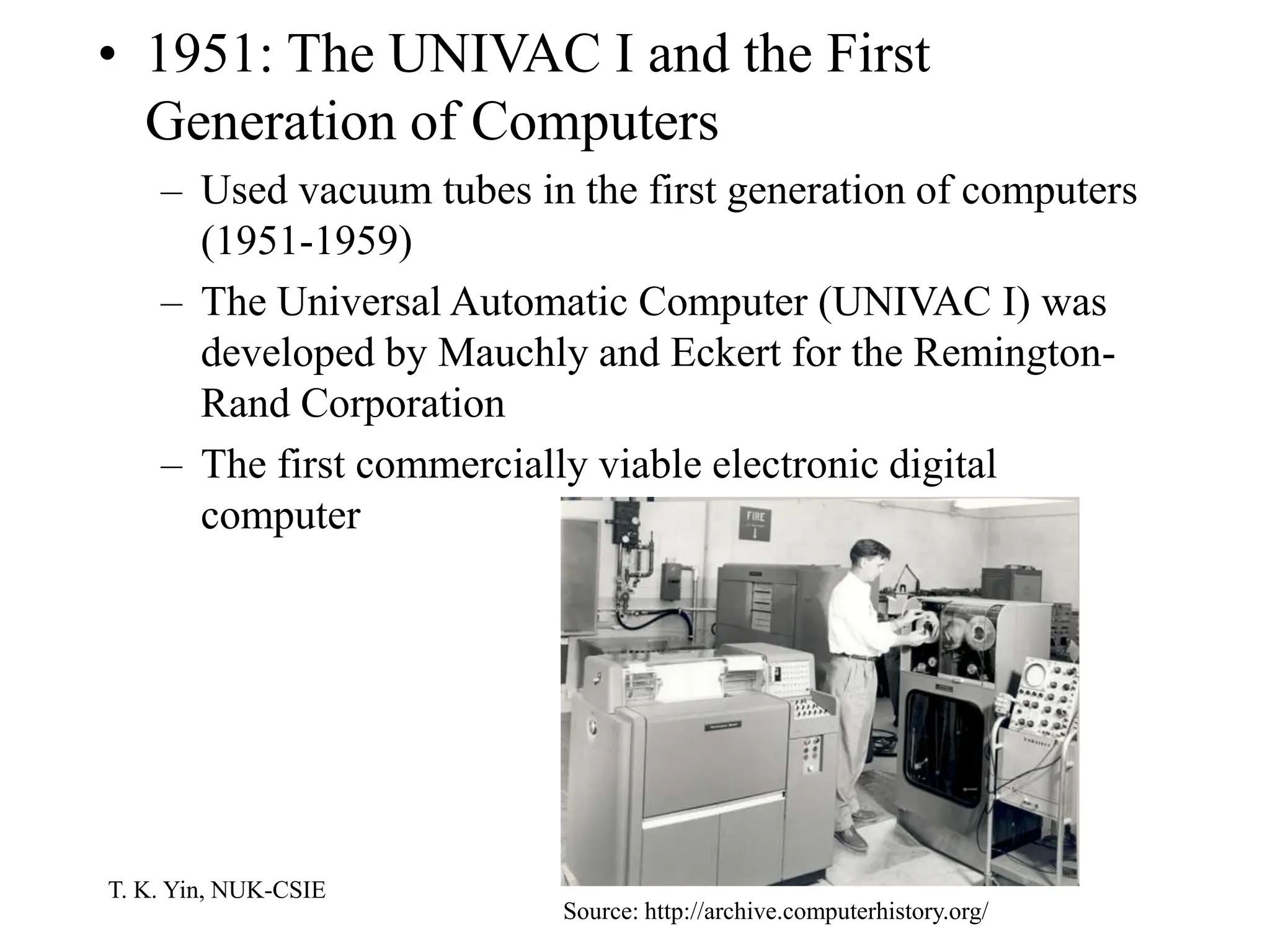
• 1951: The UNIVAC I and the First
Generation of Computers
– Used vacuum tubes in the first generation of computers
(1951-1959)
– The Universal Automatic Computer (UNIVAC I) was
developed by Mauchly and Eckert for the Remington-
Rand Corporation
– The first commercially viable electronic digital
computer
Source: http://archive.computerhistory.org/
T. K. Yin, NUK-CSIE
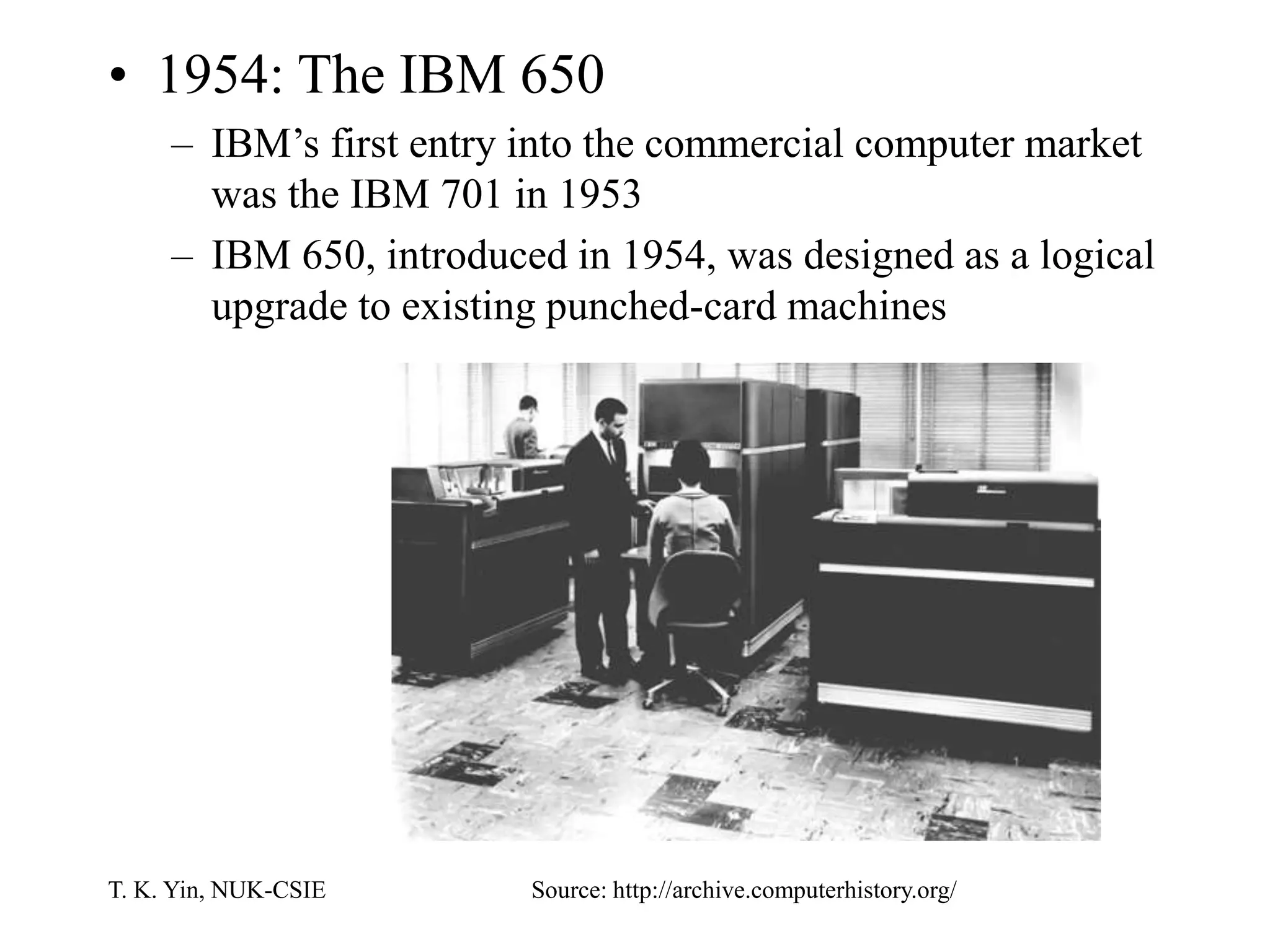
• 1954: The IBM 650
– IBM’s first entry into the commercial computer market
was the IBM 701 in 1953
– IBM 650, introduced in 1954, was designed as a logical
upgrade to existing punched-card machines
Source: http://archive.computerhistory.org/
T. K. Yin, NUK-CSIE
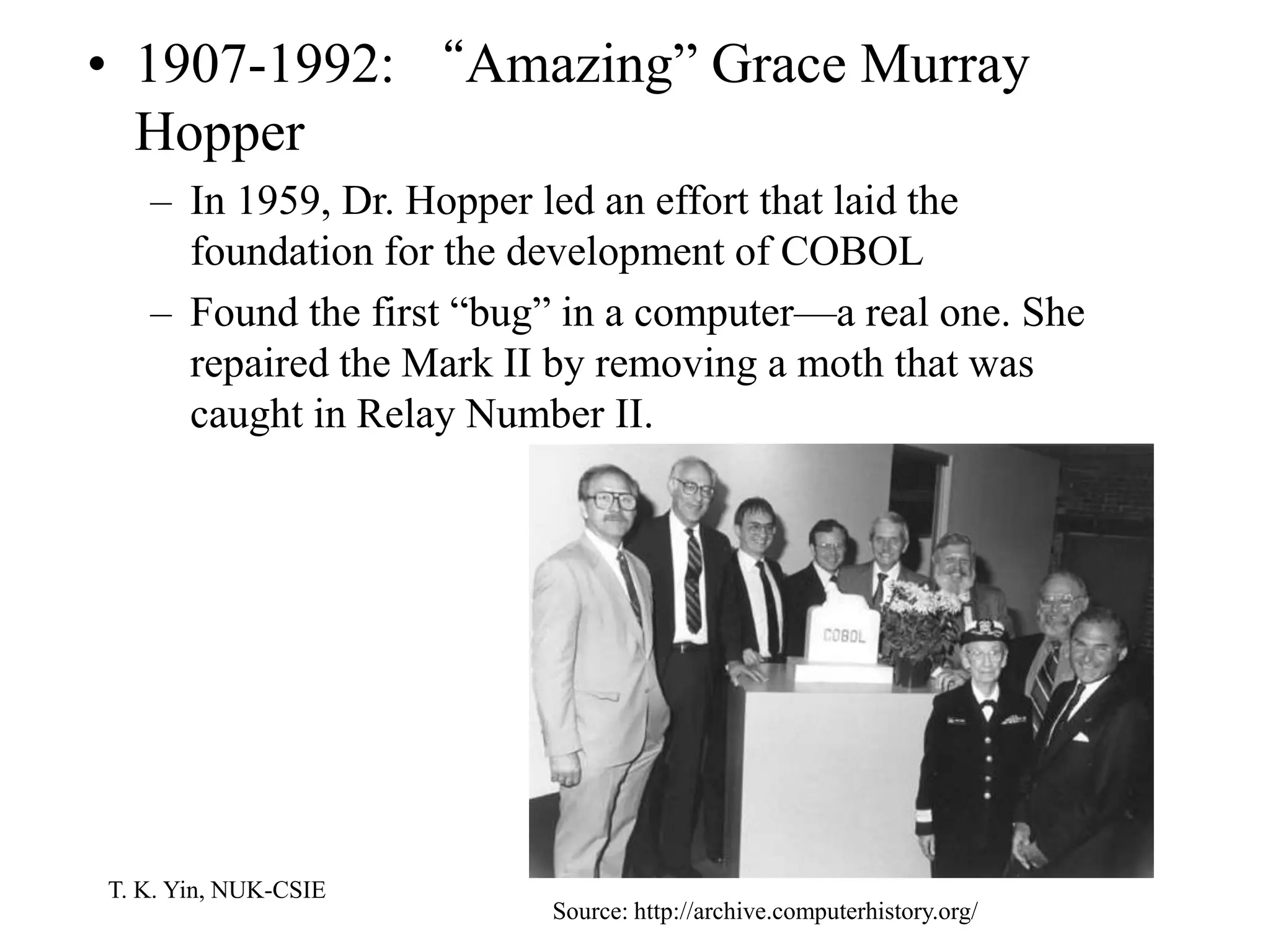
• 1907-1992: “Amazing” Grace Murray
Hopper
– In 1959, Dr. Hopper led an effort that laid the
foundation for the development of COBOL
– Found the first “bug” in a computer—a real one. She
repaired the Mark II by removing a moth that was
caught in Relay Number II.
Source: http://archive.computerhistory.org/
T. K. Yin, NUK-CSIE
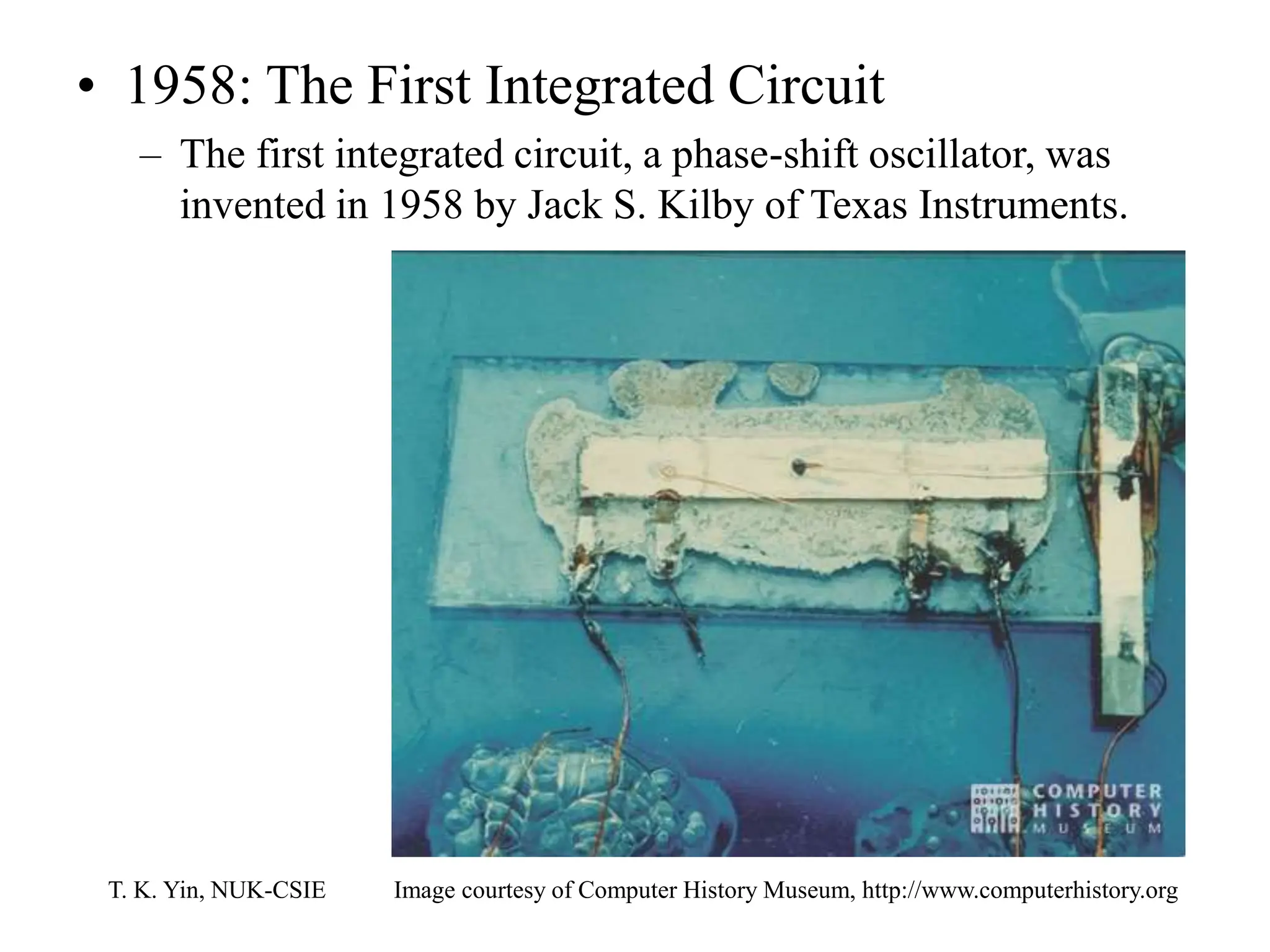
• 1958: The First Integrated Circuit
– The first integrated circuit, a phase-shift oscillator, was
invented in 1958 by Jack S. Kilby of Texas Instruments.
Image courtesy of Computer History Museum, http://www.computerhistory.org
T. K. Yin, NUK-CSIE
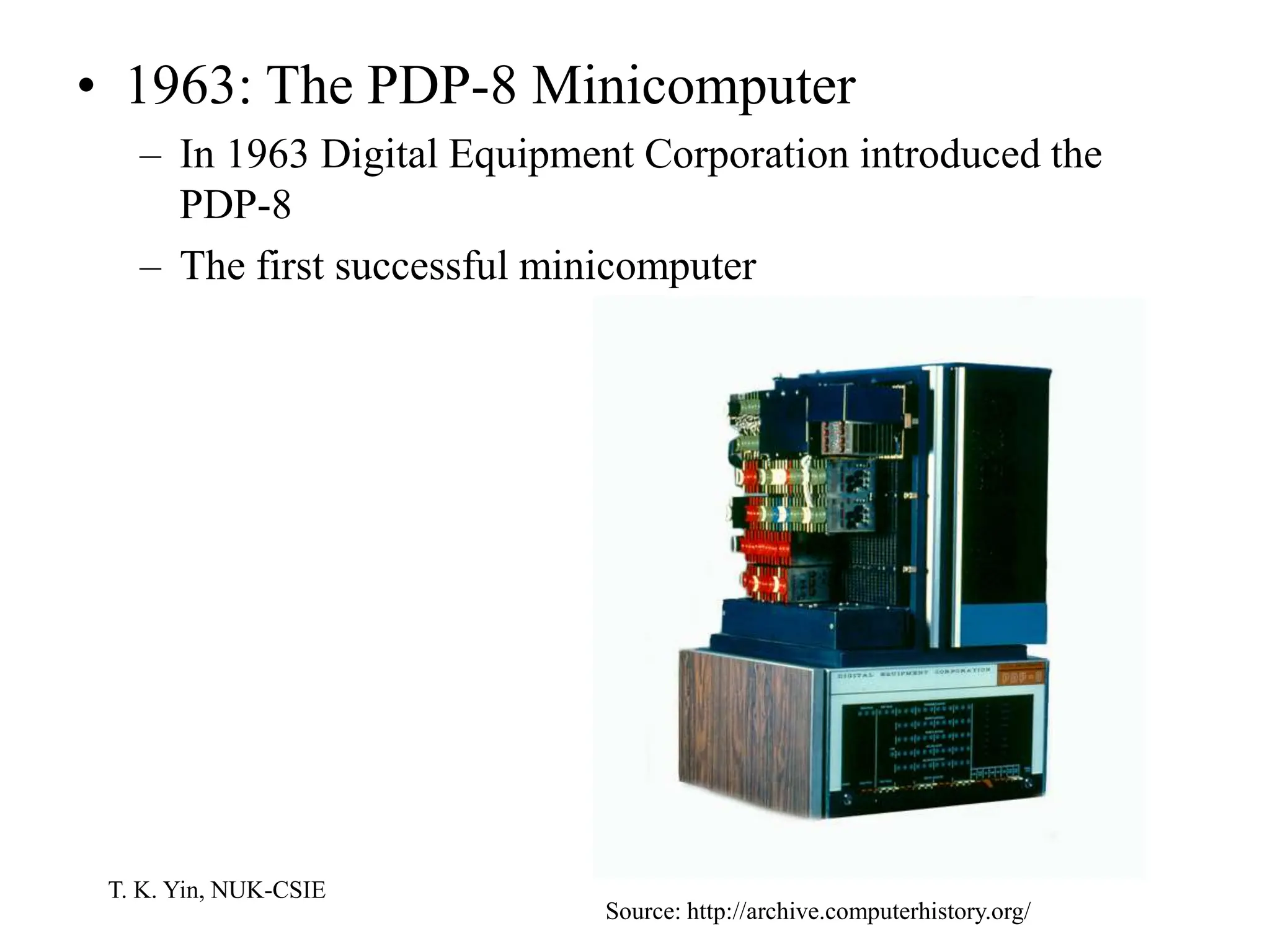
• 1963: The PDP-8 Minicomputer
– In 1963 Digital Equipment Corporation introduced the
PDP-8
– The first successful minicomputer
Source: http://archive.computerhistory.org/
T. K. Yin, NUK-CSIE
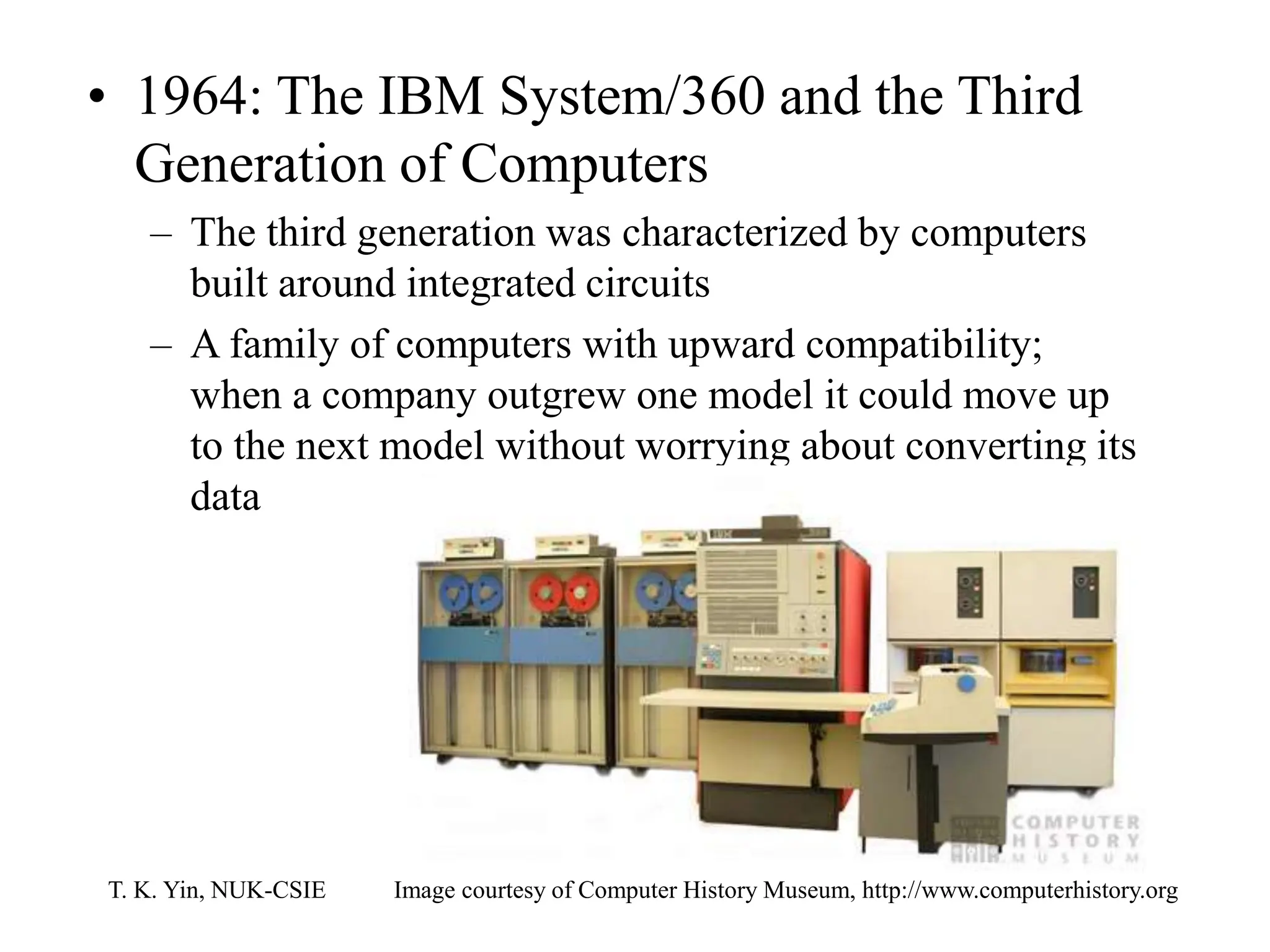
• 1964: The IBM System/360 and the Third
Generation of Computers
– The third generation was characterized by computers
built around integrated circuits
– A family of computers with upward compatibility;
when a company outgrew one model it could move up
to the next model without worrying about converting its
data
Image courtesy of Computer History Museum, http://www.computerhistory.org
T. K. Yin, NUK-CSIE
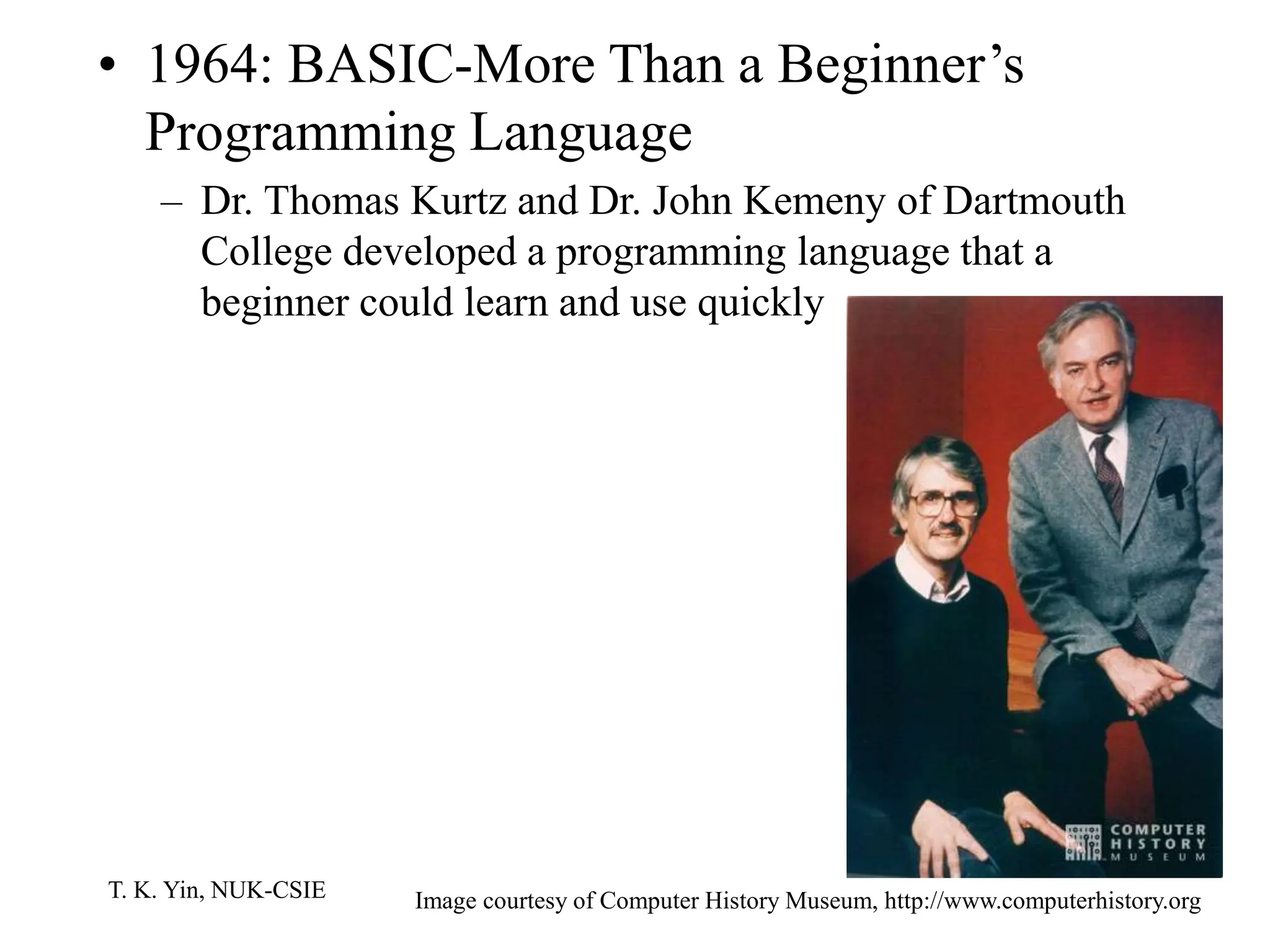
• 1964: BASIC-More Than a Beginner’s
Programming Language
– Dr. Thomas Kurtz and Dr. John Kemeny of Dartmouth
College developed a programming language that a
beginner could learn and use quickly
Image courtesy of Computer History Museum, http://www.computerhistory.org
T. K. Yin, NUK-CSIE
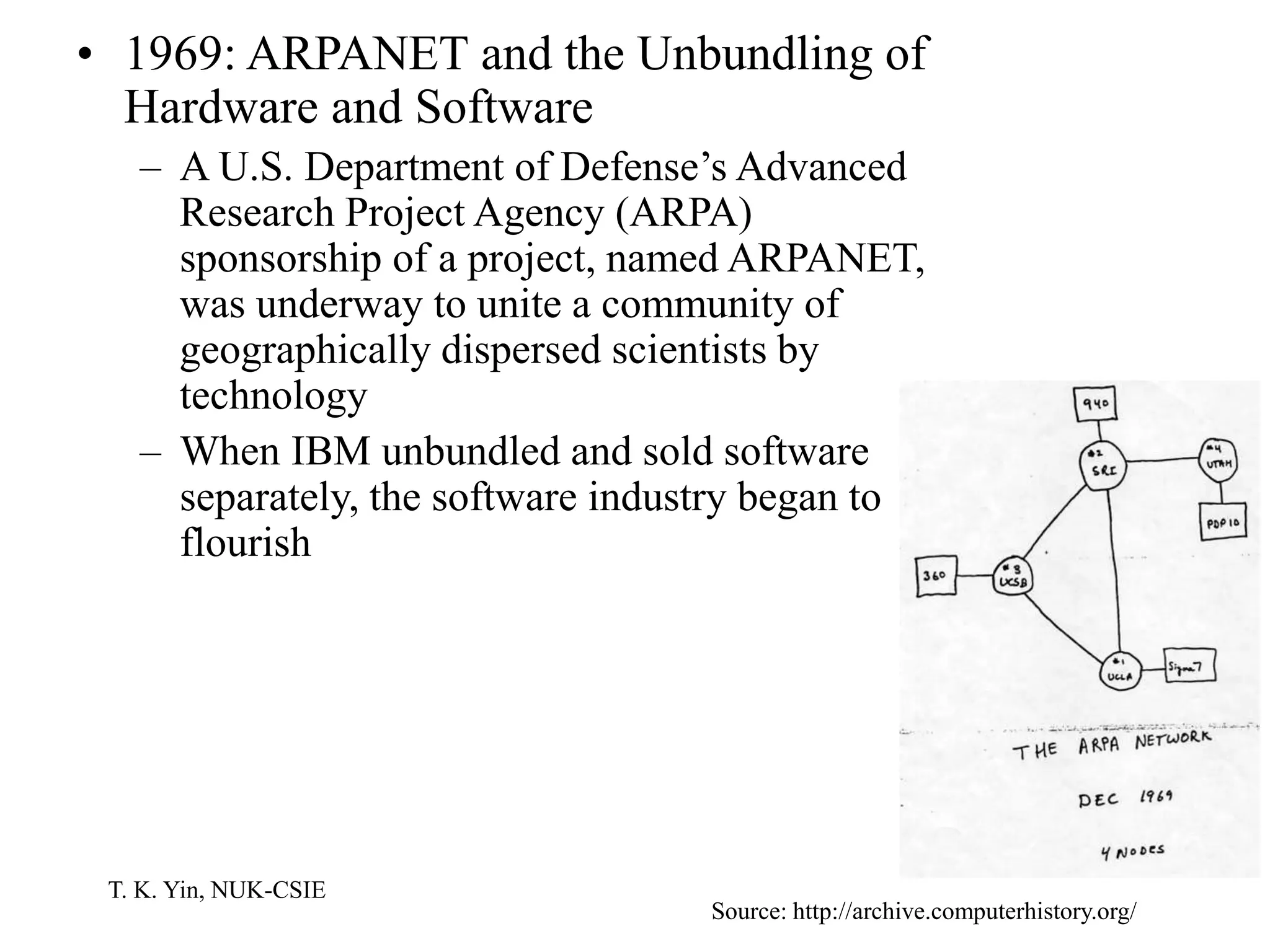
• 1969: ARPANET and the Unbundling of
Hardware and Software
– A U.S. Department of Defense’s Advanced
Research Project Agency (ARPA)
sponsorship of a project, named ARPANET,
was underway to unite a community of
geographically dispersed scientists by
technology
– When IBM unbundled and sold software
separately, the software industry began to
flourish
Source: http://archive.computerhistory.org/
T. K. Yin, NUK-CSIE
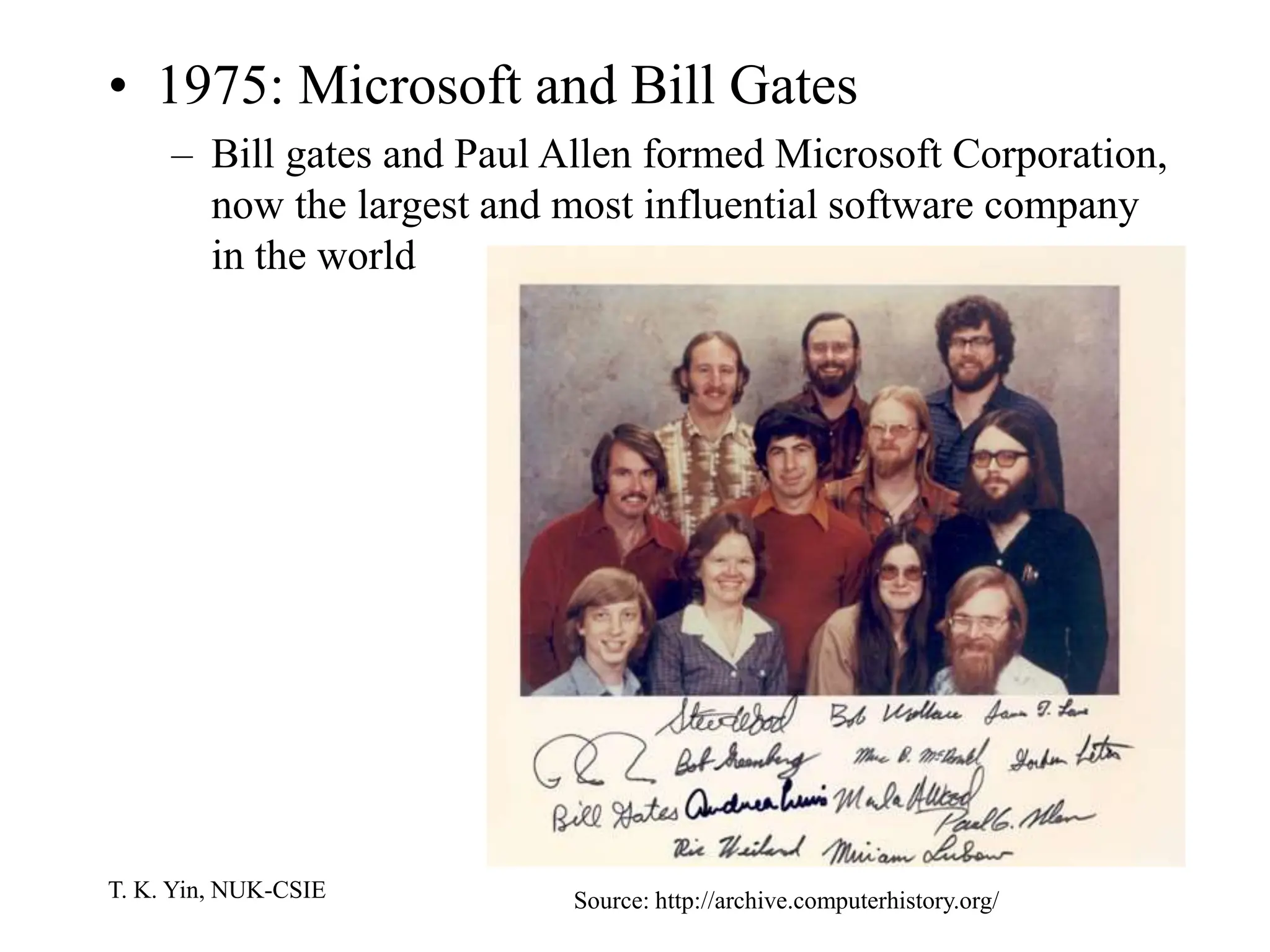
• 1975: Microsoft and Bill Gates
– Bill gates and Paul Allen formed Microsoft Corporation,
now the largest and most influential software company
in the world
Source: http://archive.computerhistory.org/
T. K. Yin, NUK-CSIE
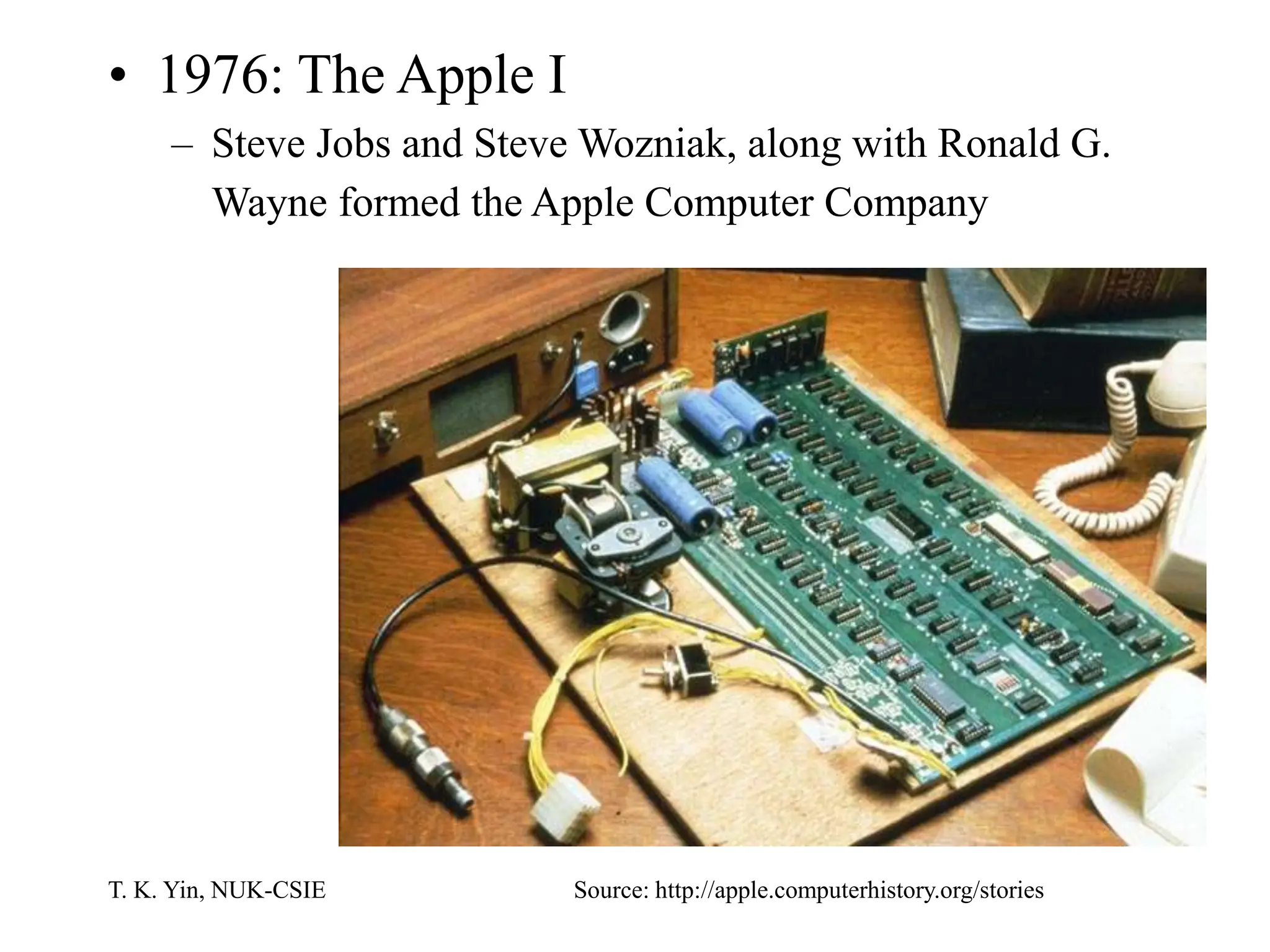
• 1976: The Apple I
– Steve Jobs and Steve Wozniak, along with Ronald G.
Wayne formed the Apple Computer Company
Source: http://apple.computerhistory.org/stories
T. K. Yin, NUK-CSIE
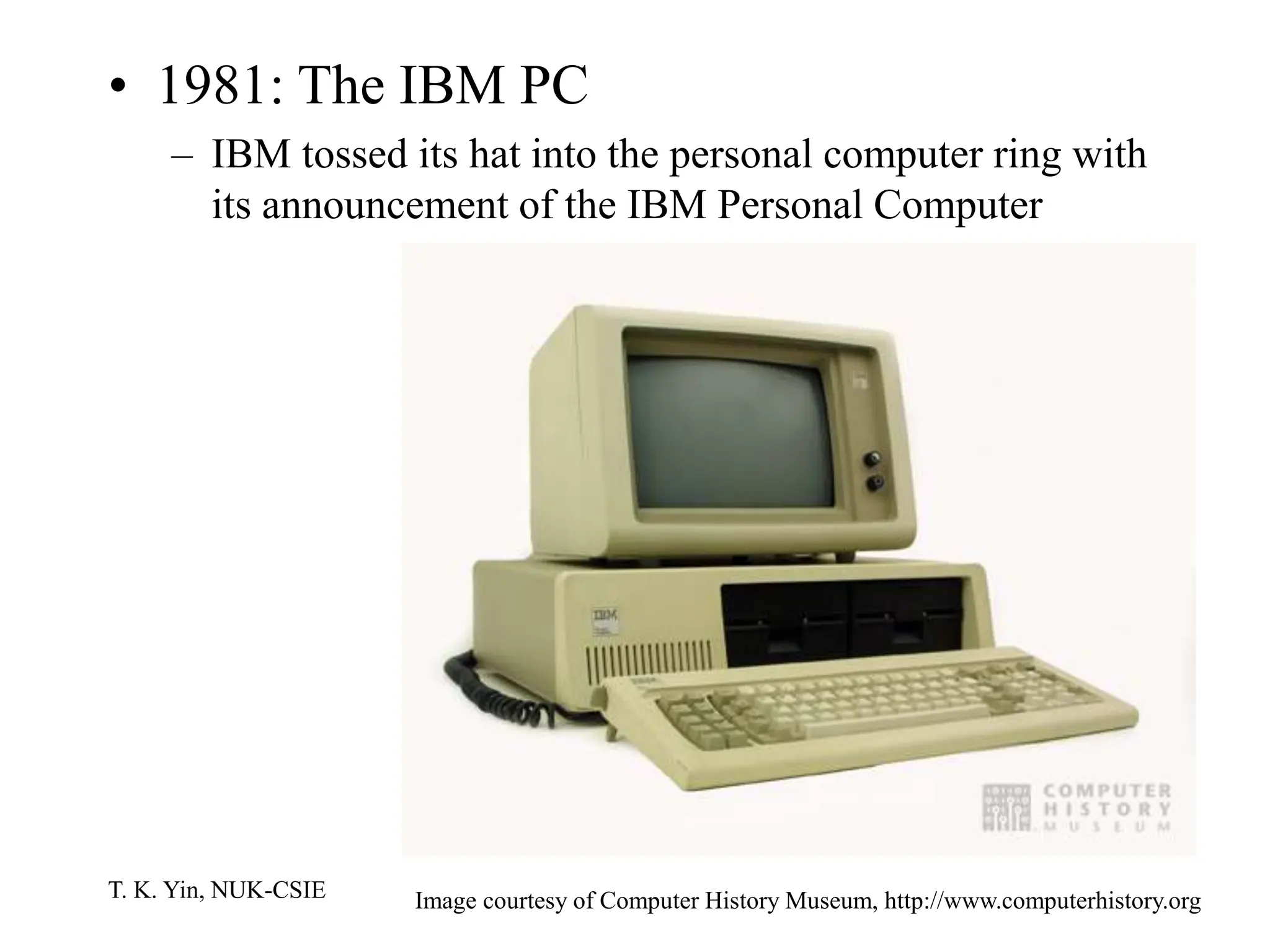
• 1981: The IBM PC
– IBM tossed its hat into the personal computer ring with
its announcement of the IBM Personal Computer
Image courtesy of Computer History Museum, http://www.computerhistory.org
T. K. Yin, NUK-CSIE
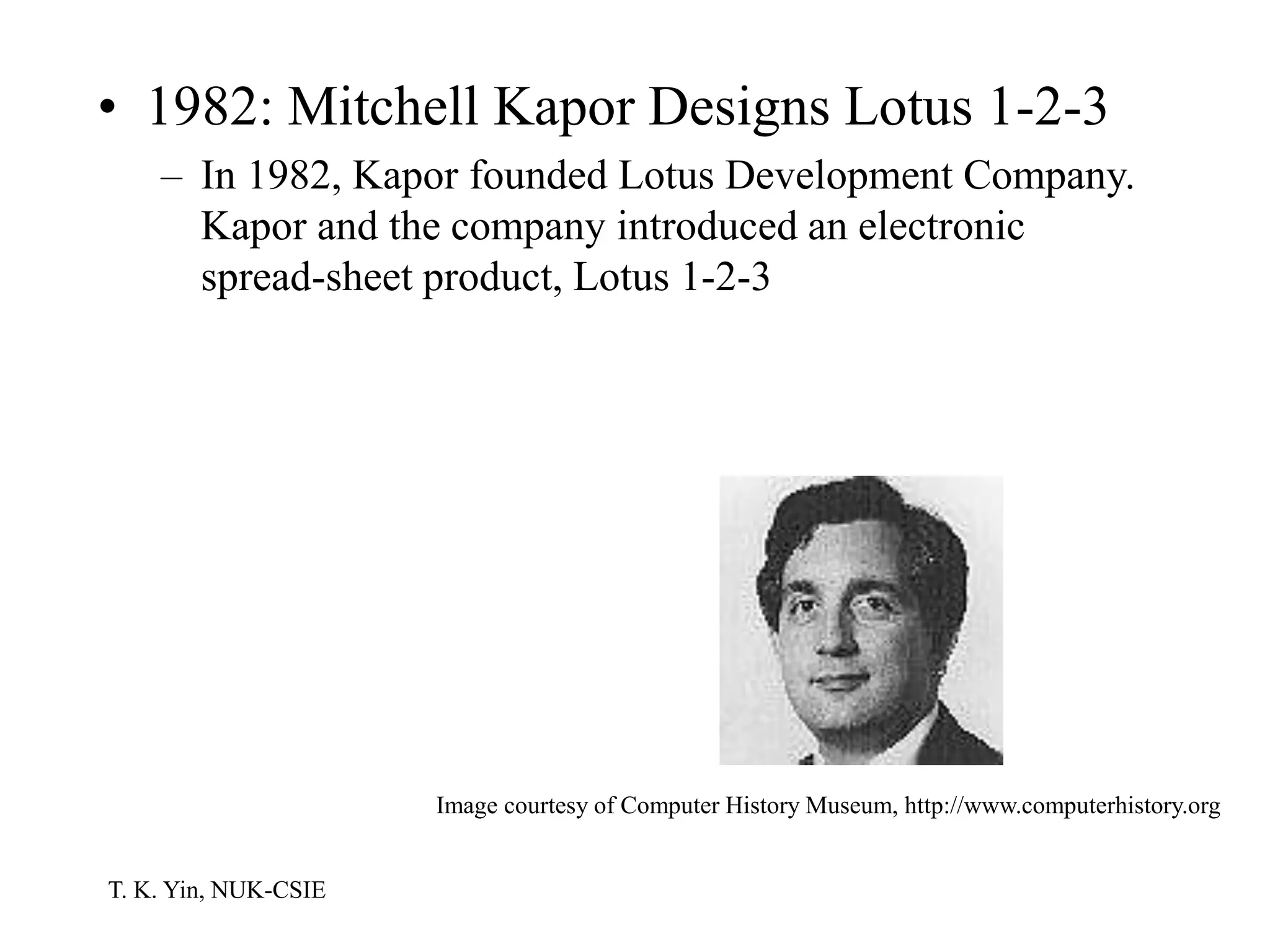
• 1982: Mitchell Kapor Designs Lotus 1-2-3
– In 1982, Kapor founded Lotus Development Company.
Kapor and the company introduced an electronic
spread-sheet product, Lotus 1-2-3
Image courtesy of Computer History Museum, http://www.computerhistory.org
T. K. Yin, NUK-CSIE
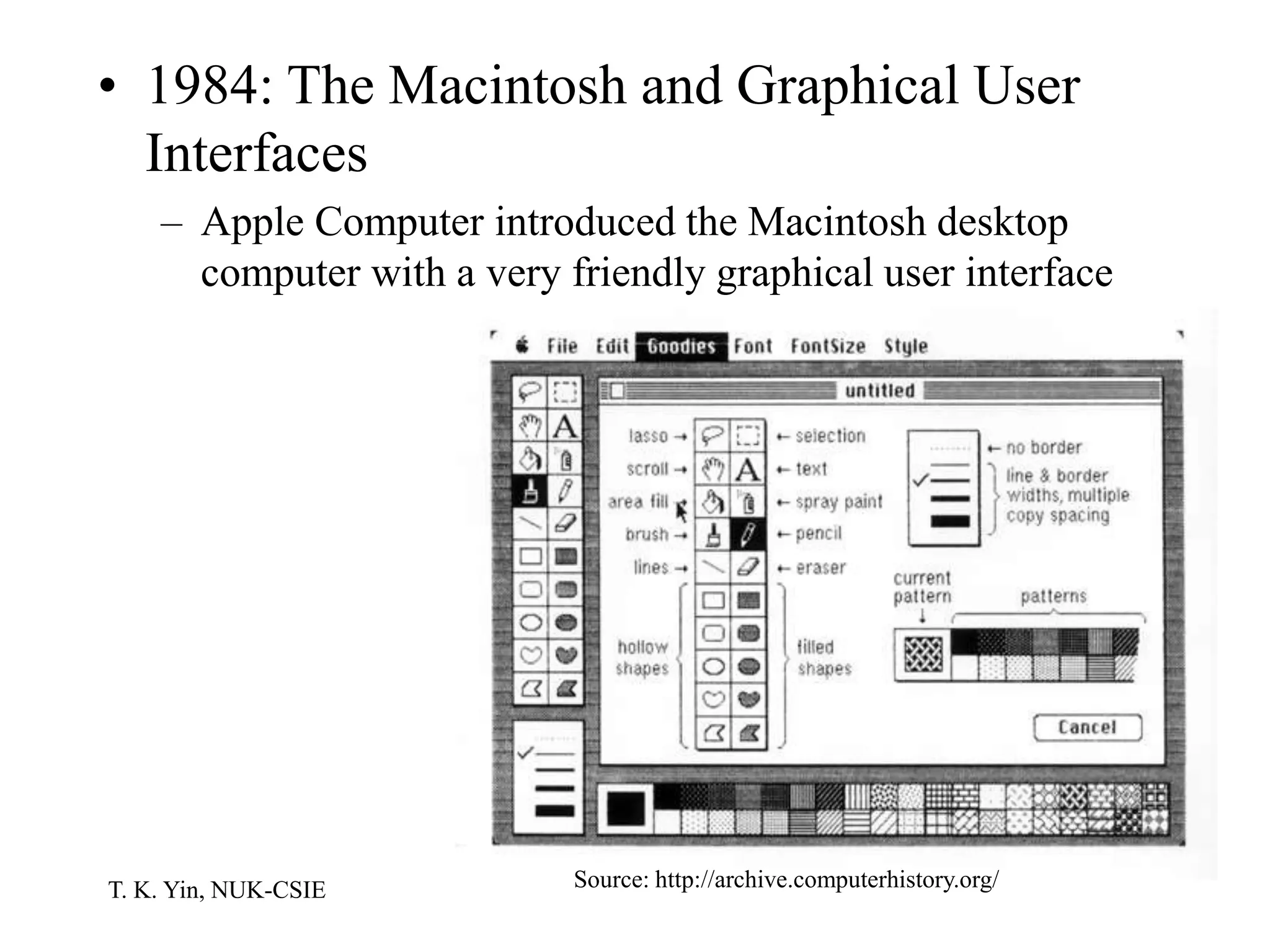
• 1984: The Macintosh and Graphical User
Interfaces
– Apple Computer introduced the Macintosh desktop
computer with a very friendly graphical user interface
Source: http://archive.computerhistory.org/
T. K. Yin, NUK-CSIE
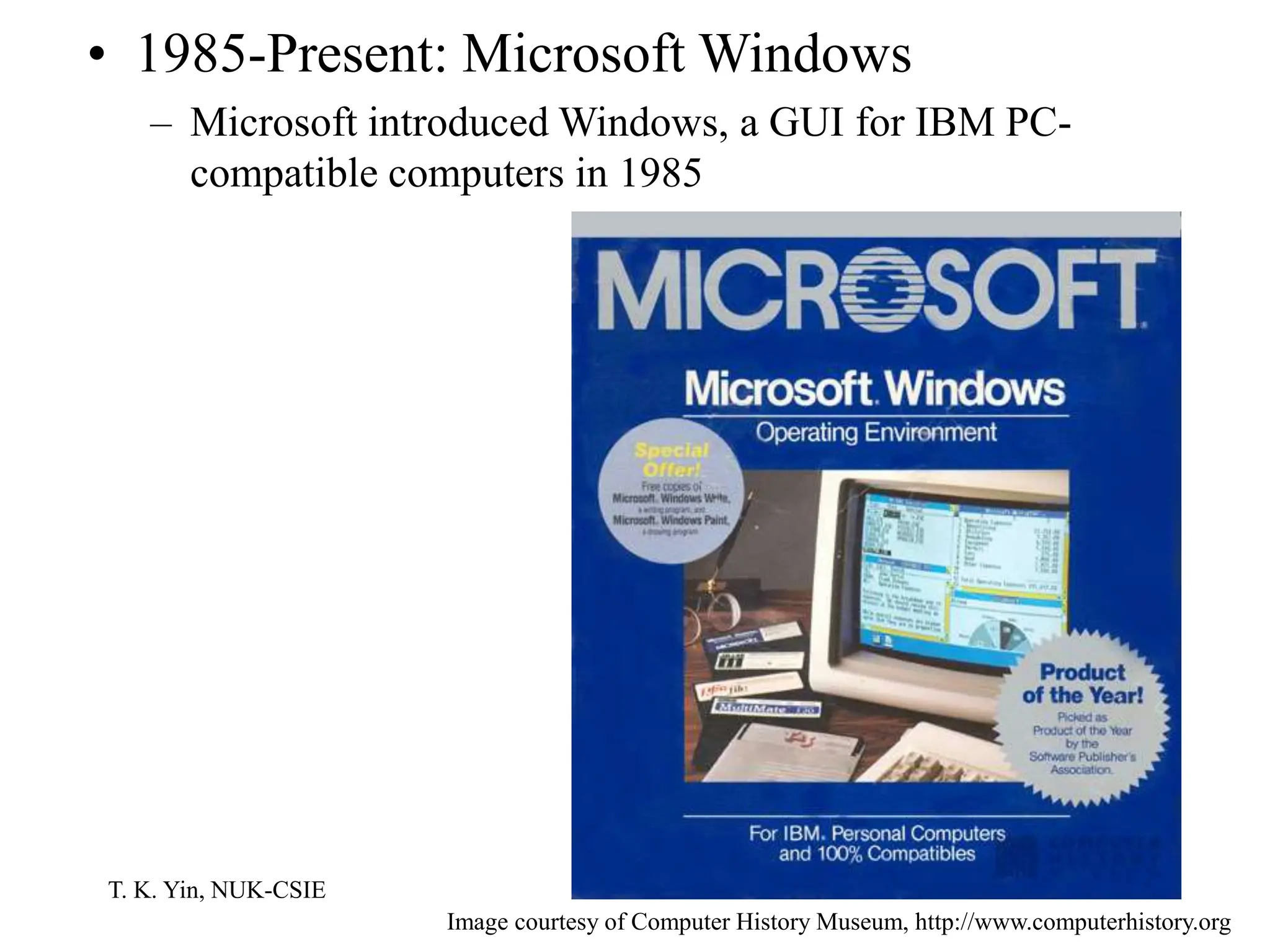
• 1985-Present: Microsoft Windows
– Microsoft introduced Windows, a GUI for IBM PC-
compatible computers in 1985
Image courtesy of Computer History Museum, http://www.computerhistory.org
T. K. Yin, NUK-CSIE
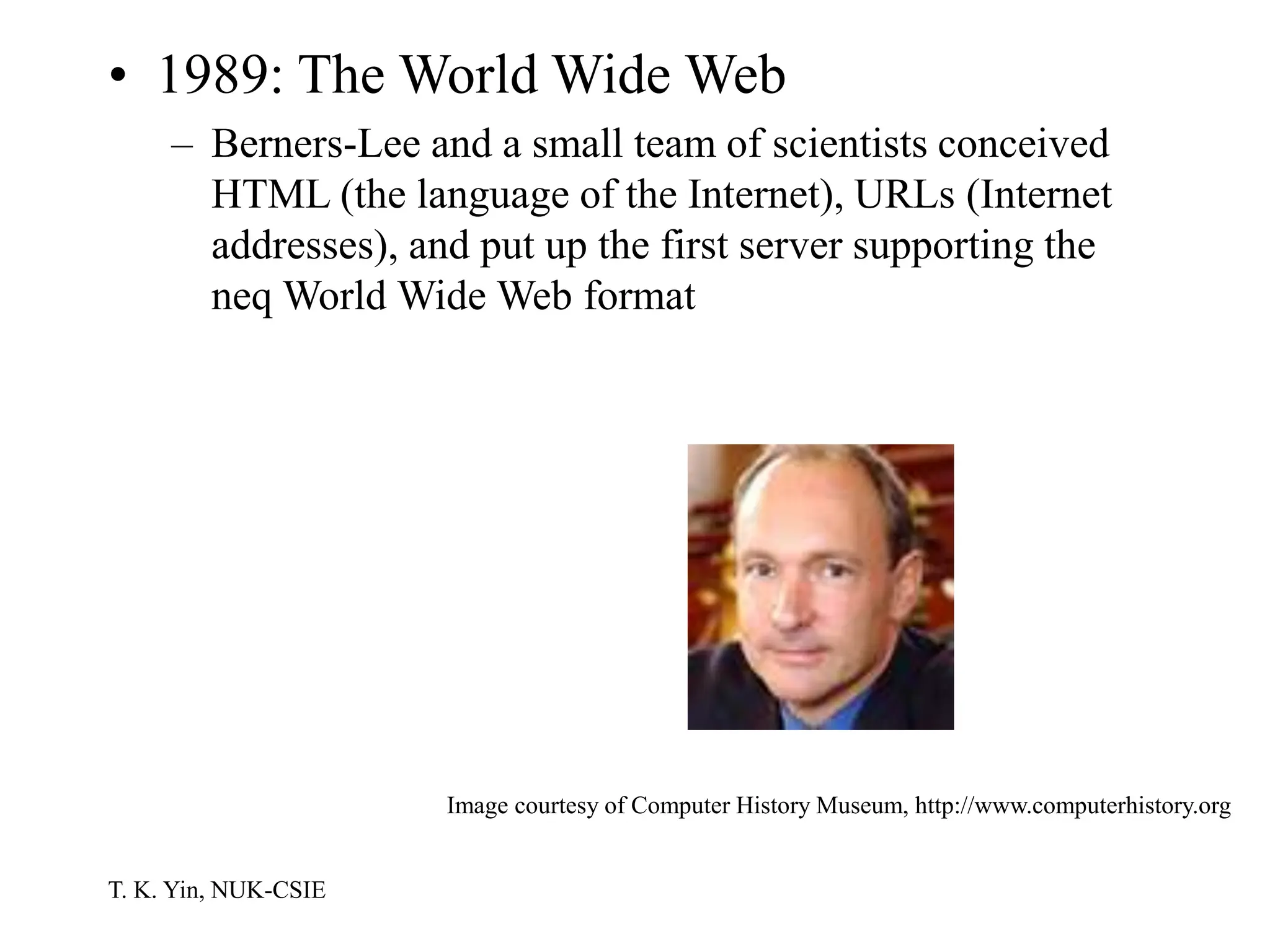
• 1989: The World Wide Web
– Berners-Lee and a small team of scientists conceived
HTML (the language of the Internet), URLs (Internet
addresses), and put up the first server supporting the
neq World Wide Web format
Image courtesy of Computer History Museum, http://www.computerhistory.org
T. K. Yin, NUK-CSIE
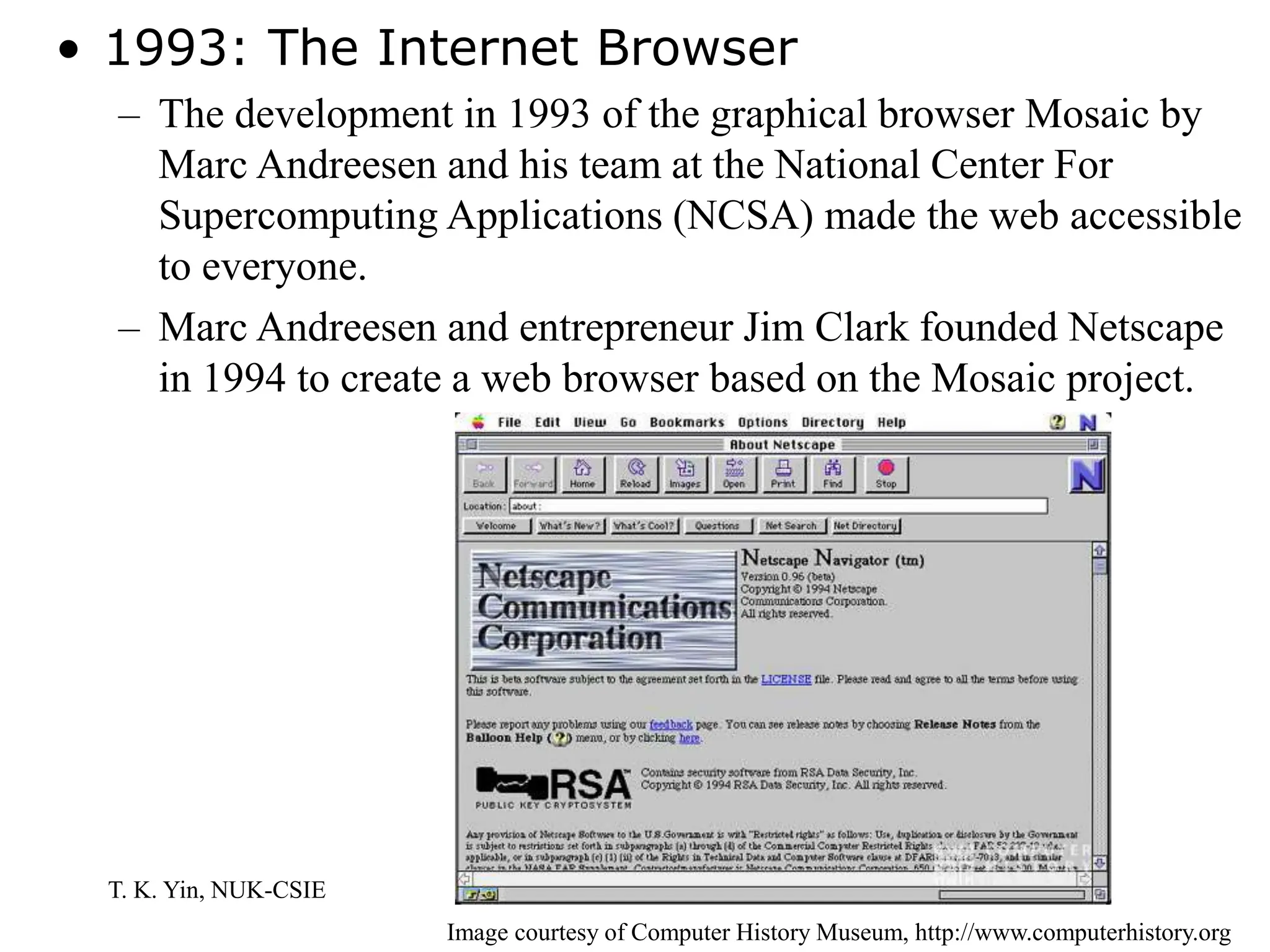
• 1993: The Internet Browser
– The development in 1993 of the graphical browser Mosaic by
Marc Andreesen and his team at the National Center For
Supercomputing Applications (NCSA) made the web accessible
to everyone.
– Marc Andreesen and entrepreneur Jim Clark founded Netscape
in 1994 to create a web browser based on the Mosaic project.
Image courtesy of Computer History Museum, http://www.computerhistory.org
T. K. Yin, NUK-CSIE
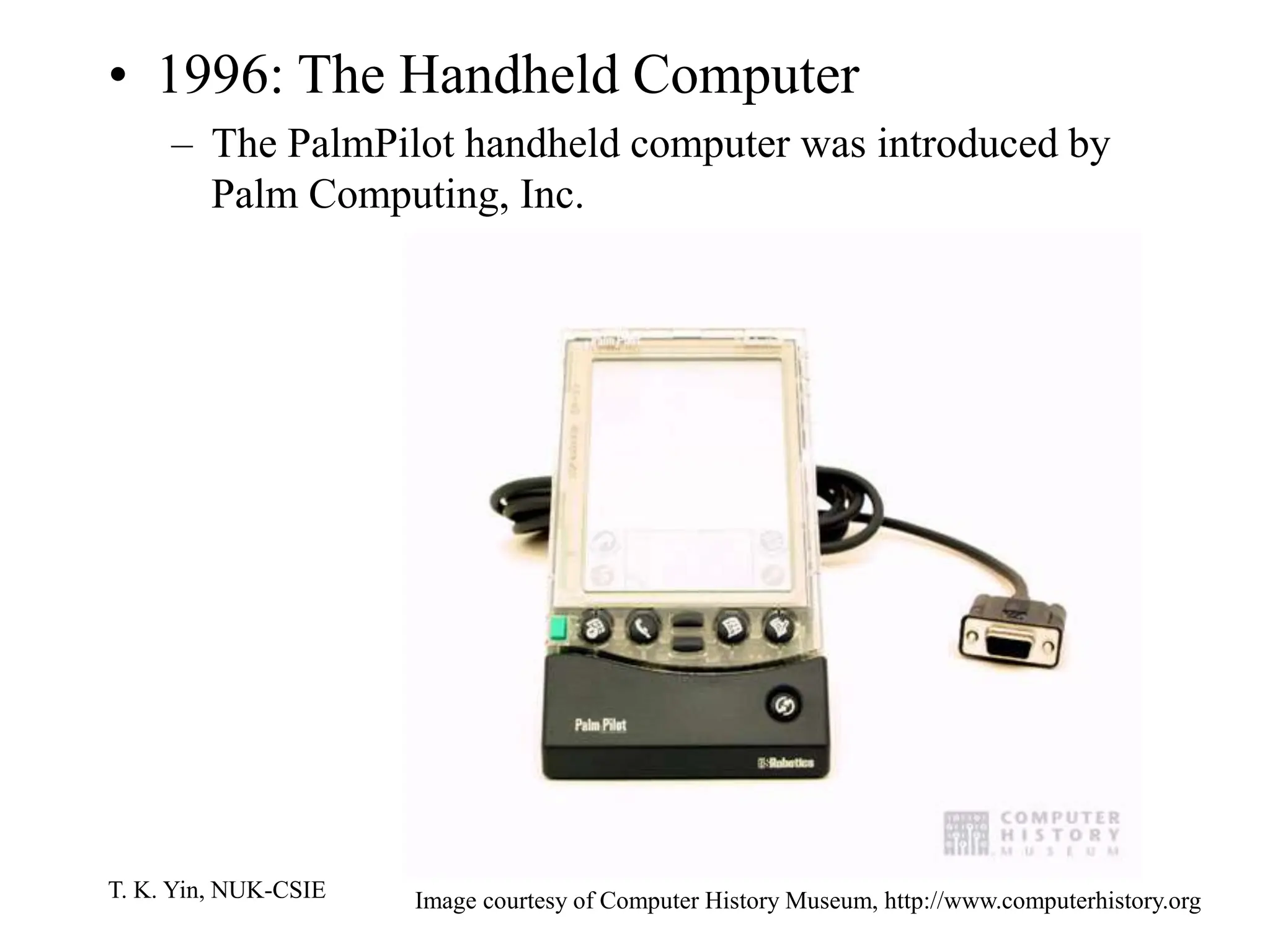
• 1996: The Handheld Computer
– The PalmPilot handheld computer was introduced by
Palm Computing, Inc.
Image courtesy of Computer History Museum, http://www.computerhistory.org
T. K. Yin, NUK-CSIE
Problem Transformation into
Calculations
• Many real problems can be transformed into
calculations. Then, these calculations can
be conducted in computers.
– Examples: Image processing, optimization,
ciphering and deciphering, simulations in
dynamic systems
T. K. Yin, NUK-CSIE
Personal Computers to
Supercomputers
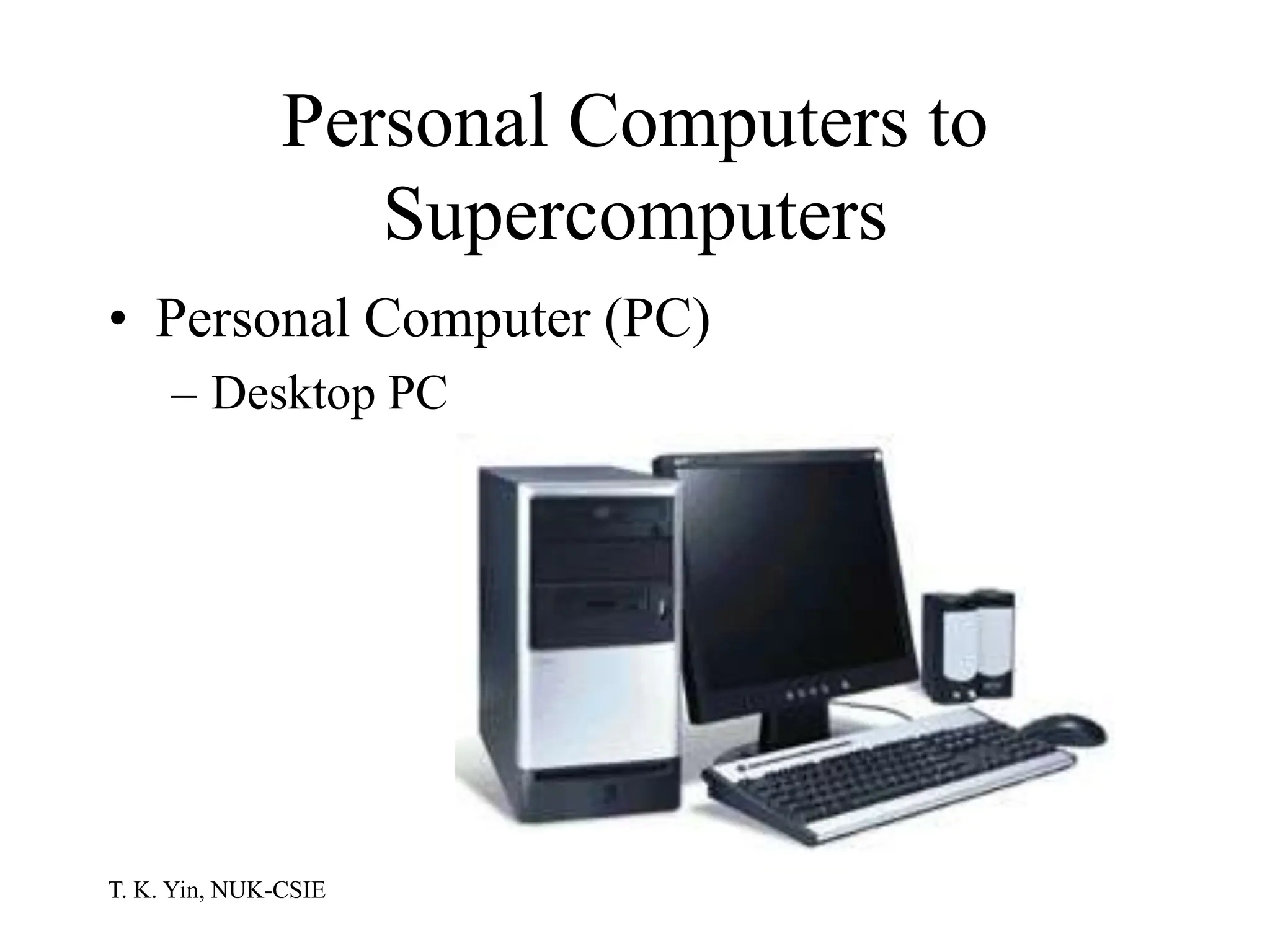
• Personal Computer (PC)
– Desktop PC
T. K. Yin, NUK-CSIE
– Notebook PC
T. K. Yin, NUK-CSIE
– Tablet PC
T. K. Yin, NUK-CSIE
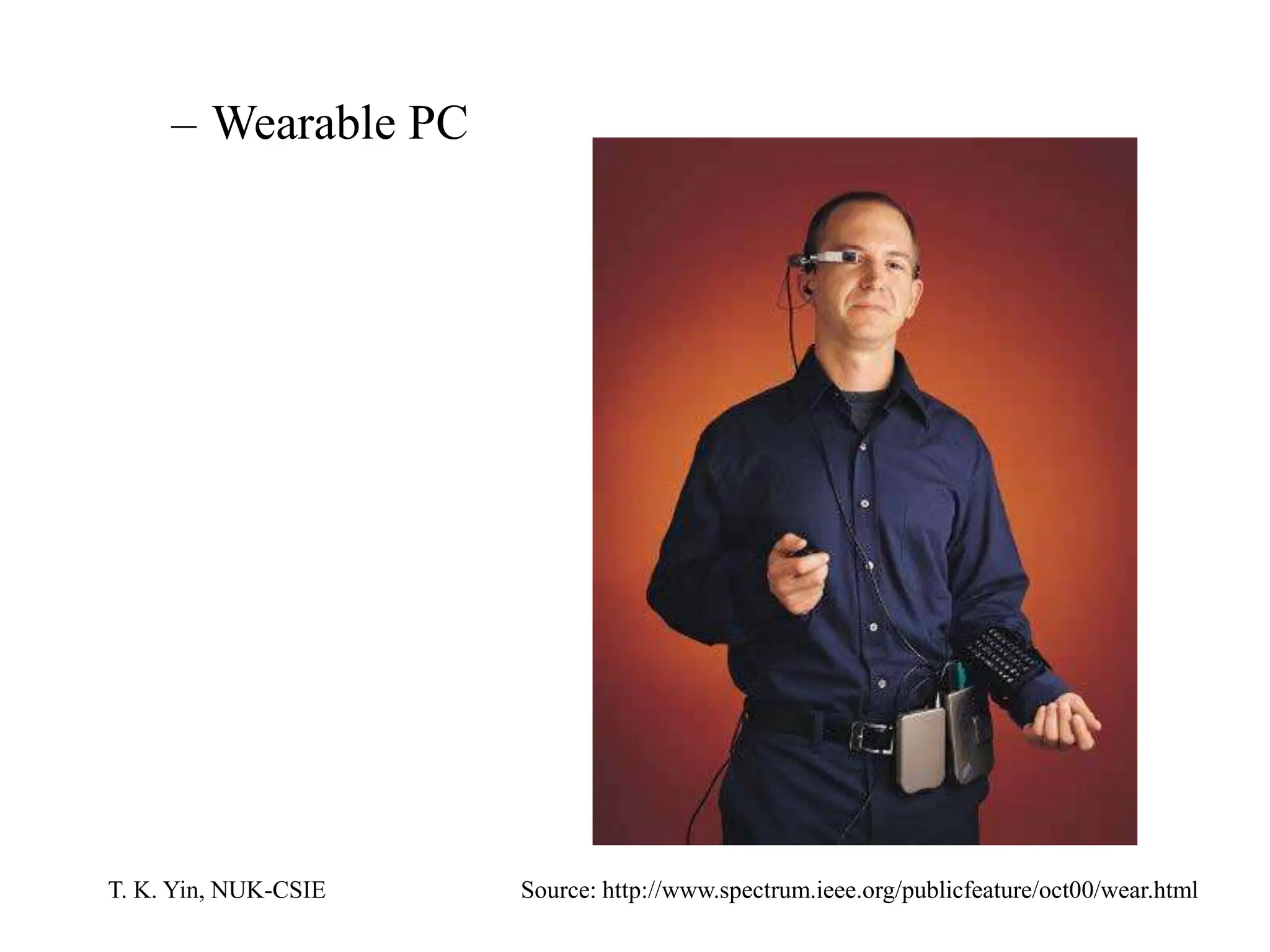
– Wearable PC
Source: http://www.spectrum.ieee.org/publicfeature/oct00/wear.html
T. K. Yin, NUK-CSIE
• Handheld Computer
T. K. Yin, NUK-CSIE
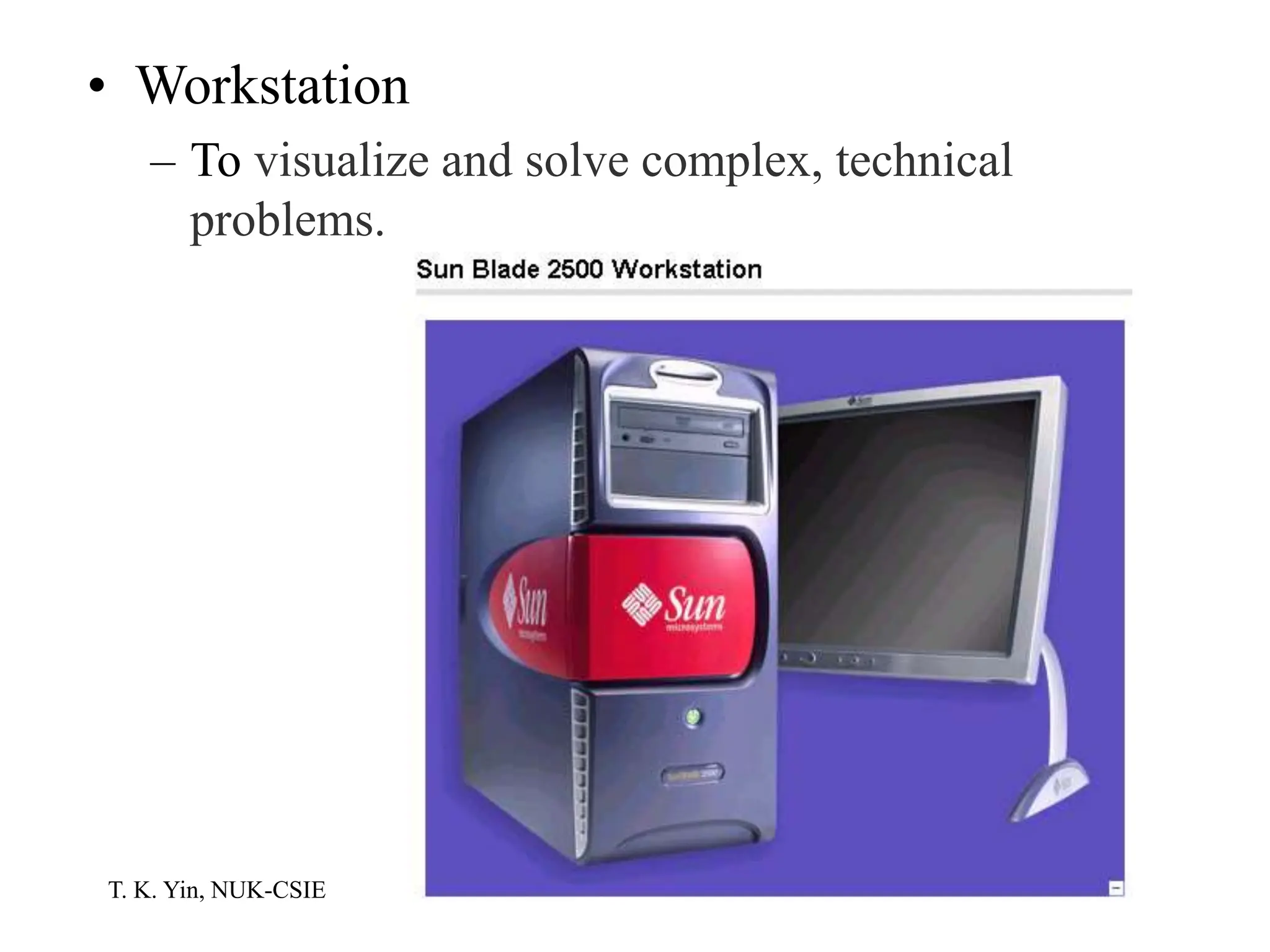
• Workstation
– To visualize and solve complex, technical
problems.
T. K. Yin, NUK-CSIE
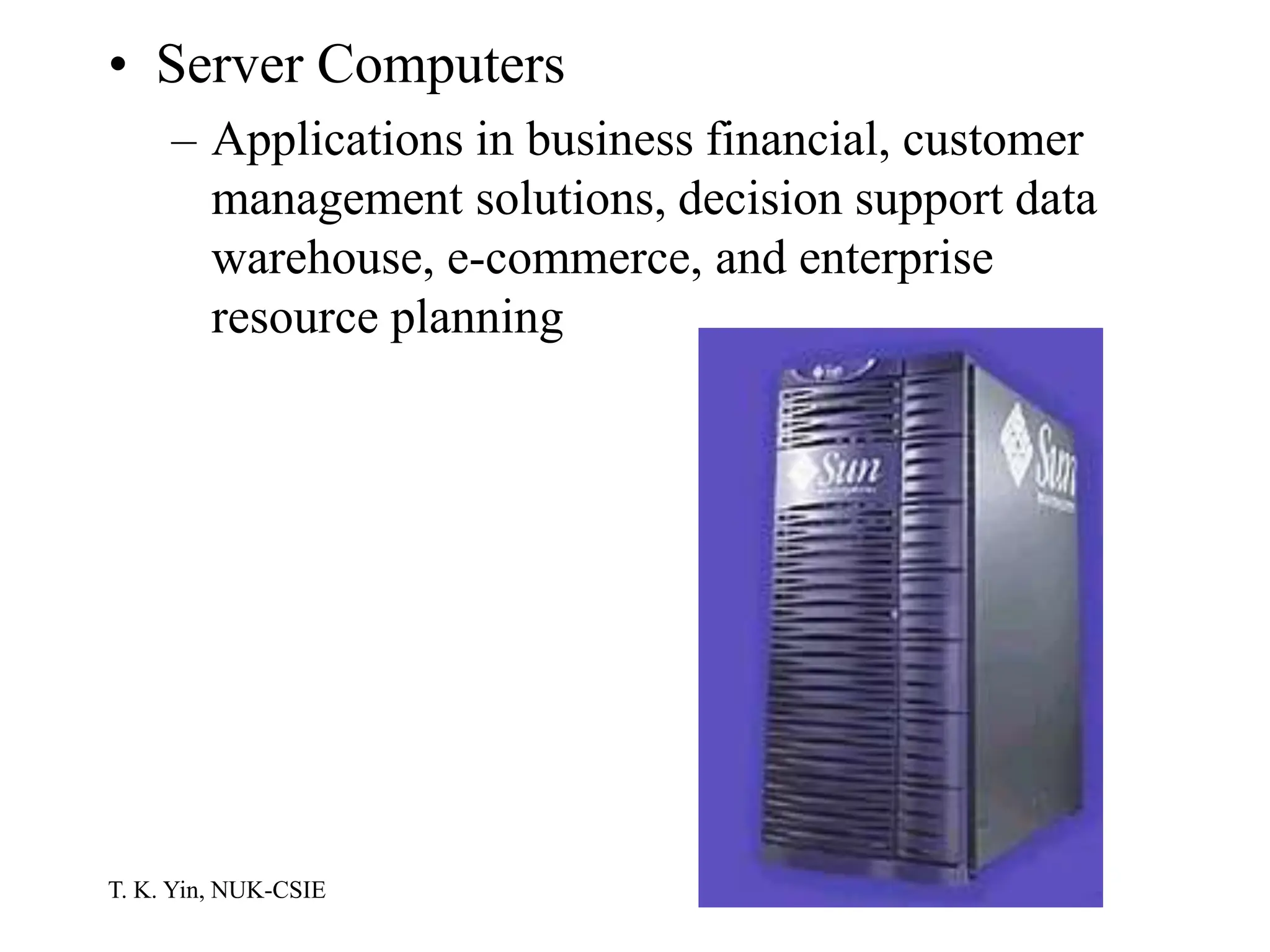
• Server Computers
– Applications in business financial, customer
management solutions, decision support data
warehouse, e-commerce, and enterprise
resource planning
T. K. Yin, NUK-CSIE
• Supercomputer
– In a six-game match, a chess-playing IBM computer
known as Deep Blue defeats chess grandmaster Garry
Kasparov - the first time a reigning world champion
loses a match to a computer opponent in tournament
play. Deep Blue is an IBM RS/6000 SP supercomputer
capable of calculating 200 million chess positions per
second.
Source: http://www-1.ibm.com/ibm/history/history/year_1997.html
T. K. Yin, NUK-CSIE
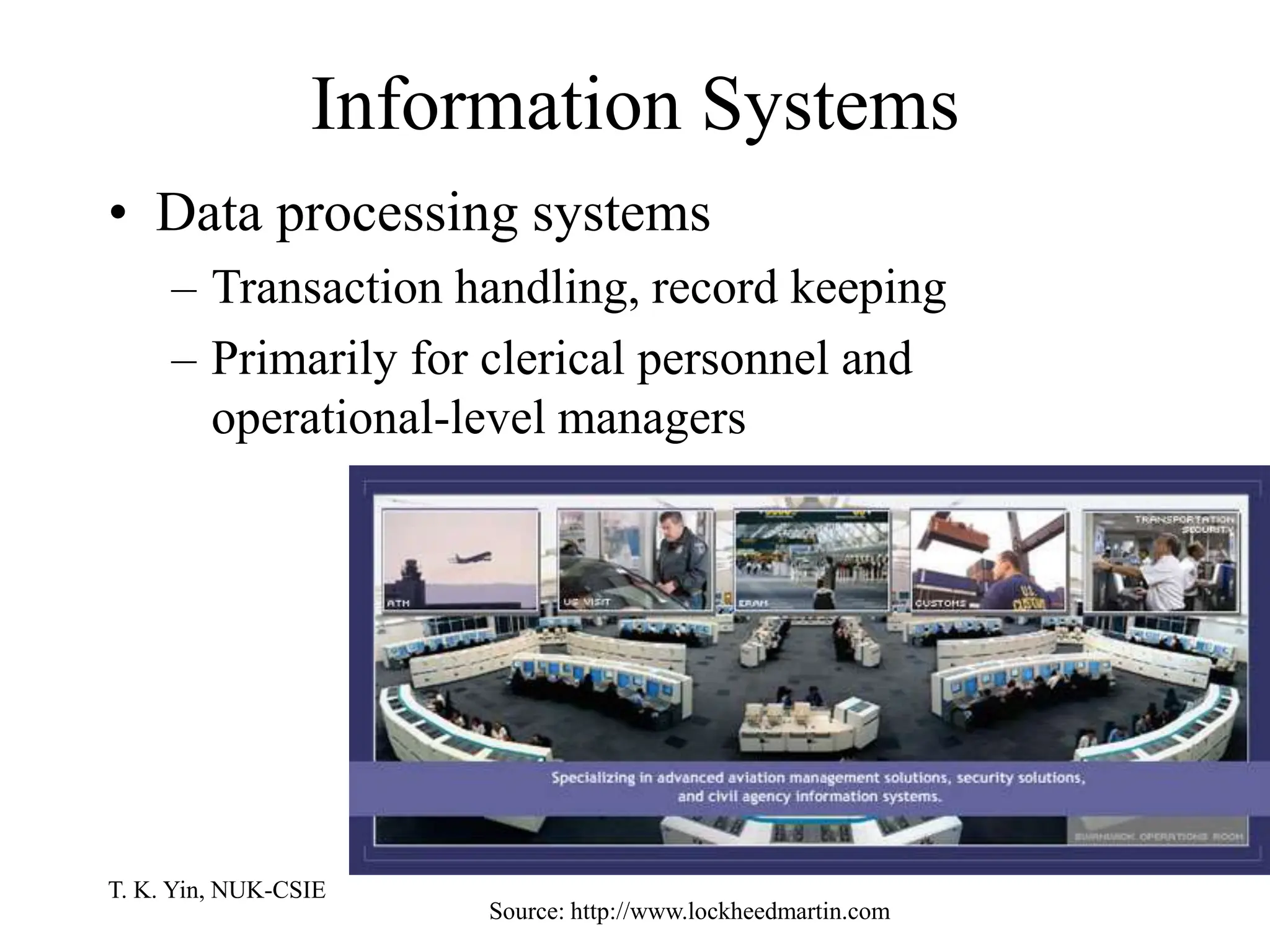
Information Systems
• Data processing systems
– Transaction handling, record keeping
– Primarily for clerical personnel and
operational-level managers
Source: http://www.lockheedmartin.com
T. K. Yin, NUK-CSIE
• Management information system
– Uses an integrated database and supports a
variety of functional areas
– Structured information (for example, a weekly
inventory status report with predefined content
and format)
– Applications in hospitals (patient accounting,
point-of-care processing), insurance (claims-
processing systems, policy administration,
actuarial statistics), and colleges (student
registration, placement)
T. K. Yin, NUK-CSIE
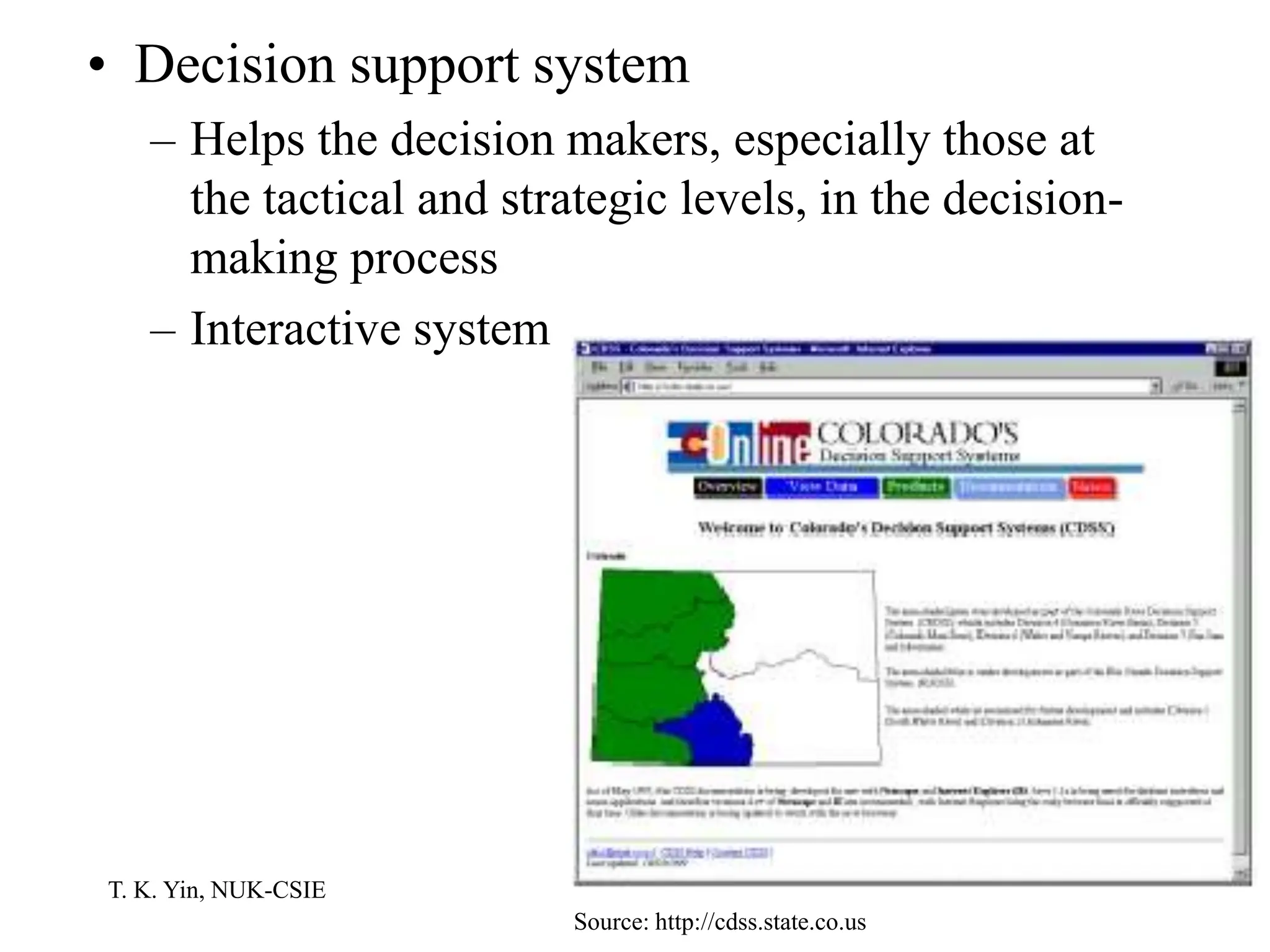
• Decision support system
– Helps the decision makers, especially those at
the tactical and strategic levels, in the decision-
making process
– Interactive system
Source: http://cdss.state.co.us
T. K. Yin, NUK-CSIE
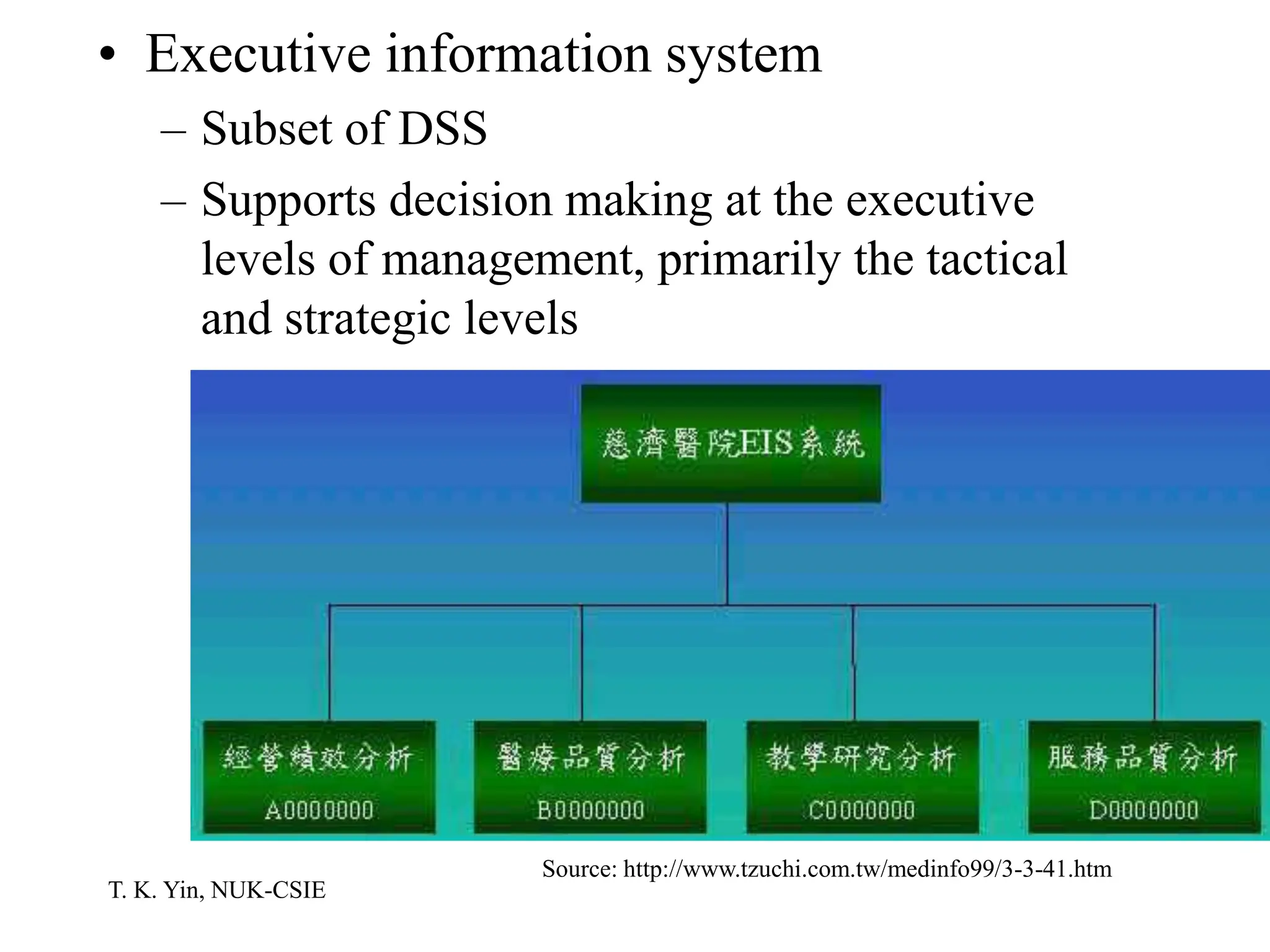
• Executive information system
– Subset of DSS
– Supports decision making at the executive
levels of management, primarily the tactical
and strategic levels
Source: http://www.tzuchi.com.tw/medinfo99/3-3-41.htm
T. K. Yin, NUK-CSIE
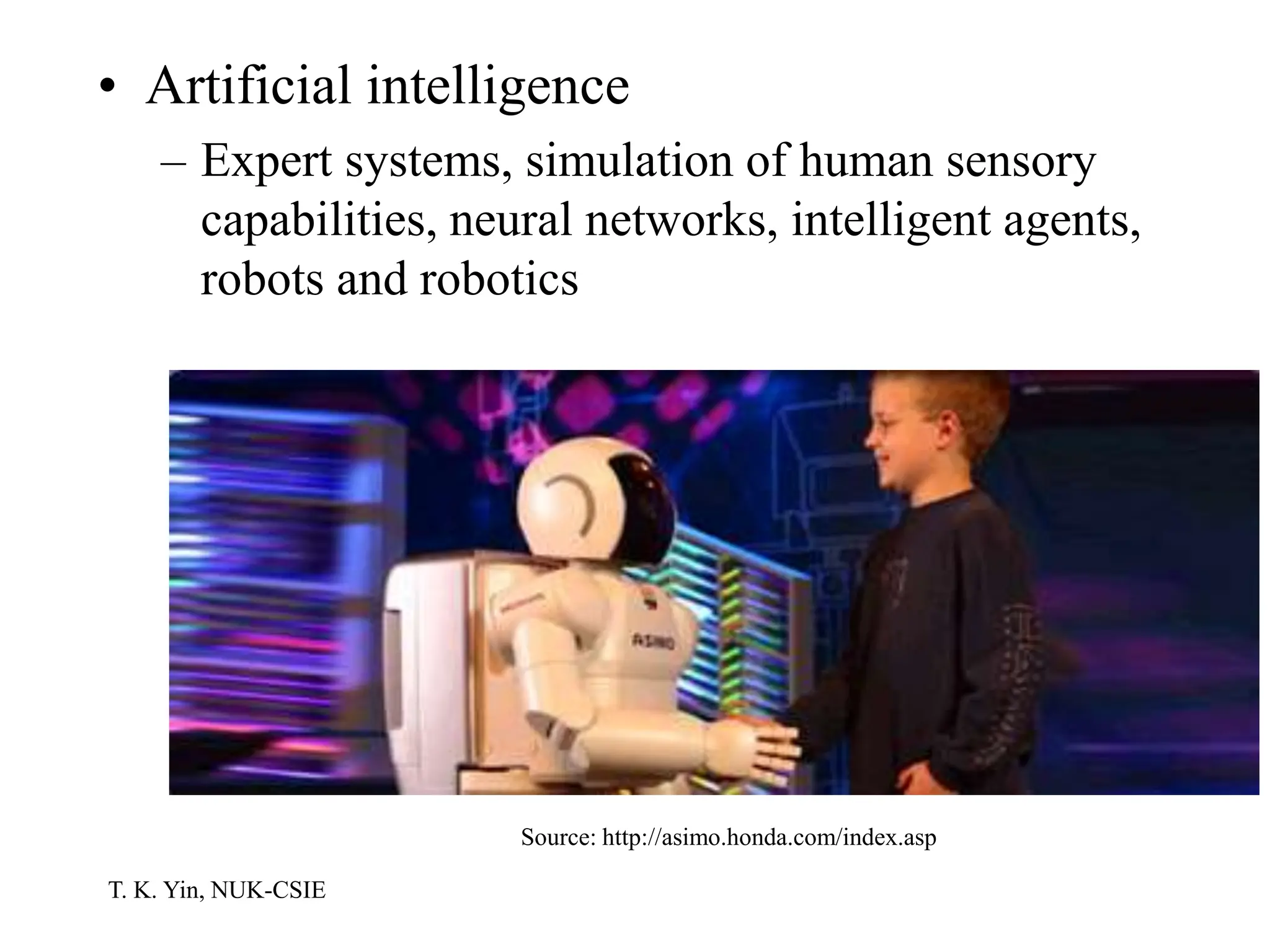
• Artificial intelligence
– Expert systems, simulation of human sensory
capabilities, neural networks, intelligent agents,
robots and robotics
Source: http://asimo.honda.com/index.asp
T. K. Yin, NUK-CSIE
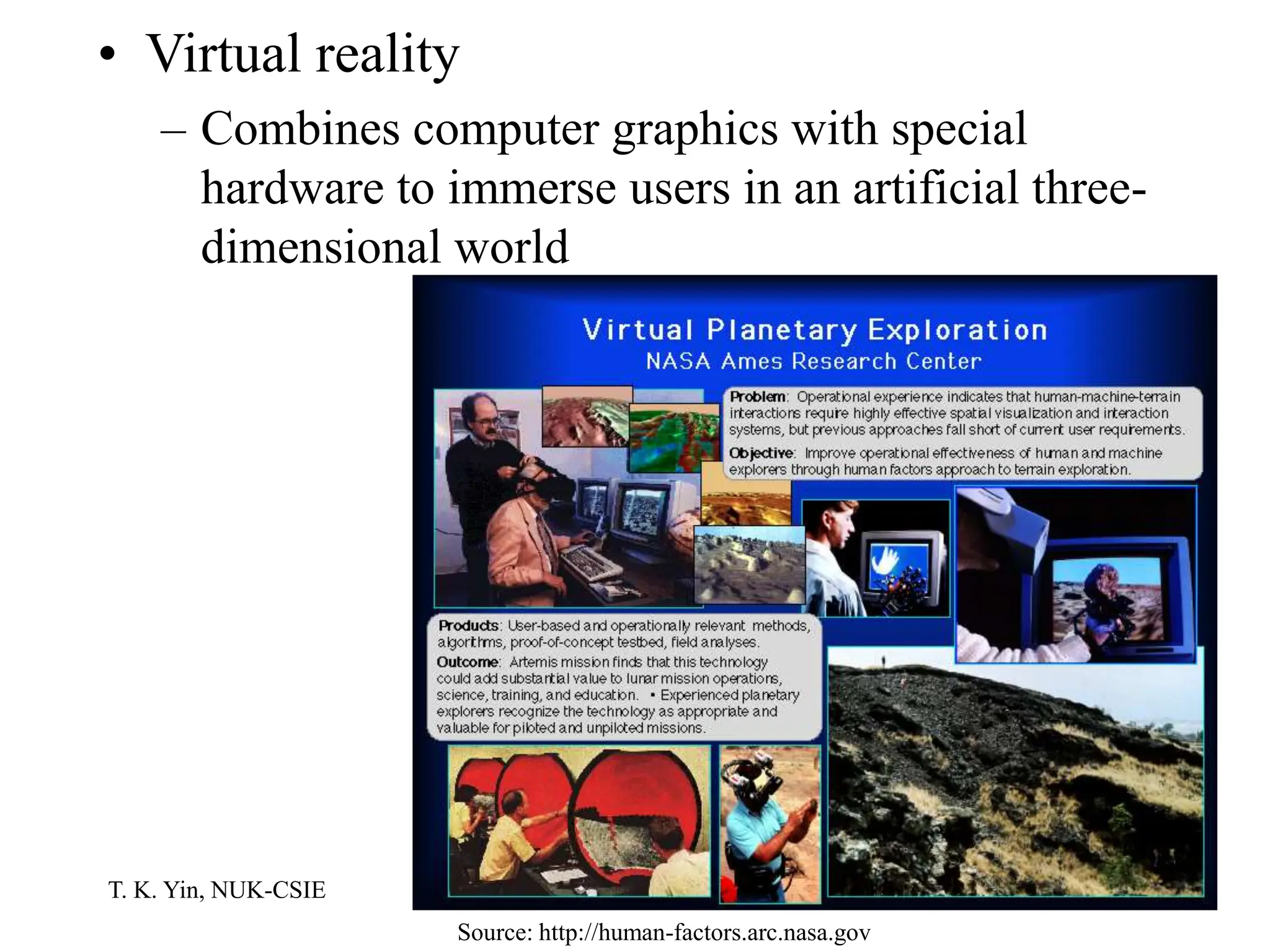
• Virtual reality
– Combines computer graphics with special
hardware to immerse users in an artificial three-
dimensional world
Source: http://human-factors.arc.nasa.gov
T. K. Yin, NUK-CSIE
References
• A Short History of Computing
– Tim Bergin, Computing History Museum American University,
http://www.computinghistorymuseum.org/
• Computer History Museum
– http://www.computerhistory.org
• Computers
– Larry Long & Nancy Long, Twelfth Edition, Pearson Education,
Inc.
• http://archive.computerhistory.org/

1-Introduction.ppt

  • 1.
    T. K. Yin,NUK-CSIE Introduction to Computer Science (I) Introduction
  • 2.
    T. K. Yin,NUK-CSIE Information Technology in Our Lives • Digital Convergence – Converting whatever we can in the physical and communications world to binary on/off signals, called bits • Text • Voice • Picture • Movie
  • 3.
    T. K. Yin,NUK-CSIE • At Home – Email, Internet shopping, virtual museum, banking transactions, news – Small computers in VCRs, automobiles, air- conditioning systems, washing machines,
  • 4.
    T. K. Yin,NUK-CSIE • At Play – Group chatting, games, songs and movies from Internet
  • 5.
    T. K. Yin,NUK-CSIE • At Work – Mobile worker – Office software, Database, ERP, SCM, CRM
  • 6.
    T. K. Yin,NUK-CSIE • At School or College – Computer-based courses, distance learning
  • 7.
    T. K. Yin,NUK-CSIE The History of Computing • 3000 B.C.: The Abacus – The original mechanical counting device Image courtesy of Computer History Museum, http://www.computerhistory.org
  • 8.
    T. K. Yin,NUK-CSIE • 1623-1662: Blaise Pascal – French mathematician and philosopher – Built the Pascaline in 1642 Image courtesy of Computer History Museum, http://www.computerhistory.org
  • 9.
    T. K. Yin,NUK-CSIE • 1642: The Pascaline – A counting-wheel design • A single revolution of one wheel would engage gears that turned the wheel one tenth of a revolution to its immediate left Image courtesy of Computer History Museum, http://www.computerhistory.org
  • 10.
    T. K. Yin,NUK-CSIE • 1801: Jacquard’s loom – Frenchman Joseph-Marie Jacquard (1753-1871) – Weaving loom – The first significant use of binary automation Image courtesy of Computer History Museum, http://www.computerhistory.org
  • 11.
    T. K. Yin,NUK-CSIE – Jacquard Loom Salesman’s Model Image courtesy of Computer History Museum, http://www.computerhistory.org
  • 12.
    T. K. Yin,NUK-CSIE • 1793-1871: Charles Babbage – Envisioned a steam-powered difference engine and then an analytical engine Image courtesy of Computer History Museum, http://www.computerhistory.org
  • 13.
    T. K. Yin,NUK-CSIE • 1842: Bassage’s Difference Engine and the Analytical Engine Image courtesy of Computer History Museum, http://www.computerhistory.org
  • 14.
    T. K. Yin,NUK-CSIE • Diagram Showing Method Image courtesy of Computer History Museum, http://www.computerhistory.org
  • 15.
    T. K. Yin,NUK-CSIE • 1816-1852: Lady Ada Augusta Lovelace – Punched cards could be prepared to instruct Babbage’s engine to repeat certain operations – The first programmer Source: http://archive.computerhistory.org/
  • 16.
    T. K. Yin,NUK-CSIE • 1860-1929: Herman Hollerith – Devised a punched-card tabulating machine to speed up the 1890 U.S. census Image courtesy of Computer History Museum, http://www.computerhistory.org
  • 17.
    T. K. Yin,NUK-CSIE • 1890: Hollerith’s Tabulating Machine – Used a hand punch to enter data onto cards Image courtesy of Computer History Museum, http://www.computerhistory.org
  • 18.
    T. K. Yin,NUK-CSIE – A Pantograph Punch Image courtesy of Computer History Museum, http://www.computerhistory.org
  • 19.
    T. K. Yin,NUK-CSIE • 1874-1956: Thomas Watson, Sr. – In 1896 Herman Hollerith founded the Tabulating Machine Company, which merged in 1911 with several other company to form the Computing-Tabulating-Recording Company. It was renamed the International Business Machines Corporation (IBM) by company president Thomas J. Watson in 1924. Image courtesy of Computer History Museum, http://www.computerhistory.org
  • 20.
    T. K. Yin,NUK-CSIE • 1920s-1950s: The Electro-Mechanical Accounting Machine Era – Punched-card technology Image courtesy of Computer History Museum, http://www.computerhistory.org
  • 21.
    T. K. Yin,NUK-CSIE • Punched Card Office Image courtesy of Computer History Museum, http://www.computerhistory.org
  • 22.
    T. K. Yin,NUK-CSIE • 1903-1995: Dr. John V. Atanasoff and His ABC (Atanasoff Berry Computer) Source: http://archive.computerhistory.org/
  • 23.
    T. K. Yin,NUK-CSIE • 1942: The First Elecronic Digital Computer: The ABC Source: http://archive.computerhistory.org/
  • 24.
    T. K. Yin,NUK-CSIE • 1946: The Electronic ENIAC Computer – Dr. John W. Mauchly (middle) collaborated with J. Presper Ecjert, Jr. (foreground) at the University of Pennsylvania to develop a machine that would compute trajectory tables for the U.S. Army. – Used vacuum tubes – ENIAC (Electronic Numerical Integrator and Computer) Image courtesy of Computer History Museum, http://www.computerhistory.org
  • 25.
    T. K. Yin,NUK-CSIE • 1951: The UNIVAC I and the First Generation of Computers – Used vacuum tubes in the first generation of computers (1951-1959) – The Universal Automatic Computer (UNIVAC I) was developed by Mauchly and Eckert for the Remington- Rand Corporation – The first commercially viable electronic digital computer Source: http://archive.computerhistory.org/
  • 26.
    T. K. Yin,NUK-CSIE • 1954: The IBM 650 – IBM’s first entry into the commercial computer market was the IBM 701 in 1953 – IBM 650, introduced in 1954, was designed as a logical upgrade to existing punched-card machines Source: http://archive.computerhistory.org/
  • 27.
    T. K. Yin,NUK-CSIE • 1907-1992: “Amazing” Grace Murray Hopper – In 1959, Dr. Hopper led an effort that laid the foundation for the development of COBOL – Found the first “bug” in a computer—a real one. She repaired the Mark II by removing a moth that was caught in Relay Number II. Source: http://archive.computerhistory.org/
  • 28.
    T. K. Yin,NUK-CSIE • 1958: The First Integrated Circuit – The first integrated circuit, a phase-shift oscillator, was invented in 1958 by Jack S. Kilby of Texas Instruments. Image courtesy of Computer History Museum, http://www.computerhistory.org
  • 29.
    T. K. Yin,NUK-CSIE • 1963: The PDP-8 Minicomputer – In 1963 Digital Equipment Corporation introduced the PDP-8 – The first successful minicomputer Source: http://archive.computerhistory.org/
  • 30.
    T. K. Yin,NUK-CSIE • 1964: The IBM System/360 and the Third Generation of Computers – The third generation was characterized by computers built around integrated circuits – A family of computers with upward compatibility; when a company outgrew one model it could move up to the next model without worrying about converting its data Image courtesy of Computer History Museum, http://www.computerhistory.org
  • 31.
    T. K. Yin,NUK-CSIE • 1964: BASIC-More Than a Beginner’s Programming Language – Dr. Thomas Kurtz and Dr. John Kemeny of Dartmouth College developed a programming language that a beginner could learn and use quickly Image courtesy of Computer History Museum, http://www.computerhistory.org
  • 32.
    T. K. Yin,NUK-CSIE • 1969: ARPANET and the Unbundling of Hardware and Software – A U.S. Department of Defense’s Advanced Research Project Agency (ARPA) sponsorship of a project, named ARPANET, was underway to unite a community of geographically dispersed scientists by technology – When IBM unbundled and sold software separately, the software industry began to flourish Source: http://archive.computerhistory.org/
  • 33.
    T. K. Yin,NUK-CSIE • 1975: Microsoft and Bill Gates – Bill gates and Paul Allen formed Microsoft Corporation, now the largest and most influential software company in the world Source: http://archive.computerhistory.org/
  • 34.
    T. K. Yin,NUK-CSIE • 1976: The Apple I – Steve Jobs and Steve Wozniak, along with Ronald G. Wayne formed the Apple Computer Company Source: http://apple.computerhistory.org/stories
  • 35.
    T. K. Yin,NUK-CSIE • 1981: The IBM PC – IBM tossed its hat into the personal computer ring with its announcement of the IBM Personal Computer Image courtesy of Computer History Museum, http://www.computerhistory.org
  • 36.
    T. K. Yin,NUK-CSIE • 1982: Mitchell Kapor Designs Lotus 1-2-3 – In 1982, Kapor founded Lotus Development Company. Kapor and the company introduced an electronic spread-sheet product, Lotus 1-2-3 Image courtesy of Computer History Museum, http://www.computerhistory.org
  • 37.
    T. K. Yin,NUK-CSIE • 1984: The Macintosh and Graphical User Interfaces – Apple Computer introduced the Macintosh desktop computer with a very friendly graphical user interface Source: http://archive.computerhistory.org/
  • 38.
    T. K. Yin,NUK-CSIE • 1985-Present: Microsoft Windows – Microsoft introduced Windows, a GUI for IBM PC- compatible computers in 1985 Image courtesy of Computer History Museum, http://www.computerhistory.org
  • 39.
    T. K. Yin,NUK-CSIE • 1989: The World Wide Web – Berners-Lee and a small team of scientists conceived HTML (the language of the Internet), URLs (Internet addresses), and put up the first server supporting the neq World Wide Web format Image courtesy of Computer History Museum, http://www.computerhistory.org
  • 40.
    T. K. Yin,NUK-CSIE • 1993: The Internet Browser – The development in 1993 of the graphical browser Mosaic by Marc Andreesen and his team at the National Center For Supercomputing Applications (NCSA) made the web accessible to everyone. – Marc Andreesen and entrepreneur Jim Clark founded Netscape in 1994 to create a web browser based on the Mosaic project. Image courtesy of Computer History Museum, http://www.computerhistory.org
  • 41.
    T. K. Yin,NUK-CSIE • 1996: The Handheld Computer – The PalmPilot handheld computer was introduced by Palm Computing, Inc. Image courtesy of Computer History Museum, http://www.computerhistory.org
  • 42.
    T. K. Yin,NUK-CSIE Problem Transformation into Calculations • Many real problems can be transformed into calculations. Then, these calculations can be conducted in computers. – Examples: Image processing, optimization, ciphering and deciphering, simulations in dynamic systems
  • 43.
    T. K. Yin,NUK-CSIE Personal Computers to Supercomputers • Personal Computer (PC) – Desktop PC
  • 44.
    T. K. Yin,NUK-CSIE – Notebook PC
  • 45.
    T. K. Yin,NUK-CSIE – Tablet PC
  • 46.
    T. K. Yin,NUK-CSIE – Wearable PC Source: http://www.spectrum.ieee.org/publicfeature/oct00/wear.html
  • 47.
    T. K. Yin,NUK-CSIE • Handheld Computer
  • 48.
    T. K. Yin,NUK-CSIE • Workstation – To visualize and solve complex, technical problems.
  • 49.
    T. K. Yin,NUK-CSIE • Server Computers – Applications in business financial, customer management solutions, decision support data warehouse, e-commerce, and enterprise resource planning
  • 50.
    T. K. Yin,NUK-CSIE • Supercomputer – In a six-game match, a chess-playing IBM computer known as Deep Blue defeats chess grandmaster Garry Kasparov - the first time a reigning world champion loses a match to a computer opponent in tournament play. Deep Blue is an IBM RS/6000 SP supercomputer capable of calculating 200 million chess positions per second. Source: http://www-1.ibm.com/ibm/history/history/year_1997.html
  • 51.
    T. K. Yin,NUK-CSIE Information Systems • Data processing systems – Transaction handling, record keeping – Primarily for clerical personnel and operational-level managers Source: http://www.lockheedmartin.com
  • 52.
    T. K. Yin,NUK-CSIE • Management information system – Uses an integrated database and supports a variety of functional areas – Structured information (for example, a weekly inventory status report with predefined content and format) – Applications in hospitals (patient accounting, point-of-care processing), insurance (claims- processing systems, policy administration, actuarial statistics), and colleges (student registration, placement)
  • 53.
    T. K. Yin,NUK-CSIE • Decision support system – Helps the decision makers, especially those at the tactical and strategic levels, in the decision- making process – Interactive system Source: http://cdss.state.co.us
  • 54.
    T. K. Yin,NUK-CSIE • Executive information system – Subset of DSS – Supports decision making at the executive levels of management, primarily the tactical and strategic levels Source: http://www.tzuchi.com.tw/medinfo99/3-3-41.htm
  • 55.
    T. K. Yin,NUK-CSIE • Artificial intelligence – Expert systems, simulation of human sensory capabilities, neural networks, intelligent agents, robots and robotics Source: http://asimo.honda.com/index.asp
  • 56.
    T. K. Yin,NUK-CSIE • Virtual reality – Combines computer graphics with special hardware to immerse users in an artificial three- dimensional world Source: http://human-factors.arc.nasa.gov
  • 57.
    T. K. Yin,NUK-CSIE References • A Short History of Computing – Tim Bergin, Computing History Museum American University, http://www.computinghistorymuseum.org/ • Computer History Museum – http://www.computerhistory.org • Computers – Larry Long & Nancy Long, Twelfth Edition, Pearson Education, Inc. • http://archive.computerhistory.org/