




A BIM Integrated Framework to Predict
Schedule Delays in Manufactured and
Modular Construction
Master’s Plan B Report
By
Sahil Navlani
Construction Management Master’s Candidate
4/21/2017 1
Two truths and a lie about me
• I took acting classes and have been in a
commercial
• When I was a kid, I wanted to be a Pilot
• I’ve been into 3 major motor-crashes.
4/21/2017 Master's Research- Sahil Navlani 2
More about me
• Indian, Civil Engineer growing into Construction
management
• Firm beliefs in passion, innovation, hard-work &
rationalism
Outline
• Research Goals
• Research Methods
• Framework Development
• Demonstration with a case scenario
• Research Findings and Contribution
• Limitations and Future Research
4/21/2017 Master's Research- Sahil Navlani 3
Introduction
• Literature has demonstrated the effect of risk
management on a construction project
• Scheduling errors and contractor delays have
been categorized as some of the most frequent
and impactful project management risks
• Several methods have been proposed in forms
of Monte-Carlo simulation, Bayesian belief
networks, time series analysis to mitigate
construction schedule inconsistency.
4/21/2017 Master's Research- Sahil Navlani 4
Problem Statement
• Most of the previous literature demonstrated the
need of manual inputs in regard to domain
knowledge
• Correlation factors, weights are sought out from
seasoned professionals to mitigate schedule
delay risks
• The most common method of collection is
through surveys and questionnaires
4/21/2017 Master's Research- Sahil Navlani 5
Research Gap
• No guidelines, specification on generation,
accumulation and storage of digitalized
construction project data.
• No existing methods to capture expert
knowledge in the construction domain
• Missing workflows for knowledge reuse in the
construction industry
4/21/2017 Master's Research- Sahil Navlani 6
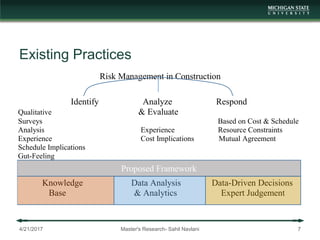
Existing Practices
Risk Management in Construction
Identify Analyze Respond
Qualitative & Evaluate
Surveys Based on Cost & Schedule
Analysis Experience Resource Constraints
Experience Cost Implications Mutual Agreement
Schedule Implications
Gut-Feeling
Knowledge Data Analysis Data-Driven Decisions
Base & Analytics Expert Judgement
Proposed Framework
4/21/2017 Master's Research- Sahil Navlani 7
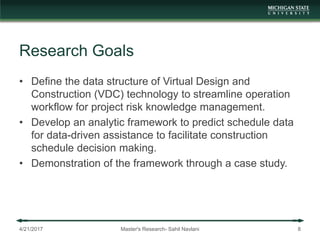
Research Goals
• Define the data structure of Virtual Design and
Construction (VDC) technology to streamline operation
workflow for project risk knowledge management.
• Develop an analytic framework to predict schedule data
for data-driven assistance to facilitate construction
schedule decision making.
• Demonstration of the framework through a case study.
4/21/2017 Master's Research- Sahil Navlani 8
Research Methods
• Literature Review
• Framework Development
• Case Demonstration
4/21/2017 Master's Research- Sahil Navlani 9
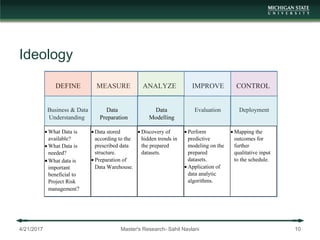
Ideology
4/21/2017 Master's Research- Sahil Navlani 10
DEFINE MEASURE ANALYZE IMPROVE CONTROL
Business & Data Data Data Evaluation Deployment
Understanding Preparation Modelling
 What Data is
available?
 What Data is
needed?
What data is
important
beneficial to
Project Risk
management?
 Data stored
according to the
prescribed data
structure.
 Preparation of
Data Warehouse.
 Discovery of
hidden trends in
the prepared
datasets.
 Perform
predictive
modeling on the
prepared
datasets.
 Application of
data analytic
algorithms.
 Mapping the
outcomes for
further
qualitative input
to the schedule.
Figure 1 Superimposed DMAIC and CRISP-DM process flow
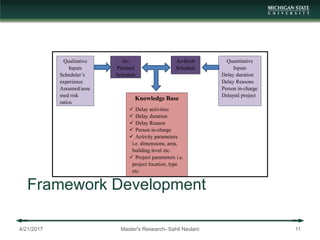
Framework Development
4/21/2017 Master's Research- Sahil Navlani 11
As-
Planned
Schedule
As-Built
Schedule
Knowledge Base
 Delay activities
 Delay duration
 Delay Reason
 Person in-charge
 Activity parameters
i.e. dimensions, area,
building level etc.
 Project parameters i.e.
project location, type
etc.
Qualitative
Inputs
Scheduler’s
experience
Assumed/asse
ssed risk
ratios
Quantitative
Inputs
Delay duration
Delay Reasons
Person in-charge
Delayed project
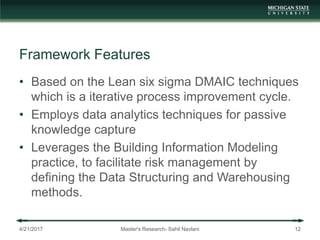
Framework Features
• Based on the Lean six sigma DMAIC techniques
which is a iterative process improvement cycle.
• Employs data analytics techniques for passive
knowledge capture
• Leverages the Building Information Modeling
practice, to facilitate risk management by
defining the Data Structuring and Warehousing
methods.
4/21/2017 Master's Research- Sahil Navlani 12
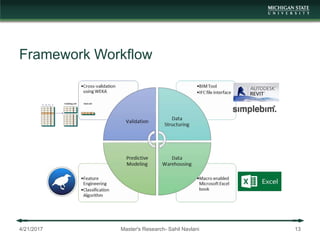
Framework Workflow
4/21/2017 Master's Research- Sahil Navlani 13
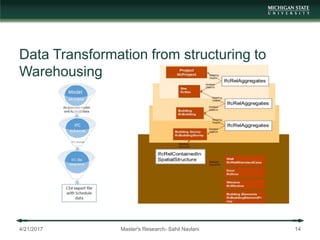
Data Transformation from structuring to
Warehousing
4/21/2017 Master's Research- Sahil Navlani 14
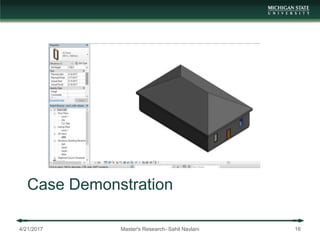
Case Demonstration
4/21/2017 Master's Research- Sahil Navlani 16
Case scenario: Modular Construction
• A speciality modular construction firm
considered to simulate conceptual schedules
• The aforementioned project with the same floor
plan and little variation in building objects was
developed.
• Modular housing construction was chosen for
demonstration, pertaining to their little to no
variability in the building objects, systems and
floor plans while leveraging the construction
schedule for facilitating the learning of the4/21/2017 Master's Research- Sahil Navlani 17
Case Description
As-built Duration (days) Variation
Case 1 35 None
Case 2 42 None
Case 3 39 2 out of 6 window sizes
changed to be smaller
Case 4 38 Wall thickness increased,
door size decreased and
the roof systems changed
to EPDM
4/21/2017 Master's Research- Sahil Navlani 18
Data Structuring
• Baselined to LOD 300
• The Model Element is graphically represented within the
Model as a specific system, object or assembly in terms of
quantity, size, shape, location, and orientation. Non-graphic
information may also be attached to the Model Element.
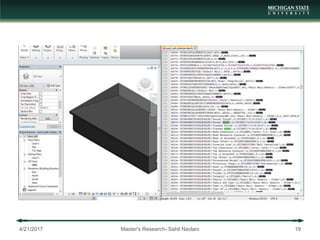
• Data loaded using project and shared
parameters
4/21/2017 Master's Research- Sahil Navlani 19
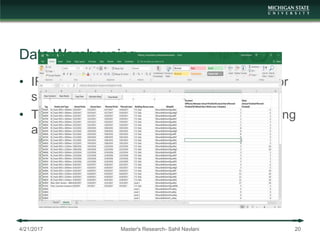
Data Warehousing
• IFC file interface to filter the attribute export for
specific building objects
• The exported worksheets will be compiled using
a Macro enabled excel workbook
4/21/2017 Master's Research- Sahil Navlani 20
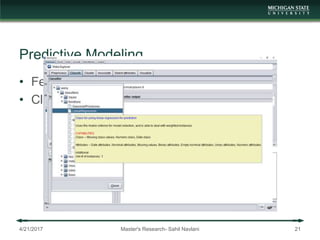
Predictive Modeling
• Feature Engineering
• Classification Algorithm
4/21/2017 Master's Research- Sahil Navlani 21
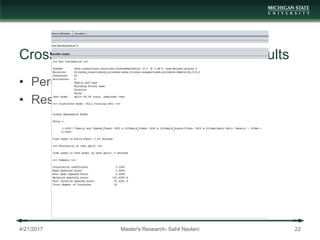
Cross-validation & Interpretation of Results
• Percentage split
• Result model
4/21/2017 Master's Research- Sahil Navlani 22
Research Findings and Contribution
4/21/2017 Master's Research- Sahil Navlani 23
Research Findings and Contribution
• As AEC industry is advancing in the new era of
technological advancements, Data Analytics
proves to be viable and Feasible.
• The research’s major contribution is exploratory
conjunction within the AEC and Data Analytics
industry. Research accomplishes the goals set
forth by proposing a functional framework for
implementation.
4/21/2017 Master's Research- Sahil Navlani 24
Limitations and Future Research
4/21/2017 Master's Research- Sahil Navlani 25
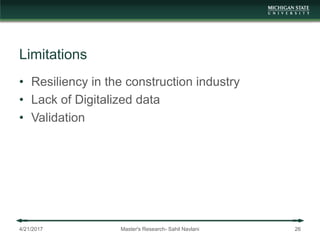
Limitations
• Resiliency in the construction industry
• Lack of Digitalized data
• Validation
4/21/2017 Master's Research- Sahil Navlani 26
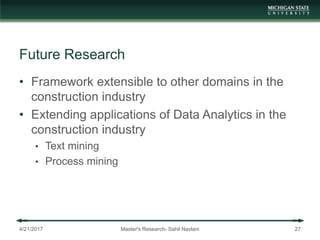
Future Research
• Framework extensible to other domains in the
construction industry
• Extending applications of Data Analytics in the
construction industry
• Text mining
• Process mining
4/21/2017 Master's Research- Sahil Navlani 27
Questions & Discussions
4/21/2017 Master's Research- Sahil Navlani 28
Thank You
4/21/2017 Master's Research- Sahil Navlani 29

A BIM-integrated framework to predict schedule delays in Construction

  • 1.
    A BIM IntegratedFramework to Predict Schedule Delays in Manufactured and Modular Construction Master’s Plan B Report By Sahil Navlani Construction Management Master’s Candidate 4/21/2017 1
  • 2.
    Two truths anda lie about me • I took acting classes and have been in a commercial • When I was a kid, I wanted to be a Pilot • I’ve been into 3 major motor-crashes. 4/21/2017 Master's Research- Sahil Navlani 2 More about me • Indian, Civil Engineer growing into Construction management • Firm beliefs in passion, innovation, hard-work & rationalism
  • 3.
    Outline • Research Goals •Research Methods • Framework Development • Demonstration with a case scenario • Research Findings and Contribution • Limitations and Future Research 4/21/2017 Master's Research- Sahil Navlani 3
  • 4.
    Introduction • Literature hasdemonstrated the effect of risk management on a construction project • Scheduling errors and contractor delays have been categorized as some of the most frequent and impactful project management risks • Several methods have been proposed in forms of Monte-Carlo simulation, Bayesian belief networks, time series analysis to mitigate construction schedule inconsistency. 4/21/2017 Master's Research- Sahil Navlani 4
  • 5.
    Problem Statement • Mostof the previous literature demonstrated the need of manual inputs in regard to domain knowledge • Correlation factors, weights are sought out from seasoned professionals to mitigate schedule delay risks • The most common method of collection is through surveys and questionnaires 4/21/2017 Master's Research- Sahil Navlani 5
  • 6.
    Research Gap • Noguidelines, specification on generation, accumulation and storage of digitalized construction project data. • No existing methods to capture expert knowledge in the construction domain • Missing workflows for knowledge reuse in the construction industry 4/21/2017 Master's Research- Sahil Navlani 6
  • 7.
    Existing Practices Risk Managementin Construction Identify Analyze Respond Qualitative & Evaluate Surveys Based on Cost & Schedule Analysis Experience Resource Constraints Experience Cost Implications Mutual Agreement Schedule Implications Gut-Feeling Knowledge Data Analysis Data-Driven Decisions Base & Analytics Expert Judgement Proposed Framework 4/21/2017 Master's Research- Sahil Navlani 7
  • 8.
    Research Goals • Definethe data structure of Virtual Design and Construction (VDC) technology to streamline operation workflow for project risk knowledge management. • Develop an analytic framework to predict schedule data for data-driven assistance to facilitate construction schedule decision making. • Demonstration of the framework through a case study. 4/21/2017 Master's Research- Sahil Navlani 8
  • 9.
    Research Methods • LiteratureReview • Framework Development • Case Demonstration 4/21/2017 Master's Research- Sahil Navlani 9
  • 10.
    Ideology 4/21/2017 Master's Research-Sahil Navlani 10 DEFINE MEASURE ANALYZE IMPROVE CONTROL Business & Data Data Data Evaluation Deployment Understanding Preparation Modelling  What Data is available?  What Data is needed? What data is important beneficial to Project Risk management?  Data stored according to the prescribed data structure.  Preparation of Data Warehouse.  Discovery of hidden trends in the prepared datasets.  Perform predictive modeling on the prepared datasets.  Application of data analytic algorithms.  Mapping the outcomes for further qualitative input to the schedule. Figure 1 Superimposed DMAIC and CRISP-DM process flow
  • 11.
    Framework Development 4/21/2017 Master'sResearch- Sahil Navlani 11 As- Planned Schedule As-Built Schedule Knowledge Base  Delay activities  Delay duration  Delay Reason  Person in-charge  Activity parameters i.e. dimensions, area, building level etc.  Project parameters i.e. project location, type etc. Qualitative Inputs Scheduler’s experience Assumed/asse ssed risk ratios Quantitative Inputs Delay duration Delay Reasons Person in-charge Delayed project
  • 12.
    Framework Features • Basedon the Lean six sigma DMAIC techniques which is a iterative process improvement cycle. • Employs data analytics techniques for passive knowledge capture • Leverages the Building Information Modeling practice, to facilitate risk management by defining the Data Structuring and Warehousing methods. 4/21/2017 Master's Research- Sahil Navlani 12
  • 13.
    Framework Workflow 4/21/2017 Master'sResearch- Sahil Navlani 13
  • 14.
    Data Transformation fromstructuring to Warehousing 4/21/2017 Master's Research- Sahil Navlani 14
  • 15.
    Case Demonstration 4/21/2017 Master'sResearch- Sahil Navlani 16
  • 16.
    Case scenario: ModularConstruction • A speciality modular construction firm considered to simulate conceptual schedules • The aforementioned project with the same floor plan and little variation in building objects was developed. • Modular housing construction was chosen for demonstration, pertaining to their little to no variability in the building objects, systems and floor plans while leveraging the construction schedule for facilitating the learning of the4/21/2017 Master's Research- Sahil Navlani 17
  • 17.
    Case Description As-built Duration(days) Variation Case 1 35 None Case 2 42 None Case 3 39 2 out of 6 window sizes changed to be smaller Case 4 38 Wall thickness increased, door size decreased and the roof systems changed to EPDM 4/21/2017 Master's Research- Sahil Navlani 18
  • 18.
    Data Structuring • Baselinedto LOD 300 • The Model Element is graphically represented within the Model as a specific system, object or assembly in terms of quantity, size, shape, location, and orientation. Non-graphic information may also be attached to the Model Element. • Data loaded using project and shared parameters 4/21/2017 Master's Research- Sahil Navlani 19
  • 19.
    Data Warehousing • IFCfile interface to filter the attribute export for specific building objects • The exported worksheets will be compiled using a Macro enabled excel workbook 4/21/2017 Master's Research- Sahil Navlani 20
  • 20.
    Predictive Modeling • FeatureEngineering • Classification Algorithm 4/21/2017 Master's Research- Sahil Navlani 21
  • 21.
    Cross-validation & Interpretationof Results • Percentage split • Result model 4/21/2017 Master's Research- Sahil Navlani 22
  • 22.
    Research Findings andContribution 4/21/2017 Master's Research- Sahil Navlani 23
  • 23.
    Research Findings andContribution • As AEC industry is advancing in the new era of technological advancements, Data Analytics proves to be viable and Feasible. • The research’s major contribution is exploratory conjunction within the AEC and Data Analytics industry. Research accomplishes the goals set forth by proposing a functional framework for implementation. 4/21/2017 Master's Research- Sahil Navlani 24
  • 24.
    Limitations and FutureResearch 4/21/2017 Master's Research- Sahil Navlani 25
  • 25.
    Limitations • Resiliency inthe construction industry • Lack of Digitalized data • Validation 4/21/2017 Master's Research- Sahil Navlani 26
  • 26.
    Future Research • Frameworkextensible to other domains in the construction industry • Extending applications of Data Analytics in the construction industry • Text mining • Process mining 4/21/2017 Master's Research- Sahil Navlani 27
  • 27.
    Questions & Discussions 4/21/2017Master's Research- Sahil Navlani 28
  • 28.
    Thank You 4/21/2017 Master'sResearch- Sahil Navlani 29