Robert Mondavi Company Family Owned, Professionally Managed 2003 Annual Shareholders Meeting
HEELCO Financial Consulting, Inc. Keith R. Dickson Simone Furlan Adam Takace MBA 670 March 10, 2003 Dr. Dave Odett
Agenda 1. Introduction 2. Vision 3. Competitive Strategies 4. Going Public 5. Strategy Execution 6. 2003 Financial Report 7. Financial Metrics 8. The Future 9. The Mondavi Brand Portfolio 10. Audience Participation Simone Furlan Keith R. Dickson Adam Takace Keith R. Dickson Keith R. Dickson Simone Furlan Adam Takace Keith R. Dickson Simone Furlan All
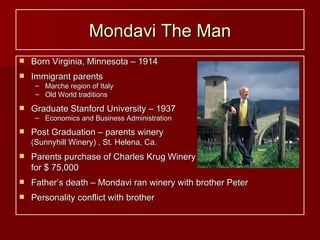
Mondavi The Man Born Virginia, Minnesota – 1914 Immigrant parents  Marche region of Italy Old World traditions Graduate Stanford University – 1937 Economics and Business Administration Post Graduation – parents winery   (Sunnyhill Winery) , St. Helena, Ca. Parents purchase of Charles Krug Winery for $ 75,000 Father’s death – Mondavi ran winery with brother Peter Personality conflict with brother
Robert Mondavi “ Wine has been with us since the beginning of civilization.  It is the temperate, civilized, sacred and romantic mealtime beverage”
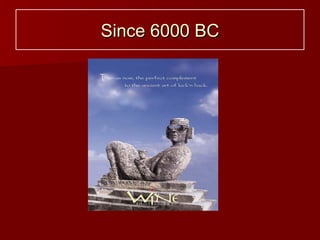
Since 6000 BC
Mondavi Vision
Wine Industry Fundamentals Appellation   name of region in which wine is produced Varietal   type of grape used to produce a wine Terroir   environmental factors of the region in which wine is produced determine the quality Old World Wine Producers   Centuries of wine making tradition, high quality France Italy New World Wine Producers   More modern wine producing methods Australia Chile Argentina
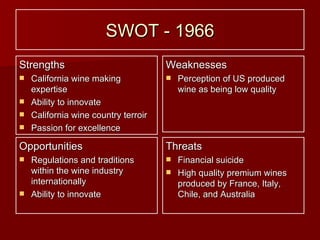
SWOT - 1966 Strengths California wine making expertise Ability to innovate California wine country terroir Passion for excellence Weaknesses Perception of US produced wine as being low quality Opportunities Regulations and traditions within the wine industry internationally Ability to innovate Threats Financial suicide High quality premium wines produced by France, Italy, Chile, and Australia
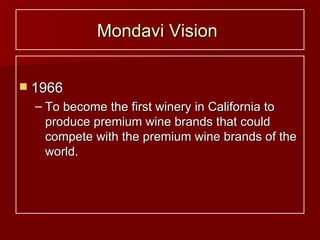
Mondavi Vision   1966 To become the first winery in California to produce premium wine brands that could compete with the premium wine brands of the world.
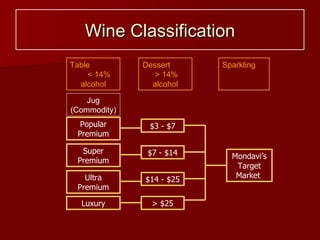
Wine Classification Sparkling  k  k  Dessert  > 14% alcohol Table  < 14% alcohol Jug (Commodity) Luxury Ultra Premium Super Premium Popular Premium Mondavi’s Target Market  $3 - $7 $7 - $14 $14 - $25 > $25
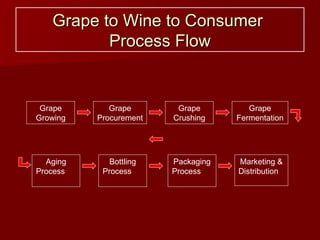
Grape to Wine to Consumer  Process Flow Grape Procurement Grape Growing Aging Process  Grape Crushing Grape Fermentation Bottling Process  Packaging Process  Marketing & Distribution
Mondavi Business Plan Build RMC Reputation Produce a limited quantity of super to ultra premium wines using the most prestigious varietal grapes Cabernet Sauvignon Pinot Noir Chardonnay Johannesburg Riesling Locate winery in the best vineyard in Napa Valley To Kalon Vineyard, Oakville, California Build a State-Of-The-Art Winemaking Facility Functional and distinctive Develop “Best-In-Class” Winemaking Procedures Assemble team of viticulture experts Develop new technologies and process innovations
Competitive Strategies
Competitive Strategy Domestic Brand Diversification Build brand portfolio in the premium wine market Price points Niches Develop new brands using new wine appellations from California Wine Country Use long-term debt to finance acquisitions Gradually raise brand prices as popularity increases
Competitive Strategy   Global Strategic Partnerships Expand brand portfolio beyond California Combine the wine making expertise of Napa Valley with that of the great wine producers of the world Develop a global recognition for Mondavi brands France Italy Chile Australia
Competitive Strategy   Grape Sourcing Company owned and leased vineyards 50% for highest quality wines 25% - 2005 goal for all wines  Densely spaced vineyards Sustainable farming practices Hand harvesting for higher quality grapes Outsourcing  Over 300 independent grape growers 75% of contracts – 3 to 7 years Partner-like relationships Prices paid based on grape quality Lending Mondavi vineyard specialists to partners
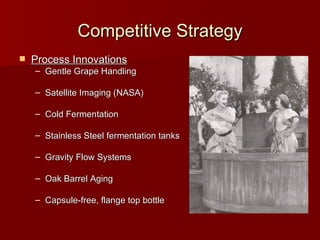
Competitive Strategy Process Innovations Gentle Grape Handling Satellite Imaging (NASA) Cold Fermentation Stainless Steel fermentation tanks Gravity Flow Systems Oak Barrel Aging Capsule-free, flange top bottle
Competitive Strategy   Sales and Distribution Domestic  More than 100 independent wine & spirits distributors Winery retail shops Internationally Regional and national importers High-end hotel chains Premium restaurants
Competitive Strategy   Marketing 12% of consumers drank 88% of wine purchased in US Identify the opinion leaders within this group Enhance their knowledge and appreciation of Mondavi wines Tours of winery Training sessions at fine restaurants and hotels Magazines – “Bon Appetit”, “The Wine Spectator”, “Food and Wine” Electronic media Radio – 1998 Television – 2001 Grow the customer base by removing wine’s mystery, while maintain the magic
Competitive Strategy Organization Prior to 2001 Vice Presidents Production Sales Marketing Finance 2001 Reorganization RMW Business Unit Woodbridge Business Unit Joint Ventures & Small Wineries Business Unit Executive compensation linked to amount BU return’s exceeded cost of capital Objective Develop a clear and distinct competitive market position for each brand
Going Public
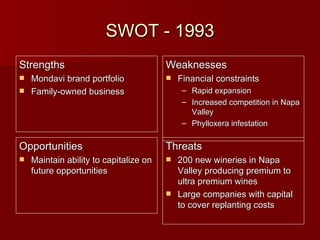
SWOT - 1993 Strengths Mondavi brand portfolio Family-owned business Weaknesses Financial constraints Rapid expansion Increased competition in Napa Valley Phylloxera infestation Opportunities Maintain ability to capitalize on future opportunities Threats 200 new wineries in Napa Valley producing premium to ultra premium wines Large companies with capital to cover replanting costs
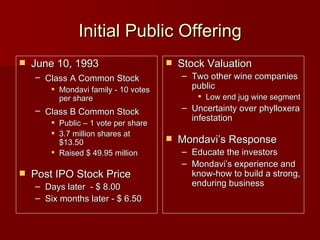
Initial Public Offering June 10, 1993  Class A Common Stock   Mondavi family - 10 votes per share Class B Common Stock   Public – 1 vote per share 3.7 million shares at $13.50 Raised $ 49.95 million Post IPO Stock Price Days later  - $ 8.00 Six months later - $ 6.50 Stock Valuation Two other wine companies public Low end jug wine segment Uncertainty over phylloxera infestation Mondavi’s Response Educate the investors Mondavi’s experience and know-how to build a strong, enduring business
Strategy Execution
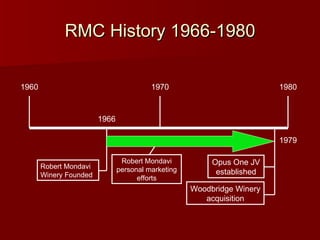
RMC History 1966-1980 Robert Mondavi Winery Founded 1970 1960 Woodbridge Winery acquisition Opus One JV established 1980 1966 1979 Robert Mondavi personal marketing efforts
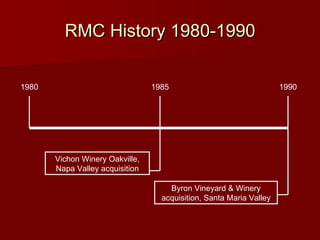
RMC History 1980-1990 Vichon Winery Oakville, Napa Valley acquisition 1985 1980 1990 Byron Vineyard & Winery acquisition, Santa Maria Valley
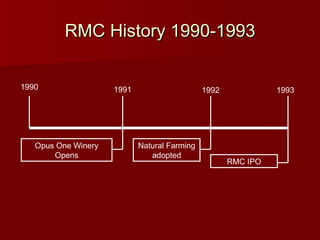
RMC History 1990-1993 1990 1993 1991 1992 Natural Farming adopted Opus One Winery Opens RMC IPO
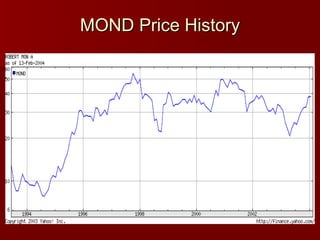
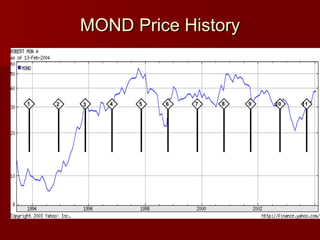
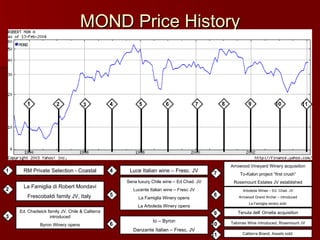
MOND Price History
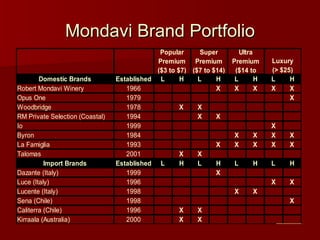
Mondavi Brand Portfolio
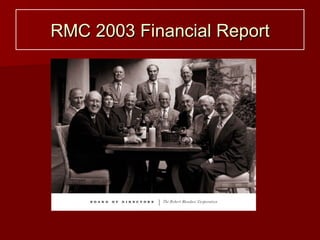
RMC 2003 Financial Report
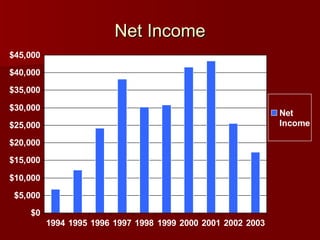
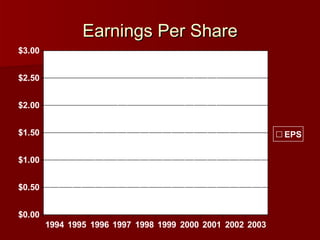
Fiscal Year 2003  (Ending June 30, 2003) Decrease in Net Income and Earnings per Share  Net Income:  $ 17.3 Mil from $ 25.5 Mil (FY 2002) Earnings per Share:  1.06 from 1.56 (FY 2002) Restructuring charges: $ 22.2 Mil (0.85/share) Staff reductions Grape contract buyouts Wine inventory and fixed asset write downs Disposal of non-strategic fixed assets La Famiglia Winery (retain brand name) 750 acres of vineyard California Central Coast Gains:  $ 7.3 Mil
FY 2003 Actions Stimulate Sales and Grow Market Share Increase efforts in trade promotion Creation of new brands Woodbridge Select Vineyard Series  Papio – popular premium segment for the “adventurous and young at heart” Discovery Series – for restaurant consumers seeking “something different” Maintain brand pricing in this highly competitive environment Strong Wine Brands Mondavi wines are synonymous with quality
Financial Metrics
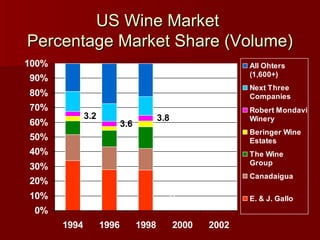
US Wine Market  Percentage Market Share (Volume)
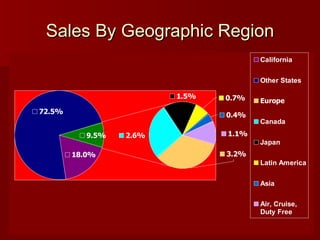
Sales By Geographic Region
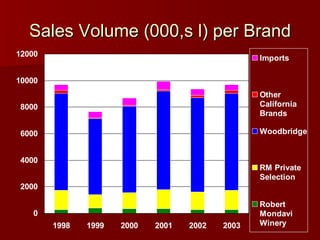
Sales Volume (000,s l) per Brand
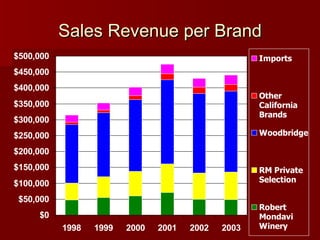
Sales Revenue per Brand
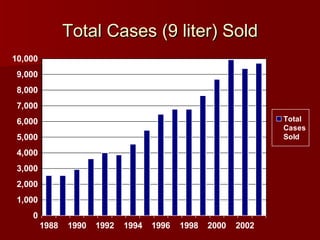
Total Cases (9 liter) Sold
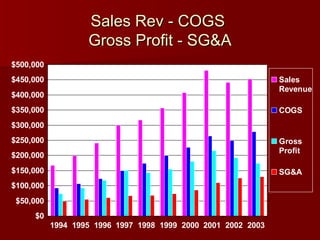
Sales Rev - COGS  Gross Profit - SG&A
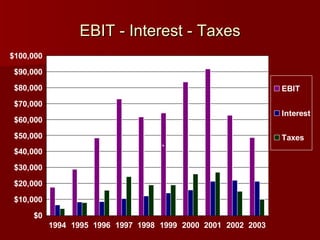
EBIT - Interest - Taxes
Net Income
Earnings Per Share
The Future
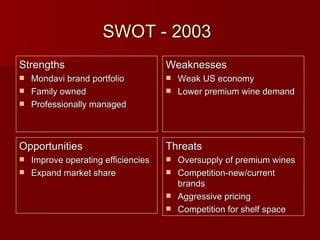
SWOT - 2003   Strengths Mondavi brand portfolio Family owned Professionally managed Weaknesses Weak US economy Lower premium wine demand Opportunities Improve operating efficiencies Expand market share Threats Oversupply of premium wines Competition-new/current brands Aggressive pricing Competition for shelf space
Competition Focused Competitors Producing premium wines Kendall-Jackson – 1982 Trinchero Estates – 1947 Southcorp (Australia) – 2001 Large Volume Producers E&J Gallo Constellation Brands Beer and Distilled Spirits Producers Foster’s Group Diaego Brown-Forman Allied-Domecq
International Market Segmentation Countries that consume and produce significant amounts of wine domestically France Italy Countries with significant levels of consumption, but no large local wine industry Switzerland United Kingdom Countries that do not yet drink significant amounts of wine Asian countries Developing countries
Forward Looking Competitive Strategies Improve Operating Efficiencies 10 % staff reductions – ($ 6 Mil annual savings in SG&A) Reduce product costs by 10% in FY 2007 ($ 30 Mil annual savings) Reduce overhead costs Streamline packaging and distribution activities Increase production from Mondavi vineyards Continue to Identify Non Strategic Assets for Disposal ($ 40 - $ 50 Mil book value) Re-deploy capital to meet long term strategies Improve Return on Invested Capital FY 2003 Actual: 4% FY 2007 Goal: 9%
Domestic Brand Labels
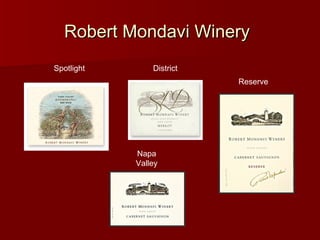
Robert Mondavi Winery   Spotlight District Reserve Napa Valley
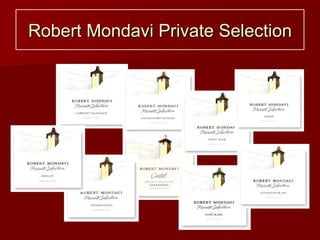
Robert Mondavi Private Selection
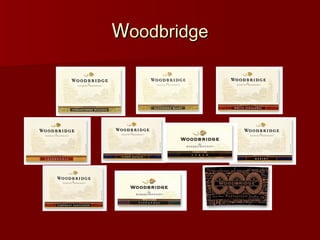
W oodbridge
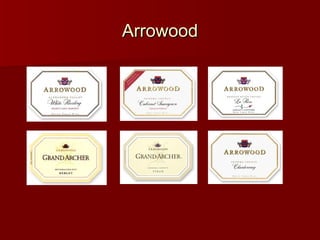
Arrowood
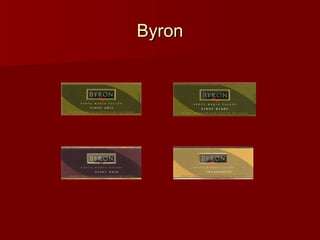
Byron
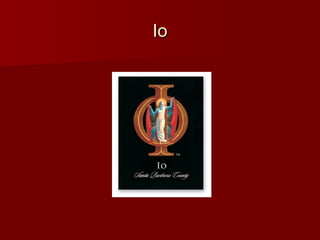
Io
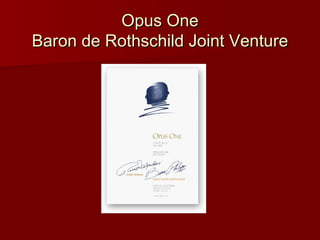
Opus One Baron de Rothschild Joint Venture
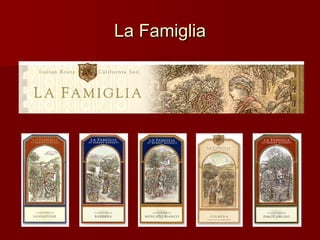
La Famiglia
Import Brand Labels
Sena  Eduardo Chadwick Joint Venture
Arboleda  Eduardo Chadwick Joint Venture
Caliterra  Eduardo Chadwick Joint Venture
Luce and Lucente  Frescobaldi Joint Venture
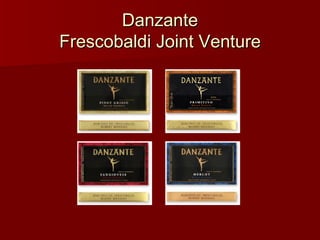
Danzante Frescobaldi Joint Venture
Talomas and Kirralaa Rosemount Estates Joint Venture
Audience Participation
References Bond, G., Porter, M. (2000).  Robert Mondavi: Competitive Strategy.  Boston: Harvard Business School Publishing. Laube, J. (2003)  Mondavi at the Crossroads . Available:  http://www.winespector.com/Wine/Main/Feature Mondavi, R. (1998).  Harvests of Joy . New York: Harcourt Brace &  Company Roberto, M., (2002).  Robert Mondavi & Wine Industry.  Boston:  Harvard Business School Publishing. Silverman et al. (2001). Robert Mondavi Corporation.   In Thompson,  A., Strickland, A.,  Strategic Management: Concepts and Cases   (pp. 247-262). New York: The McGraw-Hill Companies.
MOND Price History 1 2 3 4 5 6 7 8 9 10 11
MOND Price History La Famiglia di Robert Mondavi Frescobaldi family JV, Italy  RM Private Selection - Coastal Sena luxury Chile wine – Ed Chad. JV Lucente Italian wine – Fresc JV La Famiglia Winery opens La Arboleda Winery opens 1 2 Ed. Chadwick family JV, Chile & Caliterra introduced Byron Winery opens 3 4 5 Luce Italian wine – Fresc. JV Io – Byron Danzante Italian – Fresc. JV 6 Arrowood Vineyard Winery acquisition To-Kalon project “first crush” Rosemount Estates JV established 7 1 2 3 4 5 6 7 Arboleda Wines – Ed. Chad. JV Arrowood Grand Archer – introduced La Famiglia winery sold  8 8 Tenuta dell’ Ornelia acquisition 9 Talomas Wine introduced, Rosemount JV 10 9 10 Caliterra Brand, Assets sold  11 11
Mondavi

  • 1.
    Robert Mondavi CompanyFamily Owned, Professionally Managed 2003 Annual Shareholders Meeting
  • 2.
    HEELCO Financial Consulting,Inc. Keith R. Dickson Simone Furlan Adam Takace MBA 670 March 10, 2003 Dr. Dave Odett
  • 3.
    Agenda 1. Introduction2. Vision 3. Competitive Strategies 4. Going Public 5. Strategy Execution 6. 2003 Financial Report 7. Financial Metrics 8. The Future 9. The Mondavi Brand Portfolio 10. Audience Participation Simone Furlan Keith R. Dickson Adam Takace Keith R. Dickson Keith R. Dickson Simone Furlan Adam Takace Keith R. Dickson Simone Furlan All
  • 4.
    Mondavi The ManBorn Virginia, Minnesota – 1914 Immigrant parents Marche region of Italy Old World traditions Graduate Stanford University – 1937 Economics and Business Administration Post Graduation – parents winery (Sunnyhill Winery) , St. Helena, Ca. Parents purchase of Charles Krug Winery for $ 75,000 Father’s death – Mondavi ran winery with brother Peter Personality conflict with brother
  • 5.
    Robert Mondavi “Wine has been with us since the beginning of civilization. It is the temperate, civilized, sacred and romantic mealtime beverage”
  • 6.
  • 7.
  • 8.
    Wine Industry FundamentalsAppellation name of region in which wine is produced Varietal type of grape used to produce a wine Terroir environmental factors of the region in which wine is produced determine the quality Old World Wine Producers Centuries of wine making tradition, high quality France Italy New World Wine Producers More modern wine producing methods Australia Chile Argentina
  • 9.
    SWOT - 1966Strengths California wine making expertise Ability to innovate California wine country terroir Passion for excellence Weaknesses Perception of US produced wine as being low quality Opportunities Regulations and traditions within the wine industry internationally Ability to innovate Threats Financial suicide High quality premium wines produced by France, Italy, Chile, and Australia
  • 10.
    Mondavi Vision 1966 To become the first winery in California to produce premium wine brands that could compete with the premium wine brands of the world.
  • 11.
    Wine Classification Sparkling k k Dessert > 14% alcohol Table < 14% alcohol Jug (Commodity) Luxury Ultra Premium Super Premium Popular Premium Mondavi’s Target Market $3 - $7 $7 - $14 $14 - $25 > $25
  • 12.
    Grape to Wineto Consumer Process Flow Grape Procurement Grape Growing Aging Process Grape Crushing Grape Fermentation Bottling Process Packaging Process Marketing & Distribution
  • 13.
    Mondavi Business PlanBuild RMC Reputation Produce a limited quantity of super to ultra premium wines using the most prestigious varietal grapes Cabernet Sauvignon Pinot Noir Chardonnay Johannesburg Riesling Locate winery in the best vineyard in Napa Valley To Kalon Vineyard, Oakville, California Build a State-Of-The-Art Winemaking Facility Functional and distinctive Develop “Best-In-Class” Winemaking Procedures Assemble team of viticulture experts Develop new technologies and process innovations
  • 14.
  • 15.
    Competitive Strategy DomesticBrand Diversification Build brand portfolio in the premium wine market Price points Niches Develop new brands using new wine appellations from California Wine Country Use long-term debt to finance acquisitions Gradually raise brand prices as popularity increases
  • 16.
    Competitive Strategy Global Strategic Partnerships Expand brand portfolio beyond California Combine the wine making expertise of Napa Valley with that of the great wine producers of the world Develop a global recognition for Mondavi brands France Italy Chile Australia
  • 17.
    Competitive Strategy Grape Sourcing Company owned and leased vineyards 50% for highest quality wines 25% - 2005 goal for all wines Densely spaced vineyards Sustainable farming practices Hand harvesting for higher quality grapes Outsourcing Over 300 independent grape growers 75% of contracts – 3 to 7 years Partner-like relationships Prices paid based on grape quality Lending Mondavi vineyard specialists to partners
  • 18.
    Competitive Strategy ProcessInnovations Gentle Grape Handling Satellite Imaging (NASA) Cold Fermentation Stainless Steel fermentation tanks Gravity Flow Systems Oak Barrel Aging Capsule-free, flange top bottle
  • 19.
    Competitive Strategy Sales and Distribution Domestic More than 100 independent wine & spirits distributors Winery retail shops Internationally Regional and national importers High-end hotel chains Premium restaurants
  • 20.
    Competitive Strategy Marketing 12% of consumers drank 88% of wine purchased in US Identify the opinion leaders within this group Enhance their knowledge and appreciation of Mondavi wines Tours of winery Training sessions at fine restaurants and hotels Magazines – “Bon Appetit”, “The Wine Spectator”, “Food and Wine” Electronic media Radio – 1998 Television – 2001 Grow the customer base by removing wine’s mystery, while maintain the magic
  • 21.
    Competitive Strategy OrganizationPrior to 2001 Vice Presidents Production Sales Marketing Finance 2001 Reorganization RMW Business Unit Woodbridge Business Unit Joint Ventures & Small Wineries Business Unit Executive compensation linked to amount BU return’s exceeded cost of capital Objective Develop a clear and distinct competitive market position for each brand
  • 22.
  • 23.
    SWOT - 1993Strengths Mondavi brand portfolio Family-owned business Weaknesses Financial constraints Rapid expansion Increased competition in Napa Valley Phylloxera infestation Opportunities Maintain ability to capitalize on future opportunities Threats 200 new wineries in Napa Valley producing premium to ultra premium wines Large companies with capital to cover replanting costs
  • 24.
    Initial Public OfferingJune 10, 1993 Class A Common Stock Mondavi family - 10 votes per share Class B Common Stock Public – 1 vote per share 3.7 million shares at $13.50 Raised $ 49.95 million Post IPO Stock Price Days later - $ 8.00 Six months later - $ 6.50 Stock Valuation Two other wine companies public Low end jug wine segment Uncertainty over phylloxera infestation Mondavi’s Response Educate the investors Mondavi’s experience and know-how to build a strong, enduring business
  • 25.
  • 26.
    RMC History 1966-1980Robert Mondavi Winery Founded 1970 1960 Woodbridge Winery acquisition Opus One JV established 1980 1966 1979 Robert Mondavi personal marketing efforts
  • 27.
    RMC History 1980-1990Vichon Winery Oakville, Napa Valley acquisition 1985 1980 1990 Byron Vineyard & Winery acquisition, Santa Maria Valley
  • 28.
    RMC History 1990-19931990 1993 1991 1992 Natural Farming adopted Opus One Winery Opens RMC IPO
  • 29.
  • 30.
  • 31.
  • 32.
    Fiscal Year 2003 (Ending June 30, 2003) Decrease in Net Income and Earnings per Share Net Income: $ 17.3 Mil from $ 25.5 Mil (FY 2002) Earnings per Share: 1.06 from 1.56 (FY 2002) Restructuring charges: $ 22.2 Mil (0.85/share) Staff reductions Grape contract buyouts Wine inventory and fixed asset write downs Disposal of non-strategic fixed assets La Famiglia Winery (retain brand name) 750 acres of vineyard California Central Coast Gains: $ 7.3 Mil
  • 33.
    FY 2003 ActionsStimulate Sales and Grow Market Share Increase efforts in trade promotion Creation of new brands Woodbridge Select Vineyard Series Papio – popular premium segment for the “adventurous and young at heart” Discovery Series – for restaurant consumers seeking “something different” Maintain brand pricing in this highly competitive environment Strong Wine Brands Mondavi wines are synonymous with quality
  • 34.
  • 35.
    US Wine Market Percentage Market Share (Volume)
  • 36.
  • 37.
    Sales Volume (000,sl) per Brand
  • 38.
  • 39.
    Total Cases (9liter) Sold
  • 40.
    Sales Rev -COGS Gross Profit - SG&A
  • 41.
  • 42.
  • 43.
  • 44.
  • 45.
    SWOT - 2003 Strengths Mondavi brand portfolio Family owned Professionally managed Weaknesses Weak US economy Lower premium wine demand Opportunities Improve operating efficiencies Expand market share Threats Oversupply of premium wines Competition-new/current brands Aggressive pricing Competition for shelf space
  • 46.
    Competition Focused CompetitorsProducing premium wines Kendall-Jackson – 1982 Trinchero Estates – 1947 Southcorp (Australia) – 2001 Large Volume Producers E&J Gallo Constellation Brands Beer and Distilled Spirits Producers Foster’s Group Diaego Brown-Forman Allied-Domecq
  • 47.
    International Market SegmentationCountries that consume and produce significant amounts of wine domestically France Italy Countries with significant levels of consumption, but no large local wine industry Switzerland United Kingdom Countries that do not yet drink significant amounts of wine Asian countries Developing countries
  • 48.
    Forward Looking CompetitiveStrategies Improve Operating Efficiencies 10 % staff reductions – ($ 6 Mil annual savings in SG&A) Reduce product costs by 10% in FY 2007 ($ 30 Mil annual savings) Reduce overhead costs Streamline packaging and distribution activities Increase production from Mondavi vineyards Continue to Identify Non Strategic Assets for Disposal ($ 40 - $ 50 Mil book value) Re-deploy capital to meet long term strategies Improve Return on Invested Capital FY 2003 Actual: 4% FY 2007 Goal: 9%
  • 49.
  • 50.
    Robert Mondavi Winery Spotlight District Reserve Napa Valley
  • 51.
  • 52.
  • 53.
  • 54.
  • 55.
  • 56.
    Opus One Baronde Rothschild Joint Venture
  • 57.
  • 58.
  • 59.
    Sena EduardoChadwick Joint Venture
  • 60.
    Arboleda EduardoChadwick Joint Venture
  • 61.
    Caliterra EduardoChadwick Joint Venture
  • 62.
    Luce and Lucente Frescobaldi Joint Venture
  • 63.
  • 64.
    Talomas and KirralaaRosemount Estates Joint Venture
  • 65.
  • 66.
    References Bond, G.,Porter, M. (2000). Robert Mondavi: Competitive Strategy. Boston: Harvard Business School Publishing. Laube, J. (2003) Mondavi at the Crossroads . Available: http://www.winespector.com/Wine/Main/Feature Mondavi, R. (1998). Harvests of Joy . New York: Harcourt Brace & Company Roberto, M., (2002). Robert Mondavi & Wine Industry. Boston: Harvard Business School Publishing. Silverman et al. (2001). Robert Mondavi Corporation. In Thompson, A., Strickland, A., Strategic Management: Concepts and Cases (pp. 247-262). New York: The McGraw-Hill Companies.
  • 67.
    MOND Price History1 2 3 4 5 6 7 8 9 10 11
  • 68.
    MOND Price HistoryLa Famiglia di Robert Mondavi Frescobaldi family JV, Italy RM Private Selection - Coastal Sena luxury Chile wine – Ed Chad. JV Lucente Italian wine – Fresc JV La Famiglia Winery opens La Arboleda Winery opens 1 2 Ed. Chadwick family JV, Chile & Caliterra introduced Byron Winery opens 3 4 5 Luce Italian wine – Fresc. JV Io – Byron Danzante Italian – Fresc. JV 6 Arrowood Vineyard Winery acquisition To-Kalon project “first crush” Rosemount Estates JV established 7 1 2 3 4 5 6 7 Arboleda Wines – Ed. Chad. JV Arrowood Grand Archer – introduced La Famiglia winery sold 8 8 Tenuta dell’ Ornelia acquisition 9 Talomas Wine introduced, Rosemount JV 10 9 10 Caliterra Brand, Assets sold 11 11