Java Programming: From Problem Analysis to Program Design, 4e Chapter 8 User-Defined Classes and ADTs
Chapter Objectives Learn about classes Learn about  private ,  protected ,  public , and  static  members of a class Explore how classes are implemented Learn about the various operations on classes
Chapter Objectives (continued) Examine constructors and finalizers Examine the method  toString Learn about the abstract data type (ADT)
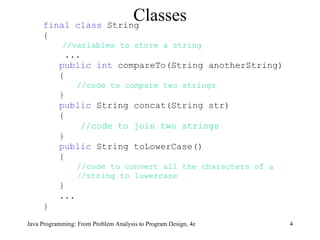
Classes final class  String  { //variables to store a string ... public int  compareTo(String anotherString) { //code to compare two strings } public  String   concat(String str)  { //code to join two strings } public  String   toLowerCase()  { //code to convert all the characters of a //string to lowercase } ... }
Classes (continued) class : reserved word; collection of a fixed number of components   Components: members of a class Members accessed by name Class categories/modifiers private protected public
Classes (continued) private : members of class are not accessible outside class public : members of class are accessible outside class Class members: can be methods or variables Variable members declared like any other variables
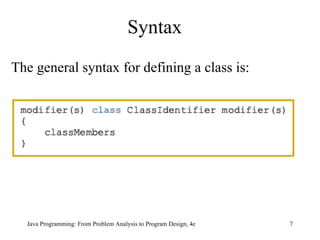
Syntax The general syntax for defining a class is:
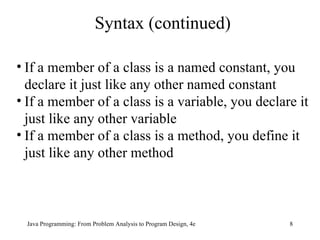
Syntax (continued) If a member of a class is a named constant, you declare it just like any other named constant If a member of a class is a variable, you declare it just like any other variable If a member of a class is a method, you define it just like any other method
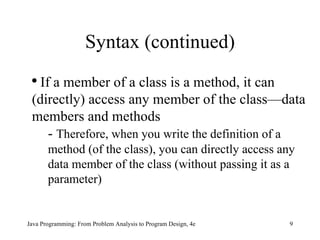
Syntax (continued) If a member of a class is a method, it can (directly) access any member of the class—data members and methods -  Therefore, when you write the definition of a method (of the class), you can directly access any data member of the class (without passing it as a parameter)
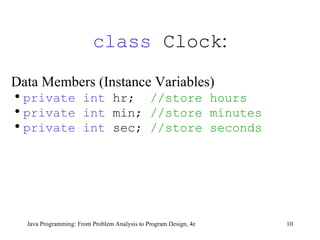
class  Clock : Data Members (Instance Variables) private int  hr;  //store hours private int  min;  //store minutes private int  sec;  //store seconds
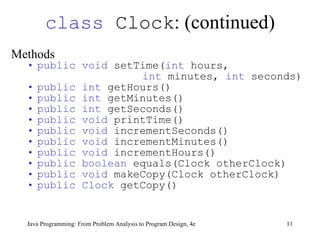
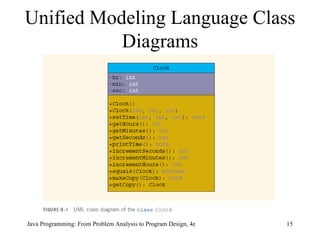
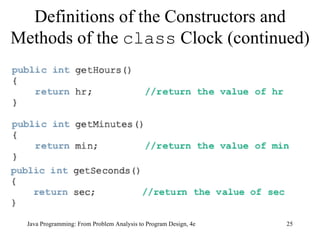
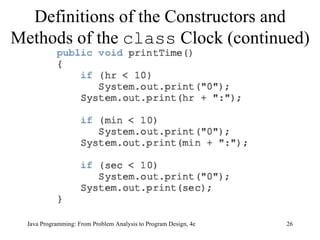
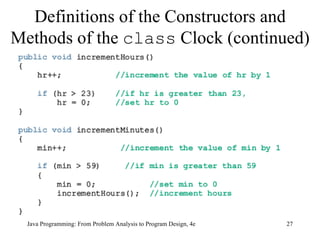
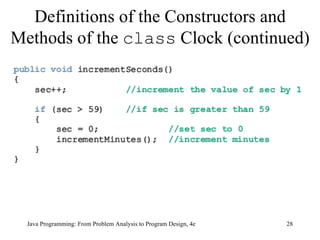
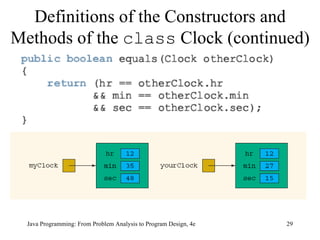
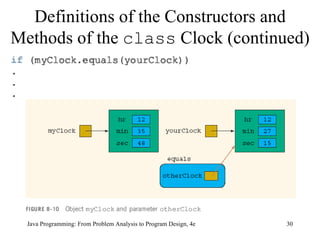
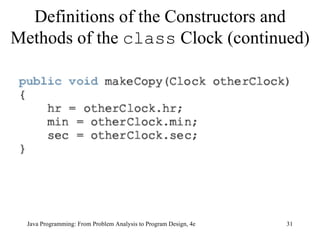
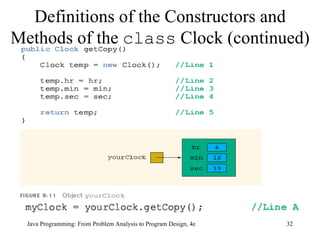
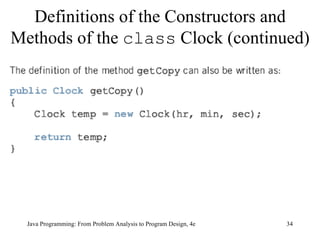
class  Clock :  (continued) Methods   public void  setTime( int  hours,  int  minutes,  int  seconds) public int  getHours() public int  getMinutes() public int  getSeconds() public void  printTime()  public void  incrementSeconds() public void  incrementMinutes() public void  incrementHours() public boolean  equals(Clock otherClock) public void  makeCopy(Clock otherClock) public Clock  getCopy()
Constructors Two types of constructors - With parameters - Without parameters ( default constructor)
Constructors (continued) Constructors have the following properties: - The name of a constructor is the same as the name of the class - A constructor, even though it is a method, has no type - A class can have more than one constructor; all constructors of a class have the same name - If a class has more than one constructor, any two constructors must have different  signatures - Constructors are automatically executed when a class object is instantiated - If there are multiple constructors, which constructor executes depends on the type of values passed to the class object when the class object is instantiated
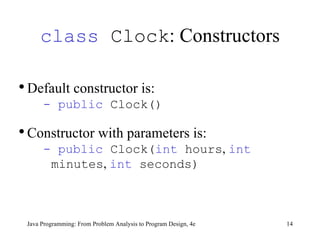
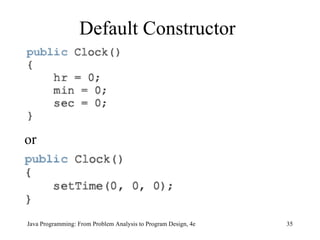
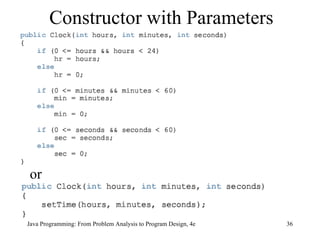
class  Clock : Constructors Default constructor is: - public  Clock() Constructor with parameters is: - public  Clock( int  hours ,  int  minutes ,  int  seconds)
Unified Modeling Language Class Diagrams
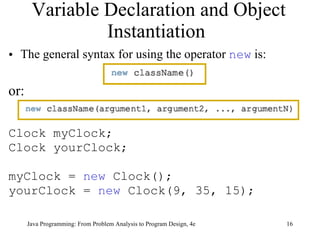
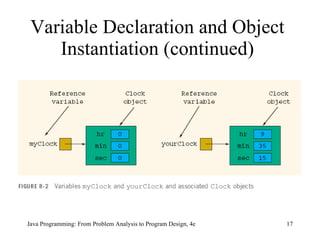
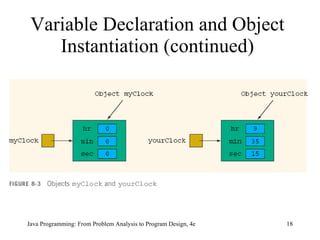
Variable Declaration and Object Instantiation  The general syntax for using the operator  new  is: or: Clock myClock;  Clock yourClock;  myClock =  new  Clock();  yourClock =  new  Clock(9, 35, 15);
Variable Declaration and Object Instantiation (continued)
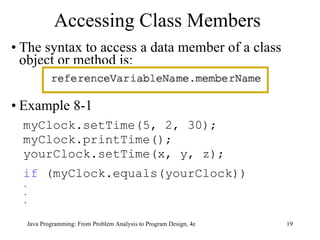
Accessing Class Members The syntax to access a data member of a class object or method is: Example 8-1 myClock.setTime(5, 2, 30); myClock.printTime(); yourClock.setTime(x, y, z);  if  (myClock.equals(yourClock)) . . .
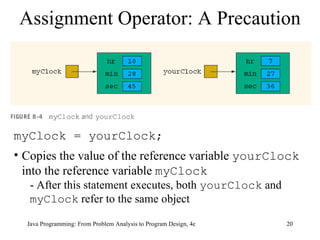
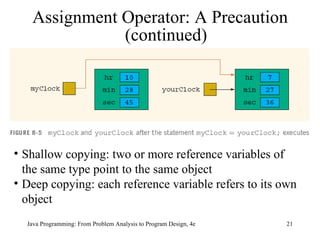
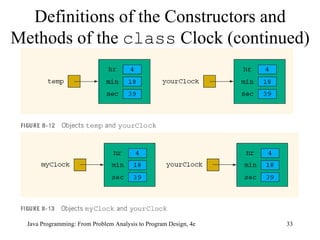
Assignment Operator: A Precaution myClock = yourClock; Copies the value of the reference variable  yourClock  into the reference variable  myClock - After this statement executes, both  yourClock  and  myClock  refer to the same object
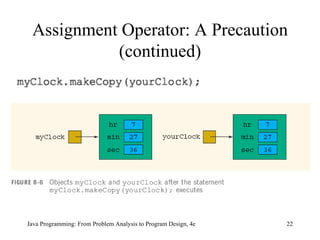
Assignment Operator: A Precaution (continued) Shallow copying: two or more reference variables of the same type point to the same object Deep copying: each reference variable refers to its own object
Assignment Operator: A Precaution (continued)
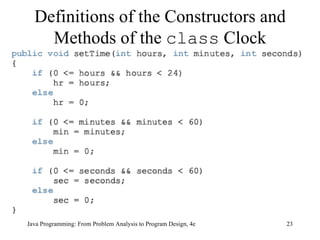
Definitions of the Constructors and Methods of the  class  Clock
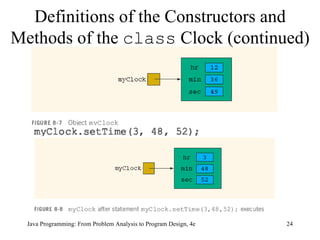
Definitions of the Constructors and Methods of the  class  Clock (continued)
Default Constructor or
Constructor with Parameters or
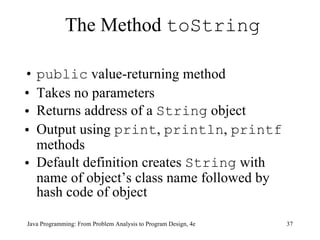
public  value-returning method Takes no parameters Returns address of a  String  object Output using  print ,  println ,  printf  methods Default definition creates  String  with name of object’s class name followed by hash code of object The Method  toString
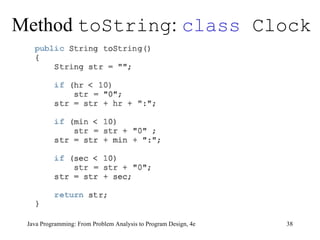
Method  toString :  class  Clock
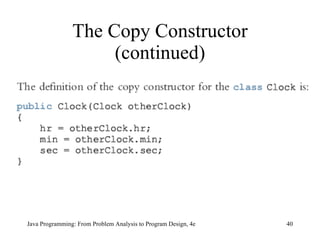
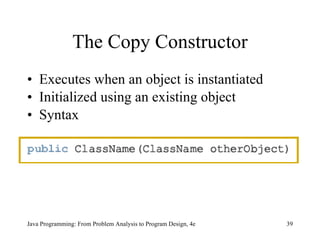
The Copy Constructor Executes when an object is instantiated Initialized using an existing object   Syntax
The Copy Constructor (continued)
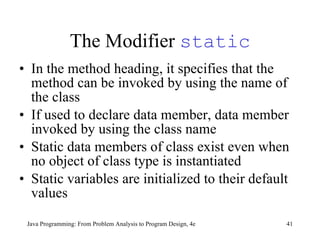
The Modifier  static In the method heading, it specifies that the method can be invoked by using the name of the class If used to declare data member, data member invoked by using the class name  Static data members of class exist even when no object of class type is instantiated Static variables are initialized to their default values
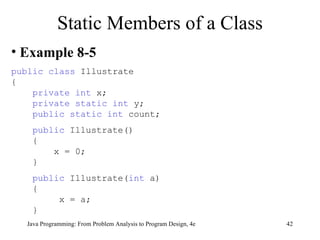
Static Members of a Class Example 8-5 public class  Illustrate { private int  x;  private static int  y; public static int  count; public  Illustrate() { x = 0; } public  Illustrate( int  a) { x = a; }
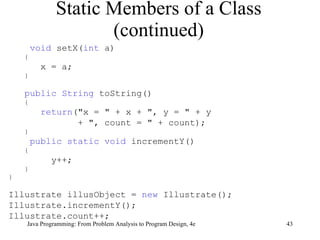
Static Members of a Class (continued) void  setX( int  a) { x = a; } public String  toString() { return ("x = " + x + ", y = " + y + ", count = " + count); } public static void  incrementY() { y++; } } Illustrate illusObject =  new  Illustrate(); Illustrate.incrementY(); Illustrate.count++;
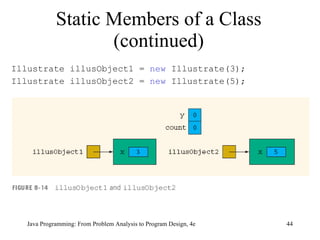
Static Members of a Class (continued) Illustrate illusObject1 =  new  Illustrate(3);  Illustrate illusObject2 =  new  Illustrate(5);
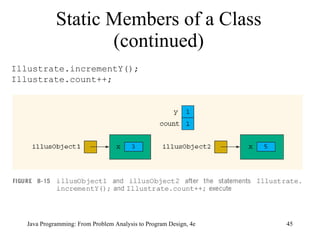
Static Members of a Class (continued) Illustrate.incrementY(); Illustrate.count++;
Finalizers Automatically execute when class object goes out of scope Have no parameters Only one finalizer per class Name of finalizer: finalize
Accessor and Mutator Methods Accessor Method : a method of a class that only accesses (that is, does not modify) the value(s) of the data member(s) Mutator Method : a method of a class that modifies the value of one or more data member(s)
The Reference  this Refers to instance variables and methods of a class Used to implement cascaded method calls
Inner Classes Defined within other classes Can be either a complete class definition or anonymous inner class definition Used to handle events
Abstract Data Types Definition - A data type that specifies the logical properties without the implementation details
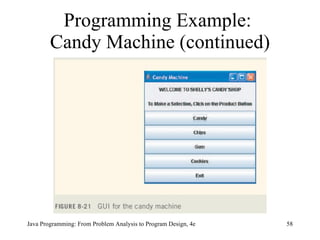
Programming Example: Candy Machine (Problem Statement) A new candy machine is bought for the gym, but it  is not working properly -The machine sells candies, chips, gum, and cookies   Write a two-part program to create a Java application program for this candy machine so that it can be put into operation - In the first part, design a non-GUI application program - In the second part, design an application program that will create a GUI as described in the second part
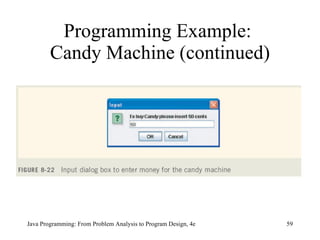
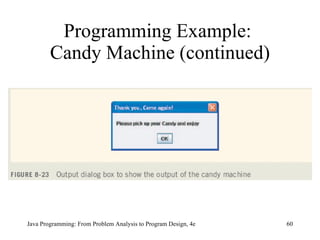
Programming Example: Candy Machine (Problem Statement) (continued) The non-GUI application program should do the following: 1. Show the customer the different products sold by the candy machine 2. Let the customer make the selection 3. Show the customer the cost of the item selected 4. Accept money from the customer 5. Release the item
Programming Example: Candy Machine (Input and Output) Input: the item selection and the cost of the    item  Output: the selected item
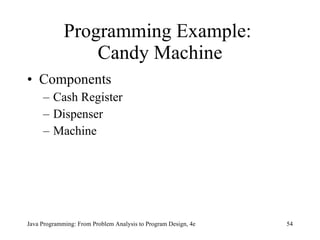
Programming Example:  Candy Machine Components Cash Register Dispenser Machine
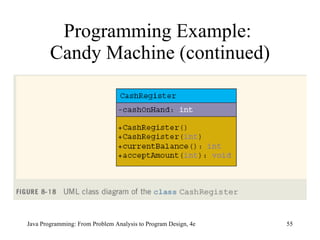
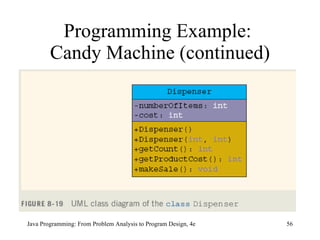
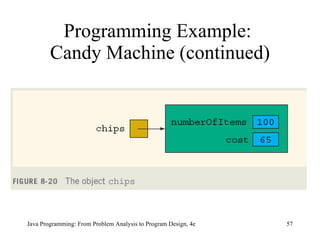
Programming Example:  Candy Machine (continued)
Chapter Summary Creating classes Members of a class private protected public static Implementing classes Various operations on classes
Chapter Summary (continued) Constructors Finalizers Method  toString Abstract Data Types

9781439035665 ppt ch08

  • 1.
    Java Programming: FromProblem Analysis to Program Design, 4e Chapter 8 User-Defined Classes and ADTs
  • 2.
    Chapter Objectives Learnabout classes Learn about private , protected , public , and static members of a class Explore how classes are implemented Learn about the various operations on classes
  • 3.
    Chapter Objectives (continued)Examine constructors and finalizers Examine the method toString Learn about the abstract data type (ADT)
  • 4.
    Classes final class String { //variables to store a string ... public int compareTo(String anotherString) { //code to compare two strings } public String concat(String str) { //code to join two strings } public String toLowerCase() { //code to convert all the characters of a //string to lowercase } ... }
  • 5.
    Classes (continued) class: reserved word; collection of a fixed number of components Components: members of a class Members accessed by name Class categories/modifiers private protected public
  • 6.
    Classes (continued) private: members of class are not accessible outside class public : members of class are accessible outside class Class members: can be methods or variables Variable members declared like any other variables
  • 7.
    Syntax The generalsyntax for defining a class is:
  • 8.
    Syntax (continued) Ifa member of a class is a named constant, you declare it just like any other named constant If a member of a class is a variable, you declare it just like any other variable If a member of a class is a method, you define it just like any other method
  • 9.
    Syntax (continued) Ifa member of a class is a method, it can (directly) access any member of the class—data members and methods - Therefore, when you write the definition of a method (of the class), you can directly access any data member of the class (without passing it as a parameter)
  • 10.
    class Clock: Data Members (Instance Variables) private int hr; //store hours private int min; //store minutes private int sec; //store seconds
  • 11.
    class Clock: (continued) Methods public void setTime( int hours, int minutes, int seconds) public int getHours() public int getMinutes() public int getSeconds() public void printTime() public void incrementSeconds() public void incrementMinutes() public void incrementHours() public boolean equals(Clock otherClock) public void makeCopy(Clock otherClock) public Clock getCopy()
  • 12.
    Constructors Two typesof constructors - With parameters - Without parameters ( default constructor)
  • 13.
    Constructors (continued) Constructorshave the following properties: - The name of a constructor is the same as the name of the class - A constructor, even though it is a method, has no type - A class can have more than one constructor; all constructors of a class have the same name - If a class has more than one constructor, any two constructors must have different signatures - Constructors are automatically executed when a class object is instantiated - If there are multiple constructors, which constructor executes depends on the type of values passed to the class object when the class object is instantiated
  • 14.
    class Clock: Constructors Default constructor is: - public Clock() Constructor with parameters is: - public Clock( int hours , int minutes , int seconds)
  • 15.
  • 16.
    Variable Declaration andObject Instantiation The general syntax for using the operator new is: or: Clock myClock; Clock yourClock; myClock = new Clock(); yourClock = new Clock(9, 35, 15);
  • 17.
    Variable Declaration andObject Instantiation (continued)
  • 18.
    Variable Declaration andObject Instantiation (continued)
  • 19.
    Accessing Class MembersThe syntax to access a data member of a class object or method is: Example 8-1 myClock.setTime(5, 2, 30); myClock.printTime(); yourClock.setTime(x, y, z); if (myClock.equals(yourClock)) . . .
  • 20.
    Assignment Operator: APrecaution myClock = yourClock; Copies the value of the reference variable yourClock into the reference variable myClock - After this statement executes, both yourClock and myClock refer to the same object
  • 21.
    Assignment Operator: APrecaution (continued) Shallow copying: two or more reference variables of the same type point to the same object Deep copying: each reference variable refers to its own object
  • 22.
    Assignment Operator: APrecaution (continued)
  • 23.
    Definitions of theConstructors and Methods of the class Clock
  • 24.
    Definitions of theConstructors and Methods of the class Clock (continued)
  • 25.
    Definitions of theConstructors and Methods of the class Clock (continued)
  • 26.
    Definitions of theConstructors and Methods of the class Clock (continued)
  • 27.
    Definitions of theConstructors and Methods of the class Clock (continued)
  • 28.
    Definitions of theConstructors and Methods of the class Clock (continued)
  • 29.
    Definitions of theConstructors and Methods of the class Clock (continued)
  • 30.
    Definitions of theConstructors and Methods of the class Clock (continued)
  • 31.
    Definitions of theConstructors and Methods of the class Clock (continued)
  • 32.
    Definitions of theConstructors and Methods of the class Clock (continued)
  • 33.
    Definitions of theConstructors and Methods of the class Clock (continued)
  • 34.
    Definitions of theConstructors and Methods of the class Clock (continued)
  • 35.
  • 36.
  • 37.
    public value-returningmethod Takes no parameters Returns address of a String object Output using print , println , printf methods Default definition creates String with name of object’s class name followed by hash code of object The Method toString
  • 38.
    Method toString: class Clock
  • 39.
    The Copy ConstructorExecutes when an object is instantiated Initialized using an existing object Syntax
  • 40.
  • 41.
    The Modifier static In the method heading, it specifies that the method can be invoked by using the name of the class If used to declare data member, data member invoked by using the class name Static data members of class exist even when no object of class type is instantiated Static variables are initialized to their default values
  • 42.
    Static Members ofa Class Example 8-5 public class Illustrate { private int x; private static int y; public static int count; public Illustrate() { x = 0; } public Illustrate( int a) { x = a; }
  • 43.
    Static Members ofa Class (continued) void setX( int a) { x = a; } public String toString() { return ("x = " + x + ", y = " + y + ", count = " + count); } public static void incrementY() { y++; } } Illustrate illusObject = new Illustrate(); Illustrate.incrementY(); Illustrate.count++;
  • 44.
    Static Members ofa Class (continued) Illustrate illusObject1 = new Illustrate(3); Illustrate illusObject2 = new Illustrate(5);
  • 45.
    Static Members ofa Class (continued) Illustrate.incrementY(); Illustrate.count++;
  • 46.
    Finalizers Automatically executewhen class object goes out of scope Have no parameters Only one finalizer per class Name of finalizer: finalize
  • 47.
    Accessor and MutatorMethods Accessor Method : a method of a class that only accesses (that is, does not modify) the value(s) of the data member(s) Mutator Method : a method of a class that modifies the value of one or more data member(s)
  • 48.
    The Reference this Refers to instance variables and methods of a class Used to implement cascaded method calls
  • 49.
    Inner Classes Definedwithin other classes Can be either a complete class definition or anonymous inner class definition Used to handle events
  • 50.
    Abstract Data TypesDefinition - A data type that specifies the logical properties without the implementation details
  • 51.
    Programming Example: CandyMachine (Problem Statement) A new candy machine is bought for the gym, but it is not working properly -The machine sells candies, chips, gum, and cookies Write a two-part program to create a Java application program for this candy machine so that it can be put into operation - In the first part, design a non-GUI application program - In the second part, design an application program that will create a GUI as described in the second part
  • 52.
    Programming Example: CandyMachine (Problem Statement) (continued) The non-GUI application program should do the following: 1. Show the customer the different products sold by the candy machine 2. Let the customer make the selection 3. Show the customer the cost of the item selected 4. Accept money from the customer 5. Release the item
  • 53.
    Programming Example: CandyMachine (Input and Output) Input: the item selection and the cost of the item Output: the selected item
  • 54.
    Programming Example: Candy Machine Components Cash Register Dispenser Machine
  • 55.
    Programming Example: Candy Machine (continued)
  • 56.
    Programming Example: Candy Machine (continued)
  • 57.
    Programming Example: Candy Machine (continued)
  • 58.
    Programming Example: Candy Machine (continued)
  • 59.
    Programming Example: Candy Machine (continued)
  • 60.
    Programming Example: Candy Machine (continued)
  • 61.
    Chapter Summary Creatingclasses Members of a class private protected public static Implementing classes Various operations on classes
  • 62.
    Chapter Summary (continued)Constructors Finalizers Method toString Abstract Data Types