This document consists of 3 printed pages.
© UCLES 2021 [Turn over
Cambridge International AS & A Level
PHYSICS 9702/11
Paper 1 Multiple Choice October/November 2021
MARK SCHEME
Maximum Mark: 40
Published
This mark scheme is published as an aid to teachers and candidates, to indicate the requirements of the
examination.
Mark schemes should be read in conjunction with the question paper and the Principal Examiner Report for
Teachers.
Cambridge International will not enter into discussions about these mark schemes.
Cambridge International is publishing the mark schemes for the October/November 2021 series for most
Cambridge IGCSE™, Cambridge International A and AS Level components and some Cambridge O Level
components.
9702/11 Cambridge International AS & A Level – Mark Scheme
PUBLISHED
October/November
2021
© UCLES 2021 Page 2 of 3
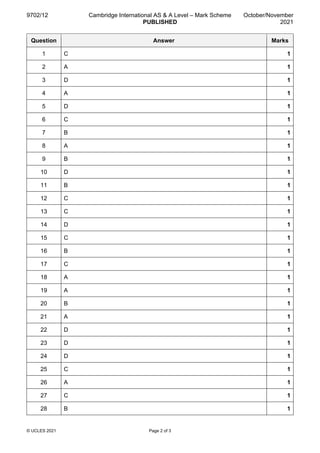
Question Answer Marks
1 B 1
2 B 1
3 A 1
4 A 1
5 B 1
6 B 1
7 D 1
8 C 1
9 B 1
10 D 1
11 C 1
12 A 1
13 D 1
14 D 1
15 D 1
16 C 1
17 B 1
18 A 1
19 C 1
20 A 1
21 D 1
22 B 1
23 D 1
24 A 1
25 D 1
26 A 1
27 D 1
28 C 1
9702/11 Cambridge International AS & A Level – Mark Scheme
PUBLISHED
October/November
2021
© UCLES 2021 Page 3 of 3
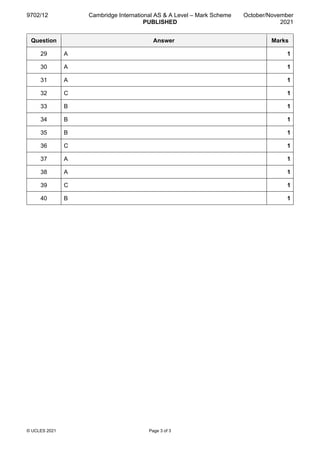
Question Answer Marks
29 C 1
30 B 1
31 A 1
32 C 1
33 D 1
34 A 1
35 D 1
36 C 1
37 A 1
38 A 1
39 C 1
40 B 1
This document consists of 3 printed pages.
© UCLES 2021 [Turn over
Cambridge International AS & A Level
PHYSICS 9702/12
Paper 1 Multiple Choice October/November 2021
MARK SCHEME
Maximum Mark: 40
Published
This mark scheme is published as an aid to teachers and candidates, to indicate the requirements of the
examination.
Mark schemes should be read in conjunction with the question paper and the Principal Examiner Report for
Teachers.
Cambridge International will not enter into discussions about these mark schemes.
Cambridge International is publishing the mark schemes for the October/November 2021 series for most
Cambridge IGCSE™, Cambridge International A and AS Level components and some Cambridge O Level
components.
9702/12 Cambridge International AS & A Level – Mark Scheme
PUBLISHED
October/November
2021
© UCLES 2021 Page 2 of 3
Question Answer Marks
1 C 1
2 A 1
3 D 1
4 A 1
5 D 1
6 C 1
7 B 1
8 A 1
9 B 1
10 D 1
11 B 1
12 C 1
13 C 1
14 D 1
15 C 1
16 B 1
17 C 1
18 A 1
19 A 1
20 B 1
21 A 1
22 D 1
23 D 1
24 D 1
25 C 1
26 A 1
27 C 1
28 B 1
9702/12 Cambridge International AS & A Level – Mark Scheme
PUBLISHED
October/November
2021
© UCLES 2021 Page 3 of 3
Question Answer Marks
29 A 1
30 A 1
31 A 1
32 C 1
33 B 1
34 B 1
35 B 1
36 C 1
37 A 1
38 A 1
39 C 1
40 B 1
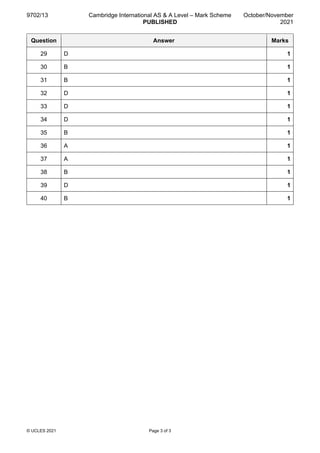
This document consists of 3 printed pages.
© UCLES 2021 [Turn over
Cambridge International AS & A Level
PHYSICS 9702/13
Paper 1 Multiple Choice October/November 2021
MARK SCHEME
Maximum Mark: 40
Published
This mark scheme is published as an aid to teachers and candidates, to indicate the requirements of the
examination.
Mark schemes should be read in conjunction with the question paper and the Principal Examiner Report for
Teachers.
Cambridge International will not enter into discussions about these mark schemes.
Cambridge International is publishing the mark schemes for the October/November 2021 series for most
Cambridge IGCSE™, Cambridge International A and AS Level components and some Cambridge O Level
components.
9702/13 Cambridge International AS & A Level – Mark Scheme
PUBLISHED
October/November
2021
© UCLES 2021 Page 2 of 3
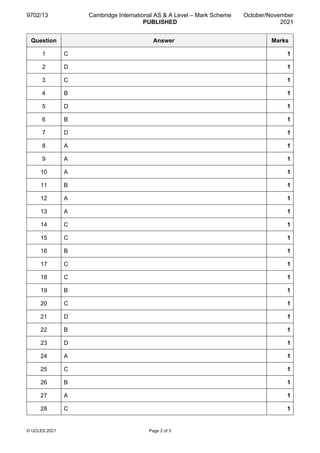
Question Answer Marks
1 C 1
2 D 1
3 C 1
4 B 1
5 D 1
6 B 1
7 D 1
8 A 1
9 A 1
10 A 1
11 B 1
12 A 1
13 A 1
14 C 1
15 C 1
16 B 1
17 C 1
18 C 1
19 B 1
20 C 1
21 D 1
22 B 1
23 D 1
24 A 1
25 C 1
26 B 1
27 A 1
28 C 1
9702/13 Cambridge International AS & A Level – Mark Scheme
PUBLISHED
October/November
2021
© UCLES 2021 Page 3 of 3
Question Answer Marks
29 D 1
30 B 1
31 B 1
32 D 1
33 D 1
34 D 1
35 B 1
36 A 1
37 A 1
38 B 1
39 D 1
40 B 1
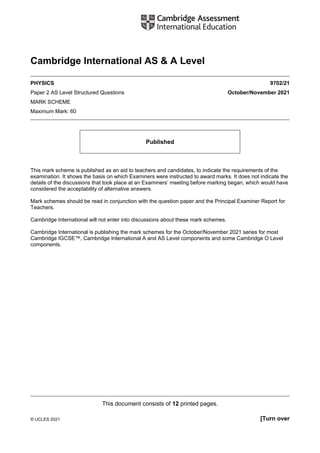
This document consists of 12 printed pages.
© UCLES 2021 [Turn over
Cambridge International AS & A Level
PHYSICS 9702/21
Paper 2 AS Level Structured Questions October/November 2021
MARK SCHEME
Maximum Mark: 60
Published
This mark scheme is published as an aid to teachers and candidates, to indicate the requirements of the
examination. It shows the basis on which Examiners were instructed to award marks. It does not indicate the
details of the discussions that took place at an Examiners’ meeting before marking began, which would have
considered the acceptability of alternative answers.
Mark schemes should be read in conjunction with the question paper and the Principal Examiner Report for
Teachers.
Cambridge International will not enter into discussions about these mark schemes.
Cambridge International is publishing the mark schemes for the October/November 2021 series for most
Cambridge IGCSE™, Cambridge International A and AS Level components and some Cambridge O Level
components.
9702/21 Cambridge International AS & A Level – Mark Scheme
PUBLISHED
October/November 2021
© UCLES 2021 Page 2 of 12
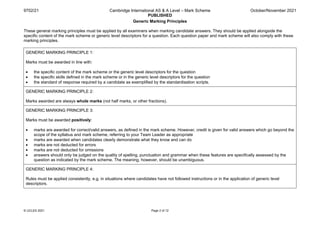
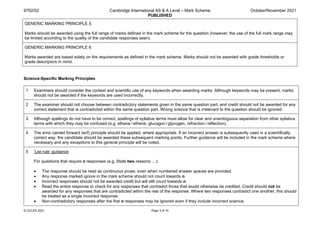
Generic Marking Principles
These general marking principles must be applied by all examiners when marking candidate answers. They should be applied alongside the
specific content of the mark scheme or generic level descriptors for a question. Each question paper and mark scheme will also comply with these
marking principles.
GENERIC MARKING PRINCIPLE 1:
Marks must be awarded in line with:
• the specific content of the mark scheme or the generic level descriptors for the question
• the specific skills defined in the mark scheme or in the generic level descriptors for the question
• the standard of response required by a candidate as exemplified by the standardisation scripts.
GENERIC MARKING PRINCIPLE 2:
Marks awarded are always whole marks (not half marks, or other fractions).
GENERIC MARKING PRINCIPLE 3:
Marks must be awarded positively:
• marks are awarded for correct/valid answers, as defined in the mark scheme. However, credit is given for valid answers which go beyond the
scope of the syllabus and mark scheme, referring to your Team Leader as appropriate
• marks are awarded when candidates clearly demonstrate what they know and can do
• marks are not deducted for errors
• marks are not deducted for omissions
• answers should only be judged on the quality of spelling, punctuation and grammar when these features are specifically assessed by the
question as indicated by the mark scheme. The meaning, however, should be unambiguous.
GENERIC MARKING PRINCIPLE 4:
Rules must be applied consistently, e.g. in situations where candidates have not followed instructions or in the application of generic level
descriptors.
9702/21 Cambridge International AS & A Level – Mark Scheme
PUBLISHED
October/November 2021
© UCLES 2021 Page 3 of 12
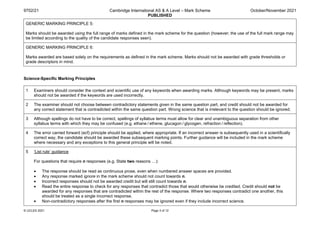
GENERIC MARKING PRINCIPLE 5:
Marks should be awarded using the full range of marks defined in the mark scheme for the question (however; the use of the full mark range may
be limited according to the quality of the candidate responses seen).
GENERIC MARKING PRINCIPLE 6:
Marks awarded are based solely on the requirements as defined in the mark scheme. Marks should not be awarded with grade thresholds or
grade descriptors in mind.
Science-Specific Marking Principles
1 Examiners should consider the context and scientific use of any keywords when awarding marks. Although keywords may be present, marks
should not be awarded if the keywords are used incorrectly.
2 The examiner should not choose between contradictory statements given in the same question part, and credit should not be awarded for
any correct statement that is contradicted within the same question part. Wrong science that is irrelevant to the question should be ignored.
3 Although spellings do not have to be correct, spellings of syllabus terms must allow for clear and unambiguous separation from other
syllabus terms with which they may be confused (e.g. ethane / ethene, glucagon / glycogen, refraction / reflection).
4 The error carried forward (ecf) principle should be applied, where appropriate. If an incorrect answer is subsequently used in a scientifically
correct way, the candidate should be awarded these subsequent marking points. Further guidance will be included in the mark scheme
where necessary and any exceptions to this general principle will be noted.
5 ‘List rule’ guidance
For questions that require n responses (e.g. State two reasons …):
• The response should be read as continuous prose, even when numbered answer spaces are provided.
• Any response marked ignore in the mark scheme should not count towards n.
• Incorrect responses should not be awarded credit but will still count towards n.
• Read the entire response to check for any responses that contradict those that would otherwise be credited. Credit should not be
awarded for any responses that are contradicted within the rest of the response. Where two responses contradict one another, this
should be treated as a single incorrect response.
• Non-contradictory responses after the first n responses may be ignored even if they include incorrect science.
9702/21 Cambridge International AS & A Level – Mark Scheme
PUBLISHED
October/November 2021
© UCLES 2021 Page 4 of 12
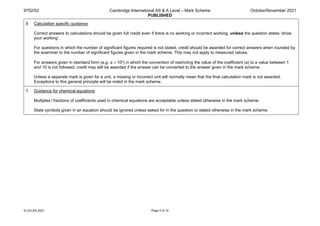
6 Calculation specific guidance
Correct answers to calculations should be given full credit even if there is no working or incorrect working, unless the question states ‘show
your working’.
For questions in which the number of significant figures required is not stated, credit should be awarded for correct answers when rounded
by the examiner to the number of significant figures given in the mark scheme. This may not apply to measured values.
For answers given in standard form (e.g. a × 10n) in which the convention of restricting the value of the coefficient (a) to a value between 1
and 10 is not followed, credit may still be awarded if the answer can be converted to the answer given in the mark scheme.
Unless a separate mark is given for a unit, a missing or incorrect unit will normally mean that the final calculation mark is not awarded.
Exceptions to this general principle will be noted in the mark scheme.
7 Guidance for chemical equations
Multiples / fractions of coefficients used in chemical equations are acceptable unless stated otherwise in the mark scheme.
State symbols given in an equation should be ignored unless asked for in the question or stated otherwise in the mark scheme.
9702/21 Cambridge International AS & A Level – Mark Scheme
PUBLISHED
October/November 2021
© UCLES 2021 Page 5 of 12
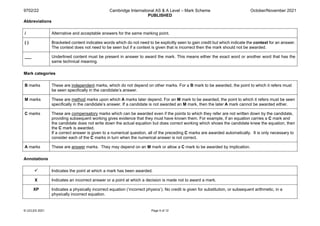
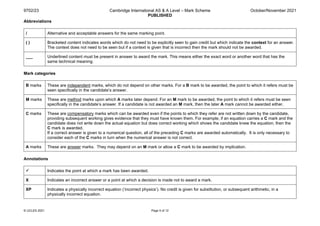
Abbreviations
/ Alternative and acceptable answers for the same marking point.
( ) Bracketed content indicates words which do not need to be explicitly seen to gain credit but which indicate the context for an answer.
The context does not need to be seen but if a context is given that is incorrect then the mark should not be awarded.
___ Underlined content must be present in answer to award the mark. This means either the exact word or another word that has the
same technical meaning.
Mark categories
B marks These are independent marks, which do not depend on other marks. For a B mark to be awarded, the point to which it refers must be
seen specifically in the candidate’s answer.
M marks These are method marks upon which A marks later depend. For an M mark to be awarded, the point to which it refers must be seen
specifically in the candidate’s answer. If a candidate is not awarded an M mark, then the later A mark cannot be awarded either.
C marks These are compensatory marks which can be awarded even if the points to which they refer are not written down by the candidate,
providing subsequent working gives evidence that they must have known them. For example, if an equation carries a C mark and the
candidate does not write down the actual equation but does correct working which shows the candidate knew the equation, then the
C mark is awarded.
If a correct answer is given to a numerical question, all of the preceding C marks are awarded automatically. It is only necessary to
consider each of the C marks in turn when the numerical answer is not correct.
A marks These are answer marks. They may depend on an M mark or allow a C mark to be awarded by implication.
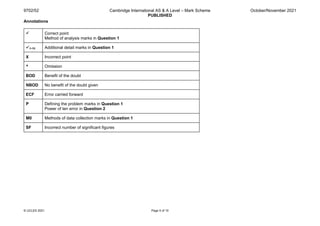
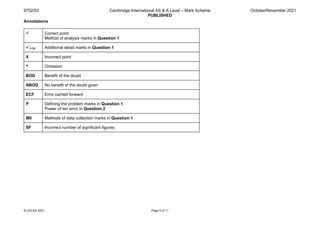
Annotations
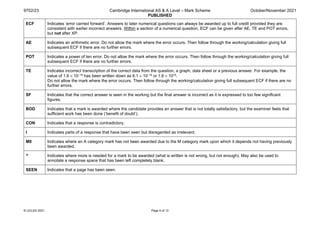
 Indicates the point at which a mark has been awarded.
X Indicates an incorrect answer or a point at which a decision is made not to award a mark.
XP Indicates a physically incorrect equation (‘incorrect physics’). No credit is given for substitution, or subsequent arithmetic, in a
physically incorrect equation.
9702/21 Cambridge International AS & A Level – Mark Scheme
PUBLISHED
October/November 2021
© UCLES 2021 Page 6 of 12
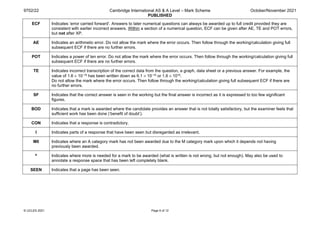
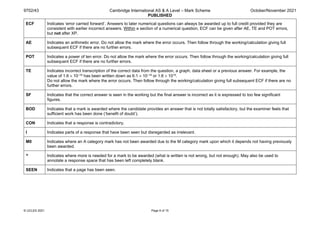
ECF Indicates ‘error carried forward’. Answers to later numerical questions can always be awarded up to full credit provided they are
consistent with earlier incorrect answers. Within a section of a numerical question, ECF can be given after AE, TE and POT errors,
but not after XP.
AE Indicates an arithmetic error. Do not allow the mark where the error occurs. Then follow through the working/calculation giving full
subsequent ECF if there are no further errors.
POT Indicates a power of ten error. Do not allow the mark where the error occurs. Then follow through the working/calculation giving full
subsequent ECF if there are no further errors.
TE Indicates incorrect transcription of the correct data from the question, a graph, data sheet or a previous answer. For example, the
value of 1.6 × 10⁻¹⁹ has been written down as 6.1 × 10⁻¹⁹ or 1.6 × 10¹⁹.
Do not allow the mark where the error occurs. Then follow through the working/calculation giving full subsequent ECF if there are no
further errors.
SF Indicates that the correct answer is seen in the working but the final answer is incorrect as it is expressed to too few significant
figures.
BOD Indicates that a mark is awarded where the candidate provides an answer that is not totally satisfactory, but the examiner feels that
sufficient work has been done (‘benefit of doubt’).
CON Indicates that a response is contradictory.
I Indicates parts of a response that have been seen but disregarded as irrelevant.
M0 Indicates where an A category mark has not been awarded due to the M category mark upon which it depends not having previously
been awarded.
^ Indicates where more is needed for a mark to be awarded (what is written is not wrong, but not enough). May also be used to
annotate a response space that has been left completely blank.
SEEN Indicates that a page has been seen.
9702/21 Cambridge International AS & A Level – Mark Scheme
PUBLISHED
October/November 2021
© UCLES 2021 Page 7 of 12
Question Answer Marks
1(a) mass / volume B1
1(b)(i) (vernier/digital) calipers B1
1(b)(ii) percentage uncertainty = (0.0004 / 0.0420) × 100
= 1%
A1
1(c)(i) kg m–3 = kg × mn / m or kg m–3 = kg × mn × m–1 M1
–3 = n – 1 and (so) n = –2 A1
1(c)(ii) (Δρ /ρ) = (ΔM / M) + 2(Δr / r) + (ΔL / L) C1
percentage uncertainty = [(0.001 / 1.072) + 2 × (0.0004 / 0.0420) + (0.0001 / 0.1242)] (× 100) C1
= 0.09% + 2 × 0.95% + 0.08%
= 2%
A1
1(c)(iii) ρ = (1.072 × 0.0420–2) / (2.094 × 0.1242)
= 2337 (kg m–3)
C1
∆ρ = 0.021 × 2337
= 49 (kg m–3)
C1
ρ = (2340 ± 50) kg m–3 A1
9702/21 Cambridge International AS & A Level – Mark Scheme
PUBLISHED
October/November 2021
© UCLES 2021 Page 8 of 12
Question Answer Marks
2(a) mass × velocity B1
2(b)(i) kinetic energy = ½mv2 C1
= ½ × 0.24 × 2.32 C1
= 0.63 J A1
2(b)(ii) change in momentum = ½ × 240 × 5.0 × 10–3 C1
= 0.60 N s A1
2(b)(iii) (change in velocity of Y) = 0.60 / 0.12
( = 5.0 m s–1)
C1
final velocity of Y = 5.0 – 2.3
= 2.7 m s–1
A1
or
(final momentum of Y) = 0.60 – 0.12 × 2.3
( = 0.324 Ns)
(C1)
final velocity of Y = 0.324 / 0.12
= 2.7 m s–1
(A1)
2(c) sloping straight line from (0, 0) to t = 3.0ms and another straight line continuous with the first from t = 3.0ms to (5.0, 0) B1
lines showing maximum force of magnitude 240 N B1
lines wholly in the negative F region of the graph B1
9702/21 Cambridge International AS & A Level – Mark Scheme
PUBLISHED
October/November 2021
© UCLES 2021 Page 9 of 12
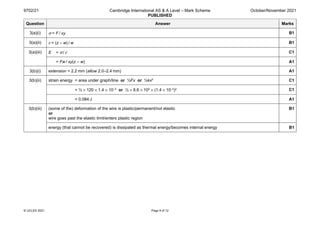
Question Answer Marks
3(a)(i) σ = F / xy B1
3(a)(ii) ε = (z – w) / w B1
3(a)(iii) E = σ / ε C1
= Fw / xy(z – w) A1
3(b)(i) extension = 2.2 mm (allow 2.0–2.4 mm) A1
3(b)(ii) strain energy = area under graph/line or ½Fx or ½kx2 C1
= ½ × 120 × 1.4 × 10–3 or ½ × 8.6 × 104 × (1.4 × 10–3)2 C1
= 0.084 J A1
3(b)(iii) (some of the) deformation of the wire is plastic/permanent/not elastic
or
wire goes past the elastic limit/enters plastic region
B1
energy (that cannot be recovered) is dissipated as thermal energy/becomes internal energy B1
9702/21 Cambridge International AS & A Level – Mark Scheme
PUBLISHED
October/November 2021
© UCLES 2021 Page 10 of 12
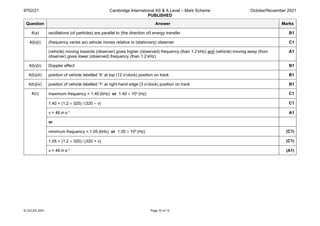
Question Answer Marks
4(a) oscillations (of particles) are parallel to (the direction of) energy transfer B1
4(b)(i) (frequency varies as) vehicle moves relative to (stationary) observer C1
(vehicle) moving towards (observer) gives higher (observed) frequency (than 1.2 kHz) and (vehicle) moving away (from
observer) gives lower (observed) frequency (than 1.2 kHz)
A1
4(b)(ii) Doppler effect B1
4(b)(iii) position of vehicle labelled ‘X’ at top (12 o’clock) position on track B1
4(b)(iv) position of vehicle labelled ‘Y’ at right-hand edge (3 o’clock) position on track B1
4(c) maximum frequency = 1.40 (kHz) or 1.40 × 10³ (Hz) C1
1.40 = (1.2 × 320) / (320 – v) C1
v = 46 m s–1 A1
or
minimum frequency = 1.05 (kHz) or 1.05 × 10³ (Hz) (C1)
1.05 = (1.2 × 320) / (320 + v) (C1)
v = 46 m s–1 (A1)
9702/21 Cambridge International AS & A Level – Mark Scheme
PUBLISHED
October/November 2021
© UCLES 2021 Page 11 of 12
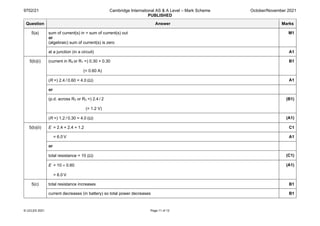
Question Answer Marks
5(a) sum of current(s) in = sum of current(s) out
or
(algebraic) sum of current(s) is zero
M1
at a junction (in a circuit) A1
5(b)(i) (current in R4 or R1 =) 0.30 + 0.30
(= 0.60 A)
B1
(R =) 2.4 / 0.60 = 4.0 (Ω) A1
or
(p.d. across R3 or R2 =) 2.4 / 2
(= 1.2 V)
(B1)
(R =) 1.2 / 0.30 = 4.0 (Ω) (A1)
5(b)(ii) E = 2.4 + 2.4 + 1.2 C1
= 6.0 V A1
or
total resistance = 10 (Ω) (C1)
E = 10 × 0.60
= 6.0 V
(A1)
5(c) total resistance increases B1
current decreases (in battery) so total power decreases B1
9702/21 Cambridge International AS & A Level – Mark Scheme
PUBLISHED
October/November 2021
© UCLES 2021 Page 12 of 12
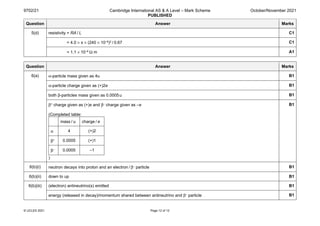
Question Answer Marks
5(d) resistivity = RA / L C1
= 4.0 × π × (240 × 10–6)2 / 0.67 C1
= 1.1 × 10⁻⁶ Ω m A1
Question Answer Marks
6(a) α-particle mass given as 4u B1
α-particle charge given as (+)2e B1
both β-particles mass given as 0.0005u B1
β+ charge given as (+)e and β– charge given as –e
(Completed table:
mass / u charge / e
α 4 (+)2
β+ 0.0005 (+)1
β– 0.0005 –1
)
B1
6(b)(i) neutron decays into proton and an electron / β– particle B1
6(b)(ii) down to up B1
6(b)(iii) (electron) antineutrino(s) emitted B1
energy (released in decay)/momentum shared between antineutrino and β– particle B1
This document consists of 12 printed pages.
© UCLES 2021 [Turn over
Cambridge International AS & A Level
PHYSICS 9702/22
Paper 2 AS Level Structured Questions October/November 2021
MARK SCHEME
Maximum Mark: 60
Published
This mark scheme is published as an aid to teachers and candidates, to indicate the requirements of the
examination. It shows the basis on which Examiners were instructed to award marks. It does not indicate the
details of the discussions that took place at an Examiners’ meeting before marking began, which would have
considered the acceptability of alternative answers.
Mark schemes should be read in conjunction with the question paper and the Principal Examiner Report for
Teachers.
Cambridge International will not enter into discussions about these mark schemes.
Cambridge International is publishing the mark schemes for the October/November 2021 series for most
Cambridge IGCSE™, Cambridge International A and AS Level components and some Cambridge O Level
components.
9702/22 Cambridge International AS & A Level – Mark Scheme
PUBLISHED
October/November 2021
© UCLES 2021 Page 2 of 12
Generic Marking Principles
These general marking principles must be applied by all examiners when marking candidate answers. They should be applied alongside the
specific content of the mark scheme or generic level descriptors for a question. Each question paper and mark scheme will also comply with these
marking principles.
GENERIC MARKING PRINCIPLE 1:
Marks must be awarded in line with:
• the specific content of the mark scheme or the generic level descriptors for the question
• the specific skills defined in the mark scheme or in the generic level descriptors for the question
• the standard of response required by a candidate as exemplified by the standardisation scripts.
GENERIC MARKING PRINCIPLE 2:
Marks awarded are always whole marks (not half marks, or other fractions).
GENERIC MARKING PRINCIPLE 3:
Marks must be awarded positively:
• marks are awarded for correct/valid answers, as defined in the mark scheme. However, credit is given for valid answers which go beyond the
scope of the syllabus and mark scheme, referring to your Team Leader as appropriate
• marks are awarded when candidates clearly demonstrate what they know and can do
• marks are not deducted for errors
• marks are not deducted for omissions
• answers should only be judged on the quality of spelling, punctuation and grammar when these features are specifically assessed by the
question as indicated by the mark scheme. The meaning, however, should be unambiguous.
GENERIC MARKING PRINCIPLE 4:
Rules must be applied consistently, e.g. in situations where candidates have not followed instructions or in the application of generic level
descriptors.
9702/22 Cambridge International AS & A Level – Mark Scheme
PUBLISHED
October/November 2021
© UCLES 2021 Page 3 of 12
GENERIC MARKING PRINCIPLE 5:
Marks should be awarded using the full range of marks defined in the mark scheme for the question (however; the use of the full mark range may
be limited according to the quality of the candidate responses seen).
GENERIC MARKING PRINCIPLE 6:
Marks awarded are based solely on the requirements as defined in the mark scheme. Marks should not be awarded with grade thresholds or
grade descriptors in mind.
Science-Specific Marking Principles
1 Examiners should consider the context and scientific use of any keywords when awarding marks. Although keywords may be present, marks
should not be awarded if the keywords are used incorrectly.
2 The examiner should not choose between contradictory statements given in the same question part, and credit should not be awarded for any
correct statement that is contradicted within the same question part. Wrong science that is irrelevant to the question should be ignored.
3 Although spellings do not have to be correct, spellings of syllabus terms must allow for clear and unambiguous separation from other syllabus
terms with which they may be confused (e.g. ethane / ethene, glucagon / glycogen, refraction / reflection).
4 The error carried forward (ecf) principle should be applied, where appropriate. If an incorrect answer is subsequently used in a scientifically
correct way, the candidate should be awarded these subsequent marking points. Further guidance will be included in the mark scheme where
necessary and any exceptions to this general principle will be noted.
5 ‘List rule’ guidance
For questions that require n responses (e.g. State two reasons …):
• The response should be read as continuous prose, even when numbered answer spaces are provided.
• Any response marked ignore in the mark scheme should not count towards n.
• Incorrect responses should not be awarded credit but will still count towards n.
• Read the entire response to check for any responses that contradict those that would otherwise be credited. Credit should not be
awarded for any responses that are contradicted within the rest of the response. Where two responses contradict one another, this should
be treated as a single incorrect response.
• Non-contradictory responses after the first n responses may be ignored even if they include incorrect science.
9702/22 Cambridge International AS & A Level – Mark Scheme
PUBLISHED
October/November 2021
© UCLES 2021 Page 4 of 12
6 Calculation specific guidance
Correct answers to calculations should be given full credit even if there is no working or incorrect working, unless the question states ‘show
your working’.
For questions in which the number of significant figures required is not stated, credit should be awarded for correct answers when rounded by
the examiner to the number of significant figures given in the mark scheme. This may not apply to measured values.
For answers given in standard form (e.g. a × 10n) in which the convention of restricting the value of the coefficient (a) to a value between 1
and 10 is not followed, credit may still be awarded if the answer can be converted to the answer given in the mark scheme.
Unless a separate mark is given for a unit, a missing or incorrect unit will normally mean that the final calculation mark is not awarded.
Exceptions to this general principle will be noted in the mark scheme.
7 Guidance for chemical equations
Multiples / fractions of coefficients used in chemical equations are acceptable unless stated otherwise in the mark scheme.
State symbols given in an equation should be ignored unless asked for in the question or stated otherwise in the mark scheme.
9702/22 Cambridge International AS & A Level – Mark Scheme
PUBLISHED
October/November 2021
© UCLES 2021 Page 5 of 12
Abbreviations
/ Alternative and acceptable answers for the same marking point.
( ) Bracketed content indicates words which do not need to be explicitly seen to gain credit but which indicate the context for an answer.
The context does not need to be seen but if a context is given that is incorrect then the mark should not be awarded.
___ Underlined content must be present in answer to award the mark. This means either the exact word or another word that has the
same technical meaning.
Mark categories
B marks These are independent marks, which do not depend on other marks. For a B mark to be awarded, the point to which it refers must
be seen specifically in the candidate’s answer.
M marks These are method marks upon which A marks later depend. For an M mark to be awarded, the point to which it refers must be seen
specifically in the candidate’s answer. If a candidate is not awarded an M mark, then the later A mark cannot be awarded either.
C marks These are compensatory marks which can be awarded even if the points to which they refer are not written down by the candidate,
providing subsequent working gives evidence that they must have known them. For example, if an equation carries a C mark and
the candidate does not write down the actual equation but does correct working which shows the candidate knew the equation, then
the C mark is awarded.
If a correct answer is given to a numerical question, all of the preceding C marks are awarded automatically. It is only necessary to
consider each of the C marks in turn when the numerical answer is not correct.
A marks These are answer marks. They may depend on an M mark or allow a C mark to be awarded by implication.
Annotations
 Indicates the point at which a mark has been awarded.
X Indicates an incorrect answer or a point at which a decision is made not to award a mark.
XP Indicates a physically incorrect equation (‘incorrect physics’). No credit is given for substitution, or subsequent arithmetic, in a
physically incorrect equation.
9702/22 Cambridge International AS & A Level – Mark Scheme
PUBLISHED
October/November 2021
© UCLES 2021 Page 6 of 12
ECF Indicates ‘error carried forward’. Answers to later numerical questions can always be awarded up to full credit provided they are
consistent with earlier incorrect answers. Within a section of a numerical question, ECF can be given after AE, TE and POT errors,
but not after XP.
AE Indicates an arithmetic error. Do not allow the mark where the error occurs. Then follow through the working/calculation giving full
subsequent ECF if there are no further errors.
POT Indicates a power of ten error. Do not allow the mark where the error occurs. Then follow through the working/calculation giving full
subsequent ECF if there are no further errors.
TE Indicates incorrect transcription of the correct data from the question, a graph, data sheet or a previous answer. For example, the
value of 1.6 × 10⁻¹⁹ has been written down as 6.1 × 10⁻¹⁹ or 1.6 × 10¹⁹.
Do not allow the mark where the error occurs. Then follow through the working/calculation giving full subsequent ECF if there are
no further errors.
SF Indicates that the correct answer is seen in the working but the final answer is incorrect as it is expressed to too few significant
figures.
BOD Indicates that a mark is awarded where the candidate provides an answer that is not totally satisfactory, but the examiner feels that
sufficient work has been done (‘benefit of doubt’).
CON Indicates that a response is contradictory.
I Indicates parts of a response that have been seen but disregarded as irrelevant.
M0 Indicates where an A category mark has not been awarded due to the M category mark upon which it depends not having
previously been awarded.
^ Indicates where more is needed for a mark to be awarded (what is written is not wrong, but not enough). May also be used to
annotate a response space that has been left completely blank.
SEEN Indicates that a page has been seen.
9702/22 Cambridge International AS & A Level – Mark Scheme
PUBLISHED
October/November 2021
© UCLES 2021 Page 7 of 12
Question Answer Marks
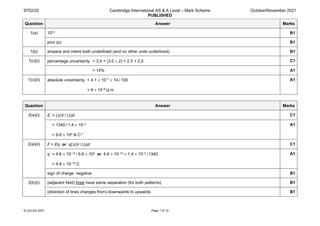
1(a) 1012 B1
pico (p) B1
1(b) ampere and metre both underlined (and no other units underlined) B1
1(c)(i) percentage uncertainty = 3.5 + (3.0 × 2) + 2.5 + 2.0 C1
= 14% A1
1(c)(ii) absolute uncertainty = 4.1 × 10–7 × 14 / 100
= 6 × 10⁻⁸ Ω m
A1
Question Answer Marks
2(a)(i) E = (Δ)V / (Δ)d C1
= 1340 / 1.4 × 10–2
= 9.6 × 10⁴ N C–1
A1
2(a)(ii) F = Eq or q(Δ)V / (Δ)d C1
q = 4.6 × 10⁻¹⁴ / 9.6 × 10⁴ or 4.6 × 10–14 × 1.4 × 10–2 / 1340
= 4.8 × 10⁻¹⁹ C
A1
sign of charge: negative B1
2(b)(i) (adjacent field) lines have same separation (for both patterns) B1
(direction of lines changes from) downwards to upwards B1
9702/22 Cambridge International AS & A Level – Mark Scheme
PUBLISHED
October/November 2021
© UCLES 2021 Page 8 of 12
Question Answer Marks
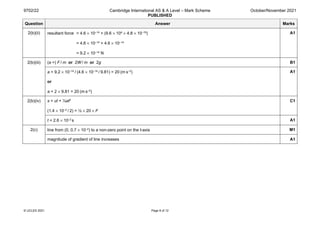
2(b)(ii) resultant force = 4.6 × 10⁻¹⁴ + (9.6 × 104 × 4.8 × 10–19)
= 4.6 × 10⁻¹⁴ + 4.6 × 10–14
= 9.2 × 10⁻¹⁴ N
A1
2(b)(iii) (a =) F / m or 2W / m or 2g B1
a = 9.2 × 10⁻¹⁴ / (4.6 × 10⁻¹⁴ / 9.81) = 20 (m s–2)
or
a = 2 × 9.81 = 20 (m s–2)
A1
2(b)(iv) s = ut + ½at2
(1.4 × 10⁻² / 2) = ½ × 20 × t2
C1
t = 2.6 × 10⁻² s A1
2(c) line from (0, 0.7 × 10⁻²) to a non-zero point on the t-axis M1
magnitude of gradient of line increases A1
9702/22 Cambridge International AS & A Level – Mark Scheme
PUBLISHED
October/November 2021
© UCLES 2021 Page 9 of 12
Question Answer Marks
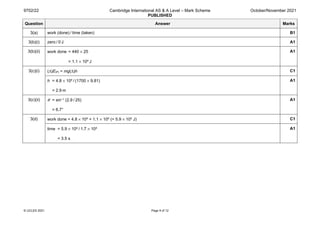
3(a) work (done) / time (taken) B1
3(b)(i) zero / 0 J A1
3(b)(ii) work done = 440 × 25
= 1.1 × 10⁴ J
A1
3(c)(i) (Δ)E(P) = mg(Δ)h C1
h = 4.8 × 10⁴ / (1700 × 9.81)
= 2.9 m
A1
3(c)(ii) θ = sin–1 (2.9 / 25)
= 6.7°
A1
3(d) work done = 4.8 × 10⁴ + 1.1 × 10⁴ (= 5.9 × 10⁴ J) C1
time = 5.9 × 10⁴ / 1.7 × 104
= 3.5 s
A1
9702/22 Cambridge International AS & A Level – Mark Scheme
PUBLISHED
October/November 2021
© UCLES 2021 Page 10 of 12
Question Answer Marks
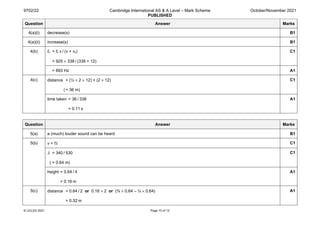
4(a)(i) decrease(s) B1
4(a)(ii) increase(s) B1
4(b) fo = fs v / (v + vs)
= 925 × 338 / (338 + 12)
C1
= 893 Hz A1
4(c) distance = (½ × 2 × 12) + (2 × 12)
(= 36 m)
C1
time taken = 36 / 338
= 0.11 s
A1
Question Answer Marks
5(a) a (much) louder sound can be heard B1
5(b) v = fλ C1
λ = 340 / 530
( = 0.64 m)
C1
height = 0.64 / 4
= 0.16 m
A1
5(c) distance = 0.64 / 2 or 0.16 × 2 or (¾ × 0.64 – ¼ × 0.64)
= 0.32 m
A1
9702/22 Cambridge International AS & A Level – Mark Scheme
PUBLISHED
October/November 2021
© UCLES 2021 Page 11 of 12
Question Answer Marks
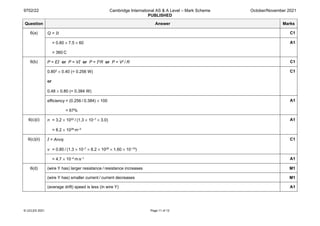
6(a) Q = It C1
= 0.80 × 7.5 × 60
= 360 C
A1
6(b) P = EI or P = VI or P = I2R or P = V2 / R C1
0.802 × 0.40 (= 0.256 W)
or
0.48 × 0.80 (= 0.384 W)
C1
efficiency = (0.256 / 0.384) × 100
= 67%
A1
6(c)(i) n = 3.2 × 10²² / (1.3 × 10–7 × 3.0)
= 8.2 × 1028 m–3
A1
6(c)(ii) I = Anvq
v = 0.80 / (1.3 × 10–7 × 8.2 × 1028 × 1.60 × 10–19)
C1
= 4.7 × 10⁻⁴ m s–1 A1
6(d) (wire Y has) larger resistance / resistance increases M1
(wire Y has) smaller current / current decreases M1
(average drift) speed is less (in wire Y) A1
9702/22 Cambridge International AS & A Level – Mark Scheme
PUBLISHED
October/November 2021
© UCLES 2021 Page 12 of 12
Question Answer Marks
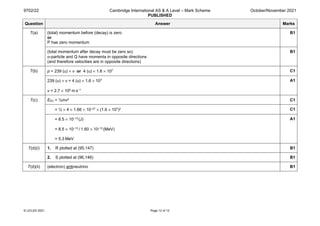
7(a) (total) momentum before (decay) is zero
or
P has zero momentum
B1
(total momentum after decay must be zero so)
α-particle and Q have momenta in opposite directions
(and therefore velocities are in opposite directions)
B1
7(b) p = 239 (u) × v or 4 (u) × 1.6 × 10⁷ C1
239 (u) × v = 4 (u) × 1.6 × 10⁷
v = 2.7 × 10⁵ m s–1
A1
7(c) E(K) = ½mv2 C1
= ½ × 4 × 1.66 × 10–27 × (1.6 × 107)2 C1
= 8.5 × 10⁻¹³ (J)
= 8.5 × 10⁻¹³ / 1.60 × 10⁻¹³ (MeV)
= 5.3 MeV
A1
7(d)(i) 1. R plotted at (95,147) B1
2. S plotted at (96,146) B1
7(d)(ii) (electron) antineutrino B1
This document consists of 12 printed pages.
© UCLES 2021 [Turn over
Cambridge International AS & A Level
PHYSICS 9702/23
Paper 2 AS Level Structured Questions October/November 2021
MARK SCHEME
Maximum Mark: 60
Published
This mark scheme is published as an aid to teachers and candidates, to indicate the requirements of the
examination. It shows the basis on which Examiners were instructed to award marks. It does not indicate the
details of the discussions that took place at an Examiners’ meeting before marking began, which would have
considered the acceptability of alternative answers.
Mark schemes should be read in conjunction with the question paper and the Principal Examiner Report for
Teachers.
Cambridge international will not enter into discussions about these mark schemes.
Cambridge International is publishing the mark schemes for the October/November 2021 series for most
Cambridge IGCSE™, Cambridge International A and AS Level components and some Cambridge O Level
components.
9702/23 Cambridge International AS & A Level – Mark Scheme
PUBLISHED
October/November 2021
© UCLES 2021 Page 2 of 12
Generic Marking Principles
These general marking principles must be applied by all examiners when marking candidate answers. They should be applied alongside the
specific content of the mark scheme or generic level descriptors for a question. Each question paper and mark scheme will also comply with these
marking principles.
GENERIC MARKING PRINCIPLE 1:
Marks must be awarded in line with:
• the specific content of the mark scheme or the generic level descriptors for the question
• the specific skills defined in the mark scheme or in the generic level descriptors for the question
• the standard of response required by a candidate as exemplified by the standardisation scripts.
GENERIC MARKING PRINCIPLE 2:
Marks awarded are always whole marks (not half marks, or other fractions).
GENERIC MARKING PRINCIPLE 3:
Marks must be awarded positively:
• marks are awarded for correct/valid answers, as defined in the mark scheme. However, credit is given for valid answers which go beyond the
scope of the syllabus and mark scheme, referring to your Team Leader as appropriate
• marks are awarded when candidates clearly demonstrate what they know and can do
• marks are not deducted for errors
• marks are not deducted for omissions
• answers should only be judged on the quality of spelling, punctuation and grammar when these features are specifically assessed by the
question as indicated by the mark scheme. The meaning, however, should be unambiguous.
GENERIC MARKING PRINCIPLE 4:
Rules must be applied consistently, e.g. in situations where candidates have not followed instructions or in the application of generic level
descriptors.
9702/23 Cambridge International AS & A Level – Mark Scheme
PUBLISHED
October/November 2021
© UCLES 2021 Page 3 of 12
GENERIC MARKING PRINCIPLE 5:
Marks should be awarded using the full range of marks defined in the mark scheme for the question (however; the use of the full mark range may
be limited according to the quality of the candidate responses seen).
GENERIC MARKING PRINCIPLE 6:
Marks awarded are based solely on the requirements as defined in the mark scheme. Marks should not be awarded with grade thresholds or
grade descriptors in mind.
Science-Specific Marking Principles
1 Examiners should consider the context and scientific use of any keywords when awarding marks. Although keywords may be present, marks
should not be awarded if the keywords are used incorrectly.
2 The examiner should not choose between contradictory statements given in the same question part, and credit should not be awarded for
any correct statement that is contradicted within the same question part. Wrong science that is irrelevant to the question should be ignored.
3 Although spellings do not have to be correct, spellings of syllabus terms must allow for clear and unambiguous separation from other
syllabus terms with which they may be confused (e.g. ethane / ethene, glucagon / glycogen, refraction / reflection).
4 The error carried forward (ecf) principle should be applied, where appropriate. If an incorrect answer is subsequently used in a scientifically
correct way, the candidate should be awarded these subsequent marking points. Further guidance will be included in the mark scheme
where necessary and any exceptions to this general principle will be noted.
5 ‘List rule’ guidance
For questions that require n responses (e.g. State two reasons …):
• The response should be read as continuous prose, even when numbered answer spaces are provided.
• Any response marked ignore in the mark scheme should not count towards n.
• Incorrect responses should not be awarded credit but will still count towards n.
• Read the entire response to check for any responses that contradict those that would otherwise be credited. Credit should not be
awarded for any responses that are contradicted within the rest of the response. Where two responses contradict one another, this
should be treated as a single incorrect response.
• Non-contradictory responses after the first n responses may be ignored even if they include incorrect science.
9702/23 Cambridge International AS & A Level – Mark Scheme
PUBLISHED
October/November 2021
© UCLES 2021 Page 4 of 12
6 Calculation specific guidance
Correct answers to calculations should be given full credit even if there is no working or incorrect working, unless the question states ‘show
your working’.
For questions in which the number of significant figures required is not stated, credit should be awarded for correct answers when rounded
by the examiner to the number of significant figures given in the mark scheme. This may not apply to measured values.
For answers given in standard form (e.g. a × 10n) in which the convention of restricting the value of the coefficient (a) to a value between 1
and 10 is not followed, credit may still be awarded if the answer can be converted to the answer given in the mark scheme.
Unless a separate mark is given for a unit, a missing or incorrect unit will normally mean that the final calculation mark is not awarded.
Exceptions to this general principle will be noted in the mark scheme.
7 Guidance for chemical equations
Multiples / fractions of coefficients used in chemical equations are acceptable unless stated otherwise in the mark scheme.
State symbols given in an equation should be ignored unless asked for in the question or stated otherwise in the mark scheme.
9702/23 Cambridge International AS & A Level – Mark Scheme
PUBLISHED
October/November 2021
© UCLES 2021 Page 5 of 12
Abbreviations
/ Alternative and acceptable answers for the same marking point.
( ) Bracketed content indicates words which do not need to be explicitly seen to gain credit but which indicate the context for an answer.
The context does not need to be seen but if a context is given that is incorrect then the mark should not be awarded.
___ Underlined content must be present in answer to award the mark. This means either the exact word or another word that has the
same technical meaning.
Mark categories
B marks These are independent marks, which do not depend on other marks. For a B mark to be awarded, the point to which it refers must be
seen specifically in the candidate’s answer.
M marks These are method marks upon which A marks later depend. For an M mark to be awarded, the point to which it refers must be seen
specifically in the candidate’s answer. If a candidate is not awarded an M mark, then the later A mark cannot be awarded either.
C marks These are compensatory marks which can be awarded even if the points to which they refer are not written down by the candidate,
providing subsequent working gives evidence that they must have known them. For example, if an equation carries a C mark and the
candidate does not write down the actual equation but does correct working which shows the candidate knew the equation, then the
C mark is awarded.
If a correct answer is given to a numerical question, all of the preceding C marks are awarded automatically. It is only necessary to
consider each of the C marks in turn when the numerical answer is not correct.
A marks These are answer marks. They may depend on an M mark or allow a C mark to be awarded by implication.
Annotations
 Indicates the point at which a mark has been awarded.
X Indicates an incorrect answer or a point at which a decision is made not to award a mark.
XP Indicates a physically incorrect equation (‘incorrect physics’). No credit is given for substitution, or subsequent arithmetic, in a
physically incorrect equation.
9702/23 Cambridge International AS & A Level – Mark Scheme
PUBLISHED
October/November 2021
© UCLES 2021 Page 6 of 12
ECF Indicates ‘error carried forward’. Answers to later numerical questions can always be awarded up to full credit provided they are
consistent with earlier incorrect answers. Within a section of a numerical question, ECF can be given after AE, TE and POT errors,
but not after XP.
AE Indicates an arithmetic error. Do not allow the mark where the error occurs. Then follow through the working/calculation giving full
subsequent ECF if there are no further errors.
POT Indicates a power of ten error. Do not allow the mark where the error occurs. Then follow through the working/calculation giving full
subsequent ECF if there are no further errors.
TE Indicates incorrect transcription of the correct data from the question, a graph, data sheet or a previous answer. For example, the
value of 1.6 × 10⁻¹⁹ has been written down as 6.1 × 10⁻¹⁹ or 1.6 × 10¹⁹.
Do not allow the mark where the error occurs. Then follow through the working/calculation giving full subsequent ECF if there are no
further errors.
SF Indicates that the correct answer is seen in the working but the final answer is incorrect as it is expressed to too few significant
figures.
BOD Indicates that a mark is awarded where the candidate provides an answer that is not totally satisfactory, but the examiner feels that
sufficient work has been done (‘benefit of doubt’).
CON Indicates that a response is contradictory.
I Indicates parts of a response that have been seen but disregarded as irrelevant.
M0 Indicates where an A category mark has not been awarded due to the M category mark upon which it depends not having previously
been awarded.
^ Indicates where more is needed for a mark to be awarded (what is written is not wrong, but not enough). May also be used to
annotate a response space that has been left completely blank.
SEEN Indicates that a page has been seen.
9702/23 Cambridge International AS & A Level – Mark Scheme
PUBLISHED
October/November 2021
© UCLES 2021 Page 7 of 12
Question Answer Marks
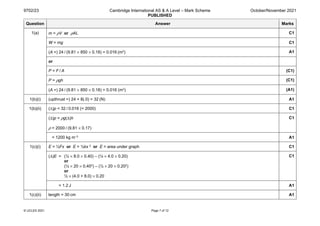
1(a) m = ρV or ρAL C1
W = mg C1
(A =) 24 / (9.81 × 850 × 0.18) = 0.016 (m2) A1
or
P = F / A (C1)
P = ρgh (C1)
(A =) 24 / (9.81 × 850 × 0.18) = 0.016 (m2) (A1)
1(b)(i) (upthrust =) 24 + 8(.0) = 32 (N) A1
1(b)(ii) (∆)p = 32 / 0.016 (= 2000) C1
(Δ)p = ρg(Δ)h
ρ = 2000 / (9.81 × 0.17)
C1
= 1200 kg m–3 A1
1(c)(i) E = ½Fx or E = ½kx 2 or E = area under graph C1
(Δ)E = (½ × 8.0 × 0.40) – (½ × 4.0 × 0.20)
or
(½ × 20 × 0.402) – (½ × 20 × 0.202)
or
½ × (4.0 + 8.0) × 0.20
C1
= 1.2 J A1
1(c)(ii) length = 30 cm A1
9702/23 Cambridge International AS & A Level – Mark Scheme
PUBLISHED
October/November 2021
© UCLES 2021 Page 8 of 12
Question Answer Marks
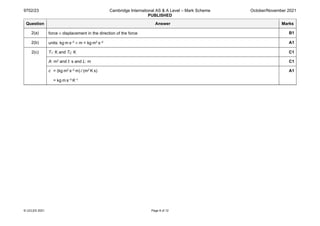
2(a) force × displacement in the direction of the force B1
2(b) units: kg m s–2 × m = kg m2 s–2 A1
2(c) T1: K and T2: K C1
A: m2 and t: s and L: m C1
c = (kg m2 s–2 m) / (m2 K s)
= kg m s–3 K–1
A1
9702/23 Cambridge International AS & A Level – Mark Scheme
PUBLISHED
October/November 2021
© UCLES 2021 Page 9 of 12
Question Answer Marks
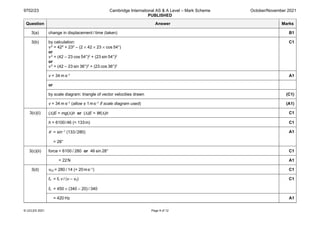
3(a) change in displacement / time (taken) B1
3(b) by calculation:
v 2 = 422 + 232 – (2 × 42 × 23 × cos 54°)
or
v 2 = (42 – 23 cos 54°)2 + (23 sin 54°)2
or
v 2 = (42 – 23 sin 36°)2 + (23 cos 36°)2
C1
v = 34 m s–1 A1
or
by scale diagram: triangle of vector velocities drawn (C1)
v = 34 m s–1 (allow ± 1ms–1 if scale diagram used) (A1)
3(c)(i) (Δ)E = mg(Δ)h or (Δ)E = W(Δ)h C1
h = 6100 / 46 (= 133m) C1
θ = sin–1 (133/280)
= 28°
A1
3(c)(ii) force = 6100 / 280 or 46 sin 28° C1
= 22N A1
3(d) v(s) = 280 / 14 (= 20ms–1) C1
fo = fs v / (v – vs)
fs = 450 × (340 – 20) / 340
C1
= 420 Hz A1
9702/23 Cambridge International AS & A Level – Mark Scheme
PUBLISHED
October/November 2021
© UCLES 2021 Page 10 of 12
Question Answer Marks
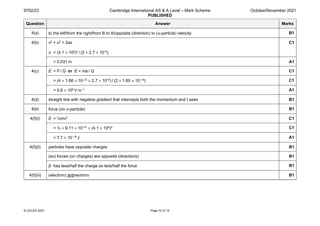
4(a) to the left/from the right/from B to A/opposite (direction) to (α-particle) velocity B1
4(b) v2 = u2 + 2as
s = (4.1 × 10⁶)2 / (2 × 2.7 × 1014)
C1
= 0.031 m A1
4(c) E = F / Q or E = ma / Q C1
= (4 × 1.66 × 10–27 × 2.7 × 1014) / (2 × 1.60 × 10–19) C1
= 5.6 × 10⁶ V m–1 A1
4(d) straight line with negative gradient that intercepts both the momentum and t axes B1
4(e) force (on α-particle) B1
4(f)(i) E = ½mv2 C1
= ½ × 9.11 × 10–31 × (4.1 × 106)2 C1
= 7.7 × 10⁻¹⁸ J A1
4(f)(ii) particles have opposite charges B1
(so) forces (on charges) are opposite (directions) B1
β– has less/half the charge so less/half the force B1
4(f)(iii) (electron) antineutrino B1
9702/23 Cambridge International AS & A Level – Mark Scheme
PUBLISHED
October/November 2021
© UCLES 2021 Page 11 of 12
Question Answer Marks
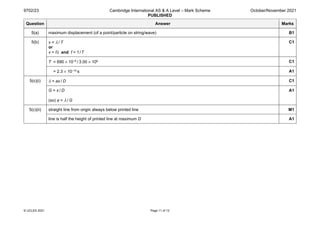
5(a) maximum displacement (of a point/particle on string/wave) B1
5(b) v = λ / T
or
v = fλ and f = 1/T
C1
T = 690 × 10–9 / 3.00 × 10⁸ C1
= 2.3 × 10⁻¹⁵ s A1
5(c)(i) λ = ax / D C1
G = x / D
(so) a = λ / G
A1
5(c)(ii) straight line from origin always below printed line M1
line is half the height of printed line at maximum D A1
9702/23 Cambridge International AS & A Level – Mark Scheme
PUBLISHED
October/November 2021
© UCLES 2021 Page 12 of 12
Question Answer Marks
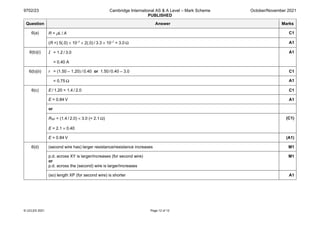
6(a) R = ρL / A C1
(R =) 5(.0) × 10–7 × 2(.0) / 3.3 × 10–7 = 3.0 Ω A1
6(b)(i) I = 1.2 / 3.0
= 0.40 A
A1
6(b)(ii) r = (1.50 – 1.20) / 0.40 or 1.50/0.40 – 3.0 C1
= 0.75 Ω A1
6(c) E / 1.20 = 1.4 / 2.0 C1
E = 0.84 V A1
or
RXP = (1.4 / 2.0) × 3.0 (= 2.1 Ω)
E = 2.1 × 0.40
(C1)
E = 0.84 V (A1)
6(d) (second wire has) larger resistance/resistance increases M1
p.d. across XY is larger/increases (for second wire)
or
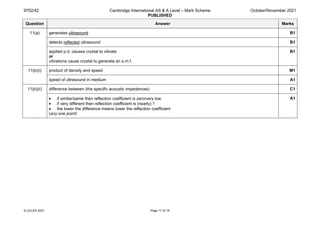
p.d. across the (second) wire is larger/increases
M1
(so) length XP (for second wire) is shorter A1
This document consists of 9 printed pages.
© UCLES 2021 [Turn over
Cambridge International AS & A Level
PHYSICS 9702/31
Paper 3 Advanced Practical Skills 1 October/November 2021
MARK SCHEME
Maximum Mark: 40
Published
This mark scheme is published as an aid to teachers and candidates, to indicate the requirements of the
examination. It shows the basis on which Examiners were instructed to award marks. It does not indicate the
details of the discussions that took place at an Examiners’ meeting before marking began, which would have
considered the acceptability of alternative answers.
Mark schemes should be read in conjunction with the question paper and the Principal Examiner Report for
Teachers.
Cambridge International will not enter into discussions about these mark schemes.
Cambridge International is publishing the mark schemes for the October/November 2021 series for most
Cambridge IGCSE™, Cambridge International A and AS Level components and some Cambridge O Level
components.
9702/31 Cambridge International AS & A Level – Mark Scheme
PUBLISHED
October/November 2021
© UCLES 2021 Page 2 of 9
Generic Marking Principles
These general marking principles must be applied by all examiners when marking candidate answers. They should be applied alongside the
specific content of the mark scheme or generic level descriptors for a question. Each question paper and mark scheme will also comply with these
marking principles.
GENERIC MARKING PRINCIPLE 1:
Marks must be awarded in line with:
• the specific content of the mark scheme or the generic level descriptors for the question
• the specific skills defined in the mark scheme or in the generic level descriptors for the question
• the standard of response required by a candidate as exemplified by the standardisation scripts.
GENERIC MARKING PRINCIPLE 2:
Marks awarded are always whole marks (not half marks, or other fractions).
GENERIC MARKING PRINCIPLE 3:
Marks must be awarded positively:
• marks are awarded for correct/valid answers, as defined in the mark scheme. However, credit is given for valid answers which go beyond the
scope of the syllabus and mark scheme, referring to your Team Leader as appropriate
• marks are awarded when candidates clearly demonstrate what they know and can do
• marks are not deducted for errors
• marks are not deducted for omissions
• answers should only be judged on the quality of spelling, punctuation and grammar when these features are specifically assessed by the
question as indicated by the mark scheme. The meaning, however, should be unambiguous.
GENERIC MARKING PRINCIPLE 4:
Rules must be applied consistently, e.g. in situations where candidates have not followed instructions or in the application of generic level
descriptors.
9702/31 Cambridge International AS & A Level – Mark Scheme
PUBLISHED
October/November 2021
© UCLES 2021 Page 3 of 9
GENERIC MARKING PRINCIPLE 5:
Marks should be awarded using the full range of marks defined in the mark scheme for the question (however; the use of the full mark range may
be limited according to the quality of the candidate responses seen).
GENERIC MARKING PRINCIPLE 6:
Marks awarded are based solely on the requirements as defined in the mark scheme. Marks should not be awarded with grade thresholds or
grade descriptors in mind.
Science-Specific Marking Principles
1 Examiners should consider the context and scientific use of any keywords when awarding marks. Although keywords may be present, marks
should not be awarded if the keywords are used incorrectly.
2 The examiner should not choose between contradictory statements given in the same question part, and credit should not be awarded for any
correct statement that is contradicted within the same question part. Wrong science that is irrelevant to the question should be ignored.
3 Although spellings do not have to be correct, spellings of syllabus terms must allow for clear and unambiguous separation from other syllabus
terms with which they may be confused (e.g. ethane / ethene, glucagon / glycogen, refraction / reflection).
4 The error carried forward (ecf) principle should be applied, where appropriate. If an incorrect answer is subsequently used in a scientifically
correct way, the candidate should be awarded these subsequent marking points. Further guidance will be included in the mark scheme where
necessary and any exceptions to this general principle will be noted.
5 ‘List rule’ guidance
For questions that require n responses (e.g. State two reasons …):
• The response should be read as continuous prose, even when numbered answer spaces are provided.
• Any response marked ignore in the mark scheme should not count towards n.
• Incorrect responses should not be awarded credit but will still count towards n.
• Read the entire response to check for any responses that contradict those that would otherwise be credited. Credit should not be
awarded for any responses that are contradicted within the rest of the response. Where two responses contradict one another, this should
be treated as a single incorrect response.
• Non-contradictory responses after the first n responses may be ignored even if they include incorrect science.
9702/31 Cambridge International AS & A Level – Mark Scheme
PUBLISHED
October/November 2021
© UCLES 2021 Page 4 of 9
6 Calculation specific guidance
Correct answers to calculations should be given full credit even if there is no working or incorrect working, unless the question states ‘show
your working’.
For questions in which the number of significant figures required is not stated, credit should be awarded for correct answers when rounded by
the examiner to the number of significant figures given in the mark scheme. This may not apply to measured values.
For answers given in standard form (e.g. a × 10n) in which the convention of restricting the value of the coefficient (a) to a value between 1
and 10 is not followed, credit may still be awarded if the answer can be converted to the answer given in the mark scheme.
Unless a separate mark is given for a unit, a missing or incorrect unit will normally mean that the final calculation mark is not awarded.
Exceptions to this general principle will be noted in the mark scheme.
7 Guidance for chemical equations
Multiples / fractions of coefficients used in chemical equations are acceptable unless stated otherwise in the mark scheme.
State symbols given in an equation should be ignored unless asked for in the question or stated otherwise in the mark scheme.
9702/31 Cambridge International AS & A Level – Mark Scheme
PUBLISHED
October/November 2021
© UCLES 2021 Page 5 of 9
Question Answer Marks
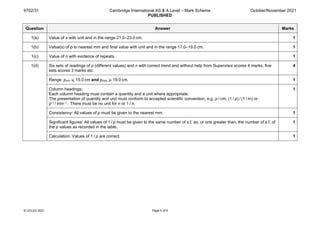
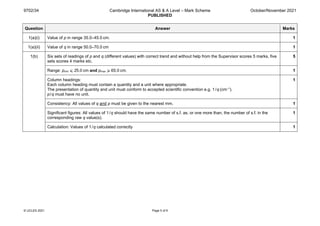
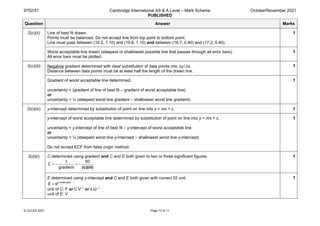
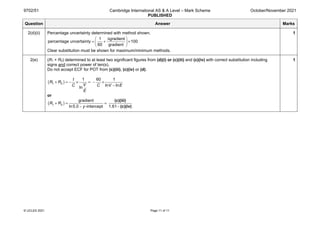
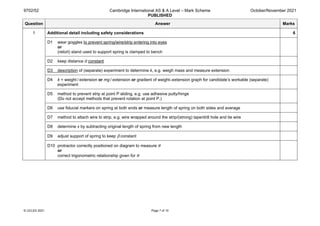
1(a) Value of x with unit and in the range 21.0–23.0 cm. 1
1(b) Value(s) of p to nearest mm and final value with unit and in the range 17.0–19.0 cm. 1
1(c) Value of n with evidence of repeats. 1
1(d) Six sets of readings of p (different values) and n with correct trend and without help from Supervisor scores 4 marks, five
sets scores 3 marks etc.
4
Range: pmin ⩽ 15.0 cm and pmax ⩾ 19.0 cm. 1
Column headings:
Each column heading must contain a quantity and a unit where appropriate.
The presentation of quantity and unit must conform to accepted scientific convention, e.g. p / cm, (1 / p) / (1 / m) or
p–1 / mm–1. There must be no unit for n or 1 / n.
1
Consistency: All values of p must be given to the nearest mm. 1
Significant figures: All values of 1 / p must be given to the same number of s.f. as, or one greater than, the number of s.f. of
the p values as recorded in the table.
1
Calculation: Values of 1 / p are correct. 1
9702/31 Cambridge International AS & A Level – Mark Scheme
PUBLISHED
October/November 2021
© UCLES 2021 Page 6 of 9
Question Answer Marks
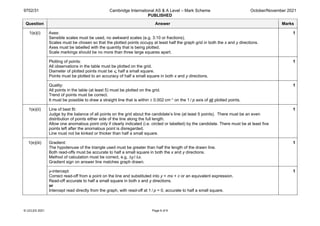
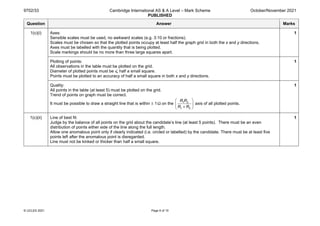
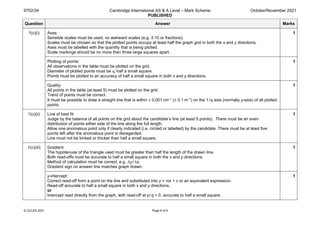
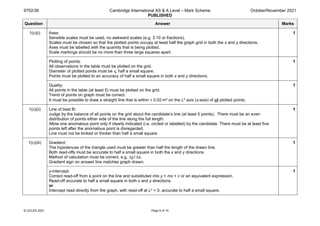
1(e)(i) Axes:
Sensible scales must be used, no awkward scales (e.g. 3:10 or fractions).
Scales must be chosen so that the plotted points occupy at least half the graph grid in both the x and y directions.
Axes must be labelled with the quantity that is being plotted.
Scale markings should be no more than three large squares apart.
1
Plotting of points:
All observations in the table must be plotted on the grid.
Diameter of plotted points must be ⩽ half a small square.
Points must be plotted to an accuracy of half a small square in both x and y directions.
1
Quality:
All points in the table (at least 5) must be plotted on the grid.
Trend of points must be correct.
It must be possible to draw a straight line that is within ± 0.002 cm–1 on the 1 / p axis of all plotted points.
1
1(e)(ii) Line of best fit:
Judge by the balance of all points on the grid about the candidate’s line (at least 5 points). There must be an even
distribution of points either side of the line along the full length.
Allow one anomalous point only if clearly indicated (i.e. circled or labelled) by the candidate. There must be at least five
points left after the anomalous point is disregarded.
Line must not be kinked or thicker than half a small square.
1
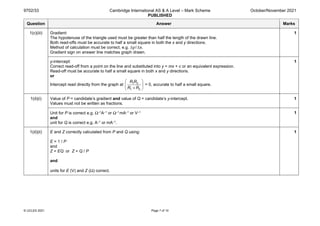
1(e)(iii) Gradient:
The hypotenuse of the triangle used must be greater than half the length of the drawn line.
Both read-offs must be accurate to half a small square in both the x and y directions.
Method of calculation must be correct, e.g. Δy / Δx.
Gradient sign on answer line matches graph drawn.
1
y-intercept:
Correct read-off from a point on the line and substituted into y = mx + c or an equivalent expression.
Read-off accurate to half a small square in both x and y directions.
or
Intercept read directly from the graph, with read-off at 1 / p = 0, accurate to half a small square.
1
9702/31 Cambridge International AS & A Level – Mark Scheme
PUBLISHED
October/November 2021
© UCLES 2021 Page 7 of 9
Question Answer Marks
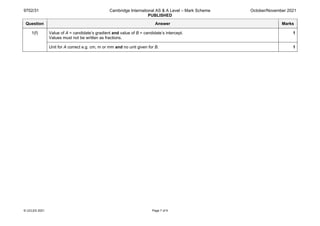
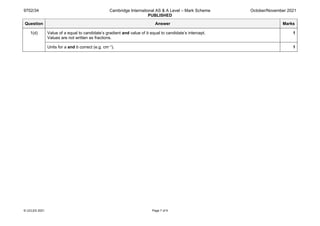
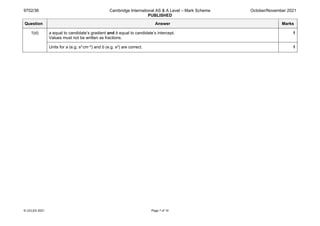
1(f) Value of A = candidate’s gradient and value of B = candidate’s intercept.
Values must not be written as fractions.
1
Unit for A correct e.g. cm, m or mm and no unit given for B. 1
9702/31 Cambridge International AS & A Level – Mark Scheme
PUBLISHED
October/November 2021
© UCLES 2021 Page 8 of 9
Question Answer Marks
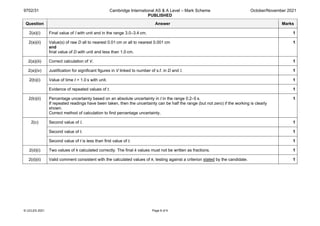
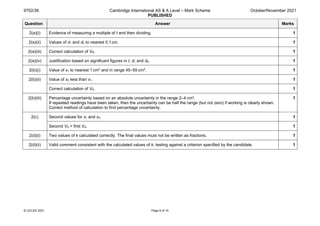
2(a)(i) Final value of l with unit and in the range 3.0–3.4 cm. 1
2(a)(ii) Value(s) of raw D all to nearest 0.01 cm or all to nearest 0.001 cm
and
final value of D with unit and less than 1.0 cm.
1
2(a)(iii) Correct calculation of V. 1
2(a)(iv) Justification for significant figures in V linked to number of s.f. in D and l. 1
2(b)(i) Value of time t > 1.0 s with unit. 1
Evidence of repeated values of t. 1
2(b)(ii) Percentage uncertainty based on an absolute uncertainty in t in the range 0.2–5 s.
If repeated readings have been taken, then the uncertainty can be half the range (but not zero) if the working is clearly
shown.
Correct method of calculation to find percentage uncertainty.
1
2(c) Second value of l. 1
Second value of t. 1
Second value of t is less than first value of t. 1
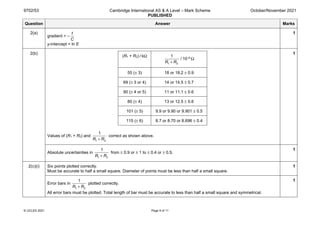
2(d)(i) Two values of k calculated correctly. The final k values must not be written as fractions. 1
2(d)(ii) Valid comment consistent with the calculated values of k, testing against a criterion stated by the candidate. 1
9702/31 Cambridge International AS & A Level – Mark Scheme
PUBLISHED
October/November 2021
© UCLES 2021 Page 9 of 9
Question Answer Marks
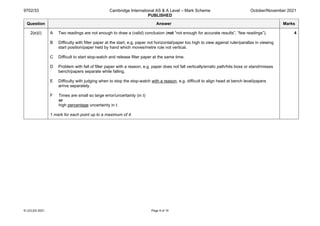
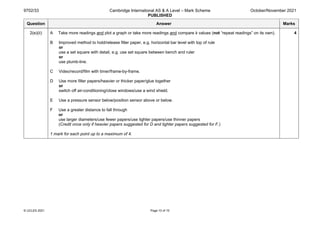
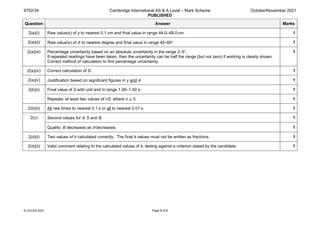
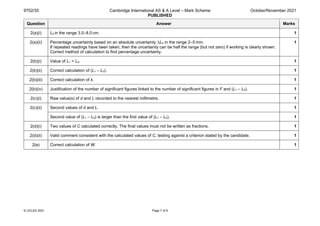
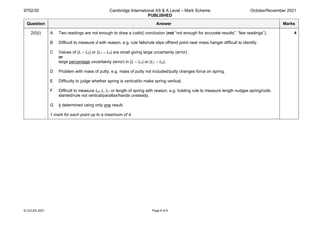
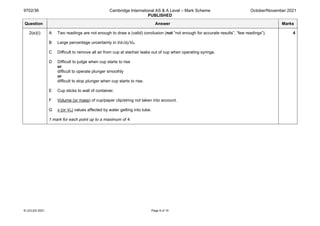
2(e)(i) A Two readings are not enough to draw a (valid) conclusion (not “not enough for accurate results”, “few readings”).
B Difficulty in measuring time t with a reason (at the start or at the finish) e.g. lifting straw and starting stopwatch
simultaneously/judging or predicting when to stop timing.
C Difficulty linked to oil with detail e.g. difficult to see as colourless/clear/transparent or some oil left in straw drips out
later/oil leaks from straw/paper straw absorbs oil.
D Difficulty linked to raising or positioning the straw e.g. not always in centre/hand moves when lifted/straw tilted/putty
obscures the centre.
E Problem with volume V with reason e.g. D is the external diameter/no account of thickness of straw/squashing
straw/putty goes up straw/oil left in straw.
1 mark for each point up to a maximum of 4.
4
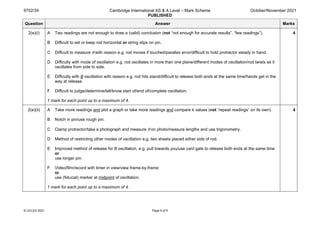
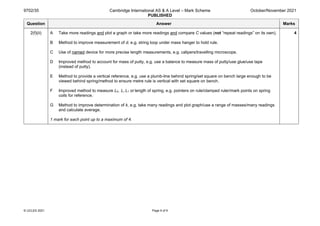
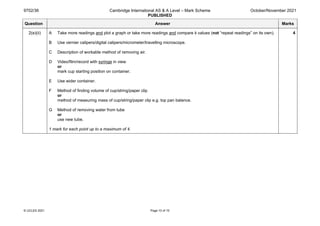
2(e)(ii) A Take more readings and plot a graph or take more readings and compare k values (not “repeat readings” on its own).
B Improved method to measure t e.g. video/film/ record with timer/view frame by frame.
C Improved method to see oil e.g. add dye
or
improved method to contain the oil e.g. flap/cap/plastic straw.
D Improved method to release or positioning of straw e.g. clamp a laser with beam above the centre point/clamp a guide
at the centre/draw a cross on the paper.
E Valid method to measure internal straw diameter e.g. travelling microscope or method to measure thickness directly
e.g. cut open and use micrometer to measure wall thickness.
1 mark for each point up to a maximum of 4.
4
This document consists of 10 printed pages.
© UCLES 2021 [Turn over
Cambridge International AS & A Level
PHYSICS 9702/33
Paper 3 Advanced Practical Skills 1 October/November 2021
MARK SCHEME
Maximum Mark: 40
Published
This mark scheme is published as an aid to teachers and candidates, to indicate the requirements of the
examination. It shows the basis on which Examiners were instructed to award marks. It does not indicate the
details of the discussions that took place at an Examiners’ meeting before marking began, which would have
considered the acceptability of alternative answers.
Mark schemes should be read in conjunction with the question paper and the Principal Examiner Report for
Teachers.
Cambridge International will not enter into discussions about these mark schemes.
Cambridge International is publishing the mark schemes for the October/November 2021 series for most
Cambridge IGCSE™, Cambridge International A and AS Level components and some Cambridge O Level
components.
9702/33 Cambridge International AS & A Level – Mark Scheme
PUBLISHED
October/November 2021
© UCLES 2021 Page 2 of 10
Generic Marking Principles
These general marking principles must be applied by all examiners when marking candidate answers. They should be applied alongside the
specific content of the mark scheme or generic level descriptors for a question. Each question paper and mark scheme will also comply with these
marking principles.
GENERIC MARKING PRINCIPLE 1:
Marks must be awarded in line with:
• the specific content of the mark scheme or the generic level descriptors for the question
• the specific skills defined in the mark scheme or in the generic level descriptors for the question
• the standard of response required by a candidate as exemplified by the standardisation scripts.
GENERIC MARKING PRINCIPLE 2:
Marks awarded are always whole marks (not half marks, or other fractions).
GENERIC MARKING PRINCIPLE 3:
Marks must be awarded positively:
• marks are awarded for correct/valid answers, as defined in the mark scheme. However, credit is given for valid answers which go beyond the
scope of the syllabus and mark scheme, referring to your Team Leader as appropriate
• marks are awarded when candidates clearly demonstrate what they know and can do
• marks are not deducted for errors
• marks are not deducted for omissions
• answers should only be judged on the quality of spelling, punctuation and grammar when these features are specifically assessed by the
question as indicated by the mark scheme. The meaning, however, should be unambiguous.
GENERIC MARKING PRINCIPLE 4:
Rules must be applied consistently, e.g. in situations where candidates have not followed instructions or in the application of generic level
descriptors.
9702/33 Cambridge International AS & A Level – Mark Scheme
PUBLISHED
October/November 2021
© UCLES 2021 Page 3 of 10
GENERIC MARKING PRINCIPLE 5:
Marks should be awarded using the full range of marks defined in the mark scheme for the question (however; the use of the full mark range may
be limited according to the quality of the candidate responses seen).
GENERIC MARKING PRINCIPLE 6:
Marks awarded are based solely on the requirements as defined in the mark scheme. Marks should not be awarded with grade thresholds or
grade descriptors in mind.
Science-Specific Marking Principles
1 Examiners should consider the context and scientific use of any keywords when awarding marks. Although keywords may be present, marks
should not be awarded if the keywords are used incorrectly.
2 The examiner should not choose between contradictory statements given in the same question part, and credit should not be awarded for
any correct statement that is contradicted within the same question part. Wrong science that is irrelevant to the question should be ignored.
3 Although spellings do not have to be correct, spellings of syllabus terms must allow for clear and unambiguous separation from other
syllabus terms with which they may be confused (e.g. ethane / ethene, glucagon / glycogen, refraction / reflection).
4 The error carried forward (ecf) principle should be applied, where appropriate. If an incorrect answer is subsequently used in a scientifically
correct way, the candidate should be awarded these subsequent marking points. Further guidance will be included in the mark scheme
where necessary and any exceptions to this general principle will be noted.
5 ‘List rule’ guidance
For questions that require n responses (e.g. State two reasons …):
• The response should be read as continuous prose, even when numbered answer spaces are provided.
• Any response marked ignore in the mark scheme should not count towards n.
• Incorrect responses should not be awarded credit but will still count towards n.
• Read the entire response to check for any responses that contradict those that would otherwise be credited. Credit should not be
awarded for any responses that are contradicted within the rest of the response. Where two responses contradict one another, this
should be treated as a single incorrect response.
• Non-contradictory responses after the first n responses may be ignored even if they include incorrect science.
9702/33 Cambridge International AS & A Level – Mark Scheme
PUBLISHED
October/November 2021
© UCLES 2021 Page 4 of 10
6 Calculation specific guidance
Correct answers to calculations should be given full credit even if there is no working or incorrect working, unless the question states ‘show
your working’.
For questions in which the number of significant figures required is not stated, credit should be awarded for correct answers when rounded
by the examiner to the number of significant figures given in the mark scheme. This may not apply to measured values.
For answers given in standard form (e.g. a × 10n) in which the convention of restricting the value of the coefficient (a) to a value between 1
and 10 is not followed, credit may still be awarded if the answer can be converted to the answer given in the mark scheme.
Unless a separate mark is given for a unit, a missing or incorrect unit will normally mean that the final calculation mark is not awarded.
Exceptions to this general principle will be noted in the mark scheme.
7 Guidance for chemical equations
Multiples / fractions of coefficients used in chemical equations are acceptable unless stated otherwise in the mark scheme.
State symbols given in an equation should be ignored unless asked for in the question or stated otherwise in the mark scheme.
9702/33 Cambridge International AS & A Level – Mark Scheme
PUBLISHED
October/November 2021
© UCLES 2021 Page 5 of 10
Question Answer Marks
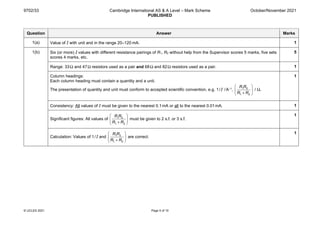
1(a) Value of I with unit and in the range 20–120 mA. 1
1(b) Six (or more) I values with different resistance pairings of R1, R2 without help from the Supervisor scores 5 marks, five sets
scores 4 marks, etc.
5
Range: 33 Ω and 47 Ω resistors used as a pair and 68 Ω and 82 Ω resistors used as a pair. 1
Column headings:
Each column heading must contain a quantity and a unit.
The presentation of quantity and unit must conform to accepted scientific convention, e.g. 1/I  / A–1, 1 2
1 2
R R
R R
 
 
+
 
/ Ω.
1
Consistency: All values of I must be given to the nearest 0.1 mA or all to the nearest 0.01 mA. 1
Significant figures: All values of 1 2
1 2
R R
R R
 
 
+
 
must be given to 2 s.f. or 3 s.f.
1
Calculation: Values of 1/I and 1 2
1 2
R R
R R
 
 
+
 
are correct.
1
9702/33 Cambridge International AS & A Level – Mark Scheme
PUBLISHED
October/November 2021
© UCLES 2021 Page 6 of 10
Question Answer Marks
1(c)(i) Axes:
Sensible scales must be used, no awkward scales (e.g. 3:10 or fractions).
Scales must be chosen so that the plotted points occupy at least half the graph grid in both the x and y directions.
Axes must be labelled with the quantity that is being plotted.
Scale markings should be no more than three large squares apart.
1
Plotting of points:
All observations in the table must be plotted on the grid.
Diameter of plotted points must be ⩽ half a small square.
Points must be plotted to an accuracy of half a small square in both x and y directions.
1
Quality:
All points in the table (at least 5) must be plotted on the grid.
Trend of points on graph must be correct.
It must be possible to draw a straight line that is within ± 1Ω on the 1 2
1 2
R R
R R
 
 
+
 
axis of all plotted points.
1
1(c)(ii) Line of best fit:
Judge by the balance of all points on the grid about the candidate’s line (at least 5 points). There must be an even
distribution of points either side of the line along the full length.
Allow one anomalous point only if clearly indicated (i.e. circled or labelled) by the candidate. There must be at least five
points left after the anomalous point is disregarded.
Line must not be kinked or thicker than half a small square.
1
9702/33 Cambridge International AS & A Level – Mark Scheme
PUBLISHED
October/November 2021
© UCLES 2021 Page 7 of 10
Question Answer Marks
1(c)(iii) Gradient:
The hypotenuse of the triangle used must be greater than half the length of the drawn line.
Both read-offs must be accurate to half a small square in both the x and y directions.
Method of calculation must be correct, e.g. Δy / Δx.
Gradient sign on answer line matches graph drawn.
1
y-intercept:
Correct read-off from a point on the line and substituted into y = mx + c or an equivalent expression.
Read-off must be accurate to half a small square in both x and y directions.
or
Intercept read directly from the graph at 1 2
1 2
R R
R R
 
 
+
 
= 0, accurate to half a small square.
1
1(d)(i) Value of P = candidate’s gradient and value of Q = candidate’s y-intercept.
Values must not be written as fractions.
1
Unit for P is correct e.g. Ω–1A–1 or Ω–1 mA–1 or V–1
and
unit for Q is correct e.g. A–1 or mA–1.
1
1(d)(ii) E and Z correctly calculated from P and Q using:
E = 1 / P
and
Z = EQ or Z = Q / P
and
units for E (V) and Z (Ω) correct.
1
9702/33 Cambridge International AS & A Level – Mark Scheme
PUBLISHED
October/November 2021
© UCLES 2021 Page 8 of 10
Question Answer Marks
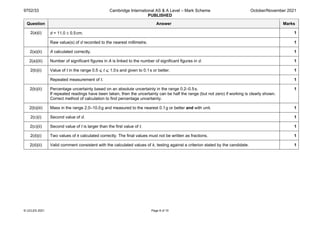
2(a)(i) d = 11.0 ± 0.5 cm. 1
Raw value(s) of d recorded to the nearest millimetre. 1
2(a)(ii) A calculated correctly. 1
2(a)(iii) Number of significant figures in A is linked to the number of significant figures in d. 1
2(b)(i) Value of t in the range 0.5 ⩽ t ⩽ 1.0 s and given to 0.1 s or better. 1
Repeated measurement of t. 1
2(b)(ii) Percentage uncertainty based on an absolute uncertainty in the range 0.2–0.5 s.
If repeated readings have been taken, then the uncertainty can be half the range (but not zero) if working is clearly shown.
Correct method of calculation to find percentage uncertainty.
1
2(b)(iii) Mass in the range 2.0–10.0 g and measured to the nearest 0.1 g or better and with unit. 1
2(c)(i) Second value of d. 1
2(c)(ii) Second value of t is larger than the first value of t. 1
2(d)(i) Two values of k calculated correctly. The final values must not be written as fractions. 1
2(d)(ii) Valid comment consistent with the calculated values of k, testing against a criterion stated by the candidate. 1
9702/33 Cambridge International AS & A Level – Mark Scheme
PUBLISHED
October/November 2021
© UCLES 2021 Page 9 of 10
Question Answer Marks
2(e)(i) A Two readings are not enough to draw a (valid) conclusion (not “not enough for accurate results”, “few readings”).
B Difficulty with filter paper at the start, e.g. paper not horizontal/paper too high to view against ruler/parallax in viewing
start position/paper held by hand which moves/metre rule not vertical.
C Difficult to start stop-watch and release filter paper at the same time.
D Problem with fall of filter paper with a reason, e.g. paper does not fall vertically/erratic path/hits boss or stand/misses
bench/papers separate while falling.
E Difficulty with judging when to stop the stop-watch with a reason, e.g. difficult to align head at bench level/papers
arrive separately.
F Times are small so large error/uncertainty (in t)
or
high percentage uncertainty in t.
1 mark for each point up to a maximum of 4.
4
9702/33 Cambridge International AS & A Level – Mark Scheme
PUBLISHED
October/November 2021
© UCLES 2021 Page 10 of 10
Question Answer Marks
2(e)(ii) A Take more readings and plot a graph or take more readings and compare k values (not “repeat readings” on its own).
B Improved method to hold/release filter paper, e.g. horizontal bar level with top of rule
or
use a set square with detail, e.g. use set square between bench and ruler
or
use plumb-line.
C Video/record/film with timer/frame-by-frame.
D Use more filter papers/heavier or thicker paper/glue together
or
switch off air-conditioning/close windows/use a wind shield.
E Use a pressure sensor below/position sensor above or below.
F Use a greater distance to fall through
or
use larger diameters/use fewer papers/use lighter papers/use thinner papers
(Credit once only if heavier papers suggested for D and lighter papers suggested for F.)
1 mark for each point up to a maximum of 4.
4
This document consists of 9 printed pages.
© UCLES 2021 [Turn over
Cambridge International AS & A Level
PHYSICS 9702/34
Paper 3 Advanced Practical Skills 2 October/November 2021
MARK SCHEME
Maximum Mark: 40
Published
This mark scheme is published as an aid to teachers and candidates, to indicate the requirements of the
examination. It shows the basis on which Examiners were instructed to award marks. It does not indicate the
details of the discussions that took place at an Examiners’ meeting before marking began, which would have
considered the acceptability of alternative answers.
Mark schemes should be read in conjunction with the question paper and the Principal Examiner Report for
Teachers.
Cambridge International will not enter into discussions about these mark schemes.
Cambridge International is publishing the mark schemes for the October/November 2021 series for most
Cambridge IGCSE™, Cambridge International A and AS Level components and some Cambridge O Level
components.
9702/34 Cambridge International AS & A Level – Mark Scheme
PUBLISHED
October/November 2021
© UCLES 2021 Page 2 of 9
Generic Marking Principles
These general marking principles must be applied by all examiners when marking candidate answers. They should be applied alongside the
specific content of the mark scheme or generic level descriptors for a question. Each question paper and mark scheme will also comply with these
marking principles.
GENERIC MARKING PRINCIPLE 1:
Marks must be awarded in line with:
• the specific content of the mark scheme or the generic level descriptors for the question
• the specific skills defined in the mark scheme or in the generic level descriptors for the question
• the standard of response required by a candidate as exemplified by the standardisation scripts.
GENERIC MARKING PRINCIPLE 2:
Marks awarded are always whole marks (not half marks, or other fractions).
GENERIC MARKING PRINCIPLE 3:
Marks must be awarded positively:
• marks are awarded for correct/valid answers, as defined in the mark scheme. However, credit is given for valid answers which go beyond the
scope of the syllabus and mark scheme, referring to your Team Leader as appropriate
• marks are awarded when candidates clearly demonstrate what they know and can do
• marks are not deducted for errors
• marks are not deducted for omissions
• answers should only be judged on the quality of spelling, punctuation and grammar when these features are specifically assessed by the
question as indicated by the mark scheme. The meaning, however, should be unambiguous.
GENERIC MARKING PRINCIPLE 4:
Rules must be applied consistently, e.g. in situations where candidates have not followed instructions or in the application of generic level
descriptors.
9702/34 Cambridge International AS & A Level – Mark Scheme
PUBLISHED
October/November 2021
© UCLES 2021 Page 3 of 9
GENERIC MARKING PRINCIPLE 5:
Marks should be awarded using the full range of marks defined in the mark scheme for the question (however; the use of the full mark range may
be limited according to the quality of the candidate responses seen).
GENERIC MARKING PRINCIPLE 6:
Marks awarded are based solely on the requirements as defined in the mark scheme. Marks should not be awarded with grade thresholds or
grade descriptors in mind.
Science-Specific Marking Principles
1 Examiners should consider the context and scientific use of any keywords when awarding marks. Although keywords may be present, marks
should not be awarded if the keywords are used incorrectly.
2 The examiner should not choose between contradictory statements given in the same question part, and credit should not be awarded for any
correct statement that is contradicted within the same question part. Wrong science that is irrelevant to the question should be ignored.
3 Although spellings do not have to be correct, spellings of syllabus terms must allow for clear and unambiguous separation from other syllabus
terms with which they may be confused (e.g. ethane / ethene, glucagon / glycogen, refraction / reflection).
4 The error carried forward (ecf) principle should be applied, where appropriate. If an incorrect answer is subsequently used in a scientifically
correct way, the candidate should be awarded these subsequent marking points. Further guidance will be included in the mark scheme where
necessary and any exceptions to this general principle will be noted.
5 ‘List rule’ guidance
For questions that require n responses (e.g. State two reasons …):
• The response should be read as continuous prose, even when numbered answer spaces are provided.
• Any response marked ignore in the mark scheme should not count towards n.
• Incorrect responses should not be awarded credit but will still count towards n.
• Read the entire response to check for any responses that contradict those that would otherwise be credited. Credit should not be
awarded for any responses that are contradicted within the rest of the response. Where two responses contradict one another, this should
be treated as a single incorrect response.
• Non-contradictory responses after the first n responses may be ignored even if they include incorrect science.
9702/34 Cambridge International AS & A Level – Mark Scheme
PUBLISHED
October/November 2021
© UCLES 2021 Page 4 of 9
6 Calculation specific guidance
Correct answers to calculations should be given full credit even if there is no working or incorrect working, unless the question states ‘show
your working’.
For questions in which the number of significant figures required is not stated, credit should be awarded for correct answers when rounded by
the examiner to the number of significant figures given in the mark scheme. This may not apply to measured values.
For answers given in standard form (e.g. a × 10n) in which the convention of restricting the value of the coefficient (a) to a value between 1
and 10 is not followed, credit may still be awarded if the answer can be converted to the answer given in the mark scheme.
Unless a separate mark is given for a unit, a missing or incorrect unit will normally mean that the final calculation mark is not awarded.
Exceptions to this general principle will be noted in the mark scheme.
7 Guidance for chemical equations
Multiples / fractions of coefficients used in chemical equations are acceptable unless stated otherwise in the mark scheme.
State symbols given in an equation should be ignored unless asked for in the question or stated otherwise in the mark scheme.
9702/34 Cambridge International AS & A Level – Mark Scheme
PUBLISHED
October/November 2021
© UCLES 2021 Page 5 of 9
Question Answer Marks
1(a)(i) Value of p in range 35.0–45.0 cm. 1
1(a)(ii) Value of q in range 50.0–70.0 cm 1
1(b) Six sets of readings of p and q (different values) with correct trend and without help from the Supervisor scores 5 marks, five
sets scores 4 marks etc.
5
Range: pmin ⩽ 25.0 cm and pmax ⩾ 65.0 cm. 1
Column headings:
Each column heading must contain a quantity and a unit where appropriate.
The presentation of quantity and unit must conform to accepted scientific convention e.g. 1/ q (cm–1).
p / q must have no unit.
1
Consistency: All values of q and p must be given to the nearest mm. 1
Significant figures: All values of 1/ q should have the same number of s.f. as, or one more than, the number of s.f. in the
corresponding raw q value(s).
1
Calculation: Values of 1/ q calculated correctly 1
9702/34 Cambridge International AS & A Level – Mark Scheme
PUBLISHED
October/November 2021
© UCLES 2021 Page 6 of 9
Question Answer Marks
1(c)(i) Axes:
Sensible scales must be used, no awkward scales (e.g. 3:10 or fractions).
Scales must be chosen so that the plotted points occupy at least half the graph grid in both the x and y directions.
Axes must be labelled with the quantity that is being plotted.
Scale markings should be no more than three large squares apart.
1
Plotting of points:
All observations in the table must be plotted on the grid.
Diameter of plotted points must be ⩽ half a small square.
Points must be plotted to an accuracy of half a small square in both x and y directions.
1
Quality:
All points in the table (at least 5) must be plotted on the grid.
Trend of points must be correct.
It must be possible to draw a straight line that is within ± 0.001 cm–1 (± 0.1 m–1) on the 1/ q axis (normally y-axis) of all plotted
points.
1
1(c)(ii) Line of best fit:
Judge by the balance of all points on the grid about the candidate’s line (at least 5 points). There must be an even
distribution of points either side of the line along the full length.
Allow one anomalous point only if clearly indicated (i.e. circled or labelled) by the candidate. There must be at least five
points left after the anomalous point is disregarded.
Line must not be kinked or thicker than half a small square.
1
1(c)(iii) Gradient:
The hypotenuse of the triangle used must be greater than half the length of the drawn line.
Both read-offs must be accurate to half a small square in both the x and y directions.
Method of calculation must be correct, e.g. Δy / Δx.
Gradient sign on answer line matches graph drawn.
1
y-intercept:
Correct read-off from a point on the line and substituted into y = mx + c or an equivalent expression.
Read-off accurate to half a small square in both x and y directions.
or
Intercept read directly from the graph, with read-off at p /q = 0, accurate to half a small square.
1
9702/34 Cambridge International AS & A Level – Mark Scheme
PUBLISHED
October/November 2021
© UCLES 2021 Page 7 of 9
Question Answer Marks
1(d) Value of a equal to candidate’s gradient and value of b equal to candidate’s intercept.
Values are not written as fractions.
1
Units for a and b correct (e.g. cm–1). 1
9702/34 Cambridge International AS & A Level – Mark Scheme
PUBLISHED
October/November 2021
© UCLES 2021 Page 8 of 9
Question Answer Marks
2(a)(i) Raw value(s) of y to nearest 0.1 cm and final value in range 44.0–48.0 cm. 1
2(a)(ii) Raw value(s) of θ  to nearest degree and final value in range 40–60°. 1
2(a)(iii) Percentage uncertainty based on an absolute uncertainty in the range 2–5°.
If repeated readings have been taken, then the uncertainty can be half the range (but not zero) if working is clearly shown.
Correct method of calculation to find percentage uncertainty.
1
2(a)(iv) Correct calculation of D. 1
2(a)(v) Justification based on significant figures in y and θ. 1
2(b)(i) Final value of S with unit and in range 1.00–1.50 s. 1
Repeats: at least two values of nS, where n ⩾ 5. 1
2(b)(ii) All raw times to nearest 0.1 s or all to nearest 0.01 s. 1
2(c) Second values for θ, S and B. 1
Quality: B decreases as θ decreases. 1
2(d)(i) Two values of k calculated correctly. The final k values must not be written as fractions. 1
2(d)(ii) Valid comment relating to the calculated values of k, testing against a criterion stated by the candidate. 1
9702/34 Cambridge International AS & A Level – Mark Scheme
PUBLISHED
October/November 2021
© UCLES 2021 Page 9 of 9
Question Answer Marks
2(e)(i) A Two readings are not enough to draw a (valid) conclusion (not “not enough for accurate results”, “few readings”).
B Difficult to set or keep rod horizontal or string slips on pin.
C Difficult to measure θ with reason e.g. rod moves if touched/parallax error/difficult to hold protractor steady in hand.
D Difficulty with mode of oscillation e.g. rod oscillates in more than one plane/different modes of oscillation/rod twists as it
oscillates from side to side.
E Difficulty with B oscillation with reason e.g. rod hits stand/difficult to release both ends at the same time/hands get in the
way at release.
F Difficult to judge/determine/tell/know start of/end of/complete oscillation.
1 mark for each point up to a maximum of 4.
4
2(e)(ii) A Take more readings and plot a graph or take more readings and compare k values (not “repeat readings” on its own).
B Notch in pin/use rough pin.
C Clamp protractor/take a photograph and measure θ on photo/measure lengths and use trigonometry.
D Method of restricting other modes of oscillation e.g. two sheets placed either side of rod.
E Improved method of release for B oscillation, e.g. pull towards you/use card gate to release both ends at the same time
or
use longer pin.
F Video/film/record with timer in view/view frame-by-frame
or
use (fiducial) marker at midpoint of oscillation.
1 mark for each point up to a maximum of 4.
4
This document consists of 9 printed pages.
© UCLES 2021 [Turn over
Cambridge International AS & A Level
PHYSICS 9702/35
Paper 3 Advanced Practical Skills 1 October/November 2021
MARK SCHEME
Maximum Mark: 40
Published
This mark scheme is published as an aid to teachers and candidates, to indicate the requirements of the
examination. It shows the basis on which Examiners were instructed to award marks. It does not indicate the
details of the discussions that took place at an Examiners’ meeting before marking began, which would have
considered the acceptability of alternative answers.
Mark schemes should be read in conjunction with the question paper and the Principal Examiner Report for
Teachers.
Cambridge International will not enter into discussions about these mark schemes.
Cambridge International is publishing the mark schemes for the October/November 2021 series for most
Cambridge IGCSE™, Cambridge International A and AS Level components and some Cambridge O Level
components.
9702/35 Cambridge International AS & A Level – Mark Scheme
PUBLISHED
October/November 2021
© UCLES 2021 Page 2 of 9
Generic Marking Principles
These general marking principles must be applied by all examiners when marking candidate answers. They should be applied alongside the
specific content of the mark scheme or generic level descriptors for a question. Each question paper and mark scheme will also comply with these
marking principles.
GENERIC MARKING PRINCIPLE 1:
Marks must be awarded in line with:
• the specific content of the mark scheme or the generic level descriptors for the question
• the specific skills defined in the mark scheme or in the generic level descriptors for the question
• the standard of response required by a candidate as exemplified by the standardisation scripts.
GENERIC MARKING PRINCIPLE 2:
Marks awarded are always whole marks (not half marks, or other fractions).
GENERIC MARKING PRINCIPLE 3:
Marks must be awarded positively:
• marks are awarded for correct/valid answers, as defined in the mark scheme. However, credit is given for valid answers which go beyond
the scope of the syllabus and mark scheme, referring to your Team Leader as appropriate
• marks are awarded when candidates clearly demonstrate what they know and can do
• marks are not deducted for errors
• marks are not deducted for omissions
• answers should only be judged on the quality of spelling, punctuation and grammar when these features are specifically assessed by the
question as indicated by the mark scheme. The meaning, however, should be unambiguous.
GENERIC MARKING PRINCIPLE 4:
Rules must be applied consistently, e.g. in situations where candidates have not followed instructions or in the application of generic level
descriptors.
9702/35 Cambridge International AS & A Level – Mark Scheme
PUBLISHED
October/November 2021
© UCLES 2021 Page 3 of 9
GENERIC MARKING PRINCIPLE 5:
Marks should be awarded using the full range of marks defined in the mark scheme for the question (however; the use of the full mark range
may be limited according to the quality of the candidate responses seen).
GENERIC MARKING PRINCIPLE 6:
Marks awarded are based solely on the requirements as defined in the mark scheme. Marks should not be awarded with grade thresholds or
grade descriptors in mind.
Science-Specific Marking Principles
1 Examiners should consider the context and scientific use of any keywords when awarding marks. Although keywords may be present,
marks should not be awarded if the keywords are used incorrectly.
2 The examiner should not choose between contradictory statements given in the same question part, and credit should not be awarded for
any correct statement that is contradicted within the same question part. Wrong science that is irrelevant to the question should be ignored.
3 Although spellings do not have to be correct, spellings of syllabus terms must allow for clear and unambiguous separation from other
syllabus terms with which they may be confused (e.g. ethane / ethene, glucagon / glycogen, refraction / reflection).
4 The error carried forward (ecf) principle should be applied, where appropriate. If an incorrect answer is subsequently used in a scientifically
correct way, the candidate should be awarded these subsequent marking points. Further guidance will be included in the mark scheme
where necessary and any exceptions to this general principle will be noted.
5 ‘List rule’ guidance
For questions that require n responses (e.g. State two reasons …):
• The response should be read as continuous prose, even when numbered answer spaces are provided.
• Any response marked ignore in the mark scheme should not count towards n.
• Incorrect responses should not be awarded credit but will still count towards n.
• Read the entire response to check for any responses that contradict those that would otherwise be credited. Credit should not be
awarded for any responses that are contradicted within the rest of the response. Where two responses contradict one another, this
should be treated as a single incorrect response.
• Non-contradictory responses after the first n responses may be ignored even if they include incorrect science.
9702/35 Cambridge International AS & A Level – Mark Scheme
PUBLISHED
October/November 2021
© UCLES 2021 Page 4 of 9
6 Calculation specific guidance
Correct answers to calculations should be given full credit even if there is no working or incorrect working, unless the question states
‘show your working’.
For questions in which the number of significant figures required is not stated, credit should be awarded for correct answers when rounded
by the examiner to the number of significant figures given in the mark scheme. This may not apply to measured values.
For answers given in standard form (e.g. a × 10n) in which the convention of restricting the value of the coefficient (a) to a value between 1
and 10 is not followed, credit may still be awarded if the answer can be converted to the answer given in the mark scheme.
Unless a separate mark is given for a unit, a missing or incorrect unit will normally mean that the final calculation mark is not awarded.
Exceptions to this general principle will be noted in the mark scheme.
7 Guidance for chemical equations
Multiples / fractions of coefficients used in chemical equations are acceptable unless stated otherwise in the mark scheme.
State symbols given in an equation should be ignored unless asked for in the question or stated otherwise in the mark scheme.
9702/35 Cambridge International AS & A Level – Mark Scheme
PUBLISHED
October/November 2021
© UCLES 2021 Page 5 of 9
Question Answer Marks
1(a) Value of H with unit and in the range 20.0–40.0 cm. 1
1(b) Final value of T in the range 2.0–10.0 s. 1
At least two measurements of nT where n ⩾ 5. 1
1(c) Six (or more) sets of readings of w (different values) and time with the correct trend and without help from the Supervisor
scores 4 marks, five sets scores 3 marks, etc.
4
Range: wmin ⩽ 6.0 cm and wmax ⩾ 18.0 cm. 1
Column headings:
Each column heading must contain a quantity and a unit where appropriate.
The presentation of quantity and unit must conform to accepted scientific convention, e.g. T / s and 1/w / cm–1 or
1/w (1/cm).
1
Consistency: All values of w must be given to the nearest 0.1 cm. 1
Significant figures: All values of 1 / w must be given to the same number of s.f. as (or one more than) the number of s.f. of
raw w.
1
Calculation: Values of 1 / w are correct. 1
9702/35 Cambridge International AS & A Level – Mark Scheme
PUBLISHED
October/November 2021
© UCLES 2021 Page 6 of 9
Question Answer Marks
1(d)(i) Axes:
Scales must be chosen so that the plotted points occupy at least half the graph grid in both x and y directions.
Sensible scales must be used, no awkward scales (e.g. 3:10 or fractions).
Axes must be labelled with the quantity that is being plotted.
Scale markings should be no more than three large squares apart.
1
Plotting of points:
All observations in the table must be plotted on the grid.
Diameter of plotted points must be ⩽ half a small square.
Points must be plotted to an accuracy of half a small square in both x and y directions.
1
Quality:
All points in the table (at least 5) must be plotted on the grid.
Trend of points on graph must be correct.
It must be possible to draw a straight line that is within ± 0.01 cm–1 (or ± 1 m–1) on the 1 / w axis of all plotted points.
1
1(d)(ii) Line of best fit:
Judge by the balance of all points on the grid about the candidate’s line (at least 5 points). There must be an even
distribution of points either side of the line along the full length.
Allow one anomalous point only if clearly indicated (i.e. circled or labelled) by the candidate. There must be at least five
points left after the anomalous point is disregarded.
Line must not be kinked or thicker than half a small square.
1
1(d)(iii) Gradient:
The hypotenuse of the triangle used must be greater than half the length of the drawn line.
Both read-offs must be accurate to half a small square in both the x and y directions.
Method of calculation must be correct, e.g. Δy / Δx.
Gradient sign on answer line matches graph drawn.
1
1(e)(i) B = candidate’s gradient value. Value must not be written as a fraction. 1
Unit for B correct (e.g. cm s or m s). 1
1(e)(ii) Correct calculation of g consistent with the unit. 1
9702/35 Cambridge International AS & A Level – Mark Scheme
PUBLISHED
October/November 2021
© UCLES 2021 Page 7 of 9
Question Answer Marks
2(a)(i) L0 in the range 3.0–8.0 cm. 1
2(a)(ii) Percentage uncertainty based on an absolute uncertainty ΔL0 in the range 2–5 mm.
If repeated readings have been taken, then the uncertainty can be half the range (but not zero) if working is clearly shown.
Correct method of calculation to find percentage uncertainty.
1
2(b)(i) Value of L1 > L0. 1
2(b)(ii) Correct calculation of (L1 – L0). 1
2(b)(iii) Correct calculation of k. 1
2(b)(iv) Justification of the number of significant figures linked to the number of significant figures in F and (L1 – L0). 1
2(c)(i) Raw value(s) of d and L recorded to the nearest millimetre. 1
2(c)(ii) Second values of d and L. 1
Second value of (L1 – L0) is larger than the first value of (L1 – L0). 1
2(d)(i) Two values of C calculated correctly. The final values must not be written as fractions. 1
2(d)(ii) Valid comment consistent with the calculated values of C, testing against a criterion stated by the candidate. 1
2(e) Correct calculation of W. 1
9702/35 Cambridge International AS & A Level – Mark Scheme
PUBLISHED
October/November 2021
© UCLES 2021 Page 8 of 9
Question Answer Marks
2(f)(i) A Two readings are not enough to draw a (valid) conclusion (not “not enough for accurate results”, “few readings”).
B Difficult to measure d with reason, e.g. rule falls/rule slips off/end point near mass hanger difficult to identify.
C Values of (L – L0) or (L1 – L0) are small giving large uncertainty (error)
or
large percentage uncertainty (error) in (L – L0) or (L1 – L0).
D Problem with mass of putty, e.g. mass of putty not included/putty changes force on spring.
E Difficulty to judge whether spring is vertical/to make spring vertical.
F Difficult to measure L0, L, L1 or length of spring with reason, e.g. holding rule to measure length nudges spring/coils
slanted/rule not vertical/parallax/hands unsteady.
G k determined using only one result.
1 mark for each point up to a maximum of 4.
4
9702/35 Cambridge International AS & A Level – Mark Scheme
PUBLISHED
October/November 2021
© UCLES 2021 Page 9 of 9
Question Answer Marks
2(f)(ii) A Take more readings and plot a graph or take more readings and compare C values (not “repeat readings” on its own).
B Method to improve measurement of d, e.g. string loop under mass hanger to hold rule.
C Use of named device for more precise length measurements, e.g. calipers/travelling microscope.
D Improved method to account for mass of putty, e.g. use a balance to measure mass of putty/use glue/use tape
(instead of putty).
E Method to provide a vertical reference, e.g. use a plumb-line behind spring/set square on bench large enough to be
viewed behind spring/method to ensure metre rule is vertical with set square on bench.
F Improved method to measure L0,  L, L1 or length of spring, e.g. pointers on rule/clamped ruler/mark points on spring
coils for reference.
G Method to improve determination of k, e.g. take many readings and plot graph/use a range of masses/many readings
and calculate average.
1 mark for each point up to a maximum of 4.
4
This document consists of 10 printed pages.
© UCLES 2021 [Turn over
Cambridge International AS & A Level
PHYSICS 9702/36
Paper 3 Advanced Practical Skills 2 October/November 2021
MARK SCHEME
Maximum Mark: 40
Published
This mark scheme is published as an aid to teachers and candidates, to indicate the requirements of the
examination. It shows the basis on which Examiners were instructed to award marks. It does not indicate the
details of the discussions that took place at an Examiners’ meeting before marking began, which would have
considered the acceptability of alternative answers.
Mark schemes should be read in conjunction with the question paper and the Principal Examiner Report for
Teachers.
Cambridge International will not enter into discussions about these mark schemes.
Cambridge International is publishing the mark schemes for the October/November 2021 series for most
Cambridge IGCSE™, Cambridge International A and AS Level components and some Cambridge O Level
components.
9702/36 Cambridge International AS & A Level – Mark Scheme
PUBLISHED
October/November 2021
© UCLES 2021 Page 2 of 10
Generic Marking Principles
These general marking principles must be applied by all examiners when marking candidate answers. They should be applied alongside the
specific content of the mark scheme or generic level descriptors for a question. Each question paper and mark scheme will also comply with these
marking principles.
GENERIC MARKING PRINCIPLE 1:
Marks must be awarded in line with:
• the specific content of the mark scheme or the generic level descriptors for the question
• the specific skills defined in the mark scheme or in the generic level descriptors for the question
• the standard of response required by a candidate as exemplified by the standardisation scripts.
GENERIC MARKING PRINCIPLE 2:
Marks awarded are always whole marks (not half marks, or other fractions).
GENERIC MARKING PRINCIPLE 3:
Marks must be awarded positively:
• marks are awarded for correct/valid answers, as defined in the mark scheme. However, credit is given for valid answers which go beyond the
scope of the syllabus and mark scheme, referring to your Team Leader as appropriate
• marks are awarded when candidates clearly demonstrate what they know and can do
• marks are not deducted for errors
• marks are not deducted for omissions
• answers should only be judged on the quality of spelling, punctuation and grammar when these features are specifically assessed by the
question as indicated by the mark scheme. The meaning, however, should be unambiguous.
GENERIC MARKING PRINCIPLE 4:
Rules must be applied consistently, e.g. in situations where candidates have not followed instructions or in the application of generic level
descriptors.
9702/36 Cambridge International AS & A Level – Mark Scheme
PUBLISHED
October/November 2021
© UCLES 2021 Page 3 of 10
GENERIC MARKING PRINCIPLE 5:
Marks should be awarded using the full range of marks defined in the mark scheme for the question (however; the use of the full mark range may
be limited according to the quality of the candidate responses seen).
GENERIC MARKING PRINCIPLE 6:
Marks awarded are based solely on the requirements as defined in the mark scheme. Marks should not be awarded with grade thresholds or
grade descriptors in mind.
Science-Specific Marking Principles
1 Examiners should consider the context and scientific use of any keywords when awarding marks. Although keywords may be present, marks
should not be awarded if the keywords are used incorrectly.
2 The examiner should not choose between contradictory statements given in the same question part, and credit should not be awarded for any
correct statement that is contradicted within the same question part. Wrong science that is irrelevant to the question should be ignored.
3 Although spellings do not have to be correct, spellings of syllabus terms must allow for clear and unambiguous separation from other syllabus
terms with which they may be confused (e.g. ethane / ethene, glucagon / glycogen, refraction / reflection).
4 The error carried forward (ecf) principle should be applied, where appropriate. If an incorrect answer is subsequently used in a scientifically
correct way, the candidate should be awarded these subsequent marking points. Further guidance will be included in the mark scheme where
necessary and any exceptions to this general principle will be noted.
5 ‘List rule’ guidance
For questions that require n responses (e.g. State two reasons …):
• The response should be read as continuous prose, even when numbered answer spaces are provided.
• Any response marked ignore in the mark scheme should not count towards n.
• Incorrect responses should not be awarded credit but will still count towards n.
• Read the entire response to check for any responses that contradict those that would otherwise be credited. Credit should not be
awarded for any responses that are contradicted within the rest of the response. Where two responses contradict one another, this should
be treated as a single incorrect response.
• Non-contradictory responses after the first n responses may be ignored even if they include incorrect science.
9702/36 Cambridge International AS & A Level – Mark Scheme
PUBLISHED
October/November 2021
© UCLES 2021 Page 4 of 10
6 Calculation specific guidance
Correct answers to calculations should be given full credit even if there is no working or incorrect working, unless the question states ‘show
your working’.
For questions in which the number of significant figures required is not stated, credit should be awarded for correct answers when rounded by
the examiner to the number of significant figures given in the mark scheme. This may not apply to measured values.
For answers given in standard form (e.g. a × 10n) in which the convention of restricting the value of the coefficient (a) to a value between 1
and 10 is not followed, credit may still be awarded if the answer can be converted to the answer given in the mark scheme.
Unless a separate mark is given for a unit, a missing or incorrect unit will normally mean that the final calculation mark is not awarded.
Exceptions to this general principle will be noted in the mark scheme.
7 Guidance for chemical equations
Multiples / fractions of coefficients used in chemical equations are acceptable unless stated otherwise in the mark scheme.
State symbols given in an equation should be ignored unless asked for in the question or stated otherwise in the mark scheme.
9702/36 Cambridge International AS & A Level – Mark Scheme
PUBLISHED
October/November 2021
© UCLES 2021 Page 5 of 10
Question Answer Marks
1(a)(i) Value of L with unit and in the range 20.0–25.0 cm. 1
1(a)(ii) Value of T in range 0.80–1.20 s. 1
Repeats: at least two measurements of at least 5T. 1
1(b) Six sets of readings of L and T with correct trend and without help from the Supervisor scores 4 marks, five sets scores 3
marks, etc.
4
Range: Lmin ⩽ 12.0 cm and Lmax ⩾ 40.0 cm. 1
Column headings:
Each column heading must contain a quantity and a unit where appropriate.
The presentation of quantity and unit must conform to accepted scientific convention e.g. L2 / cm2.
1
Consistency: All values of raw L must be given to the nearest mm. 1
Significant figures: Values of L2 should be to the same number of s.f. as (or one more than) the number of s.f. in the
corresponding value of L.
1
Calculation: Values of L2 calculated correctly. 1
9702/36 Cambridge International AS & A Level – Mark Scheme
PUBLISHED
October/November 2021
© UCLES 2021 Page 6 of 10
Question Answer Marks
1(c)(i) Axes:
Sensible scales must be used, no awkward scales (e.g. 3:10 or fractions).
Scales must be chosen so that the plotted points occupy at least half the graph grid in both the x and y directions.
Axes must be labelled with the quantity that is being plotted.
Scale markings should be no more than three large squares apart.
1
Plotting of points:
All observations in the table must be plotted on the grid.
Diameter of plotted points must be ⩽ half a small square.
Points must be plotted to an accuracy of half a small square in both x and y directions.
1
Quality:
All points in the table (at least 5) must be plotted on the grid.
Trend of points on graph must be correct.
It must be possible to draw a straight line that is within ± 0.02 m2 on the L2 axis (x-axis) of all plotted points.
1
1(c)(ii) Line of best fit:
Judge by the balance of all points on the grid about the candidate’s line (at least 5 points). There must be an even
distribution of points either side of the line along the full length.
Allow one anomalous point only if clearly indicated (i.e. circled or labelled) by the candidate. There must be at least five
points left after the anomalous point is disregarded.
Line must not be kinked or thicker than half a small square.
1
1(c)(iii) Gradient:
The hypotenuse of the triangle used must be greater than half the length of the drawn line.
Both read-offs must be accurate to half a small square in both the x and y directions.
Method of calculation must be correct, e.g. Δy / Δx.
Gradient sign on answer line matches graph drawn.
1
y-intercept:
Correct read-off from a point on the line and substituted into y = mx + c or an equivalent expression.
Read-off accurate to half a small square in both x and y directions.
or
Intercept read directly from the graph, with read-off at L2 = 0, accurate to half a small square.
1
9702/36 Cambridge International AS & A Level – Mark Scheme
PUBLISHED
October/November 2021
© UCLES 2021 Page 7 of 10
Question Answer Marks
1(d) a equal to candidate’s gradient and b equal to candidate’s intercept.
Values must not be written as fractions.
1
Units for a (e.g. s2 cm–2) and b (e.g. s2) are correct. 1
9702/36 Cambridge International AS & A Level – Mark Scheme
PUBLISHED
October/November 2021
© UCLES 2021 Page 8 of 10
Question Answer Marks
2(a)(i) Evidence of measuring a multiple of t and then dividing. 1
2(a)(ii) Values of d1 and d2 to nearest 0.1cm. 1
2(a)(iii) Correct calculation of VR. 1
2(a)(iv) Justification based on significant figures in t, d1 and d2. 1
2(b)(i) Value of x1 to nearest 1 cm3 and in range 45–55 cm3. 1
2(b)(ii) Value of x2 less than x1. 1
Correct calculation of VA. 1
2(b)(iii) Percentage uncertainty based on an absolute uncertainty in the range 2–4 cm3.
If repeated readings have been taken, then the uncertainty can be half the range (but not zero) if working is clearly shown.
Correct method of calculation to find percentage uncertainty.
1
2(c) Second values for x1 and x2. 1
Second VA > first VA. 1
2(d)(i) Two values of k calculated correctly. The final values must not be written as fractions. 1
2(d)(ii) Valid comment consistent with the calculated values of k, testing against a criterion specified by the candidate. 1
9702/36 Cambridge International AS & A Level – Mark Scheme
PUBLISHED
October/November 2021
© UCLES 2021 Page 9 of 10
Question Answer Marks
2(e)(i) A Two readings are not enough to draw a (valid) conclusion (not “not enough for accurate results”, “few readings”).
B Large percentage uncertainty in t/d1/d2/VR.
C Difficult to remove all air from cup at start/air leaks out of cup when operating syringe.
D Difficult to judge when cup starts to rise
or
difficult to operate plunger smoothly
or
difficult to stop plunger when cup starts to rise.
E Cup sticks to wall of container.
F Volume (or mass) of cup/paper clip/string not taken into account.
G x (or VA) values affected by water getting into tube.
1 mark for each point up to a maximum of 4.
4
9702/36 Cambridge International AS & A Level – Mark Scheme
PUBLISHED
October/November 2021
© UCLES 2021 Page 10 of 10
Question Answer Marks
2(e)(ii) A Take more readings and plot a graph or take more readings and compare k values (not “repeat readings” on its own).
B Use vernier calipers/digital calipers/micrometer/travelling microscope.
C Description of workable method of removing air.
D Video/film/record with syringe in view
or
mark cup starting position on container.
E Use wider container.
F Method of finding volume of cup/string/paper clip
or
method of measuring mass of cup/string/paper clip e.g. top pan balance.
G Method of removing water from tube
or
use new tube.
1 mark for each point up to a maximum of 4.
4
This document consists of 15 printed pages.
© UCLES 2021 [Turn over
Cambridge International AS & A Level
PHYSICS 9702/41
Paper 4 A Level Structured Questions October/November 2021
MARK SCHEME
Maximum Mark: 100
Published
This mark scheme is published as an aid to teachers and candidates, to indicate the requirements of the
examination. It shows the basis on which Examiners were instructed to award marks. It does not indicate the
details of the discussions that took place at an Examiners’ meeting before marking began, which would have
considered the acceptability of alternative answers.
Mark schemes should be read in conjunction with the question paper and the Principal Examiner Report for
Teachers.
Cambridge International will not enter into discussions about these mark schemes.
Cambridge International is publishing the mark schemes for the October/November 2021 series for most
Cambridge IGCSE™, Cambridge International A and AS Level components and some Cambridge O Level
components.
9702/41 Cambridge International AS & A Level – Mark Scheme
PUBLISHED
October/November 2021
© UCLES 2021 Page 2 of 15
Generic Marking Principles
These general marking principles must be applied by all examiners when marking candidate answers. They should be applied alongside the
specific content of the mark scheme or generic level descriptors for a question. Each question paper and mark scheme will also comply with these
marking principles.
GENERIC MARKING PRINCIPLE 1:
Marks must be awarded in line with:
• the specific content of the mark scheme or the generic level descriptors for the question
• the specific skills defined in the mark scheme or in the generic level descriptors for the question
• the standard of response required by a candidate as exemplified by the standardisation scripts.
GENERIC MARKING PRINCIPLE 2:
Marks awarded are always whole marks (not half marks, or other fractions).
GENERIC MARKING PRINCIPLE 3:
Marks must be awarded positively:
• marks are awarded for correct/valid answers, as defined in the mark scheme. However, credit is given for valid answers which go beyond
the scope of the syllabus and mark scheme, referring to your Team Leader as appropriate
• marks are awarded when candidates clearly demonstrate what they know and can do
• marks are not deducted for errors
• marks are not deducted for omissions
• answers should only be judged on the quality of spelling, punctuation and grammar when these features are specifically assessed by the
question as indicated by the mark scheme. The meaning, however, should be unambiguous.
GENERIC MARKING PRINCIPLE 4:
Rules must be applied consistently, e.g. in situations where candidates have not followed instructions or in the application of generic level
descriptors.
9702/41 Cambridge International AS & A Level – Mark Scheme
PUBLISHED
October/November 2021
© UCLES 2021 Page 3 of 15
GENERIC MARKING PRINCIPLE 5:
Marks should be awarded using the full range of marks defined in the mark scheme for the question (however; the use of the full mark range
may be limited according to the quality of the candidate responses seen).
GENERIC MARKING PRINCIPLE 6:
Marks awarded are based solely on the requirements as defined in the mark scheme. Marks should not be awarded with grade thresholds or
grade descriptors in mind.
Science-Specific Marking Principles
1 Examiners should consider the context and scientific use of any keywords when awarding marks. Although keywords may be present, marks
should not be awarded if the keywords are used incorrectly.
2 The examiner should not choose between contradictory statements given in the same question part, and credit should not be awarded for
any correct statement that is contradicted within the same question part. Wrong science that is irrelevant to the question should be ignored.
3 Although spellings do not have to be correct, spellings of syllabus terms must allow for clear and unambiguous separation from other
syllabus terms with which they may be confused (e.g. ethane / ethene, glucagon / glycogen, refraction / reflection).
4 The error carried forward (ecf) principle should be applied, where appropriate. If an incorrect answer is subsequently used in a scientifically
correct way, the candidate should be awarded these subsequent marking points. Further guidance will be included in the mark scheme
where necessary and any exceptions to this general principle will be noted.
5 ‘List rule’ guidance
For questions that require n responses (e.g. State two reasons …):
• The response should be read as continuous prose, even when numbered answer spaces are provided.
• Any response marked ignore in the mark scheme should not count towards n.
• Incorrect responses should not be awarded credit but will still count towards n.
• Read the entire response to check for any responses that contradict those that would otherwise be credited. Credit should not be
awarded for any responses that are contradicted within the rest of the response. Where two responses contradict one another, this
should be treated as a single incorrect response.
• Non-contradictory responses after the first n responses may be ignored even if they include incorrect science.
9702/41 Cambridge International AS & A Level – Mark Scheme
PUBLISHED
October/November 2021
© UCLES 2021 Page 4 of 15
6 Calculation specific guidance
Correct answers to calculations should be given full credit even if there is no working or incorrect working, unless the question states ‘show
your working’.
For questions in which the number of significant figures required is not stated, credit should be awarded for correct answers when rounded
by the examiner to the number of significant figures given in the mark scheme. This may not apply to measured values.
For answers given in standard form (e.g. a × 10n) in which the convention of restricting the value of the coefficient (a) to a value between 1
and 10 is not followed, credit may still be awarded if the answer can be converted to the answer given in the mark scheme.
Unless a separate mark is given for a unit, a missing or incorrect unit will normally mean that the final calculation mark is not awarded.
Exceptions to this general principle will be noted in the mark scheme.
7 Guidance for chemical equations
Multiples / fractions of coefficients used in chemical equations are acceptable unless stated otherwise in the mark scheme.
State symbols given in an equation should be ignored unless asked for in the question or stated otherwise in the mark scheme.
9702/41 Cambridge International AS & A Level – Mark Scheme
PUBLISHED
October/November 2021
© UCLES 2021 Page 5 of 15
Abbreviations
/ Alternative and acceptable answers for the same marking point.
( ) Bracketed content indicates words which do not need to be explicitly seen to gain credit but which indicate the context for an answer.
The context does not need to be seen but if a context is given that is incorrect then the mark should not be awarded.
___ Underlined content must be present in answer to award the mark. This means either the exact word or another word that has the
same technical meaning.
Mark categories
B marks These are independent marks, which do not depend on other marks. For a B mark to be awarded, the point to which it refers must be
seen specifically in the candidate’s answer.
M marks These are method marks upon which A marks later depend. For an M mark to be awarded, the point to which it refers must be seen
specifically in the candidate’s answer. If a candidate is not awarded an M mark, then the later A mark cannot be awarded either.
C marks These are compensatory marks which can be awarded even if the points to which they refer are not written down by the candidate,
providing subsequent working gives evidence that they must have known them. For example, if an equation carries a C mark and the
candidate does not write down the actual equation but does correct working which shows the candidate knew the equation, then the
C mark is awarded.
If a correct answer is given to a numerical question, all of the preceding C marks are awarded automatically. It is only necessary to
consider each of the C marks in turn when the numerical answer is not correct.
A marks These are answer marks. They may depend on an M mark or allow a C mark to be awarded by implication.
Annotations
 Indicates the point at which a mark has been awarded.
X Indicates an incorrect answer or a point at which a decision is made not to award a mark.
XP Indicates a physically incorrect equation (‘incorrect physics’). No credit is given for substitution, or subsequent arithmetic, in a
physically incorrect equation.
9702/41 Cambridge International AS & A Level – Mark Scheme
PUBLISHED
October/November 2021
© UCLES 2021 Page 6 of 15
ECF Indicates ‘error carried forward’. Answers to later numerical questions can always be awarded up to full credit provided they are
consistent with earlier incorrect answers. Within a section of a numerical question, ECF can be given after AE, TE and POT errors,
but not after XP.
AE Indicates an arithmetic error. Do not allow the mark where the error occurs. Then follow through the working/calculation giving full
subsequent ECF if there are no further errors.
POT Indicates a power of ten error. Do not allow the mark where the error occurs. Then follow through the working/calculation giving full
subsequent ECF if there are no further errors.
TE Indicates incorrect transcription of the correct data from the question, a graph, data sheet or a previous answer. For example, the
value of 1.6 × 10⁻¹⁹ has been written down as 6.1 × 10⁻¹⁹ or 1.6 × 10¹⁹.
Do not allow the mark where the error occurs. Then follow through the working/calculation giving full subsequent ECF if there are no
further errors.
SF Indicates that the correct answer is seen in the working but the final answer is incorrect as it is expressed to too few significant
figures.
BOD Indicates that a mark is awarded where the candidate provides an answer that is not totally satisfactory, but the examiner feels that
sufficient work has been done (‘benefit of doubt’).
CON Indicates that a response is contradictory.
I Indicates parts of a response that have been seen but disregarded as irrelevant.
M0 Indicates where an A category mark has not been awarded due to the M category mark upon which it depends not having previously
been awarded.
^ Indicates where more is needed for a mark to be awarded (what is written is not wrong, but not enough). May also be used to
annotate a response space that has been left completely blank.
SEEN Indicates that a page has been seen.
9702/41 Cambridge International AS & A Level – Mark Scheme
PUBLISHED
October/November 2021
© UCLES 2021 Page 7 of 15
Question Answer Marks
1(a) constant speed or constant magnitude of velocity B1
acceleration (always) perpendicular to velocity B1
1(b)(i) F = mv2 / r
or
v = rω and F = mrω2
C1
F = 790 × 942 / 318
= 22000 N
A1
1(b)(ii) centripetal acceleration: same B1
maximum speed: greater B1
time taken for one lap of the track: greater B1
9702/41 Cambridge International AS & A Level – Mark Scheme
PUBLISHED
October/November 2021
© UCLES 2021 Page 8 of 15
Question Answer Marks
2(a) work done per unit mass B1
(work done in) moving mass from infinity B1
2(b)(i) (gravitational) fields from the Earth and Moon are in opposite directions B1
(resultant is zero where gravitational) fields are equal (in magnitude) B1
2(b)(ii) g ∝ M / r2 C1
5.98 × 1024 / x2 = 7.35 × 10²² / (3.84 × 10⁸ – x)2
leading to x = 3.5 × 10⁸ (m)
A1
2(b)(iii) φ (Earth) = (–)6.67 × 10–11 × (5.98 × 1024 / 3.5 × 10⁸)
and
φ (Moon) = (–)6.67 × 10–11 × (7.35 × 1022 / 0.38 × 10⁸)
C1
φ = (–)6.67 × 10⁻¹¹ × [(5.98 × 1024 / 3.5 × 10⁸) + (7.35 × 10²² / 0.38 × 10⁸)] C1
= – 1.3 × 10⁶ J kg–1 A1
9702/41 Cambridge International AS & A Level – Mark Scheme
PUBLISHED
October/November 2021
© UCLES 2021 Page 9 of 15
Question Answer Marks
3(a) (thermal) energy per unit mass (to cause temperature change) B1
(thermal) energy per unit change in temperature B1
3(b)(i) (T =) pV / Nk B1
3(b)(ii) (pV =) NkT = ⅓Nm<c2>
or
pV = NkT and pV = ⅓Nm<c2>
M1
leading to ½m<c2> = (3/2)kT and ½m<c2> = EK A1
3(b)(iii) internal energy = ΣEK (of molecules) + ΣEP (of molecules)
or
no forces between molecules
B1
potential energy of molecules is zero B1
3(c)(i) increase in internal energy = Q + work done B1
constant volume so no work done B1
3(c)(ii) c = Q / NmΔT C1
= [N × (3/2)kΔT] / (NmΔT) = 3k / 2m A1
3(d) (as it expands) gas does work (against the atmosphere/external pressure) B1
for same temperature rise) more (thermal) energy needed, so larger specific heat capacity B1
9702/41 Cambridge International AS & A Level – Mark Scheme
PUBLISHED
October/November 2021
© UCLES 2021 Page 10 of 15
Question Answer Marks
4(a)(i) 5.0 cm A1
4(a)(ii) ω = 2π / T
or
ω = 2πf and f = 1 / T
C1
ω = 2π / 4.0
= 1.6 rad s–1
A1
4(a)(iii) v0 = ωx0 C1
= 1.57 × 5.0
= 7.9 cm s–1
A1
4(b) • initial pull was to the right
• distance from X to trolley (at equilibrium) is 20 cm
• period is 4.0 s
• initial motion undamped
• motion becomes damped at/from 12 s
• damping is light
• maximum speed at 1s, 3s, etc. / stationary at 2s, 4s, etc.
Any three points, 1 mark each
B3
4(c) sketch: closed loop encircling (20, 0) B1
minimum L shown as 15 cm and maximum L shown as 25 cm B1
minimum v shown as –7.9 cm s–1 and maximum v shown as +7.9 cm s–1 B1
9702/41 Cambridge International AS & A Level – Mark Scheme
PUBLISHED
October/November 2021
© UCLES 2021 Page 11 of 15
Question Answer Marks
5(a) • noise can be removed/signal can be regenerated
• extra bits can be added for error-checking
• signal can be encrypted (for increased security)
• data compression/multiplexing is possible
Any two points, 1 mark each
B2
5(b)(i) 4ms: 0101 and 8ms: 0100 B1
5(b)(ii) sketch: horizontal line continues to 8ms, then new horizontal line from 8ms to 12ms B1
level of line after 8ms is 4 mV B1
5(c) sketch: series of steps of width 2ms B1
step heights at 0, 2, 4, 6, 4, 6 mV
2 marks if all correct, 1 mark if only one incorrect
B2
Question Answer Marks
6(a) Q = CV and E = ½CV2 B1
6(b)(i) CN = CL / (L – D) B1
6(b)(ii) (charge is unchanged by moving the plates so) QN = CV B1
6(b)(iii) VN = QN / CN
= (CV) / [CL / (L – D)]
= V(L – D) / L
B1
6(c) oppositely charged plates attract, so energy stored decreases B1
9702/41 Cambridge International AS & A Level – Mark Scheme
PUBLISHED
October/November 2021
© UCLES 2021 Page 12 of 15
Question Answer Marks
7(a) • infinite (open-loop) gain
• infinite slew rate
• infinite input impedance
• zero output impedance
• infinite bandwidth
Any two points, 1 mark each
B2
7(b) X: thermistor and Y: relay B1
7(c)(i) (any) difference in voltage at the inputs causes output to saturate (because gain is very large) B1
saturates positively if V+ > V– and saturates negatively if V+ < V– B1
7(c)(ii) comparator B1
7(c)(iii) temperature M1
above a particular value A1
7(c)(iv) to adjust the temperature (at which the lamp illuminates/extinguishes) B1
9702/41 Cambridge International AS & A Level – Mark Scheme
PUBLISHED
October/November 2021
© UCLES 2021 Page 13 of 15
Question Answer Marks
8(a) newton per ampere per metre M1
where current/wire is perpendicular to magnetic field A1
8(b)(i) F = BILsinθ C1
B = 1.0 / (5.0 × 0.060 × sin 50°)
= 4.4 mT
A1
8(b)(ii) (from Fleming’s left-hand rule) force on wire is upwards, so reading decreases B1
8(b)(iii) frame will rotate (so that PQ becomes perpendicular to the field) B1
Question Answer Marks
9(a) constant voltage M1
that produces/dissipates same power as (the mean power of) the alternating voltage A1
9(b)(i) (maximum) rate of cutting of (magnetic) flux doubles B1
(peak and hence) r.m.s. induced e.m.f. doubles B1
9(b)(ii) sketch: (sinusoidal) wave of period 10 ms B1
peak E shown as ± 34V
(1 mark out of 2 awarded if peak E shown as ± 17V or ± 24V)
B2
9(c) current in the coil results in forces that oppose its rotation
or
current in the resistor dissipates the energy of rotation
B1
coil stops rotating B1
9702/41 Cambridge International AS & A Level – Mark Scheme
PUBLISHED
October/November 2021
© UCLES 2021 Page 14 of 15
Question Answer Marks
10(a)(i) photoelectric effect B1
10(a)(ii) electron diffraction B1
10(b)(i) λ = h / p M1
h is the Planck constant A1
10(b)(ii) de Broglie (wavelength) B1
10(c)(i) ½mv2 = eV C1
½ × 9.11 × 10–31 × v2 = 1.60 × 10–19 × 4800 so v = 4.1 × 10⁷ m s–1 A1
10(c)(ii) λ = h / mv
= 6.63 × 10⁻³⁴ / (9.11 × 10–31 × 4.1 × 107)
C1
= 1.8 × 10⁻¹¹ m A1
9702/41 Cambridge International AS & A Level – Mark Scheme
PUBLISHED
October/November 2021
© UCLES 2021 Page 15 of 15
Question Answer Marks
11(a)(i) ease with which edges can be distinguished B1
11(a)(ii) difference in degrees of blackening B1
11(b) I = I0 exp (–μx) C1
0.12 = exp (–μ × 2.3)
ln 0.12 = –2.3 × μ
C1
μ = 0.92 cm–1 A1
11(c) advantage: produces 3-dimensional image B1
disadvantage: (much) greater exposure to radiation B1
Question Answer Marks
12(a) probability of decay (of a nucleus) M1
per unit time A1
12(b) A = λN C1
N = mass / (nucleon number × u) C1
2.92 × 109 = (λ × 5.87 × 10⁻¹⁰) / (131 × 1.66 × 10–27)
λ = 1.08 × 10⁻⁶ s–1
A1
12(c) • sample emits radiation in all directions
• some radiation is absorbed by air/detector window
• self-absorption within the source
• dead time/inefficiency of detector
Any two points, 1 mark each
B2
This document consists of 19 printed pages.
© UCLES 2021 [Turn over
Cambridge International AS & A Level
PHYSICS 9702/42
Paper 4 A Level Structured Questions October/November 2021
MARK SCHEME
Maximum Mark: 100
Published
This mark scheme is published as an aid to teachers and candidates, to indicate the requirements of the
examination. It shows the basis on which Examiners were instructed to award marks. It does not indicate the
details of the discussions that took place at an Examiners’ meeting before marking began, which would have
considered the acceptability of alternative answers.
Mark schemes should be read in conjunction with the question paper and the Principal Examiner Report for
Teachers.
Cambridge International will not enter into discussions about these mark schemes.
Cambridge International is publishing the mark schemes for the October/November 2021 series for most
Cambridge IGCSE™, Cambridge International A and AS Level components and some Cambridge O Level
components.
9702/42 Cambridge International AS & A Level – Mark Scheme
PUBLISHED
October/November 2021
© UCLES 2021 Page 2 of 19
Generic Marking Principles
These general marking principles must be applied by all examiners when marking candidate answers. They should be applied alongside the
specific content of the mark scheme or generic level descriptors for a question. Each question paper and mark scheme will also comply with these
marking principles.
GENERIC MARKING PRINCIPLE 1:
Marks must be awarded in line with:
• the specific content of the mark scheme or the generic level descriptors for the question
• the specific skills defined in the mark scheme or in the generic level descriptors for the question
• the standard of response required by a candidate as exemplified by the standardisation scripts.
GENERIC MARKING PRINCIPLE 2:
Marks awarded are always whole marks (not half marks, or other fractions).
GENERIC MARKING PRINCIPLE 3:
Marks must be awarded positively:
• marks are awarded for correct/valid answers, as defined in the mark scheme. However, credit is given for valid answers which go beyond the
scope of the syllabus and mark scheme, referring to your Team Leader as appropriate
• marks are awarded when candidates clearly demonstrate what they know and can do
• marks are not deducted for errors
• marks are not deducted for omissions
• answers should only be judged on the quality of spelling, punctuation and grammar when these features are specifically assessed by the
question as indicated by the mark scheme. The meaning, however, should be unambiguous.
GENERIC MARKING PRINCIPLE 4:
Rules must be applied consistently, e.g. in situations where candidates have not followed instructions or in the application of generic level
descriptors.
9702/42 Cambridge International AS & A Level – Mark Scheme
PUBLISHED
October/November 2021
© UCLES 2021 Page 3 of 19
GENERIC MARKING PRINCIPLE 5:
Marks should be awarded using the full range of marks defined in the mark scheme for the question (however; the use of the full mark range may
be limited according to the quality of the candidate responses seen).
GENERIC MARKING PRINCIPLE 6:
Marks awarded are based solely on the requirements as defined in the mark scheme. Marks should not be awarded with grade thresholds or
grade descriptors in mind.
Science-Specific Marking Principles
1 Examiners should consider the context and scientific use of any keywords when awarding marks. Although keywords may be present, marks
should not be awarded if the keywords are used incorrectly.
2 The examiner should not choose between contradictory statements given in the same question part, and credit should not be awarded for any
correct statement that is contradicted within the same question part. Wrong science that is irrelevant to the question should be ignored.
3 Although spellings do not have to be correct, spellings of syllabus terms must allow for clear and unambiguous separation from other syllabus
terms with which they may be confused (e.g. ethane / ethene, glucagon / glycogen, refraction / reflection).
4 The error carried forward (ecf) principle should be applied, where appropriate. If an incorrect answer is subsequently used in a scientifically
correct way, the candidate should be awarded these subsequent marking points. Further guidance will be included in the mark scheme where
necessary and any exceptions to this general principle will be noted.
5 ‘List rule’ guidance
For questions that require n responses (e.g. State two reasons …):
• The response should be read as continuous prose, even when numbered answer spaces are provided.
• Any response marked ignore in the mark scheme should not count towards n.
• Incorrect responses should not be awarded credit but will still count towards n.
• Read the entire response to check for any responses that contradict those that would otherwise be credited. Credit should not be
awarded for any responses that are contradicted within the rest of the response. Where two responses contradict one another, this should
be treated as a single incorrect response.
• Non-contradictory responses after the first n responses may be ignored even if they include incorrect science.
9702/42 Cambridge International AS & A Level – Mark Scheme
PUBLISHED
October/November 2021
© UCLES 2021 Page 4 of 19
6 Calculation specific guidance
Correct answers to calculations should be given full credit even if there is no working or incorrect working, unless the question states ‘show
your working’.
For questions in which the number of significant figures required is not stated, credit should be awarded for correct answers when rounded by
the examiner to the number of significant figures given in the mark scheme. This may not apply to measured values.
For answers given in standard form (e.g. a × 10n) in which the convention of restricting the value of the coefficient (a) to a value between 1
and 10 is not followed, credit may still be awarded if the answer can be converted to the answer given in the mark scheme.
Unless a separate mark is given for a unit, a missing or incorrect unit will normally mean that the final calculation mark is not awarded.
Exceptions to this general principle will be noted in the mark scheme.
7 Guidance for chemical equations
Multiples / fractions of coefficients used in chemical equations are acceptable unless stated otherwise in the mark scheme.
State symbols given in an equation should be ignored unless asked for in the question or stated otherwise in the mark scheme.
9702/42 Cambridge International AS & A Level – Mark Scheme
PUBLISHED
October/November 2021
© UCLES 2021 Page 5 of 19
Abbreviations
/ Alternative and acceptable answers for the same marking point.
( ) Bracketed content indicates words which do not need to be explicitly seen to gain credit but which indicate the context for an answer.
The context does not need to be seen but if a context is given that is incorrect then the mark should not be awarded.
___ Underlined content must be present in answer to award the mark. This means either the exact word or another word that has the
same technical meaning.
Mark categories
B marks These are independent marks, which do not depend on other marks. For a B mark to be awarded, the point to which it refers must
be seen specifically in the candidate’s answer.
M marks These are method marks upon which A marks later depend. For an M mark to be awarded, the point to which it refers must be seen
specifically in the candidate’s answer. If a candidate is not awarded an M mark, then the later A mark cannot be awarded either.
C marks These are compensatory marks which can be awarded even if the points to which they refer are not written down by the candidate,
providing subsequent working gives evidence that they must have known them. For example, if an equation carries a C mark and
the candidate does not write down the actual equation but does correct working which shows the candidate knew the equation, then
the C mark is awarded.
If a correct answer is given to a numerical question, all of the preceding C marks are awarded automatically. It is only necessary to
consider each of the C marks in turn when the numerical answer is not correct.
A marks These are answer marks. They may depend on an M mark or allow a C mark to be awarded by implication.
Annotations
 Indicates the point at which a mark has been awarded.
X Indicates an incorrect answer or a point at which a decision is made not to award a mark.
XP Indicates a physically incorrect equation (‘incorrect physics’). No credit is given for substitution, or subsequent arithmetic, in a
physically incorrect equation.
9702/42 Cambridge International AS & A Level – Mark Scheme
PUBLISHED
October/November 2021
© UCLES 2021 Page 6 of 19
ECF Indicates ‘error carried forward’. Answers to later numerical questions can always be awarded up to full credit provided they are
consistent with earlier incorrect answers. Within a section of a numerical question, ECF can be given after AE, TE and POT errors,
but not after XP.
AE Indicates an arithmetic error. Do not allow the mark where the error occurs. Then follow through the working/calculation giving full
subsequent ECF if there are no further errors.
POT Indicates a power of ten error. Do not allow the mark where the error occurs. Then follow through the working/calculation giving full
subsequent ECF if there are no further errors.
TE Indicates incorrect transcription of the correct data from the question, a graph, data sheet or a previous answer. For example, the
value of 1.6 × 10⁻¹⁹ has been written down as 6.1 × 10⁻¹⁹ or 1.6 × 10¹⁹.
Do not allow the mark where the error occurs. Then follow through the working/calculation giving full subsequent ECF if there are
no further errors.
SF Indicates that the correct answer is seen in the working but the final answer is incorrect as it is expressed to too few significant
figures.
BOD Indicates that a mark is awarded where the candidate provides an answer that is not totally satisfactory, but the examiner feels that
sufficient work has been done (‘benefit of doubt’).
CON Indicates that a response is contradictory.
I Indicates parts of a response that have been seen but disregarded as irrelevant.
M0 Indicates where an A category mark has not been awarded due to the M category mark upon which it depends not having
previously been awarded.
^ Indicates where more is needed for a mark to be awarded (what is written is not wrong, but not enough). May also be used to
annotate a response space that has been left completely blank.
SEEN Indicates that a page has been seen.
9702/42 Cambridge International AS & A Level – Mark Scheme
PUBLISHED
October/November 2021
© UCLES 2021 Page 7 of 19
Question Answer Marks
1(a) acceleration perpendicular to velocity B1
1(b)(i) decreases B1
1(b)(ii) (acceleration of) 9.8ms–2 is caused by weight of car
or
centripetal force must be greater than weight of car
B1
(acceleration > 9.8ms–2) requires contact force from track
or
(centripetal force > weight) requires contact force from track
B1
1(c) ½mvY
2 = ½mvX
2 – mgh C1
a = v2 / r C1
vY
2 = 3.82 – 2 × 9.81 × 0.62 so vY = 1.5ms–1
a = 1.52 / 0.31 = 7.3ms–2 (which is less than 9.8ms–2) so no
A1
or
vY = √(9.81 × 0.31) = 1.74 m s–1 so vX
2 = 1.742 + 2 × 9.81 × 0.62
vX = 3.9 m s–1 (which is greater than 3.8 m s–1) so no
(A1)
1(d) acceleration is independent of mass so makes no difference
or
mass cancels in the equation so makes no difference
B1
9702/42 Cambridge International AS & A Level – Mark Scheme
PUBLISHED
October/November 2021
© UCLES 2021 Page 8 of 19
Question Answer Marks
2(a) (gravitational) field strength equals (gravitational) potential gradient M1
reference to minus sign A1
2(b)(i) potential is zero at infinity B1
(gravitational) force is attractive B1
(test) mass getting closer (from infinity) loses potential energy B1
2(b)(ii) • potential at (surface of) planet is smaller than at (surface of) moon
• potential gradient at (surface of) planet is smaller than at (surface of) moon
• magnitude of potential varies inversely with distance from centre near the spheres
• (point of) maximum potential is nearer to moon than planet
Any two points, 1 mark each
B2
2(b)(iii) sketch: one curve, starting with gradient of decreasing magnitude at 2R and finishing with gradient of increasing magnitude
at D – R
B1
field strength shown as zero (only) near the point of maximum potential B1
negative field strength near one sphere and positive field strength near the other B1
9702/42 Cambridge International AS & A Level – Mark Scheme
PUBLISHED
October/November 2021
© UCLES 2021 Page 9 of 19
Question Answer Marks
3(a)(i) no loss of kinetic energy B1
3(a)(ii) • molecules have negligible volume (compared with gas/container)
• no forces between molecules (except during collisions)
• molecules are in random motion
• collisions are instantaneous
Any two points, 1 mark each
B2
3(b)(i) 2mu A1
3(b)(ii) 2L / u A1
3(b)(iii) force = change in momentum / time = 2mu / (2L / u)
= mu2 / L
A1
3(b)(iv) pressure = force / area = (mu2 / L) / L2
= mu2 / L3
A1
3(c) pV = NkT C1
NkT = ⅓Nm<c2> leading to ½m<c2> = (3/2)kT and ½m<c2> = EK A1
3(d) ½ × 3.34 × 10⁻²⁷ × <c2> = (3/2) × 1.38 × 10–23 × (25 + 273) C1
r.m.s. speed = 1.9 × 10³ m s–1 A1
9702/42 Cambridge International AS & A Level – Mark Scheme
PUBLISHED
October/November 2021
© UCLES 2021 Page 10 of 19
Question Answer Marks
4(a) straight line through the origin B1
negative gradient B1
4(b) a = (–)ω2x and T = 2π / ω C1
e.g. ω = √(0.80 / 0.12) (any correct pair of values of a and x)
( = 2.58 rad s–1)
C1
T = 2π / 2.58
= 2.4 s
A1
4(c)(i) Point labelled P at one end of the line B1
4(c)(ii) Point labelled Q at displacement with magnitude more than half but less than maximum B1
9702/42 Cambridge International AS & A Level – Mark Scheme
PUBLISHED
October/November 2021
© UCLES 2021 Page 11 of 19
Question Answer Marks
5(a)(i) unmodulated (radio) waves would interfere with each other
or
not modulating would require aerials too long (to be practical)
B1
5(a)(ii) advantage:
• can transmit higher frequencies
• higher quality reproduction
• less prone to interference
• same frequency can be used in different areas
(any one point)
B1
disadvantage:
• takes up greater bandwidth
• shorter range of transmission
• requires a greater number of transmitting aerials
(any one point)
B1
5(b) AM amplitude: min. 8 mV and max. 12 mV B1
AM frequency: min. 100 kHz and max. 100 kHz B1
FM amplitude: min. 10 mV and max. 10 mV B1
FM frequency: min. 90 kHz and max. 110 kHz B1
5(c) 8.4 kHz A1
9702/42 Cambridge International AS & A Level – Mark Scheme
PUBLISHED
October/November 2021
© UCLES 2021 Page 12 of 19
Question Answer Marks
6(a) work done per unit charge B1
(work done in) moving positive charge from infinity B1
6(b) C = Q / V C1
V = Q / (4πε0r) and so C = Q / [Q / (4πε0r)] = 4πε0r A1
6(c) Q = 4πε0rV = 4π × 8.85 × 10–12 × 0.13 × 4500
(= 6.5 × 10⁻⁸ C)
C1
(Q – q) / 13 = q / 5.2 C1
5.2Q – 5.2q = 13q, so q = (5.2 / 18.2)Q
q = (5.2 / 18.2) × 6.5 × 10–8
= 1.9 × 10⁻⁸ C
A1
or
VT = QT / CT
= 6.5 × 10⁻⁸ / [4π × 8.85 × 10–12 × (0.13 + 0.052)]
( = 3210 V)
(C1)
q = 4π × 8.85 × 10–12 × 0.052 × 3210
= 1.9 × 10⁻⁸ C
(A1)
9702/42 Cambridge International AS & A Level – Mark Scheme
PUBLISHED
October/November 2021
© UCLES 2021 Page 13 of 19
Question Answer Marks
7(a) output voltage / input voltage M1
input (voltage) is difference between (inverting and non-inverting) inputs A1
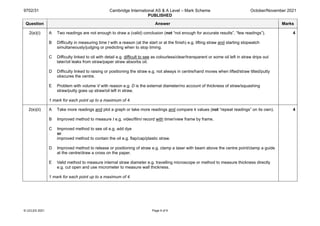
7(b) • reduces the gain
• greater bandwidth
• more stable
Any two points, 1 mark each
B2
7(c)(i) inverting amplifier B1
7(c)(ii) X marked anywhere between right-hand edge of 480Ω resistor, left-hand edge of 1.2kΩ resistor and the inverting input B1
7(c)(iii) gain = (–)Rf / Ri C1
= (–)1200 / 480
= –2.5
A1
7(c)(iv) VIN = 6.5 / (–2.5)
= –2.6 V
A1
7(c)(v) (–2.5) × (–5.4) = +13.5 V, and so output saturates
VOUT = (+)8.0 V
A1
9702/42 Cambridge International AS & A Level – Mark Scheme
PUBLISHED
October/November 2021
© UCLES 2021 Page 14 of 19
Question Answer Marks
8(a)(i) arrow from Q pointing downwards, labelled B B1
8(a)(ii) arrow from Q pointing towards P, labelled F B1
8(b)(i) force is proportional to product of both currents (I and 2I)
or
Newton’s third law
B1
forces are equal B1
8(b)(ii) opposite B1
9702/42 Cambridge International AS & A Level – Mark Scheme
PUBLISHED
October/November 2021
© UCLES 2021 Page 15 of 19
Question Answer Marks
9(a)(i) emission of electrons (from a metal surface) B1
when electromagnetic radiation is incident (on electrons) B1
9a(ii) minimum energy required for an electron to leave surface B1
9(b)(i) threshold (frequency) B1
9(b)(ii) • photons are (discrete) packets of energy
• energy of photons depends on frequency (of EM radiation)
• electrons can only absorb a single photon (of energy)
Any two points, 1 mark each
B2
emission only possible if photon energy is at least the work function B1
9(b)(iii) work function = hf0 = 6.63 × 10–34 × 6.93 × 1014 C1
= 4.59 × 10⁻¹⁹ (J)
= 4.59 × 10⁻¹⁹ / 1.60 × 10⁻¹⁹ (eV)
= 2.87 eV
A1
9702/42 Cambridge International AS & A Level – Mark Scheme
PUBLISHED
October/November 2021
© UCLES 2021 Page 16 of 19
Question Answer Marks
10(a)(i) to increase the magnetic flux linkage (between the coils) B1
10(a)(ii) to reduce energy losses B1
by reducing induced currents B1
10(b)(i) maximum VOUT = 12 000 × (625 / 25000)
= 300 V
A1
10(b)(ii) r.m.s. current = 300 / (640 × √2)
= 0.33 A
A1
10(b)(iii) sketch: sinusoidal shape in positive half of the graph, sitting with ‘minima’ resting on the time-axis (at P = 0) B1
each ‘cycle’ shown repeating every 20 ms B1
maximum P shown as 140 W B1
10(c) power curve is symmetrical about the midpoint (on the power axis) B1
mean power is half the peak power B1
9702/42 Cambridge International AS & A Level – Mark Scheme
PUBLISHED
October/November 2021
© UCLES 2021 Page 17 of 19
Question Answer Marks
11(a) generates ultrasound B1
detects reflected ultrasound B1
applied p.d. causes crystal to vibrate
or
vibrations cause crystal to generate an e.m.f.
B1
11(b)(i) product of density and speed M1
speed of ultrasound in medium A1
11(b)(ii) difference between (the specific acoustic impedances) C1
• if similar/same then reflection coefficient is zero/very low
• if very different then reflection coefficient is (nearly) 1
• the lower the difference means lower the reflection coefficient
(any one point)
A1
9702/42 Cambridge International AS & A Level – Mark Scheme
PUBLISHED
October/November 2021
© UCLES 2021 Page 18 of 19
Question Answer Marks
12(a)(i) cannot predict when a particular nucleus will decay
or
cannot predict which nucleus will decay next
B1
12(a)(ii) (decay is) not affected by external (environmental) factors B1
12(b)(i) A = A0 exp (–λt) and so ln A = ln A0 – λt
gradient of line = (–)λ
C1
λ = (36.4 – 35.0) / (20 – 0)
( = 0.07(0) min–1)
C1
half-life = ln 2 / λ
= ln 2 / 0.070
= 10 min
A1
or
A0 = exp (–36.4) = 6.43 × 10¹⁵ (Bq) (C1)
A0 / 2 = 3.21 × 10¹⁵ (Bq), so ln (A0 / 2) = 35.7 (C1)
read off half-life = 10 min (A1)
or
(at one half-life,) ln A = 36.4 – ln 2 (C1)
= 35.7 (C1)
read off half-life = 10 min (A1)
9702/42 Cambridge International AS & A Level – Mark Scheme
PUBLISHED
October/November 2021
© UCLES 2021 Page 19 of 19
Question Answer Marks
12(b)(ii) A = λN C1
N = mass / (nucleon number × u)
or
N = (mass / nucleon number) × NA
C1
exp(36.4) = (1.17 × 10–3 × 5.66 × 10–7) / (nucleon number × 1.66 × 10⁻²⁷)
or
exp(36.4) = (1.17 × 10–3 × 5.66 × 10–4 × 6.02 × 1023) / nucleon number
nucleon number = 62
A1
This document consists of 15 printed pages.
© UCLES 2021 [Turn over
Cambridge International AS & A Level
PHYSICS 9702/43
Paper 4 A Level Structured Questions October/November 2021
MARK SCHEME
Maximum Mark: 100
Published
This mark scheme is published as an aid to teachers and candidates, to indicate the requirements of the
examination. It shows the basis on which Examiners were instructed to award marks. It does not indicate the
details of the discussions that took place at an Examiners’ meeting before marking began, which would have
considered the acceptability of alternative answers.
Mark schemes should be read in conjunction with the question paper and the Principal Examiner Report for
Teachers.
Cambridge International will not enter into discussions about these mark schemes.
Cambridge International is publishing the mark schemes for the October/November 2021 series for most
Cambridge IGCSE™, Cambridge International A and AS Level components and some Cambridge O Level
components.
9702/43 Cambridge International AS & A Level – Mark Scheme
PUBLISHED
October/November 2021
© UCLES 2021 Page 2 of 15
Generic Marking Principles
These general marking principles must be applied by all examiners when marking candidate answers. They should be applied alongside the
specific content of the mark scheme or generic level descriptors for a question. Each question paper and mark scheme will also comply with these
marking principles.
GENERIC MARKING PRINCIPLE 1:
Marks must be awarded in line with:
• the specific content of the mark scheme or the generic level descriptors for the question
• the specific skills defined in the mark scheme or in the generic level descriptors for the question
• the standard of response required by a candidate as exemplified by the standardisation scripts.
GENERIC MARKING PRINCIPLE 2:
Marks awarded are always whole marks (not half marks, or other fractions).
GENERIC MARKING PRINCIPLE 3:
Marks must be awarded positively:
• marks are awarded for correct/valid answers, as defined in the mark scheme. However, credit is given for valid answers which go beyond
the scope of the syllabus and mark scheme, referring to your Team Leader as appropriate
• marks are awarded when candidates clearly demonstrate what they know and can do
• marks are not deducted for errors
• marks are not deducted for omissions
• answers should only be judged on the quality of spelling, punctuation and grammar when these features are specifically assessed by the
question as indicated by the mark scheme. The meaning, however, should be unambiguous.
GENERIC MARKING PRINCIPLE 4:
Rules must be applied consistently, e.g. in situations where candidates have not followed instructions or in the application of generic level
descriptors.
9702/43 Cambridge International AS & A Level – Mark Scheme
PUBLISHED
October/November 2021
© UCLES 2021 Page 3 of 15
GENERIC MARKING PRINCIPLE 5:
Marks should be awarded using the full range of marks defined in the mark scheme for the question (however; the use of the full mark range
may be limited according to the quality of the candidate responses seen).
GENERIC MARKING PRINCIPLE 6:
Marks awarded are based solely on the requirements as defined in the mark scheme. Marks should not be awarded with grade thresholds or
grade descriptors in mind.
Science-Specific Marking Principles
1 Examiners should consider the context and scientific use of any keywords when awarding marks. Although keywords may be present, marks
should not be awarded if the keywords are used incorrectly.
2 The examiner should not choose between contradictory statements given in the same question part, and credit should not be awarded for
any correct statement that is contradicted within the same question part. Wrong science that is irrelevant to the question should be ignored.
3 Although spellings do not have to be correct, spellings of syllabus terms must allow for clear and unambiguous separation from other
syllabus terms with which they may be confused (e.g. ethane / ethene, glucagon / glycogen, refraction / reflection).
4 The error carried forward (ecf) principle should be applied, where appropriate. If an incorrect answer is subsequently used in a scientifically
correct way, the candidate should be awarded these subsequent marking points. Further guidance will be included in the mark scheme
where necessary and any exceptions to this general principle will be noted.
5 ‘List rule’ guidance
For questions that require n responses (e.g. State two reasons …):
• The response should be read as continuous prose, even when numbered answer spaces are provided.
• Any response marked ignore in the mark scheme should not count towards n.
• Incorrect responses should not be awarded credit but will still count towards n.
• Read the entire response to check for any responses that contradict those that would otherwise be credited. Credit should not be
awarded for any responses that are contradicted within the rest of the response. Where two responses contradict one another, this
should be treated as a single incorrect response.
• Non-contradictory responses after the first n responses may be ignored even if they include incorrect science.
9702/43 Cambridge International AS & A Level – Mark Scheme
PUBLISHED
October/November 2021
© UCLES 2021 Page 4 of 15
6 Calculation specific guidance
Correct answers to calculations should be given full credit even if there is no working or incorrect working, unless the question states ‘show
your working’.
For questions in which the number of significant figures required is not stated, credit should be awarded for correct answers when rounded
by the examiner to the number of significant figures given in the mark scheme. This may not apply to measured values.
For answers given in standard form (e.g. a × 10n) in which the convention of restricting the value of the coefficient (a) to a value between 1
and 10 is not followed, credit may still be awarded if the answer can be converted to the answer given in the mark scheme.
Unless a separate mark is given for a unit, a missing or incorrect unit will normally mean that the final calculation mark is not awarded.
Exceptions to this general principle will be noted in the mark scheme.
7 Guidance for chemical equations
Multiples / fractions of coefficients used in chemical equations are acceptable unless stated otherwise in the mark scheme.
State symbols given in an equation should be ignored unless asked for in the question or stated otherwise in the mark scheme.
9702/43 Cambridge International AS & A Level – Mark Scheme
PUBLISHED
October/November 2021
© UCLES 2021 Page 5 of 15
Abbreviations
/ Alternative and acceptable answers for the same marking point.
( ) Bracketed content indicates words which do not need to be explicitly seen to gain credit but which indicate the context for an answer.
The context does not need to be seen but if a context is given that is incorrect then the mark should not be awarded.
___ Underlined content must be present in answer to award the mark. This means either the exact word or another word that has the
same technical meaning.
Mark categories
B marks These are independent marks, which do not depend on other marks. For a B mark to be awarded, the point to which it refers must be
seen specifically in the candidate’s answer.
M marks These are method marks upon which A marks later depend. For an M mark to be awarded, the point to which it refers must be seen
specifically in the candidate’s answer. If a candidate is not awarded an M mark, then the later A mark cannot be awarded either.
C marks These are compensatory marks which can be awarded even if the points to which they refer are not written down by the candidate,
providing subsequent working gives evidence that they must have known them. For example, if an equation carries a C mark and the
candidate does not write down the actual equation but does correct working which shows the candidate knew the equation, then the
C mark is awarded.
If a correct answer is given to a numerical question, all of the preceding C marks are awarded automatically. It is only necessary to
consider each of the C marks in turn when the numerical answer is not correct.
A marks These are answer marks. They may depend on an M mark or allow a C mark to be awarded by implication.
Annotations
 Indicates the point at which a mark has been awarded.
X Indicates an incorrect answer or a point at which a decision is made not to award a mark.
XP Indicates a physically incorrect equation (‘incorrect physics’). No credit is given for substitution, or subsequent arithmetic, in a
physically incorrect equation.
9702/43 Cambridge International AS & A Level – Mark Scheme
PUBLISHED
October/November 2021
© UCLES 2021 Page 6 of 15
ECF Indicates ‘error carried forward’. Answers to later numerical questions can always be awarded up to full credit provided they are
consistent with earlier incorrect answers. Within a section of a numerical question, ECF can be given after AE, TE and POT errors,
but not after XP.
AE Indicates an arithmetic error. Do not allow the mark where the error occurs. Then follow through the working/calculation giving full
subsequent ECF if there are no further errors.
POT Indicates a power of ten error. Do not allow the mark where the error occurs. Then follow through the working/calculation giving full
subsequent ECF if there are no further errors.
TE Indicates incorrect transcription of the correct data from the question, a graph, data sheet or a previous answer. For example, the
value of 1.6 × 10⁻¹⁹ has been written down as 6.1 × 10⁻¹⁹ or 1.6 × 10¹⁹.
Do not allow the mark where the error occurs. Then follow through the working/calculation giving full subsequent ECF if there are no
further errors.
SF Indicates that the correct answer is seen in the working but the final answer is incorrect as it is expressed to too few significant
figures.
BOD Indicates that a mark is awarded where the candidate provides an answer that is not totally satisfactory, but the examiner feels that
sufficient work has been done (‘benefit of doubt’).
CON Indicates that a response is contradictory.
I Indicates parts of a response that have been seen but disregarded as irrelevant.
M0 Indicates where an A category mark has not been awarded due to the M category mark upon which it depends not having previously
been awarded.
^ Indicates where more is needed for a mark to be awarded (what is written is not wrong, but not enough). May also be used to
annotate a response space that has been left completely blank.
SEEN Indicates that a page has been seen.
9702/43 Cambridge International AS & A Level – Mark Scheme
PUBLISHED
October/November 2021
© UCLES 2021 Page 7 of 15
Question Answer Marks
1(a) constant speed or constant magnitude of velocity B1
acceleration (always) perpendicular to velocity B1
1(b)(i) F = mv2 / r
or
v = rω and F = mrω2
C1
F = 790 × 942 / 318
= 22000 N
A1
1(b)(ii) centripetal acceleration: same B1
maximum speed: greater B1
time taken for one lap of the track: greater B1
9702/43 Cambridge International AS & A Level – Mark Scheme
PUBLISHED
October/November 2021
© UCLES 2021 Page 8 of 15
Question Answer Marks
2(a) work done per unit mass B1
(work done in) moving mass from infinity B1
2(b)(i) (gravitational) fields from the Earth and Moon are in opposite directions B1
(resultant is zero where gravitational) fields are equal (in magnitude) B1
2(b)(ii) g ∝ M / r2 C1
5.98 × 1024 / x2 = 7.35 × 10²² / (3.84 × 10⁸ – x)2
leading to x = 3.5 × 10⁸ (m)
A1
2(b)(iii) φ (Earth) = (–)6.67 × 10–11 × (5.98 × 1024 / 3.5 × 10⁸)
and
φ (Moon) = (–)6.67 × 10–11 × (7.35 × 1022 / 0.38 × 10⁸)
C1
φ = (–)6.67 × 10⁻¹¹ × [(5.98 × 1024 / 3.5 × 10⁸) + (7.35 × 10²² / 0.38 × 10⁸)] C1
= – 1.3 × 10⁶ J kg–1 A1
9702/43 Cambridge International AS & A Level – Mark Scheme
PUBLISHED
October/November 2021
© UCLES 2021 Page 9 of 15
Question Answer Marks
3(a) (thermal) energy per unit mass (to cause temperature change) B1
(thermal) energy per unit change in temperature B1
3(b)(i) (T =) pV / Nk B1
3(b)(ii) (pV =) NkT = ⅓Nm<c2>
or
pV = NkT and pV = ⅓Nm<c2>
M1
leading to ½m<c2> = (3/2)kT and ½m<c2> = EK A1
3(b)(iii) internal energy = ΣEK (of molecules) + ΣEP (of molecules)
or
no forces between molecules
B1
potential energy of molecules is zero B1
3(c)(i) increase in internal energy = Q + work done B1
constant volume so no work done B1
3(c)(ii) c = Q / NmΔT C1
= [N × (3/2)kΔT] / (NmΔT) = 3k / 2m A1
3(d) (as it expands) gas does work (against the atmosphere/external pressure) B1
for same temperature rise) more (thermal) energy needed, so larger specific heat capacity B1
9702/43 Cambridge International AS & A Level – Mark Scheme
PUBLISHED
October/November 2021
© UCLES 2021 Page 10 of 15
Question Answer Marks
4(a)(i) 5.0 cm A1
4(a)(ii) ω = 2π / T
or
ω = 2πf and f = 1 / T
C1
ω = 2π / 4.0
= 1.6 rad s–1
A1
4(a)(iii) v0 = ωx0 C1
= 1.57 × 5.0
= 7.9 cm s–1
A1
4(b) • initial pull was to the right
• distance from X to trolley (at equilibrium) is 20 cm
• period is 4.0 s
• initial motion undamped
• motion becomes damped at/from 12 s
• damping is light
• maximum speed at 1s, 3s, etc. / stationary at 2s, 4s, etc.
Any three points, 1 mark each
B3
4(c) sketch: closed loop encircling (20, 0) B1
minimum L shown as 15 cm and maximum L shown as 25 cm B1
minimum v shown as –7.9 cm s–1 and maximum v shown as +7.9 cm s–1 B1
9702/43 Cambridge International AS & A Level – Mark Scheme
PUBLISHED
October/November 2021
© UCLES 2021 Page 11 of 15
Question Answer Marks
5(a) • noise can be removed/signal can be regenerated
• extra bits can be added for error-checking
• signal can be encrypted (for increased security)
• data compression/multiplexing is possible
Any two points, 1 mark each
B2
5(b)(i) 4ms: 0101 and 8ms: 0100 B1
5(b)(ii) sketch: horizontal line continues to 8ms, then new horizontal line from 8ms to 12ms B1
level of line after 8ms is 4 mV B1
5(c) sketch: series of steps of width 2ms B1
step heights at 0, 2, 4, 6, 4, 6 mV
2 marks if all correct, 1 mark if only one incorrect
B2
Question Answer Marks
6(a) Q = CV and E = ½CV2 B1
6(b)(i) CN = CL / (L – D) B1
6(b)(ii) (charge is unchanged by moving the plates so) QN = CV B1
6(b)(iii) VN = QN / CN
= (CV) / [CL / (L – D)]
= V(L – D) / L
B1
6(c) oppositely charged plates attract, so energy stored decreases B1
9702/43 Cambridge International AS & A Level – Mark Scheme
PUBLISHED
October/November 2021
© UCLES 2021 Page 12 of 15
Question Answer Marks
7(a) • infinite (open-loop) gain
• infinite slew rate
• infinite input impedance
• zero output impedance
• infinite bandwidth
Any two points, 1 mark each
B2
7(b) X: thermistor and Y: relay B1
7(c)(i) (any) difference in voltage at the inputs causes output to saturate (because gain is very large) B1
saturates positively if V+ > V– and saturates negatively if V+ < V– B1
7(c)(ii) comparator B1
7(c)(iii) temperature M1
above a particular value A1
7(c)(iv) to adjust the temperature (at which the lamp illuminates/extinguishes) B1
9702/43 Cambridge International AS & A Level – Mark Scheme
PUBLISHED
October/November 2021
© UCLES 2021 Page 13 of 15
Question Answer Marks
8(a) newton per ampere per metre M1
where current/wire is perpendicular to magnetic field A1
8(b)(i) F = BILsinθ C1
B = 1.0 / (5.0 × 0.060 × sin 50°)
= 4.4 mT
A1
8(b)(ii) (from Fleming’s left-hand rule) force on wire is upwards, so reading decreases B1
8(b)(iii) frame will rotate (so that PQ becomes perpendicular to the field) B1
Question Answer Marks
9(a) constant voltage M1
that produces/dissipates same power as (the mean power of) the alternating voltage A1
9(b)(i) (maximum) rate of cutting of (magnetic) flux doubles B1
(peak and hence) r.m.s. induced e.m.f. doubles B1
9(b)(ii) sketch: (sinusoidal) wave of period 10 ms B1
peak E shown as ± 34V
(1 mark out of 2 awarded if peak E shown as ± 17V or ± 24V)
B2
9(c) current in the coil results in forces that oppose its rotation
or
current in the resistor dissipates the energy of rotation
B1
coil stops rotating B1
9702/43 Cambridge International AS & A Level – Mark Scheme
PUBLISHED
October/November 2021
© UCLES 2021 Page 14 of 15
Question Answer Marks
10(a)(i) photoelectric effect B1
10(a)(ii) electron diffraction B1
10(b)(i) λ = h / p M1
h is the Planck constant A1
10(b)(ii) de Broglie (wavelength) B1
10(c)(i) ½mv2 = eV C1
½ × 9.11 × 10–31 × v2 = 1.60 × 10–19 × 4800 so v = 4.1 × 10⁷ m s–1 A1
10(c)(ii) λ = h / mv
= 6.63 × 10⁻³⁴ / (9.11 × 10–31 × 4.1 × 107)
C1
= 1.8 × 10⁻¹¹ m A1
9702/43 Cambridge International AS & A Level – Mark Scheme
PUBLISHED
October/November 2021
© UCLES 2021 Page 15 of 15
Question Answer Marks
11(a)(i) ease with which edges can be distinguished B1
11(a)(ii) difference in degrees of blackening B1
11(b) I = I0 exp (–μx) C1
0.12 = exp (–μ × 2.3)
ln 0.12 = –2.3 × μ
C1
μ = 0.92 cm–1 A1
11(c) advantage: produces 3-dimensional image B1
disadvantage: (much) greater exposure to radiation B1
Question Answer Marks
12(a) probability of decay (of a nucleus) M1
per unit time A1
12(b) A = λN C1
N = mass / (nucleon number × u) C1
2.92 × 109 = (λ × 5.87 × 10⁻¹⁰) / (131 × 1.66 × 10–27)
λ = 1.08 × 10⁻⁶ s–1
A1
12(c) • sample emits radiation in all directions
• some radiation is absorbed by air/detector window
• self-absorption within the source
• dead time/inefficiency of detector
Any two points, 1 mark each
B2
This document consists of 11 printed pages.
© UCLES 2021 [Turn over
Cambridge International AS & A Level
PHYSICS 9702/51
Paper 5 Planning, Analysis and Evaluation October/November 2021
MARK SCHEME
Maximum Mark: 30
Published
This mark scheme is published as an aid to teachers and candidates, to indicate the requirements of the
examination. It shows the basis on which Examiners were instructed to award marks. It does not indicate the
details of the discussions that took place at an Examiners’ meeting before marking began, which would have
considered the acceptability of alternative answers.
Mark schemes should be read in conjunction with the question paper and the Principal Examiner Report for
Teachers.
Cambridge International will not enter into discussions about these mark schemes.
Cambridge International is publishing the mark schemes for the October/November 2021 series for most
Cambridge IGCSE™, Cambridge International A and AS Level components and some Cambridge O Level
components.
9702/51 Cambridge International AS & A Level – Mark Scheme
PUBLISHED
October/November 2021
© UCLES 2021 Page 2 of 11
Generic Marking Principles
These general marking principles must be applied by all examiners when marking candidate answers. They should be applied alongside the
specific content of the mark scheme or generic level descriptors for a question. Each question paper and mark scheme will also comply with these
marking principles.
GENERIC MARKING PRINCIPLE 1:
Marks must be awarded in line with:
• the specific content of the mark scheme or the generic level descriptors for the question
• the specific skills defined in the mark scheme or in the generic level descriptors for the question
• the standard of response required by a candidate as exemplified by the standardisation scripts.
GENERIC MARKING PRINCIPLE 2:
Marks awarded are always whole marks (not half marks, or other fractions).
GENERIC MARKING PRINCIPLE 3:
Marks must be awarded positively:
• marks are awarded for correct/valid answers, as defined in the mark scheme. However, credit is given for valid answers which go beyond the
scope of the syllabus and mark scheme, referring to your Team Leader as appropriate
• marks are awarded when candidates clearly demonstrate what they know and can do
• marks are not deducted for errors
• marks are not deducted for omissions
• answers should only be judged on the quality of spelling, punctuation and grammar when these features are specifically assessed by the
question as indicated by the mark scheme. The meaning, however, should be unambiguous.
GENERIC MARKING PRINCIPLE 4:
Rules must be applied consistently, e.g. in situations where candidates have not followed instructions or in the application of generic level
descriptors.
9702/51 Cambridge International AS & A Level – Mark Scheme
PUBLISHED
October/November 2021
© UCLES 2021 Page 3 of 11
GENERIC MARKING PRINCIPLE 5:
Marks should be awarded using the full range of marks defined in the mark scheme for the question (however; the use of the full mark range may
be limited according to the quality of the candidate responses seen).
GENERIC MARKING PRINCIPLE 6:
Marks awarded are based solely on the requirements as defined in the mark scheme. Marks should not be awarded with grade thresholds or
grade descriptors in mind.
Science-Specific Marking Principles
1 Examiners should consider the context and scientific use of any keywords when awarding marks. Although keywords may be present, marks
should not be awarded if the keywords are used incorrectly.
2 The examiner should not choose between contradictory statements given in the same question part, and credit should not be awarded for any
correct statement that is contradicted within the same question part. Wrong science that is irrelevant to the question should be ignored.
3 Although spellings do not have to be correct, spellings of syllabus terms must allow for clear and unambiguous separation from other syllabus
terms with which they may be confused (e.g. ethane / ethene, glucagon / glycogen, refraction / reflection).
4 The error carried forward (ecf) principle should be applied, where appropriate. If an incorrect answer is subsequently used in a scientifically
correct way, the candidate should be awarded these subsequent marking points. Further guidance will be included in the mark scheme where
necessary and any exceptions to this general principle will be noted.
5 ‘List rule’ guidance
For questions that require n responses (e.g. State two reasons …):
• The response should be read as continuous prose, even when numbered answer spaces are provided.
• Any response marked ignore in the mark scheme should not count towards n.
• Incorrect responses should not be awarded credit but will still count towards n.
• Read the entire response to check for any responses that contradict those that would otherwise be credited. Credit should not be
awarded for any responses that are contradicted within the rest of the response. Where two responses contradict one another, this should
be treated as a single incorrect response.
• Non-contradictory responses after the first n responses may be ignored even if they include incorrect science.
9702/51 Cambridge International AS & A Level – Mark Scheme
PUBLISHED
October/November 2021
© UCLES 2021 Page 4 of 11
6 Calculation specific guidance
Correct answers to calculations should be given full credit even if there is no working or incorrect working, unless the question states ‘show
your working’.
For questions in which the number of significant figures required is not stated, credit should be awarded for correct answers when rounded by
the examiner to the number of significant figures given in the mark scheme. This may not apply to measured values.
For answers given in standard form (e.g. a × 10n) in which the convention of restricting the value of the coefficient (a) to a value between 1
and 10 is not followed, credit may still be awarded if the answer can be converted to the answer given in the mark scheme.
Unless a separate mark is given for a unit, a missing or incorrect unit will normally mean that the final calculation mark is not awarded.
Exceptions to this general principle will be noted in the mark scheme.
7 Guidance for chemical equations
Multiples / fractions of coefficients used in chemical equations are acceptable unless stated otherwise in the mark scheme.
State symbols given in an equation should be ignored unless asked for in the question or stated otherwise in the mark scheme.
9702/51 Cambridge International AS & A Level – Mark Scheme
PUBLISHED
October/November 2021
© UCLES 2021 Page 5 of 11
Annotations
 Correct point
Method of analysis marks in Question 1
1–10 Additional detail marks in Question 1
X Incorrect point
^ Omission
BOD Benefit of the doubt
NBOD No benefit of the doubt given
ECF Error carried forward
P Defining the problem marks in Question 1
Power of ten error in Question 2
M0 Methods of data collection marks in Question 1
SF Incorrect number of significant figures
9702/51 Cambridge International AS & A Level – Mark Scheme
PUBLISHED
October/November 2021
© UCLES 2021 Page 6 of 11
Question Answer Marks
1 Defining the problem
diameter/d is the independent variable and frequency/f is the dependent variable or vary d and measure f 1
keep L constant or length (of tube) constant 1
Methods of data collection
labelled diagram of workable experiment including:
• tube supported
• (loud)speaker positioned in line with the tube
• (loud)speaker labelled
1
labelled microphone, positioned outside tube in line with tube, connected to labelled oscilloscope or correct circuit symbol 1
adjust/change frequency until maximum amplitude detected 1
use calipers to measure d 1
9702/51 Cambridge International AS & A Level – Mark Scheme
PUBLISHED
October/November 2021
© UCLES 2021 Page 7 of 11
Question Answer Marks
1 Method of analysis
plot a graph of
1
f
against d or d against
1
f
(Do not accept logarithmic graphs.)
1
for
1
f
against d
or
for d against
1
f
2
-intercept
L
v
y
=
v = gradient × k
or
gradient 2
-intercept
L
v
y
×
=−
1
for
1
f
against d
or
for d against
1
f
k = gradient × v
or
gradient 2
-intercept
L
k
y
×
=
2
-intercept
L
k
y
= −
1
9702/51 Cambridge International AS & A Level – Mark Scheme
PUBLISHED
October/November 2021
© UCLES 2021 Page 8 of 11
Question Answer Marks
1 Additional detail including safety considerations 6
D1 wear ear defenders (to prevent damage to hearing/to avoid loud sounds)
or
use a low volume to prevent damage to hearing/to avoid loud sounds
D2 use a rule to measure L
D3 increase frequency from a low frequency to the first maximum amplitude
D4 method to determine f at maximum amplitude, e.g. increase frequency to f, then continue increasing frequency, and
then decrease frequency until value of f determined
D5 method to determine period from oscilloscope, e.g. no. of divisions × time-base
D6 for frequency/time period determined by oscilloscope, f = 1 / T
D7 repeat measurements of d and average in different directions/positions or along the tube
D8 perform experiment in a quiet room
D9 signal generator connected to (loud)speaker in diagram
D10 relationship valid if a straight line produced
(Do not accept through the origin.)
9702/51 Cambridge International AS & A Level – Mark Scheme
PUBLISHED
October/November 2021
© UCLES 2021 Page 9 of 11
Question Answer Marks
2(a)
gradient = –
t
C
y-intercept = ln E
1
2(b)
(R1 + R2) / kΩ
1 2
1
R R
+
 / 10–6 Ω
55 (± 3) 18 or 18.2 ± 0.9
69 (± 3 or 4) 14 or 14.5 ± 0.7
90 (± 4 or 5) 11 or 11.1 ± 0.6
80 (± 4) 13 or 12.5 ± 0.6
101 (± 5) 9.9 or 9.90 or 9.901 ± 0.5
115 (± 6) 8.7 or 8.70 or 8.696 ± 0.4
Values of (R1 + R2) and
1 2
1
R R
+
correct as shown above.
1
Absolute uncertainties in
1 2
1
R R
+
from ± 0.9 or ± 1 to ± 0.4 or ± 0.5.
1
2(c)(i) Six points plotted correctly.
Must be accurate to half a small square. Diameter of points must be less than half a small square.
1
Error bars in
1 2
1
R R
+
plotted correctly.
All error bars must be plotted. Total length of bar must be accurate to less than half a small square and symmetrical.
1
9702/51 Cambridge International AS & A Level – Mark Scheme
PUBLISHED
October/November 2021
© UCLES 2021 Page 10 of 11
Question Answer Marks
2(c)(ii) Line of best fit drawn.
Points must be balanced. Do not accept line from top point to bottom point.
Line must pass between (10.2, 1.10) and (10.8, 1.10) and between (16.7, 0.40) and (17.2, 0.40).
1
Worst acceptable line drawn (steepest or shallowest possible line that passes through all error bars).
All error bars must be plotted.
1
2(c)(iii) Negative gradient determined with clear substitution of data points into Δy/Δx.
Distance between data points must be at least half the length of the drawn line.
1
Gradient of worst acceptable line determined.
uncertainty = (gradient of line of best fit – gradient of worst acceptable line)
or
uncertainty = ½ (steepest worst line gradient – shallowest worst line gradient)
1
2(c)(iv) y-intercept determined by substitution of point on line into y = mx + c. 1
y-intercept of worst acceptable line determined by substitution of point on line into y = mx + c.
uncertainty = y-intercept of line of best fit – y-intercept of worst acceptable line
or
uncertainty = ½ (steepest worst line y-intercept – shallowest worst line y-intercept)
Do not accept ECF from false origin method.
1
2(d)(i) C determined using gradient and C and E both given to two or three significant figures.
60
gradient
t
C = − = −
(c)(iii)
1
E determined using y-intercept and C and E both given with correct SI unit.
= -intercept
ey
E
unit of C: F or C V–1 or s Ω–1
unit of E: V
1
9702/51 Cambridge International AS & A Level – Mark Scheme
PUBLISHED
October/November 2021
© UCLES 2021 Page 11 of 11
Question Answer Marks
2(d)(ii) Percentage uncertainty determined with method shown.
 
Δ
= + ×
 
 
1 gradient
percentage uncertainty 100
60 gradient
Clear substitution must be shown for maximum/minimum methods.
1
2(e) (R1 + R2) determined to at least two significant figures from (d)(i) or (c)(iii) and (c)(iv) with correct substitution including
signs and correct power of ten(s).
Do not accept ECF for POT from (c)(iii), (c)(iv) or (d).
( )
1 2
1 60 1
ln ln
ln
t
R R
V
C C V E
E
+ = − × = − ×
−
or
( )
+ = =
− −
1 2
gradient
ln5.0 -intercept 1.61
R R
y
(c)(iii)
(c)(iv)
1
This document consists of 10 printed pages.
© UCLES 2021 [Turn over
Cambridge International AS & A Level
PHYSICS 9702/52
Paper 5 Planning, Analysis and Evaluation October/November 2021
MARK SCHEME
Maximum Mark: 30
Published
This mark scheme is published as an aid to teachers and candidates, to indicate the requirements of the
examination. It shows the basis on which Examiners were instructed to award marks. It does not indicate the
details of the discussions that took place at an Examiners’ meeting before marking began, which would have
considered the acceptability of alternative answers.
Mark schemes should be read in conjunction with the question paper and the Principal Examiner Report for
Teachers.
Cambridge International will not enter into discussions about these mark schemes.
Cambridge International is publishing the mark schemes for the October/November 2021 series for most
Cambridge IGCSE™, Cambridge International A and AS Level components and some Cambridge O Level
components.
9702/52 Cambridge International AS & A Level – Mark Scheme
PUBLISHED
October/November 2021
© UCLES 2021 Page 2 of 10
Generic Marking Principles
These general marking principles must be applied by all examiners when marking candidate answers. They should be applied alongside the
specific content of the mark scheme or generic level descriptors for a question. Each question paper and mark scheme will also comply with these
marking principles.
GENERIC MARKING PRINCIPLE 1:
Marks must be awarded in line with:
• the specific content of the mark scheme or the generic level descriptors for the question
• the specific skills defined in the mark scheme or in the generic level descriptors for the question
• the standard of response required by a candidate as exemplified by the standardisation scripts.
GENERIC MARKING PRINCIPLE 2:
Marks awarded are always whole marks (not half marks, or other fractions).
GENERIC MARKING PRINCIPLE 3:
Marks must be awarded positively:
• marks are awarded for correct/valid answers, as defined in the mark scheme. However, credit is given for valid answers which go beyond the
scope of the syllabus and mark scheme, referring to your Team Leader as appropriate
• marks are awarded when candidates clearly demonstrate what they know and can do
• marks are not deducted for errors
• marks are not deducted for omissions
• answers should only be judged on the quality of spelling, punctuation and grammar when these features are specifically assessed by the
question as indicated by the mark scheme. The meaning, however, should be unambiguous.
GENERIC MARKING PRINCIPLE 4:
Rules must be applied consistently, e.g. in situations where candidates have not followed instructions or in the application of generic level
descriptors.
9702/52 Cambridge International AS & A Level – Mark Scheme
PUBLISHED
October/November 2021
© UCLES 2021 Page 3 of 10
GENERIC MARKING PRINCIPLE 5:
Marks should be awarded using the full range of marks defined in the mark scheme for the question (however; the use of the full mark range may
be limited according to the quality of the candidate responses seen).
GENERIC MARKING PRINCIPLE 6:
Marks awarded are based solely on the requirements as defined in the mark scheme. Marks should not be awarded with grade thresholds or
grade descriptors in mind.
Science-Specific Marking Principles
1 Examiners should consider the context and scientific use of any keywords when awarding marks. Although keywords may be present, marks
should not be awarded if the keywords are used incorrectly.
2 The examiner should not choose between contradictory statements given in the same question part, and credit should not be awarded for any
correct statement that is contradicted within the same question part. Wrong science that is irrelevant to the question should be ignored.
3 Although spellings do not have to be correct, spellings of syllabus terms must allow for clear and unambiguous separation from other syllabus
terms with which they may be confused (e.g. ethane / ethene, glucagon / glycogen, refraction / reflection).
4 The error carried forward (ecf) principle should be applied, where appropriate. If an incorrect answer is subsequently used in a scientifically
correct way, the candidate should be awarded these subsequent marking points. Further guidance will be included in the mark scheme where
necessary and any exceptions to this general principle will be noted.
5 ‘List rule’ guidance
For questions that require n responses (e.g. State two reasons …):
• The response should be read as continuous prose, even when numbered answer spaces are provided.
• Any response marked ignore in the mark scheme should not count towards n.
• Incorrect responses should not be awarded credit but will still count towards n.
• Read the entire response to check for any responses that contradict those that would otherwise be credited. Credit should not be
awarded for any responses that are contradicted within the rest of the response. Where two responses contradict one another, this should
be treated as a single incorrect response.
• Non-contradictory responses after the first n responses may be ignored even if they include incorrect science.
9702/52 Cambridge International AS & A Level – Mark Scheme
PUBLISHED
October/November 2021
© UCLES 2021 Page 4 of 10
6 Calculation specific guidance
Correct answers to calculations should be given full credit even if there is no working or incorrect working, unless the question states ‘show
your working’.
For questions in which the number of significant figures required is not stated, credit should be awarded for correct answers when rounded by
the examiner to the number of significant figures given in the mark scheme. This may not apply to measured values.
For answers given in standard form (e.g. a × 10n) in which the convention of restricting the value of the coefficient (a) to a value between 1
and 10 is not followed, credit may still be awarded if the answer can be converted to the answer given in the mark scheme.
Unless a separate mark is given for a unit, a missing or incorrect unit will normally mean that the final calculation mark is not awarded.
Exceptions to this general principle will be noted in the mark scheme.
7 Guidance for chemical equations
Multiples / fractions of coefficients used in chemical equations are acceptable unless stated otherwise in the mark scheme.
State symbols given in an equation should be ignored unless asked for in the question or stated otherwise in the mark scheme.
9702/52 Cambridge International AS & A Level – Mark Scheme
PUBLISHED
October/November 2021
© UCLES 2021 Page 5 of 10
Annotations
 Correct point
Method of analysis marks in Question 1
1–10 Additional detail marks in Question 1
X Incorrect point
^ Omission
BOD Benefit of the doubt
NBOD No benefit of the doubt given
ECF Error carried forward
P Defining the problem marks in Question 1
Power of ten error in Question 2
M0 Methods of data collection marks in Question 1
SF Incorrect number of significant figures
9702/52 Cambridge International AS & A Level – Mark Scheme
PUBLISHED
October/November 2021
© UCLES 2021 Page 6 of 10
Question Answer Marks
1 Defining the problem
θ is the independent variable and x is the dependent variable or vary θ and measure x 1
keep (angle) β constant 1
Methods of data collection
labelled diagram of workable experiment including:
• spring attached at both ends e.g. one end connected to a clamp and stand
• strip free to move
• at least two labels from: clamp, stand, wire, strip, spring, bench
(Do not accept extra masses added to strip.)
1
use a rule to measure L and d 1
use a protractor to measure θ
or
use a rule to measure appropriate distances to determine θ by trigonometry methods
1
measure original length of spring and new length of spring using rule/calipers 1
Method of analysis
plot a graph of x against cos θ or cos θ against x
(Allow log x against log (cos θ).)
1
relationship is valid if a straight line passing through the origin is produced
(Allow straight line with gradient = 1 for log-log graph.)
1
for x against cos θ
or
for cos θ against x
gradient 2 sin
kd
W
L
β
×
=
2 sin
gradient
kd
W
L
β
=
×
1
9702/52 Cambridge International AS & A Level – Mark Scheme
PUBLISHED
October/November 2021
© UCLES 2021 Page 7 of 10
Question Answer Marks
1 Additional detail including safety considerations 6
D1 wear goggles to prevent spring/wire/strip entering into eyes
or
(retort) stand used to support spring is clamped to bench
D2 keep distance d constant
D3 description of (separate) experiment to determine k, e.g. weigh mass and measure extension
D4 k = weight / extension or mg / extension or gradient of weight–extension graph for candidate’s workable (separate)
experiment
D5 method to prevent strip at point P sliding, e.g. use adhesive putty/hinge
(Do not accept methods that prevent rotation at point P.)
D6 use fiducial markers on spring at both ends or measure length of spring on both sides and average
D7 method to attach wire to strip, e.g. wire wrapped around the strip/(strong) tape/drill hole and tie wire
D8 determine x by subtracting original length of spring from new length
D9 adjust support of spring to keep β constant
D10 protractor correctly positioned on diagram to measure θ
or
correct trigonometric relationship given for θ
9702/52 Cambridge International AS & A Level – Mark Scheme
PUBLISHED
October/November 2021
© UCLES 2021 Page 8 of 10
Question Answer Marks
2(a) gradient = –μ
y-intercept = ln R0
1
2(b)
average t / mm ln (R / s–1)
0.16 ± 0.03 3.865 or 3.8649
0.25 ± 0.03 3.784 or 3.7842
0.42 ± 0.03 3.643 or 3.6428
0.56 ± 0.02 3.535 or 3.5351
0.66 ± 0.02 3.456 or 3.4563
0.76 ± 0.02 3.391 or 3.3911
Values of average t and ln R correct as shown above.
1
Absolute uncertainties in average t correct as shown above. 1
2(c)(i) Six points plotted correctly.
Must be accurate to nearest half a small square. Diameter of points must be less than half a small square.
1
Error bars in average t plotted correctly.
All error bars must be plotted. Total length of bar must be accurate to less than half a small square and symmetrical.
1
9702/52 Cambridge International AS & A Level – Mark Scheme
PUBLISHED
October/November 2021
© UCLES 2021 Page 9 of 10
Question Answer Marks
2(c)(ii) Line of best fit drawn.
Points must be balanced. Do not accept line from top point to bottom point.
Line must pass between (0.22, 3.80) and (0.24, 3.80) and between (0.60, 3.50) and (0.62, 3.50).
1
Worst acceptable line drawn (steepest or shallowest possible line that passes through all error bars).
All error bars must be plotted.
1
2(c)(iii) Negative gradient determined with clear substitution of data points into Δy / Δx.
Distance between data points must be at least half the length of the drawn line.
1
Gradient of worst acceptable line determined.
uncertainty = (gradient of line of best fit – gradient of worst acceptable line)
or
uncertainty = ½ (steepest worst line gradient – shallowest worst line gradient)
1
2(c)(iv) y-intercept determined by substitution of point on line into y = mx + c. 1
y-intercept of worst acceptable line determined by substitution of point on line into y = mx + c.
uncertainty = y-intercept of line of best fit – y-intercept of worst acceptable line
or
uncertainty = ½ (steepest worst line y-intercept – shallowest worst line y-intercept)
Do not accept ECF from false origin method.
1
9702/52 Cambridge International AS & A Level – Mark Scheme
PUBLISHED
October/November 2021
© UCLES 2021 Page 10 of 10
Question Answer Marks
2(d) μ = – gradient value
Do not accept negative values (from a negative gradient).
1
R0 determined using y-intercept and μ and R0 both given with valid SI unit.
-intercept
0 ey
R =
unit of μ: mm–1
unit of R0: s–1
1
absolute uncertainty in μ = absolute uncertainty in gradient
and
absolute uncertainty in R0 = intercept of WAL
0
ey
R
−
−
Correct substitution of numbers must be seen.
1
2(e) Value of t determined to two or three significant figures from (d) or (c)(iii) and (c)(iv) with correct substitution and correct
power of ten(s).
Do not accept ECF for POT from (c)(iii), (c)(iv) or (d).
0 0
ln ln ln20 ln
R R R
t
μ μ
− −
= =
− −
or
ln20 -intercept 2.996
gradient
y
t
− −
= =
(c)(iv)
(c)(iii)
1
This document consists of 11 printed pages.
© UCLES 2021 [Turn over
Cambridge International AS & A Level
PHYSICS 9702/53
Paper 5 Planning, Analysis and Evaluation October/November 2021
MARK SCHEME
Maximum Mark: 30
Published
This mark scheme is published as an aid to teachers and candidates, to indicate the requirements of the
examination. It shows the basis on which Examiners were instructed to award marks. It does not indicate the
details of the discussions that took place at an Examiners’ meeting before marking began, which would have
considered the acceptability of alternative answers.
Mark schemes should be read in conjunction with the question paper and the Principal Examiner Report for
Teachers.
Cambridge International will not enter into discussions about these mark schemes.
Cambridge International is publishing the mark schemes for the October/November 2021 series for most
Cambridge IGCSE™, Cambridge International A and AS Level components and some Cambridge O Level
components.
9702/53 Cambridge International AS & A Level – Mark Scheme
PUBLISHED
October/November 2021
© UCLES 2021 Page 2 of 11
Generic Marking Principles
These general marking principles must be applied by all examiners when marking candidate answers. They should be applied alongside the
specific content of the mark scheme or generic level descriptors for a question. Each question paper and mark scheme will also comply with these
marking principles.
GENERIC MARKING PRINCIPLE 1:
Marks must be awarded in line with:
• the specific content of the mark scheme or the generic level descriptors for the question
• the specific skills defined in the mark scheme or in the generic level descriptors for the question
• the standard of response required by a candidate as exemplified by the standardisation scripts.
GENERIC MARKING PRINCIPLE 2:
Marks awarded are always whole marks (not half marks, or other fractions).
GENERIC MARKING PRINCIPLE 3:
Marks must be awarded positively:
• marks are awarded for correct/valid answers, as defined in the mark scheme. However, credit is given for valid answers which go beyond the
scope of the syllabus and mark scheme, referring to your Team Leader as appropriate
• marks are awarded when candidates clearly demonstrate what they know and can do
• marks are not deducted for errors
• marks are not deducted for omissions
• answers should only be judged on the quality of spelling, punctuation and grammar when these features are specifically assessed by the
question as indicated by the mark scheme. The meaning, however, should be unambiguous.
GENERIC MARKING PRINCIPLE 4:
Rules must be applied consistently, e.g. in situations where candidates have not followed instructions or in the application of generic level
descriptors.
9702/53 Cambridge International AS & A Level – Mark Scheme
PUBLISHED
October/November 2021
© UCLES 2021 Page 3 of 11
GENERIC MARKING PRINCIPLE 5:
Marks should be awarded using the full range of marks defined in the mark scheme for the question (however; the use of the full mark range may
be limited according to the quality of the candidate responses seen).
GENERIC MARKING PRINCIPLE 6:
Marks awarded are based solely on the requirements as defined in the mark scheme. Marks should not be awarded with grade thresholds or
grade descriptors in mind.
Science-Specific Marking Principles
1 Examiners should consider the context and scientific use of any keywords when awarding marks. Although keywords may be present, marks
should not be awarded if the keywords are used incorrectly.
2 The examiner should not choose between contradictory statements given in the same question part, and credit should not be awarded for any
correct statement that is contradicted within the same question part. Wrong science that is irrelevant to the question should be ignored.
3 Although spellings do not have to be correct, spellings of syllabus terms must allow for clear and unambiguous separation from other syllabus
terms with which they may be confused (e.g. ethane / ethene, glucagon / glycogen, refraction / reflection).
4 The error carried forward (ecf) principle should be applied, where appropriate. If an incorrect answer is subsequently used in a scientifically
correct way, the candidate should be awarded these subsequent marking points. Further guidance will be included in the mark scheme where
necessary and any exceptions to this general principle will be noted.
5 ‘List rule’ guidance
For questions that require n responses (e.g. State two reasons …):
• The response should be read as continuous prose, even when numbered answer spaces are provided.
• Any response marked ignore in the mark scheme should not count towards n.
• Incorrect responses should not be awarded credit but will still count towards n.
• Read the entire response to check for any responses that contradict those that would otherwise be credited. Credit should not be
awarded for any responses that are contradicted within the rest of the response. Where two responses contradict one another, this should
be treated as a single incorrect response.
• Non-contradictory responses after the first n responses may be ignored even if they include incorrect science.
9702/53 Cambridge International AS & A Level – Mark Scheme
PUBLISHED
October/November 2021
© UCLES 2021 Page 4 of 11
6 Calculation specific guidance
Correct answers to calculations should be given full credit even if there is no working or incorrect working, unless the question states ‘show
your working’.
For questions in which the number of significant figures required is not stated, credit should be awarded for correct answers when rounded by
the examiner to the number of significant figures given in the mark scheme. This may not apply to measured values.
For answers given in standard form (e.g. a × 10n) in which the convention of restricting the value of the coefficient (a) to a value between 1
and 10 is not followed, credit may still be awarded if the answer can be converted to the answer given in the mark scheme.
Unless a separate mark is given for a unit, a missing or incorrect unit will normally mean that the final calculation mark is not awarded.
Exceptions to this general principle will be noted in the mark scheme.
7 Guidance for chemical equations
Multiples / fractions of coefficients used in chemical equations are acceptable unless stated otherwise in the mark scheme.
State symbols given in an equation should be ignored unless asked for in the question or stated otherwise in the mark scheme.
9702/53 Cambridge International AS & A Level – Mark Scheme
PUBLISHED
October/November 2021
© UCLES 2021 Page 5 of 11
Annotations
 Correct point
Method of analysis marks in Question 1
1–10 Additional detail marks in Question 1
X Incorrect point
^ Omission
BOD Benefit of the doubt
NBOD No benefit of the doubt given
ECF Error carried forward
P Defining the problem marks in Question 1
Power of ten error in Question 2
M0 Methods of data collection marks in Question 1
SF Incorrect number of significant figures
9702/53 Cambridge International AS & A Level – Mark Scheme
PUBLISHED
October/November 2021
© UCLES 2021 Page 6 of 11
Question Answer Marks
1 Defining the problem
diameter/d is the independent variable and frequency/f is the dependent variable or vary d and measure f 1
keep L constant or length (of tube) constant 1
Methods of data collection
labelled diagram of workable experiment including:
• tube supported
• (loud)speaker positioned in line with the tube
• (loud)speaker labelled
1
labelled microphone, positioned outside tube in line with tube, connected to labelled oscilloscope or correct circuit symbol 1
adjust/change frequency until maximum amplitude detected 1
use calipers to measure d 1
9702/53 Cambridge International AS & A Level – Mark Scheme
PUBLISHED
October/November 2021
© UCLES 2021 Page 7 of 11
Question Answer Marks
1 Method of analysis
plot a graph of
1
f
against d or d against
1
f
(Do not accept logarithmic graphs.)
1
for
1
f
against d
or
for d against
1
f
2
-intercept
L
v
y
=
v = gradient × k
or
gradient 2
-intercept
L
v
y
×
=−
1
for
1
f
against d
or
for d against
1
f
k = gradient × v
or
gradient 2
-intercept
L
k
y
×
=
2
-intercept
L
k
y
= −
1
9702/53 Cambridge International AS & A Level – Mark Scheme
PUBLISHED
October/November 2021
© UCLES 2021 Page 8 of 11
Question Answer Marks
1 Additional detail including safety considerations 6
D1 wear ear defenders (to prevent damage to hearing/to avoid loud sounds)
or
use a low volume to prevent damage to hearing/to avoid loud sounds
D2 use a rule to measure L
D3 increase frequency from a low frequency to the first maximum amplitude
D4 method to determine f at maximum amplitude, e.g. increase frequency to f, then continue increasing frequency, and
then decrease frequency until value of f determined
D5 method to determine period from oscilloscope, e.g. no. of divisions × time-base
D6 for frequency/time period determined by oscilloscope, f = 1 / T
D7 repeat measurements of d and average in different directions/positions or along the tube
D8 perform experiment in a quiet room
D9 signal generator connected to (loud)speaker in diagram
D10 relationship valid if a straight line produced
(Do not accept through the origin.)
9702/53 Cambridge International AS & A Level – Mark Scheme
PUBLISHED
October/November 2021
© UCLES 2021 Page 9 of 11
Question Answer Marks
2(a)
gradient = –
t
C
y-intercept = ln E
1
2(b)
(R1 + R2) / kΩ
1 2
1
R R
+
 / 10–6 Ω
55 (± 3) 18 or 18.2 ± 0.9
69 (± 3 or 4) 14 or 14.5 ± 0.7
90 (± 4 or 5) 11 or 11.1 ± 0.6
80 (± 4) 13 or 12.5 ± 0.6
101 (± 5) 9.9 or 9.90 or 9.901 ± 0.5
115 (± 6) 8.7 or 8.70 or 8.696 ± 0.4
Values of (R1 + R2) and
1 2
1
R R
+
correct as shown above.
1
Absolute uncertainties in
1 2
1
R R
+
from ± 0.9 or ± 1 to ± 0.4 or ± 0.5.
1
2(c)(i) Six points plotted correctly.
Must be accurate to half a small square. Diameter of points must be less than half a small square.
1
Error bars in
1 2
1
R R
+
plotted correctly.
All error bars must be plotted. Total length of bar must be accurate to less than half a small square and symmetrical.
1
9702/53 Cambridge International AS & A Level – Mark Scheme
PUBLISHED
October/November 2021
© UCLES 2021 Page 10 of 11
Question Answer Marks
2(c)(ii) Line of best fit drawn.
Points must be balanced. Do not accept line from top point to bottom point.
Line must pass between (10.2, 1.10) and (10.8, 1.10) and between (16.7, 0.40) and (17.2, 0.40).
1
Worst acceptable line drawn (steepest or shallowest possible line that passes through all error bars).
All error bars must be plotted.
1
2(c)(iii) Negative gradient determined with clear substitution of data points into Δy/Δx.
Distance between data points must be at least half the length of the drawn line.
1
Gradient of worst acceptable line determined.
uncertainty = (gradient of line of best fit – gradient of worst acceptable line)
or
uncertainty = ½ (steepest worst line gradient – shallowest worst line gradient)
1
2(c)(iv) y-intercept determined by substitution of point on line into y = mx + c. 1
y-intercept of worst acceptable line determined by substitution of point on line into y = mx + c.
uncertainty = y-intercept of line of best fit – y-intercept of worst acceptable line
or
uncertainty = ½ (steepest worst line y-intercept – shallowest worst line y-intercept)
Do not accept ECF from false origin method.
1
2(d)(i) C determined using gradient and C and E both given to two or three significant figures.
60
gradient
t
C = − = −
(c)(iii)
1
E determined using y-intercept and C and E both given with correct SI unit.
= -intercept
ey
E
unit of C: F or C V–1 or s Ω–1
unit of E: V
1
9702/53 Cambridge International AS & A Level – Mark Scheme
PUBLISHED
October/November 2021
© UCLES 2021 Page 11 of 11
Question Answer Marks
2(d)(ii) Percentage uncertainty determined with method shown.
 
Δ
= + ×
 
 
1 gradient
percentage uncertainty 100
60 gradient
Clear substitution must be shown for maximum/minimum methods.
1
2(e) (R1 + R2) determined to at least two significant figures from (d)(i) or (c)(iii) and (c)(iv) with correct substitution including
signs and correct power of ten(s).
Do not accept ECF for POT from (c)(iii), (c)(iv) or (d).
( )
1 2
1 60 1
ln ln
ln
t
R R
V
C C V E
E
+ = − × = − ×
−
or
( )
+ = =
− −
1 2
gradient
ln5.0 -intercept 1.61
R R
y
(c)(iii)
(c)(iv)
1

9702_w21_ms_all.pdf

  • 1.
    This document consistsof 3 printed pages. © UCLES 2021 [Turn over Cambridge International AS & A Level PHYSICS 9702/11 Paper 1 Multiple Choice October/November 2021 MARK SCHEME Maximum Mark: 40 Published This mark scheme is published as an aid to teachers and candidates, to indicate the requirements of the examination. Mark schemes should be read in conjunction with the question paper and the Principal Examiner Report for Teachers. Cambridge International will not enter into discussions about these mark schemes. Cambridge International is publishing the mark schemes for the October/November 2021 series for most Cambridge IGCSE™, Cambridge International A and AS Level components and some Cambridge O Level components.
  • 2.
    9702/11 Cambridge InternationalAS & A Level – Mark Scheme PUBLISHED October/November 2021 © UCLES 2021 Page 2 of 3 Question Answer Marks 1 B 1 2 B 1 3 A 1 4 A 1 5 B 1 6 B 1 7 D 1 8 C 1 9 B 1 10 D 1 11 C 1 12 A 1 13 D 1 14 D 1 15 D 1 16 C 1 17 B 1 18 A 1 19 C 1 20 A 1 21 D 1 22 B 1 23 D 1 24 A 1 25 D 1 26 A 1 27 D 1 28 C 1
  • 3.
    9702/11 Cambridge InternationalAS & A Level – Mark Scheme PUBLISHED October/November 2021 © UCLES 2021 Page 3 of 3 Question Answer Marks 29 C 1 30 B 1 31 A 1 32 C 1 33 D 1 34 A 1 35 D 1 36 C 1 37 A 1 38 A 1 39 C 1 40 B 1
  • 4.
    This document consistsof 3 printed pages. © UCLES 2021 [Turn over Cambridge International AS & A Level PHYSICS 9702/12 Paper 1 Multiple Choice October/November 2021 MARK SCHEME Maximum Mark: 40 Published This mark scheme is published as an aid to teachers and candidates, to indicate the requirements of the examination. Mark schemes should be read in conjunction with the question paper and the Principal Examiner Report for Teachers. Cambridge International will not enter into discussions about these mark schemes. Cambridge International is publishing the mark schemes for the October/November 2021 series for most Cambridge IGCSE™, Cambridge International A and AS Level components and some Cambridge O Level components.
  • 5.
    9702/12 Cambridge InternationalAS & A Level – Mark Scheme PUBLISHED October/November 2021 © UCLES 2021 Page 2 of 3 Question Answer Marks 1 C 1 2 A 1 3 D 1 4 A 1 5 D 1 6 C 1 7 B 1 8 A 1 9 B 1 10 D 1 11 B 1 12 C 1 13 C 1 14 D 1 15 C 1 16 B 1 17 C 1 18 A 1 19 A 1 20 B 1 21 A 1 22 D 1 23 D 1 24 D 1 25 C 1 26 A 1 27 C 1 28 B 1
  • 6.
    9702/12 Cambridge InternationalAS & A Level – Mark Scheme PUBLISHED October/November 2021 © UCLES 2021 Page 3 of 3 Question Answer Marks 29 A 1 30 A 1 31 A 1 32 C 1 33 B 1 34 B 1 35 B 1 36 C 1 37 A 1 38 A 1 39 C 1 40 B 1
  • 7.
    This document consistsof 3 printed pages. © UCLES 2021 [Turn over Cambridge International AS & A Level PHYSICS 9702/13 Paper 1 Multiple Choice October/November 2021 MARK SCHEME Maximum Mark: 40 Published This mark scheme is published as an aid to teachers and candidates, to indicate the requirements of the examination. Mark schemes should be read in conjunction with the question paper and the Principal Examiner Report for Teachers. Cambridge International will not enter into discussions about these mark schemes. Cambridge International is publishing the mark schemes for the October/November 2021 series for most Cambridge IGCSE™, Cambridge International A and AS Level components and some Cambridge O Level components.
  • 8.
    9702/13 Cambridge InternationalAS & A Level – Mark Scheme PUBLISHED October/November 2021 © UCLES 2021 Page 2 of 3 Question Answer Marks 1 C 1 2 D 1 3 C 1 4 B 1 5 D 1 6 B 1 7 D 1 8 A 1 9 A 1 10 A 1 11 B 1 12 A 1 13 A 1 14 C 1 15 C 1 16 B 1 17 C 1 18 C 1 19 B 1 20 C 1 21 D 1 22 B 1 23 D 1 24 A 1 25 C 1 26 B 1 27 A 1 28 C 1
  • 9.
    9702/13 Cambridge InternationalAS & A Level – Mark Scheme PUBLISHED October/November 2021 © UCLES 2021 Page 3 of 3 Question Answer Marks 29 D 1 30 B 1 31 B 1 32 D 1 33 D 1 34 D 1 35 B 1 36 A 1 37 A 1 38 B 1 39 D 1 40 B 1
  • 10.
    This document consistsof 12 printed pages. © UCLES 2021 [Turn over Cambridge International AS & A Level PHYSICS 9702/21 Paper 2 AS Level Structured Questions October/November 2021 MARK SCHEME Maximum Mark: 60 Published This mark scheme is published as an aid to teachers and candidates, to indicate the requirements of the examination. It shows the basis on which Examiners were instructed to award marks. It does not indicate the details of the discussions that took place at an Examiners’ meeting before marking began, which would have considered the acceptability of alternative answers. Mark schemes should be read in conjunction with the question paper and the Principal Examiner Report for Teachers. Cambridge International will not enter into discussions about these mark schemes. Cambridge International is publishing the mark schemes for the October/November 2021 series for most Cambridge IGCSE™, Cambridge International A and AS Level components and some Cambridge O Level components.
  • 11.
    9702/21 Cambridge InternationalAS & A Level – Mark Scheme PUBLISHED October/November 2021 © UCLES 2021 Page 2 of 12 Generic Marking Principles These general marking principles must be applied by all examiners when marking candidate answers. They should be applied alongside the specific content of the mark scheme or generic level descriptors for a question. Each question paper and mark scheme will also comply with these marking principles. GENERIC MARKING PRINCIPLE 1: Marks must be awarded in line with: • the specific content of the mark scheme or the generic level descriptors for the question • the specific skills defined in the mark scheme or in the generic level descriptors for the question • the standard of response required by a candidate as exemplified by the standardisation scripts. GENERIC MARKING PRINCIPLE 2: Marks awarded are always whole marks (not half marks, or other fractions). GENERIC MARKING PRINCIPLE 3: Marks must be awarded positively: • marks are awarded for correct/valid answers, as defined in the mark scheme. However, credit is given for valid answers which go beyond the scope of the syllabus and mark scheme, referring to your Team Leader as appropriate • marks are awarded when candidates clearly demonstrate what they know and can do • marks are not deducted for errors • marks are not deducted for omissions • answers should only be judged on the quality of spelling, punctuation and grammar when these features are specifically assessed by the question as indicated by the mark scheme. The meaning, however, should be unambiguous. GENERIC MARKING PRINCIPLE 4: Rules must be applied consistently, e.g. in situations where candidates have not followed instructions or in the application of generic level descriptors.
  • 12.
    9702/21 Cambridge InternationalAS & A Level – Mark Scheme PUBLISHED October/November 2021 © UCLES 2021 Page 3 of 12 GENERIC MARKING PRINCIPLE 5: Marks should be awarded using the full range of marks defined in the mark scheme for the question (however; the use of the full mark range may be limited according to the quality of the candidate responses seen). GENERIC MARKING PRINCIPLE 6: Marks awarded are based solely on the requirements as defined in the mark scheme. Marks should not be awarded with grade thresholds or grade descriptors in mind. Science-Specific Marking Principles 1 Examiners should consider the context and scientific use of any keywords when awarding marks. Although keywords may be present, marks should not be awarded if the keywords are used incorrectly. 2 The examiner should not choose between contradictory statements given in the same question part, and credit should not be awarded for any correct statement that is contradicted within the same question part. Wrong science that is irrelevant to the question should be ignored. 3 Although spellings do not have to be correct, spellings of syllabus terms must allow for clear and unambiguous separation from other syllabus terms with which they may be confused (e.g. ethane / ethene, glucagon / glycogen, refraction / reflection). 4 The error carried forward (ecf) principle should be applied, where appropriate. If an incorrect answer is subsequently used in a scientifically correct way, the candidate should be awarded these subsequent marking points. Further guidance will be included in the mark scheme where necessary and any exceptions to this general principle will be noted. 5 ‘List rule’ guidance For questions that require n responses (e.g. State two reasons …): • The response should be read as continuous prose, even when numbered answer spaces are provided. • Any response marked ignore in the mark scheme should not count towards n. • Incorrect responses should not be awarded credit but will still count towards n. • Read the entire response to check for any responses that contradict those that would otherwise be credited. Credit should not be awarded for any responses that are contradicted within the rest of the response. Where two responses contradict one another, this should be treated as a single incorrect response. • Non-contradictory responses after the first n responses may be ignored even if they include incorrect science.
  • 13.
    9702/21 Cambridge InternationalAS & A Level – Mark Scheme PUBLISHED October/November 2021 © UCLES 2021 Page 4 of 12 6 Calculation specific guidance Correct answers to calculations should be given full credit even if there is no working or incorrect working, unless the question states ‘show your working’. For questions in which the number of significant figures required is not stated, credit should be awarded for correct answers when rounded by the examiner to the number of significant figures given in the mark scheme. This may not apply to measured values. For answers given in standard form (e.g. a × 10n) in which the convention of restricting the value of the coefficient (a) to a value between 1 and 10 is not followed, credit may still be awarded if the answer can be converted to the answer given in the mark scheme. Unless a separate mark is given for a unit, a missing or incorrect unit will normally mean that the final calculation mark is not awarded. Exceptions to this general principle will be noted in the mark scheme. 7 Guidance for chemical equations Multiples / fractions of coefficients used in chemical equations are acceptable unless stated otherwise in the mark scheme. State symbols given in an equation should be ignored unless asked for in the question or stated otherwise in the mark scheme.
  • 14.
    9702/21 Cambridge InternationalAS & A Level – Mark Scheme PUBLISHED October/November 2021 © UCLES 2021 Page 5 of 12 Abbreviations / Alternative and acceptable answers for the same marking point. ( ) Bracketed content indicates words which do not need to be explicitly seen to gain credit but which indicate the context for an answer. The context does not need to be seen but if a context is given that is incorrect then the mark should not be awarded. ___ Underlined content must be present in answer to award the mark. This means either the exact word or another word that has the same technical meaning. Mark categories B marks These are independent marks, which do not depend on other marks. For a B mark to be awarded, the point to which it refers must be seen specifically in the candidate’s answer. M marks These are method marks upon which A marks later depend. For an M mark to be awarded, the point to which it refers must be seen specifically in the candidate’s answer. If a candidate is not awarded an M mark, then the later A mark cannot be awarded either. C marks These are compensatory marks which can be awarded even if the points to which they refer are not written down by the candidate, providing subsequent working gives evidence that they must have known them. For example, if an equation carries a C mark and the candidate does not write down the actual equation but does correct working which shows the candidate knew the equation, then the C mark is awarded. If a correct answer is given to a numerical question, all of the preceding C marks are awarded automatically. It is only necessary to consider each of the C marks in turn when the numerical answer is not correct. A marks These are answer marks. They may depend on an M mark or allow a C mark to be awarded by implication. Annotations  Indicates the point at which a mark has been awarded. X Indicates an incorrect answer or a point at which a decision is made not to award a mark. XP Indicates a physically incorrect equation (‘incorrect physics’). No credit is given for substitution, or subsequent arithmetic, in a physically incorrect equation.
  • 15.
    9702/21 Cambridge InternationalAS & A Level – Mark Scheme PUBLISHED October/November 2021 © UCLES 2021 Page 6 of 12 ECF Indicates ‘error carried forward’. Answers to later numerical questions can always be awarded up to full credit provided they are consistent with earlier incorrect answers. Within a section of a numerical question, ECF can be given after AE, TE and POT errors, but not after XP. AE Indicates an arithmetic error. Do not allow the mark where the error occurs. Then follow through the working/calculation giving full subsequent ECF if there are no further errors. POT Indicates a power of ten error. Do not allow the mark where the error occurs. Then follow through the working/calculation giving full subsequent ECF if there are no further errors. TE Indicates incorrect transcription of the correct data from the question, a graph, data sheet or a previous answer. For example, the value of 1.6 × 10⁻¹⁹ has been written down as 6.1 × 10⁻¹⁹ or 1.6 × 10¹⁹. Do not allow the mark where the error occurs. Then follow through the working/calculation giving full subsequent ECF if there are no further errors. SF Indicates that the correct answer is seen in the working but the final answer is incorrect as it is expressed to too few significant figures. BOD Indicates that a mark is awarded where the candidate provides an answer that is not totally satisfactory, but the examiner feels that sufficient work has been done (‘benefit of doubt’). CON Indicates that a response is contradictory. I Indicates parts of a response that have been seen but disregarded as irrelevant. M0 Indicates where an A category mark has not been awarded due to the M category mark upon which it depends not having previously been awarded. ^ Indicates where more is needed for a mark to be awarded (what is written is not wrong, but not enough). May also be used to annotate a response space that has been left completely blank. SEEN Indicates that a page has been seen.
  • 16.
    9702/21 Cambridge InternationalAS & A Level – Mark Scheme PUBLISHED October/November 2021 © UCLES 2021 Page 7 of 12 Question Answer Marks 1(a) mass / volume B1 1(b)(i) (vernier/digital) calipers B1 1(b)(ii) percentage uncertainty = (0.0004 / 0.0420) × 100 = 1% A1 1(c)(i) kg m–3 = kg × mn / m or kg m–3 = kg × mn × m–1 M1 –3 = n – 1 and (so) n = –2 A1 1(c)(ii) (Δρ /ρ) = (ΔM / M) + 2(Δr / r) + (ΔL / L) C1 percentage uncertainty = [(0.001 / 1.072) + 2 × (0.0004 / 0.0420) + (0.0001 / 0.1242)] (× 100) C1 = 0.09% + 2 × 0.95% + 0.08% = 2% A1 1(c)(iii) ρ = (1.072 × 0.0420–2) / (2.094 × 0.1242) = 2337 (kg m–3) C1 ∆ρ = 0.021 × 2337 = 49 (kg m–3) C1 ρ = (2340 ± 50) kg m–3 A1
  • 17.
    9702/21 Cambridge InternationalAS & A Level – Mark Scheme PUBLISHED October/November 2021 © UCLES 2021 Page 8 of 12 Question Answer Marks 2(a) mass × velocity B1 2(b)(i) kinetic energy = ½mv2 C1 = ½ × 0.24 × 2.32 C1 = 0.63 J A1 2(b)(ii) change in momentum = ½ × 240 × 5.0 × 10–3 C1 = 0.60 N s A1 2(b)(iii) (change in velocity of Y) = 0.60 / 0.12 ( = 5.0 m s–1) C1 final velocity of Y = 5.0 – 2.3 = 2.7 m s–1 A1 or (final momentum of Y) = 0.60 – 0.12 × 2.3 ( = 0.324 Ns) (C1) final velocity of Y = 0.324 / 0.12 = 2.7 m s–1 (A1) 2(c) sloping straight line from (0, 0) to t = 3.0ms and another straight line continuous with the first from t = 3.0ms to (5.0, 0) B1 lines showing maximum force of magnitude 240 N B1 lines wholly in the negative F region of the graph B1
  • 18.
    9702/21 Cambridge InternationalAS & A Level – Mark Scheme PUBLISHED October/November 2021 © UCLES 2021 Page 9 of 12 Question Answer Marks 3(a)(i) σ = F / xy B1 3(a)(ii) ε = (z – w) / w B1 3(a)(iii) E = σ / ε C1 = Fw / xy(z – w) A1 3(b)(i) extension = 2.2 mm (allow 2.0–2.4 mm) A1 3(b)(ii) strain energy = area under graph/line or ½Fx or ½kx2 C1 = ½ × 120 × 1.4 × 10–3 or ½ × 8.6 × 104 × (1.4 × 10–3)2 C1 = 0.084 J A1 3(b)(iii) (some of the) deformation of the wire is plastic/permanent/not elastic or wire goes past the elastic limit/enters plastic region B1 energy (that cannot be recovered) is dissipated as thermal energy/becomes internal energy B1
  • 19.
    9702/21 Cambridge InternationalAS & A Level – Mark Scheme PUBLISHED October/November 2021 © UCLES 2021 Page 10 of 12 Question Answer Marks 4(a) oscillations (of particles) are parallel to (the direction of) energy transfer B1 4(b)(i) (frequency varies as) vehicle moves relative to (stationary) observer C1 (vehicle) moving towards (observer) gives higher (observed) frequency (than 1.2 kHz) and (vehicle) moving away (from observer) gives lower (observed) frequency (than 1.2 kHz) A1 4(b)(ii) Doppler effect B1 4(b)(iii) position of vehicle labelled ‘X’ at top (12 o’clock) position on track B1 4(b)(iv) position of vehicle labelled ‘Y’ at right-hand edge (3 o’clock) position on track B1 4(c) maximum frequency = 1.40 (kHz) or 1.40 × 10³ (Hz) C1 1.40 = (1.2 × 320) / (320 – v) C1 v = 46 m s–1 A1 or minimum frequency = 1.05 (kHz) or 1.05 × 10³ (Hz) (C1) 1.05 = (1.2 × 320) / (320 + v) (C1) v = 46 m s–1 (A1)
  • 20.
    9702/21 Cambridge InternationalAS & A Level – Mark Scheme PUBLISHED October/November 2021 © UCLES 2021 Page 11 of 12 Question Answer Marks 5(a) sum of current(s) in = sum of current(s) out or (algebraic) sum of current(s) is zero M1 at a junction (in a circuit) A1 5(b)(i) (current in R4 or R1 =) 0.30 + 0.30 (= 0.60 A) B1 (R =) 2.4 / 0.60 = 4.0 (Ω) A1 or (p.d. across R3 or R2 =) 2.4 / 2 (= 1.2 V) (B1) (R =) 1.2 / 0.30 = 4.0 (Ω) (A1) 5(b)(ii) E = 2.4 + 2.4 + 1.2 C1 = 6.0 V A1 or total resistance = 10 (Ω) (C1) E = 10 × 0.60 = 6.0 V (A1) 5(c) total resistance increases B1 current decreases (in battery) so total power decreases B1
  • 21.
    9702/21 Cambridge InternationalAS & A Level – Mark Scheme PUBLISHED October/November 2021 © UCLES 2021 Page 12 of 12 Question Answer Marks 5(d) resistivity = RA / L C1 = 4.0 × π × (240 × 10–6)2 / 0.67 C1 = 1.1 × 10⁻⁶ Ω m A1 Question Answer Marks 6(a) α-particle mass given as 4u B1 α-particle charge given as (+)2e B1 both β-particles mass given as 0.0005u B1 β+ charge given as (+)e and β– charge given as –e (Completed table: mass / u charge / e α 4 (+)2 β+ 0.0005 (+)1 β– 0.0005 –1 ) B1 6(b)(i) neutron decays into proton and an electron / β– particle B1 6(b)(ii) down to up B1 6(b)(iii) (electron) antineutrino(s) emitted B1 energy (released in decay)/momentum shared between antineutrino and β– particle B1
  • 22.
    This document consistsof 12 printed pages. © UCLES 2021 [Turn over Cambridge International AS & A Level PHYSICS 9702/22 Paper 2 AS Level Structured Questions October/November 2021 MARK SCHEME Maximum Mark: 60 Published This mark scheme is published as an aid to teachers and candidates, to indicate the requirements of the examination. It shows the basis on which Examiners were instructed to award marks. It does not indicate the details of the discussions that took place at an Examiners’ meeting before marking began, which would have considered the acceptability of alternative answers. Mark schemes should be read in conjunction with the question paper and the Principal Examiner Report for Teachers. Cambridge International will not enter into discussions about these mark schemes. Cambridge International is publishing the mark schemes for the October/November 2021 series for most Cambridge IGCSE™, Cambridge International A and AS Level components and some Cambridge O Level components.
  • 23.
    9702/22 Cambridge InternationalAS & A Level – Mark Scheme PUBLISHED October/November 2021 © UCLES 2021 Page 2 of 12 Generic Marking Principles These general marking principles must be applied by all examiners when marking candidate answers. They should be applied alongside the specific content of the mark scheme or generic level descriptors for a question. Each question paper and mark scheme will also comply with these marking principles. GENERIC MARKING PRINCIPLE 1: Marks must be awarded in line with: • the specific content of the mark scheme or the generic level descriptors for the question • the specific skills defined in the mark scheme or in the generic level descriptors for the question • the standard of response required by a candidate as exemplified by the standardisation scripts. GENERIC MARKING PRINCIPLE 2: Marks awarded are always whole marks (not half marks, or other fractions). GENERIC MARKING PRINCIPLE 3: Marks must be awarded positively: • marks are awarded for correct/valid answers, as defined in the mark scheme. However, credit is given for valid answers which go beyond the scope of the syllabus and mark scheme, referring to your Team Leader as appropriate • marks are awarded when candidates clearly demonstrate what they know and can do • marks are not deducted for errors • marks are not deducted for omissions • answers should only be judged on the quality of spelling, punctuation and grammar when these features are specifically assessed by the question as indicated by the mark scheme. The meaning, however, should be unambiguous. GENERIC MARKING PRINCIPLE 4: Rules must be applied consistently, e.g. in situations where candidates have not followed instructions or in the application of generic level descriptors.
  • 24.
    9702/22 Cambridge InternationalAS & A Level – Mark Scheme PUBLISHED October/November 2021 © UCLES 2021 Page 3 of 12 GENERIC MARKING PRINCIPLE 5: Marks should be awarded using the full range of marks defined in the mark scheme for the question (however; the use of the full mark range may be limited according to the quality of the candidate responses seen). GENERIC MARKING PRINCIPLE 6: Marks awarded are based solely on the requirements as defined in the mark scheme. Marks should not be awarded with grade thresholds or grade descriptors in mind. Science-Specific Marking Principles 1 Examiners should consider the context and scientific use of any keywords when awarding marks. Although keywords may be present, marks should not be awarded if the keywords are used incorrectly. 2 The examiner should not choose between contradictory statements given in the same question part, and credit should not be awarded for any correct statement that is contradicted within the same question part. Wrong science that is irrelevant to the question should be ignored. 3 Although spellings do not have to be correct, spellings of syllabus terms must allow for clear and unambiguous separation from other syllabus terms with which they may be confused (e.g. ethane / ethene, glucagon / glycogen, refraction / reflection). 4 The error carried forward (ecf) principle should be applied, where appropriate. If an incorrect answer is subsequently used in a scientifically correct way, the candidate should be awarded these subsequent marking points. Further guidance will be included in the mark scheme where necessary and any exceptions to this general principle will be noted. 5 ‘List rule’ guidance For questions that require n responses (e.g. State two reasons …): • The response should be read as continuous prose, even when numbered answer spaces are provided. • Any response marked ignore in the mark scheme should not count towards n. • Incorrect responses should not be awarded credit but will still count towards n. • Read the entire response to check for any responses that contradict those that would otherwise be credited. Credit should not be awarded for any responses that are contradicted within the rest of the response. Where two responses contradict one another, this should be treated as a single incorrect response. • Non-contradictory responses after the first n responses may be ignored even if they include incorrect science.
  • 25.
    9702/22 Cambridge InternationalAS & A Level – Mark Scheme PUBLISHED October/November 2021 © UCLES 2021 Page 4 of 12 6 Calculation specific guidance Correct answers to calculations should be given full credit even if there is no working or incorrect working, unless the question states ‘show your working’. For questions in which the number of significant figures required is not stated, credit should be awarded for correct answers when rounded by the examiner to the number of significant figures given in the mark scheme. This may not apply to measured values. For answers given in standard form (e.g. a × 10n) in which the convention of restricting the value of the coefficient (a) to a value between 1 and 10 is not followed, credit may still be awarded if the answer can be converted to the answer given in the mark scheme. Unless a separate mark is given for a unit, a missing or incorrect unit will normally mean that the final calculation mark is not awarded. Exceptions to this general principle will be noted in the mark scheme. 7 Guidance for chemical equations Multiples / fractions of coefficients used in chemical equations are acceptable unless stated otherwise in the mark scheme. State symbols given in an equation should be ignored unless asked for in the question or stated otherwise in the mark scheme.
  • 26.
    9702/22 Cambridge InternationalAS & A Level – Mark Scheme PUBLISHED October/November 2021 © UCLES 2021 Page 5 of 12 Abbreviations / Alternative and acceptable answers for the same marking point. ( ) Bracketed content indicates words which do not need to be explicitly seen to gain credit but which indicate the context for an answer. The context does not need to be seen but if a context is given that is incorrect then the mark should not be awarded. ___ Underlined content must be present in answer to award the mark. This means either the exact word or another word that has the same technical meaning. Mark categories B marks These are independent marks, which do not depend on other marks. For a B mark to be awarded, the point to which it refers must be seen specifically in the candidate’s answer. M marks These are method marks upon which A marks later depend. For an M mark to be awarded, the point to which it refers must be seen specifically in the candidate’s answer. If a candidate is not awarded an M mark, then the later A mark cannot be awarded either. C marks These are compensatory marks which can be awarded even if the points to which they refer are not written down by the candidate, providing subsequent working gives evidence that they must have known them. For example, if an equation carries a C mark and the candidate does not write down the actual equation but does correct working which shows the candidate knew the equation, then the C mark is awarded. If a correct answer is given to a numerical question, all of the preceding C marks are awarded automatically. It is only necessary to consider each of the C marks in turn when the numerical answer is not correct. A marks These are answer marks. They may depend on an M mark or allow a C mark to be awarded by implication. Annotations  Indicates the point at which a mark has been awarded. X Indicates an incorrect answer or a point at which a decision is made not to award a mark. XP Indicates a physically incorrect equation (‘incorrect physics’). No credit is given for substitution, or subsequent arithmetic, in a physically incorrect equation.
  • 27.
    9702/22 Cambridge InternationalAS & A Level – Mark Scheme PUBLISHED October/November 2021 © UCLES 2021 Page 6 of 12 ECF Indicates ‘error carried forward’. Answers to later numerical questions can always be awarded up to full credit provided they are consistent with earlier incorrect answers. Within a section of a numerical question, ECF can be given after AE, TE and POT errors, but not after XP. AE Indicates an arithmetic error. Do not allow the mark where the error occurs. Then follow through the working/calculation giving full subsequent ECF if there are no further errors. POT Indicates a power of ten error. Do not allow the mark where the error occurs. Then follow through the working/calculation giving full subsequent ECF if there are no further errors. TE Indicates incorrect transcription of the correct data from the question, a graph, data sheet or a previous answer. For example, the value of 1.6 × 10⁻¹⁹ has been written down as 6.1 × 10⁻¹⁹ or 1.6 × 10¹⁹. Do not allow the mark where the error occurs. Then follow through the working/calculation giving full subsequent ECF if there are no further errors. SF Indicates that the correct answer is seen in the working but the final answer is incorrect as it is expressed to too few significant figures. BOD Indicates that a mark is awarded where the candidate provides an answer that is not totally satisfactory, but the examiner feels that sufficient work has been done (‘benefit of doubt’). CON Indicates that a response is contradictory. I Indicates parts of a response that have been seen but disregarded as irrelevant. M0 Indicates where an A category mark has not been awarded due to the M category mark upon which it depends not having previously been awarded. ^ Indicates where more is needed for a mark to be awarded (what is written is not wrong, but not enough). May also be used to annotate a response space that has been left completely blank. SEEN Indicates that a page has been seen.
  • 28.
    9702/22 Cambridge InternationalAS & A Level – Mark Scheme PUBLISHED October/November 2021 © UCLES 2021 Page 7 of 12 Question Answer Marks 1(a) 1012 B1 pico (p) B1 1(b) ampere and metre both underlined (and no other units underlined) B1 1(c)(i) percentage uncertainty = 3.5 + (3.0 × 2) + 2.5 + 2.0 C1 = 14% A1 1(c)(ii) absolute uncertainty = 4.1 × 10–7 × 14 / 100 = 6 × 10⁻⁸ Ω m A1 Question Answer Marks 2(a)(i) E = (Δ)V / (Δ)d C1 = 1340 / 1.4 × 10–2 = 9.6 × 10⁴ N C–1 A1 2(a)(ii) F = Eq or q(Δ)V / (Δ)d C1 q = 4.6 × 10⁻¹⁴ / 9.6 × 10⁴ or 4.6 × 10–14 × 1.4 × 10–2 / 1340 = 4.8 × 10⁻¹⁹ C A1 sign of charge: negative B1 2(b)(i) (adjacent field) lines have same separation (for both patterns) B1 (direction of lines changes from) downwards to upwards B1
  • 29.
    9702/22 Cambridge InternationalAS & A Level – Mark Scheme PUBLISHED October/November 2021 © UCLES 2021 Page 8 of 12 Question Answer Marks 2(b)(ii) resultant force = 4.6 × 10⁻¹⁴ + (9.6 × 104 × 4.8 × 10–19) = 4.6 × 10⁻¹⁴ + 4.6 × 10–14 = 9.2 × 10⁻¹⁴ N A1 2(b)(iii) (a =) F / m or 2W / m or 2g B1 a = 9.2 × 10⁻¹⁴ / (4.6 × 10⁻¹⁴ / 9.81) = 20 (m s–2) or a = 2 × 9.81 = 20 (m s–2) A1 2(b)(iv) s = ut + ½at2 (1.4 × 10⁻² / 2) = ½ × 20 × t2 C1 t = 2.6 × 10⁻² s A1 2(c) line from (0, 0.7 × 10⁻²) to a non-zero point on the t-axis M1 magnitude of gradient of line increases A1
  • 30.
    9702/22 Cambridge InternationalAS & A Level – Mark Scheme PUBLISHED October/November 2021 © UCLES 2021 Page 9 of 12 Question Answer Marks 3(a) work (done) / time (taken) B1 3(b)(i) zero / 0 J A1 3(b)(ii) work done = 440 × 25 = 1.1 × 10⁴ J A1 3(c)(i) (Δ)E(P) = mg(Δ)h C1 h = 4.8 × 10⁴ / (1700 × 9.81) = 2.9 m A1 3(c)(ii) θ = sin–1 (2.9 / 25) = 6.7° A1 3(d) work done = 4.8 × 10⁴ + 1.1 × 10⁴ (= 5.9 × 10⁴ J) C1 time = 5.9 × 10⁴ / 1.7 × 104 = 3.5 s A1
  • 31.
    9702/22 Cambridge InternationalAS & A Level – Mark Scheme PUBLISHED October/November 2021 © UCLES 2021 Page 10 of 12 Question Answer Marks 4(a)(i) decrease(s) B1 4(a)(ii) increase(s) B1 4(b) fo = fs v / (v + vs) = 925 × 338 / (338 + 12) C1 = 893 Hz A1 4(c) distance = (½ × 2 × 12) + (2 × 12) (= 36 m) C1 time taken = 36 / 338 = 0.11 s A1 Question Answer Marks 5(a) a (much) louder sound can be heard B1 5(b) v = fλ C1 λ = 340 / 530 ( = 0.64 m) C1 height = 0.64 / 4 = 0.16 m A1 5(c) distance = 0.64 / 2 or 0.16 × 2 or (¾ × 0.64 – ¼ × 0.64) = 0.32 m A1
  • 32.
    9702/22 Cambridge InternationalAS & A Level – Mark Scheme PUBLISHED October/November 2021 © UCLES 2021 Page 11 of 12 Question Answer Marks 6(a) Q = It C1 = 0.80 × 7.5 × 60 = 360 C A1 6(b) P = EI or P = VI or P = I2R or P = V2 / R C1 0.802 × 0.40 (= 0.256 W) or 0.48 × 0.80 (= 0.384 W) C1 efficiency = (0.256 / 0.384) × 100 = 67% A1 6(c)(i) n = 3.2 × 10²² / (1.3 × 10–7 × 3.0) = 8.2 × 1028 m–3 A1 6(c)(ii) I = Anvq v = 0.80 / (1.3 × 10–7 × 8.2 × 1028 × 1.60 × 10–19) C1 = 4.7 × 10⁻⁴ m s–1 A1 6(d) (wire Y has) larger resistance / resistance increases M1 (wire Y has) smaller current / current decreases M1 (average drift) speed is less (in wire Y) A1
  • 33.
    9702/22 Cambridge InternationalAS & A Level – Mark Scheme PUBLISHED October/November 2021 © UCLES 2021 Page 12 of 12 Question Answer Marks 7(a) (total) momentum before (decay) is zero or P has zero momentum B1 (total momentum after decay must be zero so) α-particle and Q have momenta in opposite directions (and therefore velocities are in opposite directions) B1 7(b) p = 239 (u) × v or 4 (u) × 1.6 × 10⁷ C1 239 (u) × v = 4 (u) × 1.6 × 10⁷ v = 2.7 × 10⁵ m s–1 A1 7(c) E(K) = ½mv2 C1 = ½ × 4 × 1.66 × 10–27 × (1.6 × 107)2 C1 = 8.5 × 10⁻¹³ (J) = 8.5 × 10⁻¹³ / 1.60 × 10⁻¹³ (MeV) = 5.3 MeV A1 7(d)(i) 1. R plotted at (95,147) B1 2. S plotted at (96,146) B1 7(d)(ii) (electron) antineutrino B1
  • 34.
    This document consistsof 12 printed pages. © UCLES 2021 [Turn over Cambridge International AS & A Level PHYSICS 9702/23 Paper 2 AS Level Structured Questions October/November 2021 MARK SCHEME Maximum Mark: 60 Published This mark scheme is published as an aid to teachers and candidates, to indicate the requirements of the examination. It shows the basis on which Examiners were instructed to award marks. It does not indicate the details of the discussions that took place at an Examiners’ meeting before marking began, which would have considered the acceptability of alternative answers. Mark schemes should be read in conjunction with the question paper and the Principal Examiner Report for Teachers. Cambridge international will not enter into discussions about these mark schemes. Cambridge International is publishing the mark schemes for the October/November 2021 series for most Cambridge IGCSE™, Cambridge International A and AS Level components and some Cambridge O Level components.
  • 35.
    9702/23 Cambridge InternationalAS & A Level – Mark Scheme PUBLISHED October/November 2021 © UCLES 2021 Page 2 of 12 Generic Marking Principles These general marking principles must be applied by all examiners when marking candidate answers. They should be applied alongside the specific content of the mark scheme or generic level descriptors for a question. Each question paper and mark scheme will also comply with these marking principles. GENERIC MARKING PRINCIPLE 1: Marks must be awarded in line with: • the specific content of the mark scheme or the generic level descriptors for the question • the specific skills defined in the mark scheme or in the generic level descriptors for the question • the standard of response required by a candidate as exemplified by the standardisation scripts. GENERIC MARKING PRINCIPLE 2: Marks awarded are always whole marks (not half marks, or other fractions). GENERIC MARKING PRINCIPLE 3: Marks must be awarded positively: • marks are awarded for correct/valid answers, as defined in the mark scheme. However, credit is given for valid answers which go beyond the scope of the syllabus and mark scheme, referring to your Team Leader as appropriate • marks are awarded when candidates clearly demonstrate what they know and can do • marks are not deducted for errors • marks are not deducted for omissions • answers should only be judged on the quality of spelling, punctuation and grammar when these features are specifically assessed by the question as indicated by the mark scheme. The meaning, however, should be unambiguous. GENERIC MARKING PRINCIPLE 4: Rules must be applied consistently, e.g. in situations where candidates have not followed instructions or in the application of generic level descriptors.
  • 36.
    9702/23 Cambridge InternationalAS & A Level – Mark Scheme PUBLISHED October/November 2021 © UCLES 2021 Page 3 of 12 GENERIC MARKING PRINCIPLE 5: Marks should be awarded using the full range of marks defined in the mark scheme for the question (however; the use of the full mark range may be limited according to the quality of the candidate responses seen). GENERIC MARKING PRINCIPLE 6: Marks awarded are based solely on the requirements as defined in the mark scheme. Marks should not be awarded with grade thresholds or grade descriptors in mind. Science-Specific Marking Principles 1 Examiners should consider the context and scientific use of any keywords when awarding marks. Although keywords may be present, marks should not be awarded if the keywords are used incorrectly. 2 The examiner should not choose between contradictory statements given in the same question part, and credit should not be awarded for any correct statement that is contradicted within the same question part. Wrong science that is irrelevant to the question should be ignored. 3 Although spellings do not have to be correct, spellings of syllabus terms must allow for clear and unambiguous separation from other syllabus terms with which they may be confused (e.g. ethane / ethene, glucagon / glycogen, refraction / reflection). 4 The error carried forward (ecf) principle should be applied, where appropriate. If an incorrect answer is subsequently used in a scientifically correct way, the candidate should be awarded these subsequent marking points. Further guidance will be included in the mark scheme where necessary and any exceptions to this general principle will be noted. 5 ‘List rule’ guidance For questions that require n responses (e.g. State two reasons …): • The response should be read as continuous prose, even when numbered answer spaces are provided. • Any response marked ignore in the mark scheme should not count towards n. • Incorrect responses should not be awarded credit but will still count towards n. • Read the entire response to check for any responses that contradict those that would otherwise be credited. Credit should not be awarded for any responses that are contradicted within the rest of the response. Where two responses contradict one another, this should be treated as a single incorrect response. • Non-contradictory responses after the first n responses may be ignored even if they include incorrect science.
  • 37.
    9702/23 Cambridge InternationalAS & A Level – Mark Scheme PUBLISHED October/November 2021 © UCLES 2021 Page 4 of 12 6 Calculation specific guidance Correct answers to calculations should be given full credit even if there is no working or incorrect working, unless the question states ‘show your working’. For questions in which the number of significant figures required is not stated, credit should be awarded for correct answers when rounded by the examiner to the number of significant figures given in the mark scheme. This may not apply to measured values. For answers given in standard form (e.g. a × 10n) in which the convention of restricting the value of the coefficient (a) to a value between 1 and 10 is not followed, credit may still be awarded if the answer can be converted to the answer given in the mark scheme. Unless a separate mark is given for a unit, a missing or incorrect unit will normally mean that the final calculation mark is not awarded. Exceptions to this general principle will be noted in the mark scheme. 7 Guidance for chemical equations Multiples / fractions of coefficients used in chemical equations are acceptable unless stated otherwise in the mark scheme. State symbols given in an equation should be ignored unless asked for in the question or stated otherwise in the mark scheme.
  • 38.
    9702/23 Cambridge InternationalAS & A Level – Mark Scheme PUBLISHED October/November 2021 © UCLES 2021 Page 5 of 12 Abbreviations / Alternative and acceptable answers for the same marking point. ( ) Bracketed content indicates words which do not need to be explicitly seen to gain credit but which indicate the context for an answer. The context does not need to be seen but if a context is given that is incorrect then the mark should not be awarded. ___ Underlined content must be present in answer to award the mark. This means either the exact word or another word that has the same technical meaning. Mark categories B marks These are independent marks, which do not depend on other marks. For a B mark to be awarded, the point to which it refers must be seen specifically in the candidate’s answer. M marks These are method marks upon which A marks later depend. For an M mark to be awarded, the point to which it refers must be seen specifically in the candidate’s answer. If a candidate is not awarded an M mark, then the later A mark cannot be awarded either. C marks These are compensatory marks which can be awarded even if the points to which they refer are not written down by the candidate, providing subsequent working gives evidence that they must have known them. For example, if an equation carries a C mark and the candidate does not write down the actual equation but does correct working which shows the candidate knew the equation, then the C mark is awarded. If a correct answer is given to a numerical question, all of the preceding C marks are awarded automatically. It is only necessary to consider each of the C marks in turn when the numerical answer is not correct. A marks These are answer marks. They may depend on an M mark or allow a C mark to be awarded by implication. Annotations  Indicates the point at which a mark has been awarded. X Indicates an incorrect answer or a point at which a decision is made not to award a mark. XP Indicates a physically incorrect equation (‘incorrect physics’). No credit is given for substitution, or subsequent arithmetic, in a physically incorrect equation.
  • 39.
    9702/23 Cambridge InternationalAS & A Level – Mark Scheme PUBLISHED October/November 2021 © UCLES 2021 Page 6 of 12 ECF Indicates ‘error carried forward’. Answers to later numerical questions can always be awarded up to full credit provided they are consistent with earlier incorrect answers. Within a section of a numerical question, ECF can be given after AE, TE and POT errors, but not after XP. AE Indicates an arithmetic error. Do not allow the mark where the error occurs. Then follow through the working/calculation giving full subsequent ECF if there are no further errors. POT Indicates a power of ten error. Do not allow the mark where the error occurs. Then follow through the working/calculation giving full subsequent ECF if there are no further errors. TE Indicates incorrect transcription of the correct data from the question, a graph, data sheet or a previous answer. For example, the value of 1.6 × 10⁻¹⁹ has been written down as 6.1 × 10⁻¹⁹ or 1.6 × 10¹⁹. Do not allow the mark where the error occurs. Then follow through the working/calculation giving full subsequent ECF if there are no further errors. SF Indicates that the correct answer is seen in the working but the final answer is incorrect as it is expressed to too few significant figures. BOD Indicates that a mark is awarded where the candidate provides an answer that is not totally satisfactory, but the examiner feels that sufficient work has been done (‘benefit of doubt’). CON Indicates that a response is contradictory. I Indicates parts of a response that have been seen but disregarded as irrelevant. M0 Indicates where an A category mark has not been awarded due to the M category mark upon which it depends not having previously been awarded. ^ Indicates where more is needed for a mark to be awarded (what is written is not wrong, but not enough). May also be used to annotate a response space that has been left completely blank. SEEN Indicates that a page has been seen.
  • 40.
    9702/23 Cambridge InternationalAS & A Level – Mark Scheme PUBLISHED October/November 2021 © UCLES 2021 Page 7 of 12 Question Answer Marks 1(a) m = ρV or ρAL C1 W = mg C1 (A =) 24 / (9.81 × 850 × 0.18) = 0.016 (m2) A1 or P = F / A (C1) P = ρgh (C1) (A =) 24 / (9.81 × 850 × 0.18) = 0.016 (m2) (A1) 1(b)(i) (upthrust =) 24 + 8(.0) = 32 (N) A1 1(b)(ii) (∆)p = 32 / 0.016 (= 2000) C1 (Δ)p = ρg(Δ)h ρ = 2000 / (9.81 × 0.17) C1 = 1200 kg m–3 A1 1(c)(i) E = ½Fx or E = ½kx 2 or E = area under graph C1 (Δ)E = (½ × 8.0 × 0.40) – (½ × 4.0 × 0.20) or (½ × 20 × 0.402) – (½ × 20 × 0.202) or ½ × (4.0 + 8.0) × 0.20 C1 = 1.2 J A1 1(c)(ii) length = 30 cm A1
  • 41.
    9702/23 Cambridge InternationalAS & A Level – Mark Scheme PUBLISHED October/November 2021 © UCLES 2021 Page 8 of 12 Question Answer Marks 2(a) force × displacement in the direction of the force B1 2(b) units: kg m s–2 × m = kg m2 s–2 A1 2(c) T1: K and T2: K C1 A: m2 and t: s and L: m C1 c = (kg m2 s–2 m) / (m2 K s) = kg m s–3 K–1 A1
  • 42.
    9702/23 Cambridge InternationalAS & A Level – Mark Scheme PUBLISHED October/November 2021 © UCLES 2021 Page 9 of 12 Question Answer Marks 3(a) change in displacement / time (taken) B1 3(b) by calculation: v 2 = 422 + 232 – (2 × 42 × 23 × cos 54°) or v 2 = (42 – 23 cos 54°)2 + (23 sin 54°)2 or v 2 = (42 – 23 sin 36°)2 + (23 cos 36°)2 C1 v = 34 m s–1 A1 or by scale diagram: triangle of vector velocities drawn (C1) v = 34 m s–1 (allow ± 1ms–1 if scale diagram used) (A1) 3(c)(i) (Δ)E = mg(Δ)h or (Δ)E = W(Δ)h C1 h = 6100 / 46 (= 133m) C1 θ = sin–1 (133/280) = 28° A1 3(c)(ii) force = 6100 / 280 or 46 sin 28° C1 = 22N A1 3(d) v(s) = 280 / 14 (= 20ms–1) C1 fo = fs v / (v – vs) fs = 450 × (340 – 20) / 340 C1 = 420 Hz A1
  • 43.
    9702/23 Cambridge InternationalAS & A Level – Mark Scheme PUBLISHED October/November 2021 © UCLES 2021 Page 10 of 12 Question Answer Marks 4(a) to the left/from the right/from B to A/opposite (direction) to (α-particle) velocity B1 4(b) v2 = u2 + 2as s = (4.1 × 10⁶)2 / (2 × 2.7 × 1014) C1 = 0.031 m A1 4(c) E = F / Q or E = ma / Q C1 = (4 × 1.66 × 10–27 × 2.7 × 1014) / (2 × 1.60 × 10–19) C1 = 5.6 × 10⁶ V m–1 A1 4(d) straight line with negative gradient that intercepts both the momentum and t axes B1 4(e) force (on α-particle) B1 4(f)(i) E = ½mv2 C1 = ½ × 9.11 × 10–31 × (4.1 × 106)2 C1 = 7.7 × 10⁻¹⁸ J A1 4(f)(ii) particles have opposite charges B1 (so) forces (on charges) are opposite (directions) B1 β– has less/half the charge so less/half the force B1 4(f)(iii) (electron) antineutrino B1
  • 44.
    9702/23 Cambridge InternationalAS & A Level – Mark Scheme PUBLISHED October/November 2021 © UCLES 2021 Page 11 of 12 Question Answer Marks 5(a) maximum displacement (of a point/particle on string/wave) B1 5(b) v = λ / T or v = fλ and f = 1/T C1 T = 690 × 10–9 / 3.00 × 10⁸ C1 = 2.3 × 10⁻¹⁵ s A1 5(c)(i) λ = ax / D C1 G = x / D (so) a = λ / G A1 5(c)(ii) straight line from origin always below printed line M1 line is half the height of printed line at maximum D A1
  • 45.
    9702/23 Cambridge InternationalAS & A Level – Mark Scheme PUBLISHED October/November 2021 © UCLES 2021 Page 12 of 12 Question Answer Marks 6(a) R = ρL / A C1 (R =) 5(.0) × 10–7 × 2(.0) / 3.3 × 10–7 = 3.0 Ω A1 6(b)(i) I = 1.2 / 3.0 = 0.40 A A1 6(b)(ii) r = (1.50 – 1.20) / 0.40 or 1.50/0.40 – 3.0 C1 = 0.75 Ω A1 6(c) E / 1.20 = 1.4 / 2.0 C1 E = 0.84 V A1 or RXP = (1.4 / 2.0) × 3.0 (= 2.1 Ω) E = 2.1 × 0.40 (C1) E = 0.84 V (A1) 6(d) (second wire has) larger resistance/resistance increases M1 p.d. across XY is larger/increases (for second wire) or p.d. across the (second) wire is larger/increases M1 (so) length XP (for second wire) is shorter A1
  • 46.
    This document consistsof 9 printed pages. © UCLES 2021 [Turn over Cambridge International AS & A Level PHYSICS 9702/31 Paper 3 Advanced Practical Skills 1 October/November 2021 MARK SCHEME Maximum Mark: 40 Published This mark scheme is published as an aid to teachers and candidates, to indicate the requirements of the examination. It shows the basis on which Examiners were instructed to award marks. It does not indicate the details of the discussions that took place at an Examiners’ meeting before marking began, which would have considered the acceptability of alternative answers. Mark schemes should be read in conjunction with the question paper and the Principal Examiner Report for Teachers. Cambridge International will not enter into discussions about these mark schemes. Cambridge International is publishing the mark schemes for the October/November 2021 series for most Cambridge IGCSE™, Cambridge International A and AS Level components and some Cambridge O Level components.
  • 47.
    9702/31 Cambridge InternationalAS & A Level – Mark Scheme PUBLISHED October/November 2021 © UCLES 2021 Page 2 of 9 Generic Marking Principles These general marking principles must be applied by all examiners when marking candidate answers. They should be applied alongside the specific content of the mark scheme or generic level descriptors for a question. Each question paper and mark scheme will also comply with these marking principles. GENERIC MARKING PRINCIPLE 1: Marks must be awarded in line with: • the specific content of the mark scheme or the generic level descriptors for the question • the specific skills defined in the mark scheme or in the generic level descriptors for the question • the standard of response required by a candidate as exemplified by the standardisation scripts. GENERIC MARKING PRINCIPLE 2: Marks awarded are always whole marks (not half marks, or other fractions). GENERIC MARKING PRINCIPLE 3: Marks must be awarded positively: • marks are awarded for correct/valid answers, as defined in the mark scheme. However, credit is given for valid answers which go beyond the scope of the syllabus and mark scheme, referring to your Team Leader as appropriate • marks are awarded when candidates clearly demonstrate what they know and can do • marks are not deducted for errors • marks are not deducted for omissions • answers should only be judged on the quality of spelling, punctuation and grammar when these features are specifically assessed by the question as indicated by the mark scheme. The meaning, however, should be unambiguous. GENERIC MARKING PRINCIPLE 4: Rules must be applied consistently, e.g. in situations where candidates have not followed instructions or in the application of generic level descriptors.
  • 48.
    9702/31 Cambridge InternationalAS & A Level – Mark Scheme PUBLISHED October/November 2021 © UCLES 2021 Page 3 of 9 GENERIC MARKING PRINCIPLE 5: Marks should be awarded using the full range of marks defined in the mark scheme for the question (however; the use of the full mark range may be limited according to the quality of the candidate responses seen). GENERIC MARKING PRINCIPLE 6: Marks awarded are based solely on the requirements as defined in the mark scheme. Marks should not be awarded with grade thresholds or grade descriptors in mind. Science-Specific Marking Principles 1 Examiners should consider the context and scientific use of any keywords when awarding marks. Although keywords may be present, marks should not be awarded if the keywords are used incorrectly. 2 The examiner should not choose between contradictory statements given in the same question part, and credit should not be awarded for any correct statement that is contradicted within the same question part. Wrong science that is irrelevant to the question should be ignored. 3 Although spellings do not have to be correct, spellings of syllabus terms must allow for clear and unambiguous separation from other syllabus terms with which they may be confused (e.g. ethane / ethene, glucagon / glycogen, refraction / reflection). 4 The error carried forward (ecf) principle should be applied, where appropriate. If an incorrect answer is subsequently used in a scientifically correct way, the candidate should be awarded these subsequent marking points. Further guidance will be included in the mark scheme where necessary and any exceptions to this general principle will be noted. 5 ‘List rule’ guidance For questions that require n responses (e.g. State two reasons …): • The response should be read as continuous prose, even when numbered answer spaces are provided. • Any response marked ignore in the mark scheme should not count towards n. • Incorrect responses should not be awarded credit but will still count towards n. • Read the entire response to check for any responses that contradict those that would otherwise be credited. Credit should not be awarded for any responses that are contradicted within the rest of the response. Where two responses contradict one another, this should be treated as a single incorrect response. • Non-contradictory responses after the first n responses may be ignored even if they include incorrect science.
  • 49.
    9702/31 Cambridge InternationalAS & A Level – Mark Scheme PUBLISHED October/November 2021 © UCLES 2021 Page 4 of 9 6 Calculation specific guidance Correct answers to calculations should be given full credit even if there is no working or incorrect working, unless the question states ‘show your working’. For questions in which the number of significant figures required is not stated, credit should be awarded for correct answers when rounded by the examiner to the number of significant figures given in the mark scheme. This may not apply to measured values. For answers given in standard form (e.g. a × 10n) in which the convention of restricting the value of the coefficient (a) to a value between 1 and 10 is not followed, credit may still be awarded if the answer can be converted to the answer given in the mark scheme. Unless a separate mark is given for a unit, a missing or incorrect unit will normally mean that the final calculation mark is not awarded. Exceptions to this general principle will be noted in the mark scheme. 7 Guidance for chemical equations Multiples / fractions of coefficients used in chemical equations are acceptable unless stated otherwise in the mark scheme. State symbols given in an equation should be ignored unless asked for in the question or stated otherwise in the mark scheme.
  • 50.
    9702/31 Cambridge InternationalAS & A Level – Mark Scheme PUBLISHED October/November 2021 © UCLES 2021 Page 5 of 9 Question Answer Marks 1(a) Value of x with unit and in the range 21.0–23.0 cm. 1 1(b) Value(s) of p to nearest mm and final value with unit and in the range 17.0–19.0 cm. 1 1(c) Value of n with evidence of repeats. 1 1(d) Six sets of readings of p (different values) and n with correct trend and without help from Supervisor scores 4 marks, five sets scores 3 marks etc. 4 Range: pmin ⩽ 15.0 cm and pmax ⩾ 19.0 cm. 1 Column headings: Each column heading must contain a quantity and a unit where appropriate. The presentation of quantity and unit must conform to accepted scientific convention, e.g. p / cm, (1 / p) / (1 / m) or p–1 / mm–1. There must be no unit for n or 1 / n. 1 Consistency: All values of p must be given to the nearest mm. 1 Significant figures: All values of 1 / p must be given to the same number of s.f. as, or one greater than, the number of s.f. of the p values as recorded in the table. 1 Calculation: Values of 1 / p are correct. 1
  • 51.
    9702/31 Cambridge InternationalAS & A Level – Mark Scheme PUBLISHED October/November 2021 © UCLES 2021 Page 6 of 9 Question Answer Marks 1(e)(i) Axes: Sensible scales must be used, no awkward scales (e.g. 3:10 or fractions). Scales must be chosen so that the plotted points occupy at least half the graph grid in both the x and y directions. Axes must be labelled with the quantity that is being plotted. Scale markings should be no more than three large squares apart. 1 Plotting of points: All observations in the table must be plotted on the grid. Diameter of plotted points must be ⩽ half a small square. Points must be plotted to an accuracy of half a small square in both x and y directions. 1 Quality: All points in the table (at least 5) must be plotted on the grid. Trend of points must be correct. It must be possible to draw a straight line that is within ± 0.002 cm–1 on the 1 / p axis of all plotted points. 1 1(e)(ii) Line of best fit: Judge by the balance of all points on the grid about the candidate’s line (at least 5 points). There must be an even distribution of points either side of the line along the full length. Allow one anomalous point only if clearly indicated (i.e. circled or labelled) by the candidate. There must be at least five points left after the anomalous point is disregarded. Line must not be kinked or thicker than half a small square. 1 1(e)(iii) Gradient: The hypotenuse of the triangle used must be greater than half the length of the drawn line. Both read-offs must be accurate to half a small square in both the x and y directions. Method of calculation must be correct, e.g. Δy / Δx. Gradient sign on answer line matches graph drawn. 1 y-intercept: Correct read-off from a point on the line and substituted into y = mx + c or an equivalent expression. Read-off accurate to half a small square in both x and y directions. or Intercept read directly from the graph, with read-off at 1 / p = 0, accurate to half a small square. 1
  • 52.
    9702/31 Cambridge InternationalAS & A Level – Mark Scheme PUBLISHED October/November 2021 © UCLES 2021 Page 7 of 9 Question Answer Marks 1(f) Value of A = candidate’s gradient and value of B = candidate’s intercept. Values must not be written as fractions. 1 Unit for A correct e.g. cm, m or mm and no unit given for B. 1
  • 53.
    9702/31 Cambridge InternationalAS & A Level – Mark Scheme PUBLISHED October/November 2021 © UCLES 2021 Page 8 of 9 Question Answer Marks 2(a)(i) Final value of l with unit and in the range 3.0–3.4 cm. 1 2(a)(ii) Value(s) of raw D all to nearest 0.01 cm or all to nearest 0.001 cm and final value of D with unit and less than 1.0 cm. 1 2(a)(iii) Correct calculation of V. 1 2(a)(iv) Justification for significant figures in V linked to number of s.f. in D and l. 1 2(b)(i) Value of time t > 1.0 s with unit. 1 Evidence of repeated values of t. 1 2(b)(ii) Percentage uncertainty based on an absolute uncertainty in t in the range 0.2–5 s. If repeated readings have been taken, then the uncertainty can be half the range (but not zero) if the working is clearly shown. Correct method of calculation to find percentage uncertainty. 1 2(c) Second value of l. 1 Second value of t. 1 Second value of t is less than first value of t. 1 2(d)(i) Two values of k calculated correctly. The final k values must not be written as fractions. 1 2(d)(ii) Valid comment consistent with the calculated values of k, testing against a criterion stated by the candidate. 1
  • 54.
    9702/31 Cambridge InternationalAS & A Level – Mark Scheme PUBLISHED October/November 2021 © UCLES 2021 Page 9 of 9 Question Answer Marks 2(e)(i) A Two readings are not enough to draw a (valid) conclusion (not “not enough for accurate results”, “few readings”). B Difficulty in measuring time t with a reason (at the start or at the finish) e.g. lifting straw and starting stopwatch simultaneously/judging or predicting when to stop timing. C Difficulty linked to oil with detail e.g. difficult to see as colourless/clear/transparent or some oil left in straw drips out later/oil leaks from straw/paper straw absorbs oil. D Difficulty linked to raising or positioning the straw e.g. not always in centre/hand moves when lifted/straw tilted/putty obscures the centre. E Problem with volume V with reason e.g. D is the external diameter/no account of thickness of straw/squashing straw/putty goes up straw/oil left in straw. 1 mark for each point up to a maximum of 4. 4 2(e)(ii) A Take more readings and plot a graph or take more readings and compare k values (not “repeat readings” on its own). B Improved method to measure t e.g. video/film/ record with timer/view frame by frame. C Improved method to see oil e.g. add dye or improved method to contain the oil e.g. flap/cap/plastic straw. D Improved method to release or positioning of straw e.g. clamp a laser with beam above the centre point/clamp a guide at the centre/draw a cross on the paper. E Valid method to measure internal straw diameter e.g. travelling microscope or method to measure thickness directly e.g. cut open and use micrometer to measure wall thickness. 1 mark for each point up to a maximum of 4. 4
  • 55.
    This document consistsof 10 printed pages. © UCLES 2021 [Turn over Cambridge International AS & A Level PHYSICS 9702/33 Paper 3 Advanced Practical Skills 1 October/November 2021 MARK SCHEME Maximum Mark: 40 Published This mark scheme is published as an aid to teachers and candidates, to indicate the requirements of the examination. It shows the basis on which Examiners were instructed to award marks. It does not indicate the details of the discussions that took place at an Examiners’ meeting before marking began, which would have considered the acceptability of alternative answers. Mark schemes should be read in conjunction with the question paper and the Principal Examiner Report for Teachers. Cambridge International will not enter into discussions about these mark schemes. Cambridge International is publishing the mark schemes for the October/November 2021 series for most Cambridge IGCSE™, Cambridge International A and AS Level components and some Cambridge O Level components.
  • 56.
    9702/33 Cambridge InternationalAS & A Level – Mark Scheme PUBLISHED October/November 2021 © UCLES 2021 Page 2 of 10 Generic Marking Principles These general marking principles must be applied by all examiners when marking candidate answers. They should be applied alongside the specific content of the mark scheme or generic level descriptors for a question. Each question paper and mark scheme will also comply with these marking principles. GENERIC MARKING PRINCIPLE 1: Marks must be awarded in line with: • the specific content of the mark scheme or the generic level descriptors for the question • the specific skills defined in the mark scheme or in the generic level descriptors for the question • the standard of response required by a candidate as exemplified by the standardisation scripts. GENERIC MARKING PRINCIPLE 2: Marks awarded are always whole marks (not half marks, or other fractions). GENERIC MARKING PRINCIPLE 3: Marks must be awarded positively: • marks are awarded for correct/valid answers, as defined in the mark scheme. However, credit is given for valid answers which go beyond the scope of the syllabus and mark scheme, referring to your Team Leader as appropriate • marks are awarded when candidates clearly demonstrate what they know and can do • marks are not deducted for errors • marks are not deducted for omissions • answers should only be judged on the quality of spelling, punctuation and grammar when these features are specifically assessed by the question as indicated by the mark scheme. The meaning, however, should be unambiguous. GENERIC MARKING PRINCIPLE 4: Rules must be applied consistently, e.g. in situations where candidates have not followed instructions or in the application of generic level descriptors.
  • 57.
    9702/33 Cambridge InternationalAS & A Level – Mark Scheme PUBLISHED October/November 2021 © UCLES 2021 Page 3 of 10 GENERIC MARKING PRINCIPLE 5: Marks should be awarded using the full range of marks defined in the mark scheme for the question (however; the use of the full mark range may be limited according to the quality of the candidate responses seen). GENERIC MARKING PRINCIPLE 6: Marks awarded are based solely on the requirements as defined in the mark scheme. Marks should not be awarded with grade thresholds or grade descriptors in mind. Science-Specific Marking Principles 1 Examiners should consider the context and scientific use of any keywords when awarding marks. Although keywords may be present, marks should not be awarded if the keywords are used incorrectly. 2 The examiner should not choose between contradictory statements given in the same question part, and credit should not be awarded for any correct statement that is contradicted within the same question part. Wrong science that is irrelevant to the question should be ignored. 3 Although spellings do not have to be correct, spellings of syllabus terms must allow for clear and unambiguous separation from other syllabus terms with which they may be confused (e.g. ethane / ethene, glucagon / glycogen, refraction / reflection). 4 The error carried forward (ecf) principle should be applied, where appropriate. If an incorrect answer is subsequently used in a scientifically correct way, the candidate should be awarded these subsequent marking points. Further guidance will be included in the mark scheme where necessary and any exceptions to this general principle will be noted. 5 ‘List rule’ guidance For questions that require n responses (e.g. State two reasons …): • The response should be read as continuous prose, even when numbered answer spaces are provided. • Any response marked ignore in the mark scheme should not count towards n. • Incorrect responses should not be awarded credit but will still count towards n. • Read the entire response to check for any responses that contradict those that would otherwise be credited. Credit should not be awarded for any responses that are contradicted within the rest of the response. Where two responses contradict one another, this should be treated as a single incorrect response. • Non-contradictory responses after the first n responses may be ignored even if they include incorrect science.
  • 58.
    9702/33 Cambridge InternationalAS & A Level – Mark Scheme PUBLISHED October/November 2021 © UCLES 2021 Page 4 of 10 6 Calculation specific guidance Correct answers to calculations should be given full credit even if there is no working or incorrect working, unless the question states ‘show your working’. For questions in which the number of significant figures required is not stated, credit should be awarded for correct answers when rounded by the examiner to the number of significant figures given in the mark scheme. This may not apply to measured values. For answers given in standard form (e.g. a × 10n) in which the convention of restricting the value of the coefficient (a) to a value between 1 and 10 is not followed, credit may still be awarded if the answer can be converted to the answer given in the mark scheme. Unless a separate mark is given for a unit, a missing or incorrect unit will normally mean that the final calculation mark is not awarded. Exceptions to this general principle will be noted in the mark scheme. 7 Guidance for chemical equations Multiples / fractions of coefficients used in chemical equations are acceptable unless stated otherwise in the mark scheme. State symbols given in an equation should be ignored unless asked for in the question or stated otherwise in the mark scheme.
  • 59.
    9702/33 Cambridge InternationalAS & A Level – Mark Scheme PUBLISHED October/November 2021 © UCLES 2021 Page 5 of 10 Question Answer Marks 1(a) Value of I with unit and in the range 20–120 mA. 1 1(b) Six (or more) I values with different resistance pairings of R1, R2 without help from the Supervisor scores 5 marks, five sets scores 4 marks, etc. 5 Range: 33 Ω and 47 Ω resistors used as a pair and 68 Ω and 82 Ω resistors used as a pair. 1 Column headings: Each column heading must contain a quantity and a unit. The presentation of quantity and unit must conform to accepted scientific convention, e.g. 1/I  / A–1, 1 2 1 2 R R R R     +   / Ω. 1 Consistency: All values of I must be given to the nearest 0.1 mA or all to the nearest 0.01 mA. 1 Significant figures: All values of 1 2 1 2 R R R R     +   must be given to 2 s.f. or 3 s.f. 1 Calculation: Values of 1/I and 1 2 1 2 R R R R     +   are correct. 1
  • 60.
    9702/33 Cambridge InternationalAS & A Level – Mark Scheme PUBLISHED October/November 2021 © UCLES 2021 Page 6 of 10 Question Answer Marks 1(c)(i) Axes: Sensible scales must be used, no awkward scales (e.g. 3:10 or fractions). Scales must be chosen so that the plotted points occupy at least half the graph grid in both the x and y directions. Axes must be labelled with the quantity that is being plotted. Scale markings should be no more than three large squares apart. 1 Plotting of points: All observations in the table must be plotted on the grid. Diameter of plotted points must be ⩽ half a small square. Points must be plotted to an accuracy of half a small square in both x and y directions. 1 Quality: All points in the table (at least 5) must be plotted on the grid. Trend of points on graph must be correct. It must be possible to draw a straight line that is within ± 1Ω on the 1 2 1 2 R R R R     +   axis of all plotted points. 1 1(c)(ii) Line of best fit: Judge by the balance of all points on the grid about the candidate’s line (at least 5 points). There must be an even distribution of points either side of the line along the full length. Allow one anomalous point only if clearly indicated (i.e. circled or labelled) by the candidate. There must be at least five points left after the anomalous point is disregarded. Line must not be kinked or thicker than half a small square. 1
  • 61.
    9702/33 Cambridge InternationalAS & A Level – Mark Scheme PUBLISHED October/November 2021 © UCLES 2021 Page 7 of 10 Question Answer Marks 1(c)(iii) Gradient: The hypotenuse of the triangle used must be greater than half the length of the drawn line. Both read-offs must be accurate to half a small square in both the x and y directions. Method of calculation must be correct, e.g. Δy / Δx. Gradient sign on answer line matches graph drawn. 1 y-intercept: Correct read-off from a point on the line and substituted into y = mx + c or an equivalent expression. Read-off must be accurate to half a small square in both x and y directions. or Intercept read directly from the graph at 1 2 1 2 R R R R     +   = 0, accurate to half a small square. 1 1(d)(i) Value of P = candidate’s gradient and value of Q = candidate’s y-intercept. Values must not be written as fractions. 1 Unit for P is correct e.g. Ω–1A–1 or Ω–1 mA–1 or V–1 and unit for Q is correct e.g. A–1 or mA–1. 1 1(d)(ii) E and Z correctly calculated from P and Q using: E = 1 / P and Z = EQ or Z = Q / P and units for E (V) and Z (Ω) correct. 1
  • 62.
    9702/33 Cambridge InternationalAS & A Level – Mark Scheme PUBLISHED October/November 2021 © UCLES 2021 Page 8 of 10 Question Answer Marks 2(a)(i) d = 11.0 ± 0.5 cm. 1 Raw value(s) of d recorded to the nearest millimetre. 1 2(a)(ii) A calculated correctly. 1 2(a)(iii) Number of significant figures in A is linked to the number of significant figures in d. 1 2(b)(i) Value of t in the range 0.5 ⩽ t ⩽ 1.0 s and given to 0.1 s or better. 1 Repeated measurement of t. 1 2(b)(ii) Percentage uncertainty based on an absolute uncertainty in the range 0.2–0.5 s. If repeated readings have been taken, then the uncertainty can be half the range (but not zero) if working is clearly shown. Correct method of calculation to find percentage uncertainty. 1 2(b)(iii) Mass in the range 2.0–10.0 g and measured to the nearest 0.1 g or better and with unit. 1 2(c)(i) Second value of d. 1 2(c)(ii) Second value of t is larger than the first value of t. 1 2(d)(i) Two values of k calculated correctly. The final values must not be written as fractions. 1 2(d)(ii) Valid comment consistent with the calculated values of k, testing against a criterion stated by the candidate. 1
  • 63.
    9702/33 Cambridge InternationalAS & A Level – Mark Scheme PUBLISHED October/November 2021 © UCLES 2021 Page 9 of 10 Question Answer Marks 2(e)(i) A Two readings are not enough to draw a (valid) conclusion (not “not enough for accurate results”, “few readings”). B Difficulty with filter paper at the start, e.g. paper not horizontal/paper too high to view against ruler/parallax in viewing start position/paper held by hand which moves/metre rule not vertical. C Difficult to start stop-watch and release filter paper at the same time. D Problem with fall of filter paper with a reason, e.g. paper does not fall vertically/erratic path/hits boss or stand/misses bench/papers separate while falling. E Difficulty with judging when to stop the stop-watch with a reason, e.g. difficult to align head at bench level/papers arrive separately. F Times are small so large error/uncertainty (in t) or high percentage uncertainty in t. 1 mark for each point up to a maximum of 4. 4
  • 64.
    9702/33 Cambridge InternationalAS & A Level – Mark Scheme PUBLISHED October/November 2021 © UCLES 2021 Page 10 of 10 Question Answer Marks 2(e)(ii) A Take more readings and plot a graph or take more readings and compare k values (not “repeat readings” on its own). B Improved method to hold/release filter paper, e.g. horizontal bar level with top of rule or use a set square with detail, e.g. use set square between bench and ruler or use plumb-line. C Video/record/film with timer/frame-by-frame. D Use more filter papers/heavier or thicker paper/glue together or switch off air-conditioning/close windows/use a wind shield. E Use a pressure sensor below/position sensor above or below. F Use a greater distance to fall through or use larger diameters/use fewer papers/use lighter papers/use thinner papers (Credit once only if heavier papers suggested for D and lighter papers suggested for F.) 1 mark for each point up to a maximum of 4. 4
  • 65.
    This document consistsof 9 printed pages. © UCLES 2021 [Turn over Cambridge International AS & A Level PHYSICS 9702/34 Paper 3 Advanced Practical Skills 2 October/November 2021 MARK SCHEME Maximum Mark: 40 Published This mark scheme is published as an aid to teachers and candidates, to indicate the requirements of the examination. It shows the basis on which Examiners were instructed to award marks. It does not indicate the details of the discussions that took place at an Examiners’ meeting before marking began, which would have considered the acceptability of alternative answers. Mark schemes should be read in conjunction with the question paper and the Principal Examiner Report for Teachers. Cambridge International will not enter into discussions about these mark schemes. Cambridge International is publishing the mark schemes for the October/November 2021 series for most Cambridge IGCSE™, Cambridge International A and AS Level components and some Cambridge O Level components.
  • 66.
    9702/34 Cambridge InternationalAS & A Level – Mark Scheme PUBLISHED October/November 2021 © UCLES 2021 Page 2 of 9 Generic Marking Principles These general marking principles must be applied by all examiners when marking candidate answers. They should be applied alongside the specific content of the mark scheme or generic level descriptors for a question. Each question paper and mark scheme will also comply with these marking principles. GENERIC MARKING PRINCIPLE 1: Marks must be awarded in line with: • the specific content of the mark scheme or the generic level descriptors for the question • the specific skills defined in the mark scheme or in the generic level descriptors for the question • the standard of response required by a candidate as exemplified by the standardisation scripts. GENERIC MARKING PRINCIPLE 2: Marks awarded are always whole marks (not half marks, or other fractions). GENERIC MARKING PRINCIPLE 3: Marks must be awarded positively: • marks are awarded for correct/valid answers, as defined in the mark scheme. However, credit is given for valid answers which go beyond the scope of the syllabus and mark scheme, referring to your Team Leader as appropriate • marks are awarded when candidates clearly demonstrate what they know and can do • marks are not deducted for errors • marks are not deducted for omissions • answers should only be judged on the quality of spelling, punctuation and grammar when these features are specifically assessed by the question as indicated by the mark scheme. The meaning, however, should be unambiguous. GENERIC MARKING PRINCIPLE 4: Rules must be applied consistently, e.g. in situations where candidates have not followed instructions or in the application of generic level descriptors.
  • 67.
    9702/34 Cambridge InternationalAS & A Level – Mark Scheme PUBLISHED October/November 2021 © UCLES 2021 Page 3 of 9 GENERIC MARKING PRINCIPLE 5: Marks should be awarded using the full range of marks defined in the mark scheme for the question (however; the use of the full mark range may be limited according to the quality of the candidate responses seen). GENERIC MARKING PRINCIPLE 6: Marks awarded are based solely on the requirements as defined in the mark scheme. Marks should not be awarded with grade thresholds or grade descriptors in mind. Science-Specific Marking Principles 1 Examiners should consider the context and scientific use of any keywords when awarding marks. Although keywords may be present, marks should not be awarded if the keywords are used incorrectly. 2 The examiner should not choose between contradictory statements given in the same question part, and credit should not be awarded for any correct statement that is contradicted within the same question part. Wrong science that is irrelevant to the question should be ignored. 3 Although spellings do not have to be correct, spellings of syllabus terms must allow for clear and unambiguous separation from other syllabus terms with which they may be confused (e.g. ethane / ethene, glucagon / glycogen, refraction / reflection). 4 The error carried forward (ecf) principle should be applied, where appropriate. If an incorrect answer is subsequently used in a scientifically correct way, the candidate should be awarded these subsequent marking points. Further guidance will be included in the mark scheme where necessary and any exceptions to this general principle will be noted. 5 ‘List rule’ guidance For questions that require n responses (e.g. State two reasons …): • The response should be read as continuous prose, even when numbered answer spaces are provided. • Any response marked ignore in the mark scheme should not count towards n. • Incorrect responses should not be awarded credit but will still count towards n. • Read the entire response to check for any responses that contradict those that would otherwise be credited. Credit should not be awarded for any responses that are contradicted within the rest of the response. Where two responses contradict one another, this should be treated as a single incorrect response. • Non-contradictory responses after the first n responses may be ignored even if they include incorrect science.
  • 68.
    9702/34 Cambridge InternationalAS & A Level – Mark Scheme PUBLISHED October/November 2021 © UCLES 2021 Page 4 of 9 6 Calculation specific guidance Correct answers to calculations should be given full credit even if there is no working or incorrect working, unless the question states ‘show your working’. For questions in which the number of significant figures required is not stated, credit should be awarded for correct answers when rounded by the examiner to the number of significant figures given in the mark scheme. This may not apply to measured values. For answers given in standard form (e.g. a × 10n) in which the convention of restricting the value of the coefficient (a) to a value between 1 and 10 is not followed, credit may still be awarded if the answer can be converted to the answer given in the mark scheme. Unless a separate mark is given for a unit, a missing or incorrect unit will normally mean that the final calculation mark is not awarded. Exceptions to this general principle will be noted in the mark scheme. 7 Guidance for chemical equations Multiples / fractions of coefficients used in chemical equations are acceptable unless stated otherwise in the mark scheme. State symbols given in an equation should be ignored unless asked for in the question or stated otherwise in the mark scheme.
  • 69.
    9702/34 Cambridge InternationalAS & A Level – Mark Scheme PUBLISHED October/November 2021 © UCLES 2021 Page 5 of 9 Question Answer Marks 1(a)(i) Value of p in range 35.0–45.0 cm. 1 1(a)(ii) Value of q in range 50.0–70.0 cm 1 1(b) Six sets of readings of p and q (different values) with correct trend and without help from the Supervisor scores 5 marks, five sets scores 4 marks etc. 5 Range: pmin ⩽ 25.0 cm and pmax ⩾ 65.0 cm. 1 Column headings: Each column heading must contain a quantity and a unit where appropriate. The presentation of quantity and unit must conform to accepted scientific convention e.g. 1/ q (cm–1). p / q must have no unit. 1 Consistency: All values of q and p must be given to the nearest mm. 1 Significant figures: All values of 1/ q should have the same number of s.f. as, or one more than, the number of s.f. in the corresponding raw q value(s). 1 Calculation: Values of 1/ q calculated correctly 1
  • 70.
    9702/34 Cambridge InternationalAS & A Level – Mark Scheme PUBLISHED October/November 2021 © UCLES 2021 Page 6 of 9 Question Answer Marks 1(c)(i) Axes: Sensible scales must be used, no awkward scales (e.g. 3:10 or fractions). Scales must be chosen so that the plotted points occupy at least half the graph grid in both the x and y directions. Axes must be labelled with the quantity that is being plotted. Scale markings should be no more than three large squares apart. 1 Plotting of points: All observations in the table must be plotted on the grid. Diameter of plotted points must be ⩽ half a small square. Points must be plotted to an accuracy of half a small square in both x and y directions. 1 Quality: All points in the table (at least 5) must be plotted on the grid. Trend of points must be correct. It must be possible to draw a straight line that is within ± 0.001 cm–1 (± 0.1 m–1) on the 1/ q axis (normally y-axis) of all plotted points. 1 1(c)(ii) Line of best fit: Judge by the balance of all points on the grid about the candidate’s line (at least 5 points). There must be an even distribution of points either side of the line along the full length. Allow one anomalous point only if clearly indicated (i.e. circled or labelled) by the candidate. There must be at least five points left after the anomalous point is disregarded. Line must not be kinked or thicker than half a small square. 1 1(c)(iii) Gradient: The hypotenuse of the triangle used must be greater than half the length of the drawn line. Both read-offs must be accurate to half a small square in both the x and y directions. Method of calculation must be correct, e.g. Δy / Δx. Gradient sign on answer line matches graph drawn. 1 y-intercept: Correct read-off from a point on the line and substituted into y = mx + c or an equivalent expression. Read-off accurate to half a small square in both x and y directions. or Intercept read directly from the graph, with read-off at p /q = 0, accurate to half a small square. 1
  • 71.
    9702/34 Cambridge InternationalAS & A Level – Mark Scheme PUBLISHED October/November 2021 © UCLES 2021 Page 7 of 9 Question Answer Marks 1(d) Value of a equal to candidate’s gradient and value of b equal to candidate’s intercept. Values are not written as fractions. 1 Units for a and b correct (e.g. cm–1). 1
  • 72.
    9702/34 Cambridge InternationalAS & A Level – Mark Scheme PUBLISHED October/November 2021 © UCLES 2021 Page 8 of 9 Question Answer Marks 2(a)(i) Raw value(s) of y to nearest 0.1 cm and final value in range 44.0–48.0 cm. 1 2(a)(ii) Raw value(s) of θ  to nearest degree and final value in range 40–60°. 1 2(a)(iii) Percentage uncertainty based on an absolute uncertainty in the range 2–5°. If repeated readings have been taken, then the uncertainty can be half the range (but not zero) if working is clearly shown. Correct method of calculation to find percentage uncertainty. 1 2(a)(iv) Correct calculation of D. 1 2(a)(v) Justification based on significant figures in y and θ. 1 2(b)(i) Final value of S with unit and in range 1.00–1.50 s. 1 Repeats: at least two values of nS, where n ⩾ 5. 1 2(b)(ii) All raw times to nearest 0.1 s or all to nearest 0.01 s. 1 2(c) Second values for θ, S and B. 1 Quality: B decreases as θ decreases. 1 2(d)(i) Two values of k calculated correctly. The final k values must not be written as fractions. 1 2(d)(ii) Valid comment relating to the calculated values of k, testing against a criterion stated by the candidate. 1
  • 73.
    9702/34 Cambridge InternationalAS & A Level – Mark Scheme PUBLISHED October/November 2021 © UCLES 2021 Page 9 of 9 Question Answer Marks 2(e)(i) A Two readings are not enough to draw a (valid) conclusion (not “not enough for accurate results”, “few readings”). B Difficult to set or keep rod horizontal or string slips on pin. C Difficult to measure θ with reason e.g. rod moves if touched/parallax error/difficult to hold protractor steady in hand. D Difficulty with mode of oscillation e.g. rod oscillates in more than one plane/different modes of oscillation/rod twists as it oscillates from side to side. E Difficulty with B oscillation with reason e.g. rod hits stand/difficult to release both ends at the same time/hands get in the way at release. F Difficult to judge/determine/tell/know start of/end of/complete oscillation. 1 mark for each point up to a maximum of 4. 4 2(e)(ii) A Take more readings and plot a graph or take more readings and compare k values (not “repeat readings” on its own). B Notch in pin/use rough pin. C Clamp protractor/take a photograph and measure θ on photo/measure lengths and use trigonometry. D Method of restricting other modes of oscillation e.g. two sheets placed either side of rod. E Improved method of release for B oscillation, e.g. pull towards you/use card gate to release both ends at the same time or use longer pin. F Video/film/record with timer in view/view frame-by-frame or use (fiducial) marker at midpoint of oscillation. 1 mark for each point up to a maximum of 4. 4
  • 74.
    This document consistsof 9 printed pages. © UCLES 2021 [Turn over Cambridge International AS & A Level PHYSICS 9702/35 Paper 3 Advanced Practical Skills 1 October/November 2021 MARK SCHEME Maximum Mark: 40 Published This mark scheme is published as an aid to teachers and candidates, to indicate the requirements of the examination. It shows the basis on which Examiners were instructed to award marks. It does not indicate the details of the discussions that took place at an Examiners’ meeting before marking began, which would have considered the acceptability of alternative answers. Mark schemes should be read in conjunction with the question paper and the Principal Examiner Report for Teachers. Cambridge International will not enter into discussions about these mark schemes. Cambridge International is publishing the mark schemes for the October/November 2021 series for most Cambridge IGCSE™, Cambridge International A and AS Level components and some Cambridge O Level components.
  • 75.
    9702/35 Cambridge InternationalAS & A Level – Mark Scheme PUBLISHED October/November 2021 © UCLES 2021 Page 2 of 9 Generic Marking Principles These general marking principles must be applied by all examiners when marking candidate answers. They should be applied alongside the specific content of the mark scheme or generic level descriptors for a question. Each question paper and mark scheme will also comply with these marking principles. GENERIC MARKING PRINCIPLE 1: Marks must be awarded in line with: • the specific content of the mark scheme or the generic level descriptors for the question • the specific skills defined in the mark scheme or in the generic level descriptors for the question • the standard of response required by a candidate as exemplified by the standardisation scripts. GENERIC MARKING PRINCIPLE 2: Marks awarded are always whole marks (not half marks, or other fractions). GENERIC MARKING PRINCIPLE 3: Marks must be awarded positively: • marks are awarded for correct/valid answers, as defined in the mark scheme. However, credit is given for valid answers which go beyond the scope of the syllabus and mark scheme, referring to your Team Leader as appropriate • marks are awarded when candidates clearly demonstrate what they know and can do • marks are not deducted for errors • marks are not deducted for omissions • answers should only be judged on the quality of spelling, punctuation and grammar when these features are specifically assessed by the question as indicated by the mark scheme. The meaning, however, should be unambiguous. GENERIC MARKING PRINCIPLE 4: Rules must be applied consistently, e.g. in situations where candidates have not followed instructions or in the application of generic level descriptors.
  • 76.
    9702/35 Cambridge InternationalAS & A Level – Mark Scheme PUBLISHED October/November 2021 © UCLES 2021 Page 3 of 9 GENERIC MARKING PRINCIPLE 5: Marks should be awarded using the full range of marks defined in the mark scheme for the question (however; the use of the full mark range may be limited according to the quality of the candidate responses seen). GENERIC MARKING PRINCIPLE 6: Marks awarded are based solely on the requirements as defined in the mark scheme. Marks should not be awarded with grade thresholds or grade descriptors in mind. Science-Specific Marking Principles 1 Examiners should consider the context and scientific use of any keywords when awarding marks. Although keywords may be present, marks should not be awarded if the keywords are used incorrectly. 2 The examiner should not choose between contradictory statements given in the same question part, and credit should not be awarded for any correct statement that is contradicted within the same question part. Wrong science that is irrelevant to the question should be ignored. 3 Although spellings do not have to be correct, spellings of syllabus terms must allow for clear and unambiguous separation from other syllabus terms with which they may be confused (e.g. ethane / ethene, glucagon / glycogen, refraction / reflection). 4 The error carried forward (ecf) principle should be applied, where appropriate. If an incorrect answer is subsequently used in a scientifically correct way, the candidate should be awarded these subsequent marking points. Further guidance will be included in the mark scheme where necessary and any exceptions to this general principle will be noted. 5 ‘List rule’ guidance For questions that require n responses (e.g. State two reasons …): • The response should be read as continuous prose, even when numbered answer spaces are provided. • Any response marked ignore in the mark scheme should not count towards n. • Incorrect responses should not be awarded credit but will still count towards n. • Read the entire response to check for any responses that contradict those that would otherwise be credited. Credit should not be awarded for any responses that are contradicted within the rest of the response. Where two responses contradict one another, this should be treated as a single incorrect response. • Non-contradictory responses after the first n responses may be ignored even if they include incorrect science.
  • 77.
    9702/35 Cambridge InternationalAS & A Level – Mark Scheme PUBLISHED October/November 2021 © UCLES 2021 Page 4 of 9 6 Calculation specific guidance Correct answers to calculations should be given full credit even if there is no working or incorrect working, unless the question states ‘show your working’. For questions in which the number of significant figures required is not stated, credit should be awarded for correct answers when rounded by the examiner to the number of significant figures given in the mark scheme. This may not apply to measured values. For answers given in standard form (e.g. a × 10n) in which the convention of restricting the value of the coefficient (a) to a value between 1 and 10 is not followed, credit may still be awarded if the answer can be converted to the answer given in the mark scheme. Unless a separate mark is given for a unit, a missing or incorrect unit will normally mean that the final calculation mark is not awarded. Exceptions to this general principle will be noted in the mark scheme. 7 Guidance for chemical equations Multiples / fractions of coefficients used in chemical equations are acceptable unless stated otherwise in the mark scheme. State symbols given in an equation should be ignored unless asked for in the question or stated otherwise in the mark scheme.
  • 78.
    9702/35 Cambridge InternationalAS & A Level – Mark Scheme PUBLISHED October/November 2021 © UCLES 2021 Page 5 of 9 Question Answer Marks 1(a) Value of H with unit and in the range 20.0–40.0 cm. 1 1(b) Final value of T in the range 2.0–10.0 s. 1 At least two measurements of nT where n ⩾ 5. 1 1(c) Six (or more) sets of readings of w (different values) and time with the correct trend and without help from the Supervisor scores 4 marks, five sets scores 3 marks, etc. 4 Range: wmin ⩽ 6.0 cm and wmax ⩾ 18.0 cm. 1 Column headings: Each column heading must contain a quantity and a unit where appropriate. The presentation of quantity and unit must conform to accepted scientific convention, e.g. T / s and 1/w / cm–1 or 1/w (1/cm). 1 Consistency: All values of w must be given to the nearest 0.1 cm. 1 Significant figures: All values of 1 / w must be given to the same number of s.f. as (or one more than) the number of s.f. of raw w. 1 Calculation: Values of 1 / w are correct. 1
  • 79.
    9702/35 Cambridge InternationalAS & A Level – Mark Scheme PUBLISHED October/November 2021 © UCLES 2021 Page 6 of 9 Question Answer Marks 1(d)(i) Axes: Scales must be chosen so that the plotted points occupy at least half the graph grid in both x and y directions. Sensible scales must be used, no awkward scales (e.g. 3:10 or fractions). Axes must be labelled with the quantity that is being plotted. Scale markings should be no more than three large squares apart. 1 Plotting of points: All observations in the table must be plotted on the grid. Diameter of plotted points must be ⩽ half a small square. Points must be plotted to an accuracy of half a small square in both x and y directions. 1 Quality: All points in the table (at least 5) must be plotted on the grid. Trend of points on graph must be correct. It must be possible to draw a straight line that is within ± 0.01 cm–1 (or ± 1 m–1) on the 1 / w axis of all plotted points. 1 1(d)(ii) Line of best fit: Judge by the balance of all points on the grid about the candidate’s line (at least 5 points). There must be an even distribution of points either side of the line along the full length. Allow one anomalous point only if clearly indicated (i.e. circled or labelled) by the candidate. There must be at least five points left after the anomalous point is disregarded. Line must not be kinked or thicker than half a small square. 1 1(d)(iii) Gradient: The hypotenuse of the triangle used must be greater than half the length of the drawn line. Both read-offs must be accurate to half a small square in both the x and y directions. Method of calculation must be correct, e.g. Δy / Δx. Gradient sign on answer line matches graph drawn. 1 1(e)(i) B = candidate’s gradient value. Value must not be written as a fraction. 1 Unit for B correct (e.g. cm s or m s). 1 1(e)(ii) Correct calculation of g consistent with the unit. 1
  • 80.
    9702/35 Cambridge InternationalAS & A Level – Mark Scheme PUBLISHED October/November 2021 © UCLES 2021 Page 7 of 9 Question Answer Marks 2(a)(i) L0 in the range 3.0–8.0 cm. 1 2(a)(ii) Percentage uncertainty based on an absolute uncertainty ΔL0 in the range 2–5 mm. If repeated readings have been taken, then the uncertainty can be half the range (but not zero) if working is clearly shown. Correct method of calculation to find percentage uncertainty. 1 2(b)(i) Value of L1 > L0. 1 2(b)(ii) Correct calculation of (L1 – L0). 1 2(b)(iii) Correct calculation of k. 1 2(b)(iv) Justification of the number of significant figures linked to the number of significant figures in F and (L1 – L0). 1 2(c)(i) Raw value(s) of d and L recorded to the nearest millimetre. 1 2(c)(ii) Second values of d and L. 1 Second value of (L1 – L0) is larger than the first value of (L1 – L0). 1 2(d)(i) Two values of C calculated correctly. The final values must not be written as fractions. 1 2(d)(ii) Valid comment consistent with the calculated values of C, testing against a criterion stated by the candidate. 1 2(e) Correct calculation of W. 1
  • 81.
    9702/35 Cambridge InternationalAS & A Level – Mark Scheme PUBLISHED October/November 2021 © UCLES 2021 Page 8 of 9 Question Answer Marks 2(f)(i) A Two readings are not enough to draw a (valid) conclusion (not “not enough for accurate results”, “few readings”). B Difficult to measure d with reason, e.g. rule falls/rule slips off/end point near mass hanger difficult to identify. C Values of (L – L0) or (L1 – L0) are small giving large uncertainty (error) or large percentage uncertainty (error) in (L – L0) or (L1 – L0). D Problem with mass of putty, e.g. mass of putty not included/putty changes force on spring. E Difficulty to judge whether spring is vertical/to make spring vertical. F Difficult to measure L0, L, L1 or length of spring with reason, e.g. holding rule to measure length nudges spring/coils slanted/rule not vertical/parallax/hands unsteady. G k determined using only one result. 1 mark for each point up to a maximum of 4. 4
  • 82.
    9702/35 Cambridge InternationalAS & A Level – Mark Scheme PUBLISHED October/November 2021 © UCLES 2021 Page 9 of 9 Question Answer Marks 2(f)(ii) A Take more readings and plot a graph or take more readings and compare C values (not “repeat readings” on its own). B Method to improve measurement of d, e.g. string loop under mass hanger to hold rule. C Use of named device for more precise length measurements, e.g. calipers/travelling microscope. D Improved method to account for mass of putty, e.g. use a balance to measure mass of putty/use glue/use tape (instead of putty). E Method to provide a vertical reference, e.g. use a plumb-line behind spring/set square on bench large enough to be viewed behind spring/method to ensure metre rule is vertical with set square on bench. F Improved method to measure L0,  L, L1 or length of spring, e.g. pointers on rule/clamped ruler/mark points on spring coils for reference. G Method to improve determination of k, e.g. take many readings and plot graph/use a range of masses/many readings and calculate average. 1 mark for each point up to a maximum of 4. 4
  • 83.
    This document consistsof 10 printed pages. © UCLES 2021 [Turn over Cambridge International AS & A Level PHYSICS 9702/36 Paper 3 Advanced Practical Skills 2 October/November 2021 MARK SCHEME Maximum Mark: 40 Published This mark scheme is published as an aid to teachers and candidates, to indicate the requirements of the examination. It shows the basis on which Examiners were instructed to award marks. It does not indicate the details of the discussions that took place at an Examiners’ meeting before marking began, which would have considered the acceptability of alternative answers. Mark schemes should be read in conjunction with the question paper and the Principal Examiner Report for Teachers. Cambridge International will not enter into discussions about these mark schemes. Cambridge International is publishing the mark schemes for the October/November 2021 series for most Cambridge IGCSE™, Cambridge International A and AS Level components and some Cambridge O Level components.
  • 84.
    9702/36 Cambridge InternationalAS & A Level – Mark Scheme PUBLISHED October/November 2021 © UCLES 2021 Page 2 of 10 Generic Marking Principles These general marking principles must be applied by all examiners when marking candidate answers. They should be applied alongside the specific content of the mark scheme or generic level descriptors for a question. Each question paper and mark scheme will also comply with these marking principles. GENERIC MARKING PRINCIPLE 1: Marks must be awarded in line with: • the specific content of the mark scheme or the generic level descriptors for the question • the specific skills defined in the mark scheme or in the generic level descriptors for the question • the standard of response required by a candidate as exemplified by the standardisation scripts. GENERIC MARKING PRINCIPLE 2: Marks awarded are always whole marks (not half marks, or other fractions). GENERIC MARKING PRINCIPLE 3: Marks must be awarded positively: • marks are awarded for correct/valid answers, as defined in the mark scheme. However, credit is given for valid answers which go beyond the scope of the syllabus and mark scheme, referring to your Team Leader as appropriate • marks are awarded when candidates clearly demonstrate what they know and can do • marks are not deducted for errors • marks are not deducted for omissions • answers should only be judged on the quality of spelling, punctuation and grammar when these features are specifically assessed by the question as indicated by the mark scheme. The meaning, however, should be unambiguous. GENERIC MARKING PRINCIPLE 4: Rules must be applied consistently, e.g. in situations where candidates have not followed instructions or in the application of generic level descriptors.
  • 85.
    9702/36 Cambridge InternationalAS & A Level – Mark Scheme PUBLISHED October/November 2021 © UCLES 2021 Page 3 of 10 GENERIC MARKING PRINCIPLE 5: Marks should be awarded using the full range of marks defined in the mark scheme for the question (however; the use of the full mark range may be limited according to the quality of the candidate responses seen). GENERIC MARKING PRINCIPLE 6: Marks awarded are based solely on the requirements as defined in the mark scheme. Marks should not be awarded with grade thresholds or grade descriptors in mind. Science-Specific Marking Principles 1 Examiners should consider the context and scientific use of any keywords when awarding marks. Although keywords may be present, marks should not be awarded if the keywords are used incorrectly. 2 The examiner should not choose between contradictory statements given in the same question part, and credit should not be awarded for any correct statement that is contradicted within the same question part. Wrong science that is irrelevant to the question should be ignored. 3 Although spellings do not have to be correct, spellings of syllabus terms must allow for clear and unambiguous separation from other syllabus terms with which they may be confused (e.g. ethane / ethene, glucagon / glycogen, refraction / reflection). 4 The error carried forward (ecf) principle should be applied, where appropriate. If an incorrect answer is subsequently used in a scientifically correct way, the candidate should be awarded these subsequent marking points. Further guidance will be included in the mark scheme where necessary and any exceptions to this general principle will be noted. 5 ‘List rule’ guidance For questions that require n responses (e.g. State two reasons …): • The response should be read as continuous prose, even when numbered answer spaces are provided. • Any response marked ignore in the mark scheme should not count towards n. • Incorrect responses should not be awarded credit but will still count towards n. • Read the entire response to check for any responses that contradict those that would otherwise be credited. Credit should not be awarded for any responses that are contradicted within the rest of the response. Where two responses contradict one another, this should be treated as a single incorrect response. • Non-contradictory responses after the first n responses may be ignored even if they include incorrect science.
  • 86.
    9702/36 Cambridge InternationalAS & A Level – Mark Scheme PUBLISHED October/November 2021 © UCLES 2021 Page 4 of 10 6 Calculation specific guidance Correct answers to calculations should be given full credit even if there is no working or incorrect working, unless the question states ‘show your working’. For questions in which the number of significant figures required is not stated, credit should be awarded for correct answers when rounded by the examiner to the number of significant figures given in the mark scheme. This may not apply to measured values. For answers given in standard form (e.g. a × 10n) in which the convention of restricting the value of the coefficient (a) to a value between 1 and 10 is not followed, credit may still be awarded if the answer can be converted to the answer given in the mark scheme. Unless a separate mark is given for a unit, a missing or incorrect unit will normally mean that the final calculation mark is not awarded. Exceptions to this general principle will be noted in the mark scheme. 7 Guidance for chemical equations Multiples / fractions of coefficients used in chemical equations are acceptable unless stated otherwise in the mark scheme. State symbols given in an equation should be ignored unless asked for in the question or stated otherwise in the mark scheme.
  • 87.
    9702/36 Cambridge InternationalAS & A Level – Mark Scheme PUBLISHED October/November 2021 © UCLES 2021 Page 5 of 10 Question Answer Marks 1(a)(i) Value of L with unit and in the range 20.0–25.0 cm. 1 1(a)(ii) Value of T in range 0.80–1.20 s. 1 Repeats: at least two measurements of at least 5T. 1 1(b) Six sets of readings of L and T with correct trend and without help from the Supervisor scores 4 marks, five sets scores 3 marks, etc. 4 Range: Lmin ⩽ 12.0 cm and Lmax ⩾ 40.0 cm. 1 Column headings: Each column heading must contain a quantity and a unit where appropriate. The presentation of quantity and unit must conform to accepted scientific convention e.g. L2 / cm2. 1 Consistency: All values of raw L must be given to the nearest mm. 1 Significant figures: Values of L2 should be to the same number of s.f. as (or one more than) the number of s.f. in the corresponding value of L. 1 Calculation: Values of L2 calculated correctly. 1
  • 88.
    9702/36 Cambridge InternationalAS & A Level – Mark Scheme PUBLISHED October/November 2021 © UCLES 2021 Page 6 of 10 Question Answer Marks 1(c)(i) Axes: Sensible scales must be used, no awkward scales (e.g. 3:10 or fractions). Scales must be chosen so that the plotted points occupy at least half the graph grid in both the x and y directions. Axes must be labelled with the quantity that is being plotted. Scale markings should be no more than three large squares apart. 1 Plotting of points: All observations in the table must be plotted on the grid. Diameter of plotted points must be ⩽ half a small square. Points must be plotted to an accuracy of half a small square in both x and y directions. 1 Quality: All points in the table (at least 5) must be plotted on the grid. Trend of points on graph must be correct. It must be possible to draw a straight line that is within ± 0.02 m2 on the L2 axis (x-axis) of all plotted points. 1 1(c)(ii) Line of best fit: Judge by the balance of all points on the grid about the candidate’s line (at least 5 points). There must be an even distribution of points either side of the line along the full length. Allow one anomalous point only if clearly indicated (i.e. circled or labelled) by the candidate. There must be at least five points left after the anomalous point is disregarded. Line must not be kinked or thicker than half a small square. 1 1(c)(iii) Gradient: The hypotenuse of the triangle used must be greater than half the length of the drawn line. Both read-offs must be accurate to half a small square in both the x and y directions. Method of calculation must be correct, e.g. Δy / Δx. Gradient sign on answer line matches graph drawn. 1 y-intercept: Correct read-off from a point on the line and substituted into y = mx + c or an equivalent expression. Read-off accurate to half a small square in both x and y directions. or Intercept read directly from the graph, with read-off at L2 = 0, accurate to half a small square. 1
  • 89.
    9702/36 Cambridge InternationalAS & A Level – Mark Scheme PUBLISHED October/November 2021 © UCLES 2021 Page 7 of 10 Question Answer Marks 1(d) a equal to candidate’s gradient and b equal to candidate’s intercept. Values must not be written as fractions. 1 Units for a (e.g. s2 cm–2) and b (e.g. s2) are correct. 1
  • 90.
    9702/36 Cambridge InternationalAS & A Level – Mark Scheme PUBLISHED October/November 2021 © UCLES 2021 Page 8 of 10 Question Answer Marks 2(a)(i) Evidence of measuring a multiple of t and then dividing. 1 2(a)(ii) Values of d1 and d2 to nearest 0.1cm. 1 2(a)(iii) Correct calculation of VR. 1 2(a)(iv) Justification based on significant figures in t, d1 and d2. 1 2(b)(i) Value of x1 to nearest 1 cm3 and in range 45–55 cm3. 1 2(b)(ii) Value of x2 less than x1. 1 Correct calculation of VA. 1 2(b)(iii) Percentage uncertainty based on an absolute uncertainty in the range 2–4 cm3. If repeated readings have been taken, then the uncertainty can be half the range (but not zero) if working is clearly shown. Correct method of calculation to find percentage uncertainty. 1 2(c) Second values for x1 and x2. 1 Second VA > first VA. 1 2(d)(i) Two values of k calculated correctly. The final values must not be written as fractions. 1 2(d)(ii) Valid comment consistent with the calculated values of k, testing against a criterion specified by the candidate. 1
  • 91.
    9702/36 Cambridge InternationalAS & A Level – Mark Scheme PUBLISHED October/November 2021 © UCLES 2021 Page 9 of 10 Question Answer Marks 2(e)(i) A Two readings are not enough to draw a (valid) conclusion (not “not enough for accurate results”, “few readings”). B Large percentage uncertainty in t/d1/d2/VR. C Difficult to remove all air from cup at start/air leaks out of cup when operating syringe. D Difficult to judge when cup starts to rise or difficult to operate plunger smoothly or difficult to stop plunger when cup starts to rise. E Cup sticks to wall of container. F Volume (or mass) of cup/paper clip/string not taken into account. G x (or VA) values affected by water getting into tube. 1 mark for each point up to a maximum of 4. 4
  • 92.
    9702/36 Cambridge InternationalAS & A Level – Mark Scheme PUBLISHED October/November 2021 © UCLES 2021 Page 10 of 10 Question Answer Marks 2(e)(ii) A Take more readings and plot a graph or take more readings and compare k values (not “repeat readings” on its own). B Use vernier calipers/digital calipers/micrometer/travelling microscope. C Description of workable method of removing air. D Video/film/record with syringe in view or mark cup starting position on container. E Use wider container. F Method of finding volume of cup/string/paper clip or method of measuring mass of cup/string/paper clip e.g. top pan balance. G Method of removing water from tube or use new tube. 1 mark for each point up to a maximum of 4. 4
  • 93.
    This document consistsof 15 printed pages. © UCLES 2021 [Turn over Cambridge International AS & A Level PHYSICS 9702/41 Paper 4 A Level Structured Questions October/November 2021 MARK SCHEME Maximum Mark: 100 Published This mark scheme is published as an aid to teachers and candidates, to indicate the requirements of the examination. It shows the basis on which Examiners were instructed to award marks. It does not indicate the details of the discussions that took place at an Examiners’ meeting before marking began, which would have considered the acceptability of alternative answers. Mark schemes should be read in conjunction with the question paper and the Principal Examiner Report for Teachers. Cambridge International will not enter into discussions about these mark schemes. Cambridge International is publishing the mark schemes for the October/November 2021 series for most Cambridge IGCSE™, Cambridge International A and AS Level components and some Cambridge O Level components.
  • 94.
    9702/41 Cambridge InternationalAS & A Level – Mark Scheme PUBLISHED October/November 2021 © UCLES 2021 Page 2 of 15 Generic Marking Principles These general marking principles must be applied by all examiners when marking candidate answers. They should be applied alongside the specific content of the mark scheme or generic level descriptors for a question. Each question paper and mark scheme will also comply with these marking principles. GENERIC MARKING PRINCIPLE 1: Marks must be awarded in line with: • the specific content of the mark scheme or the generic level descriptors for the question • the specific skills defined in the mark scheme or in the generic level descriptors for the question • the standard of response required by a candidate as exemplified by the standardisation scripts. GENERIC MARKING PRINCIPLE 2: Marks awarded are always whole marks (not half marks, or other fractions). GENERIC MARKING PRINCIPLE 3: Marks must be awarded positively: • marks are awarded for correct/valid answers, as defined in the mark scheme. However, credit is given for valid answers which go beyond the scope of the syllabus and mark scheme, referring to your Team Leader as appropriate • marks are awarded when candidates clearly demonstrate what they know and can do • marks are not deducted for errors • marks are not deducted for omissions • answers should only be judged on the quality of spelling, punctuation and grammar when these features are specifically assessed by the question as indicated by the mark scheme. The meaning, however, should be unambiguous. GENERIC MARKING PRINCIPLE 4: Rules must be applied consistently, e.g. in situations where candidates have not followed instructions or in the application of generic level descriptors.
  • 95.
    9702/41 Cambridge InternationalAS & A Level – Mark Scheme PUBLISHED October/November 2021 © UCLES 2021 Page 3 of 15 GENERIC MARKING PRINCIPLE 5: Marks should be awarded using the full range of marks defined in the mark scheme for the question (however; the use of the full mark range may be limited according to the quality of the candidate responses seen). GENERIC MARKING PRINCIPLE 6: Marks awarded are based solely on the requirements as defined in the mark scheme. Marks should not be awarded with grade thresholds or grade descriptors in mind. Science-Specific Marking Principles 1 Examiners should consider the context and scientific use of any keywords when awarding marks. Although keywords may be present, marks should not be awarded if the keywords are used incorrectly. 2 The examiner should not choose between contradictory statements given in the same question part, and credit should not be awarded for any correct statement that is contradicted within the same question part. Wrong science that is irrelevant to the question should be ignored. 3 Although spellings do not have to be correct, spellings of syllabus terms must allow for clear and unambiguous separation from other syllabus terms with which they may be confused (e.g. ethane / ethene, glucagon / glycogen, refraction / reflection). 4 The error carried forward (ecf) principle should be applied, where appropriate. If an incorrect answer is subsequently used in a scientifically correct way, the candidate should be awarded these subsequent marking points. Further guidance will be included in the mark scheme where necessary and any exceptions to this general principle will be noted. 5 ‘List rule’ guidance For questions that require n responses (e.g. State two reasons …): • The response should be read as continuous prose, even when numbered answer spaces are provided. • Any response marked ignore in the mark scheme should not count towards n. • Incorrect responses should not be awarded credit but will still count towards n. • Read the entire response to check for any responses that contradict those that would otherwise be credited. Credit should not be awarded for any responses that are contradicted within the rest of the response. Where two responses contradict one another, this should be treated as a single incorrect response. • Non-contradictory responses after the first n responses may be ignored even if they include incorrect science.
  • 96.
    9702/41 Cambridge InternationalAS & A Level – Mark Scheme PUBLISHED October/November 2021 © UCLES 2021 Page 4 of 15 6 Calculation specific guidance Correct answers to calculations should be given full credit even if there is no working or incorrect working, unless the question states ‘show your working’. For questions in which the number of significant figures required is not stated, credit should be awarded for correct answers when rounded by the examiner to the number of significant figures given in the mark scheme. This may not apply to measured values. For answers given in standard form (e.g. a × 10n) in which the convention of restricting the value of the coefficient (a) to a value between 1 and 10 is not followed, credit may still be awarded if the answer can be converted to the answer given in the mark scheme. Unless a separate mark is given for a unit, a missing or incorrect unit will normally mean that the final calculation mark is not awarded. Exceptions to this general principle will be noted in the mark scheme. 7 Guidance for chemical equations Multiples / fractions of coefficients used in chemical equations are acceptable unless stated otherwise in the mark scheme. State symbols given in an equation should be ignored unless asked for in the question or stated otherwise in the mark scheme.
  • 97.
    9702/41 Cambridge InternationalAS & A Level – Mark Scheme PUBLISHED October/November 2021 © UCLES 2021 Page 5 of 15 Abbreviations / Alternative and acceptable answers for the same marking point. ( ) Bracketed content indicates words which do not need to be explicitly seen to gain credit but which indicate the context for an answer. The context does not need to be seen but if a context is given that is incorrect then the mark should not be awarded. ___ Underlined content must be present in answer to award the mark. This means either the exact word or another word that has the same technical meaning. Mark categories B marks These are independent marks, which do not depend on other marks. For a B mark to be awarded, the point to which it refers must be seen specifically in the candidate’s answer. M marks These are method marks upon which A marks later depend. For an M mark to be awarded, the point to which it refers must be seen specifically in the candidate’s answer. If a candidate is not awarded an M mark, then the later A mark cannot be awarded either. C marks These are compensatory marks which can be awarded even if the points to which they refer are not written down by the candidate, providing subsequent working gives evidence that they must have known them. For example, if an equation carries a C mark and the candidate does not write down the actual equation but does correct working which shows the candidate knew the equation, then the C mark is awarded. If a correct answer is given to a numerical question, all of the preceding C marks are awarded automatically. It is only necessary to consider each of the C marks in turn when the numerical answer is not correct. A marks These are answer marks. They may depend on an M mark or allow a C mark to be awarded by implication. Annotations  Indicates the point at which a mark has been awarded. X Indicates an incorrect answer or a point at which a decision is made not to award a mark. XP Indicates a physically incorrect equation (‘incorrect physics’). No credit is given for substitution, or subsequent arithmetic, in a physically incorrect equation.
  • 98.
    9702/41 Cambridge InternationalAS & A Level – Mark Scheme PUBLISHED October/November 2021 © UCLES 2021 Page 6 of 15 ECF Indicates ‘error carried forward’. Answers to later numerical questions can always be awarded up to full credit provided they are consistent with earlier incorrect answers. Within a section of a numerical question, ECF can be given after AE, TE and POT errors, but not after XP. AE Indicates an arithmetic error. Do not allow the mark where the error occurs. Then follow through the working/calculation giving full subsequent ECF if there are no further errors. POT Indicates a power of ten error. Do not allow the mark where the error occurs. Then follow through the working/calculation giving full subsequent ECF if there are no further errors. TE Indicates incorrect transcription of the correct data from the question, a graph, data sheet or a previous answer. For example, the value of 1.6 × 10⁻¹⁹ has been written down as 6.1 × 10⁻¹⁹ or 1.6 × 10¹⁹. Do not allow the mark where the error occurs. Then follow through the working/calculation giving full subsequent ECF if there are no further errors. SF Indicates that the correct answer is seen in the working but the final answer is incorrect as it is expressed to too few significant figures. BOD Indicates that a mark is awarded where the candidate provides an answer that is not totally satisfactory, but the examiner feels that sufficient work has been done (‘benefit of doubt’). CON Indicates that a response is contradictory. I Indicates parts of a response that have been seen but disregarded as irrelevant. M0 Indicates where an A category mark has not been awarded due to the M category mark upon which it depends not having previously been awarded. ^ Indicates where more is needed for a mark to be awarded (what is written is not wrong, but not enough). May also be used to annotate a response space that has been left completely blank. SEEN Indicates that a page has been seen.
  • 99.
    9702/41 Cambridge InternationalAS & A Level – Mark Scheme PUBLISHED October/November 2021 © UCLES 2021 Page 7 of 15 Question Answer Marks 1(a) constant speed or constant magnitude of velocity B1 acceleration (always) perpendicular to velocity B1 1(b)(i) F = mv2 / r or v = rω and F = mrω2 C1 F = 790 × 942 / 318 = 22000 N A1 1(b)(ii) centripetal acceleration: same B1 maximum speed: greater B1 time taken for one lap of the track: greater B1
  • 100.
    9702/41 Cambridge InternationalAS & A Level – Mark Scheme PUBLISHED October/November 2021 © UCLES 2021 Page 8 of 15 Question Answer Marks 2(a) work done per unit mass B1 (work done in) moving mass from infinity B1 2(b)(i) (gravitational) fields from the Earth and Moon are in opposite directions B1 (resultant is zero where gravitational) fields are equal (in magnitude) B1 2(b)(ii) g ∝ M / r2 C1 5.98 × 1024 / x2 = 7.35 × 10²² / (3.84 × 10⁸ – x)2 leading to x = 3.5 × 10⁸ (m) A1 2(b)(iii) φ (Earth) = (–)6.67 × 10–11 × (5.98 × 1024 / 3.5 × 10⁸) and φ (Moon) = (–)6.67 × 10–11 × (7.35 × 1022 / 0.38 × 10⁸) C1 φ = (–)6.67 × 10⁻¹¹ × [(5.98 × 1024 / 3.5 × 10⁸) + (7.35 × 10²² / 0.38 × 10⁸)] C1 = – 1.3 × 10⁶ J kg–1 A1
  • 101.
    9702/41 Cambridge InternationalAS & A Level – Mark Scheme PUBLISHED October/November 2021 © UCLES 2021 Page 9 of 15 Question Answer Marks 3(a) (thermal) energy per unit mass (to cause temperature change) B1 (thermal) energy per unit change in temperature B1 3(b)(i) (T =) pV / Nk B1 3(b)(ii) (pV =) NkT = ⅓Nm<c2> or pV = NkT and pV = ⅓Nm<c2> M1 leading to ½m<c2> = (3/2)kT and ½m<c2> = EK A1 3(b)(iii) internal energy = ΣEK (of molecules) + ΣEP (of molecules) or no forces between molecules B1 potential energy of molecules is zero B1 3(c)(i) increase in internal energy = Q + work done B1 constant volume so no work done B1 3(c)(ii) c = Q / NmΔT C1 = [N × (3/2)kΔT] / (NmΔT) = 3k / 2m A1 3(d) (as it expands) gas does work (against the atmosphere/external pressure) B1 for same temperature rise) more (thermal) energy needed, so larger specific heat capacity B1
  • 102.
    9702/41 Cambridge InternationalAS & A Level – Mark Scheme PUBLISHED October/November 2021 © UCLES 2021 Page 10 of 15 Question Answer Marks 4(a)(i) 5.0 cm A1 4(a)(ii) ω = 2π / T or ω = 2πf and f = 1 / T C1 ω = 2π / 4.0 = 1.6 rad s–1 A1 4(a)(iii) v0 = ωx0 C1 = 1.57 × 5.0 = 7.9 cm s–1 A1 4(b) • initial pull was to the right • distance from X to trolley (at equilibrium) is 20 cm • period is 4.0 s • initial motion undamped • motion becomes damped at/from 12 s • damping is light • maximum speed at 1s, 3s, etc. / stationary at 2s, 4s, etc. Any three points, 1 mark each B3 4(c) sketch: closed loop encircling (20, 0) B1 minimum L shown as 15 cm and maximum L shown as 25 cm B1 minimum v shown as –7.9 cm s–1 and maximum v shown as +7.9 cm s–1 B1
  • 103.
    9702/41 Cambridge InternationalAS & A Level – Mark Scheme PUBLISHED October/November 2021 © UCLES 2021 Page 11 of 15 Question Answer Marks 5(a) • noise can be removed/signal can be regenerated • extra bits can be added for error-checking • signal can be encrypted (for increased security) • data compression/multiplexing is possible Any two points, 1 mark each B2 5(b)(i) 4ms: 0101 and 8ms: 0100 B1 5(b)(ii) sketch: horizontal line continues to 8ms, then new horizontal line from 8ms to 12ms B1 level of line after 8ms is 4 mV B1 5(c) sketch: series of steps of width 2ms B1 step heights at 0, 2, 4, 6, 4, 6 mV 2 marks if all correct, 1 mark if only one incorrect B2 Question Answer Marks 6(a) Q = CV and E = ½CV2 B1 6(b)(i) CN = CL / (L – D) B1 6(b)(ii) (charge is unchanged by moving the plates so) QN = CV B1 6(b)(iii) VN = QN / CN = (CV) / [CL / (L – D)] = V(L – D) / L B1 6(c) oppositely charged plates attract, so energy stored decreases B1
  • 104.
    9702/41 Cambridge InternationalAS & A Level – Mark Scheme PUBLISHED October/November 2021 © UCLES 2021 Page 12 of 15 Question Answer Marks 7(a) • infinite (open-loop) gain • infinite slew rate • infinite input impedance • zero output impedance • infinite bandwidth Any two points, 1 mark each B2 7(b) X: thermistor and Y: relay B1 7(c)(i) (any) difference in voltage at the inputs causes output to saturate (because gain is very large) B1 saturates positively if V+ > V– and saturates negatively if V+ < V– B1 7(c)(ii) comparator B1 7(c)(iii) temperature M1 above a particular value A1 7(c)(iv) to adjust the temperature (at which the lamp illuminates/extinguishes) B1
  • 105.
    9702/41 Cambridge InternationalAS & A Level – Mark Scheme PUBLISHED October/November 2021 © UCLES 2021 Page 13 of 15 Question Answer Marks 8(a) newton per ampere per metre M1 where current/wire is perpendicular to magnetic field A1 8(b)(i) F = BILsinθ C1 B = 1.0 / (5.0 × 0.060 × sin 50°) = 4.4 mT A1 8(b)(ii) (from Fleming’s left-hand rule) force on wire is upwards, so reading decreases B1 8(b)(iii) frame will rotate (so that PQ becomes perpendicular to the field) B1 Question Answer Marks 9(a) constant voltage M1 that produces/dissipates same power as (the mean power of) the alternating voltage A1 9(b)(i) (maximum) rate of cutting of (magnetic) flux doubles B1 (peak and hence) r.m.s. induced e.m.f. doubles B1 9(b)(ii) sketch: (sinusoidal) wave of period 10 ms B1 peak E shown as ± 34V (1 mark out of 2 awarded if peak E shown as ± 17V or ± 24V) B2 9(c) current in the coil results in forces that oppose its rotation or current in the resistor dissipates the energy of rotation B1 coil stops rotating B1
  • 106.
    9702/41 Cambridge InternationalAS & A Level – Mark Scheme PUBLISHED October/November 2021 © UCLES 2021 Page 14 of 15 Question Answer Marks 10(a)(i) photoelectric effect B1 10(a)(ii) electron diffraction B1 10(b)(i) λ = h / p M1 h is the Planck constant A1 10(b)(ii) de Broglie (wavelength) B1 10(c)(i) ½mv2 = eV C1 ½ × 9.11 × 10–31 × v2 = 1.60 × 10–19 × 4800 so v = 4.1 × 10⁷ m s–1 A1 10(c)(ii) λ = h / mv = 6.63 × 10⁻³⁴ / (9.11 × 10–31 × 4.1 × 107) C1 = 1.8 × 10⁻¹¹ m A1
  • 107.
    9702/41 Cambridge InternationalAS & A Level – Mark Scheme PUBLISHED October/November 2021 © UCLES 2021 Page 15 of 15 Question Answer Marks 11(a)(i) ease with which edges can be distinguished B1 11(a)(ii) difference in degrees of blackening B1 11(b) I = I0 exp (–μx) C1 0.12 = exp (–μ × 2.3) ln 0.12 = –2.3 × μ C1 μ = 0.92 cm–1 A1 11(c) advantage: produces 3-dimensional image B1 disadvantage: (much) greater exposure to radiation B1 Question Answer Marks 12(a) probability of decay (of a nucleus) M1 per unit time A1 12(b) A = λN C1 N = mass / (nucleon number × u) C1 2.92 × 109 = (λ × 5.87 × 10⁻¹⁰) / (131 × 1.66 × 10–27) λ = 1.08 × 10⁻⁶ s–1 A1 12(c) • sample emits radiation in all directions • some radiation is absorbed by air/detector window • self-absorption within the source • dead time/inefficiency of detector Any two points, 1 mark each B2
  • 108.
    This document consistsof 19 printed pages. © UCLES 2021 [Turn over Cambridge International AS & A Level PHYSICS 9702/42 Paper 4 A Level Structured Questions October/November 2021 MARK SCHEME Maximum Mark: 100 Published This mark scheme is published as an aid to teachers and candidates, to indicate the requirements of the examination. It shows the basis on which Examiners were instructed to award marks. It does not indicate the details of the discussions that took place at an Examiners’ meeting before marking began, which would have considered the acceptability of alternative answers. Mark schemes should be read in conjunction with the question paper and the Principal Examiner Report for Teachers. Cambridge International will not enter into discussions about these mark schemes. Cambridge International is publishing the mark schemes for the October/November 2021 series for most Cambridge IGCSE™, Cambridge International A and AS Level components and some Cambridge O Level components.
  • 109.
    9702/42 Cambridge InternationalAS & A Level – Mark Scheme PUBLISHED October/November 2021 © UCLES 2021 Page 2 of 19 Generic Marking Principles These general marking principles must be applied by all examiners when marking candidate answers. They should be applied alongside the specific content of the mark scheme or generic level descriptors for a question. Each question paper and mark scheme will also comply with these marking principles. GENERIC MARKING PRINCIPLE 1: Marks must be awarded in line with: • the specific content of the mark scheme or the generic level descriptors for the question • the specific skills defined in the mark scheme or in the generic level descriptors for the question • the standard of response required by a candidate as exemplified by the standardisation scripts. GENERIC MARKING PRINCIPLE 2: Marks awarded are always whole marks (not half marks, or other fractions). GENERIC MARKING PRINCIPLE 3: Marks must be awarded positively: • marks are awarded for correct/valid answers, as defined in the mark scheme. However, credit is given for valid answers which go beyond the scope of the syllabus and mark scheme, referring to your Team Leader as appropriate • marks are awarded when candidates clearly demonstrate what they know and can do • marks are not deducted for errors • marks are not deducted for omissions • answers should only be judged on the quality of spelling, punctuation and grammar when these features are specifically assessed by the question as indicated by the mark scheme. The meaning, however, should be unambiguous. GENERIC MARKING PRINCIPLE 4: Rules must be applied consistently, e.g. in situations where candidates have not followed instructions or in the application of generic level descriptors.
  • 110.
    9702/42 Cambridge InternationalAS & A Level – Mark Scheme PUBLISHED October/November 2021 © UCLES 2021 Page 3 of 19 GENERIC MARKING PRINCIPLE 5: Marks should be awarded using the full range of marks defined in the mark scheme for the question (however; the use of the full mark range may be limited according to the quality of the candidate responses seen). GENERIC MARKING PRINCIPLE 6: Marks awarded are based solely on the requirements as defined in the mark scheme. Marks should not be awarded with grade thresholds or grade descriptors in mind. Science-Specific Marking Principles 1 Examiners should consider the context and scientific use of any keywords when awarding marks. Although keywords may be present, marks should not be awarded if the keywords are used incorrectly. 2 The examiner should not choose between contradictory statements given in the same question part, and credit should not be awarded for any correct statement that is contradicted within the same question part. Wrong science that is irrelevant to the question should be ignored. 3 Although spellings do not have to be correct, spellings of syllabus terms must allow for clear and unambiguous separation from other syllabus terms with which they may be confused (e.g. ethane / ethene, glucagon / glycogen, refraction / reflection). 4 The error carried forward (ecf) principle should be applied, where appropriate. If an incorrect answer is subsequently used in a scientifically correct way, the candidate should be awarded these subsequent marking points. Further guidance will be included in the mark scheme where necessary and any exceptions to this general principle will be noted. 5 ‘List rule’ guidance For questions that require n responses (e.g. State two reasons …): • The response should be read as continuous prose, even when numbered answer spaces are provided. • Any response marked ignore in the mark scheme should not count towards n. • Incorrect responses should not be awarded credit but will still count towards n. • Read the entire response to check for any responses that contradict those that would otherwise be credited. Credit should not be awarded for any responses that are contradicted within the rest of the response. Where two responses contradict one another, this should be treated as a single incorrect response. • Non-contradictory responses after the first n responses may be ignored even if they include incorrect science.
  • 111.
    9702/42 Cambridge InternationalAS & A Level – Mark Scheme PUBLISHED October/November 2021 © UCLES 2021 Page 4 of 19 6 Calculation specific guidance Correct answers to calculations should be given full credit even if there is no working or incorrect working, unless the question states ‘show your working’. For questions in which the number of significant figures required is not stated, credit should be awarded for correct answers when rounded by the examiner to the number of significant figures given in the mark scheme. This may not apply to measured values. For answers given in standard form (e.g. a × 10n) in which the convention of restricting the value of the coefficient (a) to a value between 1 and 10 is not followed, credit may still be awarded if the answer can be converted to the answer given in the mark scheme. Unless a separate mark is given for a unit, a missing or incorrect unit will normally mean that the final calculation mark is not awarded. Exceptions to this general principle will be noted in the mark scheme. 7 Guidance for chemical equations Multiples / fractions of coefficients used in chemical equations are acceptable unless stated otherwise in the mark scheme. State symbols given in an equation should be ignored unless asked for in the question or stated otherwise in the mark scheme.
  • 112.
    9702/42 Cambridge InternationalAS & A Level – Mark Scheme PUBLISHED October/November 2021 © UCLES 2021 Page 5 of 19 Abbreviations / Alternative and acceptable answers for the same marking point. ( ) Bracketed content indicates words which do not need to be explicitly seen to gain credit but which indicate the context for an answer. The context does not need to be seen but if a context is given that is incorrect then the mark should not be awarded. ___ Underlined content must be present in answer to award the mark. This means either the exact word or another word that has the same technical meaning. Mark categories B marks These are independent marks, which do not depend on other marks. For a B mark to be awarded, the point to which it refers must be seen specifically in the candidate’s answer. M marks These are method marks upon which A marks later depend. For an M mark to be awarded, the point to which it refers must be seen specifically in the candidate’s answer. If a candidate is not awarded an M mark, then the later A mark cannot be awarded either. C marks These are compensatory marks which can be awarded even if the points to which they refer are not written down by the candidate, providing subsequent working gives evidence that they must have known them. For example, if an equation carries a C mark and the candidate does not write down the actual equation but does correct working which shows the candidate knew the equation, then the C mark is awarded. If a correct answer is given to a numerical question, all of the preceding C marks are awarded automatically. It is only necessary to consider each of the C marks in turn when the numerical answer is not correct. A marks These are answer marks. They may depend on an M mark or allow a C mark to be awarded by implication. Annotations  Indicates the point at which a mark has been awarded. X Indicates an incorrect answer or a point at which a decision is made not to award a mark. XP Indicates a physically incorrect equation (‘incorrect physics’). No credit is given for substitution, or subsequent arithmetic, in a physically incorrect equation.
  • 113.
    9702/42 Cambridge InternationalAS & A Level – Mark Scheme PUBLISHED October/November 2021 © UCLES 2021 Page 6 of 19 ECF Indicates ‘error carried forward’. Answers to later numerical questions can always be awarded up to full credit provided they are consistent with earlier incorrect answers. Within a section of a numerical question, ECF can be given after AE, TE and POT errors, but not after XP. AE Indicates an arithmetic error. Do not allow the mark where the error occurs. Then follow through the working/calculation giving full subsequent ECF if there are no further errors. POT Indicates a power of ten error. Do not allow the mark where the error occurs. Then follow through the working/calculation giving full subsequent ECF if there are no further errors. TE Indicates incorrect transcription of the correct data from the question, a graph, data sheet or a previous answer. For example, the value of 1.6 × 10⁻¹⁹ has been written down as 6.1 × 10⁻¹⁹ or 1.6 × 10¹⁹. Do not allow the mark where the error occurs. Then follow through the working/calculation giving full subsequent ECF if there are no further errors. SF Indicates that the correct answer is seen in the working but the final answer is incorrect as it is expressed to too few significant figures. BOD Indicates that a mark is awarded where the candidate provides an answer that is not totally satisfactory, but the examiner feels that sufficient work has been done (‘benefit of doubt’). CON Indicates that a response is contradictory. I Indicates parts of a response that have been seen but disregarded as irrelevant. M0 Indicates where an A category mark has not been awarded due to the M category mark upon which it depends not having previously been awarded. ^ Indicates where more is needed for a mark to be awarded (what is written is not wrong, but not enough). May also be used to annotate a response space that has been left completely blank. SEEN Indicates that a page has been seen.
  • 114.
    9702/42 Cambridge InternationalAS & A Level – Mark Scheme PUBLISHED October/November 2021 © UCLES 2021 Page 7 of 19 Question Answer Marks 1(a) acceleration perpendicular to velocity B1 1(b)(i) decreases B1 1(b)(ii) (acceleration of) 9.8ms–2 is caused by weight of car or centripetal force must be greater than weight of car B1 (acceleration > 9.8ms–2) requires contact force from track or (centripetal force > weight) requires contact force from track B1 1(c) ½mvY 2 = ½mvX 2 – mgh C1 a = v2 / r C1 vY 2 = 3.82 – 2 × 9.81 × 0.62 so vY = 1.5ms–1 a = 1.52 / 0.31 = 7.3ms–2 (which is less than 9.8ms–2) so no A1 or vY = √(9.81 × 0.31) = 1.74 m s–1 so vX 2 = 1.742 + 2 × 9.81 × 0.62 vX = 3.9 m s–1 (which is greater than 3.8 m s–1) so no (A1) 1(d) acceleration is independent of mass so makes no difference or mass cancels in the equation so makes no difference B1
  • 115.
    9702/42 Cambridge InternationalAS & A Level – Mark Scheme PUBLISHED October/November 2021 © UCLES 2021 Page 8 of 19 Question Answer Marks 2(a) (gravitational) field strength equals (gravitational) potential gradient M1 reference to minus sign A1 2(b)(i) potential is zero at infinity B1 (gravitational) force is attractive B1 (test) mass getting closer (from infinity) loses potential energy B1 2(b)(ii) • potential at (surface of) planet is smaller than at (surface of) moon • potential gradient at (surface of) planet is smaller than at (surface of) moon • magnitude of potential varies inversely with distance from centre near the spheres • (point of) maximum potential is nearer to moon than planet Any two points, 1 mark each B2 2(b)(iii) sketch: one curve, starting with gradient of decreasing magnitude at 2R and finishing with gradient of increasing magnitude at D – R B1 field strength shown as zero (only) near the point of maximum potential B1 negative field strength near one sphere and positive field strength near the other B1
  • 116.
    9702/42 Cambridge InternationalAS & A Level – Mark Scheme PUBLISHED October/November 2021 © UCLES 2021 Page 9 of 19 Question Answer Marks 3(a)(i) no loss of kinetic energy B1 3(a)(ii) • molecules have negligible volume (compared with gas/container) • no forces between molecules (except during collisions) • molecules are in random motion • collisions are instantaneous Any two points, 1 mark each B2 3(b)(i) 2mu A1 3(b)(ii) 2L / u A1 3(b)(iii) force = change in momentum / time = 2mu / (2L / u) = mu2 / L A1 3(b)(iv) pressure = force / area = (mu2 / L) / L2 = mu2 / L3 A1 3(c) pV = NkT C1 NkT = ⅓Nm<c2> leading to ½m<c2> = (3/2)kT and ½m<c2> = EK A1 3(d) ½ × 3.34 × 10⁻²⁷ × <c2> = (3/2) × 1.38 × 10–23 × (25 + 273) C1 r.m.s. speed = 1.9 × 10³ m s–1 A1
  • 117.
    9702/42 Cambridge InternationalAS & A Level – Mark Scheme PUBLISHED October/November 2021 © UCLES 2021 Page 10 of 19 Question Answer Marks 4(a) straight line through the origin B1 negative gradient B1 4(b) a = (–)ω2x and T = 2π / ω C1 e.g. ω = √(0.80 / 0.12) (any correct pair of values of a and x) ( = 2.58 rad s–1) C1 T = 2π / 2.58 = 2.4 s A1 4(c)(i) Point labelled P at one end of the line B1 4(c)(ii) Point labelled Q at displacement with magnitude more than half but less than maximum B1
  • 118.
    9702/42 Cambridge InternationalAS & A Level – Mark Scheme PUBLISHED October/November 2021 © UCLES 2021 Page 11 of 19 Question Answer Marks 5(a)(i) unmodulated (radio) waves would interfere with each other or not modulating would require aerials too long (to be practical) B1 5(a)(ii) advantage: • can transmit higher frequencies • higher quality reproduction • less prone to interference • same frequency can be used in different areas (any one point) B1 disadvantage: • takes up greater bandwidth • shorter range of transmission • requires a greater number of transmitting aerials (any one point) B1 5(b) AM amplitude: min. 8 mV and max. 12 mV B1 AM frequency: min. 100 kHz and max. 100 kHz B1 FM amplitude: min. 10 mV and max. 10 mV B1 FM frequency: min. 90 kHz and max. 110 kHz B1 5(c) 8.4 kHz A1
  • 119.
    9702/42 Cambridge InternationalAS & A Level – Mark Scheme PUBLISHED October/November 2021 © UCLES 2021 Page 12 of 19 Question Answer Marks 6(a) work done per unit charge B1 (work done in) moving positive charge from infinity B1 6(b) C = Q / V C1 V = Q / (4πε0r) and so C = Q / [Q / (4πε0r)] = 4πε0r A1 6(c) Q = 4πε0rV = 4π × 8.85 × 10–12 × 0.13 × 4500 (= 6.5 × 10⁻⁸ C) C1 (Q – q) / 13 = q / 5.2 C1 5.2Q – 5.2q = 13q, so q = (5.2 / 18.2)Q q = (5.2 / 18.2) × 6.5 × 10–8 = 1.9 × 10⁻⁸ C A1 or VT = QT / CT = 6.5 × 10⁻⁸ / [4π × 8.85 × 10–12 × (0.13 + 0.052)] ( = 3210 V) (C1) q = 4π × 8.85 × 10–12 × 0.052 × 3210 = 1.9 × 10⁻⁸ C (A1)
  • 120.
    9702/42 Cambridge InternationalAS & A Level – Mark Scheme PUBLISHED October/November 2021 © UCLES 2021 Page 13 of 19 Question Answer Marks 7(a) output voltage / input voltage M1 input (voltage) is difference between (inverting and non-inverting) inputs A1 7(b) • reduces the gain • greater bandwidth • more stable Any two points, 1 mark each B2 7(c)(i) inverting amplifier B1 7(c)(ii) X marked anywhere between right-hand edge of 480Ω resistor, left-hand edge of 1.2kΩ resistor and the inverting input B1 7(c)(iii) gain = (–)Rf / Ri C1 = (–)1200 / 480 = –2.5 A1 7(c)(iv) VIN = 6.5 / (–2.5) = –2.6 V A1 7(c)(v) (–2.5) × (–5.4) = +13.5 V, and so output saturates VOUT = (+)8.0 V A1
  • 121.
    9702/42 Cambridge InternationalAS & A Level – Mark Scheme PUBLISHED October/November 2021 © UCLES 2021 Page 14 of 19 Question Answer Marks 8(a)(i) arrow from Q pointing downwards, labelled B B1 8(a)(ii) arrow from Q pointing towards P, labelled F B1 8(b)(i) force is proportional to product of both currents (I and 2I) or Newton’s third law B1 forces are equal B1 8(b)(ii) opposite B1
  • 122.
    9702/42 Cambridge InternationalAS & A Level – Mark Scheme PUBLISHED October/November 2021 © UCLES 2021 Page 15 of 19 Question Answer Marks 9(a)(i) emission of electrons (from a metal surface) B1 when electromagnetic radiation is incident (on electrons) B1 9a(ii) minimum energy required for an electron to leave surface B1 9(b)(i) threshold (frequency) B1 9(b)(ii) • photons are (discrete) packets of energy • energy of photons depends on frequency (of EM radiation) • electrons can only absorb a single photon (of energy) Any two points, 1 mark each B2 emission only possible if photon energy is at least the work function B1 9(b)(iii) work function = hf0 = 6.63 × 10–34 × 6.93 × 1014 C1 = 4.59 × 10⁻¹⁹ (J) = 4.59 × 10⁻¹⁹ / 1.60 × 10⁻¹⁹ (eV) = 2.87 eV A1
  • 123.
    9702/42 Cambridge InternationalAS & A Level – Mark Scheme PUBLISHED October/November 2021 © UCLES 2021 Page 16 of 19 Question Answer Marks 10(a)(i) to increase the magnetic flux linkage (between the coils) B1 10(a)(ii) to reduce energy losses B1 by reducing induced currents B1 10(b)(i) maximum VOUT = 12 000 × (625 / 25000) = 300 V A1 10(b)(ii) r.m.s. current = 300 / (640 × √2) = 0.33 A A1 10(b)(iii) sketch: sinusoidal shape in positive half of the graph, sitting with ‘minima’ resting on the time-axis (at P = 0) B1 each ‘cycle’ shown repeating every 20 ms B1 maximum P shown as 140 W B1 10(c) power curve is symmetrical about the midpoint (on the power axis) B1 mean power is half the peak power B1
  • 124.
    9702/42 Cambridge InternationalAS & A Level – Mark Scheme PUBLISHED October/November 2021 © UCLES 2021 Page 17 of 19 Question Answer Marks 11(a) generates ultrasound B1 detects reflected ultrasound B1 applied p.d. causes crystal to vibrate or vibrations cause crystal to generate an e.m.f. B1 11(b)(i) product of density and speed M1 speed of ultrasound in medium A1 11(b)(ii) difference between (the specific acoustic impedances) C1 • if similar/same then reflection coefficient is zero/very low • if very different then reflection coefficient is (nearly) 1 • the lower the difference means lower the reflection coefficient (any one point) A1
  • 125.
    9702/42 Cambridge InternationalAS & A Level – Mark Scheme PUBLISHED October/November 2021 © UCLES 2021 Page 18 of 19 Question Answer Marks 12(a)(i) cannot predict when a particular nucleus will decay or cannot predict which nucleus will decay next B1 12(a)(ii) (decay is) not affected by external (environmental) factors B1 12(b)(i) A = A0 exp (–λt) and so ln A = ln A0 – λt gradient of line = (–)λ C1 λ = (36.4 – 35.0) / (20 – 0) ( = 0.07(0) min–1) C1 half-life = ln 2 / λ = ln 2 / 0.070 = 10 min A1 or A0 = exp (–36.4) = 6.43 × 10¹⁵ (Bq) (C1) A0 / 2 = 3.21 × 10¹⁵ (Bq), so ln (A0 / 2) = 35.7 (C1) read off half-life = 10 min (A1) or (at one half-life,) ln A = 36.4 – ln 2 (C1) = 35.7 (C1) read off half-life = 10 min (A1)
  • 126.
    9702/42 Cambridge InternationalAS & A Level – Mark Scheme PUBLISHED October/November 2021 © UCLES 2021 Page 19 of 19 Question Answer Marks 12(b)(ii) A = λN C1 N = mass / (nucleon number × u) or N = (mass / nucleon number) × NA C1 exp(36.4) = (1.17 × 10–3 × 5.66 × 10–7) / (nucleon number × 1.66 × 10⁻²⁷) or exp(36.4) = (1.17 × 10–3 × 5.66 × 10–4 × 6.02 × 1023) / nucleon number nucleon number = 62 A1
  • 127.
    This document consistsof 15 printed pages. © UCLES 2021 [Turn over Cambridge International AS & A Level PHYSICS 9702/43 Paper 4 A Level Structured Questions October/November 2021 MARK SCHEME Maximum Mark: 100 Published This mark scheme is published as an aid to teachers and candidates, to indicate the requirements of the examination. It shows the basis on which Examiners were instructed to award marks. It does not indicate the details of the discussions that took place at an Examiners’ meeting before marking began, which would have considered the acceptability of alternative answers. Mark schemes should be read in conjunction with the question paper and the Principal Examiner Report for Teachers. Cambridge International will not enter into discussions about these mark schemes. Cambridge International is publishing the mark schemes for the October/November 2021 series for most Cambridge IGCSE™, Cambridge International A and AS Level components and some Cambridge O Level components.
  • 128.
    9702/43 Cambridge InternationalAS & A Level – Mark Scheme PUBLISHED October/November 2021 © UCLES 2021 Page 2 of 15 Generic Marking Principles These general marking principles must be applied by all examiners when marking candidate answers. They should be applied alongside the specific content of the mark scheme or generic level descriptors for a question. Each question paper and mark scheme will also comply with these marking principles. GENERIC MARKING PRINCIPLE 1: Marks must be awarded in line with: • the specific content of the mark scheme or the generic level descriptors for the question • the specific skills defined in the mark scheme or in the generic level descriptors for the question • the standard of response required by a candidate as exemplified by the standardisation scripts. GENERIC MARKING PRINCIPLE 2: Marks awarded are always whole marks (not half marks, or other fractions). GENERIC MARKING PRINCIPLE 3: Marks must be awarded positively: • marks are awarded for correct/valid answers, as defined in the mark scheme. However, credit is given for valid answers which go beyond the scope of the syllabus and mark scheme, referring to your Team Leader as appropriate • marks are awarded when candidates clearly demonstrate what they know and can do • marks are not deducted for errors • marks are not deducted for omissions • answers should only be judged on the quality of spelling, punctuation and grammar when these features are specifically assessed by the question as indicated by the mark scheme. The meaning, however, should be unambiguous. GENERIC MARKING PRINCIPLE 4: Rules must be applied consistently, e.g. in situations where candidates have not followed instructions or in the application of generic level descriptors.
  • 129.
    9702/43 Cambridge InternationalAS & A Level – Mark Scheme PUBLISHED October/November 2021 © UCLES 2021 Page 3 of 15 GENERIC MARKING PRINCIPLE 5: Marks should be awarded using the full range of marks defined in the mark scheme for the question (however; the use of the full mark range may be limited according to the quality of the candidate responses seen). GENERIC MARKING PRINCIPLE 6: Marks awarded are based solely on the requirements as defined in the mark scheme. Marks should not be awarded with grade thresholds or grade descriptors in mind. Science-Specific Marking Principles 1 Examiners should consider the context and scientific use of any keywords when awarding marks. Although keywords may be present, marks should not be awarded if the keywords are used incorrectly. 2 The examiner should not choose between contradictory statements given in the same question part, and credit should not be awarded for any correct statement that is contradicted within the same question part. Wrong science that is irrelevant to the question should be ignored. 3 Although spellings do not have to be correct, spellings of syllabus terms must allow for clear and unambiguous separation from other syllabus terms with which they may be confused (e.g. ethane / ethene, glucagon / glycogen, refraction / reflection). 4 The error carried forward (ecf) principle should be applied, where appropriate. If an incorrect answer is subsequently used in a scientifically correct way, the candidate should be awarded these subsequent marking points. Further guidance will be included in the mark scheme where necessary and any exceptions to this general principle will be noted. 5 ‘List rule’ guidance For questions that require n responses (e.g. State two reasons …): • The response should be read as continuous prose, even when numbered answer spaces are provided. • Any response marked ignore in the mark scheme should not count towards n. • Incorrect responses should not be awarded credit but will still count towards n. • Read the entire response to check for any responses that contradict those that would otherwise be credited. Credit should not be awarded for any responses that are contradicted within the rest of the response. Where two responses contradict one another, this should be treated as a single incorrect response. • Non-contradictory responses after the first n responses may be ignored even if they include incorrect science.
  • 130.
    9702/43 Cambridge InternationalAS & A Level – Mark Scheme PUBLISHED October/November 2021 © UCLES 2021 Page 4 of 15 6 Calculation specific guidance Correct answers to calculations should be given full credit even if there is no working or incorrect working, unless the question states ‘show your working’. For questions in which the number of significant figures required is not stated, credit should be awarded for correct answers when rounded by the examiner to the number of significant figures given in the mark scheme. This may not apply to measured values. For answers given in standard form (e.g. a × 10n) in which the convention of restricting the value of the coefficient (a) to a value between 1 and 10 is not followed, credit may still be awarded if the answer can be converted to the answer given in the mark scheme. Unless a separate mark is given for a unit, a missing or incorrect unit will normally mean that the final calculation mark is not awarded. Exceptions to this general principle will be noted in the mark scheme. 7 Guidance for chemical equations Multiples / fractions of coefficients used in chemical equations are acceptable unless stated otherwise in the mark scheme. State symbols given in an equation should be ignored unless asked for in the question or stated otherwise in the mark scheme.
  • 131.
    9702/43 Cambridge InternationalAS & A Level – Mark Scheme PUBLISHED October/November 2021 © UCLES 2021 Page 5 of 15 Abbreviations / Alternative and acceptable answers for the same marking point. ( ) Bracketed content indicates words which do not need to be explicitly seen to gain credit but which indicate the context for an answer. The context does not need to be seen but if a context is given that is incorrect then the mark should not be awarded. ___ Underlined content must be present in answer to award the mark. This means either the exact word or another word that has the same technical meaning. Mark categories B marks These are independent marks, which do not depend on other marks. For a B mark to be awarded, the point to which it refers must be seen specifically in the candidate’s answer. M marks These are method marks upon which A marks later depend. For an M mark to be awarded, the point to which it refers must be seen specifically in the candidate’s answer. If a candidate is not awarded an M mark, then the later A mark cannot be awarded either. C marks These are compensatory marks which can be awarded even if the points to which they refer are not written down by the candidate, providing subsequent working gives evidence that they must have known them. For example, if an equation carries a C mark and the candidate does not write down the actual equation but does correct working which shows the candidate knew the equation, then the C mark is awarded. If a correct answer is given to a numerical question, all of the preceding C marks are awarded automatically. It is only necessary to consider each of the C marks in turn when the numerical answer is not correct. A marks These are answer marks. They may depend on an M mark or allow a C mark to be awarded by implication. Annotations  Indicates the point at which a mark has been awarded. X Indicates an incorrect answer or a point at which a decision is made not to award a mark. XP Indicates a physically incorrect equation (‘incorrect physics’). No credit is given for substitution, or subsequent arithmetic, in a physically incorrect equation.
  • 132.
    9702/43 Cambridge InternationalAS & A Level – Mark Scheme PUBLISHED October/November 2021 © UCLES 2021 Page 6 of 15 ECF Indicates ‘error carried forward’. Answers to later numerical questions can always be awarded up to full credit provided they are consistent with earlier incorrect answers. Within a section of a numerical question, ECF can be given after AE, TE and POT errors, but not after XP. AE Indicates an arithmetic error. Do not allow the mark where the error occurs. Then follow through the working/calculation giving full subsequent ECF if there are no further errors. POT Indicates a power of ten error. Do not allow the mark where the error occurs. Then follow through the working/calculation giving full subsequent ECF if there are no further errors. TE Indicates incorrect transcription of the correct data from the question, a graph, data sheet or a previous answer. For example, the value of 1.6 × 10⁻¹⁹ has been written down as 6.1 × 10⁻¹⁹ or 1.6 × 10¹⁹. Do not allow the mark where the error occurs. Then follow through the working/calculation giving full subsequent ECF if there are no further errors. SF Indicates that the correct answer is seen in the working but the final answer is incorrect as it is expressed to too few significant figures. BOD Indicates that a mark is awarded where the candidate provides an answer that is not totally satisfactory, but the examiner feels that sufficient work has been done (‘benefit of doubt’). CON Indicates that a response is contradictory. I Indicates parts of a response that have been seen but disregarded as irrelevant. M0 Indicates where an A category mark has not been awarded due to the M category mark upon which it depends not having previously been awarded. ^ Indicates where more is needed for a mark to be awarded (what is written is not wrong, but not enough). May also be used to annotate a response space that has been left completely blank. SEEN Indicates that a page has been seen.
  • 133.
    9702/43 Cambridge InternationalAS & A Level – Mark Scheme PUBLISHED October/November 2021 © UCLES 2021 Page 7 of 15 Question Answer Marks 1(a) constant speed or constant magnitude of velocity B1 acceleration (always) perpendicular to velocity B1 1(b)(i) F = mv2 / r or v = rω and F = mrω2 C1 F = 790 × 942 / 318 = 22000 N A1 1(b)(ii) centripetal acceleration: same B1 maximum speed: greater B1 time taken for one lap of the track: greater B1
  • 134.
    9702/43 Cambridge InternationalAS & A Level – Mark Scheme PUBLISHED October/November 2021 © UCLES 2021 Page 8 of 15 Question Answer Marks 2(a) work done per unit mass B1 (work done in) moving mass from infinity B1 2(b)(i) (gravitational) fields from the Earth and Moon are in opposite directions B1 (resultant is zero where gravitational) fields are equal (in magnitude) B1 2(b)(ii) g ∝ M / r2 C1 5.98 × 1024 / x2 = 7.35 × 10²² / (3.84 × 10⁸ – x)2 leading to x = 3.5 × 10⁸ (m) A1 2(b)(iii) φ (Earth) = (–)6.67 × 10–11 × (5.98 × 1024 / 3.5 × 10⁸) and φ (Moon) = (–)6.67 × 10–11 × (7.35 × 1022 / 0.38 × 10⁸) C1 φ = (–)6.67 × 10⁻¹¹ × [(5.98 × 1024 / 3.5 × 10⁸) + (7.35 × 10²² / 0.38 × 10⁸)] C1 = – 1.3 × 10⁶ J kg–1 A1
  • 135.
    9702/43 Cambridge InternationalAS & A Level – Mark Scheme PUBLISHED October/November 2021 © UCLES 2021 Page 9 of 15 Question Answer Marks 3(a) (thermal) energy per unit mass (to cause temperature change) B1 (thermal) energy per unit change in temperature B1 3(b)(i) (T =) pV / Nk B1 3(b)(ii) (pV =) NkT = ⅓Nm<c2> or pV = NkT and pV = ⅓Nm<c2> M1 leading to ½m<c2> = (3/2)kT and ½m<c2> = EK A1 3(b)(iii) internal energy = ΣEK (of molecules) + ΣEP (of molecules) or no forces between molecules B1 potential energy of molecules is zero B1 3(c)(i) increase in internal energy = Q + work done B1 constant volume so no work done B1 3(c)(ii) c = Q / NmΔT C1 = [N × (3/2)kΔT] / (NmΔT) = 3k / 2m A1 3(d) (as it expands) gas does work (against the atmosphere/external pressure) B1 for same temperature rise) more (thermal) energy needed, so larger specific heat capacity B1
  • 136.
    9702/43 Cambridge InternationalAS & A Level – Mark Scheme PUBLISHED October/November 2021 © UCLES 2021 Page 10 of 15 Question Answer Marks 4(a)(i) 5.0 cm A1 4(a)(ii) ω = 2π / T or ω = 2πf and f = 1 / T C1 ω = 2π / 4.0 = 1.6 rad s–1 A1 4(a)(iii) v0 = ωx0 C1 = 1.57 × 5.0 = 7.9 cm s–1 A1 4(b) • initial pull was to the right • distance from X to trolley (at equilibrium) is 20 cm • period is 4.0 s • initial motion undamped • motion becomes damped at/from 12 s • damping is light • maximum speed at 1s, 3s, etc. / stationary at 2s, 4s, etc. Any three points, 1 mark each B3 4(c) sketch: closed loop encircling (20, 0) B1 minimum L shown as 15 cm and maximum L shown as 25 cm B1 minimum v shown as –7.9 cm s–1 and maximum v shown as +7.9 cm s–1 B1
  • 137.
    9702/43 Cambridge InternationalAS & A Level – Mark Scheme PUBLISHED October/November 2021 © UCLES 2021 Page 11 of 15 Question Answer Marks 5(a) • noise can be removed/signal can be regenerated • extra bits can be added for error-checking • signal can be encrypted (for increased security) • data compression/multiplexing is possible Any two points, 1 mark each B2 5(b)(i) 4ms: 0101 and 8ms: 0100 B1 5(b)(ii) sketch: horizontal line continues to 8ms, then new horizontal line from 8ms to 12ms B1 level of line after 8ms is 4 mV B1 5(c) sketch: series of steps of width 2ms B1 step heights at 0, 2, 4, 6, 4, 6 mV 2 marks if all correct, 1 mark if only one incorrect B2 Question Answer Marks 6(a) Q = CV and E = ½CV2 B1 6(b)(i) CN = CL / (L – D) B1 6(b)(ii) (charge is unchanged by moving the plates so) QN = CV B1 6(b)(iii) VN = QN / CN = (CV) / [CL / (L – D)] = V(L – D) / L B1 6(c) oppositely charged plates attract, so energy stored decreases B1
  • 138.
    9702/43 Cambridge InternationalAS & A Level – Mark Scheme PUBLISHED October/November 2021 © UCLES 2021 Page 12 of 15 Question Answer Marks 7(a) • infinite (open-loop) gain • infinite slew rate • infinite input impedance • zero output impedance • infinite bandwidth Any two points, 1 mark each B2 7(b) X: thermistor and Y: relay B1 7(c)(i) (any) difference in voltage at the inputs causes output to saturate (because gain is very large) B1 saturates positively if V+ > V– and saturates negatively if V+ < V– B1 7(c)(ii) comparator B1 7(c)(iii) temperature M1 above a particular value A1 7(c)(iv) to adjust the temperature (at which the lamp illuminates/extinguishes) B1
  • 139.
    9702/43 Cambridge InternationalAS & A Level – Mark Scheme PUBLISHED October/November 2021 © UCLES 2021 Page 13 of 15 Question Answer Marks 8(a) newton per ampere per metre M1 where current/wire is perpendicular to magnetic field A1 8(b)(i) F = BILsinθ C1 B = 1.0 / (5.0 × 0.060 × sin 50°) = 4.4 mT A1 8(b)(ii) (from Fleming’s left-hand rule) force on wire is upwards, so reading decreases B1 8(b)(iii) frame will rotate (so that PQ becomes perpendicular to the field) B1 Question Answer Marks 9(a) constant voltage M1 that produces/dissipates same power as (the mean power of) the alternating voltage A1 9(b)(i) (maximum) rate of cutting of (magnetic) flux doubles B1 (peak and hence) r.m.s. induced e.m.f. doubles B1 9(b)(ii) sketch: (sinusoidal) wave of period 10 ms B1 peak E shown as ± 34V (1 mark out of 2 awarded if peak E shown as ± 17V or ± 24V) B2 9(c) current in the coil results in forces that oppose its rotation or current in the resistor dissipates the energy of rotation B1 coil stops rotating B1
  • 140.
    9702/43 Cambridge InternationalAS & A Level – Mark Scheme PUBLISHED October/November 2021 © UCLES 2021 Page 14 of 15 Question Answer Marks 10(a)(i) photoelectric effect B1 10(a)(ii) electron diffraction B1 10(b)(i) λ = h / p M1 h is the Planck constant A1 10(b)(ii) de Broglie (wavelength) B1 10(c)(i) ½mv2 = eV C1 ½ × 9.11 × 10–31 × v2 = 1.60 × 10–19 × 4800 so v = 4.1 × 10⁷ m s–1 A1 10(c)(ii) λ = h / mv = 6.63 × 10⁻³⁴ / (9.11 × 10–31 × 4.1 × 107) C1 = 1.8 × 10⁻¹¹ m A1
  • 141.
    9702/43 Cambridge InternationalAS & A Level – Mark Scheme PUBLISHED October/November 2021 © UCLES 2021 Page 15 of 15 Question Answer Marks 11(a)(i) ease with which edges can be distinguished B1 11(a)(ii) difference in degrees of blackening B1 11(b) I = I0 exp (–μx) C1 0.12 = exp (–μ × 2.3) ln 0.12 = –2.3 × μ C1 μ = 0.92 cm–1 A1 11(c) advantage: produces 3-dimensional image B1 disadvantage: (much) greater exposure to radiation B1 Question Answer Marks 12(a) probability of decay (of a nucleus) M1 per unit time A1 12(b) A = λN C1 N = mass / (nucleon number × u) C1 2.92 × 109 = (λ × 5.87 × 10⁻¹⁰) / (131 × 1.66 × 10–27) λ = 1.08 × 10⁻⁶ s–1 A1 12(c) • sample emits radiation in all directions • some radiation is absorbed by air/detector window • self-absorption within the source • dead time/inefficiency of detector Any two points, 1 mark each B2
  • 142.
    This document consistsof 11 printed pages. © UCLES 2021 [Turn over Cambridge International AS & A Level PHYSICS 9702/51 Paper 5 Planning, Analysis and Evaluation October/November 2021 MARK SCHEME Maximum Mark: 30 Published This mark scheme is published as an aid to teachers and candidates, to indicate the requirements of the examination. It shows the basis on which Examiners were instructed to award marks. It does not indicate the details of the discussions that took place at an Examiners’ meeting before marking began, which would have considered the acceptability of alternative answers. Mark schemes should be read in conjunction with the question paper and the Principal Examiner Report for Teachers. Cambridge International will not enter into discussions about these mark schemes. Cambridge International is publishing the mark schemes for the October/November 2021 series for most Cambridge IGCSE™, Cambridge International A and AS Level components and some Cambridge O Level components.
  • 143.
    9702/51 Cambridge InternationalAS & A Level – Mark Scheme PUBLISHED October/November 2021 © UCLES 2021 Page 2 of 11 Generic Marking Principles These general marking principles must be applied by all examiners when marking candidate answers. They should be applied alongside the specific content of the mark scheme or generic level descriptors for a question. Each question paper and mark scheme will also comply with these marking principles. GENERIC MARKING PRINCIPLE 1: Marks must be awarded in line with: • the specific content of the mark scheme or the generic level descriptors for the question • the specific skills defined in the mark scheme or in the generic level descriptors for the question • the standard of response required by a candidate as exemplified by the standardisation scripts. GENERIC MARKING PRINCIPLE 2: Marks awarded are always whole marks (not half marks, or other fractions). GENERIC MARKING PRINCIPLE 3: Marks must be awarded positively: • marks are awarded for correct/valid answers, as defined in the mark scheme. However, credit is given for valid answers which go beyond the scope of the syllabus and mark scheme, referring to your Team Leader as appropriate • marks are awarded when candidates clearly demonstrate what they know and can do • marks are not deducted for errors • marks are not deducted for omissions • answers should only be judged on the quality of spelling, punctuation and grammar when these features are specifically assessed by the question as indicated by the mark scheme. The meaning, however, should be unambiguous. GENERIC MARKING PRINCIPLE 4: Rules must be applied consistently, e.g. in situations where candidates have not followed instructions or in the application of generic level descriptors.
  • 144.
    9702/51 Cambridge InternationalAS & A Level – Mark Scheme PUBLISHED October/November 2021 © UCLES 2021 Page 3 of 11 GENERIC MARKING PRINCIPLE 5: Marks should be awarded using the full range of marks defined in the mark scheme for the question (however; the use of the full mark range may be limited according to the quality of the candidate responses seen). GENERIC MARKING PRINCIPLE 6: Marks awarded are based solely on the requirements as defined in the mark scheme. Marks should not be awarded with grade thresholds or grade descriptors in mind. Science-Specific Marking Principles 1 Examiners should consider the context and scientific use of any keywords when awarding marks. Although keywords may be present, marks should not be awarded if the keywords are used incorrectly. 2 The examiner should not choose between contradictory statements given in the same question part, and credit should not be awarded for any correct statement that is contradicted within the same question part. Wrong science that is irrelevant to the question should be ignored. 3 Although spellings do not have to be correct, spellings of syllabus terms must allow for clear and unambiguous separation from other syllabus terms with which they may be confused (e.g. ethane / ethene, glucagon / glycogen, refraction / reflection). 4 The error carried forward (ecf) principle should be applied, where appropriate. If an incorrect answer is subsequently used in a scientifically correct way, the candidate should be awarded these subsequent marking points. Further guidance will be included in the mark scheme where necessary and any exceptions to this general principle will be noted. 5 ‘List rule’ guidance For questions that require n responses (e.g. State two reasons …): • The response should be read as continuous prose, even when numbered answer spaces are provided. • Any response marked ignore in the mark scheme should not count towards n. • Incorrect responses should not be awarded credit but will still count towards n. • Read the entire response to check for any responses that contradict those that would otherwise be credited. Credit should not be awarded for any responses that are contradicted within the rest of the response. Where two responses contradict one another, this should be treated as a single incorrect response. • Non-contradictory responses after the first n responses may be ignored even if they include incorrect science.
  • 145.
    9702/51 Cambridge InternationalAS & A Level – Mark Scheme PUBLISHED October/November 2021 © UCLES 2021 Page 4 of 11 6 Calculation specific guidance Correct answers to calculations should be given full credit even if there is no working or incorrect working, unless the question states ‘show your working’. For questions in which the number of significant figures required is not stated, credit should be awarded for correct answers when rounded by the examiner to the number of significant figures given in the mark scheme. This may not apply to measured values. For answers given in standard form (e.g. a × 10n) in which the convention of restricting the value of the coefficient (a) to a value between 1 and 10 is not followed, credit may still be awarded if the answer can be converted to the answer given in the mark scheme. Unless a separate mark is given for a unit, a missing or incorrect unit will normally mean that the final calculation mark is not awarded. Exceptions to this general principle will be noted in the mark scheme. 7 Guidance for chemical equations Multiples / fractions of coefficients used in chemical equations are acceptable unless stated otherwise in the mark scheme. State symbols given in an equation should be ignored unless asked for in the question or stated otherwise in the mark scheme.
  • 146.
    9702/51 Cambridge InternationalAS & A Level – Mark Scheme PUBLISHED October/November 2021 © UCLES 2021 Page 5 of 11 Annotations  Correct point Method of analysis marks in Question 1 1–10 Additional detail marks in Question 1 X Incorrect point ^ Omission BOD Benefit of the doubt NBOD No benefit of the doubt given ECF Error carried forward P Defining the problem marks in Question 1 Power of ten error in Question 2 M0 Methods of data collection marks in Question 1 SF Incorrect number of significant figures
  • 147.
    9702/51 Cambridge InternationalAS & A Level – Mark Scheme PUBLISHED October/November 2021 © UCLES 2021 Page 6 of 11 Question Answer Marks 1 Defining the problem diameter/d is the independent variable and frequency/f is the dependent variable or vary d and measure f 1 keep L constant or length (of tube) constant 1 Methods of data collection labelled diagram of workable experiment including: • tube supported • (loud)speaker positioned in line with the tube • (loud)speaker labelled 1 labelled microphone, positioned outside tube in line with tube, connected to labelled oscilloscope or correct circuit symbol 1 adjust/change frequency until maximum amplitude detected 1 use calipers to measure d 1
  • 148.
    9702/51 Cambridge InternationalAS & A Level – Mark Scheme PUBLISHED October/November 2021 © UCLES 2021 Page 7 of 11 Question Answer Marks 1 Method of analysis plot a graph of 1 f against d or d against 1 f (Do not accept logarithmic graphs.) 1 for 1 f against d or for d against 1 f 2 -intercept L v y = v = gradient × k or gradient 2 -intercept L v y × =− 1 for 1 f against d or for d against 1 f k = gradient × v or gradient 2 -intercept L k y × = 2 -intercept L k y = − 1
  • 149.
    9702/51 Cambridge InternationalAS & A Level – Mark Scheme PUBLISHED October/November 2021 © UCLES 2021 Page 8 of 11 Question Answer Marks 1 Additional detail including safety considerations 6 D1 wear ear defenders (to prevent damage to hearing/to avoid loud sounds) or use a low volume to prevent damage to hearing/to avoid loud sounds D2 use a rule to measure L D3 increase frequency from a low frequency to the first maximum amplitude D4 method to determine f at maximum amplitude, e.g. increase frequency to f, then continue increasing frequency, and then decrease frequency until value of f determined D5 method to determine period from oscilloscope, e.g. no. of divisions × time-base D6 for frequency/time period determined by oscilloscope, f = 1 / T D7 repeat measurements of d and average in different directions/positions or along the tube D8 perform experiment in a quiet room D9 signal generator connected to (loud)speaker in diagram D10 relationship valid if a straight line produced (Do not accept through the origin.)
  • 150.
    9702/51 Cambridge InternationalAS & A Level – Mark Scheme PUBLISHED October/November 2021 © UCLES 2021 Page 9 of 11 Question Answer Marks 2(a) gradient = – t C y-intercept = ln E 1 2(b) (R1 + R2) / kΩ 1 2 1 R R +  / 10–6 Ω 55 (± 3) 18 or 18.2 ± 0.9 69 (± 3 or 4) 14 or 14.5 ± 0.7 90 (± 4 or 5) 11 or 11.1 ± 0.6 80 (± 4) 13 or 12.5 ± 0.6 101 (± 5) 9.9 or 9.90 or 9.901 ± 0.5 115 (± 6) 8.7 or 8.70 or 8.696 ± 0.4 Values of (R1 + R2) and 1 2 1 R R + correct as shown above. 1 Absolute uncertainties in 1 2 1 R R + from ± 0.9 or ± 1 to ± 0.4 or ± 0.5. 1 2(c)(i) Six points plotted correctly. Must be accurate to half a small square. Diameter of points must be less than half a small square. 1 Error bars in 1 2 1 R R + plotted correctly. All error bars must be plotted. Total length of bar must be accurate to less than half a small square and symmetrical. 1
  • 151.
    9702/51 Cambridge InternationalAS & A Level – Mark Scheme PUBLISHED October/November 2021 © UCLES 2021 Page 10 of 11 Question Answer Marks 2(c)(ii) Line of best fit drawn. Points must be balanced. Do not accept line from top point to bottom point. Line must pass between (10.2, 1.10) and (10.8, 1.10) and between (16.7, 0.40) and (17.2, 0.40). 1 Worst acceptable line drawn (steepest or shallowest possible line that passes through all error bars). All error bars must be plotted. 1 2(c)(iii) Negative gradient determined with clear substitution of data points into Δy/Δx. Distance between data points must be at least half the length of the drawn line. 1 Gradient of worst acceptable line determined. uncertainty = (gradient of line of best fit – gradient of worst acceptable line) or uncertainty = ½ (steepest worst line gradient – shallowest worst line gradient) 1 2(c)(iv) y-intercept determined by substitution of point on line into y = mx + c. 1 y-intercept of worst acceptable line determined by substitution of point on line into y = mx + c. uncertainty = y-intercept of line of best fit – y-intercept of worst acceptable line or uncertainty = ½ (steepest worst line y-intercept – shallowest worst line y-intercept) Do not accept ECF from false origin method. 1 2(d)(i) C determined using gradient and C and E both given to two or three significant figures. 60 gradient t C = − = − (c)(iii) 1 E determined using y-intercept and C and E both given with correct SI unit. = -intercept ey E unit of C: F or C V–1 or s Ω–1 unit of E: V 1
  • 152.
    9702/51 Cambridge InternationalAS & A Level – Mark Scheme PUBLISHED October/November 2021 © UCLES 2021 Page 11 of 11 Question Answer Marks 2(d)(ii) Percentage uncertainty determined with method shown.   Δ = + ×     1 gradient percentage uncertainty 100 60 gradient Clear substitution must be shown for maximum/minimum methods. 1 2(e) (R1 + R2) determined to at least two significant figures from (d)(i) or (c)(iii) and (c)(iv) with correct substitution including signs and correct power of ten(s). Do not accept ECF for POT from (c)(iii), (c)(iv) or (d). ( ) 1 2 1 60 1 ln ln ln t R R V C C V E E + = − × = − × − or ( ) + = = − − 1 2 gradient ln5.0 -intercept 1.61 R R y (c)(iii) (c)(iv) 1
  • 153.
    This document consistsof 10 printed pages. © UCLES 2021 [Turn over Cambridge International AS & A Level PHYSICS 9702/52 Paper 5 Planning, Analysis and Evaluation October/November 2021 MARK SCHEME Maximum Mark: 30 Published This mark scheme is published as an aid to teachers and candidates, to indicate the requirements of the examination. It shows the basis on which Examiners were instructed to award marks. It does not indicate the details of the discussions that took place at an Examiners’ meeting before marking began, which would have considered the acceptability of alternative answers. Mark schemes should be read in conjunction with the question paper and the Principal Examiner Report for Teachers. Cambridge International will not enter into discussions about these mark schemes. Cambridge International is publishing the mark schemes for the October/November 2021 series for most Cambridge IGCSE™, Cambridge International A and AS Level components and some Cambridge O Level components.
  • 154.
    9702/52 Cambridge InternationalAS & A Level – Mark Scheme PUBLISHED October/November 2021 © UCLES 2021 Page 2 of 10 Generic Marking Principles These general marking principles must be applied by all examiners when marking candidate answers. They should be applied alongside the specific content of the mark scheme or generic level descriptors for a question. Each question paper and mark scheme will also comply with these marking principles. GENERIC MARKING PRINCIPLE 1: Marks must be awarded in line with: • the specific content of the mark scheme or the generic level descriptors for the question • the specific skills defined in the mark scheme or in the generic level descriptors for the question • the standard of response required by a candidate as exemplified by the standardisation scripts. GENERIC MARKING PRINCIPLE 2: Marks awarded are always whole marks (not half marks, or other fractions). GENERIC MARKING PRINCIPLE 3: Marks must be awarded positively: • marks are awarded for correct/valid answers, as defined in the mark scheme. However, credit is given for valid answers which go beyond the scope of the syllabus and mark scheme, referring to your Team Leader as appropriate • marks are awarded when candidates clearly demonstrate what they know and can do • marks are not deducted for errors • marks are not deducted for omissions • answers should only be judged on the quality of spelling, punctuation and grammar when these features are specifically assessed by the question as indicated by the mark scheme. The meaning, however, should be unambiguous. GENERIC MARKING PRINCIPLE 4: Rules must be applied consistently, e.g. in situations where candidates have not followed instructions or in the application of generic level descriptors.
  • 155.
    9702/52 Cambridge InternationalAS & A Level – Mark Scheme PUBLISHED October/November 2021 © UCLES 2021 Page 3 of 10 GENERIC MARKING PRINCIPLE 5: Marks should be awarded using the full range of marks defined in the mark scheme for the question (however; the use of the full mark range may be limited according to the quality of the candidate responses seen). GENERIC MARKING PRINCIPLE 6: Marks awarded are based solely on the requirements as defined in the mark scheme. Marks should not be awarded with grade thresholds or grade descriptors in mind. Science-Specific Marking Principles 1 Examiners should consider the context and scientific use of any keywords when awarding marks. Although keywords may be present, marks should not be awarded if the keywords are used incorrectly. 2 The examiner should not choose between contradictory statements given in the same question part, and credit should not be awarded for any correct statement that is contradicted within the same question part. Wrong science that is irrelevant to the question should be ignored. 3 Although spellings do not have to be correct, spellings of syllabus terms must allow for clear and unambiguous separation from other syllabus terms with which they may be confused (e.g. ethane / ethene, glucagon / glycogen, refraction / reflection). 4 The error carried forward (ecf) principle should be applied, where appropriate. If an incorrect answer is subsequently used in a scientifically correct way, the candidate should be awarded these subsequent marking points. Further guidance will be included in the mark scheme where necessary and any exceptions to this general principle will be noted. 5 ‘List rule’ guidance For questions that require n responses (e.g. State two reasons …): • The response should be read as continuous prose, even when numbered answer spaces are provided. • Any response marked ignore in the mark scheme should not count towards n. • Incorrect responses should not be awarded credit but will still count towards n. • Read the entire response to check for any responses that contradict those that would otherwise be credited. Credit should not be awarded for any responses that are contradicted within the rest of the response. Where two responses contradict one another, this should be treated as a single incorrect response. • Non-contradictory responses after the first n responses may be ignored even if they include incorrect science.
  • 156.
    9702/52 Cambridge InternationalAS & A Level – Mark Scheme PUBLISHED October/November 2021 © UCLES 2021 Page 4 of 10 6 Calculation specific guidance Correct answers to calculations should be given full credit even if there is no working or incorrect working, unless the question states ‘show your working’. For questions in which the number of significant figures required is not stated, credit should be awarded for correct answers when rounded by the examiner to the number of significant figures given in the mark scheme. This may not apply to measured values. For answers given in standard form (e.g. a × 10n) in which the convention of restricting the value of the coefficient (a) to a value between 1 and 10 is not followed, credit may still be awarded if the answer can be converted to the answer given in the mark scheme. Unless a separate mark is given for a unit, a missing or incorrect unit will normally mean that the final calculation mark is not awarded. Exceptions to this general principle will be noted in the mark scheme. 7 Guidance for chemical equations Multiples / fractions of coefficients used in chemical equations are acceptable unless stated otherwise in the mark scheme. State symbols given in an equation should be ignored unless asked for in the question or stated otherwise in the mark scheme.
  • 157.
    9702/52 Cambridge InternationalAS & A Level – Mark Scheme PUBLISHED October/November 2021 © UCLES 2021 Page 5 of 10 Annotations  Correct point Method of analysis marks in Question 1 1–10 Additional detail marks in Question 1 X Incorrect point ^ Omission BOD Benefit of the doubt NBOD No benefit of the doubt given ECF Error carried forward P Defining the problem marks in Question 1 Power of ten error in Question 2 M0 Methods of data collection marks in Question 1 SF Incorrect number of significant figures
  • 158.
    9702/52 Cambridge InternationalAS & A Level – Mark Scheme PUBLISHED October/November 2021 © UCLES 2021 Page 6 of 10 Question Answer Marks 1 Defining the problem θ is the independent variable and x is the dependent variable or vary θ and measure x 1 keep (angle) β constant 1 Methods of data collection labelled diagram of workable experiment including: • spring attached at both ends e.g. one end connected to a clamp and stand • strip free to move • at least two labels from: clamp, stand, wire, strip, spring, bench (Do not accept extra masses added to strip.) 1 use a rule to measure L and d 1 use a protractor to measure θ or use a rule to measure appropriate distances to determine θ by trigonometry methods 1 measure original length of spring and new length of spring using rule/calipers 1 Method of analysis plot a graph of x against cos θ or cos θ against x (Allow log x against log (cos θ).) 1 relationship is valid if a straight line passing through the origin is produced (Allow straight line with gradient = 1 for log-log graph.) 1 for x against cos θ or for cos θ against x gradient 2 sin kd W L β × = 2 sin gradient kd W L β = × 1
  • 159.
    9702/52 Cambridge InternationalAS & A Level – Mark Scheme PUBLISHED October/November 2021 © UCLES 2021 Page 7 of 10 Question Answer Marks 1 Additional detail including safety considerations 6 D1 wear goggles to prevent spring/wire/strip entering into eyes or (retort) stand used to support spring is clamped to bench D2 keep distance d constant D3 description of (separate) experiment to determine k, e.g. weigh mass and measure extension D4 k = weight / extension or mg / extension or gradient of weight–extension graph for candidate’s workable (separate) experiment D5 method to prevent strip at point P sliding, e.g. use adhesive putty/hinge (Do not accept methods that prevent rotation at point P.) D6 use fiducial markers on spring at both ends or measure length of spring on both sides and average D7 method to attach wire to strip, e.g. wire wrapped around the strip/(strong) tape/drill hole and tie wire D8 determine x by subtracting original length of spring from new length D9 adjust support of spring to keep β constant D10 protractor correctly positioned on diagram to measure θ or correct trigonometric relationship given for θ
  • 160.
    9702/52 Cambridge InternationalAS & A Level – Mark Scheme PUBLISHED October/November 2021 © UCLES 2021 Page 8 of 10 Question Answer Marks 2(a) gradient = –μ y-intercept = ln R0 1 2(b) average t / mm ln (R / s–1) 0.16 ± 0.03 3.865 or 3.8649 0.25 ± 0.03 3.784 or 3.7842 0.42 ± 0.03 3.643 or 3.6428 0.56 ± 0.02 3.535 or 3.5351 0.66 ± 0.02 3.456 or 3.4563 0.76 ± 0.02 3.391 or 3.3911 Values of average t and ln R correct as shown above. 1 Absolute uncertainties in average t correct as shown above. 1 2(c)(i) Six points plotted correctly. Must be accurate to nearest half a small square. Diameter of points must be less than half a small square. 1 Error bars in average t plotted correctly. All error bars must be plotted. Total length of bar must be accurate to less than half a small square and symmetrical. 1
  • 161.
    9702/52 Cambridge InternationalAS & A Level – Mark Scheme PUBLISHED October/November 2021 © UCLES 2021 Page 9 of 10 Question Answer Marks 2(c)(ii) Line of best fit drawn. Points must be balanced. Do not accept line from top point to bottom point. Line must pass between (0.22, 3.80) and (0.24, 3.80) and between (0.60, 3.50) and (0.62, 3.50). 1 Worst acceptable line drawn (steepest or shallowest possible line that passes through all error bars). All error bars must be plotted. 1 2(c)(iii) Negative gradient determined with clear substitution of data points into Δy / Δx. Distance between data points must be at least half the length of the drawn line. 1 Gradient of worst acceptable line determined. uncertainty = (gradient of line of best fit – gradient of worst acceptable line) or uncertainty = ½ (steepest worst line gradient – shallowest worst line gradient) 1 2(c)(iv) y-intercept determined by substitution of point on line into y = mx + c. 1 y-intercept of worst acceptable line determined by substitution of point on line into y = mx + c. uncertainty = y-intercept of line of best fit – y-intercept of worst acceptable line or uncertainty = ½ (steepest worst line y-intercept – shallowest worst line y-intercept) Do not accept ECF from false origin method. 1
  • 162.
    9702/52 Cambridge InternationalAS & A Level – Mark Scheme PUBLISHED October/November 2021 © UCLES 2021 Page 10 of 10 Question Answer Marks 2(d) μ = – gradient value Do not accept negative values (from a negative gradient). 1 R0 determined using y-intercept and μ and R0 both given with valid SI unit. -intercept 0 ey R = unit of μ: mm–1 unit of R0: s–1 1 absolute uncertainty in μ = absolute uncertainty in gradient and absolute uncertainty in R0 = intercept of WAL 0 ey R − − Correct substitution of numbers must be seen. 1 2(e) Value of t determined to two or three significant figures from (d) or (c)(iii) and (c)(iv) with correct substitution and correct power of ten(s). Do not accept ECF for POT from (c)(iii), (c)(iv) or (d). 0 0 ln ln ln20 ln R R R t μ μ − − = = − − or ln20 -intercept 2.996 gradient y t − − = = (c)(iv) (c)(iii) 1
  • 163.
    This document consistsof 11 printed pages. © UCLES 2021 [Turn over Cambridge International AS & A Level PHYSICS 9702/53 Paper 5 Planning, Analysis and Evaluation October/November 2021 MARK SCHEME Maximum Mark: 30 Published This mark scheme is published as an aid to teachers and candidates, to indicate the requirements of the examination. It shows the basis on which Examiners were instructed to award marks. It does not indicate the details of the discussions that took place at an Examiners’ meeting before marking began, which would have considered the acceptability of alternative answers. Mark schemes should be read in conjunction with the question paper and the Principal Examiner Report for Teachers. Cambridge International will not enter into discussions about these mark schemes. Cambridge International is publishing the mark schemes for the October/November 2021 series for most Cambridge IGCSE™, Cambridge International A and AS Level components and some Cambridge O Level components.
  • 164.
    9702/53 Cambridge InternationalAS & A Level – Mark Scheme PUBLISHED October/November 2021 © UCLES 2021 Page 2 of 11 Generic Marking Principles These general marking principles must be applied by all examiners when marking candidate answers. They should be applied alongside the specific content of the mark scheme or generic level descriptors for a question. Each question paper and mark scheme will also comply with these marking principles. GENERIC MARKING PRINCIPLE 1: Marks must be awarded in line with: • the specific content of the mark scheme or the generic level descriptors for the question • the specific skills defined in the mark scheme or in the generic level descriptors for the question • the standard of response required by a candidate as exemplified by the standardisation scripts. GENERIC MARKING PRINCIPLE 2: Marks awarded are always whole marks (not half marks, or other fractions). GENERIC MARKING PRINCIPLE 3: Marks must be awarded positively: • marks are awarded for correct/valid answers, as defined in the mark scheme. However, credit is given for valid answers which go beyond the scope of the syllabus and mark scheme, referring to your Team Leader as appropriate • marks are awarded when candidates clearly demonstrate what they know and can do • marks are not deducted for errors • marks are not deducted for omissions • answers should only be judged on the quality of spelling, punctuation and grammar when these features are specifically assessed by the question as indicated by the mark scheme. The meaning, however, should be unambiguous. GENERIC MARKING PRINCIPLE 4: Rules must be applied consistently, e.g. in situations where candidates have not followed instructions or in the application of generic level descriptors.
  • 165.
    9702/53 Cambridge InternationalAS & A Level – Mark Scheme PUBLISHED October/November 2021 © UCLES 2021 Page 3 of 11 GENERIC MARKING PRINCIPLE 5: Marks should be awarded using the full range of marks defined in the mark scheme for the question (however; the use of the full mark range may be limited according to the quality of the candidate responses seen). GENERIC MARKING PRINCIPLE 6: Marks awarded are based solely on the requirements as defined in the mark scheme. Marks should not be awarded with grade thresholds or grade descriptors in mind. Science-Specific Marking Principles 1 Examiners should consider the context and scientific use of any keywords when awarding marks. Although keywords may be present, marks should not be awarded if the keywords are used incorrectly. 2 The examiner should not choose between contradictory statements given in the same question part, and credit should not be awarded for any correct statement that is contradicted within the same question part. Wrong science that is irrelevant to the question should be ignored. 3 Although spellings do not have to be correct, spellings of syllabus terms must allow for clear and unambiguous separation from other syllabus terms with which they may be confused (e.g. ethane / ethene, glucagon / glycogen, refraction / reflection). 4 The error carried forward (ecf) principle should be applied, where appropriate. If an incorrect answer is subsequently used in a scientifically correct way, the candidate should be awarded these subsequent marking points. Further guidance will be included in the mark scheme where necessary and any exceptions to this general principle will be noted. 5 ‘List rule’ guidance For questions that require n responses (e.g. State two reasons …): • The response should be read as continuous prose, even when numbered answer spaces are provided. • Any response marked ignore in the mark scheme should not count towards n. • Incorrect responses should not be awarded credit but will still count towards n. • Read the entire response to check for any responses that contradict those that would otherwise be credited. Credit should not be awarded for any responses that are contradicted within the rest of the response. Where two responses contradict one another, this should be treated as a single incorrect response. • Non-contradictory responses after the first n responses may be ignored even if they include incorrect science.
  • 166.
    9702/53 Cambridge InternationalAS & A Level – Mark Scheme PUBLISHED October/November 2021 © UCLES 2021 Page 4 of 11 6 Calculation specific guidance Correct answers to calculations should be given full credit even if there is no working or incorrect working, unless the question states ‘show your working’. For questions in which the number of significant figures required is not stated, credit should be awarded for correct answers when rounded by the examiner to the number of significant figures given in the mark scheme. This may not apply to measured values. For answers given in standard form (e.g. a × 10n) in which the convention of restricting the value of the coefficient (a) to a value between 1 and 10 is not followed, credit may still be awarded if the answer can be converted to the answer given in the mark scheme. Unless a separate mark is given for a unit, a missing or incorrect unit will normally mean that the final calculation mark is not awarded. Exceptions to this general principle will be noted in the mark scheme. 7 Guidance for chemical equations Multiples / fractions of coefficients used in chemical equations are acceptable unless stated otherwise in the mark scheme. State symbols given in an equation should be ignored unless asked for in the question or stated otherwise in the mark scheme.
  • 167.
    9702/53 Cambridge InternationalAS & A Level – Mark Scheme PUBLISHED October/November 2021 © UCLES 2021 Page 5 of 11 Annotations  Correct point Method of analysis marks in Question 1 1–10 Additional detail marks in Question 1 X Incorrect point ^ Omission BOD Benefit of the doubt NBOD No benefit of the doubt given ECF Error carried forward P Defining the problem marks in Question 1 Power of ten error in Question 2 M0 Methods of data collection marks in Question 1 SF Incorrect number of significant figures
  • 168.
    9702/53 Cambridge InternationalAS & A Level – Mark Scheme PUBLISHED October/November 2021 © UCLES 2021 Page 6 of 11 Question Answer Marks 1 Defining the problem diameter/d is the independent variable and frequency/f is the dependent variable or vary d and measure f 1 keep L constant or length (of tube) constant 1 Methods of data collection labelled diagram of workable experiment including: • tube supported • (loud)speaker positioned in line with the tube • (loud)speaker labelled 1 labelled microphone, positioned outside tube in line with tube, connected to labelled oscilloscope or correct circuit symbol 1 adjust/change frequency until maximum amplitude detected 1 use calipers to measure d 1
  • 169.
    9702/53 Cambridge InternationalAS & A Level – Mark Scheme PUBLISHED October/November 2021 © UCLES 2021 Page 7 of 11 Question Answer Marks 1 Method of analysis plot a graph of 1 f against d or d against 1 f (Do not accept logarithmic graphs.) 1 for 1 f against d or for d against 1 f 2 -intercept L v y = v = gradient × k or gradient 2 -intercept L v y × =− 1 for 1 f against d or for d against 1 f k = gradient × v or gradient 2 -intercept L k y × = 2 -intercept L k y = − 1
  • 170.
    9702/53 Cambridge InternationalAS & A Level – Mark Scheme PUBLISHED October/November 2021 © UCLES 2021 Page 8 of 11 Question Answer Marks 1 Additional detail including safety considerations 6 D1 wear ear defenders (to prevent damage to hearing/to avoid loud sounds) or use a low volume to prevent damage to hearing/to avoid loud sounds D2 use a rule to measure L D3 increase frequency from a low frequency to the first maximum amplitude D4 method to determine f at maximum amplitude, e.g. increase frequency to f, then continue increasing frequency, and then decrease frequency until value of f determined D5 method to determine period from oscilloscope, e.g. no. of divisions × time-base D6 for frequency/time period determined by oscilloscope, f = 1 / T D7 repeat measurements of d and average in different directions/positions or along the tube D8 perform experiment in a quiet room D9 signal generator connected to (loud)speaker in diagram D10 relationship valid if a straight line produced (Do not accept through the origin.)
  • 171.
    9702/53 Cambridge InternationalAS & A Level – Mark Scheme PUBLISHED October/November 2021 © UCLES 2021 Page 9 of 11 Question Answer Marks 2(a) gradient = – t C y-intercept = ln E 1 2(b) (R1 + R2) / kΩ 1 2 1 R R +  / 10–6 Ω 55 (± 3) 18 or 18.2 ± 0.9 69 (± 3 or 4) 14 or 14.5 ± 0.7 90 (± 4 or 5) 11 or 11.1 ± 0.6 80 (± 4) 13 or 12.5 ± 0.6 101 (± 5) 9.9 or 9.90 or 9.901 ± 0.5 115 (± 6) 8.7 or 8.70 or 8.696 ± 0.4 Values of (R1 + R2) and 1 2 1 R R + correct as shown above. 1 Absolute uncertainties in 1 2 1 R R + from ± 0.9 or ± 1 to ± 0.4 or ± 0.5. 1 2(c)(i) Six points plotted correctly. Must be accurate to half a small square. Diameter of points must be less than half a small square. 1 Error bars in 1 2 1 R R + plotted correctly. All error bars must be plotted. Total length of bar must be accurate to less than half a small square and symmetrical. 1
  • 172.
    9702/53 Cambridge InternationalAS & A Level – Mark Scheme PUBLISHED October/November 2021 © UCLES 2021 Page 10 of 11 Question Answer Marks 2(c)(ii) Line of best fit drawn. Points must be balanced. Do not accept line from top point to bottom point. Line must pass between (10.2, 1.10) and (10.8, 1.10) and between (16.7, 0.40) and (17.2, 0.40). 1 Worst acceptable line drawn (steepest or shallowest possible line that passes through all error bars). All error bars must be plotted. 1 2(c)(iii) Negative gradient determined with clear substitution of data points into Δy/Δx. Distance between data points must be at least half the length of the drawn line. 1 Gradient of worst acceptable line determined. uncertainty = (gradient of line of best fit – gradient of worst acceptable line) or uncertainty = ½ (steepest worst line gradient – shallowest worst line gradient) 1 2(c)(iv) y-intercept determined by substitution of point on line into y = mx + c. 1 y-intercept of worst acceptable line determined by substitution of point on line into y = mx + c. uncertainty = y-intercept of line of best fit – y-intercept of worst acceptable line or uncertainty = ½ (steepest worst line y-intercept – shallowest worst line y-intercept) Do not accept ECF from false origin method. 1 2(d)(i) C determined using gradient and C and E both given to two or three significant figures. 60 gradient t C = − = − (c)(iii) 1 E determined using y-intercept and C and E both given with correct SI unit. = -intercept ey E unit of C: F or C V–1 or s Ω–1 unit of E: V 1
  • 173.
    9702/53 Cambridge InternationalAS & A Level – Mark Scheme PUBLISHED October/November 2021 © UCLES 2021 Page 11 of 11 Question Answer Marks 2(d)(ii) Percentage uncertainty determined with method shown.   Δ = + ×     1 gradient percentage uncertainty 100 60 gradient Clear substitution must be shown for maximum/minimum methods. 1 2(e) (R1 + R2) determined to at least two significant figures from (d)(i) or (c)(iii) and (c)(iv) with correct substitution including signs and correct power of ten(s). Do not accept ECF for POT from (c)(iii), (c)(iv) or (d). ( ) 1 2 1 60 1 ln ln ln t R R V C C V E E + = − × = − × − or ( ) + = = − − 1 2 gradient ln5.0 -intercept 1.61 R R y (c)(iii) (c)(iv) 1