Basic options for the
internalization of externalities
dr. Gabor Harangozo
Corvinus University of Budapest
Main regulatory options to achieve
the social optimum of externalities
(internalizing externalities)
1. Setting a norm (or standard or pollution
limit)
2. Levy taxes on polluting activity (PPP-the
polluter pays principle)
3. Enabling market forces (bargain) to achieve
the social optimum
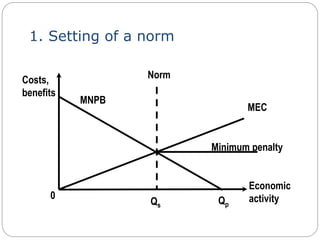
1. Setting of a norm
Norm
MEC
Qs Qp
0
MNPB
Costs,
benefits
Economic
activity
Minimum penalty
Environmental norms in practice
 Most common approach of regulation: in
international and EU level
 Almost exclusive in case of hazardous
materials
 Example: almost all fields of environmental
protection
 Types: regulation on emissions vs.
immissions
Emission norms: refer
to emitted quantity
etc.
Immission norms:
refer to pollution
concentration,
exposition level etc.
Water protection norms in paper
industry
 Maximal load of organic
elements (Biological Oxygen
Demand – BOD):
BOD5 = 25 mg/l
 Outflow of the (company)
sewage works is measured
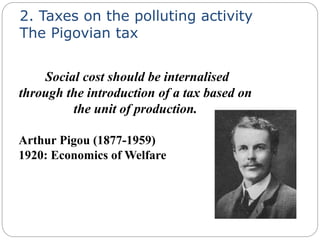
2. Taxes on the polluting activity
The Pigovian tax
Social cost should be internalised
through the introduction of a tax based on
the unit of production.
Arthur Pigou (1877-1959)
1920: Economics of Welfare
Assumptions
 Perfect competition
 Pollution is proportional to production
 The MNPB and MEC curves are known
(by regulating authorities)
The optimum rate of the Pigovian
tax equals the amount of external
effects caused by the socially
optimum production level.
The optimum rate of the Pigovian
tax
Amount of
tax paid
The optimum size of the Pigovian tax
Costs,
benefits
Economic activity
MNPB
Marginal external cost, MEC
Qp
0 Qs
Tax rate
Limitations of the theory of Pigou
• The identification of the MEC curve
• Asymmetric information
• Pollution is not proportionate with production
• Lack of perfect competition
• Does not motivate environmental innovation
• MEC can be several times higher than MC
Environmental taxes in practice
 Regulators aim to decrease environmental loads
by the taxation of polluting activities, products,
raw materials etc.
 PPP - „Polluter Pays Principle”
 Types:
‒ product fees (levied on producs)
‒ pollution/emission taxes
(levied on production)
 Major fields in practice:
‒ Transportation taxes (on vehicles, fuel, congestion charges)
‒ Energy taxes
‒ Pollution taxes
Green taxes in the EU
Example: Environmental product fees
 On products considered as environmentally
harmful
 Effects on competition
(neutrality?):
‒ Internationally: yes
‒ Among sectors: no
 Examples:
‒ Fuels and oil products
‒ Packaging materials
‒ Paper based ads
‒ Tyres
‒ Paints and other chemicals
‒ Etc.
• Based on production related
emissions
• Effects on competition
(neutrality?):
‒ Internationally: yes
‒ Among sectors: no
• Main types:
‒ air pollution charges
‒ water pollution charges
‒ soil pollution charges
Example: Emission taxes
Exercise
A cement factory (MNPB=10-Q) is in a densely populated area
and polluting the air (MEC=1/4 Q).
 How much will the slaughterhouse produce without
regulation? How much profit will it have, and what will be
the net effect for socuety in this case?
 If the government wants to limit the production of the
slaughterhouse to the socially desirable level using a norm,
where will it set the norm and how much profit will the
slaughterhouse have in this case?
 If the government wants to achieve the social optimum
using a tax, how high should the tax rate be? How much tax
will the slaughterhouse pay, and how much profit will it have
remaining? What is the net effect for society in this case?
Please also make a drawing showing the situation!
Homework for 12th November
The operation of a paper mill (MNPB=12-2Q) raises also
external effects in the form of polluting the river nearby
(MEC=Q).
 How much will the paper mill produce without regulation? How
much profit will it have, and what will be the net effect for
society in this case?
 If the authorities want to limit the production of the paper mill
to the socially desirable level using a norm, where will they
set the norm and how much will it cost to the company?
 If the government wants to achieve the social optimum using
a tax, how high should the tax rate be? How much does the
tax-based regulation cost to the paper mill altogether?
Please also make a drawing showing the situation!
3. Enabling a bargain process
The Coaseian bargain
As a result of a bargaining process the
system reaches the social optimum
independent of who ownes
the property rights.
Ronald Coase (1910-2013)
1960: The Problem of Social Cost
Assumptions
 Perfect competition
 Established property rights
 Pollution is proportionate with
production
 MNPB, MEC are known
 All interested parties have the necessary
information
 Zero transaction costs
Forest
Timber processing
company
Transportation
of wood on the river
Mercury pollution
Guests leave
Hotel
The allocation of rights
1. Everyone has the right to use (pollute) the
environment
 the party suffering from pollution will have to pay
the polluter so he will reduce his output
2. Everyone has the right to a clean environment
 the polluter will have to pay the party suffering
from the pollution so he will allow production
The Coase-theory says that the social optimum
will be reached in both situations, if the
property rights are set.
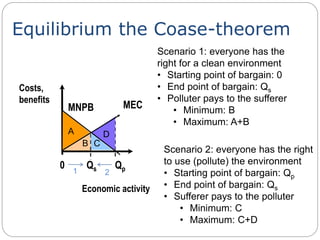
Equilibrium the Coase-theorem
Qp
Costs,
benefits
Economic activity
MEC
0 Qs
MNPB
A
B C
D
Scenario 1: everyone has the
right for a clean environment
• Starting point of bargain: 0
• End point of bargain: Qs
• Polluter pays to the sufferer
• Minimum: B
• Maximum: A+B
Scenario 2: everyone has the right
to use (pollute) the environment
• Starting point of bargain: Qp
• End point of bargain: Qs
• Sufferer pays to the polluter
• Minimum: C
• Maximum: C+D
1 2
The chance for reaching agreement
 Theoretically equal in both situations
 In practice, willingness to pay must be
accompanied by the ability to pay
 Therefore, chances for reaching agreement are
smaller when the rights are with the polluter
and the sufferer has to pay
Limitations of the theory of Coase
• assumes perfect competition
• the identification of the participants of the
bargaining process poses problems:
• high number of interested parties
• identification of those who cause the damage
and those who suffer from it
• interests of future generations
• transaction costs are often high
• only a few practical examples

9 internalizing externalities 2

  • 1.
    Basic options forthe internalization of externalities dr. Gabor Harangozo Corvinus University of Budapest
  • 2.
    Main regulatory optionsto achieve the social optimum of externalities (internalizing externalities) 1. Setting a norm (or standard or pollution limit) 2. Levy taxes on polluting activity (PPP-the polluter pays principle) 3. Enabling market forces (bargain) to achieve the social optimum
  • 3.
    1. Setting ofa norm Norm MEC Qs Qp 0 MNPB Costs, benefits Economic activity Minimum penalty
  • 4.
    Environmental norms inpractice  Most common approach of regulation: in international and EU level  Almost exclusive in case of hazardous materials  Example: almost all fields of environmental protection  Types: regulation on emissions vs. immissions
  • 5.
    Emission norms: refer toemitted quantity etc. Immission norms: refer to pollution concentration, exposition level etc.
  • 6.
    Water protection normsin paper industry  Maximal load of organic elements (Biological Oxygen Demand – BOD): BOD5 = 25 mg/l  Outflow of the (company) sewage works is measured
  • 7.
    2. Taxes onthe polluting activity The Pigovian tax Social cost should be internalised through the introduction of a tax based on the unit of production. Arthur Pigou (1877-1959) 1920: Economics of Welfare
  • 8.
    Assumptions  Perfect competition Pollution is proportional to production  The MNPB and MEC curves are known (by regulating authorities)
  • 9.
    The optimum rateof the Pigovian tax equals the amount of external effects caused by the socially optimum production level. The optimum rate of the Pigovian tax
  • 10.
    Amount of tax paid Theoptimum size of the Pigovian tax Costs, benefits Economic activity MNPB Marginal external cost, MEC Qp 0 Qs Tax rate
  • 11.
    Limitations of thetheory of Pigou • The identification of the MEC curve • Asymmetric information • Pollution is not proportionate with production • Lack of perfect competition • Does not motivate environmental innovation • MEC can be several times higher than MC
  • 12.
    Environmental taxes inpractice  Regulators aim to decrease environmental loads by the taxation of polluting activities, products, raw materials etc.  PPP - „Polluter Pays Principle”  Types: ‒ product fees (levied on producs) ‒ pollution/emission taxes (levied on production)  Major fields in practice: ‒ Transportation taxes (on vehicles, fuel, congestion charges) ‒ Energy taxes ‒ Pollution taxes
  • 13.
  • 14.
    Example: Environmental productfees  On products considered as environmentally harmful  Effects on competition (neutrality?): ‒ Internationally: yes ‒ Among sectors: no  Examples: ‒ Fuels and oil products ‒ Packaging materials ‒ Paper based ads ‒ Tyres ‒ Paints and other chemicals ‒ Etc.
  • 15.
    • Based onproduction related emissions • Effects on competition (neutrality?): ‒ Internationally: yes ‒ Among sectors: no • Main types: ‒ air pollution charges ‒ water pollution charges ‒ soil pollution charges Example: Emission taxes
  • 16.
    Exercise A cement factory(MNPB=10-Q) is in a densely populated area and polluting the air (MEC=1/4 Q).  How much will the slaughterhouse produce without regulation? How much profit will it have, and what will be the net effect for socuety in this case?  If the government wants to limit the production of the slaughterhouse to the socially desirable level using a norm, where will it set the norm and how much profit will the slaughterhouse have in this case?  If the government wants to achieve the social optimum using a tax, how high should the tax rate be? How much tax will the slaughterhouse pay, and how much profit will it have remaining? What is the net effect for society in this case? Please also make a drawing showing the situation!
  • 17.
    Homework for 12thNovember The operation of a paper mill (MNPB=12-2Q) raises also external effects in the form of polluting the river nearby (MEC=Q).  How much will the paper mill produce without regulation? How much profit will it have, and what will be the net effect for society in this case?  If the authorities want to limit the production of the paper mill to the socially desirable level using a norm, where will they set the norm and how much will it cost to the company?  If the government wants to achieve the social optimum using a tax, how high should the tax rate be? How much does the tax-based regulation cost to the paper mill altogether? Please also make a drawing showing the situation!
  • 18.
    3. Enabling abargain process The Coaseian bargain As a result of a bargaining process the system reaches the social optimum independent of who ownes the property rights. Ronald Coase (1910-2013) 1960: The Problem of Social Cost
  • 19.
    Assumptions  Perfect competition Established property rights  Pollution is proportionate with production  MNPB, MEC are known  All interested parties have the necessary information  Zero transaction costs
  • 20.
    Forest Timber processing company Transportation of woodon the river Mercury pollution Guests leave Hotel
  • 21.
    The allocation ofrights 1. Everyone has the right to use (pollute) the environment  the party suffering from pollution will have to pay the polluter so he will reduce his output 2. Everyone has the right to a clean environment  the polluter will have to pay the party suffering from the pollution so he will allow production The Coase-theory says that the social optimum will be reached in both situations, if the property rights are set.
  • 22.
    Equilibrium the Coase-theorem Qp Costs, benefits Economicactivity MEC 0 Qs MNPB A B C D Scenario 1: everyone has the right for a clean environment • Starting point of bargain: 0 • End point of bargain: Qs • Polluter pays to the sufferer • Minimum: B • Maximum: A+B Scenario 2: everyone has the right to use (pollute) the environment • Starting point of bargain: Qp • End point of bargain: Qs • Sufferer pays to the polluter • Minimum: C • Maximum: C+D 1 2
  • 23.
    The chance forreaching agreement  Theoretically equal in both situations  In practice, willingness to pay must be accompanied by the ability to pay  Therefore, chances for reaching agreement are smaller when the rights are with the polluter and the sufferer has to pay
  • 24.
    Limitations of thetheory of Coase • assumes perfect competition • the identification of the participants of the bargaining process poses problems: • high number of interested parties • identification of those who cause the damage and those who suffer from it • interests of future generations • transaction costs are often high • only a few practical examples