BUSINESS STUDIES
O LEVEL 7115
CHAPTER # 9: INTERNAL & EXTERNAL COMMUNICATION
THE CHAPTER WILL EXPLAIN :
• The importance of effective communication to a business
• The difference between internal and external
communication
• The difference between formal and informal communication
• The different methods of communication
BASIC CONCEPTS
• Communication is the transferring of a message from the sender to the receiver,
who understands the message.
• The message is the information or instructions being passed by the sender to the
receiver.
• Internal communication is between members of the same organization.
• External communication is between the organization and other organizations or
individuals
THE PROCESS OF EFFECTIVE COMMUNICATION
ONE-WAY & TWO-WAY COMMUNICATION
One-way
communication
involves a message
which does not call
for or require a
response.
Two-way
communication is
when the receiver
gives a response to
the message and
there is a
discussion about it.
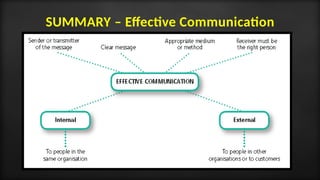
SUMMARY – Effective Communication
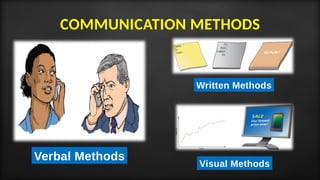
COMMUNICATION METHODS
Verbal Methods
Written Methods
Visual Methods
CHOOSING AN APPROPRIATE COMMUNICATION
METHOD
• Speed
• Cost
• Message details
• Leadership style
• The receiver
• Importance of a written
record
• Importance of feedback
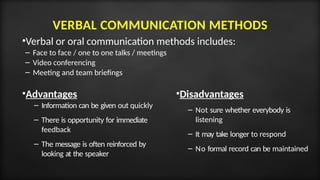
VERBAL COMMUNICATION METHODS
•Advantages
– Information can be given out quickly
– There is opportunity for immediate
feedback
– The message is often reinforced by
looking at the speaker
•Verbal or oral communication methods includes:
– Face to face / one to one talks / meetings
– Video conferencing
– Meeting and team briefings
•Disadvantages
– Not sure whether everybody is
listening
– It may take longer to respond
– No formal record can be maintained
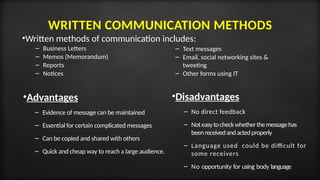
WRITTEN COMMUNICATION METHODS
•Advantages
– Evidence of message can be maintained
– Essential for certain complicated messages
– Can be copied and shared with others
– Quick and cheap way to reach a large audience.
•Written methods of communication includes:
– Business Letters
– Memos (Memorandum)
– Reports
– Notices
•Disadvantages
– No direct feedback
– Noteasytocheckwhetherthemessagehas
beenreceivedandactedproperly
– Language used could be difficult for
some receivers
– No opportunity for using body language
– Text messages
– Email, social networking sites &
tweeting
– Other forms using IT
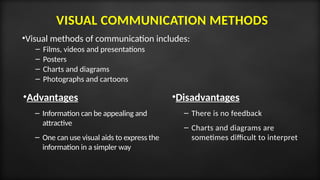
VISUAL COMMUNICATION METHODS
•Advantages
– Information can be appealing and
attractive
– One can use visual aids to express the
information in a simpler way
•Visual methods of communication includes:
– Films, videos and presentations
– Posters
– Charts and diagrams
– Photographs and cartoons
•Disadvantages
– There is no feedback
– Charts and diagrams are
sometimes difficult to interpret
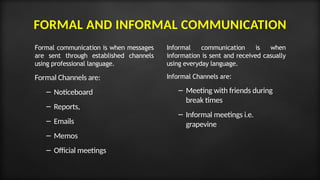
FORMAL AND INFORMAL COMMUNICATION
Formal communication is when messages
are sent through established channels
using professional language.
Formal Channels are:
– Noticeboard
– Reports,
– Emails
– Memos
– Official meetings
Informal communication is when
information is sent and received casually
using everyday language.
Informal Channels are:
– Meeting with friends during
break times
– Informal meetings i.e.
grapevine
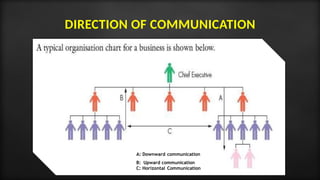
DIRECTION OF COMMUNICATION
A: Downward communication
B: Upward communication
C: Horizontal Communication
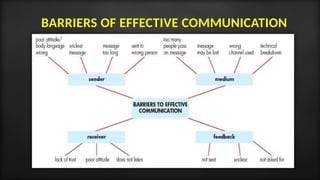
BARRIERS OF EFFECTIVE COMMUNICATION
THANKS FOR PAYING
ATTENTION


9 Internal _ External Communication.pptx

  • 1.
    BUSINESS STUDIES O LEVEL7115 CHAPTER # 9: INTERNAL & EXTERNAL COMMUNICATION
  • 2.
    THE CHAPTER WILLEXPLAIN : • The importance of effective communication to a business • The difference between internal and external communication • The difference between formal and informal communication • The different methods of communication
  • 3.
    BASIC CONCEPTS • Communicationis the transferring of a message from the sender to the receiver, who understands the message. • The message is the information or instructions being passed by the sender to the receiver. • Internal communication is between members of the same organization. • External communication is between the organization and other organizations or individuals
  • 4.
    THE PROCESS OFEFFECTIVE COMMUNICATION
  • 5.
    ONE-WAY & TWO-WAYCOMMUNICATION One-way communication involves a message which does not call for or require a response. Two-way communication is when the receiver gives a response to the message and there is a discussion about it.
  • 6.
    SUMMARY – EffectiveCommunication
  • 7.
  • 8.
    CHOOSING AN APPROPRIATECOMMUNICATION METHOD • Speed • Cost • Message details • Leadership style • The receiver • Importance of a written record • Importance of feedback
  • 9.
    VERBAL COMMUNICATION METHODS •Advantages –Information can be given out quickly – There is opportunity for immediate feedback – The message is often reinforced by looking at the speaker •Verbal or oral communication methods includes: – Face to face / one to one talks / meetings – Video conferencing – Meeting and team briefings •Disadvantages – Not sure whether everybody is listening – It may take longer to respond – No formal record can be maintained
  • 10.
    WRITTEN COMMUNICATION METHODS •Advantages –Evidence of message can be maintained – Essential for certain complicated messages – Can be copied and shared with others – Quick and cheap way to reach a large audience. •Written methods of communication includes: – Business Letters – Memos (Memorandum) – Reports – Notices •Disadvantages – No direct feedback – Noteasytocheckwhetherthemessagehas beenreceivedandactedproperly – Language used could be difficult for some receivers – No opportunity for using body language – Text messages – Email, social networking sites & tweeting – Other forms using IT
  • 11.
    VISUAL COMMUNICATION METHODS •Advantages –Information can be appealing and attractive – One can use visual aids to express the information in a simpler way •Visual methods of communication includes: – Films, videos and presentations – Posters – Charts and diagrams – Photographs and cartoons •Disadvantages – There is no feedback – Charts and diagrams are sometimes difficult to interpret
  • 12.
    FORMAL AND INFORMALCOMMUNICATION Formal communication is when messages are sent through established channels using professional language. Formal Channels are: – Noticeboard – Reports, – Emails – Memos – Official meetings Informal communication is when information is sent and received casually using everyday language. Informal Channels are: – Meeting with friends during break times – Informal meetings i.e. grapevine
  • 13.
    DIRECTION OF COMMUNICATION A:Downward communication B: Upward communication C: Horizontal Communication
  • 14.
    BARRIERS OF EFFECTIVECOMMUNICATION
  • 15.