Product-Based Marketing Strategies

• Web presence must integrate with image, brand
• Product-based organization
  – Managers think of physical objects sold or used
  – Customers think in terms of product categories
• Examples
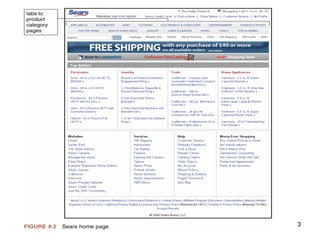
  – Web office supply stores (Staples)


                                                      1
2
3
Communicating with Different
          Market Segments
• Communications media selection to carry message
  – Physical world
     • Use building construction and floor space design
     • Example: Banks
  – Online firm
     • No physical presence
     • Customer contact through media and Web site
     • Communications media selection is critical
  – Online firm challenge
     • Customer trust with no physical presence

                                                          4
Trust, Complexity, and Media Choice

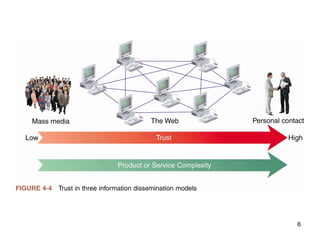
• The Web
  – Intermediate step
     • Between mass media and personal contact
• Potential customer Web communication
  – Offers advantages of personal contact selling
  – Cost savings of mass media


                                                    5
6
Trust, Complexity, and Media Choice
              (cont’d.)
• Complexity level inherent in product and service
   – Important factor in media choice
   – Mass media
      • Products with few characteristics, easy to understand
      • Expensive (deliver short messages)
   – Personal contact
      • Highly complex products and services
      • Customers may ask questions


                                                                7
Trust, Complexity, and Media Choice
              (cont’d.)
• Web (middle ground)
  – Offers various elements
     • Deliver short, focused messages
     • Engage potential customer
     • Give customers ability to choose interaction level


                                                            8
Market Segmentation on the Web
• Web opportunity
   – Present different store environments online
   – Steve Madden site
      • Target: young, fashion-conscious buyers
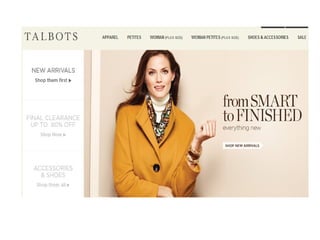
   – Talbots site
      • More muted, conservative style
• Limitations of physical retail stores
   – Floor and display space
   – Must convey one particular message
• Web stores
   – Separate virtual spaces for different market segments
                                                         9
Offering Customers a Choice on the
                 Web
• One-to-one marketing
  – Offering products, services matched to needs of a
    particular customer
• Dell
  – Offers number of different ways to do business
  – Home page links for each major customer group
     • Specific products, product categories links available
  – Dell Premier accounts
     • High level of customer-based market segmentation


                                                               12
Segmentation Using Customer
              Behavior
• Same person
  – Requires different products and services
    combinations
     • Depending on the occasion
• Behavioral segmentation
  – Creation of separate customer experiences based on
    their behavior
• Occasion segmentation
  – Based on things happening at a specific time or
    occasion

                                                      14
Segmentation Using Customer
          Behavior (cont’d.)
• Online world single Web site design
   – Easier to meet needs of different behavioral modes
   – Elements appealing to different behavioral segments
• Market research study
   – Preferences toward different product, service
     combinations
   – Web site features
      • How preferences affected by modes of interaction
• Finding
   – People want range of interaction possibilities
• Identified common behavior patterns
                                                           15
Segmentation Using Customer
          Behavior (cont’d.)
• Browsers
   – Visitors just surfing or browsing
   – Web site: offer something to visitors’ interest
   – Trigger words
      • Remind visitors of something they want to buy on the
        site
• Have links to site explanations, instructions
• Include extra content related to product, service
   – Leads to favorable impression (bookmark)


                                                               16
Segmentation Using Customer
         Behavior (cont’d.)
• Buyers
  – Ready to make a purchase right away
  – Offer certainty
     • Nothing will get in way of purchase transaction
• Shopping cart
  – Part of Web site
     • Keeps track of selected items for purchase
     • Automates purchasing process
     • Offers link back into shopping area
• Goal
  – Get buyer to shopping cart as quickly as possible
                                                         17
Segmentation Using Customer
          Behavior (cont’d.)
• Alternative visitor mode models
   – McKinsey & Company’s six behavior-based
     categories
      •   Simplifiers (convenience)
      •   Surfers (find information, explore new ideas, shop)
      •   Bargainers (search for good deal)
      •   Connectors (stay in touch with other people)
      •   Routiners (return to same sites over and over)
      •   Sportsters (spend time on sports, entertainment sites)


                                                                   18
19
Advertising on the Web
• Effective advertising involves communication
• Four-stage customer loyalty model: helpful in
  creating messages
   – Awareness stage
      • Advertising message should inform
   – Exploration stage
      • Message should explain how product, service works
      • Encourage switching brands
   – Familiarity stage
      • Message should be persuasive
   – Commitment stage
      • Reminder messages
                                                            20
Banner Ads

• Banner ad
   –   Small rectangular object on Web page
   –   Displays stationary or moving graphic
   –   Includes hyperlink to advertiser’s Web site
   –   Versatile
• Attention-grabbing
   – Uses animated GIFs and rich media objects
        • Created using Shockwave, Java, Flas


                                                     21
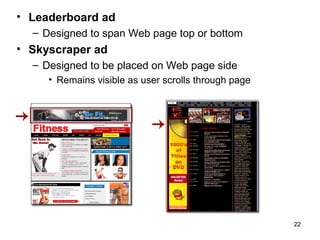
• Leaderboard ad
  – Designed to span Web page top or bottom
• Skyscraper ad
  – Designed to be placed on Web page side
     • Remains visible as user scrolls through page


                                                      22
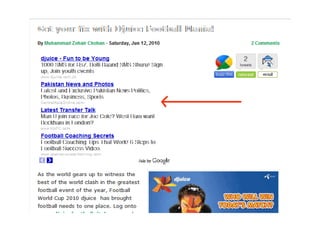
Text Ads

• Short promotional message
   – No graphic elements
      • Usually placed along Web page top or right side
• Simple but very effective
• Example: Google
   – Initially criticized for including obtrusive ads on its
     pages
   – Now clearly labels ads (to prevent confusion)
• Inline text ad
   – Text in stories displayed as hyperlinks
                                                               23
Other Web Ad Formats

• Pop-up ad
  – Appears in its own window
     • When user opens or closes Web page
  – Extremely annoying
     • Must click close button (small) in window of ad
• Pop-behind ad
  – Pop-up ad followed by command (quick)
     • Returns focus to original browser window
• Ad-blocking software
  – Prevents banner ads and pop-up ads from loading
                                                         25
Other Web Ad Formats (cont’d.)

• Interstitial ad
      – User clicks link to load page
           • Interstitial ad opens in its own browser window
           • Instead of page user intended to load
      – Many close automatically
      – Others require user to click a button
• Rich media ads (active ads)
      – Generate graphical activity that “floats” over the Web
        page itself


Electronic Commerce, Eighth Edition                            27
29
Elements of Branding

• Three key brand elements
   – Product differentiation
      • Clearly distinguish product from all others
   – Relevance
      • Degree to which product offers utility to customer
   – Perceived value (key element)
      • Customer perceives a value in buying product
• Brands can lose their value
   – Environment changes


                                                             30
Brand Consolidation Strategies

• Market intermediary
• Example
  – Della & James: online bridal registry
     • Now WeddingChannel.com
  – Created single registry connecting to several local
    and national department, gift stores
  – Logo and branding of each participating store
     • Featured prominently on WeddingChannel.com site
  – Provides valuable consolidating activity for registering
    couples, guests

                                                           31
Affiliate Marketing Strategies

• Affiliate marketing
  – One firm’s Web site (affiliate site)
     • Includes descriptions, reviews, ratings, other
       information about a product linked to another firm’s site
       (offers item for sale)
  – Affiliate site receives commission
     • For every visitor following link from affiliate’s site to
       seller’s site
  – Affiliate saves expenses
     • Handling inventory, advertising and promoting product,
       transaction processing

                                                                   33
Affiliate Marketing Strategies (cont’d.)
• Affiliate commissions
   – Pay-per-click model
      • Affiliate earns commission
      • Each time site visitor clicks link, loads the seller’s page
   – Pay-per-conversion model
      • Affiliate earns a commission
      • Each time site visitor converted from visitor into
        qualified prospect or customer


                                                                  34
Viral Marketing Strategies

• Viral marketing
  – Relies on existing customers
     • Tell other people (prospective customers) about
       products or service
  – Use individual customers to spread the word about a
    company
  – Example: BlueMountain Arts
     • Electronic greeting cards
     • E-mail messages that include link to greeting card site


                                                                 36
Search Engine Positioning and Domain
              Names
• Ways that potential customers find Web sites
   –   Referred by friend
   –   Referred by affiliate marketing partner
   –   See site’s URL in print advertisement, television
   –   Arrive unintentionally after mistyping similar URL
   –   Use a search engine or directory Web site


                                                            37
• Buying, selling, and leasing domain names
  – Recently, higher prices have prevailed in the market
    for domain names


                                                           38
A Communication Model for Online

9 21[1]

  • 1.
    Product-Based Marketing Strategies •Web presence must integrate with image, brand • Product-based organization – Managers think of physical objects sold or used – Customers think in terms of product categories • Examples – Web office supply stores (Staples) 1
  • 2.
  • 3.
  • 4.
    Communicating with Different Market Segments • Communications media selection to carry message – Physical world • Use building construction and floor space design • Example: Banks – Online firm • No physical presence • Customer contact through media and Web site • Communications media selection is critical – Online firm challenge • Customer trust with no physical presence 4
  • 5.
    Trust, Complexity, andMedia Choice • The Web – Intermediate step • Between mass media and personal contact • Potential customer Web communication – Offers advantages of personal contact selling – Cost savings of mass media 5
  • 6.
  • 7.
    Trust, Complexity, andMedia Choice (cont’d.) • Complexity level inherent in product and service – Important factor in media choice – Mass media • Products with few characteristics, easy to understand • Expensive (deliver short messages) – Personal contact • Highly complex products and services • Customers may ask questions 7
  • 8.
    Trust, Complexity, andMedia Choice (cont’d.) • Web (middle ground) – Offers various elements • Deliver short, focused messages • Engage potential customer • Give customers ability to choose interaction level 8
  • 9.
    Market Segmentation onthe Web • Web opportunity – Present different store environments online – Steve Madden site • Target: young, fashion-conscious buyers – Talbots site • More muted, conservative style • Limitations of physical retail stores – Floor and display space – Must convey one particular message • Web stores – Separate virtual spaces for different market segments 9
  • 12.
    Offering Customers aChoice on the Web • One-to-one marketing – Offering products, services matched to needs of a particular customer • Dell – Offers number of different ways to do business – Home page links for each major customer group • Specific products, product categories links available – Dell Premier accounts • High level of customer-based market segmentation 12
  • 14.
    Segmentation Using Customer Behavior • Same person – Requires different products and services combinations • Depending on the occasion • Behavioral segmentation – Creation of separate customer experiences based on their behavior • Occasion segmentation – Based on things happening at a specific time or occasion 14
  • 15.
    Segmentation Using Customer Behavior (cont’d.) • Online world single Web site design – Easier to meet needs of different behavioral modes – Elements appealing to different behavioral segments • Market research study – Preferences toward different product, service combinations – Web site features • How preferences affected by modes of interaction • Finding – People want range of interaction possibilities • Identified common behavior patterns 15
  • 16.
    Segmentation Using Customer Behavior (cont’d.) • Browsers – Visitors just surfing or browsing – Web site: offer something to visitors’ interest – Trigger words • Remind visitors of something they want to buy on the site • Have links to site explanations, instructions • Include extra content related to product, service – Leads to favorable impression (bookmark) 16
  • 17.
    Segmentation Using Customer Behavior (cont’d.) • Buyers – Ready to make a purchase right away – Offer certainty • Nothing will get in way of purchase transaction • Shopping cart – Part of Web site • Keeps track of selected items for purchase • Automates purchasing process • Offers link back into shopping area • Goal – Get buyer to shopping cart as quickly as possible 17
  • 18.
    Segmentation Using Customer Behavior (cont’d.) • Alternative visitor mode models – McKinsey & Company’s six behavior-based categories • Simplifiers (convenience) • Surfers (find information, explore new ideas, shop) • Bargainers (search for good deal) • Connectors (stay in touch with other people) • Routiners (return to same sites over and over) • Sportsters (spend time on sports, entertainment sites) 18
  • 19.
  • 20.
    Advertising on theWeb • Effective advertising involves communication • Four-stage customer loyalty model: helpful in creating messages – Awareness stage • Advertising message should inform – Exploration stage • Message should explain how product, service works • Encourage switching brands – Familiarity stage • Message should be persuasive – Commitment stage • Reminder messages 20
  • 21.
    Banner Ads • Bannerad – Small rectangular object on Web page – Displays stationary or moving graphic – Includes hyperlink to advertiser’s Web site – Versatile • Attention-grabbing – Uses animated GIFs and rich media objects • Created using Shockwave, Java, Flas 21
  • 22.
    • Leaderboard ad – Designed to span Web page top or bottom • Skyscraper ad – Designed to be placed on Web page side • Remains visible as user scrolls through page 22
  • 23.
    Text Ads • Shortpromotional message – No graphic elements • Usually placed along Web page top or right side • Simple but very effective • Example: Google – Initially criticized for including obtrusive ads on its pages – Now clearly labels ads (to prevent confusion) • Inline text ad – Text in stories displayed as hyperlinks 23
  • 25.
    Other Web AdFormats • Pop-up ad – Appears in its own window • When user opens or closes Web page – Extremely annoying • Must click close button (small) in window of ad • Pop-behind ad – Pop-up ad followed by command (quick) • Returns focus to original browser window • Ad-blocking software – Prevents banner ads and pop-up ads from loading 25
  • 27.
    Other Web AdFormats (cont’d.) • Interstitial ad – User clicks link to load page • Interstitial ad opens in its own browser window • Instead of page user intended to load – Many close automatically – Others require user to click a button • Rich media ads (active ads) – Generate graphical activity that “floats” over the Web page itself Electronic Commerce, Eighth Edition 27
  • 29.
  • 30.
    Elements of Branding •Three key brand elements – Product differentiation • Clearly distinguish product from all others – Relevance • Degree to which product offers utility to customer – Perceived value (key element) • Customer perceives a value in buying product • Brands can lose their value – Environment changes 30
  • 31.
    Brand Consolidation Strategies •Market intermediary • Example – Della & James: online bridal registry • Now WeddingChannel.com – Created single registry connecting to several local and national department, gift stores – Logo and branding of each participating store • Featured prominently on WeddingChannel.com site – Provides valuable consolidating activity for registering couples, guests 31
  • 33.
    Affiliate Marketing Strategies •Affiliate marketing – One firm’s Web site (affiliate site) • Includes descriptions, reviews, ratings, other information about a product linked to another firm’s site (offers item for sale) – Affiliate site receives commission • For every visitor following link from affiliate’s site to seller’s site – Affiliate saves expenses • Handling inventory, advertising and promoting product, transaction processing 33
  • 34.
    Affiliate Marketing Strategies(cont’d.) • Affiliate commissions – Pay-per-click model • Affiliate earns commission • Each time site visitor clicks link, loads the seller’s page – Pay-per-conversion model • Affiliate earns a commission • Each time site visitor converted from visitor into qualified prospect or customer 34
  • 36.
    Viral Marketing Strategies •Viral marketing – Relies on existing customers • Tell other people (prospective customers) about products or service – Use individual customers to spread the word about a company – Example: BlueMountain Arts • Electronic greeting cards • E-mail messages that include link to greeting card site 36
  • 37.
    Search Engine Positioningand Domain Names • Ways that potential customers find Web sites – Referred by friend – Referred by affiliate marketing partner – See site’s URL in print advertisement, television – Arrive unintentionally after mistyping similar URL – Use a search engine or directory Web site 37
  • 38.
    • Buying, selling,and leasing domain names – Recently, higher prices have prevailed in the market for domain names 38
  • 39.