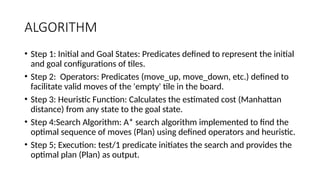
The document outlines a Prolog program designed to solve the 8-puzzle problem using a breadth-first search approach. It details five steps: defining initial and goal states, creating operators for tile movement, implementing a heuristic function, executing an A* search algorithm, and running a test predicate. The program includes various predicates for validating moves and generating the optimal solution plan.
![PROGRAM
• test(Plan):-
• write('Initial state:'),nl,
• Init= [at(tile4,1), at(tile3,2), at(tile8,3), at(empty,4), at(tile2,5), at(tile6,6),
at(tile5,7), at(tile1,8), at(tile7,9)],
• write_sol(Init),
• Goal= [at(tile1,1), at(tile2,2), at(tile3,3), at(tile4,4), at(empty,5), at(tile5,6),
at(tile6,7), at(tile7,8), at(tile8,9)],
• nl,write('Goal state:'),nl,
• write(Goal),nl,nl,
• solve(Init,Goal,Plan).](https://image.slidesharecdn.com/prolog-241219070241-19cd32f6/85/8-puzzle-problem-in-PROLOG-programming-Language-3-320.jpg)
![• solve(State, Goal, Plan):-
• solve(State, Goal, [], Plan).
•
• %Determines whether Current and Destination tiles are a valid move.
• is_movable(X1,Y1) :- (1 is X1 - Y1) ; (-1 is X1 - Y1) ; (3 is X1 - Y1) ; (-3 is X1 - Y1).
•
•
• % This predicate produces the plan. Once the Goal list is a subset
• % of the current State the plan is complete and it is written to
• % the screen using write_sol/1.
•
• solve(State, Goal, Plan, Plan):-
• is_subset(Goal, State), nl,
• write_sol(Plan).](https://image.slidesharecdn.com/prolog-241219070241-19cd32f6/85/8-puzzle-problem-in-PROLOG-programming-Language-4-320.jpg)
![• solve(State, Goal, Sofar, Plan):-
• act(Action, Preconditions, Delete, Add),
• is_subset(Preconditions, State),
• + member(Action, Sofar),
• delete_list(Delete, State, Remainder),
• append(Add, Remainder, NewState),
• solve(NewState, Goal, [Action|Sofar], Plan).
•
• % The problem has three operators.
• % 1st arg = name
• % 2nd arg = preconditions
• % 3rd arg = delete list
• % 4th arg = add list.
•](https://image.slidesharecdn.com/prolog-241219070241-19cd32f6/85/8-puzzle-problem-in-PROLOG-programming-Language-5-320.jpg)
![• % Tile can move to new position only if the destination tile is empty & Manhattan distance =
1
• act(move(X,Y,Z),
• [at(X,Y), at(empty,Z), is_movable(Y,Z)],
• [at(X,Y), at(empty,Z)],
• [at(X,Z), at(empty,Y)]).
• % Utility predicates.
•
• % Check is first list is a subset of the second
•
• is_subset([H|T], Set):-
• member(H, Set),
• is_subset(T, Set).
• is_subset([], _).](https://image.slidesharecdn.com/prolog-241219070241-19cd32f6/85/8-puzzle-problem-in-PROLOG-programming-Language-6-320.jpg)
![• % Remove all elements of 1st list from second to create third.
•
• delete_list([H|T], Curstate, Newstate):-
• remove(H, Curstate, Remainder),
• delete_list(T, Remainder, Newstate).
• delete_list([], Curstate, Curstate).
•
• remove(X, [X|T], T).
• remove(X, [H|T], [H|R]):-
• remove(X, T, R).
•
• write_sol([]).
• write_sol([H|T]):-
• write_sol(T),
• write(H), nl.
•](https://image.slidesharecdn.com/prolog-241219070241-19cd32f6/85/8-puzzle-problem-in-PROLOG-programming-Language-7-320.jpg)
![• append([H|T], L1, [H|L2]):-
• append(T, L1, L2).
• append([], L, L).
•
• member(X, [X|_]).
• member(X, [_|T]):-
• member(X, T).](https://image.slidesharecdn.com/prolog-241219070241-19cd32f6/85/8-puzzle-problem-in-PROLOG-programming-Language-8-320.jpg)


![goal_state = [1, 8, 7, 2, 0, 6, 3, 4, 5] #goal_state = [1, 0, 7, 2, .pdf](https://cdn.slidesharecdn.com/ss_thumbnails/goalstate187206345goalstate1072-230409021756-eaa13799-thumbnail.jpg?width=640&height=640&fit=bounds)


