Artificial
Intelligence and
Machine Learning
Presented by Kaye Xyrra P. Flora
These tasks include learning,
reasoning, problem-solving,
perception, and language
understanding.
Artificial Intelligence (AI) refers to the development
of computer systems capable of performing tasks
that typically require human intelligence.
Types
of AI
Narrow AI (Weak AI)
General AI (Strong AI)
AI designed and trained for a specific task, such
as image recognition or language translation.
AI with human-like cognitive abilities, capable of
understanding and performing any intellectual
task that a human can.
Components of AI
Machine Learning Neural Networks
NLP, Computer Vision, Robotics
Subset of AI that enables systems to
learn from data and improve over time
without explicit programming.
Introduction to artificial neural
networks, inspired by the structure
and functioning of the human brain.
Brief descriptions of other key components
contributing to AI's capabilities, including
NLP, computer vision, and robotics.
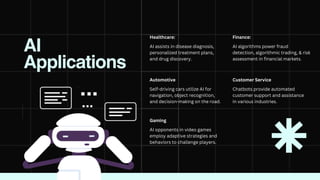
AI
Applications
Healthcare:
Automotive
Gaming
Finance:
Customer Service
AI assists in disease diagnosis,
personalized treatment plans,
and drug discovery.
Self-driving cars utilize AI for
navigation, object recognition,
and decision-making on the road.
AI opponents in video games
employ adaptive strategies and
behaviors to challenge players.
AI algorithms power fraud
detection, algorithmic trading, & risk
assessment in financial markets.
Chatbots provide automated
customer support and assistance
in various industries.
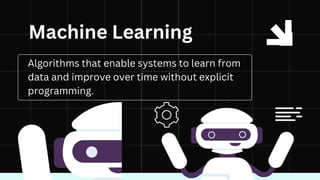
Algorithms that enable systems to learn from
data and improve over time without explicit
programming.
Machine Learning
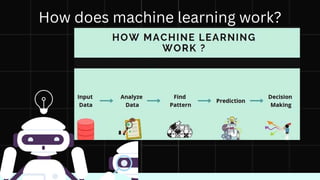
How does machine learning work?
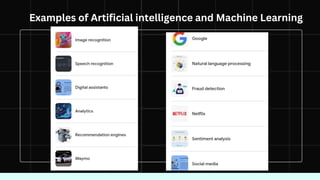
Examples of Artificial intelligence and Machine Learning
Thankyou

8. Emerging Technologies (2)enhancement.pptx

  • 1.
  • 3.
    These tasks includelearning, reasoning, problem-solving, perception, and language understanding. Artificial Intelligence (AI) refers to the development of computer systems capable of performing tasks that typically require human intelligence.
  • 4.
    Types of AI Narrow AI(Weak AI) General AI (Strong AI) AI designed and trained for a specific task, such as image recognition or language translation. AI with human-like cognitive abilities, capable of understanding and performing any intellectual task that a human can.
  • 5.
    Components of AI MachineLearning Neural Networks NLP, Computer Vision, Robotics Subset of AI that enables systems to learn from data and improve over time without explicit programming. Introduction to artificial neural networks, inspired by the structure and functioning of the human brain. Brief descriptions of other key components contributing to AI's capabilities, including NLP, computer vision, and robotics.
  • 6.
    AI Applications Healthcare: Automotive Gaming Finance: Customer Service AI assistsin disease diagnosis, personalized treatment plans, and drug discovery. Self-driving cars utilize AI for navigation, object recognition, and decision-making on the road. AI opponents in video games employ adaptive strategies and behaviors to challenge players. AI algorithms power fraud detection, algorithmic trading, & risk assessment in financial markets. Chatbots provide automated customer support and assistance in various industries.
  • 7.
    Algorithms that enablesystems to learn from data and improve over time without explicit programming. Machine Learning
  • 8.
    How does machinelearning work?
  • 9.
    Examples of Artificialintelligence and Machine Learning
  • 10.