The document provides an overview of information technology, covering basic IT concepts and terminology. It serves as an introduction for those unfamiliar with the subject. The author expresses gratitude at the end.
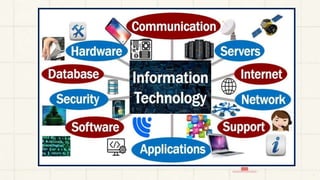
#4 Information technology includes developing a company’s communications networks, protecting data and information, managing databases, assisting staff members with computer or mobile device issues, and performing a variety of other tasks to guarantee the effectiveness and security of business information.
#5 EVERYBODY USES INFORMATION TECHNOLOGY, FROM LARGE CORPORATIONS TO ONE-PERSON SHOPS AND SMALL ACTIVITIES. IT IS USED BY MULTINATIONAL CORPORATIONS TO MANAGE DATA AND INNOVATE THEIR PROCESSES.
#6 Information technology is a broad term that involves the use of technology to communicate, transfer data and process information.
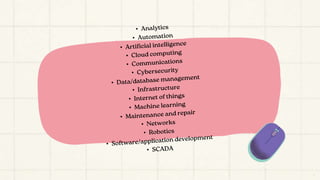
The different trends within information technology include, but aren’t limited to:
#9 Information technology plays a prominent role in business and provides a foundation for much of our current workforce. From communications to data management and operational efficiency, IT supports many business functions and helps drive productivity.
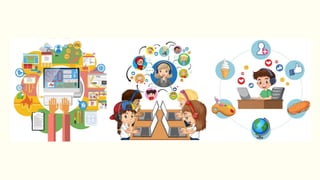
Information technology drives much of what we do in our personal and professional lives. It is the foundation of our communication, technological advancement, innovation, sustainability and recreation. We use information technology on a personal level to connect and communicate with others, play games, share media, shop and be social.
From a career perspective, information technology is largely responsible for much of our business operations and spans nearly every industry. From healthcare to food services, manufacturing to sales, and beyond, we rely on IT to help connect us to others, store and manage information and create more efficient processes.
#10 The history of technology is the story of humanity's efforts to control its environment for its own benefit by creating tools. Tools are artifacts that are constructed to aid a human being to solve a problem. Thus, tools amplify human behavior, but they are morally malleable.
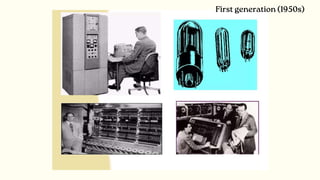
#11 First generation (1950s)
The first generation of computers used vacuum tubes as suis. Vacuum tubes failed frequently so first generation computers did not work most of the time.
• Example :
ENIAC (Electronic Integrator & Calculator) vacuum tubes.
• First electronic digital computer.
• Area: 140 meter square, Power : 130 kWatt, 18000 unit vacuum tube, Capability: 5000 addition, 300 times per sec.
UNIVAC 1 (Universal Automation Calculator).
• Used for business data processing
• Used mercury to data storage.
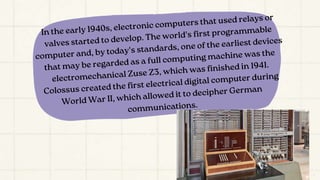
Before the 1950s, the Massachusetts Institute of Technology (MIT) and Harvard University were identified as places where computer circuits and numerical calculations were initially debated and considered. Over time, the fields of computer science and information technology become increasingly sophisticated and capable of processing larger amounts of data. Academic publications from various organizations started to appear.
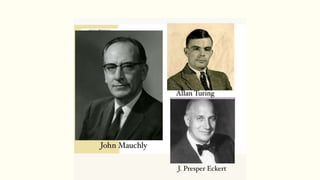
#12 When it comes to early computing, Alan Turing, John Mauchly, and J. Presper Eckert were regarded as some of the most important forerunners of computer technology in the middle of the 1900s. Although they deserve a lot of credit for their advancements, the majority of their work was devoted to creating the first digital computer. Topics like artificial intelligence also started to come up as Turing started to doubt the state of the technology at the time.
Devices have been used to aid computation for thousands of years, probably initially in the form of a tally stick. The Antikythera mechanism, dating from about the beginning of the first century BC, is generally considered the earliest known mechanical analog computer, and the earliest known geared mechanism. Comparable geared devices did not emerge in Europe until the 16th century, and it was not until 1645 that the first mechanical calculator capable of performing the four basic arithmetical operations was developed.
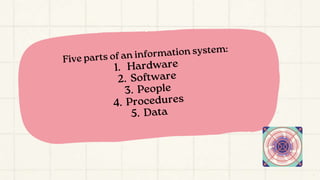
#20 1. Hardware :
•refers to all the system's physical equipment that processes the data to create information.
2. Software:
is a program that contains the step- by-step instructions that tell the computer how to do its work.
3. People
People used information systems in order to increase productivity.
4. Procedures
Are rules or guidelines for people to follow when using software, hardware and data
5. Data
data consists of raw unprocessed facts, including text, numbers, images and sounds.