Social Organization
Language
Customs and Traditions
Religion
Arts and Literature
Forms of Government
Economic Systems
 Puts its members into small units to meet
basic needs
 Family Patterns: the most important unit of
social organization. Children learn how to
behave and what to believe
Nuclear family: wife, husband, children
Extended family: Several generations together
 Social classes: rank people in an order,
depending on what is important to the
culture (money, job, education, ancestors, etc.)
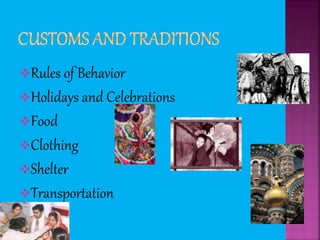
Rules of Behavior
Holidays and Celebrations
Food
Clothing
Shelter
Transportation
 All cultures have a spoken language (even if there are no
developed forms of writing)
 People who speak the same language often share the same
culture
 Many societies include a large number of people who speak
different languages
 Each language can have several different dialects
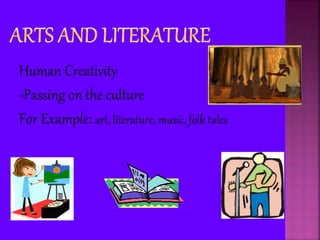
Human Creativity
-Passing on the culture
For Example: art, literature, music, folk tales
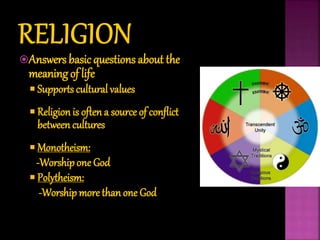
Answers basicquestions about the
meaning of life
 Supports cultural values
 Religion is often a source of conflict
between cultures
 Monotheism:
-Worshipone God
 Polytheism:
-Worship more than one God
 Government is to provide for common needs, keep order, and protect society
from outside threats
 Definition of government: 1. Person/people who hold power in a society; 2.
Society’s laws and political institutions
 Democracy: people have supreme power, government acts by and with
consent
 Republic: people choose leaders who represent them
 Dictatorship: ruler/group holds power by force
 Usually relying on military support for power
How people use money and goods –
 Traditional Economy: people produce most of what they need to survive
(hunting, gathering, farming, herding cattle, make own clothes/tools)
 Market Economy: buying and selling goods and services
 Command Economy: Government controls what/how goods are produced and
what they cost. Individuals have little economic power
 Mixed Economy: Individuals make some economic decisions and the
government makes others

7_Elements_of_Culture.ppt

  • 2.
    Social Organization Language Customs andTraditions Religion Arts and Literature Forms of Government Economic Systems
  • 3.
     Puts itsmembers into small units to meet basic needs  Family Patterns: the most important unit of social organization. Children learn how to behave and what to believe Nuclear family: wife, husband, children Extended family: Several generations together  Social classes: rank people in an order, depending on what is important to the culture (money, job, education, ancestors, etc.)
  • 4.
    Rules of Behavior Holidaysand Celebrations Food Clothing Shelter Transportation
  • 5.
     All cultureshave a spoken language (even if there are no developed forms of writing)  People who speak the same language often share the same culture  Many societies include a large number of people who speak different languages  Each language can have several different dialects
  • 6.
    Human Creativity -Passing onthe culture For Example: art, literature, music, folk tales
  • 7.
    Answers basicquestions aboutthe meaning of life  Supports cultural values  Religion is often a source of conflict between cultures  Monotheism: -Worshipone God  Polytheism: -Worship more than one God
  • 8.
     Government isto provide for common needs, keep order, and protect society from outside threats  Definition of government: 1. Person/people who hold power in a society; 2. Society’s laws and political institutions  Democracy: people have supreme power, government acts by and with consent  Republic: people choose leaders who represent them  Dictatorship: ruler/group holds power by force  Usually relying on military support for power
  • 9.
    How people usemoney and goods –  Traditional Economy: people produce most of what they need to survive (hunting, gathering, farming, herding cattle, make own clothes/tools)  Market Economy: buying and selling goods and services  Command Economy: Government controls what/how goods are produced and what they cost. Individuals have little economic power  Mixed Economy: Individuals make some economic decisions and the government makes others