IDISC 770x(Online)February 16-22, 2011From the Reformation to 1857 (Part 3)
Step 3The CRC’s First 300 years:  1536-1834I.     The Boundary Dates:  1536 and 1834II.    Defeat and VictoryIII.   Synod of Dort.IV. 	  The “Second”/”Further Reformation”V. 	  The Secession of 1834
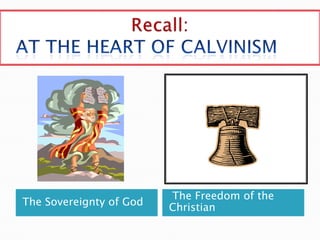
Recall:At the heart of CalvinismThe Sovereignty of God  The Freedom of the Christian
Individual Person     as an image bearer of God    has the highest     dignity, worth and responsibility;     the new Calvinist person was fiercely      	independent, highly responsible         (and politically aggressive).TheNew Anthropology:
This gave Reformed people the courage:to disobey popes and bishops  to rebel against tyrantsto create new worlds of commerceto build new societies						 
I.    The Boundary Dates:  1536 and 1834
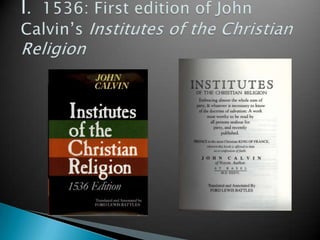
I.  1536: First edition of John Calvin’s Institutes of the Christian Religion
Preface to King Francis I of France: A Plea for the Persecuted Evangelicals of France
Your duty, most serene Prince, is, not to shut either your ears or mind against a cause involving such mighty interests as these: how the glory of God is to be maintained on the earth inviolate, how the truth of God is to preserve its dignity, how the kingdom of Christ is to continue amongst us compact and secure. The cause is worthy of your ear, worthy of your investigation, worthy of your throne.King’s duty under God: Protect the defenseless,  maintain truth of gospelYour duty, most serene Prince, is, not to shut either your ears or mind against a cause involving such mighty interests as these: how the glory of God is to be maintained on the earth inviolate, how the truth of God is to preserve its dignity, how the kingdom of Christ is to continue amongst us compact and secure. The cause is worthy of your ear, worthy of your investigation, worthy of your throne.
Just hear us out; we are confident in the justice of our cause My object, however, was not to frame a defence, but only with a view to the hearing  of our cause, to mollify your mind, now indeed turned away and estranged from us—I add, even inflamed against us—but whose good will, we are confident, we should regain, would you but once, with calmness and composure, read this our Confession, which we desire your Majesty to accept instead of a defence. . .
BUT . . . . (in a velvet glove) You are on notice:  God is Sovereignand JustBut if the whispers of the malevolent so possess your ear, that the accused are to have no opportunity of pleading their cause; if . . .  we, indeed, like sheep doomed to slaughter, shall be reduced to every extremity; yet so that, in our patience, we will possess our souls, and wait for the strong hand of the Lord, which, doubtless, will appear in its own time, and show itself armed, both to rescue the poor from affliction, and also take vengeance on the despisers, who are now exulting so securely. Most illustrious King, may the Lord, the King of kings, establish your throne in righteousness, and your sceptre in equity.
[Whatever the motives of those who overthrew tyrants] the Lord by their means equally executed his own work, when he broke the bloody sceptres of insolent kings, and overthrew their intolerable dominations.Let princes hear and be afraid. . . . For when popular magistrates have been appointed to curb the tyranny of kings [gives examples] . . . So far am I from forbidding these officially to check the undue license of kings, that if they connive at kings when they tyrannise and insult over the humbler of the people, I affirm that their dissimulation is not free from nefarious perfidy, because they fraudulently betray the liberty of the people, while knowing that, by the ordinance of God, they are its appointed guardians.From Institutes, IV.xx.31“On Civil Government”
We are subject to the men who rule over us, but subject only in the Lord.I know the imminent peril to which subjects expose themselves by this firmness, kings being most indignant when they are contemned. As Solomon says, “The wrath of a king is as messengers of death” (Prov. 16:14). But since Peter, one of heaven’s heralds, has published the edict, “We ought to obey God rather than men” (Acts 5:29), let us console ourselves with the thought, that we are rendering the obedience which the Lord requires, when we endure anything rather than turn aside from piety. And that our courage may not fail, Paul stimulates us by the additional consideration (1 Cor. 7:23), that we were redeemed by Christ at the great price which our redemption cost him, in order that we might not yield a slavish obedience to the depraved wishes of men, far less do homage to their impiety. 
B.  “Victory”II.   A Defeat and a Victory for Calvinism:A.Defeat:   St. Bartholomew’s Day Massacre  (August 24, 1572)
Assassination of Huguenot leader Admiral Caspard de Coligny (August 24, 1572)Occasion: Marriage of “Protestant” Henry Navarre and Charles IX’s sister Margaret Valois—arranged by de Coligny —August 18, 1572
Instigator: Queen Mother, Catharine de Medici
Precipipated nationwide orgy of murderous violence against Huguenots		—lasted until October		—50,000 to 100,000 deaths 
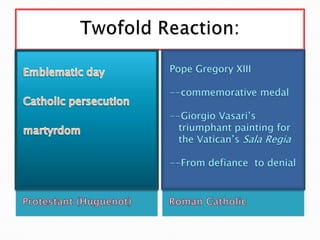
Twofold Reaction:Protestant (Huguenot)Roman CatholicEmblematic dayCatholic persecutionmartyrdomPope Gregory XIII--commemorative medal--Giorgio Vasari’s triumphant painting for the Vatican’s SalaRegia--From defiance  to denial
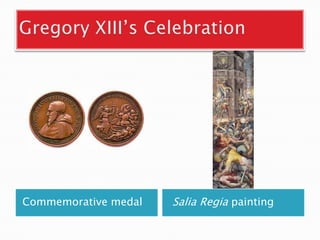
Gregory XIII’s CelebrationCommemorative medalSaliaRegiapainting
II.  B. Victory:     The 80 years War Between the Low Countries and Spain (1560s-1648)
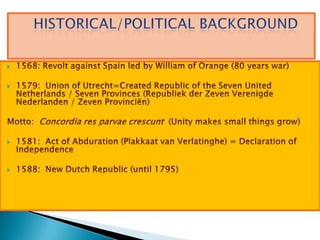
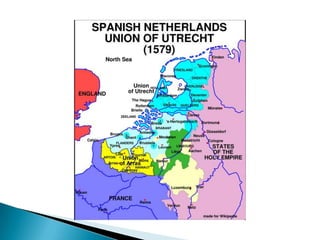
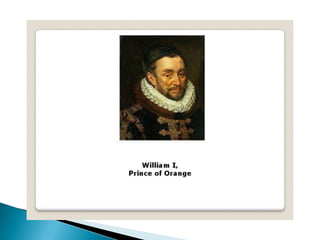
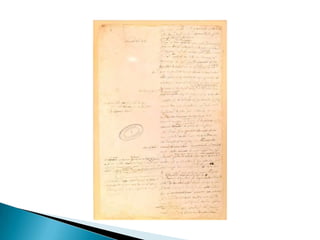
  Historical/Political Background1568: Revolt against Spain led by William of Orange (80 years war) 1579:  Union of Utrecht=Created Republic of the Seven United Netherlands / Seven Provinces (RepubliekderZevenVerenigdeNederlanden / ZevenProvinciën) Motto:  Concordia res parvaecrescunt(Unity makes small things grow) 1581:  Act of Abduration (Plakkaat van Verlatinghe) = Declaration of Independence  1588:  New Dutch Republic (until 1795) 
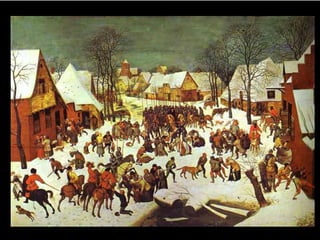
Pieter Breughel’s  “Massacre of the Innocents”  (ca. 1565)
Act of Abduration(1581)Opening Page
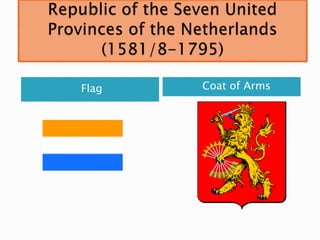
Republic of the Seven United  Provinces of the Netherlands(1581/8-1795)Flag  Coat of Arms
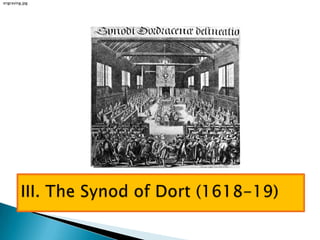
engraving.jpgIII. The Synod of Dort (1618-19)
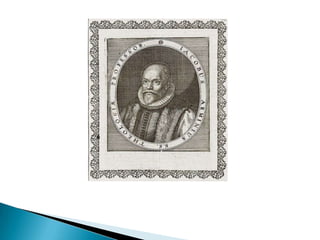
A.   The Doctrine Part 	-Against James Arminius  1560-1609; 	-Remonstrants
Appeal to Estates General of the Netherlands by the Remonstrants (1610 document, “Remonstrance”) Supported by the Land's Advocate of Hollandfor the States of Holland, Johan van Oldenbarnevelt (1547-1619)---most powerful political person in the country Opposed by  Leiden Professor FranciscusGomarus (1563-1641); Counter-Remonstrants were known as Gomarists; wanted a CHURCH assembly to decide the issue
Country divided: When Estates General finally called for national CHURCH synod, States of Holland refused to participate; Oldenbarnevelt led a revolt;  beheaded on May 12, 1619 B. The Political Side
In addition to. . . Canons  versus Remonstrants:new Dutch Bible (Statenvertaling)
new Church Order (included role of civil authority in approving ministers and church assemblies; paying salaries of ministers from the public purse)
Dutch Reformed Church became “Preferred” or National Dutch Church; result: deterioration which led to rise of pietism (“Further Reformation”)The fact that the Reformed churches had the status of “preferred” churches in the Netherlands and other Reformed territories tended to aggravate the situation. While they were not really state churches, they were folk churches. In such a church the tendency always exists to become so closely identified with the prevailing culture that its message becomes little more than a lifeless reiteration of prevailing values. This was overwhelmingly the case in the Reformed churches of the Netherlands and of the contiguous Reformed territories during the seventeenth century. Preaching was largely a matter of setting forth correct theological dogmas and generally accepted middle class virtues, the latter with a touch of artificial religious flavour. (F. Ernest Stoeffler, The Rise of Evangelical Pietism (Leiden: E. J. Brill, 1965), 115)
Calvinists in vanguard of revolt against Spain(Magistrates and Preachers scratch each other’s backs.) Calvinist preachers provided ideology via “new Israel” imagery The Reformed Churches (and the Netherlands as a nation) were very “successful” in the 17th to 18th Century
Reformed Churches had a “mixed” polity
No national synod of the Dutch Reformed Churches met after Dort until 1816.  Reference point 1:
Interlude:   From the Reformation to Secession of 1834: It’s Not Just About Doctrine, Blood, Guts, and War  It’s  also about . . . .
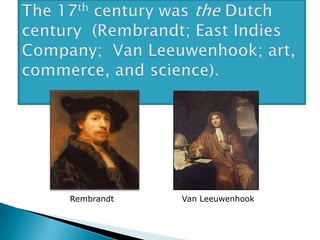
The 17th century was the Dutch century  (Rembrandt; East Indies Company;  Van Leeuwenhook; art, commerce, and science).Van LeeuwenhookRembrandt
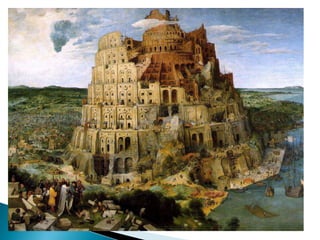
17th Century Netherlands: An Embarrassment of Riches (Simon Schama) Exemplified by Pieter Breughel’s  “Tower of Babel”

770B-X - Week 2 - Part 3

  • 1.
    IDISC 770x(Online)February 16-22,2011From the Reformation to 1857 (Part 3)
  • 2.
    Step 3The CRC’sFirst 300 years: 1536-1834I. The Boundary Dates: 1536 and 1834II. Defeat and VictoryIII. Synod of Dort.IV. The “Second”/”Further Reformation”V. The Secession of 1834
  • 3.
    Recall:At the heartof CalvinismThe Sovereignty of God The Freedom of the Christian
  • 4.
    Individual Person as an image bearer of God has the highest dignity, worth and responsibility; the new Calvinist person was fiercely independent, highly responsible (and politically aggressive).TheNew Anthropology:
  • 5.
    This gave Reformedpeople the courage:to disobey popes and bishops to rebel against tyrantsto create new worlds of commerceto build new societies  
  • 6.
    I. The Boundary Dates: 1536 and 1834
  • 7.
    I. 1536:First edition of John Calvin’s Institutes of the Christian Religion
  • 8.
    Preface to KingFrancis I of France: A Plea for the Persecuted Evangelicals of France
  • 9.
    Your duty, mostserene Prince, is, not to shut either your ears or mind against a cause involving such mighty interests as these: how the glory of God is to be maintained on the earth inviolate, how the truth of God is to preserve its dignity, how the kingdom of Christ is to continue amongst us compact and secure. The cause is worthy of your ear, worthy of your investigation, worthy of your throne.King’s duty under God: Protect the defenseless, maintain truth of gospelYour duty, most serene Prince, is, not to shut either your ears or mind against a cause involving such mighty interests as these: how the glory of God is to be maintained on the earth inviolate, how the truth of God is to preserve its dignity, how the kingdom of Christ is to continue amongst us compact and secure. The cause is worthy of your ear, worthy of your investigation, worthy of your throne.
  • 10.
    Just hear usout; we are confident in the justice of our cause My object, however, was not to frame a defence, but only with a view to the hearing of our cause, to mollify your mind, now indeed turned away and estranged from us—I add, even inflamed against us—but whose good will, we are confident, we should regain, would you but once, with calmness and composure, read this our Confession, which we desire your Majesty to accept instead of a defence. . .
  • 11.
    BUT . .. . (in a velvet glove) You are on notice: God is Sovereignand JustBut if the whispers of the malevolent so possess your ear, that the accused are to have no opportunity of pleading their cause; if . . . we, indeed, like sheep doomed to slaughter, shall be reduced to every extremity; yet so that, in our patience, we will possess our souls, and wait for the strong hand of the Lord, which, doubtless, will appear in its own time, and show itself armed, both to rescue the poor from affliction, and also take vengeance on the despisers, who are now exulting so securely. Most illustrious King, may the Lord, the King of kings, establish your throne in righteousness, and your sceptre in equity.
  • 12.
    [Whatever the motivesof those who overthrew tyrants] the Lord by their means equally executed his own work, when he broke the bloody sceptres of insolent kings, and overthrew their intolerable dominations.Let princes hear and be afraid. . . . For when popular magistrates have been appointed to curb the tyranny of kings [gives examples] . . . So far am I from forbidding these officially to check the undue license of kings, that if they connive at kings when they tyrannise and insult over the humbler of the people, I affirm that their dissimulation is not free from nefarious perfidy, because they fraudulently betray the liberty of the people, while knowing that, by the ordinance of God, they are its appointed guardians.From Institutes, IV.xx.31“On Civil Government”
  • 13.
    We are subjectto the men who rule over us, but subject only in the Lord.I know the imminent peril to which subjects expose themselves by this firmness, kings being most indignant when they are contemned. As Solomon says, “The wrath of a king is as messengers of death” (Prov. 16:14). But since Peter, one of heaven’s heralds, has published the edict, “We ought to obey God rather than men” (Acts 5:29), let us console ourselves with the thought, that we are rendering the obedience which the Lord requires, when we endure anything rather than turn aside from piety. And that our courage may not fail, Paul stimulates us by the additional consideration (1 Cor. 7:23), that we were redeemed by Christ at the great price which our redemption cost him, in order that we might not yield a slavish obedience to the depraved wishes of men, far less do homage to their impiety. 
  • 14.
    B.  “Victory”II. A Defeat and a Victory for Calvinism:A.Defeat: St. Bartholomew’s Day Massacre (August 24, 1572)
  • 15.
    Assassination of Huguenotleader Admiral Caspard de Coligny (August 24, 1572)Occasion: Marriage of “Protestant” Henry Navarre and Charles IX’s sister Margaret Valois—arranged by de Coligny —August 18, 1572
  • 16.
    Instigator: Queen Mother,Catharine de Medici
  • 17.
    Precipipated nationwide orgyof murderous violence against Huguenots —lasted until October —50,000 to 100,000 deaths 
  • 18.
    Twofold Reaction:Protestant (Huguenot)RomanCatholicEmblematic dayCatholic persecutionmartyrdomPope Gregory XIII--commemorative medal--Giorgio Vasari’s triumphant painting for the Vatican’s SalaRegia--From defiance  to denial
  • 19.
  • 20.
    II. B.Victory:  The 80 years War Between the Low Countries and Spain (1560s-1648)
  • 21.
    Historical/PoliticalBackground1568: Revolt against Spain led by William of Orange (80 years war) 1579: Union of Utrecht=Created Republic of the Seven United Netherlands / Seven Provinces (RepubliekderZevenVerenigdeNederlanden / ZevenProvinciën) Motto: Concordia res parvaecrescunt(Unity makes small things grow) 1581: Act of Abduration (Plakkaat van Verlatinghe) = Declaration of Independence 1588: New Dutch Republic (until 1795) 
  • 25.
    Pieter Breughel’s “Massacre of the Innocents” (ca. 1565)
  • 28.
  • 30.
    Republic of theSeven United Provinces of the Netherlands(1581/8-1795)Flag Coat of Arms
  • 31.
  • 32.
    A. The Doctrine Part -Against James Arminius 1560-1609; -Remonstrants
  • 34.
    Appeal to EstatesGeneral of the Netherlands by the Remonstrants (1610 document, “Remonstrance”) Supported by the Land's Advocate of Hollandfor the States of Holland, Johan van Oldenbarnevelt (1547-1619)---most powerful political person in the country Opposed by Leiden Professor FranciscusGomarus (1563-1641); Counter-Remonstrants were known as Gomarists; wanted a CHURCH assembly to decide the issue
  • 35.
    Country divided: WhenEstates General finally called for national CHURCH synod, States of Holland refused to participate; Oldenbarnevelt led a revolt; beheaded on May 12, 1619 B. The Political Side
  • 36.
    In addition to.. . Canons versus Remonstrants:new Dutch Bible (Statenvertaling)
  • 37.
    new Church Order(included role of civil authority in approving ministers and church assemblies; paying salaries of ministers from the public purse)
  • 38.
    Dutch Reformed Churchbecame “Preferred” or National Dutch Church; result: deterioration which led to rise of pietism (“Further Reformation”)The fact that the Reformed churches had the status of “preferred” churches in the Netherlands and other Reformed territories tended to aggravate the situation. While they were not really state churches, they were folk churches. In such a church the tendency always exists to become so closely identified with the prevailing culture that its message becomes little more than a lifeless reiteration of prevailing values. This was overwhelmingly the case in the Reformed churches of the Netherlands and of the contiguous Reformed territories during the seventeenth century. Preaching was largely a matter of setting forth correct theological dogmas and generally accepted middle class virtues, the latter with a touch of artificial religious flavour. (F. Ernest Stoeffler, The Rise of Evangelical Pietism (Leiden: E. J. Brill, 1965), 115)
  • 39.
    Calvinists in vanguardof revolt against Spain(Magistrates and Preachers scratch each other’s backs.) Calvinist preachers provided ideology via “new Israel” imagery The Reformed Churches (and the Netherlands as a nation) were very “successful” in the 17th to 18th Century
  • 40.
    Reformed Churches hada “mixed” polity
  • 41.
    No national synodof the Dutch Reformed Churches met after Dort until 1816.  Reference point 1:
  • 42.
    Interlude: From the Reformation to Secession of 1834: It’s Not Just About Doctrine, Blood, Guts, and War  It’s also about . . . .
  • 44.
    The 17th centurywas the Dutch century (Rembrandt; East Indies Company; Van Leeuwenhook; art, commerce, and science).Van LeeuwenhookRembrandt
  • 45.
    17th Century Netherlands:An Embarrassment of Riches (Simon Schama) Exemplified by Pieter Breughel’s “Tower of Babel”