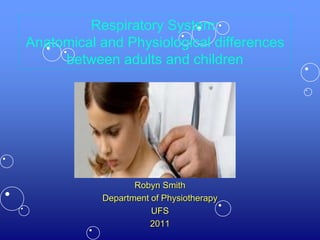
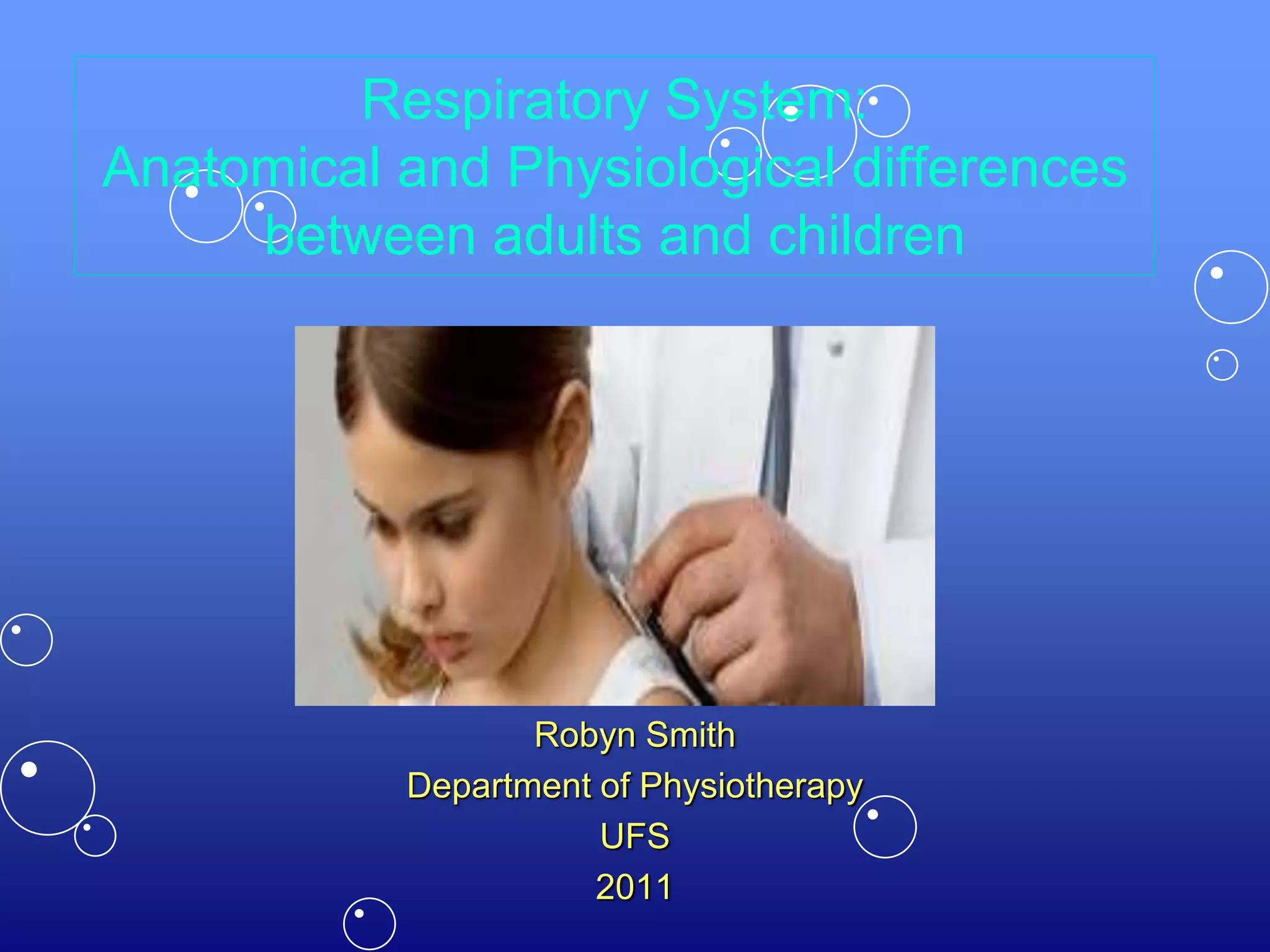
Respiratory System:
Anatomical and Physiological differences
between adults and children
Robyn Smith
Department of Physiotherapy
UFS
2011
Learning outcomes
• At the end of this module the learner should:
Be able to identify both anatomical and
physiological differences between the respiratory
systems of child and a adult
Understand and explain the impact of these
differences on the clinical findings, observations
and respiration of a child
Describe the impact of preferential nasal breathing
on respiration in babies
Background
• The respiratory system of children differs both
anatomically and physiologically from that of adults
• These differences have important consequences for
the physiotherapy care of children in terms of
assessment, treatment and choice of techniques
• The principle reason for hospital admissions in
children under the age of 4 years is respiratory illness
Background
• The principles of adult chest physiotherapy cannot
be directly transposed to a child.
• Chest physiotherapy as provided to children has
become a specialised area on its own for this reason
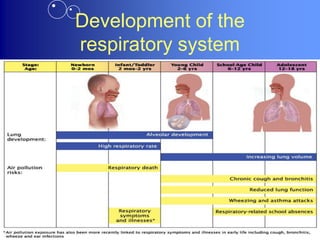
Development of the
respiratory system
ANATOMICAL DIFFERENCES
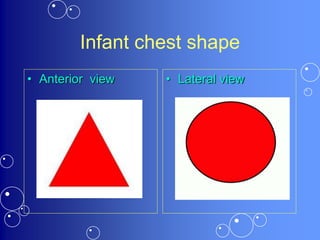
Thorax: Chest shape
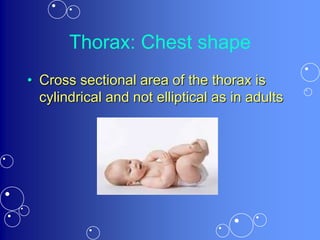
• Cross sectional area of the thorax is
cylindrical and not elliptical as in adults
Thorax: Ribcage
• The ribcage of the newborn and
infant is relatively soft and
cartilaginous compared to the rigid
chest wall of older children and
adults
• Ribs run horizontally to the
vertebrae and sternum compared to
the more oblique angle of older
children and adults. The bucket
handle movement as seen in older
children and adults is therefore not
possible.
• Infant can therefore increase the
anterior-posterior or transverse
diameter of their chest
• The intercostal muscles are inactive
and poorly developed in infancy.
And the abdominal muscles are not
yet stabilising the ribcage
• The interaction of gravity and the
musculoskeletal system play an
important role in the development of
the thorax.
Infant chest shape
• Anterior view • Lateral view
Thorax.... clinical implications
• Clinical implications....
• With the limited chest expansion
the child can only increase their
lung volumes by increasing their
respiration rate
• No postural drainage in
premature infants or neonates
• Infants are diaphragmatic
breathers
• Premature infants & children
with low tone especially
hypotonia need to be
positioned correctly to avoid
chest deformities, rib flaring and
a high riding ribcage
• Infants with chronic
caqrdiorespiratory conditions
e.g. BPD, RDS or paradoxal
breathing may also develop
chest deformities over times
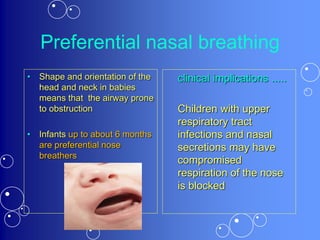
Preferential nasal breathing
• Shape and orientation of the
head and neck in babies
means that the airway prone
to obstruction
• Infants up to about 6 months
are preferential nose
breathers
clinical implications .....
Children with upper
respiratory tract
infections and nasal
secretions may have
compromised
respiration of the nose
is blocked
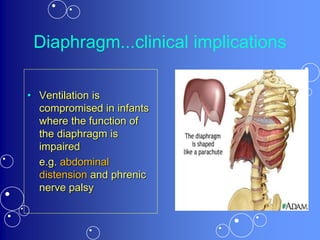
Diaphragm
• Angle of insertion of the
diaphragm in infants is more
horizontal
• Diaphragm works at a
mechanical disadvantage
• Diaphragm in infants has a
lower-content of high-
endurance muscle fibres and
also more susceptible to
fatigue
• The diaphragm is the most
important inspiratory muscle
due to the inactivity of the
intercostal muscles
Diaphragm...clinical implications
• Ventilation is
compromised in infants
where the function of
the diaphragm is
impaired
e.g. abdominal
distension and phrenic
nerve palsy
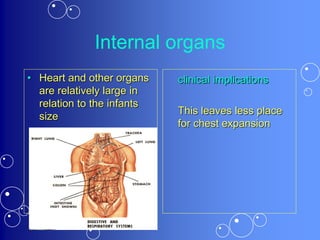
Internal organs
• Heart and other organs
are relatively large in
relation to the infants
size
clinical implications
This leaves less place
for chest expansion
Airway diameter
• Trachea is short and narrow
(1/3 of diameter adult) in
neonate. This makes respiratory
resistance higher and the work
of breathing greater.
• Narrowest part of the airway is
the cricoid ring (adult vocal
cords)
• Right bronchus less angled than
left
• During the first few years of life
their is significant growth in the
diameter of the airways
clinical implications .....
• Tracheal swelling as a result
of intubation can heighten
the resistance
• Inflexible cricoid ring leaves
child more vulnerable to post
extubation mucosal odema
and stridor
• Children are often intubated
into the right bronchus
Bronchial walls
• Bronchial walls are supported
by cartilaginous rings. However
the support provided in children
is far less than in adults making
airways
• The bronchial wall has
proportionally more cartilage,
connective tissue and mucus
cells and less muscle tissue
than in adults
• Beta adrenergic receptors
immature
clinical implications ...
• Airways more prone to
collapse
• Lung tissue less complaint
• Less smooth muscles makes
them less responsive to
bronchodilator until the age
of 12 years
Cilia
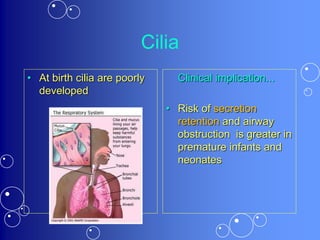
• At birth cilia are poorly
developed
Clinical implication...
• Risk of secretion
retention and airway
obstruction is greater in
premature infants and
neonates
Alveoli & surfactant
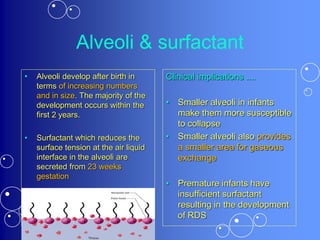
• Alveoli develop after birth in
terms of increasing numbers
and in size. The majority of the
development occurs within the
first 2 years.
• Surfactant which reduces the
surface tension at the air liquid
interface in the alveoli are
secreted from 23 weeks
gestation
Clinical implications ....
• Smaller alveoli in infants
make them more susceptible
to collapse
• Smaller alveoli also provides
a smaller area for gaseous
exchange
• Premature infants have
insufficient surfactant
resulting in the development
of RDS
Collateral ventilation
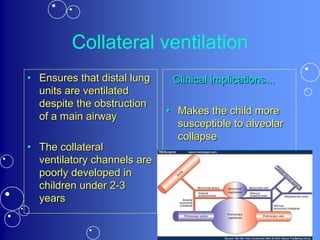
• Ensures that distal lung
units are ventilated
despite the obstruction
of a main airway
• The collateral
ventilatory channels are
poorly developed in
children under 2-3
years
Clinical implications...
• Makes the child more
susceptible to alveolar
collapse
Height and exposure to
pollution
• Children have a higher RR,
spend more time outdoors
exposing them to allergens
and pollutants
• Their height also exposes
the child to other pollutants
e.g. exhaust fumes
PHYSIOLOGICAL
DIFFERENCES
Respiratory compliance
• Measure of the pressure required to increase the
volume air in the lungs
• Combination of lung- and chest wall compliance
• Lung compliance in a child is comparable to an adult
and is directly proportional to the child’s size
• Compliance in a child is reduced by the high
proportion of cartilage in the airways
• Premature infants with insufficient surfactant show
reduced compliance
Chest wall compliance
• The chest wall of the infant is cartilaginous and
very soft and compliant. In the case of respiratory
distress the chest is drawn inwards .
• This is the reason for paradoxal breathing
Closing volume
• Lung volume at which the small airways close
• In infants the closing volume is greater than the FRC, airway
closure may thus occur before the end of expiration, a
consideration when using manual techniques e.g. Vibrations. One
may further reduce the lung volumes resulting in widespread
atelectasis
In respiratory distress children grunt (adducting the vocal cords) in
an attempt to reduce the expired volume of air in order to minimise
alveolar collapse
• It is harder to re-inflate collapsed alveoli in children
Ventilation & perfusion
• Ventilation and perfusion in both adults and children are
preferentially distributed to the dependant lung.
• The best ventilation/perfusion and gaseous exchange will occur
in the dependent lung areas
• In child the ventilation is best in the uppermost lung whilst
perfusion remains best in the dependent area, resulting a V/Q
mismatch
• Clinically significant in unilateral lung disease where the affected
lung is placed uppermost for postural drainage but impairs
ventilation
Ventilation & perfusion
• The difference in ventilation distribution in infants is due to
compliance of the ribcage, compressing the dependent areas of
the lung.
• In adults the abdominal content provides a preferential load on
the dependant diaphragm, improving its contractility. This does
not happen in the infant die to the smaller and narrower
abdomen.
Oxygen consumption
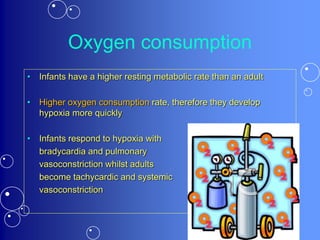
• Infants have a higher resting metabolic rate than an adult
• Higher oxygen consumption rate, therefore they develop
hypoxia more quickly
• Infants respond to hypoxia with
bradycardia and pulmonary
vasoconstriction whilst adults
become tachycardic and systemic
vasoconstriction
Muscle fatigue
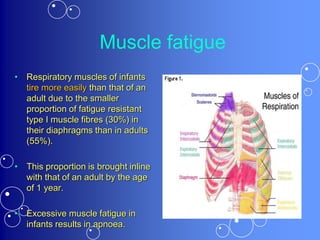
• Respiratory muscles of infants
tire more easily than that of an
adult due to the smaller
proportion of fatigue resistant
type I muscle fibres (30%) in
their diaphragms than in adults
(55%).
• This proportion is brought inline
with that of an adult by the age
of 1 year.
• Excessive muscle fatigue in
infants results in apnoea.
Breathing pattern
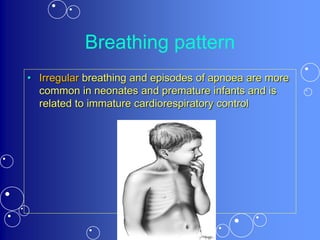
• Irregular breathing and episodes of apnoea are more
common in neonates and premature infants and is
related to immature cardiorespiratory control
References
• Smith, M. & Ball, V. 1998. Paediatric Management in
Cardiovascular/Respiratory Physiotherapy. Mosby,
London pp 254-256
• Ammani Prasad, S & Main, E. 2009. Paediatrics in
Physiotherapy for respiratory and cardiac problems.
Adults and children. Pryor, J.A. & Ammani Prasad, S
(eds.) 4th ed. Churchill Livingstone elsevierEdinburgh
pp 330-335
References
• van der Walt, R. 2009. Development of the chest wall
presented at the Baby NDT course 2010,
Bloemfontein (unpublished)
• Images courtesy of GOOGLE images

7489551.ppt

  • 1.
    Respiratory System: Anatomical andPhysiological differences between adults and children Robyn Smith Department of Physiotherapy UFS 2011
  • 2.
    Learning outcomes • Atthe end of this module the learner should: Be able to identify both anatomical and physiological differences between the respiratory systems of child and a adult Understand and explain the impact of these differences on the clinical findings, observations and respiration of a child Describe the impact of preferential nasal breathing on respiration in babies
  • 3.
    Background • The respiratorysystem of children differs both anatomically and physiologically from that of adults • These differences have important consequences for the physiotherapy care of children in terms of assessment, treatment and choice of techniques • The principle reason for hospital admissions in children under the age of 4 years is respiratory illness
  • 4.
    Background • The principlesof adult chest physiotherapy cannot be directly transposed to a child. • Chest physiotherapy as provided to children has become a specialised area on its own for this reason
  • 5.
  • 6.
  • 7.
    Thorax: Chest shape •Cross sectional area of the thorax is cylindrical and not elliptical as in adults
  • 8.
    Thorax: Ribcage • Theribcage of the newborn and infant is relatively soft and cartilaginous compared to the rigid chest wall of older children and adults • Ribs run horizontally to the vertebrae and sternum compared to the more oblique angle of older children and adults. The bucket handle movement as seen in older children and adults is therefore not possible. • Infant can therefore increase the anterior-posterior or transverse diameter of their chest • The intercostal muscles are inactive and poorly developed in infancy. And the abdominal muscles are not yet stabilising the ribcage • The interaction of gravity and the musculoskeletal system play an important role in the development of the thorax.
  • 9.
    Infant chest shape •Anterior view • Lateral view
  • 10.
    Thorax.... clinical implications •Clinical implications.... • With the limited chest expansion the child can only increase their lung volumes by increasing their respiration rate • No postural drainage in premature infants or neonates • Infants are diaphragmatic breathers • Premature infants & children with low tone especially hypotonia need to be positioned correctly to avoid chest deformities, rib flaring and a high riding ribcage • Infants with chronic caqrdiorespiratory conditions e.g. BPD, RDS or paradoxal breathing may also develop chest deformities over times
  • 11.
    Preferential nasal breathing •Shape and orientation of the head and neck in babies means that the airway prone to obstruction • Infants up to about 6 months are preferential nose breathers clinical implications ..... Children with upper respiratory tract infections and nasal secretions may have compromised respiration of the nose is blocked
  • 12.
    Diaphragm • Angle ofinsertion of the diaphragm in infants is more horizontal • Diaphragm works at a mechanical disadvantage • Diaphragm in infants has a lower-content of high- endurance muscle fibres and also more susceptible to fatigue • The diaphragm is the most important inspiratory muscle due to the inactivity of the intercostal muscles
  • 13.
    Diaphragm...clinical implications • Ventilationis compromised in infants where the function of the diaphragm is impaired e.g. abdominal distension and phrenic nerve palsy
  • 14.
    Internal organs • Heartand other organs are relatively large in relation to the infants size clinical implications This leaves less place for chest expansion
  • 15.
    Airway diameter • Tracheais short and narrow (1/3 of diameter adult) in neonate. This makes respiratory resistance higher and the work of breathing greater. • Narrowest part of the airway is the cricoid ring (adult vocal cords) • Right bronchus less angled than left • During the first few years of life their is significant growth in the diameter of the airways clinical implications ..... • Tracheal swelling as a result of intubation can heighten the resistance • Inflexible cricoid ring leaves child more vulnerable to post extubation mucosal odema and stridor • Children are often intubated into the right bronchus
  • 16.
    Bronchial walls • Bronchialwalls are supported by cartilaginous rings. However the support provided in children is far less than in adults making airways • The bronchial wall has proportionally more cartilage, connective tissue and mucus cells and less muscle tissue than in adults • Beta adrenergic receptors immature clinical implications ... • Airways more prone to collapse • Lung tissue less complaint • Less smooth muscles makes them less responsive to bronchodilator until the age of 12 years
  • 17.
    Cilia • At birthcilia are poorly developed Clinical implication... • Risk of secretion retention and airway obstruction is greater in premature infants and neonates
  • 18.
    Alveoli & surfactant •Alveoli develop after birth in terms of increasing numbers and in size. The majority of the development occurs within the first 2 years. • Surfactant which reduces the surface tension at the air liquid interface in the alveoli are secreted from 23 weeks gestation Clinical implications .... • Smaller alveoli in infants make them more susceptible to collapse • Smaller alveoli also provides a smaller area for gaseous exchange • Premature infants have insufficient surfactant resulting in the development of RDS
  • 19.
    Collateral ventilation • Ensuresthat distal lung units are ventilated despite the obstruction of a main airway • The collateral ventilatory channels are poorly developed in children under 2-3 years Clinical implications... • Makes the child more susceptible to alveolar collapse
  • 20.
    Height and exposureto pollution • Children have a higher RR, spend more time outdoors exposing them to allergens and pollutants • Their height also exposes the child to other pollutants e.g. exhaust fumes
  • 21.
  • 22.
    Respiratory compliance • Measureof the pressure required to increase the volume air in the lungs • Combination of lung- and chest wall compliance • Lung compliance in a child is comparable to an adult and is directly proportional to the child’s size • Compliance in a child is reduced by the high proportion of cartilage in the airways • Premature infants with insufficient surfactant show reduced compliance
  • 23.
    Chest wall compliance •The chest wall of the infant is cartilaginous and very soft and compliant. In the case of respiratory distress the chest is drawn inwards . • This is the reason for paradoxal breathing
  • 24.
    Closing volume • Lungvolume at which the small airways close • In infants the closing volume is greater than the FRC, airway closure may thus occur before the end of expiration, a consideration when using manual techniques e.g. Vibrations. One may further reduce the lung volumes resulting in widespread atelectasis In respiratory distress children grunt (adducting the vocal cords) in an attempt to reduce the expired volume of air in order to minimise alveolar collapse • It is harder to re-inflate collapsed alveoli in children
  • 25.
    Ventilation & perfusion •Ventilation and perfusion in both adults and children are preferentially distributed to the dependant lung. • The best ventilation/perfusion and gaseous exchange will occur in the dependent lung areas • In child the ventilation is best in the uppermost lung whilst perfusion remains best in the dependent area, resulting a V/Q mismatch • Clinically significant in unilateral lung disease where the affected lung is placed uppermost for postural drainage but impairs ventilation
  • 26.
    Ventilation & perfusion •The difference in ventilation distribution in infants is due to compliance of the ribcage, compressing the dependent areas of the lung. • In adults the abdominal content provides a preferential load on the dependant diaphragm, improving its contractility. This does not happen in the infant die to the smaller and narrower abdomen.
  • 27.
    Oxygen consumption • Infantshave a higher resting metabolic rate than an adult • Higher oxygen consumption rate, therefore they develop hypoxia more quickly • Infants respond to hypoxia with bradycardia and pulmonary vasoconstriction whilst adults become tachycardic and systemic vasoconstriction
  • 28.
    Muscle fatigue • Respiratorymuscles of infants tire more easily than that of an adult due to the smaller proportion of fatigue resistant type I muscle fibres (30%) in their diaphragms than in adults (55%). • This proportion is brought inline with that of an adult by the age of 1 year. • Excessive muscle fatigue in infants results in apnoea.
  • 29.
    Breathing pattern • Irregularbreathing and episodes of apnoea are more common in neonates and premature infants and is related to immature cardiorespiratory control
  • 30.
    References • Smith, M.& Ball, V. 1998. Paediatric Management in Cardiovascular/Respiratory Physiotherapy. Mosby, London pp 254-256 • Ammani Prasad, S & Main, E. 2009. Paediatrics in Physiotherapy for respiratory and cardiac problems. Adults and children. Pryor, J.A. & Ammani Prasad, S (eds.) 4th ed. Churchill Livingstone elsevierEdinburgh pp 330-335
  • 31.
    References • van derWalt, R. 2009. Development of the chest wall presented at the Baby NDT course 2010, Bloemfontein (unpublished) • Images courtesy of GOOGLE images