7 Implementing Strategies: Management and Operations Issues
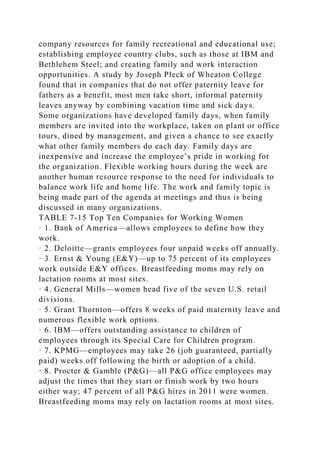
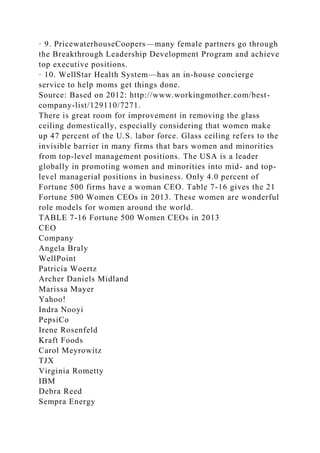
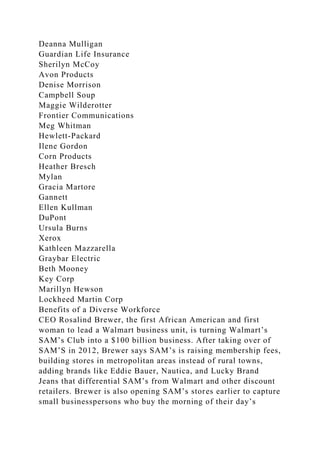
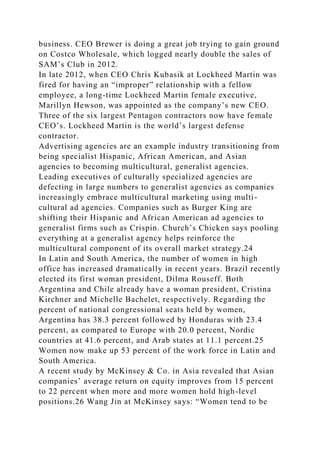
CHAPTER OBJECTIVES
After studying this chapter, you should be able to do the
following:
· 1. Construct an effective organizational chart.
· 2. Explain why corporate wellness has become so important in
strategic planning.
· 3. Explain why strategy implementation is more difficult than
strategy formulation.
· 4. Discuss the importance of annual objectives and policies in
achieving organizational commitment for strategies to be
implemented.
· 5. Explain why organizational structure is so important in
strategy implementation.
· 6. Compare and contrast restructuring and reengineering.
· 7. Describe the relationship between production/operations
and strategy implementation.
· 8. Explain how a firm can effectively link performance and
pay to strategies.
· 9. Discuss employee stock ownership plans (ESOPs) as a
strategic-management concept.
· 10. Describe how to modify an organizational culture to
support new strategies.
ASSURANCE OF LEARNING EXERCISES
The following exercises are found at the end of this chapter.
· EXERCISE 7A Critique Corporate Organizational Charts
· EXERCISE 7B Draw an Organizational Chart for PepsiCo
Using a Free, Online Template
· EXERCISE 7C Do Organizations Really Establish Objectives?
· EXERCISE 7D Understanding Your University’s Culture
The strategic-management process does not end on deciding
what strategy or strategies to pursue. There must be a
translation of strategic thought into strategic action. This
translation is much easier if managers and employees of the
firm understand the business, feel a part of the company, and
through involvement in strategy-formulation activities have
become committed to helping the organization succeed. Without
understanding and commitment, strategy-implementation efforts
face major problems. Vince Lombardi said: “The best game plan
in the world never blocked or tackled anybody.”
Implementing strategy affects an organization from top to
bottom, including all the functional and divisional areas of a
business. This chapter focuses on management issues most
central to implementing strategies in 2014–2015 and Chapter 8
focuses on marketing, finance/accounting, R&D, and
management information systems issues. TJX Companies is an
example firm with excellent management practices.
· Even the most technically perfect strategic plan will serve
little purpose if it is not implemented. Many organizations tend
to spend an inordinate amount of time, money, and effort on
developing the strategic plan, treating the means and
circumstances under which it will be implemented as
afterthoughts! Change comes through implementation and
evaluation, not through the plan. A technically imperfect plan
that is implemented well will achieve more than the perfect plan
that never gets off the paper on which it is typed.1
The Nature of Strategy Implementation
The strategy-implementation stage of strategic management is
revealed in Figure 7-1, as illustrated with white shading.
Successful strategy formulation does not guarantee successful
strategy implementation. It is always more difficult to do
something (strategy implementation) than to say you are going
to do it (strategy formulation)! Although inextricably linked,
strategy implementation is fundamentally different from
strategy formulation. Strategy formulation and implementation
can be contrasted in the following ways:
The TJX Companies Inc.: EXCELLENT STRATEGIC
MANAGEMENT SHOWCASED
Have you every shopped at the largest two discount clothing
retailers in the USA, T. J. Maxx and Marshalls? The parent
company of those clothing stores, TJX Companies, has
formulated and is implementing excellent strategies. T. J. Maxx
sells brand-name family apparel, accessories, women’s shoes,
domestics, giftware, and jewelry “at discount prices” at more
than 1,010 stores nationwide. Marshalls offers a full line of
shoes and a broader selection of menswear through about 900
stores. The company’s HomeGoods chain of 399 stores in the
USA focuses exclusively on home furnishings. T. K. Maxx is
the company’s European retail arm with more than 350 stores in
the UK, Ireland, Germany, and now Poland, including 339 T. K.
Maxx and 24 HomeSense stores. The company also operates
about 310 stores in Canada, including 222 Winners, 87
HomeSense, and 13 Marshalls.
Same-store sales at TJX climbed 8.0 percent year-over-year in
the 4-week period ended August 25, 2012. This rate of increase
was in line with the year-ago period’s growth. TJX’s total sales
climbed 10.0 percent for the aforementioned period to $1.9
billion from $1.7 billion in the year-ago period. As for the 30-
week period ended August 25, 2012, comparable sales climbed
8 percent from the year-ago period. Total sales for the same
period went up 10.0 percent year over year to $12.4 billion.
TJX’s sales exceeded even management’s expectations partly as
a result of higher customer traffic in its USA, Canadian, and
European divisions. At TJX’s largest division, Marmaxx Group,
comparable store sales growth of 9 percent during the 4-week
period ended August 25, 2012.
TJX has reported increased comparable store sales and customer
traffic for the past several quarters. TJX has an excellent,
flexible off-price business model that allows the firm to react
quickly and capitalize on market trends. TJX has a lower cost
structure than many other traditional retailers.
Source: Based on a variety of sources.
FIGURE 7-1 Comprehensive Strategic-Management Model
Table 7-7 summarizes the advantages and disadvantages of a
functional organizational structure.
FIGURE 7-3 Southwest Airlines’ Functional Organizational
Chart
Source: Based on company documents.
The Divisional Structure
The divisional structure or decentralized structure is the second
most common type used by U.S. businesses. As a small
organization grows, it has more difficulty managing different
products and services in different markets. Some form of
divisional structure generally becomes necessary to motivate
employees, control operations, and compete successfully in
diverse locations. The divisional structure can be organized in
one of four ways: by geographic area, by product or service, by
customer, or by process. With a divisional structure, functional
activities are performed both centrally and in each separate
division.
Sun Microsystems recently reduced the number of its business
units from seven to four. Kodak recently reduced its number of
business units from seven by-customer divisions to five by-
product divisions. As consumption patterns become increasingly
similar worldwide, a by-product structure is becoming more
effective than a by-customer or a by-geographic type divisional
structure. In the restructuring, Kodak eliminated its global
operations division and distributed those responsibilities across
the new by-product divisions.
A divisional structure has some clear advantages. First and
perhaps foremost, accountability is clear. That is, divisional
managers can be held responsible for sales and profit levels.
Because a divisional structure is based on extensive delegation
of authority, managers and employees can easily see the results
of their good or bad performances. As a result, employee morale
is generally higher in a divisional structure than it is in a
centralized structure. Other advantages of the divisional design
are that it creates career development opportunities for
managers, allows local control of situations, leads to a
competitive climate within an organization, and allows new
businesses and products to be added easily.
TABLE 7-7 Advantages and Disadvantages of a Functional
Organizational Structure
Advantages
Disadvantages
· 1. Simple and inexpensive
· 2. Capitalizes on specialization of business activities such as
marketing and finance
· 3. Minimizes need for elaborate control system
· 4. Allows for rapid decision making
· 1. Accountability forced to the top
· 2. Delegation of authority and responsibility not encouraged
· 3. Minimizes career development
· 4. Low employee and manager morale
· 5. Inadequate planning for products and markets
· 6. Leads to short-term, narrow thinking
· 7. Leads to communication problems
The divisional design is not without some limitations, however.
Perhaps the most important limitation is that a divisional
structure is costly, for a number of reasons. First, each division
requires functional specialists who must be paid. Second, there
exists some duplication of staff services, facilities, and
personnel; for instance, functional specialists are also needed
centrally (at headquarters) to coordinate divisional activities.
Third, managers must be well qualified because the divisional
design forces delegation of authority; better-qualified
individuals require higher salaries. A divisional structure can
also be costly because it requires an elaborate, head-quarters-
driven control system. Fourth, competition between divisions
may become so intense that it is dysfunctional and leads to
limited sharing of ideas and resources for the common good of
the firm. Table 7-8 summarizes the advantages and
disadvantages of divisional organizational structure.
TABLE 7-8 Advantages and Disadvantages of a Divisional
Organizational Structure
Advantages
Disadvantages
· 1. Accountability is clear
· 2. Allows local control of local situations
· 3. Creates career development chances
· 4. Promotes delegation of authority
· 5. Leads to competitive climate internally
· 6. Allows easy adding of new products or regions
· 7. Allows strict control and attention to products, customers,
or regions
· 1. Can be costly
· 2. Duplication of functional activities
· 3. Requires a skilled management force
· 4. Requires an elaborate control system
· 5. Competition among divisions can become so intense as to
be dysfunctional
· 6. Can lead to limited sharing of ideas and resources
· 7. Some regions, products, or customers may receive special
treatment
Ghoshal and Bartlett, two leading scholars in strategic
management, note the following:
· As their label clearly warns, divisions divide. The divisional
model fragments companies’ resources; it creates vertical
communication channels that insulate business units and
prevents them from sharing their strengths with one another.
Consequently, the whole of the corporation is often less than the
sum of its parts. A final limitation of the divisional design is
that certain regions, products, or customers may sometimes
receive special treatment, and it may be difficult to maintain
consistent, companywide practices. Nonetheless, for most large
organizations and many small firms, the advantages of a
divisional structure more than offset the potential limitations.5
A divisional structure by geographic area is appropriate for
organizations whose strategies need to be tailored to fit the
particular needs and characteristics of customers in different
geographic areas. This type of structure can be most appropriate
for organizations that have similar branch facilities located in
widely dispersed areas. A divisional structure by geographic
area allows local participation in decision making and improved
coordination within a region. Hershey Foods is an example
company organized using the divisional-by-region type of
structure, as illustrated in Figure 7-4. Analysts contend that this
type of structure may not be best for Hershey because
consumption patterns for candy are quite similar worldwide. An
alternative—and perhaps better—type of structure for Hershey
would be divisional by product because the company produces,
and sells three types of products worldwide: (1) chocolate, (2)
nonchocolate, and (3) grocery.
The divisional structure by product (or services) is most
effective for implementing strategies when specific products or
services need special emphasis. Also, this type of structure is
widely used when an organization offers only a few products or
services or when an organization’s products or services differ
substantially. The divisional structure allows strict control over
and attention to product lines, but it may also require a more
skilled management force and reduced top management control.
General Motors, DuPont, Microsoft, and Procter & Gamble use
a divisional structure by product to implement strategies.
Microsoft introduced its new Surface Tablet for $499 in late
2012. The Surface is being sold online and in Microsoft retail
stores, but not in stores such as Best Buy or Walmart, or even
Amazon. Microsoft’s divisional-by-product organizational
structure is illustrated in Figure 7-5.
FIGURE 7-4 Hershey Foods’ Divisional-by-Region
Organizational Chart
Source: Based on company documents.
FIGURE 7-5 Microsoft’s Divisional-by-Product Organizational
Structure
Source: Based on company documents.
When a few major customers are of paramount importance and
many different services are provided to these customers, then a
divisional structure by customer can be the most effective way
to implement strategies. This structure allows an organization to
cater effectively to the requirements of clearly defined customer
groups. For example, book publishing companies often organize
their activities around customer groups, such as colleges,
secondary schools, and private commercial schools. Some
airline companies have two major customer divisions:
passengers and freight or cargo services. Utility companies
often use (1) commercial, (2) residential, and (3) industrial as
their divisions by customer.
A divisional structure by process is similar to a functional
structure, because activities are organized according to the way
work is actually performed. However, a key difference between
these two designs is that functional departments are not
accountable for profits or revenues, whereas divisional process
departments are evaluated on these criteria. An example of a
divisional structure by process is a manufacturing business
organized into six divisions: electrical work, glass cutting,
welding, grinding, painting, and foundry work. In this case, all
operations related to these specific processes would be grouped
under the separate divisions. Each process (division) would be
responsible for generating revenues and profits. The divisional
structure by process can be particularly effective in achieving
objectives when distinct production processes represent the
thrust of competitiveness in an industry. Halliburton’s
organizational chart illustrated on the next page features aspects
of the division-by-process design.
The Strategic Business Unit (SBU) Structure
As the number, size, and diversity of divisions in an
organization increase, controlling and evaluating divisional
operations become increasingly difficult for strategists.
Increases in sales often are not accompanied by similar
increases in profitability. The span of control becomes too large
at top levels of the firm. For example, in a large conglomerate
organization composed of 90 divisions, such as ConAgra, the
chief executive officer could have difficulty even remembering
the first names of divisional presidents. In multidivisional
organizations, an SBU structure can greatly facilitate strategy-
implementation efforts. ConAgra has put its many divisions into
three primary SBUs: (1) food service (restaurants), (2) retail
(grocery stores), and (3) agricultural products.
The SBU structure groups similar divisions into SBUs and
delegates authority and responsibility for each unit to a senior
executive who reports directly to the chief executive officer.
This change in structure can facilitate strategy implementation
by improving coordination between similar divisions and
channeling accountability to distinct business units. In a 100-
division conglomerate, the divisions could perhaps be regrouped
into 10 SBUs according to certain common characteristics, such
as competing in the same industry, being located in the same
area, or having the same customers.
Two disadvantages of an SBU structure are that it requires an
additional layer of management, which increases salary
expenses. Also, the role of the group vice president is often
ambiguous. However, these limitations often do not outweigh
the advantages of improved coordination and accountability.
Another advantage of the SBU structure is that it makes the
tasks of planning and control by the corporate office more
manageable.
News Corp. recently reorganized its operations into two SBUs:
(1) Entertainment, which includes 20th Century Fox, Fox
Broadcast News, and the Fox News Channel, and (2) Publishing,
which includes The Wall Street Journal, Times of London, The
Sun newspaper, The Australian newspaper, and HarperCollins
book publishing. News Corp.’s Chairman and CEO, Rupert
Murdoch, is retaining his family’s 40 percent voting stake in
what may result in two separate companies. Estimated 2014
revenue in billions of dollars by division within the Publishing
SBU is as follows:
· Australia newspapers (2.19)
· Dow Jones (2.07)
· U.K. newspapers (1.34)
· Book publishing (1.25)
· Marketing services (0.97)
· Fox Sports (0.62)
· REA Group (0.37)
· NY Post, other (0.30)
· Education business (0.12)
Apparently to groom a new CEO, Coca-Cola recently
streamlined its organizational structure by converting to three
SBUs: (1) The Americas Beverages headed by Cahillane, (2)
Outside-The-Americas Beverages headed by Bozer, and (3)
Outside-The-Americas Bottlers headed by Finan. Coke CEO
Muhtar Kent said “Consolidating leadership under the three
groups will streamline reporting lines and intensify our focus on
key markets.” Either Mr. Cahillane and Mr. Bozer are expected
to replace Mr. Kent as CEO sometime in the future, although
Mr. Kent says: “As long as I’m having fun, my health allows me
to continue and I’m generating good returns for our
shareholders, and importantly as long as I’m smiling, which is
important in anything you do, then I will continue.”6
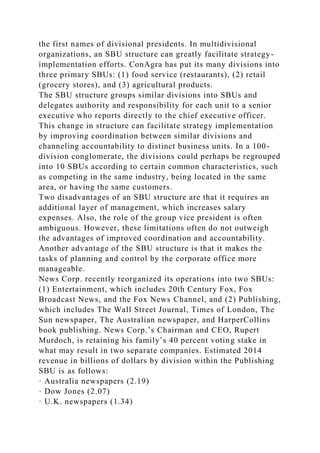
FIGURE 7-6 Halliburton Company’s SBU Organizational Chart
Source: Based on
http://www.halliburton.com/AboutUs/default.aspx?pageid=2458
&navid=966.
An excellent example of an SBU organizational chart is the one
posted at the Halliburton Company website and shown in Figure
7-6. Note that six division executives report to the Drilling and
Evaluation top executive, whereas five division heads report to
the Completion and Production top executive. It is interesting
and somewhat unusual that the 11 Halliburton divisions are
organized by process rather than by geographic region or
product.
The Matrix Structure
A matrix structure is the most complex of all designs because it
depends on both vertical and horizontal flows of authority and
communication (hence the term matrix). In contrast, functional
and divisional structures depend primarily on vertical flows of
authority and communication. A matrix structure can result in
higher overhead because it creates more management positions.
Other disadvantages of a matrix structure that contribute to
overall complexity include dual lines of budget authority (a
violation of the unity-of-command principle), dual sources of
reward and punishment, shared authority, dual reporting
channels, and a need for an extensive and effective
communication system.
Despite its complexity, the matrix structure is widely used in
many industries, including construction, health care, research,
and defense. As indicated in Table 7-9, some advantages of a
matrix structure are that project objectives are clear, there are
many channels of communication, workers can see the visible
results of their work, and shutting down a project can be
accomplished relatively easily. Another advantage of a matrix
structure is that it facilitates the use of specialized personnel,
equipment, and facilities. Functional resources are shared in a
matrix structure, rather than duplicated as in a divisional
structure. Individuals with a high degree of expertise can divide
their time as needed among projects, and they in turn develop
their own skills and competencies more than in other structures.
TABLE 7-9 Advantages and Disadvantages of a Matrix
Structure
Advantages
Disadvantages
· 1. Project objectives are clear
· 2. Employees can clearly see results of their work
· 3. Shutting down a project is easily accomplished
· 4. Facilitates uses of special equipment, personnel, and
facilities
· 5. Functional resources are shared instead of duplicated as in a
divisional structure
· 1. Requires excellent vertical and horizontal flows of
communication
· 2. Costly because creates more manager positions
· 3. Violates unity of command principle
· 4. Creates dual lines of budget authority
· 5. Creates dual sources of reward and punishment
· 6. Creates shared authority and reporting
· 7. Requires mutual trust and understanding
A typical matrix structure is illustrated in Figure 7-7. Note that
the letters (A through Z4) refer to managers. For example, if
you were manager A, you would be responsible for financial
aspects of Project 1, and you would have two bosses: the
Project 1 Manager on site and the CFO off site.
For a matrix structure to be effective, organizations need
participative planning, training, clear mutual understanding of
roles and responsibilities, excellent internal communication,
and mutual trust and confidence. The matrix structure is being
used more frequently by U.S. businesses because firms are
pursuing strategies that add new products, customer groups, and
technology to their range of activities. Out of these changes are
coming product managers, functional managers, and geographic-
area managers, all of whom have important strategic
responsibilities. When several variables, such as product,
customer, technology, geography, functional area, and line of
business, have roughly equal strategic priorities, a matrix
organization can be an effective structural form.
FIGURE 7-7 An Example Matrix Structure
Some Do’s and Don’ts in Developing Organizational Charts
Students analyzing strategic-management cases are often asked
to revise and develop a firm’s organizational structure. This
section provides some basic guidelines for this endeavor. There
are some basic do’s and don’ts in regard to devising or
constructing organizational charts, especially for midsize to
large firms. First of all, reserve the title CEO for the top
executive of the firm. Don’t use the title “president” for the top
person; use it for the division top managers if there are
divisions within the firm. Also, do not use the title “president”
for functional business executives. They should have the title
“chief,” or “vice president,” or “manager,” or “officer,” such as
“Chief Information Officer,” or “VP of Human Resources.”
Further, do not recommend a dual title (such as “CEO and
president”) for just one executive. Do not let a single individual
be both chairman of the board, although Pfizer’s CEO, Ian
Read, is also chairman of the board. And Comverse Technology
recently named Charles Burdick its president, chief executive
officer, and chairman of the board. Actually, “chairperson” is
much better than “chairman” for this title.
A significant movement among corporate America is to split the
chairperson of the board and the CEO positions in publicly held
companies.7 The movement includes asking the New York
Stock Exchange and Nasdaq to adopt listing rules that would
require separate positions. About 50 percent of companies in the
S&P 500 stock index have separate positions, up from 22
percent in 2002, but this still leaves plenty of room for
improvement. Among European and Asian companies, the split
in these two positions is much more common. For example, 79
percent of British companies split the positions, and all German
and Dutch companies split the position. South Korea’s Samsung
Electronics in mid-2013 dissolved its COO position in favor of
dual CEO’s—but this practice in not common or popular in the
USA.
Directly below the CEO, it is best to have a COO (chief
operating officer) with any division presidents reporting
directly to the COO. On the same level as the COO and also
reporting to the CEO, draw in your functional business
executives, such as a CFO (chief financial officer), VP of
human resources, a CSO (chief strategy officer), a CIO (chief
information officer), a CMO (chief marketing officer), a VP of
R&D, a VP of legal affairs, an investment relations officer,
maintenance officer, and so on. Note in Figure 7-8 that these
positions are labeled and placed appropriately. Note that a
controller or treasurer would normally report to the CFO.
In developing an organizational chart, avoid having a particular
person reporting to more than one person in the chain of
command. This would violate the unity-of-command principle
of management that “every employee should have just one
boss.” Also, do not have the CFO, CIO, CSO, human resource
officer, or other functional positions report to the COO. All
these positions report directly to the CEO.
A key consideration in devising an organizational structure
concerns the divisions. Note whether the divisions (if any) of a
firm presently are established based on geography, customer,
product, or process. If the firm’s organizational chart is not
available, you often can devise a chart based on the titles of
executives. An important case analysis activity is for you to
decide how the divisions of a firm should be organized for
maximum effectiveness. Even if the firm presently has no
divisions, determine whether the firm would operate better with
divisions. In other words, which type of divisional breakdown
do you (or your group or team) feel would be best for the firm
in allocating resources, establishing objectives, and devising
compensation incentives? This important strategic decision
faces many midsize and large firms (and teams of students
analyzing a strategic-management case).
As consumption patterns become more and more similar
worldwide, the divisional-by-product form of structure is
increasingly the most effective. Be mindful that all firms have
functional staff below their top executive and often readily
provide this information, so be wary of concluding prematurely
that a particular firm uses a functional structure. If you see the
word president in the titles of executives, coupled with
financial-reporting segments, such as by product or geographic
region, then the firm is divisionally structured.
If the firm is large with numerous divisions, decide whether an
SBU type of structure would be more appropriate to reduce the
span of control reporting to the COO. One never knows for sure
if a proposed or actual structure is indeed most effective for a
particular firm. Declining financial performance signals a need
for altering the structure.
Some important guidelines to follow in devising organizational
charts for companies are provided in Table 7-10.
FIGURE 7-8 Typical Top Managers of a Large Firm
TABLE 7-10 Fifteen Guidelines for Developing an
Organizational Chart
· 1. Instead of chairman of the board, make it chairperson of the
board.
· 2. Make sure the board of directors reveals diversity in race,
ethnicity, gender, and age.
· 3. Make sure the chair of the board is not also the CEO or
president of the company.
· 4. Make sure the CEO of the firm does not also carry the title
president.
· 5. Reserve the title president for the division heads of the
firm.
· 6. Make sure the firm has a COO.
· 7. Make sure only presidents of divisions report to the COO.
· 8. Make sure functional executives such as CFO, CIO, CMO,
CSO, R&D, CLO, CTO, and HRM report to the CEO, not the
COO.
· 9. Make sure every executive has one boss, so lines in the
chart should be drawn accordingly, assuring unity of command.
· 10. Make sure span of control is reasonable, probably no more
than 10 persons reporting to any other person.
· 11. Make sure diversity in race, ethnicity, gender, and age is
well represented among corporate executives.
· 12. Avoid a functional type structure for all but the smallest
firms.
· 13. Decentralize, using some form of divisional structure,
whenever possible.
· 14. Use an SBU type structure for large, multidivisional firms.
· 15. Make sure executive titles match product names as best
possible in division-by-product and SBU-designated firms.
Restructuring
Restructuring and reengineering are becoming commonplace on
the corporate landscape across the USA and Europe.
Restructuring—also called downsizing, rightsizing, or
delayering—involves reducing the size of the firm in terms of
number of employees, number of divisions or units, and number
of hierarchical levels in the firm’s organizational structure. This
reduction in size is intended to improve both efficiency and
effectiveness. Restructuring is concerned primarily with
shareholder well-being rather than employee well-being.
The lingering recession in Europe has forced many companies
there to downsize, laying off managers and employees. This
practice was historically rare in Europe because labor unions
and laws required lengthy negotiations or huge severance
checks before workers could be terminated. In contrast to the
USA, labor union executives of large European firms sit on
most boards of directors.
Job security in European companies is slowly moving toward a
U.S. scenario, in which firms lay off almost at will. From banks
in Milan to factories in Mannheim, European employers are
starting to show people the door in an effort to streamline
operations, increase efficiency, and compete against already
slim and trim U.S. firms. Massive U.S.-style layoffs are still
rare in Europe, but unemployment rates throughout the
continent are rising quite rapidly. European firms still prefer to
downsize by attrition and retirement rather than by blanket
layoffs because of culture, laws, and unions.
In contrast, reengineering is concerned more with employee and
customer well-being than shareholder well-being.
Reengineering—also called process management, process
innovation, or process redesign—involves reconfiguring or
redesigning work, jobs, and processes for the purpose of
improving cost, quality, service, and speed. Reengineering does
not usually affect the organizational structure or chart, nor does
it imply job loss or employee layoffs. Whereas restructuring is
concerned with eliminating or establishing, shrinking or
enlarging, and moving organizational departments and
divisions, the focus of reengineering is changing the way work
is actually carried out. Reengineering is characterized by many
tactical (short-term, business-function-specific) decisions,
whereas restructuring is characterized by strategic (long-term,
affecting all business functions) decisions.
Developed by Motorola in 1986 and made famous by CEO Jack
Welch at General Electric and more recently by Robert Nardelli,
former CEO of Home Depot, Six Sigma is a quality-boosting
process improvement technique that entails training several key
persons in the firm in the techniques to monitor, measure, and
improve processes and eliminate defects. Six Sigma has been
widely applied across industries from retailing to financial
services. CEO Dave Cote at Honeywell and CEO Jeff Immelt at
General Electric spurred acceptance of Six Sigma, which aims
to improve work processes and eliminate waste by training
“select” employees who are given judo titles such as Master
Black Belts, Black Belts, and Green Belts. Target Corp. claims
more than $100 million in savings over the past six years
resulting from its Six Sigma program.
Six Sigma was criticized in a Wall Street Journal article that
cited many example firms whose stock price fell for a number
of years after adoption of Six Sigma. The technique’s reliance
on the special group of trained employees is problematic and its
use within retail firms such as Home Depot has not been as
successful as in manufacturing firms.8
Restructuring
Firms often employ restructuring when various ratios appear out
of line with competitors as determined through benchmarking
exercises. Recall that benchmarking simply involves comparing
a firm against the best firms in the industry on a wide variety of
performance-related criteria. Some benchmarking ratios
commonly used in rationalizing the need for restructuring are
headcount-to-sales-volume, or corporate-staff-to-operating-
employees, or span-of-control figures.
The primary benefit sought from restructuring is cost reduction.
For some highly bureaucratic firms, restructuring can actually
rescue the firm from global competition and demise. But the
downside of restructuring can be reduced employee
commitment, creativity, and innovation that accompanies the
uncertainty and trauma associated with pending and actual
employee layoffs. Avon Products recently restructured partly as
a result of corruption investigations in its Russia and Brazil
operations. The company reduced its six commercial business
units down to two—(1) Developed Markets and (2) Developing
Markets—in essence going to a divisional by geographic region
type structure. Avon has been reporting lower sales and profits
amid missteps in key markets. Former CEO Andrea Jung
installed five new regional heads and new presidents in Avon’s
U.S. and Russia markets.
Employers today are looking for people who can do things, not
for people who make other people do things. Restructuring in
many firms has made a manager’s job an invisible, thankless
role. More workers today are self-managed, entrepreneurs,
interpreneurs, or team-managed. Managers today need to be
counselors, motivators, financial advisors, and psychologists.
They also run the risk of becoming technologically behind in
their areas of expertise. “Dilbert” cartoons sometimes portray
managers as enemies or as morons.
Linking Performance and Pay to Strategies
With so many people out of work and executive salaries so
large, politicians are more and more giving shareholders greater
control over executive pay. The Dodd-Frank Wall Street Reform
and Consumer Protection Act grants shareholders advisory votes
on compensation. A recent Bloomberg Businessweek article
says companies should install five policies to improve their
compensation practices:
· 1. Provide full transparency to all stakeholders. Novartis does
an excellent job on this.
· 2. Reward long-term performance with long-term pay, rather
than annual incentives. ExxonMobil does an excellent job on
this.
· 3. Base executive compensation on actual company
performance, rather than on stock price. Target, for example,
bases executive pay on same-store sales growth rather than
stock price.
· 4. Extend the time-horizon for bonuses. Replace short-term
with long-term incentives. Goldman Sachs does an excellent job
on this.
· 5. Increase equity between workers and executives. Delete
many special perks and benefits for executives. Be more
consistent across levels, although employees with greater
responsibility must receive greater compensation.10
As firms acquire other firms in other countries, these pay
differences can cause resentment and even turmoil. Larger pay
packages of U.S. CEOs are socially less acceptable in many
other countries. For example, in Japan, seniority rather than
performance is the key factor in determining pay, and harmony
among managers is emphasized over individual excellence.
How can an organization’s reward system be more closely
linked to strategic performance? How can decisions on salary
increases, promotions, merit pay, and bonuses be more closely
aligned to support the long-term strategic objectives of the
organization? There are no widely accepted answers to these
questions, but a dual bonus system based on both annual
objectives and long-term objectives is becoming common. The
percentage of a manager’s annual bonus attributable to short-
term versus long-term results should vary by hierarchical level
in the organization. It is important that bonuses not be based
solely on short-term results because such a system ignores long-
term company strategies and objectives.
Many companies have recently instituted policies to allow their
shareholders to vote on executive compensation policies. Aflac
was the first U.S. corporation to voluntarily give shareholders
an advisory vote on executive compensation. Aflac did this back
in 2007. Apple did this in 2008, as did H&R Block. Several
companies that instituted say-on-pay policies more recently
were Ingersoll-Rand, Verizon, Motorola, Occidental Petroleum,
and Hewlett-Packard. These new policies underscore how the
financial crisis and shareholder outrage about top executive pay
has affected compensation practice. None of the shareholder
votes are binding on the companies, however, at least not so far.
The U.S. House of Representatives recently passed a bill to
formalize this shareholder tactic, which is gaining steam across
the country as a means to combat exorbitant executive pay.
In an effort to cut costs and increase productivity, more and
more Japanese companies are switching from seniority-based
pay to performance-based approaches. Toyota has switched to a
full merit system for 20,000 of its 70,000 white-collar workers.
Fujitsu, Sony, Matsushita
Source: Fred R. David, “How Companies Define Their
Mission,” Long Range Planning 22, no. 3 (June 1988): 40.
· • Strategy formulation is positioning forces before the action.
· • Strategy implementation is managing forces during the
action.
· • Strategy formulation focuses on effectiveness.
· • Strategy implementation focuses on efficiency.
· • Strategy formulation is primarily an intellectual process.
· • Strategy implementation is primarily an operational process.
· • Strategy formulation requires good intuitive and analytical
skills.
· • Strategy implementation requires special motivation and
leadership skills.
· • Strategy formulation requires coordination among a few
individuals.
· • Strategy implementation requires coordination among many
individuals.
Strategy-formulation concepts and tools do not differ greatly for
small, large, for-profit, or nonprofit organizations. However,
strategy implementation varies substantially among different
types and sizes of organizations. Implementing strategies
requires such actions as altering sales territories, adding new
departments, closing facilities, hiring new employees, changing
an organization’s pricing strategy, developing financial budgets,
developing new employee benefits, establishing cost-control
procedures, changing advertising strategies, building new
facilities, training new employees, transferring managers among
divisions, and building a better management information
system. These types of activities obviously differ greatly among
manufacturing, service, and governmental organizations.
Management Perspectives
In terms of “Quality of Management,” Fortune recently ranked
the following companies as best in the world:
Rank
Company
1
Koc Holding
2
McDonald’s
3
Apple
4
Philip Morris International
5
Costco Wholesale
6
JP Morgan Chase
7
Wyndham Worldwide
8
Sysco
9
Walt Disney
10
TJX
Source: Based on:
http://money.cnn.com/magazines/fortune/mostadmired/2012/bes
t_worst/best5.html.
In all but the smallest organizations, the transition from strategy
formulation to strategy implementation requires a shift in
responsibility from strategists to divisional and functional
managers. Implementation problems can arise because of this
shift in responsibility, especially if strategy-formulation
decisions come as a surprise to middle- and lower-level
managers. Managers and employees are motivated more by
perceived self-interests than by organizational interests, unless
the two coincide. This is a primary reason why divisional and
functional managers should be involved as much as possible in
strategy-formulation and strategy-implementation activities.
TABLE 7-1 Some Management Issues Central to Strategy
Implementation
Establish annual objectives
Devise policies
Allocate resources
Alter an existing organizational structure
Restructure and reengineer
Revise reward and incentive plans
Minimize resistance to change
Match managers with strategy
Develop a strategy-supportive culture
Adapt production and operations processes
Develop an effective human resources function
Downsize and furlough as needed
Link performance and pay to strategies
As indicated in Table 7-1, management issues central to
strategy implementation include establishing annual objectives,
devising policies, allocating resources, altering an existing
organizational structure, restructuring and reengineering,
revising reward and incentive plans, minimizing resistance to
change, matching managers with strategy, developing a
strategy-supportive culture, adapting production and operations
processes, developing an effective human resources function,
and, if necessary, downsizing. Management changes are
necessarily more extensive when strategies to be implemented
move a firm in a major new direction.
Managers and employees throughout an organization should
participate early and directly in strategy-implementation
decisions. Their role in strategy implementation should build on
prior involvement in strategy-formulation activities. Strategists’
genuine personal commitment to implementation is a necessary
and powerful motivational force for managers and employees.
Too often, strategists are too busy to actively support strategy-
implementation efforts, and their lack of interest can be
detrimental to organizational success. The rationale for
objectives and strategies should be understood and clearly
communicated throughout an organization. Major competitors’
accomplishments, products, plans, actions, and performance
should be apparent to all organizational members. Major
external opportunities and threats should be clear, and
managers’ and employees’ questions should be answered. Top-
down flow of communication is essential for developing
bottom-up support.
Firms need to develop a competitor focus at all hierarchical
levels by gathering and widely distributing competitive
intelligence; every employee should be able to benchmark her
or his efforts against best-in-class competitors so that the
challenge becomes personal. For example, Starbucks Corp.
recently instituted “lean production/operations” at its 11,000+
U.S. stores. This system eliminates idle employee time and
unnecessary employee motions, such as walking, reaching, and
bending. Starbucks says 30 percent of employees’ time is
motion and the company wants to reduce that. They say “motion
and work are two different things.”
Annual Objectives
Establishing annual objectives is a decentralized activity that
directly involves all managers in an organization. Active
participation in establishing annual objectives can lead to
acceptance and commitment. Annual objectives are essential for
strategy implementation because they (a) represent the basis for
allocating resources; (b) are a primary mechanism for
evaluating managers; (c) are the major instrument for
monitoring progress toward achieving long-term objectives; and
(d) establish organizational, divisional, and departmental
priorities. Considerable time and effort should be devoted to
ensuring that annual objectives are well conceived, consistent
with long-term objectives, and supportive of strategies to be
implemented. Approving, revising, or rejecting annual
objectives is much more than a rubber-stamp activity. The
purpose of annual objectives can be summarized as follows:
· Annual objectives serve as guidelines for action, directing and
channeling efforts and activities of organization members. They
provide a source of legitimacy in an enterprise by justifying
activities to stakeholders. They serve as standards of
performance. They serve as an important source of employee
motivation and identification. They give incentives for
managers and employees to perform. They provide a basis for
organizational design.2
Clearly stated and communicated objectives are critical to
success in all types and sizes of firms. Annual objectives, stated
in terms of profitability, growth, and market share by business
segment, geographic area, customer groups, and product, are
common in organizations. Figure 7-2 illustrates how the Stamus
Company could establish annual objectives based on long-term
objectives. Table 7-2 reveals associated revenue figures that
correspond to the objectives outlined in Figure 7-2. Note that,
according to plan, the Stamus Company will slightly exceed its
long-term objective of doubling company revenues between
2012 and 2014.
Figure 7-2 also reflects how a hierarchy of annual objectives
can be established based on an organization’s structure.
Objectives should be consistent across hierarchical levels and
form a network of supportive aims. Horizontal consistency of
objectives is as important as vertical consistency of objectives.
For instance, it would not be effective for manufacturing to
achieve more than its annual objective of units produced if
marketing could not sell the additional units.
FIGURE 7-2 The Stamus Company’s Hierarchy of Aims
Annual objectives should be measurable, consistent, reasonable,
challenging, clear, communicated throughout the organization,
characterized by an appropriate time dimension, and
accompanied by commensurate rewards and sanctions. Too
often, objectives are stated in generalities, with little
operational usefulness. Annual objectives, such as “to improve
communication” or “to improve performance,” are not clear,
specific, or measurable. Objectives should state quantity,
quality, cost, and time—and also be verifiable. Terms and
phrases such as maximize, minimize, as soon as possible, and
adequate should be avoided.
Annual objectives should be compatible with employees’ and
managers’ values and supported by clearly stated policies. More
of something is not always better. Improved quality or reduced
cost may, for example, be more important than quantity. It is
important to tie rewards and sanctions to annual objectives so
that employees and managers understand that achieving
objectives is critical to successful strategy implementation.
Clear annual objectives do not guarantee successful strategy
implementation, but they do increase the likelihood that
personal and organizational aims can be accomplished.
Overemphasis on achieving objectives can result in undesirable
conduct, such as faking the numbers, distorting the records, and
letting objectives become ends in themselves. Managers must be
alert to these potential problems.
TABLE 7-2 The Stamus Company’s Revenue Expectations (in
$millions)
2012
2013
2014
Division I Revenues
1.0
1.400
1.960
Division II Revenues
0.5
0.700
0.980
Division III Revenues
0.5
0.750
1.125
Total Company Revenues
2.0
2.850
4.065
Policies
Changes in a firm’s strategic direction do not occur
automatically. On a day-to-day basis, policies are needed to
make a strategy work. Policies facilitate solving recurring
problems and guide the implementation of strategy. Broadly
defined, policy refers to specific guidelines, methods,
procedures, rules, forms, and administrative practices
established to support and encourage work toward stated goals.
Policies are instruments for strategy implementation. Policies
set boundaries, constraints, and limits on the kinds of
administrative actions that can be taken to reward and sanction
behavior; they clarify what can and cannot be done in pursuit of
an organization’s objectives. For example, Carnival’s Paradise
ship has a no smoking policy anywhere, anytime aboard ship. It
was the first cruise ship to ban smoking comprehensively.
Another example of corporate policy relates to surfing the Web
while at work. About 40 percent of companies today do not have
a formal policy preventing employees from surfing the Internet,
but software is being marketed now that allows firms to monitor
how, when, where, and how long various employees use the
Internet at work.
Policies let both employees and managers know what is
expected of them, thereby increasing the likelihood that
strategies will be implemented successfully. They provide a
basis for management control, allow coordination across
organizational units, and reduce the amount of time managers
spend making decisions. Policies also clarify what work is to be
done and by whom. They promote delegation of decision
making to appropriate managerial levels where various
problems usually arise. Many organizations have a policy
manual that serves to guide and direct behavior. Walmart has a
policy that it calls the “10 Foot” Rule, whereby customers can
find assistance within 10 feet of anywhere in the store. This is a
welcomed policy in Japan, where Walmart is trying to gain a
foothold; 58 percent of all retailers in Japan are mom-and-pop
stores and consumers historically have had to pay “top yen”
rather than “discounted prices” for merchandise.
Policies can apply to all divisions and departments (for
example, “We are an equal opportunity employer”). Some
policies apply to a single department (“Employees in this
department must take at least one training and development
course each year”). Whatever their scope and form, policies
serve as a mechanism for implementing strategies and obtaining
objectives. Policies should be stated in writing whenever
possible. They represent the means for carrying out strategic
decisions. Examples of policies that support a company
strategy, a divisional objective, and a departmental objective
are given in Table 7-3.
Some example issues that may require a management policy are
provided in Table 7-4.
TABLE 7-3 A Hierarchy of Policies
Company Strategy
Acquire a chain of retail stores to meet our sales growth and
profitability objectives.
Supporting Policies
· 1. “All stores will be open from 8 a.m. to 8 p.m. Monday
through Saturday.” (This policy could increase retail sales if
stores currently are open only 40 hours a week.)
· 2. “All stores must submit a Monthly Control Data Report.”
(This policy could reduce expense-to-sales ratios.)
· 3. “All stores must support company advertising by
contributing 5 percent of their total monthly revenues for this
purpose.” (This policy could allow the company to establish a
national reputation.)
· 4. “All stores must adhere to the uniform pricing guidelines
set forth in the Company Handbook.” (This policy could help
assure customers that the company offers a consistent product in
terms of price and quality in all its stores.)
Divisional Objective
Increase the division’s revenues from $10 million in 2014 to
$15 million in 2015.
Supporting Policies
· 1. “Beginning in January 2014, each one of this division’s
salespersons must file a weekly activity report that includes the
number of calls made, the number of miles traveled, the number
of units sold, the dollar volume sold, and the number of new
accounts opened.” (This policy could ensure that salespersons
do not place too great an emphasis in certain areas.)
· 2. “Beginning in January 2014, this division will return to its
employees 5 percent of its gross revenues in the form of a
Christmas bonus.” (This policy could increase employee
productivity.)
· 3. “Beginning in January 2014, inventory levels carried in
warehouses will be decreased by 30 percent in accordance with
a just-in-time (JIT) manufacturing approach.” (This policy
could reduce production expenses and thus free funds for
increased marketing efforts.)
Production Department Objective
Increase production from 20,000 units in 2014 to 30,000 units
in 2015.
Supporting Policies
· 1. “Beginning in January 2014, employees will have the option
of working up to 20 hours of overtime per week.” (This policy
could minimize the need to hire additional employees.)
· 2. “Beginning in January 2014, perfect attendance awards in
the amount of $100 will be given to all employees who do not
miss a workday in a given year.” (This policy could decrease
absenteeism and increase productivity.)
· 3. “Beginning in January 2014, new equipment must be leased
rather than purchased.” (This policy could reduce tax liabilities
and thus allow more funds to be invested in modernizing
production processes.)
TABLE 7-4 Some Issues That May Require a Management
Policy
· • To offer extensive or limited management development
workshops and seminars
· • To centralize or decentralize employee-training activities
· • To recruit through employment agencies, college campuses,
or newspapers
· • To promote from within or to hire from the outside
· • To promote on the basis of merit or on the basis of seniority
· • To tie executive compensation to long-term or annual
objectives
· • To offer numerous or few employee benefits
· • To negotiate directly or indirectly with labor unions
· • To delegate authority for large expenditures or to centrally
retain this authority
· • To allow much, some, or no overtime work
· • To establish a high- or low-safety stock of inventory
· • To use one or more suppliers
· • To buy, lease, or rent new production equipment
· • To greatly or somewhat stress quality control
· • To establish many or only a few production standards
· • To operate one, two, or three shifts
· • To discourage using insider information for personal gain
· • To discourage sexual harassment
· • To discourage smoking at work
· • To discourage insider trading
· • To discourage moonlighting
Resource Allocation
Resource allocation is a central management activity that allows
for strategy execution. In organizations that do not use a
strategic-management approach to decision making, resource
allocation is often based on political or personal factors.
Strategic management enables resources to be allocated
according to priorities established by annual objectives.
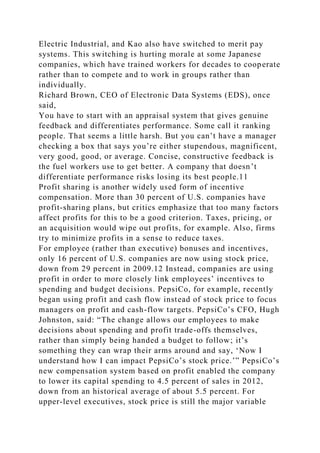
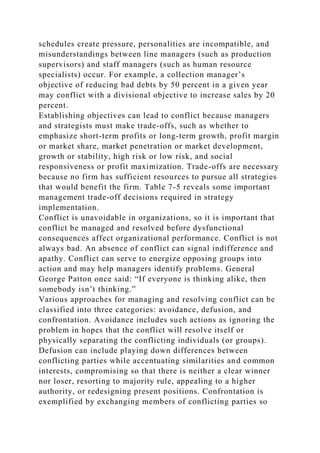
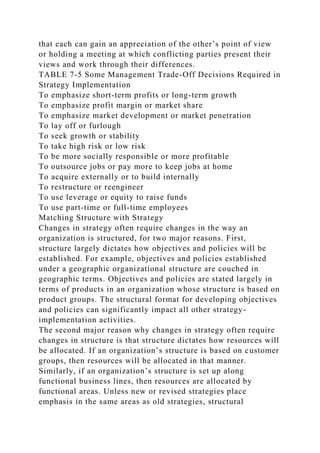
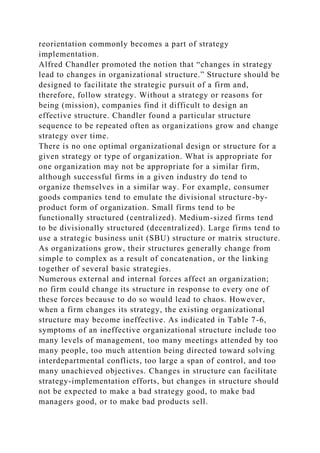
All organizations have at least four types of resources that can
be used to achieve desired objectives: financial resources,
physical resources, human resources, and technological
resources. Allocating resources to particular divisions and
departments does not mean that strategies will be successfully
implemented. A number of factors commonly prohibit effective
resource allocation, including an overprotection of resources,
too great an emphasis on short-run financial criteria,
organizational politics, vague strategy targets, a reluctance to
take risks, and a lack of sufficient knowledge.
Below the corporate level, there often exists an absence of
systematic thinking about resources allocated and strategies of
the firm. Yavitz and Newman explain why:
· Managers normally have many more tasks than they can do.
Managers must allocate time and resources among these tasks.
Pressure builds up. Expenses are too high. The CEO wants a
good financial report for the third quarter. Strategy formulation
and implementation activities often get deferred. Today’s
problems soak up available energies and resources. Scrambled
accounts and budgets fail to reveal the shift in allocation away
from strategic needs to currently squeaking wheels.3
The real value of any resource allocation program lies in the
resulting accomplishment of an organization’s objectives.
Effective resource allocation does not guarantee successful
strategy implementation because programs, personnel, controls,
and commitment must breathe life into the resources provided.
Strategic management itself is sometimes referred to as a
“resource allocation process.”
Managing Conflict
Interdependency of objectives and competition for limited
resources often leads to conflict. Conflict can be defined as a
disagreement between two or more parties on one or more
issues. Establishing annual objectives can lead to conflict
because individuals have different expectations and perceptions,
schedules create pressure, personalities are incompatible, and
misunderstandings between line managers (such as production
supervisors) and staff managers (such as human resource
specialists) occur. For example, a collection manager’s
objective of reducing bad debts by 50 percent in a given year
may conflict with a divisional objective to increase sales by 20
percent.
Establishing objectives can lead to conflict because managers
and strategists must make trade-offs, such as whether to
emphasize short-term profits or long-term growth, profit margin
or market share, market penetration or market development,
growth or stability, high risk or low risk, and social
responsiveness or profit maximization. Trade-offs are necessary
because no firm has sufficient resources to pursue all strategies
that would benefit the firm. Table 7-5 reveals some important
management trade-off decisions required in strategy
implementation.
Conflict is unavoidable in organizations, so it is important that
conflict be managed and resolved before dysfunctional
consequences affect organizational performance. Conflict is not
always bad. An absence of conflict can signal indifference and
apathy. Conflict can serve to energize opposing groups into
action and may help managers identify problems. General
George Patton once said: “If everyone is thinking alike, then
somebody isn’t thinking.”
Various approaches for managing and resolving conflict can be
classified into three categories: avoidance, defusion, and
confrontation. Avoidance includes such actions as ignoring the
problem in hopes that the conflict will resolve itself or
physically separating the conflicting individuals (or groups).
Defusion can include playing down differences between
conflicting parties while accentuating similarities and common
interests, compromising so that there is neither a clear winner
nor loser, resorting to majority rule, appealing to a higher
authority, or redesigning present positions. Confrontation is
exemplified by exchanging members of conflicting parties so
that each can gain an appreciation of the other’s point of view
or holding a meeting at which conflicting parties present their
views and work through their differences.
TABLE 7-5 Some Management Trade-Off Decisions Required in
Strategy Implementation
To emphasize short-term profits or long-term growth
To emphasize profit margin or market share
To emphasize market development or market penetration
To lay off or furlough
To seek growth or stability
To take high risk or low risk
To be more socially responsible or more profitable
To outsource jobs or pay more to keep jobs at home
To acquire externally or to build internally
To restructure or reengineer
To use leverage or equity to raise funds
To use part-time or full-time employees
Matching Structure with Strategy
Changes in strategy often require changes in the way an
organization is structured, for two major reasons. First,
structure largely dictates how objectives and policies will be
established. For example, objectives and policies established
under a geographic organizational structure are couched in
geographic terms. Objectives and policies are stated largely in
terms of products in an organization whose structure is based on
product groups. The structural format for developing objectives
and policies can significantly impact all other strategy-
implementation activities.
The second major reason why changes in strategy often require
changes in structure is that structure dictates how resources will
be allocated. If an organization’s structure is based on customer
groups, then resources will be allocated in that manner.
Similarly, if an organization’s structure is set up along
functional business lines, then resources are allocated by
functional areas. Unless new or revised strategies place
emphasis in the same areas as old strategies, structural
reorientation commonly becomes a part of strategy
implementation.
Alfred Chandler promoted the notion that “changes in strategy
lead to changes in organizational structure.” Structure should be
designed to facilitate the strategic pursuit of a firm and,
therefore, follow strategy. Without a strategy or reasons for
being (mission), companies find it difficult to design an
effective structure. Chandler found a particular structure
sequence to be repeated often as organizations grow and change
strategy over time.
There is no one optimal organizational design or structure for a
given strategy or type of organization. What is appropriate for
one organization may not be appropriate for a similar firm,
although successful firms in a given industry do tend to
organize themselves in a similar way. For example, consumer
goods companies tend to emulate the divisional structure-by-
product form of organization. Small firms tend to be
functionally structured (centralized). Medium-sized firms tend
to be divisionally structured (decentralized). Large firms tend to
use a strategic business unit (SBU) structure or matrix structure.
As organizations grow, their structures generally change from
simple to complex as a result of concatenation, or the linking
together of several basic strategies.
Numerous external and internal forces affect an organization;
no firm could change its structure in response to every one of
these forces because to do so would lead to chaos. However,
when a firm changes its strategy, the existing organizational
structure may become ineffective. As indicated in Table 7-6,
symptoms of an ineffective organizational structure include too
many levels of management, too many meetings attended by too
many people, too much attention being directed toward solving
interdepartmental conflicts, too large a span of control, and too
many unachieved objectives. Changes in structure can facilitate
strategy-implementation efforts, but changes in structure should
not be expected to make a bad strategy good, to make bad
managers good, or to make bad products sell.
Electric Industrial, and Kao also have switched to merit pay
systems. This switching is hurting morale at some Japanese
companies, which have trained workers for decades to cooperate
rather than to compete and to work in groups rather than
individually.
Richard Brown, CEO of Electronic Data Systems (EDS), once
said,
You have to start with an appraisal system that gives genuine
feedback and differentiates performance. Some call it ranking
people. That seems a little harsh. But you can’t have a manager
checking a box that says you’re either stupendous, magnificent,
very good, good, or average. Concise, constructive feedback is
the fuel workers use to get better. A company that doesn’t
differentiate performance risks losing its best people.11
Profit sharing is another widely used form of incentive
compensation. More than 30 percent of U.S. companies have
profit-sharing plans, but critics emphasize that too many factors
affect profits for this to be a good criterion. Taxes, pricing, or
an acquisition would wipe out profits, for example. Also, firms
try to minimize profits in a sense to reduce taxes.
For employee (rather than executive) bonuses and incentives,
only 16 percent of U.S. companies are now using stock price,
down from 29 percent in 2009.12 Instead, companies are using
profit in order to more closely link employees’ incentives to
spending and budget decisions. PepsiCo, for example, recently
began using profit and cash flow instead of stock price to focus
managers on profit and cash-flow targets. PepsiCo’s CFO, Hugh
Johnston, said: “The change allows our employees to make
decisions about spending and profit trade-offs themselves,
rather than simply being handed a budget to follow; it’s
something they can wrap their arms around and say, ‘Now I
understand how I can impact PepsiCo’s stock price.’” PepsiCo’s
new compensation system based on profit enabled the company
to lower its capital spending to 4.5 percent of sales in 2012,
down from an historical average of about 5.5 percent. For
upper-level executives, stock price is still the major variable
used for compensation incentives, but for mid-and-lower level
managers and employees, stock price is dependent on too many
extraneous variables for it to be an effective compensation
variable.
The good news for shareholders is that in 2013, over 50 percent
of CEO compensation was directly associated with the
performance of the firm, rather than salary—up from 35 percent
in 2009 (WSJ, 3-21-13, p. B1). Note below that Indra Nooyi of
PepsiCo was the third highest paid women CEO in 2012 in the
USA:
· 1. Irene Rosenfeld at Kraft ($21.9M)
· 2. Debra Cafaro at Ventas ($18.5M)
· 3. Indra Nooyi at PepsiCo ($17.1M)
· 4. Meg Whitman at HP ($16.5M)
· 5. Ellen Kullman at DuPont ($15.9M)
· 6. Angela Braly at WellPoint ($13.3M)
Still another criterion widely used to link performance and pay
to strategies is gain sharing. Gain sharing requires employees or
departments to establish performance targets; if actual results
exceed objectives, all members get bonuses. More than 26
percent of U.S. companies use some form of gain sharing; about
75 percent of gain-sharing plans have been adopted since 1980.
Carrier, a subsidiary of United Technologies, has had excellent
success with gain sharing in its six plants in Syracuse, New
York; Firestone’s tire plant in Wilson, North Carolina, has
experienced similar success with gain sharing.
Criteria such as sales, profit, production efficiency, quality, and
safety could also serve as bases for an effective bonus system.
If an organization meets certain understood, agreed-on profit
objectives, every member of the enterprise should share in the
harvest. A bonus system can be an effective tool for motivating
individuals to support strategy-implementation efforts.
BankAmerica, for example, recently overhauled its incentive
system to link pay to sales of the bank’s most profitable
products and services. Branch managers receive a base salary
plus a bonus based both on the number of new customers and on
sales of bank products. Every employee in each branch is also
eligible for a bonus if the branch exceeds its goals. Thomas
Peterson, a top BankAmerica executive, says, “We want to make
people responsible for meeting their goals, so we pay incentives
on sales, not on controlling costs or on being sure the parking
lot is swept.”
Five tests are often used to determine whether a performance-
pay plan will benefit an organization:
· 1.Does the plan capture attention? Are people talking more
about their activities and taking pride in early successes under
the plan?
· 2.Do employees understand the plan? Can participants explain
how it works and what they need to do to earn the incentive?
· 3.Is the plan improving communication? Do employees know
more than they used to about the company’s mission, plans, and
objectives?
· 4.Does the plan pay out when it should? Are incentives being
paid for desired results—and being withheld when objectives
are not met?
· 5.Is the company or unit performing better? Are profits up?
Has market share grown? Have gains resulted in part from the
incentives?13
In addition to a dual bonus system, a combination of reward
strategy incentives, such as salary raises, stock options, fringe
benefits, promotions, praise, recognition, criticism, fear,
increased job autonomy, and awards, can be used to encourage
managers and employees to push hard for successful strategic
implementation. The range of options for getting people,
departments, and divisions to actively support strategy-
implementation activities in a particular organization is almost
limitless. Merck, for example, recently gave each of its 37,000
employees a 10-year option to buy 100 shares of Merck stock at
a set price of $127. Steven Darien, Merck’s vice president of
human resources, says, “We needed to find ways to get
everyone in the workforce on board in terms of our goals and
objectives. Company executives will begin meeting with all
Merck workers to explore ways in which employees can
contribute more.”
Managing Resistance to Change
No organization or individual can escape change. But the
thought of change raises anxieties because people fear economic
loss, inconvenience, uncertainty, and a break in normal social
patterns. Almost any change in structure, technology, people, or
strategies has the potential to disrupt comfortable interaction
patterns. For this reason, people resist change. The strategic-
management process itself can impose major changes on
individuals and processes. Reorienting an organization to get
people to think and act strategically is not an easy task.
Resistance to change can be considered the single greatest
threat to successful strategy implementation. Resistance
regularly occurs in organizations in the form of sabotaging
production machines, absenteeism, filing unfounded grievances,
and an unwillingness to cooperate. People often resist strategy
implementation because they do not understand what is
happening or why changes are taking place. In that case,
employees may simply need accurate information. Successful
strategy implementation hinges on managers’ ability to develop
an organizational climate conducive to change. Change must be
viewed as an opportunity rather than as a threat by managers
and employees.
Resistance to change can emerge at any stage or level of the
strategy-implementation process. Although there are various
approaches for implementing changes, three commonly used
strategies are a force change strategy, an educative change
strategy, and a rational or self-interest change strategy. A force
change strategy involves giving orders and enforcing those
orders; this strategy has the advantage of being fast, but it is
plagued by low commitment and high resistance. The educative
change strategy is one that presents information to convince
people of the need for change; the disadvantage of an educative
change strategy is that implementation becomes slow and
difficult. However, this type of strategy evokes greater
commitment and less resistance than does the force change
strategy. Finally, a rational change strategy or self-interest
change strategy is one that attempts to convince individuals that
the change is to their personal advantage. When this appeal is
successful, strategy implementation can be relatively easy.
However, implementation changes are seldom to everyone’s
advantage.
The rational change strategy is the most desirable, so this
approach is examined a bit further. Managers can improve the
likelihood of successfully implementing change by carefully
designing change efforts. Jack Duncan described a rational or
self-interest change strategy as consisting of four steps. First,
employees are invited to participate in the process of change
and in the details of transition; participation allows everyone to
give opinions, to feel a part of the change process, and to
identify their own self-interests regarding the recommended
change. Second, some motivation or incentive to change is
required; self-interest can be the most important motivator.
Third, communication is needed so that people can understand
the purpose for the changes. Giving and receiving feedback is
the fourth step: everyone enjoys knowing how things are going
and how much progress is being made.14
Because of diverse external and internal forces, change is a fact
of life in organizations. The rate, speed, magnitude, and
direction of changes vary over time by industry and
organization. Strategists should strive to create a work
environment in which change is recognized as necessary and
beneficial so that individuals can more easily adapt to change.
Adopting a strategic-management approach to decision making
can itself require major changes in the philosophy and
operations of a firm.
Strategists can take a number of positive actions to minimize
managers’ and employees’ resistance to change. For example,
individuals who will be affected by a change should be involved
in the decision to make the change and in decisions about how
to implement the change. Strategists should anticipate changes
and develop and offer training and development workshops so
that managers and employees can adapt to those changes. They
also need to effectively communicate the need for changes. The
strategic-management process can be described as a process of
managing change.
Organizational change should be viewed today as a continuous
process rather than as a project or event. The most successful
organizations today continuously adapt to changes in the
competitive environment, which themselves continue to change
at an accelerating rate. It is not sufficient today to simply react
to change. Managers need to anticipate change and ideally be
the creator of change. Viewing change as a continuous process
is in stark contrast to an old management doctrine regarding
change, which was to unfreeze behavior, change the behavior,
and then refreeze the new behavior. The new “continuous
organizational change” philosophy should mirror the popular
“continuous quality improvement philosophy.”
Creating a Strategy-Supportive Culture
TABLE 7-11 Ways and Means for Altering an Organization’s
Culture
· 1. Recruitment
· 2. Training
· 3. Transfer
· 4. Promotion
· 5. Restructuring
· 6. Reengineering
· 7. Role modeling
· 8. Positive reinforcement
· 9. Mentoring
· 10. Revising vision and/or mission
· 11. Redesigning physical spaces/facades
· 12. Altering reward system
· 13. Altering organizational policies, procedures, and practices
Strategists should strive to preserve, emphasize, and build on
aspects of an existing culture that support proposed new
strategies. Aspects of an existing culture that are antagonistic to
a proposed strategy should be identified and changed.
Substantial research indicates that new strategies are often
market-driven and dictated by competitive forces. For this
reason, changing a firm’s culture to fit a new strategy is usually
more effective than changing a strategy to fit an existing
culture. As indicated in Table 7-11, numerous techniques are
available to alter an organization’s culture, including
recruitment, training, transfer, promotion, restructure of an
organization’s design, role modeling, positive reinforcement,
and mentoring.
Schein indicated that the following elements are most useful in
linking culture to strategy:
· 1. Formal statements of organizational philosophy, charters,
creeds, materials used for recruitment and selection, and
socialization
· 2. Designing of physical spaces, facades, and buildings
· 3. Deliberate role modeling, teaching, and coaching by leaders
· 4. Explicit reward and status system and promotion criteria
· 5. Stories, legends, myths, and parables about key people and
events
· 6. What leaders pay attention to, measure, and control
· 7. Leader reactions to critical incidents and organizational
crises
· 8. How the organization is designed and structured
· 9. Organizational systems and procedures
· 10. Criteria used for recruitment, selection, promotion,
leveling off, retirement, and “excommunication” of people15
When Volkswagen AG acquired Porsche in late 2012, there was
concern that the 75-year-old Volkswagen Chairman and
patriarch, Ferdinand Piech’s autocratic style would be at odds
with Porsche’s corporate culture. Porsche had for a long time
placed a premium on individual effort among its engineers and
designers, often encouraging competition among groups to come
up with new design ideas and innovations. Time will tell if
Volkswagen and Porsche can meld their cultures into a
competitive advantage.
In the personal and religious side of life, the impact of loss and
change is easy to see.16 Memories of loss and change often
haunt individuals and organizations for years. Ibsen wrote,
“Rob the average man of his life illusion and you rob him of his
happiness at the same stroke.”17 When attachments to a culture
are severed in an organization’s attempt to change direction,
employees and managers often experience deep feelings of
grief. This phenomenon commonly occurs when external
conditions dictate the need for a new strategy. Managers and
employees often struggle to find meaning in a situation that
changed many years before. Some people find comfort in
memories; others find solace in the present. Weak linkages
between strategic management and organizational culture can
jeopardize performance and success. Deal and Kennedy
emphasized that making strategic changes in an organization
always threatens a culture:
· People form strong attachments to heroes, legends, the rituals
of daily life, the hoopla of extravaganza and ceremonies, and all
the symbols of the workplace. Change strips relationships and
leaves employees confused, insecure, and often angry. Unless
something can be done to provide support for transitions from
old to new, the force of a culture can neutralize and emasculate
strategy changes.18
Production and Operations Concerns When Implementing
Strategies
Apple employs thousands of its own workers in China, but
about 700,000 assembly workers at manufacturing contractors
like Foxconn put together Apple products. It would be almost
impossible to bring those jobs to the USA for at least three
reasons. First of all, Foxconn—China’s largest private employer
and the manufacturer of an estimated 40 percent of the world’s
consumer electronic devices—pays its assembly workers far less
than U.S. labor laws would allow. A typical salary is about $18
a day. Secondly, unlike U.S. plants, Foxconn and other Chinese
manufacturing operations house employees in dormitories and
can send hundreds of thousands of workers to the assembly lines
at a moment’s notice. On the lines, workers are subjected to
what most Americans would consider unbearable long hours and
tough working conditions. That system gives tech companies the
efficiency needed to race products out the door, so speed is a
bigger factor than pay. Finally, most of the component suppliers
for Apple and other technology giants are also in China or other
Asian countries. That geographic clustering gives companies the
flexibility to change a product design at the last minute and still
ship on time.
TABLE 7-12 Production Management and Strategy
Implementation
Type of Organization
Strategy Being Implemented
Production System Adjustments
Hospital
Adding a cancer center (Product Development)
Purchase specialized equipment and add specialized people.
Bank
Adding 10 new branches (Market Development)
Perform site location analysis.
Beer brewery
Purchasing a barley farm operation (Backward Integration)
Revise the inventory control system.
Steel manufacturer
Acquiring a fast-food chain (Unrelated Diversification)
Improve the quality control system.
Computer company
Purchasing a retail distribution chain (Forward Integration)
Alter the shipping, packaging, and transportation systems.
Production and operations capabilities, limitations, and policies
can significantly enhance or inhibit the attainment of objectives.
Production processes typically constitute more than 70 percent
of a firm’s total assets. A major part of the strategy-
implementation process takes place at the production site.
Production-related decisions on plant size, plant location,
product design, choice of equipment, kind of tooling, size of
inventory, inventory control, quality control, cost control, use
of standards, job specialization, employee training, equipment
and resource utilization, shipping and packaging, and
technological innovation can have a dramatic impact on the
success or failure of strategy-implementation efforts.
Examples of adjustments in production systems that could be
required to implement various strategies are provided in Table
7-12 for both for-profit and nonprofit organizations. For
instance, note that when a bank formulates and selects a
strategy to add 10 new branches, a production-related
implementation concern is site location. The largest bicycle
company in the USA, Huffy, recently ended its own production
of bikes and now contracts out those services to Asian and
Mexican manufacturers. Huffy focuses instead on the design,
marketing, and distribution of bikes, but it no longer produces
bikes itself. The Dayton, Ohio, company closed its plants in
Ohio, Missouri, and Mississippi.
Just-in-time (JIT) production approaches have withstood the test
of time. JIT significantly reduces the costs of implementing
strategies. With JIT, parts and materials are delivered to a
production site just as they are needed, rather than being
stockpiled as a hedge against later deliveries. Harley-Davidson
reports that at one plant alone, JIT freed $22 million previously
tied up in inventory and greatly reduced reorder lead time.
Factors that should be studied before locating production
facilities include the availability of major resources, the
prevailing wage rates in the area, transportation costs related to
shipping and receiving, the location of major markets, political
risks in the area or country, and the availability of trainable
employees. Some of these factors explain why many
manufacturing operations in China are moving back to Mexico,
or to Vietnam, or even back to the USA.
Human Resource Concerns When Implementing Strategies
More and more companies are instituting furloughs to cut costs
as an alternative to laying off employees. Furloughs are
temporary layoffs and even white-collar managers are being
given furloughs, once confined to blue-collar workers. A few
organizations furloughing professional workers include
Gulfstream Aerospace, Media General, Gannett, the University
of Maryland, Clemson University, and Spansion. Most
companies are still using temporary and part-time workers
rather than hiring full-time employees, which suggests that high
unemployment rates may be a long-term trend. More and more
companies may follow Harley-Davidson’s lead when that firm
signed a new union contract recently that creates a tier of
“casual workers” with no benefits and no minimum number of
hours, allowing Harley to call up workers only as
needed.20Table 7-13 lists ways that companies today are
reducing labor costs to stay financially sound.
TABLE 7-13 Labor Cost-Saving Tactics
Salary freeze
Hiring freeze
Salary reductions
Reduce employee benefits
Raise employee contribution to health-care premiums
Reduce employee 401(k)/403(b) match
Reduce employee workweek
Mandatory furlough
Voluntary furlough
Hire temporary instead of full-time employees
Hire contract employees instead of full-time employees
Volunteer buyouts (Walt Disney is doing this)
Halt production for three days a week (Toyota Motor is doing
this)
Layoffs
Early retirement
Reducing or eliminating bonuses
Source: Based on Dana Mattioli, “Employers Make Cuts Despite
Belief Upturn Is Near,” Wall Street Journal, April 23, 2009, B4.
A well-designed strategic-management system can fail if
insufficient attention is given to the human resource dimension.
Human resource problems that arise when businesses implement
strategies can usually be traced to one of three causes: (1)
disruption of social and political structures, (2) failure to match
individuals’ aptitudes with implementation tasks, and (3)
inadequate top management support for implementation
activities.21
Strategy implementation poses a threat to many managers and
employees in an organization. New power and status
relationships are anticipated and realized. New formal and
informal groups’ values, beliefs, and priorities may be largely
unknown. Managers and employees may become engaged in
resistance behavior as their roles, prerogatives, and power in the
firm change. Disruption of social and political structures that
accompany strategy execution must be anticipated and
considered during strategy formulation and managed during
strategy implementation.
A concern in matching managers with strategy is that jobs have
specific and relatively static responsibilities, although people
are dynamic in their personal development. Commonly used
methods that match managers with strategies to be implemented
include transferring managers, developing leadership
workshops, offering career development activities, promotions,
job enlargement, and job enrichment.
A number of other guidelines can help ensure that human
relationships facilitate rather than disrupt strategy-
implementation efforts. Specifically, managers should do a lot
of chatting and informal questioning to stay abreast of how
things are progressing and to know when to intervene. Managers
can build support for strategy-implementation efforts by giving
few orders, announcing few decisions, depending heavily on
informal questioning, and seeking to probe and clarify until a
consensus emerges. Key thrusts that succeed should be
rewarded generously and visibly.
Perhaps the best method for preventing and overcoming human
resource problems in strategic management is to actively
involve as many managers and employees as possible in the
process. Although time consuming, this approach builds
understanding, trust, commitment, and ownership and reduces
resentment and hostility. The true potential of strategy
formulation and implementation resides in people.
Employee Stock Ownership Plans (ESOPs)
An ESOP is a tax-qualified, defined-contribution, employee-
benefit plan whereby employees purchase stock of the company
through borrowed money or cash contributions. ESOPs empower
employees to work as owners; this is a primary reason why the
number of ESOPs have grown dramatically to more than 10,000
firms covering more than 14 million employees. ESOPs now
control more than $600 billion in corporate stock in the USA.
Some ESOP companies include:
· • W. L. Gore & Associates—maker of medical and industrial
products as well as Gore-Tex
· • Herman Miller—famous for making innovative office
furniture
· • KCI—a civil engineering firm
· • HCSS—a software manufacturer for the heavy construction
industry
Besides reducing worker alienation and stimulating
productivity, ESOPs allow firms other benefits, such as
substantial tax savings. Principal, interest, and dividend
payments on ESOP-funded debt are tax deductible. Banks lend
money to ESOPs at interest rates below prime. This money can
be repaid in pretax dollars, lowering the debt service as much as
30 percent in some cases. “The ownership culture really makes
a difference, when management is a facilitator, not a dictator,”
says Corey Rosen, executive director of the National Center for
Employee Ownership. Fifteen employee-owned companies are
listed in Table 7-14.
If an ESOP owns more than 50 percent of the firm, those who
lend money to the ESOP are taxed on only 50 percent of the
income received on the loans. ESOPs are not for every firm,
however, because the initial legal, accounting, actuarial, and
appraisal fees to set up an ESOP are about $50,000 for a small
or midsized firm, with annual administration expenses of about
$15,000. Analysts say ESOPs also do not work well in firms
that have fluctuating payrolls and profits. Human resource
managers in many firms conduct preliminary research to
determine the desirability of an ESOP, and then they facilitate
its establishment and administration if benefits outweigh the
costs.
Wyatt Cafeterias, a southwestern U.S. operator of 120
cafeterias, also adopted the ESOP concept to prevent a hostile
takeover. Employee productivity at Wyatt greatly increased
since the ESOP began, as illustrated in the following quote:
TABLE 7-14 Fourteen Example ESOP Firms
Firm
Headquarters Location
Publix Supermarkets
Florida
Tribune Company
Illinois
Lifetouch
Minnesota
John Lewis Partnership
United Kingdom
Mondragon Cooperative
Spain
Houchens Industries
Kentucky
Amsted Industries
Illinois
Mast General Store
North Carolina
HDR, Inc.
Nebraska
Yoke’s Fresh Market
Washington
SPARTA, Inc.
California
Hy-Vee
Iowa
Bi-Mart
Washington
Ferrellgas Partners
Kansas
· The key employee in our entire organization is the person
serving the customer on the cafeteria line. We now tell the tea
cart server, “Don’t wait for the manager to tell you how to do
your job better or how to provide better service. You take care
of it.” Sure, we’re looking for productivity increases, but since
we began pushing decisions down to the level of people who
deal directly with customers, we’ve discovered an awesome side
effect—suddenly the work crews have this “happy to be here”
attitude that the customers really love.22
Balancing Work Life and Home Life
More women earn both undergraduate and graduate degrees in
the USA than men, but a wage disparity still persists between
men and women at all education levels.23 Women on average
make 25 percent less than men. The average age today for
women to get married in the USA is 30 for those with a college
degree, and 26 for those with just a high school degree. About
29 percent of both men and women in the USA today have a
college degree, whereas in 1970 only 8 percent of women and
14 percent of men had college degrees.
A recent article in Wall Street Journal (12-5-12, A3) revealed
that in the USA, women now hold 33.4 percent of legal jobs,
including lawyers, judges, magistrates, and other judicial
employees, up from 29.2 percent in 2000. Also, the percentage
of women physicians and surgeons rose to 32.4 percent from
26.8 percent during that time. This is great news; however, the
bad news is that the median salary for women lawyers is
$90,000 versus $122,000 for men, and the median salary for
female physicians is $112,128 versus $186,916 for men.
Globally, it is widely acknowledged that the best countries for
working women are Norway, Sweden, Finland, and Denmark—
that often rate above the USA. According to the World
Economic Forum’s 2012 report on the global gender gap
overall, the USA ranked number 22 overall, and on wage
equality, the USA ranked number 61 behind Madagascar,
Cambodia, and Guyana. In that report, women in the USA make
on average 67 percent of what men make, compared, for
example, to 73 percent in Canada. Unmarried women in fact
make more than men in many countries. Married women with
children, however, usually make considerably lower than men.
Work and family strategies have become so popular among
companies today that the strategies now represent a competitive
advantage for those firms that offer such benefits as elder care
assistance, flexible scheduling, job sharing, adoption benefits,
an on-site summer camp, employee help lines, pet care, and
even lawn service referrals. New corporate titles such as work
and life coordinator and director of diversity are becoming
common.
Working Mother magazine annually published its listing of “The
100 Best Companies for Working Mothers”
(www.workingmother.com). Three especially important
variables used in the ranking were availability of flextime,
advancement opportunities, and equitable distribution of
benefits among companies. Other important criteria are
compressed weeks, telecommuting, job sharing, childcare
facilities, maternity leave for both parents, mentoring, career
development, and promotion for women. Working Mother’s top
10 best companies for working women in 2012 are provided in
Table 7-15. Working Mother also conducts extensive research to
determine the best U.S. firms for women of color.
A corporate objective to become more lean and mean must
today include consideration for the fact that a good home life
contributes immensely to a good work life. The work and family
issue is no longer just a women’s issue. Some specific measures
that firms are taking to address this issue are providing spouse
relocation assistance as an employee benefit; providing
company resources for family recreational and educational use;
establishing employee country clubs, such as those at IBM and
Bethlehem Steel; and creating family and work interaction
opportunities. A study by Joseph Pleck of Wheaton College
found that in companies that do not offer paternity leave for
fathers as a benefit, most men take short, informal paternity
leaves anyway by combining vacation time and sick days.
Some organizations have developed family days, when family
members are invited into the workplace, taken on plant or office
tours, dined by management, and given a chance to see exactly
what other family members do each day. Family days are
inexpensive and increase the employee’s pride in working for
the organization. Flexible working hours during the week are
another human resource response to the need for individuals to
balance work life and home life. The work and family topic is
being made part of the agenda at meetings and thus is being
discussed in many organizations.
TABLE 7-15 Top Ten Companies for Working Women
· 1. Bank of America—allows employees to define how they
work.
· 2. Deloitte—grants employees four unpaid weeks off annually.
· 3. Ernst & Young (E&Y)—up to 75 percent of its employees
work outside E&Y offices. Breastfeeding moms may rely on
lactation rooms at most sites.
· 4. General Mills—women head five of the seven U.S. retail
divisions.
· 5. Grant Thornton—offers 8 weeks of paid maternity leave and
numerous flexible work options.
· 6. IBM—offers outstanding assistance to children of
employees through its Special Care for Children program.
· 7. KPMG—employees may take 26 (job guaranteed, partially
paid) weeks off following the birth or adoption of a child.
· 8. Procter & Gamble (P&G)—all P&G office employees may
adjust the times that they start or finish work by two hours
either way; 47 percent of all P&G hires in 2011 were women.
Breastfeeding moms may rely on lactation rooms at most sites.
· 9. PricewaterhouseCoopers—many female partners go through
the Breakthrough Leadership Development Program and achieve
top executive positions.
· 10. WellStar Health System—has an in-house concierge
service to help moms get things done.
Source: Based on 2012: http://www.workingmother.com/best-
company-list/129110/7271.
There is great room for improvement in removing the glass
ceiling domestically, especially considering that women make
up 47 percent of the U.S. labor force. Glass ceiling refers to the
invisible barrier in many firms that bars women and minorities
from top-level management positions. The USA is a leader
globally in promoting women and minorities into mid- and top-
level managerial positions in business. Only 4.0 percent of
Fortune 500 firms have a woman CEO. Table 7-16 gives the 21
Fortune 500 Women CEOs in 2013. These women are wonderful
role models for women around the world.
TABLE 7-16 Fortune 500 Women CEOs in 2013
CEO
Company
Angela Braly
WellPoint
Patricia Woertz
Archer Daniels Midland
Marissa Mayer
Yahoo!
Indra Nooyi
PepsiCo
Irene Rosenfeld
Kraft Foods
Carol Meyrowitz
TJX
Virginia Rometty
IBM
Debra Reed
Sempra Energy
Deanna Mulligan
Guardian Life Insurance
Sherilyn McCoy
Avon Products
Denise Morrison
Campbell Soup
Maggie Wilderotter
Frontier Communications
Meg Whitman
Hewlett-Packard
Ilene Gordon
Corn Products
Heather Bresch
Mylan
Gracia Martore
Gannett
Ellen Kullman
DuPont
Ursula Burns
Xerox
Kathleen Mazzarella
Graybar Electric
Beth Mooney
Key Corp
Marillyn Hewson
Lockheed Martin Corp
Benefits of a Diverse Workforce
CEO Rosalind Brewer, the first African American and first
woman to lead a Walmart business unit, is turning Walmart’s
SAM’s Club into a $100 billion business. After taking over of
SAM’S in 2012, Brewer says SAM’s is raising membership fees,
building stores in metropolitan areas instead of rural towns,
adding brands like Eddie Bauer, Nautica, and Lucky Brand
Jeans that differential SAM’s from Walmart and other discount
retailers. Brewer is also opening SAM’s stores earlier to capture
small businesspersons who buy the morning of their day’s
business. CEO Brewer is doing a great job trying to gain ground
on Costco Wholesale, which logged nearly double the sales of
SAM’s Club in 2012.
In late 2012, when CEO Chris Kubasik at Lockheed Martin was
fired for having an “improper” relationship with a fellow
employee, a long-time Lockheed Martin female executive,
Marillyn Hewson, was appointed as the company’s new CEO.
Three of the six largest Pentagon contractors now have female
CEO’s. Lockheed Martin is the world’s largest defense
contractor.
Advertising agencies are an example industry transitioning from
being specialist Hispanic, African American, and Asian
agencies to becoming multicultural, generalist agencies.
Leading executives of culturally specialized agencies are
defecting in large numbers to generalist agencies as companies
increasingly embrace multicultural marketing using multi-
cultural ad agencies. Companies such as Burger King are
shifting their Hispanic and African American ad agencies to
generalist firms such as Crispin. Church’s Chicken says pooling
everything at a generalist agency helps reinforce the
multicultural component of its overall market strategy.24
In Latin and South America, the number of women in high
office has increased dramatically in recent years. Brazil recently
elected its first woman president, Dilma Rouseff. Both
Argentina and Chile already have a woman president, Cristina
Kirchner and Michelle Bachelet, respectively. Regarding the
percent of national congressional seats held by women,
Argentina has 38.3 percent followed by Honduras with 23.4
percent, as compared to Europe with 20.0 percent, Nordic
countries at 41.6 percent, and Arab states at 11.1 percent.25
Women now make up 53 percent of the work force in Latin and
South America.
A recent study by McKinsey & Co. in Asia revealed that Asian
companies’ average return on equity improves from 15 percent
to 22 percent when more and more women hold high-level
positions.26 Wang Jin at McKinsey says: “Women tend to be
stronger in terms of collaboration and people development,
while men tend to be stronger in individual decision making. By
having more women at the senior level, companies are helping
to improve organizational health as well as financial
performance.”27 The percentage of women on corporate boards
in Australia increased from 8.3 in 2010 to 14 percent in 2012.28
Malaysia and South Korea are also making excellent progress
integrating women into upper levels of management and
subsidizing companies that build child-care facilities and help
women juggle work and family life. In contrast, women in India
still are expected to care for their family and extended family;
also in India women often unfortunately have an abortion if
they know their fetus is a girl. Overall in Asia, women comprise
only 6 percent of corporate board seats, compared to 17 percent
in Europe and 15 percent in the USA.
An organization can perhaps be most effective when its
workforce mirrors the diversity of its customers. For global
companies, this goal can be optimistic, but it is a worthwhile
goal.
Corporate Wellness Programs
Recent articles detail how companies such as Johnson &
Johnson (J&J), Lowe’s Home-Improvement, the supermarket
chain H-E-B, and Healthwise report impressive returns on
investment of comprehensive, well-run employee wellness
programs, sometimes as high as six to one.29 A recent study by
Fidelity Investments and the National Business Group on Health
reports that nearly 90 percent of employers today offer some
kind of wellness incentives or prizes to employees who “get
healthier,” up from 59 percent in 2009. For example, JetBlue
Airways offers employees money—$25 for teeth cleanings and
$400 for completing an Ironman triathlon, etc. Furniture
company, KI, has all its employees divided into four groups
based on “healthiness” with the most-healthy people paying
$1,000 less on health insurance premiums than the least-healthy
employees.
According to the 2013 National Survey of Employer-Sponsored
Health Plans, the percentage of large employers (500+
employees) that offer lower health insurance premiums to
nonsmokers increased from 9 percent in 2009 to 15 percent in
2012 (WSJ, 2-10-R5). In addition, 42 percent of large firms now
offer onsite exercise or yoga classes, and 35 percent offer onsite
Weight Watchers programs. J&J estimates that wellness
programs have cumulatively saved the company $250 million on
health-care costs over the past decade. All J&J facilities around
the world are tobacco free. At the software firm SAS Institute
head-quartered in Cary, North Carolina, voluntary turnover of
employees has dropped to just 4 percent, largely, the firm says,
due to its effective wellness program. On the SAS main campus,
70 percent of employees use the recreation center at least twice
a week. SAS is number 3 among Fortune’s “100 Best Companies
to Work For.” At Healthwise, CEO Don Kemper’s personal
commitment to wellness permeates the entire culture of the
firm, from monthly staff meetings to an annual Wellness Day.
Lowe’s offers employees a monthly $50 discount on medical
insurance if they pledge that they and covered dependents will
not use any tobacco products.
Chevron is also a model corporate wellness company that
sponsors many internal and external wellness activities.
Chevron and other companies such as Biltmore that provide
exemplary wellness programs think beyond diet and exercise
and focus also on stress management by assisting employees
with such issues as divorce, serious illness, death and grief
recovery, child rearing, and care of aging parents. Biltmore’s
two-day health fairs twice a year focus on physical, financial,
and spiritual wellness. At Lowe’s headquarters, an impressive
spiral staircase in the lobby makes climbing the stairs more
appealing than riding the elevator. Such practices as “providing
abundant bicycle racks,” “conducting walking meetings,” and
“offering five minute stress breaks” are becoming common at
companies to promote a corporate wellness culture.
Whole Foods Market headquartered in Austin, Texas, is another
outstanding corporate wellness company with their employees
receiving a 30 percent discount card on all products sold in their
stores “if they maintain and document a healthy lifestyle.” In
addition, Wegman’s Food Markets, headquartered in Rochester,
New York, is another supermarket chain with an excellent
corporate wellness program. More than 11,000 of Wegman’s
39,000 employees recently took part in a challenge to eat five
cups of fruit and vegetables and walk up to 10,000 steps a day
for eight weeks. Wegman recently ranked number 4 among
Fortune’s “100 Best Companies to Work For.”
Firms are striving to lower the accelerating costs of employees’
health-care insurance premiums. Many firms such as Scotts
Miracle-Gro Company (based in Marysville, Ohio), IBM, and
Microsoft are implementing wellness programs, requiring
employees to get healthier or pay higher insurance premiums.
Employees that do get healthier win bonuses, free trips, and pay
lower premiums; nonconforming employees pay higher
premiums and receive no “healthy” benefits. Wellness of
employees has become a strategic issue for many firms. Most
firms require a health examination as a part of an employment
application, and healthiness is more and more becoming a hiring
factor. Michael Porter, coauthor of Redefining Health Care,
says, “We have this notion that you can gorge on hot dogs, be in
a pie-eating contest, and drink every day, and society will take
care of you. We can’t afford to let individuals drive up company
costs because they’re not willing to address their own health
problems.”
Wellness programs provide counseling to employees and seek
lifestyle changes to achieve healthier living. For example, trans
fats are a major cause of heart disease. Near elimination of trans
fats in one’s diet will reduce one’s risk for heart attack.
Saturated fats are also bad, so one should avoid eating too much
red meat and dairy products, which are high in saturated fats.
Seven key lifestyle habits listed in Table 7-17 may significantly
improve health and longevity. Boston Market recently removed
all salt shakers off tables in its 476 restaurants. The company is
also reducing salt by 20 percent in its rotisserie chicken,
macaroni and cheese, and mashed potatoes. CEO George Michel
says Boston Market will reduce salt levels by 15 percent menu-
wide by the end of 2014. Pepper shakers remain on tables at
Boston Market.
Electric Industrial, and Kao also have switched to merit pay
systems. This switching is hurting morale at some Japanese
companies, which have trained workers for decades to cooperate
rather than to compete and to work in groups rather than
individually.
Richard Brown, CEO of Electronic Data Systems (EDS), once
said,
You have to start with an appraisal system that gives genuine
feedback and differentiates performance. Some call it ranking
people. That seems a little harsh. But you can’t have a manager
checking a box that says you’re either stupendous, magnificent,
very good, good, or average. Concise, constructive feedback is
the fuel workers use to get better. A company that doesn’t
differentiate performance risks losing its best people.11
Profit sharing is another widely used form of incentive
compensation. More than 30 percent of U.S. companies have
profit-sharing plans, but critics emphasize that too many factors
affect profits for this to be a good criterion. Taxes, pricing, or
an acquisition would wipe out profits, for example. Also, firms
try to minimize profits in a sense to reduce taxes.
For employee (rather than executive) bonuses and incentives,
only 16 percent of U.S. companies are now using stock price,
down from 29 percent in 2009.12 Instead, companies are using
profit in order to more closely link employees’ incentives to
spending and budget decisions. PepsiCo, for example, recently
began using profit and cash flow instead of stock price to focus
managers on profit and cash-flow targets. PepsiCo’s CFO, Hugh
Johnston, said: “The change allows our employees to make
decisions about spending and profit trade-offs themselves,
rather than simply being handed a budget to follow; it’s
something they can wrap their arms around and say, ‘Now I
understand how I can impact PepsiCo’s stock price.’” PepsiCo’s
new compensation system based on profit enabled the company
to lower its capital spending to 4.5 percent of sales in 2012,
down from an historical average of about 5.5 percent. For
upper-level executives, stock price is still the major variable
used for compensation incentives, but for mid-and-lower level
managers and employees, stock price is dependent on too many
extraneous variables for it to be an effective compensation
variable.
The good news for shareholders is that in 2013, over 50 percent
of CEO compensation was directly associated with the
performance of the firm, rather than salary—up from 35 percent
in 2009 (WSJ, 3-21-13, p. B1). Note below that Indra Nooyi of
PepsiCo was the third highest paid women CEO in 2012 in the
USA:
· 1. Irene Rosenfeld at Kraft ($21.9M)
· 2. Debra Cafaro at Ventas ($18.5M)
· 3. Indra Nooyi at PepsiCo ($17.1M)
· 4. Meg Whitman at HP ($16.5M)
· 5. Ellen Kullman at DuPont ($15.9M)
· 6. Angela Braly at WellPoint ($13.3M)
Still another criterion widely used to link performance and pay
to strategies is gain sharing. Gain sharing requires employees or
departments to establish performance targets; if actual results
exceed objectives, all members get bonuses. More than 26
percent of U.S. companies use some form of gain sharing; about
75 percent of gain-sharing plans have been adopted since 1980.
Carrier, a subsidiary of United Technologies, has had excellent
success with gain sharing in its six plants in Syracuse, New
York; Firestone’s tire plant in Wilson, North Carolina, has
experienced similar success with gain sharing.
Criteria such as sales, profit, production efficiency, quality, and
safety could also serve as bases for an effective bonus system.
If an organization meets certain understood, agreed-on profit
objectives, every member of the enterprise should share in the
harvest. A bonus system can be an effective tool for motivating
individuals to support strategy-implementation efforts.
BankAmerica, for example, recently overhauled its incentive
system to link pay to sales of the bank’s most profitable
products and services. Branch managers receive a base salary
plus a bonus based both on the number of new customers and on
sales of bank products. Every employee in each branch is also
eligible for a bonus if the branch exceeds its goals. Thomas
Peterson, a top BankAmerica executive, says, “We want to make
people responsible for meeting their goals, so we pay incentives
on sales, not on controlling costs or on being sure the parking
lot is swept.”
Five tests are often used to determine whether a performance-
pay plan will benefit an organization:
· 1.Does the plan capture attention? Are people talking more
about their activities and taking pride in early successes under
the plan?
· 2.Do employees understand the plan? Can participants explain
how it works and what they need to do to earn the incentive?
· 3.Is the plan improving communication? Do employees know
more than they used to about the company’s mission, plans, and
objectives?
· 4.Does the plan pay out when it should? Are incentives being
paid for desired results—and being withheld when objectives
are not met?
· 5.Is the company or unit performing better? Are profits up?
Has market share grown? Have gains resulted in part from the
incentives?13
In addition to a dual bonus system, a combination of reward
strategy incentives, such as salary raises, stock options, fringe
benefits, promotions, praise, recognition, criticism, fear,
increased job autonomy, and awards, can be used to encourage
managers and employees to push hard for successful strategic
implementation. The range of options for getting people,
departments, and divisions to actively support strategy-
implementation activities in a particular organization is almost
limitless. Merck, for example, recently gave each of its 37,000
employees a 10-year option to buy 100 shares of Merck stock at
a set price of $127. Steven Darien, Merck’s vice president of
human resources, says, “We needed to find ways to get
everyone in the workforce on board in terms of our goals and
objectives. Company executives will begin meeting with all
Merck workers to explore ways in which employees can
contribute more.”
Managing Resistance to Change
No organization or individual can escape change. But the
thought of change raises anxieties because people fear economic
loss, inconvenience, uncertainty, and a break in normal social
patterns. Almost any change in structure, technology, people, or
strategies has the potential to disrupt comfortable interaction
patterns. For this reason, people resist change. The strategic-
management process itself can impose major changes on
individuals and processes. Reorienting an organization to get
people to think and act strategically is not an easy task.
Resistance to change can be considered the single greatest
threat to successful strategy implementation. Resistance
regularly occurs in organizations in the form of sabotaging
production machines, absenteeism, filing unfounded grievances,
and an unwillingness to cooperate. People often resist strategy
implementation because they do not understand what is
happening or why changes are taking place. In that case,
employees may simply need accurate information. Successful
strategy implementation hinges on managers’ ability to develop
an organizational climate conducive to change. Change must be
viewed as an opportunity rather than as a threat by managers
and employees.
Resistance to change can emerge at any stage or level of the
strategy-implementation process. Although there are various
approaches for implementing changes, three commonly used
strategies are a force change strategy, an educative change
strategy, and a rational or self-interest change strategy. A force
change strategy involves giving orders and enforcing those
orders; this strategy has the advantage of being fast, but it is
plagued by low commitment and high resistance. The educative
change strategy is one that presents information to convince
people of the need for change; the disadvantage of an educative
change strategy is that implementation becomes slow and
difficult. However, this type of strategy evokes greater
commitment and less resistance than does the force change
strategy. Finally, a rational change strategy or self-interest
change strategy is one that attempts to convince individuals that
the change is to their personal advantage. When this appeal is
successful, strategy implementation can be relatively easy.
However, implementation changes are seldom to everyone’s
advantage.
The rational change strategy is the most desirable, so this
approach is examined a bit further. Managers can improve the
likelihood of successfully implementing change by carefully
designing change efforts. Jack Duncan described a rational or
self-interest change strategy as consisting of four steps. First,
employees are invited to participate in the process of change
and in the details of transition; participation allows everyone to
give opinions, to feel a part of the change process, and to
identify their own self-interests regarding the recommended
change. Second, some motivation or incentive to change is
required; self-interest can be the most important motivator.
Third, communication is needed so that people can understand
the purpose for the changes. Giving and receiving feedback is
the fourth step: everyone enjoys knowing how things are going
and how much progress is being made.14
Because of diverse external and internal forces, change is a fact
of life in organizations. The rate, speed, magnitude, and
direction of changes vary over time by industry and
organization. Strategists should strive to create a work
environment in which change is recognized as necessary and
beneficial so that individuals can more easily adapt to change.
Adopting a strategic-management approach to decision making
can itself require major changes in the philosophy and
operations of a firm.
Strategists can take a number of positive actions to minimize
managers’ and employees’ resistance to change. For example,
individuals who will be affected by a change should be involved
in the decision to make the change and in decisions about how
to implement the change. Strategists should anticipate changes
and develop and offer training and development workshops so
that managers and employees can adapt to those changes. They
also need to effectively communicate the need for changes. The
strategic-management process can be described as a process of
managing change.
Organizational change should be viewed today as a continuous
process rather than as a project or event. The most successful
organizations today continuously adapt to changes in the
competitive environment, which themselves continue to change
at an accelerating rate. It is not sufficient today to simply react
to change. Managers need to anticipate change and ideally be
the creator of change. Viewing change as a continuous process
is in stark contrast to an old management doctrine regarding
change, which was to unfreeze behavior, change the behavior,
and then refreeze the new behavior. The new “continuous
organizational change” philosophy should mirror the popular
“continuous quality improvement philosophy.”
Creating a Strategy-Supportive Culture
TABLE 7-11 Ways and Means for Altering an Organization’s
Culture
· 1. Recruitment
· 2. Training
· 3. Transfer
· 4. Promotion
· 5. Restructuring
· 6. Reengineering
· 7. Role modeling
· 8. Positive reinforcement
· 9. Mentoring
· 10. Revising vision and/or mission
· 11. Redesigning physical spaces/facades
· 12. Altering reward system
· 13. Altering organizational policies, procedures, and practices
Strategists should strive to preserve, emphasize, and build on
aspects of an existing culture that support proposed new
strategies. Aspects of an existing culture that are antagonistic to
a proposed strategy should be identified and changed.
Substantial research indicates that new strategies are often
market-driven and dictated by competitive forces. For this
reason, changing a firm’s culture to fit a new strategy is usually
more effective than changing a strategy to fit an existing
culture. As indicated in Table 7-11, numerous techniques are
available to alter an organization’s culture, including
recruitment, training, transfer, promotion, restructure of an
organization’s design, role modeling, positive reinforcement,
and mentoring.
Schein indicated that the following elements are most useful in
linking culture to strategy:
· 1. Formal statements of organizational philosophy, charters,
creeds, materials used for recruitment and selection, and
socialization
· 2. Designing of physical spaces, facades, and buildings
· 3. Deliberate role modeling, teaching, and coaching by leaders
· 4. Explicit reward and status system and promotion criteria
· 5. Stories, legends, myths, and parables about key people and
events
· 6. What leaders pay attention to, measure, and control
· 7. Leader reactions to critical incidents and organizational
crises
· 8. How the organization is designed and structured
· 9. Organizational systems and procedures
· 10. Criteria used for recruitment, selection, promotion,
leveling off, retirement, and “excommunication” of people15
When Volkswagen AG acquired Porsche in late 2012, there was
concern that the 75-year-old Volkswagen Chairman and
patriarch, Ferdinand Piech’s autocratic style would be at odds
with Porsche’s corporate culture. Porsche had for a long time
placed a premium on individual effort among its engineers and
designers, often encouraging competition among groups to come
up with new design ideas and innovations. Time will tell if
Volkswagen and Porsche can meld their cultures into a
competitive advantage.
In the personal and religious side of life, the impact of loss and
change is easy to see.16 Memories of loss and change often
haunt individuals and organizations for years. Ibsen wrote,
“Rob the average man of his life illusion and you rob him of his
happiness at the same stroke.”17 When attachments to a culture
are severed in an organization’s attempt to change direction,
employees and managers often experience deep feelings of
grief. This phenomenon commonly occurs when external
conditions dictate the need for a new strategy. Managers and
employees often struggle to find meaning in a situation that
changed many years before. Some people find comfort in
memories; others find solace in the present. Weak linkages
between strategic management and organizational culture can
jeopardize performance and success. Deal and Kennedy
emphasized that making strategic changes in an organization
always threatens a culture:
· People form strong attachments to heroes, legends, the rituals
of daily life, the hoopla of extravaganza and ceremonies, and all
the symbols of the workplace. Change strips relationships and
leaves employees confused, insecure, and often angry. Unless
something can be done to provide support for transitions from
old to new, the force of a culture can neutralize and emasculate
strategy changes.18
Production and Operations Concerns When Implementing
Strategies
Apple employs thousands of its own workers in China, but
about 700,000 assembly workers at manufacturing contractors
like Foxconn put together Apple products. It would be almost
impossible to bring those jobs to the USA for at least three
reasons. First of all, Foxconn—China’s largest private employer
and the manufacturer of an estimated 40 percent of the world’s
consumer electronic devices—pays its assembly workers far less
than U.S. labor laws would allow. A typical salary is about $18
a day. Secondly, unlike U.S. plants, Foxconn and other Chinese
manufacturing operations house employees in dormitories and
can send hundreds of thousands of workers to the assembly lines
at a moment’s notice. On the lines, workers are subjected to
what most Americans would consider unbearable long hours and
tough working conditions. That system gives tech companies the
efficiency needed to race products out the door, so speed is a
bigger factor than pay. Finally, most of the component suppliers
for Apple and other technology giants are also in China or other
Asian countries. That geographic clustering gives companies the
flexibility to change a product design at the last minute and still
ship on time.
TABLE 7-12 Production Management and Strategy
Implementation
Type of Organization
Strategy Being Implemented
Production System Adjustments
Hospital
Adding a cancer center (Product Development)
Purchase specialized equipment and add specialized people.
Bank
Adding 10 new branches (Market Development)
Perform site location analysis.
Beer brewery
Purchasing a barley farm operation (Backward Integration)
Revise the inventory control system.
Steel manufacturer
Acquiring a fast-food chain (Unrelated Diversification)
Improve the quality control system.
Computer company
Purchasing a retail distribution chain (Forward Integration)
Alter the shipping, packaging, and transportation systems.
Production and operations capabilities, limitations, and policies
can significantly enhance or inhibit the attainment of objectives.
Production processes typically constitute more than 70 percent
of a firm’s total assets. A major part of the strategy-
implementation process takes place at the production site.
Production-related decisions on plant size, plant location,
product design, choice of equipment, kind of tooling, size of
inventory, inventory control, quality control, cost control, use
of standards, job specialization, employee training, equipment
and resource utilization, shipping and packaging, and
technological innovation can have a dramatic impact on the
success or failure of strategy-implementation efforts.
Examples of adjustments in production systems that could be
required to implement various strategies are provided in Table
7-12 for both for-profit and nonprofit organizations. For
instance, note that when a bank formulates and selects a
strategy to add 10 new branches, a production-related
implementation concern is site location. The largest bicycle
company in the USA, Huffy, recently ended its own production
of bikes and now contracts out those services to Asian and
Mexican manufacturers. Huffy focuses instead on the design,
marketing, and distribution of bikes, but it no longer produces
bikes itself. The Dayton, Ohio, company closed its plants in
Ohio, Missouri, and Mississippi.
Just-in-time (JIT) production approaches have withstood the test
of time. JIT significantly reduces the costs of implementing
strategies. With JIT, parts and materials are delivered to a
production site just as they are needed, rather than being
stockpiled as a hedge against later deliveries. Harley-Davidson
reports that at one plant alone, JIT freed $22 million previously
tied up in inventory and greatly reduced reorder lead time.
Factors that should be studied before locating production
facilities include the availability of major resources, the
prevailing wage rates in the area, transportation costs related to
shipping and receiving, the location of major markets, political
risks in the area or country, and the availability of trainable
employees. Some of these factors explain why many
manufacturing operations in China are moving back to Mexico,
or to Vietnam, or even back to the USA.
Human Resource Concerns When Implementing Strategies
More and more companies are instituting furloughs to cut costs
as an alternative to laying off employees. Furloughs are
temporary layoffs and even white-collar managers are being
given furloughs, once confined to blue-collar workers. A few
organizations furloughing professional workers include
Gulfstream Aerospace, Media General, Gannett, the University
of Maryland, Clemson University, and Spansion. Most
companies are still using temporary and part-time workers
rather than hiring full-time employees, which suggests that high
unemployment rates may be a long-term trend. More and more
companies may follow Harley-Davidson’s lead when that firm
signed a new union contract recently that creates a tier of
“casual workers” with no benefits and no minimum number of
hours, allowing Harley to call up workers only as
needed.20Table 7-13 lists ways that companies today are
reducing labor costs to stay financially sound.
TABLE 7-13 Labor Cost-Saving Tactics
Salary freeze
Hiring freeze
Salary reductions
Reduce employee benefits
Raise employee contribution to health-care premiums
Reduce employee 401(k)/403(b) match
Reduce employee workweek
Mandatory furlough
Voluntary furlough
Hire temporary instead of full-time employees
Hire contract employees instead of full-time employees
Volunteer buyouts (Walt Disney is doing this)
Halt production for three days a week (Toyota Motor is doing
this)
Layoffs
Early retirement
Reducing or eliminating bonuses
Source: Based on Dana Mattioli, “Employers Make Cuts Despite
Belief Upturn Is Near,” Wall Street Journal, April 23, 2009, B4.
A well-designed strategic-management system can fail if
insufficient attention is given to the human resource dimension.
Human resource problems that arise when businesses implement
strategies can usually be traced to one of three causes: (1)
disruption of social and political structures, (2) failure to match
individuals’ aptitudes with implementation tasks, and (3)
inadequate top management support for implementation
activities.21
Strategy implementation poses a threat to many managers and
employees in an organization. New power and status
relationships are anticipated and realized. New formal and
informal groups’ values, beliefs, and priorities may be largely
unknown. Managers and employees may become engaged in
resistance behavior as their roles, prerogatives, and power in the
firm change. Disruption of social and political structures that
accompany strategy execution must be anticipated and
considered during strategy formulation and managed during
strategy implementation.
A concern in matching managers with strategy is that jobs have
specific and relatively static responsibilities, although people
are dynamic in their personal development. Commonly used
methods that match managers with strategies to be implemented
include transferring managers, developing leadership
workshops, offering career development activities, promotions,
job enlargement, and job enrichment.
A number of other guidelines can help ensure that human
relationships facilitate rather than disrupt strategy-
implementation efforts. Specifically, managers should do a lot
of chatting and informal questioning to stay abreast of how
things are progressing and to know when to intervene. Managers
can build support for strategy-implementation efforts by giving
few orders, announcing few decisions, depending heavily on
informal questioning, and seeking to probe and clarify until a
consensus emerges. Key thrusts that succeed should be
rewarded generously and visibly.
Perhaps the best method for preventing and overcoming human
resource problems in strategic management is to actively
involve as many managers and employees as possible in the
process. Although time consuming, this approach builds
understanding, trust, commitment, and ownership and reduces
resentment and hostility. The true potential of strategy
formulation and implementation resides in people.
Employee Stock Ownership Plans (ESOPs)
An ESOP is a tax-qualified, defined-contribution, employee-
benefit plan whereby employees purchase stock of the company
through borrowed money or cash contributions. ESOPs empower
employees to work as owners; this is a primary reason why the
number of ESOPs have grown dramatically to more than 10,000
firms covering more than 14 million employees. ESOPs now
control more than $600 billion in corporate stock in the USA.
Some ESOP companies include:
· • W. L. Gore & Associates—maker of medical and industrial
products as well as Gore-Tex
· • Herman Miller—famous for making innovative office
furniture
· • KCI—a civil engineering firm
· • HCSS—a software manufacturer for the heavy construction
industry
Besides reducing worker alienation and stimulating
productivity, ESOPs allow firms other benefits, such as
substantial tax savings. Principal, interest, and dividend
payments on ESOP-funded debt are tax deductible. Banks lend
money to ESOPs at interest rates below prime. This money can
be repaid in pretax dollars, lowering the debt service as much as
30 percent in some cases. “The ownership culture really makes
a difference, when management is a facilitator, not a dictator,”
says Corey Rosen, executive director of the National Center for
Employee Ownership. Fifteen employee-owned companies are
listed in Table 7-14.
If an ESOP owns more than 50 percent of the firm, those who
lend money to the ESOP are taxed on only 50 percent of the
income received on the loans. ESOPs are not for every firm,
however, because the initial legal, accounting, actuarial, and
appraisal fees to set up an ESOP are about $50,000 for a small
or midsized firm, with annual administration expenses of about
$15,000. Analysts say ESOPs also do not work well in firms
that have fluctuating payrolls and profits. Human resource
managers in many firms conduct preliminary research to
determine the desirability of an ESOP, and then they facilitate
its establishment and administration if benefits outweigh the
costs.
Wyatt Cafeterias, a southwestern U.S. operator of 120
cafeterias, also adopted the ESOP concept to prevent a hostile
takeover. Employee productivity at Wyatt greatly increased
since the ESOP began, as illustrated in the following quote:
TABLE 7-14 Fourteen Example ESOP Firms
Firm
Headquarters Location
Publix Supermarkets
Florida
Tribune Company
Illinois
Lifetouch
Minnesota
John Lewis Partnership
United Kingdom
Mondragon Cooperative
Spain
Houchens Industries
Kentucky
Amsted Industries
Illinois
Mast General Store
North Carolina
HDR, Inc.
Nebraska
Yoke’s Fresh Market
Washington
SPARTA, Inc.
California
Hy-Vee
Iowa
Bi-Mart
Washington
Ferrellgas Partners
Kansas
· The key employee in our entire organization is the person
serving the customer on the cafeteria line. We now tell the tea
cart server, “Don’t wait for the manager to tell you how to do
your job better or how to provide better service. You take care
of it.” Sure, we’re looking for productivity increases, but since
we began pushing decisions down to the level of people who
deal directly with customers, we’ve discovered an awesome side
effect—suddenly the work crews have this “happy to be here”
attitude that the customers really love.22
Balancing Work Life and Home Life
More women earn both undergraduate and graduate degrees in
the USA than men, but a wage disparity still persists between
men and women at all education levels.23 Women on average
make 25 percent less than men. The average age today for
women to get married in the USA is 30 for those with a college
degree, and 26 for those with just a high school degree. About
29 percent of both men and women in the USA today have a
college degree, whereas in 1970 only 8 percent of women and
14 percent of men had college degrees.
A recent article in Wall Street Journal (12-5-12, A3) revealed
that in the USA, women now hold 33.4 percent of legal jobs,
including lawyers, judges, magistrates, and other judicial
employees, up from 29.2 percent in 2000. Also, the percentage
of women physicians and surgeons rose to 32.4 percent from
26.8 percent during that time. This is great news; however, the
bad news is that the median salary for women lawyers is
$90,000 versus $122,000 for men, and the median salary for
female physicians is $112,128 versus $186,916 for men.
Globally, it is widely acknowledged that the best countries for
working women are Norway, Sweden, Finland, and Denmark—
that often rate above the USA. According to the World
Economic Forum’s 2012 report on the global gender gap
overall, the USA ranked number 22 overall, and on wage
equality, the USA ranked number 61 behind Madagascar,
Cambodia, and Guyana. In that report, women in the USA make
on average 67 percent of what men make, compared, for
example, to 73 percent in Canada. Unmarried women in fact
make more than men in many countries. Married women with
children, however, usually make considerably lower than men.
Work and family strategies have become so popular among
companies today that the strategies now represent a competitive
advantage for those firms that offer such benefits as elder care
assistance, flexible scheduling, job sharing, adoption benefits,
an on-site summer camp, employee help lines, pet care, and
even lawn service referrals. New corporate titles such as work
and life coordinator and director of diversity are becoming
common.
Working Mother magazine annually published its listing of “The
100 Best Companies for Working Mothers”
(www.workingmother.com). Three especially important
variables used in the ranking were availability of flextime,
advancement opportunities, and equitable distribution of
benefits among companies. Other important criteria are
compressed weeks, telecommuting, job sharing, childcare
facilities, maternity leave for both parents, mentoring, career
development, and promotion for women. Working Mother’s top
10 best companies for working women in 2012 are provided in
Table 7-15. Working Mother also conducts extensive research to
determine the best U.S. firms for women of color.
A corporate objective to become more lean and mean must
today include consideration for the fact that a good home life
contributes immensely to a good work life. The work and family
issue is no longer just a women’s issue. Some specific measures
that firms are taking to address this issue are providing spouse
relocation assistance as an employee benefit; providing
company resources for family recreational and educational use;
establishing employee country clubs, such as those at IBM and
Bethlehem Steel; and creating family and work interaction
opportunities. A study by Joseph Pleck of Wheaton College
found that in companies that do not offer paternity leave for
fathers as a benefit, most men take short, informal paternity
leaves anyway by combining vacation time and sick days.
Some organizations have developed family days, when family
members are invited into the workplace, taken on plant or office
tours, dined by management, and given a chance to see exactly
what other family members do each day. Family days are
inexpensive and increase the employee’s pride in working for
the organization. Flexible working hours during the week are
another human resource response to the need for individuals to
balance work life and home life. The work and family topic is
being made part of the agenda at meetings and thus is being
discussed in many organizations.
TABLE 7-15 Top Ten Companies for Working Women
· 1. Bank of America—allows employees to define how they
work.
· 2. Deloitte—grants employees four unpaid weeks off annually.
· 3. Ernst & Young (E&Y)—up to 75 percent of its employees
work outside E&Y offices. Breastfeeding moms may rely on
lactation rooms at most sites.
· 4. General Mills—women head five of the seven U.S. retail
divisions.
· 5. Grant Thornton—offers 8 weeks of paid maternity leave and
numerous flexible work options.
· 6. IBM—offers outstanding assistance to children of
employees through its Special Care for Children program.
· 7. KPMG—employees may take 26 (job guaranteed, partially
paid) weeks off following the birth or adoption of a child.
· 8. Procter & Gamble (P&G)—all P&G office employees may
adjust the times that they start or finish work by two hours
either way; 47 percent of all P&G hires in 2011 were women.
Breastfeeding moms may rely on lactation rooms at most sites.
· 9. PricewaterhouseCoopers—many female partners go through
the Breakthrough Leadership Development Program and achieve
top executive positions.
· 10. WellStar Health System—has an in-house concierge
service to help moms get things done.
Source: Based on 2012: http://www.workingmother.com/best-
company-list/129110/7271.
There is great room for improvement in removing the glass
ceiling domestically, especially considering that women make
up 47 percent of the U.S. labor force. Glass ceiling refers to the
invisible barrier in many firms that bars women and minorities
from top-level management positions. The USA is a leader
globally in promoting women and minorities into mid- and top-
level managerial positions in business. Only 4.0 percent of
Fortune 500 firms have a woman CEO. Table 7-16 gives the 21
Fortune 500 Women CEOs in 2013. These women are wonderful
role models for women around the world.
TABLE 7-16 Fortune 500 Women CEOs in 2013
CEO
Company
Angela Braly
WellPoint
Patricia Woertz
Archer Daniels Midland
Marissa Mayer
Yahoo!
Indra Nooyi
PepsiCo
Irene Rosenfeld
Kraft Foods
Carol Meyrowitz
TJX
Virginia Rometty
IBM
Debra Reed
Sempra Energy
Deanna Mulligan
Guardian Life Insurance
Sherilyn McCoy
Avon Products
Denise Morrison
Campbell Soup
Maggie Wilderotter
Frontier Communications
Meg Whitman
Hewlett-Packard
Ilene Gordon
Corn Products
Heather Bresch
Mylan
Gracia Martore
Gannett
Ellen Kullman
DuPont
Ursula Burns
Xerox
Kathleen Mazzarella
Graybar Electric
Beth Mooney
Key Corp
Marillyn Hewson
Lockheed Martin Corp
Benefits of a Diverse Workforce
CEO Rosalind Brewer, the first African American and first
woman to lead a Walmart business unit, is turning Walmart’s
SAM’s Club into a $100 billion business. After taking over of
SAM’S in 2012, Brewer says SAM’s is raising membership fees,
building stores in metropolitan areas instead of rural towns,
adding brands like Eddie Bauer, Nautica, and Lucky Brand
Jeans that differential SAM’s from Walmart and other discount
retailers. Brewer is also opening SAM’s stores earlier to capture
small businesspersons who buy the morning of their day’s
business. CEO Brewer is doing a great job trying to gain ground
on Costco Wholesale, which logged nearly double the sales of
SAM’s Club in 2012.
In late 2012, when CEO Chris Kubasik at Lockheed Martin was
fired for having an “improper” relationship with a fellow
employee, a long-time Lockheed Martin female executive,
Marillyn Hewson, was appointed as the company’s new CEO.
Three of the six largest Pentagon contractors now have female
CEO’s. Lockheed Martin is the world’s largest defense
contractor.
Advertising agencies are an example industry transitioning from
being specialist Hispanic, African American, and Asian
agencies to becoming multicultural, generalist agencies.
Leading executives of culturally specialized agencies are
defecting in large numbers to generalist agencies as companies
increasingly embrace multicultural marketing using multi-
cultural ad agencies. Companies such as Burger King are
shifting their Hispanic and African American ad agencies to
generalist firms such as Crispin. Church’s Chicken says pooling
everything at a generalist agency helps reinforce the
multicultural component of its overall market strategy.24
In Latin and South America, the number of women in high
office has increased dramatically in recent years. Brazil recently
elected its first woman president, Dilma Rouseff. Both
Argentina and Chile already have a woman president, Cristina
Kirchner and Michelle Bachelet, respectively. Regarding the
percent of national congressional seats held by women,
Argentina has 38.3 percent followed by Honduras with 23.4
percent, as compared to Europe with 20.0 percent, Nordic
countries at 41.6 percent, and Arab states at 11.1 percent.25
Women now make up 53 percent of the work force in Latin and
South America.
A recent study by McKinsey & Co. in Asia revealed that Asian
companies’ average return on equity improves from 15 percent
to 22 percent when more and more women hold high-level
positions.26 Wang Jin at McKinsey says: “Women tend to be
stronger in terms of collaboration and people development,
while men tend to be stronger in individual decision making. By
having more women at the senior level, companies are helping
to improve organizational health as well as financial
performance.”27 The percentage of women on corporate boards
in Australia increased from 8.3 in 2010 to 14 percent in 2012.28
Malaysia and South Korea are also making excellent progress
integrating women into upper levels of management and
subsidizing companies that build child-care facilities and help
women juggle work and family life. In contrast, women in India
still are expected to care for their family and extended family;
also in India women often unfortunately have an abortion if
they know their fetus is a girl. Overall in Asia, women comprise
only 6 percent of corporate board seats, compared to 17 percent
in Europe and 15 percent in the USA.
An organization can perhaps be most effective when its
workforce mirrors the diversity of its customers. For global
companies, this goal can be optimistic, but it is a worthwhile
goal.
Corporate Wellness Programs
Recent articles detail how companies such as Johnson &
Johnson (J&J), Lowe’s Home-Improvement, the supermarket
chain H-E-B, and Healthwise report impressive returns on
investment of comprehensive, well-run employee wellness
programs, sometimes as high as six to one.29 A recent study by
Fidelity Investments and the National Business Group on Health
reports that nearly 90 percent of employers today offer some
kind of wellness incentives or prizes to employees who “get
healthier,” up from 59 percent in 2009. For example, JetBlue
Airways offers employees money—$25 for teeth cleanings and
$400 for completing an Ironman triathlon, etc. Furniture
company, KI, has all its employees divided into four groups
based on “healthiness” with the most-healthy people paying
$1,000 less on health insurance premiums than the least-healthy
employees.
According to the 2013 National Survey of Employer-Sponsored
Health Plans, the percentage of large employers (500+
employees) that offer lower health insurance premiums to
nonsmokers increased from 9 percent in 2009 to 15 percent in
2012 (WSJ, 2-10-R5). In addition, 42 percent of large firms now
offer onsite exercise or yoga classes, and 35 percent offer onsite
Weight Watchers programs. J&J estimates that wellness
programs have cumulatively saved the company $250 million on
health-care costs over the past decade. All J&J facilities around
the world are tobacco free. At the software firm SAS Institute
head-quartered in Cary, North Carolina, voluntary turnover of
employees has dropped to just 4 percent, largely, the firm says,
due to its effective wellness program. On the SAS main campus,
70 percent of employees use the recreation center at least twice
a week. SAS is number 3 among Fortune’s “100 Best Companies
to Work For.” At Healthwise, CEO Don Kemper’s personal
commitment to wellness permeates the entire culture of the
firm, from monthly staff meetings to an annual Wellness Day.
Lowe’s offers employees a monthly $50 discount on medical
insurance if they pledge that they and covered dependents will
not use any tobacco products.
Chevron is also a model corporate wellness company that
sponsors many internal and external wellness activities.
Chevron and other companies such as Biltmore that provide
exemplary wellness programs think beyond diet and exercise
and focus also on stress management by assisting employees
with such issues as divorce, serious illness, death and grief
recovery, child rearing, and care of aging parents. Biltmore’s
two-day health fairs twice a year focus on physical, financial,
and spiritual wellness. At Lowe’s headquarters, an impressive
spiral staircase in the lobby makes climbing the stairs more
appealing than riding the elevator. Such practices as “providing
abundant bicycle racks,” “conducting walking meetings,” and
“offering five minute stress breaks” are becoming common at
companies to promote a corporate wellness culture.
Whole Foods Market headquartered in Austin, Texas, is another
outstanding corporate wellness company with their employees
receiving a 30 percent discount card on all products sold in their
stores “if they maintain and document a healthy lifestyle.” In
addition, Wegman’s Food Markets, headquartered in Rochester,
New York, is another supermarket chain with an excellent
corporate wellness program. More than 11,000 of Wegman’s
39,000 employees recently took part in a challenge to eat five
cups of fruit and vegetables and walk up to 10,000 steps a day
for eight weeks. Wegman recently ranked number 4 among
Fortune’s “100 Best Companies to Work For.”
Firms are striving to lower the accelerating costs of employees’
health-care insurance premiums. Many firms such as Scotts
Miracle-Gro Company (based in Marysville, Ohio), IBM, and
Microsoft are implementing wellness programs, requiring
employees to get healthier or pay higher insurance premiums.
Employees that do get healthier win bonuses, free trips, and pay
lower premiums; nonconforming employees pay higher
premiums and receive no “healthy” benefits. Wellness of
employees has become a strategic issue for many firms. Most
firms require a health examination as a part of an employment
application, and healthiness is more and more becoming a hiring
factor. Michael Porter, coauthor of Redefining Health Care,
says, “We have this notion that you can gorge on hot dogs, be in
a pie-eating contest, and drink every day, and society will take
care of you. We can’t afford to let individuals drive up company
costs because they’re not willing to address their own health
problems.”
Wellness programs provide counseling to employees and seek
lifestyle changes to achieve healthier living. For example, trans
fats are a major cause of heart disease. Near elimination of trans
fats in one’s diet will reduce one’s risk for heart attack.
Saturated fats are also bad, so one should avoid eating too much
red meat and dairy products, which are high in saturated fats.
Seven key lifestyle habits listed in Table 7-17 may significantly
improve health and longevity. Boston Market recently removed
all salt shakers off tables in its 476 restaurants. The company is
also reducing salt by 20 percent in its rotisserie chicken,
macaroni and cheese, and mashed potatoes. CEO George Michel
says Boston Market will reduce salt levels by 15 percent menu-
wide by the end of 2014. Pepper shakers remain on tables at
Boston Market.Special Note to Students
An integral part of managing a firm is continually and
systematically seeking to gain and sustain competitive
advantage through effective planning, organizing, motivating,
staffing, and controlling. Rival firms engage in these same
activities, so emphasize in your strategic-management case
analysis how your firm implementing your recommendations
will outperform rival firms. Remember to be prescriptive rather
than descriptive on every page or slide in your project, meaning
to be insightful, forward-looking, and analytical rather than just
describing operations. It is easy to describe a company but is
difficult to analyze a company. Strategic-management case
analysis is about analyzing a company and its industry,
uncovering ways and means for the firm to best gain and sustain
competitive advantage. So communicate throughout your project
how your firm, and especially your recommendations, will lead
to improved growth and profitability versus rival firms. Avoid
vagueness and generalities throughout your project, as your
audience or reader seeks great ideas backed up by great
analyses. Be analytical and prescriptive rather than vague and
descriptive in highlighting every slide you show an
audience.Conclusion
Successful strategy formulation does not at all guarantee
successful strategy implementation. Although inextricably
interdependent, strategy formulation and strategy
implementation are characteristically different. In a single
word, strategy implementation means change. It is widely
agreed that “the real work begins after strategies are
formulated.” Successful strategy implementation requires the
support of, as well as discipline and hard work, from motivated
managers and employees. It is sometimes frightening to think
that a single individual can irreparably sabotage strategy-
implementation efforts.
Formulating the right strategies is not enough because managers
and employees must be motivated to implement those strategies.
Management issues considered central to strategy
implementation include matching organizational structure with
strategy, linking performance and pay to strategies, creating an
organizational climate conducive to change, managing political
relationships, creating a strategy-supportive culture, adapting
production and operations processes, and managing human
resources. Establishing annual objectives, devising policies, and
allocating resources are central strategy-implementation
activities common to all organizations. Depending on the size
and type of the organization, other management issues could be
equally important to successful strategy implementation.

7 Implementing Strategies Management and Operations Issues CHAP.docx

  • 1.
    7 Implementing Strategies:Management and Operations Issues CHAPTER OBJECTIVES After studying this chapter, you should be able to do the following: · 1. Construct an effective organizational chart. · 2. Explain why corporate wellness has become so important in strategic planning. · 3. Explain why strategy implementation is more difficult than strategy formulation. · 4. Discuss the importance of annual objectives and policies in achieving organizational commitment for strategies to be implemented. · 5. Explain why organizational structure is so important in strategy implementation. · 6. Compare and contrast restructuring and reengineering. · 7. Describe the relationship between production/operations and strategy implementation. · 8. Explain how a firm can effectively link performance and pay to strategies. · 9. Discuss employee stock ownership plans (ESOPs) as a strategic-management concept. · 10. Describe how to modify an organizational culture to support new strategies. ASSURANCE OF LEARNING EXERCISES The following exercises are found at the end of this chapter. · EXERCISE 7A Critique Corporate Organizational Charts · EXERCISE 7B Draw an Organizational Chart for PepsiCo Using a Free, Online Template · EXERCISE 7C Do Organizations Really Establish Objectives? · EXERCISE 7D Understanding Your University’s Culture The strategic-management process does not end on deciding what strategy or strategies to pursue. There must be a translation of strategic thought into strategic action. This translation is much easier if managers and employees of the
  • 2.
    firm understand thebusiness, feel a part of the company, and through involvement in strategy-formulation activities have become committed to helping the organization succeed. Without understanding and commitment, strategy-implementation efforts face major problems. Vince Lombardi said: “The best game plan in the world never blocked or tackled anybody.” Implementing strategy affects an organization from top to bottom, including all the functional and divisional areas of a business. This chapter focuses on management issues most central to implementing strategies in 2014–2015 and Chapter 8 focuses on marketing, finance/accounting, R&D, and management information systems issues. TJX Companies is an example firm with excellent management practices. · Even the most technically perfect strategic plan will serve little purpose if it is not implemented. Many organizations tend to spend an inordinate amount of time, money, and effort on developing the strategic plan, treating the means and circumstances under which it will be implemented as afterthoughts! Change comes through implementation and evaluation, not through the plan. A technically imperfect plan that is implemented well will achieve more than the perfect plan that never gets off the paper on which it is typed.1 The Nature of Strategy Implementation The strategy-implementation stage of strategic management is revealed in Figure 7-1, as illustrated with white shading. Successful strategy formulation does not guarantee successful strategy implementation. It is always more difficult to do something (strategy implementation) than to say you are going to do it (strategy formulation)! Although inextricably linked, strategy implementation is fundamentally different from strategy formulation. Strategy formulation and implementation can be contrasted in the following ways: The TJX Companies Inc.: EXCELLENT STRATEGIC MANAGEMENT SHOWCASED Have you every shopped at the largest two discount clothing
  • 3.
    retailers in theUSA, T. J. Maxx and Marshalls? The parent company of those clothing stores, TJX Companies, has formulated and is implementing excellent strategies. T. J. Maxx sells brand-name family apparel, accessories, women’s shoes, domestics, giftware, and jewelry “at discount prices” at more than 1,010 stores nationwide. Marshalls offers a full line of shoes and a broader selection of menswear through about 900 stores. The company’s HomeGoods chain of 399 stores in the USA focuses exclusively on home furnishings. T. K. Maxx is the company’s European retail arm with more than 350 stores in the UK, Ireland, Germany, and now Poland, including 339 T. K. Maxx and 24 HomeSense stores. The company also operates about 310 stores in Canada, including 222 Winners, 87 HomeSense, and 13 Marshalls. Same-store sales at TJX climbed 8.0 percent year-over-year in the 4-week period ended August 25, 2012. This rate of increase was in line with the year-ago period’s growth. TJX’s total sales climbed 10.0 percent for the aforementioned period to $1.9 billion from $1.7 billion in the year-ago period. As for the 30- week period ended August 25, 2012, comparable sales climbed 8 percent from the year-ago period. Total sales for the same period went up 10.0 percent year over year to $12.4 billion. TJX’s sales exceeded even management’s expectations partly as a result of higher customer traffic in its USA, Canadian, and European divisions. At TJX’s largest division, Marmaxx Group, comparable store sales growth of 9 percent during the 4-week period ended August 25, 2012. TJX has reported increased comparable store sales and customer traffic for the past several quarters. TJX has an excellent, flexible off-price business model that allows the firm to react quickly and capitalize on market trends. TJX has a lower cost structure than many other traditional retailers. Source: Based on a variety of sources. FIGURE 7-1 Comprehensive Strategic-Management Model Table 7-7 summarizes the advantages and disadvantages of a functional organizational structure.
  • 4.
    FIGURE 7-3 SouthwestAirlines’ Functional Organizational Chart Source: Based on company documents. The Divisional Structure The divisional structure or decentralized structure is the second most common type used by U.S. businesses. As a small organization grows, it has more difficulty managing different products and services in different markets. Some form of divisional structure generally becomes necessary to motivate employees, control operations, and compete successfully in diverse locations. The divisional structure can be organized in one of four ways: by geographic area, by product or service, by customer, or by process. With a divisional structure, functional activities are performed both centrally and in each separate division. Sun Microsystems recently reduced the number of its business units from seven to four. Kodak recently reduced its number of business units from seven by-customer divisions to five by- product divisions. As consumption patterns become increasingly similar worldwide, a by-product structure is becoming more effective than a by-customer or a by-geographic type divisional structure. In the restructuring, Kodak eliminated its global operations division and distributed those responsibilities across the new by-product divisions. A divisional structure has some clear advantages. First and perhaps foremost, accountability is clear. That is, divisional managers can be held responsible for sales and profit levels. Because a divisional structure is based on extensive delegation of authority, managers and employees can easily see the results of their good or bad performances. As a result, employee morale is generally higher in a divisional structure than it is in a centralized structure. Other advantages of the divisional design are that it creates career development opportunities for managers, allows local control of situations, leads to a competitive climate within an organization, and allows new
  • 5.
    businesses and productsto be added easily. TABLE 7-7 Advantages and Disadvantages of a Functional Organizational Structure Advantages Disadvantages · 1. Simple and inexpensive · 2. Capitalizes on specialization of business activities such as marketing and finance · 3. Minimizes need for elaborate control system · 4. Allows for rapid decision making · 1. Accountability forced to the top · 2. Delegation of authority and responsibility not encouraged · 3. Minimizes career development · 4. Low employee and manager morale · 5. Inadequate planning for products and markets · 6. Leads to short-term, narrow thinking · 7. Leads to communication problems The divisional design is not without some limitations, however. Perhaps the most important limitation is that a divisional structure is costly, for a number of reasons. First, each division requires functional specialists who must be paid. Second, there exists some duplication of staff services, facilities, and personnel; for instance, functional specialists are also needed centrally (at headquarters) to coordinate divisional activities. Third, managers must be well qualified because the divisional design forces delegation of authority; better-qualified individuals require higher salaries. A divisional structure can also be costly because it requires an elaborate, head-quarters- driven control system. Fourth, competition between divisions may become so intense that it is dysfunctional and leads to limited sharing of ideas and resources for the common good of the firm. Table 7-8 summarizes the advantages and disadvantages of divisional organizational structure. TABLE 7-8 Advantages and Disadvantages of a Divisional Organizational Structure Advantages
  • 6.
    Disadvantages · 1. Accountabilityis clear · 2. Allows local control of local situations · 3. Creates career development chances · 4. Promotes delegation of authority · 5. Leads to competitive climate internally · 6. Allows easy adding of new products or regions · 7. Allows strict control and attention to products, customers, or regions · 1. Can be costly · 2. Duplication of functional activities · 3. Requires a skilled management force · 4. Requires an elaborate control system · 5. Competition among divisions can become so intense as to be dysfunctional · 6. Can lead to limited sharing of ideas and resources · 7. Some regions, products, or customers may receive special treatment Ghoshal and Bartlett, two leading scholars in strategic management, note the following: · As their label clearly warns, divisions divide. The divisional model fragments companies’ resources; it creates vertical communication channels that insulate business units and prevents them from sharing their strengths with one another. Consequently, the whole of the corporation is often less than the sum of its parts. A final limitation of the divisional design is that certain regions, products, or customers may sometimes receive special treatment, and it may be difficult to maintain consistent, companywide practices. Nonetheless, for most large organizations and many small firms, the advantages of a divisional structure more than offset the potential limitations.5 A divisional structure by geographic area is appropriate for organizations whose strategies need to be tailored to fit the particular needs and characteristics of customers in different geographic areas. This type of structure can be most appropriate for organizations that have similar branch facilities located in
  • 7.
    widely dispersed areas.A divisional structure by geographic area allows local participation in decision making and improved coordination within a region. Hershey Foods is an example company organized using the divisional-by-region type of structure, as illustrated in Figure 7-4. Analysts contend that this type of structure may not be best for Hershey because consumption patterns for candy are quite similar worldwide. An alternative—and perhaps better—type of structure for Hershey would be divisional by product because the company produces, and sells three types of products worldwide: (1) chocolate, (2) nonchocolate, and (3) grocery. The divisional structure by product (or services) is most effective for implementing strategies when specific products or services need special emphasis. Also, this type of structure is widely used when an organization offers only a few products or services or when an organization’s products or services differ substantially. The divisional structure allows strict control over and attention to product lines, but it may also require a more skilled management force and reduced top management control. General Motors, DuPont, Microsoft, and Procter & Gamble use a divisional structure by product to implement strategies. Microsoft introduced its new Surface Tablet for $499 in late 2012. The Surface is being sold online and in Microsoft retail stores, but not in stores such as Best Buy or Walmart, or even Amazon. Microsoft’s divisional-by-product organizational structure is illustrated in Figure 7-5. FIGURE 7-4 Hershey Foods’ Divisional-by-Region Organizational Chart Source: Based on company documents. FIGURE 7-5 Microsoft’s Divisional-by-Product Organizational Structure Source: Based on company documents. When a few major customers are of paramount importance and many different services are provided to these customers, then a
  • 8.
    divisional structure bycustomer can be the most effective way to implement strategies. This structure allows an organization to cater effectively to the requirements of clearly defined customer groups. For example, book publishing companies often organize their activities around customer groups, such as colleges, secondary schools, and private commercial schools. Some airline companies have two major customer divisions: passengers and freight or cargo services. Utility companies often use (1) commercial, (2) residential, and (3) industrial as their divisions by customer. A divisional structure by process is similar to a functional structure, because activities are organized according to the way work is actually performed. However, a key difference between these two designs is that functional departments are not accountable for profits or revenues, whereas divisional process departments are evaluated on these criteria. An example of a divisional structure by process is a manufacturing business organized into six divisions: electrical work, glass cutting, welding, grinding, painting, and foundry work. In this case, all operations related to these specific processes would be grouped under the separate divisions. Each process (division) would be responsible for generating revenues and profits. The divisional structure by process can be particularly effective in achieving objectives when distinct production processes represent the thrust of competitiveness in an industry. Halliburton’s organizational chart illustrated on the next page features aspects of the division-by-process design. The Strategic Business Unit (SBU) Structure As the number, size, and diversity of divisions in an organization increase, controlling and evaluating divisional operations become increasingly difficult for strategists. Increases in sales often are not accompanied by similar increases in profitability. The span of control becomes too large at top levels of the firm. For example, in a large conglomerate organization composed of 90 divisions, such as ConAgra, the chief executive officer could have difficulty even remembering
  • 9.
    the first namesof divisional presidents. In multidivisional organizations, an SBU structure can greatly facilitate strategy- implementation efforts. ConAgra has put its many divisions into three primary SBUs: (1) food service (restaurants), (2) retail (grocery stores), and (3) agricultural products. The SBU structure groups similar divisions into SBUs and delegates authority and responsibility for each unit to a senior executive who reports directly to the chief executive officer. This change in structure can facilitate strategy implementation by improving coordination between similar divisions and channeling accountability to distinct business units. In a 100- division conglomerate, the divisions could perhaps be regrouped into 10 SBUs according to certain common characteristics, such as competing in the same industry, being located in the same area, or having the same customers. Two disadvantages of an SBU structure are that it requires an additional layer of management, which increases salary expenses. Also, the role of the group vice president is often ambiguous. However, these limitations often do not outweigh the advantages of improved coordination and accountability. Another advantage of the SBU structure is that it makes the tasks of planning and control by the corporate office more manageable. News Corp. recently reorganized its operations into two SBUs: (1) Entertainment, which includes 20th Century Fox, Fox Broadcast News, and the Fox News Channel, and (2) Publishing, which includes The Wall Street Journal, Times of London, The Sun newspaper, The Australian newspaper, and HarperCollins book publishing. News Corp.’s Chairman and CEO, Rupert Murdoch, is retaining his family’s 40 percent voting stake in what may result in two separate companies. Estimated 2014 revenue in billions of dollars by division within the Publishing SBU is as follows: · Australia newspapers (2.19) · Dow Jones (2.07) · U.K. newspapers (1.34)
  • 10.
    · Book publishing(1.25) · Marketing services (0.97) · Fox Sports (0.62) · REA Group (0.37) · NY Post, other (0.30) · Education business (0.12) Apparently to groom a new CEO, Coca-Cola recently streamlined its organizational structure by converting to three SBUs: (1) The Americas Beverages headed by Cahillane, (2) Outside-The-Americas Beverages headed by Bozer, and (3) Outside-The-Americas Bottlers headed by Finan. Coke CEO Muhtar Kent said “Consolidating leadership under the three groups will streamline reporting lines and intensify our focus on key markets.” Either Mr. Cahillane and Mr. Bozer are expected to replace Mr. Kent as CEO sometime in the future, although Mr. Kent says: “As long as I’m having fun, my health allows me to continue and I’m generating good returns for our shareholders, and importantly as long as I’m smiling, which is important in anything you do, then I will continue.”6 FIGURE 7-6 Halliburton Company’s SBU Organizational Chart Source: Based on http://www.halliburton.com/AboutUs/default.aspx?pageid=2458 &navid=966. An excellent example of an SBU organizational chart is the one posted at the Halliburton Company website and shown in Figure 7-6. Note that six division executives report to the Drilling and Evaluation top executive, whereas five division heads report to the Completion and Production top executive. It is interesting and somewhat unusual that the 11 Halliburton divisions are organized by process rather than by geographic region or product. The Matrix Structure A matrix structure is the most complex of all designs because it depends on both vertical and horizontal flows of authority and communication (hence the term matrix). In contrast, functional
  • 11.
    and divisional structuresdepend primarily on vertical flows of authority and communication. A matrix structure can result in higher overhead because it creates more management positions. Other disadvantages of a matrix structure that contribute to overall complexity include dual lines of budget authority (a violation of the unity-of-command principle), dual sources of reward and punishment, shared authority, dual reporting channels, and a need for an extensive and effective communication system. Despite its complexity, the matrix structure is widely used in many industries, including construction, health care, research, and defense. As indicated in Table 7-9, some advantages of a matrix structure are that project objectives are clear, there are many channels of communication, workers can see the visible results of their work, and shutting down a project can be accomplished relatively easily. Another advantage of a matrix structure is that it facilitates the use of specialized personnel, equipment, and facilities. Functional resources are shared in a matrix structure, rather than duplicated as in a divisional structure. Individuals with a high degree of expertise can divide their time as needed among projects, and they in turn develop their own skills and competencies more than in other structures. TABLE 7-9 Advantages and Disadvantages of a Matrix Structure Advantages Disadvantages · 1. Project objectives are clear · 2. Employees can clearly see results of their work · 3. Shutting down a project is easily accomplished · 4. Facilitates uses of special equipment, personnel, and facilities · 5. Functional resources are shared instead of duplicated as in a divisional structure · 1. Requires excellent vertical and horizontal flows of communication · 2. Costly because creates more manager positions
  • 12.
    · 3. Violatesunity of command principle · 4. Creates dual lines of budget authority · 5. Creates dual sources of reward and punishment · 6. Creates shared authority and reporting · 7. Requires mutual trust and understanding A typical matrix structure is illustrated in Figure 7-7. Note that the letters (A through Z4) refer to managers. For example, if you were manager A, you would be responsible for financial aspects of Project 1, and you would have two bosses: the Project 1 Manager on site and the CFO off site. For a matrix structure to be effective, organizations need participative planning, training, clear mutual understanding of roles and responsibilities, excellent internal communication, and mutual trust and confidence. The matrix structure is being used more frequently by U.S. businesses because firms are pursuing strategies that add new products, customer groups, and technology to their range of activities. Out of these changes are coming product managers, functional managers, and geographic- area managers, all of whom have important strategic responsibilities. When several variables, such as product, customer, technology, geography, functional area, and line of business, have roughly equal strategic priorities, a matrix organization can be an effective structural form. FIGURE 7-7 An Example Matrix Structure Some Do’s and Don’ts in Developing Organizational Charts Students analyzing strategic-management cases are often asked to revise and develop a firm’s organizational structure. This section provides some basic guidelines for this endeavor. There are some basic do’s and don’ts in regard to devising or constructing organizational charts, especially for midsize to large firms. First of all, reserve the title CEO for the top executive of the firm. Don’t use the title “president” for the top person; use it for the division top managers if there are divisions within the firm. Also, do not use the title “president” for functional business executives. They should have the title
  • 13.
    “chief,” or “vicepresident,” or “manager,” or “officer,” such as “Chief Information Officer,” or “VP of Human Resources.” Further, do not recommend a dual title (such as “CEO and president”) for just one executive. Do not let a single individual be both chairman of the board, although Pfizer’s CEO, Ian Read, is also chairman of the board. And Comverse Technology recently named Charles Burdick its president, chief executive officer, and chairman of the board. Actually, “chairperson” is much better than “chairman” for this title. A significant movement among corporate America is to split the chairperson of the board and the CEO positions in publicly held companies.7 The movement includes asking the New York Stock Exchange and Nasdaq to adopt listing rules that would require separate positions. About 50 percent of companies in the S&P 500 stock index have separate positions, up from 22 percent in 2002, but this still leaves plenty of room for improvement. Among European and Asian companies, the split in these two positions is much more common. For example, 79 percent of British companies split the positions, and all German and Dutch companies split the position. South Korea’s Samsung Electronics in mid-2013 dissolved its COO position in favor of dual CEO’s—but this practice in not common or popular in the USA. Directly below the CEO, it is best to have a COO (chief operating officer) with any division presidents reporting directly to the COO. On the same level as the COO and also reporting to the CEO, draw in your functional business executives, such as a CFO (chief financial officer), VP of human resources, a CSO (chief strategy officer), a CIO (chief information officer), a CMO (chief marketing officer), a VP of R&D, a VP of legal affairs, an investment relations officer, maintenance officer, and so on. Note in Figure 7-8 that these positions are labeled and placed appropriately. Note that a controller or treasurer would normally report to the CFO. In developing an organizational chart, avoid having a particular person reporting to more than one person in the chain of
  • 14.
    command. This wouldviolate the unity-of-command principle of management that “every employee should have just one boss.” Also, do not have the CFO, CIO, CSO, human resource officer, or other functional positions report to the COO. All these positions report directly to the CEO. A key consideration in devising an organizational structure concerns the divisions. Note whether the divisions (if any) of a firm presently are established based on geography, customer, product, or process. If the firm’s organizational chart is not available, you often can devise a chart based on the titles of executives. An important case analysis activity is for you to decide how the divisions of a firm should be organized for maximum effectiveness. Even if the firm presently has no divisions, determine whether the firm would operate better with divisions. In other words, which type of divisional breakdown do you (or your group or team) feel would be best for the firm in allocating resources, establishing objectives, and devising compensation incentives? This important strategic decision faces many midsize and large firms (and teams of students analyzing a strategic-management case). As consumption patterns become more and more similar worldwide, the divisional-by-product form of structure is increasingly the most effective. Be mindful that all firms have functional staff below their top executive and often readily provide this information, so be wary of concluding prematurely that a particular firm uses a functional structure. If you see the word president in the titles of executives, coupled with financial-reporting segments, such as by product or geographic region, then the firm is divisionally structured. If the firm is large with numerous divisions, decide whether an SBU type of structure would be more appropriate to reduce the span of control reporting to the COO. One never knows for sure if a proposed or actual structure is indeed most effective for a particular firm. Declining financial performance signals a need for altering the structure. Some important guidelines to follow in devising organizational
  • 15.
    charts for companiesare provided in Table 7-10. FIGURE 7-8 Typical Top Managers of a Large Firm TABLE 7-10 Fifteen Guidelines for Developing an Organizational Chart · 1. Instead of chairman of the board, make it chairperson of the board. · 2. Make sure the board of directors reveals diversity in race, ethnicity, gender, and age. · 3. Make sure the chair of the board is not also the CEO or president of the company. · 4. Make sure the CEO of the firm does not also carry the title president. · 5. Reserve the title president for the division heads of the firm. · 6. Make sure the firm has a COO. · 7. Make sure only presidents of divisions report to the COO. · 8. Make sure functional executives such as CFO, CIO, CMO, CSO, R&D, CLO, CTO, and HRM report to the CEO, not the COO. · 9. Make sure every executive has one boss, so lines in the chart should be drawn accordingly, assuring unity of command. · 10. Make sure span of control is reasonable, probably no more than 10 persons reporting to any other person. · 11. Make sure diversity in race, ethnicity, gender, and age is well represented among corporate executives. · 12. Avoid a functional type structure for all but the smallest firms. · 13. Decentralize, using some form of divisional structure, whenever possible. · 14. Use an SBU type structure for large, multidivisional firms. · 15. Make sure executive titles match product names as best possible in division-by-product and SBU-designated firms. Restructuring Restructuring and reengineering are becoming commonplace on the corporate landscape across the USA and Europe.
  • 16.
    Restructuring—also called downsizing,rightsizing, or delayering—involves reducing the size of the firm in terms of number of employees, number of divisions or units, and number of hierarchical levels in the firm’s organizational structure. This reduction in size is intended to improve both efficiency and effectiveness. Restructuring is concerned primarily with shareholder well-being rather than employee well-being. The lingering recession in Europe has forced many companies there to downsize, laying off managers and employees. This practice was historically rare in Europe because labor unions and laws required lengthy negotiations or huge severance checks before workers could be terminated. In contrast to the USA, labor union executives of large European firms sit on most boards of directors. Job security in European companies is slowly moving toward a U.S. scenario, in which firms lay off almost at will. From banks in Milan to factories in Mannheim, European employers are starting to show people the door in an effort to streamline operations, increase efficiency, and compete against already slim and trim U.S. firms. Massive U.S.-style layoffs are still rare in Europe, but unemployment rates throughout the continent are rising quite rapidly. European firms still prefer to downsize by attrition and retirement rather than by blanket layoffs because of culture, laws, and unions. In contrast, reengineering is concerned more with employee and customer well-being than shareholder well-being. Reengineering—also called process management, process innovation, or process redesign—involves reconfiguring or redesigning work, jobs, and processes for the purpose of improving cost, quality, service, and speed. Reengineering does not usually affect the organizational structure or chart, nor does it imply job loss or employee layoffs. Whereas restructuring is concerned with eliminating or establishing, shrinking or enlarging, and moving organizational departments and divisions, the focus of reengineering is changing the way work is actually carried out. Reengineering is characterized by many
  • 17.
    tactical (short-term, business-function-specific)decisions, whereas restructuring is characterized by strategic (long-term, affecting all business functions) decisions. Developed by Motorola in 1986 and made famous by CEO Jack Welch at General Electric and more recently by Robert Nardelli, former CEO of Home Depot, Six Sigma is a quality-boosting process improvement technique that entails training several key persons in the firm in the techniques to monitor, measure, and improve processes and eliminate defects. Six Sigma has been widely applied across industries from retailing to financial services. CEO Dave Cote at Honeywell and CEO Jeff Immelt at General Electric spurred acceptance of Six Sigma, which aims to improve work processes and eliminate waste by training “select” employees who are given judo titles such as Master Black Belts, Black Belts, and Green Belts. Target Corp. claims more than $100 million in savings over the past six years resulting from its Six Sigma program. Six Sigma was criticized in a Wall Street Journal article that cited many example firms whose stock price fell for a number of years after adoption of Six Sigma. The technique’s reliance on the special group of trained employees is problematic and its use within retail firms such as Home Depot has not been as successful as in manufacturing firms.8 Restructuring Firms often employ restructuring when various ratios appear out of line with competitors as determined through benchmarking exercises. Recall that benchmarking simply involves comparing a firm against the best firms in the industry on a wide variety of performance-related criteria. Some benchmarking ratios commonly used in rationalizing the need for restructuring are headcount-to-sales-volume, or corporate-staff-to-operating- employees, or span-of-control figures. The primary benefit sought from restructuring is cost reduction. For some highly bureaucratic firms, restructuring can actually rescue the firm from global competition and demise. But the downside of restructuring can be reduced employee
  • 18.
    commitment, creativity, andinnovation that accompanies the uncertainty and trauma associated with pending and actual employee layoffs. Avon Products recently restructured partly as a result of corruption investigations in its Russia and Brazil operations. The company reduced its six commercial business units down to two—(1) Developed Markets and (2) Developing Markets—in essence going to a divisional by geographic region type structure. Avon has been reporting lower sales and profits amid missteps in key markets. Former CEO Andrea Jung installed five new regional heads and new presidents in Avon’s U.S. and Russia markets. Employers today are looking for people who can do things, not for people who make other people do things. Restructuring in many firms has made a manager’s job an invisible, thankless role. More workers today are self-managed, entrepreneurs, interpreneurs, or team-managed. Managers today need to be counselors, motivators, financial advisors, and psychologists. They also run the risk of becoming technologically behind in their areas of expertise. “Dilbert” cartoons sometimes portray managers as enemies or as morons. Linking Performance and Pay to Strategies With so many people out of work and executive salaries so large, politicians are more and more giving shareholders greater control over executive pay. The Dodd-Frank Wall Street Reform and Consumer Protection Act grants shareholders advisory votes on compensation. A recent Bloomberg Businessweek article says companies should install five policies to improve their compensation practices: · 1. Provide full transparency to all stakeholders. Novartis does an excellent job on this. · 2. Reward long-term performance with long-term pay, rather than annual incentives. ExxonMobil does an excellent job on this. · 3. Base executive compensation on actual company performance, rather than on stock price. Target, for example, bases executive pay on same-store sales growth rather than
  • 19.
    stock price. · 4.Extend the time-horizon for bonuses. Replace short-term with long-term incentives. Goldman Sachs does an excellent job on this. · 5. Increase equity between workers and executives. Delete many special perks and benefits for executives. Be more consistent across levels, although employees with greater responsibility must receive greater compensation.10 As firms acquire other firms in other countries, these pay differences can cause resentment and even turmoil. Larger pay packages of U.S. CEOs are socially less acceptable in many other countries. For example, in Japan, seniority rather than performance is the key factor in determining pay, and harmony among managers is emphasized over individual excellence. How can an organization’s reward system be more closely linked to strategic performance? How can decisions on salary increases, promotions, merit pay, and bonuses be more closely aligned to support the long-term strategic objectives of the organization? There are no widely accepted answers to these questions, but a dual bonus system based on both annual objectives and long-term objectives is becoming common. The percentage of a manager’s annual bonus attributable to short- term versus long-term results should vary by hierarchical level in the organization. It is important that bonuses not be based solely on short-term results because such a system ignores long- term company strategies and objectives. Many companies have recently instituted policies to allow their shareholders to vote on executive compensation policies. Aflac was the first U.S. corporation to voluntarily give shareholders an advisory vote on executive compensation. Aflac did this back in 2007. Apple did this in 2008, as did H&R Block. Several companies that instituted say-on-pay policies more recently were Ingersoll-Rand, Verizon, Motorola, Occidental Petroleum, and Hewlett-Packard. These new policies underscore how the financial crisis and shareholder outrage about top executive pay has affected compensation practice. None of the shareholder
  • 20.
    votes are bindingon the companies, however, at least not so far. The U.S. House of Representatives recently passed a bill to formalize this shareholder tactic, which is gaining steam across the country as a means to combat exorbitant executive pay. In an effort to cut costs and increase productivity, more and more Japanese companies are switching from seniority-based pay to performance-based approaches. Toyota has switched to a full merit system for 20,000 of its 70,000 white-collar workers. Fujitsu, Sony, Matsushita Source: Fred R. David, “How Companies Define Their Mission,” Long Range Planning 22, no. 3 (June 1988): 40. · • Strategy formulation is positioning forces before the action. · • Strategy implementation is managing forces during the action. · • Strategy formulation focuses on effectiveness. · • Strategy implementation focuses on efficiency. · • Strategy formulation is primarily an intellectual process. · • Strategy implementation is primarily an operational process. · • Strategy formulation requires good intuitive and analytical skills. · • Strategy implementation requires special motivation and leadership skills. · • Strategy formulation requires coordination among a few individuals. · • Strategy implementation requires coordination among many individuals. Strategy-formulation concepts and tools do not differ greatly for small, large, for-profit, or nonprofit organizations. However, strategy implementation varies substantially among different types and sizes of organizations. Implementing strategies requires such actions as altering sales territories, adding new departments, closing facilities, hiring new employees, changing an organization’s pricing strategy, developing financial budgets, developing new employee benefits, establishing cost-control
  • 21.
    procedures, changing advertisingstrategies, building new facilities, training new employees, transferring managers among divisions, and building a better management information system. These types of activities obviously differ greatly among manufacturing, service, and governmental organizations. Management Perspectives In terms of “Quality of Management,” Fortune recently ranked the following companies as best in the world: Rank Company 1 Koc Holding 2 McDonald’s 3 Apple 4 Philip Morris International 5 Costco Wholesale 6 JP Morgan Chase 7 Wyndham Worldwide 8 Sysco 9 Walt Disney 10 TJX Source: Based on: http://money.cnn.com/magazines/fortune/mostadmired/2012/bes t_worst/best5.html. In all but the smallest organizations, the transition from strategy formulation to strategy implementation requires a shift in responsibility from strategists to divisional and functional
  • 22.
    managers. Implementation problemscan arise because of this shift in responsibility, especially if strategy-formulation decisions come as a surprise to middle- and lower-level managers. Managers and employees are motivated more by perceived self-interests than by organizational interests, unless the two coincide. This is a primary reason why divisional and functional managers should be involved as much as possible in strategy-formulation and strategy-implementation activities. TABLE 7-1 Some Management Issues Central to Strategy Implementation Establish annual objectives Devise policies Allocate resources Alter an existing organizational structure Restructure and reengineer Revise reward and incentive plans Minimize resistance to change Match managers with strategy Develop a strategy-supportive culture Adapt production and operations processes Develop an effective human resources function Downsize and furlough as needed Link performance and pay to strategies As indicated in Table 7-1, management issues central to strategy implementation include establishing annual objectives, devising policies, allocating resources, altering an existing organizational structure, restructuring and reengineering, revising reward and incentive plans, minimizing resistance to change, matching managers with strategy, developing a strategy-supportive culture, adapting production and operations processes, developing an effective human resources function, and, if necessary, downsizing. Management changes are necessarily more extensive when strategies to be implemented move a firm in a major new direction. Managers and employees throughout an organization should participate early and directly in strategy-implementation
  • 23.
    decisions. Their rolein strategy implementation should build on prior involvement in strategy-formulation activities. Strategists’ genuine personal commitment to implementation is a necessary and powerful motivational force for managers and employees. Too often, strategists are too busy to actively support strategy- implementation efforts, and their lack of interest can be detrimental to organizational success. The rationale for objectives and strategies should be understood and clearly communicated throughout an organization. Major competitors’ accomplishments, products, plans, actions, and performance should be apparent to all organizational members. Major external opportunities and threats should be clear, and managers’ and employees’ questions should be answered. Top- down flow of communication is essential for developing bottom-up support. Firms need to develop a competitor focus at all hierarchical levels by gathering and widely distributing competitive intelligence; every employee should be able to benchmark her or his efforts against best-in-class competitors so that the challenge becomes personal. For example, Starbucks Corp. recently instituted “lean production/operations” at its 11,000+ U.S. stores. This system eliminates idle employee time and unnecessary employee motions, such as walking, reaching, and bending. Starbucks says 30 percent of employees’ time is motion and the company wants to reduce that. They say “motion and work are two different things.” Annual Objectives Establishing annual objectives is a decentralized activity that directly involves all managers in an organization. Active participation in establishing annual objectives can lead to acceptance and commitment. Annual objectives are essential for strategy implementation because they (a) represent the basis for allocating resources; (b) are a primary mechanism for evaluating managers; (c) are the major instrument for monitoring progress toward achieving long-term objectives; and (d) establish organizational, divisional, and departmental
  • 24.
    priorities. Considerable timeand effort should be devoted to ensuring that annual objectives are well conceived, consistent with long-term objectives, and supportive of strategies to be implemented. Approving, revising, or rejecting annual objectives is much more than a rubber-stamp activity. The purpose of annual objectives can be summarized as follows: · Annual objectives serve as guidelines for action, directing and channeling efforts and activities of organization members. They provide a source of legitimacy in an enterprise by justifying activities to stakeholders. They serve as standards of performance. They serve as an important source of employee motivation and identification. They give incentives for managers and employees to perform. They provide a basis for organizational design.2 Clearly stated and communicated objectives are critical to success in all types and sizes of firms. Annual objectives, stated in terms of profitability, growth, and market share by business segment, geographic area, customer groups, and product, are common in organizations. Figure 7-2 illustrates how the Stamus Company could establish annual objectives based on long-term objectives. Table 7-2 reveals associated revenue figures that correspond to the objectives outlined in Figure 7-2. Note that, according to plan, the Stamus Company will slightly exceed its long-term objective of doubling company revenues between 2012 and 2014. Figure 7-2 also reflects how a hierarchy of annual objectives can be established based on an organization’s structure. Objectives should be consistent across hierarchical levels and form a network of supportive aims. Horizontal consistency of objectives is as important as vertical consistency of objectives. For instance, it would not be effective for manufacturing to achieve more than its annual objective of units produced if marketing could not sell the additional units. FIGURE 7-2 The Stamus Company’s Hierarchy of Aims Annual objectives should be measurable, consistent, reasonable,
  • 25.
    challenging, clear, communicatedthroughout the organization, characterized by an appropriate time dimension, and accompanied by commensurate rewards and sanctions. Too often, objectives are stated in generalities, with little operational usefulness. Annual objectives, such as “to improve communication” or “to improve performance,” are not clear, specific, or measurable. Objectives should state quantity, quality, cost, and time—and also be verifiable. Terms and phrases such as maximize, minimize, as soon as possible, and adequate should be avoided. Annual objectives should be compatible with employees’ and managers’ values and supported by clearly stated policies. More of something is not always better. Improved quality or reduced cost may, for example, be more important than quantity. It is important to tie rewards and sanctions to annual objectives so that employees and managers understand that achieving objectives is critical to successful strategy implementation. Clear annual objectives do not guarantee successful strategy implementation, but they do increase the likelihood that personal and organizational aims can be accomplished. Overemphasis on achieving objectives can result in undesirable conduct, such as faking the numbers, distorting the records, and letting objectives become ends in themselves. Managers must be alert to these potential problems. TABLE 7-2 The Stamus Company’s Revenue Expectations (in $millions) 2012 2013 2014 Division I Revenues 1.0 1.400 1.960 Division II Revenues 0.5
  • 26.
    0.700 0.980 Division III Revenues 0.5 0.750 1.125 TotalCompany Revenues 2.0 2.850 4.065 Policies Changes in a firm’s strategic direction do not occur automatically. On a day-to-day basis, policies are needed to make a strategy work. Policies facilitate solving recurring problems and guide the implementation of strategy. Broadly defined, policy refers to specific guidelines, methods, procedures, rules, forms, and administrative practices established to support and encourage work toward stated goals. Policies are instruments for strategy implementation. Policies set boundaries, constraints, and limits on the kinds of administrative actions that can be taken to reward and sanction behavior; they clarify what can and cannot be done in pursuit of an organization’s objectives. For example, Carnival’s Paradise ship has a no smoking policy anywhere, anytime aboard ship. It was the first cruise ship to ban smoking comprehensively. Another example of corporate policy relates to surfing the Web while at work. About 40 percent of companies today do not have a formal policy preventing employees from surfing the Internet, but software is being marketed now that allows firms to monitor how, when, where, and how long various employees use the Internet at work. Policies let both employees and managers know what is expected of them, thereby increasing the likelihood that strategies will be implemented successfully. They provide a basis for management control, allow coordination across organizational units, and reduce the amount of time managers
  • 27.
    spend making decisions.Policies also clarify what work is to be done and by whom. They promote delegation of decision making to appropriate managerial levels where various problems usually arise. Many organizations have a policy manual that serves to guide and direct behavior. Walmart has a policy that it calls the “10 Foot” Rule, whereby customers can find assistance within 10 feet of anywhere in the store. This is a welcomed policy in Japan, where Walmart is trying to gain a foothold; 58 percent of all retailers in Japan are mom-and-pop stores and consumers historically have had to pay “top yen” rather than “discounted prices” for merchandise. Policies can apply to all divisions and departments (for example, “We are an equal opportunity employer”). Some policies apply to a single department (“Employees in this department must take at least one training and development course each year”). Whatever their scope and form, policies serve as a mechanism for implementing strategies and obtaining objectives. Policies should be stated in writing whenever possible. They represent the means for carrying out strategic decisions. Examples of policies that support a company strategy, a divisional objective, and a departmental objective are given in Table 7-3. Some example issues that may require a management policy are provided in Table 7-4. TABLE 7-3 A Hierarchy of Policies Company Strategy Acquire a chain of retail stores to meet our sales growth and profitability objectives. Supporting Policies · 1. “All stores will be open from 8 a.m. to 8 p.m. Monday through Saturday.” (This policy could increase retail sales if stores currently are open only 40 hours a week.) · 2. “All stores must submit a Monthly Control Data Report.” (This policy could reduce expense-to-sales ratios.) · 3. “All stores must support company advertising by contributing 5 percent of their total monthly revenues for this
  • 28.
    purpose.” (This policycould allow the company to establish a national reputation.) · 4. “All stores must adhere to the uniform pricing guidelines set forth in the Company Handbook.” (This policy could help assure customers that the company offers a consistent product in terms of price and quality in all its stores.) Divisional Objective Increase the division’s revenues from $10 million in 2014 to $15 million in 2015. Supporting Policies · 1. “Beginning in January 2014, each one of this division’s salespersons must file a weekly activity report that includes the number of calls made, the number of miles traveled, the number of units sold, the dollar volume sold, and the number of new accounts opened.” (This policy could ensure that salespersons do not place too great an emphasis in certain areas.) · 2. “Beginning in January 2014, this division will return to its employees 5 percent of its gross revenues in the form of a Christmas bonus.” (This policy could increase employee productivity.) · 3. “Beginning in January 2014, inventory levels carried in warehouses will be decreased by 30 percent in accordance with a just-in-time (JIT) manufacturing approach.” (This policy could reduce production expenses and thus free funds for increased marketing efforts.) Production Department Objective Increase production from 20,000 units in 2014 to 30,000 units in 2015. Supporting Policies · 1. “Beginning in January 2014, employees will have the option of working up to 20 hours of overtime per week.” (This policy could minimize the need to hire additional employees.) · 2. “Beginning in January 2014, perfect attendance awards in the amount of $100 will be given to all employees who do not miss a workday in a given year.” (This policy could decrease absenteeism and increase productivity.)
  • 29.
    · 3. “Beginningin January 2014, new equipment must be leased rather than purchased.” (This policy could reduce tax liabilities and thus allow more funds to be invested in modernizing production processes.) TABLE 7-4 Some Issues That May Require a Management Policy · • To offer extensive or limited management development workshops and seminars · • To centralize or decentralize employee-training activities · • To recruit through employment agencies, college campuses, or newspapers · • To promote from within or to hire from the outside · • To promote on the basis of merit or on the basis of seniority · • To tie executive compensation to long-term or annual objectives · • To offer numerous or few employee benefits · • To negotiate directly or indirectly with labor unions · • To delegate authority for large expenditures or to centrally retain this authority · • To allow much, some, or no overtime work · • To establish a high- or low-safety stock of inventory · • To use one or more suppliers · • To buy, lease, or rent new production equipment · • To greatly or somewhat stress quality control · • To establish many or only a few production standards · • To operate one, two, or three shifts · • To discourage using insider information for personal gain · • To discourage sexual harassment · • To discourage smoking at work · • To discourage insider trading · • To discourage moonlighting Resource Allocation Resource allocation is a central management activity that allows for strategy execution. In organizations that do not use a strategic-management approach to decision making, resource allocation is often based on political or personal factors.
  • 30.
    Strategic management enablesresources to be allocated according to priorities established by annual objectives. All organizations have at least four types of resources that can be used to achieve desired objectives: financial resources, physical resources, human resources, and technological resources. Allocating resources to particular divisions and departments does not mean that strategies will be successfully implemented. A number of factors commonly prohibit effective resource allocation, including an overprotection of resources, too great an emphasis on short-run financial criteria, organizational politics, vague strategy targets, a reluctance to take risks, and a lack of sufficient knowledge. Below the corporate level, there often exists an absence of systematic thinking about resources allocated and strategies of the firm. Yavitz and Newman explain why: · Managers normally have many more tasks than they can do. Managers must allocate time and resources among these tasks. Pressure builds up. Expenses are too high. The CEO wants a good financial report for the third quarter. Strategy formulation and implementation activities often get deferred. Today’s problems soak up available energies and resources. Scrambled accounts and budgets fail to reveal the shift in allocation away from strategic needs to currently squeaking wheels.3 The real value of any resource allocation program lies in the resulting accomplishment of an organization’s objectives. Effective resource allocation does not guarantee successful strategy implementation because programs, personnel, controls, and commitment must breathe life into the resources provided. Strategic management itself is sometimes referred to as a “resource allocation process.” Managing Conflict Interdependency of objectives and competition for limited resources often leads to conflict. Conflict can be defined as a disagreement between two or more parties on one or more issues. Establishing annual objectives can lead to conflict because individuals have different expectations and perceptions,
  • 31.
    schedules create pressure,personalities are incompatible, and misunderstandings between line managers (such as production supervisors) and staff managers (such as human resource specialists) occur. For example, a collection manager’s objective of reducing bad debts by 50 percent in a given year may conflict with a divisional objective to increase sales by 20 percent. Establishing objectives can lead to conflict because managers and strategists must make trade-offs, such as whether to emphasize short-term profits or long-term growth, profit margin or market share, market penetration or market development, growth or stability, high risk or low risk, and social responsiveness or profit maximization. Trade-offs are necessary because no firm has sufficient resources to pursue all strategies that would benefit the firm. Table 7-5 reveals some important management trade-off decisions required in strategy implementation. Conflict is unavoidable in organizations, so it is important that conflict be managed and resolved before dysfunctional consequences affect organizational performance. Conflict is not always bad. An absence of conflict can signal indifference and apathy. Conflict can serve to energize opposing groups into action and may help managers identify problems. General George Patton once said: “If everyone is thinking alike, then somebody isn’t thinking.” Various approaches for managing and resolving conflict can be classified into three categories: avoidance, defusion, and confrontation. Avoidance includes such actions as ignoring the problem in hopes that the conflict will resolve itself or physically separating the conflicting individuals (or groups). Defusion can include playing down differences between conflicting parties while accentuating similarities and common interests, compromising so that there is neither a clear winner nor loser, resorting to majority rule, appealing to a higher authority, or redesigning present positions. Confrontation is exemplified by exchanging members of conflicting parties so
  • 32.
    that each cangain an appreciation of the other’s point of view or holding a meeting at which conflicting parties present their views and work through their differences. TABLE 7-5 Some Management Trade-Off Decisions Required in Strategy Implementation To emphasize short-term profits or long-term growth To emphasize profit margin or market share To emphasize market development or market penetration To lay off or furlough To seek growth or stability To take high risk or low risk To be more socially responsible or more profitable To outsource jobs or pay more to keep jobs at home To acquire externally or to build internally To restructure or reengineer To use leverage or equity to raise funds To use part-time or full-time employees Matching Structure with Strategy Changes in strategy often require changes in the way an organization is structured, for two major reasons. First, structure largely dictates how objectives and policies will be established. For example, objectives and policies established under a geographic organizational structure are couched in geographic terms. Objectives and policies are stated largely in terms of products in an organization whose structure is based on product groups. The structural format for developing objectives and policies can significantly impact all other strategy- implementation activities. The second major reason why changes in strategy often require changes in structure is that structure dictates how resources will be allocated. If an organization’s structure is based on customer groups, then resources will be allocated in that manner. Similarly, if an organization’s structure is set up along functional business lines, then resources are allocated by functional areas. Unless new or revised strategies place emphasis in the same areas as old strategies, structural
  • 33.
    reorientation commonly becomesa part of strategy implementation. Alfred Chandler promoted the notion that “changes in strategy lead to changes in organizational structure.” Structure should be designed to facilitate the strategic pursuit of a firm and, therefore, follow strategy. Without a strategy or reasons for being (mission), companies find it difficult to design an effective structure. Chandler found a particular structure sequence to be repeated often as organizations grow and change strategy over time. There is no one optimal organizational design or structure for a given strategy or type of organization. What is appropriate for one organization may not be appropriate for a similar firm, although successful firms in a given industry do tend to organize themselves in a similar way. For example, consumer goods companies tend to emulate the divisional structure-by- product form of organization. Small firms tend to be functionally structured (centralized). Medium-sized firms tend to be divisionally structured (decentralized). Large firms tend to use a strategic business unit (SBU) structure or matrix structure. As organizations grow, their structures generally change from simple to complex as a result of concatenation, or the linking together of several basic strategies. Numerous external and internal forces affect an organization; no firm could change its structure in response to every one of these forces because to do so would lead to chaos. However, when a firm changes its strategy, the existing organizational structure may become ineffective. As indicated in Table 7-6, symptoms of an ineffective organizational structure include too many levels of management, too many meetings attended by too many people, too much attention being directed toward solving interdepartmental conflicts, too large a span of control, and too many unachieved objectives. Changes in structure can facilitate strategy-implementation efforts, but changes in structure should not be expected to make a bad strategy good, to make bad managers good, or to make bad products sell.
  • 34.
    Electric Industrial, andKao also have switched to merit pay systems. This switching is hurting morale at some Japanese companies, which have trained workers for decades to cooperate rather than to compete and to work in groups rather than individually. Richard Brown, CEO of Electronic Data Systems (EDS), once said, You have to start with an appraisal system that gives genuine feedback and differentiates performance. Some call it ranking people. That seems a little harsh. But you can’t have a manager checking a box that says you’re either stupendous, magnificent, very good, good, or average. Concise, constructive feedback is the fuel workers use to get better. A company that doesn’t differentiate performance risks losing its best people.11 Profit sharing is another widely used form of incentive compensation. More than 30 percent of U.S. companies have profit-sharing plans, but critics emphasize that too many factors affect profits for this to be a good criterion. Taxes, pricing, or an acquisition would wipe out profits, for example. Also, firms try to minimize profits in a sense to reduce taxes. For employee (rather than executive) bonuses and incentives, only 16 percent of U.S. companies are now using stock price, down from 29 percent in 2009.12 Instead, companies are using profit in order to more closely link employees’ incentives to spending and budget decisions. PepsiCo, for example, recently began using profit and cash flow instead of stock price to focus managers on profit and cash-flow targets. PepsiCo’s CFO, Hugh Johnston, said: “The change allows our employees to make decisions about spending and profit trade-offs themselves, rather than simply being handed a budget to follow; it’s something they can wrap their arms around and say, ‘Now I understand how I can impact PepsiCo’s stock price.’” PepsiCo’s new compensation system based on profit enabled the company to lower its capital spending to 4.5 percent of sales in 2012, down from an historical average of about 5.5 percent. For upper-level executives, stock price is still the major variable
  • 35.
    used for compensationincentives, but for mid-and-lower level managers and employees, stock price is dependent on too many extraneous variables for it to be an effective compensation variable. The good news for shareholders is that in 2013, over 50 percent of CEO compensation was directly associated with the performance of the firm, rather than salary—up from 35 percent in 2009 (WSJ, 3-21-13, p. B1). Note below that Indra Nooyi of PepsiCo was the third highest paid women CEO in 2012 in the USA: · 1. Irene Rosenfeld at Kraft ($21.9M) · 2. Debra Cafaro at Ventas ($18.5M) · 3. Indra Nooyi at PepsiCo ($17.1M) · 4. Meg Whitman at HP ($16.5M) · 5. Ellen Kullman at DuPont ($15.9M) · 6. Angela Braly at WellPoint ($13.3M) Still another criterion widely used to link performance and pay to strategies is gain sharing. Gain sharing requires employees or departments to establish performance targets; if actual results exceed objectives, all members get bonuses. More than 26 percent of U.S. companies use some form of gain sharing; about 75 percent of gain-sharing plans have been adopted since 1980. Carrier, a subsidiary of United Technologies, has had excellent success with gain sharing in its six plants in Syracuse, New York; Firestone’s tire plant in Wilson, North Carolina, has experienced similar success with gain sharing. Criteria such as sales, profit, production efficiency, quality, and safety could also serve as bases for an effective bonus system. If an organization meets certain understood, agreed-on profit objectives, every member of the enterprise should share in the harvest. A bonus system can be an effective tool for motivating individuals to support strategy-implementation efforts. BankAmerica, for example, recently overhauled its incentive system to link pay to sales of the bank’s most profitable products and services. Branch managers receive a base salary plus a bonus based both on the number of new customers and on
  • 36.
    sales of bankproducts. Every employee in each branch is also eligible for a bonus if the branch exceeds its goals. Thomas Peterson, a top BankAmerica executive, says, “We want to make people responsible for meeting their goals, so we pay incentives on sales, not on controlling costs or on being sure the parking lot is swept.” Five tests are often used to determine whether a performance- pay plan will benefit an organization: · 1.Does the plan capture attention? Are people talking more about their activities and taking pride in early successes under the plan? · 2.Do employees understand the plan? Can participants explain how it works and what they need to do to earn the incentive? · 3.Is the plan improving communication? Do employees know more than they used to about the company’s mission, plans, and objectives? · 4.Does the plan pay out when it should? Are incentives being paid for desired results—and being withheld when objectives are not met? · 5.Is the company or unit performing better? Are profits up? Has market share grown? Have gains resulted in part from the incentives?13 In addition to a dual bonus system, a combination of reward strategy incentives, such as salary raises, stock options, fringe benefits, promotions, praise, recognition, criticism, fear, increased job autonomy, and awards, can be used to encourage managers and employees to push hard for successful strategic implementation. The range of options for getting people, departments, and divisions to actively support strategy- implementation activities in a particular organization is almost limitless. Merck, for example, recently gave each of its 37,000 employees a 10-year option to buy 100 shares of Merck stock at a set price of $127. Steven Darien, Merck’s vice president of human resources, says, “We needed to find ways to get everyone in the workforce on board in terms of our goals and objectives. Company executives will begin meeting with all
  • 37.
    Merck workers toexplore ways in which employees can contribute more.” Managing Resistance to Change No organization or individual can escape change. But the thought of change raises anxieties because people fear economic loss, inconvenience, uncertainty, and a break in normal social patterns. Almost any change in structure, technology, people, or strategies has the potential to disrupt comfortable interaction patterns. For this reason, people resist change. The strategic- management process itself can impose major changes on individuals and processes. Reorienting an organization to get people to think and act strategically is not an easy task. Resistance to change can be considered the single greatest threat to successful strategy implementation. Resistance regularly occurs in organizations in the form of sabotaging production machines, absenteeism, filing unfounded grievances, and an unwillingness to cooperate. People often resist strategy implementation because they do not understand what is happening or why changes are taking place. In that case, employees may simply need accurate information. Successful strategy implementation hinges on managers’ ability to develop an organizational climate conducive to change. Change must be viewed as an opportunity rather than as a threat by managers and employees. Resistance to change can emerge at any stage or level of the strategy-implementation process. Although there are various approaches for implementing changes, three commonly used strategies are a force change strategy, an educative change strategy, and a rational or self-interest change strategy. A force change strategy involves giving orders and enforcing those orders; this strategy has the advantage of being fast, but it is plagued by low commitment and high resistance. The educative change strategy is one that presents information to convince people of the need for change; the disadvantage of an educative change strategy is that implementation becomes slow and difficult. However, this type of strategy evokes greater
  • 38.
    commitment and lessresistance than does the force change strategy. Finally, a rational change strategy or self-interest change strategy is one that attempts to convince individuals that the change is to their personal advantage. When this appeal is successful, strategy implementation can be relatively easy. However, implementation changes are seldom to everyone’s advantage. The rational change strategy is the most desirable, so this approach is examined a bit further. Managers can improve the likelihood of successfully implementing change by carefully designing change efforts. Jack Duncan described a rational or self-interest change strategy as consisting of four steps. First, employees are invited to participate in the process of change and in the details of transition; participation allows everyone to give opinions, to feel a part of the change process, and to identify their own self-interests regarding the recommended change. Second, some motivation or incentive to change is required; self-interest can be the most important motivator. Third, communication is needed so that people can understand the purpose for the changes. Giving and receiving feedback is the fourth step: everyone enjoys knowing how things are going and how much progress is being made.14 Because of diverse external and internal forces, change is a fact of life in organizations. The rate, speed, magnitude, and direction of changes vary over time by industry and organization. Strategists should strive to create a work environment in which change is recognized as necessary and beneficial so that individuals can more easily adapt to change. Adopting a strategic-management approach to decision making can itself require major changes in the philosophy and operations of a firm. Strategists can take a number of positive actions to minimize managers’ and employees’ resistance to change. For example, individuals who will be affected by a change should be involved in the decision to make the change and in decisions about how to implement the change. Strategists should anticipate changes
  • 39.
    and develop andoffer training and development workshops so that managers and employees can adapt to those changes. They also need to effectively communicate the need for changes. The strategic-management process can be described as a process of managing change. Organizational change should be viewed today as a continuous process rather than as a project or event. The most successful organizations today continuously adapt to changes in the competitive environment, which themselves continue to change at an accelerating rate. It is not sufficient today to simply react to change. Managers need to anticipate change and ideally be the creator of change. Viewing change as a continuous process is in stark contrast to an old management doctrine regarding change, which was to unfreeze behavior, change the behavior, and then refreeze the new behavior. The new “continuous organizational change” philosophy should mirror the popular “continuous quality improvement philosophy.” Creating a Strategy-Supportive Culture TABLE 7-11 Ways and Means for Altering an Organization’s Culture · 1. Recruitment · 2. Training · 3. Transfer · 4. Promotion · 5. Restructuring · 6. Reengineering · 7. Role modeling · 8. Positive reinforcement · 9. Mentoring · 10. Revising vision and/or mission · 11. Redesigning physical spaces/facades · 12. Altering reward system · 13. Altering organizational policies, procedures, and practices Strategists should strive to preserve, emphasize, and build on aspects of an existing culture that support proposed new strategies. Aspects of an existing culture that are antagonistic to
  • 40.
    a proposed strategyshould be identified and changed. Substantial research indicates that new strategies are often market-driven and dictated by competitive forces. For this reason, changing a firm’s culture to fit a new strategy is usually more effective than changing a strategy to fit an existing culture. As indicated in Table 7-11, numerous techniques are available to alter an organization’s culture, including recruitment, training, transfer, promotion, restructure of an organization’s design, role modeling, positive reinforcement, and mentoring. Schein indicated that the following elements are most useful in linking culture to strategy: · 1. Formal statements of organizational philosophy, charters, creeds, materials used for recruitment and selection, and socialization · 2. Designing of physical spaces, facades, and buildings · 3. Deliberate role modeling, teaching, and coaching by leaders · 4. Explicit reward and status system and promotion criteria · 5. Stories, legends, myths, and parables about key people and events · 6. What leaders pay attention to, measure, and control · 7. Leader reactions to critical incidents and organizational crises · 8. How the organization is designed and structured · 9. Organizational systems and procedures · 10. Criteria used for recruitment, selection, promotion, leveling off, retirement, and “excommunication” of people15 When Volkswagen AG acquired Porsche in late 2012, there was concern that the 75-year-old Volkswagen Chairman and patriarch, Ferdinand Piech’s autocratic style would be at odds with Porsche’s corporate culture. Porsche had for a long time placed a premium on individual effort among its engineers and designers, often encouraging competition among groups to come up with new design ideas and innovations. Time will tell if Volkswagen and Porsche can meld their cultures into a competitive advantage.
  • 41.
    In the personaland religious side of life, the impact of loss and change is easy to see.16 Memories of loss and change often haunt individuals and organizations for years. Ibsen wrote, “Rob the average man of his life illusion and you rob him of his happiness at the same stroke.”17 When attachments to a culture are severed in an organization’s attempt to change direction, employees and managers often experience deep feelings of grief. This phenomenon commonly occurs when external conditions dictate the need for a new strategy. Managers and employees often struggle to find meaning in a situation that changed many years before. Some people find comfort in memories; others find solace in the present. Weak linkages between strategic management and organizational culture can jeopardize performance and success. Deal and Kennedy emphasized that making strategic changes in an organization always threatens a culture: · People form strong attachments to heroes, legends, the rituals of daily life, the hoopla of extravaganza and ceremonies, and all the symbols of the workplace. Change strips relationships and leaves employees confused, insecure, and often angry. Unless something can be done to provide support for transitions from old to new, the force of a culture can neutralize and emasculate strategy changes.18 Production and Operations Concerns When Implementing Strategies Apple employs thousands of its own workers in China, but about 700,000 assembly workers at manufacturing contractors like Foxconn put together Apple products. It would be almost impossible to bring those jobs to the USA for at least three reasons. First of all, Foxconn—China’s largest private employer and the manufacturer of an estimated 40 percent of the world’s consumer electronic devices—pays its assembly workers far less than U.S. labor laws would allow. A typical salary is about $18 a day. Secondly, unlike U.S. plants, Foxconn and other Chinese manufacturing operations house employees in dormitories and can send hundreds of thousands of workers to the assembly lines
  • 42.
    at a moment’snotice. On the lines, workers are subjected to what most Americans would consider unbearable long hours and tough working conditions. That system gives tech companies the efficiency needed to race products out the door, so speed is a bigger factor than pay. Finally, most of the component suppliers for Apple and other technology giants are also in China or other Asian countries. That geographic clustering gives companies the flexibility to change a product design at the last minute and still ship on time. TABLE 7-12 Production Management and Strategy Implementation Type of Organization Strategy Being Implemented Production System Adjustments Hospital Adding a cancer center (Product Development) Purchase specialized equipment and add specialized people. Bank Adding 10 new branches (Market Development) Perform site location analysis. Beer brewery Purchasing a barley farm operation (Backward Integration) Revise the inventory control system. Steel manufacturer Acquiring a fast-food chain (Unrelated Diversification) Improve the quality control system. Computer company Purchasing a retail distribution chain (Forward Integration) Alter the shipping, packaging, and transportation systems. Production and operations capabilities, limitations, and policies can significantly enhance or inhibit the attainment of objectives. Production processes typically constitute more than 70 percent of a firm’s total assets. A major part of the strategy- implementation process takes place at the production site. Production-related decisions on plant size, plant location, product design, choice of equipment, kind of tooling, size of
  • 43.
    inventory, inventory control,quality control, cost control, use of standards, job specialization, employee training, equipment and resource utilization, shipping and packaging, and technological innovation can have a dramatic impact on the success or failure of strategy-implementation efforts. Examples of adjustments in production systems that could be required to implement various strategies are provided in Table 7-12 for both for-profit and nonprofit organizations. For instance, note that when a bank formulates and selects a strategy to add 10 new branches, a production-related implementation concern is site location. The largest bicycle company in the USA, Huffy, recently ended its own production of bikes and now contracts out those services to Asian and Mexican manufacturers. Huffy focuses instead on the design, marketing, and distribution of bikes, but it no longer produces bikes itself. The Dayton, Ohio, company closed its plants in Ohio, Missouri, and Mississippi. Just-in-time (JIT) production approaches have withstood the test of time. JIT significantly reduces the costs of implementing strategies. With JIT, parts and materials are delivered to a production site just as they are needed, rather than being stockpiled as a hedge against later deliveries. Harley-Davidson reports that at one plant alone, JIT freed $22 million previously tied up in inventory and greatly reduced reorder lead time. Factors that should be studied before locating production facilities include the availability of major resources, the prevailing wage rates in the area, transportation costs related to shipping and receiving, the location of major markets, political risks in the area or country, and the availability of trainable employees. Some of these factors explain why many manufacturing operations in China are moving back to Mexico, or to Vietnam, or even back to the USA. Human Resource Concerns When Implementing Strategies More and more companies are instituting furloughs to cut costs as an alternative to laying off employees. Furloughs are temporary layoffs and even white-collar managers are being
  • 44.
    given furloughs, onceconfined to blue-collar workers. A few organizations furloughing professional workers include Gulfstream Aerospace, Media General, Gannett, the University of Maryland, Clemson University, and Spansion. Most companies are still using temporary and part-time workers rather than hiring full-time employees, which suggests that high unemployment rates may be a long-term trend. More and more companies may follow Harley-Davidson’s lead when that firm signed a new union contract recently that creates a tier of “casual workers” with no benefits and no minimum number of hours, allowing Harley to call up workers only as needed.20Table 7-13 lists ways that companies today are reducing labor costs to stay financially sound. TABLE 7-13 Labor Cost-Saving Tactics Salary freeze Hiring freeze Salary reductions Reduce employee benefits Raise employee contribution to health-care premiums Reduce employee 401(k)/403(b) match Reduce employee workweek Mandatory furlough Voluntary furlough Hire temporary instead of full-time employees Hire contract employees instead of full-time employees Volunteer buyouts (Walt Disney is doing this) Halt production for three days a week (Toyota Motor is doing this) Layoffs Early retirement Reducing or eliminating bonuses Source: Based on Dana Mattioli, “Employers Make Cuts Despite Belief Upturn Is Near,” Wall Street Journal, April 23, 2009, B4. A well-designed strategic-management system can fail if insufficient attention is given to the human resource dimension. Human resource problems that arise when businesses implement
  • 45.
    strategies can usuallybe traced to one of three causes: (1) disruption of social and political structures, (2) failure to match individuals’ aptitudes with implementation tasks, and (3) inadequate top management support for implementation activities.21 Strategy implementation poses a threat to many managers and employees in an organization. New power and status relationships are anticipated and realized. New formal and informal groups’ values, beliefs, and priorities may be largely unknown. Managers and employees may become engaged in resistance behavior as their roles, prerogatives, and power in the firm change. Disruption of social and political structures that accompany strategy execution must be anticipated and considered during strategy formulation and managed during strategy implementation. A concern in matching managers with strategy is that jobs have specific and relatively static responsibilities, although people are dynamic in their personal development. Commonly used methods that match managers with strategies to be implemented include transferring managers, developing leadership workshops, offering career development activities, promotions, job enlargement, and job enrichment. A number of other guidelines can help ensure that human relationships facilitate rather than disrupt strategy- implementation efforts. Specifically, managers should do a lot of chatting and informal questioning to stay abreast of how things are progressing and to know when to intervene. Managers can build support for strategy-implementation efforts by giving few orders, announcing few decisions, depending heavily on informal questioning, and seeking to probe and clarify until a consensus emerges. Key thrusts that succeed should be rewarded generously and visibly. Perhaps the best method for preventing and overcoming human resource problems in strategic management is to actively involve as many managers and employees as possible in the process. Although time consuming, this approach builds
  • 46.
    understanding, trust, commitment,and ownership and reduces resentment and hostility. The true potential of strategy formulation and implementation resides in people. Employee Stock Ownership Plans (ESOPs) An ESOP is a tax-qualified, defined-contribution, employee- benefit plan whereby employees purchase stock of the company through borrowed money or cash contributions. ESOPs empower employees to work as owners; this is a primary reason why the number of ESOPs have grown dramatically to more than 10,000 firms covering more than 14 million employees. ESOPs now control more than $600 billion in corporate stock in the USA. Some ESOP companies include: · • W. L. Gore & Associates—maker of medical and industrial products as well as Gore-Tex · • Herman Miller—famous for making innovative office furniture · • KCI—a civil engineering firm · • HCSS—a software manufacturer for the heavy construction industry Besides reducing worker alienation and stimulating productivity, ESOPs allow firms other benefits, such as substantial tax savings. Principal, interest, and dividend payments on ESOP-funded debt are tax deductible. Banks lend money to ESOPs at interest rates below prime. This money can be repaid in pretax dollars, lowering the debt service as much as 30 percent in some cases. “The ownership culture really makes a difference, when management is a facilitator, not a dictator,” says Corey Rosen, executive director of the National Center for Employee Ownership. Fifteen employee-owned companies are listed in Table 7-14. If an ESOP owns more than 50 percent of the firm, those who lend money to the ESOP are taxed on only 50 percent of the income received on the loans. ESOPs are not for every firm, however, because the initial legal, accounting, actuarial, and appraisal fees to set up an ESOP are about $50,000 for a small or midsized firm, with annual administration expenses of about
  • 47.
    $15,000. Analysts sayESOPs also do not work well in firms that have fluctuating payrolls and profits. Human resource managers in many firms conduct preliminary research to determine the desirability of an ESOP, and then they facilitate its establishment and administration if benefits outweigh the costs. Wyatt Cafeterias, a southwestern U.S. operator of 120 cafeterias, also adopted the ESOP concept to prevent a hostile takeover. Employee productivity at Wyatt greatly increased since the ESOP began, as illustrated in the following quote: TABLE 7-14 Fourteen Example ESOP Firms Firm Headquarters Location Publix Supermarkets Florida Tribune Company Illinois Lifetouch Minnesota John Lewis Partnership United Kingdom Mondragon Cooperative Spain Houchens Industries Kentucky Amsted Industries Illinois Mast General Store North Carolina HDR, Inc. Nebraska Yoke’s Fresh Market Washington SPARTA, Inc. California Hy-Vee
  • 48.
    Iowa Bi-Mart Washington Ferrellgas Partners Kansas · Thekey employee in our entire organization is the person serving the customer on the cafeteria line. We now tell the tea cart server, “Don’t wait for the manager to tell you how to do your job better or how to provide better service. You take care of it.” Sure, we’re looking for productivity increases, but since we began pushing decisions down to the level of people who deal directly with customers, we’ve discovered an awesome side effect—suddenly the work crews have this “happy to be here” attitude that the customers really love.22 Balancing Work Life and Home Life More women earn both undergraduate and graduate degrees in the USA than men, but a wage disparity still persists between men and women at all education levels.23 Women on average make 25 percent less than men. The average age today for women to get married in the USA is 30 for those with a college degree, and 26 for those with just a high school degree. About 29 percent of both men and women in the USA today have a college degree, whereas in 1970 only 8 percent of women and 14 percent of men had college degrees. A recent article in Wall Street Journal (12-5-12, A3) revealed that in the USA, women now hold 33.4 percent of legal jobs, including lawyers, judges, magistrates, and other judicial employees, up from 29.2 percent in 2000. Also, the percentage of women physicians and surgeons rose to 32.4 percent from 26.8 percent during that time. This is great news; however, the bad news is that the median salary for women lawyers is $90,000 versus $122,000 for men, and the median salary for female physicians is $112,128 versus $186,916 for men. Globally, it is widely acknowledged that the best countries for working women are Norway, Sweden, Finland, and Denmark— that often rate above the USA. According to the World
  • 49.
    Economic Forum’s 2012report on the global gender gap overall, the USA ranked number 22 overall, and on wage equality, the USA ranked number 61 behind Madagascar, Cambodia, and Guyana. In that report, women in the USA make on average 67 percent of what men make, compared, for example, to 73 percent in Canada. Unmarried women in fact make more than men in many countries. Married women with children, however, usually make considerably lower than men. Work and family strategies have become so popular among companies today that the strategies now represent a competitive advantage for those firms that offer such benefits as elder care assistance, flexible scheduling, job sharing, adoption benefits, an on-site summer camp, employee help lines, pet care, and even lawn service referrals. New corporate titles such as work and life coordinator and director of diversity are becoming common. Working Mother magazine annually published its listing of “The 100 Best Companies for Working Mothers” (www.workingmother.com). Three especially important variables used in the ranking were availability of flextime, advancement opportunities, and equitable distribution of benefits among companies. Other important criteria are compressed weeks, telecommuting, job sharing, childcare facilities, maternity leave for both parents, mentoring, career development, and promotion for women. Working Mother’s top 10 best companies for working women in 2012 are provided in Table 7-15. Working Mother also conducts extensive research to determine the best U.S. firms for women of color. A corporate objective to become more lean and mean must today include consideration for the fact that a good home life contributes immensely to a good work life. The work and family issue is no longer just a women’s issue. Some specific measures that firms are taking to address this issue are providing spouse relocation assistance as an employee benefit; providing company resources for family recreational and educational use; establishing employee country clubs, such as those at IBM and
  • 50.
    Bethlehem Steel; andcreating family and work interaction opportunities. A study by Joseph Pleck of Wheaton College found that in companies that do not offer paternity leave for fathers as a benefit, most men take short, informal paternity leaves anyway by combining vacation time and sick days. Some organizations have developed family days, when family members are invited into the workplace, taken on plant or office tours, dined by management, and given a chance to see exactly what other family members do each day. Family days are inexpensive and increase the employee’s pride in working for the organization. Flexible working hours during the week are another human resource response to the need for individuals to balance work life and home life. The work and family topic is being made part of the agenda at meetings and thus is being discussed in many organizations. TABLE 7-15 Top Ten Companies for Working Women · 1. Bank of America—allows employees to define how they work. · 2. Deloitte—grants employees four unpaid weeks off annually. · 3. Ernst & Young (E&Y)—up to 75 percent of its employees work outside E&Y offices. Breastfeeding moms may rely on lactation rooms at most sites. · 4. General Mills—women head five of the seven U.S. retail divisions. · 5. Grant Thornton—offers 8 weeks of paid maternity leave and numerous flexible work options. · 6. IBM—offers outstanding assistance to children of employees through its Special Care for Children program. · 7. KPMG—employees may take 26 (job guaranteed, partially paid) weeks off following the birth or adoption of a child. · 8. Procter & Gamble (P&G)—all P&G office employees may adjust the times that they start or finish work by two hours either way; 47 percent of all P&G hires in 2011 were women. Breastfeeding moms may rely on lactation rooms at most sites. · 9. PricewaterhouseCoopers—many female partners go through the Breakthrough Leadership Development Program and achieve
  • 51.
    top executive positions. ·10. WellStar Health System—has an in-house concierge service to help moms get things done. Source: Based on 2012: http://www.workingmother.com/best- company-list/129110/7271. There is great room for improvement in removing the glass ceiling domestically, especially considering that women make up 47 percent of the U.S. labor force. Glass ceiling refers to the invisible barrier in many firms that bars women and minorities from top-level management positions. The USA is a leader globally in promoting women and minorities into mid- and top- level managerial positions in business. Only 4.0 percent of Fortune 500 firms have a woman CEO. Table 7-16 gives the 21 Fortune 500 Women CEOs in 2013. These women are wonderful role models for women around the world. TABLE 7-16 Fortune 500 Women CEOs in 2013 CEO Company Angela Braly WellPoint Patricia Woertz Archer Daniels Midland Marissa Mayer Yahoo! Indra Nooyi PepsiCo Irene Rosenfeld Kraft Foods Carol Meyrowitz TJX Virginia Rometty IBM Debra Reed Sempra Energy Deanna Mulligan Guardian Life Insurance
  • 52.
    Sherilyn McCoy Avon Products DeniseMorrison Campbell Soup Maggie Wilderotter Frontier Communications Meg Whitman Hewlett-Packard Ilene Gordon Corn Products Heather Bresch Mylan Gracia Martore Gannett Ellen Kullman DuPont Ursula Burns Xerox Kathleen Mazzarella Graybar Electric Beth Mooney Key Corp Marillyn Hewson Lockheed Martin Corp Benefits of a Diverse Workforce CEO Rosalind Brewer, the first African American and first woman to lead a Walmart business unit, is turning Walmart’s SAM’s Club into a $100 billion business. After taking over of SAM’S in 2012, Brewer says SAM’s is raising membership fees, building stores in metropolitan areas instead of rural towns, adding brands like Eddie Bauer, Nautica, and Lucky Brand Jeans that differential SAM’s from Walmart and other discount retailers. Brewer is also opening SAM’s stores earlier to capture small businesspersons who buy the morning of their day’s business. CEO Brewer is doing a great job trying to gain ground on Costco Wholesale, which logged nearly double the sales of
  • 53.
    SAM’s Club in2012. In late 2012, when CEO Chris Kubasik at Lockheed Martin was fired for having an “improper” relationship with a fellow employee, a long-time Lockheed Martin female executive, Marillyn Hewson, was appointed as the company’s new CEO. Three of the six largest Pentagon contractors now have female CEO’s. Lockheed Martin is the world’s largest defense contractor. Advertising agencies are an example industry transitioning from being specialist Hispanic, African American, and Asian agencies to becoming multicultural, generalist agencies. Leading executives of culturally specialized agencies are defecting in large numbers to generalist agencies as companies increasingly embrace multicultural marketing using multi- cultural ad agencies. Companies such as Burger King are shifting their Hispanic and African American ad agencies to generalist firms such as Crispin. Church’s Chicken says pooling everything at a generalist agency helps reinforce the multicultural component of its overall market strategy.24 In Latin and South America, the number of women in high office has increased dramatically in recent years. Brazil recently elected its first woman president, Dilma Rouseff. Both Argentina and Chile already have a woman president, Cristina Kirchner and Michelle Bachelet, respectively. Regarding the percent of national congressional seats held by women, Argentina has 38.3 percent followed by Honduras with 23.4 percent, as compared to Europe with 20.0 percent, Nordic countries at 41.6 percent, and Arab states at 11.1 percent.25 Women now make up 53 percent of the work force in Latin and South America. A recent study by McKinsey & Co. in Asia revealed that Asian companies’ average return on equity improves from 15 percent to 22 percent when more and more women hold high-level positions.26 Wang Jin at McKinsey says: “Women tend to be stronger in terms of collaboration and people development, while men tend to be stronger in individual decision making. By
  • 54.
    having more womenat the senior level, companies are helping to improve organizational health as well as financial performance.”27 The percentage of women on corporate boards in Australia increased from 8.3 in 2010 to 14 percent in 2012.28 Malaysia and South Korea are also making excellent progress integrating women into upper levels of management and subsidizing companies that build child-care facilities and help women juggle work and family life. In contrast, women in India still are expected to care for their family and extended family; also in India women often unfortunately have an abortion if they know their fetus is a girl. Overall in Asia, women comprise only 6 percent of corporate board seats, compared to 17 percent in Europe and 15 percent in the USA. An organization can perhaps be most effective when its workforce mirrors the diversity of its customers. For global companies, this goal can be optimistic, but it is a worthwhile goal. Corporate Wellness Programs Recent articles detail how companies such as Johnson & Johnson (J&J), Lowe’s Home-Improvement, the supermarket chain H-E-B, and Healthwise report impressive returns on investment of comprehensive, well-run employee wellness programs, sometimes as high as six to one.29 A recent study by Fidelity Investments and the National Business Group on Health reports that nearly 90 percent of employers today offer some kind of wellness incentives or prizes to employees who “get healthier,” up from 59 percent in 2009. For example, JetBlue Airways offers employees money—$25 for teeth cleanings and $400 for completing an Ironman triathlon, etc. Furniture company, KI, has all its employees divided into four groups based on “healthiness” with the most-healthy people paying $1,000 less on health insurance premiums than the least-healthy employees. According to the 2013 National Survey of Employer-Sponsored Health Plans, the percentage of large employers (500+ employees) that offer lower health insurance premiums to
  • 55.
    nonsmokers increased from9 percent in 2009 to 15 percent in 2012 (WSJ, 2-10-R5). In addition, 42 percent of large firms now offer onsite exercise or yoga classes, and 35 percent offer onsite Weight Watchers programs. J&J estimates that wellness programs have cumulatively saved the company $250 million on health-care costs over the past decade. All J&J facilities around the world are tobacco free. At the software firm SAS Institute head-quartered in Cary, North Carolina, voluntary turnover of employees has dropped to just 4 percent, largely, the firm says, due to its effective wellness program. On the SAS main campus, 70 percent of employees use the recreation center at least twice a week. SAS is number 3 among Fortune’s “100 Best Companies to Work For.” At Healthwise, CEO Don Kemper’s personal commitment to wellness permeates the entire culture of the firm, from monthly staff meetings to an annual Wellness Day. Lowe’s offers employees a monthly $50 discount on medical insurance if they pledge that they and covered dependents will not use any tobacco products. Chevron is also a model corporate wellness company that sponsors many internal and external wellness activities. Chevron and other companies such as Biltmore that provide exemplary wellness programs think beyond diet and exercise and focus also on stress management by assisting employees with such issues as divorce, serious illness, death and grief recovery, child rearing, and care of aging parents. Biltmore’s two-day health fairs twice a year focus on physical, financial, and spiritual wellness. At Lowe’s headquarters, an impressive spiral staircase in the lobby makes climbing the stairs more appealing than riding the elevator. Such practices as “providing abundant bicycle racks,” “conducting walking meetings,” and “offering five minute stress breaks” are becoming common at companies to promote a corporate wellness culture. Whole Foods Market headquartered in Austin, Texas, is another outstanding corporate wellness company with their employees receiving a 30 percent discount card on all products sold in their stores “if they maintain and document a healthy lifestyle.” In
  • 56.
    addition, Wegman’s FoodMarkets, headquartered in Rochester, New York, is another supermarket chain with an excellent corporate wellness program. More than 11,000 of Wegman’s 39,000 employees recently took part in a challenge to eat five cups of fruit and vegetables and walk up to 10,000 steps a day for eight weeks. Wegman recently ranked number 4 among Fortune’s “100 Best Companies to Work For.” Firms are striving to lower the accelerating costs of employees’ health-care insurance premiums. Many firms such as Scotts Miracle-Gro Company (based in Marysville, Ohio), IBM, and Microsoft are implementing wellness programs, requiring employees to get healthier or pay higher insurance premiums. Employees that do get healthier win bonuses, free trips, and pay lower premiums; nonconforming employees pay higher premiums and receive no “healthy” benefits. Wellness of employees has become a strategic issue for many firms. Most firms require a health examination as a part of an employment application, and healthiness is more and more becoming a hiring factor. Michael Porter, coauthor of Redefining Health Care, says, “We have this notion that you can gorge on hot dogs, be in a pie-eating contest, and drink every day, and society will take care of you. We can’t afford to let individuals drive up company costs because they’re not willing to address their own health problems.” Wellness programs provide counseling to employees and seek lifestyle changes to achieve healthier living. For example, trans fats are a major cause of heart disease. Near elimination of trans fats in one’s diet will reduce one’s risk for heart attack. Saturated fats are also bad, so one should avoid eating too much red meat and dairy products, which are high in saturated fats. Seven key lifestyle habits listed in Table 7-17 may significantly improve health and longevity. Boston Market recently removed all salt shakers off tables in its 476 restaurants. The company is also reducing salt by 20 percent in its rotisserie chicken, macaroni and cheese, and mashed potatoes. CEO George Michel says Boston Market will reduce salt levels by 15 percent menu-
  • 57.
    wide by theend of 2014. Pepper shakers remain on tables at Boston Market. Electric Industrial, and Kao also have switched to merit pay systems. This switching is hurting morale at some Japanese companies, which have trained workers for decades to cooperate rather than to compete and to work in groups rather than individually. Richard Brown, CEO of Electronic Data Systems (EDS), once said, You have to start with an appraisal system that gives genuine feedback and differentiates performance. Some call it ranking people. That seems a little harsh. But you can’t have a manager checking a box that says you’re either stupendous, magnificent, very good, good, or average. Concise, constructive feedback is the fuel workers use to get better. A company that doesn’t differentiate performance risks losing its best people.11 Profit sharing is another widely used form of incentive compensation. More than 30 percent of U.S. companies have profit-sharing plans, but critics emphasize that too many factors affect profits for this to be a good criterion. Taxes, pricing, or an acquisition would wipe out profits, for example. Also, firms try to minimize profits in a sense to reduce taxes. For employee (rather than executive) bonuses and incentives, only 16 percent of U.S. companies are now using stock price, down from 29 percent in 2009.12 Instead, companies are using profit in order to more closely link employees’ incentives to spending and budget decisions. PepsiCo, for example, recently began using profit and cash flow instead of stock price to focus managers on profit and cash-flow targets. PepsiCo’s CFO, Hugh Johnston, said: “The change allows our employees to make decisions about spending and profit trade-offs themselves, rather than simply being handed a budget to follow; it’s something they can wrap their arms around and say, ‘Now I understand how I can impact PepsiCo’s stock price.’” PepsiCo’s new compensation system based on profit enabled the company to lower its capital spending to 4.5 percent of sales in 2012,
  • 58.
    down from anhistorical average of about 5.5 percent. For upper-level executives, stock price is still the major variable used for compensation incentives, but for mid-and-lower level managers and employees, stock price is dependent on too many extraneous variables for it to be an effective compensation variable. The good news for shareholders is that in 2013, over 50 percent of CEO compensation was directly associated with the performance of the firm, rather than salary—up from 35 percent in 2009 (WSJ, 3-21-13, p. B1). Note below that Indra Nooyi of PepsiCo was the third highest paid women CEO in 2012 in the USA: · 1. Irene Rosenfeld at Kraft ($21.9M) · 2. Debra Cafaro at Ventas ($18.5M) · 3. Indra Nooyi at PepsiCo ($17.1M) · 4. Meg Whitman at HP ($16.5M) · 5. Ellen Kullman at DuPont ($15.9M) · 6. Angela Braly at WellPoint ($13.3M) Still another criterion widely used to link performance and pay to strategies is gain sharing. Gain sharing requires employees or departments to establish performance targets; if actual results exceed objectives, all members get bonuses. More than 26 percent of U.S. companies use some form of gain sharing; about 75 percent of gain-sharing plans have been adopted since 1980. Carrier, a subsidiary of United Technologies, has had excellent success with gain sharing in its six plants in Syracuse, New York; Firestone’s tire plant in Wilson, North Carolina, has experienced similar success with gain sharing. Criteria such as sales, profit, production efficiency, quality, and safety could also serve as bases for an effective bonus system. If an organization meets certain understood, agreed-on profit objectives, every member of the enterprise should share in the harvest. A bonus system can be an effective tool for motivating individuals to support strategy-implementation efforts. BankAmerica, for example, recently overhauled its incentive system to link pay to sales of the bank’s most profitable
  • 59.
    products and services.Branch managers receive a base salary plus a bonus based both on the number of new customers and on sales of bank products. Every employee in each branch is also eligible for a bonus if the branch exceeds its goals. Thomas Peterson, a top BankAmerica executive, says, “We want to make people responsible for meeting their goals, so we pay incentives on sales, not on controlling costs or on being sure the parking lot is swept.” Five tests are often used to determine whether a performance- pay plan will benefit an organization: · 1.Does the plan capture attention? Are people talking more about their activities and taking pride in early successes under the plan? · 2.Do employees understand the plan? Can participants explain how it works and what they need to do to earn the incentive? · 3.Is the plan improving communication? Do employees know more than they used to about the company’s mission, plans, and objectives? · 4.Does the plan pay out when it should? Are incentives being paid for desired results—and being withheld when objectives are not met? · 5.Is the company or unit performing better? Are profits up? Has market share grown? Have gains resulted in part from the incentives?13 In addition to a dual bonus system, a combination of reward strategy incentives, such as salary raises, stock options, fringe benefits, promotions, praise, recognition, criticism, fear, increased job autonomy, and awards, can be used to encourage managers and employees to push hard for successful strategic implementation. The range of options for getting people, departments, and divisions to actively support strategy- implementation activities in a particular organization is almost limitless. Merck, for example, recently gave each of its 37,000 employees a 10-year option to buy 100 shares of Merck stock at a set price of $127. Steven Darien, Merck’s vice president of human resources, says, “We needed to find ways to get
  • 60.
    everyone in theworkforce on board in terms of our goals and objectives. Company executives will begin meeting with all Merck workers to explore ways in which employees can contribute more.” Managing Resistance to Change No organization or individual can escape change. But the thought of change raises anxieties because people fear economic loss, inconvenience, uncertainty, and a break in normal social patterns. Almost any change in structure, technology, people, or strategies has the potential to disrupt comfortable interaction patterns. For this reason, people resist change. The strategic- management process itself can impose major changes on individuals and processes. Reorienting an organization to get people to think and act strategically is not an easy task. Resistance to change can be considered the single greatest threat to successful strategy implementation. Resistance regularly occurs in organizations in the form of sabotaging production machines, absenteeism, filing unfounded grievances, and an unwillingness to cooperate. People often resist strategy implementation because they do not understand what is happening or why changes are taking place. In that case, employees may simply need accurate information. Successful strategy implementation hinges on managers’ ability to develop an organizational climate conducive to change. Change must be viewed as an opportunity rather than as a threat by managers and employees. Resistance to change can emerge at any stage or level of the strategy-implementation process. Although there are various approaches for implementing changes, three commonly used strategies are a force change strategy, an educative change strategy, and a rational or self-interest change strategy. A force change strategy involves giving orders and enforcing those orders; this strategy has the advantage of being fast, but it is plagued by low commitment and high resistance. The educative change strategy is one that presents information to convince people of the need for change; the disadvantage of an educative
  • 61.
    change strategy isthat implementation becomes slow and difficult. However, this type of strategy evokes greater commitment and less resistance than does the force change strategy. Finally, a rational change strategy or self-interest change strategy is one that attempts to convince individuals that the change is to their personal advantage. When this appeal is successful, strategy implementation can be relatively easy. However, implementation changes are seldom to everyone’s advantage. The rational change strategy is the most desirable, so this approach is examined a bit further. Managers can improve the likelihood of successfully implementing change by carefully designing change efforts. Jack Duncan described a rational or self-interest change strategy as consisting of four steps. First, employees are invited to participate in the process of change and in the details of transition; participation allows everyone to give opinions, to feel a part of the change process, and to identify their own self-interests regarding the recommended change. Second, some motivation or incentive to change is required; self-interest can be the most important motivator. Third, communication is needed so that people can understand the purpose for the changes. Giving and receiving feedback is the fourth step: everyone enjoys knowing how things are going and how much progress is being made.14 Because of diverse external and internal forces, change is a fact of life in organizations. The rate, speed, magnitude, and direction of changes vary over time by industry and organization. Strategists should strive to create a work environment in which change is recognized as necessary and beneficial so that individuals can more easily adapt to change. Adopting a strategic-management approach to decision making can itself require major changes in the philosophy and operations of a firm. Strategists can take a number of positive actions to minimize managers’ and employees’ resistance to change. For example, individuals who will be affected by a change should be involved
  • 62.
    in the decisionto make the change and in decisions about how to implement the change. Strategists should anticipate changes and develop and offer training and development workshops so that managers and employees can adapt to those changes. They also need to effectively communicate the need for changes. The strategic-management process can be described as a process of managing change. Organizational change should be viewed today as a continuous process rather than as a project or event. The most successful organizations today continuously adapt to changes in the competitive environment, which themselves continue to change at an accelerating rate. It is not sufficient today to simply react to change. Managers need to anticipate change and ideally be the creator of change. Viewing change as a continuous process is in stark contrast to an old management doctrine regarding change, which was to unfreeze behavior, change the behavior, and then refreeze the new behavior. The new “continuous organizational change” philosophy should mirror the popular “continuous quality improvement philosophy.” Creating a Strategy-Supportive Culture TABLE 7-11 Ways and Means for Altering an Organization’s Culture · 1. Recruitment · 2. Training · 3. Transfer · 4. Promotion · 5. Restructuring · 6. Reengineering · 7. Role modeling · 8. Positive reinforcement · 9. Mentoring · 10. Revising vision and/or mission · 11. Redesigning physical spaces/facades · 12. Altering reward system · 13. Altering organizational policies, procedures, and practices Strategists should strive to preserve, emphasize, and build on
  • 63.
    aspects of anexisting culture that support proposed new strategies. Aspects of an existing culture that are antagonistic to a proposed strategy should be identified and changed. Substantial research indicates that new strategies are often market-driven and dictated by competitive forces. For this reason, changing a firm’s culture to fit a new strategy is usually more effective than changing a strategy to fit an existing culture. As indicated in Table 7-11, numerous techniques are available to alter an organization’s culture, including recruitment, training, transfer, promotion, restructure of an organization’s design, role modeling, positive reinforcement, and mentoring. Schein indicated that the following elements are most useful in linking culture to strategy: · 1. Formal statements of organizational philosophy, charters, creeds, materials used for recruitment and selection, and socialization · 2. Designing of physical spaces, facades, and buildings · 3. Deliberate role modeling, teaching, and coaching by leaders · 4. Explicit reward and status system and promotion criteria · 5. Stories, legends, myths, and parables about key people and events · 6. What leaders pay attention to, measure, and control · 7. Leader reactions to critical incidents and organizational crises · 8. How the organization is designed and structured · 9. Organizational systems and procedures · 10. Criteria used for recruitment, selection, promotion, leveling off, retirement, and “excommunication” of people15 When Volkswagen AG acquired Porsche in late 2012, there was concern that the 75-year-old Volkswagen Chairman and patriarch, Ferdinand Piech’s autocratic style would be at odds with Porsche’s corporate culture. Porsche had for a long time placed a premium on individual effort among its engineers and designers, often encouraging competition among groups to come up with new design ideas and innovations. Time will tell if
  • 64.
    Volkswagen and Porschecan meld their cultures into a competitive advantage. In the personal and religious side of life, the impact of loss and change is easy to see.16 Memories of loss and change often haunt individuals and organizations for years. Ibsen wrote, “Rob the average man of his life illusion and you rob him of his happiness at the same stroke.”17 When attachments to a culture are severed in an organization’s attempt to change direction, employees and managers often experience deep feelings of grief. This phenomenon commonly occurs when external conditions dictate the need for a new strategy. Managers and employees often struggle to find meaning in a situation that changed many years before. Some people find comfort in memories; others find solace in the present. Weak linkages between strategic management and organizational culture can jeopardize performance and success. Deal and Kennedy emphasized that making strategic changes in an organization always threatens a culture: · People form strong attachments to heroes, legends, the rituals of daily life, the hoopla of extravaganza and ceremonies, and all the symbols of the workplace. Change strips relationships and leaves employees confused, insecure, and often angry. Unless something can be done to provide support for transitions from old to new, the force of a culture can neutralize and emasculate strategy changes.18 Production and Operations Concerns When Implementing Strategies Apple employs thousands of its own workers in China, but about 700,000 assembly workers at manufacturing contractors like Foxconn put together Apple products. It would be almost impossible to bring those jobs to the USA for at least three reasons. First of all, Foxconn—China’s largest private employer and the manufacturer of an estimated 40 percent of the world’s consumer electronic devices—pays its assembly workers far less than U.S. labor laws would allow. A typical salary is about $18 a day. Secondly, unlike U.S. plants, Foxconn and other Chinese
  • 65.
    manufacturing operations houseemployees in dormitories and can send hundreds of thousands of workers to the assembly lines at a moment’s notice. On the lines, workers are subjected to what most Americans would consider unbearable long hours and tough working conditions. That system gives tech companies the efficiency needed to race products out the door, so speed is a bigger factor than pay. Finally, most of the component suppliers for Apple and other technology giants are also in China or other Asian countries. That geographic clustering gives companies the flexibility to change a product design at the last minute and still ship on time. TABLE 7-12 Production Management and Strategy Implementation Type of Organization Strategy Being Implemented Production System Adjustments Hospital Adding a cancer center (Product Development) Purchase specialized equipment and add specialized people. Bank Adding 10 new branches (Market Development) Perform site location analysis. Beer brewery Purchasing a barley farm operation (Backward Integration) Revise the inventory control system. Steel manufacturer Acquiring a fast-food chain (Unrelated Diversification) Improve the quality control system. Computer company Purchasing a retail distribution chain (Forward Integration) Alter the shipping, packaging, and transportation systems. Production and operations capabilities, limitations, and policies can significantly enhance or inhibit the attainment of objectives. Production processes typically constitute more than 70 percent of a firm’s total assets. A major part of the strategy- implementation process takes place at the production site.
  • 66.
    Production-related decisions onplant size, plant location, product design, choice of equipment, kind of tooling, size of inventory, inventory control, quality control, cost control, use of standards, job specialization, employee training, equipment and resource utilization, shipping and packaging, and technological innovation can have a dramatic impact on the success or failure of strategy-implementation efforts. Examples of adjustments in production systems that could be required to implement various strategies are provided in Table 7-12 for both for-profit and nonprofit organizations. For instance, note that when a bank formulates and selects a strategy to add 10 new branches, a production-related implementation concern is site location. The largest bicycle company in the USA, Huffy, recently ended its own production of bikes and now contracts out those services to Asian and Mexican manufacturers. Huffy focuses instead on the design, marketing, and distribution of bikes, but it no longer produces bikes itself. The Dayton, Ohio, company closed its plants in Ohio, Missouri, and Mississippi. Just-in-time (JIT) production approaches have withstood the test of time. JIT significantly reduces the costs of implementing strategies. With JIT, parts and materials are delivered to a production site just as they are needed, rather than being stockpiled as a hedge against later deliveries. Harley-Davidson reports that at one plant alone, JIT freed $22 million previously tied up in inventory and greatly reduced reorder lead time. Factors that should be studied before locating production facilities include the availability of major resources, the prevailing wage rates in the area, transportation costs related to shipping and receiving, the location of major markets, political risks in the area or country, and the availability of trainable employees. Some of these factors explain why many manufacturing operations in China are moving back to Mexico, or to Vietnam, or even back to the USA. Human Resource Concerns When Implementing Strategies More and more companies are instituting furloughs to cut costs
  • 67.
    as an alternativeto laying off employees. Furloughs are temporary layoffs and even white-collar managers are being given furloughs, once confined to blue-collar workers. A few organizations furloughing professional workers include Gulfstream Aerospace, Media General, Gannett, the University of Maryland, Clemson University, and Spansion. Most companies are still using temporary and part-time workers rather than hiring full-time employees, which suggests that high unemployment rates may be a long-term trend. More and more companies may follow Harley-Davidson’s lead when that firm signed a new union contract recently that creates a tier of “casual workers” with no benefits and no minimum number of hours, allowing Harley to call up workers only as needed.20Table 7-13 lists ways that companies today are reducing labor costs to stay financially sound. TABLE 7-13 Labor Cost-Saving Tactics Salary freeze Hiring freeze Salary reductions Reduce employee benefits Raise employee contribution to health-care premiums Reduce employee 401(k)/403(b) match Reduce employee workweek Mandatory furlough Voluntary furlough Hire temporary instead of full-time employees Hire contract employees instead of full-time employees Volunteer buyouts (Walt Disney is doing this) Halt production for three days a week (Toyota Motor is doing this) Layoffs Early retirement Reducing or eliminating bonuses Source: Based on Dana Mattioli, “Employers Make Cuts Despite Belief Upturn Is Near,” Wall Street Journal, April 23, 2009, B4. A well-designed strategic-management system can fail if
  • 68.
    insufficient attention isgiven to the human resource dimension. Human resource problems that arise when businesses implement strategies can usually be traced to one of three causes: (1) disruption of social and political structures, (2) failure to match individuals’ aptitudes with implementation tasks, and (3) inadequate top management support for implementation activities.21 Strategy implementation poses a threat to many managers and employees in an organization. New power and status relationships are anticipated and realized. New formal and informal groups’ values, beliefs, and priorities may be largely unknown. Managers and employees may become engaged in resistance behavior as their roles, prerogatives, and power in the firm change. Disruption of social and political structures that accompany strategy execution must be anticipated and considered during strategy formulation and managed during strategy implementation. A concern in matching managers with strategy is that jobs have specific and relatively static responsibilities, although people are dynamic in their personal development. Commonly used methods that match managers with strategies to be implemented include transferring managers, developing leadership workshops, offering career development activities, promotions, job enlargement, and job enrichment. A number of other guidelines can help ensure that human relationships facilitate rather than disrupt strategy- implementation efforts. Specifically, managers should do a lot of chatting and informal questioning to stay abreast of how things are progressing and to know when to intervene. Managers can build support for strategy-implementation efforts by giving few orders, announcing few decisions, depending heavily on informal questioning, and seeking to probe and clarify until a consensus emerges. Key thrusts that succeed should be rewarded generously and visibly. Perhaps the best method for preventing and overcoming human resource problems in strategic management is to actively
  • 69.
    involve as manymanagers and employees as possible in the process. Although time consuming, this approach builds understanding, trust, commitment, and ownership and reduces resentment and hostility. The true potential of strategy formulation and implementation resides in people. Employee Stock Ownership Plans (ESOPs) An ESOP is a tax-qualified, defined-contribution, employee- benefit plan whereby employees purchase stock of the company through borrowed money or cash contributions. ESOPs empower employees to work as owners; this is a primary reason why the number of ESOPs have grown dramatically to more than 10,000 firms covering more than 14 million employees. ESOPs now control more than $600 billion in corporate stock in the USA. Some ESOP companies include: · • W. L. Gore & Associates—maker of medical and industrial products as well as Gore-Tex · • Herman Miller—famous for making innovative office furniture · • KCI—a civil engineering firm · • HCSS—a software manufacturer for the heavy construction industry Besides reducing worker alienation and stimulating productivity, ESOPs allow firms other benefits, such as substantial tax savings. Principal, interest, and dividend payments on ESOP-funded debt are tax deductible. Banks lend money to ESOPs at interest rates below prime. This money can be repaid in pretax dollars, lowering the debt service as much as 30 percent in some cases. “The ownership culture really makes a difference, when management is a facilitator, not a dictator,” says Corey Rosen, executive director of the National Center for Employee Ownership. Fifteen employee-owned companies are listed in Table 7-14. If an ESOP owns more than 50 percent of the firm, those who lend money to the ESOP are taxed on only 50 percent of the income received on the loans. ESOPs are not for every firm, however, because the initial legal, accounting, actuarial, and
  • 70.
    appraisal fees toset up an ESOP are about $50,000 for a small or midsized firm, with annual administration expenses of about $15,000. Analysts say ESOPs also do not work well in firms that have fluctuating payrolls and profits. Human resource managers in many firms conduct preliminary research to determine the desirability of an ESOP, and then they facilitate its establishment and administration if benefits outweigh the costs. Wyatt Cafeterias, a southwestern U.S. operator of 120 cafeterias, also adopted the ESOP concept to prevent a hostile takeover. Employee productivity at Wyatt greatly increased since the ESOP began, as illustrated in the following quote: TABLE 7-14 Fourteen Example ESOP Firms Firm Headquarters Location Publix Supermarkets Florida Tribune Company Illinois Lifetouch Minnesota John Lewis Partnership United Kingdom Mondragon Cooperative Spain Houchens Industries Kentucky Amsted Industries Illinois Mast General Store North Carolina HDR, Inc. Nebraska Yoke’s Fresh Market Washington SPARTA, Inc.
  • 71.
    California Hy-Vee Iowa Bi-Mart Washington Ferrellgas Partners Kansas · Thekey employee in our entire organization is the person serving the customer on the cafeteria line. We now tell the tea cart server, “Don’t wait for the manager to tell you how to do your job better or how to provide better service. You take care of it.” Sure, we’re looking for productivity increases, but since we began pushing decisions down to the level of people who deal directly with customers, we’ve discovered an awesome side effect—suddenly the work crews have this “happy to be here” attitude that the customers really love.22 Balancing Work Life and Home Life More women earn both undergraduate and graduate degrees in the USA than men, but a wage disparity still persists between men and women at all education levels.23 Women on average make 25 percent less than men. The average age today for women to get married in the USA is 30 for those with a college degree, and 26 for those with just a high school degree. About 29 percent of both men and women in the USA today have a college degree, whereas in 1970 only 8 percent of women and 14 percent of men had college degrees. A recent article in Wall Street Journal (12-5-12, A3) revealed that in the USA, women now hold 33.4 percent of legal jobs, including lawyers, judges, magistrates, and other judicial employees, up from 29.2 percent in 2000. Also, the percentage of women physicians and surgeons rose to 32.4 percent from 26.8 percent during that time. This is great news; however, the bad news is that the median salary for women lawyers is $90,000 versus $122,000 for men, and the median salary for female physicians is $112,128 versus $186,916 for men. Globally, it is widely acknowledged that the best countries for
  • 72.
    working women areNorway, Sweden, Finland, and Denmark— that often rate above the USA. According to the World Economic Forum’s 2012 report on the global gender gap overall, the USA ranked number 22 overall, and on wage equality, the USA ranked number 61 behind Madagascar, Cambodia, and Guyana. In that report, women in the USA make on average 67 percent of what men make, compared, for example, to 73 percent in Canada. Unmarried women in fact make more than men in many countries. Married women with children, however, usually make considerably lower than men. Work and family strategies have become so popular among companies today that the strategies now represent a competitive advantage for those firms that offer such benefits as elder care assistance, flexible scheduling, job sharing, adoption benefits, an on-site summer camp, employee help lines, pet care, and even lawn service referrals. New corporate titles such as work and life coordinator and director of diversity are becoming common. Working Mother magazine annually published its listing of “The 100 Best Companies for Working Mothers” (www.workingmother.com). Three especially important variables used in the ranking were availability of flextime, advancement opportunities, and equitable distribution of benefits among companies. Other important criteria are compressed weeks, telecommuting, job sharing, childcare facilities, maternity leave for both parents, mentoring, career development, and promotion for women. Working Mother’s top 10 best companies for working women in 2012 are provided in Table 7-15. Working Mother also conducts extensive research to determine the best U.S. firms for women of color. A corporate objective to become more lean and mean must today include consideration for the fact that a good home life contributes immensely to a good work life. The work and family issue is no longer just a women’s issue. Some specific measures that firms are taking to address this issue are providing spouse relocation assistance as an employee benefit; providing
  • 73.
    company resources forfamily recreational and educational use; establishing employee country clubs, such as those at IBM and Bethlehem Steel; and creating family and work interaction opportunities. A study by Joseph Pleck of Wheaton College found that in companies that do not offer paternity leave for fathers as a benefit, most men take short, informal paternity leaves anyway by combining vacation time and sick days. Some organizations have developed family days, when family members are invited into the workplace, taken on plant or office tours, dined by management, and given a chance to see exactly what other family members do each day. Family days are inexpensive and increase the employee’s pride in working for the organization. Flexible working hours during the week are another human resource response to the need for individuals to balance work life and home life. The work and family topic is being made part of the agenda at meetings and thus is being discussed in many organizations. TABLE 7-15 Top Ten Companies for Working Women · 1. Bank of America—allows employees to define how they work. · 2. Deloitte—grants employees four unpaid weeks off annually. · 3. Ernst & Young (E&Y)—up to 75 percent of its employees work outside E&Y offices. Breastfeeding moms may rely on lactation rooms at most sites. · 4. General Mills—women head five of the seven U.S. retail divisions. · 5. Grant Thornton—offers 8 weeks of paid maternity leave and numerous flexible work options. · 6. IBM—offers outstanding assistance to children of employees through its Special Care for Children program. · 7. KPMG—employees may take 26 (job guaranteed, partially paid) weeks off following the birth or adoption of a child. · 8. Procter & Gamble (P&G)—all P&G office employees may adjust the times that they start or finish work by two hours either way; 47 percent of all P&G hires in 2011 were women. Breastfeeding moms may rely on lactation rooms at most sites.
  • 74.
    · 9. PricewaterhouseCoopers—manyfemale partners go through the Breakthrough Leadership Development Program and achieve top executive positions. · 10. WellStar Health System—has an in-house concierge service to help moms get things done. Source: Based on 2012: http://www.workingmother.com/best- company-list/129110/7271. There is great room for improvement in removing the glass ceiling domestically, especially considering that women make up 47 percent of the U.S. labor force. Glass ceiling refers to the invisible barrier in many firms that bars women and minorities from top-level management positions. The USA is a leader globally in promoting women and minorities into mid- and top- level managerial positions in business. Only 4.0 percent of Fortune 500 firms have a woman CEO. Table 7-16 gives the 21 Fortune 500 Women CEOs in 2013. These women are wonderful role models for women around the world. TABLE 7-16 Fortune 500 Women CEOs in 2013 CEO Company Angela Braly WellPoint Patricia Woertz Archer Daniels Midland Marissa Mayer Yahoo! Indra Nooyi PepsiCo Irene Rosenfeld Kraft Foods Carol Meyrowitz TJX Virginia Rometty IBM Debra Reed Sempra Energy
  • 75.
    Deanna Mulligan Guardian LifeInsurance Sherilyn McCoy Avon Products Denise Morrison Campbell Soup Maggie Wilderotter Frontier Communications Meg Whitman Hewlett-Packard Ilene Gordon Corn Products Heather Bresch Mylan Gracia Martore Gannett Ellen Kullman DuPont Ursula Burns Xerox Kathleen Mazzarella Graybar Electric Beth Mooney Key Corp Marillyn Hewson Lockheed Martin Corp Benefits of a Diverse Workforce CEO Rosalind Brewer, the first African American and first woman to lead a Walmart business unit, is turning Walmart’s SAM’s Club into a $100 billion business. After taking over of SAM’S in 2012, Brewer says SAM’s is raising membership fees, building stores in metropolitan areas instead of rural towns, adding brands like Eddie Bauer, Nautica, and Lucky Brand Jeans that differential SAM’s from Walmart and other discount retailers. Brewer is also opening SAM’s stores earlier to capture small businesspersons who buy the morning of their day’s
  • 76.
    business. CEO Breweris doing a great job trying to gain ground on Costco Wholesale, which logged nearly double the sales of SAM’s Club in 2012. In late 2012, when CEO Chris Kubasik at Lockheed Martin was fired for having an “improper” relationship with a fellow employee, a long-time Lockheed Martin female executive, Marillyn Hewson, was appointed as the company’s new CEO. Three of the six largest Pentagon contractors now have female CEO’s. Lockheed Martin is the world’s largest defense contractor. Advertising agencies are an example industry transitioning from being specialist Hispanic, African American, and Asian agencies to becoming multicultural, generalist agencies. Leading executives of culturally specialized agencies are defecting in large numbers to generalist agencies as companies increasingly embrace multicultural marketing using multi- cultural ad agencies. Companies such as Burger King are shifting their Hispanic and African American ad agencies to generalist firms such as Crispin. Church’s Chicken says pooling everything at a generalist agency helps reinforce the multicultural component of its overall market strategy.24 In Latin and South America, the number of women in high office has increased dramatically in recent years. Brazil recently elected its first woman president, Dilma Rouseff. Both Argentina and Chile already have a woman president, Cristina Kirchner and Michelle Bachelet, respectively. Regarding the percent of national congressional seats held by women, Argentina has 38.3 percent followed by Honduras with 23.4 percent, as compared to Europe with 20.0 percent, Nordic countries at 41.6 percent, and Arab states at 11.1 percent.25 Women now make up 53 percent of the work force in Latin and South America. A recent study by McKinsey & Co. in Asia revealed that Asian companies’ average return on equity improves from 15 percent to 22 percent when more and more women hold high-level positions.26 Wang Jin at McKinsey says: “Women tend to be
  • 77.
    stronger in termsof collaboration and people development, while men tend to be stronger in individual decision making. By having more women at the senior level, companies are helping to improve organizational health as well as financial performance.”27 The percentage of women on corporate boards in Australia increased from 8.3 in 2010 to 14 percent in 2012.28 Malaysia and South Korea are also making excellent progress integrating women into upper levels of management and subsidizing companies that build child-care facilities and help women juggle work and family life. In contrast, women in India still are expected to care for their family and extended family; also in India women often unfortunately have an abortion if they know their fetus is a girl. Overall in Asia, women comprise only 6 percent of corporate board seats, compared to 17 percent in Europe and 15 percent in the USA. An organization can perhaps be most effective when its workforce mirrors the diversity of its customers. For global companies, this goal can be optimistic, but it is a worthwhile goal. Corporate Wellness Programs Recent articles detail how companies such as Johnson & Johnson (J&J), Lowe’s Home-Improvement, the supermarket chain H-E-B, and Healthwise report impressive returns on investment of comprehensive, well-run employee wellness programs, sometimes as high as six to one.29 A recent study by Fidelity Investments and the National Business Group on Health reports that nearly 90 percent of employers today offer some kind of wellness incentives or prizes to employees who “get healthier,” up from 59 percent in 2009. For example, JetBlue Airways offers employees money—$25 for teeth cleanings and $400 for completing an Ironman triathlon, etc. Furniture company, KI, has all its employees divided into four groups based on “healthiness” with the most-healthy people paying $1,000 less on health insurance premiums than the least-healthy employees. According to the 2013 National Survey of Employer-Sponsored
  • 78.
    Health Plans, thepercentage of large employers (500+ employees) that offer lower health insurance premiums to nonsmokers increased from 9 percent in 2009 to 15 percent in 2012 (WSJ, 2-10-R5). In addition, 42 percent of large firms now offer onsite exercise or yoga classes, and 35 percent offer onsite Weight Watchers programs. J&J estimates that wellness programs have cumulatively saved the company $250 million on health-care costs over the past decade. All J&J facilities around the world are tobacco free. At the software firm SAS Institute head-quartered in Cary, North Carolina, voluntary turnover of employees has dropped to just 4 percent, largely, the firm says, due to its effective wellness program. On the SAS main campus, 70 percent of employees use the recreation center at least twice a week. SAS is number 3 among Fortune’s “100 Best Companies to Work For.” At Healthwise, CEO Don Kemper’s personal commitment to wellness permeates the entire culture of the firm, from monthly staff meetings to an annual Wellness Day. Lowe’s offers employees a monthly $50 discount on medical insurance if they pledge that they and covered dependents will not use any tobacco products. Chevron is also a model corporate wellness company that sponsors many internal and external wellness activities. Chevron and other companies such as Biltmore that provide exemplary wellness programs think beyond diet and exercise and focus also on stress management by assisting employees with such issues as divorce, serious illness, death and grief recovery, child rearing, and care of aging parents. Biltmore’s two-day health fairs twice a year focus on physical, financial, and spiritual wellness. At Lowe’s headquarters, an impressive spiral staircase in the lobby makes climbing the stairs more appealing than riding the elevator. Such practices as “providing abundant bicycle racks,” “conducting walking meetings,” and “offering five minute stress breaks” are becoming common at companies to promote a corporate wellness culture. Whole Foods Market headquartered in Austin, Texas, is another outstanding corporate wellness company with their employees
  • 79.
    receiving a 30percent discount card on all products sold in their stores “if they maintain and document a healthy lifestyle.” In addition, Wegman’s Food Markets, headquartered in Rochester, New York, is another supermarket chain with an excellent corporate wellness program. More than 11,000 of Wegman’s 39,000 employees recently took part in a challenge to eat five cups of fruit and vegetables and walk up to 10,000 steps a day for eight weeks. Wegman recently ranked number 4 among Fortune’s “100 Best Companies to Work For.” Firms are striving to lower the accelerating costs of employees’ health-care insurance premiums. Many firms such as Scotts Miracle-Gro Company (based in Marysville, Ohio), IBM, and Microsoft are implementing wellness programs, requiring employees to get healthier or pay higher insurance premiums. Employees that do get healthier win bonuses, free trips, and pay lower premiums; nonconforming employees pay higher premiums and receive no “healthy” benefits. Wellness of employees has become a strategic issue for many firms. Most firms require a health examination as a part of an employment application, and healthiness is more and more becoming a hiring factor. Michael Porter, coauthor of Redefining Health Care, says, “We have this notion that you can gorge on hot dogs, be in a pie-eating contest, and drink every day, and society will take care of you. We can’t afford to let individuals drive up company costs because they’re not willing to address their own health problems.” Wellness programs provide counseling to employees and seek lifestyle changes to achieve healthier living. For example, trans fats are a major cause of heart disease. Near elimination of trans fats in one’s diet will reduce one’s risk for heart attack. Saturated fats are also bad, so one should avoid eating too much red meat and dairy products, which are high in saturated fats. Seven key lifestyle habits listed in Table 7-17 may significantly improve health and longevity. Boston Market recently removed all salt shakers off tables in its 476 restaurants. The company is also reducing salt by 20 percent in its rotisserie chicken,
  • 80.
    macaroni and cheese,and mashed potatoes. CEO George Michel says Boston Market will reduce salt levels by 15 percent menu- wide by the end of 2014. Pepper shakers remain on tables at Boston Market.Special Note to Students An integral part of managing a firm is continually and systematically seeking to gain and sustain competitive advantage through effective planning, organizing, motivating, staffing, and controlling. Rival firms engage in these same activities, so emphasize in your strategic-management case analysis how your firm implementing your recommendations will outperform rival firms. Remember to be prescriptive rather than descriptive on every page or slide in your project, meaning to be insightful, forward-looking, and analytical rather than just describing operations. It is easy to describe a company but is difficult to analyze a company. Strategic-management case analysis is about analyzing a company and its industry, uncovering ways and means for the firm to best gain and sustain competitive advantage. So communicate throughout your project how your firm, and especially your recommendations, will lead to improved growth and profitability versus rival firms. Avoid vagueness and generalities throughout your project, as your audience or reader seeks great ideas backed up by great analyses. Be analytical and prescriptive rather than vague and descriptive in highlighting every slide you show an audience.Conclusion Successful strategy formulation does not at all guarantee successful strategy implementation. Although inextricably interdependent, strategy formulation and strategy implementation are characteristically different. In a single word, strategy implementation means change. It is widely agreed that “the real work begins after strategies are formulated.” Successful strategy implementation requires the support of, as well as discipline and hard work, from motivated managers and employees. It is sometimes frightening to think that a single individual can irreparably sabotage strategy- implementation efforts.
  • 81.
    Formulating the rightstrategies is not enough because managers and employees must be motivated to implement those strategies. Management issues considered central to strategy implementation include matching organizational structure with strategy, linking performance and pay to strategies, creating an organizational climate conducive to change, managing political relationships, creating a strategy-supportive culture, adapting production and operations processes, and managing human resources. Establishing annual objectives, devising policies, and allocating resources are central strategy-implementation activities common to all organizations. Depending on the size and type of the organization, other management issues could be equally important to successful strategy implementation.